


Directional Derivatives Study Notes
Institution: California State University, Northridge(Northridge, CA)
Course: Math 250(Vector Calculus)
Instructor: David Klein
Instructor Time: Last Tuesday
I. Course Introduction: The Core Significance of Directional Derivatives
In single-variable calculus, the derivative f(x) describes the
instantaneous rate of change of the function along the x axis. However,
for multivariable functions z = f (x, y) or w = f (x, y, z), only partial
derivatives ∂f/∂x and ∂f/∂y can reflect the rate of change along the
coordinate axes, which cannot meet the need for the rate of change in
any direction in practical problems.
Professor David Klein emphasized in class that directional derivatives
(DirectionalDerivatives) are a natural extension of partial derivatives.
They can precisely describe the trend of change of multivariable
functions in any specified direction in space, serving as the foundation
for subsequent learning of gradients, optimization problems, and vector
field-related theorems, with widespread applications in fields such as
physics, engineering, and economics. For example, in physics, they can
be used to calculate the rate of change of velocity in the direction of
force, and in engineering, they can analyze the slope change of a
surface in a specific direction.
II. Strict Definition of Directional Derivatives
2.1 Definition of Directional Derivatives for Binary Functions
Let the function z = f (x, y) be defined in a neighborhood of the point
P₀(a, b) and let the vector u = (cosθ, sinθ) be a unit vector in the plane
(where θ is the angle between the vector u and the positive direction of
the x axis). If the limit:
Dᵤf (a, b) = lim (h→0) [f (a + h・cosθ, b + h・sinθ) - f (a, b)] /h
exists, then this limit is called the directional derivative of the function f
(x, y) at the point P₀(a, b) in the direction of the vector u .
2.2 Directional derivative of a ternary function

Extending to a ternary function w = f (x, y, z), let the vector u = (cosα,
cosβ, cosγ) be a unit vector in space (where α, β, γ are the angles
between the vector u and the positive directions of the x, y, z axes,
known as direction cosines). Then the directional derivative of the
function at the point P₀(x₀, y₀, z₀) in the direction of u is:
Dᵤf (x₀, y₀, z₀) = lim (h→0) [f (x₀ + h・cosα, y₀ + h・cosβ, z₀ + h・cosγ) - f
(x₀, y₀, z₀)] /h
2.3 Geometric Meaning of the Definition
Professor David Klein intuitively explains through three-dimensional
surface graphs: For a binary function z = f (x, y), its graph is a surface in
space. Through the point P₀(a, b, f (a, b)) draw a plane parallel to the
direction u and perpendicular to the xy plane. The intersection line of
this plane with the surface is a space curve. The directional derivative
Dᵤf (a, b) is the slope of the tangent line to this curve at the point P₀ .
2.4 Key Considerations in the Definition
Direction vector u must be a unit vector: If the given direction vector is
not a unit vector, it must first be normalized (divided by the magnitude
of the vector).
Existence of Directional Derivatives: The existence of a directional
derivative of a function at a point in a certain direction does not imply
that the function is differentiable at that point, nor does it imply the
existence of partial derivatives; however, conversely, if the function is
differentiable at that point, then the directional derivative in any
direction must exist (a subsequent theorem will prove this).
Partial derivatives are a special case of directional derivatives:
When u = (1, 0) (positive x-axis direction), Dᵤf = ∂f/∂x;
When u = (0, 1) (positive y-axis direction), Dᵤf = ∂f/∂y。
III. Methods for Calculating Directional Derivatives
3.1 Direct Calculation Using the Definition (Basic Method)
Example 1: Let the function f (x, y) = x² + xy, find the f (x, y) directional
derivative at the point (1, 2) in the direction u = (cos (π/3), sin (π/3)) =
(1/2, √3/2) direction.
Solution: According to the definition of the directional derivative:
Dᵤf (1, 2) = lim (h→0) [f (1 + h/2, 2 + (√3 h)/2) - f (1, 2)] /h
Step 1: Calculate f (1 + h/2, 2 + (√3 h)/2):
f (1 + h/2, 2 + (√3 h)/2) = (1 + h/2)² + (1 + h/2)(2 + (√3 h)/2)
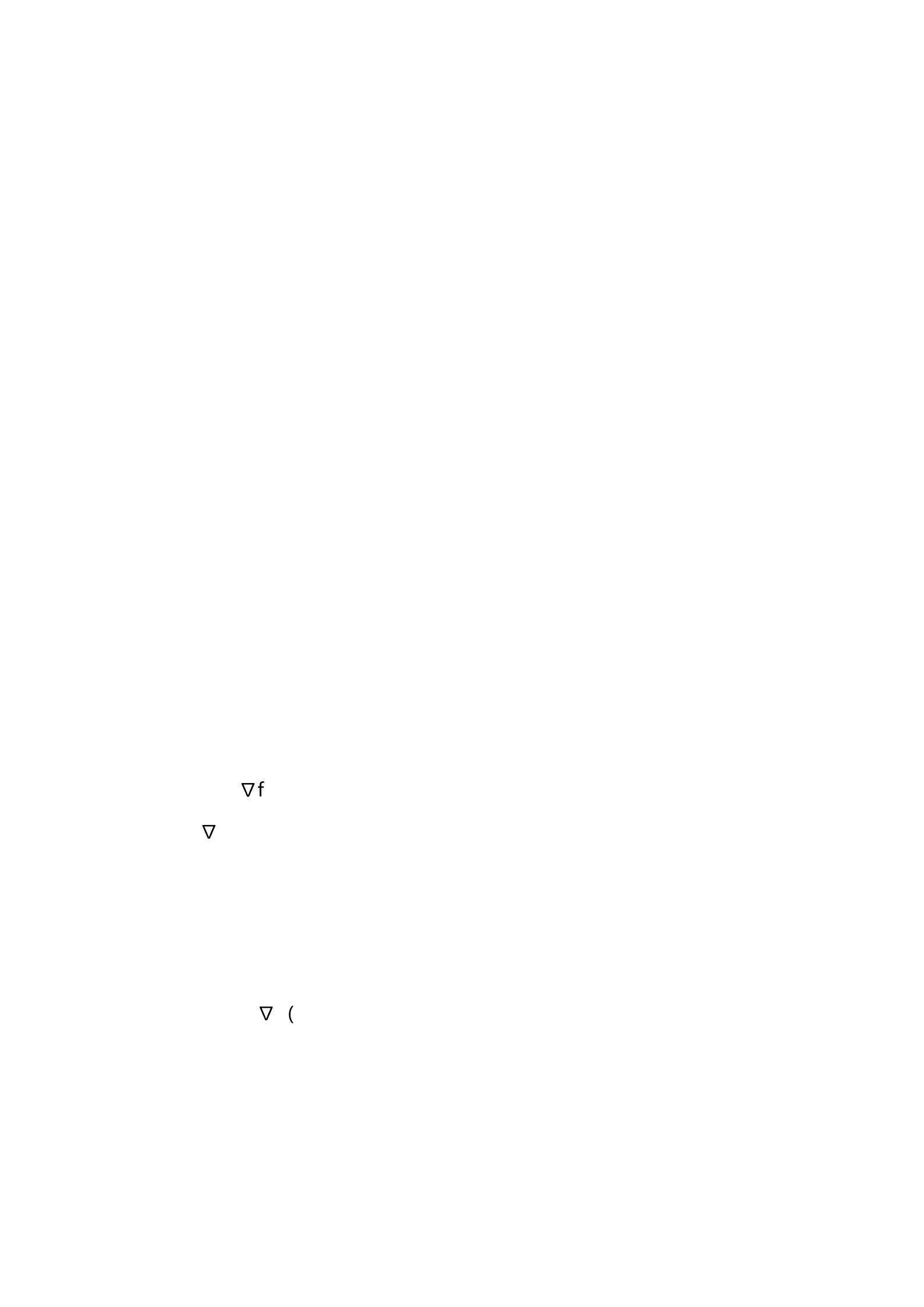
= 1 + h + h²/4 + 2 + (√3 h)/2 + h + (√3 h²)/4
= 3 + (2 + √3/2) h + [(1 + √3)/4] h²
Step 2: Calculate f (1 + h/2, 2 + (√3 h)/2) - f (1, 2):
f (1, 2) = 1² + 1×2 = 3
Difference = 3 + (2 + √3/2) h + [(1 + √3)/4] h² - 3 = (2 + √3/2) h + [(1 +
√3)/4] h²
Step 3: Substitute into the limit calculation:
Dᵤf (1, 2) = lim (h→0) [(2 + √3/2) h + [(1 + √3)/4] h²] /h
= lim (h→0) [2 + √3/2 + [(1 + √3)/4] h] = 2 + √3/2
Conclusion: The directional derivative of the function at the point (1, 2)
in the specified direction is 2 + √3/2 ≈ 2.866.
3.2 Using the dot product formula for gradients (efficient method)
Professor David Klein explained the formula for calculating the
directional derivative of differentiable functions, which is more concise
than the definition method and is one of the core focus points in the
Math 250 course.
3.2.1 Core Theorem
If the function z = f (x, y) is differentiable at the point (x, y) then the
directional derivative of the function in that point along any unit vector
u = (u₁, u₂) exists and is given by:
Dᵤf (x, y) =
∇
f (x, y)・u
where
∇
f (x, y) = (∂f/∂x, ∂f/∂y) is called the gradient (Gradient) of the
function f (x, y) and“・” denotes the dot product of vectors.
3.2.2 Generalization of the Formula (for a function of three variables)
For a differentiable function w = f (x, y, z), the directional derivative
along the unit vector u = (u₁, u₂, u₃) is:
Dᵤf (x, y, z) =
∇
f (x, y, z)・u = (∂f/∂x) u₁ + (∂f/∂y) u₂ + (∂f/∂z) u₃
3.2.3 Formula Proof (Binary Function)
Since the function f (x, y) is differentiable at the point (x, y) according to
the definition of differentiability:
f (x + Δx, y + Δy) - f (x, y) = (∂f/∂x)Δx + (∂f/∂y)Δy + o (√(Δx² + Δy²))
Let Δx = h・u₁,Δy = h・u₂(since u is a unit vector, √(Δx² + Δy²) =
h),then:
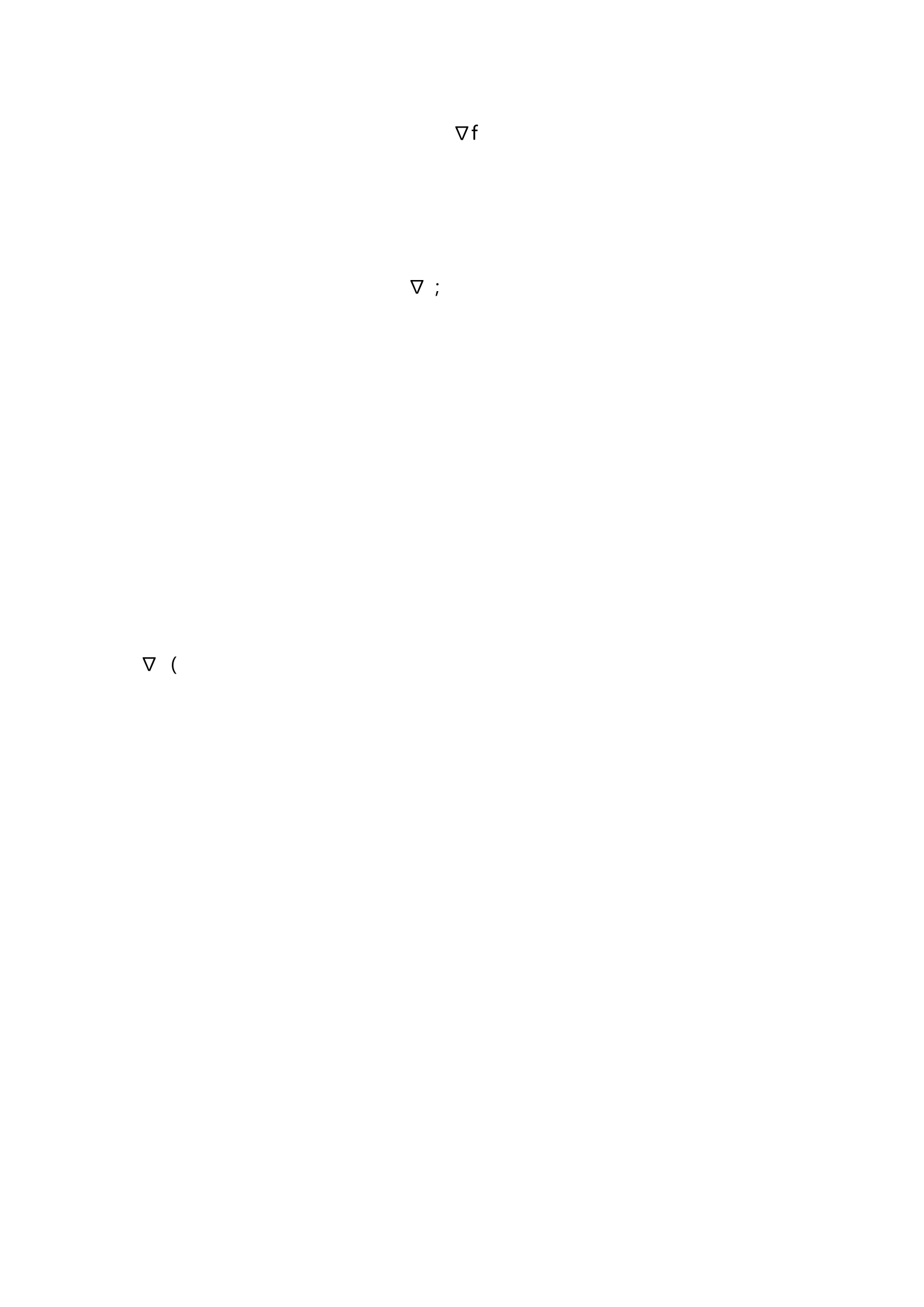
[f (x + h・u₁, y + h・u₂) - f (x, y)] /h = (∂f/∂x) u₁ + (∂f/∂y) u₂ + o (h)/h
As h→0 o (h)/h → 0, thus:
Dᵤf (x, y) = (∂f/∂x) u₁ + (∂f/∂y) u₂ =
∇
f・u
3.2.4 Steps for Applying the Formula
Calculate the partial derivatives ∂f/∂x, ∂f/∂y (or the three partial
derivatives of a ternary function);
Construct the gradient vector
∇
f;
Verify that the direction vector v is a unit vector; if not, normalize it to u
= v / v(vdenotes the magnitude of vector v );
Calculate the dot product of the gradient and the unit direction vector;
the result is the directional derivative.
Example 2: Recompute the directional derivative of Example 1 using the
gradient formula.
Solution: Step 1: Calculate the partial derivatives:
∂f/∂x = 2x + y,∂f/∂y = x
Step 2: Calculate the gradient at the point (1, 2) :
∇
f (1, 2) = (2×1 + 2, 1) = (4, 1)
Step 3: The direction vector u = (1/2, √3/2) is already a unit vector,
calculate the dot product:
Dᵤf (1, 2) = (4, 1)・(1/2, √3/2) = 4×(1/2) + 1×(√3/2) = 2 + √3/2
The result is consistent with the definition method, verifying the validity
of the formula.
Example 3: Let the function f (x, y, z) = xyz + x², find the directional
derivative of f (x, y, z) at the point (1, -1, 2) in the direction of the vector
v = (2, -1, 1) direction.
Solution: Step 1: Determine if the direction vector is a unit vector,
calculatev:
v = √(2² + (-1)² + 1²) = √(4 + 1 + 1) = √6 ≠ 1
Normalize the direction vector:
u = v / ||v|| = (2/√6, -1/√6, 1/√6)
Step 2: Calculate the partial derivatives:
∂f/∂x = yz + 2x,∂f/∂y = xz,∂f/∂z = xy
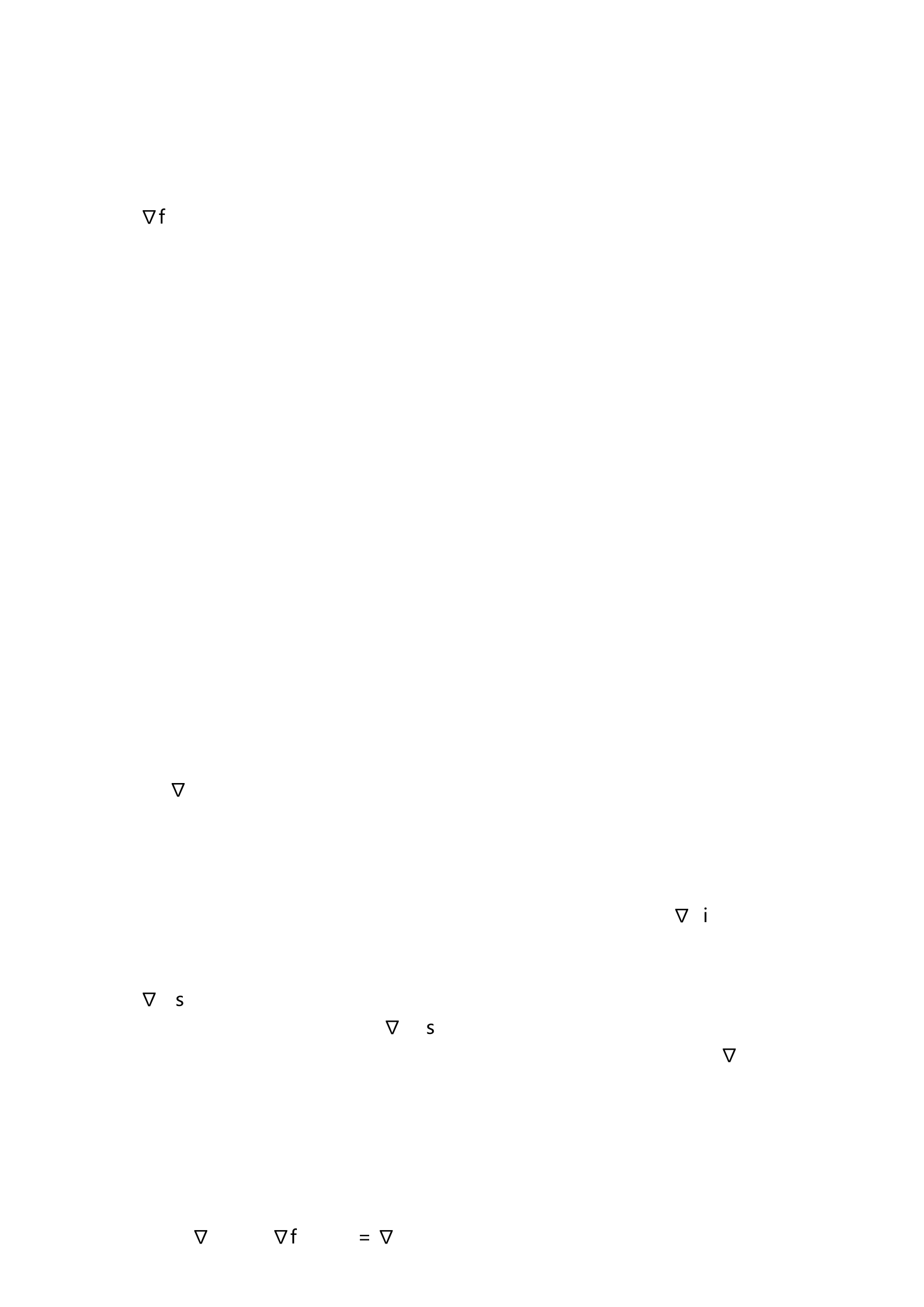
Step 3: Calculate the gradient at the point (1, -1, 2) :
∂f/∂x (1, -1, 2) = (-1)×2 + 2×1 = 0
∂f/∂y (1, -1, 2) = 1×2 = 2
∂f/∂z (1, -1, 2) = 1×(-1) = -1
∇
f (1, -1, 2) = (0, 2, -1)
Step 4: Calculate the dot product:
Dᵤf (1, -1, 2) = (0, 2, -1)・(2/√6, -1/√6, 1/√6)
= 0×(2/√6) + 2×(-1/√6) + (-1)×(1/√6)
= -3/√6 = -√6/2
Conclusion: The directional derivative of this ternary function at the
specified point in the specified direction is -√6/2 ≈ -1.225, and the
negative sign indicates that the function is monotonically decreasing in
that direction.
3.3 Special case simplification calculations
Along the positive direction of the coordinate axis: u = (1, 0) when, Dᵤf
= ∂f/∂x;u = (0, 1) when, Dᵤf = ∂f/∂y。
Along the negative direction of the coordinate axis: u = (-1, 0) when, Dᵤf
= -∂f/∂x;u = (0, -1) when, Dᵤf = -∂f/∂y。
Along the gradient direction: It will be shown later that the directional
derivative achieves its maximum value along the gradient direction,
i.e.,
∇
f (the magnitude of the gradient)。
Four, the relationship between directional derivatives and gradients
4.1 The Geometric Meaning of the Gradient
Professor David Klein emphasized in class that the gradient
∇
f is a
vector whose direction is the direction of the maximum rate of change
of the function f (x, y) at that point, and the magnitude of the gradient
∇
f is the value of this maximum rate of change; while the opposite
direction of the gradient (−
∇
f) is the direction of the minimum rate of
change of the function, with the minimum rate of change being -
∇
f.
4.2 Range of Directional Derivatives
From the properties of the dot product a・b = abcosφ(where φ is the
angle between vectors a and b ),for the directional derivative
formula:
Dᵤf =
∇
f・u =
∇
fucosφ =
∇
fcosφ
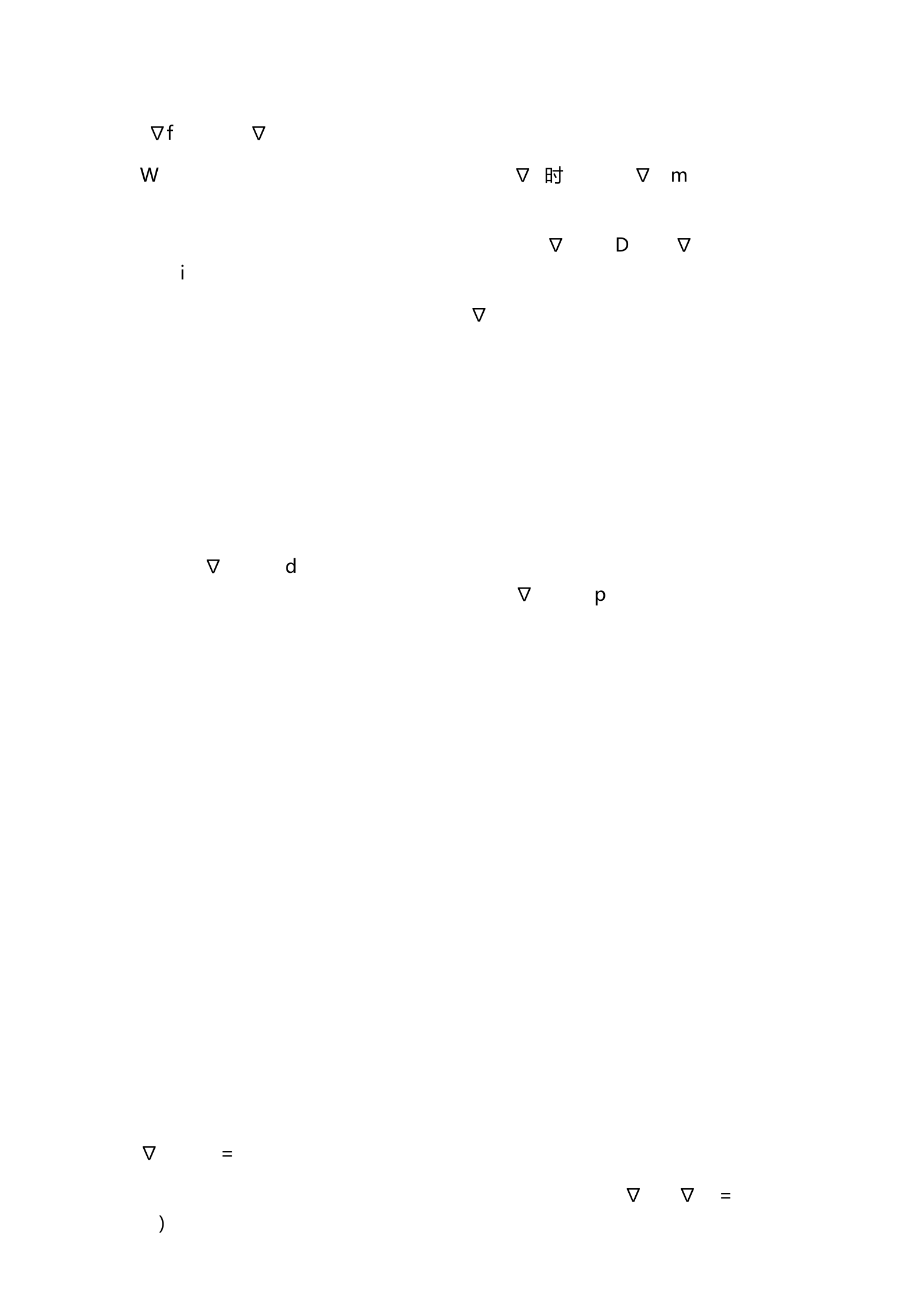
(Since u is a unit vector, u = 1).
Thus, the range of the directional derivative is:
-
∇
f ≤ Dᵤf ≤
∇
f
When φ = 0 (u is in the same direction as
∇
f)时,Dᵤf =
∇
f (maximum
value);
When φ = π (u is in the opposite direction to
∇
f)时,Dᵤf = -
∇
f
(minimum value);
When φ = π/2 (u is perpendicular to
∇
f), Du f = 0 (the function has no
change in this direction).
4.3 The Relationship Between the Gradient and Level Curves
For a binary function z = f (x, y), the equation of the level curve is f (x, y)
= C (C is a constant). Take the total differential of both sides of the level
curve equation:
(∂f/∂x) dx + (∂f/∂y) dy = 0
That is
∇
f・(dx, dy) = 0. Here, (dx, dy) is the tangent vector of the
contour line at that point, so the gradient
∇
f is perpendicular to the
tangent vector of the contour line, meaning the gradient direction is the
normal vector direction of the contour line.
Professor David Klein uses a topographic map analogy: contour lines
represent points of the same altitude, the gradient direction is
the“steepest uphill” direction, and the tangent direction of the contour
line is the“horizontal direction” (no altitude change), which is consistent
with the conclusion that the directional derivative is 0 when φ = π/2 .
Example 4: Let the function f (x, y) = x² - y², find:
(1)The gradient at the point (2, 1) ;
(2) The directional derivative of this point in the direction of the
gradient;
(3) The directional derivative of this point in the direction of the tangent
to the contour line.
Solution: (1) Calculate the gradient:
∂f/∂x = 2x, ∂f/∂y = -2y
∇
f (2, 1) = (2×2, -2×1) = (4, -2)
(2) The unit vector in the direction of the gradient u =
∇
f / ||
∇
f|| = (4,
-2) / √(4² + (-2)²) = (4, -2)/√20 = (2/√5, -1/√5)
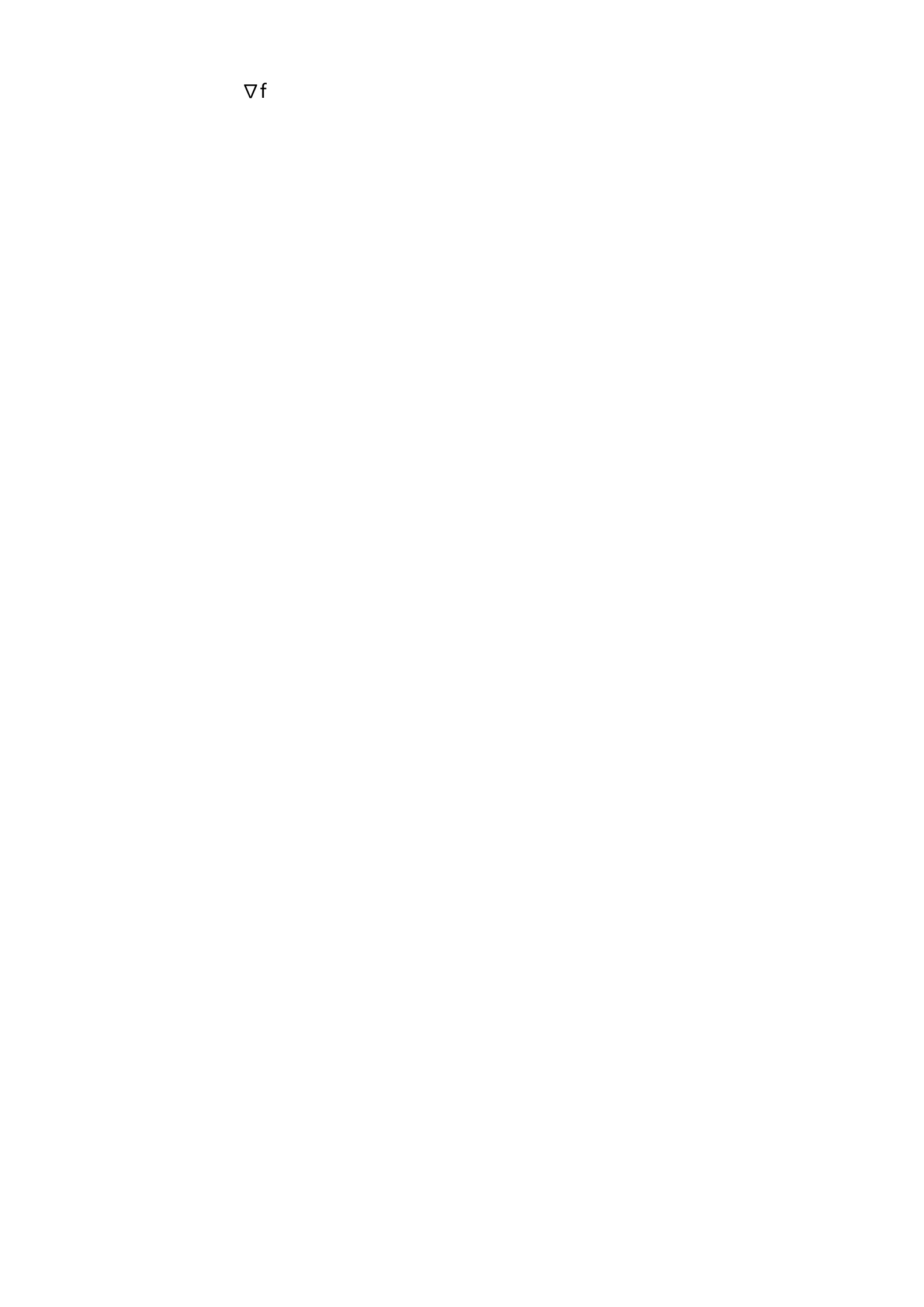
Directional derivative:
Dᵤf (2, 1) =
∇
f (2, 1) = √(4² + (-2)²) = √20 = 2√5
(3) The direction of the contour line is perpendicular to the gradient, so
the directional derivative is 0. 0.

