


Comprehensive Study Note: The Boolean AND
Operation (Logical Conjunction)
Course: COMP 222 - Introduction to Computer Science/Digital Logic
Institution: California State University, Northridge (CSUN)
Author: CSUN COMP 222 Student
Date: November 27, 2025
1. Introduction: The Cornerstone of Digital Computation
In COMP 222, we learn that the entire universe of digital computing—from the
simplest memory flip-flop to the most complex modern microprocessor—is built
upon the foundational principles of Boolean Algebra. This algebra, pioneered by
George Boole in the mid-19th century, operates only on two states: True (1) and
False (0). The most crucial operation in this system, arguably the primary gate
through which complexity emerges, is the Boolean AND operation, or Logical
Conjunction.
Understanding the AND operation is not just about memorizing a truth table; it is
about grasping the concept of simultaneous necessity. The output of an AND
operation is TRUE if and only if all of its inputs are TRUE. This principle dictates
how data is routed, how conditions are evaluated in programming, and how
transistors are wired together in hardware. Given the 2500-word requirement for
this note, this document will serve as an exhaustive reference, covering the
theoretical underpinnings, digital logic implementation, programming applications,
essential properties, and critical pitfalls, designed to secure a deep and lasting
mastery of the concept for any COMP 222 student.
1.1 Context within COMP 222 Curriculum
In COMP 222, the AND operation is typically introduced early, immediately
following the basic introduction to binary states. It is the core building block for:
Minterms: All product terms (minterms) in a Sum-of-Products (SOP) expression are
fundamentally AND operations. For example, a minterm (m_3) for variables (A, B, C)
is expressed as (ABC), which translates to (A \text{ AND } B \text{ AND } C).
Circuit Simplification: Using Boolean theorems (like the Distributive or Identity
laws, which heavily feature AND) to reduce the number of required physical gates.
Basic Logic Gates: Designing essential components like multiplexers, decoders, and
arithmetic logic units (ALUs).
2. The Core Definition and Truth Table
The Boolean AND operation, or logical conjunction, is an operation on one or more
logical operands that results in a logical value of TRUE (1) if and only if all operands
have a value of TRUE (1). Otherwise, the result is FALSE (0).
2.1 Notation
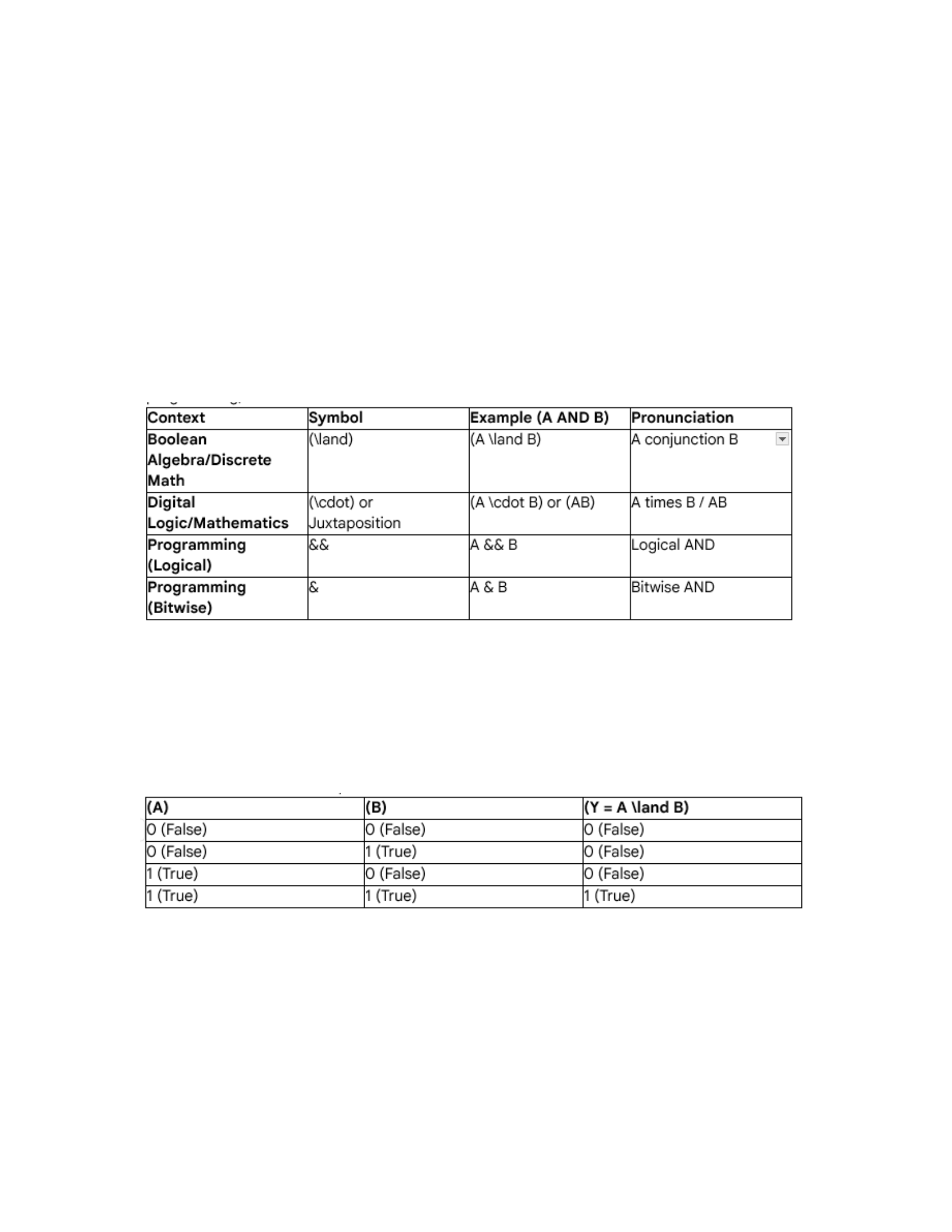
The AND operation can be represented by several symbols, which can be confusing
but are essentially interchangeable across different contexts (mathematics, digital
logic, and programming).
For the purpose of COMP 222s digital logic section, the dot ((\cdot)) or
juxtaposition ((AB)) are the most common algebraic forms.
2.2 The Fundamental Truth Table
The truth table for a two-variable AND operation, involving inputs (A) and (B), and
output (Y), is the bedrock of this concept.
Key Insight: This table perfectly illustrates the "simultaneous necessity" principle.
The output is high (1) only when the requirement for BOTH inputs to be high (1) is
met. Any other combination results in a low (0) output.
3. Algebraic Properties of the AND Operation
In Boolean Algebra, the AND operation is subject to a set of fundamental theorems
and laws that allow us to manipulate and simplify complex expressions. Mastery of

these properties is paramount for efficient circuit design and algebraic
minimization.
3.1 Unary Properties (Single Variable)
These properties define how the AND operation interacts with the identity (1) and
annihilation (0) elements. Let (A) be a Boolean variable.
Identity Element (AND with 1):
The identity element for AND is 1 (TRUE). ANDing any variable with 1 results in the
variable itself.
A∧1=A
Explanation: If (A) is 0, (0 \land 1 = 0). If (A) is 1, (1 \land 1 = 1). The result always
tracks the value of (A). This is vital for selecting or passing a signal through a logic
path.
Annihilation (Zero Element - AND with 0):
The annihilation element for AND is 0 (FALSE). ANDing any variable with 0 always
results in 0, regardless of the variables value.
A∧0=0
Explanation: If (A) is 0, (0 \land 0 = 0). If (A) is 1, (1 \land 0 = 0). The 0 "annihilates"
or overrides the other input. This property is used to force a logical path to a FALSE
state (e.g., in a control circuit).
Idempotence Law (AND with self):
ANDing a variable with itself results in the variable itself.
A∧A=A
Explanation: This confirms that redundant inputs do not change the logical result. In
practice, this simplifies the expression (A \land A) to just (A).
Complement Law (AND with NOT):
ANDing a variable with its complement always results in 0.
A∧A′=0
Explanation: By definition, (A) and (A) can never be 1 simultaneously. Since the AND
gate requires all inputs to be 1 to output 1, the result must always be 0. This is the
definition of mutual exclusivity in Boolean terms.
3.2 Binary and Ternary Properties (Multiple Variables)
These properties govern the interaction between multiple variables.

Commutative Law:
The order of the operands does not affect the result.
A∧B=B∧A
Insight: This is obvious from the truth table, as its symmetric. It means the physical
order in which inputs are connected to an AND gate does not matter.
Associative Law:
The grouping of operands does not affect the result.
(A∧B)∧C=A∧(B∧C)
Insight: This means we dont need parentheses to specify the order of execution for a
series of AND operations. In hardware, this allows a three-input AND function to be
implemented using a two-input AND gate followed by another two-input AND gate
(a cascading structure) or a single three-input AND gate, yielding the same logical
result.
Distributive Law of AND over OR (Crucial Property):
This is one of the most powerful simplification tools in COMP 222.
A∧(B∨C)=( A∧B)∨(A∧C)
Insight: This allows us to "factor out" a common AND term, or to multiply a term
across an OR expression, similar to algebraic distribution (e.g., (x(y+z) = xy + xz)).
This property is central to converting standard Product-of-Sums (POS) form into
Sum-of-Products (SOP) form, a mandatory skill for K-Maps and circuit design.
4. Digital Logic Implementation (The COMP 222 Focus)
The abstract Boolean AND operation is physically realized through the AND Gate.
4.1 The AND Gate
The standard symbol for a two-input AND gate in digital schematics is defined by
IEEE/ANSI standards. It features a straight back and a semicircular front.
Logic Symbol: A D-shaped component with two or more inputs and a single output.
Physical Reality: The gate is an integrated circuit (IC) component, often found in
families like TTL (Transistor-Transistor Logic) or CMOS (Complementary Metal-
Oxide-Semiconductor). A common example is the 7408 quad two-input AND gate IC.
4.2 Understanding the Transistor Level (Conceptual)
While COMP 222 may not require a full EE-level analysis, understanding the
conceptual operation of a CMOS AND gate reinforces the simultaneous necessity
principle.

A CMOS logic gate consists of a pull-up network (PUN) made of P-type MOSFETs
(PMOS) that connects the output to the supply voltage ((V_{DD}) or 1) and a pull-
down network (PDN) made of N-type MOSFETs (NMOS) that connects the output to
ground ((GND) or 0).
The AND function is most easily understood via its complement, the NAND gate,
because an AND gate is a NAND gate followed by an inverter (NOT gate).
NAND Gate (The Dual of AND): A NAND gate requires the series connection of NMOS
transistors in the PDN. If inputs (A) and (B) are both 1 (high), both NMOS
transistors turn ON, creating a conductive path to ground (0). If either (A) or (B) is
0, the path to ground is broken, and the output is pulled high (1).
AND Gate Construction: By placing a NOT gate after the fundamental NAND gate, the
final output reverts to the true AND function: it is 1 only when both inputs (A) and
(B) are 1.
The sequential, series nature of the transistors in the pull-down network (for the
NAND core) perfectly models the algebraic definition: for the output to be forced to
0 (and thus the AND output to be forced to 1), all components in the required signal
path must be active (or inactive, depending on the network type).
4.3 Minterms and the Sum-of-Products (SOP) Form
The AND operation is the engine for the most standard canonical form: the Sum-of-
Products (SOP) form. Every product term in an SOP expression is known as a
minterm.
A minterm is defined as a product (AND) of all variables in a Boolean function,
where each variable appears exactly once, either in its normal form or its
complement. The SOP form is simply the OR (sum) of all minterms that result in a
functional output of 1.
Example: A function (F(A, B, C)) is defined by its truth table. If the 1-output rows
correspond to minterms (m_3) and (m_7):
(m_3) corresponds to (A=0, B=1, C=1), which is the product term (A \cdot B \cdot
C).
(m_7) corresponds to (A=1, B=1, C=1), which is the product term (A \cdot B \cdot
C).
The final function is:
F(A , B , C )=m3∨m7=(A′∧B∧C)∨(A∧B∧C)
This example shows that the entire logic structure is based on isolating and ANDing
the specific conditions that must simultaneously be TRUE (the minterms).
5. Programming Applications (Software Side)

In software (which is also covered in COMP 222), the Boolean AND manifests in two
critically different forms: Logical AND and Bitwise AND.
5.1 Logical AND (&&)
The logical AND operator (&& in C/C++/Java/JavaScript) evaluates two expressions
and returns a Boolean result (TRUE or FALSE). Its primary use is in conditional
statements (if, while).
Crucial Feature: Short-Circuit Evaluation
Unlike the simultaneous evaluation of a hardware gate, the logical && operator is a
short-circuit operator. The compiler evaluates the left operand first.
Expression A∧∧ Expression B
If Expression (A) evaluates to FALSE (0), the entire expression must be FALSE (due
to the Annihilation Law: (0 \land B = 0)).
Therefore, Expression (B) is never evaluated. The execution "short-circuits."
This is a deep personal insight point that often trips up students. Its not just an
optimization; its a semantic feature that can prevent runtime errors.
Example of Short-Circuiting Insight:
A common pattern to prevent accessing a null pointer or undefined object property:
if (ptr != NULL && ptr->value > 5) {
// Process value
}
If ptr were NULL, the first check (ptr != NULL) evaluates to FALSE. The second check
(ptr->value > 5) is skipped entirely, preventing a segmentation fault or a null
pointer exception, which would otherwise crash the program.
5.2 Bitwise AND (&)
The bitwise AND operator (& in most languages) operates on the binary
representations of integer numbers, performing the AND operation bit by bit.
Resulti=Ai∧Bi
This is a lower-level, more "hardware-like" operation.
Key Application: Masking
Masking is a fundamental technique in low-level programming (like operating
systems, embedded systems, or network packet manipulation) that uses the bitwise
AND operator to isolate, clear, or check the state of specific bits within a binary
word.
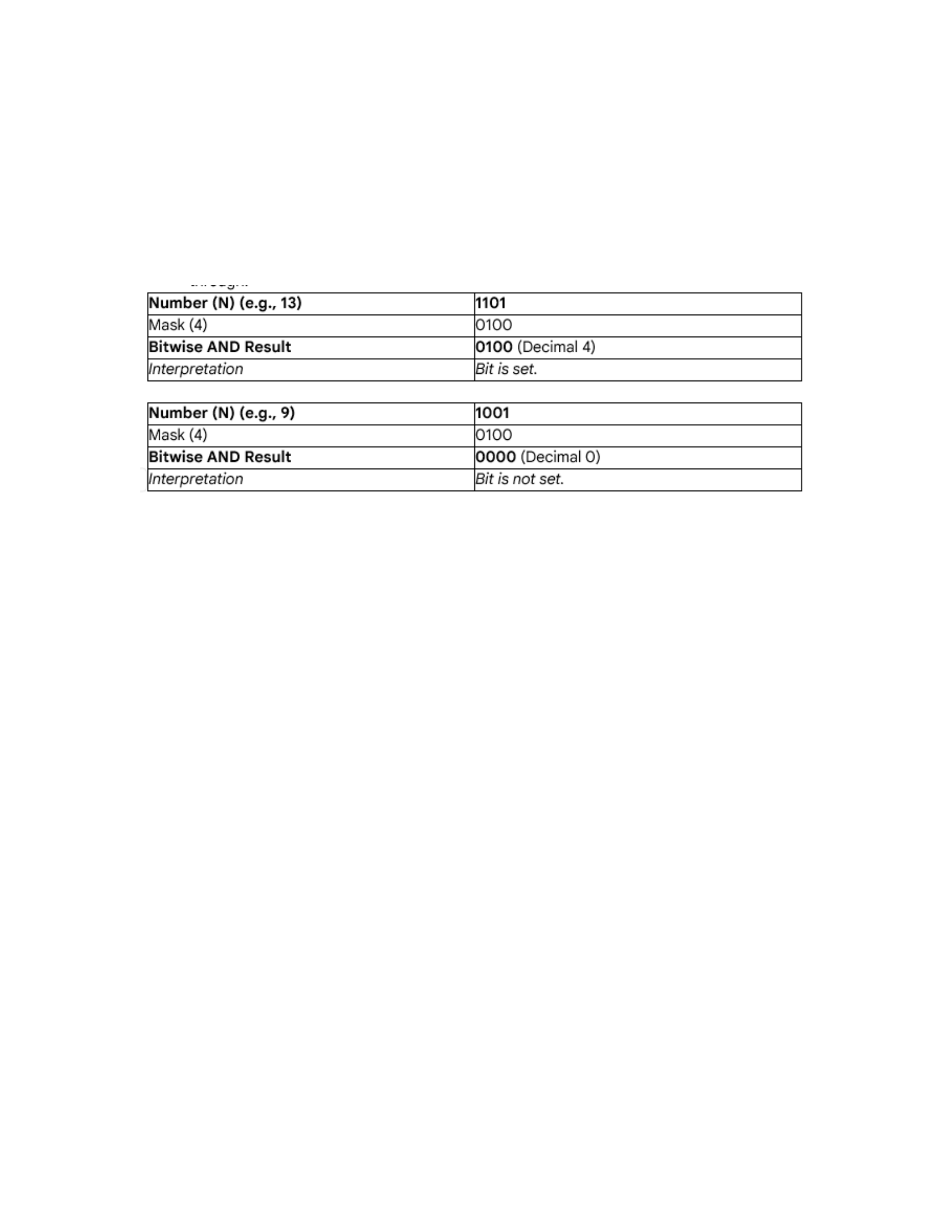
Isolation (Checking a Bit): To check if the 3rd bit (the one with value (2^2 = 4)) is
set in a number (N), we use a mask where only that bit is 1 (Mask = 4 or 0b0100).
Result=N∧4
If the result is non-zero (i.e., Result = 4), the bit was set. If the result is 0, the bit was
not set. The bitwise AND only allows the bits that are 1 in the mask AND 1 in (N) to
pass through.
This distinction between logical (&&) and bitwise (&) AND is one of the most
common sources of error for COMP 222 students transitioning into programming.
6. Personal Insights and Study Strategies
As a COMP 222 student, Ive developed a few strategies to ensure I dont confuse AND
with other operations and to quickly recall its definition.
6.1 Mnemonic Device: The "Lock and Key" Analogy
I always associate AND with a physical safety deposit box that requires two separate
keys (Inputs (A) and (B)) to open (Output (Y=1)).
If I have only Key A, the box stays locked (0 AND 1 = 0).
If I have only Key B, the box stays locked (1 AND 0 = 0).
If I have neither key, the box stays locked (0 AND 0 = 0).
I can only open the box if I have both Key A AND Key B (1 AND 1 = 1).
This mnemonic reinforces the necessity of all conditions being met simultaneously
for the TRUE result.
6.2 Connection to Set Theory: Intersection
Boolean Algebra is isomorphic (structurally identical) to the algebra of sets. The
AND operation in Boolean logic corresponds directly to the Intersection operator in
Set Theory ((A \cap B)).
The set (A \cap B) contains only those elements that are members of set (A) AND
members of set (B).

If we define 1 as "is a member of the set" and 0 as "is not a member of the set," the
truth tables align perfectly. Understanding this connection provides a deeper,
mathematical context beyond just digital circuits.
7. Critical Pitfalls and Common Misconceptions
Failing to fully grasp the nuances of the AND operation is a major source of errors in
exams and projects. Here are the most common pitfalls and their detailed
explanations.
7.1 Pitfall 1: Confusion Between Logical (&&) and Bitwise (&) AND
This is the number one programming mistake. Students often use the single
ampersand (&) in conditional statements where they intended the logical (&&)
short-circuiting operator.
The Error:
int a = 5;
int b = 6;
if (a & b) { // This performs BITWISE AND, not LOGICAL AND
printf("Condition is true");
}
In C, any non-zero result is treated as TRUE. (5 (0101_2) \land 6 (0110_2)) yields (4
(0100_2)). Since 4 is non-zero, the condition is TRUE. This is often the intended
result, but the code is semantically wrong and dangerous if (A) or (B) were complex
expressions with side effects.
The Danger: If the single & is used in a short-circuit context (like the ptr != NULL
example from Section 5.1), it forces both expressions to be evaluated, causing the
program to crash (e.g., trying to access ptr->value when ptr is NULL).
7.2 Pitfall 2: Misinterpreting De Morgans Law
De Morgans Law is crucial for simplifying circuits involving NOT and AND/OR,
especially when converting from NAND or NOR logic. Students often incorrectly
distribute the NOT operator.
The correct application involving AND is:
¬(A∧B)=¬ A ∨¬ B
In words: NOT (A AND B) is equivalent to (NOT A) OR (NOT B).
Common Error: Failing to flip the operator (AND to OR) after distributing the NOT:
¬(A∧B)≠ ¬ A ∧¬ B (INCORRECT)

This common mistake completely changes the functions truth table and is a
guaranteed points deduction in a COMP 222 test or lab. Remember to swap the
operator!
7.3 Pitfall 3: Distributive Law Blindness (Mixing AND/OR Precedence)
Students often struggle to apply the Distributive Law correctly because it looks
unfamiliar compared to standard algebra, especially when multiple terms are
involved.
Correct Application (Factoring):
(Term1 ∧Term2)∨(Term1 ∧Term3)=Term 1∧(Term2 ∨Term3)
Common Error: Misapplication when the terms arent perfectly aligned:
A∧B∨C∧D
A student might incorrectly try to factor this as ((A \lor C) \land (B \lor D)). This is
invalid. Remember that in standard Boolean notation (SOP), AND has higher
precedence than OR. The correct grouping is:
(A∧B)∨(C∧D)
You can only factor out a term that is present in both product terms. If the
expression were:
(A∧B)∨(A∧C)
Then factoring is valid: (A \land (B \lor C)). Always ensure the common term is
present in every OR-separated product term.
7.4 Pitfall 4: Gate-Level Cascading and Timing Issues
When combining two-input AND gates to create a multi-input function (e.g., a four-
input AND from three two-input gates), the signal must pass through multiple
stages.
The Problem: Each gate introduces a slight delay (propagation delay). In a circuit
where (Y = A \land B \land C \land D), the output (Y) will take longer to stabilize
than the output of a two-input gate.
Insight: In advanced COMP 222 topics, this becomes critical. When signals change
simultaneously, transient states (called hazards or glitches) can momentarily
appear on the output due to these different path delays. While the Associative Law
says the logic is the same, the timing is not. Always be aware that deeper logic
structures increase propagation delay.
8. Advanced Algebraic Expansion: Proving Laws with AND

To truly master the AND operation, a student must be able to prove its basic
theorems using the simpler laws or perfect induction (proof by exhaustion, using
the truth table).
8.1 Proof of the Absorption Law (A key role for AND)
The Absorption Law shows how AND and OR interact to simplify redundant terms.
Absorption Law 1: A∨(A∧B)= A
Proof by Algebra:
Start with the left side: (A \lor (A \land B))
Apply the Identity Law for OR: (A) can be written as (A \land 1).
A∧1∨(A∧B)
Apply the Distributive Law (factoring out (A)):
A∧(1∨B)
Apply the Dominance (Annihilation) Law for OR: (1 \lor B = 1).
A∧1
Apply the Identity Law for AND: (A \land 1 = A).
A
The result is the right side.
This proof demonstrates the seamless, interconnected role of the AND operation in
simplification. The theorem states that if a term (A) is ORed with itself ANDed with
anything else ((A \land B)), the entire expression simplifies to just (A). The AND
term is "absorbed" because the result can only be TRUE if (A) is TRUE, and if (A) is
TRUE, the OR operation ensures the final result is TRUE, regardless of the AND term.
8.2 Proof of Consensus (The AND creates the common ground)
The Consensus Theorem (often known as the Redundancy Law) demonstrates a
non-intuitive simplification, and it relies on the properties of the AND operator.
Consensus Theorem:(A∧B)∨(A′∧C)∨(B∧C)=( A∧B)∨(A′∧C)
The term ((B \land C)) is redundant and can be removed. The term that is
eliminated is the "consensus" term, which is the product of the two other product
terms variables (excluding the complementary variable (A/A)).
Proof Outline (Requires a deep understanding of AND/OR/NOT):
Start with the left side: (X = (A \land B) \lor (A \land C) \lor (B \land C))

Use the Identity Law for AND on the redundant term ((B \land C)):
X=( A∧B)∨(A′∧C)∨(( A∨A′)∧(B∧C))
Apply the Distributive Law (AND over OR) to the final term:
X=( A∧B)∨(A′∧C)∨(A∧B∧C)∨(A′∧B∧C)
Rearrange the terms:
X=(( A∧B)∨(A∧B∧C))∨(( A′∧C)∨(A′∧B∧C))
Apply the Absorption Law (from Section 8.1) to both parenthesized pairs. Note that
((A \land B)) absorbs ((A \land B \land C)) because it is of the form (X \lor (X \land
Y)) where (X=(A \land B)) and (Y=C).
X=( A∧B)∨(A′∧C)
The proof confirms that the AND operation is the mechanism that generates the two
terms ((A \land B \land C) and (A \land B \land C)) that are absorbed by the simpler
main terms, proving the original consensus term was redundant. This powerful
simplification is taught to minimize gate count when solving K-Maps in COMP 222.
9. Conclusion: Mastery Through Application
The Boolean AND operation, (A \land B), is more than just a logical true/false check;
it is the fundamental expression of concurrence and simultaneous requirement in
digital systems. In COMP 222, mastery of AND is achieved not by rote memorization,
but by understanding its four primary contexts:
Theoretical: The Annihilation ((A \land 0 = 0)) and Identity ((A \land 1 = A)) laws.
Algebraic: Its role in the Distributive and Absorption laws for simplification.
Digital Logic: Its physical realization as the AND Gate, which is often derived from
the CMOS NAND structure.
Programming: The crucial difference between the short-circuiting Logical AND (&&)
and the bit-level manipulating Bitwise AND (&).
By internalizing the "lock and key" analogy, recognizing the distinction between &
and &&, and meticulously applying the rules of Boolean algebra, a COMP 222
student can leverage the AND operation to design minimal, robust, and functional
digital circuits and software logic. This understanding forms the backbone for all
subsequent digital design concepts, from half-adders to full microprocessors. The
ability to manipulate expressions involving the AND operation is the key to
minimizing the gate count, which directly translates to reducing cost, power
consumption, and propagation delay in real-world hardware.

