


California State University, Northridge - Northridge, CA
Course Name: Calculus III (Math 250)
Professor Name: Dr. Michael Johnson
Assignment Title: 3D Coordinate System Comprehensive Homework
Submission Date: August 01, 2025
3D Coordinate System - Key Concepts
1. Basic Concepts and Coordinate Systems
1.1 Coordinate System Definitions
• R³ Coordinate System: A three-dimensional coordinate system with x, y, and z
axes
• Notation: R (1D), R² (2D), R³ (3D), Rⁿ (n-dimensional)
• Octants: The 3D coordinate system is divided into 8 octants by the coordinate
planes, with the first octant having positive x, y, and z coordinates
1.2 Coordinate Planes
• Definition: Planes formed by two coordinate axes intersecting at right angles
• Equations:
xy-plane: z = 0 (all points have z-coordinate 0)◦
yz-plane: x = 0 (all points have x-coordinate 0)◦
xz-plane: y = 0 (all points have y-coordinate 0)◦
1.3 Projections of Points
• Definition: The perpendicular projection of a point onto a coordinate plane
• Projection Rules:
Projection onto xy-plane: (x, y, 0)◦
Projection onto yz-plane: (0, y, z)◦
Projection onto xz-plane: (x, 0, z)◦
2. Distance and Midpoint Formulas
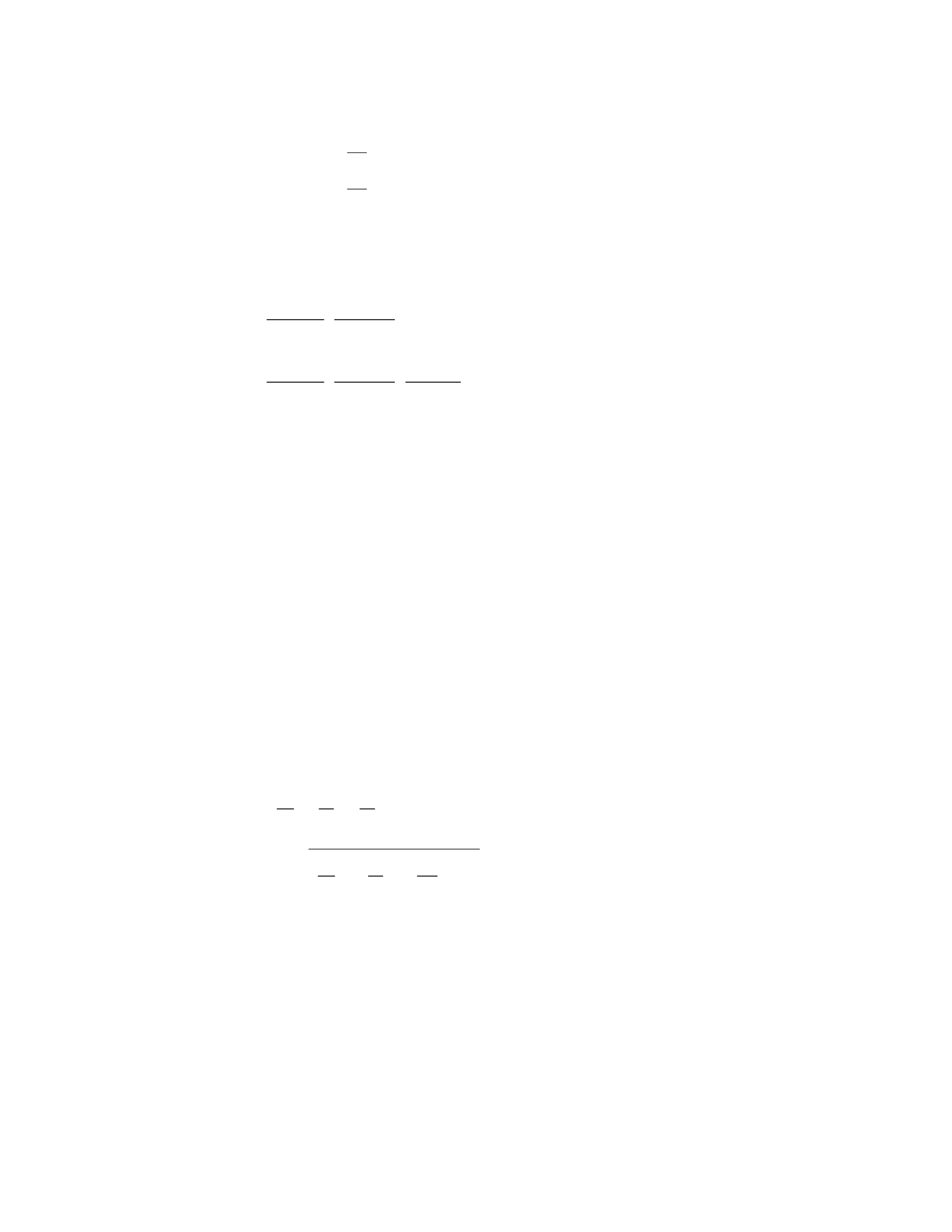
2.1 Distance Between Two Points
• In R²:
d(P1, P 2)=
√
¿¿
• In R³:
d(P1, P 2)=
√
¿¿
• Properties: Distance is non-negative, zero only when points coincide
2.2 Midpoint Coordinates
• In R²:
M
(
x1+x2
2,y1+y2
2
)
• In R³:
M
(
x1+x2
2,y1+y2
2,z1+z2
2
)
• Property: The midpoint is equidistant from both endpoints
3. Sphere Equations
3.1 Standard Form
• Equation: 2
¿
• Parameters: (h,k,l) = center coordinates, r = radius
• Special Case: Sphere centered at origin: 2
x2+y2+z2=r2
3.2 General Form
• Equation:
x2+y2+z2+Dx+Ey +Fz+G=0
• Conversion to Standard Form: Complete the square for x, y, and z terms
• Center and Radius:
Center: ◦
(
−D
2,− E
2, − F
2
)
Radius: ◦2
r=
√
(
D
2
)
2
+
(
E
2
)
2
+
(
F
2
)
2
−G
4. Graphs of Equations in Different Coordinate Systems
4.1 1D Coordinate System (R)
• Characteristics: Single coordinate axis
• Graph of Equation: A point (e.g., x=3 represents a single point)

4.2 2D Coordinate System (R²)
• Characteristics: Two coordinate axes (x,y)
• Graph of Equation: A curve (e.g., x=3 represents a vertical line)
• Common Graphs: Lines, circles, parabolas, ellipses, hyperbolas
4.3 3D Coordinate System (R³)
• Characteristics: Three coordinate axes (x,y,z)
• Graph of Equation: A surface (e.g., x=3 represents a plane parallel to yz-plane)
• Common Surfaces: Planes, cylindrical surfaces, spheres
5. Common Surfaces and Their Equations
5.1 Planes
• Characteristics: First-degree equations, may lack one or two variables
• Examples: x=a (plane parallel to yz-plane), ax+by+cz=d (general plane
equation)
5.2 Cylindrical Surfaces
• Characteristics: Second-degree equations, lack one variable
• Examples:
x2+y2=r2
(circular cylinder with z-axis)
3D Coordinate System - Exercise Set
Part 1: Basic Concept Questions (40 questions)
1.1 Question: Which equation represents the yz-plane?
A. x=0
B. y=0
C. z=0
D. x+y+z=0
Solution: The yz-plane consists of all points where the x-coordinate is 0.
Answer: A
1.2 Question: What does the equation z=5 represent in 3D coordinate system?
A. A point
B. A line

C. A plane
D. A sphere
Solution: In 3D coordinates, an equation missing x and y variables represents a
plane parallel to the xy-plane.
Answer: C
1.3 Question: Which point lies on the xz-plane?
A. (1, 2, 3)
B. (0, 5, 6)
C. (7, 0, 8)
D. (7, 8, 0)
Solution: Points on the xz-plane have y-coordinate 0.
Answer: C
1.4 Question: How many octants divide the 3D coordinate system?
A. 4
B. 6
C. 8
D. 12
Solution: The three coordinate planes (xy, yz, xz) divide 3D space into 8 octants.
Answer: C
1.5 Question: On which coordinate plane do all points have z-coordinate 0?
A. xy-plane
B. yz-plane
C. xz-plane
D. All coordinate planes
Solution: The xy-plane is defined as the set of all points with z-coordinate 0.
Answer: A
1.6 Question: What does the equation x+y=1 represent in 3D coordinate
system?
A. A line

B. A plane
C. A cylindrical surface
D. A sphere
Solution: In 3D coordinates, a linear equation missing the z-variable represents
a plane.
Answer: B
1.7 Question: What is the distance from point (3, 4, 5) to the xy-plane?
A. 3
B.4
C. 5
D. Cannot be determined
Solution: The distance from a point to the xy-plane equals the absolute value of
its z-coordinate, .
Answer: C
1.8 Question: Which plane contains the z-axis?
A. x=0
B. y=1
C. z=0
D. x+y=0
Solution: The plane x=0 (yz-plane) contains the entire z-axis.
Answer: A
1.9 Question: What does equation
x2+y2=1
represent in R³ coordinate system?
A. A circle
B. A sphere
C. A cylindrical surface
D. A cone
Solution: In 3D coordinates, a circle equation missing the z-variable represents
a cylindrical surface.
Answer: C

1.10 Question: Which point lies on two coordinate planes simultaneously?
A. (1, 2, 3)
B. (0, 4, 5)
C. (6, 0, 0)
D. (7,, 8, 0)
Solution: Point (6,, 0, 0) has both y and z coordinates zero, lying on both xz-
plane and xy-plane.
Answer: C
2.1 Question: What are the coordinates of the projection of point P(2, -3, 4)
onto the xy-plane?
A. (2, -3, 0)
B. (0, -3, 4)
C. (2, 0, 4)
D. (0, 0, 4)
Solution: The projection onto the xy-plane has z-coordinate 0, while x and y
coordinates remain unchanged.
Answer: A
2.2 Question: What are the coordinates of the projection of point Q(-1, 5, -2)
onto the yz-plane?
A. (-1, 5, 0)
B. (0, 5, -2)
C. (-1, 0, -2)
D. (0, 0, -2)
Solution: The projection onto the yz-plane has x-coordinate 0, while y and z
coordinates remain unchanged.
Answer: B
2.3 Question: What are the coordinates of the projection of point R(0, -4, -7)
onto the xz-plane?
A. (0, -4, 0)
B. (0, 0, -7)

C. (0, -4, -7)
D. (0, 0, 0)
Solution: The projection onto the xz-plane has y-coordinate 0. Since point R
already has x-coordinate 0, the projection is (0, 0, -7).
Answer: B
2.4 Question: On which coordinate plane does point S(3, 0, 5) lie?
A. xy-plane
B. yz-plane
C. xz-plane
D. Not on any coordinate plane
Solution: Point S has y-coordinate 0, so it lies on the xz-plane.
Answer: C
2.5 Question: What is the distance from point T(2, 3, 4) to the xy-plane?
A. 2
B. 3
C. 4
D. 5
Solution: The distance from a point to the xy-plane equals the absolute value of
its z-coordinate, .
Answer: C
2.6 Question: In which quadrant does the projection of point (5, -5, 5) onto the
xy-plane lie?
A. First quadrant
B. Second quadrant
C. Third quadrant
D. Fourth quadrant
Solution: The projection is (5, -5, 0) with x>0, y<0, which lies in the fourth
quadrant.
Answer: D

2.7 Question: What is the distance between the projections of point (a, b, c)
onto the yz-plane and xz-plane?
A.
√
a2+b2
B.
√
a2+c2
C.
√
b2+c2
D. a-b
Solution: The projections are (0, b, c) and (a, 0, c). The distance between them is
√
¿¿
.
Answer: A
2.8 Question: What is the distance between the projection of point (1, 2, 3) onto
the xy-plane and its projection onto the yz-plane?
A.
√
5
B.
√
10
C.
√
13
D. 5
Solution: The projections are (1, 2, 0) and (0, 2, 3). The distance is
√
¿¿
.
Answer: B
2.9 Question: Which projection of point P(x, y, z) cannot have all positive
coordinates?
A. Projection onto xy-plane
B. Projection onto yz-plane
C. Projection onto xz-plane
D. All projections can have positive coordinates
Solution: The projection onto the yz-plane has x-coordinate 0, so it cannot have
all positive coordinates.
Answer: B
2.10 Question: What is the distance from point (2, 3, 4) to its projection onto
the xz-plane?
A. 2
B. 3

C. 4
D. 5
Solution: The distance equals the absolute value of the y-coordinate, .
Answer: B
3.1 Question: What does the equation x=2 represent in a 1D coordinate system
(R)?
A. A point
B. A line
C. A plane
D. Cannot be represented
Solution: In a 1D coordinate system, any equation represents a single point.
Answer: A
3.2 Question: What does the equation x=2 represent in a 2D coordinate system
(R²)?
A. A point
B. A line
C. A plane
D. A surface
Solution: In a 2D coordinate system, x=2 represents a vertical line.
Answer: B
3.3 Question: What does the equation x=2 represent in a 3D coordinate system
(R³)?
A. A point
B. A line
C. A plane
D. A surface
Solution: In a 3D coordinate system, x=2 represents a plane parallel to the yz-
plane.
Answer: C
3.4 Question: What does the equation y=x represent in R² coordinate system?

A. A point
B. A line
C. A plane
D. A surface
Solution: In a 2D coordinate system, y=x represents a straight line with slope 1.
Answer: B
3.5 Question: What does the equation y=x represent in R³ coordinate system?
A. A line
B. A plane
C. A cylindrical surface
D. A cone
Solution: In a 3D coordinate system, a linear equation missing the z-variable
represents a plane.
Answer: B
3.6 Question: What does the equation
x2+y2=4
represent in R² coordinate
system?
A. A point
B. A line
C. A circle
D. An ellipse
Solution: In a 2D coordinate system,
x2+y2=4
represents a circle with center at
the origin and radius 2.
Answer: C
3.7 Question: What does the equation
x2+y2=4
represent in R³ coordinate
system?
A. A circle
B. A sphere
C. A cylindrical surface
D. A cone

Solution: In a 3D coordinate system, a circle equation missing the z-variable
represents a cylindrical surface.
Answer: C
3.8 Question: What does the equation
x2+y2+z2=4
represent in R³ coordinate
system?
A. A circle
B. A sphere
C. A cylindrical surface
D. A cube
Solution: This is the standard equation of a sphere with center at the origin and
radius 2.
Answer: B
3.9 Question: What does the equation z=0 represent in R³ coordinate system?
A. The origin
B. The x-axis
C. The xy-plane
D. The entire space
Solution: The equation z=0 represents the xy-plane.
Answer: C
3.10 Question: What does the equation
x2=4
represent in R³ coordinate
system?
A. Two points
B. Two lines
C. Two planes
D. A cylindrical surface
Solution: In R³,
x2=4
is equivalent to x=2 or x=-2, representing two planes
parallel to the yz-plane.
Answer: C
Part 2: Calculation Questions (30 questions)
4.1 Question: Calculate the distance between points A(1, 2, 3) and B(4, 6, 8).

Solution: Using the distance formula in 3D space:
d(A , B)=
√
¿¿
Answer:
5
√
2
(or approximately 7.07)
4.2 Question: Calculate the distance between points C(-1, 3, -2) and D(2, -1, 5).
Solution: Applying the distance formula:
d(C , D)=
√
¿¿
Answer:
√
74
(or approximately 8.60)
4.3 Question: Calculate the distance between points E(0, 0, 0) and F(3, 4, 12).
Solution: This is the distance from the origin to point (3, 4, 12):
d(E , F)=
√
¿¿
Answer: 13
4.4 Question: Calculate the distance between points G(5, -5, 5) and H(-5, 5, -5).
Solution: Applying the distance formula:
d(G , H)=
√
¿¿
Answer:
10
√
3
(or approximately 17.32)
4.5 Question: Calculate the distance between points I(2, 3, 4) and J(2, 3, 10).
Solution: Notice that x and y coordinates are identical, so the distance is
determined solely by the z-coordinate difference:
d(I , J )=
√
¿¿
Answer: 6
4.6 Question: Calculate the distance between points K(1, 2, 3) and L(4, 2, 7).
Solution: y-coordinates are identical, simplifying the distance calculation:
d(K , L)=
√
¿¿
Answer: 5
4.7 Question: The distance between points M(a, b, c) and N(d, e, f) is 5. If the x-
coordinates of both points are increased by 2, what is the new distance?
Solution: Increasing both x-coordinates by the same value doesnt change the
difference between them, so the distance remains unchanged:
d(M′, N′)=
√
¿¿

Answer: 5
4.8 Question: Calculate the distance between points O(1, -2, 3) and P(-4, 5, -6).
Solution: Applying the distance formula:
d(O , P)=
√
¿¿
Answer:
√
155
(or approximately 12.45)
4.9 Question: Calculate the distance between points Q(2, 2, 2) and R(5, 6, 10).
Solution: Applying the distance formula:
d(Q , R)=
√
¿¿
Answer:
√
89
(or approximately 9.43)
4.10 Question: Calculate the distance between points S(0, 0, 0) and T(1, 1, 1).
Solution: Distance from origin to (1,1,1):
d(S , T )=
√
¿¿
Answer:
√
3
(or approximately 1.73)
5.1 Question: Find the midpoint coordinates between points A(1, 2, 3) and B(5,
6, 7).
Solution: Applying the midpoint formula:
M
(
1+5
2,2+6
2,3+7
2
)
=M(3,4,5)
Answer: (3, 4, 5)
5.2 Question: Find the midpoint coordinates between points C(-1, 3, -2) and
D(3, -1, 4).
Solution: Applying the midpoint formula:
M
(
−1+3
2,3+(−1)
2,−2+4
2
)
=M(1,1,1)
Answer: (1, 1, 1)
5.3 Question: Point E(2, 4, 6) is the midpoint between points F(0, 2, 4) and G.
Find the coordinates of point G.
Solution: Let G(x, y, z). Then:
0+x
2=2⇒x=4

2+y
2=4⇒y=6
4+z
2=6⇒z=8
Thus, G(4, 6, 8)
Answer: (4, 6, 8)
5.4 Question: Find the midpoint coordinates between points H(1, 2, 3) and I(1,
2, 9).
Solution: x and y coordinates are identical, so we only need to average the z-
coordinates:
M
(
1,2,3+9
2
)
=M(1,2,6)
Answer: (1, 2, 6)
5.5 Question: Find the midpoint coordinates between points J(0, 0, 0) and K(10,
-10, 10).
Solution: Applying the midpoint formula:
M
(
0+10
2,0+(−10)
2,0+10
2
)
=M(5,− 5,5)
Answer: (5, -5, 5)
6.1 Question: Write the equation of a sphere with center C(2, -3, 4) and radius
r=5.
Solution: The standard equation of a sphere is:
2
¿
where (h, k, l) is the center and r is the radius. Substituting the given values:
¿
Answer:
¿
6.2 Question: The equation
x2+y2+z2−6x+4y − 2z − 11=0
represents a sphere.
Find its center coordinates and radius.
Solution: We need to complete the square for x, y, and z:
x2−6x+y2+4y+z2−2z=11

(x2−6x+9)+( y2+4y+4)+( z2−2z+1)=11 +9+4+1
¿
Thus, the center coordinates are (3, -2, 1) and the radius r=5.
Answer: Center (3, -2, 1), radius 5
6.3 Question: Find the equation of a sphere with center at point (1, 2, 3) that
passes through the origin.
Solution: The radius is the distance from the center to the origin:
r=
√
¿¿
The sphere equation is:
¿
Answer:
¿
6.4 Question: For the sphere with equation
x2+y2+z2−2x+4y −6z=0
, find its
center and radius.
Solution: Completing the square:
(x2−2x+1)+( y2+4y+4)+(z2−6z+9)=1+4+9
¿
Center (1, -2, 3), radius
√
14
Answer: Center (1, -2, 3), radius
√
14
6.5 Question: A sphere has equation
¿
. If the sphere passes through point (5, -1,
3), find the radius r.
Solution: Substitute the point (5, -1, 3) into the sphere equation:
¿
9+0+0=r2
r=3
Answer: 3
Part 3: Application Questions (30 questions)
7.1 Question: A sphere has equation
¿
. Find the equation of the circle formed by
the intersection of this sphere with the xy-plane.
Solution: The equation of the xy-plane is z=0. Substitute into the sphere
equation:

¿
¿
¿
This is a circle with center (2, 3, 0) and radius 3.
Answer:
¿
(at z=0)
7.2 Question: A sphere has equation
x2+y2+z2=16
. Find the equation of the
intersection curve with the xz-plane.
Solution: The equation of the xz-plane is y=0. Substitute into the sphere
equation:
x2+02+z2=16
x2+z2=16
This is a circle with center (0, 0, 0) and radius 4.
Answer:
x2+z2=16
(at y=0)
7.3 Question: A sphere has equation
¿
. Determine if the sphere intersects the
yz-plane and explain your reasoning.
Solution: The equation of the yz-plane is x=0. Substitute into the sphere
equation:
¿
1+¿
¿
The equation has solutions, indicating the sphere intersects the yz-plane, with
the intersection being a circle.
Answer: Yes, they intersect. The intersection curve is
¿
(at x=0)
7.4 Question: A sphere has equation
¿
. Find the coordinates of its intersection
points with the z-axis.
Solution: Points on the z-axis satisfy x=0, y=0. Substitute into the sphere
equation:
¿
9+16 +¿
¿
No real solutions, so the sphere does not intersect the z-axis.

Answer: No intersection points
7.5 Question: For the sphere with equation
x2+y2+z2−4x+6y − 8z=0
, find the
equation of its intersection with the xy-plane.
Solution: First convert to standard form by completing the square:
(x2−4x)+( y2+6y)+(z2−8z)=0
¿
¿
Substitute z=0 (xy-plane) into the equation:
¿
¿
¿
Answer:
¿
(at z=0)
8.1 Question: Find the distance between points A(1, 2, 3) and B(4, 6, 8), and find
the coordinates of their midpoint.
Solution:
Distance calculation:
d(A , B)=
√
¿¿
Midpoint coordinates:
M
(
1+4
2,2+6
2,3+8
2
)
=M(2.5 ,4,5.5)
Answer: Distance
5
√
2
, midpoint (2.5, 4, 5.5)
8.2 Question: What is the distance from point C(3, 4, 12) to the origin? What is
the distance from its projection onto the xy-plane to the origin? What is the
difference between these two distances?
Solution:
Distance from point to origin:
d1=
√
32+42+122=
√
9+16+144=
√
169=13
Distance from projection (3, 4, 0) to origin:
5

d2=
√
32+42+02=
√
9+16=
√
25=5
Difference:
13 −5=8
Answer: Distance from point to origin: 13, distance from projection to origin: 5,
difference: 8
8.3 Question: Find the perimeter of the triangle formed by points D(0, 0, 0), E(1,
0, 0), and F(0, 1, 0).
Solution:
Calculate each side length:
d(D , E)=
√
¿¿
d(E , F)=
√
¿¿
d(F , D )=
√
¿¿
Perimeter:
1+
√
2+1=2+
√
2≈3.41
Answer:
2+
√
2
(or approximately 3.41)
8.4 Question: What are the distances from point G(1, 2, 3) to the planes z=5,
x=0, and y=0?
Solution:
Distance to plane z=5:
¿3−5∨¿2
Distance to plane x=0:
¿1−0∨¿1
Distance to plane y=0:
¿2−0∨¿2
Answer: Distance to z=5: 2, to x=0: 1, to y=0: 2
8.5 Question: Find the maximum distance from any point on the sphere
x2+y2+z2=25
to point H(-3, 4, 0).
Solution:
The sphere has center at the origin (0,0,0) and radius r=5
Distance from center to point H:
d=
√
¿¿
Maximum distance: distance from center to H plus radius:
5+5=10
Answer: 10
9.1 Question: What does the equation
x2+y2=4z
represent in the R³ coordinate
system?

Solution: The equation contains x² and y² terms with z as a first-degree term,
representing a paraboloid of revolution opening upward.
Answer: Paraboloid of revolution
9.2 Question: Describe the type of surface represented by the equation
x2+y2− z2=1
in the R³ coordinate system.
Solution: This is a hyperboloid equation, specifically a hyperboloid of one sheet.
Answer: Hyperboloid of one sheet
9.3 Question: What type of surface does the equation
z=xy
represent in the R³
coordinate system?
Solution: The equation z=xy represents a hyperbolic paraboloid (saddle
surface).
Answer: Hyperbolic paraboloid (saddle surface)
9.4 Question: What does the equation
x2+y2=z2
represent in the R³ coordinate
system?
Solution: This is the equation of a cone with vertex at the origin.
Answer: Cone
9.5 Question: Describe the surface represented by the equation
x2
4+z2
9=1
in the
R³ coordinate system.
Solution: The equation lacks the y-variable, representing an elliptical cylinder.
Answer: Elliptical cylinder
10.1 Question: Find the equation of the plane that is equidistant from points
A(1, 2, 3) and B(5, 6, 7).
Solution: The desired plane is the perpendicular bisecting plane of segment AB.
Midpoint of AB: M(3, 4, 5)
Direction vector of AB: (4, 4, 4) or simplified (1, 1, 1)
Plane equation: 1·(x-3) + 1·(y-4) + 1·(z-5) = 0
Which simplifies to x + y + z - 12 = 0
Answer:
x+y+z=12
10.2 Question: Find the equation of the locus of points equidistant from (0, 0, 0)
and (2, 0, 0).

Solution: Let the moving point be (x, y, z). Then:
√
x2+y2+z2=
√
¿¿
Squaring both sides:
x2=¿
x2=x2−4x+4
4x=4⇒x=1
The locus is the plane x=1
Answer:
x=1
10.3 Question: Find the equation of a sphere with center at (1, 2, 3) that is
tangent to the xy-plane.
Solution: A sphere tangent to the xy-plane has radius equal to the distance from
its center to the xy-plane, which is the z-coordinate value 3.
Sphere equation:
¿
Answer:
¿
10.4 Question: Find the equation of the circle passing through points (0, 0, 0),
(2, 0, 0), and (0, 2, 0).
Solution: These three points lie on the xy-plane z=0, forming a right triangle.
The circles center is (1, 1, 0) and radius
√
2
Circle equation:
¿
(at z=0)
Answer:
¿
(z=0)
10.5 Question: For a point P(x, y, z), its distance to the origin is twice its
distance to point (1, 0, 0). Find the equation of the locus of point P.
Solution: According to the problem:
√
x2+y2+z2=2
√
¿¿
Squaring both sides:
x2+y2+z2=4¿
1
x2=4(x2−2x+1)+3y2+3z2
3x2+3y2+3z2−8x+4=0

x2+y2+z2−8
3x+4
3=0
Completing the square gives the sphere equation:
¿
Answer:
¿
11.1 Question: Does the equation
x2+y2+z2−2x+4y −6z+5=0
represent a
sphere? If yes, find its center and radius.
Solution: Completing the square:
¿
This is a sphere with center (1, -2, 3) and radius 3.
Answer: Yes, it is a sphere with center (1, -2, 3) and radius 3
11.2 Question: Find the equation of a sphere tangent to all three coordinate
planes with its center in the first octant.
Solution: Let the center be (a, b, c) with radius r. Since its tangent to all three
coordinate planes, a = b = c = r.
Sphere equation:
¿
For example with r=1:
¿
Answer:
¿
(r>0), for example with r=1:
¿
11.3 Question: Find the intersection curve of the spheres
x2+y2+z2=1
and
¿
.
Solution: Subtract the two sphere equations:
¿
x2−4x+4− x2=0
−4x+4=0⇒x=1
Substitute x=1 into the first sphere equation:
1+y2+z2=1⇒y2+z2=0
The intersection is the single point (1, 0, 0)
Answer: The single point (1, 0, 0)
11.4 Question: Find the symmetric point of (1, 2, 3) with respect to the plane x
+ y + z = 6.
Solution: Let the symmetric point be (x, y, z). The midpoint
(x+1
2,y+2
2,z+3
2)
lies on the plane:

x+1
2+y+2
2+z+3
2=6⇒x+y+z=6
The direction vector is parallel to the plane normal vector (1, 1, 1), so let x=1+t,
y=2+t, z=3+t
Substituting gives 1+t + 2+t + 3+t = 6 3t = 0 t=0. The point is on the plane, ⇒ ⇒
so its symmetric point is itself.
Answer: (1, 2, 3) (the point lies on the plane)
11.5 Question: Find the center and radius of the circle passing through points
(0, 0, 0), (2, 0, 0), and (0, 2, 0).
Solution: These points lie on the xy-plane z=0, forming a right triangle. The
circles center is (1, 1, 0) and radius
√
2
Answer: Center (1, 1, 0), radius
√
2
12.1 Question: What does the equation
x2+y2=2z
represent in the R³
coordinate system?
Solution: The equation contains x² and y² terms with z as a first-degree term,
representing a paraboloid of revolution.
Answer: Paraboloid of revolution
12.2 Question: Describe the type of surface represented by the equation
x2+y2− z2=1
in the R³ coordinate system.
Solution: This is a hyperboloid equation, specifically a hyperboloid of one sheet.
Answer: Hyperboloid of one sheet
12.3 Question: What type of surface does the equation
z=xy
represent in the R³
coordinate system?
Solution: The equation z=xy represents a hyperbolic paraboloid (saddle
surface).
Answer: Hyperbolic paraboloid ( saddle surface)
12.4 Question: What does the equation 2
x2+y2=z2
represent in the R³
coordinate system?
Solution: This is the equation of a cone with vertex at the origin.
Answer: Cone
12.5 Question: Describe the surface represented by the equation
x2
4+z2
9=1
in
the R³ coordinate system.

Solution: The equation lacks the y-variable, representing an elliptical cylinder.
Answer: Elliptical cylinder

