


Comprehensive Study Note: The Boolean OR
Operation (Logical Disjunction)
Course: COMP 222 - Introduction to Computer Science/Digital Logic
Institution: California State University, Northridge (CSUN)
Author: CSUN COMP 222 Student
Date: November 26, 2025
1. Introduction: The Principle of Alternative Fulfillment
Following our deep dive into the Boolean AND operation, we now turn to its
essential counterpart, the Boolean OR operation, also known as Logical Disjunction.
If AND represents simultaneous necessity (everything must be true), OR represents
the principle of alternative fulfillment (any one is sufficient). These two operations,
along with NOT (negation), form the complete set of logical functions necessary to
construct all digital systems.
In the context of digital logic and COMP 222, mastery of the OR operation is critical
for designing efficient circuits and writing flexible, robust software. The output of an
OR operation is TRUE if at least one of its inputs is TRUE. Only when all inputs are
FALSE does the output become FALSE. This principle dictates flow control, signal
combining, and is fundamental to representing logical choices in both hardware and
software.
Given the depth required for a 2500+ word study guide, this document will provide
an exhaustive examination of the OR operation, its algebraic duality with AND, its
realization in digital logic, common programming pitfalls, and advanced applications
in circuit minimization.
1.1 Context within COMP 222 Curriculum
In COMP 222, the OR operation is essential across multiple topics:
Maxterms and POS Form: OR is the fundamental operation for combining terms in
the Product-of-Sums (POS) canonical form. Each sum term in POS is a Maxterm,
representing an OR of all variables. For example, a Maxterm (M_3) for variables (A,
B, C) is expressed as ((A \lor B \lor C)).
Gate Implementation: The OR gate is a standard component (e.g., 7432 IC) and is
crucial for building essential components like Adders (where the Sum output often
involves ORing intermediate terms).
De Morgans Duality: Understanding the OR operation is impossible without
grasping its duality with the AND operation via De Morgans Laws, which allows for
conversion between SOP and POS forms and circuit manipulation using NAND/NOR
gates.
2. The Core Definition and Truth Table
The Boolean OR operation, or logical disjunction, is an operation on one or more
logical operands that results in a logical value of TRUE (1) if one or more of its
operands have a value of TRUE (1). Otherwise, the result is FALSE (0).
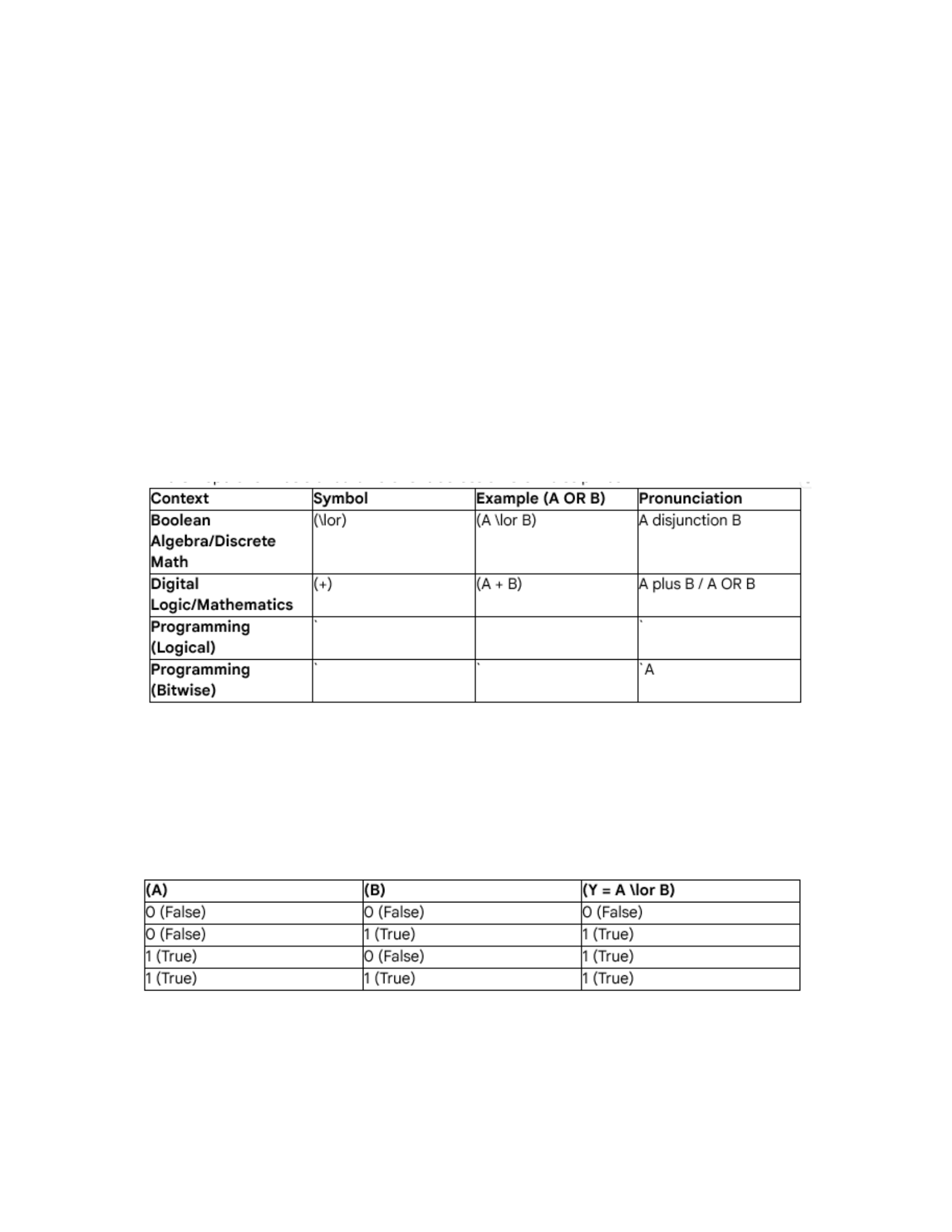
2.1 Notation
The OR operation has standard notations across different disciplines:
For COMP 222, the plus sign ((+)) is the most common algebraic form, often spoken
as "A OR B."
2.2 The Fundamental Truth Table
The truth table for a two-variable OR operation, involving inputs (A) and (B), and
output (Y), is the core definition.
Key Insight: The table perfectly embodies the "alternative fulfillment" principle. The
output is low (0) only in the case where the requirement for NEITHER input to be
high (1) is met. In all other cases, the output is high (1). This is distinct from the XOR

(Exclusive OR) operation, which would yield 0 for the final row ((1 \lor 1)). The
standard Boolean OR is inclusive.
3. Algebraic Properties of the OR Operation
Just like AND, the OR operation adheres to a set of fundamental theorems that
enable the simplification and manipulation of Boolean expressions.
3.1 Unary Properties (Single Variable)
These properties define how the OR operation interacts with the identity (0) and
annihilation (1) elements.
Identity Element (OR with 0):
The identity element for OR is 0 (FALSE). ORing any variable with 0 results in the
variable itself.
A∨0=A
Explanation: If (A) is 0, (0 \lor 0 = 0). If (A) is 1, (1 \lor 0 = 1). The result tracks (A).
This property is crucial for introducing redundant terms (like (+0)) during algebraic
manipulation for simplification.
Annihilation (Dominance Law - OR with 1):
The annihilation or dominance element for OR is 1 (TRUE). ORing any variable with
1 always results in 1, regardless of the variables value.
A∨1=1
Explanation: If (A) is 0, (0 \lor 1 = 1). If (A) is 1, (1 \lor 1 = 1). Since the OR gate only
requires one input to be 1 to output 1, the presence of a constant 1 "dominates" the
result. This is used to force a logical path to a TRUE state.
Idempotence Law (OR with self):
ORing a variable with itself results in the variable itself.
A∨A=A
Explanation: Redundant OR inputs do not affect the result. This is commonly used in
simplification steps like: (A \lor A = A).
Complement Law (OR with NOT):
ORing a variable with its complement always results in 1.
A∨A′=1
Explanation: By definition, (A) and (A) must have opposite values (0 and 1, or 1 and
0). Since the OR gate requires only one input to be 1 to output 1, and one of (A) or

(A) must always be 1, the result is always 1. This is the definition of a tautology in
Boolean terms.
3.2 Binary and Ternary Properties (Multiple Variables)
Commutative Law:
The order of the operands does not affect the result.
A∨B=B∨A
Insight: The physical order of inputs on an OR gate does not matter.
Associative Law:
The grouping of operands does not affect the result.
(A∨B)∨C=A∨(B∨C)
Insight: Similar to AND, a three-input OR function can be implemented by cascading
two-input OR gates without changing the logical result.
Distributive Law of OR over AND (The Dual Property):
This less intuitive law is the dual of the AND over OR rule.
A∨(B∧C)=( A∨B)∧(A∨C)
Insight: This property is the algebraic mechanism for converting SOP expressions
into the standard Product-of-Sums (POS) form, a mandatory skill for circuits
designed using NOR gates and for generating Maxterms.
4. Digital Logic Implementation (The COMP 222 Focus)
The Boolean OR operation is physically implemented by the OR Gate.
4.1 The OR Gate
The standard logic symbol for the OR gate, defined by IEEE/ANSI, is characterized
by a curved back and a pointed front, resembling a shield or crescent moon.
Logic Symbol: A curved component with two or more inputs and a single output.
Physical Reality: OR gates are readily available as integrated circuits (ICs), such as
the 7432 quad two-input OR gate.
4.2 Understanding the Transistor Level (Conceptual)
The conceptual operation of a CMOS OR gate reinforces the alternative fulfillment
principle. An OR gate is typically built from a NOR gate core followed by an inverter
(NOT gate).

NOR Gate (The Dual of OR): A NOR gate requires the parallel connection of PMOS
transistors in the Pull-Up Network (PUN) and the series connection of NMOS
transistors in the Pull-Down Network (PDN). The OR function is most directly
related to the NOR gates pull-up network.
NOR Gate Core: If inputs (A) and (B) are both 0 (low), both PMOS transistors turn
ON (due to the NOT logic inherent in PMOS), creating a conductive path to (V_{DD})
(1). If either (A) or (B) is 1, the parallel path to (V_{DD}) is broken, and the output is
pulled low (0).
OR Gate Construction: By placing a NOT gate after the fundamental NOR gate, the
final output reverts to the true OR function: it is 1 when at least one input is 1.
The parallel nature of the PMOS transistors (for the NOR cores output 1 condition)
perfectly models the algebraic definition: for the output to be TRUE, any one of the
parallel paths to (V_{DD}) must be activated, meaning only one input needs to be 1.
4.3 Maxterms and the Product-of-Sums (POS) Form
The OR operation is the fundamental structural element of the Product-of-Sums
(POS) form. Every sum term in a POS expression is known as a Maxterm.
A Maxterm is defined as a sum (OR) of all variables in a Boolean function, where
each variable appears exactly once, either in its normal form or its complement. The
POS form is simply the AND (product) of all Maxterms that result in a functional
output of 0.
Example: A function (F(A, B, C)) is defined by its truth table. If the 0-output rows
correspond to Maxterms (M_3) and (M_7):
(M_3) corresponds to the input (A=0, B=1, C=1), which creates the sum term ((A \
lor B \lor C)). (The maxterm is the OR of the complements of the variables in the
zero-row).
(M_7) corresponds to the input (A=1, B=1, C=1), which creates the sum term ((A \
lor B \lor C)).
The final function is:
F(A , B , C )=M3∧M7=(A∨B′∨C′)∧(A′∨B′∨C′)
This example shows that the POS form relies on ORing variables to define the
conditions that must simultaneously result in a FALSE output.
5. Programming Applications (Software Side)
In software, the OR operation, like AND, has distinct logical and bitwise forms.
5.1 Logical OR ()

The logical OR operator ( in C/C++/Java/JavaScript) is used in conditional
statements and flow control. It evaluates to TRUE if either the left or the right
operand is TRUE.
Crucial Feature: Short-Circuit Evaluation
Just like &&, the logical operator is a short-circuit operator. The compiler evaluates
the left operand first.
Expression A∨¿Expression B
If Expression (A) evaluates to TRUE (1), the entire expression must be TRUE (due to
the Dominance Law: (1 \lor B = 1)).
Therefore, Expression (B) is never evaluated. The execution "short-circuits."
Example of Short-Circuiting Insight:
Short-circuiting in OR is often used for providing default values or fallback logic
(especially in languages like JavaScript, where it can be used for truthy/falsy
evaluation):
// If primaryValue is null or undefined (falsy), fallback to Default
const finalValue = primaryValue Default;
In languages like C/C++, it is used to group error checks or multiple valid
conditions:
if (error_code == 100 error_code == 200) {
// Handle recoverable errors 100 or 200.
}
If the first check is TRUE, the second is skipped, which can save computation time
and prevent side-effect functions from running unnecessarily.
5.2 Bitwise OR ()
The bitwise OR operator ( in most languages) operates on the binary
representations of integer numbers, performing the OR operation bit by bit.
Resulti=Ai∨Bi
Key Application: Setting (Turning On) Bits
Bitwise OR is the primary operator used to ensure specific bits within a binary word
are set to 1, regardless of their current state. This technique is called Setting or
Enabling bits.
Setting a Bit: To ensure the 3rd bit (value 4 or 0b0100) is set in a number (N), we
use a mask where only that bit is 1 (Mask = 4).

Result=N∨4
The bitwise OR operation forces the output bit to 1 if either the input bit (N_i) OR
the mask bit ((4)_i) is 1. Since the mask only has a 1 at the 3rd position, all other bits
in (N) are ORed with 0 (Identity Law: (A \lor 0 = A)), leaving them unchanged, while
the 3rd bit is guaranteed to become 1 (Dominance Law: (A \lor 1 = 1)).
This is fundamentally different from the bitwise AND (&), which is used for
checking/isolating bits. Students must be precise when selecting the operator based
on whether they need to check/isolate (&) or set/enable () bits.
6. Personal Insights and Study Strategies
To ensure I maintain clarity and avoid confusing OR with its counterparts, I employ
specific mental models and connections.
6.1 Mnemonic Device: The "Multiple Path" Analogy
I associate OR with a circuit that has multiple parallel paths to the final destination
(Output (Y=1)).
Imagine a room with two doors, Door A and Door B. To exit the room, you only need
to open Door A OR Door B.
If Door A is open (1) but Door B is closed (0), you can still exit (Result = 1).
If Door B is open (1) but Door A is closed (0), you can still exit (Result = 1).
The only time you cannot exit (Result = 0) is if NEITHER Door A NOR Door B is open
(0 OR 0 = 0).
This mnemonic powerfully reinforces the sufficiency of a single TRUE input for the
OR gate.
6.2 Connection to Set Theory: Union
As the dual of the AND/Intersection relationship, the OR operation in Boolean logic
corresponds directly to the Union operator in Set Theory ((A \cup B)).
The set (A \cup B) contains all elements that are members of set (A) OR members of
set (B) (or both).
If we define 1 as "is a member of the set" and 0 as "is not a member of the set," the
truth tables align: if an element is in set A or set B, it is in their union (result 1). If its
in neither, its not in the union (result 0). This provides a mathematical grounding
for the operation.

7. Critical Pitfalls and Common Misconceptions
A thorough understanding of the OR operation requires recognizing and avoiding
common errors, particularly those related to its dual nature with AND and its
programming implementation.
7.1 Pitfall 1: Confusion Between Logical () and Bitwise () OR
This parallel pitfall to the AND operation is just as dangerous. Using the single
vertical bar () in conditional logic where was intended is a major source of
programming bugs.
The Error:
int x = 5;
int y = 6;
if (x y) { // This performs BITWISE OR, not LOGICAL OR
printf("Condition is true");
}
(5 (0101_2) \lor 6 (0110_2)) yields (7 (0111_2)). Since 7 is non-zero, the condition
is TRUE, which is likely the intended logical result. However, the use of forces the
evaluation of both operands.
The Danger (Loss of Short-Circuiting): In performance-critical or side-effect-
sensitive code, the loss of short-circuiting can be costly. If the second expression is a
complex, time-consuming function, using unnecessarily forces that function to
execute even if the first condition was already TRUE.
Example of Loss of Short-Circuiting:
if (is_valid(user_input) try_to_fix_input()) {
// Proceed
}
If is_valid() returns TRUE, the try_to_fix_input() function should be skipped. If the
programmer mistakenly uses , the expensive try_to_fix_input() function executes
anyway, wasting CPU cycles and potentially causing unintended side effects (e.g.,
writing to a log file).
7.2 Pitfall 2: Misinterpreting De Morgans Law (The OR Form)
The second form of De Morgans Law is crucial for circuit simplification and
conversion between logic styles (e.g., from OR/NOT to NOR-only logic).
The correct application involving OR is:

¬(A∨B)=¬ A ∧¬ B
In words: NOT (A OR B) is equivalent to (NOT A) AND (NOT B).
Common Error: Failing to flip the operator (OR to AND) after distributing the NOT:
¬(A∨B)≠ ¬ A ∨¬ B (INCORRECT)
This is an identical structural mistake to the AND pitfall, emphasizing the need to
memorize the operator flip (from (\lor) to (\land) or vice versa) whenever the
negation is distributed or factored out. This concept of duality is fundamental to the
entire subject.
7.3 Pitfall 3: Incorrect POS to SOP Conversion
Students often rely on the Distributive Law of AND over OR for SOP minimization,
but they struggle with the dual: the Distributive Law of OR over AND when working
with POS form.
The Correct Law (OR over AND):
A∨(B∧C)=( A∨B)∧(A∨C)
Common Error: Assuming OR distributes over AND in the same way as in standard
algebra. Standard algebra does not have the property (x + (y \cdot z) = (x+y) \cdot
(x+z)). This is unique to Boolean Algebra. Failing to remember this dual distributive
rule prevents students from correctly expanding or simplifying Maxterms in POS
form.
Example: Simplify (F = (A \lor B) \land (A \lor C)). The error is often to leave it
alone, when it can be correctly written as (F = A \lor (B \land C)) which is the
minimal POS form.
7.4 Pitfall 4: Confusion with Exclusive-OR (XOR)
The OR gate discussed in COMP 222 is the Inclusive OR, meaning (1 \lor 1 = 1).
Students sometimes confuse this with the Exclusive OR (XOR), where (1 \oplus 1 =
0).
The Error: Using the Inclusive OR in places that require XOR, such as the Sum output
of a half-adder or full-adder.
The Distinction:
Inclusive OR ((\lor)): Alternative fulfillment or simultaneous fulfillment. Output 1 if
1 or more inputs are 1.
Exclusive OR ((\oplus)): Alternative fulfillment only. Output 1 if an odd number of
inputs are 1.
The two operations are distinct and their symbols are not interchangeable. This is a
crucial distinction when designing arithmetic circuits.

8. Advanced Algebraic Expansion: Proving Laws with OR
Demonstrating the properties of the OR operation through algebraic proofs
reinforces its rules and duality with AND.
8.1 Proof of the Secondary Absorption Law (The ORs Dual Role)
The second form of the Absorption Law shows how OR and AND interact to simplify
redundant terms, demonstrating the duality of the first form (Section 8.1 in the AND
guide).
Absorption Law 2: A∧(A∨B)= A
Proof by Algebra:
Start with the left side: (A \land (A \lor B))
Apply the Distributive Law of AND over OR (Section 3.2, Property 3):
(A∧A)∨(A∧B)
Apply the Idempotence Law for AND ((A \land A = A)):
A∨(A∧B)
Apply the Identity Law for AND: (A) can be written as (A \land 1).
(A∧1)∨(A∧B)
Apply the Distributive Law (factoring out (A)):
A∧(1∨B)
Apply the Dominance (Annihilation) Law for OR: (1 \lor B = 1).
A∧1
Apply the Identity Law for AND: (A \land 1 = A).
A
The result is the right side.
This proof is a perfect illustration of how the properties of OR and AND are
interconnected and must be used in conjunction to simplify expressions effectively.
The term ((A \lor B)) is absorbed because the entire expression can only be TRUE if
(A) is TRUE. If (A) is FALSE, the entire expression is FALSE due to the Annihilation
Law of AND ((0 \land X = 0)).
8.2 Proof of the Secondary Consensus (The Dual)
The dual of the Consensus Theorem involves Maxterms and is based on the OR
operation.

Consensus Theorem (Dual):(A∨B)∧(A′∨C)∧(B∨C)=( A∨B)∧(A′∨C)
The term ((B \lor C)) is redundant and can be removed.
Proof Outline (Requires using the dual identity):
Start with the left side: (X = (A \lor B) \land (A \lor C) \land (B \lor C))
Use the Identity Law for OR on the redundant term ((B \lor C)):
X=( A∨B)∧(A′∨C)∧(( A∧A′)∨(B∨C))
Apply the Distributive Law (OR over AND) to the final term:
X=( A∨B)∧(A′∨C)∧(A∨B∨C)∧(A′∨B∨C)
Apply the secondary Absorption Law (Section 8.1) to simplify the first and third
terms. Note that ((A \lor B)) absorbs ((A \lor B \lor C)) because it is of the form (X \
land (X \lor Y)) where (X=(A \lor B)) and (Y=C).
X=(( A∨B)∧(A∨B∨C))∧(( A′∨C)∧(A′∨B∨C)) X=( A∨B)∧(A′∨C)
The proof confirms that the OR operation is the fundamental mechanism that
enables this simplification, which is crucial for minimizing Maxterm expressions in
the Product-of-Sums form.
9. Conclusion: Mastery Through Duality
The Boolean OR operation, (A \lor B), is the fundamental expression of choice and
sufficient condition in all digital systems. In COMP 222, true mastery of the OR
operation is found in understanding its deep duality with the AND operation:
By internalizing the "multiple path" analogy, recognizing the distinction between
logical () and bitwise () OR, and diligently applying De Morgans Law to convert
between canonical forms, a CSUN COMP 222 student gains the necessary tools to
navigate the complex world of digital circuit design. The ability to manipulate and

simplify expressions using the OR operation is essential for constructing Maxterms,
minimizing gate count, and ensuring logical correctness in both hardware and
software.

