


lOMoARcPSD|52070614
6-1 Discussion: Finding a Function to Match a Shape
For this week's discussion, you are asked to generate a continuous and
differentiable function f(x) with the following properties:
•f(x) is decreasing at x=−6
•f(x) has a local minimum at x=−3
•f(x) has a local maximum at x=3
Your classmates may have different criteria for their functions, so in
your initial post in Brightspace be sure to list the criteria for your
function.
Hints:
•Use calculus!
•Before specifying a function f(x), first determine requirements for
its derivative f (x)′. For example, one of the requirements is that f′
(−3)=0 .
•If you want to find a function g(x) such that g(−9)=0 and g(8)=0,
then you could try g(x)=(x+9) (x−8).
•If you have a possible function for f (x)′, then use the techniques in
Indefinite Integrals this Module to try a possible f(x).
You can generate a plot of your function by clicking the plotting option
(the page option with a "P" next to your function input). You may want
to do this before clicking "How Did I Do?". Notice that the label "f(x)="
is already provided for you.
Once you are ready to check your function, click "How Did I Do?"
below (unlimited attempts). Please note that the bounds on the x-axis go
from -6 to 6.

lOMoARcPSD|52070614
f(x)=
A function is differentiable at x = a,
If the function is continuous t x = a
Given that:
The function decreases
At x = -6 means that: f(-5)<0
The local maximum at x = 3 and
Local minimum at x = -3 means that:
x = -3 or x = 3.
Equate both equations to ‘0’
x + 3 = 0 or 3 – x = 0
Multiply both equations to give
y' = (3-x) x (x+3) y' = 3x+9-x^2-
3x y' = 3x – 3x + 9 – x^2 y' = 9 –
x^2 Integrate y' y = 9
x^0+1/0+1 – x^2+1/2+1 + c y = 9
x^1/1 – x^3/3 + c Express as a

lOMoARcPSD|52070614
function f(-6) = 9x – x^3/3 + c f(-
6) <0 implies that:
9 (-6) – (-6)^3 + c <0
-54 + 216^3/3 + c <0 c < -18
We can assume the value of c to be
C = -17 or any other value
Less than -18.
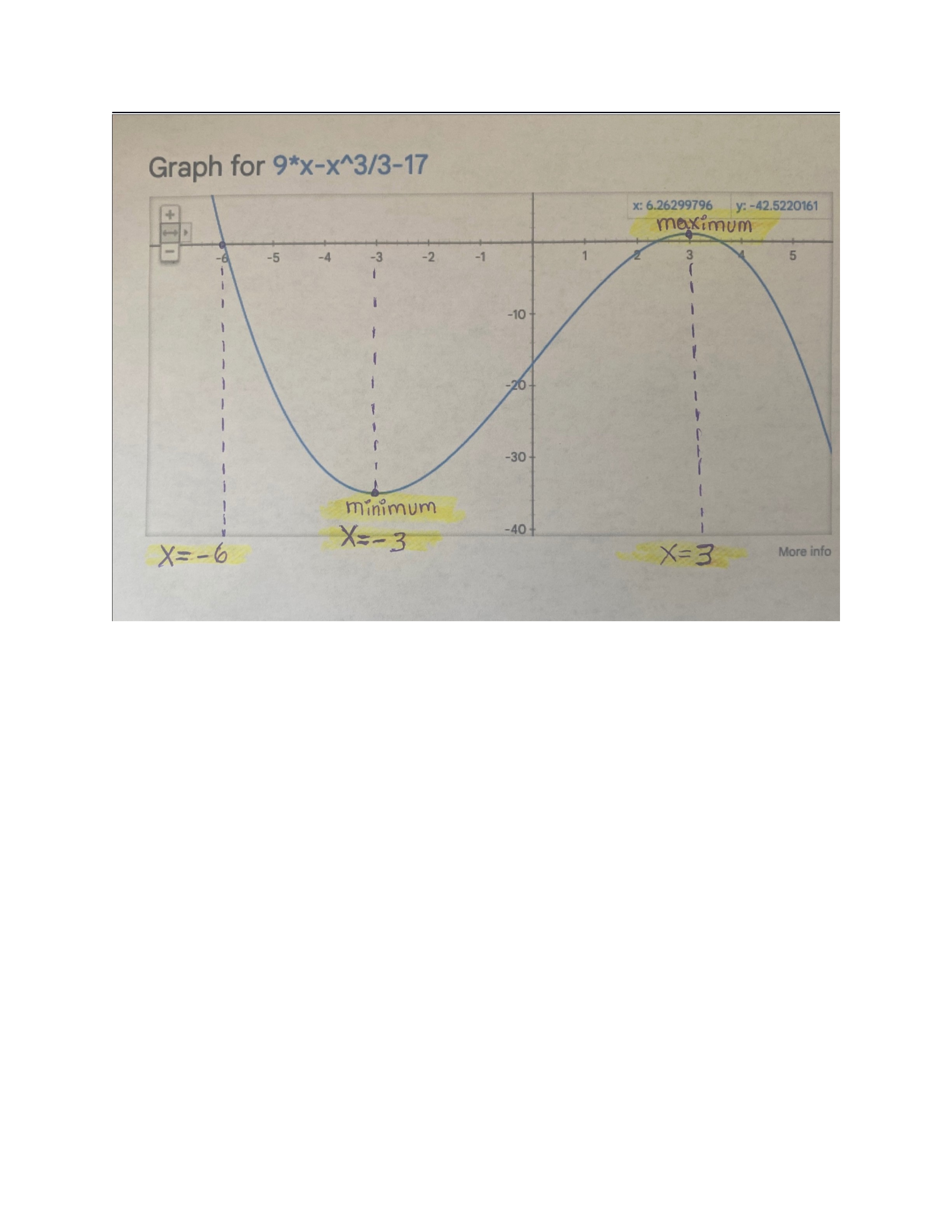
So, our required function will be: f(x) = 9x-x^3/3-17
lOMoARcPSD|52070614

