


CSUN Math 150A Study Note: The Calculus of
Continuity, Classification of Discontinuities, and the
Removable Hole
I. Introduction and The Grand Goal of Calculus
Welcome back, fellow Matadors. This topic—Continuity and the Classification of Discontinuities—
is arguably the foundational pivot upon which all of Math 150A (Differential Calculus) rests.
Understanding where and why a function "breaks" (or is discontinuous) is just as important as
knowing how to find its derivative when it’s smooth. It’s the gatekeeper concept for all
subsequent limit and derivative evaluations.
In the simplest terms, a function
f(x)
is continuous if you can draw its graph without lifting your
pen. However, calculus demands precision, moving us beyond the visual and into the algebraic
and formal definition governed by limits. Our core focus here is to master the conditions for
continuity and, specifically, to diagnose and understand the least pathological of the breaks: the
Removable Discontinuity.
The Formal Definition of Continuity at a Point
c
A function
f(x)
is continuous at a point
x=c
if and only if all three of the following conditions
are met:
Existence of the Function Value: The function must be defined at
c
.
f(c)∃.
This means
c
must be in the domain of
f(x)
. If this condition fails, we already have a
discontinuity.
Existence of the Limit: The two-sided limit must exist at
c
.
lim
x →c
f(x)exists.
This requires the left-hand limit and the right-hand limit to be equal:
lim
x→ c−
f(x)=Land lim
x→ c +¿f(x)= L¿¿
where
L
is a finite, real number. If the limits are unequal or tend to
± ∞
, the limit does not exist,
and we have a discontinuity.
Equality of Value and Limit: The limit value must equal the function value.
lim
x →c
f(x)=f(c).
This is the synthesis condition. It ensures that not only does the graph approach a specific height,
but the function actually is at that height at
x=c
.

A function is discontinuous at
c
if any of these three conditions fail. The way in which they fail
dictates the classification.
II. Classification of Discontinuities: The Big Picture
Discontinuities are broadly categorized into two main types: Removable and Non-Removable
(Essential).
Type 1: Removable Discontinuities (The Star of Our Show)
A discontinuity is removable if the limit exists, but the function is not continuous because either
the function value is missing (Condition 1 fails) or the function value is defined but placed
incorrectly (Condition 3 fails).
Geometrically, this manifests as a hole in the graph. We call it "removable" because we could
redefine the function at that single point to make it continuous.
Type 2: Non-Removable (Essential) Discontinuities
A discontinuity is non-removable if the limit does not exist at
x=c
. These breaks are so severe
that no amount of redefining the function at a single point can fix the overall behavior.
There are two primary sub-types of non-removable discontinuities:
Jump Discontinuities: The left-hand limit and the right-hand limit both exist but are not equal.
(Condition 2 fails because the two-sided limit does not exist).
Infinite Discontinuities: One or both of the one-sided limits tends to
± ∞
. (Condition 2 fails
because the limit is not a finite, real number). These typically occur at vertical asymptotes.
III. Deep Dive: Removable Discontinuities (The Hole in the Graph)
A. Formal Definition and Algebraic Mechanism
A discontinuity at
x=c
is Removable if:
lim
x →c
f(x)
exists and is equal to some finite number
L
.
However,
f(c)≠ L
(or
f(c)
is undefined).
The Algebraic Insight: Factoring and Cancellation
For rational functions (the most common context for removable discontinuities in Math 150A),
the presence of a removable discontinuity is a direct result of algebraic cancellation.
When we have a rational function
f(x)= N(x)
D(x)
, and we find a point
x=c
such that substituting
c
results in the indeterminate form
0
0
, this is the definitive algebraic signature of a removable
discontinuity.
The steps for identifying and "removing" the discontinuity are as follows:
Diagnosis: Substitute
x=c
into the function. If the result is
0
0
, a removable discontinuity exists at
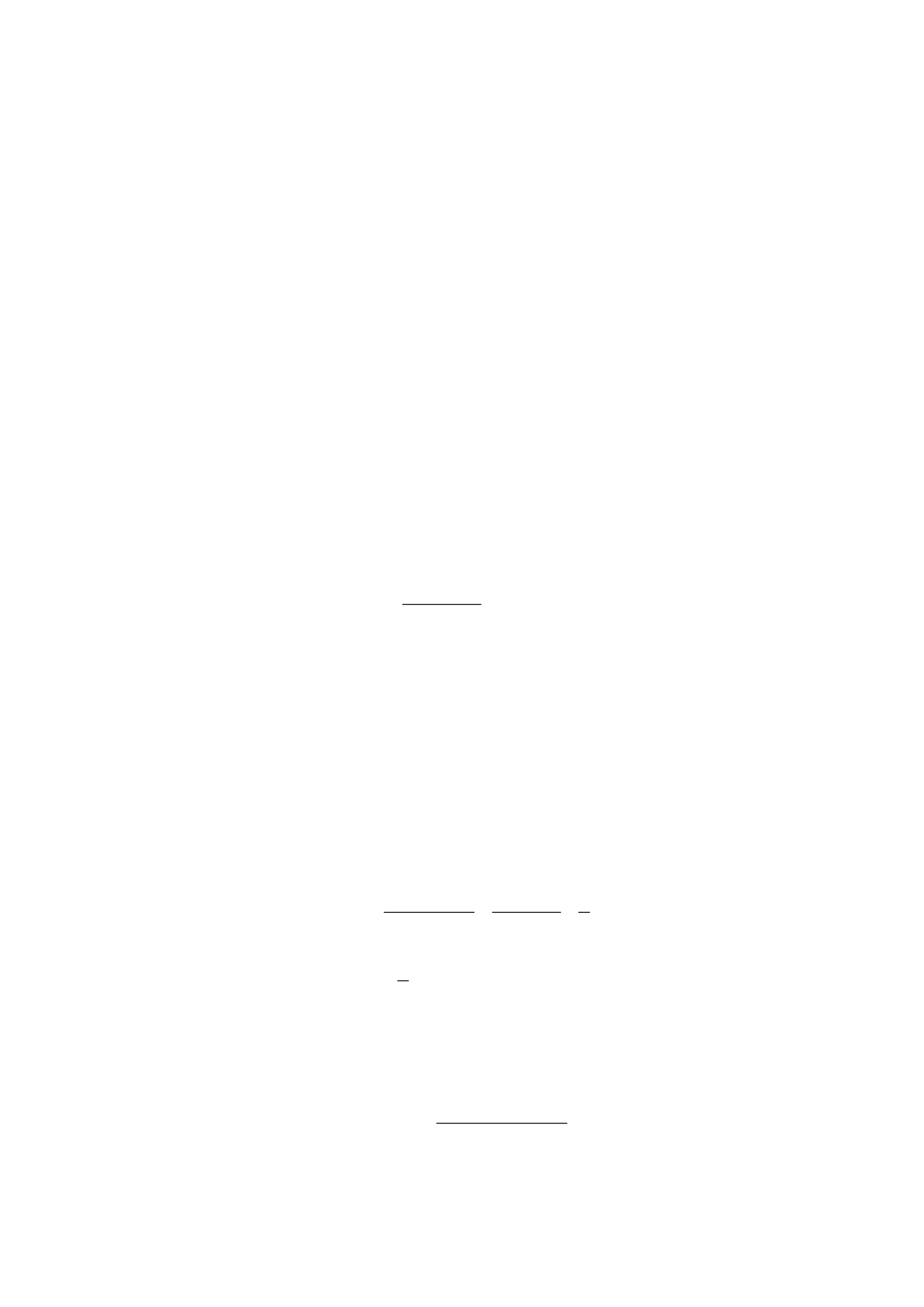
x=c
. This tells us that
(x − c)
is a factor in both the numerator
N(x)
and the denominator
D(x)
.
Remediation (Finding the Limit):
a. Factor the numerator
N(x)
and the denominator
D(x)
.
b. Cancel the common factor
(x − c)
. Note: We can only do this because we are evaluating the
limit as
x
approaches
c
, meaning
x ≠ c
, and thus
(x − c)≠0
.
c. Substitute
x=c
into the simplified function to find the limit
L
.
Redefinition (The "Removal"): To make the function continuous, we define a new piecewise
function
g(x)
, which is the continuous extension of
f(x)
:
\( g(x)=
{
f(x)if x ≠ c
Lif x=c\)
By setting
g(c)=L
, we satisfy Condition 3 (
lim
x →c
g(x)=g(c)
), and the hole is filled.
B. Extended Example Walkthrough (Focusing on algebraic rigor)
Function: Consider the function
f(x)= x2−4x+3
x2−9
.
Step 1: Check for Discontinuities
The function is discontinuous where the denominator is zero:
x2−9=0⇒(x − 3)(x+3)=0
Discontinuities occur at
x=3
and
x=−3
.
Step 2: Classify the Discontinuity at
x=3
We evaluate the function at
x=3
:
f(3)= 32−4(3)+3
32−9=9−12+3
9−9=0
0
Since we have the indeterminate form
0
0
, the discontinuity at
x=3
is Removable.
Step 3: Find the Limit (Determine the location of the hole)
We factor and cancel the common term:
lim
x →3
f(x)=
lim
x→ 3
(x −3)(x −1)
(x −3)(x+3)

Since
x ≠ 3
as we take the limit:
lim
x→ 3
x − 1
x+3
Now, substitute
x=3
into the simplified expression:
L=3−1
3+3=2
6=1
3
The limit exists:
lim
x →3
f(x)= 1
3
. The hole is at the point
(
3,1
3
)
.
Step 4: Classify the Discontinuity at
x=−3
We evaluate the function at
x=−3
:
f(−3)=¿¿
Since we have the form
non-zero constant
0
, the limit will be
± ∞
. This is an Infinite
Discontinuity, a non-removable break (Vertical Asymptote).
Conclusion for Example: The function
f(x)
has a removable discontinuity at
x=3
(a hole at
(
3,1
3
)
) and a non-removable infinite discontinuity at
x=−3
(a vertical asymptote).
C. Removable Discontinuities in Piecewise Functions
Removable discontinuities are not exclusive to rational functions. They can also occur in
piecewise functions when Condition 3 fails (Limit
≠
Function Value).
Example:
h(x)=
{
x2−1
x − 1if x ≠1
5 if x=1
Find the Limit at
x=1
:
lim
x →1
h(x)=
lim
x →1
(x −1)(x+1)
x − 1=lim
x →1
(x+1)=1+1=2
Find the Function Value at
x=1
:
h(1)=5
(Given by the second part of the piecewise definition).
Compare:
lim
x →1
h(x)=2 but h(1)=5

Since
lim
x →1
h(x)≠ h(1)
, the function is discontinuous at
x=1
. Because the limit exists (
L=2
),
this is a Removable Discontinuity. The hole exists at
(1,2)
, but the function value has been
incorrectly defined at
(1,5)
. The discontinuity is "removable" because setting
h(1)=2
would
make the function continuous.
IV. The Non-Removable (Essential) Discontinuities: For Contrast
We briefly cover the non-removable types to properly contextualize the simplicity of the
removable case. These breaks cannot be fixed by defining a single point.
A. Jump Discontinuity
A jump occurs when the two-sided limit fails because the one-sided limits approach different
values.
lim
x→ c−
f(x)=L1and lim
x → c+¿f(x)= L2¿¿
where
L1≠ L2
.
Mechanism: This is the characteristic failure point of piecewise functions, often seen in the floor
function or functions defined differently on either side of a point. The graph "jumps" from one
finite height to another.
B. Infinite Discontinuity
An infinite discontinuity occurs when one or both one-sided limits tend to infinity.
lim
x→c±
f(x)=± ∞
Mechanism: This is the characteristic failure point of rational functions where, after all factoring
and simplification, a factor
(x − c)
remains in the denominator. This signifies a Vertical
Asymptote.
V. Personal Insights and CSUN Math 150A Perspective
A. The Power of the Indeterminate Form
0
0
The most valuable takeaway for Math 150A is recognizing the immediate implication of the
indeterminate form
0
0
. This form is not an answer; it is a direction.
Geometric Implication: The function has a hole.
Algebraic Implication: A common factor
(x − c)
exists and must be canceled.
Calculus Implication: The limit exists, and you must find it via algebraic simplification (factoring,
rationalizing, or eventually, LHôpitals Rule in Math 150B/150C).
For us, if we get
0
0
, we know immediately that the discontinuity is removable and that we have a
clear path to finding the limit,
L
.

B. The Crucial Role of the Continuous Extension
When a problem asks you to "find a value of
k
that makes the function continuous," they are
asking you to find the value that fills the removable hole.
Conceptual Insight:
If
f(x)= N(x)
D(x)
has a removable discontinuity at
x=c
, the continuous extension
g(x)
is simply
the graph of the simplified expression
fsimplified (x)
. The difference between
f(x)
and
fsimplified (x)
is only the point at
x=c
. This is why
fsimplified (c)=L
is the value you must assign to
k
.
VI. Analysis of Common Mistakes (The Pitfalls for CSUN Students)
Mastering continuity means avoiding a few critical, yet common, algebraic and conceptual traps.
Mistake 1: Confusing
0
0
with
k
0
(where
k ≠ 0
)
This is the single most important mistake to avoid when classifying discontinuities.
Form at x=c
Classification
Limit Behavior
Algebraic Fix
0
0
Removable
Limit
L
exists (finite)
Factor and Cancel
k
0
(
k ≠ 0
)
Non-Removable
Limit is
± ∞
(VA)
None (Vertical Asymptote)
The Pitfall: A student finds
x=5
makes the denominator zero and incorrectly concludes it must
be a vertical asymptote (Infinite Discontinuity). They fail to check the numerator. If the numerator
is also zero, the discontinuity is removable, and the limit is finite. Always check the numerator
first after finding the denominators root!
Mistake 2: Assuming a Jump Discontinuity is Removable
In piecewise functions, students sometimes see the break and think it’s just a "badly defined
point."

The Pitfall: If, in a piecewise function,
lim
x→ c−
f(x)=5
and
lim
x→ c+¿f(x)=10 ¿
¿
, this is a Jump
Discontinuity. The two-sided limit does not exist. No single point definition
f(c)=k
can fix this.
You cannot "jump" a gap; you can only "fill" a hole. Jump discontinuities are non-removable
(essential).
Mistake 3: Algebraic Errors in the Simplification Step (Cancellation)
This is where the algebra from Math 102/103 catches up to us. Removable discontinuities require
perfect factoring.
Example Pitfall:
f(x)= x2− x −2
x − 2
at
x=2
.
Correct Factoring:
(x − 2)(x+1)
x −2
. Limit is
lim
x →2
(x+1)=3
.
Common Error: Mis-factoring the numerator as
(x − 2)(x −1)
x − 2
and getting the limit as 1.
Advice: Always check your factoring by re-multiplying. For a point
x=c
giving
0
0
, the factor
(x − c)
must be present. If your factorization doesnt contain it, youve made an error.
Mistake 4: Mismanaging the Absolute Value Function
The absolute value function, when combined with a zero in the denominator, often creates a
Jump Discontinuity, not a removable one.
Example:
f(x)=¿x∨¿
x¿
at
x=0
.
lim
x→ 0+¿¿x∨¿
x=lim
x→ 0+¿x
x=1 lim
x →0−
¿x∨¿
x=
lim
x → 0−
− x
x=−1¿ ¿
¿¿ ¿
¿
The Pitfall: Since the limits are
1
and
−1
, this is a Jump Discontinuity, which is Non-Removable.
Students often see the zero in the denominator and try to factor, but the absolute value prevents
cancellation in the algebraic sense that leads to a single, finite limit. When dealing with absolute
values, always evaluate the left and right limits separately.
Mistake 5: Failing to Check the Domain Before the Limit
Condition 1 for continuity is that
f(c)
must exist.
The Pitfall: Consider
f(x)=sin (x)
x
. This function is discontinuous at
x=0
because
f(0)
is

undefined (Condition 1 fails). However,
lim
x → 0
sin (x)
x=1
(a crucial special limit). Since the limit
exists and is finite, and the function is undefined, this is a Removable Discontinuity (specifically, a
hole at
(0,1)
).
Students sometimes mistakenly look only at the limit and forget that the original function is
discontinuous simply because the point is outside the domain. The existence of the finite limit is
what makes it removable.
VII. Synthesis of Concepts and Advanced Techniques
A. The Role of
tan(x)
and Secant Functions
Functions involving trigonometric terms often present infinite discontinuities (Vertical
Asymptotes) rather than removable ones.
Example:
f(x)=tan(x)= sin(x)
cos(x)
.
Discontinuities occur where
cos (x)=0
, which is at
x=π
2+nπ
for integer
n
.
At these points,
sin(x)
is either
1
or
−1
, meaning the function evaluates to
k
0
(
k ≠ 0
).
Conclusion: All discontinuities for
tan(x)
are Non-Removable Infinite Discontinuities (Vertical
Asymptotes). We never encounter
0
0
here, so factoring or cancellation is impossible.
B. Removable Discontinuities and Differentiability
The study of removable discontinuities sets the stage for differentiability (the core of the second
half of Math 150A).
A function must be continuous to be differentiable. If a function has a removable discontinuity (a
hole), it is immediately not differentiable at that point.
However, the "removable" aspect is key:
If a function
f(x)
has a removable discontinuity at
x=c
, the continuous extension
g(x)
(the
version with the hole filled) might be differentiable at
x=c
. The ability to "fix" the function at
the point in question is what makes the removable case the least severe breach of continuity. For
the non-removable cases (Jump or Infinite), there is no way to define the function to achieve
continuity, so differentiability is impossible.
C. A Final Geometric Visualization
Imagine a string stretched across a graph.
Continuous: The string is taut and unbroken.
Removable (Hole): The string has a tiny knot in it, or a single thread is missing. The endpoints of
the gap meet. You could tie the string back together with one precise stitch (filling the hole).

Removable (Point Wrongly Defined): The string is taut, but one thread has been plucked out and
pinned above or below the line. The limit exists, but the function value is wrong. You can unpin it
and re-pin it to the right place.
Non-Removable (Jump): The string has been cut, and the two cut ends are at different heights.
You need a piece of string (an entire segment) to bridge the gap. Not fixable by a single point.
Non-Removable (Infinite): The string goes up forever toward the sky on one side and down
forever into the ground on the other. Unfixable.
The ability to "fix" the graph with a single point value
L
is the definition of a removable
discontinuity, and algebraically, this always stems from the
0
0
indeterminate form that allows for
cancellation.
VIII. Conclusion
Mastery of continuity classification is fundamental to success in Math 150A. We must move
beyond the "lift-your-pen" test and embrace the formal three-condition definition.
The two keys to remember are:
Algebraic Signal:
0
0
means Removable Discontinuity (A hole that requires factoring).
Limit Failure: If the limit does not exist (left
≠
right, or
± ∞
), the discontinuity is Non-Removable
(A jump or an asymptote).
By systematically checking the three conditions, looking for the
0
0
signal, and performing the
correct algebraic cancellation to find
L
, you will confidently locate and classify every removable
discontinuity presented in this course. Keep practicing those factoring skills, and remember the
geometric meaning—you’re just patching a small hole! Good luck with the next quiz, Matadors!

