



Austin Cholley Jones MAT 275 ONLINE B Spring 2021
Assignment Section 2.3 Modeling with First Order due 03/15/2021 at 11:59pm MST
1. (1 point)
Newton’s law of cooling says that the rate of cooling of an
object is proportional to the difference between the temperature
of the object and that of its surroundings (provided the differ-
ence is not too large).
If T=T(t)represents the temperature of a (warm) object
at time t,Arepresents the ambient (cool) temperature, and kis
a negative constant of proportionality, which equation(s) accu-
rately characterize Newton’s law?
•A. dT
dt =kT (1−T/A)
•B. dT
dt =k(T−A)
•C. dT
dt =k(A−T)
•D. dT
dt =kT (T−A)
•E. All of the above
•F. None of the above
Answer(s) submitted:
•B
(correct)
Correct Answers:
•B
2. (1 point)
Water leaks from a vertical cylindrical tank through a small
hole in its base at a rate proportional to the square root of the vol-
ume of water remaining. The tank initially contains 325 liters
and 18 liters leak out during the first day.
A. When will the tank be half empty? t=days
B. How much water will remain in the tank after 5 days?
volume = Liters
Solution:
SOLUTION
Let V(t)be the volume of water in the tank at time t, then
dV
dt =k√V.
This is a separable equation which has the solution
V(t) = (kt
2+C)2.
Since V(0) = 325 this gives 325 =C2so
V(t) = (kt
2+√325)2.
However, V(1) = 307, and so
307 = ( k
2+√325)2,
so that k=2(√307 −√325) = −1.0126. Therefore,
V(t) = (−0.5063t+√325)2.
The tank will be half-empty when V(t) = 162.5, so we solve
162.5= (−0.5063t+√325)2
to obtain t=10.428 days. The tank will be half empty in 10.428
days.
The volume after 5 days is V(5)which is approximately
240.134 liters.
Answer(s) submitted:
•(((sqrt(325)-sqrt(((325)/2))))/(sqrt(325)-sqrt(325-18)))
•(sqrt(325)-(sqrt(325)-sqrt(325-18))*5)ˆ(2)
(correct)
Correct Answers:
•(sqrt(325)-sqrt(325/2))/(sqrt(325) - sqrt(325-18))
•(sqrt(325) - (sqrt(325) - sqrt(325-18))*5)ˆ2
3. (1 point) A tank contains 2640 L of pure water. Solution
that contains 0.06 kg of sugar per liter enters the tank at the
rate 7 L/min, and is thoroughly mixed into it. The new solution
drains out of the tank at the same rate.
(a) How much sugar is in the tank at the begining?
y(0) = (kg)
(b) Find the amount of sugar after t minutes.
y(t) = (kg)
(c) As t becomes large, what value is y(t)approaching ? In
other words, calculate the following limit. lim
t→∞
y(t) = (kg)
Solution: (a) Since the tank originally contains pure water,
the initial amount of sugar is y(0) = 0.
(b) First note that, since the incoming and outgoing flows of
water are the same, the amount of water in the pool remains
constant at 2640 L. We have
dy
dt =rate in −rate out
where ”rate in” and ”rate out” refer to the rates at which the
sugar enters and exits the tank, respectively. The rate at which
the sugar enters the tank is given by
rate in = (7 L/min)(0.06 kg/L) = 0.42 kg/min
The concentation of sugar in the tank is y
2640 kg/L, so the rate of
flow out is
rate out = (7 L/min)hy
2640 kg/Li=7
2640 ykg/min
1

Thus we obtain the differential equation
dy
dt =0.42 −7
2640 y
where each term has the units kg/min. We rewrite the differen-
tial equation as
dy
dt =−7
2640 (y−158.4)
Separating the variables yields
Zdy
y−158.4=−Z7
2640 dt
so
ln|y−158.4|=−7
2640 t+K
and
y=158.4+Ce−7
2640 t
The initial condition y(0) = 0 gives C=−158.4, so
y=158.4−158.4e−7
2640 t
(c)
lim
t→∞158.4−158.4e−7
2640 t=158.4
Answer(s) submitted:
•0
•((792)/5)-((792)/5)eˆ(((-7)/(2640))t)
•((792)/5)
(correct)
Correct Answers:
•0
•158.4*(1-2.71828182845905ˆ(-0.00265151515151515*t))
•158.4
4. (1 point) A tank contains 80 kg of salt and 2000 L of water.
A solution of a concentration 0.02 kg of salt per liter enters a
tank at the rate 9 L/min. The solution is mixed and drains from
the tank at the same rate.
(a) What is the concentration of our solution in the tank ini-
tially?
concentration = (kg/L)
(b) Set up an initial value problem for the quantity y, in kg,
of salt in the tank at time t minutes.
dy
dt =(kg/min) y(0) = (kg)
(c) Solve the initial value problem in part (b).
y(t) =
(d) Find the amount of salt in the tank after 1.5 hours.
amount = (kg)
(e) Find the concentration of salt in the solution in the tank
as time approaches infinity.
concentration = (kg/L)
Solution: (a) Since the tank originally contains 80 L, the
initial concentration is 80
2000 =0.04kg/L.
(b) First note that, since the incoming and outgoing flows of
water are the same, the amount of water in the pool remains
constant at 2000 L. We have
dy
dt =rate in −rate out
where ”rate in” and ”rate out” refer to the rates at which the salt
enters and exits the tank, respectively. The rate at which the salt
enters the tank is given by
rate in = (9 L/min)(0.02 kg/L) = 0.18 kg/min
The concentation of salt in the tank is y
2000 kg/L, so the rate of
flow out is
rate out = (9 L/min)hy
2000 kg/Li=0.0045ykg/min
Thus we obtain the differential equation
dy
dt =0.18 −0.0045y
where each term has the units kg/min. The initial condition is
y(0) = 80.
(c) We rewrite the differential equation as
dy
dt =−0.0045(y−40)
Separating the variables yields
Zdy
y−40 =−Z0.0045 dt
so
ln|y−40|=−0.0045t+K
and
y=40 +Ce−0.0045t
The initial condition y(0) = 80 gives C=40, so
y(t) = 40 +40e−0.0045t
(d) The amount of salt after 1.5 hours is the given by
y(90) = 40 +40e−0.0045(90)=66.6791
(e) The concentration in the tank at any time tis given by
y
2000 =0.02 +0.02e−0.0045tso
lim
t→∞0.02 +0.02e−0.0045t=0.02
Note that this limiting concentration equals the incoming con-
centration.
Answer(s) submitted:
•.04
•.18-(((9y)/(2000)))
•80
•-.18
2

•80-40(1-eˆ(-(9/(1000))*120))
•.02
(score 0.666667)
Correct Answers:
•0.04
•9*0.02-9*y/2000
•80
•40+40*exp(-0.0045*t)
•66.679072434339
•0.02
5. (1 point) A tank contains 70 kg of salt and 1000 L of
water. Pure water enters a tank at the rate 6 L/min. The solution
is mixed and drains from the tank at the rate 3 L/min.
(a) Write an initial value problem for the amount of salt, y,
in kilograms, at time tin minutes:
dy
dt =(kg/min) y(0) = kg.
(b) Solve the initial value problem in part (a)
y(t) = kg.
(c) Find the amount of salt in the tank after 4.5 hours.
amount = (kg)
(d) Find the concentration of salt in the solution in the tank
as time approaches infinity. (Assume your tank is large enough
to hold all the solution.)
concentration = (kg/L)
Solution: (a) First note that, since the incoming and outgo-
ing flows of water are not the same, the amount of water in the
tank is not constant. In fact the amount of water in the tank in-
creases at a rate of 3 L/min and therefore the amount of water at
any given time time tis given by 1000 +3t.
Let y(t)be the amount of salt (in kg) at time tminutes.
We have dy
dt =rate in −rate out
where ”rate in” and ”rate out” refer to the rates at which the salt
enters and exits the tank, respectively. Since pure water enters
the tank, the rate at which the salt enters the tank is given by
rate in = (6 L/min)(0 kg/L) = 0 kg/min
The concentation of salt in the tank is y
1000+3tkg/L, so the rate
of flow out is
rate out = (3 L/min)y
1000 +3tkg/L=3y
1000 +3tkg/min
Thus we obtain the differential equation
dy
dt =−3y
1000 +3t
where each term has the units kg/min. The initial condition is
y(0) = 70.
(b) Separating the variables gives
dy
y=−3
1000 +3tdt
Integrating
ln|y|=−ln|1000 +3t|+K
and
y=C
1000 +3t
The initial condition y(0) = 70 gives C=70000, so
y(t) = 70000
1000 +3t
(d) The amount of salt after 4.5 hours, i.e. the amount of salt
after 270 minutes, is the given by
y(270) = 70000
1000 +3(270)=38.674
(d) The concentration in the tank at any time tis given by
y
1000+3t=70000
(1000+3t)2.
lim
t→∞70000
(1000 +3t)2=0
The limiting concentration is zero, as expected, since pure water
is entering the tank.
Answer(s) submitted:
•-((3y)/(1000+3t))
•70
•((70000)/(1000+3t))
•57.98528
•0
(score 0.8)
Correct Answers:
•-3*y/(1000+3*t)
•70
•70000/(1000+3*t)
•38.6740331491713
•0
6. (1 point) Newton’s law of cooling states that the tempera-
ture of an object changes at a rate proportional to the difference
between its temperature and that of its surroundings.
Suppose that the temperature of a cup of coffee obeys Newton’s
law of cooling. Let k>0 be the constant of proportionality.
Assume the coffee has a temperature of 185 degrees Fahrenheit
when freshly poured, and 3 minutes later has cooled to 173 de-
grees in a room at 80 degrees.
(a) Write an initial value problem for the temperature Tof
the coffee, in Fahrenheit, at time tin minutes. Your answer will
contain the uknown constant k:
dT
dt =T(0) =
(b) Solve the initial value problem in part (a). Your answer
3

will contain the unknown constant k.
T(t) =
(c) Determine the value of the constant k
k=
(d) Determine when the coffee reaches a temperature of 148
degrees.
minutes.
Solution: (a) T(t)satisfies the initial value problem
dT
dt =−k(T−80)T(0) = 185
(b) Solving the differential equation gives
T(t) = 80 +Ce−kt
Since T(0) = 185, we have
T(t) = 80 +105e−kt
(c) After 3 minutes the temperature is 173, thus
173 =80 +105e−3k,
which gives
k=−1
3ln93
105 ≈0.0404536.
(d) The temperature is given by
T(t) = 80 +105e−0.0404536t
To find when the coffee will reach a temperature of 148, we
solve the equation
148 =80 +105e−0.0404536t
This gives t=10.7395 minutes.
Answer(s) submitted:
•k(173-80)
•
•
•
•
(incorrect)
Correct Answers:
•-k(T-80)
•185
•80+105 eˆ(-k*t)
•0.0404536190014225
•10.7395248115166
7. (1 point)
A curve passes through the point (0,7)and has the prop-
erty that the slope of the curve at every point Pis twice the
y-coordinate of P. What is the equation of the curve?
y(x) =
Solution:
y(x)satisfies the differential equation
dy
dx =2y
with solution
y(x) = Ce2x
Since the curve passes through the point (0,7), we have 7 =C
so
y(x) = 7e2x
Answer(s) submitted:
•7eˆ(2x)
(correct)
Correct Answers:
•7 * eˆ(2 * x)
8. (1 point)
A thermometer is taken from a room where the temperature
is 20oCto the outdoors, where the temperature is 1oC. After one
minute the thermometer reads 12oC.
(a) What will the reading on the thermometer be after 4 more
minutes?
,
(b) When will the thermometer read 2oC?
minutes after it was taken to the outdoors.
Solution: Let T(t)be the temperature at time t, measured in
minutes.
T(t)satisfies the differential equation
dT
dt =−k(T−1)
with solution
T(t) = 1+Ce−kt
Since T(0) = 20, we have
T(t) = 1+19e−kt
After one minute the temperature is 12, thus
12 =1+19e−k,
which gives k=−ln 11
19 ≈0.546544. Hence
T(t) = 1+19e−0.546544t
(a) The reading on the thermometer after 4 more minutes will
be
T(5) = 1+19e−0.546544(5)≈2.2358
(a) To find when the termomether will read 2, we solve the equa-
tion
2=1+19e−0.546544t
4
This gives t=5.38738 minutes.
Answer(s) submitted:
•-3.13456
•3.
(incorrect)
Correct Answers:
•2.23580236492967
•5.38738063371552
9. (1 point)
Dead leaves accumulate on the ground in a forest at a rate of
2 grams per square centimeter per year. At the same time, these
leaves decompose at a continuous rate of 50 percent per year.
A. Write a differential equation for the total quantity Qof
dead leaves (per square centimeter) at time t:
dQ
dt =
B. Sketch a solution to your differential equation showing
that the quantity of dead leaves tends toward an equilibrium
level. Assume that initially (t=0) there are no leaves on the
ground.
What is the initial quantity of leaves? Q(0) =
What is the equilibrium level? Qeq =
Does the equilibrium value attained depend on the initial condi-
tion?
•A. yes
•B. no
Solution:
SOLUTION
Let Q(t)be the quantity of dead leaves, in grams per square
centimeter. Then dQ
dt =2−0.5Q, where tis in years.
If we suppose that the initial quantity is Q(0) = 0, then we
can guess what the solution will look like without solving the
differential equation: initially dQ
dt =2, so the quantity is increas-
ing. However, as it increases the rate of decay −0.5Qincreases,
so Qwill increase until the decay rate is equal to the accumula-
tion rate. This occurs when 2 =0.5Q, or Q=4.
Note that Q=4 is the equilibrium solution, which is where
Qis constant: when Qis constant, dQ
dt =0, which gives the same
condition as we solved above.
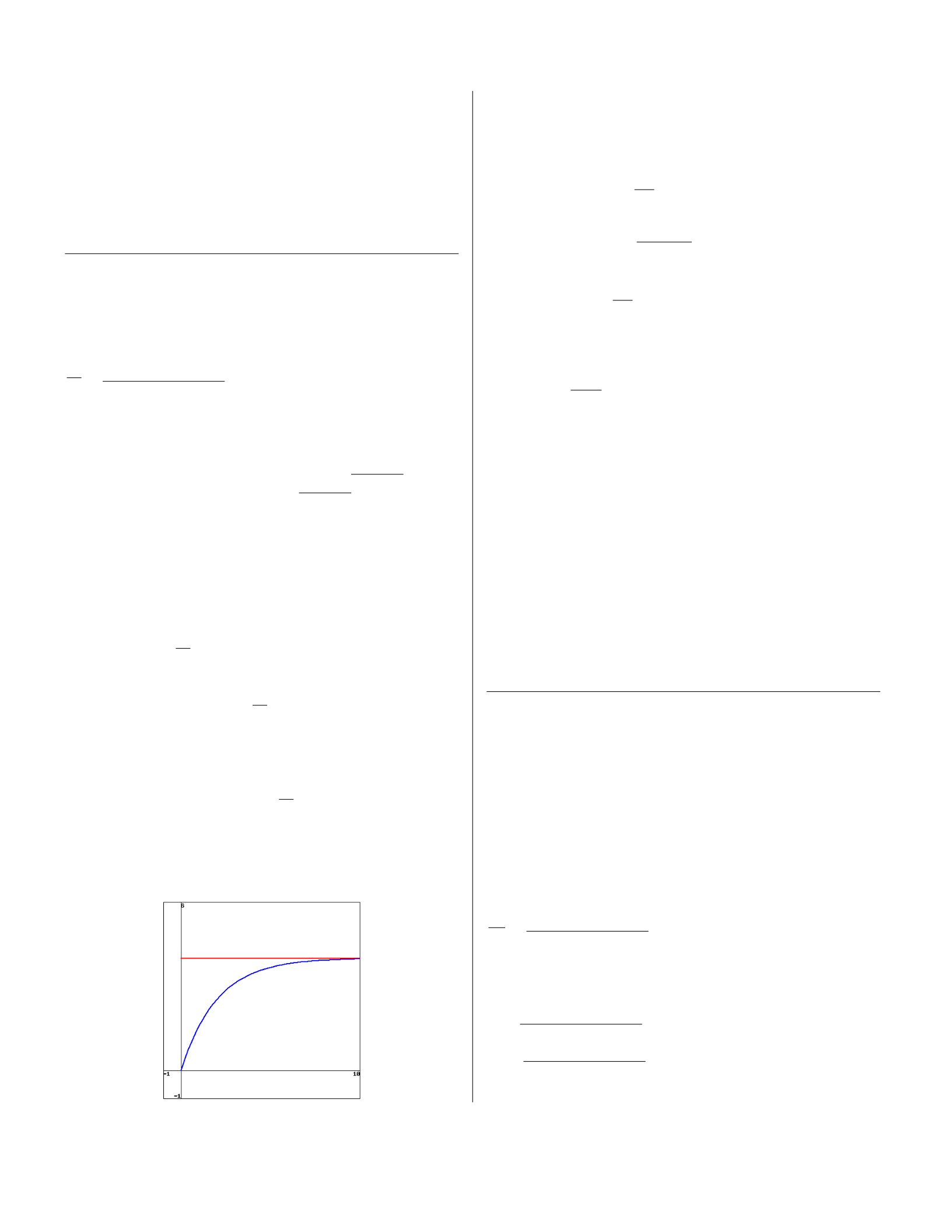
Therefore we know that the solution will look like the figure
below, which shows the solution in blue and the equilibrium in
red.
(Click on the graph for a larger version.)
We can also solve the differential equation using separation
of variables.
dQ
dt =2−0.5Q,
so
ZdQ
2−0.5Q=Zdt,
and
−1
0.5ln|2−0.5Q|=t+C.
Solving for Q, we get
Q=4−Ae−0.5t,
where A=±e−0.5C
0.5. With Q(0) = 0,
Q=4(1−e0.5t).
Note that no matter what the initial condition is, the same
equilibrium solution will be attained.
Answer(s) submitted:
•2-.5Q
•.5
•4
•B
(score 0.75)
Correct Answers:
•2 - 0.5*Q
•0
•2/0.5
•B
10. (1 point)
According to a simple physiological model, an athletic adult
male needs 20 calories per day per pound of body weight to
maintain his weight. If he consumes more or fewer calories than
those required to maintain his weight, his weight changes at a
rate proportional to the difference between the number of calo-
ries consumed and the number needed to maintain his current
weight; the constant of proportionality is 1/3500 pounds per
calorie. Suppose that a particular person has a constant caloric
intake of Hcalories per day. Let W(t)be the person’s weight in
pounds at time t(measured in days).
(a) What differential equation has solution W(t)?
dW
dt =
(Your answer may involve W,Hand values given in the prob-
lem.)
(b) Solve this differential equation, if the person starts out
weighing 155 pounds and consumes 2800 calories a day.
W=
(c) What happens to the person’s weight as t→∞?
W→
Solution:
SOLUTION
5

(a) Since the rate of change of the weight is equal to
1
3500 (Intake −Amount to maintain weight)
we have
dW
dt =1
3500 (H−20W).
(b) Starting off with the equation
dW
dt =−1
175 W−H
20 ,
we separate variables and integrate:
ZdW
W−H
20
=−Z1
175 dt.
Thus we have
ln
W−H
20
=−1
175t+C
so that
W−H
20 =Ae−t/175
or, in other words
W=H
20 +Ae−t/175.
If the caloric intake is 2800 calories per day we know that
H=2800. Then, if the person initially weighs 155 pounds, we
have
155 =140 +A,
so that A=15. Thus
W=140 +15e−t/175.
(c) From our solution in (b), we know that as t→∞,W→
140. This is seen in the graph of weight vs. time, shown below.
Answer(s) submitted:
•(1/(3500))(H-20W)
•140+15eˆ(-(1/(175))t)
•140
(correct)
Correct Answers:
•1/3500*(H-20*W)
•2800/20+(155-2800/20)*eˆ(-t/175)
•2800/20
11. (1 point)
A 64kg skydiver jumps out of an airplane. We assume that
the forces acting on the body are the force of gravity and a
retarding force of air resistance with direction opposite to the
direction of motion and with magnitude cv2where c=0.17 kg
m
and v(t)is the velocity of the skydiver at time t(and upward is
positive velocity). The gravitational constant is g=9.8m/s2.
a) Find a differential equation for the velocity v:
dv
dt =
b) Determine the terminal velocity in meters per second for
free-fall (no parachute).
terminal velocity = m/s
Note: Answer should be negative for downward velocity.
Solution: (a) The net force acting on the skydiver is given by
the sum of the gravitational force and the air resistance:
mdv
dt =−mg +cv2
Dividing by myields
dv
dt =−g+c
mv2
Substituting the given values of m,gand cyields the differential
equation
dv
dt =−9.8+0.17
64 v2
(b) The terminal velocity is given by the equilibrium solution,
which we can find by solving the equation
0=−9.8+0.17
64 v2
This gives
v2=627.2
0.17 .
Since the velocity is downward, the limiting value is
v=−r627.2
0.17 ≈ −60.7405
Answer(s) submitted:
•(((.17vˆ(2))/(64)))-9.8
•-60.740528
(correct)
Correct Answers:
•-9.8 + 0.17*vˆ2/64
•-60.7405
6
12. (1 point) A drug is administered intravenously at a con-
stant rate of rmg/hour and is excreted at a rate proportional to
the quantity present, with constant of proportionality k>0.
(a) Set up a differential equation for the quantity, Q, in mil-
ligrams, of the drug in the body at time thours. Your answer
will contain the unknown constants rand k.
Q0=
(b) Solve this differential equation, assuming there is no drug in
the body initially. Your answer will contain rand k.
Q=
(c) What is the limiting long-run value of Q?
lim
t→∞
Q(t) =
Solution:
SOLUTION
The differential equation for Qis
dQ
dt =r−kQ,
so that
ZdQ
r−kQ =Zdt,
and, after solving,
Q=r
k+Ae−kt .
When t=0, Q=0,
Q=r
k(1−e−kt ).
Thus,
Q∞=lim
t→∞
Q=r
k.
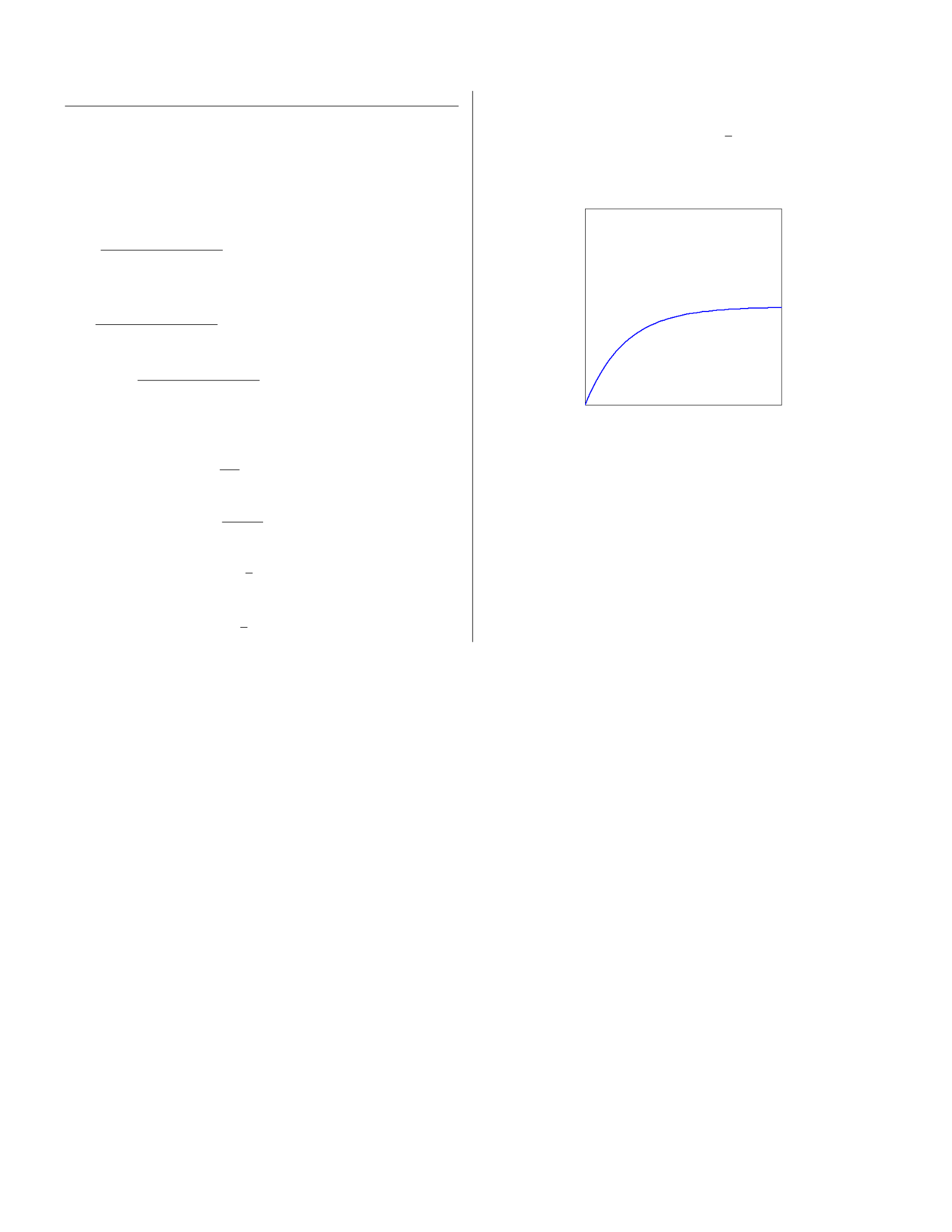
This is shown in the following graph.
(Click on the graph for a larger version.)
Answer(s) submitted:
•-kQ+r
•(r/k)-((r/k))eˆ(-kt)
•(r/k)
(correct)
Correct Answers:
•r-k*Q
•r/k*[1-eˆ(-k*t)]
•r/k
7

