


Introduction to Modern Art:
Stylistics

What is Stylistic Evidence?
To examine a masterpiece, historians
may use specific methodologies on
particular art’s features basis.
Stylistic evidence is one of the
approaches to recognize the age of
an example of art. It applies to a
distinctive way of artifact production
that may be common to a certain
period. For instance, caves curved
with rocks indicate primitive peoples
primary attempts to create art and its
ancient origin.
What is Personal Style?
Personal style is an artist’s manner of
creating his masterpieces. It is used
to examine art pieces with the same

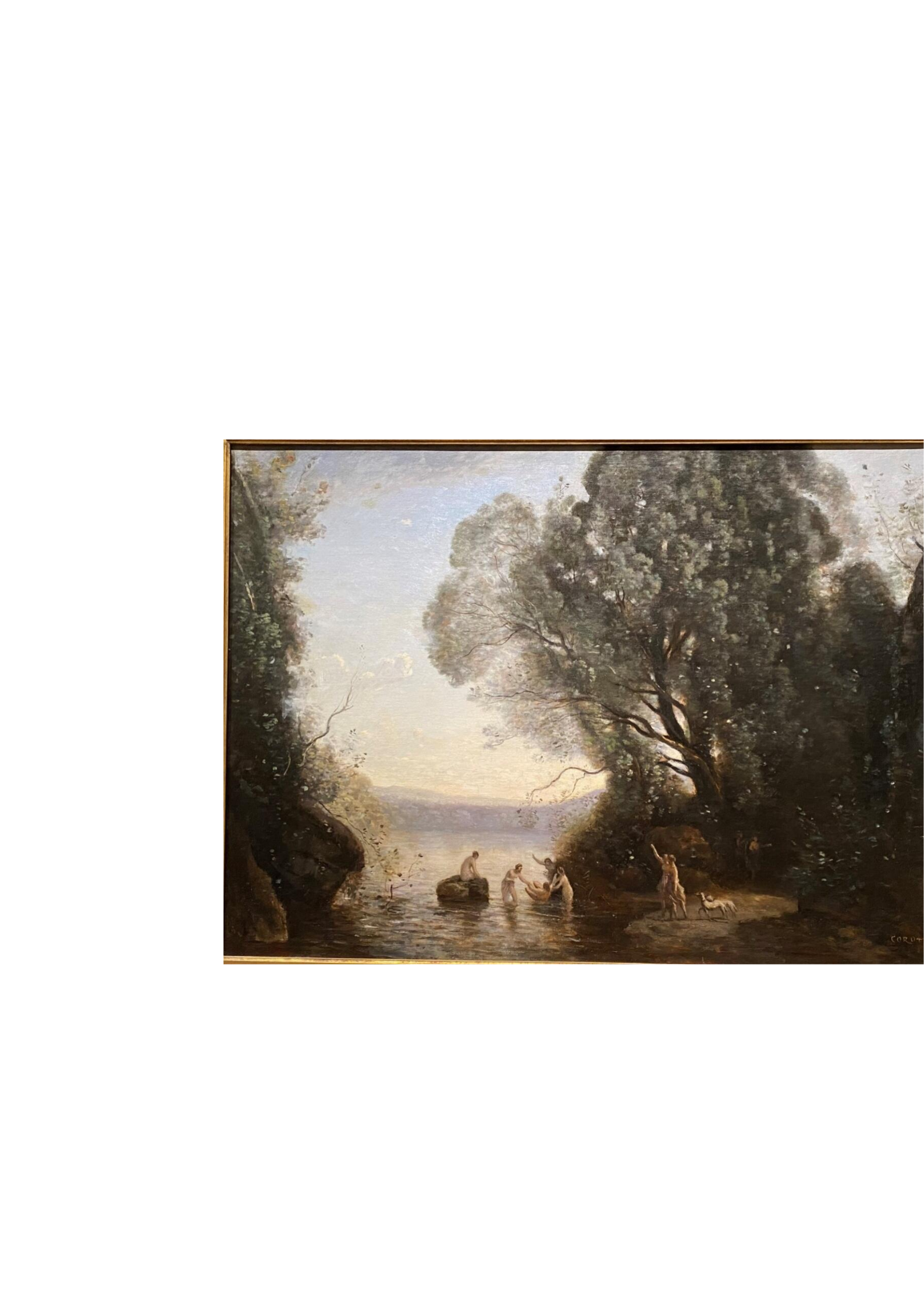
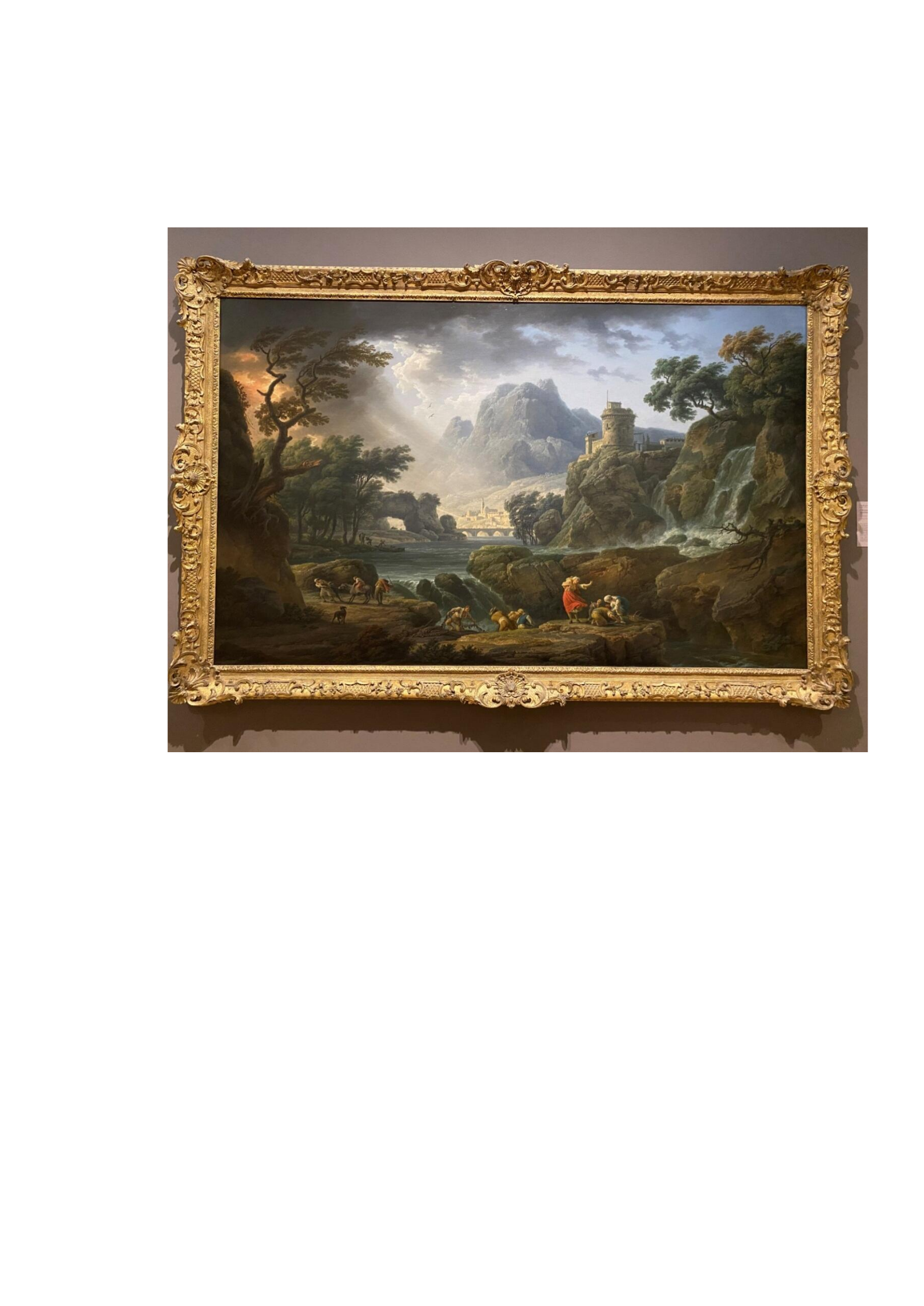
distinguishing features when the
evidence about their author is
missing. The purpose of personal
style detection is to discover the
artist who created a work. For
instance, Aivazovsky’s paintings
usually hold the same line that may
help find the work, which belongs to
him, referring to his style.
What is Iconography?
Pictorial subjects are divided by
historians into categories such as
portraiture, religious, historical, and
others, depending on what
represents a piece of art.
Iconography means a particular
subject and research of its features.

The instances of subjects are
represented but not limited to colors,
texture, symbols, and composition.
Iconography is used to recognize a
hidden meaning an artist put into his
masterpiece and determine its
affiliation to a specific art genre.
Why Look at Art?
Art is a significant component of
culture, which provides people with
visual images. A substantial part of
art is presented in most objects
people consider “common” ones,
such as newspaper photos, works in
a museum, birds, and many others.
But sometimes, art contained in
surroundings conceives a temptation

to stop the time and take a deep look
at its beauty. This moment makes a
person see beyond the first
impression and is a reason why
people look at art.
Hirst’s Shark: Interpreting
Contemporary Art
Hirst’s Shark is a piece of art
representing death’s physical
impossibility from a living human’s
perspective. This work shows the fear
to its viewer, as a shark is considered
a threat to a person’s life. It may not
be possible for ordinary people to
imagine death, as the human
consciousness cannot perceive this
understanding. Artist used a shark in

vitrine to make an illusion of
existence on the edge of extinction.
Contemporary Religious Art: Visual
Art
Art has always been an integral part
of religion, and visual art is especially
effective in conveying religious
values. The paintings by the
Australian artist O’Brien are
displayed in modern art galleries, as
they are characterized by a bright
palette and dedication to religious
subjects. The artist had an eye for
detail and extensive knowledge of art
and literature (“Justin O’Brien,” n.d.).
The purpose of this paper is to
discuss the connection between

O’Brien’s painting Nativity and
religion.
The artwork discussed in this paper is
a rare example of contemporary
religious art. Since O’Brien was born
in an Irish Catholic family, his
paintings often reflect scenes from
the Bible. Nativity depicts the birth of
Christ in a unique manner, as the
colors in the painting are unusually
bright. This special characteristic
enables the use of the picture as a
design element, even in buildings
that are not positioned to promote
Catholicism. The content of the
picture is unobtrusive in comparison
to the form, which draws the

viewer’s attention with vibrant
colors. For those who
believe, Nativity is perfectly
acceptable, as it belongs to an
important phase in the history of
religious art. To me, the traditional
scene of the Magi presenting gifts to
the newborn appeals differently in
O’Brien’s painting. Stylized figures
and landscape create a feeling of joy,
peace and happiness. I believe that
the artist aimed to inspire the viewer
with the harmonious scenery. In
general, Nativity is an exclusive
painting that reflects the author’s
sacred values and shows the essence
of contemporary religious art.

In conclusion, the
painting Nativity by O’Brien and its
association with religion is analyzed
in this paper. O’Brien was a talented
artist whose religious artworks
uniquely promote transcendence.
His legacy is valued not only in his
motherland, Australia but also on the
international level. The
painting Nativity is a reflection of the
artist’s view of religion, which
combines a traditional Christian plot
and a modernistic approach.
References
Justin O’Brien: The sacred music of
colour. (n. d.). Art Gallery of New
South Wales.

O’Brien, J. (1949-
50). Nativity [painting]. Art Gallery of
New South Wales, Sydney, Australia.
Web.
Modern Art Surrealists and Abstract
Surrealism brings out the art in its
purest form and this is an advantage
as the imaginations of the artist are
candidly expressed rather than their
rational thoughts. Freud in
expressing his averments on
Surrealism intimates that art under
this direction is used to express the
hidden or pressed feelings of the
artists through things such as dreams
(Frey, p. 14). The Philosophic nature
of surrealism art which expresses

individual psychology makes it
difficult to have the abstract nature
of art. The possibility of consumers of
the art being able to derive similar
messages from the same was
extremely low.
Abstraction has the advantage of
letting the artist express himself or
herself without the art having an
inner meaning as Kandinsky posits. In
making such liberal expressions,
artists are not bound by elements of
art that help create an out-of-the-box
meaning such as the use of color,
lines, and composition. Further, Piet
Mondrian in validating abstraction
notes that it gives the parties the

room to optimize on imagination and
have the same expressed on the face
of the painting rather than letting the
consumer of the art make
interpretations for themselves. The
imaginations are depicted in visual
representations that do not rely on
inner meanings. Abstraction has the
shortcoming of the inability to offer a
hidden meaning which is a critical
aspect of art. It is more inclined to the
beauty aspect than it is at giving
meaning to a course, explanation, or
discovery.
Pop arts have the advantage of being
simple with less hidden meaning as
they are intended to pass a specific

message to a particular audience.
Rauschenberg embraces the idea of a
simplified form of art that
communicates to people other than
the art that is more inclined towards
having a hidden meaning (Kleiner
n.p). Pop art has been viewed as
aggressive and simple thus diverting
from the elements of art. Despite the
freedom of expression being enjoyed
by artists, the express passing of
information without having the
consumers find an inner meaning to
the art itself reduces the levels of
abstraction which forms the basis of
most forms of art directions.
Works Cited

1. Frey, John G. “Miro and the
Surrealists.” Parnassus 8.5 (1936):
13-15.
2. Kleiner, Fred S. Gardner’s Art
through the Ages The Western
Perspective. Boston, MA: Clark
Baxter, Wadsworth, 2012.
3. Photography’s Effects on
Modern Art
Since its invention, photography has
been hailed by the masses as one of
the best means of bringing the rest of
the world to the public, affording
them views of far-away places and
peoples they would never have
known about otherwise. The public

appearance of the photographic
process in 1839 (Leggat, 2000)
revolutionized the way people saw
the world around them and
introduced a concept of capturing
images that was so true to life that
only the best painters could duplicate
the effects. “As an aid in the search
for reality, the photograph offered an
immediate, faithful and permanent
record, a source of artistic
exploration” (Brown, 1971: 31). In its
earliest forms, due perhaps in large
part to the fact that exposure times
were lengthy as the technology was
in its infancy, photography was used
as a narrative form, but even this

early in its history, technological
developments were allowing for
more creative expression than simply
recording the ‘truthful’ image. “At
the turn of the century [1900], a
small group of serious photographers
tried to rescue the art form from its
low estate by turning their backs on
the more blatant forms of narrative
photography and its continued
reliance on and subservience to
painting. They sought a more
independent poetic vision based on
the camera lens and motivated by a
concern with contemporary forms”
(Brown, 1971: 31). Thus, while it
might be said that “The new

malleability of the image may
eventually lead to a profound
undermining of photography’s status
as an inherently truthful pictorial
form” (Ritchin, 1990: 28), the new
technological developments offered
to photography are merely the latest
in a long line of photographic tools
that can be used to explore new
creative possibilities and/or provide
truthful representation, based upon
the decisions made by the
photographer. At no point in its
history can photography be said to
have been limited to merely ‘true’
forms of capturing images.

Artists working during the relative
time period between 1910 and 1920
were affected to a great degree by
the technological innovations of the
photograph. This period was an era
of prosperity and modernization,
when the entire world it seemed was
becoming mechanized and the world
of art was being questioned by such
new technologies as photography
and motion pictures, which could
produce realistic representation at
least as well as the artists in a fraction
of the time for a fraction of the cost.
In response, artists began
experimenting with those forms of
expression that the camera couldn’t

touch, such as the colors and shapes
of emotion. There remains a
significant difference between the
art produced at the beginning of this
decade, such as Duchamp’s, with the
art produced at the end of the
decade such as Modigliani’s, which is
primarily divided by the advent of
World War I in 1914. As a result, one
can see the cubist influences of the
first decade of 1900 in the work of
Duchamp, such as in his “Nude
Descending a Staircase #2”. This
painting is characterized with a
lighthearted, warm light and a
sentimentalized emotional content.
This is sharply contrasted with the

darkened spaces of Modigliani’s
painting, “Head of a Woman,” in
which the woman seems bent out of
shape, dark and mysterious,
impossible to penetrate and guarded
in her forced interactions. Where
Duchamp’s woman seems to glow
from within as she floats down the
stairway, Modigliani’s woman is
smudged with dirt and seems off-
balanced in her motionless state
while her eyes remain coldly
inexpressive and hollow.
Works Cited
1. Brown, Milton W. “The History
of Photography as Art History.”

Art Journal. Vol. 31, N. 1, (1971):
pp. 31-32 + 36.
2. Duchamp, Marcel. “Nude
Descending a Staircase #2.” Oil on
canvas. Philadelphia Museum of
Art, 1912.
3. Leggat, Robert. The Beginnings
of Photography. (2000).
4. Modigliani, Amedeo. “Head of
a Woman.” Oil on canvas.
Bridgeman Art Gallery, c. 1915-
1918.
5. Ritchin, Fred. The Critical
Image: Essays on Contemporary
Photography. C. Squiers (Ed.).

London: Lawrence & Wishart,
1990: p. 28.
6. The Tempest and the
Contemporary Arts
7. Introduction
8. No one would deny the
fact that Shakespearean
works are timeless. They
have survived during the
centuries and continue to
ask readers various
questions the answers to
which help them to
understand the mysteries of
life. Drawing parallels
between the works of the
great poet and playwright
helps the reader to

understand the author’s
message and to dig into the
very essence of the work.
9. Main text
10. The Tempest is one of the
most famous plays of the
final period of
Shakespearean creative
work. We consider the
problems that the author
revealed in this play to be
rather topical for the
present day. The
interconnection
between The Tempest and
the modern times is quite
obvious if we regard the play
from the point of view of its
relevance to the

contemporary art.
Reconciliation and the
forgiveness of potentially
tragic errors are perfectly
depicted through the use of
the same techniques as
contemporary sound art
does.
11. First of all, we should
point out that the work
under consideration uses a
lot of attention-grabbing
devices as well as
contemporary art aims at.
Attracting the audience’s
attention has always been
the main target of any
author. But if nowadays the
modern technologies serve

as the authors’ friends in
their tasks, during the
Shakespearian age the
playwright needed to apply
to various non-mechanic
techniques to impress the
audience, therefore, we
consider Shakespeare to be
a skilful performer of sound
art. This art movement of
the 2000’s is concerned with
sound and listening. The
Tempest is also full of the
effects of this type. Their
main function is to render
the correct atmosphere of
the play.
12. For example, the first
scene is characterized by

usage of short characters’
lines. But for the lines 20-25,
the characters’ words are
rather harsh and dynamic.
Shakespeare uses hurried
dialogues to render the
atmosphere of panic. Under
the circumstances the
characters do not have time
for long conversations. They
are at a loss; they try to shut
themselves down as well as
the noise of the storm.
13. Special effects in the play
14. The very storm is also
rendered successfully by the
author. Probably, the actors
who played in The
Tempest could clearly see

how the storm should be set
in front of the audience.
Making as much noise as
possible the actors could
incarnate the author’s
concept.
15. The noise is also created
when the characters
constantly come on and off
stage. If we consider
that The Tempest is set by
some sound art performer,
he or she will easily get the
springboard for the effects.
The very characters’ voices
will help the creator to
render the horrible
atmosphere: the
conversation between the

Boatswain and the
passengers becomes more
and more heated. Not only is
the actual cry used by
Shakespeare in his play, but
the cry within, as well. The
cry within means shouting
off-stage. Shakespeare
implied the usage of this
technique and its
appropriate application
enables us to call him a
representative of the sound
art that is so popular
nowadays.
16. By using the techniques of
sound art we have talked
above Shakespeare manages
to draw the audience into

the plot and make the
reader find out more.
17. The Making of Modern
Life: Art and Design in the
Nineteenth Century
18. Introduction
19. The expression of
emotions and moods, as
well as a call to the feelings
of the viewer, are one of the
essential tasks of visual art.
A competent artist uses not
only the plot of a picture but
also drawing techniques as a
medium of expression. Vivid
examples of such adept
application of both methods
simultaneously are of the

classical era is The Bath of
Diana by Jean-Baptiste-
Camille Corot and A
Mountain Landscape with an
Approaching Storm by
Claude-Joseph Vernet.
These works became the
objects of study because
they show the opposite
emotions of calmness and
anxiety using similar means
of painting despite the
difference of more than a
hundred years. This work
will examine from the
perspective of visual and
comparative analysis what
methods of art prevailed in
different centuries and the

paradox between
techniques and moods.
20. Main body
21. Jean-Baptiste-Camille
Corot, the French artist of
the realism movement,
painted an oil picture
called The Bath of Diana in
1855. The central figures of
the image are Diana and
other women who take part
in bathing in the river. Two of
them are to the left of Diana,
one of which sits on a stone.
Three women are on the
right side of the main
character of the picture, and
two of them, along with two
dogs, stand on the shore and

keep a little closer to the
viewer. Also, another woman
leaves the bushes, thus
being in front of Diana. The
background consists of
various kinds of vegetation
like shrubs and trees of dark
shades as well as the
coastline and sky. The bright
space of the picture
represents the sky, which
illuminates the bathing
process and resonates with
the hands of two women
pointing up.
22. Of course, the focal point
of the picture is a group of
women located at the
bottom of the image. To

focus attention, the artist
used not only their central
location in a single place of
sunlight, but also the
contrast between light tones
of women, water and sky,
and dark tones of plants.
Light tones include pastel
shades of blue, gray, yellow,
orange, brown, green, and
flesh. Green, brown, and
orange nuances make up
dark tones. The conflict
between the horizon and the
diagonal manifested by the
trees and the sky also
supports the general focus.
Smooth, long, and confident
lines characterize images of

girls, dogs, tree trunks, and
branches. However, Corot
applied mostly light, rough,
short lines when creating
the background. Dotted,
somewhere inaccurate,
strokes make the foliage and
lighting on it. The artist
avoids sharp corners and
uses wavy lines and rounded
shapes.
23. Calmness is the primary
mood of The Bath of Diana.
Diana is undergoing a
process of sacred spiritual
purification. The evidence of
it is a light source directed
down at her and other
women, which may indicate

the presence of God in this
ritual. The weather
transmits the feeling of
some divine calm and
appeasement. The viewer
might observe a lack of wind
when looking at the water
surface, foliage, and
branches. Even animals are
in harmony with the
environment, judging by
their stance. If the paintings
could convey sounds, then
perhaps even the birds
would remain silent in this
canvas. The atmosphere of
mystery and proximity,
which are provided by dark,
dense, almost completely

covering the sky, greenery
also supports the feeling of
calmness. The artist created
a fully immersive situation of
the intimacy of the process
of female bathing.
24. The romantic artist
Claude-Joseph Vernet
created an oil canvas
called A Mountain
Landscape with an
Approaching Storm in 1775. A
woman in red, and people
around her, whom she may
warn of an imminent
thunderstorm or storm,
represents the central
figures. These seven people
on a steep bank of the river

in a hurry collect fishing
rods, fishnets, and their
catch. In the background,
other people are also
rushing to the city in a
wagon, leaving the boat on
the shore and driving a
stubborn donkey with a
cane. The background also
includes the river
surrounding its steep rocky
bank on sides, the castle and
waterfall on the right side,
and the city far in the center.
A massive mountain range
rises above the sunlit city
and the aqueduct. Darkness
gradually covers the sky
from left to right with

thunderclouds due to the
upcoming storm. Lightings
of hellish colors sparkle in
the upper left corner of the
picture.
25. A woman with a child,
who is the local focal point
of the picture, is slight to the
right of the lower center of
the image, which creates
visual dissonance. The red
color of her clothes distracts
the viewer’s attention from
three people, who represent
the real center; however,
their dull clothes merge
them with the background
colors. The artist used a
wide range of vibrant colors

and shades such as red,
orange, yellow, dark brown,
dark green, deep blue, dark
gray, white, and black. In
general, the viewer might
characterize the picture as
having an extremely high
degree of detail. The artist
provided this effect by a
multitude of heavy, smooth
long thin, and sinuous lines.
Another technique is a large
number of heavy, sleek long,
and thin lines, especially on
stones, trees, and water. The
environment consists of
angular square shapes that
contrast with the wavy and
rounded silhouetted living

objects. The upcoming
storm as if an asteroid falls
diagonally on the horizontal
line of the aqueduct and the
water surface.
26. The main motive of the
work of Jean-Baptiste-
Camille Corot is anxiety.
First of all, the artist
provided this feeling by the
dissonance of points of
attention on the canvas. In
the foreground, a woman in
red is not in the center; the
lighting falls on her and her
surroundings as well as on a
group of people with a
donkey. In the background,
the castle tower, the city,

the top of the mountain, and
lightning simultaneously
attract the viewer’s eye. The
town in the distance may be
the general center of the
picture, but the bright red
color of the dress always
distracts the focus. Nature
announces the impending
threat with the dog, donkey,
strong winds, and frightened
birds. The contrasting
infernal unnatural color
palette of lightning and
thunderclouds possibly
portray God’s anger, and the
light yellow city is the only
haven in the picture. The
location of people on a steep

bank even causes a feeling
of fear of falling into a raging
river.
27. The presence and
influence of God in the most
intimate aspects of human
life is a common motive for
both paintings. This
similarity lies in the
correlation between light
colors and security. The sun
completely illuminates the
bathing process, as well as
the city under the mountain,
which will soon be under the
shadow of a divine
thunderstorm. The presence
of Biblical motifs and divine
principles in paintings were

standard, if not mandatory,
practice for most artists
until the beginning of the
20th century. Also, in each of
the two pictures, there is a
body of water represented
as a river, and even if they
have a radically different
mood, nevertheless they
both fulfill an emotional
function. Canvases have a
common element of the plot
during which people
complete activities in rivers
after seeing changes in the
sky. Both artists actively
used weather and nature in
their paintings to express
the spirits. The movement of

the clouds occurs from left
to right in both works, and
the dogs turned their heads
to the upper left corner.
28. The viewer might trace
the common technique of
focusing attention through
the intersection of
horizontal and diagonal in
these two works. Also, Corot
and Vernet captured
participants of both
paintings at the moment of
their greatest attention to
weather changes. Similar
shades of green, brown, and
blue make up the picture of
both surroundings. The
viewer sees the far

background of both
canvases, mainly on the left
side of the paintings. Also,
both artists emphasize the
attention in both artworks at
the bottom of the picture.
The works of Corot and
Vernet have a common
paradox between the
applied techniques and
transmitted moods. Nervous
short and rough strokes
suggest an alarming sense of
work, while long, accurate,
and thin lines should convey
calm.
29. One of the most critical
semantic differences is the
value of the diagonal line

from the upper left corner to
the center of the picture. In
the case of The Bath of
Diana, it means divine favor
and support, but in A
Mountain Landscape with an
Approaching Storm, it
symbolizes the Wrath of
God. Artists clearly
expressed these emotions
by the colors which
represent the light source
and clouds, light blue tones
of The Bath of Diana against
the dark gray shades of A
Mountain Landscape. The
plot of the sky is also
different; it is absolutely
calm in the work of the 19th

century, while in the canvas
of the 18th century,
aggressively moving clouds
will soon completely cover
the sky. Corot portrayed a
distant background only in
the form of small wooded
hills, and Vernet’s canvas
has a vast mountain range
and urban area. Also, there
are entirely no buildings
in The Bath of Diana; nature
constitutes everything in the
picture. The patterns of the
flow of the rivers differ by
dividing into a raging,
turbulent stream and small
calm ripples.
30. Conclusion

31. The scale of the paintings
is also different; the work of
Jean-Baptiste-Camille Corot
captured events much
smaller than the canvas of
Claude-Joseph Vernet. The
nature of the colors
corresponds to the moods of
calmness and anxiety; the
first painting uses pastel
shades, while bright colors
completely filled the second
canvas. The leisurely
pastime of Diana and the
women contrasts with the
anxiety of the inhabitants of
the mountain landscape.
The colors depicting people
in The Bath of Diana are in

perfect harmony with the
environment and almost
merge with it. In A Mountain
Landscape, the purpose of
tones and shades is to
highlight and contrast the
participants with their
surroundings. Also, people
are located on the right
strand in the first painting
and on the left in the
second. Corot’s canvas
represents the ideal of
sealed calmness, and
Vernet’s artwork is a perfect
sample of visually depicted
anxiety. For a clear
understanding of the
principal differences
between the two works, it is
enough to look at the
branches on the right of A
Mountain Landscape and in
the center of the Bathing of
Diana.
32.
Jean-Baptiste-Camille Corot, The
Bath of Diana, ca. 1855. Oil on
canvas. Dallas Museum of Art.
Level 2. European Art – 19th
Century.
Claude-Joseph Vernet, A
Mountain Landscape with an
Approaching Storm, ca.1775. Oil
on canvas. Foundation for the Arts
Collection. Mrs. John, B O’Hara
Fund, 1983.41.FA. European Art –
18th Century.

