


The Impact of Remote Leadership on the
Global Business Organization
LAW 6003 - Business Law
University of Cincinnati
October 4, 2024

Introduction
Due to their scale and work in several
countries at once, international business
organizations must comply with many
standards and laws than local companies.
With the organization’s growth, the scope of
its responsibility increases; with the growth
of income, opportunities increase,
generating free resources. These resources
are usually invested in the company’s further
development: marketing, capturing new
markets, product diversification, and more
(Kabwe & Okorie, 2019). With the
development of technology, many business
processes are significantly accelerated and
automated, increasing the pace of
development of companies and, accordingly,
competition. As a result, international
companies become more exposed to
external global factors. The strongest in the
market is the best to adapt to new

conditions. As part of the economic crisis and
pandemic, this is precisely the situation that
has led to many changes in the established
business processes of many organizations.
The COVID-19 pandemic has forced many
global companies to experiment with
remote work on a scale like never before.
While teleworking at multinational
companies is not a new work model, most
business firms have closed their offices
indefinitely, instructing employees to work
from home to contain the spread of the
virus. At first, many international companies
hoped to return to everyday life in a couple
of months, but years later, millions of
workers are still working remotely (Espitia et
al., 2021). This trend has its obvious
advantages: the selection of candidates for
various vacancies is extrapolated to the
international labor market, and there is no
physical contact among employees, which is

undesirable in a pandemic. Technological
advances in software and hardware have
made it possible to reduce the impact of
switching to this mode of work for those who
usually work full-time. Many video
conferencing programs, interactive systems
for interacting with a large group of human
employees, and Internet traffic control
programs such as Zoom, Timely, and
CleverControl – began to develop thanks to
the transition to remote work actively
(Pratama et al., 2020). On the other hand,
the possibility of interacting with customers
directly, creating a working atmosphere, and
the possibility of control by management are
falling.
This workforce shift has increased the need
for remote leaders to manage the
organization’s goals and objectives.
Organizational leadership has been the
backbone and key to the success of firms in

solving company problems and problems.
Leaders of all sizes and positions are faced
with the extraordinary task of managing
employees remotely. Such a task still had to
meet the requirements of social
responsibility, the company’s mission, goals,
and vision. The ability to adapt and mobility
became critical for employees and
managers, who had to maintain the
efficiency of the company’s operations in the
new conditions and adjust to the crisis.
Experts in dealing with uncertainty and lack
of sufficient information to make decisions
have become highly valued (Hong et al.,
2018). Thus, the influence of remote leaders
and their popularity is an important area that
requires research related to the effects of
the pandemic and other external factors that
contribute to the transition of employees of
a business organization to a remote work
mode.

This paper contains a literary review of
aspects of remote leadership, the main
types, the implementation of these styles,
and theoretical justification. This section is
followed by the research methodology
section, which contains the concepts
considered in the study and the primary
methods for their quantitative assessment.
They include collecting information from
open official sources, such as annual reports
of companies, on the dynamics of financial
performance in recent years. The study was
conducted using questionnaires of leaders
from different business areas. Then, a
regression analysis will be performed to find
correlations between the number of remote
employees, organizational structure and
leadership style, and various financial
indicators of the liquidity and relevance of
the company based on both surveys and
other available information. The description

is followed by a section on results and their
interpretation, detailing all outputs and
possible predictions and limitations.
Literature Review
This section deals with the main aspects of
remote work and leadership in general,
especially in its implementation in this
mode. The literature review turns into a
retrospective of remote work and its
development on an international scale. In
addition, the central leadership styles are
considered through the prism of their
adaptation to the new working environment.
The theoretical models used in this study to
describe the processes are also included in
this section.
Background and History
Over time, the development of technology
has given rise to the possibility of remote
communication. Within this opportunity,

organizations saw remote workers as an
opportunity, not a constraint (Hunter, 2019).
In this regard, business processes have been
gradually optimized, within which the
physical presence of a person is no longer
needed to share or convey information.
Accordingly, the organization’s structure is
also being transformed, becoming less
hierarchical and more autonomous in each
sector. At the same time, the consistency
and messaging pace across sectors are
increasing, which is critical within an
international organization: information
technology capital directly affects labor
productivity (Arvanitis & Loukis, 2009). In
this case, the leader’s task is to control the
execution of the company’s operations
within the organizational structure in the
context of changing the way information is
communicated between its levels. If the
basic rules and roles of employees in the

organization remain the same, responsibility
can be transformed under a changing work
environment, requiring specific skills from
them.
For many large companies, employees
themselves are one of the most important
values. Apple and IBM, for example, offer
ongoing learning and a welcoming
environment built on inclusion and diversity
(Apple, 2022; IBM, 2021). Showing care,
attention, and appropriate attitude on the
part of management requires appropriate
competencies in the soft skills of a leader,
such as teamworking, motivation, and
conflict resolution. Managers in the
workplace can influence the interlocutor
with the help of non-verbal signs and
interaction in the physical environment,
among which moments of informal
communication are possible. The remote
leader, in turn, must be able to adapt these

support mechanisms to the new
environment without the possibility of
physical contact, that is, only through the
available means and communication
channels (Vijaykar & Karhade, 2021; Kaveri &
Mohan, 2020). If these processes are
progressive and the company automates and
introduces solutions requiring remote mode,
employees have time to adapt to the new
conditions. The case of the pandemic is
fundamentally different precisely in this
aspect – many companies were not ready for
such drastic changes, as well as leaders and
employees, respectively. The complexity of
adaptation was that it was necessary to
master new tools across the company for
functions that did not require any tools in a
physical office: communication, team
discussion, and physical document
management. Although international
companies already had an experience of

remote collaboration, the transition of
offices to this mode from the very beginning
significantly increased the time spent on
such moments, not to mention the
psychological aspects of adaptation.
The office provided access to hardware and
software, certain archival records, and an
established interaction system between
employees. Each employee has a habit that
everything they need is at hand. The sudden
transition to remote work requires managers
to consolidate all these mechanisms and
make them available to employees in the
new environment (Contreras et al., 2020;
Kaveri & Mohan, 2020). At the same time,
organizations often provide all the necessary
technical equipment, including covering the
associated costs of an employee for
arranging a workplace, by the remote work
policy and other labor standards, including,
for example, the General Data Protection

Regulation (Lueck, 2021). Now leaders must
manage the organization’s resources within
the framework of operations and provide
support to employees at various levels, right
down to the personal level.
Personal capabilities are now becoming a
problem for the entire organization: if
employees do not have access to the
Internet, their laptop or smartphone with
the necessary functions, and expensive
software, the organization must provide the
employee with all the necessary resources.
For example, IBM has gone from adapting
employees in the workplace to
implementing a hybrid approach in
operations. At first, the company viewed the
cost of supporting employees at home as
temporary, but now it is seriously
considering abandoning many offices (Ford
& Chang, 2021). The capabilities of
employees in both modes are fixed at the

level of policies of international companies:
in-home offices, where there are no control
systems, the time or amount of work of an
employee is strictly regulated (Ford & Chang,
2021). With adaptation, the measures could
be softened, forming the company’s current
policy, which itself is already striving for this
regime.
Some companies were able to quickly and
effectively adapt to new conditions.
McDonald’s has implemented a flexible
leadership system to quickly respond to local
groups, almost instantly implementing all
kinds of requirements for operating offices
and own establishments (Edeh et al., 2021).
However, the individual characteristics of
organizations created their own pace of
transition. For example, IT companies such
as IBM had the leading layer of their
operations in a virtual environment, which
only required the creation of working

conditions and control for employees and
the adaptation of key business processes,
such as closing deals and interactions
between management and employees (Ford
& Chang, 2021). Companies from areas
where complete headquarters relocation is
not possible, such as the hotel business,
were forced to differentiate this transition
for specific departments while creating a
safe environment for offline employees
(Pham et al., 2022). In addition to the
apparent differences in business industries,
representatives of strict hierarchical
organizational structures adapted differently
from more autonomous ones. Written
assurances of document flow in strict non-
governmental organizations required
streamlining and significant revision of the
process (Chai & Freeman, 2018). At the same
time, the absence of the need for such
moments in more autonomous structures

ensured a smoother transition to remote
work.
Effective Organizational Strategies
Effective organizational strategies have a
complex structure, as the leader must
ensure all aspects of the transition to a
remote mode and consider psychological
and, in some cases, even personal factors.
Although leaders have fewer opportunities
for informal communication and personal
assistance to employees, they can change
the form of support in the form of remote
access tools: instant messengers, video
conferencing, and more (Golden &
Gajendran, 2019). The interactive impact can
now come in the form of encouraging emails
and the provision of benefits in the form of
paid counseling if the transition is difficult.
Companies began to turn to the outsourced
services of psychiatrists more often, and

psychiatrists, in turn, began to use the
possibilities of telemedicine more than 40
times (APA, 2021). Large organizations
began to document policies to help
employees work remotely, regulating
opportunities not only to receive mental
health services but also to give memberships
to the gym, choose the time for an
employee’s religious activities, and much
more (Miller, 2019). Physical activity, time
off, and the possibility of informal virtual
communication with the leader can indeed
be considered aspects of an effective
strategy, the most recent research confirms
an increase in the frequency of contact
between employees among themselves,
which has led to an increase in productivity
in several cases (Yang et al., 2022).
Regardless of the company’s operations,
leadership style, and structure chosen,
mental aspects are the key to the

effectiveness of the strategy chosen by the
remote leader.
In a short time, most of the strategies for
improving efficiency, and planning, such as
Kanban boards, Agile, and many others, have
become available for most companies to use
analogs on computers and smartphones
remotely. With the help of these
applications, managers were able to
delegate tasks to employees in a new but
rather convenient form, and employees
received a visualization of their activities
(Cong, 2021). Studies have shown that
technical issues arise almost as often as
communication and management issues,
while technology is the primary driver of
remote work (Ferreira et al., 2021). The small
organization of people implies constant
contact since the management now has no
physical access to the employee. Practical
strategy skills now include management

competencies within communication
applications such as Skype or Zoom and
applications that provide remote access,
electronic document management, and
interactive interaction within operational
activities.
Regardless of their ultimate goals and
dynamics, organizational strategies
experienced a change in the form of their
principal activity as part of the transition to a
remote mode. If the company was aimed at
capturing a particular market share, then, for
example, now meetings with potential
customers have moved online, the possibility
of concluding contracts has also become
necessary, and it has become necessary to
find an aggregator to organize the logistics of
supplying goods under new restrictions
(Oxelheim & Randøy, 2021). If we rely on the
three components of the content of the
organization’s strategy: communication,

intention, and implementation – only the
intention has not changed its form. Intention
sets goals, and the majority of companies, if
they have not faced a severe crisis or a
complete shutdown of their activities under
the restrictions imposed, are still focused on
increasing net and gross profits and
expanding. Companies suffered losses, but
approximately 10% were able to find
resources to financially support their
employees to maintain productivity and
implementation (Pokojski et al., 2022). The
dynamics of change in communication have
been described above.
Finally, companies must meet social
responsibility requirements along with
environmental responsibility (Yang et al.,
2021). As a rule, it implies the values of
recognition of diversity, inclusiveness, and
high professional ethics (Latapí Agudelo et
al., 2019). Stakeholder pressure during a

crisis can significantly reduce employee
performance: studies have shown that
adapting corporate ethics to a new virtual
environment reduces the likelihood of
conflict situations (Mehmood et al., 2020).
The remote mode of work makes it possible
to get jobs more often for women who have
to stay at home with children and people
with disabilities who would find it difficult to
get to the office physically. Considering the
tendencies to protect the rights of people
subjected to various kinds of structural
discrimination, remote work is a new normal
toward which a civilized society was moving.
Along with this, creating employees’ rhythm
of work, improving time management skills,
and the ability to manage resources are
other significant advantages that have begun
to be noticeably developed among
employees. Such skills make life easier for
the manager since employees are given

more responsibility for their operations
without the need for control.
Qualities and Roles of Remote Leaders
The goal of remote leaders is to help the
organization identify the most important
goals and develop the best ways to achieve
them. Leading an invisible team requires
someone who can understand complex
conditions and objectively examine
problems rationally and impartially before
making decisions (Wang et al., 2020).
Another essential quality of remote leaders
is effective communication and strategic
planning for more efficient and profitable
systems (Spagnoli et al., 2020). When
working from home, leaders tend to be more
involved in the work that becomes part of
their personal lives: the schedule becomes
irregular. Suppose leaders are effectively
fulfilling their responsibilities in this mode. In

that case, the positive aspects of this
experience should be adapted to the
operational activities of employees,
primarily by encouraging the transition to
remote work. However, according to
research, about 30% of workers cannot work
from home due to various subjective reasons
(Bloom, 2020). At the same time, large
companies such as IBM, after the experience
of the pandemic, are considering hybrid and
completely remote options as a different
vector for the company’s development (Ford
& Chang, 2021). Except in the extreme of not
being able to work from home, leaders must,
like the foundations of transformational
leadership, lead by example in adapting
work processes to their personal lives.
For many business sectors, such as the
entertainment industry, hospitality, and
tourism, the restrictions imposed almost
wholly stop the ability to operate. These

industries cannot function remotely, just
like, for example, IT, marketing, or
education. Accordingly, there are other
organizations where the remote mode
causes minor damage but forces not only to
restructure the form of activity but to cope
with a crisis. Organizations adjust to
numerous legislative decisions in their
geographic region, and in many cases, these
decisions are large-scale and require rapid
response in reforming operations in the
marketplace. The most stringent restrictions
on strict social distancing, gatherings of no
more than four people in South Korea are
not comparable to the relatively low ones in
Mexico, where only wearing masks in public
places is required (Han et al., 2020). On the
one hand, companies working remotely do
not need to adapt the physical office to
government requirements, and employees
do not need to contact other people during

the journey to the office. On the other hand,
leaders have less control over the movement
of employees, which can violate restrictions
on working hours, putting the company’s
reputation at risk.
The ongoing digital transformation process,
which affects both the necessary
competencies of a leader and entire business
development strategies. Numerous studies
show that technology has always been the
driving force behind innovation, as
evidenced by empirical evidence from the
chemical industry to IT (Ahuja & Morris
Lampert, 2001). Progressive changes are
associated with the digitalization of
commerce, marketing, purchases, and much
more. As interviews with e-retail leaders
have shown, this transition creates a risk
transformation, understanding scarcity, and
company size in a new environment that
requires adaptation (Johnson, 2010). Any

technological opportunity always requires
costs and risks at first, but the most effective
implementation later becomes necessary to
maintain competitiveness (Bilan et al., 2020).
Offices controlled by directors in
international companies represent a similar
model in the transition to remote work; the
difference is that each employee now has his
workspace, to which the manager does not
have physical access. Digital transformation
has made such a regime possible in principle,
thanks to remote communication, the
creation of shared networks, e-commerce,
and many other technological processes.
Remote work has allowed employees to
better balance work and family. Many have
begun to save money and time on the road,
sleep better and work much better in a
comfortable, stress-free environment. The
balance between personal life and work is
one of the critical factors in employee

satisfaction. A study of banking employees
has shown that remote work, in contrast to
being physically present, has a more
significant impact on work-life balance,
which is primarily positive (Putra et al.,
2020). In contrast to the physical mode,
remote leaders will deal with this aspect
more often, which slightly distinguishes their
competencies from classical leadership.
Research in this area also shows that
traditional leaders are better at increasing
the effectiveness of remote workers over
time by creating an appropriate culture that
includes behavioral and communication
strategies for interaction (Basile &
Beauregard, 2016). Figure 1 shows the
dynamics of employee satisfaction in this
study over time.

Figure 1. Employee satisfaction by
employment type
Remote Leadership Styles
Leadership is categorized into different
styles that have distinctive qualities.
According to research, if the pace of current
telecommuting trends continues, more than
30 million Americans will be working
remotely by 2025 (Brynjolfsson et al., 2020).
The most common leadership styles are
transformational, participative, situational,
laissez-faire, servant, and adaptive. The

context of the remote mode changes the
form, methods of achieving goals, and
control mechanisms in each of the above
styles. The common thread among them is
that telecommuting leads to a forced
transition to autonomy, which can lead to
improved productivity and well-being of
employees and cause conflict and chaos. The
task of management, in this case, is to
increase the positive impact of such an
irreversible transition and reduce the
negative one.
Laissez-faire or non-intervention is the
leadership style, the hallmarks of which were
forced to appear remotely. Leaders who
have a participatory style are deprived of the
opportunity to be personally present during
operations. Except in the case of constant
monitoring via video or similar applications,
many leaders are forced to move to a hands-
off approach for two reasons. First,

employees need to adapt to working from
home, where all kinds of control systems can
be negatively perceived as an attempt to
encroach on personal space. According to
research, these attempts are stressors that,
according to research, under a laissez-faire
policy, become the causes of conflict and
destructive behavior of employees, leading
to the decay of the social atmosphere and a
drop in productivity (Skogstad et al., 2007).
Secondly, the employee can give instant
feedback without constant physical
monitoring of the presence in the workplace.
There is a theory that autonomy, which gives
employees independence, contributes to the
disclosure of the creative potential of
people. This theory is supported by studies
that show a connection between the implicit
autonomy motive and creative production
both from school age and in an older sample,
where the relationship between the leader

and employees is also essential (Baum &
Baumann, 2019; Volmer et al., 2012).
Paradoxically, the more the leader
communicates with employees, the more
they demonstrate creativity and creativity
with the autonomy granted (Volmer et al.,
2012). Within the framework of this
autonomy, the leader’s main task is to create
conditions for open, ethical communication,
both voice and text. The social environment
should encourage innovation since the
virtual environment itself is, in a certain
sense, a forced but innovative solution for
many people and organizations.
Participative leadership in reflecting the
remote work mode implies many group
activities: videoconferencing, sharing
interactive use of working software. Like
servant leadership, the manager is
constantly in touch with employees to
control the process and help its participants.

A similar approach is used for
transformational leadership, but the goal of
this style is a positive change. In all three
cases, the leaders set an example, which has
a positive relationship with employee
performance and engagement instead of
styles based on transactional leadership
(Limsila & Ogunlana, 2008). Consequently,
the leader must have the skills to confidently
use the software and help employees adapt
to the use. If the work involves a constant
presence at the workplace, the leader should
also be with his team, if possible, without
absences.
An important psychological aspect of the
servant leadership approach is vital to apply
regardless of the chosen style. Many
employees have experienced adaptation
problems, burnout, and the inability to
concentrate at home, as they needed
psychological support against the

background of the imposed restrictions –
many lost their jobs, experienced the
consequences of lockdowns, and the
inability to see relatives, and friends, and
much more. This information, as a rule, was
obtained by remote surveys through
specially compiled scales of stress and
burnout (Hayes et al., 2020). This
phenomenon has been referred to as
professional and social isolation, which
reduces employees’ productivity for various
reasons when staying at home for a long
time. For example, research has shown that
lockdown can lead to reduced sleep quality,
anxiety, and feelings of loneliness. Research
findings are similar for teleworking
compared to much earlier in a pandemic
context (Mann & Holdsworth, 2003; Xiao et
al., 2020). The servant-leader always
supports his employees emotionally,
inspiring them to mutual respect and putting

the employee’s well-being over the client’s
satisfaction (Canavesi & Minelli, 2021). In the
face of brutal layoffs, mass layoffs, and
financial constraints, this type of long-term
leadership in remote work has proven the
best adaptive.
Adaptive leadership offers the most flexible
self-awareness of both the leader himself
and all employees of the organization. This
style sets adaptive tasks for the company,
each of which does not have a single correct
and obvious solution. The conditions of
uncertainty that characterize the pandemic
experience imply the need for constant
adaptation. For example, the restaurant
business that was able to adapt and quickly
connect to food delivery aggregators and
create the possibility of online orders could
save a certain percentage of revenue and
closure (Serbulova et al., 2020). In addition,
according to empirical studies, this style is

primarily consistent with the non-financial
sustainability of the business, which in turn
contributes to financial success (Akhtar et
al., 2016). The role of a leader in such an
approach varies from task to task and,
depending on talents and competencies, can
be ranked among all leadership styles.
Moreover, a new kind of collaborative
leadership has emerged during the era of
telecommuting. This phenomenon was born
from the spread of autonomy, the
consolidation of virtual teams, and the
distribution of responsibilities and shared
responsibility for the result (Pavez & Neves,
2021). Within the framework of this
approach, the involvement of employees is
significantly increased, while the figure of
the leader itself is not excluded but may be
formal. A survey through surveys showed
that when using collaborative leadership
tools, in addition to involvement, the power

and responsibility of each employee
increases, and psychological factors become
essential. When conflicts arise, as a rule, the
leader in this situation has less power and,
accordingly, the means to resolve it; in a
virtual environment, the situation becomes
more complicated (Kramer & Crespy, 2011).
The virtual environment often involves
asynchronous communication, which, by
definition, is less efficient and controllable
between the leader and the employee.
Concept of a Remote Leadership
The resulting model, taking into account the
specifics of some business sectors, will show
the effectiveness of various leadership styles
and the dependence of the number of
remote workers on the company’s financial
performance. According to the studies, the
success and sustainable development of the
company does not only depend on the

positive dynamics of specific financial
indicators but also depends on compliance
with the requirements of social and
environmental responsibility, the presence
of corporate ethics, charity events, and other
events that form the image and position of
the company (Maden et al., 2012; Waler &
Dyck, 2014). Reputation is the degree of
stakeholder evaluation based on profitability
and intangible assets such as CSR, but the
degree of influence is subjective. There are
essential behaviors of remote leaders that
have a qualitative impact on the success of
an organization. These behavioral roles
affect the relationship between employees
and their supervisors, as do influence the
psychological state of each other in a virtual
environment (Mann, S., & Holdsworth, 2003;
Xiao et al., 2020). They act as intermediaries
and mentors between the management
team and remote workers. Human relations

and goal achievement roles are essential to
success in global organizations for remote
executives.
Theoretical Framework
There are several theories, the practical
application of which would be necessary for
remote mode; however, in this paper, the
model of George Homans is used. The model
includes three main elements: tasks,
interactions, and attitudes. From the
manager, employees receive tasks, perform
them, and establish interaction, which is
likes, dislikes, feelings, and attitudes. The
more frequent the interactions, the stronger
the attitudes, and vice versa (Treviqo & Tilly,
2015). The longer the interaction, the more
identical the attitudes and the more similar
the employees. They have standard norms
and what they value together. Norms are
fulfilled the better, the more cohesive the

community is. Norms can be better enforced
than formal rules. Violators may be subject
to informal sanctions.
The more people interact with each other,
the more positively they can relate to each
other. The reverse is also true: the more
positive the relationship, the more intense
the interactions. However, having set the
initial conditions for the group’s existence,
the external system influences what is
happening in the group to an even lesser
extent since what J. Homans called the
internal system appears, which includes
group norms, ways of interaction, and joint
activity. However, the external and internal
systems are in a specific interaction (Treviqo
& Tilly, 2015). Change in technology leads to
changes within the group, and new ways of
working together can then be turned into
technology.

First of all, this model focuses on the aspect
of forming a team or group, taking into
account three critical dimensions – physical,
cultural, and technological. All these aspects
are somehow important in the conditions of
remote interaction. Management
mechanisms of management also lie in three
planes. Using the terms of the model, the
leader can give tasks and provide
interactions within which attitudes are
formed. In addition, this model has
previously been used only to address issues
of distribution of power and building ethics
in the company (Chen & Choi, 2005).
Although these factors are also aspects of
leadership, the current processes are
complex and multifaceted.
This model will make it possible to form a
questionnaire for leaders better, providing
work within the same terminology, which
considers an activity’s technological and

psychological aspects. Technology in the
model acts as a mechanism for forming new
attitudes and norms, while the technological
factors of the virtual external environment
affect the categories of interaction between
employees and management. Through the
prism of this theory, it is possible to observe
how the specific practical implementations
identified in the surveys will affect the group
effectiveness and interaction of employees
subordinate to the leader.
According to Homans’ theory, success in a
team is achieved through mutually acquired
benefits. Within companies, success is most
often seen in financial performance; as a
result, this indicator will be tracked to
measure success (Treviqo & Tilly, 2015). The
leader’s task is to find a compromise or unite
the company’s interests and each employee
who forms new attitudes or transforms them
into new conditions. Aspects of interaction

continue to form or are formed from scratch
for new teams; the leader must determine
the vector and create a comfortable
environment and technical equipment for
such installations. At the same time, tasks
from the leader that are of interest to the
company should be carried out, and the
formed attitudes create a background that
provides a valuable foundation for the
formation of motivation and satisfaction of
the interests of employees.
Therefore, the survey will be twenty-five
questionnaires self-completed by various
business organizations to study the chosen
area. HR and an accessible management
team will help answer online questions
related to leadership work and managing a
remote workforce, as this is a standard
research method in organizations (Flores,
2019). Each section of the questionnaire will
have a selective overview and consist of

different personal and work data categories.
A Likert scale will be used: 1-strongly
disagree, 2-disagree, 3-moderately, 4-agree,
5-strongly agree. The collected data will be
analyzed using static packages such as SPSS.
Organization Performance
Productivity is an individual achievement
after putting effort into a particular work. In
the global business structure, productivity is
a unique phenomenon influenced by various
variables such as environmental factors,
workability, and employee motivation. Thus,
the performance of an organization is highly
dependent on the individual work of remote
leaders to influence and bring change to
their teams effectively. The performance
and achievement of international companies
suffer in direct proportion when remote
executives do not make practical personal
contributions, as the PLS-SEM study on 307

respondents showed (Chatterjee et al.,
2022). Organizational achievement creates
inspiration and opportunity for employees
working remotely, resulting in exceptional
effort, commitment, and willingness to take
on the challenge.
With the modernization of technology and
software applications, remote leaders have
at their disposal a variety of technologies
that help them make effective decisions.
They can influence their productivity
through Zoom, Skype, and Google meetings
with their teams. Despite the limited
knowledge of technology among team
members, remote leaders must choose the
right leadership path to get the best results
from remote workers and influence the
worker’s attitude toward their duties. In
addition, similar psychological issues for all
of their teams on the same track are a

significant challenge for remote leaders in
achieving active participation.
The productivity and efficiency of a company
are most often measured using financial
indicators. Various ratios of organizations in
financial activities understand the relevance,
liquidity, and ability to repay their short-
term obligations. These figures, as
mentioned above, dropped markedly during
the onset of the pandemic due to restrictions
and a decrease in the purchasing power of
many people. In this study, it is proposed to
use a particular set of financial ratios that
best demonstrate the success of the
company’s operations in various aspects.
The financial indicators are reporting or
calculated data that characterize various
aspects of an enterprise’s activities related
to the formation and use of its monetary
funds and savings. Financial indicators are

expressed in absolute and relative terms,
such as norms, ratios, and values. Analysis of
financial indicators is one of the methods for
assessing the state of the enterprise and its
capabilities in the future. It serves as the
basis for strategic planning, helps managers
identify resources and directions for the
enterprise’s subsequent development, finds
its strengths and weaknesses, and
determines investment attractiveness.
This work relies on four leading company
indicators: liquidity, asset turnover,
profitability, and market value. Liquidity
indicators in a pandemic or a global crisis
reflect the company’s readiness to cope with
its obligations in a problematic situation.
This indicator reflects the company’s ability
to adapt to an economic crisis, a critical
ability, as identified above. The current ratio
will be used to assess liquidity.

Due to restrictions, asset turnover could
have dropped significantly due to lower
revenues after the pandemic so this
indicator will be considered separately in
two periodizations, like all other financial
indicators. How well and adequately a
company uses assets during a crisis reflects
the effectiveness of its management.
Keeping this indicator at the same level in a
difficult situation can indicate good
leadership in the company, and if the leader
was able to even better to use assets during
a crisis, then this fact is a clear sign of high
competence. It should be noted that this
indicator is also essential for investors, who
can see the degree of effective use of assets
invested in the company and signal either
the profitability of deposits or problems in
management. The asset turnover ratio can
be obtained by dividing net income by the
company’s total assets.

A company’s top profitability ratios evaluate
its profitability potential concerning its
revenues, operating expenses, and other
critical financial ratios. In a crisis, a company
can reduce the cost of producing products or
services to maintain profit concerning the
gross profit ratio. Return on investment
shows the company’s ability to competently
manage incoming investments, which is also
expressed through net profit. These ratios
also demonstrate a different share of the
success of the company’s management by
the leader, however, at a level closer to
operational activity. Here we will consider
the gross profit ratio, operating profit ratio,
net profit ratio, and return on investment.
Market value ratios shape the prices of a
company’s shares. While dynamics within
these financials could be driven by external
factors beyond the pandemic, operations,
and the global crisis will be the most

important determinants. These indicators
are far from the company’s operations and
are of more interest to investors than
managers. However, the enterprise’s market
value, PE ratio, and other indicators affect
the company’s investment attractiveness,
opening up the opportunity to receive funds
in a difficult period if these indicators remain
normal and show growth, despite external
factors. It should be noted that in any case,
their positive dynamics depend on the
activities of managers and best reflects their
performance in quantitative terms. The PE
ratio and Earnings per Share will be
considered part of these ratios.
Methodology
This section provides the main techniques
used to find answers to questions on this
issue, and also explains the choice of a
quantitative research method over others.

This is followed by a roadmap of the study
with a detailed explanation of the
hypotheses under consideration, the design
of the questionnaire, and further processing
of the data to calculate statistical
significance.
Methodology Options
Questionnaires and quantitative
approaches, including statistics and
mathematical analysis, are a priority
methodology option utilized in the studies
presented in the literature review chapter.
This type of research is quite common in
many business industries as a tool for
collecting data for various purposes (Saris &
Gallhofer, 2014). Most of these are in-house
surveys looking for relationships between
two or three selected variables, with
samples ranging from 150 people. As a rule,
the assessment of financial indicators is

rarely carried out in the context of the
number of remote employees, therefore,
this study will be of scientific novelty and will
be relevant.
Qualitative methods in relation to the
understanding, interpretation and
interpretation of empirical data at the
moment can be used as attempts to build
theories on the experience of international
companies already using remote leadership.
However, in the current environment, a new
experience trend has been established for
many companies regarding this
phenomenon (Ford & Chang, 2021; Galanti
et al., 2021). As a result, to begin with, a
quantitative assessment is required, which is
chosen as a priority in this study over
qualitative and, accordingly, over mixed
ones. The implementation of mixed methods
requires more data collection methods,

which will require more resources, including
human and time (Creswell & Creswell, 2017).
This study involved the targeted research
group of 25 executives of different ranges
from the professional community on
LinkedIn, representing companies from five
business sectors: IT, marketing, education,
analytics and design. All 25 participants
confirmed and took part in the survey. This
study will be distinguished by a small sample,
and, as a result, the created questionnaire
will be analyzed using regression analysis.
The dependent variable in this study is the
so-called success of the company, which will
be manifested through a comprehensive
assessment of all the above financial
indicators. In other words, survey results and
other explanatory variables will be
compared over time with each of the
highlighted financial ratios to get the

complete picture of the company in terms of
remote leadership. The independent
variables are the following: leadership style,
the main list of possible options will be taken
from the results of a survey of managers’
questionnaires. The second independent
variable is the number of remote workers in
the company or branch. These two variables
are the most important in this study. In
addition to them, the availability of
international experience, the mental state of
employees according to surveys of
managers, the general atmosphere in the
team, and technical equipment stand out. In
this paper, only statistically significant
results will be presented, as well as those
that may be critical for the interpretation of
the leading indicators.
Regression analysis can explain the nature of
the correlation between the listed variables
or their absence. One way or another, the

presence of linear regression will prove the
effectiveness of the remote node and the
selected style, or vice versa, depending on
the direction of the trend line, which can be
rising or falling (Rawlings et al., 2000). A
more complex polynomial regression may
suggest the nature of the relationship
between a company’s financial performance
and telecommuting. This type explains more
complicated relationships between the
selected variables and is not considered in
this paper. The nature of this correlation may
spur further research in this area, which may
suggest new integrated management
practices for leaders.
Finally, the analysis by style will be the most
practical, the results of which leaders can
apply immediately. In the literature review,
a theoretical analysis of leadership styles
was given, but there will be experimental
confirmation or refutation within the

framework of the selected company or
industry. As a result, not only a quantitative
representation of the impact of remote work
on the company’s liquidity and profitability
will be obtained, but also the most effective
leadership methods for this. A mechanism
for further evaluation of leadership methods
and this mode of operation will also be
obtained if the results obtained are
statistically significant and confirm or refute
the hypothesis. The high indicators of
correlation between the variables found will
allow companies to more adequately assess
the impact of aspects of the remote mode on
the company’s overall work.
Questionnaire Design
The first considered aspect is the chosen
leadership style: information about the most
successful styles can be critical in the results
of this study. Secondly, this is the influence

of international experience: as mentioned
above, large companies somehow have
experience of remote interaction between
countries, how much this experience helps
adapt to new conditions, and whether scale
matters. Thirdly, the leaders in the
questionnaire should immediately clarify in
advance what percentage or how many of
their employees worked remotely before the
pandemic and how much became after.
Then, the questionnaire will ask to evaluate
their mental state in the leader’s opinion,
the general atmosphere in the team, and the
occurrence of problems with technical
equipment and support. In shifting the focus
from employees to management methods
themselves, the leader will also need to
evaluate the extent and quality of the
change in their approaches, the time
devoted to each employee, and a personal
and quantified assessment of the

operational performance of the company’s
department.
As a result, these indicators will be estimated
using the Homans model. The leader will
personally assess the interaction processes
between employees, their psychological
state, their tasks, and formed attitudes. All
questions will be divided into three main
sub-items, evaluated according to the
Homans model. A leader can contribute to
creating technologies, attitudes, and norms;
the leader is looking for ways to
communicate goals and objectives; Finally,
the leader influences the psychological
mood of interactions in the team. The
phrases that participants will rate on the
questionnaire using the Likert scale will
contain statements based on the literature
review and research. These statements will
evaluate the intervention in the operational
process, interact with employees from

different angles, and try on the manager’s
main manifestations of leadership styles.
The results obtained will allow us to
conclude the style, form, methods, and
approaches in the terminology of Homans.
The model will allow the interpretation of
quantitative statistical data.
Finally, leaders will be allowed to comment
freely on critical aspects of success within
the company. Such aspects include
teamwork, technical capabilities in remote
mode, the consequences of social and
professional isolation, mechanisms for
working with clients in a new environment,
and the impact of significant external
factors. In addition to these issues, leaders
will be able to comment on issues that they
think are important in this context. In order
to preserve confidentiality, the names of the
participants will be hidden, and only the
statistical indicators of their results and the

names of the companies under
consideration by industry are given in this
work.
Reliability and Validity
This study is quantitative in that it relies on
numerical and measurable data such as
financial ratios and questionnaire scores. To
do this, it is needed to determine the degree
of reliability using the t-test tool, since, for
example, in ANOVA analysis of variance, a
quantitative continuous data type is needed,
discrete data is less desirable (Creswell &
Creswell, 2017). This criterion will show how
the results obtained with a recognized level
of confidence can be extrapolated to larger
samples with the same questions (Creswell &
Creswell, 2017). The survey was
administered in three phases according to
the Dillman model, involving a preliminary
letter via email, a letter with a questionnaire

and a final cover letter, which resulted in the
duration of this event taking up to three
weeks (Creswell & Creswell, 2017). The
reliability of the instrument is achieved by
repeating the same results under the same
conditions, so it is necessary to exclude the
possibility of error at this stage.
In this experiment, a five-point Likert scale
will be used. According to research, among
various scale divisors from 1 to 5, it has the
highest p-value of about 0.11 and,
accordingly, validity, which was confirmed
by numerous tests through Monte Carlo
simulation (Louangrath, 2018). Accordingly,
the collection of quantitative data will be
carried out by questionnaires of respondents
to evaluate statements on hypotheses. The
survey tool will be an e-mail distribution, and
financial information will be obtained
through the analysis of official sources. All of
these activities are primarily aimed at

obtaining measurable answers to research
questions, which is the basis of data
collection (Creswell & Clark, 2017). Due to
the rather small sample, the p-value will be
taken equal to 0.1.
Ethics
The code of ethics of the American
Sociological Association was taken as the
basis for regulating ethical issues. According
to the main principles, the cover letter to the
participants in the experiment gave a
complete picture of the level of professional
competence of the researcher, according to
principle A, clear boundaries for the use of
answers and responsibilities of the parties,
according to principle B (ASA, 2018). The
conduct of the experiment is regulated only
by the questions of the study and the goal
set, in addition to it, the participants should
not provide any third-party information, and

researchers can only use it within the
framework of this work. Principle D and F on
human rights and respect for them allowed
survey participants to remain anonymous
and report only on business areas and
chosen leadership style (ASA, 2018).
Following the basic principle E, postulating
social responsibility, eliminates ambiguous,
unethical questions, uncomfortable
situations for the participants in the
experiment (ASA, 2018). The purpose of the
study is primarily aimed at finding the
relationship between the success of the
company and aspects of remote work, its
results are not a ready-made guide for
companies, but are illustrative,
recommendatory in the considered
conditions for practical activities.
Research Questions and Question
Validation

The main research questions and hypotheses
are summarized in Table 1, showing which
statements test those hypotheses. The
details of the answers to the questions were
preliminarily agreed with the participants,
within which the researchers and the leaders
came to an agreement on non-disclosure of
the names and names of the companies that
the respondents represent. Each of the
statements was evaluated from one to five,
except for the first and second questions
about the style of the leader and the
dynamics of the number of employees in the
company. The participants, for their part, in
exchange for the condition of anonymity,
agreed to give honest and direct answers,
without hiding or embellishing the
performance of their company. Figure 2
shows the dependence of hypotheses and
questions with the Homans model.
Table 1. Question table

Hypotheses
Statement
Reference
Q1. Leadership
Style
Laissez-faire
Kaveri &
Mohan,
2020;
Galanti et al.,
2021;
Akpoviroro
et al., 2018.
Participative
Servant
Adaptive
Joint/Cooperative
Company did not
improve its
performance
Q2. Number of
remote workers
in the company
Number of remote
workers in the
company before
pandemic
Taucean et
al., 2016.
Number of remote
workers in the
company during and
after pandemic

H1. Multinational
experience helps
companies to
adapt for remote
working better
International
communication tools
can be adapted for
smaller branches
Vijaykar &
Karhade,
2021;
Hultman et
al., 2011.
Remote interaction
technologies between
countries are applied
locally after the
pandemic
Leaders were able to
adapt their tasks and
norms to the new
conditions without
hindrance
H2. A remote
leader has a
positive effect on
the mental state
A leader can work with
the consequences of
social and professional
isolation
Baum &
Baumann,
2018;
Akhtar et al.,

of employees and
the atmosphere
in the team
A leader devotes time
separately to each
employee
2016;
Shimazu et
al., 2020.
A leader adapts the
norms of
communication and
behavior established
in the physical office to
the new virtual
environment
A leader helps to find a
balance between work
and personal life
H3. Technical
equipment or lack
of it affects the
efficiency of
remote workers
A leader provides
hardware support
from the company to
employees
Ashraf, 2020;
Fowkes,
2020;
Moradi,
2020.
A leader provides
programmatic support

from the company for
employees
A leader conducts
consultations on the
use of the necessary
hardware and
software at home
Help from a leader
affects the efficiency
of remote employees
A leader resorts to
outsourcing or
delegating on the issue
A leader himself
confidently uses
technology and
becomes an example
for employees

H4. Remote
leadership affects
the company’s
financial
performance
Switching to remote
mode increased sales
after the pandemic
Wilhelmson,
2006;
Sizova et al.,
2021.
The increase in the
number of remote
employees increased
the whole financial
efficiency of the
company
Operational processes
have become faster
Business processes
were optimized, which
was reflected in the
financial performance

Figure 2. Homans model and questionnaire
hypotheses dependence
Limitations
This research is limited by the relationship
between remote leadership and
organizational effectiveness. Other global
organizational factors such as economics and
culture are not considered. It determines the
reliability of the results since all aspects of

the success of multinational companies are
not taken into account. This study focuses on
the timescale of the global organization
during the COVID-19 pandemic, and the
long-term implications require in-depth
study. The recent fallout from the virus is a
severe limitation on the approach to data
collection and contact with research-related
companies.
Results
Introduction
In the framework of this work,
questionnaires of a target group of 25
managers from professional communities
are studied, a detailed description of which
is given below. Questionnaires were sent via
e-mail, the results are presented in the form
of diagrams. Statistical significance will be
assessed using the t-test tool. Four
hypotheses are analyzed, which are

presented in the questionnaire in Table 1.
Then, an analysis was made of the financial
performance of companies from five
selected industries and a search for a
correlation between these results and the
dynamics of the number of remote
employees.
First of all, it was necessary to decide on
industries where non-remote work is not
critical but is an option for employees and,
they had to visit the office or be onsite
workers. Such industries involve almost no
physical contact with the client; most of the
interaction takes place within the framework
of electronic interaction. These most
relevant business areas include IT, private
education, marketing, analytics,
management, and design. Each of these
areas has several professions that are most
in demand in the labor market worldwide
due to the relevance and effectiveness of the

technologies used (Phillips, 2020). The
search for leaders from professional
communities took place precisely in these
areas.
As a result, leaders representing five of the
business sectors listed above were selected
for places from twenty-five questionnaires.
The IT sector was represented by leaders,
each of whom is a manager or team leader in
web development teams, testers, mobile
application developers, and Python and Java
specialists. The marketing industry was
represented by leaders from the areas of
SEO, SMM, targeting, and Internet
marketers. Game design companies, graphic
design companies, and UX / UI developers
represent the design industry. Education and
analytics specialists are also take part in this
study. Figure 3 shows the number of leaders
in the selected industries.

Figure 3. Participants by industries
The distribution of demographic
characteristics is shown in Figure 4 and was
not used as any variable for the analysis. This
is due to the fact that this study primarily
answers the questions of the effectiveness of
separately chosen leadership styles, certain
aspects of management, but does not aim to
find a relationship between the gender or
age of leaders. However, this information is
provided here for the purpose of possible
further research.


Figure 4. Demographic data
Overall, the samples for each industry were
relatively small when compared to studies of
remote workers (Kaveri & Mohan, 2020;
Lueck, 2021; Chatterjee et al., 2022). As
mentioned above, twenty-five leaders
received the questionnaires by email and
completed the Likert scale questions and
supplemented the questionnaires with
answers to open-ended questions within the
predetermined time frame. The list of
companies considered in the article is also
partially anonymized at the request of some

participants. The results section of this
article is presented as follows: first, it is a
graphical representation of the statistical
data on the Homans model of information
obtained from the questionnaires. The
numbers and relative sizes of teleworkers
within companies are then presented,
followed by a regression analysis on the four
dimensions of organizational success
reflected in financial measures collected
from company public data sources. All
calculations were carried out in two
periodizations: in the pre-pandemic period
and the current one. The interpretation of
the results goes hand in hand with the
quantitative information presented.
Questionnaire Analysis
A preliminary breakdown of the business
industry and chosen leadership style in Q1 is
shown in Figure 5. It is worth noting that

most leaders whose professions are more
related to information technology have not
changed their style after switching to remote
work from the office (Taucean et al., 2016).
The processes of their communication
almost always took place with the help of
various tools of Internet communication,
due to which the main difficulties in the way
of transition were psychological problems
associated with isolation and a forced shift in
the balance between personal life and work.
Other managers have lost their usual
mechanisms for monitoring employees, and
such a process does not always lead to
adverse effects (Taucean et al., 2016). Many
noted an involuntary transition to adaptive
leadership; in Homans terminology – the
leaders faced the task of maintaining the
norms and attitudes: the values, mission,
and vision of the company in the processes

taking place in the new conditions and
environment.
Figure 5. Leadership styles by industries
It can be seen that, in general, the styles
were distributed relatively evenly; only
adaptive, laissez-faire, and joint stand out in
number, which are the most suitable for the
remote mode, according to the literature
review. Next, Figure 6 shows the number of
remote workers before and after the
pandemic in the respective industries. This

information was obtained entirely from the
questionnaires of managers in Q2.
Figure 6. Number of remote workers by
industries
Figure 6 shows a trend that the number of
remote workers has only increased since the
start of the pandemic. Initially, there were no
remote employees at all; for some
organizations, this transition has lasted and
only accelerated due to external factors. The
distribution of remote employees is
approximately the same since the consent to

participate was mainly given by middle
managers, where the number of employees
under their control does not exceed 100
people. The main retention factors for onsite
workers were clarified in an open question:
they include employees who need access to
specific hardware or face-to-face interaction
with customers despite restrictions. Figure 7
shows the average percentage of growth by
industry. The IT, design and analytics sectors
are experiencing the lowest growth rates
due to the already large number of
employees working remotely, while these
changes were new for education and
marketing.

Figure 7. Percentage of increase by
industries
Further, Figure 8 shows the dependence of
the benefits of international experience in
the transition to a remote mode in
organizations and industries. The
information was taken from the H1 part of
the questionnaires. The following points
were evaluated on a five-point Likert scale:
international communication tools can be
adapted for smaller branches; remote
interaction technologies between countries
are applied locally after the pandemic;

leaders were able to adapt their tasks and
norms to the new conditions without
hindrance. The average value for each
industry was then calculated from the
weighted average vote, where each of the
items had the same weight. Consequently,
there were again more positive results for
the IT companies, marketing, and analytics
industries. Comparing this result with similar
studies of previous years, it can be concluded
that it is in these areas that the influence of
international experience extends to the
individual effectiveness of employees, which
results in the productivity of the entire
company (Hultman et al., 2011).

Figure 8. The impact of multinational
experience on remote working mode
In general, each of these industries is, to a
different extent, associated with the use of
information technology in its operational
activities; however, the effectiveness of
adapting these tools to specific non-
operational tasks differs. The virtual sphere
implies not only the main functionality of
companies but also the possibility of
communication and interactive interaction
between employees (Vijaykar & Karhade,
2021). Figure 8 illustrates the following

hypothesis that remote leaders can
positively influence the mental state of
employees, it is presented in the H2 section
of questionnaire. Problems of social
exclusion, work-life balance, communication
with each employee separately, and
adaptation of communication and
behavioral norms are the variables that are
assessed in this question. Even within the
framework of this activity, the leader must
be revealed as a person who is deeply
competent in matters of psychology.
However, employees’ problems can often be
personal in nature, which will affect
performance, but the leader’s sphere of
influence does not extend. However, the
results were significantly lower on all
measures than those testing the first
hypothesis.

Figure 9. Leaders’ impact on workers mental
health by industries
This figure shows that the sphere of
analytics, IT, and design suffered the most.
Adjustment in education and marketing has
been better with adjusting communication
norms and a more flexible work-life balance.
Most leaders in design work with each
employee individually, as creativity and
uniqueness are critical competencies in this
area (Baum & Baumann, 2018). In general,
leaders singled out psychological problems
as a negative aspect of the impact on

productivity, which is difficult to correct by
managerial decisions. However, figure 10
shows which leadership styles have been
most effective in working with the
atmosphere in the team.
Figure 10. Leaders’ impact on workers
mental health by leadership styles
Naturally, servant leadership received the
highest of the ratings since, in this type of
leadership, the psychological state of
employees is considered a critical
determinant of their satisfaction and

involvement (Canavesi & Minelli, 2021). The
participants explained the relatively low
indicators of participative leadership
resulting from conflict situations due to the
inability to find a compromise due to the
tense and stressful situation amid the
pandemic. Adaptive leadership is seen as the
most suitable for remote leadership and, at
the same time, has a positive effect on the
atmosphere within the team (Akhtar et al.,
2016). Specific problems are presented as
adaptive tasks in the company’s interests,
which become a mechanism for influencing
interactions between employees and
forming flexible attitudes that contribute to
efficiency. The participants as a promising
direction highlight joint leadership, but the
methods of its use are still in constant
practical development since the beginning of
the XXI century (Wilhelmson, 2006).

Managers, in general, did not single out
technical equipment as a problem that could
affect the productivity of employees.
Moreover, many representatives of design
and IT work on their own devices, laptops,
and computers; therefore, the transition in
terms of software will be the most painless.
Representatives of education highlighted
noticeable changes; for some of them, the
transition from offline learning to online
mode was quite laborious (Lai & Bower,
2019). Here, weighted voting was applied
only to those responses that played a
relevant role in the evaluation of the
answers from section H3. If the employee did
not need help with hardware or software,
the manager’s responses to these questions
were not taken into account in the statistics.
The main aspects of the assessment included
the already mentioned assistance with
hardware and software, consultations,

intervention of the management on the
technical equipment of the employee, the
use of outsourcing services or delegation of
technical issues, and, finally, own example of
a leader in the use of technology (Fowkes,
2020). In the IT field, management is
required to have technical competencies,
especially given that many team leads are
former developers (Moradi, 2020). There are
no apparent results of understanding the
implementation of technologies in other
industries. Nevertheless, almost all leaders
tried to set their example. Only
representatives of the design and analytics
sector turned to outsource, while in the
marketing industry, leaders of this study
consulted their employees more often than
others (Giest, 2018). Finally, the weight of
indicators for each industry was calculated
separately, taking into account the necessary
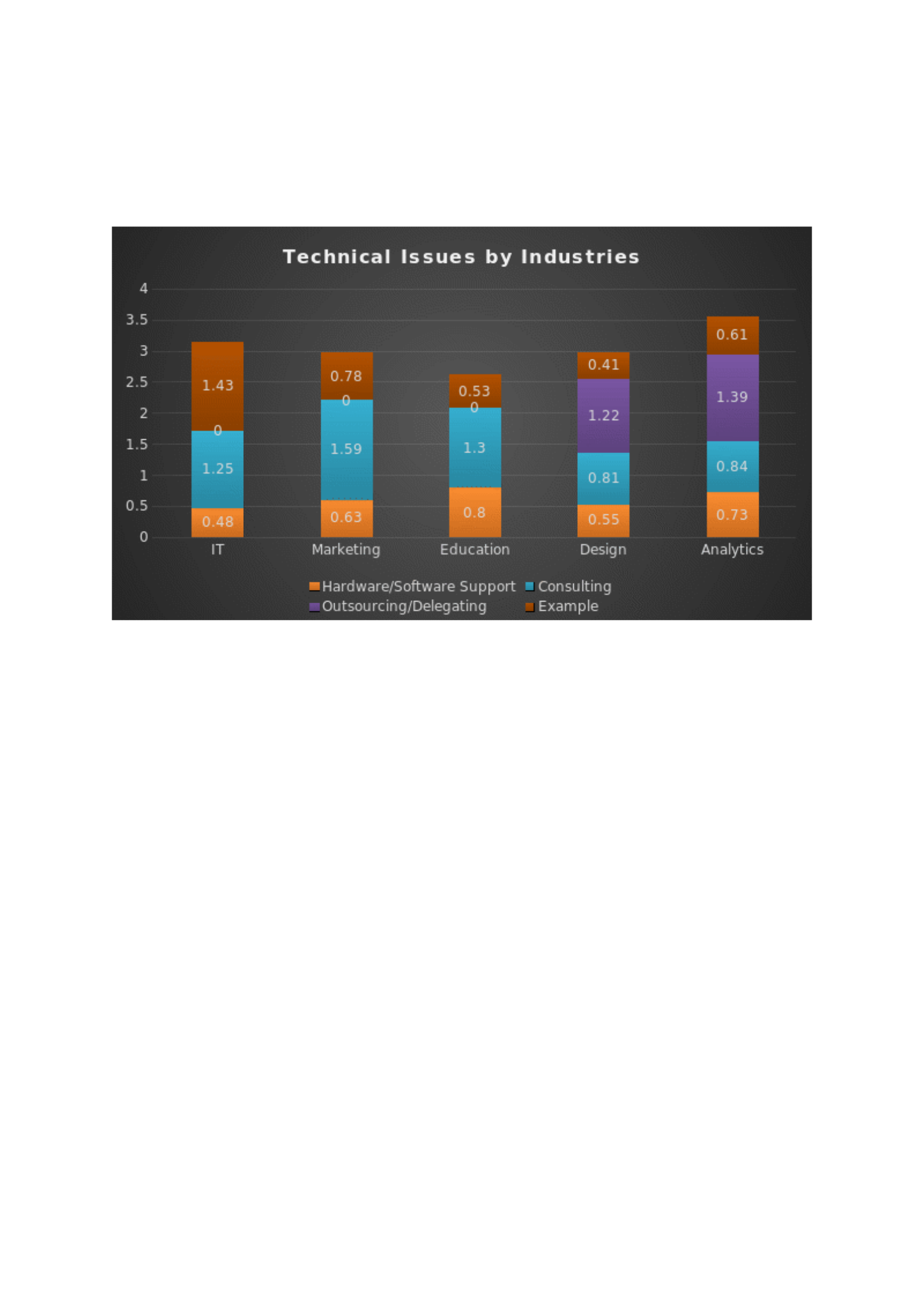
and excluded parameters, as shown in Figure
11.
Figure 11. Technical issues by industries
Despite the relatively large number of issues
in various areas during the transition to a
remote mode, most companies in this study
generally coped with them. According to
executives open question’s answers,
psychological problems had a more
significant impact on the workflow than
technical or operational problems. In a few
cases, managers reported that there were

still problems with technical issues: much of
this is due to funding issues. The next
questionnaire sector H4 reflects the leader’s
opinion and information about the
company’s financial performance. Many
companies’ revenues fell immediately after
introducing the first restrictions, as
discussed in the sections above (Ashraf,
2020). However, in the field of IT and digital
marketing, in some cases, there was even an
increase, a rush demand, that some leaders
thought about the rapid expansion of the
headquarters.
The survey asked leaders to account for
lower revenues amid the global economic
crisis despite varying dynamics. In this
regard, the division into pre-pandemic and
post-pandemic periods will be made only in
the regression analysis section to find a
correlation between financial performance
and the number of employees in companies.

In addition, this H4 section of questions
contains statements about the main
operational business processes of the
company and their speed, optimization, and
the reflection of these dynamics on financial
performance. Figure 12 reflects the
weighted responses of industry leaders.
Figure 12. Financial performance by
industries
As it can be seen in the diagram, design
suffered the most in the financial plane. The
leaders in the field of analytics were able to

maintain the most even dynamics. In
education, management adapted to the new
conditions, improving overall financial
efficiency against the backdrop of declining
sales (Brinia et al., 2021). According to the
leaders’ answers, such a transition for the IT
industry and marketing only affected for the
better, despite the potential psychological
problems. The increased demand for IT
products and the need to move marketing
campaigns online due to the restrictions
imposed, respectively, are reflected in the
financial performance of companies in these
industries (Maresova et al., 2018). The
results of the correlation of assessments of
the financial performance of companies with
leadership styles are quite interesting. It is
worth noting that some leaders admitted
that they were inclined to change their style
under the pressure of external conditions
but still insisted that the basic mechanisms

of their management have so far remained
the same. In this regard, the dynamics of
changing styles after the pandemic is not
reflected in these statistics. The dependence
of financial indicators on leadership style is
shown in Figure 13.
Figure 13. Financial performance by styles
Servant and adaptive leadership show the
best results in improving operational
processes and optimization, apparently since
such styles were in the lead and in the ability
to work with the mental state of employees

(Canavesi & Minelli, 2021). Laissez-faire has
the best sales and financial performance
because most of the leaders with such styles
work in the field of IT and marketing, which
have maintained and even increased
revenue in times of crisis (Baum & Baumann,
2018). Participative leadership is proving to
be the most inappropriate for adapting to
remote work, although it may be able to
change the dynamics over a longer distance
(Akpoviroro et al., 2018). Management
mechanisms in joint leadership lead to
better optimization of business processes
but still do not contribute to a positive
impact on financial performance
(Wilhelmson, 2006).
At the end of the questionnaire, an open-
ended question allowed for a free-form list
and explanation of those aspects that were
not covered in the study but had a significant
impact on the effectiveness and process of

working remotely. Among these moments,
the process of working with clients stands
out. Executives say that employees were
more or less confident users of modern
technology, while this transition was
challenging for some clients from the design
and education sectors. Companies have the
opportunity and interest in the availability of
competencies on technical issues among
employees, especially in related areas, but
they cannot guarantee the same knowledge
from customers. Problems could arise,
ranging from communication tools to
complexities in e-commerce. Customers, as a
rule, spent more time adapting to new
conditions than employees of the company
(Sizova et al., 2021).
All results were calculated by weighted
voting after statistical processing of the
received answers. Values above one showed
that the answers were generally close to the

maximum and, as a result, the aspects in the
hypotheses did not cause problems and had
only positive dynamics. Values below one
implied worsening of the indicator in
question in the industry or company. As a
result, the obtained data can lead to one
coefficient of companies’ adaptation to new
conditions. The industry average for each of
the above items with a weighted vote based
on data from the questionnaires will be
presented in Figure 13. Technical issues H3
and international experience H1 received
the least weight as determinants of the
effectiveness of the company and
employees in particular. The psychological
impact H2 of external factors and the
company’s financial performance H4 had a
much more significant influence on the
company’s internal processes according to
the open question answers. The weights for
financial activity, psychological influence,

technical issues, and international
experience were 0.35, 0.35, 0.15, and 0.15,
respectively.
Figure 14. Adaptation rate by industries
In this Figure 14, it can be seen that financial
performance has become the leading
determining indicator of the coefficient of
adaptation to new conditions. The industries
are located identically if compared with
Figure 12. At the same time, the index of
influence on the mental state of employees
that has the same weight as the leader has a

different location by industry in Figure 9.
Therefore, financial performance as a
mechanism for assessing the company’s
efficiency was chosen correctly. This fact will
be approved by the statistical significance
calculations at the end of the chapter.
A similar adaptation rate for leadership
styles is shown in Figure 15. Laissez-faire has
high rates only due to maintaining a positive
financial performance due to the leadership
representation of this style in IT companies.
Due to well-developed mechanisms for
dealing with the mental consequences of a
pandemic among employees, servant
leadership showed the best result of the
calculated coefficient. Technological aspects
and international experience again turned
out to be approximately on the same level
and did not significantly affect the results in
a weighted vote. As stated, adaptive,
servant, and joint are the most appropriate

leadership styles in the designated industries
when working remotely. This information
can help companies and leaders considering
implementing remote mode use the critical
approaches and control mechanisms specific
to the selected styles.
Figure 15. Adaptation rate by styles
The laissez-faire style in IT is pretty standard
due to the specific competencies, which
need a certain degree of autonomy (Baum &
Baumann, 2018). The manager is more
concerned with negotiating contracts and

project management than direct
intervention in the operational process. This
fact explains the autonomy of almost all
employees of the considered IT companies in
the hardware and software used (Baum &
Baumann, 2018). International experience in
this industry implies the use of advanced
technologies and applications, as this aspect
is critical in maintaining the competitiveness
of companies (O’Donell et al., 2002). In this
regard, the leaders practically did not have
to adapt the norms of communication and
attitudes to the new regime since the means
of communication remained the same.
Declining product sales have hardest hit the
design industry. Design development
requires the realization of creative potential
from employees, who, as a rule, endure
crises more difficultly. Leaders in this field
were more likely to work with each
employee individually but could not offer

sufficient relief from the effects of social and
professional isolation and create a work-life
balance (Orzel & Wolniak, 2022).
International experience has also helped
design leaders to a lesser extent in adapting,
but many see these difficulties as temporary.
A positive attitude helps maintain growth in
related areas that often turn to design
services – IT and marketing, as well as a
significant transition of a large number of
people and businesses online, where the
creation of unique content will be an even
more important characteristic of the
competitiveness of any company in the
market (Orzel & Wolniak, 2022).
The sphere of private education assumes the
most extended contact with clients even
after the transition of employees to a remote
work mode. In this regard, so much attention
is paid to the psychological aspects in this
industry – more than in any of the

considered ones (Yildirim & Elverici, 2021).
Information technology tools have long been
firmly integrated into the usual education
processes but have not yet allowed the
industry to be fully integrated into the virtual
environment (Manegre & Sabiri, 2020). As
leaders claim, live contact continues to be
valued by many in the profession and clients.
In connection with this, the lowest rates of
technical equipment of employees from this
area are observed. Managers are faced with
the need to compromise between
legislation, mass character, and efficiency
(Yildirim & Elverici, 2021).
If we consider the most suitable style for
remote management, then servant and
adaptive are objective favorites in
comparison. According to past research, the
best styles are derived from
transformational leadership, which includes
adaptive and servant (Lombardo, 2011). The

servant considers the psychological issues
that have proven to be important in the
context of the adaptation process. Servant
leadership puts employees first in its values,
giving them the most attention (Canavesi &
Minelli, 2021). Indeed, leaders with this style
were more likely to devote time to each
employee individually and, using familiar
mechanisms, establish appropriate
interaction and installation processes in the
new environment, as the analysis of
questionnaires showed. As a rule, according
to Homans, each employee is clearly aware
of his goal and personal benefit, which
contributes to efficiency and productivity at
the level of the entire company.
Adaptive leadership is highly relevant in the
face of uncertainty (Thomé et al., 2016). The
pandemic created just such a background,
where each industry was forced to adapt to
new conditions dictated by external factors

(Lin et al., 2021). Adaptive tasks are set as
tasks in the company’s interests, which take
into account only the current situation
(Thomé et al., 2016). There is practically no
routine and certainty in actions in such
organizations, but all employees are highly
mobile and competent in their fields (Lin et
al., 2021). At the same time, leaders take full
responsibility for the proposed solutions and
are always ready to admit their mistakes
with a new solution. Therefore, these two
styles should be considered by the leaders of
companies that are switching to a remote
work mode to find a balance between
psychological factors and maintaining the
company’s financial activity.
According to the questionnaire, four
hypotheses H1 – H4 were put forward.
Responses were analyzed by t-test for
statistical significance. Responses on a Likert
scale of 4 and 5 were taken into account,

which implied an affirmative answer to the
statements provided, influencing the
hypotheses. A standard error was calculated
for each of the presented statements in the
H1-H4 section of the questionnaire. t =1.96
is the value used for the 95% confidence
level. Table 2 shows the resulting statistical
significance values. The questionnaires
showed that the most significant differences
between samples by industry are in matters
of international experience and technical
equipment H1 and H3. Psychological factors
and financial performance H2 and H4, taken
with a large weight in the calculation of the
adaptation rate, have less significance in the
differences, but still exceed the level of
confidence, which this fact can confirm the
hypotheses with a confidence level of 95%. If
the same values of the survey results are
divided by leadership styles, the statistical

significance will be somewhat different, it is
presented in Table 3.
Table 2. Statistical significance for H1-H4
questionnaire sections by industry samples
Pooled
Sample
Proportion
(p)
Standard
Error
(SE)
Test
Statistic
(t)
Confidence
Level
H1.
Multinational
experience
helps
companies to
adapt for
remote
working
better.
0.428
0.567
3.35
1.96
H2. A remote
leader has a
positive effect
0.403
0.546
2.28
1.96

on the mental
state of
employees
and the
atmosphere
in the team.
H3. Technical
equipment or
lack of it
affects the
efficiency of
remote
workers.
0.583
0.565
4.31
1.96
H4. Remote
leadership
affects the
company’s
financial
performance.
0.383
0.522
2.08
1.96

Table 3. Statistical significance for H1-H4
questionnaire sections by styles samples
Pooled
Sample
Proportion
(p)
Standard
Error
(SE)
Test
Statistic
(t)
Confidence
Level
H1.
Multinational
experience
helps
companies to
adapt for
remote
working
better.
0.232
0.483
1.46
1.96
H2. A remote
leader has a
positive effect
on the mental
state of
0.461
0.571
4.78
1.96

employees
and the
atmosphere
in the team.
H3. Technical
equipment or
lack of it
affects the
efficiency of
remote
workers.
0.367
0.544
2.46
1.96
H4. Remote
leadership
affects the
company’s
financial
performance.
0.415
0.554
1.99
1.96
The statistical significance of the difference
in the samples between styles on the t-test
was determined in the H2 and H3

hypotheses about the mental state and
technical equipment. Financial performance
varied significantly between style samples,
while the effect of style on international
experience was not confirmed in this survey.
Comparing the results with the Homans
model, we can conclude that sentiments and
interactions are indeed key factors in
establishing a social group in remote
management, while activities and company’s
success have less influence. Further research
is related to the search for a correlation
between the number of remote employees
and the financial performance of companies
from these industries. The results obtained
will also be tested using the t-test.
Remote Workers and Financial Indicators
Correlation
The number of remote workers has
increased significantly since the introduction

of pandemic restrictions. This fact is proved
by the results of the survey of managers.
However, these data were given to small
departments of international companies. A
broader scope is the search for correlations
in international companies from these areas
between the financial indicators of
organizations indicated in the Methodology
section and the dynamics of the number of
remote employees in the period before the
pandemic, after it began, and to the present
moment. Among the 25 executives, one
company was selected in each industry,
which contains publicly available
information on the number of remote
employees and has up-to-date financial
indicators in annual reports. In order to
maintain confidentiality, the affiliation of
specific study participants to organizations is
not disclosed.

This work was carried out with significant
assumptions and limitations in order to test
the second question of the H4 questionnaire,
stating “the increase in the number of
remote employees increased the whole
financial efficiency of the company”,
according to the data on the number of
remote employees provided in sections of
the same questionnaire. “The whole
financial efficiency of the company” in this
statement means the quantitative
indicators, that show liquidity, asset
turnover, profitability and market value of
the organization. In all the companies
examined, the number of remote employees
has increased, which allows considering this
issue as a separate hypothesis in this section.
However, the process of earning a company
can be influenced by many external and
internal factors that do not depend on the
chosen variable. The survey participants also

informed that there was no staff turnover
and significant change in workflow tasks in
the particular departments of the companies
in question. It is also assumed that the group
of employees who remained in the offices
and the remote employees started with the
same performance rating, recorded in the
company’s financial indicators. The units
controlled by the leaders did not undergo
changes in human resources. Summarizing
all of the above and taking into account
these assumptions in the results, this study
can be carried out in order to find a different
point of view on the results of the second
question of H4 questionnaire, presenting the
quantitative dependence of four groups of
financial indicators on the dynamic number
of remote employees.
Data from the following companies were
analyzed: Alphabet Inc., Accenture
Interactive, Deloitte Digital, SAP, and Bright

Horizons. First, information was obtained
from open sources of annual reports on the
number of employees and the approximate
percentage of those who work remotely
among them. Here, the trend of a significant
increase in the number of remote workers
during the pandemic and a slight decrease to
the present moment when many pandemic
restrictions have already been lifted. Tables
4 and 5 show these quantitative indicators.
Table 6 shows the estimated number of
remote workers in each company listed.
Table 4. Percent of remote employees in
companies
Company
Percent of
Remote
Employees
before
Pandemic
(2019)
Percent of
Remote
Employees
during
Pandemic
(2020-2021)
Percent of
Remote
Employees
now (2021-
2022)

Alphabet
Inc
15%
60%
20%
Accenture
Interactive
4.7%
39.8%
14.5%
Deloitte
Digital
0%
30%
50%
SAP
10%
70%
60%
Bright
Horizons
5%
45%
29%
Table 5. Number of employees in companies
Company
Number of
Employees
before
Pandemic
(2019)
Number of
Employees
during
Pandemic
(2020-2021)
Number of
Employees
now (2021-
2022)
Alphabet
Inc
118899
135301
156500

Accenture
Interactive
492000
506000
624000
Deloitte
Digital
2575
2642
2581
SAP
100330
102430
107415
Bright
Horizons
24300
26800
29000
Table 6. Number of remote employees in
companies
Company
Number of
Employees
before
Pandemic
(2019)
Number of
Employees
during
Pandemic
(2020-2021)
Number of
Employees
now (2021-
2022)
Alphabet
Inc
17835
81181
31300
Accenture
Interactive
23124
201388
90480

Deloitte
Digital
1
793
1291
SAP
10033
71701
64449
Bright
Horizons
1215
12060
8410
Tables 7-11 are presented below, reflecting
the company’s financial performance for the
indicated three periods according to pre-
selected indicators. Data is also taken from
companies’ annual reports, and in rare cases,
some ratios have been calculated from the
same data. These organizations, in general,
practically did not experience a significant
economic shock caused by the crisis due to
pandemic restrictions. Nevertheless, the
dynamics of many indicators are not evident,
and therefore the search for correlation will
be carried out by groups of these financial
values: liquidity, asset turnover, profitability,
and market value.

Table 7. Alphabet Inc Financials
Alphabet Inc
2019
2020
2021
Current ratio
3.37
3.07
2.93
Asset turnover ratio
0.587
0.571
0.717
Gross profit ratio
55.6
53.6
56.9
Operating profit ratio
21.15
22.59
30.55
Net profit ratio
21.22
22.06
29.51
Return on Investment
16.67
17.03
28.54
PE ratio
29.52
23.46
27.49
Earnings per Share
49.1
58.6
112.2
Table 8. Accenture Interactive Financials
Accenture Interactive
2019
2020
2021
Current ratio
1.39
1.40
1.25
Asset turnover ratio
1.45
1.19
1.17
Gross profit ratio
30.8
31.5
32.4
Operating profit ratio
14.59
14.69
15.06

Net profit ratio
11.05
11.52
11.68
Return on Investment
32.64
29.54
29.73
PE ratio
22.49
22.92
29.39
Earnings per Share
7.36
7.89
9.16
Table 9. Deloitte Digital Financials
Deloitte Digital
2019
2020
2021
Current ratio
1.025
1.010
1.016
Asset turnover ratio
0.258
0.598
0.432
Gross profit ratio
27.1
22.8
20.05
Operating profit ratio
102
80
72
Net profit ratio
2.7
2.2
1.9
Return on Investment
10.8
7.4
8.9
PE ratio
33.3
29.7
26.2
Earnings per Share
5.61
5.42
5.50
Table 10. SAP Financials
SAP
2019
2020
2021

Current ratio
1.58
1.05
1.17
Asset turnover ratio
0.48
0.46
0.47
Gross profit ratio
69.8
69.7
71.2
Operating profit ratio
23.08
16.23
24.23
Net profit ratio
16.52
12.05
17.82
Return on Investment
10.37
7.7
12.13
PE ratio
35.38
26.94
22.88
Earnings per Share
3.11
4.97
5.28
Table 11. Bright Horizons Financials
Bright Horizons
2019
2020
2021
Current ratio
0.82
0.79
0.87
Asset turnover ratio
0.48
0.56
0.48
Gross profit ratio
13.45
11.74
19.68
Operating profit ratio
5.62
5.12
5.89
Net profit ratio
3.3
2.3
4
Return on Investment
3.05
3.32
3.39

PE ratio
105.6
117.1
118.85
Earnings per Share
3.10
0.45
1.36
For each company, calculations were made
separately. As a result, a comprehensive
assessment of the dependence of the
leading financial indicators on the number of
remote employees in the company was
obtained. The regression analysis results are
shown in summary table 12, where the
coefficients for each of the sections of
financial indicators with a weighted average
vote are also calculated. The final values are
presented as an R-square, which is closer to
one, the stronger the correlation between
these variables.
Table 12. R-squares for financials by
companies
Ratio/Company
Alphabet
Accenture
Deloitte
SAP
BH

Current ratio
(Liquidity)
0.16
0.04
0.48
0.99
0.03
Asset
turnoverratio
0.17
0.75
0.38
0.84
0.57
Gross profit
ratio
0.68
0.09
0.99
0.12
0.01
Operating profit
ratio
0.03
0.97
0.98
0.23
0.23
Net profit ratio
0.05
0.38
0.99
0.16
0.18
Return on
Investment
0.09
0.68
0.48
0.05
0.74
Profitability
0.21
0.53
0.86
0.14
0.29
PE ratio
0.98
0.01
0.98
0.82
0.80
Earnings per
Share
0.03
0.02
0.46
0.94
0.99
Market Value
0.51
0.01
0.72
0.88
0.90
According to the obtained data of statistical
significance, with the accepted confidence

level of 95% and, accordingly, t = 1.96, the
asset turnover and market value indicators
can be extrapolated to the general
population, the result turned out to be
statistically significant. At the same time, the
correlation between the company’s
profitability and liquidity and the number of
remote employees is small and does not
have a close statistical relationship.
The regression analysis, in turn, considered
in more detail the dependence of financial
indicators and their components on the
number of remote employees. At Deloitte,
this factor was necessary for performance
and efficiency; at Alphabet Inc., no such
correlation was observed. The highest
dependence on liquidity is observed at SAP,
which indicates the importance of the
remote work mechanism for adapting to
new conditions in the field of analytics
(Motamarri et al., 2022). At the same time,

the company has the highest dependence of
asset turnover on the number of remote
workers. Market value measures are most
correlated with the ratio of remote workers
everywhere except in the marketing
industry. These mechanisms are not evident
in their qualitative interpretation; there is
likely an influence of other factors that are
not considered in this work.
IT company Alphabet showed the most
negligible dependence on the number of
remote employees since the regime change
processes do not significantly affect its well-
established integrated information
development system – most employees
constantly reside and interact in a virtual
environment (Alves et al., 2021). At the same
time, indicators of liquidity and profitability
in web design, which are closely related to
the IT structure, have a much higher
correlation indicator. Despite possible

psychological challenges due to the
pandemic, creatives in the design industry
appreciate the balance of personal work and
family more, improving their productivity
with positive changes in this area (Orzel &
Wolniak, 2022). The education sector,
represented by Bright Horizons, has a high
correlation between market value and asset
turnover. Teachers could work more online,
and technologies and tools for distance
learning began to develop quite quickly
(Yildirim & Elverici, 2021). These factors
affected the company’s financial results.
Discussion
Results Implications
It can be concluded that the growing
popularity of studying aspects of remote
leadership in international companies is
needed primarily to improve the
organization’s performance. At the moment,

the potential for the effectiveness of the
transition to remote work has not been fully
utilized due to somewhere lack of
experience, somewhere external solid
factors, and the mechanisms for combating,
which have not yet been fully mastered by
leaders. It has been proven for a long time
that technology is the engine of progress and
competitiveness of organizations, just as the
mental state of employees is a key factor in
the financial performance of almost any
company (Kostopoulos et al., 2011; Kim et
al., 2011). This paper evaluates these criteria
through the prism of remote leadership,
which, due to the global external factor of
the pandemic, has become widespread in
the world and required a reassessment of
the impact on employee engagement and
other key indicators (Galanti et al., 2021).
The survey of leaders provides an
opportunity to identify the most promising

management styles in the five industries
considered, where the transition to remote
work is a topical issue (Ford & Chang, 2021).
As a result, these results have not only
statistical significance for further scientific
research, but also scope for practical
implementations, confirmed by a statistically
significant survey.
Recommendations
Recommendations for practical
implementations are the ability to apply
certain style features that have proven to be
most suitable for remote leadership in these
five industries. The basics of servant and
adaptive styles have proven themselves in
the most important four aspects that affect
the success and progress of the company,
according to the analysis of the
questionnaires. The theoretical importance
lies in a detailed analysis of the responses of

leaders who, by their own example,
experienced the transition to a remote work
mode.
Failure to follow these recommendations
can lead to the main identified problems
raised in this study: mental health and
technical equipment. According to the
results of questionnaires, other leadership
styles in their foundations do not involve
such a detailed inclusion of the leader in
processes that are usually closer to personal
life in balance with work (Putra et al., 2020).
As a consequence, engagement and
satisfaction may fall, leading to a drop in
performance (Putra et al., 2020). Leaders can
adapt their approaches to the new
environment in order to maintain these
important characteristics of work.
Further Research

The task of assessing the effectiveness of the
company as a whole is multifactorial and
multicriteria. In the specific conditions of the
transition to a remote mode, leadership has
the opportunity to transform under the
influence of international experience, the
virtual environment, and the general
atmosphere in the team (Wang et al., 2021).
Although other external and subjective
factors may have influenced the final results
of this study, the main task of testing the
hypotheses was achieved. Further research
may go deeper into each factor separately,
differentiating aspects of remote leadership
(Wang et al., 2021; Waizenegger et al.,
2020). Such assessments are needed for
further integration, creating a unique model
that implements a practical approach within
a particular industry.
Mathematical studies of quantitative
indicators can be further processed using

modern machine learning techniques, neural
networks, or fuzzy logic. In economics and
forecasting, many quantities are
approximate, and therefore work in fuzzy
algebra can give more detailed results
(Ferrer-Comalat et al., 2020). The
methodology can be extended not only to
mathematical modeling methods but also to
the information industry. Obtaining
universal models is possible due to the steps
for solving highly technical problems.
In addition to the methodology, further work
in this area may optimize the variables under
consideration. Accounting for such aspects
as satisfaction, involvement, qualifications of
employees, peculiarities of working with
clients, and cultural and social components
can also significantly impact the results of
assessments of the company’s performance
as a whole (Galanti et al., 2021). Finally, the
distribution of the model proposed in this

paper for a broader range of business sectors
and companies, working with data without
considering the pandemic, can also be
considered promising areas for developing
this issue. Further research implications can
also include extrapolation to other
industries, validation of statistical
significance by another tools, and
consideration of different models that
describe interaction and governance in
organizations.
Conclusion
This work conducts an in-depth analysis of
the literature on the transformation of
leadership processes in the context of the
transition to a remote work mode. Each
leadership style is considered in detail in its
original meaning, as well as through the
prism of remote leadership. Digital
transformations, international experience,

and general trends that have come to
various business sectors with the pandemic
provide a starting point for this study. The
theoretical analysis shows that remote
leadership can influence the company’s
efficiency through tasks, interactions, and
attitudes, which are explained by the
Homans theory. Literature analysis has
shown that these three aspects include the
psychological factor, experience in
international activities, technical equipment
issues, and the company’s financial
performance. Together they add up to the
interest and capabilities of employees, which
is the key to successful interaction,
efficiency, and productivity.
A questionnaire for managers was built on
this model, and a regression analysis was
carried out. These two tools made it possible
to comprehensively assess remote
leadership styles in various industries and

the impact of this mode on the company’s
productivity, expressed in financial terms.
Adaptive and servant styles have proven to
be the most effective for remote leadership.
The most important aspects of adapting to
new conditions were the psychological
factor and financial performance, a
comprehensive assessment that turned out
to be higher than other styles. The IT
industry and marketing survived the
consequences of the crisis more quickly due
to the increased demand for the services of
these companies in the new reality. The rest
of the styles and industries received a
detailed assessment of each factor of remote
leadership that affects efficiency.
Finally, the regression analysis showed that
the relationship between the number of
remote employees and financial
performance is relatively small, having a
more point and, at the same time, multi-

criteria character. Each industry reacts
differently to the forced or planned
transition of employees to remote work, and
different groups of financial indicators show
this fact. In particular, during the transition,
companies are subject to changes in financial
indicators of market value and asset
turnover, which is explained by investors’
reactions to the global crisis and the
dynamics of the purchasing power of the
target audience, respectively.
References
Accenture. (2019). Accenture 2019 Fiscal
Annual Report. Web.
Accenture. (2020). Accenture 2020 Fiscal
Annual Report. Web.
Accenture. (2021). Accenture 2021 Fiscal
Annual Report. Web.
Ahuja, G., & Morris Lampert, C. (2001).
Entrepreneurship in the large corporation: A

longitudinal study of how established firms
create breakthrough inventions. Strategic
Management Journal, 22(6‐7), 521-543.
Akhtar, P., Tse, Y. K., Khan, Z., & Rao-
Nicholson, R. (2016). Data-driven and
adaptive leadership contributing to
sustainability: Global agri-food supply chains
connected with emerging
markets. International Journal of Production
Economics, 181, 392-401. Web.
Akpoviroro, K. S., Kadiri, B., & Owotutu, S. O.
(2018). Effect of participative leadership
style on employee’s
productivity. International Journal of
Economic Behavior (IJEB), 8(1), 47-60. Web.
Alphabet Inc. (2019). 2019 Annual
Report. Web.
Alphabet Inc. (2020). 2020 Annual Report.
Web.

Alphabet Inc. (2021). 2021 Annual
Report. Web.
Alves, T. L. D. L., Amorim, A. F. A., & Bezerra,
M. C. C. (2021). “Not one less”! Adaptation
to the home office in times of COVID-
19. Revista de Administração
Contemporânea, 25.
ASA. (2018). Code of Ethics. Web.
Ashraf, B. N. (2020). Economic impact of
government interventions during the COVID-
19 pandemic: International evidence from
financial markets. Journal of Behavioral and
Experimental Finance, 27, 100371. Web.
APA. (2021). Psychiatrists use of
telepsychiatry during COVID-19 public health
emergency. Web.
Apple. (2022). Diversity and Inclusion. Web.
Arvanitis, S., & Loukis, E. N. (2009).
Information and communication

technologies, human capital, workplace
organization and labour productivity: A
comparative study based on firm-level data
for Greece and Switzerland. Information
Economics and Policy, 21(1), 43-61.
Basile, K. A., & Beauregard, T. A. (2016).
Strategies for successful telework: How
effective employees manage work/home
boundaries. Strategic HR Review, 15(3), 106-
111.
Baum, I. R., & Baumann, N.
(2018). Autonomous creativity: The implicit
autonomy motive fosters creative
production and innovative behavior at
school. Gifted and Talented International,
33(1-2), 15-25. Web.
Bilan, Y., Hussain, H. I., Haseeb, M., & Kot, S.
(2020). Sustainability and economic
performance: Role of organizational learning

and innovation. Engineering Economics,
31(1), 93-103. Web.
Bloom, N. (2020). How working from home
works out. Institute for Economic Policy
Research (SIEPR). Policy Brief June. Web.
Bright Horizons. (2019). For Investors. Web.
Bright Horizons. (2020). For Investors. Web.
Brinia, V., Leimoniti, S., & Dimos, A. (2021).
Financial Gains and Moral Satisfaction as Key
Factors for Greater Efficiency in the Field of
Education. Education Sciences, 11(5), 236.
Brynjolfsson, E., Horton, J. J., Ozimek, A.,
Rock, D., Sharma, G., & TuYe, H. Y. (2020).
COVID-19 and remote work: An early look at
US data (No. w27344). National Bureau of
Economic Research.
Canavesi, A., & Minelli, E. (2021). Servant
leadership and employee engagement: a

qualitative study. Employee Responsibilities
and Rights Journal, 1-23.
Chai S. & Freeman R. (2019). Temporary
colocation and collaborative discovery: Who
confers at conferences. Technical Report.
Chatterjee, S., Chaudhuri, R., & Vrontis, D.
(2022). Does remote work flexibility enhance
organization performance? Moderating role
of organization policy and top management
support. Journal of Business Research, 139,
1501-1512. Web.
Chen, S., & Choi, C. J. (2005). A social
exchange perspective on business ethics: An
application to knowledge exchange. Journal
of Business Ethics, 62(1), 1-11. Web.
Cong, Y. (2021). A commentary of Remote
everything in MIT Technology Review
2021. Fundamental Research, 1(6), 842-843.
Web.

Contreras, F., Baykal, E., & Abid, G. (2020). E-
leadership and teleworking in times of
COVID-19 and beyond: what we know and
where do we go. Frontiers in Psychology,
3484. Web.
Creswell, J. W., & Clark, V. L. P.
(2017). Designing and conducting mixed
methods research. Sage publications.
Creswell, J. W., & Creswell, J. D.
(2017). Research design: Qualitative,
quantitative, and mixed methods
approaches. Sage publications.
Deloitte Digital. (2020). Annual Report
19/20. Web.
Deloitte Digital. (2021). Annual Report
2021. Web.
Edeh, F. O., Ranjith, P. V., Syafawani, N., Kee,
D. M. H., Aina, N., Syafikah, N., & Nurunnisa,
N. (2021). McDonald’s Customer’s
Satisfaction Strategies during COVID-19

Pandemic in Malaysia. International Journal
of Tourism and Hospitality in Asia Pasific
(IJTHAP), 4(3), 73-88.
Espitia, A., Mattoo, A., Rocha, N., Ruta, M., &
Winkler, D. (2021). Pandemic trade: COVID‐
19, remote work and global value chains. The
World Economy, 45(2), 561-589.
Ferreira, R., Pereira, R., Bianchi, I. S., & da
Silva, M. M. (2021). Decision factors for
remote work adoption: Advantages,
disadvantages, driving forces and
challenges. Journal of Open Innovation:
Technology, Market, and Complexity, 7(1),
70.
Ferrer-Comalat, J. C., Corominas-Coll, D., &
Linares-Mustarós, S. (2020). Fuzzy logic in
economic models. Journal of Intelligent &
Fuzzy Systems, 38(5), 5333-5342. Web.
Flores, M. F. (2019). Understanding the
challenges of remote working and its impact

to workers. International Journal of Business
Marketing and Management (IJBMM), 4(11),
40-44. Web.
Ford B. & Chang E. (2021). IBM sees 80% of
employees working in hybrid roles after
pandemic. Bloomberg. Web.
Fowkes, L. (2020). Seeing people in the
computer: the role of information
technology in remote employment
services. Australian Journal of Social Issues,
55(1), 13-26.
Galanti, T., Guidetti, G., Mazzei, E., Zappalà,
S., & Toscano, F. (2021). Work from home
during the COVID-19 outbreak: The impact
on employees’ remote work productivity,
engagement, and stress. Journal of
Occupational and Environmental Medicine,
63(7), e426.
Giest, S. (2018). Policy learning in times of big
data analytics: The challenges of skill-based

outsourcing. In Knowledge, Policymaking
and Learning for European Cities and
Regions. Edward Elgar Publishing.
Golden, T. D., & Gajendran, R. S. (2019).
Unpacking the role of a telecommuter’s job
in their performance: Examining job
complexity, problem-solving,
interdependence, and social
support. Journal of Business and Psychology,
34(1), 55–69.
Han, E., Tan, M. M. J., Turk, E., Sridhar, D.,
Leung, G. M., Shibuya, K.,… & Legido-
Quigley, H. (2020). Lessons learnt from
easing COVID-19 restrictions: an analysis of
countries and regions in Asia Pacific and
Europe. The Lancet, 396(10261), 1525-1534.
Web.
Hayes, S., Priestley, J. L., Ishmakhametov, N.,
& Ray, H. E. (2020). “I’m not Working from
Home, I’m Living at Work”: Perceived Stress

and Work-Related Burnout before and
during COVID-19. Analytics & Data Science.
Web.
Hernandez, Y. A. T. (2020). Remote workers
during the COVID-19 lockdown. What are we
missing and why is important. Journal of
Occupational and Environmental Medicine,
62(11), e669-e672.
Hong, Z., Lee, C. K., & Zhang, L.
(2018). Procurement risk management
under uncertainty: a review. Industrial
Management & Data Systems, 118(7), 1547-
1574. Web.
Hultman, M., Katsikeas, C. S., & Robson, M.
J. (2011). Export promotion strategy and
performance: The role of international
experience. Journal of International
Marketing, 19(4), 17-39. Web.
Hunter, P. (2019). Remote working in
research: An increasing usage of flexible

work arrangements can improve
productivity and creativity. EMBO Reports,
20(1), e47435.
IBM. (2021). IBM Impact. Web.
Johnson, M. (2010). Barriers to innovation
adoption: a study of e‐markets. Industrial
Management & Data Systems, 110(2), 157-
174. Web.
Kabwe, C., & Okorie, C. (2019). The efficacy
of talent management in international
business: The case of European
multinationals. Thunderbird International
Business Review, 61(6), 857-872.
Kaveri, M. & Mohan, G.C.D.M.
(2020). Impact of Techno-Stress on IT sector
employees of Bengaluru City. PalArch’s
Journal of Archaeology of Egypt/Egyptology,
17(7), pp.12886-12902. Web.
Kim, G., Shin, B., Kim, K. K., & Lee, H. G.
(2011). IT capabilities, process-oriented

dynamic capabilities, and firm financial
performance. Journal of the Association for
Information Systems, 12(7), 1. Web.
Kniffin, K. M., Narayanan, J., Antonakis, J., &
Greer, L. L. (2021). Covid-19 and the
workplace: Implications, issues, and insights
for future research and action. American
Psychologist, 76(1), 63–77.
Kostopoulos, K., Papalexandris, A.,
Papachroni, M., & Ioannou, G. (2011).
Absorptive capacity, innovation, and
financial performance. Journal of Business
Research, 64(12), 1335-1343.
Kramer, M. W., & Crespy, D. A. (2011).
Communicating collaborative
leadership. The Leadership Quarterly, 22(5),
1024-1037.
Lai, J. W., & Bower, M. (2019). How is the use
of technology in education evaluated? A

systematic review. Computers & Education,
133, 27-42. Web.
Latapí Agudelo, M. A., Jóhannsdóttir, L., &
Davídsdóttir, B. (2019). A literature review of
the history and evolution of corporate social
responsibility. International Journal of
Corporate Social Responsibility, 4(1), 1-23.
Web.
Li, H., Li, F., & Chen, T. (2018). A
motivational–cognitive model of creativity
and the role of autonomy. Journal of
Business Research, 92, 179-188. Web.
Limsila, K. & Ogunlana, S. O. (2008).
Performance and leadership outcome
correlates of leadership styles and
subordinate commitment. Engineering,
Construction and Architectural
Management, 15(2), 164-184.
Lin, W., Shao, Y., Li, G., Guo, Y., & Zhan, X.
(2021). The psychological implications of

COVID-19 on employee job insecurity and its
consequences: The mitigating role of
organization adaptive practices. Journal of
Applied Psychology, 106(3), 317. Web.
Lombardo, C. P. (2011). Remote
management styles: Analyzing the effects of
relational psychological contracts and
leadership style on teleworkers. University of
Maryland University College.
Louangrath, P. (2018). Reliability and validity
of survey scales. International Journal of
Research & Methodology in Social Science,
4(1), 50-62.
Lueck, M. (2020). GDPR in the new remote-
working normal. Computer Fraud & Security,
2020(8), 14-16. Web.
Maden, C., Arıkan, E., Telci, E. E., & Kantur, D.
(2012). Linking corporate social
responsibility to corporate reputation: a
study on understanding behavioral

consequences. Procedia-Social and
Behavioral Sciences, 58, 655-664. Web.
Manegre, M., & Sabiri, K. A. (2020). Online
language learning using virtual classrooms:
an analysis of teacher
perceptions. Computer Assisted Language
Learning, 1-16.
Mann, S., & Holdsworth, L. (2003). The
psychological impact of teleworking: stress,
emotions and health. New
Technology, Work and Employment, 18(3),
196-211.
Maresova, P., Soukal, I., Svobodova, L.,
Hedvicakova, M., Javanmardi, E., Selamat,
A., & Krejcar, O. (2018). Consequences of
industry 4.0 in business and
economics. Economies, 6(3), 46.
Mehmood, K. K., Rasheed, R., & Jaan, J.
(2020). How Does Stakeholders Pressure
Affect Organization Performance and

Employee Wellbeing? Study of Multiple
Mediating Roles. Journal of Business and
Social Review in Emerging Economies, 6(1),
55-68. Web.
Miller, S. (2019). Underused EAPs are a
missed opportunity to help workers. SHRM.
Web.
Mollenkopf, D. A., Ozanne, L. K., & Stolze, H.
J. (2020). A transformative supply chain
response to COVID-19. Journal of Service
Management, 32(2), 190-202.
Moradi, S., Kähkönen, K. & Aaltonen, K.
(2020). Comparison of research and industry
views on project managers’
competencies. International Journal of
Managing Projects in Business, 13(3), 543-
572.
Motamarri, S., Akter, S., Hossain, M. A., &
Dwivedi, Y. K. (2022). How does remote
analytics empowerment capability payoff in

the emerging industrial revolution? Journal
of Business Research, 144, 1163-1174.
Novet, J. (2021). Google relaxes remote work
plan, will let 20% of employees
telecommute. CNBC. Web.
O’Donnell, A., Durkin, M.G. and McCartan‐
Quinn, D. (2002). Corporate banking in the
UK: personal vs remote
interaction. International Journal of Bank
Marketing, 20(6), 273-284.
Orzeł, B., & Wolniak, R. (2022). Digitization in
the Design and Construction Industry—
Remote Work in the Context of
Sustainability: A Study from
Poland. Sustainability, 14(3), 1332.
Oxelheim, L., & Randøy, T. (2021). The global
logistic chain under siege in a post-Covid
era. In Bidrag innen kundeverdi og marked:
Festskrift til Øyvind Helgesen (pp. 159-176).
Web.

Pavez, I., & Neves, E. (2021). Developing
Teams in a Virtual Environment: A
Generative Approach. The Journal of Applied
Behavioral Science, 00218863211053881.
Web.
Pham, D. N., Rios, L., & Workiewicz, M.
(2022). Remote Access Memories: How
Remote Work Will Impact Organizational
Learning and What Firms Can Do About
It. Available at SSRN 4032764. Web.
Phillips, S. (2020). Working through the
pandemic: Accelerating the transition to
remote working. Business Information
Review, 37(3), 129-134.
Pokojski, Z., Kister, A., & Lipowski, M. (2022).
Remote Work Efficiency from the Employers’
Perspective–What’s Next? Sustainability
2022, 14, 4220.
Pratama, H., Azman, M. N. A., Kassymova, G.
K., & Duisenbayeva, S. S. (2020). The Trend in

using online meeting applications for
learning during the period of pandemic
COVID-19: A literature review. Journal of
Innovation in Educational and Cultural
Research, 1(2), 58-68.
Putra, K. C., Pratama, T. A., Linggautama, R.
A., & Prasetyaningtyas, S. W. (2020). The
Impact of Flexible Working Hours, Remote
Working, and Work Life Balance to Employee
Satisfaction in Banking Industry during
Covid-19 Pandemic Period. Journal of
Business and Management Review, 1(5),
341-353.
Rawlings, J. O., Pantula, S. G., & Dickey, D. A.
(Eds.). (2000). Applied regression analysis: a
research tool. New York, NY: Springer New
York.
SAP. (2019). SAP 2019 Integrated
Report. Web.

SAP. (2020). SAP 2020 Integrated
Report. Web.
SAP. (2021). SAP 2021 Integrated Report.
Web.
Saris, W. E., & Gallhofer, I. N. (2014). Design,
evaluation, and analysis of questionnaires
for survey research. John Wiley & Sons.
Serbulova, N., Morgunova, T., &
Persiyanova, G. (2020). Innovations during
COVID-19 pandemic: Trends, technologies,
prospects. In E3S Web of Conferences (Vol.
210, p. 02005). EDP Sciences. Web.
Shimazu, A., Nakata, A., Nagata, T., Arakawa,
Y., Kuroda, S., Inamizu, N., & Yamamoto, I.
(2020). Psychosocial impact of COVID-19 for
general workers. Journal of Occupational
Health, 62(1), e12132. Web.
Sizova, I., Bakaev, M., & Khvorostov, V.
(2021, June). Labor Demand and Supply
Adaptation to the Pandemic-Induced Shock.

In International Conference on Digital
Transformation and Global Society (pp. 461-
476). Springer, Cham.
Skogstad, A., Einarsen, S., Torsheim, T.,
Aasland, M. S., & Hetland, H. (2007). The
destructiveness of laissez-faire leadership
behavior. Journal of Occupational Health
Psychology, 12(1), 80.
Spagnoli, P., Molino, M., Molinaro, D.,
Giancaspro, M. L., Manuti, A., & Ghislieri, C.
(2020). Workaholism and technostress
during the COVID-19 emergency: The crucial
role of the leaders on remote
working. Frontiers in Psychology, 11, 3714.
Taucean, I. M., Tamasila, M., & Negru-
Strauti, G. (2016). Study on management
styles and managerial power types for a large
organization. Procedia-Social and Behavioral
Sciences, 221, 66-75.

Toscano, F., & Zappalà, S. (2020). Social
isolation and stress as predictors of
productivity perception and remote work
satisfaction during the COVID-19 pandemic:
The role of concern about the virus in a
moderated double mediation. Sustainability,
12(23), 9804. Web.
Thomé, A. M. T., Scavarda, L. F., Scavarda, A.,
& de Souza Thomé, F. E. S.
(2016). Similarities and contrasts of
complexity, uncertainty, risks, and resilience
in supply chains and temporary multi-
organization projects. International Journal
of Project Management, 34(7), 1328-1346.
Web.
Treviqo, A. J., & Tilly, C. (2015). George C.
Homans: History, theory, and method.
Routledge.
Vijaykar, S., & Karhade, P. (2021). Remote
Virtual Workplaces in the Pandemic: The

Case of IT-enabled Service Leadership.
In Pacific Asia Conference on Information
Systems. Web.
Volmer, J., Spurk, D., & Niessen, C.
(2012). Leader–member exchange (LMX),
job autonomy, and creative work
involvement. The Leadership Quarterly,
23(3), 456-465. Web.
Waizenegger, L., McKenna, B., Cai, W., &
Bendz, T. (2020). An affordance perspective
of team collaboration and enforced working
from home during COVID-19. European
Journal of Information Systems, 29(4), 429-
442. Web.
Walker, K., & Dyck, B. (2014). The primary
importance of corporate social responsibility
and ethicality in corporate reputation: An
empirical study. Business and Society
Review, 119(1), 147-174.

Wang, B., Liu, Y., Qian, J., & Parker, S. K.
(2020). Achieving effective remote working
during the COVID‐19 pandemic: A work
design perspective. Applied Psychology,
70(1), 16–59.
Wilhelmson, L. (2006). Transformative
learning in joint leadership. Journal of
Workplace Learning, 18(7/8), 495-507. Web.
Xiao, H., Zhang, Y., Kong, D., Li, S., & Yang, N.
(2020). Social capital and sleep quality in
individuals who self-isolated for 14 days
during the coronavirus disease 2019 (COVID-
19) outbreak in January 2020 in
China. Medical Science Monitor:
International Medical Journal of
Experimental and Clinical Research, 26,
e923921-1. Web.
Yang, L., Holtz, D., Jaffe, S., Suri, S., Sinha, S.,
Weston, J.,… & Teevan, J. (2022). The effects
of remote work on collaboration among

information workers. Nature Human
Behaviour, 6(1), 43-54.
Yang, R., Wong, C. W., & Miao, X. (2021).
Analysis of the trend in the knowledge of
environmental responsibility
research. Journal of Cleaner Production, 278,
123402.
Yildirim, K., & Elverici, S. E. (2021). Examining
Emergency Remote Teaching: A Case Study
in a Private School. Online Submission, 8(1),
153-178. Web.

