


Organization Behavior – Consumer
Decision-Making Is a Process

Introduction
Marketers all over the world rely upon their
understanding of the consumer decision-making
process to be successful in their day-to-day
practices. Consumer behaviour captures all the
activities of consumers that range from
searching of the suitable products or services,
their utility, all the way to the disposal of such
products or services. Different scholars have
developed models, strategies and theories that
seek to clarify the consumer decision-making
process.
Marketers rely upon the knowledge of this
process in their identification of the most
effective points of entry to influence the choices
and decisions made by the various consumers to
their advantage (Bettman et al. 1998, p.195).
Since it is common knowledge that the
consumer decision-making is a series of steps
that constitute the whole process, the knowledge
of what comprises each of the steps, as presented
by the different models, is vital for any marketer
seeking to be successful in marketing either
products or services.

The marketer takes the responsibility of a guide
to the consumer. Therefore, he/ she should be
able to provide a good share of information
about the effect of the decision that the consumer
makes (Bilkey 2010, p. 20).
Successful dissemination of correct information
about the important attributes of a given product,
as well as its advantages in comparison to those
offered by the competitors, is important in
making sales and maintaining a clientele base.
This paper aims at analysing the consumer
decision-making process determining why it is
necessary for marketers to understand the
process in details to secure sales and maintain a
satisfied client base.
The consumer decision-making process
There are a number of models put in place by
marketers to explain the consumers’ decision-
making process. The most common model is an
adaption of the scientific method, which
comprises of five basic steps.
For the purposes of marketing, research, as well
as understanding the buying patterns of different
consumer segments, it is important for marketers

to understand what each of the steps contain,
which leads into each other (Doney, & Cannon
2008, p.35).
The claim holds because each of the steps
corresponds to an internal psychological process
that should be understood by every marketer
whose aim is to lead the pack when it comes to
securing product and services sales. The
consumer decision-making process and the
corresponding internal psychological processes
are as follows:
Need recognition – Motivation
The need recognition is the initial step in the
consumer decision-making process. This usually
takes place when a given consumer realises the
existence of a given need. As a result, he/she is
motivated to venture into the decision-making
process to see that the need is resolved (Bettman
1999, p.45).
It is important for any marketer to have a deep
understanding of what the consumer undergoes
in this particular level in the decision-making
process, as well as the specific needs that they
seek to satisfy to translate them into the purchase

criteria. The information that marketers get at
this point of the process is critical in that it
allows them to portray the most-felt need of the
consumer in the promotional messages (Arzen
2005, p.209).
Need recognition might be a simple process in
the consumer decision-making process.
However, the manner in which the consumer
perceives any purchase situation and is
subsequently motivated to resolve it becomes
very influential to the remaining steps in the
decision-making process.
To understand deeply the reasons behind a given
consumer’s purchases, marketers should devote
a lot of their time in understanding the motives
– the factor that compel the consumer to opt for
a particular option. Need recognition might take
place because of a change in the current or
desired consumer’s state.
Both internal and external factors might be
responsible for these causes. For a marketer to
align himself/herself with the most-felt need of
the consumer, he or she must invest a great deal
of effort to understand the factors that result to

the consumer’s need recognition. These factors
include, but not limited to the following:
a. Out of stock
When consumers exhaust their existing supplies,
need recognition often occurs, as there is the
need to replenish their stock (Ajzen, & Fishbein
1980, p.5). The understanding of this factor
ensures that a given marketer keeps the
consumer constantly supplied with the brands
that they are familiar with or those to which they
feel loyal.
b. Dissatisfaction
When a product, service, or a current situation
does not satisfy a consumer, need recognition is
created. For instance, the consumer might feel
that a given product that they are used to is not
comfortable anymore. Therefore, he/she sets out
to get a more comfortable option that will ensure
that they feel comfortable and satisfied. Through
advertising, marketers can ensure that
consumers are able to recognise when they are
dissatisfied and when they need to make a
purchase.
c. New needs/ wants

The lifestyles of people keep on changing
drastically. With them, new needs or wants are
created. A change in the day-to-day operations
of a given person might result in the creation of
new needs or wants. These become even more
important than the previously existing ones.
Through a constant market research, marketers
are capable of recognising whenever new needs
or wants are created by consumers to know
exactly when to get involved in the process
(Ajzen, & Fishbein 1980, p.16).
Information search- perception
Once consumers are sure that their need can be
satisfied through making a purchase, they
embark on a journey to search for useful
information that will enable them make the right
decisions. The search usually begins with a scan
of the consumer’s memory to recall whether
there is any useful information from their
experiences.
According to Doney and Cannon (2008, p.41),
this is termed as an internal search. If there is not
any relevant or useful information, the consumer
goes to the extent of conducting an external

search (Bilkey 2010, p. 23). The knowledge of
how the consumer gets and utilises information
especially from the external sources is very
important to the marketers. This is what is
regarded as perception. External sources include
but are not limited to
a. Personal sources
These include friends, relatives, and coworkers
and so on. A consumer usually opts to get help
in making the right purchase decision first from
the people that are around him/ her. At this point,
it is hard for the marketer to recognise and seize
the opportunity unless they fortunately fall
under that category.
b. Marketer controlled sources
These include information from advertisements,
salespeople, displays or even the internet. It is
through conducting effective market research
that marketers are able to provide the
information before their competitors and secure
a chance to make a sale.
c. Public sources

Public sources that include information from
media channels such as televisions, radios, print
media such as magazine articles and newspapers
provide information to consumers when
preparing to make a purchase. Marketers often
target the media to provide the information that
influences the consumers’ purchase decision-
making process.
Alternative evaluation – Attitude
After acquiring the relevant and helpful
information that will enable them to make the
right purchase decision, the consumers move on
to the alternative evaluation stage. It is in this
particular stage that the consumers make a
comparison of the various product brands that
they have previously identified to ensure that
they settled only for what ensures their needs or
wants are catered for.
The ultimate goal of most advertisement
projects is to ensure that their product is
involved in what is termed as the “evoked set”,
which is a subset of brands that the consumer
chooses as purchase options (Kohli 2009, p.61).
Through effective advertisement, marketers

create a “top –of –mind awareness” (Bettman
1999, p.23) to consumers to ensure that their
products are not left out.
While marketers tend to think of their products
as “bundles of attributes”, the consumers view
them as “bundles of benefits” according to their
consequences. In the discipline of consumer
behavior, attitude is one of the concepts that is
heavily studied (Bettman 1999, p.23). Recent
perspectives by scholars view attitudes as “a
summary construct that represents an
individual’s overall feelings towards or the
evaluation of a product” (Kohli 2009, p. 63).
Consumers express attitudes, which are of key
importance to the marketers since, though them,
they summarize their evaluation of a given item
(brand or company) and make a representation
of the positive or negative behavior tendencies
(Ajzen, & Fishbein 1980, p. 12). The various
attitudes are related to the purchasing choices.
That is why they are of great benefit to any
marketer.
Purchase decision- Integration

In the process, when the consumers feel satisfied
with the options that they have taken, they end
up making a purchase decision. Under the
inspiration of the alternative evaluation stage,
the consumer may end up developing a purchase
intention (Moorman et al. 2003, p.90). This is
the predisposition to purchase a given brand.
All the other personal sub-processes such as
motivation and attitude formation influence the
formation of the purchase intention and so on.
However, one should note that the purchase
decision is completely different from the actual
purchase. This provides the chance for those
marketers whose brands have not been chosen
by the consumer for one reason or the other to
attempt influencing the actual purchase, which
is the most important part (Williamson 2000,
p.466).
Key to this stage is the manner in which
consumers combine the information that they
have about the characteristics of the brands that
they had sampled in the evaluation stage
(Lerner, & Tiedens 2006, p.126).

Through the analysis of this process, marketers
become aware of the different decision rules or
strategies that a number of consumers apply
while making their ultimate decision. At this
point, marketers should seek to know exactly
which attributes appeal more to consumers to
provide them with the relevant information,
which works to their advantage.
Post purchase evaluation- satisfaction
The final stage of the consumer decision-making
process is not the purchase but the post-purchase
evaluation. After a consumer consumes a given
product, he or she goes ahead to assess the utility
or the performance of the product according to
how it satisfactorily suits their needs.
This stage is useful to marketers considering that
the feedback gathered at this stage will definitely
influence the consumers’ purchase decisions in
the future (Williamson 2000, p. 472). When
consumers are not satisfied with a given brand
that they have purchased, they end up forming
negative attitudes towards it. This can even
make them influence other people in their
purchase decisions.

When the consumer’s goal is achieved, this
means, “the expectations have been met or have
been exceeded by the consumption of the given
brand” (Kohli 2009, p. 64). This means that the
consumer will not hesitate in the future to
purchase the same brand for a similar need or a
related one. When a given brand satisfies a
consumer, it does not mean that the marketer
should feel aware, as the competitors are
constantly devising ways to secure future sales.

Conclusion
Knowledge of the consumer decision-making
process is very important to marketers in that, in
every stage of the process, as described in the
basic model, the marketers should be constantly
involved to ensure that they influence the
decisions made by the consumer.
All the way from the need recognition stage of
the process, the marketer should understand the
dilemmas faced by the consumer in the effort of
making the right decision. This knowledge
provides them with the relevant knowledge on
the entry points that will have the biggest impact
when it comes to securing the sales (Williamson
2000, p.484). Effective understanding of the
entire process not only ensures that sales are
secured, but also that the consumers remain
loyal to their brands.

References
Ajzen, I & Fishbein, M 1980, Understanding
Attitude and Predicting Social Behaviour.
Prentice-Hall, Inc., Englewood Cliffs, NJ.
Arzen, E 2005, ‘The theory of planned
behaviour’, Organisational Behaviour and
Human Decision Processes, vol. 50 no. 1, pp.
179-211.
Bettman, J 1999, An information processing
theory of consumer choice. Addison-Wesley,
Reading, MA.
Bettman, J, Luce, M, & Payne, J 1998,
‘Constructive consumer choice processes’, The
Journal of Consumer Research, vol. 25 no. 1,
pp. 187–217.
Bilkey, W.J., 2010. A psychological approach to
consumer behavior analysis. Journal of
Marketing, 18, pp.18-25.
Doney, P & Cannon, J 2008, ‘An examination of
the nature of trust in buyer-seller
Relationships’, Journal of Marketing, vol. 61
no. 2, pp. 35-51.

Kohli, A 2009, ‘Determinants of influence in
organisational buying: a contingency
approach’, Journal of Marketing, vol. 53 no. 1,
pp. 50-65.
Lerner, J & Tiedens, L 2006, ‘Portrait of the
angry decision maker: How appraisal tendencies
shape anger’s influence on cognition’, Journal
of Behavioral Decision Making, vol. 19 no. 1,
pp. 115–137.
Moorman, C, Deshpande, R, & Zaltman, G
2003, ‘Factors affecting trust in market research
relationships’, Journal of Marketing, vol. 57
no.1, pp. 81-101.
Williamson, O 2000, ‘Calculativeness, trust, and
economic organisation’, Journal of Law and
Economics, vol. 36 no. 1, pp. 453-486.

Consumer eating and shopping behaviors in
Japan
Introduction
Research shows that majority of population in
Japan embraces health conscious and awareness
dietary habits as one of the important factors
promoting healthy living. Majority of the
population within the country eat healthy food
for the purposes of maintaining slimmer figures.
Their concerns could be linked to most of the
developed countries which include maintenance
of weight balance and preventing chronic
illnesses such as diabetes, obesity and heart
diseases. The rate of obesity cases have
increased for the last couple of years to an
estimation of 3% of the population.
This has made them to be more sensible and
selective to what they eat. Most Japanese living
in urban centers obtain their food from
restaurants and some from fast-food centers.
However, older generation living in rural areas
depend mostly on traditional diet, they prefer
local food to foreign dishes. The young

generation on the other hand is adopting the
western kind of diets at a very high rate, this
present rich market for fast-food restaurants like
Wendy International Inc. (Euromonitor
International, 2009).
Consumer Patterns in the use of food
products
Japanese consumers are mostly interested in
sports nutrition products, these posses a
challenge to food manufacturers who are
required to have unique nutritional complex and
thrilling profile for the purposes of attracting
customers. According to research statistics an
average Japanese diet is composed of 15%
protein, the level of carbohydrates should be
averagely 60% and 25% fat content
(International Markets Bureau, 2010).
Japanese households focus on eating averagely
three meals per day; they consider meal times as
social occasions where each enjoys eating with
others. Japanese enjoy eating fast-foods at lunch
hours where they prefer eating outside home.
Dinner is usually consumed back home with

common foods like meat, rice and fish. Research
has revealed that the influence of western culture
is leading the population towards consumption
of snacks.
The consumers have great sensitivity to pricing,
this is evident from the level of sales
experienced within the stores that indulge in
selling of heavily discounted food comprising of
those damaged in the process of packing and
food that are out of season including those
nearing expiry date.
This means that for success to be realized,
Wendy has to be very reasonable with their
pricing strategies. The following table from the
National statistical offices shows the average
consumer spending on food within the year 2006
and 2007 (International Markets Bureau, 2010).
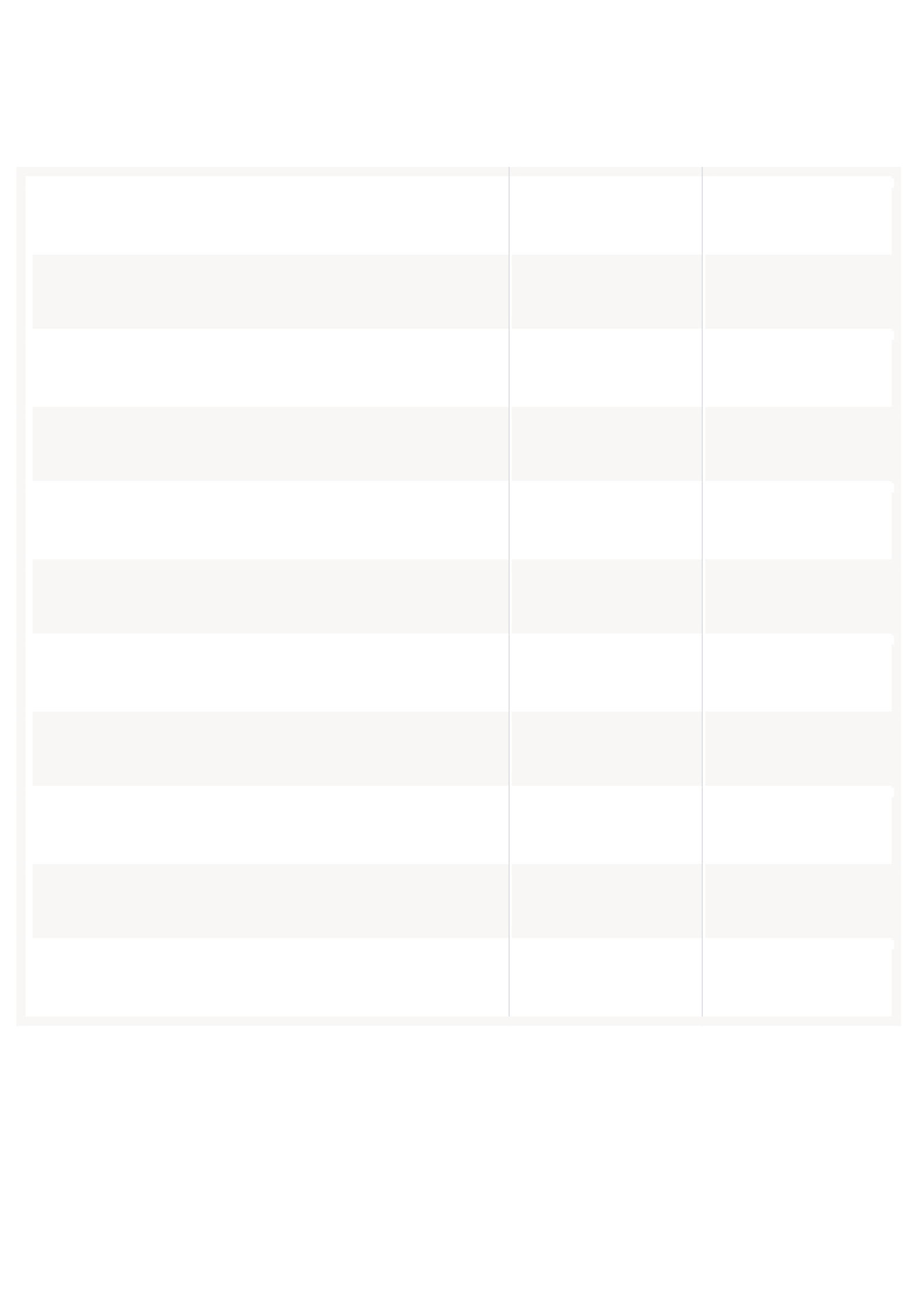
Table 1: Consumer expenditure on food
¥ Billion
2006
2007
Bread and cereals
3,840.1
3,811.6
Meat
3,636.9
3,637.6
Fish and seafood
4,410.6
4,342.5
Milk, cheese and eggs
1,994.9
2,000.4
Oil and fats
1,877.3
1,899.0
Fruit
1,874.6
1,869.9
Vegetables
4,981.7
4,976.7
Sugar and confectionery
3,627.6
3,653.0
Other food
12,795.8
12,945.5
Total
39,039.4
39,136.2
According to recent research, the influence of
western style of eating has seen the decrease on
the consumption of traditional food. This
includes the consumption of seafood which was

known to be popular within Japanese culture.
Contrary, there is notable rise in the
consumption of sugar, oils, fats and
confectionaries this is due to the fact that these
kinds of food appear cheaper.
Popularity of ready made meals is on the rise for
the purposes of convenience that addresses the
high number of singles within urban centers.
This may present good market to Wendy’s fast
food restaurants (Euromonitor International,
2009).
There is great difference in taste within Japan
due to regional differences. Japan is divided into
two regions namely; Kanto and Kansai. This is
one of the crucial factors that need to be
considered by Wendy since the natives from
Kanto region seem to like western products and
have less concern for food costs.
Kansai residents seem to more conscious on
food costs and prefer mostly their traditional
food to Western food. This calls for adjustment
in taste profile for the purposes of serving the
entire population. One of the major advantages
to Wendy Inc is that Japanese are cultured to

fast-paced lifestyle which makes fast-food
restaurants a priority most of the times
(Euromonitor International, 2009).
Shopping habits
The shopping habits are reflected based on
several factors some of which include;
importance of product information, the
enjoyment that goes along with shopping,
pricing, the nature of advertisement used and
people’s reactions.
The Japanese does their food shopping based on
its quality health- wise, tastiness and freshness.
Markets in Japan offer different kinds of food
depending on customer’s choice and preference.
Research shows that more than half of the
population likes eating out at restaurants more
so when in companionship with friends.
Most of the public meetings and social
gatherings take place at social facilities creating
reach market for fast food. The eating out
population in Japan has increased due to some
factors such as high number of single persons,
society experiencing tremendous changes, for

instance long working hours, fast-paced lifestyle
and low food prices. Recent statistics have
shown that in Japan great number of street
vendors deal with food and beverage.
The frequency of those who eat out is on the
increase despite the economic downturn. They
consider that eating out improves one’s self
identity since it presents an opportunity to meet
people from diverse background. Majority of the
consumers have adjusted their purchasing habits
for the purposes of utilizing on the consumption
of fast food and street vendors (Euromonitor
International, 2009).
The statistics further shows that the majority of
the population comprises young men with the
elderly above sixty five years accounting for
only 22%. Japan’s food related segments are
divided into; traditional consumers, adventurous
and uninvolved consumer segments. The
research shows that the number of adventurous
consumers is high as compared to the other two.
This is because most of them prefer healthy,
organic food products and more sensitive to
safety and taste. However, the consumers tend to

be very skeptical on the nature of food safety.
This is due to some recently identified food
scandals such as contaminated mill from Snow
Brand and contaminated Chinese vegetables
including false branding of beef.
Food consumption and purchasing is high in the
country and considered as one of the largest
expenditure after housing. They are more
focused on purchasing variety of fresh foods
from the common outlets offering highest
quality food products. Recent statistics shows
that general and specialty stores sells averagely
39% of total food sales followed by
supermarkets at 34% and lastly convenient
stores at 13% of total food sales.
Within the last four years, records shows that the
consumption rate of retail packed food increased
by considerable percentage of 2.2% compared to
that of fresh food which recorded small increase
as low between 0.5-0.6%. These statistics
presents Wendy Inc with good starting consumer
base, which when utilized could result to good
financial returns (Euromonitor International,
2009).

Product feature preferences
Wendy International Inc should focus on
providing consumers with reliable and high
degree services. They measure the quality of the
product by the impacts it has on general health
and value the cleanliness that goes with it. To
motivate the population towards the products,
hygiene factors which might result in consumer
dissatisfaction must be observed closely.
The population considers variety and
inexpensiveness of the product as one of the
motivating factors. The research further
indicates that according to Japanese culture, if
the high-level need which in their case is self
identity cannot be satisfied, then they consider
lower-level needs which in their case are
inexpensiveness, variety and quality health
(Rothbart, 2009).
To satisfy the uninvolved consumers within
Japan, majority being male bachelors, the focus
should be on product design. This will provide
them with food products that are easily used
which most of them prefer. To reach the
traditional consumers Wendy Inc should put a

lot of emphasis on product labels since most of
those in this category have poor purchasing
habits.
Conclusion
More attention should be paid on individual
consumer effects and the level of its impact on
current and future trends. Personal interview and
multiple regression approaches should be
employed to test the research hypotheses and
exploratory propositions. Lowering prices was
found to have a positive effect on consumer
buying habits and their frequency to food stores.
This clearly suggested that in order to
experience increase in consumer spending and
repeat visits, the restaurants should invest more
in tools that promote the use of price-off. Wendy
Inc image could be improved only by
promotional tools that focus on consumer tastes.

Consumer and Decision Making Behavior:
Contrast and Similarities Between the Two
Companies
Qantas and virgin Australia share many
similarities since they are in the same industry.
Both companies make sure that services offered
to their customers are paramount hence making
them acquire individual market share. This is
done by these companies making sure that their
airlines have records of safety.
Consumers prefer travelling with airlines with a
clear history of incidences and accidents.
Everyone aims at reaching their final destination
safely hence making it essential for consumers
to rely on airline companies that have safety
measures (Goh, 2004). They make sure that their
pilots are competent in order to build trust to
their consumers that they will eventually land to
their destinations safely (Forsyth, 2005).
Both companies make sure that they provide
customer services to their consumers that match
international standards. Once consumers are
received by customer care representatives and

assisted along the process of clearance, they feel
encouraged to come back to the company again
for services.
If a company has poor customer relationships,
consumers end up disappointed by their services
hence opting to try out services from other
players in the market this means that the
company loses out to its competitors. These two
companies carry out extensive consumer
surveys to find out what consumers prefer when
travelling.
They provide what customers feel best for their
journeys and this assures them of retaining
customers and attracting more. Their cabin crew
retains high professionalism in serving
customers making them miss flying in these
airlines. Consumer behavior is monitored by a
customer service department in both companies.
This makes sure that customer requirements are
given priority and attended remarkably fast. This
is done to make sure any complaint from
customers is addressed, and communication
made to the concerned client to retain their faith.
For example, whenever a customer is

dissatisfied with the services offered by the
travel company, they may raise the issue to the
management.
The managements of Qantas and virgin
Australia companies follow up with the client to
make sure that, they clarify and make apologies
where possible hence restoring customer trust.
This promises these companies stable market
share. This is because consumers who fail to be
satisfied with their services are followed up to
be explained until they feel that the issue was
accidental.
On the other hand, these two companies tend to
differ in some aspects because Qantas Airline
Company is financially healthier than virgin
Australia and relies on the strategic planning
theory. This makes a significant difference
between the two companies because Qantas
offers services to its consumers without
straining their budgets (Lawton. 2002).
Qantas focuses more on long term benefits of the
airline in selection of their target market. For
example, customers pay less to travel with
Qantas as their tickets cost much cheaper than

those from virgin Australia Company.
Customers love travelling with Qantas because
they pay less and safety is assured. The airline
uses the positioning theory and they position
their flights among the cheapest in the region.
Consumers who get late for flights in Qantas get
quick arrangements to get another flight, unlike
in virgin Australia where customers have to wait
to be rescheduled for other flights.
This is because, virgin Australia uses social class
theory whereby they concentrate on customers
more than they do for their company. In fact, this
is the winning factor for Qantas airlines because
their customers are assured that nothing can
unreservedly reschedule their flights by a day.
Qantas make sure they hire most competent staff
and fund for their further training on customer
service. This is the reason their crew and other
support staff handle their customers according to
individual needs. In virgin Australia, customers
are attended by the crew and staff not trained on
handling some needs of customers. Therefore,
customers like traveling with the prestigious
Qantas airlines as opposed to virgin Australia.

Consumer Buying Behavior – Muffin
Consumption
Introduction
Studies such as those by Heffetz (2012) explain
that in the case of the 45-65 age demographic,
buying decisions on food are oriented more
towards long term healthy food choices and, as
such, they are willing to spend considerable
amounts on food that they know is healthy
(Heffetz, 801-818).
Evidence of this can be seen in the creation of
several companies that produce products
specifically targeted at this demographic, such
as high fiber cereals, vitamin enriched bread,
various types of multi-vitamins and a variety of
other products (Heffetz, 801-818).
Not only that, the study “Disparities in the
Frequency Of Fruit and Vegetable Consumption
by Socio-Demographic and Lifestyle
Characteristics in Canada” (2011) which
examined consumer trends in healthy eating
revealed that as consumers age they tend to take
into consideration the type of food they eat given

their susceptibility to illnesses due to their
advanced age (Disparities in The Frequency of
Fruit and Vegetable Consumption, 118-125).
As a result, they are willing to spend more to get
better high quality food that is rich in vitamins,
fiber and other nutritious elements.
From these studies, it is evident that consumer
buying behavior for the 45-65 demographic is
oriented more towards healthy food choices
wherein they first consider the health benefits of
what they consume as opposed to its
affordability or popularity.
While muffins are not as popular as compared to
burgers, shakes, and fries, they are a healthier
choice which appeals to the 45-65 age
demographic.
Understanding 45 – 65 Demographic
Consumer Buying Behavior
When examining the 45-65 demographic, it can
be seen in the study by Wheatley et al., (1980)
that consumers within this age bracket have
more disposable income as compared to either
the 18-29 or 30 – 44 demographics (Wheatley et
al., 31).

Wheatley et al., (1980) explains that this age
group is closer to retirement and has already
reached a point in their lives where they have
paid off large additional expenses such as
mortgages and car loans which are normally
accumulated early in life which results in a
greater amount of disposable income.
Combined with the fact that individuals within
this age group normally have had long and
fulfilling careers resulting in advanced positions
within their respective companies (i.e.
managers, shift leaders, foreman, principles etc.)
results in higher levels of income as compared
to their counterparts in the 18-29 demographic
who are still staring their careers, the 30 – 44
who are in the middle of their careers and the 66
and above demographic who rely primarily on
their retirement income.
As such, it can be assumed that the 45 – 65
demographic has high amounts of disposable
income which has a direct influence on their
buying behavior.
It is normally the case that under the concept of
budget constraints, each consumer is assumed to

have a fixed and finite income due to the limited
amount of work in exchange for income each
individual consumer is capable of achieving.
When taking into consideration a high income
threshold and the aforementioned desire for high
quality health food, as seen in the study of
Heffetz (2012), this means that the 45-65
demographic is not concerned with the price of
the food that they are buying but rather its
potential health benefits.
Thus, when it comes to purchasing a muffin
from the Muffin Shoppe it is likely that these
consumers would choose from a selection of
muffins that they would perceive as giving them
the highest health benefits regardless of the cost
(i.e. whole wheat muffins, bran muffins, banana
muffins etc.).
Nandamuri et al. (2012) adds to the argument by
showing that this particular consumer
demographic is more likely to spend more on
quality food as compared to consumer
electronics due to their age factoring into their
adaptability to new types of popular culture
technology (i.e. iPhones, iPads, etc.) which

enables them to spend more money on high
quality consumable goods (Nandamuri et al., 48-
63).
Rational Buying Behavior
The concept of rational behavior assumes that all
consumers are rational individuals who try to
use their earned incomes in order to derive the
greatest amount of satisfaction/ utility.
In other words, consumers try to get the most out
of their income through rational buying behavior
which results in a maximization of total utility
from the products or services used.
In the case of the 45-65 demographic, rational
behavior comes in the form of choosing healthy
food options, despite the cost, due to their
deteriorating health as a result of old age.
Rational behavior is based on the fact that
consumers should act in an economically
competent manner to not spend too much money
on irrational purchases or services.
For the age demographic under examination,
this means purchasing food items that contribute
to their well being (ex: healthy muffins, fruits,

vegetables etc.) as oppose to those that result in
bodily harm (i.e. burgers, fries, donuts, etc.).
Consumers from this age demographic are
inherently aware of how much in the way of
marginal utility they are able to derive from
successive use/consumption of a healthy
product and, as such, orient their buying
behavior towards this type of consumption.

Consumers’ Behavioral Intentions as to
Organic Food Products
This report pertains to an analysis performed by
Diligent Consulting Group for Loving Organic
Foods’ venture. It aimed at determining the
source of the idea which arose the motivation to
boost customers’ habits of making purchases.
The major market segment of customers was
identified with their purchasing frequency
determined. It was established that customers
who lie within different age-groups have been
purchasing organic foods for over three months
from the business venture. Their motives for
purchasing particular items vary from one
person to another. The rising need to establish
the source of customers’ motivation to make
purchases prompted Loving Organic Foods to
survey 200 clients who previously made organic
foods purchases, and 124 clients who responded
had their age data randomly recorded. The
survey targeted past clients of Loving Organic
Foods who had made purchases in the preceding
quarter of marketing.

Organic Food Industry Description
Organic food is seen as a healthy product which
will avail more nutritious substances and create
little harm to the consumer’s health.
Organizations have prioritized a long-term
strategy such as sustainable environment and
food security to ensure a sustainable organic
food supply chain (Mie et al., 2017). The rapid
increase in the market for organic food products
has created a positive shift in consumers’
behavior, which will require businesses to
deploy better policies and decision-making
techniques (Wang, Pham, & Dang, 2020).
Therefore, it is important to urgently understand
the consumers’ behavioral intentions and
perceptions towards accessing organic food
products.
Targeted Market Segment
The demand and consumption of organic food
products are increasing on a daily basis. The
belief in contextualizing organic food products
as healthier than other conventional food
products contributes to the rising demand

(Brantsæter, Ydersbond, Hoppin, Haugen, &
Meltzer, 2017). In 2014, the United States retail
sales volume for organic food products was
$35.9 billion, the largest worldwide (Brantsæter
et al., 2017).
The availability of organic food products has
facilitated faster growth in the segment market
for these products. Past studies show how the
frequency of organic food product consumption
fails to follow a specific age-group but is found
within the categories of older and younger adults
(Brantsæter et al., 2017). Furthermore, homes
which have children tend to purchase more
organic food compared to those without
(Brantsæter et al., 2017). Organic food products
are eco-friendly, safer, healthier, cleaner,
nutritious, safer, and tastier.
Consumers Lifestyles and Shopping Trend
According to Wang et al., existing perceived
quality of food products affects the connection
between the intention to purchase organic food
products and environmental awareness (2020).
Furthermore, they perceive the price as the

moderating factor between the intention to
purchase organic food products and the
perceived quality of the food items. High
income households purchase more organic
foodstuff because they can easily afford them;
most of the organic foods are expensive
(Nguyen, Nguyen, Nguyen, Lobo & Vu, 2019).
Therefore, the purchasing motive of organic
food products by a consumer relies on the link
between intention to purchase, income level, and
the perceived quality of the food products.
Analysis
The analysis for this survey used Excel to
analyze the age data. While performing the
analysis, histograms were created to capture
relevant information from the age data. The
histogram’s width had age categories, for
instance, 15 years, 10 years, and 5 years.
Furthermore, the report performed an analysis to
determine the mode, mean, and median of the
age data collected by Loving Organic Foods for
the survey.

Analysis Supporting the Age-groups (Bins)
The created histograms had different types of
bins, which facilitated different appearance
types for the age data representation. The used
bins consisted of 5, 10, 15, and 20 age groups.
The histogram with bins of width 20 covered a
larger area under a large group, while the one
with bins of width 5 covered smaller areas under
a small area. Therefore, bin ranges of 10 are
more suitable to create a histogram.
Grouping the bins to appear in clusters allowed
the histograms to reveal the underlying patterns
in them. Furthermore, the bins are appropriate
for creating the histograms since the beauty of
these frequency distribution charts lies within
the area they cover and not the height of
individual bars. The individual’s bars’ height
will be wrongly assessed as showing the
frequency, but not the bar’s area since
histograms usually have bins that have equal
spacing. Therefore, using the bins’ height fails to
give a clear and correct reflection of the
frequency.

Results Description
Median Age
Histograms represent data and are applicable in
determining information about data distribution.
Histograms provide presentations for
exploratory tools since they show properties
regarding a dataset to summarize the data. The
histograms will enable identifying and
understanding the center of the data. Chart 2 will
be utilized since the bin range used to create the
histogram was convenient. For instance, in
Chart 2, the data center lies between 41 and 50
years of age. Therefore, the median age of
customers making purchases of organic food
products is approximated as 46. Therefore, the
mean of the age of the customers lies between
41 and 50 years.

The Modal Age
Checking for the modal value in the created
histograms with different bin ranges is possible.
Chart 2 is symmetric, and a unimodal
distribution since it contains a single-peaked
section. But considering its appearance, the
modal value lies in the class intervals 41 and 50
and approximated 46 years of age. This section
is the highest peak seen from the created
histogram using the bin range of 10. This high
peak would suggest the age data concentrated
towards higher ages.
The Minimum, Maximum and Range
Checking for the minimum, maximum, and
range of age of the organic food products buyers
from the chart, the analysis established the
following. In Chart 2, the approximated
minimum age is 25, while the approximated
maximum age is 75. The approximated range
will, therefore, be 50 years of age. Furthermore,
the histogram in Chart 2 is right-skewed,
indicating existing values that are greater than
the modal value.

Recommendations
Since Chart 2 is symmetrical, right-shifted, and
peaked, Loving Organic Foods should be
informed of the nature of their market segment,
which is consistent and it majorly favors
customers of high ages. On average, those aged
45 made more purchases compared to those who
were younger. Furthermore, the market
distribution is even between the entire collected
age data. It is recommended for Loving Organic
Foods to concentrate more on attracting the
younger population while maximizing and
maintaining strategies geared towards meeting
the needs of the older customers.

References
Brantsæter, A. L., Ydersbond, T. A., Hoppin, J.
A., Haugen, M., & Meltzer, H. M.
(2017). Organic food in the diet: Exposure and
health implications. Annual Review of Public
Health, 38(1), 295-313. Web.
Mie, A., Andersen, H. R., Gunnarsson, S., Kahl,
J., Kesse-Guyot, E., Rembiałkowska, E.,
Quaglio, G., & Grandjean, P. (2017). Human
health implications of organic food and organic
agriculture: A comprehensive
review. Environmental Health, 16(1). 1-22.
Web.
Nguyen, H., Nguyen, N., Nguyen, B., Lobo, A.,
& Vu, P. (2019). Organic food purchases in an
emerging market: The influence of consumers’
personal factors and green marketing practices
of food stores. International Journal of
Environmental Research and Public
Health, 16(6), 1037. Web.
Wang, J., Pham, T. L., & Dang, V. T.
(2020). Environmental consciousness and
organic food purchase intention: A moderated
mediation model of perceived food quality and


Consumers’ Behavior and Market Trends
Executive Summary
The main purpose of this report is to explore
consumer buying behaviors and the market
trends. The findings show that a consumer has
diverse requirements and spend different
amounts on necessities and non necessities
according to one’s social class, cultural setting,
psychological make up or age bracket.
Conversely, the market responds to the
consumer’s behavior to suit the buyer’s needs,
hence setting the market trends.
Introduction
Consumer behavior is a rational psychological
process which allows consumers to critically
evaluate their purchase options with the aim of
justifying the reasons behind their purchases in
order to maximize their satisfaction. Consumer
behavior means more than just buying tangible
goods; it also includes consumers’ use of
services, activities experiences and ideas.

Market trends are dynamic patterns that are set
by consumers buying and selling decisions.
Markets are designed around linking consumers’
disposition decision to the customers’
acquisition decisions. Thus, marketers are more
concerned with the manner in which consumers
buy products and services, how they use the
product and dispose the same (Saunders et al,
2009).
The paper studies various groups of consumers
in different age brackets and their preferences
and buying trends for particular beauty products.
It emerges that the various groups behave
differently due to various factors that influence
their buying decisions. It also comes out that the
market responds to the consumer behavior by
coming up with different products targeting the
diverse clientèle.
This paper aims to explain factors influencing
consumer behavior and market trends.

Literature review
According to Maslow’s theory, individuals will
attempt to cater for their most important needs
first. When an individual achieves certain needs
within this hierarchy these needs no longer
motivate them and therefore will seek to satisfy
other motivating needs. Maslow’s theory assists
marketers understand how plans, goals and
motives are connected to purchases made by
consumers.
Fredrick Herzberg’s, ‘factor theory’
differentiates issues causing discontent from the
satisfiers therefore taking centre stage in
determining human behavior” (Kotler 2003, p.
27).
Herzberg’s theory has two implications. First,
sellers should do their best to avoid factors that
bring about dissatisfaction. Secondly, the
manufacturer should precisely identify satisfiers
and therefore aim to incorporate them in
production in order to motivate consumers to
purchase their products. These satisfiers
determine the key variation as to which product
the customer buys.

Additionally, Sigmund Feud motivation theory
suggests that the psychological factors
influencing individual’s actions are mainly
unaware and that an individual cannot
comprehensively appreciate his impulses.
Laddering method can be used to accurately
determine a person’s motivations that influence
his behavior. Thus, marketing experts can make
important strategic decisions that are involved
with the design of messages that appeal to
consumers.
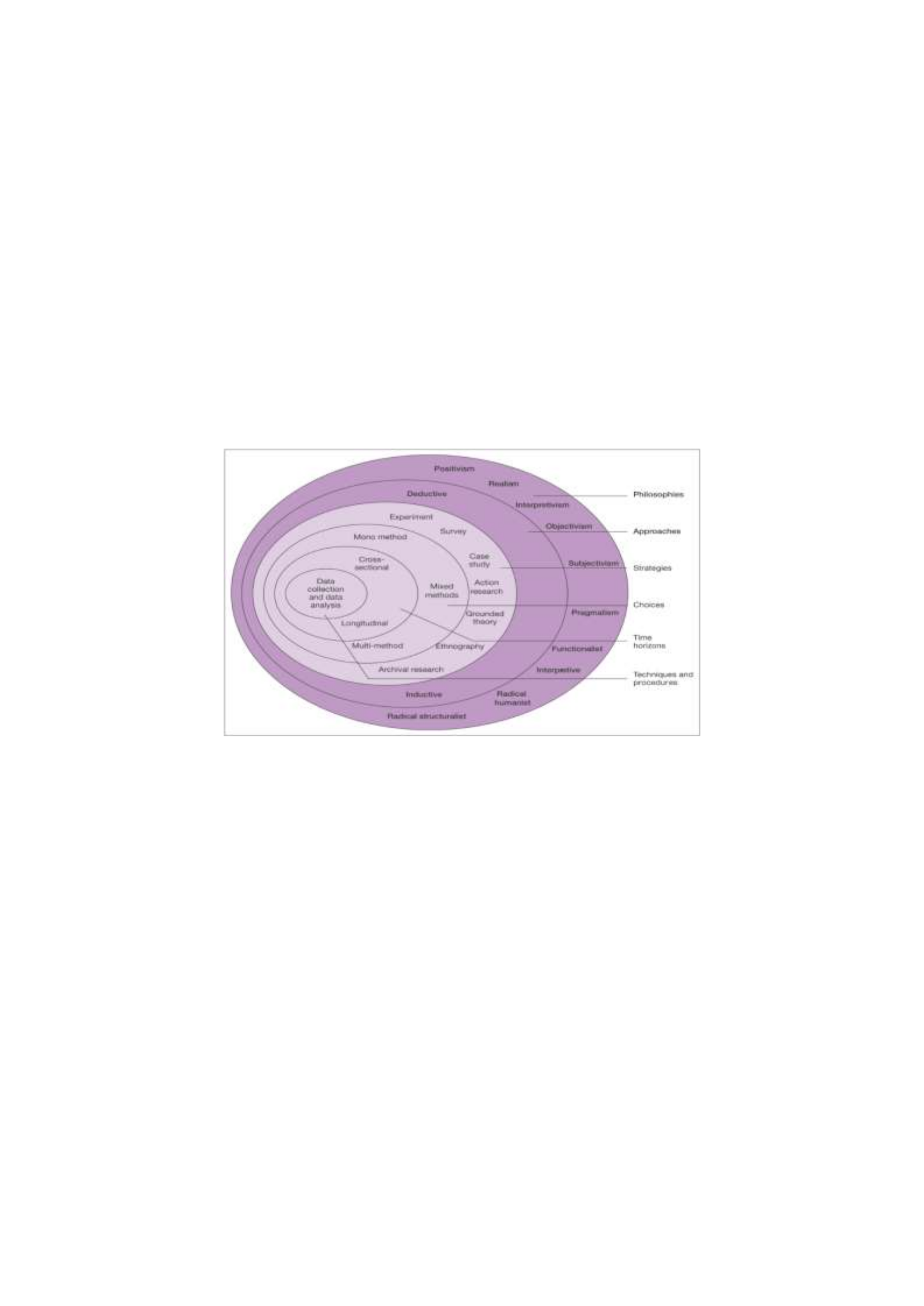
Methodology
The methodology provides the experiential
approach to the research study where the
research design, population, sample, research
instruments and data analysis techniques to be
employed.
The Research Onion
Research philosophy
According to Creswell (2008), research
philosophy can be demonstrated in terms of
epistemology or ontology. Epistemology
comprises of acceptable knowledge in a
particular field of knowledge where
interpretivism and positivism philosophical
paradigms are pertinent, whereas ontology is
based on nature related knowledge.

Based on the nature of the research topic,
positivism philosophy will be adopted. With
positivism philosophical paradigm focusing on
the establishment of ‘how we know something’,
it is considered to be the most suitable for this
study.
Research approach
A research study is approached either
deductively or inductively. Since this study
focuses on the consumer buying behavior and
market trends, deductive research approach is
considered to be most effective, since it involves
drawing of conclusions based on the general
findings using logical premises.
Target Population and Sampling Procedures
The target population for this study will
comprise of mainly ladies in different age
groups classified as teenagers, middle age and
old ladies. In selecting the participants, this
study will employ stratified random sampling
where the interviewees will be categorized on

their age groups and the products they mainly
use.
Data collection
The research will employ both primary and
secondary data.
The Research instruments
This research will entirely use interviews to
collect primary data from the field as it’s easy
and simple to administer.
Data analysis techniques
The collected data will be analyzed statistically
for frequency distribution, regression and
correlation.
Findings and discussion of findings
Some of the image altering options reflecting the
variety of behaviors by the illustration were:
body art for fashion (tattooing and piercing);
cultural body art as a reflection of ethnicity;
myriad services of cosmetic enhancement- laser
skin treatments for wrinkles and hair; botox,
collagen, cosmetic dentistry; body contouring;
eye surgery instead of using glasses; cosmetic

dentistry for example veneers and whitening and
cosmetic surgery.
Interview Results
AGE/GROUP
OPTIONS
TEENAGER(
16- 24)
MIDDLE AGE
WOMAN(33-46)
OLD LADY ( 50
AND ABOVE)
Cosmetic surgery
3
10
7
Tattoo& piercing
10
3
1
Eye surgery
6
7
10
Laser skin
treatments
2
7
9
Cosmetic surgery i.e.
whitening
8
6
5
Collagen
4
6
8
For the teenager, she was more into her
appearance where the highest level was in
tattooing and piercing for beauty as well as
cosmetic surgery, such as whitening and the
lowest being laser skin treatments since their
skins have not been affected by the toxins of the

cosmetics and now that she is young she will not
be needing the skin laser treatments.
For the middle aged, her highest level was
cosmetic surgery, this is to enable her to feel like
she is still young and the lowest rank being
tattooing and piercing and since she is mature
and she would like to present herself in a
respectable manner she would only prioritize on
cosmetic surgery, eye surgery and laser skin
treatment.
The old lady ought to prioritize her options to
eye surgery to avoid wearing glasses, followed
by the laser skin treatments to prevent her from
looking too old and avoid the wrinkles from
appearing.
Discussion of findings
Some decisions about whether to acquire, use, or
dispose of a product are related to personal
goals, safety concerns or desire to reduce
economic, social or psychological risk
(Lancaster & Withey, 2006). In our case, there
are several factors that may influence buyer
behavior and how marketers capitalize on them,
these include;

Culture
People of a particular cluster tend to buy similar
goods, that is why marketers design mass
products according to the target social or cultural
segment. For instance, more teenagers would
prefer tattoos and piercings than middle or old
women.
Social factors
Social factors such as reference groups, families
and institutions introduce individuals to new
practices and lifestyle and put pressure on the
consumer consent and influence on the choice of
product. For example, most teenagers tend to
behave the same and the same applies to the
other age groups.
Roles and statuses
Most people will choose products that
communicate their role and status in the society,
for instance for the middle aged, her highest
level was cosmetic surgery this was to enable her
to feel like she is still young and the lowest rank
being tattooing and piercing and since she is
mature and she would like to present herself in a
respectable manner.

Personal factors
A consumer’s judgment to buy a product can
also be subjective on individual traits. From the
study, a teenager will buy cheap cosmetics while
a middle aged lady will likely buy more
expensive cosmetics.
Conclusions and recommendations
Consumer’s buying decisions are influenced by
many varying factors. Individuals often
purchase goods and services that reflect their
particular age, social class or culture at the time
of purchase. With time, consumers buy different
products and services that would best suite them
at that time. People tend to relate to what they
believe in and how they behave with the groups
they are associated with.
There are also psychological factors that greatly
determine what consumers go for. Based on the
consumer buying decisions, the market comes
up with more advanced products to satisfy the
diverse clients. This shows there is a direct
relationship between the consumer behavior and
the market trends. The market responds to the
consumer behavior instantaneously.

Thus, marketers need to search for relationships
between their products and lifestyle group, for
example a middle-aged lady would prioritize her
needs to cosmetic surgery, this is to enable her
to feel like she is still young and the lowest need
being tattooing and piercing and since she is
mature and she would like to present herself in a
respectable manner she would only prioritize on
cosmetic surgery, eye surgery and laser skin
treatment.
Contrary, the older lady would prioritized on eye
surgery to avoid wearing glasses, followed by
the laser skin treatments to prevent her from
looking too old and avoid the wrinkles from
appearing (Koontz & Weihrich, 2009).
The market should develop brand images that
match the target market’s self image, for
instance setting up a laser treatment infirmary to
an educational institution that’s full of students
who range from 18 to 24 instead of body art
facility for fashion or a cultural body art as a
reflection of ethnicity. The marketer should have
a selection attention that means that products
should capture the target consumers’ attention
by the first impression.

Reference List
Creswell, J 2008, Research design: Qualitative,
quantitative, and mixed methods
approach, Sage Publications, New Jersey.
Koontz, H & Weihrich, H 2009, Essence of
Management an International Perspective, Tata
McGraw Hill, New Delhi.
Kotler, P 2003, Marketing Insights from A to Z:
80 concepts every manager needs to know, John
Wiley & Sons Inc, New Jersey.
Lancaster, G & Withey, F 2006, Marketing
Fundamentals’: CIM Course book, Oxford
publishers, London.
Saunders, M, Lewis, P, & Thornhill, A
2009, Research methods for business
students, Pearson Education Limited, Essex.

Consumer Behavior in Malaysia v. Australia
Introduction
As compared to Australia, Malaysia is a
developing country whose consumers still direct
most of their consumption towards expenditure
on basic commodities. Consumer behavior on
any basis is driven by many factors hence hard
to know the exact reasons why people buy.
While most consumers may be driven by need,
others buy due to motivation (psyche) (Mowen
2000). Comparisons and contrasts of consumer
models according to schiffman in Malaysia The
theories tend to shows beliefs possessed by
various categories of consumers and how their
beliefs influence consumer behavior.
Consumers are viewed from either the economic
perspective or social perspectives as indicated
by the two theories applicable in Malaysia
(Mowen 2000). These are the points of
penetration of by the marketers into the
consumers to influence how?, what?, how
much? in addition, the quantity.

The theories discussed are based on the needs of
consumers and they are social in nature. They
include – Pavlovian learning model and Veblen
social-psychological model. Pavlovian model is
derived from the famous Russian experiment on
the dog and its behavior concerning food where
the dog could be induced for food using the bell.
It is therefore quite clear that human behavior in
terms of purchasing is conditioned in such a
manner.
This theory is employed in Malaysia by
marketers to explore consumer aspects such as
learning ability, the rate they forget and the
extent to which they are likely to discriminate
(Mooij 2004). These results into a human
consumption behavior where a response is
triggered by a relevant stimulus based on the
concepts of drive, cue, stimulated response, and
reinforcement.
Drives either can be primary or learned and are
the needs that drive consumers to behave in a
given way. Generally, they entail hunger, thirst,
cold, corporation, and fear. Cue is more specific
as it determines where, how and the time when
the subject responds to a drive. For example,

depending on how a cold drink is advertised it
may stimulate the drive of thirst.
Response refers to the manner in which
consumers react to the cue, the reactions are
normally not similar. Similarity can be skewed
by intensifying the degree of the experience. The
Malaysian market is striving to do this by
providing a variety of products through
differentiation.
Reinforcement strategy is also because of a
rewarding experience, an experience is earned
only when it is repeated severally. The aspect
stresses that when reinforcement is ignored the
consumer habit is likely to extinguish (Mooij
2004).
Marketing application of the model This method
as applied in Malaysia directs a marketer on the
ways of behavior expected from the consumers
and the advertisement strategy to be employed
depending on the target market. In addition, the
model is largely applicable mostly when
introducing a new product into the market,
which is highly competitive.

Marketers in Malaysia apply this by
extinguishing old and outdated brands while
introducing new ones. It only challenge comes
at the point when you need to convince
consumers on the strong cues and revokes them
out of the weaker cues. This is also the point
where this model differs in Australia as in
Malaysia.
Advocacy for the strong brand of a product is the
most important cue to spread among the buyers
since it has the impact of creating brand loyalty
though it is an expensive approach.
The method also advocates for a reinforcement
strategy to be conducted through frequent
advertisements, this ensures that consumers do
not forget first and as well, reinforcement is
facilitated because the consumer only realizes
about the product after buying it (Mooij 2004).
Veblenian Social-Psychological model The
model is also a consumer behavior model
deriving it basis from Thorstein Veblen who is
an economist (McAlister 1982).
It views man as a social animal who is
influenced by the factors, which surrounds them

of which culture contributes a great percentage,
this narrows down to sub-cultures that results
from the groups, which they deal. The model
identifies that consumer purchase ability is
influenced by leisure and prestige acts
accompanied by the urge to satisfy them.
The model stresses on factors, which emulate
one another in the bid to influence consumer
purchase. The model as applied in Malaysia is
not that modern and hence wealthy people
would consider to under spending on flashy
commodities when they do not like them
(McAlister 1982).
The model, which classifies consumers on social
grounds, applies on the lower social class in
Malaysia, the reverse takes place in Australia,
and this has intensified research since there is
space. Marketing application of the model
According to Schiffman, Veblen model is
important in the determination of groups and
their respective demand of products.
The various social groups must be identified and
the important social influences that have impacts
on demand of the products. The points of

emphasis are, the social influences, how they
would facilitate the introduction of the products
considering culture, social class and the groups.
How models differ with the same in Australia
According to Farley, Howard, & Ring (1974),
the Pavlovian and Veblen models explain
consumer behavior and in its explanation, there
is a difference in its application in both Malaysia
and Australia. While in Australia Pavlovian
directs its efforts towards inducing customers to
increase their purchase to facilitate the
introduction of a new product.
Veblen on the other hand advocates for
marketing by considering classes in the society.
In Australia the models differ in their application
since Pavlov’s model is used at maturity to
market an established product, this is in view
that Australia is an industrialized nation, which
focuses much on luxury products.
It applies the Veblen’s model by majoring its
marketing on the upper class who mostly buy the
luxurious products since they have excess
resources after taking care of the basics. The
models are at the same time similar because they

use a common target audience only different on
their segmentation of the markets (Farley,
Howard, & Ring 1974).
The other difference is that in Malaysia,
consumers know what they want and therefore
they can never be swayed by advertisement.
How is this marketing opportunity for an
Australian exporter An Australian exporter have
with them manufactured goods which needs a
well established market base.
They involve a mix of the 4P’s and the models
would enhance an Australian exporter get the
best mix that would facilitate the marketing of
its products in the foreign market (Cheverton
2004). The models will ensure that favorable
prices are fixed that are competitive in the world
markets which would ensure that they gain from
such exportation.
The models would help the exporter do a market
segmentation and identification of a market.
Target markets identification very useful in
marketing since they aid in increased sales. An
exporter also needs information about the

countries to which they would direct their
exports.

