



PHYS 305 - INTRODUCTION TO
MODERN PHYSICS - Rotational
kinematics
Question Bank - Set 2
Liberty University
Question 1
Question
A disk of radius 0.2 m is initially at rest. It starts rotating with a constant
angular acceleration of 2 rad/s
²
. Determine the angular velocity of the disk
after 3 seconds.
Solution
Step 1: Recall the equation for angular velocity with constant angular acceler-
ation:
ω=ω0+αt
where - ωis the final angular velocity, - ω0is the initial angular velocity (which
is 0 in this case), - αis the angular acceleration, - tis the time.
Step 2: Substitute the given values into the equation to find the angular
velocity after 3 seconds:
ω= 0 + 2 ×3 = 6 rad/s
Therefore, the angular velocity of the disk after 3 seconds is 6 rad/s.
Question 2
Question
A disk of radius 0.3 m starts from rest and accelerates with a constant angular
acceleration of 2 rad/s2.
1. Find the angular velocity of the disk after 3 seconds.
2. Determine the angular displacement of the disk after 3 seconds.

Solution
1. We can find the angular velocity of the disk after 3 seconds using the equation
ω=ω0+αt, where ωis the final angular velocity, ω0is the initial angular velocity
(which is zero in this case), αis the angular acceleration, and tis the time.
ω= 0 + (2 rad/s2)(3 s) = 6 rad/s
Therefore, the angular velocity of the disk after 3 seconds is 6 rad/s.
2. To find the angular displacement of the disk after 3 seconds, we can use
the equation θ=θ0+ω0t+1
2αt2, where θis the final angular displacement, θ0
is the initial angular displacement (which is zero in this case), ω0is the initial
angular velocity, αis the angular acceleration, and tis the time.
θ=0+0+1
2(2 rad/s2)(3 s)2= 9 rad
Therefore, the angular displacement of the disk after 3 seconds is 9 radians.
Question 3
Question
A disc of radius 0.5 m is initially at rest. It starts rotating with a constant
angular acceleration of 0.2 rad/s2. How long does it take for the disc to reach
an angular velocity of 4 rad/s?
Solution
Step 1: First, we can use the equation for angular velocity under constant an-
gular acceleration to find the time it takes to reach the desired angular velocity:
ωf=ωi+αt
where ωf= 4 rad/s, ωi= 0 rad/s, α= 0.2 rad/s2, and tis the time we are
solving for.
Step 2: Substitute the given values into the equation:
4 rad/s = 0 + 0.2 rad/s2·t
Step 3: Solve for t:
t=4 rad/s
0.2 rad/s2= 20 s
Therefore, it takes 20 seconds for the disc to reach an angular velocity of
4 rad/s.
2

Question 4
Question
A solid sphere of radius Rand mass Mis rolling without slipping down an incline
that makes an angle θwith the horizontal. At a certain point, the sphere is at
a height habove its base. Find an expression for its speed vin terms of R,M,
h,θ, and the gravitational acceleration g.
Solution
Step 1: The acceleration of the sphere down the incline can be found using
Newton’s second law. The forces acting on the sphere are gravitational force
(mg) pulling it down the incline, the normal force (N) pushing it perpendicular
to the incline, and the frictional force (f) opposing its motion. Since the sphere
is rolling without slipping, there is no slipping between the sphere and the
incline; hence, the frictional force is static and given by f=µsN, where µsis
the coefficient of static friction.
XFparallel =mg sin θ−f=mg sin θ−µsN
XFparallel =ma
ma =mg sin θ−µsN(1)
Step 2: The torque acting on the sphere about its center is due to the
gravitational force. The torque is given by τ=r×F, where ris the distance
from the axis of rotation to where the force is applied. The moment of inertia of
a solid sphere about its center is I=2
5MR2. The net torque about the center
is τ=mgh.
τ=maR ⇒mgh =maR
a=gh
R(2)
Step 3: Substituting the expression for acceleration (from step 2) into equa-
tion (1), we get:
mgh
R=mg sin θ−µsN
mg sin θ−µsN=mgh
R
N=mg cos θ
Step 4: Now, using the condition for rolling without slipping, the acceleration
of the center of mass must be equal to Rα, where αis the angular acceleration.
3

The tangential acceleration is given by a=Rα. Substituting the acceleration
expression from step 2 into this equation:
gh
R=Rα
α=gh
R2
Step 5: Using the no-slip condition:
a=Rα
gh
R=R×gh
R2
v2= 2gsin θh
v=p2gsin θh
Question 5
Question
A disk of radius Ris spinning with an angular velocity ω0. At t= 0, a constant
torque of magnitude Tis applied to the disk. The disk comes to rest after
completing exactly 10 full rotations. Determine the moment of inertia Iof the
disk in terms of R,T, and ω0.
Solution
Step 1: We know that the net torque on the disk is responsible for the angular
acceleration of the disk. The torque equation can be written as
τ=Iα
where τis the torque, Iis the moment of inertia, and αis the angular acceler-
ation.
Step 2: The angular acceleration αis related to the angular velocity ωby
the equation
α=dω
dt
Step 3: Integrating the above equation, we get the expression for angular
velocity as a function of time:
ω(t) = ω0−T
It
Step 4: Since the disk comes to rest after completing exactly 10 full rotations,
we can write the final angular velocity as 0. This gives us the following equation:
0 = ω0−T
I(10τ)
4

Step 5: Solving for the moment of inertia I, we find
I=10τ
ω0
Step 6: Hence, the moment of inertia Iof the disk in terms of R,T, and ω0
is
I=10T
ω0
Question 6
Question
A disk of radius Ris initially at rest. A constant torque τis applied to the disk,
causing it to rotate about its central axis. The disk accelerates uniformly from
rest to a final angular velocity ωfin a time interval t. Determine the angular
acceleration of the disk in terms of ωf,t, and R.
Solution
Step 1: Recall the kinematic equation for rotational motion:
ωf=ωi+αt
where ωf= final angular velocity, ωi= initial angular velocity (which is 0 in
this case), α= angular acceleration, and t= time interval.
Step 2: Substituting the given values into the equation:
ωf= 0 + αt
α=ωf
t
Step 3: Recall the kinematic equation for rotational motion in terms of
angular displacement:
ω2
f=ω2
i+ 2αθ
where θ= angular displacement (which is 2πfor a complete rotation).
Step 4: Since the disk starts from rest, ωi= 0. Substituting the given values
into the equation:
ω2
f= 0 + 2α(2π)
α=ω2
f
4π
Step 5: Equate the two expressions for α:
ωf
t=ω2
f
4π
5

4π=ωft
Step 6: Finally, we can express the angular acceleration αin terms of ωf,
t, and Rby noting that the final angular velocity ωfis related to the linear
velocity of a point on the outer edge of the disk:
v=Rωf
4π=Rωft
α=ω2
f
4π=1
Rt
Therefore, the angular acceleration of the disk in terms of ωf,t, and Ris
1
Rt .
Question 7
Question
A disk of radius 0.2 m is initially at rest. A constant force of 4 N is applied
tangentially to the edge of the disk for 3 seconds. If the moment of inertia of the
disk is 0.01 kg ·m2, determine the angular velocity of the disk after 3 seconds.
Solution
Step 1: Calculate the torque applied to the disk. The torque applied to the disk
can be calculated using the equation:
τ=r·F·sin(θ)
where ris the radius of the disk (0.2 m), Fis the applied force (4 N), and
θis the angle between the force and the radius (90 degrees, since the force is
tangential).
τ= 0.2 m ·4 N = 0.8 N ·m
Step 2: Use the torque to find the angular acceleration. The torque applied
to the disk can be related to the angular acceleration (α) using the equation:
τ=I·α
where Iis the moment of inertia of the disk (0.01 kg ·m2).
0.8 N ·m=0.01 kg ·m2·α
α=0.8 N ·m
0.01 kg ·m2= 80 rad/s2
6

Step 3: Use the angular acceleration to find the final angular velocity. We
can use the following equation of motion for rotational kinematics:
ωf=ωi+α·t
where ωiis the initial angular velocity (0 rad/s), αis the angular acceleration
(80 rad/s2), and tis the time (3 seconds).
ωf= 0 + 80 rad/s2·3 s = 240 rad/s
Therefore, the angular velocity of the disk after 3 seconds is 240 rad/s.
Question 8
Question
A thin uniform rod of length Land mass Mis pivoted about an axis passing
through one end. The rod is released from rest at an angle θfrom the vertical.
Calculate the angular acceleration of the rod as a function of the angle θ.
Solution
Step 1: We will start by drawing a free-body diagram of the rod. The forces
acting on the rod are the gravitational force mg acting at the center of mass of
the rod, and the normal force Nacting at the pivot point.
Step 2: Using Newton’s second law for rotation, the torque about the pivot
point is equal to the moment of inertia times the angular acceleration. When
calculating the torque, we need to consider the component of the gravitational
force that causes rotation, which is mg sin(θ).
Step 3: The torque about the pivot point is given by τ=Iα, where I=
1
3ML2is the moment of inertia of a rod rotating about one end.
Step 4: Substituting the expression for the torque and moment of inertia
into the equation τ=Iα, we get mg sin(θ)·L=1
3ML2·α.
Step 5: Simplifying the equation, we find 3gsin(θ) = αL.
Therefore, the angular acceleration of the rod as a function of the angle θis
α=3gsin(θ)
L.
Question 9
Question
A disk with radius Ris spinning about a fixed axis with an angular velocity ω.
Initially, a point on the rim of the disk has tangential velocity v0. The point
moves around the rim of the disk for a brief time ∆tand comes to rest. What
is the angular acceleration of the disk during this time?
7

Solution
1. We know that the tangential velocity of a point on the rim of the disk is
given by vt=Rω, where vtis the tangential velocity, Ris the radius of the disk,
and ωis the angular velocity.
2. The initial tangential velocity is v0, so we have v0=Rω. Solving for ω,
we get ω=v0
R.
3. When the point comes to rest, its final tangential velocity is 0. We can
use the equation vf=vi+a∆twhere vfis the final velocity, viis the initial
velocity, ais the acceleration, and ∆tis the time interval.
4. Substituting the values into the equation, we get 0 = v0+a∆t. Solving
for a, we find a=−v0
∆t.
5. The angular acceleration αis related to linear acceleration aby α=a
R.
6. Substituting the value of ainto the equation for angular acceleration, we
get α=−v0
∆t·R.
Therefore, the angular acceleration of the disk during this time is −v0
∆t·R.
Question 10
Question
A uniform disk of radius Rand mass Mis rolling without slipping down an
incline with an angle of θwith respect to the horizontal. The disk is released
from rest at the top of the incline and reaches a speed of vat the bottom.
Calculate the height of the incline in terms of Rand θ.
Solution
Step 1: The total kinetic energy at the bottom of the incline is the sum of the
translational and rotational kinetic energies:
1
2Mv2+1
2Iω2
where I=1
2MR2is the moment of inertia of the disk and ω=v
Ris the angular
velocity.
Step 2: The total kinetic energy is also equal to the total potential energy
at the top of the incline, which is Mgh, where his the height of the incline.
Step 3: Setting the two expressions for kinetic energy equal to each other:
1
2Mv2+1
21
2MR2v
R2=Mgh
Step 4: Simplifying the equation:
1
2Mv2+1
4Mv2=M gh
8

3
4Mv2=M gh
h=3
4
v2
g
Step 5: Using trigonometry, we have sin θ=h
L, where Lis the length of the
incline. Substituting hin terms of vand g:
sin θ=3
4
v2
gL
Step 6: Now, notice that the velocity vat the bottom of the incline can be
expressed in terms of the initial height Hfrom which the disk is released:
v=p2gH
Step 7: Substituting vin terms of Hinto our previous equation:
sin θ=3
4
2gH
gL
sin θ=3
2
H
L
H=2
3Lsin θ
Therefore, the height of the incline in terms of Rand θis 2
3Rsin θ.
Question 11
Question
A disk of radius Ris rotating with a constant angular velocity ω. A small bug
starts from rest at the edge of the disk and crawls towards the center. Determine
the bug’s angular velocity when it reaches the center of the disk.
Solution
1. Let rbe the bug’s distance from the center of the disk at any time t, and let
θbe the bug’s angle from the starting point. The bug’s linear velocity vand
angular velocity ωbcan be related by:
v=r·ωb
2. The bug’s angular displacement ∆θis given by:
∆θ=θ=ωt
9

where ωis the angular velocity of the disk.
3. The bug’s linear displacement ∆ris given by:
∆r=R−r
4. Since the angular velocity of the disk is constant, we have ωb=v/r. From
the relationships above, we have:
v=ωr
∆r=R−r
5. To eliminate time, we use:
∆r=v·t
R−r=ωr ·t
6. When the bug reaches the center r= 0, the time taken tcan be found as:
R= 0 + ω·0·t
t=R
ω
7. Substitute t=R
ωinto the equation R−r=ωr ·tto find ωbat the center:
R=ωr ·R
ω
R=r·R
r= 1
8. The bug’s angular velocity when it reaches the center of the disk is:
ωb=ω·r=ω·1 = ω
Question 12
Question
A disk with radius Rand moment of inertia Iabout its center is initially at
rest. A constant force Fis applied tangent to the disk at a distance rfrom the
center. The force is applied for a time t, causing the disk to reach an angular
speed ω. Find an expression for ωin terms of F,r,I,t, and R.
10

Solution
Step 1: Calculate the torque applied to the disk. The torque is given by τ=rF ,
where ris the distance from the center to where the force is applied. Step 2:
Use the equation τ=Iα, where αis the angular acceleration. Since the disk
starts from rest, the initial angular velocity ω0= 0 and α=ω−ω0
t=ω
t. Step
3: Substitute τ=Iα and τ=rF to get rF =Iω
t. Step 4: Solve for ωto get
ω=rF t
I. Step 5: Note that the moment of inertia of a disk about its center is
I=1
2mR2, where mis the mass of the disk. Substituting Iinto the equation
gives ω=2rF t
mR2.
Question 13
Question
An object starts from rest and experiences a constant angular acceleration of
0.05 rad/s2. Determine the angular velocity of the object after rotating through
an angle of 4πrad.
Solution
Step 1: We can use the equation for angular velocity with constant angular
acceleration:
ω=ω0+α·t
where: - ωis the final angular velocity, - ω0is the initial angular velocity (which
is 0 in this case), - αis the angular acceleration, and - tis the time taken to
reach the final angular velocity.
Step 2: We can find the time taken to rotate through an angle of 4πrad
using the equation for angular displacement:
θ=ω0·t+1
2·α·t2
Given θ= 4πrad, ω0= 0, and α= 0.05 rad/s2, we can solve for t.
Step 3: Using θ=ω0·t+1
2·α·t2with the given values, we have:
4π= 0 + 1
2·0.05 ·t2
Step 4: This simplifies to:
4π= 0.025t2
Step 5: Solving for t, we get:
t=r4π
0.025 = 40 s
11

Step 6: With t= 40 s, we can find the final angular velocity ωusing:
ω=α·t
Step 7: Substituting the given values, we get:
ω= 0.05 ·40 = 2 rad/s
Therefore, the angular velocity of the object after rotating through an angle
of 4πrad is 2 rad/s.
Question 14
Question
A wheel is initially rotating at 10 rad/s and comes to a stop after rotating
through 50 revolutions. The entire process takes 20 seconds. What is the
constant angular deceleration of the wheel?
Solution
Step 1: Convert 50 revolutions to radians
To convert revolutions to radians, we use the conversion factor 1 rev = 2πrad.
Thus, 50 revolutions is equal to 50 ×2πradians. So, the total angular displace-
ment is θ= 50 ×2π= 100πrad.
Step 2: Find the initial angular velocity in rad/s
The initial angular velocity is given as ω0= 10 rad/s.
Step 3: Find the time taken to come to a stop
The time taken for the wheel to come to a stop is given as t= 20 seconds.
Step 4: Find the final angular velocity
The final angular velocity is given by the equation of rotational kinematics:
ω2=ω2
0+ 2αθ
where αis the angular acceleration. Since the wheel comes to a stop, the final
angular velocity ωis 0. Substituting the known values, we get
0 = (10)2+ 2α×100π
100πα =−100
α=−100
100π=−1
π
Therefore, the constant angular deceleration of the wheel is −1
πrad/s2.
12

Question 15
Question
A disk of radius 0.2 m starts from rest and accelerates with a constant angular
acceleration of 2 rad/s2. Determine the angular velocity of the disk after 3 s.
Solution
Step 1: First, we can find the angular velocity of the disk after 3 s using the
kinematic equation for rotational motion:
ω=ω0+αt
where ω= final angular velocity, ω0= initial angular velocity (since the disk
starts from rest, ω0= 0), α= angular acceleration, and t= time.
Step 2: Substituting the given values into the equation, we get:
ω= 0 + (2 rad/s2)×3 s
Step 3: Calculating, we find:
ω= 6 rad/s
Step 4: Therefore, the angular velocity of the disk after 3 s is 6 rad/s.
Question 16
Question
A wheel of radius 0.5 m starts from rest and accelerates uniformly to an angular
velocity of 10 rad/s in 4 seconds. What is the angular acceleration of the wheel
during this time?
Solution
Step 1: The formula relating angular acceleration (α), initial angular velocity
(ωi), final angular velocity (ωf), and time (t) is:
α=ωf−ωi
t
Step 2: We are given:
Initial angular velocity, ωi= 0 rad/s
Final angular velocity, ωf= 10 rad/s
Time, t= 4 s
13

Step 3: Substitute the known values into the formula to calculate the angular
acceleration:
α=10 rad/s −0 rad/s
4 s =10 rad/s
4 s = 2.5 rad/s2
Step 4: Therefore, the angular acceleration of the wheel during this time is
2.5 rad/s2.
Question 17
Question
A disc of radius 10 cm starts from rest and accelerates with a constant angular
acceleration of 2 rad/s2.
1. Find the angular velocity of the disc after 2 seconds.
2. Determine the angular displacement of the disc after 5 seconds.
3. Calculate the tangential acceleration of a point on the rim of the disc after
3 seconds.
Solution
1. Find the angular velocity of the disc after 2 seconds.
Given: r= 10 cm, α= 2 rad/s2,t= 2 s.
We can use the equation for angular velocity with constant angular acceler-
ation:
ω=ω0+αt
where ω0= 0, as the disc starts from rest.
Step 1: Substitute the known values into the equation.
ω= 0 + 2 ×2
Step 2: Calculate the angular velocity.
ω= 4 rad/s
Therefore, the angular velocity of the disc after 2 seconds is 4 rad/s.
2. Determine the angular displacement of the disc after 5 seconds.
We can use the equation for angular displacement with constant angular
acceleration:
θ=θ0+ω0t+1
2αt2
14

Step 1: Substitute the known values into the equation.
θ= 0 + 0 ×5 + 1
2×2×52
Step 2: Calculate the angular displacement.
θ= 50 rad
Therefore, the angular displacement of the disc after 5 seconds is 50 rad.
3. Calculate the tangential acceleration of a point on the rim of the disc
after 3 seconds.
The tangential acceleration of a point on the rim of the disc can be calculated
using the formula:
at=rα
Given: r= 10 cm, α= 2 rad/s2,t= 3 s.
Step 1: Substitute the known values into the equation.
at= 10 ×2
Step 2: Calculate the tangential acceleration.
at= 20 cm/s2
Therefore, the tangential acceleration of a point on the rim of the disc after
3 seconds is 20 cm/s2.
Question 18
Question
A solid sphere of mass Mand radius Rrolls without slipping along a horizontal
surface with an initial angular speed of ω0. It then rolls up an incline of angle
θwithout slipping. What is the minimum value of ω0such that the sphere will
reach the top of the incline?
Solution
Step 1: At the top of the incline, the kinetic energy of the sphere is equal to
the potential energy difference between the top of the incline and the point at
which it started rolling.
Step 2: The initial kinetic energy is the sum of translational and rotational
kinetic energy:
KEinitial =1
2Mv2+1
2Iω2
0
15

Given that the sphere rolls without slipping, we have v=Rω0. Substituting
this into the equation gives:
KEinitial =1
2M(Rω0)2+1
22
5MR2ω2
0=7
10Mω2
0R2
Step 3: The final gravitational potential energy at the top of the incline is:
P Efinal =Mgh
where his the height of the incline: h=Rsin θ.
Step 4: At the top of the incline, the sphere is momentarily at rest, so the
final kinetic energy is zero. Therefore, the conservation of mechanical energy
gives:
KEinitial −P Efinal = 0
Step 5: Substituting the expressions for initial and final energies, we get:
7
10Mω2
0R2−MgR sin θ= 0
Step 6: Solving for ω0gives:
ω0=r10gR sin θ
7R2=r10gsin θ
7R
Step 7: Therefore, the minimum value of ω0such that the sphere will reach
the top of the incline is q10gsin θ
7R.
Question 19
Question
A thin uniform horizontal rod of length Land mass Mrotates freely about a
vertical axis through one end of the rod at a constant angular speed ω. A small
object of mass mstrikes the rod perpendicularly at a distance 3L
4from the axis
and sticks to it. What is the new angular speed of the system just after the
collision? (Hint: Use conservation of angular momentum.)
Solution
Step 1: Calculate the initial angular momentum of the system before the col-
lision. The initial angular momentum (Li) of the system before the collision is
given by:
Li=Iω,
where Iis the moment of inertia of the rod and ωis the angular speed.
16

The moment of inertia (I) of the rod about the end of the rod where it
rotates is:
I=1
3ML2.
Substitute this into the equation for angular momentum:
Li=1
3ML2·ω.
Step 2: Calculate the final angular momentum of the system after the col-
lision. After the small object of mass msticks to the rod, the new moment of
inertia of the system can be calculated by treating the rod and object as one
system. The new moment of inertia (If) is given by:
If=1
3ML2+m3L
42
.
The new angular speed of the system just after the collision is denoted by ω′.
Therefore, the final angular momentum (Lf) of the system after the collision is:
Lf=Ifω′.
Step 3: Apply conservation of angular momentum. According to the con-
servation of angular momentum, the initial angular momentum of the system
before the collision should be equal to the final angular momentum of the system
after the collision:
Li=Lf.
Step 4: Solve for the new angular speed of the system. Equating the initial
and final angular momenta and solving for ω′:
1
3ML2·ω=1
3ML2+9
16mL2·ω′.
Solving for ω′gives:
ω′=ML2·ω
ML2+9
16 mL2.
Simplify this expression to get the new angular speed of the system just after
the collision.
Question 20
Question
A solid sphere of radius Rand mass Mrolls without slipping down a 30◦incline.
What is the acceleration of its center of mass?
17

Solution
Step 1: We need to consider both translation and rotation of the sphere. The
acceleration of the center of mass can be found using the equation acm =atrans +
arot.
Step 2: The acceleration of translation can be found using atrans =gsin θ.
Substituting g= 9.81 m/s2and θ= 30◦, we have atrans = 9.81 ×sin(30◦).
Step 3: The acceleration of rotation can be found using arot =αR, where α
is the angular acceleration. Since the sphere is rolling without slipping, we have
α=atrans
R.
Step 4: Substituting atrans from Step 2 into the above equation, we have
α=9.81×sin(30◦)
R.
Step 5: Finally, we can find the total acceleration of the center of mass by
summing the translations and rotations: acm = 9.81 ×sin(30◦) + 9.81×sin(30◦)
R.
Step 6: Simplifying the expression gives acm = 9.81 ×sin(30◦)×1 + 1
R.
Therefore, the acceleration of the center of mass of the solid sphere rolling
down the incline is acm = 9.81 ×sin(30◦)×1 + 1
R.
Question 21
Question
A particle is moving along a circular path with a radius of 2 meters. The particle
starts from rest and accelerates uniformly at a rate of 4 m/s2around the circle.
What is its angular velocity after 3 seconds?
Solution
Step 1: Find the angular acceleration α. The angular acceleration αcan be
related to the linear acceleration ausing the formula α=a
r, where ris the
radius of the circular path. Plugging in the values, we get:
α=4 m/s2
2 m = 2 rad/s2
Step 2: Find the angular velocity ω. The final angular velocity ωcan be
found using the formula:
ω=ω0+αt
Since the particle starts from rest, ω0= 0. Plugging in the values, we get:
ω= 0 + 2 rad/s2×3 s = 6 rad/s
Therefore, the angular velocity of the particle after 3 seconds is 6 rad/s.
18

Question 22
Question
A wheel starts from rest and rotates with a constant angular acceleration of
2.0 rad/s2. How long will it take the wheel to reach an angular speed of 8.0 rad/s?
Solution
Step 1: We are given the angular acceleration α= 2.0 rad/s2and the final
angular speed ωf= 8.0 rad/s. We are asked to find the time tit takes for
the wheel to reach this angular speed. We can use the rotational kinematic
equation:
ωf=ωi+αt
where ωiis the initial angular speed, which is 0 since the wheel starts from
rest.
Step 2: Plugging in the known values into the equation:
8.0 rad/s = 0 + 2.0 rad/s2·t
Solving for tgives:
t=8.0
2.0= 4.0 s
Therefore, it will take 4.0 seconds for the wheel to reach an angular speed
of 8.0 rad/s.
Question 23
Question
A thin rod of length Land mass Mis initially at rest and free to rotate about
a frictionless pivot at its end. A bullet with mass mand speed vis fired per-
pendicular to the rod and sticks to it at a distance dfrom the pivot. Given that
the bullet strikes the rod at time t= 0, determine the angular velocity of the
system just after the collision.
Solution
1. Conservation of angular momentum: Just after the collision, the total
angular momentum of the system remains constant. The initial angular mo-
mentum is zero since the rod is initially at rest, so the final angular momentum
is the angular momentum due to the bullet sticking to the rod.
Mvd = (M+m)r2ω
19

where ris the distance from the pivot to the point where the bullet hits the
rod. Given that r=L−d, we have:
MLd = (M+m)(L−d)2ω
2. Conservation of energy: We can also apply conservation of energy to
determine the angular velocity. The bullet imparts an energy of 1
2mv2to the
system. This energy is converted into rotational kinetic energy.
1
2Iω2=1
2mv2
Substitute the moment of inertia I=1
3M(L−d)2+md2and solve for ω.
3. Calculate ω: Solving the two equations for ωwill give the angular
velocity of the system just after the collision.
Question 24
Question
A thin rod of length Land mass Mis rotating about one end with angular
velocity ω0. A small object of mass mis attached to the free end of the rod.
The system is released from rest in a horizontal position. Find the angular
velocity of the system just as the object leaves the ground.
Solution
Step 1: Let’s denote the length of the rod as L, the mass of the rod as M, the
mass of the object as m, and the initial angular velocity as ω0.
Step 2: The initial moment of inertia of the system about the pivot point
(end of the rod) is I0=ML
22.
Step 3: The final moment of inertia of the system about the pivot point
when the object leaves the ground can be found using the parallel axis theorem.
The moment of inertia of the rod about its end is Irod =1
3ML2. Thus, the
moment of inertia of the system about the pivot point with the object at the
other end is
If=Irod +m(L/2)2.
Step 4: Conservation of mechanical energy can be applied to find the final
angular velocity. The total initial energy is purely rotational and is given by
Ei=1
2I0ω2
0.
Step 5: The total final energy is also purely rotational and is given by
Ef=1
2Ifω2
f.
20

Step 6: Since there is no external torque acting on the system, mechanical
energy is conserved. Therefore, Ei=Ef.
Step 7: Plugging in the expressions for Eiand Ef, we have
1
2I0ω2
0=1
2Ifω2
f.
Step 8: Solving for ωf, we find
ωf=ω01 + m
3M−1/2.
Step 9: Thus, the angular velocity of the system just as the object leaves
the ground is ωf=ω01 + m
3M−1/2.
Question 25
Question
A thin, uniform rod of length Land mass Mis free to rotate about a frictionless
pivot located a distance Lfrom one end of the rod. The rod is released from rest
in a vertical orientation. What is the angular speed of the rod when it makes
an angle of 45◦with the vertical?
Solution
Step 1: We will start by identifying the forces acting on the rod. When the
rod makes an angle θwith the vertical, the forces acting on the rod are the
gravitational force (Mg) acting at the center of mass and the normal force (N)
acting at the pivot point. The net torque about the pivot point is given by
τ=Iα, where Iis the moment of inertia of the rod and αis the angular
acceleration.
Step 2: The moment of inertia of a thin, uniform rod rotating about an end
is I=1
3ML2. The torque causing the rotation is due to the gravitational force.
When the rod makes an angle θ, the moment arm of the gravitational force is
Lsin θ.
Step 3: The torque causing the rotation is τ= (Mg)(Lsin θ). This torque is
equal to Iα =1
3ML2α. Since the rod is released from rest, the initial angular
speed is 0, so α=ωf−ωi
t=ωf
t.
Step 4: Combining the equations above, we have (Mg)(Lsin θ) = 1
3ML2ωf
t.
Simplifying, we get 3gsin θ=Lωf.
Step 5: When θ= 45◦, we substitute into the equation: 3gsin 45◦=Lωf.
Therefore, ωf= 3 g
L. Thus, the angular speed of the rod when it makes an angle
of 45◦with the vertical is ωf= 3 g
L.
21

Question 26
Question
A thin uniform rod of length Lis pivoted at one end and released from rest
in a vertical plane as shown in the figure below. The moment of inertia of the
rod about the pivot point is 1
3mL2, where mis the mass of the rod. At what
angle θbelow the horizontal does the rod make to the vertical when it is in the
horizontal position?
[diagram depicting a thin uniform rod pivoted at one end, starting from a
vertical position]
Solution
1. Let’s consider the conservation of mechanical energy. When the rod is at the
horizontal position, all of its initial gravitational potential energy is converted
into kinetic energy. This gives us the equation:
mgh =1
2Iω2
where mis the mass of the rod, gis the acceleration due to gravity, his the
height the rod falls from, Iis the moment of inertia of the rod, and ωis the
angular velocity of the rod at the horizontal position.
2. The height the rod falls from can be expressed as h=L(1 −cos(θ)),
where θis the angle the rod makes with the vertical at the horizontal position.
3. Substituting h=L(1−cos(θ)) and I=1
3mL2into the energy conservation
equation gives:
mgL(1 −cos(θ)) = 1
21
3mL2ω2
4. We know that the linear velocity vof the tip of the rod at the horizontal
position is given by v=ωL. Substituting ωL =vinto the previous equation
gives:
mgL(1 −cos(θ)) = 1
21
3mL2v
L2
5. Simplifying and solving for cos(θ) gives:
cos(θ)=1−3
2v
L2
6. Solving for θgives:
θ= cos−11−3
2v
L2
Therefore, the angle θbelow the horizontal when the rod is in the horizontal
position is cos−11−3
2v
L2.
22

Question 27
Question
A disk with a radius of 0.5 m is rotating about its axis with an initial angular
velocity of 4 rad/s. The angular acceleration of the disk is given by the equation
α= 2t2, where tis the time in seconds. At what time does the disk come to a
stop?
Solution
Step 1: Find the angular velocity as a function of time using the equation
α= 2t2and the kinematic equation ω=ω0+αt.
α= 2t2
ω= 4 + 2t2
Step 2: The disk will stop when the angular velocity becomes zero. Set
ω= 0 and solve for t.
0 = 4 + 2t2
t2= 2
t=√2
Step 3: Therefore, the disk comes to a stop at t=√2 seconds.
Question 28
Question
A disk of radius 0.5 m starts from rest and rotates with a constant angular
acceleration of 2 rad/s2.
1. Find the angular velocity of the disk after 3 seconds.
2. Determine the number of revolutions the disk has completed after 3 sec-
onds.
Solution
1. We can use the kinematic equation for rotational motion:
ωf=ωi+αt
where - ωfis the final angular velocity, - ωiis the initial angular velocity (which
is 0 since the disk starts from rest), - αis the angular acceleration, and - tis
the time.
23

Step 1: Find the final angular velocity:
ωf=ωi+αt = 0 + 2 ×3 = 6 rad/s
Therefore, the angular velocity of the disk after 3 seconds is 6 rad/s.
2. To determine the number of revolutions, we can use the formula relating
angular velocity and angular displacement for constant angular acceleration:
θ=θi+ωit+1
2αt2
where - θis the angular displacement, - θiis the initial angular displacement
(which is 0), - ωiis the initial angular velocity, - αis the angular acceleration,
and - tis the time.
Step 2: Find the angular displacement θ:
θ=θi+ωit+1
2αt2=0+0+1
2×2×(3)2= 9 rad
Since one revolution corresponds to 2πradians, the number of revolutions
completed after 3 seconds is:
9 rad
2πrad/rev ≈1.43 revolutions
The disk has completed approximately 1.43 revolutions after 3 seconds.
Question 29
Question
A wheel starts from rest and rotates with a constant angular acceleration of
2.0 rad/s2for 10 seconds.
1. What is the angular velocity of the wheel after 10 seconds?
2. Through what angle has the wheel turned in this time?
3. What is the average angular velocity of the wheel during this time interval?
Solution
1. We can find the final angular velocity of the wheel using the formula:
ωf=ω0+αt
where: - ωfis the final angular velocity, - ω0is the initial angular velocity (which
is 0 in this case since the wheel starts from rest), - αis the angular acceleration,
and - tis the time.
24

Therefore, the final angular velocity is:
ωf= 0 + (2.0 rad/s2)×10 s = 20 rad/s
2. The angle rotated by the wheel can be found using the formula:
θ=ω0t+1
2αt2
where: - θis the angle rotated.
Substitute the given values:
θ= 0 ×10 + 1
2×2.0 rad/s2×(10 s)2= 100 rad
3. The average angular velocity can be calculated using the formula:
Average ω=ωf+ω0
2
In this case, the average angular velocity is:
Average ω=20 rad/s + 0
2= 10 rad/s
Question 30
Question
A uniform disk of radius Rand mass Mis spinning about its central axis with
an angular velocity ω0. A small piece of clay of mass mand initial speed v0in
the same plane as the disk is dropped onto the disk and sticks to it. What is
the final angular velocity of the disk-clay system?
Solution
Let Ibe the moment of inertia of the disk and rbe the distance of the small
clay piece from the center of the disk. The conservation of angular momentum
can be applied here to find the final angular velocity of the system. Step 1:
Calculate the initial angular momentum of the system due to the spinning disk.
The initial angular momentum L0of the spinning disk is given by
L0=Iω0
L0=1
2MR2ω0
Step 2: Calculate the angular momentum of the small clay piece before it
sticks to the disk. The initial angular momentum l0of the small clay piece is
given by
l0=mvr0
25
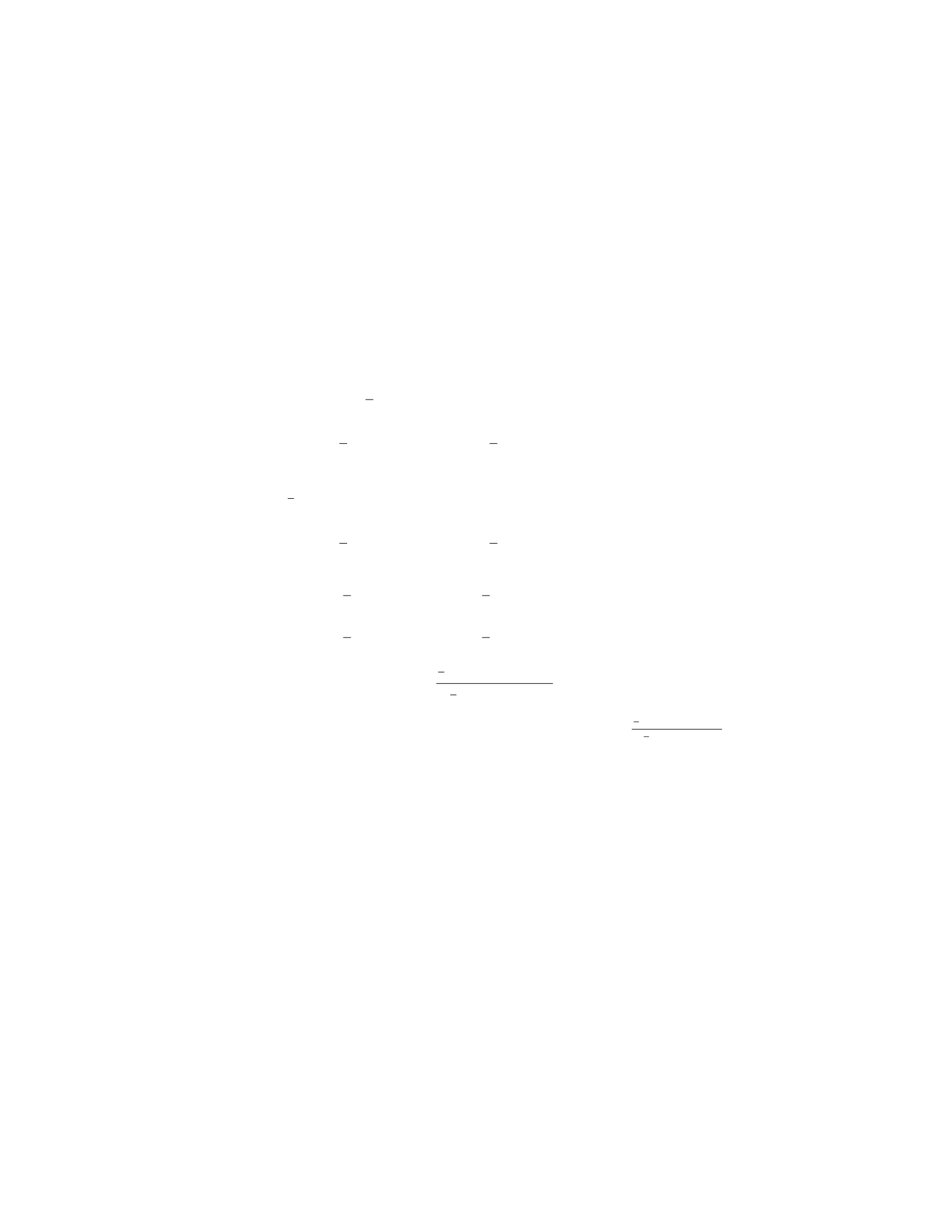
Step 3: Apply conservation of angular momentum to find the final angular
velocity of the system. When the clay sticks to the disk, the system’s moment
of inertia changes to I+mr2. The final angular momentum Lfof the system
is given by
Lf= (I+mr2)ωf
where ωfis the final angular velocity of the system.
Step 4: Apply conservation of angular momentum. By conservation of an-
gular momentum,
L0+l0=Lf
1
2MR2ω0+mvr0= (I+mr2)ωf
1
2MR2ω0+mvr0=1
2MR2+mr2ωf
Step 5: Solve for the final angular velocity ωf. Substitute the moment of
inertia I=1
2MR2into the equation and solve for ωf:
1
2MR2ω0+mvr0=1
2MR2+mr2ωf
1
2MR2ω0+mvr0=1
2MR2ωf+mr2ωf
1
2MR2ω0+mvr0=1
2MR2ωf+mr2ωf
ωf=
1
2MR2ω0+mvr0
1
2MR2+mr2
Therefore, the final angular velocity of the system is ωf=
1
2MR2ω0+mvr0
1
2MR2+mr2.
Question 31
Question
A wheel starts from rest and accelerates uniformly for 15 seconds. If the wheel
makes 10 revolutions during this time, determine the angular acceleration of the
wheel.
Solution
Step 1: Identify the given quantities Let: - Initial angular velocity of the wheel
be ωi= 0 (as it starts from rest) - Time taken for acceleration be t= 15 s -
Number of revolutions during this time be N= 10 - Final angular velocity of
the wheel be ωf- Angular acceleration of the wheel be α
26
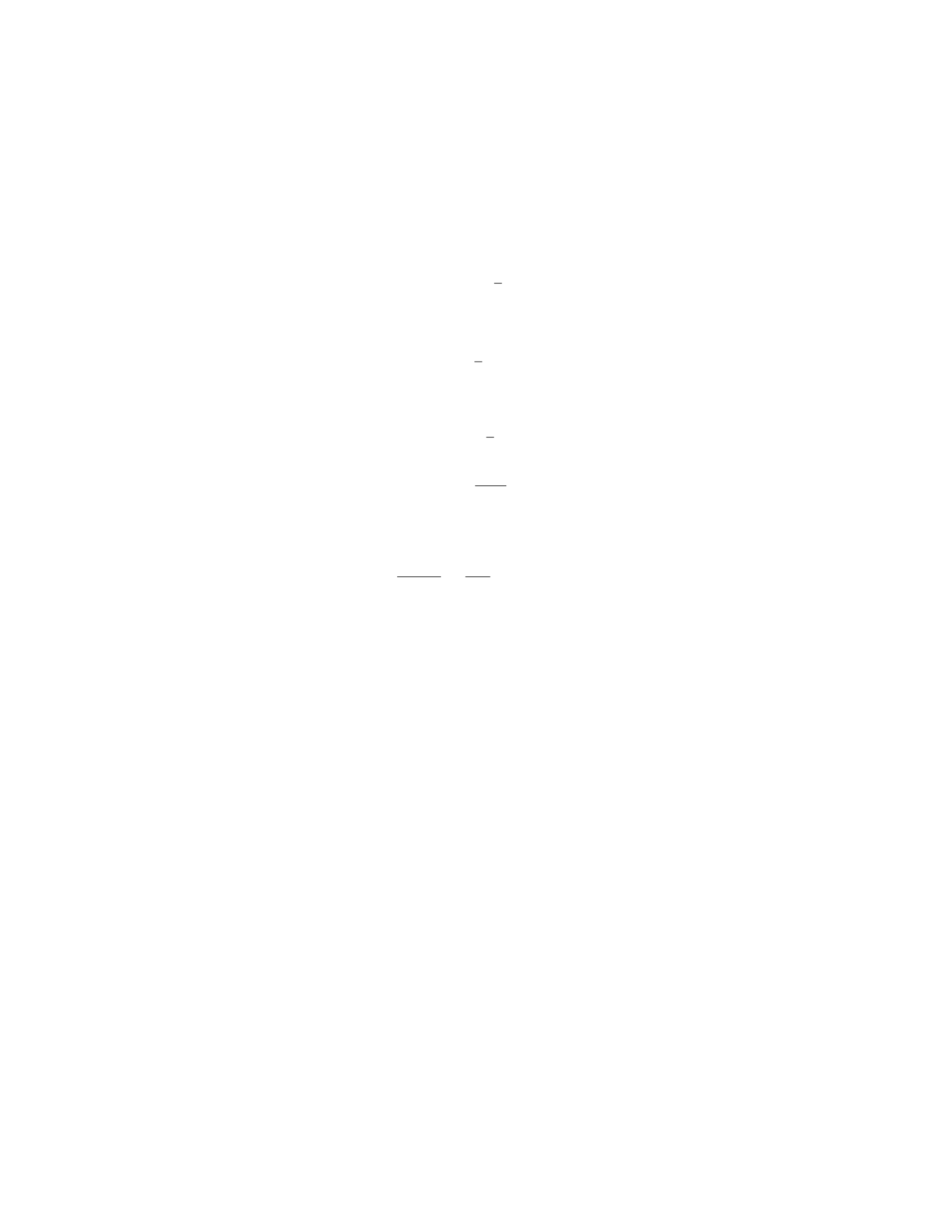
Step 2: Find the final angular velocity The number of revolutions made by
the wheel is related to the angular displacement by 2πN, where Nis the number
of revolutions. The angular displacement, θ, is given by the equation
θ=ωit+1
2αt2
Since ωi= 0, the equation becomes
θ=1
2αt2
Substitute θ= 2πN and solve for α
2πN =1
2αt2
α=4πN
t2
Step 3: Calculate the angular acceleration Substitute N= 10 and t= 15
seconds into the equation we found in Step 2 to find the angular acceleration, α
α=4π·10
152=40π
225 ≈0.56 rad/s2
Therefore, the angular acceleration of the wheel is approximately 0.56 rad/s2.
Question 32
Question
A wheel of radius 0.5 m starts from rest and accelerates at a constant rate of 2
rad/s2for 5 seconds. Find the angular velocity of the wheel at the end of the 5
seconds.
Solution
Step 1: Determine the initial angular velocity using the equation ω=ω0+αt,
where ω0is the initial angular velocity, αis the angular acceleration, and tis
the time.
ω0= 0 rad/s
Step 2: Calculate the final angular velocity using the equation ω=ω0+αt.
ω= 0 rad/s + (2 rad/s2)(5 s)
ω= 10 rad/s
Therefore, the angular velocity of the wheel at the end of the 5 seconds is
10 rad/s.
27

Question 33
Question
A thin uniform rod of length Land mass Mis suspended horizontally from
one end. The rod is released from rest and allowed to swing under gravity. At
the instant when the rod makes an angle θwith the vertical, find the angular
acceleration of the rod.
Solution
Step 1: First, let’s draw a free-body diagram of the rod at the instant when it
makes an angle θwith the vertical. The forces acting on the rod are gravitational
force (mg) acting at the center of mass, and the tension (T) at the pivot point.
Step 2: Now, we can write down the equation of motion for the rod in terms
of torque. The net torque acting on the rod about the pivot point is equal
to the moment of inertia of the rod about the pivot point times the angular
acceleration, which is given by:
τ=Iα
Step 3: The torque due to the gravitational force about the pivot point is
−mg L
2sin θ, and this torque causes a counterclockwise rotation. Step 4: The
moment of inertia of the rod about the pivot point is I=1
3ML2. Step 5:
Putting it all together, we have:
−mg L
2sin θ=1
3ML2α
Step 6: From this equation, we can solve for the angular acceleration αas:
α=−3
2gsin θ
Therefore, the angular acceleration of the rod at the instant when it makes an
angle θwith the vertical is α=−3
2gsin θ
Question 34
Question
A solid cylinder of mass Mand radius Ris initially at rest on a frictionless
surface. A constant horizontal force Fis applied to the cylinder at a distance R
above the center of mass. Calculate the angular velocity of the cylinder when
it has moved a distance halong the surface.
Solution
Step 1: The torque applied to the cylinder is given by τ=F r. Since the force
is applied at a distance r=Rfrom the center of mass, the torque is τ=F R.
28

Step 2: The moment of inertia of a solid cylinder about its central axis is
I=1
2MR2.
Step 3: The rotational analog of Newton’s second law relates torque to
angular acceleration: τ=Iα. Rearranging, we have F R =1
2MR2α.
Step 4: Since the cylinder is initially at rest, its initial angular velocity is
ω0= 0. Using the kinematic equation ω2=ω2
0+ 2αθ, where θis the angular
displacement, we have ω2= 2αθ.
Step 5: The angular displacement θis related to the linear displacement h
by θ=h
Rsince the cylinder is rolling without slipping.
Step 6: Substituting θ=h
Rinto the equation from Step 4 gives ω2= 2αh
R.
Step 7: Substituting α=2F R
MR2from Step 3 into the equation in Step 6 gives
ω2= 2 ·2F R
MR2·h
R.
Step 8: Simplifying the expression gives ω2=4F h
MR .
Step 9: Taking the square root of both sides gives the angular velocity of
the cylinder: ω=q4F h
MR .
Question 35
Question
A wheel with a radius of 0.5 m is rotating at an angular velocity of 5 rad/s. A
point on the edge of the wheel is accelerating at a rate of 15 m/s2. What is the
magnitude of the angular acceleration of the wheel at that instant?
Solution
Step 1: We know that the linear acceleration aof a point on the edge of a
rotating object is related to the angular acceleration αby the equation:
a=rα
where ris the radius of the wheel.
Step 2: We are given that the linear acceleration a= 15 m/s2and the radius
r= 0.5 m. Substituting these values into the equation above, we can solve for
the angular acceleration α:
15 = 0.5α
Step 3: Rearranging the equation, we find:
α=15
0.5= 30 rad/s2
Step 4: Therefore, the magnitude of the angular acceleration of the wheel
at that instant is 30 rad/s2.
29

Question 4
Question
A solid sphere of radius Rand mass Mis rolling without slipping down an incline
that makes an angle θwith the horizontal. At a certain point, the sphere is at
a height habove its base. Find an expression for its speed vin terms of R,M,
h,θ, and the gravitational acceleration g.
Solution
Step 1: The acceleration of the sphere down the incline can be found using
Newton’s second law. The forces acting on the sphere are gravitational force
(mg) pulling it down the incline, the normal force (N) pushing it perpendicular
to the incline, and the frictional force (f) opposing its motion. Since the sphere
is rolling without slipping, there is no slipping between the sphere and the
incline; hence, the frictional force is static and given by f=µsN, where µsis
the coefficient of static friction.
XFparallel =mg sin θ−f=mg sin θ−µsN
XFparallel =ma
ma =mg sin θ−µsN(1)
Step 2: The torque acting on the sphere about its center is due to the
gravitational force. The torque is given by τ=r×F, where ris the distance
from the axis of rotation to where the force is applied. The moment of inertia of
a solid sphere about its center is I=2
5MR2. The net torque about the center
is τ=mgh.
τ=maR ⇒mgh =maR
a=gh
R(2)
Step 3: Substituting the expression for acceleration (from step 2) into equa-
tion (1), we get:
mgh
R=mg sin θ−µsN
mg sin θ−µsN=mgh
R
N=mg cos θ
Step 4: Now, using the condition for rolling without slipping, the acceleration
of the center of mass must be equal to Rα, where αis the angular acceleration.
3

The tangential acceleration is given by a=Rα. Substituting the acceleration
expression from step 2 into this equation:
gh
R=Rα
α=gh
R2
Step 5: Using the no-slip condition:
a=Rα
gh
R=R×gh
R2
v2= 2gsin θh
v=p2gsin θh
Question 5
Question
A disk of radius Ris spinning with an angular velocity ω0. At t= 0, a constant
torque of magnitude Tis applied to the disk. The disk comes to rest after
completing exactly 10 full rotations. Determine the moment of inertia Iof the
disk in terms of R,T, and ω0.
Solution
Step 1: We know that the net torque on the disk is responsible for the angular
acceleration of the disk. The torque equation can be written as
τ=Iα
where τis the torque, Iis the moment of inertia, and αis the angular acceler-
ation.
Step 2: The angular acceleration αis related to the angular velocity ωby
the equation
α=dω
dt
Step 3: Integrating the above equation, we get the expression for angular
velocity as a function of time:
ω(t) = ω0−T
It
Step 4: Since the disk comes to rest after completing exactly 10 full rotations,
we can write the final angular velocity as 0. This gives us the following equation:
0 = ω0−T
I(10τ)
4

Step 5: Solving for the moment of inertia I, we find
I=10τ
ω0
Step 6: Hence, the moment of inertia Iof the disk in terms of R,T, and ω0
is
I=10T
ω0
Question 6
Question
A disk of radius Ris initially at rest. A constant torque τis applied to the disk,
causing it to rotate about its central axis. The disk accelerates uniformly from
rest to a final angular velocity ωfin a time interval t. Determine the angular
acceleration of the disk in terms of ωf,t, and R.
Solution
Step 1: Recall the kinematic equation for rotational motion:
ωf=ωi+αt
where ωf= final angular velocity, ωi= initial angular velocity (which is 0 in
this case), α= angular acceleration, and t= time interval.
Step 2: Substituting the given values into the equation:
ωf= 0 + αt
α=ωf
t
Step 3: Recall the kinematic equation for rotational motion in terms of
angular displacement:
ω2
f=ω2
i+ 2αθ
where θ= angular displacement (which is 2πfor a complete rotation).
Step 4: Since the disk starts from rest, ωi= 0. Substituting the given values
into the equation:
ω2
f= 0 + 2α(2π)
α=ω2
f
4π
Step 5: Equate the two expressions for α:
ωf
t=ω2
f
4π
5

4π=ωft
Step 6: Finally, we can express the angular acceleration αin terms of ωf,
t, and Rby noting that the final angular velocity ωfis related to the linear
velocity of a point on the outer edge of the disk:
v=Rωf
4π=Rωft
α=ω2
f
4π=1
Rt
Therefore, the angular acceleration of the disk in terms of ωf,t, and Ris
1
Rt .
Question 7
Question
A disk of radius 0.2 m is initially at rest. A constant force of 4 N is applied
tangentially to the edge of the disk for 3 seconds. If the moment of inertia of the
disk is 0.01 kg ·m2, determine the angular velocity of the disk after 3 seconds.
Solution
Step 1: Calculate the torque applied to the disk. The torque applied to the disk
can be calculated using the equation:
τ=r·F·sin(θ)
where ris the radius of the disk (0.2 m), Fis the applied force (4 N), and
θis the angle between the force and the radius (90 degrees, since the force is
tangential).
τ= 0.2 m ·4 N = 0.8 N ·m
Step 2: Use the torque to find the angular acceleration. The torque applied
to the disk can be related to the angular acceleration (α) using the equation:
τ=I·α
where Iis the moment of inertia of the disk (0.01 kg ·m2).
0.8 N ·m=0.01 kg ·m2·α
α=0.8 N ·m
0.01 kg ·m2= 80 rad/s2
6

Step 3: Use the angular acceleration to find the final angular velocity. We
can use the following equation of motion for rotational kinematics:
ωf=ωi+α·t
where ωiis the initial angular velocity (0 rad/s), αis the angular acceleration
(80 rad/s2), and tis the time (3 seconds).
ωf= 0 + 80 rad/s2·3 s = 240 rad/s
Therefore, the angular velocity of the disk after 3 seconds is 240 rad/s.
Question 8
Question
A thin uniform rod of length Land mass Mis pivoted about an axis passing
through one end. The rod is released from rest at an angle θfrom the vertical.
Calculate the angular acceleration of the rod as a function of the angle θ.
Solution
Step 1: We will start by drawing a free-body diagram of the rod. The forces
acting on the rod are the gravitational force mg acting at the center of mass of
the rod, and the normal force Nacting at the pivot point.
Step 2: Using Newton’s second law for rotation, the torque about the pivot
point is equal to the moment of inertia times the angular acceleration. When
calculating the torque, we need to consider the component of the gravitational
force that causes rotation, which is mg sin(θ).
Step 3: The torque about the pivot point is given by τ=Iα, where I=
1
3ML2is the moment of inertia of a rod rotating about one end.
Step 4: Substituting the expression for the torque and moment of inertia
into the equation τ=Iα, we get mg sin(θ)·L=1
3ML2·α.
Step 5: Simplifying the equation, we find 3gsin(θ) = αL.
Therefore, the angular acceleration of the rod as a function of the angle θis
α=3gsin(θ)
L.
Question 9
Question
A disk with radius Ris spinning about a fixed axis with an angular velocity ω.
Initially, a point on the rim of the disk has tangential velocity v0. The point
moves around the rim of the disk for a brief time ∆tand comes to rest. What
is the angular acceleration of the disk during this time?
7

Solution
1. We know that the tangential velocity of a point on the rim of the disk is
given by vt=Rω, where vtis the tangential velocity, Ris the radius of the disk,
and ωis the angular velocity.
2. The initial tangential velocity is v0, so we have v0=Rω. Solving for ω,
we get ω=v0
R.
3. When the point comes to rest, its final tangential velocity is 0. We can
use the equation vf=vi+a∆twhere vfis the final velocity, viis the initial
velocity, ais the acceleration, and ∆tis the time interval.
4. Substituting the values into the equation, we get 0 = v0+a∆t. Solving
for a, we find a=−v0
∆t.
5. The angular acceleration αis related to linear acceleration aby α=a
R.
6. Substituting the value of ainto the equation for angular acceleration, we
get α=−v0
∆t·R.
Therefore, the angular acceleration of the disk during this time is −v0
∆t·R.
Question 10
Question
A uniform disk of radius Rand mass Mis rolling without slipping down an
incline with an angle of θwith respect to the horizontal. The disk is released
from rest at the top of the incline and reaches a speed of vat the bottom.
Calculate the height of the incline in terms of Rand θ.
Solution
Step 1: The total kinetic energy at the bottom of the incline is the sum of the
translational and rotational kinetic energies:
1
2Mv2+1
2Iω2
where I=1
2MR2is the moment of inertia of the disk and ω=v
Ris the angular
velocity.
Step 2: The total kinetic energy is also equal to the total potential energy
at the top of the incline, which is Mgh, where his the height of the incline.
Step 3: Setting the two expressions for kinetic energy equal to each other:
1
2Mv2+1
21
2MR2v
R2=Mgh
Step 4: Simplifying the equation:
1
2Mv2+1
4Mv2=Mgh
8

3
4Mv2=Mgh
h=3
4
v2
g
Step 5: Using trigonometry, we have sin θ=h
L, where Lis the length of the
incline. Substituting hin terms of vand g:
sin θ=3
4
v2
gL
Step 6: Now, notice that the velocity vat the bottom of the incline can be
expressed in terms of the initial height Hfrom which the disk is released:
v=p2gH
Step 7: Substituting vin terms of Hinto our previous equation:
sin θ=3
4
2gH
gL
sin θ=3
2
H
L
H=2
3Lsin θ
Therefore, the height of the incline in terms of Rand θis 2
3Rsin θ.
Question 11
Question
A disk of radius Ris rotating with a constant angular velocity ω. A small bug
starts from rest at the edge of the disk and crawls towards the center. Determine
the bug’s angular velocity when it reaches the center of the disk.
Solution
1. Let rbe the bug’s distance from the center of the disk at any time t, and let
θbe the bug’s angle from the starting point. The bug’s linear velocity vand
angular velocity ωbcan be related by:
v=r·ωb
2. The bug’s angular displacement ∆θis given by:
∆θ=θ=ωt
9

where ωis the angular velocity of the disk.
3. The bug’s linear displacement ∆ris given by:
∆r=R−r
4. Since the angular velocity of the disk is constant, we have ωb=v/r. From
the relationships above, we have:
v=ωr
∆r=R−r
5. To eliminate time, we use:
∆r=v·t
R−r=ωr ·t
6. When the bug reaches the center r= 0, the time taken tcan be found as:
R= 0 + ω·0·t
t=R
ω
7. Substitute t=R
ωinto the equation R−r=ωr ·tto find ωbat the center:
R=ωr ·R
ω
R=r·R
r= 1
8. The bug’s angular velocity when it reaches the center of the disk is:
ωb=ω·r=ω·1 = ω
Question 12
Question
A disk with radius Rand moment of inertia Iabout its center is initially at
rest. A constant force Fis applied tangent to the disk at a distance rfrom the
center. The force is applied for a time t, causing the disk to reach an angular
speed ω. Find an expression for ωin terms of F,r,I,t, and R.
10

Solution
Step 1: Calculate the torque applied to the disk. The torque is given by τ=rF ,
where ris the distance from the center to where the force is applied. Step 2:
Use the equation τ=Iα, where αis the angular acceleration. Since the disk
starts from rest, the initial angular velocity ω0= 0 and α=ω−ω0
t=ω
t. Step
3: Substitute τ=Iα and τ=rF to get rF =Iω
t. Step 4: Solve for ωto get
ω=rF t
I. Step 5: Note that the moment of inertia of a disk about its center is
I=1
2mR2, where mis the mass of the disk. Substituting Iinto the equation
gives ω=2rF t
mR2.
Question 13
Question
An object starts from rest and experiences a constant angular acceleration of
0.05 rad/s2. Determine the angular velocity of the object after rotating through
an angle of 4πrad.
Solution
Step 1: We can use the equation for angular velocity with constant angular
acceleration:
ω=ω0+α·t
where: - ωis the final angular velocity, - ω0is the initial angular velocity (which
is 0 in this case), - αis the angular acceleration, and - tis the time taken to
reach the final angular velocity.
Step 2: We can find the time taken to rotate through an angle of 4πrad
using the equation for angular displacement:
θ=ω0·t+1
2·α·t2
Given θ= 4πrad, ω0= 0, and α= 0.05 rad/s2, we can solve for t.
Step 3: Using θ=ω0·t+1
2·α·t2with the given values, we have:
4π= 0 + 1
2·0.05 ·t2
Step 4: This simplifies to:
4π= 0.025t2
Step 5: Solving for t, we get:
t=r4π
0.025 = 40 s
11

Step 6: With t= 40 s, we can find the final angular velocity ωusing:
ω=α·t
Step 7: Substituting the given values, we get:
ω= 0.05 ·40 = 2 rad/s
Therefore, the angular velocity of the object after rotating through an angle
of 4πrad is 2 rad/s.
Question 14
Question
A wheel is initially rotating at 10 rad/s and comes to a stop after rotating
through 50 revolutions. The entire process takes 20 seconds. What is the
constant angular deceleration of the wheel?
Solution
Step 1: Convert 50 revolutions to radians
To convert revolutions to radians, we use the conversion factor 1 rev = 2πrad.
Thus, 50 revolutions is equal to 50 ×2πradians. So, the total angular displace-
ment is θ= 50 ×2π= 100πrad.
Step 2: Find the initial angular velocity in rad/s
The initial angular velocity is given as ω0= 10 rad/s.
Step 3: Find the time taken to come to a stop
The time taken for the wheel to come to a stop is given as t= 20 seconds.
Step 4: Find the final angular velocity
The final angular velocity is given by the equation of rotational kinematics:
ω2=ω2
0+ 2αθ
where αis the angular acceleration. Since the wheel comes to a stop, the final
angular velocity ωis 0. Substituting the known values, we get
0 = (10)2+ 2α×100π
100πα =−100
α=−100
100π=−1
π
Therefore, the constant angular deceleration of the wheel is −1
πrad/s2.
12

Question 15
Question
A disk of radius 0.2 m starts from rest and accelerates with a constant angular
acceleration of 2 rad/s2. Determine the angular velocity of the disk after 3 s.
Solution
Step 1: First, we can find the angular velocity of the disk after 3 s using the
kinematic equation for rotational motion:
ω=ω0+αt
where ω= final angular velocity, ω0= initial angular velocity (since the disk
starts from rest, ω0= 0), α= angular acceleration, and t= time.
Step 2: Substituting the given values into the equation, we get:
ω= 0 + (2 rad/s2)×3 s
Step 3: Calculating, we find:
ω= 6 rad/s
Step 4: Therefore, the angular velocity of the disk after 3 s is 6 rad/s.
Question 16
Question
A wheel of radius 0.5 m starts from rest and accelerates uniformly to an angular
velocity of 10 rad/s in 4 seconds. What is the angular acceleration of the wheel
during this time?
Solution
Step 1: The formula relating angular acceleration (α), initial angular velocity
(ωi), final angular velocity (ωf), and time (t) is:
α=ωf−ωi
t
Step 2: We are given:
Initial angular velocity, ωi= 0 rad/s
Final angular velocity, ωf= 10 rad/s
Time, t= 4 s
13

Step 3: Substitute the known values into the formula to calculate the angular
acceleration:
α=10 rad/s −0 rad/s
4 s =10 rad/s
4 s = 2.5 rad/s2
Step 4: Therefore, the angular acceleration of the wheel during this time is
2.5 rad/s2.
Question 17
Question
A disc of radius 10 cm starts from rest and accelerates with a constant angular
acceleration of 2 rad/s2.
1. Find the angular velocity of the disc after 2 seconds.
2. Determine the angular displacement of the disc after 5 seconds.
3. Calculate the tangential acceleration of a point on the rim of the disc after
3 seconds.
Solution
1. Find the angular velocity of the disc after 2 seconds.
Given: r= 10 cm, α= 2 rad/s2,t= 2 s.
We can use the equation for angular velocity with constant angular acceler-
ation:
ω=ω0+αt
where ω0= 0, as the disc starts from rest.
Step 1: Substitute the known values into the equation.
ω= 0 + 2 ×2
Step 2: Calculate the angular velocity.
ω= 4 rad/s
Therefore, the angular velocity of the disc after 2 seconds is 4 rad/s.
2. Determine the angular displacement of the disc after 5 seconds.
We can use the equation for angular displacement with constant angular
acceleration:
θ=θ0+ω0t+1
2αt2
14

Step 1: Substitute the known values into the equation.
θ= 0 + 0 ×5 + 1
2×2×52
Step 2: Calculate the angular displacement.
θ= 50 rad
Therefore, the angular displacement of the disc after 5 seconds is 50 rad.
3. Calculate the tangential acceleration of a point on the rim of the disc
after 3 seconds.
The tangential acceleration of a point on the rim of the disc can be calculated
using the formula:
at=rα
Given: r= 10 cm, α= 2 rad/s2,t= 3 s.
Step 1: Substitute the known values into the equation.
at= 10 ×2
Step 2: Calculate the tangential acceleration.
at= 20 cm/s2
Therefore, the tangential acceleration of a point on the rim of the disc after
3 seconds is 20 cm/s2.
Question 18
Question
A solid sphere of mass Mand radius Rrolls without slipping along a horizontal
surface with an initial angular speed of ω0. It then rolls up an incline of angle
θwithout slipping. What is the minimum value of ω0such that the sphere will
reach the top of the incline?
Solution
Step 1: At the top of the incline, the kinetic energy of the sphere is equal to
the potential energy difference between the top of the incline and the point at
which it started rolling.
Step 2: The initial kinetic energy is the sum of translational and rotational
kinetic energy:
KEinitial =1
2Mv2+1
2Iω2
0
15

Given that the sphere rolls without slipping, we have v=Rω0. Substituting
this into the equation gives:
KEinitial =1
2M(Rω0)2+1
22
5MR2ω2
0=7
10Mω2
0R2
Step 3: The final gravitational potential energy at the top of the incline is:
P Efinal =Mgh
where his the height of the incline: h=Rsin θ.
Step 4: At the top of the incline, the sphere is momentarily at rest, so the
final kinetic energy is zero. Therefore, the conservation of mechanical energy
gives:
KEinitial −P Efinal = 0
Step 5: Substituting the expressions for initial and final energies, we get:
7
10Mω2
0R2−MgR sin θ= 0
Step 6: Solving for ω0gives:
ω0=r10gR sin θ
7R2=r10gsin θ
7R
Step 7: Therefore, the minimum value of ω0such that the sphere will reach
the top of the incline is q10gsin θ
7R.
Question 19
Question
A thin uniform horizontal rod of length Land mass Mrotates freely about a
vertical axis through one end of the rod at a constant angular speed ω. A small
object of mass mstrikes the rod perpendicularly at a distance 3L
4from the axis
and sticks to it. What is the new angular speed of the system just after the
collision? (Hint: Use conservation of angular momentum.)
Solution
Step 1: Calculate the initial angular momentum of the system before the col-
lision. The initial angular momentum (Li) of the system before the collision is
given by:
Li=Iω,
where Iis the moment of inertia of the rod and ωis the angular speed.
16

The moment of inertia (I) of the rod about the end of the rod where it
rotates is:
I=1
3ML2.
Substitute this into the equation for angular momentum:
Li=1
3ML2·ω.
Step 2: Calculate the final angular momentum of the system after the col-
lision. After the small object of mass msticks to the rod, the new moment of
inertia of the system can be calculated by treating the rod and object as one
system. The new moment of inertia (If) is given by:
If=1
3ML2+m3L
42
.
The new angular speed of the system just after the collision is denoted by ω′.
Therefore, the final angular momentum (Lf) of the system after the collision is:
Lf=Ifω′.
Step 3: Apply conservation of angular momentum. According to the con-
servation of angular momentum, the initial angular momentum of the system
before the collision should be equal to the final angular momentum of the system
after the collision:
Li=Lf.
Step 4: Solve for the new angular speed of the system. Equating the initial
and final angular momenta and solving for ω′:
1
3ML2·ω=1
3ML2+9
16mL2·ω′.
Solving for ω′gives:
ω′=ML2·ω
ML2+9
16 mL2.
Simplify this expression to get the new angular speed of the system just after
the collision.
Question 20
Question
A solid sphere of radius Rand mass Mrolls without slipping down a 30◦incline.
What is the acceleration of its center of mass?
17

Solution
Step 1: We need to consider both translation and rotation of the sphere. The
acceleration of the center of mass can be found using the equation acm =atrans +
arot.
Step 2: The acceleration of translation can be found using atrans =gsin θ.
Substituting g= 9.81 m/s2and θ= 30◦, we have atrans = 9.81 ×sin(30◦).
Step 3: The acceleration of rotation can be found using arot =αR, where α
is the angular acceleration. Since the sphere is rolling without slipping, we have
α=atrans
R.
Step 4: Substituting atrans from Step 2 into the above equation, we have
α=9.81×sin(30◦)
R.
Step 5: Finally, we can find the total acceleration of the center of mass by
summing the translations and rotations: acm = 9.81 ×sin(30◦) + 9.81×sin(30◦)
R.
Step 6: Simplifying the expression gives acm = 9.81 ×sin(30◦)×1 + 1
R.
Therefore, the acceleration of the center of mass of the solid sphere rolling
down the incline is acm = 9.81 ×sin(30◦)×1 + 1
R.
Question 21
Question
A particle is moving along a circular path with a radius of 2 meters. The particle
starts from rest and accelerates uniformly at a rate of 4 m/s2around the circle.
What is its angular velocity after 3 seconds?
Solution
Step 1: Find the angular acceleration α. The angular acceleration αcan be
related to the linear acceleration ausing the formula α=a
r, where ris the
radius of the circular path. Plugging in the values, we get:
α=4 m/s2
2 m = 2 rad/s2
Step 2: Find the angular velocity ω. The final angular velocity ωcan be
found using the formula:
ω=ω0+αt
Since the particle starts from rest, ω0= 0. Plugging in the values, we get:
ω= 0 + 2 rad/s2×3 s = 6 rad/s
Therefore, the angular velocity of the particle after 3 seconds is 6 rad/s.
18

Question 22
Question
A wheel starts from rest and rotates with a constant angular acceleration of
2.0 rad/s2. How long will it take the wheel to reach an angular speed of 8.0 rad/s?
Solution
Step 1: We are given the angular acceleration α= 2.0 rad/s2and the final
angular speed ωf= 8.0 rad/s. We are asked to find the time tit takes for
the wheel to reach this angular speed. We can use the rotational kinematic
equation:
ωf=ωi+αt
where ωiis the initial angular speed, which is 0 since the wheel starts from
rest.
Step 2: Plugging in the known values into the equation:
8.0 rad/s = 0 + 2.0 rad/s2·t
Solving for tgives:
t=8.0
2.0= 4.0 s
Therefore, it will take 4.0 seconds for the wheel to reach an angular speed
of 8.0 rad/s.
Question 23
Question
A thin rod of length Land mass Mis initially at rest and free to rotate about
a frictionless pivot at its end. A bullet with mass mand speed vis fired per-
pendicular to the rod and sticks to it at a distance dfrom the pivot. Given that
the bullet strikes the rod at time t= 0, determine the angular velocity of the
system just after the collision.
Solution
1. Conservation of angular momentum: Just after the collision, the total
angular momentum of the system remains constant. The initial angular mo-
mentum is zero since the rod is initially at rest, so the final angular momentum
is the angular momentum due to the bullet sticking to the rod.
Mvd = (M+m)r2ω
19

where ris the distance from the pivot to the point where the bullet hits the
rod. Given that r=L−d, we have:
MLd = (M+m)(L−d)2ω
2. Conservation of energy: We can also apply conservation of energy to
determine the angular velocity. The bullet imparts an energy of 1
2mv2to the
system. This energy is converted into rotational kinetic energy.
1
2Iω2=1
2mv2
Substitute the moment of inertia I=1
3M(L−d)2+md2and solve for ω.
3. Calculate ω: Solving the two equations for ωwill give the angular
velocity of the system just after the collision.
Question 24
Question
A thin rod of length Land mass Mis rotating about one end with angular
velocity ω0. A small object of mass mis attached to the free end of the rod.
The system is released from rest in a horizontal position. Find the angular
velocity of the system just as the object leaves the ground.
Solution
Step 1: Let’s denote the length of the rod as L, the mass of the rod as M, the
mass of the object as m, and the initial angular velocity as ω0.
Step 2: The initial moment of inertia of the system about the pivot point
(end of the rod) is I0=ML
22.
Step 3: The final moment of inertia of the system about the pivot point
when the object leaves the ground can be found using the parallel axis theorem.
The moment of inertia of the rod about its end is Irod =1
3ML2. Thus, the
moment of inertia of the system about the pivot point with the object at the
other end is
If=Irod +m(L/2)2.
Step 4: Conservation of mechanical energy can be applied to find the final
angular velocity. The total initial energy is purely rotational and is given by
Ei=1
2I0ω2
0.
Step 5: The total final energy is also purely rotational and is given by
Ef=1
2Ifω2
f.
20

Step 6: Since there is no external torque acting on the system, mechanical
energy is conserved. Therefore, Ei=Ef.
Step 7: Plugging in the expressions for Eiand Ef, we have
1
2I0ω2
0=1
2Ifω2
f.
Step 8: Solving for ωf, we find
ωf=ω01 + m
3M−1/2.
Step 9: Thus, the angular velocity of the system just as the object leaves
the ground is ωf=ω01 + m
3M−1/2.
Question 25
Question
A thin, uniform rod of length Land mass Mis free to rotate about a frictionless
pivot located a distance Lfrom one end of the rod. The rod is released from rest
in a vertical orientation. What is the angular speed of the rod when it makes
an angle of 45◦with the vertical?
Solution
Step 1: We will start by identifying the forces acting on the rod. When the
rod makes an angle θwith the vertical, the forces acting on the rod are the
gravitational force (Mg) acting at the center of mass and the normal force (N)
acting at the pivot point. The net torque about the pivot point is given by
τ=Iα, where Iis the moment of inertia of the rod and αis the angular
acceleration.
Step 2: The moment of inertia of a thin, uniform rod rotating about an end
is I=1
3ML2. The torque causing the rotation is due to the gravitational force.
When the rod makes an angle θ, the moment arm of the gravitational force is
Lsin θ.
Step 3: The torque causing the rotation is τ= (Mg)(Lsin θ). This torque is
equal to Iα =1
3ML2α. Since the rod is released from rest, the initial angular
speed is 0, so α=ωf−ωi
t=ωf
t.
Step 4: Combining the equations above, we have (Mg)(Lsin θ) = 1
3ML2ωf
t.
Simplifying, we get 3gsin θ=Lωf.
Step 5: When θ= 45◦, we substitute into the equation: 3gsin 45◦=Lωf.
Therefore, ωf= 3 g
L. Thus, the angular speed of the rod when it makes an angle
of 45◦with the vertical is ωf= 3 g
L.
21

Question 26
Question
A thin uniform rod of length Lis pivoted at one end and released from rest
in a vertical plane as shown in the figure below. The moment of inertia of the
rod about the pivot point is 1
3mL2, where mis the mass of the rod. At what
angle θbelow the horizontal does the rod make to the vertical when it is in the
horizontal position?
[diagram depicting a thin uniform rod pivoted at one end, starting from a
vertical position]
Solution
1. Let’s consider the conservation of mechanical energy. When the rod is at the
horizontal position, all of its initial gravitational potential energy is converted
into kinetic energy. This gives us the equation:
mgh =1
2Iω2
where mis the mass of the rod, gis the acceleration due to gravity, his the
height the rod falls from, Iis the moment of inertia of the rod, and ωis the
angular velocity of the rod at the horizontal position.
2. The height the rod falls from can be expressed as h=L(1 −cos(θ)),
where θis the angle the rod makes with the vertical at the horizontal position.
3. Substituting h=L(1−cos(θ)) and I=1
3mL2into the energy conservation
equation gives:
mgL(1 −cos(θ)) = 1
21
3mL2ω2
4. We know that the linear velocity vof the tip of the rod at the horizontal
position is given by v=ωL. Substituting ωL =vinto the previous equation
gives:
mgL(1 −cos(θ)) = 1
21
3mL2v
L2
5. Simplifying and solving for cos(θ) gives:
cos(θ)=1−3
2v
L2
6. Solving for θgives:
θ= cos−11−3
2v
L2
Therefore, the angle θbelow the horizontal when the rod is in the horizontal
position is cos−11−3
2v
L2.
22

Question 27
Question
A disk with a radius of 0.5 m is rotating about its axis with an initial angular
velocity of 4 rad/s. The angular acceleration of the disk is given by the equation
α= 2t2, where tis the time in seconds. At what time does the disk come to a
stop?
Solution
Step 1: Find the angular velocity as a function of time using the equation
α= 2t2and the kinematic equation ω=ω0+αt.
α= 2t2
ω= 4 + 2t2
Step 2: The disk will stop when the angular velocity becomes zero. Set
ω= 0 and solve for t.
0 = 4 + 2t2
t2= 2
t=√2
Step 3: Therefore, the disk comes to a stop at t=√2 seconds.
Question 28
Question
A disk of radius 0.5 m starts from rest and rotates with a constant angular
acceleration of 2 rad/s2.
1. Find the angular velocity of the disk after 3 seconds.
2. Determine the number of revolutions the disk has completed after 3 sec-
onds.
Solution
1. We can use the kinematic equation for rotational motion:
ωf=ωi+αt
where - ωfis the final angular velocity, - ωiis the initial angular velocity (which
is 0 since the disk starts from rest), - αis the angular acceleration, and - tis
the time.
23

Step 1: Find the final angular velocity:
ωf=ωi+αt = 0 + 2 ×3 = 6 rad/s
Therefore, the angular velocity of the disk after 3 seconds is 6 rad/s.
2. To determine the number of revolutions, we can use the formula relating
angular velocity and angular displacement for constant angular acceleration:
θ=θi+ωit+1
2αt2
where - θis the angular displacement, - θiis the initial angular displacement
(which is 0), - ωiis the initial angular velocity, - αis the angular acceleration,
and - tis the time.
Step 2: Find the angular displacement θ:
θ=θi+ωit+1
2αt2=0+0+1
2×2×(3)2= 9 rad
Since one revolution corresponds to 2πradians, the number of revolutions
completed after 3 seconds is:
9 rad
2πrad/rev ≈1.43 revolutions
The disk has completed approximately 1.43 revolutions after 3 seconds.
Question 29
Question
A wheel starts from rest and rotates with a constant angular acceleration of
2.0 rad/s2for 10 seconds.
1. What is the angular velocity of the wheel after 10 seconds?
2. Through what angle has the wheel turned in this time?
3. What is the average angular velocity of the wheel during this time interval?
Solution
1. We can find the final angular velocity of the wheel using the formula:
ωf=ω0+αt
where: - ωfis the final angular velocity, - ω0is the initial angular velocity (which
is 0 in this case since the wheel starts from rest), - αis the angular acceleration,
and - tis the time.
24

Therefore, the final angular velocity is:
ωf= 0 + (2.0 rad/s2)×10 s = 20 rad/s
2. The angle rotated by the wheel can be found using the formula:
θ=ω0t+1
2αt2
where: - θis the angle rotated.
Substitute the given values:
θ= 0 ×10 + 1
2×2.0 rad/s2×(10 s)2= 100 rad
3. The average angular velocity can be calculated using the formula:
Average ω=ωf+ω0
2
In this case, the average angular velocity is:
Average ω=20 rad/s + 0
2= 10 rad/s
Question 30
Question
A uniform disk of radius Rand mass Mis spinning about its central axis with
an angular velocity ω0. A small piece of clay of mass mand initial speed v0in
the same plane as the disk is dropped onto the disk and sticks to it. What is
the final angular velocity of the disk-clay system?
Solution
Let Ibe the moment of inertia of the disk and rbe the distance of the small
clay piece from the center of the disk. The conservation of angular momentum
can be applied here to find the final angular velocity of the system. Step 1:
Calculate the initial angular momentum of the system due to the spinning disk.
The initial angular momentum L0of the spinning disk is given by
L0=Iω0
L0=1
2MR2ω0
Step 2: Calculate the angular momentum of the small clay piece before it
sticks to the disk. The initial angular momentum l0of the small clay piece is
given by
l0=mvr0
25
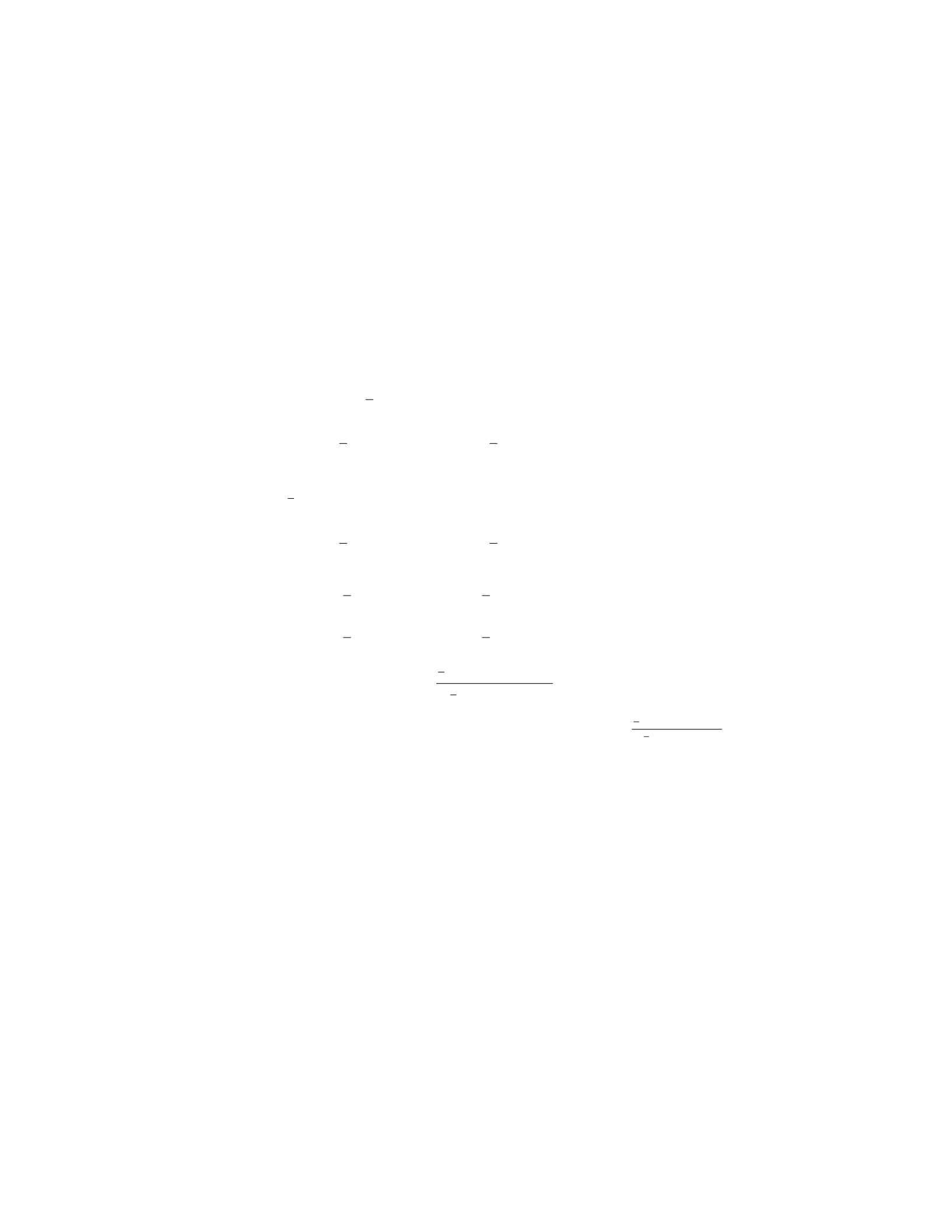
Step 3: Apply conservation of angular momentum to find the final angular
velocity of the system. When the clay sticks to the disk, the system’s moment
of inertia changes to I+mr2. The final angular momentum Lfof the system
is given by
Lf= (I+mr2)ωf
where ωfis the final angular velocity of the system.
Step 4: Apply conservation of angular momentum. By conservation of an-
gular momentum,
L0+l0=Lf
1
2MR2ω0+mvr0= (I+mr2)ωf
1
2MR2ω0+mvr0=1
2MR2+mr2ωf
Step 5: Solve for the final angular velocity ωf. Substitute the moment of
inertia I=1
2MR2into the equation and solve for ωf:
1
2MR2ω0+mvr0=1
2MR2+mr2ωf
1
2MR2ω0+mvr0=1
2MR2ωf+mr2ωf
1
2MR2ω0+mvr0=1
2MR2ωf+mr2ωf
ωf=
1
2MR2ω0+mvr0
1
2MR2+mr2
Therefore, the final angular velocity of the system is ωf=
1
2MR2ω0+mvr0
1
2MR2+mr2.
Question 31
Question
A wheel starts from rest and accelerates uniformly for 15 seconds. If the wheel
makes 10 revolutions during this time, determine the angular acceleration of the
wheel.
Solution
Step 1: Identify the given quantities Let: - Initial angular velocity of the wheel
be ωi= 0 (as it starts from rest) - Time taken for acceleration be t= 15 s -
Number of revolutions during this time be N= 10 - Final angular velocity of
the wheel be ωf- Angular acceleration of the wheel be α
26
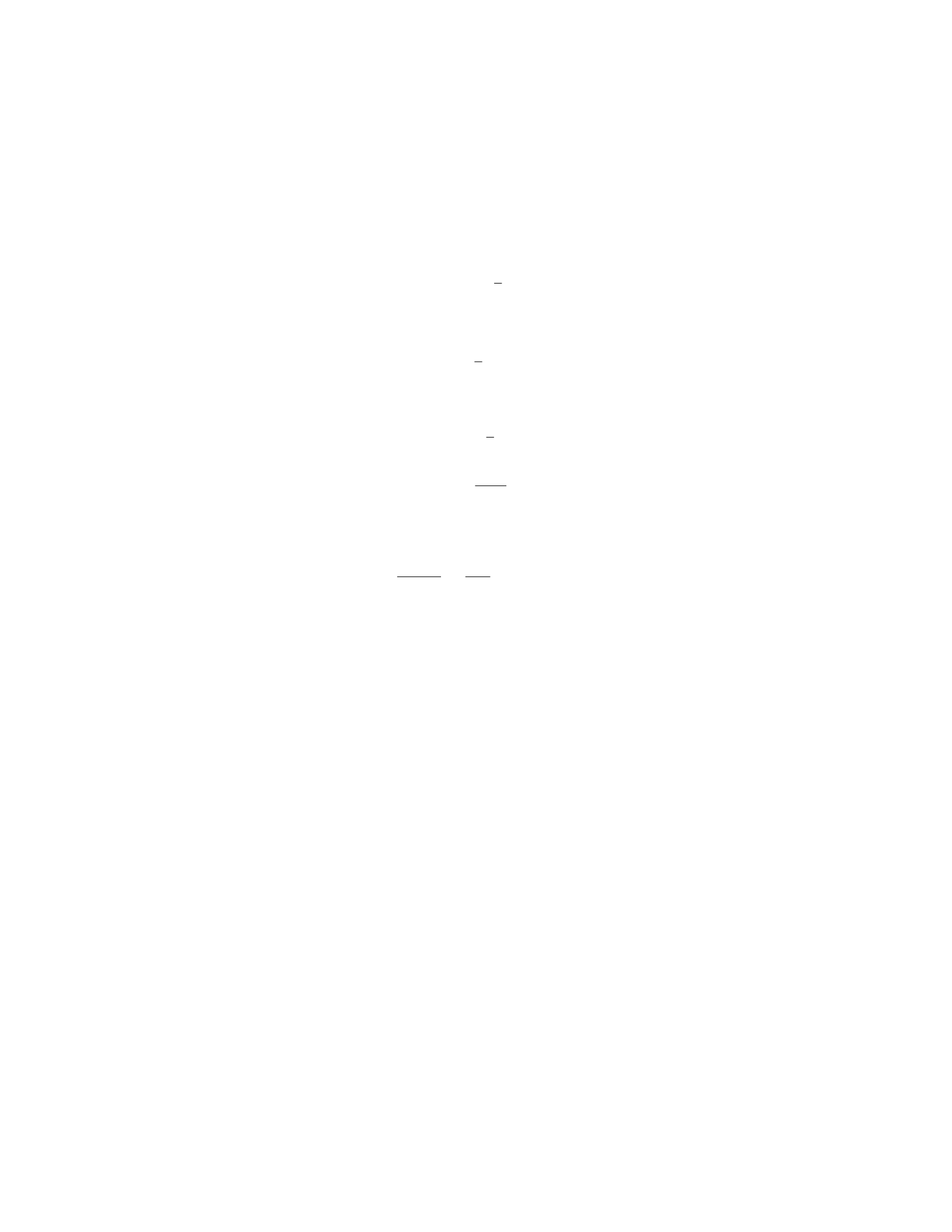
Step 2: Find the final angular velocity The number of revolutions made by
the wheel is related to the angular displacement by 2πN, where Nis the number
of revolutions. The angular displacement, θ, is given by the equation
θ=ωit+1
2αt2
Since ωi= 0, the equation becomes
θ=1
2αt2
Substitute θ= 2πN and solve for α
2πN =1
2αt2
α=4πN
t2
Step 3: Calculate the angular acceleration Substitute N= 10 and t= 15
seconds into the equation we found in Step 2 to find the angular acceleration, α
α=4π·10
152=40π
225 ≈0.56 rad/s2
Therefore, the angular acceleration of the wheel is approximately 0.56 rad/s2.
Question 32
Question
A wheel of radius 0.5 m starts from rest and accelerates at a constant rate of 2
rad/s2for 5 seconds. Find the angular velocity of the wheel at the end of the 5
seconds.
Solution
Step 1: Determine the initial angular velocity using the equation ω=ω0+αt,
where ω0is the initial angular velocity, αis the angular acceleration, and tis
the time.
ω0= 0 rad/s
Step 2: Calculate the final angular velocity using the equation ω=ω0+αt.
ω= 0 rad/s + (2 rad/s2)(5 s)
ω= 10 rad/s
Therefore, the angular velocity of the wheel at the end of the 5 seconds is
10 rad/s.
27

Question 33
Question
A thin uniform rod of length Land mass Mis suspended horizontally from
one end. The rod is released from rest and allowed to swing under gravity. At
the instant when the rod makes an angle θwith the vertical, find the angular
acceleration of the rod.
Solution
Step 1: First, let’s draw a free-body diagram of the rod at the instant when it
makes an angle θwith the vertical. The forces acting on the rod are gravitational
force (mg) acting at the center of mass, and the tension (T) at the pivot point.
Step 2: Now, we can write down the equation of motion for the rod in terms
of torque. The net torque acting on the rod about the pivot point is equal
to the moment of inertia of the rod about the pivot point times the angular
acceleration, which is given by:
τ=Iα
Step 3: The torque due to the gravitational force about the pivot point is
−mg L
2sin θ, and this torque causes a counterclockwise rotation. Step 4: The
moment of inertia of the rod about the pivot point is I=1
3ML2. Step 5:
Putting it all together, we have:
−mg L
2sin θ=1
3ML2α
Step 6: From this equation, we can solve for the angular acceleration αas:
α=−3
2gsin θ
Therefore, the angular acceleration of the rod at the instant when it makes an
angle θwith the vertical is α=−3
2gsin θ
Question 34
Question
A solid cylinder of mass Mand radius Ris initially at rest on a frictionless
surface. A constant horizontal force Fis applied to the cylinder at a distance R
above the center of mass. Calculate the angular velocity of the cylinder when
it has moved a distance halong the surface.
Solution
Step 1: The torque applied to the cylinder is given by τ=F r. Since the force
is applied at a distance r=Rfrom the center of mass, the torque is τ=F R.
28

Step 2: The moment of inertia of a solid cylinder about its central axis is
I=1
2MR2.
Step 3: The rotational analog of Newton’s second law relates torque to
angular acceleration: τ=Iα. Rearranging, we have F R =1
2MR2α.
Step 4: Since the cylinder is initially at rest, its initial angular velocity is
ω0= 0. Using the kinematic equation ω2=ω2
0+ 2αθ, where θis the angular
displacement, we have ω2= 2αθ.
Step 5: The angular displacement θis related to the linear displacement h
by θ=h
Rsince the cylinder is rolling without slipping.
Step 6: Substituting θ=h
Rinto the equation from Step 4 gives ω2= 2αh
R.
Step 7: Substituting α=2F R
MR2from Step 3 into the equation in Step 6 gives
ω2= 2 ·2F R
MR2·h
R.
Step 8: Simplifying the expression gives ω2=4F h
MR .
Step 9: Taking the square root of both sides gives the angular velocity of
the cylinder: ω=q4F h
MR .
Question 35
Question
A wheel with a radius of 0.5 m is rotating at an angular velocity of 5 rad/s. A
point on the edge of the wheel is accelerating at a rate of 15 m/s2. What is the
magnitude of the angular acceleration of the wheel at that instant?
Solution
Step 1: We know that the linear acceleration aof a point on the edge of a
rotating object is related to the angular acceleration αby the equation:
a=rα
where ris the radius of the wheel.
Step 2: We are given that the linear acceleration a= 15 m/s2and the radius
r= 0.5 m. Substituting these values into the equation above, we can solve for
the angular acceleration α:
15 = 0.5α
Step 3: Rearranging the equation, we find:
α=15
0.5= 30 rad/s2
Step 4: Therefore, the magnitude of the angular acceleration of the wheel
at that instant is 30 rad/s2.
29

