



PHYS 232 - UNIVERSITY PHYSICS
II - Superposition principle for multiple
charges
Question Bank - Set 2
Liberty University
Question 1
Question
Three point charges are arranged as shown below:
Charge Magnitude (Coulombs)
q1+3 ×10⁻⁶
q2−2×10⁻⁶
q3+5 ×10⁻⁶
The charges are located at the following coordinates in meters: q1at (0,0),
q2at (0,2), and q3at (3,0).
a) Find the electric field at a point P(2,2) due to these charges.
b) What is the direction of the electric field at point P?
Solution
a) To find the electric field at point P(2,2) due to the charges q1,q2, and q3, we
need to calculate the electric fields produced by each charge at that point and
then sum them up using the superposition principle.
Step 1: Calculate the electric field produced by q1.The electric field
E1produced by q1at point P(2,2) is given by Coulomb’s Law:
E1=k· |q1|
r2
1
ˆr1
where k= 8.99×10⁹N m2/C2is the electrostatic constant, |q1|= 3×10⁻⁶C,
r1is the distance between q1and P, and ˆr1is the unit vector from q1to P.

Given r1=p(2 −0)2+ (2 −0)2=√8 = 2√2, and ˆr1=P−q1
|P−q1|=<2,2>
√8=<
1,1>.
Therefore,
E1=(8.99×109)·(3×10−6)
(2√2)2<1,1>= 6.36 ×10³<1,1>N/C.
Step 2: Calculate the electric field produced by q2.The electric field
E2produced by q2at point P(2,2) is given by Coulomb’s Law:
E2=k· |q2|
r2
2
ˆr2
Question 2
Question
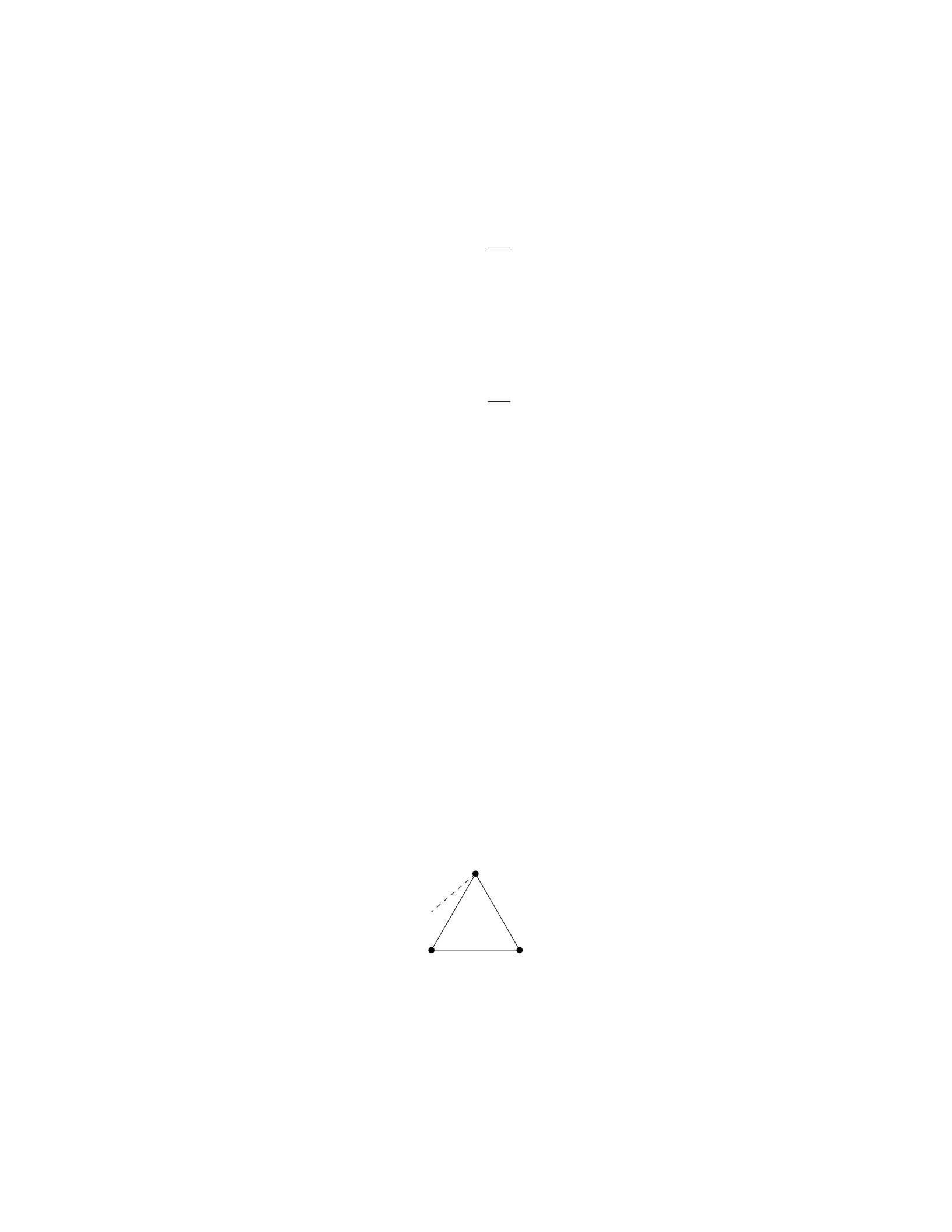
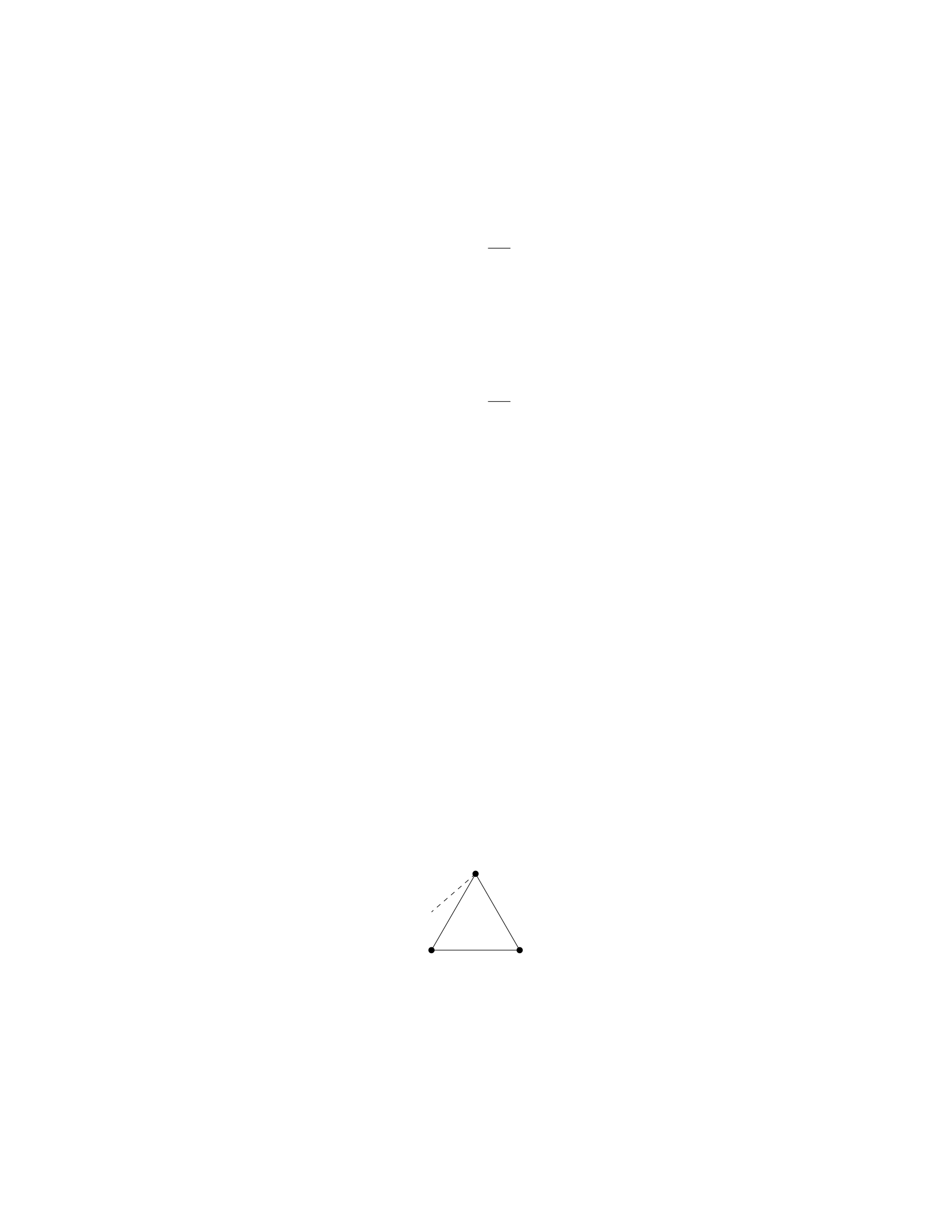
Three point charges are placed at the vertices of an equilateral triangle as shown
below:
+q
−q+q
(a) Calculate the electric field at the third vertex due to the other two
charges.
(b) If q= 2 ×10⁻⁶C and the side length of the triangle is 0.1 m, what is the
magnitude and direction of the electric field at the third vertex?
Solution
(a) To calculate the electric field at the third vertex due to the other two charges,
we can use the principle of superposition. The electric field at the third vertex
is the vector sum of the electric fields created by each of the other charges
individually.
Step 1: Calculate the electric field due to the positive charge +qat the
third vertex.
The electric field at the third vertex due to the charge +qcan be calculated
using the equation for electric field created by a point charge:
E+q=k· |q|
r2
where kis the Coulomb constant, |q|is the magnitude of the charge, and r
is the distance between the charge and the point where the electric field is being
calculated.
Step 2: Calculate the direction of the electric field due to the positive charge
+q.
Since the charge +qis positive, the electric field created by it will radiate
away from the charge.
Step 3: Calculate the electric field due to the negative charge −qat the
third vertex.
2

Similarly, the electric field at the third vertex due to the charge −qcan be
calculated using the same equation for electric field.
E−q=k·|−q|
r2
Step 4: Calculate the direction of the electric field due to the negative
charge −q.
Since the charge −qis negative, the electric field created by it will point
toward the charge.
Step 5: Calculate the total electric field at the third vertex.
The total electric field at the third vertex is the vector sum of the electric
fields due to the positive and negative charges.
Etotal =
E+q+
E−q
(b) Given that q= 2 ×10⁻⁶C and the side length of the triangle is 0.1 m,
we can now calculate the magnitude and direction of the electric field at the
third vertex using the superposition principle and the electric field equations.
Question 3
Question
Three charges are placed on the x-axis as follows: q1= +2µC at x=−1m,
q2=−3µC at x= 0, and q3= +4µC at x= +1m. Calculate the electric field
at the origin due to these charges.
Solution
In order to find the electric field at the origin (x= 0) due to the three charges
on the x-axis, we will calculate the electric fields due to each charge separately
and then use the superposition principle to add them up.
Step 1: Calculate the electric field due to q1at the origin. The electric field
E1due to q1can be calculated using the formula:
E1=k· |q1|
r2
1
where k= 8.99 ×10⁹N m2/C2is the Coulomb constant and r1= 1mis the
distance from q1to the origin. Substituting the values, we get:
E1=(8.99 ×10⁹N m2/C2)·2×10−6C
(1m)2= 1.798 ×10⁶N/C
Step 2: Calculate the electric field due to q2at the origin. The electric
field E2due to q2can be calculated using the same formula as above, with
3

q2=−3µC and r2= 0 as q2is at the origin. Since r2= 0, the electric field due
to q2is zero.
Step 3: Calculate the electric field due to q3at the origin. The electric field
E3due to q3can be calculated using the same formula as above, with q3= 4µC
and r3= 1mas the distance from q3to the origin. Substituting the values, we
get:
E3=(8.99 ×10⁹N m2/C2)·4×10−6C
(1m)2= 3.597 ×10⁶N/C
Step 4: Apply the principle of superposition. The total electric field at the
origin, Etotal, is the vector sum of the individual electric fields:
Etotal =E1+E2+E3= 1.798×10⁶N/C+0+3.597×106N/C = 5.395×10⁶N/C
Therefore, the electric field at the origin due to the three charges on the
x-axis is 5.395 ×10⁶N/C directed along the positive x-axis.
Question 4
Question
Three point charges are placed at the vertices of an equilateral triangle with
sides of length d. The charges are all equal in magnitude and are labeled as
follows: qat the top vertex, 2qat the bottom left vertex, and −2qat the
bottom right vertex. Calculate the electric field at the center of the triangle due
to these charges.
Solution
Step 1: Calculate the electric fields due to each individual charge at the center
of the triangle. The electric field due to a point charge qat a distance ris given
by Coulomb’s Law:
E=k· |q|
r2
where kis the Coulomb’s constant (8.99 ×10⁹N m2/C2).
Let E1,E2, and E3be the electric fields due to charges q,2q, and −2q
respectively at the center of the triangle. Since the electric field is a vector
quantity, we need to consider the direction as well.
For the charge qat the top vertex: The distance from the center of the
triangle to the top vertex is d/2. Therefore,
E1=k· |q|
(d/2)2=4kq
d2
This electric field points directly upwards.
4

Step 2: Calculate the electric field due to the 2qcharge at the bottom left
vertex at the center of the triangle. The distance from the center to this charge
is d. The electric field is given by:
E2=k· |2q|
d2=4kq
d2
This electric field points directly to the left.
Step 3: Calculate the electric field due to the −2qcharge at the bottom right
vertex at the center of the triangle. The distance from the center to this charge
is also d. The electric field is given by:
E3=k·|−2q|
d2=4kq
d2
This electric field points directly to the right.
Step 4: Determine the net electric field at the center of the triangle. Since
the electric fields due to the three charges all have the same magnitude and are
directed along three different directions, they will cancel each other out. Thus,
the net electric field at the center of the triangle is 0N/C .
Question 5
Question
Consider three point charges arranged as shown below: q1=−2µC,q2= 4µC,
and q3=−3µC. The charges are placed at the corners of an equilateral triangle
with sides of length a= 1.0m. What is the magnitude and direction of the
force on q1due to the other two charges?
q1(−2µC)
q2(4µC)q3(−3µC)
Solution
Step 1: First, we need to find the electric force on q1due to q2and q3separately,
and then find the net force by summing the individual forces, taking into account
their directions.
The electric force between two point charges q1and q2is given by Coulomb’s
Law:
F=k|q1q2|
r2
where k= 8.99 ×10⁹N·m2/C2is the Coulomb’s constant, q1and q2are the
magnitudes of the charges, and ris the distance between the charges.
5

Step 2: Calculating the force on q1due to q2. The distance between q1
and q2is the same as the side of the equilateral triangle, which is a= 1.0m.
Plugging the values into Coulomb’s Law formula, we get:
F12 =k|q1q2|
a2
F12 = 8.99 ×10⁹N·m2/C2×2×4×10−6
(1.0)2
F12 = 7.19 ×10⁻⁵N
The force exerted by q2on q1is attractive since q2is positive and q1is
negative.
Step 3: Calculating the force on q1due to q3. Similarly, we find the force
exerted by q3on q1using Coulomb’s Law:
F13 =k|q1q3|
a2
F13 = 8.99 ×10⁹N·m2/C2×2×3×10−6
(1.0)2
F13 = 5.39 ×10⁻⁵N
The force exerted by q3on q1is repulsive since q3is negative and q1is
negative.
Step 4: Calculating the net force on q1. The net force on q1is the vector
sum of the forces F12 and F13. Since these forces act along the same line (from
different directions), the magnitude of the net force is:
Fnet =|F12 −F13|
Therefore,
Fnet =
7.19 ×10⁻⁵−5.39 ×10⁻⁵
Fnet = 1.8×10⁻⁵N
The direction of the net force is directed towards the positive charge q2.
Question 6
Question
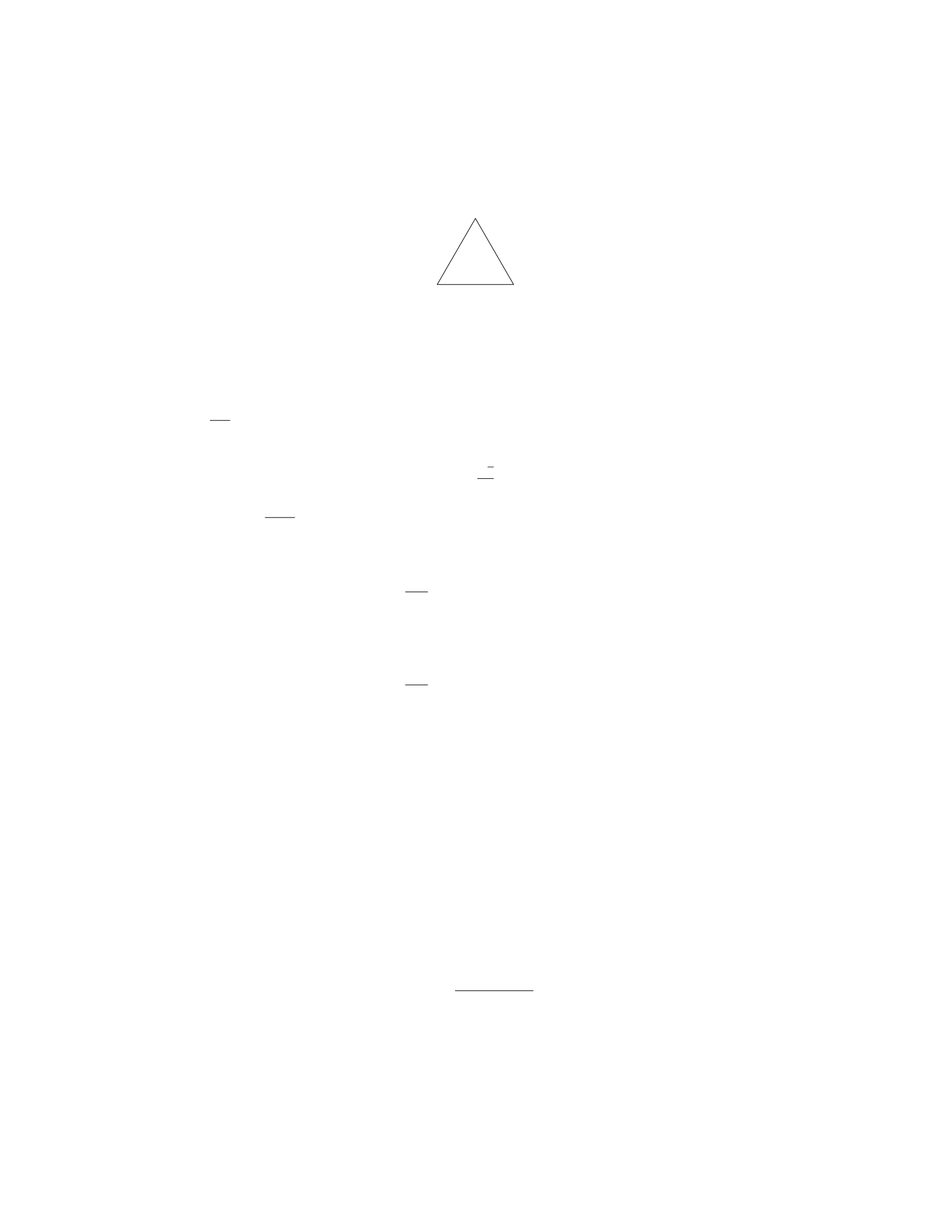
Three charges are placed at the corners of an equilateral triangle as shown below:
Charge Q1=−4µC at the top vertex, charge Q2= 3 µC at the bottom left
vertex, and charge Q3= 5 µC at the bottom right vertex. Calculate the net
electric field at the center of the equilateral triangle due to these three charges.
6
Q2Q3
Q1
Solution
Step 1: Calculate the electric field due to each charge at the center of the
equilateral triangle.
The electric field
Eat a distance rfrom a point charge Qis given by
E=
k·Q
r2ˆr, where kis Coulomb’s constant, ˆris the unit vector pointing from the
charge to the point, and ris the distance from the charge to the point.
For Q1=−4µC: The distance from Q1to the center of the triangle is the
height of the equilateral triangle h=√3
2s, where sis the side length of the
equilateral triangle. The magnitude of the electric field due to Q1at the center
is E1=k|Q1|
h2. The direction of the electric field due to Q1at the center points
along the line connecting the charge and the center of the equilateral triangle.
For Q2= 3 µC: The distance from Q2to the center of the triangle is the
side length of the equilateral triangle s. The magnitude of the electric field due
to Q2at the center is E2=kQ2
s2. The direction of the electric field due to Q2
at the center points along the line connecting the charge and the center of the
equilateral triangle.
For Q3= 5 µC: The distance from Q3to the center of the triangle is the
side length of the equilateral triangle s. The magnitude of the electric field due
to Q3at the center is E3=kQ3
s2. The direction of the electric field due to Q3
at the center points along the line connecting the charge and the center of the
equilateral triangle.
Question 7
Question
Three point charges are placed on the x-axis: q1=−2nC at x=−0.5m,
q2= 3 nC at x= 0 m, and q3=−4nC at x= 1 m. What is the magnitude and
direction of the force on a 5nC charge placed at the origin due to these charges?
Solution
Step 1: Calculate the force on the 5nC charge from q1using Coulomb’s Law:
F1=k|q1||qorigin|
r2
7

where: kis Coulomb’s constant (8.99 ×10⁹N·m2/C2), q1=−2nC, qorigin =
5nC, r= 0.5m. Plugging in the values:
F1=(8.99 ×10⁹)(2 ×10⁻⁹)(5 ×10⁻⁹)
0.52
F1=8.99 ×2×5
0.25
F1=89.9
0.25
F1= 359.6N
The force from q1is attractive and acts towards the origin.
Step 2: Calculate the force on the 5nC charge from q2:
F2= 0
Since q2is at the origin, the force it exerts on the charge at the origin will be
zero.
Step 3: Calculate the force on the 5nC charge from q3:
F3=k|q3||qorigin|
r2
where: q3=−4nC, r= 1 m. Plugging in the values:
F3=(8.99 ×10⁹)(4 ×10⁻⁹)(5 ×10⁻⁹)
12
F3=8.99 ×4×5
1
F3=35.96
1
F3= 35.96 N
The force from q3is repulsive and acts away from the origin.
Step 4: Calculate the net force on the 5nC charge by summing the individual
forces:
Fnet =F1+F2+F3
Fnet = 359.6N+ 0 N+ 35.96 N
Fnet = 395.56 N
The net force on the 5nC charge is 395.56 N, directed towards the origin.
8

Question 8
Question
Three point charges are arranged as follows: - Charge q1= +3 µC is located at
(0,0) m. - Charge q2=−2µC is located at (0,4) m. - Charge q3= +4 µC is
located at (3,0) m.
Determine the electric field at the point (4,4) m due to these three charges.
Solution
The electric field at point (4,4) m due to the three charges can be determined
by calculating the contributions of each charge individually and then summing
them up according to the superposition principle.
Step 1: Calculate the electric field contribution from charge q1.
The distance between charge q1and point (4,4) is r1=p(4 −0)2+ (4 −0)2=
√32 = 4√2m. The electric field contribution from charge q1at point (4,4) is
given by:
E1=k· |q1|
r2
1·ˆr1
where kis Coulomb’s constant and ˆr1is the unit vector pointing from charge
q1to the point (4,4).
Step 2: Calculate the electric field contribution from charge q2.The
distance between charge q2and point (4,4) is r2=p(4 −0)2+ (4 −4)2= 4 m.
The electric field contribution from charge q2at point (4,4) is given by:
E2=k· |q2|
r2
2·ˆr2
where ˆr2is the unit vector pointing from charge q2to the point (4,4).
Step 3: Calculate the electric field contribution from charge q3.
The distance between charge q3and point (4,4) is r3=p(4 −3)2+ (4 −0)2=
√22+ 42=√20 = 2√5m. The electric field contribution from charge q3at
point (4,4) is given by:
E3=k· |q3|
r2
3·ˆr3
where ˆr3is the unit vector pointing from charge q3to the point (4,4).
Step 4: Sum up the electric field contributions from all charges.
The total electric field at point (4,4) is given by the vector sum of the contri-
butions from each charge:
Etotal =
E1+
E2+
E3
Now, substitute the values of k,q1,q2,q3,r1,r2,r3,ˆr1,ˆr2, and ˆr3into the
above expressions to find the total electric field.
9

Question 9
Question
Three point charges are arranged along the x-axis. Charge q1=−2.0µC is at
the origin, charge q2= 1.0µC is at x= 4.0m, and charge q3=−3.0µC is at
x= 10.0m. What is the magnitude and direction of the electric field at a point
on the x-axis where x= 6.0m?
Solution
Step 1: Calculate the electric field contribution from q1at the point x= 6.0m.
The electric field from a point charge is given by the equation:
E=k|q|
r2
where - kis the Coulomb constant, 8.9875 ×10⁹N m2/C2, - qis the charge, - r
is the distance from the charge to the point.
The distance from q1to the point is 6.0m. The charge q1=−2.0µC =
−2.0×10⁻⁶C. Thus, the electric field from q1at x= 6.0m is:
E1=(8.9875 ×10⁹)(| − 2.0×10⁻⁶|)
(6.0)2
Step 2: Calculate the electric field contribution from q2at the point x= 6.0
m. The distance from q2to the point is 2.0m. The charge q2= 1.0µC =
1.0×10⁻⁶C. Thus, the electric field from q2at x= 6.0m is:
E2=(8.9875 ×10⁹)(1.0×10⁻⁶)
(2.0)2
Step 3: Calculate the electric field contribution from q3at the point x= 6.0
m. The distance from q3to the point is 4.0m. The charge q3=−3.0µC =
−3.0×10⁻⁶C. Thus, the electric field from q3at x= 6.0m is:
E3=(8.9875 ×10⁹)(| − 3.0×10⁻⁶|)
(4.0)2
Step 4: Calculate the total electric field at x= 6.0m by summing the
contributions from all three charges. The total electric field magnitude is:
|E|=|E1+E2+E3|
The direction of the electric field is the direction of the sum vector. If the
vector sum is positive, the direction is towards the positive x-axis; if negative,
it is towards the negative x-axis.
10
Question 10
Question
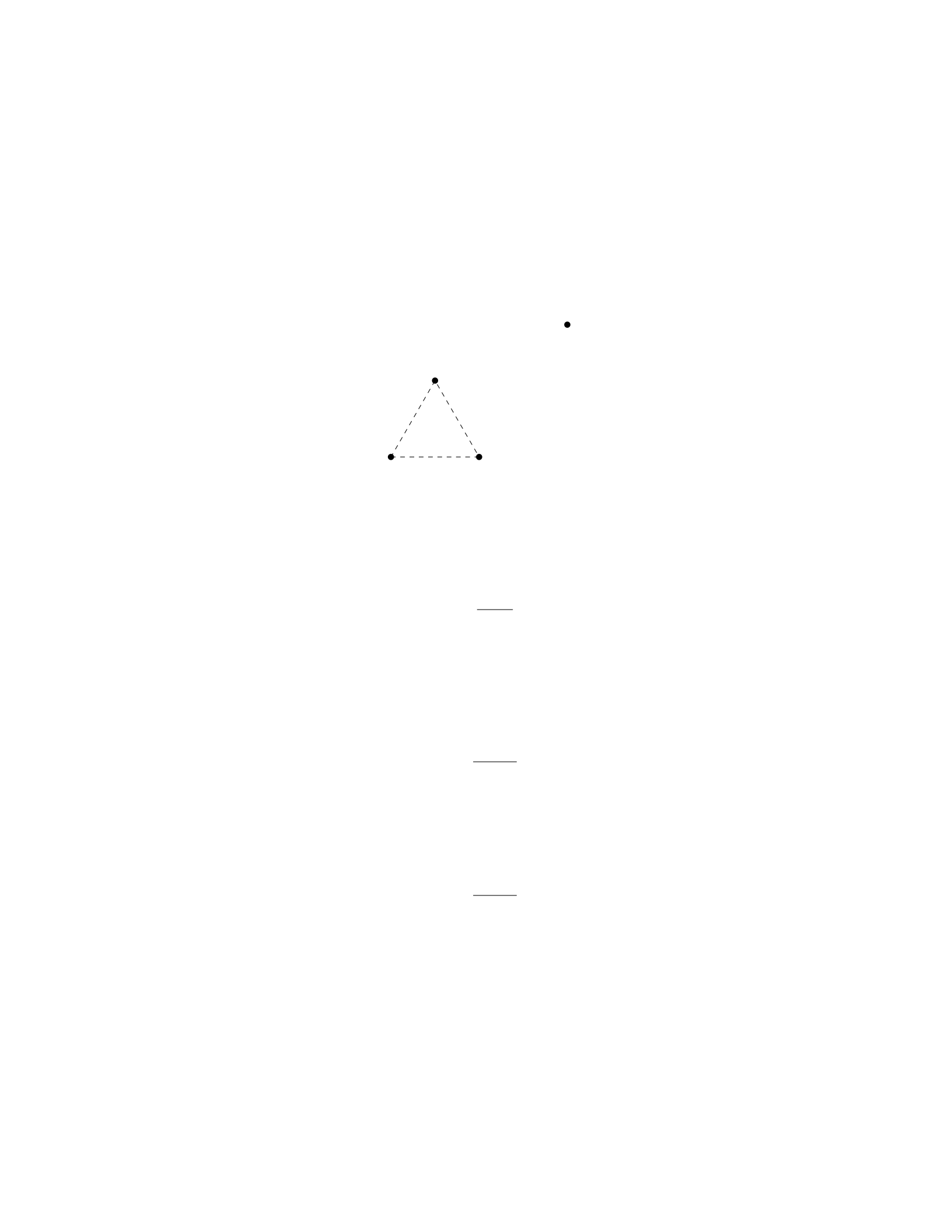
Three point charges are arranged as shown in the diagram below. Find the
electric field at point P due to these charges using the superposition principle.
−q+2q
−3q
P
Solution
Step 1: Find the electric field at point P due to the first charge (−q). The
electric field E1at point P due to the charge −qis given by Coulomb’s law:
E1=k· |q|
r2
where k= 8.99 ×10⁹N m2/C2is Coulomb’s constant, q=−qis the charge,
and ris the distance from the charge to point P.
Step 2: Find the electric field at point P due to the second charge (+2q).
The electric field E2at point P due to the charge +2qis given by Coulomb’s
law:
E2=k· |2q|
r2
where k= 8.99 ×10⁹N m2/C2is Coulomb’s constant, q= 2qis the charge,
and ris the distance from the charge to point P.
Step 3: Find the electric field at point P due to the third charge (−3q). The
electric field E3at point P due to the charge −3qis given by Coulomb’s law:
E3=k· |3q|
r2
where k= 8.99×10⁹N m2/C2is Coulomb’s constant, q=−3qis the charge,
and ris the distance from the charge to point P.
Step 4: Apply the superposition principle. The total electric field at point
P is the vector sum of the electric fields due to each charge:
Etotal =E1+E2+E3
11

Calculate the magnitudes and directions of each electric field using the dis-
tances from each charge to point P, and then find the total electric field at point
P by adding these vectors together.
Question 11
Question
Three charges are arranged along the x-axis as follows: q1=−2µC at x=−2m,
q2= 3 µC at x= 0 m, and q3=−1µC at x= 4 m. What is the electric field at
a point x= 3 m on the x-axis?
Solution
Step 1: Calculate the electric field contribution from each individual charge.
The electric field at a point due to a point charge is given by the formula:
E=k· |q|
r2
where kis the Coulomb constant (8.99 ×10⁹N m2/C2), qis the charge, and r
is the distance from the charge to the point where the field is being calculated.
Let’s calculate the electric field contribution from each charge at the point
x= 3 m.
For q1=−2µC at x=−2m:
E1=k·|−2µC|
(3 + 2)2=8.99 ×109·2×10−6
52= 2.8784 ×10⁶N/C
For q2= 3 µC at x= 0 m:
E2=k· |3µC|
32=8.99 ×109·3×10−6
32= 8.99 ×10⁶N/C
For q3=−1µC at x= 4 m:
E3=k·|−1µC|
(3 −4)2=8.99 ×109·1×10−6
12= 8.99 ×10⁹N/C
Step 2: Find the direction of each electric field contribution. Since q1is neg-
ative, its electric field points towards the left. q2’s electric field points towards
the right, and q3’s electric field also points towards the right.
Step 3: Combine the electric field contributions. We need to add the elec-
tric field contributions from each charge as vectors, taking into account their
directions.
Since E1and E3are in opposite directions, we need to subtract E3from E1
and then add E2:
12

Etotal =E2+E1−E3= 8.99 ×10⁶+ 2.8784 ×10⁶−8.99 ×10⁹
Etotal =−8.99 ×10⁹+ 11.8684 ×106=−8.9881 ×10⁹N/C
Therefore, the electric field at x= 3 m on the x-axis is −8.9881 ×10⁹N/C
pointing towards the left.
Question 12
Question
Three point charges are arranged along the x-axis as follows: q1=−2µC at
x= 0,q2= 4µC at x= 2 m, and q3=−6µC at x= 4 m. Calculate the
magnitude and direction of the electric field at a point located 3 meters to the
right of the charge q1.
Solution
Step 1: Calculate the electric fields due to each individual charge using the
formula E=k|q|
r2.
• For charge q1=−2µC at x= 0 m:
E1=k|q1|
(3)2
• For charge q2= 4µC at x= 2 m:
E2=k|q2|
(1)2
• For charge q3=−6µC at x= 4 m:
E3=k|q3|
(1)2
Step 2: Determine the direction of each electric field using the principle
that electric field lines point away from positive charges and towards negative
charges.
Step 3: Calculate the net electric field at the point 3 meters to the right of
q1by summing the individual electric fields:
Enet =
E1+
E2+
E3
Step 4: Add the individual electric fields in the appropriate direction to find
the net electric field.
13

Question 13
Question
Three charges are positioned as follows: a charge of +2.0µC at the origin, a
charge of −3.0µC at (0, 4.0m), and a charge of +4.0µC at (3.0m, 0). What is
the magnitude and direction of the electric field at the point (1.0m, 2.0m)?
Solution
Step 1: Calculate the electric field contribution from each charge individually
using the formula E=kq
r2, where k= 8.99 ×10⁹N m2/C2.
•Charge at the origin (+2.0µC):
The distance between the charge at the origin and the point (1.0m, 2.0m)
is √12+ 22=√5.
E1= 8.99 ×109×2.0×10−6
5= 0.7192 N/C
The direction of the electric field from this charge is along the line con-
necting the charge and the point.
•Charge at (0, 4.0m) (−3.0µC):
The distance between the charge at (0, 4.0m) and the point (1.0m, 2.0m)
is √12+ 22+ 42=√21.
E2= 8.99 ×10⁹×−3.0×10⁻⁶
21 =−0.3857 N/C
The direction of the electric field from this charge is along the line con-
necting the charge and the point.
•Charge at (3.0m, 0) (+4.0µC):
The distance between the charge at (3.0m, 0) and the point (1.0m, 2.0m)
is √22+ 32=√13.
E3= 8.99 ×109×4.0×10−6
13 = 2.2688 N/C
The direction of the electric field from this charge is along the line con-
necting the charge and the point.
Step 2: Find the total electric field at the point (1.0m, 2.0m) by summing
the individual electric field contributions in vector form.
E=
E1+
E2+
E3
E= (0.7192 N/C ˆr1)+(−0.3857 N/C ˆr2) + (2.2688 N/C ˆr3)
14

The resultant electric field magnitude can be calculated as:
E=qE2
total,x +E2
total,y
E=p(0.7192)2+ (−0.3857)2+ (2.2688)2= 2.5125 N/C
The direction of the electric field at the point (1.0m, 2.0m) can be found by
taking the arctangent of the ratios of the components:
θ= tan−1Etotal,y
Etotal,x
θ= tan−1−0.3857
0.7192 =−28.4◦
Therefore, the magnitude of the electric field at the point (1.0m
Question 14
Question
Three charges are placed at the vertices of an equilateral triangle with side
length a. The charges are +q,−q, and +2q. Calculate the electric field at the
center of the triangle.
Solution
To find the electric field at the center of the equilateral triangle, we will first
find the electric field contribution from each charge individually and then sum
them up using the principle of superposition.
Step 1: Electric field due to the charge +q
The magnitude of the electric field due to a point charge qat a distance ris
given by Coulomb’s law:
E=k|q|
r2
where kis the Coulomb constant (8.988 ×10⁹N m2/C2).
In this case, the distance from the center of the equilateral triangle to any
of its vertices (where the charge +qis located) is a/√3.
Therefore, the electric field due to the charge +qat the center of the triangle
is:
E1=k|q|
(a/√3)2
E1=kq√3
a2
15

Step 2: Electric field due to the charge −q
Similarly, the electric field due to the charge −qat the center of the triangle
is:
E2=k|q|
(a/√3)2
E2=kq√3
a2
Step 3: Electric field due to the charge +2q
Finally, the electric field due to the charge +2qat the center of the triangle
is:
E3=k|2q|
(a/√3)2
E3=k2q√3
a2
Step 4: Total electric field at the center of the triangle
By the principle of superposition, the total electric field at the center of the
equilateral triangle is the vector sum of the electric fields due to each charge:
Etotal =
E1+
E2+
E3
Since the electric fields due to charges +qand −qare equal in magnitude but
opposite in direction, they cancel each other out. Therefore, the total electric
field at the center of the triangle is:
Etotal =
E3=k2q√3
a2
Thus, the electric field at the center of the equilateral triangle due to the
given charges +q,−q, and +2qis k2q√3
a2.
Question 16
Question
Three point charges are located along the x-axis: a charge of +4.0µC at x=
−2.0m, a charge of −2.0µC at the origin, and a charge of +6.0µC at x= 3.0m.
Calculate the magnitude and direction of the electric field at the point x= 1.0m
on the x-axis.
16

Solution
Step 1: Calculate the electric field contribution at x= 1.0m due to the +4.0µC
charge at x=−2.0m. The electric field E1at x= 1.0m due to the +4.0µC
charge is given by Coulomb’s Law:
E1=k· |q1|
r2
1
where kis the Coulomb constant (8.99 ×10⁹N·m2/C2), q1is the charge
(+4.0µC), r1is the distance from the charge to the point (1.0m−(−2.0m) =
3.0m). Plugging in the values, we get:
E1=(8.99 ×10⁹N·m2/C2)·(4.0×10−6C)
(3.0m)2
E1=35.96 ×10³
9.0= 3.99 ×10³N/C
Step 2: Calculate the electric field contribution at x= 1.0m due to the
−2.0µC charge at the origin. The electric field E2at x= 1.0m due to the
−2.0µC charge is:
E2= 0
since the electric field from a point charge at the same location is zero.
Step 3: Calculate the electric field contribution at x= 1.0m due to the
+6.0µC charge at x= 3.0m. The electric field E3at x= 1.0m due to the
+6.0µC charge is:
E3=k· |q3|
r2
3
where kis the Coulomb constant, q3is the charge (+6.0µC), r3is the distance
from the charge to the point (3.0m−1.0m= 2.0m). Plugging in the values,
we get:
E3=(8.99 ×10⁹N·m2/C2)·(6.0×10−6C)
(2.0m)2= 1.35 ×10⁴N/C
Step 4: Calculate the total electric field at x= 1.0m by adding the contri-
butions from all charges. The total electric field Etotal at x= 1.0m is the vector
sum of E1,E2, and E3:
Etotal
Question 17
Question
Three point charges are arranged as follows: a charge of +2 µC is located at
the origin, a charge of −3µC is located at (0,3m), and a charge of +4 µC is
located at (4 m,0). Calculate the electric field at the point P(3 m,3m)due to
these charges.
17

Solution
Step 1: Calculate the electric field due to each charge separately using Coulomb’s
law. The electric field Eat a point due to a point charge qat a distance ris
given by:
E=k· |q|
r2
where kis Coulomb’s constant (8.99 ×10⁹N m2/C2).
For the charge at the origin (+2 µC):
E1=k· | + 2 µC|
(3 m)2
For the charge at (0,3m)(−3µC):
E2=k·|−3µC|
(3 m)2
For the charge at (4 m,0) (+4 µC):
E3=k· | + 4 µC|
5m
Step 2: Calculate the electric field vectors for each charge. The electric field
is a vector quantity, so we need to determine the direction of each field.
The electric field from the charge at the origin has components along the
positive x and y directions.
The electric field from the charge at (0,3m)has only a y-component.
The electric field from the charge at (4 m,0) has only an x-component.
Step 3: Use the principle of superposition to find the total electric field at
point P. The total electric field at point P due to the three charges is the vector
sum of the individual electric fields:
Etotal =
E1+
E2+
E3
Calculate the magnitudes and directions of
E1,
E2, and
E3using the infor-
mation from Step 1 and Step 2. Then, add these vectors together to find
Etotal
at point P.
Question 18
Question
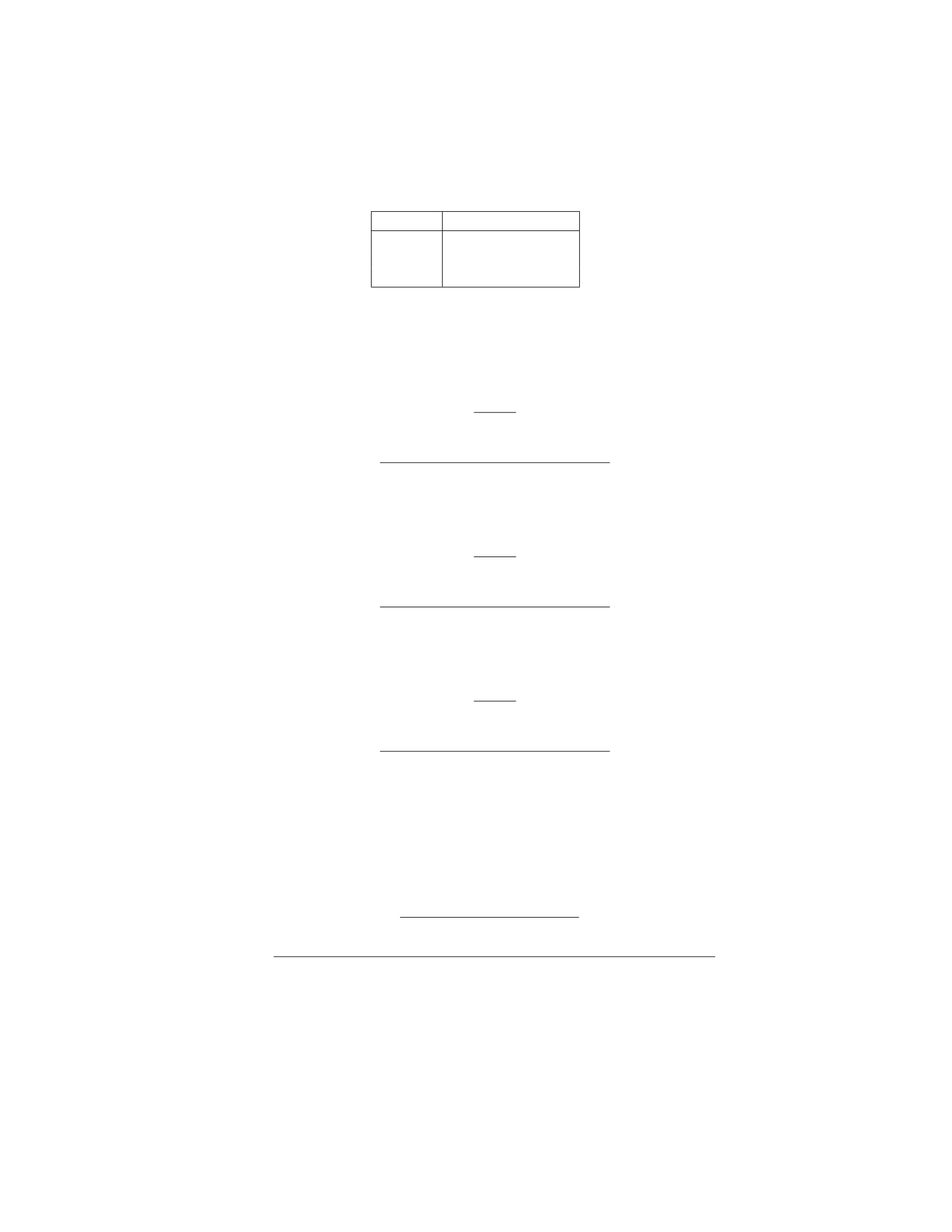
Three charges are arranged in the x-y plane as shown below: a positive charge
of +3.0µC at the origin, a positive charge of +5.0µC at (0,2.0) m, and a
negative charge of −2.0µC at (2.0,0) m. Determine the electric field at the
point (1.0,1.0) m due to these three charges.
18
Charge Position (x, y)(m)
+3.0µC(0,0)
+5.0µC(0,2.0)
−2.0µC(2.0,0)
Solution
Step 1: Calculate the electric field due to each charge at the point (1.0,1.0) m.
Using the expression for the electric field due to a point charge:
For charge at the origin:
E1=k· |q1|
r2
1
E1=8.99 ×10⁹N m2/C2·3.0×10−6C
(1.0)2
E1= 2.70 ×10⁶N/C
For charge at (0,2.0) m:
E2=k· |q2|
r2
2
E2=8.99 ×10⁹N m2/C2·5.0×10−6C
(1.0)2
E2= 4.49 ×10⁶N/C
For charge at (2.0,0) m:
E3=k· |q3|
r2
3
E3=8.99 ×10⁹N m2/C2·2.0×10−6C
(1.41)2
E3= 2.41 ×10⁶N/C
Step 2: Calculate the net electric field at the point (1.0,1.0) m by considering
the vector sum of the individual electric fields.
Let’s consider the electric field due to the positive charges as positive and
the electric field due to the negative charge as negative.
The angle between the electric field due to each charge and the x-axis is 45◦.
Enet =qE2
1+E2
2−2E1E2cos(45◦)−E3
Enet =p(2.70 ×10⁶)2+ (4.49 ×10⁶)2−2(2.70 ×10⁶)(4.49 ×10⁶) cos(45◦)−2.41×10⁶
Enet = 7.5×10⁶N/C
Therefore, the electric field at the point (1.0,1.0) m due to the three charges
is 7.5×10⁶N/C.
19

Question 19
Question
Three point charges are arranged on the x-axis as follows: a charge of +4 µC at
x=−2m, a charge of −2µC at x= 0 m, and a charge of +3 µC at x= 3 m.
Calculate the electric field at the point Plocated on the x-axis at x= 1 m due
to these three charges.
Solution
Step 1: Calculate the electric field due to the +4 µC charge at x=−2m. The
electric field E1at point Pdue to charge q1is given by Coulomb’s law:
E1=k· |q1|
r2
1
where k= 8.99 ×10⁹N m2/C2is the Coulomb constant, |q1|= 4 ×10⁻⁶C is
the magnitude of the charge, and r1= 3 m is the distance between the charge
and point P.
Plugging in the given values:
E1=8.99 ×109·4×10−6
(−2−1)2
E1=35.96 ×10³
9
E1= 3995.56 N/C (to the left)
Step 2: Calculate the electric field due to the −2µC charge at x= 0 m. The
electric field E2at point Pdue to charge q2is given by Coulomb’s law:
E2=k· |q2|
r2
2
where |q2|= 2 ×10⁻⁶C, and r2= 1 m.
Plugging in the given values:
E2=8.99 ×109·2×10−6
12
E2= 17.98 ×10³
E2= 17980 N/C (to the right)
Step 3: Calculate the electric field due to the +3 µC charge at x= 3 m. The
electric field E3at point Pdue to charge q3is given by Coulomb’s law:
E3=k· |q3|
r2
3
20
where |q3|= 3 ×10⁻⁶C, and r3= 2 m.
Plugging in the given values:
E3=8.99 ×109·3×10−6
22
E3= 13.485 ×10³
E3= 13485 N/C (to the left)
Step 4: Calculate the total electric field at point P. The total electric field
at point Pis the vector sum of the individual electric fields:
Etotal =E1+E2+E3= 3995.56 N/C −17980 N/C + 13485 N/C
Etotal =−5320.44 N/C (to the left)
Therefore, the electric field at point
Question 20
Question
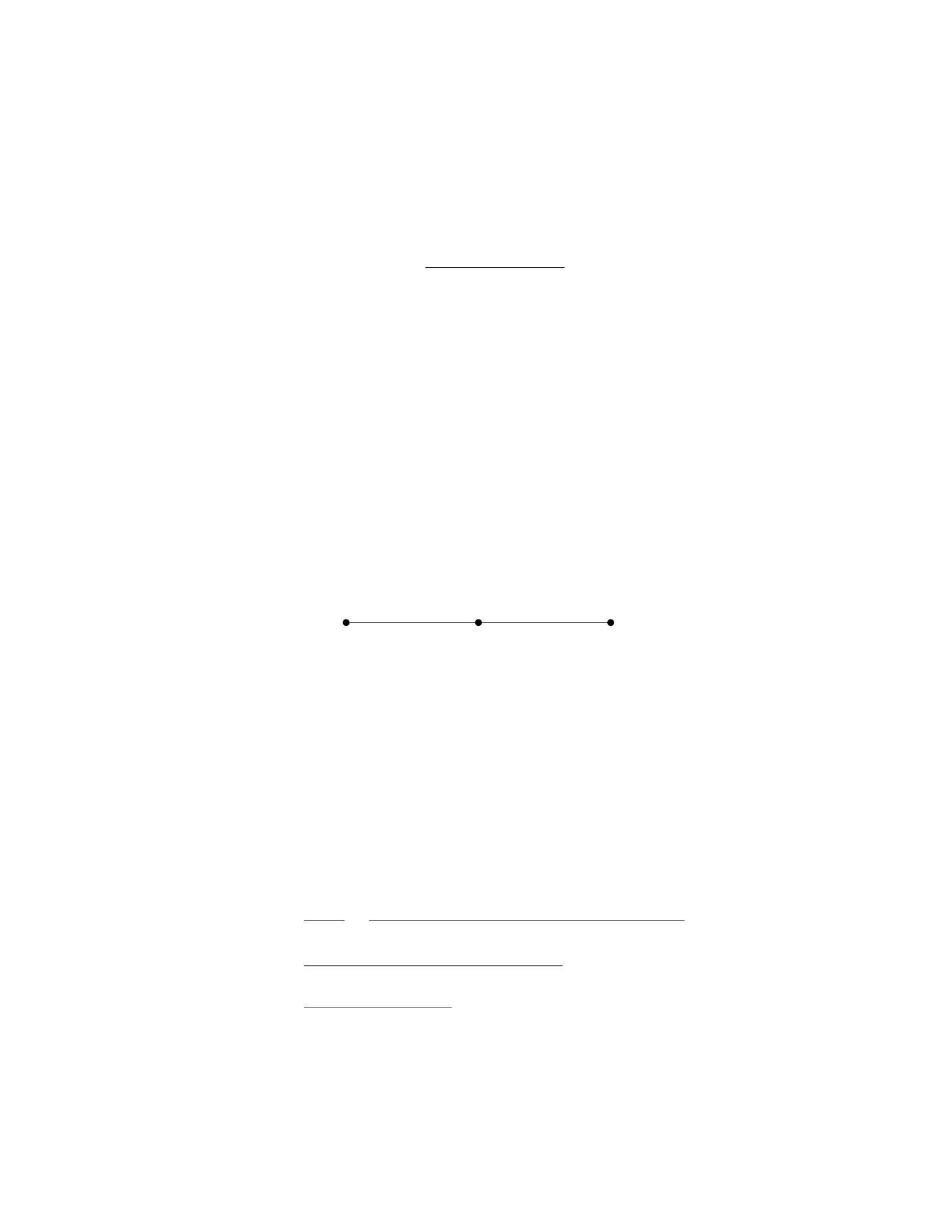
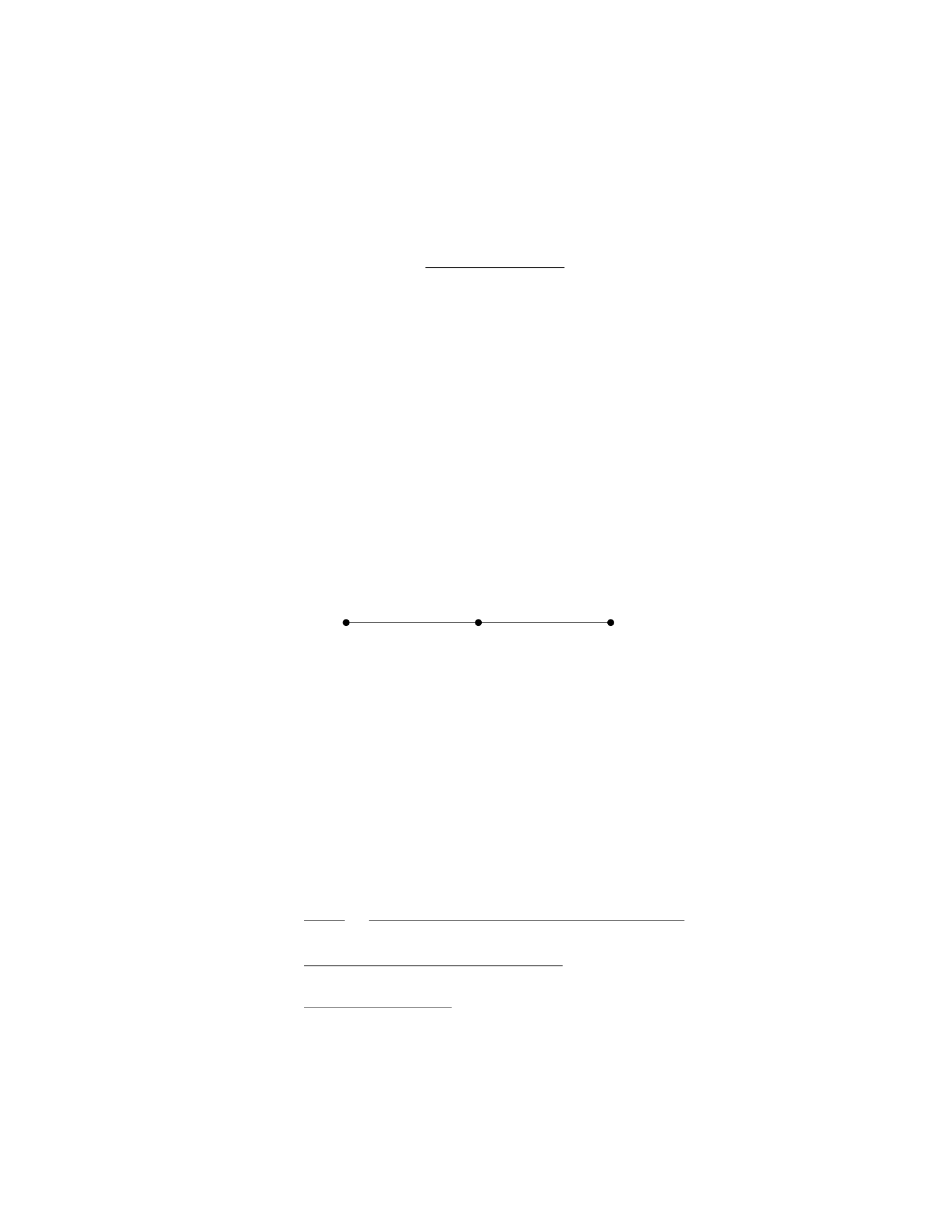
Three charges are arranged in a line as shown below:
−q2dq
Given that q= 8 nC, d= 2 m, and k= 8.99 ×10⁹N m2/C2, find the
magnitude of the electric force acting on the positive charge q.
Solution
Step 1: Calculate the distance between each charge and the positive charge q.
r1= 2d= 2(2 m) = 4 m
r2=d= 2 m
Step 2: Calculate the magnitudes of the electric forces F1and F2due to
charges −qand −qacting on q.
F1=k|q||q|
r2
1
=(8.99 ×10⁹N m2/C2)(8 ×10−9C)(8 ×10⁻⁹C)
(4 m)2
=(7.192 ×10⁻⁸N)(8.99 ×10⁹N m2/C2)
16 m2
=0.646 ×10²N·m2/C2
16
= 4.04 N
21

F2=k|q||q|
r2
2
=(8.99 ×10⁹N m2/C2)(8 ×10−9C)(8 ×10⁻⁹C)
(2 m)2
=(7.192 ×10⁻⁸N)(8.99 ×10⁹N m2/C2)
4m2
=0.646 ×10²N·m2/C2
4
= 16.16 N
Step 3: The total electric force on qis given by the sum of F1and F2.
Total electric force =F1+F2= 4.04 N+ 16.16 N= 20.20 N
Therefore, the magnitude of the electric force acting on the positive charge
qis 20.20 N.
Question 22
Question
Three point charges are placed on the x-axis: a charge of +3.0µC at x= 0 m, a
charge of −5.0µC at x= 2.0m, and a charge of +2.0µC at x= 4.0m. Calculate
the electric field at a point x= 3.0mon the x-axis due to these charges.
Solution
Step 1: Calculate the electric field due to each individual charge at the point
x= 3.0musing Coulomb’s Law:
For the +3.0µC charge at x= 0 m: The distance between the charge and
the point is r1= 3.0m−0m= 3.0m. The electric field E1at x= 3.0mdue to
this charge is given by:
E1=k·|q1|
r2
1
E1= (8.99 ×10⁹Nm2/C2)·3.0×10−6C
(3.0m)2
E1= 1.0×10⁵N/C
For the −5.0µC charge at x= 2.0m: The distance between the charge and
the point is r2= 3.0m−2.0m= 1.0m. The electric field E2at x= 3.0mdue
to this charge is given by:
E2=k·|q2|
r2
2
E2= (8.99 ×10⁹Nm2/C2)·5.0×10−6C
(1.0m)2
22

E2= 4.5×10⁶N/C
For the +2.0µC charge at x= 4.0m: The distance between the charge and
the point is r3= 4.0m−3.0m= 1.0m. The electric field E3at x= 3.0mdue
to this charge is given by:
E3=k·|q3|
r2
3
E3= (8.99 ×10⁹Nm2/C2)·2.0×10−6C
(1.0m)2
E3= 1.8×10⁶N/C
Step 2: Calculate the total electric field at x= 3.0mdue to the superposition
of the individual electric fields:
The total electric field Eat x= 3.0mis the vector sum of the individual
electric fields E1,E2, and E3,
E=E1+E2+E3
E= 1.0×10⁵N/C + 4.5×10⁶N/C + 1.8×10⁶N/C
E= 6.3×10⁶N/C
Therefore, the electric field at x= 3.0mon the x-axis due to the three
charges is 6.3×10⁶N/C directed along the positive x-direction.
Question 23
Question
Three point charges are arranged as follows: charge q1=−2µC is located at
(0,0), charge q2= 3 µC is located at (0,3m), and charge q3=−4µC is located
at (4m,0). Calculate the electric field at point P, which is located at (3m,4m).
Solution
1. Calculate the electric field due to charge q1at point P using the formula for
electric field:
E1=k|q1|
r2
1
where k= 9 ×10⁹Nm2/C2,q1=−2µC, and r1is the distance from q1to point
P.
2. Calculate the distance r1between q1and point P using the distance
formula:
r1=p(3 −0)2+ (4 −0)2
3. Substitute the values into the equation for E1to find the electric field
due to q1at point P.
23
4. Calculate the electric field due to charge q2at point P using the formula
for electric field:
E2=k|q2|
r2
2
where q2= 3 µC, and r2is the distance from q2to point P.
5. Calculate the distance r2between q2and point P.
6. Substitute the values into the equation for E2to find the electric field
due to q2at point P.
7. Calculate the electric field due to charge q3at point P using the formula
for electric field:
E3=k|q3|
r2
3
where q3=−4µC, and r3is the distance from q3to point P.
8. Calculate the distance r3between q3and point P.
9. Substitute the values into the equation for E3to find the electric field
due to q3at point P.
10. Finally, find the total electric field at point P by summing the electric
fields due to each charge using the principle of superposition:
Etotal =E1+E2+E3
11. Calculate the magnitude and direction of the total electric field at point
P.
Question 24
Question
Three point charges are arranged at the vertices of an equilateral triangle as
shown below. Charge q1=−5µC is located at point A, charge q2= 8 µC is at
point B, and charge q3=−3µC is at point C. Calculate the electric field at the
following point P, which is at a distance rfrom point A along the perpendicular
bisector of side BC. Use ras a variable in your final answer. Given that the
side length of the equilateral triangle is 10 cm.
AB
C
r
24

Solution
Step 1: Calculate the electric field contribution at point P due to charge q1=
−5µC at point A. Let this contribution be E1. The electric field due to a point
charge qat a distance rfrom it is given by the formula:
E=k· |q|
r2·ˆr
where kis Coulomb’s constant (8.987 ×10⁹N m2/C2) and ˆris the unit vector
in the direction from the charge to the point P.
The magnitude of the electric field at point P due to charge q1is:
E1=k· |q1|
r2
Step 2: Calculate the electric field contribution at point P due to charge
q2= 8 µC at point B. Let this contribution be E2. The magnitude of the
electric field at point P due to charge q2can be calculated using the same
formula as above:
E2=k· |q2|
r2
Step 3: Calculate the electric field contribution at point P due to charge
q3=−3µC at point C. Let this contribution be E3. The magnitude of the
electric field at point P due to charge q3can be calculated using the same
formula as above:
E3=k· |q3|
r2
Step 4: Calculate the total electric field at point P by summing the contri-
butions from each charge. The total electric field at point P is given by:
E=E1+E2+E3
The final expression for the total electric field at point P will be in terms of
r.
Question 25
Question
Three point charges are arranged on the x-axis as follows: q1= +2.0µC at
the origin, q2=−3.0µC at x= +4.0m, and q3= +1.0µC at x=−3.0m.
Calculate the electric field at the point x= +1.0m on the x-axis. Given:
k= 8.99 ×10⁹N m2/C2
25

Solution
Step 1: Calculate the electric field due to each individual charge at the point
x= +1.0m using the formula for electric field due to a point charge:
Eq1=k· |q1|
(+1.0m)2
Step 2: Substitute the given values of k,q1, and xinto the formula to find
Eq1:
Eq1=(8.99 ×10⁹N m2/C2)·(2.0×10−6C)
(+1.0m)2
Eq1=17.98 N
1.0m2
Eq1= 17.98 N/C (due to q1)
Step 3: Repeat Steps 1 and 2 for charges q2and q3to find Eq2and Eq3:
Eq2=k· |q2|
(−3.0m−1.0m)2
Eq3=k· |q3|
(+1.0m+ 3.0m)2
Step 4: Substitute the given values of k,q, and xinto the formulas to find
Eq2and Eq3:
Eq2=(8.99 ×10⁹N m2/C2)·(3.0×10−6C)
(−4.0m)2
Eq2=26.97 N
16.0m2
Eq2= 1.686 N/C (due to q2)
Eq3=(8.99 ×10⁹N m2/C2)·(1.0×10−6C)
(+4.0m)2
Eq3=8.99 N
16.0m2
Eq3= 0.562 N/C (due to q3)
Step 5: Calculate the total electric field at x= +1.0m by summing the
individual electric fields with proper signs:
Etotal =Eq1+Eq2+Eq3
Etotal = 17.98 N/C −1.686 N/C + 0.
26

Given r1=p(2 −0)2+ (2 −0)2=√8 = 2√2, and ˆr1=P−q1
|P−q1|=<2,2>
√8=<
1,1>.
Therefore,
E1=(8.99×109)·(3×10−6)
(2√2)2<1,1>= 6.36 ×10³<1,1>N/C.
Step 2: Calculate the electric field produced by q2.The electric field
E2produced by q2at point P(2,2) is given by Coulomb’s Law:
E2=k· |q2|
r2
2
ˆr2
Question 2
Question
Three point charges are placed at the vertices of an equilateral triangle as shown
below:
+q
−q+q
(a) Calculate the electric field at the third vertex due to the other two
charges.
(b) If q= 2 ×10⁻⁶C and the side length of the triangle is 0.1 m, what is the
magnitude and direction of the electric field at the third vertex?
Solution
(a) To calculate the electric field at the third vertex due to the other two charges,
we can use the principle of superposition. The electric field at the third vertex
is the vector sum of the electric fields created by each of the other charges
individually.
Step 1: Calculate the electric field due to the positive charge +qat the
third vertex.
The electric field at the third vertex due to the charge +qcan be calculated
using the equation for electric field created by a point charge:
E+q=k· |q|
r2
where kis the Coulomb constant, |q|is the magnitude of the charge, and r
is the distance between the charge and the point where the electric field is being
calculated.
Step 2: Calculate the direction of the electric field due to the positive charge
+q.
Since the charge +qis positive, the electric field created by it will radiate
away from the charge.
Step 3: Calculate the electric field due to the negative charge −qat the
third vertex.
2

Similarly, the electric field at the third vertex due to the charge −qcan be
calculated using the same equation for electric field.
E−q=k·|−q|
r2
Step 4: Calculate the direction of the electric field due to the negative
charge −q.
Since the charge −qis negative, the electric field created by it will point
toward the charge.
Step 5: Calculate the total electric field at the third vertex.
The total electric field at the third vertex is the vector sum of the electric
fields due to the positive and negative charges.
Etotal =
E+q+
E−q
(b) Given that q= 2 ×10⁻⁶C and the side length of the triangle is 0.1 m,
we can now calculate the magnitude and direction of the electric field at the
third vertex using the superposition principle and the electric field equations.
Question 3
Question
Three charges are placed on the x-axis as follows: q1= +2µC at x=−1m,
q2=−3µC at x= 0, and q3= +4µC at x= +1m. Calculate the electric field
at the origin due to these charges.
Solution
In order to find the electric field at the origin (x= 0) due to the three charges
on the x-axis, we will calculate the electric fields due to each charge separately
and then use the superposition principle to add them up.
Step 1: Calculate the electric field due to q1at the origin. The electric field
E1due to q1can be calculated using the formula:
E1=k· |q1|
r2
1
where k= 8.99 ×10⁹N m2/C2is the Coulomb constant and r1= 1mis the
distance from q1to the origin. Substituting the values, we get:
E1=(8.99 ×10⁹N m2/C2)·2×10−6C
(1m)2= 1.798 ×10⁶N/C
Step 2: Calculate the electric field due to q2at the origin. The electric
field E2due to q2can be calculated using the same formula as above, with
3

q2=−3µC and r2= 0 as q2is at the origin. Since r2= 0, the electric field due
to q2is zero.
Step 3: Calculate the electric field due to q3at the origin. The electric field
E3due to q3can be calculated using the same formula as above, with q3= 4µC
and r3= 1mas the distance from q3to the origin. Substituting the values, we
get:
E3=(8.99 ×10⁹N m2/C2)·4×10−6C
(1m)2= 3.597 ×10⁶N/C
Step 4: Apply the principle of superposition. The total electric field at the
origin, Etotal, is the vector sum of the individual electric fields:
Etotal =E1+E2+E3= 1.798×10⁶N/C+0+3.597×106N/C = 5.395×10⁶N/C
Therefore, the electric field at the origin due to the three charges on the
x-axis is 5.395 ×10⁶N/C directed along the positive x-axis.
Question 4
Question
Three point charges are placed at the vertices of an equilateral triangle with
sides of length d. The charges are all equal in magnitude and are labeled as
follows: qat the top vertex, 2qat the bottom left vertex, and −2qat the
bottom right vertex. Calculate the electric field at the center of the triangle due
to these charges.
Solution
Step 1: Calculate the electric fields due to each individual charge at the center
of the triangle. The electric field due to a point charge qat a distance ris given
by Coulomb’s Law:
E=k· |q|
r2
where kis the Coulomb’s constant (8.99 ×10⁹N m2/C2).
Let E1,E2, and E3be the electric fields due to charges q,2q, and −2q
respectively at the center of the triangle. Since the electric field is a vector
quantity, we need to consider the direction as well.
For the charge qat the top vertex: The distance from the center of the
triangle to the top vertex is d/2. Therefore,
E1=k· |q|
(d/2)2=4kq
d2
This electric field points directly upwards.
4

Step 2: Calculate the electric field due to the 2qcharge at the bottom left
vertex at the center of the triangle. The distance from the center to this charge
is d. The electric field is given by:
E2=k· |2q|
d2=4kq
d2
This electric field points directly to the left.
Step 3: Calculate the electric field due to the −2qcharge at the bottom right
vertex at the center of the triangle. The distance from the center to this charge
is also d. The electric field is given by:
E3=k·|−2q|
d2=4kq
d2
This electric field points directly to the right.
Step 4: Determine the net electric field at the center of the triangle. Since
the electric fields due to the three charges all have the same magnitude and are
directed along three different directions, they will cancel each other out. Thus,
the net electric field at the center of the triangle is 0N/C .
Question 5
Question
Consider three point charges arranged as shown below: q1=−2µC,q2= 4µC,
and q3=−3µC. The charges are placed at the corners of an equilateral triangle
with sides of length a= 1.0m. What is the magnitude and direction of the
force on q1due to the other two charges?
q1(−2µC)
q2(4µC)q3(−3µC)
Solution
Step 1: First, we need to find the electric force on q1due to q2and q3separately,
and then find the net force by summing the individual forces, taking into account
their directions.
The electric force between two point charges q1and q2is given by Coulomb’s
Law:
F=k|q1q2|
r2
where k= 8.99 ×10⁹N·m2/C2is the Coulomb’s constant, q1and q2are the
magnitudes of the charges, and ris the distance between the charges.
5

Step 2: Calculating the force on q1due to q2. The distance between q1
and q2is the same as the side of the equilateral triangle, which is a= 1.0m.
Plugging the values into Coulomb’s Law formula, we get:
F12 =k|q1q2|
a2
F12 = 8.99 ×10⁹N·m2/C2×2×4×10−6
(1.0)2
F12 = 7.19 ×10⁻⁵N
The force exerted by q2on q1is attractive since q2is positive and q1is
negative.
Step 3: Calculating the force on q1due to q3. Similarly, we find the force
exerted by q3on q1using Coulomb’s Law:
F13 =k|q1q3|
a2
F13 = 8.99 ×10⁹N·m2/C2×2×3×10−6
(1.0)2
F13 = 5.39 ×10⁻⁵N
The force exerted by q3on q1is repulsive since q3is negative and q1is
negative.
Step 4: Calculating the net force on q1. The net force on q1is the vector
sum of the forces F12 and F13. Since these forces act along the same line (from
different directions), the magnitude of the net force is:
Fnet =|F12 −F13|
Therefore,
Fnet =
7.19 ×10⁻⁵−5.39 ×10⁻⁵
Fnet = 1.8×10⁻⁵N
The direction of the net force is directed towards the positive charge q2.
Question 6
Question
Three charges are placed at the corners of an equilateral triangle as shown below:
Charge Q1=−4µC at the top vertex, charge Q2= 3 µC at the bottom left
vertex, and charge Q3= 5 µC at the bottom right vertex. Calculate the net
electric field at the center of the equilateral triangle due to these three charges.
6
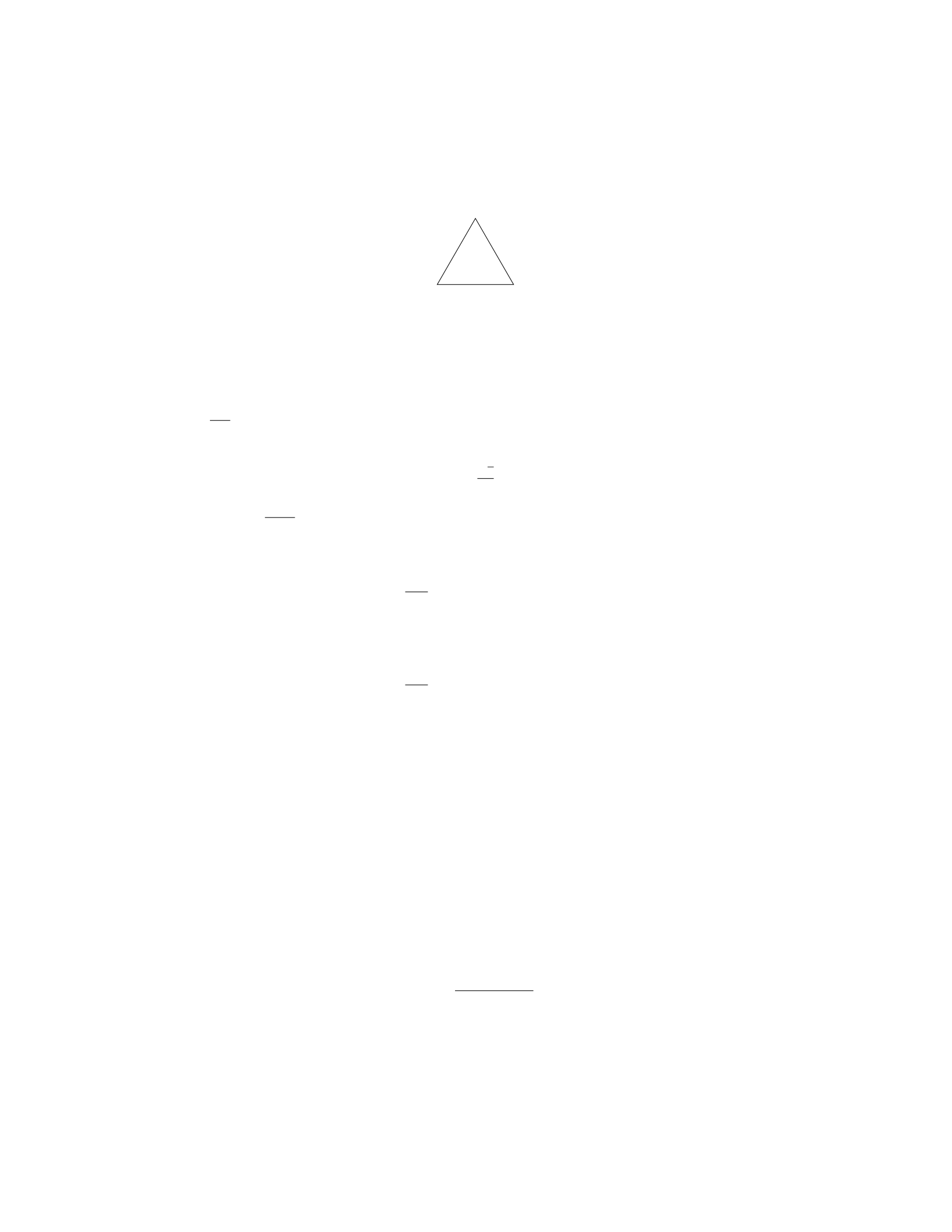
Q2Q3
Q1
Solution
Step 1: Calculate the electric field due to each charge at the center of the
equilateral triangle.
The electric field
Eat a distance rfrom a point charge Qis given by
E=
k·Q
r2ˆr, where kis Coulomb’s constant, ˆris the unit vector pointing from the
charge to the point, and ris the distance from the charge to the point.
For Q1=−4µC: The distance from Q1to the center of the triangle is the
height of the equilateral triangle h=√3
2s, where sis the side length of the
equilateral triangle. The magnitude of the electric field due to Q1at the center
is E1=k|Q1|
h2. The direction of the electric field due to Q1at the center points
along the line connecting the charge and the center of the equilateral triangle.
For Q2= 3 µC: The distance from Q2to the center of the triangle is the
side length of the equilateral triangle s. The magnitude of the electric field due
to Q2at the center is E2=kQ2
s2. The direction of the electric field due to Q2
at the center points along the line connecting the charge and the center of the
equilateral triangle.
For Q3= 5 µC: The distance from Q3to the center of the triangle is the
side length of the equilateral triangle s. The magnitude of the electric field due
to Q3at the center is E3=kQ3
s2. The direction of the electric field due to Q3
at the center points along the line connecting the charge and the center of the
equilateral triangle.
Question 7
Question
Three point charges are placed on the x-axis: q1=−2nC at x=−0.5m,
q2= 3 nC at x= 0 m, and q3=−4nC at x= 1 m. What is the magnitude and
direction of the force on a 5nC charge placed at the origin due to these charges?
Solution
Step 1: Calculate the force on the 5nC charge from q1using Coulomb’s Law:
F1=k|q1||qorigin|
r2
7

where: kis Coulomb’s constant (8.99 ×10⁹N·m2/C2), q1=−2nC, qorigin =
5nC, r= 0.5m. Plugging in the values:
F1=(8.99 ×10⁹)(2 ×10⁻⁹)(5 ×10⁻⁹)
0.52
F1=8.99 ×2×5
0.25
F1=89.9
0.25
F1= 359.6N
The force from q1is attractive and acts towards the origin.
Step 2: Calculate the force on the 5nC charge from q2:
F2= 0
Since q2is at the origin, the force it exerts on the charge at the origin will be
zero.
Step 3: Calculate the force on the 5nC charge from q3:
F3=k|q3||qorigin|
r2
where: q3=−4nC, r= 1 m. Plugging in the values:
F3=(8.99 ×10⁹)(4 ×10⁻⁹)(5 ×10⁻⁹)
12
F3=8.99 ×4×5
1
F3=35.96
1
F3= 35.96 N
The force from q3is repulsive and acts away from the origin.
Step 4: Calculate the net force on the 5nC charge by summing the individual
forces:
Fnet =F1+F2+F3
Fnet = 359.6N+ 0 N+ 35.96 N
Fnet = 395.56 N
The net force on the 5nC charge is 395.56 N, directed towards the origin.
8

Question 8
Question
Three point charges are arranged as follows: - Charge q1= +3 µC is located at
(0,0) m. - Charge q2=−2µC is located at (0,4) m. - Charge q3= +4 µC is
located at (3,0) m.
Determine the electric field at the point (4,4) m due to these three charges.
Solution
The electric field at point (4,4) m due to the three charges can be determined
by calculating the contributions of each charge individually and then summing
them up according to the superposition principle.
Step 1: Calculate the electric field contribution from charge q1.
The distance between charge q1and point (4,4) is r1=p(4 −0)2+ (4 −0)2=
√32 = 4√2m. The electric field contribution from charge q1at point (4,4) is
given by:
E1=k· |q1|
r2
1·ˆr1
where kis Coulomb’s constant and ˆr1is the unit vector pointing from charge
q1to the point (4,4).
Step 2: Calculate the electric field contribution from charge q2.The
distance between charge q2and point (4,4) is r2=p(4 −0)2+ (4 −4)2= 4 m.
The electric field contribution from charge q2at point (4,4) is given by:
E2=k· |q2|
r2
2·ˆr2
where ˆr2is the unit vector pointing from charge q2to the point (4,4).
Step 3: Calculate the electric field contribution from charge q3.
The distance between charge q3and point (4,4) is r3=p(4 −3)2+ (4 −0)2=
√22+ 42=√20 = 2√5m. The electric field contribution from charge q3at
point (4,4) is given by:
E3=k· |q3|
r2
3·ˆr3
where ˆr3is the unit vector pointing from charge q3to the point (4,4).
Step 4: Sum up the electric field contributions from all charges.
The total electric field at point (4,4) is given by the vector sum of the contri-
butions from each charge:
Etotal =
E1+
E2+
E3
Now, substitute the values of k,q1,q2,q3,r1,r2,r3,ˆr1,ˆr2, and ˆr3into the
above expressions to find the total electric field.
9

Question 9
Question
Three point charges are arranged along the x-axis. Charge q1=−2.0µC is at
the origin, charge q2= 1.0µC is at x= 4.0m, and charge q3=−3.0µC is at
x= 10.0m. What is the magnitude and direction of the electric field at a point
on the x-axis where x= 6.0m?
Solution
Step 1: Calculate the electric field contribution from q1at the point x= 6.0m.
The electric field from a point charge is given by the equation:
E=k|q|
r2
where - kis the Coulomb constant, 8.9875 ×10⁹N m2/C2, - qis the charge, - r
is the distance from the charge to the point.
The distance from q1to the point is 6.0m. The charge q1=−2.0µC =
−2.0×10⁻⁶C. Thus, the electric field from q1at x= 6.0m is:
E1=(8.9875 ×10⁹)(| − 2.0×10⁻⁶|)
(6.0)2
Step 2: Calculate the electric field contribution from q2at the point x= 6.0
m. The distance from q2to the point is 2.0m. The charge q2= 1.0µC =
1.0×10⁻⁶C. Thus, the electric field from q2at x= 6.0m is:
E2=(8.9875 ×10⁹)(1.0×10⁻⁶)
(2.0)2
Step 3: Calculate the electric field contribution from q3at the point x= 6.0
m. The distance from q3to the point is 4.0m. The charge q3=−3.0µC =
−3.0×10⁻⁶C. Thus, the electric field from q3at x= 6.0m is:
E3=(8.9875 ×10⁹)(| − 3.0×10⁻⁶|)
(4.0)2
Step 4: Calculate the total electric field at x= 6.0m by summing the
contributions from all three charges. The total electric field magnitude is:
|E|=|E1+E2+E3|
The direction of the electric field is the direction of the sum vector. If the
vector sum is positive, the direction is towards the positive x-axis; if negative,
it is towards the negative x-axis.
10
Question 10
Question
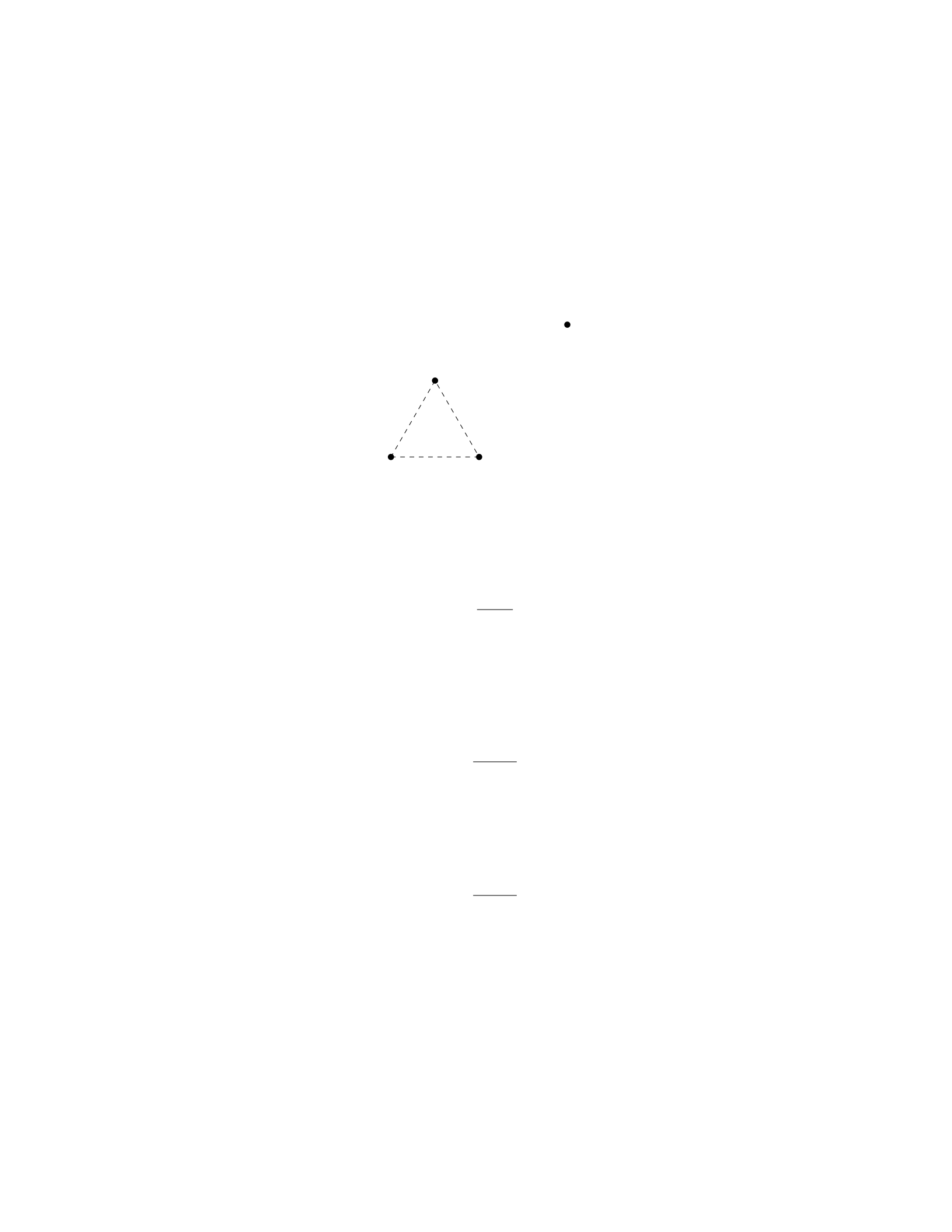
Three point charges are arranged as shown in the diagram below. Find the
electric field at point P due to these charges using the superposition principle.
−q+2q
−3q
P
Solution
Step 1: Find the electric field at point P due to the first charge (−q). The
electric field E1at point P due to the charge −qis given by Coulomb’s law:
E1=k· |q|
r2
where k= 8.99 ×10⁹N m2/C2is Coulomb’s constant, q=−qis the charge,
and ris the distance from the charge to point P.
Step 2: Find the electric field at point P due to the second charge (+2q).
The electric field E2at point P due to the charge +2qis given by Coulomb’s
law:
E2=k· |2q|
r2
where k= 8.99 ×10⁹N m2/C2is Coulomb’s constant, q= 2qis the charge,
and ris the distance from the charge to point P.
Step 3: Find the electric field at point P due to the third charge (−3q). The
electric field E3at point P due to the charge −3qis given by Coulomb’s law:
E3=k· |3q|
r2
where k= 8.99×10⁹N m2/C2is Coulomb’s constant, q=−3qis the charge,
and ris the distance from the charge to point P.
Step 4: Apply the superposition principle. The total electric field at point
P is the vector sum of the electric fields due to each charge:
Etotal =E1+E2+E3
11

Calculate the magnitudes and directions of each electric field using the dis-
tances from each charge to point P, and then find the total electric field at point
P by adding these vectors together.
Question 11
Question
Three charges are arranged along the x-axis as follows: q1=−2µC at x=−2m,
q2= 3 µC at x= 0 m, and q3=−1µC at x= 4 m. What is the electric field at
a point x= 3 m on the x-axis?
Solution
Step 1: Calculate the electric field contribution from each individual charge.
The electric field at a point due to a point charge is given by the formula:
E=k· |q|
r2
where kis the Coulomb constant (8.99 ×10⁹N m2/C2), qis the charge, and r
is the distance from the charge to the point where the field is being calculated.
Let’s calculate the electric field contribution from each charge at the point
x= 3 m.
For q1=−2µC at x=−2m:
E1=k·|−2µC|
(3 + 2)2=8.99 ×109·2×10−6
52= 2.8784 ×10⁶N/C
For q2= 3 µC at x= 0 m:
E2=k· |3µC|
32=8.99 ×109·3×10−6
32= 8.99 ×10⁶N/C
For q3=−1µC at x= 4 m:
E3=k·|−1µC|
(3 −4)2=8.99 ×109·1×10−6
12= 8.99 ×10⁹N/C
Step 2: Find the direction of each electric field contribution. Since q1is neg-
ative, its electric field points towards the left. q2’s electric field points towards
the right, and q3’s electric field also points towards the right.
Step 3: Combine the electric field contributions. We need to add the elec-
tric field contributions from each charge as vectors, taking into account their
directions.
Since E1and E3are in opposite directions, we need to subtract E3from E1
and then add E2:
12

Etotal =E2+E1−E3= 8.99 ×10⁶+ 2.8784 ×10⁶−8.99 ×10⁹
Etotal =−8.99 ×10⁹+ 11.8684 ×106=−8.9881 ×10⁹N/C
Therefore, the electric field at x= 3 m on the x-axis is −8.9881 ×10⁹N/C
pointing towards the left.
Question 12
Question
Three point charges are arranged along the x-axis as follows: q1=−2µC at
x= 0,q2= 4µC at x= 2 m, and q3=−6µC at x= 4 m. Calculate the
magnitude and direction of the electric field at a point located 3 meters to the
right of the charge q1.
Solution
Step 1: Calculate the electric fields due to each individual charge using the
formula E=k|q|
r2.
• For charge q1=−2µC at x= 0 m:
E1=k|q1|
(3)2
• For charge q2= 4µC at x= 2 m:
E2=k|q2|
(1)2
• For charge q3=−6µC at x= 4 m:
E3=k|q3|
(1)2
Step 2: Determine the direction of each electric field using the principle
that electric field lines point away from positive charges and towards negative
charges.
Step 3: Calculate the net electric field at the point 3 meters to the right of
q1by summing the individual electric fields:
Enet =
E1+
E2+
E3
Step 4: Add the individual electric fields in the appropriate direction to find
the net electric field.
13

Question 13
Question
Three charges are positioned as follows: a charge of +2.0µC at the origin, a
charge of −3.0µC at (0, 4.0m), and a charge of +4.0µC at (3.0m, 0). What is
the magnitude and direction of the electric field at the point (1.0m, 2.0m)?
Solution
Step 1: Calculate the electric field contribution from each charge individually
using the formula E=kq
r2, where k= 8.99 ×10⁹N m2/C2.
•Charge at the origin (+2.0µC):
The distance between the charge at the origin and the point (1.0m, 2.0m)
is √12+ 22=√5.
E1= 8.99 ×109×2.0×10−6
5= 0.7192 N/C
The direction of the electric field from this charge is along the line con-
necting the charge and the point.
•Charge at (0, 4.0m) (−3.0µC):
The distance between the charge at (0, 4.0m) and the point (1.0m, 2.0m)
is √12+ 22+ 42=√21.
E2= 8.99 ×10⁹×−3.0×10⁻⁶
21 =−0.3857 N/C
The direction of the electric field from this charge is along the line con-
necting the charge and the point.
•Charge at (3.0m, 0) (+4.0µC):
The distance between the charge at (3.0m, 0) and the point (1.0m, 2.0m)
is √22+ 32=√13.
E3= 8.99 ×109×4.0×10−6
13 = 2.2688 N/C
The direction of the electric field from this charge is along the line con-
necting the charge and the point.
Step 2: Find the total electric field at the point (1.0m, 2.0m) by summing
the individual electric field contributions in vector form.
E=
E1+
E2+
E3
E= (0.7192 N/C ˆr1)+(−0.3857 N/C ˆr2) + (2.2688 N/C ˆr3)
14

The resultant electric field magnitude can be calculated as:
E=qE2
total,x +E2
total,y
E=p(0.7192)2+ (−0.3857)2+ (2.2688)2= 2.5125 N/C
The direction of the electric field at the point (1.0m, 2.0m) can be found by
taking the arctangent of the ratios of the components:
θ= tan−1Etotal,y
Etotal,x
θ= tan−1−0.3857
0.7192 =−28.4◦
Therefore, the magnitude of the electric field at the point (1.0m
Question 14
Question
Three charges are placed at the vertices of an equilateral triangle with side
length a. The charges are +q,−q, and +2q. Calculate the electric field at the
center of the triangle.
Solution
To find the electric field at the center of the equilateral triangle, we will first
find the electric field contribution from each charge individually and then sum
them up using the principle of superposition.
Step 1: Electric field due to the charge +q
The magnitude of the electric field due to a point charge qat a distance ris
given by Coulomb’s law:
E=k|q|
r2
where kis the Coulomb constant (8.988 ×10⁹N m2/C2).
In this case, the distance from the center of the equilateral triangle to any
of its vertices (where the charge +qis located) is a/√3.
Therefore, the electric field due to the charge +qat the center of the triangle
is:
E1=k|q|
(a/√3)2
E1=kq√3
a2
15

Step 2: Electric field due to the charge −q
Similarly, the electric field due to the charge −qat the center of the triangle
is:
E2=k|q|
(a/√3)2
E2=kq√3
a2
Step 3: Electric field due to the charge +2q
Finally, the electric field due to the charge +2qat the center of the triangle
is:
E3=k|2q|
(a/√3)2
E3=k2q√3
a2
Step 4: Total electric field at the center of the triangle
By the principle of superposition, the total electric field at the center of the
equilateral triangle is the vector sum of the electric fields due to each charge:
Etotal =
E1+
E2+
E3
Since the electric fields due to charges +qand −qare equal in magnitude but
opposite in direction, they cancel each other out. Therefore, the total electric
field at the center of the triangle is:
Etotal =
E3=k2q√3
a2
Thus, the electric field at the center of the equilateral triangle due to the
given charges +q,−q, and +2qis k2q√3
a2.
Question 16
Question
Three point charges are located along the x-axis: a charge of +4.0µC at x=
−2.0m, a charge of −2.0µC at the origin, and a charge of +6.0µC at x= 3.0m.
Calculate the magnitude and direction of the electric field at the point x= 1.0m
on the x-axis.
16

Solution
Step 1: Calculate the electric field contribution at x= 1.0m due to the +4.0µC
charge at x=−2.0m. The electric field E1at x= 1.0m due to the +4.0µC
charge is given by Coulomb’s Law:
E1=k· |q1|
r2
1
where kis the Coulomb constant (8.99 ×10⁹N·m2/C2), q1is the charge
(+4.0µC), r1is the distance from the charge to the point (1.0m−(−2.0m) =
3.0m). Plugging in the values, we get:
E1=(8.99 ×10⁹N·m2/C2)·(4.0×10−6C)
(3.0m)2
E1=35.96 ×10³
9.0= 3.99 ×10³N/C
Step 2: Calculate the electric field contribution at x= 1.0m due to the
−2.0µC charge at the origin. The electric field E2at x= 1.0m due to the
−2.0µC charge is:
E2= 0
since the electric field from a point charge at the same location is zero.
Step 3: Calculate the electric field contribution at x= 1.0m due to the
+6.0µC charge at x= 3.0m. The electric field E3at x= 1.0m due to the
+6.0µC charge is:
E3=k· |q3|
r2
3
where kis the Coulomb constant, q3is the charge (+6.0µC), r3is the distance
from the charge to the point (3.0m−1.0m= 2.0m). Plugging in the values,
we get:
E3=(8.99 ×10⁹N·m2/C2)·(6.0×10−6C)
(2.0m)2= 1.35 ×10⁴N/C
Step 4: Calculate the total electric field at x= 1.0m by adding the contri-
butions from all charges. The total electric field Etotal at x= 1.0m is the vector
sum of E1,E2, and E3:
Etotal
Question 17
Question
Three point charges are arranged as follows: a charge of +2 µC is located at
the origin, a charge of −3µC is located at (0,3m), and a charge of +4 µC is
located at (4 m,0). Calculate the electric field at the point P(3 m,3m)due to
these charges.
17

Solution
Step 1: Calculate the electric field due to each charge separately using Coulomb’s
law. The electric field Eat a point due to a point charge qat a distance ris
given by:
E=k· |q|
r2
where kis Coulomb’s constant (8.99 ×10⁹N m2/C2).
For the charge at the origin (+2 µC):
E1=k· | + 2 µC|
(3 m)2
For the charge at (0,3m)(−3µC):
E2=k·|−3µC|
(3 m)2
For the charge at (4 m,0) (+4 µC):
E3=k· | + 4 µC|
5m
Step 2: Calculate the electric field vectors for each charge. The electric field
is a vector quantity, so we need to determine the direction of each field.
The electric field from the charge at the origin has components along the
positive x and y directions.
The electric field from the charge at (0,3m)has only a y-component.
The electric field from the charge at (4 m,0) has only an x-component.
Step 3: Use the principle of superposition to find the total electric field at
point P. The total electric field at point P due to the three charges is the vector
sum of the individual electric fields:
Etotal =
E1+
E2+
E3
Calculate the magnitudes and directions of
E1,
E2, and
E3using the infor-
mation from Step 1 and Step 2. Then, add these vectors together to find
Etotal
at point P.
Question 18
Question
Three charges are arranged in the x-y plane as shown below: a positive charge
of +3.0µC at the origin, a positive charge of +5.0µC at (0,2.0) m, and a
negative charge of −2.0µC at (2.0,0) m. Determine the electric field at the
point (1.0,1.0) m due to these three charges.
18
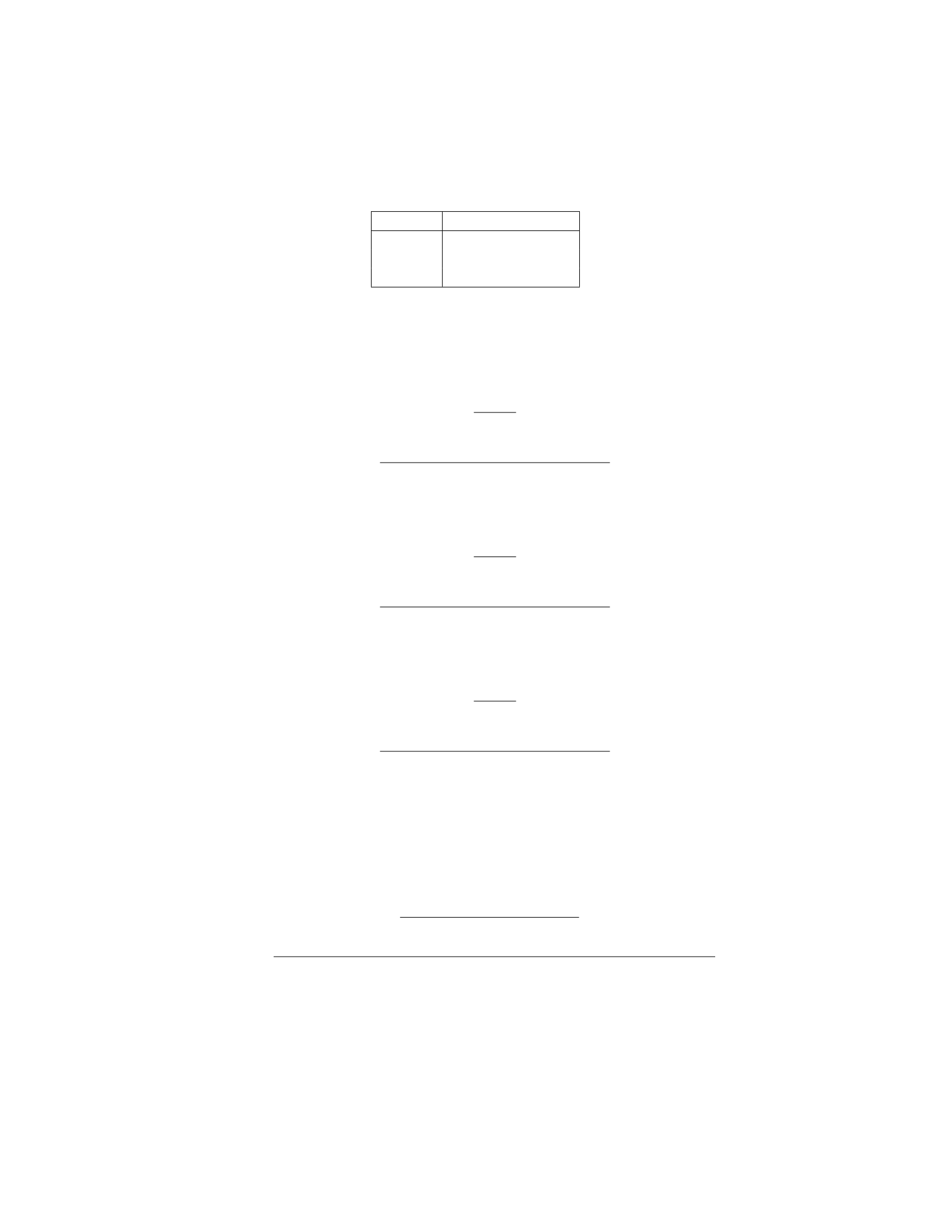
Charge Position (x, y)(m)
+3.0µC(0,0)
+5.0µC(0,2.0)
−2.0µC(2.0,0)
Solution
Step 1: Calculate the electric field due to each charge at the point (1.0,1.0) m.
Using the expression for the electric field due to a point charge:
For charge at the origin:
E1=k· |q1|
r2
1
E1=8.99 ×10⁹N m2/C2·3.0×10−6C
(1.0)2
E1= 2.70 ×10⁶N/C
For charge at (0,2.0) m:
E2=k· |q2|
r2
2
E2=8.99 ×10⁹N m2/C2·5.0×10−6C
(1.0)2
E2= 4.49 ×10⁶N/C
For charge at (2.0,0) m:
E3=k· |q3|
r2
3
E3=8.99 ×10⁹N m2/C2·2.0×10−6C
(1.41)2
E3= 2.41 ×10⁶N/C
Step 2: Calculate the net electric field at the point (1.0,1.0) m by considering
the vector sum of the individual electric fields.
Let’s consider the electric field due to the positive charges as positive and
the electric field due to the negative charge as negative.
The angle between the electric field due to each charge and the x-axis is 45◦.
Enet =qE2
1+E2
2−2E1E2cos(45◦)−E3
Enet =p(2.70 ×10⁶)2+ (4.49 ×10⁶)2−2(2.70 ×10⁶)(4.49 ×10⁶) cos(45◦)−2.41×10⁶
Enet = 7.5×10⁶N/C
Therefore, the electric field at the point (1.0,1.0) m due to the three charges
is 7.5×10⁶N/C.
19

Question 19
Question
Three point charges are arranged on the x-axis as follows: a charge of +4 µC at
x=−2m, a charge of −2µC at x= 0 m, and a charge of +3 µC at x= 3 m.
Calculate the electric field at the point Plocated on the x-axis at x= 1 m due
to these three charges.
Solution
Step 1: Calculate the electric field due to the +4 µC charge at x=−2m. The
electric field E1at point Pdue to charge q1is given by Coulomb’s law:
E1=k· |q1|
r2
1
where k= 8.99 ×10⁹N m2/C2is the Coulomb constant, |q1|= 4 ×10⁻⁶C is
the magnitude of the charge, and r1= 3 m is the distance between the charge
and point P.
Plugging in the given values:
E1=8.99 ×109·4×10−6
(−2−1)2
E1=35.96 ×10³
9
E1= 3995.56 N/C (to the left)
Step 2: Calculate the electric field due to the −2µC charge at x= 0 m. The
electric field E2at point Pdue to charge q2is given by Coulomb’s law:
E2=k· |q2|
r2
2
where |q2|= 2 ×10⁻⁶C, and r2= 1 m.
Plugging in the given values:
E2=8.99 ×109·2×10−6
12
E2= 17.98 ×10³
E2= 17980 N/C (to the right)
Step 3: Calculate the electric field due to the +3 µC charge at x= 3 m. The
electric field E3at point Pdue to charge q3is given by Coulomb’s law:
E3=k· |q3|
r2
3
20
where |q3|= 3 ×10⁻⁶C, and r3= 2 m.
Plugging in the given values:
E3=8.99 ×109·3×10−6
22
E3= 13.485 ×10³
E3= 13485 N/C (to the left)
Step 4: Calculate the total electric field at point P. The total electric field
at point Pis the vector sum of the individual electric fields:
Etotal =E1+E2+E3= 3995.56 N/C −17980 N/C + 13485 N/C
Etotal =−5320.44 N/C (to the left)
Therefore, the electric field at point
Question 20
Question
Three charges are arranged in a line as shown below:
−q2dq
Given that q= 8 nC, d= 2 m, and k= 8.99 ×10⁹N m2/C2, find the
magnitude of the electric force acting on the positive charge q.
Solution
Step 1: Calculate the distance between each charge and the positive charge q.
r1= 2d= 2(2 m) = 4 m
r2=d= 2 m
Step 2: Calculate the magnitudes of the electric forces F1and F2due to
charges −qand −qacting on q.
F1=k|q||q|
r2
1
=(8.99 ×10⁹N m2/C2)(8 ×10−9C)(8 ×10⁻⁹C)
(4 m)2
=(7.192 ×10⁻⁸N)(8.99 ×10⁹N m2/C2)
16 m2
=0.646 ×10²N·m2/C2
16
= 4.04 N
21

F2=k|q||q|
r2
2
=(8.99 ×10⁹N m2/C2)(8 ×10−9C)(8 ×10⁻⁹C)
(2 m)2
=(7.192 ×10⁻⁸N)(8.99 ×10⁹N m2/C2)
4m2
=0.646 ×10²N·m2/C2
4
= 16.16 N
Step 3: The total electric force on qis given by the sum of F1and F2.
Total electric force =F1+F2= 4.04 N+ 16.16 N= 20.20 N
Therefore, the magnitude of the electric force acting on the positive charge
qis 20.20 N.
Question 22
Question
Three point charges are placed on the x-axis: a charge of +3.0µC at x= 0 m, a
charge of −5.0µC at x= 2.0m, and a charge of +2.0µC at x= 4.0m. Calculate
the electric field at a point x= 3.0mon the x-axis due to these charges.
Solution
Step 1: Calculate the electric field due to each individual charge at the point
x= 3.0musing Coulomb’s Law:
For the +3.0µC charge at x= 0 m: The distance between the charge and
the point is r1= 3.0m−0m= 3.0m. The electric field E1at x= 3.0mdue to
this charge is given by:
E1=k·|q1|
r2
1
E1= (8.99 ×10⁹Nm2/C2)·3.0×10−6C
(3.0m)2
E1= 1.0×10⁵N/C
For the −5.0µC charge at x= 2.0m: The distance between the charge and
the point is r2= 3.0m−2.0m= 1.0m. The electric field E2at x= 3.0mdue
to this charge is given by:
E2=k·|q2|
r2
2
E2= (8.99 ×10⁹Nm2/C2)·5.0×10−6C
(1.0m)2
22

E2= 4.5×10⁶N/C
For the +2.0µC charge at x= 4.0m: The distance between the charge and
the point is r3= 4.0m−3.0m= 1.0m. The electric field E3at x= 3.0mdue
to this charge is given by:
E3=k·|q3|
r2
3
E3= (8.99 ×10⁹Nm2/C2)·2.0×10−6C
(1.0m)2
E3= 1.8×10⁶N/C
Step 2: Calculate the total electric field at x= 3.0mdue to the superposition
of the individual electric fields:
The total electric field Eat x= 3.0mis the vector sum of the individual
electric fields E1,E2, and E3,
E=E1+E2+E3
E= 1.0×10⁵N/C + 4.5×10⁶N/C + 1.8×10⁶N/C
E= 6.3×10⁶N/C
Therefore, the electric field at x= 3.0mon the x-axis due to the three
charges is 6.3×10⁶N/C directed along the positive x-direction.
Question 23
Question
Three point charges are arranged as follows: charge q1=−2µC is located at
(0,0), charge q2= 3 µC is located at (0,3m), and charge q3=−4µC is located
at (4m,0). Calculate the electric field at point P, which is located at (3m,4m).
Solution
1. Calculate the electric field due to charge q1at point P using the formula for
electric field:
E1=k|q1|
r2
1
where k= 9 ×10⁹Nm2/C2,q1=−2µC, and r1is the distance from q1to point
P.
2. Calculate the distance r1between q1and point P using the distance
formula:
r1=p(3 −0)2+ (4 −0)2
3. Substitute the values into the equation for E1to find the electric field
due to q1at point P.
23
4. Calculate the electric field due to charge q2at point P using the formula
for electric field:
E2=k|q2|
r2
2
where q2= 3 µC, and r2is the distance from q2to point P.
5. Calculate the distance r2between q2and point P.
6. Substitute the values into the equation for E2to find the electric field
due to q2at point P.
7. Calculate the electric field due to charge q3at point P using the formula
for electric field:
E3=k|q3|
r2
3
where q3=−4µC, and r3is the distance from q3to point P.
8. Calculate the distance r3between q3and point P.
9. Substitute the values into the equation for E3to find the electric field
due to q3at point P.
10. Finally, find the total electric field at point P by summing the electric
fields due to each charge using the principle of superposition:
Etotal =E1+E2+E3
11. Calculate the magnitude and direction of the total electric field at point
P.
Question 24
Question
Three point charges are arranged at the vertices of an equilateral triangle as
shown below. Charge q1=−5µC is located at point A, charge q2= 8 µC is at
point B, and charge q3=−3µC is at point C. Calculate the electric field at the
following point P, which is at a distance rfrom point A along the perpendicular
bisector of side BC. Use ras a variable in your final answer. Given that the
side length of the equilateral triangle is 10 cm.
AB
C
r
24

Solution
Step 1: Calculate the electric field contribution at point P due to charge q1=
−5µC at point A. Let this contribution be E1. The electric field due to a point
charge qat a distance rfrom it is given by the formula:
E=k· |q|
r2·ˆr
where kis Coulomb’s constant (8.987 ×10⁹N m2/C2) and ˆris the unit vector
in the direction from the charge to the point P.
The magnitude of the electric field at point P due to charge q1is:
E1=k· |q1|
r2
Step 2: Calculate the electric field contribution at point P due to charge
q2= 8 µC at point B. Let this contribution be E2. The magnitude of the
electric field at point P due to charge q2can be calculated using the same
formula as above:
E2=k· |q2|
r2
Step 3: Calculate the electric field contribution at point P due to charge
q3=−3µC at point C. Let this contribution be E3. The magnitude of the
electric field at point P due to charge q3can be calculated using the same
formula as above:
E3=k· |q3|
r2
Step 4: Calculate the total electric field at point P by summing the contri-
butions from each charge. The total electric field at point P is given by:
E=E1+E2+E3
The final expression for the total electric field at point P will be in terms of
r.
Question 25
Question
Three point charges are arranged on the x-axis as follows: q1= +2.0µC at
the origin, q2=−3.0µC at x= +4.0m, and q3= +1.0µC at x=−3.0m.
Calculate the electric field at the point x= +1.0m on the x-axis. Given:
k= 8.99 ×10⁹N m2/C2
25

Solution
Step 1: Calculate the electric field due to each individual charge at the point
x= +1.0m using the formula for electric field due to a point charge:
Eq1=k· |q1|
(+1.0m)2
Step 2: Substitute the given values of k,q1, and xinto the formula to find
Eq1:
Eq1=(8.99 ×10⁹N m2/C2)·(2.0×10−6C)
(+1.0m)2
Eq1=17.98 N
1.0m2
Eq1= 17.98 N/C (due to q1)
Step 3: Repeat Steps 1 and 2 for charges q2and q3to find Eq2and Eq3:
Eq2=k· |q2|
(−3.0m−1.0m)2
Eq3=k· |q3|
(+1.0m+ 3.0m)2
Step 4: Substitute the given values of k,q, and xinto the formulas to find
Eq2and Eq3:
Eq2=(8.99 ×10⁹N m2/C2)·(3.0×10−6C)
(−4.0m)2
Eq2=26.97 N
16.0m2
Eq2= 1.686 N/C (due to q2)
Eq3=(8.99 ×10⁹N m2/C2)·(1.0×10−6C)
(+4.0m)2
Eq3=8.99 N
16.0m2
Eq3= 0.562 N/C (due to q3)
Step 5: Calculate the total electric field at x= +1.0m by summing the
individual electric fields with proper signs:
Etotal =Eq1+Eq2+Eq3
Etotal = 17.98 N/C −1.686 N/C + 0.
26

Given r1=p(2 −0)2+ (2 −0)2=√8 = 2√2, and ˆr1=P−q1
|P−q1|=<2,2>
√8=<
1,1>.
Therefore,
E1=(8.99×109)·(3×10−6)
(2√2)2<1,1>= 6.36 ×10³<1,1>N/C.
Step 2: Calculate the electric field produced by q2.The electric field
E2produced by q2at point P(2,2) is given by Coulomb’s Law:
E2=k· |q2|
r2
2
ˆr2
Question 2
Question
Three point charges are placed at the vertices of an equilateral triangle as shown
below:
+q
−q+q
(a) Calculate the electric field at the third vertex due to the other two
charges.
(b) If q= 2 ×10⁻⁶C and the side length of the triangle is 0.1 m, what is the
magnitude and direction of the electric field at the third vertex?
Solution
(a) To calculate the electric field at the third vertex due to the other two charges,
we can use the principle of superposition. The electric field at the third vertex
is the vector sum of the electric fields created by each of the other charges
individually.
Step 1: Calculate the electric field due to the positive charge +qat the
third vertex.
The electric field at the third vertex due to the charge +qcan be calculated
using the equation for electric field created by a point charge:
E+q=k· |q|
r2
where kis the Coulomb constant, |q|is the magnitude of the charge, and r
is the distance between the charge and the point where the electric field is being
calculated.
Step 2: Calculate the direction of the electric field due to the positive charge
+q.
Since the charge +qis positive, the electric field created by it will radiate
away from the charge.
Step 3: Calculate the electric field due to the negative charge −qat the
third vertex.
2

Similarly, the electric field at the third vertex due to the charge −qcan be
calculated using the same equation for electric field.
E−q=k·|−q|
r2
Step 4: Calculate the direction of the electric field due to the negative
charge −q.
Since the charge −qis negative, the electric field created by it will point
toward the charge.
Step 5: Calculate the total electric field at the third vertex.
The total electric field at the third vertex is the vector sum of the electric
fields due to the positive and negative charges.
Etotal =
E+q+
E−q
(b) Given that q= 2 ×10⁻⁶C and the side length of the triangle is 0.1 m,
we can now calculate the magnitude and direction of the electric field at the
third vertex using the superposition principle and the electric field equations.
Question 3
Question
Three charges are placed on the x-axis as follows: q1= +2µC at x=−1m,
q2=−3µC at x= 0, and q3= +4µC at x= +1m. Calculate the electric field
at the origin due to these charges.
Solution
In order to find the electric field at the origin (x= 0) due to the three charges
on the x-axis, we will calculate the electric fields due to each charge separately
and then use the superposition principle to add them up.
Step 1: Calculate the electric field due to q1at the origin. The electric field
E1due to q1can be calculated using the formula:
E1=k· |q1|
r2
1
where k= 8.99 ×10⁹N m2/C2is the Coulomb constant and r1= 1mis the
distance from q1to the origin. Substituting the values, we get:
E1=(8.99 ×10⁹N m2/C2)·2×10−6C
(1m)2= 1.798 ×10⁶N/C
Step 2: Calculate the electric field due to q2at the origin. The electric
field E2due to q2can be calculated using the same formula as above, with
3

q2=−3µC and r2= 0 as q2is at the origin. Since r2= 0, the electric field due
to q2is zero.
Step 3: Calculate the electric field due to q3at the origin. The electric field
E3due to q3can be calculated using the same formula as above, with q3= 4µC
and r3= 1mas the distance from q3to the origin. Substituting the values, we
get:
E3=(8.99 ×10⁹N m2/C2)·4×10−6C
(1m)2= 3.597 ×10⁶N/C
Step 4: Apply the principle of superposition. The total electric field at the
origin, Etotal, is the vector sum of the individual electric fields:
Etotal =E1+E2+E3= 1.798×10⁶N/C+0+3.597×106N/C = 5.395×10⁶N/C
Therefore, the electric field at the origin due to the three charges on the
x-axis is 5.395 ×10⁶N/C directed along the positive x-axis.
Question 4
Question
Three point charges are placed at the vertices of an equilateral triangle with
sides of length d. The charges are all equal in magnitude and are labeled as
follows: qat the top vertex, 2qat the bottom left vertex, and −2qat the
bottom right vertex. Calculate the electric field at the center of the triangle due
to these charges.
Solution
Step 1: Calculate the electric fields due to each individual charge at the center
of the triangle. The electric field due to a point charge qat a distance ris given
by Coulomb’s Law:
E=k· |q|
r2
where kis the Coulomb’s constant (8.99 ×10⁹N m2/C2).
Let E1,E2, and E3be the electric fields due to charges q,2q, and −2q
respectively at the center of the triangle. Since the electric field is a vector
quantity, we need to consider the direction as well.
For the charge qat the top vertex: The distance from the center of the
triangle to the top vertex is d/2. Therefore,
E1=k· |q|
(d/2)2=4kq
d2
This electric field points directly upwards.
4

Step 2: Calculate the electric field due to the 2qcharge at the bottom left
vertex at the center of the triangle. The distance from the center to this charge
is d. The electric field is given by:
E2=k· |2q|
d2=4kq
d2
This electric field points directly to the left.
Step 3: Calculate the electric field due to the −2qcharge at the bottom right
vertex at the center of the triangle. The distance from the center to this charge
is also d. The electric field is given by:
E3=k·|−2q|
d2=4kq
d2
This electric field points directly to the right.
Step 4: Determine the net electric field at the center of the triangle. Since
the electric fields due to the three charges all have the same magnitude and are
directed along three different directions, they will cancel each other out. Thus,
the net electric field at the center of the triangle is 0N/C .
Question 5
Question
Consider three point charges arranged as shown below: q1=−2µC,q2= 4µC,
and q3=−3µC. The charges are placed at the corners of an equilateral triangle
with sides of length a= 1.0m. What is the magnitude and direction of the
force on q1due to the other two charges?
q1(−2µC)
q2(4µC)q3(−3µC)
Solution
Step 1: First, we need to find the electric force on q1due to q2and q3separately,
and then find the net force by summing the individual forces, taking into account
their directions.
The electric force between two point charges q1and q2is given by Coulomb’s
Law:
F=k|q1q2|
r2
where k= 8.99 ×10⁹N·m2/C2is the Coulomb’s constant, q1and q2are the
magnitudes of the charges, and ris the distance between the charges.
5

Step 2: Calculating the force on q1due to q2. The distance between q1
and q2is the same as the side of the equilateral triangle, which is a= 1.0m.
Plugging the values into Coulomb’s Law formula, we get:
F12 =k|q1q2|
a2
F12 = 8.99 ×10⁹N·m2/C2×2×4×10−6
(1.0)2
F12 = 7.19 ×10⁻⁵N
The force exerted by q2on q1is attractive since q2is positive and q1is
negative.
Step 3: Calculating the force on q1due to q3. Similarly, we find the force
exerted by q3on q1using Coulomb’s Law:
F13 =k|q1q3|
a2
F13 = 8.99 ×10⁹N·m2/C2×2×3×10−6
(1.0)2
F13 = 5.39 ×10⁻⁵N
The force exerted by q3on q1is repulsive since q3is negative and q1is
negative.
Step 4: Calculating the net force on q1. The net force on q1is the vector
sum of the forces F12 and F13. Since these forces act along the same line (from
different directions), the magnitude of the net force is:
Fnet =|F12 −F13|
Therefore,
Fnet =
7.19 ×10⁻⁵−5.39 ×10⁻⁵
Fnet = 1.8×10⁻⁵N
The direction of the net force is directed towards the positive charge q2.
Question 6
Question
Three charges are placed at the corners of an equilateral triangle as shown below:
Charge Q1=−4µC at the top vertex, charge Q2= 3 µC at the bottom left
vertex, and charge Q3= 5 µC at the bottom right vertex. Calculate the net
electric field at the center of the equilateral triangle due to these three charges.
6

Q2Q3
Q1
Solution
Step 1: Calculate the electric field due to each charge at the center of the
equilateral triangle.
The electric field
Eat a distance rfrom a point charge Qis given by
E=
k·Q
r2ˆr, where kis Coulomb’s constant, ˆris the unit vector pointing from the
charge to the point, and ris the distance from the charge to the point.
For Q1=−4µC: The distance from Q1to the center of the triangle is the
height of the equilateral triangle h=√3
2s, where sis the side length of the
equilateral triangle. The magnitude of the electric field due to Q1at the center
is E1=k|Q1|
h2. The direction of the electric field due to Q1at the center points
along the line connecting the charge and the center of the equilateral triangle.
For Q2= 3 µC: The distance from Q2to the center of the triangle is the
side length of the equilateral triangle s. The magnitude of the electric field due
to Q2at the center is E2=kQ2
s2. The direction of the electric field due to Q2
at the center points along the line connecting the charge and the center of the
equilateral triangle.
For Q3= 5 µC: The distance from Q3to the center of the triangle is the
side length of the equilateral triangle s. The magnitude of the electric field due
to Q3at the center is E3=kQ3
s2. The direction of the electric field due to Q3
at the center points along the line connecting the charge and the center of the
equilateral triangle.
Question 7
Question
Three point charges are placed on the x-axis: q1=−2nC at x=−0.5m,
q2= 3 nC at x= 0 m, and q3=−4nC at x= 1 m. What is the magnitude and
direction of the force on a 5nC charge placed at the origin due to these charges?
Solution
Step 1: Calculate the force on the 5nC charge from q1using Coulomb’s Law:
F1=k|q1||qorigin|
r2
7

where: kis Coulomb’s constant (8.99 ×10⁹N·m2/C2), q1=−2nC, qorigin =
5nC, r= 0.5m. Plugging in the values:
F1=(8.99 ×10⁹)(2 ×10⁻⁹)(5 ×10⁻⁹)
0.52
F1=8.99 ×2×5
0.25
F1=89.9
0.25
F1= 359.6N
The force from q1is attractive and acts towards the origin.
Step 2: Calculate the force on the 5nC charge from q2:
F2= 0
Since q2is at the origin, the force it exerts on the charge at the origin will be
zero.
Step 3: Calculate the force on the 5nC charge from q3:
F3=k|q3||qorigin|
r2
where: q3=−4nC, r= 1 m. Plugging in the values:
F3=(8.99 ×10⁹)(4 ×10⁻⁹)(5 ×10⁻⁹)
12
F3=8.99 ×4×5
1
F3=35.96
1
F3= 35.96 N
The force from q3is repulsive and acts away from the origin.
Step 4: Calculate the net force on the 5nC charge by summing the individual
forces:
Fnet =F1+F2+F3
Fnet = 359.6N+ 0 N+ 35.96 N
Fnet = 395.56 N
The net force on the 5nC charge is 395.56 N, directed towards the origin.
8

Question 8
Question
Three point charges are arranged as follows: - Charge q1= +3 µC is located at
(0,0) m. - Charge q2=−2µC is located at (0,4) m. - Charge q3= +4 µC is
located at (3,0) m.
Determine the electric field at the point (4,4) m due to these three charges.
Solution
The electric field at point (4,4) m due to the three charges can be determined
by calculating the contributions of each charge individually and then summing
them up according to the superposition principle.
Step 1: Calculate the electric field contribution from charge q1.
The distance between charge q1and point (4,4) is r1=p(4 −0)2+ (4 −0)2=
√32 = 4√2m. The electric field contribution from charge q1at point (4,4) is
given by:
E1=k· |q1|
r2
1·ˆr1
where kis Coulomb’s constant and ˆr1is the unit vector pointing from charge
q1to the point (4,4).
Step 2: Calculate the electric field contribution from charge q2.The
distance between charge q2and point (4,4) is r2=p(4 −0)2+ (4 −4)2= 4 m.
The electric field contribution from charge q2at point (4,4) is given by:
E2=k· |q2|
r2
2·ˆr2
where ˆr2is the unit vector pointing from charge q2to the point (4,4).
Step 3: Calculate the electric field contribution from charge q3.
The distance between charge q3and point (4,4) is r3=p(4 −3)2+ (4 −0)2=
√22+ 42=√20 = 2√5m. The electric field contribution from charge q3at
point (4,4) is given by:
E3=k· |q3|
r2
3·ˆr3
where ˆr3is the unit vector pointing from charge q3to the point (4,4).
Step 4: Sum up the electric field contributions from all charges.
The total electric field at point (4,4) is given by the vector sum of the contri-
butions from each charge:
Etotal =
E1+
E2+
E3
Now, substitute the values of k,q1,q2,q3,r1,r2,r3,ˆr1,ˆr2, and ˆr3into the
above expressions to find the total electric field.
9

Question 9
Question
Three point charges are arranged along the x-axis. Charge q1=−2.0µC is at
the origin, charge q2= 1.0µC is at x= 4.0m, and charge q3=−3.0µC is at
x= 10.0m. What is the magnitude and direction of the electric field at a point
on the x-axis where x= 6.0m?
Solution
Step 1: Calculate the electric field contribution from q1at the point x= 6.0m.
The electric field from a point charge is given by the equation:
E=k|q|
r2
where - kis the Coulomb constant, 8.9875 ×10⁹N m2/C2, - qis the charge, - r
is the distance from the charge to the point.
The distance from q1to the point is 6.0m. The charge q1=−2.0µC =
−2.0×10⁻⁶C. Thus, the electric field from q1at x= 6.0m is:
E1=(8.9875 ×10⁹)(| − 2.0×10⁻⁶|)
(6.0)2
Step 2: Calculate the electric field contribution from q2at the point x= 6.0
m. The distance from q2to the point is 2.0m. The charge q2= 1.0µC =
1.0×10⁻⁶C. Thus, the electric field from q2at x= 6.0m is:
E2=(8.9875 ×10⁹)(1.0×10⁻⁶)
(2.0)2
Step 3: Calculate the electric field contribution from q3at the point x= 6.0
m. The distance from q3to the point is 4.0m. The charge q3=−3.0µC =
−3.0×10⁻⁶C. Thus, the electric field from q3at x= 6.0m is:
E3=(8.9875 ×10⁹)(| − 3.0×10⁻⁶|)
(4.0)2
Step 4: Calculate the total electric field at x= 6.0m by summing the
contributions from all three charges. The total electric field magnitude is:
|E|=|E1+E2+E3|
The direction of the electric field is the direction of the sum vector. If the
vector sum is positive, the direction is towards the positive x-axis; if negative,
it is towards the negative x-axis.
10
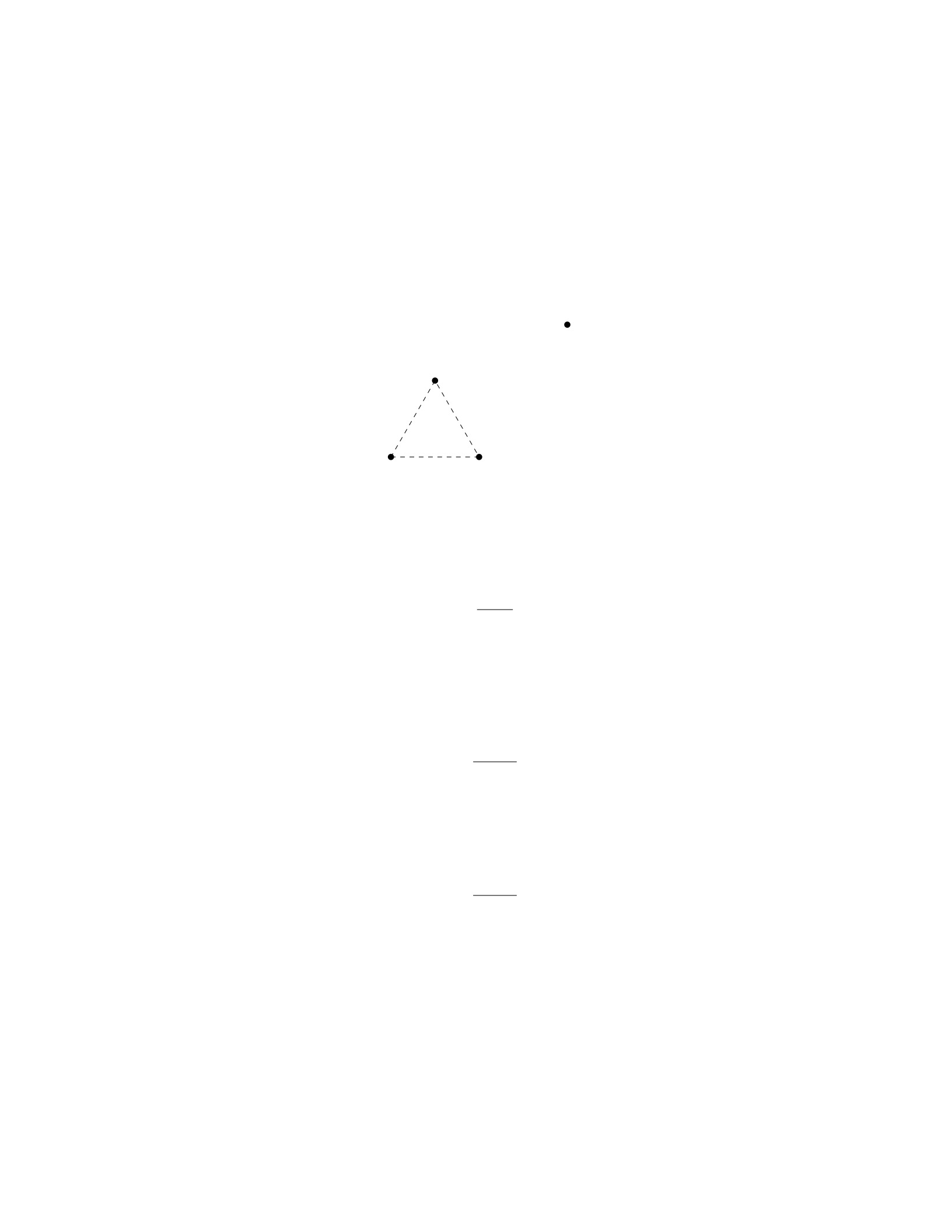
Question 10
Question
Three point charges are arranged as shown in the diagram below. Find the
electric field at point P due to these charges using the superposition principle.
−q+2q
−3q
P
Solution
Step 1: Find the electric field at point P due to the first charge (−q). The
electric field E1at point P due to the charge −qis given by Coulomb’s law:
E1=k· |q|
r2
where k= 8.99 ×10⁹N m2/C2is Coulomb’s constant, q=−qis the charge,
and ris the distance from the charge to point P.
Step 2: Find the electric field at point P due to the second charge (+2q).
The electric field E2at point P due to the charge +2qis given by Coulomb’s
law:
E2=k· |2q|
r2
where k= 8.99 ×10⁹N m2/C2is Coulomb’s constant, q= 2qis the charge,
and ris the distance from the charge to point P.
Step 3: Find the electric field at point P due to the third charge (−3q). The
electric field E3at point P due to the charge −3qis given by Coulomb’s law:
E3=k· |3q|
r2
where k= 8.99×10⁹N m2/C2is Coulomb’s constant, q=−3qis the charge,
and ris the distance from the charge to point P.
Step 4: Apply the superposition principle. The total electric field at point
P is the vector sum of the electric fields due to each charge:
Etotal =E1+E2+E3
11

Calculate the magnitudes and directions of each electric field using the dis-
tances from each charge to point P, and then find the total electric field at point
P by adding these vectors together.
Question 11
Question
Three charges are arranged along the x-axis as follows: q1=−2µC at x=−2m,
q2= 3 µC at x= 0 m, and q3=−1µC at x= 4 m. What is the electric field at
a point x= 3 m on the x-axis?
Solution
Step 1: Calculate the electric field contribution from each individual charge.
The electric field at a point due to a point charge is given by the formula:
E=k· |q|
r2
where kis the Coulomb constant (8.99 ×10⁹N m2/C2), qis the charge, and r
is the distance from the charge to the point where the field is being calculated.
Let’s calculate the electric field contribution from each charge at the point
x= 3 m.
For q1=−2µC at x=−2m:
E1=k·|−2µC|
(3 + 2)2=8.99 ×109·2×10−6
52= 2.8784 ×10⁶N/C
For q2= 3 µC at x= 0 m:
E2=k· |3µC|
32=8.99 ×109·3×10−6
32= 8.99 ×10⁶N/C
For q3=−1µC at x= 4 m:
E3=k·|−1µC|
(3 −4)2=8.99 ×109·1×10−6
12= 8.99 ×10⁹N/C
Step 2: Find the direction of each electric field contribution. Since q1is neg-
ative, its electric field points towards the left. q2’s electric field points towards
the right, and q3’s electric field also points towards the right.
Step 3: Combine the electric field contributions. We need to add the elec-
tric field contributions from each charge as vectors, taking into account their
directions.
Since E1and E3are in opposite directions, we need to subtract E3from E1
and then add E2:
12

Etotal =E2+E1−E3= 8.99 ×10⁶+ 2.8784 ×10⁶−8.99 ×10⁹
Etotal =−8.99 ×10⁹+ 11.8684 ×106=−8.9881 ×10⁹N/C
Therefore, the electric field at x= 3 m on the x-axis is −8.9881 ×10⁹N/C
pointing towards the left.
Question 12
Question
Three point charges are arranged along the x-axis as follows: q1=−2µC at
x= 0,q2= 4µC at x= 2 m, and q3=−6µC at x= 4 m. Calculate the
magnitude and direction of the electric field at a point located 3 meters to the
right of the charge q1.
Solution
Step 1: Calculate the electric fields due to each individual charge using the
formula E=k|q|
r2.
• For charge q1=−2µC at x= 0 m:
E1=k|q1|
(3)2
• For charge q2= 4µC at x= 2 m:
E2=k|q2|
(1)2
• For charge q3=−6µC at x= 4 m:
E3=k|q3|
(1)2
Step 2: Determine the direction of each electric field using the principle
that electric field lines point away from positive charges and towards negative
charges.
Step 3: Calculate the net electric field at the point 3 meters to the right of
q1by summing the individual electric fields:
Enet =
E1+
E2+
E3
Step 4: Add the individual electric fields in the appropriate direction to find
the net electric field.
13

Question 13
Question
Three charges are positioned as follows: a charge of +2.0µC at the origin, a
charge of −3.0µC at (0, 4.0m), and a charge of +4.0µC at (3.0m, 0). What is
the magnitude and direction of the electric field at the point (1.0m, 2.0m)?
Solution
Step 1: Calculate the electric field contribution from each charge individually
using the formula E=kq
r2, where k= 8.99 ×10⁹N m2/C2.
•Charge at the origin (+2.0µC):
The distance between the charge at the origin and the point (1.0m, 2.0m)
is √12+ 22=√5.
E1= 8.99 ×109×2.0×10−6
5= 0.7192 N/C
The direction of the electric field from this charge is along the line con-
necting the charge and the point.
•Charge at (0, 4.0m) (−3.0µC):
The distance between the charge at (0, 4.0m) and the point (1.0m, 2.0m)
is √12+ 22+ 42=√21.
E2= 8.99 ×10⁹×−3.0×10⁻⁶
21 =−0.3857 N/C
The direction of the electric field from this charge is along the line con-
necting the charge and the point.
•Charge at (3.0m, 0) (+4.0µC):
The distance between the charge at (3.0m, 0) and the point (1.0m, 2.0m)
is √22+ 32=√13.
E3= 8.99 ×109×4.0×10−6
13 = 2.2688 N/C
The direction of the electric field from this charge is along the line con-
necting the charge and the point.
Step 2: Find the total electric field at the point (1.0m, 2.0m) by summing
the individual electric field contributions in vector form.
E=
E1+
E2+
E3
E= (0.7192 N/C ˆr1)+(−0.3857 N/C ˆr2) + (2.2688 N/C ˆr3)
14

The resultant electric field magnitude can be calculated as:
E=qE2
total,x +E2
total,y
E=p(0.7192)2+ (−0.3857)2+ (2.2688)2= 2.5125 N/C
The direction of the electric field at the point (1.0m, 2.0m) can be found by
taking the arctangent of the ratios of the components:
θ= tan−1Etotal,y
Etotal,x
θ= tan−1−0.3857
0.7192 =−28.4◦
Therefore, the magnitude of the electric field at the point (1.0m
Question 14
Question
Three charges are placed at the vertices of an equilateral triangle with side
length a. The charges are +q,−q, and +2q. Calculate the electric field at the
center of the triangle.
Solution
To find the electric field at the center of the equilateral triangle, we will first
find the electric field contribution from each charge individually and then sum
them up using the principle of superposition.
Step 1: Electric field due to the charge +q
The magnitude of the electric field due to a point charge qat a distance ris
given by Coulomb’s law:
E=k|q|
r2
where kis the Coulomb constant (8.988 ×10⁹N m2/C2).
In this case, the distance from the center of the equilateral triangle to any
of its vertices (where the charge +qis located) is a/√3.
Therefore, the electric field due to the charge +qat the center of the triangle
is:
E1=k|q|
(a/√3)2
E1=kq√3
a2
15

Step 2: Electric field due to the charge −q
Similarly, the electric field due to the charge −qat the center of the triangle
is:
E2=k|q|
(a/√3)2
E2=kq√3
a2
Step 3: Electric field due to the charge +2q
Finally, the electric field due to the charge +2qat the center of the triangle
is:
E3=k|2q|
(a/√3)2
E3=k2q√3
a2
Step 4: Total electric field at the center of the triangle
By the principle of superposition, the total electric field at the center of the
equilateral triangle is the vector sum of the electric fields due to each charge:
Etotal =
E1+
E2+
E3
Since the electric fields due to charges +qand −qare equal in magnitude but
opposite in direction, they cancel each other out. Therefore, the total electric
field at the center of the triangle is:
Etotal =
E3=k2q√3
a2
Thus, the electric field at the center of the equilateral triangle due to the
given charges +q,−q, and +2qis k2q√3
a2.
Question 16
Question
Three point charges are located along the x-axis: a charge of +4.0µC at x=
−2.0m, a charge of −2.0µC at the origin, and a charge of +6.0µC at x= 3.0m.
Calculate the magnitude and direction of the electric field at the point x= 1.0m
on the x-axis.
16

Solution
Step 1: Calculate the electric field contribution at x= 1.0m due to the +4.0µC
charge at x=−2.0m. The electric field E1at x= 1.0m due to the +4.0µC
charge is given by Coulomb’s Law:
E1=k· |q1|
r2
1
where kis the Coulomb constant (8.99 ×10⁹N·m2/C2), q1is the charge
(+4.0µC), r1is the distance from the charge to the point (1.0m−(−2.0m) =
3.0m). Plugging in the values, we get:
E1=(8.99 ×10⁹N·m2/C2)·(4.0×10−6C)
(3.0m)2
E1=35.96 ×10³
9.0= 3.99 ×10³N/C
Step 2: Calculate the electric field contribution at x= 1.0m due to the
−2.0µC charge at the origin. The electric field E2at x= 1.0m due to the
−2.0µC charge is:
E2= 0
since the electric field from a point charge at the same location is zero.
Step 3: Calculate the electric field contribution at x= 1.0m due to the
+6.0µC charge at x= 3.0m. The electric field E3at x= 1.0m due to the
+6.0µC charge is:
E3=k· |q3|
r2
3
where kis the Coulomb constant, q3is the charge (+6.0µC), r3is the distance
from the charge to the point (3.0m−1.0m= 2.0m). Plugging in the values,
we get:
E3=(8.99 ×10⁹N·m2/C2)·(6.0×10−6C)
(2.0m)2= 1.35 ×10⁴N/C
Step 4: Calculate the total electric field at x= 1.0m by adding the contri-
butions from all charges. The total electric field Etotal at x= 1.0m is the vector
sum of E1,E2, and E3:
Etotal
Question 17
Question
Three point charges are arranged as follows: a charge of +2 µC is located at
the origin, a charge of −3µC is located at (0,3m), and a charge of +4 µC is
located at (4 m,0). Calculate the electric field at the point P(3 m,3m)due to
these charges.
17

Solution
Step 1: Calculate the electric field due to each charge separately using Coulomb’s
law. The electric field Eat a point due to a point charge qat a distance ris
given by:
E=k· |q|
r2
where kis Coulomb’s constant (8.99 ×10⁹N m2/C2).
For the charge at the origin (+2 µC):
E1=k· | + 2 µC|
(3 m)2
For the charge at (0,3m)(−3µC):
E2=k·|−3µC|
(3 m)2
For the charge at (4 m,0) (+4 µC):
E3=k· | + 4 µC|
5m
Step 2: Calculate the electric field vectors for each charge. The electric field
is a vector quantity, so we need to determine the direction of each field.
The electric field from the charge at the origin has components along the
positive x and y directions.
The electric field from the charge at (0,3m)has only a y-component.
The electric field from the charge at (4 m,0) has only an x-component.
Step 3: Use the principle of superposition to find the total electric field at
point P. The total electric field at point P due to the three charges is the vector
sum of the individual electric fields:
Etotal =
E1+
E2+
E3
Calculate the magnitudes and directions of
E1,
E2, and
E3using the infor-
mation from Step 1 and Step 2. Then, add these vectors together to find
Etotal
at point P.
Question 18
Question
Three charges are arranged in the x-y plane as shown below: a positive charge
of +3.0µC at the origin, a positive charge of +5.0µC at (0,2.0) m, and a
negative charge of −2.0µC at (2.0,0) m. Determine the electric field at the
point (1.0,1.0) m due to these three charges.
18
Charge Position (x, y)(m)
+3.0µC(0,0)
+5.0µC(0,2.0)
−2.0µC(2.0,0)
Solution
Step 1: Calculate the electric field due to each charge at the point (1.0,1.0) m.
Using the expression for the electric field due to a point charge:
For charge at the origin:
E1=k· |q1|
r2
1
E1=8.99 ×10⁹N m2/C2·3.0×10−6C
(1.0)2
E1= 2.70 ×10⁶N/C
For charge at (0,2.0) m:
E2=k· |q2|
r2
2
E2=8.99 ×10⁹N m2/C2·5.0×10−6C
(1.0)2
E2= 4.49 ×10⁶N/C
For charge at (2.0,0) m:
E3=k· |q3|
r2
3
E3=8.99 ×10⁹N m2/C2·2.0×10−6C
(1.41)2
E3= 2.41 ×10⁶N/C
Step 2: Calculate the net electric field at the point (1.0,1.0) m by considering
the vector sum of the individual electric fields.
Let’s consider the electric field due to the positive charges as positive and
the electric field due to the negative charge as negative.
The angle between the electric field due to each charge and the x-axis is 45◦.
Enet =qE2
1+E2
2−2E1E2cos(45◦)−E3
Enet =p(2.70 ×10⁶)2+ (4.49 ×10⁶)2−2(2.70 ×10⁶)(4.49 ×10⁶) cos(45◦)−2.41×10⁶
Enet = 7.5×10⁶N/C
Therefore, the electric field at the point (1.0,1.0) m due to the three charges
is 7.5×10⁶N/C.
19

Question 19
Question
Three point charges are arranged on the x-axis as follows: a charge of +4 µC at
x=−2m, a charge of −2µC at x= 0 m, and a charge of +3 µC at x= 3 m.
Calculate the electric field at the point Plocated on the x-axis at x= 1 m due
to these three charges.
Solution
Step 1: Calculate the electric field due to the +4 µC charge at x=−2m. The
electric field E1at point Pdue to charge q1is given by Coulomb’s law:
E1=k· |q1|
r2
1
where k= 8.99 ×10⁹N m2/C2is the Coulomb constant, |q1|= 4 ×10⁻⁶C is
the magnitude of the charge, and r1= 3 m is the distance between the charge
and point P.
Plugging in the given values:
E1=8.99 ×109·4×10−6
(−2−1)2
E1=35.96 ×10³
9
E1= 3995.56 N/C (to the left)
Step 2: Calculate the electric field due to the −2µC charge at x= 0 m. The
electric field E2at point Pdue to charge q2is given by Coulomb’s law:
E2=k· |q2|
r2
2
where |q2|= 2 ×10⁻⁶C, and r2= 1 m.
Plugging in the given values:
E2=8.99 ×109·2×10−6
12
E2= 17.98 ×10³
E2= 17980 N/C (to the right)
Step 3: Calculate the electric field due to the +3 µC charge at x= 3 m. The
electric field E3at point Pdue to charge q3is given by Coulomb’s law:
E3=k· |q3|
r2
3
20
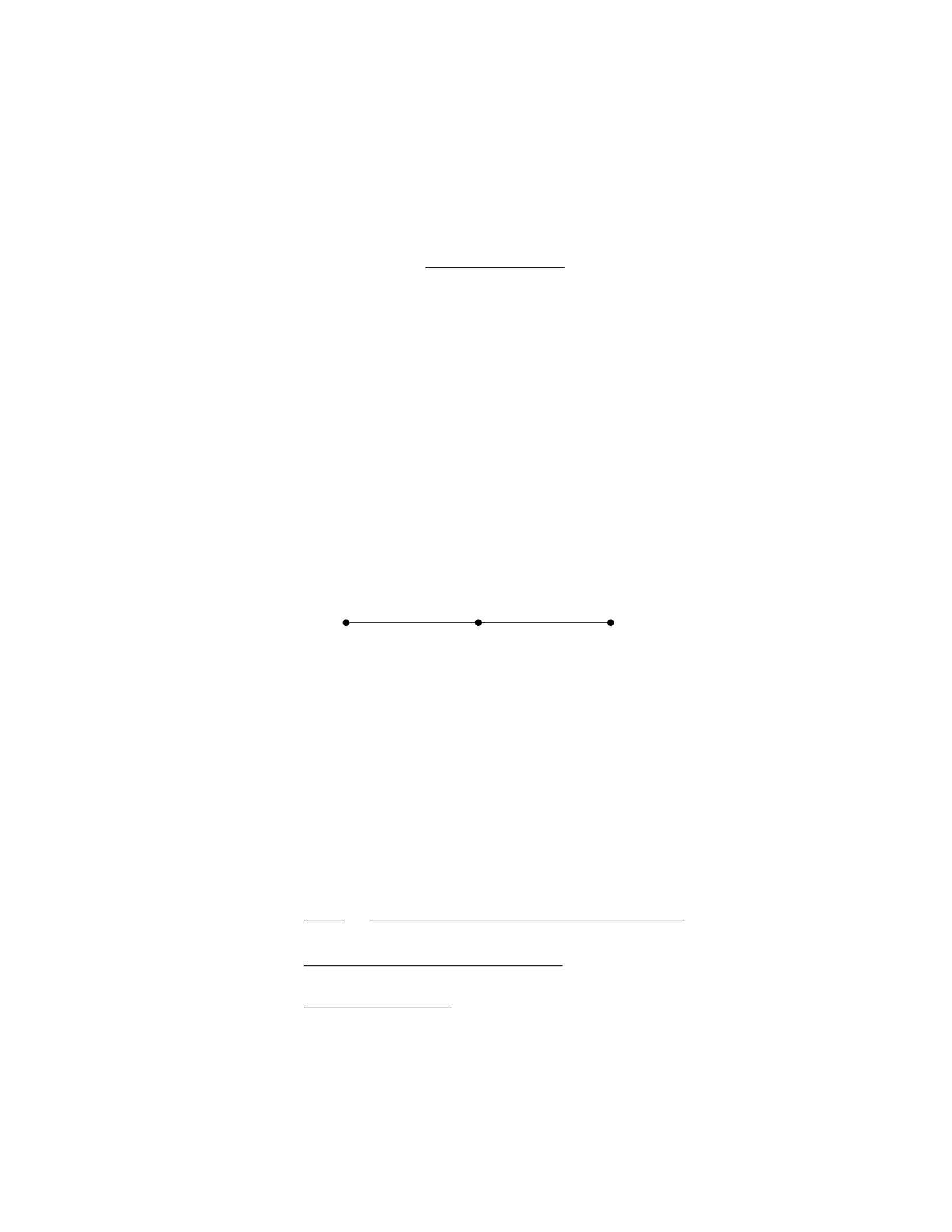
where |q3|= 3 ×10⁻⁶C, and r3= 2 m.
Plugging in the given values:
E3=8.99 ×109·3×10−6
22
E3= 13.485 ×10³
E3= 13485 N/C (to the left)
Step 4: Calculate the total electric field at point P. The total electric field
at point Pis the vector sum of the individual electric fields:
Etotal =E1+E2+E3= 3995.56 N/C −17980 N/C + 13485 N/C
Etotal =−5320.44 N/C (to the left)
Therefore, the electric field at point
Question 20
Question
Three charges are arranged in a line as shown below:
−q2dq
Given that q= 8 nC, d= 2 m, and k= 8.99 ×10⁹N m2/C2, find the
magnitude of the electric force acting on the positive charge q.
Solution
Step 1: Calculate the distance between each charge and the positive charge q.
r1= 2d= 2(2 m) = 4 m
r2=d= 2 m
Step 2: Calculate the magnitudes of the electric forces F1and F2due to
charges −qand −qacting on q.
F1=k|q||q|
r2
1
=(8.99 ×10⁹N m2/C2)(8 ×10−9C)(8 ×10⁻⁹C)
(4 m)2
=(7.192 ×10⁻⁸N)(8.99 ×10⁹N m2/C2)
16 m2
=0.646 ×10²N·m2/C2
16
= 4.04 N
21

F2=k|q||q|
r2
2
=(8.99 ×10⁹N m2/C2)(8 ×10−9C)(8 ×10⁻⁹C)
(2 m)2
=(7.192 ×10⁻⁸N)(8.99 ×10⁹N m2/C2)
4m2
=0.646 ×10²N·m2/C2
4
= 16.16 N
Step 3: The total electric force on qis given by the sum of F1and F2.
Total electric force =F1+F2= 4.04 N+ 16.16 N= 20.20 N
Therefore, the magnitude of the electric force acting on the positive charge
qis 20.20 N.
Question 22
Question
Three point charges are placed on the x-axis: a charge of +3.0µC at x= 0 m, a
charge of −5.0µC at x= 2.0m, and a charge of +2.0µC at x= 4.0m. Calculate
the electric field at a point x= 3.0mon the x-axis due to these charges.
Solution
Step 1: Calculate the electric field due to each individual charge at the point
x= 3.0musing Coulomb’s Law:
For the +3.0µC charge at x= 0 m: The distance between the charge and
the point is r1= 3.0m−0m= 3.0m. The electric field E1at x= 3.0mdue to
this charge is given by:
E1=k·|q1|
r2
1
E1= (8.99 ×10⁹Nm2/C2)·3.0×10−6C
(3.0m)2
E1= 1.0×10⁵N/C
For the −5.0µC charge at x= 2.0m: The distance between the charge and
the point is r2= 3.0m−2.0m= 1.0m. The electric field E2at x= 3.0mdue
to this charge is given by:
E2=k·|q2|
r2
2
E2= (8.99 ×10⁹Nm2/C2)·5.0×10−6C
(1.0m)2
22

E2= 4.5×10⁶N/C
For the +2.0µC charge at x= 4.0m: The distance between the charge and
the point is r3= 4.0m−3.0m= 1.0m. The electric field E3at x= 3.0mdue
to this charge is given by:
E3=k·|q3|
r2
3
E3= (8.99 ×10⁹Nm2/C2)·2.0×10−6C
(1.0m)2
E3= 1.8×10⁶N/C
Step 2: Calculate the total electric field at x= 3.0mdue to the superposition
of the individual electric fields:
The total electric field Eat x= 3.0mis the vector sum of the individual
electric fields E1,E2, and E3,
E=E1+E2+E3
E= 1.0×10⁵N/C + 4.5×10⁶N/C + 1.8×10⁶N/C
E= 6.3×10⁶N/C
Therefore, the electric field at x= 3.0mon the x-axis due to the three
charges is 6.3×10⁶N/C directed along the positive x-direction.
Question 23
Question
Three point charges are arranged as follows: charge q1=−2µC is located at
(0,0), charge q2= 3 µC is located at (0,3m), and charge q3=−4µC is located
at (4m,0). Calculate the electric field at point P, which is located at (3m,4m).
Solution
1. Calculate the electric field due to charge q1at point P using the formula for
electric field:
E1=k|q1|
r2
1
where k= 9 ×10⁹Nm2/C2,q1=−2µC, and r1is the distance from q1to point
P.
2. Calculate the distance r1between q1and point P using the distance
formula:
r1=p(3 −0)2+ (4 −0)2
3. Substitute the values into the equation for E1to find the electric field
due to q1at point P.
23
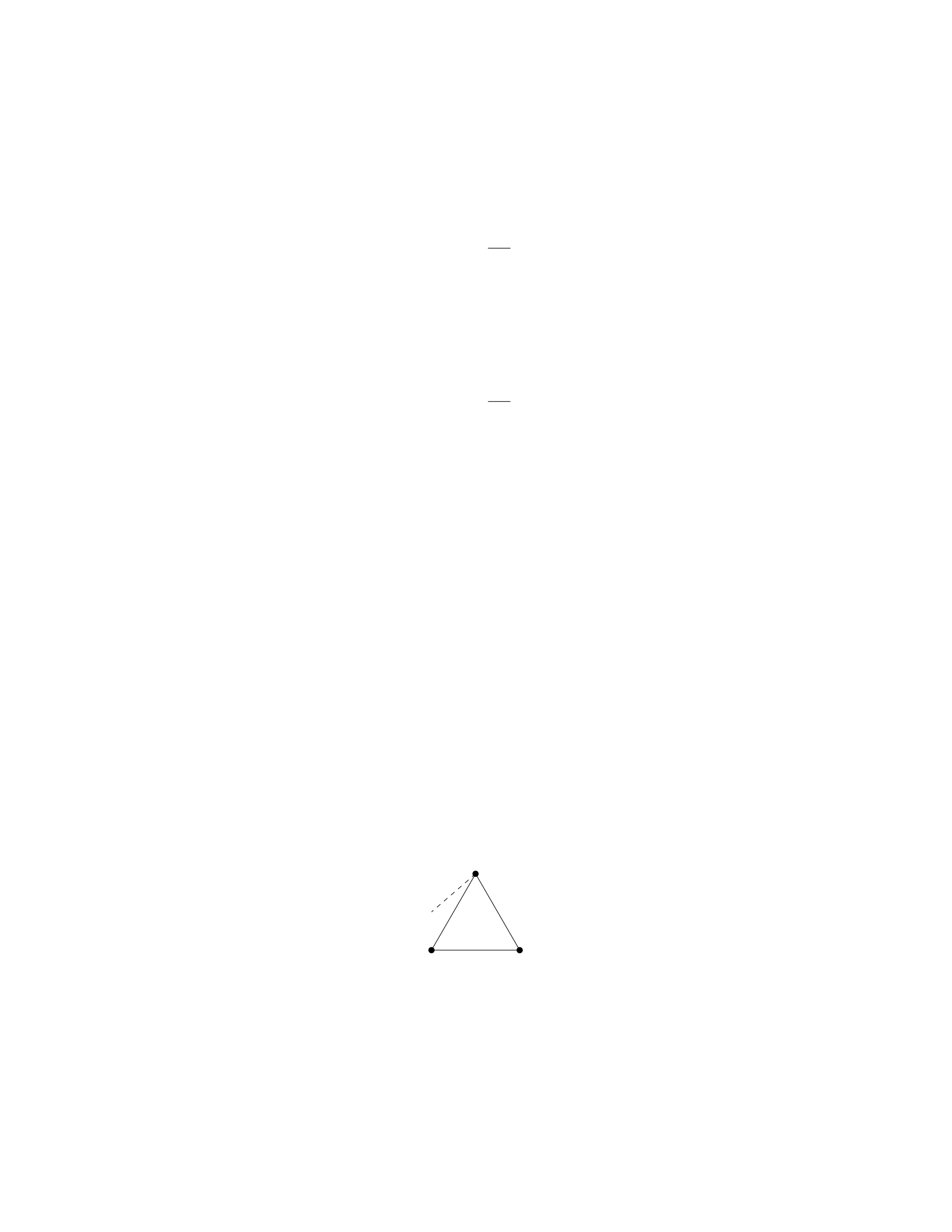
4. Calculate the electric field due to charge q2at point P using the formula
for electric field:
E2=k|q2|
r2
2
where q2= 3 µC, and r2is the distance from q2to point P.
5. Calculate the distance r2between q2and point P.
6. Substitute the values into the equation for E2to find the electric field
due to q2at point P.
7. Calculate the electric field due to charge q3at point P using the formula
for electric field:
E3=k|q3|
r2
3
where q3=−4µC, and r3is the distance from q3to point P.
8. Calculate the distance r3between q3and point P.
9. Substitute the values into the equation for E3to find the electric field
due to q3at point P.
10. Finally, find the total electric field at point P by summing the electric
fields due to each charge using the principle of superposition:
Etotal =E1+E2+E3
11. Calculate the magnitude and direction of the total electric field at point
P.
Question 24
Question
Three point charges are arranged at the vertices of an equilateral triangle as
shown below. Charge q1=−5µC is located at point A, charge q2= 8 µC is at
point B, and charge q3=−3µC is at point C. Calculate the electric field at the
following point P, which is at a distance rfrom point A along the perpendicular
bisector of side BC. Use ras a variable in your final answer. Given that the
side length of the equilateral triangle is 10 cm.
AB
C
r
24

Solution
Step 1: Calculate the electric field contribution at point P due to charge q1=
−5µC at point A. Let this contribution be E1. The electric field due to a point
charge qat a distance rfrom it is given by the formula:
E=k· |q|
r2·ˆr
where kis Coulomb’s constant (8.987 ×10⁹N m2/C2) and ˆris the unit vector
in the direction from the charge to the point P.
The magnitude of the electric field at point P due to charge q1is:
E1=k· |q1|
r2
Step 2: Calculate the electric field contribution at point P due to charge
q2= 8 µC at point B. Let this contribution be E2. The magnitude of the
electric field at point P due to charge q2can be calculated using the same
formula as above:
E2=k· |q2|
r2
Step 3: Calculate the electric field contribution at point P due to charge
q3=−3µC at point C. Let this contribution be E3. The magnitude of the
electric field at point P due to charge q3can be calculated using the same
formula as above:
E3=k· |q3|
r2
Step 4: Calculate the total electric field at point P by summing the contri-
butions from each charge. The total electric field at point P is given by:
E=E1+E2+E3
The final expression for the total electric field at point P will be in terms of
r.
Question 25
Question
Three point charges are arranged on the x-axis as follows: q1= +2.0µC at
the origin, q2=−3.0µC at x= +4.0m, and q3= +1.0µC at x=−3.0m.
Calculate the electric field at the point x= +1.0m on the x-axis. Given:
k= 8.99 ×10⁹N m2/C2
25

Solution
Step 1: Calculate the electric field due to each individual charge at the point
x= +1.0m using the formula for electric field due to a point charge:
Eq1=k· |q1|
(+1.0m)2
Step 2: Substitute the given values of k,q1, and xinto the formula to find
Eq1:
Eq1=(8.99 ×10⁹N m2/C2)·(2.0×10−6C)
(+1.0m)2
Eq1=17.98 N
1.0m2
Eq1= 17.98 N/C (due to q1)
Step 3: Repeat Steps 1 and 2 for charges q2and q3to find Eq2and Eq3:
Eq2=k· |q2|
(−3.0m−1.0m)2
Eq3=k· |q3|
(+1.0m+ 3.0m)2
Step 4: Substitute the given values of k,q, and xinto the formulas to find
Eq2and Eq3:
Eq2=(8.99 ×10⁹N m2/C2)·(3.0×10−6C)
(−4.0m)2
Eq2=26.97 N
16.0m2
Eq2= 1.686 N/C (due to q2)
Eq3=(8.99 ×10⁹N m2/C2)·(1.0×10−6C)
(+4.0m)2
Eq3=8.99 N
16.0m2
Eq3= 0.562 N/C (due to q3)
Step 5: Calculate the total electric field at x= +1.0m by summing the
individual electric fields with proper signs:
Etotal =Eq1+Eq2+Eq3
Etotal = 17.98 N/C −1.686 N/C + 0.
26

Given r1=p(2 −0)2+ (2 −0)2=√8 = 2√2, and ˆr1=P−q1
|P−q1|=<2,2>
√8=<
1,1>.
Therefore,
E1=(8.99×109)·(3×10−6)
(2√2)2<1,1>= 6.36 ×10³<1,1>N/C.
Step 2: Calculate the electric field produced by q2.The electric field
E2produced by q2at point P(2,2) is given by Coulomb’s Law:
E2=k· |q2|
r2
2
ˆr2
Question 2
Question
Three point charges are placed at the vertices of an equilateral triangle as shown
below:
+q
−q+q
(a) Calculate the electric field at the third vertex due to the other two
charges.
(b) If q= 2 ×10⁻⁶C and the side length of the triangle is 0.1 m, what is the
magnitude and direction of the electric field at the third vertex?
Solution
(a) To calculate the electric field at the third vertex due to the other two charges,
we can use the principle of superposition. The electric field at the third vertex
is the vector sum of the electric fields created by each of the other charges
individually.
Step 1: Calculate the electric field due to the positive charge +qat the
third vertex.
The electric field at the third vertex due to the charge +qcan be calculated
using the equation for electric field created by a point charge:
E+q=k· |q|
r2
where kis the Coulomb constant, |q|is the magnitude of the charge, and r
is the distance between the charge and the point where the electric field is being
calculated.
Step 2: Calculate the direction of the electric field due to the positive charge
+q.
Since the charge +qis positive, the electric field created by it will radiate
away from the charge.
Step 3: Calculate the electric field due to the negative charge −qat the
third vertex.
2

Similarly, the electric field at the third vertex due to the charge −qcan be
calculated using the same equation for electric field.
E−q=k·|−q|
r2
Step 4: Calculate the direction of the electric field due to the negative
charge −q.
Since the charge −qis negative, the electric field created by it will point
toward the charge.
Step 5: Calculate the total electric field at the third vertex.
The total electric field at the third vertex is the vector sum of the electric
fields due to the positive and negative charges.
Etotal =
E+q+
E−q
(b) Given that q= 2 ×10⁻⁶C and the side length of the triangle is 0.1 m,
we can now calculate the magnitude and direction of the electric field at the
third vertex using the superposition principle and the electric field equations.
Question 3
Question
Three charges are placed on the x-axis as follows: q1= +2µC at x=−1m,
q2=−3µC at x= 0, and q3= +4µC at x= +1m. Calculate the electric field
at the origin due to these charges.
Solution
In order to find the electric field at the origin (x= 0) due to the three charges
on the x-axis, we will calculate the electric fields due to each charge separately
and then use the superposition principle to add them up.
Step 1: Calculate the electric field due to q1at the origin. The electric field
E1due to q1can be calculated using the formula:
E1=k· |q1|
r2
1
where k= 8.99 ×10⁹N m2/C2is the Coulomb constant and r1= 1mis the
distance from q1to the origin. Substituting the values, we get:
E1=(8.99 ×10⁹N m2/C2)·2×10−6C
(1m)2= 1.798 ×10⁶N/C
Step 2: Calculate the electric field due to q2at the origin. The electric
field E2due to q2can be calculated using the same formula as above, with
3

q2=−3µC and r2= 0 as q2is at the origin. Since r2= 0, the electric field due
to q2is zero.
Step 3: Calculate the electric field due to q3at the origin. The electric field
E3due to q3can be calculated using the same formula as above, with q3= 4µC
and r3= 1mas the distance from q3to the origin. Substituting the values, we
get:
E3=(8.99 ×10⁹N m2/C2)·4×10−6C
(1m)2= 3.597 ×10⁶N/C
Step 4: Apply the principle of superposition. The total electric field at the
origin, Etotal, is the vector sum of the individual electric fields:
Etotal =E1+E2+E3= 1.798×10⁶N/C+0+3.597×106N/C = 5.395×10⁶N/C
Therefore, the electric field at the origin due to the three charges on the
x-axis is 5.395 ×10⁶N/C directed along the positive x-axis.
Question 4
Question
Three point charges are placed at the vertices of an equilateral triangle with
sides of length d. The charges are all equal in magnitude and are labeled as
follows: qat the top vertex, 2qat the bottom left vertex, and −2qat the
bottom right vertex. Calculate the electric field at the center of the triangle due
to these charges.
Solution
Step 1: Calculate the electric fields due to each individual charge at the center
of the triangle. The electric field due to a point charge qat a distance ris given
by Coulomb’s Law:
E=k· |q|
r2
where kis the Coulomb’s constant (8.99 ×10⁹N m2/C2).
Let E1,E2, and E3be the electric fields due to charges q,2q, and −2q
respectively at the center of the triangle. Since the electric field is a vector
quantity, we need to consider the direction as well.
For the charge qat the top vertex: The distance from the center of the
triangle to the top vertex is d/2. Therefore,
E1=k· |q|
(d/2)2=4kq
d2
This electric field points directly upwards.
4

Step 2: Calculate the electric field due to the 2qcharge at the bottom left
vertex at the center of the triangle. The distance from the center to this charge
is d. The electric field is given by:
E2=k· |2q|
d2=4kq
d2
This electric field points directly to the left.
Step 3: Calculate the electric field due to the −2qcharge at the bottom right
vertex at the center of the triangle. The distance from the center to this charge
is also d. The electric field is given by:
E3=k·|−2q|
d2=4kq
d2
This electric field points directly to the right.
Step 4: Determine the net electric field at the center of the triangle. Since
the electric fields due to the three charges all have the same magnitude and are
directed along three different directions, they will cancel each other out. Thus,
the net electric field at the center of the triangle is 0N/C .
Question 5
Question
Consider three point charges arranged as shown below: q1=−2µC,q2= 4µC,
and q3=−3µC. The charges are placed at the corners of an equilateral triangle
with sides of length a= 1.0m. What is the magnitude and direction of the
force on q1due to the other two charges?
q1(−2µC)
q2(4µC)q3(−3µC)
Solution
Step 1: First, we need to find the electric force on q1due to q2and q3separately,
and then find the net force by summing the individual forces, taking into account
their directions.
The electric force between two point charges q1and q2is given by Coulomb’s
Law:
F=k|q1q2|
r2
where k= 8.99 ×10⁹N·m2/C2is the Coulomb’s constant, q1and q2are the
magnitudes of the charges, and ris the distance between the charges.
5

Step 2: Calculating the force on q1due to q2. The distance between q1
and q2is the same as the side of the equilateral triangle, which is a= 1.0m.
Plugging the values into Coulomb’s Law formula, we get:
F12 =k|q1q2|
a2
F12 = 8.99 ×10⁹N·m2/C2×2×4×10−6
(1.0)2
F12 = 7.19 ×10⁻⁵N
The force exerted by q2on q1is attractive since q2is positive and q1is
negative.
Step 3: Calculating the force on q1due to q3. Similarly, we find the force
exerted by q3on q1using Coulomb’s Law:
F13 =k|q1q3|
a2
F13 = 8.99 ×10⁹N·m2/C2×2×3×10−6
(1.0)2
F13 = 5.39 ×10⁻⁵N
The force exerted by q3on q1is repulsive since q3is negative and q1is
negative.
Step 4: Calculating the net force on q1. The net force on q1is the vector
sum of the forces F12 and F13. Since these forces act along the same line (from
different directions), the magnitude of the net force is:
Fnet =|F12 −F13|
Therefore,
Fnet =
7.19 ×10⁻⁵−5.39 ×10⁻⁵
Fnet = 1.8×10⁻⁵N
The direction of the net force is directed towards the positive charge q2.
Question 6
Question
Three charges are placed at the corners of an equilateral triangle as shown below:
Charge Q1=−4µC at the top vertex, charge Q2= 3 µC at the bottom left
vertex, and charge Q3= 5 µC at the bottom right vertex. Calculate the net
electric field at the center of the equilateral triangle due to these three charges.
6
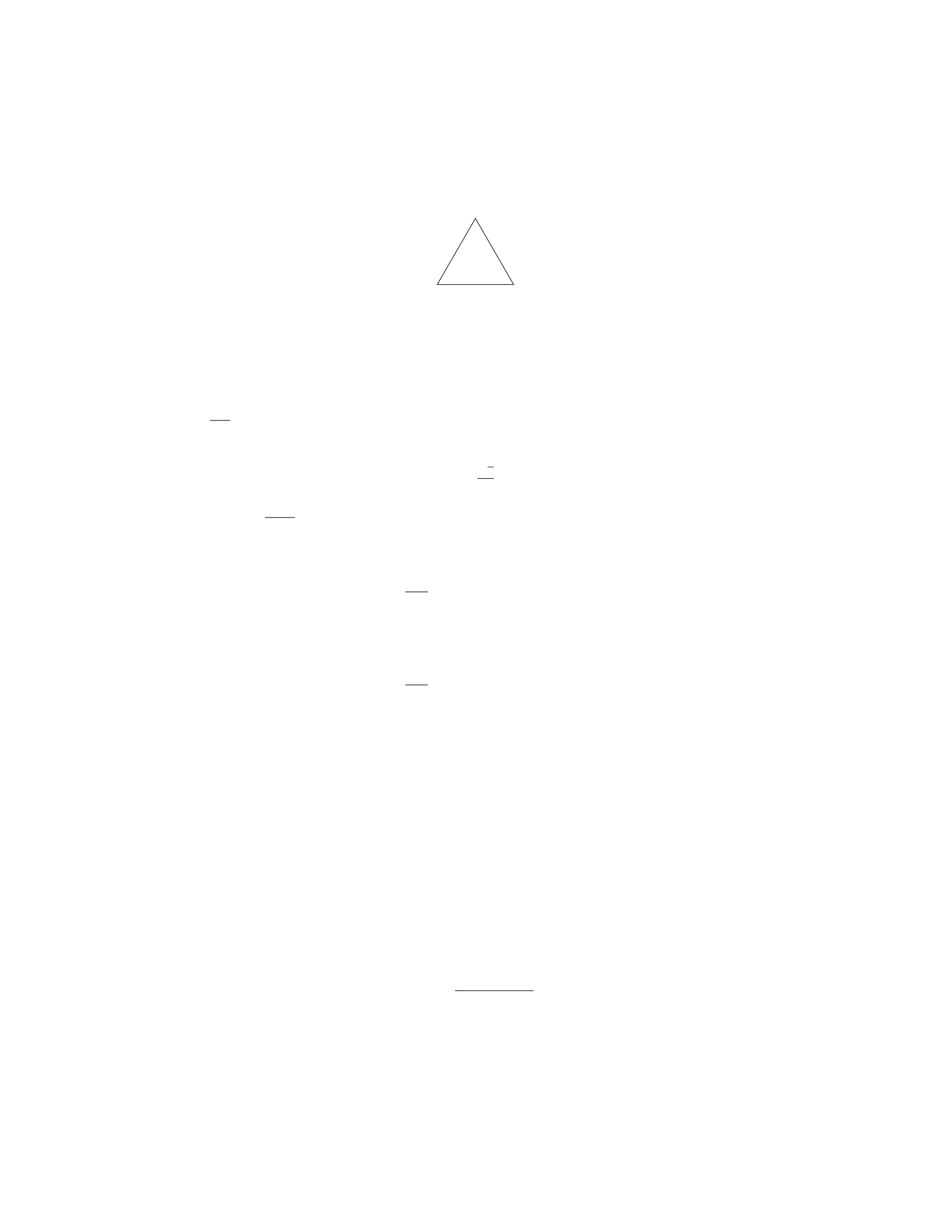
Q2Q3
Q1
Solution
Step 1: Calculate the electric field due to each charge at the center of the
equilateral triangle.
The electric field
Eat a distance rfrom a point charge Qis given by
E=
k·Q
r2ˆr, where kis Coulomb’s constant, ˆris the unit vector pointing from the
charge to the point, and ris the distance from the charge to the point.
For Q1=−4µC: The distance from Q1to the center of the triangle is the
height of the equilateral triangle h=√3
2s, where sis the side length of the
equilateral triangle. The magnitude of the electric field due to Q1at the center
is E1=k|Q1|
h2. The direction of the electric field due to Q1at the center points
along the line connecting the charge and the center of the equilateral triangle.
For Q2= 3 µC: The distance from Q2to the center of the triangle is the
side length of the equilateral triangle s. The magnitude of the electric field due
to Q2at the center is E2=kQ2
s2. The direction of the electric field due to Q2
at the center points along the line connecting the charge and the center of the
equilateral triangle.
For Q3= 5 µC: The distance from Q3to the center of the triangle is the
side length of the equilateral triangle s. The magnitude of the electric field due
to Q3at the center is E3=kQ3
s2. The direction of the electric field due to Q3
at the center points along the line connecting the charge and the center of the
equilateral triangle.
Question 7
Question
Three point charges are placed on the x-axis: q1=−2nC at x=−0.5m,
q2= 3 nC at x= 0 m, and q3=−4nC at x= 1 m. What is the magnitude and
direction of the force on a 5nC charge placed at the origin due to these charges?
Solution
Step 1: Calculate the force on the 5nC charge from q1using Coulomb’s Law:
F1=k|q1||qorigin|
r2
7

where: kis Coulomb’s constant (8.99 ×10⁹N·m2/C2), q1=−2nC, qorigin =
5nC, r= 0.5m. Plugging in the values:
F1=(8.99 ×10⁹)(2 ×10⁻⁹)(5 ×10⁻⁹)
0.52
F1=8.99 ×2×5
0.25
F1=89.9
0.25
F1= 359.6N
The force from q1is attractive and acts towards the origin.
Step 2: Calculate the force on the 5nC charge from q2:
F2= 0
Since q2is at the origin, the force it exerts on the charge at the origin will be
zero.
Step 3: Calculate the force on the 5nC charge from q3:
F3=k|q3||qorigin|
r2
where: q3=−4nC, r= 1 m. Plugging in the values:
F3=(8.99 ×10⁹)(4 ×10⁻⁹)(5 ×10⁻⁹)
12
F3=8.99 ×4×5
1
F3=35.96
1
F3= 35.96 N
The force from q3is repulsive and acts away from the origin.
Step 4: Calculate the net force on the 5nC charge by summing the individual
forces:
Fnet =F1+F2+F3
Fnet = 359.6N+ 0 N+ 35.96 N
Fnet = 395.56 N
The net force on the 5nC charge is 395.56 N, directed towards the origin.
8

Question 8
Question
Three point charges are arranged as follows: - Charge q1= +3 µC is located at
(0,0) m. - Charge q2=−2µC is located at (0,4) m. - Charge q3= +4 µC is
located at (3,0) m.
Determine the electric field at the point (4,4) m due to these three charges.
Solution
The electric field at point (4,4) m due to the three charges can be determined
by calculating the contributions of each charge individually and then summing
them up according to the superposition principle.
Step 1: Calculate the electric field contribution from charge q1.
The distance between charge q1and point (4,4) is r1=p(4 −0)2+ (4 −0)2=
√32 = 4√2m. The electric field contribution from charge q1at point (4,4) is
given by:
E1=k· |q1|
r2
1·ˆr1
where kis Coulomb’s constant and ˆr1is the unit vector pointing from charge
q1to the point (4,4).
Step 2: Calculate the electric field contribution from charge q2.The
distance between charge q2and point (4,4) is r2=p(4 −0)2+ (4 −4)2= 4 m.
The electric field contribution from charge q2at point (4,4) is given by:
E2=k· |q2|
r2
2·ˆr2
where ˆr2is the unit vector pointing from charge q2to the point (4,4).
Step 3: Calculate the electric field contribution from charge q3.
The distance between charge q3and point (4,4) is r3=p(4 −3)2+ (4 −0)2=
√22+ 42=√20 = 2√5m. The electric field contribution from charge q3at
point (4,4) is given by:
E3=k· |q3|
r2
3·ˆr3
where ˆr3is the unit vector pointing from charge q3to the point (4,4).
Step 4: Sum up the electric field contributions from all charges.
The total electric field at point (4,4) is given by the vector sum of the contri-
butions from each charge:
Etotal =
E1+
E2+
E3
Now, substitute the values of k,q1,q2,q3,r1,r2,r3,ˆr1,ˆr2, and ˆr3into the
above expressions to find the total electric field.
9

Question 9
Question
Three point charges are arranged along the x-axis. Charge q1=−2.0µC is at
the origin, charge q2= 1.0µC is at x= 4.0m, and charge q3=−3.0µC is at
x= 10.0m. What is the magnitude and direction of the electric field at a point
on the x-axis where x= 6.0m?
Solution
Step 1: Calculate the electric field contribution from q1at the point x= 6.0m.
The electric field from a point charge is given by the equation:
E=k|q|
r2
where - kis the Coulomb constant, 8.9875 ×10⁹N m2/C2, - qis the charge, - r
is the distance from the charge to the point.
The distance from q1to the point is 6.0m. The charge q1=−2.0µC =
−2.0×10⁻⁶C. Thus, the electric field from q1at x= 6.0m is:
E1=(8.9875 ×10⁹)(| − 2.0×10⁻⁶|)
(6.0)2
Step 2: Calculate the electric field contribution from q2at the point x= 6.0
m. The distance from q2to the point is 2.0m. The charge q2= 1.0µC =
1.0×10⁻⁶C. Thus, the electric field from q2at x= 6.0m is:
E2=(8.9875 ×10⁹)(1.0×10⁻⁶)
(2.0)2
Step 3: Calculate the electric field contribution from q3at the point x= 6.0
m. The distance from q3to the point is 4.0m. The charge q3=−3.0µC =
−3.0×10⁻⁶C. Thus, the electric field from q3at x= 6.0m is:
E3=(8.9875 ×10⁹)(| − 3.0×10⁻⁶|)
(4.0)2
Step 4: Calculate the total electric field at x= 6.0m by summing the
contributions from all three charges. The total electric field magnitude is:
|E|=|E1+E2+E3|
The direction of the electric field is the direction of the sum vector. If the
vector sum is positive, the direction is towards the positive x-axis; if negative,
it is towards the negative x-axis.
10
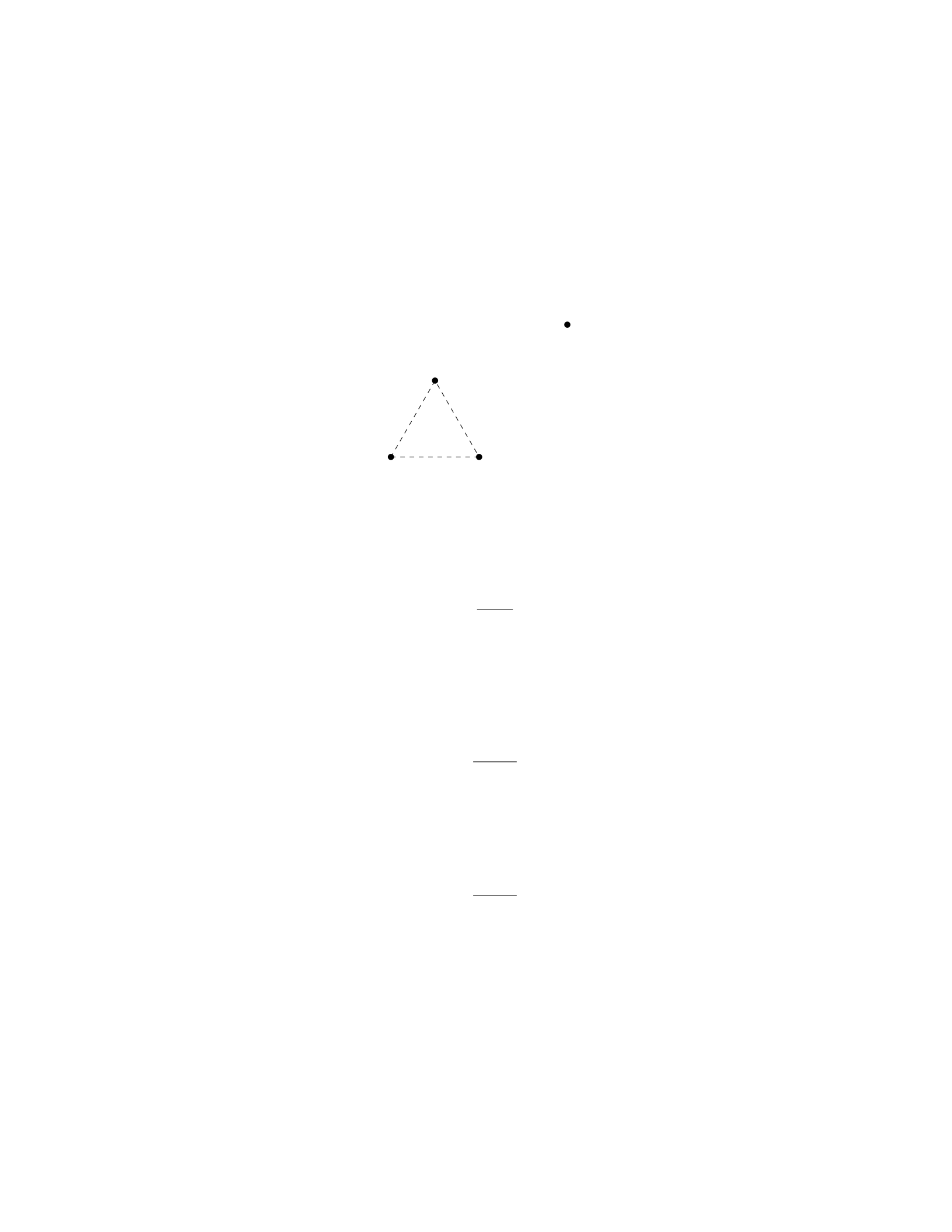
Question 10
Question
Three point charges are arranged as shown in the diagram below. Find the
electric field at point P due to these charges using the superposition principle.
−q+2q
−3q
P
Solution
Step 1: Find the electric field at point P due to the first charge (−q). The
electric field E1at point P due to the charge −qis given by Coulomb’s law:
E1=k· |q|
r2
where k= 8.99 ×10⁹N m2/C2is Coulomb’s constant, q=−qis the charge,
and ris the distance from the charge to point P.
Step 2: Find the electric field at point P due to the second charge (+2q).
The electric field E2at point P due to the charge +2qis given by Coulomb’s
law:
E2=k· |2q|
r2
where k= 8.99 ×10⁹N m2/C2is Coulomb’s constant, q= 2qis the charge,
and ris the distance from the charge to point P.
Step 3: Find the electric field at point P due to the third charge (−3q). The
electric field E3at point P due to the charge −3qis given by Coulomb’s law:
E3=k· |3q|
r2
where k= 8.99×10⁹N m2/C2is Coulomb’s constant, q=−3qis the charge,
and ris the distance from the charge to point P.
Step 4: Apply the superposition principle. The total electric field at point
P is the vector sum of the electric fields due to each charge:
Etotal =E1+E2+E3
11

Calculate the magnitudes and directions of each electric field using the dis-
tances from each charge to point P, and then find the total electric field at point
P by adding these vectors together.
Question 11
Question
Three charges are arranged along the x-axis as follows: q1=−2µC at x=−2m,
q2= 3 µC at x= 0 m, and q3=−1µC at x= 4 m. What is the electric field at
a point x= 3 m on the x-axis?
Solution
Step 1: Calculate the electric field contribution from each individual charge.
The electric field at a point due to a point charge is given by the formula:
E=k· |q|
r2
where kis the Coulomb constant (8.99 ×10⁹N m2/C2), qis the charge, and r
is the distance from the charge to the point where the field is being calculated.
Let’s calculate the electric field contribution from each charge at the point
x= 3 m.
For q1=−2µC at x=−2m:
E1=k·|−2µC|
(3 + 2)2=8.99 ×109·2×10−6
52= 2.8784 ×10⁶N/C
For q2= 3 µC at x= 0 m:
E2=k· |3µC|
32=8.99 ×109·3×10−6
32= 8.99 ×10⁶N/C
For q3=−1µC at x= 4 m:
E3=k·|−1µC|
(3 −4)2=8.99 ×109·1×10−6
12= 8.99 ×10⁹N/C
Step 2: Find the direction of each electric field contribution. Since q1is neg-
ative, its electric field points towards the left. q2’s electric field points towards
the right, and q3’s electric field also points towards the right.
Step 3: Combine the electric field contributions. We need to add the elec-
tric field contributions from each charge as vectors, taking into account their
directions.
Since E1and E3are in opposite directions, we need to subtract E3from E1
and then add E2:
12

Etotal =E2+E1−E3= 8.99 ×10⁶+ 2.8784 ×10⁶−8.99 ×10⁹
Etotal =−8.99 ×10⁹+ 11.8684 ×106=−8.9881 ×10⁹N/C
Therefore, the electric field at x= 3 m on the x-axis is −8.9881 ×10⁹N/C
pointing towards the left.
Question 12
Question
Three point charges are arranged along the x-axis as follows: q1=−2µC at
x= 0,q2= 4µC at x= 2 m, and q3=−6µC at x= 4 m. Calculate the
magnitude and direction of the electric field at a point located 3 meters to the
right of the charge q1.
Solution
Step 1: Calculate the electric fields due to each individual charge using the
formula E=k|q|
r2.
• For charge q1=−2µC at x= 0 m:
E1=k|q1|
(3)2
• For charge q2= 4µC at x= 2 m:
E2=k|q2|
(1)2
• For charge q3=−6µC at x= 4 m:
E3=k|q3|
(1)2
Step 2: Determine the direction of each electric field using the principle
that electric field lines point away from positive charges and towards negative
charges.
Step 3: Calculate the net electric field at the point 3 meters to the right of
q1by summing the individual electric fields:
Enet =
E1+
E2+
E3
Step 4: Add the individual electric fields in the appropriate direction to find
the net electric field.
13

Question 13
Question
Three charges are positioned as follows: a charge of +2.0µC at the origin, a
charge of −3.0µC at (0, 4.0m), and a charge of +4.0µC at (3.0m, 0). What is
the magnitude and direction of the electric field at the point (1.0m, 2.0m)?
Solution
Step 1: Calculate the electric field contribution from each charge individually
using the formula E=kq
r2, where k= 8.99 ×10⁹N m2/C2.
•Charge at the origin (+2.0µC):
The distance between the charge at the origin and the point (1.0m, 2.0m)
is √12+ 22=√5.
E1= 8.99 ×109×2.0×10−6
5= 0.7192 N/C
The direction of the electric field from this charge is along the line con-
necting the charge and the point.
•Charge at (0, 4.0m) (−3.0µC):
The distance between the charge at (0, 4.0m) and the point (1.0m, 2.0m)
is √12+ 22+ 42=√21.
E2= 8.99 ×10⁹×−3.0×10⁻⁶
21 =−0.3857 N/C
The direction of the electric field from this charge is along the line con-
necting the charge and the point.
•Charge at (3.0m, 0) (+4.0µC):
The distance between the charge at (3.0m, 0) and the point (1.0m, 2.0m)
is √22+ 32=√13.
E3= 8.99 ×109×4.0×10−6
13 = 2.2688 N/C
The direction of the electric field from this charge is along the line con-
necting the charge and the point.
Step 2: Find the total electric field at the point (1.0m, 2.0m) by summing
the individual electric field contributions in vector form.
E=
E1+
E2+
E3
E= (0.7192 N/C ˆr1)+(−0.3857 N/C ˆr2) + (2.2688 N/C ˆr3)
14

The resultant electric field magnitude can be calculated as:
E=qE2
total,x +E2
total,y
E=p(0.7192)2+ (−0.3857)2+ (2.2688)2= 2.5125 N/C
The direction of the electric field at the point (1.0m, 2.0m) can be found by
taking the arctangent of the ratios of the components:
θ= tan−1Etotal,y
Etotal,x
θ= tan−1−0.3857
0.7192 =−28.4◦
Therefore, the magnitude of the electric field at the point (1.0m
Question 14
Question
Three charges are placed at the vertices of an equilateral triangle with side
length a. The charges are +q,−q, and +2q. Calculate the electric field at the
center of the triangle.
Solution
To find the electric field at the center of the equilateral triangle, we will first
find the electric field contribution from each charge individually and then sum
them up using the principle of superposition.
Step 1: Electric field due to the charge +q
The magnitude of the electric field due to a point charge qat a distance ris
given by Coulomb’s law:
E=k|q|
r2
where kis the Coulomb constant (8.988 ×10⁹N m2/C2).
In this case, the distance from the center of the equilateral triangle to any
of its vertices (where the charge +qis located) is a/√3.
Therefore, the electric field due to the charge +qat the center of the triangle
is:
E1=k|q|
(a/√3)2
E1=kq√3
a2
15

Step 2: Electric field due to the charge −q
Similarly, the electric field due to the charge −qat the center of the triangle
is:
E2=k|q|
(a/√3)2
E2=kq√3
a2
Step 3: Electric field due to the charge +2q
Finally, the electric field due to the charge +2qat the center of the triangle
is:
E3=k|2q|
(a/√3)2
E3=k2q√3
a2
Step 4: Total electric field at the center of the triangle
By the principle of superposition, the total electric field at the center of the
equilateral triangle is the vector sum of the electric fields due to each charge:
Etotal =
E1+
E2+
E3
Since the electric fields due to charges +qand −qare equal in magnitude but
opposite in direction, they cancel each other out. Therefore, the total electric
field at the center of the triangle is:
Etotal =
E3=k2q√3
a2
Thus, the electric field at the center of the equilateral triangle due to the
given charges +q,−q, and +2qis k2q√3
a2.
Question 16
Question
Three point charges are located along the x-axis: a charge of +4.0µC at x=
−2.0m, a charge of −2.0µC at the origin, and a charge of +6.0µC at x= 3.0m.
Calculate the magnitude and direction of the electric field at the point x= 1.0m
on the x-axis.
16

Solution
Step 1: Calculate the electric field contribution at x= 1.0m due to the +4.0µC
charge at x=−2.0m. The electric field E1at x= 1.0m due to the +4.0µC
charge is given by Coulomb’s Law:
E1=k· |q1|
r2
1
where kis the Coulomb constant (8.99 ×10⁹N·m2/C2), q1is the charge
(+4.0µC), r1is the distance from the charge to the point (1.0m−(−2.0m) =
3.0m). Plugging in the values, we get:
E1=(8.99 ×10⁹N·m2/C2)·(4.0×10−6C)
(3.0m)2
E1=35.96 ×10³
9.0= 3.99 ×10³N/C
Step 2: Calculate the electric field contribution at x= 1.0m due to the
−2.0µC charge at the origin. The electric field E2at x= 1.0m due to the
−2.0µC charge is:
E2= 0
since the electric field from a point charge at the same location is zero.
Step 3: Calculate the electric field contribution at x= 1.0m due to the
+6.0µC charge at x= 3.0m. The electric field E3at x= 1.0m due to the
+6.0µC charge is:
E3=k· |q3|
r2
3
where kis the Coulomb constant, q3is the charge (+6.0µC), r3is the distance
from the charge to the point (3.0m−1.0m= 2.0m). Plugging in the values,
we get:
E3=(8.99 ×10⁹N·m2/C2)·(6.0×10−6C)
(2.0m)2= 1.35 ×10⁴N/C
Step 4: Calculate the total electric field at x= 1.0m by adding the contri-
butions from all charges. The total electric field Etotal at x= 1.0m is the vector
sum of E1,E2, and E3:
Etotal
Question 17
Question
Three point charges are arranged as follows: a charge of +2 µC is located at
the origin, a charge of −3µC is located at (0,3m), and a charge of +4 µC is
located at (4 m,0). Calculate the electric field at the point P(3 m,3m)due to
these charges.
17

Solution
Step 1: Calculate the electric field due to each charge separately using Coulomb’s
law. The electric field Eat a point due to a point charge qat a distance ris
given by:
E=k· |q|
r2
where kis Coulomb’s constant (8.99 ×10⁹N m2/C2).
For the charge at the origin (+2 µC):
E1=k· | + 2 µC|
(3 m)2
For the charge at (0,3m)(−3µC):
E2=k·|−3µC|
(3 m)2
For the charge at (4 m,0) (+4 µC):
E3=k· | + 4 µC|
5m
Step 2: Calculate the electric field vectors for each charge. The electric field
is a vector quantity, so we need to determine the direction of each field.
The electric field from the charge at the origin has components along the
positive x and y directions.
The electric field from the charge at (0,3m)has only a y-component.
The electric field from the charge at (4 m,0) has only an x-component.
Step 3: Use the principle of superposition to find the total electric field at
point P. The total electric field at point P due to the three charges is the vector
sum of the individual electric fields:
Etotal =
E1+
E2+
E3
Calculate the magnitudes and directions of
E1,
E2, and
E3using the infor-
mation from Step 1 and Step 2. Then, add these vectors together to find
Etotal
at point P.
Question 18
Question
Three charges are arranged in the x-y plane as shown below: a positive charge
of +3.0µC at the origin, a positive charge of +5.0µC at (0,2.0) m, and a
negative charge of −2.0µC at (2.0,0) m. Determine the electric field at the
point (1.0,1.0) m due to these three charges.
18
Charge Position (x, y)(m)
+3.0µC(0,0)
+5.0µC(0,2.0)
−2.0µC(2.0,0)
Solution
Step 1: Calculate the electric field due to each charge at the point (1.0,1.0) m.
Using the expression for the electric field due to a point charge:
For charge at the origin:
E1=k· |q1|
r2
1
E1=8.99 ×10⁹N m2/C2·3.0×10−6C
(1.0)2
E1= 2.70 ×10⁶N/C
For charge at (0,2.0) m:
E2=k· |q2|
r2
2
E2=8.99 ×10⁹N m2/C2·5.0×10−6C
(1.0)2
E2= 4.49 ×10⁶N/C
For charge at (2.0,0) m:
E3=k· |q3|
r2
3
E3=8.99 ×10⁹N m2/C2·2.0×10−6C
(1.41)2
E3= 2.41 ×10⁶N/C
Step 2: Calculate the net electric field at the point (1.0,1.0) m by considering
the vector sum of the individual electric fields.
Let’s consider the electric field due to the positive charges as positive and
the electric field due to the negative charge as negative.
The angle between the electric field due to each charge and the x-axis is 45◦.
Enet =qE2
1+E2
2−2E1E2cos(45◦)−E3
Enet =p(2.70 ×10⁶)2+ (4.49 ×10⁶)2−2(2.70 ×10⁶)(4.49 ×10⁶) cos(45◦)−2.41×10⁶
Enet = 7.5×10⁶N/C
Therefore, the electric field at the point (1.0,1.0) m due to the three charges
is 7.5×10⁶N/C.
19

Question 19
Question
Three point charges are arranged on the x-axis as follows: a charge of +4 µC at
x=−2m, a charge of −2µC at x= 0 m, and a charge of +3 µC at x= 3 m.
Calculate the electric field at the point Plocated on the x-axis at x= 1 m due
to these three charges.
Solution
Step 1: Calculate the electric field due to the +4 µC charge at x=−2m. The
electric field E1at point Pdue to charge q1is given by Coulomb’s law:
E1=k· |q1|
r2
1
where k= 8.99 ×10⁹N m2/C2is the Coulomb constant, |q1|= 4 ×10⁻⁶C is
the magnitude of the charge, and r1= 3 m is the distance between the charge
and point P.
Plugging in the given values:
E1=8.99 ×109·4×10−6
(−2−1)2
E1=35.96 ×10³
9
E1= 3995.56 N/C (to the left)
Step 2: Calculate the electric field due to the −2µC charge at x= 0 m. The
electric field E2at point Pdue to charge q2is given by Coulomb’s law:
E2=k· |q2|
r2
2
where |q2|= 2 ×10⁻⁶C, and r2= 1 m.
Plugging in the given values:
E2=8.99 ×109·2×10−6
12
E2= 17.98 ×10³
E2= 17980 N/C (to the right)
Step 3: Calculate the electric field due to the +3 µC charge at x= 3 m. The
electric field E3at point Pdue to charge q3is given by Coulomb’s law:
E3=k· |q3|
r2
3
20
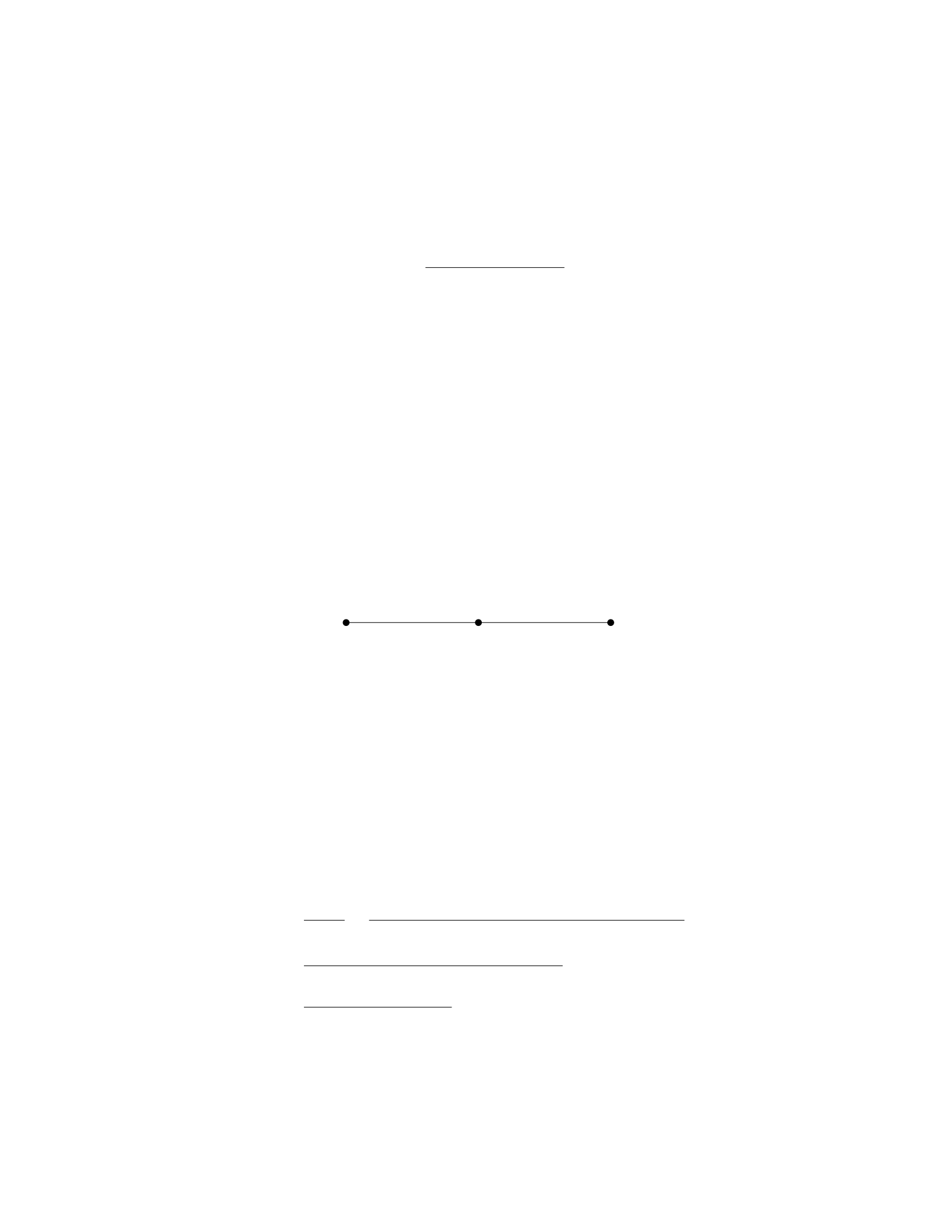
where |q3|= 3 ×10⁻⁶C, and r3= 2 m.
Plugging in the given values:
E3=8.99 ×109·3×10−6
22
E3= 13.485 ×10³
E3= 13485 N/C (to the left)
Step 4: Calculate the total electric field at point P. The total electric field
at point Pis the vector sum of the individual electric fields:
Etotal =E1+E2+E3= 3995.56 N/C −17980 N/C + 13485 N/C
Etotal =−5320.44 N/C (to the left)
Therefore, the electric field at point
Question 20
Question
Three charges are arranged in a line as shown below:
−q2dq
Given that q= 8 nC, d= 2 m, and k= 8.99 ×10⁹N m2/C2, find the
magnitude of the electric force acting on the positive charge q.
Solution
Step 1: Calculate the distance between each charge and the positive charge q.
r1= 2d= 2(2 m) = 4 m
r2=d= 2 m
Step 2: Calculate the magnitudes of the electric forces F1and F2due to
charges −qand −qacting on q.
F1=k|q||q|
r2
1
=(8.99 ×10⁹N m2/C2)(8 ×10−9C)(8 ×10⁻⁹C)
(4 m)2
=(7.192 ×10⁻⁸N)(8.99 ×10⁹N m2/C2)
16 m2
=0.646 ×10²N·m2/C2
16
= 4.04 N
21

F2=k|q||q|
r2
2
=(8.99 ×10⁹N m2/C2)(8 ×10−9C)(8 ×10⁻⁹C)
(2 m)2
=(7.192 ×10⁻⁸N)(8.99 ×10⁹N m2/C2)
4m2
=0.646 ×10²N·m2/C2
4
= 16.16 N
Step 3: The total electric force on qis given by the sum of F1and F2.
Total electric force =F1+F2= 4.04 N+ 16.16 N= 20.20 N
Therefore, the magnitude of the electric force acting on the positive charge
qis 20.20 N.
Question 22
Question
Three point charges are placed on the x-axis: a charge of +3.0µC at x= 0 m, a
charge of −5.0µC at x= 2.0m, and a charge of +2.0µC at x= 4.0m. Calculate
the electric field at a point x= 3.0mon the x-axis due to these charges.
Solution
Step 1: Calculate the electric field due to each individual charge at the point
x= 3.0musing Coulomb’s Law:
For the +3.0µC charge at x= 0 m: The distance between the charge and
the point is r1= 3.0m−0m= 3.0m. The electric field E1at x= 3.0mdue to
this charge is given by:
E1=k·|q1|
r2
1
E1= (8.99 ×10⁹Nm2/C2)·3.0×10−6C
(3.0m)2
E1= 1.0×10⁵N/C
For the −5.0µC charge at x= 2.0m: The distance between the charge and
the point is r2= 3.0m−2.0m= 1.0m. The electric field E2at x= 3.0mdue
to this charge is given by:
E2=k·|q2|
r2
2
E2= (8.99 ×10⁹Nm2/C2)·5.0×10−6C
(1.0m)2
22

E2= 4.5×10⁶N/C
For the +2.0µC charge at x= 4.0m: The distance between the charge and
the point is r3= 4.0m−3.0m= 1.0m. The electric field E3at x= 3.0mdue
to this charge is given by:
E3=k·|q3|
r2
3
E3= (8.99 ×10⁹Nm2/C2)·2.0×10−6C
(1.0m)2
E3= 1.8×10⁶N/C
Step 2: Calculate the total electric field at x= 3.0mdue to the superposition
of the individual electric fields:
The total electric field Eat x= 3.0mis the vector sum of the individual
electric fields E1,E2, and E3,
E=E1+E2+E3
E= 1.0×10⁵N/C + 4.5×10⁶N/C + 1.8×10⁶N/C
E= 6.3×10⁶N/C
Therefore, the electric field at x= 3.0mon the x-axis due to the three
charges is 6.3×10⁶N/C directed along the positive x-direction.
Question 23
Question
Three point charges are arranged as follows: charge q1=−2µC is located at
(0,0), charge q2= 3 µC is located at (0,3m), and charge q3=−4µC is located
at (4m,0). Calculate the electric field at point P, which is located at (3m,4m).
Solution
1. Calculate the electric field due to charge q1at point P using the formula for
electric field:
E1=k|q1|
r2
1
where k= 9 ×10⁹Nm2/C2,q1=−2µC, and r1is the distance from q1to point
P.
2. Calculate the distance r1between q1and point P using the distance
formula:
r1=p(3 −0)2+ (4 −0)2
3. Substitute the values into the equation for E1to find the electric field
due to q1at point P.
23
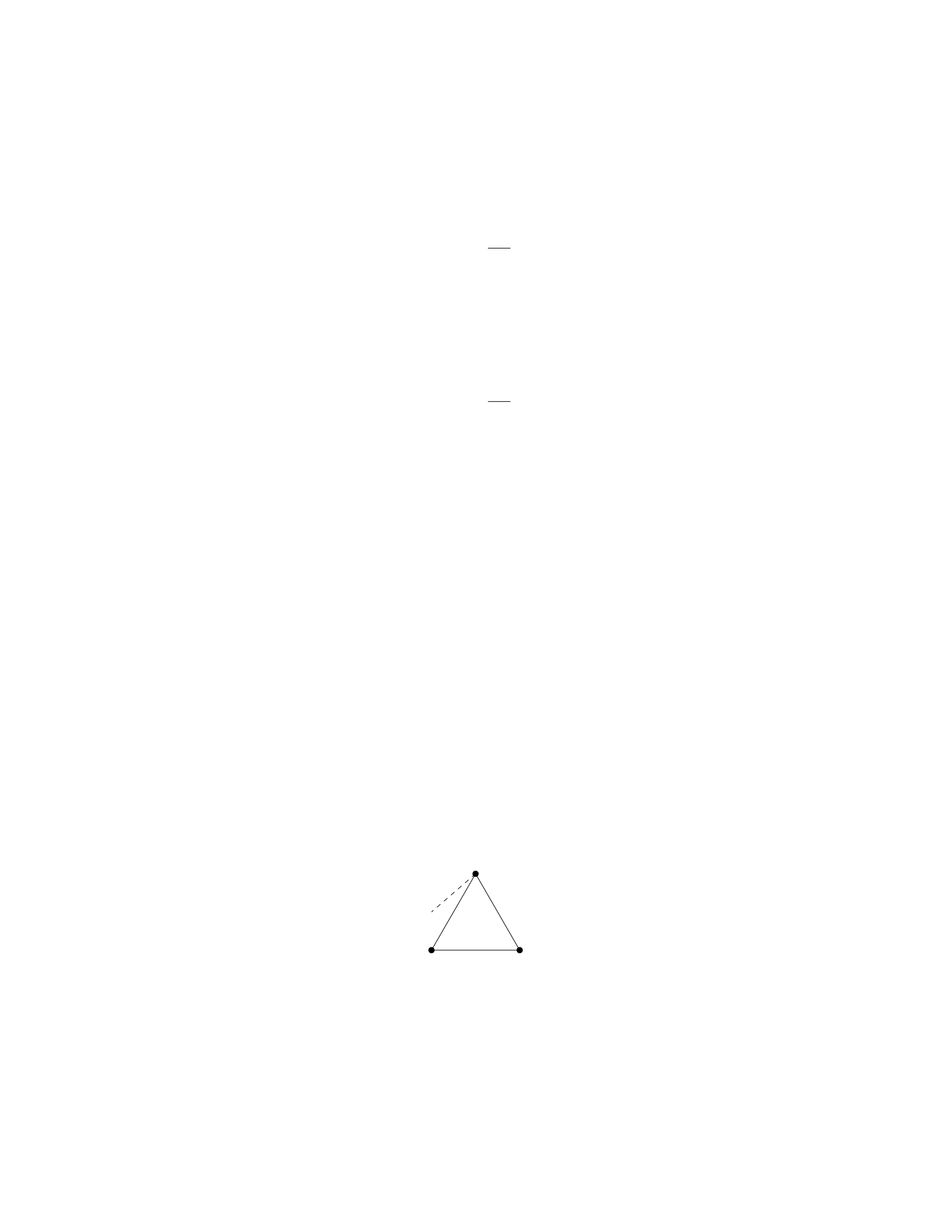
4. Calculate the electric field due to charge q2at point P using the formula
for electric field:
E2=k|q2|
r2
2
where q2= 3 µC, and r2is the distance from q2to point P.
5. Calculate the distance r2between q2and point P.
6. Substitute the values into the equation for E2to find the electric field
due to q2at point P.
7. Calculate the electric field due to charge q3at point P using the formula
for electric field:
E3=k|q3|
r2
3
where q3=−4µC, and r3is the distance from q3to point P.
8. Calculate the distance r3between q3and point P.
9. Substitute the values into the equation for E3to find the electric field
due to q3at point P.
10. Finally, find the total electric field at point P by summing the electric
fields due to each charge using the principle of superposition:
Etotal =E1+E2+E3
11. Calculate the magnitude and direction of the total electric field at point
P.
Question 24
Question
Three point charges are arranged at the vertices of an equilateral triangle as
shown below. Charge q1=−5µC is located at point A, charge q2= 8 µC is at
point B, and charge q3=−3µC is at point C. Calculate the electric field at the
following point P, which is at a distance rfrom point A along the perpendicular
bisector of side BC. Use ras a variable in your final answer. Given that the
side length of the equilateral triangle is 10 cm.
AB
C
r
24

Solution
Step 1: Calculate the electric field contribution at point P due to charge q1=
−5µC at point A. Let this contribution be E1. The electric field due to a point
charge qat a distance rfrom it is given by the formula:
E=k· |q|
r2·ˆr
where kis Coulomb’s constant (8.987 ×10⁹N m2/C2) and ˆris the unit vector
in the direction from the charge to the point P.
The magnitude of the electric field at point P due to charge q1is:
E1=k· |q1|
r2
Step 2: Calculate the electric field contribution at point P due to charge
q2= 8 µC at point B. Let this contribution be E2. The magnitude of the
electric field at point P due to charge q2can be calculated using the same
formula as above:
E2=k· |q2|
r2
Step 3: Calculate the electric field contribution at point P due to charge
q3=−3µC at point C. Let this contribution be E3. The magnitude of the
electric field at point P due to charge q3can be calculated using the same
formula as above:
E3=k· |q3|
r2
Step 4: Calculate the total electric field at point P by summing the contri-
butions from each charge. The total electric field at point P is given by:
E=E1+E2+E3
The final expression for the total electric field at point P will be in terms of
r.
Question 25
Question
Three point charges are arranged on the x-axis as follows: q1= +2.0µC at
the origin, q2=−3.0µC at x= +4.0m, and q3= +1.0µC at x=−3.0m.
Calculate the electric field at the point x= +1.0m on the x-axis. Given:
k= 8.99 ×10⁹N m2/C2
25

Solution
Step 1: Calculate the electric field due to each individual charge at the point
x= +1.0m using the formula for electric field due to a point charge:
Eq1=k· |q1|
(+1.0m)2
Step 2: Substitute the given values of k,q1, and xinto the formula to find
Eq1:
Eq1=(8.99 ×10⁹N m2/C2)·(2.0×10−6C)
(+1.0m)2
Eq1=17.98 N
1.0m2
Eq1= 17.98 N/C (due to q1)
Step 3: Repeat Steps 1 and 2 for charges q2and q3to find Eq2and Eq3:
Eq2=k· |q2|
(−3.0m−1.0m)2
Eq3=k· |q3|
(+1.0m+ 3.0m)2
Step 4: Substitute the given values of k,q, and xinto the formulas to find
Eq2and Eq3:
Eq2=(8.99 ×10⁹N m2/C2)·(3.0×10−6C)
(−4.0m)2
Eq2=26.97 N
16.0m2
Eq2= 1.686 N/C (due to q2)
Eq3=(8.99 ×10⁹N m2/C2)·(1.0×10−6C)
(+4.0m)2
Eq3=8.99 N
16.0m2
Eq3= 0.562 N/C (due to q3)
Step 5: Calculate the total electric field at x= +1.0m by summing the
individual electric fields with proper signs:
Etotal =Eq1+Eq2+Eq3
Etotal = 17.98 N/C −1.686 N/C + 0.
26

Given r1=p(2 −0)2+ (2 −0)2=√8 = 2√2, and ˆr1=P−q1
|P−q1|=<2,2>
√8=<
1,1>.
Therefore,
E1=(8.99×109)·(3×10−6)
(2√2)2<1,1>= 6.36 ×10³<1,1>N/C.
Step 2: Calculate the electric field produced by q2.The electric field
E2produced by q2at point P(2,2) is given by Coulomb’s Law:
E2=k· |q2|
r2
2
ˆr2
Question 2
Question
Three point charges are placed at the vertices of an equilateral triangle as shown
below:
+q
−q+q
(a) Calculate the electric field at the third vertex due to the other two
charges.
(b) If q= 2 ×10⁻⁶C and the side length of the triangle is 0.1 m, what is the
magnitude and direction of the electric field at the third vertex?
Solution
(a) To calculate the electric field at the third vertex due to the other two charges,
we can use the principle of superposition. The electric field at the third vertex
is the vector sum of the electric fields created by each of the other charges
individually.
Step 1: Calculate the electric field due to the positive charge +qat the
third vertex.
The electric field at the third vertex due to the charge +qcan be calculated
using the equation for electric field created by a point charge:
E+q=k· |q|
r2
where kis the Coulomb constant, |q|is the magnitude of the charge, and r
is the distance between the charge and the point where the electric field is being
calculated.
Step 2: Calculate the direction of the electric field due to the positive charge
+q.
Since the charge +qis positive, the electric field created by it will radiate
away from the charge.
Step 3: Calculate the electric field due to the negative charge −qat the
third vertex.
2

Similarly, the electric field at the third vertex due to the charge −qcan be
calculated using the same equation for electric field.
E−q=k·|−q|
r2
Step 4: Calculate the direction of the electric field due to the negative
charge −q.
Since the charge −qis negative, the electric field created by it will point
toward the charge.
Step 5: Calculate the total electric field at the third vertex.
The total electric field at the third vertex is the vector sum of the electric
fields due to the positive and negative charges.
Etotal =
E+q+
E−q
(b) Given that q= 2 ×10⁻⁶C and the side length of the triangle is 0.1 m,
we can now calculate the magnitude and direction of the electric field at the
third vertex using the superposition principle and the electric field equations.
Question 3
Question
Three charges are placed on the x-axis as follows: q1= +2µC at x=−1m,
q2=−3µC at x= 0, and q3= +4µC at x= +1m. Calculate the electric field
at the origin due to these charges.
Solution
In order to find the electric field at the origin (x= 0) due to the three charges
on the x-axis, we will calculate the electric fields due to each charge separately
and then use the superposition principle to add them up.
Step 1: Calculate the electric field due to q1at the origin. The electric field
E1due to q1can be calculated using the formula:
E1=k· |q1|
r2
1
where k= 8.99 ×10⁹N m2/C2is the Coulomb constant and r1= 1mis the
distance from q1to the origin. Substituting the values, we get:
E1=(8.99 ×10⁹N m2/C2)·2×10−6C
(1m)2= 1.798 ×10⁶N/C
Step 2: Calculate the electric field due to q2at the origin. The electric
field E2due to q2can be calculated using the same formula as above, with
3

q2=−3µC and r2= 0 as q2is at the origin. Since r2= 0, the electric field due
to q2is zero.
Step 3: Calculate the electric field due to q3at the origin. The electric field
E3due to q3can be calculated using the same formula as above, with q3= 4µC
and r3= 1mas the distance from q3to the origin. Substituting the values, we
get:
E3=(8.99 ×10⁹N m2/C2)·4×10−6C
(1m)2= 3.597 ×10⁶N/C
Step 4: Apply the principle of superposition. The total electric field at the
origin, Etotal, is the vector sum of the individual electric fields:
Etotal =E1+E2+E3= 1.798×10⁶N/C+0+3.597×106N/C = 5.395×10⁶N/C
Therefore, the electric field at the origin due to the three charges on the
x-axis is 5.395 ×10⁶N/C directed along the positive x-axis.
Question 4
Question
Three point charges are placed at the vertices of an equilateral triangle with
sides of length d. The charges are all equal in magnitude and are labeled as
follows: qat the top vertex, 2qat the bottom left vertex, and −2qat the
bottom right vertex. Calculate the electric field at the center of the triangle due
to these charges.
Solution
Step 1: Calculate the electric fields due to each individual charge at the center
of the triangle. The electric field due to a point charge qat a distance ris given
by Coulomb’s Law:
E=k· |q|
r2
where kis the Coulomb’s constant (8.99 ×10⁹N m2/C2).
Let E1,E2, and E3be the electric fields due to charges q,2q, and −2q
respectively at the center of the triangle. Since the electric field is a vector
quantity, we need to consider the direction as well.
For the charge qat the top vertex: The distance from the center of the
triangle to the top vertex is d/2. Therefore,
E1=k· |q|
(d/2)2=4kq
d2
This electric field points directly upwards.
4

Step 2: Calculate the electric field due to the 2qcharge at the bottom left
vertex at the center of the triangle. The distance from the center to this charge
is d. The electric field is given by:
E2=k· |2q|
d2=4kq
d2
This electric field points directly to the left.
Step 3: Calculate the electric field due to the −2qcharge at the bottom right
vertex at the center of the triangle. The distance from the center to this charge
is also d. The electric field is given by:
E3=k·|−2q|
d2=4kq
d2
This electric field points directly to the right.
Step 4: Determine the net electric field at the center of the triangle. Since
the electric fields due to the three charges all have the same magnitude and are
directed along three different directions, they will cancel each other out. Thus,
the net electric field at the center of the triangle is 0N/C .
Question 5
Question
Consider three point charges arranged as shown below: q1=−2µC,q2= 4µC,
and q3=−3µC. The charges are placed at the corners of an equilateral triangle
with sides of length a= 1.0m. What is the magnitude and direction of the
force on q1due to the other two charges?
q1(−2µC)
q2(4µC)q3(−3µC)
Solution
Step 1: First, we need to find the electric force on q1due to q2and q3separately,
and then find the net force by summing the individual forces, taking into account
their directions.
The electric force between two point charges q1and q2is given by Coulomb’s
Law:
F=k|q1q2|
r2
where k= 8.99 ×10⁹N·m2/C2is the Coulomb’s constant, q1and q2are the
magnitudes of the charges, and ris the distance between the charges.
5

Step 2: Calculating the force on q1due to q2. The distance between q1
and q2is the same as the side of the equilateral triangle, which is a= 1.0m.
Plugging the values into Coulomb’s Law formula, we get:
F12 =k|q1q2|
a2
F12 = 8.99 ×10⁹N·m2/C2×2×4×10−6
(1.0)2
F12 = 7.19 ×10⁻⁵N
The force exerted by q2on q1is attractive since q2is positive and q1is
negative.
Step 3: Calculating the force on q1due to q3. Similarly, we find the force
exerted by q3on q1using Coulomb’s Law:
F13 =k|q1q3|
a2
F13 = 8.99 ×10⁹N·m2/C2×2×3×10−6
(1.0)2
F13 = 5.39 ×10⁻⁵N
The force exerted by q3on q1is repulsive since q3is negative and q1is
negative.
Step 4: Calculating the net force on q1. The net force on q1is the vector
sum of the forces F12 and F13. Since these forces act along the same line (from
different directions), the magnitude of the net force is:
Fnet =|F12 −F13|
Therefore,
Fnet =
7.19 ×10⁻⁵−5.39 ×10⁻⁵
Fnet = 1.8×10⁻⁵N
The direction of the net force is directed towards the positive charge q2.
Question 6
Question
Three charges are placed at the corners of an equilateral triangle as shown below:
Charge Q1=−4µC at the top vertex, charge Q2= 3 µC at the bottom left
vertex, and charge Q3= 5 µC at the bottom right vertex. Calculate the net
electric field at the center of the equilateral triangle due to these three charges.
6
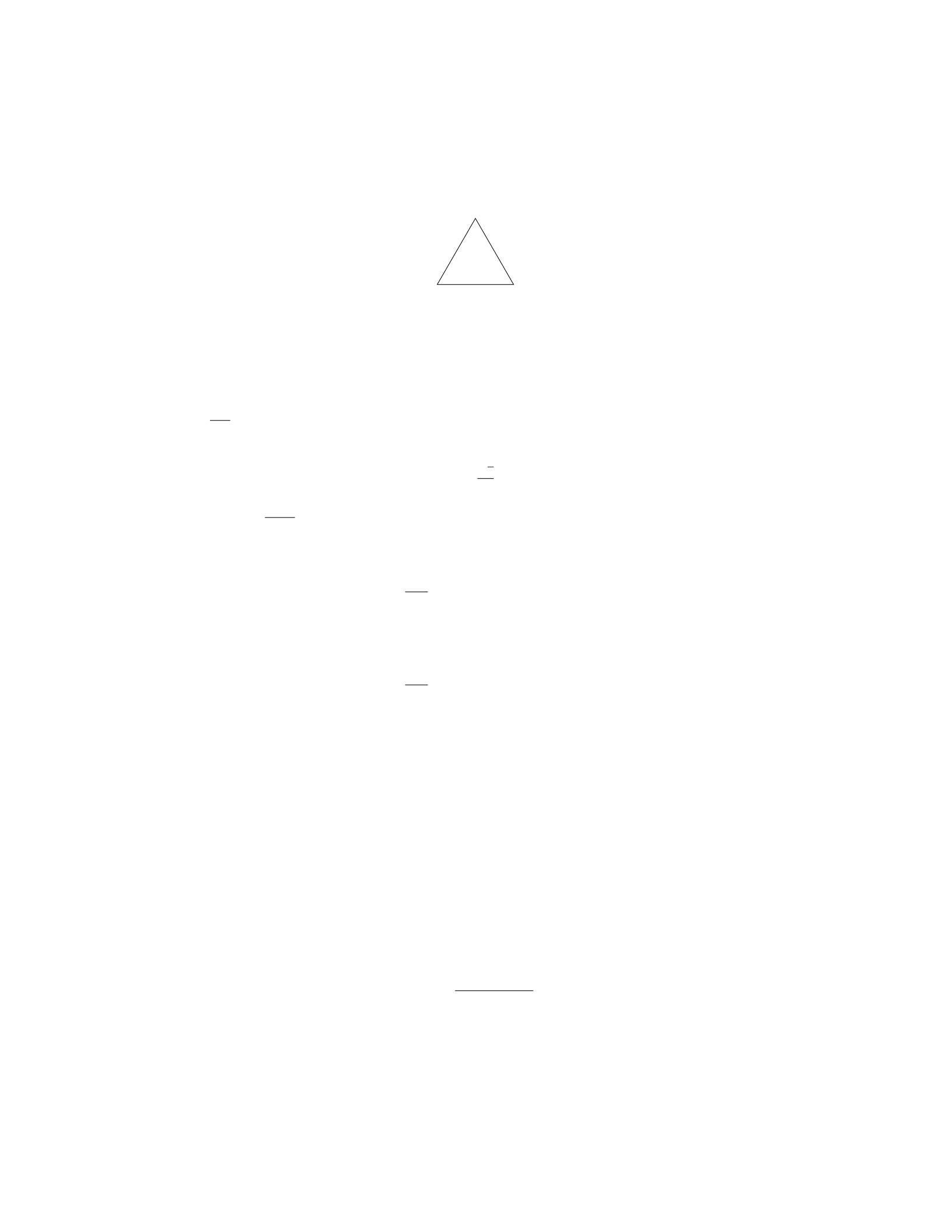
Q2Q3
Q1
Solution
Step 1: Calculate the electric field due to each charge at the center of the
equilateral triangle.
The electric field
Eat a distance rfrom a point charge Qis given by
E=
k·Q
r2ˆr, where kis Coulomb’s constant, ˆris the unit vector pointing from the
charge to the point, and ris the distance from the charge to the point.
For Q1=−4µC: The distance from Q1to the center of the triangle is the
height of the equilateral triangle h=√3
2s, where sis the side length of the
equilateral triangle. The magnitude of the electric field due to Q1at the center
is E1=k|Q1|
h2. The direction of the electric field due to Q1at the center points
along the line connecting the charge and the center of the equilateral triangle.
For Q2= 3 µC: The distance from Q2to the center of the triangle is the
side length of the equilateral triangle s. The magnitude of the electric field due
to Q2at the center is E2=kQ2
s2. The direction of the electric field due to Q2
at the center points along the line connecting the charge and the center of the
equilateral triangle.
For Q3= 5 µC: The distance from Q3to the center of the triangle is the
side length of the equilateral triangle s. The magnitude of the electric field due
to Q3at the center is E3=kQ3
s2. The direction of the electric field due to Q3
at the center points along the line connecting the charge and the center of the
equilateral triangle.
Question 7
Question
Three point charges are placed on the x-axis: q1=−2nC at x=−0.5m,
q2= 3 nC at x= 0 m, and q3=−4nC at x= 1 m. What is the magnitude and
direction of the force on a 5nC charge placed at the origin due to these charges?
Solution
Step 1: Calculate the force on the 5nC charge from q1using Coulomb’s Law:
F1=k|q1||qorigin|
r2
7

where: kis Coulomb’s constant (8.99 ×10⁹N·m2/C2), q1=−2nC, qorigin =
5nC, r= 0.5m. Plugging in the values:
F1=(8.99 ×10⁹)(2 ×10⁻⁹)(5 ×10⁻⁹)
0.52
F1=8.99 ×2×5
0.25
F1=89.9
0.25
F1= 359.6N
The force from q1is attractive and acts towards the origin.
Step 2: Calculate the force on the 5nC charge from q2:
F2= 0
Since q2is at the origin, the force it exerts on the charge at the origin will be
zero.
Step 3: Calculate the force on the 5nC charge from q3:
F3=k|q3||qorigin|
r2
where: q3=−4nC, r= 1 m. Plugging in the values:
F3=(8.99 ×10⁹)(4 ×10⁻⁹)(5 ×10⁻⁹)
12
F3=8.99 ×4×5
1
F3=35.96
1
F3= 35.96 N
The force from q3is repulsive and acts away from the origin.
Step 4: Calculate the net force on the 5nC charge by summing the individual
forces:
Fnet =F1+F2+F3
Fnet = 359.6N+ 0 N+ 35.96 N
Fnet = 395.56 N
The net force on the 5nC charge is 395.56 N, directed towards the origin.
8

Question 8
Question
Three point charges are arranged as follows: - Charge q1= +3 µC is located at
(0,0) m. - Charge q2=−2µC is located at (0,4) m. - Charge q3= +4 µC is
located at (3,0) m.
Determine the electric field at the point (4,4) m due to these three charges.
Solution
The electric field at point (4,4) m due to the three charges can be determined
by calculating the contributions of each charge individually and then summing
them up according to the superposition principle.
Step 1: Calculate the electric field contribution from charge q1.
The distance between charge q1and point (4,4) is r1=p(4 −0)2+ (4 −0)2=
√32 = 4√2m. The electric field contribution from charge q1at point (4,4) is
given by:
E1=k· |q1|
r2
1·ˆr1
where kis Coulomb’s constant and ˆr1is the unit vector pointing from charge
q1to the point (4,4).
Step 2: Calculate the electric field contribution from charge q2.The
distance between charge q2and point (4,4) is r2=p(4 −0)2+ (4 −4)2= 4 m.
The electric field contribution from charge q2at point (4,4) is given by:
E2=k· |q2|
r2
2·ˆr2
where ˆr2is the unit vector pointing from charge q2to the point (4,4).
Step 3: Calculate the electric field contribution from charge q3.
The distance between charge q3and point (4,4) is r3=p(4 −3)2+ (4 −0)2=
√22+ 42=√20 = 2√5m. The electric field contribution from charge q3at
point (4,4) is given by:
E3=k· |q3|
r2
3·ˆr3
where ˆr3is the unit vector pointing from charge q3to the point (4,4).
Step 4: Sum up the electric field contributions from all charges.
The total electric field at point (4,4) is given by the vector sum of the contri-
butions from each charge:
Etotal =
E1+
E2+
E3
Now, substitute the values of k,q1,q2,q3,r1,r2,r3,ˆr1,ˆr2, and ˆr3into the
above expressions to find the total electric field.
9

Question 9
Question
Three point charges are arranged along the x-axis. Charge q1=−2.0µC is at
the origin, charge q2= 1.0µC is at x= 4.0m, and charge q3=−3.0µC is at
x= 10.0m. What is the magnitude and direction of the electric field at a point
on the x-axis where x= 6.0m?
Solution
Step 1: Calculate the electric field contribution from q1at the point x= 6.0m.
The electric field from a point charge is given by the equation:
E=k|q|
r2
where - kis the Coulomb constant, 8.9875 ×10⁹N m2/C2, - qis the charge, - r
is the distance from the charge to the point.
The distance from q1to the point is 6.0m. The charge q1=−2.0µC =
−2.0×10⁻⁶C. Thus, the electric field from q1at x= 6.0m is:
E1=(8.9875 ×10⁹)(| − 2.0×10⁻⁶|)
(6.0)2
Step 2: Calculate the electric field contribution from q2at the point x= 6.0
m. The distance from q2to the point is 2.0m. The charge q2= 1.0µC =
1.0×10⁻⁶C. Thus, the electric field from q2at x= 6.0m is:
E2=(8.9875 ×10⁹)(1.0×10⁻⁶)
(2.0)2
Step 3: Calculate the electric field contribution from q3at the point x= 6.0
m. The distance from q3to the point is 4.0m. The charge q3=−3.0µC =
−3.0×10⁻⁶C. Thus, the electric field from q3at x= 6.0m is:
E3=(8.9875 ×10⁹)(| − 3.0×10⁻⁶|)
(4.0)2
Step 4: Calculate the total electric field at x= 6.0m by summing the
contributions from all three charges. The total electric field magnitude is:
|E|=|E1+E2+E3|
The direction of the electric field is the direction of the sum vector. If the
vector sum is positive, the direction is towards the positive x-axis; if negative,
it is towards the negative x-axis.
10
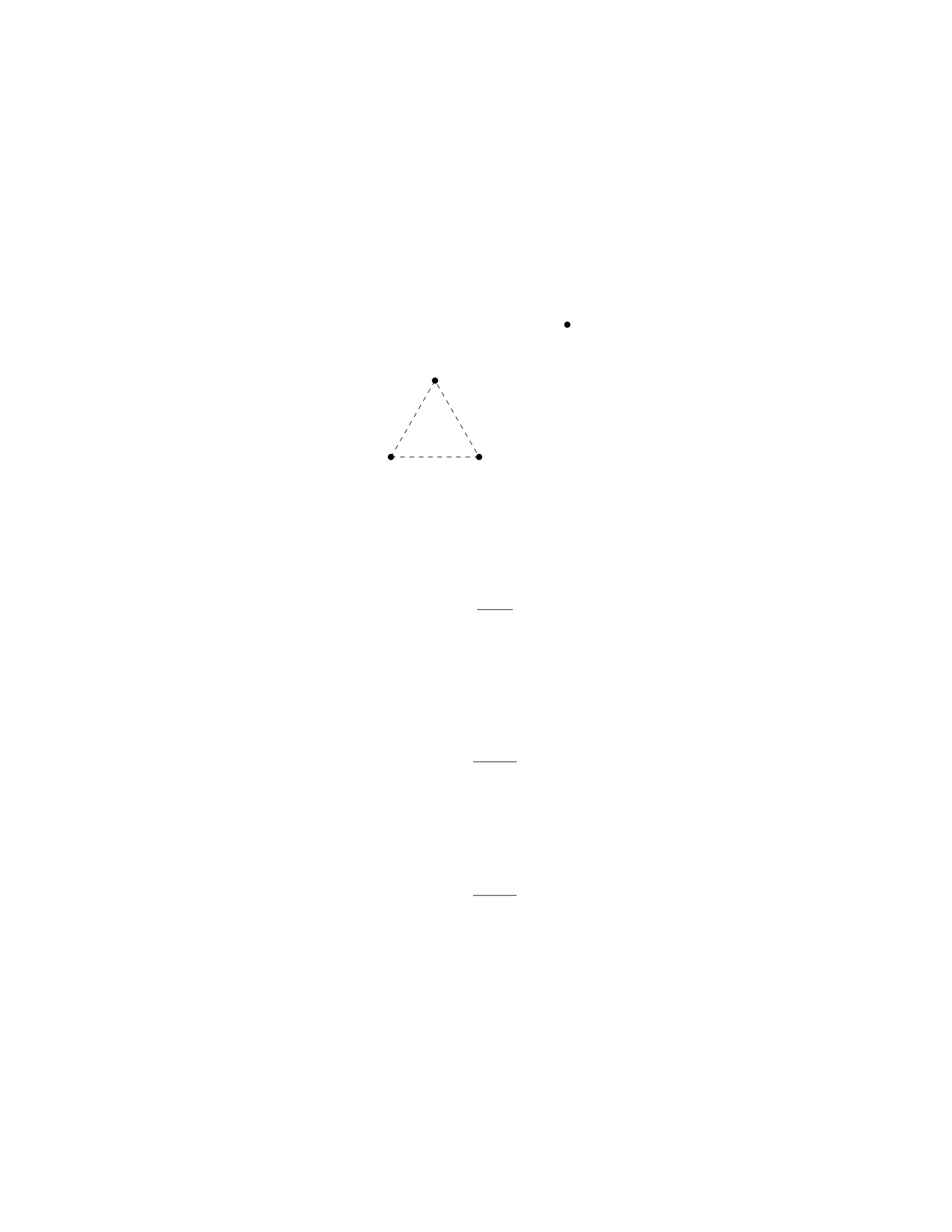
Question 10
Question
Three point charges are arranged as shown in the diagram below. Find the
electric field at point P due to these charges using the superposition principle.
−q+2q
−3q
P
Solution
Step 1: Find the electric field at point P due to the first charge (−q). The
electric field E1at point P due to the charge −qis given by Coulomb’s law:
E1=k· |q|
r2
where k= 8.99 ×10⁹N m2/C2is Coulomb’s constant, q=−qis the charge,
and ris the distance from the charge to point P.
Step 2: Find the electric field at point P due to the second charge (+2q).
The electric field E2at point P due to the charge +2qis given by Coulomb’s
law:
E2=k· |2q|
r2
where k= 8.99 ×10⁹N m2/C2is Coulomb’s constant, q= 2qis the charge,
and ris the distance from the charge to point P.
Step 3: Find the electric field at point P due to the third charge (−3q). The
electric field E3at point P due to the charge −3qis given by Coulomb’s law:
E3=k· |3q|
r2
where k= 8.99×10⁹N m2/C2is Coulomb’s constant, q=−3qis the charge,
and ris the distance from the charge to point P.
Step 4: Apply the superposition principle. The total electric field at point
P is the vector sum of the electric fields due to each charge:
Etotal =E1+E2+E3
11

Calculate the magnitudes and directions of each electric field using the dis-
tances from each charge to point P, and then find the total electric field at point
P by adding these vectors together.
Question 11
Question
Three charges are arranged along the x-axis as follows: q1=−2µC at x=−2m,
q2= 3 µC at x= 0 m, and q3=−1µC at x= 4 m. What is the electric field at
a point x= 3 m on the x-axis?
Solution
Step 1: Calculate the electric field contribution from each individual charge.
The electric field at a point due to a point charge is given by the formula:
E=k· |q|
r2
where kis the Coulomb constant (8.99 ×10⁹N m2/C2), qis the charge, and r
is the distance from the charge to the point where the field is being calculated.
Let’s calculate the electric field contribution from each charge at the point
x= 3 m.
For q1=−2µC at x=−2m:
E1=k·|−2µC|
(3 + 2)2=8.99 ×109·2×10−6
52= 2.8784 ×10⁶N/C
For q2= 3 µC at x= 0 m:
E2=k· |3µC|
32=8.99 ×109·3×10−6
32= 8.99 ×10⁶N/C
For q3=−1µC at x= 4 m:
E3=k·|−1µC|
(3 −4)2=8.99 ×109·1×10−6
12= 8.99 ×10⁹N/C
Step 2: Find the direction of each electric field contribution. Since q1is neg-
ative, its electric field points towards the left. q2’s electric field points towards
the right, and q3’s electric field also points towards the right.
Step 3: Combine the electric field contributions. We need to add the elec-
tric field contributions from each charge as vectors, taking into account their
directions.
Since E1and E3are in opposite directions, we need to subtract E3from E1
and then add E2:
12

Etotal =E2+E1−E3= 8.99 ×10⁶+ 2.8784 ×10⁶−8.99 ×10⁹
Etotal =−8.99 ×10⁹+ 11.8684 ×106=−8.9881 ×10⁹N/C
Therefore, the electric field at x= 3 m on the x-axis is −8.9881 ×10⁹N/C
pointing towards the left.
Question 12
Question
Three point charges are arranged along the x-axis as follows: q1=−2µC at
x= 0,q2= 4µC at x= 2 m, and q3=−6µC at x= 4 m. Calculate the
magnitude and direction of the electric field at a point located 3 meters to the
right of the charge q1.
Solution
Step 1: Calculate the electric fields due to each individual charge using the
formula E=k|q|
r2.
• For charge q1=−2µC at x= 0 m:
E1=k|q1|
(3)2
• For charge q2= 4µC at x= 2 m:
E2=k|q2|
(1)2
• For charge q3=−6µC at x= 4 m:
E3=k|q3|
(1)2
Step 2: Determine the direction of each electric field using the principle
that electric field lines point away from positive charges and towards negative
charges.
Step 3: Calculate the net electric field at the point 3 meters to the right of
q1by summing the individual electric fields:
Enet =
E1+
E2+
E3
Step 4: Add the individual electric fields in the appropriate direction to find
the net electric field.
13

Question 13
Question
Three charges are positioned as follows: a charge of +2.0µC at the origin, a
charge of −3.0µC at (0, 4.0m), and a charge of +4.0µC at (3.0m, 0). What is
the magnitude and direction of the electric field at the point (1.0m, 2.0m)?
Solution
Step 1: Calculate the electric field contribution from each charge individually
using the formula E=kq
r2, where k= 8.99 ×10⁹N m2/C2.
•Charge at the origin (+2.0µC):
The distance between the charge at the origin and the point (1.0m, 2.0m)
is √12+ 22=√5.
E1= 8.99 ×109×2.0×10−6
5= 0.7192 N/C
The direction of the electric field from this charge is along the line con-
necting the charge and the point.
•Charge at (0, 4.0m) (−3.0µC):
The distance between the charge at (0, 4.0m) and the point (1.0m, 2.0m)
is √12+ 22+ 42=√21.
E2= 8.99 ×10⁹×−3.0×10⁻⁶
21 =−0.3857 N/C
The direction of the electric field from this charge is along the line con-
necting the charge and the point.
•Charge at (3.0m, 0) (+4.0µC):
The distance between the charge at (3.0m, 0) and the point (1.0m, 2.0m)
is √22+ 32=√13.
E3= 8.99 ×109×4.0×10−6
13 = 2.2688 N/C
The direction of the electric field from this charge is along the line con-
necting the charge and the point.
Step 2: Find the total electric field at the point (1.0m, 2.0m) by summing
the individual electric field contributions in vector form.
E=
E1+
E2+
E3
E= (0.7192 N/C ˆr1)+(−0.3857 N/C ˆr2) + (2.2688 N/C ˆr3)
14

The resultant electric field magnitude can be calculated as:
E=qE2
total,x +E2
total,y
E=p(0.7192)2+ (−0.3857)2+ (2.2688)2= 2.5125 N/C
The direction of the electric field at the point (1.0m, 2.0m) can be found by
taking the arctangent of the ratios of the components:
θ= tan−1Etotal,y
Etotal,x
θ= tan−1−0.3857
0.7192 =−28.4◦
Therefore, the magnitude of the electric field at the point (1.0m
Question 14
Question
Three charges are placed at the vertices of an equilateral triangle with side
length a. The charges are +q,−q, and +2q. Calculate the electric field at the
center of the triangle.
Solution
To find the electric field at the center of the equilateral triangle, we will first
find the electric field contribution from each charge individually and then sum
them up using the principle of superposition.
Step 1: Electric field due to the charge +q
The magnitude of the electric field due to a point charge qat a distance ris
given by Coulomb’s law:
E=k|q|
r2
where kis the Coulomb constant (8.988 ×10⁹N m2/C2).
In this case, the distance from the center of the equilateral triangle to any
of its vertices (where the charge +qis located) is a/√3.
Therefore, the electric field due to the charge +qat the center of the triangle
is:
E1=k|q|
(a/√3)2
E1=kq√3
a2
15

Step 2: Electric field due to the charge −q
Similarly, the electric field due to the charge −qat the center of the triangle
is:
E2=k|q|
(a/√3)2
E2=kq√3
a2
Step 3: Electric field due to the charge +2q
Finally, the electric field due to the charge +2qat the center of the triangle
is:
E3=k|2q|
(a/√3)2
E3=k2q√3
a2
Step 4: Total electric field at the center of the triangle
By the principle of superposition, the total electric field at the center of the
equilateral triangle is the vector sum of the electric fields due to each charge:
Etotal =
E1+
E2+
E3
Since the electric fields due to charges +qand −qare equal in magnitude but
opposite in direction, they cancel each other out. Therefore, the total electric
field at the center of the triangle is:
Etotal =
E3=k2q√3
a2
Thus, the electric field at the center of the equilateral triangle due to the
given charges +q,−q, and +2qis k2q√3
a2.
Question 16
Question
Three point charges are located along the x-axis: a charge of +4.0µC at x=
−2.0m, a charge of −2.0µC at the origin, and a charge of +6.0µC at x= 3.0m.
Calculate the magnitude and direction of the electric field at the point x= 1.0m
on the x-axis.
16

Solution
Step 1: Calculate the electric field contribution at x= 1.0m due to the +4.0µC
charge at x=−2.0m. The electric field E1at x= 1.0m due to the +4.0µC
charge is given by Coulomb’s Law:
E1=k· |q1|
r2
1
where kis the Coulomb constant (8.99 ×10⁹N·m2/C2), q1is the charge
(+4.0µC), r1is the distance from the charge to the point (1.0m−(−2.0m) =
3.0m). Plugging in the values, we get:
E1=(8.99 ×10⁹N·m2/C2)·(4.0×10−6C)
(3.0m)2
E1=35.96 ×10³
9.0= 3.99 ×10³N/C
Step 2: Calculate the electric field contribution at x= 1.0m due to the
−2.0µC charge at the origin. The electric field E2at x= 1.0m due to the
−2.0µC charge is:
E2= 0
since the electric field from a point charge at the same location is zero.
Step 3: Calculate the electric field contribution at x= 1.0m due to the
+6.0µC charge at x= 3.0m. The electric field E3at x= 1.0m due to the
+6.0µC charge is:
E3=k· |q3|
r2
3
where kis the Coulomb constant, q3is the charge (+6.0µC), r3is the distance
from the charge to the point (3.0m−1.0m= 2.0m). Plugging in the values,
we get:
E3=(8.99 ×10⁹N·m2/C2)·(6.0×10−6C)
(2.0m)2= 1.35 ×10⁴N/C
Step 4: Calculate the total electric field at x= 1.0m by adding the contri-
butions from all charges. The total electric field Etotal at x= 1.0m is the vector
sum of E1,E2, and E3:
Etotal
Question 17
Question
Three point charges are arranged as follows: a charge of +2 µC is located at
the origin, a charge of −3µC is located at (0,3m), and a charge of +4 µC is
located at (4 m,0). Calculate the electric field at the point P(3 m,3m)due to
these charges.
17

Solution
Step 1: Calculate the electric field due to each charge separately using Coulomb’s
law. The electric field Eat a point due to a point charge qat a distance ris
given by:
E=k· |q|
r2
where kis Coulomb’s constant (8.99 ×10⁹N m2/C2).
For the charge at the origin (+2 µC):
E1=k· | + 2 µC|
(3 m)2
For the charge at (0,3m)(−3µC):
E2=k·|−3µC|
(3 m)2
For the charge at (4 m,0) (+4 µC):
E3=k· | + 4 µC|
5m
Step 2: Calculate the electric field vectors for each charge. The electric field
is a vector quantity, so we need to determine the direction of each field.
The electric field from the charge at the origin has components along the
positive x and y directions.
The electric field from the charge at (0,3m)has only a y-component.
The electric field from the charge at (4 m,0) has only an x-component.
Step 3: Use the principle of superposition to find the total electric field at
point P. The total electric field at point P due to the three charges is the vector
sum of the individual electric fields:
Etotal =
E1+
E2+
E3
Calculate the magnitudes and directions of
E1,
E2, and
E3using the infor-
mation from Step 1 and Step 2. Then, add these vectors together to find
Etotal
at point P.
Question 18
Question
Three charges are arranged in the x-y plane as shown below: a positive charge
of +3.0µC at the origin, a positive charge of +5.0µC at (0,2.0) m, and a
negative charge of −2.0µC at (2.0,0) m. Determine the electric field at the
point (1.0,1.0) m due to these three charges.
18
Charge Position (x, y)(m)
+3.0µC(0,0)
+5.0µC(0,2.0)
−2.0µC(2.0,0)
Solution
Step 1: Calculate the electric field due to each charge at the point (1.0,1.0) m.
Using the expression for the electric field due to a point charge:
For charge at the origin:
E1=k· |q1|
r2
1
E1=8.99 ×10⁹N m2/C2·3.0×10−6C
(1.0)2
E1= 2.70 ×10⁶N/C
For charge at (0,2.0) m:
E2=k· |q2|
r2
2
E2=8.99 ×10⁹N m2/C2·5.0×10−6C
(1.0)2
E2= 4.49 ×10⁶N/C
For charge at (2.0,0) m:
E3=k· |q3|
r2
3
E3=8.99 ×10⁹N m2/C2·2.0×10−6C
(1.41)2
E3= 2.41 ×10⁶N/C
Step 2: Calculate the net electric field at the point (1.0,1.0) m by considering
the vector sum of the individual electric fields.
Let’s consider the electric field due to the positive charges as positive and
the electric field due to the negative charge as negative.
The angle between the electric field due to each charge and the x-axis is 45◦.
Enet =qE2
1+E2
2−2E1E2cos(45◦)−E3
Enet =p(2.70 ×10⁶)2+ (4.49 ×10⁶)2−2(2.70 ×10⁶)(4.49 ×10⁶) cos(45◦)−2.41×10⁶
Enet = 7.5×10⁶N/C
Therefore, the electric field at the point (1.0,1.0) m due to the three charges
is 7.5×10⁶N/C.
19

Question 19
Question
Three point charges are arranged on the x-axis as follows: a charge of +4 µC at
x=−2m, a charge of −2µC at x= 0 m, and a charge of +3 µC at x= 3 m.
Calculate the electric field at the point Plocated on the x-axis at x= 1 m due
to these three charges.
Solution
Step 1: Calculate the electric field due to the +4 µC charge at x=−2m. The
electric field E1at point Pdue to charge q1is given by Coulomb’s law:
E1=k· |q1|
r2
1
where k= 8.99 ×10⁹N m2/C2is the Coulomb constant, |q1|= 4 ×10⁻⁶C is
the magnitude of the charge, and r1= 3 m is the distance between the charge
and point P.
Plugging in the given values:
E1=8.99 ×109·4×10−6
(−2−1)2
E1=35.96 ×10³
9
E1= 3995.56 N/C (to the left)
Step 2: Calculate the electric field due to the −2µC charge at x= 0 m. The
electric field E2at point Pdue to charge q2is given by Coulomb’s law:
E2=k· |q2|
r2
2
where |q2|= 2 ×10⁻⁶C, and r2= 1 m.
Plugging in the given values:
E2=8.99 ×109·2×10−6
12
E2= 17.98 ×10³
E2= 17980 N/C (to the right)
Step 3: Calculate the electric field due to the +3 µC charge at x= 3 m. The
electric field E3at point Pdue to charge q3is given by Coulomb’s law:
E3=k· |q3|
r2
3
20
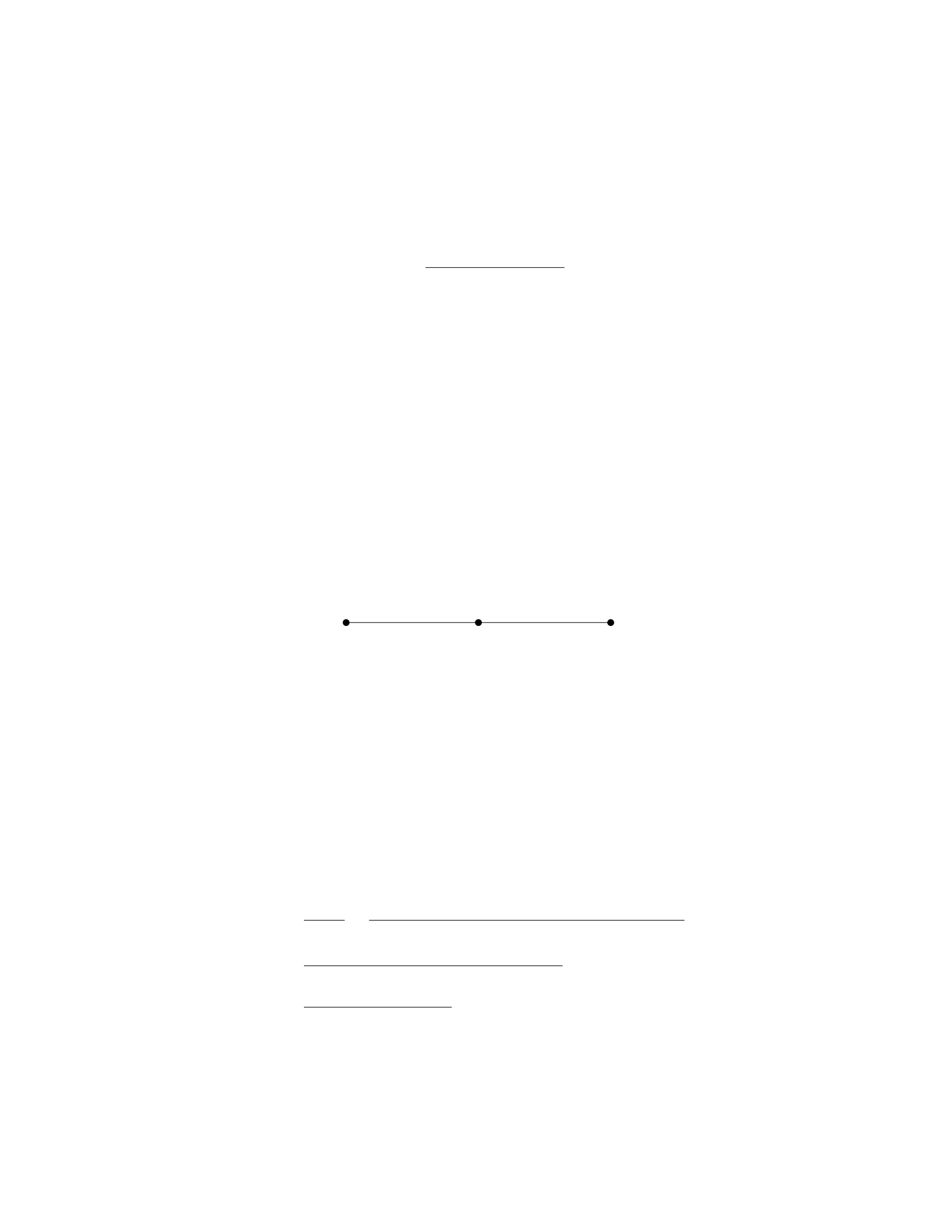
where |q3|= 3 ×10⁻⁶C, and r3= 2 m.
Plugging in the given values:
E3=8.99 ×109·3×10−6
22
E3= 13.485 ×10³
E3= 13485 N/C (to the left)
Step 4: Calculate the total electric field at point P. The total electric field
at point Pis the vector sum of the individual electric fields:
Etotal =E1+E2+E3= 3995.56 N/C −17980 N/C + 13485 N/C
Etotal =−5320.44 N/C (to the left)
Therefore, the electric field at point
Question 20
Question
Three charges are arranged in a line as shown below:
−q2dq
Given that q= 8 nC, d= 2 m, and k= 8.99 ×10⁹N m2/C2, find the
magnitude of the electric force acting on the positive charge q.
Solution
Step 1: Calculate the distance between each charge and the positive charge q.
r1= 2d= 2(2 m) = 4 m
r2=d= 2 m
Step 2: Calculate the magnitudes of the electric forces F1and F2due to
charges −qand −qacting on q.
F1=k|q||q|
r2
1
=(8.99 ×10⁹N m2/C2)(8 ×10−9C)(8 ×10⁻⁹C)
(4 m)2
=(7.192 ×10⁻⁸N)(8.99 ×10⁹N m2/C2)
16 m2
=0.646 ×10²N·m2/C2
16
= 4.04 N
21

F2=k|q||q|
r2
2
=(8.99 ×10⁹N m2/C2)(8 ×10−9C)(8 ×10⁻⁹C)
(2 m)2
=(7.192 ×10⁻⁸N)(8.99 ×10⁹N m2/C2)
4m2
=0.646 ×10²N·m2/C2
4
= 16.16 N
Step 3: The total electric force on qis given by the sum of F1and F2.
Total electric force =F1+F2= 4.04 N+ 16.16 N= 20.20 N
Therefore, the magnitude of the electric force acting on the positive charge
qis 20.20 N.
Question 22
Question
Three point charges are placed on the x-axis: a charge of +3.0µC at x= 0 m, a
charge of −5.0µC at x= 2.0m, and a charge of +2.0µC at x= 4.0m. Calculate
the electric field at a point x= 3.0mon the x-axis due to these charges.
Solution
Step 1: Calculate the electric field due to each individual charge at the point
x= 3.0musing Coulomb’s Law:
For the +3.0µC charge at x= 0 m: The distance between the charge and
the point is r1= 3.0m−0m= 3.0m. The electric field E1at x= 3.0mdue to
this charge is given by:
E1=k·|q1|
r2
1
E1= (8.99 ×10⁹Nm2/C2)·3.0×10−6C
(3.0m)2
E1= 1.0×10⁵N/C
For the −5.0µC charge at x= 2.0m: The distance between the charge and
the point is r2= 3.0m−2.0m= 1.0m. The electric field E2at x= 3.0mdue
to this charge is given by:
E2=k·|q2|
r2
2
E2= (8.99 ×10⁹Nm2/C2)·5.0×10−6C
(1.0m)2
22

E2= 4.5×10⁶N/C
For the +2.0µC charge at x= 4.0m: The distance between the charge and
the point is r3= 4.0m−3.0m= 1.0m. The electric field E3at x= 3.0mdue
to this charge is given by:
E3=k·|q3|
r2
3
E3= (8.99 ×10⁹Nm2/C2)·2.0×10−6C
(1.0m)2
E3= 1.8×10⁶N/C
Step 2: Calculate the total electric field at x= 3.0mdue to the superposition
of the individual electric fields:
The total electric field Eat x= 3.0mis the vector sum of the individual
electric fields E1,E2, and E3,
E=E1+E2+E3
E= 1.0×10⁵N/C + 4.5×10⁶N/C + 1.8×10⁶N/C
E= 6.3×10⁶N/C
Therefore, the electric field at x= 3.0mon the x-axis due to the three
charges is 6.3×10⁶N/C directed along the positive x-direction.
Question 23
Question
Three point charges are arranged as follows: charge q1=−2µC is located at
(0,0), charge q2= 3 µC is located at (0,3m), and charge q3=−4µC is located
at (4m,0). Calculate the electric field at point P, which is located at (3m,4m).
Solution
1. Calculate the electric field due to charge q1at point P using the formula for
electric field:
E1=k|q1|
r2
1
where k= 9 ×10⁹Nm2/C2,q1=−2µC, and r1is the distance from q1to point
P.
2. Calculate the distance r1between q1and point P using the distance
formula:
r1=p(3 −0)2+ (4 −0)2
3. Substitute the values into the equation for E1to find the electric field
due to q1at point P.
23
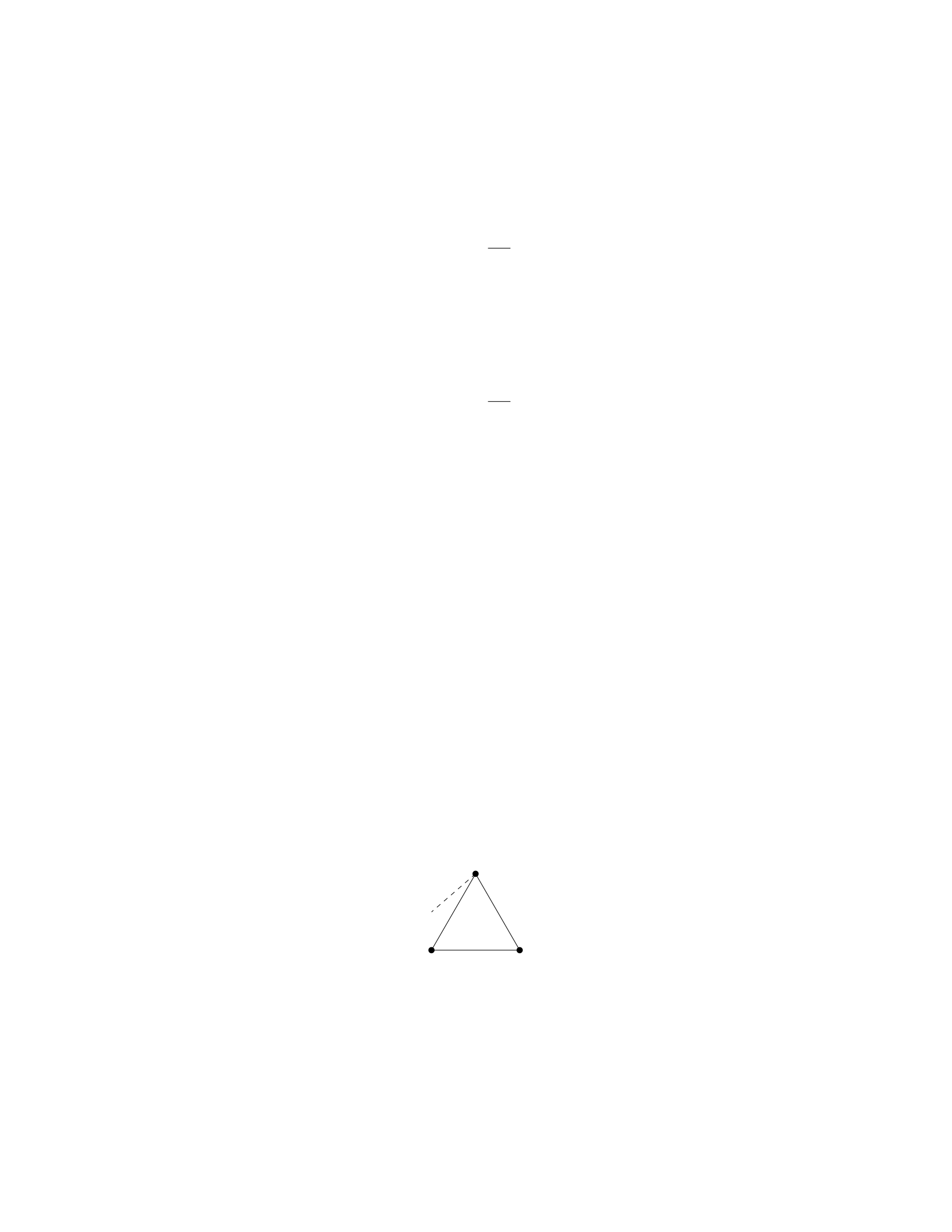
4. Calculate the electric field due to charge q2at point P using the formula
for electric field:
E2=k|q2|
r2
2
where q2= 3 µC, and r2is the distance from q2to point P.
5. Calculate the distance r2between q2and point P.
6. Substitute the values into the equation for E2to find the electric field
due to q2at point P.
7. Calculate the electric field due to charge q3at point P using the formula
for electric field:
E3=k|q3|
r2
3
where q3=−4µC, and r3is the distance from q3to point P.
8. Calculate the distance r3between q3and point P.
9. Substitute the values into the equation for E3to find the electric field
due to q3at point P.
10. Finally, find the total electric field at point P by summing the electric
fields due to each charge using the principle of superposition:
Etotal =E1+E2+E3
11. Calculate the magnitude and direction of the total electric field at point
P.
Question 24
Question
Three point charges are arranged at the vertices of an equilateral triangle as
shown below. Charge q1=−5µC is located at point A, charge q2= 8 µC is at
point B, and charge q3=−3µC is at point C. Calculate the electric field at the
following point P, which is at a distance rfrom point A along the perpendicular
bisector of side BC. Use ras a variable in your final answer. Given that the
side length of the equilateral triangle is 10 cm.
AB
C
r
24

Solution
Step 1: Calculate the electric field contribution at point P due to charge q1=
−5µC at point A. Let this contribution be E1. The electric field due to a point
charge qat a distance rfrom it is given by the formula:
E=k· |q|
r2·ˆr
where kis Coulomb’s constant (8.987 ×10⁹N m2/C2) and ˆris the unit vector
in the direction from the charge to the point P.
The magnitude of the electric field at point P due to charge q1is:
E1=k· |q1|
r2
Step 2: Calculate the electric field contribution at point P due to charge
q2= 8 µC at point B. Let this contribution be E2. The magnitude of the
electric field at point P due to charge q2can be calculated using the same
formula as above:
E2=k· |q2|
r2
Step 3: Calculate the electric field contribution at point P due to charge
q3=−3µC at point C. Let this contribution be E3. The magnitude of the
electric field at point P due to charge q3can be calculated using the same
formula as above:
E3=k· |q3|
r2
Step 4: Calculate the total electric field at point P by summing the contri-
butions from each charge. The total electric field at point P is given by:
E=E1+E2+E3
The final expression for the total electric field at point P will be in terms of
r.
Question 25
Question
Three point charges are arranged on the x-axis as follows: q1= +2.0µC at
the origin, q2=−3.0µC at x= +4.0m, and q3= +1.0µC at x=−3.0m.
Calculate the electric field at the point x= +1.0m on the x-axis. Given:
k= 8.99 ×10⁹N m2/C2
25

Solution
Step 1: Calculate the electric field due to each individual charge at the point
x= +1.0m using the formula for electric field due to a point charge:
Eq1=k· |q1|
(+1.0m)2
Step 2: Substitute the given values of k,q1, and xinto the formula to find
Eq1:
Eq1=(8.99 ×10⁹N m2/C2)·(2.0×10−6C)
(+1.0m)2
Eq1=17.98 N
1.0m2
Eq1= 17.98 N/C (due to q1)
Step 3: Repeat Steps 1 and 2 for charges q2and q3to find Eq2and Eq3:
Eq2=k· |q2|
(−3.0m−1.0m)2
Eq3=k· |q3|
(+1.0m+ 3.0m)2
Step 4: Substitute the given values of k,q, and xinto the formulas to find
Eq2and Eq3:
Eq2=(8.99 ×10⁹N m2/C2)·(3.0×10−6C)
(−4.0m)2
Eq2=26.97 N
16.0m2
Eq2= 1.686 N/C (due to q2)
Eq3=(8.99 ×10⁹N m2/C2)·(1.0×10−6C)
(+4.0m)2
Eq3=8.99 N
16.0m2
Eq3= 0.562 N/C (due to q3)
Step 5: Calculate the total electric field at x= +1.0m by summing the
individual electric fields with proper signs:
Etotal =Eq1+Eq2+Eq3
Etotal = 17.98 N/C −1.686 N/C + 0.
26

