



PHYS 232 - UNIVERSITY PHYSICS
II - Calculation of electric forces
between point charges
Question Bank - Set 4
Liberty University
Question 1
Question
Two point charges, q1=−3.0µC and q2= 5.0µC, are placed 10 cm apart in a
vacuum. Calculate the magnitude and direction of the electric force on q1.
Solution
Step 1: Calculate the magnitude of the electric force using Coulomb’s Law:
F=k|q1q2|
r2
where: k= 8.99 ×10⁹N m2/C2is the Coulomb’s constant, q1=−3.0µC =
−3.0×10⁻⁶C, q2= 5.0µC = 5.0×10⁻⁶C, and r= 0.10 m.
Now, substituting the given values into Coulomb’s Law:
F= (8.99 ×10⁹)| − 3.0×10−6×5.0×10−6|
(0.10)2
Step 2: Calculate the magnitude of the electric force:
F= (8.99 ×10⁹)3.0×5.0×10−12
0.01
F= 8.99 ×109×1.5×10−11
F= 13.485 ×10⁻²

Step 3: Express the magnitude of the force in scientific notation:
F= 1.3485 N
Step 4: Determine the direction of the force. Since q1is negative and q2is
positive, the electric force on q1will be attractive towards q2.
Therefore, the magnitude of the electric force on q1is 1.3485 N, directed
towards q2.
Question 2
Question
Two point charges, q1=−2.0µC and q2= 3.0µC, are placed 10.0 cm apart in
a vacuum. Calculate the magnitude of the electric force between the charges.
Solution
Step 1: Given that the charges q1=−2.0µC and q2= 3.0µC are 10.0 cm apart,
we can find the magnitude of the electric force between them using Coulomb’s
Law. Coulomb’s Law states that the magnitude of the electric force (F) between
two point charges is given by:
F=k·|q1·q2|
r2,
where kis the electrostatic constant (8.99 ×10⁹N m2/C2), q1and q2are the
magnitudes of the point charges, and ris the distance between the charges.
Step 2: Substituting the given values into Coulomb’s Law, we get:
F= (8.99 ×10⁹N m2/C2)·| − 2.0×10−6C·3.0×10−6C|
(0.10 m)2.
Step 3: Calculating the magnitude of the electric force gives:
F= (8.99 ×10⁹N m2/C2)·6.0×10−12 C2
0.01 m2.
Step 4: Simplifying the expression, we find:
F= 8.99 ×10⁹N m2/C2·6.0×10−10 C/m2= 5.394 N.
Therefore, the magnitude of the electric force between the charges q1and q2
is 5.394 N.
2

Question 3
Question
Two point charges are placed along the x-axis. The first charge, q1=−3µC, is
located at the origin, and the second charge, q2= 4µC, is located at x= 6 m.
Calculate the magnitude and direction of the electric force on q2.
Solution
Step 1: Calculate the distance rbetween the two charges. Since q1is at the
origin and q2is at x= 6 m, the distance rbetween the two charges is:
r=|6−0|= 6 m
Step 2: Calculate the magnitude of the electric force. The magnitude of the
electric force between the two charges is given by Coulomb’s Law:
F=k|q1q2|
r2
where k= 8.99 ×10⁹Nm2/C2is the Coulomb constant.
Substitute the given values:
F=(8.99 ×10⁹)|(−3×10⁻⁶)(4 ×10⁻⁶)|
(6)2
Calculating this expression gives:
F=107940
36
F2998.33 N
So, the magnitude of the electric force on q2is approximately 2998.33 N.
Step 3: Determine the direction of the electric force. The direction of the
electric force depends on the sign of the charges. Since q2is positive, it will
experience a repulsive force away from q1which is negative. Thus, the electric
force on q2is directed along the positive x-axis.
Therefore, the electric force on q2has a magnitude of approximately 2998.33 N
and is directed along the positive x-axis.
Question 4
Question
Two point charges, q1=−3µC and q2= 7 µC, are placed 12 cm apart in a
vacuum. Calculate the magnitude of the electric force between these charges.
3

Solution
Step 1: Convert all given quantities to standard SI units.
•q1=−3µC=−3×10⁻⁶C
•q2= 7 µC= 7 ×10⁻⁶C
•r= 12 cm = 0.12 m
Step 2: Calculate the electric force using Coulomb’s law:
F=k· |q1|·|q2|
r2
where k= 8.99 ×10⁹N m2/C2is the electrostatic constant.
Step 3: Substitute the given values into the formula and calculate the electric
force. Remember that the force is attractive if charges have opposite signs and
repulsive if charges have the same sign.
F=8.99 ×109×3×7×10−6×10−6
(0.12)2
Step 4: Solve for the electric force magnitude.
F=8.99 ×3×7
(0.12)2=8.99 ×21
0.0144 ≈13161.458 N
Therefore, the magnitude of the electric force between the charges is approx-
imately 13161.458 N.
Question 5
Question
Two point charges, q1=−4µC and q2= 8 µC, are separated by a distance of
5cm. Determine the magnitude and direction of the electric force exerted on q1
due to q2.
Solution
Step 1: Calculate the electric force magnitude using Coulomb’s Law: The elec-
tric force between two point charges is given by Coulomb’s Law:
F=k|q1q2|
r2,
where kis Coulomb’s constant (8.988 ×10⁹N m2/C2), q1and q2are the mag-
nitudes of the charges, and ris the distance between them. Plugging in the
values:
F= (8.988 ×10⁹)|(−4×10⁻⁶)(8 ×10⁻⁶)|
(0.05)2,
4

F= (8.988 ×10⁹)32 ×10−12
0.0025 ,
F= (8.988 ×109)×12.8×10−10,
F= 1.15 ×10⁻³N.
Step 2: Determine the direction of the electric force: The force will be
attractive since the charges have opposite signs. The force will act along the
line joining the two charges, directed towards q2.
Question 6
Question
Two point charges, q1=−2.0µC and q2= 4.0µC, are placed 10.0 cm apart in
a vacuum. Calculate the magnitude and direction of the electric force that q1
exerts on q2.
Solution
Step 1: Convert all given quantities to standard SI units.
•q1=−2.0µC = −2.0×10⁻⁶C
•q2= 4.0µC = 4.0×10⁻⁶C
•r= 10.0cm = 0.10 m
• The vacuum permittivity constant, ε0= 8.85 ×10⁻¹² C2/N·m2
Step 2: Calculate the magnitude of the electric force using Coulomb’s Law:
F=k· |q1|·|q2|
r2
where k=1
4πε0
is the Coulomb constant.
Step 3: Substitute the given values into the formula:
F=1
4πε0·| − 2.0×10⁻⁶|·|4.0×10⁻⁶|
(0.10)2
Step 4: Calculate the magnitude of the electric force:
F=1
4π·8.85 ×10−12 ·2.0×4.0×10−6×10−6
0.01
F=1
4π·8.85 ×10−12 ·8.0×10−12
5

Step 5: Calculate the magnitude of the electric force:
F≈9.02 ×10⁻⁵N
The direction of the force between these two charges is attractive because
they have opposite signs.
Therefore, the magnitude of the electric force that q1exerts on q2is approx-
imately 9.02 ×10⁻⁵N, directed from q1towards q2.
Question 7
Question
Two point charges, q1= +3.0µC and q2=−5.0µC, are placed 10.0 cm apart
along the x-axis. Calculate the magnitude of the electric force that q2exerts on
q1.
Solution
Step 1: Convert the charges to C (Coulombs) and the distance to meters. Given:
q1= +3.0µC= 3.0×10⁻⁶Cq2=−5.0µC=−5.0×10⁻⁶C Distance between
the charges, r= 10.0cm = 0.10 m
Step 2: Calculate the magnitude of the electric force using Coulomb’s Law:
The electric force Fbetween two point charges is given by:
F=k·|q1·q2|
r2
where k= 8.99 ×10⁹N·m2/C2is the electrostatic constant.
Substitute the given values into the formula:
F= (8.99 ×10⁹)·|3.0×10⁻⁶· −5.0×10⁻⁶|
(0.10)2
Step 3: Perform the calculation to find the electric force.
F= 8.99 ×109·15 ×10−12
0.01 = 8.99 ×109·1.5×10−9
F= 13.485 ×10−9= 1.3485 ×10⁻⁸N
Therefore, the magnitude of the electric force that q2exerts on q1is 1.3485×
10−8N.
Question 8
Question
Three point charges are located at the vertices of an equilateral triangle of
side length a= 2.00 m. The charges are q1=−2.00 µC, q2= 4.00 µC, and
q3=−3.00 µC. Calculate the net electric force on q2.
6

Solution
Step 1: Calculate the electric force on q2due to q1. The electric force F12
between q1and q2is given by Coulomb’s Law:
F12 =k|q1||q2|
r2
12
where kis the Coulomb constant, q1and q2are the magnitudes of the charges,
and r12 is the distance between the charges. The direction of the force will be
along the line connecting the two charges.
Step 2: Calculate the distance r12 between q1and q2. Since the charges are
at the vertices of an equilateral triangle, the distance r12 is equal to the length
of the side of the triangle, a= 2.00 m.
Step 3: Substitute the given values and solve for F12. Plugging in the values
k= 8.99 ×10⁹N m2/C2,q1=−2.00 ×10−6C, q2= 4.00 ×10⁻⁶C, and
r12 = 2.00 m into Coulomb’s Law, we get:
F12 = (8.99 ×10⁹)(2.00 ×10⁻⁶)(4.00 ×10⁻⁶)
(2.00)2
Step 4: Calculate the magnitude of F12.
|F12|= (8.99 ×10⁹)(2.00 ×10⁻⁶)(4.00 ×10⁻⁶)
(2.00)2
Step 5: Repeat steps 1-4 for the electric forces F23 between q2and q3, and
F13 between q1and q3.
Step 6: Calculate the net force on q2. Since forces are vectors, we need to
resolve them into components and add them together. The net force on q2is
the vector sum of F12 ,F23 , and F13 .
Question 9
Question
Two point charges are placed on the x-axis. The first charge, q1= 2.0µC,
is located at x= 1.0mand the second charge, q2=−3.0µC, is located at
x= 3.0m. Calculate the magnitude and direction of the electric force that
charge q2exerts on charge q1.
Solution
To calculate the electric force between the two charges, we can use Coulomb’s
Law which states that the magnitude of the electric force Fbetween two point
charges q1and q2separated by a distance ris given by:
F=k·|q1q2|
r2
7

where kis the Coulomb constant, 8.99 ×10⁹Nm2/C2.
Step 1: Calculate the distance between the charges The distance r
between the two charges is given by:
r=|x2−x1|=|3.0m−1.0m|= 2.0m
Step 2: Calculate the magnitude of the electric force Substitute the
given values into Coulomb’s Law:
F= (8.99 ×10⁹Nm2/C2)·|(2.0×10−6C)(−3.0×10−6C)|
(2.0m)2
F= (8.99 ×109)·6.0×10−12
4
F= 1.3485 ×10⁻²N
So, the magnitude of the electric force between the two charges is 1.3485 ×
10−2N.
Step 3: Determine the direction of the electric force The direction
of the force will be attractive since the charges have opposite signs. Charge q2
(negative) will exert a force in the direction towards charge q1(positive).
Therefore, the electric force that charge q2exerts on charge q1is 1.3485 ×
10−2Ndirected towards charge q1.
Question 10
Question
Two point charges, q1=−3.5×10⁻⁶C and q2= 7.2×10⁻⁶C, are placed 15 cm
apart in air. Calculate the magnitude of the electric force between the charges.
Solution
Step 1: Calculate the magnitude of the electric force using Coulomb’s Law:
F=k· |q1|·|q2|
r2
where kis the Coulomb constant (8.99 ×10⁹N m2/C2), |q1|and |q2|are the
magnitudes of the charges, and ris the distance between the charges.
Step 2: Substitute the given values into the formula:
F=(8.99 ×10⁹N m2/C2)·(3.5×10−6C)·(7.2×10−6C)
(0.15 m)2
Step 3: Calculate the electric force:
F=(8.99 ×109)·(3.5×10−6)·(7.2×10−6)
(0.15)2N
8

F≈0.725 N
Therefore, the magnitude of the electric force between the charges is approx-
imately 0.725 N.
Question 11
Question
Two point charges, q1=−4.00 µC and q2= 6.00 µC, are separated by a distance
of 2.00 m in a vacuum. Calculate the magnitude of the electric force between
the two charges.
Solution
Step 1: Convert the charges to Coulombs. Step 2: Calculate the magnitude
of the electric force using Coulomb’s law. Step 3: Write the final answer with
appropriate units.
Step 1: Convert the charges to Coulombs. Given that 1µC (microcoulomb)
is equal to 10−6C (coulombs), we have: q1=−4.00 µC=−4.00 ×10⁻⁶C, and
q2= 6.00 µC= 6.00 ×10⁻⁶C.
Step 2: Calculate the magnitude of the electric force using Coulomb’s
law. The formula for the electric force between two point charges is given by
Coulomb’s law:
F=k·|q1|·|q2|
r2
where kis the Coulomb constant, which has a value of 8.99 ×10⁹N m²/C², q1
and q2are the charges, and ris the distance between the charges.
Substitute the given values into the formula:
F= 8.99 ×10⁹·|−4.00 ×10⁻⁶|·|6.00 ×10⁻⁶|
2.002
Calculating the magnitude of the electric force gives:
F= 8.99 ×109·4.00 ×6.00 ×10−12
4.00
F= 8.99 ×109·6.00 ×10−12
Step 3: Write the final answer with appropriate units. Calculating the final
result:
F= 53.94 ×10⁻³N= 53.94 mN
Therefore, the magnitude of the electric force between the two charges is
53.94 mN.
9

Question 12
Question
Two point charges, q1=−3.0µC and q2= 5.0µC, are placed 10.0 cm apart in
air. Calculate the magnitude of the electric force between the charges.
Solution
Step 1: Convert the charges to Coulombs. Given that 1µC= 10−6C, we can
convert the charges: q1=−3.0µC=−3.0×10⁻⁶Cq2= 5.0µC= 5.0×10⁻⁶C
Step 2: Calculate the electric force between the charges using Coulomb’s
law. The magnitude of the electric force between two point charges is given by
Coulomb’s law:
F=k·|q1·q2|
r2
where kis the electrostatic constant (8.99 ×10⁹N m2/C2), q1and q2are the
charges, and ris the distance between the charges.
Plugging in the values, we have:
F= (8.99 ×10⁹)×| − 3.0×10−6×5.0×10−6|
(0.10)2
Step 3: Calculate the magnitude of the electric force.
F= 8.99 ×109×15 ×10−12
0.01
F= 8.99 ×107×1.5×10−10
F= 1.35 ×10⁻²N
Therefore, the magnitude of the electric force between the charges is 1.35 ×
10−2N.
Question 13
Question
Three point charges are arranged in a line. Charge q1= +4 µC is located at
the origin, charge q2=−2µC is located at x= 2 m, and charge q3= +3 µC is
located at x= 4 m. Calculate the net electric force on charge q2due to charges
q1and q3.
10

Solution
Step 1: Calculate the electric force on charge q2due to q1. The electric force
F12 between charges q1and q2is given by Coulomb’s law:
F12 =k|q1·q2|
r2
12
where kis Coulomb’s constant (8.99×10⁹N m2/C2), r12 is the distance between
the charges, and q1and q2are the magnitudes of the charges. Since q1and q2
have opposite signs, the force is attractive.
Given q1= +4 µC, q2=−2µC, and r12 = 2 m, we can substitute these
values into the formula to find F12.
F12 = (8.99 ×10⁹)|4×10⁻⁶· −2×10⁻⁶|
(2)2
F12 = 4.495 ×10⁻³N
Step 2: Calculate the electric force on charge q2due to q3. Similarly, we can
find the electric force F23 between charges q2and q3by using Coulomb’s law:
F23 =k|q2·q3|
r2
23
where r23 is the distance between the charges.
Given q2=−2µC, q3= +3 µC, and r23 = 2 m, we can substitute these
values into the formula to find F23.
F23 = (8.99 ×10⁹)| − 2×10−6·3×10−6|
(2)2
F23 = 4.495 ×10⁻³N
Step 3: Find the net electric force on charge q2. Since the forces F12 and
F23 are in opposite directions, we need to find their vector sum:
Fnet =F12 −F23 = 4.495 ×10⁻³−4.495 ×10−3= 0
Therefore, the net electric force on charge q2due to charges q1and q3is 0
N.
Question 14
Question
Two point charges, q1= +3 nC and q2=−4nC, are placed 5 cm apart in air.
Calculate the magnitude of the electric force between these charges.
11

Solution
Step 1: Convert the charges to standard units: Given that 1 nC (nanoCoulomb)
is equal to 1×10⁻⁹C (Coulombs), the charges are: q1= +3 nC = 3 ×10⁻⁹C
and q2=−4nC =−4×10⁻⁹C.
Step 2: Calculate the distance between the charges: Given that the charges
are 5 cm apart, we convert this to meters by dividing by 100: d= 5 cm =
5×10⁻²m.
Step 3: Calculate the magnitude of the electric force using Coulomb’s Law:
The magnitude of the electric force between two point charges is given by:
F=k· |q1·q2|
d2
where k= 8.99 ×10⁹N m2/C2is the electrostatic constant.
Step 4: Substitute the given values into the formula:
F=8.99 ×10⁹· |3×10⁻⁹· −4×10⁻⁹|
(5 ×10⁻²)2
Step 5: Perform the calculation:
F=8.99 ×109·12 ×10−18
25 ×10−4
F=8.99 ×12 ×10−9
0.25
F=107.88 ×10⁻⁹
0.25
F= 4.312 ×10⁻⁹N
Therefore, the magnitude of the electric force between the point charges is
4.312 ×10⁻⁹N.
Question 15
Question
Three point charges are arranged in an equilateral triangle as shown below.
Charge q1is at the top vertex, charge q2is at the bottom left vertex, and charge
q3is at the bottom right vertex. Find the magnitude of the net electrostatic
force acting on charge q3.
12
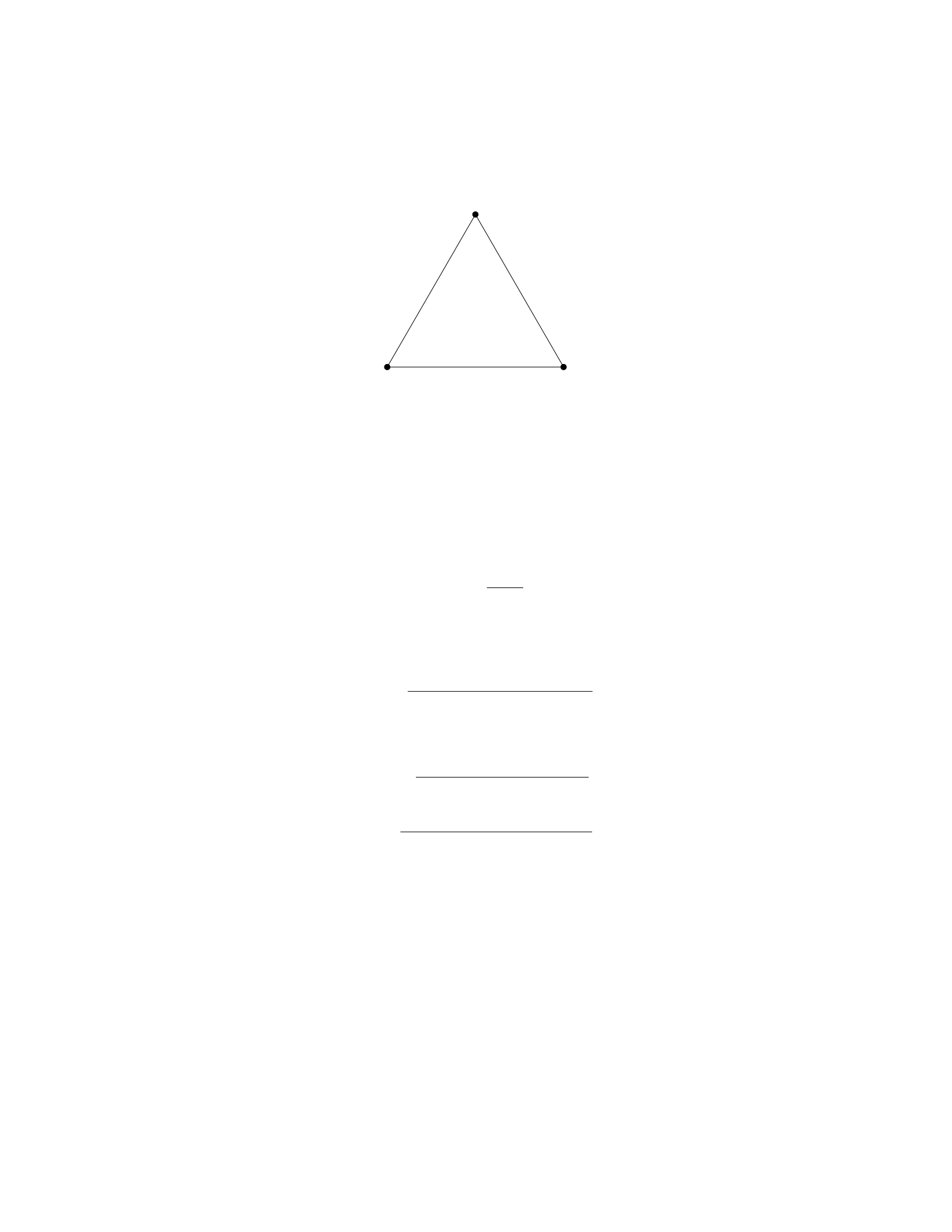
q1
q2q3
Given that q1= 2 µC, q2=−4µC, and q3= 6 µC. The side length of the
equilateral triangle is d= 1 m.
Solution
Step 1: Calculate the electric forces between each pair of charges using Coulomb’s
law: The electric force between two charges q1and q2separated by a distance
ris given by Coulomb’s law:
F12 =k·|q1q2|
r2,
where k= 9 ×10⁹N m2/C2.
Using this formula:
F12 = (9 ×10⁹)·|2×10⁻⁶C× −4×10⁻⁶C|
(1 m)2=−72 N.
Similarly, we can find F13 and F23:
F13 = (9 ×10⁹)·|2×10−6C×6×10−6C|
(1 m)2= 108 N,
F23 = (9 ×10⁹)·| − 4×10−6C×6×10−6C|
(1 m)2=−216 N.
Step 2: Calculate the net force on q3by applying the principle of superpo-
sition: The net force on q3is the vector sum of F13 and F23:
Fnet =F13 +F23 = 108 N−216 N=−108 N.
Hence, the magnitude of the net electrostatic force acting on charge q3is
108 N.
13

Question 16
Question
Three point charges are arranged as shown: q1= 2 µC at the origin, q2=−1µC
at point (2,0), and q3= 3 µC at point (0,3). Calculate the net force on q2due
to the other charges.
Solution
Step 1: Calculate the force on q2due to q1. The electric force on a charge qdue
to another charge Qis given by Coulomb’s law:
F=k
qQ
r2
where kis the Coulomb constant (8.99 ×10⁹N·m2/C2) and ris the distance
between the charges.
The distance r1between q1and q2is
r1=p22+ 02= 2 m
Thus, the magnitude of the force on q2due to q1is:
F1= 8.99 ×109·2×10−6·1×10−6
22= 8.99 ×109·10−12 = 8.99 ×10⁻³N
The direction of the force on q2due to q1is radially inward toward the origin.
Step 2: Calculate the force on q2due to q3. The distance r2between q2and
q3is
r2=p02+ 32= 3 m
The magnitude of the force on q2due to q3is:
F2= 8.99 ×109·1×10−6·3×10−6
32= 8.99 ×109·10−12 = 8.99 ×10⁻³N
The direction of the force on q2due to q3is radially downward.
Step 3: Calculate the net force on q2. The net force on q2is the vector sum
of the two forces:
Fnet =qF2
1+F2
2=p(8.99 ×10⁻³)2+ (8.99 ×10⁻³)2=p2×(8.99 ×10−3)2= 2×8.99×10−3= 17.98×10−3= 17.98 mN
The direction of the net force on q2is the vector sum of the individual forces.
14

Question 17
Question
Three point charges are arranged as shown in the diagram below. Calculate the
magnitude and direction of the electric force acting on the charge q1.
q2= +2µC
↑
q1=−3µC →q3=−1µC
↓
Solution
Step 1: Calculate the electric force on charge q1due to charge q2.
The electric force between two point charges can be calculated using Coulomb’s
Law:
F=k|q1q2|
r2,
where kis Coulomb’s constant (8.99 ×10⁹Nm2/C2), q1and q2are the magni-
tudes of the charges, and ris the distance between the charges.
Given q1=−3µC =−3×10⁻⁶C,q2= +2µC = 2 ×10⁻⁶C, and r=
distance between q1and q2=unknown. We need to find the distance between
the charges to calculate the force.
Step 2: Calculate the distance between charges q1and q2.
In this case, q1and q2are in the same line, so their distance is simply the
distance between them, which is equal to the length of the segment q1q2.
Since q2is directly above q1, we have a right triangle where the hypotenuse
is the segment q1q2, the vertical leg is the distance between q1and q2, and the
horizontal leg is r. Using Pythagoras’ theorem, we find
r=p(2cm)2+ (3cm)2=p4cm2+ 9cm2=√13cm2≈3.61cm.
Step 3: Calculate the electric force acting on charge q1due to charge q2.
Substitute the values into Coulomb’s Law:
Fq1−q2= (8.99 ×10⁹Nm2/C2)| − 3×10−6C×2×10−6C|
(3.61 ×10⁻²m)2
= 8.99 ×109×6×10−12C2
1.30321 ×10⁻³m2= 157.5N.
The electric force on charge q1due to charge q2is 157.5Nupwards.
Step 4: Calculate the electric force on charge q1due to charge q3.
The electric force between charges q1and q3follows the same steps as above.
Step 5: Calculate the total electric force on charge q1.
The electric force is a vector quantity, so we need to consider the directions of
15

the forces due to charges q2and q3. The force due to charge q3will be opposite
in direction to the force due to charge q2.
The total electric force on charge q1is the vector sum of the forces due to
q2and q3. The magnitude can be calculated using the Pythagorean theorem,
while the direction can be found by trigonometry.
Question 18
Question
Two point charges, q1=−6nC and q2= 2 nC, are placed 10 cm apart in air.
Calculate the magnitude and direction of the electric force that q1exerts on q2.
Solution
1. Calculate the magnitude of the electric force using Coulomb’s law:
F=k|q1q2|
r2
where k= 8.99 ×10⁹N·m2/C2is the electrostatic constant, |q1|= 6 ×10⁻⁹C
is the magnitude of q1,|q2|= 2 ×10⁻⁹C is the magnitude of q2, and r= 0.10 m
is the distance between the charges.
F= (8.99 ×10⁹N·m2
C2)(6 ×10⁻⁹C)(2 ×10⁻⁹C)
(0.10 m)2
2. Calculate the magnitude of the electric force:
F= 8.99 ×10⁹N·m2
C2×1.2×10−17 C/0.01 m= 107.88 N
3. Determine the direction of the force. Since q1is negative and q2is positive,
the force on q2will be attractive and directed towards q1.
Question 20
Question
Two point charges, q1= +4 nC and q2=−5nC, are placed 10 cm apart in a
vacuum. Calculate the magnitude of the electric force each charge exerts on the
other.
16

Solution
Step 1: Calculate the magnitude of the electric force exerted by q1on q2using
Coulomb’s Law:
F12 =k|q1||q2|
r2
where k= 8.99 ×10⁹N m2C−2is the electrostatic constant, |q1|= 4 ×10⁻⁹C,
|q2|= 5 ×10⁻⁹C, and r= 0.10 m. Plugging in the values, we get:
F12 =(8.99 ×10⁹)(4 ×10⁻⁹)(5 ×10⁻⁹)
0.102
F12 =(35.96)(5)
0.01
F12 = 179.8N
Step 2: Calculate the magnitude of the electric force exerted by q2on q1:
The magnitude of the force exerted by q2on q1will be equal in magnitude but
opposite in direction to the force exerted by q1on q2. Therefore, |F21|=|F12|=
179.8N.
Question 21
Question
Two point charges, each with a magnitude of 4.00 µC, are placed 2.00 m apart.
Calculate the magnitude of the electric force between the charges.
Solution
To calculate the magnitude of the electric force between the charges, we can use
Coulomb’s Law, which states that the magnitude of the electric force between
two point charges is given by:
F=k·|q1·q2|
r2
Where: - Fis the magnitude of the electric force, - kis the Coulomb constant
(8.99 ×10⁹N m2/C2), - q1and q2are the magnitudes of the charges, and - ris
the distance between the charges.
Step 1: Identify the given values: - Magnitude of each charge, q1=q2=
4.00 µC= 4.00 ×10⁻⁶C - Distance between the charges, r= 2.00 m
Step 2: Substitute the given values into Coulomb’s Law:
F= (8.99 ×10⁹N m2/C2)·|4.00 ×10−6C·4.00 ×10−6C|
(2.00 m)2
17

Step 3: Calculate the magnitude of the electric force:
F= (8.99 ×10⁹)·|16.00 ×10⁻¹²|
4.00
F= 8.99 ×109·4.00 ×10−12
F= 35.96 ×10⁻³
F= 3.60 ×10⁻²N
Therefore, the magnitude of the electric force between the charges is 3.60 ×
10−2N.
Question 22
Question
Two point charges, Q1= +6 µC and Q2=−4µC, are placed 10 cm apart.
Calculate the magnitude of the electric force between the charges.
Solution
To calculate the magnitude of the electric force between the charges, we can use
Coulomb’s law. Coulomb’s law states that the magnitude of the electric force
between two point charges is directly proportional to the product of the charges
and inversely proportional to the square of the distance between them.
Step 1: Convert the charges to Coulombs.
Since 1µC = 10−6C, Q1= +6 µC becomes Q1= +6×10⁻⁶C and Q2=−4µC
becomes Q2=−4×10⁻⁶C.
Step 2: Calculate the electric force using Coulomb’s law formula:
F=k·|Q1·Q2|
r2
where: - Fis the electric force, - kis Coulomb’s constant, 8.9875×10⁹N·m2/C2,
-Q1= +6 ×10⁻⁶C, - Q2=−4×10⁻⁶C, - r= 10 cm = 0.1m.
Substitute the values into the formula:
F= 8.9875 ×10⁹N·m2/C2·|(+6 ×10−6)·(−4×10⁻⁶)|
(0.1)2
F= 8.9875 ×109×24 ×10−12 ×106N
F= 8.9875 ×24 N
F= 215.70 N
Therefore, the magnitude of the electric force between the charges is 215.70
N.
18

Question 23
Question
Three point charges are placed along the x-axis as follows: +4 nC at x= 0,
−8nC at x= 5 cm, and +6 nC at x= 10 cm. Calculate the net electric force
experienced by the +4 nC charge.
Solution
Step 1: Calculate the force between the +4 nC charge and the −8nC charge.
The electric force Fbetween two point charges q1and q2separated by distance
ris given by Coulomb’s Law:
F=k· |q1·q2|
r2
where k≈8.99 ×10⁹N m2/C2is the electrostatic constant.
Plugging in the charges and the distance between +4 nC and −8nC charges,
we get:
F1,2 =8.99 ×10⁹· |4×(−8)| × 0.052
(0.05)2
F1,2 =8.99 ×109·32 ×0.052
0.052
F1,2 = 8.99 ×109·32 = 2.8768 ×10¹¹ N
Step 2: Calculate the force between the +4 nC charge and the +6 nC charge.
Following the same process as in step 1, we find:
F1,3 =8.99 ×10⁹· |4×6| · 0.12
0.12= 4.794 ×10¹¹ N
Step 3: Calculate the net force on the +4 nC charge. The net force is the
vector sum of the forces due to the other two charges. Since the forces are along
the x-axis, we can simply add them up algebraically.
Fnet =F1,2 +F1,3 = 2.8768 ×10¹¹ + 4.794 ×10¹¹
Fnet = 7.6708 ×10¹¹ N
Therefore, the net electric force experienced by the +4 nC charge is 7.6708×
1011 N.
Question 24
Question
Two point charges, q1= 3.0µC and q2=−4.0µC, are placed 8.0 cm apart.
Calculate the magnitude of the electric force between these two charges.
19

Solution
Let’s denote the magnitude of the electric force between q1and q2as Felec.
Step 1: Calculate the distance between the two charges in meters: The
distance between the charges is given as 8.0 cm, which is equal to 0.08 m.
Step 2: Calculate the magnitude of the electric force using Coulomb’s law:
Coulomb’s law states that the magnitude of the electric force between two point
charges is given by:
Felec =k· |q1·q2|
r2
where kis the electrostatic constant (8.99 ×10⁹N m2/C2), q1and q2are the
magnitudes of the charges in coulombs, and ris the distance between the charges
in meters.
Substitute the given values into the equation:
Felec =(8.99 ×10⁹N m2/C2)· |3.0×10⁻⁶C· −4.0×10⁻⁶C|
(0.08 m)2
Felec =(8.99 ×109)·(3.0×10−6·4.0×10−6)
0.0064
Felec =(8.99 ×109)·(12.0×10−12)
0.0064
Felec =107.88 ×10⁻³
0.0064
Felec = 16.86 N
Therefore, the magnitude of the electric force between the two charges is
16.86 N.
Question 25
Question
Three point charges are located at the vertices of an equilateral triangle of side
length a. The charges have the following magnitudes: q1= 2µC,q2=−3µC,
and q3= 4µC. Calculate the net electric force on q1due to the other two
charges.
Solution
1. Find the electric force
F1,2on q1due to q2: The electric force between two
point charges q1and q2separated by a distance ris given by Coulomb’s Law:
F1,2=k· |q1|·|q2|
r2ˆr
20

where kis the electrostatic constant and ˆris the unit vector pointing from q2to
q1. Given that q1= 2µC,q2=−3µC, and ais the side length of the equilateral
triangle, we have:
r=a, |q1|= 2 ×10⁻⁶C, |q2|= 3 ×10⁻⁶C
The electric force
F1,2on q1due to q2is directed toward q2.
2. Find the electric force
F1,3on q1due to q3: Similarly, the electric force
F1,3on q1due to q3is also directed away from q3. The magnitudes of the charges
are:
|q1|= 2 ×10⁻⁶C, |q3|= 4 ×10⁻⁶C
3. Calculate the net electric force
Fnet on q1: To find the net electric force
on q1, we sum the individual forces
F1,2and
F1,3:
Fnet =
F1,2+
F1,3
Since the forces are in opposite directions, the net force will depend on the
relative magnitudes of
F1,2and
F1,3.
21

Step 3: Express the magnitude of the force in scientific notation:
F= 1.3485 N
Step 4: Determine the direction of the force. Since q1is negative and q2is
positive, the electric force on q1will be attractive towards q2.
Therefore, the magnitude of the electric force on q1is 1.3485 N, directed
towards q2.
Question 2
Question
Two point charges, q1=−2.0µC and q2= 3.0µC, are placed 10.0 cm apart in
a vacuum. Calculate the magnitude of the electric force between the charges.
Solution
Step 1: Given that the charges q1=−2.0µC and q2= 3.0µC are 10.0 cm apart,
we can find the magnitude of the electric force between them using Coulomb’s
Law. Coulomb’s Law states that the magnitude of the electric force (F) between
two point charges is given by:
F=k·|q1·q2|
r2,
where kis the electrostatic constant (8.99 ×10⁹N m2/C2), q1and q2are the
magnitudes of the point charges, and ris the distance between the charges.
Step 2: Substituting the given values into Coulomb’s Law, we get:
F= (8.99 ×10⁹N m2/C2)·| − 2.0×10−6C·3.0×10−6C|
(0.10 m)2.
Step 3: Calculating the magnitude of the electric force gives:
F= (8.99 ×10⁹N m2/C2)·6.0×10−12 C2
0.01 m2.
Step 4: Simplifying the expression, we find:
F= 8.99 ×10⁹N m2/C2·6.0×10−10 C/m2= 5.394 N.
Therefore, the magnitude of the electric force between the charges q1and q2
is 5.394 N.
2

Question 3
Question
Two point charges are placed along the x-axis. The first charge, q1=−3µC, is
located at the origin, and the second charge, q2= 4µC, is located at x= 6 m.
Calculate the magnitude and direction of the electric force on q2.
Solution
Step 1: Calculate the distance rbetween the two charges. Since q1is at the
origin and q2is at x= 6 m, the distance rbetween the two charges is:
r=|6−0|= 6 m
Step 2: Calculate the magnitude of the electric force. The magnitude of the
electric force between the two charges is given by Coulomb’s Law:
F=k|q1q2|
r2
where k= 8.99 ×10⁹Nm2/C2is the Coulomb constant.
Substitute the given values:
F=(8.99 ×10⁹)|(−3×10⁻⁶)(4 ×10⁻⁶)|
(6)2
Calculating this expression gives:
F=107940
36
F2998.33 N
So, the magnitude of the electric force on q2is approximately 2998.33 N.
Step 3: Determine the direction of the electric force. The direction of the
electric force depends on the sign of the charges. Since q2is positive, it will
experience a repulsive force away from q1which is negative. Thus, the electric
force on q2is directed along the positive x-axis.
Therefore, the electric force on q2has a magnitude of approximately 2998.33 N
and is directed along the positive x-axis.
Question 4
Question
Two point charges, q1=−3µC and q2= 7 µC, are placed 12 cm apart in a
vacuum. Calculate the magnitude of the electric force between these charges.
3

Solution
Step 1: Convert all given quantities to standard SI units.
•q1=−3µC=−3×10⁻⁶C
•q2= 7 µC= 7 ×10⁻⁶C
•r= 12 cm = 0.12 m
Step 2: Calculate the electric force using Coulomb’s law:
F=k· |q1|·|q2|
r2
where k= 8.99 ×10⁹N m2/C2is the electrostatic constant.
Step 3: Substitute the given values into the formula and calculate the electric
force. Remember that the force is attractive if charges have opposite signs and
repulsive if charges have the same sign.
F=8.99 ×109×3×7×10−6×10−6
(0.12)2
Step 4: Solve for the electric force magnitude.
F=8.99 ×3×7
(0.12)2=8.99 ×21
0.0144 ≈13161.458 N
Therefore, the magnitude of the electric force between the charges is approx-
imately 13161.458 N.
Question 5
Question
Two point charges, q1=−4µC and q2= 8 µC, are separated by a distance of
5cm. Determine the magnitude and direction of the electric force exerted on q1
due to q2.
Solution
Step 1: Calculate the electric force magnitude using Coulomb’s Law: The elec-
tric force between two point charges is given by Coulomb’s Law:
F=k|q1q2|
r2,
where kis Coulomb’s constant (8.988 ×10⁹N m2/C2), q1and q2are the mag-
nitudes of the charges, and ris the distance between them. Plugging in the
values:
F= (8.988 ×10⁹)|(−4×10⁻⁶)(8 ×10⁻⁶)|
(0.05)2,
4

F= (8.988 ×10⁹)32 ×10−12
0.0025 ,
F= (8.988 ×109)×12.8×10−10,
F= 1.15 ×10⁻³N.
Step 2: Determine the direction of the electric force: The force will be
attractive since the charges have opposite signs. The force will act along the
line joining the two charges, directed towards q2.
Question 6
Question
Two point charges, q1=−2.0µC and q2= 4.0µC, are placed 10.0 cm apart in
a vacuum. Calculate the magnitude and direction of the electric force that q1
exerts on q2.
Solution
Step 1: Convert all given quantities to standard SI units.
•q1=−2.0µC = −2.0×10⁻⁶C
•q2= 4.0µC = 4.0×10⁻⁶C
•r= 10.0cm = 0.10 m
• The vacuum permittivity constant, ε0= 8.85 ×10⁻¹² C2/N·m2
Step 2: Calculate the magnitude of the electric force using Coulomb’s Law:
F=k· |q1|·|q2|
r2
where k=1
4πε0
is the Coulomb constant.
Step 3: Substitute the given values into the formula:
F=1
4πε0·| − 2.0×10⁻⁶|·|4.0×10⁻⁶|
(0.10)2
Step 4: Calculate the magnitude of the electric force:
F=1
4π·8.85 ×10−12 ·2.0×4.0×10−6×10−6
0.01
F=1
4π·8.85 ×10−12 ·8.0×10−12
5

Step 5: Calculate the magnitude of the electric force:
F≈9.02 ×10⁻⁵N
The direction of the force between these two charges is attractive because
they have opposite signs.
Therefore, the magnitude of the electric force that q1exerts on q2is approx-
imately 9.02 ×10⁻⁵N, directed from q1towards q2.
Question 7
Question
Two point charges, q1= +3.0µC and q2=−5.0µC, are placed 10.0 cm apart
along the x-axis. Calculate the magnitude of the electric force that q2exerts on
q1.
Solution
Step 1: Convert the charges to C (Coulombs) and the distance to meters. Given:
q1= +3.0µC= 3.0×10⁻⁶Cq2=−5.0µC=−5.0×10⁻⁶C Distance between
the charges, r= 10.0cm = 0.10 m
Step 2: Calculate the magnitude of the electric force using Coulomb’s Law:
The electric force Fbetween two point charges is given by:
F=k·|q1·q2|
r2
where k= 8.99 ×10⁹N·m2/C2is the electrostatic constant.
Substitute the given values into the formula:
F= (8.99 ×10⁹)·|3.0×10⁻⁶· −5.0×10⁻⁶|
(0.10)2
Step 3: Perform the calculation to find the electric force.
F= 8.99 ×109·15 ×10−12
0.01 = 8.99 ×109·1.5×10−9
F= 13.485 ×10−9= 1.3485 ×10⁻⁸N
Therefore, the magnitude of the electric force that q2exerts on q1is 1.3485×
10−8N.
Question 8
Question
Three point charges are located at the vertices of an equilateral triangle of
side length a= 2.00 m. The charges are q1=−2.00 µC, q2= 4.00 µC, and
q3=−3.00 µC. Calculate the net electric force on q2.
6

Solution
Step 1: Calculate the electric force on q2due to q1. The electric force F12
between q1and q2is given by Coulomb’s Law:
F12 =k|q1||q2|
r2
12
where kis the Coulomb constant, q1and q2are the magnitudes of the charges,
and r12 is the distance between the charges. The direction of the force will be
along the line connecting the two charges.
Step 2: Calculate the distance r12 between q1and q2. Since the charges are
at the vertices of an equilateral triangle, the distance r12 is equal to the length
of the side of the triangle, a= 2.00 m.
Step 3: Substitute the given values and solve for F12. Plugging in the values
k= 8.99 ×10⁹N m2/C2,q1=−2.00 ×10−6C, q2= 4.00 ×10⁻⁶C, and
r12 = 2.00 m into Coulomb’s Law, we get:
F12 = (8.99 ×10⁹)(2.00 ×10⁻⁶)(4.00 ×10⁻⁶)
(2.00)2
Step 4: Calculate the magnitude of F12.
|F12|= (8.99 ×10⁹)(2.00 ×10⁻⁶)(4.00 ×10⁻⁶)
(2.00)2
Step 5: Repeat steps 1-4 for the electric forces F23 between q2and q3, and
F13 between q1and q3.
Step 6: Calculate the net force on q2. Since forces are vectors, we need to
resolve them into components and add them together. The net force on q2is
the vector sum of F12 ,F23 , and F13 .
Question 9
Question
Two point charges are placed on the x-axis. The first charge, q1= 2.0µC,
is located at x= 1.0mand the second charge, q2=−3.0µC, is located at
x= 3.0m. Calculate the magnitude and direction of the electric force that
charge q2exerts on charge q1.
Solution
To calculate the electric force between the two charges, we can use Coulomb’s
Law which states that the magnitude of the electric force Fbetween two point
charges q1and q2separated by a distance ris given by:
F=k·|q1q2|
r2
7

where kis the Coulomb constant, 8.99 ×10⁹Nm2/C2.
Step 1: Calculate the distance between the charges The distance r
between the two charges is given by:
r=|x2−x1|=|3.0m−1.0m|= 2.0m
Step 2: Calculate the magnitude of the electric force Substitute the
given values into Coulomb’s Law:
F= (8.99 ×10⁹Nm2/C2)·|(2.0×10−6C)(−3.0×10−6C)|
(2.0m)2
F= (8.99 ×109)·6.0×10−12
4
F= 1.3485 ×10⁻²N
So, the magnitude of the electric force between the two charges is 1.3485 ×
10−2N.
Step 3: Determine the direction of the electric force The direction
of the force will be attractive since the charges have opposite signs. Charge q2
(negative) will exert a force in the direction towards charge q1(positive).
Therefore, the electric force that charge q2exerts on charge q1is 1.3485 ×
10−2Ndirected towards charge q1.
Question 10
Question
Two point charges, q1=−3.5×10⁻⁶C and q2= 7.2×10⁻⁶C, are placed 15 cm
apart in air. Calculate the magnitude of the electric force between the charges.
Solution
Step 1: Calculate the magnitude of the electric force using Coulomb’s Law:
F=k· |q1|·|q2|
r2
where kis the Coulomb constant (8.99 ×10⁹N m2/C2), |q1|and |q2|are the
magnitudes of the charges, and ris the distance between the charges.
Step 2: Substitute the given values into the formula:
F=(8.99 ×10⁹N m2/C2)·(3.5×10−6C)·(7.2×10−6C)
(0.15 m)2
Step 3: Calculate the electric force:
F=(8.99 ×109)·(3.5×10−6)·(7.2×10−6)
(0.15)2N
8

F≈0.725 N
Therefore, the magnitude of the electric force between the charges is approx-
imately 0.725 N.
Question 11
Question
Two point charges, q1=−4.00 µC and q2= 6.00 µC, are separated by a distance
of 2.00 m in a vacuum. Calculate the magnitude of the electric force between
the two charges.
Solution
Step 1: Convert the charges to Coulombs. Step 2: Calculate the magnitude
of the electric force using Coulomb’s law. Step 3: Write the final answer with
appropriate units.
Step 1: Convert the charges to Coulombs. Given that 1µC (microcoulomb)
is equal to 10−6C (coulombs), we have: q1=−4.00 µC=−4.00 ×10⁻⁶C, and
q2= 6.00 µC= 6.00 ×10⁻⁶C.
Step 2: Calculate the magnitude of the electric force using Coulomb’s
law. The formula for the electric force between two point charges is given by
Coulomb’s law:
F=k·|q1|·|q2|
r2
where kis the Coulomb constant, which has a value of 8.99 ×10⁹N m²/C², q1
and q2are the charges, and ris the distance between the charges.
Substitute the given values into the formula:
F= 8.99 ×10⁹·|−4.00 ×10⁻⁶|·|6.00 ×10⁻⁶|
2.002
Calculating the magnitude of the electric force gives:
F= 8.99 ×109·4.00 ×6.00 ×10−12
4.00
F= 8.99 ×109·6.00 ×10−12
Step 3: Write the final answer with appropriate units. Calculating the final
result:
F= 53.94 ×10⁻³N= 53.94 mN
Therefore, the magnitude of the electric force between the two charges is
53.94 mN.
9

Question 12
Question
Two point charges, q1=−3.0µC and q2= 5.0µC, are placed 10.0 cm apart in
air. Calculate the magnitude of the electric force between the charges.
Solution
Step 1: Convert the charges to Coulombs. Given that 1µC= 10−6C, we can
convert the charges: q1=−3.0µC=−3.0×10⁻⁶Cq2= 5.0µC= 5.0×10⁻⁶C
Step 2: Calculate the electric force between the charges using Coulomb’s
law. The magnitude of the electric force between two point charges is given by
Coulomb’s law:
F=k·|q1·q2|
r2
where kis the electrostatic constant (8.99 ×10⁹N m2/C2), q1and q2are the
charges, and ris the distance between the charges.
Plugging in the values, we have:
F= (8.99 ×10⁹)×| − 3.0×10−6×5.0×10−6|
(0.10)2
Step 3: Calculate the magnitude of the electric force.
F= 8.99 ×109×15 ×10−12
0.01
F= 8.99 ×107×1.5×10−10
F= 1.35 ×10⁻²N
Therefore, the magnitude of the electric force between the charges is 1.35 ×
10−2N.
Question 13
Question
Three point charges are arranged in a line. Charge q1= +4 µC is located at
the origin, charge q2=−2µC is located at x= 2 m, and charge q3= +3 µC is
located at x= 4 m. Calculate the net electric force on charge q2due to charges
q1and q3.
10

Solution
Step 1: Calculate the electric force on charge q2due to q1. The electric force
F12 between charges q1and q2is given by Coulomb’s law:
F12 =k|q1·q2|
r2
12
where kis Coulomb’s constant (8.99×10⁹N m2/C2), r12 is the distance between
the charges, and q1and q2are the magnitudes of the charges. Since q1and q2
have opposite signs, the force is attractive.
Given q1= +4 µC, q2=−2µC, and r12 = 2 m, we can substitute these
values into the formula to find F12.
F12 = (8.99 ×10⁹)|4×10⁻⁶· −2×10⁻⁶|
(2)2
F12 = 4.495 ×10⁻³N
Step 2: Calculate the electric force on charge q2due to q3. Similarly, we can
find the electric force F23 between charges q2and q3by using Coulomb’s law:
F23 =k|q2·q3|
r2
23
where r23 is the distance between the charges.
Given q2=−2µC, q3= +3 µC, and r23 = 2 m, we can substitute these
values into the formula to find F23.
F23 = (8.99 ×10⁹)| − 2×10−6·3×10−6|
(2)2
F23 = 4.495 ×10⁻³N
Step 3: Find the net electric force on charge q2. Since the forces F12 and
F23 are in opposite directions, we need to find their vector sum:
Fnet =F12 −F23 = 4.495 ×10⁻³−4.495 ×10−3= 0
Therefore, the net electric force on charge q2due to charges q1and q3is 0
N.
Question 14
Question
Two point charges, q1= +3 nC and q2=−4nC, are placed 5 cm apart in air.
Calculate the magnitude of the electric force between these charges.
11

Solution
Step 1: Convert the charges to standard units: Given that 1 nC (nanoCoulomb)
is equal to 1×10⁻⁹C (Coulombs), the charges are: q1= +3 nC = 3 ×10⁻⁹C
and q2=−4nC =−4×10⁻⁹C.
Step 2: Calculate the distance between the charges: Given that the charges
are 5 cm apart, we convert this to meters by dividing by 100: d= 5 cm =
5×10⁻²m.
Step 3: Calculate the magnitude of the electric force using Coulomb’s Law:
The magnitude of the electric force between two point charges is given by:
F=k· |q1·q2|
d2
where k= 8.99 ×10⁹N m2/C2is the electrostatic constant.
Step 4: Substitute the given values into the formula:
F=8.99 ×10⁹· |3×10⁻⁹· −4×10⁻⁹|
(5 ×10⁻²)2
Step 5: Perform the calculation:
F=8.99 ×109·12 ×10−18
25 ×10−4
F=8.99 ×12 ×10−9
0.25
F=107.88 ×10⁻⁹
0.25
F= 4.312 ×10⁻⁹N
Therefore, the magnitude of the electric force between the point charges is
4.312 ×10⁻⁹N.
Question 15
Question
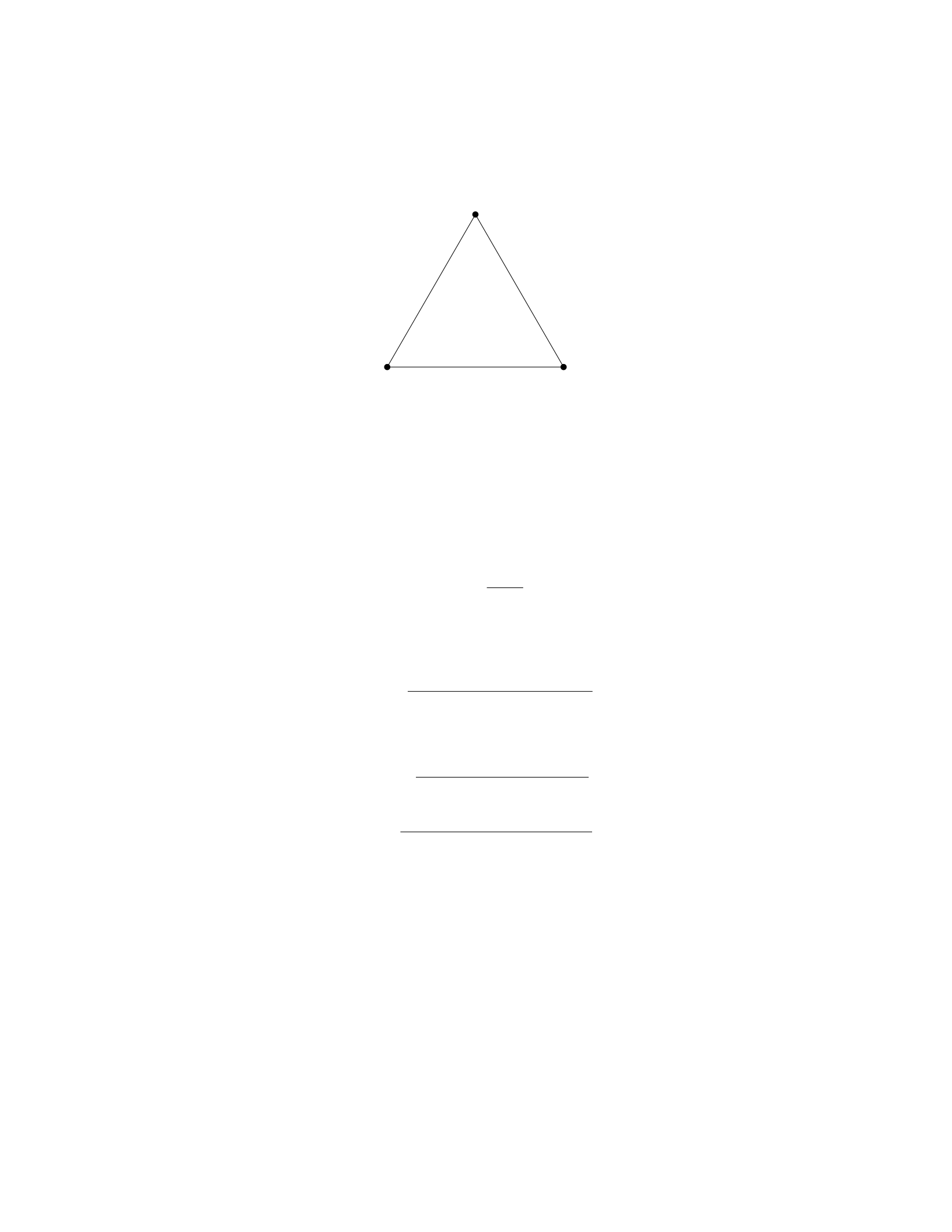
Three point charges are arranged in an equilateral triangle as shown below.
Charge q1is at the top vertex, charge q2is at the bottom left vertex, and charge
q3is at the bottom right vertex. Find the magnitude of the net electrostatic
force acting on charge q3.
12

q1
q2q3
Given that q1= 2 µC, q2=−4µC, and q3= 6 µC. The side length of the
equilateral triangle is d= 1 m.
Solution
Step 1: Calculate the electric forces between each pair of charges using Coulomb’s
law: The electric force between two charges q1and q2separated by a distance
ris given by Coulomb’s law:
F12 =k·|q1q2|
r2,
where k= 9 ×10⁹N m2/C2.
Using this formula:
F12 = (9 ×10⁹)·|2×10⁻⁶C× −4×10⁻⁶C|
(1 m)2=−72 N.
Similarly, we can find F13 and F23:
F13 = (9 ×10⁹)·|2×10−6C×6×10−6C|
(1 m)2= 108 N,
F23 = (9 ×10⁹)·| − 4×10−6C×6×10−6C|
(1 m)2=−216 N.
Step 2: Calculate the net force on q3by applying the principle of superpo-
sition: The net force on q3is the vector sum of F13 and F23:
Fnet =F13 +F23 = 108 N−216 N=−108 N.
Hence, the magnitude of the net electrostatic force acting on charge q3is
108 N.
13

Question 16
Question
Three point charges are arranged as shown: q1= 2 µC at the origin, q2=−1µC
at point (2,0), and q3= 3 µC at point (0,3). Calculate the net force on q2due
to the other charges.
Solution
Step 1: Calculate the force on q2due to q1. The electric force on a charge qdue
to another charge Qis given by Coulomb’s law:
F=k
qQ
r2
where kis the Coulomb constant (8.99 ×10⁹N·m2/C2) and ris the distance
between the charges.
The distance r1between q1and q2is
r1=p22+ 02= 2 m
Thus, the magnitude of the force on q2due to q1is:
F1= 8.99 ×109·2×10−6·1×10−6
22= 8.99 ×109·10−12 = 8.99 ×10⁻³N
The direction of the force on q2due to q1is radially inward toward the origin.
Step 2: Calculate the force on q2due to q3. The distance r2between q2and
q3is
r2=p02+ 32= 3 m
The magnitude of the force on q2due to q3is:
F2= 8.99 ×109·1×10−6·3×10−6
32= 8.99 ×109·10−12 = 8.99 ×10⁻³N
The direction of the force on q2due to q3is radially downward.
Step 3: Calculate the net force on q2. The net force on q2is the vector sum
of the two forces:
Fnet =qF2
1+F2
2=p(8.99 ×10⁻³)2+ (8.99 ×10⁻³)2=p2×(8.99 ×10−3)2= 2×8.99×10−3= 17.98×10−3= 17.98 mN
The direction of the net force on q2is the vector sum of the individual forces.
14

Question 17
Question
Three point charges are arranged as shown in the diagram below. Calculate the
magnitude and direction of the electric force acting on the charge q1.
q2= +2µC
↑
q1=−3µC →q3=−1µC
↓
Solution
Step 1: Calculate the electric force on charge q1due to charge q2.
The electric force between two point charges can be calculated using Coulomb’s
Law:
F=k|q1q2|
r2,
where kis Coulomb’s constant (8.99 ×10⁹Nm2/C2), q1and q2are the magni-
tudes of the charges, and ris the distance between the charges.
Given q1=−3µC =−3×10⁻⁶C,q2= +2µC = 2 ×10⁻⁶C, and r=
distance between q1and q2=unknown. We need to find the distance between
the charges to calculate the force.
Step 2: Calculate the distance between charges q1and q2.
In this case, q1and q2are in the same line, so their distance is simply the
distance between them, which is equal to the length of the segment q1q2.
Since q2is directly above q1, we have a right triangle where the hypotenuse
is the segment q1q2, the vertical leg is the distance between q1and q2, and the
horizontal leg is r. Using Pythagoras’ theorem, we find
r=p(2cm)2+ (3cm)2=p4cm2+ 9cm2=√13cm2≈3.61cm.
Step 3: Calculate the electric force acting on charge q1due to charge q2.
Substitute the values into Coulomb’s Law:
Fq1−q2= (8.99 ×10⁹Nm2/C2)| − 3×10−6C×2×10−6C|
(3.61 ×10⁻²m)2
= 8.99 ×109×6×10−12C2
1.30321 ×10⁻³m2= 157.5N.
The electric force on charge q1due to charge q2is 157.5Nupwards.
Step 4: Calculate the electric force on charge q1due to charge q3.
The electric force between charges q1and q3follows the same steps as above.
Step 5: Calculate the total electric force on charge q1.
The electric force is a vector quantity, so we need to consider the directions of
15

the forces due to charges q2and q3. The force due to charge q3will be opposite
in direction to the force due to charge q2.
The total electric force on charge q1is the vector sum of the forces due to
q2and q3. The magnitude can be calculated using the Pythagorean theorem,
while the direction can be found by trigonometry.
Question 18
Question
Two point charges, q1=−6nC and q2= 2 nC, are placed 10 cm apart in air.
Calculate the magnitude and direction of the electric force that q1exerts on q2.
Solution
1. Calculate the magnitude of the electric force using Coulomb’s law:
F=k|q1q2|
r2
where k= 8.99 ×10⁹N·m2/C2is the electrostatic constant, |q1|= 6 ×10⁻⁹C
is the magnitude of q1,|q2|= 2 ×10⁻⁹C is the magnitude of q2, and r= 0.10 m
is the distance between the charges.
F= (8.99 ×10⁹N·m2
C2)(6 ×10⁻⁹C)(2 ×10⁻⁹C)
(0.10 m)2
2. Calculate the magnitude of the electric force:
F= 8.99 ×10⁹N·m2
C2×1.2×10−17 C/0.01 m= 107.88 N
3. Determine the direction of the force. Since q1is negative and q2is positive,
the force on q2will be attractive and directed towards q1.
Question 20
Question
Two point charges, q1= +4 nC and q2=−5nC, are placed 10 cm apart in a
vacuum. Calculate the magnitude of the electric force each charge exerts on the
other.
16

Solution
Step 1: Calculate the magnitude of the electric force exerted by q1on q2using
Coulomb’s Law:
F12 =k|q1||q2|
r2
where k= 8.99 ×10⁹N m2C−2is the electrostatic constant, |q1|= 4 ×10⁻⁹C,
|q2|= 5 ×10⁻⁹C, and r= 0.10 m. Plugging in the values, we get:
F12 =(8.99 ×10⁹)(4 ×10⁻⁹)(5 ×10⁻⁹)
0.102
F12 =(35.96)(5)
0.01
F12 = 179.8N
Step 2: Calculate the magnitude of the electric force exerted by q2on q1:
The magnitude of the force exerted by q2on q1will be equal in magnitude but
opposite in direction to the force exerted by q1on q2. Therefore, |F21|=|F12|=
179.8N.
Question 21
Question
Two point charges, each with a magnitude of 4.00 µC, are placed 2.00 m apart.
Calculate the magnitude of the electric force between the charges.
Solution
To calculate the magnitude of the electric force between the charges, we can use
Coulomb’s Law, which states that the magnitude of the electric force between
two point charges is given by:
F=k·|q1·q2|
r2
Where: - Fis the magnitude of the electric force, - kis the Coulomb constant
(8.99 ×10⁹N m2/C2), - q1and q2are the magnitudes of the charges, and - ris
the distance between the charges.
Step 1: Identify the given values: - Magnitude of each charge, q1=q2=
4.00 µC= 4.00 ×10⁻⁶C - Distance between the charges, r= 2.00 m
Step 2: Substitute the given values into Coulomb’s Law:
F= (8.99 ×10⁹N m2/C2)·|4.00 ×10−6C·4.00 ×10−6C|
(2.00 m)2
17

Step 3: Calculate the magnitude of the electric force:
F= (8.99 ×10⁹)·|16.00 ×10⁻¹²|
4.00
F= 8.99 ×109·4.00 ×10−12
F= 35.96 ×10⁻³
F= 3.60 ×10⁻²N
Therefore, the magnitude of the electric force between the charges is 3.60 ×
10−2N.
Question 22
Question
Two point charges, Q1= +6 µC and Q2=−4µC, are placed 10 cm apart.
Calculate the magnitude of the electric force between the charges.
Solution
To calculate the magnitude of the electric force between the charges, we can use
Coulomb’s law. Coulomb’s law states that the magnitude of the electric force
between two point charges is directly proportional to the product of the charges
and inversely proportional to the square of the distance between them.
Step 1: Convert the charges to Coulombs.
Since 1µC = 10−6C, Q1= +6 µC becomes Q1= +6×10⁻⁶C and Q2=−4µC
becomes Q2=−4×10⁻⁶C.
Step 2: Calculate the electric force using Coulomb’s law formula:
F=k·|Q1·Q2|
r2
where: - Fis the electric force, - kis Coulomb’s constant, 8.9875×10⁹N·m2/C2,
-Q1= +6 ×10⁻⁶C, - Q2=−4×10⁻⁶C, - r= 10 cm = 0.1m.
Substitute the values into the formula:
F= 8.9875 ×10⁹N·m2/C2·|(+6 ×10−6)·(−4×10⁻⁶)|
(0.1)2
F= 8.9875 ×109×24 ×10−12 ×106N
F= 8.9875 ×24 N
F= 215.70 N
Therefore, the magnitude of the electric force between the charges is 215.70
N.
18

Question 23
Question
Three point charges are placed along the x-axis as follows: +4 nC at x= 0,
−8nC at x= 5 cm, and +6 nC at x= 10 cm. Calculate the net electric force
experienced by the +4 nC charge.
Solution
Step 1: Calculate the force between the +4 nC charge and the −8nC charge.
The electric force Fbetween two point charges q1and q2separated by distance
ris given by Coulomb’s Law:
F=k· |q1·q2|
r2
where k≈8.99 ×10⁹N m2/C2is the electrostatic constant.
Plugging in the charges and the distance between +4 nC and −8nC charges,
we get:
F1,2 =8.99 ×10⁹· |4×(−8)| × 0.052
(0.05)2
F1,2 =8.99 ×109·32 ×0.052
0.052
F1,2 = 8.99 ×109·32 = 2.8768 ×10¹¹ N
Step 2: Calculate the force between the +4 nC charge and the +6 nC charge.
Following the same process as in step 1, we find:
F1,3 =8.99 ×10⁹· |4×6| · 0.12
0.12= 4.794 ×10¹¹ N
Step 3: Calculate the net force on the +4 nC charge. The net force is the
vector sum of the forces due to the other two charges. Since the forces are along
the x-axis, we can simply add them up algebraically.
Fnet =F1,2 +F1,3 = 2.8768 ×10¹¹ + 4.794 ×10¹¹
Fnet = 7.6708 ×10¹¹ N
Therefore, the net electric force experienced by the +4 nC charge is 7.6708×
1011 N.
Question 24
Question
Two point charges, q1= 3.0µC and q2=−4.0µC, are placed 8.0 cm apart.
Calculate the magnitude of the electric force between these two charges.
19

Solution
Let’s denote the magnitude of the electric force between q1and q2as Felec.
Step 1: Calculate the distance between the two charges in meters: The
distance between the charges is given as 8.0 cm, which is equal to 0.08 m.
Step 2: Calculate the magnitude of the electric force using Coulomb’s law:
Coulomb’s law states that the magnitude of the electric force between two point
charges is given by:
Felec =k· |q1·q2|
r2
where kis the electrostatic constant (8.99 ×10⁹N m2/C2), q1and q2are the
magnitudes of the charges in coulombs, and ris the distance between the charges
in meters.
Substitute the given values into the equation:
Felec =(8.99 ×10⁹N m2/C2)· |3.0×10⁻⁶C· −4.0×10⁻⁶C|
(0.08 m)2
Felec =(8.99 ×109)·(3.0×10−6·4.0×10−6)
0.0064
Felec =(8.99 ×109)·(12.0×10−12)
0.0064
Felec =107.88 ×10⁻³
0.0064
Felec = 16.86 N
Therefore, the magnitude of the electric force between the two charges is
16.86 N.
Question 25
Question
Three point charges are located at the vertices of an equilateral triangle of side
length a. The charges have the following magnitudes: q1= 2µC,q2=−3µC,
and q3= 4µC. Calculate the net electric force on q1due to the other two
charges.
Solution
1. Find the electric force
F1,2on q1due to q2: The electric force between two
point charges q1and q2separated by a distance ris given by Coulomb’s Law:
F1,2=k· |q1|·|q2|
r2ˆr
20

where kis the electrostatic constant and ˆris the unit vector pointing from q2to
q1. Given that q1= 2µC,q2=−3µC, and ais the side length of the equilateral
triangle, we have:
r=a, |q1|= 2 ×10⁻⁶C, |q2|= 3 ×10⁻⁶C
The electric force
F1,2on q1due to q2is directed toward q2.
2. Find the electric force
F1,3on q1due to q3: Similarly, the electric force
F1,3on q1due to q3is also directed away from q3. The magnitudes of the charges
are:
|q1|= 2 ×10⁻⁶C, |q3|= 4 ×10⁻⁶C
3. Calculate the net electric force
Fnet on q1: To find the net electric force
on q1, we sum the individual forces
F1,2and
F1,3:
Fnet =
F1,2+
F1,3
Since the forces are in opposite directions, the net force will depend on the
relative magnitudes of
F1,2and
F1,3.
21

Step 3: Express the magnitude of the force in scientific notation:
F= 1.3485 N
Step 4: Determine the direction of the force. Since q1is negative and q2is
positive, the electric force on q1will be attractive towards q2.
Therefore, the magnitude of the electric force on q1is 1.3485 N, directed
towards q2.
Question 2
Question
Two point charges, q1=−2.0µC and q2= 3.0µC, are placed 10.0 cm apart in
a vacuum. Calculate the magnitude of the electric force between the charges.
Solution
Step 1: Given that the charges q1=−2.0µC and q2= 3.0µC are 10.0 cm apart,
we can find the magnitude of the electric force between them using Coulomb’s
Law. Coulomb’s Law states that the magnitude of the electric force (F) between
two point charges is given by:
F=k·|q1·q2|
r2,
where kis the electrostatic constant (8.99 ×10⁹N m2/C2), q1and q2are the
magnitudes of the point charges, and ris the distance between the charges.
Step 2: Substituting the given values into Coulomb’s Law, we get:
F= (8.99 ×10⁹N m2/C2)·| − 2.0×10−6C·3.0×10−6C|
(0.10 m)2.
Step 3: Calculating the magnitude of the electric force gives:
F= (8.99 ×10⁹N m2/C2)·6.0×10−12 C2
0.01 m2.
Step 4: Simplifying the expression, we find:
F= 8.99 ×10⁹N m2/C2·6.0×10−10 C/m2= 5.394 N.
Therefore, the magnitude of the electric force between the charges q1and q2
is 5.394 N.
2

Question 3
Question
Two point charges are placed along the x-axis. The first charge, q1=−3µC, is
located at the origin, and the second charge, q2= 4µC, is located at x= 6 m.
Calculate the magnitude and direction of the electric force on q2.
Solution
Step 1: Calculate the distance rbetween the two charges. Since q1is at the
origin and q2is at x= 6 m, the distance rbetween the two charges is:
r=|6−0|= 6 m
Step 2: Calculate the magnitude of the electric force. The magnitude of the
electric force between the two charges is given by Coulomb’s Law:
F=k|q1q2|
r2
where k= 8.99 ×10⁹Nm2/C2is the Coulomb constant.
Substitute the given values:
F=(8.99 ×10⁹)|(−3×10⁻⁶)(4 ×10⁻⁶)|
(6)2
Calculating this expression gives:
F=107940
36
F2998.33 N
So, the magnitude of the electric force on q2is approximately 2998.33 N.
Step 3: Determine the direction of the electric force. The direction of the
electric force depends on the sign of the charges. Since q2is positive, it will
experience a repulsive force away from q1which is negative. Thus, the electric
force on q2is directed along the positive x-axis.
Therefore, the electric force on q2has a magnitude of approximately 2998.33 N
and is directed along the positive x-axis.
Question 4
Question
Two point charges, q1=−3µC and q2= 7 µC, are placed 12 cm apart in a
vacuum. Calculate the magnitude of the electric force between these charges.
3

Solution
Step 1: Convert all given quantities to standard SI units.
•q1=−3µC=−3×10⁻⁶C
•q2= 7 µC= 7 ×10⁻⁶C
•r= 12 cm = 0.12 m
Step 2: Calculate the electric force using Coulomb’s law:
F=k· |q1|·|q2|
r2
where k= 8.99 ×10⁹N m2/C2is the electrostatic constant.
Step 3: Substitute the given values into the formula and calculate the electric
force. Remember that the force is attractive if charges have opposite signs and
repulsive if charges have the same sign.
F=8.99 ×109×3×7×10−6×10−6
(0.12)2
Step 4: Solve for the electric force magnitude.
F=8.99 ×3×7
(0.12)2=8.99 ×21
0.0144 ≈13161.458 N
Therefore, the magnitude of the electric force between the charges is approx-
imately 13161.458 N.
Question 5
Question
Two point charges, q1=−4µC and q2= 8 µC, are separated by a distance of
5cm. Determine the magnitude and direction of the electric force exerted on q1
due to q2.
Solution
Step 1: Calculate the electric force magnitude using Coulomb’s Law: The elec-
tric force between two point charges is given by Coulomb’s Law:
F=k|q1q2|
r2,
where kis Coulomb’s constant (8.988 ×10⁹N m2/C2), q1and q2are the mag-
nitudes of the charges, and ris the distance between them. Plugging in the
values:
F= (8.988 ×10⁹)|(−4×10⁻⁶)(8 ×10⁻⁶)|
(0.05)2,
4

F= (8.988 ×10⁹)32 ×10−12
0.0025 ,
F= (8.988 ×109)×12.8×10−10,
F= 1.15 ×10⁻³N.
Step 2: Determine the direction of the electric force: The force will be
attractive since the charges have opposite signs. The force will act along the
line joining the two charges, directed towards q2.
Question 6
Question
Two point charges, q1=−2.0µC and q2= 4.0µC, are placed 10.0 cm apart in
a vacuum. Calculate the magnitude and direction of the electric force that q1
exerts on q2.
Solution
Step 1: Convert all given quantities to standard SI units.
•q1=−2.0µC = −2.0×10⁻⁶C
•q2= 4.0µC = 4.0×10⁻⁶C
•r= 10.0cm = 0.10 m
• The vacuum permittivity constant, ε0= 8.85 ×10⁻¹² C2/N·m2
Step 2: Calculate the magnitude of the electric force using Coulomb’s Law:
F=k· |q1|·|q2|
r2
where k=1
4πε0
is the Coulomb constant.
Step 3: Substitute the given values into the formula:
F=1
4πε0·| − 2.0×10⁻⁶|·|4.0×10⁻⁶|
(0.10)2
Step 4: Calculate the magnitude of the electric force:
F=1
4π·8.85 ×10−12 ·2.0×4.0×10−6×10−6
0.01
F=1
4π·8.85 ×10−12 ·8.0×10−12
5

Step 5: Calculate the magnitude of the electric force:
F≈9.02 ×10⁻⁵N
The direction of the force between these two charges is attractive because
they have opposite signs.
Therefore, the magnitude of the electric force that q1exerts on q2is approx-
imately 9.02 ×10⁻⁵N, directed from q1towards q2.
Question 7
Question
Two point charges, q1= +3.0µC and q2=−5.0µC, are placed 10.0 cm apart
along the x-axis. Calculate the magnitude of the electric force that q2exerts on
q1.
Solution
Step 1: Convert the charges to C (Coulombs) and the distance to meters. Given:
q1= +3.0µC= 3.0×10⁻⁶Cq2=−5.0µC=−5.0×10⁻⁶C Distance between
the charges, r= 10.0cm = 0.10 m
Step 2: Calculate the magnitude of the electric force using Coulomb’s Law:
The electric force Fbetween two point charges is given by:
F=k·|q1·q2|
r2
where k= 8.99 ×10⁹N·m2/C2is the electrostatic constant.
Substitute the given values into the formula:
F= (8.99 ×10⁹)·|3.0×10⁻⁶· −5.0×10⁻⁶|
(0.10)2
Step 3: Perform the calculation to find the electric force.
F= 8.99 ×109·15 ×10−12
0.01 = 8.99 ×109·1.5×10−9
F= 13.485 ×10−9= 1.3485 ×10⁻⁸N
Therefore, the magnitude of the electric force that q2exerts on q1is 1.3485×
10−8N.
Question 8
Question
Three point charges are located at the vertices of an equilateral triangle of
side length a= 2.00 m. The charges are q1=−2.00 µC, q2= 4.00 µC, and
q3=−3.00 µC. Calculate the net electric force on q2.
6

Solution
Step 1: Calculate the electric force on q2due to q1. The electric force F12
between q1and q2is given by Coulomb’s Law:
F12 =k|q1||q2|
r2
12
where kis the Coulomb constant, q1and q2are the magnitudes of the charges,
and r12 is the distance between the charges. The direction of the force will be
along the line connecting the two charges.
Step 2: Calculate the distance r12 between q1and q2. Since the charges are
at the vertices of an equilateral triangle, the distance r12 is equal to the length
of the side of the triangle, a= 2.00 m.
Step 3: Substitute the given values and solve for F12. Plugging in the values
k= 8.99 ×10⁹N m2/C2,q1=−2.00 ×10−6C, q2= 4.00 ×10⁻⁶C, and
r12 = 2.00 m into Coulomb’s Law, we get:
F12 = (8.99 ×10⁹)(2.00 ×10⁻⁶)(4.00 ×10⁻⁶)
(2.00)2
Step 4: Calculate the magnitude of F12.
|F12|= (8.99 ×10⁹)(2.00 ×10⁻⁶)(4.00 ×10⁻⁶)
(2.00)2
Step 5: Repeat steps 1-4 for the electric forces F23 between q2and q3, and
F13 between q1and q3.
Step 6: Calculate the net force on q2. Since forces are vectors, we need to
resolve them into components and add them together. The net force on q2is
the vector sum of F12 ,F23 , and F13 .
Question 9
Question
Two point charges are placed on the x-axis. The first charge, q1= 2.0µC,
is located at x= 1.0mand the second charge, q2=−3.0µC, is located at
x= 3.0m. Calculate the magnitude and direction of the electric force that
charge q2exerts on charge q1.
Solution
To calculate the electric force between the two charges, we can use Coulomb’s
Law which states that the magnitude of the electric force Fbetween two point
charges q1and q2separated by a distance ris given by:
F=k·|q1q2|
r2
7

where kis the Coulomb constant, 8.99 ×10⁹Nm2/C2.
Step 1: Calculate the distance between the charges The distance r
between the two charges is given by:
r=|x2−x1|=|3.0m−1.0m|= 2.0m
Step 2: Calculate the magnitude of the electric force Substitute the
given values into Coulomb’s Law:
F= (8.99 ×10⁹Nm2/C2)·|(2.0×10−6C)(−3.0×10−6C)|
(2.0m)2
F= (8.99 ×109)·6.0×10−12
4
F= 1.3485 ×10⁻²N
So, the magnitude of the electric force between the two charges is 1.3485 ×
10−2N.
Step 3: Determine the direction of the electric force The direction
of the force will be attractive since the charges have opposite signs. Charge q2
(negative) will exert a force in the direction towards charge q1(positive).
Therefore, the electric force that charge q2exerts on charge q1is 1.3485 ×
10−2Ndirected towards charge q1.
Question 10
Question
Two point charges, q1=−3.5×10⁻⁶C and q2= 7.2×10⁻⁶C, are placed 15 cm
apart in air. Calculate the magnitude of the electric force between the charges.
Solution
Step 1: Calculate the magnitude of the electric force using Coulomb’s Law:
F=k· |q1|·|q2|
r2
where kis the Coulomb constant (8.99 ×10⁹N m2/C2), |q1|and |q2|are the
magnitudes of the charges, and ris the distance between the charges.
Step 2: Substitute the given values into the formula:
F=(8.99 ×10⁹N m2/C2)·(3.5×10−6C)·(7.2×10−6C)
(0.15 m)2
Step 3: Calculate the electric force:
F=(8.99 ×109)·(3.5×10−6)·(7.2×10−6)
(0.15)2N
8

F≈0.725 N
Therefore, the magnitude of the electric force between the charges is approx-
imately 0.725 N.
Question 11
Question
Two point charges, q1=−4.00 µC and q2= 6.00 µC, are separated by a distance
of 2.00 m in a vacuum. Calculate the magnitude of the electric force between
the two charges.
Solution
Step 1: Convert the charges to Coulombs. Step 2: Calculate the magnitude
of the electric force using Coulomb’s law. Step 3: Write the final answer with
appropriate units.
Step 1: Convert the charges to Coulombs. Given that 1µC (microcoulomb)
is equal to 10−6C (coulombs), we have: q1=−4.00 µC=−4.00 ×10⁻⁶C, and
q2= 6.00 µC= 6.00 ×10⁻⁶C.
Step 2: Calculate the magnitude of the electric force using Coulomb’s
law. The formula for the electric force between two point charges is given by
Coulomb’s law:
F=k·|q1|·|q2|
r2
where kis the Coulomb constant, which has a value of 8.99 ×10⁹N m²/C², q1
and q2are the charges, and ris the distance between the charges.
Substitute the given values into the formula:
F= 8.99 ×10⁹·|−4.00 ×10⁻⁶|·|6.00 ×10⁻⁶|
2.002
Calculating the magnitude of the electric force gives:
F= 8.99 ×109·4.00 ×6.00 ×10−12
4.00
F= 8.99 ×109·6.00 ×10−12
Step 3: Write the final answer with appropriate units. Calculating the final
result:
F= 53.94 ×10⁻³N= 53.94 mN
Therefore, the magnitude of the electric force between the two charges is
53.94 mN.
9

Question 12
Question
Two point charges, q1=−3.0µC and q2= 5.0µC, are placed 10.0 cm apart in
air. Calculate the magnitude of the electric force between the charges.
Solution
Step 1: Convert the charges to Coulombs. Given that 1µC= 10−6C, we can
convert the charges: q1=−3.0µC=−3.0×10⁻⁶Cq2= 5.0µC= 5.0×10⁻⁶C
Step 2: Calculate the electric force between the charges using Coulomb’s
law. The magnitude of the electric force between two point charges is given by
Coulomb’s law:
F=k·|q1·q2|
r2
where kis the electrostatic constant (8.99 ×10⁹N m2/C2), q1and q2are the
charges, and ris the distance between the charges.
Plugging in the values, we have:
F= (8.99 ×10⁹)×| − 3.0×10−6×5.0×10−6|
(0.10)2
Step 3: Calculate the magnitude of the electric force.
F= 8.99 ×109×15 ×10−12
0.01
F= 8.99 ×107×1.5×10−10
F= 1.35 ×10⁻²N
Therefore, the magnitude of the electric force between the charges is 1.35 ×
10−2N.
Question 13
Question
Three point charges are arranged in a line. Charge q1= +4 µC is located at
the origin, charge q2=−2µC is located at x= 2 m, and charge q3= +3 µC is
located at x= 4 m. Calculate the net electric force on charge q2due to charges
q1and q3.
10

Solution
Step 1: Calculate the electric force on charge q2due to q1. The electric force
F12 between charges q1and q2is given by Coulomb’s law:
F12 =k|q1·q2|
r2
12
where kis Coulomb’s constant (8.99×10⁹N m2/C2), r12 is the distance between
the charges, and q1and q2are the magnitudes of the charges. Since q1and q2
have opposite signs, the force is attractive.
Given q1= +4 µC, q2=−2µC, and r12 = 2 m, we can substitute these
values into the formula to find F12.
F12 = (8.99 ×10⁹)|4×10⁻⁶· −2×10⁻⁶|
(2)2
F12 = 4.495 ×10⁻³N
Step 2: Calculate the electric force on charge q2due to q3. Similarly, we can
find the electric force F23 between charges q2and q3by using Coulomb’s law:
F23 =k|q2·q3|
r2
23
where r23 is the distance between the charges.
Given q2=−2µC, q3= +3 µC, and r23 = 2 m, we can substitute these
values into the formula to find F23.
F23 = (8.99 ×10⁹)| − 2×10−6·3×10−6|
(2)2
F23 = 4.495 ×10⁻³N
Step 3: Find the net electric force on charge q2. Since the forces F12 and
F23 are in opposite directions, we need to find their vector sum:
Fnet =F12 −F23 = 4.495 ×10⁻³−4.495 ×10−3= 0
Therefore, the net electric force on charge q2due to charges q1and q3is 0
N.
Question 14
Question
Two point charges, q1= +3 nC and q2=−4nC, are placed 5 cm apart in air.
Calculate the magnitude of the electric force between these charges.
11

Solution
Step 1: Convert the charges to standard units: Given that 1 nC (nanoCoulomb)
is equal to 1×10⁻⁹C (Coulombs), the charges are: q1= +3 nC = 3 ×10⁻⁹C
and q2=−4nC =−4×10⁻⁹C.
Step 2: Calculate the distance between the charges: Given that the charges
are 5 cm apart, we convert this to meters by dividing by 100: d= 5 cm =
5×10⁻²m.
Step 3: Calculate the magnitude of the electric force using Coulomb’s Law:
The magnitude of the electric force between two point charges is given by:
F=k· |q1·q2|
d2
where k= 8.99 ×10⁹N m2/C2is the electrostatic constant.
Step 4: Substitute the given values into the formula:
F=8.99 ×10⁹· |3×10⁻⁹· −4×10⁻⁹|
(5 ×10⁻²)2
Step 5: Perform the calculation:
F=8.99 ×109·12 ×10−18
25 ×10−4
F=8.99 ×12 ×10−9
0.25
F=107.88 ×10⁻⁹
0.25
F= 4.312 ×10⁻⁹N
Therefore, the magnitude of the electric force between the point charges is
4.312 ×10⁻⁹N.
Question 15
Question
Three point charges are arranged in an equilateral triangle as shown below.
Charge q1is at the top vertex, charge q2is at the bottom left vertex, and charge
q3is at the bottom right vertex. Find the magnitude of the net electrostatic
force acting on charge q3.
12
q1
q2q3
Given that q1= 2 µC, q2=−4µC, and q3= 6 µC. The side length of the
equilateral triangle is d= 1 m.
Solution
Step 1: Calculate the electric forces between each pair of charges using Coulomb’s
law: The electric force between two charges q1and q2separated by a distance
ris given by Coulomb’s law:
F12 =k·|q1q2|
r2,
where k= 9 ×10⁹N m2/C2.
Using this formula:
F12 = (9 ×10⁹)·|2×10⁻⁶C× −4×10⁻⁶C|
(1 m)2=−72 N.
Similarly, we can find F13 and F23:
F13 = (9 ×10⁹)·|2×10−6C×6×10−6C|
(1 m)2= 108 N,
F23 = (9 ×10⁹)·| − 4×10−6C×6×10−6C|
(1 m)2=−216 N.
Step 2: Calculate the net force on q3by applying the principle of superpo-
sition: The net force on q3is the vector sum of F13 and F23:
Fnet =F13 +F23 = 108 N−216 N=−108 N.
Hence, the magnitude of the net electrostatic force acting on charge q3is
108 N.
13

Question 16
Question
Three point charges are arranged as shown: q1= 2 µC at the origin, q2=−1µC
at point (2,0), and q3= 3 µC at point (0,3). Calculate the net force on q2due
to the other charges.
Solution
Step 1: Calculate the force on q2due to q1. The electric force on a charge qdue
to another charge Qis given by Coulomb’s law:
F=k
qQ
r2
where kis the Coulomb constant (8.99 ×10⁹N·m2/C2) and ris the distance
between the charges.
The distance r1between q1and q2is
r1=p22+ 02= 2 m
Thus, the magnitude of the force on q2due to q1is:
F1= 8.99 ×109·2×10−6·1×10−6
22= 8.99 ×109·10−12 = 8.99 ×10⁻³N
The direction of the force on q2due to q1is radially inward toward the origin.
Step 2: Calculate the force on q2due to q3. The distance r2between q2and
q3is
r2=p02+ 32= 3 m
The magnitude of the force on q2due to q3is:
F2= 8.99 ×109·1×10−6·3×10−6
32= 8.99 ×109·10−12 = 8.99 ×10⁻³N
The direction of the force on q2due to q3is radially downward.
Step 3: Calculate the net force on q2. The net force on q2is the vector sum
of the two forces:
Fnet =qF2
1+F2
2=p(8.99 ×10⁻³)2+ (8.99 ×10⁻³)2=p2×(8.99 ×10−3)2= 2×8.99×10−3= 17.98×10−3= 17.98 mN
The direction of the net force on q2is the vector sum of the individual forces.
14

Question 17
Question
Three point charges are arranged as shown in the diagram below. Calculate the
magnitude and direction of the electric force acting on the charge q1.
q2= +2µC
↑
q1=−3µC →q3=−1µC
↓
Solution
Step 1: Calculate the electric force on charge q1due to charge q2.
The electric force between two point charges can be calculated using Coulomb’s
Law:
F=k|q1q2|
r2,
where kis Coulomb’s constant (8.99 ×10⁹Nm2/C2), q1and q2are the magni-
tudes of the charges, and ris the distance between the charges.
Given q1=−3µC =−3×10⁻⁶C,q2= +2µC = 2 ×10⁻⁶C, and r=
distance between q1and q2=unknown. We need to find the distance between
the charges to calculate the force.
Step 2: Calculate the distance between charges q1and q2.
In this case, q1and q2are in the same line, so their distance is simply the
distance between them, which is equal to the length of the segment q1q2.
Since q2is directly above q1, we have a right triangle where the hypotenuse
is the segment q1q2, the vertical leg is the distance between q1and q2, and the
horizontal leg is r. Using Pythagoras’ theorem, we find
r=p(2cm)2+ (3cm)2=p4cm2+ 9cm2=√13cm2≈3.61cm.
Step 3: Calculate the electric force acting on charge q1due to charge q2.
Substitute the values into Coulomb’s Law:
Fq1−q2= (8.99 ×10⁹Nm2/C2)| − 3×10−6C×2×10−6C|
(3.61 ×10⁻²m)2
= 8.99 ×109×6×10−12C2
1.30321 ×10⁻³m2= 157.5N.
The electric force on charge q1due to charge q2is 157.5Nupwards.
Step 4: Calculate the electric force on charge q1due to charge q3.
The electric force between charges q1and q3follows the same steps as above.
Step 5: Calculate the total electric force on charge q1.
The electric force is a vector quantity, so we need to consider the directions of
15

the forces due to charges q2and q3. The force due to charge q3will be opposite
in direction to the force due to charge q2.
The total electric force on charge q1is the vector sum of the forces due to
q2and q3. The magnitude can be calculated using the Pythagorean theorem,
while the direction can be found by trigonometry.
Question 18
Question
Two point charges, q1=−6nC and q2= 2 nC, are placed 10 cm apart in air.
Calculate the magnitude and direction of the electric force that q1exerts on q2.
Solution
1. Calculate the magnitude of the electric force using Coulomb’s law:
F=k|q1q2|
r2
where k= 8.99 ×10⁹N·m2/C2is the electrostatic constant, |q1|= 6 ×10⁻⁹C
is the magnitude of q1,|q2|= 2 ×10⁻⁹C is the magnitude of q2, and r= 0.10 m
is the distance between the charges.
F= (8.99 ×10⁹N·m2
C2)(6 ×10⁻⁹C)(2 ×10⁻⁹C)
(0.10 m)2
2. Calculate the magnitude of the electric force:
F= 8.99 ×10⁹N·m2
C2×1.2×10−17 C/0.01 m= 107.88 N
3. Determine the direction of the force. Since q1is negative and q2is positive,
the force on q2will be attractive and directed towards q1.
Question 20
Question
Two point charges, q1= +4 nC and q2=−5nC, are placed 10 cm apart in a
vacuum. Calculate the magnitude of the electric force each charge exerts on the
other.
16

Solution
Step 1: Calculate the magnitude of the electric force exerted by q1on q2using
Coulomb’s Law:
F12 =k|q1||q2|
r2
where k= 8.99 ×10⁹N m2C−2is the electrostatic constant, |q1|= 4 ×10⁻⁹C,
|q2|= 5 ×10⁻⁹C, and r= 0.10 m. Plugging in the values, we get:
F12 =(8.99 ×10⁹)(4 ×10⁻⁹)(5 ×10⁻⁹)
0.102
F12 =(35.96)(5)
0.01
F12 = 179.8N
Step 2: Calculate the magnitude of the electric force exerted by q2on q1:
The magnitude of the force exerted by q2on q1will be equal in magnitude but
opposite in direction to the force exerted by q1on q2. Therefore, |F21|=|F12|=
179.8N.
Question 21
Question
Two point charges, each with a magnitude of 4.00 µC, are placed 2.00 m apart.
Calculate the magnitude of the electric force between the charges.
Solution
To calculate the magnitude of the electric force between the charges, we can use
Coulomb’s Law, which states that the magnitude of the electric force between
two point charges is given by:
F=k·|q1·q2|
r2
Where: - Fis the magnitude of the electric force, - kis the Coulomb constant
(8.99 ×10⁹N m2/C2), - q1and q2are the magnitudes of the charges, and - ris
the distance between the charges.
Step 1: Identify the given values: - Magnitude of each charge, q1=q2=
4.00 µC= 4.00 ×10⁻⁶C - Distance between the charges, r= 2.00 m
Step 2: Substitute the given values into Coulomb’s Law:
F= (8.99 ×10⁹N m2/C2)·|4.00 ×10−6C·4.00 ×10−6C|
(2.00 m)2
17

Step 3: Calculate the magnitude of the electric force:
F= (8.99 ×10⁹)·|16.00 ×10⁻¹²|
4.00
F= 8.99 ×109·4.00 ×10−12
F= 35.96 ×10⁻³
F= 3.60 ×10⁻²N
Therefore, the magnitude of the electric force between the charges is 3.60 ×
10−2N.
Question 22
Question
Two point charges, Q1= +6 µC and Q2=−4µC, are placed 10 cm apart.
Calculate the magnitude of the electric force between the charges.
Solution
To calculate the magnitude of the electric force between the charges, we can use
Coulomb’s law. Coulomb’s law states that the magnitude of the electric force
between two point charges is directly proportional to the product of the charges
and inversely proportional to the square of the distance between them.
Step 1: Convert the charges to Coulombs.
Since 1µC = 10−6C, Q1= +6 µC becomes Q1= +6×10⁻⁶C and Q2=−4µC
becomes Q2=−4×10⁻⁶C.
Step 2: Calculate the electric force using Coulomb’s law formula:
F=k·|Q1·Q2|
r2
where: - Fis the electric force, - kis Coulomb’s constant, 8.9875×10⁹N·m2/C2,
-Q1= +6 ×10⁻⁶C, - Q2=−4×10⁻⁶C, - r= 10 cm = 0.1m.
Substitute the values into the formula:
F= 8.9875 ×10⁹N·m2/C2·|(+6 ×10−6)·(−4×10⁻⁶)|
(0.1)2
F= 8.9875 ×109×24 ×10−12 ×106N
F= 8.9875 ×24 N
F= 215.70 N
Therefore, the magnitude of the electric force between the charges is 215.70
N.
18

Question 23
Question
Three point charges are placed along the x-axis as follows: +4 nC at x= 0,
−8nC at x= 5 cm, and +6 nC at x= 10 cm. Calculate the net electric force
experienced by the +4 nC charge.
Solution
Step 1: Calculate the force between the +4 nC charge and the −8nC charge.
The electric force Fbetween two point charges q1and q2separated by distance
ris given by Coulomb’s Law:
F=k· |q1·q2|
r2
where k≈8.99 ×10⁹N m2/C2is the electrostatic constant.
Plugging in the charges and the distance between +4 nC and −8nC charges,
we get:
F1,2 =8.99 ×10⁹· |4×(−8)| × 0.052
(0.05)2
F1,2 =8.99 ×109·32 ×0.052
0.052
F1,2 = 8.99 ×109·32 = 2.8768 ×10¹¹ N
Step 2: Calculate the force between the +4 nC charge and the +6 nC charge.
Following the same process as in step 1, we find:
F1,3 =8.99 ×10⁹· |4×6| · 0.12
0.12= 4.794 ×10¹¹ N
Step 3: Calculate the net force on the +4 nC charge. The net force is the
vector sum of the forces due to the other two charges. Since the forces are along
the x-axis, we can simply add them up algebraically.
Fnet =F1,2 +F1,3 = 2.8768 ×10¹¹ + 4.794 ×10¹¹
Fnet = 7.6708 ×10¹¹ N
Therefore, the net electric force experienced by the +4 nC charge is 7.6708×
1011 N.
Question 24
Question
Two point charges, q1= 3.0µC and q2=−4.0µC, are placed 8.0 cm apart.
Calculate the magnitude of the electric force between these two charges.
19

Solution
Let’s denote the magnitude of the electric force between q1and q2as Felec.
Step 1: Calculate the distance between the two charges in meters: The
distance between the charges is given as 8.0 cm, which is equal to 0.08 m.
Step 2: Calculate the magnitude of the electric force using Coulomb’s law:
Coulomb’s law states that the magnitude of the electric force between two point
charges is given by:
Felec =k· |q1·q2|
r2
where kis the electrostatic constant (8.99 ×10⁹N m2/C2), q1and q2are the
magnitudes of the charges in coulombs, and ris the distance between the charges
in meters.
Substitute the given values into the equation:
Felec =(8.99 ×10⁹N m2/C2)· |3.0×10⁻⁶C· −4.0×10⁻⁶C|
(0.08 m)2
Felec =(8.99 ×109)·(3.0×10−6·4.0×10−6)
0.0064
Felec =(8.99 ×109)·(12.0×10−12)
0.0064
Felec =107.88 ×10⁻³
0.0064
Felec = 16.86 N
Therefore, the magnitude of the electric force between the two charges is
16.86 N.
Question 25
Question
Three point charges are located at the vertices of an equilateral triangle of side
length a. The charges have the following magnitudes: q1= 2µC,q2=−3µC,
and q3= 4µC. Calculate the net electric force on q1due to the other two
charges.
Solution
1. Find the electric force
F1,2on q1due to q2: The electric force between two
point charges q1and q2separated by a distance ris given by Coulomb’s Law:
F1,2=k· |q1|·|q2|
r2ˆr
20

where kis the electrostatic constant and ˆris the unit vector pointing from q2to
q1. Given that q1= 2µC,q2=−3µC, and ais the side length of the equilateral
triangle, we have:
r=a, |q1|= 2 ×10⁻⁶C, |q2|= 3 ×10⁻⁶C
The electric force
F1,2on q1due to q2is directed toward q2.
2. Find the electric force
F1,3on q1due to q3: Similarly, the electric force
F1,3on q1due to q3is also directed away from q3. The magnitudes of the charges
are:
|q1|= 2 ×10⁻⁶C, |q3|= 4 ×10⁻⁶C
3. Calculate the net electric force
Fnet on q1: To find the net electric force
on q1, we sum the individual forces
F1,2and
F1,3:
Fnet =
F1,2+
F1,3
Since the forces are in opposite directions, the net force will depend on the
relative magnitudes of
F1,2and
F1,3.
21

Step 3: Express the magnitude of the force in scientific notation:
F= 1.3485 N
Step 4: Determine the direction of the force. Since q1is negative and q2is
positive, the electric force on q1will be attractive towards q2.
Therefore, the magnitude of the electric force on q1is 1.3485 N, directed
towards q2.
Question 2
Question
Two point charges, q1=−2.0µC and q2= 3.0µC, are placed 10.0 cm apart in
a vacuum. Calculate the magnitude of the electric force between the charges.
Solution
Step 1: Given that the charges q1=−2.0µC and q2= 3.0µC are 10.0 cm apart,
we can find the magnitude of the electric force between them using Coulomb’s
Law. Coulomb’s Law states that the magnitude of the electric force (F) between
two point charges is given by:
F=k·|q1·q2|
r2,
where kis the electrostatic constant (8.99 ×10⁹N m2/C2), q1and q2are the
magnitudes of the point charges, and ris the distance between the charges.
Step 2: Substituting the given values into Coulomb’s Law, we get:
F= (8.99 ×10⁹N m2/C2)·| − 2.0×10−6C·3.0×10−6C|
(0.10 m)2.
Step 3: Calculating the magnitude of the electric force gives:
F= (8.99 ×10⁹N m2/C2)·6.0×10−12 C2
0.01 m2.
Step 4: Simplifying the expression, we find:
F= 8.99 ×10⁹N m2/C2·6.0×10−10 C/m2= 5.394 N.
Therefore, the magnitude of the electric force between the charges q1and q2
is 5.394 N.
2

Question 3
Question
Two point charges are placed along the x-axis. The first charge, q1=−3µC, is
located at the origin, and the second charge, q2= 4µC, is located at x= 6 m.
Calculate the magnitude and direction of the electric force on q2.
Solution
Step 1: Calculate the distance rbetween the two charges. Since q1is at the
origin and q2is at x= 6 m, the distance rbetween the two charges is:
r=|6−0|= 6 m
Step 2: Calculate the magnitude of the electric force. The magnitude of the
electric force between the two charges is given by Coulomb’s Law:
F=k|q1q2|
r2
where k= 8.99 ×10⁹Nm2/C2is the Coulomb constant.
Substitute the given values:
F=(8.99 ×10⁹)|(−3×10⁻⁶)(4 ×10⁻⁶)|
(6)2
Calculating this expression gives:
F=107940
36
F2998.33 N
So, the magnitude of the electric force on q2is approximately 2998.33 N.
Step 3: Determine the direction of the electric force. The direction of the
electric force depends on the sign of the charges. Since q2is positive, it will
experience a repulsive force away from q1which is negative. Thus, the electric
force on q2is directed along the positive x-axis.
Therefore, the electric force on q2has a magnitude of approximately 2998.33 N
and is directed along the positive x-axis.
Question 4
Question
Two point charges, q1=−3µC and q2= 7 µC, are placed 12 cm apart in a
vacuum. Calculate the magnitude of the electric force between these charges.
3

Solution
Step 1: Convert all given quantities to standard SI units.
•q1=−3µC=−3×10⁻⁶C
•q2= 7 µC= 7 ×10⁻⁶C
•r= 12 cm = 0.12 m
Step 2: Calculate the electric force using Coulomb’s law:
F=k· |q1|·|q2|
r2
where k= 8.99 ×10⁹N m2/C2is the electrostatic constant.
Step 3: Substitute the given values into the formula and calculate the electric
force. Remember that the force is attractive if charges have opposite signs and
repulsive if charges have the same sign.
F=8.99 ×109×3×7×10−6×10−6
(0.12)2
Step 4: Solve for the electric force magnitude.
F=8.99 ×3×7
(0.12)2=8.99 ×21
0.0144 ≈13161.458 N
Therefore, the magnitude of the electric force between the charges is approx-
imately 13161.458 N.
Question 5
Question
Two point charges, q1=−4µC and q2= 8 µC, are separated by a distance of
5cm. Determine the magnitude and direction of the electric force exerted on q1
due to q2.
Solution
Step 1: Calculate the electric force magnitude using Coulomb’s Law: The elec-
tric force between two point charges is given by Coulomb’s Law:
F=k|q1q2|
r2,
where kis Coulomb’s constant (8.988 ×10⁹N m2/C2), q1and q2are the mag-
nitudes of the charges, and ris the distance between them. Plugging in the
values:
F= (8.988 ×10⁹)|(−4×10⁻⁶)(8 ×10⁻⁶)|
(0.05)2,
4

F= (8.988 ×10⁹)32 ×10−12
0.0025 ,
F= (8.988 ×109)×12.8×10−10,
F= 1.15 ×10⁻³N.
Step 2: Determine the direction of the electric force: The force will be
attractive since the charges have opposite signs. The force will act along the
line joining the two charges, directed towards q2.
Question 6
Question
Two point charges, q1=−2.0µC and q2= 4.0µC, are placed 10.0 cm apart in
a vacuum. Calculate the magnitude and direction of the electric force that q1
exerts on q2.
Solution
Step 1: Convert all given quantities to standard SI units.
•q1=−2.0µC = −2.0×10⁻⁶C
•q2= 4.0µC = 4.0×10⁻⁶C
•r= 10.0cm = 0.10 m
• The vacuum permittivity constant, ε0= 8.85 ×10⁻¹² C2/N·m2
Step 2: Calculate the magnitude of the electric force using Coulomb’s Law:
F=k· |q1|·|q2|
r2
where k=1
4πε0
is the Coulomb constant.
Step 3: Substitute the given values into the formula:
F=1
4πε0·| − 2.0×10⁻⁶|·|4.0×10⁻⁶|
(0.10)2
Step 4: Calculate the magnitude of the electric force:
F=1
4π·8.85 ×10−12 ·2.0×4.0×10−6×10−6
0.01
F=1
4π·8.85 ×10−12 ·8.0×10−12
5

Step 5: Calculate the magnitude of the electric force:
F≈9.02 ×10⁻⁵N
The direction of the force between these two charges is attractive because
they have opposite signs.
Therefore, the magnitude of the electric force that q1exerts on q2is approx-
imately 9.02 ×10⁻⁵N, directed from q1towards q2.
Question 7
Question
Two point charges, q1= +3.0µC and q2=−5.0µC, are placed 10.0 cm apart
along the x-axis. Calculate the magnitude of the electric force that q2exerts on
q1.
Solution
Step 1: Convert the charges to C (Coulombs) and the distance to meters. Given:
q1= +3.0µC= 3.0×10⁻⁶Cq2=−5.0µC=−5.0×10⁻⁶C Distance between
the charges, r= 10.0cm = 0.10 m
Step 2: Calculate the magnitude of the electric force using Coulomb’s Law:
The electric force Fbetween two point charges is given by:
F=k·|q1·q2|
r2
where k= 8.99 ×10⁹N·m2/C2is the electrostatic constant.
Substitute the given values into the formula:
F= (8.99 ×10⁹)·|3.0×10⁻⁶· −5.0×10⁻⁶|
(0.10)2
Step 3: Perform the calculation to find the electric force.
F= 8.99 ×109·15 ×10−12
0.01 = 8.99 ×109·1.5×10−9
F= 13.485 ×10−9= 1.3485 ×10⁻⁸N
Therefore, the magnitude of the electric force that q2exerts on q1is 1.3485×
10−8N.
Question 8
Question
Three point charges are located at the vertices of an equilateral triangle of
side length a= 2.00 m. The charges are q1=−2.00 µC, q2= 4.00 µC, and
q3=−3.00 µC. Calculate the net electric force on q2.
6

Solution
Step 1: Calculate the electric force on q2due to q1. The electric force F12
between q1and q2is given by Coulomb’s Law:
F12 =k|q1||q2|
r2
12
where kis the Coulomb constant, q1and q2are the magnitudes of the charges,
and r12 is the distance between the charges. The direction of the force will be
along the line connecting the two charges.
Step 2: Calculate the distance r12 between q1and q2. Since the charges are
at the vertices of an equilateral triangle, the distance r12 is equal to the length
of the side of the triangle, a= 2.00 m.
Step 3: Substitute the given values and solve for F12. Plugging in the values
k= 8.99 ×10⁹N m2/C2,q1=−2.00 ×10−6C, q2= 4.00 ×10⁻⁶C, and
r12 = 2.00 m into Coulomb’s Law, we get:
F12 = (8.99 ×10⁹)(2.00 ×10⁻⁶)(4.00 ×10⁻⁶)
(2.00)2
Step 4: Calculate the magnitude of F12.
|F12|= (8.99 ×10⁹)(2.00 ×10⁻⁶)(4.00 ×10⁻⁶)
(2.00)2
Step 5: Repeat steps 1-4 for the electric forces F23 between q2and q3, and
F13 between q1and q3.
Step 6: Calculate the net force on q2. Since forces are vectors, we need to
resolve them into components and add them together. The net force on q2is
the vector sum of F12 ,F23 , and F13 .
Question 9
Question
Two point charges are placed on the x-axis. The first charge, q1= 2.0µC,
is located at x= 1.0mand the second charge, q2=−3.0µC, is located at
x= 3.0m. Calculate the magnitude and direction of the electric force that
charge q2exerts on charge q1.
Solution
To calculate the electric force between the two charges, we can use Coulomb’s
Law which states that the magnitude of the electric force Fbetween two point
charges q1and q2separated by a distance ris given by:
F=k·|q1q2|
r2
7

where kis the Coulomb constant, 8.99 ×10⁹Nm2/C2.
Step 1: Calculate the distance between the charges The distance r
between the two charges is given by:
r=|x2−x1|=|3.0m−1.0m|= 2.0m
Step 2: Calculate the magnitude of the electric force Substitute the
given values into Coulomb’s Law:
F= (8.99 ×10⁹Nm2/C2)·|(2.0×10−6C)(−3.0×10−6C)|
(2.0m)2
F= (8.99 ×109)·6.0×10−12
4
F= 1.3485 ×10⁻²N
So, the magnitude of the electric force between the two charges is 1.3485 ×
10−2N.
Step 3: Determine the direction of the electric force The direction
of the force will be attractive since the charges have opposite signs. Charge q2
(negative) will exert a force in the direction towards charge q1(positive).
Therefore, the electric force that charge q2exerts on charge q1is 1.3485 ×
10−2Ndirected towards charge q1.
Question 10
Question
Two point charges, q1=−3.5×10⁻⁶C and q2= 7.2×10⁻⁶C, are placed 15 cm
apart in air. Calculate the magnitude of the electric force between the charges.
Solution
Step 1: Calculate the magnitude of the electric force using Coulomb’s Law:
F=k· |q1|·|q2|
r2
where kis the Coulomb constant (8.99 ×10⁹N m2/C2), |q1|and |q2|are the
magnitudes of the charges, and ris the distance between the charges.
Step 2: Substitute the given values into the formula:
F=(8.99 ×10⁹N m2/C2)·(3.5×10−6C)·(7.2×10−6C)
(0.15 m)2
Step 3: Calculate the electric force:
F=(8.99 ×109)·(3.5×10−6)·(7.2×10−6)
(0.15)2N
8

F≈0.725 N
Therefore, the magnitude of the electric force between the charges is approx-
imately 0.725 N.
Question 11
Question
Two point charges, q1=−4.00 µC and q2= 6.00 µC, are separated by a distance
of 2.00 m in a vacuum. Calculate the magnitude of the electric force between
the two charges.
Solution
Step 1: Convert the charges to Coulombs. Step 2: Calculate the magnitude
of the electric force using Coulomb’s law. Step 3: Write the final answer with
appropriate units.
Step 1: Convert the charges to Coulombs. Given that 1µC (microcoulomb)
is equal to 10−6C (coulombs), we have: q1=−4.00 µC=−4.00 ×10⁻⁶C, and
q2= 6.00 µC= 6.00 ×10⁻⁶C.
Step 2: Calculate the magnitude of the electric force using Coulomb’s
law. The formula for the electric force between two point charges is given by
Coulomb’s law:
F=k·|q1|·|q2|
r2
where kis the Coulomb constant, which has a value of 8.99 ×10⁹N m²/C², q1
and q2are the charges, and ris the distance between the charges.
Substitute the given values into the formula:
F= 8.99 ×10⁹·|−4.00 ×10⁻⁶|·|6.00 ×10⁻⁶|
2.002
Calculating the magnitude of the electric force gives:
F= 8.99 ×109·4.00 ×6.00 ×10−12
4.00
F= 8.99 ×109·6.00 ×10−12
Step 3: Write the final answer with appropriate units. Calculating the final
result:
F= 53.94 ×10⁻³N= 53.94 mN
Therefore, the magnitude of the electric force between the two charges is
53.94 mN.
9

Question 12
Question
Two point charges, q1=−3.0µC and q2= 5.0µC, are placed 10.0 cm apart in
air. Calculate the magnitude of the electric force between the charges.
Solution
Step 1: Convert the charges to Coulombs. Given that 1µC= 10−6C, we can
convert the charges: q1=−3.0µC=−3.0×10⁻⁶Cq2= 5.0µC= 5.0×10⁻⁶C
Step 2: Calculate the electric force between the charges using Coulomb’s
law. The magnitude of the electric force between two point charges is given by
Coulomb’s law:
F=k·|q1·q2|
r2
where kis the electrostatic constant (8.99 ×10⁹N m2/C2), q1and q2are the
charges, and ris the distance between the charges.
Plugging in the values, we have:
F= (8.99 ×10⁹)×| − 3.0×10−6×5.0×10−6|
(0.10)2
Step 3: Calculate the magnitude of the electric force.
F= 8.99 ×109×15 ×10−12
0.01
F= 8.99 ×107×1.5×10−10
F= 1.35 ×10⁻²N
Therefore, the magnitude of the electric force between the charges is 1.35 ×
10−2N.
Question 13
Question
Three point charges are arranged in a line. Charge q1= +4 µC is located at
the origin, charge q2=−2µC is located at x= 2 m, and charge q3= +3 µC is
located at x= 4 m. Calculate the net electric force on charge q2due to charges
q1and q3.
10

Solution
Step 1: Calculate the electric force on charge q2due to q1. The electric force
F12 between charges q1and q2is given by Coulomb’s law:
F12 =k|q1·q2|
r2
12
where kis Coulomb’s constant (8.99×10⁹N m2/C2), r12 is the distance between
the charges, and q1and q2are the magnitudes of the charges. Since q1and q2
have opposite signs, the force is attractive.
Given q1= +4 µC, q2=−2µC, and r12 = 2 m, we can substitute these
values into the formula to find F12.
F12 = (8.99 ×10⁹)|4×10⁻⁶· −2×10⁻⁶|
(2)2
F12 = 4.495 ×10⁻³N
Step 2: Calculate the electric force on charge q2due to q3. Similarly, we can
find the electric force F23 between charges q2and q3by using Coulomb’s law:
F23 =k|q2·q3|
r2
23
where r23 is the distance between the charges.
Given q2=−2µC, q3= +3 µC, and r23 = 2 m, we can substitute these
values into the formula to find F23.
F23 = (8.99 ×10⁹)| − 2×10−6·3×10−6|
(2)2
F23 = 4.495 ×10⁻³N
Step 3: Find the net electric force on charge q2. Since the forces F12 and
F23 are in opposite directions, we need to find their vector sum:
Fnet =F12 −F23 = 4.495 ×10⁻³−4.495 ×10−3= 0
Therefore, the net electric force on charge q2due to charges q1and q3is 0
N.
Question 14
Question
Two point charges, q1= +3 nC and q2=−4nC, are placed 5 cm apart in air.
Calculate the magnitude of the electric force between these charges.
11

Solution
Step 1: Convert the charges to standard units: Given that 1 nC (nanoCoulomb)
is equal to 1×10⁻⁹C (Coulombs), the charges are: q1= +3 nC = 3 ×10⁻⁹C
and q2=−4nC =−4×10⁻⁹C.
Step 2: Calculate the distance between the charges: Given that the charges
are 5 cm apart, we convert this to meters by dividing by 100: d= 5 cm =
5×10⁻²m.
Step 3: Calculate the magnitude of the electric force using Coulomb’s Law:
The magnitude of the electric force between two point charges is given by:
F=k· |q1·q2|
d2
where k= 8.99 ×10⁹N m2/C2is the electrostatic constant.
Step 4: Substitute the given values into the formula:
F=8.99 ×10⁹· |3×10⁻⁹· −4×10⁻⁹|
(5 ×10⁻²)2
Step 5: Perform the calculation:
F=8.99 ×109·12 ×10−18
25 ×10−4
F=8.99 ×12 ×10−9
0.25
F=107.88 ×10⁻⁹
0.25
F= 4.312 ×10⁻⁹N
Therefore, the magnitude of the electric force between the point charges is
4.312 ×10⁻⁹N.
Question 15
Question
Three point charges are arranged in an equilateral triangle as shown below.
Charge q1is at the top vertex, charge q2is at the bottom left vertex, and charge
q3is at the bottom right vertex. Find the magnitude of the net electrostatic
force acting on charge q3.
12
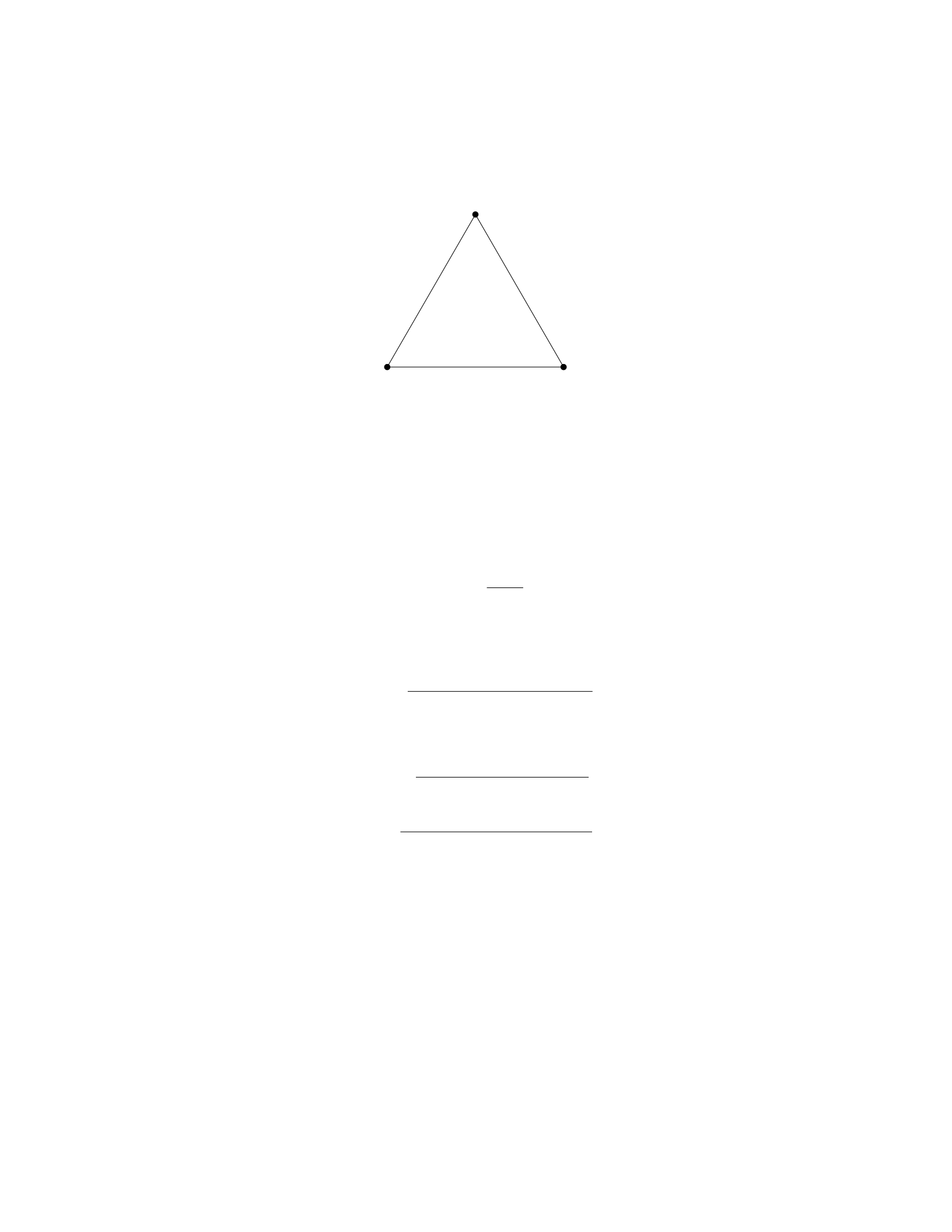
q1
q2q3
Given that q1= 2 µC, q2=−4µC, and q3= 6 µC. The side length of the
equilateral triangle is d= 1 m.
Solution
Step 1: Calculate the electric forces between each pair of charges using Coulomb’s
law: The electric force between two charges q1and q2separated by a distance
ris given by Coulomb’s law:
F12 =k·|q1q2|
r2,
where k= 9 ×10⁹N m2/C2.
Using this formula:
F12 = (9 ×10⁹)·|2×10⁻⁶C× −4×10⁻⁶C|
(1 m)2=−72 N.
Similarly, we can find F13 and F23:
F13 = (9 ×10⁹)·|2×10−6C×6×10−6C|
(1 m)2= 108 N,
F23 = (9 ×10⁹)·| − 4×10−6C×6×10−6C|
(1 m)2=−216 N.
Step 2: Calculate the net force on q3by applying the principle of superpo-
sition: The net force on q3is the vector sum of F13 and F23:
Fnet =F13 +F23 = 108 N−216 N=−108 N.
Hence, the magnitude of the net electrostatic force acting on charge q3is
108 N.
13

Question 16
Question
Three point charges are arranged as shown: q1= 2 µC at the origin, q2=−1µC
at point (2,0), and q3= 3 µC at point (0,3). Calculate the net force on q2due
to the other charges.
Solution
Step 1: Calculate the force on q2due to q1. The electric force on a charge qdue
to another charge Qis given by Coulomb’s law:
F=k
qQ
r2
where kis the Coulomb constant (8.99 ×10⁹N·m2/C2) and ris the distance
between the charges.
The distance r1between q1and q2is
r1=p22+ 02= 2 m
Thus, the magnitude of the force on q2due to q1is:
F1= 8.99 ×109·2×10−6·1×10−6
22= 8.99 ×109·10−12 = 8.99 ×10⁻³N
The direction of the force on q2due to q1is radially inward toward the origin.
Step 2: Calculate the force on q2due to q3. The distance r2between q2and
q3is
r2=p02+ 32= 3 m
The magnitude of the force on q2due to q3is:
F2= 8.99 ×109·1×10−6·3×10−6
32= 8.99 ×109·10−12 = 8.99 ×10⁻³N
The direction of the force on q2due to q3is radially downward.
Step 3: Calculate the net force on q2. The net force on q2is the vector sum
of the two forces:
Fnet =qF2
1+F2
2=p(8.99 ×10⁻³)2+ (8.99 ×10⁻³)2=p2×(8.99 ×10−3)2= 2×8.99×10−3= 17.98×10−3= 17.98 mN
The direction of the net force on q2is the vector sum of the individual forces.
14

Question 17
Question
Three point charges are arranged as shown in the diagram below. Calculate the
magnitude and direction of the electric force acting on the charge q1.
q2= +2µC
↑
q1=−3µC →q3=−1µC
↓
Solution
Step 1: Calculate the electric force on charge q1due to charge q2.
The electric force between two point charges can be calculated using Coulomb’s
Law:
F=k|q1q2|
r2,
where kis Coulomb’s constant (8.99 ×10⁹Nm2/C2), q1and q2are the magni-
tudes of the charges, and ris the distance between the charges.
Given q1=−3µC =−3×10⁻⁶C,q2= +2µC = 2 ×10⁻⁶C, and r=
distance between q1and q2=unknown. We need to find the distance between
the charges to calculate the force.
Step 2: Calculate the distance between charges q1and q2.
In this case, q1and q2are in the same line, so their distance is simply the
distance between them, which is equal to the length of the segment q1q2.
Since q2is directly above q1, we have a right triangle where the hypotenuse
is the segment q1q2, the vertical leg is the distance between q1and q2, and the
horizontal leg is r. Using Pythagoras’ theorem, we find
r=p(2cm)2+ (3cm)2=p4cm2+ 9cm2=√13cm2≈3.61cm.
Step 3: Calculate the electric force acting on charge q1due to charge q2.
Substitute the values into Coulomb’s Law:
Fq1−q2= (8.99 ×10⁹Nm2/C2)| − 3×10−6C×2×10−6C|
(3.61 ×10⁻²m)2
= 8.99 ×109×6×10−12C2
1.30321 ×10⁻³m2= 157.5N.
The electric force on charge q1due to charge q2is 157.5Nupwards.
Step 4: Calculate the electric force on charge q1due to charge q3.
The electric force between charges q1and q3follows the same steps as above.
Step 5: Calculate the total electric force on charge q1.
The electric force is a vector quantity, so we need to consider the directions of
15

the forces due to charges q2and q3. The force due to charge q3will be opposite
in direction to the force due to charge q2.
The total electric force on charge q1is the vector sum of the forces due to
q2and q3. The magnitude can be calculated using the Pythagorean theorem,
while the direction can be found by trigonometry.
Question 18
Question
Two point charges, q1=−6nC and q2= 2 nC, are placed 10 cm apart in air.
Calculate the magnitude and direction of the electric force that q1exerts on q2.
Solution
1. Calculate the magnitude of the electric force using Coulomb’s law:
F=k|q1q2|
r2
where k= 8.99 ×10⁹N·m2/C2is the electrostatic constant, |q1|= 6 ×10⁻⁹C
is the magnitude of q1,|q2|= 2 ×10⁻⁹C is the magnitude of q2, and r= 0.10 m
is the distance between the charges.
F= (8.99 ×10⁹N·m2
C2)(6 ×10⁻⁹C)(2 ×10⁻⁹C)
(0.10 m)2
2. Calculate the magnitude of the electric force:
F= 8.99 ×10⁹N·m2
C2×1.2×10−17 C/0.01 m= 107.88 N
3. Determine the direction of the force. Since q1is negative and q2is positive,
the force on q2will be attractive and directed towards q1.
Question 20
Question
Two point charges, q1= +4 nC and q2=−5nC, are placed 10 cm apart in a
vacuum. Calculate the magnitude of the electric force each charge exerts on the
other.
16

Solution
Step 1: Calculate the magnitude of the electric force exerted by q1on q2using
Coulomb’s Law:
F12 =k|q1||q2|
r2
where k= 8.99 ×10⁹N m2C−2is the electrostatic constant, |q1|= 4 ×10⁻⁹C,
|q2|= 5 ×10⁻⁹C, and r= 0.10 m. Plugging in the values, we get:
F12 =(8.99 ×10⁹)(4 ×10⁻⁹)(5 ×10⁻⁹)
0.102
F12 =(35.96)(5)
0.01
F12 = 179.8N
Step 2: Calculate the magnitude of the electric force exerted by q2on q1:
The magnitude of the force exerted by q2on q1will be equal in magnitude but
opposite in direction to the force exerted by q1on q2. Therefore, |F21|=|F12|=
179.8N.
Question 21
Question
Two point charges, each with a magnitude of 4.00 µC, are placed 2.00 m apart.
Calculate the magnitude of the electric force between the charges.
Solution
To calculate the magnitude of the electric force between the charges, we can use
Coulomb’s Law, which states that the magnitude of the electric force between
two point charges is given by:
F=k·|q1·q2|
r2
Where: - Fis the magnitude of the electric force, - kis the Coulomb constant
(8.99 ×10⁹N m2/C2), - q1and q2are the magnitudes of the charges, and - ris
the distance between the charges.
Step 1: Identify the given values: - Magnitude of each charge, q1=q2=
4.00 µC= 4.00 ×10⁻⁶C - Distance between the charges, r= 2.00 m
Step 2: Substitute the given values into Coulomb’s Law:
F= (8.99 ×10⁹N m2/C2)·|4.00 ×10−6C·4.00 ×10−6C|
(2.00 m)2
17

Step 3: Calculate the magnitude of the electric force:
F= (8.99 ×10⁹)·|16.00 ×10⁻¹²|
4.00
F= 8.99 ×109·4.00 ×10−12
F= 35.96 ×10⁻³
F= 3.60 ×10⁻²N
Therefore, the magnitude of the electric force between the charges is 3.60 ×
10−2N.
Question 22
Question
Two point charges, Q1= +6 µC and Q2=−4µC, are placed 10 cm apart.
Calculate the magnitude of the electric force between the charges.
Solution
To calculate the magnitude of the electric force between the charges, we can use
Coulomb’s law. Coulomb’s law states that the magnitude of the electric force
between two point charges is directly proportional to the product of the charges
and inversely proportional to the square of the distance between them.
Step 1: Convert the charges to Coulombs.
Since 1µC = 10−6C, Q1= +6 µC becomes Q1= +6×10⁻⁶C and Q2=−4µC
becomes Q2=−4×10⁻⁶C.
Step 2: Calculate the electric force using Coulomb’s law formula:
F=k·|Q1·Q2|
r2
where: - Fis the electric force, - kis Coulomb’s constant, 8.9875×10⁹N·m2/C2,
-Q1= +6 ×10⁻⁶C, - Q2=−4×10⁻⁶C, - r= 10 cm = 0.1m.
Substitute the values into the formula:
F= 8.9875 ×10⁹N·m2/C2·|(+6 ×10−6)·(−4×10⁻⁶)|
(0.1)2
F= 8.9875 ×109×24 ×10−12 ×106N
F= 8.9875 ×24 N
F= 215.70 N
Therefore, the magnitude of the electric force between the charges is 215.70
N.
18

Question 23
Question
Three point charges are placed along the x-axis as follows: +4 nC at x= 0,
−8nC at x= 5 cm, and +6 nC at x= 10 cm. Calculate the net electric force
experienced by the +4 nC charge.
Solution
Step 1: Calculate the force between the +4 nC charge and the −8nC charge.
The electric force Fbetween two point charges q1and q2separated by distance
ris given by Coulomb’s Law:
F=k· |q1·q2|
r2
where k≈8.99 ×10⁹N m2/C2is the electrostatic constant.
Plugging in the charges and the distance between +4 nC and −8nC charges,
we get:
F1,2 =8.99 ×10⁹· |4×(−8)| × 0.052
(0.05)2
F1,2 =8.99 ×109·32 ×0.052
0.052
F1,2 = 8.99 ×109·32 = 2.8768 ×10¹¹ N
Step 2: Calculate the force between the +4 nC charge and the +6 nC charge.
Following the same process as in step 1, we find:
F1,3 =8.99 ×10⁹· |4×6| · 0.12
0.12= 4.794 ×10¹¹ N
Step 3: Calculate the net force on the +4 nC charge. The net force is the
vector sum of the forces due to the other two charges. Since the forces are along
the x-axis, we can simply add them up algebraically.
Fnet =F1,2 +F1,3 = 2.8768 ×10¹¹ + 4.794 ×10¹¹
Fnet = 7.6708 ×10¹¹ N
Therefore, the net electric force experienced by the +4 nC charge is 7.6708×
1011 N.
Question 24
Question
Two point charges, q1= 3.0µC and q2=−4.0µC, are placed 8.0 cm apart.
Calculate the magnitude of the electric force between these two charges.
19

Solution
Let’s denote the magnitude of the electric force between q1and q2as Felec.
Step 1: Calculate the distance between the two charges in meters: The
distance between the charges is given as 8.0 cm, which is equal to 0.08 m.
Step 2: Calculate the magnitude of the electric force using Coulomb’s law:
Coulomb’s law states that the magnitude of the electric force between two point
charges is given by:
Felec =k· |q1·q2|
r2
where kis the electrostatic constant (8.99 ×10⁹N m2/C2), q1and q2are the
magnitudes of the charges in coulombs, and ris the distance between the charges
in meters.
Substitute the given values into the equation:
Felec =(8.99 ×10⁹N m2/C2)· |3.0×10⁻⁶C· −4.0×10⁻⁶C|
(0.08 m)2
Felec =(8.99 ×109)·(3.0×10−6·4.0×10−6)
0.0064
Felec =(8.99 ×109)·(12.0×10−12)
0.0064
Felec =107.88 ×10⁻³
0.0064
Felec = 16.86 N
Therefore, the magnitude of the electric force between the two charges is
16.86 N.
Question 25
Question
Three point charges are located at the vertices of an equilateral triangle of side
length a. The charges have the following magnitudes: q1= 2µC,q2=−3µC,
and q3= 4µC. Calculate the net electric force on q1due to the other two
charges.
Solution
1. Find the electric force
F1,2on q1due to q2: The electric force between two
point charges q1and q2separated by a distance ris given by Coulomb’s Law:
F1,2=k· |q1|·|q2|
r2ˆr
20

where kis the electrostatic constant and ˆris the unit vector pointing from q2to
q1. Given that q1= 2µC,q2=−3µC, and ais the side length of the equilateral
triangle, we have:
r=a, |q1|= 2 ×10⁻⁶C, |q2|= 3 ×10⁻⁶C
The electric force
F1,2on q1due to q2is directed toward q2.
2. Find the electric force
F1,3on q1due to q3: Similarly, the electric force
F1,3on q1due to q3is also directed away from q3. The magnitudes of the charges
are:
|q1|= 2 ×10⁻⁶C, |q3|= 4 ×10⁻⁶C
3. Calculate the net electric force
Fnet on q1: To find the net electric force
on q1, we sum the individual forces
F1,2and
F1,3:
Fnet =
F1,2+
F1,3
Since the forces are in opposite directions, the net force will depend on the
relative magnitudes of
F1,2and
F1,3.
21

Step 3: Express the magnitude of the force in scientific notation:
F= 1.3485 N
Step 4: Determine the direction of the force. Since q1is negative and q2is
positive, the electric force on q1will be attractive towards q2.
Therefore, the magnitude of the electric force on q1is 1.3485 N, directed
towards q2.
Question 2
Question
Two point charges, q1=−2.0µC and q2= 3.0µC, are placed 10.0 cm apart in
a vacuum. Calculate the magnitude of the electric force between the charges.
Solution
Step 1: Given that the charges q1=−2.0µC and q2= 3.0µC are 10.0 cm apart,
we can find the magnitude of the electric force between them using Coulomb’s
Law. Coulomb’s Law states that the magnitude of the electric force (F) between
two point charges is given by:
F=k·|q1·q2|
r2,
where kis the electrostatic constant (8.99 ×10⁹N m2/C2), q1and q2are the
magnitudes of the point charges, and ris the distance between the charges.
Step 2: Substituting the given values into Coulomb’s Law, we get:
F= (8.99 ×10⁹N m2/C2)·| − 2.0×10−6C·3.0×10−6C|
(0.10 m)2.
Step 3: Calculating the magnitude of the electric force gives:
F= (8.99 ×10⁹N m2/C2)·6.0×10−12 C2
0.01 m2.
Step 4: Simplifying the expression, we find:
F= 8.99 ×10⁹N m2/C2·6.0×10−10 C/m2= 5.394 N.
Therefore, the magnitude of the electric force between the charges q1and q2
is 5.394 N.
2

Question 3
Question
Two point charges are placed along the x-axis. The first charge, q1=−3µC, is
located at the origin, and the second charge, q2= 4µC, is located at x= 6 m.
Calculate the magnitude and direction of the electric force on q2.
Solution
Step 1: Calculate the distance rbetween the two charges. Since q1is at the
origin and q2is at x= 6 m, the distance rbetween the two charges is:
r=|6−0|= 6 m
Step 2: Calculate the magnitude of the electric force. The magnitude of the
electric force between the two charges is given by Coulomb’s Law:
F=k|q1q2|
r2
where k= 8.99 ×10⁹Nm2/C2is the Coulomb constant.
Substitute the given values:
F=(8.99 ×10⁹)|(−3×10⁻⁶)(4 ×10⁻⁶)|
(6)2
Calculating this expression gives:
F=107940
36
F2998.33 N
So, the magnitude of the electric force on q2is approximately 2998.33 N.
Step 3: Determine the direction of the electric force. The direction of the
electric force depends on the sign of the charges. Since q2is positive, it will
experience a repulsive force away from q1which is negative. Thus, the electric
force on q2is directed along the positive x-axis.
Therefore, the electric force on q2has a magnitude of approximately 2998.33 N
and is directed along the positive x-axis.
Question 4
Question
Two point charges, q1=−3µC and q2= 7 µC, are placed 12 cm apart in a
vacuum. Calculate the magnitude of the electric force between these charges.
3

Solution
Step 1: Convert all given quantities to standard SI units.
•q1=−3µC=−3×10⁻⁶C
•q2= 7 µC= 7 ×10⁻⁶C
•r= 12 cm = 0.12 m
Step 2: Calculate the electric force using Coulomb’s law:
F=k· |q1|·|q2|
r2
where k= 8.99 ×10⁹N m2/C2is the electrostatic constant.
Step 3: Substitute the given values into the formula and calculate the electric
force. Remember that the force is attractive if charges have opposite signs and
repulsive if charges have the same sign.
F=8.99 ×109×3×7×10−6×10−6
(0.12)2
Step 4: Solve for the electric force magnitude.
F=8.99 ×3×7
(0.12)2=8.99 ×21
0.0144 ≈13161.458 N
Therefore, the magnitude of the electric force between the charges is approx-
imately 13161.458 N.
Question 5
Question
Two point charges, q1=−4µC and q2= 8 µC, are separated by a distance of
5cm. Determine the magnitude and direction of the electric force exerted on q1
due to q2.
Solution
Step 1: Calculate the electric force magnitude using Coulomb’s Law: The elec-
tric force between two point charges is given by Coulomb’s Law:
F=k|q1q2|
r2,
where kis Coulomb’s constant (8.988 ×10⁹N m2/C2), q1and q2are the mag-
nitudes of the charges, and ris the distance between them. Plugging in the
values:
F= (8.988 ×10⁹)|(−4×10⁻⁶)(8 ×10⁻⁶)|
(0.05)2,
4

F= (8.988 ×10⁹)32 ×10−12
0.0025 ,
F= (8.988 ×109)×12.8×10−10,
F= 1.15 ×10⁻³N.
Step 2: Determine the direction of the electric force: The force will be
attractive since the charges have opposite signs. The force will act along the
line joining the two charges, directed towards q2.
Question 6
Question
Two point charges, q1=−2.0µC and q2= 4.0µC, are placed 10.0 cm apart in
a vacuum. Calculate the magnitude and direction of the electric force that q1
exerts on q2.
Solution
Step 1: Convert all given quantities to standard SI units.
•q1=−2.0µC = −2.0×10⁻⁶C
•q2= 4.0µC = 4.0×10⁻⁶C
•r= 10.0cm = 0.10 m
• The vacuum permittivity constant, ε0= 8.85 ×10⁻¹² C2/N·m2
Step 2: Calculate the magnitude of the electric force using Coulomb’s Law:
F=k· |q1|·|q2|
r2
where k=1
4πε0
is the Coulomb constant.
Step 3: Substitute the given values into the formula:
F=1
4πε0·| − 2.0×10⁻⁶|·|4.0×10⁻⁶|
(0.10)2
Step 4: Calculate the magnitude of the electric force:
F=1
4π·8.85 ×10−12 ·2.0×4.0×10−6×10−6
0.01
F=1
4π·8.85 ×10−12 ·8.0×10−12
5

Step 5: Calculate the magnitude of the electric force:
F≈9.02 ×10⁻⁵N
The direction of the force between these two charges is attractive because
they have opposite signs.
Therefore, the magnitude of the electric force that q1exerts on q2is approx-
imately 9.02 ×10⁻⁵N, directed from q1towards q2.
Question 7
Question
Two point charges, q1= +3.0µC and q2=−5.0µC, are placed 10.0 cm apart
along the x-axis. Calculate the magnitude of the electric force that q2exerts on
q1.
Solution
Step 1: Convert the charges to C (Coulombs) and the distance to meters. Given:
q1= +3.0µC= 3.0×10⁻⁶Cq2=−5.0µC=−5.0×10⁻⁶C Distance between
the charges, r= 10.0cm = 0.10 m
Step 2: Calculate the magnitude of the electric force using Coulomb’s Law:
The electric force Fbetween two point charges is given by:
F=k·|q1·q2|
r2
where k= 8.99 ×10⁹N·m2/C2is the electrostatic constant.
Substitute the given values into the formula:
F= (8.99 ×10⁹)·|3.0×10⁻⁶· −5.0×10⁻⁶|
(0.10)2
Step 3: Perform the calculation to find the electric force.
F= 8.99 ×109·15 ×10−12
0.01 = 8.99 ×109·1.5×10−9
F= 13.485 ×10−9= 1.3485 ×10⁻⁸N
Therefore, the magnitude of the electric force that q2exerts on q1is 1.3485×
10−8N.
Question 8
Question
Three point charges are located at the vertices of an equilateral triangle of
side length a= 2.00 m. The charges are q1=−2.00 µC, q2= 4.00 µC, and
q3=−3.00 µC. Calculate the net electric force on q2.
6

Solution
Step 1: Calculate the electric force on q2due to q1. The electric force F12
between q1and q2is given by Coulomb’s Law:
F12 =k|q1||q2|
r2
12
where kis the Coulomb constant, q1and q2are the magnitudes of the charges,
and r12 is the distance between the charges. The direction of the force will be
along the line connecting the two charges.
Step 2: Calculate the distance r12 between q1and q2. Since the charges are
at the vertices of an equilateral triangle, the distance r12 is equal to the length
of the side of the triangle, a= 2.00 m.
Step 3: Substitute the given values and solve for F12. Plugging in the values
k= 8.99 ×10⁹N m2/C2,q1=−2.00 ×10−6C, q2= 4.00 ×10⁻⁶C, and
r12 = 2.00 m into Coulomb’s Law, we get:
F12 = (8.99 ×10⁹)(2.00 ×10⁻⁶)(4.00 ×10⁻⁶)
(2.00)2
Step 4: Calculate the magnitude of F12.
|F12|= (8.99 ×10⁹)(2.00 ×10⁻⁶)(4.00 ×10⁻⁶)
(2.00)2
Step 5: Repeat steps 1-4 for the electric forces F23 between q2and q3, and
F13 between q1and q3.
Step 6: Calculate the net force on q2. Since forces are vectors, we need to
resolve them into components and add them together. The net force on q2is
the vector sum of F12 ,F23 , and F13 .
Question 9
Question
Two point charges are placed on the x-axis. The first charge, q1= 2.0µC,
is located at x= 1.0mand the second charge, q2=−3.0µC, is located at
x= 3.0m. Calculate the magnitude and direction of the electric force that
charge q2exerts on charge q1.
Solution
To calculate the electric force between the two charges, we can use Coulomb’s
Law which states that the magnitude of the electric force Fbetween two point
charges q1and q2separated by a distance ris given by:
F=k·|q1q2|
r2
7

where kis the Coulomb constant, 8.99 ×10⁹Nm2/C2.
Step 1: Calculate the distance between the charges The distance r
between the two charges is given by:
r=|x2−x1|=|3.0m−1.0m|= 2.0m
Step 2: Calculate the magnitude of the electric force Substitute the
given values into Coulomb’s Law:
F= (8.99 ×10⁹Nm2/C2)·|(2.0×10−6C)(−3.0×10−6C)|
(2.0m)2
F= (8.99 ×109)·6.0×10−12
4
F= 1.3485 ×10⁻²N
So, the magnitude of the electric force between the two charges is 1.3485 ×
10−2N.
Step 3: Determine the direction of the electric force The direction
of the force will be attractive since the charges have opposite signs. Charge q2
(negative) will exert a force in the direction towards charge q1(positive).
Therefore, the electric force that charge q2exerts on charge q1is 1.3485 ×
10−2Ndirected towards charge q1.
Question 10
Question
Two point charges, q1=−3.5×10⁻⁶C and q2= 7.2×10⁻⁶C, are placed 15 cm
apart in air. Calculate the magnitude of the electric force between the charges.
Solution
Step 1: Calculate the magnitude of the electric force using Coulomb’s Law:
F=k· |q1|·|q2|
r2
where kis the Coulomb constant (8.99 ×10⁹N m2/C2), |q1|and |q2|are the
magnitudes of the charges, and ris the distance between the charges.
Step 2: Substitute the given values into the formula:
F=(8.99 ×10⁹N m2/C2)·(3.5×10−6C)·(7.2×10−6C)
(0.15 m)2
Step 3: Calculate the electric force:
F=(8.99 ×109)·(3.5×10−6)·(7.2×10−6)
(0.15)2N
8

F≈0.725 N
Therefore, the magnitude of the electric force between the charges is approx-
imately 0.725 N.
Question 11
Question
Two point charges, q1=−4.00 µC and q2= 6.00 µC, are separated by a distance
of 2.00 m in a vacuum. Calculate the magnitude of the electric force between
the two charges.
Solution
Step 1: Convert the charges to Coulombs. Step 2: Calculate the magnitude
of the electric force using Coulomb’s law. Step 3: Write the final answer with
appropriate units.
Step 1: Convert the charges to Coulombs. Given that 1µC (microcoulomb)
is equal to 10−6C (coulombs), we have: q1=−4.00 µC=−4.00 ×10⁻⁶C, and
q2= 6.00 µC= 6.00 ×10⁻⁶C.
Step 2: Calculate the magnitude of the electric force using Coulomb’s
law. The formula for the electric force between two point charges is given by
Coulomb’s law:
F=k·|q1|·|q2|
r2
where kis the Coulomb constant, which has a value of 8.99 ×10⁹N m²/C², q1
and q2are the charges, and ris the distance between the charges.
Substitute the given values into the formula:
F= 8.99 ×10⁹·|−4.00 ×10⁻⁶|·|6.00 ×10⁻⁶|
2.002
Calculating the magnitude of the electric force gives:
F= 8.99 ×109·4.00 ×6.00 ×10−12
4.00
F= 8.99 ×109·6.00 ×10−12
Step 3: Write the final answer with appropriate units. Calculating the final
result:
F= 53.94 ×10⁻³N= 53.94 mN
Therefore, the magnitude of the electric force between the two charges is
53.94 mN.
9

Question 12
Question
Two point charges, q1=−3.0µC and q2= 5.0µC, are placed 10.0 cm apart in
air. Calculate the magnitude of the electric force between the charges.
Solution
Step 1: Convert the charges to Coulombs. Given that 1µC= 10−6C, we can
convert the charges: q1=−3.0µC=−3.0×10⁻⁶Cq2= 5.0µC= 5.0×10⁻⁶C
Step 2: Calculate the electric force between the charges using Coulomb’s
law. The magnitude of the electric force between two point charges is given by
Coulomb’s law:
F=k·|q1·q2|
r2
where kis the electrostatic constant (8.99 ×10⁹N m2/C2), q1and q2are the
charges, and ris the distance between the charges.
Plugging in the values, we have:
F= (8.99 ×10⁹)×| − 3.0×10−6×5.0×10−6|
(0.10)2
Step 3: Calculate the magnitude of the electric force.
F= 8.99 ×109×15 ×10−12
0.01
F= 8.99 ×107×1.5×10−10
F= 1.35 ×10⁻²N
Therefore, the magnitude of the electric force between the charges is 1.35 ×
10−2N.
Question 13
Question
Three point charges are arranged in a line. Charge q1= +4 µC is located at
the origin, charge q2=−2µC is located at x= 2 m, and charge q3= +3 µC is
located at x= 4 m. Calculate the net electric force on charge q2due to charges
q1and q3.
10

Solution
Step 1: Calculate the electric force on charge q2due to q1. The electric force
F12 between charges q1and q2is given by Coulomb’s law:
F12 =k|q1·q2|
r2
12
where kis Coulomb’s constant (8.99×10⁹N m2/C2), r12 is the distance between
the charges, and q1and q2are the magnitudes of the charges. Since q1and q2
have opposite signs, the force is attractive.
Given q1= +4 µC, q2=−2µC, and r12 = 2 m, we can substitute these
values into the formula to find F12.
F12 = (8.99 ×10⁹)|4×10⁻⁶· −2×10⁻⁶|
(2)2
F12 = 4.495 ×10⁻³N
Step 2: Calculate the electric force on charge q2due to q3. Similarly, we can
find the electric force F23 between charges q2and q3by using Coulomb’s law:
F23 =k|q2·q3|
r2
23
where r23 is the distance between the charges.
Given q2=−2µC, q3= +3 µC, and r23 = 2 m, we can substitute these
values into the formula to find F23.
F23 = (8.99 ×10⁹)| − 2×10−6·3×10−6|
(2)2
F23 = 4.495 ×10⁻³N
Step 3: Find the net electric force on charge q2. Since the forces F12 and
F23 are in opposite directions, we need to find their vector sum:
Fnet =F12 −F23 = 4.495 ×10⁻³−4.495 ×10−3= 0
Therefore, the net electric force on charge q2due to charges q1and q3is 0
N.
Question 14
Question
Two point charges, q1= +3 nC and q2=−4nC, are placed 5 cm apart in air.
Calculate the magnitude of the electric force between these charges.
11

Solution
Step 1: Convert the charges to standard units: Given that 1 nC (nanoCoulomb)
is equal to 1×10⁻⁹C (Coulombs), the charges are: q1= +3 nC = 3 ×10⁻⁹C
and q2=−4nC =−4×10⁻⁹C.
Step 2: Calculate the distance between the charges: Given that the charges
are 5 cm apart, we convert this to meters by dividing by 100: d= 5 cm =
5×10⁻²m.
Step 3: Calculate the magnitude of the electric force using Coulomb’s Law:
The magnitude of the electric force between two point charges is given by:
F=k· |q1·q2|
d2
where k= 8.99 ×10⁹N m2/C2is the electrostatic constant.
Step 4: Substitute the given values into the formula:
F=8.99 ×10⁹· |3×10⁻⁹· −4×10⁻⁹|
(5 ×10⁻²)2
Step 5: Perform the calculation:
F=8.99 ×109·12 ×10−18
25 ×10−4
F=8.99 ×12 ×10−9
0.25
F=107.88 ×10⁻⁹
0.25
F= 4.312 ×10⁻⁹N
Therefore, the magnitude of the electric force between the point charges is
4.312 ×10⁻⁹N.
Question 15
Question
Three point charges are arranged in an equilateral triangle as shown below.
Charge q1is at the top vertex, charge q2is at the bottom left vertex, and charge
q3is at the bottom right vertex. Find the magnitude of the net electrostatic
force acting on charge q3.
12
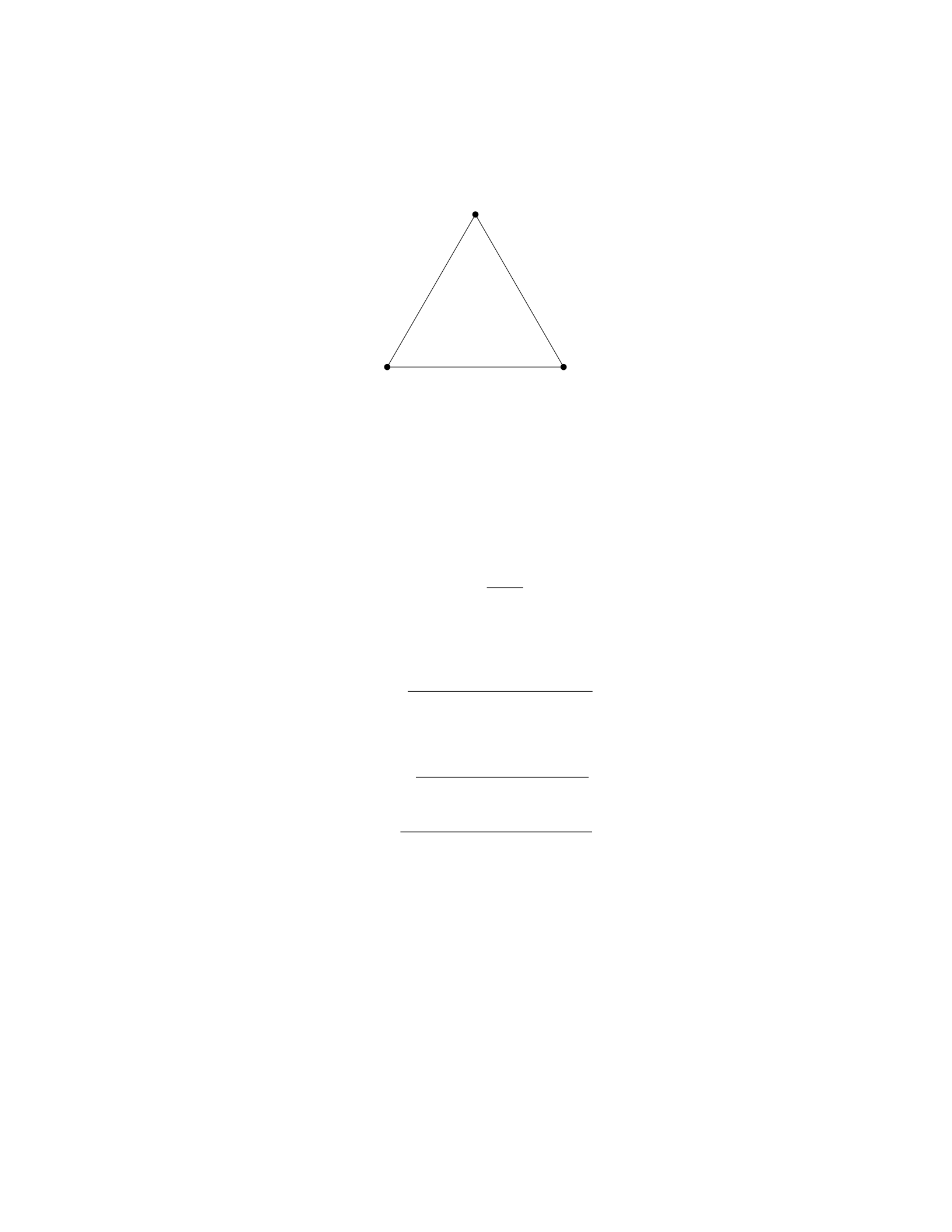
q1
q2q3
Given that q1= 2 µC, q2=−4µC, and q3= 6 µC. The side length of the
equilateral triangle is d= 1 m.
Solution
Step 1: Calculate the electric forces between each pair of charges using Coulomb’s
law: The electric force between two charges q1and q2separated by a distance
ris given by Coulomb’s law:
F12 =k·|q1q2|
r2,
where k= 9 ×10⁹N m2/C2.
Using this formula:
F12 = (9 ×10⁹)·|2×10⁻⁶C× −4×10⁻⁶C|
(1 m)2=−72 N.
Similarly, we can find F13 and F23:
F13 = (9 ×10⁹)·|2×10−6C×6×10−6C|
(1 m)2= 108 N,
F23 = (9 ×10⁹)·| − 4×10−6C×6×10−6C|
(1 m)2=−216 N.
Step 2: Calculate the net force on q3by applying the principle of superpo-
sition: The net force on q3is the vector sum of F13 and F23:
Fnet =F13 +F23 = 108 N−216 N=−108 N.
Hence, the magnitude of the net electrostatic force acting on charge q3is
108 N.
13

Question 16
Question
Three point charges are arranged as shown: q1= 2 µC at the origin, q2=−1µC
at point (2,0), and q3= 3 µC at point (0,3). Calculate the net force on q2due
to the other charges.
Solution
Step 1: Calculate the force on q2due to q1. The electric force on a charge qdue
to another charge Qis given by Coulomb’s law:
F=k
qQ
r2
where kis the Coulomb constant (8.99 ×10⁹N·m2/C2) and ris the distance
between the charges.
The distance r1between q1and q2is
r1=p22+ 02= 2 m
Thus, the magnitude of the force on q2due to q1is:
F1= 8.99 ×109·2×10−6·1×10−6
22= 8.99 ×109·10−12 = 8.99 ×10⁻³N
The direction of the force on q2due to q1is radially inward toward the origin.
Step 2: Calculate the force on q2due to q3. The distance r2between q2and
q3is
r2=p02+ 32= 3 m
The magnitude of the force on q2due to q3is:
F2= 8.99 ×109·1×10−6·3×10−6
32= 8.99 ×109·10−12 = 8.99 ×10⁻³N
The direction of the force on q2due to q3is radially downward.
Step 3: Calculate the net force on q2. The net force on q2is the vector sum
of the two forces:
Fnet =qF2
1+F2
2=p(8.99 ×10⁻³)2+ (8.99 ×10⁻³)2=p2×(8.99 ×10−3)2= 2×8.99×10−3= 17.98×10−3= 17.98 mN
The direction of the net force on q2is the vector sum of the individual forces.
14

Question 17
Question
Three point charges are arranged as shown in the diagram below. Calculate the
magnitude and direction of the electric force acting on the charge q1.
q2= +2µC
↑
q1=−3µC →q3=−1µC
↓
Solution
Step 1: Calculate the electric force on charge q1due to charge q2.
The electric force between two point charges can be calculated using Coulomb’s
Law:
F=k|q1q2|
r2,
where kis Coulomb’s constant (8.99 ×10⁹Nm2/C2), q1and q2are the magni-
tudes of the charges, and ris the distance between the charges.
Given q1=−3µC =−3×10⁻⁶C,q2= +2µC = 2 ×10⁻⁶C, and r=
distance between q1and q2=unknown. We need to find the distance between
the charges to calculate the force.
Step 2: Calculate the distance between charges q1and q2.
In this case, q1and q2are in the same line, so their distance is simply the
distance between them, which is equal to the length of the segment q1q2.
Since q2is directly above q1, we have a right triangle where the hypotenuse
is the segment q1q2, the vertical leg is the distance between q1and q2, and the
horizontal leg is r. Using Pythagoras’ theorem, we find
r=p(2cm)2+ (3cm)2=p4cm2+ 9cm2=√13cm2≈3.61cm.
Step 3: Calculate the electric force acting on charge q1due to charge q2.
Substitute the values into Coulomb’s Law:
Fq1−q2= (8.99 ×10⁹Nm2/C2)| − 3×10−6C×2×10−6C|
(3.61 ×10⁻²m)2
= 8.99 ×109×6×10−12C2
1.30321 ×10⁻³m2= 157.5N.
The electric force on charge q1due to charge q2is 157.5Nupwards.
Step 4: Calculate the electric force on charge q1due to charge q3.
The electric force between charges q1and q3follows the same steps as above.
Step 5: Calculate the total electric force on charge q1.
The electric force is a vector quantity, so we need to consider the directions of
15

the forces due to charges q2and q3. The force due to charge q3will be opposite
in direction to the force due to charge q2.
The total electric force on charge q1is the vector sum of the forces due to
q2and q3. The magnitude can be calculated using the Pythagorean theorem,
while the direction can be found by trigonometry.
Question 18
Question
Two point charges, q1=−6nC and q2= 2 nC, are placed 10 cm apart in air.
Calculate the magnitude and direction of the electric force that q1exerts on q2.
Solution
1. Calculate the magnitude of the electric force using Coulomb’s law:
F=k|q1q2|
r2
where k= 8.99 ×10⁹N·m2/C2is the electrostatic constant, |q1|= 6 ×10⁻⁹C
is the magnitude of q1,|q2|= 2 ×10⁻⁹C is the magnitude of q2, and r= 0.10 m
is the distance between the charges.
F= (8.99 ×10⁹N·m2
C2)(6 ×10⁻⁹C)(2 ×10⁻⁹C)
(0.10 m)2
2. Calculate the magnitude of the electric force:
F= 8.99 ×10⁹N·m2
C2×1.2×10−17 C/0.01 m= 107.88 N
3. Determine the direction of the force. Since q1is negative and q2is positive,
the force on q2will be attractive and directed towards q1.
Question 20
Question
Two point charges, q1= +4 nC and q2=−5nC, are placed 10 cm apart in a
vacuum. Calculate the magnitude of the electric force each charge exerts on the
other.
16

Solution
Step 1: Calculate the magnitude of the electric force exerted by q1on q2using
Coulomb’s Law:
F12 =k|q1||q2|
r2
where k= 8.99 ×10⁹N m2C−2is the electrostatic constant, |q1|= 4 ×10⁻⁹C,
|q2|= 5 ×10⁻⁹C, and r= 0.10 m. Plugging in the values, we get:
F12 =(8.99 ×10⁹)(4 ×10⁻⁹)(5 ×10⁻⁹)
0.102
F12 =(35.96)(5)
0.01
F12 = 179.8N
Step 2: Calculate the magnitude of the electric force exerted by q2on q1:
The magnitude of the force exerted by q2on q1will be equal in magnitude but
opposite in direction to the force exerted by q1on q2. Therefore, |F21|=|F12|=
179.8N.
Question 21
Question
Two point charges, each with a magnitude of 4.00 µC, are placed 2.00 m apart.
Calculate the magnitude of the electric force between the charges.
Solution
To calculate the magnitude of the electric force between the charges, we can use
Coulomb’s Law, which states that the magnitude of the electric force between
two point charges is given by:
F=k·|q1·q2|
r2
Where: - Fis the magnitude of the electric force, - kis the Coulomb constant
(8.99 ×10⁹N m2/C2), - q1and q2are the magnitudes of the charges, and - ris
the distance between the charges.
Step 1: Identify the given values: - Magnitude of each charge, q1=q2=
4.00 µC= 4.00 ×10⁻⁶C - Distance between the charges, r= 2.00 m
Step 2: Substitute the given values into Coulomb’s Law:
F= (8.99 ×10⁹N m2/C2)·|4.00 ×10−6C·4.00 ×10−6C|
(2.00 m)2
17

Step 3: Calculate the magnitude of the electric force:
F= (8.99 ×10⁹)·|16.00 ×10⁻¹²|
4.00
F= 8.99 ×109·4.00 ×10−12
F= 35.96 ×10⁻³
F= 3.60 ×10⁻²N
Therefore, the magnitude of the electric force between the charges is 3.60 ×
10−2N.
Question 22
Question
Two point charges, Q1= +6 µC and Q2=−4µC, are placed 10 cm apart.
Calculate the magnitude of the electric force between the charges.
Solution
To calculate the magnitude of the electric force between the charges, we can use
Coulomb’s law. Coulomb’s law states that the magnitude of the electric force
between two point charges is directly proportional to the product of the charges
and inversely proportional to the square of the distance between them.
Step 1: Convert the charges to Coulombs.
Since 1µC = 10−6C, Q1= +6 µC becomes Q1= +6×10⁻⁶C and Q2=−4µC
becomes Q2=−4×10⁻⁶C.
Step 2: Calculate the electric force using Coulomb’s law formula:
F=k·|Q1·Q2|
r2
where: - Fis the electric force, - kis Coulomb’s constant, 8.9875×10⁹N·m2/C2,
-Q1= +6 ×10⁻⁶C, - Q2=−4×10⁻⁶C, - r= 10 cm = 0.1m.
Substitute the values into the formula:
F= 8.9875 ×10⁹N·m2/C2·|(+6 ×10−6)·(−4×10⁻⁶)|
(0.1)2
F= 8.9875 ×109×24 ×10−12 ×106N
F= 8.9875 ×24 N
F= 215.70 N
Therefore, the magnitude of the electric force between the charges is 215.70
N.
18

Question 23
Question
Three point charges are placed along the x-axis as follows: +4 nC at x= 0,
−8nC at x= 5 cm, and +6 nC at x= 10 cm. Calculate the net electric force
experienced by the +4 nC charge.
Solution
Step 1: Calculate the force between the +4 nC charge and the −8nC charge.
The electric force Fbetween two point charges q1and q2separated by distance
ris given by Coulomb’s Law:
F=k· |q1·q2|
r2
where k≈8.99 ×10⁹N m2/C2is the electrostatic constant.
Plugging in the charges and the distance between +4 nC and −8nC charges,
we get:
F1,2 =8.99 ×10⁹· |4×(−8)| × 0.052
(0.05)2
F1,2 =8.99 ×109·32 ×0.052
0.052
F1,2 = 8.99 ×109·32 = 2.8768 ×10¹¹ N
Step 2: Calculate the force between the +4 nC charge and the +6 nC charge.
Following the same process as in step 1, we find:
F1,3 =8.99 ×10⁹· |4×6| · 0.12
0.12= 4.794 ×10¹¹ N
Step 3: Calculate the net force on the +4 nC charge. The net force is the
vector sum of the forces due to the other two charges. Since the forces are along
the x-axis, we can simply add them up algebraically.
Fnet =F1,2 +F1,3 = 2.8768 ×10¹¹ + 4.794 ×10¹¹
Fnet = 7.6708 ×10¹¹ N
Therefore, the net electric force experienced by the +4 nC charge is 7.6708×
1011 N.
Question 24
Question
Two point charges, q1= 3.0µC and q2=−4.0µC, are placed 8.0 cm apart.
Calculate the magnitude of the electric force between these two charges.
19

Solution
Let’s denote the magnitude of the electric force between q1and q2as Felec.
Step 1: Calculate the distance between the two charges in meters: The
distance between the charges is given as 8.0 cm, which is equal to 0.08 m.
Step 2: Calculate the magnitude of the electric force using Coulomb’s law:
Coulomb’s law states that the magnitude of the electric force between two point
charges is given by:
Felec =k· |q1·q2|
r2
where kis the electrostatic constant (8.99 ×10⁹N m2/C2), q1and q2are the
magnitudes of the charges in coulombs, and ris the distance between the charges
in meters.
Substitute the given values into the equation:
Felec =(8.99 ×10⁹N m2/C2)· |3.0×10⁻⁶C· −4.0×10⁻⁶C|
(0.08 m)2
Felec =(8.99 ×109)·(3.0×10−6·4.0×10−6)
0.0064
Felec =(8.99 ×109)·(12.0×10−12)
0.0064
Felec =107.88 ×10⁻³
0.0064
Felec = 16.86 N
Therefore, the magnitude of the electric force between the two charges is
16.86 N.
Question 25
Question
Three point charges are located at the vertices of an equilateral triangle of side
length a. The charges have the following magnitudes: q1= 2µC,q2=−3µC,
and q3= 4µC. Calculate the net electric force on q1due to the other two
charges.
Solution
1. Find the electric force
F1,2on q1due to q2: The electric force between two
point charges q1and q2separated by a distance ris given by Coulomb’s Law:
F1,2=k· |q1|·|q2|
r2ˆr
20

where kis the electrostatic constant and ˆris the unit vector pointing from q2to
q1. Given that q1= 2µC,q2=−3µC, and ais the side length of the equilateral
triangle, we have:
r=a, |q1|= 2 ×10⁻⁶C, |q2|= 3 ×10⁻⁶C
The electric force
F1,2on q1due to q2is directed toward q2.
2. Find the electric force
F1,3on q1due to q3: Similarly, the electric force
F1,3on q1due to q3is also directed away from q3. The magnitudes of the charges
are:
|q1|= 2 ×10⁻⁶C, |q3|= 4 ×10⁻⁶C
3. Calculate the net electric force
Fnet on q1: To find the net electric force
on q1, we sum the individual forces
F1,2and
F1,3:
Fnet =
F1,2+
F1,3
Since the forces are in opposite directions, the net force will depend on the
relative magnitudes of
F1,2and
F1,3.
21

Step 3: Express the magnitude of the force in scientific notation:
F= 1.3485 N
Step 4: Determine the direction of the force. Since q1is negative and q2is
positive, the electric force on q1will be attractive towards q2.
Therefore, the magnitude of the electric force on q1is 1.3485 N, directed
towards q2.
Question 2
Question
Two point charges, q1=−2.0µC and q2= 3.0µC, are placed 10.0 cm apart in
a vacuum. Calculate the magnitude of the electric force between the charges.
Solution
Step 1: Given that the charges q1=−2.0µC and q2= 3.0µC are 10.0 cm apart,
we can find the magnitude of the electric force between them using Coulomb’s
Law. Coulomb’s Law states that the magnitude of the electric force (F) between
two point charges is given by:
F=k·|q1·q2|
r2,
where kis the electrostatic constant (8.99 ×10⁹N m2/C2), q1and q2are the
magnitudes of the point charges, and ris the distance between the charges.
Step 2: Substituting the given values into Coulomb’s Law, we get:
F= (8.99 ×10⁹N m2/C2)·| − 2.0×10−6C·3.0×10−6C|
(0.10 m)2.
Step 3: Calculating the magnitude of the electric force gives:
F= (8.99 ×10⁹N m2/C2)·6.0×10−12 C2
0.01 m2.
Step 4: Simplifying the expression, we find:
F= 8.99 ×10⁹N m2/C2·6.0×10−10 C/m2= 5.394 N.
Therefore, the magnitude of the electric force between the charges q1and q2
is 5.394 N.
2

Question 3
Question
Two point charges are placed along the x-axis. The first charge, q1=−3µC, is
located at the origin, and the second charge, q2= 4µC, is located at x= 6 m.
Calculate the magnitude and direction of the electric force on q2.
Solution
Step 1: Calculate the distance rbetween the two charges. Since q1is at the
origin and q2is at x= 6 m, the distance rbetween the two charges is:
r=|6−0|= 6 m
Step 2: Calculate the magnitude of the electric force. The magnitude of the
electric force between the two charges is given by Coulomb’s Law:
F=k|q1q2|
r2
where k= 8.99 ×10⁹Nm2/C2is the Coulomb constant.
Substitute the given values:
F=(8.99 ×10⁹)|(−3×10⁻⁶)(4 ×10⁻⁶)|
(6)2
Calculating this expression gives:
F=107940
36
F2998.33 N
So, the magnitude of the electric force on q2is approximately 2998.33 N.
Step 3: Determine the direction of the electric force. The direction of the
electric force depends on the sign of the charges. Since q2is positive, it will
experience a repulsive force away from q1which is negative. Thus, the electric
force on q2is directed along the positive x-axis.
Therefore, the electric force on q2has a magnitude of approximately 2998.33 N
and is directed along the positive x-axis.
Question 4
Question
Two point charges, q1=−3µC and q2= 7 µC, are placed 12 cm apart in a
vacuum. Calculate the magnitude of the electric force between these charges.
3

Solution
Step 1: Convert all given quantities to standard SI units.
•q1=−3µC=−3×10⁻⁶C
•q2= 7 µC= 7 ×10⁻⁶C
•r= 12 cm = 0.12 m
Step 2: Calculate the electric force using Coulomb’s law:
F=k· |q1|·|q2|
r2
where k= 8.99 ×10⁹N m2/C2is the electrostatic constant.
Step 3: Substitute the given values into the formula and calculate the electric
force. Remember that the force is attractive if charges have opposite signs and
repulsive if charges have the same sign.
F=8.99 ×109×3×7×10−6×10−6
(0.12)2
Step 4: Solve for the electric force magnitude.
F=8.99 ×3×7
(0.12)2=8.99 ×21
0.0144 ≈13161.458 N
Therefore, the magnitude of the electric force between the charges is approx-
imately 13161.458 N.
Question 5
Question
Two point charges, q1=−4µC and q2= 8 µC, are separated by a distance of
5cm. Determine the magnitude and direction of the electric force exerted on q1
due to q2.
Solution
Step 1: Calculate the electric force magnitude using Coulomb’s Law: The elec-
tric force between two point charges is given by Coulomb’s Law:
F=k|q1q2|
r2,
where kis Coulomb’s constant (8.988 ×10⁹N m2/C2), q1and q2are the mag-
nitudes of the charges, and ris the distance between them. Plugging in the
values:
F= (8.988 ×10⁹)|(−4×10⁻⁶)(8 ×10⁻⁶)|
(0.05)2,
4

F= (8.988 ×10⁹)32 ×10−12
0.0025 ,
F= (8.988 ×109)×12.8×10−10,
F= 1.15 ×10⁻³N.
Step 2: Determine the direction of the electric force: The force will be
attractive since the charges have opposite signs. The force will act along the
line joining the two charges, directed towards q2.
Question 6
Question
Two point charges, q1=−2.0µC and q2= 4.0µC, are placed 10.0 cm apart in
a vacuum. Calculate the magnitude and direction of the electric force that q1
exerts on q2.
Solution
Step 1: Convert all given quantities to standard SI units.
•q1=−2.0µC = −2.0×10⁻⁶C
•q2= 4.0µC = 4.0×10⁻⁶C
•r= 10.0cm = 0.10 m
• The vacuum permittivity constant, ε0= 8.85 ×10⁻¹² C2/N·m2
Step 2: Calculate the magnitude of the electric force using Coulomb’s Law:
F=k· |q1|·|q2|
r2
where k=1
4πε0
is the Coulomb constant.
Step 3: Substitute the given values into the formula:
F=1
4πε0·| − 2.0×10⁻⁶|·|4.0×10⁻⁶|
(0.10)2
Step 4: Calculate the magnitude of the electric force:
F=1
4π·8.85 ×10−12 ·2.0×4.0×10−6×10−6
0.01
F=1
4π·8.85 ×10−12 ·8.0×10−12
5

Step 5: Calculate the magnitude of the electric force:
F≈9.02 ×10⁻⁵N
The direction of the force between these two charges is attractive because
they have opposite signs.
Therefore, the magnitude of the electric force that q1exerts on q2is approx-
imately 9.02 ×10⁻⁵N, directed from q1towards q2.
Question 7
Question
Two point charges, q1= +3.0µC and q2=−5.0µC, are placed 10.0 cm apart
along the x-axis. Calculate the magnitude of the electric force that q2exerts on
q1.
Solution
Step 1: Convert the charges to C (Coulombs) and the distance to meters. Given:
q1= +3.0µC= 3.0×10⁻⁶Cq2=−5.0µC=−5.0×10⁻⁶C Distance between
the charges, r= 10.0cm = 0.10 m
Step 2: Calculate the magnitude of the electric force using Coulomb’s Law:
The electric force Fbetween two point charges is given by:
F=k·|q1·q2|
r2
where k= 8.99 ×10⁹N·m2/C2is the electrostatic constant.
Substitute the given values into the formula:
F= (8.99 ×10⁹)·|3.0×10⁻⁶· −5.0×10⁻⁶|
(0.10)2
Step 3: Perform the calculation to find the electric force.
F= 8.99 ×109·15 ×10−12
0.01 = 8.99 ×109·1.5×10−9
F= 13.485 ×10−9= 1.3485 ×10⁻⁸N
Therefore, the magnitude of the electric force that q2exerts on q1is 1.3485×
10−8N.
Question 8
Question
Three point charges are located at the vertices of an equilateral triangle of
side length a= 2.00 m. The charges are q1=−2.00 µC, q2= 4.00 µC, and
q3=−3.00 µC. Calculate the net electric force on q2.
6

Solution
Step 1: Calculate the electric force on q2due to q1. The electric force F12
between q1and q2is given by Coulomb’s Law:
F12 =k|q1||q2|
r2
12
where kis the Coulomb constant, q1and q2are the magnitudes of the charges,
and r12 is the distance between the charges. The direction of the force will be
along the line connecting the two charges.
Step 2: Calculate the distance r12 between q1and q2. Since the charges are
at the vertices of an equilateral triangle, the distance r12 is equal to the length
of the side of the triangle, a= 2.00 m.
Step 3: Substitute the given values and solve for F12. Plugging in the values
k= 8.99 ×10⁹N m2/C2,q1=−2.00 ×10−6C, q2= 4.00 ×10⁻⁶C, and
r12 = 2.00 m into Coulomb’s Law, we get:
F12 = (8.99 ×10⁹)(2.00 ×10⁻⁶)(4.00 ×10⁻⁶)
(2.00)2
Step 4: Calculate the magnitude of F12.
|F12|= (8.99 ×10⁹)(2.00 ×10⁻⁶)(4.00 ×10⁻⁶)
(2.00)2
Step 5: Repeat steps 1-4 for the electric forces F23 between q2and q3, and
F13 between q1and q3.
Step 6: Calculate the net force on q2. Since forces are vectors, we need to
resolve them into components and add them together. The net force on q2is
the vector sum of F12 ,F23 , and F13 .
Question 9
Question
Two point charges are placed on the x-axis. The first charge, q1= 2.0µC,
is located at x= 1.0mand the second charge, q2=−3.0µC, is located at
x= 3.0m. Calculate the magnitude and direction of the electric force that
charge q2exerts on charge q1.
Solution
To calculate the electric force between the two charges, we can use Coulomb’s
Law which states that the magnitude of the electric force Fbetween two point
charges q1and q2separated by a distance ris given by:
F=k·|q1q2|
r2
7

where kis the Coulomb constant, 8.99 ×10⁹Nm2/C2.
Step 1: Calculate the distance between the charges The distance r
between the two charges is given by:
r=|x2−x1|=|3.0m−1.0m|= 2.0m
Step 2: Calculate the magnitude of the electric force Substitute the
given values into Coulomb’s Law:
F= (8.99 ×10⁹Nm2/C2)·|(2.0×10−6C)(−3.0×10−6C)|
(2.0m)2
F= (8.99 ×109)·6.0×10−12
4
F= 1.3485 ×10⁻²N
So, the magnitude of the electric force between the two charges is 1.3485 ×
10−2N.
Step 3: Determine the direction of the electric force The direction
of the force will be attractive since the charges have opposite signs. Charge q2
(negative) will exert a force in the direction towards charge q1(positive).
Therefore, the electric force that charge q2exerts on charge q1is 1.3485 ×
10−2Ndirected towards charge q1.
Question 10
Question
Two point charges, q1=−3.5×10⁻⁶C and q2= 7.2×10⁻⁶C, are placed 15 cm
apart in air. Calculate the magnitude of the electric force between the charges.
Solution
Step 1: Calculate the magnitude of the electric force using Coulomb’s Law:
F=k· |q1|·|q2|
r2
where kis the Coulomb constant (8.99 ×10⁹N m2/C2), |q1|and |q2|are the
magnitudes of the charges, and ris the distance between the charges.
Step 2: Substitute the given values into the formula:
F=(8.99 ×10⁹N m2/C2)·(3.5×10−6C)·(7.2×10−6C)
(0.15 m)2
Step 3: Calculate the electric force:
F=(8.99 ×109)·(3.5×10−6)·(7.2×10−6)
(0.15)2N
8

F≈0.725 N
Therefore, the magnitude of the electric force between the charges is approx-
imately 0.725 N.
Question 11
Question
Two point charges, q1=−4.00 µC and q2= 6.00 µC, are separated by a distance
of 2.00 m in a vacuum. Calculate the magnitude of the electric force between
the two charges.
Solution
Step 1: Convert the charges to Coulombs. Step 2: Calculate the magnitude
of the electric force using Coulomb’s law. Step 3: Write the final answer with
appropriate units.
Step 1: Convert the charges to Coulombs. Given that 1µC (microcoulomb)
is equal to 10−6C (coulombs), we have: q1=−4.00 µC=−4.00 ×10⁻⁶C, and
q2= 6.00 µC= 6.00 ×10⁻⁶C.
Step 2: Calculate the magnitude of the electric force using Coulomb’s
law. The formula for the electric force between two point charges is given by
Coulomb’s law:
F=k·|q1|·|q2|
r2
where kis the Coulomb constant, which has a value of 8.99 ×10⁹N m²/C², q1
and q2are the charges, and ris the distance between the charges.
Substitute the given values into the formula:
F= 8.99 ×10⁹·|−4.00 ×10⁻⁶|·|6.00 ×10⁻⁶|
2.002
Calculating the magnitude of the electric force gives:
F= 8.99 ×109·4.00 ×6.00 ×10−12
4.00
F= 8.99 ×109·6.00 ×10−12
Step 3: Write the final answer with appropriate units. Calculating the final
result:
F= 53.94 ×10⁻³N= 53.94 mN
Therefore, the magnitude of the electric force between the two charges is
53.94 mN.
9

Question 12
Question
Two point charges, q1=−3.0µC and q2= 5.0µC, are placed 10.0 cm apart in
air. Calculate the magnitude of the electric force between the charges.
Solution
Step 1: Convert the charges to Coulombs. Given that 1µC= 10−6C, we can
convert the charges: q1=−3.0µC=−3.0×10⁻⁶Cq2= 5.0µC= 5.0×10⁻⁶C
Step 2: Calculate the electric force between the charges using Coulomb’s
law. The magnitude of the electric force between two point charges is given by
Coulomb’s law:
F=k·|q1·q2|
r2
where kis the electrostatic constant (8.99 ×10⁹N m2/C2), q1and q2are the
charges, and ris the distance between the charges.
Plugging in the values, we have:
F= (8.99 ×10⁹)×| − 3.0×10−6×5.0×10−6|
(0.10)2
Step 3: Calculate the magnitude of the electric force.
F= 8.99 ×109×15 ×10−12
0.01
F= 8.99 ×107×1.5×10−10
F= 1.35 ×10⁻²N
Therefore, the magnitude of the electric force between the charges is 1.35 ×
10−2N.
Question 13
Question
Three point charges are arranged in a line. Charge q1= +4 µC is located at
the origin, charge q2=−2µC is located at x= 2 m, and charge q3= +3 µC is
located at x= 4 m. Calculate the net electric force on charge q2due to charges
q1and q3.
10

Solution
Step 1: Calculate the electric force on charge q2due to q1. The electric force
F12 between charges q1and q2is given by Coulomb’s law:
F12 =k|q1·q2|
r2
12
where kis Coulomb’s constant (8.99×10⁹N m2/C2), r12 is the distance between
the charges, and q1and q2are the magnitudes of the charges. Since q1and q2
have opposite signs, the force is attractive.
Given q1= +4 µC, q2=−2µC, and r12 = 2 m, we can substitute these
values into the formula to find F12.
F12 = (8.99 ×10⁹)|4×10⁻⁶· −2×10⁻⁶|
(2)2
F12 = 4.495 ×10⁻³N
Step 2: Calculate the electric force on charge q2due to q3. Similarly, we can
find the electric force F23 between charges q2and q3by using Coulomb’s law:
F23 =k|q2·q3|
r2
23
where r23 is the distance between the charges.
Given q2=−2µC, q3= +3 µC, and r23 = 2 m, we can substitute these
values into the formula to find F23.
F23 = (8.99 ×10⁹)| − 2×10−6·3×10−6|
(2)2
F23 = 4.495 ×10⁻³N
Step 3: Find the net electric force on charge q2. Since the forces F12 and
F23 are in opposite directions, we need to find their vector sum:
Fnet =F12 −F23 = 4.495 ×10⁻³−4.495 ×10−3= 0
Therefore, the net electric force on charge q2due to charges q1and q3is 0
N.
Question 14
Question
Two point charges, q1= +3 nC and q2=−4nC, are placed 5 cm apart in air.
Calculate the magnitude of the electric force between these charges.
11

Solution
Step 1: Convert the charges to standard units: Given that 1 nC (nanoCoulomb)
is equal to 1×10⁻⁹C (Coulombs), the charges are: q1= +3 nC = 3 ×10⁻⁹C
and q2=−4nC =−4×10⁻⁹C.
Step 2: Calculate the distance between the charges: Given that the charges
are 5 cm apart, we convert this to meters by dividing by 100: d= 5 cm =
5×10⁻²m.
Step 3: Calculate the magnitude of the electric force using Coulomb’s Law:
The magnitude of the electric force between two point charges is given by:
F=k· |q1·q2|
d2
where k= 8.99 ×10⁹N m2/C2is the electrostatic constant.
Step 4: Substitute the given values into the formula:
F=8.99 ×10⁹· |3×10⁻⁹· −4×10⁻⁹|
(5 ×10⁻²)2
Step 5: Perform the calculation:
F=8.99 ×109·12 ×10−18
25 ×10−4
F=8.99 ×12 ×10−9
0.25
F=107.88 ×10⁻⁹
0.25
F= 4.312 ×10⁻⁹N
Therefore, the magnitude of the electric force between the point charges is
4.312 ×10⁻⁹N.
Question 15
Question
Three point charges are arranged in an equilateral triangle as shown below.
Charge q1is at the top vertex, charge q2is at the bottom left vertex, and charge
q3is at the bottom right vertex. Find the magnitude of the net electrostatic
force acting on charge q3.
12

q1
q2q3
Given that q1= 2 µC, q2=−4µC, and q3= 6 µC. The side length of the
equilateral triangle is d= 1 m.
Solution
Step 1: Calculate the electric forces between each pair of charges using Coulomb’s
law: The electric force between two charges q1and q2separated by a distance
ris given by Coulomb’s law:
F12 =k·|q1q2|
r2,
where k= 9 ×10⁹N m2/C2.
Using this formula:
F12 = (9 ×10⁹)·|2×10⁻⁶C× −4×10⁻⁶C|
(1 m)2=−72 N.
Similarly, we can find F13 and F23:
F13 = (9 ×10⁹)·|2×10−6C×6×10−6C|
(1 m)2= 108 N,
F23 = (9 ×10⁹)·| − 4×10−6C×6×10−6C|
(1 m)2=−216 N.
Step 2: Calculate the net force on q3by applying the principle of superpo-
sition: The net force on q3is the vector sum of F13 and F23:
Fnet =F13 +F23 = 108 N−216 N=−108 N.
Hence, the magnitude of the net electrostatic force acting on charge q3is
108 N.
13

Question 16
Question
Three point charges are arranged as shown: q1= 2 µC at the origin, q2=−1µC
at point (2,0), and q3= 3 µC at point (0,3). Calculate the net force on q2due
to the other charges.
Solution
Step 1: Calculate the force on q2due to q1. The electric force on a charge qdue
to another charge Qis given by Coulomb’s law:
F=k
qQ
r2
where kis the Coulomb constant (8.99 ×10⁹N·m2/C2) and ris the distance
between the charges.
The distance r1between q1and q2is
r1=p22+ 02= 2 m
Thus, the magnitude of the force on q2due to q1is:
F1= 8.99 ×109·2×10−6·1×10−6
22= 8.99 ×109·10−12 = 8.99 ×10⁻³N
The direction of the force on q2due to q1is radially inward toward the origin.
Step 2: Calculate the force on q2due to q3. The distance r2between q2and
q3is
r2=p02+ 32= 3 m
The magnitude of the force on q2due to q3is:
F2= 8.99 ×109·1×10−6·3×10−6
32= 8.99 ×109·10−12 = 8.99 ×10⁻³N
The direction of the force on q2due to q3is radially downward.
Step 3: Calculate the net force on q2. The net force on q2is the vector sum
of the two forces:
Fnet =qF2
1+F2
2=p(8.99 ×10⁻³)2+ (8.99 ×10⁻³)2=p2×(8.99 ×10−3)2= 2×8.99×10−3= 17.98×10−3= 17.98 mN
The direction of the net force on q2is the vector sum of the individual forces.
14

Question 17
Question
Three point charges are arranged as shown in the diagram below. Calculate the
magnitude and direction of the electric force acting on the charge q1.
q2= +2µC
↑
q1=−3µC →q3=−1µC
↓
Solution
Step 1: Calculate the electric force on charge q1due to charge q2.
The electric force between two point charges can be calculated using Coulomb’s
Law:
F=k|q1q2|
r2,
where kis Coulomb’s constant (8.99 ×10⁹Nm2/C2), q1and q2are the magni-
tudes of the charges, and ris the distance between the charges.
Given q1=−3µC =−3×10⁻⁶C,q2= +2µC = 2 ×10⁻⁶C, and r=
distance between q1and q2=unknown. We need to find the distance between
the charges to calculate the force.
Step 2: Calculate the distance between charges q1and q2.
In this case, q1and q2are in the same line, so their distance is simply the
distance between them, which is equal to the length of the segment q1q2.
Since q2is directly above q1, we have a right triangle where the hypotenuse
is the segment q1q2, the vertical leg is the distance between q1and q2, and the
horizontal leg is r. Using Pythagoras’ theorem, we find
r=p(2cm)2+ (3cm)2=p4cm2+ 9cm2=√13cm2≈3.61cm.
Step 3: Calculate the electric force acting on charge q1due to charge q2.
Substitute the values into Coulomb’s Law:
Fq1−q2= (8.99 ×10⁹Nm2/C2)| − 3×10−6C×2×10−6C|
(3.61 ×10⁻²m)2
= 8.99 ×109×6×10−12C2
1.30321 ×10⁻³m2= 157.5N.
The electric force on charge q1due to charge q2is 157.5Nupwards.
Step 4: Calculate the electric force on charge q1due to charge q3.
The electric force between charges q1and q3follows the same steps as above.
Step 5: Calculate the total electric force on charge q1.
The electric force is a vector quantity, so we need to consider the directions of
15

the forces due to charges q2and q3. The force due to charge q3will be opposite
in direction to the force due to charge q2.
The total electric force on charge q1is the vector sum of the forces due to
q2and q3. The magnitude can be calculated using the Pythagorean theorem,
while the direction can be found by trigonometry.
Question 18
Question
Two point charges, q1=−6nC and q2= 2 nC, are placed 10 cm apart in air.
Calculate the magnitude and direction of the electric force that q1exerts on q2.
Solution
1. Calculate the magnitude of the electric force using Coulomb’s law:
F=k|q1q2|
r2
where k= 8.99 ×10⁹N·m2/C2is the electrostatic constant, |q1|= 6 ×10⁻⁹C
is the magnitude of q1,|q2|= 2 ×10⁻⁹C is the magnitude of q2, and r= 0.10 m
is the distance between the charges.
F= (8.99 ×10⁹N·m2
C2)(6 ×10⁻⁹C)(2 ×10⁻⁹C)
(0.10 m)2
2. Calculate the magnitude of the electric force:
F= 8.99 ×10⁹N·m2
C2×1.2×10−17 C/0.01 m= 107.88 N
3. Determine the direction of the force. Since q1is negative and q2is positive,
the force on q2will be attractive and directed towards q1.
Question 20
Question
Two point charges, q1= +4 nC and q2=−5nC, are placed 10 cm apart in a
vacuum. Calculate the magnitude of the electric force each charge exerts on the
other.
16

Solution
Step 1: Calculate the magnitude of the electric force exerted by q1on q2using
Coulomb’s Law:
F12 =k|q1||q2|
r2
where k= 8.99 ×10⁹N m2C−2is the electrostatic constant, |q1|= 4 ×10⁻⁹C,
|q2|= 5 ×10⁻⁹C, and r= 0.10 m. Plugging in the values, we get:
F12 =(8.99 ×10⁹)(4 ×10⁻⁹)(5 ×10⁻⁹)
0.102
F12 =(35.96)(5)
0.01
F12 = 179.8N
Step 2: Calculate the magnitude of the electric force exerted by q2on q1:
The magnitude of the force exerted by q2on q1will be equal in magnitude but
opposite in direction to the force exerted by q1on q2. Therefore, |F21|=|F12|=
179.8N.
Question 21
Question
Two point charges, each with a magnitude of 4.00 µC, are placed 2.00 m apart.
Calculate the magnitude of the electric force between the charges.
Solution
To calculate the magnitude of the electric force between the charges, we can use
Coulomb’s Law, which states that the magnitude of the electric force between
two point charges is given by:
F=k·|q1·q2|
r2
Where: - Fis the magnitude of the electric force, - kis the Coulomb constant
(8.99 ×10⁹N m2/C2), - q1and q2are the magnitudes of the charges, and - ris
the distance between the charges.
Step 1: Identify the given values: - Magnitude of each charge, q1=q2=
4.00 µC= 4.00 ×10⁻⁶C - Distance between the charges, r= 2.00 m
Step 2: Substitute the given values into Coulomb’s Law:
F= (8.99 ×10⁹N m2/C2)·|4.00 ×10−6C·4.00 ×10−6C|
(2.00 m)2
17

Step 3: Calculate the magnitude of the electric force:
F= (8.99 ×10⁹)·|16.00 ×10⁻¹²|
4.00
F= 8.99 ×109·4.00 ×10−12
F= 35.96 ×10⁻³
F= 3.60 ×10⁻²N
Therefore, the magnitude of the electric force between the charges is 3.60 ×
10−2N.
Question 22
Question
Two point charges, Q1= +6 µC and Q2=−4µC, are placed 10 cm apart.
Calculate the magnitude of the electric force between the charges.
Solution
To calculate the magnitude of the electric force between the charges, we can use
Coulomb’s law. Coulomb’s law states that the magnitude of the electric force
between two point charges is directly proportional to the product of the charges
and inversely proportional to the square of the distance between them.
Step 1: Convert the charges to Coulombs.
Since 1µC = 10−6C, Q1= +6 µC becomes Q1= +6×10⁻⁶C and Q2=−4µC
becomes Q2=−4×10⁻⁶C.
Step 2: Calculate the electric force using Coulomb’s law formula:
F=k·|Q1·Q2|
r2
where: - Fis the electric force, - kis Coulomb’s constant, 8.9875×10⁹N·m2/C2,
-Q1= +6 ×10⁻⁶C, - Q2=−4×10⁻⁶C, - r= 10 cm = 0.1m.
Substitute the values into the formula:
F= 8.9875 ×10⁹N·m2/C2·|(+6 ×10−6)·(−4×10⁻⁶)|
(0.1)2
F= 8.9875 ×109×24 ×10−12 ×106N
F= 8.9875 ×24 N
F= 215.70 N
Therefore, the magnitude of the electric force between the charges is 215.70
N.
18

Question 23
Question
Three point charges are placed along the x-axis as follows: +4 nC at x= 0,
−8nC at x= 5 cm, and +6 nC at x= 10 cm. Calculate the net electric force
experienced by the +4 nC charge.
Solution
Step 1: Calculate the force between the +4 nC charge and the −8nC charge.
The electric force Fbetween two point charges q1and q2separated by distance
ris given by Coulomb’s Law:
F=k· |q1·q2|
r2
where k≈8.99 ×10⁹N m2/C2is the electrostatic constant.
Plugging in the charges and the distance between +4 nC and −8nC charges,
we get:
F1,2 =8.99 ×10⁹· |4×(−8)| × 0.052
(0.05)2
F1,2 =8.99 ×109·32 ×0.052
0.052
F1,2 = 8.99 ×109·32 = 2.8768 ×10¹¹ N
Step 2: Calculate the force between the +4 nC charge and the +6 nC charge.
Following the same process as in step 1, we find:
F1,3 =8.99 ×10⁹· |4×6| · 0.12
0.12= 4.794 ×10¹¹ N
Step 3: Calculate the net force on the +4 nC charge. The net force is the
vector sum of the forces due to the other two charges. Since the forces are along
the x-axis, we can simply add them up algebraically.
Fnet =F1,2 +F1,3 = 2.8768 ×10¹¹ + 4.794 ×10¹¹
Fnet = 7.6708 ×10¹¹ N
Therefore, the net electric force experienced by the +4 nC charge is 7.6708×
1011 N.
Question 24
Question
Two point charges, q1= 3.0µC and q2=−4.0µC, are placed 8.0 cm apart.
Calculate the magnitude of the electric force between these two charges.
19

Solution
Let’s denote the magnitude of the electric force between q1and q2as Felec.
Step 1: Calculate the distance between the two charges in meters: The
distance between the charges is given as 8.0 cm, which is equal to 0.08 m.
Step 2: Calculate the magnitude of the electric force using Coulomb’s law:
Coulomb’s law states that the magnitude of the electric force between two point
charges is given by:
Felec =k· |q1·q2|
r2
where kis the electrostatic constant (8.99 ×10⁹N m2/C2), q1and q2are the
magnitudes of the charges in coulombs, and ris the distance between the charges
in meters.
Substitute the given values into the equation:
Felec =(8.99 ×10⁹N m2/C2)· |3.0×10⁻⁶C· −4.0×10⁻⁶C|
(0.08 m)2
Felec =(8.99 ×109)·(3.0×10−6·4.0×10−6)
0.0064
Felec =(8.99 ×109)·(12.0×10−12)
0.0064
Felec =107.88 ×10⁻³
0.0064
Felec = 16.86 N
Therefore, the magnitude of the electric force between the two charges is
16.86 N.
Question 25
Question
Three point charges are located at the vertices of an equilateral triangle of side
length a. The charges have the following magnitudes: q1= 2µC,q2=−3µC,
and q3= 4µC. Calculate the net electric force on q1due to the other two
charges.
Solution
1. Find the electric force
F1,2on q1due to q2: The electric force between two
point charges q1and q2separated by a distance ris given by Coulomb’s Law:
F1,2=k· |q1|·|q2|
r2ˆr
20

where kis the electrostatic constant and ˆris the unit vector pointing from q2to
q1. Given that q1= 2µC,q2=−3µC, and ais the side length of the equilateral
triangle, we have:
r=a, |q1|= 2 ×10⁻⁶C, |q2|= 3 ×10⁻⁶C
The electric force
F1,2on q1due to q2is directed toward q2.
2. Find the electric force
F1,3on q1due to q3: Similarly, the electric force
F1,3on q1due to q3is also directed away from q3. The magnitudes of the charges
are:
|q1|= 2 ×10⁻⁶C, |q3|= 4 ×10⁻⁶C
3. Calculate the net electric force
Fnet on q1: To find the net electric force
on q1, we sum the individual forces
F1,2and
F1,3:
Fnet =
F1,2+
F1,3
Since the forces are in opposite directions, the net force will depend on the
relative magnitudes of
F1,2and
F1,3.
21

