



PHYS 101 - ELEMENTS OF PHYSICS
- Reflection and refraction - Optics
Question Bank - Set 2
Liberty University
Question 1
Question
A ray of light is incident on a glass-air interface at an angle of 60◦. If the
refractive indices of glass and air are 1.5 and 1.0 respectively, determine the
angle of refraction.
Solution
Let’s use Snell’s Law to find the angle of refraction. Snell’s Law states: n1sin(θ1) =
n2sin(θ2), where n1and n2are the refractive indices of the two media, and θ1
and θ2are the angles of incidence and refraction respectively.
Step 1: Given that n1= 1.5, n2= 1.0 and θ1= 60◦, we can begin by
substituting these values into Snell’s Law.
1.5 sin(60◦)=1.0 sin(θ2)
Step 2: Solve for sin(θ2) by rearranging the equation.
sin(θ2) = 1.5 sin(60◦)
1.0
Step 3: Calculate the value of sin(θ2).
sin(θ2) = 1.5×√3
2
1.0=1.5√3
2
Step 4: Find the angle of refraction θ2by taking the inverse sine of 1.5√3
2.
θ2= sin−1 1.5√3
2!≈71.57◦
Therefore, the angle of refraction when light is incident on a glass-air inter-
face at 60◦is approximately 71.57◦.

Question 2
Question
A ray of light is incident on a glass-air interface at an angle of 60◦. If the
refractive index of glass is 1.5, what is the angle of refraction?
Solution
Step 1: Recall the relationship between the angles of incidence and refraction
given by Snell’s Law:
n1sin(θ1) = n2sin(θ2)
where n1and n2are the refractive indices of the first and second mediums, and
θ1and θ2are the angles of incidence and refraction, respectively.
Step 2: Given that the refractive index of glass is 1.5 and the angle of
incidence is 60◦, the equation becomes:
1.5×sin(60◦) = n2×sin(θ2)
Step 3: Simplify the equation to solve for the angle of refraction θ2:
sin(60◦) = 1.5×sin(θ2)
Step 4: Solve for sin(θ2):
sin(θ2) = sin(60◦)
1.5
Step 5: Find the angle of refraction θ2by taking the arcsine of the calculated
value:
θ2= arcsin sin(60◦)
1.5
Step 6: Calculate the angle of refraction:
θ2= arcsin √3/2
1.5!≈arcsin √3
3!≈36.87◦
Therefore, the angle of refraction is approximately 36.87◦.
Question 3
Question
A beam of light travels from air (n= 1.0003) into a material with an index
of refraction of 1.5. If the angle of incidence is 60◦, calculate: a) the angle of
refraction b) the critical angle for total internal reflection at the interface
2

Solution
a) Let the angle of refraction be denoted as θ2. Using Snell’s Law:
n1sin(θ1) = n2sin(θ2)
where n1= 1.0003, θ1= 60◦, and n2= 1.5.
sin(60◦)=1.0003 ×sin(θ2)/1.5
sin(θ2) = 1.0003
1.5×sin(60◦)
sin(θ2) = 1.0003
1.5×
√3
2
θ2= sin−1 1.0003
1.5×
√3
2!
θ2≈37.806◦
b) The critical angle (θc) is defined as the angle of incidence that produces
an angle of refraction of 90◦. To find the critical angle, we can use Snell’s Law
and set θ2= 90◦:
n1sin(θc) = n2sin(90◦)
sin(θc) = n2
n1
θc= sin−11.5
1.0003
θc≈56.26◦
Question 4
Question
A monochromatic light beam enters a glass block with an angle of incidence of
60 degrees. The refractive index of the glass is 1.5. The light beam then travels
from the glass block into the air. Calculate the angle of refraction in the air and
the lateral displacement of the light beam as it emerges from the glass block.
Solution
1. To find the angle of refraction in the air, we can use Snell’s Law, which states:
n1sin(θ1) = n2sin(θ2), where n1and n2are the refractive indices of the two
media, and θ1and θ2are the angles of incidence and refraction, respectively.
2. Given that the angle of incidence θ1is 60 degrees and the refractive index
of glass n1is 1.5, and the refractive index of air n2is 1, we have:
1.5 sin(60◦) = 1 sin(θ2)
3

3. Simplifying the equation, we find:
1.5×
√3
2= sin(θ2)
sin(θ2) = 1.5√3
2
4. Solving for θ2, we get:
θ2= sin−1 1.5√3
2!≈71.57◦
5. Therefore, the angle of refraction in the air is approximately 71.57 degrees.
6. To calculate the lateral displacement of the light beam as it emerges from
the glass block, we can use the formula for lateral displacement:
d=t×tan(θ1) + t×tan(θ2)
7. Where tis the thickness of the glass block. Since we are dealing with a
thin glass block, we can assume the thickness to be very small.
8. Substituting the values, we have:
d= 0 ×tan(60◦)+0×tan(71.57◦)
d= 0
9. Therefore, the lateral displacement of the light beam as it emerges from
the glass block is 0.
Question 5
Question
A light ray is incident on a glass slab (refractive index n= 1.5) at an angle of
60◦to the normal. The reflected and refracted angles are measured to be equal.
Determine the angle of refraction and the angle of reflection.
Solution
Step 1: We first determine the angle of refraction using Snell’s Law:
n1sin(θ1) = n2sin(θ2)
where n1and n2are the refractive indices of the two mediums, and θ1and θ2
are the angles of incidence and refraction respectively.
Given that n1= 1 (for air) and n2= 1.5 (for glass), and θ1= 60◦, we have:
1×sin(60◦) = 1.5×sin(θ2)
4

sin(θ2) = 1
1.5×sin(60◦)
sin(θ2)≈0.577
θ2≈35.26◦
Therefore, the angle of refraction is approximately 35.26◦.
Step 2: Since the reflected and refracted angles are equal, we have:
θr=θ1= 60◦
Therefore, the angle of reflection is 60◦.
Question 6
Question
An object is placed 15 cm in front of a convex lens of focal length 10 cm. The
height of the object is 2 cm. Find the image distance, magnification, and height
of the image when the lens is immersed in a medium of refractive index 1.5.
Solution
Step 1: Determine the image distance using the lens formula:
1
f=1
do
+1
di
where fis the focal length of the lens, dois the object distance, and diis the
image distance.
Given: f= 10 cm (focal length), do=−15 cm (object distance),
Plugging in the values, we get:
1
10 =1
−15 +1
di
Solving for di, we get:
di=1
1
10 −1
−15
= 30 cm
Step 2: Calculate the magnification (M) using the formula:
M=−di
do
Given: di= 30 cm and do=−15 cm,
Substitute the values to calculate the magnification:
M=−30
−15 = 2
5

Step 3: Determine the height of the image using the magnification formula:
M=hi
ho
where hiis the image height and hois the object height.
Given M= 2 (magnification) and ho= 2 cm (object height),
2 = hi
2
Solving for hi, we get:
hi= 2 cm
Therefore, when the lens is immersed in a medium of refractive index 1.5,
the image distance is 30 cm, magnification is 2, and the height of the image is
2 cm.
Question 7
Question
A light ray traveling in air enters a glass slab at an angle of incidence of 60◦.
The refractive index of glass is 1.5. Calculate the angle of refraction inside the
glass slab.
Solution
Step 1: Recall the formula for Snell’s Law, which relates the angles of incidence
and refraction to the refractive indices of the two media:
n1sin(θ1) = n2sin(θ2)
where n1and n2are the refractive indices of the initial and final media, θ1is
the angle of incidence, and θ2is the angle of refraction.
Step 2: Substitute the given values into Snell’s Law:
1.00 ×sin(60◦) = 1.5×sin(θ2)
Step 3: Solve for θ2:
sin(60◦) = 1.5×sin(θ2)
1.00 =⇒sin(θ2) = sin(60◦)
1.5
Step 4: Calculate the angle of refraction θ2:
θ2= sin−1sin(60◦)
1.5≈40◦
Therefore, the angle of refraction inside the glass slab is approximately 40◦.
6

Question 8
Question
Light is incident from air onto a block of glass at an angle of 60 degrees to the
normal. Calculate the angle of refraction if the refractive index of glass is 1.5.
Solution
Step 1: Recall Snell’s Law, which relates the angles of incidence and refraction
to the refractive indices of the two media:
sin(θ1)
sin(θ2)=n2
n1
where θ1is the angle of incidence, θ2is the angle of refraction, n1is the refractive
index of the initial medium (air in this case), and n2is the refractive index of
the second medium (glass in this case).
Step 2: Plug in the given values:
sin(60◦)
sin(θ2)=1.5
1
Step 3: Solve for sin(θ2):
sin(θ2) = sin(60◦)
1.5
Step 4: Find θ2by taking the inverse sine of the result:
θ2= arcsin sin(60◦)
1.5
Step 5: Calculate the value of θ2using a calculator:
θ2≈40◦
Therefore, the angle of refraction when light is incident at 60 degrees to the
normal onto a block of glass with a refractive index of 1.5 is approximately 40
degrees.
Question 9
Question
A beam of light is incident on a glass-air interface at an angle of 60◦with
the normal. If the refractive index of glass is 1.5, calculate: a) The angle of
refraction b) The critical angle for total internal reflection to occur
7

Solution
a) Let the angle of refraction be denoted as θr. Using Snell’s Law, we have:
n1sin(θi) = n2sin(θr)
where n1= 1 (refractive index of air) and n2= 1.5 (refractive index of glass).
Step 1: Convert the angle of incidence into radians:
θi= 60◦=60π
180 =π
3radians
Step 2: Calculate the angle of refraction using Snell’s Law:
1×sin π
3= 1.5×sin(θr)
sin(θr) = 1
1.5×sin π
3=1
1.5×
√3
2=√3
3
θr= arcsin √3
3!≈35.26◦
Therefore, the angle of refraction is approximately 35.26◦.
b) The critical angle θcis the angle of incidence for which the angle of
refraction is 90◦. Using Snell’s Law, when θr= 90◦:
n1sin(θc) = n2sin(90◦) = n2
Step 3: Calculate the critical angle:
sin(θc) = n2
n1
=1.5
1= 1.5
θc= arcsin(1.5)
Since sin(θc) cannot exceed 1, total internal reflection will occur if the angle
of incidence is greater than the critical angle.
Question 10
Question
A ray of light travels from air into a material with an index of refraction of 1.5.
If the angle of incidence is 30◦, calculate:
1. The angle of refraction.
2. The critical angle for total internal reflection to occur from the material
back into air.
8

Solution
1. We can use Snell’s Law to determine the angle of refraction. Snell’s Law
states: n1sin(θ1) = n2sin(θ2), where n1and n2are the indices of refraction
for the two materials, and θ1and θ2are the angles of incidence and refraction,
respectively. Given that n1= 1 (for air) and n2= 1.5, and θ1= 30◦, we can
solve for θ2:
sin(30◦)=1.5 sin(θ2)
sin(θ2) = sin(30◦)
1.5
θ2= sin−1sin(30◦)
1.5≈19.47◦
2. The critical angle θcis the angle of incidence at which the angle of
refraction becomes 90◦. When light goes from material with higher refractive
index to lower refractive index, the critical angle is given by:
θc= sin−1n2
n1
Substitute n1= 1 and n2= 1.5:
θc= sin−11.5
1
θc= sin−1(1.5) ≈56.44◦
Therefore, the angle of refraction is approximately 19.47◦, and the critical
angle for total internal reflection to occur from the material back into air is
approximately 56.44◦.
Question 11
Question
A light ray traveling in air is incident on a glass slab (refractive index = 1.5) at
an angle of 45 degrees with the normal. The light ray enters the glass slab and
then emerges out of it. Calculate the angles of reflection and refraction.
Solution
Step 1: Calculate the angle of refraction using Snell’s Law. Given that the
refractive index of glass, n2= 1.5, the refractive index of air, n1= 1, and the
angle of incidence, θ1= 45◦. Snell’s law is given by:
n1sin(θ1) = n2sin(θ2)
9

Plugging in the values, we get:
1.0×sin(45◦)=1.5×sin(θ2)
√2
2= 1.5×sin(θ2)
sin(θ2) = √2
3
θ2= sin−1 √2
3!≈30.47◦
Step 2: Calculate the angle of reflection. The angle of reflection is equal to
the angle of incidence. Therefore, the angle of reflection, θr= 45◦.
Question 12
Question
An incident ray traveling in air strikes a glass surface at an angle of 30 degrees
with the normal. If the refractive index of glass is 1.5, calculate the angle of
refraction and the angle of reflection.
Solution
Step 1: Calculate the angle of reflection using the law of reflection. Step 2:
Calculate the angle of refraction using Snell’s Law.
Step 1: Angle of Reflection The angle of reflection, θr, is equal to the
angle of incidence, θi, as per the law of reflection.
θr=θi= 30◦
Step 2: Angle of Refraction We can use Snell’s Law to find the angle of
refraction, θt. Snell’s Law states:
n1sin(θi) = n2sin(θt)
Given that n1= 1 (for air) and n2= 1.5 (for glass), we have:
1·sin(30◦) = 1.5·sin(θt)
sin(θt) = 1
1.5sin(30◦)
sin(θt) = 1
1.5·1
2
sin(θt) = 1
3
θt= sin−11
3≈19.47◦
Therefore, the angle of reflection is 30◦and the angle of refraction is 19.47◦.
10

Question 13
Question
A beam of light is incident on a glass-air interface at an angle of 60◦with the
normal. If the refractive index of glass is 1.5, calculate the angle of refraction
and the critical angle for total internal reflection.
Solution
Step 1: Use Snell’s Law to find the angle of refraction.
sin(angle of incidence)·refractive index of first medium = sin(angle of refraction)·refractive index of second medium
Step 2: Substitute the given values into Snell’s Law.
sin(60◦)·1.5 = sin(angle of refraction) ·1
Step 3: Solve for the angle of refraction.
sin(angle of refraction) = sin(60◦)
1.5
angle of refraction = sin−1sin(60◦)
1.5
Step 4: Calculate the angle of refraction.
angle of refraction ≈sin−1 √3/2
1.5!≈sin−1 √3
3!≈37.38◦
Step 5: The critical angle for total internal reflection is when the angle of
refraction is 90◦. However, for glass-air interface, the angle of incidence is always
greater than the angle of refraction due to a higher refractive index of glass than
air. Therefore, the critical angle is the angle of incidence at which the angle of
refraction is 90◦.
sin(critical angle) = 1
1.5=2
3
critical angle = sin−12
3
Step 6: Calculate the critical angle.
critical angle ≈sin−12
3≈41.81◦
Therefore, the angle of refraction is approximately 37.38◦and the critical
angle for total internal reflection is approximately 41.81◦.
11

Question 14
Question
A ray of light is incident on a glass-air interface at an angle of 60◦with the nor-
mal. The refractive indices of glass and air are 1.5 and 1 respectively. Determine
the angle of refraction and the angle of reflection.
Solution
Step 1: Calculate the angle of refraction using Snell’s Law:
n1sin(θ1) = n2sin(θ2)
where n1and n2are the refractive indices of the initial and final mediums, θ1is
the angle of incidence, and θ2is the angle of refraction. Plugging in the values
given:
1.5·sin(60◦)=1·sin(θ2)
sin(θ2) = 1.5
1·sin(60◦) = sin(60◦) = √3
2
θ2= sin−1 √3
2!= 60◦
Step 2: Calculate the angle of reflection using the fact that the angle of
reflection is equal to the angle of incidence:
θr=θ1= 60◦
Therefore, the angle of refraction is 60◦and the angle of reflection is also
60◦.
Question 15
Question
A light ray is incident on a glass-air interface at an angle of 60◦with the normal.
The refractive indices of glass and air are 1.5 and 1.0, respectively. Calculate
the angle of refraction and the angle of reflection.
Solution
Step 1: Identify the given values. The angle of incidence, θ1, is 60◦, the refractive
index of glass (n1) is 1.5, and the refractive index of air (n2) is 1.0.
Step 2: Use Snell’s Law to find the angle of refraction:
n1sin(θ1) = n2sin(θ2)
12

Substitute the values:
1.5 sin(60◦)=1.0 sin(θ2)
1.5×
√3
2= 1.0 sin(θ2)
sin(θ2) = 1.5×√3
2=3√3
4
θ2= sin−1 3√3
4!≈69.59◦
Step 3: Calculate the angle of reflection: The angle of reflection, θR, is equal
to the angle of incidence, θ1:
θR=θ1= 60◦
Therefore, the angle of refraction is approximately 69.59◦and the angle of
reflection is 60◦.
Question 16
Question
A ray of light is incident at an angle of 30◦on the surface of a glass block
(n= 1.5). If the angle of refraction is 20◦, determine the wavelength of light in
the glass block.
Solution
Step 1: Use Snell’s Law to find the angle of incidence inside the glass block.
sin(θi) = n·sin(θr)
sin(θi) = 1.5·sin(20◦)
θi≈31.28◦
Step 2: Use the relationship between the angles of incidence and the critical
angle to find the critical angle.
n=sin(critical angle)
sin(90◦)
1.5 = sin(critical angle)
1
sin(critical angle) = 1.5
critical angle ≈90◦
13

Step 3: Since the angle of incidence is less than the critical angle, total
internal reflection does not occur. Use the formula for refractive index to find
the wavelength of light.
n=c
v
1.5 = 3.00 ×10⁸
v
v=3.00 ×10⁸
1.5
v= 2.00 ×10⁸m/s
Step 4: Use the formula relating speed of light, frequency, and wavelength.
v=fλ
2.00 ×108=fλ
Step 5: Since the speed of light in a medium is inversely proportional to the
refractive index of the medium, the frequency remains the same. Therefore, the
wavelength in the glass block is the same as in vacuum. Thus, the wavelength
of light in the glass block is λ=2.00×10⁸m/s
f.
Question 17
Question
A light ray is incident from air onto a rectangular glass block with refractive
index 1.5. The angle of incidence is 40 degrees. Calculate the angle of refraction
inside the glass block and the angle of incidence at the second air-glass interface
if the light undergoes total internal reflection.
Solution
Let’s denote: - Angle of incidence in air as θ1(given as 40 degrees). - Refractive
index of glass block as n= 1.5. - Angle of refraction inside the glass block as
θ2. - Angle of incidence at the second air-glass interface as θ3.
Using Snell’s Law: n1sin(θ1) = n2sin(θ2),
Step 1: Calculate the angle of refraction inside the glass block Given that
n1= 1 (refractive index of air) and n2= 1.5:
sin(θ2) = n1
n2
sin(θ1)
sin(θ2) = 1
1.5sin(40◦)
sin(θ2)≈0.425
14

θ2≈sin−1(0.425) ≈25.7◦
Step 2: Calculate the critical angle for total internal reflection The critical
angle θCfor a boundary between glass and air is found by setting sin(θ2) = 1:
sin(θC) = 1
1.5
θC≈sin−1(0.667) ≈41.8◦
Step 3: Determine if total internal reflection occurs Since the angle of in-
cidence at the second air-glass interface is θ3= 90◦−θC= 48.2◦> θC, total
internal reflection occurs at the second interface.
Question 18
Question
A beam of light travels from air into a piece of glass at an angle of incidence of
60◦. The refractive index of glass is 1.5. Calculate:
a) The angle of refraction
b) The critical angle for total internal reflection
Solution
a) To find the angle of refraction, we can use Snell’s Law:
n1sin(θ1) = n2sin(θ2)
Given: n1= 1 (for air), θ1= 60◦, and n2= 1.5 (for glass).
Step 1: Convert angles to radians.
θ1= 60◦×π
180 =π
3rad
Step 2: Substitute values into Snell’s Law.
1×sin π
3= 1.5×sin(θ2)
Step 3: Solve for θ2.
sin(θ2) = sin π
3
1.5=√3/2
1.5=√3
3
θ2= sin−1 √3
3!≈35.26◦
Therefore, the angle of refraction is approximately 35.26◦.
15

b) The critical angle (θc) for total internal reflection occurs when the angle
of refraction becomes 90◦. This can be found using the equation:
sin(θc) = n2
n1
Step 4: Plug in the values.
sin(θc) = 1.5
1= 1.5
Step 5: Solve for θc.
θc= sin−1(1.5) ≈90◦
Therefore, the critical angle for total internal reflection is 90◦.
Question 19
Question
A parallel beam of light is incident on a glass block with an angle of incidence of
60◦. The refractive index of the glass is 1.5. Determine the angle of refraction,
the critical angle, and whether total internal reflection will occur at the interface
between the glass block and air.
Solution
Step 1: Calculate the angle of refraction using Snell’s Law.
Snell’s Law: n1sin θ1=n2sin θ2
Given: n1= 1 (air), θ1= 60◦, and n2= 1.5 (glass).
sin θ2=n1
n2
sin θ1
sin θ2=1
1.5sin 60◦
sin θ2≈0.5774
θ2≈sin−10.5774
θ2≈35.26◦
Step 2: Calculate the critical angle for total internal reflection.
Critical angle: θc= sin−1n2
n1
θc= sin−11
1.5
16

θc≈sin−1(0.6667)
θc≈41.81◦
Step 3: Determine if total internal reflection will occur. Since the angle of
incidence (60◦) is greater than the critical angle (41.81◦), total internal reflection
will occur at the interface between the glass block and air.
Question 20
Question
A light ray with a wavelength of 500 nm is incident on a glass slab with a
refractive index of 1.5. The angle of incidence is 40 degrees. Calculate the angle
of refraction inside the glass slab.
Solution
Let’s use Snell’s Law to find the angle of refraction. Snell’s Law states:
n1sin θ1=n2sin θ2
where - n1is the refractive index of the first medium (air, with n1= 1), -
θ1is the angle of incidence, - n2is the refractive index of the second medium
(glass, with n2= 1.5), - θ2is the angle of refraction.
Step 1: Convert the angle of incidence to radians.
θ1= 40◦
θ1= 40◦×π
180
θ1=2π
9radians
Step 2: Substitute the given values into Snell’s Law.
1×sin 2π
9= 1.5×sin θ2
sin θ2=sin 2π
9
1.5
θ2= sin−1 sin 2π
9
1.5!
Step 3: Calculate the angle of refraction.
θ2= sin−1 sin 2π
9
1.5!
θ2≈24.89◦
Therefore, the angle of refraction inside the glass slab is approximately 24.89
degrees.
17

Question 21
Question
A ray of light is incident on a glass-liquid interface at an angle of incidence of
60◦. The refractive indices of glass and liquid are 1.5 and 1.25, respectively.
Calculate the angle of refraction in the liquid.
Solution
Step 1: Use Snell’s Law to find the angle of refraction in the liquid. Step 2:
Snell’s Law states sin(θ1)
sin(θ2)=n2
n1, where θ1is the angle of incidence, θ2is the angle
of refraction, n1is the refractive index of the initial medium (glass in this case),
and n2is the refractive index of the final medium (liquid in this case). Step 3:
Plug in the values given in the problem: sin(60◦)
sin(θ2)=1.25
1.5. Step 4: Solve for θ2:
sin(θ2) = 1.5
1.25 sin(60◦). Step 5: Calculate the angle of refraction in the liquid:
θ2= sin−11.5
1.25 sin(60◦). Step 6: Use a calculator to find the numerical value
of θ2. Step 7: Therefore, the angle of refraction in the liquid is approximately
θ2degrees.
Question 22
Question
An object is placed 20 cm in front of a concave mirror with a focal length of 10
cm. Calculate the position and nature of the image formed by the mirror.
Solution
Step 1: Given that the object distance u=−20 cm and the focal length f=−10
cm for the concave mirror, we can use the mirror formula to find the image
distance v:1
f=1
v+1
u
1
−10 =1
v+1
−20
−1
10 =1
v−1
20
−1
10 +1
20 =1
v
1
20 =1
v
v= 20 cm
Therefore, the image distance vis 20 cm.
18

Step 2: To determine the nature of the image, we can use the magnification
formula: v
u=−20
20 =−1
Since the magnification is negative, the image is real and inverted.
Thus, the image formed by the concave mirror is located 20 cm behind the
mirror and is a real and inverted image.
Question 23
Question
A ray of light is incident on a glass slab of refractive index 1.5 at an angle of 60
degrees with the normal. The reflected and refracted rays are perpendicular to
each other. Calculate the angle of refraction.
Solution
Step 1: Let’s denote the angle of refraction as θr. Since the reflected and
refracted rays are perpendicular to each other, we have the angle of reflection
(θi) equals the angle of incidence.
Step 2: Using Snell’s Law, we have:
n1sin(θi) = n2sin(θr)
Step 3: Given that the incident ray is in air (with refractive index 1) and
the glass slab has a refractive index of 1.5, we can rewrite Snell’s Law as:
1×sin(60◦)=1.5×sin(θr)
Step 4: Solving for θr, we have:
sin(θr) = sin(60◦)
1.5
θr= arcsin sin(60◦)
1.5
Step 5: Calculating the value of θr, we get:
θr= arcsin √3/2
1.5!
θr= arcsin √3
3!
θr= 35.26◦
Therefore, the angle of refraction is 35.26 degrees.
19

Question 24
Question
A ray of light is incident on a glass-air interface with an angle of incidence of 60◦.
If the refractive indices of glass and air are 1.5 and 1.0 respectively, determine
the angle of refraction and the angle of reflection.
Solution
Step 1: We can use Snell’s Law to find the angle of refraction:
n1sin(θ1) = n2sin(θ2)
where n1and n2are the refractive indices of the first and second medium, and
θ1and θ2are the angles of incidence and refraction, respectively.
Step 2: Given that n1= 1.5, n2= 1.0, and θ1= 60◦, we can plug these
values into Snell’s Law to find θ2:
1.5 sin(60◦)=1.0 sin(θ2)
sin(60◦) = sin(θ2)
θ2= sin−1(sin(60◦))
θ2= 60◦
Step 3: The angle of refraction is 60◦.
Step 4: To find the angle of reflection, we use the fact that the angle of
incidence is equal to the angle of reflection:
θreflection =θ1= 60◦
Step 5: Therefore, the angle of refraction is 60◦, and the angle of reflection
is 60◦.
Question 25
Question
A beam of light with a wavelength of 600 nm travels through air and enters a
glass prism with an index of refraction of 1.5. The angle of incidence of the light
beam on the prism is 30 degrees. Determine the angle of refraction inside the
prism and the wavelength of light inside the glass.
20

Solution
Step 1: First, we can use Snell’s Law to find the angle of refraction:
n1sin(θ1) = n2sin(θ2)
where n1= 1 (index of refraction of air) and n2= 1.5 (index of refraction of
glass). Given that θ1= 30◦, we can solve for θ2:
1×sin(30◦) = 1.5×sin(θ2)
sin(θ2) = 1
1.5sin(30◦)
θ2= sin−11
1.5sin(30◦)
θ2≈19.47◦
Step 2: Next, we can calculate the wavelength of light inside the glass using
the equation:
λglass =λair
nglass
where λair = 600 nm and nglass = 1.5:
λglass =600 nm
1.5
λglass = 400 nm
Therefore, the angle of refraction inside the glass prism is approximately
19.47◦and the wavelength of light inside the glass is 400 nm.
Question 26
Question
A light ray travels from air into a material with an index of refraction of 1.6. If
the angle of incidence is 30 degrees, what is the angle of refraction?
Solution
Step 1: Apply Snell’s Law to find the angle of refraction. The relationship
between the angles of incidence and refraction is given by Snell’s Law:
n1sin(θ1) = n2sin(θ2)
where n1is the index of refraction of the initial medium, θ1is the angle of
incidence, n2is the index of refraction of the new medium, and θ2is the angle
of refraction.
21
Step 2: Plug in the known values. Given that the initial medium is air with
an index of refraction of n1= 1, the new medium has an index of refraction of
n2= 1.6, and the angle of incidence is θ1= 30 degrees, we can plug these values
into Snell’s Law:
1×sin(30◦) = 1.6×sin(θ2)
Step 3: Solve for the angle of refraction.
sin(30◦)=1.6×sin(θ2)
sin(θ2) = sin(30◦)
1.6
θ2= sin−1sin(30◦)
1.6
Step 4: Calculate the angle of refraction.
θ2= sin−1sin(30◦)
1.6≈sin−10.5
1.6≈sin−1(0.3125)
θ2≈18.19◦
Therefore, the angle of refraction when a light ray travels from air into a
material with an index of refraction of 1.6, with an angle of incidence of 30
degrees, is approximately 18.19 degrees.
Question 27
Question
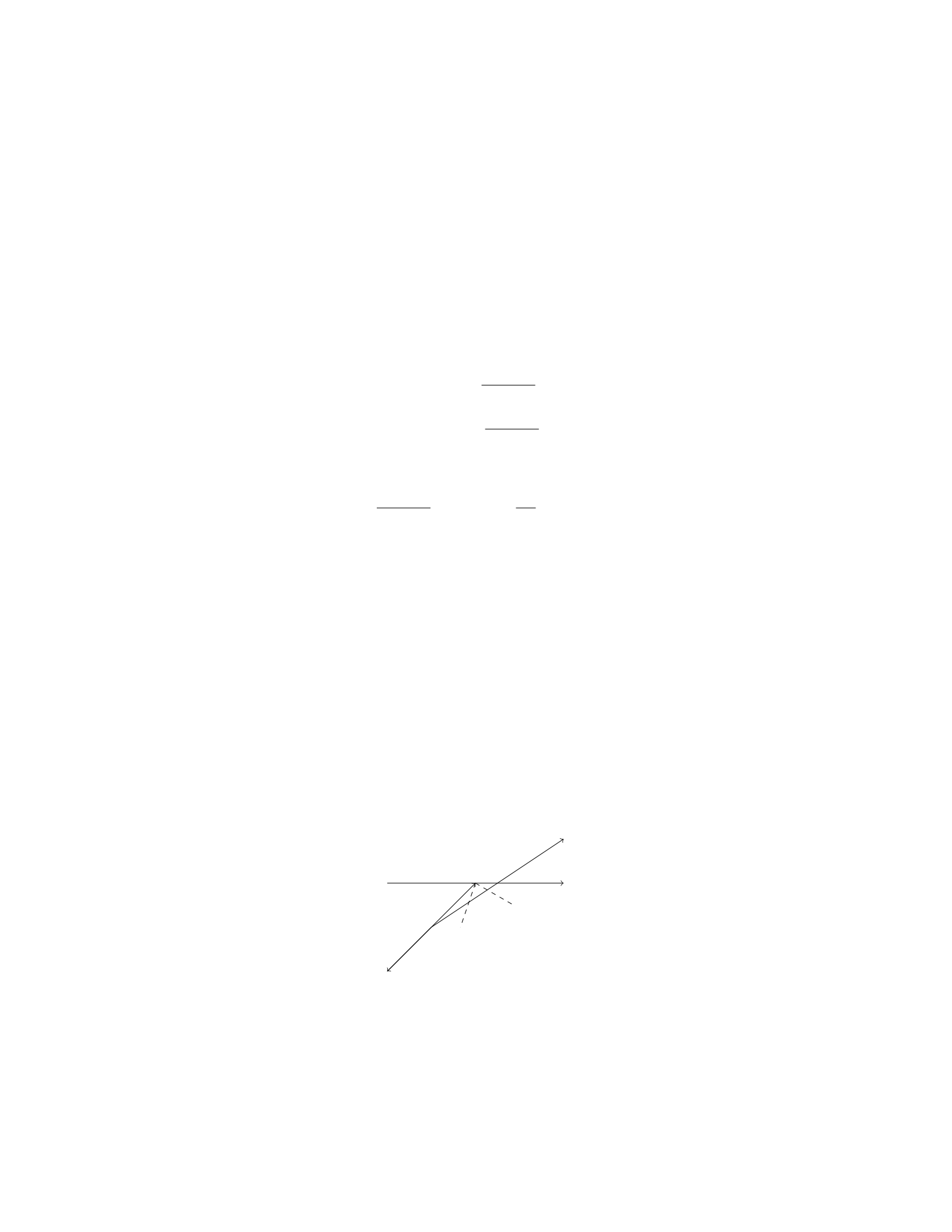
A light ray travels from medium 1 into medium 2, as shown in the diagram
below. If the refractive index of medium 1 is 1.5 and the angle of incidence is
30 degrees, determine: a) The angle of refraction in medium 2 b) The critical
angle for total internal reflection to occur at the interface between medium 1
and medium 2
Interface
Medium 1
Medium 2
30◦
?
22

Solution
a) The relationship between the angles of incidence and refraction is governed by
Snell’s Law: n1sin(θ1) = n2sin(θ2), where n1and n2are the refractive indices
of the two media, and θ1and θ2are the angles of incidence and refraction,
respectively.
Step 1: Given that n1= 1.5, θ1= 30◦, and n2= 1 (since the angle of
refraction is in medium 2, which is assumed to be air with a refractive index of
1), we can solve for θ2.
1.5 sin(30◦) = 1 sin(θ2)
Step 2:
sin(θ2) = 1.5
1sin(30◦)
sin(θ2) = sin(30◦)
Step 3: Since both angles are positive and less than 90◦, we have:
θ2= 30◦
Therefore, the angle of refraction in medium 2 is 30◦.
b) The critical angle (θc) for total internal reflection can be determined using
the formula sin(θc) = n2
n1.
Step 1: Given that n1= 1.5 and n2= 1, we can solve for θc.
sin(θc) = 1
1.5
Step 2:
sin(θc) = 2
3
θc= sin−12
3
Step 3: Using a calculator, we find:
θc≈41.81◦
Therefore, the critical angle for total internal reflection to occur at the in-
terface between medium 1 and medium 2 is approximately 41.81◦.
Question 28
Question
An object is placed 10 cm in front of a concave mirror with a focal length of 15
cm. Determine the image distance, image height, magnification, and describe
the nature of the image.
23

Solution
Step 1: Identify the given values.
Object distance (u) = -10 cm (since the object is in front of the mirror)
Focal length (f) = 15 cm
Step 2: Calculate the image distance using the mirror formula 1
f=1
v+1
u.
1
15 =1
v+1
−10
1
v=1
15 −1
−10
1
v=2
30 +3
30
1
v=5
30
v=30
5
v= 6 cm
Therefore, the image distance is 6 cm.
Step 3: Calculate the magnification using the magnification formula m=v
u.
m=6
−10
m=−0.6
Step 4: Determine the image height using the height formula h′=m×h.
Given that the object height is not specified, we cannot determine the image
height.
Step 5: Determine the nature of the image. Since the magnification is neg-
ative, the image is inverted. Since the object is placed beyond the focal point
of the concave mirror, the image will be real and reduced in size.
Question 29
Question
A ray of light strikes the surface of a glass block at an angle of incidence of 50◦.
The refractive indices of air and glass are 1 and 1.5, respectively. Find the angle
of refraction inside the glass block.
Solution
Step 1: Recall Snell’s Law, which relates the angles of incidence and refraction
to the refractive indices of the two media:
sin(θ1)
sin(θ2)=n2
n1
24

where θ1is the angle of incidence, θ2is the angle of refraction, n1is the refractive
index of the initial medium, and n2is the refractive index of the second medium.
Step 2: Given that the angle of incidence (θ1) is 50◦, the refractive indices
n1and n2are 1 and 1.5, respectively. We can substitute these values into Snell’s
Law: sin(50◦)
sin(θ2)=1.5
1
Step 3: Rearranging the equation to solve for sin(θ2) gives:
sin(θ2) = 1
1.5×sin(50◦)
sin(θ2) = 2
3sin(50◦)=0.6293
Step 4: To find the angle of refraction θ2, take the arcsine of the result:
θ2= arcsin(0.6293) ≈39.46◦
Therefore, the angle of refraction inside the glass block is approximately
39.46◦.
Question 30
Question
A light ray traveling in air is incident on a glass surface at an angle of 60◦. The
refractive index of the glass is 1.5. Determine:
1. The angle of refraction.
2. The critical angle for total internal reflection to occur at this interface.
Solution
1. Let’s use Snell’s Law to find the angle of refraction. Snell’s Law states:
n1sin(θ1) = n2sin(θ2), where n1and n2are the refractive indices of the first
and second mediums, and θ1and θ2are the angles of incidence and refraction,
respectively.
Given that n1= 1 (refractive index of air) and n2= 1.5 (refractive index of
glass), and θ1= 60◦, we can calculate θ2.
1×sin(60◦) = 1.5×sin(θ2)
sin(θ2) = 1
1.5sin(60◦)
sin(θ2) = 2
3·
√3
2
25

Question 2
Question
A ray of light is incident on a glass-air interface at an angle of 60◦. If the
refractive index of glass is 1.5, what is the angle of refraction?
Solution
Step 1: Recall the relationship between the angles of incidence and refraction
given by Snell’s Law:
n1sin(θ1) = n2sin(θ2)
where n1and n2are the refractive indices of the first and second mediums, and
θ1and θ2are the angles of incidence and refraction, respectively.
Step 2: Given that the refractive index of glass is 1.5 and the angle of
incidence is 60◦, the equation becomes:
1.5×sin(60◦) = n2×sin(θ2)
Step 3: Simplify the equation to solve for the angle of refraction θ2:
sin(60◦) = 1.5×sin(θ2)
Step 4: Solve for sin(θ2):
sin(θ2) = sin(60◦)
1.5
Step 5: Find the angle of refraction θ2by taking the arcsine of the calculated
value:
θ2= arcsin sin(60◦)
1.5
Step 6: Calculate the angle of refraction:
θ2= arcsin √3/2
1.5!≈arcsin √3
3!≈36.87◦
Therefore, the angle of refraction is approximately 36.87◦.
Question 3
Question
A beam of light travels from air (n= 1.0003) into a material with an index
of refraction of 1.5. If the angle of incidence is 60◦, calculate: a) the angle of
refraction b) the critical angle for total internal reflection at the interface
2

Solution
a) Let the angle of refraction be denoted as θ2. Using Snell’s Law:
n1sin(θ1) = n2sin(θ2)
where n1= 1.0003, θ1= 60◦, and n2= 1.5.
sin(60◦)=1.0003 ×sin(θ2)/1.5
sin(θ2) = 1.0003
1.5×sin(60◦)
sin(θ2) = 1.0003
1.5×
√3
2
θ2= sin−1 1.0003
1.5×
√3
2!
θ2≈37.806◦
b) The critical angle (θc) is defined as the angle of incidence that produces
an angle of refraction of 90◦. To find the critical angle, we can use Snell’s Law
and set θ2= 90◦:
n1sin(θc) = n2sin(90◦)
sin(θc) = n2
n1
θc= sin−11.5
1.0003
θc≈56.26◦
Question 4
Question
A monochromatic light beam enters a glass block with an angle of incidence of
60 degrees. The refractive index of the glass is 1.5. The light beam then travels
from the glass block into the air. Calculate the angle of refraction in the air and
the lateral displacement of the light beam as it emerges from the glass block.
Solution
1. To find the angle of refraction in the air, we can use Snell’s Law, which states:
n1sin(θ1) = n2sin(θ2), where n1and n2are the refractive indices of the two
media, and θ1and θ2are the angles of incidence and refraction, respectively.
2. Given that the angle of incidence θ1is 60 degrees and the refractive index
of glass n1is 1.5, and the refractive index of air n2is 1, we have:
1.5 sin(60◦) = 1 sin(θ2)
3

3. Simplifying the equation, we find:
1.5×
√3
2= sin(θ2)
sin(θ2) = 1.5√3
2
4. Solving for θ2, we get:
θ2= sin−1 1.5√3
2!≈71.57◦
5. Therefore, the angle of refraction in the air is approximately 71.57 degrees.
6. To calculate the lateral displacement of the light beam as it emerges from
the glass block, we can use the formula for lateral displacement:
d=t×tan(θ1) + t×tan(θ2)
7. Where tis the thickness of the glass block. Since we are dealing with a
thin glass block, we can assume the thickness to be very small.
8. Substituting the values, we have:
d= 0 ×tan(60◦)+0×tan(71.57◦)
d= 0
9. Therefore, the lateral displacement of the light beam as it emerges from
the glass block is 0.
Question 5
Question
A light ray is incident on a glass slab (refractive index n= 1.5) at an angle of
60◦to the normal. The reflected and refracted angles are measured to be equal.
Determine the angle of refraction and the angle of reflection.
Solution
Step 1: We first determine the angle of refraction using Snell’s Law:
n1sin(θ1) = n2sin(θ2)
where n1and n2are the refractive indices of the two mediums, and θ1and θ2
are the angles of incidence and refraction respectively.
Given that n1= 1 (for air) and n2= 1.5 (for glass), and θ1= 60◦, we have:
1×sin(60◦) = 1.5×sin(θ2)
4

sin(θ2) = 1
1.5×sin(60◦)
sin(θ2)≈0.577
θ2≈35.26◦
Therefore, the angle of refraction is approximately 35.26◦.
Step 2: Since the reflected and refracted angles are equal, we have:
θr=θ1= 60◦
Therefore, the angle of reflection is 60◦.
Question 6
Question
An object is placed 15 cm in front of a convex lens of focal length 10 cm. The
height of the object is 2 cm. Find the image distance, magnification, and height
of the image when the lens is immersed in a medium of refractive index 1.5.
Solution
Step 1: Determine the image distance using the lens formula:
1
f=1
do
+1
di
where fis the focal length of the lens, dois the object distance, and diis the
image distance.
Given: f= 10 cm (focal length), do=−15 cm (object distance),
Plugging in the values, we get:
1
10 =1
−15 +1
di
Solving for di, we get:
di=1
1
10 −1
−15
= 30 cm
Step 2: Calculate the magnification (M) using the formula:
M=−di
do
Given: di= 30 cm and do=−15 cm,
Substitute the values to calculate the magnification:
M=−30
−15 = 2
5

Step 3: Determine the height of the image using the magnification formula:
M=hi
ho
where hiis the image height and hois the object height.
Given M= 2 (magnification) and ho= 2 cm (object height),
2 = hi
2
Solving for hi, we get:
hi= 2 cm
Therefore, when the lens is immersed in a medium of refractive index 1.5,
the image distance is 30 cm, magnification is 2, and the height of the image is
2 cm.
Question 7
Question
A light ray traveling in air enters a glass slab at an angle of incidence of 60◦.
The refractive index of glass is 1.5. Calculate the angle of refraction inside the
glass slab.
Solution
Step 1: Recall the formula for Snell’s Law, which relates the angles of incidence
and refraction to the refractive indices of the two media:
n1sin(θ1) = n2sin(θ2)
where n1and n2are the refractive indices of the initial and final media, θ1is
the angle of incidence, and θ2is the angle of refraction.
Step 2: Substitute the given values into Snell’s Law:
1.00 ×sin(60◦) = 1.5×sin(θ2)
Step 3: Solve for θ2:
sin(60◦) = 1.5×sin(θ2)
1.00 =⇒sin(θ2) = sin(60◦)
1.5
Step 4: Calculate the angle of refraction θ2:
θ2= sin−1sin(60◦)
1.5≈40◦
Therefore, the angle of refraction inside the glass slab is approximately 40◦.
6

Question 8
Question
Light is incident from air onto a block of glass at an angle of 60 degrees to the
normal. Calculate the angle of refraction if the refractive index of glass is 1.5.
Solution
Step 1: Recall Snell’s Law, which relates the angles of incidence and refraction
to the refractive indices of the two media:
sin(θ1)
sin(θ2)=n2
n1
where θ1is the angle of incidence, θ2is the angle of refraction, n1is the refractive
index of the initial medium (air in this case), and n2is the refractive index of
the second medium (glass in this case).
Step 2: Plug in the given values:
sin(60◦)
sin(θ2)=1.5
1
Step 3: Solve for sin(θ2):
sin(θ2) = sin(60◦)
1.5
Step 4: Find θ2by taking the inverse sine of the result:
θ2= arcsin sin(60◦)
1.5
Step 5: Calculate the value of θ2using a calculator:
θ2≈40◦
Therefore, the angle of refraction when light is incident at 60 degrees to the
normal onto a block of glass with a refractive index of 1.5 is approximately 40
degrees.
Question 9
Question
A beam of light is incident on a glass-air interface at an angle of 60◦with
the normal. If the refractive index of glass is 1.5, calculate: a) The angle of
refraction b) The critical angle for total internal reflection to occur
7

Solution
a) Let the angle of refraction be denoted as θr. Using Snell’s Law, we have:
n1sin(θi) = n2sin(θr)
where n1= 1 (refractive index of air) and n2= 1.5 (refractive index of glass).
Step 1: Convert the angle of incidence into radians:
θi= 60◦=60π
180 =π
3radians
Step 2: Calculate the angle of refraction using Snell’s Law:
1×sin π
3= 1.5×sin(θr)
sin(θr) = 1
1.5×sin π
3=1
1.5×
√3
2=√3
3
θr= arcsin √3
3!≈35.26◦
Therefore, the angle of refraction is approximately 35.26◦.
b) The critical angle θcis the angle of incidence for which the angle of
refraction is 90◦. Using Snell’s Law, when θr= 90◦:
n1sin(θc) = n2sin(90◦) = n2
Step 3: Calculate the critical angle:
sin(θc) = n2
n1
=1.5
1= 1.5
θc= arcsin(1.5)
Since sin(θc) cannot exceed 1, total internal reflection will occur if the angle
of incidence is greater than the critical angle.
Question 10
Question
A ray of light travels from air into a material with an index of refraction of 1.5.
If the angle of incidence is 30◦, calculate:
1. The angle of refraction.
2. The critical angle for total internal reflection to occur from the material
back into air.
8

Solution
1. We can use Snell’s Law to determine the angle of refraction. Snell’s Law
states: n1sin(θ1) = n2sin(θ2), where n1and n2are the indices of refraction
for the two materials, and θ1and θ2are the angles of incidence and refraction,
respectively. Given that n1= 1 (for air) and n2= 1.5, and θ1= 30◦, we can
solve for θ2:
sin(30◦)=1.5 sin(θ2)
sin(θ2) = sin(30◦)
1.5
θ2= sin−1sin(30◦)
1.5≈19.47◦
2. The critical angle θcis the angle of incidence at which the angle of
refraction becomes 90◦. When light goes from material with higher refractive
index to lower refractive index, the critical angle is given by:
θc= sin−1n2
n1
Substitute n1= 1 and n2= 1.5:
θc= sin−11.5
1
θc= sin−1(1.5) ≈56.44◦
Therefore, the angle of refraction is approximately 19.47◦, and the critical
angle for total internal reflection to occur from the material back into air is
approximately 56.44◦.
Question 11
Question
A light ray traveling in air is incident on a glass slab (refractive index = 1.5) at
an angle of 45 degrees with the normal. The light ray enters the glass slab and
then emerges out of it. Calculate the angles of reflection and refraction.
Solution
Step 1: Calculate the angle of refraction using Snell’s Law. Given that the
refractive index of glass, n2= 1.5, the refractive index of air, n1= 1, and the
angle of incidence, θ1= 45◦. Snell’s law is given by:
n1sin(θ1) = n2sin(θ2)
9

Plugging in the values, we get:
1.0×sin(45◦)=1.5×sin(θ2)
√2
2= 1.5×sin(θ2)
sin(θ2) = √2
3
θ2= sin−1 √2
3!≈30.47◦
Step 2: Calculate the angle of reflection. The angle of reflection is equal to
the angle of incidence. Therefore, the angle of reflection, θr= 45◦.
Question 12
Question
An incident ray traveling in air strikes a glass surface at an angle of 30 degrees
with the normal. If the refractive index of glass is 1.5, calculate the angle of
refraction and the angle of reflection.
Solution
Step 1: Calculate the angle of reflection using the law of reflection. Step 2:
Calculate the angle of refraction using Snell’s Law.
Step 1: Angle of Reflection The angle of reflection, θr, is equal to the
angle of incidence, θi, as per the law of reflection.
θr=θi= 30◦
Step 2: Angle of Refraction We can use Snell’s Law to find the angle of
refraction, θt. Snell’s Law states:
n1sin(θi) = n2sin(θt)
Given that n1= 1 (for air) and n2= 1.5 (for glass), we have:
1·sin(30◦) = 1.5·sin(θt)
sin(θt) = 1
1.5sin(30◦)
sin(θt) = 1
1.5·1
2
sin(θt) = 1
3
θt= sin−11
3≈19.47◦
Therefore, the angle of reflection is 30◦and the angle of refraction is 19.47◦.
10

Question 13
Question
A beam of light is incident on a glass-air interface at an angle of 60◦with the
normal. If the refractive index of glass is 1.5, calculate the angle of refraction
and the critical angle for total internal reflection.
Solution
Step 1: Use Snell’s Law to find the angle of refraction.
sin(angle of incidence)·refractive index of first medium = sin(angle of refraction)·refractive index of second medium
Step 2: Substitute the given values into Snell’s Law.
sin(60◦)·1.5 = sin(angle of refraction) ·1
Step 3: Solve for the angle of refraction.
sin(angle of refraction) = sin(60◦)
1.5
angle of refraction = sin−1sin(60◦)
1.5
Step 4: Calculate the angle of refraction.
angle of refraction ≈sin−1 √3/2
1.5!≈sin−1 √3
3!≈37.38◦
Step 5: The critical angle for total internal reflection is when the angle of
refraction is 90◦. However, for glass-air interface, the angle of incidence is always
greater than the angle of refraction due to a higher refractive index of glass than
air. Therefore, the critical angle is the angle of incidence at which the angle of
refraction is 90◦.
sin(critical angle) = 1
1.5=2
3
critical angle = sin−12
3
Step 6: Calculate the critical angle.
critical angle ≈sin−12
3≈41.81◦
Therefore, the angle of refraction is approximately 37.38◦and the critical
angle for total internal reflection is approximately 41.81◦.
11

Question 14
Question
A ray of light is incident on a glass-air interface at an angle of 60◦with the nor-
mal. The refractive indices of glass and air are 1.5 and 1 respectively. Determine
the angle of refraction and the angle of reflection.
Solution
Step 1: Calculate the angle of refraction using Snell’s Law:
n1sin(θ1) = n2sin(θ2)
where n1and n2are the refractive indices of the initial and final mediums, θ1is
the angle of incidence, and θ2is the angle of refraction. Plugging in the values
given:
1.5·sin(60◦)=1·sin(θ2)
sin(θ2) = 1.5
1·sin(60◦) = sin(60◦) = √3
2
θ2= sin−1 √3
2!= 60◦
Step 2: Calculate the angle of reflection using the fact that the angle of
reflection is equal to the angle of incidence:
θr=θ1= 60◦
Therefore, the angle of refraction is 60◦and the angle of reflection is also
60◦.
Question 15
Question
A light ray is incident on a glass-air interface at an angle of 60◦with the normal.
The refractive indices of glass and air are 1.5 and 1.0, respectively. Calculate
the angle of refraction and the angle of reflection.
Solution
Step 1: Identify the given values. The angle of incidence, θ1, is 60◦, the refractive
index of glass (n1) is 1.5, and the refractive index of air (n2) is 1.0.
Step 2: Use Snell’s Law to find the angle of refraction:
n1sin(θ1) = n2sin(θ2)
12

Substitute the values:
1.5 sin(60◦)=1.0 sin(θ2)
1.5×
√3
2= 1.0 sin(θ2)
sin(θ2) = 1.5×√3
2=3√3
4
θ2= sin−1 3√3
4!≈69.59◦
Step 3: Calculate the angle of reflection: The angle of reflection, θR, is equal
to the angle of incidence, θ1:
θR=θ1= 60◦
Therefore, the angle of refraction is approximately 69.59◦and the angle of
reflection is 60◦.
Question 16
Question
A ray of light is incident at an angle of 30◦on the surface of a glass block
(n= 1.5). If the angle of refraction is 20◦, determine the wavelength of light in
the glass block.
Solution
Step 1: Use Snell’s Law to find the angle of incidence inside the glass block.
sin(θi) = n·sin(θr)
sin(θi) = 1.5·sin(20◦)
θi≈31.28◦
Step 2: Use the relationship between the angles of incidence and the critical
angle to find the critical angle.
n=sin(critical angle)
sin(90◦)
1.5 = sin(critical angle)
1
sin(critical angle) = 1.5
critical angle ≈90◦
13

Step 3: Since the angle of incidence is less than the critical angle, total
internal reflection does not occur. Use the formula for refractive index to find
the wavelength of light.
n=c
v
1.5 = 3.00 ×10⁸
v
v=3.00 ×10⁸
1.5
v= 2.00 ×10⁸m/s
Step 4: Use the formula relating speed of light, frequency, and wavelength.
v=fλ
2.00 ×108=fλ
Step 5: Since the speed of light in a medium is inversely proportional to the
refractive index of the medium, the frequency remains the same. Therefore, the
wavelength in the glass block is the same as in vacuum. Thus, the wavelength
of light in the glass block is λ=2.00×10⁸m/s
f.
Question 17
Question
A light ray is incident from air onto a rectangular glass block with refractive
index 1.5. The angle of incidence is 40 degrees. Calculate the angle of refraction
inside the glass block and the angle of incidence at the second air-glass interface
if the light undergoes total internal reflection.
Solution
Let’s denote: - Angle of incidence in air as θ1(given as 40 degrees). - Refractive
index of glass block as n= 1.5. - Angle of refraction inside the glass block as
θ2. - Angle of incidence at the second air-glass interface as θ3.
Using Snell’s Law: n1sin(θ1) = n2sin(θ2),
Step 1: Calculate the angle of refraction inside the glass block Given that
n1= 1 (refractive index of air) and n2= 1.5:
sin(θ2) = n1
n2
sin(θ1)
sin(θ2) = 1
1.5sin(40◦)
sin(θ2)≈0.425
14

θ2≈sin−1(0.425) ≈25.7◦
Step 2: Calculate the critical angle for total internal reflection The critical
angle θCfor a boundary between glass and air is found by setting sin(θ2) = 1:
sin(θC) = 1
1.5
θC≈sin−1(0.667) ≈41.8◦
Step 3: Determine if total internal reflection occurs Since the angle of in-
cidence at the second air-glass interface is θ3= 90◦−θC= 48.2◦> θC, total
internal reflection occurs at the second interface.
Question 18
Question
A beam of light travels from air into a piece of glass at an angle of incidence of
60◦. The refractive index of glass is 1.5. Calculate:
a) The angle of refraction
b) The critical angle for total internal reflection
Solution
a) To find the angle of refraction, we can use Snell’s Law:
n1sin(θ1) = n2sin(θ2)
Given: n1= 1 (for air), θ1= 60◦, and n2= 1.5 (for glass).
Step 1: Convert angles to radians.
θ1= 60◦×π
180 =π
3rad
Step 2: Substitute values into Snell’s Law.
1×sin π
3= 1.5×sin(θ2)
Step 3: Solve for θ2.
sin(θ2) = sin π
3
1.5=√3/2
1.5=√3
3
θ2= sin−1 √3
3!≈35.26◦
Therefore, the angle of refraction is approximately 35.26◦.
15

b) The critical angle (θc) for total internal reflection occurs when the angle
of refraction becomes 90◦. This can be found using the equation:
sin(θc) = n2
n1
Step 4: Plug in the values.
sin(θc) = 1.5
1= 1.5
Step 5: Solve for θc.
θc= sin−1(1.5) ≈90◦
Therefore, the critical angle for total internal reflection is 90◦.
Question 19
Question
A parallel beam of light is incident on a glass block with an angle of incidence of
60◦. The refractive index of the glass is 1.5. Determine the angle of refraction,
the critical angle, and whether total internal reflection will occur at the interface
between the glass block and air.
Solution
Step 1: Calculate the angle of refraction using Snell’s Law.
Snell’s Law: n1sin θ1=n2sin θ2
Given: n1= 1 (air), θ1= 60◦, and n2= 1.5 (glass).
sin θ2=n1
n2
sin θ1
sin θ2=1
1.5sin 60◦
sin θ2≈0.5774
θ2≈sin−10.5774
θ2≈35.26◦
Step 2: Calculate the critical angle for total internal reflection.
Critical angle: θc= sin−1n2
n1
θc= sin−11
1.5
16

θc≈sin−1(0.6667)
θc≈41.81◦
Step 3: Determine if total internal reflection will occur. Since the angle of
incidence (60◦) is greater than the critical angle (41.81◦), total internal reflection
will occur at the interface between the glass block and air.
Question 20
Question
A light ray with a wavelength of 500 nm is incident on a glass slab with a
refractive index of 1.5. The angle of incidence is 40 degrees. Calculate the angle
of refraction inside the glass slab.
Solution
Let’s use Snell’s Law to find the angle of refraction. Snell’s Law states:
n1sin θ1=n2sin θ2
where - n1is the refractive index of the first medium (air, with n1= 1), -
θ1is the angle of incidence, - n2is the refractive index of the second medium
(glass, with n2= 1.5), - θ2is the angle of refraction.
Step 1: Convert the angle of incidence to radians.
θ1= 40◦
θ1= 40◦×π
180
θ1=2π
9radians
Step 2: Substitute the given values into Snell’s Law.
1×sin 2π
9= 1.5×sin θ2
sin θ2=sin 2π
9
1.5
θ2= sin−1 sin 2π
9
1.5!
Step 3: Calculate the angle of refraction.
θ2= sin−1 sin 2π
9
1.5!
θ2≈24.89◦
Therefore, the angle of refraction inside the glass slab is approximately 24.89
degrees.
17

Question 21
Question
A ray of light is incident on a glass-liquid interface at an angle of incidence of
60◦. The refractive indices of glass and liquid are 1.5 and 1.25, respectively.
Calculate the angle of refraction in the liquid.
Solution
Step 1: Use Snell’s Law to find the angle of refraction in the liquid. Step 2:
Snell’s Law states sin(θ1)
sin(θ2)=n2
n1, where θ1is the angle of incidence, θ2is the angle
of refraction, n1is the refractive index of the initial medium (glass in this case),
and n2is the refractive index of the final medium (liquid in this case). Step 3:
Plug in the values given in the problem: sin(60◦)
sin(θ2)=1.25
1.5. Step 4: Solve for θ2:
sin(θ2) = 1.5
1.25 sin(60◦). Step 5: Calculate the angle of refraction in the liquid:
θ2= sin−11.5
1.25 sin(60◦). Step 6: Use a calculator to find the numerical value
of θ2. Step 7: Therefore, the angle of refraction in the liquid is approximately
θ2degrees.
Question 22
Question
An object is placed 20 cm in front of a concave mirror with a focal length of 10
cm. Calculate the position and nature of the image formed by the mirror.
Solution
Step 1: Given that the object distance u=−20 cm and the focal length f=−10
cm for the concave mirror, we can use the mirror formula to find the image
distance v:1
f=1
v+1
u
1
−10 =1
v+1
−20
−1
10 =1
v−1
20
−1
10 +1
20 =1
v
1
20 =1
v
v= 20 cm
Therefore, the image distance vis 20 cm.
18

Step 2: To determine the nature of the image, we can use the magnification
formula: v
u=−20
20 =−1
Since the magnification is negative, the image is real and inverted.
Thus, the image formed by the concave mirror is located 20 cm behind the
mirror and is a real and inverted image.
Question 23
Question
A ray of light is incident on a glass slab of refractive index 1.5 at an angle of 60
degrees with the normal. The reflected and refracted rays are perpendicular to
each other. Calculate the angle of refraction.
Solution
Step 1: Let’s denote the angle of refraction as θr. Since the reflected and
refracted rays are perpendicular to each other, we have the angle of reflection
(θi) equals the angle of incidence.
Step 2: Using Snell’s Law, we have:
n1sin(θi) = n2sin(θr)
Step 3: Given that the incident ray is in air (with refractive index 1) and
the glass slab has a refractive index of 1.5, we can rewrite Snell’s Law as:
1×sin(60◦)=1.5×sin(θr)
Step 4: Solving for θr, we have:
sin(θr) = sin(60◦)
1.5
θr= arcsin sin(60◦)
1.5
Step 5: Calculating the value of θr, we get:
θr= arcsin √3/2
1.5!
θr= arcsin √3
3!
θr= 35.26◦
Therefore, the angle of refraction is 35.26 degrees.
19

Question 24
Question
A ray of light is incident on a glass-air interface with an angle of incidence of 60◦.
If the refractive indices of glass and air are 1.5 and 1.0 respectively, determine
the angle of refraction and the angle of reflection.
Solution
Step 1: We can use Snell’s Law to find the angle of refraction:
n1sin(θ1) = n2sin(θ2)
where n1and n2are the refractive indices of the first and second medium, and
θ1and θ2are the angles of incidence and refraction, respectively.
Step 2: Given that n1= 1.5, n2= 1.0, and θ1= 60◦, we can plug these
values into Snell’s Law to find θ2:
1.5 sin(60◦)=1.0 sin(θ2)
sin(60◦) = sin(θ2)
θ2= sin−1(sin(60◦))
θ2= 60◦
Step 3: The angle of refraction is 60◦.
Step 4: To find the angle of reflection, we use the fact that the angle of
incidence is equal to the angle of reflection:
θreflection =θ1= 60◦
Step 5: Therefore, the angle of refraction is 60◦, and the angle of reflection
is 60◦.
Question 25
Question
A beam of light with a wavelength of 600 nm travels through air and enters a
glass prism with an index of refraction of 1.5. The angle of incidence of the light
beam on the prism is 30 degrees. Determine the angle of refraction inside the
prism and the wavelength of light inside the glass.
20

Solution
Step 1: First, we can use Snell’s Law to find the angle of refraction:
n1sin(θ1) = n2sin(θ2)
where n1= 1 (index of refraction of air) and n2= 1.5 (index of refraction of
glass). Given that θ1= 30◦, we can solve for θ2:
1×sin(30◦) = 1.5×sin(θ2)
sin(θ2) = 1
1.5sin(30◦)
θ2= sin−11
1.5sin(30◦)
θ2≈19.47◦
Step 2: Next, we can calculate the wavelength of light inside the glass using
the equation:
λglass =λair
nglass
where λair = 600 nm and nglass = 1.5:
λglass =600 nm
1.5
λglass = 400 nm
Therefore, the angle of refraction inside the glass prism is approximately
19.47◦and the wavelength of light inside the glass is 400 nm.
Question 26
Question
A light ray travels from air into a material with an index of refraction of 1.6. If
the angle of incidence is 30 degrees, what is the angle of refraction?
Solution
Step 1: Apply Snell’s Law to find the angle of refraction. The relationship
between the angles of incidence and refraction is given by Snell’s Law:
n1sin(θ1) = n2sin(θ2)
where n1is the index of refraction of the initial medium, θ1is the angle of
incidence, n2is the index of refraction of the new medium, and θ2is the angle
of refraction.
21
Step 2: Plug in the known values. Given that the initial medium is air with
an index of refraction of n1= 1, the new medium has an index of refraction of
n2= 1.6, and the angle of incidence is θ1= 30 degrees, we can plug these values
into Snell’s Law:
1×sin(30◦) = 1.6×sin(θ2)
Step 3: Solve for the angle of refraction.
sin(30◦)=1.6×sin(θ2)
sin(θ2) = sin(30◦)
1.6
θ2= sin−1sin(30◦)
1.6
Step 4: Calculate the angle of refraction.
θ2= sin−1sin(30◦)
1.6≈sin−10.5
1.6≈sin−1(0.3125)
θ2≈18.19◦
Therefore, the angle of refraction when a light ray travels from air into a
material with an index of refraction of 1.6, with an angle of incidence of 30
degrees, is approximately 18.19 degrees.
Question 27
Question
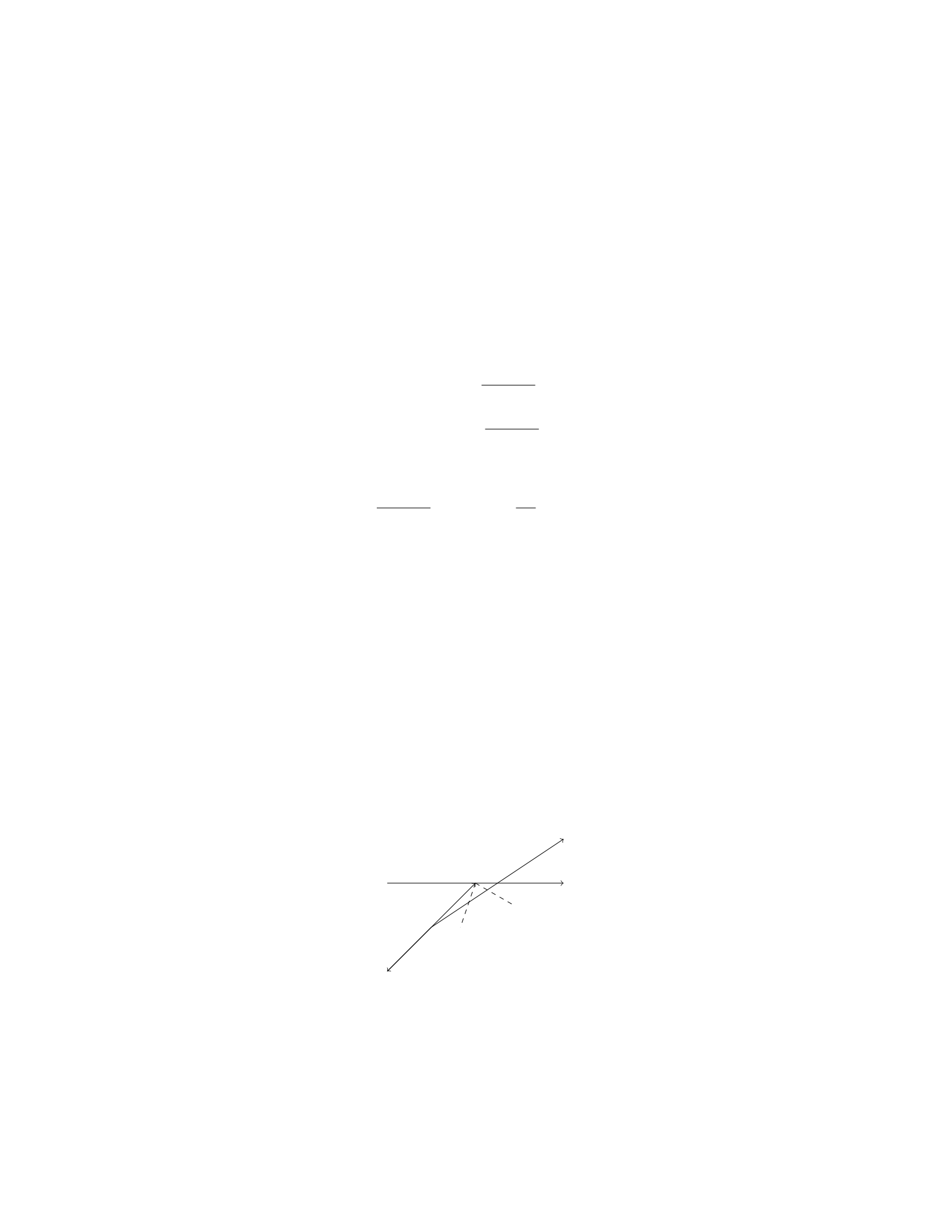
A light ray travels from medium 1 into medium 2, as shown in the diagram
below. If the refractive index of medium 1 is 1.5 and the angle of incidence is
30 degrees, determine: a) The angle of refraction in medium 2 b) The critical
angle for total internal reflection to occur at the interface between medium 1
and medium 2
Interface
Medium 1
Medium 2
30◦
?
22

Solution
a) The relationship between the angles of incidence and refraction is governed by
Snell’s Law: n1sin(θ1) = n2sin(θ2), where n1and n2are the refractive indices
of the two media, and θ1and θ2are the angles of incidence and refraction,
respectively.
Step 1: Given that n1= 1.5, θ1= 30◦, and n2= 1 (since the angle of
refraction is in medium 2, which is assumed to be air with a refractive index of
1), we can solve for θ2.
1.5 sin(30◦) = 1 sin(θ2)
Step 2:
sin(θ2) = 1.5
1sin(30◦)
sin(θ2) = sin(30◦)
Step 3: Since both angles are positive and less than 90◦, we have:
θ2= 30◦
Therefore, the angle of refraction in medium 2 is 30◦.
b) The critical angle (θc) for total internal reflection can be determined using
the formula sin(θc) = n2
n1.
Step 1: Given that n1= 1.5 and n2= 1, we can solve for θc.
sin(θc) = 1
1.5
Step 2:
sin(θc) = 2
3
θc= sin−12
3
Step 3: Using a calculator, we find:
θc≈41.81◦
Therefore, the critical angle for total internal reflection to occur at the in-
terface between medium 1 and medium 2 is approximately 41.81◦.
Question 28
Question
An object is placed 10 cm in front of a concave mirror with a focal length of 15
cm. Determine the image distance, image height, magnification, and describe
the nature of the image.
23

Solution
Step 1: Identify the given values.
Object distance (u) = -10 cm (since the object is in front of the mirror)
Focal length (f) = 15 cm
Step 2: Calculate the image distance using the mirror formula 1
f=1
v+1
u.
1
15 =1
v+1
−10
1
v=1
15 −1
−10
1
v=2
30 +3
30
1
v=5
30
v=30
5
v= 6 cm
Therefore, the image distance is 6 cm.
Step 3: Calculate the magnification using the magnification formula m=v
u.
m=6
−10
m=−0.6
Step 4: Determine the image height using the height formula h′=m×h.
Given that the object height is not specified, we cannot determine the image
height.
Step 5: Determine the nature of the image. Since the magnification is neg-
ative, the image is inverted. Since the object is placed beyond the focal point
of the concave mirror, the image will be real and reduced in size.
Question 29
Question
A ray of light strikes the surface of a glass block at an angle of incidence of 50◦.
The refractive indices of air and glass are 1 and 1.5, respectively. Find the angle
of refraction inside the glass block.
Solution
Step 1: Recall Snell’s Law, which relates the angles of incidence and refraction
to the refractive indices of the two media:
sin(θ1)
sin(θ2)=n2
n1
24

where θ1is the angle of incidence, θ2is the angle of refraction, n1is the refractive
index of the initial medium, and n2is the refractive index of the second medium.
Step 2: Given that the angle of incidence (θ1) is 50◦, the refractive indices
n1and n2are 1 and 1.5, respectively. We can substitute these values into Snell’s
Law: sin(50◦)
sin(θ2)=1.5
1
Step 3: Rearranging the equation to solve for sin(θ2) gives:
sin(θ2) = 1
1.5×sin(50◦)
sin(θ2) = 2
3sin(50◦)=0.6293
Step 4: To find the angle of refraction θ2, take the arcsine of the result:
θ2= arcsin(0.6293) ≈39.46◦
Therefore, the angle of refraction inside the glass block is approximately
39.46◦.
Question 30
Question
A light ray traveling in air is incident on a glass surface at an angle of 60◦. The
refractive index of the glass is 1.5. Determine:
1. The angle of refraction.
2. The critical angle for total internal reflection to occur at this interface.
Solution
1. Let’s use Snell’s Law to find the angle of refraction. Snell’s Law states:
n1sin(θ1) = n2sin(θ2), where n1and n2are the refractive indices of the first
and second mediums, and θ1and θ2are the angles of incidence and refraction,
respectively.
Given that n1= 1 (refractive index of air) and n2= 1.5 (refractive index of
glass), and θ1= 60◦, we can calculate θ2.
1×sin(60◦) = 1.5×sin(θ2)
sin(θ2) = 1
1.5sin(60◦)
sin(θ2) = 2
3·
√3
2
25

sin(θ2) = √3
3
θ2= arcsin √3
3!
θ2≈35.26◦
2. To find the critical angle for total internal reflection, we use the formula
θc= arcsin n2
n1.
Given that n1= 1 (refractive index of air) and n2= 1.5 (refractive index of
glass), we can calculate the critical angle θc.
θc= arcsin 1.5
1
θc= arcsin(1.5)
θc≈41.81◦
Therefore, the angle of refraction is approximately 35.26◦and the critical
angle for total internal reflection at this interface is approximately 41.81◦.
26

