


PHYS 101 - ELEMENTS OF PHYSICS
- Buoyant forces and Archimedes’
principle
Question Bank - Set 5
Liberty University
Question 1
Question
A cylindrical object with a radius of 5 cm and a height of 10 cm is placed in
a container filled with water. The object has a density of 800 kg/m3, while
the density of water is 1000 kg/m3. Calculate the buoyant force acting on the
object in Newtons.
Solution
Step 1: Calculate the volume of the cylindrical object. The volume of a cylinder
is given by the formula:
V=πr2h
where ris the radius and his the height of the cylinder. Given: r= 5 cm and
h= 10 cm, we can convert these values to meters: r= 0.05 m and h= 0.10 m.
Plugging in these values:
V=π×(0.05)2×0.10 = 0.000785 m3
Step 2: Calculate the mass of the object. The mass of an object can be
calculated using the formula:
mass = density ×volume
Given: density of the object is 800 kg/m3, we can calculate the mass:
mass = 800 ×0.000785 = 0.628 kg

Step 3: Calculate the buoyant force. The buoyant force acting on an object
immersed in a fluid is equal to the weight of the fluid displaced by the object.
The weight of the water displaced by the object is given by:
Weight of water displaced = Volume of object×Density of water×Acceleration due to gravity
Weight of water displaced = 0.000785 ×1000 ×9.81 = 7.72 N
Therefore, the buoyant force acting on the object is 7.72 N.
Question 2
Question
A cube of wood with a density of 600 kg/m3and an edge length of 2 meters
is floating in a container of water. Calculate the depth to which the cube is
submerged in the water.
Given: Density of water = 1000 kg/m3, acceleration due to gravity = 9.81
m/s2.
Solution
Step 1: Determine the buoyant force acting on the cube. The buoyant force is
given by the formula:
Fbuoyant =ρ·Vdisplaced ·g
where: - ρis the density of water = 1000 kg/m3-Vdisplaced is the volume of
water displaced by the cube - gis the acceleration due to gravity = 9.81 m/s2
Step 2: Calculate the volume of water displaced by the cube. The volume
of water displaced is equal to the volume of the cube that is submerged. Let x
be the depth to which the cube is submerged. The volume of water displaced
is given by:
Vdisplaced =x×Aface
where: - xis the depth to which the cube is submerged - Aface is the area of
one face of the cube = (2 m)2
Step 3: Substitute the known values into the formula for buoyant force and
simplify.
Fbuoyant = 1000 ×(2x)×4×9.81
Step 4: Determine the weight of the floating cube. The weight of the cube
is equal to the gravitational force acting on the cube, given by:
Fweight =ρcube ×Vcube ×g
where: - ρcube is the density of the cube = 600 kg/m3-Vcube is the volume of
the cube = (2 m)3
2
Step 5: Set up the equilibrium condition. For the floating cube, the buoyant
force must equal the weight of the cube. Thus, we have:
Fbuoyant =Fweight
Step 6: Solve for the depth to which the cube is submerged. Equating the
buoyant force and weight of the cube, we get:
1000 ×2x×4×9.81 = 600 ×23×9.81
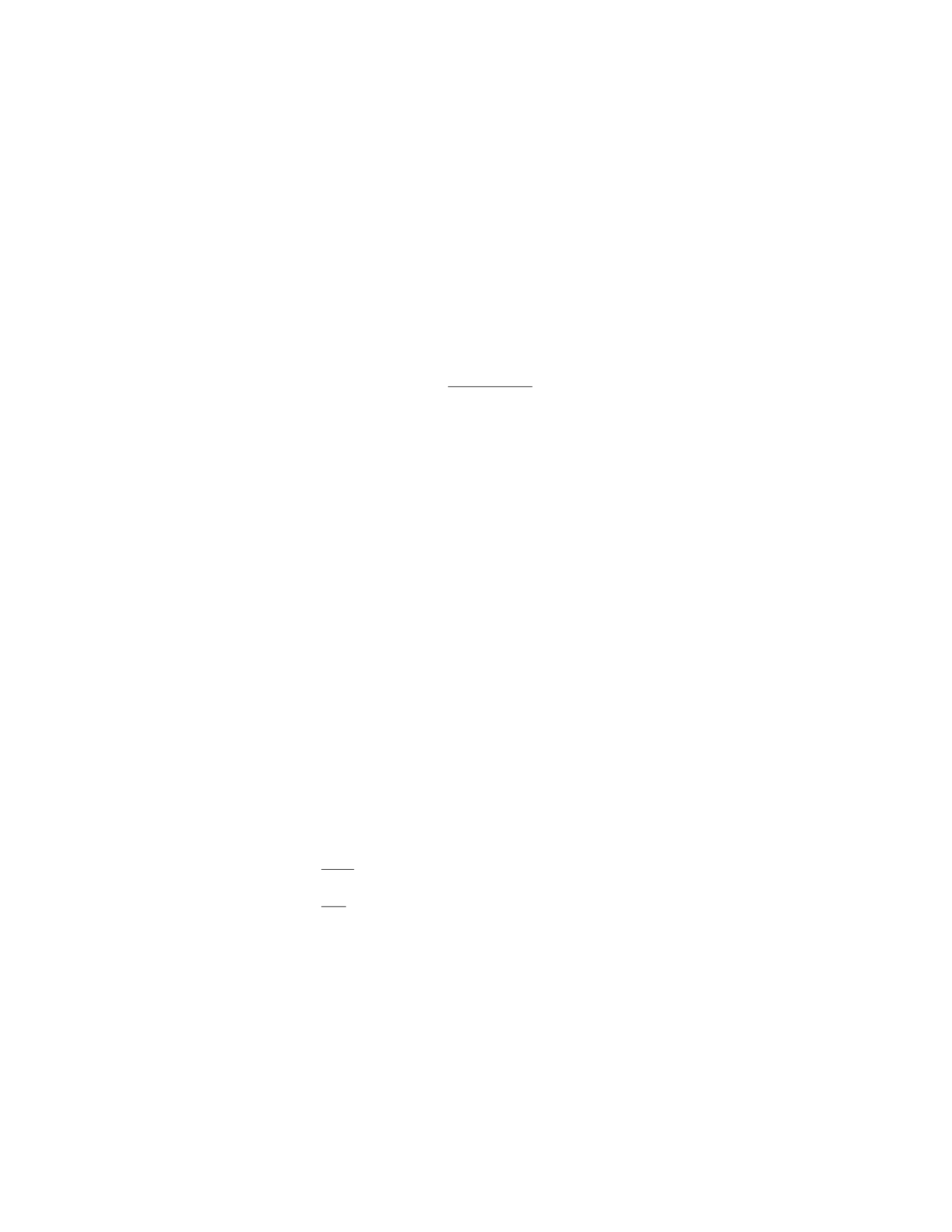
x=600 ×23
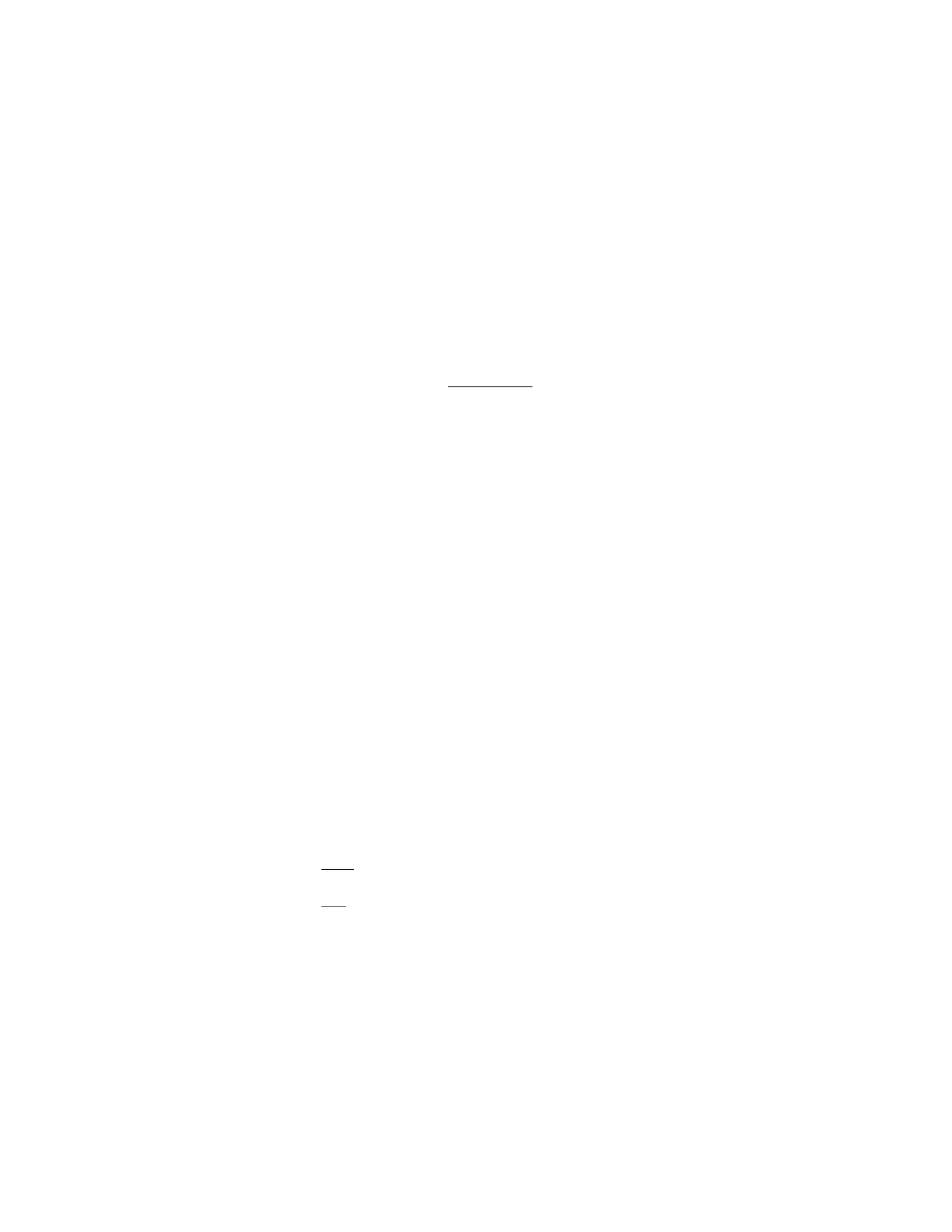
1000 ×2×4
Therefore, the depth to which the cube is submerged in the water is 0.12
meters.
Question 3
Question
A cube of wood with a density of 600 kg/m3and side length 0.1 m is floating
in water. What is the volume of the cube that is submerged in water?
Solution
Step 1: Let’s denote the density of water as ρwater = 1000 kg/m3and the volume
submerged as Vsubmerged.
Step 2: In order for the cube to float in water, the buoyant force on the
cube must be equal to the weight of the cube. The buoyant force is given by
Fbuoyant =ρwater ·Vsubmerged ·g, where g= 9.81 m/s2is the acceleration due to
gravity.
Step 3: The weight of the wooden cube is given by Fweight = density of wood×
volume of the cube×g. Since the cube is floating, the weight is balanced by the
buoyant force. So, we have:
ρwood ·Vcube ·g=ρwater ·Vsubmerged ·g
Step 4: We can now solve for the volume of the cube that is submerged in
water:
Vsubmerged =ρwood
ρwater
·Vcube
Step 5: Substituting the given values into the equation, we get:
Vsubmerged =600
1000 ·0.13m3
Step 6: Calculating the volume of the cube that is submerged, we find:
Vsubmerged = 0.06 m3
Therefore, the volume of the cube that is submerged in water is 0.06 m3.
3

Question 4
Question
A cylindrical tank filled with water has a diameter of 3 meters and a height of 4
meters. Calculate the buoyant force acting on a solid iron cylinder of diameter
2 meters and height 3 meters submerged in the water.
Solution
Step 1: Calculate the volume of the iron cylinder. Step 2: Calculate the volume
of water displaced by the iron cylinder. Step 3: Determine the weight of the
water displaced, which is equal to the buoyant force acting on the iron cylinder.
Step 1: The volume of the iron cylinder can be calculated using the formula
for the volume of a cylinder:
Viron =πr2h
where ris the radius of the cylinder and his the height. Given that the
diameter of the iron cylinder is 2 meters, the radius ris 1 meter and the height
his 3 meters. Substituting these values into the formula:
Viron =π(1)2×3=3πm3
Step 2: The volume of water displaced by the iron cylinder is equal to
the volume of the iron cylinder. This is based on Archimedes’ principle, which
states that an object submerged in a fluid will displace an equal volume of fluid.
Therefore, the volume of water displaced is also 3πm3.
Step 3: The weight of the water displaced is equal to the buoyant force
acting on the iron cylinder. The weight of water can be calculated using the
formula:
Weight = Mass ×Gravity
The mass of water displaced can be calculated by multiplying the volume of
water displaced by the density of water. The density of water is approximately
1000 kg/m3.
Weight = (3πm3)(1000 kg/m3)×9.81 m/s2
Weight = 29430πN
Therefore, the buoyant force acting on the iron cylinder is approximately
29430πN.
4

Question 5
Question
A block of wood with a volume of 0.1 m3and a density of 600 kg/m3is floating
in a pool of water. Determine the minimum mass that needs to be added on
top of the wood block in order to submerge it completely. The density of water
is 1000 kg/m3.
Solution
Step 1: Determine the mass of the wood block. Given that the density of the
wood block is 600 kg/m3and its volume is 0.1 m3, we can calculate the mass
using the formula:
mass = density ×volume
mass = 600 ×0.1 = 60 kg
Step 2: Determine the buoyant force acting on the wood block. The buoyant
force acting on the wood block is equal to the weight of the water displaced,
which is the weight of the volume of water equal to the volume of the submerged
part of the wood block. Since the wood block is floating, the buoyant force is
equal to the weight of the wood block.
Step 3: Determine the maximum mass for the wood block to float. Since
the wood block is floating, the buoyant force is equal to the weight of the wood
block. Let mwbe the mass of the wood block and mabe the mass that needs
to be added to submerge the block completely. The total mass when the block
is submerged is given by:
mw+ma
Step 4: Determine the volume of the wood block submerged in water. Since
the wood block is floating, the volume of the submerged part is equal to the
volume of the water displaced. Let Vsub be the volume of the submerged part.
Then:
Vsub = 0.1m3
Step 5: Determine the buoyant force when the wood block is submerged.
Since the wood block is now submerged, the buoyant force is equal to the weight
of the water displaced, which is equal to the weight of the wood block plus the
weight of the mass added. The buoyant force can be calculated by:
Buoyant force = (density of water) ×Vsub ×g
Step 6: Equate the buoyant force when submerged to the total mass when
the block is submerged.
(density of water) ×Vsub ×g=mw+ma
5

Step 7: Solve for the mass that needs to be added to submerge the wood
block completely. Substitute the known values into the equation and solve for
ma:
1000 ×0.1×9.8 = 60 + ma
980 = 60 + ma
ma= 920 kg
Therefore, the minimum mass that needs to be added on top of the wood
block in order to submerge it completely is 920 kg.
Question 6
Question
A cube of wood with side length 20 cm and density 0.8 g/cm3is floating in
water. Calculate the depth to which the cube floats in water.
Solution
Step 1: First, we need to find the buoyant force acting on the cube. The buoyant
force is equal to the weight of the water displaced by the cube. The weight of
the water displaced is equal to the volume of water displaced multiplied by the
density of water (ρwater = 1 g/cm3) multiplied by the acceleration due to gravity
(g= 9.8 m/s2).
Step 2: The volume of water displaced is equal to the volume of the sub-
merged part of the cube. Let the depth to which the cube is submerged be
hcm. The volume of the submerged part of the cube can be expressed as
20 ×20 ×h= 400hcm3.
Step 3: The weight of the water displaced is therefore 400h×1×9.8 N.
Step 4: The weight of the cube is equal to its volume (4000 cm3) multiplied
by its density (0.8 g/cm3) multiplied by the acceleration due to gravity (9.8
m/s2).
Step 5: The weight of the cube is 4000 ×0.8×9.8 N.
Step 6: For the cube to float, the buoyant force must be equal to the weight
of the cube. Equating the two forces:
400h×1×9.8 = 4000 ×0.8×9.8
Step 7: Solving for h:
400h=4000 ×0.8×9.8
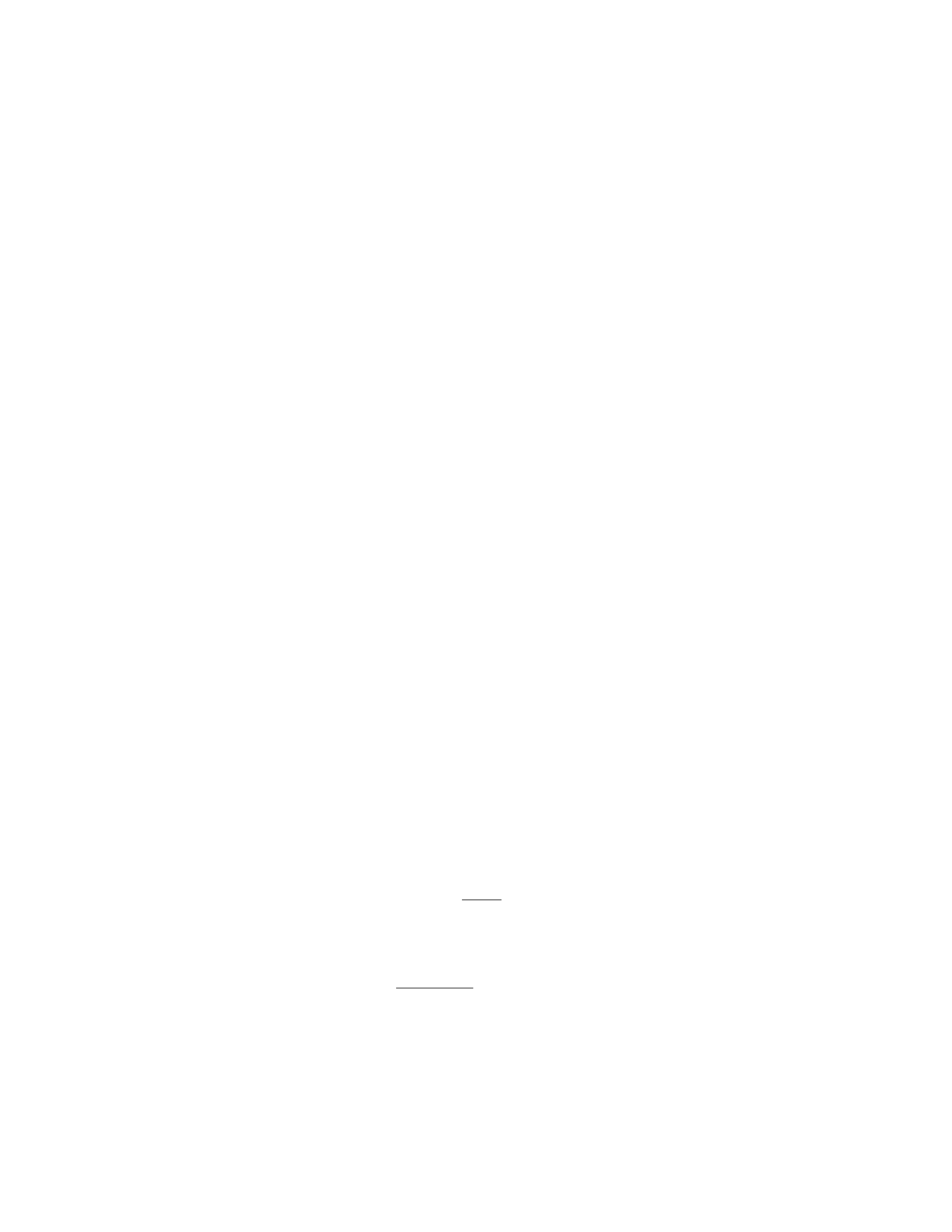
9.8
h=4000 ×0.8
9.8
Step 8: Calculating the depth to which the cube floats, we get:
6
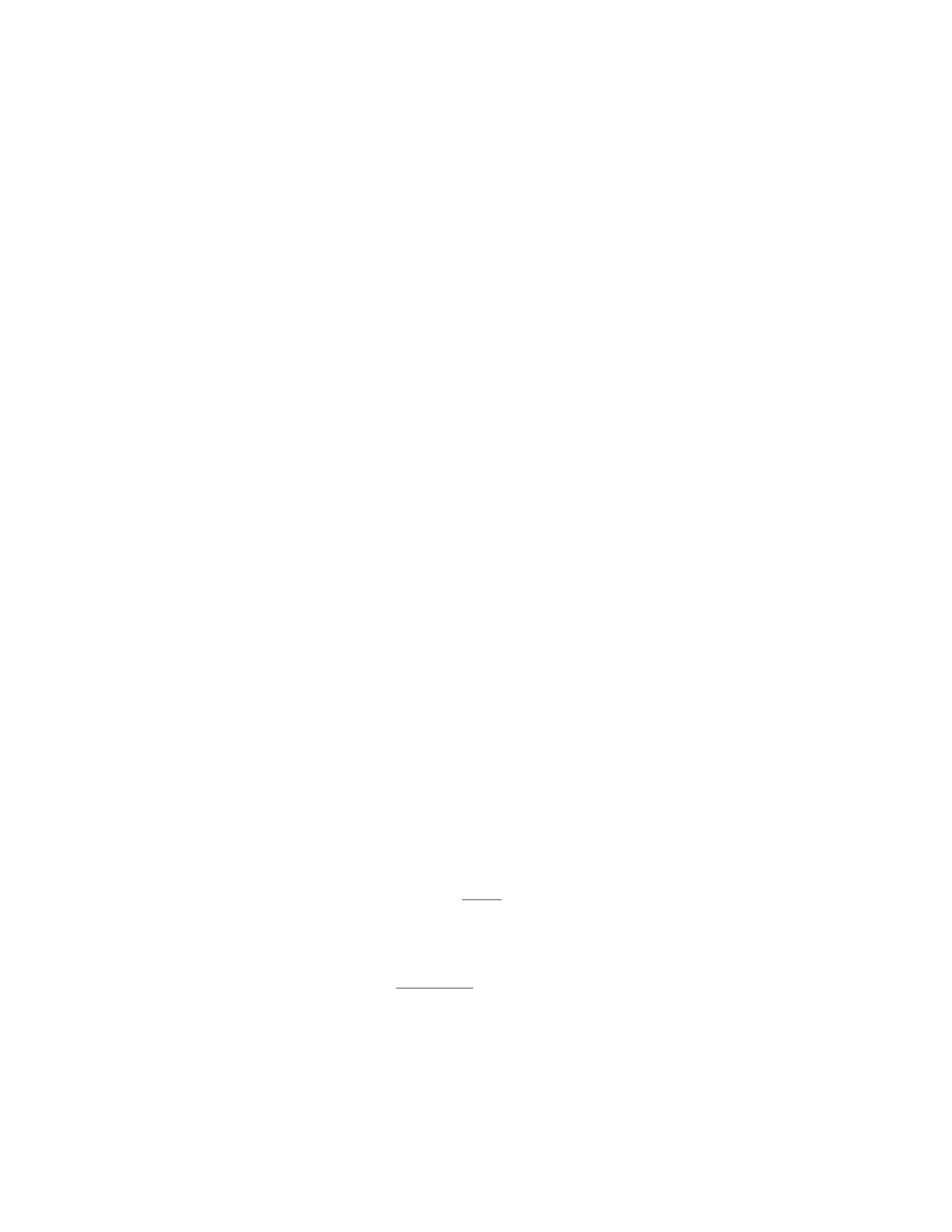
h= 32.65 cm
Therefore, the cube floats to a depth of 32.65 cm in water.
Question 7
Question
A cube of wood with a density of 700 kg/m3and side length 0.2 m floats in a
liquid with a density of 1000 kg/m3. Determine the depth to which the cube is
submerged in the liquid.
Solution
Step 1: We first calculate the buoyant force acting on the cube. The buoyant
force, Fb, is given by Archimedes’ principle:
Fb=ρliquid ·Vsub ·g
where: ρliquid is the density of the liquid, Vsub is the volume of the cube sub-
merged in the liquid, and gis the acceleration due to gravity.
Step 2: The volume of the cube submerged in the liquid is equal to the total
volume of the cube times the depth submerged. Hence,
Vsub =l2·d
where lis the side length of the cube and dis the depth submerged.
Step 3: The weight of the cube is equal to the weight of the liquid displaced,
so the weight of the cube can be calculated by:
Wcube =ρwood ·Vcube ·g=ρliquid ·Vsub ·g
Step 4: Substituting the values into the equation gives:
ρwood ·l3·g=ρliquid ·l2·d·g
Step 5: Solving for the depth submerged, d, we get:
d=ρwood
ρliquid
·l
Step 6: Substituting the given values, we find:
d=700 kg/m3
1000 kg/m3·0.2 m = 0.14 m
Therefore, the cube is submerged to a depth of 0.14 meters in the liquid.
7

Question 8
Question
A solid cube of wood with side length 10 cm and density 0.7 g/cm3is floating
in a container of water. If 80
(Given: Density of water = 1 g/cm3)
Solution
Step 1: Calculate the volume of the cube submerged in water. The volume of
the cube submerged in water can be calculated by multiplying the side length
of the submerged portion by itself and by the height of the submerged portion.
Let the side length of the submerged portion be xcm. Given that 80Therefore,
the volume of the cube submerged in water is:
Vsubmerged =x2×0.8x= 0.8x3
Step 2: Calculate the mass of the water displaced by the submerged cube.
Since the cube is floating, the mass of water displaced by the cube is equal to
the mass of the cube. The density of water is 1 g/cm3, so the mass of the water
displaced is equal to the volume of water displaced multiplied by the density of
water:
mdisplaced =Vsubmerged ×1=0.8x3
Step 3: Use Archimedes’ principle to determine the mass of the cube. Ac-
cording to Archimedes’ principle, the buoyant force acting on a submerged ob-
ject is equal to the weight of the fluid displaced. The weight of the fluid displaced
is equal to the mass of the fluid displaced times the acceleration due to gravity,
g= 9.8 m/s2. Therefore, the buoyant force acting on the wood cube is:
Fbuoyant =mdisplaced ×g
Step 4: Calculate the weight of the wood cube. The weight of the cube can
be calculated by multiplying the mass of the cube by the acceleration due to
gravity:
Wcube =mcube ×g
Step 5: Set the buoyant force equal to the weight of the cube and solve for
the mass of the cube.
Fbuoyant =Wcube
mdisplaced ×g=mcube ×g
0.8x3×9.8 = mcube ×9.8
Step 6: Calculate the mass of the cube.
mcube = 0.8x3
Substitute x= 10 cm (side length of the cube):
mcube = 0.8×103= 800 g
Therefore, the mass of the cube is 800 g.
8

Question 9
Question
A cube of side length 10 cm and density 800 kg/m3is floating in water. Deter-
mine the depth to which the cube is submerged.
Solution
Step 1: The buoyant force (Fb) acting on the cube can be calculated using
Archimedes’ principle:
Fb=ρw·Vsubmerged ·g
where ρwis the density of water (1000 kg/m3), Vsubmerged is the volume sub-
merged, and gis the acceleration due to gravity (9.81 m/s2).
Step 2: The weight of the cube is equal to the buoyant force, since it is in
equilibrium. The weight of the cube can be calculated using:
W=m·g
W=ρcube ·V·g
where ρcube is the density of the cube (800 kg/m3), Vis the total volume of the
cube, and gis the acceleration due to gravity.
Step 3: The volume of the cube can be calculated using:
V= side length3
V= (0.1 m)3
Step 4: Set W=Fband solve for Vsubmerged to find the volume submerged.
Step 5: Once you have the volume submerged, you can find the depth to
which the cube is submerged by dividing the volume by the cross-sectional area
submerged.
Step 6: Remember to convert the final depth from meters to centimeters for
the solution in the same unit as the given side length.
Question 10
Question
A cube of side length aand density ρcube is floating in water with a certain
portion submerged. Calculate the density of the cube in terms of the submerged
depth hand the cube’s fraction submerged f, where f=Vsubmerged
Vcube .
9

Solution
Step 1: Identify the forces acting on the cube. The forces acting on the cube
are the gravitational force (W), the buoyant force (FB), and the normal force
(N).
Step 2: Determine the gravitational force on the cube. The gravitational
force on the cube is given by W=ρcubeVcubeg, where Vcube =a3is the volume
of the cube submerged in the water.
Step 3: Calculate the buoyant force on the cube. The buoyant force on the
cube is given by FB=ρwater Vsubmergedg, where ρwater is the density of water
and Vsubmerged is the volume of the cube submerged in the water.
Step 4: Use the conditions for equilibrium. For the cube to be in equilibrium,
the net force acting on the cube must be zero. This gives us the equation:
W−FB= 0.
Step 5: Express the volume of the cube submerged in terms of a,h, and f.
The volume of the cube submerged is Vsubmerged =a2h.
Step 6: Substitute the expressions for Wand FBinto the equilibrium equa-
tion. ρcubea3g−ρwatera2hg = 0
Step 7: Solve for the density of the cube, ρcube. Dividing both sides by a3
gives ρcube =ρwater h
a
Step 8: Substitute fback into the equation. Since f=a2h
a3=h
a, we can
rewrite the density as ρcube =ρwater f
Therefore, the density of the cube in terms of the submerged depth hand
the cube’s fraction submerged fis ρcube =ρwater f.
Question 11
Question
A cylindrical object with a volume of 0.1 m3and a density of 800 kg/m3is
placed in a container filled with water. Determine the buoyant force acting on
the object and the depth to which the object sinks in the water. The density of
water is 1000 kg/m3and the acceleration due to gravity is 9.8 m/s2.
Solution
Step 1: Calculate the weight of the object.
Volume of object = 0.1 m3
Density of object = 800 kg/m3
Acceleration due to gravity = 9.8 m/s2
The weight of the object can be calculated using the formula:
Weight = Volume ×Density ×Acceleration due to gravity
10

Weight = 0.1 m3×800 kg/m3×9.8 m/s2
Weight = 784 N
Step 2: Calculate the buoyant force acting on the object. The buoyant
force is equal to the weight of the water displaced by the object, which can be
calculated using Archimedes’ principle:
Buoyant force = Weight of water displaced = Volume of object×Density of water×Acceleration due to gravity
Buoyant force = 0.1 m3×1000 kg/m3×9.8 m/s2= 980 N
Step 3: Calculate the depth to which the object sinks in the water. The
object will sink until the weight of the object is balanced by the buoyant force.
Let hbe the depth to which the object sinks. The weight of the water displaced
by this submerged portion will equal the buoyant force:
Weight of water displaced = Buoyant force
1
2×π×r2×h×Density of water ×Acceleration due to gravity = 980 N
Since the cross-sectional area of the object, π×r2, is constant:
h=2×Buoyant force
π×Density of water ×Acceleration due to gravity =2×980
π×1000 ×9.8≈0.63 m
Therefore, the buoyant force acting on the object is 980 N and the depth to
which the object sinks in the water is approximately 0.63 meters.
Question 12
Question
A solid cube of side length aand density ρcube is floating in a liquid of density
ρliquid. The cube is in equilibrium with a fraction fof its height above the liquid
surface in the air. Determine the value of fin terms of the densities ρcube and
ρliquid.
Solution
Step 1: First, let’s analyze the forces acting on the cube.
The buoyant force Fbacting on the cube is equal to the weight of the liquid
displaced by the submerged portion of the cube. Since the cube is floating, the
weight of the cube equals the buoyant force.
Step 2: The weight of the cube can be expressed as Wcube =ρcubegVsubmerged,
where Vsubmerged is the volume of the cube that is submerged in the liquid.
Step 3: The buoyant force is given by Fb=ρliquidgVsubmerged, where Vsubmerged =
af (volume of the submerged portion of the cube).
11

Step 4: Setting the weight of the cube equal to the buoyant force, we have
ρcubegaf =ρliquidgaf. Simplifying, we get ρcube =ρliquid.
Step 5: Hence, the value of fin terms of the densities ρcube and ρliquid is
f=ρcube
ρliquid .
Question 13
Question
A cube with a side length of 0.5 m and a density of 800 kg/m3is submerged in
a liquid with a density of 1000 kg/m3. Calculate the buoyant force acting on
the cube and determine whether the cube will float, sink, or remain suspended
in the liquid.
Solution
Step 1: Calculate the weight of the cube submerged in the liquid. The weight
of the cube is given by the formula: W=mg, where mis the mass of the cube
and gis the acceleration due to gravity (9.81 m/s2). Given that the density
of the cube is 800 kg/m3and the volume of a cube is V=s3, where sis the
side length, we can find the mass of the cube as m=ρV =ρs3. Substitute the
values into the formula to get m= 800 kg/m3×(0.5 m)3.
Step 2: Calculate the weight of the cube. Substitute the value of minto the
weight formula: W= 800 kg/m3×(0.5 m)3×9.81 m/s2.
Step 3: Calculate the buoyant force acting on the cube. The buoyant force
is given by Archimedes’ principle, which states that the buoyant force is equal
to the weight of the fluid displaced by the object. The buoyant force can be
calculated using the formula: Fb=ρfluidVdisplacedg. Given that the density of
the fluid is 1000 kg/m3and the volume of the cube submerged in the fluid
is V=s2, substitute the values into the formula to get Fb= 1000 kg/m3×
(0.5 m)2×9.81 m/s2.
Step 4: Determine whether the cube will float, sink, or remain suspended.
If the buoyant force is greater than the weight of the cube, then the cube will
float; if the buoyant force is less than the weight of the cube, the cube will sink;
and if the buoyant force is equal to the weight of the cube, the cube will remain
suspended. Compare the weight and the buoyant force calculated in steps 2 and
3 to make a determination.
Question 14
Question
A cube with a side length of 10 cm and a mass of 500 g is submerged in water.
Calculate the buoyant force acting on the cube and determine if the cube will
float, sink, or remain suspended in the water.
12
Solution
Step 1: Calculate the volume of the cube. The volume of the cube is given by
the formula V=s3, where sis the side length of the cube. Given that the side
length of the cube is 10 cm, we have:
V= (10 cm)3= 1000 cm3= 0.001 m3
Step 2: Calculate the density of the cube. The density of the cube can be
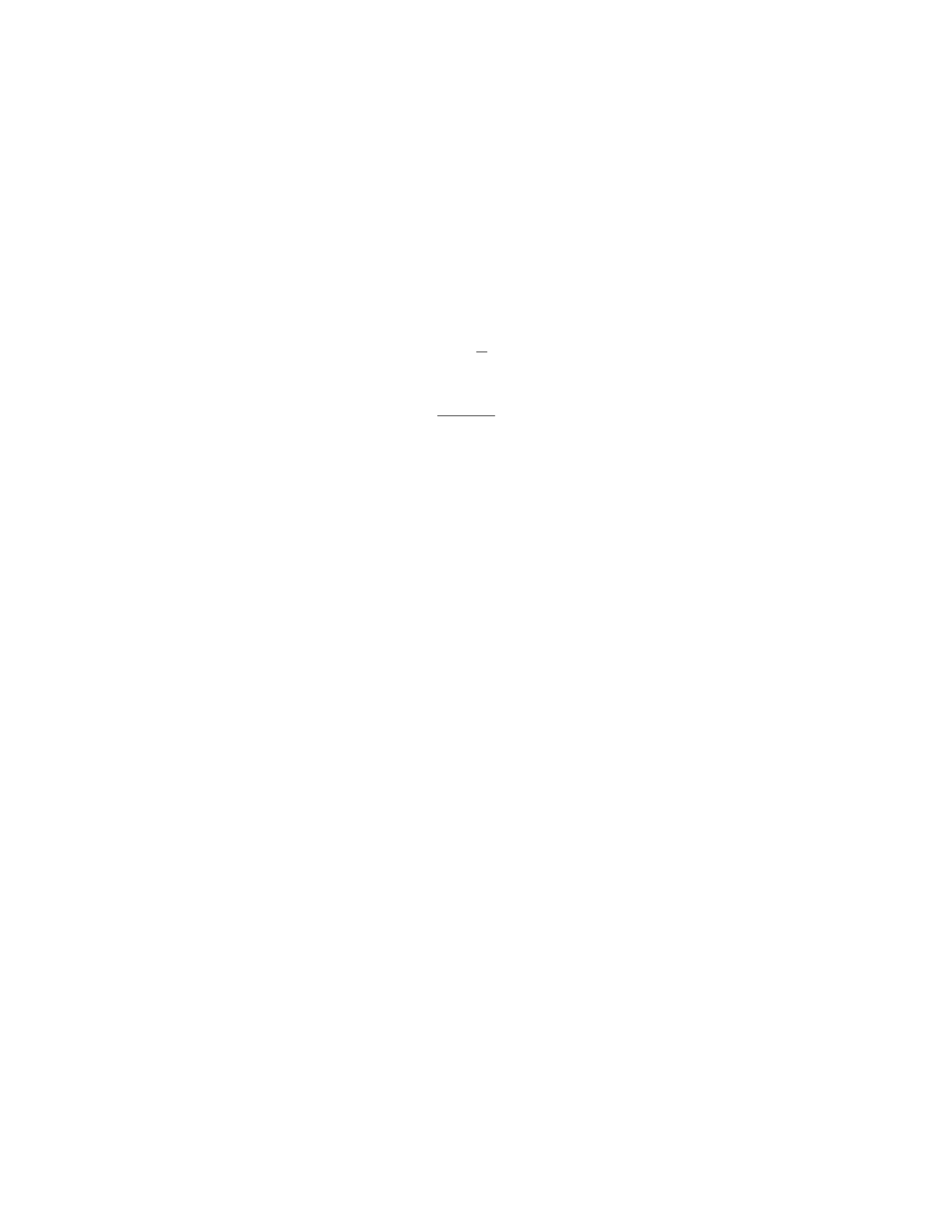
calculated using the formula density =m
V, where mis the mass of the cube and
Vis the volume of the cube. Given that the mass of the cube is 500 g (or 0.5
kg), we have:
density =0.5 kg
0.001 m3= 500 kg/m3
Step 3: Calculate the buoyant force. According to Archimedes’ principle, the
buoyant force acting on an object submerged in a fluid is equal to the weight of
the fluid displaced by the object. The buoyant force can be calculated using the
formula Fbuoyant =ρ·Vdisplaced ·g, where ρis the density of the fluid, Vdisplaced
is the volume of the fluid displaced by the object, and gis the acceleration due
to gravity. For water, the density is approximately 1000 kg/m3. Since the cube
is fully submerged, the volume of water displaced is equal to the volume of the
cube, which is 0.001 m3. Therefore, the buoyant force is:
Fbuoyant = 1000 kg/m3·0.001 m3·9.81 m/s2= 9.81 N
Step 4: Determine if the cube will float, sink, or remain suspended in the
water. The weight of the cube can be calculated as W=m·g= 0.5 kg ·
9.81 m/s2= 4.905 N. If the buoyant force is greater than the weight of the
cube, the cube will float. If the buoyant force is less than the weight of the
cube, the cube will sink. If the buoyant force is equal to the weight of the cube,
the cube will remain suspended. In this case, the buoyant force (9.81 N) is
greater than the weight of the cube (4.905 N), so the cube will float.
Question 15
Question
A cube of wood with a side length of 10 cm and a density of 0.8 g/cm3is floating
in water. What is the height of the cube that sticks out of the water?
(Note: Density of water = 1 g/cm3, acceleration due to gravity = 9.8 m/s2)
Solution
Step 1: Calculate the mass of the cube. Given the density of the cube, ρwood =
0.8 g/cm3, and the side length of the cube, l= 10 cm, the volume of the cube
is:
V=l3= (10 cm)3= 1000 cm3= 1000 cm3×(1 m/100 cm)3= 0.001 m3.
13

The mass of the cube can be calculated using the formula:
m=ρV = 0.8 g/cm3×0.001 m3= 0.0008 kg.
Step 2: Calculate the volume of the cube submerged in water. The buoyant
force acting on the cube is equal to the weight of water displaced by the cube.
The volume of water displaced is the volume of the cube submerged, denoted
as Vsubmerged. From Archimedes’ principle, we know that the buoyant force,
Fbuoyant, is also equal to the weight of the cube when floating:
Fbuoyant =mcube ·g=mwater ·g=ρwater ·Vsubmerged ·g,
where mwater is the mass of the water displaced by the cube, and ρwater is the
density of water. Using this equation, we find:
ρwater ·Vsubmerged ·g=ρwood ·Vsubmerged ·g,
which simplifies to:
ρwater ·Vsubmerged =ρwood ·V.
Substitute the values for densities and volumes:
1 g/cm3·Vsubmerged = 0.8 g/cm3·0.001 m3,
and solve for Vsubmerged:
Vsubmerged =0.8×0.001
1= 0.0008 m3.
Question 16
Question
A cylindrical object with a diameter of 10 cm and a height of 20 cm is floating
in water with two-thirds of its height submerged. If the density of water is
1000 kg/m3, find the density of the material of the object.
Solution
Step 1: Let’s denote the density of the material of the object as ρ. Given that
two-thirds of the height of the object is submerged, this means the volume of
water displaced by the object is equal to two-thirds of the volume of the object.
Step 2: First, let’s calculate the volume of the object. The volume of a
cylinder is given by the formula V=πr2h, where ris the radius and his the
height.
Step 3: In this case, the radius ris half of the diameter, so r=10 cm
2=
5 cm = 0.05 m. The height hof the object is 20 cm = 0.20 m.
Step 4: Substituting rand hinto the formula for the volume of a cylinder,
we get:
V=π×(0.05)2×0.20 m = 0.000785 m3
14

Step 5: Since two-thirds of the height of the object is submerged, the volume
of water displaced is 2
3×0.000785 m3= 0.000523 m3.
Step 6: According to Archimedes’ principle, the buoyant force Fbacting
on the object is equal to the weight of the water displaced, which is Fb=
V×ρwater ×g, where ρwater is the density of water and gis the acceleration
due to gravity.
Step 7: The buoyant force is also equal to the weight of the object, which is
Fb=V×ρ×g, where ρis the density of the material of the object.
Step 8: Equating the two expressions for the buoyant force and solving for
ρ, we get:
0.000523 m3×1000 kg/m3×9.81 m/s2= 0.000785 m3×ρ×9.81 m/s2
Step 9: Solving for ρ, we find:
ρ=0.000523 ×1000 ×9.81
0.000785 ≈662 kg/m3
Question 17
Question
A cube of side length 0.5 m and density 800 kg/m3is placed in a liquid of
density 1000 kg/m3. Determine the volume of the cube that is submerged in
the liquid.
Solution
Step 1: Calculate the weight of the cube. Given that the density of the cube,
ρcube = 800 kg/m3and the side length of the cube, l= 0.5 m, the volume of
the cube is given by
Vcube =l3= (0.5)3= 0.125 m3.
The weight of the cube is given by
Wcube =mcube ·g,
where mcube is the mass of the cube and gis the acceleration due to gravity
(9.81 m/s2). The mass of the cube can be calculated as
mcube =ρcube ·Vcube = 800 ×0.125 = 100 kg.
Therefore,
Wcube = 100 ×9.81 = 981 N.
Step 2: Calculate the buoyant force acting on the cube. The buoyant force
acting on the cube is given by
Fbuoyant =ρliquid ·Vsubmerged ·g,
15
where ρliquid = 1000 kg/m3is the density of the liquid and Vsubmerged is the
volume of the cube submerged in the liquid. Since the cube is in equilibrium,
the weight of the cube is balanced by the buoyant force, i.e.,
981 = 1000 ·Vsubmerged ·9.81.
Solving for Vsubmerged, we have
Vsubmerged =981
1000 ×9.81 =981
9810 = 0.1 m3.
Therefore, the volume of the cube that is submerged in the liquid is 0.1 m3.
Question 18
Question
A cube of side length 0.2 m and density 800 kg/m3is submerged in water.
Calculate the buoyant force acting on the cube and determine if it will sink or
float in the water.
Solution
Step 1: Calculate the volume of the cube The volume of a cube is given by
V=s3, where sis the side length of the cube. Given that the side length
s= 0.2 m, we have:
V= (0.2)3= 0.008 m3
Step 2: Calculate the weight of the cube The weight of the cube is given by
the formula W=mg, where mis the mass of the cube and gis the acceleration
due to gravity (9.81 m/s2). The mass mcan be found using the formula m=ρV ,
where ρis the density of the cube. Given that the density ρ= 800 kg/m3, we
have:
m= 800 ×0.008 = 6.4 kg
Therefore, the weight of the cube is:
W= 6.4×9.81 = 62.784 N
Step 3: Calculate the buoyant force According to Archimedes’ principle, the
buoyant force is equal to the weight of the fluid displaced by the object. The
buoyant force Fbcan be calculated by the formula Fb=ρwaterVdisplacedg, where
ρwater is the density of water and Vdisplaced is the volume of water displaced by
the cube. The volume of water displaced is equal to the volume of the cube
(0.008 m3). Given that the density of water ρwater = 1000 kg/m3, the buoyant
force is:
Fb= 1000 ×0.008 ×9.81 = 78.48 N
16

Step 4: Analyze the forces To determine if the cube will sink or float, we
compare the weight of the cube (62.784 N) to the buoyant force (78.48 N). Since
the buoyant force is greater than the weight of the cube, the cube will float in
water.
Question 19
Question
A solid object with a density of 8000 kg/m3is floating in a container of water.
If the object has a mass of 2 kg, what is the volume of the object? Assume the
density of water is 1000 kg/m3.
Solution
Step 1: We can use Archimedes’ principle, which states that the buoyant force
on an object is equal to the weight of the fluid displaced by the object. The
buoyant force (Fb) is given by the formula:
Fb=ρfluid ·Vsubmerged ·g
where ρfluid is the density of the fluid, Vsubmerged is the volume of the object
submerged in the fluid, and gis the acceleration due to gravity.
Step 2: The weight of the object can be calculated using its mass (m) and
the acceleration due to gravity (g):
W=m·g
Step 3: Since the object is floating, the weight of the object is balanced by
the buoyant force. Therefore, we can set W=Fb:
m·g=ρfluid ·Vsubmerged ·g
Step 4: We can rearrange the equation to solve for Vsubmerged:
Vsubmerged =m
ρfluid
Step 5: Substituting the given values:
Vsubmerged =2 kg
1000 kg/m3
Vsubmerged = 0.002 m3
Step 6: Since the object is floating, the volume of the object is equal to the
volume submerged in water:
Vobject =Vsubmerged
Vobject = 0.002 m3
Therefore, the volume of the object is 0.002 m3.
17

Question 20
Question
A cube of wood with a density of 700 kg/m3and side length 0.1 m is floating
in water. The cube has a small metal flake glued to its top face, which is 90%
submerged in water. Determine the side length of the metal flake. The density
of water is 1000 kg/m3and the acceleration due to gravity is 9.81 m/s2.
Solution
Step 1: Let’s first determine the buoyant force on the wooden cube. The buoyant
force Fbis equal to the weight of the water the cube displaces. The volume of
water displaced is the volume of the submerged portion of the cube. Given that
the cube is floating, the weight of the cube is equal to the buoyant force. The
weight of the cube can be calculated as the product of its volume, density, and
gravitational acceleration: W=Vcube ·ρcube ·g. The volume of the cube is
Vcube = (side length)3.
Step 2: Now, let’s determine the volume of water displaced by the submerged
portion of the cube. Since the top face of the cube is 90
Step 3: Next, we calculate the weight of the water displaced which is equal
to the buoyant force Fb. The weight of the water displaced is Wwater =Vwater ·
ρwater ·g.
Step 4: Since the cube is floating, the weight of the water displaced must
be equal to the weight of the cube. Equating the two weights, we have Vcube ·
ρcube ·g=Vwater ·ρwater ·g.
Step 5: Substituting the expressions for Vcube and Vwater into the equation,
we have (side length)3·ρcube = 0.9·(side length)3·ρwater. Solving for the side
length of the cube, we get side length = 0.91/3·ρwater
ρcube 1/3
.
Step 6: We can now calculate the side length of the metal flake. Since the
cube has the same side length as the metal flake, the side length of the metal
flake is 0.91/3·ρwater
ρmetal 1/3
.
Question 21
Question
A rectangular block of wood with dimensions 20 cm ×10 cm ×5 cm floats in
water. What is the minimum mass that can be added to the block before it
sinks?
Solution
Let’s first find the volume of the rectangular block of wood.
18

Step 1: Calculate the volume of the block. The volume (V) of the block is
given by:
V= length ×width ×height
Given that the dimensions of the block are 20 cm ×10 cm ×5 cm:
V= 20 cm ×10 cm ×5 cm
V= 1000 cm3
Step 2: Calculate the weight of the block. The weight of the block is equal
to the weight of the displaced water, which is equal to the buoyant force acting
on the block. The weight of the block can be calculated using the density of
water (ρ= 1000 kg/m3) and acceleration due to gravity (g= 9.81 m/s2):
Weight of block = ρ×V×g
Converting the volume to m3:
V= 1000 cm3= 0.001 m3
Substitute the values:
Weight of block = 1000 kg/m3×0.001 m3×9.81 m/s2
Weight of block = 9.81 N
Step 3: Calculate the minimum mass that can be added to the block before
it sinks. The minimum mass that can be added to the block before it sinks is
the difference between the weight of the block and the weight of the added mass
when the block is in equilibrium just before sinking. Let’s represent the mass
added as m.
When the block is about to sink, the total weight acting downward equals
the buoyant force acting upward. This implies weighting of the whole system
down equals to buoyant force upwards. That means total weight equals the
weight of the block plus the weight of the additional mass.
Therefore:
Weight of block + m×g=ρ×V×g
Now, we can solve for m:
m=ρ×V−Weight of block
m= 1000 kg/m3×0.001 m3−9.81 N
m= 0.9919 kg
Therefore, the minimum mass that can be added to the block before it sinks
is approximately 0.9919 kg.
19

Question 22
Question
A small spherical object with a density of 800 kg/m3and a diameter of 10 cm
is submerged in a container of water. Calculate the buoyant force acting on the
object and determine whether it will sink or float in water.
Solution
Step 1: Calculate the volume of the spherical object.
The volume of a sphere can be calculated using the formula:
V=4
3πr3
where ris the radius of the sphere. Given that the diameter is 10 cm, the radius
ris 5 cm or 0.05 m. Therefore, the volume Vis:
V=4
3π(0.05)3
Step 2: Calculate the mass of the spherical object.
The mass of the object can be calculated using the formula:
mass = density ×volume
Given that the density is 800 kg/m3, the mass is:
mass = 800 ×4
3π(0.05)3
Step 3: Calculate the buoyant force.
The buoyant force can be calculated using the formula:
buoyant force = weight of water displaced
The weight of water displaced is equal to the weight of the water that would
occupy the space of the submerged object. The weight of water displaced can be
determined by multiplying the volume of the object submerged in water by the
density of water (1000 kg/m3) and the acceleration due to gravity (9.8 m/s2).
Step 4: Determine whether the object will sink or float.
If the buoyant force is greater than the weight of the object, it will float. If the
buoyant force is less than the weight of the object, it will sink. If they are equal,
the object will remain at the same depth it was placed at.
Question 23
Question
A cube of iron with side length 10 cm and density 7.87 g/cm3is placed in a con-
tainer of water. Calculate the buoyant force acting on the cube and determine
if the cube will sink or float. Assume the density of water is 1 g/cm3.
20

Solution
Step 1: Calculate the mass of the iron cube.
The mass of the iron cube can be calculated using the formula m=ρV , where
ρis the density and Vis the volume. The volume of a cube is given by V=s3,
where sis the side length. Therefore,
V= (0.10 m)3= 0.001 m3= 1000 cm3.
The mass of the iron cube is
m= 7.87 g/cm3×1000 cm3= 7870 g = 7.87 kg.
Step 2: Calculate the weight of the iron cube.
The weight of the iron cube is given by W=mg, where gis the acceleration
due to gravity (9.81 m/s2). Therefore,
W= 7.87 kg ×9.81 m/s2= 77.45 N.
Step 3: Calculate the buoyant force acting on the cube.
The buoyant force can be calculated using Archimedes’ principle, which states
that the buoyant force is equal to the weight of the fluid displaced by the object.
The volume of water displaced by the cube is the same as the volume of the
cube, which is 0.001 m3. The weight of this volume of water is
Fbuoyant =ρwaterV g = 1000 kg/m3×0.001 m3×9.81 m/s2= 9.81 N.
Step 4: Determine if the cube will sink or float.
Since the weight of the iron cube (77.45 N) is greater than the buoyant force
acting on it (9.81 N), the cube will sink in water.
Question 24
Question
A large cube of side length 2 m is made of a material with a density of 8000
kg/m3. The cube is submerged in a pool of water. Determine the buoyant force
acting on the cube.
Solution
Step 1: Determine the volume of the cube. The volume of a cube is given by
V=s3, where sis the side length. Given that the side length is 2 m, the volume
of the cube is:
V= 23= 8 m3
Step 2: Determine the submerged volume of the cube. The cube is sub-
merged in water, so the volume of water displaced by the cube is equal to the
volume of the cube. Therefore, the submerged volume is 8 m3.
21

Step 3: Determine the density of water. The density of water is typically
taken to be 1000 kg/m3.
Step 4: Use Archimedes’ principle to calculate the buoyant force. The buoy-
ant force Fbacting on an object submerged in a fluid is given by the weight of
the fluid displaced by the object:
Fb= density of fluid ×volume of fluid displaced ×g
where gis the acceleration due to gravity. In this case, the buoyant force is:
Fb= 1000 ×8×9.8 = 78,400 N
Therefore, the buoyant force acting on the cube is 78,400 N.
Question 25
Question
A large block of wood with a density of 700 kg/m3floats in a tub of water.
If the block has a volume of 0.08 m3, determine the tension in the string that
holds the block in equilibrium. Assume the density of water is 1000 kg/m3.
Solution
Step 1: Determine the weight of the block in water.
The weight of the block in the air is given by Wblock =ρblockVblockg, where
-ρblock is the density of the block, - Vblock is the volume of the block, - gis the
acceleration due to gravity.
Given that ρblock = 700 kg/m3,Vblock = 0.08 m3, and g= 9.81 m/s2, we find
Wblock = 700 ×0.08 ×9.81 N = 548.64 N
Step 2: Determine the buoyant force acting on the block.
The buoyant force is given by Fbuoyant =ρwaterVblockg, where - ρwater is the
density of water.
Given that ρwater = 1000 kg/m3, we find
Fbuoyant = 1000 ×0.08 ×9.81 N = 784.8 N
Step 3: Determine the tension in the string.
Since the block is in equilibrium, the tension in the string T must be equal
to the weight of the block minus the buoyant force. Therefore,
T=Wblock −Fbuoyant = 548.64 N −784.8 N = −236.16 N
The negative sign indicates that the tension in the string acts in the opposite
direction to the weight of the block, i.e., upward.
Therefore, the tension in the string holding the block in equilibrium is 236.16
N.
22
Question 26
Question
A cube of aluminum with side length 10 cm and density 2700 kg/m3is placed
in water. What is the buoyant force acting on the cube?
Solution
Step 1: Calculate the volume of the aluminum cube. Given that the side length
of the cube is 10 cm, we can convert this to meters:
Side length (m) = 10 cm ×1 m
100 cm = 0.1 m
The volume of the cube is then:
Volume = (Side length)3= (0.1 m)3= 0.001 m3
Step 2: Calculate the weight of the aluminum cube. The weight of the
aluminum cube is given by:
Weight = Volume ×Density ×Acceleration due to gravity
Plugging in the values:
Weight = 0.001 m3×2700 kg/m3×9.8 m/s2= 26.46 N
Step 3: Calculate the buoyant force acting on the cube. The buoyant force is
equal to the weight of the water displaced by the cube, which is also equal to the
weight of the water that the cube displaces. Since the cube is fully submerged,
it displaces its own volume in water. Therefore, the buoyant force is:
Buoyant force = Volume ×Density of water ×Acceleration due to gravity
Plugging in the values:
Buoyant force = 0.001 m3×1000 kg/m3×9.8 m/s2= 9.8 N
Therefore, the buoyant force acting on the aluminum cube is 9.8 N.
Question 27
Question
A solid metal cube with a density of 8000 kg/m3and a mass of 2 kg is floating
in a liquid of density 1000 kg/m3. What is the volume of the cube that is
submerged in the liquid?
23
Solution
Step 1: First, we need to determine the volume of the cube. We can use the
formula V=m/ρ, where Vis the volume, mis the mass, and ρis the density.
Substituting in the values given, we have:
V=2 kg
8000 kg/m3
V= 0.00025 m3
Step 2: Next, we need to find the volume of the cube that is submerged in
the liquid. We can use Archimedes’ principle, which states that the buoyant
force on an object is equal to the weight of the fluid displaced by the object.
The buoyant force can be calculated as Fb=ρfluid ·Vsubmerged ·g, where ρfluid
is the density of the fluid, Vsubmerged is the volume submerged, and gis the
acceleration due to gravity.
Step 3: The weight of the cube can be calculated as W=m·g, where m
is the mass of the cube and gis the acceleration due to gravity. The cube is in
equilibrium, so the weight of the cube is equal to the buoyant force:
m·g=ρfluid ·Vsubmerged ·g
Vsubmerged =m
ρfluid
Substitute m= 2 kg and ρfluid = 1000 kg/m3:
Vsubmerged =2 kg
1000 kg/m3
Vsubmerged = 0.002 m3
Therefore, the volume of the cube that is submerged in the liquid is 0.002
m3.
Question 28
Question
A large rectangular block of wood with dimensions 4m x 2m x 1m is floating in
water. Determine the density of the wood if 50
Solution
Step 1: Let’s begin by identifying the given information: - Dimensions of the
block: 4 m ×2 m ×1 m - Percentage of the block submerged: 50
24

Step 2: The buoyant force acting on the block is equal to the weight of
the water displaced by the submerged part of the block. We can calculate the
buoyant force using the formula:
Fb=ρwater ·Vsubmerged ·g
where: Fb= buoyant force, ρwater = density of water (1000 kg/m3), Vsubmerged
= volume of the submerged part, g= acceleration due to gravity (9.81 m/s2).
Step 3: We are given that 50
Vsubmerged = 0.5×4 m ×2 m ×1 m
Step 4: Calculate the volume of the submerged part:
Vsubmerged = 4 m3
Step 5: Now, substitute the values into the buoyant force formula:
Fb= 1000 kg/m3×4 m3×9.81 m/s2
Step 6: Calculate the buoyant force:
Fb= 39240 N
Step 7: The weight of the block is equal to the buoyant force acting on it.
The weight of the block can be calculated using the formula:
W=ρwood ×Vtotal ×g
where: W= weight of the block, ρwood = density of wood, Vtotal = total volume
of the block.
Step 8: Substitute the given dimensions to calculate the total volume:
Vtotal = 4 m ×2 m ×1 m
Step 9: Calculate the total volume of the block:
Vtotal = 8 m3
Step 10: Since the block is floating, the weight of the block and the buoyant
force are equal:
W= 39240 N
Step 11: Substitute the weight and total volume into the weight formula to
solve for the density of wood:
ρwood =W
Vtotal ×g
Step 12: Calculate the density of wood:
ρwood =39240 N
8 m3×9.81 m/s2
Step 13: ρwood ≈500 kg/m3
Therefore, the density of the wood is approximately 500 kg/m3.
25

Question 29
Question
A cylindrical vessel of radius rand height his filled with a liquid of density ρ.
A solid cylinder of radius Rand height H, where R > r and H < h, is floating
in the liquid with its axis vertical. Calculate the height of the cylinder that is
submerged in the liquid.
Solution
Step 1: Let’s start by determining the volume of the displaced liquid by the
floating cylinder. The volume of the displaced liquid is equal to the volume of
the solid cylinder floating in the liquid. Since the cylinder is floating, the weight
of the floating cylinder is equal to the weight of the displaced liquid. We can
use Archimedes’ principle to find the volume of the displaced liquid:
Wcylinder =ρliquidVdisplacedg
πR2Hρg =ρliquidVdisplacedg
Vdisplaced =πR2H
Step 2: Next, we can determine the height of the cylindrical vessel that
is submerged in the liquid. The displaced liquid has the shape of a cylinder,
with radius Rand height x(the height of the submerged portion of the solid
cylinder). The volume of the displaced liquid is also the volume of this cylinder:
Vdisplaced =πR2x
Step 3: We can now set the two expressions for the volume of the displaced
liquid equal to each other and solve for x:
πR2H=πR2x
H=x
Thus, the height of the cylinder that is submerged in the liquid is equal to
the height of the solid cylinder, which is H.
Question 30
Question
A cube of wood with sides of length 10 cm and a mass of 800 g is floating in
water. What is the density of the wood? (Density of water is 1000 kg/m3)
26
Solution
Step 1: Find the volume of the cube. Step 2: Find the volume of water displaced
by the cube. Step 3: Use Archimedes’ principle to find the buoyant force acting
on the cube. Step 4: Use the equation for density to find the density of the
wood.
Step 1: The volume of the cube is given by V= (10 cm)3= 1000 cm3=
0.001 m3.
Step 2: The volume of water displaced by the cube is equal to the volume
of the cube, Vdisplaced = 0.001 m3.
Step 3: The buoyant force acting on the cube is given by Fbuoyant =ρwater ·
Vdisplaced ·g, where ρwater = 1000 kg/m3and g= 9.8 m/s2. Therefore, Fbuoyant =
1000 ×0.001 ×9.8=9.8 N.
Step 4: The weight of the cube is equal to the buoyant force, so 800 g ×
0.0098 kg/g = 9.8 N. This weight equals the weight of the water displaced by the
cube. Now, we can find the density of the wood using the formula for density:
ρwood =Mass
Volume =0.8 kg
0.001 m3= 800 kg/m3.
Therefore, the density of the wood is 800 kg/m3.
Question 31
Question
A cube of steel with sides of 6 cm is immersed in water. If the cube experiences
a buoyant force of 0.8 N, what is the density of the steel? (Density of water =
1000 kg/m3, g = 9.81 m/s2)
Solution
Step 1: The buoyant force acting on an object immersed in a fluid is equal to the
weight of the fluid displaced by the object. The buoyant force can be calculated
using the formula:
Fbuoyant =ρfluid ×Vsubmerged ×g
where ρfluid is the density of the fluid, Vsubmerged is the volume of the object
submerged in the fluid, and g is the acceleration due to gravity.
Step 2: The volume of the cube submerged in water can be calculated using
the formula Vsubmerged =l3, where lis the length of each side of the cube. Given
that the cube has sides of 6 cm (0.06 m), we find Vsubmerged = (0.06 m)3=
0.000216 m3.
Step 3: Substituting the known values into the formula for buoyant force,
we get:
0.8 N = 1000 kg/m3×0.000216 m3×9.81 m/s2
Step 4: Solving for ρsteel, the density of steel, we find:
ρsteel =0.8
1000 ×0.000216 ×9.81 ≈3750 kg/m3
27

Therefore, the density of the steel cube is approximately 3750 kg/m3.
Question 32
Question
A cube of side length 0.2 m and density 800 kg/m3is submerged in water.
Determine the buoyant force acting on the cube. (Density of water = 1000
kg/m3, acceleration due to gravity = 9.81 m/s2).
Solution
Step 1: Calculate the volume of the cube: The volume of a cube is given by
V= side length3. Given that the side length is 0.2 m, we have:
V= 0.2 m ×0.2 m ×0.2 m = 0.008 m3
Step 2: Calculate the mass of the cube: The mass of the cube can be
determined using the formula m= density ×volume. Substitute the density
of the cube (800 kg/m3) and the volume (0.008 m3) into the formula:
m= 800 kg/m3×0.008 m3= 6.4 kg
Step 3: Calculate the weight of the cube: The weight of an object is given
by the formula W=m×g, where mis the mass of the object and gis the
acceleration due to gravity. Substitute the mass of the cube (6.4 kg) and the
acceleration due to gravity (9.81 m/s2) into the formula:
W= 6.4 kg ×9.81 m/s2= 62.976 N
Step 4: Calculate the buoyant force acting on the cube: According to
Archimedes’ principle, the buoyant force acting on an object immersed in a
fluid is equal to the weight of the fluid displaced by the object. The volume of
fluid displaced by the cube is equal to its volume (0.008 m3). The density of
water is 1000 kg/m3. Thus, the weight of the fluid displaced by the cube is:
Wfluid = densitywater×volume×g= 1000 kg/m3×0.008 m3×9.81 m/s2= 78.48 N
Therefore, the buoyant force acting on the cube is 78.48 N.
Question 33
Question
A cube of wood with sides measuring 20 cm is floating in water with 60
28
Solution
Step 1: We first need to determine the buoyant force acting on the wood cube.
The buoyant force is given by:
Fbuoyant =ρ·g·Vsubmerged
where ρis the density of water, gis the acceleration due to gravity, and
Vsubmerged is the volume of the cube submerged in water.
Step 2: The volume of the cube submerged in water can be found using the
percentage of its volume submerged:
Vsubmerged = 0.6·Vcube
Vsubmerged = 0.6·(0.2 m)3= 0.024 m3
Step 3: Substitute the given values into the formula for buoyant force:
Fbuoyant = 1000 kg/m3·9.8 m/s2·0.024 m3
Fbuoyant = 235.2 N
Step 4: The buoyant force must be equal to the weight of the water displaced
by the cube:
Fbuoyant =Fweight
235.2 = ρwood ·g·Vsubmerged
Step 5: Solve for the density of the wood:
ρwood =235.2
9.8·0.024
ρwood =235.2
0.2352 = 1000 kg/m3
Therefore, the density of the wood cube is 1000 kg/m3.
Question 34
Question
A spherical balloon filled with helium has a radius of 0.5 meters and a mass of
2 kg. Calculate the buoyant force acting on the balloon when it is released into
the air. Assume the density of air is 1.2 kg/m3.
29

Solution
Step 1: Determine the volume of the balloon using the formula for the volume
of a sphere:
Volume of a sphere = 4
3πr3
where ris the radius of the sphere.
Step 2: Substitute r= 0.5 meters into the formula to find the volume:
Volume of the balloon = 4
3π(0.5)3
Step 3: Calculate the volume of the balloon:
Volume of the balloon = 4
3π(0.125) = 1
6π≈0.5236 m3
Step 4: Determine the buoyant force acting on the balloon using Archimedes’
principle:
Buoyant force = Weight of displaced air
Step 5: Calculate the weight of the displaced air using the density of air and
the volume of the balloon:
Weight of displaced air = Density ×Volume ×Acceleration due to gravity
Step 6: Substitute the given values into the formula to find the buoyant
force:
Buoyant force = 1.2×0.5236 ×9.81 ≈6.13 N
Therefore, the buoyant force acting on the balloon when it is released into
the air is approximately 6.13 N.
Question 35
Question
A spherical balloon with a radius of 2 meters is filled with helium gas. The
density of helium is 0.178 kg/m3, and the density of air is 1.21 kg/m3. Calculate
the buoyant force acting on the balloon.
Solution
Step 1: Calculate the volume of the balloon using the formula for the volume
of a sphere:
V=4
3πr3
where ris the radius of the balloon.
V=4
3π(2 m)3=32
3πm3≈33.51 m3
30

Step 3: Calculate the buoyant force. The buoyant force acting on an object
immersed in a fluid is equal to the weight of the fluid displaced by the object.
The weight of the water displaced by the object is given by:
Weight of water displaced = Volume of object×Density of water×Acceleration due to gravity
Weight of water displaced = 0.000785 ×1000 ×9.81 = 7.72 N
Therefore, the buoyant force acting on the object is 7.72 N.
Question 2
Question
A cube of wood with a density of 600 kg/m3and an edge length of 2 meters
is floating in a container of water. Calculate the depth to which the cube is
submerged in the water.
Given: Density of water = 1000 kg/m3, acceleration due to gravity = 9.81
m/s2.
Solution
Step 1: Determine the buoyant force acting on the cube. The buoyant force is
given by the formula:
Fbuoyant =ρ·Vdisplaced ·g
where: - ρis the density of water = 1000 kg/m3-Vdisplaced is the volume of
water displaced by the cube - gis the acceleration due to gravity = 9.81 m/s2
Step 2: Calculate the volume of water displaced by the cube. The volume
of water displaced is equal to the volume of the cube that is submerged. Let x
be the depth to which the cube is submerged. The volume of water displaced
is given by:
Vdisplaced =x×Aface
where: - xis the depth to which the cube is submerged - Aface is the area of
one face of the cube = (2 m)2
Step 3: Substitute the known values into the formula for buoyant force and
simplify.
Fbuoyant = 1000 ×(2x)×4×9.81
Step 4: Determine the weight of the floating cube. The weight of the cube
is equal to the gravitational force acting on the cube, given by:
Fweight =ρcube ×Vcube ×g
where: - ρcube is the density of the cube = 600 kg/m3-Vcube is the volume of
the cube = (2 m)3
2
Step 5: Set up the equilibrium condition. For the floating cube, the buoyant
force must equal the weight of the cube. Thus, we have:
Fbuoyant =Fweight
Step 6: Solve for the depth to which the cube is submerged. Equating the
buoyant force and weight of the cube, we get:
1000 ×2x×4×9.81 = 600 ×23×9.81
x=600 ×23
1000 ×2×4
Therefore, the depth to which the cube is submerged in the water is 0.12
meters.
Question 3
Question
A cube of wood with a density of 600 kg/m3and side length 0.1 m is floating
in water. What is the volume of the cube that is submerged in water?
Solution
Step 1: Let’s denote the density of water as ρwater = 1000 kg/m3and the volume
submerged as Vsubmerged.
Step 2: In order for the cube to float in water, the buoyant force on the
cube must be equal to the weight of the cube. The buoyant force is given by
Fbuoyant =ρwater ·Vsubmerged ·g, where g= 9.81 m/s2is the acceleration due to
gravity.
Step 3: The weight of the wooden cube is given by Fweight = density of wood×
volume of the cube×g. Since the cube is floating, the weight is balanced by the
buoyant force. So, we have:
ρwood ·Vcube ·g=ρwater ·Vsubmerged ·g
Step 4: We can now solve for the volume of the cube that is submerged in
water:
Vsubmerged =ρwood
ρwater
·Vcube
Step 5: Substituting the given values into the equation, we get:
Vsubmerged =600
1000 ·0.13m3
Step 6: Calculating the volume of the cube that is submerged, we find:
Vsubmerged = 0.06 m3
Therefore, the volume of the cube that is submerged in water is 0.06 m3.
3

Question 4
Question
A cylindrical tank filled with water has a diameter of 3 meters and a height of 4
meters. Calculate the buoyant force acting on a solid iron cylinder of diameter
2 meters and height 3 meters submerged in the water.
Solution
Step 1: Calculate the volume of the iron cylinder. Step 2: Calculate the volume
of water displaced by the iron cylinder. Step 3: Determine the weight of the
water displaced, which is equal to the buoyant force acting on the iron cylinder.
Step 1: The volume of the iron cylinder can be calculated using the formula
for the volume of a cylinder:
Viron =πr2h
where ris the radius of the cylinder and his the height. Given that the
diameter of the iron cylinder is 2 meters, the radius ris 1 meter and the height
his 3 meters. Substituting these values into the formula:
Viron =π(1)2×3=3πm3
Step 2: The volume of water displaced by the iron cylinder is equal to
the volume of the iron cylinder. This is based on Archimedes’ principle, which
states that an object submerged in a fluid will displace an equal volume of fluid.
Therefore, the volume of water displaced is also 3πm3.
Step 3: The weight of the water displaced is equal to the buoyant force
acting on the iron cylinder. The weight of water can be calculated using the
formula:
Weight = Mass ×Gravity
The mass of water displaced can be calculated by multiplying the volume of
water displaced by the density of water. The density of water is approximately
1000 kg/m3.
Weight = (3πm3)(1000 kg/m3)×9.81 m/s2
Weight = 29430πN
Therefore, the buoyant force acting on the iron cylinder is approximately
29430πN.
4

Question 5
Question
A block of wood with a volume of 0.1 m3and a density of 600 kg/m3is floating
in a pool of water. Determine the minimum mass that needs to be added on
top of the wood block in order to submerge it completely. The density of water
is 1000 kg/m3.
Solution
Step 1: Determine the mass of the wood block. Given that the density of the
wood block is 600 kg/m3and its volume is 0.1 m3, we can calculate the mass
using the formula:
mass = density ×volume
mass = 600 ×0.1 = 60 kg
Step 2: Determine the buoyant force acting on the wood block. The buoyant
force acting on the wood block is equal to the weight of the water displaced,
which is the weight of the volume of water equal to the volume of the submerged
part of the wood block. Since the wood block is floating, the buoyant force is
equal to the weight of the wood block.
Step 3: Determine the maximum mass for the wood block to float. Since
the wood block is floating, the buoyant force is equal to the weight of the wood
block. Let mwbe the mass of the wood block and mabe the mass that needs
to be added to submerge the block completely. The total mass when the block
is submerged is given by:
mw+ma
Step 4: Determine the volume of the wood block submerged in water. Since
the wood block is floating, the volume of the submerged part is equal to the
volume of the water displaced. Let Vsub be the volume of the submerged part.
Then:
Vsub = 0.1m3
Step 5: Determine the buoyant force when the wood block is submerged.
Since the wood block is now submerged, the buoyant force is equal to the weight
of the water displaced, which is equal to the weight of the wood block plus the
weight of the mass added. The buoyant force can be calculated by:
Buoyant force = (density of water) ×Vsub ×g
Step 6: Equate the buoyant force when submerged to the total mass when
the block is submerged.
(density of water) ×Vsub ×g=mw+ma
5

Step 7: Solve for the mass that needs to be added to submerge the wood
block completely. Substitute the known values into the equation and solve for
ma:
1000 ×0.1×9.8 = 60 + ma
980 = 60 + ma
ma= 920 kg
Therefore, the minimum mass that needs to be added on top of the wood
block in order to submerge it completely is 920 kg.
Question 6
Question
A cube of wood with side length 20 cm and density 0.8 g/cm3is floating in
water. Calculate the depth to which the cube floats in water.
Solution
Step 1: First, we need to find the buoyant force acting on the cube. The buoyant
force is equal to the weight of the water displaced by the cube. The weight of
the water displaced is equal to the volume of water displaced multiplied by the
density of water (ρwater = 1 g/cm3) multiplied by the acceleration due to gravity
(g= 9.8 m/s2).
Step 2: The volume of water displaced is equal to the volume of the sub-
merged part of the cube. Let the depth to which the cube is submerged be
hcm. The volume of the submerged part of the cube can be expressed as
20 ×20 ×h= 400hcm3.
Step 3: The weight of the water displaced is therefore 400h×1×9.8 N.
Step 4: The weight of the cube is equal to its volume (4000 cm3) multiplied
by its density (0.8 g/cm3) multiplied by the acceleration due to gravity (9.8
m/s2).
Step 5: The weight of the cube is 4000 ×0.8×9.8 N.
Step 6: For the cube to float, the buoyant force must be equal to the weight
of the cube. Equating the two forces:
400h×1×9.8 = 4000 ×0.8×9.8
Step 7: Solving for h:
400h=4000 ×0.8×9.8
9.8
h=4000 ×0.8
9.8
Step 8: Calculating the depth to which the cube floats, we get:
6
h= 32.65 cm
Therefore, the cube floats to a depth of 32.65 cm in water.
Question 7
Question
A cube of wood with a density of 700 kg/m3and side length 0.2 m floats in a
liquid with a density of 1000 kg/m3. Determine the depth to which the cube is
submerged in the liquid.
Solution
Step 1: We first calculate the buoyant force acting on the cube. The buoyant
force, Fb, is given by Archimedes’ principle:
Fb=ρliquid ·Vsub ·g
where: ρliquid is the density of the liquid, Vsub is the volume of the cube sub-
merged in the liquid, and gis the acceleration due to gravity.
Step 2: The volume of the cube submerged in the liquid is equal to the total
volume of the cube times the depth submerged. Hence,
Vsub =l2·d
where lis the side length of the cube and dis the depth submerged.
Step 3: The weight of the cube is equal to the weight of the liquid displaced,
so the weight of the cube can be calculated by:
Wcube =ρwood ·Vcube ·g=ρliquid ·Vsub ·g
Step 4: Substituting the values into the equation gives:
ρwood ·l3·g=ρliquid ·l2·d·g
Step 5: Solving for the depth submerged, d, we get:
d=ρwood
ρliquid
·l
Step 6: Substituting the given values, we find:
d=700 kg/m3
1000 kg/m3·0.2 m = 0.14 m
Therefore, the cube is submerged to a depth of 0.14 meters in the liquid.
7

Question 8
Question
A solid cube of wood with side length 10 cm and density 0.7 g/cm3is floating
in a container of water. If 80
(Given: Density of water = 1 g/cm3)
Solution
Step 1: Calculate the volume of the cube submerged in water. The volume of
the cube submerged in water can be calculated by multiplying the side length
of the submerged portion by itself and by the height of the submerged portion.
Let the side length of the submerged portion be xcm. Given that 80Therefore,
the volume of the cube submerged in water is:
Vsubmerged =x2×0.8x= 0.8x3
Step 2: Calculate the mass of the water displaced by the submerged cube.
Since the cube is floating, the mass of water displaced by the cube is equal to
the mass of the cube. The density of water is 1 g/cm3, so the mass of the water
displaced is equal to the volume of water displaced multiplied by the density of
water:
mdisplaced =Vsubmerged ×1=0.8x3
Step 3: Use Archimedes’ principle to determine the mass of the cube. Ac-
cording to Archimedes’ principle, the buoyant force acting on a submerged ob-
ject is equal to the weight of the fluid displaced. The weight of the fluid displaced
is equal to the mass of the fluid displaced times the acceleration due to gravity,
g= 9.8 m/s2. Therefore, the buoyant force acting on the wood cube is:
Fbuoyant =mdisplaced ×g
Step 4: Calculate the weight of the wood cube. The weight of the cube can
be calculated by multiplying the mass of the cube by the acceleration due to
gravity:
Wcube =mcube ×g
Step 5: Set the buoyant force equal to the weight of the cube and solve for
the mass of the cube.
Fbuoyant =Wcube
mdisplaced ×g=mcube ×g
0.8x3×9.8 = mcube ×9.8
Step 6: Calculate the mass of the cube.
mcube = 0.8x3
Substitute x= 10 cm (side length of the cube):
mcube = 0.8×103= 800 g
Therefore, the mass of the cube is 800 g.
8

Question 9
Question
A cube of side length 10 cm and density 800 kg/m3is floating in water. Deter-
mine the depth to which the cube is submerged.
Solution
Step 1: The buoyant force (Fb) acting on the cube can be calculated using
Archimedes’ principle:
Fb=ρw·Vsubmerged ·g
where ρwis the density of water (1000 kg/m3), Vsubmerged is the volume sub-
merged, and gis the acceleration due to gravity (9.81 m/s2).
Step 2: The weight of the cube is equal to the buoyant force, since it is in
equilibrium. The weight of the cube can be calculated using:
W=m·g
W=ρcube ·V·g
where ρcube is the density of the cube (800 kg/m3), Vis the total volume of the
cube, and gis the acceleration due to gravity.
Step 3: The volume of the cube can be calculated using:
V= side length3
V= (0.1 m)3
Step 4: Set W=Fband solve for Vsubmerged to find the volume submerged.
Step 5: Once you have the volume submerged, you can find the depth to
which the cube is submerged by dividing the volume by the cross-sectional area
submerged.
Step 6: Remember to convert the final depth from meters to centimeters for
the solution in the same unit as the given side length.
Question 10
Question
A cube of side length aand density ρcube is floating in water with a certain
portion submerged. Calculate the density of the cube in terms of the submerged
depth hand the cube’s fraction submerged f, where f=Vsubmerged
Vcube .
9

Solution
Step 1: Identify the forces acting on the cube. The forces acting on the cube
are the gravitational force (W), the buoyant force (FB), and the normal force
(N).
Step 2: Determine the gravitational force on the cube. The gravitational
force on the cube is given by W=ρcubeVcubeg, where Vcube =a3is the volume
of the cube submerged in the water.
Step 3: Calculate the buoyant force on the cube. The buoyant force on the
cube is given by FB=ρwater Vsubmergedg, where ρwater is the density of water
and Vsubmerged is the volume of the cube submerged in the water.
Step 4: Use the conditions for equilibrium. For the cube to be in equilibrium,
the net force acting on the cube must be zero. This gives us the equation:
W−FB= 0.
Step 5: Express the volume of the cube submerged in terms of a,h, and f.
The volume of the cube submerged is Vsubmerged =a2h.
Step 6: Substitute the expressions for Wand FBinto the equilibrium equa-
tion. ρcubea3g−ρwatera2hg = 0
Step 7: Solve for the density of the cube, ρcube. Dividing both sides by a3
gives ρcube =ρwater h
a
Step 8: Substitute fback into the equation. Since f=a2h
a3=h
a, we can
rewrite the density as ρcube =ρwater f
Therefore, the density of the cube in terms of the submerged depth hand
the cube’s fraction submerged fis ρcube =ρwater f.
Question 11
Question
A cylindrical object with a volume of 0.1 m3and a density of 800 kg/m3is
placed in a container filled with water. Determine the buoyant force acting on
the object and the depth to which the object sinks in the water. The density of
water is 1000 kg/m3and the acceleration due to gravity is 9.8 m/s2.
Solution
Step 1: Calculate the weight of the object.
Volume of object = 0.1 m3
Density of object = 800 kg/m3
Acceleration due to gravity = 9.8 m/s2
The weight of the object can be calculated using the formula:
Weight = Volume ×Density ×Acceleration due to gravity
10

Weight = 0.1 m3×800 kg/m3×9.8 m/s2
Weight = 784 N
Step 2: Calculate the buoyant force acting on the object. The buoyant
force is equal to the weight of the water displaced by the object, which can be
calculated using Archimedes’ principle:
Buoyant force = Weight of water displaced = Volume of object×Density of water×Acceleration due to gravity
Buoyant force = 0.1 m3×1000 kg/m3×9.8 m/s2= 980 N
Step 3: Calculate the depth to which the object sinks in the water. The
object will sink until the weight of the object is balanced by the buoyant force.
Let hbe the depth to which the object sinks. The weight of the water displaced
by this submerged portion will equal the buoyant force:
Weight of water displaced = Buoyant force
1
2×π×r2×h×Density of water ×Acceleration due to gravity = 980 N
Since the cross-sectional area of the object, π×r2, is constant:
h=2×Buoyant force
π×Density of water ×Acceleration due to gravity =2×980
π×1000 ×9.8≈0.63 m
Therefore, the buoyant force acting on the object is 980 N and the depth to
which the object sinks in the water is approximately 0.63 meters.
Question 12
Question
A solid cube of side length aand density ρcube is floating in a liquid of density
ρliquid. The cube is in equilibrium with a fraction fof its height above the liquid
surface in the air. Determine the value of fin terms of the densities ρcube and
ρliquid.
Solution
Step 1: First, let’s analyze the forces acting on the cube.
The buoyant force Fbacting on the cube is equal to the weight of the liquid
displaced by the submerged portion of the cube. Since the cube is floating, the
weight of the cube equals the buoyant force.
Step 2: The weight of the cube can be expressed as Wcube =ρcubegVsubmerged,
where Vsubmerged is the volume of the cube that is submerged in the liquid.
Step 3: The buoyant force is given by Fb=ρliquidgVsubmerged, where Vsubmerged =
af (volume of the submerged portion of the cube).
11

Step 4: Setting the weight of the cube equal to the buoyant force, we have
ρcubegaf =ρliquidgaf. Simplifying, we get ρcube =ρliquid.
Step 5: Hence, the value of fin terms of the densities ρcube and ρliquid is
f=ρcube
ρliquid .
Question 13
Question
A cube with a side length of 0.5 m and a density of 800 kg/m3is submerged in
a liquid with a density of 1000 kg/m3. Calculate the buoyant force acting on
the cube and determine whether the cube will float, sink, or remain suspended
in the liquid.
Solution
Step 1: Calculate the weight of the cube submerged in the liquid. The weight
of the cube is given by the formula: W=mg, where mis the mass of the cube
and gis the acceleration due to gravity (9.81 m/s2). Given that the density
of the cube is 800 kg/m3and the volume of a cube is V=s3, where sis the
side length, we can find the mass of the cube as m=ρV =ρs3. Substitute the
values into the formula to get m= 800 kg/m3×(0.5 m)3.
Step 2: Calculate the weight of the cube. Substitute the value of minto the
weight formula: W= 800 kg/m3×(0.5 m)3×9.81 m/s2.
Step 3: Calculate the buoyant force acting on the cube. The buoyant force
is given by Archimedes’ principle, which states that the buoyant force is equal
to the weight of the fluid displaced by the object. The buoyant force can be
calculated using the formula: Fb=ρfluidVdisplacedg. Given that the density of
the fluid is 1000 kg/m3and the volume of the cube submerged in the fluid
is V=s2, substitute the values into the formula to get Fb= 1000 kg/m3×
(0.5 m)2×9.81 m/s2.
Step 4: Determine whether the cube will float, sink, or remain suspended.
If the buoyant force is greater than the weight of the cube, then the cube will
float; if the buoyant force is less than the weight of the cube, the cube will sink;
and if the buoyant force is equal to the weight of the cube, the cube will remain
suspended. Compare the weight and the buoyant force calculated in steps 2 and
3 to make a determination.
Question 14
Question
A cube with a side length of 10 cm and a mass of 500 g is submerged in water.
Calculate the buoyant force acting on the cube and determine if the cube will
float, sink, or remain suspended in the water.
12
Solution
Step 1: Calculate the volume of the cube. The volume of the cube is given by
the formula V=s3, where sis the side length of the cube. Given that the side
length of the cube is 10 cm, we have:
V= (10 cm)3= 1000 cm3= 0.001 m3
Step 2: Calculate the density of the cube. The density of the cube can be
calculated using the formula density =m
V, where mis the mass of the cube and
Vis the volume of the cube. Given that the mass of the cube is 500 g (or 0.5
kg), we have:
density =0.5 kg
0.001 m3= 500 kg/m3
Step 3: Calculate the buoyant force. According to Archimedes’ principle, the
buoyant force acting on an object submerged in a fluid is equal to the weight of
the fluid displaced by the object. The buoyant force can be calculated using the
formula Fbuoyant =ρ·Vdisplaced ·g, where ρis the density of the fluid, Vdisplaced
is the volume of the fluid displaced by the object, and gis the acceleration due
to gravity. For water, the density is approximately 1000 kg/m3. Since the cube
is fully submerged, the volume of water displaced is equal to the volume of the
cube, which is 0.001 m3. Therefore, the buoyant force is:
Fbuoyant = 1000 kg/m3·0.001 m3·9.81 m/s2= 9.81 N
Step 4: Determine if the cube will float, sink, or remain suspended in the
water. The weight of the cube can be calculated as W=m·g= 0.5 kg ·
9.81 m/s2= 4.905 N. If the buoyant force is greater than the weight of the
cube, the cube will float. If the buoyant force is less than the weight of the
cube, the cube will sink. If the buoyant force is equal to the weight of the cube,
the cube will remain suspended. In this case, the buoyant force (9.81 N) is
greater than the weight of the cube (4.905 N), so the cube will float.
Question 15
Question
A cube of wood with a side length of 10 cm and a density of 0.8 g/cm3is floating
in water. What is the height of the cube that sticks out of the water?
(Note: Density of water = 1 g/cm3, acceleration due to gravity = 9.8 m/s2)
Solution
Step 1: Calculate the mass of the cube. Given the density of the cube, ρwood =
0.8 g/cm3, and the side length of the cube, l= 10 cm, the volume of the cube
is:
V=l3= (10 cm)3= 1000 cm3= 1000 cm3×(1 m/100 cm)3= 0.001 m3.
13

The mass of the cube can be calculated using the formula:
m=ρV = 0.8 g/cm3×0.001 m3= 0.0008 kg.
Step 2: Calculate the volume of the cube submerged in water. The buoyant
force acting on the cube is equal to the weight of water displaced by the cube.
The volume of water displaced is the volume of the cube submerged, denoted
as Vsubmerged. From Archimedes’ principle, we know that the buoyant force,
Fbuoyant, is also equal to the weight of the cube when floating:
Fbuoyant =mcube ·g=mwater ·g=ρwater ·Vsubmerged ·g,
where mwater is the mass of the water displaced by the cube, and ρwater is the
density of water. Using this equation, we find:
ρwater ·Vsubmerged ·g=ρwood ·Vsubmerged ·g,
which simplifies to:
ρwater ·Vsubmerged =ρwood ·V.
Substitute the values for densities and volumes:
1 g/cm3·Vsubmerged = 0.8 g/cm3·0.001 m3,
and solve for Vsubmerged:
Vsubmerged =0.8×0.001
1= 0.0008 m3.
Question 16
Question
A cylindrical object with a diameter of 10 cm and a height of 20 cm is floating
in water with two-thirds of its height submerged. If the density of water is
1000 kg/m3, find the density of the material of the object.
Solution
Step 1: Let’s denote the density of the material of the object as ρ. Given that
two-thirds of the height of the object is submerged, this means the volume of
water displaced by the object is equal to two-thirds of the volume of the object.
Step 2: First, let’s calculate the volume of the object. The volume of a
cylinder is given by the formula V=πr2h, where ris the radius and his the
height.
Step 3: In this case, the radius ris half of the diameter, so r=10 cm
2=
5 cm = 0.05 m. The height hof the object is 20 cm = 0.20 m.
Step 4: Substituting rand hinto the formula for the volume of a cylinder,
we get:
V=π×(0.05)2×0.20 m = 0.000785 m3
14

Step 5: Since two-thirds of the height of the object is submerged, the volume
of water displaced is 2
3×0.000785 m3= 0.000523 m3.
Step 6: According to Archimedes’ principle, the buoyant force Fbacting
on the object is equal to the weight of the water displaced, which is Fb=
V×ρwater ×g, where ρwater is the density of water and gis the acceleration
due to gravity.
Step 7: The buoyant force is also equal to the weight of the object, which is
Fb=V×ρ×g, where ρis the density of the material of the object.
Step 8: Equating the two expressions for the buoyant force and solving for
ρ, we get:
0.000523 m3×1000 kg/m3×9.81 m/s2= 0.000785 m3×ρ×9.81 m/s2
Step 9: Solving for ρ, we find:
ρ=0.000523 ×1000 ×9.81
0.000785 ≈662 kg/m3
Question 17
Question
A cube of side length 0.5 m and density 800 kg/m3is placed in a liquid of
density 1000 kg/m3. Determine the volume of the cube that is submerged in
the liquid.
Solution
Step 1: Calculate the weight of the cube. Given that the density of the cube,
ρcube = 800 kg/m3and the side length of the cube, l= 0.5 m, the volume of
the cube is given by
Vcube =l3= (0.5)3= 0.125 m3.
The weight of the cube is given by
Wcube =mcube ·g,
where mcube is the mass of the cube and gis the acceleration due to gravity
(9.81 m/s2). The mass of the cube can be calculated as
mcube =ρcube ·Vcube = 800 ×0.125 = 100 kg.
Therefore,
Wcube = 100 ×9.81 = 981 N.
Step 2: Calculate the buoyant force acting on the cube. The buoyant force
acting on the cube is given by
Fbuoyant =ρliquid ·Vsubmerged ·g,
15
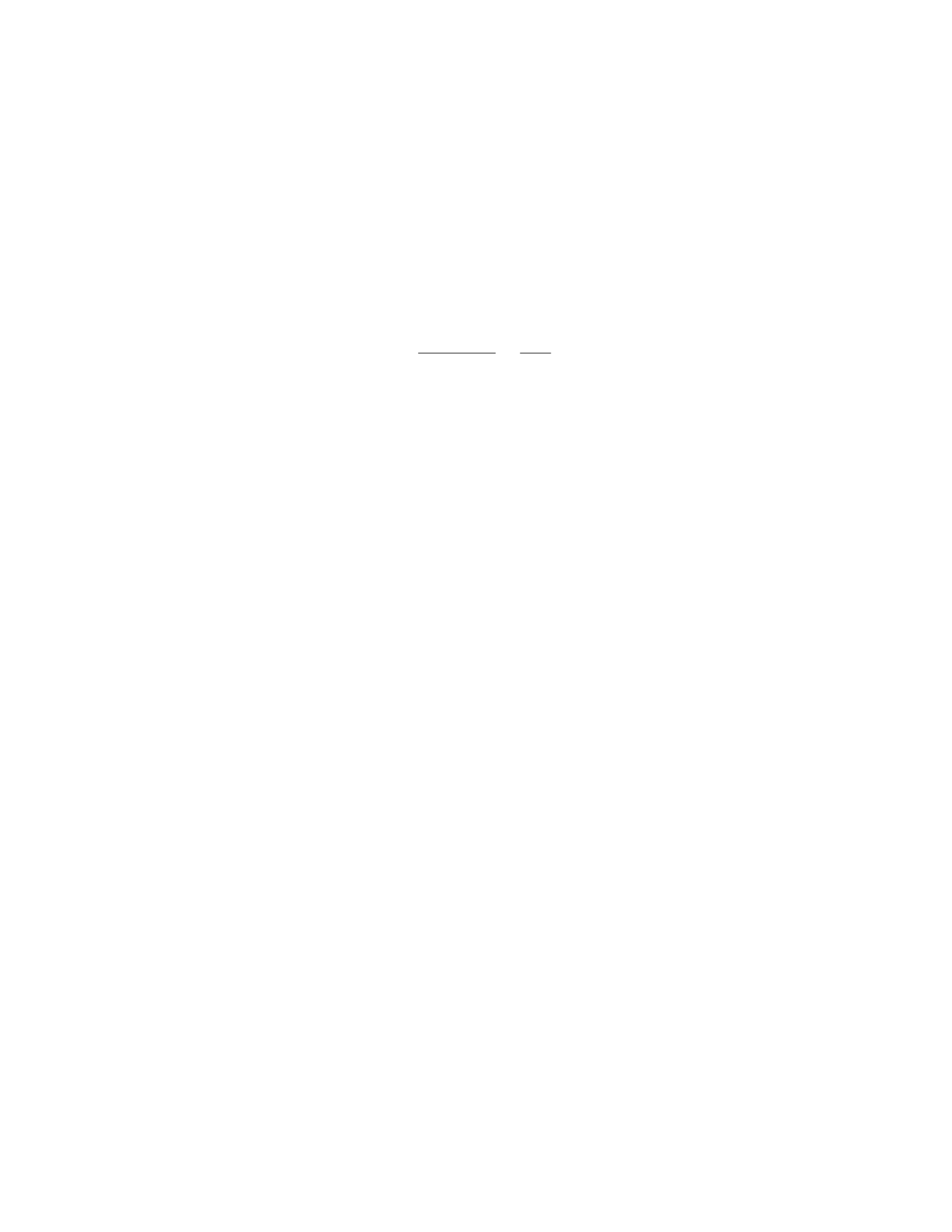
where ρliquid = 1000 kg/m3is the density of the liquid and Vsubmerged is the
volume of the cube submerged in the liquid. Since the cube is in equilibrium,
the weight of the cube is balanced by the buoyant force, i.e.,
981 = 1000 ·Vsubmerged ·9.81.
Solving for Vsubmerged, we have
Vsubmerged =981
1000 ×9.81 =981
9810 = 0.1 m3.
Therefore, the volume of the cube that is submerged in the liquid is 0.1 m3.
Question 18
Question
A cube of side length 0.2 m and density 800 kg/m3is submerged in water.
Calculate the buoyant force acting on the cube and determine if it will sink or
float in the water.
Solution
Step 1: Calculate the volume of the cube The volume of a cube is given by
V=s3, where sis the side length of the cube. Given that the side length
s= 0.2 m, we have:
V= (0.2)3= 0.008 m3
Step 2: Calculate the weight of the cube The weight of the cube is given by
the formula W=mg, where mis the mass of the cube and gis the acceleration
due to gravity (9.81 m/s2). The mass mcan be found using the formula m=ρV ,
where ρis the density of the cube. Given that the density ρ= 800 kg/m3, we
have:
m= 800 ×0.008 = 6.4 kg
Therefore, the weight of the cube is:
W= 6.4×9.81 = 62.784 N
Step 3: Calculate the buoyant force According to Archimedes’ principle, the
buoyant force is equal to the weight of the fluid displaced by the object. The
buoyant force Fbcan be calculated by the formula Fb=ρwaterVdisplacedg, where
ρwater is the density of water and Vdisplaced is the volume of water displaced by
the cube. The volume of water displaced is equal to the volume of the cube
(0.008 m3). Given that the density of water ρwater = 1000 kg/m3, the buoyant
force is:
Fb= 1000 ×0.008 ×9.81 = 78.48 N
16

Step 4: Analyze the forces To determine if the cube will sink or float, we
compare the weight of the cube (62.784 N) to the buoyant force (78.48 N). Since
the buoyant force is greater than the weight of the cube, the cube will float in
water.
Question 19
Question
A solid object with a density of 8000 kg/m3is floating in a container of water.
If the object has a mass of 2 kg, what is the volume of the object? Assume the
density of water is 1000 kg/m3.
Solution
Step 1: We can use Archimedes’ principle, which states that the buoyant force
on an object is equal to the weight of the fluid displaced by the object. The
buoyant force (Fb) is given by the formula:
Fb=ρfluid ·Vsubmerged ·g
where ρfluid is the density of the fluid, Vsubmerged is the volume of the object
submerged in the fluid, and gis the acceleration due to gravity.
Step 2: The weight of the object can be calculated using its mass (m) and
the acceleration due to gravity (g):
W=m·g
Step 3: Since the object is floating, the weight of the object is balanced by
the buoyant force. Therefore, we can set W=Fb:
m·g=ρfluid ·Vsubmerged ·g
Step 4: We can rearrange the equation to solve for Vsubmerged:
Vsubmerged =m
ρfluid
Step 5: Substituting the given values:
Vsubmerged =2 kg
1000 kg/m3
Vsubmerged = 0.002 m3
Step 6: Since the object is floating, the volume of the object is equal to the
volume submerged in water:
Vobject =Vsubmerged
Vobject = 0.002 m3
Therefore, the volume of the object is 0.002 m3.
17

Question 20
Question
A cube of wood with a density of 700 kg/m3and side length 0.1 m is floating
in water. The cube has a small metal flake glued to its top face, which is 90%
submerged in water. Determine the side length of the metal flake. The density
of water is 1000 kg/m3and the acceleration due to gravity is 9.81 m/s2.
Solution
Step 1: Let’s first determine the buoyant force on the wooden cube. The buoyant
force Fbis equal to the weight of the water the cube displaces. The volume of
water displaced is the volume of the submerged portion of the cube. Given that
the cube is floating, the weight of the cube is equal to the buoyant force. The
weight of the cube can be calculated as the product of its volume, density, and
gravitational acceleration: W=Vcube ·ρcube ·g. The volume of the cube is
Vcube = (side length)3.
Step 2: Now, let’s determine the volume of water displaced by the submerged
portion of the cube. Since the top face of the cube is 90
Step 3: Next, we calculate the weight of the water displaced which is equal
to the buoyant force Fb. The weight of the water displaced is Wwater =Vwater ·
ρwater ·g.
Step 4: Since the cube is floating, the weight of the water displaced must
be equal to the weight of the cube. Equating the two weights, we have Vcube ·
ρcube ·g=Vwater ·ρwater ·g.
Step 5: Substituting the expressions for Vcube and Vwater into the equation,
we have (side length)3·ρcube = 0.9·(side length)3·ρwater. Solving for the side
length of the cube, we get side length = 0.91/3·ρwater
ρcube 1/3
.
Step 6: We can now calculate the side length of the metal flake. Since the
cube has the same side length as the metal flake, the side length of the metal
flake is 0.91/3·ρwater
ρmetal 1/3
.
Question 21
Question
A rectangular block of wood with dimensions 20 cm ×10 cm ×5 cm floats in
water. What is the minimum mass that can be added to the block before it
sinks?
Solution
Let’s first find the volume of the rectangular block of wood.
18

Step 1: Calculate the volume of the block. The volume (V) of the block is
given by:
V= length ×width ×height
Given that the dimensions of the block are 20 cm ×10 cm ×5 cm:
V= 20 cm ×10 cm ×5 cm
V= 1000 cm3
Step 2: Calculate the weight of the block. The weight of the block is equal
to the weight of the displaced water, which is equal to the buoyant force acting
on the block. The weight of the block can be calculated using the density of
water (ρ= 1000 kg/m3) and acceleration due to gravity (g= 9.81 m/s2):
Weight of block = ρ×V×g
Converting the volume to m3:
V= 1000 cm3= 0.001 m3
Substitute the values:
Weight of block = 1000 kg/m3×0.001 m3×9.81 m/s2
Weight of block = 9.81 N
Step 3: Calculate the minimum mass that can be added to the block before
it sinks. The minimum mass that can be added to the block before it sinks is
the difference between the weight of the block and the weight of the added mass
when the block is in equilibrium just before sinking. Let’s represent the mass
added as m.
When the block is about to sink, the total weight acting downward equals
the buoyant force acting upward. This implies weighting of the whole system
down equals to buoyant force upwards. That means total weight equals the
weight of the block plus the weight of the additional mass.
Therefore:
Weight of block + m×g=ρ×V×g
Now, we can solve for m:
m=ρ×V−Weight of block
m= 1000 kg/m3×0.001 m3−9.81 N
m= 0.9919 kg
Therefore, the minimum mass that can be added to the block before it sinks
is approximately 0.9919 kg.
19

Question 22
Question
A small spherical object with a density of 800 kg/m3and a diameter of 10 cm
is submerged in a container of water. Calculate the buoyant force acting on the
object and determine whether it will sink or float in water.
Solution
Step 1: Calculate the volume of the spherical object.
The volume of a sphere can be calculated using the formula:
V=4
3πr3
where ris the radius of the sphere. Given that the diameter is 10 cm, the radius
ris 5 cm or 0.05 m. Therefore, the volume Vis:
V=4
3π(0.05)3
Step 2: Calculate the mass of the spherical object.
The mass of the object can be calculated using the formula:
mass = density ×volume
Given that the density is 800 kg/m3, the mass is:
mass = 800 ×4
3π(0.05)3
Step 3: Calculate the buoyant force.
The buoyant force can be calculated using the formula:
buoyant force = weight of water displaced
The weight of water displaced is equal to the weight of the water that would
occupy the space of the submerged object. The weight of water displaced can be
determined by multiplying the volume of the object submerged in water by the
density of water (1000 kg/m3) and the acceleration due to gravity (9.8 m/s2).
Step 4: Determine whether the object will sink or float.
If the buoyant force is greater than the weight of the object, it will float. If the
buoyant force is less than the weight of the object, it will sink. If they are equal,
the object will remain at the same depth it was placed at.
Question 23
Question
A cube of iron with side length 10 cm and density 7.87 g/cm3is placed in a con-
tainer of water. Calculate the buoyant force acting on the cube and determine
if the cube will sink or float. Assume the density of water is 1 g/cm3.
20

Solution
Step 1: Calculate the mass of the iron cube.
The mass of the iron cube can be calculated using the formula m=ρV , where
ρis the density and Vis the volume. The volume of a cube is given by V=s3,
where sis the side length. Therefore,
V= (0.10 m)3= 0.001 m3= 1000 cm3.
The mass of the iron cube is
m= 7.87 g/cm3×1000 cm3= 7870 g = 7.87 kg.
Step 2: Calculate the weight of the iron cube.
The weight of the iron cube is given by W=mg, where gis the acceleration
due to gravity (9.81 m/s2). Therefore,
W= 7.87 kg ×9.81 m/s2= 77.45 N.
Step 3: Calculate the buoyant force acting on the cube.
The buoyant force can be calculated using Archimedes’ principle, which states
that the buoyant force is equal to the weight of the fluid displaced by the object.
The volume of water displaced by the cube is the same as the volume of the
cube, which is 0.001 m3. The weight of this volume of water is
Fbuoyant =ρwaterV g = 1000 kg/m3×0.001 m3×9.81 m/s2= 9.81 N.
Step 4: Determine if the cube will sink or float.
Since the weight of the iron cube (77.45 N) is greater than the buoyant force
acting on it (9.81 N), the cube will sink in water.
Question 24
Question
A large cube of side length 2 m is made of a material with a density of 8000
kg/m3. The cube is submerged in a pool of water. Determine the buoyant force
acting on the cube.
Solution
Step 1: Determine the volume of the cube. The volume of a cube is given by
V=s3, where sis the side length. Given that the side length is 2 m, the volume
of the cube is:
V= 23= 8 m3
Step 2: Determine the submerged volume of the cube. The cube is sub-
merged in water, so the volume of water displaced by the cube is equal to the
volume of the cube. Therefore, the submerged volume is 8 m3.
21

Step 3: Determine the density of water. The density of water is typically
taken to be 1000 kg/m3.
Step 4: Use Archimedes’ principle to calculate the buoyant force. The buoy-
ant force Fbacting on an object submerged in a fluid is given by the weight of
the fluid displaced by the object:
Fb= density of fluid ×volume of fluid displaced ×g
where gis the acceleration due to gravity. In this case, the buoyant force is:
Fb= 1000 ×8×9.8 = 78,400 N
Therefore, the buoyant force acting on the cube is 78,400 N.
Question 25
Question
A large block of wood with a density of 700 kg/m3floats in a tub of water.
If the block has a volume of 0.08 m3, determine the tension in the string that
holds the block in equilibrium. Assume the density of water is 1000 kg/m3.
Solution
Step 1: Determine the weight of the block in water.
The weight of the block in the air is given by Wblock =ρblockVblockg, where
-ρblock is the density of the block, - Vblock is the volume of the block, - gis the
acceleration due to gravity.
Given that ρblock = 700 kg/m3,Vblock = 0.08 m3, and g= 9.81 m/s2, we find
Wblock = 700 ×0.08 ×9.81 N = 548.64 N
Step 2: Determine the buoyant force acting on the block.
The buoyant force is given by Fbuoyant =ρwaterVblockg, where - ρwater is the
density of water.
Given that ρwater = 1000 kg/m3, we find
Fbuoyant = 1000 ×0.08 ×9.81 N = 784.8 N
Step 3: Determine the tension in the string.
Since the block is in equilibrium, the tension in the string T must be equal
to the weight of the block minus the buoyant force. Therefore,
T=Wblock −Fbuoyant = 548.64 N −784.8 N = −236.16 N
The negative sign indicates that the tension in the string acts in the opposite
direction to the weight of the block, i.e., upward.
Therefore, the tension in the string holding the block in equilibrium is 236.16
N.
22
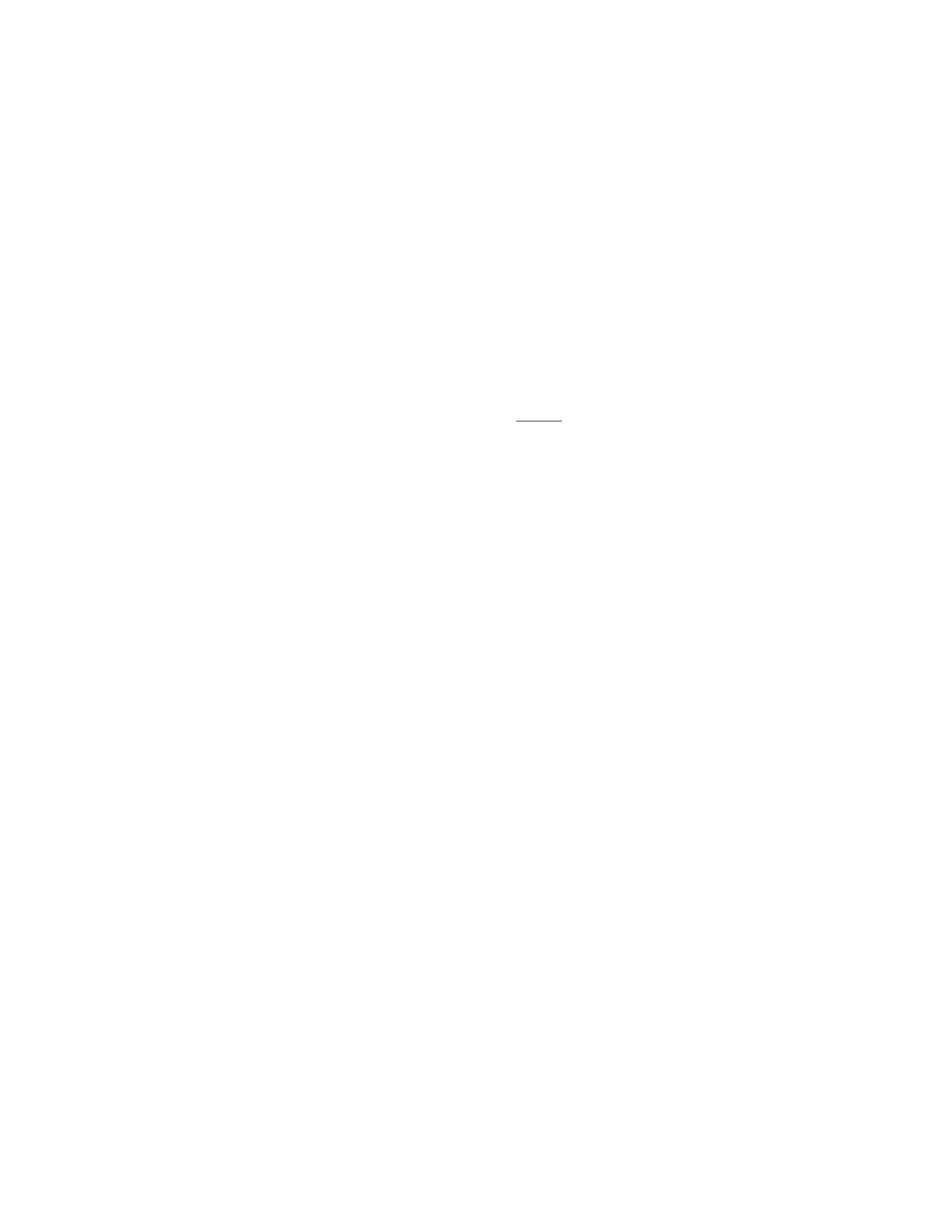
Question 26
Question
A cube of aluminum with side length 10 cm and density 2700 kg/m3is placed
in water. What is the buoyant force acting on the cube?
Solution
Step 1: Calculate the volume of the aluminum cube. Given that the side length
of the cube is 10 cm, we can convert this to meters:
Side length (m) = 10 cm ×1 m
100 cm = 0.1 m
The volume of the cube is then:
Volume = (Side length)3= (0.1 m)3= 0.001 m3
Step 2: Calculate the weight of the aluminum cube. The weight of the
aluminum cube is given by:
Weight = Volume ×Density ×Acceleration due to gravity
Plugging in the values:
Weight = 0.001 m3×2700 kg/m3×9.8 m/s2= 26.46 N
Step 3: Calculate the buoyant force acting on the cube. The buoyant force is
equal to the weight of the water displaced by the cube, which is also equal to the
weight of the water that the cube displaces. Since the cube is fully submerged,
it displaces its own volume in water. Therefore, the buoyant force is:
Buoyant force = Volume ×Density of water ×Acceleration due to gravity
Plugging in the values:
Buoyant force = 0.001 m3×1000 kg/m3×9.8 m/s2= 9.8 N
Therefore, the buoyant force acting on the aluminum cube is 9.8 N.
Question 27
Question
A solid metal cube with a density of 8000 kg/m3and a mass of 2 kg is floating
in a liquid of density 1000 kg/m3. What is the volume of the cube that is
submerged in the liquid?
23
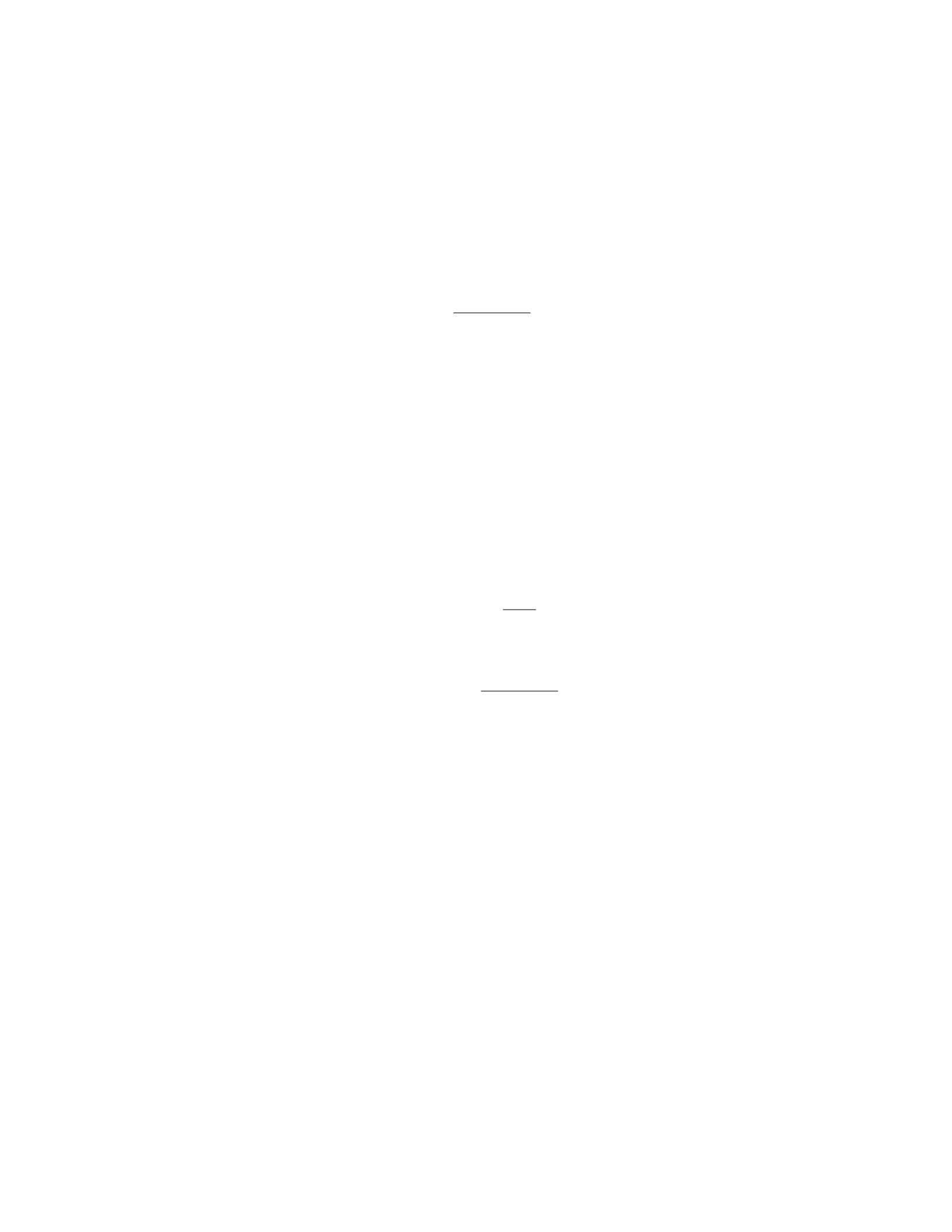
Solution
Step 1: First, we need to determine the volume of the cube. We can use the
formula V=m/ρ, where Vis the volume, mis the mass, and ρis the density.
Substituting in the values given, we have:
V=2 kg
8000 kg/m3
V= 0.00025 m3
Step 2: Next, we need to find the volume of the cube that is submerged in
the liquid. We can use Archimedes’ principle, which states that the buoyant
force on an object is equal to the weight of the fluid displaced by the object.
The buoyant force can be calculated as Fb=ρfluid ·Vsubmerged ·g, where ρfluid
is the density of the fluid, Vsubmerged is the volume submerged, and gis the
acceleration due to gravity.
Step 3: The weight of the cube can be calculated as W=m·g, where m
is the mass of the cube and gis the acceleration due to gravity. The cube is in
equilibrium, so the weight of the cube is equal to the buoyant force:
m·g=ρfluid ·Vsubmerged ·g
Vsubmerged =m
ρfluid
Substitute m= 2 kg and ρfluid = 1000 kg/m3:
Vsubmerged =2 kg
1000 kg/m3
Vsubmerged = 0.002 m3
Therefore, the volume of the cube that is submerged in the liquid is 0.002
m3.
Question 28
Question
A large rectangular block of wood with dimensions 4m x 2m x 1m is floating in
water. Determine the density of the wood if 50
Solution
Step 1: Let’s begin by identifying the given information: - Dimensions of the
block: 4 m ×2 m ×1 m - Percentage of the block submerged: 50
24

Step 2: The buoyant force acting on the block is equal to the weight of
the water displaced by the submerged part of the block. We can calculate the
buoyant force using the formula:
Fb=ρwater ·Vsubmerged ·g
where: Fb= buoyant force, ρwater = density of water (1000 kg/m3), Vsubmerged
= volume of the submerged part, g= acceleration due to gravity (9.81 m/s2).
Step 3: We are given that 50
Vsubmerged = 0.5×4 m ×2 m ×1 m
Step 4: Calculate the volume of the submerged part:
Vsubmerged = 4 m3
Step 5: Now, substitute the values into the buoyant force formula:
Fb= 1000 kg/m3×4 m3×9.81 m/s2
Step 6: Calculate the buoyant force:
Fb= 39240 N
Step 7: The weight of the block is equal to the buoyant force acting on it.
The weight of the block can be calculated using the formula:
W=ρwood ×Vtotal ×g
where: W= weight of the block, ρwood = density of wood, Vtotal = total volume
of the block.
Step 8: Substitute the given dimensions to calculate the total volume:
Vtotal = 4 m ×2 m ×1 m
Step 9: Calculate the total volume of the block:
Vtotal = 8 m3
Step 10: Since the block is floating, the weight of the block and the buoyant
force are equal:
W= 39240 N
Step 11: Substitute the weight and total volume into the weight formula to
solve for the density of wood:
ρwood =W
Vtotal ×g
Step 12: Calculate the density of wood:
ρwood =39240 N
8 m3×9.81 m/s2
Step 13: ρwood ≈500 kg/m3
Therefore, the density of the wood is approximately 500 kg/m3.
25

Question 29
Question
A cylindrical vessel of radius rand height his filled with a liquid of density ρ.
A solid cylinder of radius Rand height H, where R > r and H < h, is floating
in the liquid with its axis vertical. Calculate the height of the cylinder that is
submerged in the liquid.
Solution
Step 1: Let’s start by determining the volume of the displaced liquid by the
floating cylinder. The volume of the displaced liquid is equal to the volume of
the solid cylinder floating in the liquid. Since the cylinder is floating, the weight
of the floating cylinder is equal to the weight of the displaced liquid. We can
use Archimedes’ principle to find the volume of the displaced liquid:
Wcylinder =ρliquidVdisplacedg
πR2Hρg =ρliquidVdisplacedg
Vdisplaced =πR2H
Step 2: Next, we can determine the height of the cylindrical vessel that
is submerged in the liquid. The displaced liquid has the shape of a cylinder,
with radius Rand height x(the height of the submerged portion of the solid
cylinder). The volume of the displaced liquid is also the volume of this cylinder:
Vdisplaced =πR2x
Step 3: We can now set the two expressions for the volume of the displaced
liquid equal to each other and solve for x:
πR2H=πR2x
H=x
Thus, the height of the cylinder that is submerged in the liquid is equal to
the height of the solid cylinder, which is H.
Question 30
Question
A cube of wood with sides of length 10 cm and a mass of 800 g is floating in
water. What is the density of the wood? (Density of water is 1000 kg/m3)
26
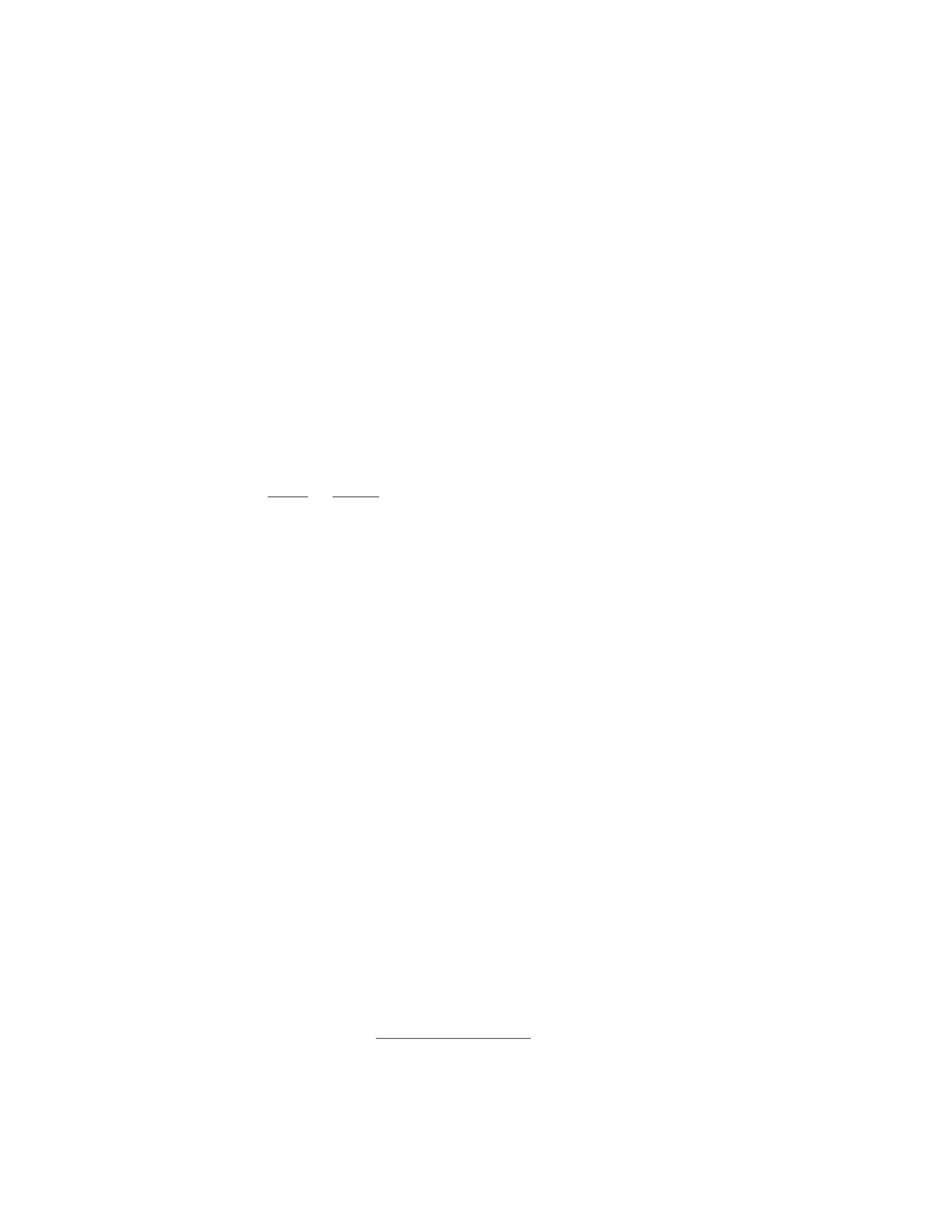
Solution
Step 1: Find the volume of the cube. Step 2: Find the volume of water displaced
by the cube. Step 3: Use Archimedes’ principle to find the buoyant force acting
on the cube. Step 4: Use the equation for density to find the density of the
wood.
Step 1: The volume of the cube is given by V= (10 cm)3= 1000 cm3=
0.001 m3.
Step 2: The volume of water displaced by the cube is equal to the volume
of the cube, Vdisplaced = 0.001 m3.
Step 3: The buoyant force acting on the cube is given by Fbuoyant =ρwater ·
Vdisplaced ·g, where ρwater = 1000 kg/m3and g= 9.8 m/s2. Therefore, Fbuoyant =
1000 ×0.001 ×9.8=9.8 N.
Step 4: The weight of the cube is equal to the buoyant force, so 800 g ×
0.0098 kg/g = 9.8 N. This weight equals the weight of the water displaced by the
cube. Now, we can find the density of the wood using the formula for density:
ρwood =Mass
Volume =0.8 kg
0.001 m3= 800 kg/m3.
Therefore, the density of the wood is 800 kg/m3.
Question 31
Question
A cube of steel with sides of 6 cm is immersed in water. If the cube experiences
a buoyant force of 0.8 N, what is the density of the steel? (Density of water =
1000 kg/m3, g = 9.81 m/s2)
Solution
Step 1: The buoyant force acting on an object immersed in a fluid is equal to the
weight of the fluid displaced by the object. The buoyant force can be calculated
using the formula:
Fbuoyant =ρfluid ×Vsubmerged ×g
where ρfluid is the density of the fluid, Vsubmerged is the volume of the object
submerged in the fluid, and g is the acceleration due to gravity.
Step 2: The volume of the cube submerged in water can be calculated using
the formula Vsubmerged =l3, where lis the length of each side of the cube. Given
that the cube has sides of 6 cm (0.06 m), we find Vsubmerged = (0.06 m)3=
0.000216 m3.
Step 3: Substituting the known values into the formula for buoyant force,
we get:
0.8 N = 1000 kg/m3×0.000216 m3×9.81 m/s2
Step 4: Solving for ρsteel, the density of steel, we find:
ρsteel =0.8
1000 ×0.000216 ×9.81 ≈3750 kg/m3
27

Therefore, the density of the steel cube is approximately 3750 kg/m3.
Question 32
Question
A cube of side length 0.2 m and density 800 kg/m3is submerged in water.
Determine the buoyant force acting on the cube. (Density of water = 1000
kg/m3, acceleration due to gravity = 9.81 m/s2).
Solution
Step 1: Calculate the volume of the cube: The volume of a cube is given by
V= side length3. Given that the side length is 0.2 m, we have:
V= 0.2 m ×0.2 m ×0.2 m = 0.008 m3
Step 2: Calculate the mass of the cube: The mass of the cube can be
determined using the formula m= density ×volume. Substitute the density
of the cube (800 kg/m3) and the volume (0.008 m3) into the formula:
m= 800 kg/m3×0.008 m3= 6.4 kg
Step 3: Calculate the weight of the cube: The weight of an object is given
by the formula W=m×g, where mis the mass of the object and gis the
acceleration due to gravity. Substitute the mass of the cube (6.4 kg) and the
acceleration due to gravity (9.81 m/s2) into the formula:
W= 6.4 kg ×9.81 m/s2= 62.976 N
Step 4: Calculate the buoyant force acting on the cube: According to
Archimedes’ principle, the buoyant force acting on an object immersed in a
fluid is equal to the weight of the fluid displaced by the object. The volume of
fluid displaced by the cube is equal to its volume (0.008 m3). The density of
water is 1000 kg/m3. Thus, the weight of the fluid displaced by the cube is:
Wfluid = densitywater×volume×g= 1000 kg/m3×0.008 m3×9.81 m/s2= 78.48 N
Therefore, the buoyant force acting on the cube is 78.48 N.
Question 33
Question
A cube of wood with sides measuring 20 cm is floating in water with 60
28
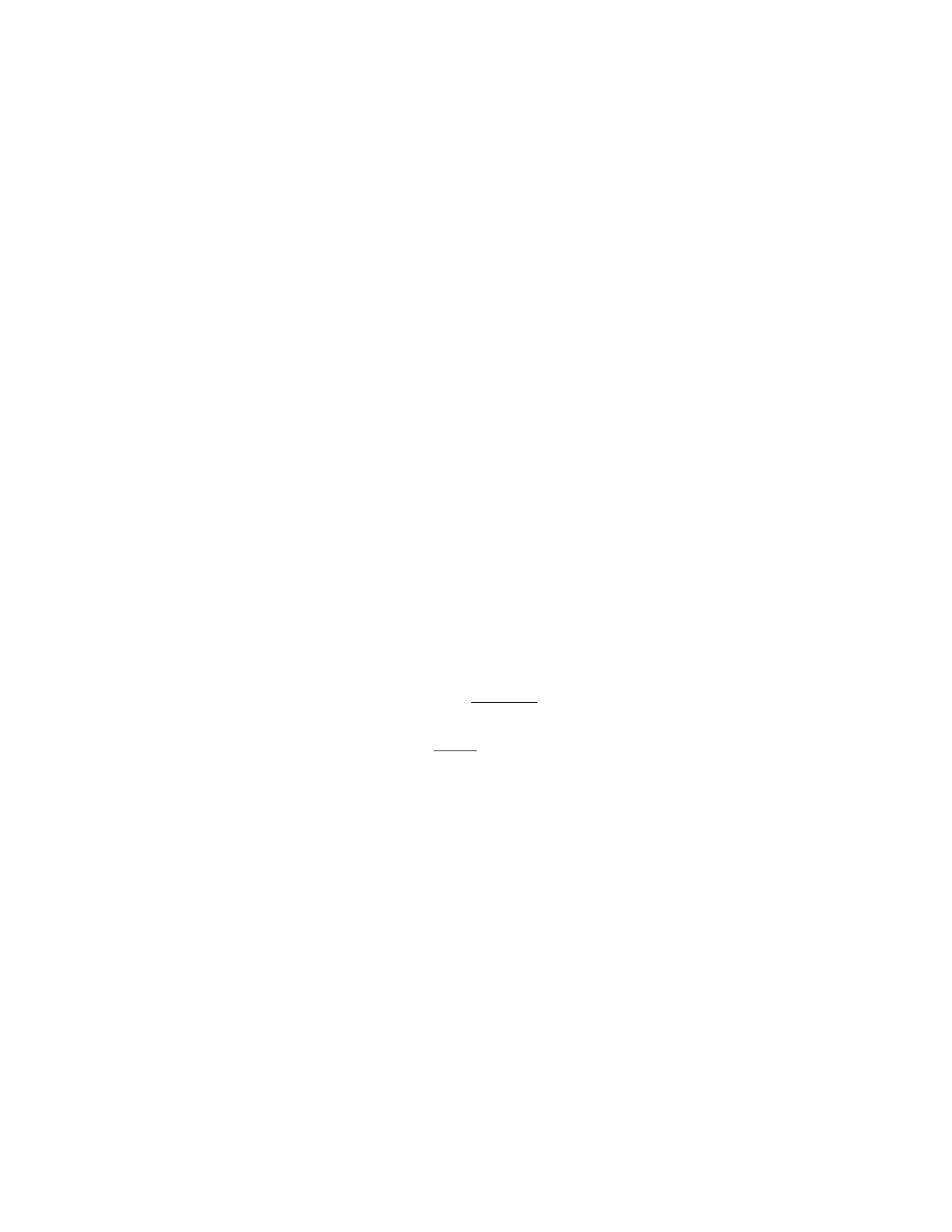
Solution
Step 1: We first need to determine the buoyant force acting on the wood cube.
The buoyant force is given by:
Fbuoyant =ρ·g·Vsubmerged
where ρis the density of water, gis the acceleration due to gravity, and
Vsubmerged is the volume of the cube submerged in water.
Step 2: The volume of the cube submerged in water can be found using the
percentage of its volume submerged:
Vsubmerged = 0.6·Vcube
Vsubmerged = 0.6·(0.2 m)3= 0.024 m3
Step 3: Substitute the given values into the formula for buoyant force:
Fbuoyant = 1000 kg/m3·9.8 m/s2·0.024 m3
Fbuoyant = 235.2 N
Step 4: The buoyant force must be equal to the weight of the water displaced
by the cube:
Fbuoyant =Fweight
235.2 = ρwood ·g·Vsubmerged
Step 5: Solve for the density of the wood:
ρwood =235.2
9.8·0.024
ρwood =235.2
0.2352 = 1000 kg/m3
Therefore, the density of the wood cube is 1000 kg/m3.
Question 34
Question
A spherical balloon filled with helium has a radius of 0.5 meters and a mass of
2 kg. Calculate the buoyant force acting on the balloon when it is released into
the air. Assume the density of air is 1.2 kg/m3.
29

Solution
Step 1: Determine the volume of the balloon using the formula for the volume
of a sphere:
Volume of a sphere = 4
3πr3
where ris the radius of the sphere.
Step 2: Substitute r= 0.5 meters into the formula to find the volume:
Volume of the balloon = 4
3π(0.5)3
Step 3: Calculate the volume of the balloon:
Volume of the balloon = 4
3π(0.125) = 1
6π≈0.5236 m3
Step 4: Determine the buoyant force acting on the balloon using Archimedes’
principle:
Buoyant force = Weight of displaced air
Step 5: Calculate the weight of the displaced air using the density of air and
the volume of the balloon:
Weight of displaced air = Density ×Volume ×Acceleration due to gravity
Step 6: Substitute the given values into the formula to find the buoyant
force:
Buoyant force = 1.2×0.5236 ×9.81 ≈6.13 N
Therefore, the buoyant force acting on the balloon when it is released into
the air is approximately 6.13 N.
Question 35
Question
A spherical balloon with a radius of 2 meters is filled with helium gas. The
density of helium is 0.178 kg/m3, and the density of air is 1.21 kg/m3. Calculate
the buoyant force acting on the balloon.
Solution
Step 1: Calculate the volume of the balloon using the formula for the volume
of a sphere:
V=4
3πr3
where ris the radius of the balloon.
V=4
3π(2 m)3=32
3πm3≈33.51 m3
30

Step 2: Calculate the weight of the displaced air:
Weight of displaced air = Volume of balloon×Density of air×Acceleration due to gravity
Weight of displaced air = 33.51 m3×1.21 kg/m3×9.81 m/s2≈400.15 N
Step 3: Calculate the weight of the helium gas in the balloon:
Weight of helium gas = Volume of balloon×Density of helium×Acceleration due to gravity
Weight of helium gas = 33.51 m3×0.178 kg/m3×9.81 m/s2≈56.43 N
Step 4: Calculate the buoyant force acting on the balloon:
Buoyant force = Weight of displaced air −Weight of helium gas
Buoyant force = 400.15 N −56.43 N = 343.72 N
Therefore, the buoyant force acting on the balloon is approximately 343.72
N.
31

