



PHYS 101 - ELEMENTS OF PHYSICS
- Buoyant forces and Archimedes’
principle
Question Bank - Set 10
Liberty University
Question 1
Question
A cube of wood with a density of 800 kg/m3and a side length of 0.1 m is
floating in a pool of water. Calculate the fraction of the cube’s volume that is
submerged in water.
Solution
Step 1: Determine the density of water. The density of water is approximately
1000 kg/m3.
Step 2: Calculate the mass of the cube. The mass of the cube can be
calculated using the formula m=ρV , where ρis the density of the cube and
Vis the volume of the cube. Given that ρ= 800 kg/m3and a= 0.1 m, the
volume of the cube is V=a3= (0.1)3= 0.001 m3. Therefore, the mass of the
cube is m= 800 ×0.001 = 0.8 kg.
Step 3: Determine the buoyant force acting on the cube. The buoyant force
acting on the cube is equal to the weight of the water displaced by the cube. This
can be calculated using the formula Fb=ρwaterVsubmergedg, where ρwater is the
density of water, Vsubmerged is the volume of the cube submerged in water, and g
is the acceleration due to gravity. The weight of the cube can also be calculated
as weight =mg = 0.8×9.8=7.84 N. For the cube to be in equilibrium, the
buoyant force equals the weight of the cube, so Fb= 7.84 N.
Step 4: Calculate the volume of the cube submerged in water. Using the
known densities and the formula for the buoyant force, we have: ρwaterVsubmergedg=
7.84 N. Substituting the values ρwater = 1000 kg/m3and g= 9.8 m/s2, we can
solve for Vsubmerged. We find Vsubmerged =7.84
1000×9.8= 0.0008 m3.

Step 5: Calculate the fraction of the cube’s volume submerged in water.
The fraction of the cube’s volume submerged in water can be calculated as the
submerged volume divided by the total volume of the cube. Therefore, the
fraction submerged is Vsubmerged
V=0.0008
0.001 =4
5= 0.8 or 80
Thus, 80
Question 2
Question
A cylindrical object with a density of 900 kg/m3and a radius of 0.5 m is
floating in water. Calculate the depth to which the object is submerged in
water. (Density of water = 1000 kg/m3, acceleration due to gravity = 9.81
m/s2)
Solution
Step 1: Find the volume of the object using the formula for the volume of a
cylinder:
V=πr2h
where ris the radius of the cylinder and his the height (depth of submersion
in this case).
Step 2: Substitute the given values into the formula:
V=π(0.5 m)2×h
V=π×0.25 m2×h= 0.25πh m3
Step 3: Calculate the weight of the object using the formula:
Wobject =ρobject ×V×g
where ρobject is the density of the object, Vis the volume of the object, and g
is the acceleration due to gravity.
Step 4: Substitute the given values into the formula:
Wobject = 900 kg/m3×0.25πh m3×9.81 m/s2
Step 5: Calculate the buoyant force acting on the object:
Fbuoyant =ρwater ×Vsubmerged ×g
where ρwater is the density of water, Vsubmerged is the volume of the object
submerged in water, and gis the acceleration due to gravity.
Step 6: Since the object is floating, the weight of the object is equal to the
buoyant force:
Wobject =Fbuoyant
2

Step 7: Solve for the depth of submersion, h, by equating the weight of the
object to the buoyant force:
900 kg/m3×0.25πh m3×9.81 m/s2= 1000 kg/m3×π×0.5 m ×h×9.81 m/s2
Step 8: Solve for hto find the depth to which the object is submerged in
water.
Question 3
Question
A cube of side length 0.3 m and density 900 kg/m3is placed in a container filled
with water of density 1000 kg/m3. Calculate the buoyant force acting on the
cube when it is fully submerged in the water.
Solution
Step 1: First, calculate the volume of the cube. The volume of a cube is given
by V=s3, where s is the side length of the cube. Given that the side length of
the cube is 0.3 m, we have:
V= (0.3)3= 0.027 m3
Step 2: Next, calculate the mass of the cube. The mass of an object is given
by m=ρV , where ρis the density of the object and V is the volume. Given
that the density of the cube is 900 kg/m3, we have:
m= 900 ×0.027 = 24.3kg
Step 3: Calculate the weight of the cube. The weight of an object is given
by W=mg, where m is the mass of the object and g is the acceleration due to
gravity (approximately 9.81 m/s2).
W= 24.3×9.81 = 238.683 N
Step 4: Calculate the buoyant force. According to Archimedes’ principle,
the buoyant force acting on an object in a fluid is equal to the weight of the fluid
displaced by the object. The volume of water displaced by the cube is equal
to the volume of the cube. Given that the density of water is 1000 kg/m3, the
weight of the water displaced is:
Wwater =ρwaterV= 1000 ×0.027 = 27 kg ×9.81 = 264.33 N
Therefore, the buoyant force acting on the cube is 264.33 N, upwards.
3

Question 4
Question
A block of wood with a density of 600 kg/m3is floating in a container of water.
The block has a volume of 0.02 m3and a mass of 8 kg. Calculate the buoyant
force acting on the block and determine whether it will sink or float.
Solution
Step 1: Calculate the weight of the block The weight of the block can be calcu-
lated using the formula:
weight = mass ×gravitational acceleration
weight = 8 kg ×9.81 m/s2= 78.48 N
Step 2: Calculate the weight of the displaced water The weight of the dis-
placed water is equal to the weight of the block. This can be calculated using
the formula:
weight of water = weight of block = 78.48 N
Step 3: Calculate the volume of water displaced The volume of water dis-
placed is equal to the volume of the block. This can be calculated using the
formula:
volume of water = volume of block = 0.02 m3
Step 4: Calculate the buoyant force The buoyant force acting on the block
can be calculated using the formula:
buoyant force = density of water×gravitational acceleration×volume of water displaced
buoyant force = 1000 kg/m3×9.81 m/s2×0.02 m3= 196.2 N
Step 5: Compare the buoyant force and the weight of the block Since the
buoyant force (196.2 N) is greater than the weight of the block (78.48 N), the
block will float in the container of water.
Question 5
Question
A cube of wood with a density of 0.80 g/cm3and a side length of 10 cm is sub-
merged in water. Calculate the buoyant force acting on the cube and determine
whether it will sink or float.
4

Solution
Step 1: Determine the volume of the cube. The volume of a cube is given by the
formula V=s3, where sis the side length of the cube. Given that s= 10 cm,
we have:
V= (10 cm)3= 1000 cm3
Step 2: Calculate the mass of the cube. The mass of the cube can be found
using the formula m=ρV , where ρis the density of the cube. Given that
ρ= 0.80 g/cm3and V= 1000 cm3, we have:
m= 0.80 g/cm3×1000 cm3= 800 g
Step 3: Determine the buoyant force. The buoyant force acting on an ob-
ject submerged in a fluid is equal to the weight of the fluid displaced by the
object. The buoyant force can be calculated using the formula Fbuoyant =
ρfluidVdisplacedg, where ρfluid is the density of the fluid, Vdisplaced is the vol-
ume of fluid displaced, and gis the acceleration due to gravity. For water,
ρfluid = 1 g/cm3. Since the cube is completely submerged, the volume of water
displaced is equal to the volume of the cube, which is 1000 cm3. Therefore, the
buoyant force is:
Fbuoyant = 1 g/cm3×1000 cm3×9.81 m/s2= 9810 N
Step 4: Determine if the cube will sink or float. Since the buoyant force
of 9810 N is greater than the weight of the cube which is 800 N, the net force
acting on the cube is upward and it will float in water.
Question 6
Question
A wooden cube with a side length of 10 cm and a density of 0.8 g/cm3is placed
in a container filled with water. What is the minimum additional load that
must be placed on top of the cube to make it sink?
Solution
Step 1: Calculate the weight of the cube to determine the buoyant force it
experiences. Given that the density of water is 1 g/cm3, the weight of the
wooden cube is:
Weight = Volume ×Density ×Acceleration due to gravity
Volume = (Side length)3= (10 cm)3= 1000 cm3
Weight = 1000 cm3×0.8 g/cm3×9.8 m/s2= 7840 N
5

Step 2: Determine the buoyant force acting on the cube. The buoyant force
is equal to the weight of the water displaced by the cube:
Buoyant force = Weight of water displaced = Volume of cube under water×Density of water×Acceleration due to gravity
The volume of the cube under water is equal to the volume of the cube that is
submerged:
Volume submerged = Volume of cube ×Density of object
Density of water
Volume submerged = 1000 cm3× 0.8 g/cm3
1 g/cm3!= 800 cm3
Buoyant force = 800 cm3×1 g/cm3×9.8 m/s2= 7840 N
Step 3: The cube will float until the weight of the additional load exceeds the
buoyant force. Let the additional load be denoted by Fload. Since the buoyant
force on the cube is already equal to its weight, the additional load must exceed
the weight of the cube for it to sink:
Fload >7840 N
Therefore, the minimum additional load required to make the cube sink is
7841 N .
Question 7
Question
A cube of side length aand density ρcube is placed in a liquid of density ρliquid.
The cube floats with a fraction xof its volume submerged in the liquid. De-
termine the relationship between the densities ρcube,ρliquid, and the fraction
x.
Solution
Step 1: Determine the forces acting on the cube. The forces acting on the cube
are its weight Wdownwards and the buoyant force Fbuoy upwards. The weight
is given by:
W=ρcube ·g·Vcube
where Vcube =a3is the volume of the cube.
Step 2: Calculate the volume of the cube submerged. The volume of the
cube submerged is given by:
Vsub =x·Vcube =x·a3
6

Step 3: Determine the buoyant force. The buoyant force is equal to the
weight of the liquid displaced by the cube:
Fbuoy =ρliquid ·g·Vsub
Step 4: Apply Archimedes’ principle. According to Archimedes’ principle,
the buoyant force Fbuoy acting on the cube is equal to the weight Wof the cube:
ρliquid ·g·Vsub =ρcube ·g·Vcube
Step 5: Substituting the expressions for Vsub and Vcube:
ρliquid ·g·x·a3=ρcube ·g·a3
Step 6: Simplify the equation. Solving for x, we find:
x=ρcube
ρliquid
Therefore, the relationship between the densities ρcube,ρliquid, and the frac-
tion xis x=ρcube
ρliquid .
Question 8
Question
A cube of wood with sides of length 10 cm and density 600 kg/m3is floating in
water. Calculate the height of the cube that is above the water’s surface. The
density of water is 1000 kg/m3.
Solution
Let’s denote the height of the cube above the water’s surface as h.
Step 1: First, let’s calculate the volume of the cube. The volume of the
cube is given by Vcube = (10 cm)3= 0.001 m3.
Step 2: Next, we can calculate the mass of the cube. The mass of the cube
is given by mcube = density ×volume.
Substituting the values, we have: mcube = 600 kg/m3×0.001 m3= 0.6 kg.
Step 3: Now, let’s consider the forces acting on the cube when it is floating
in water. The weight of the cube Wcube =mcube ×g, where g= 9.8 m/s2is the
acceleration due to gravity.
The buoyant force Fbuoyant acting on the cube is equal to the weight of the
water displaced by the cube. Fbuoyant = density of water×volume of cube submerged×
g.
Step 4: In equilibrium, the weight of the cube is balanced by the buoyant
force. Thus, we have Wcube =Fbuoyant.
Substitute the expressions and solve for the volume of the cube submerged:
mcube ×g= density of water ×volume of cube submerged ×g
0.6 kg ×9.8 m/s2= 1000 kg/m3×areacross-section ×h×9.8 m/s2
Solve for hto find the height of the cube above the water’s surface.
7
Question 9
Question
A cylindrical container with a radius of 0.5 m and a height of 1 m is completely
filled with water. A solid metal sphere with a radius of 0.3 m and a density
of 8000 kg/m3is then lowered into the water until it is completely submerged.
Calculate the buoyant force acting on the sphere when it is in the water.
Solution
Step 1: Calculate the volume of the sphere The volume of a sphere is given by
the formula:
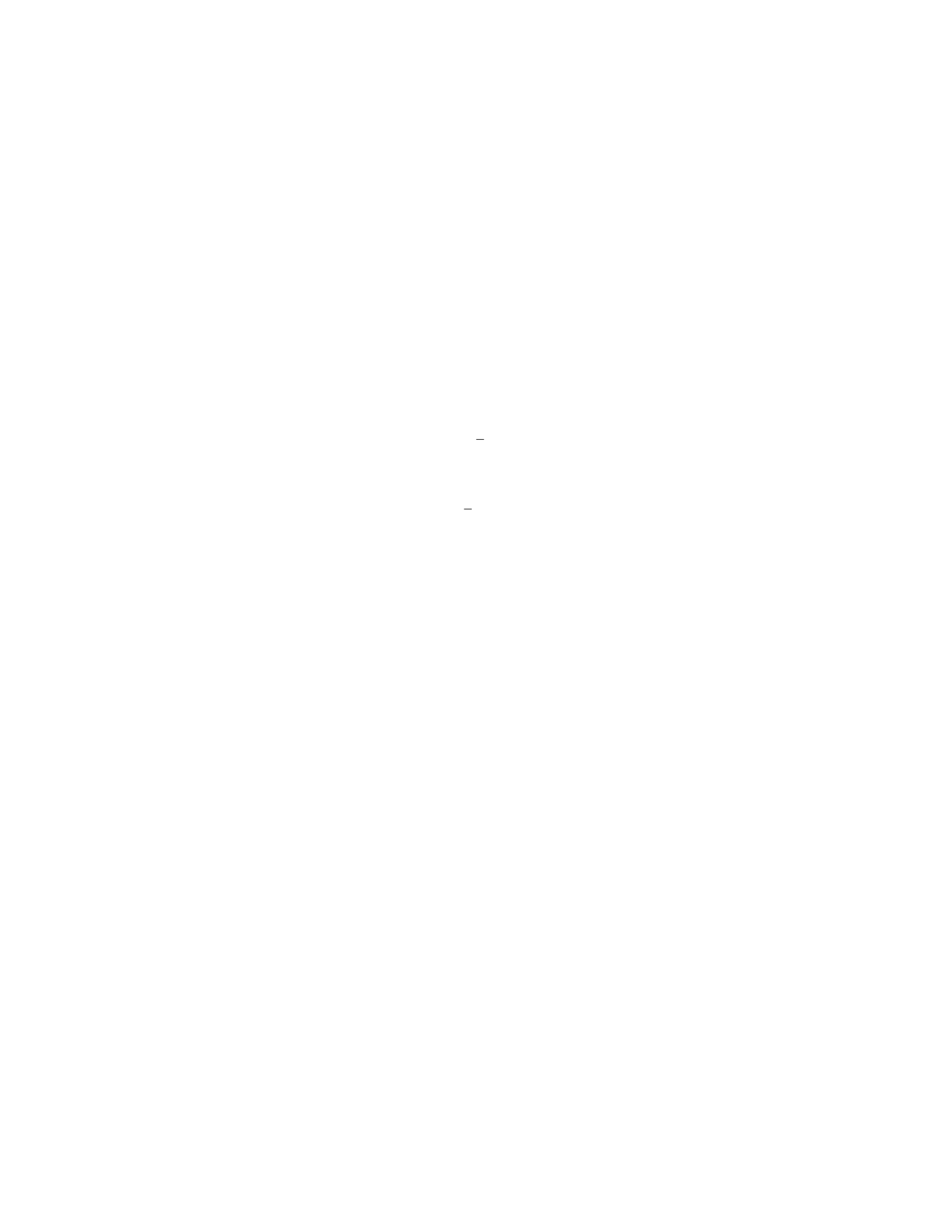
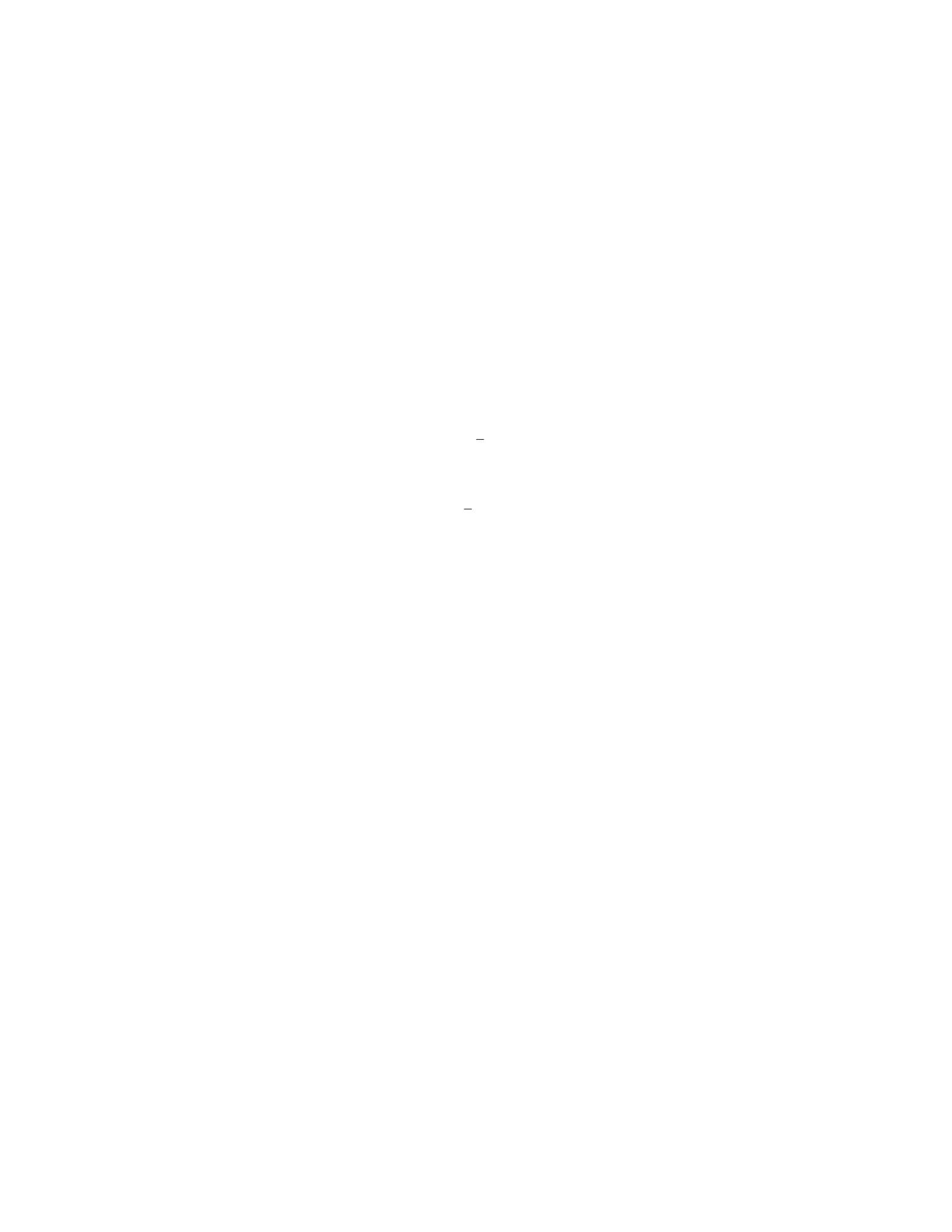
V=4
3πr3
Substitute the radius of the sphere:
V=4
3π(0.3)3
V≈0.1131 m3
Step 2: Calculate the weight of the sphere The weight of the sphere can be
calculated using the formula:
Weight = Mass ×Acceleration due to gravity
The mass of the sphere can be calculated using the formula:
Mass = Density ×Volume
Substitute the density and volume of the sphere:
Mass = 8000 kg/m3×0.1131 m3
Mass ≈904.8 kg
Now, calculate the weight of the sphere:
Weight = 904.8 kg ×9.81 m/s2
Weight ≈8886.3 N
Step 3: Calculate the weight of the water displaced The weight of the water
displaced is equal to the weight of the water that would fill the volume of the
sphere. The volume of the sphere is equal to the volume of water displaced.
Thus, the weight of the water displaced is equal to the weight of the sphere:
Weight of water displaced = 8886.3 N
Step 4: Calculate the buoyant force According to Archimedes’ principle, the
buoyant force acting on an object immersed in a fluid is equal to the weight of
8

the fluid that the object displaces. Therefore, the buoyant force acting on the
sphere is equal to the weight of the water displaced:
Buoyant force = 8886.3 N
Therefore, the buoyant force acting on the sphere when it is in the water is
approximately 8886.3 N.
Question 10
Question
A cube of wood with a side length of 10 cm and a density of 0.8 g/cm3is
placed in a liquid of density 1.2 g/cm3. Calculate the volume of the cube that
is submerged in the liquid.
Solution
Step 1: Calculate the weight of the cube Given density of wood, ρwood = 0.8
g/cm3and side length l= 10 cm. The mass of the cube can be calculated as:
mass = ρwood ×volume = ρwood ×l3
mass = 0.8 g/cm3×(10 cm)3= 800 g
The weight of the cube can be found by multiplying the mass by the acceleration
due to gravity g= 9.81 m/s2:
weight = mass ×g= 800 g ×9.81 m/s2= 7848 N
Step 2: Calculate the buoyant force acting on the cube The buoyant force
is equal to the weight of the liquid displaced by the cube. The volume of liquid
displaced is equal to the volume of the cube submerged, denoted as Vsubmerged.
The buoyant force can be calculated as:
buoyant force = ρliquid ×g×Vsubmerged
Now, we need to find Vsubmerged.
Step 3: Calculate the volume submerged The volume submerged can be
found using Archimedes’ principle which states that the buoyant force is equal
to the weight of the displaced fluid:
buoyant force = weight of fluid displaced
⇒ρliquid ×g×Vsubmerged =ρwood ×g×l3
⇒1.2 g/cm3×Vsubmerged = 0.8 g/cm3×(10 cm)3
⇒Vsubmerged =0.8×1000
1.2= 666.67 cm3
Therefore, the volume of the cube that is submerged in the liquid is 666.67
cm3.
9

Question 11
Question
A cube of wood with a density of 700 kg/m3and a side length of 0.05 m is
floating in water. Calculate the depth to which the cube is submerged in the
water.
Solution
Let’s denote: - Vcube as the volume of the cube, - das the depth to which the
cube is submerged, - ρwater as the density of water, - Fbuoyant as the buoyant
force acting on the cube, - Fgravity as the weight of the cube.
Step 1: Calculate the volume of the cube. Since the cube has a side length
of 0.05 m, the volume can be calculated as:
Vcube = (0.05 m)3= 0.000125 m3
Step 2: Calculate the weight of the cube. The weight of the cube can be
calculated using the formula:
Fgravity =m·g
where mis the mass of the cube and gis the acceleration due to gravity. The
mass of the cube can be calculated as:
m=ρcube ·Vcube
m= 700 kg/m3·0.000125 m3= 0.0875 kg
The weight of the cube is:
Fgravity = 0.0875 kg ·9.8 m/s2= 0.8575 N
Step 3: Calculate the buoyant force. According to Archimedes’ principle,
the buoyant force acting on the cube is equal to the weight of the water displaced
by the cube. The buoyant force can be calculated as:
Fbuoyant =ρwater ·Vsubmerged ·g
where Vsubmerged is the volume of the cube submerged in water. Since the cube
is floating, the buoyant force is equal to the weight of the cube:
Fbuoyant =Fgravity
ρwater ·Vsubmerged ·g=ρcube ·Vcube ·g
ρwater ·Vsubmerged =ρcube ·Vcube
Vsubmerged =ρcube ·Vcube
ρwater
10

Vsubmerged =700 kg/m3·0.000125 m3
1000 kg/m3= 0.0875 m3
Step 4: Calculate the depth to which the cube is submerged. The depth to
which the cube is submerged can be calculated using the formula:
Vsubmerged =A·d
where Ais the area of the base of the cube and dis the depth. Since the base
of the cube is a square with side length 0.05 m, the area can be calculated as:
A= (0.05 m) ×(0.05 m) = 0.0025 m2
0.0875 m3= 0.0025 m2×d
d=0.0875 m3
0.0025 m2= 0.035 m
Therefore, the depth to which the cube is submerged in the water is 0.035
m.
Question 12
Question
A cube of wood with a density of 600 kg/m3and side length 0.1 m is floating
in water. What is the buoyant force acting on the cube?
Solution
Step 1: Determine the volume of the cube. The volume of a cube is given by
V=L3, where Lis the length of a side. In this case, the side length L= 0.1
m, so the volume of the cube is:
V= (0.1 m)3= 0.001 m3
Step 2: Determine the weight of the cube. The weight of the cube is given by
the formula W=mg, where mis the mass of the cube and gis the acceleration
due to gravity (9.81 m/s2). The mass of the cube can be calculated using the
formula m=ρV , where ρis the density of the material. Substituting in the
given values:
m= 600 kg/m3×0.001 m3= 0.6 kg
Thus, the weight of the cube is:
W= 0.6 kg ×9.81 m/s2= 5.886 N
Step 3: Calculate the buoyant force. According to Archimedes’ principle,
the buoyant force acting on an object in a fluid is equal to the weight of the
fluid displaced by the object. Since the cube is floating, the weight of the cube
is equal to the buoyant force. Therefore, the buoyant force acting on the cube
is:
Buoyant force = 5.886 N
11
Question 13
Question
A cylindrical container has a height of 1.5 meters and a radius of 0.5 meters.
The container is filled with water to a height of 1.2 meters. Determine the
buoyant force acting on a solid iron sphere of radius 0.2 meters submerged in
the water. The density of iron is 7800 kg/m3and the density of water is 1000
kg/m3.
Solution
Step 1: Find the volume of water displaced by the iron sphere. The volume of
the iron sphere can be calculated using the formula for the volume of a sphere:
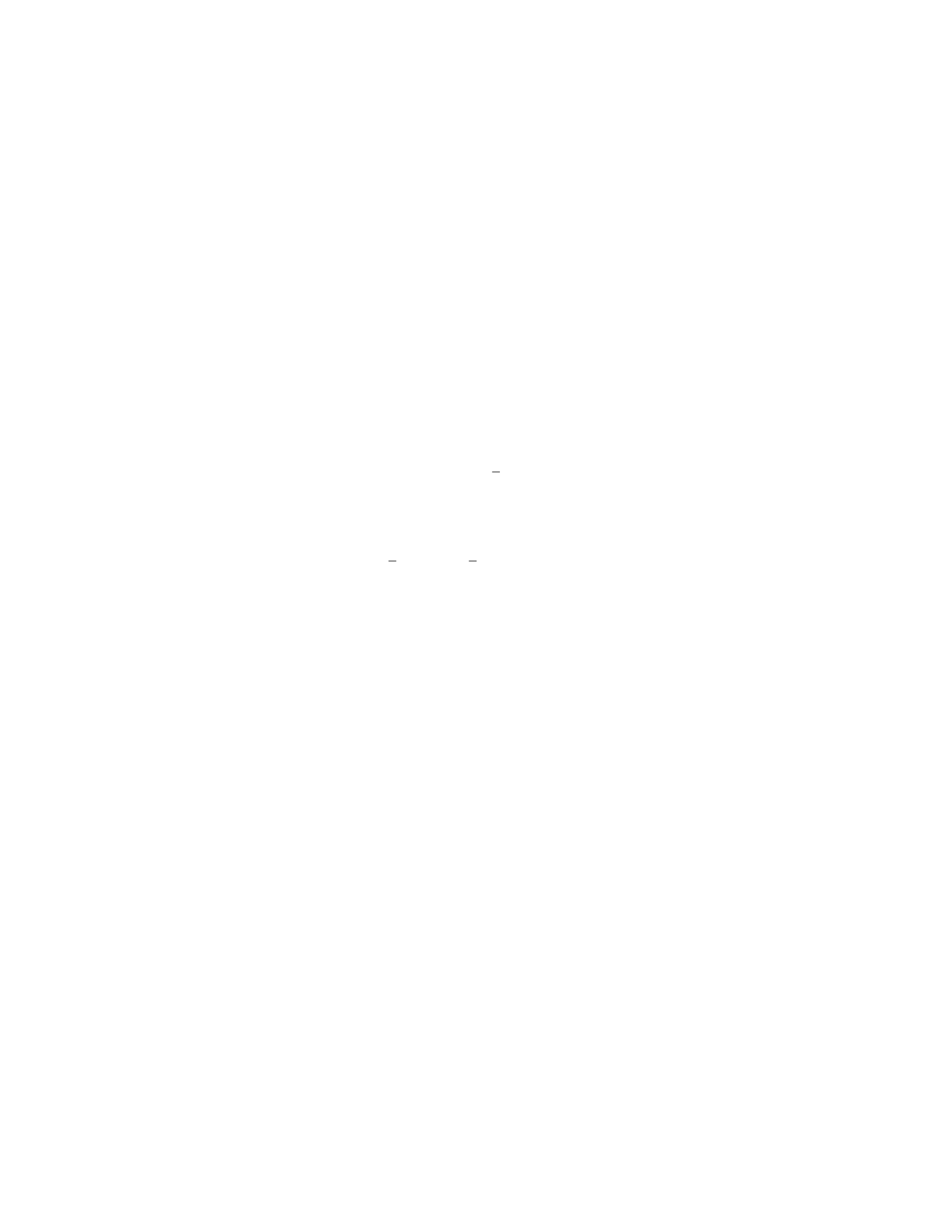
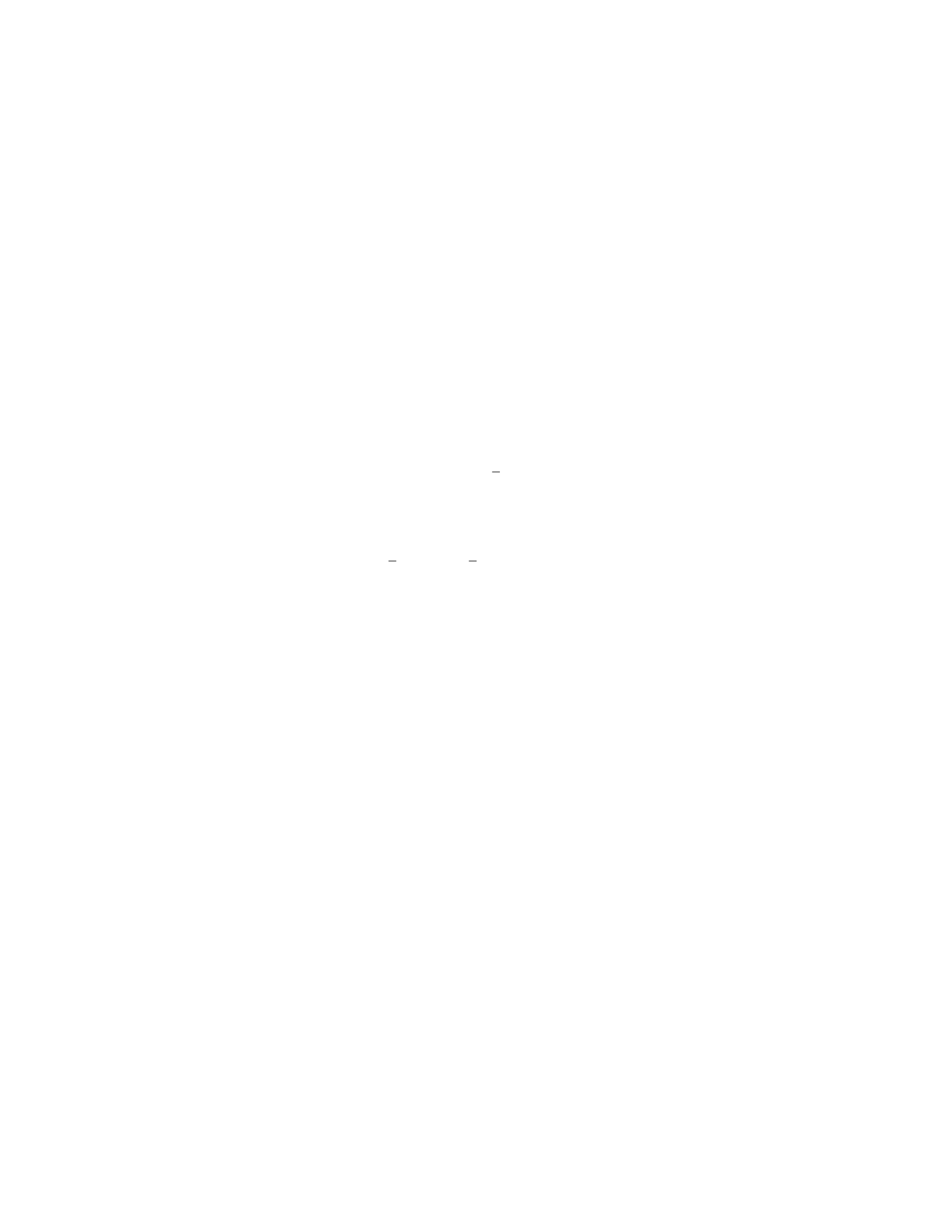
Vsphere =4
3πr3
where ris the radius of the sphere. Substitute r= 0.2 m into the formula to
find the volume of the iron sphere:
Vsphere =4
3π(0.2)3=4
3π(0.008) = 0.03351 m3
Step 2: Calculate the volume of water displaced by the iron sphere. The
volume of water displaced is equal to the volume of the iron sphere that is
submerged in the water.
Vwater =Vsphere = 0.03351 m3
Step 3: Determine the weight of water displaced. The weight of water
displaced can be calculated using the formula:
Weight = Density ×Volume ×Acceleration due to gravity
Given that the density of water is 1000 kg/m3and the acceleration due to
gravity is 9.8 m/s2, the weight of water displaced is:
Weight = 1000 ×0.03351 ×9.8 = 328.93 N
Step 4: Determine the weight of the iron sphere. The weight of the iron
sphere can be calculated using the formula:
Weight = Density ×Volume ×Acceleration due to gravity
Given that the density of iron is 7800 kg/m3and the volume of the iron sphere
is the same as the volume of water displaced, the weight of the iron sphere is:
Weight = 7800 ×0.03351 ×9.8 = 2530.51 N
Step 5: Determine the buoyant force acting on the iron sphere. The buoyant
force is equal to the weight of the water displaced, which we calculated to be
328.93 N. Thus, the buoyant force acting on the iron sphere is 328.93 N.
12

Question 14
Question
A cube of side length 25 cm and density 950 kg/m3is floating in water. What
is the depth of the cube submerged in the water? (Density of water = 1000
kg/m3, acceleration due to gravity = 9.81 m/s2)
Solution
Step 1: Begin by finding the volume of the cube. The volume of a cube is given
by the formula V=s3, where sis the side length of the cube. Given that the
side length of the cube is 25 cm (0.25 m), we have:
V= (0.25 m)3= 0.015625 m3
Step 2: Calculate the weight of the cube. The weight of an object is given
by the formula W=mg, where mis the mass of the object and gis the
acceleration due to gravity. The mass of the cube can be calculated using the
formula m= density ×V. Substituting in the values:
m= 950 kg/m3×0.015625 m3= 14.84375 kg
Now, we can find the weight of the cube:
W= 14.84375 kg ×9.81 m/s2= 145.5984375 N
Step 3: Determine the buoyant force acting on the cube. According to
Archimedes’ principle, the buoyant force acting on an object submerged in a
fluid is equal to the weight of the fluid displaced by the object. The buoyant
force can be calculated using the formula Fb= density of water×Vsubmerged ×g,
where Vsubmerged is the volume of the cube submerged in water. Let hbe
the depth of the cube submerged in water. The volume submerged is A×h,
where Ais the area of the cube’s face. A=s2= (0.25 m)2= 0.0625 m2Thus,
Vsubmerged = 0.0625 m2×h= 0.0625hm3Substitute the values and calculate
the buoyant force:
Fb= 1000 kg/m3×0.0625hm3×9.81 m/s2= 614.0625hN
Step 4: Set up the equilibrium condition. For the cube to be floating in
equilibrium, the weight of the cube must be equal to the buoyant force acting
on it. Thus, we have:
W=Fb
145.5984375 N = 614.0625hN
Step 5: Solve for the depth of the cube submerged.
614.0625h= 145.5984375
h=145.5984375
614.0625 = 0.237 m
Therefore, the depth of the cube submerged in water is 23.7 cm.
13
Question 15
Question
A cube of wood with a density of 0.75 g/cm3and side length of 5 cm is floating
in water. Calculate the depth to which the cube floats in water.
Solution
Step 1: Determine the density of water Given that the density of water is
ρwater = 1.0 g/cm3.
Step 2: Calculate the fraction of the cube submerged in water We can use
Archimedes’ principle to find the fraction of the cube submerged in water:
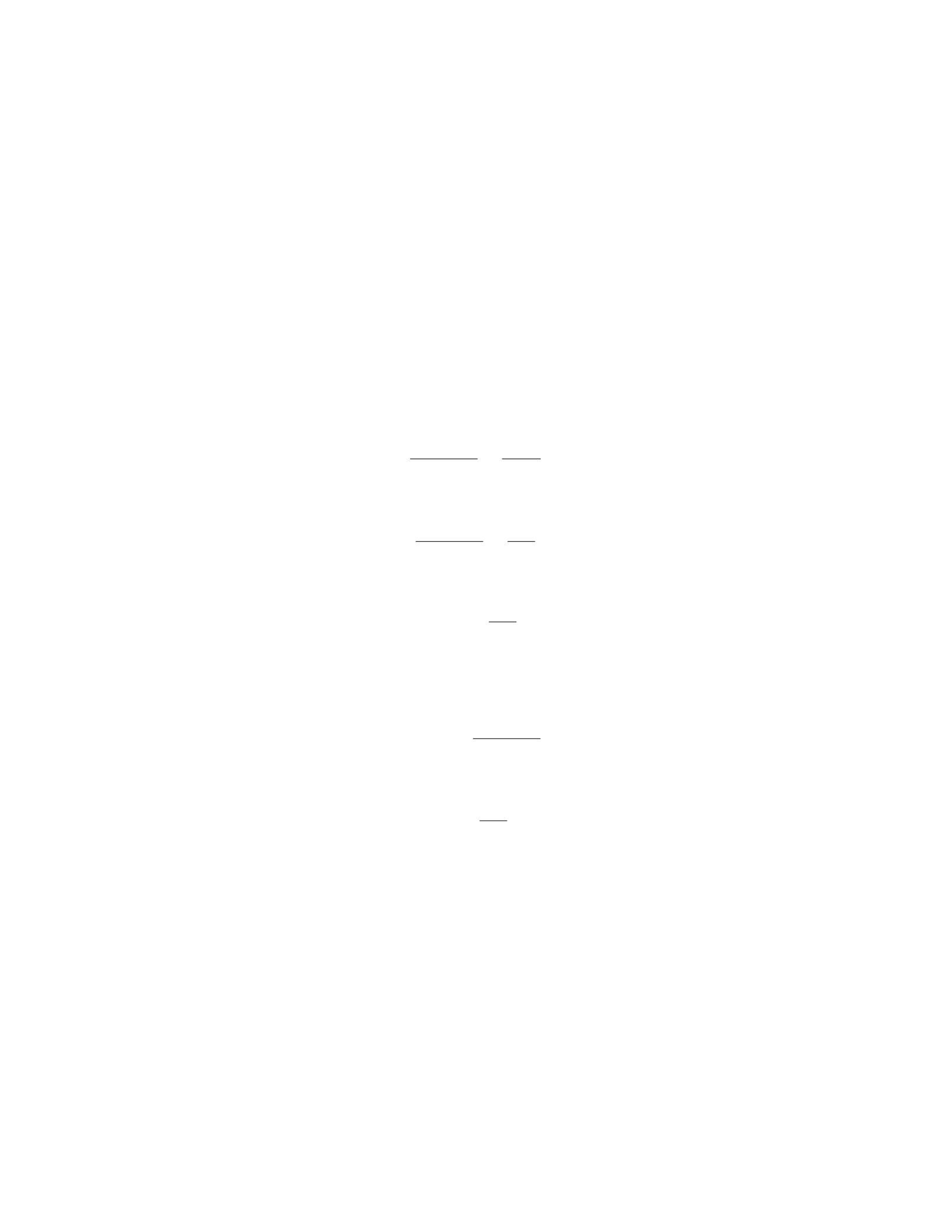
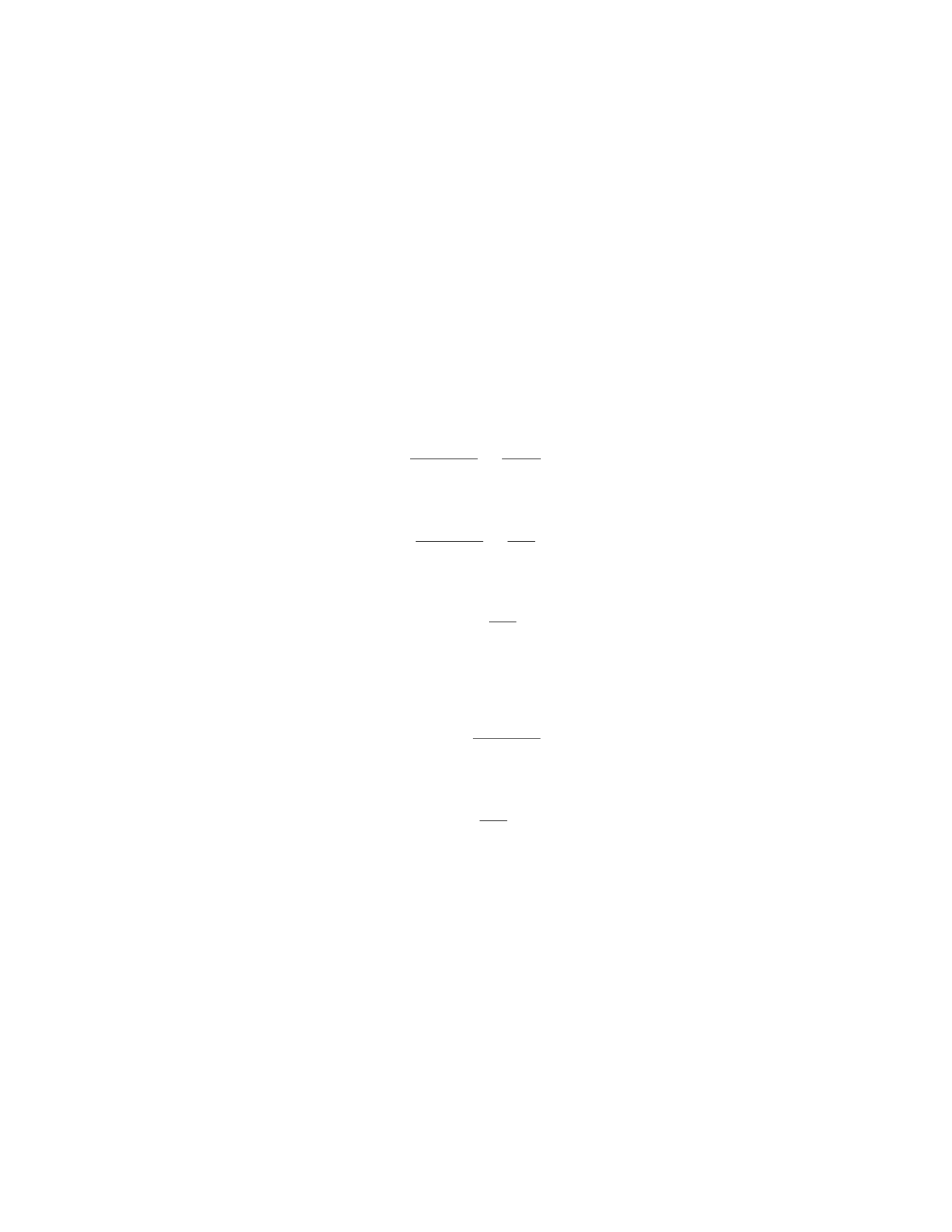
Vsubmerged
Vtotal
=ρwater
ρwood
Plugging in the values, we get
Vsubmerged
53=1.0
0.75
Solving for Vsubmerged gives
Vsubmerged =1.0
0.75 ×53
Step 3: Calculate the depth to which the cube floats in water The depth
to which the cube floats in water is half the height of the submerged portion.
Therefore, the depth is given by
Depth = Vsubmerged
52
Step 4: Substitute the value of Vsubmerged into the formula and calculate the
depth
Depth = 1.0
0.75 ×5
Calculating this will give us the depth to which the cube floats in water.
Question 16
Question
A solid cube with a side length of 10 cm and a density of 800 kg/m3is floating
in water. Calculate the buoyant force acting on the cube.
14

Solution
Step 1: Determine the volume of the cube: The volume of a cube is given by
the formula V=s3, where sis the side length. Substituting s= 0.1 m into the
formula, we have
V= (0.1 m)3= 0.001 m3
Step 2: Calculate the mass of the cube: The mass of the cube can be found
using the formula m=ρV , where ρis the density of the cube. Substituting
ρ= 800 kg/m3and V= 0.001 m3into the formula,
m= 800 kg/m3×0.001 m3= 0.8 kg
Step 3: Determine the weight of the cube: The weight of the cube can be
calculated using the formula Fgravity =m·g, where gis the acceleration due to
gravity (9.81 m/s2). Substituting m= 0.8 kg,
Fgravity = 0.8 kg ×9.81 m/s2= 7.848 N
Step 4: Calculate the buoyant force acting on the cube: According to
Archimedes’ principle, the buoyant force is equal to the weight of the water
displaced by the object. Since the cube is floating, the weight of the water
displaced is equal to the weight of the cube. Therefore, the buoyant force is
Fbuoyant = 7.848 N
Therefore, the buoyant force acting on the cube is 7.848 N.
Question 17
Question
A solid cube of side length aand density ρsis placed in a liquid of density
ρl, with a < 2h, where his the depth of the liquid. The cube floats partially
submerged in the liquid, with a height xof the cube above the liquid surface.
Determine the expression for xin terms of a,h,ρs, and ρl.
Solution
Step 1: Determine the buoyant force on the cube when it is partially submerged.
The buoyant force Fbacting on the cube is equal to the weight of the liquid
displaced by the cube. Since the cube is partially submerged, the volume of the
liquid displaced is given by Asubmerged ·x, where Asubmerged =a2is the area of
the cube submerged in the liquid.
Therefore, the buoyant force Fbis given by:
Fb=ρl·g·Asubmerged ·x
15

Step 2: Determine the weight of the cube. The weight of the cube is equal
to the weight of the cube’s volume of liquid, which is a2·a·ρl·g=ρs·a3·g.
Step 3: Set up the equilibrium condition. For the cube to float partially
submerged, the buoyant force Fbmust equal the weight of the cube. Hence, we
have:
ρl·g·a2·x=ρs·a3·g
Step 4: Solve for x. From the equilibrium condition, we can solve for x:
x=ρs·a
ρl·a=ρs
ρl·a
Therefore, the expression for xin terms of a,ρs, and ρlis x=ρs
ρl·a.
Question 18
Question
A spherical balloon with a radius of 5 m is filled with helium. The volume of
the balloon is 524.47 m3and the density of helium is 0.179 kg/m3. Calculate
the buoyant force acting on the balloon when it is released from rest at the
bottom of a lake. The density of water is 1000 kg/m3and the acceleration due
to gravity is 9.81 m/s2.
Solution
Step 1: Calculate the weight of the helium in the balloon.
The weight can be calculated using the formula: W=m·g, where mis the
mass of the helium and gis the acceleration due to gravity.
The mass of the helium can be calculated using the formula: m= density ×
volume.
Substitute the given values to find the mass of the helium:
m= 0.179 kg/m3×524.47 m3
m≈93.81 kg
Step 2: Calculate the buoyant force acting on the balloon.
The buoyant force is equal to the weight of the water displaced by the balloon
(Archimedes’ principle). The volume of water displaced is equal to the volume
of the balloon.
The weight of the water displaced can be calculated using the formula: W=
density ×volume ×g.
Substitute the given values to find the weight of the water displaced:
W= 1000 kg/m3×524.47 m3×9.81 m/s2
W≈5141649.3 N
16

Step 3: Determine the net force acting on the balloon.
The net force is the difference between the buoyant force and the weight of the
helium:
Net force = Weight of water displaced −Weight of helium
Net force = 5141649.3 N −93.81 kg ×9.81 m/s2
Net force = 5131703.49 N
Therefore, the buoyant force acting on the balloon when it is released from
rest at the bottom of the lake is approximately 5131703.49 N.
Question 19
Question
A cube of side length 0.5 m and density 800 kg/m3is floating in water. A 2 kg
weight is placed on top of the cube and the equilibrium water level changes by
6.25 cm. What is the density of the weight?
Solution
Step 1: Calculate the original volume of the cube.
The volume of the cube is given by V= (0.5 m)3= 0.125 m3.
Step 2: Calculate the weight of the cube.
The weight of the cube can be found using the formula W=ρV g, where ρis
the density of the cube, Vis the volume of the cube, and gis the acceleration
due to gravity.
Substituting the given values, W= (800 kg/m3)(0.125 m3)(9.8 m/s2) = 980 N.
Step 3: Calculate the new volume of the cube and weight.
Since the weight is floating, the weight of the cube plus the weight placed on
top (2 kg) must equal the weight of the displaced water. Therefore, the new
weight of the system is 980 N + 2 kg ×9.8 m/s2= 1000.6 N.
The volume of water displaced is given by Vwater =Wnew
ρwaterg, where ρwater is the
density of water.
Substituting the given values, Vwater =1000.6 N
(1000 kg/m3)(9.8 m/s2)= 0.102 m3.
Step 4: Calculate the side length of the new cube.
The new volume of the cube is Vnew = 0.125 m3−0.102 m3= 0.023 m3. The
side length of the new cube can be found by taking the cube root of this volume:
snew =3
√0.023 m ≈0.27 m.
Step 5: Calculate the density of the weight.
The volume of the weight is the difference between the original cube volume
and the new cube volume: Vweight = 0.125 m3−0.027 m3= 0.098 m3.
The density of the weight is then ρweight =Wweight
Vweight g. Substituting the values,
ρweight =2 kg×9.8 m/s2
0.098 m3×9.8 m/s2≈20.41 kg/m3.
17
Question 20
Question
A cube of wood with a density of 800 kg/m3and a side length of 0.1 m is floating
in a pool of water. Determine the depth to which the cube is submerged in the
water.
Solution
Step 1: Begin by finding the density of water. We know that the density of
water is approximately 1000 kg/m3.
Step 2: Next, use Archimedes’ principle to find the depth submerged. The
buoyant force acting on the cube is equal to the weight of the water displaced
by the cube. The buoyant force is given by FB=ρwater ·g·Vsubmerged, where
ρwater is the density of water, gis the acceleration due to gravity, and Vsubmerged
is the volume submerged.
Step 3: Calculate the volume of the cube submerged. The volume of the
cube submerged is equal to Vsubmerged = side length ×side length ×depth.
Step 4: Equate the buoyant force to the weight of the cube to solve for the
depth submerged. The weight of the cube is given by Wcube =ρwood ·g·Vcube,
where ρwood is the density of the wood and Vcube is the volume of the cube.
Step 5: Substituting the values and solving for the depth submerged. From
Step 2, FB=ρwater ·g·side length2·depth From Step 4, Wcube =ρwood ·
g·side length3Setting these two equal gives: ρwater ·side length2·depth =
ρwood ·side length3
Step 6: Finally, solve for the depth submerged. Solving the equation from
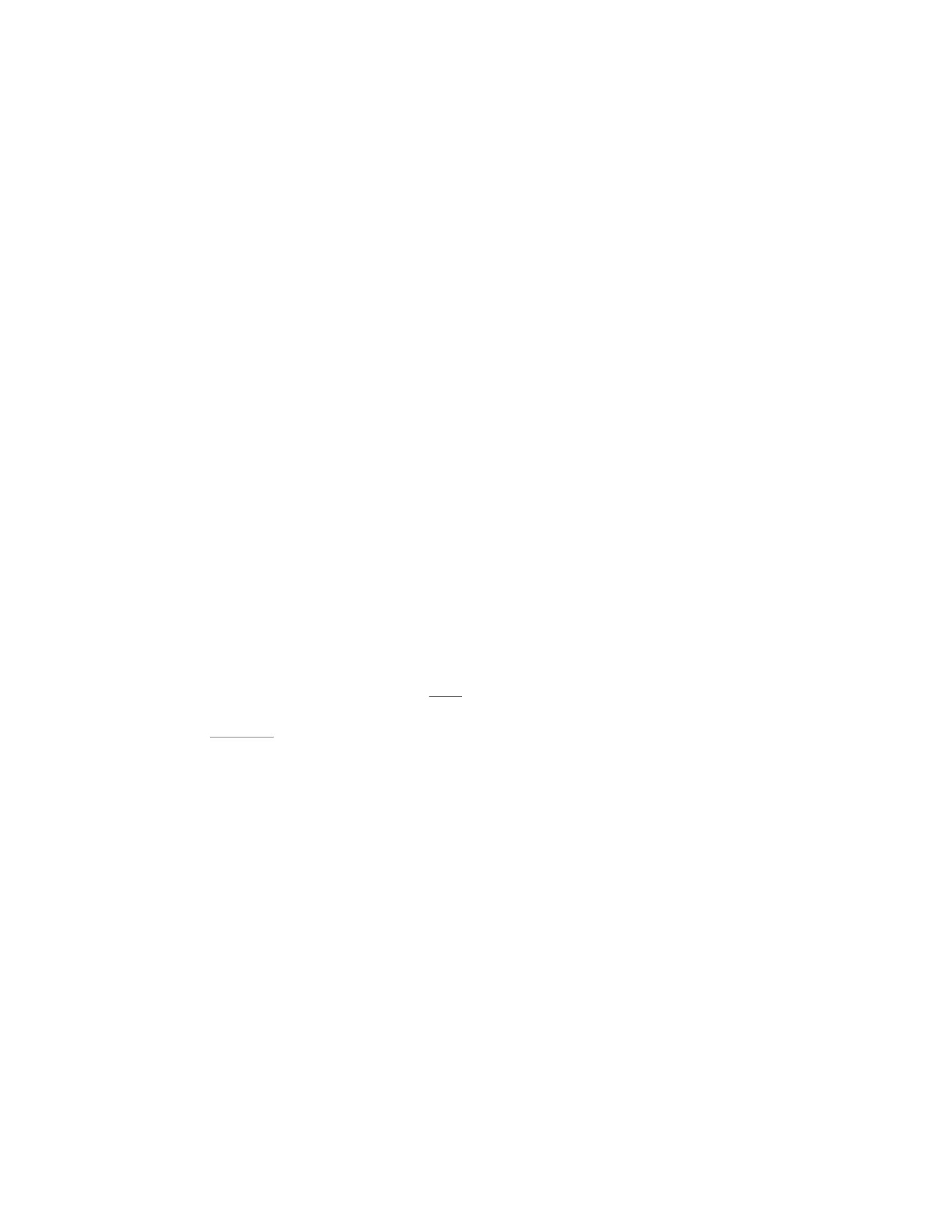
Step 5 for depth gives: depth = ρwood
ρwater ·side length
Step 7: Plug in the given values and calculate the depth submerged. depth =
800 kg/m3
1000 kg/m3·0.1 m = 0.08 m
Therefore, the cube is submerged to a depth of 0.08 meters in the water.
Question 21
Question
A cylindrical metal object with a density of 5000 kg/m3and a height of 0.5 m is
floating in water. If the diameter of the cylinder is 0.2 m, calculate the buoyant
force acting on the object and determine if the object will sink or float when
placed in a container of oil with a density of 800 kg/m3.
Solution
Step 1: Calculate the volume of the metal cylinder. The volume of a cylinder
is given by the formula V=πr2h, where ris the radius and his the height.
18

Given that the diameter is 0.2 m, the radius ris half of the diameter, so r= 0.1
m. Plugging the values into the formula, we get:
V=π(0.1)2×0.5
V= 0.0157 m3
Step 2: Calculate the weight of the metal cylinder. The weight of an object
is given by the formula W=mg, where mis the mass and gis the acceleration
due to gravity (approximately 9.81m/s2). Given that the density ρis 5000
kg/m3, the mass mof the cylinder is:
m=ρV = 5000 ×0.0157 = 78.5kg
Now, calculate the weight Wof the cylinder:
W= 78.5×9.81 = 770.2N
Step 3: Calculate the buoyant force in water. The buoyant force Fbin water
is equal to the weight of the water displaced by the object. The volume of water
displaced is equal to the volume of the cylinder, which is 0.0157 m3. The density
of water is 1000 kg/m3. Calculating the buoyant force:
Fb=ρwaterV g = 1000 ×0.0157 ×9.81 = 153.717 N
Step 4: Determine if the object will float or sink in oil. For an object to
float, the buoyant force acting on it must be greater than or equal to its weight.
Given that the buoyant force in oil is less than the weight of the object, the
object will sink when placed in a container of oil.
Question 22
Question
A metal cube with a side length of 3 cm and a mass of 100 g is submerged in a
container of water. What is the buoyant force acting on the cube? (Density of
water = 1000 kg/m3, acceleration due to gravity = 9.81 m/s2)
Solution
Step 1: Calculate the volume of the metal cube. The volume of a cube is given
by V= (side length)3. Substituting side length = 3 cm = 0.03 m, we have:
V= (0.03 m)3= 0.000027 m3
Step 2: Calculate the density of the metal. Density is given by the for-
mula density =mass
volume . Substituting mass = 100 g= 0.1kg and volume =
0.000027 m3, we have:
density =0.1kg
0.000027 m3= 3703.7kg/m3
19

Step 3: Calculate the buoyant force. According to Archimedes’ principle,
the buoyant force acting on an object in a fluid is equal to the weight of the fluid
displaced by the object. The weight of the fluid displaced is equal to the volume
of the fluid displaced multiplied by the density of the fluid and acceleration
due to gravity. The weight of the water displaced by the cube is given by
weight = density of water×V×g. Substituting density of water = 1000 kg/m3,
V= 0.000027 m3, and g= 9.81 m/s2, we have:
weight = 1000 ×0.000027 ×9.81 = 0.2646 N
Step 4: Compare the density of the cube to the density of water. Since
the density of the cube is greater than the density of water, the cube will sink.
Therefore, the buoyant force will be less than the weight of the cube. The
buoyant force is given by the weight of the water displaced, which is 0.2646 N.
Question 23
Question
A cube of wood with sides of length 5 cm and a density of 0.8 g/cm3is submerged
in water. Calculate the buoyant force acting on the cube and determine if it
will float or sink.
Solution
Step 1: Calculate the mass of the wooden cube.
Given that the density of the wood is 0.8 g/cm3and the volume of the cube is
(5 cm)3= 125 cm3, we can find the mass of the cube using the formula m=ρV ,
where mis the mass, ρis the density, and Vis the volume.
Density = 0.8 g/cm3
Volume = 125 cm3
m= 0.8×125 = 100 g
Step 2: Calculate the buoyant force acting on the cube.
The buoyant force acting on an object submerged in a fluid is equal to the weight
of the fluid displaced by the object. The weight of the fluid displaced is given
by the formula Fb=ρfluidVsubmergedg, where ρfluid is the density of the fluid,
Vsubmerged is the volume of the object submerged, and gis the acceleration due
to gravity.
Density of water = 1 g/cm3
Volume submerged = 125 cm3
Fb= 1 ×125 ×9.81 = 1226.25 N
Step 3: Determine if the cube will float or sink.
An object will float if the buoyant force is greater than or equal to the weight of
20

the object. Since the buoyant force is 1226.25 N and the weight of the cube is
m×g= 100 ×9.81 = 981 N, we can see that the cube will float as the buoyant
force is greater than the weight of the cube.
Question 24
Question
A cube of side length Land density ρ1is placed in a container of water, with a
fraction of its volume submerged. Another cube of side length 2Land density ρ2
is placed in the same container of water, with a different fraction of its volume
submerged. If the buoyant force acting on the larger cube is 400 N greater than
the buoyant force acting on the smaller cube, determine the densities ρ1and ρ2
in terms of the density of water ρw.
Solution
Step 1: Recall the expression for the buoyant force Fbacting on an object
submerged in a fluid:
Fb=ρw·g·Vsub
where ρwis the density of water, gis the acceleration due to gravity, and Vsub
is the volume of the object submerged in the fluid.
Step 2: The volume of a cube is given by V=L3. Let V1be the volume of
the smaller cube submerged, and V2be the volume of the larger cube submerged.
Step 3: We have that the buoyant force acting on the smaller cube is Fb1=
ρw·g·V1and the buoyant force acting on the larger cube is Fb2=ρw·g·V2.
We are given that Fb2−Fb1= 400 N.
Step 4: Substituting in the expressions for the buoyant forces:
ρw·g·V2−ρw·g·V1= 400
ρw·g·8L3−ρw·g·L3= 400
Step 5: Simplifying, we get:
7ρw·g·L3= 400
Step 6: Now, we know that the mass of the cubes is related to their densities
and volumes:
Masssmall =ρ1·Vsmall =ρ1·L3
Masslarge =ρ2·Vlarge =ρ2·(2L)3
Step 7: Since the cubes are in water and in equilibrium, the weight of the
cubes must be balanced by the buoyant force:
Weightsmall =Fb1=ρw·g·V1=ρw·g·L3
21

Weightlarge =Fb2=ρw·g·V2=ρw·g·8L3
Step 8: Equating the weights:
ρ1·L3·g=ρw·g·L3
ρ2·8L3·g=ρw·g·8L3
Step 9: Since we are given that the buoyant force acting on the larger cube
is greater by 400 N, we can solve for ρ1and ρ2in terms of ρwby setting up and
solving a system of equations:
(7ρw= 400
ρ1=ρw
Step 10: Solving the system of equations, we find:
ρw=400
7
ρ2=8
ρw
=8
400/7=56
400
Therefore, the densities of the cubes are ρ1=400
7and ρ2=56
400 in terms of
the density of water ρw.
Question 25
Question
A sphere of radius Rand density ρ1is partially submerged in a liquid of density
ρ2. If the sphere is in equilibrium, determine the ratio ρ1
ρ2in terms of the depth
hto which the sphere is submerged.
Solution
Step 1: The buoyant force acting on the sphere is equal to the weight of the
liquid displaced. Let’s denote the volume of the sphere submerged in the liquid
as Vs, and the volume of the sphere above the liquid surface as Va. The volume
of the liquid displaced is then Vs.
Step 2: The weight of the liquid displaced is equal to the buoyant force.
The weight of the liquid displaced is Vsρ2g, where gis the acceleration due to
gravity. This must equal the weight of the sphere submerged in the liquid.
Step 3: The weight of the sphere submerged in the liquid can be expressed
as:
W=Vsρ1g=4
3πR3ρ1g
22

Step 4: Setting the weight of the liquid displaced equal to the weight of the
sphere submerged, we have:
Vsρ2g=4
3πR3ρ1g
Step 5: Given that the sphere is partially submerged, we can express Vsin
terms of Rand h. We know that Vs=1
24/3πR3−1
2πR2h. Simplifying this
expression, we get Vs=2
3πR3−πR2h.
Step 6: Substituting this expression for Vsinto the equation from Step 4,
we get:
2
3πR3−πR2hρ2g=4
3πR3ρ1g
Step 7: Simplifying this equation, we find:
2
3−2h
Rρ2= 4ρ1
Step 8: Finally, isolating the ratio ρ1
ρ2, we get:
ρ1
ρ2
=1
42
3−2h
R−1
Question 26
Question
A solid sphere of radius Ris floating in a liquid with half of its volume sub-
merged. The density of the liquid is ρland the density of the sphere is ρs.
Determine an expression for the density of the sphere in terms of the radius R,
the density of the liquid ρl, and the acceleration due to gravity g.
Solution
Step 1: Let’s first determine the volume of the sphere that is submerged in
the liquid. Since half of the sphere is submerged, the volume of the sphere
submerged is 1
2of the total volume:
Vsubmerged =1
2·4
3πR3=2
3πR3
Step 2: The buoyant force Fbacting on the sphere is equal to the weight of
the liquid displaced. Using Archimedes’ principle, we have:
Fb=ρl·Vsubmerged ·g
Step 3: The weight of the sphere Wsis equal to the weight of the displaced
liquid, so:
Ws=ρs·4
3πR3·g
23

Step 4: Since the sphere is floating, the buoyant force Fbis equal to the
weight of the sphere Ws. Equating the two expressions for Fband Ws, we have:
ρl·2
3πR3·g=ρs·4
3πR3·g
Step 5: Simplifying the equation above, we get:
ρs= 2ρl
Therefore, the density of the sphere is given by ρs= 2ρl.
Question 27
Question
A spherical balloon with a radius of 0.5 meters is filled with helium. The density
of helium is 0.178 kg/m3and the density of air is 1.225 kg/m3. Calculate the
maximum mass that the balloon can lift off the ground.
Solution
Step 1: Find the volume of the balloon. The volume of a sphere is given by the
formula:
Vsphere =4
3πr3
Plugging in the radius r= 0.5 meters:
Vsphere =4
3π(0.5)3=4
3π×0.125 = 1
6πm3
Step 2: Find the mass of the displaced air by the balloon. The buoyant force
acting on the balloon is equal to the weight of the air displaced by the balloon.
The mass of the air displaced is given by:
mair = Densityair ×Vsphere = 1.225 ×1
6π=5
6πkg
Step 3: Calculate the weight of the air displaced. The weight of the air
displaced can be found using the formula Fbuoyant =mg, where mis the mass
of the air displaced.
Fbuoyant = 9.81 ×5
6π≈8.14πN
Step 4: Calculate the maximum mass the balloon can lift. The weight of the
helium inside the balloon must be less than the buoyant force in order for the
balloon to lift. Let mhelium be the maximum mass the balloon can lift, then:
mhelium ≤Fbuoyant
mhelium ≤8.14π
Therefore, the maximum mass that the balloon can lift off the ground is
approximately 8.14πkg.
24

Question 28
Question
A solid aluminum sphere with radius 10 cm is floating in water with 20
Solution
Step 1: First, we need to determine the density of water, which is ρwater =
1000 kg/m3.
Step 2: We know that the buoyant force (Fbuoyant) acting on the sphere
is equal to the weight of the water displaced by the submerged portion of the
sphere. The volume of water displaced is given by the volume of the submerged
portion of the sphere:
Vsubmerged =4
3πr3×20
100 =4
3π(0.10 m)3×0.20 = 8
3000πm3.
Step 3: The weight of the water displaced is equal to the buoyant force:
Fbuoyant =ρwaterVsubmergedg,
where gis the acceleration due to gravity.
Step 4: The weight of the aluminum sphere is given by:
Fweight =ρaluminumVsphereg,
where Vsphere =4
3π(0.10 m)3is the total volume of the sphere.
Step 5: Since the sphere is floating, the buoyant force must equal the weight
of the sphere:
ρwaterVsubmergedg=ρaluminumVsphereg.
Step 6: Now, we can solve for the density of the aluminum sphere:
ρaluminum =ρwaterVsubmerged
Vsphere
=1000 ×8
3000 π
4
3π(0.10)3=2666.67
0.004 ≈666,670 kg/m3.
Step 7: Therefore, the density of the aluminum sphere is approximately
666,670 kg/m3.
Question 29
Question
A cube of side length 2.5 m and density 800 kg/m3is floating in a liquid with
density 1000 kg/m3. Calculate the height of the cube that is submerged in the
liquid. (Assume the acceleration due to gravity is 9.81 m/s2)
25

Solution
Step 1: Calculate the weight of the cube. The weight of the cube is equal
to the gravitational force acting on it. This can be calculated by multiplying
the volume of the cube by the density of the cube and the acceleration due to
gravity.
Volume of cube = (side length)3= (2.5 m)3= 15.625 m3
Weight of cube = Volume ×Density ×g= 15.625 m3×800 kg/m3×9.81 m/s2
Step 2: Calculate the buoyant force acting on the cube. The buoyant force
acting on the cube is equal to the weight of the liquid displaced by the cube.
This can be calculated by multiplying the volume of the cube submerged in the
liquid by the density of the liquid and the acceleration due to gravity. Let hbe
the height of the cube submerged in the liquid.
Volume of submerged cube = Area of base ×height = (2.5 m)2×h= 6.25hm3
Buoyant force = Volume×Density of liquid×g= 6.25hm3×1000 kg/m3×9.81 m/s2
Step 3: Apply Archimedes’ principle. According to Archimedes’ principle,
the weight of the cube is equal to the buoyant force acting on it when it is in
equilibrium.
Weight of cube = Buoyant force
15.625 m3×800 kg/m3×9.81 m/s2= 6.25hm3×1000 kg/m3×9.81 m/s2
Step 4: Solve for h.
15.625 ×800 = 6.25h×1000
h=15.625 ×800
6.25 ×1000
h= 2 m
Therefore, the cube is submerged to a height of 2 meters in the liquid.
Question 30
Question
A cube of iron with sides of length 10 cm is completely submerged in water. The
density of iron is 7.87 g/cm3, and the density of water is 1.00 g/cm3. Calculate
the buoyant force acting on the iron cube.
26

Solution
Step 1: First, we need to calculate the volume of the iron cube. The volume of
a cube is given by the formula V=a3, where ais the length of a side. Given
that the side length of the cube is 10 cm, the volume of the iron cube is:
Vcube = (10 cm)3= 1000 cm3
Step 2: Next, we calculate the mass of the iron cube. The mass of the cube
can be found using the formula m=ρ×V, where ρis the density of iron.
Substitute the values:
miron = 7.87 g/cm3×1000 cm3= 7870 g
Step 3: Now, we calculate the weight of the iron cube. The weight Wof
an object is given by the formula W=m×g, where gis the acceleration due
to gravity (approximately 9.81 m/s2). Convert the mass of the iron cube to
kilograms:
miron = 7870 g = 7.87 kg
Calculate the weight:
Wiron = 7.87 kg ×9.81 m/s2= 77.3 N
Step 4: Finally, we calculate the buoyant force acting on the iron cube.
According to Archimedes’ principle, the buoyant force is equal to the weight of
fluid displaced by the object. The volume of water displaced by the cube is also
1000 cm3. The weight of this volume of water is given by:
Wwater =ρwater ×Vcube ×g= 1.00 g/cm3×1000 cm3×9.81 m/s2= 9810 N
Step 5: Since the buoyant force is equal to the weight of the water displaced,
the buoyant force acting on the iron cube is 9810 N.
Question 31
Question
A cube of wood with a density of 700 kg/m3and a side length of 0.1 m is floating
in a tub of water. What is the depth of immersion of the cube?
Solution
Step 1: The depth of immersion of an object floating in a fluid is determined
by the buoyant force acting on the object. The buoyant force can be calculated
using Archimedes’ principle, which states that the buoyant force is equal to the
weight of the fluid displaced by the object. Step 2: The weight of the fluid
displaced by the cube is equal to the weight of the cube itself. We can calculate
27

the weight of the cube using the formula W=mg, where mis the mass of the
cube and gis the acceleration due to gravity. Step 3: Since the cube is floating,
the buoyant force FBacting on the cube is equal in magnitude to the weight W
of the cube. This can be expressed as FB=W. Step 4: The buoyant force can
also be calculated using the formula FB=ρVimmersedg, where ρis the density of
the fluid (water), Vimmersed is the volume of the cube submerged in water, and g
is the acceleration due to gravity. Step 5: The volume of the cube submerged in
water can be calculated as Vimmersed = (side length)3×depth of immersion. Step
6: Equating the two expressions for the buoyant force, we have ρVimmersedg=
mg. Step 7: Substitute the given values into the equation and solve for the
depth of immersion, h. Remember that ρwater = 1000 kg/m3. Step 8: After
substituting the values into the equation and solving for h, we find the depth of
immersion of the cube to be approximately 0.071 m or 7.1 cm.
Question 32
Question
A cube of side length 0.1 m is submerged in water. The upper surface of the
cube is 4 cm below the water surface. Find the buoyant force acting on the
cube. (Density of water = 1000 kg/m3)
Solution
Step 1: Calculate the volume of the cube submerged in water. The volume of
the cube submerged is the same as the volume of water displaced, which is given
by the formula:
V=Ah
where Ais the area of one face of the cube and his the height submerged.
Given that the side length of the cube is 0.1 m and the cube is submerged 4 cm
(0.04 m) under the water surface, the area Aand height hcan be calculated as
follows:
A= (0.1)2
h= 0.04
Step 2: Calculate the volume of water displaced. Substitute the values into
the formula:
V= (0.1)2×0.04
Step 3: Calculate the mass of water displaced. The mass of water displaced
can be found using the formula:
m=V×ρ
where ρis the density of water (1000 kg/m3).
28

Step 4: Calculate the weight of the water displaced. The weight of the water
displaced is equal to the buoyant force acting on the cube, which is given by:
Fb=m×g
where gis the acceleration due to gravity (9.81 m/s2).
Step 5: Substitute the values and calculate the buoyant force. Substitute
the values of mand ginto the formula:
Fb=V×ρ×g
Question 33
Question
A wooden cube of side length 10 cm floats in water with 4 cm of its height above
the water surface. What is the density of the wood?
Solution
Step 1: Calculate the volume of the cube submerged in the water. Step 2:
Calculate the weight of the water displaced by the submerged cube. Step 3: Set
up an equation using Archimedes’ principle to solve for the density of the wood.
Step 1: The volume of the cube submerged in water is given by Vsubmerged =
A×hsubmerged, where Ais the area of one face of the cube and hsubmerged is the
height submerged in water. Given that the side length of the cube is 10 cm and
4 cm of its height is submerged in water, we have: A= (10 cm)2= 100 cm2,
hsubmerged = 4 cm. Therefore, Vsubmerged = 100 cm2×4 cm = 400 cm3.
Step 2: The weight of the water displaced by the cube can be calculated
using the density of water, ρwater = 1000 kg/m3. The mass of the water displaced
is then mwater =ρwater ×Vsubmerged. Converting the volume to cubic meters, we
have Vsubmerged = 0.0004 m3. Therefore, mwater = 1000 kg/m3×0.0004 m3=
0.4 kg. The weight of the water displaced is Wwater =mwater ×g, where g=
9.8 m/s2is the acceleration due to gravity. Hence, Wwater = 0.4 kg ×9.8 m/s2=
3.92 N.
Step 3: According to Archimedes’ principle, the buoyant force acting on the
cube is equal to the weight of the water displaced by the cube. Therefore, the
buoyant force, Fbuoyant =Wwater = 3.92 N. The buoyant force can also be ex-
pressed as Fbuoyant =ρwater ×g×Vsubmerged. Setting these two expressions equal
to each other, we have: 3.92 N = 1000 kg/m3×9.8 m/s2×0.0004 m3. Solving
for the density of the wood, ρwood, we get: ρwood =3.92 N
0.00392 m3= 1000 kg/m3.
Therefore, the density of the wood is 1000 kg/m3.
29

Question 34
Question
A cube of side length aand density ρcube is floating in water with 1/3 of its
volume submerged. Find the ratio of the densities of the cube and water, given
that the cube is in equilibrium.
Solution
Step 1: Recall that for an object floating in a fluid, the buoyant force on the
object is equal to the weight of the fluid displaced by the object. Step 2: The
buoyant force Fbacting on the cube is equal to the weight of the water displaced
by the submerged volume of the cube. Step 3: The weight of the cube, acting
downwards, is equal to the weight of the water displaced by the submerged
volume of the cube, acting upwards. Step 4: The weight of the cube is given
by Wcube =ρcube ·g·Vsub, where ρcube is the density of the cube, gis the
acceleration due to gravity, and Vsub is the submerged volume of the cube. Step
5: The weight of the displaced water is given by Wwater =ρwater ·g·Vsub, where
ρwater is the density of water. Step 6: Since the cube is in equilibrium, the
weight of the cube and the weight of the displaced water are equal. Therefore,
ρcube ·Vsub =ρwater ·Vsub. Step 7: Simplifying the equation gives ρcube =ρwater.
Step 8: Therefore, the ratio of the densities of the cube and water is 1 : 1 .
Question 35
Question
A cube of wood with a density of 700 kg/m3and a side length of 0.20 m floats
in a container of water. What fraction of the cube’s volume is above water?
Solution
Step 1: First, we need to find the density of water. The density of water is
approximately 1000 kg/m3.
Step 2: Next, we can find the weight of the cube using the formula w=
mg, where mis the mass of the cube and gis the acceleration due to gravity
(9.81 m/s2).
Step 3: The volume of the cube can be calculated using V= side length3.
Step 4: The weight of the water displaced by the cube is equal to the weight
of the cube. Using the formula for weight of water displaced (wdisplaced =
ρwater ·Vsubmerged ·g) where ρwater is the density of water, Vsubmerged is the
volume of the cube submerged in water, and gis the acceleration due to gravity.
Step 5: The volume of the cube submerged in water is equal to the fraction
of the cube submerged multiplied by the total volume of the cube.
30

Step 5: Calculate the fraction of the cube’s volume submerged in water.
The fraction of the cube’s volume submerged in water can be calculated as the
submerged volume divided by the total volume of the cube. Therefore, the
fraction submerged is Vsubmerged
V=0.0008
0.001 =4
5= 0.8 or 80
Thus, 80
Question 2
Question
A cylindrical object with a density of 900 kg/m3and a radius of 0.5 m is
floating in water. Calculate the depth to which the object is submerged in
water. (Density of water = 1000 kg/m3, acceleration due to gravity = 9.81
m/s2)
Solution
Step 1: Find the volume of the object using the formula for the volume of a
cylinder:
V=πr2h
where ris the radius of the cylinder and his the height (depth of submersion
in this case).
Step 2: Substitute the given values into the formula:
V=π(0.5 m)2×h
V=π×0.25 m2×h= 0.25πh m3
Step 3: Calculate the weight of the object using the formula:
Wobject =ρobject ×V×g
where ρobject is the density of the object, Vis the volume of the object, and g
is the acceleration due to gravity.
Step 4: Substitute the given values into the formula:
Wobject = 900 kg/m3×0.25πh m3×9.81 m/s2
Step 5: Calculate the buoyant force acting on the object:
Fbuoyant =ρwater ×Vsubmerged ×g
where ρwater is the density of water, Vsubmerged is the volume of the object
submerged in water, and gis the acceleration due to gravity.
Step 6: Since the object is floating, the weight of the object is equal to the
buoyant force:
Wobject =Fbuoyant
2

Step 7: Solve for the depth of submersion, h, by equating the weight of the
object to the buoyant force:
900 kg/m3×0.25πh m3×9.81 m/s2= 1000 kg/m3×π×0.5 m ×h×9.81 m/s2
Step 8: Solve for hto find the depth to which the object is submerged in
water.
Question 3
Question
A cube of side length 0.3 m and density 900 kg/m3is placed in a container filled
with water of density 1000 kg/m3. Calculate the buoyant force acting on the
cube when it is fully submerged in the water.
Solution
Step 1: First, calculate the volume of the cube. The volume of a cube is given
by V=s3, where s is the side length of the cube. Given that the side length of
the cube is 0.3 m, we have:
V= (0.3)3= 0.027 m3
Step 2: Next, calculate the mass of the cube. The mass of an object is given
by m=ρV , where ρis the density of the object and V is the volume. Given
that the density of the cube is 900 kg/m3, we have:
m= 900 ×0.027 = 24.3kg
Step 3: Calculate the weight of the cube. The weight of an object is given
by W=mg, where m is the mass of the object and g is the acceleration due to
gravity (approximately 9.81 m/s2).
W= 24.3×9.81 = 238.683 N
Step 4: Calculate the buoyant force. According to Archimedes’ principle,
the buoyant force acting on an object in a fluid is equal to the weight of the fluid
displaced by the object. The volume of water displaced by the cube is equal
to the volume of the cube. Given that the density of water is 1000 kg/m3, the
weight of the water displaced is:
Wwater =ρwaterV= 1000 ×0.027 = 27 kg ×9.81 = 264.33 N
Therefore, the buoyant force acting on the cube is 264.33 N, upwards.
3

Question 4
Question
A block of wood with a density of 600 kg/m3is floating in a container of water.
The block has a volume of 0.02 m3and a mass of 8 kg. Calculate the buoyant
force acting on the block and determine whether it will sink or float.
Solution
Step 1: Calculate the weight of the block The weight of the block can be calcu-
lated using the formula:
weight = mass ×gravitational acceleration
weight = 8 kg ×9.81 m/s2= 78.48 N
Step 2: Calculate the weight of the displaced water The weight of the dis-
placed water is equal to the weight of the block. This can be calculated using
the formula:
weight of water = weight of block = 78.48 N
Step 3: Calculate the volume of water displaced The volume of water dis-
placed is equal to the volume of the block. This can be calculated using the
formula:
volume of water = volume of block = 0.02 m3
Step 4: Calculate the buoyant force The buoyant force acting on the block
can be calculated using the formula:
buoyant force = density of water×gravitational acceleration×volume of water displaced
buoyant force = 1000 kg/m3×9.81 m/s2×0.02 m3= 196.2 N
Step 5: Compare the buoyant force and the weight of the block Since the
buoyant force (196.2 N) is greater than the weight of the block (78.48 N), the
block will float in the container of water.
Question 5
Question
A cube of wood with a density of 0.80 g/cm3and a side length of 10 cm is sub-
merged in water. Calculate the buoyant force acting on the cube and determine
whether it will sink or float.
4

Solution
Step 1: Determine the volume of the cube. The volume of a cube is given by the
formula V=s3, where sis the side length of the cube. Given that s= 10 cm,
we have:
V= (10 cm)3= 1000 cm3
Step 2: Calculate the mass of the cube. The mass of the cube can be found
using the formula m=ρV , where ρis the density of the cube. Given that
ρ= 0.80 g/cm3and V= 1000 cm3, we have:
m= 0.80 g/cm3×1000 cm3= 800 g
Step 3: Determine the buoyant force. The buoyant force acting on an ob-
ject submerged in a fluid is equal to the weight of the fluid displaced by the
object. The buoyant force can be calculated using the formula Fbuoyant =
ρfluidVdisplacedg, where ρfluid is the density of the fluid, Vdisplaced is the vol-
ume of fluid displaced, and gis the acceleration due to gravity. For water,
ρfluid = 1 g/cm3. Since the cube is completely submerged, the volume of water
displaced is equal to the volume of the cube, which is 1000 cm3. Therefore, the
buoyant force is:
Fbuoyant = 1 g/cm3×1000 cm3×9.81 m/s2= 9810 N
Step 4: Determine if the cube will sink or float. Since the buoyant force
of 9810 N is greater than the weight of the cube which is 800 N, the net force
acting on the cube is upward and it will float in water.
Question 6
Question
A wooden cube with a side length of 10 cm and a density of 0.8 g/cm3is placed
in a container filled with water. What is the minimum additional load that
must be placed on top of the cube to make it sink?
Solution
Step 1: Calculate the weight of the cube to determine the buoyant force it
experiences. Given that the density of water is 1 g/cm3, the weight of the
wooden cube is:
Weight = Volume ×Density ×Acceleration due to gravity
Volume = (Side length)3= (10 cm)3= 1000 cm3
Weight = 1000 cm3×0.8 g/cm3×9.8 m/s2= 7840 N
5

Step 2: Determine the buoyant force acting on the cube. The buoyant force
is equal to the weight of the water displaced by the cube:
Buoyant force = Weight of water displaced = Volume of cube under water×Density of water×Acceleration due to gravity
The volume of the cube under water is equal to the volume of the cube that is
submerged:
Volume submerged = Volume of cube ×Density of object
Density of water
Volume submerged = 1000 cm3× 0.8 g/cm3
1 g/cm3!= 800 cm3
Buoyant force = 800 cm3×1 g/cm3×9.8 m/s2= 7840 N
Step 3: The cube will float until the weight of the additional load exceeds the
buoyant force. Let the additional load be denoted by Fload. Since the buoyant
force on the cube is already equal to its weight, the additional load must exceed
the weight of the cube for it to sink:
Fload >7840 N
Therefore, the minimum additional load required to make the cube sink is
7841 N .
Question 7
Question
A cube of side length aand density ρcube is placed in a liquid of density ρliquid.
The cube floats with a fraction xof its volume submerged in the liquid. De-
termine the relationship between the densities ρcube,ρliquid, and the fraction
x.
Solution
Step 1: Determine the forces acting on the cube. The forces acting on the cube
are its weight Wdownwards and the buoyant force Fbuoy upwards. The weight
is given by:
W=ρcube ·g·Vcube
where Vcube =a3is the volume of the cube.
Step 2: Calculate the volume of the cube submerged. The volume of the
cube submerged is given by:
Vsub =x·Vcube =x·a3
6

Step 3: Determine the buoyant force. The buoyant force is equal to the
weight of the liquid displaced by the cube:
Fbuoy =ρliquid ·g·Vsub
Step 4: Apply Archimedes’ principle. According to Archimedes’ principle,
the buoyant force Fbuoy acting on the cube is equal to the weight Wof the cube:
ρliquid ·g·Vsub =ρcube ·g·Vcube
Step 5: Substituting the expressions for Vsub and Vcube:
ρliquid ·g·x·a3=ρcube ·g·a3
Step 6: Simplify the equation. Solving for x, we find:
x=ρcube
ρliquid
Therefore, the relationship between the densities ρcube,ρliquid, and the frac-
tion xis x=ρcube
ρliquid .
Question 8
Question
A cube of wood with sides of length 10 cm and density 600 kg/m3is floating in
water. Calculate the height of the cube that is above the water’s surface. The
density of water is 1000 kg/m3.
Solution
Let’s denote the height of the cube above the water’s surface as h.
Step 1: First, let’s calculate the volume of the cube. The volume of the
cube is given by Vcube = (10 cm)3= 0.001 m3.
Step 2: Next, we can calculate the mass of the cube. The mass of the cube
is given by mcube = density ×volume.
Substituting the values, we have: mcube = 600 kg/m3×0.001 m3= 0.6 kg.
Step 3: Now, let’s consider the forces acting on the cube when it is floating
in water. The weight of the cube Wcube =mcube ×g, where g= 9.8 m/s2is the
acceleration due to gravity.
The buoyant force Fbuoyant acting on the cube is equal to the weight of the
water displaced by the cube. Fbuoyant = density of water×volume of cube submerged×
g.
Step 4: In equilibrium, the weight of the cube is balanced by the buoyant
force. Thus, we have Wcube =Fbuoyant.
Substitute the expressions and solve for the volume of the cube submerged:
mcube ×g= density of water ×volume of cube submerged ×g
0.6 kg ×9.8 m/s2= 1000 kg/m3×areacross-section ×h×9.8 m/s2
Solve for hto find the height of the cube above the water’s surface.
7
Question 9
Question
A cylindrical container with a radius of 0.5 m and a height of 1 m is completely
filled with water. A solid metal sphere with a radius of 0.3 m and a density
of 8000 kg/m3is then lowered into the water until it is completely submerged.
Calculate the buoyant force acting on the sphere when it is in the water.
Solution
Step 1: Calculate the volume of the sphere The volume of a sphere is given by
the formula:
V=4
3πr3
Substitute the radius of the sphere:
V=4
3π(0.3)3
V≈0.1131 m3
Step 2: Calculate the weight of the sphere The weight of the sphere can be
calculated using the formula:
Weight = Mass ×Acceleration due to gravity
The mass of the sphere can be calculated using the formula:
Mass = Density ×Volume
Substitute the density and volume of the sphere:
Mass = 8000 kg/m3×0.1131 m3
Mass ≈904.8 kg
Now, calculate the weight of the sphere:
Weight = 904.8 kg ×9.81 m/s2
Weight ≈8886.3 N
Step 3: Calculate the weight of the water displaced The weight of the water
displaced is equal to the weight of the water that would fill the volume of the
sphere. The volume of the sphere is equal to the volume of water displaced.
Thus, the weight of the water displaced is equal to the weight of the sphere:
Weight of water displaced = 8886.3 N
Step 4: Calculate the buoyant force According to Archimedes’ principle, the
buoyant force acting on an object immersed in a fluid is equal to the weight of
8

the fluid that the object displaces. Therefore, the buoyant force acting on the
sphere is equal to the weight of the water displaced:
Buoyant force = 8886.3 N
Therefore, the buoyant force acting on the sphere when it is in the water is
approximately 8886.3 N.
Question 10
Question
A cube of wood with a side length of 10 cm and a density of 0.8 g/cm3is
placed in a liquid of density 1.2 g/cm3. Calculate the volume of the cube that
is submerged in the liquid.
Solution
Step 1: Calculate the weight of the cube Given density of wood, ρwood = 0.8
g/cm3and side length l= 10 cm. The mass of the cube can be calculated as:
mass = ρwood ×volume = ρwood ×l3
mass = 0.8 g/cm3×(10 cm)3= 800 g
The weight of the cube can be found by multiplying the mass by the acceleration
due to gravity g= 9.81 m/s2:
weight = mass ×g= 800 g ×9.81 m/s2= 7848 N
Step 2: Calculate the buoyant force acting on the cube The buoyant force
is equal to the weight of the liquid displaced by the cube. The volume of liquid
displaced is equal to the volume of the cube submerged, denoted as Vsubmerged.
The buoyant force can be calculated as:
buoyant force = ρliquid ×g×Vsubmerged
Now, we need to find Vsubmerged.
Step 3: Calculate the volume submerged The volume submerged can be
found using Archimedes’ principle which states that the buoyant force is equal
to the weight of the displaced fluid:
buoyant force = weight of fluid displaced
⇒ρliquid ×g×Vsubmerged =ρwood ×g×l3
⇒1.2 g/cm3×Vsubmerged = 0.8 g/cm3×(10 cm)3
⇒Vsubmerged =0.8×1000
1.2= 666.67 cm3
Therefore, the volume of the cube that is submerged in the liquid is 666.67
cm3.
9

Question 11
Question
A cube of wood with a density of 700 kg/m3and a side length of 0.05 m is
floating in water. Calculate the depth to which the cube is submerged in the
water.
Solution
Let’s denote: - Vcube as the volume of the cube, - das the depth to which the
cube is submerged, - ρwater as the density of water, - Fbuoyant as the buoyant
force acting on the cube, - Fgravity as the weight of the cube.
Step 1: Calculate the volume of the cube. Since the cube has a side length
of 0.05 m, the volume can be calculated as:
Vcube = (0.05 m)3= 0.000125 m3
Step 2: Calculate the weight of the cube. The weight of the cube can be
calculated using the formula:
Fgravity =m·g
where mis the mass of the cube and gis the acceleration due to gravity. The
mass of the cube can be calculated as:
m=ρcube ·Vcube
m= 700 kg/m3·0.000125 m3= 0.0875 kg
The weight of the cube is:
Fgravity = 0.0875 kg ·9.8 m/s2= 0.8575 N
Step 3: Calculate the buoyant force. According to Archimedes’ principle,
the buoyant force acting on the cube is equal to the weight of the water displaced
by the cube. The buoyant force can be calculated as:
Fbuoyant =ρwater ·Vsubmerged ·g
where Vsubmerged is the volume of the cube submerged in water. Since the cube
is floating, the buoyant force is equal to the weight of the cube:
Fbuoyant =Fgravity
ρwater ·Vsubmerged ·g=ρcube ·Vcube ·g
ρwater ·Vsubmerged =ρcube ·Vcube
Vsubmerged =ρcube ·Vcube
ρwater
10

Vsubmerged =700 kg/m3·0.000125 m3
1000 kg/m3= 0.0875 m3
Step 4: Calculate the depth to which the cube is submerged. The depth to
which the cube is submerged can be calculated using the formula:
Vsubmerged =A·d
where Ais the area of the base of the cube and dis the depth. Since the base
of the cube is a square with side length 0.05 m, the area can be calculated as:
A= (0.05 m) ×(0.05 m) = 0.0025 m2
0.0875 m3= 0.0025 m2×d
d=0.0875 m3
0.0025 m2= 0.035 m
Therefore, the depth to which the cube is submerged in the water is 0.035
m.
Question 12
Question
A cube of wood with a density of 600 kg/m3and side length 0.1 m is floating
in water. What is the buoyant force acting on the cube?
Solution
Step 1: Determine the volume of the cube. The volume of a cube is given by
V=L3, where Lis the length of a side. In this case, the side length L= 0.1
m, so the volume of the cube is:
V= (0.1 m)3= 0.001 m3
Step 2: Determine the weight of the cube. The weight of the cube is given by
the formula W=mg, where mis the mass of the cube and gis the acceleration
due to gravity (9.81 m/s2). The mass of the cube can be calculated using the
formula m=ρV , where ρis the density of the material. Substituting in the
given values:
m= 600 kg/m3×0.001 m3= 0.6 kg
Thus, the weight of the cube is:
W= 0.6 kg ×9.81 m/s2= 5.886 N
Step 3: Calculate the buoyant force. According to Archimedes’ principle,
the buoyant force acting on an object in a fluid is equal to the weight of the
fluid displaced by the object. Since the cube is floating, the weight of the cube
is equal to the buoyant force. Therefore, the buoyant force acting on the cube
is:
Buoyant force = 5.886 N
11
Question 13
Question
A cylindrical container has a height of 1.5 meters and a radius of 0.5 meters.
The container is filled with water to a height of 1.2 meters. Determine the
buoyant force acting on a solid iron sphere of radius 0.2 meters submerged in
the water. The density of iron is 7800 kg/m3and the density of water is 1000
kg/m3.
Solution
Step 1: Find the volume of water displaced by the iron sphere. The volume of
the iron sphere can be calculated using the formula for the volume of a sphere:
Vsphere =4
3πr3
where ris the radius of the sphere. Substitute r= 0.2 m into the formula to
find the volume of the iron sphere:
Vsphere =4
3π(0.2)3=4
3π(0.008) = 0.03351 m3
Step 2: Calculate the volume of water displaced by the iron sphere. The
volume of water displaced is equal to the volume of the iron sphere that is
submerged in the water.
Vwater =Vsphere = 0.03351 m3
Step 3: Determine the weight of water displaced. The weight of water
displaced can be calculated using the formula:
Weight = Density ×Volume ×Acceleration due to gravity
Given that the density of water is 1000 kg/m3and the acceleration due to
gravity is 9.8 m/s2, the weight of water displaced is:
Weight = 1000 ×0.03351 ×9.8 = 328.93 N
Step 4: Determine the weight of the iron sphere. The weight of the iron
sphere can be calculated using the formula:
Weight = Density ×Volume ×Acceleration due to gravity
Given that the density of iron is 7800 kg/m3and the volume of the iron sphere
is the same as the volume of water displaced, the weight of the iron sphere is:
Weight = 7800 ×0.03351 ×9.8 = 2530.51 N
Step 5: Determine the buoyant force acting on the iron sphere. The buoyant
force is equal to the weight of the water displaced, which we calculated to be
328.93 N. Thus, the buoyant force acting on the iron sphere is 328.93 N.
12

Question 14
Question
A cube of side length 25 cm and density 950 kg/m3is floating in water. What
is the depth of the cube submerged in the water? (Density of water = 1000
kg/m3, acceleration due to gravity = 9.81 m/s2)
Solution
Step 1: Begin by finding the volume of the cube. The volume of a cube is given
by the formula V=s3, where sis the side length of the cube. Given that the
side length of the cube is 25 cm (0.25 m), we have:
V= (0.25 m)3= 0.015625 m3
Step 2: Calculate the weight of the cube. The weight of an object is given
by the formula W=mg, where mis the mass of the object and gis the
acceleration due to gravity. The mass of the cube can be calculated using the
formula m= density ×V. Substituting in the values:
m= 950 kg/m3×0.015625 m3= 14.84375 kg
Now, we can find the weight of the cube:
W= 14.84375 kg ×9.81 m/s2= 145.5984375 N
Step 3: Determine the buoyant force acting on the cube. According to
Archimedes’ principle, the buoyant force acting on an object submerged in a
fluid is equal to the weight of the fluid displaced by the object. The buoyant
force can be calculated using the formula Fb= density of water×Vsubmerged ×g,
where Vsubmerged is the volume of the cube submerged in water. Let hbe
the depth of the cube submerged in water. The volume submerged is A×h,
where Ais the area of the cube’s face. A=s2= (0.25 m)2= 0.0625 m2Thus,
Vsubmerged = 0.0625 m2×h= 0.0625hm3Substitute the values and calculate
the buoyant force:
Fb= 1000 kg/m3×0.0625hm3×9.81 m/s2= 614.0625hN
Step 4: Set up the equilibrium condition. For the cube to be floating in
equilibrium, the weight of the cube must be equal to the buoyant force acting
on it. Thus, we have:
W=Fb
145.5984375 N = 614.0625hN
Step 5: Solve for the depth of the cube submerged.
614.0625h= 145.5984375
h=145.5984375
614.0625 = 0.237 m
Therefore, the depth of the cube submerged in water is 23.7 cm.
13
Question 15
Question
A cube of wood with a density of 0.75 g/cm3and side length of 5 cm is floating
in water. Calculate the depth to which the cube floats in water.
Solution
Step 1: Determine the density of water Given that the density of water is
ρwater = 1.0 g/cm3.
Step 2: Calculate the fraction of the cube submerged in water We can use
Archimedes’ principle to find the fraction of the cube submerged in water:
Vsubmerged
Vtotal
=ρwater
ρwood
Plugging in the values, we get
Vsubmerged
53=1.0
0.75
Solving for Vsubmerged gives
Vsubmerged =1.0
0.75 ×53
Step 3: Calculate the depth to which the cube floats in water The depth
to which the cube floats in water is half the height of the submerged portion.
Therefore, the depth is given by
Depth = Vsubmerged
52
Step 4: Substitute the value of Vsubmerged into the formula and calculate the
depth
Depth = 1.0
0.75 ×5
Calculating this will give us the depth to which the cube floats in water.
Question 16
Question
A solid cube with a side length of 10 cm and a density of 800 kg/m3is floating
in water. Calculate the buoyant force acting on the cube.
14

Solution
Step 1: Determine the volume of the cube: The volume of a cube is given by
the formula V=s3, where sis the side length. Substituting s= 0.1 m into the
formula, we have
V= (0.1 m)3= 0.001 m3
Step 2: Calculate the mass of the cube: The mass of the cube can be found
using the formula m=ρV , where ρis the density of the cube. Substituting
ρ= 800 kg/m3and V= 0.001 m3into the formula,
m= 800 kg/m3×0.001 m3= 0.8 kg
Step 3: Determine the weight of the cube: The weight of the cube can be
calculated using the formula Fgravity =m·g, where gis the acceleration due to
gravity (9.81 m/s2). Substituting m= 0.8 kg,
Fgravity = 0.8 kg ×9.81 m/s2= 7.848 N
Step 4: Calculate the buoyant force acting on the cube: According to
Archimedes’ principle, the buoyant force is equal to the weight of the water
displaced by the object. Since the cube is floating, the weight of the water
displaced is equal to the weight of the cube. Therefore, the buoyant force is
Fbuoyant = 7.848 N
Therefore, the buoyant force acting on the cube is 7.848 N.
Question 17
Question
A solid cube of side length aand density ρsis placed in a liquid of density
ρl, with a < 2h, where his the depth of the liquid. The cube floats partially
submerged in the liquid, with a height xof the cube above the liquid surface.
Determine the expression for xin terms of a,h,ρs, and ρl.
Solution
Step 1: Determine the buoyant force on the cube when it is partially submerged.
The buoyant force Fbacting on the cube is equal to the weight of the liquid
displaced by the cube. Since the cube is partially submerged, the volume of the
liquid displaced is given by Asubmerged ·x, where Asubmerged =a2is the area of
the cube submerged in the liquid.
Therefore, the buoyant force Fbis given by:
Fb=ρl·g·Asubmerged ·x
15

Step 2: Determine the weight of the cube. The weight of the cube is equal
to the weight of the cube’s volume of liquid, which is a2·a·ρl·g=ρs·a3·g.
Step 3: Set up the equilibrium condition. For the cube to float partially
submerged, the buoyant force Fbmust equal the weight of the cube. Hence, we
have:
ρl·g·a2·x=ρs·a3·g
Step 4: Solve for x. From the equilibrium condition, we can solve for x:
x=ρs·a
ρl·a=ρs
ρl·a
Therefore, the expression for xin terms of a,ρs, and ρlis x=ρs
ρl·a.
Question 18
Question
A spherical balloon with a radius of 5 m is filled with helium. The volume of
the balloon is 524.47 m3and the density of helium is 0.179 kg/m3. Calculate
the buoyant force acting on the balloon when it is released from rest at the
bottom of a lake. The density of water is 1000 kg/m3and the acceleration due
to gravity is 9.81 m/s2.
Solution
Step 1: Calculate the weight of the helium in the balloon.
The weight can be calculated using the formula: W=m·g, where mis the
mass of the helium and gis the acceleration due to gravity.
The mass of the helium can be calculated using the formula: m= density ×
volume.
Substitute the given values to find the mass of the helium:
m= 0.179 kg/m3×524.47 m3
m≈93.81 kg
Step 2: Calculate the buoyant force acting on the balloon.
The buoyant force is equal to the weight of the water displaced by the balloon
(Archimedes’ principle). The volume of water displaced is equal to the volume
of the balloon.
The weight of the water displaced can be calculated using the formula: W=
density ×volume ×g.
Substitute the given values to find the weight of the water displaced:
W= 1000 kg/m3×524.47 m3×9.81 m/s2
W≈5141649.3 N
16

Step 3: Determine the net force acting on the balloon.
The net force is the difference between the buoyant force and the weight of the
helium:
Net force = Weight of water displaced −Weight of helium
Net force = 5141649.3 N −93.81 kg ×9.81 m/s2
Net force = 5131703.49 N
Therefore, the buoyant force acting on the balloon when it is released from
rest at the bottom of the lake is approximately 5131703.49 N.
Question 19
Question
A cube of side length 0.5 m and density 800 kg/m3is floating in water. A 2 kg
weight is placed on top of the cube and the equilibrium water level changes by
6.25 cm. What is the density of the weight?
Solution
Step 1: Calculate the original volume of the cube.
The volume of the cube is given by V= (0.5 m)3= 0.125 m3.
Step 2: Calculate the weight of the cube.
The weight of the cube can be found using the formula W=ρV g, where ρis
the density of the cube, Vis the volume of the cube, and gis the acceleration
due to gravity.
Substituting the given values, W= (800 kg/m3)(0.125 m3)(9.8 m/s2) = 980 N.
Step 3: Calculate the new volume of the cube and weight.
Since the weight is floating, the weight of the cube plus the weight placed on
top (2 kg) must equal the weight of the displaced water. Therefore, the new
weight of the system is 980 N + 2 kg ×9.8 m/s2= 1000.6 N.
The volume of water displaced is given by Vwater =Wnew
ρwaterg, where ρwater is the
density of water.
Substituting the given values, Vwater =1000.6 N
(1000 kg/m3)(9.8 m/s2)= 0.102 m3.
Step 4: Calculate the side length of the new cube.
The new volume of the cube is Vnew = 0.125 m3−0.102 m3= 0.023 m3. The
side length of the new cube can be found by taking the cube root of this volume:
snew =3
√0.023 m ≈0.27 m.
Step 5: Calculate the density of the weight.
The volume of the weight is the difference between the original cube volume
and the new cube volume: Vweight = 0.125 m3−0.027 m3= 0.098 m3.
The density of the weight is then ρweight =Wweight
Vweight g. Substituting the values,
ρweight =2 kg×9.8 m/s2
0.098 m3×9.8 m/s2≈20.41 kg/m3.
17
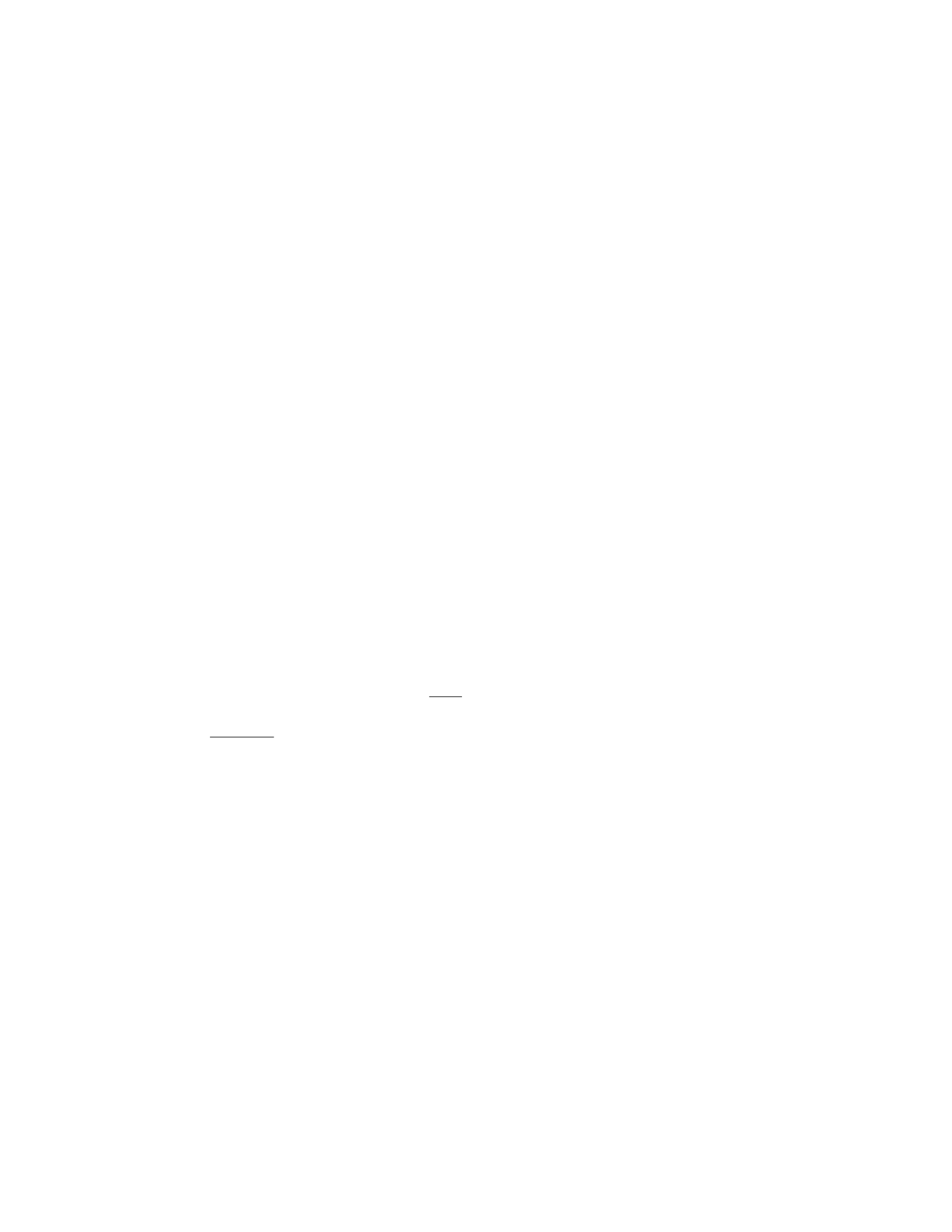
Question 20
Question
A cube of wood with a density of 800 kg/m3and a side length of 0.1 m is floating
in a pool of water. Determine the depth to which the cube is submerged in the
water.
Solution
Step 1: Begin by finding the density of water. We know that the density of
water is approximately 1000 kg/m3.
Step 2: Next, use Archimedes’ principle to find the depth submerged. The
buoyant force acting on the cube is equal to the weight of the water displaced
by the cube. The buoyant force is given by FB=ρwater ·g·Vsubmerged, where
ρwater is the density of water, gis the acceleration due to gravity, and Vsubmerged
is the volume submerged.
Step 3: Calculate the volume of the cube submerged. The volume of the
cube submerged is equal to Vsubmerged = side length ×side length ×depth.
Step 4: Equate the buoyant force to the weight of the cube to solve for the
depth submerged. The weight of the cube is given by Wcube =ρwood ·g·Vcube,
where ρwood is the density of the wood and Vcube is the volume of the cube.
Step 5: Substituting the values and solving for the depth submerged. From
Step 2, FB=ρwater ·g·side length2·depth From Step 4, Wcube =ρwood ·
g·side length3Setting these two equal gives: ρwater ·side length2·depth =
ρwood ·side length3
Step 6: Finally, solve for the depth submerged. Solving the equation from
Step 5 for depth gives: depth = ρwood
ρwater ·side length
Step 7: Plug in the given values and calculate the depth submerged. depth =
800 kg/m3
1000 kg/m3·0.1 m = 0.08 m
Therefore, the cube is submerged to a depth of 0.08 meters in the water.
Question 21
Question
A cylindrical metal object with a density of 5000 kg/m3and a height of 0.5 m is
floating in water. If the diameter of the cylinder is 0.2 m, calculate the buoyant
force acting on the object and determine if the object will sink or float when
placed in a container of oil with a density of 800 kg/m3.
Solution
Step 1: Calculate the volume of the metal cylinder. The volume of a cylinder
is given by the formula V=πr2h, where ris the radius and his the height.
18

Given that the diameter is 0.2 m, the radius ris half of the diameter, so r= 0.1
m. Plugging the values into the formula, we get:
V=π(0.1)2×0.5
V= 0.0157 m3
Step 2: Calculate the weight of the metal cylinder. The weight of an object
is given by the formula W=mg, where mis the mass and gis the acceleration
due to gravity (approximately 9.81m/s2). Given that the density ρis 5000
kg/m3, the mass mof the cylinder is:
m=ρV = 5000 ×0.0157 = 78.5kg
Now, calculate the weight Wof the cylinder:
W= 78.5×9.81 = 770.2N
Step 3: Calculate the buoyant force in water. The buoyant force Fbin water
is equal to the weight of the water displaced by the object. The volume of water
displaced is equal to the volume of the cylinder, which is 0.0157 m3. The density
of water is 1000 kg/m3. Calculating the buoyant force:
Fb=ρwaterV g = 1000 ×0.0157 ×9.81 = 153.717 N
Step 4: Determine if the object will float or sink in oil. For an object to
float, the buoyant force acting on it must be greater than or equal to its weight.
Given that the buoyant force in oil is less than the weight of the object, the
object will sink when placed in a container of oil.
Question 22
Question
A metal cube with a side length of 3 cm and a mass of 100 g is submerged in a
container of water. What is the buoyant force acting on the cube? (Density of
water = 1000 kg/m3, acceleration due to gravity = 9.81 m/s2)
Solution
Step 1: Calculate the volume of the metal cube. The volume of a cube is given
by V= (side length)3. Substituting side length = 3 cm = 0.03 m, we have:
V= (0.03 m)3= 0.000027 m3
Step 2: Calculate the density of the metal. Density is given by the for-
mula density =mass
volume . Substituting mass = 100 g= 0.1kg and volume =
0.000027 m3, we have:
density =0.1kg
0.000027 m3= 3703.7kg/m3
19

Step 3: Calculate the buoyant force. According to Archimedes’ principle,
the buoyant force acting on an object in a fluid is equal to the weight of the fluid
displaced by the object. The weight of the fluid displaced is equal to the volume
of the fluid displaced multiplied by the density of the fluid and acceleration
due to gravity. The weight of the water displaced by the cube is given by
weight = density of water×V×g. Substituting density of water = 1000 kg/m3,
V= 0.000027 m3, and g= 9.81 m/s2, we have:
weight = 1000 ×0.000027 ×9.81 = 0.2646 N
Step 4: Compare the density of the cube to the density of water. Since
the density of the cube is greater than the density of water, the cube will sink.
Therefore, the buoyant force will be less than the weight of the cube. The
buoyant force is given by the weight of the water displaced, which is 0.2646 N.
Question 23
Question
A cube of wood with sides of length 5 cm and a density of 0.8 g/cm3is submerged
in water. Calculate the buoyant force acting on the cube and determine if it
will float or sink.
Solution
Step 1: Calculate the mass of the wooden cube.
Given that the density of the wood is 0.8 g/cm3and the volume of the cube is
(5 cm)3= 125 cm3, we can find the mass of the cube using the formula m=ρV ,
where mis the mass, ρis the density, and Vis the volume.
Density = 0.8 g/cm3
Volume = 125 cm3
m= 0.8×125 = 100 g
Step 2: Calculate the buoyant force acting on the cube.
The buoyant force acting on an object submerged in a fluid is equal to the weight
of the fluid displaced by the object. The weight of the fluid displaced is given
by the formula Fb=ρfluidVsubmergedg, where ρfluid is the density of the fluid,
Vsubmerged is the volume of the object submerged, and gis the acceleration due
to gravity.
Density of water = 1 g/cm3
Volume submerged = 125 cm3
Fb= 1 ×125 ×9.81 = 1226.25 N
Step 3: Determine if the cube will float or sink.
An object will float if the buoyant force is greater than or equal to the weight of
20

the object. Since the buoyant force is 1226.25 N and the weight of the cube is
m×g= 100 ×9.81 = 981 N, we can see that the cube will float as the buoyant
force is greater than the weight of the cube.
Question 24
Question
A cube of side length Land density ρ1is placed in a container of water, with a
fraction of its volume submerged. Another cube of side length 2Land density ρ2
is placed in the same container of water, with a different fraction of its volume
submerged. If the buoyant force acting on the larger cube is 400 N greater than
the buoyant force acting on the smaller cube, determine the densities ρ1and ρ2
in terms of the density of water ρw.
Solution
Step 1: Recall the expression for the buoyant force Fbacting on an object
submerged in a fluid:
Fb=ρw·g·Vsub
where ρwis the density of water, gis the acceleration due to gravity, and Vsub
is the volume of the object submerged in the fluid.
Step 2: The volume of a cube is given by V=L3. Let V1be the volume of
the smaller cube submerged, and V2be the volume of the larger cube submerged.
Step 3: We have that the buoyant force acting on the smaller cube is Fb1=
ρw·g·V1and the buoyant force acting on the larger cube is Fb2=ρw·g·V2.
We are given that Fb2−Fb1= 400 N.
Step 4: Substituting in the expressions for the buoyant forces:
ρw·g·V2−ρw·g·V1= 400
ρw·g·8L3−ρw·g·L3= 400
Step 5: Simplifying, we get:
7ρw·g·L3= 400
Step 6: Now, we know that the mass of the cubes is related to their densities
and volumes:
Masssmall =ρ1·Vsmall =ρ1·L3
Masslarge =ρ2·Vlarge =ρ2·(2L)3
Step 7: Since the cubes are in water and in equilibrium, the weight of the
cubes must be balanced by the buoyant force:
Weightsmall =Fb1=ρw·g·V1=ρw·g·L3
21

Weightlarge =Fb2=ρw·g·V2=ρw·g·8L3
Step 8: Equating the weights:
ρ1·L3·g=ρw·g·L3
ρ2·8L3·g=ρw·g·8L3
Step 9: Since we are given that the buoyant force acting on the larger cube
is greater by 400 N, we can solve for ρ1and ρ2in terms of ρwby setting up and
solving a system of equations:
(7ρw= 400
ρ1=ρw
Step 10: Solving the system of equations, we find:
ρw=400
7
ρ2=8
ρw
=8
400/7=56
400
Therefore, the densities of the cubes are ρ1=400
7and ρ2=56
400 in terms of
the density of water ρw.
Question 25
Question
A sphere of radius Rand density ρ1is partially submerged in a liquid of density
ρ2. If the sphere is in equilibrium, determine the ratio ρ1
ρ2in terms of the depth
hto which the sphere is submerged.
Solution
Step 1: The buoyant force acting on the sphere is equal to the weight of the
liquid displaced. Let’s denote the volume of the sphere submerged in the liquid
as Vs, and the volume of the sphere above the liquid surface as Va. The volume
of the liquid displaced is then Vs.
Step 2: The weight of the liquid displaced is equal to the buoyant force.
The weight of the liquid displaced is Vsρ2g, where gis the acceleration due to
gravity. This must equal the weight of the sphere submerged in the liquid.
Step 3: The weight of the sphere submerged in the liquid can be expressed
as:
W=Vsρ1g=4
3πR3ρ1g
22

Step 4: Setting the weight of the liquid displaced equal to the weight of the
sphere submerged, we have:
Vsρ2g=4
3πR3ρ1g
Step 5: Given that the sphere is partially submerged, we can express Vsin
terms of Rand h. We know that Vs=1
24/3πR3−1
2πR2h. Simplifying this
expression, we get Vs=2
3πR3−πR2h.
Step 6: Substituting this expression for Vsinto the equation from Step 4,
we get:
2
3πR3−πR2hρ2g=4
3πR3ρ1g
Step 7: Simplifying this equation, we find:
2
3−2h
Rρ2= 4ρ1
Step 8: Finally, isolating the ratio ρ1
ρ2, we get:
ρ1
ρ2
=1
42
3−2h
R−1
Question 26
Question
A solid sphere of radius Ris floating in a liquid with half of its volume sub-
merged. The density of the liquid is ρland the density of the sphere is ρs.
Determine an expression for the density of the sphere in terms of the radius R,
the density of the liquid ρl, and the acceleration due to gravity g.
Solution
Step 1: Let’s first determine the volume of the sphere that is submerged in
the liquid. Since half of the sphere is submerged, the volume of the sphere
submerged is 1
2of the total volume:
Vsubmerged =1
2·4
3πR3=2
3πR3
Step 2: The buoyant force Fbacting on the sphere is equal to the weight of
the liquid displaced. Using Archimedes’ principle, we have:
Fb=ρl·Vsubmerged ·g
Step 3: The weight of the sphere Wsis equal to the weight of the displaced
liquid, so:
Ws=ρs·4
3πR3·g
23

Step 4: Since the sphere is floating, the buoyant force Fbis equal to the
weight of the sphere Ws. Equating the two expressions for Fband Ws, we have:
ρl·2
3πR3·g=ρs·4
3πR3·g
Step 5: Simplifying the equation above, we get:
ρs= 2ρl
Therefore, the density of the sphere is given by ρs= 2ρl.
Question 27
Question
A spherical balloon with a radius of 0.5 meters is filled with helium. The density
of helium is 0.178 kg/m3and the density of air is 1.225 kg/m3. Calculate the
maximum mass that the balloon can lift off the ground.
Solution
Step 1: Find the volume of the balloon. The volume of a sphere is given by the
formula:
Vsphere =4
3πr3
Plugging in the radius r= 0.5 meters:
Vsphere =4
3π(0.5)3=4
3π×0.125 = 1
6πm3
Step 2: Find the mass of the displaced air by the balloon. The buoyant force
acting on the balloon is equal to the weight of the air displaced by the balloon.
The mass of the air displaced is given by:
mair = Densityair ×Vsphere = 1.225 ×1
6π=5
6πkg
Step 3: Calculate the weight of the air displaced. The weight of the air
displaced can be found using the formula Fbuoyant =mg, where mis the mass
of the air displaced.
Fbuoyant = 9.81 ×5
6π≈8.14πN
Step 4: Calculate the maximum mass the balloon can lift. The weight of the
helium inside the balloon must be less than the buoyant force in order for the
balloon to lift. Let mhelium be the maximum mass the balloon can lift, then:
mhelium ≤Fbuoyant
mhelium ≤8.14π
Therefore, the maximum mass that the balloon can lift off the ground is
approximately 8.14πkg.
24

Question 28
Question
A solid aluminum sphere with radius 10 cm is floating in water with 20
Solution
Step 1: First, we need to determine the density of water, which is ρwater =
1000 kg/m3.
Step 2: We know that the buoyant force (Fbuoyant) acting on the sphere
is equal to the weight of the water displaced by the submerged portion of the
sphere. The volume of water displaced is given by the volume of the submerged
portion of the sphere:
Vsubmerged =4
3πr3×20
100 =4
3π(0.10 m)3×0.20 = 8
3000πm3.
Step 3: The weight of the water displaced is equal to the buoyant force:
Fbuoyant =ρwaterVsubmergedg,
where gis the acceleration due to gravity.
Step 4: The weight of the aluminum sphere is given by:
Fweight =ρaluminumVsphereg,
where Vsphere =4
3π(0.10 m)3is the total volume of the sphere.
Step 5: Since the sphere is floating, the buoyant force must equal the weight
of the sphere:
ρwaterVsubmergedg=ρaluminumVsphereg.
Step 6: Now, we can solve for the density of the aluminum sphere:
ρaluminum =ρwaterVsubmerged
Vsphere
=1000 ×8
3000 π
4
3π(0.10)3=2666.67
0.004 ≈666,670 kg/m3.
Step 7: Therefore, the density of the aluminum sphere is approximately
666,670 kg/m3.
Question 29
Question
A cube of side length 2.5 m and density 800 kg/m3is floating in a liquid with
density 1000 kg/m3. Calculate the height of the cube that is submerged in the
liquid. (Assume the acceleration due to gravity is 9.81 m/s2)
25

Solution
Step 1: Calculate the weight of the cube. The weight of the cube is equal
to the gravitational force acting on it. This can be calculated by multiplying
the volume of the cube by the density of the cube and the acceleration due to
gravity.
Volume of cube = (side length)3= (2.5 m)3= 15.625 m3
Weight of cube = Volume ×Density ×g= 15.625 m3×800 kg/m3×9.81 m/s2
Step 2: Calculate the buoyant force acting on the cube. The buoyant force
acting on the cube is equal to the weight of the liquid displaced by the cube.
This can be calculated by multiplying the volume of the cube submerged in the
liquid by the density of the liquid and the acceleration due to gravity. Let hbe
the height of the cube submerged in the liquid.
Volume of submerged cube = Area of base ×height = (2.5 m)2×h= 6.25hm3
Buoyant force = Volume×Density of liquid×g= 6.25hm3×1000 kg/m3×9.81 m/s2
Step 3: Apply Archimedes’ principle. According to Archimedes’ principle,
the weight of the cube is equal to the buoyant force acting on it when it is in
equilibrium.
Weight of cube = Buoyant force
15.625 m3×800 kg/m3×9.81 m/s2= 6.25hm3×1000 kg/m3×9.81 m/s2
Step 4: Solve for h.
15.625 ×800 = 6.25h×1000
h=15.625 ×800
6.25 ×1000
h= 2 m
Therefore, the cube is submerged to a height of 2 meters in the liquid.
Question 30
Question
A cube of iron with sides of length 10 cm is completely submerged in water. The
density of iron is 7.87 g/cm3, and the density of water is 1.00 g/cm3. Calculate
the buoyant force acting on the iron cube.
26

Solution
Step 1: First, we need to calculate the volume of the iron cube. The volume of
a cube is given by the formula V=a3, where ais the length of a side. Given
that the side length of the cube is 10 cm, the volume of the iron cube is:
Vcube = (10 cm)3= 1000 cm3
Step 2: Next, we calculate the mass of the iron cube. The mass of the cube
can be found using the formula m=ρ×V, where ρis the density of iron.
Substitute the values:
miron = 7.87 g/cm3×1000 cm3= 7870 g
Step 3: Now, we calculate the weight of the iron cube. The weight Wof
an object is given by the formula W=m×g, where gis the acceleration due
to gravity (approximately 9.81 m/s2). Convert the mass of the iron cube to
kilograms:
miron = 7870 g = 7.87 kg
Calculate the weight:
Wiron = 7.87 kg ×9.81 m/s2= 77.3 N
Step 4: Finally, we calculate the buoyant force acting on the iron cube.
According to Archimedes’ principle, the buoyant force is equal to the weight of
fluid displaced by the object. The volume of water displaced by the cube is also
1000 cm3. The weight of this volume of water is given by:
Wwater =ρwater ×Vcube ×g= 1.00 g/cm3×1000 cm3×9.81 m/s2= 9810 N
Step 5: Since the buoyant force is equal to the weight of the water displaced,
the buoyant force acting on the iron cube is 9810 N.
Question 31
Question
A cube of wood with a density of 700 kg/m3and a side length of 0.1 m is floating
in a tub of water. What is the depth of immersion of the cube?
Solution
Step 1: The depth of immersion of an object floating in a fluid is determined
by the buoyant force acting on the object. The buoyant force can be calculated
using Archimedes’ principle, which states that the buoyant force is equal to the
weight of the fluid displaced by the object. Step 2: The weight of the fluid
displaced by the cube is equal to the weight of the cube itself. We can calculate
27

the weight of the cube using the formula W=mg, where mis the mass of the
cube and gis the acceleration due to gravity. Step 3: Since the cube is floating,
the buoyant force FBacting on the cube is equal in magnitude to the weight W
of the cube. This can be expressed as FB=W. Step 4: The buoyant force can
also be calculated using the formula FB=ρVimmersedg, where ρis the density of
the fluid (water), Vimmersed is the volume of the cube submerged in water, and g
is the acceleration due to gravity. Step 5: The volume of the cube submerged in
water can be calculated as Vimmersed = (side length)3×depth of immersion. Step
6: Equating the two expressions for the buoyant force, we have ρVimmersedg=
mg. Step 7: Substitute the given values into the equation and solve for the
depth of immersion, h. Remember that ρwater = 1000 kg/m3. Step 8: After
substituting the values into the equation and solving for h, we find the depth of
immersion of the cube to be approximately 0.071 m or 7.1 cm.
Question 32
Question
A cube of side length 0.1 m is submerged in water. The upper surface of the
cube is 4 cm below the water surface. Find the buoyant force acting on the
cube. (Density of water = 1000 kg/m3)
Solution
Step 1: Calculate the volume of the cube submerged in water. The volume of
the cube submerged is the same as the volume of water displaced, which is given
by the formula:
V=Ah
where Ais the area of one face of the cube and his the height submerged.
Given that the side length of the cube is 0.1 m and the cube is submerged 4 cm
(0.04 m) under the water surface, the area Aand height hcan be calculated as
follows:
A= (0.1)2
h= 0.04
Step 2: Calculate the volume of water displaced. Substitute the values into
the formula:
V= (0.1)2×0.04
Step 3: Calculate the mass of water displaced. The mass of water displaced
can be found using the formula:
m=V×ρ
where ρis the density of water (1000 kg/m3).
28

Step 4: Calculate the weight of the water displaced. The weight of the water
displaced is equal to the buoyant force acting on the cube, which is given by:
Fb=m×g
where gis the acceleration due to gravity (9.81 m/s2).
Step 5: Substitute the values and calculate the buoyant force. Substitute
the values of mand ginto the formula:
Fb=V×ρ×g
Question 33
Question
A wooden cube of side length 10 cm floats in water with 4 cm of its height above
the water surface. What is the density of the wood?
Solution
Step 1: Calculate the volume of the cube submerged in the water. Step 2:
Calculate the weight of the water displaced by the submerged cube. Step 3: Set
up an equation using Archimedes’ principle to solve for the density of the wood.
Step 1: The volume of the cube submerged in water is given by Vsubmerged =
A×hsubmerged, where Ais the area of one face of the cube and hsubmerged is the
height submerged in water. Given that the side length of the cube is 10 cm and
4 cm of its height is submerged in water, we have: A= (10 cm)2= 100 cm2,
hsubmerged = 4 cm. Therefore, Vsubmerged = 100 cm2×4 cm = 400 cm3.
Step 2: The weight of the water displaced by the cube can be calculated
using the density of water, ρwater = 1000 kg/m3. The mass of the water displaced
is then mwater =ρwater ×Vsubmerged. Converting the volume to cubic meters, we
have Vsubmerged = 0.0004 m3. Therefore, mwater = 1000 kg/m3×0.0004 m3=
0.4 kg. The weight of the water displaced is Wwater =mwater ×g, where g=
9.8 m/s2is the acceleration due to gravity. Hence, Wwater = 0.4 kg ×9.8 m/s2=
3.92 N.
Step 3: According to Archimedes’ principle, the buoyant force acting on the
cube is equal to the weight of the water displaced by the cube. Therefore, the
buoyant force, Fbuoyant =Wwater = 3.92 N. The buoyant force can also be ex-
pressed as Fbuoyant =ρwater ×g×Vsubmerged. Setting these two expressions equal
to each other, we have: 3.92 N = 1000 kg/m3×9.8 m/s2×0.0004 m3. Solving
for the density of the wood, ρwood, we get: ρwood =3.92 N
0.00392 m3= 1000 kg/m3.
Therefore, the density of the wood is 1000 kg/m3.
29

Question 34
Question
A cube of side length aand density ρcube is floating in water with 1/3 of its
volume submerged. Find the ratio of the densities of the cube and water, given
that the cube is in equilibrium.
Solution
Step 1: Recall that for an object floating in a fluid, the buoyant force on the
object is equal to the weight of the fluid displaced by the object. Step 2: The
buoyant force Fbacting on the cube is equal to the weight of the water displaced
by the submerged volume of the cube. Step 3: The weight of the cube, acting
downwards, is equal to the weight of the water displaced by the submerged
volume of the cube, acting upwards. Step 4: The weight of the cube is given
by Wcube =ρcube ·g·Vsub, where ρcube is the density of the cube, gis the
acceleration due to gravity, and Vsub is the submerged volume of the cube. Step
5: The weight of the displaced water is given by Wwater =ρwater ·g·Vsub, where
ρwater is the density of water. Step 6: Since the cube is in equilibrium, the
weight of the cube and the weight of the displaced water are equal. Therefore,
ρcube ·Vsub =ρwater ·Vsub. Step 7: Simplifying the equation gives ρcube =ρwater.
Step 8: Therefore, the ratio of the densities of the cube and water is 1 : 1 .
Question 35
Question
A cube of wood with a density of 700 kg/m3and a side length of 0.20 m floats
in a container of water. What fraction of the cube’s volume is above water?
Solution
Step 1: First, we need to find the density of water. The density of water is
approximately 1000 kg/m3.
Step 2: Next, we can find the weight of the cube using the formula w=
mg, where mis the mass of the cube and gis the acceleration due to gravity
(9.81 m/s2).
Step 3: The volume of the cube can be calculated using V= side length3.
Step 4: The weight of the water displaced by the cube is equal to the weight
of the cube. Using the formula for weight of water displaced (wdisplaced =
ρwater ·Vsubmerged ·g) where ρwater is the density of water, Vsubmerged is the
volume of the cube submerged in water, and gis the acceleration due to gravity.
Step 5: The volume of the cube submerged in water is equal to the fraction
of the cube submerged multiplied by the total volume of the cube.
30

Step 6: Finally, we can find the fraction of the cube’s volume above water
by subtracting the volume submerged from the total volume and then dividing
by the total volume.
This fraction represents the ratio of the volume of the cube above water to
the total volume.
31

