



PHYS 101 - ELEMENTS OF PHYSICS
- Buoyant forces and Archimedes’
principle
Question Bank - Set 1
Liberty University
Question 1
Question
A spherical object with a radius of 8 cm and a density of 2000 kg/m3is placed
in a container of water. Calculate the buoyant force acting on the object and
determine whether it will sink or float.
Solution
Step 1: Calculate the volume of the spherical object using the formula V=4
3πr3.
Given the radius r= 8 cm, we convert it to meters: r= 0.08 m.
V=4
3π(0.08)3≈2.144 ×10⁻⁴m3
Step 2: Calculate the weight of the object using the formula W=mg, where
mis the mass and gis the acceleration due to gravity (9.81 m/s2).
m= density ×volume = 2000 ×2.144 ×10−4≈0.4288 kg
W= 0.4288 ×9.81 ≈4.21 N
Step 3: Calculate the buoyant force acting on the object using Archimedes’
principle, which states that the buoyant force is equal to the weight of the fluid
displaced. The density of water is 1000 kg/m3.
Fbuoyant = density of water ×Vobject ×g
Fbuoyant = 1000 ×2.144 ×10−4×9.81 ≈2.09 N
Step 4: Determine whether the object will sink or float by comparing the
buoyant force and the weight of the object. The buoyant force is 2.09 N and
the weight of the object is 4.21 N. Since the weight of the object is greater than
the buoyant force, the object will sink in the water.

Question 2
Question
A rectangular block of wood with dimensions 10 cm x 5 cm x 3 cm and density
0.8 g/cm3floats in water. Calculate the minimum force required to push the
block down so that it is submerged completely in water.
Solution
Step 1: First, we need to calculate the weight of the block. The mass of the
block can be calculated using the formula:
mass = density ×volume
Given that the density of the block is 0.8 g/cm3, and the volume of the block
is:
Volume = length ×width ×height
Volume = 10 cm ×5 cm ×3 cm
Volume = 150 cm3
Therefore, the mass of the block is:
mass = 0.8 g/cm3×150 cm3= 120 g
Step 2: Next, we need to calculate the weight of the block using the formula:
weight = mass ×gravity
weight = 120 g ×9.81 m/s2= 1177.2 N
Step 3: Now, in order for the block to be submerged completely in water,
the buoyant force acting upwards should be equal to the weight of the block.
Therefore, the minimum force required to push the block down is equal to the
weight of the block:
Minimum force = 1177.2 N
Question 3
Question
A solid cone of base radius Rand height his floating upright in water. The
cone is immersed to a depth dand is in equilibrium. Calculate the ratio of the
density of the cone material to that of water.
2
Solution
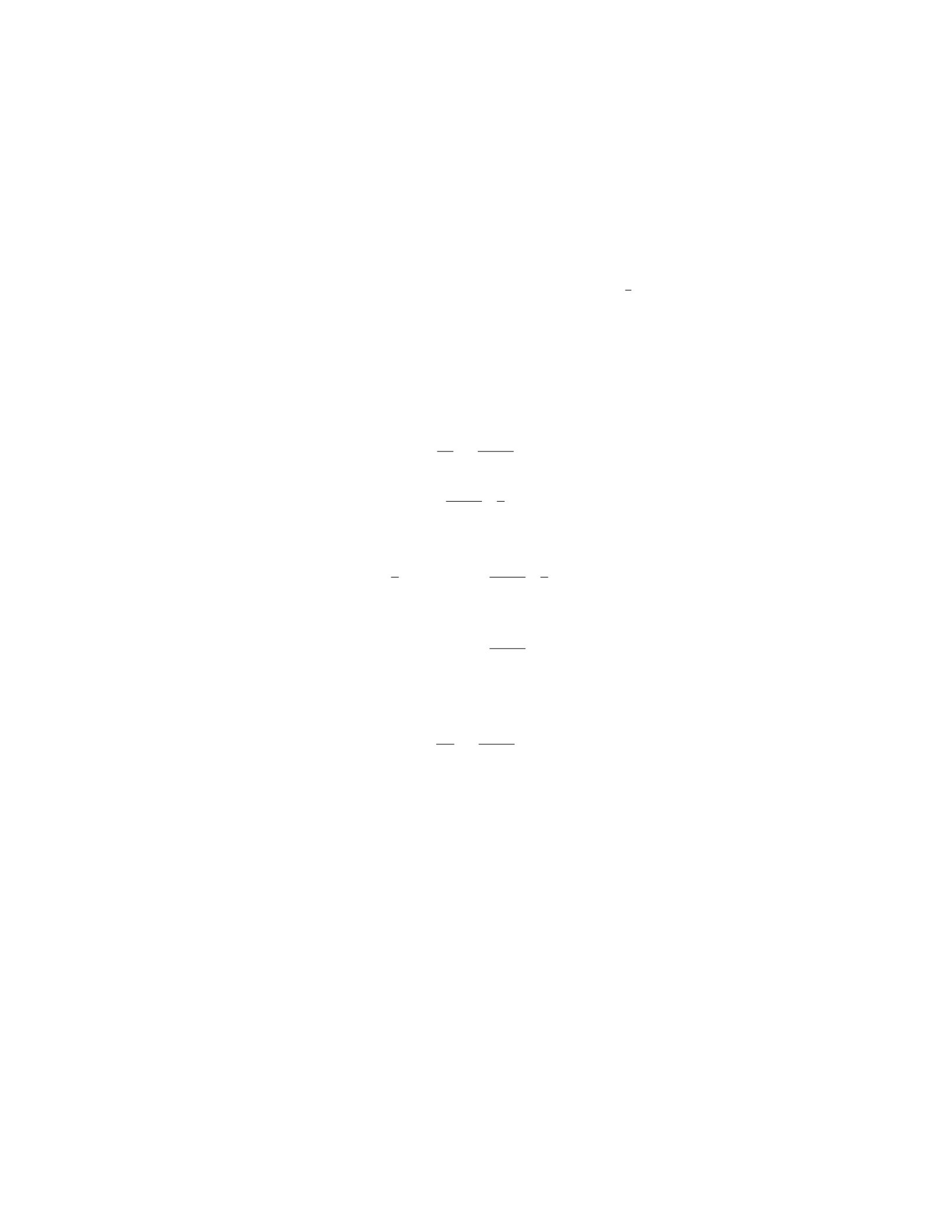
Step 1: The buoyant force acting on the cone is equal to the weight of the water
displaced by the cone. Let the density of the cone material be ρc, the density of
water be ρw, and the volume of water displaced be Vd. The volume of the cone
can be calculated using the formula for the volume of a cone: 1
3πR2h. Since the
cone is floating, the weight of the cone is equal to the buoyant force.
ρc·g·Vc=ρw·g·Vd
Step 2: Next, we can express the volume of water displaced in terms of the
parameters given in the problem. The volume of the cone immersed in water
can be calculated using similar triangles:
Vd
Vc
=h−d
h
Vd=h−d
h·1
3πR2h
Step 3: Substituting this expression for Vdback into our equation from Step
1, we have:
ρc·1
3πR2h=ρw·h−d
h·1
3πR2h
Step 4: Simplifying the equation, we find:
ρc=ρw·h−d
h
Step 5: Finally, we can calculate the ratio of the density of the cone material
to that of water by dividing ρcby ρw:
ρc
ρw
=h−d
h
Question 4
Question
A large steel cube with sides measuring 2 meters is submerged in water. The
density of steel is 7850 kg/m3, and the density of water is 1000 kg/m3. Deter-
mine the buoyant force acting on the cube and whether the cube will sink or
float.
Solution
Step 1: Calculate the weight of the cube. The weight of the cube can be
calculated using the formula:
Weight = Mass ×Gravity
3

The mass of the cube can be calculated using the formula:
Mass = Density ×Volume
The volume of the cube is:
Volume = Side3= 23= 8 m3
Thus, the mass of the cube is:
Mass = 7850 kg/m3×8 m3= 62800 kg
Therefore, the weight of the cube is:
Weight = 62800 kg ×9.81 m/s2= 616968 N
Step 2: Calculate the buoyant force. The buoyant force can be calculated
using Archimedes’ principle:
Buoyant force = Weight of displaced fluid
The volume of water displaced by the cube is equal to the volume of the cube
submerged, which is 8 m3. The weight of the displaced water is:
Weight of displaced fluid = Volume of water ×Density of water ×Gravity
Weight of displaced fluid = 8 m3×1000 kg/m3×9.81 m/s2= 78480 N
Therefore, the buoyant force acting on the cube is 78480 N.
Step 3: Determine if the cube will float or sink. If the buoyant force is
greater than or equal to the weight of the cube, the cube will float. Otherwise,
it will sink. Comparing the buoyant force (78480 N) to the weight of the cube
(616968 N), we see that the buoyant force is not enough to support the weight
of the cube. Hence, the steel cube will sink in water.
Question 5
Question
A spherical metal ball with radius 10 cm and a density of 8000 kg/m3is sub-
merged in a container of water. Find the buoyant force acting on the ball and
also determine the apparent weight of the ball in water.
Solution
Step 1: First, let’s find the volume of the metal ball. The volume of a sphere is
given by the formula V=4
3πr3, where ris the radius of the sphere. Substitute
the given radius r= 10 cm into the formula:
V=4
3π(0.1)3=4
3π×0.001 = 4
3000π=π
750 m3
4

Step 2: Next, calculate the mass of the metal ball. The mass of an object
is given by the formula m= density ×volume. Substitute the given density
density = 8000 kg/m3and volume V=π
750 m3into the formula:
m= 8000 ×π
750 =8π
3kg
Step 3: Now, determine the weight of the metal ball in air. The weight of
an object is given by the formula W=mg, where mis the mass of the object
and gis the acceleration due to gravity (approximately 9.81 m/s2). Substitute
the calculated mass m=8π
3kg into the formula:
W=8π
3×9.81 ≈82.78πN
Step 4: Calculate the buoyant force acting on the metal ball. According
to Archimedes’ principle, the buoyant force is equal to the weight of the water
displaced by the metal ball. The volume of water displaced is equal to the
volume of the metal ball (since they are completely submerged). Substitute the
volume π
750 m3and the density of water 1000 kg/m3into the formula:
Buoyant force = Density of water×Volume of water displaced×g= 1000×π
750×9.81 = 13
3πN
Step 5: Finally, determine the apparent weight of the metal ball in water.
The apparent weight in water is given by the difference between the weight of
the ball in air and the buoyant force acting on it.
Apparent weight = W−Buoyant force = 82.78π−13
3π=223
3πN
Therefore, the buoyant force acting on the metal ball is 13
3πN and the
apparent weight of the ball in water is 223
3πN.
Question 6
Question
A cylindrical metal object has a radius of 5 cm and a height of 10 cm. The
density of the metal is 7000 kg/m3. The object is immersed in water. Determine
the buoyant force acting on the object and whether the object will sink or float
in water.
Solution
Step 1: Calculate the volume of the cylindrical object. Given the radius r= 5
cm, and height h= 10 cm, the volume Vcan be calculated using the formula
for the volume of a cylinder:
V=πr2h
5

Step 2: Convert the radius and height to meters for consistent units. Con-
verting the radius and height to meters:
r= 5 cm = 0.05 m, h = 10 cm = 0.10 m
Step 3: Calculate the volume of the object in cubic meters. Substitute the
values of rand hinto the formula for volume:
V=π(0.05 m)2·0.10 m
Step 4: Calculate the volume of the object.
V=π×0.0025 m2×0.10 m = 0.000785 m3
Step 5: Calculate the mass of the object. Given the density ρ= 7000 kg/m3,
the mass mof the object can be calculated using:
m=ρ×V
Step 6: Calculate the mass of the object.
m= 7000 kg/m3×0.000785 m3= 5.495 kg
Step 7: Calculate the weight of the object. The weight of the object Wis
given by:
W=m×g
where gis the acceleration due to gravity (9.81 m/s2).
Step 8: Calculate the weight of the object.
W= 5.495 kg ×9.81 m/s2= 53.84 N
Step 9: Calculate the buoyant force. The buoyant force Fbacting on the
object immersed in water is equal to the weight of the water displaced by the
object. According to Archimedes’ principle, the buoyant force is equal to the
weight of the water displaced:
Fb=ρwater ×g×Vdisplaced
where ρwater = 1000 kg/m3is the density of water, and Vdisplaced is the
volume of water displaced by the object (equal to the volume of the object V).
Step 10: Calculate the buoyant force.
Fb= 1000 kg/m3×9.81 m/s2×0.000785 m3
Step 11: Calculate the buoyant force.
Fb= 9.81 N
Step 12: Determine if the object will sink or float. Since the weight of the
object is greater than the buoyant force, the object will sink in water.
6

Question 7
Question
A solid iron cube of side length 10 cm and mass 8 kg is placed in a container filled
with water. Calculate the buoyant force acting on the iron cube and determine
whether it will sink or float in the water.
Solution
Step 1: Find the volume of the iron cube. The volume of a cube is given by
V=s3, where sis the side length. Given that the side length s= 10 cm, the
volume Vof the iron cube is:
V= 103cm3= 1000 cm3= 0.001 m3
Step 2: Calculate the density of iron. The density of iron is approximately
7,870 kg/m3.
Step 3: Calculate the weight of the iron cube. The weight Wof the iron
cube is given by W=mg, where mis the mass and gis the acceleration due to
gravity. Given that m= 8 kg and g= 9.81 m/s2:
W= 8 ×9.81 = 78.48 N
Step 4: Calculate the buoyant force. According to Archimedes’ principle,
the buoyant force Fbis equal to the weight of the water displaced by the object.
The weight of the displaced water is equal to the weight of the water that would
fill the volume of the cube:
Weight of water displaced = Density of water ×Volume of cube ×g
= 1000 kg/m3×0.001 m3×9.81 m/s2
= 9.81 N
Step 5: Analyze whether the iron cube will sink or float. If the buoyant force
is greater than the weight of the iron cube, the cube will float. If the buoyant
force is less than the weight of the iron cube, the cube will sink. Comparing the
buoyant force of 9.81 N to the weight of the iron cube of 78.48 N, we find that
the iron cube will sink in water.
Question 8
Question
A hollow spherical shell with a radius of 0.5 m is immersed in water. The mass
of the shell is 20 kg. Determine the buoyant force acting on the shell and the
net force experienced by the shell if the shell is released from rest.
7
Solution
Step 1: Calculate the volume of the hollow spherical shell. The volume of a
hollow spherical shell is given by the formula:
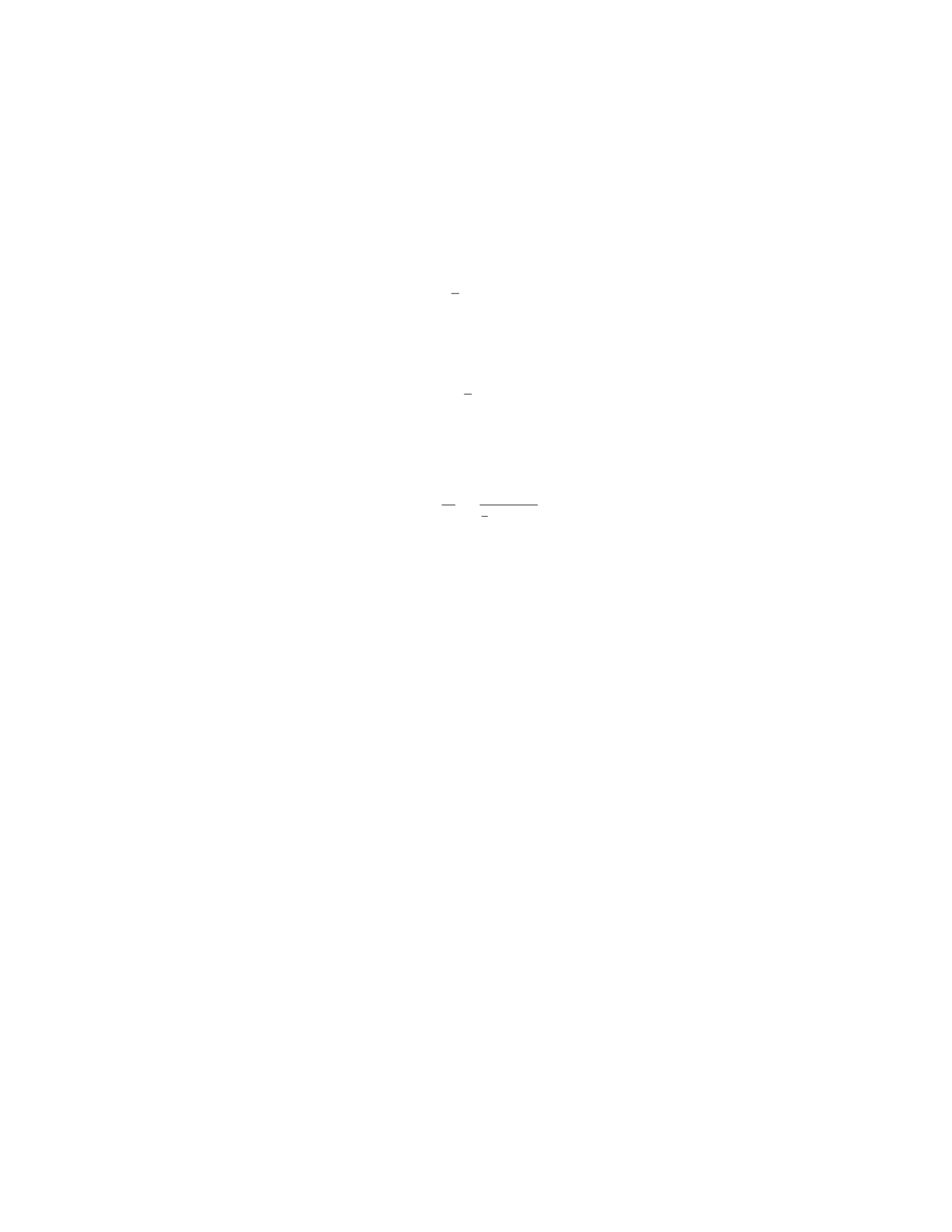
V=4
3π(R3−r3)
where R is the outer radius, r is the inner radius, and π≈3.14159. Since the
shell is hollow, with an outer radius of 0.5 m, and no inner radius, the volume
can be simplified to:
V=4
3π(0.53)
Step 2: Find the density of the shell. Density (ρ) is defined as mass per unit
volume. Given that the mass of the shell is 20 kg and the volume is calculated
in Step 1, the density can be expressed as:
ρ=m
V=20
4
3π(0.53)
Step 3: Determine the buoyant force acting on the shell. The buoyant
force is equal to the weight of the water displaced by the shell. According to
Archimedes’ principle, the buoyant force is given by:
Fb=ρwater ·g·Vdisplaced
Where: - ρwater is the density of water, - g is the acceleration due to gravity,
and - Vdisplaced is the volume of water displaced by the shell.
Step 4: Calculate the net force experienced by the shell. The net force
experienced by the shell when released from rest is the difference between the
buoyant force and the weight of the shell. The weight of the shell is given by:
W=m·g
The net force is thus:
Fnet =Fb−W
Substitute the given values into the above equations to find the buoyant
force and the net force.
Question 9
Question
A large barrel of oil has a mass of 400 kg and a volume of 0.5 m3. When it is
fully submerged in water, the apparent weight of the barrel is 3000 N. Calculate
the density of the oil.
8

Solution
Step 1: First, let’s calculate the weight of the barrel in air using the formula
W=mg, where mis the mass of the barrel and gis the acceleration due to
gravity (approximately 9.81 m/s2).
Weight in air = 400 kg ×9.81 m/s2= 3924 N
Step 2: Next, let’s calculate the buoyant force acting on the barrel when it
is fully submerged in water. The buoyant force is equal to the weight of the
water displaced by the barrel. The volume of the barrel is 0.5 m3, so the weight
of water displaced is given by Fbuoyant =V ρwaterg, where Vis the volume of
the barrel, ρwater is the density of water (1000 kg/m3), and gis the acceleration
due to gravity.
Fbuoyant = 0.5 m3×1000 kg/m3×9.81 m/s2= 4905 N
Step 3: Since the apparent weight of the barrel when submerged in water
is 3000 N, the buoyant force acting upwards on the barrel in water is 3000 N.
This is given by Fbuoyant = 3000 N.
Step 4: Using Archimedes’ principle, we can relate the density of the oil to
the buoyant force. The buoyant force on the barrel is also equal to the weight
of the oil displaced. Thus, Fbuoyant =V ρoilg, where ρoil is the density of the oil.
3000 N = 0.5 m3×ρoil ×9.81 m/s2
Step 5: Solving for ρoil, we find:
ρoil =3000 N
0.5 m3×9.81 m/s2= 612.24 kg/m3
Therefore, the density of the oil is 612.24 kg/m3.
Question 10
Question
A cube made of lead with sides of length 10 cm is completely submerged in
water. If the density of lead is 11,300 kg/m3and the density of water is 1000
kg/m3, find the buoyant force acting on the lead cube.
Solution
Step 1: Determine the volume of the lead cube. Step 2: Calculate the weight
of the lead cube. Step 3: Calculate the weight of the water displaced. Step 4:
Find the buoyant force acting on the lead cube.
9

Step 1: The volume of the lead cube can be calculated using the formula
for the volume of a cube:
Volume of cube = side length3= (0.1 m)3= 0.001 m3
Step 2: The weight of the lead cube can be found using the formula:
Weight = mass ×acceleration due to gravity
Weight = density ×volume ×acceleration due to gravity
Weight = 11,300 kg/m3×0.001 m3×9.8 m/s2= 110.74 N
Step 3: The weight of the water displaced by the lead cube is equal to the
weight of the lead cube. Therefore, the weight of the water displaced is 110.74
N.
Step 4: The buoyant force acting on the lead cube is equal to the weight of
the water displaced, which is 110.74 N.
Question 11
Question
A spherical balloon with a radius of 1.5 meters is filled with helium gas. The
density of helium is 0.1785 kg/m3, while the density of air is 1.2 kg/m3. Calcu-
late the maximum mass the balloon can carry without sinking in air.
Solution
Step 1: Find the volume of the balloon. Since the balloon is spherical, we can
use the formula for the volume of a sphere:
V=4
3πr3
where ris the radius of the balloon given as 1.5 meters.
Step 2: Substitute the radius into the formula to find the volume.
V=4
3π×(1.5)3
Step 3: Calculate the volume.
V=4
3π×3.375
V≈14.137 m3
Step 4: Calculate the buoyant force acting on the balloon. The buoyant
force is equal to the weight of the air displaced by the balloon. The weight of
air displaced is given by:
Weight of air = Density of air×Volume of the balloon×Acceleration due to gravity
10

Weight of air = 1.2×14.137 ×9.81
Step 5: Calculate the weight of air displaced.
Weight of air ≈166.323 N
Step 6: Calculate the maximum mass the balloon can carry without sinking.
The buoyant force is equal to the weight of the air displaced, so the maximum
mass the balloon can carry is the weight of the displaced air divided by the
acceleration due to gravity:
Maximum mass = Weight of air
9.81
Step 7: Calculate the maximum mass.
Maximum mass ≈166.323
9.81
Maximum mass ≈16.95 kg
Therefore, the maximum mass the balloon can carry without sinking in air
is approximately 16.95 kg.
Question 12
Question
A cube of side length aand density ρ1is floating in a liquid of density ρ2with
a fraction fof its volume submerged. Determine the expression for the depth
to which the cube is submerged in terms of the given quantities.
Solution
Step 1: Find the buoyant force acting on the cube. The buoyant force is given
by the weight of the liquid displaced by the cube. Let the volume of the cube be
V=a3, then the volume of the cube submerged in the liquid is fV =fa3. The
weight of the liquid displaced is Wliquid =ρ2·f V ·g. Therefore, the buoyant
force Fbuoyant =ρ2·fa3·g.
Step 2: Find the weight of the cube. The weight of the cube is given by the
density times volume times acceleration due to gravity Wcube =ρ1·a3·g.
Step 3: For the cube to remain floating at a constant depth, the buoyant
force must balance the weight of the cube. This gives us the equation ρ2·fa3·g=
ρ1·a3·g.
Step 4: Solve for the fraction fof the cube’s volume submerged.
ρ2·fa3·g=ρ1·a3·g
ρ2·f=ρ1
11

f=ρ1
ρ2
Therefore, the depth to which the cube is submerged is given by the fraction
of its volume submerged, which is f=ρ1
ρ2.
Question 13
Question
A cylindrical object with a radius of 5 cm and a height of 20 cm is immersed in
water. The density of water is 1000 kg/m3and the gravitational acceleration is
9.81 m/s2. If the object floats with 1/3 of its volume above the surface of the
water, determine the density of the material the object is made of.
Solution
Step 1: Calculate the volume of the object submerged in water. The volume
of the object submerged in water can be calculated using the formula for the
volume of a cylinder, V=πr2h, where ris the radius and his the height. Given
that 1/3 of the volume of the cylinder is submerged in water, we can find the
volume of the submerged section:
Vsubmerged =1
3·π(0.05 m)2·0.2 m
Step 2: Calculate the buoyant force acting on the object. The buoyant force
is given by the formula Fb=ρV g, where ρis the density of the fluid, Vis
the volume of the fluid displaced, and gis the acceleration due to gravity. The
volume of water displaced by the submerged section of the cylinder is equal to
the volume of the submerged section, Vsubmerged. Therefore, the buoyant force
is:
Fb= 1000 kg/m3·Vsubmerged ·9.81 m/s2
Step 3: Set up the equilibrium condition. For an object to float, the buoyant
force acting on it must be equal to the weight of the object. The weight of the
object can be calculated using the formula W=m·g, where mis the mass of
the object. Since the object is floating, the weight of the object is equal to the
weight of the water it displaces. This weight is equal to the buoyant force, so
we have:
m·g= 1000 kg/m3·Vsubmerged ·g
Step 4: Find the density of the material the object is made of. The mass of
the object can be calculated using the density formula m=ρobjectVtotal, where
ρobject is the density of the object material and Vtotal is the total volume of the
object. Since 1/3 of the object is submerged, the total volume of the object is:
Vtotal =3
2·Vsubmerged
12

Therefore, the mass of the object is:
ρobject ·3
2·Vsubmerged = 1000 kg/m3·Vsubmerged
Finally, solve for the density of the object material, ρobject.
Question 14
Question
A cube of wood with a density of 0.8 g/cm3and a side length of 10 cm is floating
in water. What is the depth to which it floats?
Solution
Step 1: Determine the density of water. The density of water is typically 1
g/cm3. Step 2: Calculate the weight of the cube. The weight of an object is
given by the formula: weight = mass * gravity. The mass of the cube can be
calculated as the volume of the cube multiplied by its density: mass = volume *
density. The volume of the cube is given by the formula: volume = side length3.
Therefore, the mass of the cube is: mass = 10 cm3* 0.8 g/cm3= 8 g. The
weight of the cube is: weight = 8 g * 9.8 m/s2= 78.4 N. Step 3: Calculate
the buoyant force on the cube. The buoyant force on an object is equal to the
weight of the fluid displaced by the object. In this case, the buoyant force on
the cube is equal to the weight of the water displaced by the cube, which can be
calculated as the volume of water displaced multiplied by the density of water
and gravity. Step 4: Calculate the volume of water displaced. The volume of
water displaced by the cube is equal to the volume of the cube that is submerged
in water. Let the depth to which the cube floats be h cm. Therefore, the volume
of water displaced is h cm * 10 cm2= 10h cm3. Step 5: Calculate the buoyant
force. The buoyant force is equal to the weight of the water displaced: buoyant
force = 10h cm3* 1 g/cm3* 9.8 m/s2= 98h N. Step 6: Apply Archimedes’
principle. According to Archimedes’ principle, the buoyant force on an object
is equal to the weight of the fluid it displaces. Therefore, the buoyant force is
equal to the weight of the cube while it is floating: 78.4 N = 98h N. Solve for h:
h = 78.4 N / 98 N/cm = 0.8 cm. Therefore, the depth to which the cube floats
is 0.8 cm.
Question 15
Question
A spherical balloon with a radius of 2 meters is filled with helium. The mass
of the balloon itself is 10 kg. If the density of helium is 0.18 kg/m3and the
density of air is 1.225 kg/m3, calculate the buoyant force acting on the balloon.
13

Solution
Step 1: Calculate the volume of the balloon using the formula for the volume
of a sphere: V=4
3πr3. Given that the radius r= 2 m,
V=4
3π(2 m)3=32
3πm3
Step 2: Calculate the total mass of the balloon. The mass of the balloon
itself is 10 kg and the mass of the helium can be calculated as mass = density
×volume. The mass of helium mhelium = densityhelium ×V. Given that density
of helium densityhelium = 0.18 kg/m3,
mhelium = 0.18 ×32
3π=288
3πkg
The total mass mtotal of the balloon is:
mtotal =mhelium +mballoon =288
3π+ 10 kg = 288
3π+ 30 kg
Step 3: Calculate the difference in densities between air and helium to find
the effective density of the balloon. Given that the density of air densityair =
1.225 kg/m3,
∆density = densityair −densityhelium = 1.225 −0.18 = 1.045 kg/m3
Step 4: Calculate the buoyant force using Archimedes’ principle, which states
that the buoyant force Fbuoyant is equal to the weight of the fluid displaced by
the object. The buoyant force can be calculated as Fbuoyant = densityair ×V×g,
where Vis the volume of the balloon and gis the acceleration due to gravity.
Fbuoyant = 1.225 ×32
3π×9.8 N
Question 16
Question
A solid cube with sides of length 0.1 m and density 1000 kg/m3is placed in a
container of water. If the cube is released from rest, determine the acceleration
of the cube as it sinks in the water. Take the density of water to be 1000 kg/m3
and acceleration due to gravity to be 9.81 m/s2.
Solution
Step 1: Determine the buoyant force acting on the cube. The buoyant force
FBacting on the cube is equal to the weight of the water displaced by the
cube. The volume of the cube is V= (0.1 m)3= 0.001 m3. Since the cube is
submerged in water, the volume of water displaced is equal to the volume of
14

the cube, 0.001 m3. The weight of the water displaced is given by mg, where
mis the mass of the water and gis the acceleration due to gravity. The mass
of the water displaced is m=ρwater ·V, where ρwater is the density of water.
Therefore, FB=ρwater ·V·g.
Step 2: Determine the weight of the cube. The weight of the cube Fcube is
given by mg, where mis the mass of the cube. The mass of the cube is m=
ρcube ·V, where ρcube is the density of the cube. Therefore, Fcube =ρcube ·V·g.
Step 3: Apply Newton’s second law to find the acceleration of the cube.
The net force acting on the cube is the difference between the buoyant force
and the weight of the cube, Fnet =FB−Fcube. By Newton’s second law,
we have Fnet =mcube ·a, where mcube is the mass of the cube and ais its
acceleration. Substituting the expressions for FB,Fcube, and mcube, we get
ρwater ·V·g−ρcube ·V·g=ρcube ·V·a. Solving for a, we find a=ρwater −ρcube
ρcube ·g.
Substituting the given values, we get a=1000 kg/m3
−1000 kg/m3
1000 kg/m3·9.81 m/s2=
0 m/s2.
Question 17
Question
A cube of aluminum with sides measuring 10 cm each is submerged in a pool
of water. If the density of aluminum is 2.7 g/cm3and the density of water is
1 g/cm3, determine the buoyant force acting on the aluminum cube in Newtons.
Solution
Step 1: Calculate the volume of the aluminum cube. Given that each side of
the cube measures 10 cm, the volume can be calculated as:
Volume of cube = side length3= (10 cm)3
Step 2: Convert the volume of the cube to cubic meters. Since 1 cm3=
10−6m3, we have:
Volume of cube = (10 cm)3×(10−6m3/cm3)
Step 3: Calculate the mass of the aluminum cube. The mass can be found
using the formula:
Mass = Density ×Volume
Substitute the density of aluminum (2.7 g/cm3) and the volume of the cube to
find the mass.
Step 4: Determine the weight of the aluminum cube. Use the formula
Weight = Mass ×Acceleration due to gravity.
15

Step 5: Determine the weight of the water displaced by the aluminum cube.
Since the cube is submerged in water, the weight of the water displaced is equal
to the buoyant force acting on the cube.
Step 6: Apply Archimedes’ principle to find the buoyant force. Archimedes’
principle states that the buoyant force is equal to the weight of the fluid displaced
by the object, which in this case is water.
Step 7: Calculate the buoyant force in Newtons. The buoyant force can be
determined as the weight of the water displaced by the aluminum cube.
Question 18
Question
A cube of wood with sides of length 0.1 m and a density of 600 kg/m3is floating
in a container of water. If the cube is pushed down a depth of 0.04 m and then
released, determine the magnitude of the acceleration of the cube as it returns
to its original position. Assume the density of water is 1000 kg/m3and neglect
any effects due to friction.
Solution
Step 1: Calculate the weight of the cube. The weight of the cube is equal to
the weight of the water displaced by the cube. We can calculate the weight of
the water displaced using Archimedes’ principle:
Weight of the cube = Weight of the water displaced
mg =ρwater ·Vdisplaced ·g
mg =ρwater ·L3·g
mg = 1000 kg/m3·(0.1 m)3·9.8 m/s2
mg = 98 N
Step 2: Calculate the buoyant force when the cube is submerged. When the
cube is submerged to a depth of 0.04 m, the buoyant force acting on it is equal
to the weight of the water displaced at that depth:
Fbuoyant =ρwater ·g·Vdisplaced
Fbuoyant = 1000 kg/m3·A·d·g
Fbuoyant = 1000 kg/m3·(0.1 m)2·0.04 m ·9.8 m/s2
Fbuoyant = 39.2 N
Step 3: Determine the net force and acceleration when the cube is sub-
merged. The net force acting on the cube when submerged is the difference
between its weight and the buoyant force:
16

Fnet =mg −Fbuoyant
Fnet = 98 N −39.2 N
Fnet = 58.8 N
The acceleration of the cube is given by Newton’s second law:
Fnet =m·a
58.8 N = 600 kg/m3·L3·a
a=58.8 N
600 kg/m3·(0.1 m)3
a= 0.98 m/s2
Therefore, the magnitude of the acceleration of the cube as it returns to its
original position is 0.98 m/s2.
Question 19
Question
A cylindrical tank has a radius of 2 meters and a height of 5 meters. The tank
is filled with water up to a height of 3 meters. Calculate the buoyant force
acting on a solid lead sphere of radius 0.5 meters submerged in the water. The
density of lead is 11,343 kg/m3and the density of water is 1000 kg/m3. Take
the gravitational acceleration to be 9.81 m/s2.
Solution
Step 1: Calculate the volume of the lead sphere. Step 2: Determine the volume
of water displaced by the lead sphere. Step 3: Calculate the buoyant force
acting on the lead sphere.
Step 1: The volume of a sphere is given by the formula:
V=4
3πr3
where ris the radius of the sphere. Substituting in the radius r= 0.5 m, we
get:
V=4
3π(0.5)3=1
6πm3
So, the volume of the lead sphere is 1
6πm3.
Step 2: The volume of water displaced by the lead sphere can be determined
by the volume of the cylindrical tank filled with water up to a height of 3 meters.
The volume of water in the tank is given by:
Vwater =πr2h
17

Substituting the values r= 2 m and h= 3 m, we get:
Vwater =π(22)(3) = 12πm3
The volume of water displaced by the lead sphere is the same as the volume of
water in the tank up to a height of 3 meters, so Vdisplaced = 12πm3.
Step 3: The buoyant force acting on the lead sphere is equal to the weight
of the water displaced by the sphere. The weight of the water displaced is given
by:
Fb=ρwater ·g·Vdisplaced
Substitute the values ρwater = 1000 kg/m3,g= 9.81 m/s2, and Vdisplaced =
12πm3:
Fb= 1000 ·9.81 ·12π≈372,600 N
Therefore, the buoyant force acting on the lead sphere submerged in the water
is approximately 372,600 N.
Question 20
Question
A steel cube with a side length of 10 cm is placed in a liquid with a density of
800 kg/m3. What is the buoyant force on the cube? (Use g= 9.81 m/s2)
Solution
Step 1: Calculate the volume of the cube. The volume of a cube is given by
V= side length3. In this case, the side length is 10 cm, which is equal to 0.1
m. Thus, the volume of the cube is:
V= (0.1 m)3= 0.001 m3
Step 2: Calculate the mass of the cube. The mass of the cube can be found
using the density of steel, which is 7850 kg/m3. We know that mass = density
×volume, so:
m= 7850 kg/m3×0.001 m3= 7.85 kg
Step 3: Calculate the weight of the cube. The weight of the cube is given
by the formula W=mg. Substitute the mass we found in the previous step:
W= 7.85 kg ×9.81 m/s2= 77.1685 N
Step 4: Calculate the buoyant force. The buoyant force on the cube is equal
to the weight of the liquid displaced by the cube, which can be calculated using
Archimedes’ Principle. Buoyant force = weight of liquid displaced Buoyant force
= density of liquid ×volume of liquid displaced ×g Buoyant force = 800 kg/m3
×0.001 m3×9.81 m/s2Buoyant force = 7.848 N
Therefore, the buoyant force on the cube is 7.848 N.
18

Question 21
Question
A cube with a density of 800 kg/m3and side length of 0.5 meters is floating in
water. What is the depth of the cube that is submerged in the water?
Solution
Step 1: First, we need to determine the density of water, which is 1000 kg/m3.
Step 2: Next, let’s denote the depth of the cube submerged in the water as
h. The volume of the cube submerged in the water is Vsubmerged = (0.5 m)2·h.
Step 3: The weight of the cube is equal to the buoyant force acting on it.
The weight of the cube is given by mg, where mis the mass of the cube and
gis the acceleration due to gravity (9.81 m/s2). The mass of the cube is V·ρ,
where Vis the volume of the cube and ρis the density of the cube.
Step 4: The weight of the cube is mg =V·ρ·g.
Step 5: The buoyant force is equal to the weight of the water displaced by
the cube. The buoyant force is given by Fbuoyant =Vsubmerged ·ρwater ·g.
Step 6: Since the cube is floating, the weight of the cube is equal to the
buoyant force: V·ρ·g=Vsubmerged ·ρwater ·g.
Step 7: Substituting the expressions for Vsubmerged and simplifying, we get
(0.5 m)2·h·800 kg/m3= (0.5 m)2·h·1000 kg/m3.
Step 8: Solving for h, we find h=1000
800 = 1.25 m.
Therefore, the depth of the cube submerged in the water is 1.25 m.
Question 22
Question
A solid cube of iron with a side length of 10 cm is placed into a container of
water. The density of iron is 7.87 g/cm3and the density of water is 1.00 g/cm3.
What is the apparent weight of the iron cube when submerged in water?
Solution
Step 1: First, we need to calculate the weight of the iron cube in air. Given
that the density of iron is 7.87 g/cm3, we can calculate the mass of the iron
cube using its volume and density. The volume of a cube is given by V=s3,
where sis the side length. Thus, the volume of the iron cube is:
V= (10 cm)3= 1000 cm3
The mass of the iron cube is then:
miron = Density ×Volume = 7.87 g/cm3×1000 cm3= 7870 g = 7.87 kg
19

The weight of the iron cube in air is given by:
Wiron =miron ×g= 7.87 kg ×9.81 m/s2= 77.36 N
Step 2: Next, we need to calculate the buoyant force acting on the iron
cube when submerged in water. The buoyant force is equal to the weight of the
water displaced by the iron cube. The volume of water displaced is equal to the
volume of the iron cube (since it is fully submerged), which is 1000 cm3. The
mass of this displaced water is:
mwater = Density of water×Volume = 1.00 g/cm3×1000 cm3= 1000 g = 1.00 kg
Therefore, the buoyant force is:
Fbuoyant =mwater ×g= 1.00 kg ×9.81 m/s2= 9.81 N
Step 3: Finally, we can calculate the apparent weight of the iron cube when
submerged in water. The apparent weight is given by:
Wapparent =Wiron −Fbuoyant = 77.36 N −9.81 N = 67.55 N
Therefore, the apparent weight of the iron cube when submerged in water is
67.55 N.
Question 23
Question
A sphere made of aluminum (density 2700 kg/m3) with a radius of 0.1 m is
submerged in a container of oil (density 850 kg/m3) such that it floats with 30
Solution
Step 1: Calculate the volume of the sphere submerged in the oil. The volume of
a sphere can be calculated using the formula V=4
3πr3. Since 30Substituting
the radius r= 0.1 m into the formula:
Volume of the sphere = 4
3π×(0.1)3≈0.004188 m3.
Thus, the volume submerged is:
Volume submerged = 0.3×0.004188 ≈0.0012564 m3.
Step 2: Calculate the mass of the sphere. The buoyant force acting on the
sphere is equal to the weight of the oil displaced by the sphere. The weight of
the oil displaced can be calculated using the formula Fb=ρoil ×Vsubmerged ×g,
20

where gis the acceleration due to gravity and ρoil is the density of the oil.
Substituting ρoil = 850 kg/m3,Vsubmerged = 0.0012564 m3, and g= 9.81 m/s2:
Fb= 850 ×0.0012564 ×9.81 ≈10.466 N.
Step 3: Equate the buoyant force to the weight of the sphere to find its mass.
The weight of the sphere can be calculated using the formula W=m×g, where
mis the mass of the sphere. Equate Wto the buoyant force Fb:
m×g= 10.466.
Solve for m:
m=10.466
9.81 ≈1.067 kg.
Therefore, the mass of the aluminum sphere is approximately 1.067 kg.
Question 24
Question
A cube of wood with a density of 0.8 g/cm3and a side length of 5 cm is floating
in water. What is the volume of the cube above the water surface?
Solution
Step 1: Calculate the density of water. The density of water is 1 g/cm3.
Step 2: Use Archimedes’ principle to find the volume of the cube above the
water surface. The buoyant force on the cube is equal to the weight of the water
displaced by the cube. This can be calculated using the formula:
Fbuoyant =ρwater ·Vabove water ·g
where: Fbuoyant = Buoyant force, ρwater = Density of water, Vabove water =
Volume of the cube above the water surface, g= Acceleration due to gravity.
Step 3: Calculate the weight of the cube using the formula W=m·g, where
mis the total mass of the cube (including the part above water).
Step 4: Set up the equilibrium condition by noting that the weight of the
cube equals the buoyant force:
W=Fbuoyant
Step 5: Substitute the expressions for Wand Fbuoyant and solve for Vabove water.
Step 6: Calculate the volume of the cube above the water surface.
By solving the problem step by step, we can find the volume of the cube
above the water surface.
21

Question 25
Question
A cube of wood with a density of 800 kg/m3and side length of 0.1 m is floating
in water. What is the depth to which the cube is submerged?
Solution
Step 1: Determine the density of water. We know that the density of water is
approximately 1000 kg/m3.
Step 2: Identify the forces acting on the cube. The buoyant force (FB) will
act upwards on the cube and the weight of the cube (Fg) will act downwards.
Step 3: Calculate the weight of the cube. The weight of the cube can be
calculated using the formula:
Fg=mg
where mis the mass of the cube and gis the acceleration due to gravity (ap-
proximately 9.81 m/s2). The mass of the cube can be calculated using the
formula:
mass = density ×volume
mass = 800 kg/m3×(0.1 m)3
mass = 800 ×0.001 kg
mass = 0.8 kg
Therefore, the weight of the cube is:
Fg= 0.8 kg ×9.81 m/s2
Step 4: Calculate the buoyant force. The buoyant force can be calculated
using the formula:
FB=ρwater ×Vsubmerged ×g
where ρwater is the density of water and Vsubmerged is the volume of the cube
that is submerged. The volume of the cube that is submerged can be calculated
using the formula:
Vsubmerged =A×d
where Ais the area of one face of the cube and dis the depth to which the cube
is submerged.
Step 5: Equate the weight of the cube to the buoyant force. The cube is
floating, so the weight of the cube is equal to the buoyant force:
Fg=FB
0.8 kg ×9.81 m/s2=ρwater ×0.1 m2×d×9.81 m/s2
22

Step 6: Solve for the depth to which the cube is submerged (d).
0.8 = 1000 ×0.1×d
d=0.8
100
d= 0.008 m
Therefore, the depth to which the cube is submerged is 0.008 m.
Question 26
Question
A cube of metal with side length 10 cm and density 8000 kg/m3is submerged in
water. Determine the buoyant force acting on the cube and the depth to which
the cube is submerged in water. The density of water is 1000 kg/m3.
Solution
Step 1: Calculate the buoyant force acting on the cube. Step 2: Use the buoyant
force to determine the depth to which the cube is submerged in water.
Step 1: Calculate the buoyant force acting on the cube.
Given: Density of metal cube, ρcube = 8000 kg/m3
Density of water, ρwater = 1000 kg/m3
Side length of cube, a= 0.1 m
The volume of the cube is Vcube =a3= (0.1)3m3.
The weight of the cube can be calculated as:
Wcube =ρcube ·g·Vcube
where gis the acceleration due to gravity.
The buoyant force acting on the cube is equal to the weight of the water
displaced by the cube, which is given by:
Fbuoyant =ρwater ·g·Vcube
Substitute the known values to find the buoyant force.
Step 2: Use the buoyant force to determine the depth to which the cube is
submerged in water.
The depth to which the cube is submerged is given by:
h=Fbuoyant
A·ρwater ·g
where Ais the surface area of the cube in contact with water.
The surface area of one face of the cube is a2. Thus, the total surface area
is 6a2.
Substitute the known values to find the depth to which the cube is sub-
merged.
23

Question 27
Question
A cube of wood with a density of 600 kg/m3and side length 0.10 m is floating in
water. What is the percentage of the volume of the cube submerged in water?
Solution
Step 1: Determine the density of water. The density of water is approximately
1000 kg/m3.
Step 2: Calculate the weight of the cube. The weight of the cube can be
calculated using the formula W=mg, where mis the mass of the cube and gis
the acceleration due to gravity (9.81 m/s2). Given that density = mass/volume,
we can rearrange this to find the mass of the cube: m= density ×volume. The
volume of the cube is V= side length3= 0.103m3.
Step 3: Calculate the buoyant force. According to Archimedes’ principle,
the buoyant force (FB) acting on the cube is equal to the weight of the water
displaced by the cube. The buoyant force can be calculated using the formula
FB= density of water ×volume submerged ×g.
Step 4: Set up the equilibrium condition. For the cube to float, the weight
of the cube must be equal to the buoyant force. Therefore, we have W=FB.
Step 5: Calculate the percentage of the volume submerged. The percentage
of the volume submerged can be calculated as 100 ×volume submerged
total volume . Since
the volume of the cube submerged is equal to the volume of water displaced, we
can find the percentage of the volume submerged using the formula above.
Step 6: Perform the calculations. Now, substitute the relevant values into
the formulas and solve for the percentage of the volume submerged.
Density of water = 1000 kg/m3
Volume of the cube = (0.10 m)3= 0.001 m3
Mass of the cube = 600 kg/m3×0.001 m3
Buoyant force = 1000 kg/m3×volume submerged ×9.81 m/s2
Setting weight equal to the buoyant force and solving for the volume sub-
merged yields:
600 kg/m3×0.001 m3×9.81 m/s2= 1000 kg/m3×volume submerged×9.81 m/s2
Percentage submerged = 100 ×volume submerged
0.001 m3
24

Question 28
Question
A cube of side length 15 cm and density 800 kg/m3is floating in a liquid of
density 1000 kg/m3. Determine the depth to which the cube is submerged in
the liquid.
Solution
Step 1: First, we need to find the volume of the cube. Given that the side length
of the cube is 15 cm, we have:
Volume of the cube = (side length)3= (0.15 m)3= 0.003375 m3
Step 2: Next, we can find the weight of the cube using the formula W=mg,
where mis the mass of the cube and gis the acceleration due to gravity (9.81
m/s2). The mass of the cube can be calculated using the formula m=ρV ,
where ρis the density of the cube and Vis its volume. Substituting the values:
m= 800 kg/m3×0.003375 m3= 2.7 kg
Step 3: The weight of the cube is:
W= 2.7 kg ×9.81 m/s2= 26.487 N
Step 4: According to Archimedes’ principle, the buoyant force acting on the
cube is equal to the weight of the liquid displaced by the cube. The buoyant
force is given by Fb=ρliquidVsubmergedg, where ρliquid is the density of the liquid
and Vsubmerged is the volume of the cube submerged in the liquid. Let hbe the
depth to which the cube is submerged. Then Vsubmerged = 0.152h. Therefore,
Fb= 1000 kg/m3×0.152h×9.81 m/s2
Step 5: Since the cube is floating, the buoyant force must equal the weight
of the cube:
1000 kg/m3×0.152h×9.81 m/s2= 26.487 N
Solving for h, we find:
h=26.487
1000 ×0.152×9.81 ≈0.12 m
Therefore, the cube is submerged to a depth of approximately 12 cm in the
liquid.
Question 29
Question
A metal sphere of radius 10 cm and density 8000 kg/m3is placed in a container
filled with water. The sphere floats with 80
25

Solution
Step 1: First, we need to find the volume of the sphere submerged in water. We
are told that 80
Volume submerged = 0.8×4
3π(0.1)3
Volume submerged = 0.268 m3
Step 2: Next, we will find the weight of the water displaced by the submerged
part of the sphere. The weight of the water displaced is equal to the buoyant
force acting on the sphere, which can be calculated using the formula:
Buoyant force = Weight of water displaced = Volume submerged×Density of water×Acceleration due to gravity
Buoyant force = 0.268 m3×1000 kg/m3×9.81 m/s2
Buoyant force ≈2628.468 N
Step 3: Since the sphere is floating, the buoyant force is equal to the weight
of the sphere. The weight of the sphere can be calculated using the formula:
Weight of sphere = Volume of sphere×Density of sphere×Acceleration due to gravity
Weight of sphere = 4
3π(0.1)3×8000 kg/m3×9.81 m/s2
Weight of sphere ≈837.758 N
Step 4: Since the weight of the sphere is greater than the buoyant force, the
sphere will sink. Thus, the buoyant force acting on the sphere is 2628.468 N.
Question 30
Question
A cube of wood with sides of length 10 cm and a density of 0.8 g/cm3is floating
in water. Calculate the depth to which the cube is submerged in the water.
(Density of water = 1 g/cm3)
Solution
Step 1: Determine the volume of the cube The volume of the cube can be
calculated using the formula:
Volume = side length3
Given that the side length of the cube is 10 cm, we have:
Volume = 103= 1000 cm3
26

Step 2: Determine the mass of the cube The mass of the cube can be calcu-
lated using the formula:
Mass = density ×volume
Given that the density of the cube is 0.8 g/cm3, we have:
Mass = 0.8×1000 = 800 g = 0.8 kg
Step 3: Calculate the volume of water displaced According to Archimedes’
principle, the buoyant force is equal to the weight of the water displaced by the
cube. The volume of water displaced is equal to the volume of the submerged
part of the cube. Let the depth to which the cube is submerged be denoted as
h, then the volume of water displaced is 100 ×hcm3.
Step 4: Calculate the weight of the cube The weight of the cube is given by:
Weight of cube = mass ×acceleration due to gravity
Weight of cube = 0.8×9.81 = 7.848 N
Step 5: Calculate the buoyant force The buoyant force is equal to the weight
of the water displaced. Using the density of water and the volume of water
displaced, we can calculate the buoyant force:
Buoyant force = Density of water×Volume of water displaced×Acceleration due to gravity
Buoyant force = 1 ×100 ×h×9.81 = 981hN
Step 6: Set up the equilibrium condition For the cube to float in water, the
weight of the cube must be equal to the buoyant force:
7.848 = 981h
Solving for hgives:
h=7.848
981 = 0.008 m = 0.8 cm
Therefore, the cube is submerged to a depth of 0.8 cm in the water.
Question 31
Question
A cylindrical glass of radius 5 cm and height 8 cm is floating in water with its
axis vertical. If the depth of the glass below the water surface is 4 cm, determine
the density of the glass.
Given: Density of water = 1000 kg/m3, g = 9.8 m/s2.
27

Solution
Step 1: We first calculate the volume of the glass submerged in water. The
volume of the glass submerged in water is equal to the volume in water displaced
by the glass, which is equal to the volume of water displaced by the glass.
Let Vglass be the total volume of the glass, and Vsubmerged be the volume of
the glass submerged in water.
Vsubmerged =πr2h
Given: r= 5 cm = 0.05 m, h= 4 cm = 0.04 m
Vsubmerged =π×(0.05)2×0.04 ≈3.14 ×10⁻⁵m3
Step 2: Calculate the weight of water displaced by the glass. The weight of
water displaced by the glass is equal to the weight of the glass.
Fbuoyant =Fgravity
Vsubmerged ×ρwater ×g=Vglass ×ρglass ×g
ρglass =Vsubmerged ×ρwater
Vglass
ρglass =3.14 ×10−5×1000
π×(0.05)2×0.08 ≈2500 kg/m3
Therefore, the density of the glass is approximately 2500 kg/m3.
Question 32
Question
A cube of side length aand density ρ1is placed in a liquid of density ρ2with
a < 2
3Dwhere Dis the depth of the liquid. Determine the conditions for the
cube to be floating, sinking, or completely submerged in terms of ρ1,ρ2, and D.
Solution
Step 1: We first need to consider the different forces acting on the cube: the
gravitational force, the buoyant force, and the force due to the displaced liquid.
Step 2: Let’s examine the conditions for each case: - If the cube is floating,
the buoyant force Fbuoyant must equal the weight of the cube mg. The buoyant
force is given by Fbuoyant =ρ2Vcubeg, where Vcube =a3is the volume of the
cube. The weight of the cube is mg =ρ1Vcubeg. Therefore, for the cube to be
floating, ρ2Vcube =ρ1Vcube.
Step 3: If the cube is sinking, the weight of the cube must be greater than
the buoyant force. This is the case when ρ1Vcube > ρ2Vcube, which simplifies to
ρ1> ρ2.
28

Step 4: If the cube is completely submerged, the entire volume must be
underwater. This means the volume of the cube equals the volume of liquid
displaced, i.e., Vcube =Vliquid =D·a2. Therefore, a3=D·a2, which simplifies
to a=D.
Step 5: Putting it all together, we have the following conditions: - For the
cube to be floating: ρ1=ρ2- For the cube to be sinking: ρ1> ρ2- For the
cube to be completely submerged: a=D
Question 33
Question
A cube of wood with side length sand density ρwood is floating in water. If
the cube is pushed down so that three-fourths of it is submerged in water, what
fraction of the cube’s volume is submerged when it is in equilibrium?
Solution
Step 1: First, we find the fraction of the cube’s volume that is submerged when
it is floating in water. Let Vbe the volume of the cube and Vsubmerged be the
submerged volume when the cube is floating. Since the cube is floating, the
buoyant force is equal to the weight of the cube:
Fbuoyant =Fgravity.
The buoyant force is given by Fbuoyant =ρwaterVsubmergedg, where ρwater is the
density of water and gis the acceleration due to gravity. The weight of the cube
is mg, where m=ρwoodVis the mass of the cube. Solving for Vsubmerged gives:
ρwaterVsubmergedg=ρwoodV g ⇒Vsubmerged =ρwood
ρwater
V.
Step 2: Next, we find the fraction of the cube’s volume that is submerged
when three-fourths of it is submerged. Let V3/4 submerged be the submerged
volume when three-fourths of the cube is submerged. Given that three-fourths
of the cube is submerged, we have:
V3/4 submerged
V=3
4
⇒V3/4 submerged =3
4V.
Step 3: Finally, we find the fraction of the cube’s volume that is submerged
when it is pushed down. The fraction of the cube’s volume that is submerged
when it is in equilibrium is given by:
V3/4 submerged
V=3
4.
Therefore, when three-fourths of the cube is submerged in water, three-fourths
of the cube’s volume is submerged when it is in equilibrium.
29

Question 34
Question
A cube of side length 5 cm and density 800 kg/m3is floating in water with 75%
of its volume submerged. Calculate the buoyant force acting on the cube.
Solution
Step 1: Determine the volume of the cube submerged in water. Let Vbe the
volume of the cube. Since 75% of the cube’s volume is submerged, the volume
of the submerged part is 0.75V. Given that the side length of the cube is 5 cm,
we have
V= (5 cm)3= 125 cm3= 0.000125 m3.
Thus, the volume of the submerged part is
0.75V= 0.000125 m3×0.75 = 0.00009375 m3.
Step 2: Calculate the mass of the cube. The mass of the cube can be found
using the formula
mass = density ×volume.
Given that the density of the cube is 800 kg/m3and the total volume is 0.000125
m3, we have
mass = 800 kg/m3×0.000125 m3= 0.1 kg.
Step 3: Calculate the weight of the cube. The weight of the cube can be
found using the formula
weight = mass ×acceleration due to gravity.
Given that the acceleration due to gravity is 9.81 m/s2, the weight of the cube
is
weight = 0.1 kg ×9.81 m/s2= 0.981 N.
Step 4: Calculate the buoyant force. The buoyant force acting on the cube
is equal to the weight of the water displaced by the submerged part of the cube.
Since the cube is floating, the buoyant force is equal in magnitude to the weight
of the cube. Therefore, the buoyant force acting on the cube is 0.981 N.
Question 35
Question
A steel cube with a side length of 10 cm and a density of 7,800 kg/m3is
submerged in water. Determine the buoyant force acting on the cube and the
depth to which it sinks in water. The density of water is 1,000 kg/m3and the
acceleration due to gravity is 9.81 m/s2.
30

Solution
Step 1: Calculate the weight of the steel cube. The weight of an object is given
by W=mg, where mis the mass of the object and gis the acceleration due to
gravity. Since the density of the steel cube is given as 7,800 kg/m3and its side
length is 0.1 m, the mass of the cube is:
m= density ×volume = 7,800 kg/m3×(0.1 m)3= 7.8 kg
Therefore, the weight of the steel cube is:
W= 7.8 kg ×9.81 m/s2= 76.638 N
Step 2: Calculate the volume of the cube submerged in water. The volume
of the cube submerged in water can be calculated using the formula for volume
of a cube: V= side length3. The volume submerged is equal to the volume
of water displaced by the cube. Since the density of water is 1,000 kg/m3, the
mass of water displaced is equal to the mass of the cube. The volume submerged
is then:
V= side length3= (0.1 m)3= 0.001 m3
Step 3: Calculate the buoyant force. The buoyant force acting on the cube
is given by Archimedes’ principle, which states that the buoyant force is equal
to the weight of the water displaced by the object. The buoyant force can be
calculated using the formula: Fb= density of water ×V×g. Substitute the
given values into the formula:
Fb= 1,000 kg/m3×0.001 m3×9.81 m/s2= 9.81 N
Step 4: Calculate the depth to which the cube sinks in water. The depth to
which the cube sinks in water can be calculated using the concept of pressure at
different depths. The pressure exerted by the water at a certain depth is equal
to the atmospheric pressure plus the pressure due to the weight of the water
above that depth. Since the steel cube is in static equilibrium, the upward
buoyant force is equal to the downward weight of the water displaced. Let hbe
the depth to which the cube sinks. The pressure at the depth his:
Patm +ρwatergh =ρwatergh
Equating the pressure due to the weight of the water displaced to the weight of
the cube:
ρwaterghA =mg
Solving for h:
h=mg
ρwatergA =7.8 kg ×9.81 m/s2
1,000 kg/m3×9.81 m/s2= 0.078 m
Therefore, the buoyant force acting on the cube is 9.81 N and the depth to
which it sinks in water is 0.078 m.
31

Question 2
Question
A rectangular block of wood with dimensions 10 cm x 5 cm x 3 cm and density
0.8 g/cm3floats in water. Calculate the minimum force required to push the
block down so that it is submerged completely in water.
Solution
Step 1: First, we need to calculate the weight of the block. The mass of the
block can be calculated using the formula:
mass = density ×volume
Given that the density of the block is 0.8 g/cm3, and the volume of the block
is:
Volume = length ×width ×height
Volume = 10 cm ×5 cm ×3 cm
Volume = 150 cm3
Therefore, the mass of the block is:
mass = 0.8 g/cm3×150 cm3= 120 g
Step 2: Next, we need to calculate the weight of the block using the formula:
weight = mass ×gravity
weight = 120 g ×9.81 m/s2= 1177.2 N
Step 3: Now, in order for the block to be submerged completely in water,
the buoyant force acting upwards should be equal to the weight of the block.
Therefore, the minimum force required to push the block down is equal to the
weight of the block:
Minimum force = 1177.2 N
Question 3
Question
A solid cone of base radius Rand height his floating upright in water. The
cone is immersed to a depth dand is in equilibrium. Calculate the ratio of the
density of the cone material to that of water.
2

Solution
Step 1: The buoyant force acting on the cone is equal to the weight of the water
displaced by the cone. Let the density of the cone material be ρc, the density of
water be ρw, and the volume of water displaced be Vd. The volume of the cone
can be calculated using the formula for the volume of a cone: 1
3πR2h. Since the
cone is floating, the weight of the cone is equal to the buoyant force.
ρc·g·Vc=ρw·g·Vd
Step 2: Next, we can express the volume of water displaced in terms of the
parameters given in the problem. The volume of the cone immersed in water
can be calculated using similar triangles:
Vd
Vc
=h−d
h
Vd=h−d
h·1
3πR2h
Step 3: Substituting this expression for Vdback into our equation from Step
1, we have:
ρc·1
3πR2h=ρw·h−d
h·1
3πR2h
Step 4: Simplifying the equation, we find:
ρc=ρw·h−d
h
Step 5: Finally, we can calculate the ratio of the density of the cone material
to that of water by dividing ρcby ρw:
ρc
ρw
=h−d
h
Question 4
Question
A large steel cube with sides measuring 2 meters is submerged in water. The
density of steel is 7850 kg/m3, and the density of water is 1000 kg/m3. Deter-
mine the buoyant force acting on the cube and whether the cube will sink or
float.
Solution
Step 1: Calculate the weight of the cube. The weight of the cube can be
calculated using the formula:
Weight = Mass ×Gravity
3

The mass of the cube can be calculated using the formula:
Mass = Density ×Volume
The volume of the cube is:
Volume = Side3= 23= 8 m3
Thus, the mass of the cube is:
Mass = 7850 kg/m3×8 m3= 62800 kg
Therefore, the weight of the cube is:
Weight = 62800 kg ×9.81 m/s2= 616968 N
Step 2: Calculate the buoyant force. The buoyant force can be calculated
using Archimedes’ principle:
Buoyant force = Weight of displaced fluid
The volume of water displaced by the cube is equal to the volume of the cube
submerged, which is 8 m3. The weight of the displaced water is:
Weight of displaced fluid = Volume of water ×Density of water ×Gravity
Weight of displaced fluid = 8 m3×1000 kg/m3×9.81 m/s2= 78480 N
Therefore, the buoyant force acting on the cube is 78480 N.
Step 3: Determine if the cube will float or sink. If the buoyant force is
greater than or equal to the weight of the cube, the cube will float. Otherwise,
it will sink. Comparing the buoyant force (78480 N) to the weight of the cube
(616968 N), we see that the buoyant force is not enough to support the weight
of the cube. Hence, the steel cube will sink in water.
Question 5
Question
A spherical metal ball with radius 10 cm and a density of 8000 kg/m3is sub-
merged in a container of water. Find the buoyant force acting on the ball and
also determine the apparent weight of the ball in water.
Solution
Step 1: First, let’s find the volume of the metal ball. The volume of a sphere is
given by the formula V=4
3πr3, where ris the radius of the sphere. Substitute
the given radius r= 10 cm into the formula:
V=4
3π(0.1)3=4
3π×0.001 = 4
3000π=π
750 m3
4

Step 2: Next, calculate the mass of the metal ball. The mass of an object
is given by the formula m= density ×volume. Substitute the given density
density = 8000 kg/m3and volume V=π
750 m3into the formula:
m= 8000 ×π
750 =8π
3kg
Step 3: Now, determine the weight of the metal ball in air. The weight of
an object is given by the formula W=mg, where mis the mass of the object
and gis the acceleration due to gravity (approximately 9.81 m/s2). Substitute
the calculated mass m=8π
3kg into the formula:
W=8π
3×9.81 ≈82.78πN
Step 4: Calculate the buoyant force acting on the metal ball. According
to Archimedes’ principle, the buoyant force is equal to the weight of the water
displaced by the metal ball. The volume of water displaced is equal to the
volume of the metal ball (since they are completely submerged). Substitute the
volume π
750 m3and the density of water 1000 kg/m3into the formula:
Buoyant force = Density of water×Volume of water displaced×g= 1000×π
750×9.81 = 13
3πN
Step 5: Finally, determine the apparent weight of the metal ball in water.
The apparent weight in water is given by the difference between the weight of
the ball in air and the buoyant force acting on it.
Apparent weight = W−Buoyant force = 82.78π−13
3π=223
3πN
Therefore, the buoyant force acting on the metal ball is 13
3πN and the
apparent weight of the ball in water is 223
3πN.
Question 6
Question
A cylindrical metal object has a radius of 5 cm and a height of 10 cm. The
density of the metal is 7000 kg/m3. The object is immersed in water. Determine
the buoyant force acting on the object and whether the object will sink or float
in water.
Solution
Step 1: Calculate the volume of the cylindrical object. Given the radius r= 5
cm, and height h= 10 cm, the volume Vcan be calculated using the formula
for the volume of a cylinder:
V=πr2h
5

Step 2: Convert the radius and height to meters for consistent units. Con-
verting the radius and height to meters:
r= 5 cm = 0.05 m, h = 10 cm = 0.10 m
Step 3: Calculate the volume of the object in cubic meters. Substitute the
values of rand hinto the formula for volume:
V=π(0.05 m)2·0.10 m
Step 4: Calculate the volume of the object.
V=π×0.0025 m2×0.10 m = 0.000785 m3
Step 5: Calculate the mass of the object. Given the density ρ= 7000 kg/m3,
the mass mof the object can be calculated using:
m=ρ×V
Step 6: Calculate the mass of the object.
m= 7000 kg/m3×0.000785 m3= 5.495 kg
Step 7: Calculate the weight of the object. The weight of the object Wis
given by:
W=m×g
where gis the acceleration due to gravity (9.81 m/s2).
Step 8: Calculate the weight of the object.
W= 5.495 kg ×9.81 m/s2= 53.84 N
Step 9: Calculate the buoyant force. The buoyant force Fbacting on the
object immersed in water is equal to the weight of the water displaced by the
object. According to Archimedes’ principle, the buoyant force is equal to the
weight of the water displaced:
Fb=ρwater ×g×Vdisplaced
where ρwater = 1000 kg/m3is the density of water, and Vdisplaced is the
volume of water displaced by the object (equal to the volume of the object V).
Step 10: Calculate the buoyant force.
Fb= 1000 kg/m3×9.81 m/s2×0.000785 m3
Step 11: Calculate the buoyant force.
Fb= 9.81 N
Step 12: Determine if the object will sink or float. Since the weight of the
object is greater than the buoyant force, the object will sink in water.
6

Question 7
Question
A solid iron cube of side length 10 cm and mass 8 kg is placed in a container filled
with water. Calculate the buoyant force acting on the iron cube and determine
whether it will sink or float in the water.
Solution
Step 1: Find the volume of the iron cube. The volume of a cube is given by
V=s3, where sis the side length. Given that the side length s= 10 cm, the
volume Vof the iron cube is:
V= 103cm3= 1000 cm3= 0.001 m3
Step 2: Calculate the density of iron. The density of iron is approximately
7,870 kg/m3.
Step 3: Calculate the weight of the iron cube. The weight Wof the iron
cube is given by W=mg, where mis the mass and gis the acceleration due to
gravity. Given that m= 8 kg and g= 9.81 m/s2:
W= 8 ×9.81 = 78.48 N
Step 4: Calculate the buoyant force. According to Archimedes’ principle,
the buoyant force Fbis equal to the weight of the water displaced by the object.
The weight of the displaced water is equal to the weight of the water that would
fill the volume of the cube:
Weight of water displaced = Density of water ×Volume of cube ×g
= 1000 kg/m3×0.001 m3×9.81 m/s2
= 9.81 N
Step 5: Analyze whether the iron cube will sink or float. If the buoyant force
is greater than the weight of the iron cube, the cube will float. If the buoyant
force is less than the weight of the iron cube, the cube will sink. Comparing the
buoyant force of 9.81 N to the weight of the iron cube of 78.48 N, we find that
the iron cube will sink in water.
Question 8
Question
A hollow spherical shell with a radius of 0.5 m is immersed in water. The mass
of the shell is 20 kg. Determine the buoyant force acting on the shell and the
net force experienced by the shell if the shell is released from rest.
7
Solution
Step 1: Calculate the volume of the hollow spherical shell. The volume of a
hollow spherical shell is given by the formula:
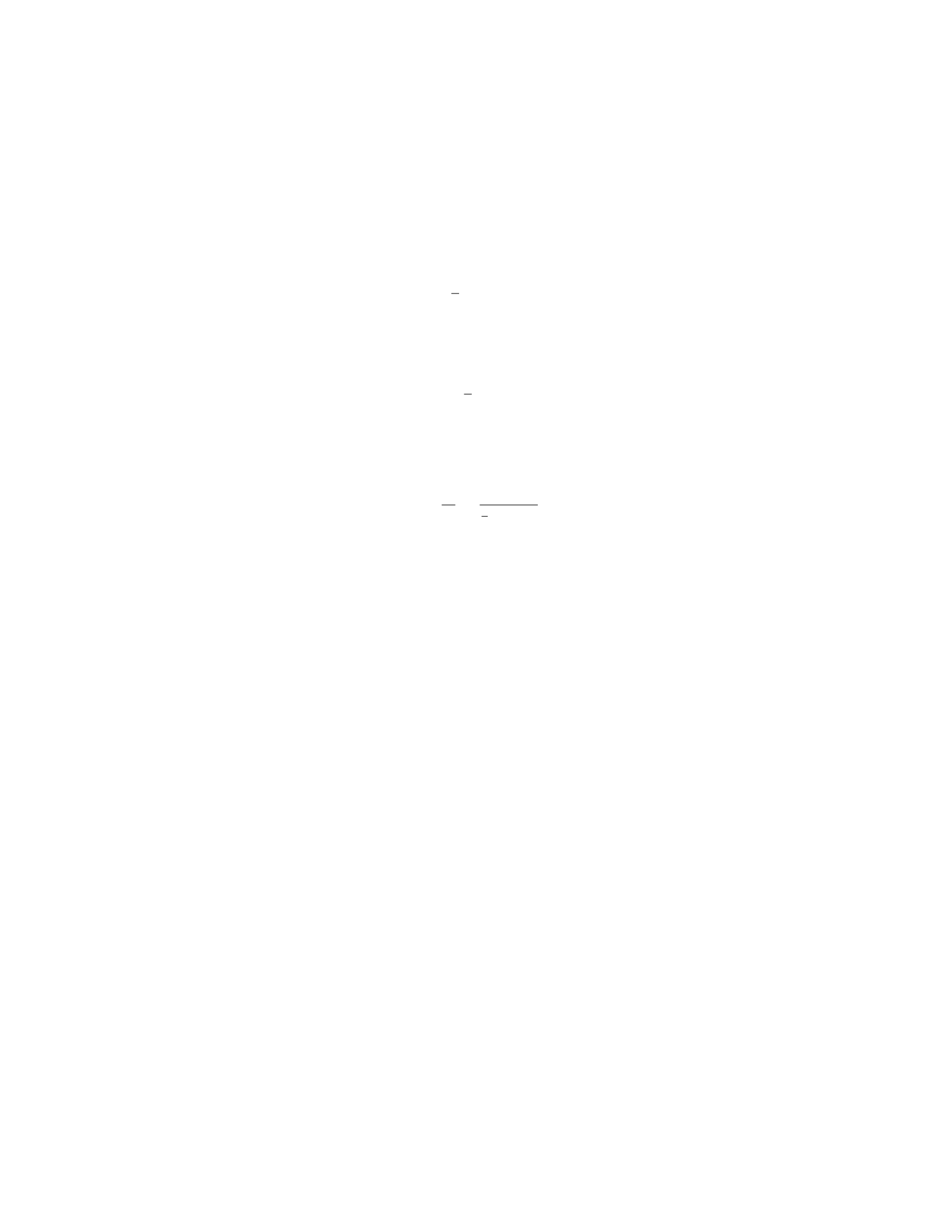
V=4
3π(R3−r3)
where R is the outer radius, r is the inner radius, and π≈3.14159. Since the
shell is hollow, with an outer radius of 0.5 m, and no inner radius, the volume
can be simplified to:
V=4
3π(0.53)
Step 2: Find the density of the shell. Density (ρ) is defined as mass per unit
volume. Given that the mass of the shell is 20 kg and the volume is calculated
in Step 1, the density can be expressed as:
ρ=m
V=20
4
3π(0.53)
Step 3: Determine the buoyant force acting on the shell. The buoyant
force is equal to the weight of the water displaced by the shell. According to
Archimedes’ principle, the buoyant force is given by:
Fb=ρwater ·g·Vdisplaced
Where: - ρwater is the density of water, - g is the acceleration due to gravity,
and - Vdisplaced is the volume of water displaced by the shell.
Step 4: Calculate the net force experienced by the shell. The net force
experienced by the shell when released from rest is the difference between the
buoyant force and the weight of the shell. The weight of the shell is given by:
W=m·g
The net force is thus:
Fnet =Fb−W
Substitute the given values into the above equations to find the buoyant
force and the net force.
Question 9
Question
A large barrel of oil has a mass of 400 kg and a volume of 0.5 m3. When it is
fully submerged in water, the apparent weight of the barrel is 3000 N. Calculate
the density of the oil.
8

Solution
Step 1: First, let’s calculate the weight of the barrel in air using the formula
W=mg, where mis the mass of the barrel and gis the acceleration due to
gravity (approximately 9.81 m/s2).
Weight in air = 400 kg ×9.81 m/s2= 3924 N
Step 2: Next, let’s calculate the buoyant force acting on the barrel when it
is fully submerged in water. The buoyant force is equal to the weight of the
water displaced by the barrel. The volume of the barrel is 0.5 m3, so the weight
of water displaced is given by Fbuoyant =V ρwaterg, where Vis the volume of
the barrel, ρwater is the density of water (1000 kg/m3), and gis the acceleration
due to gravity.
Fbuoyant = 0.5 m3×1000 kg/m3×9.81 m/s2= 4905 N
Step 3: Since the apparent weight of the barrel when submerged in water
is 3000 N, the buoyant force acting upwards on the barrel in water is 3000 N.
This is given by Fbuoyant = 3000 N.
Step 4: Using Archimedes’ principle, we can relate the density of the oil to
the buoyant force. The buoyant force on the barrel is also equal to the weight
of the oil displaced. Thus, Fbuoyant =V ρoilg, where ρoil is the density of the oil.
3000 N = 0.5 m3×ρoil ×9.81 m/s2
Step 5: Solving for ρoil, we find:
ρoil =3000 N
0.5 m3×9.81 m/s2= 612.24 kg/m3
Therefore, the density of the oil is 612.24 kg/m3.
Question 10
Question
A cube made of lead with sides of length 10 cm is completely submerged in
water. If the density of lead is 11,300 kg/m3and the density of water is 1000
kg/m3, find the buoyant force acting on the lead cube.
Solution
Step 1: Determine the volume of the lead cube. Step 2: Calculate the weight
of the lead cube. Step 3: Calculate the weight of the water displaced. Step 4:
Find the buoyant force acting on the lead cube.
9

Step 1: The volume of the lead cube can be calculated using the formula
for the volume of a cube:
Volume of cube = side length3= (0.1 m)3= 0.001 m3
Step 2: The weight of the lead cube can be found using the formula:
Weight = mass ×acceleration due to gravity
Weight = density ×volume ×acceleration due to gravity
Weight = 11,300 kg/m3×0.001 m3×9.8 m/s2= 110.74 N
Step 3: The weight of the water displaced by the lead cube is equal to the
weight of the lead cube. Therefore, the weight of the water displaced is 110.74
N.
Step 4: The buoyant force acting on the lead cube is equal to the weight of
the water displaced, which is 110.74 N.
Question 11
Question
A spherical balloon with a radius of 1.5 meters is filled with helium gas. The
density of helium is 0.1785 kg/m3, while the density of air is 1.2 kg/m3. Calcu-
late the maximum mass the balloon can carry without sinking in air.
Solution
Step 1: Find the volume of the balloon. Since the balloon is spherical, we can
use the formula for the volume of a sphere:
V=4
3πr3
where ris the radius of the balloon given as 1.5 meters.
Step 2: Substitute the radius into the formula to find the volume.
V=4
3π×(1.5)3
Step 3: Calculate the volume.
V=4
3π×3.375
V≈14.137 m3
Step 4: Calculate the buoyant force acting on the balloon. The buoyant
force is equal to the weight of the air displaced by the balloon. The weight of
air displaced is given by:
Weight of air = Density of air×Volume of the balloon×Acceleration due to gravity
10

Weight of air = 1.2×14.137 ×9.81
Step 5: Calculate the weight of air displaced.
Weight of air ≈166.323 N
Step 6: Calculate the maximum mass the balloon can carry without sinking.
The buoyant force is equal to the weight of the air displaced, so the maximum
mass the balloon can carry is the weight of the displaced air divided by the
acceleration due to gravity:
Maximum mass = Weight of air
9.81
Step 7: Calculate the maximum mass.
Maximum mass ≈166.323
9.81
Maximum mass ≈16.95 kg
Therefore, the maximum mass the balloon can carry without sinking in air
is approximately 16.95 kg.
Question 12
Question
A cube of side length aand density ρ1is floating in a liquid of density ρ2with
a fraction fof its volume submerged. Determine the expression for the depth
to which the cube is submerged in terms of the given quantities.
Solution
Step 1: Find the buoyant force acting on the cube. The buoyant force is given
by the weight of the liquid displaced by the cube. Let the volume of the cube be
V=a3, then the volume of the cube submerged in the liquid is fV =fa3. The
weight of the liquid displaced is Wliquid =ρ2·f V ·g. Therefore, the buoyant
force Fbuoyant =ρ2·fa3·g.
Step 2: Find the weight of the cube. The weight of the cube is given by the
density times volume times acceleration due to gravity Wcube =ρ1·a3·g.
Step 3: For the cube to remain floating at a constant depth, the buoyant
force must balance the weight of the cube. This gives us the equation ρ2·fa3·g=
ρ1·a3·g.
Step 4: Solve for the fraction fof the cube’s volume submerged.
ρ2·fa3·g=ρ1·a3·g
ρ2·f=ρ1
11

f=ρ1
ρ2
Therefore, the depth to which the cube is submerged is given by the fraction
of its volume submerged, which is f=ρ1
ρ2.
Question 13
Question
A cylindrical object with a radius of 5 cm and a height of 20 cm is immersed in
water. The density of water is 1000 kg/m3and the gravitational acceleration is
9.81 m/s2. If the object floats with 1/3 of its volume above the surface of the
water, determine the density of the material the object is made of.
Solution
Step 1: Calculate the volume of the object submerged in water. The volume
of the object submerged in water can be calculated using the formula for the
volume of a cylinder, V=πr2h, where ris the radius and his the height. Given
that 1/3 of the volume of the cylinder is submerged in water, we can find the
volume of the submerged section:
Vsubmerged =1
3·π(0.05 m)2·0.2 m
Step 2: Calculate the buoyant force acting on the object. The buoyant force
is given by the formula Fb=ρV g, where ρis the density of the fluid, Vis
the volume of the fluid displaced, and gis the acceleration due to gravity. The
volume of water displaced by the submerged section of the cylinder is equal to
the volume of the submerged section, Vsubmerged. Therefore, the buoyant force
is:
Fb= 1000 kg/m3·Vsubmerged ·9.81 m/s2
Step 3: Set up the equilibrium condition. For an object to float, the buoyant
force acting on it must be equal to the weight of the object. The weight of the
object can be calculated using the formula W=m·g, where mis the mass of
the object. Since the object is floating, the weight of the object is equal to the
weight of the water it displaces. This weight is equal to the buoyant force, so
we have:
m·g= 1000 kg/m3·Vsubmerged ·g
Step 4: Find the density of the material the object is made of. The mass of
the object can be calculated using the density formula m=ρobjectVtotal, where
ρobject is the density of the object material and Vtotal is the total volume of the
object. Since 1/3 of the object is submerged, the total volume of the object is:
Vtotal =3
2·Vsubmerged
12

Therefore, the mass of the object is:
ρobject ·3
2·Vsubmerged = 1000 kg/m3·Vsubmerged
Finally, solve for the density of the object material, ρobject.
Question 14
Question
A cube of wood with a density of 0.8 g/cm3and a side length of 10 cm is floating
in water. What is the depth to which it floats?
Solution
Step 1: Determine the density of water. The density of water is typically 1
g/cm3. Step 2: Calculate the weight of the cube. The weight of an object is
given by the formula: weight = mass * gravity. The mass of the cube can be
calculated as the volume of the cube multiplied by its density: mass = volume *
density. The volume of the cube is given by the formula: volume = side length3.
Therefore, the mass of the cube is: mass = 10 cm3* 0.8 g/cm3= 8 g. The
weight of the cube is: weight = 8 g * 9.8 m/s2= 78.4 N. Step 3: Calculate
the buoyant force on the cube. The buoyant force on an object is equal to the
weight of the fluid displaced by the object. In this case, the buoyant force on
the cube is equal to the weight of the water displaced by the cube, which can be
calculated as the volume of water displaced multiplied by the density of water
and gravity. Step 4: Calculate the volume of water displaced. The volume of
water displaced by the cube is equal to the volume of the cube that is submerged
in water. Let the depth to which the cube floats be h cm. Therefore, the volume
of water displaced is h cm * 10 cm2= 10h cm3. Step 5: Calculate the buoyant
force. The buoyant force is equal to the weight of the water displaced: buoyant
force = 10h cm3* 1 g/cm3* 9.8 m/s2= 98h N. Step 6: Apply Archimedes’
principle. According to Archimedes’ principle, the buoyant force on an object
is equal to the weight of the fluid it displaces. Therefore, the buoyant force is
equal to the weight of the cube while it is floating: 78.4 N = 98h N. Solve for h:
h = 78.4 N / 98 N/cm = 0.8 cm. Therefore, the depth to which the cube floats
is 0.8 cm.
Question 15
Question
A spherical balloon with a radius of 2 meters is filled with helium. The mass
of the balloon itself is 10 kg. If the density of helium is 0.18 kg/m3and the
density of air is 1.225 kg/m3, calculate the buoyant force acting on the balloon.
13

Solution
Step 1: Calculate the volume of the balloon using the formula for the volume
of a sphere: V=4
3πr3. Given that the radius r= 2 m,
V=4
3π(2 m)3=32
3πm3
Step 2: Calculate the total mass of the balloon. The mass of the balloon
itself is 10 kg and the mass of the helium can be calculated as mass = density
×volume. The mass of helium mhelium = densityhelium ×V. Given that density
of helium densityhelium = 0.18 kg/m3,
mhelium = 0.18 ×32
3π=288
3πkg
The total mass mtotal of the balloon is:
mtotal =mhelium +mballoon =288
3π+ 10 kg = 288
3π+ 30 kg
Step 3: Calculate the difference in densities between air and helium to find
the effective density of the balloon. Given that the density of air densityair =
1.225 kg/m3,
∆density = densityair −densityhelium = 1.225 −0.18 = 1.045 kg/m3
Step 4: Calculate the buoyant force using Archimedes’ principle, which states
that the buoyant force Fbuoyant is equal to the weight of the fluid displaced by
the object. The buoyant force can be calculated as Fbuoyant = densityair ×V×g,
where Vis the volume of the balloon and gis the acceleration due to gravity.
Fbuoyant = 1.225 ×32
3π×9.8 N
Question 16
Question
A solid cube with sides of length 0.1 m and density 1000 kg/m3is placed in a
container of water. If the cube is released from rest, determine the acceleration
of the cube as it sinks in the water. Take the density of water to be 1000 kg/m3
and acceleration due to gravity to be 9.81 m/s2.
Solution
Step 1: Determine the buoyant force acting on the cube. The buoyant force
FBacting on the cube is equal to the weight of the water displaced by the
cube. The volume of the cube is V= (0.1 m)3= 0.001 m3. Since the cube is
submerged in water, the volume of water displaced is equal to the volume of
14

the cube, 0.001 m3. The weight of the water displaced is given by mg, where
mis the mass of the water and gis the acceleration due to gravity. The mass
of the water displaced is m=ρwater ·V, where ρwater is the density of water.
Therefore, FB=ρwater ·V·g.
Step 2: Determine the weight of the cube. The weight of the cube Fcube is
given by mg, where mis the mass of the cube. The mass of the cube is m=
ρcube ·V, where ρcube is the density of the cube. Therefore, Fcube =ρcube ·V·g.
Step 3: Apply Newton’s second law to find the acceleration of the cube.
The net force acting on the cube is the difference between the buoyant force
and the weight of the cube, Fnet =FB−Fcube. By Newton’s second law,
we have Fnet =mcube ·a, where mcube is the mass of the cube and ais its
acceleration. Substituting the expressions for FB,Fcube, and mcube, we get
ρwater ·V·g−ρcube ·V·g=ρcube ·V·a. Solving for a, we find a=ρwater −ρcube
ρcube ·g.
Substituting the given values, we get a=1000 kg/m3
−1000 kg/m3
1000 kg/m3·9.81 m/s2=
0 m/s2.
Question 17
Question
A cube of aluminum with sides measuring 10 cm each is submerged in a pool
of water. If the density of aluminum is 2.7 g/cm3and the density of water is
1 g/cm3, determine the buoyant force acting on the aluminum cube in Newtons.
Solution
Step 1: Calculate the volume of the aluminum cube. Given that each side of
the cube measures 10 cm, the volume can be calculated as:
Volume of cube = side length3= (10 cm)3
Step 2: Convert the volume of the cube to cubic meters. Since 1 cm3=
10−6m3, we have:
Volume of cube = (10 cm)3×(10−6m3/cm3)
Step 3: Calculate the mass of the aluminum cube. The mass can be found
using the formula:
Mass = Density ×Volume
Substitute the density of aluminum (2.7 g/cm3) and the volume of the cube to
find the mass.
Step 4: Determine the weight of the aluminum cube. Use the formula
Weight = Mass ×Acceleration due to gravity.
15

Step 5: Determine the weight of the water displaced by the aluminum cube.
Since the cube is submerged in water, the weight of the water displaced is equal
to the buoyant force acting on the cube.
Step 6: Apply Archimedes’ principle to find the buoyant force. Archimedes’
principle states that the buoyant force is equal to the weight of the fluid displaced
by the object, which in this case is water.
Step 7: Calculate the buoyant force in Newtons. The buoyant force can be
determined as the weight of the water displaced by the aluminum cube.
Question 18
Question
A cube of wood with sides of length 0.1 m and a density of 600 kg/m3is floating
in a container of water. If the cube is pushed down a depth of 0.04 m and then
released, determine the magnitude of the acceleration of the cube as it returns
to its original position. Assume the density of water is 1000 kg/m3and neglect
any effects due to friction.
Solution
Step 1: Calculate the weight of the cube. The weight of the cube is equal to
the weight of the water displaced by the cube. We can calculate the weight of
the water displaced using Archimedes’ principle:
Weight of the cube = Weight of the water displaced
mg =ρwater ·Vdisplaced ·g
mg =ρwater ·L3·g
mg = 1000 kg/m3·(0.1 m)3·9.8 m/s2
mg = 98 N
Step 2: Calculate the buoyant force when the cube is submerged. When the
cube is submerged to a depth of 0.04 m, the buoyant force acting on it is equal
to the weight of the water displaced at that depth:
Fbuoyant =ρwater ·g·Vdisplaced
Fbuoyant = 1000 kg/m3·A·d·g
Fbuoyant = 1000 kg/m3·(0.1 m)2·0.04 m ·9.8 m/s2
Fbuoyant = 39.2 N
Step 3: Determine the net force and acceleration when the cube is sub-
merged. The net force acting on the cube when submerged is the difference
between its weight and the buoyant force:
16

Fnet =mg −Fbuoyant
Fnet = 98 N −39.2 N
Fnet = 58.8 N
The acceleration of the cube is given by Newton’s second law:
Fnet =m·a
58.8 N = 600 kg/m3·L3·a
a=58.8 N
600 kg/m3·(0.1 m)3
a= 0.98 m/s2
Therefore, the magnitude of the acceleration of the cube as it returns to its
original position is 0.98 m/s2.
Question 19
Question
A cylindrical tank has a radius of 2 meters and a height of 5 meters. The tank
is filled with water up to a height of 3 meters. Calculate the buoyant force
acting on a solid lead sphere of radius 0.5 meters submerged in the water. The
density of lead is 11,343 kg/m3and the density of water is 1000 kg/m3. Take
the gravitational acceleration to be 9.81 m/s2.
Solution
Step 1: Calculate the volume of the lead sphere. Step 2: Determine the volume
of water displaced by the lead sphere. Step 3: Calculate the buoyant force
acting on the lead sphere.
Step 1: The volume of a sphere is given by the formula:
V=4
3πr3
where ris the radius of the sphere. Substituting in the radius r= 0.5 m, we
get:
V=4
3π(0.5)3=1
6πm3
So, the volume of the lead sphere is 1
6πm3.
Step 2: The volume of water displaced by the lead sphere can be determined
by the volume of the cylindrical tank filled with water up to a height of 3 meters.
The volume of water in the tank is given by:
Vwater =πr2h
17

Substituting the values r= 2 m and h= 3 m, we get:
Vwater =π(22)(3) = 12πm3
The volume of water displaced by the lead sphere is the same as the volume of
water in the tank up to a height of 3 meters, so Vdisplaced = 12πm3.
Step 3: The buoyant force acting on the lead sphere is equal to the weight
of the water displaced by the sphere. The weight of the water displaced is given
by:
Fb=ρwater ·g·Vdisplaced
Substitute the values ρwater = 1000 kg/m3,g= 9.81 m/s2, and Vdisplaced =
12πm3:
Fb= 1000 ·9.81 ·12π≈372,600 N
Therefore, the buoyant force acting on the lead sphere submerged in the water
is approximately 372,600 N.
Question 20
Question
A steel cube with a side length of 10 cm is placed in a liquid with a density of
800 kg/m3. What is the buoyant force on the cube? (Use g= 9.81 m/s2)
Solution
Step 1: Calculate the volume of the cube. The volume of a cube is given by
V= side length3. In this case, the side length is 10 cm, which is equal to 0.1
m. Thus, the volume of the cube is:
V= (0.1 m)3= 0.001 m3
Step 2: Calculate the mass of the cube. The mass of the cube can be found
using the density of steel, which is 7850 kg/m3. We know that mass = density
×volume, so:
m= 7850 kg/m3×0.001 m3= 7.85 kg
Step 3: Calculate the weight of the cube. The weight of the cube is given
by the formula W=mg. Substitute the mass we found in the previous step:
W= 7.85 kg ×9.81 m/s2= 77.1685 N
Step 4: Calculate the buoyant force. The buoyant force on the cube is equal
to the weight of the liquid displaced by the cube, which can be calculated using
Archimedes’ Principle. Buoyant force = weight of liquid displaced Buoyant force
= density of liquid ×volume of liquid displaced ×g Buoyant force = 800 kg/m3
×0.001 m3×9.81 m/s2Buoyant force = 7.848 N
Therefore, the buoyant force on the cube is 7.848 N.
18

Question 21
Question
A cube with a density of 800 kg/m3and side length of 0.5 meters is floating in
water. What is the depth of the cube that is submerged in the water?
Solution
Step 1: First, we need to determine the density of water, which is 1000 kg/m3.
Step 2: Next, let’s denote the depth of the cube submerged in the water as
h. The volume of the cube submerged in the water is Vsubmerged = (0.5 m)2·h.
Step 3: The weight of the cube is equal to the buoyant force acting on it.
The weight of the cube is given by mg, where mis the mass of the cube and
gis the acceleration due to gravity (9.81 m/s2). The mass of the cube is V·ρ,
where Vis the volume of the cube and ρis the density of the cube.
Step 4: The weight of the cube is mg =V·ρ·g.
Step 5: The buoyant force is equal to the weight of the water displaced by
the cube. The buoyant force is given by Fbuoyant =Vsubmerged ·ρwater ·g.
Step 6: Since the cube is floating, the weight of the cube is equal to the
buoyant force: V·ρ·g=Vsubmerged ·ρwater ·g.
Step 7: Substituting the expressions for Vsubmerged and simplifying, we get
(0.5 m)2·h·800 kg/m3= (0.5 m)2·h·1000 kg/m3.
Step 8: Solving for h, we find h=1000
800 = 1.25 m.
Therefore, the depth of the cube submerged in the water is 1.25 m.
Question 22
Question
A solid cube of iron with a side length of 10 cm is placed into a container of
water. The density of iron is 7.87 g/cm3and the density of water is 1.00 g/cm3.
What is the apparent weight of the iron cube when submerged in water?
Solution
Step 1: First, we need to calculate the weight of the iron cube in air. Given
that the density of iron is 7.87 g/cm3, we can calculate the mass of the iron
cube using its volume and density. The volume of a cube is given by V=s3,
where sis the side length. Thus, the volume of the iron cube is:
V= (10 cm)3= 1000 cm3
The mass of the iron cube is then:
miron = Density ×Volume = 7.87 g/cm3×1000 cm3= 7870 g = 7.87 kg
19

The weight of the iron cube in air is given by:
Wiron =miron ×g= 7.87 kg ×9.81 m/s2= 77.36 N
Step 2: Next, we need to calculate the buoyant force acting on the iron
cube when submerged in water. The buoyant force is equal to the weight of the
water displaced by the iron cube. The volume of water displaced is equal to the
volume of the iron cube (since it is fully submerged), which is 1000 cm3. The
mass of this displaced water is:
mwater = Density of water×Volume = 1.00 g/cm3×1000 cm3= 1000 g = 1.00 kg
Therefore, the buoyant force is:
Fbuoyant =mwater ×g= 1.00 kg ×9.81 m/s2= 9.81 N
Step 3: Finally, we can calculate the apparent weight of the iron cube when
submerged in water. The apparent weight is given by:
Wapparent =Wiron −Fbuoyant = 77.36 N −9.81 N = 67.55 N
Therefore, the apparent weight of the iron cube when submerged in water is
67.55 N.
Question 23
Question
A sphere made of aluminum (density 2700 kg/m3) with a radius of 0.1 m is
submerged in a container of oil (density 850 kg/m3) such that it floats with 30
Solution
Step 1: Calculate the volume of the sphere submerged in the oil. The volume of
a sphere can be calculated using the formula V=4
3πr3. Since 30Substituting
the radius r= 0.1 m into the formula:
Volume of the sphere = 4
3π×(0.1)3≈0.004188 m3.
Thus, the volume submerged is:
Volume submerged = 0.3×0.004188 ≈0.0012564 m3.
Step 2: Calculate the mass of the sphere. The buoyant force acting on the
sphere is equal to the weight of the oil displaced by the sphere. The weight of
the oil displaced can be calculated using the formula Fb=ρoil ×Vsubmerged ×g,
20

where gis the acceleration due to gravity and ρoil is the density of the oil.
Substituting ρoil = 850 kg/m3,Vsubmerged = 0.0012564 m3, and g= 9.81 m/s2:
Fb= 850 ×0.0012564 ×9.81 ≈10.466 N.
Step 3: Equate the buoyant force to the weight of the sphere to find its mass.
The weight of the sphere can be calculated using the formula W=m×g, where
mis the mass of the sphere. Equate Wto the buoyant force Fb:
m×g= 10.466.
Solve for m:
m=10.466
9.81 ≈1.067 kg.
Therefore, the mass of the aluminum sphere is approximately 1.067 kg.
Question 24
Question
A cube of wood with a density of 0.8 g/cm3and a side length of 5 cm is floating
in water. What is the volume of the cube above the water surface?
Solution
Step 1: Calculate the density of water. The density of water is 1 g/cm3.
Step 2: Use Archimedes’ principle to find the volume of the cube above the
water surface. The buoyant force on the cube is equal to the weight of the water
displaced by the cube. This can be calculated using the formula:
Fbuoyant =ρwater ·Vabove water ·g
where: Fbuoyant = Buoyant force, ρwater = Density of water, Vabove water =
Volume of the cube above the water surface, g= Acceleration due to gravity.
Step 3: Calculate the weight of the cube using the formula W=m·g, where
mis the total mass of the cube (including the part above water).
Step 4: Set up the equilibrium condition by noting that the weight of the
cube equals the buoyant force:
W=Fbuoyant
Step 5: Substitute the expressions for Wand Fbuoyant and solve for Vabove water.
Step 6: Calculate the volume of the cube above the water surface.
By solving the problem step by step, we can find the volume of the cube
above the water surface.
21

Question 25
Question
A cube of wood with a density of 800 kg/m3and side length of 0.1 m is floating
in water. What is the depth to which the cube is submerged?
Solution
Step 1: Determine the density of water. We know that the density of water is
approximately 1000 kg/m3.
Step 2: Identify the forces acting on the cube. The buoyant force (FB) will
act upwards on the cube and the weight of the cube (Fg) will act downwards.
Step 3: Calculate the weight of the cube. The weight of the cube can be
calculated using the formula:
Fg=mg
where mis the mass of the cube and gis the acceleration due to gravity (ap-
proximately 9.81 m/s2). The mass of the cube can be calculated using the
formula:
mass = density ×volume
mass = 800 kg/m3×(0.1 m)3
mass = 800 ×0.001 kg
mass = 0.8 kg
Therefore, the weight of the cube is:
Fg= 0.8 kg ×9.81 m/s2
Step 4: Calculate the buoyant force. The buoyant force can be calculated
using the formula:
FB=ρwater ×Vsubmerged ×g
where ρwater is the density of water and Vsubmerged is the volume of the cube
that is submerged. The volume of the cube that is submerged can be calculated
using the formula:
Vsubmerged =A×d
where Ais the area of one face of the cube and dis the depth to which the cube
is submerged.
Step 5: Equate the weight of the cube to the buoyant force. The cube is
floating, so the weight of the cube is equal to the buoyant force:
Fg=FB
0.8 kg ×9.81 m/s2=ρwater ×0.1 m2×d×9.81 m/s2
22

Step 6: Solve for the depth to which the cube is submerged (d).
0.8 = 1000 ×0.1×d
d=0.8
100
d= 0.008 m
Therefore, the depth to which the cube is submerged is 0.008 m.
Question 26
Question
A cube of metal with side length 10 cm and density 8000 kg/m3is submerged in
water. Determine the buoyant force acting on the cube and the depth to which
the cube is submerged in water. The density of water is 1000 kg/m3.
Solution
Step 1: Calculate the buoyant force acting on the cube. Step 2: Use the buoyant
force to determine the depth to which the cube is submerged in water.
Step 1: Calculate the buoyant force acting on the cube.
Given: Density of metal cube, ρcube = 8000 kg/m3
Density of water, ρwater = 1000 kg/m3
Side length of cube, a= 0.1 m
The volume of the cube is Vcube =a3= (0.1)3m3.
The weight of the cube can be calculated as:
Wcube =ρcube ·g·Vcube
where gis the acceleration due to gravity.
The buoyant force acting on the cube is equal to the weight of the water
displaced by the cube, which is given by:
Fbuoyant =ρwater ·g·Vcube
Substitute the known values to find the buoyant force.
Step 2: Use the buoyant force to determine the depth to which the cube is
submerged in water.
The depth to which the cube is submerged is given by:
h=Fbuoyant
A·ρwater ·g
where Ais the surface area of the cube in contact with water.
The surface area of one face of the cube is a2. Thus, the total surface area
is 6a2.
Substitute the known values to find the depth to which the cube is sub-
merged.
23

Question 27
Question
A cube of wood with a density of 600 kg/m3and side length 0.10 m is floating in
water. What is the percentage of the volume of the cube submerged in water?
Solution
Step 1: Determine the density of water. The density of water is approximately
1000 kg/m3.
Step 2: Calculate the weight of the cube. The weight of the cube can be
calculated using the formula W=mg, where mis the mass of the cube and gis
the acceleration due to gravity (9.81 m/s2). Given that density = mass/volume,
we can rearrange this to find the mass of the cube: m= density ×volume. The
volume of the cube is V= side length3= 0.103m3.
Step 3: Calculate the buoyant force. According to Archimedes’ principle,
the buoyant force (FB) acting on the cube is equal to the weight of the water
displaced by the cube. The buoyant force can be calculated using the formula
FB= density of water ×volume submerged ×g.
Step 4: Set up the equilibrium condition. For the cube to float, the weight
of the cube must be equal to the buoyant force. Therefore, we have W=FB.
Step 5: Calculate the percentage of the volume submerged. The percentage
of the volume submerged can be calculated as 100 ×volume submerged
total volume . Since
the volume of the cube submerged is equal to the volume of water displaced, we
can find the percentage of the volume submerged using the formula above.
Step 6: Perform the calculations. Now, substitute the relevant values into
the formulas and solve for the percentage of the volume submerged.
Density of water = 1000 kg/m3
Volume of the cube = (0.10 m)3= 0.001 m3
Mass of the cube = 600 kg/m3×0.001 m3
Buoyant force = 1000 kg/m3×volume submerged ×9.81 m/s2
Setting weight equal to the buoyant force and solving for the volume sub-
merged yields:
600 kg/m3×0.001 m3×9.81 m/s2= 1000 kg/m3×volume submerged×9.81 m/s2
Percentage submerged = 100 ×volume submerged
0.001 m3
24

Question 28
Question
A cube of side length 15 cm and density 800 kg/m3is floating in a liquid of
density 1000 kg/m3. Determine the depth to which the cube is submerged in
the liquid.
Solution
Step 1: First, we need to find the volume of the cube. Given that the side length
of the cube is 15 cm, we have:
Volume of the cube = (side length)3= (0.15 m)3= 0.003375 m3
Step 2: Next, we can find the weight of the cube using the formula W=mg,
where mis the mass of the cube and gis the acceleration due to gravity (9.81
m/s2). The mass of the cube can be calculated using the formula m=ρV ,
where ρis the density of the cube and Vis its volume. Substituting the values:
m= 800 kg/m3×0.003375 m3= 2.7 kg
Step 3: The weight of the cube is:
W= 2.7 kg ×9.81 m/s2= 26.487 N
Step 4: According to Archimedes’ principle, the buoyant force acting on the
cube is equal to the weight of the liquid displaced by the cube. The buoyant
force is given by Fb=ρliquidVsubmergedg, where ρliquid is the density of the liquid
and Vsubmerged is the volume of the cube submerged in the liquid. Let hbe the
depth to which the cube is submerged. Then Vsubmerged = 0.152h. Therefore,
Fb= 1000 kg/m3×0.152h×9.81 m/s2
Step 5: Since the cube is floating, the buoyant force must equal the weight
of the cube:
1000 kg/m3×0.152h×9.81 m/s2= 26.487 N
Solving for h, we find:
h=26.487
1000 ×0.152×9.81 ≈0.12 m
Therefore, the cube is submerged to a depth of approximately 12 cm in the
liquid.
Question 29
Question
A metal sphere of radius 10 cm and density 8000 kg/m3is placed in a container
filled with water. The sphere floats with 80
25

Solution
Step 1: First, we need to find the volume of the sphere submerged in water. We
are told that 80
Volume submerged = 0.8×4
3π(0.1)3
Volume submerged = 0.268 m3
Step 2: Next, we will find the weight of the water displaced by the submerged
part of the sphere. The weight of the water displaced is equal to the buoyant
force acting on the sphere, which can be calculated using the formula:
Buoyant force = Weight of water displaced = Volume submerged×Density of water×Acceleration due to gravity
Buoyant force = 0.268 m3×1000 kg/m3×9.81 m/s2
Buoyant force ≈2628.468 N
Step 3: Since the sphere is floating, the buoyant force is equal to the weight
of the sphere. The weight of the sphere can be calculated using the formula:
Weight of sphere = Volume of sphere×Density of sphere×Acceleration due to gravity
Weight of sphere = 4
3π(0.1)3×8000 kg/m3×9.81 m/s2
Weight of sphere ≈837.758 N
Step 4: Since the weight of the sphere is greater than the buoyant force, the
sphere will sink. Thus, the buoyant force acting on the sphere is 2628.468 N.
Question 30
Question
A cube of wood with sides of length 10 cm and a density of 0.8 g/cm3is floating
in water. Calculate the depth to which the cube is submerged in the water.
(Density of water = 1 g/cm3)
Solution
Step 1: Determine the volume of the cube The volume of the cube can be
calculated using the formula:
Volume = side length3
Given that the side length of the cube is 10 cm, we have:
Volume = 103= 1000 cm3
26

Step 2: Determine the mass of the cube The mass of the cube can be calcu-
lated using the formula:
Mass = density ×volume
Given that the density of the cube is 0.8 g/cm3, we have:
Mass = 0.8×1000 = 800 g = 0.8 kg
Step 3: Calculate the volume of water displaced According to Archimedes’
principle, the buoyant force is equal to the weight of the water displaced by the
cube. The volume of water displaced is equal to the volume of the submerged
part of the cube. Let the depth to which the cube is submerged be denoted as
h, then the volume of water displaced is 100 ×hcm3.
Step 4: Calculate the weight of the cube The weight of the cube is given by:
Weight of cube = mass ×acceleration due to gravity
Weight of cube = 0.8×9.81 = 7.848 N
Step 5: Calculate the buoyant force The buoyant force is equal to the weight
of the water displaced. Using the density of water and the volume of water
displaced, we can calculate the buoyant force:
Buoyant force = Density of water×Volume of water displaced×Acceleration due to gravity
Buoyant force = 1 ×100 ×h×9.81 = 981hN
Step 6: Set up the equilibrium condition For the cube to float in water, the
weight of the cube must be equal to the buoyant force:
7.848 = 981h
Solving for hgives:
h=7.848
981 = 0.008 m = 0.8 cm
Therefore, the cube is submerged to a depth of 0.8 cm in the water.
Question 31
Question
A cylindrical glass of radius 5 cm and height 8 cm is floating in water with its
axis vertical. If the depth of the glass below the water surface is 4 cm, determine
the density of the glass.
Given: Density of water = 1000 kg/m3, g = 9.8 m/s2.
27

Solution
Step 1: We first calculate the volume of the glass submerged in water. The
volume of the glass submerged in water is equal to the volume in water displaced
by the glass, which is equal to the volume of water displaced by the glass.
Let Vglass be the total volume of the glass, and Vsubmerged be the volume of
the glass submerged in water.
Vsubmerged =πr2h
Given: r= 5 cm = 0.05 m, h= 4 cm = 0.04 m
Vsubmerged =π×(0.05)2×0.04 ≈3.14 ×10⁻⁵m3
Step 2: Calculate the weight of water displaced by the glass. The weight of
water displaced by the glass is equal to the weight of the glass.
Fbuoyant =Fgravity
Vsubmerged ×ρwater ×g=Vglass ×ρglass ×g
ρglass =Vsubmerged ×ρwater
Vglass
ρglass =3.14 ×10−5×1000
π×(0.05)2×0.08 ≈2500 kg/m3
Therefore, the density of the glass is approximately 2500 kg/m3.
Question 32
Question
A cube of side length aand density ρ1is placed in a liquid of density ρ2with
a < 2
3Dwhere Dis the depth of the liquid. Determine the conditions for the
cube to be floating, sinking, or completely submerged in terms of ρ1,ρ2, and D.
Solution
Step 1: We first need to consider the different forces acting on the cube: the
gravitational force, the buoyant force, and the force due to the displaced liquid.
Step 2: Let’s examine the conditions for each case: - If the cube is floating,
the buoyant force Fbuoyant must equal the weight of the cube mg. The buoyant
force is given by Fbuoyant =ρ2Vcubeg, where Vcube =a3is the volume of the
cube. The weight of the cube is mg =ρ1Vcubeg. Therefore, for the cube to be
floating, ρ2Vcube =ρ1Vcube.
Step 3: If the cube is sinking, the weight of the cube must be greater than
the buoyant force. This is the case when ρ1Vcube > ρ2Vcube, which simplifies to
ρ1> ρ2.
28

Step 4: If the cube is completely submerged, the entire volume must be
underwater. This means the volume of the cube equals the volume of liquid
displaced, i.e., Vcube =Vliquid =D·a2. Therefore, a3=D·a2, which simplifies
to a=D.
Step 5: Putting it all together, we have the following conditions: - For the
cube to be floating: ρ1=ρ2- For the cube to be sinking: ρ1> ρ2- For the
cube to be completely submerged: a=D
Question 33
Question
A cube of wood with side length sand density ρwood is floating in water. If
the cube is pushed down so that three-fourths of it is submerged in water, what
fraction of the cube’s volume is submerged when it is in equilibrium?
Solution
Step 1: First, we find the fraction of the cube’s volume that is submerged when
it is floating in water. Let Vbe the volume of the cube and Vsubmerged be the
submerged volume when the cube is floating. Since the cube is floating, the
buoyant force is equal to the weight of the cube:
Fbuoyant =Fgravity.
The buoyant force is given by Fbuoyant =ρwaterVsubmergedg, where ρwater is the
density of water and gis the acceleration due to gravity. The weight of the cube
is mg, where m=ρwoodVis the mass of the cube. Solving for Vsubmerged gives:
ρwaterVsubmergedg=ρwoodV g ⇒Vsubmerged =ρwood
ρwater
V.
Step 2: Next, we find the fraction of the cube’s volume that is submerged
when three-fourths of it is submerged. Let V3/4 submerged be the submerged
volume when three-fourths of the cube is submerged. Given that three-fourths
of the cube is submerged, we have:
V3/4 submerged
V=3
4
⇒V3/4 submerged =3
4V.
Step 3: Finally, we find the fraction of the cube’s volume that is submerged
when it is pushed down. The fraction of the cube’s volume that is submerged
when it is in equilibrium is given by:
V3/4 submerged
V=3
4.
Therefore, when three-fourths of the cube is submerged in water, three-fourths
of the cube’s volume is submerged when it is in equilibrium.
29

Question 34
Question
A cube of side length 5 cm and density 800 kg/m3is floating in water with 75%
of its volume submerged. Calculate the buoyant force acting on the cube.
Solution
Step 1: Determine the volume of the cube submerged in water. Let Vbe the
volume of the cube. Since 75% of the cube’s volume is submerged, the volume
of the submerged part is 0.75V. Given that the side length of the cube is 5 cm,
we have
V= (5 cm)3= 125 cm3= 0.000125 m3.
Thus, the volume of the submerged part is
0.75V= 0.000125 m3×0.75 = 0.00009375 m3.
Step 2: Calculate the mass of the cube. The mass of the cube can be found
using the formula
mass = density ×volume.
Given that the density of the cube is 800 kg/m3and the total volume is 0.000125
m3, we have
mass = 800 kg/m3×0.000125 m3= 0.1 kg.
Step 3: Calculate the weight of the cube. The weight of the cube can be
found using the formula
weight = mass ×acceleration due to gravity.
Given that the acceleration due to gravity is 9.81 m/s2, the weight of the cube
is
weight = 0.1 kg ×9.81 m/s2= 0.981 N.
Step 4: Calculate the buoyant force. The buoyant force acting on the cube
is equal to the weight of the water displaced by the submerged part of the cube.
Since the cube is floating, the buoyant force is equal in magnitude to the weight
of the cube. Therefore, the buoyant force acting on the cube is 0.981 N.
Question 35
Question
A steel cube with a side length of 10 cm and a density of 7,800 kg/m3is
submerged in water. Determine the buoyant force acting on the cube and the
depth to which it sinks in water. The density of water is 1,000 kg/m3and the
acceleration due to gravity is 9.81 m/s2.
30

Solution
Step 1: Calculate the weight of the steel cube. The weight of an object is given
by W=mg, where mis the mass of the object and gis the acceleration due to
gravity. Since the density of the steel cube is given as 7,800 kg/m3and its side
length is 0.1 m, the mass of the cube is:
m= density ×volume = 7,800 kg/m3×(0.1 m)3= 7.8 kg
Therefore, the weight of the steel cube is:
W= 7.8 kg ×9.81 m/s2= 76.638 N
Step 2: Calculate the volume of the cube submerged in water. The volume
of the cube submerged in water can be calculated using the formula for volume
of a cube: V= side length3. The volume submerged is equal to the volume
of water displaced by the cube. Since the density of water is 1,000 kg/m3, the
mass of water displaced is equal to the mass of the cube. The volume submerged
is then:
V= side length3= (0.1 m)3= 0.001 m3
Step 3: Calculate the buoyant force. The buoyant force acting on the cube
is given by Archimedes’ principle, which states that the buoyant force is equal
to the weight of the water displaced by the object. The buoyant force can be
calculated using the formula: Fb= density of water ×V×g. Substitute the
given values into the formula:
Fb= 1,000 kg/m3×0.001 m3×9.81 m/s2= 9.81 N
Step 4: Calculate the depth to which the cube sinks in water. The depth to
which the cube sinks in water can be calculated using the concept of pressure at
different depths. The pressure exerted by the water at a certain depth is equal
to the atmospheric pressure plus the pressure due to the weight of the water
above that depth. Since the steel cube is in static equilibrium, the upward
buoyant force is equal to the downward weight of the water displaced. Let hbe
the depth to which the cube sinks. The pressure at the depth his:
Patm +ρwatergh =ρwatergh
Equating the pressure due to the weight of the water displaced to the weight of
the cube:
ρwaterghA =mg
Solving for h:
h=mg
ρwatergA =7.8 kg ×9.81 m/s2
1,000 kg/m3×9.81 m/s2= 0.078 m
Therefore, the buoyant force acting on the cube is 9.81 N and the depth to
which it sinks in water is 0.078 m.
31

