



PHYS 101 - ELEMENTS OF PHYSICS -
Angular Motion Question Bank
Question 1
Solution: To find the magnitude of the car’s acceleration at any point along
the track, we need to consider both the centripetal acceleration and tangential
acceleration.
Given: Radius of the circular track, r= 100 meters Velocity of the car,
v= 20 m/s
1. Centripetal acceleration: The centripetal acceleration, ac, is given by the
formula:
ac=v2
r
Substitute the given values:
ac=(20)2
100 = 4 m/s2
2. Tangential acceleration: Since the velocity is constant, there is no tan-
gential acceleration.
3. Total acceleration: The magnitude of the total acceleration, atotal, is the
vector sum of the centripetal acceleration and tangential acceleration. Since
there is no tangential acceleration, the total acceleration is equal to the cen-
tripetal acceleration.
Therefore, the magnitude of the car’s acceleration at any point along the
track is 4 m/s2.Question 1: A car travels around a circular track with a
radius of 100 meters. The car’s velocity is constant at 20 m/s. Find
the magnitude of the car’s acceleration at any point along the track.
Solution: To find the magnitude of the car’s acceleration at any
point along the track, we need to consider both the centripetal accel-
eration and tangential acceleration.
Given: Radius of the circular track, r= 100 meters Velocity of the
car, v= 20 m/s
1. Centripetal acceleration: The centripetal acceleration, ac, is
given by the formula:
ac=v2
r
1

Substitute the given values:
ac=(20)2
100 = 4 m/s2
2. Tangential acceleration: Since the velocity is constant, there is
no tangential acceleration.
3. Total acceleration: The magnitude of the total acceleration,
atotal, is the vector sum of the centripetal acceleration and tangen-
tial acceleration. Since there is no tangential acceleration, the total
acceleration is equal to the centripetal acceleration.
Therefore, the magnitude of the car’s acceleration at any point
along the track is 4m/s2.
Question 2
Step-by-step solution: Given: Initial angular speed, ωi= 0 rad/s
Final angular speed, ωf= 4 rad/s Angular acceleration, α= 2 rad/s
²
Time, t= 5 seconds
Using the equation of angular motion: ωf=ωi+αt
Substitute the given values: 4 = 0 + 2 ×5
Solving for the final angular speed: 4 = 10 So, the final angular
speed after 5 seconds is 4rad/s.
Next, we can find the angular displacement using the equation:
θ=ωit+1
2αt2
Substitute the given values: θ= 0 ×5 + 1
2×2×52
Calculating the angular displacement: θ= 0 + 1
2×2×25 θ= 25 rad
Therefore, the angular displacement of the disc during the 5-
second period is 25 radians.Question 2: A disc rotates with an an-
gular speed of 4 rad/s. If the disc starts from rest and accelerates
at a constant rate of 2 rad/s
²
for 5 seconds, determine the angular
displacement of the disc during this time period.
Step-by-step solution: Given: Initial angular speed, ωi= 0 rad/s
Final angular speed, ωf= 4 rad/s Angular acceleration, α= 2 rad/s
²
Time, t= 5 seconds
Using the equation of angular motion: ωf=ωi+αt
Substitute the given values: 4 = 0 + 2 ×5
Solving for the final angular speed: 4 = 10 So, the final angular
speed after 5 seconds is 4rad/s.
Next, we can find the angular displacement using the equation:
θ=ωit+1
2αt2
Substitute the given values: θ= 0 ×5 + 1
2×2×52
Calculating the angular displacement: θ= 0 + 1
2×2×25 θ= 25 rad
Therefore, the angular displacement of the disc during the 5-
second period is 25 radians.
2

Question 3
Step-by-step solution: Given: Radius of the curved road, r= 100 m
Speed of the car, v= 20 m/s
1. The centripetal acceleration can be calculated using the for-
mula:
ac=v2
r
2. Substitute the given values into the formula:
ac=(20 m/s)2
100 m
3. Calculate the centripetal acceleration:
ac=400 m2/s2
100 m= 4 m/s2
4. Therefore, the magnitude of the car’s acceleration is 4m/s2.Question
3: A car travels along a curved road with a radius of 100 meters. If
the car’s speed is 20 m/s, what is the magnitude of its acceleration?
Step-by-step solution: Given: Radius of the curved road, r= 100 m
Speed of the car, v= 20 m/s
1. The centripetal acceleration can be calculated using the for-
mula:
ac=v2
r
2. Substitute the given values into the formula:
ac=(20 m/s)2
100 m
3. Calculate the centripetal acceleration:
ac=400 m2/s2
100 m= 4 m/s2
4. Therefore, the magnitude of the car’s acceleration is 4m/s2.
Question 4
Solution: Given: Initial angular velocity, ω0= 0 rad/s
Angular acceleration, α= 2 rad/s2
Time, t= 3 s
We can use the equation for angular motion:
ω=ω0+αt
3

Substitute the given values:
ω= 0 + 2 ×3
ω= 6 rad/s
Therefore, the angular velocity of the wheel after 3 seconds is
ω= 6 rad/s.Question 4: A wheel starts from rest and rotates with a
constant angular acceleration of 2rad/s2. Find the angular velocity
of the wheel after 3 seconds.
Solution: Given: Initial angular velocity, ω0= 0 rad/s
Angular acceleration, α= 2 rad/s2
Time, t= 3 s
We can use the equation for angular motion:
ω=ω0+αt
Substitute the given values:
ω= 0 + 2 ×3
ω= 6 rad/s
Therefore, the angular velocity of the wheel after 3 seconds is
ω= 6 rad/s.
Question 5
An object travels along a circular path of radius 2 m with a con-
stant speed of 4 m/s. Calculate the angular velocity of the object.
Step-by-step solution: 1. The angular velocity (ω) is defined as
the rate of change of angular displacement with respect to time. 2.
The formula to calculate angular velocity is given by ω=v
r, where
vis the linear speed and ris the radius of the circular path. 3.
Given that v= 4 m/s and r= 2 m, substitute these values into the
formula to find the angular velocity. 4. Plug in the values: ω=4
2= 2
rad/s. 5. Therefore, the angular velocity of the object traveling along
the circular path of radius 2 m with a constant speed of 4 m/s is 2
rad/s.Question 5:
An object travels along a circular path of radius 2 m with a con-
stant speed of 4 m/s. Calculate the angular velocity of the object.
Step-by-step solution: 1. The angular velocity (ω) is defined as
the rate of change of angular displacement with respect to time. 2.
The formula to calculate angular velocity is given by ω=v
r, where v
is the linear speed and ris the radius of the circular path. 3. Given
that v= 4 m/s and r= 2 m, substitute these values into the formula
to find the angular velocity. 4. Plug in the values: ω=4
2= 2 rad/s.
5. Therefore, the angular velocity of the object traveling along the
circular path of radius 2 m with a constant speed of 4 m/s is 2 rad/s.
4

Question 6
A particle moves in a circular path of radius r= 2 m with a constant
angular speed of ω= 3 rad/s. a) Determine the linear speed of the
particle. b) Find the acceleration of the particle.
Step-by-step solutions: a) The linear speed of the particle can be
calculated using the formula:
v=rω
Substitute the given values:
v= 2 ×3=6m/s
b) The acceleration of the particle can be calculated using the
formula:
a=rα
where αis the angular acceleration. Since the particle moves with
constant angular speed, α= 0 and the acceleration is purely cen-
tripetal. Therefore,
a=v2
r=62
2= 18 m/s2
Question 6:
A particle moves in a circular path of radius r= 2 m with a constant
angular speed of ω= 3 rad/s. a) Determine the linear speed of the
particle. b) Find the acceleration of the particle.
Step-by-step solutions: a) The linear speed of the particle can be
calculated using the formula:
v=rω
Substitute the given values:
v= 2 ×3=6m/s
b) The acceleration of the particle can be calculated using the
formula:
a=rα
where αis the angular acceleration. Since the particle moves with
constant angular speed, α= 0 and the acceleration is purely cen-
tripetal. Therefore,
a=v2
r=62
2= 18 m/s2
5

Question 7
Question 7: A wheel is rotating at a constant angular velocity of
30 rad/s. If the wheel’s diameter is 2meters, determine the linear
velocity of a point on the edge of the wheel.
Solution: Given data: - Angular velocity ω= 30 rad/s - Diameter
d= 2 meters
The angular velocity of the wheel is related to the linear velocity
of a point on the edge of the wheel by the formula:
v=rω
where vis the linear velocity, ris the radius of the wheel.
Given the diameter of the wheel, we can find the radius rby
dividing the diameter by 2:
r=d
2=2
2= 1 meter
Substitute the values of rand ωinto the formula to find the linear
velocity v:
v= 1 ×30 = 30 m/s
Therefore, the linear velocity of a point on the edge of the wheel
is 30 m/s.Certainly! Here’s a question on Angular Motion with step-
by-step solutions in LateX code for Liberty University.
Question 7: A wheel is rotating at a constant angular velocity of
30 rad/s. If the wheel’s diameter is 2meters, determine the linear
velocity of a point on the edge of the wheel.
Solution: Given data: - Angular velocity ω= 30 rad/s - Diameter
d= 2 meters
The angular velocity of the wheel is related to the linear velocity
of a point on the edge of the wheel by the formula:
v=rω
where vis the linear velocity, ris the radius of the wheel.
Given the diameter of the wheel, we can find the radius rby
dividing the diameter by 2:
r=d
2=2
2= 1 meter
Substitute the values of rand ωinto the formula to find the linear
velocity v:
v= 1 ×30 = 30 m/s
Therefore, the linear velocity of a point on the edge of the wheel
is 30 m/s.
6

Question 8
Question 8: A particle moves in a circle of radius 2 m with a
uniform angular speed of 3 rad/s. Calculate the magnitude of the
linear velocity of the particle.
Step-by-step Solution: 1. The linear velocity of a particle moving
along a circular path can be calculated using the formula:
v=r·ω
where: v= linear velocity, r= radius of the circle, and ω= angular
speed.
2. Substituting the given values: r= 2 m and ω= 3 rad/s, we get:
v= 2 ·3=6m/s
Therefore, the magnitude of the linear velocity of the particle is 6
m/s.
v= 6 m/s
Certainly! Here is a question on Angular Motion along with step-by-
step solutions in Latex code:
Question 8: A particle moves in a circle of radius 2 m with a
uniform angular speed of 3 rad/s. Calculate the magnitude of the
linear velocity of the particle.
Step-by-step Solution: 1. The linear velocity of a particle moving
along a circular path can be calculated using the formula:
v=r·ω
where: v= linear velocity, r= radius of the circle, and ω= angular
speed.
2. Substituting the given values: r= 2 m and ω= 3 rad/s, we get:
v= 2 ·3=6m/s
Therefore, the magnitude of the linear velocity of the particle is 6
m/s.
v= 6 m/s
Question 9
Step-by-step Solution: Given: Radius of the disc, r= 0.2m Angu-
lar velocity, ω= 4 rad/s
7
1. Angular velocity relationship:
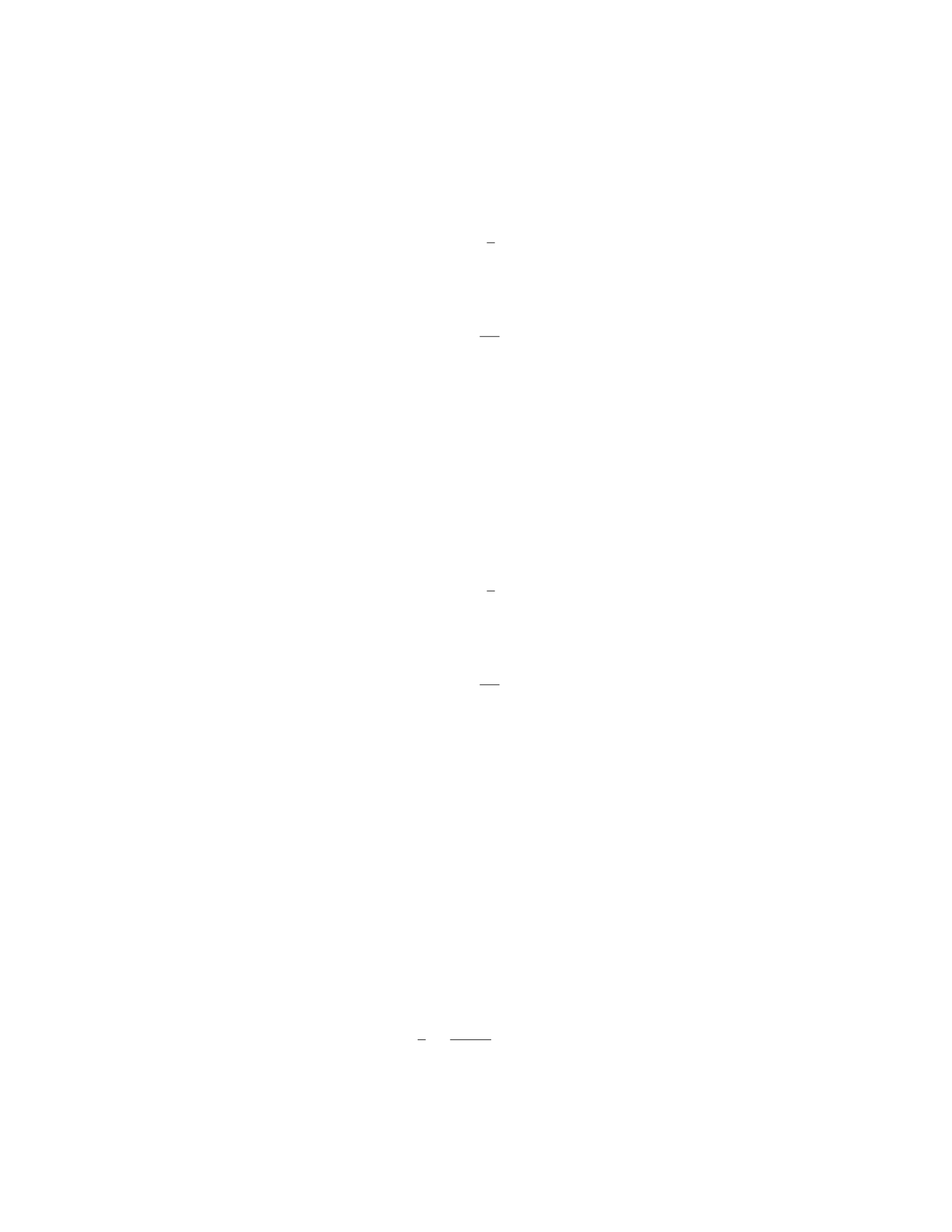
ω=v
r
where: v= linear velocity r= radius
2. Substituting the given values into the formula:
4 = v
0.2
3. Solving for linear velocity, v:
v= 4 ×0.2=0.8m/s
Therefore, the linear velocity of a point on the edge of the disc is
0.8 m/s.Question 9: A disc of radius 0.2 m is rotating at an angular
velocity of 4 rad/s. Find the linear velocity of a point on the edge of
the disc.
Step-by-step Solution: Given: Radius of the disc, r= 0.2m Angu-
lar velocity, ω= 4 rad/s
1. Angular velocity relationship:
ω=v
r
where: v= linear velocity r= radius
2. Substituting the given values into the formula:
4 = v
0.2
3. Solving for linear velocity, v:
v= 4 ×0.2=0.8m/s
Therefore, the linear velocity of a point on the edge of the disc is
0.8 m/s.
Question 10
Step-by-step solution: Given: Radius of the circular path, r= 2 m
Speed of the particle, v= 4 m/s
The angular velocity, ω, of a particle moving along a circular path
is given by:
v=r·ω
Substitute the given values into the equation:
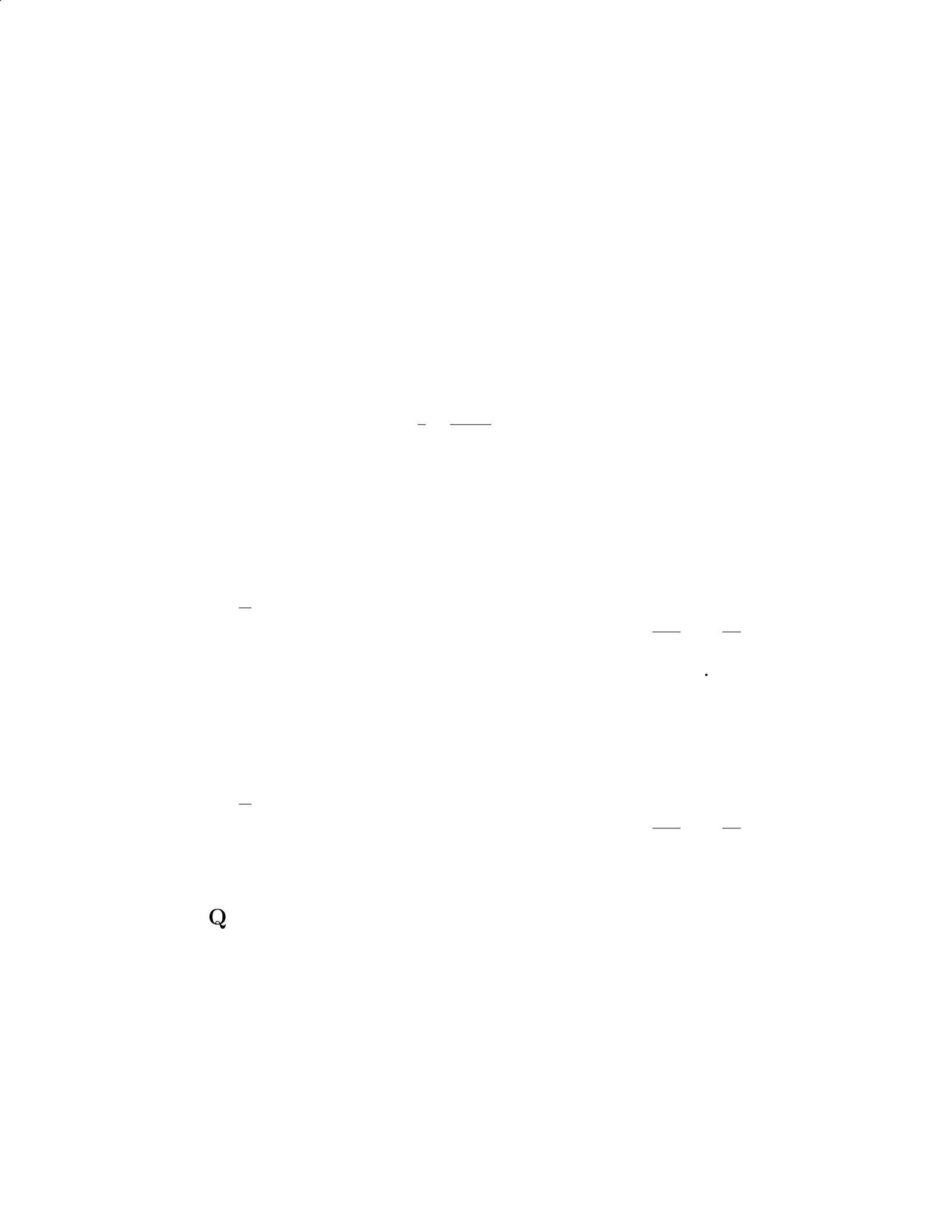
ω=v
r=4m/s
2m= 2 rad/s
8
Therefore, the angular velocity of the particle is 2rad/s.Question
10: A particle moves along a circular path with a radius of 2 meters
at a constant speed of 4 m/s. Calculate the angular velocity of the
particle.
Step-by-step solution: Given: Radius of the circular path, r= 2 m
Speed of the particle, v= 4 m/s
The angular velocity, ω, of a particle moving along a circular path
is given by:
v=r·ω
Substitute the given values into the equation:
ω=v
r=4m/s
2m= 2 rad/s
Therefore, the angular velocity of the particle is 2rad/s.
Question 11
Step-by-step solution: 1. Given data: Speed of the car, v = 20
m/s Radius of curvature, r = 50 m
2. Calculate the magnitude of the acceleration using the formula:
a=v2
r
3. Substitute the given values into the formula: a=(20)2
50 a=400
50
a= 8 m/s2
4. Therefore, the magnitude of the car’s acceleration is 8 m/s
²
.Question
11: A car is moving along a curved road with a constant speed of 20
m/s. If the radius of curvature of the road is 50 m, determine the
magnitude of the car’s acceleration.
Step-by-step solution: 1. Given data: Speed of the car, v = 20
m/s Radius of curvature, r = 50 m
2. Calculate the magnitude of the acceleration using the formula:
a=v2
r
3. Substitute the given values into the formula: a=(20)2
50 a=400
50
a= 8 m/s2
4. Therefore, the magnitude of the car’s acceleration is 8 m/s
²
.
Question 12
“‘latex Question 12:
A wheel rotates with an angular acceleration of 4rad/s2. If the
initial angular velocity of the wheel is 2rad/s and it rotates for 3
seconds, determine the final angular velocity of the wheel.
Solution:
9

Given: Initial angular velocity, ωi= 2 rad/s Angular acceleration,
α= 4 rad/s2Time, t= 3 s
We can use the formula for angular motion:
ωf=ωi+αt
Substitute the given values:
ωf= 2 + 4 ·3
ωf= 2 + 12
ωf= 14 rad/s
Therefore, the final angular velocity of the wheel is ωf= 14 rad/s.
“‘
Feel free to let me know if you need more questions or explana-
tions!Certainly! Here is the question and step-by-step solution on
Angular Motion in LateX code:
“‘latex Question 12:
A wheel rotates with an angular acceleration of 4rad/s2. If the
initial angular velocity of the wheel is 2rad/s and it rotates for 3
seconds, determine the final angular velocity of the wheel.
Solution:
Given: Initial angular velocity, ωi= 2 rad/s Angular acceleration,
α= 4 rad/s2Time, t= 3 s
We can use the formula for angular motion:
ωf=ωi+αt
Substitute the given values:
ωf= 2 + 4 ·3
ωf= 2 + 12
ωf= 14 rad/s
Therefore, the final angular velocity of the wheel is ωf= 14 rad/s.
“‘
Feel free to let me know if you need more questions or explana-
tions!
10

Question 13
Question 13: A disc of radius 0.2 m is rotating with an angular
acceleration of 2rad/s2. Initially, the disc is at rest. Find the angular
velocity of the disc after 3 seconds.
Solution:
Given: - Radius of the disc, r= 0.2m- Angular acceleration, α=
2rad/s2- Time, t= 3 s
To find the final angular velocity, we can use the equation relating
angular acceleration, initial angular velocity, and time:
ωf=ωi+α·t
Since the disc is initially at rest, the initial angular velocity ωi=
0rad/s.
Substitute the values into the equation:
ωf= 0 + 2 ·3=6rad/s
Therefore, the angular velocity of the disc after 3 seconds is 6
rad/s.
Feel free to ask if you have any questions or need further clarifica-
tion.Sure, here is a question along with its step-by-step solution on
Angular Motion:
Question 13: A disc of radius 0.2 m is rotating with an angular
acceleration of 2rad/s2. Initially, the disc is at rest. Find the angular
velocity of the disc after 3 seconds.
Solution:
Given: - Radius of the disc, r= 0.2m- Angular acceleration, α=
2rad/s2- Time, t= 3 s
To find the final angular velocity, we can use the equation relating
angular acceleration, initial angular velocity, and time:
ωf=ωi+α·t
Since the disc is initially at rest, the initial angular velocity ωi=
0rad/s.
Substitute the values into the equation:
ωf= 0 + 2 ·3=6rad/s
Therefore, the angular velocity of the disc after 3 seconds is 6
rad/s.
Feel free to ask if you have any questions or need further clarifi-
cation.
11

Question 14
Step-by-step Solution: Given: Inclined angle, θ= 30◦
To find the acceleration along the incline, we can use the following
equation derived from the component of weight along the incline:
a=g·sin(θ)
where: a= acceleration along the incline g= acceleration due to
gravity (9.81 m/s2)θ= angle of incline (30◦in this case)
Substitute the given values into the formula:
a= 9.81 m/s2·sin(30◦)
a= 9.81 m/s2·0.5
a= 4.905 m/s2
Therefore, the acceleration of the ball along the incline is 4.905 m/s2.Question
14: A ball is released from rest from the top of a ramp that is inclined
at an angle of 30◦above the horizontal. What is the acceleration of
the ball along the incline?
Step-by-step Solution: Given: Inclined angle, θ= 30◦
To find the acceleration along the incline, we can use the following
equation derived from the component of weight along the incline:
a=g·sin(θ)
where: a= acceleration along the incline g= acceleration due to
gravity (9.81 m/s2)θ= angle of incline (30◦in this case)
Substitute the given values into the formula:
a= 9.81 m/s2·sin(30◦)
a= 9.81 m/s2·0.5
a= 4.905 m/s2
Therefore, the acceleration of the ball along the incline is 4.905 m/s2.
12

Question 15
Question 15:
An object is initially at rest and then rotates with a constant
angular acceleration of 2rad/s2for 4 seconds. Calculate the angular
velocity of the object after 4 seconds, the number of revolutions it
has completed during this time, and the angular displacement of the
object.
Solution:
Given data: Initial angular velocity, ω0= 0 rad/s Angular acceler-
ation, α= 2 rad/s2Time, t= 4 s
1. Calculate the final angular velocity (ωf) using the kinematic
equation:
ωf=ω0+αt
Substitute the values to find:
ωf= 0 + 2 ×4=8rad/s
Therefore, the angular velocity of the object after 4 seconds is
8rad/s.
2. Calculate the number of revolutions completed during this time
using the formula:
Number of revolutions =ωf×t
2π
Substitute the values to find:
Number of revolutions =8×4
2π=32
2π≈5.09 revolutions
Therefore, the object completes approximately 5.09 revolutions in
4 seconds.
3. Calculate the angular displacement of the object during this
time using the formula:
θ=ω0t+1
2αt2
Substitute the values to find:
θ= 0 ×4 + 1
2×2×42= 16 rad
Therefore, the angular displacement of the object after 4 seconds
is 16 rad.Sure, here is a question along with a step-by-step solution on
Angular Motion in LateX code:
Question 15:
An object is initially at rest and then rotates with a constant
angular acceleration of 2rad/s2for 4 seconds. Calculate the angular
13
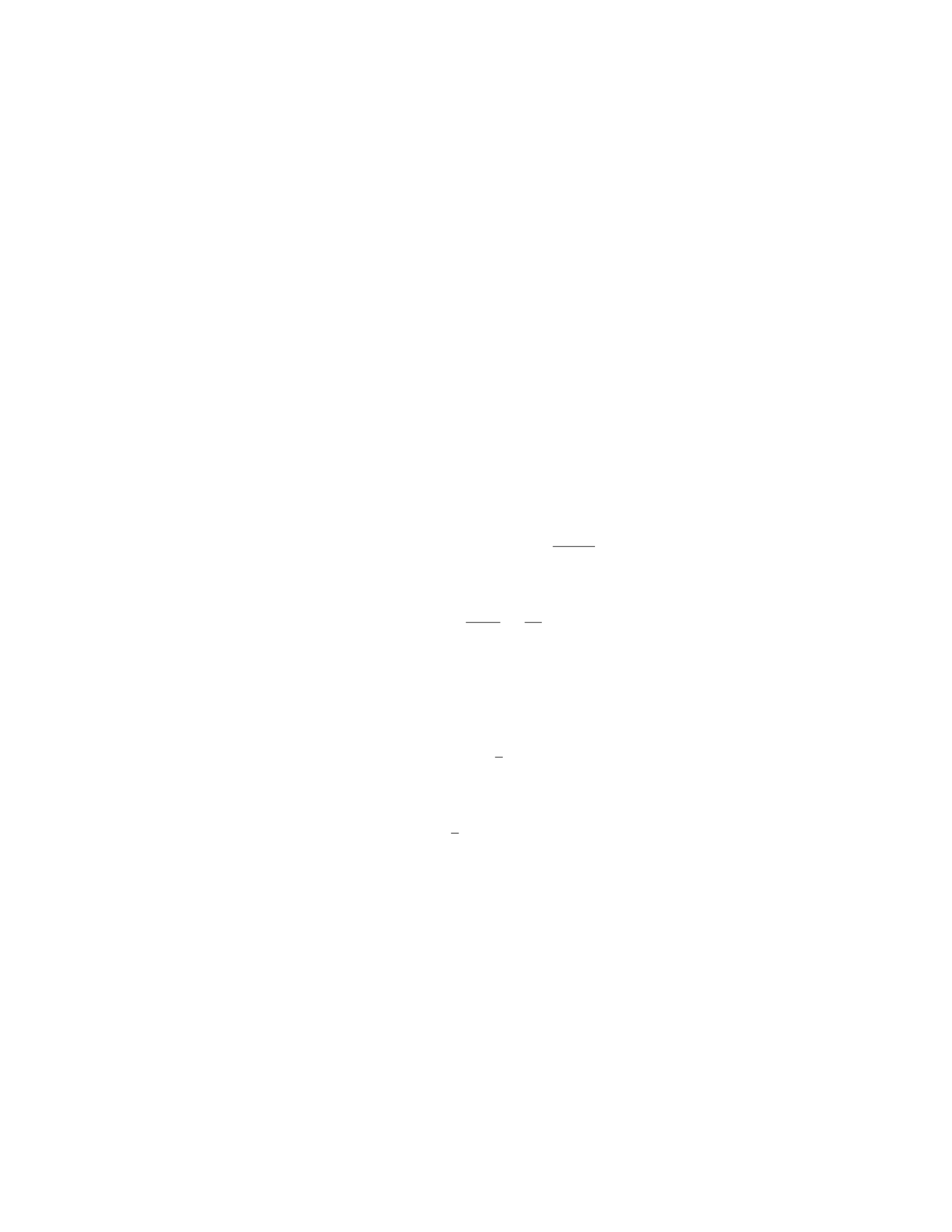
velocity of the object after 4 seconds, the number of revolutions it
has completed during this time, and the angular displacement of the
object.
Solution:
Given data: Initial angular velocity, ω0= 0 rad/s Angular acceler-
ation, α= 2 rad/s2Time, t= 4 s
1. Calculate the final angular velocity (ωf) using the kinematic
equation:
ωf=ω0+αt
Substitute the values to find:
ωf= 0 + 2 ×4=8rad/s
Therefore, the angular velocity of the object after 4 seconds is
8rad/s.
2. Calculate the number of revolutions completed during this time
using the formula:
Number of revolutions =ωf×t
2π
Substitute the values to find:
Number of revolutions =8×4
2π=32
2π≈5.09 revolutions
Therefore, the object completes approximately 5.09 revolutions in
4 seconds.
3. Calculate the angular displacement of the object during this
time using the formula:
θ=ω0t+1
2αt2
Substitute the values to find:
θ= 0 ×4 + 1
2×2×42= 16 rad
Therefore, the angular displacement of the object after 4 seconds
is 16 rad.
Question 16
“‘latex Question 16: A wheel rotates with an angular velocity
of 4rad/s. The wheel slows down with an angular acceleration of
−2rad/s2until it comes to a stop. Calculate the time it takes for the
wheel to stop rotating.
14
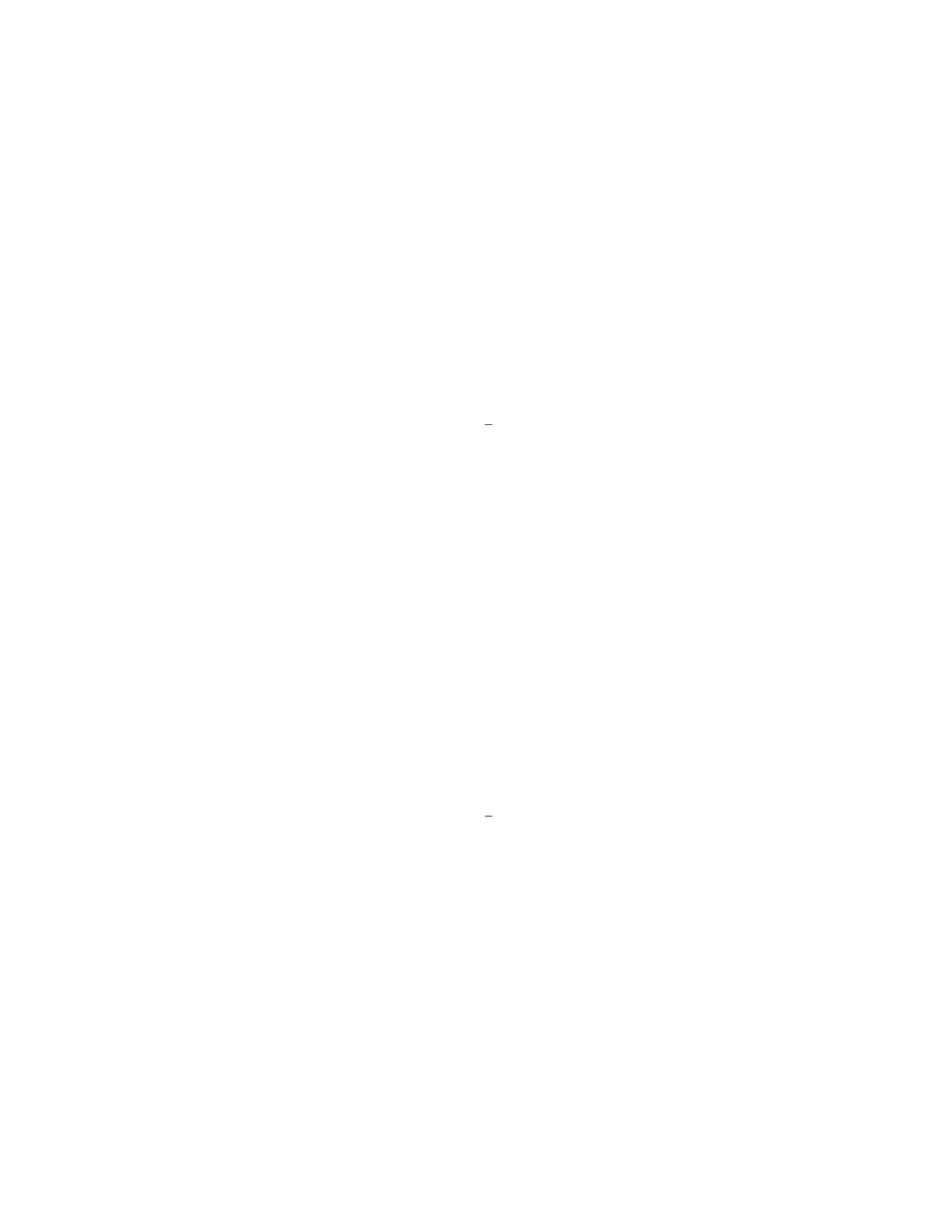
Solution: Given, Initial angular velocity, ωi= 4 rad/s
Angular acceleration, α=−2rad/s2
We can use the formula relating angular velocity, angular acceler-
ation, and time:
ωf=ωi+α·t
When the wheel stops rotating, the final angular velocity is 0, so
we have:
0=4−2t
Solving for t:
2t= 4
t=4
2
t= 2 s
Therefore, it takes 2seconds for the wheel to stop rotating. “‘Sure,
here is the LateX code for question number 16 on Angular Motion:
“‘latex Question 16: A wheel rotates with an angular velocity
of 4rad/s. The wheel slows down with an angular acceleration of
−2rad/s2until it comes to a stop. Calculate the time it takes for the
wheel to stop rotating.
Solution: Given, Initial angular velocity, ωi= 4 rad/s
Angular acceleration, α=−2rad/s2
We can use the formula relating angular velocity, angular acceler-
ation, and time:
ωf=ωi+α·t
When the wheel stops rotating, the final angular velocity is 0, so
we have:
0=4−2t
Solving for t:
2t= 4
t=4
2
t= 2 s
Therefore, it takes 2seconds for the wheel to stop rotating. “‘
Question 17
A car moves around a circular track with a radius of 50 meters.
The car’s speed is initially 20 m/s and it accelerates uniformly at a
rate of 5 m/s2. Determine the angular acceleration of the car and the
time it takes to complete one full lap around the track.
Solution:
15

Given: Radius of the circular track, r= 50 meters Initial speed of
the car, v0= 20 m/s Acceleration of the car, a= 5 m/s2
1. Calculate the angular acceleration using the formula:
aangular =alinear
r
Where: alinear = Acceleration of the car r= Radius of the circular
track
Substitute the given values:
aangular =5
50 = 0.1rad/s2
2. Determine the angular speed using the formula:
ω=ω0+aangulart
Where: ω= Angular speed ω0= Initial angular speed (0 for this case)
aangular = Angular acceleration t= Time
Since the initial angular speed is 0:
ω= 0 + 0.1t= 0.1t
3. Calculate the time taken to complete one full lap by finding the
time when the angular displacement is 2πradians (one full rotation):
θ=ω0t+1
2aangulart2
For one full rotation, θ= 2πradians:
2π= 0.1t2
Solve for t:
t=r2π
0.1=√20π≈7.98 s
Therefore, the angular acceleration of the car is 0.1 rad/s2and it
takes approximately 7.98 seconds to complete one full lap around the
track.Question 17:
A car moves around a circular track with a radius of 50 meters.
The car’s speed is initially 20 m/s and it accelerates uniformly at a
rate of 5 m/s2. Determine the angular acceleration of the car and the
time it takes to complete one full lap around the track.
Solution:
Given: Radius of the circular track, r= 50 meters Initial speed of
the car, v0= 20 m/s Acceleration of the car, a= 5 m/s2
1. Calculate the angular acceleration using the formula:
aangular =alinear
r
16
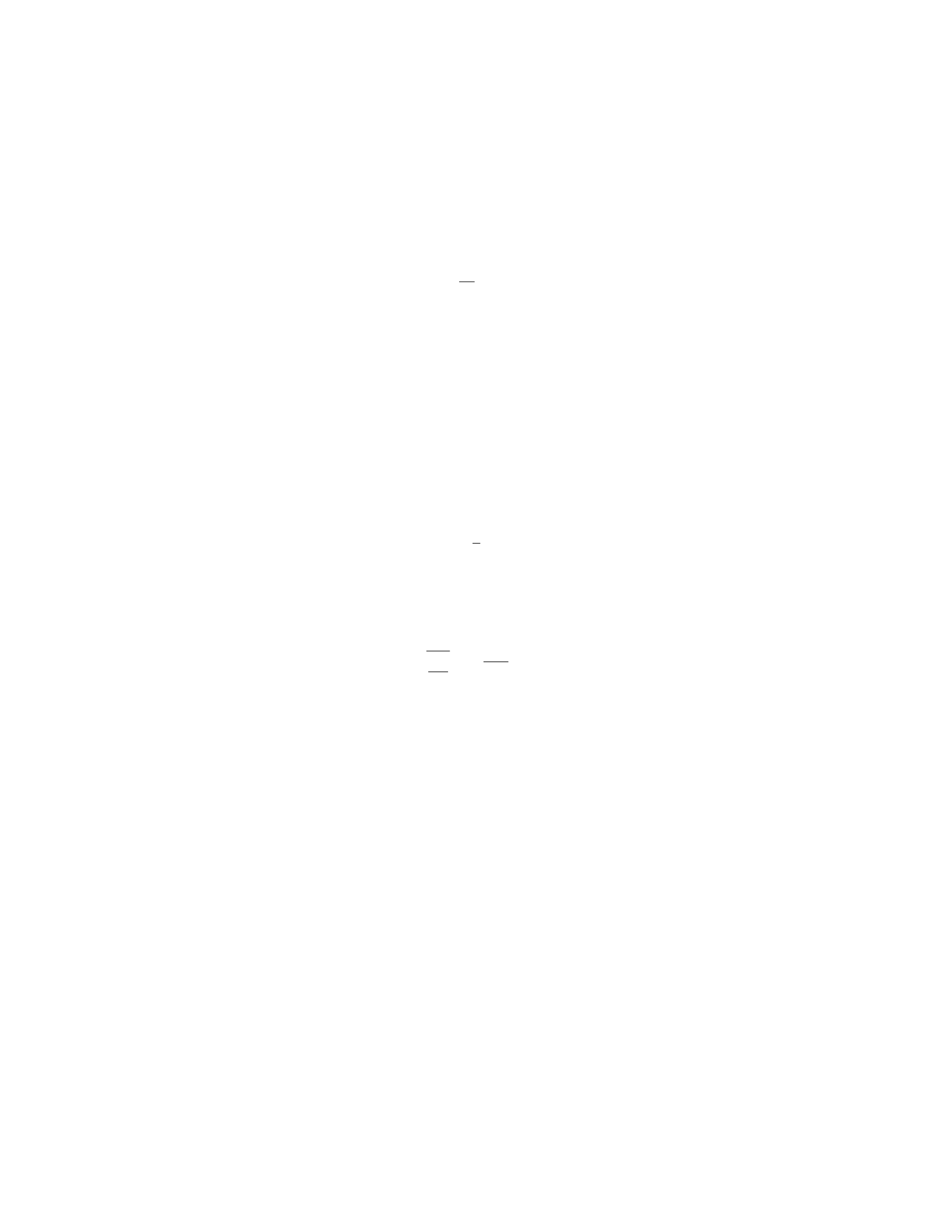
Where: alinear = Acceleration of the car r= Radius of the circular
track
Substitute the given values:
aangular =5
50 = 0.1rad/s2
2. Determine the angular speed using the formula:
ω=ω0+aangulart
Where: ω= Angular speed ω0= Initial angular speed (0 for this case)
aangular = Angular acceleration t= Time
Since the initial angular speed is 0:
ω= 0 + 0.1t= 0.1t
3. Calculate the time taken to complete one full lap by finding the
time when the angular displacement is 2πradians (one full rotation):
θ=ω0t+1
2aangulart2
For one full rotation, θ= 2πradians:
2π= 0.1t2
Solve for t:
t=r2π
0.1=√20π≈7.98 s
Therefore, the angular acceleration of the car is 0.1 rad/s2and it
takes approximately 7.98 seconds to complete one full lap around the
track.
Question 18
“‘latex 18. A particle moves along a circular path with a radius
of 2 m. The particle starts from rest and has a constant angular
acceleration of 3rad/s2. Calculate the linear velocity of the particle
after it has completed one-fourth of a revolution.
Solution:
Given: Radius, r= 2 mAngular acceleration, α= 3 rad/s2
The angular velocity of the particle can be calculated using the
formula
ω2=ω2
0+ 2αθ
where ω= final angular velocity, ω0= initial angular velocity (since
the particle starts from rest, ω0= 0), α= angular acceleration, θ=
angle in radians.
17

When the particle has completed one-fourth of a revolution, θ=
1
4×2π=π
2rad.
Substitute the given values into the formula:
ω2= 0 + 2 ×3×π
2
ω2= 3π rad/s
ω=√3π rad/s
The linear velocity of the particle is given by
v=rω
Substitute the values of rand ω:
v= 2 ×√3π≈6.09 m/s
Therefore, the linear velocity of the particle after it has completed
one-fourth of a revolution is approximately 6.09 m/s. “‘
Let me know if you need any modifications or further assistance!Sure!
Here is the LateX code for your requested question:
“‘latex 18. A particle moves along a circular path with a radius
of 2 m. The particle starts from rest and has a constant angular
acceleration of 3rad/s2. Calculate the linear velocity of the particle
after it has completed one-fourth of a revolution.
Solution:
Given: Radius, r= 2 mAngular acceleration, α= 3 rad/s2
The angular velocity of the particle can be calculated using the
formula
ω2=ω2
0+ 2αθ
where ω= final angular velocity, ω0= initial angular velocity (since
the particle starts from rest, ω0= 0), α= angular acceleration, θ=
angle in radians.
When the particle has completed one-fourth of a revolution, θ=
1
4×2π=π
2rad.
Substitute the given values into the formula:
ω2= 0 + 2 ×3×π
2
ω2= 3π rad/s
ω=√3π rad/s
The linear velocity of the particle is given by
v=rω
18

Substitute the values of rand ω:
v= 2 ×√3π≈6.09 m/s
Therefore, the linear velocity of the particle after it has completed
one-fourth of a revolution is approximately 6.09 m/s. “‘
Let me know if you need any modifications or further assistance!
Question 19
A particle moves along the x-axis according to the equation of
motion x(t) = 4t2−3t+ 7, where xis in meters and tis in seconds.
(a) Determine the velocity of the particle at t= 2 seconds.
(b) Find the acceleration of the particle at t= 2 seconds.
(c) What is the position of the particle at t= 2 seconds?
—
Solution:
(a) To find the velocity of the particle, we need to differentiate the
position equation with respect to time tto get the velocity equation:
v(t) = dx
dt =d
dt(4t2−3t+ 7)
v(t)=8t−3
Substitute t= 2 into the velocity equation:
v(2) = 8(2) −3
v(2) = 13 m/s
(b) To find the acceleration of the particle, we need to differentiate
the velocity equation with respect to time tto get the acceleration
equation:
a(t) = dv
dt =d
dt(8t−3)
a(t)=8
Substitute t= 2 into the acceleration equation:
a(2) = 8
a(2) = 8 m/s2
19

(c) To find the position of the particle at t= 2 seconds, simply
substitute t= 2 into the position equation:
x(2) = 4(2)2−3(2) + 7
x(2) = 16 −6+7
x(2) = 17 meters
Therefore, at t= 2 seconds, the velocity of the particle is 13 m/s,
the acceleration is 8 m/s
²
, and the position of the particle is 17 me-
ters.Question 19:
A particle moves along the x-axis according to the equation of
motion x(t) = 4t2−3t+ 7, where xis in meters and tis in seconds.
(a) Determine the velocity of the particle at t= 2 seconds.
(b) Find the acceleration of the particle at t= 2 seconds.
(c) What is the position of the particle at t= 2 seconds?
—
Solution:
(a) To find the velocity of the particle, we need to differentiate the
position equation with respect to time tto get the velocity equation:
v(t) = dx
dt =d
dt(4t2−3t+ 7)
v(t)=8t−3
Substitute t= 2 into the velocity equation:
v(2) = 8(2) −3
v(2) = 13 m/s
(b) To find the acceleration of the particle, we need to differentiate
the velocity equation with respect to time tto get the acceleration
equation:
a(t) = dv
dt =d
dt(8t−3)
a(t)=8
Substitute t= 2 into the acceleration equation:
a(2) = 8
20

a(2) = 8 m/s2
(c) To find the position of the particle at t= 2 seconds, simply
substitute t= 2 into the position equation:
x(2) = 4(2)2−3(2) + 7
x(2) = 16 −6+7
x(2) = 17 meters
Therefore, at t= 2 seconds, the velocity of the particle is 13 m/s,
the acceleration is 8 m/s
²
, and the position of the particle is 17 me-
ters.
Question 20
Solution:
1. To find the car’s angular acceleration, we will use the formula:
at=r×α
where atis the tangential acceleration, ris the radius of the
circular track, and αis the angular acceleration. Given that
at= 2 m/s2and r= 100 m, we can solve for α:
2 = 100 ×α=⇒α=2
100 = 0.02 rad/s2
2. To calculate the car’s angular velocity at that moment, we will
use the formula:
v=r×ω
where vis the linear speed of the car, ris the radius of the
circular track, and ωis the angular velocity. Given that v= 10
m/s and r= 100 m, we can solve for ω:
10 = 100 ×ω=⇒ω=10
100 = 0.1rad/s
3. The total acceleration of the car can be calculated using the
formula:
atotal =qa2
t+a2
c
21

where atotal is the total acceleration, atis the tangential accel-
eration, and acis the centripetal acceleration. The centripetal
acceleration is given by:
ac=r×ω2= 100 ×(0.1)2= 1 m/s2
Substituting these values into the total acceleration formula:
atotal =p22+ 12=√5≈2.24 m/s2
Question 20: A car is driving around a circular track with a radius
of 100 meters. The car’s speed is increasing at a rate of 2 m/s2. At
a certain moment, the car’s speed is 10 m/s.
1. Determine the car’s angular acceleration.
2. Calculate the car’s angular velocity at that moment.
3. Find the total acceleration of the car.
Solution:
1. To find the car’s angular acceleration, we will use the formula:
at=r×α
where atis the tangential acceleration, ris the radius of the
circular track, and αis the angular acceleration. Given that
at= 2 m/s2and r= 100 m, we can solve for α:
2 = 100 ×α=⇒α=2
100 = 0.02 rad/s2
2. To calculate the car’s angular velocity at that moment, we will
use the formula:
v=r×ω
where vis the linear speed of the car, ris the radius of the
circular track, and ωis the angular velocity. Given that v= 10
m/s and r= 100 m, we can solve for ω:
10 = 100 ×ω=⇒ω=10
100 = 0.1rad/s
3. The total acceleration of the car can be calculated using the
formula:
atotal =qa2
t+a2
c
where atotal is the total acceleration, atis the tangential accel-
eration, and acis the centripetal acceleration. The centripetal
acceleration is given by:
ac=r×ω2= 100 ×(0.1)2= 1 m/s2
22

Substitute the given values:
ac=(20)2
100 = 4 m/s2
2. Tangential acceleration: Since the velocity is constant, there is
no tangential acceleration.
3. Total acceleration: The magnitude of the total acceleration,
atotal, is the vector sum of the centripetal acceleration and tangen-
tial acceleration. Since there is no tangential acceleration, the total
acceleration is equal to the centripetal acceleration.
Therefore, the magnitude of the car’s acceleration at any point
along the track is 4m/s2.
Question 2
Step-by-step solution: Given: Initial angular speed, ωi= 0 rad/s
Final angular speed, ωf= 4 rad/s Angular acceleration, α= 2 rad/s
²
Time, t= 5 seconds
Using the equation of angular motion: ωf=ωi+αt
Substitute the given values: 4 = 0 + 2 ×5
Solving for the final angular speed: 4 = 10 So, the final angular
speed after 5 seconds is 4rad/s.
Next, we can find the angular displacement using the equation:
θ=ωit+1
2αt2
Substitute the given values: θ= 0 ×5 + 1
2×2×52
Calculating the angular displacement: θ= 0 + 1
2×2×25 θ= 25 rad
Therefore, the angular displacement of the disc during the 5-
second period is 25 radians.Question 2: A disc rotates with an an-
gular speed of 4 rad/s. If the disc starts from rest and accelerates
at a constant rate of 2 rad/s
²
for 5 seconds, determine the angular
displacement of the disc during this time period.
Step-by-step solution: Given: Initial angular speed, ωi= 0 rad/s
Final angular speed, ωf= 4 rad/s Angular acceleration, α= 2 rad/s
²
Time, t= 5 seconds
Using the equation of angular motion: ωf=ωi+αt
Substitute the given values: 4 = 0 + 2 ×5
Solving for the final angular speed: 4 = 10 So, the final angular
speed after 5 seconds is 4rad/s.
Next, we can find the angular displacement using the equation:
θ=ωit+1
2αt2
Substitute the given values: θ= 0 ×5 + 1
2×2×52
Calculating the angular displacement: θ= 0 + 1
2×2×25 θ= 25 rad
Therefore, the angular displacement of the disc during the 5-
second period is 25 radians.
2

Question 3
Step-by-step solution: Given: Radius of the curved road, r= 100 m
Speed of the car, v= 20 m/s
1. The centripetal acceleration can be calculated using the for-
mula:
ac=v2
r
2. Substitute the given values into the formula:
ac=(20 m/s)2
100 m
3. Calculate the centripetal acceleration:
ac=400 m2/s2
100 m= 4 m/s2
4. Therefore, the magnitude of the car’s acceleration is 4m/s2.Question
3: A car travels along a curved road with a radius of 100 meters. If
the car’s speed is 20 m/s, what is the magnitude of its acceleration?
Step-by-step solution: Given: Radius of the curved road, r= 100 m
Speed of the car, v= 20 m/s
1. The centripetal acceleration can be calculated using the for-
mula:
ac=v2
r
2. Substitute the given values into the formula:
ac=(20 m/s)2
100 m
3. Calculate the centripetal acceleration:
ac=400 m2/s2
100 m= 4 m/s2
4. Therefore, the magnitude of the car’s acceleration is 4m/s2.
Question 4
Solution: Given: Initial angular velocity, ω0= 0 rad/s
Angular acceleration, α= 2 rad/s2
Time, t= 3 s
We can use the equation for angular motion:
ω=ω0+αt
3

Substitute the given values:
ω= 0 + 2 ×3
ω= 6 rad/s
Therefore, the angular velocity of the wheel after 3 seconds is
ω= 6 rad/s.Question 4: A wheel starts from rest and rotates with a
constant angular acceleration of 2rad/s2. Find the angular velocity
of the wheel after 3 seconds.
Solution: Given: Initial angular velocity, ω0= 0 rad/s
Angular acceleration, α= 2 rad/s2
Time, t= 3 s
We can use the equation for angular motion:
ω=ω0+αt
Substitute the given values:
ω= 0 + 2 ×3
ω= 6 rad/s
Therefore, the angular velocity of the wheel after 3 seconds is
ω= 6 rad/s.
Question 5
An object travels along a circular path of radius 2 m with a con-
stant speed of 4 m/s. Calculate the angular velocity of the object.
Step-by-step solution: 1. The angular velocity (ω) is defined as
the rate of change of angular displacement with respect to time. 2.
The formula to calculate angular velocity is given by ω=v
r, where
vis the linear speed and ris the radius of the circular path. 3.
Given that v= 4 m/s and r= 2 m, substitute these values into the
formula to find the angular velocity. 4. Plug in the values: ω=4
2= 2
rad/s. 5. Therefore, the angular velocity of the object traveling along
the circular path of radius 2 m with a constant speed of 4 m/s is 2
rad/s.Question 5:
An object travels along a circular path of radius 2 m with a con-
stant speed of 4 m/s. Calculate the angular velocity of the object.
Step-by-step solution: 1. The angular velocity (ω) is defined as
the rate of change of angular displacement with respect to time. 2.
The formula to calculate angular velocity is given by ω=v
r, where v
is the linear speed and ris the radius of the circular path. 3. Given
that v= 4 m/s and r= 2 m, substitute these values into the formula
to find the angular velocity. 4. Plug in the values: ω=4
2= 2 rad/s.
5. Therefore, the angular velocity of the object traveling along the
circular path of radius 2 m with a constant speed of 4 m/s is 2 rad/s.
4

Question 6
A particle moves in a circular path of radius r= 2 m with a constant
angular speed of ω= 3 rad/s. a) Determine the linear speed of the
particle. b) Find the acceleration of the particle.
Step-by-step solutions: a) The linear speed of the particle can be
calculated using the formula:
v=rω
Substitute the given values:
v= 2 ×3=6m/s
b) The acceleration of the particle can be calculated using the
formula:
a=rα
where αis the angular acceleration. Since the particle moves with
constant angular speed, α= 0 and the acceleration is purely cen-
tripetal. Therefore,
a=v2
r=62
2= 18 m/s2
Question 6:
A particle moves in a circular path of radius r= 2 m with a constant
angular speed of ω= 3 rad/s. a) Determine the linear speed of the
particle. b) Find the acceleration of the particle.
Step-by-step solutions: a) The linear speed of the particle can be
calculated using the formula:
v=rω
Substitute the given values:
v= 2 ×3=6m/s
b) The acceleration of the particle can be calculated using the
formula:
a=rα
where αis the angular acceleration. Since the particle moves with
constant angular speed, α= 0 and the acceleration is purely cen-
tripetal. Therefore,
a=v2
r=62
2= 18 m/s2
5

Question 7
Question 7: A wheel is rotating at a constant angular velocity of
30 rad/s. If the wheel’s diameter is 2meters, determine the linear
velocity of a point on the edge of the wheel.
Solution: Given data: - Angular velocity ω= 30 rad/s - Diameter
d= 2 meters
The angular velocity of the wheel is related to the linear velocity
of a point on the edge of the wheel by the formula:
v=rω
where vis the linear velocity, ris the radius of the wheel.
Given the diameter of the wheel, we can find the radius rby
dividing the diameter by 2:
r=d
2=2
2= 1 meter
Substitute the values of rand ωinto the formula to find the linear
velocity v:
v= 1 ×30 = 30 m/s
Therefore, the linear velocity of a point on the edge of the wheel
is 30 m/s.Certainly! Here’s a question on Angular Motion with step-
by-step solutions in LateX code for Liberty University.
Question 7: A wheel is rotating at a constant angular velocity of
30 rad/s. If the wheel’s diameter is 2meters, determine the linear
velocity of a point on the edge of the wheel.
Solution: Given data: - Angular velocity ω= 30 rad/s - Diameter
d= 2 meters
The angular velocity of the wheel is related to the linear velocity
of a point on the edge of the wheel by the formula:
v=rω
where vis the linear velocity, ris the radius of the wheel.
Given the diameter of the wheel, we can find the radius rby
dividing the diameter by 2:
r=d
2=2
2= 1 meter
Substitute the values of rand ωinto the formula to find the linear
velocity v:
v= 1 ×30 = 30 m/s
Therefore, the linear velocity of a point on the edge of the wheel
is 30 m/s.
6

Question 8
Question 8: A particle moves in a circle of radius 2 m with a
uniform angular speed of 3 rad/s. Calculate the magnitude of the
linear velocity of the particle.
Step-by-step Solution: 1. The linear velocity of a particle moving
along a circular path can be calculated using the formula:
v=r·ω
where: v= linear velocity, r= radius of the circle, and ω= angular
speed.
2. Substituting the given values: r= 2 m and ω= 3 rad/s, we get:
v= 2 ·3=6m/s
Therefore, the magnitude of the linear velocity of the particle is 6
m/s.
v= 6 m/s
Certainly! Here is a question on Angular Motion along with step-by-
step solutions in Latex code:
Question 8: A particle moves in a circle of radius 2 m with a
uniform angular speed of 3 rad/s. Calculate the magnitude of the
linear velocity of the particle.
Step-by-step Solution: 1. The linear velocity of a particle moving
along a circular path can be calculated using the formula:
v=r·ω
where: v= linear velocity, r= radius of the circle, and ω= angular
speed.
2. Substituting the given values: r= 2 m and ω= 3 rad/s, we get:
v= 2 ·3=6m/s
Therefore, the magnitude of the linear velocity of the particle is 6
m/s.
v= 6 m/s
Question 9
Step-by-step Solution: Given: Radius of the disc, r= 0.2m Angu-
lar velocity, ω= 4 rad/s
7
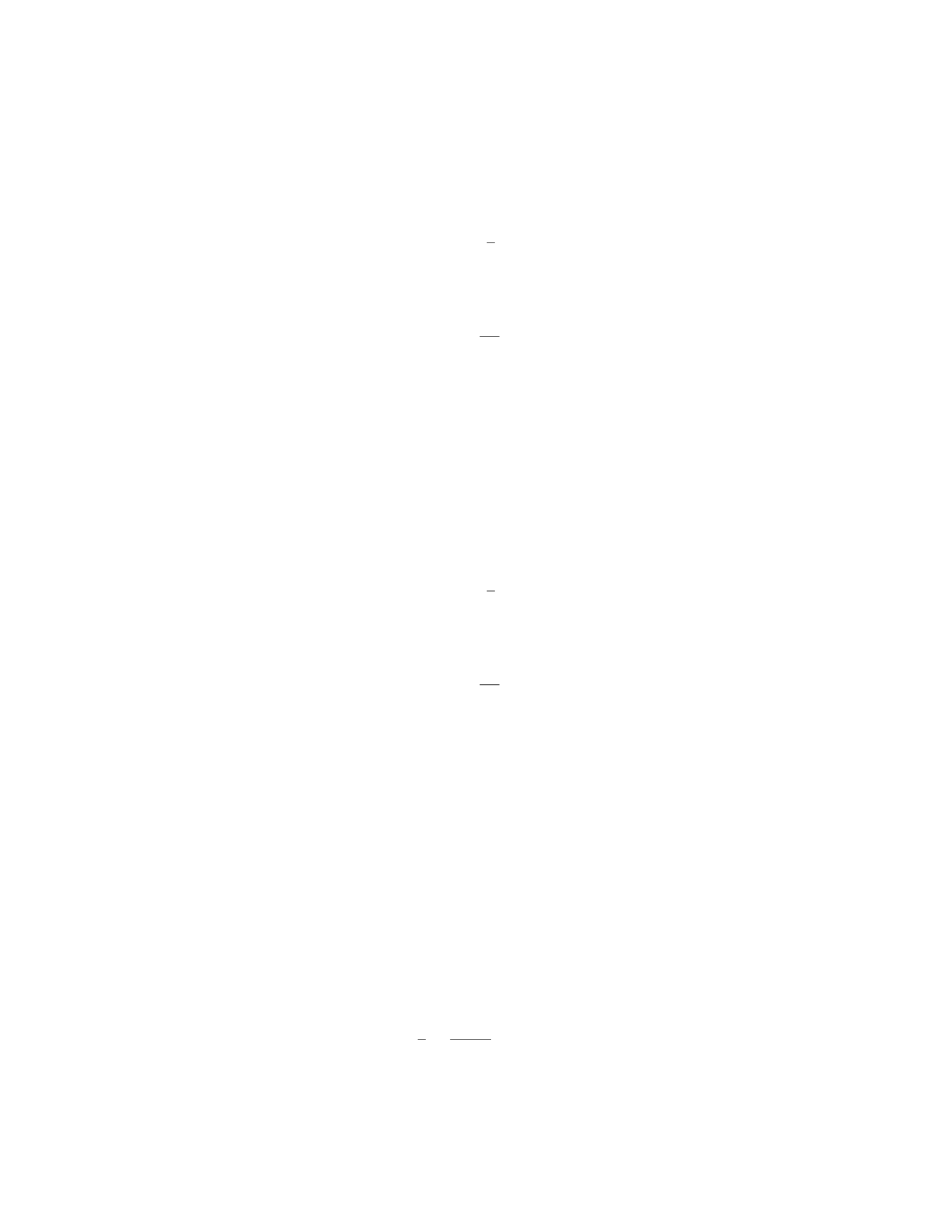
1. Angular velocity relationship:
ω=v
r
where: v= linear velocity r= radius
2. Substituting the given values into the formula:
4 = v
0.2
3. Solving for linear velocity, v:
v= 4 ×0.2=0.8m/s
Therefore, the linear velocity of a point on the edge of the disc is
0.8 m/s.Question 9: A disc of radius 0.2 m is rotating at an angular
velocity of 4 rad/s. Find the linear velocity of a point on the edge of
the disc.
Step-by-step Solution: Given: Radius of the disc, r= 0.2m Angu-
lar velocity, ω= 4 rad/s
1. Angular velocity relationship:
ω=v
r
where: v= linear velocity r= radius
2. Substituting the given values into the formula:
4 = v
0.2
3. Solving for linear velocity, v:
v= 4 ×0.2=0.8m/s
Therefore, the linear velocity of a point on the edge of the disc is
0.8 m/s.
Question 10
Step-by-step solution: Given: Radius of the circular path, r= 2 m
Speed of the particle, v= 4 m/s
The angular velocity, ω, of a particle moving along a circular path
is given by:
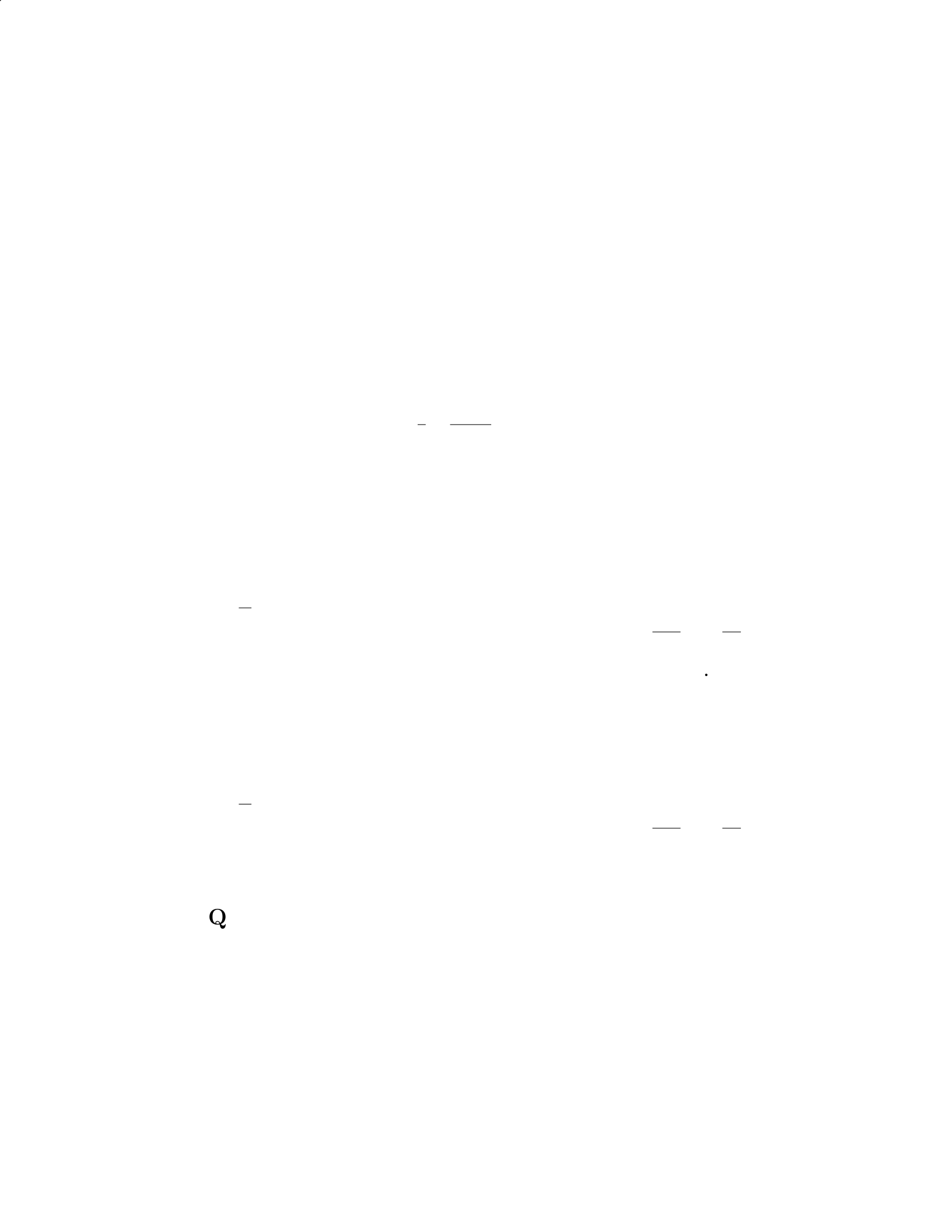
v=r·ω
Substitute the given values into the equation:
ω=v
r=4m/s
2m= 2 rad/s
8
Therefore, the angular velocity of the particle is 2rad/s.Question
10: A particle moves along a circular path with a radius of 2 meters
at a constant speed of 4 m/s. Calculate the angular velocity of the
particle.
Step-by-step solution: Given: Radius of the circular path, r= 2 m
Speed of the particle, v= 4 m/s
The angular velocity, ω, of a particle moving along a circular path
is given by:
v=r·ω
Substitute the given values into the equation:
ω=v
r=4m/s
2m= 2 rad/s
Therefore, the angular velocity of the particle is 2rad/s.
Question 11
Step-by-step solution: 1. Given data: Speed of the car, v = 20
m/s Radius of curvature, r = 50 m
2. Calculate the magnitude of the acceleration using the formula:
a=v2
r
3. Substitute the given values into the formula: a=(20)2
50 a=400
50
a= 8 m/s2
4. Therefore, the magnitude of the car’s acceleration is 8 m/s
²
.Question
11: A car is moving along a curved road with a constant speed of 20
m/s. If the radius of curvature of the road is 50 m, determine the
magnitude of the car’s acceleration.
Step-by-step solution: 1. Given data: Speed of the car, v = 20
m/s Radius of curvature, r = 50 m
2. Calculate the magnitude of the acceleration using the formula:
a=v2
r
3. Substitute the given values into the formula: a=(20)2
50 a=400
50
a= 8 m/s2
4. Therefore, the magnitude of the car’s acceleration is 8 m/s
²
.
Question 12
“‘latex Question 12:
A wheel rotates with an angular acceleration of 4rad/s2. If the
initial angular velocity of the wheel is 2rad/s and it rotates for 3
seconds, determine the final angular velocity of the wheel.
Solution:
9

Given: Initial angular velocity, ωi= 2 rad/s Angular acceleration,
α= 4 rad/s2Time, t= 3 s
We can use the formula for angular motion:
ωf=ωi+αt
Substitute the given values:
ωf= 2 + 4 ·3
ωf= 2 + 12
ωf= 14 rad/s
Therefore, the final angular velocity of the wheel is ωf= 14 rad/s.
“‘
Feel free to let me know if you need more questions or explana-
tions!Certainly! Here is the question and step-by-step solution on
Angular Motion in LateX code:
“‘latex Question 12:
A wheel rotates with an angular acceleration of 4rad/s2. If the
initial angular velocity of the wheel is 2rad/s and it rotates for 3
seconds, determine the final angular velocity of the wheel.
Solution:
Given: Initial angular velocity, ωi= 2 rad/s Angular acceleration,
α= 4 rad/s2Time, t= 3 s
We can use the formula for angular motion:
ωf=ωi+αt
Substitute the given values:
ωf= 2 + 4 ·3
ωf= 2 + 12
ωf= 14 rad/s
Therefore, the final angular velocity of the wheel is ωf= 14 rad/s.
“‘
Feel free to let me know if you need more questions or explana-
tions!
10

Question 13
Question 13: A disc of radius 0.2 m is rotating with an angular
acceleration of 2rad/s2. Initially, the disc is at rest. Find the angular
velocity of the disc after 3 seconds.
Solution:
Given: - Radius of the disc, r= 0.2m- Angular acceleration, α=
2rad/s2- Time, t= 3 s
To find the final angular velocity, we can use the equation relating
angular acceleration, initial angular velocity, and time:
ωf=ωi+α·t
Since the disc is initially at rest, the initial angular velocity ωi=
0rad/s.
Substitute the values into the equation:
ωf= 0 + 2 ·3=6rad/s
Therefore, the angular velocity of the disc after 3 seconds is 6
rad/s.
Feel free to ask if you have any questions or need further clarifica-
tion.Sure, here is a question along with its step-by-step solution on
Angular Motion:
Question 13: A disc of radius 0.2 m is rotating with an angular
acceleration of 2rad/s2. Initially, the disc is at rest. Find the angular
velocity of the disc after 3 seconds.
Solution:
Given: - Radius of the disc, r= 0.2m- Angular acceleration, α=
2rad/s2- Time, t= 3 s
To find the final angular velocity, we can use the equation relating
angular acceleration, initial angular velocity, and time:
ωf=ωi+α·t
Since the disc is initially at rest, the initial angular velocity ωi=
0rad/s.
Substitute the values into the equation:
ωf= 0 + 2 ·3=6rad/s
Therefore, the angular velocity of the disc after 3 seconds is 6
rad/s.
Feel free to ask if you have any questions or need further clarifi-
cation.
11

Question 14
Step-by-step Solution: Given: Inclined angle, θ= 30◦
To find the acceleration along the incline, we can use the following
equation derived from the component of weight along the incline:
a=g·sin(θ)
where: a= acceleration along the incline g= acceleration due to
gravity (9.81 m/s2)θ= angle of incline (30◦in this case)
Substitute the given values into the formula:
a= 9.81 m/s2·sin(30◦)
a= 9.81 m/s2·0.5
a= 4.905 m/s2
Therefore, the acceleration of the ball along the incline is 4.905 m/s2.Question
14: A ball is released from rest from the top of a ramp that is inclined
at an angle of 30◦above the horizontal. What is the acceleration of
the ball along the incline?
Step-by-step Solution: Given: Inclined angle, θ= 30◦
To find the acceleration along the incline, we can use the following
equation derived from the component of weight along the incline:
a=g·sin(θ)
where: a= acceleration along the incline g= acceleration due to
gravity (9.81 m/s2)θ= angle of incline (30◦in this case)
Substitute the given values into the formula:
a= 9.81 m/s2·sin(30◦)
a= 9.81 m/s2·0.5
a= 4.905 m/s2
Therefore, the acceleration of the ball along the incline is 4.905 m/s2.
12

Question 15
Question 15:
An object is initially at rest and then rotates with a constant
angular acceleration of 2rad/s2for 4 seconds. Calculate the angular
velocity of the object after 4 seconds, the number of revolutions it
has completed during this time, and the angular displacement of the
object.
Solution:
Given data: Initial angular velocity, ω0= 0 rad/s Angular acceler-
ation, α= 2 rad/s2Time, t= 4 s
1. Calculate the final angular velocity (ωf) using the kinematic
equation:
ωf=ω0+αt
Substitute the values to find:
ωf= 0 + 2 ×4=8rad/s
Therefore, the angular velocity of the object after 4 seconds is
8rad/s.
2. Calculate the number of revolutions completed during this time
using the formula:
Number of revolutions =ωf×t
2π
Substitute the values to find:
Number of revolutions =8×4
2π=32
2π≈5.09 revolutions
Therefore, the object completes approximately 5.09 revolutions in
4 seconds.
3. Calculate the angular displacement of the object during this
time using the formula:
θ=ω0t+1
2αt2
Substitute the values to find:
θ= 0 ×4 + 1
2×2×42= 16 rad
Therefore, the angular displacement of the object after 4 seconds
is 16 rad.Sure, here is a question along with a step-by-step solution on
Angular Motion in LateX code:
Question 15:
An object is initially at rest and then rotates with a constant
angular acceleration of 2rad/s2for 4 seconds. Calculate the angular
13
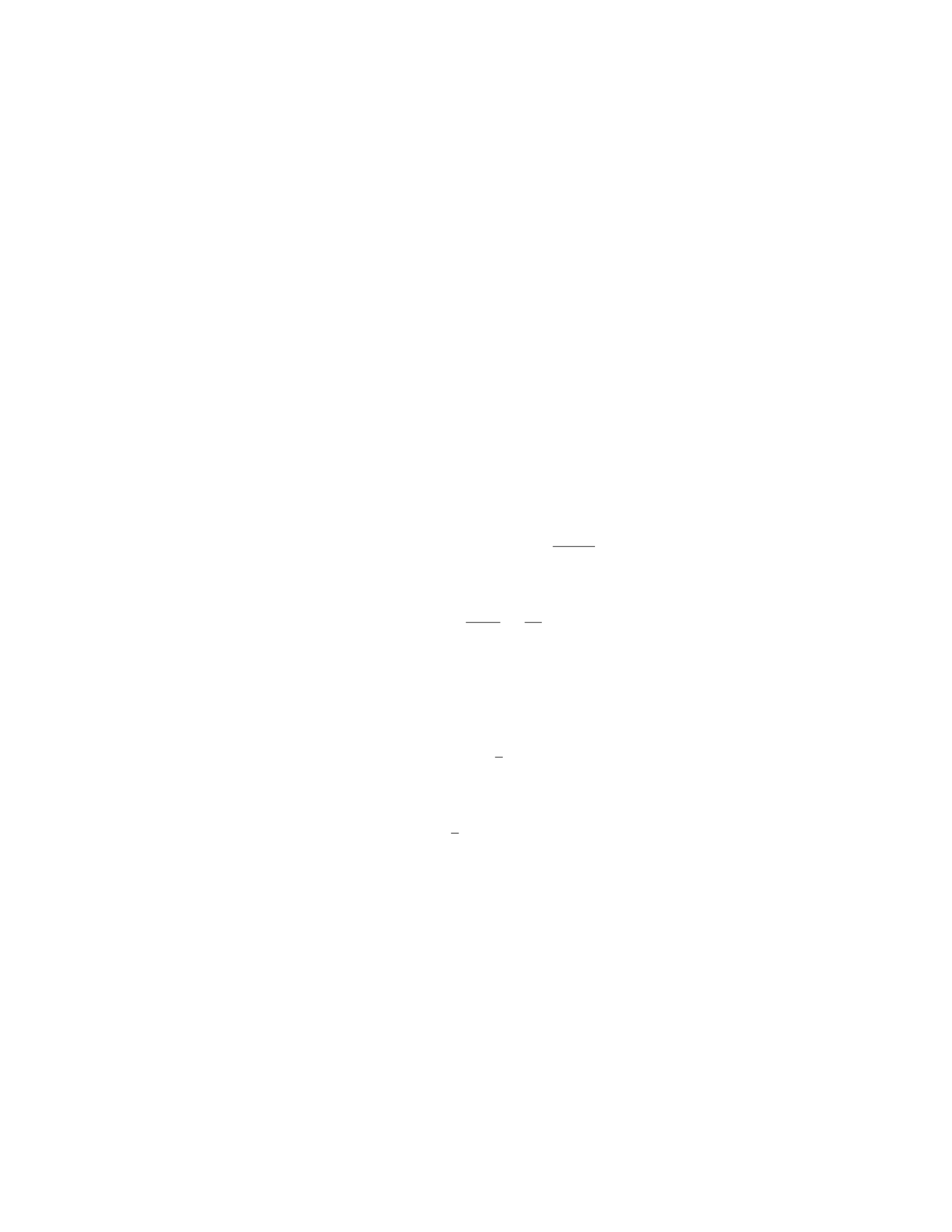
velocity of the object after 4 seconds, the number of revolutions it
has completed during this time, and the angular displacement of the
object.
Solution:
Given data: Initial angular velocity, ω0= 0 rad/s Angular acceler-
ation, α= 2 rad/s2Time, t= 4 s
1. Calculate the final angular velocity (ωf) using the kinematic
equation:
ωf=ω0+αt
Substitute the values to find:
ωf= 0 + 2 ×4=8rad/s
Therefore, the angular velocity of the object after 4 seconds is
8rad/s.
2. Calculate the number of revolutions completed during this time
using the formula:
Number of revolutions =ωf×t
2π
Substitute the values to find:
Number of revolutions =8×4
2π=32
2π≈5.09 revolutions
Therefore, the object completes approximately 5.09 revolutions in
4 seconds.
3. Calculate the angular displacement of the object during this
time using the formula:
θ=ω0t+1
2αt2
Substitute the values to find:
θ= 0 ×4 + 1
2×2×42= 16 rad
Therefore, the angular displacement of the object after 4 seconds
is 16 rad.
Question 16
“‘latex Question 16: A wheel rotates with an angular velocity
of 4rad/s. The wheel slows down with an angular acceleration of
−2rad/s2until it comes to a stop. Calculate the time it takes for the
wheel to stop rotating.
14
Solution: Given, Initial angular velocity, ωi= 4 rad/s
Angular acceleration, α=−2rad/s2
We can use the formula relating angular velocity, angular acceler-
ation, and time:
ωf=ωi+α·t
When the wheel stops rotating, the final angular velocity is 0, so
we have:
0=4−2t
Solving for t:
2t= 4
t=4
2
t= 2 s
Therefore, it takes 2seconds for the wheel to stop rotating. “‘Sure,
here is the LateX code for question number 16 on Angular Motion:
“‘latex Question 16: A wheel rotates with an angular velocity
of 4rad/s. The wheel slows down with an angular acceleration of
−2rad/s2until it comes to a stop. Calculate the time it takes for the
wheel to stop rotating.
Solution: Given, Initial angular velocity, ωi= 4 rad/s
Angular acceleration, α=−2rad/s2
We can use the formula relating angular velocity, angular acceler-
ation, and time:
ωf=ωi+α·t
When the wheel stops rotating, the final angular velocity is 0, so
we have:
0=4−2t
Solving for t:
2t= 4
t=4
2
t= 2 s
Therefore, it takes 2seconds for the wheel to stop rotating. “‘
Question 17
A car moves around a circular track with a radius of 50 meters.
The car’s speed is initially 20 m/s and it accelerates uniformly at a
rate of 5 m/s2. Determine the angular acceleration of the car and the
time it takes to complete one full lap around the track.
Solution:
15

Given: Radius of the circular track, r= 50 meters Initial speed of
the car, v0= 20 m/s Acceleration of the car, a= 5 m/s2
1. Calculate the angular acceleration using the formula:
aangular =alinear
r
Where: alinear = Acceleration of the car r= Radius of the circular
track
Substitute the given values:
aangular =5
50 = 0.1rad/s2
2. Determine the angular speed using the formula:
ω=ω0+aangulart
Where: ω= Angular speed ω0= Initial angular speed (0 for this case)
aangular = Angular acceleration t= Time
Since the initial angular speed is 0:
ω= 0 + 0.1t= 0.1t
3. Calculate the time taken to complete one full lap by finding the
time when the angular displacement is 2πradians (one full rotation):
θ=ω0t+1
2aangulart2
For one full rotation, θ= 2πradians:
2π= 0.1t2
Solve for t:
t=r2π
0.1=√20π≈7.98 s
Therefore, the angular acceleration of the car is 0.1 rad/s2and it
takes approximately 7.98 seconds to complete one full lap around the
track.Question 17:
A car moves around a circular track with a radius of 50 meters.
The car’s speed is initially 20 m/s and it accelerates uniformly at a
rate of 5 m/s2. Determine the angular acceleration of the car and the
time it takes to complete one full lap around the track.
Solution:
Given: Radius of the circular track, r= 50 meters Initial speed of
the car, v0= 20 m/s Acceleration of the car, a= 5 m/s2
1. Calculate the angular acceleration using the formula:
aangular =alinear
r
16
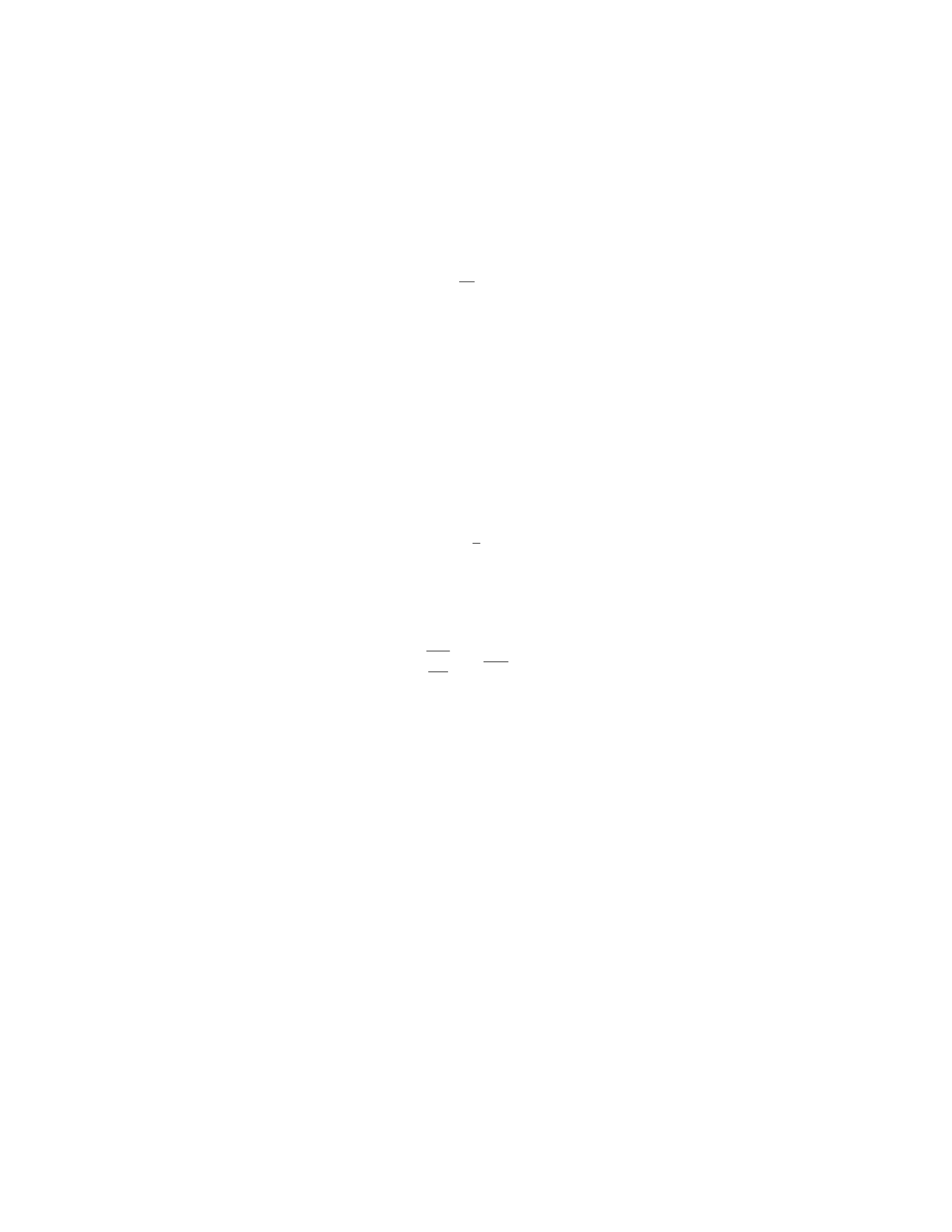
Where: alinear = Acceleration of the car r= Radius of the circular
track
Substitute the given values:
aangular =5
50 = 0.1rad/s2
2. Determine the angular speed using the formula:
ω=ω0+aangulart
Where: ω= Angular speed ω0= Initial angular speed (0 for this case)
aangular = Angular acceleration t= Time
Since the initial angular speed is 0:
ω= 0 + 0.1t= 0.1t
3. Calculate the time taken to complete one full lap by finding the
time when the angular displacement is 2πradians (one full rotation):
θ=ω0t+1
2aangulart2
For one full rotation, θ= 2πradians:
2π= 0.1t2
Solve for t:
t=r2π
0.1=√20π≈7.98 s
Therefore, the angular acceleration of the car is 0.1 rad/s2and it
takes approximately 7.98 seconds to complete one full lap around the
track.
Question 18
“‘latex 18. A particle moves along a circular path with a radius
of 2 m. The particle starts from rest and has a constant angular
acceleration of 3rad/s2. Calculate the linear velocity of the particle
after it has completed one-fourth of a revolution.
Solution:
Given: Radius, r= 2 mAngular acceleration, α= 3 rad/s2
The angular velocity of the particle can be calculated using the
formula
ω2=ω2
0+ 2αθ
where ω= final angular velocity, ω0= initial angular velocity (since
the particle starts from rest, ω0= 0), α= angular acceleration, θ=
angle in radians.
17

When the particle has completed one-fourth of a revolution, θ=
1
4×2π=π
2rad.
Substitute the given values into the formula:
ω2= 0 + 2 ×3×π
2
ω2= 3π rad/s
ω=√3π rad/s
The linear velocity of the particle is given by
v=rω
Substitute the values of rand ω:
v= 2 ×√3π≈6.09 m/s
Therefore, the linear velocity of the particle after it has completed
one-fourth of a revolution is approximately 6.09 m/s. “‘
Let me know if you need any modifications or further assistance!Sure!
Here is the LateX code for your requested question:
“‘latex 18. A particle moves along a circular path with a radius
of 2 m. The particle starts from rest and has a constant angular
acceleration of 3rad/s2. Calculate the linear velocity of the particle
after it has completed one-fourth of a revolution.
Solution:
Given: Radius, r= 2 mAngular acceleration, α= 3 rad/s2
The angular velocity of the particle can be calculated using the
formula
ω2=ω2
0+ 2αθ
where ω= final angular velocity, ω0= initial angular velocity (since
the particle starts from rest, ω0= 0), α= angular acceleration, θ=
angle in radians.
When the particle has completed one-fourth of a revolution, θ=
1
4×2π=π
2rad.
Substitute the given values into the formula:
ω2= 0 + 2 ×3×π
2
ω2= 3π rad/s
ω=√3π rad/s
The linear velocity of the particle is given by
v=rω
18

Substitute the values of rand ω:
v= 2 ×√3π≈6.09 m/s
Therefore, the linear velocity of the particle after it has completed
one-fourth of a revolution is approximately 6.09 m/s. “‘
Let me know if you need any modifications or further assistance!
Question 19
A particle moves along the x-axis according to the equation of
motion x(t) = 4t2−3t+ 7, where xis in meters and tis in seconds.
(a) Determine the velocity of the particle at t= 2 seconds.
(b) Find the acceleration of the particle at t= 2 seconds.
(c) What is the position of the particle at t= 2 seconds?
—
Solution:
(a) To find the velocity of the particle, we need to differentiate the
position equation with respect to time tto get the velocity equation:
v(t) = dx
dt =d
dt(4t2−3t+ 7)
v(t)=8t−3
Substitute t= 2 into the velocity equation:
v(2) = 8(2) −3
v(2) = 13 m/s
(b) To find the acceleration of the particle, we need to differentiate
the velocity equation with respect to time tto get the acceleration
equation:
a(t) = dv
dt =d
dt(8t−3)
a(t)=8
Substitute t= 2 into the acceleration equation:
a(2) = 8
a(2) = 8 m/s2
19

(c) To find the position of the particle at t= 2 seconds, simply
substitute t= 2 into the position equation:
x(2) = 4(2)2−3(2) + 7
x(2) = 16 −6+7
x(2) = 17 meters
Therefore, at t= 2 seconds, the velocity of the particle is 13 m/s,
the acceleration is 8 m/s
²
, and the position of the particle is 17 me-
ters.Question 19:
A particle moves along the x-axis according to the equation of
motion x(t) = 4t2−3t+ 7, where xis in meters and tis in seconds.
(a) Determine the velocity of the particle at t= 2 seconds.
(b) Find the acceleration of the particle at t= 2 seconds.
(c) What is the position of the particle at t= 2 seconds?
—
Solution:
(a) To find the velocity of the particle, we need to differentiate the
position equation with respect to time tto get the velocity equation:
v(t) = dx
dt =d
dt(4t2−3t+ 7)
v(t)=8t−3
Substitute t= 2 into the velocity equation:
v(2) = 8(2) −3
v(2) = 13 m/s
(b) To find the acceleration of the particle, we need to differentiate
the velocity equation with respect to time tto get the acceleration
equation:
a(t) = dv
dt =d
dt(8t−3)
a(t)=8
Substitute t= 2 into the acceleration equation:
a(2) = 8
20

a(2) = 8 m/s2
(c) To find the position of the particle at t= 2 seconds, simply
substitute t= 2 into the position equation:
x(2) = 4(2)2−3(2) + 7
x(2) = 16 −6+7
x(2) = 17 meters
Therefore, at t= 2 seconds, the velocity of the particle is 13 m/s,
the acceleration is 8 m/s
²
, and the position of the particle is 17 me-
ters.
Question 20
Solution:
1. To find the car’s angular acceleration, we will use the formula:
at=r×α
where atis the tangential acceleration, ris the radius of the
circular track, and αis the angular acceleration. Given that
at= 2 m/s2and r= 100 m, we can solve for α:
2 = 100 ×α=⇒α=2
100 = 0.02 rad/s2
2. To calculate the car’s angular velocity at that moment, we will
use the formula:
v=r×ω
where vis the linear speed of the car, ris the radius of the
circular track, and ωis the angular velocity. Given that v= 10
m/s and r= 100 m, we can solve for ω:
10 = 100 ×ω=⇒ω=10
100 = 0.1rad/s
3. The total acceleration of the car can be calculated using the
formula:
atotal =qa2
t+a2
c
21

where atotal is the total acceleration, atis the tangential accel-
eration, and acis the centripetal acceleration. The centripetal
acceleration is given by:
ac=r×ω2= 100 ×(0.1)2= 1 m/s2
Substituting these values into the total acceleration formula:
atotal =p22+ 12=√5≈2.24 m/s2
Question 20: A car is driving around a circular track with a radius
of 100 meters. The car’s speed is increasing at a rate of 2 m/s2. At
a certain moment, the car’s speed is 10 m/s.
1. Determine the car’s angular acceleration.
2. Calculate the car’s angular velocity at that moment.
3. Find the total acceleration of the car.
Solution:
1. To find the car’s angular acceleration, we will use the formula:
at=r×α
where atis the tangential acceleration, ris the radius of the
circular track, and αis the angular acceleration. Given that
at= 2 m/s2and r= 100 m, we can solve for α:
2 = 100 ×α=⇒α=2
100 = 0.02 rad/s2
2. To calculate the car’s angular velocity at that moment, we will
use the formula:
v=r×ω
where vis the linear speed of the car, ris the radius of the
circular track, and ωis the angular velocity. Given that v= 10
m/s and r= 100 m, we can solve for ω:
10 = 100 ×ω=⇒ω=10
100 = 0.1rad/s
3. The total acceleration of the car can be calculated using the
formula:
atotal =qa2
t+a2
c
where atotal is the total acceleration, atis the tangential accel-
eration, and acis the centripetal acceleration. The centripetal
acceleration is given by:
ac=r×ω2= 100 ×(0.1)2= 1 m/s2
22

Substituting these values into the total acceleration formula:
atotal =p22+ 12=√5≈2.24 m/s2
23

