


MATH 332 - Functional Analysis Question Bank
Question 1
Prompt:
Consider the vector space R2equipped with the norm defined by
∥(x, y)∥= max{|x|,|y|}.
This norm is known as the infinity norm or the maximum norm.
(a) Show that ∥·∥satisfies the properties of a norm.
(b) Compute the norm of the vector (3,−4) using this definition.
Step-by-Step Solution:
(a) *Norm Properties Verification:*
Recall that a norm must satisfy the following properties for any vectors (x, y)
and (x′, y′) in territorium)Notebook002)ban(R2:
i. Non-negativity: ∥(x, y)∥ ≥ 0 and ∥(x, y)∥= 0 if and only if (x, y) = (0,0).
ii. Scalability (Absolute Homogeneity): ∥a(x, y)∥=|a| · ∥(x, y)∥for any
scalar a.
iii. Triangle Inequality: ∥(x, y)+(x′, y′)∥≤∥(x, y)∥+∥(x′, y′)∥.
- Verifying non-negativity:
∥(x, y)∥= max{|x|,|y|}
Since |x|and |y|are non-negative (as absolute values), the maximum of these
two non-negative numbers is also non-negative.
∥(x, y)∥= 0 if and only if both |x|= 0 and |y|= 0. Thus, x= 0 and y= 0,
so (x, y) = (0,0).
- Verifying scalability:
∥a(x, y)∥=∥(ax, ay)∥= max{|ax|,|ay|} = max{|a||x|,|a||y|} =|a|max{|x|,|y|} =
|a|∥(x, y)∥.
- Verifying triangle inequality:
Let (x′, y′) be another vector in R2.
∥(x, y)+(x′, y′)∥=∥(x+x′, y +y′)∥= max{|x+x′|,|y+y′|}.
Using the triangle inequality for absolute values:
|x+x′|≤|x|+|x′|and |y+y′| ≤ |y|+|y′|.
Thus, max{|x+x′|,|y+y′|} ≤ max{|x|+|x′|,|y|+|y′|}.
Since max of sums is less than or equal to the sum of maxs:
max{|x|+|x′|,|y|+|y′|} ≤ max{|x|,|y|}+max{|x′|,|y′|} =∥(x, y)∥+∥(x′, y′)∥.
Thus, the triangle inequality holds.
(b) *Compute the norm of (3,−4):*
1

∥(3,−4)∥= max{|3|,| − 4|} = max{3,4}= 4.
Hence, the norm of the vector (3,−4) under the infinity norm is 4.Question
1: Basic Concepts of Normed Spaces
Prompt:
Consider the vector space R2equipped with the norm defined by
∥(x, y)∥= max{|x|,|y|}.
This norm is known as the infinity norm or the maximum norm.
(a) Show that ∥·∥satisfies the properties of a norm.
(b) Compute the norm of the vector (3,−4) using this definition.
Step-by-Step Solution:
(a) *Norm Properties Verification:*
Recall that a norm must satisfy the following properties for any
vectors (x, y)and (x′, y′)in territorium)Notebook002)ban(R2:
i. Non-negativity: ∥(x, y)∥ ≥ 0and ∥(x, y)∥= 0 if and only if (x, y) =
(0,0).
ii. Scalability (Absolute Homogeneity): ∥a(x, y)∥=|a| · ∥(x, y)∥for
any scalar a.
iii. Triangle Inequality: ∥(x, y)+(x′, y′)∥≤∥(x, y)∥+∥(x′, y′)∥.
- Verifying non-negativity:
∥(x, y)∥= max{|x|,|y|}
Since |x|and |y|are non-negative (as absolute values), the maxi-
mum of these two non-negative numbers is also non-negative.
∥(x, y)∥= 0 if and only if both |x|= 0 and |y|= 0. Thus, x= 0 and
y= 0, so (x, y) = (0,0).
- Verifying scalability:
∥a(x, y)∥=∥(ax, ay)∥= max{|ax|,|ay|} = max{|a||x|,|a||y|} =|a|max{|x|,|y|} =
|a|∥(x, y)∥.
- Verifying triangle inequality:
Let (x′, y′)be another vector in R2.
∥(x, y)+(x′, y′)∥=∥(x+x′, y +y′)∥= max{|x+x′|,|y+y′|}.
Using the triangle inequality for absolute values:
|x+x′|≤|x|+|x′|and |y+y′|≤|y|+|y′|.
Thus, max{|x+x′|,|y+y′|} ≤ max{|x|+|x′|,|y|+|y′|}.
Since max of sums is less than or equal to the sum of maxs:
max{|x|+|x′|,|y|+|y′|} ≤ max{|x|,|y|}+max{|x′|,|y′|} =∥(x, y)∥+∥(x′, y′)∥.
Thus, the triangle inequality holds.
(b) *Compute the norm of (3,−4):*
∥(3,−4)∥= max{|3|,| − 4|} = max{3,4}= 4.
Hence, the norm of the vector (3,−4) under the infinity norm is 4.
Question 2
Step-by-step Solution
2

Step 1: Define the Spaces - The space ℓ∞consists of all bounded
sequences (xn)of real numbers, i.e., there exists some constant Msuch
that |xn| ≤ Mfor all n∈N. - The space c0consists of all sequences
(xn)of real numbers such that limn→∞ xn = 0.
Step 2: Show c0⊆ℓ∞- If a sequence (xn)∈c0, then xn→0as
n→ ∞. - Since xn→0, the sequence (xn)is bounded (otherwise the
limit cannot be zero). Hence, (xn)∈ℓ∞. - Therefore, every sequence
in c0is also in ℓ∞, so c0⊆ℓ∞.
Step 3: Show c0is Closed in ℓ∞- To show c0is closed, we need
to show that it contains all its limit points within ℓ∞. - Consider a
sequence of sequences (x(k)
n)where each x(k)
n∈c0, and suppose (x(k)
n)
converges to some (xn)in the norm of ℓ∞, i.e., supn|x(k)
n−xn| → 0as
k→ ∞.
Step 4: Use the Convergence Definition - Since x(k)
n∈c0, for each
k, we have x(k)
n→0as n→ ∞. - To show xn→0as n→ ∞, fix ϵ > 0.
Then, for each k, there exists Nksuch that for all n≥Nk,|x(k)
n|< ϵ/2.
Step 5: Apply the Uniform Convergence - Since (x(k)
n)converges
uniformly to (xn)in ℓ∞, there exists Ksuch that for all k≥K,
supn|x(k)
n−xn|< ϵ/2. - Choose n≥NK. Then |xn|≤|xn−x(K)
n|+|x(K)
n|. -
|xn−x(K)
n|< ϵ/2and |x(K)
n|< ϵ/2, thus |xn|< ϵ. - Since ϵwas arbitrary,
xn→0as n→ ∞, proving xn∈c0.
Conclusion: - Since every limit point of sequences in c0still belongs
to c0, it follows that c0is a closed subspace of ℓ∞. Question 2: Prove
that the space c0, which consists of all sequences of real numbers that
converge to zero, is a closed subspace of ℓ∞, the space of all bounded
sequences of real numbers.
Step-by-step Solution
Step 1: Define the Spaces - The space ℓ∞consists of all bounded
sequences (xn)of real numbers, i.e., there exists some constant Msuch
that |xn| ≤ Mfor all n∈N. - The space c0consists of all sequences
(xn)of real numbers such that limn→∞ xn = 0.
Step 2: Show c0⊆ℓ∞- If a sequence (xn)∈c0, then xn→0as
n→ ∞. - Since xn→0, the sequence (xn)is bounded (otherwise the
limit cannot be zero). Hence, (xn)∈ℓ∞. - Therefore, every sequence
in c0is also in ℓ∞, so c0⊆ℓ∞.
Step 3: Show c0is Closed in ℓ∞- To show c0is closed, we need
to show that it contains all its limit points within ℓ∞. - Consider a
sequence of sequences (x(k)
n)where each x(k)
n∈c0, and suppose (x(k)
n)
converges to some (xn)in the norm of ℓ∞, i.e., supn|x(k)
n−xn| → 0as
k→ ∞.
Step 4: Use the Convergence Definition - Since x(k)
n∈c0, for each
k, we have x(k)
n→0as n→ ∞. - To show xn→0as n→ ∞, fix ϵ > 0.
Then, for each k, there exists Nksuch that for all n≥Nk,|x(k)
n|< ϵ/2.
Step 5: Apply the Uniform Convergence - Since (x(k)
n)converges
3

uniformly to (xn)in ℓ∞, there exists Ksuch that for all k≥K,
supn|x(k)
n−xn|< ϵ/2. - Choose n≥NK. Then |xn|≤|xn−x(K)
n|+|x(K)
n|. -
|xn−x(K)
n|< ϵ/2and |x(K)
n|< ϵ/2, thus |xn|< ϵ. - Since ϵwas arbitrary,
xn→0as n→ ∞, proving xn∈c0.
Conclusion: - Since every limit point of sequences in c0still belongs
to c0, it follows that c0is a closed subspace of ℓ∞.
Question 3
Question 3: Convergence in Normed Spaces
Define a sequence of functions {fn}in the normed vector space
C[0,1] of all continuous functions on the interval [0,1] with the supre-
mum norm, by setting
fn(x) = n
√xfor x∈[0,1].
Determine whether {fn}converges in the norm ∥·∥∞and if so, find
the limit function f.
Solution:
Step 1: Understanding the Sequence The sequence given is fn(x) =
n
√x, where each fnis defined on the interval [0,1]. Recall that n
√xcan
be written as x1/n.
Step 2: Examining Pointwise Convergence We first examine if
there is pointwise convergence by fixing x∈(0,1) and letting ngo to
infinity. By elementary calculus, since 1/n →0as n→ ∞, we have
x1/n →1. Also, for x= 0 and x= 1,fn(0) = 0 for all nand fn(1) = 1 for
all n. Hence, fn(x)converges pointwise to the function f(x), where
f(x) = (1if x > 0,
0if x= 0.
Step 3: Convergence in the Supremum Norm Next, consider con-
vergence in the norm ∥ · ∥∞. For this type of convergence, we must
have limn→∞ ∥fn−f∥∞= 0. Calculate ∥fn−f∥∞:
∥fn−f∥∞= sup
x∈[0,1] |fn(x)−f(x)|.
For x= 0,|fn(0) −f(0)|= 0. For x > 0,
|fn(x)−f(x)|=|x1/n −1|,
and since x1/n →1as n→ ∞, this expression goes to 0 for each
x. However, the rate of convergence depends on xand is slower for
values of xnear 0. Therefore, the supreme of |fn(x)−1|over xin [0,1]
does not necessarily go to 0.
4

Step 4: Evaluating the supremum To further evaluate it, consider
any ϵ > 0. Given xapproaches 0, the expression x1/n approaches 0 as
well because its exponent decreases. Therefore, near x= 1,|x1/n −1|
stays below ϵonly for sufficiently large n, but for smaller x, smaller
values of nmight not suffice to bring |x1/n −1|below ϵ. Thus,
sup
x∈[0,1] |x1/n −1|= 1 for all n,
since the supremum involves considering all values including xnear
0.
Step 5: Conclusion The sequence {fn}does not converge in the
norm ∥·∥∞to any function fin C[0,1].
The outcome shows the nuanced difference between pointwise and
uniform convergence, importantly, fas described violates continuity
at x= 0 and hence is not even in C[0,1]. Therefore {fn}certainly does
not converge uniformly to f.Here’s a suitable question for Liberty
University on Functional Analysis, complete with a detailed step-by-
step solution.
Question 3: Convergence in Normed Spaces
Define a sequence of functions {fn}in the normed vector space
C[0,1] of all continuous functions on the interval [0,1] with the supre-
mum norm, by setting
fn(x) = n
√xfor x∈[0,1].
Determine whether {fn}converges in the norm ∥·∥∞and if so, find
the limit function f.
Solution:
Step 1: Understanding the Sequence The sequence given is fn(x) =
n
√x, where each fnis defined on the interval [0,1]. Recall that n
√xcan
be written as x1/n.
Step 2: Examining Pointwise Convergence We first examine if
there is pointwise convergence by fixing x∈(0,1) and letting ngo to
infinity. By elementary calculus, since 1/n →0as n→ ∞, we have
x1/n →1. Also, for x= 0 and x= 1,fn(0) = 0 for all nand fn(1) = 1 for
all n. Hence, fn(x)converges pointwise to the function f(x), where
f(x) = (1if x > 0,
0if x= 0.
Step 3: Convergence in the Supremum Norm Next, consider con-
vergence in the norm ∥ · ∥∞. For this type of convergence, we must
have limn→∞ ∥fn−f∥∞= 0. Calculate ∥fn−f∥∞:
∥fn−f∥∞= sup
x∈[0,1] |fn(x)−f(x)|.
5

For x= 0,|fn(0) −f(0)|= 0. For x > 0,
|fn(x)−f(x)|=|x1/n −1|,
and since x1/n →1as n→ ∞, this expression goes to 0 for each
x. However, the rate of convergence depends on xand is slower for
values of xnear 0. Therefore, the supreme of |fn(x)−1|over xin [0,1]
does not necessarily go to 0.
Step 4: Evaluating the supremum To further evaluate it, consider
any ϵ > 0. Given xapproaches 0, the expression x1/n approaches 0 as
well because its exponent decreases. Therefore, near x= 1,|x1/n −1|
stays below ϵonly for sufficiently large n, but for smaller x, smaller
values of nmight not suffice to bring |x1/n −1|below ϵ. Thus,
sup
x∈[0,1] |x1/n −1|= 1 for all n,
since the supremum involves considering all values including xnear
0.
Step 5: Conclusion The sequence {fn}does not converge in the
norm ∥·∥∞to any function fin C[0,1].
The outcome shows the nuanced difference between pointwise and
uniform convergence, importantly, fas described violates continuity
at x= 0 and hence is not even in C[0,1]. Therefore {fn}certainly does
not converge uniformly to f.
Question 4
Consider the Banach spaces Xand Y. Let T:X→Ybe a linear
operator. Prove that if Tis bounded, then it is continuous.
Solution:
Step 1: Understanding Definitions - A linear operator T:X→Y
is bounded if there exists a constant C > 0such that for all x∈X,
∥T(x)∥Y≤C∥x∥X.
- A linear operator is continuous if the pre-image of every open set
is open, or equivalently, for every sequence {xn}in Xthat converges
to xin X, the sequence {T(xn)}converges to T(x)in Y.
Step 2: Show Continuity from Boundedness - Assume Tis bounded.
Then, there exists a constant C > 0such that
∥T(x)∥Y≤C∥x∥Xfor all x∈X.
- Consider a sequence {xn}in Xsuch that xn→xin X. We need to
show T(xn)→T(x)in Y.
6

Step 3: Use Norm Inequality - From the linearity and the bound-
edness of T, we have
∥T(xn)−T(x)∥Y=∥T(xn−x)∥Y≤C∥xn−x∥X.
- Since xn→x, by definition ∥xn−x∥X→0as n→ ∞.
Step 4: Conclude Convergence - The inequality ∥T(xn)−T(x)∥Y≤
C∥xn−x∥Ximplies that
∥T(xn)−T(x)∥Y→0as n→ ∞.
- Hence, T(xn)→T(x)in Y.
Step 5: Conclude Continuity - We have shown that for any se-
quence {xn}in Xconverging to x, the sequence {T(xn)}converges to
T(x)in Y. Therefore, Tis continuous.
Conclusion: The bounded linear operator Tfrom Xto Yis contin-
uous. This demonstrates the connection between boundedness and
continuity in the context of linear operators between Banach spaces.
Question 4: Bounded Linear Operators
Consider the Banach spaces Xand Y. Let T:X→Ybe a linear
operator. Prove that if Tis bounded, then it is continuous.
Solution:
Step 1: Understanding Definitions - A linear operator T:X→Y
is bounded if there exists a constant C > 0such that for all x∈X,
∥T(x)∥Y≤C∥x∥X.
- A linear operator is continuous if the pre-image of every open set
is open, or equivalently, for every sequence {xn}in Xthat converges
to xin X, the sequence {T(xn)}converges to T(x)in Y.
Step 2: Show Continuity from Boundedness - Assume Tis bounded.
Then, there exists a constant C > 0such that
∥T(x)∥Y≤C∥x∥Xfor all x∈X.
- Consider a sequence {xn}in Xsuch that xn→xin X. We need to
show T(xn)→T(x)in Y.
Step 3: Use Norm Inequality - From the linearity and the bound-
edness of T, we have
∥T(xn)−T(x)∥Y=∥T(xn−x)∥Y≤C∥xn−x∥X.
- Since xn→x, by definition ∥xn−x∥X→0as n→ ∞.
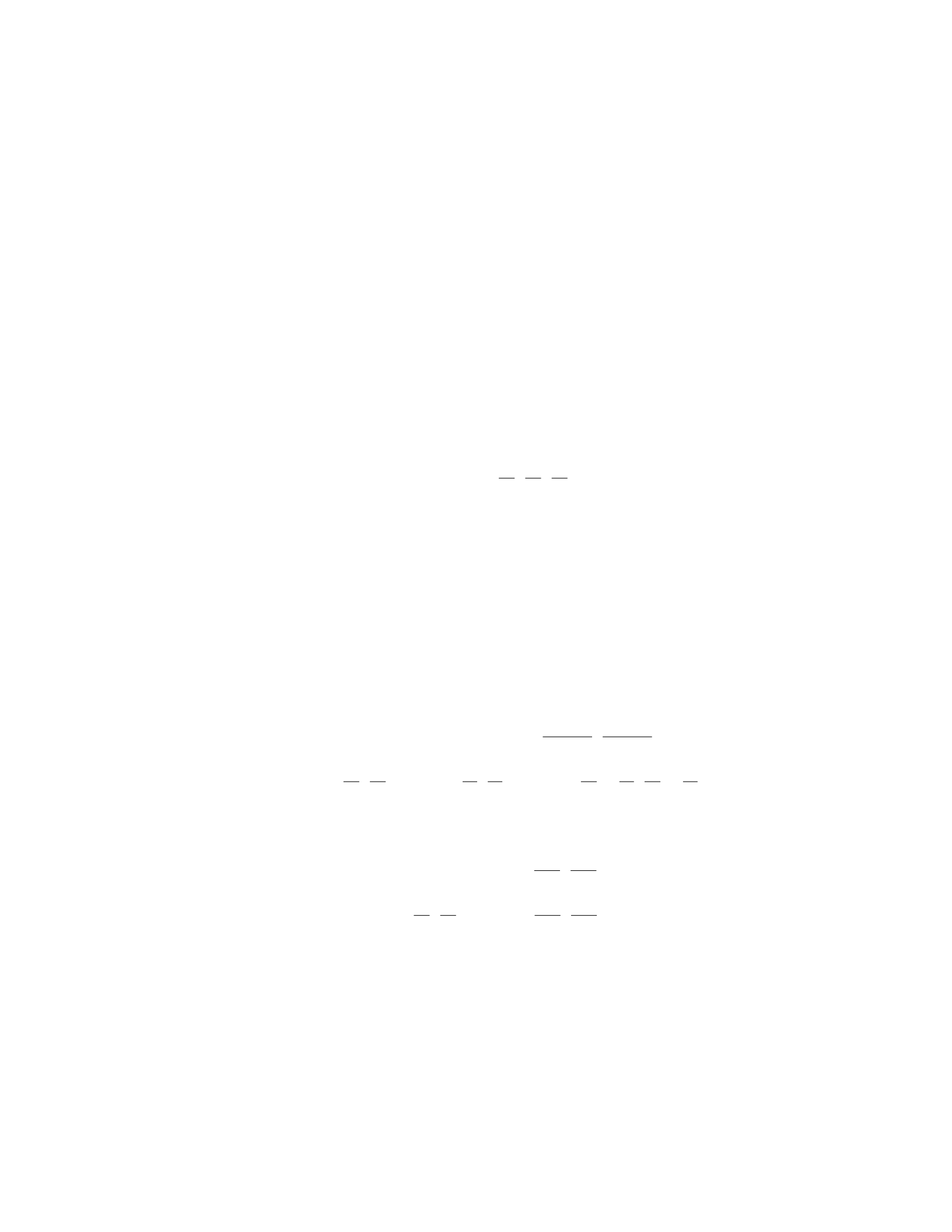
Step 4: Conclude Convergence - The inequality ∥T(xn)−T(x)∥Y≤
C∥xn−x∥Ximplies that
∥T(xn)−T(x)∥Y→0as n→ ∞.
- Hence, T(xn)→T(x)in Y.
7
Step 5: Conclude Continuity - We have shown that for any se-
quence {xn}in Xconverging to x, the sequence {T(xn)}converges to
T(x)in Y. Therefore, Tis continuous.
Conclusion: The bounded linear operator Tfrom Xto Yis contin-
uous. This demonstrates the connection between boundedness and
continuity in the context of linear operators between Banach spaces.
Question 5
Problem: Let X=l2and Y=l2be Hilbert spaces, where l2denotes
the space of all infinite sequences of real numbers (x1, x2, x3, . . .)such
that the series P∞
n=1 |xn|2is convergent. Consider the linear operator
T:X→Ydefined by
T(x1, x2, x3, . . . ) = (0,x1
2,x2
3,x3
4, . . . ).
Prove that Tis a bounded linear operator and find its norm ∥T∥.
Solution:
Step 1: Check Linearity To verify that Tis linear, consider two
elements x= (x1, x2, . . . )and y= (y1, y2, . . . )in l2, and let αbe a scalar.
We need to check the two properties: 1. T(x+y) = T(x) + T(y)2.
T(αx) = αT (x)
For the first property,
x+y= (x1+y1, x2+y2, . . . )
so,
T(x+y) = T(x1+y1, x2+y2, . . . ) = (0,x1+y1
2,x2+y2
3, . . . )
T(x) + T(y) = (0,x1
2,x2
3, . . . ) + (0,y1
2,y2
3, . . . ) = (0,x1
2+y1
2,x2
3+y2
3, . . . )
Thus, T(x+y) = T(x) + T(y).
For the second property,
T(αx) = T(αx1, αx2, . . . ) = (0,αx1
2,αx2
3, . . . )
αT (x) = α(0,x1
2,x2
3, . . . ) = (0,αx1
2,αx2
3, . . . )
Thus, T(αx) = αT (x). So, Tis linear.
Step 2: Check Boundedness and Compute ∥T∥A linear operator
Tis bounded if there exists a constant Csuch that for all x∈X,
∥T(x)∥ ≤ C∥x∥.
8
Compute T(x):
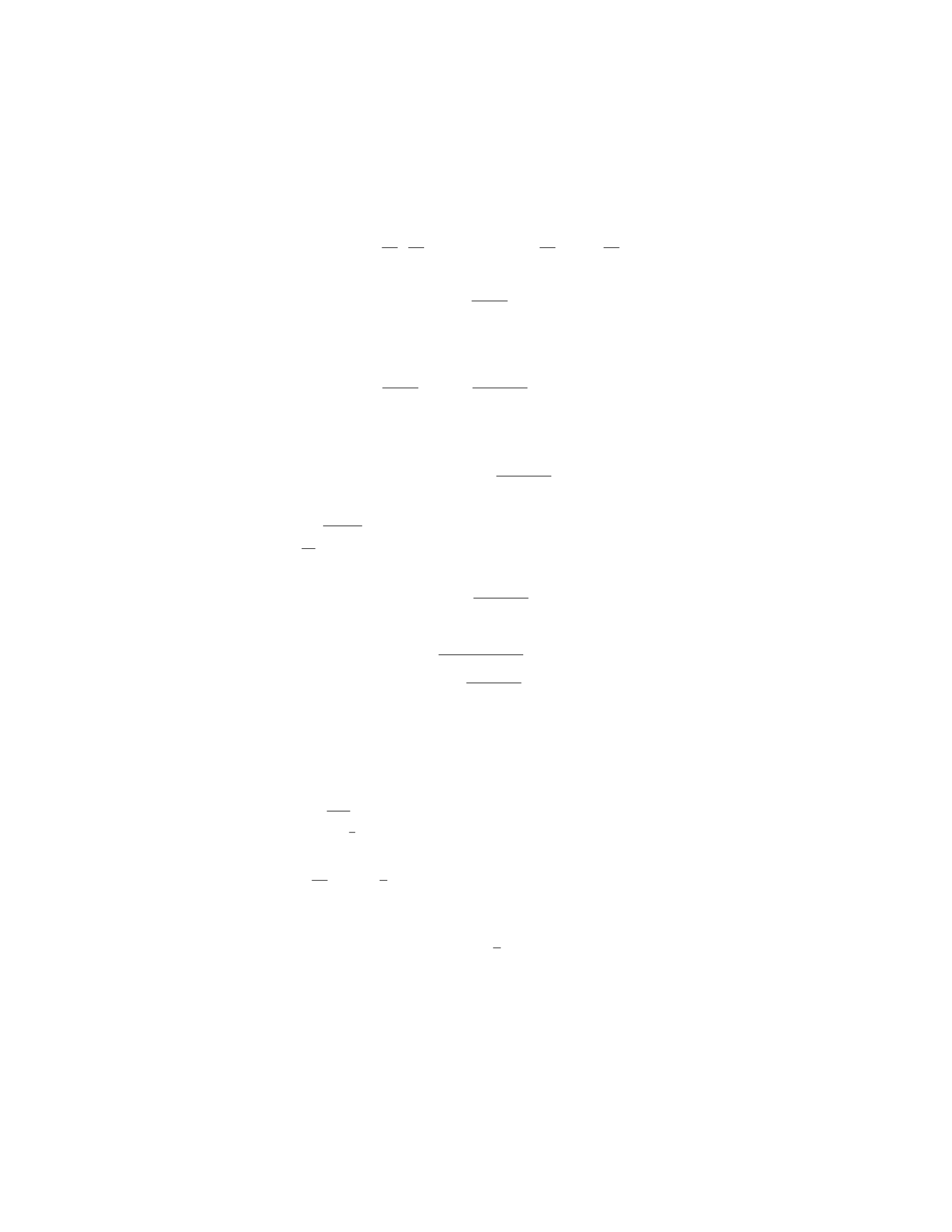
∥T(x)∥2=∥(0,x1
2,x2
3, . . . )∥2= 02+x1
22+x2
32+. . .
=
∞
X
n=1 xn
n+ 12
.
By Cauchy-Schwarz inequality,
xn
n+ 12
≤1
(n+ 1)2x2
n,
and summing over all n:
∥T(x)∥2≤
∞
X
n=1
x2
n
(n+ 1)2.
Because P∞
n=1 1
(n+1)2converges (by the comparison test with the p-
series P∞
n=2 1
n2),
∥T(x)∥2≤ ∞
X
n=1
1
(n+ 1)2!∞
X
n=1
x2
n.
Hence,
∥T(x)∥ ≤ v
u
u
t
∞
X
n=1
1
(n+ 1)2∥x∥<∥x∥.
This establishes that Tis bounded. To find ∥T∥,
∥T∥= sup
∥x∥=1 ∥T(x)∥,
and since each 1
n+1 as n→ ∞ approaches 0, the tightest bound occurs
approximately as 1
2since for the first term:
x1
22=1
22
if x1= 1 and xn= 0 for n > 1.
Hence,
∥T∥=1
2.
Question 5: Proving boundedness of a linear operator
Problem: Let X=l2and Y=l2be Hilbert spaces, where l2denotes
the space of all infinite sequences of real numbers (x1, x2, x3, . . .)such
9
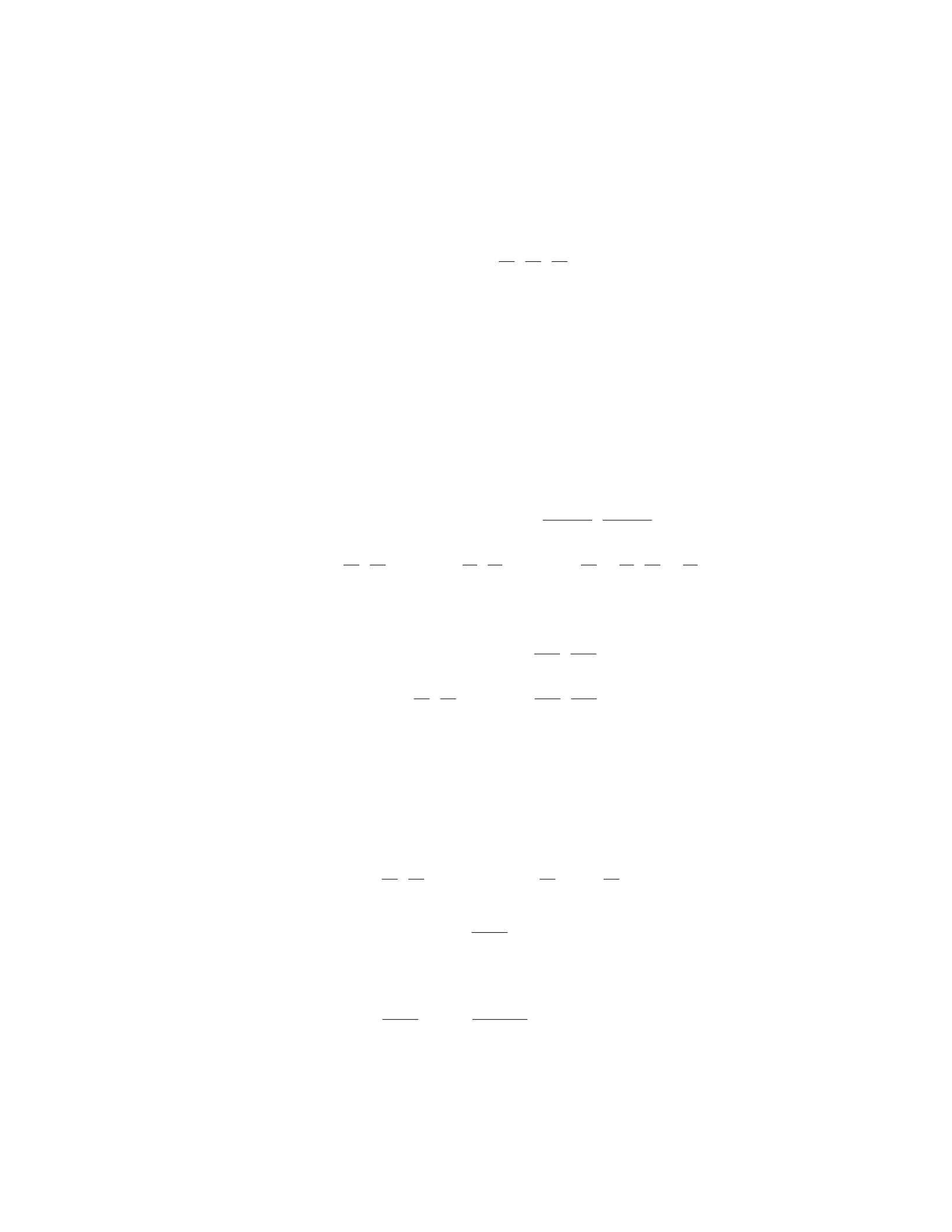
that the series P∞
n=1 |xn|2is convergent. Consider the linear operator
T:X→Ydefined by
T(x1, x2, x3, . . . ) = (0,x1
2,x2
3,x3
4, . . . ).
Prove that Tis a bounded linear operator and find its norm ∥T∥.
Solution:
Step 1: Check Linearity To verify that Tis linear, consider two
elements x= (x1, x2, . . . )and y= (y1, y2, . . . )in l2, and let αbe a scalar.
We need to check the two properties: 1. T(x+y) = T(x) + T(y)2.
T(αx) = αT (x)
For the first property,
x+y= (x1+y1, x2+y2, . . . )
so,
T(x+y) = T(x1+y1, x2+y2, . . . ) = (0,x1+y1
2,x2+y2
3, . . . )
T(x) + T(y) = (0,x1
2,x2
3, . . . ) + (0,y1
2,y2
3, . . . ) = (0,x1
2+y1
2,x2
3+y2
3, . . . )
Thus, T(x+y) = T(x) + T(y).
For the second property,
T(αx) = T(αx1, αx2, . . . ) = (0,αx1
2,αx2
3, . . . )
αT (x) = α(0,x1
2,x2
3, . . . ) = (0,αx1
2,αx2
3, . . . )
Thus, T(αx) = αT (x). So, Tis linear.
Step 2: Check Boundedness and Compute ∥T∥A linear operator
Tis bounded if there exists a constant Csuch that for all x∈X,
∥T(x)∥ ≤ C∥x∥.
Compute T(x):
∥T(x)∥2=∥(0,x1
2,x2
3, . . . )∥2= 02+x1
22+x2
32+. . .
=
∞
X
n=1 xn
n+ 12
.
By Cauchy-Schwarz inequality,
xn
n+ 12
≤1
(n+ 1)2x2
n,
10

and summing over all n:
∥T(x)∥2≤
∞
X
n=1
x2
n
(n+ 1)2.
Because P∞
n=1 1
(n+1)2converges (by the comparison test with the p-
series P∞
n=2 1
n2),
∥T(x)∥2≤ ∞
X
n=1
1
(n+ 1)2!∞
X
n=1
x2
n.
Hence,
∥T(x)∥ ≤ v
u
u
t
∞
X
n=1
1
(n+ 1)2∥x∥<∥x∥.
This establishes that Tis bounded. To find ∥T∥,
∥T∥= sup
∥x∥=1 ∥T(x)∥,
and since each 1
n+1 as n→ ∞ approaches 0, the tightest bound occurs
approximately as 1
2since for the first term:
x1
22=1
22
if x1= 1 and xn= 0 for n > 1.
Hence,
∥T∥=1
2.
Question 6
Question: Let {xn}be a sequence in ℓp(1≤p < ∞) defined by
xn(k) = 1
nif k≤nand xn(k) = 0 otherwise. Prove that xnconverges
weakly to 0in ℓp.
Solution:
Step 1: Understand weak convergence
A sequence {xn}in a normed space Xconverges weakly to x∈X
if for every continuous linear functional fon X,f(xn)converges to
f(x). In the context of ℓp, the dual space is ℓqwhere 1
p+1
q= 1 and
functionals f∈(ℓp)∗can be represented as f(x) = P∞
k=1 xkykfor some
y= (yk)∈ℓq.
Step 2: Express the functional applied to the sequence
Given {xn}in ℓpas xn(k) = 1
nfor k≤nand xn(k)=0for k > n, the
application of fassociated with y∈ℓqto xnis
f(xn) =
∞
X
k=1
xn(k)yk=
n
X
k=1
1
nyk.
11

Step 3: Assess convergence of the sum
We need to show that limn→∞ Pn
k=1 1
nyk= 0. Convert the sum into
an integral-like form:
n
X
k=1
1
nyk≈1
n(y1+y2+. . . +yn).
Step 4: Utilize properties of ℓqsequences
Since y∈ℓq, we know that P∞
k=1 |yk|q<∞. By H¨older’s inequal-
ity or the dominated convergence theorem, as n→ ∞, the average
1
nPn
k=1 yk→0because the series P∞
k=1 ykis absolutely convergent and
therefore yk→0as k→ ∞.
Step 5: Confirm weak convergence
Since 1
nPn
k=1 yk→0as n→ ∞ and since this is true for any y∈ℓq, it
follows that f(xn)→0for every f∈(ℓp)∗. Thus, xnconverges weakly
to 0in ℓp.
Conclusion: The sequence {xn}defined in the problem statement
converges weakly to 0in ℓp, concluding the proof of the statement.
Question 6: Weak Convergence in ℓpSpaces
Question: Let {xn}be a sequence in ℓp(1≤p < ∞) defined by
xn(k) = 1
nif k≤nand xn(k) = 0 otherwise. Prove that xnconverges
weakly to 0in ℓp.
Solution:
Step 1: Understand weak convergence
A sequence {xn}in a normed space Xconverges weakly to x∈X
if for every continuous linear functional fon X,f(xn)converges to
f(x). In the context of ℓp, the dual space is ℓqwhere 1
p+1
q= 1 and
functionals f∈(ℓp)∗can be represented as f(x) = P∞
k=1 xkykfor some
y= (yk)∈ℓq.
Step 2: Express the functional applied to the sequence
Given {xn}in ℓpas xn(k) = 1
nfor k≤nand xn(k)=0for k > n, the
application of fassociated with y∈ℓqto xnis
f(xn) =
∞
X
k=1
xn(k)yk=
n
X
k=1
1
nyk.
Step 3: Assess convergence of the sum
We need to show that limn→∞ Pn
k=1 1
nyk= 0. Convert the sum into
an integral-like form:
n
X
k=1
1
nyk≈1
n(y1+y2+. . . +yn).
Step 4: Utilize properties of ℓqsequences
Since y∈ℓq, we know that P∞
k=1 |yk|q<∞. By H¨older’s inequal-
ity or the dominated convergence theorem, as n→ ∞, the average
12

1
nPn
k=1 yk→0because the series P∞
k=1 ykis absolutely convergent and
therefore yk→0as k→ ∞.
Step 5: Confirm weak convergence
Since 1
nPn
k=1 yk→0as n→ ∞ and since this is true for any y∈ℓq, it
follows that f(xn)→0for every f∈(ℓp)∗. Thus, xnconverges weakly
to 0in ℓp.
Conclusion: The sequence {xn}defined in the problem statement
converges weakly to 0in ℓp, concluding the proof of the statement.
Question 7
Question:
Consider the normed linear space (C[0,1],∥·∥∞), where C[0,1] con-
sists of all continuous functions on the interval [0,1] and ∥·∥∞is the
supremum norm, defined as
∥f∥∞= sup
x∈[0,1] |f(x)|.
Let fn(x) = xnfor n= 1,2,3, . . . and x∈[0,1].
a) Prove that the sequence (fn)converges in (C[0,1],∥ · ∥∞)and
determine the limit.
b) Is the convergence uniform? Justify your answer.
—
Solution:
a) Proving Convergence and Determining the Limit:
Step 1: Identify the pointwise limit of fn(x). - Notice that for each
xin [0,1), as n→ ∞,xn→0. - At x= 1,fn(1) = 1n= 1 for all n.
Step 2: Define the candidate for the limit function. - Define func-
tion f(x)such that f(x) = 0 for x∈[0,1) and f(1) = 1.
Step 3: Check the convergence of fnto fin the supremum norm.
- Compute the supremum norm as follows:
∥fn−f∥∞= sup
x∈[0,1] |fn(x)−f(x)|.
- For x∈[0,1),∥fn(x)−f(x)∥=|xn−0|=xn. - At x= 1,∥fn(1) −f(1)∥=
|1−1|= 0. - Thus, ∥fn−f∥∞= supx∈[0,1) xn.
Step 4: Assess the supremum over [0,1). - As n→ ∞, the supre-
mum supx∈[0,1) xnapproaches 0 since xngets arbitrarily small for each
x∈[0,1).
Conclusion: Since ∥fn−f∥∞→0as n→ ∞, the sequence (fn)
converges to the zero function in the supremum norm.
b) Checking Uniform Convergence:
Step 1: Review definition and condition. - A sequence of functions
(fn)converges uniformly to a function fon a set Dif
lim
n→∞ sup
x∈D|fn(x)−f(x)|= 0.
13

Step 2: Apply to fn. - From part (a), we’ve seen that ∥fn−f∥∞→0
as n→ ∞, where f(x) = 0 for all x∈[0,1) and f(1) = 1.
Step 3: Examine continuity of the limit function. - Given that
the limit function f(x)is discontinuous at x= 1, while each fn(x)is
continuous over [0,1].
Conclusion: The convergence cannot be uniform because the limit
of continuous functions under uniform convergence must itself be con-
tinuous on the same interval, contradicting the discontinuity of fat
x= 1. Thus, (fn)does not converge uniformly to f. Question 7:
Functional Analysis - Normed Linear Spaces and Convergence
Question:
Consider the normed linear space (C[0,1],∥·∥∞), where C[0,1] con-
sists of all continuous functions on the interval [0,1] and ∥·∥∞is the
supremum norm, defined as
∥f∥∞= sup
x∈[0,1] |f(x)|.
Let fn(x) = xnfor n= 1,2,3, . . . and x∈[0,1].
a) Prove that the sequence (fn)converges in (C[0,1],∥ · ∥∞)and
determine the limit.
b) Is the convergence uniform? Justify your answer.
—
Solution:
a) Proving Convergence and Determining the Limit:
Step 1: Identify the pointwise limit of fn(x). - Notice that for each
xin [0,1), as n→ ∞,xn→0. - At x= 1,fn(1) = 1n= 1 for all n.
Step 2: Define the candidate for the limit function. - Define func-
tion f(x)such that f(x) = 0 for x∈[0,1) and f(1) = 1.
Step 3: Check the convergence of fnto fin the supremum norm.
- Compute the supremum norm as follows:
∥fn−f∥∞= sup
x∈[0,1] |fn(x)−f(x)|.
- For x∈[0,1),∥fn(x)−f(x)∥=|xn−0|=xn. - At x= 1,∥fn(1) −f(1)∥=
|1−1|= 0. - Thus, ∥fn−f∥∞= supx∈[0,1) xn.
Step 4: Assess the supremum over [0,1). - As n→ ∞, the supre-
mum supx∈[0,1) xnapproaches 0 since xngets arbitrarily small for each
x∈[0,1).
Conclusion: Since ∥fn−f∥∞→0as n→ ∞, the sequence (fn)
converges to the zero function in the supremum norm.
b) Checking Uniform Convergence:
Step 1: Review definition and condition. - A sequence of functions
(fn)converges uniformly to a function fon a set Dif
lim
n→∞ sup
x∈D|fn(x)−f(x)|= 0.
14

Step 2: Apply to fn. - From part (a), we’ve seen that ∥fn−f∥∞→0
as n→ ∞, where f(x) = 0 for all x∈[0,1) and f(1) = 1.
Step 3: Examine continuity of the limit function. - Given that
the limit function f(x)is discontinuous at x= 1, while each fn(x)is
continuous over [0,1].
Conclusion: The convergence cannot be uniform because the limit
of continuous functions under uniform convergence must itself be con-
tinuous on the same interval, contradicting the discontinuity of fat
x= 1. Thus, (fn)does not converge uniformly to f.
Question 8
Consider the sequence of functions fn: [0,1] →Rdefined by fn(x) =
xnfor each n∈N. We explore the behavior of this sequence in different
normed spaces.
Part A: Pointwise Convergence 1. Determine the pointwise limit
of the sequence fnon the interval [0,1]. 2. Prove your assertion.
Part B: Uniform Convergence 1. Does the sequence fnconverge
uniformly on [0,1]? 2. Justify your answer using the definition of
uniform convergence.
Part C: Lp−N ormConvergence1.F orp ≥1, does the sequence fn
converge in the Lp([0,1])-norm? 2. Compute limn→∞ ∥fn−f∥pwhere f
is the pointwise limit of fn.
—
Solutions:
Part A: Pointwise Convergence Step 1: To find the pointwise limit,
we evaluate limn→∞ fn(x)at each point xin [0,1].
Step 2: For x∈[0,1),
lim
n→∞ xn= 0
since each xngets smaller as nincreases (recall xnwhere x < 1ap-
proaches 0). At x= 1,
lim
n→∞ 1n= 1.
Thus, the pointwise limit f(x)is:
f(x) = (0if x∈[0,1)
1if x= 1
Part B: Uniform Convergence Step 1: To check for uniform con-
vergence, we look at the supremum norm ∥fn−f∥∞.
Step 2: Since f(x) = 0 on [0,1) and f(1) = 1,
∥fn−f∥∞= sup
x∈[0,1] |fn(x)−f(x)|.
15

For x∈[0,1),|fn(x)−0|=xnapproaches 0, but at x= 1,|fn(1) −1|= 0.
However, the convergence is not uniform because the convergence
rate of xnto 0 depends on xand is slower close to 1. As n→ ∞,
supx∈[0,1) xnapproached 1, not 0.
Part C: Lp−N ormConvergenceStep1 : W ecomputetheLp-norm of fn−f,
where fis the pointwise limit.
∥fn−f∥p
p=Z1
0|fn(x)−f(x)|pdx =Z1
0|xn|pdx =Z1
0
xnp dx.
Step 2: Computing the integral,
∥fn−f∥p
p=1
np + 1
Thus,
∥fn−f∥p=1
np + 11/p
and
lim
n→∞ ∥fn−f∥p= lim
n→∞ 1
np + 11/p
= 0.
Hence, fnconverges to fin the Lp-norm.
These results reflect how the behavior of fnvaries depending on
the mode of convergence considered. Question 8: Norms and Con-
vergence in Different Spaces
Consider the sequence of functions fn: [0,1] →Rdefined by fn(x) =
xnfor each n∈N. We explore the behavior of this sequence in different
normed spaces.
Part A: Pointwise Convergence 1. Determine the pointwise limit
of the sequence fnon the interval [0,1]. 2. Prove your assertion.
Part B: Uniform Convergence 1. Does the sequence fnconverge
uniformly on [0,1]? 2. Justify your answer using the definition of
uniform convergence.
Part C: Lp−N ormConvergence1.F orp ≥1, does the sequence fn
converge in the Lp([0,1])-norm? 2. Compute limn→∞ ∥fn−f∥pwhere f
is the pointwise limit of fn.
—
Solutions:
Part A: Pointwise Convergence Step 1: To find the pointwise limit,
we evaluate limn→∞ fn(x)at each point xin [0,1].
Step 2: For x∈[0,1),
lim
n→∞ xn= 0
since each xngets smaller as nincreases (recall xnwhere x < 1ap-
proaches 0). At x= 1,
lim
n→∞ 1n= 1.
16

Thus, the pointwise limit f(x)is:
f(x) = (0if x∈[0,1)
1if x= 1
Part B: Uniform Convergence Step 1: To check for uniform con-
vergence, we look at the supremum norm ∥fn−f∥∞.
Step 2: Since f(x) = 0 on [0,1) and f(1) = 1,
∥fn−f∥∞= sup
x∈[0,1] |fn(x)−f(x)|.
For x∈[0,1),|fn(x)−0|=xnapproaches 0, but at x= 1,|fn(1) −1|= 0.
However, the convergence is not uniform because the convergence
rate of xnto 0 depends on xand is slower close to 1. As n→ ∞,
supx∈[0,1) xnapproached 1, not 0.
Part C: Lp−N ormConvergenceStep1 : W ecomputetheLp-norm of fn−f,
where fis the pointwise limit.
∥fn−f∥p
p=Z1
0|fn(x)−f(x)|pdx =Z1
0|xn|pdx =Z1
0
xnp dx.
Step 2: Computing the integral,
∥fn−f∥p
p=1
np + 1
Thus,
∥fn−f∥p=1
np + 11/p
and
lim
n→∞ ∥fn−f∥p= lim
n→∞ 1
np + 11/p
= 0.
Hence, fnconverges to fin the Lp-norm.
These results reflect how the behavior of fnvaries depending on
the mode of convergence considered.
Question 9
Consider the sequence of functions (fn)∞
n=1 defined on the interval
[0,1] by
fn(x) = n2x(1 −xn)
Investigate the pointwise convergence of this sequence. Determine
whether the sequence converges uniformly on [0,1], and if not, why.
17

Solution
Step 1: Investigate Pointwise Convergence
To find the pointwise limit of the sequence (fn)∞
n=1, consider the
limit of fn(x)as napproaches infinity for each xin [0,1]:
lim
n→∞ fn(x) = lim
n→∞ n2x(1 −xn)
We analyze this limit, considering different values of x:
- If x= 0 or x= 1:
lim
n→∞ n2x(1 −xn) = 0(1 −0n) = 0 and lim
n→∞ n21(1 −1n)=0,
So, fn(x)→0when x= 0 or x= 1.
- If 0<x<1: Note that as n→ ∞,xn→0. Hence,
lim
n→∞ n2x(1 −xn) = xlim
n→∞ n2(1 −xn).
Since 1−xn→1as n→ ∞, consider the behavior of n2:
lim
n→∞ n2(1 −xn)≈n2
This quantity clearly goes to infinity.
This suggests that limn→∞ n2x(1 −xn)does not exist for 0<x<1
as the limit goes to infinity.
Conclusion for Pointwise Convergence: The sequence fn(x)con-
verges pointwise to 0 at x= 0 and x= 1, and does not converge
(diverges to infinity) for 0<x<1.
Step 2: Test for Uniform Convergence
To check for uniform convergence, consider the supremum (maxi-
mum) of |fn(x)−0|over [0,1]:
sup
x∈[0,1] |fn(x)|= sup
x∈[0,1] n2x(1 −xn).
Examining |fn(x)|, notice this attains a maximum when xmaxi-
mizes x(1 −xn). This typically occurs for some xin the interval (0,1).
Since we know the general behavior tends to infinity as nincreases,
this suggests:
lim
n→∞ sup
x∈[0,1] |fn(x)|=∞,
indicating the supremum does not approach zero.
Conclusion for Uniform Convergence: Consequently, fn(x)does
not converge uniformly on [0,1], as the supremum of the differences
|fn(x)−0|does not converge to zero.
This divergence is largely due to the fact that for any n, there
exists some xclose to 1 for which fn(x)becomes substantially large,
and the overall maximum of |fn(x)|over [0,1] increases without bound
as n→ ∞. Question
18

Consider the sequence of functions (fn)∞
n=1 defined on the interval
[0,1] by
fn(x) = n2x(1 −xn)
Investigate the pointwise convergence of this sequence. Determine
whether the sequence converges uniformly on [0,1], and if not, why.
Solution
Step 1: Investigate Pointwise Convergence
To find the pointwise limit of the sequence (fn)∞
n=1, consider the
limit of fn(x)as napproaches infinity for each xin [0,1]:
lim
n→∞ fn(x) = lim
n→∞ n2x(1 −xn)
We analyze this limit, considering different values of x:
- If x= 0 or x= 1:
lim
n→∞ n2x(1 −xn) = 0(1 −0n) = 0 and lim
n→∞ n21(1 −1n)=0,
So, fn(x)→0when x= 0 or x= 1.
- If 0<x<1: Note that as n→ ∞,xn→0. Hence,
lim
n→∞ n2x(1 −xn) = xlim
n→∞ n2(1 −xn).
Since 1−xn→1as n→ ∞, consider the behavior of n2:
lim
n→∞ n2(1 −xn)≈n2
This quantity clearly goes to infinity.
This suggests that limn→∞ n2x(1 −xn)does not exist for 0<x<1
as the limit goes to infinity.
Conclusion for Pointwise Convergence: The sequence fn(x)con-
verges pointwise to 0 at x= 0 and x= 1, and does not converge
(diverges to infinity) for 0<x<1.
Step 2: Test for Uniform Convergence
To check for uniform convergence, consider the supremum (maxi-
mum) of |fn(x)−0|over [0,1]:
sup
x∈[0,1] |fn(x)|= sup
x∈[0,1] n2x(1 −xn).
Examining |fn(x)|, notice this attains a maximum when xmaxi-
mizes x(1 −xn). This typically occurs for some xin the interval (0,1).
Since we know the general behavior tends to infinity as nincreases,
this suggests:
lim
n→∞ sup
x∈[0,1] |fn(x)|=∞,
indicating the supremum does not approach zero.
19

Conclusion for Uniform Convergence: Consequently, fn(x)does
not converge uniformly on [0,1], as the supremum of the differences
|fn(x)−0|does not converge to zero.
This divergence is largely due to the fact that for any n, there
exists some xclose to 1 for which fn(x)becomes substantially large,
and the overall maximum of |fn(x)|over [0,1] increases without bound
as n→ ∞.
Question 10
A family {Tα}α∈Aof bounded linear operators from a Banach space
Xto a normed space Yis given. Proving the Uniform Boundedness
Principle involves demonstrating that if for all x∈X,supα∈A∥Tαx∥<
∞, then supα∈A∥Tα∥<∞.
Solution
Step 1: Define the Set and Assumption. Let {Tα}α∈Abe a family
of bounded linear operators from Banach space Xto normed space
Y. Assume that for every x∈X,supα∈A∥Tαx∥<∞.
Step 2: Construct Auxiliary Function. Consider the function f:
X→Rdefined by:
f(x) = sup
α∈A∥Tαx∥
Note that f(x)is finite for each x∈X.
Step 3: Show fis a Semi-norm. 1. Positivity: f(x)≥0because
norms are non-negative. 2. Homogeneity: For any scalar λ,
f(λx) = sup
α∈A∥Tα(λx)∥=|λ|sup
α∈A∥Tαx∥=|φ| · f(x)
3. Triangle Inequality: For any x, y ∈X,
f(x+y) = sup
α∈A∥Tα(x+y)∥ ≤ sup
α∈A
(∥Tαx∥+∥Tαy∥)≤f(x) + f(y)
Step 4: Apply Baire Category Theorem. Consider the sets Bn=
{x∈X:f(x)≤n}. Each set Bnis closed:
- The set is closed because it can be represented as f−1([0, n]) and
fis continuous (as a result of local boundedness of each Tα).
The sets Bnalso cover X, since f(x)is finite for each x∈X. By
the Baire Category Theorem, some Bnhas a nonempty interior.
Step 5: Establish Uniform Boundedness. Since Bnhas nonempty
interior, there exists an x0∈X,r > 0such that B(x0, r)⊆Bn, implying
that for all x∈B(x0, r),
f(x)≤n
For any x∈Xwith ∥x∥ ≤ 1, the element x0+rx is in B(x0, r), thus
f(x0+rx)≤n
20

or
sup
α∈A∥Tα(x0+rx)∥ ≤ n
Since Tαis linear, this gives a bound on Tαover the unit ball, directly
implying that:
sup
α∈A∥Tα∥<∞
Conclusion: Thus, it has been demonstrated that supα∈A∥Tα∥<∞,
proving the uniform boundedness principle for the family {Tα}α∈A
under the given conditions. Question 10: Prove the Uniform Bound-
edness Principle
A family {Tα}α∈Aof bounded linear operators from a Banach space
Xto a normed space Yis given. Proving the Uniform Boundedness
Principle involves demonstrating that if for all x∈X,supα∈A∥Tαx∥<
∞, then supα∈A∥Tα∥<∞.
Solution
Step 1: Define the Set and Assumption. Let {Tα}α∈Abe a family
of bounded linear operators from Banach space Xto normed space
Y. Assume that for every x∈X,supα∈A∥Tαx∥<∞.
Step 2: Construct Auxiliary Function. Consider the function f:
X→Rdefined by:
f(x) = sup
α∈A∥Tαx∥
Note that f(x)is finite for each x∈X.
Step 3: Show fis a Semi-norm. 1. Positivity: f(x)≥0because
norms are non-negative. 2. Homogeneity: For any scalar λ,
f(λx) = sup
α∈A∥Tα(λx)∥=|λ|sup
α∈A∥Tαx∥=|φ| · f(x)
3. Triangle Inequality: For any x, y ∈X,
f(x+y) = sup
α∈A∥Tα(x+y)∥ ≤ sup
α∈A
(∥Tαx∥+∥Tαy∥)≤f(x) + f(y)
Step 4: Apply Baire Category Theorem. Consider the sets Bn=
{x∈X:f(x)≤n}. Each set Bnis closed:
- The set is closed because it can be represented as f−1([0, n]) and
fis continuous (as a result of local boundedness of each Tα).
The sets Bnalso cover X, since f(x)is finite for each x∈X. By
the Baire Category Theorem, some Bnhas a nonempty interior.
Step 5: Establish Uniform Boundedness. Since Bnhas nonempty
interior, there exists an x0∈X,r > 0such that B(x0, r)⊆Bn, implying
that for all x∈B(x0, r),
f(x)≤n
For any x∈Xwith ∥x∥ ≤ 1, the element x0+rx is in B(x0, r), thus
f(x0+rx)≤n
21

or
sup
α∈A∥Tα(x0+rx)∥ ≤ n
Since Tαis linear, this gives a bound on Tαover the unit ball, directly
implying that:
sup
α∈A∥Tα∥<∞
Conclusion: Thus, it has been demonstrated that supα∈A∥Tα∥<∞,
proving the uniform boundedness principle for the family {Tα}α∈A
under the given conditions.
Question 11
Suppose Xis a normed vector space and Yis a compact metric
space. Consider the space C(Y, X)of continuous functions from Yto
Xequipped with the supremum norm given by
∥f∥= sup
y∈Y∥f(y)∥X.
Assume f, g ∈C(Y, X)and let λ∈R. Show that:
1. ∥f+g∥≤∥f∥+∥g∥. 2. ∥λf∥=|λ|∥f∥.
Step-by-Step Solution:
Part 1: Showing that ∥f+g∥≤∥f∥+∥g∥.
1. Define the function h=f+g. We know that h∈C(Y, X)
because the sum of two continuous functions is continuous. 2. Thus,
h(y) = f(y) + g(y)for all y∈Y. 3. Using the triangle inequality of the
norm in X, we get
∥h(y)∥=∥f(y) + g(y)∥≤∥f(y)∥+∥g(y)∥
for each y∈Y. 4. Taking the supremum over all y∈Y, we obtain
∥h∥=∥f+g∥= sup
y∈Y∥f(y) + g(y)∥ ≤ sup
y∈Y
(∥f(y)∥+∥g(y)∥).
5. Applying the properties of supremum, we get
∥f+g∥ ≤ sup
y∈Y∥f(y)∥+ sup
y∈Y∥g(y)∥=∥f∥+∥g∥.
Therefore, ∥f+g∥ ≤ ∥f∥+∥g∥.
Part 2: Showing that ∥λf∥=|λ|∥f∥.
1. Define a function k=λf. Since the product of a scalar and a
continuous function is continuous, k∈C(Y, X). 2. Therefore, k(y) =
λf(y)for all yinY . 3. Using the scalar multiplication property of the
norm in X, we get
∥k(y)∥=∥λf(y)∥=|λ|∥f(y)∥
22

for each yinY . 4. Taking the supremum over all yinY , we get
∥k∥=∥λf∥= sup
yinY |λ|∥f(y)∥=|λ|sup
yinY ∥f(y)∥=|λ|∥f∥.
Therefore, ∥λf∥=|λ|∥f∥.
Conclusion: The properties demonstrated align with the norm
axioms in a normed vector space, helping to confirm that C(Y, X)
with the supremum norm is indeed a normed vector space. Question
11
Suppose Xis a normed vector space and Yis a compact metric
space. Consider the space C(Y, X)of continuous functions from Yto
Xequipped with the supremum norm given by
∥f∥= sup
y∈Y∥f(y)∥X.
Assume f, g ∈C(Y, X)and let λ∈R. Show that:
1. ∥f+g∥≤∥f∥+∥g∥. 2. ∥λf∥=|λ|∥f∥.
Step-by-Step Solution:
Part 1: Showing that ∥f+g∥≤∥f∥+∥g∥.
1. Define the function h=f+g. We know that h∈C(Y, X)
because the sum of two continuous functions is continuous. 2. Thus,
h(y) = f(y) + g(y)for all y∈Y. 3. Using the triangle inequality of the
norm in X, we get
∥h(y)∥=∥f(y) + g(y)∥≤∥f(y)∥+∥g(y)∥
for each y∈Y. 4. Taking the supremum over all y∈Y, we obtain
∥h∥=∥f+g∥= sup
y∈Y∥f(y) + g(y)∥ ≤ sup
y∈Y
(∥f(y)∥+∥g(y)∥).
5. Applying the properties of supremum, we get
∥f+g∥ ≤ sup
y∈Y∥f(y)∥+ sup
y∈Y∥g(y)∥=∥f∥+∥g∥.
Therefore, ∥f+g∥ ≤ ∥f∥+∥g∥.
Part 2: Showing that ∥λf∥=|λ|∥f∥.
1. Define a function k=λf. Since the product of a scalar and a
continuous function is continuous, k∈C(Y, X). 2. Therefore, k(y) =
λf(y)for all yinY . 3. Using the scalar multiplication property of the
norm in X, we get
∥k(y)∥=∥λf(y)∥=|λ|∥f(y)∥
for each yinY . 4. Taking the supremum over all yinY , we get
∥k∥=∥λf∥= sup
yinY |λ|∥f(y)∥=|λ|sup
yinY ∥f(y)∥=|λ|∥f∥.
Therefore, ∥λf∥=|λ|∥f∥.
Conclusion: The properties demonstrated align with the norm
axioms in a normed vector space, helping to confirm that C(Y, X)
with the supremum norm is indeed a normed vector space.
23

Question 12
Problem Statement: Let Vbe a normed linear space over the field
Rwith norm ∥ · ∥. Let T:V→Vbe a linear operator. Prove that if
Tis continuous at a single point in V, then Tis uniformly continuous
on V.
Solution:
Step 1: Understanding Continuity of Linear Operators Recall that
a linear operator T:V→Vis said to be continuous at a point v0∈V
if for every sequence {vn}in Vconverging to v0, the sequence {T(vn)}
converges to T(v0). Equivalently, Tis continuous at v0if for every
ϵ > 0, there exists δ > 0such that for all v∈Vwith ∥v−v0∥< δ, it
holds that ∥T(v)−T(v0)∥< ϵ.
Step 2: Showing Continuity at Zero Implies Continuity Every-
where Assume Tis continuous at some point v0∈V. We want to
show that Tis continuous at any point v∈V. Consider any v∈V.
We need to show that for every ϵ > 0, there exists a δ > 0such that if
w∈Vsatisfies ∥w−v∥< δ, then ∥T(w)−T(v)∥< ϵ.
Step 3: Using the Linearity of TBy the linearity of T, we have
T(w)−T(v) = T(w−v).
Since Tis continuous at v0, it is also continuous at zero (note that
T(0) = 0 because Tis linear). Thus, given ϵ > 0, there exists δ > 0
such that if ∥u∥< δ, then ∥T(u)∥< ϵ for u=w−v.
So, if ∥w−v∥< δ, then ∥T(w)−T(v)∥=∥T(w−v)∥< ϵ.
Step 4: Concluding Uniform Continuity The choice of δdoes not
depend on v, only on ϵ. Hence, Tis uniformly continuous on V.
Uniform continuity of Timplies that for every ϵ > 0, there exists a
δ > 0such that for all v, w ∈Vwith ∥v−w∥< δ, we have ∥T(v)−T(w)∥<
ϵ.
Conclusion: We have shown that the continuity of the linear oper-
ator Tat any single point in a normed linear space Vimplies that T
is uniformly continuous on the entire space V. Question 12: Normed
Linear Spaces and Continuous Linear Operators
Problem Statement: Let Vbe a normed linear space over the field
Rwith norm ∥ · ∥. Let T:V→Vbe a linear operator. Prove that if
Tis continuous at a single point in V, then Tis uniformly continuous
on V.
Solution:
Step 1: Understanding Continuity of Linear Operators Recall that
a linear operator T:V→Vis said to be continuous at a point v0∈V
if for every sequence {vn}in Vconverging to v0, the sequence {T(vn)}
converges to T(v0). Equivalently, Tis continuous at v0if for every
ϵ > 0, there exists δ > 0such that for all v∈Vwith ∥v−v0∥< δ, it
holds that ∥T(v)−T(v0)∥< ϵ.
24

Step 2: Showing Continuity at Zero Implies Continuity Every-
where Assume Tis continuous at some point v0∈V. We want to
show that Tis continuous at any point v∈V. Consider any v∈V.
We need to show that for every ϵ > 0, there exists a δ > 0such that if
w∈Vsatisfies ∥w−v∥< δ, then ∥T(w)−T(v)∥< ϵ.
Step 3: Using the Linearity of TBy the linearity of T, we have
T(w)−T(v) = T(w−v).
Since Tis continuous at v0, it is also continuous at zero (note that
T(0) = 0 because Tis linear). Thus, given ϵ > 0, there exists δ > 0
such that if ∥u∥< δ, then ∥T(u)∥< ϵ for u=w−v.
So, if ∥w−v∥< δ, then ∥T(w)−T(v)∥=∥T(w−v)∥< ϵ.
Step 4: Concluding Uniform Continuity The choice of δdoes not
depend on v, only on ϵ. Hence, Tis uniformly continuous on V.
Uniform continuity of Timplies that for every ϵ > 0, there exists a
δ > 0such that for all v, w ∈Vwith ∥v−w∥< δ, we have ∥T(v)−T(w)∥<
ϵ.
Conclusion: We have shown that the continuity of the linear op-
erator Tat any single point in a normed linear space Vimplies that
Tis uniformly continuous on the entire space V.
Question 13
Question:
Let Vand Wbe normed vector spaces, and let T:V→Wbe a
linear operator. Prove that if Tis bounded, then Tis continuous.
Solution:
Step 1: Definition of a Bounded Linear Operator
A linear operator T:V→Wis said to be bounded if there exists
a constant C > 0such that for all vectors x∈V, the inequality
∥T(x)∥W≤C∥x∥V
holds, where ∥x∥Vand ∥T(x)∥Ware the norms of xin Vand T(x)in
W, respectively.
Step 2: Proof Strategy
We will prove that the boundedness of Timplies its continuity.
Recall that a function between normed vector spaces is continuous if
it preserves the limit of every convergent sequence, or equivalently, if
it is continuous at zero. We use the definition of continuity via limits.
Step 3: Verifying Continuity at zero
We need to show that for any sequence {xn}in Vconverging to zero
(i.e., ∥xn∥V→0as n→ ∞), the sequence {T(xn)}in Walso converges
to zero (i.e., ∥T(xn)∥W→0).
Step 4: Using Boundedness of T
25

Since Tis bounded, we have:
∥T(xn)∥W≤C∥xn∥V
for all n. Given that ∥xn∥V→0as n→ ∞, multiplying by the constant
C(which does not depend on n), we get:
∥T(xn)∥W≤C∥xn∥V→0·C= 0 as n→ ∞.
Step 5: Concluding Continuity
The above calculation shows that ∥T(xn)∥W→0as n→ ∞, satis-
fying the definition of continuity at zero. Thus, Tis continuous at
zero.
Step 6: General Continuity
By the linearity of Tand the continuity at zero, Tis continuous
everywhere in V. This is because for any a∈Vand any sequence
{xn}converging to a, the sequence {xn−a}converges to zero, and
thus {T(xn)−T(a)}={T(xn−a)}converges to zero, showing T(xn)
converges to T(a).
Step 7: Conclusion
We have shown that a bounded linear operator Tfrom a normed
vector space Vto another normed vector space Wis necessarily con-
tinuous. This conclusion is a fundamental result in functional anal-
ysis, highlighting an important property of linear operators in the
context of normed spaces. Question 13: Functional Analysis - Prov-
ing Continuity of a Linear Operator
Question:
Let Vand Wbe normed vector spaces, and let T:V→Wbe a
linear operator. Prove that if Tis bounded, then Tis continuous.
Solution:
Step 1: Definition of a Bounded Linear Operator
A linear operator T:V→Wis said to be bounded if there exists
a constant C > 0such that for all vectors x∈V, the inequality
∥T(x)∥W≤C∥x∥V
holds, where ∥x∥Vand ∥T(x)∥Ware the norms of xin Vand T(x)in
W, respectively.
Step 2: Proof Strategy
We will prove that the boundedness of Timplies its continuity.
Recall that a function between normed vector spaces is continuous if
it preserves the limit of every convergent sequence, or equivalently, if
it is continuous at zero. We use the definition of continuity via limits.
Step 3: Verifying Continuity at zero
We need to show that for any sequence {xn}in Vconverging to zero
(i.e., ∥xn∥V→0as n→ ∞), the sequence {T(xn)}in Walso converges
to zero (i.e., ∥T(xn)∥W→0).
26
Step 4: Using Boundedness of T
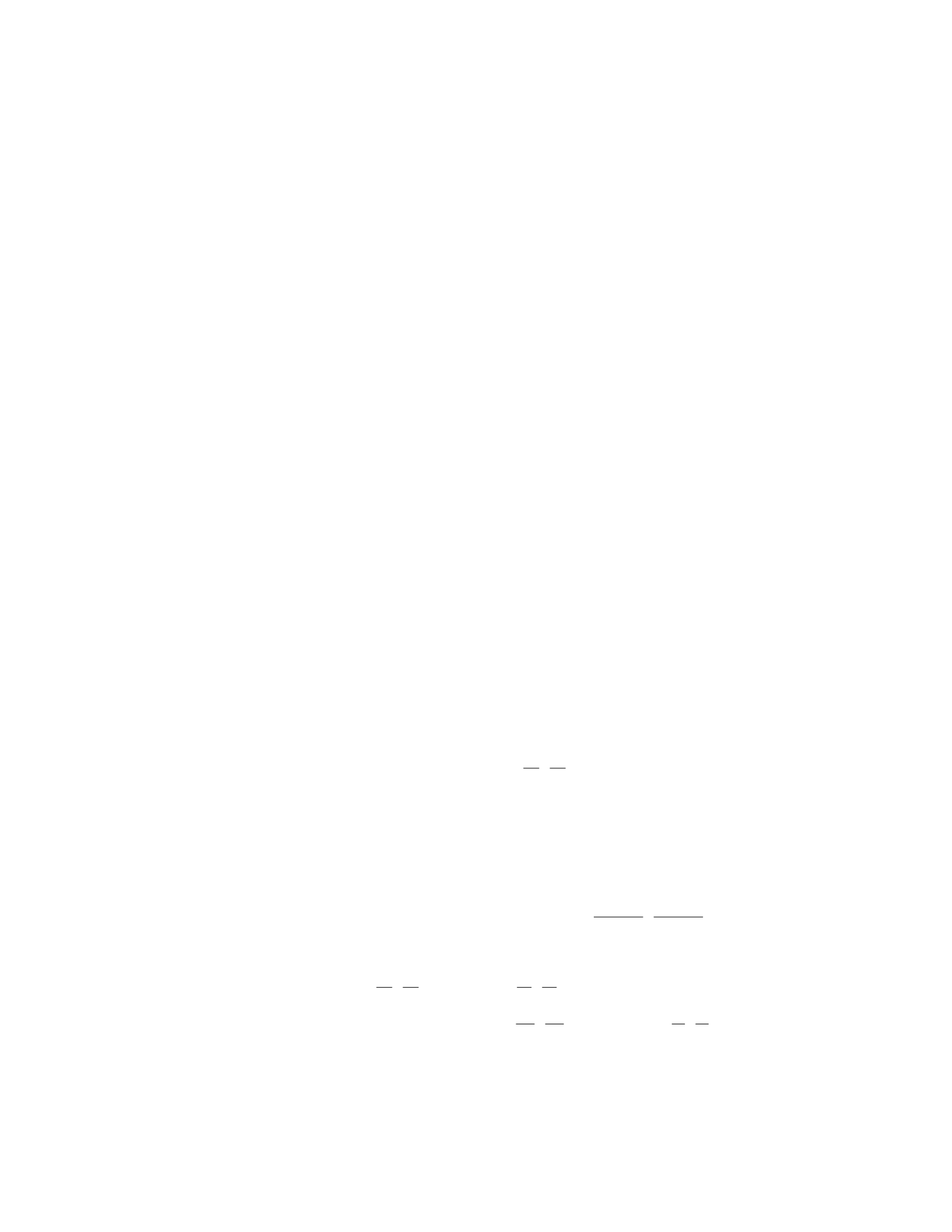
Since Tis bounded, we have:
∥T(xn)∥W≤C∥xn∥V
for all n. Given that ∥xn∥V→0as n→ ∞, multiplying by the constant
C(which does not depend on n), we get:
∥T(xn)∥W≤C∥xn∥V→0·C= 0 as n→ ∞.
Step 5: Concluding Continuity
The above calculation shows that ∥T(xn)∥W→0as n→ ∞, satis-
fying the definition of continuity at zero. Thus, Tis continuous at
zero.
Step 6: General Continuity
By the linearity of Tand the continuity at zero, Tis continuous
everywhere in V. This is because for any a∈Vand any sequence
{xn}converging to a, the sequence {xn−a}converges to zero, and
thus {T(xn)−T(a)}={T(xn−a)}converges to zero, showing T(xn)
converges to T(a).
Step 7: Conclusion
We have shown that a bounded linear operator Tfrom a normed
vector space Vto another normed vector space Wis necessarily con-
tinuous. This conclusion is a fundamental result in functional anal-
ysis, highlighting an important property of linear operators in the
context of normed spaces.
Question 14
Problem: Consider a linear operator T:ℓ2→ℓ2defined by
T(x1, x2, x3, . . . ) = (0, x1,x2
2,x3
3, . . . ).
Prove that Tis a bounded linear operator and find its norm ∥T∥.
Solution:
Step 1: Linear Operator Check
First, note that Tis linear: For any x= (x1, x2, x3, . . . )and y=
(y1, y2, y3, . . . )in ℓ2, and any scalar c,
T(x+y) = T(x1+y1, x2+y2, x3+y3, . . . ) = (0, x1+y1,x2+y2
2,x3+y3
3, . . . ).
By linearity of addition and multiplication within R,
T(x+y) = (0, x1,x2
2,x3
3, . . . ) + (0, y1,y2
2,y3
3, . . . ) = T(x) + T(y).
Also, T(cx) = T(cx1, cx2, cx3, . . . ) = (0, cx1,cx2
2,cx3
3, . . . ) = c(0, x1,x2
2,x3
3, . . . ) =
cT (x).Thus, Tis linear.
27
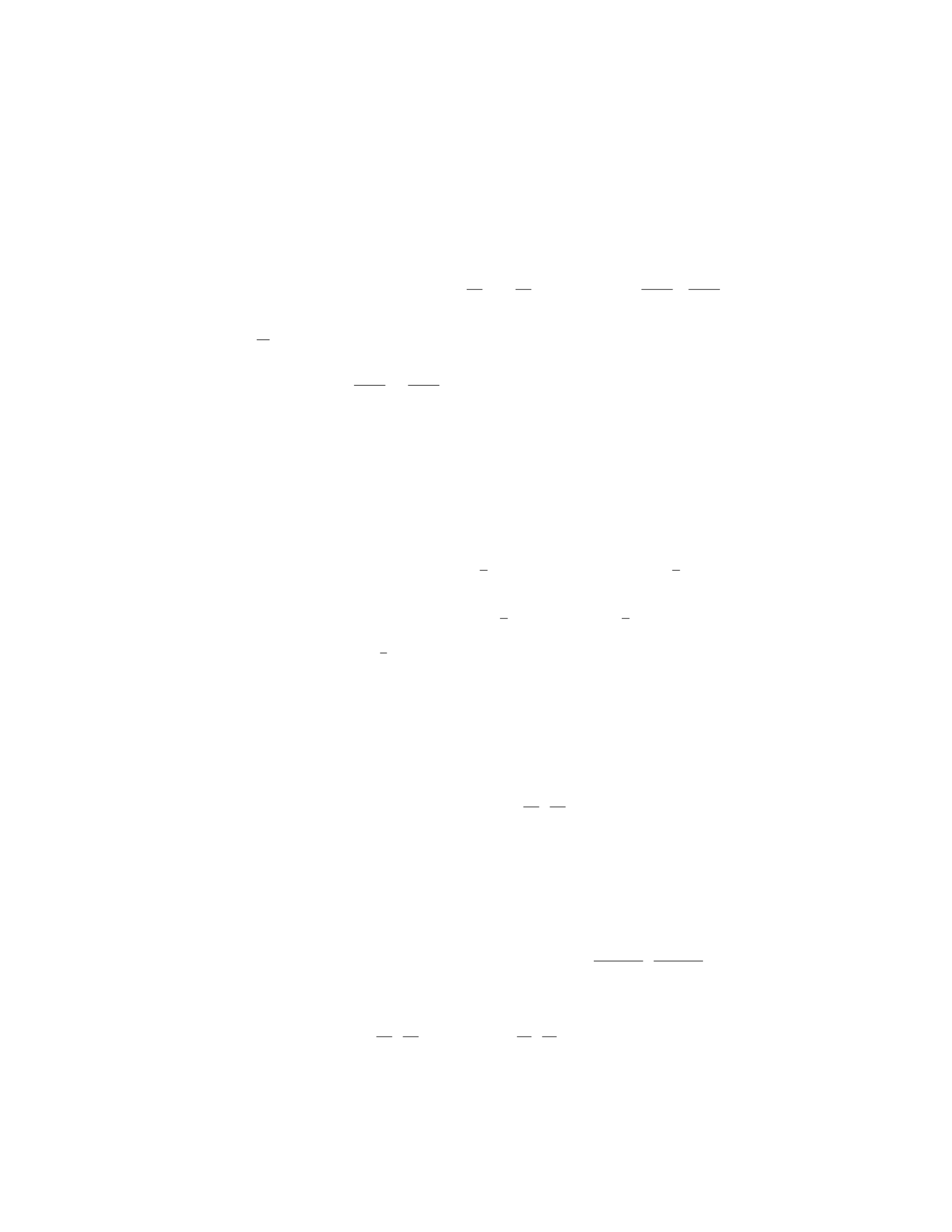
Step 2: Check for Boundedness
To show Tis bounded, we need to find C > 0such that ∥T(x)∥ℓ2≤
C∥x∥ℓ2for all xin ℓ2. We have:
∥T(x)∥2
ℓ2=
∞
X
k=1 |T(x)k|2= 02+|x1|2+
x2
2
2+
x3
3
2+··· =|x1|2+|x2|2
4+|x3|2
9+. . . .
Since 1
k2≤1for all k≥1,
∥T(x)∥2
ℓ2=|x1|2+|x2|2
4+|x3|2
9+··· ≤ |x1|2+|x2|2+|x3|2+··· =∥x∥2
ℓ2.
This implies
∥T(x)∥ℓ2≤ ∥x∥ℓ2.
Hence, Tis bounded, and ∥T∥ ≤ 1.
Step 3: Calculate the Norm ∥T∥
To determine the exact norm ∥T∥, we look for ∥T∥= sup∥x∥ℓ2=1 ∥T(x)∥ℓ2.
Consider x=ek(the standard basis vectors of ℓ2):
T(e1) = (0,1,0,0, . . . ), T (e2) = (0,0,1
2,0, . . . ), T (e3) = (0,0,0,1
3, . . . ), . . .
∥T(e1)∥ℓ2= 1,∥T(e2)∥ℓ2=1
2,∥T(e3)∥ℓ2=1
3, . . .
As k→ ∞,∥T(ek)∥ℓ2=1
k→0. Thus, the supremum is taken for k= 1,
so
∥T∥= sup
∥x∥ℓ2=1 ∥T(x)∥ℓ2= 1.
Conclusion: The operator Tis a bounded linear operator on ℓ2
with norm ∥T∥= 1. Question 14: Boundedness of Linear Operators
Problem: Consider a linear operator T:ℓ2→ℓ2defined by
T(x1, x2, x3, . . . ) = (0, x1,x2
2,x3
3, . . . ).
Prove that Tis a bounded linear operator and find its norm ∥T∥.
Solution:
Step 1: Linear Operator Check
First, note that Tis linear: For any x= (x1, x2, x3, . . . )and y=
(y1, y2, y3, . . . )in ℓ2, and any scalar c,
T(x+y) = T(x1+y1, x2+y2, x3+y3, . . . ) = (0, x1+y1,x2+y2
2,x3+y3
3, . . . ).
By linearity of addition and multiplication within R,
T(x+y) = (0, x1,x2
2,x3
3, . . . ) + (0, y1,y2
2,y3
3, . . . ) = T(x) + T(y).
28
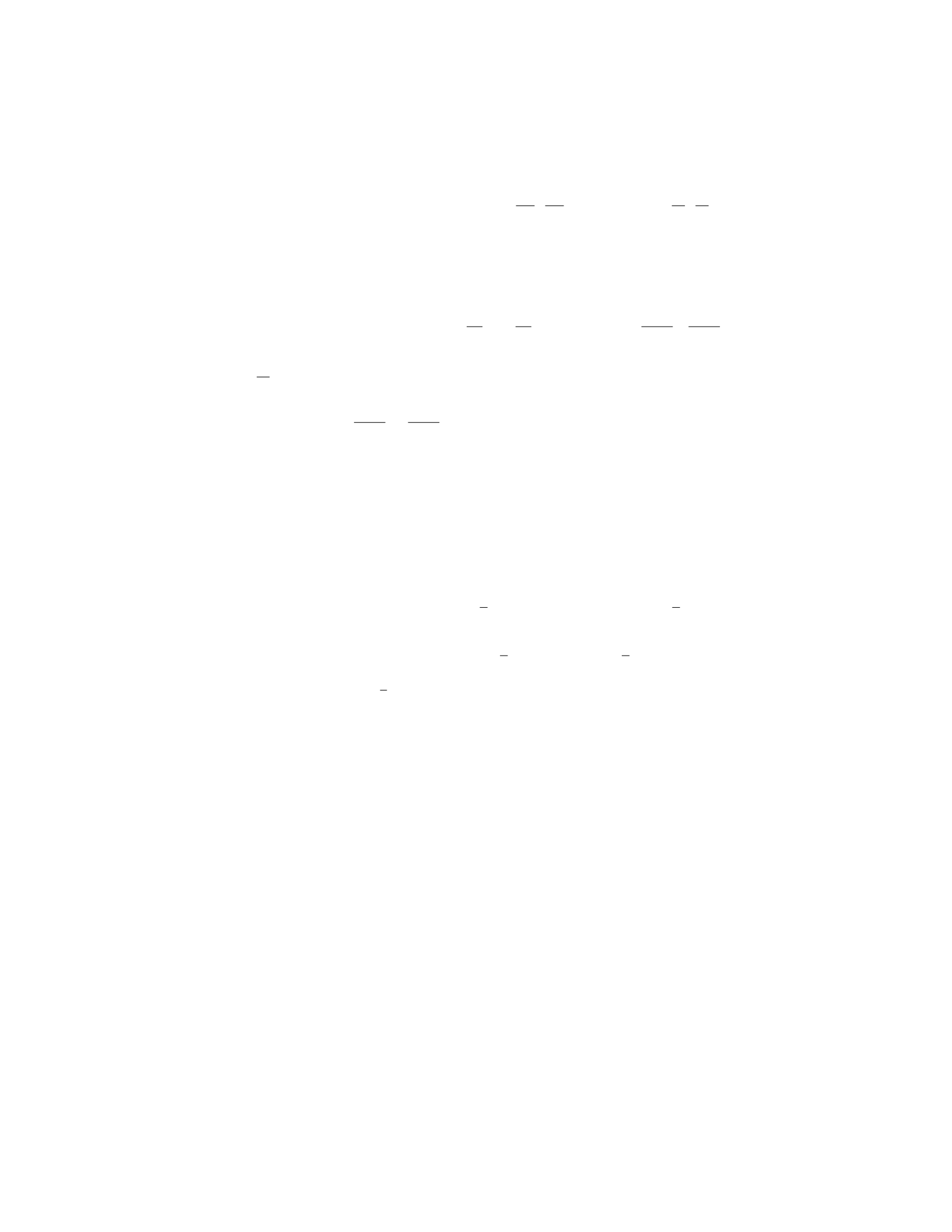
Also, T(cx) = T(cx1, cx2, cx3, . . . ) = (0, cx1,cx2
2,cx3
3, . . . ) = c(0, x1,x2
2,x3
3, . . . ) =
cT (x).Thus, Tis linear.
Step 2: Check for Boundedness
To show Tis bounded, we need to find C > 0such that ∥T(x)∥ℓ2≤
C∥x∥ℓ2for all xin ℓ2. We have:
∥T(x)∥2
ℓ2=
∞
X
k=1 |T(x)k|2= 02+|x1|2+
x2
2
2+
x3
3
2+··· =|x1|2+|x2|2
4+|x3|2
9+. . . .
Since 1
k2≤1for all k≥1,
∥T(x)∥2
ℓ2=|x1|2+|x2|2
4+|x3|2
9+··· ≤ |x1|2+|x2|2+|x3|2+··· =∥x∥2
ℓ2.
This implies
∥T(x)∥ℓ2≤ ∥x∥ℓ2.
Hence, Tis bounded, and ∥T∥ ≤ 1.
Step 3: Calculate the Norm ∥T∥
To determine the exact norm ∥T∥, we look for ∥T∥= sup∥x∥ℓ2=1 ∥T(x)∥ℓ2.
Consider x=ek(the standard basis vectors of ℓ2):
T(e1) = (0,1,0,0, . . . ), T (e2) = (0,0,1
2,0, . . . ), T (e3) = (0,0,0,1
3, . . . ), . . .
∥T(e1)∥ℓ2= 1,∥T(e2)∥ℓ2=1
2,∥T(e3)∥ℓ2=1
3, . . .
As k→ ∞,∥T(ek)∥ℓ2=1
k→0. Thus, the supremum is taken for k= 1,
so
∥T∥= sup
∥x∥ℓ2=1 ∥T(x)∥ℓ2= 1.
Conclusion: The operator Tis a bounded linear operator on ℓ2
with norm ∥T∥= 1.
Question 15
Let Xbe a normed vector space over the field F(where Fcan
either be Ror C). Consider two vectors x, y ∈Xand a scalar α∈F.
Prove the following properties of the norm:
1. Positive Scaling: ∥αx∥=|α|∥x∥2. Triangle Inequality: ∥x+y∥ ≤
∥x∥+∥y∥
Step-by-Step Solution:
1. Positive Scaling:
Step 1: Assumption: Assume that x∈Xand α∈F.
Step 2: By Definition of a Norm: The norm has the property
∥αx∥=|α|∥x∥.
29

Step 3: Applying Scalar Multiplicity in Norm: In the case of
αx, every component of the vector xis multiplied by α. The norm,
measuring the ’size’ of the vector, will scale by the absolute value of
α, thereby ∥αx∥=|α|∥x∥.
Step 4: Conclusion: This property holds for any x∈Xand any
scalar α.
2. Triangle Inequality:
Step 1: Assumption: Assume x, y ∈X.
Step 2: By Definition of a Norm: One basic property of the norm
is that ∥x+y∥≤∥x∥+∥y∥.
Step 3: Visual Interpretation: If you think of the norm as a kind
of ’length’, then adding two vectors xand ycorresponds to placing
the tail of yat the head of x. The direct ’line’ from the origin to the
head of this resultant vector (which is x+y) would be at most the
sum of the lengths of xand y, hence ∥x+y∥≤∥x∥+∥y∥.
Step 4: Using the Triangle Inequality: This inequality is a funda-
mental property stemming from the very definition of a normed space
and encapsulates the concept that the shortest distance between two
points is a straight line.
Step 5: Conclusion: This general concept applies to any vectors x
and yin the normed vector space X.
These properties are fundamental in the study of normed vector
spaces and essential in various proofs and applications within func-
tional analysis. Question 15: Norm Properties in Vector Spaces
Let Xbe a normed vector space over the field F(where Fcan
either be Ror C). Consider two vectors x, y ∈Xand a scalar α∈F.
Prove the following properties of the norm:
1. Positive Scaling: ∥αx∥=|α|∥x∥2. Triangle Inequality: ∥x+y∥ ≤
∥x∥+∥y∥
Step-by-Step Solution:
1. Positive Scaling:
Step 1: Assumption: Assume that x∈Xand α∈F.
Step 2: By Definition of a Norm: The norm has the property
∥αx∥=|α|∥x∥.
Step 3: Applying Scalar Multiplicity in Norm: In the case of
αx, every component of the vector xis multiplied by α. The norm,
measuring the ’size’ of the vector, will scale by the absolute value of
α, thereby ∥αx∥=|α|∥x∥.
Step 4: Conclusion: This property holds for any x∈Xand any
scalar α.
2. Triangle Inequality:
Step 1: Assumption: Assume x, y ∈X.
Step 2: By Definition of a Norm: One basic property of the norm
is that ∥x+y∥ ≤ ∥x∥+∥y∥.
Step 3: Visual Interpretation: If you think of the norm as a kind
of ’length’, then adding two vectors xand ycorresponds to placing
30

the tail of yat the head of x. The direct ’line’ from the origin to the
head of this resultant vector (which is x+y) would be at most the
sum of the lengths of xand y, hence ∥x+y∥≤∥x∥+∥y∥.
Step 4: Using the Triangle Inequality: This inequality is a funda-
mental property stemming from the very definition of a normed space
and encapsulates the concept that the shortest distance between two
points is a straight line.
Step 5: Conclusion: This general concept applies to any vectors x
and yin the normed vector space X.
These properties are fundamental in the study of normed vector
spaces and essential in various proofs and applications within func-
tional analysis.
Question 16
Problem Statement: Let (X, ∥·∥)be a normed vector space, and let
(xn)be a sequence in Xconverging to x∈X. Show that limn→∞ ∥xn∥=
∥x∥.
Solution:
Step 1: *Understand what needs to be proven.* We need to show
that the sequence of norms ∥xn∥converges to the norm ∥x∥. Mathe-
matically, this is stated as:
lim
n→∞ ∥xn∥=∥x∥.
Step 2: *Recall definitions and properties.* By the definition of
convergence in a normed space, xn→xmeans that for every ϵ > 0,
there exists an Nsuch that for all n≥N,
∥xn−x∥< ϵ.
Step 3: *Use the properties of the norm.* We use the reverse
triangle inequality, which gives us:
∥xn∥−∥x∥≤ ∥xn−x∥
Step 4: *Apply the triangle inequality and convergence.* From
Step 2, since ∥xn−x∥< ϵ for all n≥N, we can replace this in the
reverse triangle inequality:
∥xn∥−∥x∥≤ ∥xn−x∥< ϵ.
Step 5: *Conclude the proof.* Thus, for every ϵ > 0, there exists
an Nsuch that for all n≥N,
∥xen∥−∥x∥< ϵ.
31

This is precisely the definition of the limit of a sequence. Hence,
lim
n→∞ ∥xn∥=∥x∥.
This completes the proof that if a sequence converges in a normed
vector space, the norms of the elements of the sequence converge to
the norm of the limit. Question 16: Norms and Convergence in a
Normed Space
Problem Statement: Let (X, ∥·∥)be a normed vector space, and let
(xn)be a sequence in Xconverging to x∈X. Show that limn→∞ ∥xn∥=
∥x∥.
Solution:
Step 1: *Understand what needs to be proven.* We need to show
that the sequence of norms ∥xn∥converges to the norm ∥x∥. Mathe-
matically, this is stated as:
lim
n→∞ ∥xn∥=∥x∥.
Step 2: *Recall definitions and properties.* By the definition of
convergence in a normed space, xn→xmeans that for every ϵ > 0,
there exists an Nsuch that for all n≥N,
∥xn−x∥< ϵ.
Step 3: *Use the properties of the norm.* We use the reverse
triangle inequality, which gives us:
∥xn∥−∥x∥≤ ∥xn−x∥
Step 4: *Apply the triangle inequality and convergence.* From
Step 2, since ∥xn−x∥< ϵ for all n≥N, we can replace this in the
reverse triangle inequality:
∥xn∥−∥x∥≤ ∥xn−x∥< ϵ.
Step 5: *Conclude the proof.* Thus, for every ϵ > 0, there exists
an Nsuch that for all n≥N,
∥xen∥−∥x∥< ϵ.
This is precisely the definition of the limit of a sequence. Hence,
lim
n→∞ ∥xn∥=∥x∥.
This completes the proof that if a sequence converges in a normed
vector space, the norms of the elements of the sequence converge to
the norm of the limit.
32
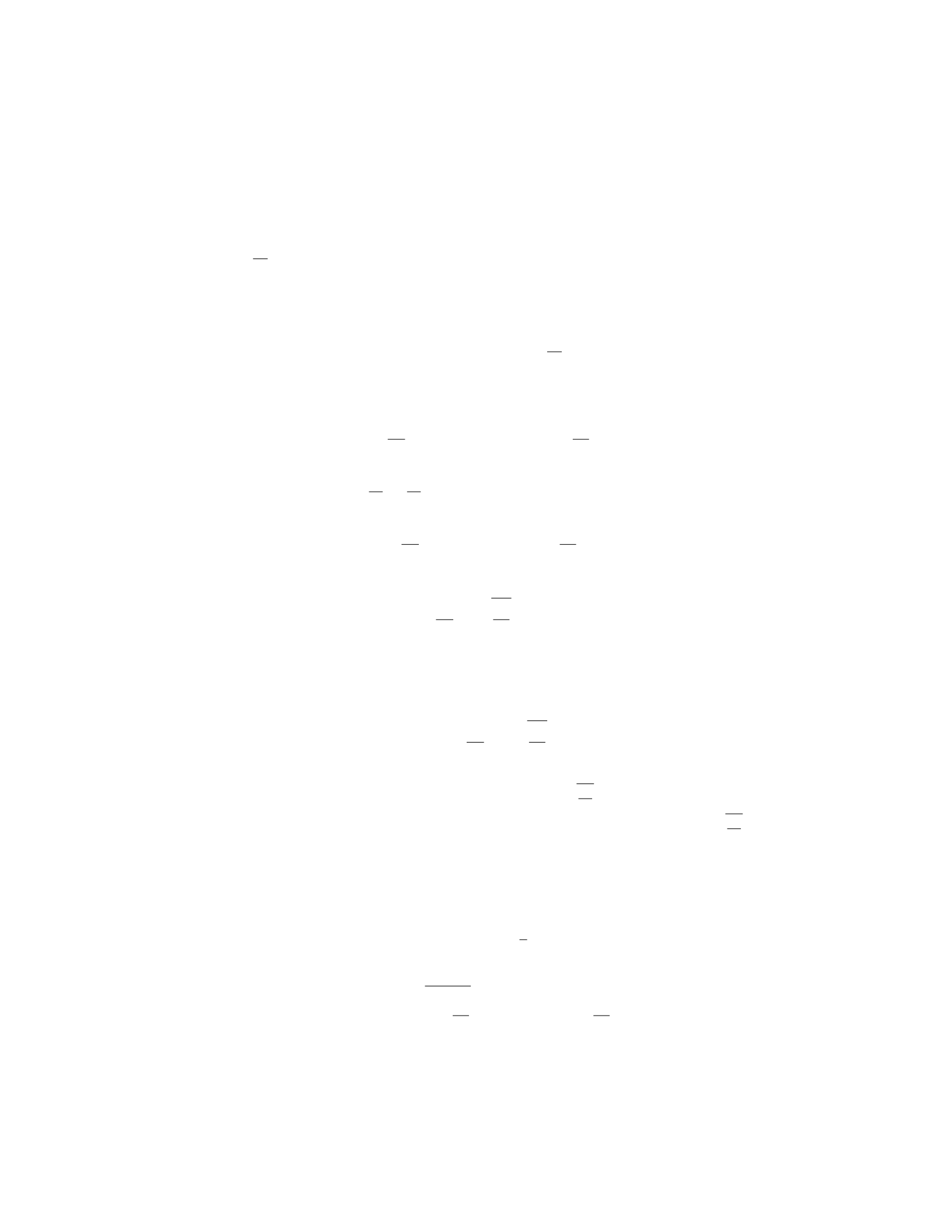
Question 17
Problem: Consider a linear operator T:ℓ2→Rdefined by T(x) =
P∞
n=1
xn
nfor x= (x1, x2, x3, . . .)∈ℓ2, where xnis the nth term of the se-
quence x. Show whether the operator Tis well-defined and bounded.
If Tis bounded, find its norm.
Solution:
Step 1: Check if Tis well-defined. To confirm that Tis well-
defined, we must prove that the series P∞
n=1
xn
nconverges for all x∈ℓ2.
Recall that the elements of ℓ2are such that P∞
n=1 |xn|2<∞. Using
the Cauchy-Schwarz inequality on the series:
∞
X
n=1
xn
n!2
≤ ∞
X
n=1 |xn|2! ∞
X
n=1
1
n2!
We know that P∞
n=1 1
n2=π2
6(from the Basel problem), so:
∞
X
n=1
xn
n!2
≤ ∞
X
n=1 |xn|2!π2
6
Hence: ∞
X
n=1
xn
n≤rπ2
6∥x∥2
and the series converges.
Step 2: Check if Tis bounded. From the inequality derived above,
it is indicated that Tis bounded because:
|T(x)|=
∞
X
n=1
xn
n≤rπ2
6∥x∥2
Therefore, the operator norm ∥T∥is at most qπ2
6.
Step 3: Find the norm of T. We need to check if the constant qπ2
6
is indeed the norm of T, or if there exists a smaller bound.
Checking for the tightness of the norm:
∥T∥= sup{|T(x)|:∥x∥2≤1}
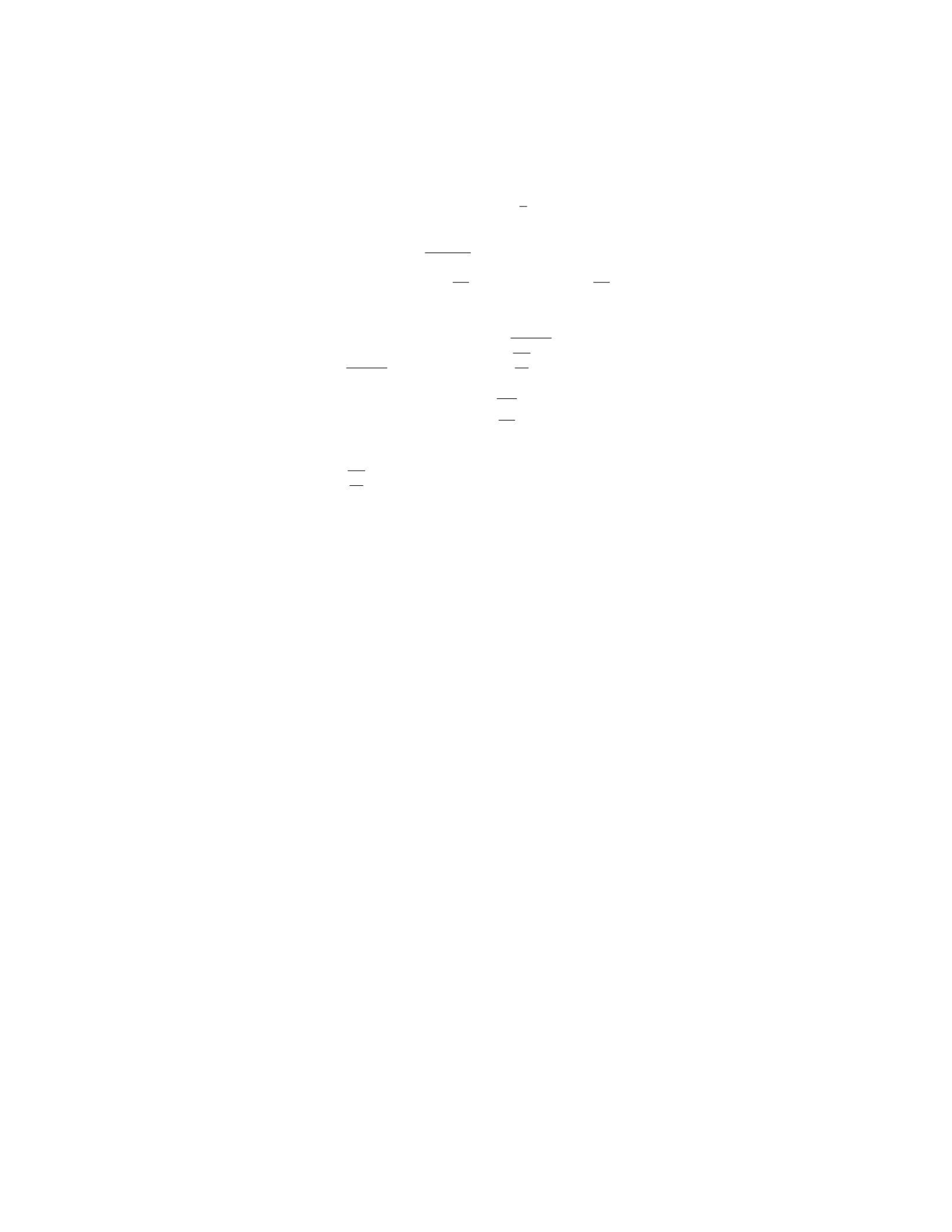
Consider a sequence x(k)where x(k)
n=1
nfor n≤kand x(k)
n= 0 for
n>k. The norm ∥x(k)∥2and T(x(k))converge to:
∥x(k)∥2=v
u
u
t
k
X
n=1
1
n2, T (x(k)) =
k
X
n=1
1
n2
33
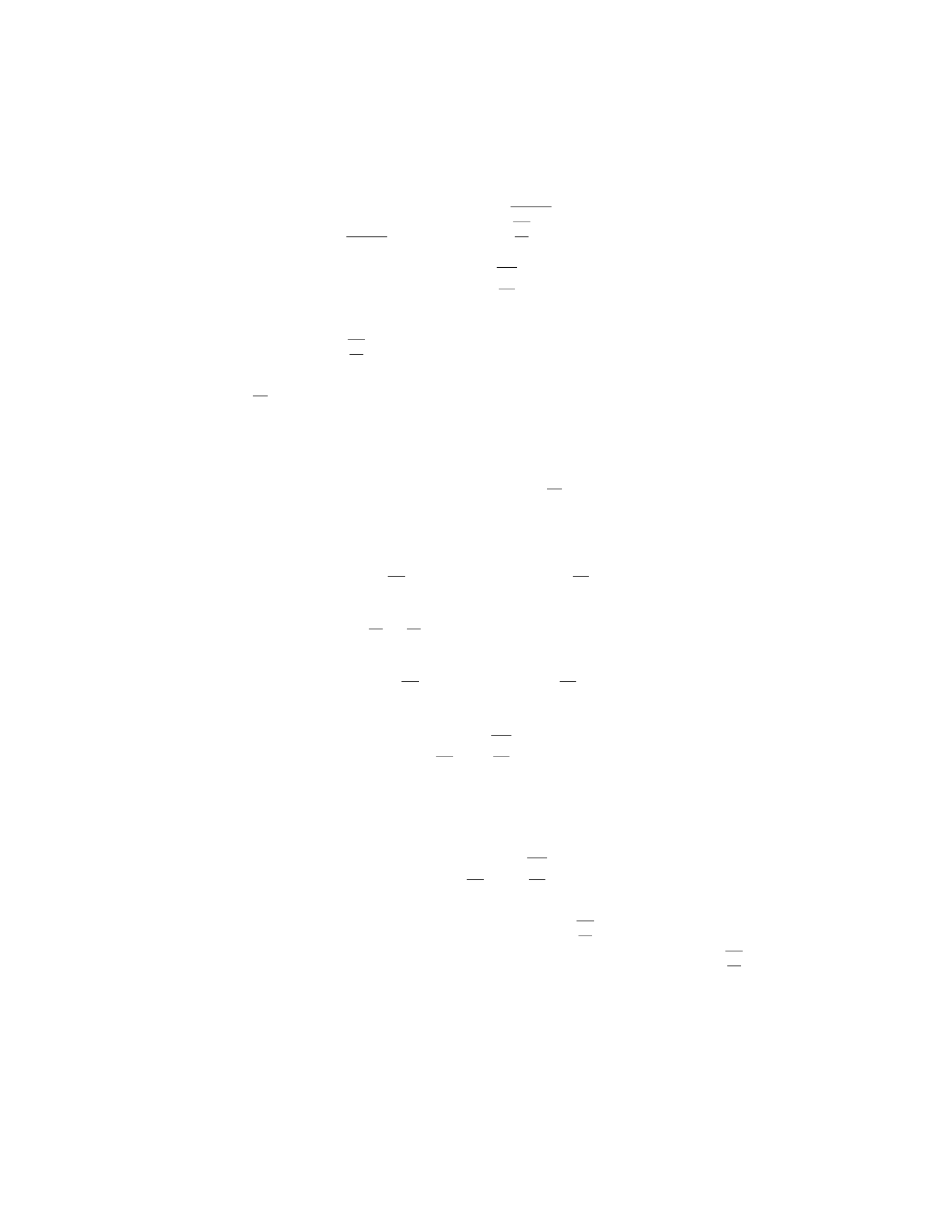
As kapproaches infinity, the sequence x(k)
∥x(k)∥2converges to a vector of
norm 1 in ℓ2and T(x(k))
∥x(k)∥2converges to qπ2
6. Hence,
∥T∥=rπ2
6
Conclusion: The operator Tis well-defined and bounded on ℓ2,
and its norm is qπ2
6. Question 17: Norms in Different Spaces
Problem: Consider a linear operator T:ℓ2→Rdefined by T(x) =
P∞
n=1
xn
nfor x= (x1, x2, x3, . . .)∈ℓ2, where xnis the nth term of the se-
quence x. Show whether the operator Tis well-defined and bounded.
If Tis bounded, find its norm.
Solution:
Step 1: Check if Tis well-defined. To confirm that Tis well-
defined, we must prove that the series P∞
n=1
xn
nconverges for all x∈ℓ2.
Recall that the elements of ℓ2are such that P∞
n=1 |xn|2<∞. Using
the Cauchy-Schwarz inequality on the series:
∞
X
n=1
xn
n!2
≤ ∞
X
n=1 |xn|2! ∞
X
n=1
1
n2!
We know that P∞
n=1 1
n2=π2
6(from the Basel problem), so:
∞
X
n=1
xn
n!2
≤ ∞
X
n=1 |xn|2!π2
6
Hence: ∞
X
n=1
xn
n≤rπ2
6∥x∥2
and the series converges.
Step 2: Check if Tis bounded. From the inequality derived above,
it is indicated that Tis bounded because:
|T(x)|=
∞
X
n=1
xn
n≤rπ2
6∥x∥2
Therefore, the operator norm ∥T∥is at most qπ2
6.
Step 3: Find the norm of T. We need to check if the constant qπ2
6
is indeed the norm of T, or if there exists a smaller bound.
Checking for the tightness of the norm:
∥T∥= sup{|T(x)|:∥x∥2≤1}
34
Consider a sequence x(k)where x(k)
n=1
nfor n≤kand x(k)
n= 0 for
n>k. The norm ∥x(k)∥2and T(x(k))converge to:
∥x(k)∥2=v
u
u
t
k
X
n=1
1
n2, T (x(k)) =
k
X
n=1
1
n2
As kapproaches infinity, the sequence x(k)
∥x(k)∥2converges to a vector of
norm 1 in ℓ2and T(x(k))
∥x(k)∥2converges to qπ2
6. Hence,
∥T∥=rπ2
6
Conclusion: The operator Tis well-defined and bounded on ℓ2,
and its norm is qπ2
6.
Question 18
Problem Statement: Given a vector space V=R2equipped with
the norm defined by ∥x∥= max{|x1|,|x2|} where x= (x1, x2)∈R2. Verify
that this function satisfies the properties of a norm and demonstrate
with an example.
—
Step-by-Step Solution:
Step 1: Verify Non-negativity
To verify that the norm ∥x∥is non-negative, consider x= (x1, x2)∈
R2. The norm is defined as ∥x∥= max{|x1|,|x2|}. Both |x1|and |x2|
are non-negative because absolute values of real numbers are always
non-negative. Therefore, max{|x1|,|x2|} must also be non-negative,
implying that ∥x∥ ≥ 0.
Step 2: Verify Definiteness
A norm must satisfy ∥x∥= 0 if and only if x= 0. Assume ∥x∥= 0.
Given ∥x∥= max{|x1|,|x2|}, it follows that both |x1|= 0 and |x2|= 0
because the maximum of non-negative numbers is zero only when
both are zero. Thus, x1= 0 and x2= 0, implying x= (0,0). Conversely,
if x= (0,0), then obviously ∥x∥= max{0,0}= 0.
Step 3: Verify Homogeneity (Absolute Scalability)
Consider any scalar αand any vector x= (x1, x2). We need to verify
that ∥αx∥=|α|∥x∥. - Compute ∥αx∥=∥α(x1, x2)∥= max{|αx1|,|αx2|}.
- Using the properties of absolute values, this is max{|α||x1|,|α||x2|} =
|α|max{|x1|,|x2|} =|α|∥x∥.
Step 4: Verify Triangle Inequality
To verify the triangle inequality, consider any two vectors x=
(x1, x2)and y= (y1, y2). We must show that ∥x+y∥ ≤ ∥x∥+∥y∥. -
35

Compute ∥x+y∥= max{|x1+y1|,|x2+y2|}. - Using the triangle inequality
for absolute values, we get |x1+y1|≤|x1|+|y1|and |x2+y2|≤|x2|+|y2|.
- Thus, ∥x+y∥= max{|x1+y1|,|x2+y2|} ≤ max{|x1|+|y1|,|x2|+|y2|} ≤
max{|x1|,|x2|} + max{|y1|,|y2|} =∥x∥+∥y∥.
Example Demonstration:
Take vectors x= (2,−3) and y= (−1,4). - We calculate ∥x∥=
max{2,3}= 3 and ∥y∥= max{1,4}= 4. - Compute x+y= (2−1,−3+4) =
(1,1), then ∥x+y∥= max{1,1}= 1. - Notice ∥x+y∥= 1 and ∥x∥+∥y∥= 7,
confirming that ∥x+y∥≤∥x∥+∥y∥.
This formally verifies that the given function is a valid norm on R2
and provides an illustrative example. Question 18: Normed Vector
Spaces
Problem Statement: Given a vector space V=R2equipped with
the norm defined by ∥x∥= max{|x1|,|x2|} where x= (x1, x2)∈R2. Verify
that this function satisfies the properties of a norm and demonstrate
with an example.
—
Step-by-Step Solution:
Step 1: Verify Non-negativity
To verify that the norm ∥x∥is non-negative, consider x= (x1, x2)∈
R2. The norm is defined as ∥x∥= max{|x1|,|x2|}. Both |x1|and |x2|
are non-negative because absolute values of real numbers are always
non-negative. Therefore, max{|x1|,|x2|} must also be non-negative,
implying that ∥x∥ ≥ 0.
Step 2: Verify Definiteness
A norm must satisfy ∥x∥= 0 if and only if x= 0. Assume ∥x∥= 0.
Given ∥x∥= max{|x1|,|x2|}, it follows that both |x1|= 0 and |x2|= 0
because the maximum of non-negative numbers is zero only when
both are zero. Thus, x1= 0 and x2= 0, implying x= (0,0). Conversely,
if x= (0,0), then obviously ∥x∥= max{0,0}= 0.
Step 3: Verify Homogeneity (Absolute Scalability)
Consider any scalar αand any vector x= (x1, x2). We need to verify
that ∥αx∥=|α|∥x∥. - Compute ∥αx∥=∥α(x1, x2)∥= max{|αx1|,|αx2|}.
- Using the properties of absolute values, this is max{|α||x1|,|α||x2|} =
|α|max{|x1|,|x2|} =|α|∥x∥.
Step 4: Verify Triangle Inequality
To verify the triangle inequality, consider any two vectors x=
(x1, x2)and y= (y1, y2). We must show that ∥x+y∥ ≤ ∥x∥+∥y∥. -
Compute ∥x+y∥= max{|x1+y1|,|x2+y2|}. - Using the triangle inequality
for absolute values, we get |x1+y1| ≤ |x1|+|y1|and |x2+y2| ≤ |x2|+|y2|.
- Thus, ∥x+y∥= max{|x1+y1|,|x2+y2|} ≤ max{|x1|+|y1|,|x2|+|y2|} ≤
max{|x1|,|x2|} + max{|y1|,|y2|} =∥x∥+∥y∥.
Example Demonstration:
Take vectors x= (2,−3) and y= (−1,4). - We calculate ∥x∥=
max{2,3}= 3 and ∥y∥= max{1,4}= 4. - Compute x+y= (2−1,−3+4) =
36

(1,1), then ∥x+y∥= max{1,1}= 1. - Notice ∥x+y∥= 1 and ∥x∥+∥y∥= 7,
confirming that ∥x+y∥≤∥x∥+∥y∥.
This formally verifies that the given function is a valid norm on
R2and provides an illustrative example.
Question 19
Problem:
Let (X, M, µ)be a measure space, and let fn, f :X→Rbe func-
tions in Lp(X)for 1≤p < ∞. Suppose fn→fin the Lpnorm, i.e.,
limn→∞ ∥fn−f∥p= 0. Prove the following two statements:
1. ∥fn∥p→ ∥f∥pas n→ ∞. 2. If µ(X)<∞, then fn→fin L1(X)as
well.
Step-by-Step Solutions:
Part 1: Proof of ∥fn∥p→ ∥f∥p
Step 1: Recall the triangle inequality for Lpnorms:
|∥fn∥p− ∥f∥p|≤ ∥fn−f∥p.
Step 2: Since it is given that ∥fn−f∥p→0, applying the result
from Step 1, we have:
|∥fn∥p− ∥f∥p|→0.
Step 3: Conclude that ∥fn∥p→ ∥f∥pas n→ ∞.
Part 2: Proof of Convergence in L1
Step 1: Start from H¨older’s Inequality:
Z|fn−f|dµ ≤Z|fn−f|pdµ1/p
(µ(X))1/q ,
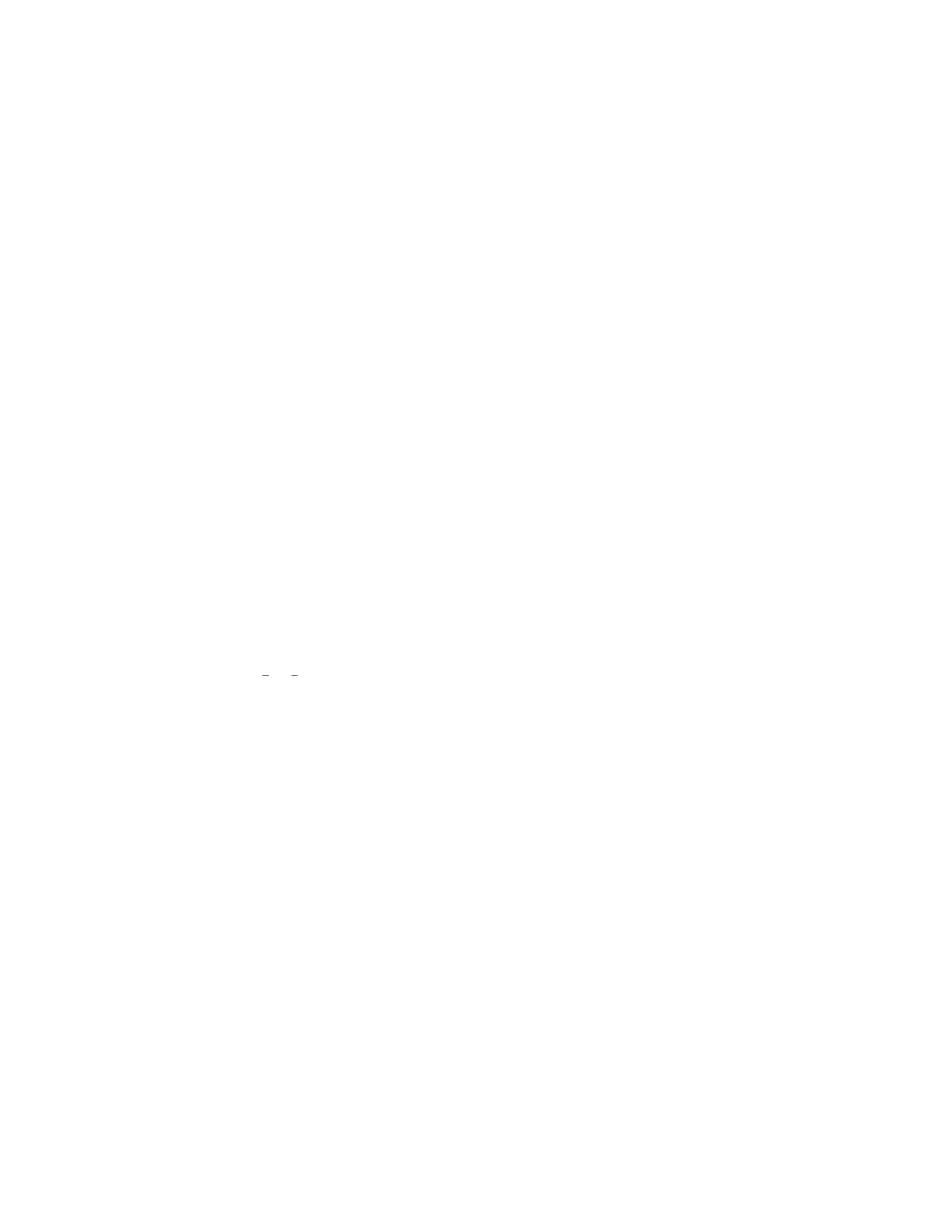
where 1
p+1
q= 1.
Step 2: Since ∥fn−f∥p→0and µ(X)<∞, we plug in these values:
(∥fn−f∥p)1/p (µ(X))1/q →0.
Step 3: Hence by the inequality in Step 1:
∥fn−f∥1=Z|fn−f|dµ →0.
Step 4: Conclude fn→fin L1(X)as n→ ∞.
Conclusion:
Both assertions are proven by effectively using properties of norms
in conjunction with convergence conditions given in the Lpspaces.
The first uses directly the Lpnorm convergence property and the
37
second utilizes H¨older’s inequality along with the finiteness of mea-
sure. Question 19: Norm and Convergence in LpSpaces
Problem:
Let (X, M, µ)be a measure space, and let fn, f :X→Rbe func-
tions in Lp(X)for 1≤p < ∞. Suppose fn→fin the Lpnorm, i.e.,
limn→∞ ∥fn−f∥p= 0. Prove the following two statements:
1. ∥fn∥p→ ∥f∥pas n→ ∞. 2. If µ(X)<∞, then fn→fin L1(X)as
well.
Step-by-Step Solutions:
Part 1: Proof of ∥fn∥p→ ∥f∥p
Step 1: Recall the triangle inequality for Lpnorms:
|∥fn∥p− ∥f∥p|≤ ∥fn−f∥p.
Step 2: Since it is given that ∥fn−f∥p→0, applying the result
from Step 1, we have:
|∥fn∥p− ∥f∥p|→0.
Step 3: Conclude that ∥fn∥p→ ∥f∥pas n→ ∞.
Part 2: Proof of Convergence in L1
Step 1: Start from H¨older’s Inequality:
Z|fn−f|dµ ≤Z|fn−f|pdµ1/p
(µ(X))1/q ,
where 1
p+1
q= 1.
Step 2: Since ∥fn−f∥p→0and µ(X)<∞, we plug in these values:
(∥fn−f∥p)1/p (µ(X))1/q →0.
Step 3: Hence by the inequality in Step 1:
∥fn−f∥1=Z|fn−f|dµ →0.
Step 4: Conclude fn→fin L1(X)as n→ ∞.
Conclusion:
Both assertions are proven by effectively using properties of norms
in conjunction with convergence conditions given in the Lpspaces.
The first uses directly the Lpnorm convergence property and the
second utilizes H¨older’s inequality along with the finiteness of mea-
sure.
38

Question 20
Consider the space C[0,1] of all continuous real-valued functions
defined on the interval [0,1]. Let {fn}∞
n=1 be a sequence in C[0,1]
defined by fn(x) = xn.
Question: Does the sequence {fn}converge in the C[0,1] norm? If
so, to what function does it converge?
Step-by-Step Solution:
Step 1: Recall the definition of convergence in the C[0,1] norm. A
sequence {fn}in C[0,1] converges to a function f∈C[0,1] in the C[0,1]
norm if
lim
n→∞ sup
x∈[0,1] |fn(x)−f(x)|= 0.
This means that the functions fnget uniformly close to the function
fover the interval [0,1].
Step 2: Analyze the behavior of fn(x) = xnas n→ ∞ for x∈[0,1].
- For x= 0,fn(0) = 0n= 0 for all n≥1. - For x= 1,fn(1) = 1n= 1
for all n≥1. - For x∈(0,1), we observe that xnbecomes smaller as n
increases and approaches zero. That is, limn→∞ xn= 0.
Step 3: Determine the function fthat fn(x)might converge to
based on the pointwise limit. Given the analysis in Step 2, pointwise
on (0,1) and at x= 0,fn(x)→0. Since fn(1) = 1 for all nand 1ndoes
not approach 0, we consider that f(x) = 0 for x∈[0,1) and f(1) = 1.
However, the limit function we get by analysis, f(x) = (0if x∈[0,1)
1if x= 1
is not continuous at x= 1.
Step 4: Calculate supx∈[0,1] |fn(x)−f(x)|. We note that the function
fas defined above is not in C[0,1], but if we consider f(x)=0(which
is in C[0,1]), then:
sup
x∈[0,1] |fn(x)−f(x)|= sup
x∈[0,1] |xn−0|= sup
x∈[0,1]
xn= 1.
This supremum is 1 at x= 1.
Step 5: Conclusion on convergence. Since we find that supx∈[0,1] |fn(x)−
0|maintains a constant value of 1 instead of approaching 0, the se-
quence {fn}does not converge in the C[0,1] norm to any function in
C[0,1].
Answer: The sequence {fn}does not converge in the C[0,1] norm.
Question 20: Functional Analysis
Consider the space C[0,1] of all continuous real-valued functions
defined on the interval [0,1]. Let {fn}∞
n=1 be a sequence in C[0,1]
defined by fn(x) = xn.
Question: Does the sequence {fn}converge in the C[0,1] norm? If
so, to what function does it converge?
Step-by-Step Solution:
39

Step 1: Recall the definition of convergence in the C[0,1] norm. A
sequence {fn}in C[0,1] converges to a function f∈C[0,1] in the C[0,1]
norm if
lim
n→∞ sup
x∈[0,1] |fn(x)−f(x)|= 0.
This means that the functions fnget uniformly close to the function
fover the interval [0,1].
Step 2: Analyze the behavior of fn(x) = xnas n→ ∞ for x∈[0,1].
- For x= 0,fn(0) = 0n= 0 for all n≥1. - For x= 1,fn(1) = 1n= 1
for all n≥1. - For x∈(0,1), we observe that xnbecomes smaller as n
increases and approaches zero. That is, limn→∞ xn= 0.
Step 3: Determine the function fthat fn(x)might converge to
based on the pointwise limit. Given the analysis in Step 2, pointwise
on (0,1) and at x= 0,fn(x)→0. Since fn(1) = 1 for all nand 1ndoes
not approach 0, we consider that f(x) = 0 for x∈[0,1) and f(1) = 1.
However, the limit function we get by analysis, f(x) = (0if x∈[0,1)
1if x= 1
is not continuous at x= 1.
Step 4: Calculate supx∈[0,1] |fn(x)−f(x)|. We note that the function
fas defined above is not in C[0,1], but if we consider f(x)=0(which
is in C[0,1]), then:
sup
x∈[0,1] |fn(x)−f(x)|= sup
x∈[0,1] |xn−0|= sup
x∈[0,1]
xn= 1.
This supremum is 1 at x= 1.
Step 5: Conclusion on convergence. Since we find that supx∈[0,1] |fn(x)−
0|maintains a constant value of 1 instead of approaching 0, the se-
quence {fn}does not converge in the C[0,1] norm to any function in
C[0,1].
Answer: The sequence {fn}does not converge in the C[0,1] norm.
40

