



MATH 332 - ADVANCED CALCULUS
- Green’s Theorem
Question Bank - Set 3
Liberty University
Question 1
Question
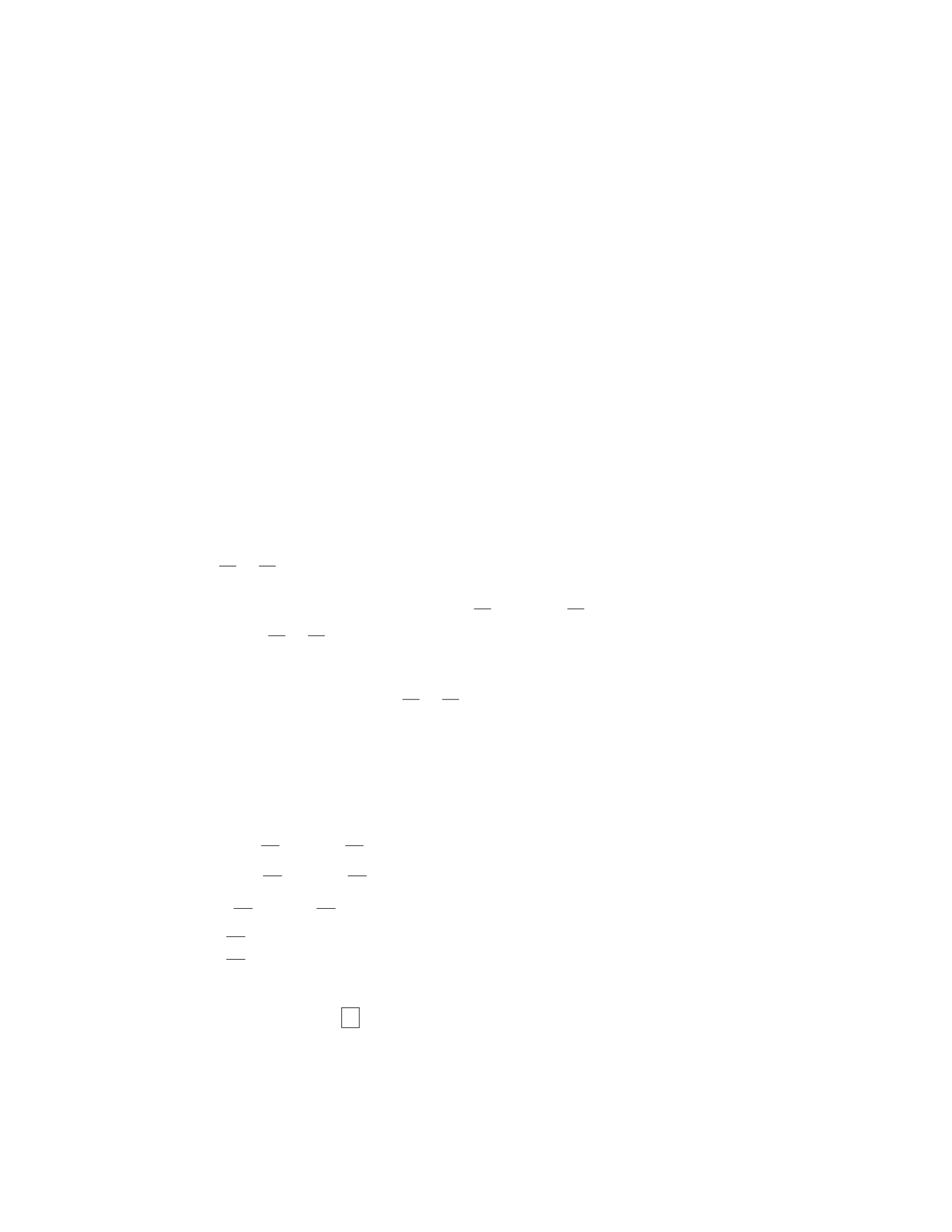
Let Cbe the curve defined by x2+y2= 4 oriented counterclockwise. Calculate
the line integral HC(x−y)dx + (2x+y)dy using Green’s Theorem.
Solution
Step 1: Determine the region Denclosed by the curve C. Since x2+y2= 4
represents a circle of radius 2 centered at the origin, the region Denclosed by
Cis the interior of this circle.
Step 2: Determine the partial derivatives of the given vector field F(x, y) =
(x−y, 2x+y). Let P(x, y) = x−yand Q(x, y)=2x+y. Then, ∂Q
∂x = 2 and
∂P
∂y =−1.
Step 3: Apply Green’s Theorem. Green’s Theorem states that for a region
Denclosed by a simple, closed, positively oriented curve C, given a vector field
F(x, y) = (P(x, y), Q(x, y)) that is continuously differentiable on D, we have
IC
P dx +Q dy =ZZD∂Q
∂x −∂P
∂y dA.
Thus, in this case, we have
IC
(x−y)dx + (2x+y)dy =ZZD
(2 −(−1)) dA =ZZD
3dA.
Step 4: Calculate the area integral over the region D. Since the region D
is the interior of the circle x2+y2= 4, we can represent this region in polar
coordinates by 0≤r≤2,0≤θ≤2π. Therefore,
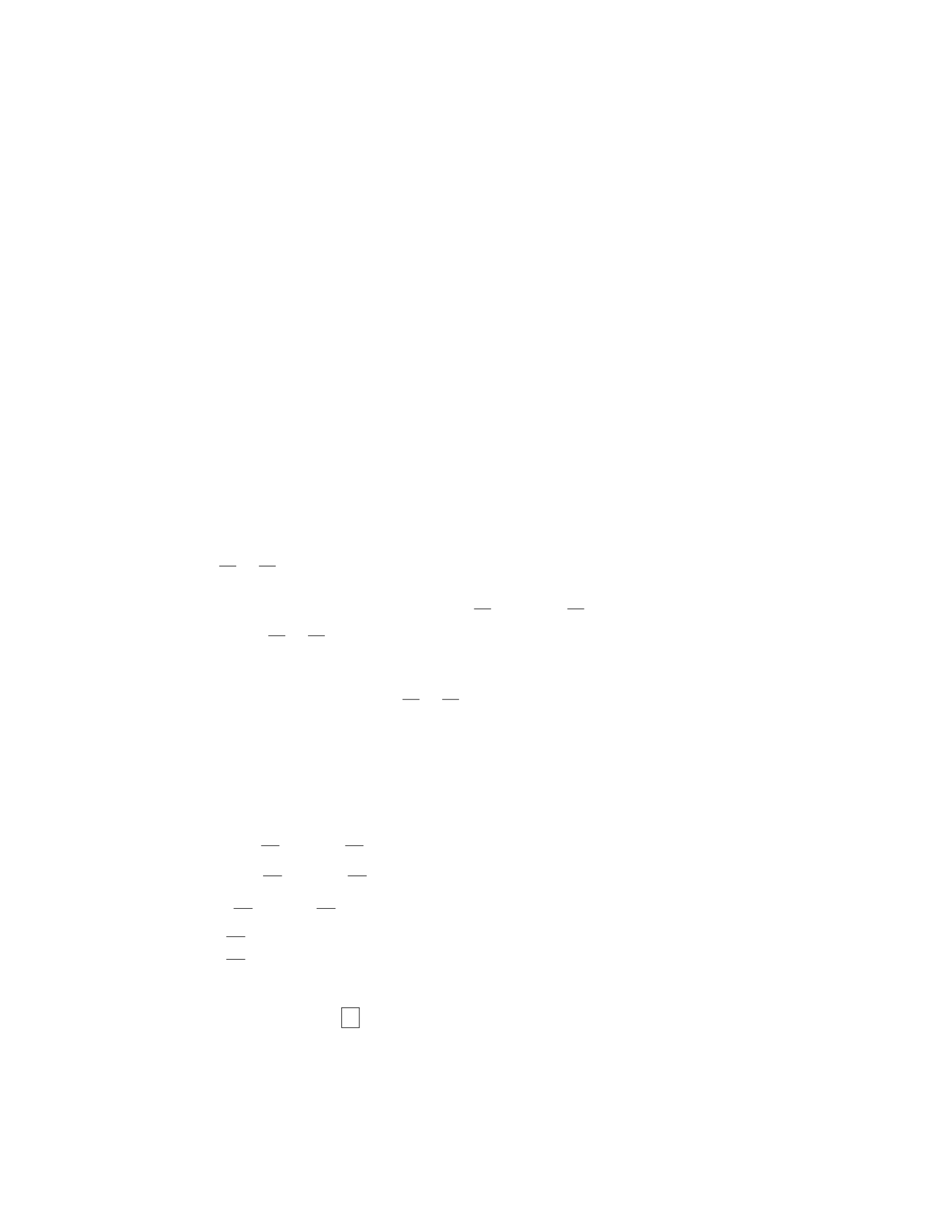
ZZD
3dA =Z2π
0Z2
0
3r dr dθ = 3 Z2π
01
2r22
0
dθ = 3 Z2π
0
2dθ = 6π.
Step 5: Conclusion. Therefore, the line integral HC(x−y)dx + (2x+y)dy
over the curve Cis equal to 6π.
Question 2
Question
Let Cbe the circle centered at the origin with radius a, oriented counterclock-
wise. Use Green’s Theorem to evaluate the line integral HC(x2+y2)dx + (x2−
y2)dy.
Solution
1. Determine the region enclosed by C:The circle Cwith radius acentered
at the origin encloses the region inside the circle.
2. Apply Green’s Theorem: Green’s Theorem states that for a positively
oriented, piecewise smooth, simple closed curve Cenclosing a region D, and a
vector field F=Pi+Qjthat is continuously differentiable on an open region
containing D, the line integral of Faround Cis equal to the double integral of
∂Q
∂x −∂P
∂y dA over the region D.
In this case, we have: P=x2+y2and Q=x2−y2.
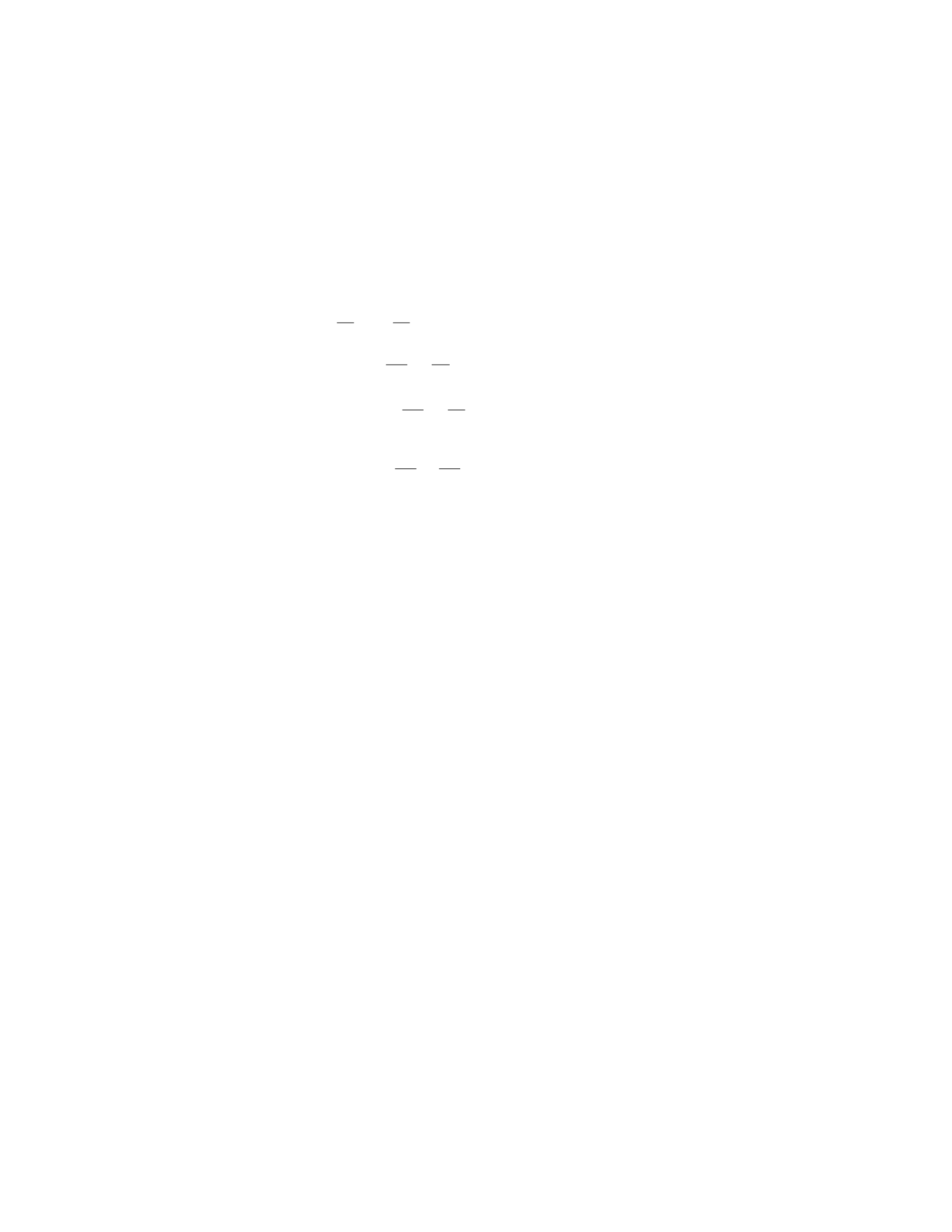
Computing the partial derivatives: ∂Q
∂x = 2xand ∂P
∂y = 2y.
So, ∂Q
∂x −∂P
∂y = 2x−2y.
3. Evaluate the double integral over the region D:Since Cencloses
the region inside the circle, Dis the disk with radius a.
The double integral of ∂Q
∂x −∂P
∂y dA over Dbecomes: RR
D
(2x−2y)dA =
RR
D
2(x−y)dA.
Switching to polar coordinates (x=rcos(θ), y =rsin(θ)) where 0≤r≤a
and 0≤θ≤2π:R2π
0Ra
02(rcos(θ)−rsin(θ))rdrdθ.
4. Compute the double integral: Solving the integral iteratively: R2π
0Ra
02r2cos(θ)−
2r2sin(θ)drdθ
=R2π
0h2r3
3cos(θ)−2r3
3sin(θ)ia
0
dθ
=R2π
02a3
3cos(θ)−2a3
3sin(θ)dθ
=h2a3
3sin(θ) + 2a3
3cos(θ)i2π
0
=4a3
3(sin(2π) + cos(2π)−sin(0) −cos(0))
=4a3
3(0 + 1 −0−1)
= 0.
5. Conclusion: The line integral HC(x2+y2)dx + (x2−y2)dy around the
circle Cis equal to 0.
2

Question 3
Question
Let Cbe the circle defined by x2+y2= 4, oriented counterclockwise. Calculate
the line integral HC(x2+y2)dx + 3xy dy using Green’s Theorem.
Solution
Step 1: Verify that the given curve Cis a simple closed curve without self-
intersections.
• The curve Cis a circle with radius 2 centered at the origin.
• Since it is a simple closed curve without self-intersections, we can apply
Green’s Theorem.
Step 2: Find the region Denclosed by Cand parameterize the boundary
curve C.
• The region Denclosed by Cis the interior of the circle x2+y2= 4, hence
Dis the disk with radius 2 centered at the origin.
• Parameterize the circle C:x(t) = 2 cos(t),y(t) = 2 sin(t)with 0≤t≤2π.
Step 3: Apply Green’s Theorem to compute the line integral.
IC
(x2+y2)dx + 3xy dy =ZZD∂(3xy)
∂x −∂(x2+y2)
∂y dA
=ZZD
(3y−2y)dA
=ZZD
y dA.
Step 4: Convert the double integral over region Dto polar coordinates.
• In polar coordinates, x=rcos(θ),y=rsin(θ), and dA =r dr dθ.
• The integral becomes: R2π
0R2
0rsin(θ)·r dr dθ.
Step 5: Solve the integral.
Z2π
0Z2
0
rsin(θ)·r dr dθ =Z2π
0r2
2·(−cos(θ))2
0
dθ
=Z2π
0−2 cos(θ)dθ
=−[2 sin(θ)]2π
0
= 0.
Therefore, the line integral HC(x2+y2)dx + 3xy dy around the circle Cis
equal to 0 when evaluated using Green’s Theorem.
3

Question 4
Question
Let Cbe the curve in the plane defined by x2+y2= 1 oriented counterclockwise.
Let Dbe the region bounded by C. Use Green’s Theorem to evaluate the line
integral
IC
(x2+y)dx + (y2+x)dy
Solution
To apply Green’s Theorem, we first need to find the vector field F= (P, Q)
such that P=x2+yand Q=y2+x. Then Green’s Theorem states that
IC
F·dr=ZZD∂Q
∂x −∂P
∂y dA
where dr= (dx, dy)and dA is an infinitesimal area element.
Let’s compute the partial derivatives of Pand Q:
∂P
∂y = 1 and ∂Q
∂x = 1
Now we compute the double integral over the region D:
ZZD∂Q
∂x −∂P
∂y dA =ZZD
(1 −1) dA = 0
Therefore, the line integral around Csimplifies to zero:
IC
(x2+y)dx + (y2+x)dy = 0
Question 5
Question
Let Cbe the curve parameterized by r(t) = ⟨t2, et⟩for 0≤t≤1. Calculate the
circulation of the vector field F(x, y) = ⟨y2,−x⟩around the curve C.
Solution
Step 1: Calculate the curl of the vector field F(x, y) = ⟨y2,−x⟩. The curl of F
is given by:
∇ × F=∂
∂x ,∂
∂y × ⟨y2,−x⟩
=∂
∂x ⟨y2,−x⟩ − ∂
∂y ⟨y2,−x⟩
4

= (−1−2y, 0)
Step 2: Calculate the circulation of Faround the curve C. By Green’s
Theorem, circulation of Faround the curve Cis equal to the line integral of F
over the curve C.
The circulation of Faround Cis given by:
circulation =ZC
F·dr=Z1
0
F(r(t)) ·r′(t)dt
Substitute r(t)and F(r(t)) into the line integral:
=Z1
0⟨e2t,−t2⟩·⟨2t, et⟩dt
=Z1
0
(2te2t−t2et)dt
Step 3: Evaluate the integral:
=t2e2t1
0−1
3t3et1
0
= (1e2−0) −1
3e−0
=e2−1
3e
Therefore, the circulation of the vector field F(x, y) = ⟨y2,−x⟩around the
curve Cis e2−1
3e.
Question 6
Question
Let Cbe the curve parameterized by r(t)=(t2, et)for 0≤t≤1. Use Green’s
Theorem to calculate the line integral HC(x2+y)dx + (2y−sin(x)) dy.
Solution
Given a vector field F(x, y) = (P(x, y), Q(x, y)) and a closed curve Cparame-
terized by r(t) = (x(t), y(t)), Green’s Theorem states:
IC
F·dr=ZZD∂Q
∂x −∂P
∂y dA,
where Dis the region enclosed by the curve C.
5
First, let’s find the parameterization of the curve C:
r(t) = (t2, et)
(x(t) = t2
y(t) = et
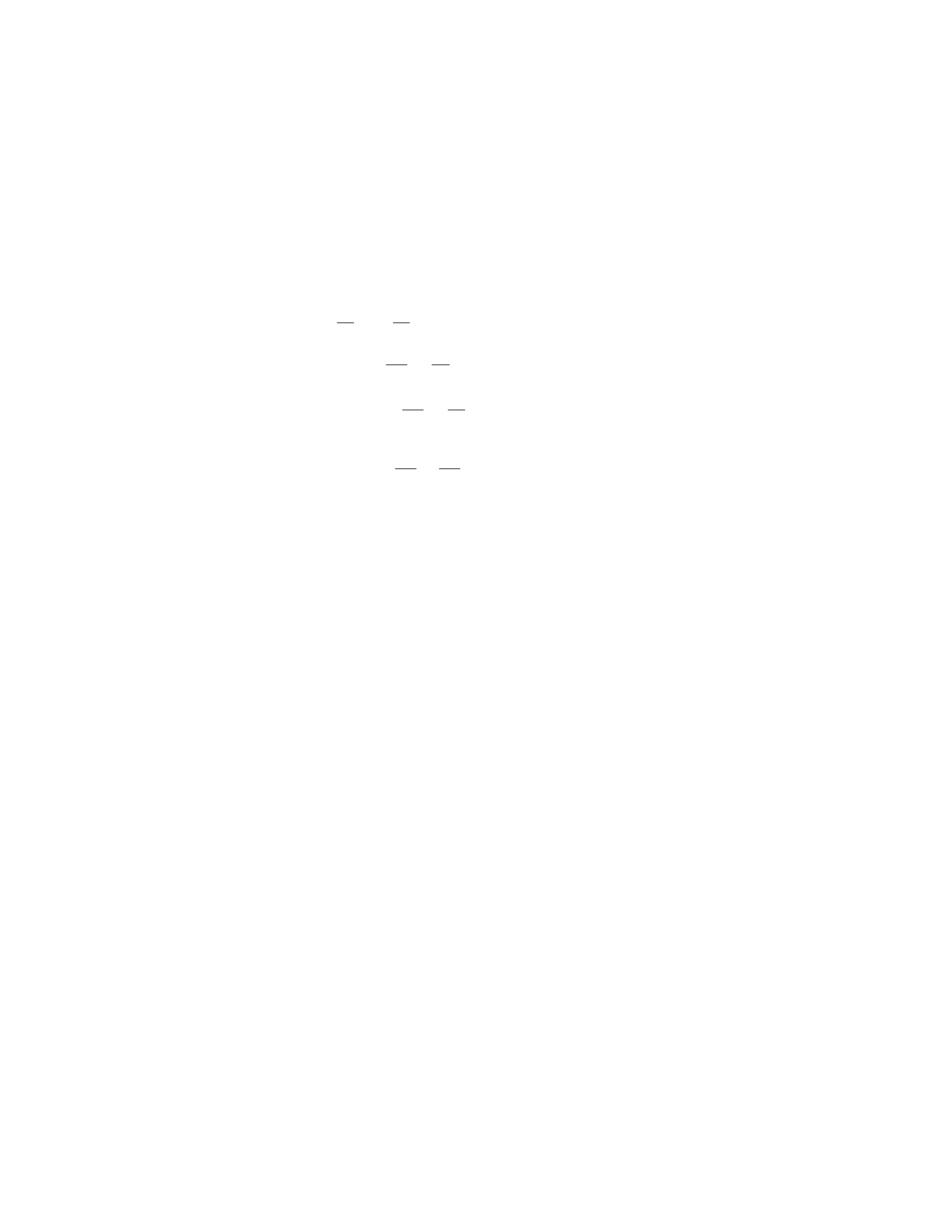
Now, we calculate ∂Q
∂x and ∂P
∂y :
∂Q
∂x =∂
∂x (2y−sin(x)) = 0
∂P
∂y =∂
∂y (x2+y) = 1
Thus, we have
∂Q
∂x −∂P
∂y = 0 −1 = −1
Now, we find the region Denclosed by the curve C. Since r(t)traces out the
curve C as tvaries from 0 to 1, the region Dis the area under the curve y=et
from x= 0 to x= 1. Therefore, D={(x, y)|0≤x≤1,0≤y≤e}, and
dA =dx dy =dy dx.
We can now compute the line integral using Green’s Theorem:
IC
(x2+y)dx + (2y−sin(x)) dy =ZZD−1dA
=−ZZD
dA
=−Z1
0Ze
0
1dy dx
=−Z1
0
(y
e
0)dx
=−Z1
0
(e−0) dx
=−Z1
0
e dx
=−eZ1
0
1dx
=−e(x)
1
0
=−e(1) −(−e(0))
=−e
Therefore, the line integral HC(x2+y)dx + (2y−sin(x)) dy around the curve
Cis equal to −e.
6
Question 7
Question
Consider the vector field F(x, y) = (yex, x cos(y)) and the region Dbounded
by the curve C:x2+y2= 1. Calculate the circulation of Faround Cusing
Green’s Theorem.
Solution
Step 1: Calculate the circulation of Faround Cusing Green’s Theorem.
IC
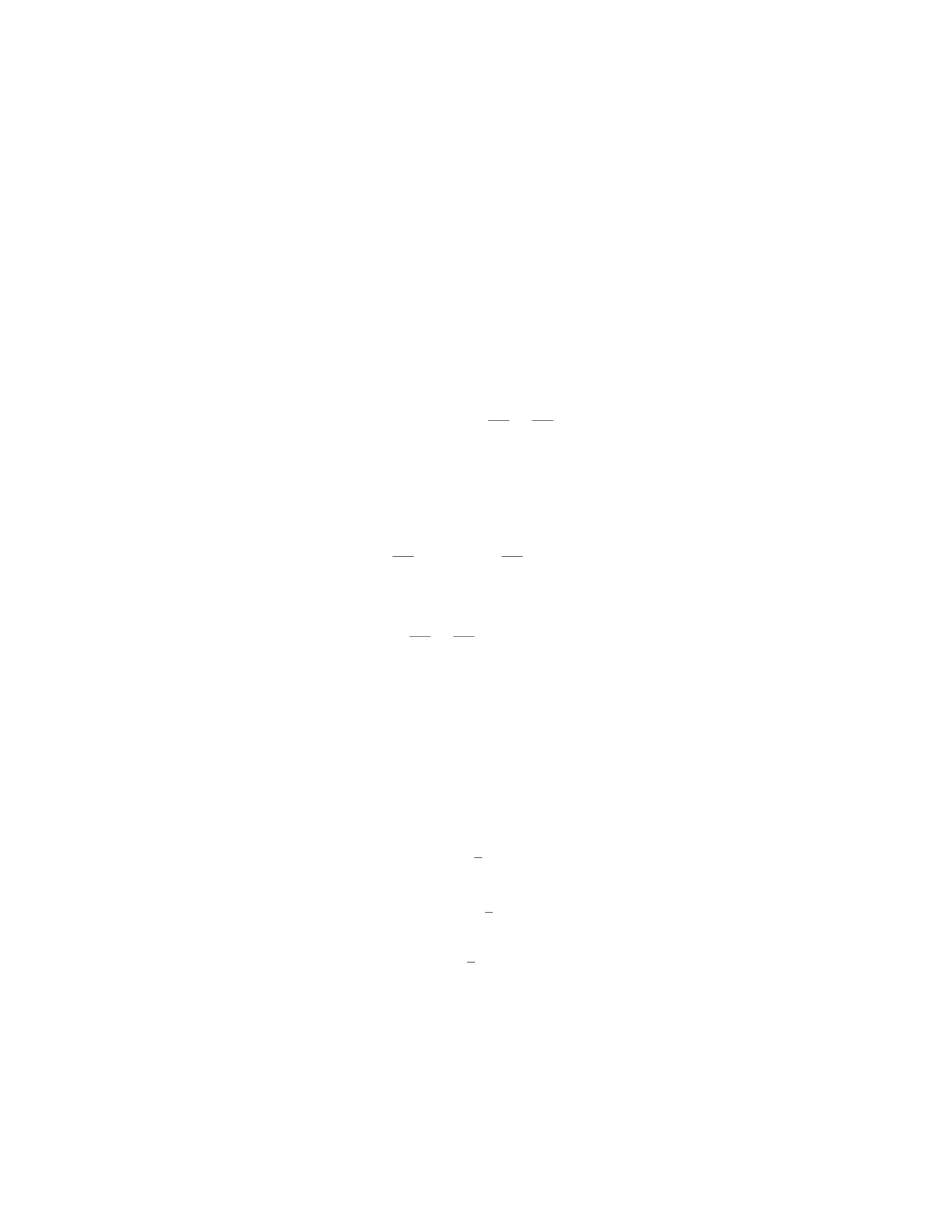
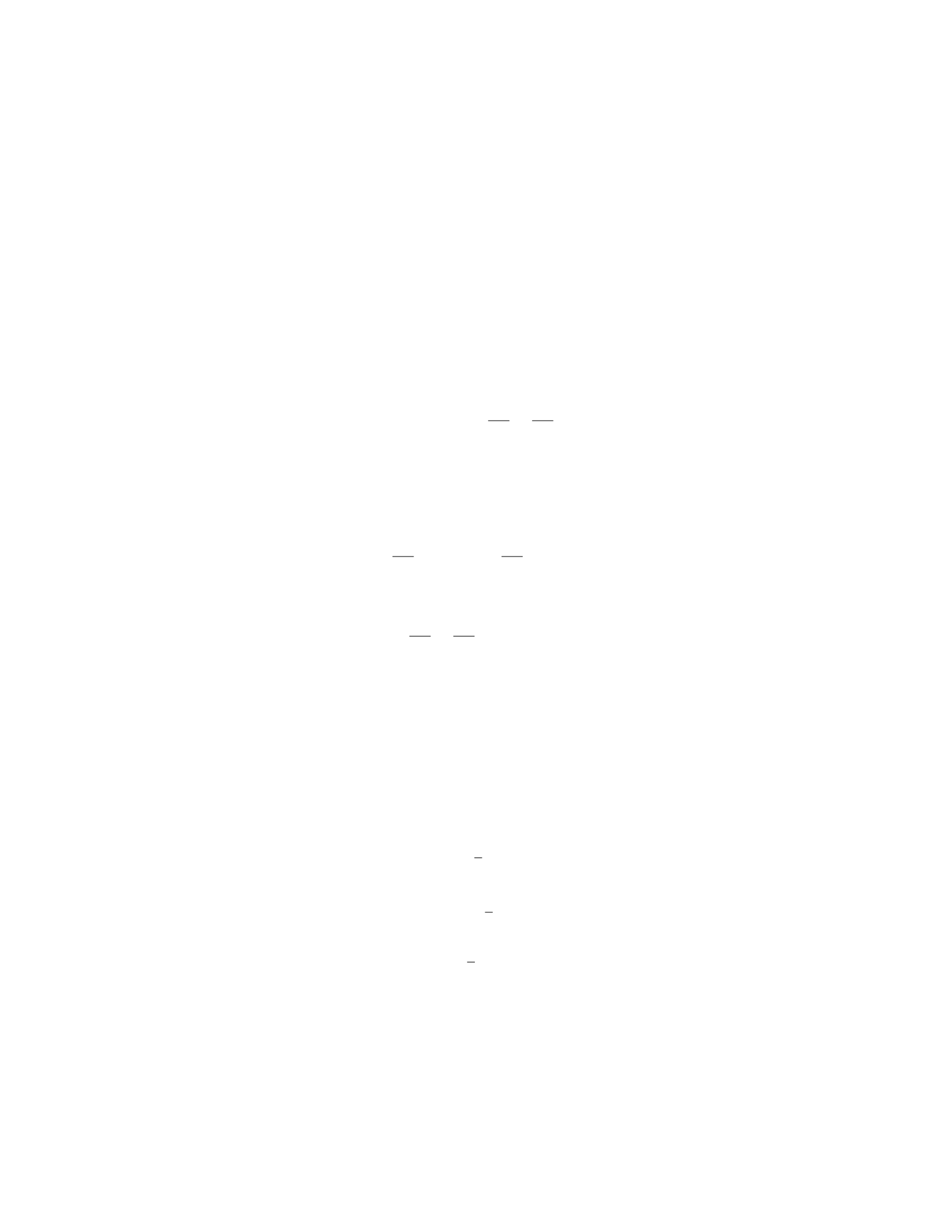
F·dr=ZZD∂Q
∂x −∂P
∂y dA
where F(x, y) = (P, Q).
Step 2: Write F(x, y)in terms of Pand Q. Here, P(x, y) = yexand
Q(x, y) = xcos(y).
Step 3: Calculate the partial derivatives of Pand Q.
∂Q
∂x = cos(y),∂P
∂y =ex
Step 4: Evaluate the double integral over the region D.
IC
F·dr=ZZD∂Q
∂x −∂P
∂y dA =ZZD
(cos(y)−ex)dA
Step 5: Convert the double integral to polar coordinates. In polar coor-
dinates, the region Dis described by 0≤r≤1and 0≤θ≤2π. Also,
dA =rdrdθ.
Step 6: Substitute the polar form into the double integral.
IC
F·dr=Z2π
0Z1
0
(cos(θ)−er)rdrdθ
Step 7: Evaluate the double integral to find the circulation.
IC
F·dr=Z2π
01
2sin(θ)−rer1
0
dθ
IC
F·dr=Z2π
01
2sin(θ)−edθ
IC
F·dr=−1
2cos(θ)−2πe2π
0
IC
F·dr= 0 −(−2πe) = 2πe
Therefore, the circulation of Faround Cis 2πe.
7

Question 8
Question
Let Cbe the circle centered at the origin with radius 3 oriented counterclockwise.
Calculate the line integral HC−y2dx +x2dyusing Green’s Theorem.
Solution
Step 1: Determine the region Denclosed by the curve C, which in this case is
the interior of the circle of radius 3 centered at the origin.
Step 2: Write the given line integral as a double integral over the region D
using Green’s Theorem, which states that for a vector field F= (P, Q)where P
and Qhave continuous first partial derivatives on a region D, the line integral
of Faround the boundary of Dis equal to the double integral of (∂Q
∂x −∂P
∂y )
over D. Thus, we have
IC−y2dx +x2dy=ZZD∂(x2)
∂x −∂(−y2)
∂y dA.
Step 3: Compute the partial derivatives and substitute into the expression
from Step 2:
∂(x2)
∂x = 2x, ∂(−y2)
∂y =−2y,
∂(x2)
∂x −∂(−y2)
∂y = 2x+ 2y.
Step 4: Integrate 2x+ 2yover the region D, which is the circle of radius 3
centered at the origin. This can be done in polar coordinates:
ZZD
(2x+ 2y)dA =Z2π
0Z3
0
(2rcos θ+ 2rsin θ)r dr dθ.
Step 5: Evaluate the double integral from Step 4:
Z2π
0Z3
0
(2r2cos θ+ 2r2sin θ)dr dθ =Z2π
02
3r3cos θ+2
3r3sin θ3
0
dθ,
=Z2π
0
(18 cos θ+ 18 sin θ)dθ = [18 sin θ−18 cos θ]2π
0,
= 0 −(−18) = 18.
Therefore, the value of the line integral HC−y2dx +x2dyaround the circle
Cis 18.
8

Question 9
Question
Let Cbe the curve defined by x2+y2= 4 oriented counterclockwise. Calculate
the circulation HCF·drof the vector field F(x, y) = ⟨y2, x2⟩along the curve C.
Solution
Step 1: To apply Green’s Theorem, we first need to find the region Denclosed by
the curve C. The curve Cis a circle centered at the origin with radius 2. Thus, D
is the interior of the circle, which can be represented as D:{(x, y)|x2+y2≤4}.
Step 2: In Green’s Theorem, circulation of Falong Cis given by the double
integral of the curl of Fover the region D, i.e., HCF·dr=RRD(curl F)·ndA,
where nis the outward unit normal vector to D.
Step 3: Compute the curl of F:
curl F=∂F2
∂x −∂F1
∂y =∂
∂x (x2)−∂
∂y (y2)= 2x−2y
Step 4: Since the curve Cis oriented counterclockwise, the outward unit
normal vector nis −yi+xj.
Step 5: Substituting the curl of Fand ninto the double integral, we get:
IC
F·dr=ZZD
(2x−2y)·(−yi+xj)dA
Step 6: Switch to polar coordinates to evaluate the double integral. The
jacobian determinant is r. Substituting x=rcos(θ)and y=rsin(θ)into the
integral:
IC
F·dr=Z2π
0Z2
0
(2rcos(θ)−2rsin(θ)) ·(−rsin(θ)i+rcos(θ)j)dr dθ
Step 7: After evaluating the double integral, we find that the circulation of
Falong Cis 0.
Question 10
Question
Let Cbe the curve formed by the intersection of the surfaces z=x2+y2and
z= 4 −x2−y2. Calculate the flux of the vector field F(x, y, z)=(−y, x, z)
across Cin the counterclockwise direction.
9

Solution
Step 1: First, we need to find the region Din the xy-plane enclosed by the curve
C. This can be done by setting zin the two equations equal to each other:
x2+y2= 4 −x2−y2
2x2+ 2y2= 4
x2+y2= 2
This represents a circle in the xy-plane centered at the origin with radius √2.
Step 2: Next, we parameterize the curve Cin the xy-plane. Let x=
√2 cos(t)and y=√2 sin(t), where 0≤t≤2π. Then, the corresponding
z-values are z1=√2and z2= 4 −2.
Step 3: The curve Cis parameterized by:
r(t) = ⟨√2 cos(t),√2 sin(t),2⟩,0≤t≤2π
Step 4: Now, we need to compute the unit normal vector to the surface S
determined by C. This vector is given by:
N=±∂z
∂x ,∂z
∂y ,−1
By computing these partial derivatives for z=x2+y2and z= 4 −x2−y2, we
get N=1
√2⟨x, y, −1⟩.
Step 5: Calculate the curl of F:
∇ × F=
i j k
∂
∂x
∂
∂y
∂
∂z
−y x z
=⟨0,0,2⟩
Step 6: Using Green’s Theorem, the flux of Facross Cis:
ZZ
D
(∇ × F)·NdA =Z2π
0Z√2
0
2·1
√2dr dt =Z2π
0Z√2
0
√2dr dt = 2π√2
Question 11
Question
Let Cbe the curve in the xy-plane defined by x2+y2= 4, oriented counter-
clockwise, and let F(x, y) = (2y, x). Compute the line integral HCF·drusing
Green’s Theorem.
10
Solution
Let’s first compute the line integral directly using Green’s Theorem. Green’s
Theorem states that for a vector field F(x, y)=(P(x, y), Q(x, y)) defined on
a region Denclosed by a simple closed curve C, oriented counterclockwise, we
have: IC
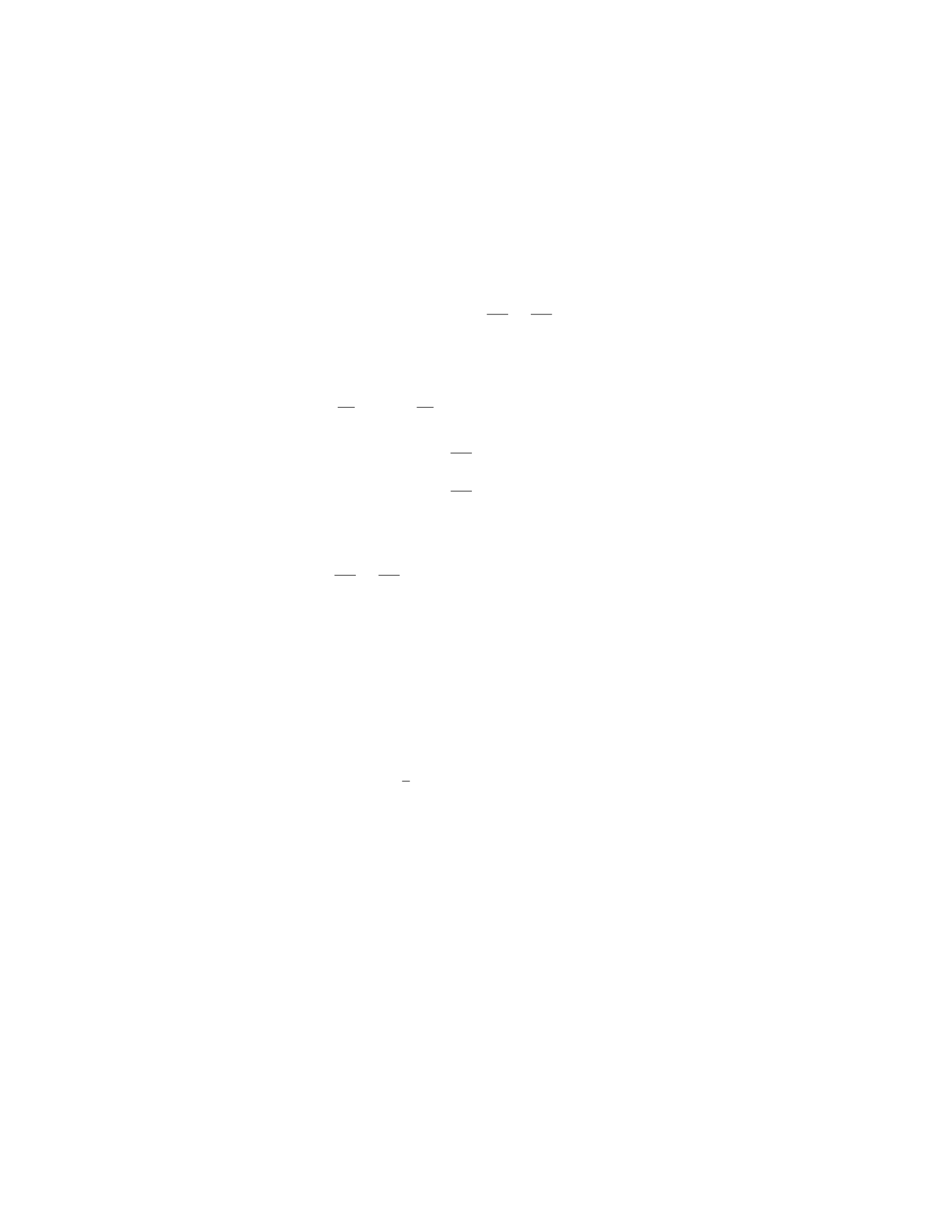
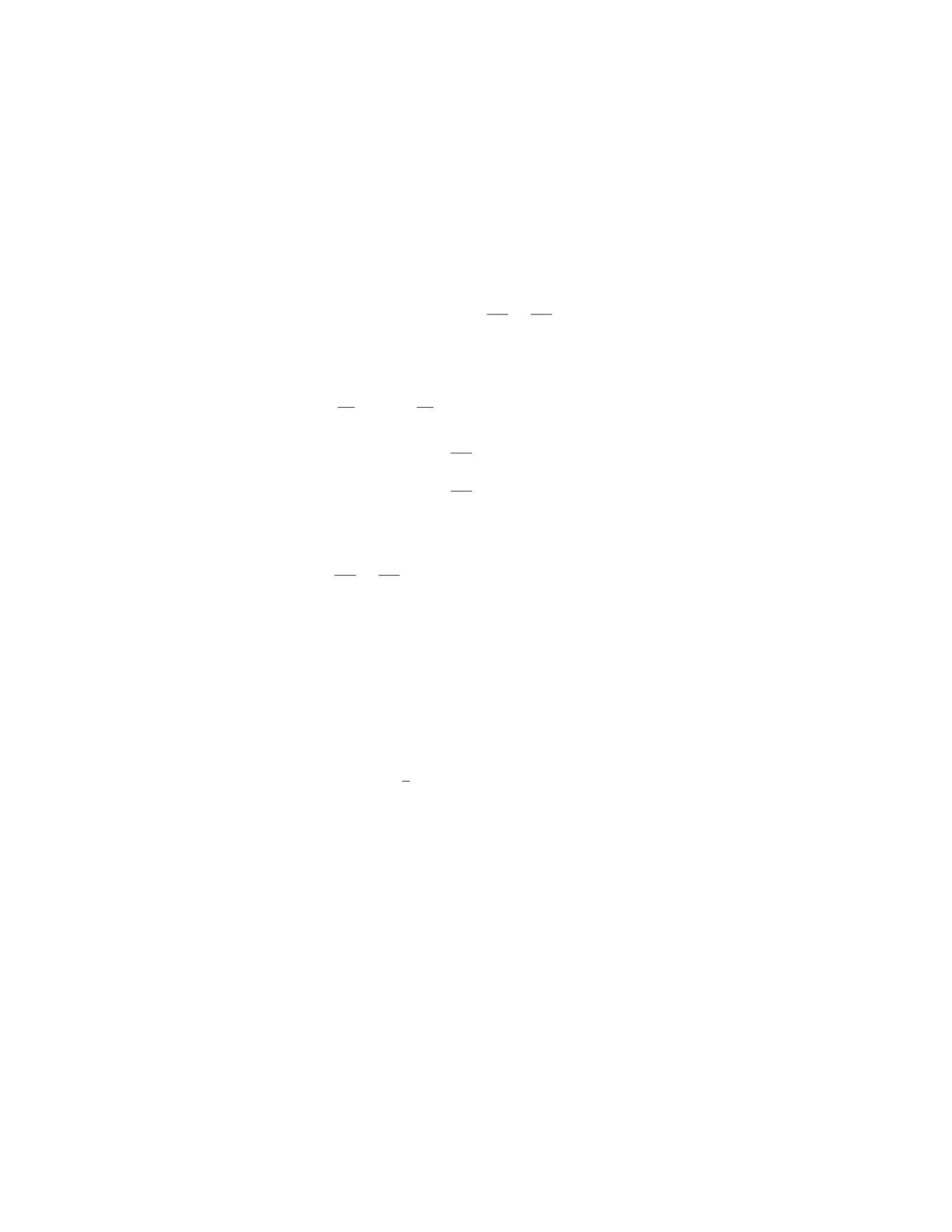
F·dr=ZZD∂Q
∂x −∂P
∂y dA
Given that F(x, y) = (2y, x), we have P(x, y) = 2yand Q(x, y) = x. We
also note that the curve Cis a circle of radius 2 centered at the origin, so the
region Dbounded by Cis the interior of this circle.
Step 1: Find ∂Q ∂x and ∂P
∂y .
∂Q
∂x = 1
∂P
∂y = 2
Step 2: Compute the double integral.
ZZD∂Q
∂x −∂P
∂y dA =ZZD
(1 −2) dA =ZZD
(−1) dA
Step 3: Evaluate the double integral over the region D.To evaluate
the double integral, we can use polar coordinates to describe the region Das
0≤r≤2,0≤θ≤2π. The Jacobian for the transformation is r, so the integral
becomes:
Z2π
0Z2
0
(−1) ·r dr dθ =−Z2π
0Z2
0
r dr dθ
Step 4: Evaluate the inner integral.
−Z2π
01
2r22
0
dθ =−Z2π
0
2dθ =−4π
Therefore, the line integral HCF·dris −4π.
Question 12
Question
Let Cbe the curve in the xy-plane consisting of the line segments from (0,0) to
(1,0) and from (1,0) to (1,1), oriented counterclockwise. Let Dbe the region
enclosed by C. Using Green’s Theorem, calculate the line integral
ICy2−x2dx +xy dy.
11

Solution
Step 1: Find the partial derivatives of Qwith respect to xand Pwith respect
to y. Let P(x, y) = y2−x2and Q(x, y) = xy. Then, the partial derivatives are:
∂Q
∂x =yand ∂P
∂y = 2y.
Step 2: Calculate the double integral over the region D. By Green’s The-
orem, we have:
ICy2−x2dx +xy dy =ZZD∂Q
∂x −∂P
∂y dA.
So, we need to evaluate the double integral of 2y−y dA over the region D.
Step 3: Determine the boundaries for the double integral. The region Dis
the unit square in the first quadrant. Therefore, the boundaries for the double
integral are 0≤x≤1and 0≤y≤1.
Step 4: Evaluate the double integral.
ZZD
(2y−y)dA =Z1
0Z1
0
(y)dx dy =Z1
0
[xy]1
0dy =Z1
0
y dy =y2
21
0
=1
2.
Step 5: Write the final answer. The line integral HCy2−x2dx +xy dy
over the curve Cis 1
2.
Question 13
Question
Let Cbe the curve that consists of the line segment from (0,1) to (2,3) followed
by the line segment from (2,3) to (3,2). Calculate the line integral HCy2dx +
x2dy.
Solution
Step 1: Parameterize the curve C.
The first line segment from (0,1) to (2,3) can be parameterized as r1(t) =
(2t, 1+2t)for 0≤t≤1.
The second line segment from (2,3) to (3,2) can be parameterized as r2(t) =
(2 + t, 3−t)for 0≤t≤1.
Step 2: Calculate the line integral over the first line segment.
12

Zr1
y2dx +x2dy =Z1
0
(1 + 2t)2·2dt + (2t)2·2dt
=Z1
0
(1 + 4t+ 4t2)·2dt + 4t2dt
=Z1
0
(2 + 8t+ 8t2)+4t2dt
= 2t+ 4t2+8t3
3+4t3
3
1
0
= 2 + 4 + 8
3+4
3
=34
3.
Step 3: Calculate the line integral over the second line segment.
Zr2
y2dx +x2dy =Z1
0
(3 −t)2·1dt + (2 + t)2·(−1) dt
=Z1
0
(9 −6t+t2)−(4 + 4t+t2)dt
=Z1
0
5−10t dt
= 5t−5t2
1
0
= 5 −5
= 0.
Step 4: Calculate the total line integral HCy2dx +x2dy.
IC
y2dx +x2dy =Zr1
y2dx +x2dy +Zr2
y2dx +x2dy =34
3+ 0 = 34
3.
Question 14
Question
Let Cbe the curve given by x(t) = 2 cos(t)and y(t) = 3 sin(t)for 0≤t≤π
2.
Calculate the line integral HC(3x2+ 2y)dx + (x−y2)dy using Green’s Theorem.
13

Solution
Step 1: Calculate the partial derivatives of the given vector field: Let P(x, y) =
3x2+ 2yand Q(x, y) = x−y2. Then,
∂Q
∂x = 1 and ∂P
∂y = 2
Step 2: Apply Green’s Theorem: Green’s Theorem states: HCP dx+Qdy =
RRD∂Q
∂x −∂P
∂y dA.
Therefore, we have:
IC
(3x2+ 2y)dx + (x−y2)dy =ZZD
(1 −2) dA
Step 3: Calculate the double integral: The region Denclosed by the curve
Cis the quarter circle in the first quadrant. We can rewrite the integral as:
ZZD
(−1)dA =−ZZD
dA =−Area of D
Step 4: Find the area of the region D: The radius of the quarter circle is
r=√22+ 32=√13. So, the area of the quarter circle is 1
4πr2=1
4π(13).
Step 5: Calculating the final answer: Finally, substituting the area of region
Dinto the expression gives:
IC
(3x2+ 2y)dx + (x−y2)dy =−1
4π(13) = −13
4π
Therefore, the line integral around the curve Cis −13
4π.
Question 15
Question
Let Cbe the curve defined by x2+y2= 4 oriented counterclockwise. Evaluate
the line integral HCy2dx +x2dy using Green’s Theorem.
Solution
Step 1: Determine the region enclosed by the curve C. The curve Crepresents
a circle centered at the origin with radius 2. Therefore, the region enclosed by
the curve Cis the interior of this circle.
Step 2: Apply Green’s Theorem. Green’s Theorem relates a line integral
around a positively oriented simple closed curve Cto a double integral over the
region Dbounded by C. Green’s Theorem states:
IC
P dx +Qdy =ZZD∂Q
∂x −∂P
∂y dA
14

In this case, P=y2and Q=x2. We need to find ∂Q
∂x and ∂P
∂y .
∂Q
∂x = 2x, ∂P
∂y = 2y
Step 3: Evaluate the double integral over the region D. The double integral
becomes: ZZD
(2y−2y)dA =ZZD
0dA = 0
Step 4: Conclude the solution. Since the double integral over the region D
is 0, the line integral over the curve Cis also 0. Therefore, HCy2dx +x2dy = 0.
Question 16
Question
Let Cbe the curve given by the intersection of the plane x+ 2y+ 3z= 6
and the cylinder x2+y2= 4. Evaluate the line integral HC(x2y+y2z)·dr
counterclockwise along Cusing Green’s Theorem.
Solution
Step 1: Find the region Denclosed by the curve C, which is the intersection of
the plane and cylinder.
The intersection of the plane and cylinder can be parametrized as x=
2 cos(t), y = 2 sin(t), z =6−2x−2y
3.
Here, 0≤t≤2πparameterizes the curve in a counterclockwise manner.
Step 2: Apply Green’s Theorem, which states that for a region Denclosed
by a simple closed curve C, oriented counterclockwise, and a vector field F=
Pi+Qjthat is continuously differentiable in D,
IC
F·dr=ZZD∂Q
∂x −∂P
∂y dA
Step 3: To apply Green’s Theorem, we first need to express the line integral
as a double integral. Here, F=x2yi+y2zj, so P=x2yand Q=y2z.
Step 4: Compute ∂Q
∂x and ∂P
∂y .
∂Q
∂x = 0,∂P
∂y = 2xy
Step 5: Calculate the double integral of ∂Q
∂x −∂P
∂y over the region D.
ZZD
(0 −2xy)dA =ZZD−2xy dA
15

Step 6: Transform the double integral into polar coordinates since the region
is circular.
ZZD−2xy dA =Z2π
0Z2
0−2(2 cos(t))(2 sin(t))r dr dt
Step 7: Integrate with respect to rfirst.
Z2
0−2(2 cos(t))(2 sin(t))r dr =−16 cos(t) sin(t)Z2
0
r dr
Step 8: Integrate with respect to rfrom 0 to 2.
−16 cos(t) sin(t)r2
22
0
=−16 cos(t) sin(t)(2 −0) = −32 cos(t) sin(t)
Step 9: Integrate with respect to tfrom 0 to 2π.
Z2π
0−32 cos(t) sin(t)dt =−16π
Step 10: Therefore, the line integral HC(x2y+y2z)·drevaluated counter-
clockwise along Cis −16π.
Question 17
Question
Let Cbe the curve formed by the intersection of the cylinder x2+y2= 1 and
the plane y+z= 2. Use Green’s Theorem to find the area enclosed by C.
Solution
Step 1: First, let’s parameterize the curve C. Since Clies on the cylinder
x2+y2= 1, we can let x= cos tand y= sin t, where 0≤t≤2π. Substituting
these into the equation of the plane y+z= 2, we get z= 2 −sin t.
Step 2: Next, let’s express the curve Cin vector form. We have r(t) =
⟨cos t, sin t, 2−sin t⟩, where 0≤t≤2π.
Step 3: Green’s Theorem states that the area enclosed by a simple closed
curve Ccan be calculated as RRDdA, where Dis the region enclosed by Cand
dA =dx dy =−dy dx. Therefore, we need to find the region Denclosed by C.
Step 4: To find D, we can project Conto the xy-plane by setting z= 0.
This gives us the projected curve Cproj defined by r(t) = ⟨cos t, sin t, 0⟩. The
region Dwill be the interior of Cproj, which is the unit circle x2+y2= 1.
Step 5: The area enclosed by Ccan then be evaluated as RRDdA =RRx2+y2≤1−dy dx =
−RRx2+y2≤1dx dy.
16
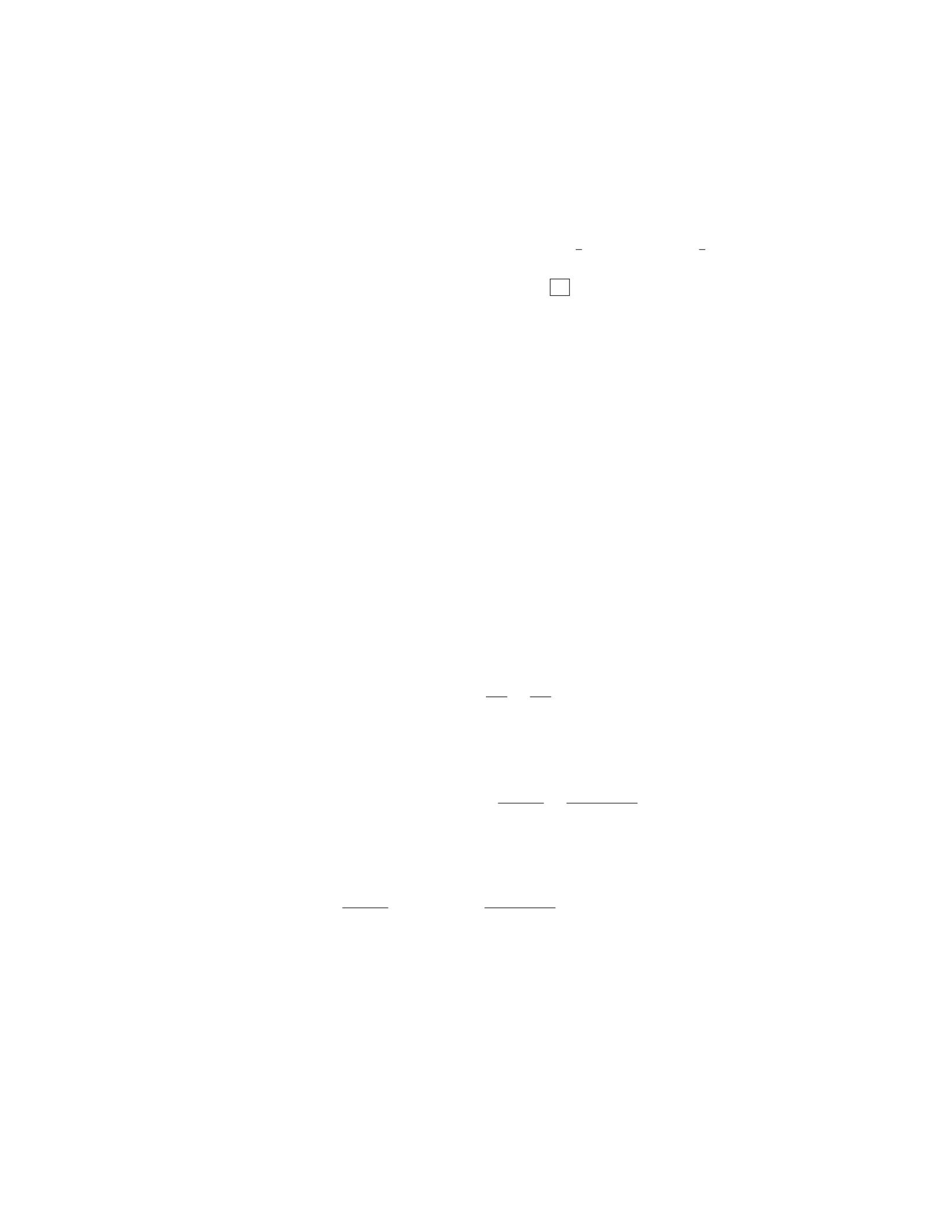
Step 6: Converting to polar coordinates, we have dx dy =r dr dθ. The
integral becomes −R2π
0R1
0r dr dθ.
Step 7: Solving the above integral, we get −R2π
01
2r21
0dθ =−R2π
0
1
2dθ =
−π.
Therefore, the area enclosed by the curve Cis π.
Question 18
Question
Let Cbe the curve given by x2+y2= 1 oriented counterclockwise. Use Green’s
Theorem to evaluate the line integral
IC
(x2−y2)dx + 2xydy.
Solution
Step 1: Determine the region Denclosed by the curve C. Since x2+y2= 1
is the equation of a circle with radius 1 centered at the origin, the region D
enclosed by Cis the interior of this circle.
Step 2: Write the given line integral as a double integral over D. Green’s
Theorem states that for a simple closed curve Cenclosing a region D, the line
integral of a vector field F=Pi+Qjalong Ccan be computed as the double
integral of the curl of Fover the region D, i.e.,
IC
F·dr=ZZD∂Q
∂x −∂P
∂y dA.
In this case, F= (x2−y2)i+ 2xyj, so P=x2−y2and Q= 2xy. Then, the
line integral becomes
IC
(x2−y2)dx + 2xydy =ZZD∂(2xy)
∂x −∂(x2−y2)
∂y dA.
Step 3: Compute the partial derivatives and set up the double integral. To
apply Green’s Theorem, we need to calculate the partial derivatives:
∂(2xy)
∂x = 2yand ∂(x2−y2)
∂y =−2y.
Therefore, the line integral is equal to
ZZD
(2y−(−2y))dA = 4ydA.
17

Step 4: Switch to polar coordinates and evaluate the double integral. In
polar coordinates, dA =rdrdθ and y=rsin(θ). The integral becomes
ZZD
4ydA =Z2π
0Z1
0
4rsin(θ)·rdrdθ
=Z2π
0Z1
0
4r2sin(θ)drdθ
=Z2π
04
3r3sin(θ)1
0
dθ
=Z2π
0
4
3sin(θ)dθ
=4
3[−cos(θ)]2π
0
=8
3.
Therefore, the value of the line integral HC(x2−y2)dx + 2xydy is 8
3.
Question 19
Question
Let Cbe the circle with radius 3 centered at the origin, oriented counterclock-
wise. Compute the line integral HC(2x−ey)dx +x2+ydy using Green’s
Theorem.
Solution
Step 1: Calculate the curl of the vector field F(x, y) = 2x−ey, x2+y.
Curl F(x, y) = ∂(x2+y)
∂x −∂(2x−ey)
∂y ,∂(2x−ey)
∂x +∂(x2+y)
∂y
= (2x−0,2 + 1) = (2x, 3)
Step 2: Apply Green’s Theorem, which states that for a region Rbounded
by a simple, positively oriented, piecewise-smooth curve C, the line integral of
a vector field Faround Cis equal to the double integral of the curl of Fover
R.IC
F·dr=ZZR
Curl F·dA
Step 3: The area Renclosed by Cis the disk with radius 3, so we can
use polar coordinates to compute the double integral. The area of the disk is
A=πr2= 9π.
18
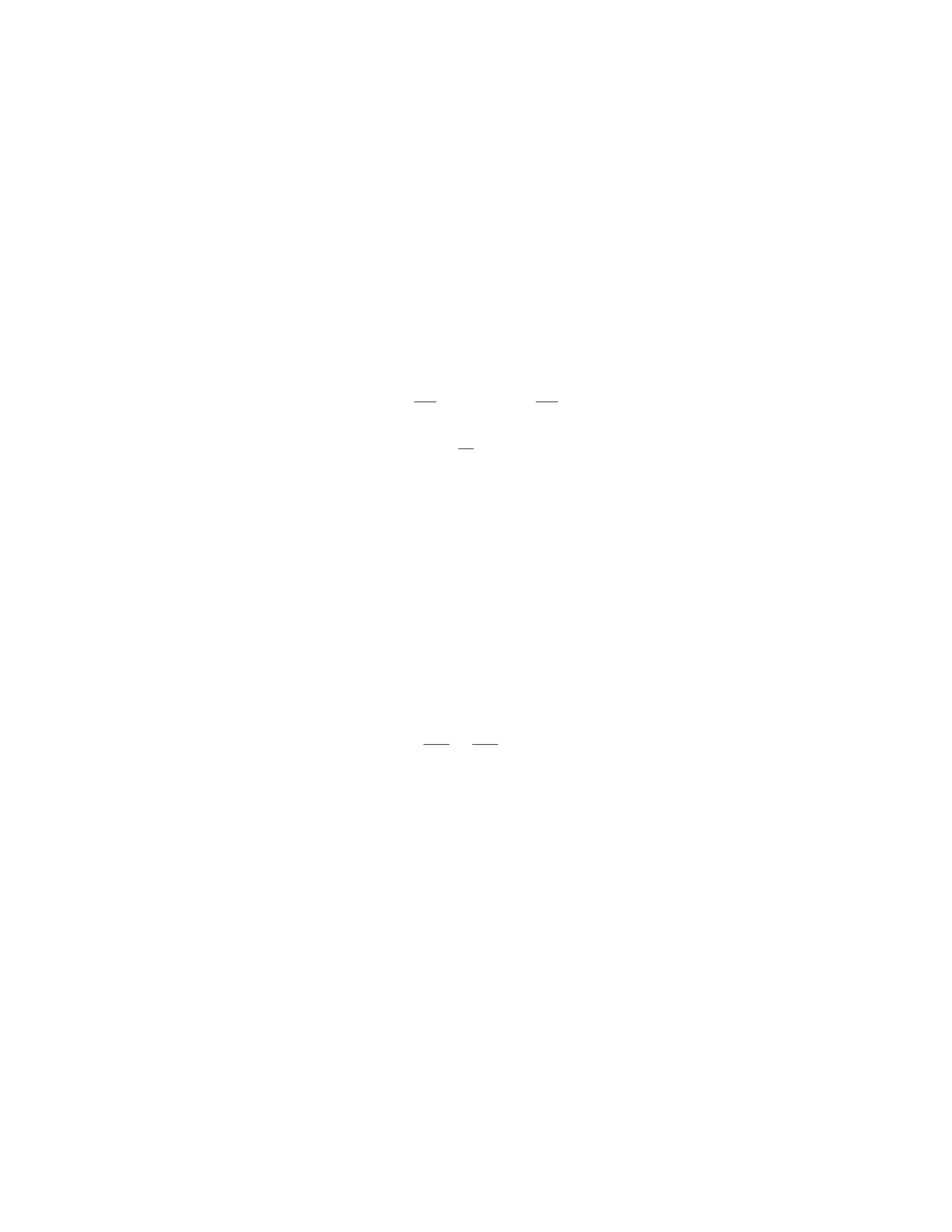
Step 4: Substitute the curl of Finto Green’s Theorem to find the line
integral.
ZZR
Curl F·dA =ZZR
(2x, 3) ·dA =ZZR
2x dA +ZZR
3dA
=Z2π
0Z3
0
2r·r dr dθ +Z2π
0Z3
0
3·r dr dθ
=Z2π
0Z3
0
2r2dr dθ +Z2π
0Z3
0
3r dr dθ
=Z2π
02r3
33
0
dθ +Z2π
03r2
23
0
dθ
=Z2π
0
18 dθ +Z2π
0
27
2dθ = 36π+ 27π= 63π
Therefore, the line integral HC(2x−ey)dx +x2+ydy around the circle
Cis 63π.
Question 20
Question
Let Cbe the curve given by x2+y2= 1 oriented counterclockwise and let
F= (4x3+y2,2y3). Calculate the line integral HCF·dr using Green’s Theorem.
Solution
Step 1: Calculate the curl of F. The curl of F= (4x3+y2,2y3)is given by
curl(F) = ∂F2
∂x −∂F1
∂y = (0 −0) = 0.
Step 2: Apply Green’s Theorem. Green’s Theorem states that for a simply
connected region Dbounded by a simple, closed, positively oriented curve C,
the line integral of a vector field Falong Ccan be calculated as the double
integral of the curl of Fover D. Mathematically,
IC
F·dr=ZZD
curl(F)·dA.
Since the curl of Fis 0, the line integral becomes 0 by Green’s Theorem.
Question 21
Question
Let Cbe the curve given by x=t2−1,y=t3−tfor −1≤t≤1. Calculate
the line integral of the vector field F(x, y) = ⟨x2, y2⟩counterclockwise along C.
19

Solution
Let’s start by parameterizing the curve C. We have:
x=t2−1
y=t3−t
Step 1: Find r(t).
The position vector r(t)for the curve Cis given by:
r(t) = ⟨x(t), y(t)⟩=⟨t2−1, t3−t⟩
Step 2: Calculate r′(t).
The derivative of r(t)with respect to tis:
r′(t) = ⟨2t, 3t2−1⟩
Step 3: Compute F(r(t)).
Substitute x=t2−1and y=t3−tinto F(x, y) = ⟨x2, y2⟩to get:
F(r(t)) = ⟨(t2−1)2,(t3−t)2⟩=⟨t4−2t2+ 1, t6−2t4+t2⟩
Step 4: Calculate the dot product.
The dot product of F(r(t)) and r′(t)is:
F(r(t)) ·r′(t) = (t4−2t2+ 1)(2t)+(t6−2t4+t2)(3t2−1)
Simplify this expression and integrate it over −1≤t≤1to find the line
integral along C.
Question 22
Question
Let Cbe the curve given by x2+y2= 4 oriented counterclockwise. Evaluate
the line integral HC(x2−y2)dx + 2xydy using Green’s Theorem.
Solution
Step 1: Determine the region enclosed by the curve C.
Given that x2+y2= 4, we recognize that Cis a circle centered at the origin
with radius 2.
Step 2: Apply Green’s Theorem.
Green’s Theorem states that for a smooth, simply connected region Den-
closed by a simple, positively oriented, piecewise-smooth curve C, and functions
P(x, y)and Q(x, y)that have continuous partial derivatives on an open region
containing D, we have
IC
P dx +Qdy =ZZD∂Q
∂x −∂P
∂y dA
20
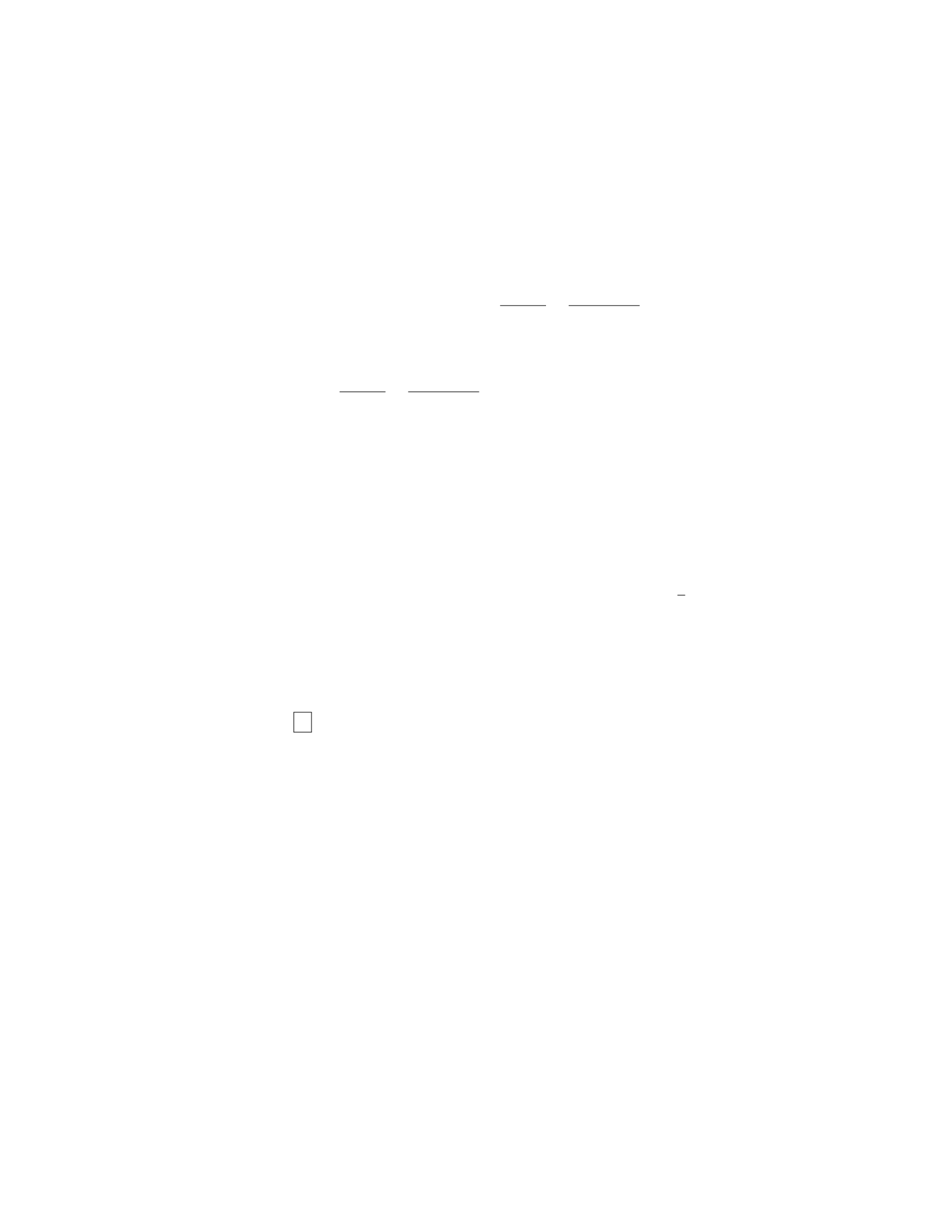
where dA =dxdy.
Step 3: Express the line integral in terms of double integrals using Green’s
Theorem.
Given P(x, y) = x2−y2and Q(x, y) = 2xy, the line integral becomes
IC
(x2−y2)dx + 2xydy =ZZD∂(2xy)
∂x −∂(x2−y2)
∂y dA
Step 4: Calculate the partial derivatives and evaluate the double integral.
We have ∂(2xy)
∂x −∂(x2−y2)
∂y = 2y−(−2y) = 4y
Thus, the line integral simplifies to
IC
(x2−y2)dx + 2xydy =ZZD
4y dA
Step 5: Find the area of the region D.
The region Dis a circle with radius 2, so its area is A=π·22= 4π.
Step 6: Evaluate the double integral.
ZZD
4y dA = 4 ZZD
y dA = 4·Z2π
0Z2
0
r·sin(θ)drdθ= 4· Z2π
0−1
2r2cos(θ)2
0
dθ!
= 4 ·Z2π
0
[−2 cos(θ)]dθ= 4 ·[−2 sin(θ)]2π
0= 0
Step 7: Conclusion.
Therefore, after evaluating the line integral using Green’s Theorem, we find that
the result is 0.
Question 23
Question
Let Cbe the curve given by x2+y2= 4 oriented counterclockwise. Calculate
the circulation of the vector field F(x, y)=(y2,−x)around the curve Cusing
Green’s Theorem.
Solution
To apply Green’s Theorem, we first need to find a region Denclosed by the
curve C.
Step 1: Find the Region Enclosed by the Curve
The curve Cis a circle centered at the origin with radius 2. This implies that
the region enclosed by Cis the disk Dwith radius 2.
21
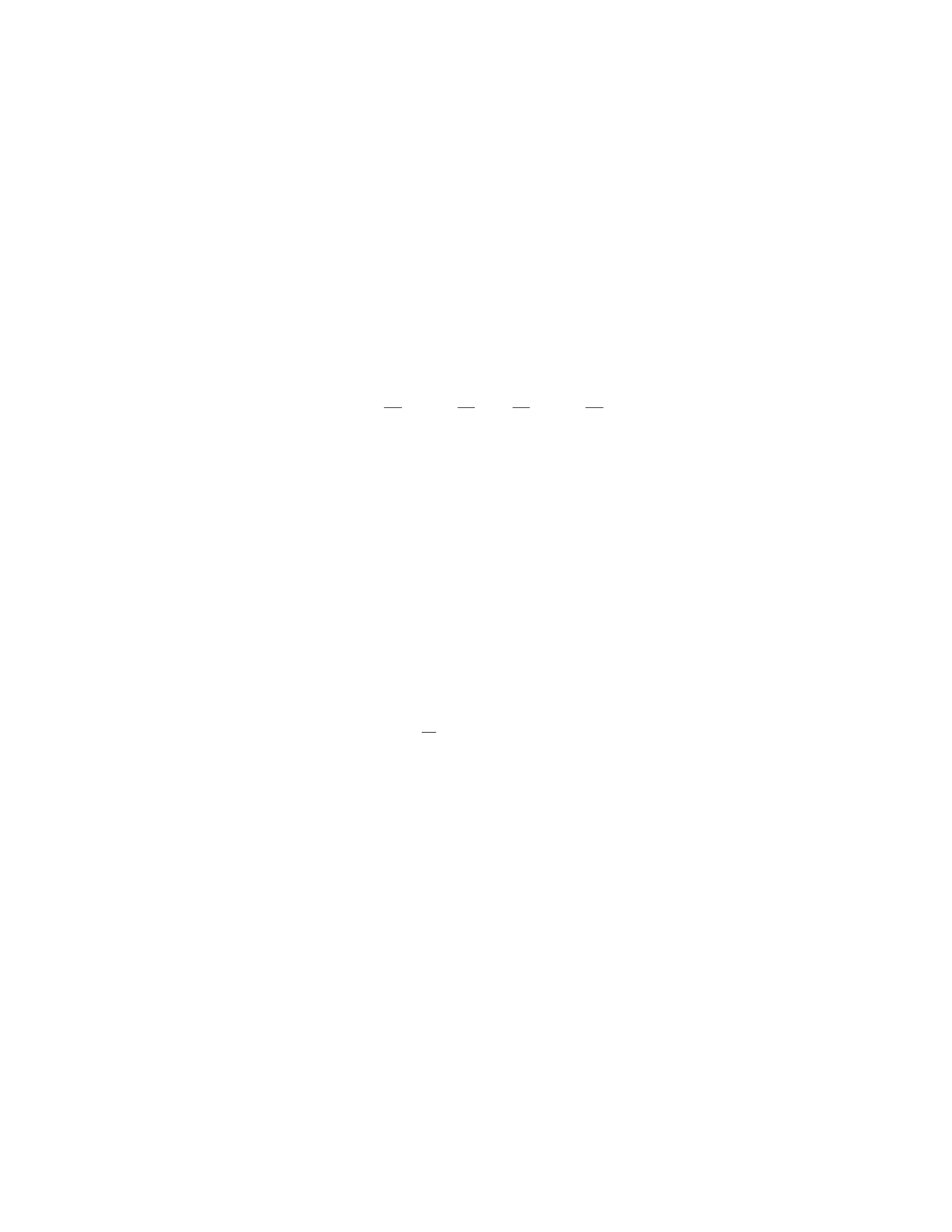
Step 2: Calculate the Circulation
According to Green’s Theorem, the circulation of a vector field around a closed
curve is equal to the double integral of the curl of the vector field over the region
enclosed by the curve. The circulation circ(C)is given by:
circ(C) = ZZD
(∇ × F)·dA
Step 3: Calculate the Curl of F
The vector field F(x, y) = (y2,−x). The curl of F, denoted by ∇ × F, is:
∇ × F=∂
∂x (−x)−∂
∂y (y2),∂
∂y (−x)−∂
∂x (y2)
= (−1−0,0−(−2y)) = (−1,2y)
Step 4: Set Up the Double Integral
Substitute the curl of Finto the circulation formula and compute the double
integral over the region D, which is the disk with radius 2. Using polar coordi-
nates, dA=r dr dθ, and the region Dis 0≤r≤2,0≤θ≤2π. The circulation
becomes:
circ(C) = ZZD
(−1,2y)·(r dr dθ)
Step 5: Evaluate the Double Integral
The circulation integral becomes:
circ(C) = Z2π
0Z2
0
(−1) ·r dr dθ +Z2π
0Z2
0
2y·r dr dθ
=Z2π
0−r2
22
0
dθ +Z2π
0y·r22
0dθ
=Z2π
0
(−2) dθ +Z2π
0
4y dθ =−4·2π+ 8π=−8π+ 8π= 0
Therefore, the circulation of the vector field Faround the curve Cis 0.
Question 24
Question
Let Cbe the curve given by x2+y2= 4 oriented counterclockwise. Use Green’s
Theorem to evaluate the line integral
ICx2+y2dx + 2xy dy.
22

Solution
1. Let’s first parameterize the curve C. The curve Cis a circle with radius
2, so we can parameterize it by x= 2 cos(t)and y= 2 sin(t), where
0≤t≤2πto cover the entire circle.
2. Next, we calculate the partial derivatives of the given vector field:
∂
∂y (x2+y2) = 2y,
∂
∂x (2xy) = 2y.
3. Now, we apply Green’s Theorem, which states:
IC
(P dx +Q dy) = ZZD∂Q
∂x −∂P
∂y dA,
where Dis the region enclosed by C.
4. Substituting the given values, we have:
ZZD
(2y−2y)dA =ZZD
0dA
= 0.
5. Therefore, the line integral HCx2+y2dx + 2xy dy evaluated over Cis
0.
Question 25
Question
Let Cbe the curve consisting of the line segment from (0,0) to (4,0) and the
parabolic arc y=x2from (4,0) to (0,0). Calculate the line integral HC⟨y, x⟩ ·
dr, where r(t) = ⟨x(t), y(t)⟩parameterizes Ccounterclockwise, using Green’s
Theorem.
Solution
Step 1: Parameterize the curve C.
We can parameterize the line segment from (0,0) to (4,0) as r1(t) = ⟨t, 0⟩
for 0≤t≤4.
For the parabolic arc y=x2from (4,0) to (0,0), we can parameterize it as
r2(t) = ⟨4−t, (4 −t)2⟩for 0≤t≤4.
Step 2: Compute the line integral around C.
23

We have HC⟨y, x⟩·dr=RRD∂Q
∂x −∂P
∂y dA, where P(y, x) = yand Q(y, x) =
x.
Step 3: Find the area Dthat Cencloses.
Dis the region enclosed by the curve C, which is the triangular region
bounded by the x-axis, the line x= 4, and the parabola y=x2. To find the
area of D, we need to solve for the intersection points of x= 4 and y=x2.
Setting x= 4 and y=x2, we get 4 = x2. Solving this quadratic equation
gives x= 2 (since x=−2is extraneous). So, the area is given by:
A=Z2
0
x2dx =8
3
Step 4: Compute the line integral using Green’s Theorem.
IC⟨y, x⟩ · dr=ZZD∂Q
∂x −∂P
∂y dA
=Z2
0Zx2
0
(1 −1) dy dx
=Z2
0
x2dx
=x3
32
0
=8
3
Therefore, the line integral HC⟨y, x⟩ · draround the curve Cis 8
3.
24
Step 5: Conclusion. Therefore, the line integral HC(x−y)dx + (2x+y)dy
over the curve Cis equal to 6π.
Question 2
Question
Let Cbe the circle centered at the origin with radius a, oriented counterclock-
wise. Use Green’s Theorem to evaluate the line integral HC(x2+y2)dx + (x2−
y2)dy.
Solution
1. Determine the region enclosed by C:The circle Cwith radius acentered
at the origin encloses the region inside the circle.
2. Apply Green’s Theorem: Green’s Theorem states that for a positively
oriented, piecewise smooth, simple closed curve Cenclosing a region D, and a
vector field F=Pi+Qjthat is continuously differentiable on an open region
containing D, the line integral of Faround Cis equal to the double integral of
∂Q
∂x −∂P
∂y dA over the region D.
In this case, we have: P=x2+y2and Q=x2−y2.
Computing the partial derivatives: ∂Q
∂x = 2xand ∂P
∂y = 2y.
So, ∂Q
∂x −∂P
∂y = 2x−2y.
3. Evaluate the double integral over the region D:Since Cencloses
the region inside the circle, Dis the disk with radius a.
The double integral of ∂Q
∂x −∂P
∂y dA over Dbecomes: RR
D
(2x−2y)dA =
RR
D
2(x−y)dA.
Switching to polar coordinates (x=rcos(θ), y =rsin(θ)) where 0≤r≤a
and 0≤θ≤2π:R2π
0Ra
02(rcos(θ)−rsin(θ))rdrdθ.
4. Compute the double integral: Solving the integral iteratively: R2π
0Ra
02r2cos(θ)−
2r2sin(θ)drdθ
=R2π
0h2r3
3cos(θ)−2r3
3sin(θ)ia
0
dθ
=R2π
02a3
3cos(θ)−2a3
3sin(θ)dθ
=h2a3
3sin(θ) + 2a3
3cos(θ)i2π
0
=4a3
3(sin(2π) + cos(2π)−sin(0) −cos(0))
=4a3
3(0 + 1 −0−1)
= 0.
5. Conclusion: The line integral HC(x2+y2)dx + (x2−y2)dy around the
circle Cis equal to 0.
2

Question 3
Question
Let Cbe the circle defined by x2+y2= 4, oriented counterclockwise. Calculate
the line integral HC(x2+y2)dx + 3xy dy using Green’s Theorem.
Solution
Step 1: Verify that the given curve Cis a simple closed curve without self-
intersections.
• The curve Cis a circle with radius 2 centered at the origin.
• Since it is a simple closed curve without self-intersections, we can apply
Green’s Theorem.
Step 2: Find the region Denclosed by Cand parameterize the boundary
curve C.
• The region Denclosed by Cis the interior of the circle x2+y2= 4, hence
Dis the disk with radius 2 centered at the origin.
• Parameterize the circle C:x(t) = 2 cos(t),y(t) = 2 sin(t)with 0≤t≤2π.
Step 3: Apply Green’s Theorem to compute the line integral.
IC
(x2+y2)dx + 3xy dy =ZZD∂(3xy)
∂x −∂(x2+y2)
∂y dA
=ZZD
(3y−2y)dA
=ZZD
y dA.
Step 4: Convert the double integral over region Dto polar coordinates.
• In polar coordinates, x=rcos(θ),y=rsin(θ), and dA =r dr dθ.
• The integral becomes: R2π
0R2
0rsin(θ)·r dr dθ.
Step 5: Solve the integral.
Z2π
0Z2
0
rsin(θ)·r dr dθ =Z2π
0r2
2·(−cos(θ))2
0
dθ
=Z2π
0−2 cos(θ)dθ
=−[2 sin(θ)]2π
0
= 0.
Therefore, the line integral HC(x2+y2)dx + 3xy dy around the circle Cis
equal to 0 when evaluated using Green’s Theorem.
3

Question 4
Question
Let Cbe the curve in the plane defined by x2+y2= 1 oriented counterclockwise.
Let Dbe the region bounded by C. Use Green’s Theorem to evaluate the line
integral
IC
(x2+y)dx + (y2+x)dy
Solution
To apply Green’s Theorem, we first need to find the vector field F= (P, Q)
such that P=x2+yand Q=y2+x. Then Green’s Theorem states that
IC
F·dr=ZZD∂Q
∂x −∂P
∂y dA
where dr= (dx, dy)and dA is an infinitesimal area element.
Let’s compute the partial derivatives of Pand Q:
∂P
∂y = 1 and ∂Q
∂x = 1
Now we compute the double integral over the region D:
ZZD∂Q
∂x −∂P
∂y dA =ZZD
(1 −1) dA = 0
Therefore, the line integral around Csimplifies to zero:
IC
(x2+y)dx + (y2+x)dy = 0
Question 5
Question
Let Cbe the curve parameterized by r(t) = ⟨t2, et⟩for 0≤t≤1. Calculate the
circulation of the vector field F(x, y) = ⟨y2,−x⟩around the curve C.
Solution
Step 1: Calculate the curl of the vector field F(x, y) = ⟨y2,−x⟩. The curl of F
is given by:
∇ × F=∂
∂x ,∂
∂y × ⟨y2,−x⟩
=∂
∂x ⟨y2,−x⟩ − ∂
∂y ⟨y2,−x⟩
4

= (−1−2y, 0)
Step 2: Calculate the circulation of Faround the curve C. By Green’s
Theorem, circulation of Faround the curve Cis equal to the line integral of F
over the curve C.
The circulation of Faround Cis given by:
circulation =ZC
F·dr=Z1
0
F(r(t)) ·r′(t)dt
Substitute r(t)and F(r(t)) into the line integral:
=Z1
0⟨e2t,−t2⟩·⟨2t, et⟩dt
=Z1
0
(2te2t−t2et)dt
Step 3: Evaluate the integral:
=t2e2t1
0−1
3t3et1
0
= (1e2−0) −1
3e−0
=e2−1
3e
Therefore, the circulation of the vector field F(x, y) = ⟨y2,−x⟩around the
curve Cis e2−1
3e.
Question 6
Question
Let Cbe the curve parameterized by r(t)=(t2, et)for 0≤t≤1. Use Green’s
Theorem to calculate the line integral HC(x2+y)dx + (2y−sin(x)) dy.
Solution
Given a vector field F(x, y) = (P(x, y), Q(x, y)) and a closed curve Cparame-
terized by r(t) = (x(t), y(t)), Green’s Theorem states:
IC
F·dr=ZZD∂Q
∂x −∂P
∂y dA,
where Dis the region enclosed by the curve C.
5
First, let’s find the parameterization of the curve C:
r(t) = (t2, et)
(x(t) = t2
y(t) = et
Now, we calculate ∂Q
∂x and ∂P
∂y :
∂Q
∂x =∂
∂x (2y−sin(x)) = 0
∂P
∂y =∂
∂y (x2+y) = 1
Thus, we have
∂Q
∂x −∂P
∂y = 0 −1 = −1
Now, we find the region Denclosed by the curve C. Since r(t)traces out the
curve C as tvaries from 0 to 1, the region Dis the area under the curve y=et
from x= 0 to x= 1. Therefore, D={(x, y)|0≤x≤1,0≤y≤e}, and
dA =dx dy =dy dx.
We can now compute the line integral using Green’s Theorem:
IC
(x2+y)dx + (2y−sin(x)) dy =ZZD−1dA
=−ZZD
dA
=−Z1
0Ze
0
1dy dx
=−Z1
0
(y
e
0)dx
=−Z1
0
(e−0) dx
=−Z1
0
e dx
=−eZ1
0
1dx
=−e(x)
1
0
=−e(1) −(−e(0))
=−e
Therefore, the line integral HC(x2+y)dx + (2y−sin(x)) dy around the curve
Cis equal to −e.
6
Question 7
Question
Consider the vector field F(x, y) = (yex, x cos(y)) and the region Dbounded
by the curve C:x2+y2= 1. Calculate the circulation of Faround Cusing
Green’s Theorem.
Solution
Step 1: Calculate the circulation of Faround Cusing Green’s Theorem.
IC
F·dr=ZZD∂Q
∂x −∂P
∂y dA
where F(x, y) = (P, Q).
Step 2: Write F(x, y)in terms of Pand Q. Here, P(x, y) = yexand
Q(x, y) = xcos(y).
Step 3: Calculate the partial derivatives of Pand Q.
∂Q
∂x = cos(y),∂P
∂y =ex
Step 4: Evaluate the double integral over the region D.
IC
F·dr=ZZD∂Q
∂x −∂P
∂y dA =ZZD
(cos(y)−ex)dA
Step 5: Convert the double integral to polar coordinates. In polar coor-
dinates, the region Dis described by 0≤r≤1and 0≤θ≤2π. Also,
dA =rdrdθ.
Step 6: Substitute the polar form into the double integral.
IC
F·dr=Z2π
0Z1
0
(cos(θ)−er)rdrdθ
Step 7: Evaluate the double integral to find the circulation.
IC
F·dr=Z2π
01
2sin(θ)−rer1
0
dθ
IC
F·dr=Z2π
01
2sin(θ)−edθ
IC
F·dr=−1
2cos(θ)−2πe2π
0
IC
F·dr= 0 −(−2πe) = 2πe
Therefore, the circulation of Faround Cis 2πe.
7

Question 8
Question
Let Cbe the circle centered at the origin with radius 3 oriented counterclockwise.
Calculate the line integral HC−y2dx +x2dyusing Green’s Theorem.
Solution
Step 1: Determine the region Denclosed by the curve C, which in this case is
the interior of the circle of radius 3 centered at the origin.
Step 2: Write the given line integral as a double integral over the region D
using Green’s Theorem, which states that for a vector field F= (P, Q)where P
and Qhave continuous first partial derivatives on a region D, the line integral
of Faround the boundary of Dis equal to the double integral of (∂Q
∂x −∂P
∂y )
over D. Thus, we have
IC−y2dx +x2dy=ZZD∂(x2)
∂x −∂(−y2)
∂y dA.
Step 3: Compute the partial derivatives and substitute into the expression
from Step 2:
∂(x2)
∂x = 2x, ∂(−y2)
∂y =−2y,
∂(x2)
∂x −∂(−y2)
∂y = 2x+ 2y.
Step 4: Integrate 2x+ 2yover the region D, which is the circle of radius 3
centered at the origin. This can be done in polar coordinates:
ZZD
(2x+ 2y)dA =Z2π
0Z3
0
(2rcos θ+ 2rsin θ)r dr dθ.
Step 5: Evaluate the double integral from Step 4:
Z2π
0Z3
0
(2r2cos θ+ 2r2sin θ)dr dθ =Z2π
02
3r3cos θ+2
3r3sin θ3
0
dθ,
=Z2π
0
(18 cos θ+ 18 sin θ)dθ = [18 sin θ−18 cos θ]2π
0,
= 0 −(−18) = 18.
Therefore, the value of the line integral HC−y2dx +x2dyaround the circle
Cis 18.
8

Question 9
Question
Let Cbe the curve defined by x2+y2= 4 oriented counterclockwise. Calculate
the circulation HCF·drof the vector field F(x, y) = ⟨y2, x2⟩along the curve C.
Solution
Step 1: To apply Green’s Theorem, we first need to find the region Denclosed by
the curve C. The curve Cis a circle centered at the origin with radius 2. Thus, D
is the interior of the circle, which can be represented as D:{(x, y)|x2+y2≤4}.
Step 2: In Green’s Theorem, circulation of Falong Cis given by the double
integral of the curl of Fover the region D, i.e., HCF·dr=RRD(curl F)·ndA,
where nis the outward unit normal vector to D.
Step 3: Compute the curl of F:
curl F=∂F2
∂x −∂F1
∂y =∂
∂x (x2)−∂
∂y (y2)= 2x−2y
Step 4: Since the curve Cis oriented counterclockwise, the outward unit
normal vector nis −yi+xj.
Step 5: Substituting the curl of Fand ninto the double integral, we get:
IC
F·dr=ZZD
(2x−2y)·(−yi+xj)dA
Step 6: Switch to polar coordinates to evaluate the double integral. The
jacobian determinant is r. Substituting x=rcos(θ)and y=rsin(θ)into the
integral:
IC
F·dr=Z2π
0Z2
0
(2rcos(θ)−2rsin(θ)) ·(−rsin(θ)i+rcos(θ)j)dr dθ
Step 7: After evaluating the double integral, we find that the circulation of
Falong Cis 0.
Question 10
Question
Let Cbe the curve formed by the intersection of the surfaces z=x2+y2and
z= 4 −x2−y2. Calculate the flux of the vector field F(x, y, z)=(−y, x, z)
across Cin the counterclockwise direction.
9

Solution
Step 1: First, we need to find the region Din the xy-plane enclosed by the curve
C. This can be done by setting zin the two equations equal to each other:
x2+y2= 4 −x2−y2
2x2+ 2y2= 4
x2+y2= 2
This represents a circle in the xy-plane centered at the origin with radius √2.
Step 2: Next, we parameterize the curve Cin the xy-plane. Let x=
√2 cos(t)and y=√2 sin(t), where 0≤t≤2π. Then, the corresponding
z-values are z1=√2and z2= 4 −2.
Step 3: The curve Cis parameterized by:
r(t) = ⟨√2 cos(t),√2 sin(t),2⟩,0≤t≤2π
Step 4: Now, we need to compute the unit normal vector to the surface S
determined by C. This vector is given by:
N=±∂z
∂x ,∂z
∂y ,−1
By computing these partial derivatives for z=x2+y2and z= 4 −x2−y2, we
get N=1
√2⟨x, y, −1⟩.
Step 5: Calculate the curl of F:
∇ × F=
i j k
∂
∂x
∂
∂y
∂
∂z
−y x z
=⟨0,0,2⟩
Step 6: Using Green’s Theorem, the flux of Facross Cis:
ZZ
D
(∇ × F)·NdA =Z2π
0Z√2
0
2·1
√2dr dt =Z2π
0Z√2
0
√2dr dt = 2π√2
Question 11
Question
Let Cbe the curve in the xy-plane defined by x2+y2= 4, oriented counter-
clockwise, and let F(x, y) = (2y, x). Compute the line integral HCF·drusing
Green’s Theorem.
10
Solution
Let’s first compute the line integral directly using Green’s Theorem. Green’s
Theorem states that for a vector field F(x, y)=(P(x, y), Q(x, y)) defined on
a region Denclosed by a simple closed curve C, oriented counterclockwise, we
have: IC
F·dr=ZZD∂Q
∂x −∂P
∂y dA
Given that F(x, y) = (2y, x), we have P(x, y) = 2yand Q(x, y) = x. We
also note that the curve Cis a circle of radius 2 centered at the origin, so the
region Dbounded by Cis the interior of this circle.
Step 1: Find ∂Q ∂x and ∂P
∂y .
∂Q
∂x = 1
∂P
∂y = 2
Step 2: Compute the double integral.
ZZD∂Q
∂x −∂P
∂y dA =ZZD
(1 −2) dA =ZZD
(−1) dA
Step 3: Evaluate the double integral over the region D.To evaluate
the double integral, we can use polar coordinates to describe the region Das
0≤r≤2,0≤θ≤2π. The Jacobian for the transformation is r, so the integral
becomes:
Z2π
0Z2
0
(−1) ·r dr dθ =−Z2π
0Z2
0
r dr dθ
Step 4: Evaluate the inner integral.
−Z2π
01
2r22
0
dθ =−Z2π
0
2dθ =−4π
Therefore, the line integral HCF·dris −4π.
Question 12
Question
Let Cbe the curve in the xy-plane consisting of the line segments from (0,0) to
(1,0) and from (1,0) to (1,1), oriented counterclockwise. Let Dbe the region
enclosed by C. Using Green’s Theorem, calculate the line integral
ICy2−x2dx +xy dy.
11

Solution
Step 1: Find the partial derivatives of Qwith respect to xand Pwith respect
to y. Let P(x, y) = y2−x2and Q(x, y) = xy. Then, the partial derivatives are:
∂Q
∂x =yand ∂P
∂y = 2y.
Step 2: Calculate the double integral over the region D. By Green’s The-
orem, we have:
ICy2−x2dx +xy dy =ZZD∂Q
∂x −∂P
∂y dA.
So, we need to evaluate the double integral of 2y−y dA over the region D.
Step 3: Determine the boundaries for the double integral. The region Dis
the unit square in the first quadrant. Therefore, the boundaries for the double
integral are 0≤x≤1and 0≤y≤1.
Step 4: Evaluate the double integral.
ZZD
(2y−y)dA =Z1
0Z1
0
(y)dx dy =Z1
0
[xy]1
0dy =Z1
0
y dy =y2
21
0
=1
2.
Step 5: Write the final answer. The line integral HCy2−x2dx +xy dy
over the curve Cis 1
2.
Question 13
Question
Let Cbe the curve that consists of the line segment from (0,1) to (2,3) followed
by the line segment from (2,3) to (3,2). Calculate the line integral HCy2dx +
x2dy.
Solution
Step 1: Parameterize the curve C.
The first line segment from (0,1) to (2,3) can be parameterized as r1(t) =
(2t, 1+2t)for 0≤t≤1.
The second line segment from (2,3) to (3,2) can be parameterized as r2(t) =
(2 + t, 3−t)for 0≤t≤1.
Step 2: Calculate the line integral over the first line segment.
12

Zr1
y2dx +x2dy =Z1
0
(1 + 2t)2·2dt + (2t)2·2dt
=Z1
0
(1 + 4t+ 4t2)·2dt + 4t2dt
=Z1
0
(2 + 8t+ 8t2)+4t2dt
= 2t+ 4t2+8t3
3+4t3
3
1
0
= 2 + 4 + 8
3+4
3
=34
3.
Step 3: Calculate the line integral over the second line segment.
Zr2
y2dx +x2dy =Z1
0
(3 −t)2·1dt + (2 + t)2·(−1) dt
=Z1
0
(9 −6t+t2)−(4 + 4t+t2)dt
=Z1
0
5−10t dt
= 5t−5t2
1
0
= 5 −5
= 0.
Step 4: Calculate the total line integral HCy2dx +x2dy.
IC
y2dx +x2dy =Zr1
y2dx +x2dy +Zr2
y2dx +x2dy =34
3+ 0 = 34
3.
Question 14
Question
Let Cbe the curve given by x(t) = 2 cos(t)and y(t) = 3 sin(t)for 0≤t≤π
2.
Calculate the line integral HC(3x2+ 2y)dx + (x−y2)dy using Green’s Theorem.
13

Solution
Step 1: Calculate the partial derivatives of the given vector field: Let P(x, y) =
3x2+ 2yand Q(x, y) = x−y2. Then,
∂Q
∂x = 1 and ∂P
∂y = 2
Step 2: Apply Green’s Theorem: Green’s Theorem states: HCP dx+Qdy =
RRD∂Q
∂x −∂P
∂y dA.
Therefore, we have:
IC
(3x2+ 2y)dx + (x−y2)dy =ZZD
(1 −2) dA
Step 3: Calculate the double integral: The region Denclosed by the curve
Cis the quarter circle in the first quadrant. We can rewrite the integral as:
ZZD
(−1)dA =−ZZD
dA =−Area of D
Step 4: Find the area of the region D: The radius of the quarter circle is
r=√22+ 32=√13. So, the area of the quarter circle is 1
4πr2=1
4π(13).
Step 5: Calculating the final answer: Finally, substituting the area of region
Dinto the expression gives:
IC
(3x2+ 2y)dx + (x−y2)dy =−1
4π(13) = −13
4π
Therefore, the line integral around the curve Cis −13
4π.
Question 15
Question
Let Cbe the curve defined by x2+y2= 4 oriented counterclockwise. Evaluate
the line integral HCy2dx +x2dy using Green’s Theorem.
Solution
Step 1: Determine the region enclosed by the curve C. The curve Crepresents
a circle centered at the origin with radius 2. Therefore, the region enclosed by
the curve Cis the interior of this circle.
Step 2: Apply Green’s Theorem. Green’s Theorem relates a line integral
around a positively oriented simple closed curve Cto a double integral over the
region Dbounded by C. Green’s Theorem states:
IC
P dx +Qdy =ZZD∂Q
∂x −∂P
∂y dA
14

In this case, P=y2and Q=x2. We need to find ∂Q
∂x and ∂P
∂y .
∂Q
∂x = 2x, ∂P
∂y = 2y
Step 3: Evaluate the double integral over the region D. The double integral
becomes: ZZD
(2y−2y)dA =ZZD
0dA = 0
Step 4: Conclude the solution. Since the double integral over the region D
is 0, the line integral over the curve Cis also 0. Therefore, HCy2dx +x2dy = 0.
Question 16
Question
Let Cbe the curve given by the intersection of the plane x+ 2y+ 3z= 6
and the cylinder x2+y2= 4. Evaluate the line integral HC(x2y+y2z)·dr
counterclockwise along Cusing Green’s Theorem.
Solution
Step 1: Find the region Denclosed by the curve C, which is the intersection of
the plane and cylinder.
The intersection of the plane and cylinder can be parametrized as x=
2 cos(t), y = 2 sin(t), z =6−2x−2y
3.
Here, 0≤t≤2πparameterizes the curve in a counterclockwise manner.
Step 2: Apply Green’s Theorem, which states that for a region Denclosed
by a simple closed curve C, oriented counterclockwise, and a vector field F=
Pi+Qjthat is continuously differentiable in D,
IC
F·dr=ZZD∂Q
∂x −∂P
∂y dA
Step 3: To apply Green’s Theorem, we first need to express the line integral
as a double integral. Here, F=x2yi+y2zj, so P=x2yand Q=y2z.
Step 4: Compute ∂Q
∂x and ∂P
∂y .
∂Q
∂x = 0,∂P
∂y = 2xy
Step 5: Calculate the double integral of ∂Q
∂x −∂P
∂y over the region D.
ZZD
(0 −2xy)dA =ZZD−2xy dA
15

Step 6: Transform the double integral into polar coordinates since the region
is circular.
ZZD−2xy dA =Z2π
0Z2
0−2(2 cos(t))(2 sin(t))r dr dt
Step 7: Integrate with respect to rfirst.
Z2
0−2(2 cos(t))(2 sin(t))r dr =−16 cos(t) sin(t)Z2
0
r dr
Step 8: Integrate with respect to rfrom 0 to 2.
−16 cos(t) sin(t)r2
22
0
=−16 cos(t) sin(t)(2 −0) = −32 cos(t) sin(t)
Step 9: Integrate with respect to tfrom 0 to 2π.
Z2π
0−32 cos(t) sin(t)dt =−16π
Step 10: Therefore, the line integral HC(x2y+y2z)·drevaluated counter-
clockwise along Cis −16π.
Question 17
Question
Let Cbe the curve formed by the intersection of the cylinder x2+y2= 1 and
the plane y+z= 2. Use Green’s Theorem to find the area enclosed by C.
Solution
Step 1: First, let’s parameterize the curve C. Since Clies on the cylinder
x2+y2= 1, we can let x= cos tand y= sin t, where 0≤t≤2π. Substituting
these into the equation of the plane y+z= 2, we get z= 2 −sin t.
Step 2: Next, let’s express the curve Cin vector form. We have r(t) =
⟨cos t, sin t, 2−sin t⟩, where 0≤t≤2π.
Step 3: Green’s Theorem states that the area enclosed by a simple closed
curve Ccan be calculated as RRDdA, where Dis the region enclosed by Cand
dA =dx dy =−dy dx. Therefore, we need to find the region Denclosed by C.
Step 4: To find D, we can project Conto the xy-plane by setting z= 0.
This gives us the projected curve Cproj defined by r(t) = ⟨cos t, sin t, 0⟩. The
region Dwill be the interior of Cproj, which is the unit circle x2+y2= 1.
Step 5: The area enclosed by Ccan then be evaluated as RRDdA =RRx2+y2≤1−dy dx =
−RRx2+y2≤1dx dy.
16
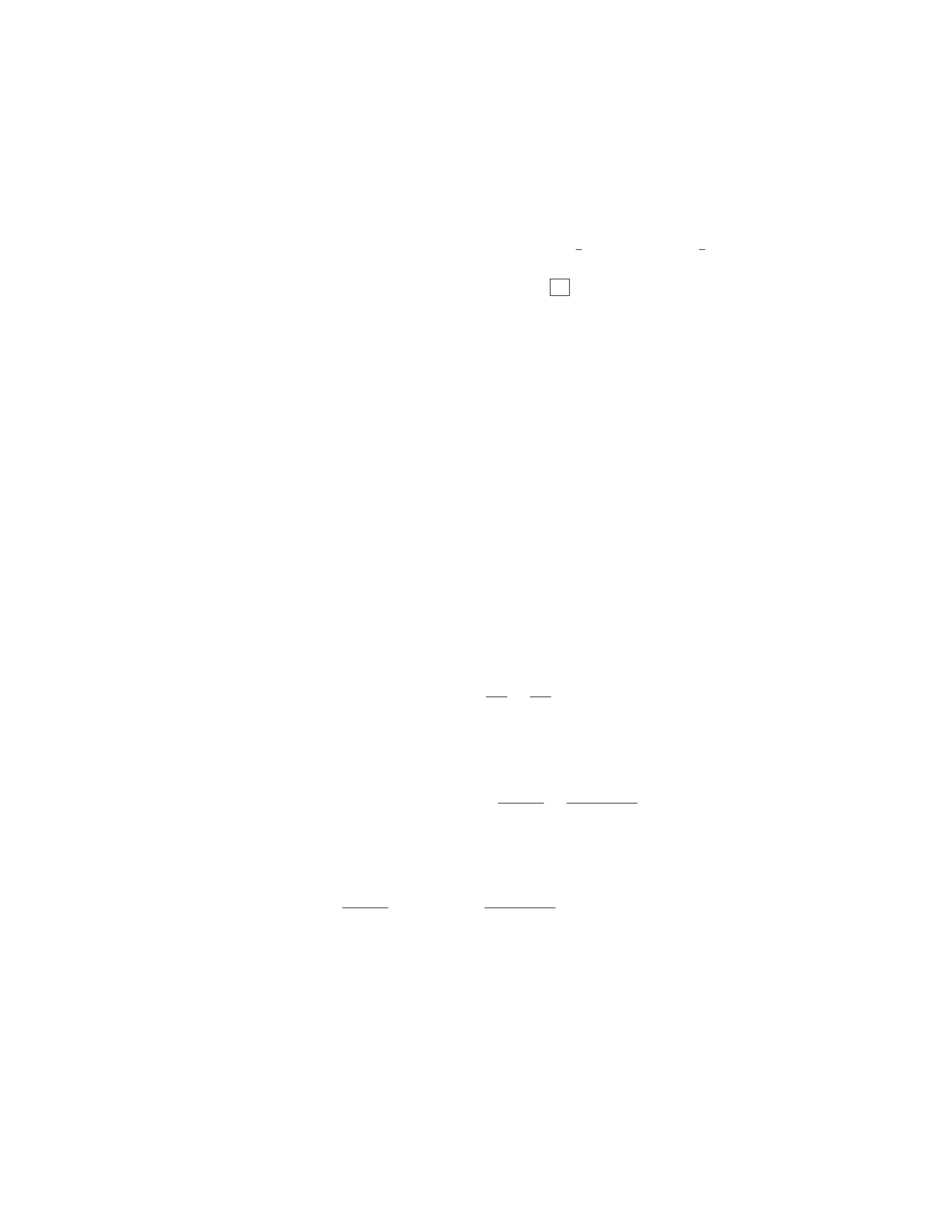
Step 6: Converting to polar coordinates, we have dx dy =r dr dθ. The
integral becomes −R2π
0R1
0r dr dθ.
Step 7: Solving the above integral, we get −R2π
01
2r21
0dθ =−R2π
0
1
2dθ =
−π.
Therefore, the area enclosed by the curve Cis π.
Question 18
Question
Let Cbe the curve given by x2+y2= 1 oriented counterclockwise. Use Green’s
Theorem to evaluate the line integral
IC
(x2−y2)dx + 2xydy.
Solution
Step 1: Determine the region Denclosed by the curve C. Since x2+y2= 1
is the equation of a circle with radius 1 centered at the origin, the region D
enclosed by Cis the interior of this circle.
Step 2: Write the given line integral as a double integral over D. Green’s
Theorem states that for a simple closed curve Cenclosing a region D, the line
integral of a vector field F=Pi+Qjalong Ccan be computed as the double
integral of the curl of Fover the region D, i.e.,
IC
F·dr=ZZD∂Q
∂x −∂P
∂y dA.
In this case, F= (x2−y2)i+ 2xyj, so P=x2−y2and Q= 2xy. Then, the
line integral becomes
IC
(x2−y2)dx + 2xydy =ZZD∂(2xy)
∂x −∂(x2−y2)
∂y dA.
Step 3: Compute the partial derivatives and set up the double integral. To
apply Green’s Theorem, we need to calculate the partial derivatives:
∂(2xy)
∂x = 2yand ∂(x2−y2)
∂y =−2y.
Therefore, the line integral is equal to
ZZD
(2y−(−2y))dA = 4ydA.
17

Step 4: Switch to polar coordinates and evaluate the double integral. In
polar coordinates, dA =rdrdθ and y=rsin(θ). The integral becomes
ZZD
4ydA =Z2π
0Z1
0
4rsin(θ)·rdrdθ
=Z2π
0Z1
0
4r2sin(θ)drdθ
=Z2π
04
3r3sin(θ)1
0
dθ
=Z2π
0
4
3sin(θ)dθ
=4
3[−cos(θ)]2π
0
=8
3.
Therefore, the value of the line integral HC(x2−y2)dx + 2xydy is 8
3.
Question 19
Question
Let Cbe the circle with radius 3 centered at the origin, oriented counterclock-
wise. Compute the line integral HC(2x−ey)dx +x2+ydy using Green’s
Theorem.
Solution
Step 1: Calculate the curl of the vector field F(x, y) = 2x−ey, x2+y.
Curl F(x, y) = ∂(x2+y)
∂x −∂(2x−ey)
∂y ,∂(2x−ey)
∂x +∂(x2+y)
∂y
= (2x−0,2 + 1) = (2x, 3)
Step 2: Apply Green’s Theorem, which states that for a region Rbounded
by a simple, positively oriented, piecewise-smooth curve C, the line integral of
a vector field Faround Cis equal to the double integral of the curl of Fover
R.IC
F·dr=ZZR
Curl F·dA
Step 3: The area Renclosed by Cis the disk with radius 3, so we can
use polar coordinates to compute the double integral. The area of the disk is
A=πr2= 9π.
18
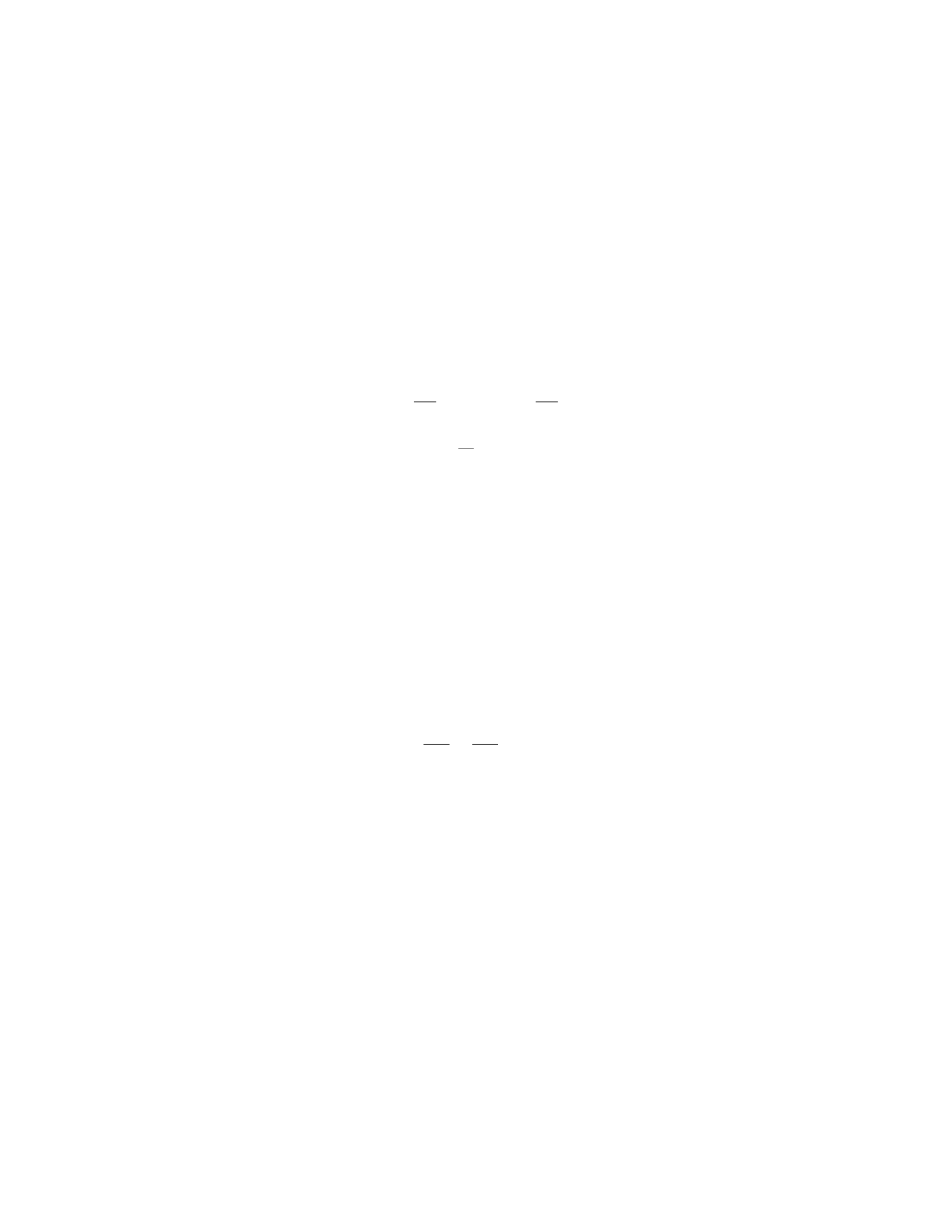
Step 4: Substitute the curl of Finto Green’s Theorem to find the line
integral.
ZZR
Curl F·dA =ZZR
(2x, 3) ·dA =ZZR
2x dA +ZZR
3dA
=Z2π
0Z3
0
2r·r dr dθ +Z2π
0Z3
0
3·r dr dθ
=Z2π
0Z3
0
2r2dr dθ +Z2π
0Z3
0
3r dr dθ
=Z2π
02r3
33
0
dθ +Z2π
03r2
23
0
dθ
=Z2π
0
18 dθ +Z2π
0
27
2dθ = 36π+ 27π= 63π
Therefore, the line integral HC(2x−ey)dx +x2+ydy around the circle
Cis 63π.
Question 20
Question
Let Cbe the curve given by x2+y2= 1 oriented counterclockwise and let
F= (4x3+y2,2y3). Calculate the line integral HCF·dr using Green’s Theorem.
Solution
Step 1: Calculate the curl of F. The curl of F= (4x3+y2,2y3)is given by
curl(F) = ∂F2
∂x −∂F1
∂y = (0 −0) = 0.
Step 2: Apply Green’s Theorem. Green’s Theorem states that for a simply
connected region Dbounded by a simple, closed, positively oriented curve C,
the line integral of a vector field Falong Ccan be calculated as the double
integral of the curl of Fover D. Mathematically,
IC
F·dr=ZZD
curl(F)·dA.
Since the curl of Fis 0, the line integral becomes 0 by Green’s Theorem.
Question 21
Question
Let Cbe the curve given by x=t2−1,y=t3−tfor −1≤t≤1. Calculate
the line integral of the vector field F(x, y) = ⟨x2, y2⟩counterclockwise along C.
19

Solution
Let’s start by parameterizing the curve C. We have:
x=t2−1
y=t3−t
Step 1: Find r(t).
The position vector r(t)for the curve Cis given by:
r(t) = ⟨x(t), y(t)⟩=⟨t2−1, t3−t⟩
Step 2: Calculate r′(t).
The derivative of r(t)with respect to tis:
r′(t) = ⟨2t, 3t2−1⟩
Step 3: Compute F(r(t)).
Substitute x=t2−1and y=t3−tinto F(x, y) = ⟨x2, y2⟩to get:
F(r(t)) = ⟨(t2−1)2,(t3−t)2⟩=⟨t4−2t2+ 1, t6−2t4+t2⟩
Step 4: Calculate the dot product.
The dot product of F(r(t)) and r′(t)is:
F(r(t)) ·r′(t) = (t4−2t2+ 1)(2t)+(t6−2t4+t2)(3t2−1)
Simplify this expression and integrate it over −1≤t≤1to find the line
integral along C.
Question 22
Question
Let Cbe the curve given by x2+y2= 4 oriented counterclockwise. Evaluate
the line integral HC(x2−y2)dx + 2xydy using Green’s Theorem.
Solution
Step 1: Determine the region enclosed by the curve C.
Given that x2+y2= 4, we recognize that Cis a circle centered at the origin
with radius 2.
Step 2: Apply Green’s Theorem.
Green’s Theorem states that for a smooth, simply connected region Den-
closed by a simple, positively oriented, piecewise-smooth curve C, and functions
P(x, y)and Q(x, y)that have continuous partial derivatives on an open region
containing D, we have
IC
P dx +Qdy =ZZD∂Q
∂x −∂P
∂y dA
20
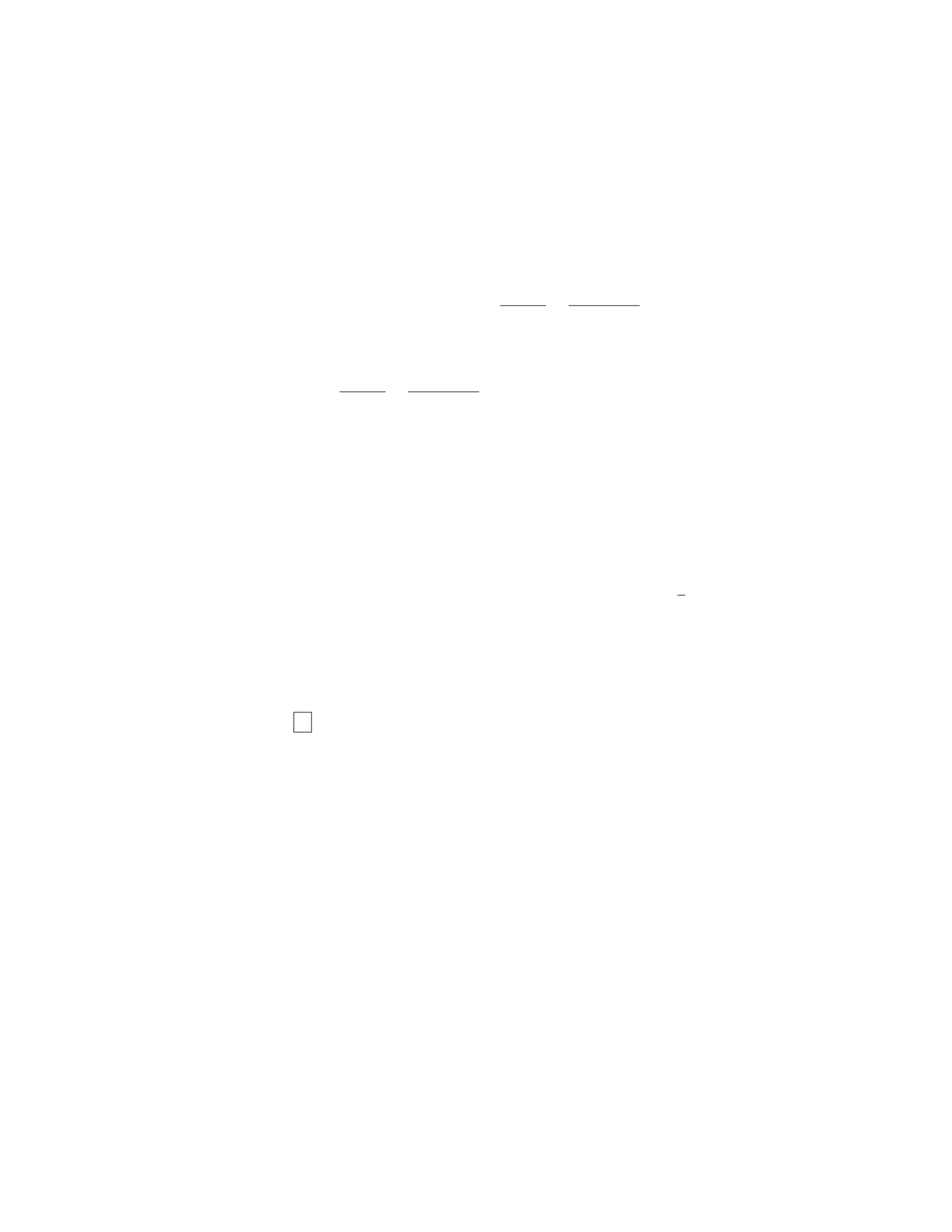
where dA =dxdy.
Step 3: Express the line integral in terms of double integrals using Green’s
Theorem.
Given P(x, y) = x2−y2and Q(x, y) = 2xy, the line integral becomes
IC
(x2−y2)dx + 2xydy =ZZD∂(2xy)
∂x −∂(x2−y2)
∂y dA
Step 4: Calculate the partial derivatives and evaluate the double integral.
We have ∂(2xy)
∂x −∂(x2−y2)
∂y = 2y−(−2y) = 4y
Thus, the line integral simplifies to
IC
(x2−y2)dx + 2xydy =ZZD
4y dA
Step 5: Find the area of the region D.
The region Dis a circle with radius 2, so its area is A=π·22= 4π.
Step 6: Evaluate the double integral.
ZZD
4y dA = 4 ZZD
y dA = 4·Z2π
0Z2
0
r·sin(θ)drdθ= 4· Z2π
0−1
2r2cos(θ)2
0
dθ!
= 4 ·Z2π
0
[−2 cos(θ)]dθ= 4 ·[−2 sin(θ)]2π
0= 0
Step 7: Conclusion.
Therefore, after evaluating the line integral using Green’s Theorem, we find that
the result is 0.
Question 23
Question
Let Cbe the curve given by x2+y2= 4 oriented counterclockwise. Calculate
the circulation of the vector field F(x, y)=(y2,−x)around the curve Cusing
Green’s Theorem.
Solution
To apply Green’s Theorem, we first need to find a region Denclosed by the
curve C.
Step 1: Find the Region Enclosed by the Curve
The curve Cis a circle centered at the origin with radius 2. This implies that
the region enclosed by Cis the disk Dwith radius 2.
21
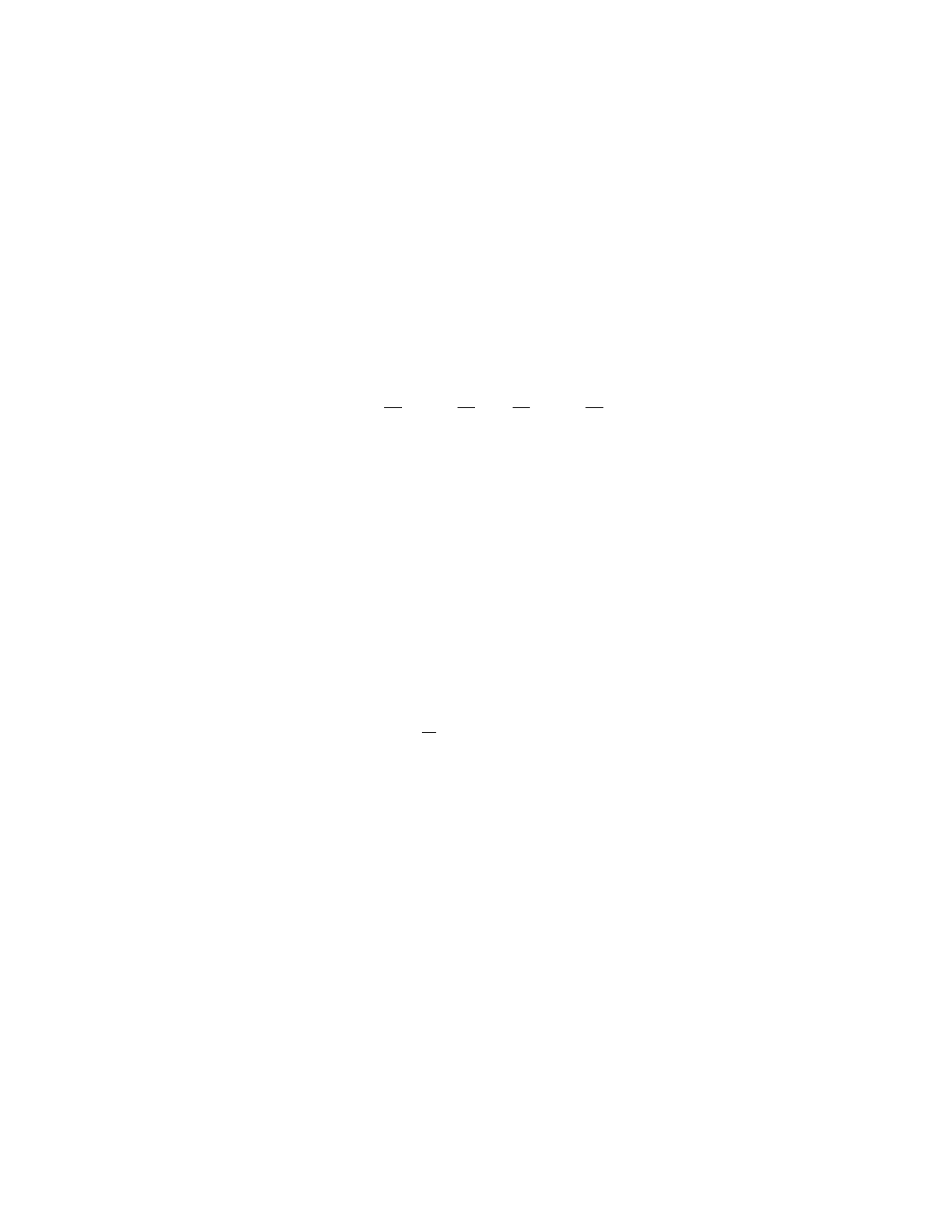
Step 2: Calculate the Circulation
According to Green’s Theorem, the circulation of a vector field around a closed
curve is equal to the double integral of the curl of the vector field over the region
enclosed by the curve. The circulation circ(C)is given by:
circ(C) = ZZD
(∇ × F)·dA
Step 3: Calculate the Curl of F
The vector field F(x, y) = (y2,−x). The curl of F, denoted by ∇ × F, is:
∇ × F=∂
∂x (−x)−∂
∂y (y2),∂
∂y (−x)−∂
∂x (y2)
= (−1−0,0−(−2y)) = (−1,2y)
Step 4: Set Up the Double Integral
Substitute the curl of Finto the circulation formula and compute the double
integral over the region D, which is the disk with radius 2. Using polar coordi-
nates, dA=r dr dθ, and the region Dis 0≤r≤2,0≤θ≤2π. The circulation
becomes:
circ(C) = ZZD
(−1,2y)·(r dr dθ)
Step 5: Evaluate the Double Integral
The circulation integral becomes:
circ(C) = Z2π
0Z2
0
(−1) ·r dr dθ +Z2π
0Z2
0
2y·r dr dθ
=Z2π
0−r2
22
0
dθ +Z2π
0y·r22
0dθ
=Z2π
0
(−2) dθ +Z2π
0
4y dθ =−4·2π+ 8π=−8π+ 8π= 0
Therefore, the circulation of the vector field Faround the curve Cis 0.
Question 24
Question
Let Cbe the curve given by x2+y2= 4 oriented counterclockwise. Use Green’s
Theorem to evaluate the line integral
ICx2+y2dx + 2xy dy.
22

Solution
1. Let’s first parameterize the curve C. The curve Cis a circle with radius
2, so we can parameterize it by x= 2 cos(t)and y= 2 sin(t), where
0≤t≤2πto cover the entire circle.
2. Next, we calculate the partial derivatives of the given vector field:
∂
∂y (x2+y2) = 2y,
∂
∂x (2xy) = 2y.
3. Now, we apply Green’s Theorem, which states:
IC
(P dx +Q dy) = ZZD∂Q
∂x −∂P
∂y dA,
where Dis the region enclosed by C.
4. Substituting the given values, we have:
ZZD
(2y−2y)dA =ZZD
0dA
= 0.
5. Therefore, the line integral HCx2+y2dx + 2xy dy evaluated over Cis
0.
Question 25
Question
Let Cbe the curve consisting of the line segment from (0,0) to (4,0) and the
parabolic arc y=x2from (4,0) to (0,0). Calculate the line integral HC⟨y, x⟩ ·
dr, where r(t) = ⟨x(t), y(t)⟩parameterizes Ccounterclockwise, using Green’s
Theorem.
Solution
Step 1: Parameterize the curve C.
We can parameterize the line segment from (0,0) to (4,0) as r1(t) = ⟨t, 0⟩
for 0≤t≤4.
For the parabolic arc y=x2from (4,0) to (0,0), we can parameterize it as
r2(t) = ⟨4−t, (4 −t)2⟩for 0≤t≤4.
Step 2: Compute the line integral around C.
23

We have HC⟨y, x⟩·dr=RRD∂Q
∂x −∂P
∂y dA, where P(y, x) = yand Q(y, x) =
x.
Step 3: Find the area Dthat Cencloses.
Dis the region enclosed by the curve C, which is the triangular region
bounded by the x-axis, the line x= 4, and the parabola y=x2. To find the
area of D, we need to solve for the intersection points of x= 4 and y=x2.
Setting x= 4 and y=x2, we get 4 = x2. Solving this quadratic equation
gives x= 2 (since x=−2is extraneous). So, the area is given by:
A=Z2
0
x2dx =8
3
Step 4: Compute the line integral using Green’s Theorem.
IC⟨y, x⟩ · dr=ZZD∂Q
∂x −∂P
∂y dA
=Z2
0Zx2
0
(1 −1) dy dx
=Z2
0
x2dx
=x3
32
0
=8
3
Therefore, the line integral HC⟨y, x⟩ · draround the curve Cis 8
3.
24
Step 5: Conclusion. Therefore, the line integral HC(x−y)dx + (2x+y)dy
over the curve Cis equal to 6π.
Question 2
Question
Let Cbe the circle centered at the origin with radius a, oriented counterclock-
wise. Use Green’s Theorem to evaluate the line integral HC(x2+y2)dx + (x2−
y2)dy.
Solution
1. Determine the region enclosed by C:The circle Cwith radius acentered
at the origin encloses the region inside the circle.
2. Apply Green’s Theorem: Green’s Theorem states that for a positively
oriented, piecewise smooth, simple closed curve Cenclosing a region D, and a
vector field F=Pi+Qjthat is continuously differentiable on an open region
containing D, the line integral of Faround Cis equal to the double integral of
∂Q
∂x −∂P
∂y dA over the region D.
In this case, we have: P=x2+y2and Q=x2−y2.
Computing the partial derivatives: ∂Q
∂x = 2xand ∂P
∂y = 2y.
So, ∂Q
∂x −∂P
∂y = 2x−2y.
3. Evaluate the double integral over the region D:Since Cencloses
the region inside the circle, Dis the disk with radius a.
The double integral of ∂Q
∂x −∂P
∂y dA over Dbecomes: RR
D
(2x−2y)dA =
RR
D
2(x−y)dA.
Switching to polar coordinates (x=rcos(θ), y =rsin(θ)) where 0≤r≤a
and 0≤θ≤2π:R2π
0Ra
02(rcos(θ)−rsin(θ))rdrdθ.
4. Compute the double integral: Solving the integral iteratively: R2π
0Ra
02r2cos(θ)−
2r2sin(θ)drdθ
=R2π
0h2r3
3cos(θ)−2r3
3sin(θ)ia
0
dθ
=R2π
02a3
3cos(θ)−2a3
3sin(θ)dθ
=h2a3
3sin(θ) + 2a3
3cos(θ)i2π
0
=4a3
3(sin(2π) + cos(2π)−sin(0) −cos(0))
=4a3
3(0 + 1 −0−1)
= 0.
5. Conclusion: The line integral HC(x2+y2)dx + (x2−y2)dy around the
circle Cis equal to 0.
2

Question 3
Question
Let Cbe the circle defined by x2+y2= 4, oriented counterclockwise. Calculate
the line integral HC(x2+y2)dx + 3xy dy using Green’s Theorem.
Solution
Step 1: Verify that the given curve Cis a simple closed curve without self-
intersections.
• The curve Cis a circle with radius 2 centered at the origin.
• Since it is a simple closed curve without self-intersections, we can apply
Green’s Theorem.
Step 2: Find the region Denclosed by Cand parameterize the boundary
curve C.
• The region Denclosed by Cis the interior of the circle x2+y2= 4, hence
Dis the disk with radius 2 centered at the origin.
• Parameterize the circle C:x(t) = 2 cos(t),y(t) = 2 sin(t)with 0≤t≤2π.
Step 3: Apply Green’s Theorem to compute the line integral.
IC
(x2+y2)dx + 3xy dy =ZZD∂(3xy)
∂x −∂(x2+y2)
∂y dA
=ZZD
(3y−2y)dA
=ZZD
y dA.
Step 4: Convert the double integral over region Dto polar coordinates.
• In polar coordinates, x=rcos(θ),y=rsin(θ), and dA =r dr dθ.
• The integral becomes: R2π
0R2
0rsin(θ)·r dr dθ.
Step 5: Solve the integral.
Z2π
0Z2
0
rsin(θ)·r dr dθ =Z2π
0r2
2·(−cos(θ))2
0
dθ
=Z2π
0−2 cos(θ)dθ
=−[2 sin(θ)]2π
0
= 0.
Therefore, the line integral HC(x2+y2)dx + 3xy dy around the circle Cis
equal to 0 when evaluated using Green’s Theorem.
3

Question 4
Question
Let Cbe the curve in the plane defined by x2+y2= 1 oriented counterclockwise.
Let Dbe the region bounded by C. Use Green’s Theorem to evaluate the line
integral
IC
(x2+y)dx + (y2+x)dy
Solution
To apply Green’s Theorem, we first need to find the vector field F= (P, Q)
such that P=x2+yand Q=y2+x. Then Green’s Theorem states that
IC
F·dr=ZZD∂Q
∂x −∂P
∂y dA
where dr= (dx, dy)and dA is an infinitesimal area element.
Let’s compute the partial derivatives of Pand Q:
∂P
∂y = 1 and ∂Q
∂x = 1
Now we compute the double integral over the region D:
ZZD∂Q
∂x −∂P
∂y dA =ZZD
(1 −1) dA = 0
Therefore, the line integral around Csimplifies to zero:
IC
(x2+y)dx + (y2+x)dy = 0
Question 5
Question
Let Cbe the curve parameterized by r(t) = ⟨t2, et⟩for 0≤t≤1. Calculate the
circulation of the vector field F(x, y) = ⟨y2,−x⟩around the curve C.
Solution
Step 1: Calculate the curl of the vector field F(x, y) = ⟨y2,−x⟩. The curl of F
is given by:
∇ × F=∂
∂x ,∂
∂y × ⟨y2,−x⟩
=∂
∂x ⟨y2,−x⟩ − ∂
∂y ⟨y2,−x⟩
4

= (−1−2y, 0)
Step 2: Calculate the circulation of Faround the curve C. By Green’s
Theorem, circulation of Faround the curve Cis equal to the line integral of F
over the curve C.
The circulation of Faround Cis given by:
circulation =ZC
F·dr=Z1
0
F(r(t)) ·r′(t)dt
Substitute r(t)and F(r(t)) into the line integral:
=Z1
0⟨e2t,−t2⟩·⟨2t, et⟩dt
=Z1
0
(2te2t−t2et)dt
Step 3: Evaluate the integral:
=t2e2t1
0−1
3t3et1
0
= (1e2−0) −1
3e−0
=e2−1
3e
Therefore, the circulation of the vector field F(x, y) = ⟨y2,−x⟩around the
curve Cis e2−1
3e.
Question 6
Question
Let Cbe the curve parameterized by r(t)=(t2, et)for 0≤t≤1. Use Green’s
Theorem to calculate the line integral HC(x2+y)dx + (2y−sin(x)) dy.
Solution
Given a vector field F(x, y) = (P(x, y), Q(x, y)) and a closed curve Cparame-
terized by r(t) = (x(t), y(t)), Green’s Theorem states:
IC
F·dr=ZZD∂Q
∂x −∂P
∂y dA,
where Dis the region enclosed by the curve C.
5
First, let’s find the parameterization of the curve C:
r(t) = (t2, et)
(x(t) = t2
y(t) = et
Now, we calculate ∂Q
∂x and ∂P
∂y :
∂Q
∂x =∂
∂x (2y−sin(x)) = 0
∂P
∂y =∂
∂y (x2+y) = 1
Thus, we have
∂Q
∂x −∂P
∂y = 0 −1 = −1
Now, we find the region Denclosed by the curve C. Since r(t)traces out the
curve C as tvaries from 0 to 1, the region Dis the area under the curve y=et
from x= 0 to x= 1. Therefore, D={(x, y)|0≤x≤1,0≤y≤e}, and
dA =dx dy =dy dx.
We can now compute the line integral using Green’s Theorem:
IC
(x2+y)dx + (2y−sin(x)) dy =ZZD−1dA
=−ZZD
dA
=−Z1
0Ze
0
1dy dx
=−Z1
0
(y
e
0)dx
=−Z1
0
(e−0) dx
=−Z1
0
e dx
=−eZ1
0
1dx
=−e(x)
1
0
=−e(1) −(−e(0))
=−e
Therefore, the line integral HC(x2+y)dx + (2y−sin(x)) dy around the curve
Cis equal to −e.
6
Question 7
Question
Consider the vector field F(x, y) = (yex, x cos(y)) and the region Dbounded
by the curve C:x2+y2= 1. Calculate the circulation of Faround Cusing
Green’s Theorem.
Solution
Step 1: Calculate the circulation of Faround Cusing Green’s Theorem.
IC
F·dr=ZZD∂Q
∂x −∂P
∂y dA
where F(x, y) = (P, Q).
Step 2: Write F(x, y)in terms of Pand Q. Here, P(x, y) = yexand
Q(x, y) = xcos(y).
Step 3: Calculate the partial derivatives of Pand Q.
∂Q
∂x = cos(y),∂P
∂y =ex
Step 4: Evaluate the double integral over the region D.
IC
F·dr=ZZD∂Q
∂x −∂P
∂y dA =ZZD
(cos(y)−ex)dA
Step 5: Convert the double integral to polar coordinates. In polar coor-
dinates, the region Dis described by 0≤r≤1and 0≤θ≤2π. Also,
dA =rdrdθ.
Step 6: Substitute the polar form into the double integral.
IC
F·dr=Z2π
0Z1
0
(cos(θ)−er)rdrdθ
Step 7: Evaluate the double integral to find the circulation.
IC
F·dr=Z2π
01
2sin(θ)−rer1
0
dθ
IC
F·dr=Z2π
01
2sin(θ)−edθ
IC
F·dr=−1
2cos(θ)−2πe2π
0
IC
F·dr= 0 −(−2πe) = 2πe
Therefore, the circulation of Faround Cis 2πe.
7

Question 8
Question
Let Cbe the circle centered at the origin with radius 3 oriented counterclockwise.
Calculate the line integral HC−y2dx +x2dyusing Green’s Theorem.
Solution
Step 1: Determine the region Denclosed by the curve C, which in this case is
the interior of the circle of radius 3 centered at the origin.
Step 2: Write the given line integral as a double integral over the region D
using Green’s Theorem, which states that for a vector field F= (P, Q)where P
and Qhave continuous first partial derivatives on a region D, the line integral
of Faround the boundary of Dis equal to the double integral of (∂Q
∂x −∂P
∂y )
over D. Thus, we have
IC−y2dx +x2dy=ZZD∂(x2)
∂x −∂(−y2)
∂y dA.
Step 3: Compute the partial derivatives and substitute into the expression
from Step 2:
∂(x2)
∂x = 2x, ∂(−y2)
∂y =−2y,
∂(x2)
∂x −∂(−y2)
∂y = 2x+ 2y.
Step 4: Integrate 2x+ 2yover the region D, which is the circle of radius 3
centered at the origin. This can be done in polar coordinates:
ZZD
(2x+ 2y)dA =Z2π
0Z3
0
(2rcos θ+ 2rsin θ)r dr dθ.
Step 5: Evaluate the double integral from Step 4:
Z2π
0Z3
0
(2r2cos θ+ 2r2sin θ)dr dθ =Z2π
02
3r3cos θ+2
3r3sin θ3
0
dθ,
=Z2π
0
(18 cos θ+ 18 sin θ)dθ = [18 sin θ−18 cos θ]2π
0,
= 0 −(−18) = 18.
Therefore, the value of the line integral HC−y2dx +x2dyaround the circle
Cis 18.
8

Question 9
Question
Let Cbe the curve defined by x2+y2= 4 oriented counterclockwise. Calculate
the circulation HCF·drof the vector field F(x, y) = ⟨y2, x2⟩along the curve C.
Solution
Step 1: To apply Green’s Theorem, we first need to find the region Denclosed by
the curve C. The curve Cis a circle centered at the origin with radius 2. Thus, D
is the interior of the circle, which can be represented as D:{(x, y)|x2+y2≤4}.
Step 2: In Green’s Theorem, circulation of Falong Cis given by the double
integral of the curl of Fover the region D, i.e., HCF·dr=RRD(curl F)·ndA,
where nis the outward unit normal vector to D.
Step 3: Compute the curl of F:
curl F=∂F2
∂x −∂F1
∂y =∂
∂x (x2)−∂
∂y (y2)= 2x−2y
Step 4: Since the curve Cis oriented counterclockwise, the outward unit
normal vector nis −yi+xj.
Step 5: Substituting the curl of Fand ninto the double integral, we get:
IC
F·dr=ZZD
(2x−2y)·(−yi+xj)dA
Step 6: Switch to polar coordinates to evaluate the double integral. The
jacobian determinant is r. Substituting x=rcos(θ)and y=rsin(θ)into the
integral:
IC
F·dr=Z2π
0Z2
0
(2rcos(θ)−2rsin(θ)) ·(−rsin(θ)i+rcos(θ)j)dr dθ
Step 7: After evaluating the double integral, we find that the circulation of
Falong Cis 0.
Question 10
Question
Let Cbe the curve formed by the intersection of the surfaces z=x2+y2and
z= 4 −x2−y2. Calculate the flux of the vector field F(x, y, z)=(−y, x, z)
across Cin the counterclockwise direction.
9

Solution
Step 1: First, we need to find the region Din the xy-plane enclosed by the curve
C. This can be done by setting zin the two equations equal to each other:
x2+y2= 4 −x2−y2
2x2+ 2y2= 4
x2+y2= 2
This represents a circle in the xy-plane centered at the origin with radius √2.
Step 2: Next, we parameterize the curve Cin the xy-plane. Let x=
√2 cos(t)and y=√2 sin(t), where 0≤t≤2π. Then, the corresponding
z-values are z1=√2and z2= 4 −2.
Step 3: The curve Cis parameterized by:
r(t) = ⟨√2 cos(t),√2 sin(t),2⟩,0≤t≤2π
Step 4: Now, we need to compute the unit normal vector to the surface S
determined by C. This vector is given by:
N=±∂z
∂x ,∂z
∂y ,−1
By computing these partial derivatives for z=x2+y2and z= 4 −x2−y2, we
get N=1
√2⟨x, y, −1⟩.
Step 5: Calculate the curl of F:
∇ × F=
i j k
∂
∂x
∂
∂y
∂
∂z
−y x z
=⟨0,0,2⟩
Step 6: Using Green’s Theorem, the flux of Facross Cis:
ZZ
D
(∇ × F)·NdA =Z2π
0Z√2
0
2·1
√2dr dt =Z2π
0Z√2
0
√2dr dt = 2π√2
Question 11
Question
Let Cbe the curve in the xy-plane defined by x2+y2= 4, oriented counter-
clockwise, and let F(x, y) = (2y, x). Compute the line integral HCF·drusing
Green’s Theorem.
10
Solution
Let’s first compute the line integral directly using Green’s Theorem. Green’s
Theorem states that for a vector field F(x, y)=(P(x, y), Q(x, y)) defined on
a region Denclosed by a simple closed curve C, oriented counterclockwise, we
have: IC
F·dr=ZZD∂Q
∂x −∂P
∂y dA
Given that F(x, y) = (2y, x), we have P(x, y) = 2yand Q(x, y) = x. We
also note that the curve Cis a circle of radius 2 centered at the origin, so the
region Dbounded by Cis the interior of this circle.
Step 1: Find ∂Q ∂x and ∂P
∂y .
∂Q
∂x = 1
∂P
∂y = 2
Step 2: Compute the double integral.
ZZD∂Q
∂x −∂P
∂y dA =ZZD
(1 −2) dA =ZZD
(−1) dA
Step 3: Evaluate the double integral over the region D.To evaluate
the double integral, we can use polar coordinates to describe the region Das
0≤r≤2,0≤θ≤2π. The Jacobian for the transformation is r, so the integral
becomes:
Z2π
0Z2
0
(−1) ·r dr dθ =−Z2π
0Z2
0
r dr dθ
Step 4: Evaluate the inner integral.
−Z2π
01
2r22
0
dθ =−Z2π
0
2dθ =−4π
Therefore, the line integral HCF·dris −4π.
Question 12
Question
Let Cbe the curve in the xy-plane consisting of the line segments from (0,0) to
(1,0) and from (1,0) to (1,1), oriented counterclockwise. Let Dbe the region
enclosed by C. Using Green’s Theorem, calculate the line integral
ICy2−x2dx +xy dy.
11

Solution
Step 1: Find the partial derivatives of Qwith respect to xand Pwith respect
to y. Let P(x, y) = y2−x2and Q(x, y) = xy. Then, the partial derivatives are:
∂Q
∂x =yand ∂P
∂y = 2y.
Step 2: Calculate the double integral over the region D. By Green’s The-
orem, we have:
ICy2−x2dx +xy dy =ZZD∂Q
∂x −∂P
∂y dA.
So, we need to evaluate the double integral of 2y−y dA over the region D.
Step 3: Determine the boundaries for the double integral. The region Dis
the unit square in the first quadrant. Therefore, the boundaries for the double
integral are 0≤x≤1and 0≤y≤1.
Step 4: Evaluate the double integral.
ZZD
(2y−y)dA =Z1
0Z1
0
(y)dx dy =Z1
0
[xy]1
0dy =Z1
0
y dy =y2
21
0
=1
2.
Step 5: Write the final answer. The line integral HCy2−x2dx +xy dy
over the curve Cis 1
2.
Question 13
Question
Let Cbe the curve that consists of the line segment from (0,1) to (2,3) followed
by the line segment from (2,3) to (3,2). Calculate the line integral HCy2dx +
x2dy.
Solution
Step 1: Parameterize the curve C.
The first line segment from (0,1) to (2,3) can be parameterized as r1(t) =
(2t, 1+2t)for 0≤t≤1.
The second line segment from (2,3) to (3,2) can be parameterized as r2(t) =
(2 + t, 3−t)for 0≤t≤1.
Step 2: Calculate the line integral over the first line segment.
12

Zr1
y2dx +x2dy =Z1
0
(1 + 2t)2·2dt + (2t)2·2dt
=Z1
0
(1 + 4t+ 4t2)·2dt + 4t2dt
=Z1
0
(2 + 8t+ 8t2)+4t2dt
= 2t+ 4t2+8t3
3+4t3
3
1
0
= 2 + 4 + 8
3+4
3
=34
3.
Step 3: Calculate the line integral over the second line segment.
Zr2
y2dx +x2dy =Z1
0
(3 −t)2·1dt + (2 + t)2·(−1) dt
=Z1
0
(9 −6t+t2)−(4 + 4t+t2)dt
=Z1
0
5−10t dt
= 5t−5t2
1
0
= 5 −5
= 0.
Step 4: Calculate the total line integral HCy2dx +x2dy.
IC
y2dx +x2dy =Zr1
y2dx +x2dy +Zr2
y2dx +x2dy =34
3+ 0 = 34
3.
Question 14
Question
Let Cbe the curve given by x(t) = 2 cos(t)and y(t) = 3 sin(t)for 0≤t≤π
2.
Calculate the line integral HC(3x2+ 2y)dx + (x−y2)dy using Green’s Theorem.
13

Solution
Step 1: Calculate the partial derivatives of the given vector field: Let P(x, y) =
3x2+ 2yand Q(x, y) = x−y2. Then,
∂Q
∂x = 1 and ∂P
∂y = 2
Step 2: Apply Green’s Theorem: Green’s Theorem states: HCP dx+Qdy =
RRD∂Q
∂x −∂P
∂y dA.
Therefore, we have:
IC
(3x2+ 2y)dx + (x−y2)dy =ZZD
(1 −2) dA
Step 3: Calculate the double integral: The region Denclosed by the curve
Cis the quarter circle in the first quadrant. We can rewrite the integral as:
ZZD
(−1)dA =−ZZD
dA =−Area of D
Step 4: Find the area of the region D: The radius of the quarter circle is
r=√22+ 32=√13. So, the area of the quarter circle is 1
4πr2=1
4π(13).
Step 5: Calculating the final answer: Finally, substituting the area of region
Dinto the expression gives:
IC
(3x2+ 2y)dx + (x−y2)dy =−1
4π(13) = −13
4π
Therefore, the line integral around the curve Cis −13
4π.
Question 15
Question
Let Cbe the curve defined by x2+y2= 4 oriented counterclockwise. Evaluate
the line integral HCy2dx +x2dy using Green’s Theorem.
Solution
Step 1: Determine the region enclosed by the curve C. The curve Crepresents
a circle centered at the origin with radius 2. Therefore, the region enclosed by
the curve Cis the interior of this circle.
Step 2: Apply Green’s Theorem. Green’s Theorem relates a line integral
around a positively oriented simple closed curve Cto a double integral over the
region Dbounded by C. Green’s Theorem states:
IC
P dx +Qdy =ZZD∂Q
∂x −∂P
∂y dA
14

In this case, P=y2and Q=x2. We need to find ∂Q
∂x and ∂P
∂y .
∂Q
∂x = 2x, ∂P
∂y = 2y
Step 3: Evaluate the double integral over the region D. The double integral
becomes: ZZD
(2y−2y)dA =ZZD
0dA = 0
Step 4: Conclude the solution. Since the double integral over the region D
is 0, the line integral over the curve Cis also 0. Therefore, HCy2dx +x2dy = 0.
Question 16
Question
Let Cbe the curve given by the intersection of the plane x+ 2y+ 3z= 6
and the cylinder x2+y2= 4. Evaluate the line integral HC(x2y+y2z)·dr
counterclockwise along Cusing Green’s Theorem.
Solution
Step 1: Find the region Denclosed by the curve C, which is the intersection of
the plane and cylinder.
The intersection of the plane and cylinder can be parametrized as x=
2 cos(t), y = 2 sin(t), z =6−2x−2y
3.
Here, 0≤t≤2πparameterizes the curve in a counterclockwise manner.
Step 2: Apply Green’s Theorem, which states that for a region Denclosed
by a simple closed curve C, oriented counterclockwise, and a vector field F=
Pi+Qjthat is continuously differentiable in D,
IC
F·dr=ZZD∂Q
∂x −∂P
∂y dA
Step 3: To apply Green’s Theorem, we first need to express the line integral
as a double integral. Here, F=x2yi+y2zj, so P=x2yand Q=y2z.
Step 4: Compute ∂Q
∂x and ∂P
∂y .
∂Q
∂x = 0,∂P
∂y = 2xy
Step 5: Calculate the double integral of ∂Q
∂x −∂P
∂y over the region D.
ZZD
(0 −2xy)dA =ZZD−2xy dA
15

Step 6: Transform the double integral into polar coordinates since the region
is circular.
ZZD−2xy dA =Z2π
0Z2
0−2(2 cos(t))(2 sin(t))r dr dt
Step 7: Integrate with respect to rfirst.
Z2
0−2(2 cos(t))(2 sin(t))r dr =−16 cos(t) sin(t)Z2
0
r dr
Step 8: Integrate with respect to rfrom 0 to 2.
−16 cos(t) sin(t)r2
22
0
=−16 cos(t) sin(t)(2 −0) = −32 cos(t) sin(t)
Step 9: Integrate with respect to tfrom 0 to 2π.
Z2π
0−32 cos(t) sin(t)dt =−16π
Step 10: Therefore, the line integral HC(x2y+y2z)·drevaluated counter-
clockwise along Cis −16π.
Question 17
Question
Let Cbe the curve formed by the intersection of the cylinder x2+y2= 1 and
the plane y+z= 2. Use Green’s Theorem to find the area enclosed by C.
Solution
Step 1: First, let’s parameterize the curve C. Since Clies on the cylinder
x2+y2= 1, we can let x= cos tand y= sin t, where 0≤t≤2π. Substituting
these into the equation of the plane y+z= 2, we get z= 2 −sin t.
Step 2: Next, let’s express the curve Cin vector form. We have r(t) =
⟨cos t, sin t, 2−sin t⟩, where 0≤t≤2π.
Step 3: Green’s Theorem states that the area enclosed by a simple closed
curve Ccan be calculated as RRDdA, where Dis the region enclosed by Cand
dA =dx dy =−dy dx. Therefore, we need to find the region Denclosed by C.
Step 4: To find D, we can project Conto the xy-plane by setting z= 0.
This gives us the projected curve Cproj defined by r(t) = ⟨cos t, sin t, 0⟩. The
region Dwill be the interior of Cproj, which is the unit circle x2+y2= 1.
Step 5: The area enclosed by Ccan then be evaluated as RRDdA =RRx2+y2≤1−dy dx =
−RRx2+y2≤1dx dy.
16
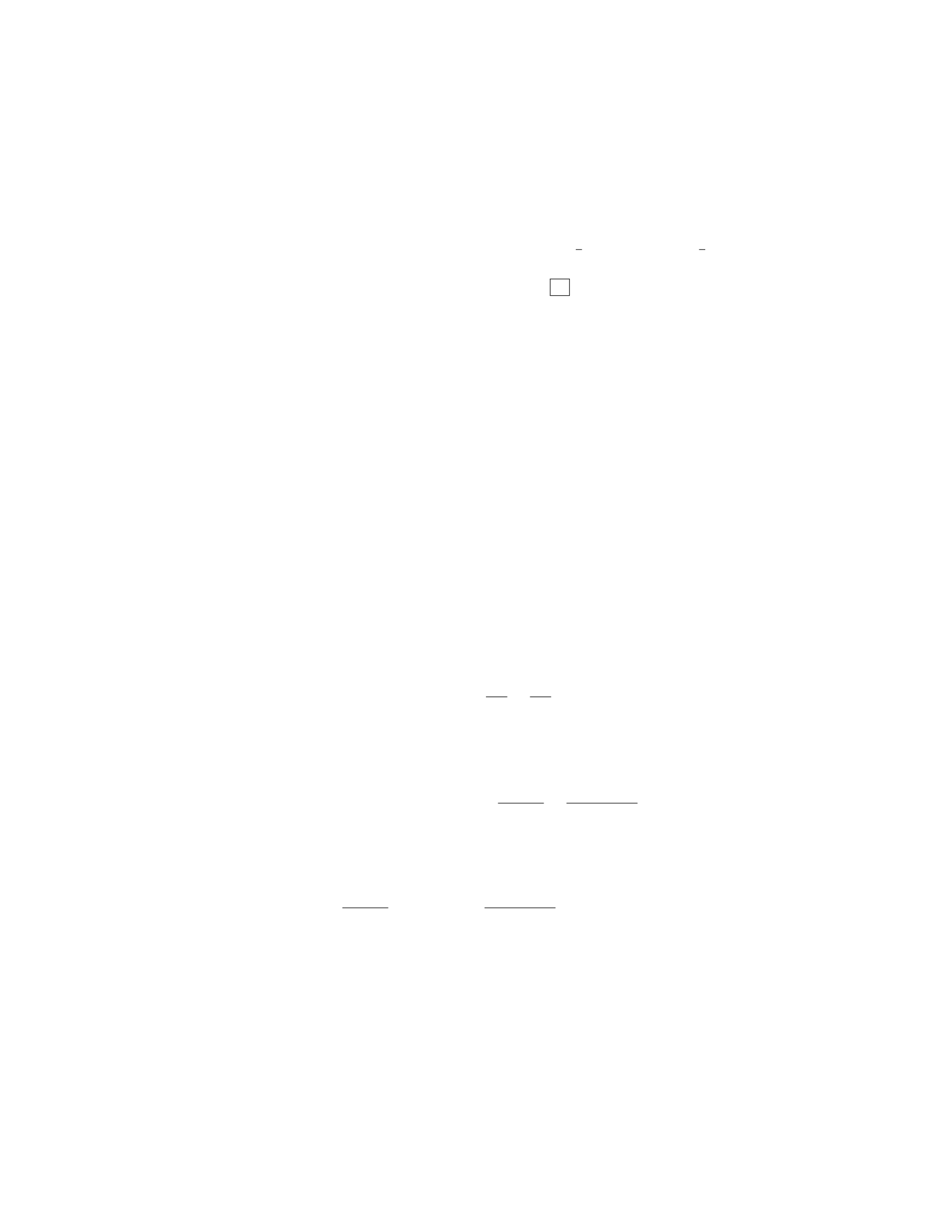
Step 6: Converting to polar coordinates, we have dx dy =r dr dθ. The
integral becomes −R2π
0R1
0r dr dθ.
Step 7: Solving the above integral, we get −R2π
01
2r21
0dθ =−R2π
0
1
2dθ =
−π.
Therefore, the area enclosed by the curve Cis π.
Question 18
Question
Let Cbe the curve given by x2+y2= 1 oriented counterclockwise. Use Green’s
Theorem to evaluate the line integral
IC
(x2−y2)dx + 2xydy.
Solution
Step 1: Determine the region Denclosed by the curve C. Since x2+y2= 1
is the equation of a circle with radius 1 centered at the origin, the region D
enclosed by Cis the interior of this circle.
Step 2: Write the given line integral as a double integral over D. Green’s
Theorem states that for a simple closed curve Cenclosing a region D, the line
integral of a vector field F=Pi+Qjalong Ccan be computed as the double
integral of the curl of Fover the region D, i.e.,
IC
F·dr=ZZD∂Q
∂x −∂P
∂y dA.
In this case, F= (x2−y2)i+ 2xyj, so P=x2−y2and Q= 2xy. Then, the
line integral becomes
IC
(x2−y2)dx + 2xydy =ZZD∂(2xy)
∂x −∂(x2−y2)
∂y dA.
Step 3: Compute the partial derivatives and set up the double integral. To
apply Green’s Theorem, we need to calculate the partial derivatives:
∂(2xy)
∂x = 2yand ∂(x2−y2)
∂y =−2y.
Therefore, the line integral is equal to
ZZD
(2y−(−2y))dA = 4ydA.
17

Step 4: Switch to polar coordinates and evaluate the double integral. In
polar coordinates, dA =rdrdθ and y=rsin(θ). The integral becomes
ZZD
4ydA =Z2π
0Z1
0
4rsin(θ)·rdrdθ
=Z2π
0Z1
0
4r2sin(θ)drdθ
=Z2π
04
3r3sin(θ)1
0
dθ
=Z2π
0
4
3sin(θ)dθ
=4
3[−cos(θ)]2π
0
=8
3.
Therefore, the value of the line integral HC(x2−y2)dx + 2xydy is 8
3.
Question 19
Question
Let Cbe the circle with radius 3 centered at the origin, oriented counterclock-
wise. Compute the line integral HC(2x−ey)dx +x2+ydy using Green’s
Theorem.
Solution
Step 1: Calculate the curl of the vector field F(x, y) = 2x−ey, x2+y.
Curl F(x, y) = ∂(x2+y)
∂x −∂(2x−ey)
∂y ,∂(2x−ey)
∂x +∂(x2+y)
∂y
= (2x−0,2 + 1) = (2x, 3)
Step 2: Apply Green’s Theorem, which states that for a region Rbounded
by a simple, positively oriented, piecewise-smooth curve C, the line integral of
a vector field Faround Cis equal to the double integral of the curl of Fover
R.IC
F·dr=ZZR
Curl F·dA
Step 3: The area Renclosed by Cis the disk with radius 3, so we can
use polar coordinates to compute the double integral. The area of the disk is
A=πr2= 9π.
18
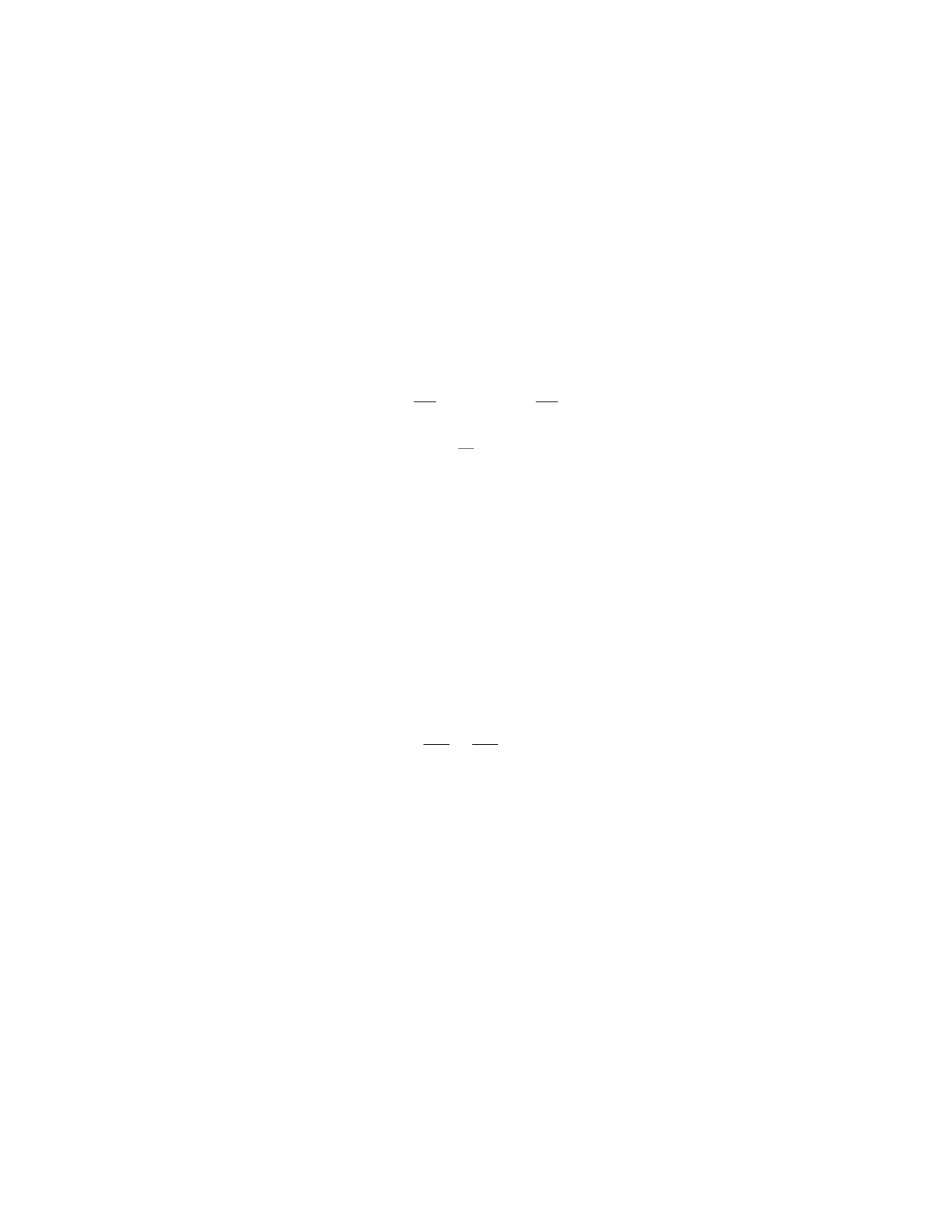
Step 4: Substitute the curl of Finto Green’s Theorem to find the line
integral.
ZZR
Curl F·dA =ZZR
(2x, 3) ·dA =ZZR
2x dA +ZZR
3dA
=Z2π
0Z3
0
2r·r dr dθ +Z2π
0Z3
0
3·r dr dθ
=Z2π
0Z3
0
2r2dr dθ +Z2π
0Z3
0
3r dr dθ
=Z2π
02r3
33
0
dθ +Z2π
03r2
23
0
dθ
=Z2π
0
18 dθ +Z2π
0
27
2dθ = 36π+ 27π= 63π
Therefore, the line integral HC(2x−ey)dx +x2+ydy around the circle
Cis 63π.
Question 20
Question
Let Cbe the curve given by x2+y2= 1 oriented counterclockwise and let
F= (4x3+y2,2y3). Calculate the line integral HCF·dr using Green’s Theorem.
Solution
Step 1: Calculate the curl of F. The curl of F= (4x3+y2,2y3)is given by
curl(F) = ∂F2
∂x −∂F1
∂y = (0 −0) = 0.
Step 2: Apply Green’s Theorem. Green’s Theorem states that for a simply
connected region Dbounded by a simple, closed, positively oriented curve C,
the line integral of a vector field Falong Ccan be calculated as the double
integral of the curl of Fover D. Mathematically,
IC
F·dr=ZZD
curl(F)·dA.
Since the curl of Fis 0, the line integral becomes 0 by Green’s Theorem.
Question 21
Question
Let Cbe the curve given by x=t2−1,y=t3−tfor −1≤t≤1. Calculate
the line integral of the vector field F(x, y) = ⟨x2, y2⟩counterclockwise along C.
19

Solution
Let’s start by parameterizing the curve C. We have:
x=t2−1
y=t3−t
Step 1: Find r(t).
The position vector r(t)for the curve Cis given by:
r(t) = ⟨x(t), y(t)⟩=⟨t2−1, t3−t⟩
Step 2: Calculate r′(t).
The derivative of r(t)with respect to tis:
r′(t) = ⟨2t, 3t2−1⟩
Step 3: Compute F(r(t)).
Substitute x=t2−1and y=t3−tinto F(x, y) = ⟨x2, y2⟩to get:
F(r(t)) = ⟨(t2−1)2,(t3−t)2⟩=⟨t4−2t2+ 1, t6−2t4+t2⟩
Step 4: Calculate the dot product.
The dot product of F(r(t)) and r′(t)is:
F(r(t)) ·r′(t) = (t4−2t2+ 1)(2t)+(t6−2t4+t2)(3t2−1)
Simplify this expression and integrate it over −1≤t≤1to find the line
integral along C.
Question 22
Question
Let Cbe the curve given by x2+y2= 4 oriented counterclockwise. Evaluate
the line integral HC(x2−y2)dx + 2xydy using Green’s Theorem.
Solution
Step 1: Determine the region enclosed by the curve C.
Given that x2+y2= 4, we recognize that Cis a circle centered at the origin
with radius 2.
Step 2: Apply Green’s Theorem.
Green’s Theorem states that for a smooth, simply connected region Den-
closed by a simple, positively oriented, piecewise-smooth curve C, and functions
P(x, y)and Q(x, y)that have continuous partial derivatives on an open region
containing D, we have
IC
P dx +Qdy =ZZD∂Q
∂x −∂P
∂y dA
20
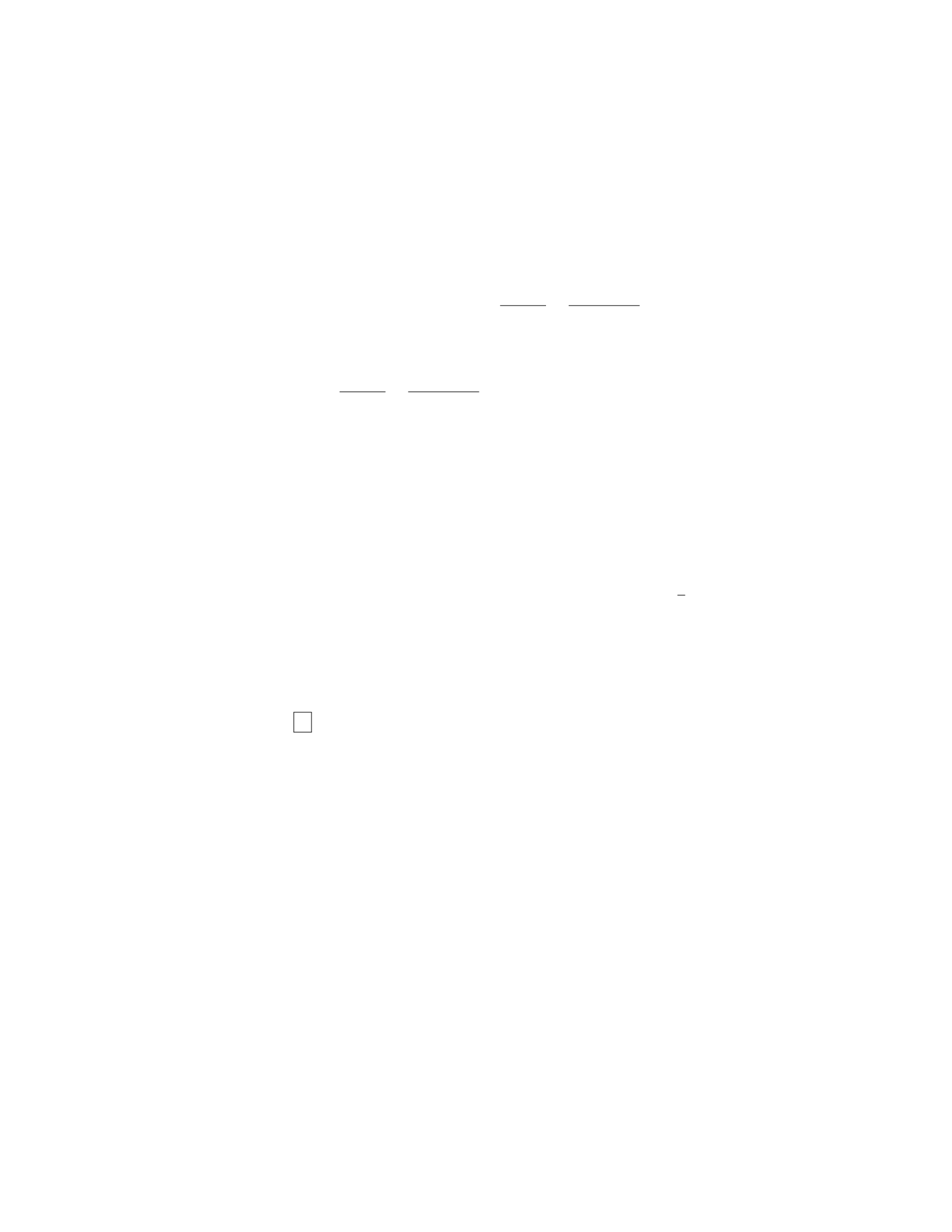
where dA =dxdy.
Step 3: Express the line integral in terms of double integrals using Green’s
Theorem.
Given P(x, y) = x2−y2and Q(x, y) = 2xy, the line integral becomes
IC
(x2−y2)dx + 2xydy =ZZD∂(2xy)
∂x −∂(x2−y2)
∂y dA
Step 4: Calculate the partial derivatives and evaluate the double integral.
We have ∂(2xy)
∂x −∂(x2−y2)
∂y = 2y−(−2y) = 4y
Thus, the line integral simplifies to
IC
(x2−y2)dx + 2xydy =ZZD
4y dA
Step 5: Find the area of the region D.
The region Dis a circle with radius 2, so its area is A=π·22= 4π.
Step 6: Evaluate the double integral.
ZZD
4y dA = 4 ZZD
y dA = 4·Z2π
0Z2
0
r·sin(θ)drdθ= 4· Z2π
0−1
2r2cos(θ)2
0
dθ!
= 4 ·Z2π
0
[−2 cos(θ)]dθ= 4 ·[−2 sin(θ)]2π
0= 0
Step 7: Conclusion.
Therefore, after evaluating the line integral using Green’s Theorem, we find that
the result is 0.
Question 23
Question
Let Cbe the curve given by x2+y2= 4 oriented counterclockwise. Calculate
the circulation of the vector field F(x, y)=(y2,−x)around the curve Cusing
Green’s Theorem.
Solution
To apply Green’s Theorem, we first need to find a region Denclosed by the
curve C.
Step 1: Find the Region Enclosed by the Curve
The curve Cis a circle centered at the origin with radius 2. This implies that
the region enclosed by Cis the disk Dwith radius 2.
21
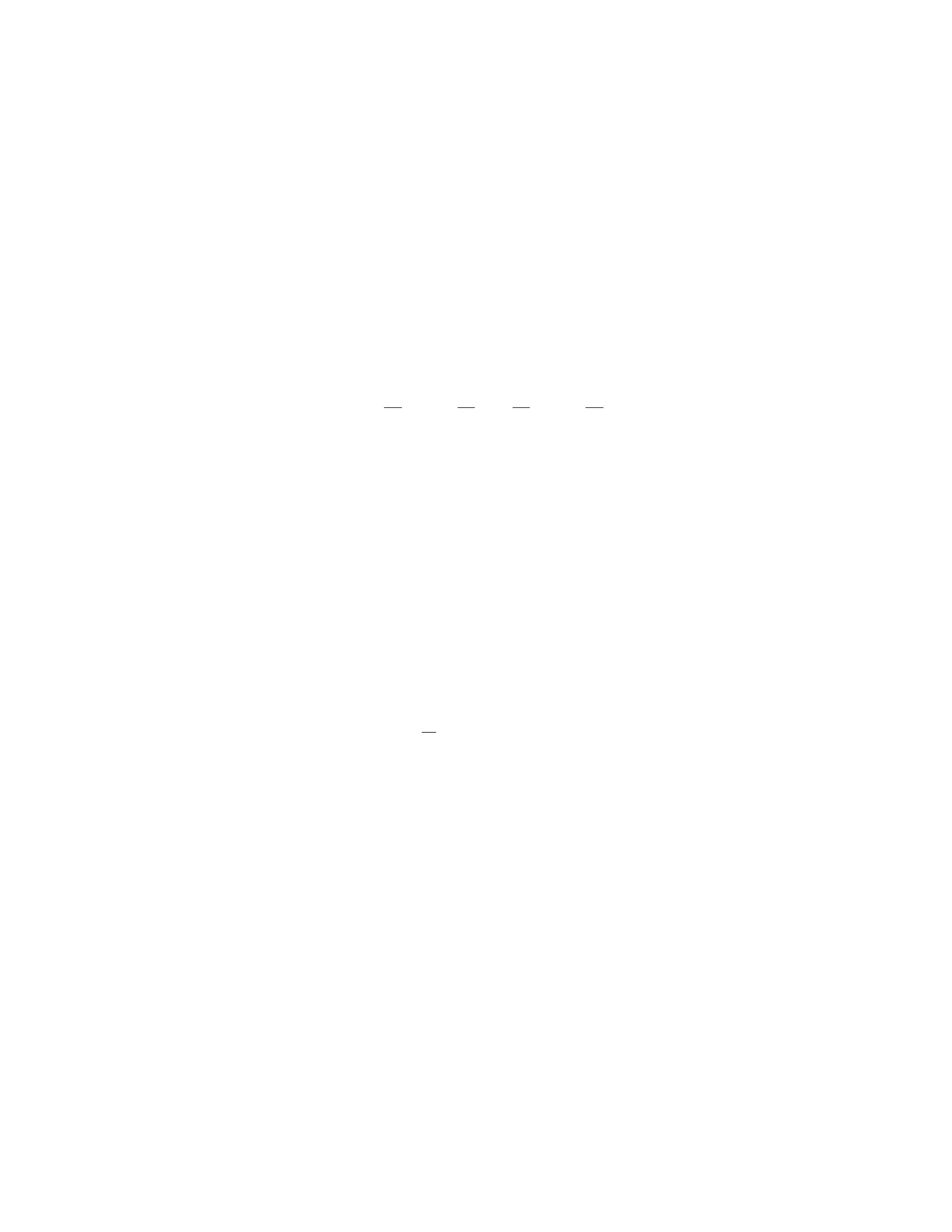
Step 2: Calculate the Circulation
According to Green’s Theorem, the circulation of a vector field around a closed
curve is equal to the double integral of the curl of the vector field over the region
enclosed by the curve. The circulation circ(C)is given by:
circ(C) = ZZD
(∇ × F)·dA
Step 3: Calculate the Curl of F
The vector field F(x, y) = (y2,−x). The curl of F, denoted by ∇ × F, is:
∇ × F=∂
∂x (−x)−∂
∂y (y2),∂
∂y (−x)−∂
∂x (y2)
= (−1−0,0−(−2y)) = (−1,2y)
Step 4: Set Up the Double Integral
Substitute the curl of Finto the circulation formula and compute the double
integral over the region D, which is the disk with radius 2. Using polar coordi-
nates, dA=r dr dθ, and the region Dis 0≤r≤2,0≤θ≤2π. The circulation
becomes:
circ(C) = ZZD
(−1,2y)·(r dr dθ)
Step 5: Evaluate the Double Integral
The circulation integral becomes:
circ(C) = Z2π
0Z2
0
(−1) ·r dr dθ +Z2π
0Z2
0
2y·r dr dθ
=Z2π
0−r2
22
0
dθ +Z2π
0y·r22
0dθ
=Z2π
0
(−2) dθ +Z2π
0
4y dθ =−4·2π+ 8π=−8π+ 8π= 0
Therefore, the circulation of the vector field Faround the curve Cis 0.
Question 24
Question
Let Cbe the curve given by x2+y2= 4 oriented counterclockwise. Use Green’s
Theorem to evaluate the line integral
ICx2+y2dx + 2xy dy.
22

Solution
1. Let’s first parameterize the curve C. The curve Cis a circle with radius
2, so we can parameterize it by x= 2 cos(t)and y= 2 sin(t), where
0≤t≤2πto cover the entire circle.
2. Next, we calculate the partial derivatives of the given vector field:
∂
∂y (x2+y2) = 2y,
∂
∂x (2xy) = 2y.
3. Now, we apply Green’s Theorem, which states:
IC
(P dx +Q dy) = ZZD∂Q
∂x −∂P
∂y dA,
where Dis the region enclosed by C.
4. Substituting the given values, we have:
ZZD
(2y−2y)dA =ZZD
0dA
= 0.
5. Therefore, the line integral HCx2+y2dx + 2xy dy evaluated over Cis
0.
Question 25
Question
Let Cbe the curve consisting of the line segment from (0,0) to (4,0) and the
parabolic arc y=x2from (4,0) to (0,0). Calculate the line integral HC⟨y, x⟩ ·
dr, where r(t) = ⟨x(t), y(t)⟩parameterizes Ccounterclockwise, using Green’s
Theorem.
Solution
Step 1: Parameterize the curve C.
We can parameterize the line segment from (0,0) to (4,0) as r1(t) = ⟨t, 0⟩
for 0≤t≤4.
For the parabolic arc y=x2from (4,0) to (0,0), we can parameterize it as
r2(t) = ⟨4−t, (4 −t)2⟩for 0≤t≤4.
Step 2: Compute the line integral around C.
23

We have HC⟨y, x⟩·dr=RRD∂Q
∂x −∂P
∂y dA, where P(y, x) = yand Q(y, x) =
x.
Step 3: Find the area Dthat Cencloses.
Dis the region enclosed by the curve C, which is the triangular region
bounded by the x-axis, the line x= 4, and the parabola y=x2. To find the
area of D, we need to solve for the intersection points of x= 4 and y=x2.
Setting x= 4 and y=x2, we get 4 = x2. Solving this quadratic equation
gives x= 2 (since x=−2is extraneous). So, the area is given by:
A=Z2
0
x2dx =8
3
Step 4: Compute the line integral using Green’s Theorem.
IC⟨y, x⟩ · dr=ZZD∂Q
∂x −∂P
∂y dA
=Z2
0Zx2
0
(1 −1) dy dx
=Z2
0
x2dx
=x3
32
0
=8
3
Therefore, the line integral HC⟨y, x⟩ · draround the curve Cis 8
3.
24

