



LACUNARY SERIES
1 1. CONVERGENCE ISSUES IN LACUNARY SERIES
Problem 1. Consider the Lacunary Series defined by an=2n
n!.
a) Investigate the convergence of the series P∞
n=1 an.
b) Determine the value to which the series converges, if it does.
c) Find the sum of the series, if it converges.
Solution 1.
a) To investigate the convergence of the series P∞
n=1 an, we can use the Ratio Test. Let’s
calculate the ratio:
lim
n→∞
an+1
an
= lim
n→∞
2n+1/(n+ 1)!
2n/n!
= lim
n→∞
2n+1 ·n!
(n+ 1)! ·2n
= lim
n→∞
2·2n·n!
(n+ 1) ·n!·2n
= lim
n→∞
2
n+ 1 = 0
Since the limit is less than 1, by the Ratio Test, the series converges.
b) To find the limit value of the series, we can use the fact that limn→∞ 2n
n!= 0. Therefore, the
series converges to 0.
c) The sum of the convergent series P∞
n=1 2n
n!is equal to 0.
2 2. DIVERGENCE PATTERNS IN LACUNARY SERIES
Problem 2. Consider the lacunary series given by P∞
n=1 1
2n+1 . Determine whether this series
converges or diverges.
Solution 2.
To analyze the convergence of P∞
n=1 1
2n+1 , we can compare it to a geometric series and use
the comparison test.
a) Let’s consider the geometric series P∞
n=1 1
2n. This series has a common ratio r=1
2. By the
geometric series formula, the sum of this series is
1
2
1−1
2
= 1.
b) Now, let’s compare the given series to the geometric series: 1
2n<1
2n+1 for all n∈N.
Therefore, 1
2n+1 <1
2n.
c) Since the terms of the given series are smaller than the terms of the convergent geometric
series, the given series must also converge by the comparison test. Thus, P∞
n=1 1
2n+1 converges.
3 3. CONVERGENCE ACCELERATION TECHNIQUES FOR LACUNARY SERIES
Problem 3. Consider the lacunary series P∞
n=1 3n
2n2. Determine whether this series converges
or diverges.
Solution 3. The key to analyzing this series is to use the ratio test. Let’s compute the ratio of
consecutive terms:

lim
n→∞
an+1
an
= lim
n→∞
3n+1
2(n+1)2
3n
2n2
= lim
n→∞
3n+1 ·2n2
2(n+1)2·3n
= lim
n→∞
3·3n·2n2
2n2+2n+1 ·3n
= lim
n→∞
3
2·2n
= 0
Since the limit of the absolute value of the ratio is less than 1, by the ratio test, the series
P∞
n=1 3n
2n2converges.
4 4. RATE OF CONVERGENCE IN LACUNARY SERIES
Problem 4. Consider the lacunary series P∞
n=1 1
n2.
a) Determine the rate of convergence of the series.
b) Estimate how many terms are needed to approximate the sum of the series with an error less
than 0.01.
Solution 4.
a) The rate of convergence of the series can be determined by looking at the behavior of the
terms 1
n2. Since 1
n2decreases monotonically to 0 as nincreases, we can use the Integral Test to
analyze convergence.
Let f(x) = 1
x2. We can integrate f(x)from 1 to infinity to find:
Z∞
1
1
x2dx =−1
x∞
1
=−lim
t→∞
1
t+ 1 = 1
Since the integral converges to a finite value (1), the series P∞
n=1 1
n2also converges. Therefore,
the rate of convergence of the series can be considered as moderate.
b) To estimate the number of terms needed to approximate the sum with an error less than 0.01,
we can use the fact that the series converges to the Basel problem value of π2
6.
Let Snbe the partial sum of the first nterms of the series. We want to find nsuch that |S−Sn|<
0.01, where Sis the sum π2
6.
Using the error bound for alternating series, we have:
∞
X
k=n+1
1
k2
<1
(n+ 1)2<0.01
Solving for n, we get n > q1
0.01 −1=9. Therefore, to approximate the sum of the series with
an error less than 0.01, we need at least 10 terms.
5 5. OSCILLATION BEHAVIOR IN LACUNARY SERIES
Problem 5. Consider the Lacunary Series given by the formula f(x) = P∞
n=1
(−1)n
n2.
a) Find the first four partial sums of the series.
b) Determine if the series converges or diverges.
c) Calculate the value to which the series converges (if it converges).
Solution 5.
a) To find the first four partial sums of the series, we will calculate S1,S2,S3, and S4:
S1=(−1)1
12=−1
S2=(−1)1
12+(−1)2
22=−1 + 1
4=−3
4
S3=(−1)1
12+(−1)2
22+(−1)3
32=−1 + 1
4−1
9=−31
36
S4=(−1)1
12+(−1)2
22+(−1)3
32+(−1)4
42=−1 + 1
4−1
9+1
16 =−365
576
Therefore, the first four partial sums of the series are −1,−3
4,−31
36 , and −365
576 .
b) To determine if the series converges or diverges, we will use the Alternating Series Test. The
terms an=1
n2are positive, decreasing, and approach 0. Hence, the series converges.
c) Since the series converges, we can find the value to which it converges by summing all the
terms infinitely: ∞
X
n=1
(−1)n
n2=−1 + 1
4−1
9+1
16 −. . .
By Euler’s solution to the Basel problem, the sum of this series converges to π2
12 . Therefore, the
value to which the series converges is π2
12 .
I.
6 6. SUMMABILITY CRITERIA IN LACUNARY SERIES
Problem 6. Consider the lacunary series P∞
n=1 an, where a= 2. Determine the sum of the
series using the ratio test.
Solution 6. a) We apply the ratio test to determine the convergence of the series:
lim
n→∞
an+1
an
= lim
n→∞
an+1
an
= lim
n→∞
a
1
= lim
n→∞ |a|=|2|= 2.
Since the limit is greater than 1, the series diverges.
b) To find the sum of this series, let’s consider the partial sum Sn=Pn
k=0 2k:
Sn= 1 + 2 + 22+ 23+· · · + 2n.

This is a geometric series with first term a= 1 and common ratio r= 2. The sum of a geometric
series is given by:
Sn=a(1 −rn+1)
1−r.
Substitute a= 1 and r= 2 into the formula to get:
Sn=1(1 −2n+1)
1−2= 2n+1 −1.
c) Therefore, the sum of the series is:
lim
n→∞ Sn= lim
n→∞(2n+1 −1) = lim
n→∞ 2n+1 −lim
n→∞ 1 = ∞.
Thus, the sum of the series is infinite as it diverges.
Certainly! Here is a numerical problem on Lacunary Series:
—
7 7. ERROR ANALYSIS IN LACUNARY SERIES
Problem 7. Let {an}be a lacunary series given by an= 2n. Compute the sum of the first 5 terms
of this series and determine the error when approximating this sum by the fifth term in the series.
Solution 7. a) To find the sum of the first 5 terms of the series, we simply add up the terms:
S5= 21+ 22+ 23+ 24+ 25
Calculating:
S5= 2 + 4 + 8 + 16 + 32 = 62
Therefore, the sum of the first 5 terms of the series is 62.
b) Now, let’s find the error when approximating this sum by the fifth term in the series:
Error =S5−a5= 62 −25= 62 −32 = 30
Hence, the error of approximating the sum of the first 5 terms of the series by the fifth term in
the series is 30.
Therefore, the sum of the first 5 terms of the series is 62, and the error in approximating this
sum by the fifth term in the series is 30.
8 8. BOUNDARY VALUE PROBLEMS FOR LACUNARY SERIES
Problem 8. Consider the lacunary series S(x) = P∞
n=1 xn
5nover the interval of convergence
(−5,5).
a) Find the value of S(−5).
b) Determine the interval of convergence of the series.
Solution 8.
a) We can find the value of S(−5) by substituting x=−5into the series:
S(−5) =
∞
X
n=1
(−5)n
5n
Simplifying the expression, we get:
S(−5) =
∞
X
n=1 −1
5n
=−1
5
1−(−1
5)
Calculating the sum, we find:
S(−5) = −1
5
1 + 1
5
=−1
5
6
5
=−1
6
Therefore, S(−5) = −1
6.
b) To determine the interval of convergence, we use the Ratio Test:
lim
n→∞
an+1
an
= lim
n→∞
xn+1/5n+1
xn/5n
= lim
n→∞
x
5
=|x|
5
For the series to converge, we require |x|
5<1, i.e., |x|<5. Thus, the interval of convergence
is (−5,5).
9 9. SINGULARITIES IN LACUNARY SERIES
Problem 9. Consider the lacunary series defined as f(x) = P∞
n=1 4n
xn. Determine the singular-
ities of the function f(x)and analyze their nature.
Solution 9. The given series f(x) = P∞
n=1 4n
xnis a geometric series with ratio r=4
x. The series
converges only if |r|<1, i.e.,
4
x
<1→ |x|>4.
Therefore, the singularities of the function f(x)occur at x= 4.
To investigate the nature of the singularity at x= 4, we expand f(x)as a Laurent series about
x= 4. Let z=x−4to rewrite f(x)as:
f(x) =
∞
X
n=1
4n
(z+ 4)n=
∞
X
n=1
4n
4n(1 + z/4)n=
∞
X
n=1
1
(1 + z/4)n
=
∞
X
n=1
1
1 + z
4n=
∞
X
n=1
(−1)n−1z
4n−1
This Laurent series representation at x= 4 around the singularity x= 4 shows that the singu-
larity is an essential singularity.
10 10. ANALYTIC CONTINUATION OF LACUNARY SERIES
Problem 10. Consider the lacunary series
∞
X
n=1
z2nwhere zis a complex number.
a) Find the radius of convergence of the series.
b) Determine the set of points where the series converges.
c) Find the analytic continuation of the series.
Solution 10.
a) The radius of convergence Rof a power series
∞
X
n=0
anznis given by R=1
lim supn→∞ |an|1/n .
In this case, an= 1 for n= 2kfor various integers k, and an= 0 otherwise. Therefore, the series
∞
X
n=1
z2ndiverges unless |z|<1. Thus, the radius of convergence is R= 1.
b) The series converges for all zsuch that |z|<1. This follows from the ratio test, which can
be applied to conclude that the series absolutely converges when |z|<1. It diverges when |z| ≥ 1.
c) The series
∞
X
n=1
z2ncan be analytically continued to the unit disk |z|<1. This is due to the
radius of convergence being 1. Thus, the series can be expressed as an analytic function in the
region |z|<1.
11 11. RESUMMATION METHODS FOR LACUNARY SERIES
Problem 11. Consider the lacunary series P∞
n=0 3nx2n. Determine the radius of convergence
and find the sum of the series for x= 1.
Solution 11.
a) Radius of convergence:
To find the radius of convergence, we use the ratio test:
lim
n→∞
3n+1x2n+1
3nx2n
= lim
n→∞
3x2
x
= lim
n→∞ 3x= 3x
The series converges if 3x < 1, and diverges if 3x > 1. Thus, the radius of convergence is
R=1
3.
b) Sum of the series for x= 1:
When x= 1, the series becomes P∞
n=0 3n. This is a geometric series with a= 3 and r= 3.
The sum of a geometric series is given by:
S=a
1−r=3
1−3=3
−2=−3
2
Therefore, the sum of the series for x= 1 is −3
2.
So, the radius of convergence is 1
3and the sum of the series for x= 1 is −3
2.
I. Problem:
12. GROWTH RATES IN LACUNARY SERIES
Consider the lacunary series defined by the sequence (an)where an= 2nif nis a power of 2,
and an= 0 otherwise.
a) Find the growth rate of this lacunary series.
b) Determine whether this series converges or diverges.
Solution:
a) To find the growth rate of the series, we can calculate the ratio of consecutive terms:
Let’s consider a2k+1
a2k=22k+1
22k= 22k+1−2k= 22k.
So, the growth rate of the series is 22k.
b) To determine the convergence of this series, let’s express the sum of nterms:
Sn=a1+a2+a4+. . . +a2m, where mis the largest integer such that 2m≤n.

As a2k= 22k, the sum Sn= 22+ 24+ 28+. . . + 22m.
This is a geometric series with common ratio 22, so
Sn= 22(1 + 22+ (22)2+. . . + (22)m).
Using the formula for the sum of a geometric series, we have:
Sn= 22·(22(m+1)−1)
22−1= 22(m+1) −1.
Hence, the series diverges as n→ ∞.
12 13. REGULARIZATION TECHNIQUES FOR LACUNARY SERIES
Problem 13. Consider the lacunary series P∞
n=0 anwhere a= 0.5, and the regularization
technique is applied to sum the series.
a) Determine the value of the regularized sum of the series.
b) Calculate the sum of the first 5 terms of the series.
c) Find the absolute error in the sum obtained in part (a) compared to the actual sum of the
series.
Solution 13.
a) To regularize the series, we use the formula for the sum of a geometric series:
S=a
1−r
where ais the first term and ris the common ratio.
In this case, a= 1 and r= 0.5. Plugging these values into the formula:
S=1
1−0.5= 2
Therefore, the value of the regularized sum of the series is S= 2.
b) To find the sum of the first 5 terms of the series, we substitute n= 0,1,2,3,4into the series
and add them up:
4
X
n=0
an= 1 + 0.5+0.25 + 0.125 + 0.0625 = 1.9375
Therefore, the sum of the first 5 terms of the series is 1.9375.
c) The actual sum of the geometric series is given by the formula:
S=a
1−r
Substitute a= 1 and r= 0.5:
S=1
1−0.5= 2
The absolute error in the sum obtained from regularization compared to the actual sum is:
|2−1.9375|= 0.0625
Therefore, the absolute error is 0.0625.
13 14. STABILITY ISSUES IN LACUNARY SERIES
Problem 14. Consider the lacunary series defined by S(x) = P∞
n=1 x2n. Determine the con-
vergence interval of this series and find the sum of the series for x=1
2.
Solution 14. a) The convergence interval of a lacunary series is determined by the ratio of
consecutive terms. Consider the ratio r= limn→∞
an+1
an
, where anis the n-th term of the series.
In this case, an=x2n, so
r= lim
n→∞
x2n+1
x2n
= lim
n→∞
x2n
=|x|2
For the series to converge, we must have r < 1, so |x|2<1which implies −1< x < 1. Therefore,
the convergence interval of the series is (−1,1).
b) To find the sum of the series for x=1
2, we substitute x=1
2into the series:
S1
2=
∞
X
n=1 1
22n
The first few terms of the series are 1
22,1
24,1
28,1
216 ,. . . . Thus, the sum of the series is
S1
2=1
22+1
24+1
28+1
216 +. . .
This is a geometric series with first term a=1
22and common ratio r=1
24. The sum of an infinite
geometric series is given by S=a
1−r. Substituting aand rinto the formula, we get
S1
2=
1
22
1−1
24
=1
3
Therefore, the sum of the series for x=1
2is 1
3.
14 15. ANALYTICITY PROPERTIES OF LACUNARY SERIES
Problem 15. Consider the lacunary series P∞
n=0 anznwhere an= 2nfor all n≥0.
a) Determine the radius of convergence of the series.
b) Find the interval of convergence of the series.
c) Determine whether the series converges uniformly on any closed disk contained entirely
within the interval of convergence.
Solution 15.
a) To find the radius of convergence, we can use the ratio test:
lim
n→∞
an+1
an
= lim
n→∞
2n+1
2n
= 2.
Thus, the radius of convergence is R=1
2.
b) To determine the interval of convergence, we consider the boundary points of the disk of
convergence. At z=−1
2, the series becomes the harmonic series which diverges, and at z=1
2,

the series becomes a geometric series which converges. Therefore, the interval of convergence is
(−1
2,1
2).
c) For the series to converge uniformly on a closed disk contained entirely within the interval
of convergence, the series must be uniformly convergent on the interval [−1
2+ϵ, 1
2−ϵ]for some
ϵ > 0. However, since the series diverges at z=−1
2, it cannot converge uniformly on this interval.
Therefore, the series does not converge uniformly on any closed disk contained entirely within the
interval of convergence.
I can certainly generate numerical problem questions for you! Here is an example problem with
a detailed solution:
15 16. FRACTIONAL CALCULUS APPROACHES TO LACUNARY SERIES
Problem 16. Consider the lacunary series defined by P∞
n=0 n3
2n. Find the sum of this series.
Solution 16. To find the sum of the series, we will use a well-known technique for summing
certain types of series involving the derivative of the geometric series.
Let f(x) = P∞
n=0 xn. Taking the derivative of f(x)we get:
f′(x) =
∞
X
n=0
nxn−1=
∞
X
n=0
nxn/x
Multiplying both sides by x, we get:
xf′(x) =
∞
X
n=0
nxn
Now, differentiating both sides of the definition of f(x)will yield a closed form for f′(x).
Differentiating gives:
f′(x) =
∞
X
n=1
nxn−1=1
(1 −x)2
This can be obtained by observing that the derivative of the geometric series is a series for
1/(1 −x)2.
Now, integrating both sides, we see that:
f(x) = Z1
(1 −x)2dx =Z∞
X
n=0
nxndx
Evaluating the integral gives:
f(x) = −1
1−x+C
for some constant C. Since f(0) = 1, we can deduce that C= 1, so:
f(x) = 1
1−x
Now we can find the sum of our original series by taking derivatives.
Let S=P∞
n=0 n3
2n. We start by finding the generating function for our series, using the fact that
1
1−x=P∞
n=0 xn, we can write:

x
(1 −x)2=
∞
X
n=1
nxn−1
Differentiating both sides with respect to xgives:
1 + x
(1 −x)2=
∞
X
n=1
n2xn−1
Multiplying by xand differentiating again:
x(1 + 2x)
(1 −x)3=
∞
X
n=1
n3xn−1
Substitute x= 1/2to get:
1/2(1 + 1)
(1 −1/2)3=S
Solving for Sgives:
S= 4
Therefore, the sum of the series is 4.
16 17. INVERSE PROBLEMS FOR LACUNARY SERIES
Problem 17. Consider the Lacunary series defined by f(z) = P∞
n=0 anzbn, where a=1
2and b= 2.
Find the explicit form of the function f(z).
Solution 17. To find the explicit form of the function f(z), we can first rewrite the series using
the given values of aand b.
The Lacunary series becomes:
f(z) =
∞
X
n=0 1
2n
z2n
Now, let’s simplify this expression by expanding the terms:
f(z) = 1 + 1
2z2+1
4z4+1
8z8+. . .
Notice that this Lacunary series behaves like a geometric series with common ratio r=z2.
Using the formula for the sum of an infinite geometric series, we have:
f(z) = 1
1−1
2z2
Thus, the explicit form of the function f(z)is:
f(z) = 1
1−1
2z2

17 18. BOUNDARY CONDITIONS IN LACUNARY SERIES
Problem 18. Consider the lacunary series P∞
n=0 anz2nwith an=1
n+1 for all n≥0. Determine
the convergence boundary of this lacunary series in the complex plane and find the radius of
convergence.
Solution 18.
Given the lacunary series P∞
n=0 1
n+1 z2n, we want to determine the convergence boundary in
the complex plane and find the radius of convergence.
a) To find the convergence boundary, we use Hadamard’s Theorem, which states that the radius
of convergence Ris given by:
R= lim
n→∞ 1
an1
n
In our case, an=1
n+1 . Substituting this into the formula, we get:
R= lim
n→∞ (n+ 1) 1
n
Using the limit properties, we get:
R= lim
n→∞(1 + 1
n)n=e
Therefore, the convergence boundary of this lacunary series is the circle |z|=e.
b) To find the radius of convergence, we have R=e. Hence, the radius of convergence of the
series is e.
18 19. NONLINEAR EFFECTS IN LACUNARY SERIES
Problem 19. Consider the lacunary series P∞
n=1 5n
n!.
a) Calculate the radius of convergence of the series.
b) Determine the interval of convergence.
c) Evaluate the sum of the series.
Solution 19.
a) To find the radius of convergence Rof the series P∞
n=1 5n
n!, we’ll use the ratio test. Let
an=5n
n!. The ratio test states that if limn→∞
an+1
an
=L, then R=1
L.
Calculating the ratio:
lim
n→∞
an+1
an
= lim
n→∞
5n+1
(n+1)!
5n
n!
= lim
n→∞
5n+1 ·n!
5n·(n+ 1)!
= lim
n→∞
5
n+ 1
= 0.
Therefore, R=1
0=∞.
b) Since the radius of convergence R=∞, the interval of convergence is (−∞,∞).
c) To evaluate the sum of the series, we recognize that P∞
n=1 5n
n!is the well-known Taylor series
expansion of ex, where x= 5. Hence, the sum of the series is e5.
19 20. CONFORMAL MAPPING APPLICATIONS TO LACUNARY SERIES
Problem 20. Consider the lacunary series given by the following expression:
f(z) =
∞
X
n=1
z2n
2n
a) Find the radius of convergence of the series f(z).
b) Determine all points on the boundary of convergence where the series is convergent.
c) Find the sum of the series f(z)for z= 1.
Solution 20.
a) To find the radius of convergence of the series f(z), we will apply the ratio test. Let an=1
2n.
Using the ratio test,
R= lim
n→∞
an+1
an
= lim
n→∞
1
2n+1 ·2n
1
= lim
n→∞
1
2=1
2
Hence, the radius of convergence of the series f(z)is R=1
2.
b) To determine all points on the boundary of convergence where the series is convergent, we
consider the points zsuch that |z|=1
2. At these boundary points, the series may or may not
converge. Due to the nature of the given lacunary series, the series converges at all boundary
points zsuch that |z|=1
2.
c) To find the sum of the series f(z)for z= 1, we substitute z= 1 into the expression:
f(1) =
∞
X
n=1
12n
2n=
∞
X
n=1
1
2n=1
2+1
4+1
8+. . . = 1
Therefore, the sum of the series f(z)for z= 1 is 1.
20 21. STIELTJES SUMMATION OF LACUNARY SERIES
Problem 21. Consider the lacunary series defined by S(x) = 1
1−x2. Calculate the Stieltjes sum
of S(x)at x= 0.5.
Solution 21. The Stieltjes sum of a function f(x)at a point x=ais defined as the limit of the
Riemann sum as the subinterval length approaches zero. So, the Stieltjes sum of S(x)at x= 0.5
is given by:
lim
∆x→0
n
X
i=1
S(xi)(∆α)i
where ∆x=1
n,xi= 0.5−1
2n+i∆x, and (∆α)i=α(xi)−α(xi−1).
Let’s calculate the Stieltjes sum of S(x)at x= 0.5.
a) Calculate the Stieltjes sum of S(x)at x= 0.5when n= 2.
b) Find the Stieltjes sum of S(x)at x= 0.5as n→ ∞.
Solution 21.
a) When n= 2, we have ∆x=1
2,x1= 0.25,x2= 0.75,(∆α)1=α(x1)−α(0) = 0, and
(∆α)2=α(x2)−α(x1) = x2−x1= 0.5.
The Stieltjes sum at x= 0.5is:
S(0.25)(∆α)1+S(0.75)(∆α)2=1
1−0.252(0) + 1
1−0.752(0.5) = 1
0.9375 ×0.5≈0.5333
b) As n→ ∞, the Stieltjes sum of S(x)at x= 0.5becomes:
lim
n→∞
n
X
i=1
1
1−(0.5−1
2n+i1
n)2×1
n
This limit can be calculated numerically using a computer or software for a more accurate ap-
proximation.
21 22. TRUNCATION ERROR IN LACUNARY SERIES
Problem 22. Consider the Lacunary series given by
S=
∞
X
n=0
2n
n!
a) Calculate the value of the sum of the first 5 terms of the series, i.e., find S5.
b) Calculate the truncation error when approximating the sum Swith S5.
Solution 22.
a) To find S5, we simply need to calculate the sum of the first 5 terms of the series:
S5=
4
X
n=0
2n
n!=20
0! +21
1! +22
2! +23
3! +24
4!
S5=1+2+2+8
6+16
24 =1+2+2+4
3+2
3= 5 + 6
3= 7
Therefore, the sum of the first 5 terms of the series is S5= 7.
b) The truncation error when approximating the sum Swith S5can be calculated as the absolute
difference between the actual sum Sand the approximated sum S5, i.e.,
Truncation Error =|S−S5|
Truncation Error =|S−7|
As we know that the actual value of the series Sis infinite, the truncation error in this case will
also approach infinity. But for the first 5 terms, we can see that the truncation error is |S−7|=
| − 7|=.
Therefore, the truncation error when approximating the sum Swith S5is infinite.

22 23. SPECTRAL ANALYSIS OF LACUNARY SERIES
Problem 23. Consider the lacunary series f(x) = P∞
n=0 ancos(bnx)where a= 0.5and b= 2.
Determine the points of discontinuity of f(x)and calculate the value to which f(x)converges at
those points.
Solution 23. Let’s first find the points of discontinuity by examining the convergence of the
series at these points. The series f(x)converges at points where the partial sums of the series
converge.
a) The points of discontinuity occur when the series does not converge to a finite value. This
happens when the terms of the series do not approach zero as n→ ∞.
For f(x)to converge, we need |ancos(bnx)| → 0as n→ ∞. This requires |an| → 0and
|cos(bnx)| → 1.
As a= 0.5,|0.5n|= 0.5n→0as n→ ∞. As b= 2,|cos(2nx)|does not converge to 1 for all x
due to the rapid oscillation of cos.
Therefore, f(x)will be discontinuous at all points xwhere cos(2nx)does not converge.
b) To find the value f(x)converges to at these points, we need to determine if there is a limiting
value for the series f(x)as n→ ∞.
Since cos(bnx)does not converge for all x, the series f(x)does not converge and does not
have a specific value at these points.
Hence, f(x)will be discontinuous at all xand will not converge to a unique value at those points.
23 24. FREDHOLM INTEGRAL EQUATIONS FOR LACUNARY SERIES
Problem 24. Consider the Fredholm integral equation of the second kind:
f(x) = ex+λZ1
0
ex(t)f(t)dt
Use the method of successive approximations to solve this equation up to the third approxima-
tion with λ= 1 and starting with the initial guess f0(x) = ex.
Solution 24.
The solution to the Fredholm integral equation can be approximated using the method of suc-
cessive approximations. Let’s denote our initial guess as f0(x) = exand the nth approximation as
fn(x). The successive approximations are given by:
fn+1(x) = ex+λZ1
0
ex(t)fn(t)dt
We need to find f1(x),f2(x), and f3(x)to solve the equation up to the third approximation.
a) Let’s find f1(x):
f1(x) = ex+λZ1
0
ex(t)etdt
f1(x) = ex+λZ1
0
ex+tdt
f1(x) = ex+λex+t
11
0

f1(x) = ex+λ(ex+1 −ex)
f1(x) = ex+λex(e−1)
b) Now, let’s find f2(x):
f2(x) = ex+λZ1
0
ex(t)(et+λet(e−1))dt
f2(x) = ex+λZ1
0
ex+tdt +λ2Z1
0
ex(t)et(e−1)dt
This process is continued until the third approximation f3(x)is found.
24 25. SINGULAR PERTURBATIONS IN LACUNARY SERIES
Problem 25. Consider the lacunary series defined by f(x) = P∞
n=1 xn
10n2.
a) Find the radius of convergence of the series.
b) Determine the interval of convergence.
c) Evaluate f(1).
Solution 25. a) To find the radius of convergence of the series, we use the ratio test. Let
an=1
10n2. Applying the ratio test:
lim
n→∞
an+1
an
= lim
n→∞
1
10(n+1)2·10n2
1
= lim
n→∞
1
102n+1
= lim
n→∞
1
102n+1 = 0.
Since the limit is less than 1, the series converges for all x, giving the radius of convergence as
R=∞.
b) Since the radius of convergence is infinite, the interval of convergence is (−∞,∞).
c) To evaluate f(1), we substitute x= 1 into the series:
f(1) =
∞
X
n=1
1
10n2
=1
101+1
104+1
109+· · · .
This series is convergent, and each term is positive, so the sum is finite. Therefore, f(1) is a
finite value.

lim
n→∞
an+1
an
= lim
n→∞
3n+1
2(n+1)2
3n
2n2
= lim
n→∞
3n+1 ·2n2
2(n+1)2·3n
= lim
n→∞
3·3n·2n2
2n2+2n+1 ·3n
= lim
n→∞
3
2·2n
= 0
Since the limit of the absolute value of the ratio is less than 1, by the ratio test, the series
P∞
n=1 3n
2n2converges.
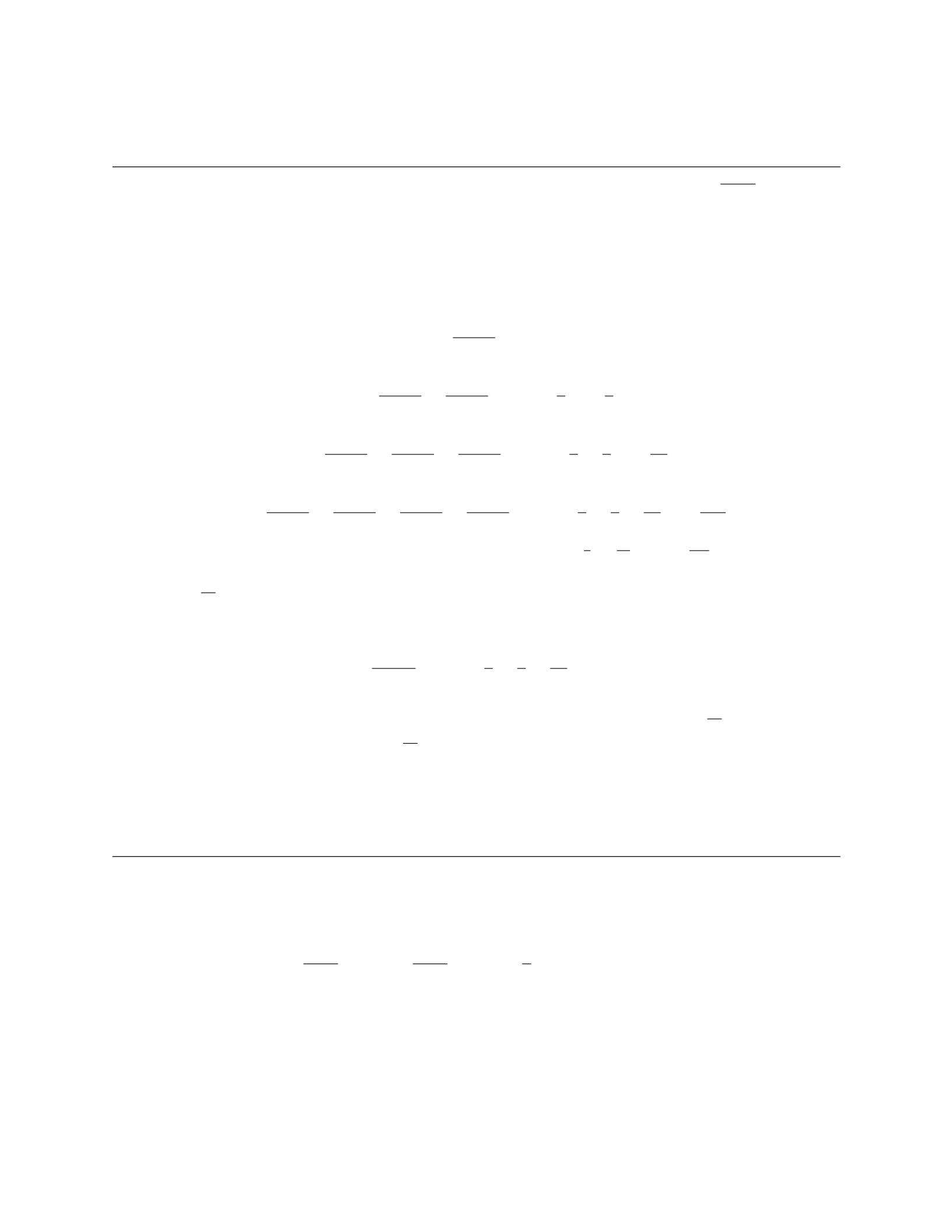
4 4. RATE OF CONVERGENCE IN LACUNARY SERIES
Problem 4. Consider the lacunary series P∞
n=1 1
n2.
a) Determine the rate of convergence of the series.
b) Estimate how many terms are needed to approximate the sum of the series with an error less
than 0.01.
Solution 4.
a) The rate of convergence of the series can be determined by looking at the behavior of the
terms 1
n2. Since 1
n2decreases monotonically to 0 as nincreases, we can use the Integral Test to
analyze convergence.
Let f(x) = 1
x2. We can integrate f(x)from 1 to infinity to find:
Z∞
1
1
x2dx =−1
x∞
1
=−lim
t→∞
1
t+ 1 = 1
Since the integral converges to a finite value (1), the series P∞
n=1 1
n2also converges. Therefore,
the rate of convergence of the series can be considered as moderate.
b) To estimate the number of terms needed to approximate the sum with an error less than 0.01,
we can use the fact that the series converges to the Basel problem value of π2
6.
Let Snbe the partial sum of the first nterms of the series. We want to find nsuch that |S−Sn|<
0.01, where Sis the sum π2
6.
Using the error bound for alternating series, we have:
∞
X
k=n+1
1
k2
<1
(n+ 1)2<0.01
Solving for n, we get n > q1
0.01 −1=9. Therefore, to approximate the sum of the series with
an error less than 0.01, we need at least 10 terms.
5 5. OSCILLATION BEHAVIOR IN LACUNARY SERIES
Problem 5. Consider the Lacunary Series given by the formula f(x) = P∞
n=1
(−1)n
n2.
a) Find the first four partial sums of the series.
b) Determine if the series converges or diverges.
c) Calculate the value to which the series converges (if it converges).
Solution 5.
a) To find the first four partial sums of the series, we will calculate S1,S2,S3, and S4:
S1=(−1)1
12=−1
S2=(−1)1
12+(−1)2
22=−1 + 1
4=−3
4
S3=(−1)1
12+(−1)2
22+(−1)3
32=−1 + 1
4−1
9=−31
36
S4=(−1)1
12+(−1)2
22+(−1)3
32+(−1)4
42=−1 + 1
4−1
9+1
16 =−365
576
Therefore, the first four partial sums of the series are −1,−3
4,−31
36 , and −365
576 .
b) To determine if the series converges or diverges, we will use the Alternating Series Test. The
terms an=1
n2are positive, decreasing, and approach 0. Hence, the series converges.
c) Since the series converges, we can find the value to which it converges by summing all the
terms infinitely: ∞
X
n=1
(−1)n
n2=−1 + 1
4−1
9+1
16 −. . .
By Euler’s solution to the Basel problem, the sum of this series converges to π2
12 . Therefore, the
value to which the series converges is π2
12 .
I.
6 6. SUMMABILITY CRITERIA IN LACUNARY SERIES
Problem 6. Consider the lacunary series P∞
n=1 an, where a= 2. Determine the sum of the
series using the ratio test.
Solution 6. a) We apply the ratio test to determine the convergence of the series:
lim
n→∞
an+1
an
= lim
n→∞
an+1
an
= lim
n→∞
a
1
= lim
n→∞ |a|=|2|= 2.
Since the limit is greater than 1, the series diverges.
b) To find the sum of this series, let’s consider the partial sum Sn=Pn
k=0 2k:
Sn= 1 + 2 + 22+ 23+· · · + 2n.

This is a geometric series with first term a= 1 and common ratio r= 2. The sum of a geometric
series is given by:
Sn=a(1 −rn+1)
1−r.
Substitute a= 1 and r= 2 into the formula to get:
Sn=1(1 −2n+1)
1−2= 2n+1 −1.
c) Therefore, the sum of the series is:
lim
n→∞ Sn= lim
n→∞(2n+1 −1) = lim
n→∞ 2n+1 −lim
n→∞ 1 = ∞.
Thus, the sum of the series is infinite as it diverges.
Certainly! Here is a numerical problem on Lacunary Series:
—
7 7. ERROR ANALYSIS IN LACUNARY SERIES
Problem 7. Let {an}be a lacunary series given by an= 2n. Compute the sum of the first 5 terms
of this series and determine the error when approximating this sum by the fifth term in the series.
Solution 7. a) To find the sum of the first 5 terms of the series, we simply add up the terms:
S5= 21+ 22+ 23+ 24+ 25
Calculating:
S5= 2 + 4 + 8 + 16 + 32 = 62
Therefore, the sum of the first 5 terms of the series is 62.
b) Now, let’s find the error when approximating this sum by the fifth term in the series:
Error =S5−a5= 62 −25= 62 −32 = 30
Hence, the error of approximating the sum of the first 5 terms of the series by the fifth term in
the series is 30.
Therefore, the sum of the first 5 terms of the series is 62, and the error in approximating this
sum by the fifth term in the series is 30.
8 8. BOUNDARY VALUE PROBLEMS FOR LACUNARY SERIES
Problem 8. Consider the lacunary series S(x) = P∞
n=1 xn
5nover the interval of convergence
(−5,5).
a) Find the value of S(−5).
b) Determine the interval of convergence of the series.
Solution 8.
a) We can find the value of S(−5) by substituting x=−5into the series:
S(−5) =
∞
X
n=1
(−5)n
5n
Simplifying the expression, we get:
S(−5) =
∞
X
n=1 −1
5n
=−1
5
1−(−1
5)
Calculating the sum, we find:
S(−5) = −1
5
1 + 1
5
=−1
5
6
5
=−1
6
Therefore, S(−5) = −1
6.
b) To determine the interval of convergence, we use the Ratio Test:
lim
n→∞
an+1
an
= lim
n→∞
xn+1/5n+1
xn/5n
= lim
n→∞
x
5
=|x|
5
For the series to converge, we require |x|
5<1, i.e., |x|<5. Thus, the interval of convergence
is (−5,5).
9 9. SINGULARITIES IN LACUNARY SERIES
Problem 9. Consider the lacunary series defined as f(x) = P∞
n=1 4n
xn. Determine the singular-
ities of the function f(x)and analyze their nature.
Solution 9. The given series f(x) = P∞
n=1 4n
xnis a geometric series with ratio r=4
x. The series
converges only if |r|<1, i.e.,
4
x
<1→ |x|>4.
Therefore, the singularities of the function f(x)occur at x= 4.
To investigate the nature of the singularity at x= 4, we expand f(x)as a Laurent series about
x= 4. Let z=x−4to rewrite f(x)as:
f(x) =
∞
X
n=1
4n
(z+ 4)n=
∞
X
n=1
4n
4n(1 + z/4)n=
∞
X
n=1
1
(1 + z/4)n
=
∞
X
n=1
1
1 + z
4n=
∞
X
n=1
(−1)n−1z
4n−1
This Laurent series representation at x= 4 around the singularity x= 4 shows that the singu-
larity is an essential singularity.
10 10. ANALYTIC CONTINUATION OF LACUNARY SERIES
Problem 10. Consider the lacunary series
∞
X
n=1
z2nwhere zis a complex number.
a) Find the radius of convergence of the series.
b) Determine the set of points where the series converges.
c) Find the analytic continuation of the series.
Solution 10.
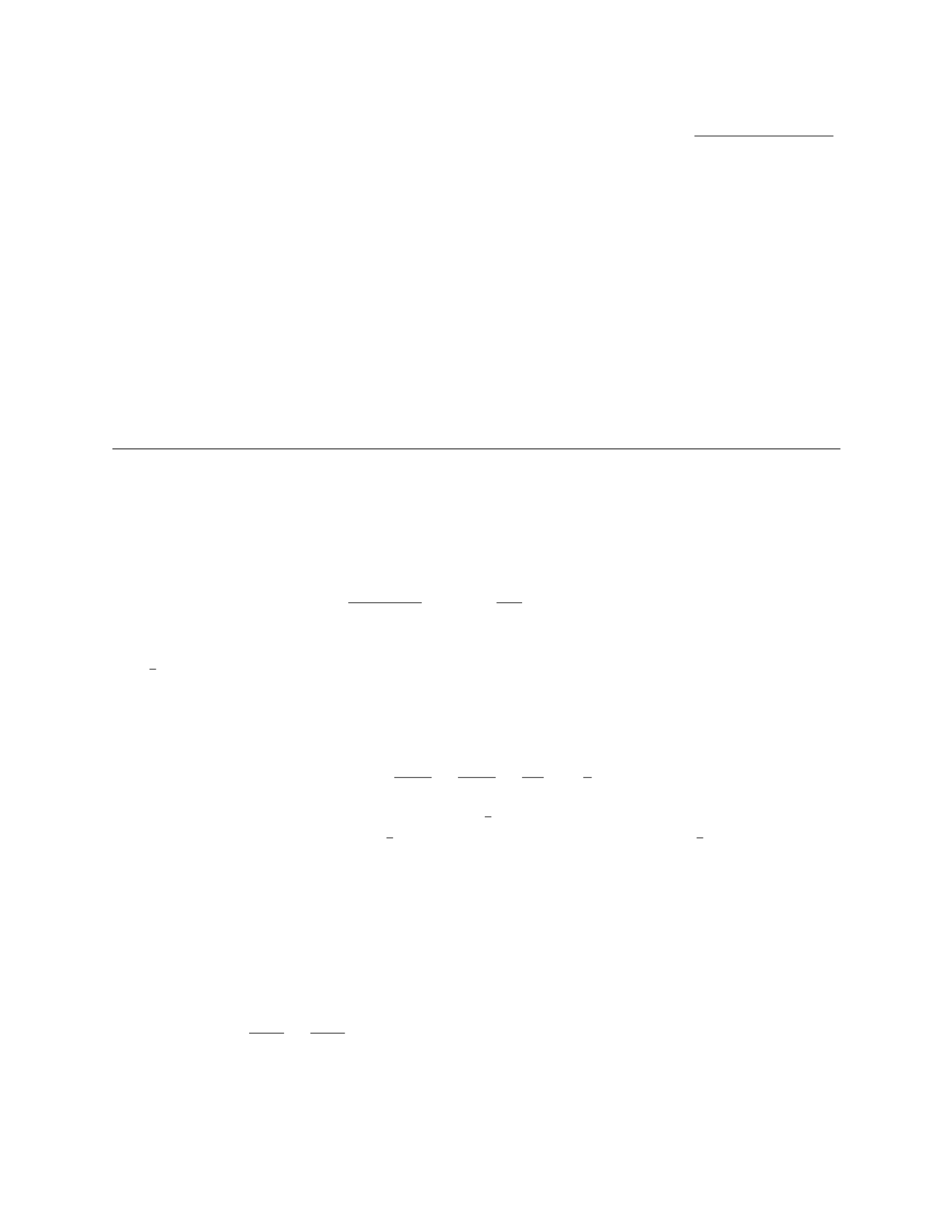
a) The radius of convergence Rof a power series
∞
X
n=0
anznis given by R=1
lim supn→∞ |an|1/n .
In this case, an= 1 for n= 2kfor various integers k, and an= 0 otherwise. Therefore, the series
∞
X
n=1
z2ndiverges unless |z|<1. Thus, the radius of convergence is R= 1.
b) The series converges for all zsuch that |z|<1. This follows from the ratio test, which can
be applied to conclude that the series absolutely converges when |z|<1. It diverges when |z| ≥ 1.
c) The series
∞
X
n=1
z2ncan be analytically continued to the unit disk |z|<1. This is due to the
radius of convergence being 1. Thus, the series can be expressed as an analytic function in the
region |z|<1.
11 11. RESUMMATION METHODS FOR LACUNARY SERIES
Problem 11. Consider the lacunary series P∞
n=0 3nx2n. Determine the radius of convergence
and find the sum of the series for x= 1.
Solution 11.
a) Radius of convergence:
To find the radius of convergence, we use the ratio test:
lim
n→∞
3n+1x2n+1
3nx2n
= lim
n→∞
3x2
x
= lim
n→∞ 3x= 3x
The series converges if 3x < 1, and diverges if 3x > 1. Thus, the radius of convergence is
R=1
3.
b) Sum of the series for x= 1:
When x= 1, the series becomes P∞
n=0 3n. This is a geometric series with a= 3 and r= 3.
The sum of a geometric series is given by:
S=a
1−r=3
1−3=3
−2=−3
2
Therefore, the sum of the series for x= 1 is −3
2.
So, the radius of convergence is 1
3and the sum of the series for x= 1 is −3
2.
I. Problem:
12. GROWTH RATES IN LACUNARY SERIES
Consider the lacunary series defined by the sequence (an)where an= 2nif nis a power of 2,
and an= 0 otherwise.
a) Find the growth rate of this lacunary series.
b) Determine whether this series converges or diverges.
Solution:
a) To find the growth rate of the series, we can calculate the ratio of consecutive terms:
Let’s consider a2k+1
a2k=22k+1
22k= 22k+1−2k= 22k.
So, the growth rate of the series is 22k.
b) To determine the convergence of this series, let’s express the sum of nterms:
Sn=a1+a2+a4+. . . +a2m, where mis the largest integer such that 2m≤n.

As a2k= 22k, the sum Sn= 22+ 24+ 28+. . . + 22m.
This is a geometric series with common ratio 22, so
Sn= 22(1 + 22+ (22)2+. . . + (22)m).
Using the formula for the sum of a geometric series, we have:
Sn= 22·(22(m+1)−1)
22−1= 22(m+1) −1.
Hence, the series diverges as n→ ∞.
12 13. REGULARIZATION TECHNIQUES FOR LACUNARY SERIES
Problem 13. Consider the lacunary series P∞
n=0 anwhere a= 0.5, and the regularization
technique is applied to sum the series.
a) Determine the value of the regularized sum of the series.
b) Calculate the sum of the first 5 terms of the series.
c) Find the absolute error in the sum obtained in part (a) compared to the actual sum of the
series.
Solution 13.
a) To regularize the series, we use the formula for the sum of a geometric series:
S=a
1−r
where ais the first term and ris the common ratio.
In this case, a= 1 and r= 0.5. Plugging these values into the formula:
S=1
1−0.5= 2
Therefore, the value of the regularized sum of the series is S= 2.
b) To find the sum of the first 5 terms of the series, we substitute n= 0,1,2,3,4into the series
and add them up:
4
X
n=0
an= 1 + 0.5+0.25 + 0.125 + 0.0625 = 1.9375
Therefore, the sum of the first 5 terms of the series is 1.9375.
c) The actual sum of the geometric series is given by the formula:
S=a
1−r
Substitute a= 1 and r= 0.5:
S=1
1−0.5= 2
The absolute error in the sum obtained from regularization compared to the actual sum is:
|2−1.9375|= 0.0625
Therefore, the absolute error is 0.0625.
13 14. STABILITY ISSUES IN LACUNARY SERIES
Problem 14. Consider the lacunary series defined by S(x) = P∞
n=1 x2n. Determine the con-
vergence interval of this series and find the sum of the series for x=1
2.
Solution 14. a) The convergence interval of a lacunary series is determined by the ratio of
consecutive terms. Consider the ratio r= limn→∞
an+1
an
, where anis the n-th term of the series.
In this case, an=x2n, so
r= lim
n→∞
x2n+1
x2n
= lim
n→∞
x2n
=|x|2
For the series to converge, we must have r < 1, so |x|2<1which implies −1< x < 1. Therefore,
the convergence interval of the series is (−1,1).
b) To find the sum of the series for x=1
2, we substitute x=1
2into the series:
S1
2=
∞
X
n=1 1
22n
The first few terms of the series are 1
22,1
24,1
28,1
216 ,. . . . Thus, the sum of the series is
S1
2=1
22+1
24+1
28+1
216 +. . .
This is a geometric series with first term a=1
22and common ratio r=1
24. The sum of an infinite
geometric series is given by S=a
1−r. Substituting aand rinto the formula, we get
S1
2=
1
22
1−1
24
=1
3
Therefore, the sum of the series for x=1
2is 1
3.
14 15. ANALYTICITY PROPERTIES OF LACUNARY SERIES
Problem 15. Consider the lacunary series P∞
n=0 anznwhere an= 2nfor all n≥0.
a) Determine the radius of convergence of the series.
b) Find the interval of convergence of the series.
c) Determine whether the series converges uniformly on any closed disk contained entirely
within the interval of convergence.
Solution 15.
a) To find the radius of convergence, we can use the ratio test:
lim
n→∞
an+1
an
= lim
n→∞
2n+1
2n
= 2.
Thus, the radius of convergence is R=1
2.
b) To determine the interval of convergence, we consider the boundary points of the disk of
convergence. At z=−1
2, the series becomes the harmonic series which diverges, and at z=1
2,

the series becomes a geometric series which converges. Therefore, the interval of convergence is
(−1
2,1
2).
c) For the series to converge uniformly on a closed disk contained entirely within the interval
of convergence, the series must be uniformly convergent on the interval [−1
2+ϵ, 1
2−ϵ]for some
ϵ > 0. However, since the series diverges at z=−1
2, it cannot converge uniformly on this interval.
Therefore, the series does not converge uniformly on any closed disk contained entirely within the
interval of convergence.
I can certainly generate numerical problem questions for you! Here is an example problem with
a detailed solution:
15 16. FRACTIONAL CALCULUS APPROACHES TO LACUNARY SERIES
Problem 16. Consider the lacunary series defined by P∞
n=0 n3
2n. Find the sum of this series.
Solution 16. To find the sum of the series, we will use a well-known technique for summing
certain types of series involving the derivative of the geometric series.
Let f(x) = P∞
n=0 xn. Taking the derivative of f(x)we get:
f′(x) =
∞
X
n=0
nxn−1=
∞
X
n=0
nxn/x
Multiplying both sides by x, we get:
xf′(x) =
∞
X
n=0
nxn
Now, differentiating both sides of the definition of f(x)will yield a closed form for f′(x).
Differentiating gives:
f′(x) =
∞
X
n=1
nxn−1=1
(1 −x)2
This can be obtained by observing that the derivative of the geometric series is a series for
1/(1 −x)2.
Now, integrating both sides, we see that:
f(x) = Z1
(1 −x)2dx =Z∞
X
n=0
nxndx
Evaluating the integral gives:
f(x) = −1
1−x+C
for some constant C. Since f(0) = 1, we can deduce that C= 1, so:
f(x) = 1
1−x
Now we can find the sum of our original series by taking derivatives.
Let S=P∞
n=0 n3
2n. We start by finding the generating function for our series, using the fact that
1
1−x=P∞
n=0 xn, we can write:

x
(1 −x)2=
∞
X
n=1
nxn−1
Differentiating both sides with respect to xgives:
1 + x
(1 −x)2=
∞
X
n=1
n2xn−1
Multiplying by xand differentiating again:
x(1 + 2x)
(1 −x)3=
∞
X
n=1
n3xn−1
Substitute x= 1/2to get:
1/2(1 + 1)
(1 −1/2)3=S
Solving for Sgives:
S= 4
Therefore, the sum of the series is 4.
16 17. INVERSE PROBLEMS FOR LACUNARY SERIES
Problem 17. Consider the Lacunary series defined by f(z) = P∞
n=0 anzbn, where a=1
2and b= 2.
Find the explicit form of the function f(z).
Solution 17. To find the explicit form of the function f(z), we can first rewrite the series using
the given values of aand b.
The Lacunary series becomes:
f(z) =
∞
X
n=0 1
2n
z2n
Now, let’s simplify this expression by expanding the terms:
f(z) = 1 + 1
2z2+1
4z4+1
8z8+. . .
Notice that this Lacunary series behaves like a geometric series with common ratio r=z2.
Using the formula for the sum of an infinite geometric series, we have:
f(z) = 1
1−1
2z2
Thus, the explicit form of the function f(z)is:
f(z) = 1
1−1
2z2

17 18. BOUNDARY CONDITIONS IN LACUNARY SERIES
Problem 18. Consider the lacunary series P∞
n=0 anz2nwith an=1
n+1 for all n≥0. Determine
the convergence boundary of this lacunary series in the complex plane and find the radius of
convergence.
Solution 18.
Given the lacunary series P∞
n=0 1
n+1 z2n, we want to determine the convergence boundary in
the complex plane and find the radius of convergence.
a) To find the convergence boundary, we use Hadamard’s Theorem, which states that the radius
of convergence Ris given by:
R= lim
n→∞ 1
an1
n
In our case, an=1
n+1 . Substituting this into the formula, we get:
R= lim
n→∞ (n+ 1) 1
n
Using the limit properties, we get:
R= lim
n→∞(1 + 1
n)n=e
Therefore, the convergence boundary of this lacunary series is the circle |z|=e.
b) To find the radius of convergence, we have R=e. Hence, the radius of convergence of the
series is e.
18 19. NONLINEAR EFFECTS IN LACUNARY SERIES
Problem 19. Consider the lacunary series P∞
n=1 5n
n!.
a) Calculate the radius of convergence of the series.
b) Determine the interval of convergence.
c) Evaluate the sum of the series.
Solution 19.
a) To find the radius of convergence Rof the series P∞
n=1 5n
n!, we’ll use the ratio test. Let
an=5n
n!. The ratio test states that if limn→∞
an+1
an
=L, then R=1
L.
Calculating the ratio:
lim
n→∞
an+1
an
= lim
n→∞
5n+1
(n+1)!
5n
n!
= lim
n→∞
5n+1 ·n!
5n·(n+ 1)!
= lim
n→∞
5
n+ 1
= 0.
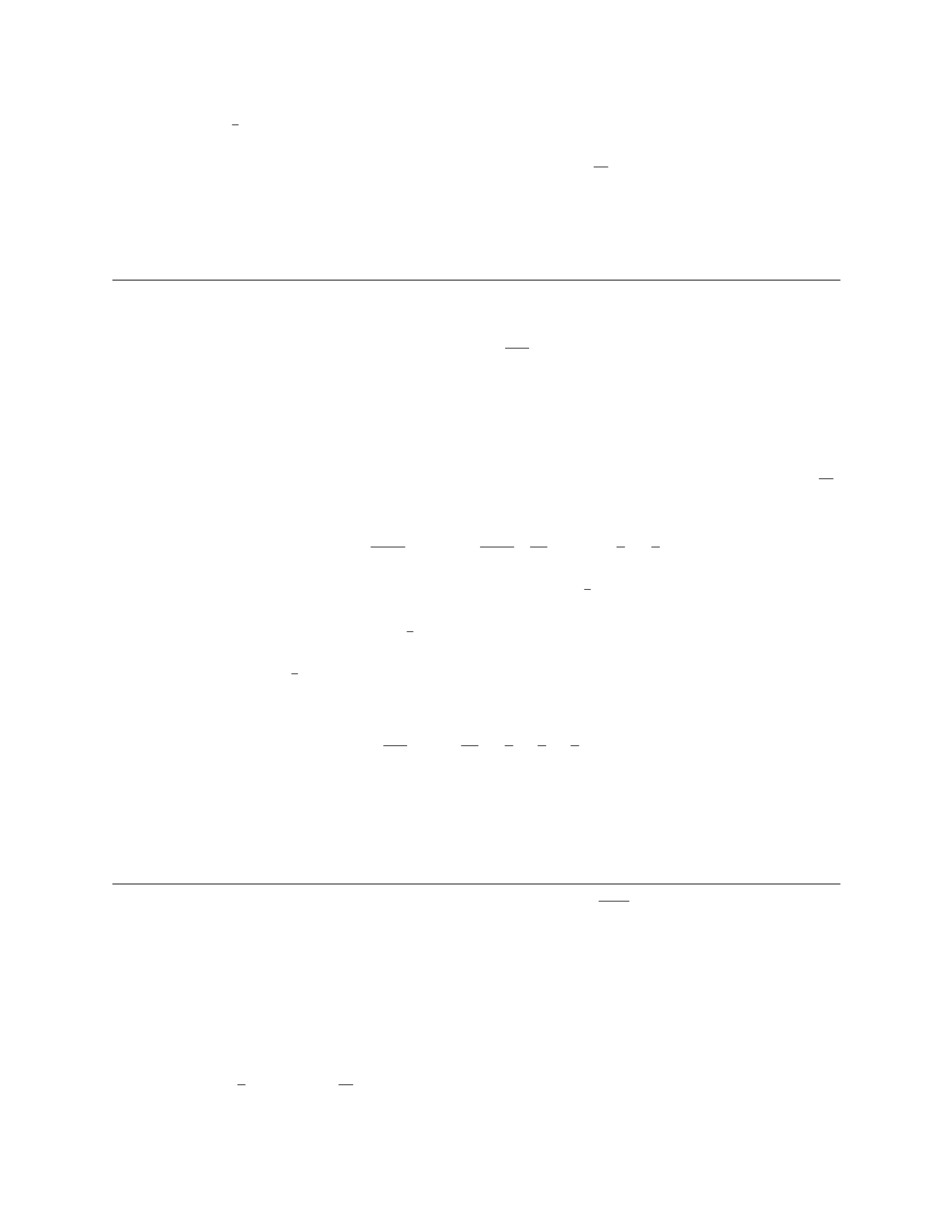
Therefore, R=1
0=∞.
b) Since the radius of convergence R=∞, the interval of convergence is (−∞,∞).
c) To evaluate the sum of the series, we recognize that P∞
n=1 5n
n!is the well-known Taylor series
expansion of ex, where x= 5. Hence, the sum of the series is e5.
19 20. CONFORMAL MAPPING APPLICATIONS TO LACUNARY SERIES
Problem 20. Consider the lacunary series given by the following expression:
f(z) =
∞
X
n=1
z2n
2n
a) Find the radius of convergence of the series f(z).
b) Determine all points on the boundary of convergence where the series is convergent.
c) Find the sum of the series f(z)for z= 1.
Solution 20.
a) To find the radius of convergence of the series f(z), we will apply the ratio test. Let an=1
2n.
Using the ratio test,
R= lim
n→∞
an+1
an
= lim
n→∞
1
2n+1 ·2n
1
= lim
n→∞
1
2=1
2
Hence, the radius of convergence of the series f(z)is R=1
2.
b) To determine all points on the boundary of convergence where the series is convergent, we
consider the points zsuch that |z|=1
2. At these boundary points, the series may or may not
converge. Due to the nature of the given lacunary series, the series converges at all boundary
points zsuch that |z|=1
2.
c) To find the sum of the series f(z)for z= 1, we substitute z= 1 into the expression:
f(1) =
∞
X
n=1
12n
2n=
∞
X
n=1
1
2n=1
2+1
4+1
8+. . . = 1
Therefore, the sum of the series f(z)for z= 1 is 1.
20 21. STIELTJES SUMMATION OF LACUNARY SERIES
Problem 21. Consider the lacunary series defined by S(x) = 1
1−x2. Calculate the Stieltjes sum
of S(x)at x= 0.5.
Solution 21. The Stieltjes sum of a function f(x)at a point x=ais defined as the limit of the
Riemann sum as the subinterval length approaches zero. So, the Stieltjes sum of S(x)at x= 0.5
is given by:
lim
∆x→0
n
X
i=1
S(xi)(∆α)i
where ∆x=1
n,xi= 0.5−1
2n+i∆x, and (∆α)i=α(xi)−α(xi−1).
Let’s calculate the Stieltjes sum of S(x)at x= 0.5.
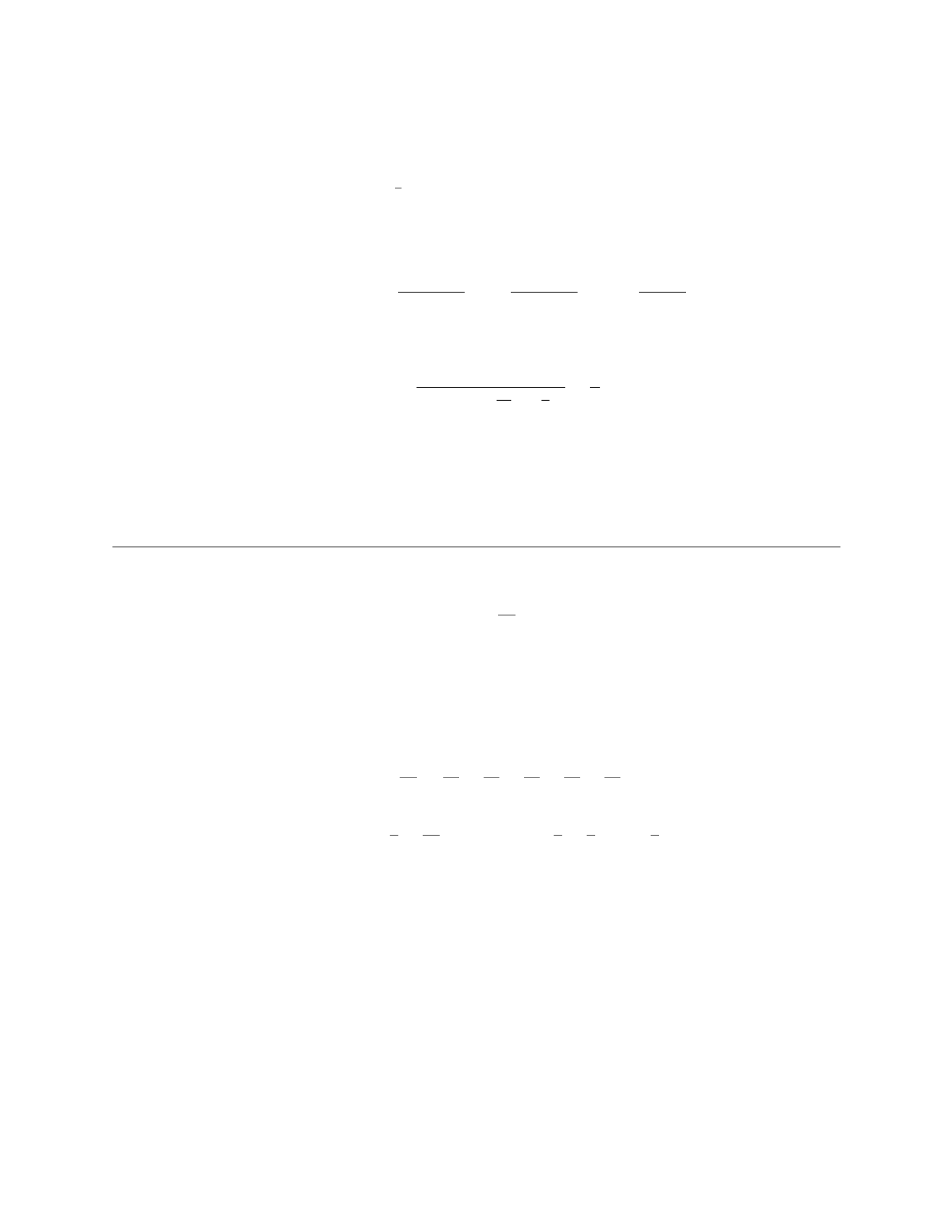
a) Calculate the Stieltjes sum of S(x)at x= 0.5when n= 2.
b) Find the Stieltjes sum of S(x)at x= 0.5as n→ ∞.
Solution 21.
a) When n= 2, we have ∆x=1
2,x1= 0.25,x2= 0.75,(∆α)1=α(x1)−α(0) = 0, and
(∆α)2=α(x2)−α(x1) = x2−x1= 0.5.
The Stieltjes sum at x= 0.5is:
S(0.25)(∆α)1+S(0.75)(∆α)2=1
1−0.252(0) + 1
1−0.752(0.5) = 1
0.9375 ×0.5≈0.5333
b) As n→ ∞, the Stieltjes sum of S(x)at x= 0.5becomes:
lim
n→∞
n
X
i=1
1
1−(0.5−1
2n+i1
n)2×1
n
This limit can be calculated numerically using a computer or software for a more accurate ap-
proximation.
21 22. TRUNCATION ERROR IN LACUNARY SERIES
Problem 22. Consider the Lacunary series given by
S=
∞
X
n=0
2n
n!
a) Calculate the value of the sum of the first 5 terms of the series, i.e., find S5.
b) Calculate the truncation error when approximating the sum Swith S5.
Solution 22.
a) To find S5, we simply need to calculate the sum of the first 5 terms of the series:
S5=
4
X
n=0
2n
n!=20
0! +21
1! +22
2! +23
3! +24
4!
S5=1+2+2+8
6+16
24 =1+2+2+4
3+2
3= 5 + 6
3= 7
Therefore, the sum of the first 5 terms of the series is S5= 7.
b) The truncation error when approximating the sum Swith S5can be calculated as the absolute
difference between the actual sum Sand the approximated sum S5, i.e.,
Truncation Error =|S−S5|
Truncation Error =|S−7|
As we know that the actual value of the series Sis infinite, the truncation error in this case will
also approach infinity. But for the first 5 terms, we can see that the truncation error is |S−7|=
| − 7|=.
Therefore, the truncation error when approximating the sum Swith S5is infinite.

22 23. SPECTRAL ANALYSIS OF LACUNARY SERIES
Problem 23. Consider the lacunary series f(x) = P∞
n=0 ancos(bnx)where a= 0.5and b= 2.
Determine the points of discontinuity of f(x)and calculate the value to which f(x)converges at
those points.
Solution 23. Let’s first find the points of discontinuity by examining the convergence of the
series at these points. The series f(x)converges at points where the partial sums of the series
converge.
a) The points of discontinuity occur when the series does not converge to a finite value. This
happens when the terms of the series do not approach zero as n→ ∞.
For f(x)to converge, we need |ancos(bnx)| → 0as n→ ∞. This requires |an| → 0and
|cos(bnx)| → 1.
As a= 0.5,|0.5n|= 0.5n→0as n→ ∞. As b= 2,|cos(2nx)|does not converge to 1 for all x
due to the rapid oscillation of cos.
Therefore, f(x)will be discontinuous at all points xwhere cos(2nx)does not converge.
b) To find the value f(x)converges to at these points, we need to determine if there is a limiting
value for the series f(x)as n→ ∞.
Since cos(bnx)does not converge for all x, the series f(x)does not converge and does not
have a specific value at these points.
Hence, f(x)will be discontinuous at all xand will not converge to a unique value at those points.
23 24. FREDHOLM INTEGRAL EQUATIONS FOR LACUNARY SERIES
Problem 24. Consider the Fredholm integral equation of the second kind:
f(x) = ex+λZ1
0
ex(t)f(t)dt
Use the method of successive approximations to solve this equation up to the third approxima-
tion with λ= 1 and starting with the initial guess f0(x) = ex.
Solution 24.
The solution to the Fredholm integral equation can be approximated using the method of suc-
cessive approximations. Let’s denote our initial guess as f0(x) = exand the nth approximation as
fn(x). The successive approximations are given by:
fn+1(x) = ex+λZ1
0
ex(t)fn(t)dt
We need to find f1(x),f2(x), and f3(x)to solve the equation up to the third approximation.
a) Let’s find f1(x):
f1(x) = ex+λZ1
0
ex(t)etdt
f1(x) = ex+λZ1
0
ex+tdt
f1(x) = ex+λex+t
11
0

f1(x) = ex+λ(ex+1 −ex)
f1(x) = ex+λex(e−1)
b) Now, let’s find f2(x):
f2(x) = ex+λZ1
0
ex(t)(et+λet(e−1))dt
f2(x) = ex+λZ1
0
ex+tdt +λ2Z1
0
ex(t)et(e−1)dt
This process is continued until the third approximation f3(x)is found.
24 25. SINGULAR PERTURBATIONS IN LACUNARY SERIES
Problem 25. Consider the lacunary series defined by f(x) = P∞
n=1 xn
10n2.
a) Find the radius of convergence of the series.
b) Determine the interval of convergence.
c) Evaluate f(1).
Solution 25. a) To find the radius of convergence of the series, we use the ratio test. Let
an=1
10n2. Applying the ratio test:
lim
n→∞
an+1
an
= lim
n→∞
1
10(n+1)2·10n2
1
= lim
n→∞
1
102n+1
= lim
n→∞
1
102n+1 = 0.
Since the limit is less than 1, the series converges for all x, giving the radius of convergence as
R=∞.
b) Since the radius of convergence is infinite, the interval of convergence is (−∞,∞).
c) To evaluate f(1), we substitute x= 1 into the series:
f(1) =
∞
X
n=1
1
10n2
=1
101+1
104+1
109+· · · .
This series is convergent, and each term is positive, so the sum is finite. Therefore, f(1) is a
finite value.

lim
n→∞
an+1
an
= lim
n→∞
3n+1
2(n+1)2
3n
2n2
= lim
n→∞
3n+1 ·2n2
2(n+1)2·3n
= lim
n→∞
3·3n·2n2
2n2+2n+1 ·3n
= lim
n→∞
3
2·2n
= 0
Since the limit of the absolute value of the ratio is less than 1, by the ratio test, the series
P∞
n=1 3n
2n2converges.
4 4. RATE OF CONVERGENCE IN LACUNARY SERIES
Problem 4. Consider the lacunary series P∞
n=1 1
n2.
a) Determine the rate of convergence of the series.
b) Estimate how many terms are needed to approximate the sum of the series with an error less
than 0.01.
Solution 4.
a) The rate of convergence of the series can be determined by looking at the behavior of the
terms 1
n2. Since 1
n2decreases monotonically to 0 as nincreases, we can use the Integral Test to
analyze convergence.
Let f(x) = 1
x2. We can integrate f(x)from 1 to infinity to find:
Z∞
1
1
x2dx =−1
x∞
1
=−lim
t→∞
1
t+ 1 = 1
Since the integral converges to a finite value (1), the series P∞
n=1 1
n2also converges. Therefore,
the rate of convergence of the series can be considered as moderate.
b) To estimate the number of terms needed to approximate the sum with an error less than 0.01,
we can use the fact that the series converges to the Basel problem value of π2
6.
Let Snbe the partial sum of the first nterms of the series. We want to find nsuch that |S−Sn|<
0.01, where Sis the sum π2
6.
Using the error bound for alternating series, we have:
∞
X
k=n+1
1
k2
<1
(n+ 1)2<0.01
Solving for n, we get n > q1
0.01 −1=9. Therefore, to approximate the sum of the series with
an error less than 0.01, we need at least 10 terms.
5 5. OSCILLATION BEHAVIOR IN LACUNARY SERIES
Problem 5. Consider the Lacunary Series given by the formula f(x) = P∞
n=1
(−1)n
n2.
a) Find the first four partial sums of the series.
b) Determine if the series converges or diverges.
c) Calculate the value to which the series converges (if it converges).
Solution 5.
a) To find the first four partial sums of the series, we will calculate S1,S2,S3, and S4:
S1=(−1)1
12=−1
S2=(−1)1
12+(−1)2
22=−1 + 1
4=−3
4
S3=(−1)1
12+(−1)2
22+(−1)3
32=−1 + 1
4−1
9=−31
36
S4=(−1)1
12+(−1)2
22+(−1)3
32+(−1)4
42=−1 + 1
4−1
9+1
16 =−365
576
Therefore, the first four partial sums of the series are −1,−3
4,−31
36 , and −365
576 .
b) To determine if the series converges or diverges, we will use the Alternating Series Test. The
terms an=1
n2are positive, decreasing, and approach 0. Hence, the series converges.
c) Since the series converges, we can find the value to which it converges by summing all the
terms infinitely: ∞
X
n=1
(−1)n
n2=−1 + 1
4−1
9+1
16 −. . .
By Euler’s solution to the Basel problem, the sum of this series converges to π2
12 . Therefore, the
value to which the series converges is π2
12 .
I.
6 6. SUMMABILITY CRITERIA IN LACUNARY SERIES
Problem 6. Consider the lacunary series P∞
n=1 an, where a= 2. Determine the sum of the
series using the ratio test.
Solution 6. a) We apply the ratio test to determine the convergence of the series:
lim
n→∞
an+1
an
= lim
n→∞
an+1
an
= lim
n→∞
a
1
= lim
n→∞ |a|=|2|= 2.
Since the limit is greater than 1, the series diverges.
b) To find the sum of this series, let’s consider the partial sum Sn=Pn
k=0 2k:
Sn= 1 + 2 + 22+ 23+· · · + 2n.

This is a geometric series with first term a= 1 and common ratio r= 2. The sum of a geometric
series is given by:
Sn=a(1 −rn+1)
1−r.
Substitute a= 1 and r= 2 into the formula to get:
Sn=1(1 −2n+1)
1−2= 2n+1 −1.
c) Therefore, the sum of the series is:
lim
n→∞ Sn= lim
n→∞(2n+1 −1) = lim
n→∞ 2n+1 −lim
n→∞ 1 = ∞.
Thus, the sum of the series is infinite as it diverges.
Certainly! Here is a numerical problem on Lacunary Series:
—
7 7. ERROR ANALYSIS IN LACUNARY SERIES
Problem 7. Let {an}be a lacunary series given by an= 2n. Compute the sum of the first 5 terms
of this series and determine the error when approximating this sum by the fifth term in the series.
Solution 7. a) To find the sum of the first 5 terms of the series, we simply add up the terms:
S5= 21+ 22+ 23+ 24+ 25
Calculating:
S5= 2 + 4 + 8 + 16 + 32 = 62
Therefore, the sum of the first 5 terms of the series is 62.
b) Now, let’s find the error when approximating this sum by the fifth term in the series:
Error =S5−a5= 62 −25= 62 −32 = 30
Hence, the error of approximating the sum of the first 5 terms of the series by the fifth term in
the series is 30.
Therefore, the sum of the first 5 terms of the series is 62, and the error in approximating this
sum by the fifth term in the series is 30.
8 8. BOUNDARY VALUE PROBLEMS FOR LACUNARY SERIES
Problem 8. Consider the lacunary series S(x) = P∞
n=1 xn
5nover the interval of convergence
(−5,5).
a) Find the value of S(−5).
b) Determine the interval of convergence of the series.
Solution 8.
a) We can find the value of S(−5) by substituting x=−5into the series:
S(−5) =
∞
X
n=1
(−5)n
5n
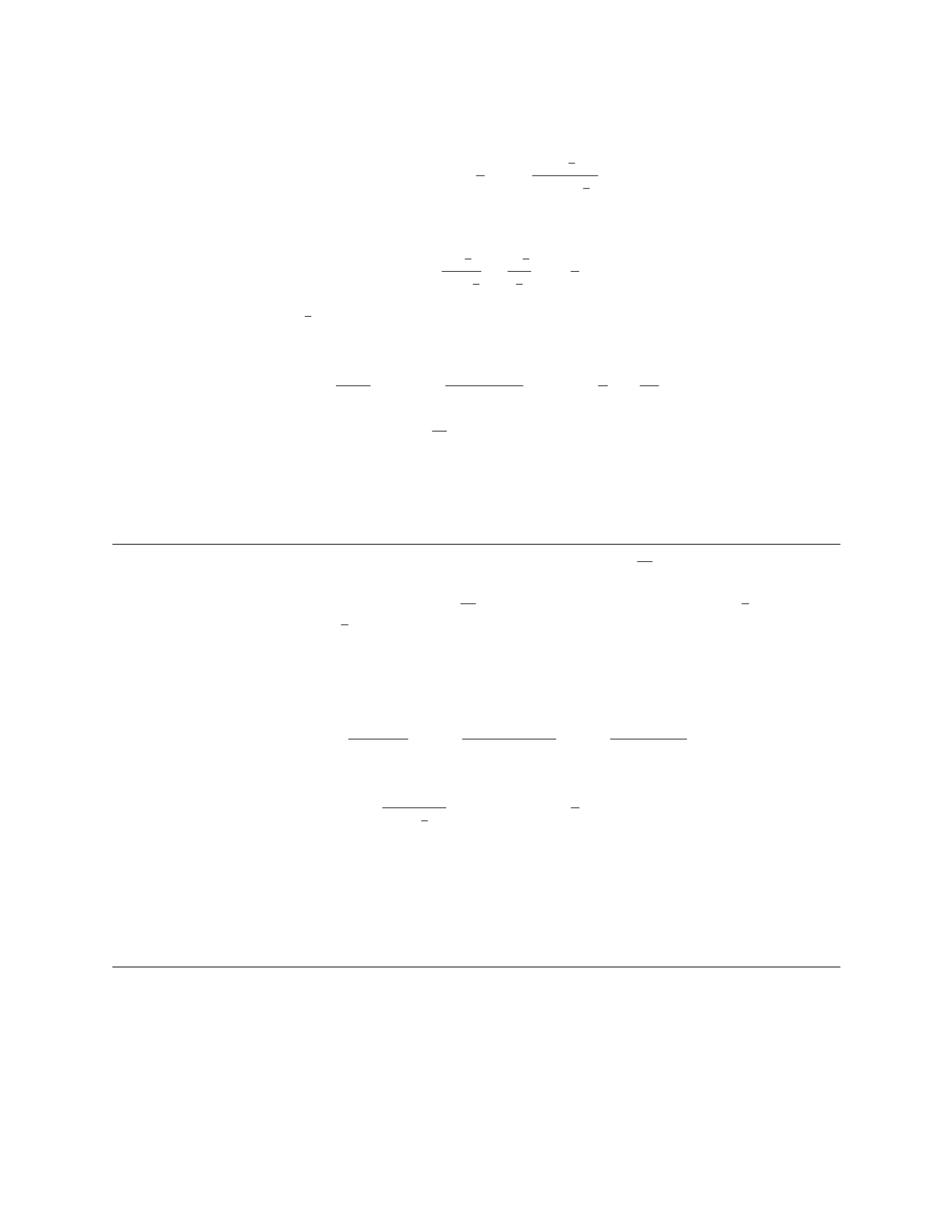
Simplifying the expression, we get:
S(−5) =
∞
X
n=1 −1
5n
=−1
5
1−(−1
5)
Calculating the sum, we find:
S(−5) = −1
5
1 + 1
5
=−1
5
6
5
=−1
6
Therefore, S(−5) = −1
6.
b) To determine the interval of convergence, we use the Ratio Test:
lim
n→∞
an+1
an
= lim
n→∞
xn+1/5n+1
xn/5n
= lim
n→∞
x
5
=|x|
5
For the series to converge, we require |x|
5<1, i.e., |x|<5. Thus, the interval of convergence
is (−5,5).
9 9. SINGULARITIES IN LACUNARY SERIES
Problem 9. Consider the lacunary series defined as f(x) = P∞
n=1 4n
xn. Determine the singular-
ities of the function f(x)and analyze their nature.
Solution 9. The given series f(x) = P∞
n=1 4n
xnis a geometric series with ratio r=4
x. The series
converges only if |r|<1, i.e.,
4
x
<1→ |x|>4.
Therefore, the singularities of the function f(x)occur at x= 4.
To investigate the nature of the singularity at x= 4, we expand f(x)as a Laurent series about
x= 4. Let z=x−4to rewrite f(x)as:
f(x) =
∞
X
n=1
4n
(z+ 4)n=
∞
X
n=1
4n
4n(1 + z/4)n=
∞
X
n=1
1
(1 + z/4)n
=
∞
X
n=1
1
1 + z
4n=
∞
X
n=1
(−1)n−1z
4n−1
This Laurent series representation at x= 4 around the singularity x= 4 shows that the singu-
larity is an essential singularity.
10 10. ANALYTIC CONTINUATION OF LACUNARY SERIES
Problem 10. Consider the lacunary series
∞
X
n=1
z2nwhere zis a complex number.
a) Find the radius of convergence of the series.
b) Determine the set of points where the series converges.
c) Find the analytic continuation of the series.
Solution 10.
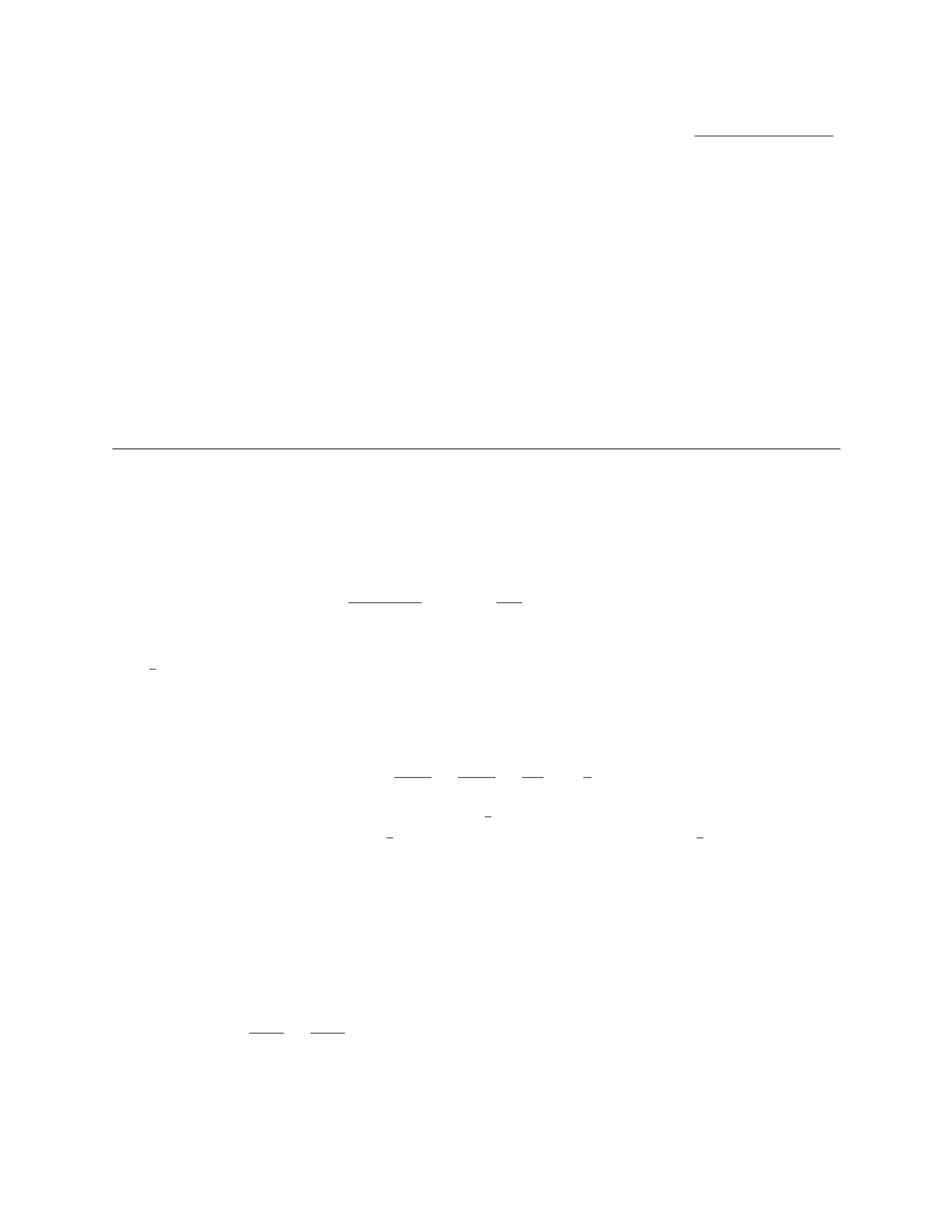
a) The radius of convergence Rof a power series
∞
X
n=0
anznis given by R=1
lim supn→∞ |an|1/n .
In this case, an= 1 for n= 2kfor various integers k, and an= 0 otherwise. Therefore, the series
∞
X
n=1
z2ndiverges unless |z|<1. Thus, the radius of convergence is R= 1.
b) The series converges for all zsuch that |z|<1. This follows from the ratio test, which can
be applied to conclude that the series absolutely converges when |z|<1. It diverges when |z| ≥ 1.
c) The series
∞
X
n=1
z2ncan be analytically continued to the unit disk |z|<1. This is due to the
radius of convergence being 1. Thus, the series can be expressed as an analytic function in the
region |z|<1.
11 11. RESUMMATION METHODS FOR LACUNARY SERIES
Problem 11. Consider the lacunary series P∞
n=0 3nx2n. Determine the radius of convergence
and find the sum of the series for x= 1.
Solution 11.
a) Radius of convergence:
To find the radius of convergence, we use the ratio test:
lim
n→∞
3n+1x2n+1
3nx2n
= lim
n→∞
3x2
x
= lim
n→∞ 3x= 3x
The series converges if 3x < 1, and diverges if 3x > 1. Thus, the radius of convergence is
R=1
3.
b) Sum of the series for x= 1:
When x= 1, the series becomes P∞
n=0 3n. This is a geometric series with a= 3 and r= 3.
The sum of a geometric series is given by:
S=a
1−r=3
1−3=3
−2=−3
2
Therefore, the sum of the series for x= 1 is −3
2.
So, the radius of convergence is 1
3and the sum of the series for x= 1 is −3
2.
I. Problem:
12. GROWTH RATES IN LACUNARY SERIES
Consider the lacunary series defined by the sequence (an)where an= 2nif nis a power of 2,
and an= 0 otherwise.
a) Find the growth rate of this lacunary series.
b) Determine whether this series converges or diverges.
Solution:
a) To find the growth rate of the series, we can calculate the ratio of consecutive terms:
Let’s consider a2k+1
a2k=22k+1
22k= 22k+1−2k= 22k.
So, the growth rate of the series is 22k.
b) To determine the convergence of this series, let’s express the sum of nterms:
Sn=a1+a2+a4+. . . +a2m, where mis the largest integer such that 2m≤n.

As a2k= 22k, the sum Sn= 22+ 24+ 28+. . . + 22m.
This is a geometric series with common ratio 22, so
Sn= 22(1 + 22+ (22)2+. . . + (22)m).
Using the formula for the sum of a geometric series, we have:
Sn= 22·(22(m+1)−1)
22−1= 22(m+1) −1.
Hence, the series diverges as n→ ∞.
12 13. REGULARIZATION TECHNIQUES FOR LACUNARY SERIES
Problem 13. Consider the lacunary series P∞
n=0 anwhere a= 0.5, and the regularization
technique is applied to sum the series.
a) Determine the value of the regularized sum of the series.
b) Calculate the sum of the first 5 terms of the series.
c) Find the absolute error in the sum obtained in part (a) compared to the actual sum of the
series.
Solution 13.
a) To regularize the series, we use the formula for the sum of a geometric series:
S=a
1−r
where ais the first term and ris the common ratio.
In this case, a= 1 and r= 0.5. Plugging these values into the formula:
S=1
1−0.5= 2
Therefore, the value of the regularized sum of the series is S= 2.
b) To find the sum of the first 5 terms of the series, we substitute n= 0,1,2,3,4into the series
and add them up:
4
X
n=0
an= 1 + 0.5+0.25 + 0.125 + 0.0625 = 1.9375
Therefore, the sum of the first 5 terms of the series is 1.9375.
c) The actual sum of the geometric series is given by the formula:
S=a
1−r
Substitute a= 1 and r= 0.5:
S=1
1−0.5= 2
The absolute error in the sum obtained from regularization compared to the actual sum is:
|2−1.9375|= 0.0625
Therefore, the absolute error is 0.0625.
13 14. STABILITY ISSUES IN LACUNARY SERIES
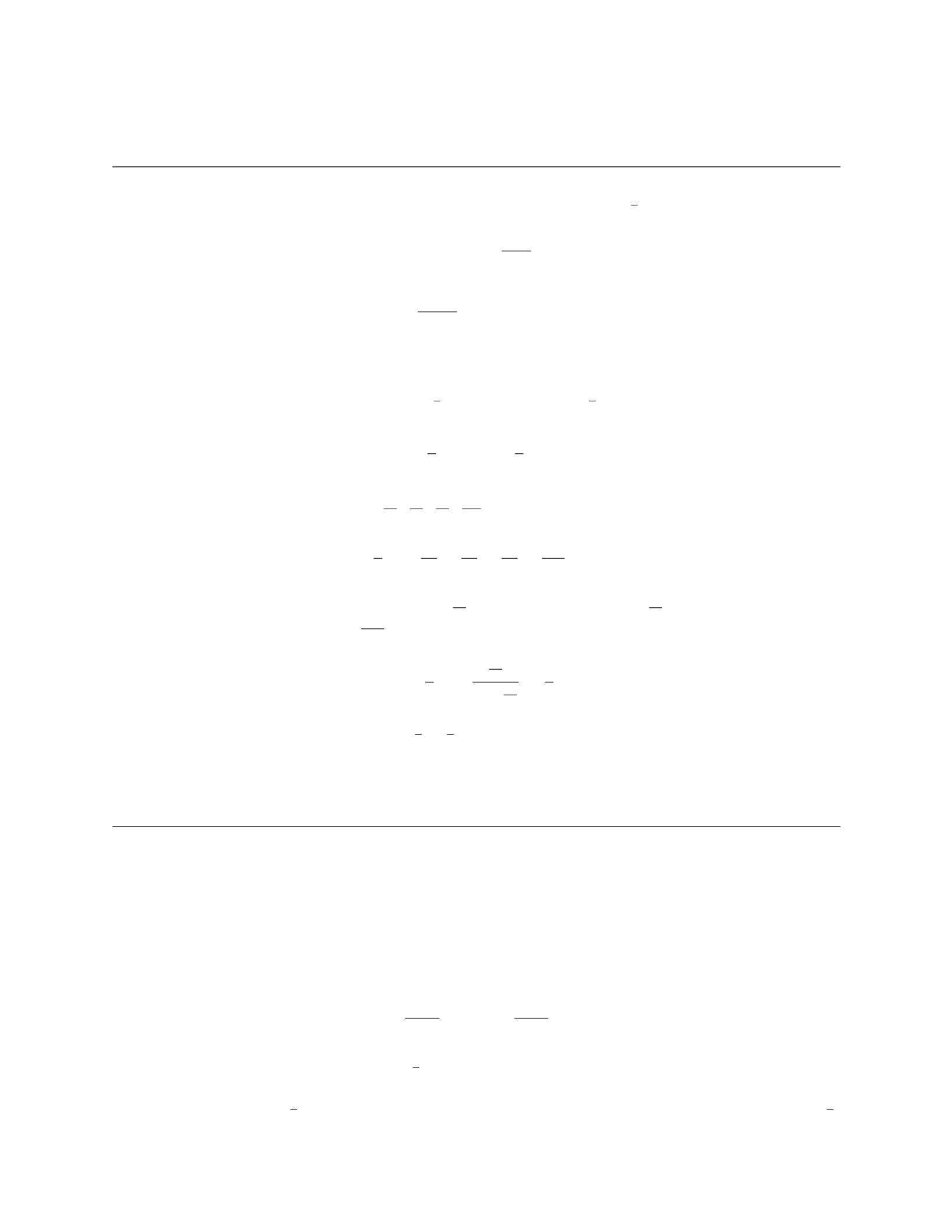
Problem 14. Consider the lacunary series defined by S(x) = P∞
n=1 x2n. Determine the con-
vergence interval of this series and find the sum of the series for x=1
2.
Solution 14. a) The convergence interval of a lacunary series is determined by the ratio of
consecutive terms. Consider the ratio r= limn→∞
an+1
an
, where anis the n-th term of the series.
In this case, an=x2n, so
r= lim
n→∞
x2n+1
x2n
= lim
n→∞
x2n
=|x|2
For the series to converge, we must have r < 1, so |x|2<1which implies −1< x < 1. Therefore,
the convergence interval of the series is (−1,1).
b) To find the sum of the series for x=1
2, we substitute x=1
2into the series:
S1
2=
∞
X
n=1 1
22n
The first few terms of the series are 1
22,1
24,1
28,1
216 ,. . . . Thus, the sum of the series is
S1
2=1
22+1
24+1
28+1
216 +. . .
This is a geometric series with first term a=1
22and common ratio r=1
24. The sum of an infinite
geometric series is given by S=a
1−r. Substituting aand rinto the formula, we get
S1
2=
1
22
1−1
24
=1
3
Therefore, the sum of the series for x=1
2is 1
3.
14 15. ANALYTICITY PROPERTIES OF LACUNARY SERIES
Problem 15. Consider the lacunary series P∞
n=0 anznwhere an= 2nfor all n≥0.
a) Determine the radius of convergence of the series.
b) Find the interval of convergence of the series.
c) Determine whether the series converges uniformly on any closed disk contained entirely
within the interval of convergence.
Solution 15.
a) To find the radius of convergence, we can use the ratio test:
lim
n→∞
an+1
an
= lim
n→∞
2n+1
2n
= 2.
Thus, the radius of convergence is R=1
2.
b) To determine the interval of convergence, we consider the boundary points of the disk of
convergence. At z=−1
2, the series becomes the harmonic series which diverges, and at z=1
2,

the series becomes a geometric series which converges. Therefore, the interval of convergence is
(−1
2,1
2).
c) For the series to converge uniformly on a closed disk contained entirely within the interval
of convergence, the series must be uniformly convergent on the interval [−1
2+ϵ, 1
2−ϵ]for some
ϵ > 0. However, since the series diverges at z=−1
2, it cannot converge uniformly on this interval.
Therefore, the series does not converge uniformly on any closed disk contained entirely within the
interval of convergence.
I can certainly generate numerical problem questions for you! Here is an example problem with
a detailed solution:
15 16. FRACTIONAL CALCULUS APPROACHES TO LACUNARY SERIES
Problem 16. Consider the lacunary series defined by P∞
n=0 n3
2n. Find the sum of this series.
Solution 16. To find the sum of the series, we will use a well-known technique for summing
certain types of series involving the derivative of the geometric series.
Let f(x) = P∞
n=0 xn. Taking the derivative of f(x)we get:
f′(x) =
∞
X
n=0
nxn−1=
∞
X
n=0
nxn/x
Multiplying both sides by x, we get:
xf′(x) =
∞
X
n=0
nxn
Now, differentiating both sides of the definition of f(x)will yield a closed form for f′(x).
Differentiating gives:
f′(x) =
∞
X
n=1
nxn−1=1
(1 −x)2
This can be obtained by observing that the derivative of the geometric series is a series for
1/(1 −x)2.
Now, integrating both sides, we see that:
f(x) = Z1
(1 −x)2dx =Z∞
X
n=0
nxndx
Evaluating the integral gives:
f(x) = −1
1−x+C
for some constant C. Since f(0) = 1, we can deduce that C= 1, so:
f(x) = 1
1−x
Now we can find the sum of our original series by taking derivatives.
Let S=P∞
n=0 n3
2n. We start by finding the generating function for our series, using the fact that
1
1−x=P∞
n=0 xn, we can write:

x
(1 −x)2=
∞
X
n=1
nxn−1
Differentiating both sides with respect to xgives:
1 + x
(1 −x)2=
∞
X
n=1
n2xn−1
Multiplying by xand differentiating again:
x(1 + 2x)
(1 −x)3=
∞
X
n=1
n3xn−1
Substitute x= 1/2to get:
1/2(1 + 1)
(1 −1/2)3=S
Solving for Sgives:
S= 4
Therefore, the sum of the series is 4.
16 17. INVERSE PROBLEMS FOR LACUNARY SERIES
Problem 17. Consider the Lacunary series defined by f(z) = P∞
n=0 anzbn, where a=1
2and b= 2.
Find the explicit form of the function f(z).
Solution 17. To find the explicit form of the function f(z), we can first rewrite the series using
the given values of aand b.
The Lacunary series becomes:
f(z) =
∞
X
n=0 1
2n
z2n
Now, let’s simplify this expression by expanding the terms:
f(z) = 1 + 1
2z2+1
4z4+1
8z8+. . .
Notice that this Lacunary series behaves like a geometric series with common ratio r=z2.
Using the formula for the sum of an infinite geometric series, we have:
f(z) = 1
1−1
2z2
Thus, the explicit form of the function f(z)is:
f(z) = 1
1−1
2z2

17 18. BOUNDARY CONDITIONS IN LACUNARY SERIES
Problem 18. Consider the lacunary series P∞
n=0 anz2nwith an=1
n+1 for all n≥0. Determine
the convergence boundary of this lacunary series in the complex plane and find the radius of
convergence.
Solution 18.
Given the lacunary series P∞
n=0 1
n+1 z2n, we want to determine the convergence boundary in
the complex plane and find the radius of convergence.
a) To find the convergence boundary, we use Hadamard’s Theorem, which states that the radius
of convergence Ris given by:
R= lim
n→∞ 1
an1
n
In our case, an=1
n+1 . Substituting this into the formula, we get:
R= lim
n→∞ (n+ 1) 1
n
Using the limit properties, we get:
R= lim
n→∞(1 + 1
n)n=e
Therefore, the convergence boundary of this lacunary series is the circle |z|=e.
b) To find the radius of convergence, we have R=e. Hence, the radius of convergence of the
series is e.
18 19. NONLINEAR EFFECTS IN LACUNARY SERIES
Problem 19. Consider the lacunary series P∞
n=1 5n
n!.
a) Calculate the radius of convergence of the series.
b) Determine the interval of convergence.
c) Evaluate the sum of the series.
Solution 19.
a) To find the radius of convergence Rof the series P∞
n=1 5n
n!, we’ll use the ratio test. Let
an=5n
n!. The ratio test states that if limn→∞
an+1
an
=L, then R=1
L.
Calculating the ratio:
lim
n→∞
an+1
an
= lim
n→∞
5n+1
(n+1)!
5n
n!
= lim
n→∞
5n+1 ·n!
5n·(n+ 1)!
= lim
n→∞
5
n+ 1
= 0.
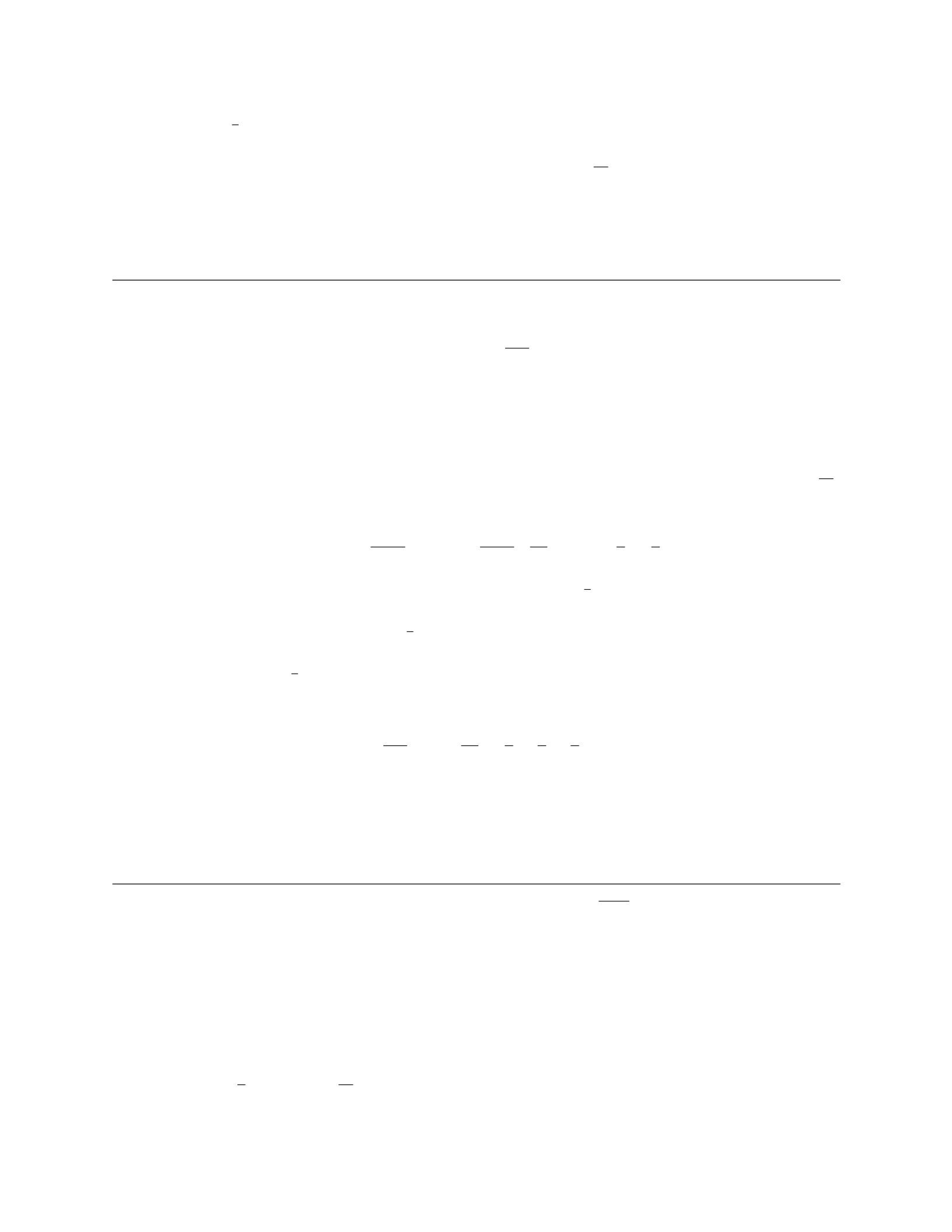
Therefore, R=1
0=∞.
b) Since the radius of convergence R=∞, the interval of convergence is (−∞,∞).
c) To evaluate the sum of the series, we recognize that P∞
n=1 5n
n!is the well-known Taylor series
expansion of ex, where x= 5. Hence, the sum of the series is e5.
19 20. CONFORMAL MAPPING APPLICATIONS TO LACUNARY SERIES
Problem 20. Consider the lacunary series given by the following expression:
f(z) =
∞
X
n=1
z2n
2n
a) Find the radius of convergence of the series f(z).
b) Determine all points on the boundary of convergence where the series is convergent.
c) Find the sum of the series f(z)for z= 1.
Solution 20.
a) To find the radius of convergence of the series f(z), we will apply the ratio test. Let an=1
2n.
Using the ratio test,
R= lim
n→∞
an+1
an
= lim
n→∞
1
2n+1 ·2n
1
= lim
n→∞
1
2=1
2
Hence, the radius of convergence of the series f(z)is R=1
2.
b) To determine all points on the boundary of convergence where the series is convergent, we
consider the points zsuch that |z|=1
2. At these boundary points, the series may or may not
converge. Due to the nature of the given lacunary series, the series converges at all boundary
points zsuch that |z|=1
2.
c) To find the sum of the series f(z)for z= 1, we substitute z= 1 into the expression:
f(1) =
∞
X
n=1
12n
2n=
∞
X
n=1
1
2n=1
2+1
4+1
8+. . . = 1
Therefore, the sum of the series f(z)for z= 1 is 1.
20 21. STIELTJES SUMMATION OF LACUNARY SERIES
Problem 21. Consider the lacunary series defined by S(x) = 1
1−x2. Calculate the Stieltjes sum
of S(x)at x= 0.5.
Solution 21. The Stieltjes sum of a function f(x)at a point x=ais defined as the limit of the
Riemann sum as the subinterval length approaches zero. So, the Stieltjes sum of S(x)at x= 0.5
is given by:
lim
∆x→0
n
X
i=1
S(xi)(∆α)i
where ∆x=1
n,xi= 0.5−1
2n+i∆x, and (∆α)i=α(xi)−α(xi−1).
Let’s calculate the Stieltjes sum of S(x)at x= 0.5.
a) Calculate the Stieltjes sum of S(x)at x= 0.5when n= 2.
b) Find the Stieltjes sum of S(x)at x= 0.5as n→ ∞.
Solution 21.
a) When n= 2, we have ∆x=1
2,x1= 0.25,x2= 0.75,(∆α)1=α(x1)−α(0) = 0, and
(∆α)2=α(x2)−α(x1) = x2−x1= 0.5.
The Stieltjes sum at x= 0.5is:
S(0.25)(∆α)1+S(0.75)(∆α)2=1
1−0.252(0) + 1
1−0.752(0.5) = 1
0.9375 ×0.5≈0.5333
b) As n→ ∞, the Stieltjes sum of S(x)at x= 0.5becomes:
lim
n→∞
n
X
i=1
1
1−(0.5−1
2n+i1
n)2×1
n
This limit can be calculated numerically using a computer or software for a more accurate ap-
proximation.
21 22. TRUNCATION ERROR IN LACUNARY SERIES
Problem 22. Consider the Lacunary series given by
S=
∞
X
n=0
2n
n!
a) Calculate the value of the sum of the first 5 terms of the series, i.e., find S5.
b) Calculate the truncation error when approximating the sum Swith S5.
Solution 22.
a) To find S5, we simply need to calculate the sum of the first 5 terms of the series:
S5=
4
X
n=0
2n
n!=20
0! +21
1! +22
2! +23
3! +24
4!
S5=1+2+2+8
6+16
24 =1+2+2+4
3+2
3= 5 + 6
3= 7
Therefore, the sum of the first 5 terms of the series is S5= 7.
b) The truncation error when approximating the sum Swith S5can be calculated as the absolute
difference between the actual sum Sand the approximated sum S5, i.e.,
Truncation Error =|S−S5|
Truncation Error =|S−7|
As we know that the actual value of the series Sis infinite, the truncation error in this case will
also approach infinity. But for the first 5 terms, we can see that the truncation error is |S−7|=
| − 7|=.
Therefore, the truncation error when approximating the sum Swith S5is infinite.

22 23. SPECTRAL ANALYSIS OF LACUNARY SERIES
Problem 23. Consider the lacunary series f(x) = P∞
n=0 ancos(bnx)where a= 0.5and b= 2.
Determine the points of discontinuity of f(x)and calculate the value to which f(x)converges at
those points.
Solution 23. Let’s first find the points of discontinuity by examining the convergence of the
series at these points. The series f(x)converges at points where the partial sums of the series
converge.
a) The points of discontinuity occur when the series does not converge to a finite value. This
happens when the terms of the series do not approach zero as n→ ∞.
For f(x)to converge, we need |ancos(bnx)| → 0as n→ ∞. This requires |an| → 0and
|cos(bnx)| → 1.
As a= 0.5,|0.5n|= 0.5n→0as n→ ∞. As b= 2,|cos(2nx)|does not converge to 1 for all x
due to the rapid oscillation of cos.
Therefore, f(x)will be discontinuous at all points xwhere cos(2nx)does not converge.
b) To find the value f(x)converges to at these points, we need to determine if there is a limiting
value for the series f(x)as n→ ∞.
Since cos(bnx)does not converge for all x, the series f(x)does not converge and does not
have a specific value at these points.
Hence, f(x)will be discontinuous at all xand will not converge to a unique value at those points.
23 24. FREDHOLM INTEGRAL EQUATIONS FOR LACUNARY SERIES
Problem 24. Consider the Fredholm integral equation of the second kind:
f(x) = ex+λZ1
0
ex(t)f(t)dt
Use the method of successive approximations to solve this equation up to the third approxima-
tion with λ= 1 and starting with the initial guess f0(x) = ex.
Solution 24.
The solution to the Fredholm integral equation can be approximated using the method of suc-
cessive approximations. Let’s denote our initial guess as f0(x) = exand the nth approximation as
fn(x). The successive approximations are given by:
fn+1(x) = ex+λZ1
0
ex(t)fn(t)dt
We need to find f1(x),f2(x), and f3(x)to solve the equation up to the third approximation.
a) Let’s find f1(x):
f1(x) = ex+λZ1
0
ex(t)etdt
f1(x) = ex+λZ1
0
ex+tdt
f1(x) = ex+λex+t
11
0

f1(x) = ex+λ(ex+1 −ex)
f1(x) = ex+λex(e−1)
b) Now, let’s find f2(x):
f2(x) = ex+λZ1
0
ex(t)(et+λet(e−1))dt
f2(x) = ex+λZ1
0
ex+tdt +λ2Z1
0
ex(t)et(e−1)dt
This process is continued until the third approximation f3(x)is found.
24 25. SINGULAR PERTURBATIONS IN LACUNARY SERIES
Problem 25. Consider the lacunary series defined by f(x) = P∞
n=1 xn
10n2.
a) Find the radius of convergence of the series.
b) Determine the interval of convergence.
c) Evaluate f(1).
Solution 25. a) To find the radius of convergence of the series, we use the ratio test. Let
an=1
10n2. Applying the ratio test:
lim
n→∞
an+1
an
= lim
n→∞
1
10(n+1)2·10n2
1
= lim
n→∞
1
102n+1
= lim
n→∞
1
102n+1 = 0.
Since the limit is less than 1, the series converges for all x, giving the radius of convergence as
R=∞.
b) Since the radius of convergence is infinite, the interval of convergence is (−∞,∞).
c) To evaluate f(1), we substitute x= 1 into the series:
f(1) =
∞
X
n=1
1
10n2
=1
101+1
104+1
109+· · · .
This series is convergent, and each term is positive, so the sum is finite. Therefore, f(1) is a
finite value.

lim
n→∞
an+1
an
= lim
n→∞
3n+1
2(n+1)2
3n
2n2
= lim
n→∞
3n+1 ·2n2
2(n+1)2·3n
= lim
n→∞
3·3n·2n2
2n2+2n+1 ·3n
= lim
n→∞
3
2·2n
= 0
Since the limit of the absolute value of the ratio is less than 1, by the ratio test, the series
P∞
n=1 3n
2n2converges.
4 4. RATE OF CONVERGENCE IN LACUNARY SERIES
Problem 4. Consider the lacunary series P∞
n=1 1
n2.
a) Determine the rate of convergence of the series.
b) Estimate how many terms are needed to approximate the sum of the series with an error less
than 0.01.
Solution 4.
a) The rate of convergence of the series can be determined by looking at the behavior of the
terms 1
n2. Since 1
n2decreases monotonically to 0 as nincreases, we can use the Integral Test to
analyze convergence.
Let f(x) = 1
x2. We can integrate f(x)from 1 to infinity to find:
Z∞
1
1
x2dx =−1
x∞
1
=−lim
t→∞
1
t+ 1 = 1
Since the integral converges to a finite value (1), the series P∞
n=1 1
n2also converges. Therefore,
the rate of convergence of the series can be considered as moderate.
b) To estimate the number of terms needed to approximate the sum with an error less than 0.01,
we can use the fact that the series converges to the Basel problem value of π2
6.
Let Snbe the partial sum of the first nterms of the series. We want to find nsuch that |S−Sn|<
0.01, where Sis the sum π2
6.
Using the error bound for alternating series, we have:
∞
X
k=n+1
1
k2
<1
(n+ 1)2<0.01
Solving for n, we get n > q1
0.01 −1=9. Therefore, to approximate the sum of the series with
an error less than 0.01, we need at least 10 terms.
5 5. OSCILLATION BEHAVIOR IN LACUNARY SERIES
Problem 5. Consider the Lacunary Series given by the formula f(x) = P∞
n=1
(−1)n
n2.
a) Find the first four partial sums of the series.
b) Determine if the series converges or diverges.
c) Calculate the value to which the series converges (if it converges).
Solution 5.
a) To find the first four partial sums of the series, we will calculate S1,S2,S3, and S4:
S1=(−1)1
12=−1
S2=(−1)1
12+(−1)2
22=−1 + 1
4=−3
4
S3=(−1)1
12+(−1)2
22+(−1)3
32=−1 + 1
4−1
9=−31
36
S4=(−1)1
12+(−1)2
22+(−1)3
32+(−1)4
42=−1 + 1
4−1
9+1
16 =−365
576
Therefore, the first four partial sums of the series are −1,−3
4,−31
36 , and −365
576 .
b) To determine if the series converges or diverges, we will use the Alternating Series Test. The
terms an=1
n2are positive, decreasing, and approach 0. Hence, the series converges.
c) Since the series converges, we can find the value to which it converges by summing all the
terms infinitely: ∞
X
n=1
(−1)n
n2=−1 + 1
4−1
9+1
16 −. . .
By Euler’s solution to the Basel problem, the sum of this series converges to π2
12 . Therefore, the
value to which the series converges is π2
12 .
I.
6 6. SUMMABILITY CRITERIA IN LACUNARY SERIES
Problem 6. Consider the lacunary series P∞
n=1 an, where a= 2. Determine the sum of the
series using the ratio test.
Solution 6. a) We apply the ratio test to determine the convergence of the series:
lim
n→∞
an+1
an
= lim
n→∞
an+1
an
= lim
n→∞
a
1
= lim
n→∞ |a|=|2|= 2.
Since the limit is greater than 1, the series diverges.
b) To find the sum of this series, let’s consider the partial sum Sn=Pn
k=0 2k:
Sn= 1 + 2 + 22+ 23+· · · + 2n.

This is a geometric series with first term a= 1 and common ratio r= 2. The sum of a geometric
series is given by:
Sn=a(1 −rn+1)
1−r.
Substitute a= 1 and r= 2 into the formula to get:
Sn=1(1 −2n+1)
1−2= 2n+1 −1.
c) Therefore, the sum of the series is:
lim
n→∞ Sn= lim
n→∞(2n+1 −1) = lim
n→∞ 2n+1 −lim
n→∞ 1 = ∞.
Thus, the sum of the series is infinite as it diverges.
Certainly! Here is a numerical problem on Lacunary Series:
—
7 7. ERROR ANALYSIS IN LACUNARY SERIES
Problem 7. Let {an}be a lacunary series given by an= 2n. Compute the sum of the first 5 terms
of this series and determine the error when approximating this sum by the fifth term in the series.
Solution 7. a) To find the sum of the first 5 terms of the series, we simply add up the terms:
S5= 21+ 22+ 23+ 24+ 25
Calculating:
S5= 2 + 4 + 8 + 16 + 32 = 62
Therefore, the sum of the first 5 terms of the series is 62.
b) Now, let’s find the error when approximating this sum by the fifth term in the series:
Error =S5−a5= 62 −25= 62 −32 = 30
Hence, the error of approximating the sum of the first 5 terms of the series by the fifth term in
the series is 30.
Therefore, the sum of the first 5 terms of the series is 62, and the error in approximating this
sum by the fifth term in the series is 30.
8 8. BOUNDARY VALUE PROBLEMS FOR LACUNARY SERIES
Problem 8. Consider the lacunary series S(x) = P∞
n=1 xn
5nover the interval of convergence
(−5,5).
a) Find the value of S(−5).
b) Determine the interval of convergence of the series.
Solution 8.
a) We can find the value of S(−5) by substituting x=−5into the series:
S(−5) =
∞
X
n=1
(−5)n
5n
Simplifying the expression, we get:
S(−5) =
∞
X
n=1 −1
5n
=−1
5
1−(−1
5)
Calculating the sum, we find:
S(−5) = −1
5
1 + 1
5
=−1
5
6
5
=−1
6
Therefore, S(−5) = −1
6.
b) To determine the interval of convergence, we use the Ratio Test:
lim
n→∞
an+1
an
= lim
n→∞
xn+1/5n+1
xn/5n
= lim
n→∞
x
5
=|x|
5
For the series to converge, we require |x|
5<1, i.e., |x|<5. Thus, the interval of convergence
is (−5,5).
9 9. SINGULARITIES IN LACUNARY SERIES
Problem 9. Consider the lacunary series defined as f(x) = P∞
n=1 4n
xn. Determine the singular-
ities of the function f(x)and analyze their nature.
Solution 9. The given series f(x) = P∞
n=1 4n
xnis a geometric series with ratio r=4
x. The series
converges only if |r|<1, i.e.,
4
x
<1→ |x|>4.
Therefore, the singularities of the function f(x)occur at x= 4.
To investigate the nature of the singularity at x= 4, we expand f(x)as a Laurent series about
x= 4. Let z=x−4to rewrite f(x)as:
f(x) =
∞
X
n=1
4n
(z+ 4)n=
∞
X
n=1
4n
4n(1 + z/4)n=
∞
X
n=1
1
(1 + z/4)n
=
∞
X
n=1
1
1 + z
4n=
∞
X
n=1
(−1)n−1z
4n−1
This Laurent series representation at x= 4 around the singularity x= 4 shows that the singu-
larity is an essential singularity.
10 10. ANALYTIC CONTINUATION OF LACUNARY SERIES
Problem 10. Consider the lacunary series
∞
X
n=1
z2nwhere zis a complex number.
a) Find the radius of convergence of the series.
b) Determine the set of points where the series converges.
c) Find the analytic continuation of the series.
Solution 10.
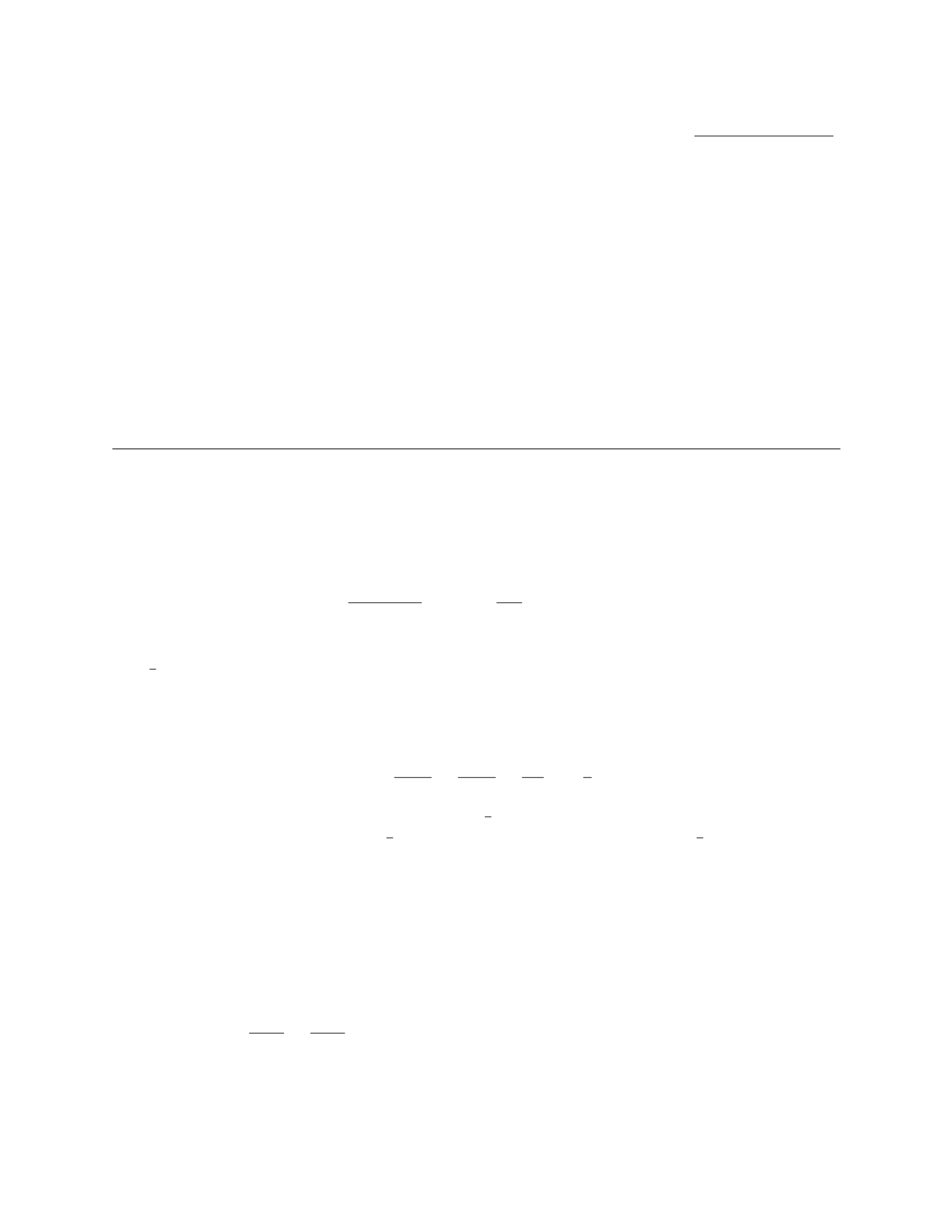
a) The radius of convergence Rof a power series
∞
X
n=0
anznis given by R=1
lim supn→∞ |an|1/n .
In this case, an= 1 for n= 2kfor various integers k, and an= 0 otherwise. Therefore, the series
∞
X
n=1
z2ndiverges unless |z|<1. Thus, the radius of convergence is R= 1.
b) The series converges for all zsuch that |z|<1. This follows from the ratio test, which can
be applied to conclude that the series absolutely converges when |z|<1. It diverges when |z| ≥ 1.
c) The series
∞
X
n=1
z2ncan be analytically continued to the unit disk |z|<1. This is due to the
radius of convergence being 1. Thus, the series can be expressed as an analytic function in the
region |z|<1.
11 11. RESUMMATION METHODS FOR LACUNARY SERIES
Problem 11. Consider the lacunary series P∞
n=0 3nx2n. Determine the radius of convergence
and find the sum of the series for x= 1.
Solution 11.
a) Radius of convergence:
To find the radius of convergence, we use the ratio test:
lim
n→∞
3n+1x2n+1
3nx2n
= lim
n→∞
3x2
x
= lim
n→∞ 3x= 3x
The series converges if 3x < 1, and diverges if 3x > 1. Thus, the radius of convergence is
R=1
3.
b) Sum of the series for x= 1:
When x= 1, the series becomes P∞
n=0 3n. This is a geometric series with a= 3 and r= 3.
The sum of a geometric series is given by:
S=a
1−r=3
1−3=3
−2=−3
2
Therefore, the sum of the series for x= 1 is −3
2.
So, the radius of convergence is 1
3and the sum of the series for x= 1 is −3
2.
I. Problem:
12. GROWTH RATES IN LACUNARY SERIES
Consider the lacunary series defined by the sequence (an)where an= 2nif nis a power of 2,
and an= 0 otherwise.
a) Find the growth rate of this lacunary series.
b) Determine whether this series converges or diverges.
Solution:
a) To find the growth rate of the series, we can calculate the ratio of consecutive terms:
Let’s consider a2k+1
a2k=22k+1
22k= 22k+1−2k= 22k.
So, the growth rate of the series is 22k.
b) To determine the convergence of this series, let’s express the sum of nterms:
Sn=a1+a2+a4+. . . +a2m, where mis the largest integer such that 2m≤n.

As a2k= 22k, the sum Sn= 22+ 24+ 28+. . . + 22m.
This is a geometric series with common ratio 22, so
Sn= 22(1 + 22+ (22)2+. . . + (22)m).
Using the formula for the sum of a geometric series, we have:
Sn= 22·(22(m+1)−1)
22−1= 22(m+1) −1.
Hence, the series diverges as n→ ∞.
12 13. REGULARIZATION TECHNIQUES FOR LACUNARY SERIES
Problem 13. Consider the lacunary series P∞
n=0 anwhere a= 0.5, and the regularization
technique is applied to sum the series.
a) Determine the value of the regularized sum of the series.
b) Calculate the sum of the first 5 terms of the series.
c) Find the absolute error in the sum obtained in part (a) compared to the actual sum of the
series.
Solution 13.
a) To regularize the series, we use the formula for the sum of a geometric series:
S=a
1−r
where ais the first term and ris the common ratio.
In this case, a= 1 and r= 0.5. Plugging these values into the formula:
S=1
1−0.5= 2
Therefore, the value of the regularized sum of the series is S= 2.
b) To find the sum of the first 5 terms of the series, we substitute n= 0,1,2,3,4into the series
and add them up:
4
X
n=0
an= 1 + 0.5+0.25 + 0.125 + 0.0625 = 1.9375
Therefore, the sum of the first 5 terms of the series is 1.9375.
c) The actual sum of the geometric series is given by the formula:
S=a
1−r
Substitute a= 1 and r= 0.5:
S=1
1−0.5= 2
The absolute error in the sum obtained from regularization compared to the actual sum is:
|2−1.9375|= 0.0625
Therefore, the absolute error is 0.0625.
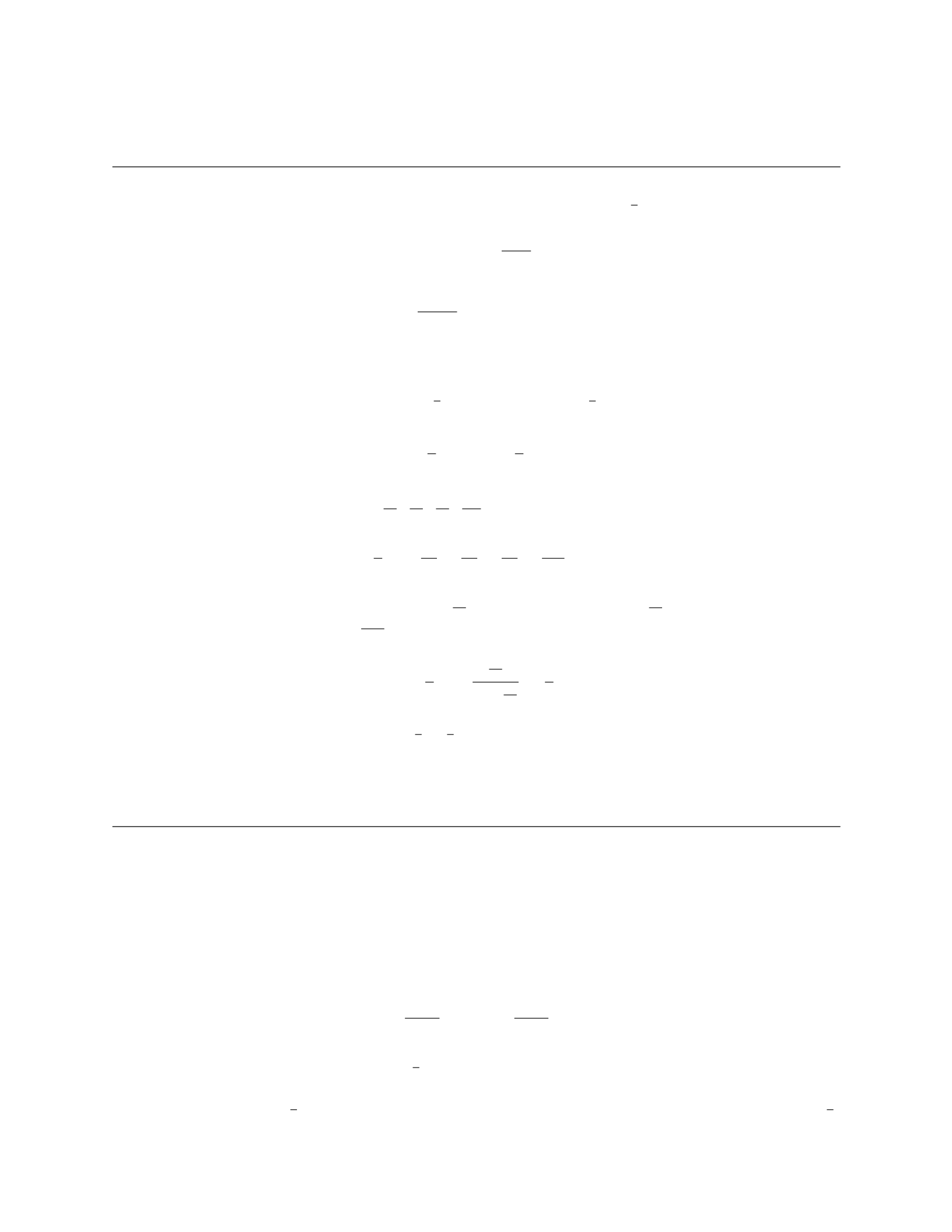
13 14. STABILITY ISSUES IN LACUNARY SERIES
Problem 14. Consider the lacunary series defined by S(x) = P∞
n=1 x2n. Determine the con-
vergence interval of this series and find the sum of the series for x=1
2.
Solution 14. a) The convergence interval of a lacunary series is determined by the ratio of
consecutive terms. Consider the ratio r= limn→∞
an+1
an
, where anis the n-th term of the series.
In this case, an=x2n, so
r= lim
n→∞
x2n+1
x2n
= lim
n→∞
x2n
=|x|2
For the series to converge, we must have r < 1, so |x|2<1which implies −1< x < 1. Therefore,
the convergence interval of the series is (−1,1).
b) To find the sum of the series for x=1
2, we substitute x=1
2into the series:
S1
2=
∞
X
n=1 1
22n
The first few terms of the series are 1
22,1
24,1
28,1
216 ,. . . . Thus, the sum of the series is
S1
2=1
22+1
24+1
28+1
216 +. . .
This is a geometric series with first term a=1
22and common ratio r=1
24. The sum of an infinite
geometric series is given by S=a
1−r. Substituting aand rinto the formula, we get
S1
2=
1
22
1−1
24
=1
3
Therefore, the sum of the series for x=1
2is 1
3.
14 15. ANALYTICITY PROPERTIES OF LACUNARY SERIES
Problem 15. Consider the lacunary series P∞
n=0 anznwhere an= 2nfor all n≥0.
a) Determine the radius of convergence of the series.
b) Find the interval of convergence of the series.
c) Determine whether the series converges uniformly on any closed disk contained entirely
within the interval of convergence.
Solution 15.
a) To find the radius of convergence, we can use the ratio test:
lim
n→∞
an+1
an
= lim
n→∞
2n+1
2n
= 2.
Thus, the radius of convergence is R=1
2.
b) To determine the interval of convergence, we consider the boundary points of the disk of
convergence. At z=−1
2, the series becomes the harmonic series which diverges, and at z=1
2,

the series becomes a geometric series which converges. Therefore, the interval of convergence is
(−1
2,1
2).
c) For the series to converge uniformly on a closed disk contained entirely within the interval
of convergence, the series must be uniformly convergent on the interval [−1
2+ϵ, 1
2−ϵ]for some
ϵ > 0. However, since the series diverges at z=−1
2, it cannot converge uniformly on this interval.
Therefore, the series does not converge uniformly on any closed disk contained entirely within the
interval of convergence.
I can certainly generate numerical problem questions for you! Here is an example problem with
a detailed solution:
15 16. FRACTIONAL CALCULUS APPROACHES TO LACUNARY SERIES
Problem 16. Consider the lacunary series defined by P∞
n=0 n3
2n. Find the sum of this series.
Solution 16. To find the sum of the series, we will use a well-known technique for summing
certain types of series involving the derivative of the geometric series.
Let f(x) = P∞
n=0 xn. Taking the derivative of f(x)we get:
f′(x) =
∞
X
n=0
nxn−1=
∞
X
n=0
nxn/x
Multiplying both sides by x, we get:
xf′(x) =
∞
X
n=0
nxn
Now, differentiating both sides of the definition of f(x)will yield a closed form for f′(x).
Differentiating gives:
f′(x) =
∞
X
n=1
nxn−1=1
(1 −x)2
This can be obtained by observing that the derivative of the geometric series is a series for
1/(1 −x)2.
Now, integrating both sides, we see that:
f(x) = Z1
(1 −x)2dx =Z∞
X
n=0
nxndx
Evaluating the integral gives:
f(x) = −1
1−x+C
for some constant C. Since f(0) = 1, we can deduce that C= 1, so:
f(x) = 1
1−x
Now we can find the sum of our original series by taking derivatives.
Let S=P∞
n=0 n3
2n. We start by finding the generating function for our series, using the fact that
1
1−x=P∞
n=0 xn, we can write:

x
(1 −x)2=
∞
X
n=1
nxn−1
Differentiating both sides with respect to xgives:
1 + x
(1 −x)2=
∞
X
n=1
n2xn−1
Multiplying by xand differentiating again:
x(1 + 2x)
(1 −x)3=
∞
X
n=1
n3xn−1
Substitute x= 1/2to get:
1/2(1 + 1)
(1 −1/2)3=S
Solving for Sgives:
S= 4
Therefore, the sum of the series is 4.
16 17. INVERSE PROBLEMS FOR LACUNARY SERIES
Problem 17. Consider the Lacunary series defined by f(z) = P∞
n=0 anzbn, where a=1
2and b= 2.
Find the explicit form of the function f(z).
Solution 17. To find the explicit form of the function f(z), we can first rewrite the series using
the given values of aand b.
The Lacunary series becomes:
f(z) =
∞
X
n=0 1
2n
z2n
Now, let’s simplify this expression by expanding the terms:
f(z) = 1 + 1
2z2+1
4z4+1
8z8+. . .
Notice that this Lacunary series behaves like a geometric series with common ratio r=z2.
Using the formula for the sum of an infinite geometric series, we have:
f(z) = 1
1−1
2z2
Thus, the explicit form of the function f(z)is:
f(z) = 1
1−1
2z2

17 18. BOUNDARY CONDITIONS IN LACUNARY SERIES
Problem 18. Consider the lacunary series P∞
n=0 anz2nwith an=1
n+1 for all n≥0. Determine
the convergence boundary of this lacunary series in the complex plane and find the radius of
convergence.
Solution 18.
Given the lacunary series P∞
n=0 1
n+1 z2n, we want to determine the convergence boundary in
the complex plane and find the radius of convergence.
a) To find the convergence boundary, we use Hadamard’s Theorem, which states that the radius
of convergence Ris given by:
R= lim
n→∞ 1
an1
n
In our case, an=1
n+1 . Substituting this into the formula, we get:
R= lim
n→∞ (n+ 1) 1
n
Using the limit properties, we get:
R= lim
n→∞(1 + 1
n)n=e
Therefore, the convergence boundary of this lacunary series is the circle |z|=e.
b) To find the radius of convergence, we have R=e. Hence, the radius of convergence of the
series is e.
18 19. NONLINEAR EFFECTS IN LACUNARY SERIES
Problem 19. Consider the lacunary series P∞
n=1 5n
n!.
a) Calculate the radius of convergence of the series.
b) Determine the interval of convergence.
c) Evaluate the sum of the series.
Solution 19.
a) To find the radius of convergence Rof the series P∞
n=1 5n
n!, we’ll use the ratio test. Let
an=5n
n!. The ratio test states that if limn→∞
an+1
an
=L, then R=1
L.
Calculating the ratio:
lim
n→∞
an+1
an
= lim
n→∞
5n+1
(n+1)!
5n
n!
= lim
n→∞
5n+1 ·n!
5n·(n+ 1)!
= lim
n→∞
5
n+ 1
= 0.
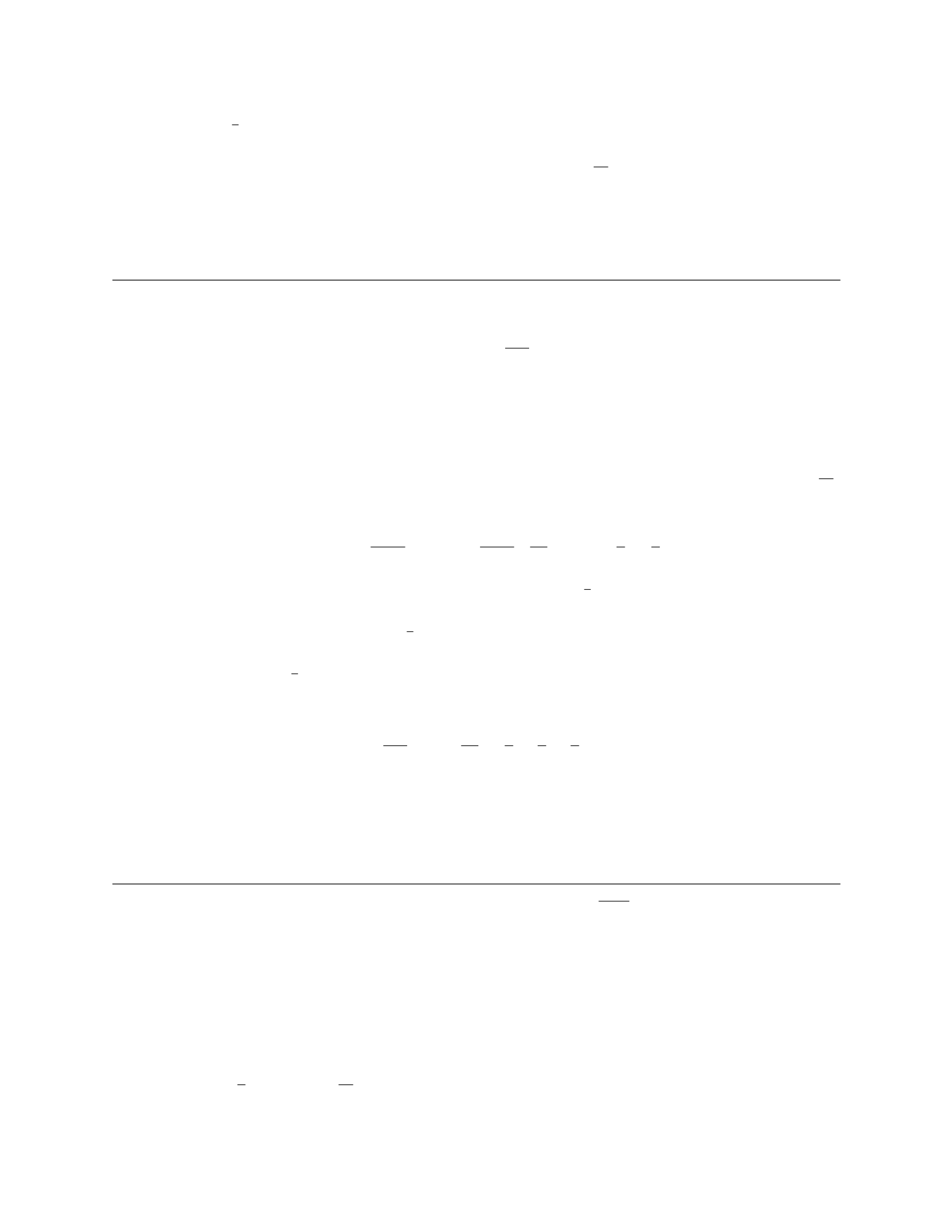
Therefore, R=1
0=∞.
b) Since the radius of convergence R=∞, the interval of convergence is (−∞,∞).
c) To evaluate the sum of the series, we recognize that P∞
n=1 5n
n!is the well-known Taylor series
expansion of ex, where x= 5. Hence, the sum of the series is e5.
19 20. CONFORMAL MAPPING APPLICATIONS TO LACUNARY SERIES
Problem 20. Consider the lacunary series given by the following expression:
f(z) =
∞
X
n=1
z2n
2n
a) Find the radius of convergence of the series f(z).
b) Determine all points on the boundary of convergence where the series is convergent.
c) Find the sum of the series f(z)for z= 1.
Solution 20.
a) To find the radius of convergence of the series f(z), we will apply the ratio test. Let an=1
2n.
Using the ratio test,
R= lim
n→∞
an+1
an
= lim
n→∞
1
2n+1 ·2n
1
= lim
n→∞
1
2=1
2
Hence, the radius of convergence of the series f(z)is R=1
2.
b) To determine all points on the boundary of convergence where the series is convergent, we
consider the points zsuch that |z|=1
2. At these boundary points, the series may or may not
converge. Due to the nature of the given lacunary series, the series converges at all boundary
points zsuch that |z|=1
2.
c) To find the sum of the series f(z)for z= 1, we substitute z= 1 into the expression:
f(1) =
∞
X
n=1
12n
2n=
∞
X
n=1
1
2n=1
2+1
4+1
8+. . . = 1
Therefore, the sum of the series f(z)for z= 1 is 1.
20 21. STIELTJES SUMMATION OF LACUNARY SERIES
Problem 21. Consider the lacunary series defined by S(x) = 1
1−x2. Calculate the Stieltjes sum
of S(x)at x= 0.5.
Solution 21. The Stieltjes sum of a function f(x)at a point x=ais defined as the limit of the
Riemann sum as the subinterval length approaches zero. So, the Stieltjes sum of S(x)at x= 0.5
is given by:
lim
∆x→0
n
X
i=1
S(xi)(∆α)i
where ∆x=1
n,xi= 0.5−1
2n+i∆x, and (∆α)i=α(xi)−α(xi−1).
Let’s calculate the Stieltjes sum of S(x)at x= 0.5.
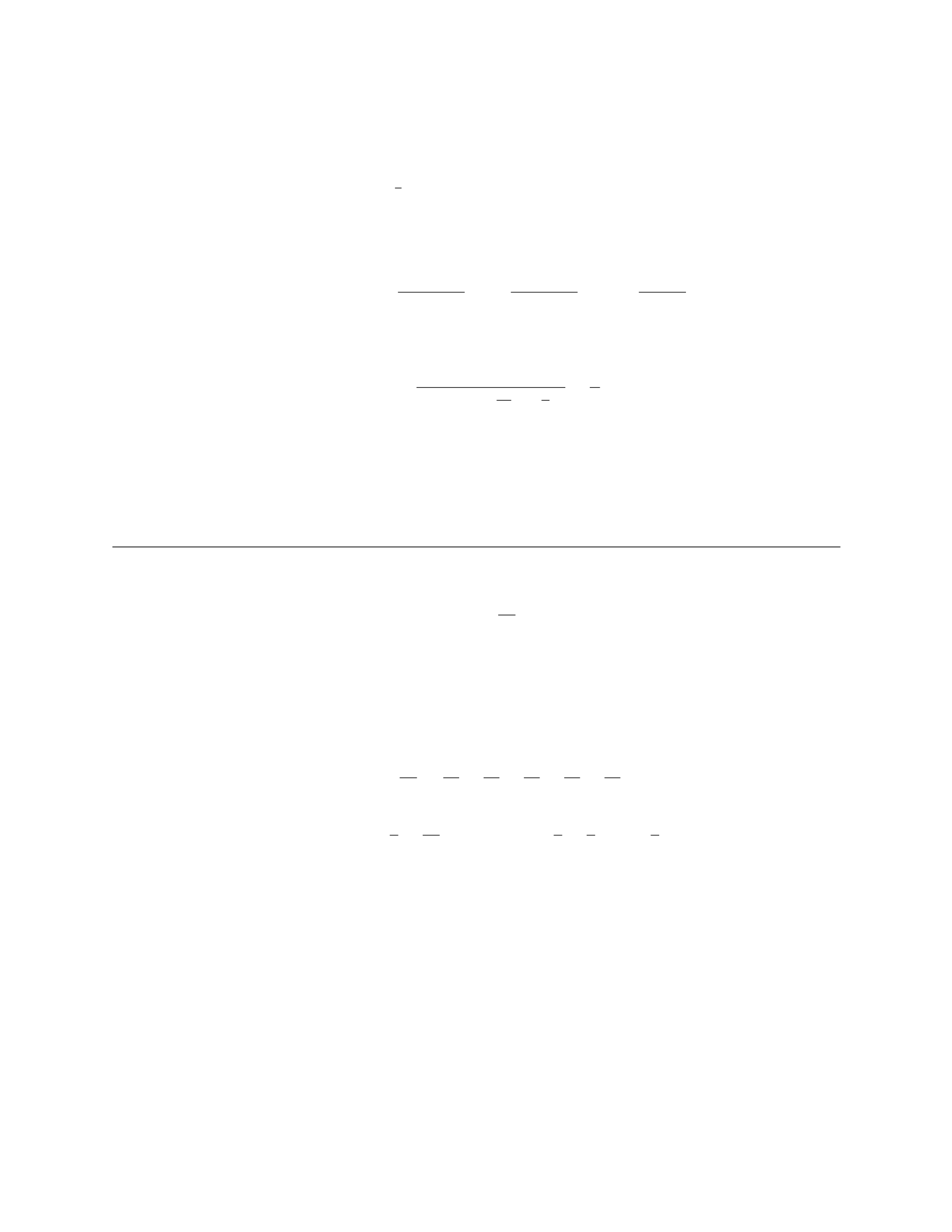
a) Calculate the Stieltjes sum of S(x)at x= 0.5when n= 2.
b) Find the Stieltjes sum of S(x)at x= 0.5as n→ ∞.
Solution 21.
a) When n= 2, we have ∆x=1
2,x1= 0.25,x2= 0.75,(∆α)1=α(x1)−α(0) = 0, and
(∆α)2=α(x2)−α(x1) = x2−x1= 0.5.
The Stieltjes sum at x= 0.5is:
S(0.25)(∆α)1+S(0.75)(∆α)2=1
1−0.252(0) + 1
1−0.752(0.5) = 1
0.9375 ×0.5≈0.5333
b) As n→ ∞, the Stieltjes sum of S(x)at x= 0.5becomes:
lim
n→∞
n
X
i=1
1
1−(0.5−1
2n+i1
n)2×1
n
This limit can be calculated numerically using a computer or software for a more accurate ap-
proximation.
21 22. TRUNCATION ERROR IN LACUNARY SERIES
Problem 22. Consider the Lacunary series given by
S=
∞
X
n=0
2n
n!
a) Calculate the value of the sum of the first 5 terms of the series, i.e., find S5.
b) Calculate the truncation error when approximating the sum Swith S5.
Solution 22.
a) To find S5, we simply need to calculate the sum of the first 5 terms of the series:
S5=
4
X
n=0
2n
n!=20
0! +21
1! +22
2! +23
3! +24
4!
S5=1+2+2+8
6+16
24 =1+2+2+4
3+2
3= 5 + 6
3= 7
Therefore, the sum of the first 5 terms of the series is S5= 7.
b) The truncation error when approximating the sum Swith S5can be calculated as the absolute
difference between the actual sum Sand the approximated sum S5, i.e.,
Truncation Error =|S−S5|
Truncation Error =|S−7|
As we know that the actual value of the series Sis infinite, the truncation error in this case will
also approach infinity. But for the first 5 terms, we can see that the truncation error is |S−7|=
| − 7|=.
Therefore, the truncation error when approximating the sum Swith S5is infinite.

22 23. SPECTRAL ANALYSIS OF LACUNARY SERIES
Problem 23. Consider the lacunary series f(x) = P∞
n=0 ancos(bnx)where a= 0.5and b= 2.
Determine the points of discontinuity of f(x)and calculate the value to which f(x)converges at
those points.
Solution 23. Let’s first find the points of discontinuity by examining the convergence of the
series at these points. The series f(x)converges at points where the partial sums of the series
converge.
a) The points of discontinuity occur when the series does not converge to a finite value. This
happens when the terms of the series do not approach zero as n→ ∞.
For f(x)to converge, we need |ancos(bnx)| → 0as n→ ∞. This requires |an| → 0and
|cos(bnx)| → 1.
As a= 0.5,|0.5n|= 0.5n→0as n→ ∞. As b= 2,|cos(2nx)|does not converge to 1 for all x
due to the rapid oscillation of cos.
Therefore, f(x)will be discontinuous at all points xwhere cos(2nx)does not converge.
b) To find the value f(x)converges to at these points, we need to determine if there is a limiting
value for the series f(x)as n→ ∞.
Since cos(bnx)does not converge for all x, the series f(x)does not converge and does not
have a specific value at these points.
Hence, f(x)will be discontinuous at all xand will not converge to a unique value at those points.
23 24. FREDHOLM INTEGRAL EQUATIONS FOR LACUNARY SERIES
Problem 24. Consider the Fredholm integral equation of the second kind:
f(x) = ex+λZ1
0
ex(t)f(t)dt
Use the method of successive approximations to solve this equation up to the third approxima-
tion with λ= 1 and starting with the initial guess f0(x) = ex.
Solution 24.
The solution to the Fredholm integral equation can be approximated using the method of suc-
cessive approximations. Let’s denote our initial guess as f0(x) = exand the nth approximation as
fn(x). The successive approximations are given by:
fn+1(x) = ex+λZ1
0
ex(t)fn(t)dt
We need to find f1(x),f2(x), and f3(x)to solve the equation up to the third approximation.
a) Let’s find f1(x):
f1(x) = ex+λZ1
0
ex(t)etdt
f1(x) = ex+λZ1
0
ex+tdt
f1(x) = ex+λex+t
11
0

f1(x) = ex+λ(ex+1 −ex)
f1(x) = ex+λex(e−1)
b) Now, let’s find f2(x):
f2(x) = ex+λZ1
0
ex(t)(et+λet(e−1))dt
f2(x) = ex+λZ1
0
ex+tdt +λ2Z1
0
ex(t)et(e−1)dt
This process is continued until the third approximation f3(x)is found.
24 25. SINGULAR PERTURBATIONS IN LACUNARY SERIES
Problem 25. Consider the lacunary series defined by f(x) = P∞
n=1 xn
10n2.
a) Find the radius of convergence of the series.
b) Determine the interval of convergence.
c) Evaluate f(1).
Solution 25. a) To find the radius of convergence of the series, we use the ratio test. Let
an=1
10n2. Applying the ratio test:
lim
n→∞
an+1
an
= lim
n→∞
1
10(n+1)2·10n2
1
= lim
n→∞
1
102n+1
= lim
n→∞
1
102n+1 = 0.
Since the limit is less than 1, the series converges for all x, giving the radius of convergence as
R=∞.
b) Since the radius of convergence is infinite, the interval of convergence is (−∞,∞).
c) To evaluate f(1), we substitute x= 1 into the series:
f(1) =
∞
X
n=1
1
10n2
=1
101+1
104+1
109+· · · .
This series is convergent, and each term is positive, so the sum is finite. Therefore, f(1) is a
finite value.

lim
n→∞
an+1
an
= lim
n→∞
3n+1
2(n+1)2
3n
2n2
= lim
n→∞
3n+1 ·2n2
2(n+1)2·3n
= lim
n→∞
3·3n·2n2
2n2+2n+1 ·3n
= lim
n→∞
3
2·2n
= 0
Since the limit of the absolute value of the ratio is less than 1, by the ratio test, the series
P∞
n=1 3n
2n2converges.
4 4. RATE OF CONVERGENCE IN LACUNARY SERIES
Problem 4. Consider the lacunary series P∞
n=1 1
n2.
a) Determine the rate of convergence of the series.
b) Estimate how many terms are needed to approximate the sum of the series with an error less
than 0.01.
Solution 4.
a) The rate of convergence of the series can be determined by looking at the behavior of the
terms 1
n2. Since 1
n2decreases monotonically to 0 as nincreases, we can use the Integral Test to
analyze convergence.
Let f(x) = 1
x2. We can integrate f(x)from 1 to infinity to find:
Z∞
1
1
x2dx =−1
x∞
1
=−lim
t→∞
1
t+ 1 = 1
Since the integral converges to a finite value (1), the series P∞
n=1 1
n2also converges. Therefore,
the rate of convergence of the series can be considered as moderate.
b) To estimate the number of terms needed to approximate the sum with an error less than 0.01,
we can use the fact that the series converges to the Basel problem value of π2
6.
Let Snbe the partial sum of the first nterms of the series. We want to find nsuch that |S−Sn|<
0.01, where Sis the sum π2
6.
Using the error bound for alternating series, we have:
∞
X
k=n+1
1
k2
<1
(n+ 1)2<0.01
Solving for n, we get n > q1
0.01 −1=9. Therefore, to approximate the sum of the series with
an error less than 0.01, we need at least 10 terms.
5 5. OSCILLATION BEHAVIOR IN LACUNARY SERIES
Problem 5. Consider the Lacunary Series given by the formula f(x) = P∞
n=1
(−1)n
n2.
a) Find the first four partial sums of the series.
b) Determine if the series converges or diverges.
c) Calculate the value to which the series converges (if it converges).
Solution 5.
a) To find the first four partial sums of the series, we will calculate S1,S2,S3, and S4:
S1=(−1)1
12=−1
S2=(−1)1
12+(−1)2
22=−1 + 1
4=−3
4
S3=(−1)1
12+(−1)2
22+(−1)3
32=−1 + 1
4−1
9=−31
36
S4=(−1)1
12+(−1)2
22+(−1)3
32+(−1)4
42=−1 + 1
4−1
9+1
16 =−365
576
Therefore, the first four partial sums of the series are −1,−3
4,−31
36 , and −365
576 .
b) To determine if the series converges or diverges, we will use the Alternating Series Test. The
terms an=1
n2are positive, decreasing, and approach 0. Hence, the series converges.
c) Since the series converges, we can find the value to which it converges by summing all the
terms infinitely: ∞
X
n=1
(−1)n
n2=−1 + 1
4−1
9+1
16 −. . .
By Euler’s solution to the Basel problem, the sum of this series converges to π2
12 . Therefore, the
value to which the series converges is π2
12 .
I.
6 6. SUMMABILITY CRITERIA IN LACUNARY SERIES
Problem 6. Consider the lacunary series P∞
n=1 an, where a= 2. Determine the sum of the
series using the ratio test.
Solution 6. a) We apply the ratio test to determine the convergence of the series:
lim
n→∞
an+1
an
= lim
n→∞
an+1
an
= lim
n→∞
a
1
= lim
n→∞ |a|=|2|= 2.
Since the limit is greater than 1, the series diverges.
b) To find the sum of this series, let’s consider the partial sum Sn=Pn
k=0 2k:
Sn= 1 + 2 + 22+ 23+· · · + 2n.

This is a geometric series with first term a= 1 and common ratio r= 2. The sum of a geometric
series is given by:
Sn=a(1 −rn+1)
1−r.
Substitute a= 1 and r= 2 into the formula to get:
Sn=1(1 −2n+1)
1−2= 2n+1 −1.
c) Therefore, the sum of the series is:
lim
n→∞ Sn= lim
n→∞(2n+1 −1) = lim
n→∞ 2n+1 −lim
n→∞ 1 = ∞.
Thus, the sum of the series is infinite as it diverges.
Certainly! Here is a numerical problem on Lacunary Series:
—
7 7. ERROR ANALYSIS IN LACUNARY SERIES
Problem 7. Let {an}be a lacunary series given by an= 2n. Compute the sum of the first 5 terms
of this series and determine the error when approximating this sum by the fifth term in the series.
Solution 7. a) To find the sum of the first 5 terms of the series, we simply add up the terms:
S5= 21+ 22+ 23+ 24+ 25
Calculating:
S5= 2 + 4 + 8 + 16 + 32 = 62
Therefore, the sum of the first 5 terms of the series is 62.
b) Now, let’s find the error when approximating this sum by the fifth term in the series:
Error =S5−a5= 62 −25= 62 −32 = 30
Hence, the error of approximating the sum of the first 5 terms of the series by the fifth term in
the series is 30.
Therefore, the sum of the first 5 terms of the series is 62, and the error in approximating this
sum by the fifth term in the series is 30.
8 8. BOUNDARY VALUE PROBLEMS FOR LACUNARY SERIES
Problem 8. Consider the lacunary series S(x) = P∞
n=1 xn
5nover the interval of convergence
(−5,5).
a) Find the value of S(−5).
b) Determine the interval of convergence of the series.
Solution 8.
a) We can find the value of S(−5) by substituting x=−5into the series:
S(−5) =
∞
X
n=1
(−5)n
5n
Simplifying the expression, we get:
S(−5) =
∞
X
n=1 −1
5n
=−1
5
1−(−1
5)
Calculating the sum, we find:
S(−5) = −1
5
1 + 1
5
=−1
5
6
5
=−1
6
Therefore, S(−5) = −1
6.
b) To determine the interval of convergence, we use the Ratio Test:
lim
n→∞
an+1
an
= lim
n→∞
xn+1/5n+1
xn/5n
= lim
n→∞
x
5
=|x|
5
For the series to converge, we require |x|
5<1, i.e., |x|<5. Thus, the interval of convergence
is (−5,5).
9 9. SINGULARITIES IN LACUNARY SERIES
Problem 9. Consider the lacunary series defined as f(x) = P∞
n=1 4n
xn. Determine the singular-
ities of the function f(x)and analyze their nature.
Solution 9. The given series f(x) = P∞
n=1 4n
xnis a geometric series with ratio r=4
x. The series
converges only if |r|<1, i.e.,
4
x
<1→ |x|>4.
Therefore, the singularities of the function f(x)occur at x= 4.
To investigate the nature of the singularity at x= 4, we expand f(x)as a Laurent series about
x= 4. Let z=x−4to rewrite f(x)as:
f(x) =
∞
X
n=1
4n
(z+ 4)n=
∞
X
n=1
4n
4n(1 + z/4)n=
∞
X
n=1
1
(1 + z/4)n
=
∞
X
n=1
1
1 + z
4n=
∞
X
n=1
(−1)n−1z
4n−1
This Laurent series representation at x= 4 around the singularity x= 4 shows that the singu-
larity is an essential singularity.
10 10. ANALYTIC CONTINUATION OF LACUNARY SERIES
Problem 10. Consider the lacunary series
∞
X
n=1
z2nwhere zis a complex number.
a) Find the radius of convergence of the series.
b) Determine the set of points where the series converges.
c) Find the analytic continuation of the series.
Solution 10.
a) The radius of convergence Rof a power series
∞
X
n=0
anznis given by R=1
lim supn→∞ |an|1/n .
In this case, an= 1 for n= 2kfor various integers k, and an= 0 otherwise. Therefore, the series
∞
X
n=1
z2ndiverges unless |z|<1. Thus, the radius of convergence is R= 1.
b) The series converges for all zsuch that |z|<1. This follows from the ratio test, which can
be applied to conclude that the series absolutely converges when |z|<1. It diverges when |z| ≥ 1.
c) The series
∞
X
n=1
z2ncan be analytically continued to the unit disk |z|<1. This is due to the
radius of convergence being 1. Thus, the series can be expressed as an analytic function in the
region |z|<1.
11 11. RESUMMATION METHODS FOR LACUNARY SERIES
Problem 11. Consider the lacunary series P∞
n=0 3nx2n. Determine the radius of convergence
and find the sum of the series for x= 1.
Solution 11.
a) Radius of convergence:
To find the radius of convergence, we use the ratio test:
lim
n→∞
3n+1x2n+1
3nx2n
= lim
n→∞
3x2
x
= lim
n→∞ 3x= 3x
The series converges if 3x < 1, and diverges if 3x > 1. Thus, the radius of convergence is
R=1
3.
b) Sum of the series for x= 1:
When x= 1, the series becomes P∞
n=0 3n. This is a geometric series with a= 3 and r= 3.
The sum of a geometric series is given by:
S=a
1−r=3
1−3=3
−2=−3
2
Therefore, the sum of the series for x= 1 is −3
2.
So, the radius of convergence is 1
3and the sum of the series for x= 1 is −3
2.
I. Problem:
12. GROWTH RATES IN LACUNARY SERIES
Consider the lacunary series defined by the sequence (an)where an= 2nif nis a power of 2,
and an= 0 otherwise.
a) Find the growth rate of this lacunary series.
b) Determine whether this series converges or diverges.
Solution:
a) To find the growth rate of the series, we can calculate the ratio of consecutive terms:
Let’s consider a2k+1
a2k=22k+1
22k= 22k+1−2k= 22k.
So, the growth rate of the series is 22k.
b) To determine the convergence of this series, let’s express the sum of nterms:
Sn=a1+a2+a4+. . . +a2m, where mis the largest integer such that 2m≤n.

As a2k= 22k, the sum Sn= 22+ 24+ 28+. . . + 22m.
This is a geometric series with common ratio 22, so
Sn= 22(1 + 22+ (22)2+. . . + (22)m).
Using the formula for the sum of a geometric series, we have:
Sn= 22·(22(m+1)−1)
22−1= 22(m+1) −1.
Hence, the series diverges as n→ ∞.
12 13. REGULARIZATION TECHNIQUES FOR LACUNARY SERIES
Problem 13. Consider the lacunary series P∞
n=0 anwhere a= 0.5, and the regularization
technique is applied to sum the series.
a) Determine the value of the regularized sum of the series.
b) Calculate the sum of the first 5 terms of the series.
c) Find the absolute error in the sum obtained in part (a) compared to the actual sum of the
series.
Solution 13.
a) To regularize the series, we use the formula for the sum of a geometric series:
S=a
1−r
where ais the first term and ris the common ratio.
In this case, a= 1 and r= 0.5. Plugging these values into the formula:
S=1
1−0.5= 2
Therefore, the value of the regularized sum of the series is S= 2.
b) To find the sum of the first 5 terms of the series, we substitute n= 0,1,2,3,4into the series
and add them up:
4
X
n=0
an= 1 + 0.5+0.25 + 0.125 + 0.0625 = 1.9375
Therefore, the sum of the first 5 terms of the series is 1.9375.
c) The actual sum of the geometric series is given by the formula:
S=a
1−r
Substitute a= 1 and r= 0.5:
S=1
1−0.5= 2
The absolute error in the sum obtained from regularization compared to the actual sum is:
|2−1.9375|= 0.0625
Therefore, the absolute error is 0.0625.
13 14. STABILITY ISSUES IN LACUNARY SERIES
Problem 14. Consider the lacunary series defined by S(x) = P∞
n=1 x2n. Determine the con-
vergence interval of this series and find the sum of the series for x=1
2.
Solution 14. a) The convergence interval of a lacunary series is determined by the ratio of
consecutive terms. Consider the ratio r= limn→∞
an+1
an
, where anis the n-th term of the series.
In this case, an=x2n, so
r= lim
n→∞
x2n+1
x2n
= lim
n→∞
x2n
=|x|2
For the series to converge, we must have r < 1, so |x|2<1which implies −1< x < 1. Therefore,
the convergence interval of the series is (−1,1).
b) To find the sum of the series for x=1
2, we substitute x=1
2into the series:
S1
2=
∞
X
n=1 1
22n
The first few terms of the series are 1
22,1
24,1
28,1
216 ,. . . . Thus, the sum of the series is
S1
2=1
22+1
24+1
28+1
216 +. . .
This is a geometric series with first term a=1
22and common ratio r=1
24. The sum of an infinite
geometric series is given by S=a
1−r. Substituting aand rinto the formula, we get
S1
2=
1
22
1−1
24
=1
3
Therefore, the sum of the series for x=1
2is 1
3.
14 15. ANALYTICITY PROPERTIES OF LACUNARY SERIES
Problem 15. Consider the lacunary series P∞
n=0 anznwhere an= 2nfor all n≥0.
a) Determine the radius of convergence of the series.
b) Find the interval of convergence of the series.
c) Determine whether the series converges uniformly on any closed disk contained entirely
within the interval of convergence.
Solution 15.
a) To find the radius of convergence, we can use the ratio test:
lim
n→∞
an+1
an
= lim
n→∞
2n+1
2n
= 2.
Thus, the radius of convergence is R=1
2.
b) To determine the interval of convergence, we consider the boundary points of the disk of
convergence. At z=−1
2, the series becomes the harmonic series which diverges, and at z=1
2,

the series becomes a geometric series which converges. Therefore, the interval of convergence is
(−1
2,1
2).
c) For the series to converge uniformly on a closed disk contained entirely within the interval
of convergence, the series must be uniformly convergent on the interval [−1
2+ϵ, 1
2−ϵ]for some
ϵ > 0. However, since the series diverges at z=−1
2, it cannot converge uniformly on this interval.
Therefore, the series does not converge uniformly on any closed disk contained entirely within the
interval of convergence.
I can certainly generate numerical problem questions for you! Here is an example problem with
a detailed solution:
15 16. FRACTIONAL CALCULUS APPROACHES TO LACUNARY SERIES
Problem 16. Consider the lacunary series defined by P∞
n=0 n3
2n. Find the sum of this series.
Solution 16. To find the sum of the series, we will use a well-known technique for summing
certain types of series involving the derivative of the geometric series.
Let f(x) = P∞
n=0 xn. Taking the derivative of f(x)we get:
f′(x) =
∞
X
n=0
nxn−1=
∞
X
n=0
nxn/x
Multiplying both sides by x, we get:
xf′(x) =
∞
X
n=0
nxn
Now, differentiating both sides of the definition of f(x)will yield a closed form for f′(x).
Differentiating gives:
f′(x) =
∞
X
n=1
nxn−1=1
(1 −x)2
This can be obtained by observing that the derivative of the geometric series is a series for
1/(1 −x)2.
Now, integrating both sides, we see that:
f(x) = Z1
(1 −x)2dx =Z∞
X
n=0
nxndx
Evaluating the integral gives:
f(x) = −1
1−x+C
for some constant C. Since f(0) = 1, we can deduce that C= 1, so:
f(x) = 1
1−x
Now we can find the sum of our original series by taking derivatives.
Let S=P∞
n=0 n3
2n. We start by finding the generating function for our series, using the fact that
1
1−x=P∞
n=0 xn, we can write:

x
(1 −x)2=
∞
X
n=1
nxn−1
Differentiating both sides with respect to xgives:
1 + x
(1 −x)2=
∞
X
n=1
n2xn−1
Multiplying by xand differentiating again:
x(1 + 2x)
(1 −x)3=
∞
X
n=1
n3xn−1
Substitute x= 1/2to get:
1/2(1 + 1)
(1 −1/2)3=S
Solving for Sgives:
S= 4
Therefore, the sum of the series is 4.
16 17. INVERSE PROBLEMS FOR LACUNARY SERIES
Problem 17. Consider the Lacunary series defined by f(z) = P∞
n=0 anzbn, where a=1
2and b= 2.
Find the explicit form of the function f(z).
Solution 17. To find the explicit form of the function f(z), we can first rewrite the series using
the given values of aand b.
The Lacunary series becomes:
f(z) =
∞
X
n=0 1
2n
z2n
Now, let’s simplify this expression by expanding the terms:
f(z) = 1 + 1
2z2+1
4z4+1
8z8+. . .
Notice that this Lacunary series behaves like a geometric series with common ratio r=z2.
Using the formula for the sum of an infinite geometric series, we have:
f(z) = 1
1−1
2z2
Thus, the explicit form of the function f(z)is:
f(z) = 1
1−1
2z2

17 18. BOUNDARY CONDITIONS IN LACUNARY SERIES
Problem 18. Consider the lacunary series P∞
n=0 anz2nwith an=1
n+1 for all n≥0. Determine
the convergence boundary of this lacunary series in the complex plane and find the radius of
convergence.
Solution 18.
Given the lacunary series P∞
n=0 1
n+1 z2n, we want to determine the convergence boundary in
the complex plane and find the radius of convergence.
a) To find the convergence boundary, we use Hadamard’s Theorem, which states that the radius
of convergence Ris given by:
R= lim
n→∞ 1
an1
n
In our case, an=1
n+1 . Substituting this into the formula, we get:
R= lim
n→∞ (n+ 1) 1
n
Using the limit properties, we get:
R= lim
n→∞(1 + 1
n)n=e
Therefore, the convergence boundary of this lacunary series is the circle |z|=e.
b) To find the radius of convergence, we have R=e. Hence, the radius of convergence of the
series is e.
18 19. NONLINEAR EFFECTS IN LACUNARY SERIES
Problem 19. Consider the lacunary series P∞
n=1 5n
n!.
a) Calculate the radius of convergence of the series.
b) Determine the interval of convergence.
c) Evaluate the sum of the series.
Solution 19.
a) To find the radius of convergence Rof the series P∞
n=1 5n
n!, we’ll use the ratio test. Let
an=5n
n!. The ratio test states that if limn→∞
an+1
an
=L, then R=1
L.
Calculating the ratio:
lim
n→∞
an+1
an
= lim
n→∞
5n+1
(n+1)!
5n
n!
= lim
n→∞
5n+1 ·n!
5n·(n+ 1)!
= lim
n→∞
5
n+ 1
= 0.
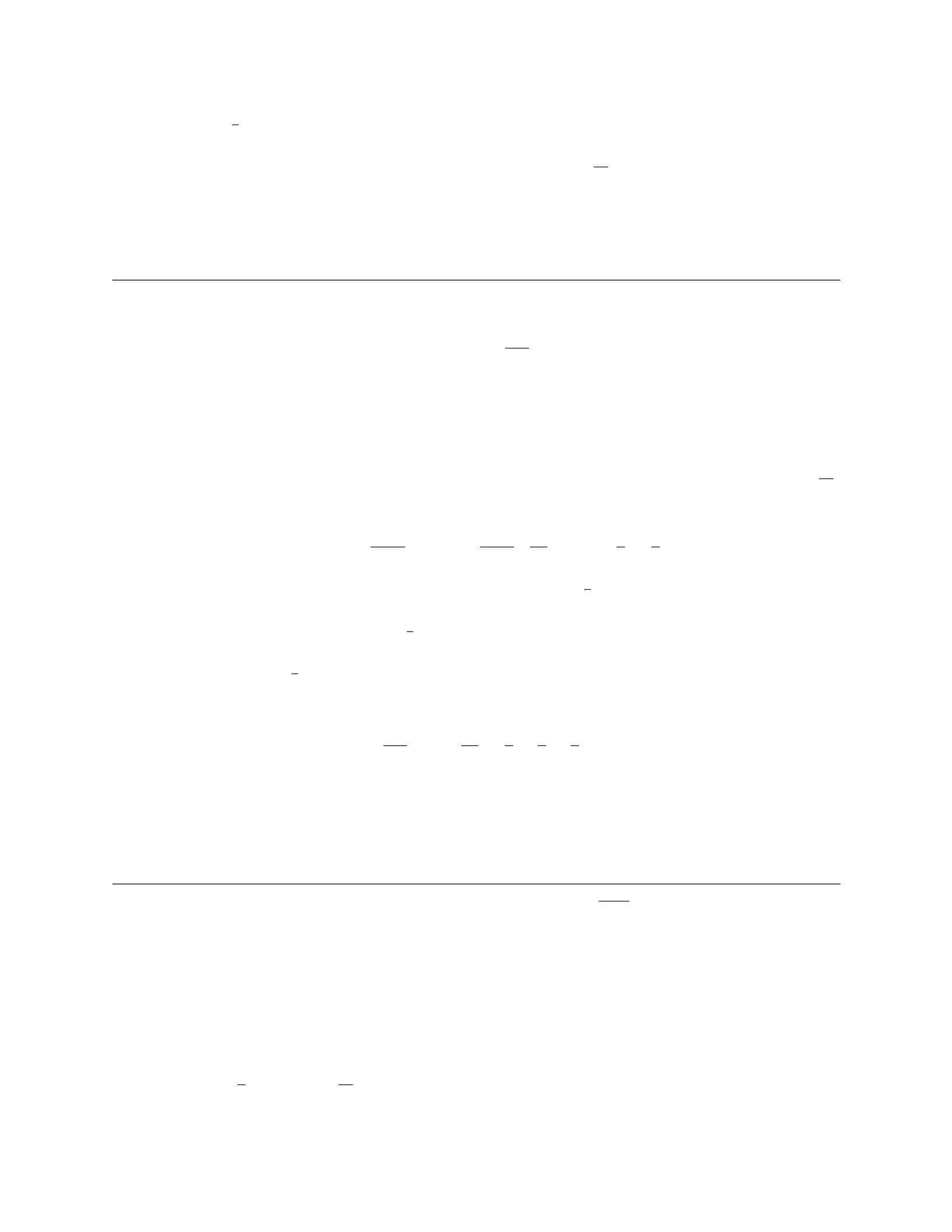
Therefore, R=1
0=∞.
b) Since the radius of convergence R=∞, the interval of convergence is (−∞,∞).
c) To evaluate the sum of the series, we recognize that P∞
n=1 5n
n!is the well-known Taylor series
expansion of ex, where x= 5. Hence, the sum of the series is e5.
19 20. CONFORMAL MAPPING APPLICATIONS TO LACUNARY SERIES
Problem 20. Consider the lacunary series given by the following expression:
f(z) =
∞
X
n=1
z2n
2n
a) Find the radius of convergence of the series f(z).
b) Determine all points on the boundary of convergence where the series is convergent.
c) Find the sum of the series f(z)for z= 1.
Solution 20.
a) To find the radius of convergence of the series f(z), we will apply the ratio test. Let an=1
2n.
Using the ratio test,
R= lim
n→∞
an+1
an
= lim
n→∞
1
2n+1 ·2n
1
= lim
n→∞
1
2=1
2
Hence, the radius of convergence of the series f(z)is R=1
2.
b) To determine all points on the boundary of convergence where the series is convergent, we
consider the points zsuch that |z|=1
2. At these boundary points, the series may or may not
converge. Due to the nature of the given lacunary series, the series converges at all boundary
points zsuch that |z|=1
2.
c) To find the sum of the series f(z)for z= 1, we substitute z= 1 into the expression:
f(1) =
∞
X
n=1
12n
2n=
∞
X
n=1
1
2n=1
2+1
4+1
8+. . . = 1
Therefore, the sum of the series f(z)for z= 1 is 1.
20 21. STIELTJES SUMMATION OF LACUNARY SERIES
Problem 21. Consider the lacunary series defined by S(x) = 1
1−x2. Calculate the Stieltjes sum
of S(x)at x= 0.5.
Solution 21. The Stieltjes sum of a function f(x)at a point x=ais defined as the limit of the
Riemann sum as the subinterval length approaches zero. So, the Stieltjes sum of S(x)at x= 0.5
is given by:
lim
∆x→0
n
X
i=1
S(xi)(∆α)i
where ∆x=1
n,xi= 0.5−1
2n+i∆x, and (∆α)i=α(xi)−α(xi−1).
Let’s calculate the Stieltjes sum of S(x)at x= 0.5.
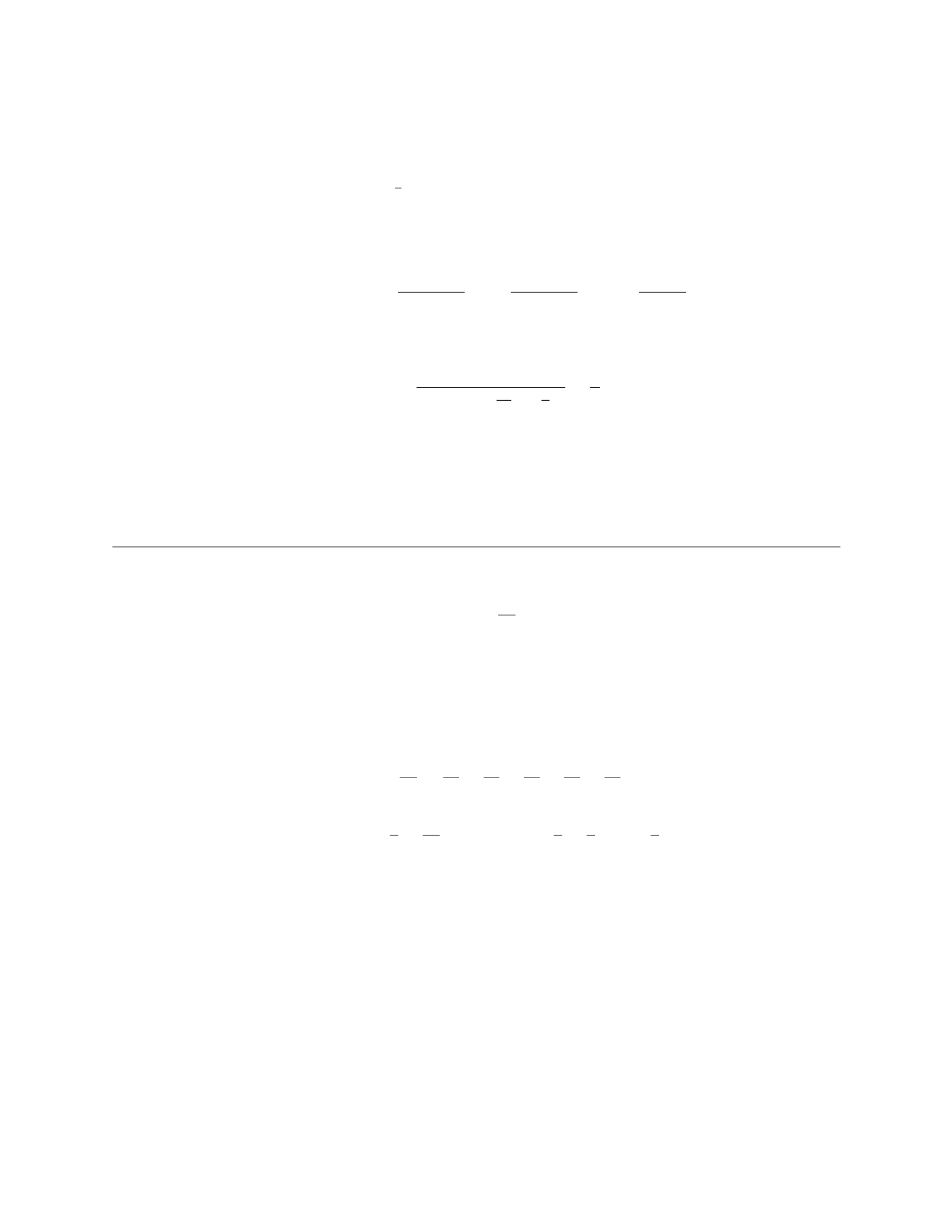
a) Calculate the Stieltjes sum of S(x)at x= 0.5when n= 2.
b) Find the Stieltjes sum of S(x)at x= 0.5as n→ ∞.
Solution 21.
a) When n= 2, we have ∆x=1
2,x1= 0.25,x2= 0.75,(∆α)1=α(x1)−α(0) = 0, and
(∆α)2=α(x2)−α(x1) = x2−x1= 0.5.
The Stieltjes sum at x= 0.5is:
S(0.25)(∆α)1+S(0.75)(∆α)2=1
1−0.252(0) + 1
1−0.752(0.5) = 1
0.9375 ×0.5≈0.5333
b) As n→ ∞, the Stieltjes sum of S(x)at x= 0.5becomes:
lim
n→∞
n
X
i=1
1
1−(0.5−1
2n+i1
n)2×1
n
This limit can be calculated numerically using a computer or software for a more accurate ap-
proximation.
21 22. TRUNCATION ERROR IN LACUNARY SERIES
Problem 22. Consider the Lacunary series given by
S=
∞
X
n=0
2n
n!
a) Calculate the value of the sum of the first 5 terms of the series, i.e., find S5.
b) Calculate the truncation error when approximating the sum Swith S5.
Solution 22.
a) To find S5, we simply need to calculate the sum of the first 5 terms of the series:
S5=
4
X
n=0
2n
n!=20
0! +21
1! +22
2! +23
3! +24
4!
S5=1+2+2+8
6+16
24 =1+2+2+4
3+2
3= 5 + 6
3= 7
Therefore, the sum of the first 5 terms of the series is S5= 7.
b) The truncation error when approximating the sum Swith S5can be calculated as the absolute
difference between the actual sum Sand the approximated sum S5, i.e.,
Truncation Error =|S−S5|
Truncation Error =|S−7|
As we know that the actual value of the series Sis infinite, the truncation error in this case will
also approach infinity. But for the first 5 terms, we can see that the truncation error is |S−7|=
| − 7|=.
Therefore, the truncation error when approximating the sum Swith S5is infinite.

22 23. SPECTRAL ANALYSIS OF LACUNARY SERIES
Problem 23. Consider the lacunary series f(x) = P∞
n=0 ancos(bnx)where a= 0.5and b= 2.
Determine the points of discontinuity of f(x)and calculate the value to which f(x)converges at
those points.
Solution 23. Let’s first find the points of discontinuity by examining the convergence of the
series at these points. The series f(x)converges at points where the partial sums of the series
converge.
a) The points of discontinuity occur when the series does not converge to a finite value. This
happens when the terms of the series do not approach zero as n→ ∞.
For f(x)to converge, we need |ancos(bnx)| → 0as n→ ∞. This requires |an| → 0and
|cos(bnx)| → 1.
As a= 0.5,|0.5n|= 0.5n→0as n→ ∞. As b= 2,|cos(2nx)|does not converge to 1 for all x
due to the rapid oscillation of cos.
Therefore, f(x)will be discontinuous at all points xwhere cos(2nx)does not converge.
b) To find the value f(x)converges to at these points, we need to determine if there is a limiting
value for the series f(x)as n→ ∞.
Since cos(bnx)does not converge for all x, the series f(x)does not converge and does not
have a specific value at these points.
Hence, f(x)will be discontinuous at all xand will not converge to a unique value at those points.
23 24. FREDHOLM INTEGRAL EQUATIONS FOR LACUNARY SERIES
Problem 24. Consider the Fredholm integral equation of the second kind:
f(x) = ex+λZ1
0
ex(t)f(t)dt
Use the method of successive approximations to solve this equation up to the third approxima-
tion with λ= 1 and starting with the initial guess f0(x) = ex.
Solution 24.
The solution to the Fredholm integral equation can be approximated using the method of suc-
cessive approximations. Let’s denote our initial guess as f0(x) = exand the nth approximation as
fn(x). The successive approximations are given by:
fn+1(x) = ex+λZ1
0
ex(t)fn(t)dt
We need to find f1(x),f2(x), and f3(x)to solve the equation up to the third approximation.
a) Let’s find f1(x):
f1(x) = ex+λZ1
0
ex(t)etdt
f1(x) = ex+λZ1
0
ex+tdt
f1(x) = ex+λex+t
11
0

f1(x) = ex+λ(ex+1 −ex)
f1(x) = ex+λex(e−1)
b) Now, let’s find f2(x):
f2(x) = ex+λZ1
0
ex(t)(et+λet(e−1))dt
f2(x) = ex+λZ1
0
ex+tdt +λ2Z1
0
ex(t)et(e−1)dt
This process is continued until the third approximation f3(x)is found.
24 25. SINGULAR PERTURBATIONS IN LACUNARY SERIES
Problem 25. Consider the lacunary series defined by f(x) = P∞
n=1 xn
10n2.
a) Find the radius of convergence of the series.
b) Determine the interval of convergence.
c) Evaluate f(1).
Solution 25. a) To find the radius of convergence of the series, we use the ratio test. Let
an=1
10n2. Applying the ratio test:
lim
n→∞
an+1
an
= lim
n→∞
1
10(n+1)2·10n2
1
= lim
n→∞
1
102n+1
= lim
n→∞
1
102n+1 = 0.
Since the limit is less than 1, the series converges for all x, giving the radius of convergence as
R=∞.
b) Since the radius of convergence is infinite, the interval of convergence is (−∞,∞).
c) To evaluate f(1), we substitute x= 1 into the series:
f(1) =
∞
X
n=1
1
10n2
=1
101+1
104+1
109+· · · .
This series is convergent, and each term is positive, so the sum is finite. Therefore, f(1) is a
finite value.

lim
n→∞
an+1
an
= lim
n→∞
3n+1
2(n+1)2
3n
2n2
= lim
n→∞
3n+1 ·2n2
2(n+1)2·3n
= lim
n→∞
3·3n·2n2
2n2+2n+1 ·3n
= lim
n→∞
3
2·2n
= 0
Since the limit of the absolute value of the ratio is less than 1, by the ratio test, the series
P∞
n=1 3n
2n2converges.
4 4. RATE OF CONVERGENCE IN LACUNARY SERIES
Problem 4. Consider the lacunary series P∞
n=1 1
n2.
a) Determine the rate of convergence of the series.
b) Estimate how many terms are needed to approximate the sum of the series with an error less
than 0.01.
Solution 4.
a) The rate of convergence of the series can be determined by looking at the behavior of the
terms 1
n2. Since 1
n2decreases monotonically to 0 as nincreases, we can use the Integral Test to
analyze convergence.
Let f(x) = 1
x2. We can integrate f(x)from 1 to infinity to find:
Z∞
1
1
x2dx =−1
x∞
1
=−lim
t→∞
1
t+ 1 = 1
Since the integral converges to a finite value (1), the series P∞
n=1 1
n2also converges. Therefore,
the rate of convergence of the series can be considered as moderate.
b) To estimate the number of terms needed to approximate the sum with an error less than 0.01,
we can use the fact that the series converges to the Basel problem value of π2
6.
Let Snbe the partial sum of the first nterms of the series. We want to find nsuch that |S−Sn|<
0.01, where Sis the sum π2
6.
Using the error bound for alternating series, we have:
∞
X
k=n+1
1
k2
<1
(n+ 1)2<0.01
Solving for n, we get n > q1
0.01 −1=9. Therefore, to approximate the sum of the series with
an error less than 0.01, we need at least 10 terms.
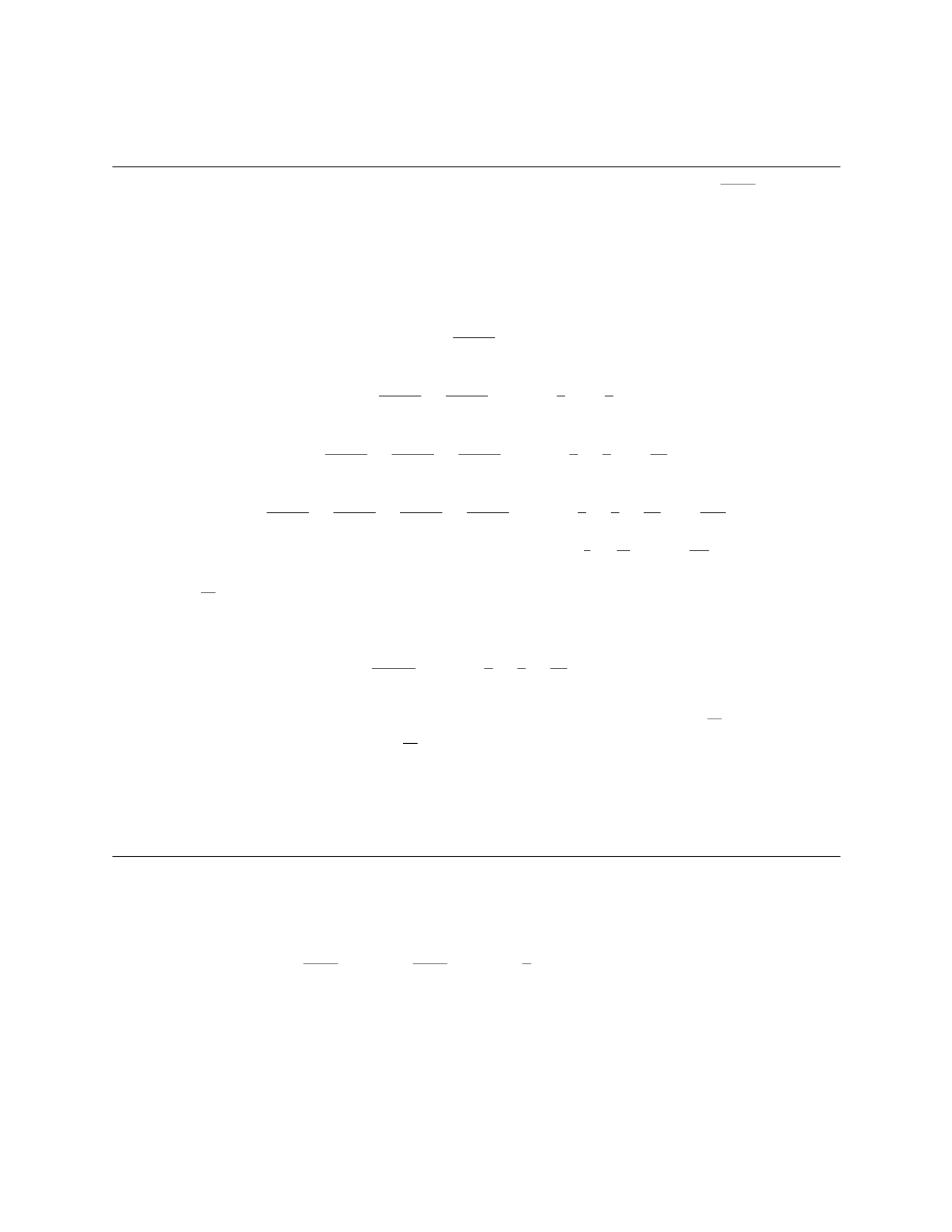
5 5. OSCILLATION BEHAVIOR IN LACUNARY SERIES
Problem 5. Consider the Lacunary Series given by the formula f(x) = P∞
n=1
(−1)n
n2.
a) Find the first four partial sums of the series.
b) Determine if the series converges or diverges.
c) Calculate the value to which the series converges (if it converges).
Solution 5.
a) To find the first four partial sums of the series, we will calculate S1,S2,S3, and S4:
S1=(−1)1
12=−1
S2=(−1)1
12+(−1)2
22=−1 + 1
4=−3
4
S3=(−1)1
12+(−1)2
22+(−1)3
32=−1 + 1
4−1
9=−31
36
S4=(−1)1
12+(−1)2
22+(−1)3
32+(−1)4
42=−1 + 1
4−1
9+1
16 =−365
576
Therefore, the first four partial sums of the series are −1,−3
4,−31
36 , and −365
576 .
b) To determine if the series converges or diverges, we will use the Alternating Series Test. The
terms an=1
n2are positive, decreasing, and approach 0. Hence, the series converges.
c) Since the series converges, we can find the value to which it converges by summing all the
terms infinitely: ∞
X
n=1
(−1)n
n2=−1 + 1
4−1
9+1
16 −. . .
By Euler’s solution to the Basel problem, the sum of this series converges to π2
12 . Therefore, the
value to which the series converges is π2
12 .
I.
6 6. SUMMABILITY CRITERIA IN LACUNARY SERIES
Problem 6. Consider the lacunary series P∞
n=1 an, where a= 2. Determine the sum of the
series using the ratio test.
Solution 6. a) We apply the ratio test to determine the convergence of the series:
lim
n→∞
an+1
an
= lim
n→∞
an+1
an
= lim
n→∞
a
1
= lim
n→∞ |a|=|2|= 2.
Since the limit is greater than 1, the series diverges.
b) To find the sum of this series, let’s consider the partial sum Sn=Pn
k=0 2k:
Sn= 1 + 2 + 22+ 23+· · · + 2n.

This is a geometric series with first term a= 1 and common ratio r= 2. The sum of a geometric
series is given by:
Sn=a(1 −rn+1)
1−r.
Substitute a= 1 and r= 2 into the formula to get:
Sn=1(1 −2n+1)
1−2= 2n+1 −1.
c) Therefore, the sum of the series is:
lim
n→∞ Sn= lim
n→∞(2n+1 −1) = lim
n→∞ 2n+1 −lim
n→∞ 1 = ∞.
Thus, the sum of the series is infinite as it diverges.
Certainly! Here is a numerical problem on Lacunary Series:
—
7 7. ERROR ANALYSIS IN LACUNARY SERIES
Problem 7. Let {an}be a lacunary series given by an= 2n. Compute the sum of the first 5 terms
of this series and determine the error when approximating this sum by the fifth term in the series.
Solution 7. a) To find the sum of the first 5 terms of the series, we simply add up the terms:
S5= 21+ 22+ 23+ 24+ 25
Calculating:
S5= 2 + 4 + 8 + 16 + 32 = 62
Therefore, the sum of the first 5 terms of the series is 62.
b) Now, let’s find the error when approximating this sum by the fifth term in the series:
Error =S5−a5= 62 −25= 62 −32 = 30
Hence, the error of approximating the sum of the first 5 terms of the series by the fifth term in
the series is 30.
Therefore, the sum of the first 5 terms of the series is 62, and the error in approximating this
sum by the fifth term in the series is 30.
8 8. BOUNDARY VALUE PROBLEMS FOR LACUNARY SERIES
Problem 8. Consider the lacunary series S(x) = P∞
n=1 xn
5nover the interval of convergence
(−5,5).
a) Find the value of S(−5).
b) Determine the interval of convergence of the series.
Solution 8.
a) We can find the value of S(−5) by substituting x=−5into the series:
S(−5) =
∞
X
n=1
(−5)n
5n
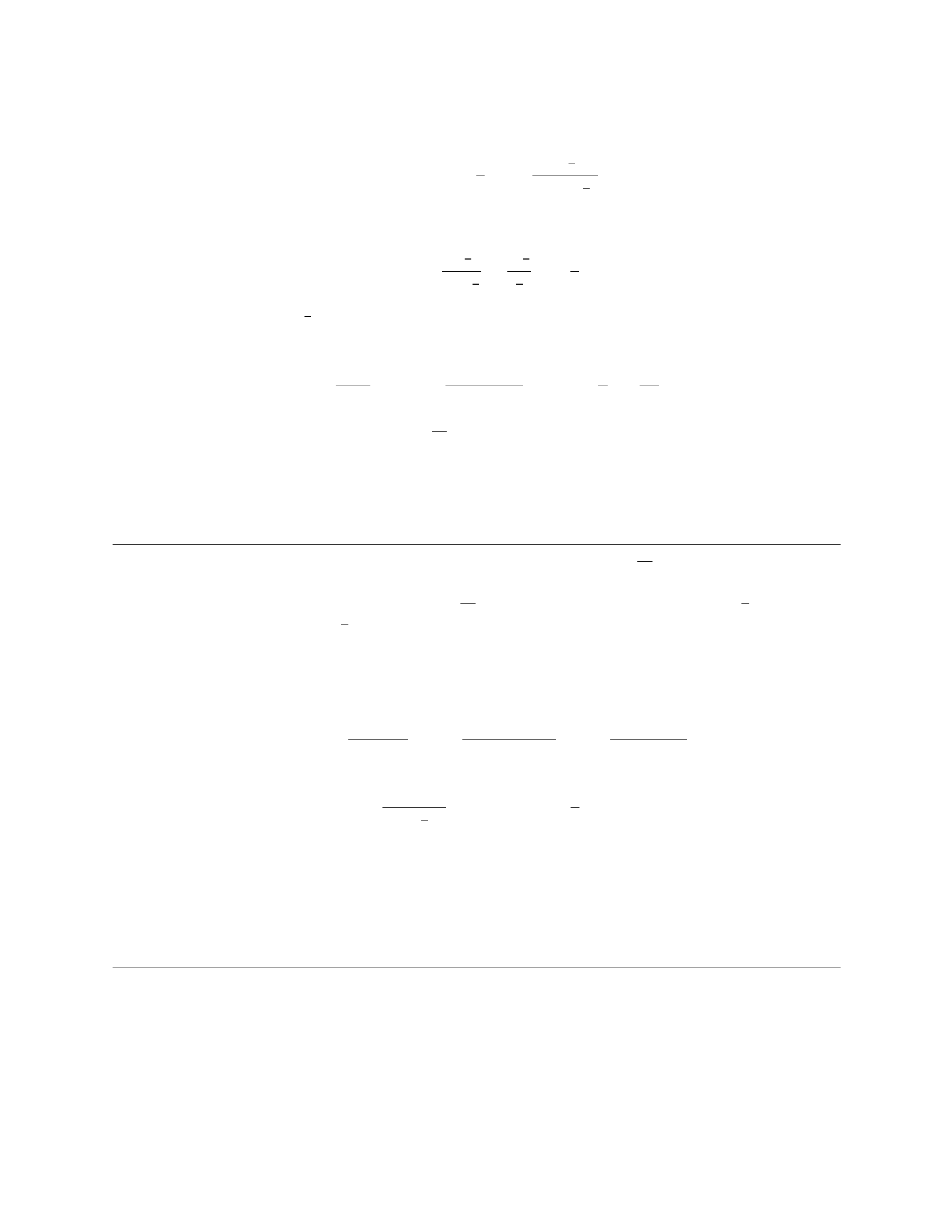
Simplifying the expression, we get:
S(−5) =
∞
X
n=1 −1
5n
=−1
5
1−(−1
5)
Calculating the sum, we find:
S(−5) = −1
5
1 + 1
5
=−1
5
6
5
=−1
6
Therefore, S(−5) = −1
6.
b) To determine the interval of convergence, we use the Ratio Test:
lim
n→∞
an+1
an
= lim
n→∞
xn+1/5n+1
xn/5n
= lim
n→∞
x
5
=|x|
5
For the series to converge, we require |x|
5<1, i.e., |x|<5. Thus, the interval of convergence
is (−5,5).
9 9. SINGULARITIES IN LACUNARY SERIES
Problem 9. Consider the lacunary series defined as f(x) = P∞
n=1 4n
xn. Determine the singular-
ities of the function f(x)and analyze their nature.
Solution 9. The given series f(x) = P∞
n=1 4n
xnis a geometric series with ratio r=4
x. The series
converges only if |r|<1, i.e.,
4
x
<1→ |x|>4.
Therefore, the singularities of the function f(x)occur at x= 4.
To investigate the nature of the singularity at x= 4, we expand f(x)as a Laurent series about
x= 4. Let z=x−4to rewrite f(x)as:
f(x) =
∞
X
n=1
4n
(z+ 4)n=
∞
X
n=1
4n
4n(1 + z/4)n=
∞
X
n=1
1
(1 + z/4)n
=
∞
X
n=1
1
1 + z
4n=
∞
X
n=1
(−1)n−1z
4n−1
This Laurent series representation at x= 4 around the singularity x= 4 shows that the singu-
larity is an essential singularity.
10 10. ANALYTIC CONTINUATION OF LACUNARY SERIES
Problem 10. Consider the lacunary series
∞
X
n=1
z2nwhere zis a complex number.
a) Find the radius of convergence of the series.
b) Determine the set of points where the series converges.
c) Find the analytic continuation of the series.
Solution 10.
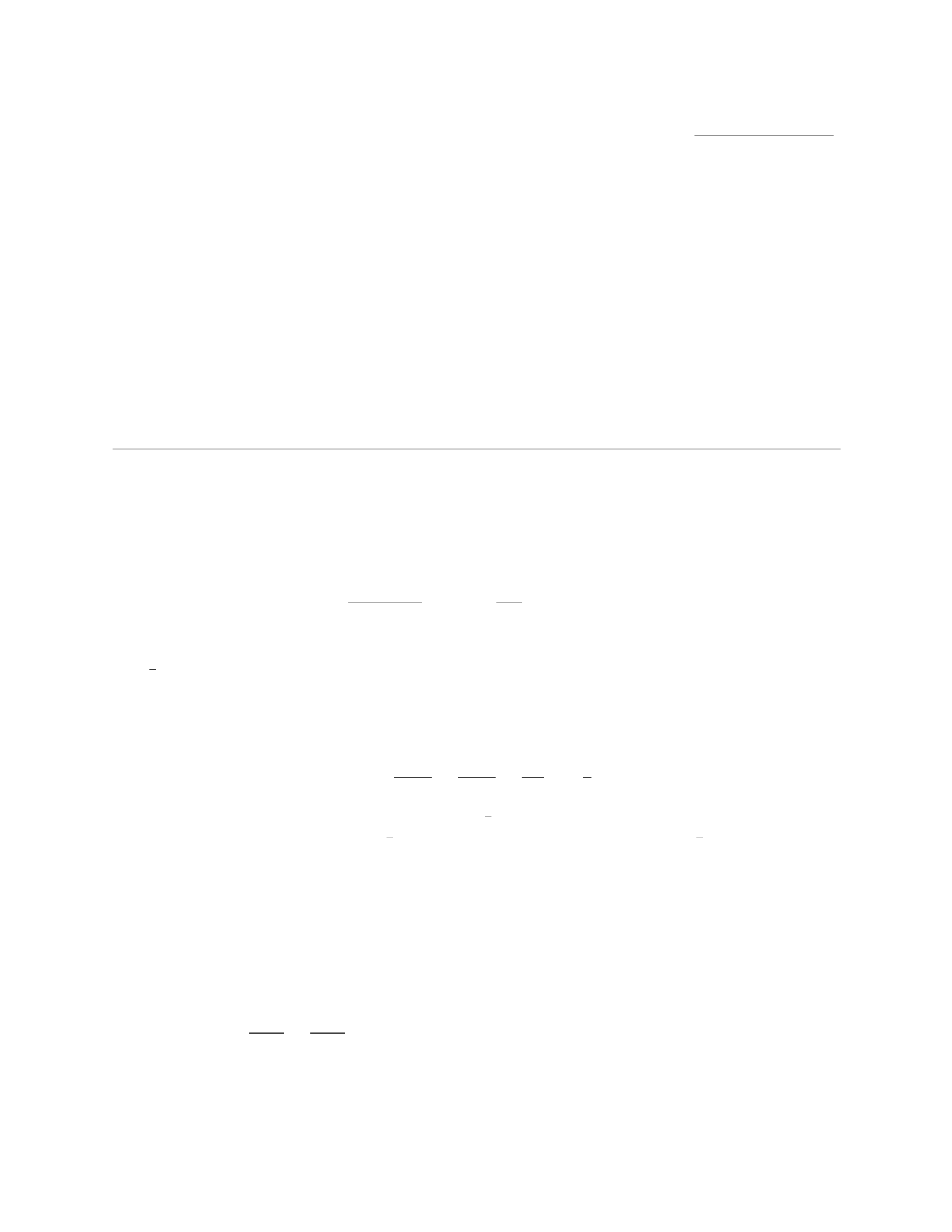
a) The radius of convergence Rof a power series
∞
X
n=0
anznis given by R=1
lim supn→∞ |an|1/n .
In this case, an= 1 for n= 2kfor various integers k, and an= 0 otherwise. Therefore, the series
∞
X
n=1
z2ndiverges unless |z|<1. Thus, the radius of convergence is R= 1.
b) The series converges for all zsuch that |z|<1. This follows from the ratio test, which can
be applied to conclude that the series absolutely converges when |z|<1. It diverges when |z| ≥ 1.
c) The series
∞
X
n=1
z2ncan be analytically continued to the unit disk |z|<1. This is due to the
radius of convergence being 1. Thus, the series can be expressed as an analytic function in the
region |z|<1.
11 11. RESUMMATION METHODS FOR LACUNARY SERIES
Problem 11. Consider the lacunary series P∞
n=0 3nx2n. Determine the radius of convergence
and find the sum of the series for x= 1.
Solution 11.
a) Radius of convergence:
To find the radius of convergence, we use the ratio test:
lim
n→∞
3n+1x2n+1
3nx2n
= lim
n→∞
3x2
x
= lim
n→∞ 3x= 3x
The series converges if 3x < 1, and diverges if 3x > 1. Thus, the radius of convergence is
R=1
3.
b) Sum of the series for x= 1:
When x= 1, the series becomes P∞
n=0 3n. This is a geometric series with a= 3 and r= 3.
The sum of a geometric series is given by:
S=a
1−r=3
1−3=3
−2=−3
2
Therefore, the sum of the series for x= 1 is −3
2.
So, the radius of convergence is 1
3and the sum of the series for x= 1 is −3
2.
I. Problem:
12. GROWTH RATES IN LACUNARY SERIES
Consider the lacunary series defined by the sequence (an)where an= 2nif nis a power of 2,
and an= 0 otherwise.
a) Find the growth rate of this lacunary series.
b) Determine whether this series converges or diverges.
Solution:
a) To find the growth rate of the series, we can calculate the ratio of consecutive terms:
Let’s consider a2k+1
a2k=22k+1
22k= 22k+1−2k= 22k.
So, the growth rate of the series is 22k.
b) To determine the convergence of this series, let’s express the sum of nterms:
Sn=a1+a2+a4+. . . +a2m, where mis the largest integer such that 2m≤n.

As a2k= 22k, the sum Sn= 22+ 24+ 28+. . . + 22m.
This is a geometric series with common ratio 22, so
Sn= 22(1 + 22+ (22)2+. . . + (22)m).
Using the formula for the sum of a geometric series, we have:
Sn= 22·(22(m+1)−1)
22−1= 22(m+1) −1.
Hence, the series diverges as n→ ∞.
12 13. REGULARIZATION TECHNIQUES FOR LACUNARY SERIES
Problem 13. Consider the lacunary series P∞
n=0 anwhere a= 0.5, and the regularization
technique is applied to sum the series.
a) Determine the value of the regularized sum of the series.
b) Calculate the sum of the first 5 terms of the series.
c) Find the absolute error in the sum obtained in part (a) compared to the actual sum of the
series.
Solution 13.
a) To regularize the series, we use the formula for the sum of a geometric series:
S=a
1−r
where ais the first term and ris the common ratio.
In this case, a= 1 and r= 0.5. Plugging these values into the formula:
S=1
1−0.5= 2
Therefore, the value of the regularized sum of the series is S= 2.
b) To find the sum of the first 5 terms of the series, we substitute n= 0,1,2,3,4into the series
and add them up:
4
X
n=0
an= 1 + 0.5+0.25 + 0.125 + 0.0625 = 1.9375
Therefore, the sum of the first 5 terms of the series is 1.9375.
c) The actual sum of the geometric series is given by the formula:
S=a
1−r
Substitute a= 1 and r= 0.5:
S=1
1−0.5= 2
The absolute error in the sum obtained from regularization compared to the actual sum is:
|2−1.9375|= 0.0625
Therefore, the absolute error is 0.0625.
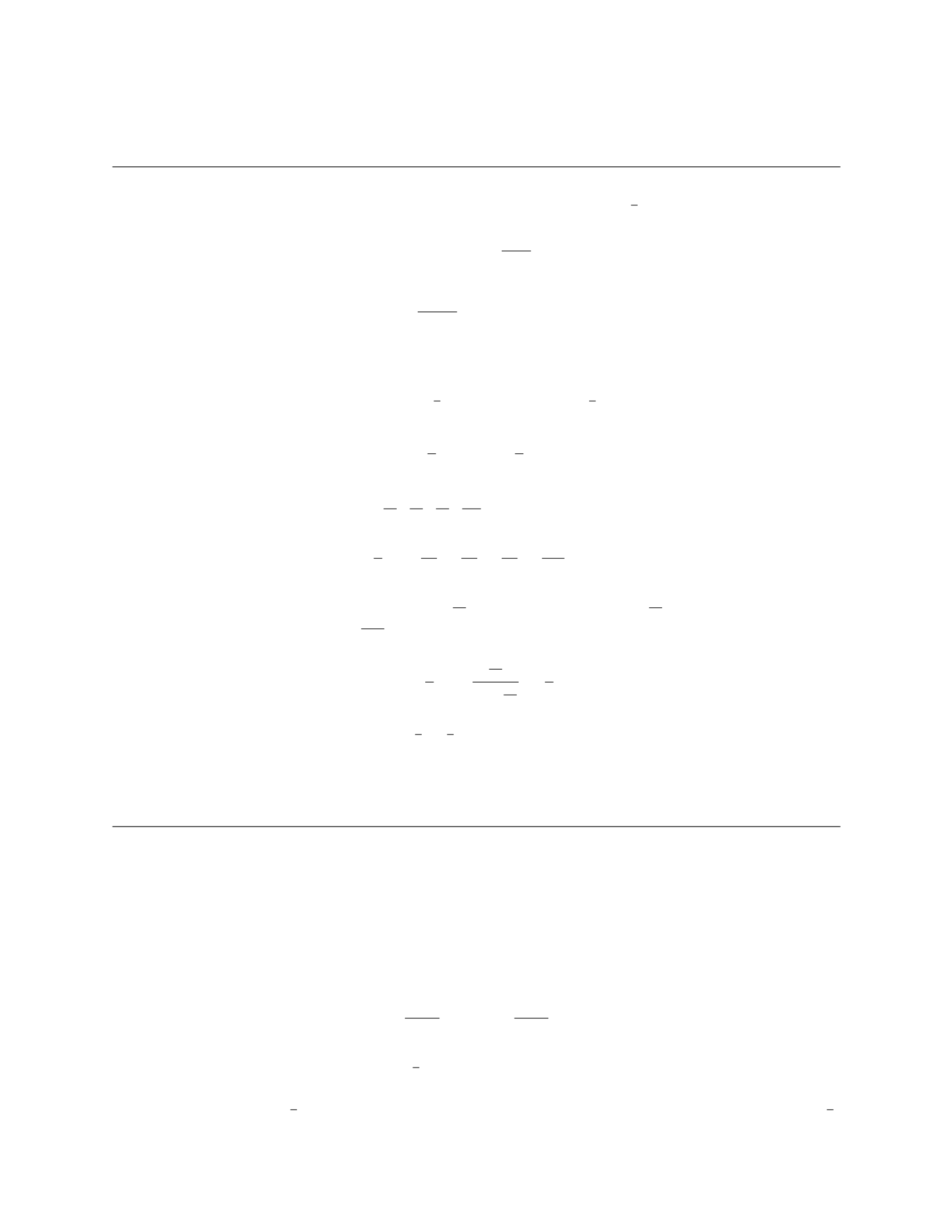
13 14. STABILITY ISSUES IN LACUNARY SERIES
Problem 14. Consider the lacunary series defined by S(x) = P∞
n=1 x2n. Determine the con-
vergence interval of this series and find the sum of the series for x=1
2.
Solution 14. a) The convergence interval of a lacunary series is determined by the ratio of
consecutive terms. Consider the ratio r= limn→∞
an+1
an
, where anis the n-th term of the series.
In this case, an=x2n, so
r= lim
n→∞
x2n+1
x2n
= lim
n→∞
x2n
=|x|2
For the series to converge, we must have r < 1, so |x|2<1which implies −1< x < 1. Therefore,
the convergence interval of the series is (−1,1).
b) To find the sum of the series for x=1
2, we substitute x=1
2into the series:
S1
2=
∞
X
n=1 1
22n
The first few terms of the series are 1
22,1
24,1
28,1
216 ,. . . . Thus, the sum of the series is
S1
2=1
22+1
24+1
28+1
216 +. . .
This is a geometric series with first term a=1
22and common ratio r=1
24. The sum of an infinite
geometric series is given by S=a
1−r. Substituting aand rinto the formula, we get
S1
2=
1
22
1−1
24
=1
3
Therefore, the sum of the series for x=1
2is 1
3.
14 15. ANALYTICITY PROPERTIES OF LACUNARY SERIES
Problem 15. Consider the lacunary series P∞
n=0 anznwhere an= 2nfor all n≥0.
a) Determine the radius of convergence of the series.
b) Find the interval of convergence of the series.
c) Determine whether the series converges uniformly on any closed disk contained entirely
within the interval of convergence.
Solution 15.
a) To find the radius of convergence, we can use the ratio test:
lim
n→∞
an+1
an
= lim
n→∞
2n+1
2n
= 2.
Thus, the radius of convergence is R=1
2.
b) To determine the interval of convergence, we consider the boundary points of the disk of
convergence. At z=−1
2, the series becomes the harmonic series which diverges, and at z=1
2,

the series becomes a geometric series which converges. Therefore, the interval of convergence is
(−1
2,1
2).
c) For the series to converge uniformly on a closed disk contained entirely within the interval
of convergence, the series must be uniformly convergent on the interval [−1
2+ϵ, 1
2−ϵ]for some
ϵ > 0. However, since the series diverges at z=−1
2, it cannot converge uniformly on this interval.
Therefore, the series does not converge uniformly on any closed disk contained entirely within the
interval of convergence.
I can certainly generate numerical problem questions for you! Here is an example problem with
a detailed solution:
15 16. FRACTIONAL CALCULUS APPROACHES TO LACUNARY SERIES
Problem 16. Consider the lacunary series defined by P∞
n=0 n3
2n. Find the sum of this series.
Solution 16. To find the sum of the series, we will use a well-known technique for summing
certain types of series involving the derivative of the geometric series.
Let f(x) = P∞
n=0 xn. Taking the derivative of f(x)we get:
f′(x) =
∞
X
n=0
nxn−1=
∞
X
n=0
nxn/x
Multiplying both sides by x, we get:
xf′(x) =
∞
X
n=0
nxn
Now, differentiating both sides of the definition of f(x)will yield a closed form for f′(x).
Differentiating gives:
f′(x) =
∞
X
n=1
nxn−1=1
(1 −x)2
This can be obtained by observing that the derivative of the geometric series is a series for
1/(1 −x)2.
Now, integrating both sides, we see that:
f(x) = Z1
(1 −x)2dx =Z∞
X
n=0
nxndx
Evaluating the integral gives:
f(x) = −1
1−x+C
for some constant C. Since f(0) = 1, we can deduce that C= 1, so:
f(x) = 1
1−x
Now we can find the sum of our original series by taking derivatives.
Let S=P∞
n=0 n3
2n. We start by finding the generating function for our series, using the fact that
1
1−x=P∞
n=0 xn, we can write:

x
(1 −x)2=
∞
X
n=1
nxn−1
Differentiating both sides with respect to xgives:
1 + x
(1 −x)2=
∞
X
n=1
n2xn−1
Multiplying by xand differentiating again:
x(1 + 2x)
(1 −x)3=
∞
X
n=1
n3xn−1
Substitute x= 1/2to get:
1/2(1 + 1)
(1 −1/2)3=S
Solving for Sgives:
S= 4
Therefore, the sum of the series is 4.
16 17. INVERSE PROBLEMS FOR LACUNARY SERIES
Problem 17. Consider the Lacunary series defined by f(z) = P∞
n=0 anzbn, where a=1
2and b= 2.
Find the explicit form of the function f(z).
Solution 17. To find the explicit form of the function f(z), we can first rewrite the series using
the given values of aand b.
The Lacunary series becomes:
f(z) =
∞
X
n=0 1
2n
z2n
Now, let’s simplify this expression by expanding the terms:
f(z) = 1 + 1
2z2+1
4z4+1
8z8+. . .
Notice that this Lacunary series behaves like a geometric series with common ratio r=z2.
Using the formula for the sum of an infinite geometric series, we have:
f(z) = 1
1−1
2z2
Thus, the explicit form of the function f(z)is:
f(z) = 1
1−1
2z2

17 18. BOUNDARY CONDITIONS IN LACUNARY SERIES
Problem 18. Consider the lacunary series P∞
n=0 anz2nwith an=1
n+1 for all n≥0. Determine
the convergence boundary of this lacunary series in the complex plane and find the radius of
convergence.
Solution 18.
Given the lacunary series P∞
n=0 1
n+1 z2n, we want to determine the convergence boundary in
the complex plane and find the radius of convergence.
a) To find the convergence boundary, we use Hadamard’s Theorem, which states that the radius
of convergence Ris given by:
R= lim
n→∞ 1
an1
n
In our case, an=1
n+1 . Substituting this into the formula, we get:
R= lim
n→∞ (n+ 1) 1
n
Using the limit properties, we get:
R= lim
n→∞(1 + 1
n)n=e
Therefore, the convergence boundary of this lacunary series is the circle |z|=e.
b) To find the radius of convergence, we have R=e. Hence, the radius of convergence of the
series is e.
18 19. NONLINEAR EFFECTS IN LACUNARY SERIES
Problem 19. Consider the lacunary series P∞
n=1 5n
n!.
a) Calculate the radius of convergence of the series.
b) Determine the interval of convergence.
c) Evaluate the sum of the series.
Solution 19.
a) To find the radius of convergence Rof the series P∞
n=1 5n
n!, we’ll use the ratio test. Let
an=5n
n!. The ratio test states that if limn→∞
an+1
an
=L, then R=1
L.
Calculating the ratio:
lim
n→∞
an+1
an
= lim
n→∞
5n+1
(n+1)!
5n
n!
= lim
n→∞
5n+1 ·n!
5n·(n+ 1)!
= lim
n→∞
5
n+ 1
= 0.
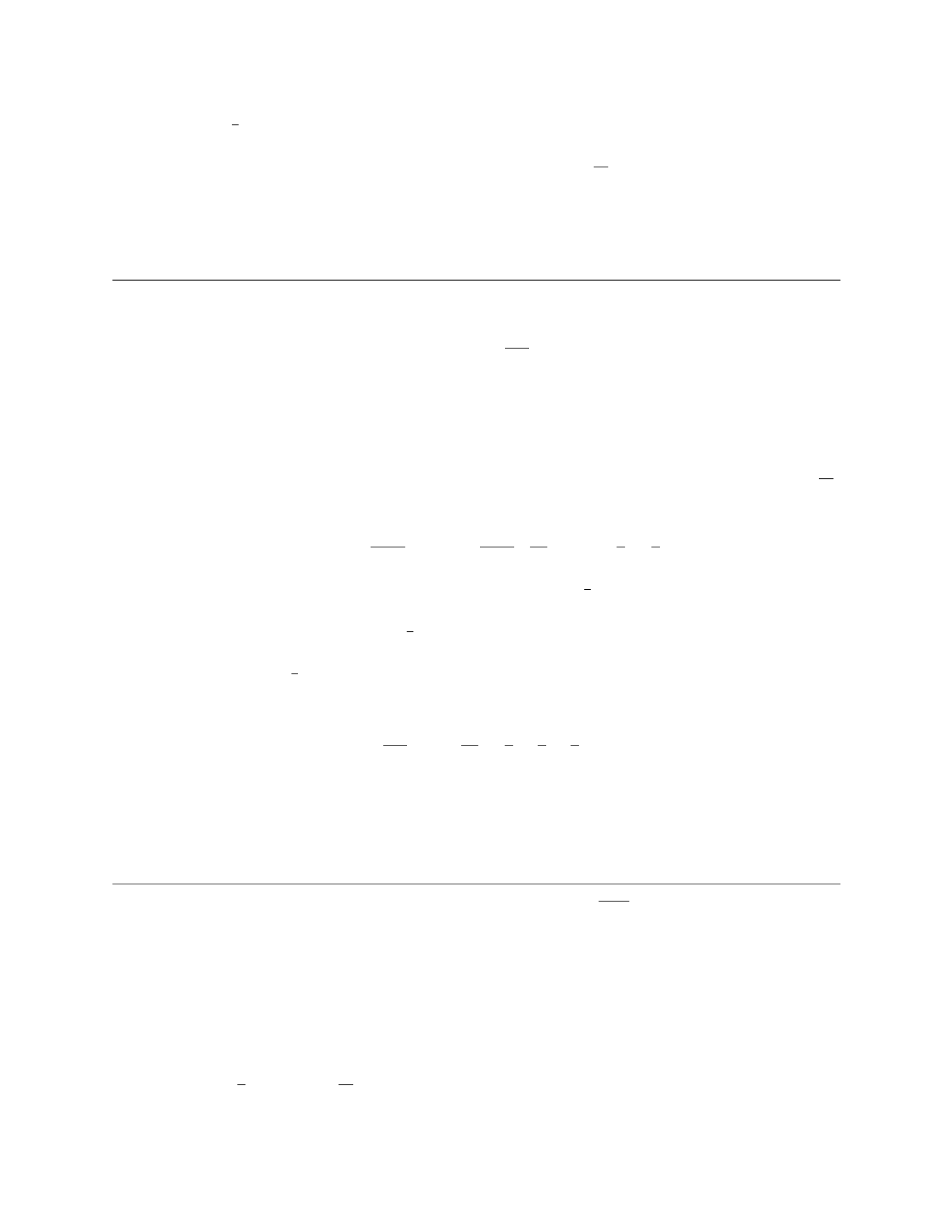
Therefore, R=1
0=∞.
b) Since the radius of convergence R=∞, the interval of convergence is (−∞,∞).
c) To evaluate the sum of the series, we recognize that P∞
n=1 5n
n!is the well-known Taylor series
expansion of ex, where x= 5. Hence, the sum of the series is e5.
19 20. CONFORMAL MAPPING APPLICATIONS TO LACUNARY SERIES
Problem 20. Consider the lacunary series given by the following expression:
f(z) =
∞
X
n=1
z2n
2n
a) Find the radius of convergence of the series f(z).
b) Determine all points on the boundary of convergence where the series is convergent.
c) Find the sum of the series f(z)for z= 1.
Solution 20.
a) To find the radius of convergence of the series f(z), we will apply the ratio test. Let an=1
2n.
Using the ratio test,
R= lim
n→∞
an+1
an
= lim
n→∞
1
2n+1 ·2n
1
= lim
n→∞
1
2=1
2
Hence, the radius of convergence of the series f(z)is R=1
2.
b) To determine all points on the boundary of convergence where the series is convergent, we
consider the points zsuch that |z|=1
2. At these boundary points, the series may or may not
converge. Due to the nature of the given lacunary series, the series converges at all boundary
points zsuch that |z|=1
2.
c) To find the sum of the series f(z)for z= 1, we substitute z= 1 into the expression:
f(1) =
∞
X
n=1
12n
2n=
∞
X
n=1
1
2n=1
2+1
4+1
8+. . . = 1
Therefore, the sum of the series f(z)for z= 1 is 1.
20 21. STIELTJES SUMMATION OF LACUNARY SERIES
Problem 21. Consider the lacunary series defined by S(x) = 1
1−x2. Calculate the Stieltjes sum
of S(x)at x= 0.5.
Solution 21. The Stieltjes sum of a function f(x)at a point x=ais defined as the limit of the
Riemann sum as the subinterval length approaches zero. So, the Stieltjes sum of S(x)at x= 0.5
is given by:
lim
∆x→0
n
X
i=1
S(xi)(∆α)i
where ∆x=1
n,xi= 0.5−1
2n+i∆x, and (∆α)i=α(xi)−α(xi−1).
Let’s calculate the Stieltjes sum of S(x)at x= 0.5.
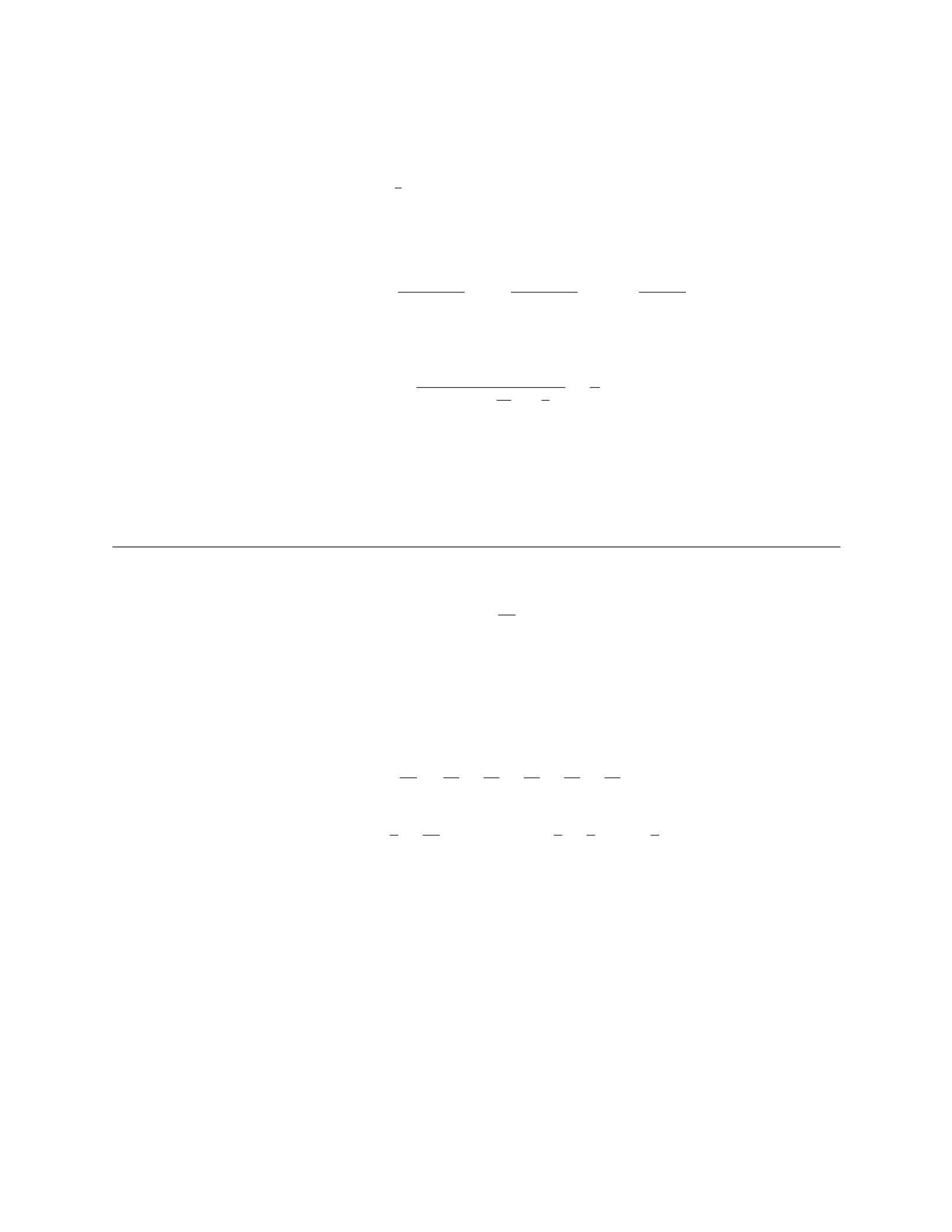
a) Calculate the Stieltjes sum of S(x)at x= 0.5when n= 2.
b) Find the Stieltjes sum of S(x)at x= 0.5as n→ ∞.
Solution 21.
a) When n= 2, we have ∆x=1
2,x1= 0.25,x2= 0.75,(∆α)1=α(x1)−α(0) = 0, and
(∆α)2=α(x2)−α(x1) = x2−x1= 0.5.
The Stieltjes sum at x= 0.5is:
S(0.25)(∆α)1+S(0.75)(∆α)2=1
1−0.252(0) + 1
1−0.752(0.5) = 1
0.9375 ×0.5≈0.5333
b) As n→ ∞, the Stieltjes sum of S(x)at x= 0.5becomes:
lim
n→∞
n
X
i=1
1
1−(0.5−1
2n+i1
n)2×1
n
This limit can be calculated numerically using a computer or software for a more accurate ap-
proximation.
21 22. TRUNCATION ERROR IN LACUNARY SERIES
Problem 22. Consider the Lacunary series given by
S=
∞
X
n=0
2n
n!
a) Calculate the value of the sum of the first 5 terms of the series, i.e., find S5.
b) Calculate the truncation error when approximating the sum Swith S5.
Solution 22.
a) To find S5, we simply need to calculate the sum of the first 5 terms of the series:
S5=
4
X
n=0
2n
n!=20
0! +21
1! +22
2! +23
3! +24
4!
S5=1+2+2+8
6+16
24 =1+2+2+4
3+2
3= 5 + 6
3= 7
Therefore, the sum of the first 5 terms of the series is S5= 7.
b) The truncation error when approximating the sum Swith S5can be calculated as the absolute
difference between the actual sum Sand the approximated sum S5, i.e.,
Truncation Error =|S−S5|
Truncation Error =|S−7|
As we know that the actual value of the series Sis infinite, the truncation error in this case will
also approach infinity. But for the first 5 terms, we can see that the truncation error is |S−7|=
| − 7|=.
Therefore, the truncation error when approximating the sum Swith S5is infinite.

22 23. SPECTRAL ANALYSIS OF LACUNARY SERIES
Problem 23. Consider the lacunary series f(x) = P∞
n=0 ancos(bnx)where a= 0.5and b= 2.
Determine the points of discontinuity of f(x)and calculate the value to which f(x)converges at
those points.
Solution 23. Let’s first find the points of discontinuity by examining the convergence of the
series at these points. The series f(x)converges at points where the partial sums of the series
converge.
a) The points of discontinuity occur when the series does not converge to a finite value. This
happens when the terms of the series do not approach zero as n→ ∞.
For f(x)to converge, we need |ancos(bnx)| → 0as n→ ∞. This requires |an| → 0and
|cos(bnx)| → 1.
As a= 0.5,|0.5n|= 0.5n→0as n→ ∞. As b= 2,|cos(2nx)|does not converge to 1 for all x
due to the rapid oscillation of cos.
Therefore, f(x)will be discontinuous at all points xwhere cos(2nx)does not converge.
b) To find the value f(x)converges to at these points, we need to determine if there is a limiting
value for the series f(x)as n→ ∞.
Since cos(bnx)does not converge for all x, the series f(x)does not converge and does not
have a specific value at these points.
Hence, f(x)will be discontinuous at all xand will not converge to a unique value at those points.
23 24. FREDHOLM INTEGRAL EQUATIONS FOR LACUNARY SERIES
Problem 24. Consider the Fredholm integral equation of the second kind:
f(x) = ex+λZ1
0
ex(t)f(t)dt
Use the method of successive approximations to solve this equation up to the third approxima-
tion with λ= 1 and starting with the initial guess f0(x) = ex.
Solution 24.
The solution to the Fredholm integral equation can be approximated using the method of suc-
cessive approximations. Let’s denote our initial guess as f0(x) = exand the nth approximation as
fn(x). The successive approximations are given by:
fn+1(x) = ex+λZ1
0
ex(t)fn(t)dt
We need to find f1(x),f2(x), and f3(x)to solve the equation up to the third approximation.
a) Let’s find f1(x):
f1(x) = ex+λZ1
0
ex(t)etdt
f1(x) = ex+λZ1
0
ex+tdt
f1(x) = ex+λex+t
11
0

f1(x) = ex+λ(ex+1 −ex)
f1(x) = ex+λex(e−1)
b) Now, let’s find f2(x):
f2(x) = ex+λZ1
0
ex(t)(et+λet(e−1))dt
f2(x) = ex+λZ1
0
ex+tdt +λ2Z1
0
ex(t)et(e−1)dt
This process is continued until the third approximation f3(x)is found.
24 25. SINGULAR PERTURBATIONS IN LACUNARY SERIES
Problem 25. Consider the lacunary series defined by f(x) = P∞
n=1 xn
10n2.
a) Find the radius of convergence of the series.
b) Determine the interval of convergence.
c) Evaluate f(1).
Solution 25. a) To find the radius of convergence of the series, we use the ratio test. Let
an=1
10n2. Applying the ratio test:
lim
n→∞
an+1
an
= lim
n→∞
1
10(n+1)2·10n2
1
= lim
n→∞
1
102n+1
= lim
n→∞
1
102n+1 = 0.
Since the limit is less than 1, the series converges for all x, giving the radius of convergence as
R=∞.
b) Since the radius of convergence is infinite, the interval of convergence is (−∞,∞).
c) To evaluate f(1), we substitute x= 1 into the series:
f(1) =
∞
X
n=1
1
10n2
=1
101+1
104+1
109+· · · .
This series is convergent, and each term is positive, so the sum is finite. Therefore, f(1) is a
finite value.

lim
n→∞
an+1
an
= lim
n→∞
3n+1
2(n+1)2
3n
2n2
= lim
n→∞
3n+1 ·2n2
2(n+1)2·3n
= lim
n→∞
3·3n·2n2
2n2+2n+1 ·3n
= lim
n→∞
3
2·2n
= 0
Since the limit of the absolute value of the ratio is less than 1, by the ratio test, the series
P∞
n=1 3n
2n2converges.
4 4. RATE OF CONVERGENCE IN LACUNARY SERIES
Problem 4. Consider the lacunary series P∞
n=1 1
n2.
a) Determine the rate of convergence of the series.
b) Estimate how many terms are needed to approximate the sum of the series with an error less
than 0.01.
Solution 4.
a) The rate of convergence of the series can be determined by looking at the behavior of the
terms 1
n2. Since 1
n2decreases monotonically to 0 as nincreases, we can use the Integral Test to
analyze convergence.
Let f(x) = 1
x2. We can integrate f(x)from 1 to infinity to find:
Z∞
1
1
x2dx =−1
x∞
1
=−lim
t→∞
1
t+ 1 = 1
Since the integral converges to a finite value (1), the series P∞
n=1 1
n2also converges. Therefore,
the rate of convergence of the series can be considered as moderate.
b) To estimate the number of terms needed to approximate the sum with an error less than 0.01,
we can use the fact that the series converges to the Basel problem value of π2
6.
Let Snbe the partial sum of the first nterms of the series. We want to find nsuch that |S−Sn|<
0.01, where Sis the sum π2
6.
Using the error bound for alternating series, we have:
∞
X
k=n+1
1
k2
<1
(n+ 1)2<0.01
Solving for n, we get n > q1
0.01 −1=9. Therefore, to approximate the sum of the series with
an error less than 0.01, we need at least 10 terms.
5 5. OSCILLATION BEHAVIOR IN LACUNARY SERIES
Problem 5. Consider the Lacunary Series given by the formula f(x) = P∞
n=1
(−1)n
n2.
a) Find the first four partial sums of the series.
b) Determine if the series converges or diverges.
c) Calculate the value to which the series converges (if it converges).
Solution 5.
a) To find the first four partial sums of the series, we will calculate S1,S2,S3, and S4:
S1=(−1)1
12=−1
S2=(−1)1
12+(−1)2
22=−1 + 1
4=−3
4
S3=(−1)1
12+(−1)2
22+(−1)3
32=−1 + 1
4−1
9=−31
36
S4=(−1)1
12+(−1)2
22+(−1)3
32+(−1)4
42=−1 + 1
4−1
9+1
16 =−365
576
Therefore, the first four partial sums of the series are −1,−3
4,−31
36 , and −365
576 .
b) To determine if the series converges or diverges, we will use the Alternating Series Test. The
terms an=1
n2are positive, decreasing, and approach 0. Hence, the series converges.
c) Since the series converges, we can find the value to which it converges by summing all the
terms infinitely: ∞
X
n=1
(−1)n
n2=−1 + 1
4−1
9+1
16 −. . .
By Euler’s solution to the Basel problem, the sum of this series converges to π2
12 . Therefore, the
value to which the series converges is π2
12 .
I.
6 6. SUMMABILITY CRITERIA IN LACUNARY SERIES
Problem 6. Consider the lacunary series P∞
n=1 an, where a= 2. Determine the sum of the
series using the ratio test.
Solution 6. a) We apply the ratio test to determine the convergence of the series:
lim
n→∞
an+1
an
= lim
n→∞
an+1
an
= lim
n→∞
a
1
= lim
n→∞ |a|=|2|= 2.
Since the limit is greater than 1, the series diverges.
b) To find the sum of this series, let’s consider the partial sum Sn=Pn
k=0 2k:
Sn= 1 + 2 + 22+ 23+· · · + 2n.

This is a geometric series with first term a= 1 and common ratio r= 2. The sum of a geometric
series is given by:
Sn=a(1 −rn+1)
1−r.
Substitute a= 1 and r= 2 into the formula to get:
Sn=1(1 −2n+1)
1−2= 2n+1 −1.
c) Therefore, the sum of the series is:
lim
n→∞ Sn= lim
n→∞(2n+1 −1) = lim
n→∞ 2n+1 −lim
n→∞ 1 = ∞.
Thus, the sum of the series is infinite as it diverges.
Certainly! Here is a numerical problem on Lacunary Series:
—
7 7. ERROR ANALYSIS IN LACUNARY SERIES
Problem 7. Let {an}be a lacunary series given by an= 2n. Compute the sum of the first 5 terms
of this series and determine the error when approximating this sum by the fifth term in the series.
Solution 7. a) To find the sum of the first 5 terms of the series, we simply add up the terms:
S5= 21+ 22+ 23+ 24+ 25
Calculating:
S5= 2 + 4 + 8 + 16 + 32 = 62
Therefore, the sum of the first 5 terms of the series is 62.
b) Now, let’s find the error when approximating this sum by the fifth term in the series:
Error =S5−a5= 62 −25= 62 −32 = 30
Hence, the error of approximating the sum of the first 5 terms of the series by the fifth term in
the series is 30.
Therefore, the sum of the first 5 terms of the series is 62, and the error in approximating this
sum by the fifth term in the series is 30.
8 8. BOUNDARY VALUE PROBLEMS FOR LACUNARY SERIES
Problem 8. Consider the lacunary series S(x) = P∞
n=1 xn
5nover the interval of convergence
(−5,5).
a) Find the value of S(−5).
b) Determine the interval of convergence of the series.
Solution 8.
a) We can find the value of S(−5) by substituting x=−5into the series:
S(−5) =
∞
X
n=1
(−5)n
5n
Simplifying the expression, we get:
S(−5) =
∞
X
n=1 −1
5n
=−1
5
1−(−1
5)
Calculating the sum, we find:
S(−5) = −1
5
1 + 1
5
=−1
5
6
5
=−1
6
Therefore, S(−5) = −1
6.
b) To determine the interval of convergence, we use the Ratio Test:
lim
n→∞
an+1
an
= lim
n→∞
xn+1/5n+1
xn/5n
= lim
n→∞
x
5
=|x|
5
For the series to converge, we require |x|
5<1, i.e., |x|<5. Thus, the interval of convergence
is (−5,5).
9 9. SINGULARITIES IN LACUNARY SERIES
Problem 9. Consider the lacunary series defined as f(x) = P∞
n=1 4n
xn. Determine the singular-
ities of the function f(x)and analyze their nature.
Solution 9. The given series f(x) = P∞
n=1 4n
xnis a geometric series with ratio r=4
x. The series
converges only if |r|<1, i.e.,
4
x
<1→ |x|>4.
Therefore, the singularities of the function f(x)occur at x= 4.
To investigate the nature of the singularity at x= 4, we expand f(x)as a Laurent series about
x= 4. Let z=x−4to rewrite f(x)as:
f(x) =
∞
X
n=1
4n
(z+ 4)n=
∞
X
n=1
4n
4n(1 + z/4)n=
∞
X
n=1
1
(1 + z/4)n
=
∞
X
n=1
1
1 + z
4n=
∞
X
n=1
(−1)n−1z
4n−1
This Laurent series representation at x= 4 around the singularity x= 4 shows that the singu-
larity is an essential singularity.
10 10. ANALYTIC CONTINUATION OF LACUNARY SERIES
Problem 10. Consider the lacunary series
∞
X
n=1
z2nwhere zis a complex number.
a) Find the radius of convergence of the series.
b) Determine the set of points where the series converges.
c) Find the analytic continuation of the series.
Solution 10.
a) The radius of convergence Rof a power series
∞
X
n=0
anznis given by R=1
lim supn→∞ |an|1/n .
In this case, an= 1 for n= 2kfor various integers k, and an= 0 otherwise. Therefore, the series
∞
X
n=1
z2ndiverges unless |z|<1. Thus, the radius of convergence is R= 1.
b) The series converges for all zsuch that |z|<1. This follows from the ratio test, which can
be applied to conclude that the series absolutely converges when |z|<1. It diverges when |z| ≥ 1.
c) The series
∞
X
n=1
z2ncan be analytically continued to the unit disk |z|<1. This is due to the
radius of convergence being 1. Thus, the series can be expressed as an analytic function in the
region |z|<1.
11 11. RESUMMATION METHODS FOR LACUNARY SERIES
Problem 11. Consider the lacunary series P∞
n=0 3nx2n. Determine the radius of convergence
and find the sum of the series for x= 1.
Solution 11.
a) Radius of convergence:
To find the radius of convergence, we use the ratio test:
lim
n→∞
3n+1x2n+1
3nx2n
= lim
n→∞
3x2
x
= lim
n→∞ 3x= 3x
The series converges if 3x < 1, and diverges if 3x > 1. Thus, the radius of convergence is
R=1
3.
b) Sum of the series for x= 1:
When x= 1, the series becomes P∞
n=0 3n. This is a geometric series with a= 3 and r= 3.
The sum of a geometric series is given by:
S=a
1−r=3
1−3=3
−2=−3
2
Therefore, the sum of the series for x= 1 is −3
2.
So, the radius of convergence is 1
3and the sum of the series for x= 1 is −3
2.
I. Problem:
12. GROWTH RATES IN LACUNARY SERIES
Consider the lacunary series defined by the sequence (an)where an= 2nif nis a power of 2,
and an= 0 otherwise.
a) Find the growth rate of this lacunary series.
b) Determine whether this series converges or diverges.
Solution:
a) To find the growth rate of the series, we can calculate the ratio of consecutive terms:
Let’s consider a2k+1
a2k=22k+1
22k= 22k+1−2k= 22k.
So, the growth rate of the series is 22k.
b) To determine the convergence of this series, let’s express the sum of nterms:
Sn=a1+a2+a4+. . . +a2m, where mis the largest integer such that 2m≤n.

As a2k= 22k, the sum Sn= 22+ 24+ 28+. . . + 22m.
This is a geometric series with common ratio 22, so
Sn= 22(1 + 22+ (22)2+. . . + (22)m).
Using the formula for the sum of a geometric series, we have:
Sn= 22·(22(m+1)−1)
22−1= 22(m+1) −1.
Hence, the series diverges as n→ ∞.
12 13. REGULARIZATION TECHNIQUES FOR LACUNARY SERIES
Problem 13. Consider the lacunary series P∞
n=0 anwhere a= 0.5, and the regularization
technique is applied to sum the series.
a) Determine the value of the regularized sum of the series.
b) Calculate the sum of the first 5 terms of the series.
c) Find the absolute error in the sum obtained in part (a) compared to the actual sum of the
series.
Solution 13.
a) To regularize the series, we use the formula for the sum of a geometric series:
S=a
1−r
where ais the first term and ris the common ratio.
In this case, a= 1 and r= 0.5. Plugging these values into the formula:
S=1
1−0.5= 2
Therefore, the value of the regularized sum of the series is S= 2.
b) To find the sum of the first 5 terms of the series, we substitute n= 0,1,2,3,4into the series
and add them up:
4
X
n=0
an= 1 + 0.5+0.25 + 0.125 + 0.0625 = 1.9375
Therefore, the sum of the first 5 terms of the series is 1.9375.
c) The actual sum of the geometric series is given by the formula:
S=a
1−r
Substitute a= 1 and r= 0.5:
S=1
1−0.5= 2
The absolute error in the sum obtained from regularization compared to the actual sum is:
|2−1.9375|= 0.0625
Therefore, the absolute error is 0.0625.
13 14. STABILITY ISSUES IN LACUNARY SERIES
Problem 14. Consider the lacunary series defined by S(x) = P∞
n=1 x2n. Determine the con-
vergence interval of this series and find the sum of the series for x=1
2.
Solution 14. a) The convergence interval of a lacunary series is determined by the ratio of
consecutive terms. Consider the ratio r= limn→∞
an+1
an
, where anis the n-th term of the series.
In this case, an=x2n, so
r= lim
n→∞
x2n+1
x2n
= lim
n→∞
x2n
=|x|2
For the series to converge, we must have r < 1, so |x|2<1which implies −1< x < 1. Therefore,
the convergence interval of the series is (−1,1).
b) To find the sum of the series for x=1
2, we substitute x=1
2into the series:
S1
2=
∞
X
n=1 1
22n
The first few terms of the series are 1
22,1
24,1
28,1
216 ,. . . . Thus, the sum of the series is
S1
2=1
22+1
24+1
28+1
216 +. . .
This is a geometric series with first term a=1
22and common ratio r=1
24. The sum of an infinite
geometric series is given by S=a
1−r. Substituting aand rinto the formula, we get
S1
2=
1
22
1−1
24
=1
3
Therefore, the sum of the series for x=1
2is 1
3.
14 15. ANALYTICITY PROPERTIES OF LACUNARY SERIES
Problem 15. Consider the lacunary series P∞
n=0 anznwhere an= 2nfor all n≥0.
a) Determine the radius of convergence of the series.
b) Find the interval of convergence of the series.
c) Determine whether the series converges uniformly on any closed disk contained entirely
within the interval of convergence.
Solution 15.
a) To find the radius of convergence, we can use the ratio test:
lim
n→∞
an+1
an
= lim
n→∞
2n+1
2n
= 2.
Thus, the radius of convergence is R=1
2.
b) To determine the interval of convergence, we consider the boundary points of the disk of
convergence. At z=−1
2, the series becomes the harmonic series which diverges, and at z=1
2,

the series becomes a geometric series which converges. Therefore, the interval of convergence is
(−1
2,1
2).
c) For the series to converge uniformly on a closed disk contained entirely within the interval
of convergence, the series must be uniformly convergent on the interval [−1
2+ϵ, 1
2−ϵ]for some
ϵ > 0. However, since the series diverges at z=−1
2, it cannot converge uniformly on this interval.
Therefore, the series does not converge uniformly on any closed disk contained entirely within the
interval of convergence.
I can certainly generate numerical problem questions for you! Here is an example problem with
a detailed solution:
15 16. FRACTIONAL CALCULUS APPROACHES TO LACUNARY SERIES
Problem 16. Consider the lacunary series defined by P∞
n=0 n3
2n. Find the sum of this series.
Solution 16. To find the sum of the series, we will use a well-known technique for summing
certain types of series involving the derivative of the geometric series.
Let f(x) = P∞
n=0 xn. Taking the derivative of f(x)we get:
f′(x) =
∞
X
n=0
nxn−1=
∞
X
n=0
nxn/x
Multiplying both sides by x, we get:
xf′(x) =
∞
X
n=0
nxn
Now, differentiating both sides of the definition of f(x)will yield a closed form for f′(x).
Differentiating gives:
f′(x) =
∞
X
n=1
nxn−1=1
(1 −x)2
This can be obtained by observing that the derivative of the geometric series is a series for
1/(1 −x)2.
Now, integrating both sides, we see that:
f(x) = Z1
(1 −x)2dx =Z∞
X
n=0
nxndx
Evaluating the integral gives:
f(x) = −1
1−x+C
for some constant C. Since f(0) = 1, we can deduce that C= 1, so:
f(x) = 1
1−x
Now we can find the sum of our original series by taking derivatives.
Let S=P∞
n=0 n3
2n. We start by finding the generating function for our series, using the fact that
1
1−x=P∞
n=0 xn, we can write:

x
(1 −x)2=
∞
X
n=1
nxn−1
Differentiating both sides with respect to xgives:
1 + x
(1 −x)2=
∞
X
n=1
n2xn−1
Multiplying by xand differentiating again:
x(1 + 2x)
(1 −x)3=
∞
X
n=1
n3xn−1
Substitute x= 1/2to get:
1/2(1 + 1)
(1 −1/2)3=S
Solving for Sgives:
S= 4
Therefore, the sum of the series is 4.
16 17. INVERSE PROBLEMS FOR LACUNARY SERIES
Problem 17. Consider the Lacunary series defined by f(z) = P∞
n=0 anzbn, where a=1
2and b= 2.
Find the explicit form of the function f(z).
Solution 17. To find the explicit form of the function f(z), we can first rewrite the series using
the given values of aand b.
The Lacunary series becomes:
f(z) =
∞
X
n=0 1
2n
z2n
Now, let’s simplify this expression by expanding the terms:
f(z) = 1 + 1
2z2+1
4z4+1
8z8+. . .
Notice that this Lacunary series behaves like a geometric series with common ratio r=z2.
Using the formula for the sum of an infinite geometric series, we have:
f(z) = 1
1−1
2z2
Thus, the explicit form of the function f(z)is:
f(z) = 1
1−1
2z2

17 18. BOUNDARY CONDITIONS IN LACUNARY SERIES
Problem 18. Consider the lacunary series P∞
n=0 anz2nwith an=1
n+1 for all n≥0. Determine
the convergence boundary of this lacunary series in the complex plane and find the radius of
convergence.
Solution 18.
Given the lacunary series P∞
n=0 1
n+1 z2n, we want to determine the convergence boundary in
the complex plane and find the radius of convergence.
a) To find the convergence boundary, we use Hadamard’s Theorem, which states that the radius
of convergence Ris given by:
R= lim
n→∞ 1
an1
n
In our case, an=1
n+1 . Substituting this into the formula, we get:
R= lim
n→∞ (n+ 1) 1
n
Using the limit properties, we get:
R= lim
n→∞(1 + 1
n)n=e
Therefore, the convergence boundary of this lacunary series is the circle |z|=e.
b) To find the radius of convergence, we have R=e. Hence, the radius of convergence of the
series is e.
18 19. NONLINEAR EFFECTS IN LACUNARY SERIES
Problem 19. Consider the lacunary series P∞
n=1 5n
n!.
a) Calculate the radius of convergence of the series.
b) Determine the interval of convergence.
c) Evaluate the sum of the series.
Solution 19.
a) To find the radius of convergence Rof the series P∞
n=1 5n
n!, we’ll use the ratio test. Let
an=5n
n!. The ratio test states that if limn→∞
an+1
an
=L, then R=1
L.
Calculating the ratio:
lim
n→∞
an+1
an
= lim
n→∞
5n+1
(n+1)!
5n
n!
= lim
n→∞
5n+1 ·n!
5n·(n+ 1)!
= lim
n→∞
5
n+ 1
= 0.
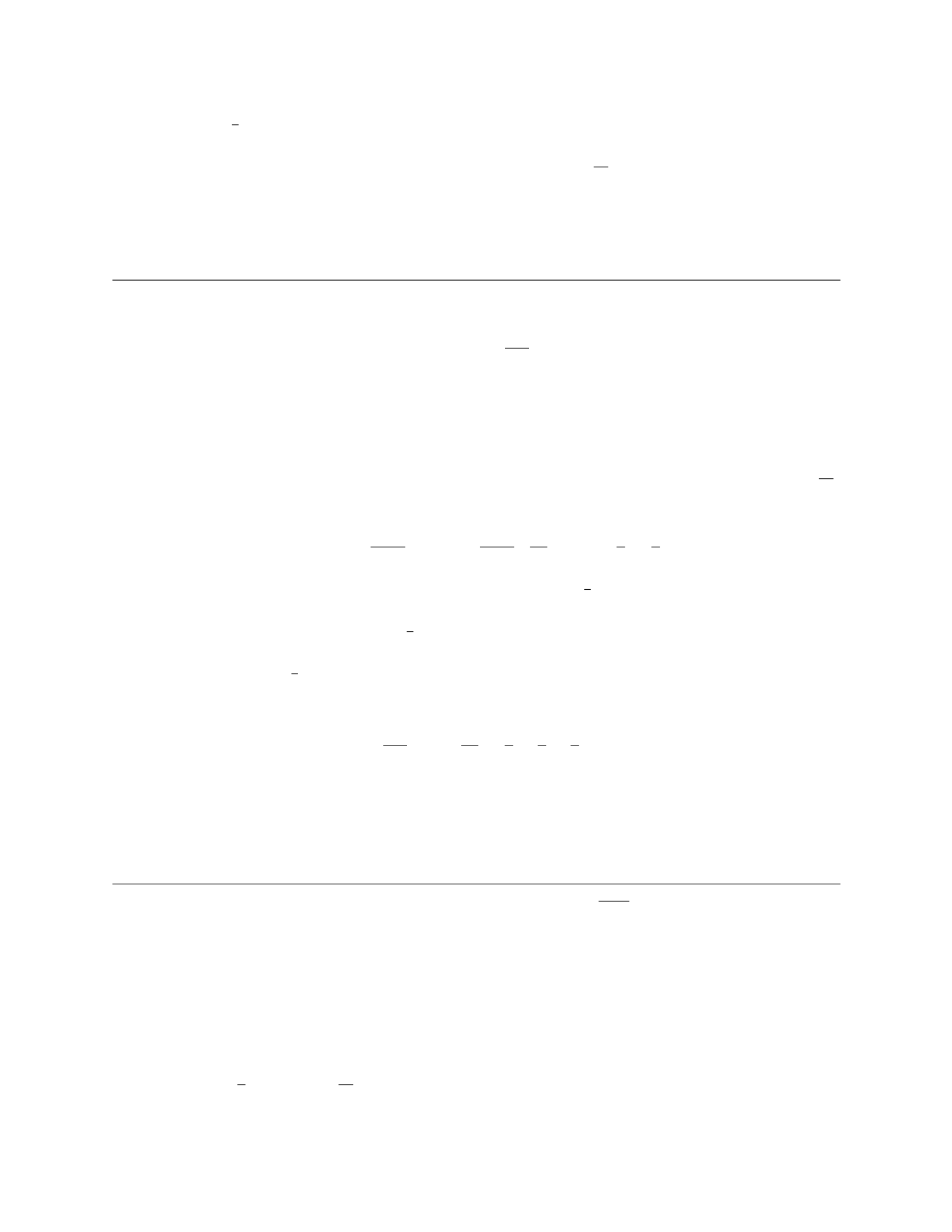
Therefore, R=1
0=∞.
b) Since the radius of convergence R=∞, the interval of convergence is (−∞,∞).
c) To evaluate the sum of the series, we recognize that P∞
n=1 5n
n!is the well-known Taylor series
expansion of ex, where x= 5. Hence, the sum of the series is e5.
19 20. CONFORMAL MAPPING APPLICATIONS TO LACUNARY SERIES
Problem 20. Consider the lacunary series given by the following expression:
f(z) =
∞
X
n=1
z2n
2n
a) Find the radius of convergence of the series f(z).
b) Determine all points on the boundary of convergence where the series is convergent.
c) Find the sum of the series f(z)for z= 1.
Solution 20.
a) To find the radius of convergence of the series f(z), we will apply the ratio test. Let an=1
2n.
Using the ratio test,
R= lim
n→∞
an+1
an
= lim
n→∞
1
2n+1 ·2n
1
= lim
n→∞
1
2=1
2
Hence, the radius of convergence of the series f(z)is R=1
2.
b) To determine all points on the boundary of convergence where the series is convergent, we
consider the points zsuch that |z|=1
2. At these boundary points, the series may or may not
converge. Due to the nature of the given lacunary series, the series converges at all boundary
points zsuch that |z|=1
2.
c) To find the sum of the series f(z)for z= 1, we substitute z= 1 into the expression:
f(1) =
∞
X
n=1
12n
2n=
∞
X
n=1
1
2n=1
2+1
4+1
8+. . . = 1
Therefore, the sum of the series f(z)for z= 1 is 1.
20 21. STIELTJES SUMMATION OF LACUNARY SERIES
Problem 21. Consider the lacunary series defined by S(x) = 1
1−x2. Calculate the Stieltjes sum
of S(x)at x= 0.5.
Solution 21. The Stieltjes sum of a function f(x)at a point x=ais defined as the limit of the
Riemann sum as the subinterval length approaches zero. So, the Stieltjes sum of S(x)at x= 0.5
is given by:
lim
∆x→0
n
X
i=1
S(xi)(∆α)i
where ∆x=1
n,xi= 0.5−1
2n+i∆x, and (∆α)i=α(xi)−α(xi−1).
Let’s calculate the Stieltjes sum of S(x)at x= 0.5.
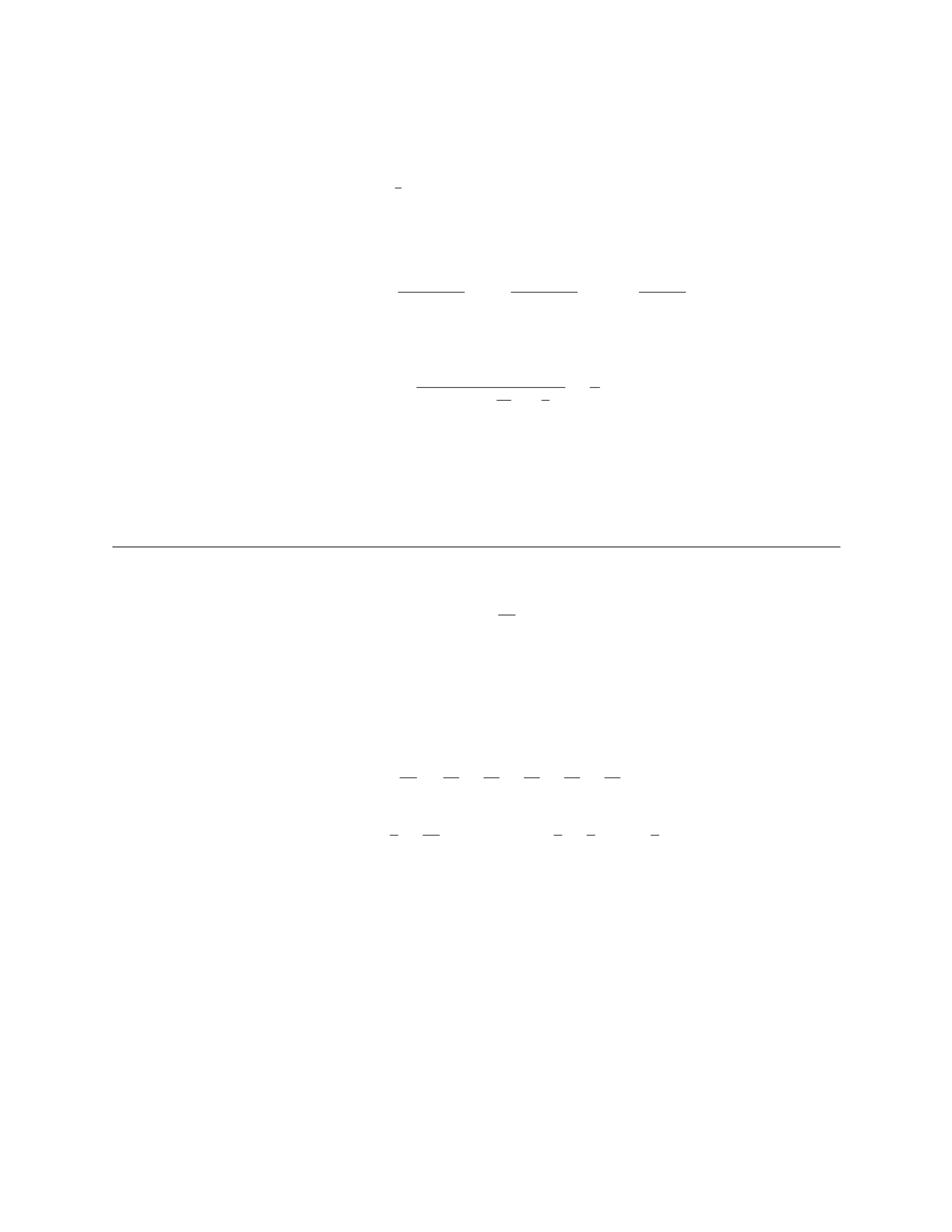
a) Calculate the Stieltjes sum of S(x)at x= 0.5when n= 2.
b) Find the Stieltjes sum of S(x)at x= 0.5as n→ ∞.
Solution 21.
a) When n= 2, we have ∆x=1
2,x1= 0.25,x2= 0.75,(∆α)1=α(x1)−α(0) = 0, and
(∆α)2=α(x2)−α(x1) = x2−x1= 0.5.
The Stieltjes sum at x= 0.5is:
S(0.25)(∆α)1+S(0.75)(∆α)2=1
1−0.252(0) + 1
1−0.752(0.5) = 1
0.9375 ×0.5≈0.5333
b) As n→ ∞, the Stieltjes sum of S(x)at x= 0.5becomes:
lim
n→∞
n
X
i=1
1
1−(0.5−1
2n+i1
n)2×1
n
This limit can be calculated numerically using a computer or software for a more accurate ap-
proximation.
21 22. TRUNCATION ERROR IN LACUNARY SERIES
Problem 22. Consider the Lacunary series given by
S=
∞
X
n=0
2n
n!
a) Calculate the value of the sum of the first 5 terms of the series, i.e., find S5.
b) Calculate the truncation error when approximating the sum Swith S5.
Solution 22.
a) To find S5, we simply need to calculate the sum of the first 5 terms of the series:
S5=
4
X
n=0
2n
n!=20
0! +21
1! +22
2! +23
3! +24
4!
S5=1+2+2+8
6+16
24 =1+2+2+4
3+2
3= 5 + 6
3= 7
Therefore, the sum of the first 5 terms of the series is S5= 7.
b) The truncation error when approximating the sum Swith S5can be calculated as the absolute
difference between the actual sum Sand the approximated sum S5, i.e.,
Truncation Error =|S−S5|
Truncation Error =|S−7|
As we know that the actual value of the series Sis infinite, the truncation error in this case will
also approach infinity. But for the first 5 terms, we can see that the truncation error is |S−7|=
| − 7|=.
Therefore, the truncation error when approximating the sum Swith S5is infinite.

22 23. SPECTRAL ANALYSIS OF LACUNARY SERIES
Problem 23. Consider the lacunary series f(x) = P∞
n=0 ancos(bnx)where a= 0.5and b= 2.
Determine the points of discontinuity of f(x)and calculate the value to which f(x)converges at
those points.
Solution 23. Let’s first find the points of discontinuity by examining the convergence of the
series at these points. The series f(x)converges at points where the partial sums of the series
converge.
a) The points of discontinuity occur when the series does not converge to a finite value. This
happens when the terms of the series do not approach zero as n→ ∞.
For f(x)to converge, we need |ancos(bnx)| → 0as n→ ∞. This requires |an| → 0and
|cos(bnx)| → 1.
As a= 0.5,|0.5n|= 0.5n→0as n→ ∞. As b= 2,|cos(2nx)|does not converge to 1 for all x
due to the rapid oscillation of cos.
Therefore, f(x)will be discontinuous at all points xwhere cos(2nx)does not converge.
b) To find the value f(x)converges to at these points, we need to determine if there is a limiting
value for the series f(x)as n→ ∞.
Since cos(bnx)does not converge for all x, the series f(x)does not converge and does not
have a specific value at these points.
Hence, f(x)will be discontinuous at all xand will not converge to a unique value at those points.
23 24. FREDHOLM INTEGRAL EQUATIONS FOR LACUNARY SERIES
Problem 24. Consider the Fredholm integral equation of the second kind:
f(x) = ex+λZ1
0
ex(t)f(t)dt
Use the method of successive approximations to solve this equation up to the third approxima-
tion with λ= 1 and starting with the initial guess f0(x) = ex.
Solution 24.
The solution to the Fredholm integral equation can be approximated using the method of suc-
cessive approximations. Let’s denote our initial guess as f0(x) = exand the nth approximation as
fn(x). The successive approximations are given by:
fn+1(x) = ex+λZ1
0
ex(t)fn(t)dt
We need to find f1(x),f2(x), and f3(x)to solve the equation up to the third approximation.
a) Let’s find f1(x):
f1(x) = ex+λZ1
0
ex(t)etdt
f1(x) = ex+λZ1
0
ex+tdt
f1(x) = ex+λex+t
11
0

f1(x) = ex+λ(ex+1 −ex)
f1(x) = ex+λex(e−1)
b) Now, let’s find f2(x):
f2(x) = ex+λZ1
0
ex(t)(et+λet(e−1))dt
f2(x) = ex+λZ1
0
ex+tdt +λ2Z1
0
ex(t)et(e−1)dt
This process is continued until the third approximation f3(x)is found.
24 25. SINGULAR PERTURBATIONS IN LACUNARY SERIES
Problem 25. Consider the lacunary series defined by f(x) = P∞
n=1 xn
10n2.
a) Find the radius of convergence of the series.
b) Determine the interval of convergence.
c) Evaluate f(1).
Solution 25. a) To find the radius of convergence of the series, we use the ratio test. Let
an=1
10n2. Applying the ratio test:
lim
n→∞
an+1
an
= lim
n→∞
1
10(n+1)2·10n2
1
= lim
n→∞
1
102n+1
= lim
n→∞
1
102n+1 = 0.
Since the limit is less than 1, the series converges for all x, giving the radius of convergence as
R=∞.
b) Since the radius of convergence is infinite, the interval of convergence is (−∞,∞).
c) To evaluate f(1), we substitute x= 1 into the series:
f(1) =
∞
X
n=1
1
10n2
=1
101+1
104+1
109+· · · .
This series is convergent, and each term is positive, so the sum is finite. Therefore, f(1) is a
finite value.

lim
n→∞
an+1
an
= lim
n→∞
3n+1
2(n+1)2
3n
2n2
= lim
n→∞
3n+1 ·2n2
2(n+1)2·3n
= lim
n→∞
3·3n·2n2
2n2+2n+1 ·3n
= lim
n→∞
3
2·2n
= 0
Since the limit of the absolute value of the ratio is less than 1, by the ratio test, the series
P∞
n=1 3n
2n2converges.
4 4. RATE OF CONVERGENCE IN LACUNARY SERIES
Problem 4. Consider the lacunary series P∞
n=1 1
n2.
a) Determine the rate of convergence of the series.
b) Estimate how many terms are needed to approximate the sum of the series with an error less
than 0.01.
Solution 4.
a) The rate of convergence of the series can be determined by looking at the behavior of the
terms 1
n2. Since 1
n2decreases monotonically to 0 as nincreases, we can use the Integral Test to
analyze convergence.
Let f(x) = 1
x2. We can integrate f(x)from 1 to infinity to find:
Z∞
1
1
x2dx =−1
x∞
1
=−lim
t→∞
1
t+ 1 = 1
Since the integral converges to a finite value (1), the series P∞
n=1 1
n2also converges. Therefore,
the rate of convergence of the series can be considered as moderate.
b) To estimate the number of terms needed to approximate the sum with an error less than 0.01,
we can use the fact that the series converges to the Basel problem value of π2
6.
Let Snbe the partial sum of the first nterms of the series. We want to find nsuch that |S−Sn|<
0.01, where Sis the sum π2
6.
Using the error bound for alternating series, we have:
∞
X
k=n+1
1
k2
<1
(n+ 1)2<0.01
Solving for n, we get n > q1
0.01 −1=9. Therefore, to approximate the sum of the series with
an error less than 0.01, we need at least 10 terms.
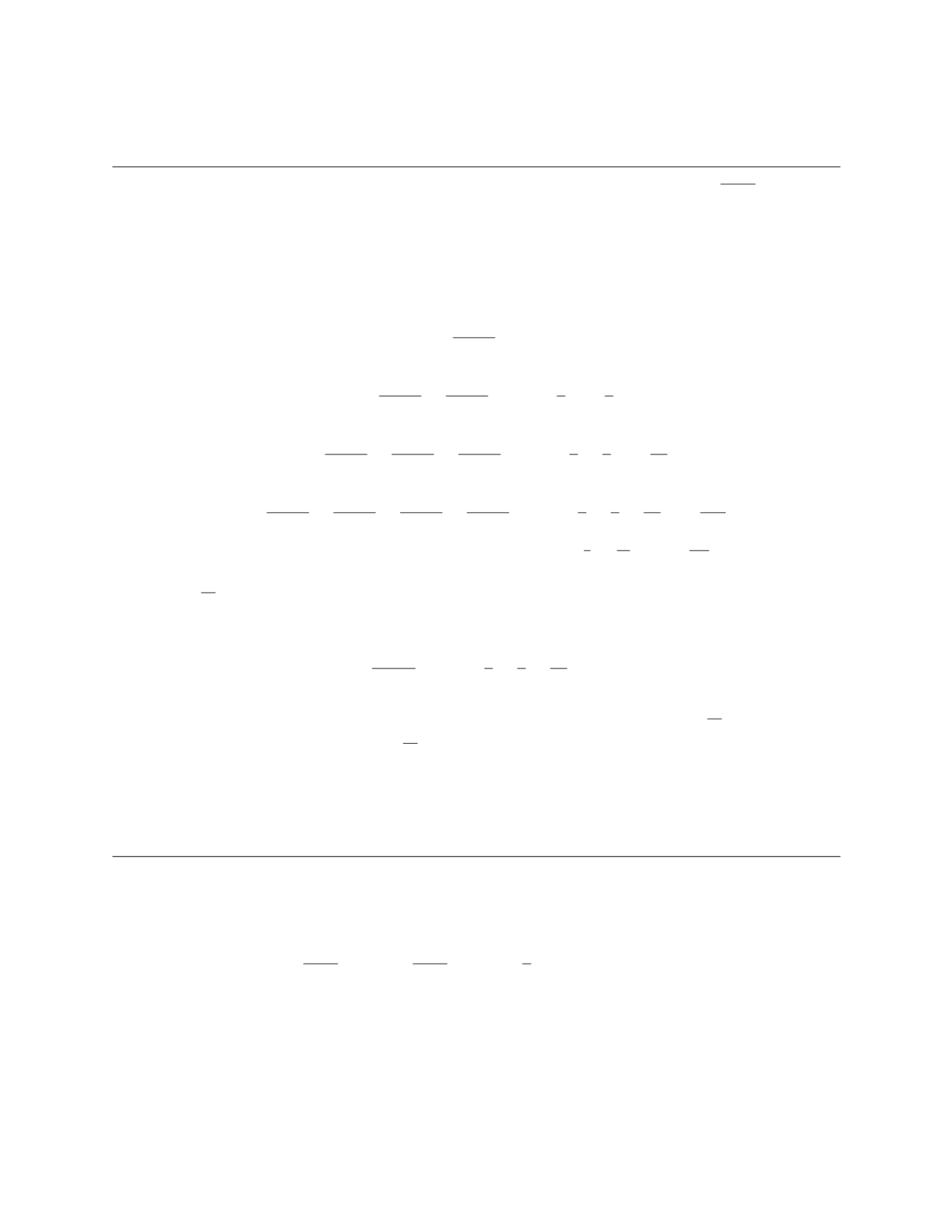
5 5. OSCILLATION BEHAVIOR IN LACUNARY SERIES
Problem 5. Consider the Lacunary Series given by the formula f(x) = P∞
n=1
(−1)n
n2.
a) Find the first four partial sums of the series.
b) Determine if the series converges or diverges.
c) Calculate the value to which the series converges (if it converges).
Solution 5.
a) To find the first four partial sums of the series, we will calculate S1,S2,S3, and S4:
S1=(−1)1
12=−1
S2=(−1)1
12+(−1)2
22=−1 + 1
4=−3
4
S3=(−1)1
12+(−1)2
22+(−1)3
32=−1 + 1
4−1
9=−31
36
S4=(−1)1
12+(−1)2
22+(−1)3
32+(−1)4
42=−1 + 1
4−1
9+1
16 =−365
576
Therefore, the first four partial sums of the series are −1,−3
4,−31
36 , and −365
576 .
b) To determine if the series converges or diverges, we will use the Alternating Series Test. The
terms an=1
n2are positive, decreasing, and approach 0. Hence, the series converges.
c) Since the series converges, we can find the value to which it converges by summing all the
terms infinitely: ∞
X
n=1
(−1)n
n2=−1 + 1
4−1
9+1
16 −. . .
By Euler’s solution to the Basel problem, the sum of this series converges to π2
12 . Therefore, the
value to which the series converges is π2
12 .
I.
6 6. SUMMABILITY CRITERIA IN LACUNARY SERIES
Problem 6. Consider the lacunary series P∞
n=1 an, where a= 2. Determine the sum of the
series using the ratio test.
Solution 6. a) We apply the ratio test to determine the convergence of the series:
lim
n→∞
an+1
an
= lim
n→∞
an+1
an
= lim
n→∞
a
1
= lim
n→∞ |a|=|2|= 2.
Since the limit is greater than 1, the series diverges.
b) To find the sum of this series, let’s consider the partial sum Sn=Pn
k=0 2k:
Sn= 1 + 2 + 22+ 23+· · · + 2n.

This is a geometric series with first term a= 1 and common ratio r= 2. The sum of a geometric
series is given by:
Sn=a(1 −rn+1)
1−r.
Substitute a= 1 and r= 2 into the formula to get:
Sn=1(1 −2n+1)
1−2= 2n+1 −1.
c) Therefore, the sum of the series is:
lim
n→∞ Sn= lim
n→∞(2n+1 −1) = lim
n→∞ 2n+1 −lim
n→∞ 1 = ∞.
Thus, the sum of the series is infinite as it diverges.
Certainly! Here is a numerical problem on Lacunary Series:
—
7 7. ERROR ANALYSIS IN LACUNARY SERIES
Problem 7. Let {an}be a lacunary series given by an= 2n. Compute the sum of the first 5 terms
of this series and determine the error when approximating this sum by the fifth term in the series.
Solution 7. a) To find the sum of the first 5 terms of the series, we simply add up the terms:
S5= 21+ 22+ 23+ 24+ 25
Calculating:
S5= 2 + 4 + 8 + 16 + 32 = 62
Therefore, the sum of the first 5 terms of the series is 62.
b) Now, let’s find the error when approximating this sum by the fifth term in the series:
Error =S5−a5= 62 −25= 62 −32 = 30
Hence, the error of approximating the sum of the first 5 terms of the series by the fifth term in
the series is 30.
Therefore, the sum of the first 5 terms of the series is 62, and the error in approximating this
sum by the fifth term in the series is 30.
8 8. BOUNDARY VALUE PROBLEMS FOR LACUNARY SERIES
Problem 8. Consider the lacunary series S(x) = P∞
n=1 xn
5nover the interval of convergence
(−5,5).
a) Find the value of S(−5).
b) Determine the interval of convergence of the series.
Solution 8.
a) We can find the value of S(−5) by substituting x=−5into the series:
S(−5) =
∞
X
n=1
(−5)n
5n
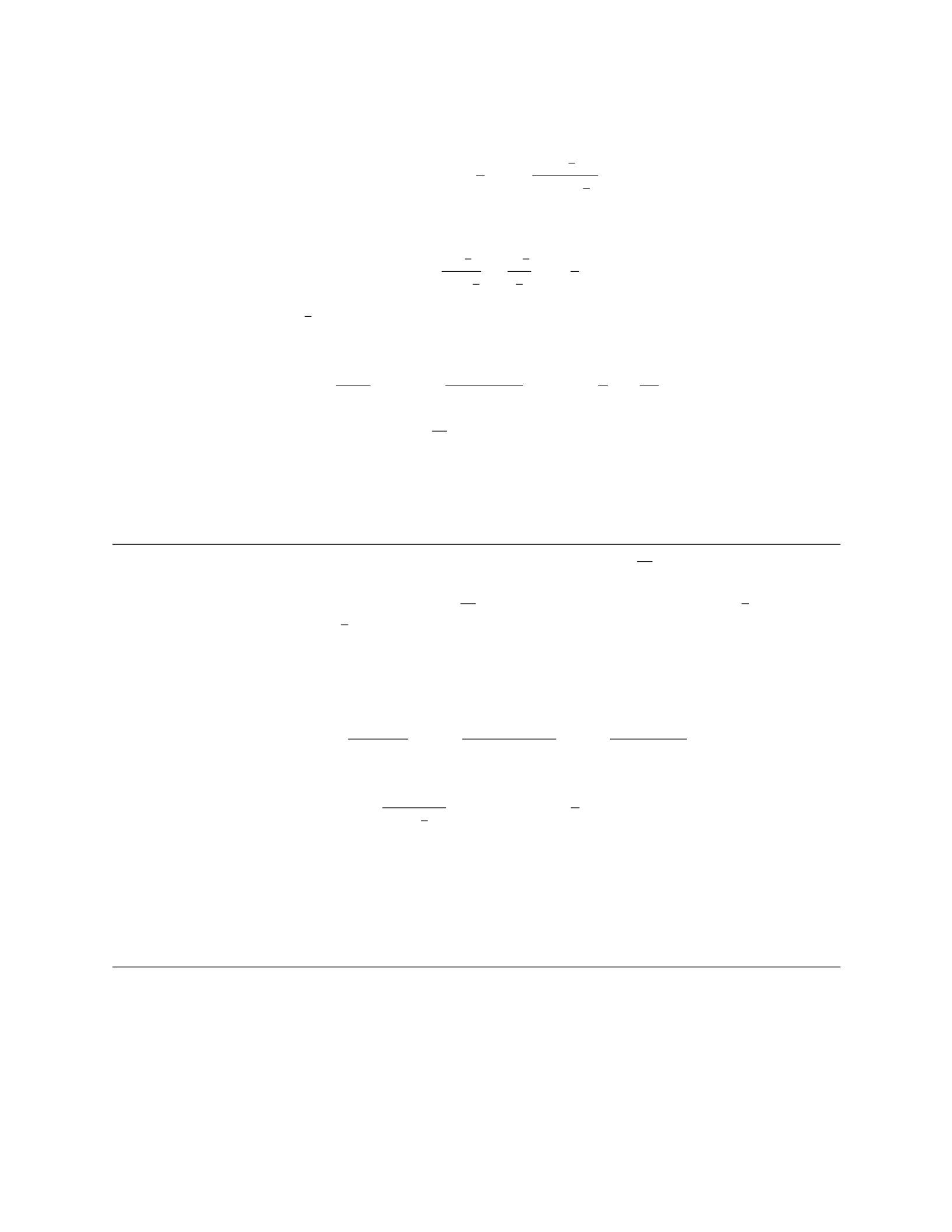
Simplifying the expression, we get:
S(−5) =
∞
X
n=1 −1
5n
=−1
5
1−(−1
5)
Calculating the sum, we find:
S(−5) = −1
5
1 + 1
5
=−1
5
6
5
=−1
6
Therefore, S(−5) = −1
6.
b) To determine the interval of convergence, we use the Ratio Test:
lim
n→∞
an+1
an
= lim
n→∞
xn+1/5n+1
xn/5n
= lim
n→∞
x
5
=|x|
5
For the series to converge, we require |x|
5<1, i.e., |x|<5. Thus, the interval of convergence
is (−5,5).
9 9. SINGULARITIES IN LACUNARY SERIES
Problem 9. Consider the lacunary series defined as f(x) = P∞
n=1 4n
xn. Determine the singular-
ities of the function f(x)and analyze their nature.
Solution 9. The given series f(x) = P∞
n=1 4n
xnis a geometric series with ratio r=4
x. The series
converges only if |r|<1, i.e.,
4
x
<1→ |x|>4.
Therefore, the singularities of the function f(x)occur at x= 4.
To investigate the nature of the singularity at x= 4, we expand f(x)as a Laurent series about
x= 4. Let z=x−4to rewrite f(x)as:
f(x) =
∞
X
n=1
4n
(z+ 4)n=
∞
X
n=1
4n
4n(1 + z/4)n=
∞
X
n=1
1
(1 + z/4)n
=
∞
X
n=1
1
1 + z
4n=
∞
X
n=1
(−1)n−1z
4n−1
This Laurent series representation at x= 4 around the singularity x= 4 shows that the singu-
larity is an essential singularity.
10 10. ANALYTIC CONTINUATION OF LACUNARY SERIES
Problem 10. Consider the lacunary series
∞
X
n=1
z2nwhere zis a complex number.
a) Find the radius of convergence of the series.
b) Determine the set of points where the series converges.
c) Find the analytic continuation of the series.
Solution 10.
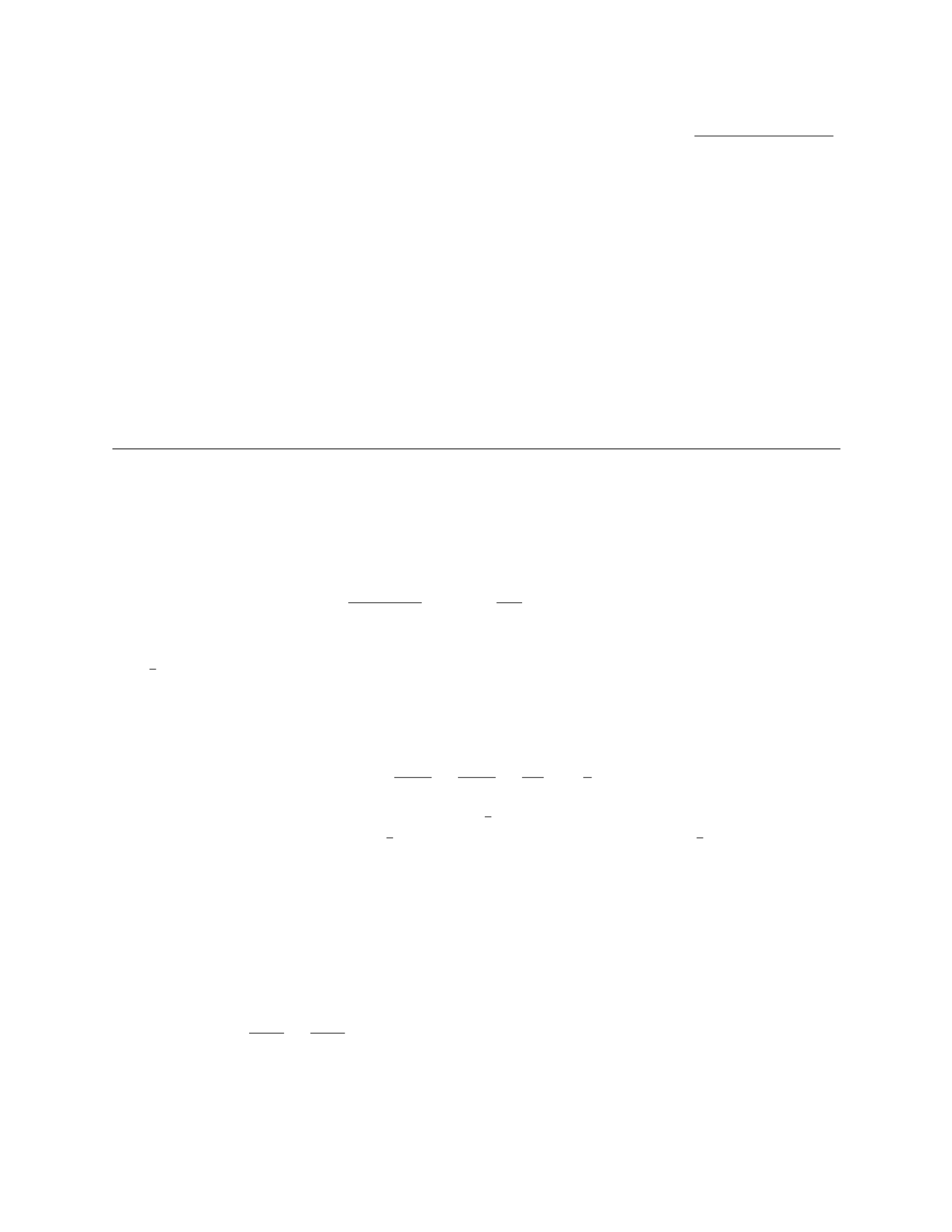
a) The radius of convergence Rof a power series
∞
X
n=0
anznis given by R=1
lim supn→∞ |an|1/n .
In this case, an= 1 for n= 2kfor various integers k, and an= 0 otherwise. Therefore, the series
∞
X
n=1
z2ndiverges unless |z|<1. Thus, the radius of convergence is R= 1.
b) The series converges for all zsuch that |z|<1. This follows from the ratio test, which can
be applied to conclude that the series absolutely converges when |z|<1. It diverges when |z| ≥ 1.
c) The series
∞
X
n=1
z2ncan be analytically continued to the unit disk |z|<1. This is due to the
radius of convergence being 1. Thus, the series can be expressed as an analytic function in the
region |z|<1.
11 11. RESUMMATION METHODS FOR LACUNARY SERIES
Problem 11. Consider the lacunary series P∞
n=0 3nx2n. Determine the radius of convergence
and find the sum of the series for x= 1.
Solution 11.
a) Radius of convergence:
To find the radius of convergence, we use the ratio test:
lim
n→∞
3n+1x2n+1
3nx2n
= lim
n→∞
3x2
x
= lim
n→∞ 3x= 3x
The series converges if 3x < 1, and diverges if 3x > 1. Thus, the radius of convergence is
R=1
3.
b) Sum of the series for x= 1:
When x= 1, the series becomes P∞
n=0 3n. This is a geometric series with a= 3 and r= 3.
The sum of a geometric series is given by:
S=a
1−r=3
1−3=3
−2=−3
2
Therefore, the sum of the series for x= 1 is −3
2.
So, the radius of convergence is 1
3and the sum of the series for x= 1 is −3
2.
I. Problem:
12. GROWTH RATES IN LACUNARY SERIES
Consider the lacunary series defined by the sequence (an)where an= 2nif nis a power of 2,
and an= 0 otherwise.
a) Find the growth rate of this lacunary series.
b) Determine whether this series converges or diverges.
Solution:
a) To find the growth rate of the series, we can calculate the ratio of consecutive terms:
Let’s consider a2k+1
a2k=22k+1
22k= 22k+1−2k= 22k.
So, the growth rate of the series is 22k.
b) To determine the convergence of this series, let’s express the sum of nterms:
Sn=a1+a2+a4+. . . +a2m, where mis the largest integer such that 2m≤n.

As a2k= 22k, the sum Sn= 22+ 24+ 28+. . . + 22m.
This is a geometric series with common ratio 22, so
Sn= 22(1 + 22+ (22)2+. . . + (22)m).
Using the formula for the sum of a geometric series, we have:
Sn= 22·(22(m+1)−1)
22−1= 22(m+1) −1.
Hence, the series diverges as n→ ∞.
12 13. REGULARIZATION TECHNIQUES FOR LACUNARY SERIES
Problem 13. Consider the lacunary series P∞
n=0 anwhere a= 0.5, and the regularization
technique is applied to sum the series.
a) Determine the value of the regularized sum of the series.
b) Calculate the sum of the first 5 terms of the series.
c) Find the absolute error in the sum obtained in part (a) compared to the actual sum of the
series.
Solution 13.
a) To regularize the series, we use the formula for the sum of a geometric series:
S=a
1−r
where ais the first term and ris the common ratio.
In this case, a= 1 and r= 0.5. Plugging these values into the formula:
S=1
1−0.5= 2
Therefore, the value of the regularized sum of the series is S= 2.
b) To find the sum of the first 5 terms of the series, we substitute n= 0,1,2,3,4into the series
and add them up:
4
X
n=0
an= 1 + 0.5+0.25 + 0.125 + 0.0625 = 1.9375
Therefore, the sum of the first 5 terms of the series is 1.9375.
c) The actual sum of the geometric series is given by the formula:
S=a
1−r
Substitute a= 1 and r= 0.5:
S=1
1−0.5= 2
The absolute error in the sum obtained from regularization compared to the actual sum is:
|2−1.9375|= 0.0625
Therefore, the absolute error is 0.0625.
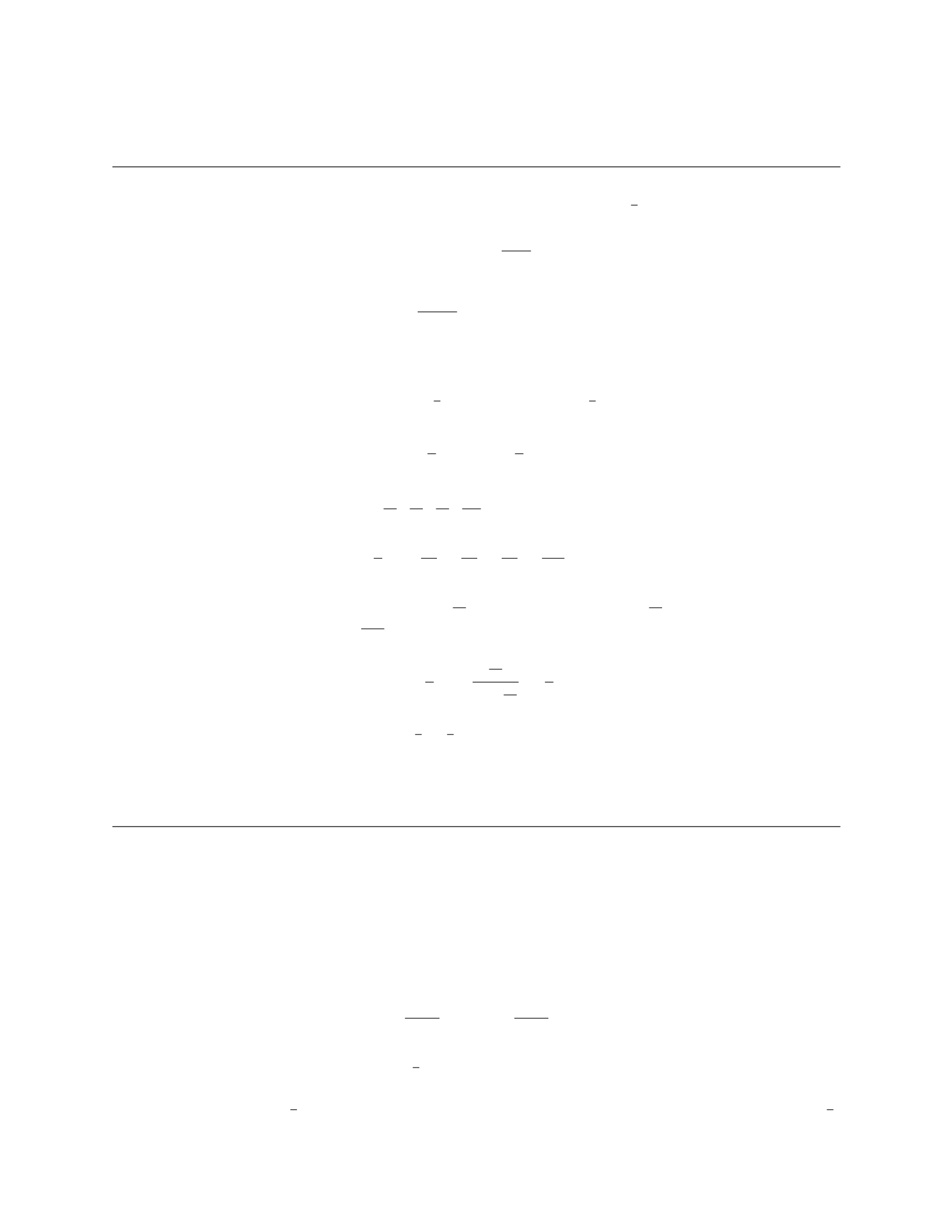
13 14. STABILITY ISSUES IN LACUNARY SERIES
Problem 14. Consider the lacunary series defined by S(x) = P∞
n=1 x2n. Determine the con-
vergence interval of this series and find the sum of the series for x=1
2.
Solution 14. a) The convergence interval of a lacunary series is determined by the ratio of
consecutive terms. Consider the ratio r= limn→∞
an+1
an
, where anis the n-th term of the series.
In this case, an=x2n, so
r= lim
n→∞
x2n+1
x2n
= lim
n→∞
x2n
=|x|2
For the series to converge, we must have r < 1, so |x|2<1which implies −1< x < 1. Therefore,
the convergence interval of the series is (−1,1).
b) To find the sum of the series for x=1
2, we substitute x=1
2into the series:
S1
2=
∞
X
n=1 1
22n
The first few terms of the series are 1
22,1
24,1
28,1
216 ,. . . . Thus, the sum of the series is
S1
2=1
22+1
24+1
28+1
216 +. . .
This is a geometric series with first term a=1
22and common ratio r=1
24. The sum of an infinite
geometric series is given by S=a
1−r. Substituting aand rinto the formula, we get
S1
2=
1
22
1−1
24
=1
3
Therefore, the sum of the series for x=1
2is 1
3.
14 15. ANALYTICITY PROPERTIES OF LACUNARY SERIES
Problem 15. Consider the lacunary series P∞
n=0 anznwhere an= 2nfor all n≥0.
a) Determine the radius of convergence of the series.
b) Find the interval of convergence of the series.
c) Determine whether the series converges uniformly on any closed disk contained entirely
within the interval of convergence.
Solution 15.
a) To find the radius of convergence, we can use the ratio test:
lim
n→∞
an+1
an
= lim
n→∞
2n+1
2n
= 2.
Thus, the radius of convergence is R=1
2.
b) To determine the interval of convergence, we consider the boundary points of the disk of
convergence. At z=−1
2, the series becomes the harmonic series which diverges, and at z=1
2,

the series becomes a geometric series which converges. Therefore, the interval of convergence is
(−1
2,1
2).
c) For the series to converge uniformly on a closed disk contained entirely within the interval
of convergence, the series must be uniformly convergent on the interval [−1
2+ϵ, 1
2−ϵ]for some
ϵ > 0. However, since the series diverges at z=−1
2, it cannot converge uniformly on this interval.
Therefore, the series does not converge uniformly on any closed disk contained entirely within the
interval of convergence.
I can certainly generate numerical problem questions for you! Here is an example problem with
a detailed solution:
15 16. FRACTIONAL CALCULUS APPROACHES TO LACUNARY SERIES
Problem 16. Consider the lacunary series defined by P∞
n=0 n3
2n. Find the sum of this series.
Solution 16. To find the sum of the series, we will use a well-known technique for summing
certain types of series involving the derivative of the geometric series.
Let f(x) = P∞
n=0 xn. Taking the derivative of f(x)we get:
f′(x) =
∞
X
n=0
nxn−1=
∞
X
n=0
nxn/x
Multiplying both sides by x, we get:
xf′(x) =
∞
X
n=0
nxn
Now, differentiating both sides of the definition of f(x)will yield a closed form for f′(x).
Differentiating gives:
f′(x) =
∞
X
n=1
nxn−1=1
(1 −x)2
This can be obtained by observing that the derivative of the geometric series is a series for
1/(1 −x)2.
Now, integrating both sides, we see that:
f(x) = Z1
(1 −x)2dx =Z∞
X
n=0
nxndx
Evaluating the integral gives:
f(x) = −1
1−x+C
for some constant C. Since f(0) = 1, we can deduce that C= 1, so:
f(x) = 1
1−x
Now we can find the sum of our original series by taking derivatives.
Let S=P∞
n=0 n3
2n. We start by finding the generating function for our series, using the fact that
1
1−x=P∞
n=0 xn, we can write:

x
(1 −x)2=
∞
X
n=1
nxn−1
Differentiating both sides with respect to xgives:
1 + x
(1 −x)2=
∞
X
n=1
n2xn−1
Multiplying by xand differentiating again:
x(1 + 2x)
(1 −x)3=
∞
X
n=1
n3xn−1
Substitute x= 1/2to get:
1/2(1 + 1)
(1 −1/2)3=S
Solving for Sgives:
S= 4
Therefore, the sum of the series is 4.
16 17. INVERSE PROBLEMS FOR LACUNARY SERIES
Problem 17. Consider the Lacunary series defined by f(z) = P∞
n=0 anzbn, where a=1
2and b= 2.
Find the explicit form of the function f(z).
Solution 17. To find the explicit form of the function f(z), we can first rewrite the series using
the given values of aand b.
The Lacunary series becomes:
f(z) =
∞
X
n=0 1
2n
z2n
Now, let’s simplify this expression by expanding the terms:
f(z) = 1 + 1
2z2+1
4z4+1
8z8+. . .
Notice that this Lacunary series behaves like a geometric series with common ratio r=z2.
Using the formula for the sum of an infinite geometric series, we have:
f(z) = 1
1−1
2z2
Thus, the explicit form of the function f(z)is:
f(z) = 1
1−1
2z2

17 18. BOUNDARY CONDITIONS IN LACUNARY SERIES
Problem 18. Consider the lacunary series P∞
n=0 anz2nwith an=1
n+1 for all n≥0. Determine
the convergence boundary of this lacunary series in the complex plane and find the radius of
convergence.
Solution 18.
Given the lacunary series P∞
n=0 1
n+1 z2n, we want to determine the convergence boundary in
the complex plane and find the radius of convergence.
a) To find the convergence boundary, we use Hadamard’s Theorem, which states that the radius
of convergence Ris given by:
R= lim
n→∞ 1
an1
n
In our case, an=1
n+1 . Substituting this into the formula, we get:
R= lim
n→∞ (n+ 1) 1
n
Using the limit properties, we get:
R= lim
n→∞(1 + 1
n)n=e
Therefore, the convergence boundary of this lacunary series is the circle |z|=e.
b) To find the radius of convergence, we have R=e. Hence, the radius of convergence of the
series is e.
18 19. NONLINEAR EFFECTS IN LACUNARY SERIES
Problem 19. Consider the lacunary series P∞
n=1 5n
n!.
a) Calculate the radius of convergence of the series.
b) Determine the interval of convergence.
c) Evaluate the sum of the series.
Solution 19.
a) To find the radius of convergence Rof the series P∞
n=1 5n
n!, we’ll use the ratio test. Let
an=5n
n!. The ratio test states that if limn→∞
an+1
an
=L, then R=1
L.
Calculating the ratio:
lim
n→∞
an+1
an
= lim
n→∞
5n+1
(n+1)!
5n
n!
= lim
n→∞
5n+1 ·n!
5n·(n+ 1)!
= lim
n→∞
5
n+ 1
= 0.
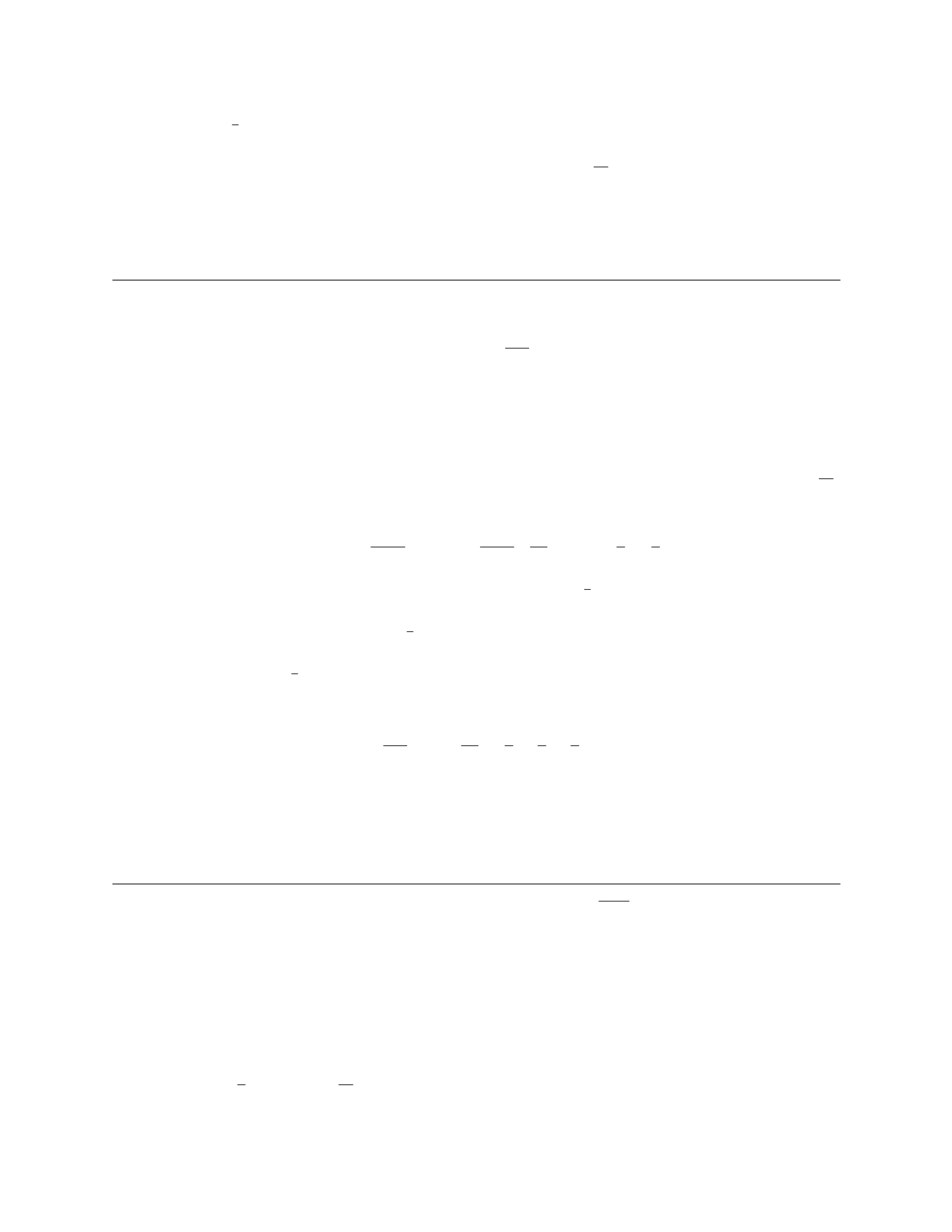
Therefore, R=1
0=∞.
b) Since the radius of convergence R=∞, the interval of convergence is (−∞,∞).
c) To evaluate the sum of the series, we recognize that P∞
n=1 5n
n!is the well-known Taylor series
expansion of ex, where x= 5. Hence, the sum of the series is e5.
19 20. CONFORMAL MAPPING APPLICATIONS TO LACUNARY SERIES
Problem 20. Consider the lacunary series given by the following expression:
f(z) =
∞
X
n=1
z2n
2n
a) Find the radius of convergence of the series f(z).
b) Determine all points on the boundary of convergence where the series is convergent.
c) Find the sum of the series f(z)for z= 1.
Solution 20.
a) To find the radius of convergence of the series f(z), we will apply the ratio test. Let an=1
2n.
Using the ratio test,
R= lim
n→∞
an+1
an
= lim
n→∞
1
2n+1 ·2n
1
= lim
n→∞
1
2=1
2
Hence, the radius of convergence of the series f(z)is R=1
2.
b) To determine all points on the boundary of convergence where the series is convergent, we
consider the points zsuch that |z|=1
2. At these boundary points, the series may or may not
converge. Due to the nature of the given lacunary series, the series converges at all boundary
points zsuch that |z|=1
2.
c) To find the sum of the series f(z)for z= 1, we substitute z= 1 into the expression:
f(1) =
∞
X
n=1
12n
2n=
∞
X
n=1
1
2n=1
2+1
4+1
8+. . . = 1
Therefore, the sum of the series f(z)for z= 1 is 1.
20 21. STIELTJES SUMMATION OF LACUNARY SERIES
Problem 21. Consider the lacunary series defined by S(x) = 1
1−x2. Calculate the Stieltjes sum
of S(x)at x= 0.5.
Solution 21. The Stieltjes sum of a function f(x)at a point x=ais defined as the limit of the
Riemann sum as the subinterval length approaches zero. So, the Stieltjes sum of S(x)at x= 0.5
is given by:
lim
∆x→0
n
X
i=1
S(xi)(∆α)i
where ∆x=1
n,xi= 0.5−1
2n+i∆x, and (∆α)i=α(xi)−α(xi−1).
Let’s calculate the Stieltjes sum of S(x)at x= 0.5.
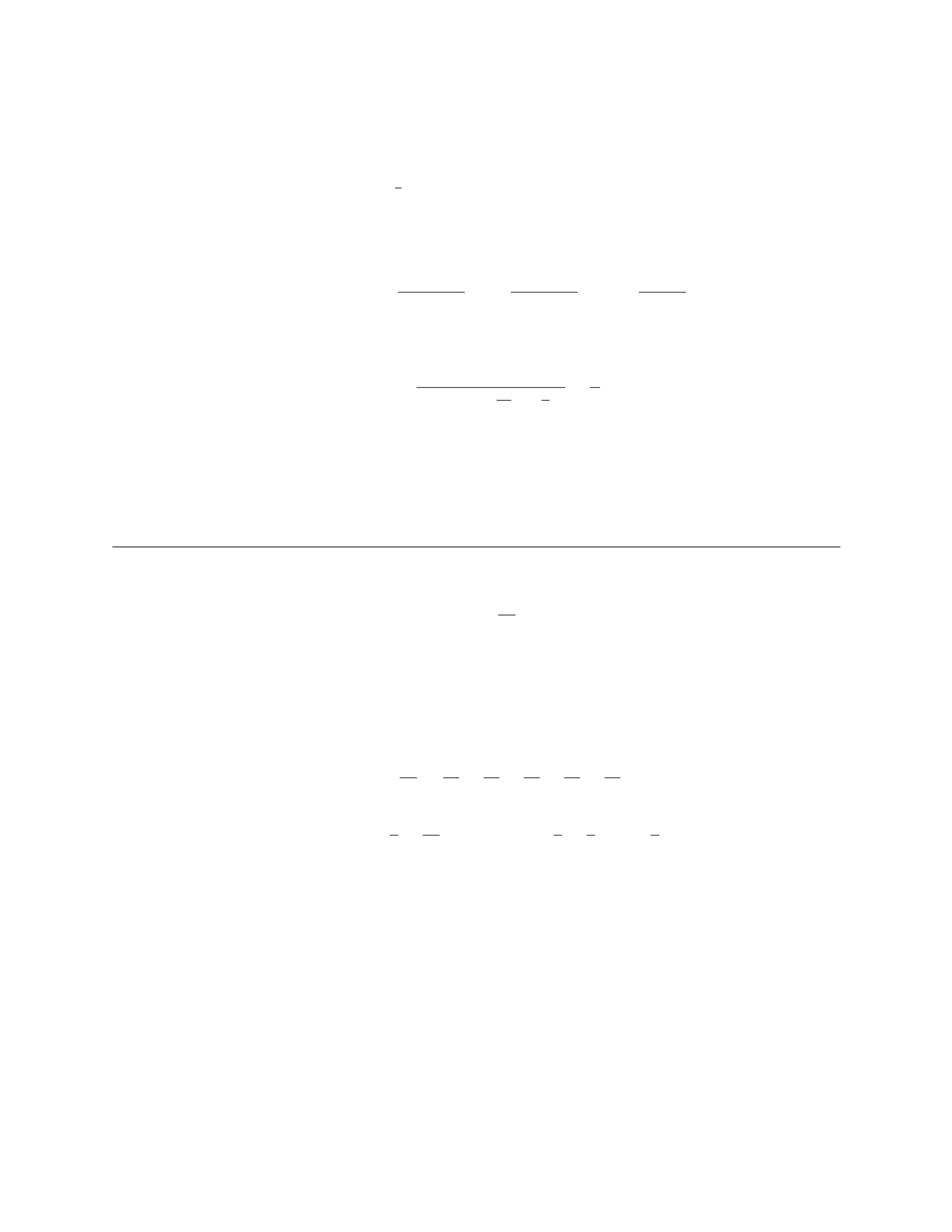
a) Calculate the Stieltjes sum of S(x)at x= 0.5when n= 2.
b) Find the Stieltjes sum of S(x)at x= 0.5as n→ ∞.
Solution 21.
a) When n= 2, we have ∆x=1
2,x1= 0.25,x2= 0.75,(∆α)1=α(x1)−α(0) = 0, and
(∆α)2=α(x2)−α(x1) = x2−x1= 0.5.
The Stieltjes sum at x= 0.5is:
S(0.25)(∆α)1+S(0.75)(∆α)2=1
1−0.252(0) + 1
1−0.752(0.5) = 1
0.9375 ×0.5≈0.5333
b) As n→ ∞, the Stieltjes sum of S(x)at x= 0.5becomes:
lim
n→∞
n
X
i=1
1
1−(0.5−1
2n+i1
n)2×1
n
This limit can be calculated numerically using a computer or software for a more accurate ap-
proximation.
21 22. TRUNCATION ERROR IN LACUNARY SERIES
Problem 22. Consider the Lacunary series given by
S=
∞
X
n=0
2n
n!
a) Calculate the value of the sum of the first 5 terms of the series, i.e., find S5.
b) Calculate the truncation error when approximating the sum Swith S5.
Solution 22.
a) To find S5, we simply need to calculate the sum of the first 5 terms of the series:
S5=
4
X
n=0
2n
n!=20
0! +21
1! +22
2! +23
3! +24
4!
S5=1+2+2+8
6+16
24 =1+2+2+4
3+2
3= 5 + 6
3= 7
Therefore, the sum of the first 5 terms of the series is S5= 7.
b) The truncation error when approximating the sum Swith S5can be calculated as the absolute
difference between the actual sum Sand the approximated sum S5, i.e.,
Truncation Error =|S−S5|
Truncation Error =|S−7|
As we know that the actual value of the series Sis infinite, the truncation error in this case will
also approach infinity. But for the first 5 terms, we can see that the truncation error is |S−7|=
| − 7|=.
Therefore, the truncation error when approximating the sum Swith S5is infinite.

22 23. SPECTRAL ANALYSIS OF LACUNARY SERIES
Problem 23. Consider the lacunary series f(x) = P∞
n=0 ancos(bnx)where a= 0.5and b= 2.
Determine the points of discontinuity of f(x)and calculate the value to which f(x)converges at
those points.
Solution 23. Let’s first find the points of discontinuity by examining the convergence of the
series at these points. The series f(x)converges at points where the partial sums of the series
converge.
a) The points of discontinuity occur when the series does not converge to a finite value. This
happens when the terms of the series do not approach zero as n→ ∞.
For f(x)to converge, we need |ancos(bnx)| → 0as n→ ∞. This requires |an| → 0and
|cos(bnx)| → 1.
As a= 0.5,|0.5n|= 0.5n→0as n→ ∞. As b= 2,|cos(2nx)|does not converge to 1 for all x
due to the rapid oscillation of cos.
Therefore, f(x)will be discontinuous at all points xwhere cos(2nx)does not converge.
b) To find the value f(x)converges to at these points, we need to determine if there is a limiting
value for the series f(x)as n→ ∞.
Since cos(bnx)does not converge for all x, the series f(x)does not converge and does not
have a specific value at these points.
Hence, f(x)will be discontinuous at all xand will not converge to a unique value at those points.
23 24. FREDHOLM INTEGRAL EQUATIONS FOR LACUNARY SERIES
Problem 24. Consider the Fredholm integral equation of the second kind:
f(x) = ex+λZ1
0
ex(t)f(t)dt
Use the method of successive approximations to solve this equation up to the third approxima-
tion with λ= 1 and starting with the initial guess f0(x) = ex.
Solution 24.
The solution to the Fredholm integral equation can be approximated using the method of suc-
cessive approximations. Let’s denote our initial guess as f0(x) = exand the nth approximation as
fn(x). The successive approximations are given by:
fn+1(x) = ex+λZ1
0
ex(t)fn(t)dt
We need to find f1(x),f2(x), and f3(x)to solve the equation up to the third approximation.
a) Let’s find f1(x):
f1(x) = ex+λZ1
0
ex(t)etdt
f1(x) = ex+λZ1
0
ex+tdt
f1(x) = ex+λex+t
11
0

f1(x) = ex+λ(ex+1 −ex)
f1(x) = ex+λex(e−1)
b) Now, let’s find f2(x):
f2(x) = ex+λZ1
0
ex(t)(et+λet(e−1))dt
f2(x) = ex+λZ1
0
ex+tdt +λ2Z1
0
ex(t)et(e−1)dt
This process is continued until the third approximation f3(x)is found.
24 25. SINGULAR PERTURBATIONS IN LACUNARY SERIES
Problem 25. Consider the lacunary series defined by f(x) = P∞
n=1 xn
10n2.
a) Find the radius of convergence of the series.
b) Determine the interval of convergence.
c) Evaluate f(1).
Solution 25. a) To find the radius of convergence of the series, we use the ratio test. Let
an=1
10n2. Applying the ratio test:
lim
n→∞
an+1
an
= lim
n→∞
1
10(n+1)2·10n2
1
= lim
n→∞
1
102n+1
= lim
n→∞
1
102n+1 = 0.
Since the limit is less than 1, the series converges for all x, giving the radius of convergence as
R=∞.
b) Since the radius of convergence is infinite, the interval of convergence is (−∞,∞).
c) To evaluate f(1), we substitute x= 1 into the series:
f(1) =
∞
X
n=1
1
10n2
=1
101+1
104+1
109+· · · .
This series is convergent, and each term is positive, so the sum is finite. Therefore, f(1) is a
finite value.

