


Letters
Letters I
• Use letters to communicate outside your organization.
• Whereas the memorandum is the primary vehicle for
communication within an organization, letters are often used to
communicate to individuals outside it, especially in formal and
semiformal contexts.
• Letters are an essential part of all business and technical
communication because they are more formal and reliable than
electronic mail and more precise and permanent than telephone or
face-to-face conversations.
Types of Letters
• The following are some of the most common types of letters
written by people in technical fields.
– Job application letters
– Acceptance letters
– Transmittal letters
– Inquiry letters
– Technical-information letters
– Letters of recommendation

Format of a Letter
• If your organization has a specific style for business letters, follow
that format. Otherwise, follow the guidelines provided here.
• Business letters are commonly either full-block formatted, with every
line starting at the left margin and usually a business letterhead at the
top of the page, or modified-block formatted, with the heading and the
closing aligned at the center of the page.
Elements of a Letter
• Business letters have the following elements:
– Heading
– Date
– Recipient's address
– Salutation
– Body
– Closing
– End notations
Slide 6
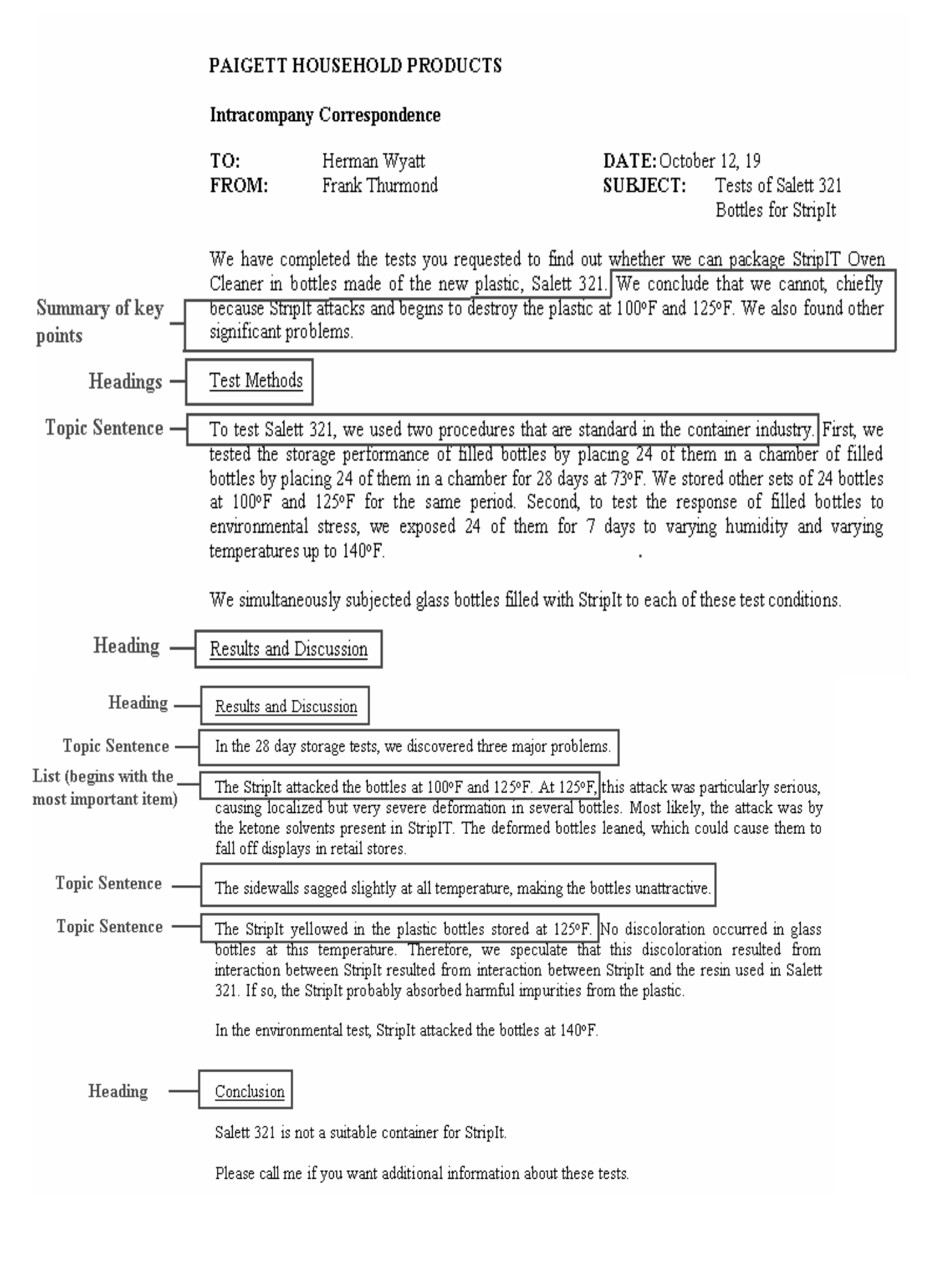

Heading
• If you are using letterhead stationery, include only the date two
lines below the bottom of the letterhead.
• Spell out the name of month.
• If you are not using letterhead stationery, begin with your full
address (city, street, and zip code) 1to 1½ inches from the top of
the page.
• Spell out address designations, such as Street, Avenue etc.
• Include the date aligned at left with the address, spelling out the
name of the month.
Recipient's Address
• Two to four lines below the date, place the following items:
• The recipient's title (such as Mr., Ms., or Dr.) and full name (address a
woman who does not have a professional title as Ms. unless you know
she prefers Miss or Mrs.; if the recipient does not have a title and you
are unsure of his or her gender, omit the title).
• The recipient's job title, if appropriate.
• The name of the company or institution, if appropriate.
• The full address, following the same format as for the address in the heading.
• The recipient's address is always aligned on the left margin.
Salutation

• Place the salutation two lines below the recipient's address.
• The salutation begins with the word Dear, continues with the
recipient's title and last name, and ends with a colon.
• If you are unsure of the recipient's gender and the recipient does not
have a professional title, omit the title and, instead, use both the first
and the last names in the salutation (Dear Tabassum Khursheed:).
• If you do not know the name of the recipient of the letter, refer to the
department you are writing to (Dear Technical Support:).
• Avoid salutations such as Dear Sir or Madam:.
Body
• Start the letter two lines after the salutation. Body paragraphs
should be single spaced with a double space between paragraphs.
• Indenting the first line of each paragraph is acceptable but is more
informal than the unindented style.
• Be concise, direct, and considerate.
• State the letter's purpose in the opening paragraph.
• Include supporting information in a middle paragraph or two, and
conclude your letter with a brief paragraph that both establishes
goodwill and expresses what needs to be done next.

•
If a letter requires more than one page, make sure there are at least
two lines of
body text on the final page.
• Never use an entire page for just the closing.
•
The second page and all subsequent pages must include a heading
with the
recipient's name, the date, and the page number.
Closing Phrase
• Write a complimentary closing phrase two lines below the final body
paragraph.
•Yours truly, Sincerely, or Sincerely yours are common endings for
professional letters.
• Capitalize the first letter of the first word of your complimentary
closing, and end the complimentary closing with a comma.
• Four lines below the closing phrase, write your full name.
• If you are writing in an official capacity that is not included in the
stationery's letterhead, write your title on the next line.
• Your signature goes above your typed name.
End Notations
• At the bottom of the last page of a business letter, end notations
may show who typed the letter, whether any materials are
enclosed with the letter, and who is receiving a copy of the letter.
• The typist's initials, in lowercase letters, follow the initials of the
author, in capital letters, and a colon or a front-slash (LCP: ecb or

LCP/ecb).
• An enclosure notation--Enclosure:, Encl., or Enc.—alerts the recipient
that additional material (such as a resume or a technical article) is
included with the letter.
• You can either identify the enclosure or indicate how many pieces there are.
Example
Enclosure: Article by Ali Bashir
Encl. (2)
Enc. (2)
• In addition to the enclosure notation, always refer to your
enclosures explicitly within the text of the letter.
• A copy notation (cc:) lets the recipient of the letter know who else is
receiving a copy. Put each recipient of a copy on a separate line.
Example
cc: Dr. Maria Aalam
Mr. Waleed Usman
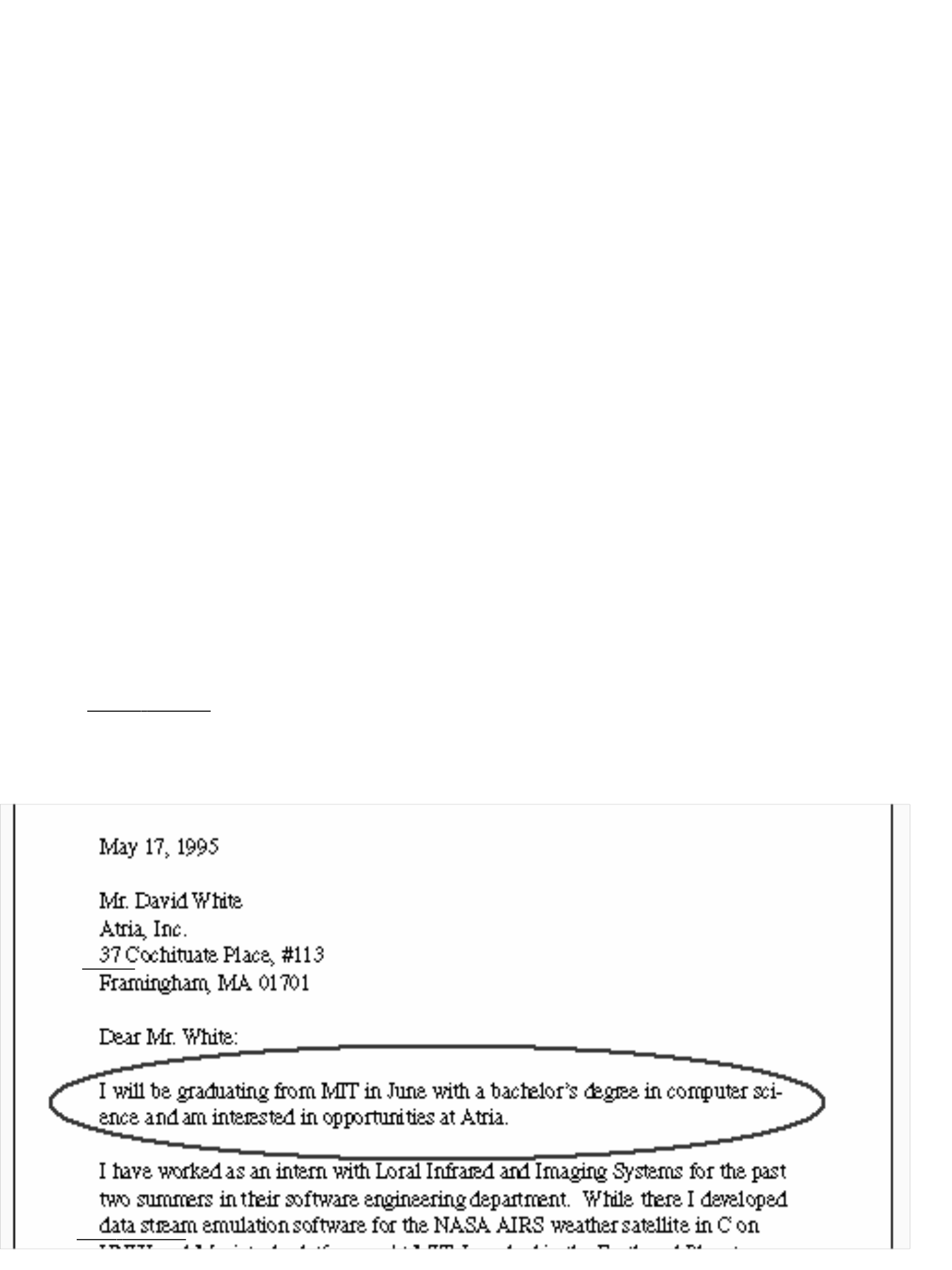
Front Matter
Job Application Letters
• Write job application letters that identify a specific area of
employment, summarize your qualifications for the job, refer to
an enclosed résumé, and request the next step of the application
process, usually an interview.
Application letters
•Application letters are usually just one page and consist
of three sections:
– Front Matter
– Body
– End Matter
Front Matter
• State that you are applying for a specific job title or field.
• Also mention the person who referred you or told you about the job.
• If you learned of the job from an advertisement, mention that.
Body
• Explain specifically why you are qualified for the job.
• Describe education and work experience and any other activities
that display relevant talents, such as foreign-language
proficiencies and leadership or supervisory experience.
End Matter

• Refer to your enclosed résumé and express your desire for an
interview, stating when and where you will be available for one.
• In addition, invite further inquiries, and state how you can be contacted.

Body
End Matter
Acceptance Letters
• Letters accepting a job not only convey information, but also establish
a contractual relationship between you and the organization or person
offering you the position.

• Consequently, acceptance letters should accurately restate the
key terms of employment.
• Send an acceptance letter as soon as you are absolutely sure that
you want to accept the job offer.
• If you need more than two weeks to decide whether or not to accept
an offer, telephone or write the person making the offer and ask for
an extension of time to decide.
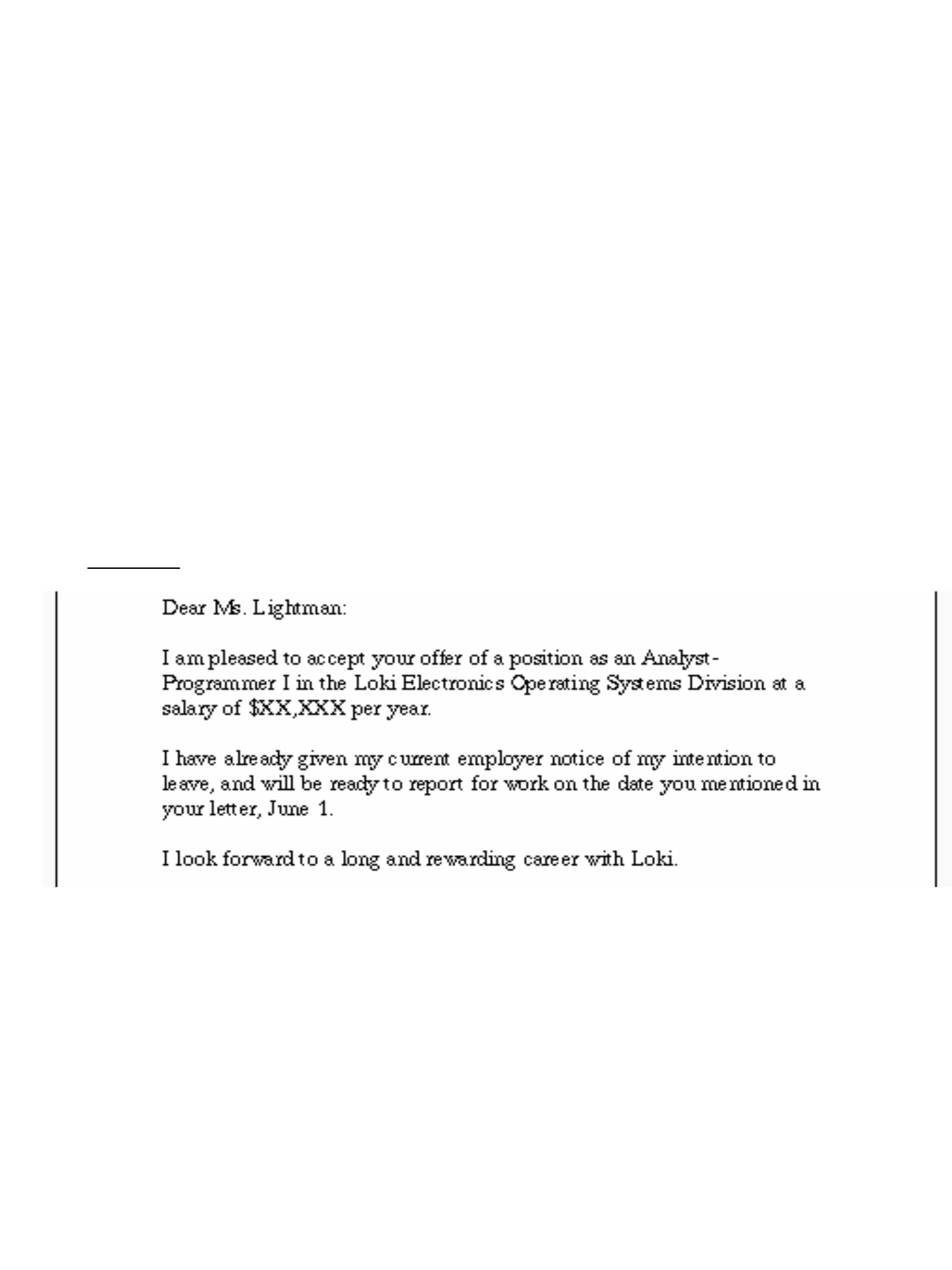
Format
• Begin the first paragraph by enthusiastically accepting the job.
• Be sure to state the exact title of the job and the salary.
• The second paragraph usually discusses details about the position,
especially the date that you will begin work.
• The last paragraph is short statement of goodwill, usually indicating
that you are looking forward to starting your new job.
• The following is an example of a standard letter of acceptance.
Sample

Transmittal Letters
•
A transmittal or cover letter accompanies a larger item, usually a document.
• The transmittal letter provides the recipient with a specific context
in which to place the larger document and simultaneously gives the
sender a permanent record of having sent the material.
• Transmittal letters are usually brief.
• The first paragraph describes what is being sent and the purpose for sending
it.
• A longer transmittal letter may summarize key elements of the
proposal in one or two sentences and provide the recipient with other
useful information.
• End transmittal letters with a one-sentence paragraph that establishes
goodwill by thanking or complimenting the recipient.
• The following document is an example of a formal
transmittal letter accompanying a grant proposal to the
National Science Foundation.
• The structure of the letter, the use of language, such as herewith , and
the use of the passive voice reflect common conventions for
submitting formal scientific proposals.

Sample Letter
Revision
•Letters
– Job Application Letters
– Acceptance Letters
– Transmittal Letters

Letters II
Letters of Inquiry
• A letter of inquiry asks someone for specific information.
• In some cases, such as a request for promotional material, the recipient
will have a clear interest in responding to your letter.
• In other cases, such as a request for specific information on a
product, the recipient may or may not be as motivated to
respond quickly.
• Consequently, always make the tone of the letter friendly and make
it easy for the recipient to identify and provide the information you
need.
Format of a Letter of Inquiry
• Follow this format in writing a letter of inquiry:
– In the first paragraph, identify yourself and, if appropriate,

your position, and your institution or firm.
– In the second paragraph, briefly explain why you are writing
and how you will use the requested information. Offer to keep
the response confidential if such an offer seems reasonable.
– List the specific information you need. You can phrase your
requests as questions or as a list of specific items of
information. In either case, make each item clear and discrete.
– Conclude your letter by offering your reader some
incentive for responding.
Example
– The following letter of inquiry is written by a computer
programmer requesting specific information about an
upcoming release of a software product.
Head

Body
Footer

Technical-Information Letters and Memoranda
• Technical-information letters and memoranda are short documents
that announce new technical information, such as a software bug and
its solution, or a new feature.
• Use the memorandum format if the information is being sent
inside an organization. Use the letter format if the document
will be sent to outside individuals.
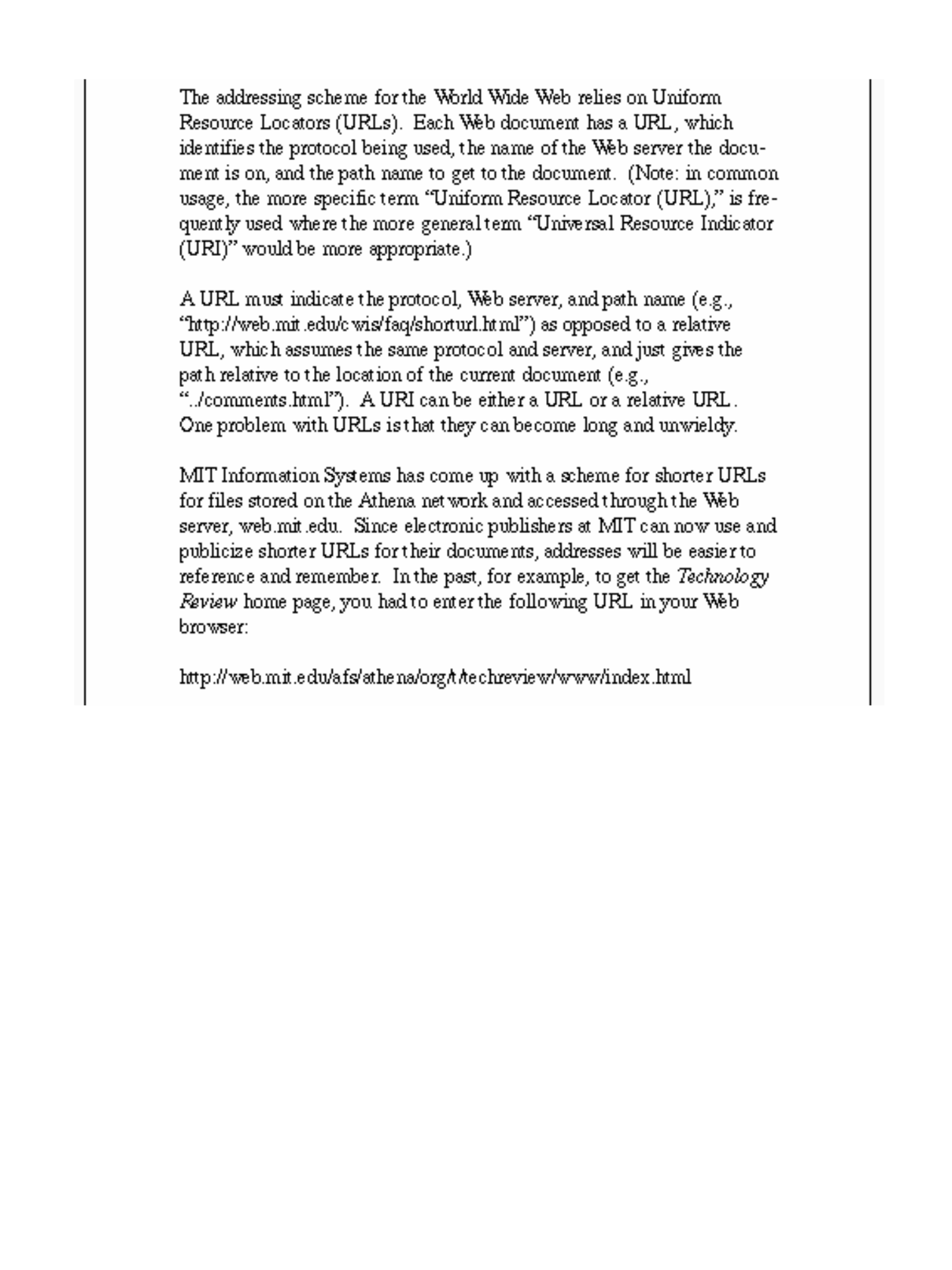
• The following example is adapted from a technical-information
memorandum written by Information Systems at the
Massachusetts Institute of Technology.
• The document informs users of MIT's network of a change in the p
rotocols of MIT's main World Wide Web (WWW) server that allows
users to place shorter Uniform Resource Locators (URLs) in their
WWW pages.
Body

References and Letters of Recommendation
• You should follow standard procedures in obtaining references,
a nd use conventional formats in writing letters of
recommendation.
•
References are an essential component of almost all admissions,
grant, and
employment processes.
• Managers and other individuals in any selection process need
evaluations from individuals who have had long and close contact
with applicants in order to assess accurately their abilities and
accomplishments.
• The number of recommendations required by employers and
universities usually ranges from one to five, with three being the most
common number.
• There are two basic forms of references: oral and written.
• Most often, oral references are conducted by telephone.
• The name, professional title and affiliation, address, and phone
number of each reference are included in a list of references, which
is often mentioned in résumés and application letters but always
kept separate from them.
• Give your list of references to a potential employer or to a selection

committee only when it is requested.
• Your recommenders are doing you a favor.
• If you subject them to too many intrusions, you may find them less
willing to help you in the future.
• Written letters of recommendation are more formal.
• Often, they are written to a specific individual for a specific position.
• In other cases, however, letters of recommendation are written for
a general type of job or for graduate school and are included in a
collection of letters of recommendation called a dossier.
Obtaining Letters of Recommendation
• Make your candidacy as strong as possible by carefully soliciting
references and letters of recommendation.
• Letters of recommendation are extremely important in decisions to
hire or admit an individual or to award a scholarship or grant.
• Consequently, be sure to spend adequate time and effort to
ensure their effectiveness.
• In some cases, you list an individual as a reference, and the
organization or individual considering your application will contact that
person, often only if you are a finalist for the position.
• Other situations, however, require a formal letter of recommendation
from each reference.

General Guidelines for Requesting
References or Letters of
Recommendation
• If possible, always ask one or two more persons than the minimum
number you need.
• Ask a range of persons who can testify to different abilities and
accomplishments relevant to the position or award.
• If possible, ask someone in person to write a recommendation
or to be a reference.
• If the individual is far away, ask him or her by phone or through a written
letter.
• Generally, unless you know the person extremely well, do not ask
someone to be a reference or write a letter of recommendation
through e-mail.
• Never list a person as a reference or as someone who will provide
a letter of recommendation until the person has agreed to do so.
• Give each person serving as a reference or writing a letter of
recommendation the following written information:
• a description of the position or award you are applying for
• a short statement of your professional goals longer than a one-
sentence career- objective statement included as part of your résumé
• a current Resume

• background material to refresh the recommender's memory of
specific work you did with him or her that you feel should be
included in a letter of recommendation
Guidelines for Written Letters of Recommendation
• Generally, people give more weight to recommendations that
contain a waiver of your right to see the recommendation.
• Sometimes, however, it may be prudent not to waive your right to
review the recommendation, especially if you are unsure of the
recommender's attitude toward you or of his or her writing ability.
• Recommenders are busy people.
• Ask a person to write the recommendation and give him or her all
the necessary material at least three weeks before the
recommendation is due.
•
Sometimes recommendations are sent to a central office, such as a
university
career center, which then forwards the recommendations
to specific individuals.
• In these cases, you may be able to ask someone in the office to review
the recommendations on file and suggest which combination of
recommendations best present an overall picture of your abilities and
accomplishments related to your career objectives.
• If appropriate, provide each recommender with
– all required recommendation forms; be sure you have completed
all parts of the form you are required to fill out.

– a sheet stating to whom or where the recommendation should be
sent.
– When appropriate, include addressed envelopes and, in
some cases, postage.

• One week before the recommendations are due, tactfully ask
each recommender if he or she has sent the
recommendation.
• After the letter of recommendation has been sent or the reference
has been given, write a short letter thanking the recommender.
• The recommender has spent time helping you, and such a recognition
of his or her efforts not only is polite but also may make it easier for
you to request future references or recommendations.
• Keep all letters of recommendation and references current.
• In general, written recommendations that are older than three or
four years carry little weight.
Writing Letters of Recommendation
•
Write letters of recommendation to provide relevant information and to
present
an individual truthfully and positively.
Guidelines for Writing Letters of Recommendation
• In most cases, agree to write a letter of recommendation only if
you can honestly write a supportive letter.
• If you cannot portray an individual positively, decline to
write the recommendation.
• Ask for a current Resume and as complete a description as possible
of the position or program to which the person is applying.

• Assemble and review all other relevant information you may have
about the person you are recommending.
• It is often easy to overlook some important accomplishment.
• Present the person truthfully but positively.
• A recommendation that paints an unrealistic picture of a candidate
may be discounted.
• A recommendation that focuses on negative qualities may do
more harm than intended.
• Tailor the recommendation to the position. A letter recommending an
individual for a job as a camp counselor should contain different
information from that in a letter recommending the same individual for
a job as a computer programmer.
• Begin the letter by describing how you know the individual you are
recommending and the specific contexts upon which you are basing
your evaluation. In what situations have you known the individual?
For how long? How closely?
• Present the individual's general qualities relevant to the position
along with one or two detailed examples. Including vivid detail will
make the recommendation much more effective.
• In most cases, a letter of recommendation should consist of three
or four paragraphs and not be over one page in length.
• A sample letter of recommendation is given is now showing on your screen.
******************************************************

*************

