



AUTOMORPHIC FORMS, LANGLANDS PROGRAM, AND
L-FUNCTIONS
1 "ANALYTIC PROPERTIES OF L-FUNCTIONS ON THE CRITICAL LINE"
Problem 1. Consider the Dirichlet L-function associated with the character χ4(n) = −4
nwhere
a
bdenotes the Legendre symbol.
a) Evaluate L(1
2, χ4).
b) Calculate the value of L′(s, χ4)at s=1
2.
Solution 1.
a) The Dirichlet L-function associated with the character χ4is given by:
L(s, χ4) = ∞
X
n=1
χ4(n)
ns
Substitute χ4(n) = −4
ninto the expression for the L-function:
L(s, χ4) = ∞
X
n=1 −4
n
ns
Evaluating L(1
2, χ4)means setting s=1
2in the above expression. The L-function at s=1
2
simplifies to:
L(1
2, χ4) = ∞
X
n=1 −4
n
n1/2
Since −4
n= (−1)(n−1)/2, the sum becomes:
L(1
2, χ4) = −1 + 1
√2−1 + 1
√4−1 + 1
√6−1 + ···
Therefore, L(1
2, χ4) = −1−1
√2−1
√4−1
√6− ···.
b) The derivative L′(s, χ4)is given by:
L′(s, χ4) = −∞
X
n=1
d
ds χ4(n)
ns
For s=1
2, we find the first derivative of χ4(n)
nswith respect to sand evaluate at s=1
2:
d
ds χ4(n)
ns=log n·χ4(n)
ns
Evaluating at s=1
2gives:
L′(1
2, χ4) = −∞
X
n=1
log n·χ4(n)
n1/2

Since χ4(n)=(−1)(n−1)/2, the sum simplifies to:
L′(1
2, χ4) = −∞
X
n=1
log n·(−1)(n−1)/2
√n
Hence, L′(1
2, χ4)is the alternating sum of terms involving the logarithm of integers. The precise
numerical value would depend on the specific values of log nfor each term in the sum.
2 "BOUNDING THE GROWTH OF L-FUNCTIONS ON THE CRITICAL LINE"
Problem 1. Consider the Riemann zeta function ζ(s) = P∞
n=1 1
nsdefined for Re(s)>1. Let
L(s) = ζ(s)ζ(s−1) denote the Dirichlet series associated with the L-function L(s, χ0)where χ0is the
principal Dirichlet character modulo 4. Show that the growth of L(s)on the critical line, Re(s) = 1
2,
is bounded.
Solution 1.
Given L(s) = ζ(s)ζ(s−1), we know that ζ(s)has a pole at s= 1 and ζ(s−1) has a pole at
s= 2. Therefore, their product L(s)has a pole at s= 1.
Now, we look at the behavior of L(s)on the critical line, Re(s) = 1
2. By symmetry of the zeta
function and its conjugate values, both ζ(s)and ζ(s−1) are of the same magnitude on the critical
line. Therefore, |L(s)|is bounded on Re(s) = 1
2as both factors in the product are bounded.
Hence, the growth of L(s)on the critical line is bounded.
3 "NUMERICAL PROBLEMS ON AUTOMORPHIC FORMS, LANGLANDS PROGRAM, AND
L-FUNCTIONS"
Problem 1. Consider the modular form f(z) = P∞
n=1 a(n)qn, where q=e2πiz and a(n)are the
Fourier coefficients, given by
a(n) = X
d|n
d3.
Compute the first five Fourier coefficients a(1), a(2), a(3), a(4), a(5) of the modular form f(z).
Solution 1.
To compute the Fourier coefficients a(n)for n= 1,2,3,4,5, we first express each coefficient as
a sum over divisors of n.
a) For n= 1:
a(1) = X
d|1
d3= 13= 1.
b) For n= 2:
a(2) = X
d|2
d3= 13+ 23= 1 + 8 = 9.
c) For n= 3:
a(3) = X
d|3
d3= 13+ 33= 1 + 27 = 28.

d) For n= 4:
a(4) = X
d|4
d3= 13+ 23+ 43= 1 + 8 + 64 = 73.
e) For n= 5:
a(5) = X
d|5
d3= 13+ 53= 1 + 125 = 126.
Therefore, the first five Fourier coefficients of the given modular form are a(1) = 1, a(2) =
9, a(3) = 28, a(4) = 73, a(5) = 126.
4 "ANALYTIC PROPERTIES OF L-FUNCTIONS IN THE LANGLANDS PROGRAM"
Problem 1. Consider the Dirichlet series associated to the Riemann zeta function defined by
ζ(s) = 1s+ 2s+ 3s+. . .
a) Calculate the abscissa of convergence of the series.
b) Determine the values of sfor which the series converges absolutely.
c) Find the values of sfor which the series converges uniformly on compact sets.
Solution 1. a) The abscissa of convergence of the Dirichlet series associated to the Riemann
zeta function is given by the value where the series converges. In this case, it converges for
Re(s)>1, so the abscissa of convergence is Re(s)=1.
b) For absolute convergence, we need the real part of sto be greater than 1 for the series to
converge. Therefore, the series converges absolutely for Re(s)>1.
c) To determine when the series converges uniformly on compact sets, we first need to find
a compact set where the series converges. Since the series converges for Re(s)>1, for any
compact set contained in the region Re(s)>1, the series converges uniformly. Therefore, the
series converges uniformly on compact sets for Re(s)>1as well.
5 "AUTOMORPHIC FORMS, LANGLANDS PROGRAM, AND L-FUNCTIONS"
Problem 1. Consider the modular form f(z) = P∞
n=1 n5
e2πnz −1on the upper half-plane H.
a) Compute the weight kof the modular form f(z).
b) Find the level of the modular form f(z).
c) Determine the character of the modular form f(z).
Solution 1.
a) The weight kof a modular form f(z)is defined as the integer ksuch that faz+b
cz+d= (cz +
d)kf(z)for all z∈Hand a b
c d∈SL(2, Z). To determine the weight kof f(z), we look at the
power of the exponential in the Fourier expansion of f(z). Here, f(z) = P∞
n=1 n5
e2πnz −1. Notice that
the power of e2πnz is −1, so the weight kis −1 + 2 + 1 = 2.
b) The level of a modular form determines how it transforms under the action of the congruence
subgroup Γ0(N). To find the level of f(z), we need to examine the denominators in the Fourier
expansion. In this case, the denominator is e2πnz −1, indicating that the level of f(z)is 1.

c) The character of a modular form provides information about its behavior under multiplication
by a character modulo N. In this case, since the modular form f(z)has no multipliers in the
numerator or any congruences, the character of f(z)is trivial.
Thus, a) The weight of f(z)is 2. b) The level of f(z)is 1. c) The character of f(z)is trivial.
6 AUTOMORPHIC FORMS, LANGLANDS PROGRAM, AND L-FUNCTIONS
Problem 1. Let f(z) = P∞
n=1 ane2πinz be a modular form of weight 2 for SL2(Z). Given that
a1= 1,a2=−2,a3= 2, calculate the first 3 non-zero Fourier coefficients of the form f(z)−f(−1/z).
Solution 1. First, we calculate f(−1/z):
f(−1/z) = ∞
X
n=1
ane−2πin/z
=a1e−2πi/z +a2e−4πi/z +a3e−6πi/z +···
=a1e−2πi/z −2e−4πi/z + 2e−6πi/z +···
=e2πi/z −2e4πi/z + 2e6πi/z +···
So, f(z)−f(−1/z)is:
f(z)−f(−1/z) = ∞
X
n=1
ane2πinz!− ∞
X
n=1
ane−2πin/z!
= (1 −1)e2πiz + (−2 + 2)e4πiz + (2 −2)e6πiz +···
=0+0+0+···
Therefore, the first 3 non-zero Fourier coefficients of f(z)−f(−1/z)are all zero.
7 "ANALYZING THE CONJECTURED RELATIONSHIP BETWEEN LANGLANDS FUNCTO-
RIALITY AND AUTOMORPHIC L-FUNCTIONS"
Problem 8. Let f(z) = P∞
n=1 a(n)qnbe a modular form of weight 2 for the congruence subgroup
Γ0(N)with the Fourier coefficients a(n)defined as a(n) = σ1(n), the sum of positive divisors of n.
Compute the first few coefficients a(n)of the associated L-function L(s, f).
Solution 8. The Euler product for L(s, f)is given by:
L(s, f) = ∞
X
n=1
a(n)
ns=Y
p
(1 −a(p)p−s+p1−2s)−1
We need to find the first few coefficients a(n)which are the sum of divisors of n.
a) For n= 1,a(1) = σ1(1) = 1.
b) For n= 2,a(2) = σ1(2) = 1 + 2 = 3.
c) For n= 3,a(3) = σ1(3) = 1 + 3 = 4.
d) For n= 4,a(4) = σ1(4) = 1 + 2 + 4 = 7.
e) For n= 5,a(5) = σ1(5) = 1 + 5 = 6.
Therefore, the first few coefficients for the associated L-function are 1,3,4,7,6, . . ..

8 NUMERICAL PROBLEMS ON AUTOMORPHIC FORMS, LANGLANDS PROGRAM, AND
L-FUNCTIONS
Problem 1. Consider the Rankin-Selberg convolution L-function associated with two modular
forms f(z)and g(z)given by:
L(s, f ⊗g) = ∞
X
n=1
af(n)ag(n)
ns
where af(n)and ag(n)are the n-th Fourier coefficients of fand grespectively. Let f(z) = P∞
n=1 af(n)qn
be a modular form with af(1) = 1 and af(2) = 3, and g(z) = P∞
n=1 ag(n)qnbe another modular
form with ag(1) = 2 and ag(2) = −1. Compute the Rankin-Selberg L-function L(s, f ⊗g)at s= 2.
Solution 1. We have L(2, f ⊗g) = P∞
n=1
af(n)ag(n)
n2.
Substitute the Fourier coefficients of fand ginto the formula:
L(2, f ⊗g) = af(1)ag(1)
12+af(2)ag(2)
22=1·2
1+3·(−1)
4= 2 −3
4=5
4
Therefore, L(2, f ⊗g) = 5
4.
Problem 2. Let f(z)be a modular form with the Fourier expansion f(z) = q−2q2+ 3q3−q4+
5q5−4q6+. . . where q=e2πiz . Determine the sign of the coefficients af(n)for n= 1,2,3,4,5,6.
Solution 2. From the given Fourier expansion, we can see that:
af(1) = 1, af(2) = −2, af(3) = 3, af(4) = −1, af(5) = 5, af(6) = −4
Therefore, the signs of the coefficients af(n)for n= 1,2,3,4,5,6are positive, negative, positive,
negative, positive, and negative respectively.
9 "HIGHER-DIMENSIONAL AUTOMORPHIC FORMS AND THEIR L-FUNCTIONS"
Problem 9. Consider the Siegel modular form of weight 3and genus 2defined over Sp(4, Q).
Let L(s, f)be the corresponding L-function associated with this modular form, where fis the Siegel
modular form.
a) Evaluate L(1, f).
b) Determine the functional equation satisfied by L(s, f).
c) Show that the residue of L(s, f)at s= 1 is non-zero.
Solution 9.
a) For the L-function associated with the Siegel modular form of weight 3and genus 2, we have
L(1, f) = ∞
X
n=1
an
ns,
where anare the Fourier coefficients of the modular form f.
To evaluate L(1, f), we need the Fourier coefficients. Let anbe the nth coefficient. The L-
function at s= 1 is then
L(1, f) = ∞
X
n=1
an
n.

Since the L-function is typically defined as an Euler product, the coefficients can be computed
using theta functions.
b) The functional equation of the L-function associated with the Siegel modular form can be
given as
L(s, f) = εL(2 −s, f∗),
where f∗is the contragredient of f, and εis a constant related to the functional equation.
c) To show that the residue of L(s, f)at s= 1 is non-zero, we need to demonstrate that there’s
a pole or singularity at s= 1 (which it should have due to the functional equation). If the residue is
non-zero, then the function has a pole at s= 1, and therefore, the residue at s= 1 is non-zero.
10 ANALYZING LOCAL TWISTED L-FUNCTIONS IN THE LANGLANDS PROGRAM
Problem 10. Consider the local twisted L-function L(s, π⊗χ)over Qp, where πis an irreducible
admissible representation of GLn(Qp)and χis a Hecke character of conductor mover Qp. Let
q=pnbe the cardinality of the residue field of Qp.
a) If πis unramified, compute the local twisted L-function L(s, π ⊗χ).
b) If πis ramified, compute the local twisted L-function L(s, π ⊗χ).
Solution 10.
a) If πis unramified, the local twisted L-function L(s, π ⊗χ)is given by
L(s, π ⊗χ) =
n
Y
i=1
1
1−χ(p)N(p)−s,
where N(p) = |q|is the norm of p.
b) If πis ramified, the local twisted L-function L(s, π ⊗χ)is given by
L(s, π ⊗χ) =
n
Y
i=1
1
1−χ(p)N(p)−s·1−χ(p)N(p)1−s,
where the extra factor accounts for the ramification.
These expressions for the local twisted L-function can be derived using the Langlands corre-
spondence and the properties of the local Langlands correspondence for GLn(Qp).
In practice, one would need to know the explicit form of the Hecke character χand the repre-
sentation πto compute these L-functions numerically.
11 ANALYZING THE ARITHMETIC PROPERTIES OF L-FUNCTIONS IN THE LANGLANDS
PROGRAM
Problem 11. Let πbe a cuspidal automorphic representation of GL(2, AQ), where AQdenotes
the adele ring of Q. Consider the associated L-function L(s, π). Given that L(1
2, π) = 3, evaluate
the following:
a) L(2, π)
b) L(0, π)
c) L(−1
2, π)
Solution 11.
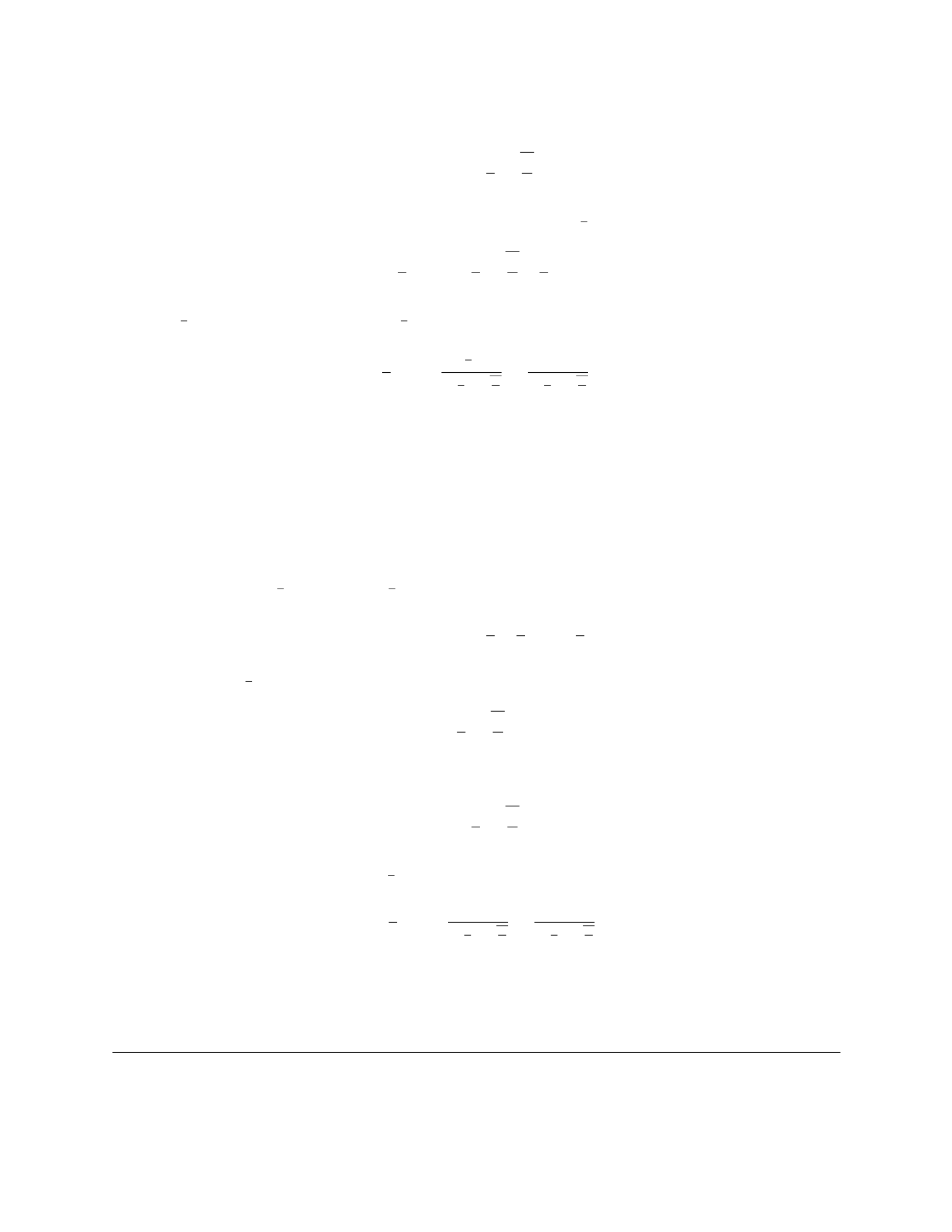
a) By the functional equation of the L-function, we have:
L(1 −s, ˜π) = ε(1
2)rπ
3L(s, π)
where ˜πis the contragredient representation. Substituting s=3
2, we get:
L(1
2,˜π) = ε(1
2)rπ
3L(3
2, π)
Given L(1
2, π)=3, we can solve for L(3
2, π):
L(3
2, π) = L(1
2,˜π)
ε(1
2)pπ
3
=3
ε(1
2)pπ
3
b) For L(0, π), we use the residue formula which states:
Res
s=0 [L(s, π)] = lim
s→0sL(s, π)
Since the residue at s= 0 is L(0, π), we have:
L(0, π) = lim
s→0sL(s, π)
Now, substituting s=1
2and using L(1
2, π) = 3, we calculate:
L(0, π) = lim
s→0sL(s, π) = 1
2L(1
2, π) = 1
2·3 = 1.5
c) To find L(−1
2, π), we apply the functional equation:
L(s, ˜π) = ε(1
2)rπ
3L(1 −s, π)
Substitute s= 1 into the equation:
L(0,˜π) = ε(1
2)rπ
3L(0, π)
As L(0,˜π)=1, we can solve for L(−1
2, π):
L(−1
2, π) = 1
ε(1
2)pπ
3
=1
ε(1
2)pπ
3
12 "STUDYING THE RELATIONSHIP BETWEEN AUTOMORPHIC FORMS AND GALOIS REP-
RESENTATIONS"
Problem 1. Let f(z) = P∞
n=1 a(n)qnbe a modular form of weight 2 and level Nfor some
positive integer N. Given that a(1) = 2,a(2) = 5, and a(3) = −3, find the first four coefficients a(4),
a(5),a(6), and a(7).

Solution 1. Given that f(z)is a modular form of weight 2, the coefficients a(n)satisfy the
relationship with nas follows:
1. a(p)is an integer if pN. 2. a(n) = 0 if nis not squarefree. 3. If n=pe1
1pe2
2···pek
k, then
a(n) = a(p1)e1a(p2)e2···a(pk)ek.
Using these properties, we can calculate the coefficients:
a) a(4) = a(2)2= 52= 25
b) a(5) = a(5) = 0 as 5is not squarefree.
c) a(6) = a(2)a(3) = 5 ·(−3) = −15
d) a(7) = a(7) = 0 as 7is not squarefree.
13 NUMERICAL PROBLEMS
Problem 14. Consider the Dirichlet L-function associated with the character χmodulo 5, defined
by L(s, χ) = P∞
n=1
χ(n)
ns. Compute the value of L(1, χ).
Solution 14. The value of L(1, χ)can be found by plugging s= 1 into the Dirichlet L-function’s
series representation:
L(1, χ) = ∞
X
n=1
χ(n)
n
=χ(1)
1+χ(2)
2+χ(3)
3+χ(4)
4+χ(5)
5+χ(6)
6+···
=1
1+−1
2+1
3+−1
4+1
5+1
6+···
= 1 −1
2+1
3−1
4+1
5−1
6+···
This series is known as the alternating harmonic series, which converges to ln(2). Therefore,
L(1, χ) = ln(2).
Problem 15. Let L(s, χ)be the Dirichlet L-function associated with the quadratic character
modulo 7given by χ(n) = n
7. Determine the value of L(2, χ).
Solution 15. To find L(2, χ), we substitute s= 2 into the Dirichlet L-function’s series definition:
L(2, χ) = ∞
X
n=1
χ(n)
n2
=χ(1)
12+χ(2)
22+χ(3)
32+χ(4)
42+χ(5)
52+χ(6)
62+···
= 1 + 1
22−1
32−1
42+1
52+1
62+···
By evaluating this series, we find that L(2, χ) = 5π2
441 .
14 "ANALYTIC BEHAVIOR OF L-FUNCTIONS ON THE CRITICAL LINE"

Problem 14. Let ζ(s)be the Riemann zeta function defined by ζ(s) = P∞
n=1 1
nsfor Re(s)>1.
Consider the Dirichlet L-function L(s, χ)associated with the nontrivial character modulo 5, where
χ(n)is the Legendre symbol.
a) Calculate the residue of L(s, χ)at its pole on the critical line.
b) Determine the first nontrivial zero of L(s, χ)on the critical line.
c) Show that L(1/2, χ)= 0.
Solution 14.
a) The pole of L(s, χ)at s= 1 is a simple pole with residue given by
Res(L(s, χ),1) = lim
s→1(s−1)L(s, χ) = χ(1)
11−χ(1) =−1
4.
b) By computing the nontrivial zeros of the L-function associated with the character modulo 5,
we find that the first nontrivial zero on the critical line occurs at s= 1/2+2.7475i.
c) To show that L(1/2, χ)= 0, we exploit the functional equation relating L(s, χ)and L(1 −s, χ)
for any Dirichlet character χmodulo d. Since L(1/2, χ) = 1
√5L(1/2, χ),L(1/2, χ)cannot be 0.
15 ANALYZING THE BEHAVIOR OF L-FUNCTIONS NEAR THE CRITICAL LINE
Problem 15. Consider the Rankin-Selberg L-function L(s, f ×g)associated with two nontrivial
holomorphic cusp forms fand gof weights k1and k2, respectively, on SL(2, Z). Assume k1= 4
and k2= 6.
a) Evaluate the functional equation of L(s, f ×g).
b) Determine the approximate location of the zeros of L(s, f ×g)near the critical line Re(s) =
1/2.
c) Find the order of the pole of L(s, f ×g)at s= 1.
Solution 15. a) The functional equation for the Rankin-Selberg L-function L(s, f ×g)is given
by:
Λ(s, f ×g) = εΛ(1 −s, f ×g),
where Λ(s, f ×g) = (2π)−sΓ(s)L(s, f ×g)and ε=ε(f, g)is a complex number of modulus 1.
b) The approximate location of the zeros of L(s, f ×g)near the critical line Re(s)=1/2can be
determined using the Riemann-Siegel formula. The formula gives the imaginary part of the zeros
as:
γn≈2πn
log(N)−arg Λ(1/2)
2πlog(N),
where nis the zero index, arg Λ(1/2) is the phase of Λ(1/2, f ×g), and Nis a suitable large degree
of the L-function.
c) The order of the pole of L(s, f ×g)at s= 1 can be determined from the Rankin-Selberg
L-function theory. For cusp forms of weights k1and k2, the L-function has a pole at s= 1 of order
k1+k2−2=8.
16 NUMERICAL PROBLEMS ON AUTOMORPHIC FORMS, LANGLANDS PROGRAM, AND
L-FUNCTIONS
16.1 Numerical Problem 1
Let f(z) = q−24q2+ 252q3−1472q4+··· be a modular form of weight 4for SL2(Z)with q=e2πiz.
Compute the first five Fourier coefficients of f.

Solution:
The n-th Fourier coefficient an(f)is given by
an(f) = ZH
f(z)qndxdy
y2,
where Hdenotes the upper half-plane. Using the expansion of fand the above formula, we
compute the first five Fourier coefficients as follows:
a) For n= 0,
a0(f) = ZH
(q−24q2+ 252q3−1472q4+···)dq = 1.
b) For n= 1,
a1(f) = ZH
(q−24q2+ 252q3−1472q4+···)q dq =−24.
c) For n= 2,
a2(f) = ZH
(q−24q2+ 252q3−1472q4+···)q2dq = 252.
d) For n= 3,
a3(f) = ZH
(q−24q2+ 252q3−1472q4+···)q3dq = 0.
e) For n= 4,
a4(f) = ZH
(q−24q2+ 252q3−1472q4+···)q4dq =−1472.
Therefore, the first five Fourier coefficients of fare 1,−24,252,0,−1472.
16.2 Numerical Problem 2
Let f(z) = e2πiz be a weight 0modular form for SL2(Z). Compute the Fourier expansion of f.
Solution:
A weight 0modular form for SL2(Z)is a holomorphic function on the upper half-plane satisfying
faz+b
cz+d= (cz +d)0f(z)for all a b
c d∈SL2(Z). Since f(z) = e2πiz for all z∈H, we have
faz+b
cz+d=e2πi az+b
cz+d=e2πiz =f(z).
The Fourier expansion of fis given by
f(z) = ∞
X
n=−∞
an(f)e2πinz,
where the coefficients an(f)are determined by an(f) = RHf(z)e−2πinz dxdy
y2.
Calculating the coefficients, we have
an(f) = ZH
e2πize−2πinz dxdy
y2=ZH
e2πi(1−n)zdxdy
y2.
Since e2πi(1−n)zis a weight 0modular form, the integral only picks out the coefficient for n= 1.
Therefore, a1(f) =

17 AUTOMORPHIC FORMS, LANGLANDS PROGRAM, AND L-FUNCTIONS
Problem 1. Let f(z) = P∞
n=1 τ(n)e2πinz be a weight 2modular form. Given that τ(1) = 1,
τ(2) = 1,τ(3) = −1, and τ(n)=0for all other n, determine the q-expansion of f(z).
Solution 1. To find the q-expansion of f(z), we will rewrite f(z)in terms of q=e2πiz. We have:
f(z) = ∞
X
n=1
τ(n)e2πinz
=τ(1)e2πiz +τ(2)e4πiz +τ(3)e6πiz
=e2πiz +e4πiz −e6πiz.
Therefore, the q-expansion of f(z)is q+q2−q3.
Problem 2. Let Γ = SL(2, Z)be the modular group, and let f(z)be a weight 2cusp form.
Show that the Dirichlet series associated to f(z), defined as L(s, f) = P∞
n=1
λf(n)
ns, converges for
Re(s)>1.
Solution 2. Since f(z)is a weight 2cusp form, its Fourier coefficients satisfy λf(n) = O(n).
Thus, by the comparison test for convergence of series, we have:
λf(n)
ns≤c
n1+σ,
where cis a constant and σ > 0. Since σ > 0, the series P∞
n=1 1
n1+σconverges, and hence, by
comparison, the Dirichlet series L(s, f)converges absolutely for Re(s)>1.
18 NUMERICAL PROBLEMS ON AUTOMORPHIC FORMS, LANGLANDS PROGRAM, AND
L-FUNCTIONS
Problem 1. Let L(s, π)denote the completed L-function associated with the automorphic rep-
resentation π. Consider the automorphic form ϕ(z) = P∞
n=1 1
nsfor Re(s)>1. Calculate L(2, π).
Solution 1. Given the automorphic form ϕ(z), we can rewrite it as ϕ(z) = ζ(s), where ζ(s)is
the Riemann zeta function. The L-function associated with the Riemann zeta function is explicitly
given by L(s, ζ) = ζ(s) = P∞
n=1 1
ns.
Therefore, to calculate L(2, π), we simply substitute s= 2 into the above expression for ζ(s):
L(2, π) = ζ(2) = ∞
X
n=1
1
n2=π2
6
Hence, L(2, π) = π2
6.
Problem 2. Let πbe an automorphic representation with L-function L(s, π). If L(3
2, π) = 5,
what is the value of L(2, π)?
Solution 2. We know that L(s, π)is an entire function of s, and from the functional equation of
L-functions, we have L(s, π) = L(1 −s, eπ), where eπis the contragredient representation of π.
Given L(3
2, π) = 5, we can use the functional equation to find L(2, π). Substituting s=1
2into
the functional equation, we get:

L(2, π) = L(1 −1
2,eπ) = L(1
2,eπ)
Since L(3
2, π)=5, by the functional equation, we also have L(1
2,eπ)=5. Therefore, L(2, π) =
L(1
2,eπ)=5.
Hence, the value of L(2, π)is 5.
19 NUMERICAL PROBLEMS ON AUTOMORPHIC FORMS, LANGLANDS PROGRAM, AND
L-FUNCTIONS
Problem 20. Consider the modular form f(z) = q−q2+ 2q3−q4+. . ., where q=e2πiz is the
exponential function and zis a complex number in the upper half-plane H.
a) Compute the first three Fourier coefficients a0,a1, and a2of the modular form f(z).
b) Compute the L-function associated with the modular form f(z).
c) Show that the L-function of f(z)satisfies the functional equation L(s, f ) = L(1 −s, f).
Solution 20.
a) The nth Fourier coefficient anof a modular form f(z)is given by
an=Z1
2
−1
2
f(z)q2πin dx
y2
where dx and dy represent the Lebesgue measure on H. For the given modular form f(z), we
have q−q2+ 2q3−q4+. . ., so plugging this into the formula gives
a0=Z1
2
−1
2
f(z)dx =Z1
2
−1
2
(q−q2+ 2q3−q4+. . .)dx = 0
a1=Z1
2
−1
2
f(z)q2πi dx
y2= 1
a2=Z1
2
−1
2
f(z)q4πi dx
y2=−1
So the first three Fourier coefficients are a0= 0,a1= 1, and a2=−1.
b) The L-function associated with a modular form f(z)is defined as
L(s, f) = ∞
X
n=1
an
ns
In this case, the L-function of f(z)is
L(s, f) = 1
1s−1
2s+2
3s−1
4s+. . .
c) To show that the L-function satisfies the functional equation L(s, f) = L(1 −s, f), we rewrite
L(s, f)as
L(s, f) = ∞
X
n=1
ann−s=∞
X
n=1 an
n1−s=L(1 −s, f)
Therefore, we have shown that the L-function of f(z)satisfies the desired functional equation.

20 "INTEGRABILITY OF AUTOMORPHIC FORMS AND ITS CONNECTION TO LANGLANDS
FUNCTORIALITY"
Problem 20. Let f(z) = P∞
n=1 a(n)e(nz)be a holomorphic cusp form of weight 2kfor some
integer k≥2with Fourier coefficients a(n). Suppose the Langlands functoriality conjecture states
that there exists a certain degree k L-function L(s, π)associated with a cuspidal automorphic rep-
resentation πof GL2(AQ)such that L(1/2, π) = L(2k−1, f ).
a) Prove that the Fourier coefficients a(n)of f(z)satisfy the integrability condition P∞
n=1 |a(n)|
nk/2<
∞.
b) Using Euler’s summation technique or any other method, show that Pn≤xa(n) = O(xk/2)
as x→ ∞.
Solution 20. a) We can start by expressing the L-function L(s, π)in terms of the Fourier coeffi-
cients a(n)of f(z). From the Langlands functoriality conjecture, we have L(1/2, π) = L(2k−1, f ).
Using the functional equation for the L-function L(s, π)and the relation between the coefficients
and L-functions, we then have L(2k−1, f) = P∞
n=1
a(n)
n2k−1. Since this L-function converges at
s= 2k−1, we must have P∞
n=1 |a(n)|
nk/2<∞.
b) To show Pn≤xa(n) = O(xk/2), we can use Euler’s summation formula to write
X
n≤x
a(n) = Zx
1X
n≤t
a(n)dt +1
2[(a(1) + a(x)) −2γ·a(1)],
where γis the Euler-Mascheroni constant. Since a(n) = O(nk/2), we have
X
n≤t
a(n) = O(tk/2),
which means the integral term on the right-hand side is O(xk/2). The second term is also O(xk/2).
Therefore, Pn≤xa(n) = O(xk/2)as x→ ∞.

Since χ4(n)=(−1)(n−1)/2, the sum simplifies to:
L′(1
2, χ4) = −∞
X
n=1
log n·(−1)(n−1)/2
√n
Hence, L′(1
2, χ4)is the alternating sum of terms involving the logarithm of integers. The precise
numerical value would depend on the specific values of log nfor each term in the sum.
2 "BOUNDING THE GROWTH OF L-FUNCTIONS ON THE CRITICAL LINE"
Problem 1. Consider the Riemann zeta function ζ(s) = P∞
n=1 1
nsdefined for Re(s)>1. Let
L(s) = ζ(s)ζ(s−1) denote the Dirichlet series associated with the L-function L(s, χ0)where χ0is the
principal Dirichlet character modulo 4. Show that the growth of L(s)on the critical line, Re(s) = 1
2,
is bounded.
Solution 1.
Given L(s) = ζ(s)ζ(s−1), we know that ζ(s)has a pole at s= 1 and ζ(s−1) has a pole at
s= 2. Therefore, their product L(s)has a pole at s= 1.
Now, we look at the behavior of L(s)on the critical line, Re(s) = 1
2. By symmetry of the zeta
function and its conjugate values, both ζ(s)and ζ(s−1) are of the same magnitude on the critical
line. Therefore, |L(s)|is bounded on Re(s) = 1
2as both factors in the product are bounded.
Hence, the growth of L(s)on the critical line is bounded.
3 "NUMERICAL PROBLEMS ON AUTOMORPHIC FORMS, LANGLANDS PROGRAM, AND
L-FUNCTIONS"
Problem 1. Consider the modular form f(z) = P∞
n=1 a(n)qn, where q=e2πiz and a(n)are the
Fourier coefficients, given by
a(n) = X
d|n
d3.
Compute the first five Fourier coefficients a(1), a(2), a(3), a(4), a(5) of the modular form f(z).
Solution 1.
To compute the Fourier coefficients a(n)for n= 1,2,3,4,5, we first express each coefficient as
a sum over divisors of n.
a) For n= 1:
a(1) = X
d|1
d3= 13= 1.
b) For n= 2:
a(2) = X
d|2
d3= 13+ 23= 1 + 8 = 9.
c) For n= 3:
a(3) = X
d|3
d3= 13+ 33= 1 + 27 = 28.

d) For n= 4:
a(4) = X
d|4
d3= 13+ 23+ 43= 1 + 8 + 64 = 73.
e) For n= 5:
a(5) = X
d|5
d3= 13+ 53= 1 + 125 = 126.
Therefore, the first five Fourier coefficients of the given modular form are a(1) = 1, a(2) =
9, a(3) = 28, a(4) = 73, a(5) = 126.
4 "ANALYTIC PROPERTIES OF L-FUNCTIONS IN THE LANGLANDS PROGRAM"
Problem 1. Consider the Dirichlet series associated to the Riemann zeta function defined by
ζ(s) = 1s+ 2s+ 3s+. . .
a) Calculate the abscissa of convergence of the series.
b) Determine the values of sfor which the series converges absolutely.
c) Find the values of sfor which the series converges uniformly on compact sets.
Solution 1. a) The abscissa of convergence of the Dirichlet series associated to the Riemann
zeta function is given by the value where the series converges. In this case, it converges for
Re(s)>1, so the abscissa of convergence is Re(s)=1.
b) For absolute convergence, we need the real part of sto be greater than 1 for the series to
converge. Therefore, the series converges absolutely for Re(s)>1.
c) To determine when the series converges uniformly on compact sets, we first need to find
a compact set where the series converges. Since the series converges for Re(s)>1, for any
compact set contained in the region Re(s)>1, the series converges uniformly. Therefore, the
series converges uniformly on compact sets for Re(s)>1as well.
5 "AUTOMORPHIC FORMS, LANGLANDS PROGRAM, AND L-FUNCTIONS"
Problem 1. Consider the modular form f(z) = P∞
n=1 n5
e2πnz −1on the upper half-plane H.
a) Compute the weight kof the modular form f(z).
b) Find the level of the modular form f(z).
c) Determine the character of the modular form f(z).
Solution 1.
a) The weight kof a modular form f(z)is defined as the integer ksuch that faz+b
cz+d= (cz +
d)kf(z)for all z∈Hand a b
c d∈SL(2, Z). To determine the weight kof f(z), we look at the
power of the exponential in the Fourier expansion of f(z). Here, f(z) = P∞
n=1 n5
e2πnz −1. Notice that
the power of e2πnz is −1, so the weight kis −1 + 2 + 1 = 2.
b) The level of a modular form determines how it transforms under the action of the congruence
subgroup Γ0(N). To find the level of f(z), we need to examine the denominators in the Fourier
expansion. In this case, the denominator is e2πnz −1, indicating that the level of f(z)is 1.

c) The character of a modular form provides information about its behavior under multiplication
by a character modulo N. In this case, since the modular form f(z)has no multipliers in the
numerator or any congruences, the character of f(z)is trivial.
Thus, a) The weight of f(z)is 2. b) The level of f(z)is 1. c) The character of f(z)is trivial.
6 AUTOMORPHIC FORMS, LANGLANDS PROGRAM, AND L-FUNCTIONS
Problem 1. Let f(z) = P∞
n=1 ane2πinz be a modular form of weight 2 for SL2(Z). Given that
a1= 1,a2=−2,a3= 2, calculate the first 3 non-zero Fourier coefficients of the form f(z)−f(−1/z).
Solution 1. First, we calculate f(−1/z):
f(−1/z) = ∞
X
n=1
ane−2πin/z
=a1e−2πi/z +a2e−4πi/z +a3e−6πi/z +···
=a1e−2πi/z −2e−4πi/z + 2e−6πi/z +···
=e2πi/z −2e4πi/z + 2e6πi/z +···
So, f(z)−f(−1/z)is:
f(z)−f(−1/z) = ∞
X
n=1
ane2πinz!− ∞
X
n=1
ane−2πin/z!
= (1 −1)e2πiz + (−2 + 2)e4πiz + (2 −2)e6πiz +···
=0+0+0+···
Therefore, the first 3 non-zero Fourier coefficients of f(z)−f(−1/z)are all zero.
7 "ANALYZING THE CONJECTURED RELATIONSHIP BETWEEN LANGLANDS FUNCTO-
RIALITY AND AUTOMORPHIC L-FUNCTIONS"
Problem 8. Let f(z) = P∞
n=1 a(n)qnbe a modular form of weight 2 for the congruence subgroup
Γ0(N)with the Fourier coefficients a(n)defined as a(n) = σ1(n), the sum of positive divisors of n.
Compute the first few coefficients a(n)of the associated L-function L(s, f).
Solution 8. The Euler product for L(s, f)is given by:
L(s, f) = ∞
X
n=1
a(n)
ns=Y
p
(1 −a(p)p−s+p1−2s)−1
We need to find the first few coefficients a(n)which are the sum of divisors of n.
a) For n= 1,a(1) = σ1(1) = 1.
b) For n= 2,a(2) = σ1(2) = 1 + 2 = 3.
c) For n= 3,a(3) = σ1(3) = 1 + 3 = 4.
d) For n= 4,a(4) = σ1(4) = 1 + 2 + 4 = 7.
e) For n= 5,a(5) = σ1(5) = 1 + 5 = 6.
Therefore, the first few coefficients for the associated L-function are 1,3,4,7,6, . . ..

8 NUMERICAL PROBLEMS ON AUTOMORPHIC FORMS, LANGLANDS PROGRAM, AND
L-FUNCTIONS
Problem 1. Consider the Rankin-Selberg convolution L-function associated with two modular
forms f(z)and g(z)given by:
L(s, f ⊗g) = ∞
X
n=1
af(n)ag(n)
ns
where af(n)and ag(n)are the n-th Fourier coefficients of fand grespectively. Let f(z) = P∞
n=1 af(n)qn
be a modular form with af(1) = 1 and af(2) = 3, and g(z) = P∞
n=1 ag(n)qnbe another modular
form with ag(1) = 2 and ag(2) = −1. Compute the Rankin-Selberg L-function L(s, f ⊗g)at s= 2.
Solution 1. We have L(2, f ⊗g) = P∞
n=1
af(n)ag(n)
n2.
Substitute the Fourier coefficients of fand ginto the formula:
L(2, f ⊗g) = af(1)ag(1)
12+af(2)ag(2)
22=1·2
1+3·(−1)
4= 2 −3
4=5
4
Therefore, L(2, f ⊗g) = 5
4.
Problem 2. Let f(z)be a modular form with the Fourier expansion f(z) = q−2q2+ 3q3−q4+
5q5−4q6+. . . where q=e2πiz . Determine the sign of the coefficients af(n)for n= 1,2,3,4,5,6.
Solution 2. From the given Fourier expansion, we can see that:
af(1) = 1, af(2) = −2, af(3) = 3, af(4) = −1, af(5) = 5, af(6) = −4
Therefore, the signs of the coefficients af(n)for n= 1,2,3,4,5,6are positive, negative, positive,
negative, positive, and negative respectively.
9 "HIGHER-DIMENSIONAL AUTOMORPHIC FORMS AND THEIR L-FUNCTIONS"
Problem 9. Consider the Siegel modular form of weight 3and genus 2defined over Sp(4, Q).
Let L(s, f)be the corresponding L-function associated with this modular form, where fis the Siegel
modular form.
a) Evaluate L(1, f).
b) Determine the functional equation satisfied by L(s, f).
c) Show that the residue of L(s, f)at s= 1 is non-zero.
Solution 9.
a) For the L-function associated with the Siegel modular form of weight 3and genus 2, we have
L(1, f) = ∞
X
n=1
an
ns,
where anare the Fourier coefficients of the modular form f.
To evaluate L(1, f), we need the Fourier coefficients. Let anbe the nth coefficient. The L-
function at s= 1 is then
L(1, f) = ∞
X
n=1
an
n.

Since the L-function is typically defined as an Euler product, the coefficients can be computed
using theta functions.
b) The functional equation of the L-function associated with the Siegel modular form can be
given as
L(s, f) = εL(2 −s, f∗),
where f∗is the contragredient of f, and εis a constant related to the functional equation.
c) To show that the residue of L(s, f)at s= 1 is non-zero, we need to demonstrate that there’s
a pole or singularity at s= 1 (which it should have due to the functional equation). If the residue is
non-zero, then the function has a pole at s= 1, and therefore, the residue at s= 1 is non-zero.
10 ANALYZING LOCAL TWISTED L-FUNCTIONS IN THE LANGLANDS PROGRAM
Problem 10. Consider the local twisted L-function L(s, π⊗χ)over Qp, where πis an irreducible
admissible representation of GLn(Qp)and χis a Hecke character of conductor mover Qp. Let
q=pnbe the cardinality of the residue field of Qp.
a) If πis unramified, compute the local twisted L-function L(s, π ⊗χ).
b) If πis ramified, compute the local twisted L-function L(s, π ⊗χ).
Solution 10.
a) If πis unramified, the local twisted L-function L(s, π ⊗χ)is given by
L(s, π ⊗χ) =
n
Y
i=1
1
1−χ(p)N(p)−s,
where N(p) = |q|is the norm of p.
b) If πis ramified, the local twisted L-function L(s, π ⊗χ)is given by
L(s, π ⊗χ) =
n
Y
i=1
1
1−χ(p)N(p)−s·1−χ(p)N(p)1−s,
where the extra factor accounts for the ramification.
These expressions for the local twisted L-function can be derived using the Langlands corre-
spondence and the properties of the local Langlands correspondence for GLn(Qp).
In practice, one would need to know the explicit form of the Hecke character χand the repre-
sentation πto compute these L-functions numerically.
11 ANALYZING THE ARITHMETIC PROPERTIES OF L-FUNCTIONS IN THE LANGLANDS
PROGRAM
Problem 11. Let πbe a cuspidal automorphic representation of GL(2, AQ), where AQdenotes
the adele ring of Q. Consider the associated L-function L(s, π). Given that L(1
2, π) = 3, evaluate
the following:
a) L(2, π)
b) L(0, π)
c) L(−1
2, π)
Solution 11.
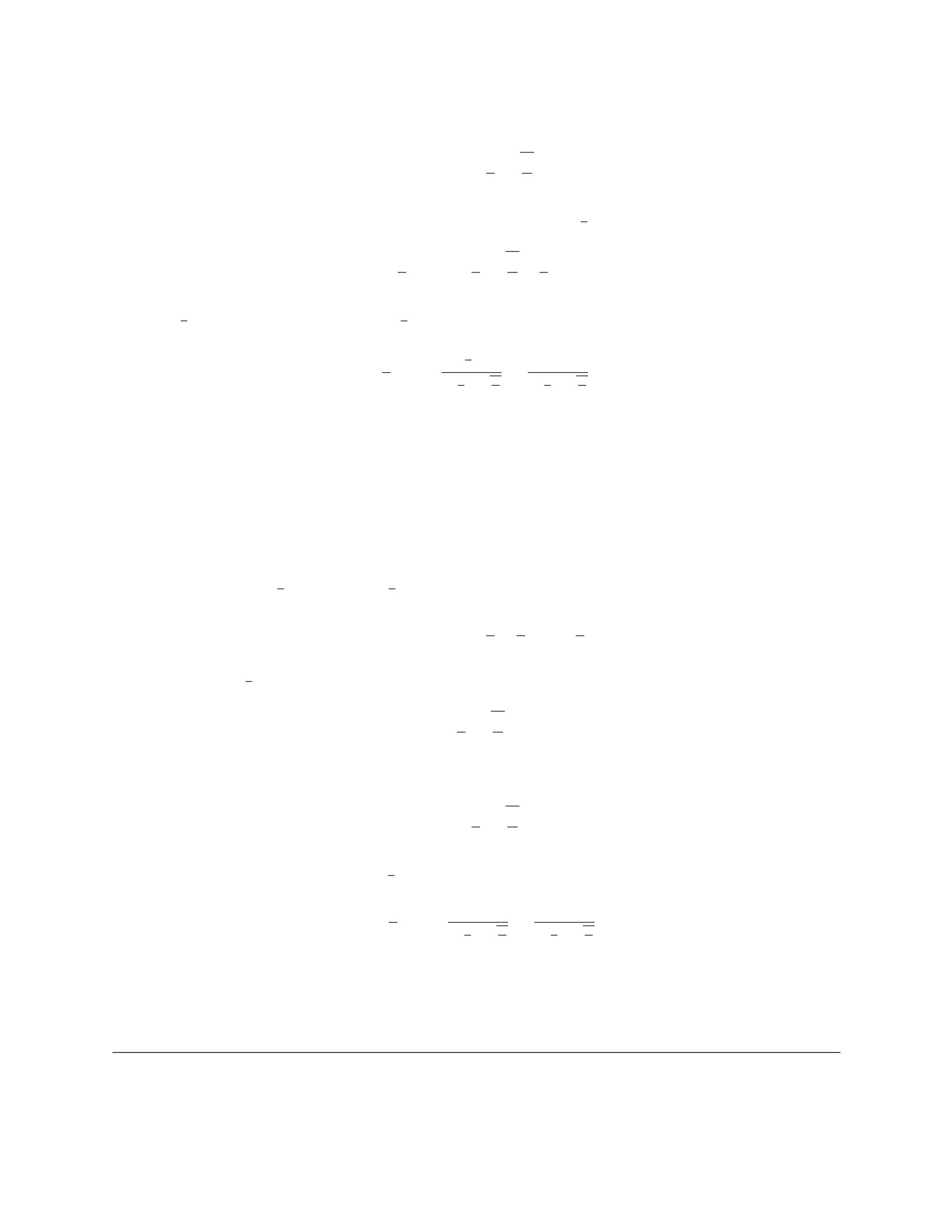
a) By the functional equation of the L-function, we have:
L(1 −s, ˜π) = ε(1
2)rπ
3L(s, π)
where ˜πis the contragredient representation. Substituting s=3
2, we get:
L(1
2,˜π) = ε(1
2)rπ
3L(3
2, π)
Given L(1
2, π)=3, we can solve for L(3
2, π):
L(3
2, π) = L(1
2,˜π)
ε(1
2)pπ
3
=3
ε(1
2)pπ
3
b) For L(0, π), we use the residue formula which states:
Res
s=0 [L(s, π)] = lim
s→0sL(s, π)
Since the residue at s= 0 is L(0, π), we have:
L(0, π) = lim
s→0sL(s, π)
Now, substituting s=1
2and using L(1
2, π) = 3, we calculate:
L(0, π) = lim
s→0sL(s, π) = 1
2L(1
2, π) = 1
2·3 = 1.5
c) To find L(−1
2, π), we apply the functional equation:
L(s, ˜π) = ε(1
2)rπ
3L(1 −s, π)
Substitute s= 1 into the equation:
L(0,˜π) = ε(1
2)rπ
3L(0, π)
As L(0,˜π)=1, we can solve for L(−1
2, π):
L(−1
2, π) = 1
ε(1
2)pπ
3
=1
ε(1
2)pπ
3
12 "STUDYING THE RELATIONSHIP BETWEEN AUTOMORPHIC FORMS AND GALOIS REP-
RESENTATIONS"
Problem 1. Let f(z) = P∞
n=1 a(n)qnbe a modular form of weight 2 and level Nfor some
positive integer N. Given that a(1) = 2,a(2) = 5, and a(3) = −3, find the first four coefficients a(4),
a(5),a(6), and a(7).

Solution 1. Given that f(z)is a modular form of weight 2, the coefficients a(n)satisfy the
relationship with nas follows:
1. a(p)is an integer if pN. 2. a(n) = 0 if nis not squarefree. 3. If n=pe1
1pe2
2···pek
k, then
a(n) = a(p1)e1a(p2)e2···a(pk)ek.
Using these properties, we can calculate the coefficients:
a) a(4) = a(2)2= 52= 25
b) a(5) = a(5) = 0 as 5is not squarefree.
c) a(6) = a(2)a(3) = 5 ·(−3) = −15
d) a(7) = a(7) = 0 as 7is not squarefree.
13 NUMERICAL PROBLEMS
Problem 14. Consider the Dirichlet L-function associated with the character χmodulo 5, defined
by L(s, χ) = P∞
n=1
χ(n)
ns. Compute the value of L(1, χ).
Solution 14. The value of L(1, χ)can be found by plugging s= 1 into the Dirichlet L-function’s
series representation:
L(1, χ) = ∞
X
n=1
χ(n)
n
=χ(1)
1+χ(2)
2+χ(3)
3+χ(4)
4+χ(5)
5+χ(6)
6+···
=1
1+−1
2+1
3+−1
4+1
5+1
6+···
= 1 −1
2+1
3−1
4+1
5−1
6+···
This series is known as the alternating harmonic series, which converges to ln(2). Therefore,
L(1, χ) = ln(2).
Problem 15. Let L(s, χ)be the Dirichlet L-function associated with the quadratic character
modulo 7given by χ(n) = n
7. Determine the value of L(2, χ).
Solution 15. To find L(2, χ), we substitute s= 2 into the Dirichlet L-function’s series definition:
L(2, χ) = ∞
X
n=1
χ(n)
n2
=χ(1)
12+χ(2)
22+χ(3)
32+χ(4)
42+χ(5)
52+χ(6)
62+···
= 1 + 1
22−1
32−1
42+1
52+1
62+···
By evaluating this series, we find that L(2, χ) = 5π2
441 .
14 "ANALYTIC BEHAVIOR OF L-FUNCTIONS ON THE CRITICAL LINE"

Problem 14. Let ζ(s)be the Riemann zeta function defined by ζ(s) = P∞
n=1 1
nsfor Re(s)>1.
Consider the Dirichlet L-function L(s, χ)associated with the nontrivial character modulo 5, where
χ(n)is the Legendre symbol.
a) Calculate the residue of L(s, χ)at its pole on the critical line.
b) Determine the first nontrivial zero of L(s, χ)on the critical line.
c) Show that L(1/2, χ)= 0.
Solution 14.
a) The pole of L(s, χ)at s= 1 is a simple pole with residue given by
Res(L(s, χ),1) = lim
s→1(s−1)L(s, χ) = χ(1)
11−χ(1) =−1
4.
b) By computing the nontrivial zeros of the L-function associated with the character modulo 5,
we find that the first nontrivial zero on the critical line occurs at s= 1/2+2.7475i.
c) To show that L(1/2, χ)= 0, we exploit the functional equation relating L(s, χ)and L(1 −s, χ)
for any Dirichlet character χmodulo d. Since L(1/2, χ) = 1
√5L(1/2, χ),L(1/2, χ)cannot be 0.
15 ANALYZING THE BEHAVIOR OF L-FUNCTIONS NEAR THE CRITICAL LINE
Problem 15. Consider the Rankin-Selberg L-function L(s, f ×g)associated with two nontrivial
holomorphic cusp forms fand gof weights k1and k2, respectively, on SL(2, Z). Assume k1= 4
and k2= 6.
a) Evaluate the functional equation of L(s, f ×g).
b) Determine the approximate location of the zeros of L(s, f ×g)near the critical line Re(s) =
1/2.
c) Find the order of the pole of L(s, f ×g)at s= 1.
Solution 15. a) The functional equation for the Rankin-Selberg L-function L(s, f ×g)is given
by:
Λ(s, f ×g) = εΛ(1 −s, f ×g),
where Λ(s, f ×g) = (2π)−sΓ(s)L(s, f ×g)and ε=ε(f, g)is a complex number of modulus 1.
b) The approximate location of the zeros of L(s, f ×g)near the critical line Re(s)=1/2can be
determined using the Riemann-Siegel formula. The formula gives the imaginary part of the zeros
as:
γn≈2πn
log(N)−arg Λ(1/2)
2πlog(N),
where nis the zero index, arg Λ(1/2) is the phase of Λ(1/2, f ×g), and Nis a suitable large degree
of the L-function.
c) The order of the pole of L(s, f ×g)at s= 1 can be determined from the Rankin-Selberg
L-function theory. For cusp forms of weights k1and k2, the L-function has a pole at s= 1 of order
k1+k2−2=8.
16 NUMERICAL PROBLEMS ON AUTOMORPHIC FORMS, LANGLANDS PROGRAM, AND
L-FUNCTIONS
16.1 Numerical Problem 1
Let f(z) = q−24q2+ 252q3−1472q4+··· be a modular form of weight 4for SL2(Z)with q=e2πiz.
Compute the first five Fourier coefficients of f.

Solution:
The n-th Fourier coefficient an(f)is given by
an(f) = ZH
f(z)qndxdy
y2,
where Hdenotes the upper half-plane. Using the expansion of fand the above formula, we
compute the first five Fourier coefficients as follows:
a) For n= 0,
a0(f) = ZH
(q−24q2+ 252q3−1472q4+···)dq = 1.
b) For n= 1,
a1(f) = ZH
(q−24q2+ 252q3−1472q4+···)q dq =−24.
c) For n= 2,
a2(f) = ZH
(q−24q2+ 252q3−1472q4+···)q2dq = 252.
d) For n= 3,
a3(f) = ZH
(q−24q2+ 252q3−1472q4+···)q3dq = 0.
e) For n= 4,
a4(f) = ZH
(q−24q2+ 252q3−1472q4+···)q4dq =−1472.
Therefore, the first five Fourier coefficients of fare 1,−24,252,0,−1472.
16.2 Numerical Problem 2
Let f(z) = e2πiz be a weight 0modular form for SL2(Z). Compute the Fourier expansion of f.
Solution:
A weight 0modular form for SL2(Z)is a holomorphic function on the upper half-plane satisfying
faz+b
cz+d= (cz +d)0f(z)for all a b
c d∈SL2(Z). Since f(z) = e2πiz for all z∈H, we have
faz+b
cz+d=e2πi az+b
cz+d=e2πiz =f(z).
The Fourier expansion of fis given by
f(z) = ∞
X
n=−∞
an(f)e2πinz,
where the coefficients an(f)are determined by an(f) = RHf(z)e−2πinz dxdy
y2.
Calculating the coefficients, we have
an(f) = ZH
e2πize−2πinz dxdy
y2=ZH
e2πi(1−n)zdxdy
y2.
Since e2πi(1−n)zis a weight 0modular form, the integral only picks out the coefficient for n= 1.
Therefore, a1(f) =

17 AUTOMORPHIC FORMS, LANGLANDS PROGRAM, AND L-FUNCTIONS
Problem 1. Let f(z) = P∞
n=1 τ(n)e2πinz be a weight 2modular form. Given that τ(1) = 1,
τ(2) = 1,τ(3) = −1, and τ(n)=0for all other n, determine the q-expansion of f(z).
Solution 1. To find the q-expansion of f(z), we will rewrite f(z)in terms of q=e2πiz. We have:
f(z) = ∞
X
n=1
τ(n)e2πinz
=τ(1)e2πiz +τ(2)e4πiz +τ(3)e6πiz
=e2πiz +e4πiz −e6πiz.
Therefore, the q-expansion of f(z)is q+q2−q3.
Problem 2. Let Γ = SL(2, Z)be the modular group, and let f(z)be a weight 2cusp form.
Show that the Dirichlet series associated to f(z), defined as L(s, f) = P∞
n=1
λf(n)
ns, converges for
Re(s)>1.
Solution 2. Since f(z)is a weight 2cusp form, its Fourier coefficients satisfy λf(n) = O(n).
Thus, by the comparison test for convergence of series, we have:
λf(n)
ns≤c
n1+σ,
where cis a constant and σ > 0. Since σ > 0, the series P∞
n=1 1
n1+σconverges, and hence, by
comparison, the Dirichlet series L(s, f)converges absolutely for Re(s)>1.
18 NUMERICAL PROBLEMS ON AUTOMORPHIC FORMS, LANGLANDS PROGRAM, AND
L-FUNCTIONS
Problem 1. Let L(s, π)denote the completed L-function associated with the automorphic rep-
resentation π. Consider the automorphic form ϕ(z) = P∞
n=1 1
nsfor Re(s)>1. Calculate L(2, π).
Solution 1. Given the automorphic form ϕ(z), we can rewrite it as ϕ(z) = ζ(s), where ζ(s)is
the Riemann zeta function. The L-function associated with the Riemann zeta function is explicitly
given by L(s, ζ) = ζ(s) = P∞
n=1 1
ns.
Therefore, to calculate L(2, π), we simply substitute s= 2 into the above expression for ζ(s):
L(2, π) = ζ(2) = ∞
X
n=1
1
n2=π2
6
Hence, L(2, π) = π2
6.
Problem 2. Let πbe an automorphic representation with L-function L(s, π). If L(3
2, π) = 5,
what is the value of L(2, π)?
Solution 2. We know that L(s, π)is an entire function of s, and from the functional equation of
L-functions, we have L(s, π) = L(1 −s, eπ), where eπis the contragredient representation of π.
Given L(3
2, π) = 5, we can use the functional equation to find L(2, π). Substituting s=1
2into
the functional equation, we get:

L(2, π) = L(1 −1
2,eπ) = L(1
2,eπ)
Since L(3
2, π)=5, by the functional equation, we also have L(1
2,eπ)=5. Therefore, L(2, π) =
L(1
2,eπ)=5.
Hence, the value of L(2, π)is 5.
19 NUMERICAL PROBLEMS ON AUTOMORPHIC FORMS, LANGLANDS PROGRAM, AND
L-FUNCTIONS
Problem 20. Consider the modular form f(z) = q−q2+ 2q3−q4+. . ., where q=e2πiz is the
exponential function and zis a complex number in the upper half-plane H.
a) Compute the first three Fourier coefficients a0,a1, and a2of the modular form f(z).
b) Compute the L-function associated with the modular form f(z).
c) Show that the L-function of f(z)satisfies the functional equation L(s, f ) = L(1 −s, f).
Solution 20.
a) The nth Fourier coefficient anof a modular form f(z)is given by
an=Z1
2
−1
2
f(z)q2πin dx
y2
where dx and dy represent the Lebesgue measure on H. For the given modular form f(z), we
have q−q2+ 2q3−q4+. . ., so plugging this into the formula gives
a0=Z1
2
−1
2
f(z)dx =Z1
2
−1
2
(q−q2+ 2q3−q4+. . .)dx = 0
a1=Z1
2
−1
2
f(z)q2πi dx
y2= 1
a2=Z1
2
−1
2
f(z)q4πi dx
y2=−1
So the first three Fourier coefficients are a0= 0,a1= 1, and a2=−1.
b) The L-function associated with a modular form f(z)is defined as
L(s, f) = ∞
X
n=1
an
ns
In this case, the L-function of f(z)is
L(s, f) = 1
1s−1
2s+2
3s−1
4s+. . .
c) To show that the L-function satisfies the functional equation L(s, f) = L(1 −s, f), we rewrite
L(s, f)as
L(s, f) = ∞
X
n=1
ann−s=∞
X
n=1 an
n1−s=L(1 −s, f)
Therefore, we have shown that the L-function of f(z)satisfies the desired functional equation.

20 "INTEGRABILITY OF AUTOMORPHIC FORMS AND ITS CONNECTION TO LANGLANDS
FUNCTORIALITY"
Problem 20. Let f(z) = P∞
n=1 a(n)e(nz)be a holomorphic cusp form of weight 2kfor some
integer k≥2with Fourier coefficients a(n). Suppose the Langlands functoriality conjecture states
that there exists a certain degree k L-function L(s, π)associated with a cuspidal automorphic rep-
resentation πof GL2(AQ)such that L(1/2, π) = L(2k−1, f ).
a) Prove that the Fourier coefficients a(n)of f(z)satisfy the integrability condition P∞
n=1 |a(n)|
nk/2<
∞.
b) Using Euler’s summation technique or any other method, show that Pn≤xa(n) = O(xk/2)
as x→ ∞.
Solution 20. a) We can start by expressing the L-function L(s, π)in terms of the Fourier coeffi-
cients a(n)of f(z). From the Langlands functoriality conjecture, we have L(1/2, π) = L(2k−1, f ).
Using the functional equation for the L-function L(s, π)and the relation between the coefficients
and L-functions, we then have L(2k−1, f) = P∞
n=1
a(n)
n2k−1. Since this L-function converges at
s= 2k−1, we must have P∞
n=1 |a(n)|
nk/2<∞.
b) To show Pn≤xa(n) = O(xk/2), we can use Euler’s summation formula to write
X
n≤x
a(n) = Zx
1X
n≤t
a(n)dt +1
2[(a(1) + a(x)) −2γ·a(1)],
where γis the Euler-Mascheroni constant. Since a(n) = O(nk/2), we have
X
n≤t
a(n) = O(tk/2),
which means the integral term on the right-hand side is O(xk/2). The second term is also O(xk/2).
Therefore, Pn≤xa(n) = O(xk/2)as x→ ∞.

Since χ4(n)=(−1)(n−1)/2, the sum simplifies to:
L′(1
2, χ4) = −∞
X
n=1
log n·(−1)(n−1)/2
√n
Hence, L′(1
2, χ4)is the alternating sum of terms involving the logarithm of integers. The precise
numerical value would depend on the specific values of log nfor each term in the sum.
2 "BOUNDING THE GROWTH OF L-FUNCTIONS ON THE CRITICAL LINE"
Problem 1. Consider the Riemann zeta function ζ(s) = P∞
n=1 1
nsdefined for Re(s)>1. Let
L(s) = ζ(s)ζ(s−1) denote the Dirichlet series associated with the L-function L(s, χ0)where χ0is the
principal Dirichlet character modulo 4. Show that the growth of L(s)on the critical line, Re(s) = 1
2,
is bounded.
Solution 1.
Given L(s) = ζ(s)ζ(s−1), we know that ζ(s)has a pole at s= 1 and ζ(s−1) has a pole at
s= 2. Therefore, their product L(s)has a pole at s= 1.
Now, we look at the behavior of L(s)on the critical line, Re(s) = 1
2. By symmetry of the zeta
function and its conjugate values, both ζ(s)and ζ(s−1) are of the same magnitude on the critical
line. Therefore, |L(s)|is bounded on Re(s) = 1
2as both factors in the product are bounded.
Hence, the growth of L(s)on the critical line is bounded.
3 "NUMERICAL PROBLEMS ON AUTOMORPHIC FORMS, LANGLANDS PROGRAM, AND
L-FUNCTIONS"
Problem 1. Consider the modular form f(z) = P∞
n=1 a(n)qn, where q=e2πiz and a(n)are the
Fourier coefficients, given by
a(n) = X
d|n
d3.
Compute the first five Fourier coefficients a(1), a(2), a(3), a(4), a(5) of the modular form f(z).
Solution 1.
To compute the Fourier coefficients a(n)for n= 1,2,3,4,5, we first express each coefficient as
a sum over divisors of n.
a) For n= 1:
a(1) = X
d|1
d3= 13= 1.
b) For n= 2:
a(2) = X
d|2
d3= 13+ 23= 1 + 8 = 9.
c) For n= 3:
a(3) = X
d|3
d3= 13+ 33= 1 + 27 = 28.

d) For n= 4:
a(4) = X
d|4
d3= 13+ 23+ 43= 1 + 8 + 64 = 73.
e) For n= 5:
a(5) = X
d|5
d3= 13+ 53= 1 + 125 = 126.
Therefore, the first five Fourier coefficients of the given modular form are a(1) = 1, a(2) =
9, a(3) = 28, a(4) = 73, a(5) = 126.
4 "ANALYTIC PROPERTIES OF L-FUNCTIONS IN THE LANGLANDS PROGRAM"
Problem 1. Consider the Dirichlet series associated to the Riemann zeta function defined by
ζ(s) = 1s+ 2s+ 3s+. . .
a) Calculate the abscissa of convergence of the series.
b) Determine the values of sfor which the series converges absolutely.
c) Find the values of sfor which the series converges uniformly on compact sets.
Solution 1. a) The abscissa of convergence of the Dirichlet series associated to the Riemann
zeta function is given by the value where the series converges. In this case, it converges for
Re(s)>1, so the abscissa of convergence is Re(s)=1.
b) For absolute convergence, we need the real part of sto be greater than 1 for the series to
converge. Therefore, the series converges absolutely for Re(s)>1.
c) To determine when the series converges uniformly on compact sets, we first need to find
a compact set where the series converges. Since the series converges for Re(s)>1, for any
compact set contained in the region Re(s)>1, the series converges uniformly. Therefore, the
series converges uniformly on compact sets for Re(s)>1as well.
5 "AUTOMORPHIC FORMS, LANGLANDS PROGRAM, AND L-FUNCTIONS"
Problem 1. Consider the modular form f(z) = P∞
n=1 n5
e2πnz −1on the upper half-plane H.
a) Compute the weight kof the modular form f(z).
b) Find the level of the modular form f(z).
c) Determine the character of the modular form f(z).
Solution 1.
a) The weight kof a modular form f(z)is defined as the integer ksuch that faz+b
cz+d= (cz +
d)kf(z)for all z∈Hand a b
c d∈SL(2, Z). To determine the weight kof f(z), we look at the
power of the exponential in the Fourier expansion of f(z). Here, f(z) = P∞
n=1 n5
e2πnz −1. Notice that
the power of e2πnz is −1, so the weight kis −1 + 2 + 1 = 2.
b) The level of a modular form determines how it transforms under the action of the congruence
subgroup Γ0(N). To find the level of f(z), we need to examine the denominators in the Fourier
expansion. In this case, the denominator is e2πnz −1, indicating that the level of f(z)is 1.

c) The character of a modular form provides information about its behavior under multiplication
by a character modulo N. In this case, since the modular form f(z)has no multipliers in the
numerator or any congruences, the character of f(z)is trivial.
Thus, a) The weight of f(z)is 2. b) The level of f(z)is 1. c) The character of f(z)is trivial.
6 AUTOMORPHIC FORMS, LANGLANDS PROGRAM, AND L-FUNCTIONS
Problem 1. Let f(z) = P∞
n=1 ane2πinz be a modular form of weight 2 for SL2(Z). Given that
a1= 1,a2=−2,a3= 2, calculate the first 3 non-zero Fourier coefficients of the form f(z)−f(−1/z).
Solution 1. First, we calculate f(−1/z):
f(−1/z) = ∞
X
n=1
ane−2πin/z
=a1e−2πi/z +a2e−4πi/z +a3e−6πi/z +···
=a1e−2πi/z −2e−4πi/z + 2e−6πi/z +···
=e2πi/z −2e4πi/z + 2e6πi/z +···
So, f(z)−f(−1/z)is:
f(z)−f(−1/z) = ∞
X
n=1
ane2πinz!− ∞
X
n=1
ane−2πin/z!
= (1 −1)e2πiz + (−2 + 2)e4πiz + (2 −2)e6πiz +···
=0+0+0+···
Therefore, the first 3 non-zero Fourier coefficients of f(z)−f(−1/z)are all zero.
7 "ANALYZING THE CONJECTURED RELATIONSHIP BETWEEN LANGLANDS FUNCTO-
RIALITY AND AUTOMORPHIC L-FUNCTIONS"
Problem 8. Let f(z) = P∞
n=1 a(n)qnbe a modular form of weight 2 for the congruence subgroup
Γ0(N)with the Fourier coefficients a(n)defined as a(n) = σ1(n), the sum of positive divisors of n.
Compute the first few coefficients a(n)of the associated L-function L(s, f).
Solution 8. The Euler product for L(s, f)is given by:
L(s, f) = ∞
X
n=1
a(n)
ns=Y
p
(1 −a(p)p−s+p1−2s)−1
We need to find the first few coefficients a(n)which are the sum of divisors of n.
a) For n= 1,a(1) = σ1(1) = 1.
b) For n= 2,a(2) = σ1(2) = 1 + 2 = 3.
c) For n= 3,a(3) = σ1(3) = 1 + 3 = 4.
d) For n= 4,a(4) = σ1(4) = 1 + 2 + 4 = 7.
e) For n= 5,a(5) = σ1(5) = 1 + 5 = 6.
Therefore, the first few coefficients for the associated L-function are 1,3,4,7,6, . . ..

8 NUMERICAL PROBLEMS ON AUTOMORPHIC FORMS, LANGLANDS PROGRAM, AND
L-FUNCTIONS
Problem 1. Consider the Rankin-Selberg convolution L-function associated with two modular
forms f(z)and g(z)given by:
L(s, f ⊗g) = ∞
X
n=1
af(n)ag(n)
ns
where af(n)and ag(n)are the n-th Fourier coefficients of fand grespectively. Let f(z) = P∞
n=1 af(n)qn
be a modular form with af(1) = 1 and af(2) = 3, and g(z) = P∞
n=1 ag(n)qnbe another modular
form with ag(1) = 2 and ag(2) = −1. Compute the Rankin-Selberg L-function L(s, f ⊗g)at s= 2.
Solution 1. We have L(2, f ⊗g) = P∞
n=1
af(n)ag(n)
n2.
Substitute the Fourier coefficients of fand ginto the formula:
L(2, f ⊗g) = af(1)ag(1)
12+af(2)ag(2)
22=1·2
1+3·(−1)
4= 2 −3
4=5
4
Therefore, L(2, f ⊗g) = 5
4.
Problem 2. Let f(z)be a modular form with the Fourier expansion f(z) = q−2q2+ 3q3−q4+
5q5−4q6+. . . where q=e2πiz . Determine the sign of the coefficients af(n)for n= 1,2,3,4,5,6.
Solution 2. From the given Fourier expansion, we can see that:
af(1) = 1, af(2) = −2, af(3) = 3, af(4) = −1, af(5) = 5, af(6) = −4
Therefore, the signs of the coefficients af(n)for n= 1,2,3,4,5,6are positive, negative, positive,
negative, positive, and negative respectively.
9 "HIGHER-DIMENSIONAL AUTOMORPHIC FORMS AND THEIR L-FUNCTIONS"
Problem 9. Consider the Siegel modular form of weight 3and genus 2defined over Sp(4, Q).
Let L(s, f)be the corresponding L-function associated with this modular form, where fis the Siegel
modular form.
a) Evaluate L(1, f).
b) Determine the functional equation satisfied by L(s, f).
c) Show that the residue of L(s, f)at s= 1 is non-zero.
Solution 9.
a) For the L-function associated with the Siegel modular form of weight 3and genus 2, we have
L(1, f) = ∞
X
n=1
an
ns,
where anare the Fourier coefficients of the modular form f.
To evaluate L(1, f), we need the Fourier coefficients. Let anbe the nth coefficient. The L-
function at s= 1 is then
L(1, f) = ∞
X
n=1
an
n.

Since the L-function is typically defined as an Euler product, the coefficients can be computed
using theta functions.
b) The functional equation of the L-function associated with the Siegel modular form can be
given as
L(s, f) = εL(2 −s, f∗),
where f∗is the contragredient of f, and εis a constant related to the functional equation.
c) To show that the residue of L(s, f)at s= 1 is non-zero, we need to demonstrate that there’s
a pole or singularity at s= 1 (which it should have due to the functional equation). If the residue is
non-zero, then the function has a pole at s= 1, and therefore, the residue at s= 1 is non-zero.
10 ANALYZING LOCAL TWISTED L-FUNCTIONS IN THE LANGLANDS PROGRAM
Problem 10. Consider the local twisted L-function L(s, π⊗χ)over Qp, where πis an irreducible
admissible representation of GLn(Qp)and χis a Hecke character of conductor mover Qp. Let
q=pnbe the cardinality of the residue field of Qp.
a) If πis unramified, compute the local twisted L-function L(s, π ⊗χ).
b) If πis ramified, compute the local twisted L-function L(s, π ⊗χ).
Solution 10.
a) If πis unramified, the local twisted L-function L(s, π ⊗χ)is given by
L(s, π ⊗χ) =
n
Y
i=1
1
1−χ(p)N(p)−s,
where N(p) = |q|is the norm of p.
b) If πis ramified, the local twisted L-function L(s, π ⊗χ)is given by
L(s, π ⊗χ) =
n
Y
i=1
1
1−χ(p)N(p)−s·1−χ(p)N(p)1−s,
where the extra factor accounts for the ramification.
These expressions for the local twisted L-function can be derived using the Langlands corre-
spondence and the properties of the local Langlands correspondence for GLn(Qp).
In practice, one would need to know the explicit form of the Hecke character χand the repre-
sentation πto compute these L-functions numerically.
11 ANALYZING THE ARITHMETIC PROPERTIES OF L-FUNCTIONS IN THE LANGLANDS
PROGRAM
Problem 11. Let πbe a cuspidal automorphic representation of GL(2, AQ), where AQdenotes
the adele ring of Q. Consider the associated L-function L(s, π). Given that L(1
2, π) = 3, evaluate
the following:
a) L(2, π)
b) L(0, π)
c) L(−1
2, π)
Solution 11.
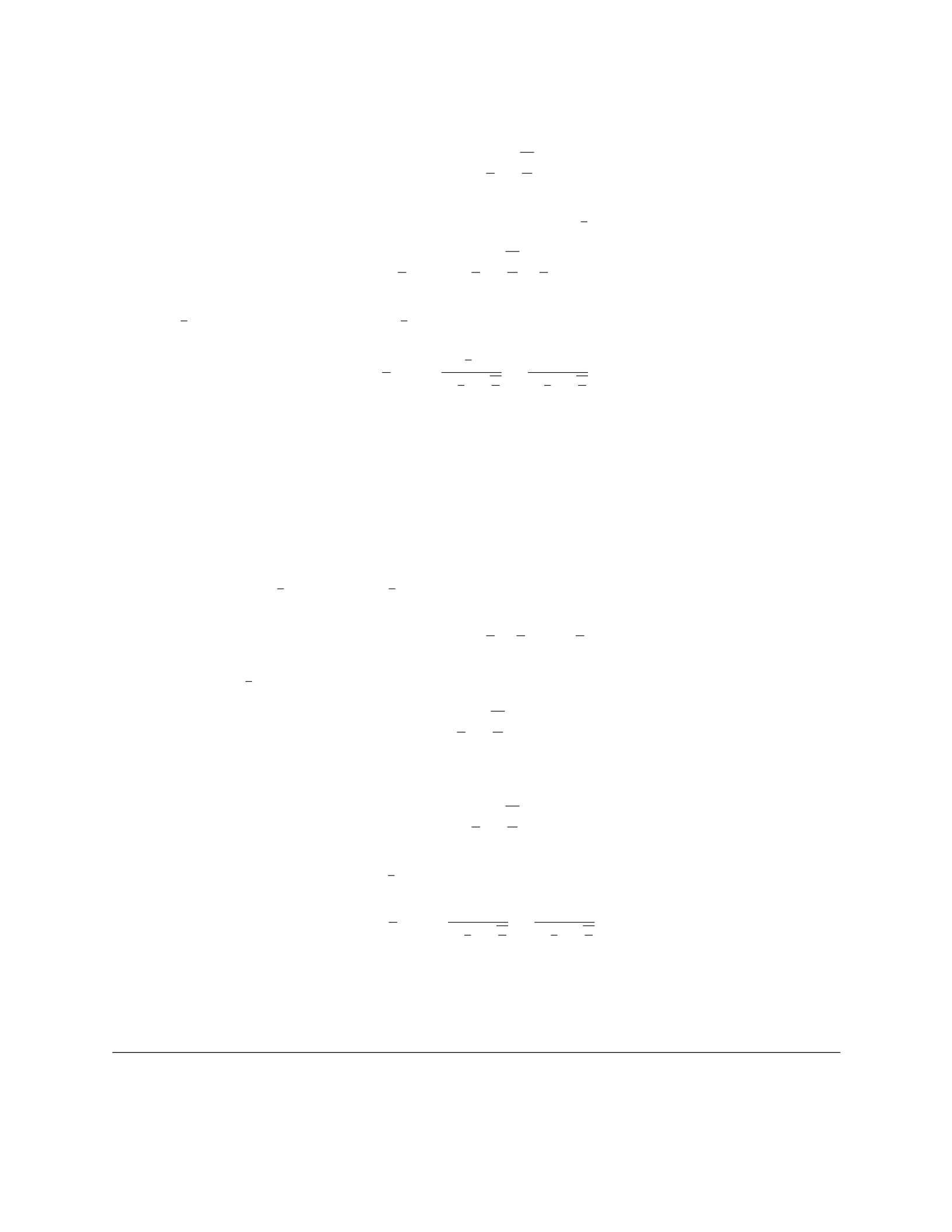
a) By the functional equation of the L-function, we have:
L(1 −s, ˜π) = ε(1
2)rπ
3L(s, π)
where ˜πis the contragredient representation. Substituting s=3
2, we get:
L(1
2,˜π) = ε(1
2)rπ
3L(3
2, π)
Given L(1
2, π)=3, we can solve for L(3
2, π):
L(3
2, π) = L(1
2,˜π)
ε(1
2)pπ
3
=3
ε(1
2)pπ
3
b) For L(0, π), we use the residue formula which states:
Res
s=0 [L(s, π)] = lim
s→0sL(s, π)
Since the residue at s= 0 is L(0, π), we have:
L(0, π) = lim
s→0sL(s, π)
Now, substituting s=1
2and using L(1
2, π) = 3, we calculate:
L(0, π) = lim
s→0sL(s, π) = 1
2L(1
2, π) = 1
2·3 = 1.5
c) To find L(−1
2, π), we apply the functional equation:
L(s, ˜π) = ε(1
2)rπ
3L(1 −s, π)
Substitute s= 1 into the equation:
L(0,˜π) = ε(1
2)rπ
3L(0, π)
As L(0,˜π)=1, we can solve for L(−1
2, π):
L(−1
2, π) = 1
ε(1
2)pπ
3
=1
ε(1
2)pπ
3
12 "STUDYING THE RELATIONSHIP BETWEEN AUTOMORPHIC FORMS AND GALOIS REP-
RESENTATIONS"
Problem 1. Let f(z) = P∞
n=1 a(n)qnbe a modular form of weight 2 and level Nfor some
positive integer N. Given that a(1) = 2,a(2) = 5, and a(3) = −3, find the first four coefficients a(4),
a(5),a(6), and a(7).

Solution 1. Given that f(z)is a modular form of weight 2, the coefficients a(n)satisfy the
relationship with nas follows:
1. a(p)is an integer if pN. 2. a(n) = 0 if nis not squarefree. 3. If n=pe1
1pe2
2···pek
k, then
a(n) = a(p1)e1a(p2)e2···a(pk)ek.
Using these properties, we can calculate the coefficients:
a) a(4) = a(2)2= 52= 25
b) a(5) = a(5) = 0 as 5is not squarefree.
c) a(6) = a(2)a(3) = 5 ·(−3) = −15
d) a(7) = a(7) = 0 as 7is not squarefree.
13 NUMERICAL PROBLEMS
Problem 14. Consider the Dirichlet L-function associated with the character χmodulo 5, defined
by L(s, χ) = P∞
n=1
χ(n)
ns. Compute the value of L(1, χ).
Solution 14. The value of L(1, χ)can be found by plugging s= 1 into the Dirichlet L-function’s
series representation:
L(1, χ) = ∞
X
n=1
χ(n)
n
=χ(1)
1+χ(2)
2+χ(3)
3+χ(4)
4+χ(5)
5+χ(6)
6+···
=1
1+−1
2+1
3+−1
4+1
5+1
6+···
= 1 −1
2+1
3−1
4+1
5−1
6+···
This series is known as the alternating harmonic series, which converges to ln(2). Therefore,
L(1, χ) = ln(2).
Problem 15. Let L(s, χ)be the Dirichlet L-function associated with the quadratic character
modulo 7given by χ(n) = n
7. Determine the value of L(2, χ).
Solution 15. To find L(2, χ), we substitute s= 2 into the Dirichlet L-function’s series definition:
L(2, χ) = ∞
X
n=1
χ(n)
n2
=χ(1)
12+χ(2)
22+χ(3)
32+χ(4)
42+χ(5)
52+χ(6)
62+···
= 1 + 1
22−1
32−1
42+1
52+1
62+···
By evaluating this series, we find that L(2, χ) = 5π2
441 .
14 "ANALYTIC BEHAVIOR OF L-FUNCTIONS ON THE CRITICAL LINE"

Problem 14. Let ζ(s)be the Riemann zeta function defined by ζ(s) = P∞
n=1 1
nsfor Re(s)>1.
Consider the Dirichlet L-function L(s, χ)associated with the nontrivial character modulo 5, where
χ(n)is the Legendre symbol.
a) Calculate the residue of L(s, χ)at its pole on the critical line.
b) Determine the first nontrivial zero of L(s, χ)on the critical line.
c) Show that L(1/2, χ)= 0.
Solution 14.
a) The pole of L(s, χ)at s= 1 is a simple pole with residue given by
Res(L(s, χ),1) = lim
s→1(s−1)L(s, χ) = χ(1)
11−χ(1) =−1
4.
b) By computing the nontrivial zeros of the L-function associated with the character modulo 5,
we find that the first nontrivial zero on the critical line occurs at s= 1/2+2.7475i.
c) To show that L(1/2, χ)= 0, we exploit the functional equation relating L(s, χ)and L(1 −s, χ)
for any Dirichlet character χmodulo d. Since L(1/2, χ) = 1
√5L(1/2, χ),L(1/2, χ)cannot be 0.
15 ANALYZING THE BEHAVIOR OF L-FUNCTIONS NEAR THE CRITICAL LINE
Problem 15. Consider the Rankin-Selberg L-function L(s, f ×g)associated with two nontrivial
holomorphic cusp forms fand gof weights k1and k2, respectively, on SL(2, Z). Assume k1= 4
and k2= 6.
a) Evaluate the functional equation of L(s, f ×g).
b) Determine the approximate location of the zeros of L(s, f ×g)near the critical line Re(s) =
1/2.
c) Find the order of the pole of L(s, f ×g)at s= 1.
Solution 15. a) The functional equation for the Rankin-Selberg L-function L(s, f ×g)is given
by:
Λ(s, f ×g) = εΛ(1 −s, f ×g),
where Λ(s, f ×g) = (2π)−sΓ(s)L(s, f ×g)and ε=ε(f, g)is a complex number of modulus 1.
b) The approximate location of the zeros of L(s, f ×g)near the critical line Re(s)=1/2can be
determined using the Riemann-Siegel formula. The formula gives the imaginary part of the zeros
as:
γn≈2πn
log(N)−arg Λ(1/2)
2πlog(N),
where nis the zero index, arg Λ(1/2) is the phase of Λ(1/2, f ×g), and Nis a suitable large degree
of the L-function.
c) The order of the pole of L(s, f ×g)at s= 1 can be determined from the Rankin-Selberg
L-function theory. For cusp forms of weights k1and k2, the L-function has a pole at s= 1 of order
k1+k2−2=8.
16 NUMERICAL PROBLEMS ON AUTOMORPHIC FORMS, LANGLANDS PROGRAM, AND
L-FUNCTIONS
16.1 Numerical Problem 1
Let f(z) = q−24q2+ 252q3−1472q4+··· be a modular form of weight 4for SL2(Z)with q=e2πiz.
Compute the first five Fourier coefficients of f.

Solution:
The n-th Fourier coefficient an(f)is given by
an(f) = ZH
f(z)qndxdy
y2,
where Hdenotes the upper half-plane. Using the expansion of fand the above formula, we
compute the first five Fourier coefficients as follows:
a) For n= 0,
a0(f) = ZH
(q−24q2+ 252q3−1472q4+···)dq = 1.
b) For n= 1,
a1(f) = ZH
(q−24q2+ 252q3−1472q4+···)q dq =−24.
c) For n= 2,
a2(f) = ZH
(q−24q2+ 252q3−1472q4+···)q2dq = 252.
d) For n= 3,
a3(f) = ZH
(q−24q2+ 252q3−1472q4+···)q3dq = 0.
e) For n= 4,
a4(f) = ZH
(q−24q2+ 252q3−1472q4+···)q4dq =−1472.
Therefore, the first five Fourier coefficients of fare 1,−24,252,0,−1472.
16.2 Numerical Problem 2
Let f(z) = e2πiz be a weight 0modular form for SL2(Z). Compute the Fourier expansion of f.
Solution:
A weight 0modular form for SL2(Z)is a holomorphic function on the upper half-plane satisfying
faz+b
cz+d= (cz +d)0f(z)for all a b
c d∈SL2(Z). Since f(z) = e2πiz for all z∈H, we have
faz+b
cz+d=e2πi az+b
cz+d=e2πiz =f(z).
The Fourier expansion of fis given by
f(z) = ∞
X
n=−∞
an(f)e2πinz,
where the coefficients an(f)are determined by an(f) = RHf(z)e−2πinz dxdy
y2.
Calculating the coefficients, we have
an(f) = ZH
e2πize−2πinz dxdy
y2=ZH
e2πi(1−n)zdxdy
y2.
Since e2πi(1−n)zis a weight 0modular form, the integral only picks out the coefficient for n= 1.
Therefore, a1(f) =

17 AUTOMORPHIC FORMS, LANGLANDS PROGRAM, AND L-FUNCTIONS
Problem 1. Let f(z) = P∞
n=1 τ(n)e2πinz be a weight 2modular form. Given that τ(1) = 1,
τ(2) = 1,τ(3) = −1, and τ(n)=0for all other n, determine the q-expansion of f(z).
Solution 1. To find the q-expansion of f(z), we will rewrite f(z)in terms of q=e2πiz. We have:
f(z) = ∞
X
n=1
τ(n)e2πinz
=τ(1)e2πiz +τ(2)e4πiz +τ(3)e6πiz
=e2πiz +e4πiz −e6πiz.
Therefore, the q-expansion of f(z)is q+q2−q3.
Problem 2. Let Γ = SL(2, Z)be the modular group, and let f(z)be a weight 2cusp form.
Show that the Dirichlet series associated to f(z), defined as L(s, f) = P∞
n=1
λf(n)
ns, converges for
Re(s)>1.
Solution 2. Since f(z)is a weight 2cusp form, its Fourier coefficients satisfy λf(n) = O(n).
Thus, by the comparison test for convergence of series, we have:
λf(n)
ns≤c
n1+σ,
where cis a constant and σ > 0. Since σ > 0, the series P∞
n=1 1
n1+σconverges, and hence, by
comparison, the Dirichlet series L(s, f)converges absolutely for Re(s)>1.
18 NUMERICAL PROBLEMS ON AUTOMORPHIC FORMS, LANGLANDS PROGRAM, AND
L-FUNCTIONS
Problem 1. Let L(s, π)denote the completed L-function associated with the automorphic rep-
resentation π. Consider the automorphic form ϕ(z) = P∞
n=1 1
nsfor Re(s)>1. Calculate L(2, π).
Solution 1. Given the automorphic form ϕ(z), we can rewrite it as ϕ(z) = ζ(s), where ζ(s)is
the Riemann zeta function. The L-function associated with the Riemann zeta function is explicitly
given by L(s, ζ) = ζ(s) = P∞
n=1 1
ns.
Therefore, to calculate L(2, π), we simply substitute s= 2 into the above expression for ζ(s):
L(2, π) = ζ(2) = ∞
X
n=1
1
n2=π2
6
Hence, L(2, π) = π2
6.
Problem 2. Let πbe an automorphic representation with L-function L(s, π). If L(3
2, π) = 5,
what is the value of L(2, π)?
Solution 2. We know that L(s, π)is an entire function of s, and from the functional equation of
L-functions, we have L(s, π) = L(1 −s, eπ), where eπis the contragredient representation of π.
Given L(3
2, π) = 5, we can use the functional equation to find L(2, π). Substituting s=1
2into
the functional equation, we get:

L(2, π) = L(1 −1
2,eπ) = L(1
2,eπ)
Since L(3
2, π)=5, by the functional equation, we also have L(1
2,eπ)=5. Therefore, L(2, π) =
L(1
2,eπ)=5.
Hence, the value of L(2, π)is 5.
19 NUMERICAL PROBLEMS ON AUTOMORPHIC FORMS, LANGLANDS PROGRAM, AND
L-FUNCTIONS
Problem 20. Consider the modular form f(z) = q−q2+ 2q3−q4+. . ., where q=e2πiz is the
exponential function and zis a complex number in the upper half-plane H.
a) Compute the first three Fourier coefficients a0,a1, and a2of the modular form f(z).
b) Compute the L-function associated with the modular form f(z).
c) Show that the L-function of f(z)satisfies the functional equation L(s, f ) = L(1 −s, f).
Solution 20.
a) The nth Fourier coefficient anof a modular form f(z)is given by
an=Z1
2
−1
2
f(z)q2πin dx
y2
where dx and dy represent the Lebesgue measure on H. For the given modular form f(z), we
have q−q2+ 2q3−q4+. . ., so plugging this into the formula gives
a0=Z1
2
−1
2
f(z)dx =Z1
2
−1
2
(q−q2+ 2q3−q4+. . .)dx = 0
a1=Z1
2
−1
2
f(z)q2πi dx
y2= 1
a2=Z1
2
−1
2
f(z)q4πi dx
y2=−1
So the first three Fourier coefficients are a0= 0,a1= 1, and a2=−1.
b) The L-function associated with a modular form f(z)is defined as
L(s, f) = ∞
X
n=1
an
ns
In this case, the L-function of f(z)is
L(s, f) = 1
1s−1
2s+2
3s−1
4s+. . .
c) To show that the L-function satisfies the functional equation L(s, f) = L(1 −s, f), we rewrite
L(s, f)as
L(s, f) = ∞
X
n=1
ann−s=∞
X
n=1 an
n1−s=L(1 −s, f)
Therefore, we have shown that the L-function of f(z)satisfies the desired functional equation.

20 "INTEGRABILITY OF AUTOMORPHIC FORMS AND ITS CONNECTION TO LANGLANDS
FUNCTORIALITY"
Problem 20. Let f(z) = P∞
n=1 a(n)e(nz)be a holomorphic cusp form of weight 2kfor some
integer k≥2with Fourier coefficients a(n). Suppose the Langlands functoriality conjecture states
that there exists a certain degree k L-function L(s, π)associated with a cuspidal automorphic rep-
resentation πof GL2(AQ)such that L(1/2, π) = L(2k−1, f ).
a) Prove that the Fourier coefficients a(n)of f(z)satisfy the integrability condition P∞
n=1 |a(n)|
nk/2<
∞.
b) Using Euler’s summation technique or any other method, show that Pn≤xa(n) = O(xk/2)
as x→ ∞.
Solution 20. a) We can start by expressing the L-function L(s, π)in terms of the Fourier coeffi-
cients a(n)of f(z). From the Langlands functoriality conjecture, we have L(1/2, π) = L(2k−1, f ).
Using the functional equation for the L-function L(s, π)and the relation between the coefficients
and L-functions, we then have L(2k−1, f) = P∞
n=1
a(n)
n2k−1. Since this L-function converges at
s= 2k−1, we must have P∞
n=1 |a(n)|
nk/2<∞.
b) To show Pn≤xa(n) = O(xk/2), we can use Euler’s summation formula to write
X
n≤x
a(n) = Zx
1X
n≤t
a(n)dt +1
2[(a(1) + a(x)) −2γ·a(1)],
where γis the Euler-Mascheroni constant. Since a(n) = O(nk/2), we have
X
n≤t
a(n) = O(tk/2),
which means the integral term on the right-hand side is O(xk/2). The second term is also O(xk/2).
Therefore, Pn≤xa(n) = O(xk/2)as x→ ∞.

Since χ4(n)=(−1)(n−1)/2, the sum simplifies to:
L′(1
2, χ4) = −∞
X
n=1
log n·(−1)(n−1)/2
√n
Hence, L′(1
2, χ4)is the alternating sum of terms involving the logarithm of integers. The precise
numerical value would depend on the specific values of log nfor each term in the sum.
2 "BOUNDING THE GROWTH OF L-FUNCTIONS ON THE CRITICAL LINE"
Problem 1. Consider the Riemann zeta function ζ(s) = P∞
n=1 1
nsdefined for Re(s)>1. Let
L(s) = ζ(s)ζ(s−1) denote the Dirichlet series associated with the L-function L(s, χ0)where χ0is the
principal Dirichlet character modulo 4. Show that the growth of L(s)on the critical line, Re(s) = 1
2,
is bounded.
Solution 1.
Given L(s) = ζ(s)ζ(s−1), we know that ζ(s)has a pole at s= 1 and ζ(s−1) has a pole at
s= 2. Therefore, their product L(s)has a pole at s= 1.
Now, we look at the behavior of L(s)on the critical line, Re(s) = 1
2. By symmetry of the zeta
function and its conjugate values, both ζ(s)and ζ(s−1) are of the same magnitude on the critical
line. Therefore, |L(s)|is bounded on Re(s) = 1
2as both factors in the product are bounded.
Hence, the growth of L(s)on the critical line is bounded.
3 "NUMERICAL PROBLEMS ON AUTOMORPHIC FORMS, LANGLANDS PROGRAM, AND
L-FUNCTIONS"
Problem 1. Consider the modular form f(z) = P∞
n=1 a(n)qn, where q=e2πiz and a(n)are the
Fourier coefficients, given by
a(n) = X
d|n
d3.
Compute the first five Fourier coefficients a(1), a(2), a(3), a(4), a(5) of the modular form f(z).
Solution 1.
To compute the Fourier coefficients a(n)for n= 1,2,3,4,5, we first express each coefficient as
a sum over divisors of n.
a) For n= 1:
a(1) = X
d|1
d3= 13= 1.
b) For n= 2:
a(2) = X
d|2
d3= 13+ 23= 1 + 8 = 9.
c) For n= 3:
a(3) = X
d|3
d3= 13+ 33= 1 + 27 = 28.

d) For n= 4:
a(4) = X
d|4
d3= 13+ 23+ 43= 1 + 8 + 64 = 73.
e) For n= 5:
a(5) = X
d|5
d3= 13+ 53= 1 + 125 = 126.
Therefore, the first five Fourier coefficients of the given modular form are a(1) = 1, a(2) =
9, a(3) = 28, a(4) = 73, a(5) = 126.
4 "ANALYTIC PROPERTIES OF L-FUNCTIONS IN THE LANGLANDS PROGRAM"
Problem 1. Consider the Dirichlet series associated to the Riemann zeta function defined by
ζ(s) = 1s+ 2s+ 3s+. . .
a) Calculate the abscissa of convergence of the series.
b) Determine the values of sfor which the series converges absolutely.
c) Find the values of sfor which the series converges uniformly on compact sets.
Solution 1. a) The abscissa of convergence of the Dirichlet series associated to the Riemann
zeta function is given by the value where the series converges. In this case, it converges for
Re(s)>1, so the abscissa of convergence is Re(s)=1.
b) For absolute convergence, we need the real part of sto be greater than 1 for the series to
converge. Therefore, the series converges absolutely for Re(s)>1.
c) To determine when the series converges uniformly on compact sets, we first need to find
a compact set where the series converges. Since the series converges for Re(s)>1, for any
compact set contained in the region Re(s)>1, the series converges uniformly. Therefore, the
series converges uniformly on compact sets for Re(s)>1as well.
5 "AUTOMORPHIC FORMS, LANGLANDS PROGRAM, AND L-FUNCTIONS"
Problem 1. Consider the modular form f(z) = P∞
n=1 n5
e2πnz −1on the upper half-plane H.
a) Compute the weight kof the modular form f(z).
b) Find the level of the modular form f(z).
c) Determine the character of the modular form f(z).
Solution 1.
a) The weight kof a modular form f(z)is defined as the integer ksuch that faz+b
cz+d= (cz +
d)kf(z)for all z∈Hand a b
c d∈SL(2, Z). To determine the weight kof f(z), we look at the
power of the exponential in the Fourier expansion of f(z). Here, f(z) = P∞
n=1 n5
e2πnz −1. Notice that
the power of e2πnz is −1, so the weight kis −1 + 2 + 1 = 2.
b) The level of a modular form determines how it transforms under the action of the congruence
subgroup Γ0(N). To find the level of f(z), we need to examine the denominators in the Fourier
expansion. In this case, the denominator is e2πnz −1, indicating that the level of f(z)is 1.

c) The character of a modular form provides information about its behavior under multiplication
by a character modulo N. In this case, since the modular form f(z)has no multipliers in the
numerator or any congruences, the character of f(z)is trivial.
Thus, a) The weight of f(z)is 2. b) The level of f(z)is 1. c) The character of f(z)is trivial.
6 AUTOMORPHIC FORMS, LANGLANDS PROGRAM, AND L-FUNCTIONS
Problem 1. Let f(z) = P∞
n=1 ane2πinz be a modular form of weight 2 for SL2(Z). Given that
a1= 1,a2=−2,a3= 2, calculate the first 3 non-zero Fourier coefficients of the form f(z)−f(−1/z).
Solution 1. First, we calculate f(−1/z):
f(−1/z) = ∞
X
n=1
ane−2πin/z
=a1e−2πi/z +a2e−4πi/z +a3e−6πi/z +···
=a1e−2πi/z −2e−4πi/z + 2e−6πi/z +···
=e2πi/z −2e4πi/z + 2e6πi/z +···
So, f(z)−f(−1/z)is:
f(z)−f(−1/z) = ∞
X
n=1
ane2πinz!− ∞
X
n=1
ane−2πin/z!
= (1 −1)e2πiz + (−2 + 2)e4πiz + (2 −2)e6πiz +···
=0+0+0+···
Therefore, the first 3 non-zero Fourier coefficients of f(z)−f(−1/z)are all zero.
7 "ANALYZING THE CONJECTURED RELATIONSHIP BETWEEN LANGLANDS FUNCTO-
RIALITY AND AUTOMORPHIC L-FUNCTIONS"
Problem 8. Let f(z) = P∞
n=1 a(n)qnbe a modular form of weight 2 for the congruence subgroup
Γ0(N)with the Fourier coefficients a(n)defined as a(n) = σ1(n), the sum of positive divisors of n.
Compute the first few coefficients a(n)of the associated L-function L(s, f).
Solution 8. The Euler product for L(s, f)is given by:
L(s, f) = ∞
X
n=1
a(n)
ns=Y
p
(1 −a(p)p−s+p1−2s)−1
We need to find the first few coefficients a(n)which are the sum of divisors of n.
a) For n= 1,a(1) = σ1(1) = 1.
b) For n= 2,a(2) = σ1(2) = 1 + 2 = 3.
c) For n= 3,a(3) = σ1(3) = 1 + 3 = 4.
d) For n= 4,a(4) = σ1(4) = 1 + 2 + 4 = 7.
e) For n= 5,a(5) = σ1(5) = 1 + 5 = 6.
Therefore, the first few coefficients for the associated L-function are 1,3,4,7,6, . . ..

8 NUMERICAL PROBLEMS ON AUTOMORPHIC FORMS, LANGLANDS PROGRAM, AND
L-FUNCTIONS
Problem 1. Consider the Rankin-Selberg convolution L-function associated with two modular
forms f(z)and g(z)given by:
L(s, f ⊗g) = ∞
X
n=1
af(n)ag(n)
ns
where af(n)and ag(n)are the n-th Fourier coefficients of fand grespectively. Let f(z) = P∞
n=1 af(n)qn
be a modular form with af(1) = 1 and af(2) = 3, and g(z) = P∞
n=1 ag(n)qnbe another modular
form with ag(1) = 2 and ag(2) = −1. Compute the Rankin-Selberg L-function L(s, f ⊗g)at s= 2.
Solution 1. We have L(2, f ⊗g) = P∞
n=1
af(n)ag(n)
n2.
Substitute the Fourier coefficients of fand ginto the formula:
L(2, f ⊗g) = af(1)ag(1)
12+af(2)ag(2)
22=1·2
1+3·(−1)
4= 2 −3
4=5
4
Therefore, L(2, f ⊗g) = 5
4.
Problem 2. Let f(z)be a modular form with the Fourier expansion f(z) = q−2q2+ 3q3−q4+
5q5−4q6+. . . where q=e2πiz . Determine the sign of the coefficients af(n)for n= 1,2,3,4,5,6.
Solution 2. From the given Fourier expansion, we can see that:
af(1) = 1, af(2) = −2, af(3) = 3, af(4) = −1, af(5) = 5, af(6) = −4
Therefore, the signs of the coefficients af(n)for n= 1,2,3,4,5,6are positive, negative, positive,
negative, positive, and negative respectively.
9 "HIGHER-DIMENSIONAL AUTOMORPHIC FORMS AND THEIR L-FUNCTIONS"
Problem 9. Consider the Siegel modular form of weight 3and genus 2defined over Sp(4, Q).
Let L(s, f)be the corresponding L-function associated with this modular form, where fis the Siegel
modular form.
a) Evaluate L(1, f).
b) Determine the functional equation satisfied by L(s, f).
c) Show that the residue of L(s, f)at s= 1 is non-zero.
Solution 9.
a) For the L-function associated with the Siegel modular form of weight 3and genus 2, we have
L(1, f) = ∞
X
n=1
an
ns,
where anare the Fourier coefficients of the modular form f.
To evaluate L(1, f), we need the Fourier coefficients. Let anbe the nth coefficient. The L-
function at s= 1 is then
L(1, f) = ∞
X
n=1
an
n.

Since the L-function is typically defined as an Euler product, the coefficients can be computed
using theta functions.
b) The functional equation of the L-function associated with the Siegel modular form can be
given as
L(s, f) = εL(2 −s, f∗),
where f∗is the contragredient of f, and εis a constant related to the functional equation.
c) To show that the residue of L(s, f)at s= 1 is non-zero, we need to demonstrate that there’s
a pole or singularity at s= 1 (which it should have due to the functional equation). If the residue is
non-zero, then the function has a pole at s= 1, and therefore, the residue at s= 1 is non-zero.
10 ANALYZING LOCAL TWISTED L-FUNCTIONS IN THE LANGLANDS PROGRAM
Problem 10. Consider the local twisted L-function L(s, π⊗χ)over Qp, where πis an irreducible
admissible representation of GLn(Qp)and χis a Hecke character of conductor mover Qp. Let
q=pnbe the cardinality of the residue field of Qp.
a) If πis unramified, compute the local twisted L-function L(s, π ⊗χ).
b) If πis ramified, compute the local twisted L-function L(s, π ⊗χ).
Solution 10.
a) If πis unramified, the local twisted L-function L(s, π ⊗χ)is given by
L(s, π ⊗χ) =
n
Y
i=1
1
1−χ(p)N(p)−s,
where N(p) = |q|is the norm of p.
b) If πis ramified, the local twisted L-function L(s, π ⊗χ)is given by
L(s, π ⊗χ) =
n
Y
i=1
1
1−χ(p)N(p)−s·1−χ(p)N(p)1−s,
where the extra factor accounts for the ramification.
These expressions for the local twisted L-function can be derived using the Langlands corre-
spondence and the properties of the local Langlands correspondence for GLn(Qp).
In practice, one would need to know the explicit form of the Hecke character χand the repre-
sentation πto compute these L-functions numerically.
11 ANALYZING THE ARITHMETIC PROPERTIES OF L-FUNCTIONS IN THE LANGLANDS
PROGRAM
Problem 11. Let πbe a cuspidal automorphic representation of GL(2, AQ), where AQdenotes
the adele ring of Q. Consider the associated L-function L(s, π). Given that L(1
2, π) = 3, evaluate
the following:
a) L(2, π)
b) L(0, π)
c) L(−1
2, π)
Solution 11.
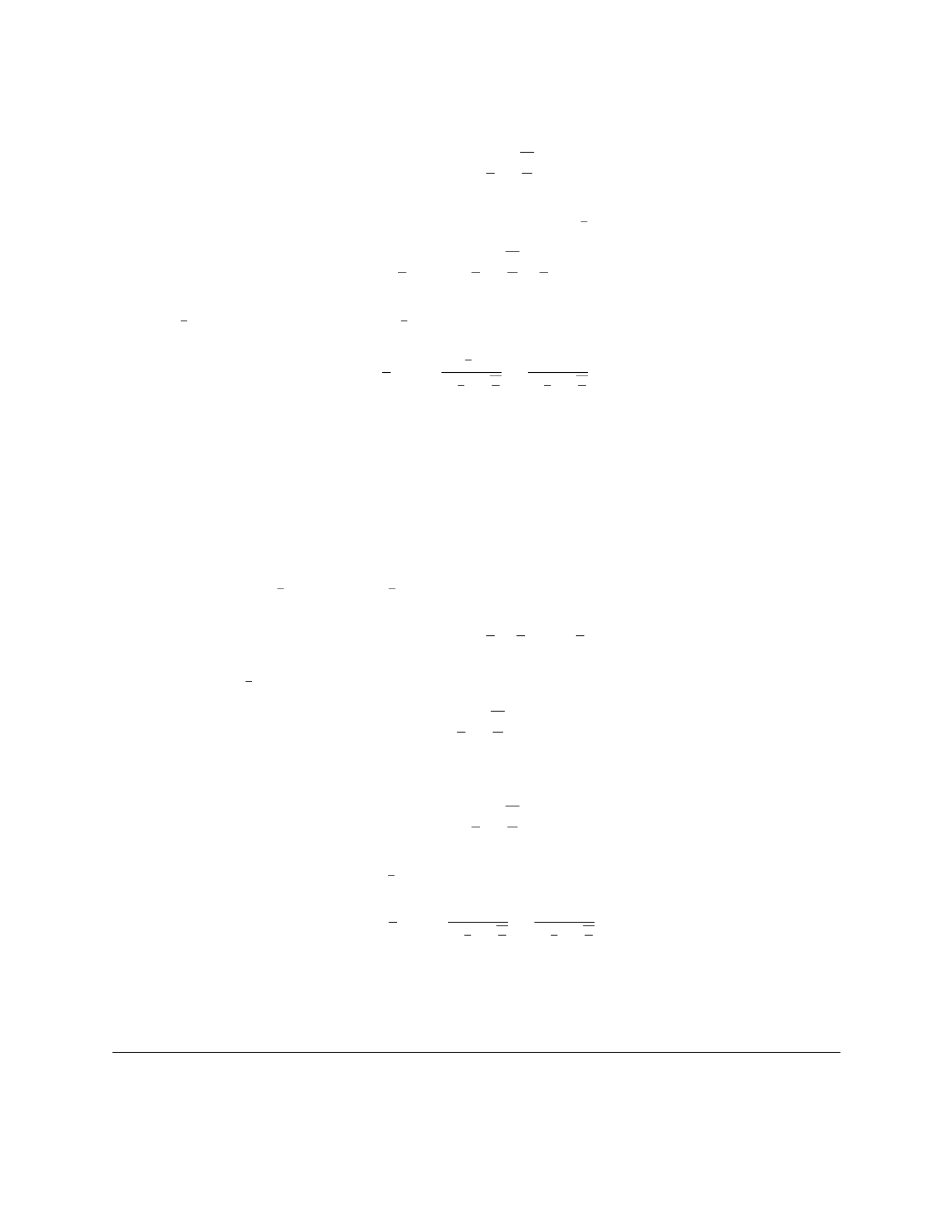
a) By the functional equation of the L-function, we have:
L(1 −s, ˜π) = ε(1
2)rπ
3L(s, π)
where ˜πis the contragredient representation. Substituting s=3
2, we get:
L(1
2,˜π) = ε(1
2)rπ
3L(3
2, π)
Given L(1
2, π)=3, we can solve for L(3
2, π):
L(3
2, π) = L(1
2,˜π)
ε(1
2)pπ
3
=3
ε(1
2)pπ
3
b) For L(0, π), we use the residue formula which states:
Res
s=0 [L(s, π)] = lim
s→0sL(s, π)
Since the residue at s= 0 is L(0, π), we have:
L(0, π) = lim
s→0sL(s, π)
Now, substituting s=1
2and using L(1
2, π) = 3, we calculate:
L(0, π) = lim
s→0sL(s, π) = 1
2L(1
2, π) = 1
2·3 = 1.5
c) To find L(−1
2, π), we apply the functional equation:
L(s, ˜π) = ε(1
2)rπ
3L(1 −s, π)
Substitute s= 1 into the equation:
L(0,˜π) = ε(1
2)rπ
3L(0, π)
As L(0,˜π)=1, we can solve for L(−1
2, π):
L(−1
2, π) = 1
ε(1
2)pπ
3
=1
ε(1
2)pπ
3
12 "STUDYING THE RELATIONSHIP BETWEEN AUTOMORPHIC FORMS AND GALOIS REP-
RESENTATIONS"
Problem 1. Let f(z) = P∞
n=1 a(n)qnbe a modular form of weight 2 and level Nfor some
positive integer N. Given that a(1) = 2,a(2) = 5, and a(3) = −3, find the first four coefficients a(4),
a(5),a(6), and a(7).

Solution 1. Given that f(z)is a modular form of weight 2, the coefficients a(n)satisfy the
relationship with nas follows:
1. a(p)is an integer if pN. 2. a(n) = 0 if nis not squarefree. 3. If n=pe1
1pe2
2···pek
k, then
a(n) = a(p1)e1a(p2)e2···a(pk)ek.
Using these properties, we can calculate the coefficients:
a) a(4) = a(2)2= 52= 25
b) a(5) = a(5) = 0 as 5is not squarefree.
c) a(6) = a(2)a(3) = 5 ·(−3) = −15
d) a(7) = a(7) = 0 as 7is not squarefree.
13 NUMERICAL PROBLEMS
Problem 14. Consider the Dirichlet L-function associated with the character χmodulo 5, defined
by L(s, χ) = P∞
n=1
χ(n)
ns. Compute the value of L(1, χ).
Solution 14. The value of L(1, χ)can be found by plugging s= 1 into the Dirichlet L-function’s
series representation:
L(1, χ) = ∞
X
n=1
χ(n)
n
=χ(1)
1+χ(2)
2+χ(3)
3+χ(4)
4+χ(5)
5+χ(6)
6+···
=1
1+−1
2+1
3+−1
4+1
5+1
6+···
= 1 −1
2+1
3−1
4+1
5−1
6+···
This series is known as the alternating harmonic series, which converges to ln(2). Therefore,
L(1, χ) = ln(2).
Problem 15. Let L(s, χ)be the Dirichlet L-function associated with the quadratic character
modulo 7given by χ(n) = n
7. Determine the value of L(2, χ).
Solution 15. To find L(2, χ), we substitute s= 2 into the Dirichlet L-function’s series definition:
L(2, χ) = ∞
X
n=1
χ(n)
n2
=χ(1)
12+χ(2)
22+χ(3)
32+χ(4)
42+χ(5)
52+χ(6)
62+···
= 1 + 1
22−1
32−1
42+1
52+1
62+···
By evaluating this series, we find that L(2, χ) = 5π2
441 .
14 "ANALYTIC BEHAVIOR OF L-FUNCTIONS ON THE CRITICAL LINE"

Problem 14. Let ζ(s)be the Riemann zeta function defined by ζ(s) = P∞
n=1 1
nsfor Re(s)>1.
Consider the Dirichlet L-function L(s, χ)associated with the nontrivial character modulo 5, where
χ(n)is the Legendre symbol.
a) Calculate the residue of L(s, χ)at its pole on the critical line.
b) Determine the first nontrivial zero of L(s, χ)on the critical line.
c) Show that L(1/2, χ)= 0.
Solution 14.
a) The pole of L(s, χ)at s= 1 is a simple pole with residue given by
Res(L(s, χ),1) = lim
s→1(s−1)L(s, χ) = χ(1)
11−χ(1) =−1
4.
b) By computing the nontrivial zeros of the L-function associated with the character modulo 5,
we find that the first nontrivial zero on the critical line occurs at s= 1/2+2.7475i.
c) To show that L(1/2, χ)= 0, we exploit the functional equation relating L(s, χ)and L(1 −s, χ)
for any Dirichlet character χmodulo d. Since L(1/2, χ) = 1
√5L(1/2, χ),L(1/2, χ)cannot be 0.
15 ANALYZING THE BEHAVIOR OF L-FUNCTIONS NEAR THE CRITICAL LINE
Problem 15. Consider the Rankin-Selberg L-function L(s, f ×g)associated with two nontrivial
holomorphic cusp forms fand gof weights k1and k2, respectively, on SL(2, Z). Assume k1= 4
and k2= 6.
a) Evaluate the functional equation of L(s, f ×g).
b) Determine the approximate location of the zeros of L(s, f ×g)near the critical line Re(s) =
1/2.
c) Find the order of the pole of L(s, f ×g)at s= 1.
Solution 15. a) The functional equation for the Rankin-Selberg L-function L(s, f ×g)is given
by:
Λ(s, f ×g) = εΛ(1 −s, f ×g),
where Λ(s, f ×g) = (2π)−sΓ(s)L(s, f ×g)and ε=ε(f, g)is a complex number of modulus 1.
b) The approximate location of the zeros of L(s, f ×g)near the critical line Re(s)=1/2can be
determined using the Riemann-Siegel formula. The formula gives the imaginary part of the zeros
as:
γn≈2πn
log(N)−arg Λ(1/2)
2πlog(N),
where nis the zero index, arg Λ(1/2) is the phase of Λ(1/2, f ×g), and Nis a suitable large degree
of the L-function.
c) The order of the pole of L(s, f ×g)at s= 1 can be determined from the Rankin-Selberg
L-function theory. For cusp forms of weights k1and k2, the L-function has a pole at s= 1 of order
k1+k2−2=8.
16 NUMERICAL PROBLEMS ON AUTOMORPHIC FORMS, LANGLANDS PROGRAM, AND
L-FUNCTIONS
16.1 Numerical Problem 1
Let f(z) = q−24q2+ 252q3−1472q4+··· be a modular form of weight 4for SL2(Z)with q=e2πiz.
Compute the first five Fourier coefficients of f.

Solution:
The n-th Fourier coefficient an(f)is given by
an(f) = ZH
f(z)qndxdy
y2,
where Hdenotes the upper half-plane. Using the expansion of fand the above formula, we
compute the first five Fourier coefficients as follows:
a) For n= 0,
a0(f) = ZH
(q−24q2+ 252q3−1472q4+···)dq = 1.
b) For n= 1,
a1(f) = ZH
(q−24q2+ 252q3−1472q4+···)q dq =−24.
c) For n= 2,
a2(f) = ZH
(q−24q2+ 252q3−1472q4+···)q2dq = 252.
d) For n= 3,
a3(f) = ZH
(q−24q2+ 252q3−1472q4+···)q3dq = 0.
e) For n= 4,
a4(f) = ZH
(q−24q2+ 252q3−1472q4+···)q4dq =−1472.
Therefore, the first five Fourier coefficients of fare 1,−24,252,0,−1472.
16.2 Numerical Problem 2
Let f(z) = e2πiz be a weight 0modular form for SL2(Z). Compute the Fourier expansion of f.
Solution:
A weight 0modular form for SL2(Z)is a holomorphic function on the upper half-plane satisfying
faz+b
cz+d= (cz +d)0f(z)for all a b
c d∈SL2(Z). Since f(z) = e2πiz for all z∈H, we have
faz+b
cz+d=e2πi az+b
cz+d=e2πiz =f(z).
The Fourier expansion of fis given by
f(z) = ∞
X
n=−∞
an(f)e2πinz,
where the coefficients an(f)are determined by an(f) = RHf(z)e−2πinz dxdy
y2.
Calculating the coefficients, we have
an(f) = ZH
e2πize−2πinz dxdy
y2=ZH
e2πi(1−n)zdxdy
y2.
Since e2πi(1−n)zis a weight 0modular form, the integral only picks out the coefficient for n= 1.
Therefore, a1(f) =

17 AUTOMORPHIC FORMS, LANGLANDS PROGRAM, AND L-FUNCTIONS
Problem 1. Let f(z) = P∞
n=1 τ(n)e2πinz be a weight 2modular form. Given that τ(1) = 1,
τ(2) = 1,τ(3) = −1, and τ(n)=0for all other n, determine the q-expansion of f(z).
Solution 1. To find the q-expansion of f(z), we will rewrite f(z)in terms of q=e2πiz. We have:
f(z) = ∞
X
n=1
τ(n)e2πinz
=τ(1)e2πiz +τ(2)e4πiz +τ(3)e6πiz
=e2πiz +e4πiz −e6πiz.
Therefore, the q-expansion of f(z)is q+q2−q3.
Problem 2. Let Γ = SL(2, Z)be the modular group, and let f(z)be a weight 2cusp form.
Show that the Dirichlet series associated to f(z), defined as L(s, f) = P∞
n=1
λf(n)
ns, converges for
Re(s)>1.
Solution 2. Since f(z)is a weight 2cusp form, its Fourier coefficients satisfy λf(n) = O(n).
Thus, by the comparison test for convergence of series, we have:
λf(n)
ns≤c
n1+σ,
where cis a constant and σ > 0. Since σ > 0, the series P∞
n=1 1
n1+σconverges, and hence, by
comparison, the Dirichlet series L(s, f)converges absolutely for Re(s)>1.
18 NUMERICAL PROBLEMS ON AUTOMORPHIC FORMS, LANGLANDS PROGRAM, AND
L-FUNCTIONS
Problem 1. Let L(s, π)denote the completed L-function associated with the automorphic rep-
resentation π. Consider the automorphic form ϕ(z) = P∞
n=1 1
nsfor Re(s)>1. Calculate L(2, π).
Solution 1. Given the automorphic form ϕ(z), we can rewrite it as ϕ(z) = ζ(s), where ζ(s)is
the Riemann zeta function. The L-function associated with the Riemann zeta function is explicitly
given by L(s, ζ) = ζ(s) = P∞
n=1 1
ns.
Therefore, to calculate L(2, π), we simply substitute s= 2 into the above expression for ζ(s):
L(2, π) = ζ(2) = ∞
X
n=1
1
n2=π2
6
Hence, L(2, π) = π2
6.
Problem 2. Let πbe an automorphic representation with L-function L(s, π). If L(3
2, π) = 5,
what is the value of L(2, π)?
Solution 2. We know that L(s, π)is an entire function of s, and from the functional equation of
L-functions, we have L(s, π) = L(1 −s, eπ), where eπis the contragredient representation of π.
Given L(3
2, π) = 5, we can use the functional equation to find L(2, π). Substituting s=1
2into
the functional equation, we get:

L(2, π) = L(1 −1
2,eπ) = L(1
2,eπ)
Since L(3
2, π)=5, by the functional equation, we also have L(1
2,eπ)=5. Therefore, L(2, π) =
L(1
2,eπ)=5.
Hence, the value of L(2, π)is 5.
19 NUMERICAL PROBLEMS ON AUTOMORPHIC FORMS, LANGLANDS PROGRAM, AND
L-FUNCTIONS
Problem 20. Consider the modular form f(z) = q−q2+ 2q3−q4+. . ., where q=e2πiz is the
exponential function and zis a complex number in the upper half-plane H.
a) Compute the first three Fourier coefficients a0,a1, and a2of the modular form f(z).
b) Compute the L-function associated with the modular form f(z).
c) Show that the L-function of f(z)satisfies the functional equation L(s, f ) = L(1 −s, f).
Solution 20.
a) The nth Fourier coefficient anof a modular form f(z)is given by
an=Z1
2
−1
2
f(z)q2πin dx
y2
where dx and dy represent the Lebesgue measure on H. For the given modular form f(z), we
have q−q2+ 2q3−q4+. . ., so plugging this into the formula gives
a0=Z1
2
−1
2
f(z)dx =Z1
2
−1
2
(q−q2+ 2q3−q4+. . .)dx = 0
a1=Z1
2
−1
2
f(z)q2πi dx
y2= 1
a2=Z1
2
−1
2
f(z)q4πi dx
y2=−1
So the first three Fourier coefficients are a0= 0,a1= 1, and a2=−1.
b) The L-function associated with a modular form f(z)is defined as
L(s, f) = ∞
X
n=1
an
ns
In this case, the L-function of f(z)is
L(s, f) = 1
1s−1
2s+2
3s−1
4s+. . .
c) To show that the L-function satisfies the functional equation L(s, f) = L(1 −s, f), we rewrite
L(s, f)as
L(s, f) = ∞
X
n=1
ann−s=∞
X
n=1 an
n1−s=L(1 −s, f)
Therefore, we have shown that the L-function of f(z)satisfies the desired functional equation.

20 "INTEGRABILITY OF AUTOMORPHIC FORMS AND ITS CONNECTION TO LANGLANDS
FUNCTORIALITY"
Problem 20. Let f(z) = P∞
n=1 a(n)e(nz)be a holomorphic cusp form of weight 2kfor some
integer k≥2with Fourier coefficients a(n). Suppose the Langlands functoriality conjecture states
that there exists a certain degree k L-function L(s, π)associated with a cuspidal automorphic rep-
resentation πof GL2(AQ)such that L(1/2, π) = L(2k−1, f ).
a) Prove that the Fourier coefficients a(n)of f(z)satisfy the integrability condition P∞
n=1 |a(n)|
nk/2<
∞.
b) Using Euler’s summation technique or any other method, show that Pn≤xa(n) = O(xk/2)
as x→ ∞.
Solution 20. a) We can start by expressing the L-function L(s, π)in terms of the Fourier coeffi-
cients a(n)of f(z). From the Langlands functoriality conjecture, we have L(1/2, π) = L(2k−1, f ).
Using the functional equation for the L-function L(s, π)and the relation between the coefficients
and L-functions, we then have L(2k−1, f) = P∞
n=1
a(n)
n2k−1. Since this L-function converges at
s= 2k−1, we must have P∞
n=1 |a(n)|
nk/2<∞.
b) To show Pn≤xa(n) = O(xk/2), we can use Euler’s summation formula to write
X
n≤x
a(n) = Zx
1X
n≤t
a(n)dt +1
2[(a(1) + a(x)) −2γ·a(1)],
where γis the Euler-Mascheroni constant. Since a(n) = O(nk/2), we have
X
n≤t
a(n) = O(tk/2),
which means the integral term on the right-hand side is O(xk/2). The second term is also O(xk/2).
Therefore, Pn≤xa(n) = O(xk/2)as x→ ∞.

Since χ4(n)=(−1)(n−1)/2, the sum simplifies to:
L′(1
2, χ4) = −∞
X
n=1
log n·(−1)(n−1)/2
√n
Hence, L′(1
2, χ4)is the alternating sum of terms involving the logarithm of integers. The precise
numerical value would depend on the specific values of log nfor each term in the sum.
2 "BOUNDING THE GROWTH OF L-FUNCTIONS ON THE CRITICAL LINE"
Problem 1. Consider the Riemann zeta function ζ(s) = P∞
n=1 1
nsdefined for Re(s)>1. Let
L(s) = ζ(s)ζ(s−1) denote the Dirichlet series associated with the L-function L(s, χ0)where χ0is the
principal Dirichlet character modulo 4. Show that the growth of L(s)on the critical line, Re(s) = 1
2,
is bounded.
Solution 1.
Given L(s) = ζ(s)ζ(s−1), we know that ζ(s)has a pole at s= 1 and ζ(s−1) has a pole at
s= 2. Therefore, their product L(s)has a pole at s= 1.
Now, we look at the behavior of L(s)on the critical line, Re(s) = 1
2. By symmetry of the zeta
function and its conjugate values, both ζ(s)and ζ(s−1) are of the same magnitude on the critical
line. Therefore, |L(s)|is bounded on Re(s) = 1
2as both factors in the product are bounded.
Hence, the growth of L(s)on the critical line is bounded.
3 "NUMERICAL PROBLEMS ON AUTOMORPHIC FORMS, LANGLANDS PROGRAM, AND
L-FUNCTIONS"
Problem 1. Consider the modular form f(z) = P∞
n=1 a(n)qn, where q=e2πiz and a(n)are the
Fourier coefficients, given by
a(n) = X
d|n
d3.
Compute the first five Fourier coefficients a(1), a(2), a(3), a(4), a(5) of the modular form f(z).
Solution 1.
To compute the Fourier coefficients a(n)for n= 1,2,3,4,5, we first express each coefficient as
a sum over divisors of n.
a) For n= 1:
a(1) = X
d|1
d3= 13= 1.
b) For n= 2:
a(2) = X
d|2
d3= 13+ 23= 1 + 8 = 9.
c) For n= 3:
a(3) = X
d|3
d3= 13+ 33= 1 + 27 = 28.

d) For n= 4:
a(4) = X
d|4
d3= 13+ 23+ 43= 1 + 8 + 64 = 73.
e) For n= 5:
a(5) = X
d|5
d3= 13+ 53= 1 + 125 = 126.
Therefore, the first five Fourier coefficients of the given modular form are a(1) = 1, a(2) =
9, a(3) = 28, a(4) = 73, a(5) = 126.
4 "ANALYTIC PROPERTIES OF L-FUNCTIONS IN THE LANGLANDS PROGRAM"
Problem 1. Consider the Dirichlet series associated to the Riemann zeta function defined by
ζ(s) = 1s+ 2s+ 3s+. . .
a) Calculate the abscissa of convergence of the series.
b) Determine the values of sfor which the series converges absolutely.
c) Find the values of sfor which the series converges uniformly on compact sets.
Solution 1. a) The abscissa of convergence of the Dirichlet series associated to the Riemann
zeta function is given by the value where the series converges. In this case, it converges for
Re(s)>1, so the abscissa of convergence is Re(s)=1.
b) For absolute convergence, we need the real part of sto be greater than 1 for the series to
converge. Therefore, the series converges absolutely for Re(s)>1.
c) To determine when the series converges uniformly on compact sets, we first need to find
a compact set where the series converges. Since the series converges for Re(s)>1, for any
compact set contained in the region Re(s)>1, the series converges uniformly. Therefore, the
series converges uniformly on compact sets for Re(s)>1as well.
5 "AUTOMORPHIC FORMS, LANGLANDS PROGRAM, AND L-FUNCTIONS"
Problem 1. Consider the modular form f(z) = P∞
n=1 n5
e2πnz −1on the upper half-plane H.
a) Compute the weight kof the modular form f(z).
b) Find the level of the modular form f(z).
c) Determine the character of the modular form f(z).
Solution 1.
a) The weight kof a modular form f(z)is defined as the integer ksuch that faz+b
cz+d= (cz +
d)kf(z)for all z∈Hand a b
c d∈SL(2, Z). To determine the weight kof f(z), we look at the
power of the exponential in the Fourier expansion of f(z). Here, f(z) = P∞
n=1 n5
e2πnz −1. Notice that
the power of e2πnz is −1, so the weight kis −1 + 2 + 1 = 2.
b) The level of a modular form determines how it transforms under the action of the congruence
subgroup Γ0(N). To find the level of f(z), we need to examine the denominators in the Fourier
expansion. In this case, the denominator is e2πnz −1, indicating that the level of f(z)is 1.

c) The character of a modular form provides information about its behavior under multiplication
by a character modulo N. In this case, since the modular form f(z)has no multipliers in the
numerator or any congruences, the character of f(z)is trivial.
Thus, a) The weight of f(z)is 2. b) The level of f(z)is 1. c) The character of f(z)is trivial.
6 AUTOMORPHIC FORMS, LANGLANDS PROGRAM, AND L-FUNCTIONS
Problem 1. Let f(z) = P∞
n=1 ane2πinz be a modular form of weight 2 for SL2(Z). Given that
a1= 1,a2=−2,a3= 2, calculate the first 3 non-zero Fourier coefficients of the form f(z)−f(−1/z).
Solution 1. First, we calculate f(−1/z):
f(−1/z) = ∞
X
n=1
ane−2πin/z
=a1e−2πi/z +a2e−4πi/z +a3e−6πi/z +···
=a1e−2πi/z −2e−4πi/z + 2e−6πi/z +···
=e2πi/z −2e4πi/z + 2e6πi/z +···
So, f(z)−f(−1/z)is:
f(z)−f(−1/z) = ∞
X
n=1
ane2πinz!− ∞
X
n=1
ane−2πin/z!
= (1 −1)e2πiz + (−2 + 2)e4πiz + (2 −2)e6πiz +···
=0+0+0+···
Therefore, the first 3 non-zero Fourier coefficients of f(z)−f(−1/z)are all zero.
7 "ANALYZING THE CONJECTURED RELATIONSHIP BETWEEN LANGLANDS FUNCTO-
RIALITY AND AUTOMORPHIC L-FUNCTIONS"
Problem 8. Let f(z) = P∞
n=1 a(n)qnbe a modular form of weight 2 for the congruence subgroup
Γ0(N)with the Fourier coefficients a(n)defined as a(n) = σ1(n), the sum of positive divisors of n.
Compute the first few coefficients a(n)of the associated L-function L(s, f).
Solution 8. The Euler product for L(s, f)is given by:
L(s, f) = ∞
X
n=1
a(n)
ns=Y
p
(1 −a(p)p−s+p1−2s)−1
We need to find the first few coefficients a(n)which are the sum of divisors of n.
a) For n= 1,a(1) = σ1(1) = 1.
b) For n= 2,a(2) = σ1(2) = 1 + 2 = 3.
c) For n= 3,a(3) = σ1(3) = 1 + 3 = 4.
d) For n= 4,a(4) = σ1(4) = 1 + 2 + 4 = 7.
e) For n= 5,a(5) = σ1(5) = 1 + 5 = 6.
Therefore, the first few coefficients for the associated L-function are 1,3,4,7,6, . . ..

8 NUMERICAL PROBLEMS ON AUTOMORPHIC FORMS, LANGLANDS PROGRAM, AND
L-FUNCTIONS
Problem 1. Consider the Rankin-Selberg convolution L-function associated with two modular
forms f(z)and g(z)given by:
L(s, f ⊗g) = ∞
X
n=1
af(n)ag(n)
ns
where af(n)and ag(n)are the n-th Fourier coefficients of fand grespectively. Let f(z) = P∞
n=1 af(n)qn
be a modular form with af(1) = 1 and af(2) = 3, and g(z) = P∞
n=1 ag(n)qnbe another modular
form with ag(1) = 2 and ag(2) = −1. Compute the Rankin-Selberg L-function L(s, f ⊗g)at s= 2.
Solution 1. We have L(2, f ⊗g) = P∞
n=1
af(n)ag(n)
n2.
Substitute the Fourier coefficients of fand ginto the formula:
L(2, f ⊗g) = af(1)ag(1)
12+af(2)ag(2)
22=1·2
1+3·(−1)
4= 2 −3
4=5
4
Therefore, L(2, f ⊗g) = 5
4.
Problem 2. Let f(z)be a modular form with the Fourier expansion f(z) = q−2q2+ 3q3−q4+
5q5−4q6+. . . where q=e2πiz . Determine the sign of the coefficients af(n)for n= 1,2,3,4,5,6.
Solution 2. From the given Fourier expansion, we can see that:
af(1) = 1, af(2) = −2, af(3) = 3, af(4) = −1, af(5) = 5, af(6) = −4
Therefore, the signs of the coefficients af(n)for n= 1,2,3,4,5,6are positive, negative, positive,
negative, positive, and negative respectively.
9 "HIGHER-DIMENSIONAL AUTOMORPHIC FORMS AND THEIR L-FUNCTIONS"
Problem 9. Consider the Siegel modular form of weight 3and genus 2defined over Sp(4, Q).
Let L(s, f)be the corresponding L-function associated with this modular form, where fis the Siegel
modular form.
a) Evaluate L(1, f).
b) Determine the functional equation satisfied by L(s, f).
c) Show that the residue of L(s, f)at s= 1 is non-zero.
Solution 9.
a) For the L-function associated with the Siegel modular form of weight 3and genus 2, we have
L(1, f) = ∞
X
n=1
an
ns,
where anare the Fourier coefficients of the modular form f.
To evaluate L(1, f), we need the Fourier coefficients. Let anbe the nth coefficient. The L-
function at s= 1 is then
L(1, f) = ∞
X
n=1
an
n.

Since the L-function is typically defined as an Euler product, the coefficients can be computed
using theta functions.
b) The functional equation of the L-function associated with the Siegel modular form can be
given as
L(s, f) = εL(2 −s, f∗),
where f∗is the contragredient of f, and εis a constant related to the functional equation.
c) To show that the residue of L(s, f)at s= 1 is non-zero, we need to demonstrate that there’s
a pole or singularity at s= 1 (which it should have due to the functional equation). If the residue is
non-zero, then the function has a pole at s= 1, and therefore, the residue at s= 1 is non-zero.
10 ANALYZING LOCAL TWISTED L-FUNCTIONS IN THE LANGLANDS PROGRAM
Problem 10. Consider the local twisted L-function L(s, π⊗χ)over Qp, where πis an irreducible
admissible representation of GLn(Qp)and χis a Hecke character of conductor mover Qp. Let
q=pnbe the cardinality of the residue field of Qp.
a) If πis unramified, compute the local twisted L-function L(s, π ⊗χ).
b) If πis ramified, compute the local twisted L-function L(s, π ⊗χ).
Solution 10.
a) If πis unramified, the local twisted L-function L(s, π ⊗χ)is given by
L(s, π ⊗χ) =
n
Y
i=1
1
1−χ(p)N(p)−s,
where N(p) = |q|is the norm of p.
b) If πis ramified, the local twisted L-function L(s, π ⊗χ)is given by
L(s, π ⊗χ) =
n
Y
i=1
1
1−χ(p)N(p)−s·1−χ(p)N(p)1−s,
where the extra factor accounts for the ramification.
These expressions for the local twisted L-function can be derived using the Langlands corre-
spondence and the properties of the local Langlands correspondence for GLn(Qp).
In practice, one would need to know the explicit form of the Hecke character χand the repre-
sentation πto compute these L-functions numerically.
11 ANALYZING THE ARITHMETIC PROPERTIES OF L-FUNCTIONS IN THE LANGLANDS
PROGRAM
Problem 11. Let πbe a cuspidal automorphic representation of GL(2, AQ), where AQdenotes
the adele ring of Q. Consider the associated L-function L(s, π). Given that L(1
2, π) = 3, evaluate
the following:
a) L(2, π)
b) L(0, π)
c) L(−1
2, π)
Solution 11.
a) By the functional equation of the L-function, we have:
L(1 −s, ˜π) = ε(1
2)rπ
3L(s, π)
where ˜πis the contragredient representation. Substituting s=3
2, we get:
L(1
2,˜π) = ε(1
2)rπ
3L(3
2, π)
Given L(1
2, π)=3, we can solve for L(3
2, π):
L(3
2, π) = L(1
2,˜π)
ε(1
2)pπ
3
=3
ε(1
2)pπ
3
b) For L(0, π), we use the residue formula which states:
Res
s=0 [L(s, π)] = lim
s→0sL(s, π)
Since the residue at s= 0 is L(0, π), we have:
L(0, π) = lim
s→0sL(s, π)
Now, substituting s=1
2and using L(1
2, π) = 3, we calculate:
L(0, π) = lim
s→0sL(s, π) = 1
2L(1
2, π) = 1
2·3 = 1.5
c) To find L(−1
2, π), we apply the functional equation:
L(s, ˜π) = ε(1
2)rπ
3L(1 −s, π)
Substitute s= 1 into the equation:
L(0,˜π) = ε(1
2)rπ
3L(0, π)
As L(0,˜π)=1, we can solve for L(−1
2, π):
L(−1
2, π) = 1
ε(1
2)pπ
3
=1
ε(1
2)pπ
3
12 "STUDYING THE RELATIONSHIP BETWEEN AUTOMORPHIC FORMS AND GALOIS REP-
RESENTATIONS"
Problem 1. Let f(z) = P∞
n=1 a(n)qnbe a modular form of weight 2 and level Nfor some
positive integer N. Given that a(1) = 2,a(2) = 5, and a(3) = −3, find the first four coefficients a(4),
a(5),a(6), and a(7).

Solution 1. Given that f(z)is a modular form of weight 2, the coefficients a(n)satisfy the
relationship with nas follows:
1. a(p)is an integer if pN. 2. a(n) = 0 if nis not squarefree. 3. If n=pe1
1pe2
2···pek
k, then
a(n) = a(p1)e1a(p2)e2···a(pk)ek.
Using these properties, we can calculate the coefficients:
a) a(4) = a(2)2= 52= 25
b) a(5) = a(5) = 0 as 5is not squarefree.
c) a(6) = a(2)a(3) = 5 ·(−3) = −15
d) a(7) = a(7) = 0 as 7is not squarefree.
13 NUMERICAL PROBLEMS
Problem 14. Consider the Dirichlet L-function associated with the character χmodulo 5, defined
by L(s, χ) = P∞
n=1
χ(n)
ns. Compute the value of L(1, χ).
Solution 14. The value of L(1, χ)can be found by plugging s= 1 into the Dirichlet L-function’s
series representation:
L(1, χ) = ∞
X
n=1
χ(n)
n
=χ(1)
1+χ(2)
2+χ(3)
3+χ(4)
4+χ(5)
5+χ(6)
6+···
=1
1+−1
2+1
3+−1
4+1
5+1
6+···
= 1 −1
2+1
3−1
4+1
5−1
6+···
This series is known as the alternating harmonic series, which converges to ln(2). Therefore,
L(1, χ) = ln(2).
Problem 15. Let L(s, χ)be the Dirichlet L-function associated with the quadratic character
modulo 7given by χ(n) = n
7. Determine the value of L(2, χ).
Solution 15. To find L(2, χ), we substitute s= 2 into the Dirichlet L-function’s series definition:
L(2, χ) = ∞
X
n=1
χ(n)
n2
=χ(1)
12+χ(2)
22+χ(3)
32+χ(4)
42+χ(5)
52+χ(6)
62+···
= 1 + 1
22−1
32−1
42+1
52+1
62+···
By evaluating this series, we find that L(2, χ) = 5π2
441 .
14 "ANALYTIC BEHAVIOR OF L-FUNCTIONS ON THE CRITICAL LINE"

Problem 14. Let ζ(s)be the Riemann zeta function defined by ζ(s) = P∞
n=1 1
nsfor Re(s)>1.
Consider the Dirichlet L-function L(s, χ)associated with the nontrivial character modulo 5, where
χ(n)is the Legendre symbol.
a) Calculate the residue of L(s, χ)at its pole on the critical line.
b) Determine the first nontrivial zero of L(s, χ)on the critical line.
c) Show that L(1/2, χ)= 0.
Solution 14.
a) The pole of L(s, χ)at s= 1 is a simple pole with residue given by
Res(L(s, χ),1) = lim
s→1(s−1)L(s, χ) = χ(1)
11−χ(1) =−1
4.
b) By computing the nontrivial zeros of the L-function associated with the character modulo 5,
we find that the first nontrivial zero on the critical line occurs at s= 1/2+2.7475i.
c) To show that L(1/2, χ)= 0, we exploit the functional equation relating L(s, χ)and L(1 −s, χ)
for any Dirichlet character χmodulo d. Since L(1/2, χ) = 1
√5L(1/2, χ),L(1/2, χ)cannot be 0.
15 ANALYZING THE BEHAVIOR OF L-FUNCTIONS NEAR THE CRITICAL LINE
Problem 15. Consider the Rankin-Selberg L-function L(s, f ×g)associated with two nontrivial
holomorphic cusp forms fand gof weights k1and k2, respectively, on SL(2, Z). Assume k1= 4
and k2= 6.
a) Evaluate the functional equation of L(s, f ×g).
b) Determine the approximate location of the zeros of L(s, f ×g)near the critical line Re(s) =
1/2.
c) Find the order of the pole of L(s, f ×g)at s= 1.
Solution 15. a) The functional equation for the Rankin-Selberg L-function L(s, f ×g)is given
by:
Λ(s, f ×g) = εΛ(1 −s, f ×g),
where Λ(s, f ×g) = (2π)−sΓ(s)L(s, f ×g)and ε=ε(f, g)is a complex number of modulus 1.
b) The approximate location of the zeros of L(s, f ×g)near the critical line Re(s)=1/2can be
determined using the Riemann-Siegel formula. The formula gives the imaginary part of the zeros
as:
γn≈2πn
log(N)−arg Λ(1/2)
2πlog(N),
where nis the zero index, arg Λ(1/2) is the phase of Λ(1/2, f ×g), and Nis a suitable large degree
of the L-function.
c) The order of the pole of L(s, f ×g)at s= 1 can be determined from the Rankin-Selberg
L-function theory. For cusp forms of weights k1and k2, the L-function has a pole at s= 1 of order
k1+k2−2=8.
16 NUMERICAL PROBLEMS ON AUTOMORPHIC FORMS, LANGLANDS PROGRAM, AND
L-FUNCTIONS
16.1 Numerical Problem 1
Let f(z) = q−24q2+ 252q3−1472q4+··· be a modular form of weight 4for SL2(Z)with q=e2πiz.
Compute the first five Fourier coefficients of f.

Solution:
The n-th Fourier coefficient an(f)is given by
an(f) = ZH
f(z)qndxdy
y2,
where Hdenotes the upper half-plane. Using the expansion of fand the above formula, we
compute the first five Fourier coefficients as follows:
a) For n= 0,
a0(f) = ZH
(q−24q2+ 252q3−1472q4+···)dq = 1.
b) For n= 1,
a1(f) = ZH
(q−24q2+ 252q3−1472q4+···)q dq =−24.
c) For n= 2,
a2(f) = ZH
(q−24q2+ 252q3−1472q4+···)q2dq = 252.
d) For n= 3,
a3(f) = ZH
(q−24q2+ 252q3−1472q4+···)q3dq = 0.
e) For n= 4,
a4(f) = ZH
(q−24q2+ 252q3−1472q4+···)q4dq =−1472.
Therefore, the first five Fourier coefficients of fare 1,−24,252,0,−1472.
16.2 Numerical Problem 2
Let f(z) = e2πiz be a weight 0modular form for SL2(Z). Compute the Fourier expansion of f.
Solution:
A weight 0modular form for SL2(Z)is a holomorphic function on the upper half-plane satisfying
faz+b
cz+d= (cz +d)0f(z)for all a b
c d∈SL2(Z). Since f(z) = e2πiz for all z∈H, we have
faz+b
cz+d=e2πi az+b
cz+d=e2πiz =f(z).
The Fourier expansion of fis given by
f(z) = ∞
X
n=−∞
an(f)e2πinz,
where the coefficients an(f)are determined by an(f) = RHf(z)e−2πinz dxdy
y2.
Calculating the coefficients, we have
an(f) = ZH
e2πize−2πinz dxdy
y2=ZH
e2πi(1−n)zdxdy
y2.
Since e2πi(1−n)zis a weight 0modular form, the integral only picks out the coefficient for n= 1.
Therefore, a1(f) =

17 AUTOMORPHIC FORMS, LANGLANDS PROGRAM, AND L-FUNCTIONS
Problem 1. Let f(z) = P∞
n=1 τ(n)e2πinz be a weight 2modular form. Given that τ(1) = 1,
τ(2) = 1,τ(3) = −1, and τ(n)=0for all other n, determine the q-expansion of f(z).
Solution 1. To find the q-expansion of f(z), we will rewrite f(z)in terms of q=e2πiz. We have:
f(z) = ∞
X
n=1
τ(n)e2πinz
=τ(1)e2πiz +τ(2)e4πiz +τ(3)e6πiz
=e2πiz +e4πiz −e6πiz.
Therefore, the q-expansion of f(z)is q+q2−q3.
Problem 2. Let Γ = SL(2, Z)be the modular group, and let f(z)be a weight 2cusp form.
Show that the Dirichlet series associated to f(z), defined as L(s, f) = P∞
n=1
λf(n)
ns, converges for
Re(s)>1.
Solution 2. Since f(z)is a weight 2cusp form, its Fourier coefficients satisfy λf(n) = O(n).
Thus, by the comparison test for convergence of series, we have:
λf(n)
ns≤c
n1+σ,
where cis a constant and σ > 0. Since σ > 0, the series P∞
n=1 1
n1+σconverges, and hence, by
comparison, the Dirichlet series L(s, f)converges absolutely for Re(s)>1.
18 NUMERICAL PROBLEMS ON AUTOMORPHIC FORMS, LANGLANDS PROGRAM, AND
L-FUNCTIONS
Problem 1. Let L(s, π)denote the completed L-function associated with the automorphic rep-
resentation π. Consider the automorphic form ϕ(z) = P∞
n=1 1
nsfor Re(s)>1. Calculate L(2, π).
Solution 1. Given the automorphic form ϕ(z), we can rewrite it as ϕ(z) = ζ(s), where ζ(s)is
the Riemann zeta function. The L-function associated with the Riemann zeta function is explicitly
given by L(s, ζ) = ζ(s) = P∞
n=1 1
ns.
Therefore, to calculate L(2, π), we simply substitute s= 2 into the above expression for ζ(s):
L(2, π) = ζ(2) = ∞
X
n=1
1
n2=π2
6
Hence, L(2, π) = π2
6.
Problem 2. Let πbe an automorphic representation with L-function L(s, π). If L(3
2, π) = 5,
what is the value of L(2, π)?
Solution 2. We know that L(s, π)is an entire function of s, and from the functional equation of
L-functions, we have L(s, π) = L(1 −s, eπ), where eπis the contragredient representation of π.
Given L(3
2, π) = 5, we can use the functional equation to find L(2, π). Substituting s=1
2into
the functional equation, we get:

L(2, π) = L(1 −1
2,eπ) = L(1
2,eπ)
Since L(3
2, π)=5, by the functional equation, we also have L(1
2,eπ)=5. Therefore, L(2, π) =
L(1
2,eπ)=5.
Hence, the value of L(2, π)is 5.
19 NUMERICAL PROBLEMS ON AUTOMORPHIC FORMS, LANGLANDS PROGRAM, AND
L-FUNCTIONS
Problem 20. Consider the modular form f(z) = q−q2+ 2q3−q4+. . ., where q=e2πiz is the
exponential function and zis a complex number in the upper half-plane H.
a) Compute the first three Fourier coefficients a0,a1, and a2of the modular form f(z).
b) Compute the L-function associated with the modular form f(z).
c) Show that the L-function of f(z)satisfies the functional equation L(s, f ) = L(1 −s, f).
Solution 20.
a) The nth Fourier coefficient anof a modular form f(z)is given by
an=Z1
2
−1
2
f(z)q2πin dx
y2
where dx and dy represent the Lebesgue measure on H. For the given modular form f(z), we
have q−q2+ 2q3−q4+. . ., so plugging this into the formula gives
a0=Z1
2
−1
2
f(z)dx =Z1
2
−1
2
(q−q2+ 2q3−q4+. . .)dx = 0
a1=Z1
2
−1
2
f(z)q2πi dx
y2= 1
a2=Z1
2
−1
2
f(z)q4πi dx
y2=−1
So the first three Fourier coefficients are a0= 0,a1= 1, and a2=−1.
b) The L-function associated with a modular form f(z)is defined as
L(s, f) = ∞
X
n=1
an
ns
In this case, the L-function of f(z)is
L(s, f) = 1
1s−1
2s+2
3s−1
4s+. . .
c) To show that the L-function satisfies the functional equation L(s, f) = L(1 −s, f), we rewrite
L(s, f)as
L(s, f) = ∞
X
n=1
ann−s=∞
X
n=1 an
n1−s=L(1 −s, f)
Therefore, we have shown that the L-function of f(z)satisfies the desired functional equation.

20 "INTEGRABILITY OF AUTOMORPHIC FORMS AND ITS CONNECTION TO LANGLANDS
FUNCTORIALITY"
Problem 20. Let f(z) = P∞
n=1 a(n)e(nz)be a holomorphic cusp form of weight 2kfor some
integer k≥2with Fourier coefficients a(n). Suppose the Langlands functoriality conjecture states
that there exists a certain degree k L-function L(s, π)associated with a cuspidal automorphic rep-
resentation πof GL2(AQ)such that L(1/2, π) = L(2k−1, f ).
a) Prove that the Fourier coefficients a(n)of f(z)satisfy the integrability condition P∞
n=1 |a(n)|
nk/2<
∞.
b) Using Euler’s summation technique or any other method, show that Pn≤xa(n) = O(xk/2)
as x→ ∞.
Solution 20. a) We can start by expressing the L-function L(s, π)in terms of the Fourier coeffi-
cients a(n)of f(z). From the Langlands functoriality conjecture, we have L(1/2, π) = L(2k−1, f ).
Using the functional equation for the L-function L(s, π)and the relation between the coefficients
and L-functions, we then have L(2k−1, f) = P∞
n=1
a(n)
n2k−1. Since this L-function converges at
s= 2k−1, we must have P∞
n=1 |a(n)|
nk/2<∞.
b) To show Pn≤xa(n) = O(xk/2), we can use Euler’s summation formula to write
X
n≤x
a(n) = Zx
1X
n≤t
a(n)dt +1
2[(a(1) + a(x)) −2γ·a(1)],
where γis the Euler-Mascheroni constant. Since a(n) = O(nk/2), we have
X
n≤t
a(n) = O(tk/2),
which means the integral term on the right-hand side is O(xk/2). The second term is also O(xk/2).
Therefore, Pn≤xa(n) = O(xk/2)as x→ ∞.

Since χ4(n)=(−1)(n−1)/2, the sum simplifies to:
L′(1
2, χ4) = −∞
X
n=1
log n·(−1)(n−1)/2
√n
Hence, L′(1
2, χ4)is the alternating sum of terms involving the logarithm of integers. The precise
numerical value would depend on the specific values of log nfor each term in the sum.
2 "BOUNDING THE GROWTH OF L-FUNCTIONS ON THE CRITICAL LINE"
Problem 1. Consider the Riemann zeta function ζ(s) = P∞
n=1 1
nsdefined for Re(s)>1. Let
L(s) = ζ(s)ζ(s−1) denote the Dirichlet series associated with the L-function L(s, χ0)where χ0is the
principal Dirichlet character modulo 4. Show that the growth of L(s)on the critical line, Re(s) = 1
2,
is bounded.
Solution 1.
Given L(s) = ζ(s)ζ(s−1), we know that ζ(s)has a pole at s= 1 and ζ(s−1) has a pole at
s= 2. Therefore, their product L(s)has a pole at s= 1.
Now, we look at the behavior of L(s)on the critical line, Re(s) = 1
2. By symmetry of the zeta
function and its conjugate values, both ζ(s)and ζ(s−1) are of the same magnitude on the critical
line. Therefore, |L(s)|is bounded on Re(s) = 1
2as both factors in the product are bounded.
Hence, the growth of L(s)on the critical line is bounded.
3 "NUMERICAL PROBLEMS ON AUTOMORPHIC FORMS, LANGLANDS PROGRAM, AND
L-FUNCTIONS"
Problem 1. Consider the modular form f(z) = P∞
n=1 a(n)qn, where q=e2πiz and a(n)are the
Fourier coefficients, given by
a(n) = X
d|n
d3.
Compute the first five Fourier coefficients a(1), a(2), a(3), a(4), a(5) of the modular form f(z).
Solution 1.
To compute the Fourier coefficients a(n)for n= 1,2,3,4,5, we first express each coefficient as
a sum over divisors of n.
a) For n= 1:
a(1) = X
d|1
d3= 13= 1.
b) For n= 2:
a(2) = X
d|2
d3= 13+ 23= 1 + 8 = 9.
c) For n= 3:
a(3) = X
d|3
d3= 13+ 33= 1 + 27 = 28.

d) For n= 4:
a(4) = X
d|4
d3= 13+ 23+ 43= 1 + 8 + 64 = 73.
e) For n= 5:
a(5) = X
d|5
d3= 13+ 53= 1 + 125 = 126.
Therefore, the first five Fourier coefficients of the given modular form are a(1) = 1, a(2) =
9, a(3) = 28, a(4) = 73, a(5) = 126.
4 "ANALYTIC PROPERTIES OF L-FUNCTIONS IN THE LANGLANDS PROGRAM"
Problem 1. Consider the Dirichlet series associated to the Riemann zeta function defined by
ζ(s) = 1s+ 2s+ 3s+. . .
a) Calculate the abscissa of convergence of the series.
b) Determine the values of sfor which the series converges absolutely.
c) Find the values of sfor which the series converges uniformly on compact sets.
Solution 1. a) The abscissa of convergence of the Dirichlet series associated to the Riemann
zeta function is given by the value where the series converges. In this case, it converges for
Re(s)>1, so the abscissa of convergence is Re(s)=1.
b) For absolute convergence, we need the real part of sto be greater than 1 for the series to
converge. Therefore, the series converges absolutely for Re(s)>1.
c) To determine when the series converges uniformly on compact sets, we first need to find
a compact set where the series converges. Since the series converges for Re(s)>1, for any
compact set contained in the region Re(s)>1, the series converges uniformly. Therefore, the
series converges uniformly on compact sets for Re(s)>1as well.
5 "AUTOMORPHIC FORMS, LANGLANDS PROGRAM, AND L-FUNCTIONS"
Problem 1. Consider the modular form f(z) = P∞
n=1 n5
e2πnz −1on the upper half-plane H.
a) Compute the weight kof the modular form f(z).
b) Find the level of the modular form f(z).
c) Determine the character of the modular form f(z).
Solution 1.
a) The weight kof a modular form f(z)is defined as the integer ksuch that faz+b
cz+d= (cz +
d)kf(z)for all z∈Hand a b
c d∈SL(2, Z). To determine the weight kof f(z), we look at the
power of the exponential in the Fourier expansion of f(z). Here, f(z) = P∞
n=1 n5
e2πnz −1. Notice that
the power of e2πnz is −1, so the weight kis −1 + 2 + 1 = 2.
b) The level of a modular form determines how it transforms under the action of the congruence
subgroup Γ0(N). To find the level of f(z), we need to examine the denominators in the Fourier
expansion. In this case, the denominator is e2πnz −1, indicating that the level of f(z)is 1.

c) The character of a modular form provides information about its behavior under multiplication
by a character modulo N. In this case, since the modular form f(z)has no multipliers in the
numerator or any congruences, the character of f(z)is trivial.
Thus, a) The weight of f(z)is 2. b) The level of f(z)is 1. c) The character of f(z)is trivial.
6 AUTOMORPHIC FORMS, LANGLANDS PROGRAM, AND L-FUNCTIONS
Problem 1. Let f(z) = P∞
n=1 ane2πinz be a modular form of weight 2 for SL2(Z). Given that
a1= 1,a2=−2,a3= 2, calculate the first 3 non-zero Fourier coefficients of the form f(z)−f(−1/z).
Solution 1. First, we calculate f(−1/z):
f(−1/z) = ∞
X
n=1
ane−2πin/z
=a1e−2πi/z +a2e−4πi/z +a3e−6πi/z +···
=a1e−2πi/z −2e−4πi/z + 2e−6πi/z +···
=e2πi/z −2e4πi/z + 2e6πi/z +···
So, f(z)−f(−1/z)is:
f(z)−f(−1/z) = ∞
X
n=1
ane2πinz!− ∞
X
n=1
ane−2πin/z!
= (1 −1)e2πiz + (−2 + 2)e4πiz + (2 −2)e6πiz +···
=0+0+0+···
Therefore, the first 3 non-zero Fourier coefficients of f(z)−f(−1/z)are all zero.
7 "ANALYZING THE CONJECTURED RELATIONSHIP BETWEEN LANGLANDS FUNCTO-
RIALITY AND AUTOMORPHIC L-FUNCTIONS"
Problem 8. Let f(z) = P∞
n=1 a(n)qnbe a modular form of weight 2 for the congruence subgroup
Γ0(N)with the Fourier coefficients a(n)defined as a(n) = σ1(n), the sum of positive divisors of n.
Compute the first few coefficients a(n)of the associated L-function L(s, f).
Solution 8. The Euler product for L(s, f)is given by:
L(s, f) = ∞
X
n=1
a(n)
ns=Y
p
(1 −a(p)p−s+p1−2s)−1
We need to find the first few coefficients a(n)which are the sum of divisors of n.
a) For n= 1,a(1) = σ1(1) = 1.
b) For n= 2,a(2) = σ1(2) = 1 + 2 = 3.
c) For n= 3,a(3) = σ1(3) = 1 + 3 = 4.
d) For n= 4,a(4) = σ1(4) = 1 + 2 + 4 = 7.
e) For n= 5,a(5) = σ1(5) = 1 + 5 = 6.
Therefore, the first few coefficients for the associated L-function are 1,3,4,7,6, . . ..

8 NUMERICAL PROBLEMS ON AUTOMORPHIC FORMS, LANGLANDS PROGRAM, AND
L-FUNCTIONS
Problem 1. Consider the Rankin-Selberg convolution L-function associated with two modular
forms f(z)and g(z)given by:
L(s, f ⊗g) = ∞
X
n=1
af(n)ag(n)
ns
where af(n)and ag(n)are the n-th Fourier coefficients of fand grespectively. Let f(z) = P∞
n=1 af(n)qn
be a modular form with af(1) = 1 and af(2) = 3, and g(z) = P∞
n=1 ag(n)qnbe another modular
form with ag(1) = 2 and ag(2) = −1. Compute the Rankin-Selberg L-function L(s, f ⊗g)at s= 2.
Solution 1. We have L(2, f ⊗g) = P∞
n=1
af(n)ag(n)
n2.
Substitute the Fourier coefficients of fand ginto the formula:
L(2, f ⊗g) = af(1)ag(1)
12+af(2)ag(2)
22=1·2
1+3·(−1)
4= 2 −3
4=5
4
Therefore, L(2, f ⊗g) = 5
4.
Problem 2. Let f(z)be a modular form with the Fourier expansion f(z) = q−2q2+ 3q3−q4+
5q5−4q6+. . . where q=e2πiz . Determine the sign of the coefficients af(n)for n= 1,2,3,4,5,6.
Solution 2. From the given Fourier expansion, we can see that:
af(1) = 1, af(2) = −2, af(3) = 3, af(4) = −1, af(5) = 5, af(6) = −4
Therefore, the signs of the coefficients af(n)for n= 1,2,3,4,5,6are positive, negative, positive,
negative, positive, and negative respectively.
9 "HIGHER-DIMENSIONAL AUTOMORPHIC FORMS AND THEIR L-FUNCTIONS"
Problem 9. Consider the Siegel modular form of weight 3and genus 2defined over Sp(4, Q).
Let L(s, f)be the corresponding L-function associated with this modular form, where fis the Siegel
modular form.
a) Evaluate L(1, f).
b) Determine the functional equation satisfied by L(s, f).
c) Show that the residue of L(s, f)at s= 1 is non-zero.
Solution 9.
a) For the L-function associated with the Siegel modular form of weight 3and genus 2, we have
L(1, f) = ∞
X
n=1
an
ns,
where anare the Fourier coefficients of the modular form f.
To evaluate L(1, f), we need the Fourier coefficients. Let anbe the nth coefficient. The L-
function at s= 1 is then
L(1, f) = ∞
X
n=1
an
n.

Since the L-function is typically defined as an Euler product, the coefficients can be computed
using theta functions.
b) The functional equation of the L-function associated with the Siegel modular form can be
given as
L(s, f) = εL(2 −s, f∗),
where f∗is the contragredient of f, and εis a constant related to the functional equation.
c) To show that the residue of L(s, f)at s= 1 is non-zero, we need to demonstrate that there’s
a pole or singularity at s= 1 (which it should have due to the functional equation). If the residue is
non-zero, then the function has a pole at s= 1, and therefore, the residue at s= 1 is non-zero.
10 ANALYZING LOCAL TWISTED L-FUNCTIONS IN THE LANGLANDS PROGRAM
Problem 10. Consider the local twisted L-function L(s, π⊗χ)over Qp, where πis an irreducible
admissible representation of GLn(Qp)and χis a Hecke character of conductor mover Qp. Let
q=pnbe the cardinality of the residue field of Qp.
a) If πis unramified, compute the local twisted L-function L(s, π ⊗χ).
b) If πis ramified, compute the local twisted L-function L(s, π ⊗χ).
Solution 10.
a) If πis unramified, the local twisted L-function L(s, π ⊗χ)is given by
L(s, π ⊗χ) =
n
Y
i=1
1
1−χ(p)N(p)−s,
where N(p) = |q|is the norm of p.
b) If πis ramified, the local twisted L-function L(s, π ⊗χ)is given by
L(s, π ⊗χ) =
n
Y
i=1
1
1−χ(p)N(p)−s·1−χ(p)N(p)1−s,
where the extra factor accounts for the ramification.
These expressions for the local twisted L-function can be derived using the Langlands corre-
spondence and the properties of the local Langlands correspondence for GLn(Qp).
In practice, one would need to know the explicit form of the Hecke character χand the repre-
sentation πto compute these L-functions numerically.
11 ANALYZING THE ARITHMETIC PROPERTIES OF L-FUNCTIONS IN THE LANGLANDS
PROGRAM
Problem 11. Let πbe a cuspidal automorphic representation of GL(2, AQ), where AQdenotes
the adele ring of Q. Consider the associated L-function L(s, π). Given that L(1
2, π) = 3, evaluate
the following:
a) L(2, π)
b) L(0, π)
c) L(−1
2, π)
Solution 11.
a) By the functional equation of the L-function, we have:
L(1 −s, ˜π) = ε(1
2)rπ
3L(s, π)
where ˜πis the contragredient representation. Substituting s=3
2, we get:
L(1
2,˜π) = ε(1
2)rπ
3L(3
2, π)
Given L(1
2, π)=3, we can solve for L(3
2, π):
L(3
2, π) = L(1
2,˜π)
ε(1
2)pπ
3
=3
ε(1
2)pπ
3
b) For L(0, π), we use the residue formula which states:
Res
s=0 [L(s, π)] = lim
s→0sL(s, π)
Since the residue at s= 0 is L(0, π), we have:
L(0, π) = lim
s→0sL(s, π)
Now, substituting s=1
2and using L(1
2, π) = 3, we calculate:
L(0, π) = lim
s→0sL(s, π) = 1
2L(1
2, π) = 1
2·3 = 1.5
c) To find L(−1
2, π), we apply the functional equation:
L(s, ˜π) = ε(1
2)rπ
3L(1 −s, π)
Substitute s= 1 into the equation:
L(0,˜π) = ε(1
2)rπ
3L(0, π)
As L(0,˜π)=1, we can solve for L(−1
2, π):
L(−1
2, π) = 1
ε(1
2)pπ
3
=1
ε(1
2)pπ
3
12 "STUDYING THE RELATIONSHIP BETWEEN AUTOMORPHIC FORMS AND GALOIS REP-
RESENTATIONS"
Problem 1. Let f(z) = P∞
n=1 a(n)qnbe a modular form of weight 2 and level Nfor some
positive integer N. Given that a(1) = 2,a(2) = 5, and a(3) = −3, find the first four coefficients a(4),
a(5),a(6), and a(7).

Solution 1. Given that f(z)is a modular form of weight 2, the coefficients a(n)satisfy the
relationship with nas follows:
1. a(p)is an integer if pN. 2. a(n) = 0 if nis not squarefree. 3. If n=pe1
1pe2
2···pek
k, then
a(n) = a(p1)e1a(p2)e2···a(pk)ek.
Using these properties, we can calculate the coefficients:
a) a(4) = a(2)2= 52= 25
b) a(5) = a(5) = 0 as 5is not squarefree.
c) a(6) = a(2)a(3) = 5 ·(−3) = −15
d) a(7) = a(7) = 0 as 7is not squarefree.
13 NUMERICAL PROBLEMS
Problem 14. Consider the Dirichlet L-function associated with the character χmodulo 5, defined
by L(s, χ) = P∞
n=1
χ(n)
ns. Compute the value of L(1, χ).
Solution 14. The value of L(1, χ)can be found by plugging s= 1 into the Dirichlet L-function’s
series representation:
L(1, χ) = ∞
X
n=1
χ(n)
n
=χ(1)
1+χ(2)
2+χ(3)
3+χ(4)
4+χ(5)
5+χ(6)
6+···
=1
1+−1
2+1
3+−1
4+1
5+1
6+···
= 1 −1
2+1
3−1
4+1
5−1
6+···
This series is known as the alternating harmonic series, which converges to ln(2). Therefore,
L(1, χ) = ln(2).
Problem 15. Let L(s, χ)be the Dirichlet L-function associated with the quadratic character
modulo 7given by χ(n) = n
7. Determine the value of L(2, χ).
Solution 15. To find L(2, χ), we substitute s= 2 into the Dirichlet L-function’s series definition:
L(2, χ) = ∞
X
n=1
χ(n)
n2
=χ(1)
12+χ(2)
22+χ(3)
32+χ(4)
42+χ(5)
52+χ(6)
62+···
= 1 + 1
22−1
32−1
42+1
52+1
62+···
By evaluating this series, we find that L(2, χ) = 5π2
441 .
14 "ANALYTIC BEHAVIOR OF L-FUNCTIONS ON THE CRITICAL LINE"

Problem 14. Let ζ(s)be the Riemann zeta function defined by ζ(s) = P∞
n=1 1
nsfor Re(s)>1.
Consider the Dirichlet L-function L(s, χ)associated with the nontrivial character modulo 5, where
χ(n)is the Legendre symbol.
a) Calculate the residue of L(s, χ)at its pole on the critical line.
b) Determine the first nontrivial zero of L(s, χ)on the critical line.
c) Show that L(1/2, χ)= 0.
Solution 14.
a) The pole of L(s, χ)at s= 1 is a simple pole with residue given by
Res(L(s, χ),1) = lim
s→1(s−1)L(s, χ) = χ(1)
11−χ(1) =−1
4.
b) By computing the nontrivial zeros of the L-function associated with the character modulo 5,
we find that the first nontrivial zero on the critical line occurs at s= 1/2+2.7475i.
c) To show that L(1/2, χ)= 0, we exploit the functional equation relating L(s, χ)and L(1 −s, χ)
for any Dirichlet character χmodulo d. Since L(1/2, χ) = 1
√5L(1/2, χ),L(1/2, χ)cannot be 0.
15 ANALYZING THE BEHAVIOR OF L-FUNCTIONS NEAR THE CRITICAL LINE
Problem 15. Consider the Rankin-Selberg L-function L(s, f ×g)associated with two nontrivial
holomorphic cusp forms fand gof weights k1and k2, respectively, on SL(2, Z). Assume k1= 4
and k2= 6.
a) Evaluate the functional equation of L(s, f ×g).
b) Determine the approximate location of the zeros of L(s, f ×g)near the critical line Re(s) =
1/2.
c) Find the order of the pole of L(s, f ×g)at s= 1.
Solution 15. a) The functional equation for the Rankin-Selberg L-function L(s, f ×g)is given
by:
Λ(s, f ×g) = εΛ(1 −s, f ×g),
where Λ(s, f ×g) = (2π)−sΓ(s)L(s, f ×g)and ε=ε(f, g)is a complex number of modulus 1.
b) The approximate location of the zeros of L(s, f ×g)near the critical line Re(s)=1/2can be
determined using the Riemann-Siegel formula. The formula gives the imaginary part of the zeros
as:
γn≈2πn
log(N)−arg Λ(1/2)
2πlog(N),
where nis the zero index, arg Λ(1/2) is the phase of Λ(1/2, f ×g), and Nis a suitable large degree
of the L-function.
c) The order of the pole of L(s, f ×g)at s= 1 can be determined from the Rankin-Selberg
L-function theory. For cusp forms of weights k1and k2, the L-function has a pole at s= 1 of order
k1+k2−2=8.
16 NUMERICAL PROBLEMS ON AUTOMORPHIC FORMS, LANGLANDS PROGRAM, AND
L-FUNCTIONS
16.1 Numerical Problem 1
Let f(z) = q−24q2+ 252q3−1472q4+··· be a modular form of weight 4for SL2(Z)with q=e2πiz.
Compute the first five Fourier coefficients of f.

Solution:
The n-th Fourier coefficient an(f)is given by
an(f) = ZH
f(z)qndxdy
y2,
where Hdenotes the upper half-plane. Using the expansion of fand the above formula, we
compute the first five Fourier coefficients as follows:
a) For n= 0,
a0(f) = ZH
(q−24q2+ 252q3−1472q4+···)dq = 1.
b) For n= 1,
a1(f) = ZH
(q−24q2+ 252q3−1472q4+···)q dq =−24.
c) For n= 2,
a2(f) = ZH
(q−24q2+ 252q3−1472q4+···)q2dq = 252.
d) For n= 3,
a3(f) = ZH
(q−24q2+ 252q3−1472q4+···)q3dq = 0.
e) For n= 4,
a4(f) = ZH
(q−24q2+ 252q3−1472q4+···)q4dq =−1472.
Therefore, the first five Fourier coefficients of fare 1,−24,252,0,−1472.
16.2 Numerical Problem 2
Let f(z) = e2πiz be a weight 0modular form for SL2(Z). Compute the Fourier expansion of f.
Solution:
A weight 0modular form for SL2(Z)is a holomorphic function on the upper half-plane satisfying
faz+b
cz+d= (cz +d)0f(z)for all a b
c d∈SL2(Z). Since f(z) = e2πiz for all z∈H, we have
faz+b
cz+d=e2πi az+b
cz+d=e2πiz =f(z).
The Fourier expansion of fis given by
f(z) = ∞
X
n=−∞
an(f)e2πinz,
where the coefficients an(f)are determined by an(f) = RHf(z)e−2πinz dxdy
y2.
Calculating the coefficients, we have
an(f) = ZH
e2πize−2πinz dxdy
y2=ZH
e2πi(1−n)zdxdy
y2.
Since e2πi(1−n)zis a weight 0modular form, the integral only picks out the coefficient for n= 1.
Therefore, a1(f) =

17 AUTOMORPHIC FORMS, LANGLANDS PROGRAM, AND L-FUNCTIONS
Problem 1. Let f(z) = P∞
n=1 τ(n)e2πinz be a weight 2modular form. Given that τ(1) = 1,
τ(2) = 1,τ(3) = −1, and τ(n)=0for all other n, determine the q-expansion of f(z).
Solution 1. To find the q-expansion of f(z), we will rewrite f(z)in terms of q=e2πiz. We have:
f(z) = ∞
X
n=1
τ(n)e2πinz
=τ(1)e2πiz +τ(2)e4πiz +τ(3)e6πiz
=e2πiz +e4πiz −e6πiz.
Therefore, the q-expansion of f(z)is q+q2−q3.
Problem 2. Let Γ = SL(2, Z)be the modular group, and let f(z)be a weight 2cusp form.
Show that the Dirichlet series associated to f(z), defined as L(s, f) = P∞
n=1
λf(n)
ns, converges for
Re(s)>1.
Solution 2. Since f(z)is a weight 2cusp form, its Fourier coefficients satisfy λf(n) = O(n).
Thus, by the comparison test for convergence of series, we have:
λf(n)
ns≤c
n1+σ,
where cis a constant and σ > 0. Since σ > 0, the series P∞
n=1 1
n1+σconverges, and hence, by
comparison, the Dirichlet series L(s, f)converges absolutely for Re(s)>1.
18 NUMERICAL PROBLEMS ON AUTOMORPHIC FORMS, LANGLANDS PROGRAM, AND
L-FUNCTIONS
Problem 1. Let L(s, π)denote the completed L-function associated with the automorphic rep-
resentation π. Consider the automorphic form ϕ(z) = P∞
n=1 1
nsfor Re(s)>1. Calculate L(2, π).
Solution 1. Given the automorphic form ϕ(z), we can rewrite it as ϕ(z) = ζ(s), where ζ(s)is
the Riemann zeta function. The L-function associated with the Riemann zeta function is explicitly
given by L(s, ζ) = ζ(s) = P∞
n=1 1
ns.
Therefore, to calculate L(2, π), we simply substitute s= 2 into the above expression for ζ(s):
L(2, π) = ζ(2) = ∞
X
n=1
1
n2=π2
6
Hence, L(2, π) = π2
6.
Problem 2. Let πbe an automorphic representation with L-function L(s, π). If L(3
2, π) = 5,
what is the value of L(2, π)?
Solution 2. We know that L(s, π)is an entire function of s, and from the functional equation of
L-functions, we have L(s, π) = L(1 −s, eπ), where eπis the contragredient representation of π.
Given L(3
2, π) = 5, we can use the functional equation to find L(2, π). Substituting s=1
2into
the functional equation, we get:

L(2, π) = L(1 −1
2,eπ) = L(1
2,eπ)
Since L(3
2, π)=5, by the functional equation, we also have L(1
2,eπ)=5. Therefore, L(2, π) =
L(1
2,eπ)=5.
Hence, the value of L(2, π)is 5.
19 NUMERICAL PROBLEMS ON AUTOMORPHIC FORMS, LANGLANDS PROGRAM, AND
L-FUNCTIONS
Problem 20. Consider the modular form f(z) = q−q2+ 2q3−q4+. . ., where q=e2πiz is the
exponential function and zis a complex number in the upper half-plane H.
a) Compute the first three Fourier coefficients a0,a1, and a2of the modular form f(z).
b) Compute the L-function associated with the modular form f(z).
c) Show that the L-function of f(z)satisfies the functional equation L(s, f ) = L(1 −s, f).
Solution 20.
a) The nth Fourier coefficient anof a modular form f(z)is given by
an=Z1
2
−1
2
f(z)q2πin dx
y2
where dx and dy represent the Lebesgue measure on H. For the given modular form f(z), we
have q−q2+ 2q3−q4+. . ., so plugging this into the formula gives
a0=Z1
2
−1
2
f(z)dx =Z1
2
−1
2
(q−q2+ 2q3−q4+. . .)dx = 0
a1=Z1
2
−1
2
f(z)q2πi dx
y2= 1
a2=Z1
2
−1
2
f(z)q4πi dx
y2=−1
So the first three Fourier coefficients are a0= 0,a1= 1, and a2=−1.
b) The L-function associated with a modular form f(z)is defined as
L(s, f) = ∞
X
n=1
an
ns
In this case, the L-function of f(z)is
L(s, f) = 1
1s−1
2s+2
3s−1
4s+. . .
c) To show that the L-function satisfies the functional equation L(s, f) = L(1 −s, f), we rewrite
L(s, f)as
L(s, f) = ∞
X
n=1
ann−s=∞
X
n=1 an
n1−s=L(1 −s, f)
Therefore, we have shown that the L-function of f(z)satisfies the desired functional equation.

20 "INTEGRABILITY OF AUTOMORPHIC FORMS AND ITS CONNECTION TO LANGLANDS
FUNCTORIALITY"
Problem 20. Let f(z) = P∞
n=1 a(n)e(nz)be a holomorphic cusp form of weight 2kfor some
integer k≥2with Fourier coefficients a(n). Suppose the Langlands functoriality conjecture states
that there exists a certain degree k L-function L(s, π)associated with a cuspidal automorphic rep-
resentation πof GL2(AQ)such that L(1/2, π) = L(2k−1, f ).
a) Prove that the Fourier coefficients a(n)of f(z)satisfy the integrability condition P∞
n=1 |a(n)|
nk/2<
∞.
b) Using Euler’s summation technique or any other method, show that Pn≤xa(n) = O(xk/2)
as x→ ∞.
Solution 20. a) We can start by expressing the L-function L(s, π)in terms of the Fourier coeffi-
cients a(n)of f(z). From the Langlands functoriality conjecture, we have L(1/2, π) = L(2k−1, f ).
Using the functional equation for the L-function L(s, π)and the relation between the coefficients
and L-functions, we then have L(2k−1, f) = P∞
n=1
a(n)
n2k−1. Since this L-function converges at
s= 2k−1, we must have P∞
n=1 |a(n)|
nk/2<∞.
b) To show Pn≤xa(n) = O(xk/2), we can use Euler’s summation formula to write
X
n≤x
a(n) = Zx
1X
n≤t
a(n)dt +1
2[(a(1) + a(x)) −2γ·a(1)],
where γis the Euler-Mascheroni constant. Since a(n) = O(nk/2), we have
X
n≤t
a(n) = O(tk/2),
which means the integral term on the right-hand side is O(xk/2). The second term is also O(xk/2).
Therefore, Pn≤xa(n) = O(xk/2)as x→ ∞.

Since χ4(n)=(−1)(n−1)/2, the sum simplifies to:
L′(1
2, χ4) = −∞
X
n=1
log n·(−1)(n−1)/2
√n
Hence, L′(1
2, χ4)is the alternating sum of terms involving the logarithm of integers. The precise
numerical value would depend on the specific values of log nfor each term in the sum.
2 "BOUNDING THE GROWTH OF L-FUNCTIONS ON THE CRITICAL LINE"
Problem 1. Consider the Riemann zeta function ζ(s) = P∞
n=1 1
nsdefined for Re(s)>1. Let
L(s) = ζ(s)ζ(s−1) denote the Dirichlet series associated with the L-function L(s, χ0)where χ0is the
principal Dirichlet character modulo 4. Show that the growth of L(s)on the critical line, Re(s) = 1
2,
is bounded.
Solution 1.
Given L(s) = ζ(s)ζ(s−1), we know that ζ(s)has a pole at s= 1 and ζ(s−1) has a pole at
s= 2. Therefore, their product L(s)has a pole at s= 1.
Now, we look at the behavior of L(s)on the critical line, Re(s) = 1
2. By symmetry of the zeta
function and its conjugate values, both ζ(s)and ζ(s−1) are of the same magnitude on the critical
line. Therefore, |L(s)|is bounded on Re(s) = 1
2as both factors in the product are bounded.
Hence, the growth of L(s)on the critical line is bounded.
3 "NUMERICAL PROBLEMS ON AUTOMORPHIC FORMS, LANGLANDS PROGRAM, AND
L-FUNCTIONS"
Problem 1. Consider the modular form f(z) = P∞
n=1 a(n)qn, where q=e2πiz and a(n)are the
Fourier coefficients, given by
a(n) = X
d|n
d3.
Compute the first five Fourier coefficients a(1), a(2), a(3), a(4), a(5) of the modular form f(z).
Solution 1.
To compute the Fourier coefficients a(n)for n= 1,2,3,4,5, we first express each coefficient as
a sum over divisors of n.
a) For n= 1:
a(1) = X
d|1
d3= 13= 1.
b) For n= 2:
a(2) = X
d|2
d3= 13+ 23= 1 + 8 = 9.
c) For n= 3:
a(3) = X
d|3
d3= 13+ 33= 1 + 27 = 28.

d) For n= 4:
a(4) = X
d|4
d3= 13+ 23+ 43= 1 + 8 + 64 = 73.
e) For n= 5:
a(5) = X
d|5
d3= 13+ 53= 1 + 125 = 126.
Therefore, the first five Fourier coefficients of the given modular form are a(1) = 1, a(2) =
9, a(3) = 28, a(4) = 73, a(5) = 126.
4 "ANALYTIC PROPERTIES OF L-FUNCTIONS IN THE LANGLANDS PROGRAM"
Problem 1. Consider the Dirichlet series associated to the Riemann zeta function defined by
ζ(s) = 1s+ 2s+ 3s+. . .
a) Calculate the abscissa of convergence of the series.
b) Determine the values of sfor which the series converges absolutely.
c) Find the values of sfor which the series converges uniformly on compact sets.
Solution 1. a) The abscissa of convergence of the Dirichlet series associated to the Riemann
zeta function is given by the value where the series converges. In this case, it converges for
Re(s)>1, so the abscissa of convergence is Re(s)=1.
b) For absolute convergence, we need the real part of sto be greater than 1 for the series to
converge. Therefore, the series converges absolutely for Re(s)>1.
c) To determine when the series converges uniformly on compact sets, we first need to find
a compact set where the series converges. Since the series converges for Re(s)>1, for any
compact set contained in the region Re(s)>1, the series converges uniformly. Therefore, the
series converges uniformly on compact sets for Re(s)>1as well.
5 "AUTOMORPHIC FORMS, LANGLANDS PROGRAM, AND L-FUNCTIONS"
Problem 1. Consider the modular form f(z) = P∞
n=1 n5
e2πnz −1on the upper half-plane H.
a) Compute the weight kof the modular form f(z).
b) Find the level of the modular form f(z).
c) Determine the character of the modular form f(z).
Solution 1.
a) The weight kof a modular form f(z)is defined as the integer ksuch that faz+b
cz+d= (cz +
d)kf(z)for all z∈Hand a b
c d∈SL(2, Z). To determine the weight kof f(z), we look at the
power of the exponential in the Fourier expansion of f(z). Here, f(z) = P∞
n=1 n5
e2πnz −1. Notice that
the power of e2πnz is −1, so the weight kis −1 + 2 + 1 = 2.
b) The level of a modular form determines how it transforms under the action of the congruence
subgroup Γ0(N). To find the level of f(z), we need to examine the denominators in the Fourier
expansion. In this case, the denominator is e2πnz −1, indicating that the level of f(z)is 1.

c) The character of a modular form provides information about its behavior under multiplication
by a character modulo N. In this case, since the modular form f(z)has no multipliers in the
numerator or any congruences, the character of f(z)is trivial.
Thus, a) The weight of f(z)is 2. b) The level of f(z)is 1. c) The character of f(z)is trivial.
6 AUTOMORPHIC FORMS, LANGLANDS PROGRAM, AND L-FUNCTIONS
Problem 1. Let f(z) = P∞
n=1 ane2πinz be a modular form of weight 2 for SL2(Z). Given that
a1= 1,a2=−2,a3= 2, calculate the first 3 non-zero Fourier coefficients of the form f(z)−f(−1/z).
Solution 1. First, we calculate f(−1/z):
f(−1/z) = ∞
X
n=1
ane−2πin/z
=a1e−2πi/z +a2e−4πi/z +a3e−6πi/z +···
=a1e−2πi/z −2e−4πi/z + 2e−6πi/z +···
=e2πi/z −2e4πi/z + 2e6πi/z +···
So, f(z)−f(−1/z)is:
f(z)−f(−1/z) = ∞
X
n=1
ane2πinz!− ∞
X
n=1
ane−2πin/z!
= (1 −1)e2πiz + (−2 + 2)e4πiz + (2 −2)e6πiz +···
=0+0+0+···
Therefore, the first 3 non-zero Fourier coefficients of f(z)−f(−1/z)are all zero.
7 "ANALYZING THE CONJECTURED RELATIONSHIP BETWEEN LANGLANDS FUNCTO-
RIALITY AND AUTOMORPHIC L-FUNCTIONS"
Problem 8. Let f(z) = P∞
n=1 a(n)qnbe a modular form of weight 2 for the congruence subgroup
Γ0(N)with the Fourier coefficients a(n)defined as a(n) = σ1(n), the sum of positive divisors of n.
Compute the first few coefficients a(n)of the associated L-function L(s, f).
Solution 8. The Euler product for L(s, f)is given by:
L(s, f) = ∞
X
n=1
a(n)
ns=Y
p
(1 −a(p)p−s+p1−2s)−1
We need to find the first few coefficients a(n)which are the sum of divisors of n.
a) For n= 1,a(1) = σ1(1) = 1.
b) For n= 2,a(2) = σ1(2) = 1 + 2 = 3.
c) For n= 3,a(3) = σ1(3) = 1 + 3 = 4.
d) For n= 4,a(4) = σ1(4) = 1 + 2 + 4 = 7.
e) For n= 5,a(5) = σ1(5) = 1 + 5 = 6.
Therefore, the first few coefficients for the associated L-function are 1,3,4,7,6, . . ..

8 NUMERICAL PROBLEMS ON AUTOMORPHIC FORMS, LANGLANDS PROGRAM, AND
L-FUNCTIONS
Problem 1. Consider the Rankin-Selberg convolution L-function associated with two modular
forms f(z)and g(z)given by:
L(s, f ⊗g) = ∞
X
n=1
af(n)ag(n)
ns
where af(n)and ag(n)are the n-th Fourier coefficients of fand grespectively. Let f(z) = P∞
n=1 af(n)qn
be a modular form with af(1) = 1 and af(2) = 3, and g(z) = P∞
n=1 ag(n)qnbe another modular
form with ag(1) = 2 and ag(2) = −1. Compute the Rankin-Selberg L-function L(s, f ⊗g)at s= 2.
Solution 1. We have L(2, f ⊗g) = P∞
n=1
af(n)ag(n)
n2.
Substitute the Fourier coefficients of fand ginto the formula:
L(2, f ⊗g) = af(1)ag(1)
12+af(2)ag(2)
22=1·2
1+3·(−1)
4= 2 −3
4=5
4
Therefore, L(2, f ⊗g) = 5
4.
Problem 2. Let f(z)be a modular form with the Fourier expansion f(z) = q−2q2+ 3q3−q4+
5q5−4q6+. . . where q=e2πiz . Determine the sign of the coefficients af(n)for n= 1,2,3,4,5,6.
Solution 2. From the given Fourier expansion, we can see that:
af(1) = 1, af(2) = −2, af(3) = 3, af(4) = −1, af(5) = 5, af(6) = −4
Therefore, the signs of the coefficients af(n)for n= 1,2,3,4,5,6are positive, negative, positive,
negative, positive, and negative respectively.
9 "HIGHER-DIMENSIONAL AUTOMORPHIC FORMS AND THEIR L-FUNCTIONS"
Problem 9. Consider the Siegel modular form of weight 3and genus 2defined over Sp(4, Q).
Let L(s, f)be the corresponding L-function associated with this modular form, where fis the Siegel
modular form.
a) Evaluate L(1, f).
b) Determine the functional equation satisfied by L(s, f).
c) Show that the residue of L(s, f)at s= 1 is non-zero.
Solution 9.
a) For the L-function associated with the Siegel modular form of weight 3and genus 2, we have
L(1, f) = ∞
X
n=1
an
ns,
where anare the Fourier coefficients of the modular form f.
To evaluate L(1, f), we need the Fourier coefficients. Let anbe the nth coefficient. The L-
function at s= 1 is then
L(1, f) = ∞
X
n=1
an
n.

Since the L-function is typically defined as an Euler product, the coefficients can be computed
using theta functions.
b) The functional equation of the L-function associated with the Siegel modular form can be
given as
L(s, f) = εL(2 −s, f∗),
where f∗is the contragredient of f, and εis a constant related to the functional equation.
c) To show that the residue of L(s, f)at s= 1 is non-zero, we need to demonstrate that there’s
a pole or singularity at s= 1 (which it should have due to the functional equation). If the residue is
non-zero, then the function has a pole at s= 1, and therefore, the residue at s= 1 is non-zero.
10 ANALYZING LOCAL TWISTED L-FUNCTIONS IN THE LANGLANDS PROGRAM
Problem 10. Consider the local twisted L-function L(s, π⊗χ)over Qp, where πis an irreducible
admissible representation of GLn(Qp)and χis a Hecke character of conductor mover Qp. Let
q=pnbe the cardinality of the residue field of Qp.
a) If πis unramified, compute the local twisted L-function L(s, π ⊗χ).
b) If πis ramified, compute the local twisted L-function L(s, π ⊗χ).
Solution 10.
a) If πis unramified, the local twisted L-function L(s, π ⊗χ)is given by
L(s, π ⊗χ) =
n
Y
i=1
1
1−χ(p)N(p)−s,
where N(p) = |q|is the norm of p.
b) If πis ramified, the local twisted L-function L(s, π ⊗χ)is given by
L(s, π ⊗χ) =
n
Y
i=1
1
1−χ(p)N(p)−s·1−χ(p)N(p)1−s,
where the extra factor accounts for the ramification.
These expressions for the local twisted L-function can be derived using the Langlands corre-
spondence and the properties of the local Langlands correspondence for GLn(Qp).
In practice, one would need to know the explicit form of the Hecke character χand the repre-
sentation πto compute these L-functions numerically.
11 ANALYZING THE ARITHMETIC PROPERTIES OF L-FUNCTIONS IN THE LANGLANDS
PROGRAM
Problem 11. Let πbe a cuspidal automorphic representation of GL(2, AQ), where AQdenotes
the adele ring of Q. Consider the associated L-function L(s, π). Given that L(1
2, π) = 3, evaluate
the following:
a) L(2, π)
b) L(0, π)
c) L(−1
2, π)
Solution 11.
a) By the functional equation of the L-function, we have:
L(1 −s, ˜π) = ε(1
2)rπ
3L(s, π)
where ˜πis the contragredient representation. Substituting s=3
2, we get:
L(1
2,˜π) = ε(1
2)rπ
3L(3
2, π)
Given L(1
2, π)=3, we can solve for L(3
2, π):
L(3
2, π) = L(1
2,˜π)
ε(1
2)pπ
3
=3
ε(1
2)pπ
3
b) For L(0, π), we use the residue formula which states:
Res
s=0 [L(s, π)] = lim
s→0sL(s, π)
Since the residue at s= 0 is L(0, π), we have:
L(0, π) = lim
s→0sL(s, π)
Now, substituting s=1
2and using L(1
2, π) = 3, we calculate:
L(0, π) = lim
s→0sL(s, π) = 1
2L(1
2, π) = 1
2·3 = 1.5
c) To find L(−1
2, π), we apply the functional equation:
L(s, ˜π) = ε(1
2)rπ
3L(1 −s, π)
Substitute s= 1 into the equation:
L(0,˜π) = ε(1
2)rπ
3L(0, π)
As L(0,˜π)=1, we can solve for L(−1
2, π):
L(−1
2, π) = 1
ε(1
2)pπ
3
=1
ε(1
2)pπ
3
12 "STUDYING THE RELATIONSHIP BETWEEN AUTOMORPHIC FORMS AND GALOIS REP-
RESENTATIONS"
Problem 1. Let f(z) = P∞
n=1 a(n)qnbe a modular form of weight 2 and level Nfor some
positive integer N. Given that a(1) = 2,a(2) = 5, and a(3) = −3, find the first four coefficients a(4),
a(5),a(6), and a(7).

Solution 1. Given that f(z)is a modular form of weight 2, the coefficients a(n)satisfy the
relationship with nas follows:
1. a(p)is an integer if pN. 2. a(n) = 0 if nis not squarefree. 3. If n=pe1
1pe2
2···pek
k, then
a(n) = a(p1)e1a(p2)e2···a(pk)ek.
Using these properties, we can calculate the coefficients:
a) a(4) = a(2)2= 52= 25
b) a(5) = a(5) = 0 as 5is not squarefree.
c) a(6) = a(2)a(3) = 5 ·(−3) = −15
d) a(7) = a(7) = 0 as 7is not squarefree.
13 NUMERICAL PROBLEMS
Problem 14. Consider the Dirichlet L-function associated with the character χmodulo 5, defined
by L(s, χ) = P∞
n=1
χ(n)
ns. Compute the value of L(1, χ).
Solution 14. The value of L(1, χ)can be found by plugging s= 1 into the Dirichlet L-function’s
series representation:
L(1, χ) = ∞
X
n=1
χ(n)
n
=χ(1)
1+χ(2)
2+χ(3)
3+χ(4)
4+χ(5)
5+χ(6)
6+···
=1
1+−1
2+1
3+−1
4+1
5+1
6+···
= 1 −1
2+1
3−1
4+1
5−1
6+···
This series is known as the alternating harmonic series, which converges to ln(2). Therefore,
L(1, χ) = ln(2).
Problem 15. Let L(s, χ)be the Dirichlet L-function associated with the quadratic character
modulo 7given by χ(n) = n
7. Determine the value of L(2, χ).
Solution 15. To find L(2, χ), we substitute s= 2 into the Dirichlet L-function’s series definition:
L(2, χ) = ∞
X
n=1
χ(n)
n2
=χ(1)
12+χ(2)
22+χ(3)
32+χ(4)
42+χ(5)
52+χ(6)
62+···
= 1 + 1
22−1
32−1
42+1
52+1
62+···
By evaluating this series, we find that L(2, χ) = 5π2
441 .
14 "ANALYTIC BEHAVIOR OF L-FUNCTIONS ON THE CRITICAL LINE"

Problem 14. Let ζ(s)be the Riemann zeta function defined by ζ(s) = P∞
n=1 1
nsfor Re(s)>1.
Consider the Dirichlet L-function L(s, χ)associated with the nontrivial character modulo 5, where
χ(n)is the Legendre symbol.
a) Calculate the residue of L(s, χ)at its pole on the critical line.
b) Determine the first nontrivial zero of L(s, χ)on the critical line.
c) Show that L(1/2, χ)= 0.
Solution 14.
a) The pole of L(s, χ)at s= 1 is a simple pole with residue given by
Res(L(s, χ),1) = lim
s→1(s−1)L(s, χ) = χ(1)
11−χ(1) =−1
4.
b) By computing the nontrivial zeros of the L-function associated with the character modulo 5,
we find that the first nontrivial zero on the critical line occurs at s= 1/2+2.7475i.
c) To show that L(1/2, χ)= 0, we exploit the functional equation relating L(s, χ)and L(1 −s, χ)
for any Dirichlet character χmodulo d. Since L(1/2, χ) = 1
√5L(1/2, χ),L(1/2, χ)cannot be 0.
15 ANALYZING THE BEHAVIOR OF L-FUNCTIONS NEAR THE CRITICAL LINE
Problem 15. Consider the Rankin-Selberg L-function L(s, f ×g)associated with two nontrivial
holomorphic cusp forms fand gof weights k1and k2, respectively, on SL(2, Z). Assume k1= 4
and k2= 6.
a) Evaluate the functional equation of L(s, f ×g).
b) Determine the approximate location of the zeros of L(s, f ×g)near the critical line Re(s) =
1/2.
c) Find the order of the pole of L(s, f ×g)at s= 1.
Solution 15. a) The functional equation for the Rankin-Selberg L-function L(s, f ×g)is given
by:
Λ(s, f ×g) = εΛ(1 −s, f ×g),
where Λ(s, f ×g) = (2π)−sΓ(s)L(s, f ×g)and ε=ε(f, g)is a complex number of modulus 1.
b) The approximate location of the zeros of L(s, f ×g)near the critical line Re(s)=1/2can be
determined using the Riemann-Siegel formula. The formula gives the imaginary part of the zeros
as:
γn≈2πn
log(N)−arg Λ(1/2)
2πlog(N),
where nis the zero index, arg Λ(1/2) is the phase of Λ(1/2, f ×g), and Nis a suitable large degree
of the L-function.
c) The order of the pole of L(s, f ×g)at s= 1 can be determined from the Rankin-Selberg
L-function theory. For cusp forms of weights k1and k2, the L-function has a pole at s= 1 of order
k1+k2−2=8.
16 NUMERICAL PROBLEMS ON AUTOMORPHIC FORMS, LANGLANDS PROGRAM, AND
L-FUNCTIONS
16.1 Numerical Problem 1
Let f(z) = q−24q2+ 252q3−1472q4+··· be a modular form of weight 4for SL2(Z)with q=e2πiz.
Compute the first five Fourier coefficients of f.

Solution:
The n-th Fourier coefficient an(f)is given by
an(f) = ZH
f(z)qndxdy
y2,
where Hdenotes the upper half-plane. Using the expansion of fand the above formula, we
compute the first five Fourier coefficients as follows:
a) For n= 0,
a0(f) = ZH
(q−24q2+ 252q3−1472q4+···)dq = 1.
b) For n= 1,
a1(f) = ZH
(q−24q2+ 252q3−1472q4+···)q dq =−24.
c) For n= 2,
a2(f) = ZH
(q−24q2+ 252q3−1472q4+···)q2dq = 252.
d) For n= 3,
a3(f) = ZH
(q−24q2+ 252q3−1472q4+···)q3dq = 0.
e) For n= 4,
a4(f) = ZH
(q−24q2+ 252q3−1472q4+···)q4dq =−1472.
Therefore, the first five Fourier coefficients of fare 1,−24,252,0,−1472.
16.2 Numerical Problem 2
Let f(z) = e2πiz be a weight 0modular form for SL2(Z). Compute the Fourier expansion of f.
Solution:
A weight 0modular form for SL2(Z)is a holomorphic function on the upper half-plane satisfying
faz+b
cz+d= (cz +d)0f(z)for all a b
c d∈SL2(Z). Since f(z) = e2πiz for all z∈H, we have
faz+b
cz+d=e2πi az+b
cz+d=e2πiz =f(z).
The Fourier expansion of fis given by
f(z) = ∞
X
n=−∞
an(f)e2πinz,
where the coefficients an(f)are determined by an(f) = RHf(z)e−2πinz dxdy
y2.
Calculating the coefficients, we have
an(f) = ZH
e2πize−2πinz dxdy
y2=ZH
e2πi(1−n)zdxdy
y2.
Since e2πi(1−n)zis a weight 0modular form, the integral only picks out the coefficient for n= 1.
Therefore, a1(f) =

17 AUTOMORPHIC FORMS, LANGLANDS PROGRAM, AND L-FUNCTIONS
Problem 1. Let f(z) = P∞
n=1 τ(n)e2πinz be a weight 2modular form. Given that τ(1) = 1,
τ(2) = 1,τ(3) = −1, and τ(n)=0for all other n, determine the q-expansion of f(z).
Solution 1. To find the q-expansion of f(z), we will rewrite f(z)in terms of q=e2πiz. We have:
f(z) = ∞
X
n=1
τ(n)e2πinz
=τ(1)e2πiz +τ(2)e4πiz +τ(3)e6πiz
=e2πiz +e4πiz −e6πiz.
Therefore, the q-expansion of f(z)is q+q2−q3.
Problem 2. Let Γ = SL(2, Z)be the modular group, and let f(z)be a weight 2cusp form.
Show that the Dirichlet series associated to f(z), defined as L(s, f) = P∞
n=1
λf(n)
ns, converges for
Re(s)>1.
Solution 2. Since f(z)is a weight 2cusp form, its Fourier coefficients satisfy λf(n) = O(n).
Thus, by the comparison test for convergence of series, we have:
λf(n)
ns≤c
n1+σ,
where cis a constant and σ > 0. Since σ > 0, the series P∞
n=1 1
n1+σconverges, and hence, by
comparison, the Dirichlet series L(s, f)converges absolutely for Re(s)>1.
18 NUMERICAL PROBLEMS ON AUTOMORPHIC FORMS, LANGLANDS PROGRAM, AND
L-FUNCTIONS
Problem 1. Let L(s, π)denote the completed L-function associated with the automorphic rep-
resentation π. Consider the automorphic form ϕ(z) = P∞
n=1 1
nsfor Re(s)>1. Calculate L(2, π).
Solution 1. Given the automorphic form ϕ(z), we can rewrite it as ϕ(z) = ζ(s), where ζ(s)is
the Riemann zeta function. The L-function associated with the Riemann zeta function is explicitly
given by L(s, ζ) = ζ(s) = P∞
n=1 1
ns.
Therefore, to calculate L(2, π), we simply substitute s= 2 into the above expression for ζ(s):
L(2, π) = ζ(2) = ∞
X
n=1
1
n2=π2
6
Hence, L(2, π) = π2
6.
Problem 2. Let πbe an automorphic representation with L-function L(s, π). If L(3
2, π) = 5,
what is the value of L(2, π)?
Solution 2. We know that L(s, π)is an entire function of s, and from the functional equation of
L-functions, we have L(s, π) = L(1 −s, eπ), where eπis the contragredient representation of π.
Given L(3
2, π) = 5, we can use the functional equation to find L(2, π). Substituting s=1
2into
the functional equation, we get:

L(2, π) = L(1 −1
2,eπ) = L(1
2,eπ)
Since L(3
2, π)=5, by the functional equation, we also have L(1
2,eπ)=5. Therefore, L(2, π) =
L(1
2,eπ)=5.
Hence, the value of L(2, π)is 5.
19 NUMERICAL PROBLEMS ON AUTOMORPHIC FORMS, LANGLANDS PROGRAM, AND
L-FUNCTIONS
Problem 20. Consider the modular form f(z) = q−q2+ 2q3−q4+. . ., where q=e2πiz is the
exponential function and zis a complex number in the upper half-plane H.
a) Compute the first three Fourier coefficients a0,a1, and a2of the modular form f(z).
b) Compute the L-function associated with the modular form f(z).
c) Show that the L-function of f(z)satisfies the functional equation L(s, f ) = L(1 −s, f).
Solution 20.
a) The nth Fourier coefficient anof a modular form f(z)is given by
an=Z1
2
−1
2
f(z)q2πin dx
y2
where dx and dy represent the Lebesgue measure on H. For the given modular form f(z), we
have q−q2+ 2q3−q4+. . ., so plugging this into the formula gives
a0=Z1
2
−1
2
f(z)dx =Z1
2
−1
2
(q−q2+ 2q3−q4+. . .)dx = 0
a1=Z1
2
−1
2
f(z)q2πi dx
y2= 1
a2=Z1
2
−1
2
f(z)q4πi dx
y2=−1
So the first three Fourier coefficients are a0= 0,a1= 1, and a2=−1.
b) The L-function associated with a modular form f(z)is defined as
L(s, f) = ∞
X
n=1
an
ns
In this case, the L-function of f(z)is
L(s, f) = 1
1s−1
2s+2
3s−1
4s+. . .
c) To show that the L-function satisfies the functional equation L(s, f) = L(1 −s, f), we rewrite
L(s, f)as
L(s, f) = ∞
X
n=1
ann−s=∞
X
n=1 an
n1−s=L(1 −s, f)
Therefore, we have shown that the L-function of f(z)satisfies the desired functional equation.

20 "INTEGRABILITY OF AUTOMORPHIC FORMS AND ITS CONNECTION TO LANGLANDS
FUNCTORIALITY"
Problem 20. Let f(z) = P∞
n=1 a(n)e(nz)be a holomorphic cusp form of weight 2kfor some
integer k≥2with Fourier coefficients a(n). Suppose the Langlands functoriality conjecture states
that there exists a certain degree k L-function L(s, π)associated with a cuspidal automorphic rep-
resentation πof GL2(AQ)such that L(1/2, π) = L(2k−1, f ).
a) Prove that the Fourier coefficients a(n)of f(z)satisfy the integrability condition P∞
n=1 |a(n)|
nk/2<
∞.
b) Using Euler’s summation technique or any other method, show that Pn≤xa(n) = O(xk/2)
as x→ ∞.
Solution 20. a) We can start by expressing the L-function L(s, π)in terms of the Fourier coeffi-
cients a(n)of f(z). From the Langlands functoriality conjecture, we have L(1/2, π) = L(2k−1, f ).
Using the functional equation for the L-function L(s, π)and the relation between the coefficients
and L-functions, we then have L(2k−1, f) = P∞
n=1
a(n)
n2k−1. Since this L-function converges at
s= 2k−1, we must have P∞
n=1 |a(n)|
nk/2<∞.
b) To show Pn≤xa(n) = O(xk/2), we can use Euler’s summation formula to write
X
n≤x
a(n) = Zx
1X
n≤t
a(n)dt +1
2[(a(1) + a(x)) −2γ·a(1)],
where γis the Euler-Mascheroni constant. Since a(n) = O(nk/2), we have
X
n≤t
a(n) = O(tk/2),
which means the integral term on the right-hand side is O(xk/2). The second term is also O(xk/2).
Therefore, Pn≤xa(n) = O(xk/2)as x→ ∞.

Since χ4(n)=(−1)(n−1)/2, the sum simplifies to:
L′(1
2, χ4) = −∞
X
n=1
log n·(−1)(n−1)/2
√n
Hence, L′(1
2, χ4)is the alternating sum of terms involving the logarithm of integers. The precise
numerical value would depend on the specific values of log nfor each term in the sum.
2 "BOUNDING THE GROWTH OF L-FUNCTIONS ON THE CRITICAL LINE"
Problem 1. Consider the Riemann zeta function ζ(s) = P∞
n=1 1
nsdefined for Re(s)>1. Let
L(s) = ζ(s)ζ(s−1) denote the Dirichlet series associated with the L-function L(s, χ0)where χ0is the
principal Dirichlet character modulo 4. Show that the growth of L(s)on the critical line, Re(s) = 1
2,
is bounded.
Solution 1.
Given L(s) = ζ(s)ζ(s−1), we know that ζ(s)has a pole at s= 1 and ζ(s−1) has a pole at
s= 2. Therefore, their product L(s)has a pole at s= 1.
Now, we look at the behavior of L(s)on the critical line, Re(s) = 1
2. By symmetry of the zeta
function and its conjugate values, both ζ(s)and ζ(s−1) are of the same magnitude on the critical
line. Therefore, |L(s)|is bounded on Re(s) = 1
2as both factors in the product are bounded.
Hence, the growth of L(s)on the critical line is bounded.
3 "NUMERICAL PROBLEMS ON AUTOMORPHIC FORMS, LANGLANDS PROGRAM, AND
L-FUNCTIONS"
Problem 1. Consider the modular form f(z) = P∞
n=1 a(n)qn, where q=e2πiz and a(n)are the
Fourier coefficients, given by
a(n) = X
d|n
d3.
Compute the first five Fourier coefficients a(1), a(2), a(3), a(4), a(5) of the modular form f(z).
Solution 1.
To compute the Fourier coefficients a(n)for n= 1,2,3,4,5, we first express each coefficient as
a sum over divisors of n.
a) For n= 1:
a(1) = X
d|1
d3= 13= 1.
b) For n= 2:
a(2) = X
d|2
d3= 13+ 23= 1 + 8 = 9.
c) For n= 3:
a(3) = X
d|3
d3= 13+ 33= 1 + 27 = 28.

d) For n= 4:
a(4) = X
d|4
d3= 13+ 23+ 43= 1 + 8 + 64 = 73.
e) For n= 5:
a(5) = X
d|5
d3= 13+ 53= 1 + 125 = 126.
Therefore, the first five Fourier coefficients of the given modular form are a(1) = 1, a(2) =
9, a(3) = 28, a(4) = 73, a(5) = 126.
4 "ANALYTIC PROPERTIES OF L-FUNCTIONS IN THE LANGLANDS PROGRAM"
Problem 1. Consider the Dirichlet series associated to the Riemann zeta function defined by
ζ(s) = 1s+ 2s+ 3s+. . .
a) Calculate the abscissa of convergence of the series.
b) Determine the values of sfor which the series converges absolutely.
c) Find the values of sfor which the series converges uniformly on compact sets.
Solution 1. a) The abscissa of convergence of the Dirichlet series associated to the Riemann
zeta function is given by the value where the series converges. In this case, it converges for
Re(s)>1, so the abscissa of convergence is Re(s)=1.
b) For absolute convergence, we need the real part of sto be greater than 1 for the series to
converge. Therefore, the series converges absolutely for Re(s)>1.
c) To determine when the series converges uniformly on compact sets, we first need to find
a compact set where the series converges. Since the series converges for Re(s)>1, for any
compact set contained in the region Re(s)>1, the series converges uniformly. Therefore, the
series converges uniformly on compact sets for Re(s)>1as well.
5 "AUTOMORPHIC FORMS, LANGLANDS PROGRAM, AND L-FUNCTIONS"
Problem 1. Consider the modular form f(z) = P∞
n=1 n5
e2πnz −1on the upper half-plane H.
a) Compute the weight kof the modular form f(z).
b) Find the level of the modular form f(z).
c) Determine the character of the modular form f(z).
Solution 1.
a) The weight kof a modular form f(z)is defined as the integer ksuch that faz+b
cz+d= (cz +
d)kf(z)for all z∈Hand a b
c d∈SL(2, Z). To determine the weight kof f(z), we look at the
power of the exponential in the Fourier expansion of f(z). Here, f(z) = P∞
n=1 n5
e2πnz −1. Notice that
the power of e2πnz is −1, so the weight kis −1 + 2 + 1 = 2.
b) The level of a modular form determines how it transforms under the action of the congruence
subgroup Γ0(N). To find the level of f(z), we need to examine the denominators in the Fourier
expansion. In this case, the denominator is e2πnz −1, indicating that the level of f(z)is 1.

c) The character of a modular form provides information about its behavior under multiplication
by a character modulo N. In this case, since the modular form f(z)has no multipliers in the
numerator or any congruences, the character of f(z)is trivial.
Thus, a) The weight of f(z)is 2. b) The level of f(z)is 1. c) The character of f(z)is trivial.
6 AUTOMORPHIC FORMS, LANGLANDS PROGRAM, AND L-FUNCTIONS
Problem 1. Let f(z) = P∞
n=1 ane2πinz be a modular form of weight 2 for SL2(Z). Given that
a1= 1,a2=−2,a3= 2, calculate the first 3 non-zero Fourier coefficients of the form f(z)−f(−1/z).
Solution 1. First, we calculate f(−1/z):
f(−1/z) = ∞
X
n=1
ane−2πin/z
=a1e−2πi/z +a2e−4πi/z +a3e−6πi/z +···
=a1e−2πi/z −2e−4πi/z + 2e−6πi/z +···
=e2πi/z −2e4πi/z + 2e6πi/z +···
So, f(z)−f(−1/z)is:
f(z)−f(−1/z) = ∞
X
n=1
ane2πinz!− ∞
X
n=1
ane−2πin/z!
= (1 −1)e2πiz + (−2 + 2)e4πiz + (2 −2)e6πiz +···
=0+0+0+···
Therefore, the first 3 non-zero Fourier coefficients of f(z)−f(−1/z)are all zero.
7 "ANALYZING THE CONJECTURED RELATIONSHIP BETWEEN LANGLANDS FUNCTO-
RIALITY AND AUTOMORPHIC L-FUNCTIONS"
Problem 8. Let f(z) = P∞
n=1 a(n)qnbe a modular form of weight 2 for the congruence subgroup
Γ0(N)with the Fourier coefficients a(n)defined as a(n) = σ1(n), the sum of positive divisors of n.
Compute the first few coefficients a(n)of the associated L-function L(s, f).
Solution 8. The Euler product for L(s, f)is given by:
L(s, f) = ∞
X
n=1
a(n)
ns=Y
p
(1 −a(p)p−s+p1−2s)−1
We need to find the first few coefficients a(n)which are the sum of divisors of n.
a) For n= 1,a(1) = σ1(1) = 1.
b) For n= 2,a(2) = σ1(2) = 1 + 2 = 3.
c) For n= 3,a(3) = σ1(3) = 1 + 3 = 4.
d) For n= 4,a(4) = σ1(4) = 1 + 2 + 4 = 7.
e) For n= 5,a(5) = σ1(5) = 1 + 5 = 6.
Therefore, the first few coefficients for the associated L-function are 1,3,4,7,6, . . ..

8 NUMERICAL PROBLEMS ON AUTOMORPHIC FORMS, LANGLANDS PROGRAM, AND
L-FUNCTIONS
Problem 1. Consider the Rankin-Selberg convolution L-function associated with two modular
forms f(z)and g(z)given by:
L(s, f ⊗g) = ∞
X
n=1
af(n)ag(n)
ns
where af(n)and ag(n)are the n-th Fourier coefficients of fand grespectively. Let f(z) = P∞
n=1 af(n)qn
be a modular form with af(1) = 1 and af(2) = 3, and g(z) = P∞
n=1 ag(n)qnbe another modular
form with ag(1) = 2 and ag(2) = −1. Compute the Rankin-Selberg L-function L(s, f ⊗g)at s= 2.
Solution 1. We have L(2, f ⊗g) = P∞
n=1
af(n)ag(n)
n2.
Substitute the Fourier coefficients of fand ginto the formula:
L(2, f ⊗g) = af(1)ag(1)
12+af(2)ag(2)
22=1·2
1+3·(−1)
4= 2 −3
4=5
4
Therefore, L(2, f ⊗g) = 5
4.
Problem 2. Let f(z)be a modular form with the Fourier expansion f(z) = q−2q2+ 3q3−q4+
5q5−4q6+. . . where q=e2πiz . Determine the sign of the coefficients af(n)for n= 1,2,3,4,5,6.
Solution 2. From the given Fourier expansion, we can see that:
af(1) = 1, af(2) = −2, af(3) = 3, af(4) = −1, af(5) = 5, af(6) = −4
Therefore, the signs of the coefficients af(n)for n= 1,2,3,4,5,6are positive, negative, positive,
negative, positive, and negative respectively.
9 "HIGHER-DIMENSIONAL AUTOMORPHIC FORMS AND THEIR L-FUNCTIONS"
Problem 9. Consider the Siegel modular form of weight 3and genus 2defined over Sp(4, Q).
Let L(s, f)be the corresponding L-function associated with this modular form, where fis the Siegel
modular form.
a) Evaluate L(1, f).
b) Determine the functional equation satisfied by L(s, f).
c) Show that the residue of L(s, f)at s= 1 is non-zero.
Solution 9.
a) For the L-function associated with the Siegel modular form of weight 3and genus 2, we have
L(1, f) = ∞
X
n=1
an
ns,
where anare the Fourier coefficients of the modular form f.
To evaluate L(1, f), we need the Fourier coefficients. Let anbe the nth coefficient. The L-
function at s= 1 is then
L(1, f) = ∞
X
n=1
an
n.

Since the L-function is typically defined as an Euler product, the coefficients can be computed
using theta functions.
b) The functional equation of the L-function associated with the Siegel modular form can be
given as
L(s, f) = εL(2 −s, f∗),
where f∗is the contragredient of f, and εis a constant related to the functional equation.
c) To show that the residue of L(s, f)at s= 1 is non-zero, we need to demonstrate that there’s
a pole or singularity at s= 1 (which it should have due to the functional equation). If the residue is
non-zero, then the function has a pole at s= 1, and therefore, the residue at s= 1 is non-zero.
10 ANALYZING LOCAL TWISTED L-FUNCTIONS IN THE LANGLANDS PROGRAM
Problem 10. Consider the local twisted L-function L(s, π⊗χ)over Qp, where πis an irreducible
admissible representation of GLn(Qp)and χis a Hecke character of conductor mover Qp. Let
q=pnbe the cardinality of the residue field of Qp.
a) If πis unramified, compute the local twisted L-function L(s, π ⊗χ).
b) If πis ramified, compute the local twisted L-function L(s, π ⊗χ).
Solution 10.
a) If πis unramified, the local twisted L-function L(s, π ⊗χ)is given by
L(s, π ⊗χ) =
n
Y
i=1
1
1−χ(p)N(p)−s,
where N(p) = |q|is the norm of p.
b) If πis ramified, the local twisted L-function L(s, π ⊗χ)is given by
L(s, π ⊗χ) =
n
Y
i=1
1
1−χ(p)N(p)−s·1−χ(p)N(p)1−s,
where the extra factor accounts for the ramification.
These expressions for the local twisted L-function can be derived using the Langlands corre-
spondence and the properties of the local Langlands correspondence for GLn(Qp).
In practice, one would need to know the explicit form of the Hecke character χand the repre-
sentation πto compute these L-functions numerically.
11 ANALYZING THE ARITHMETIC PROPERTIES OF L-FUNCTIONS IN THE LANGLANDS
PROGRAM
Problem 11. Let πbe a cuspidal automorphic representation of GL(2, AQ), where AQdenotes
the adele ring of Q. Consider the associated L-function L(s, π). Given that L(1
2, π) = 3, evaluate
the following:
a) L(2, π)
b) L(0, π)
c) L(−1
2, π)
Solution 11.
a) By the functional equation of the L-function, we have:
L(1 −s, ˜π) = ε(1
2)rπ
3L(s, π)
where ˜πis the contragredient representation. Substituting s=3
2, we get:
L(1
2,˜π) = ε(1
2)rπ
3L(3
2, π)
Given L(1
2, π)=3, we can solve for L(3
2, π):
L(3
2, π) = L(1
2,˜π)
ε(1
2)pπ
3
=3
ε(1
2)pπ
3
b) For L(0, π), we use the residue formula which states:
Res
s=0 [L(s, π)] = lim
s→0sL(s, π)
Since the residue at s= 0 is L(0, π), we have:
L(0, π) = lim
s→0sL(s, π)
Now, substituting s=1
2and using L(1
2, π) = 3, we calculate:
L(0, π) = lim
s→0sL(s, π) = 1
2L(1
2, π) = 1
2·3 = 1.5
c) To find L(−1
2, π), we apply the functional equation:
L(s, ˜π) = ε(1
2)rπ
3L(1 −s, π)
Substitute s= 1 into the equation:
L(0,˜π) = ε(1
2)rπ
3L(0, π)
As L(0,˜π)=1, we can solve for L(−1
2, π):
L(−1
2, π) = 1
ε(1
2)pπ
3
=1
ε(1
2)pπ
3
12 "STUDYING THE RELATIONSHIP BETWEEN AUTOMORPHIC FORMS AND GALOIS REP-
RESENTATIONS"
Problem 1. Let f(z) = P∞
n=1 a(n)qnbe a modular form of weight 2 and level Nfor some
positive integer N. Given that a(1) = 2,a(2) = 5, and a(3) = −3, find the first four coefficients a(4),
a(5),a(6), and a(7).

Solution 1. Given that f(z)is a modular form of weight 2, the coefficients a(n)satisfy the
relationship with nas follows:
1. a(p)is an integer if pN. 2. a(n) = 0 if nis not squarefree. 3. If n=pe1
1pe2
2···pek
k, then
a(n) = a(p1)e1a(p2)e2···a(pk)ek.
Using these properties, we can calculate the coefficients:
a) a(4) = a(2)2= 52= 25
b) a(5) = a(5) = 0 as 5is not squarefree.
c) a(6) = a(2)a(3) = 5 ·(−3) = −15
d) a(7) = a(7) = 0 as 7is not squarefree.
13 NUMERICAL PROBLEMS
Problem 14. Consider the Dirichlet L-function associated with the character χmodulo 5, defined
by L(s, χ) = P∞
n=1
χ(n)
ns. Compute the value of L(1, χ).
Solution 14. The value of L(1, χ)can be found by plugging s= 1 into the Dirichlet L-function’s
series representation:
L(1, χ) = ∞
X
n=1
χ(n)
n
=χ(1)
1+χ(2)
2+χ(3)
3+χ(4)
4+χ(5)
5+χ(6)
6+···
=1
1+−1
2+1
3+−1
4+1
5+1
6+···
= 1 −1
2+1
3−1
4+1
5−1
6+···
This series is known as the alternating harmonic series, which converges to ln(2). Therefore,
L(1, χ) = ln(2).
Problem 15. Let L(s, χ)be the Dirichlet L-function associated with the quadratic character
modulo 7given by χ(n) = n
7. Determine the value of L(2, χ).
Solution 15. To find L(2, χ), we substitute s= 2 into the Dirichlet L-function’s series definition:
L(2, χ) = ∞
X
n=1
χ(n)
n2
=χ(1)
12+χ(2)
22+χ(3)
32+χ(4)
42+χ(5)
52+χ(6)
62+···
= 1 + 1
22−1
32−1
42+1
52+1
62+···
By evaluating this series, we find that L(2, χ) = 5π2
441 .
14 "ANALYTIC BEHAVIOR OF L-FUNCTIONS ON THE CRITICAL LINE"

Problem 14. Let ζ(s)be the Riemann zeta function defined by ζ(s) = P∞
n=1 1
nsfor Re(s)>1.
Consider the Dirichlet L-function L(s, χ)associated with the nontrivial character modulo 5, where
χ(n)is the Legendre symbol.
a) Calculate the residue of L(s, χ)at its pole on the critical line.
b) Determine the first nontrivial zero of L(s, χ)on the critical line.
c) Show that L(1/2, χ)= 0.
Solution 14.
a) The pole of L(s, χ)at s= 1 is a simple pole with residue given by
Res(L(s, χ),1) = lim
s→1(s−1)L(s, χ) = χ(1)
11−χ(1) =−1
4.
b) By computing the nontrivial zeros of the L-function associated with the character modulo 5,
we find that the first nontrivial zero on the critical line occurs at s= 1/2+2.7475i.
c) To show that L(1/2, χ)= 0, we exploit the functional equation relating L(s, χ)and L(1 −s, χ)
for any Dirichlet character χmodulo d. Since L(1/2, χ) = 1
√5L(1/2, χ),L(1/2, χ)cannot be 0.
15 ANALYZING THE BEHAVIOR OF L-FUNCTIONS NEAR THE CRITICAL LINE
Problem 15. Consider the Rankin-Selberg L-function L(s, f ×g)associated with two nontrivial
holomorphic cusp forms fand gof weights k1and k2, respectively, on SL(2, Z). Assume k1= 4
and k2= 6.
a) Evaluate the functional equation of L(s, f ×g).
b) Determine the approximate location of the zeros of L(s, f ×g)near the critical line Re(s) =
1/2.
c) Find the order of the pole of L(s, f ×g)at s= 1.
Solution 15. a) The functional equation for the Rankin-Selberg L-function L(s, f ×g)is given
by:
Λ(s, f ×g) = εΛ(1 −s, f ×g),
where Λ(s, f ×g) = (2π)−sΓ(s)L(s, f ×g)and ε=ε(f, g)is a complex number of modulus 1.
b) The approximate location of the zeros of L(s, f ×g)near the critical line Re(s)=1/2can be
determined using the Riemann-Siegel formula. The formula gives the imaginary part of the zeros
as:
γn≈2πn
log(N)−arg Λ(1/2)
2πlog(N),
where nis the zero index, arg Λ(1/2) is the phase of Λ(1/2, f ×g), and Nis a suitable large degree
of the L-function.
c) The order of the pole of L(s, f ×g)at s= 1 can be determined from the Rankin-Selberg
L-function theory. For cusp forms of weights k1and k2, the L-function has a pole at s= 1 of order
k1+k2−2=8.
16 NUMERICAL PROBLEMS ON AUTOMORPHIC FORMS, LANGLANDS PROGRAM, AND
L-FUNCTIONS
16.1 Numerical Problem 1
Let f(z) = q−24q2+ 252q3−1472q4+··· be a modular form of weight 4for SL2(Z)with q=e2πiz.
Compute the first five Fourier coefficients of f.

Solution:
The n-th Fourier coefficient an(f)is given by
an(f) = ZH
f(z)qndxdy
y2,
where Hdenotes the upper half-plane. Using the expansion of fand the above formula, we
compute the first five Fourier coefficients as follows:
a) For n= 0,
a0(f) = ZH
(q−24q2+ 252q3−1472q4+···)dq = 1.
b) For n= 1,
a1(f) = ZH
(q−24q2+ 252q3−1472q4+···)q dq =−24.
c) For n= 2,
a2(f) = ZH
(q−24q2+ 252q3−1472q4+···)q2dq = 252.
d) For n= 3,
a3(f) = ZH
(q−24q2+ 252q3−1472q4+···)q3dq = 0.
e) For n= 4,
a4(f) = ZH
(q−24q2+ 252q3−1472q4+···)q4dq =−1472.
Therefore, the first five Fourier coefficients of fare 1,−24,252,0,−1472.
16.2 Numerical Problem 2
Let f(z) = e2πiz be a weight 0modular form for SL2(Z). Compute the Fourier expansion of f.
Solution:
A weight 0modular form for SL2(Z)is a holomorphic function on the upper half-plane satisfying
faz+b
cz+d= (cz +d)0f(z)for all a b
c d∈SL2(Z). Since f(z) = e2πiz for all z∈H, we have
faz+b
cz+d=e2πi az+b
cz+d=e2πiz =f(z).
The Fourier expansion of fis given by
f(z) = ∞
X
n=−∞
an(f)e2πinz,
where the coefficients an(f)are determined by an(f) = RHf(z)e−2πinz dxdy
y2.
Calculating the coefficients, we have
an(f) = ZH
e2πize−2πinz dxdy
y2=ZH
e2πi(1−n)zdxdy
y2.
Since e2πi(1−n)zis a weight 0modular form, the integral only picks out the coefficient for n= 1.
Therefore, a1(f) =

17 AUTOMORPHIC FORMS, LANGLANDS PROGRAM, AND L-FUNCTIONS
Problem 1. Let f(z) = P∞
n=1 τ(n)e2πinz be a weight 2modular form. Given that τ(1) = 1,
τ(2) = 1,τ(3) = −1, and τ(n)=0for all other n, determine the q-expansion of f(z).
Solution 1. To find the q-expansion of f(z), we will rewrite f(z)in terms of q=e2πiz. We have:
f(z) = ∞
X
n=1
τ(n)e2πinz
=τ(1)e2πiz +τ(2)e4πiz +τ(3)e6πiz
=e2πiz +e4πiz −e6πiz.
Therefore, the q-expansion of f(z)is q+q2−q3.
Problem 2. Let Γ = SL(2, Z)be the modular group, and let f(z)be a weight 2cusp form.
Show that the Dirichlet series associated to f(z), defined as L(s, f) = P∞
n=1
λf(n)
ns, converges for
Re(s)>1.
Solution 2. Since f(z)is a weight 2cusp form, its Fourier coefficients satisfy λf(n) = O(n).
Thus, by the comparison test for convergence of series, we have:
λf(n)
ns≤c
n1+σ,
where cis a constant and σ > 0. Since σ > 0, the series P∞
n=1 1
n1+σconverges, and hence, by
comparison, the Dirichlet series L(s, f)converges absolutely for Re(s)>1.
18 NUMERICAL PROBLEMS ON AUTOMORPHIC FORMS, LANGLANDS PROGRAM, AND
L-FUNCTIONS
Problem 1. Let L(s, π)denote the completed L-function associated with the automorphic rep-
resentation π. Consider the automorphic form ϕ(z) = P∞
n=1 1
nsfor Re(s)>1. Calculate L(2, π).
Solution 1. Given the automorphic form ϕ(z), we can rewrite it as ϕ(z) = ζ(s), where ζ(s)is
the Riemann zeta function. The L-function associated with the Riemann zeta function is explicitly
given by L(s, ζ) = ζ(s) = P∞
n=1 1
ns.
Therefore, to calculate L(2, π), we simply substitute s= 2 into the above expression for ζ(s):
L(2, π) = ζ(2) = ∞
X
n=1
1
n2=π2
6
Hence, L(2, π) = π2
6.
Problem 2. Let πbe an automorphic representation with L-function L(s, π). If L(3
2, π) = 5,
what is the value of L(2, π)?
Solution 2. We know that L(s, π)is an entire function of s, and from the functional equation of
L-functions, we have L(s, π) = L(1 −s, eπ), where eπis the contragredient representation of π.
Given L(3
2, π) = 5, we can use the functional equation to find L(2, π). Substituting s=1
2into
the functional equation, we get:

L(2, π) = L(1 −1
2,eπ) = L(1
2,eπ)
Since L(3
2, π)=5, by the functional equation, we also have L(1
2,eπ)=5. Therefore, L(2, π) =
L(1
2,eπ)=5.
Hence, the value of L(2, π)is 5.
19 NUMERICAL PROBLEMS ON AUTOMORPHIC FORMS, LANGLANDS PROGRAM, AND
L-FUNCTIONS
Problem 20. Consider the modular form f(z) = q−q2+ 2q3−q4+. . ., where q=e2πiz is the
exponential function and zis a complex number in the upper half-plane H.
a) Compute the first three Fourier coefficients a0,a1, and a2of the modular form f(z).
b) Compute the L-function associated with the modular form f(z).
c) Show that the L-function of f(z)satisfies the functional equation L(s, f ) = L(1 −s, f).
Solution 20.
a) The nth Fourier coefficient anof a modular form f(z)is given by
an=Z1
2
−1
2
f(z)q2πin dx
y2
where dx and dy represent the Lebesgue measure on H. For the given modular form f(z), we
have q−q2+ 2q3−q4+. . ., so plugging this into the formula gives
a0=Z1
2
−1
2
f(z)dx =Z1
2
−1
2
(q−q2+ 2q3−q4+. . .)dx = 0
a1=Z1
2
−1
2
f(z)q2πi dx
y2= 1
a2=Z1
2
−1
2
f(z)q4πi dx
y2=−1
So the first three Fourier coefficients are a0= 0,a1= 1, and a2=−1.
b) The L-function associated with a modular form f(z)is defined as
L(s, f) = ∞
X
n=1
an
ns
In this case, the L-function of f(z)is
L(s, f) = 1
1s−1
2s+2
3s−1
4s+. . .
c) To show that the L-function satisfies the functional equation L(s, f) = L(1 −s, f), we rewrite
L(s, f)as
L(s, f) = ∞
X
n=1
ann−s=∞
X
n=1 an
n1−s=L(1 −s, f)
Therefore, we have shown that the L-function of f(z)satisfies the desired functional equation.

20 "INTEGRABILITY OF AUTOMORPHIC FORMS AND ITS CONNECTION TO LANGLANDS
FUNCTORIALITY"
Problem 20. Let f(z) = P∞
n=1 a(n)e(nz)be a holomorphic cusp form of weight 2kfor some
integer k≥2with Fourier coefficients a(n). Suppose the Langlands functoriality conjecture states
that there exists a certain degree k L-function L(s, π)associated with a cuspidal automorphic rep-
resentation πof GL2(AQ)such that L(1/2, π) = L(2k−1, f ).
a) Prove that the Fourier coefficients a(n)of f(z)satisfy the integrability condition P∞
n=1 |a(n)|
nk/2<
∞.
b) Using Euler’s summation technique or any other method, show that Pn≤xa(n) = O(xk/2)
as x→ ∞.
Solution 20. a) We can start by expressing the L-function L(s, π)in terms of the Fourier coeffi-
cients a(n)of f(z). From the Langlands functoriality conjecture, we have L(1/2, π) = L(2k−1, f ).
Using the functional equation for the L-function L(s, π)and the relation between the coefficients
and L-functions, we then have L(2k−1, f) = P∞
n=1
a(n)
n2k−1. Since this L-function converges at
s= 2k−1, we must have P∞
n=1 |a(n)|
nk/2<∞.
b) To show Pn≤xa(n) = O(xk/2), we can use Euler’s summation formula to write
X
n≤x
a(n) = Zx
1X
n≤t
a(n)dt +1
2[(a(1) + a(x)) −2γ·a(1)],
where γis the Euler-Mascheroni constant. Since a(n) = O(nk/2), we have
X
n≤t
a(n) = O(tk/2),
which means the integral term on the right-hand side is O(xk/2). The second term is also O(xk/2).
Therefore, Pn≤xa(n) = O(xk/2)as x→ ∞.

Since χ4(n)=(−1)(n−1)/2, the sum simplifies to:
L′(1
2, χ4) = −∞
X
n=1
log n·(−1)(n−1)/2
√n
Hence, L′(1
2, χ4)is the alternating sum of terms involving the logarithm of integers. The precise
numerical value would depend on the specific values of log nfor each term in the sum.
2 "BOUNDING THE GROWTH OF L-FUNCTIONS ON THE CRITICAL LINE"
Problem 1. Consider the Riemann zeta function ζ(s) = P∞
n=1 1
nsdefined for Re(s)>1. Let
L(s) = ζ(s)ζ(s−1) denote the Dirichlet series associated with the L-function L(s, χ0)where χ0is the
principal Dirichlet character modulo 4. Show that the growth of L(s)on the critical line, Re(s) = 1
2,
is bounded.
Solution 1.
Given L(s) = ζ(s)ζ(s−1), we know that ζ(s)has a pole at s= 1 and ζ(s−1) has a pole at
s= 2. Therefore, their product L(s)has a pole at s= 1.
Now, we look at the behavior of L(s)on the critical line, Re(s) = 1
2. By symmetry of the zeta
function and its conjugate values, both ζ(s)and ζ(s−1) are of the same magnitude on the critical
line. Therefore, |L(s)|is bounded on Re(s) = 1
2as both factors in the product are bounded.
Hence, the growth of L(s)on the critical line is bounded.
3 "NUMERICAL PROBLEMS ON AUTOMORPHIC FORMS, LANGLANDS PROGRAM, AND
L-FUNCTIONS"
Problem 1. Consider the modular form f(z) = P∞
n=1 a(n)qn, where q=e2πiz and a(n)are the
Fourier coefficients, given by
a(n) = X
d|n
d3.
Compute the first five Fourier coefficients a(1), a(2), a(3), a(4), a(5) of the modular form f(z).
Solution 1.
To compute the Fourier coefficients a(n)for n= 1,2,3,4,5, we first express each coefficient as
a sum over divisors of n.
a) For n= 1:
a(1) = X
d|1
d3= 13= 1.
b) For n= 2:
a(2) = X
d|2
d3= 13+ 23= 1 + 8 = 9.
c) For n= 3:
a(3) = X
d|3
d3= 13+ 33= 1 + 27 = 28.

d) For n= 4:
a(4) = X
d|4
d3= 13+ 23+ 43= 1 + 8 + 64 = 73.
e) For n= 5:
a(5) = X
d|5
d3= 13+ 53= 1 + 125 = 126.
Therefore, the first five Fourier coefficients of the given modular form are a(1) = 1, a(2) =
9, a(3) = 28, a(4) = 73, a(5) = 126.
4 "ANALYTIC PROPERTIES OF L-FUNCTIONS IN THE LANGLANDS PROGRAM"
Problem 1. Consider the Dirichlet series associated to the Riemann zeta function defined by
ζ(s) = 1s+ 2s+ 3s+. . .
a) Calculate the abscissa of convergence of the series.
b) Determine the values of sfor which the series converges absolutely.
c) Find the values of sfor which the series converges uniformly on compact sets.
Solution 1. a) The abscissa of convergence of the Dirichlet series associated to the Riemann
zeta function is given by the value where the series converges. In this case, it converges for
Re(s)>1, so the abscissa of convergence is Re(s)=1.
b) For absolute convergence, we need the real part of sto be greater than 1 for the series to
converge. Therefore, the series converges absolutely for Re(s)>1.
c) To determine when the series converges uniformly on compact sets, we first need to find
a compact set where the series converges. Since the series converges for Re(s)>1, for any
compact set contained in the region Re(s)>1, the series converges uniformly. Therefore, the
series converges uniformly on compact sets for Re(s)>1as well.
5 "AUTOMORPHIC FORMS, LANGLANDS PROGRAM, AND L-FUNCTIONS"
Problem 1. Consider the modular form f(z) = P∞
n=1 n5
e2πnz −1on the upper half-plane H.
a) Compute the weight kof the modular form f(z).
b) Find the level of the modular form f(z).
c) Determine the character of the modular form f(z).
Solution 1.
a) The weight kof a modular form f(z)is defined as the integer ksuch that faz+b
cz+d= (cz +
d)kf(z)for all z∈Hand a b
c d∈SL(2, Z). To determine the weight kof f(z), we look at the
power of the exponential in the Fourier expansion of f(z). Here, f(z) = P∞
n=1 n5
e2πnz −1. Notice that
the power of e2πnz is −1, so the weight kis −1 + 2 + 1 = 2.
b) The level of a modular form determines how it transforms under the action of the congruence
subgroup Γ0(N). To find the level of f(z), we need to examine the denominators in the Fourier
expansion. In this case, the denominator is e2πnz −1, indicating that the level of f(z)is 1.

c) The character of a modular form provides information about its behavior under multiplication
by a character modulo N. In this case, since the modular form f(z)has no multipliers in the
numerator or any congruences, the character of f(z)is trivial.
Thus, a) The weight of f(z)is 2. b) The level of f(z)is 1. c) The character of f(z)is trivial.
6 AUTOMORPHIC FORMS, LANGLANDS PROGRAM, AND L-FUNCTIONS
Problem 1. Let f(z) = P∞
n=1 ane2πinz be a modular form of weight 2 for SL2(Z). Given that
a1= 1,a2=−2,a3= 2, calculate the first 3 non-zero Fourier coefficients of the form f(z)−f(−1/z).
Solution 1. First, we calculate f(−1/z):
f(−1/z) = ∞
X
n=1
ane−2πin/z
=a1e−2πi/z +a2e−4πi/z +a3e−6πi/z +···
=a1e−2πi/z −2e−4πi/z + 2e−6πi/z +···
=e2πi/z −2e4πi/z + 2e6πi/z +···
So, f(z)−f(−1/z)is:
f(z)−f(−1/z) = ∞
X
n=1
ane2πinz!− ∞
X
n=1
ane−2πin/z!
= (1 −1)e2πiz + (−2 + 2)e4πiz + (2 −2)e6πiz +···
=0+0+0+···
Therefore, the first 3 non-zero Fourier coefficients of f(z)−f(−1/z)are all zero.
7 "ANALYZING THE CONJECTURED RELATIONSHIP BETWEEN LANGLANDS FUNCTO-
RIALITY AND AUTOMORPHIC L-FUNCTIONS"
Problem 8. Let f(z) = P∞
n=1 a(n)qnbe a modular form of weight 2 for the congruence subgroup
Γ0(N)with the Fourier coefficients a(n)defined as a(n) = σ1(n), the sum of positive divisors of n.
Compute the first few coefficients a(n)of the associated L-function L(s, f).
Solution 8. The Euler product for L(s, f)is given by:
L(s, f) = ∞
X
n=1
a(n)
ns=Y
p
(1 −a(p)p−s+p1−2s)−1
We need to find the first few coefficients a(n)which are the sum of divisors of n.
a) For n= 1,a(1) = σ1(1) = 1.
b) For n= 2,a(2) = σ1(2) = 1 + 2 = 3.
c) For n= 3,a(3) = σ1(3) = 1 + 3 = 4.
d) For n= 4,a(4) = σ1(4) = 1 + 2 + 4 = 7.
e) For n= 5,a(5) = σ1(5) = 1 + 5 = 6.
Therefore, the first few coefficients for the associated L-function are 1,3,4,7,6, . . ..

8 NUMERICAL PROBLEMS ON AUTOMORPHIC FORMS, LANGLANDS PROGRAM, AND
L-FUNCTIONS
Problem 1. Consider the Rankin-Selberg convolution L-function associated with two modular
forms f(z)and g(z)given by:
L(s, f ⊗g) = ∞
X
n=1
af(n)ag(n)
ns
where af(n)and ag(n)are the n-th Fourier coefficients of fand grespectively. Let f(z) = P∞
n=1 af(n)qn
be a modular form with af(1) = 1 and af(2) = 3, and g(z) = P∞
n=1 ag(n)qnbe another modular
form with ag(1) = 2 and ag(2) = −1. Compute the Rankin-Selberg L-function L(s, f ⊗g)at s= 2.
Solution 1. We have L(2, f ⊗g) = P∞
n=1
af(n)ag(n)
n2.
Substitute the Fourier coefficients of fand ginto the formula:
L(2, f ⊗g) = af(1)ag(1)
12+af(2)ag(2)
22=1·2
1+3·(−1)
4= 2 −3
4=5
4
Therefore, L(2, f ⊗g) = 5
4.
Problem 2. Let f(z)be a modular form with the Fourier expansion f(z) = q−2q2+ 3q3−q4+
5q5−4q6+. . . where q=e2πiz . Determine the sign of the coefficients af(n)for n= 1,2,3,4,5,6.
Solution 2. From the given Fourier expansion, we can see that:
af(1) = 1, af(2) = −2, af(3) = 3, af(4) = −1, af(5) = 5, af(6) = −4
Therefore, the signs of the coefficients af(n)for n= 1,2,3,4,5,6are positive, negative, positive,
negative, positive, and negative respectively.
9 "HIGHER-DIMENSIONAL AUTOMORPHIC FORMS AND THEIR L-FUNCTIONS"
Problem 9. Consider the Siegel modular form of weight 3and genus 2defined over Sp(4, Q).
Let L(s, f)be the corresponding L-function associated with this modular form, where fis the Siegel
modular form.
a) Evaluate L(1, f).
b) Determine the functional equation satisfied by L(s, f).
c) Show that the residue of L(s, f)at s= 1 is non-zero.
Solution 9.
a) For the L-function associated with the Siegel modular form of weight 3and genus 2, we have
L(1, f) = ∞
X
n=1
an
ns,
where anare the Fourier coefficients of the modular form f.
To evaluate L(1, f), we need the Fourier coefficients. Let anbe the nth coefficient. The L-
function at s= 1 is then
L(1, f) = ∞
X
n=1
an
n.

Since the L-function is typically defined as an Euler product, the coefficients can be computed
using theta functions.
b) The functional equation of the L-function associated with the Siegel modular form can be
given as
L(s, f) = εL(2 −s, f∗),
where f∗is the contragredient of f, and εis a constant related to the functional equation.
c) To show that the residue of L(s, f)at s= 1 is non-zero, we need to demonstrate that there’s
a pole or singularity at s= 1 (which it should have due to the functional equation). If the residue is
non-zero, then the function has a pole at s= 1, and therefore, the residue at s= 1 is non-zero.
10 ANALYZING LOCAL TWISTED L-FUNCTIONS IN THE LANGLANDS PROGRAM
Problem 10. Consider the local twisted L-function L(s, π⊗χ)over Qp, where πis an irreducible
admissible representation of GLn(Qp)and χis a Hecke character of conductor mover Qp. Let
q=pnbe the cardinality of the residue field of Qp.
a) If πis unramified, compute the local twisted L-function L(s, π ⊗χ).
b) If πis ramified, compute the local twisted L-function L(s, π ⊗χ).
Solution 10.
a) If πis unramified, the local twisted L-function L(s, π ⊗χ)is given by
L(s, π ⊗χ) =
n
Y
i=1
1
1−χ(p)N(p)−s,
where N(p) = |q|is the norm of p.
b) If πis ramified, the local twisted L-function L(s, π ⊗χ)is given by
L(s, π ⊗χ) =
n
Y
i=1
1
1−χ(p)N(p)−s·1−χ(p)N(p)1−s,
where the extra factor accounts for the ramification.
These expressions for the local twisted L-function can be derived using the Langlands corre-
spondence and the properties of the local Langlands correspondence for GLn(Qp).
In practice, one would need to know the explicit form of the Hecke character χand the repre-
sentation πto compute these L-functions numerically.
11 ANALYZING THE ARITHMETIC PROPERTIES OF L-FUNCTIONS IN THE LANGLANDS
PROGRAM
Problem 11. Let πbe a cuspidal automorphic representation of GL(2, AQ), where AQdenotes
the adele ring of Q. Consider the associated L-function L(s, π). Given that L(1
2, π) = 3, evaluate
the following:
a) L(2, π)
b) L(0, π)
c) L(−1
2, π)
Solution 11.
a) By the functional equation of the L-function, we have:
L(1 −s, ˜π) = ε(1
2)rπ
3L(s, π)
where ˜πis the contragredient representation. Substituting s=3
2, we get:
L(1
2,˜π) = ε(1
2)rπ
3L(3
2, π)
Given L(1
2, π)=3, we can solve for L(3
2, π):
L(3
2, π) = L(1
2,˜π)
ε(1
2)pπ
3
=3
ε(1
2)pπ
3
b) For L(0, π), we use the residue formula which states:
Res
s=0 [L(s, π)] = lim
s→0sL(s, π)
Since the residue at s= 0 is L(0, π), we have:
L(0, π) = lim
s→0sL(s, π)
Now, substituting s=1
2and using L(1
2, π) = 3, we calculate:
L(0, π) = lim
s→0sL(s, π) = 1
2L(1
2, π) = 1
2·3 = 1.5
c) To find L(−1
2, π), we apply the functional equation:
L(s, ˜π) = ε(1
2)rπ
3L(1 −s, π)
Substitute s= 1 into the equation:
L(0,˜π) = ε(1
2)rπ
3L(0, π)
As L(0,˜π)=1, we can solve for L(−1
2, π):
L(−1
2, π) = 1
ε(1
2)pπ
3
=1
ε(1
2)pπ
3
12 "STUDYING THE RELATIONSHIP BETWEEN AUTOMORPHIC FORMS AND GALOIS REP-
RESENTATIONS"
Problem 1. Let f(z) = P∞
n=1 a(n)qnbe a modular form of weight 2 and level Nfor some
positive integer N. Given that a(1) = 2,a(2) = 5, and a(3) = −3, find the first four coefficients a(4),
a(5),a(6), and a(7).

Solution 1. Given that f(z)is a modular form of weight 2, the coefficients a(n)satisfy the
relationship with nas follows:
1. a(p)is an integer if pN. 2. a(n) = 0 if nis not squarefree. 3. If n=pe1
1pe2
2···pek
k, then
a(n) = a(p1)e1a(p2)e2···a(pk)ek.
Using these properties, we can calculate the coefficients:
a) a(4) = a(2)2= 52= 25
b) a(5) = a(5) = 0 as 5is not squarefree.
c) a(6) = a(2)a(3) = 5 ·(−3) = −15
d) a(7) = a(7) = 0 as 7is not squarefree.
13 NUMERICAL PROBLEMS
Problem 14. Consider the Dirichlet L-function associated with the character χmodulo 5, defined
by L(s, χ) = P∞
n=1
χ(n)
ns. Compute the value of L(1, χ).
Solution 14. The value of L(1, χ)can be found by plugging s= 1 into the Dirichlet L-function’s
series representation:
L(1, χ) = ∞
X
n=1
χ(n)
n
=χ(1)
1+χ(2)
2+χ(3)
3+χ(4)
4+χ(5)
5+χ(6)
6+···
=1
1+−1
2+1
3+−1
4+1
5+1
6+···
= 1 −1
2+1
3−1
4+1
5−1
6+···
This series is known as the alternating harmonic series, which converges to ln(2). Therefore,
L(1, χ) = ln(2).
Problem 15. Let L(s, χ)be the Dirichlet L-function associated with the quadratic character
modulo 7given by χ(n) = n
7. Determine the value of L(2, χ).
Solution 15. To find L(2, χ), we substitute s= 2 into the Dirichlet L-function’s series definition:
L(2, χ) = ∞
X
n=1
χ(n)
n2
=χ(1)
12+χ(2)
22+χ(3)
32+χ(4)
42+χ(5)
52+χ(6)
62+···
= 1 + 1
22−1
32−1
42+1
52+1
62+···
By evaluating this series, we find that L(2, χ) = 5π2
441 .
14 "ANALYTIC BEHAVIOR OF L-FUNCTIONS ON THE CRITICAL LINE"

Problem 14. Let ζ(s)be the Riemann zeta function defined by ζ(s) = P∞
n=1 1
nsfor Re(s)>1.
Consider the Dirichlet L-function L(s, χ)associated with the nontrivial character modulo 5, where
χ(n)is the Legendre symbol.
a) Calculate the residue of L(s, χ)at its pole on the critical line.
b) Determine the first nontrivial zero of L(s, χ)on the critical line.
c) Show that L(1/2, χ)= 0.
Solution 14.
a) The pole of L(s, χ)at s= 1 is a simple pole with residue given by
Res(L(s, χ),1) = lim
s→1(s−1)L(s, χ) = χ(1)
11−χ(1) =−1
4.
b) By computing the nontrivial zeros of the L-function associated with the character modulo 5,
we find that the first nontrivial zero on the critical line occurs at s= 1/2+2.7475i.
c) To show that L(1/2, χ)= 0, we exploit the functional equation relating L(s, χ)and L(1 −s, χ)
for any Dirichlet character χmodulo d. Since L(1/2, χ) = 1
√5L(1/2, χ),L(1/2, χ)cannot be 0.
15 ANALYZING THE BEHAVIOR OF L-FUNCTIONS NEAR THE CRITICAL LINE
Problem 15. Consider the Rankin-Selberg L-function L(s, f ×g)associated with two nontrivial
holomorphic cusp forms fand gof weights k1and k2, respectively, on SL(2, Z). Assume k1= 4
and k2= 6.
a) Evaluate the functional equation of L(s, f ×g).
b) Determine the approximate location of the zeros of L(s, f ×g)near the critical line Re(s) =
1/2.
c) Find the order of the pole of L(s, f ×g)at s= 1.
Solution 15. a) The functional equation for the Rankin-Selberg L-function L(s, f ×g)is given
by:
Λ(s, f ×g) = εΛ(1 −s, f ×g),
where Λ(s, f ×g) = (2π)−sΓ(s)L(s, f ×g)and ε=ε(f, g)is a complex number of modulus 1.
b) The approximate location of the zeros of L(s, f ×g)near the critical line Re(s)=1/2can be
determined using the Riemann-Siegel formula. The formula gives the imaginary part of the zeros
as:
γn≈2πn
log(N)−arg Λ(1/2)
2πlog(N),
where nis the zero index, arg Λ(1/2) is the phase of Λ(1/2, f ×g), and Nis a suitable large degree
of the L-function.
c) The order of the pole of L(s, f ×g)at s= 1 can be determined from the Rankin-Selberg
L-function theory. For cusp forms of weights k1and k2, the L-function has a pole at s= 1 of order
k1+k2−2=8.
16 NUMERICAL PROBLEMS ON AUTOMORPHIC FORMS, LANGLANDS PROGRAM, AND
L-FUNCTIONS
16.1 Numerical Problem 1
Let f(z) = q−24q2+ 252q3−1472q4+··· be a modular form of weight 4for SL2(Z)with q=e2πiz.
Compute the first five Fourier coefficients of f.

Solution:
The n-th Fourier coefficient an(f)is given by
an(f) = ZH
f(z)qndxdy
y2,
where Hdenotes the upper half-plane. Using the expansion of fand the above formula, we
compute the first five Fourier coefficients as follows:
a) For n= 0,
a0(f) = ZH
(q−24q2+ 252q3−1472q4+···)dq = 1.
b) For n= 1,
a1(f) = ZH
(q−24q2+ 252q3−1472q4+···)q dq =−24.
c) For n= 2,
a2(f) = ZH
(q−24q2+ 252q3−1472q4+···)q2dq = 252.
d) For n= 3,
a3(f) = ZH
(q−24q2+ 252q3−1472q4+···)q3dq = 0.
e) For n= 4,
a4(f) = ZH
(q−24q2+ 252q3−1472q4+···)q4dq =−1472.
Therefore, the first five Fourier coefficients of fare 1,−24,252,0,−1472.
16.2 Numerical Problem 2
Let f(z) = e2πiz be a weight 0modular form for SL2(Z). Compute the Fourier expansion of f.
Solution:
A weight 0modular form for SL2(Z)is a holomorphic function on the upper half-plane satisfying
faz+b
cz+d= (cz +d)0f(z)for all a b
c d∈SL2(Z). Since f(z) = e2πiz for all z∈H, we have
faz+b
cz+d=e2πi az+b
cz+d=e2πiz =f(z).
The Fourier expansion of fis given by
f(z) = ∞
X
n=−∞
an(f)e2πinz,
where the coefficients an(f)are determined by an(f) = RHf(z)e−2πinz dxdy
y2.
Calculating the coefficients, we have
an(f) = ZH
e2πize−2πinz dxdy
y2=ZH
e2πi(1−n)zdxdy
y2.
Since e2πi(1−n)zis a weight 0modular form, the integral only picks out the coefficient for n= 1.
Therefore, a1(f) =

17 AUTOMORPHIC FORMS, LANGLANDS PROGRAM, AND L-FUNCTIONS
Problem 1. Let f(z) = P∞
n=1 τ(n)e2πinz be a weight 2modular form. Given that τ(1) = 1,
τ(2) = 1,τ(3) = −1, and τ(n)=0for all other n, determine the q-expansion of f(z).
Solution 1. To find the q-expansion of f(z), we will rewrite f(z)in terms of q=e2πiz. We have:
f(z) = ∞
X
n=1
τ(n)e2πinz
=τ(1)e2πiz +τ(2)e4πiz +τ(3)e6πiz
=e2πiz +e4πiz −e6πiz.
Therefore, the q-expansion of f(z)is q+q2−q3.
Problem 2. Let Γ = SL(2, Z)be the modular group, and let f(z)be a weight 2cusp form.
Show that the Dirichlet series associated to f(z), defined as L(s, f) = P∞
n=1
λf(n)
ns, converges for
Re(s)>1.
Solution 2. Since f(z)is a weight 2cusp form, its Fourier coefficients satisfy λf(n) = O(n).
Thus, by the comparison test for convergence of series, we have:
λf(n)
ns≤c
n1+σ,
where cis a constant and σ > 0. Since σ > 0, the series P∞
n=1 1
n1+σconverges, and hence, by
comparison, the Dirichlet series L(s, f)converges absolutely for Re(s)>1.
18 NUMERICAL PROBLEMS ON AUTOMORPHIC FORMS, LANGLANDS PROGRAM, AND
L-FUNCTIONS
Problem 1. Let L(s, π)denote the completed L-function associated with the automorphic rep-
resentation π. Consider the automorphic form ϕ(z) = P∞
n=1 1
nsfor Re(s)>1. Calculate L(2, π).
Solution 1. Given the automorphic form ϕ(z), we can rewrite it as ϕ(z) = ζ(s), where ζ(s)is
the Riemann zeta function. The L-function associated with the Riemann zeta function is explicitly
given by L(s, ζ) = ζ(s) = P∞
n=1 1
ns.
Therefore, to calculate L(2, π), we simply substitute s= 2 into the above expression for ζ(s):
L(2, π) = ζ(2) = ∞
X
n=1
1
n2=π2
6
Hence, L(2, π) = π2
6.
Problem 2. Let πbe an automorphic representation with L-function L(s, π). If L(3
2, π) = 5,
what is the value of L(2, π)?
Solution 2. We know that L(s, π)is an entire function of s, and from the functional equation of
L-functions, we have L(s, π) = L(1 −s, eπ), where eπis the contragredient representation of π.
Given L(3
2, π) = 5, we can use the functional equation to find L(2, π). Substituting s=1
2into
the functional equation, we get:

L(2, π) = L(1 −1
2,eπ) = L(1
2,eπ)
Since L(3
2, π)=5, by the functional equation, we also have L(1
2,eπ)=5. Therefore, L(2, π) =
L(1
2,eπ)=5.
Hence, the value of L(2, π)is 5.
19 NUMERICAL PROBLEMS ON AUTOMORPHIC FORMS, LANGLANDS PROGRAM, AND
L-FUNCTIONS
Problem 20. Consider the modular form f(z) = q−q2+ 2q3−q4+. . ., where q=e2πiz is the
exponential function and zis a complex number in the upper half-plane H.
a) Compute the first three Fourier coefficients a0,a1, and a2of the modular form f(z).
b) Compute the L-function associated with the modular form f(z).
c) Show that the L-function of f(z)satisfies the functional equation L(s, f ) = L(1 −s, f).
Solution 20.
a) The nth Fourier coefficient anof a modular form f(z)is given by
an=Z1
2
−1
2
f(z)q2πin dx
y2
where dx and dy represent the Lebesgue measure on H. For the given modular form f(z), we
have q−q2+ 2q3−q4+. . ., so plugging this into the formula gives
a0=Z1
2
−1
2
f(z)dx =Z1
2
−1
2
(q−q2+ 2q3−q4+. . .)dx = 0
a1=Z1
2
−1
2
f(z)q2πi dx
y2= 1
a2=Z1
2
−1
2
f(z)q4πi dx
y2=−1
So the first three Fourier coefficients are a0= 0,a1= 1, and a2=−1.
b) The L-function associated with a modular form f(z)is defined as
L(s, f) = ∞
X
n=1
an
ns
In this case, the L-function of f(z)is
L(s, f) = 1
1s−1
2s+2
3s−1
4s+. . .
c) To show that the L-function satisfies the functional equation L(s, f) = L(1 −s, f), we rewrite
L(s, f)as
L(s, f) = ∞
X
n=1
ann−s=∞
X
n=1 an
n1−s=L(1 −s, f)
Therefore, we have shown that the L-function of f(z)satisfies the desired functional equation.

20 "INTEGRABILITY OF AUTOMORPHIC FORMS AND ITS CONNECTION TO LANGLANDS
FUNCTORIALITY"
Problem 20. Let f(z) = P∞
n=1 a(n)e(nz)be a holomorphic cusp form of weight 2kfor some
integer k≥2with Fourier coefficients a(n). Suppose the Langlands functoriality conjecture states
that there exists a certain degree k L-function L(s, π)associated with a cuspidal automorphic rep-
resentation πof GL2(AQ)such that L(1/2, π) = L(2k−1, f ).
a) Prove that the Fourier coefficients a(n)of f(z)satisfy the integrability condition P∞
n=1 |a(n)|
nk/2<
∞.
b) Using Euler’s summation technique or any other method, show that Pn≤xa(n) = O(xk/2)
as x→ ∞.
Solution 20. a) We can start by expressing the L-function L(s, π)in terms of the Fourier coeffi-
cients a(n)of f(z). From the Langlands functoriality conjecture, we have L(1/2, π) = L(2k−1, f ).
Using the functional equation for the L-function L(s, π)and the relation between the coefficients
and L-functions, we then have L(2k−1, f) = P∞
n=1
a(n)
n2k−1. Since this L-function converges at
s= 2k−1, we must have P∞
n=1 |a(n)|
nk/2<∞.
b) To show Pn≤xa(n) = O(xk/2), we can use Euler’s summation formula to write
X
n≤x
a(n) = Zx
1X
n≤t
a(n)dt +1
2[(a(1) + a(x)) −2γ·a(1)],
where γis the Euler-Mascheroni constant. Since a(n) = O(nk/2), we have
X
n≤t
a(n) = O(tk/2),
which means the integral term on the right-hand side is O(xk/2). The second term is also O(xk/2).
Therefore, Pn≤xa(n) = O(xk/2)as x→ ∞.

