



MATH 100 - FUNDAMENTALS OF
MATHEMATICS - Vector
Differentiation
Question Bank - Set 2
Liberty University
Question 1
Question
Let v=
x2
2x
ex
be a vector-valued function of x. Find dv
dx .
Solution
To find dv
dx , we differentiate each component of v=
x2
2x
ex
with respect to x.
Step 1: Differentiate the first component:
d
dx (x2)=2x
Step 2: Differentiate the second component:
d
dx (2x)=2
Step 3: Differentiate the third component:
d
dx (ex) = ex
Therefore, the derivative of vwith respect to xis:
dv
dx =
2x
2
ex

Question 2
Question
Let u=⟨3x2+ 2y, x +y2⟩and v=⟨x3,2xy −3y2⟩. Find d
dx (u·v).
Solution
Step 1: Find u·v:
u·v= (3x2+ 2y)(x3)+(x+y2)(2xy −3y2)
u·v= 3x5+ 2xy + 2y2x3−3y3−2y2x
Step 2: Differentiate u·vwith respect to x:
d
dx (u·v) = d
dx (3x5+ 2xy + 2y2x3−3y3−2y2x)
d
dx (u·v) = 15x4+ 2y+ 6yx2−2y2
Therefore, d
dx (u·v) = 15x4+ 2y+ 6yx2−2y2.
Question 3
Question
Let u= 3i−4j+ 2kand v= 2i+ 5j−3k. Find d
dt (u·v) where uand vare
functions of t.
Solution
Step 1: Compute u·v.
u·v= (3i−4j+ 2k)·(2i+ 5j−3k)
u·v= 3 ·2+(−4) ·5+2·(−3)
u·v= 6 −20 −6
u·v=−20
Step 2: Differentiate the dot product with respect to t.
d
dt (u·v) = d
dt (−20)
d
dt (u·v) = 0
Therefore, d
dt (u·v) = 0.
2

Question 4
Question
Let v= 3x2i+ 2yj−zk. Find dv
dx ,dv
dy , and dv
dz .
Solution
To differentiate a vector with respect to a scalar, we simply differentiate each
component of the vector.
Step 1: Find dvdx Given v= 3x2i+ 2yj−zk, we differentiate each
component with respect to x:
dv
dx =d
dx (3x2i) + d
dx (2yj) + d
dx (−zk)
dv
dx = 6xi+ 0j+ 0k
So, dv
dx = 6xi.
Step 2: Find dvdy Given v= 3x2i+ 2yj−zk, we differentiate each
component with respect to y:
dv
dy =d
dy (3x2i) + d
dy (2yj) + d
dy (−zk)
dv
dy = 0i+ 2j+ 0k
So, dv
dy = 2j.
Step 3: Find dvdz Given v= 3x2i+ 2yj−zk, we differentiate each
component with respect to z:
dv
dz =d
dz (3x2i) + d
dz (2yj) + d
dz (−zk)
dv
dz = 0i+ 0j−1k
So, dv
dz =−k.
Question 5
Question
Let u=
x2
ex
ln(y)
and v=
sin(y)
cos(x)
y2
. Find d(u·v)
dx .
3

Solution
Step 1: Compute u·v.
u·v=x2sin(y) + excos(x) + ln(y)y2
Step 2: Differentiate u·vwith respect to x.
d
dx (u·v) = d
dx (x2sin(y) + excos(x) + ln(y)y2)
Step 3: Differentiate each term separately using the product rule and chain
rule. d
dx (x2sin(y)) = 2xsin(y) + x2cos(y)dy
dx
d
dx (excos(x)) = excos(x)−exsin(x)
d
dx (ln(y)y2) = 1
y
dy
dx y2+ ln(y)2y
Step 4: Substitute the derivatives back into the expression.
d(u·v)
dx = 2xsin(y) + x2cos(y)dy
dx +excos(x)−exsin(x) + 1
y
dy
dx y2+ 2yln(y)
Question 6
Question
Let v= 3x2i−4yj+ 2zk. Find dv
dx .
Solution
To differentiate a vector function with respect to a scalar variable, we simply
differentiate each component separately.
Step 1: Differentiate the xcomponent.
d
dx (3x2)=6x
Step 2: Differentiate the ycomponent.
d
dx (−4y) = 0
Step 3: Differentiate the zcomponent.
d
dx (2z)=0
Therefore, dv
dx = 6xi.
4

Question 7
Question
Let v= 3i+ 2j−kand u= 4i−3j+ 5k. Find d
dt (v·u), where ·denotes the
dot product.
Solution
Step 1: Recall that the dot product of two vectors a=a1i+a2j+a3kand
b=b1i+b2j+b3kis given by a·b=a1b1+a2b2+a3b3.
Step 2: Given vectors v= 3i+ 2j−kand u= 4i−3j+ 5k, the dot product
v·uis:
v·u= (3)(4) + (2)(−3) + (−1)(5)
= 12 −6−5=1
Step 3: To find d
dt (v·u), we differentiate the dot product with respect to t
implicitly:
d
dt (v·u) = d
dt (1)
Step 4: The derivative of a constant with respect to tis always zero, so:
d
dt (v·u) = 0
Therefore, d
dt (v·u) = 0 .
Question 8
Question
Let f(x) = x2
sin(x). Find the derivative of f(x) with respect to x.
Solution
To find the derivative of f(x) with respect to x, we will find the derivative of
each component function separately.
Step 1: Find the derivative of the first component function f1(x) = x2.
d
dx x2= 2x
Step 2: Find the derivative of the second component function f2(x) =
sin(x).
d
dx sin(x) = cos(x)
5
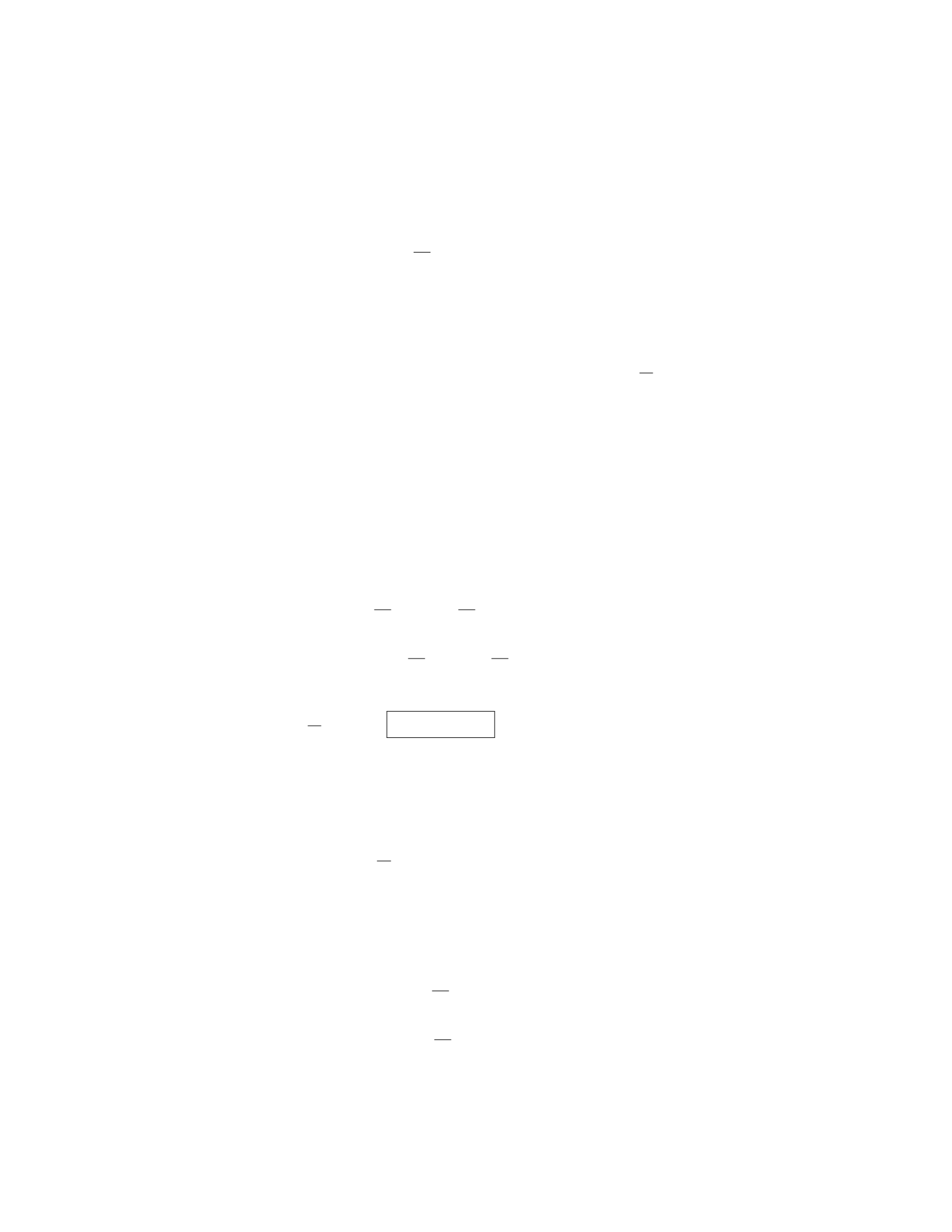
Step 3: Assemble the derivatives of the component functions to find the
derivative of f(x).
d
dx f(x) = 2x
cos(x)
Question 9
Question
Let u= 2x2i+ 3xyjand v= 4xyi+ 3y2jbe two vectors. Find d
dx (u·v).
Solution
Step 1: Compute u·v.
u·v= (2x2i+ 3xyj)·(4xyi+ 3y2j)
= (2x2)(4xy) + (3xy)(3y2)
= 8x3y+ 9x2y3
Step 2: Differentiate with respect to x.
d
dx (u·v) = d
dx (8x3y+ 9x2y3)
=d
dx (8x3y) + d
dx (9x2y3)
= 24x2y+ 18xy3
Therefore, d
dx (u·v) = 24x2y+ 18xy3.
Question 10
Question
Let v=
x2
ex
ln(x)
. Find dv
dx .
Solution
Step 1: Compute the derivative of each component of vwith respect to x.
d
dx x2= 2x
d
dx (ex) = ex
6
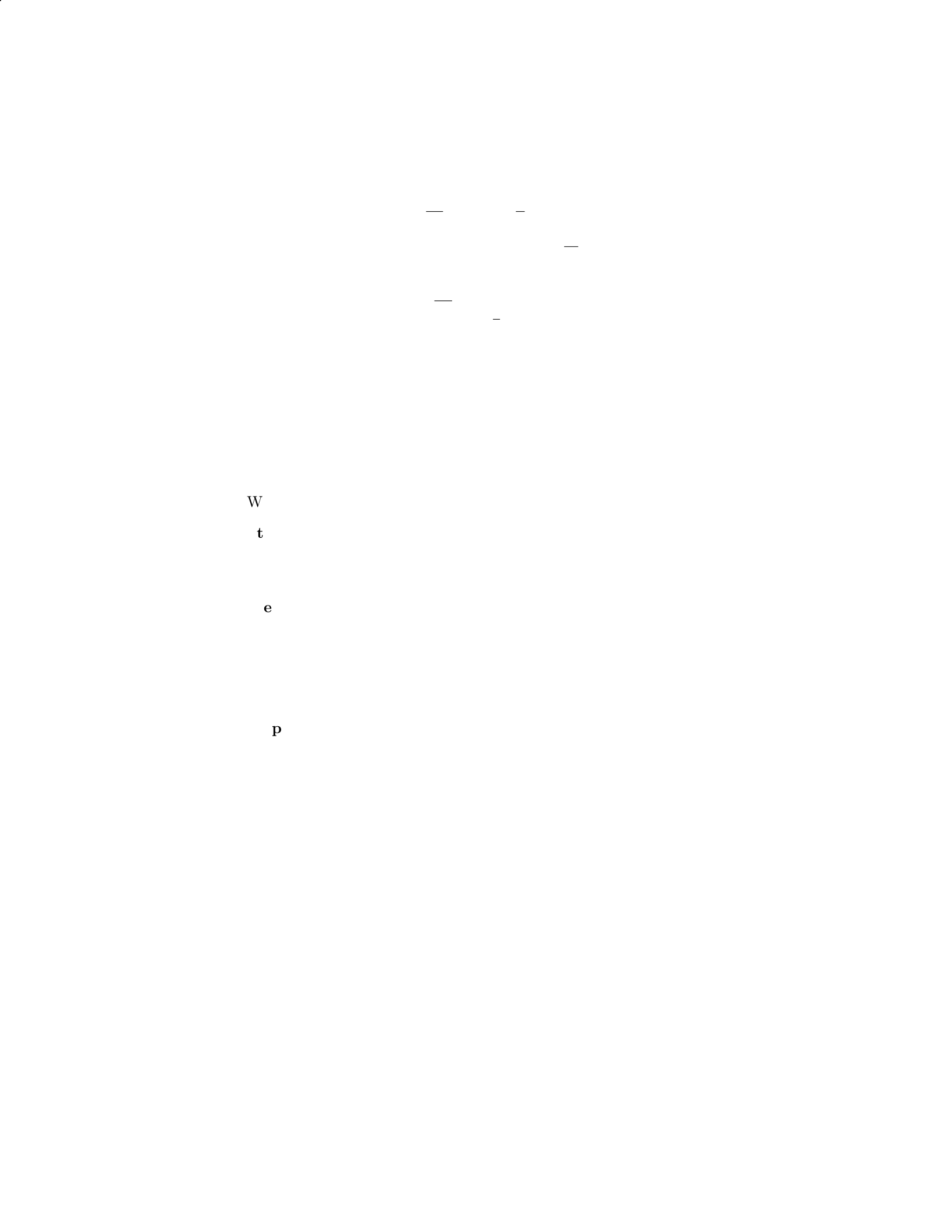
d
dx (ln(x)) = 1
x
Step 2: Assemble the derivatives into the vector dv
dx .
dv
dx =
2x
ex
1
x
Question 11
Question
Let a,b, and cbe vectors in R3. Prove that (a·b)c=c×(a×b)−(c·b)a+(c·a)b.
Solution
We will start by expanding the right-hand side of the equation.
Step 1: Expand c×(a×b) using the vector triple product identity:
c×(a×b) = (c·b)a−(c·a)b
Step 2: Now, we have:
c×(a×b)−(c·b)a+ (c·a)b= ((c·b)a−(c·a)b)−(c·b)a+ (c·a)b
= (c·b)a−(c·b)a+ (c·a)b
=c·b
Step 3: Lastly, we have shown that (a·b)c=c×(a×b)−(c·b)a+(c·a)b,
as required.
Question 12
Question
Let u= 3i−2j+ 4kand v= 2i+ 5j−k.
Find the derivative of the vector function r(t) = u×vwith respect to t.
Solution
Step 1: Find r(t).
r(t) = u×v=
i j k
3−2 4
2 5 −1
r(t)=(i(−2(−1) −5·4) −j(3(−1) −2·4) + k(3 ·5−(−2) ·2))
7

r(t)=(i(2 + 20) −j(−3−8) + k(15 + 4))
r(t) = (22i+ 11j+ 19k)
Step 2: Find dr
dt .
dr
dt =
22
11
19
So, the derivative of the vector function r(t) = u×vwith respect to tis
dr
dt =
22
11
19
.
Question 13
Question
Let v=
3x2
2y
z3
and u=
x+y
2z
xyz
. Find dv
du.
Solution
To find dv
du, we need to compute the Jacobian matrix of vwith respect to u.
Step 1: Write vand uin terms of column vectors:
v=
3x2
2y
z3
and u=
x+y
2z
xyz
Step 2: Compute the partial derivatives of vwith respect to u:
∂v
∂u=
∂v1
∂u1
∂v1
∂u2
∂v1
∂u3
∂v2
∂u1
∂v2
∂u2
∂v2
∂u3
∂v3
∂u1
∂v3
∂u2
∂v3
∂u3
Now, we calculate the partial derivatives of vwith respect to u:
∂v
∂u=
∂v1
∂u1
∂v1
∂u2
∂v1
∂u3
∂v2
∂u1
∂v2
∂u2
∂v2
∂u3
∂v3
∂u1
∂v3
∂u2
∂v3
∂u3
Step 3: Compute the partial derivatives:
∂v
∂u=
3x0 0
0 0 0
0 2 3z2
Therefore, dv
du=
3x0 0
0 0 0
0 2 3z2
.
8

Question 14
Question
Let u= 3i−4j+ 2kand v= 2i−5j+ 3k. Find d
dt (u·v).
Solution
To differentiate the dot product of two vectors with respect to a scalar variable
t, we can use the formula d
dt (u·v) = du
dt ·v+u·dv
dt .
Given that u= 3i−4j+ 2kand v= 2i−5j+ 3k, we can find du
dt and dv
dt as
follows:
Step 1: Find du
dt .
du
dt =d
dt (3i−4j+ 2k) = 0i+ 0j+ 0k=0
Step 2: Find dv
dt .
dv
dt =d
dt (2i−5j+ 3k)=0i+ 0j+ 0k=0
Now, we can substitute these results back into the formula d
dt (u·v) =
du
dt ·v+u·dv
dt .
Since du
dt and dv
dt are both zero vectors, d
dt (u·v) = 0·v+u·0=0.
Therefore, d
dt (u·v) = 0.
Question 15
Question
Let v= 2i−3j+ 5kand u=xi+yj−zk. Find the derivative of v·uwith
respect to x,y, and z.
Solution
To find the derivative of v·uwith respect to x,y, and z, we first need to find
the expression for v·u.
Step 1: Find v·u.
v·u= (2x)+(−3y) + (5z)
Step 2: Take the derivative of v·uwith respect to x.
d
dx (v·u) = 2
9

Step 3: Take the derivative of v·uwith respect to y.
d
dy (v·u) = −3
Step 4: Take the derivative of v·uwith respect to z.
d
dz (v·u)=5
Therefore, the derivative of v·uwith respect to x,y, and zare 2, -3, and
5, respectively.
Question 16
Question
Let v=
3t2
2t
sin(t)
be a vector function. Find dv
dt .
Solution
Step 1: To find dv
dt , we differentiate each component of vwith respect to t
separately.
Step 2: The derivative of the first component 3t2with respect to tis:
d
dt (3t2)=6t
Step 3: The derivative of the second component 2twith respect to tis:
d
dt (2t)=2
Step 4: The derivative of the third component sin(t) with respect to tis:
d
dt (sin(t)) = cos(t)
Step 5: Putting it all together, we have:
dv
dt =
6t
2
cos(t)
Question 17
Question
Let u=x2i+y3jand v= cos (xy)i−ex2j.
Find the derivative of u·vwith respect to x, where iand jare unit vectors
in the xand ydirections, respectively.
10

Solution
To find the derivative of u·vwith respect to x, we first need to compute u·v:
u·v= (x2i+y3j)·(cos (xy)i−ex2
j) = x2cos (xy)−y3ex2
Now, differentiating with respect to x, we have:
d
dx (u·v) = d
dx (x2cos (xy)−y3ex2)
Step 1: Differentiate x2cos (xy) with respect to xusing the product rule:
d
dx (x2cos (xy)) = 2xcos (xy)−x3ysin (xy)
Step 2: Differentiate −y3ex2with respect to x:
d
dx (−y3ex2) = −3y2ex2·2x=−6xy2ex2
Therefore, the derivative of u·vwith respect to xis:
2xcos (xy)−x3ysin (xy)−6xy2ex2
Question 18
Question
Let u= 2i−4j+ 3kand v=i+ 2j−k. Find d(u
·v)dt.
Solution
Step 1: Find the dot product of uand v:
u·v= (2i−4j+ 3k)·(i+ 2j−k)
= 2(1) + (−4)(2) + 3(−1)
= 2 −8−3
=−9
Step 2: Differentiate the dot product with respect to t:
d(u
·v)dt =d(−9)
dt
= 0
Therefore, d(u
·v)dt = 0.
11

Question 19
Question
Let v= 3x2i−4xyj+ 2zk. Find ∇ · v, where ∇is the gradient operator.
Solution
Step 1: The divergence of a vector field vis defined as ∇ · v=∂vx
∂x +∂vy
∂y +∂vz
∂z .
Step 2: Given v= 3x2i−4xyj+ 2zk, we have vx= 3x2,vy=−4xy, and
vz= 2z.
Step 3: Now, let’s calculate the partial derivatives with respect to x,y, and
z:∂vx
∂x =∂(3x2)
∂x = 6x
∂vy
∂y =∂(−4xy)
∂y =−4x
∂vz
∂z =∂(2z)
∂z = 2
Step 4: Finally, we find the divergence of v:
∇ · v=∂vx
∂x +∂vy
∂y +∂vz
∂z = 6x−4x+ 2 = 2x+ 2
Therefore, ∇ · v= 2x+ 2.
Question 20
Question
Let a = 3ˆı−4ˆȷ+ 2ˆ
kand
b= 2ˆı+ 5ˆȷ−ˆ
k. Find d
dt (a ·
b) where a ·
bis the dot
product of vectors a and
b.
Solution
Step 1: Calculate the dot product of vectors a and
b.
a ·
b= (3)(2) + (−4)(5) + (2)(−1)
a ·
b= 6 −20 −2 = −16
Step 2: Differentiate the dot product with respect to tusing the chain rule.
d
dt (a ·
b) = d
dt (−16)
d
dt (a ·
b)=0
Therefore, d
dt (a ·
b) = 0.
12

Question 21
Question
Let v=
x2+y2
yz
xz
be a vector in R3, where x, y, z are differentiable functions
of t. Find dv
dt .
Solution
Step 1: Compute the derivative of each component with respect to tusing the
chain rule:
dv
dt =
d
dt (x2+y2)
d
dt (yz)
d
dt (xz)
Step 2: Compute the derivatives:
d
dt (x2+y2)=2xdx
dt + 2ydy
dt
d
dt (yz) = ydz
dt +zdy
dt
d
dt (xz) = xdz
dt +zdx
dt
Step 3: Substitute the derivatives back into the vector form:
dv
dt =
2xdx
dt + 2ydy
dt
ydz
dt +zdy
dt
xdz
dt +zdx
dt
Therefore, dv
dt =
2xdx
dt + 2ydy
dt
ydz
dt +zdy
dt
xdz
dt +zdx
dt
.
Question 22
Question
Let u(t) =
3t2
e2t
cos(t)
be a vector function. Find du
dt .
13

Solution
Step 1: To find du
dt , we differentiate each component of the vector u(t) with
respect to t.
Step 2: Differentiating the first component, we have
d
dt 3t2= 6t.
Step 3: Differentiating the second component, we get
d
dt e2t= 2e2t.
Step 4: Differentiating the third component, we have
d
dt (cos(t)) = −sin(t).
Step 5: Therefore, the derivative of the vector function u(t) is
du
dt =
6t
2e2t
−sin(t)
.
Question 23
Question
Let u=⟨x2, ex,sin(y)⟩and v=⟨ex, y3, x sin(y)⟩. Compute d
dx (u·v).
Solution
We have u·v=x2ex+exy3+ sin(y)xsin(y) = x2ex+exy3+xsin2(y).
Step 1: Compute the derivative of u·vwith respect to x.
d
dx (u·v) = d
dx (x2ex) + d
dx (exy3) + d
dx (xsin2(y))
Step 2: Use the product rule and chain rule to find the derivatives.
d
dx (x2ex)=2xex+x2ex
d
dx (exy3) = exy3+ 3exy2dy
dx
d
dx (xsin2(y)) = sin2(y) + x(2 sin(y) cos(y)) dy
dx
Step 3: Substitute the derivatives back into the expression.
d
dx (u·v) = (2xex+x2ex) + (exy3+ 3exy2dy
dx ) + (sin2(y) + x(2 sin(y) cos(y)) dy
dx )
Therefore, d
dx (u·v)=2xex+x2ex+exy3+3exy2dy
dx +sin2(y)+x(2 sin(y) cos(y)) dy
dx .
14
Question 24
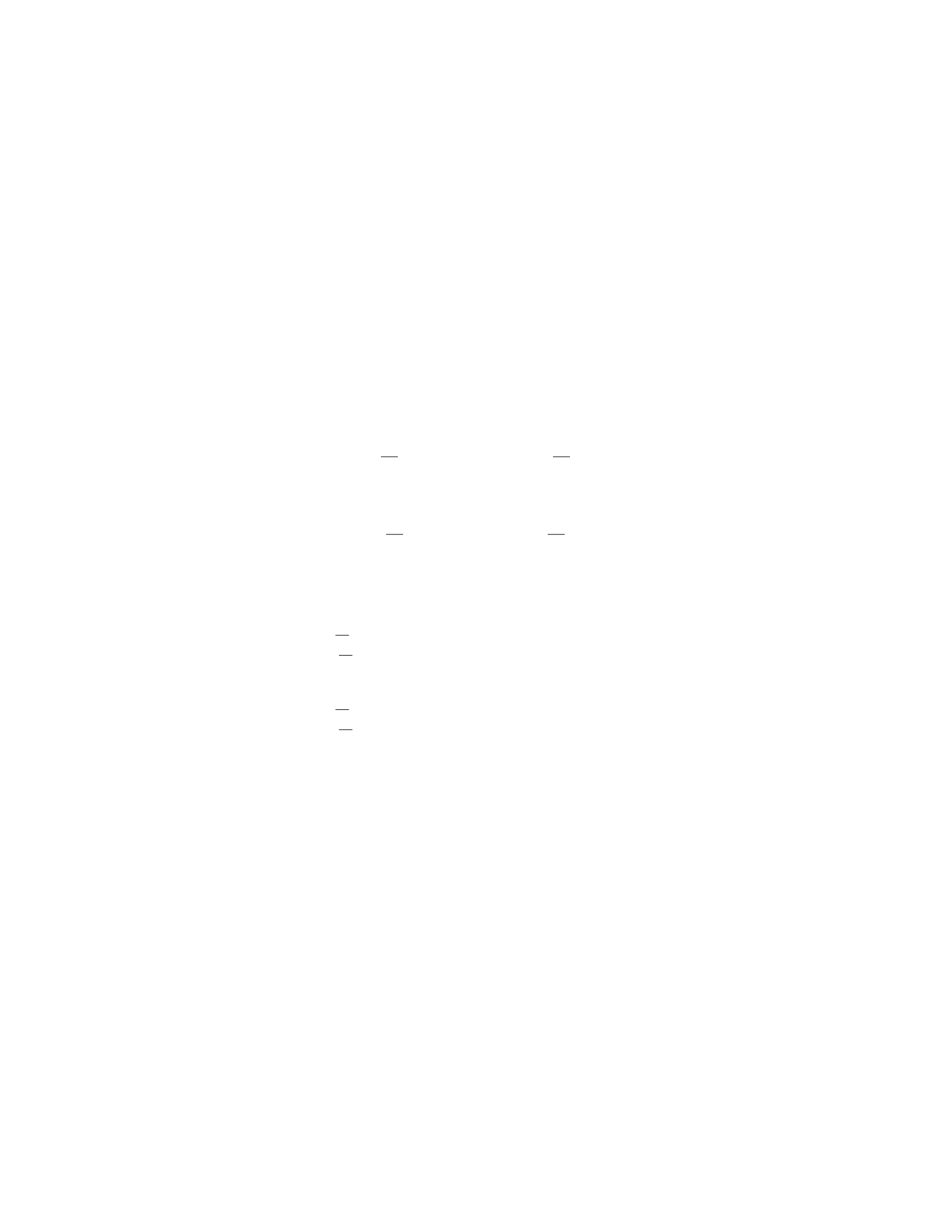
Question
Let v=3x2+ 2xy
x3+y2. Find
dx.
Solution
To find
dx, weneedtodifferentiateeachcomponentofvwithrespecttox.
Step 1: Differentiate the first component of v with respect to x
d
dx (3x2+ 2xy)=6x+ 2ydy
dx
Step 2: Differentiate the second component of v with respect to x
d
dx (x3+y2) = 3x2+ 2ydy
dx
Step 3: Final Answer Putting it all together, we have:
dx = 6x+ 2ydy
dx
3x2+ 2ydy
dx
So,
dx = 6x+ 2ydy
dx
3x2+ 2ydy
dx .
Question 25
Question
Let u= 4i−2j+ 3kand v= 2i+ 5j−k. Find ∇ · (u×v).
Solution
Step 1: Calculate u×v.
u×v=
i j k
4−2 3
2 5 −1
u×v= (−(−2·(−1) −3·5),−(4 ·(−1) −3·2),4·5−(−2·2))
u×v= (7,10,18)
15

Step 2: Calculate ∇ · (u×v).
∇ · F=∂
∂x (7) + ∂
∂y (10) + ∂
∂z (18)
∇ · F= 0 + 0 + 0
∇ · F= 0
Therefore, ∇ · (u×v) = 0.
Question 26
Question
Let u= 2i−3j+ 4kand v=i+ 2j−k. Find d(u·v)
dt , where u·vrepresents the
dot product of vectors uand v.
Solution
Step 1: Calculate d(u·v)
dt using the rule for differentiating dot products.
d(u·v)
dt =u·dv
dt +du
dt ·v
Step 2: Find du
dt and dv
dt .
du
dt =d
dt (2i−3j+ 4k) = d(2)
dt i−d(3)
dt j+d(4)
dt k= 0i−0j+ 0k=0
dv
dt =d
dt (i+ 2j−k) = d(1)
dt i+d(2)
dt j−d(1)
dt k= 0i+ 0j+ 0k=0
Step 3: Substitute du
dt =0and dv
dt =0back into the formula and simplify.
d(u·v)
dt =u·0+0·v=0+0=0
Hence, d(u·v)
dt =0.
Question 27
Question
Let v=
3x2−y
2xy
z2
be a vector function. Find dv
dt .
16

Solution
Step 1: We differentiate each component of the vector function vwith respect
to t.
dv
dt =
d
dt (3x2−y)
d
dt (2xy)
d
dt (z2)
Step 2: Determine the derivatives of each component:
d
dt (3x2−y) = 6xdx
dt −dy
dt
d
dt (2xy)=2ydx
dt + 2xdy
dt
d
dt (z2)=2zdz
dt
Step 3: Substituting these derivatives back in, we have:
dv
dt =
6xdx
dt −dy
dt
2ydx
dt + 2xdy
dt
2zdz
dt
Thus, dv
dt =
6xdx
dt −dy
dt
2ydx
dt + 2xdy
dt
2zdz
dt
.
Question 28
Question
Let f(x, y)=3x2yi+ 2xy2j. Find ∇ · f.
Solution
Step 1: The divergence of a vector field f(x, y) = P(x, y)i+Q(x, y)jis defined
as ∇ · f=∂P
∂x +∂Q
∂y .
Step 2: In this case, P(x, y)=3x2yand Q(x, y)=2xy2.
Step 3: Calculate ∂P
∂x and ∂Q
∂y .
∂P
∂x =∂
∂x (3x2y)=6xy
∂Q
∂y =∂
∂y (2xy2)=2x(2y) = 4xy
Step 4: Find the divergence, ∇ · f=∂P
∂x +∂Q
∂y = 6xy + 4xy = 10xy.
Therefore, the divergence of f(x, y)=3x2yi+ 2xy2jis ∇ · f= 10xy.
17

Question 29
Question
Let u=
3t2
et
cos(t)
and v=
ln(t)
t3
sin(t)
. Find d
dt (u·v).
Solution
Step 1: Calculate the dot product u·v:
u·v= 3t2ln(t) + ett3+ cos(t) sin(t)
Step 2: Differentiate the dot product with respect to t:
d
dt (u·v) = d
dt (3t2ln(t)) + d
dt (ett3) + d
dt (cos(t) sin(t))
Step 3: To differentiate 3t2ln(t), we will use the product rule:
d
dt (3t2ln(t)) = 3 ·2tln(t)+3t2·1
t
Step 4: Simplify the derivative of 3t2ln(t):
d
dt (3t2ln(t)) = 6tln(t)+3t
Step 5: Next, differentiate ett3using the product rule:
d
dt (ett3) = et·3t2+t3·et
Step 6: Simplify the derivative of ett3:
d
dt (ett3) = 3t2et+t3et
Step 7: For d
dt (cos(t) sin(t)), we will use the product rule:
d
dt (cos(t) sin(t)) = −sin(t) sin(t) + cos(t) cos(t)
Step 8: Simplify the derivative of cos(t) sin(t):
d
dt (cos(t) sin(t)) = −sin2(t) + cos2(t)
Step 9: Combine the results of the derivative calculations to find d
dt (u·v):
d
dt (u·v)=6tln(t)+3t+ 3t2et+t3et−sin2(t) + cos2(t)
Therefore, d
dt (u·v)=6tln(t)+3t+ 3t2et+t3et−sin2(t) + cos2(t).
18
Question 30
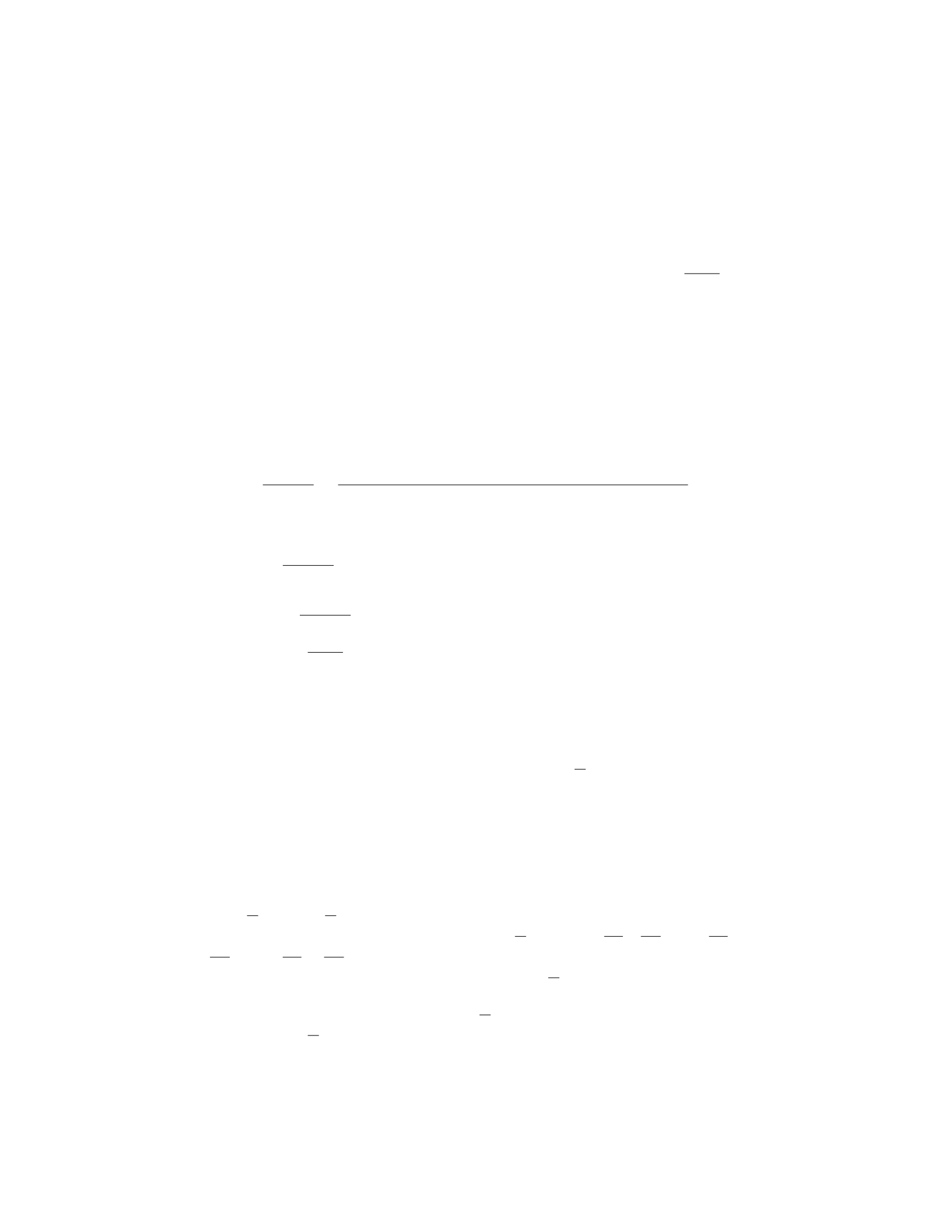
Question
Let u= (3x2+y)i+ (x2+ 2y)jand v= (xy + 2)i+ (3x−y2)j. Find d(u·v)
dx .
Solution
Step 1: Calculate u·v.
u·v= (3x2+y)(xy + 2) + (x2+ 2y)(3x−y2)
= 3x3y+ 6x2+xy2+ 2y+ 3x3−x2y2+ 6xy −2y3
Step 2: Differentiate u·vwith respect to x.
d(u·v)
dx =d(3x3y+ 6x2+xy2+ 2y+ 3x3−x2y2+ 6xy −2y3)
dx
Step 3: Simplify the expression and apply the chain rule as needed.
d(u·v)
dx = 9x2y+ 12x+y2+ 6y+ 9x2−2xy2+ 6y−6y2
d(u·v)
dx = 9x2y+ 9x2−2xy2+ 6y−7y2+ 12x+ 6y
Therefore, d(u·v)
dx = 9x2y+ 9x2−2xy2+ 6y−7y2+ 12x+ 6y.
Question 31
Question
Let u= 3i−2j+ 5kand v=i+ 4j−2k. Determine d
dt (u·v).
Solution
Step 1: Recall that the dot product of two vectors u=u1i+u2j+u3kand
v=v1i+v2j+v3kis given by u·v=u1v1+u2v2+u3v3.
Step 2: In our case, u·v= (3)(1) + (−2)(4) + (5)(−2) = 3 −8−10 = −15.
Step 3: Now, differentiate the dot product with respect to tusing the product
rule: d
dt (u·v) = d
dt (u1v1+u2v2+u3v3).
Step 4: Applying the product rule, we get d
dt (u·v) = u1dv1
dt +du1
dt v1+u2dv2
dt +
du2
dt v2+u3dv3
dt +du3
dt v3.
Step 5: Plugging in the given vectors, we have d
dt (u·v) = 3 ·0 + 0 ·1 + (−2) ·
0+0·4+5·0+0·(−2).
Step 6: Simplifying further, we find d
dt (u·v) = 0.
Therefore, d
dt (u·v) = 0.
19
Question 32
Question
Let v= (2x+y)i+ (x+y2)jbe a vector-valued function. Find
dx.
Solution
Step 1: Recall that for a vector-valued function v=f(x)i+g(x)j, the derivative
dxiscomputedbytakingthederivativeofeachcomponentseparately.
Step 2: Given v= (2x+y)i+ (x+y2)j, we will differentiate each component
with respect to x.
Step 3: For the icomponent, we have
d
dx (2x+y)=2.
Step 4: For the jcomponent, we have
d
dx (x+y2) = 1 + 2ydy
dx .
Step 5: Putting these components together, we get
dx = 2i+ (1 + 2ydydx)j.
Therefore,
dx = i+ (1 + 2ydydx)j.
Question 33
Question
Let v= 3i−2j+4kand u= 2i+5j−kbe two vectors. Determine the derivative
of v·uwith respect to t, where i,j, and kare the standard unit vectors.
Solution
Step 1: Recall that the dot product of two vectors a=a1i+a2j+a3kand
b=b1i+b2j+b3kis given by:
a·b=a1b1+a2b2+a3b3
Step 2: In this case, v·u= (3)(2) + (−2)(5) + (4)(−1) = 6 −10 −4 = −8.
Step 3: To find the derivative of v·uwith respect to t, we differentiate each
component of vand uwith respect to t.
d
dt (v·u) = d
dt (3 ·2−2·5+4·(−1))
20

Step 4: Simplifying, we get:
d
dt (−8) = 0
Step 5: Therefore, the derivative of v·uwith respect to tis 0 .
Question 34
Question
Let v=x2
exand u=ln(y)
y2. Compute the gradient of v·u.
Solution
To compute the gradient of v·u, we will first find the dot product of vand u,
and then take the gradient of the resulting scalar function.
Step 1: Find the dot product of v and u The dot product of two vectors
a=a1
a2and b=b1
b2is given by:
a·b=a1b1+a2b2
For vectors v=x2
exand u=ln(y)
y2, the dot product v·uis:
v·u= (x2)(ln(y)) + (ex)(y2)
Step 2: Compute the gradient The gradient of a scalar function f(x, y)
is given by ∇f="∂f
∂x
∂f
∂y #.
In this case, our scalar function is f(x, y) = v·u= (x2)(ln(y)) + (ex)(y2).
Taking the partial derivative of f(x, y) with respect to xgives:
∂f
∂x = 2xln(y) + exy2
Taking the partial derivative of f(x, y) with respect to ygives:
∂f
∂y =x21
y+ 2exy
Therefore, the gradient of v·uis:
∇(v·u) = 2xln(y) + exy2
x21
y+ 2exy
21

Question 2
Question
Let u=⟨3x2+ 2y, x +y2⟩and v=⟨x3,2xy −3y2⟩. Find d
dx (u·v).
Solution
Step 1: Find u·v:
u·v= (3x2+ 2y)(x3)+(x+y2)(2xy −3y2)
u·v= 3x5+ 2xy + 2y2x3−3y3−2y2x
Step 2: Differentiate u·vwith respect to x:
d
dx (u·v) = d
dx (3x5+ 2xy + 2y2x3−3y3−2y2x)
d
dx (u·v) = 15x4+ 2y+ 6yx2−2y2
Therefore, d
dx (u·v) = 15x4+ 2y+ 6yx2−2y2.
Question 3
Question
Let u= 3i−4j+ 2kand v= 2i+ 5j−3k. Find d
dt (u·v) where uand vare
functions of t.
Solution
Step 1: Compute u·v.
u·v= (3i−4j+ 2k)·(2i+ 5j−3k)
u·v= 3 ·2+(−4) ·5+2·(−3)
u·v= 6 −20 −6
u·v=−20
Step 2: Differentiate the dot product with respect to t.
d
dt (u·v) = d
dt (−20)
d
dt (u·v) = 0
Therefore, d
dt (u·v) = 0.
2

Question 4
Question
Let v= 3x2i+ 2yj−zk. Find dv
dx ,dv
dy , and dv
dz .
Solution
To differentiate a vector with respect to a scalar, we simply differentiate each
component of the vector.
Step 1: Find dvdx Given v= 3x2i+ 2yj−zk, we differentiate each
component with respect to x:
dv
dx =d
dx (3x2i) + d
dx (2yj) + d
dx (−zk)
dv
dx = 6xi+ 0j+ 0k
So, dv
dx = 6xi.
Step 2: Find dvdy Given v= 3x2i+ 2yj−zk, we differentiate each
component with respect to y:
dv
dy =d
dy (3x2i) + d
dy (2yj) + d
dy (−zk)
dv
dy = 0i+ 2j+ 0k
So, dv
dy = 2j.
Step 3: Find dvdz Given v= 3x2i+ 2yj−zk, we differentiate each
component with respect to z:
dv
dz =d
dz (3x2i) + d
dz (2yj) + d
dz (−zk)
dv
dz = 0i+ 0j−1k
So, dv
dz =−k.
Question 5
Question
Let u=
x2
ex
ln(y)
and v=
sin(y)
cos(x)
y2
. Find d(u·v)
dx .
3

Solution
Step 1: Compute u·v.
u·v=x2sin(y) + excos(x) + ln(y)y2
Step 2: Differentiate u·vwith respect to x.
d
dx (u·v) = d
dx (x2sin(y) + excos(x) + ln(y)y2)
Step 3: Differentiate each term separately using the product rule and chain
rule. d
dx (x2sin(y)) = 2xsin(y) + x2cos(y)dy
dx
d
dx (excos(x)) = excos(x)−exsin(x)
d
dx (ln(y)y2) = 1
y
dy
dx y2+ ln(y)2y
Step 4: Substitute the derivatives back into the expression.
d(u·v)
dx = 2xsin(y) + x2cos(y)dy
dx +excos(x)−exsin(x) + 1
y
dy
dx y2+ 2yln(y)
Question 6
Question
Let v= 3x2i−4yj+ 2zk. Find dv
dx .
Solution
To differentiate a vector function with respect to a scalar variable, we simply
differentiate each component separately.
Step 1: Differentiate the xcomponent.
d
dx (3x2)=6x
Step 2: Differentiate the ycomponent.
d
dx (−4y) = 0
Step 3: Differentiate the zcomponent.
d
dx (2z)=0
Therefore, dv
dx = 6xi.
4

Question 7
Question
Let v= 3i+ 2j−kand u= 4i−3j+ 5k. Find d
dt (v·u), where ·denotes the
dot product.
Solution
Step 1: Recall that the dot product of two vectors a=a1i+a2j+a3kand
b=b1i+b2j+b3kis given by a·b=a1b1+a2b2+a3b3.
Step 2: Given vectors v= 3i+ 2j−kand u= 4i−3j+ 5k, the dot product
v·uis:
v·u= (3)(4) + (2)(−3) + (−1)(5)
= 12 −6−5=1
Step 3: To find d
dt (v·u), we differentiate the dot product with respect to t
implicitly:
d
dt (v·u) = d
dt (1)
Step 4: The derivative of a constant with respect to tis always zero, so:
d
dt (v·u) = 0
Therefore, d
dt (v·u) = 0 .
Question 8
Question
Let f(x) = x2
sin(x). Find the derivative of f(x) with respect to x.
Solution
To find the derivative of f(x) with respect to x, we will find the derivative of
each component function separately.
Step 1: Find the derivative of the first component function f1(x) = x2.
d
dx x2= 2x
Step 2: Find the derivative of the second component function f2(x) =
sin(x).
d
dx sin(x) = cos(x)
5
Step 3: Assemble the derivatives of the component functions to find the
derivative of f(x).
d
dx f(x) = 2x
cos(x)
Question 9
Question
Let u= 2x2i+ 3xyjand v= 4xyi+ 3y2jbe two vectors. Find d
dx (u·v).
Solution
Step 1: Compute u·v.
u·v= (2x2i+ 3xyj)·(4xyi+ 3y2j)
= (2x2)(4xy) + (3xy)(3y2)
= 8x3y+ 9x2y3
Step 2: Differentiate with respect to x.
d
dx (u·v) = d
dx (8x3y+ 9x2y3)
=d
dx (8x3y) + d
dx (9x2y3)
= 24x2y+ 18xy3
Therefore, d
dx (u·v) = 24x2y+ 18xy3.
Question 10
Question
Let v=
x2
ex
ln(x)
. Find dv
dx .
Solution
Step 1: Compute the derivative of each component of vwith respect to x.
d
dx x2= 2x
d
dx (ex) = ex
6
d
dx (ln(x)) = 1
x
Step 2: Assemble the derivatives into the vector dv
dx .
dv
dx =
2x
ex
1
x
Question 11
Question
Let a,b, and cbe vectors in R3. Prove that (a·b)c=c×(a×b)−(c·b)a+(c·a)b.
Solution
We will start by expanding the right-hand side of the equation.
Step 1: Expand c×(a×b) using the vector triple product identity:
c×(a×b) = (c·b)a−(c·a)b
Step 2: Now, we have:
c×(a×b)−(c·b)a+ (c·a)b= ((c·b)a−(c·a)b)−(c·b)a+ (c·a)b
= (c·b)a−(c·b)a+ (c·a)b
=c·b
Step 3: Lastly, we have shown that (a·b)c=c×(a×b)−(c·b)a+(c·a)b,
as required.
Question 12
Question
Let u= 3i−2j+ 4kand v= 2i+ 5j−k.
Find the derivative of the vector function r(t) = u×vwith respect to t.
Solution
Step 1: Find r(t).
r(t) = u×v=
i j k
3−2 4
2 5 −1
r(t)=(i(−2(−1) −5·4) −j(3(−1) −2·4) + k(3 ·5−(−2) ·2))
7

r(t)=(i(2 + 20) −j(−3−8) + k(15 + 4))
r(t) = (22i+ 11j+ 19k)
Step 2: Find dr
dt .
dr
dt =
22
11
19
So, the derivative of the vector function r(t) = u×vwith respect to tis
dr
dt =
22
11
19
.
Question 13
Question
Let v=
3x2
2y
z3
and u=
x+y
2z
xyz
. Find dv
du.
Solution
To find dv
du, we need to compute the Jacobian matrix of vwith respect to u.
Step 1: Write vand uin terms of column vectors:
v=
3x2
2y
z3
and u=
x+y
2z
xyz
Step 2: Compute the partial derivatives of vwith respect to u:
∂v
∂u=
∂v1
∂u1
∂v1
∂u2
∂v1
∂u3
∂v2
∂u1
∂v2
∂u2
∂v2
∂u3
∂v3
∂u1
∂v3
∂u2
∂v3
∂u3
Now, we calculate the partial derivatives of vwith respect to u:
∂v
∂u=
∂v1
∂u1
∂v1
∂u2
∂v1
∂u3
∂v2
∂u1
∂v2
∂u2
∂v2
∂u3
∂v3
∂u1
∂v3
∂u2
∂v3
∂u3
Step 3: Compute the partial derivatives:
∂v
∂u=
3x0 0
0 0 0
0 2 3z2
Therefore, dv
du=
3x0 0
0 0 0
0 2 3z2
.
8

Question 14
Question
Let u= 3i−4j+ 2kand v= 2i−5j+ 3k. Find d
dt (u·v).
Solution
To differentiate the dot product of two vectors with respect to a scalar variable
t, we can use the formula d
dt (u·v) = du
dt ·v+u·dv
dt .
Given that u= 3i−4j+ 2kand v= 2i−5j+ 3k, we can find du
dt and dv
dt as
follows:
Step 1: Find du
dt .
du
dt =d
dt (3i−4j+ 2k) = 0i+ 0j+ 0k=0
Step 2: Find dv
dt .
dv
dt =d
dt (2i−5j+ 3k)=0i+ 0j+ 0k=0
Now, we can substitute these results back into the formula d
dt (u·v) =
du
dt ·v+u·dv
dt .
Since du
dt and dv
dt are both zero vectors, d
dt (u·v) = 0·v+u·0=0.
Therefore, d
dt (u·v) = 0.
Question 15
Question
Let v= 2i−3j+ 5kand u=xi+yj−zk. Find the derivative of v·uwith
respect to x,y, and z.
Solution
To find the derivative of v·uwith respect to x,y, and z, we first need to find
the expression for v·u.
Step 1: Find v·u.
v·u= (2x)+(−3y) + (5z)
Step 2: Take the derivative of v·uwith respect to x.
d
dx (v·u) = 2
9

Step 3: Take the derivative of v·uwith respect to y.
d
dy (v·u) = −3
Step 4: Take the derivative of v·uwith respect to z.
d
dz (v·u)=5
Therefore, the derivative of v·uwith respect to x,y, and zare 2, -3, and
5, respectively.
Question 16
Question
Let v=
3t2
2t
sin(t)
be a vector function. Find dv
dt .
Solution
Step 1: To find dv
dt , we differentiate each component of vwith respect to t
separately.
Step 2: The derivative of the first component 3t2with respect to tis:
d
dt (3t2)=6t
Step 3: The derivative of the second component 2twith respect to tis:
d
dt (2t)=2
Step 4: The derivative of the third component sin(t) with respect to tis:
d
dt (sin(t)) = cos(t)
Step 5: Putting it all together, we have:
dv
dt =
6t
2
cos(t)
Question 17
Question
Let u=x2i+y3jand v= cos (xy)i−ex2j.
Find the derivative of u·vwith respect to x, where iand jare unit vectors
in the xand ydirections, respectively.
10

Solution
To find the derivative of u·vwith respect to x, we first need to compute u·v:
u·v= (x2i+y3j)·(cos (xy)i−ex2
j) = x2cos (xy)−y3ex2
Now, differentiating with respect to x, we have:
d
dx (u·v) = d
dx (x2cos (xy)−y3ex2)
Step 1: Differentiate x2cos (xy) with respect to xusing the product rule:
d
dx (x2cos (xy)) = 2xcos (xy)−x3ysin (xy)
Step 2: Differentiate −y3ex2with respect to x:
d
dx (−y3ex2) = −3y2ex2·2x=−6xy2ex2
Therefore, the derivative of u·vwith respect to xis:
2xcos (xy)−x3ysin (xy)−6xy2ex2
Question 18
Question
Let u= 2i−4j+ 3kand v=i+ 2j−k. Find d(u
·v)dt.
Solution
Step 1: Find the dot product of uand v:
u·v= (2i−4j+ 3k)·(i+ 2j−k)
= 2(1) + (−4)(2) + 3(−1)
= 2 −8−3
=−9
Step 2: Differentiate the dot product with respect to t:
d(u
·v)dt =d(−9)
dt
= 0
Therefore, d(u
·v)dt = 0.
11

Question 19
Question
Let v= 3x2i−4xyj+ 2zk. Find ∇ · v, where ∇is the gradient operator.
Solution
Step 1: The divergence of a vector field vis defined as ∇ · v=∂vx
∂x +∂vy
∂y +∂vz
∂z .
Step 2: Given v= 3x2i−4xyj+ 2zk, we have vx= 3x2,vy=−4xy, and
vz= 2z.
Step 3: Now, let’s calculate the partial derivatives with respect to x,y, and
z:∂vx
∂x =∂(3x2)
∂x = 6x
∂vy
∂y =∂(−4xy)
∂y =−4x
∂vz
∂z =∂(2z)
∂z = 2
Step 4: Finally, we find the divergence of v:
∇ · v=∂vx
∂x +∂vy
∂y +∂vz
∂z = 6x−4x+ 2 = 2x+ 2
Therefore, ∇ · v= 2x+ 2.
Question 20
Question
Let a = 3ˆı−4ˆȷ+ 2ˆ
kand
b= 2ˆı+ 5ˆȷ−ˆ
k. Find d
dt (a ·
b) where a ·
bis the dot
product of vectors a and
b.
Solution
Step 1: Calculate the dot product of vectors a and
b.
a ·
b= (3)(2) + (−4)(5) + (2)(−1)
a ·
b= 6 −20 −2 = −16
Step 2: Differentiate the dot product with respect to tusing the chain rule.
d
dt (a ·
b) = d
dt (−16)
d
dt (a ·
b)=0
Therefore, d
dt (a ·
b) = 0.
12

Question 21
Question
Let v=
x2+y2
yz
xz
be a vector in R3, where x, y, z are differentiable functions
of t. Find dv
dt .
Solution
Step 1: Compute the derivative of each component with respect to tusing the
chain rule:
dv
dt =
d
dt (x2+y2)
d
dt (yz)
d
dt (xz)
Step 2: Compute the derivatives:
d
dt (x2+y2)=2xdx
dt + 2ydy
dt
d
dt (yz) = ydz
dt +zdy
dt
d
dt (xz) = xdz
dt +zdx
dt
Step 3: Substitute the derivatives back into the vector form:
dv
dt =
2xdx
dt + 2ydy
dt
ydz
dt +zdy
dt
xdz
dt +zdx
dt
Therefore, dv
dt =
2xdx
dt + 2ydy
dt
ydz
dt +zdy
dt
xdz
dt +zdx
dt
.
Question 22
Question
Let u(t) =
3t2
e2t
cos(t)
be a vector function. Find du
dt .
13

Solution
Step 1: To find du
dt , we differentiate each component of the vector u(t) with
respect to t.
Step 2: Differentiating the first component, we have
d
dt 3t2= 6t.
Step 3: Differentiating the second component, we get
d
dt e2t= 2e2t.
Step 4: Differentiating the third component, we have
d
dt (cos(t)) = −sin(t).
Step 5: Therefore, the derivative of the vector function u(t) is
du
dt =
6t
2e2t
−sin(t)
.
Question 23
Question
Let u=⟨x2, ex,sin(y)⟩and v=⟨ex, y3, x sin(y)⟩. Compute d
dx (u·v).
Solution
We have u·v=x2ex+exy3+ sin(y)xsin(y) = x2ex+exy3+xsin2(y).
Step 1: Compute the derivative of u·vwith respect to x.
d
dx (u·v) = d
dx (x2ex) + d
dx (exy3) + d
dx (xsin2(y))
Step 2: Use the product rule and chain rule to find the derivatives.
d
dx (x2ex)=2xex+x2ex
d
dx (exy3) = exy3+ 3exy2dy
dx
d
dx (xsin2(y)) = sin2(y) + x(2 sin(y) cos(y)) dy
dx
Step 3: Substitute the derivatives back into the expression.
d
dx (u·v) = (2xex+x2ex) + (exy3+ 3exy2dy
dx ) + (sin2(y) + x(2 sin(y) cos(y)) dy
dx )
Therefore, d
dx (u·v)=2xex+x2ex+exy3+3exy2dy
dx +sin2(y)+x(2 sin(y) cos(y)) dy
dx .
14
Question 24
Question
Let v=3x2+ 2xy
x3+y2. Find
dx.
Solution
To find
dx, weneedtodifferentiateeachcomponentofvwithrespecttox.
Step 1: Differentiate the first component of v with respect to x
d
dx (3x2+ 2xy)=6x+ 2ydy
dx
Step 2: Differentiate the second component of v with respect to x
d
dx (x3+y2) = 3x2+ 2ydy
dx
Step 3: Final Answer Putting it all together, we have:
dx = 6x+ 2ydy
dx
3x2+ 2ydy
dx
So,
dx = 6x+ 2ydy
dx
3x2+ 2ydy
dx .
Question 25
Question
Let u= 4i−2j+ 3kand v= 2i+ 5j−k. Find ∇ · (u×v).
Solution
Step 1: Calculate u×v.
u×v=
i j k
4−2 3
2 5 −1
u×v= (−(−2·(−1) −3·5),−(4 ·(−1) −3·2),4·5−(−2·2))
u×v= (7,10,18)
15

Step 2: Calculate ∇ · (u×v).
∇ · F=∂
∂x (7) + ∂
∂y (10) + ∂
∂z (18)
∇ · F= 0 + 0 + 0
∇ · F= 0
Therefore, ∇ · (u×v) = 0.
Question 26
Question
Let u= 2i−3j+ 4kand v=i+ 2j−k. Find d(u·v)
dt , where u·vrepresents the
dot product of vectors uand v.
Solution
Step 1: Calculate d(u·v)
dt using the rule for differentiating dot products.
d(u·v)
dt =u·dv
dt +du
dt ·v
Step 2: Find du
dt and dv
dt .
du
dt =d
dt (2i−3j+ 4k) = d(2)
dt i−d(3)
dt j+d(4)
dt k= 0i−0j+ 0k=0
dv
dt =d
dt (i+ 2j−k) = d(1)
dt i+d(2)
dt j−d(1)
dt k= 0i+ 0j+ 0k=0
Step 3: Substitute du
dt =0and dv
dt =0back into the formula and simplify.
d(u·v)
dt =u·0+0·v=0+0=0
Hence, d(u·v)
dt =0.
Question 27
Question
Let v=
3x2−y
2xy
z2
be a vector function. Find dv
dt .
16

Solution
Step 1: We differentiate each component of the vector function vwith respect
to t.
dv
dt =
d
dt (3x2−y)
d
dt (2xy)
d
dt (z2)
Step 2: Determine the derivatives of each component:
d
dt (3x2−y) = 6xdx
dt −dy
dt
d
dt (2xy)=2ydx
dt + 2xdy
dt
d
dt (z2)=2zdz
dt
Step 3: Substituting these derivatives back in, we have:
dv
dt =
6xdx
dt −dy
dt
2ydx
dt + 2xdy
dt
2zdz
dt
Thus, dv
dt =
6xdx
dt −dy
dt
2ydx
dt + 2xdy
dt
2zdz
dt
.
Question 28
Question
Let f(x, y)=3x2yi+ 2xy2j. Find ∇ · f.
Solution
Step 1: The divergence of a vector field f(x, y) = P(x, y)i+Q(x, y)jis defined
as ∇ · f=∂P
∂x +∂Q
∂y .
Step 2: In this case, P(x, y)=3x2yand Q(x, y)=2xy2.
Step 3: Calculate ∂P
∂x and ∂Q
∂y .
∂P
∂x =∂
∂x (3x2y)=6xy
∂Q
∂y =∂
∂y (2xy2)=2x(2y) = 4xy
Step 4: Find the divergence, ∇ · f=∂P
∂x +∂Q
∂y = 6xy + 4xy = 10xy.
Therefore, the divergence of f(x, y)=3x2yi+ 2xy2jis ∇ · f= 10xy.
17

Question 29
Question
Let u=
3t2
et
cos(t)
and v=
ln(t)
t3
sin(t)
. Find d
dt (u·v).
Solution
Step 1: Calculate the dot product u·v:
u·v= 3t2ln(t) + ett3+ cos(t) sin(t)
Step 2: Differentiate the dot product with respect to t:
d
dt (u·v) = d
dt (3t2ln(t)) + d
dt (ett3) + d
dt (cos(t) sin(t))
Step 3: To differentiate 3t2ln(t), we will use the product rule:
d
dt (3t2ln(t)) = 3 ·2tln(t)+3t2·1
t
Step 4: Simplify the derivative of 3t2ln(t):
d
dt (3t2ln(t)) = 6tln(t)+3t
Step 5: Next, differentiate ett3using the product rule:
d
dt (ett3) = et·3t2+t3·et
Step 6: Simplify the derivative of ett3:
d
dt (ett3) = 3t2et+t3et
Step 7: For d
dt (cos(t) sin(t)), we will use the product rule:
d
dt (cos(t) sin(t)) = −sin(t) sin(t) + cos(t) cos(t)
Step 8: Simplify the derivative of cos(t) sin(t):
d
dt (cos(t) sin(t)) = −sin2(t) + cos2(t)
Step 9: Combine the results of the derivative calculations to find d
dt (u·v):
d
dt (u·v)=6tln(t)+3t+ 3t2et+t3et−sin2(t) + cos2(t)
Therefore, d
dt (u·v)=6tln(t)+3t+ 3t2et+t3et−sin2(t) + cos2(t).
18
Question 30
Question
Let u= (3x2+y)i+ (x2+ 2y)jand v= (xy + 2)i+ (3x−y2)j. Find d(u·v)
dx .
Solution
Step 1: Calculate u·v.
u·v= (3x2+y)(xy + 2) + (x2+ 2y)(3x−y2)
= 3x3y+ 6x2+xy2+ 2y+ 3x3−x2y2+ 6xy −2y3
Step 2: Differentiate u·vwith respect to x.
d(u·v)
dx =d(3x3y+ 6x2+xy2+ 2y+ 3x3−x2y2+ 6xy −2y3)
dx
Step 3: Simplify the expression and apply the chain rule as needed.
d(u·v)
dx = 9x2y+ 12x+y2+ 6y+ 9x2−2xy2+ 6y−6y2
d(u·v)
dx = 9x2y+ 9x2−2xy2+ 6y−7y2+ 12x+ 6y
Therefore, d(u·v)
dx = 9x2y+ 9x2−2xy2+ 6y−7y2+ 12x+ 6y.
Question 31
Question
Let u= 3i−2j+ 5kand v=i+ 4j−2k. Determine d
dt (u·v).
Solution
Step 1: Recall that the dot product of two vectors u=u1i+u2j+u3kand
v=v1i+v2j+v3kis given by u·v=u1v1+u2v2+u3v3.
Step 2: In our case, u·v= (3)(1) + (−2)(4) + (5)(−2) = 3 −8−10 = −15.
Step 3: Now, differentiate the dot product with respect to tusing the product
rule: d
dt (u·v) = d
dt (u1v1+u2v2+u3v3).
Step 4: Applying the product rule, we get d
dt (u·v) = u1dv1
dt +du1
dt v1+u2dv2
dt +
du2
dt v2+u3dv3
dt +du3
dt v3.
Step 5: Plugging in the given vectors, we have d
dt (u·v) = 3 ·0 + 0 ·1 + (−2) ·
0+0·4+5·0+0·(−2).
Step 6: Simplifying further, we find d
dt (u·v) = 0.
Therefore, d
dt (u·v) = 0.
19
Question 32
Question
Let v= (2x+y)i+ (x+y2)jbe a vector-valued function. Find
dx.
Solution
Step 1: Recall that for a vector-valued function v=f(x)i+g(x)j, the derivative
dxiscomputedbytakingthederivativeofeachcomponentseparately.
Step 2: Given v= (2x+y)i+ (x+y2)j, we will differentiate each component
with respect to x.
Step 3: For the icomponent, we have
d
dx (2x+y)=2.
Step 4: For the jcomponent, we have
d
dx (x+y2) = 1 + 2ydy
dx .
Step 5: Putting these components together, we get
dx = 2i+ (1 + 2ydydx)j.
Therefore,
dx = i+ (1 + 2ydydx)j.
Question 33
Question
Let v= 3i−2j+4kand u= 2i+5j−kbe two vectors. Determine the derivative
of v·uwith respect to t, where i,j, and kare the standard unit vectors.
Solution
Step 1: Recall that the dot product of two vectors a=a1i+a2j+a3kand
b=b1i+b2j+b3kis given by:
a·b=a1b1+a2b2+a3b3
Step 2: In this case, v·u= (3)(2) + (−2)(5) + (4)(−1) = 6 −10 −4 = −8.
Step 3: To find the derivative of v·uwith respect to t, we differentiate each
component of vand uwith respect to t.
d
dt (v·u) = d
dt (3 ·2−2·5+4·(−1))
20

Step 4: Simplifying, we get:
d
dt (−8) = 0
Step 5: Therefore, the derivative of v·uwith respect to tis 0 .
Question 34
Question
Let v=x2
exand u=ln(y)
y2. Compute the gradient of v·u.
Solution
To compute the gradient of v·u, we will first find the dot product of vand u,
and then take the gradient of the resulting scalar function.
Step 1: Find the dot product of v and u The dot product of two vectors
a=a1
a2and b=b1
b2is given by:
a·b=a1b1+a2b2
For vectors v=x2
exand u=ln(y)
y2, the dot product v·uis:
v·u= (x2)(ln(y)) + (ex)(y2)
Step 2: Compute the gradient The gradient of a scalar function f(x, y)
is given by ∇f="∂f
∂x
∂f
∂y #.
In this case, our scalar function is f(x, y) = v·u= (x2)(ln(y)) + (ex)(y2).
Taking the partial derivative of f(x, y) with respect to xgives:
∂f
∂x = 2xln(y) + exy2
Taking the partial derivative of f(x, y) with respect to ygives:
∂f
∂y =x21
y+ 2exy
Therefore, the gradient of v·uis:
∇(v·u) = 2xln(y) + exy2
x21
y+ 2exy
21

Question 2
Question
Let u=⟨3x2+ 2y, x +y2⟩and v=⟨x3,2xy −3y2⟩. Find d
dx (u·v).
Solution
Step 1: Find u·v:
u·v= (3x2+ 2y)(x3)+(x+y2)(2xy −3y2)
u·v= 3x5+ 2xy + 2y2x3−3y3−2y2x
Step 2: Differentiate u·vwith respect to x:
d
dx (u·v) = d
dx (3x5+ 2xy + 2y2x3−3y3−2y2x)
d
dx (u·v) = 15x4+ 2y+ 6yx2−2y2
Therefore, d
dx (u·v) = 15x4+ 2y+ 6yx2−2y2.
Question 3
Question
Let u= 3i−4j+ 2kand v= 2i+ 5j−3k. Find d
dt (u·v) where uand vare
functions of t.
Solution
Step 1: Compute u·v.
u·v= (3i−4j+ 2k)·(2i+ 5j−3k)
u·v= 3 ·2+(−4) ·5+2·(−3)
u·v= 6 −20 −6
u·v=−20
Step 2: Differentiate the dot product with respect to t.
d
dt (u·v) = d
dt (−20)
d
dt (u·v) = 0
Therefore, d
dt (u·v) = 0.
2

Question 4
Question
Let v= 3x2i+ 2yj−zk. Find dv
dx ,dv
dy , and dv
dz .
Solution
To differentiate a vector with respect to a scalar, we simply differentiate each
component of the vector.
Step 1: Find dvdx Given v= 3x2i+ 2yj−zk, we differentiate each
component with respect to x:
dv
dx =d
dx (3x2i) + d
dx (2yj) + d
dx (−zk)
dv
dx = 6xi+ 0j+ 0k
So, dv
dx = 6xi.
Step 2: Find dvdy Given v= 3x2i+ 2yj−zk, we differentiate each
component with respect to y:
dv
dy =d
dy (3x2i) + d
dy (2yj) + d
dy (−zk)
dv
dy = 0i+ 2j+ 0k
So, dv
dy = 2j.
Step 3: Find dvdz Given v= 3x2i+ 2yj−zk, we differentiate each
component with respect to z:
dv
dz =d
dz (3x2i) + d
dz (2yj) + d
dz (−zk)
dv
dz = 0i+ 0j−1k
So, dv
dz =−k.
Question 5
Question
Let u=
x2
ex
ln(y)
and v=
sin(y)
cos(x)
y2
. Find d(u·v)
dx .
3

Solution
Step 1: Compute u·v.
u·v=x2sin(y) + excos(x) + ln(y)y2
Step 2: Differentiate u·vwith respect to x.
d
dx (u·v) = d
dx (x2sin(y) + excos(x) + ln(y)y2)
Step 3: Differentiate each term separately using the product rule and chain
rule. d
dx (x2sin(y)) = 2xsin(y) + x2cos(y)dy
dx
d
dx (excos(x)) = excos(x)−exsin(x)
d
dx (ln(y)y2) = 1
y
dy
dx y2+ ln(y)2y
Step 4: Substitute the derivatives back into the expression.
d(u·v)
dx = 2xsin(y) + x2cos(y)dy
dx +excos(x)−exsin(x) + 1
y
dy
dx y2+ 2yln(y)
Question 6
Question
Let v= 3x2i−4yj+ 2zk. Find dv
dx .
Solution
To differentiate a vector function with respect to a scalar variable, we simply
differentiate each component separately.
Step 1: Differentiate the xcomponent.
d
dx (3x2)=6x
Step 2: Differentiate the ycomponent.
d
dx (−4y) = 0
Step 3: Differentiate the zcomponent.
d
dx (2z)=0
Therefore, dv
dx = 6xi.
4

Question 7
Question
Let v= 3i+ 2j−kand u= 4i−3j+ 5k. Find d
dt (v·u), where ·denotes the
dot product.
Solution
Step 1: Recall that the dot product of two vectors a=a1i+a2j+a3kand
b=b1i+b2j+b3kis given by a·b=a1b1+a2b2+a3b3.
Step 2: Given vectors v= 3i+ 2j−kand u= 4i−3j+ 5k, the dot product
v·uis:
v·u= (3)(4) + (2)(−3) + (−1)(5)
= 12 −6−5=1
Step 3: To find d
dt (v·u), we differentiate the dot product with respect to t
implicitly:
d
dt (v·u) = d
dt (1)
Step 4: The derivative of a constant with respect to tis always zero, so:
d
dt (v·u) = 0
Therefore, d
dt (v·u) = 0 .
Question 8
Question
Let f(x) = x2
sin(x). Find the derivative of f(x) with respect to x.
Solution
To find the derivative of f(x) with respect to x, we will find the derivative of
each component function separately.
Step 1: Find the derivative of the first component function f1(x) = x2.
d
dx x2= 2x
Step 2: Find the derivative of the second component function f2(x) =
sin(x).
d
dx sin(x) = cos(x)
5

Step 3: Assemble the derivatives of the component functions to find the
derivative of f(x).
d
dx f(x) = 2x
cos(x)
Question 9
Question
Let u= 2x2i+ 3xyjand v= 4xyi+ 3y2jbe two vectors. Find d
dx (u·v).
Solution
Step 1: Compute u·v.
u·v= (2x2i+ 3xyj)·(4xyi+ 3y2j)
= (2x2)(4xy) + (3xy)(3y2)
= 8x3y+ 9x2y3
Step 2: Differentiate with respect to x.
d
dx (u·v) = d
dx (8x3y+ 9x2y3)
=d
dx (8x3y) + d
dx (9x2y3)
= 24x2y+ 18xy3
Therefore, d
dx (u·v) = 24x2y+ 18xy3.
Question 10
Question
Let v=
x2
ex
ln(x)
. Find dv
dx .
Solution
Step 1: Compute the derivative of each component of vwith respect to x.
d
dx x2= 2x
d
dx (ex) = ex
6

d
dx (ln(x)) = 1
x
Step 2: Assemble the derivatives into the vector dv
dx .
dv
dx =
2x
ex
1
x
Question 11
Question
Let a,b, and cbe vectors in R3. Prove that (a·b)c=c×(a×b)−(c·b)a+(c·a)b.
Solution
We will start by expanding the right-hand side of the equation.
Step 1: Expand c×(a×b) using the vector triple product identity:
c×(a×b) = (c·b)a−(c·a)b
Step 2: Now, we have:
c×(a×b)−(c·b)a+ (c·a)b= ((c·b)a−(c·a)b)−(c·b)a+ (c·a)b
= (c·b)a−(c·b)a+ (c·a)b
=c·b
Step 3: Lastly, we have shown that (a·b)c=c×(a×b)−(c·b)a+(c·a)b,
as required.
Question 12
Question
Let u= 3i−2j+ 4kand v= 2i+ 5j−k.
Find the derivative of the vector function r(t) = u×vwith respect to t.
Solution
Step 1: Find r(t).
r(t) = u×v=
i j k
3−2 4
2 5 −1
r(t)=(i(−2(−1) −5·4) −j(3(−1) −2·4) + k(3 ·5−(−2) ·2))
7

r(t)=(i(2 + 20) −j(−3−8) + k(15 + 4))
r(t) = (22i+ 11j+ 19k)
Step 2: Find dr
dt .
dr
dt =
22
11
19
So, the derivative of the vector function r(t) = u×vwith respect to tis
dr
dt =
22
11
19
.
Question 13
Question
Let v=
3x2
2y
z3
and u=
x+y
2z
xyz
. Find dv
du.
Solution
To find dv
du, we need to compute the Jacobian matrix of vwith respect to u.
Step 1: Write vand uin terms of column vectors:
v=
3x2
2y
z3
and u=
x+y
2z
xyz
Step 2: Compute the partial derivatives of vwith respect to u:
∂v
∂u=
∂v1
∂u1
∂v1
∂u2
∂v1
∂u3
∂v2
∂u1
∂v2
∂u2
∂v2
∂u3
∂v3
∂u1
∂v3
∂u2
∂v3
∂u3
Now, we calculate the partial derivatives of vwith respect to u:
∂v
∂u=
∂v1
∂u1
∂v1
∂u2
∂v1
∂u3
∂v2
∂u1
∂v2
∂u2
∂v2
∂u3
∂v3
∂u1
∂v3
∂u2
∂v3
∂u3
Step 3: Compute the partial derivatives:
∂v
∂u=
3x0 0
0 0 0
0 2 3z2
Therefore, dv
du=
3x0 0
0 0 0
0 2 3z2
.
8

Question 14
Question
Let u= 3i−4j+ 2kand v= 2i−5j+ 3k. Find d
dt (u·v).
Solution
To differentiate the dot product of two vectors with respect to a scalar variable
t, we can use the formula d
dt (u·v) = du
dt ·v+u·dv
dt .
Given that u= 3i−4j+ 2kand v= 2i−5j+ 3k, we can find du
dt and dv
dt as
follows:
Step 1: Find du
dt .
du
dt =d
dt (3i−4j+ 2k) = 0i+ 0j+ 0k=0
Step 2: Find dv
dt .
dv
dt =d
dt (2i−5j+ 3k)=0i+ 0j+ 0k=0
Now, we can substitute these results back into the formula d
dt (u·v) =
du
dt ·v+u·dv
dt .
Since du
dt and dv
dt are both zero vectors, d
dt (u·v) = 0·v+u·0=0.
Therefore, d
dt (u·v) = 0.
Question 15
Question
Let v= 2i−3j+ 5kand u=xi+yj−zk. Find the derivative of v·uwith
respect to x,y, and z.
Solution
To find the derivative of v·uwith respect to x,y, and z, we first need to find
the expression for v·u.
Step 1: Find v·u.
v·u= (2x)+(−3y) + (5z)
Step 2: Take the derivative of v·uwith respect to x.
d
dx (v·u) = 2
9

Step 3: Take the derivative of v·uwith respect to y.
d
dy (v·u) = −3
Step 4: Take the derivative of v·uwith respect to z.
d
dz (v·u)=5
Therefore, the derivative of v·uwith respect to x,y, and zare 2, -3, and
5, respectively.
Question 16
Question
Let v=
3t2
2t
sin(t)
be a vector function. Find dv
dt .
Solution
Step 1: To find dv
dt , we differentiate each component of vwith respect to t
separately.
Step 2: The derivative of the first component 3t2with respect to tis:
d
dt (3t2)=6t
Step 3: The derivative of the second component 2twith respect to tis:
d
dt (2t)=2
Step 4: The derivative of the third component sin(t) with respect to tis:
d
dt (sin(t)) = cos(t)
Step 5: Putting it all together, we have:
dv
dt =
6t
2
cos(t)
Question 17
Question
Let u=x2i+y3jand v= cos (xy)i−ex2j.
Find the derivative of u·vwith respect to x, where iand jare unit vectors
in the xand ydirections, respectively.
10

Solution
To find the derivative of u·vwith respect to x, we first need to compute u·v:
u·v= (x2i+y3j)·(cos (xy)i−ex2
j) = x2cos (xy)−y3ex2
Now, differentiating with respect to x, we have:
d
dx (u·v) = d
dx (x2cos (xy)−y3ex2)
Step 1: Differentiate x2cos (xy) with respect to xusing the product rule:
d
dx (x2cos (xy)) = 2xcos (xy)−x3ysin (xy)
Step 2: Differentiate −y3ex2with respect to x:
d
dx (−y3ex2) = −3y2ex2·2x=−6xy2ex2
Therefore, the derivative of u·vwith respect to xis:
2xcos (xy)−x3ysin (xy)−6xy2ex2
Question 18
Question
Let u= 2i−4j+ 3kand v=i+ 2j−k. Find d(u
·v)dt.
Solution
Step 1: Find the dot product of uand v:
u·v= (2i−4j+ 3k)·(i+ 2j−k)
= 2(1) + (−4)(2) + 3(−1)
= 2 −8−3
=−9
Step 2: Differentiate the dot product with respect to t:
d(u
·v)dt =d(−9)
dt
= 0
Therefore, d(u
·v)dt = 0.
11

Question 19
Question
Let v= 3x2i−4xyj+ 2zk. Find ∇ · v, where ∇is the gradient operator.
Solution
Step 1: The divergence of a vector field vis defined as ∇ · v=∂vx
∂x +∂vy
∂y +∂vz
∂z .
Step 2: Given v= 3x2i−4xyj+ 2zk, we have vx= 3x2,vy=−4xy, and
vz= 2z.
Step 3: Now, let’s calculate the partial derivatives with respect to x,y, and
z:∂vx
∂x =∂(3x2)
∂x = 6x
∂vy
∂y =∂(−4xy)
∂y =−4x
∂vz
∂z =∂(2z)
∂z = 2
Step 4: Finally, we find the divergence of v:
∇ · v=∂vx
∂x +∂vy
∂y +∂vz
∂z = 6x−4x+ 2 = 2x+ 2
Therefore, ∇ · v= 2x+ 2.
Question 20
Question
Let a = 3ˆı−4ˆȷ+ 2ˆ
kand
b= 2ˆı+ 5ˆȷ−ˆ
k. Find d
dt (a ·
b) where a ·
bis the dot
product of vectors a and
b.
Solution
Step 1: Calculate the dot product of vectors a and
b.
a ·
b= (3)(2) + (−4)(5) + (2)(−1)
a ·
b= 6 −20 −2 = −16
Step 2: Differentiate the dot product with respect to tusing the chain rule.
d
dt (a ·
b) = d
dt (−16)
d
dt (a ·
b)=0
Therefore, d
dt (a ·
b) = 0.
12

Question 21
Question
Let v=
x2+y2
yz
xz
be a vector in R3, where x, y, z are differentiable functions
of t. Find dv
dt .
Solution
Step 1: Compute the derivative of each component with respect to tusing the
chain rule:
dv
dt =
d
dt (x2+y2)
d
dt (yz)
d
dt (xz)
Step 2: Compute the derivatives:
d
dt (x2+y2)=2xdx
dt + 2ydy
dt
d
dt (yz) = ydz
dt +zdy
dt
d
dt (xz) = xdz
dt +zdx
dt
Step 3: Substitute the derivatives back into the vector form:
dv
dt =
2xdx
dt + 2ydy
dt
ydz
dt +zdy
dt
xdz
dt +zdx
dt
Therefore, dv
dt =
2xdx
dt + 2ydy
dt
ydz
dt +zdy
dt
xdz
dt +zdx
dt
.
Question 22
Question
Let u(t) =
3t2
e2t
cos(t)
be a vector function. Find du
dt .
13

Solution
Step 1: To find du
dt , we differentiate each component of the vector u(t) with
respect to t.
Step 2: Differentiating the first component, we have
d
dt 3t2= 6t.
Step 3: Differentiating the second component, we get
d
dt e2t= 2e2t.
Step 4: Differentiating the third component, we have
d
dt (cos(t)) = −sin(t).
Step 5: Therefore, the derivative of the vector function u(t) is
du
dt =
6t
2e2t
−sin(t)
.
Question 23
Question
Let u=⟨x2, ex,sin(y)⟩and v=⟨ex, y3, x sin(y)⟩. Compute d
dx (u·v).
Solution
We have u·v=x2ex+exy3+ sin(y)xsin(y) = x2ex+exy3+xsin2(y).
Step 1: Compute the derivative of u·vwith respect to x.
d
dx (u·v) = d
dx (x2ex) + d
dx (exy3) + d
dx (xsin2(y))
Step 2: Use the product rule and chain rule to find the derivatives.
d
dx (x2ex)=2xex+x2ex
d
dx (exy3) = exy3+ 3exy2dy
dx
d
dx (xsin2(y)) = sin2(y) + x(2 sin(y) cos(y)) dy
dx
Step 3: Substitute the derivatives back into the expression.
d
dx (u·v) = (2xex+x2ex) + (exy3+ 3exy2dy
dx ) + (sin2(y) + x(2 sin(y) cos(y)) dy
dx )
Therefore, d
dx (u·v)=2xex+x2ex+exy3+3exy2dy
dx +sin2(y)+x(2 sin(y) cos(y)) dy
dx .
14
Question 24
Question
Let v=3x2+ 2xy
x3+y2. Find
dx.
Solution
To find
dx, weneedtodifferentiateeachcomponentofvwithrespecttox.
Step 1: Differentiate the first component of v with respect to x
d
dx (3x2+ 2xy)=6x+ 2ydy
dx
Step 2: Differentiate the second component of v with respect to x
d
dx (x3+y2) = 3x2+ 2ydy
dx
Step 3: Final Answer Putting it all together, we have:
dx = 6x+ 2ydy
dx
3x2+ 2ydy
dx
So,
dx = 6x+ 2ydy
dx
3x2+ 2ydy
dx .
Question 25
Question
Let u= 4i−2j+ 3kand v= 2i+ 5j−k. Find ∇ · (u×v).
Solution
Step 1: Calculate u×v.
u×v=
i j k
4−2 3
2 5 −1
u×v= (−(−2·(−1) −3·5),−(4 ·(−1) −3·2),4·5−(−2·2))
u×v= (7,10,18)
15

Step 2: Calculate ∇ · (u×v).
∇ · F=∂
∂x (7) + ∂
∂y (10) + ∂
∂z (18)
∇ · F= 0 + 0 + 0
∇ · F= 0
Therefore, ∇ · (u×v) = 0.
Question 26
Question
Let u= 2i−3j+ 4kand v=i+ 2j−k. Find d(u·v)
dt , where u·vrepresents the
dot product of vectors uand v.
Solution
Step 1: Calculate d(u·v)
dt using the rule for differentiating dot products.
d(u·v)
dt =u·dv
dt +du
dt ·v
Step 2: Find du
dt and dv
dt .
du
dt =d
dt (2i−3j+ 4k) = d(2)
dt i−d(3)
dt j+d(4)
dt k= 0i−0j+ 0k=0
dv
dt =d
dt (i+ 2j−k) = d(1)
dt i+d(2)
dt j−d(1)
dt k= 0i+ 0j+ 0k=0
Step 3: Substitute du
dt =0and dv
dt =0back into the formula and simplify.
d(u·v)
dt =u·0+0·v=0+0=0
Hence, d(u·v)
dt =0.
Question 27
Question
Let v=
3x2−y
2xy
z2
be a vector function. Find dv
dt .
16

Solution
Step 1: We differentiate each component of the vector function vwith respect
to t.
dv
dt =
d
dt (3x2−y)
d
dt (2xy)
d
dt (z2)
Step 2: Determine the derivatives of each component:
d
dt (3x2−y) = 6xdx
dt −dy
dt
d
dt (2xy)=2ydx
dt + 2xdy
dt
d
dt (z2)=2zdz
dt
Step 3: Substituting these derivatives back in, we have:
dv
dt =
6xdx
dt −dy
dt
2ydx
dt + 2xdy
dt
2zdz
dt
Thus, dv
dt =
6xdx
dt −dy
dt
2ydx
dt + 2xdy
dt
2zdz
dt
.
Question 28
Question
Let f(x, y)=3x2yi+ 2xy2j. Find ∇ · f.
Solution
Step 1: The divergence of a vector field f(x, y) = P(x, y)i+Q(x, y)jis defined
as ∇ · f=∂P
∂x +∂Q
∂y .
Step 2: In this case, P(x, y)=3x2yand Q(x, y)=2xy2.
Step 3: Calculate ∂P
∂x and ∂Q
∂y .
∂P
∂x =∂
∂x (3x2y)=6xy
∂Q
∂y =∂
∂y (2xy2)=2x(2y) = 4xy
Step 4: Find the divergence, ∇ · f=∂P
∂x +∂Q
∂y = 6xy + 4xy = 10xy.
Therefore, the divergence of f(x, y)=3x2yi+ 2xy2jis ∇ · f= 10xy.
17

Question 29
Question
Let u=
3t2
et
cos(t)
and v=
ln(t)
t3
sin(t)
. Find d
dt (u·v).
Solution
Step 1: Calculate the dot product u·v:
u·v= 3t2ln(t) + ett3+ cos(t) sin(t)
Step 2: Differentiate the dot product with respect to t:
d
dt (u·v) = d
dt (3t2ln(t)) + d
dt (ett3) + d
dt (cos(t) sin(t))
Step 3: To differentiate 3t2ln(t), we will use the product rule:
d
dt (3t2ln(t)) = 3 ·2tln(t)+3t2·1
t
Step 4: Simplify the derivative of 3t2ln(t):
d
dt (3t2ln(t)) = 6tln(t)+3t
Step 5: Next, differentiate ett3using the product rule:
d
dt (ett3) = et·3t2+t3·et
Step 6: Simplify the derivative of ett3:
d
dt (ett3) = 3t2et+t3et
Step 7: For d
dt (cos(t) sin(t)), we will use the product rule:
d
dt (cos(t) sin(t)) = −sin(t) sin(t) + cos(t) cos(t)
Step 8: Simplify the derivative of cos(t) sin(t):
d
dt (cos(t) sin(t)) = −sin2(t) + cos2(t)
Step 9: Combine the results of the derivative calculations to find d
dt (u·v):
d
dt (u·v)=6tln(t)+3t+ 3t2et+t3et−sin2(t) + cos2(t)
Therefore, d
dt (u·v)=6tln(t)+3t+ 3t2et+t3et−sin2(t) + cos2(t).
18
Question 30
Question
Let u= (3x2+y)i+ (x2+ 2y)jand v= (xy + 2)i+ (3x−y2)j. Find d(u·v)
dx .
Solution
Step 1: Calculate u·v.
u·v= (3x2+y)(xy + 2) + (x2+ 2y)(3x−y2)
= 3x3y+ 6x2+xy2+ 2y+ 3x3−x2y2+ 6xy −2y3
Step 2: Differentiate u·vwith respect to x.
d(u·v)
dx =d(3x3y+ 6x2+xy2+ 2y+ 3x3−x2y2+ 6xy −2y3)
dx
Step 3: Simplify the expression and apply the chain rule as needed.
d(u·v)
dx = 9x2y+ 12x+y2+ 6y+ 9x2−2xy2+ 6y−6y2
d(u·v)
dx = 9x2y+ 9x2−2xy2+ 6y−7y2+ 12x+ 6y
Therefore, d(u·v)
dx = 9x2y+ 9x2−2xy2+ 6y−7y2+ 12x+ 6y.
Question 31
Question
Let u= 3i−2j+ 5kand v=i+ 4j−2k. Determine d
dt (u·v).
Solution
Step 1: Recall that the dot product of two vectors u=u1i+u2j+u3kand
v=v1i+v2j+v3kis given by u·v=u1v1+u2v2+u3v3.
Step 2: In our case, u·v= (3)(1) + (−2)(4) + (5)(−2) = 3 −8−10 = −15.
Step 3: Now, differentiate the dot product with respect to tusing the product
rule: d
dt (u·v) = d
dt (u1v1+u2v2+u3v3).
Step 4: Applying the product rule, we get d
dt (u·v) = u1dv1
dt +du1
dt v1+u2dv2
dt +
du2
dt v2+u3dv3
dt +du3
dt v3.
Step 5: Plugging in the given vectors, we have d
dt (u·v) = 3 ·0 + 0 ·1 + (−2) ·
0+0·4+5·0+0·(−2).
Step 6: Simplifying further, we find d
dt (u·v) = 0.
Therefore, d
dt (u·v) = 0.
19
Question 32
Question
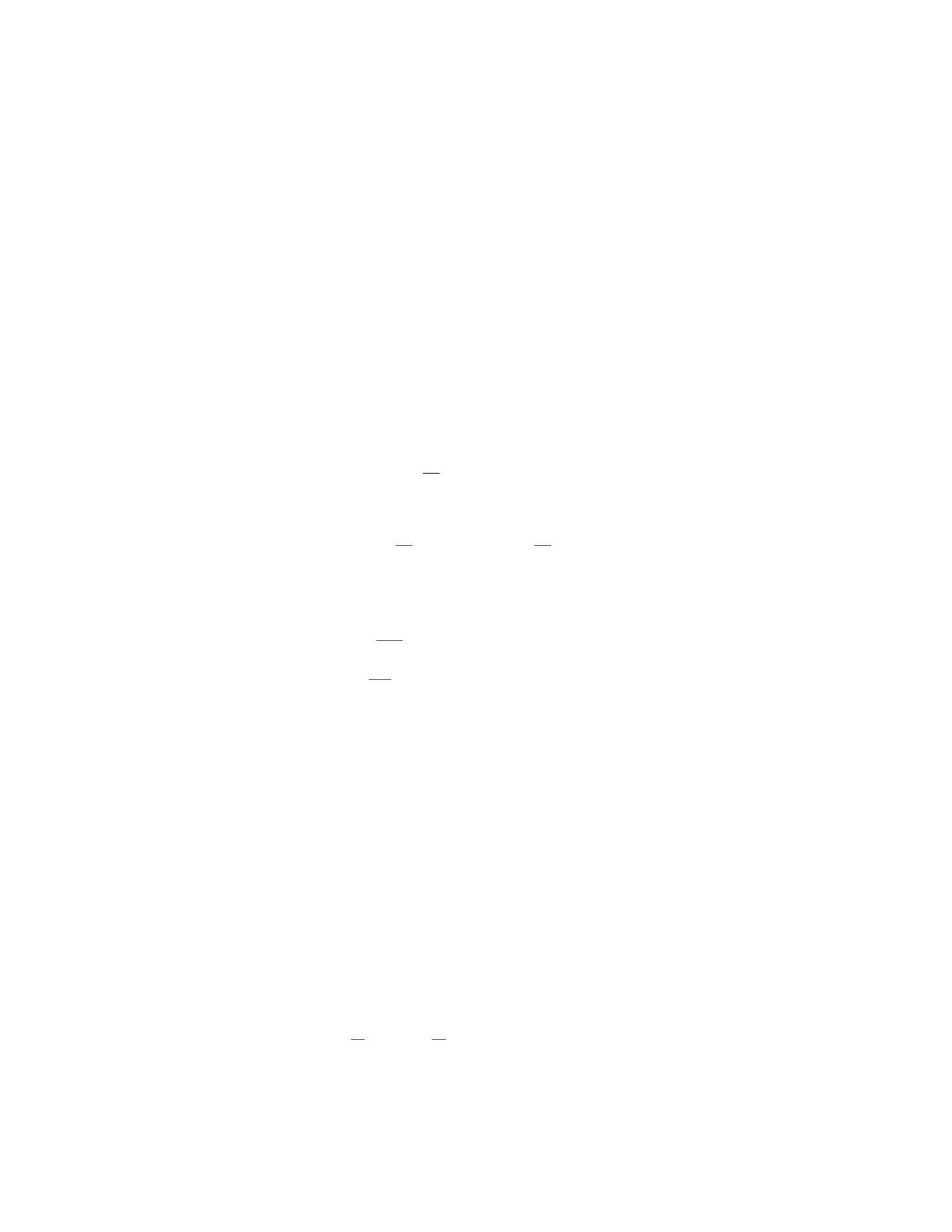
Let v= (2x+y)i+ (x+y2)jbe a vector-valued function. Find
dx.
Solution
Step 1: Recall that for a vector-valued function v=f(x)i+g(x)j, the derivative
dxiscomputedbytakingthederivativeofeachcomponentseparately.
Step 2: Given v= (2x+y)i+ (x+y2)j, we will differentiate each component
with respect to x.
Step 3: For the icomponent, we have
d
dx (2x+y)=2.
Step 4: For the jcomponent, we have
d
dx (x+y2) = 1 + 2ydy
dx .
Step 5: Putting these components together, we get
dx = 2i+ (1 + 2ydydx)j.
Therefore,
dx = i+ (1 + 2ydydx)j.
Question 33
Question
Let v= 3i−2j+4kand u= 2i+5j−kbe two vectors. Determine the derivative
of v·uwith respect to t, where i,j, and kare the standard unit vectors.
Solution
Step 1: Recall that the dot product of two vectors a=a1i+a2j+a3kand
b=b1i+b2j+b3kis given by:
a·b=a1b1+a2b2+a3b3
Step 2: In this case, v·u= (3)(2) + (−2)(5) + (4)(−1) = 6 −10 −4 = −8.
Step 3: To find the derivative of v·uwith respect to t, we differentiate each
component of vand uwith respect to t.
d
dt (v·u) = d
dt (3 ·2−2·5+4·(−1))
20

Step 4: Simplifying, we get:
d
dt (−8) = 0
Step 5: Therefore, the derivative of v·uwith respect to tis 0 .
Question 34
Question
Let v=x2
exand u=ln(y)
y2. Compute the gradient of v·u.
Solution
To compute the gradient of v·u, we will first find the dot product of vand u,
and then take the gradient of the resulting scalar function.
Step 1: Find the dot product of v and u The dot product of two vectors
a=a1
a2and b=b1
b2is given by:
a·b=a1b1+a2b2
For vectors v=x2
exand u=ln(y)
y2, the dot product v·uis:
v·u= (x2)(ln(y)) + (ex)(y2)
Step 2: Compute the gradient The gradient of a scalar function f(x, y)
is given by ∇f="∂f
∂x
∂f
∂y #.
In this case, our scalar function is f(x, y) = v·u= (x2)(ln(y)) + (ex)(y2).
Taking the partial derivative of f(x, y) with respect to xgives:
∂f
∂x = 2xln(y) + exy2
Taking the partial derivative of f(x, y) with respect to ygives:
∂f
∂y =x21
y+ 2exy
Therefore, the gradient of v·uis:
∇(v·u) = 2xln(y) + exy2
x21
y+ 2exy
21
Question 35
Question
Let wbe a vector function given by w=x2+ 2y
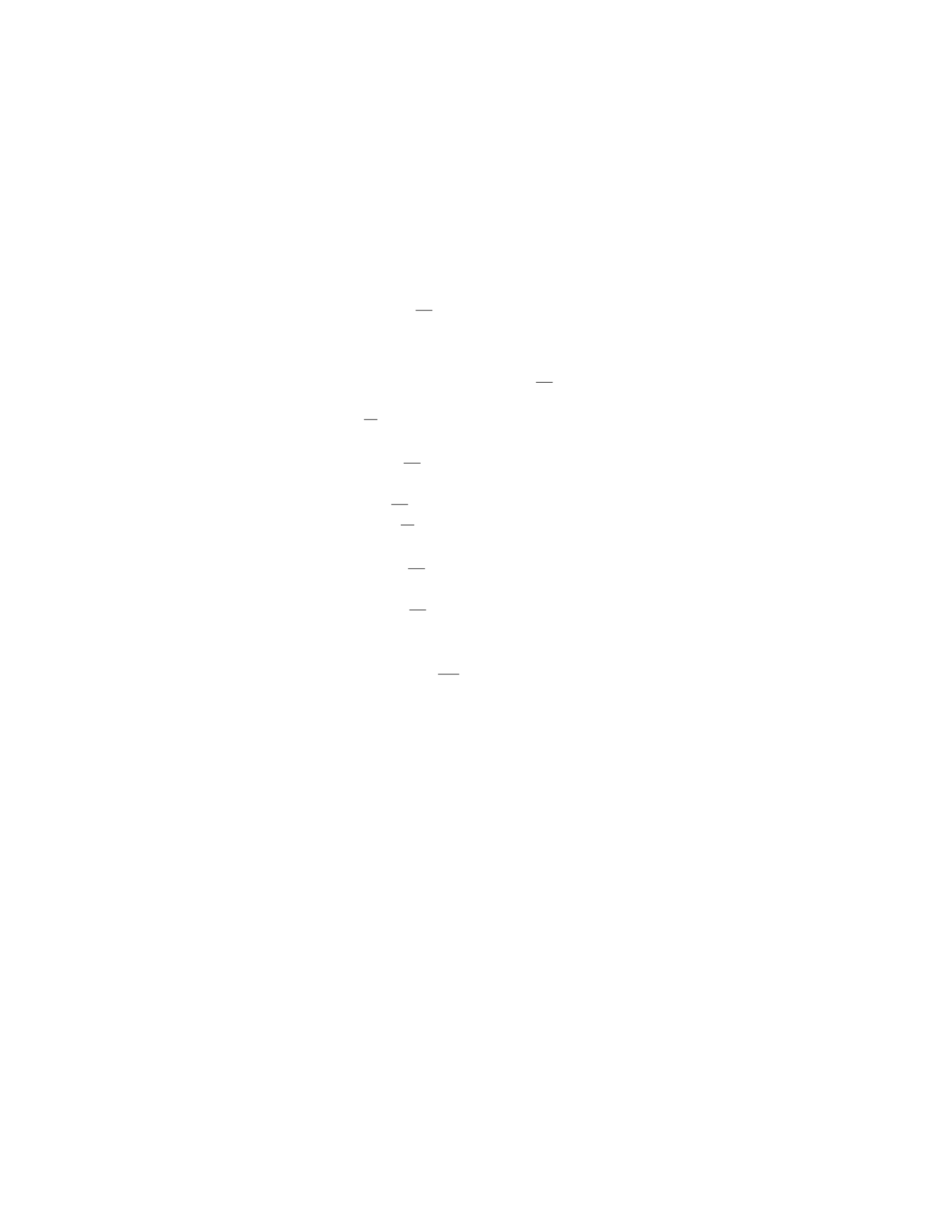
3x−y2. Find the derivative of w
with respect to x, denoted by dw
dx .
Solution
To find the derivative of wwith respect to x(dw
dx ), we will differentiate each
component of wwith respect to xseparately.
Step 1: Let’s find d
dx (x2+ 2y).
d
dx (x2+ 2y)=2x+ 0
So, the first component of dw
dx is 2x.
Step 2: Next, let’s find d
dx (3x−y2).
d
dx (3x−y2)=3−0
So, the second component of dw
dx is 3.
Step 3: Putting the derivatives of each component together, the derivative
of wwith respect to xis:
dw
dx =2x
3
22

