


The workplace as an arena for health promotion
Due to the high prevalence of chronic diseases along with increased costs for public
health and decreased productivity at the workplace, there is a growing emphasis on the
promotion of health and active lifestyles (33,106,107). The WHO has for many years
advocated an approach to target health promotion in different settings (108). By
stimulating healthy behaviors in workplaces, large groups of the adult populations can
be reached, which is of importance for both organizations and public health (1,79,108).
Because there are possibilities for controlling environmental, individual, and
organizational-level activities in the workplace, the workplace is considered to be an
important and influential and important setting for health-promotion activities
(5,102,109). Due to the demographic developments, there will be future needs to keep
the ageing population working, and this will further increase the need to prevent chronic
diseases among the working population (106). Work-site health promotion (WHP)
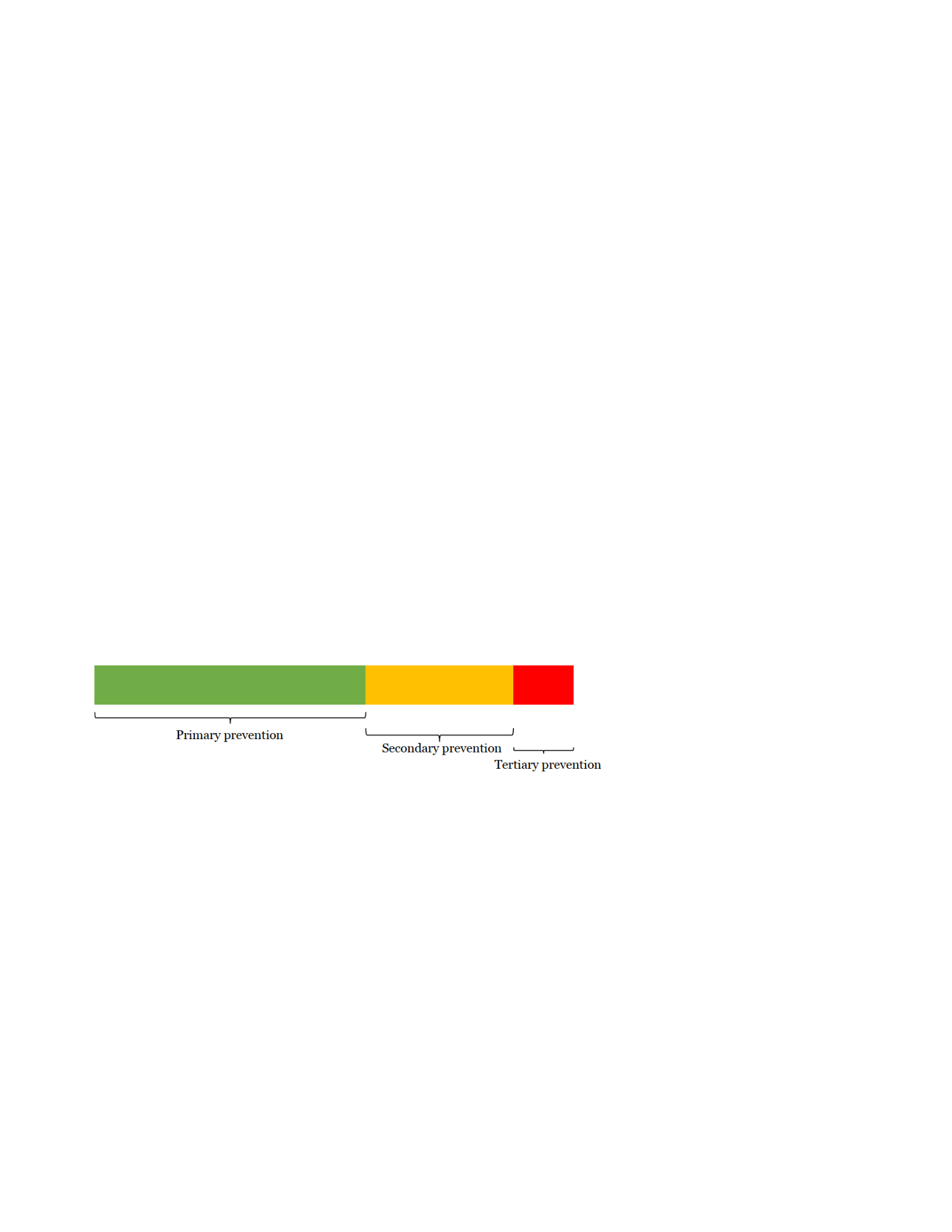
supports primary, secondary, and tertiary prevention efforts (107).
Primary prevention is directed to employees who are generally healthy, and the
interventions aim to maintain good health or to prevent or delay disease progression.
Secondary prevention activities are directed to employees who are at high risk of
becoming ill, due to lifestyle behaviors. Sometimes WHP also includes tertiary
prevention, which includes support for disease management, such as musculoskeletal
disorders or depression (107)(Figure 3). WHP can target different lifestyle behaviors
like diet, tobacco use, stress or PA. Health promotion programs have shown favorable
results for weight-related disorders, while interventions only targeting PA show more
inconclusive results, compared to those including both diet and PA (106,109). High-
quality WHP programs are likely to improve health and productivity among workers,
and WHP might also be of importance for being seen as an attractive employer in the
competition for labor (107). It seems like interventions consisting of multiple
components, are more likely to be effective compared to single- component
interventions (106,107,110), and this also seems to be the case in interventions aiming
to decrease SB and increase PA in workplaces (78).
Figure 3. Different types of program efforts in WHP programs (107).
There is still a need for well-designed, theory-based health promotion research in order
to understand the effectiveness of workplace interventions and to be able to identify
what types of interventions that seems to be the most promising. To date, there is
uncertainty about what components, dose, and frequency to recommend for
interventions aiming to decrease SB, which makes it difficult to formulate
recommendations for organizations (76,106). To date, the knowledge about the effects of
environmental modification on SB in office settings, like sit- stand tables or different
types of office design is limited, and the effects from environmental approaches are
important in future research (102).
Flex offices with activity-based work
Flex offices with activity-based work (ABW) have increased in popularity in recent years
(111). The main reasons for relocating to a flex office are usually to reduce facility costs
and suggested facilitation of communication and creativity within the organization
(111,112). Fifteen percent of Swedish office workers reported that they did not have a
personal workstation in 2017 (113), as is the case in flex offices with ABW. The basis of

the interior design in flex offices is to have workstations in open landscape areas. In
addition, the office often provides some workstations in cell offices, small and large
meeting rooms, break-out spaces, and lounge areas or other areas needed in the
organization (114,115). The term ABW does not refer to PA in the office, but to work-
task performance. In flex offices with ABW, employees have shared workstations, and
everybody uses wireless computers. The goal is to work without papers. Different
spaces in the office are designed to meet different needs, and employees are supposed
to choose workstation depending on the current work task. It is well known that the
traditional open-plan offices have adverse effects on wellbeing and health (111,112), but
the knowledge of the effects on different health aspects related to flex office
environments is still limited (114).
Theoretically it appears likely that flex offices with ABW can increase PA at work. The
different types of environmental spaces combined with shared workstations might
increase both breaks from sitting and walking time (64,116). Even though environmental
changes are highlighted as a possibility to increase PA in offices, only a few studies have
been performed. Table 1 shows the design and results of six studies that have evaluated
SB and PA in relation to different office designs. Three of them have evaluated SB and
PA in offices with “active design” where employees have personal workstations, while
the office environment is developed to facilitate PA by i.e. centrally placed stairs and sit-
stand tables (117-119). Three of the studies have evaluated flex offices with ABW, where
employees have shared workstations (64,116,120). A Swedish study
(64) followed four office sites relocating to flex offices with ABW, and a comparison site.
In that study, employees had sit-stand tables already at baseline, and limited effects on
occupational total sitting or sitting accumulation patterns after relocation were seen,
although more walking time was observed. Heterogeneous results were seen across
sites, which implies that specific determinants of sitting behavior in flex offices need
further focus (64).
Work-site interventions among office workers show promising results to
reduce SB, and they seem to have a clinically meaningful effect on mediators
to improving health. However, there is still a need for more studies of high
quality and long-term follow-up, evaluating the impact of environmental
factors in the office, such as office design and office type. More knowledge is
also needed on how successful interventions should be designed to fit the
contextual situation, and to stimulate behaviors towards less sitting and more
movement in the office.
Theoretical models
The development of the Inphact treadmill study was influenced by two models
– the Ecological model of SB and the International Classification of
Functioning, Disability and Health (ICF). The PA-promoting program in the
AOD study was based on three models – Five Keys to workplace health
promotion, the Social ecologic model of influence on physical activity and the
Social cognitive theory.
The assumption that behaviors are influenced by multiple factors, including
those at the individual, social, organizational, environmental, and policy
levels, is described as an ecological approach (75,121). To be able to develop
interventions targeting SB and PA, there is a need to have a context- and
behavior-specific approach and to understand the multiple factors
influencing behaviors. Owen et. al. developed the ecological model of SB,
and this includes factors related to SB in different contexts (75). ICF
recognizes the impact of a disease or disability incorporating both body
function, personal factors and environmental factors (122).
Five Keys to workplace health promotion highlights five main areas that
should be considered in health promotion in the workplace: 1) commitment
from leaders and managers, 2) involvement of employees, 3) business ethics
and laws, 4) the use of a systematic process to ensure efficiency, and 5)
continuous improvements, including development of strategies to maintain
and integrate health-promoting activities (100). The model influenced the PA-
promoting program due to anchoring with management and leaders, and the
participatory approach in the development of the program content.
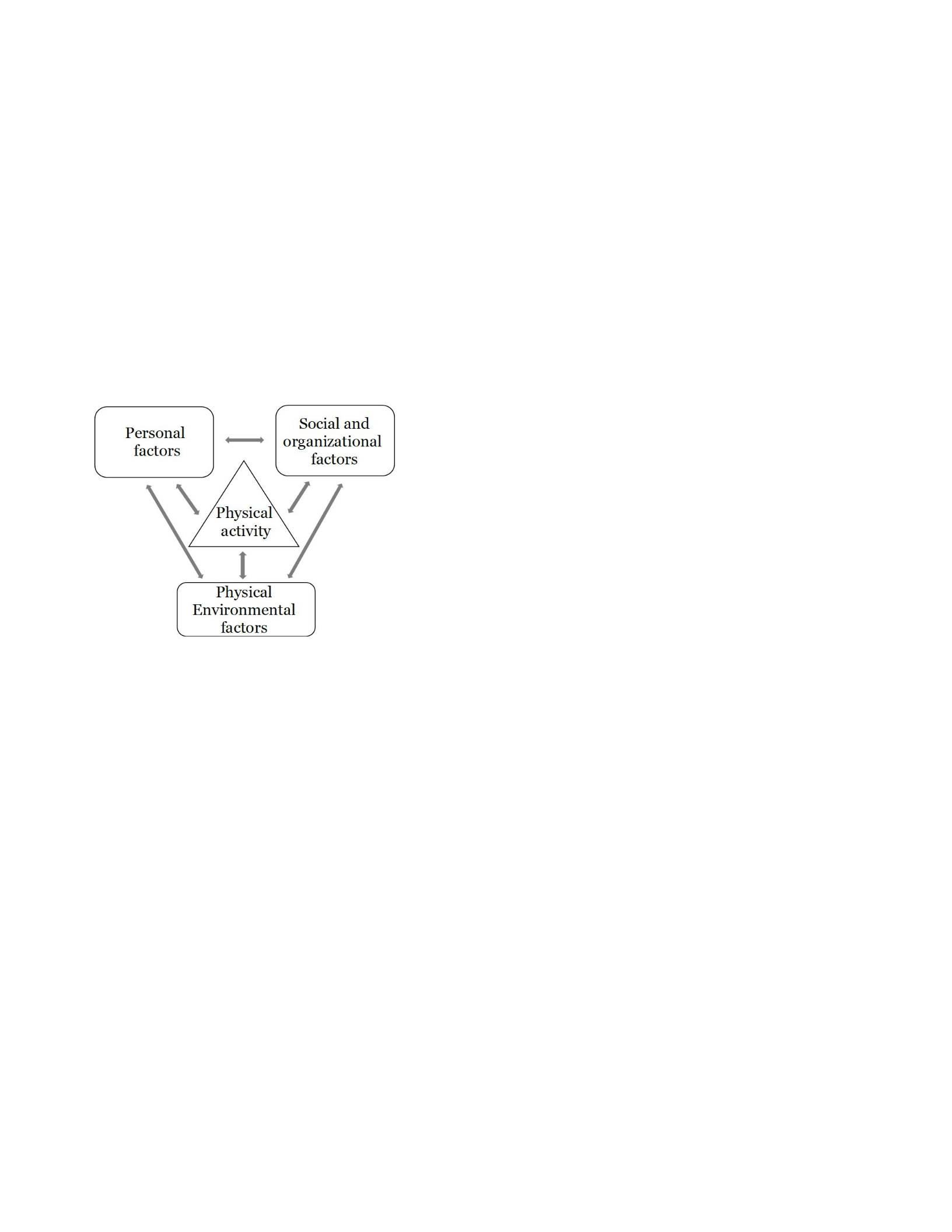
The Social ecologic model of influence on physical activity describes how
personal, social/organizational, and environmental factors interact and affect
human movement behavior in a building (123) (Figure 4). When developing
the contents of the lecture, the workshop with managers, and the
communication campaigns, all of these aspects were kept in mind, in order to
develop all factors in parallel.
Figure 4. A social ecological model of influences on PA. Modified by Zimring et al. (123).
The Social cognitive theory developed by Bandura describes knowledge,
outcome expectations, and perceived social as well as structural facilitators
and barriers for change (124). The PA-promoting program targeted both
knowledge, social and structural factors of interest for change. Repeated
examples on how to implement small changes, and rhetorical questions
aiming to create reflection and goal setting, aimed to support self-efficacy to
behavioral changes. The combined influences from the theoretical models led
to a broad approach of the PA-promoting program.
For the PE we used a modified version of a theoretical model developed by
Nielsen et al. (103) for planning, performing and evaluating organizational
interventions. As guidance for both data collection and evaluation of the
intervention process, the model has a connected framework, including
aspects that are crucial in PEs. The model and framework are influenced
from other disciplines, such as participatory ergonomics and organizational
development. Originally the model included aspects on mental models of
actors, contextual factors, intervention design and implementation (104). To
meet the aims of our study (paper IV), we modified the model by adding an
element for behaviors (Figure 5). This made it possible to use the model
when analyzing both the implementation process and the behaviors.

