


CONFLICT ASSESSMENTS BRIEF
Conflict Assessments Brief
Benjamin Fouse
Department of Communications
COMS 560 Communication and Conflict
Dr. John Katsion
October 6, 2021
CONFLICT ASSESSMENTS BRIEF
Executive Summary
Purpose
The purpose of this paper is to discuss the results of my Conflict Styles Assessment and any
consequences that pertain to said results therein.
Assessment Results
My results are that I am a majority share compromiser with a 91% rating from the conflict
assessment. Following this, I am 64% problem solver, 57% accommodator, 33% avoider, and 8%
competer.
Benefits and Drawbacks
Possible benefits of being a primary compromiser is that all parties involved might come to peaceful
terms with the purposed solution. Possible drawbacks to such conflict resolution include the amount of
time it takes to find the middle line between two opposing arguments as well as the threat of giving more
than receiving. Thus, it is important while attempting to find the middle ground that deeply held personal
beliefs aren’t compromised. This would include my foundational religious beliefs in God and in
Christianity.
Response
Thus, the conclusion would be that while being a compromiser is not something that is a deterrent to
conflict resolution, one must be able to find the line between remaining timely as well as remaining firm
in personal convictions. In this particular case, it might mean developing a more complete personal
worldview as well as developing lesser utilized conflict resolution techniques such as a more competitive
conflict resolution style.
CONFLICT ASSESSMENTS BRIEF
Introduction
While there are few certainties in life, one that we all might be sure of, is that of conflict. While one
might not necessarily seek it out, it is inevitable that it will arise. While such conflict is often unavoidable,
that doesn’t mean that it shouldn’t or can’t be minimized. Additionally, before diving into any in depth
conversation about conflict and corresponding resolution it is valuable to remind ourselves how Christ
calls us to live that is; that we would love the Lord our God and love our neighbors like ourselves
(Matthew 22:36-40, English Standard Version). With this understanding constantly in mind, we may then
continue forward to find and develop our conflict resolution skills. It is with a heart of love for God and
for those we are interacting with that we are to respond, regardless of the situation. Only after
understanding this can, we begin to find Biblical resolution.
Response to Conflict
According to the assessment taken on October 4th, my conflict responses are as follows: 91%
compromiser, 64% problem solver, 57% accommodator, 33% avoider, and 8% competer. This means that
primarily my means of conflict resolution comes from attempting to find a solution that works for all
parties involved. While this seems to me to be the ideal solution in most situations, it is not my only
utilized method of resolution. The next would be to solve the problem itself, while obviously ideal, it
often is either not possible or requires more time then reasonable for the situation. The last percentage of
significance would be 57% accommodating. Although this style has natural pros and cons the essence of
this style of resolution comes from the part of me that would prefer to neglect personal opinions.
Initially, I was slightly surprised at the results. My thought was that I would’ve scored higher in
competer and problem solver. For instance, my initial feelings whenever considering a conflict outside
my own sphere of influence, is to try and come up with solutions. I often get frustrated by being a
sounding board for conflicts if those involved aren’t willing to work to change the circumstances.
However, after reviewing the descriptions of each as well as taking in consideration my past moments of

CONFLICT ASSESSMENTS BRIEF
conflict, the results began to make more sense. It is precisely because I often find frustration when
someone isn’t willing to do what it might take to resolve the issue that makes me such a compromiser. In
almost every instance I would rather find middle ground or some working solution as opposed break
relationships or living in discontent. If one or neither of the sides are willing to change, adapt, or give a
little than how or why should the others? Catherine Jere, a researcher at the school of international
development in the United Kingdom suggests that most of our organizational power comes through the
ability to come to agreements through strategies such as compromise, “In relation to interdepartmental
collaboration, it takes more than people being willing to get together, share information and cooperate. It
more importantly involves making tough decisions and trade-offs across areas with different priorities and
bosses” (p. 3, 2017).
Contributing Factors
Often the most difficult struggles in my own primary approach to conflict resolution comes from
an inability to find the right line of give and take. Careful compromising will often lead to viable and
workable solutions; however, it is hard to find the correct balance. One side might be sacrificing more
than the other or sacrificing something they aren’t truly ready to give up. Unfortunately, this means that it
may often come at the cost of my own accommodating attitude. Preferring to give up more of my own
emotions or feelings toward a conflict in the case of imbalanced compromises are two things that go
negatively hand in hand.
With this being said, there are also strengths to the compromising approach. While these might
seem self-evident, the compromiser, when successful, might be able to find the best possible solution for
the group as a whole, where others cannot or would be unwilling to. Additionally, those approaching
conflict in the attempt to compromise may often find appreciation from those engaged in the conflict. It is
a common experience to not feel heard or understood, however, by nature it is necessary for
compromisers to truly hear and understand both sides of the argument to find viable neutral. Additionally,
in a recent article published in the Small Group Research Magazine, Igor Kotlyar discovered that, “The
CONFLICT ASSESSMENTS BRIEF
findings support the assertion that differences in leadership behaviors can trigger different levels of
cognitive and affective conflict among group members.” With the leadership styles being a compromising
leader that garners the most effective group results (p. 6, 2006).
Becoming more Effective
Taking assessment tests such as those offered by USIP and others like it provide opportunities to
learn more about your own conflict resolution styles. Understanding your own approach to conflict helps
ensure that one can develop methods of conflict resolution that works within your style of management.
With this in mind, two specific aspects in which my method for dealing with conflict might be improved
is by; first, focusing on what values are important to me, values that I am unwilling or unable to sacrifice
in order to come to resolutions and which are not as deeply held. This would then entail an almost “self-
discovery” journey. A reflection into my own innate and chosen beliefs would, like the USIP assessment
test did, help me approach situations differently. Knowing exactly what I believe and for what reasons I
believe it means that I would be much more affectively able to draw the conflict line where it mattered
and adjust it when it didn’t. The second would be to develop my lesser utilized conflict management
styles, specifically, in the competing style management. As previously mentioned, it is clear that I tend to
lean more toward a passive response toward conflict. If there is a way to resolve the issue without
sacrificing too much on the part of the other, I would generally prefer that. However, this may often mean
that it might come at the cost of something I should not be willing to give up, i.e., one of my core values.
Meghan Lazier, a writer for Digital.gov offers this as a positive application for the competitive style of
conflict resolution, “A competing style can be effective during certain difficult situations, like in a crisis,
when decisions need to be made immediately” (Lazier, 2017, para. 3). It is often true that in my own
personal experience, indecision due to inability to quickly find middle ground, has been a weakness in my
leading style.
Thus, we arrive at plan development and implementation. The first step would be to discover for
myself what values are those that are entirely core to my own systems of belief that I will be unwilling to
CONFLICT ASSESSMENTS BRIEF
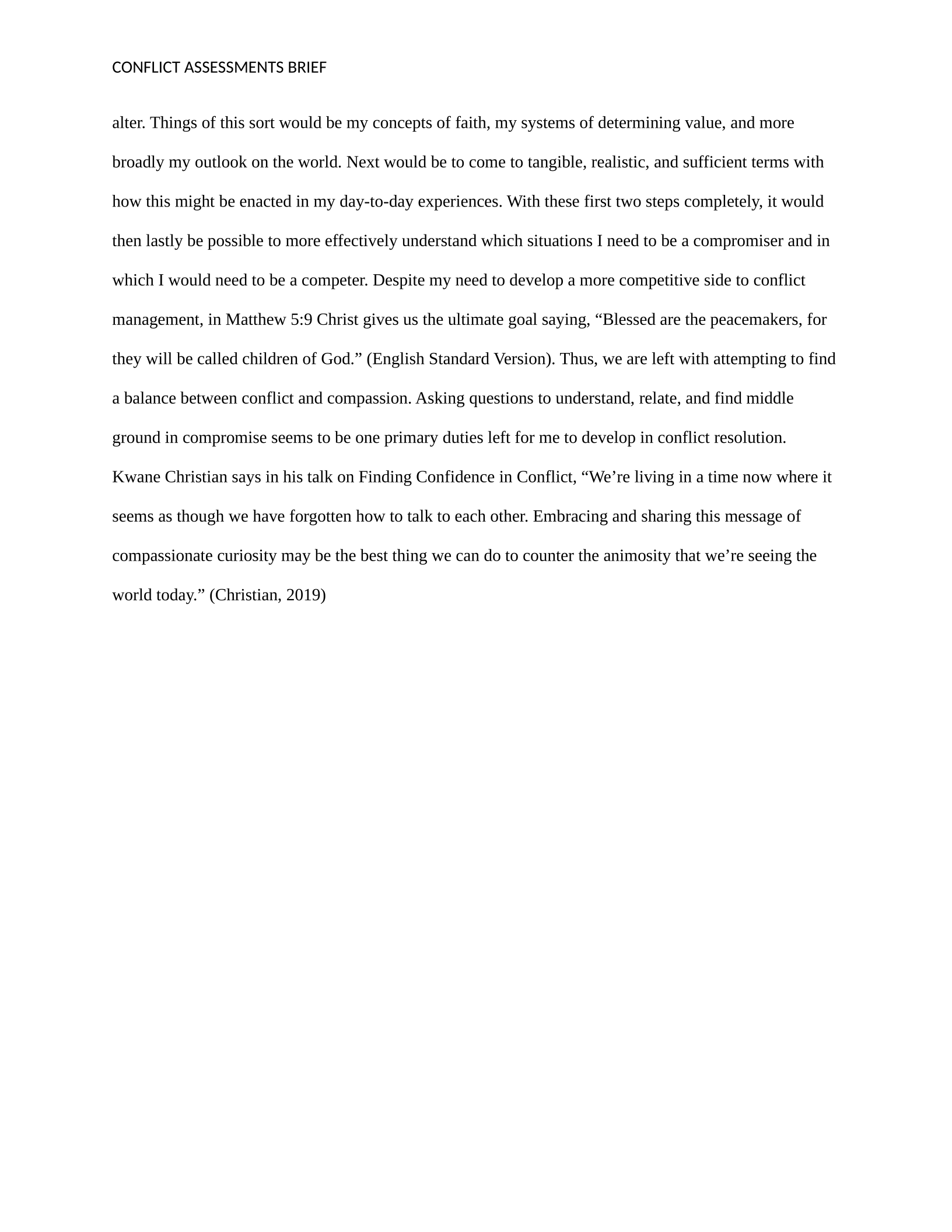
alter. Things of this sort would be my concepts of faith, my systems of determining value, and more
broadly my outlook on the world. Next would be to come to tangible, realistic, and sufficient terms with
how this might be enacted in my day-to-day experiences. With these first two steps completely, it would
then lastly be possible to more effectively understand which situations I need to be a compromiser and in
which I would need to be a competer. Despite my need to develop a more competitive side to conflict
management, in Matthew 5:9 Christ gives us the ultimate goal saying, “Blessed are the peacemakers, for
they will be called children of God.” (English Standard Version). Thus, we are left with attempting to find
a balance between conflict and compassion. Asking questions to understand, relate, and find middle
ground in compromise seems to be one primary duties left for me to develop in conflict resolution.
Kwane Christian says in his talk on Finding Confidence in Conflict, “We’re living in a time now where it
seems as though we have forgotten how to talk to each other. Embracing and sharing this message of
compassionate curiosity may be the best thing we can do to counter the animosity that we’re seeing the
world today.” (Christian, 2019)
CONFLICT ASSESSMENTS BRIEF
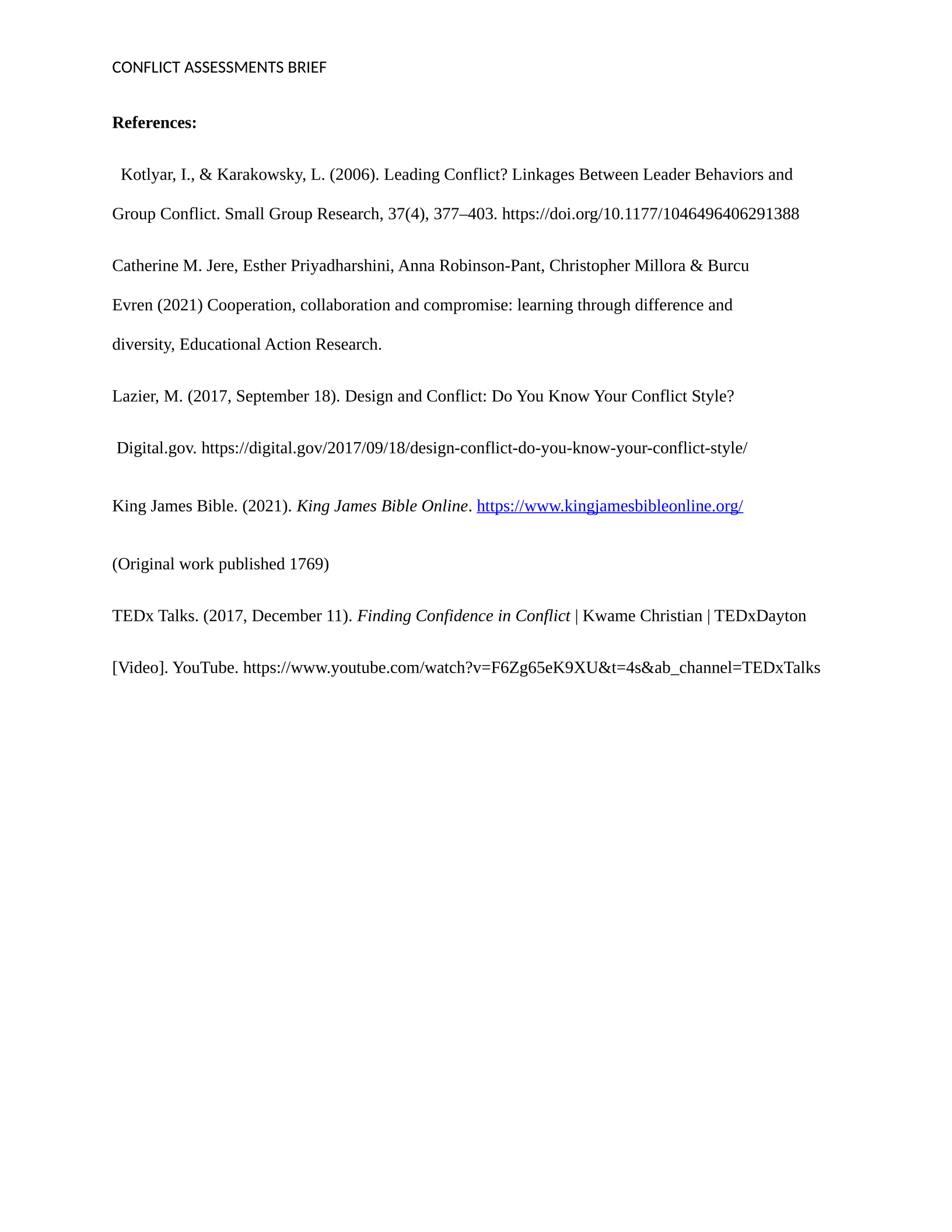
References:
Kotlyar, I., & Karakowsky, L. (2006). Leading Conflict? Linkages Between Leader Behaviors and
Group Conflict. Small Group Research, 37(4), 377–403. https://doi.org/10.1177/1046496406291388
Catherine M. Jere, Esther Priyadharshini, Anna Robinson-Pant, Christopher Millora & Burcu
Evren (2021) Cooperation, collaboration and compromise: learning through difference and
diversity, Educational Action Research.
Lazier, M. (2017, September 18). Design and Conflict: Do You Know Your Conflict Style?
Digital.gov. https://digital.gov/2017/09/18/design-conflict-do-you-know-your-conflict-style/
King James Bible. (2021). King James Bible Online. https://www.kingjamesbibleonline.org/
(Original work published 1769)
TEDx Talks. (2017, December 11). Finding Confidence in Conflict | Kwame Christian | TEDxDayton
[Video]. YouTube. https://www.youtube.com/watch?v=F6Zg65eK9XU&t=4s&ab_channel=TEDxTalks
Powered by TCPDF (www.tcpdf.org)

