


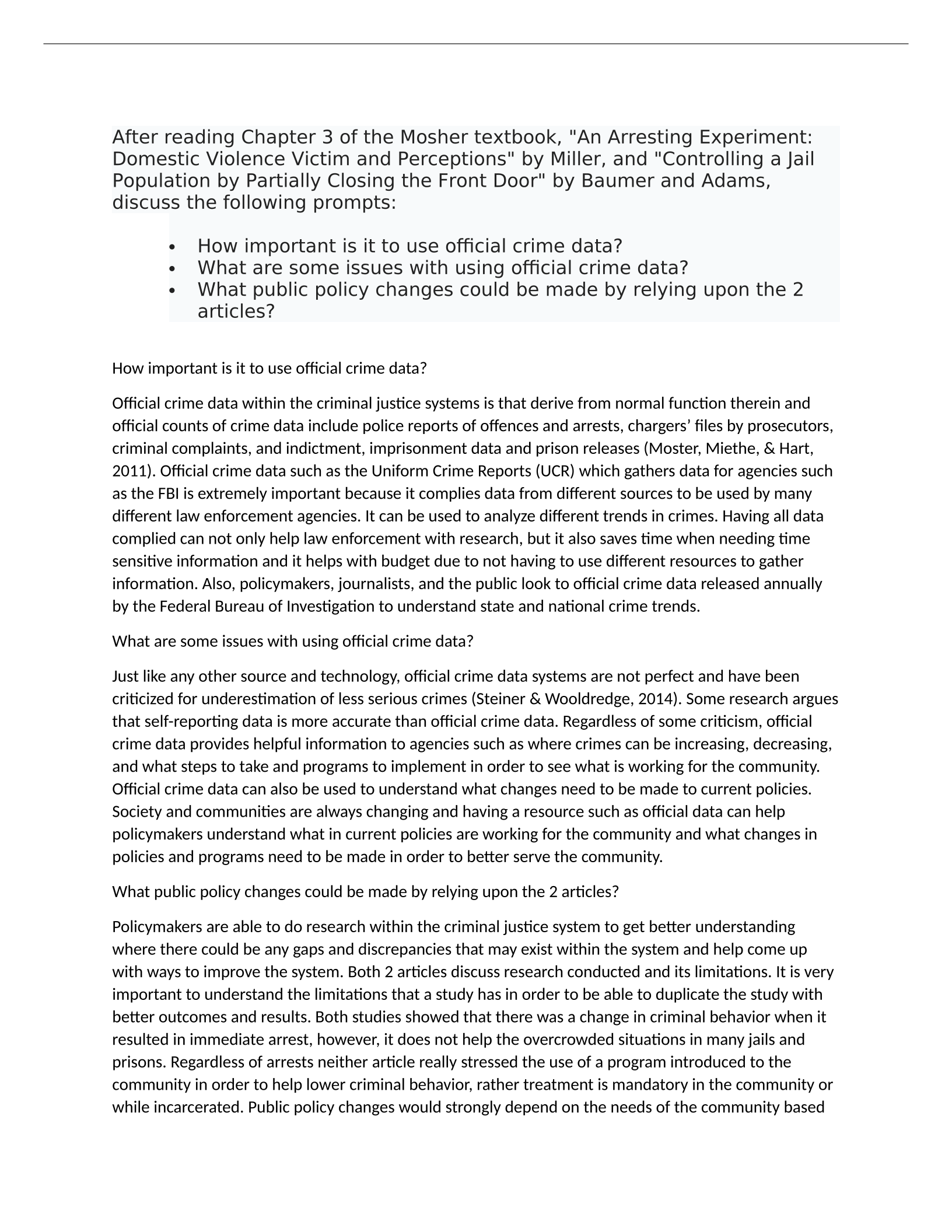
After reading Chapter 3 of the Mosher textbook, "An Arresting Experiment:
Domestic Violence Victim and Perceptions" by Miller, and "Controlling a Jail
Population by Partially Closing the Front Door" by Baumer and Adams,
discuss the following prompts:
How important is it to use official crime data?
What are some issues with using official crime data?
What public policy changes could be made by relying upon the 2
articles?
How important is it to use official crime data?
Official crime data within the criminal justice systems is that derive from normal function therein and
official counts of crime data include police reports of offences and arrests, chargers’ files by prosecutors,
criminal complaints, and indictment, imprisonment data and prison releases (Moster, Miethe, & Hart,
2011). Official crime data such as the Uniform Crime Reports (UCR) which gathers data for agencies such
as the FBI is extremely important because it complies data from different sources to be used by many
different law enforcement agencies. It can be used to analyze different trends in crimes. Having all data
complied can not only help law enforcement with research, but it also saves time when needing time
sensitive information and it helps with budget due to not having to use different resources to gather
information. Also, policymakers, journalists, and the public look to official crime data released annually
by the Federal Bureau of Investigation to understand state and national crime trends.
What are some issues with using official crime data?
Just like any other source and technology, official crime data systems are not perfect and have been
criticized for underestimation of less serious crimes (Steiner & Wooldredge, 2014). Some research argues
that self-reporting data is more accurate than official crime data. Regardless of some criticism, official
crime data provides helpful information to agencies such as where crimes can be increasing, decreasing,
and what steps to take and programs to implement in order to see what is working for the community.
Official crime data can also be used to understand what changes need to be made to current policies.
Society and communities are always changing and having a resource such as official data can help
policymakers understand what in current policies are working for the community and what changes in
policies and programs need to be made in order to better serve the community.
What public policy changes could be made by relying upon the 2 articles?
Policymakers are able to do research within the criminal justice system to get better understanding
where there could be any gaps and discrepancies that may exist within the system and help come up
with ways to improve the system. Both 2 articles discuss research conducted and its limitations. It is very
important to understand the limitations that a study has in order to be able to duplicate the study with
better outcomes and results. Both studies showed that there was a change in criminal behavior when it
resulted in immediate arrest, however, it does not help the overcrowded situations in many jails and
prisons. Regardless of arrests neither article really stressed the use of a program introduced to the
community in order to help lower criminal behavior, rather treatment is mandatory in the community or
while incarcerated. Public policy changes would strongly depend on the needs of the community based

on the information gathers in the field by the law enforcement agencies. According to Bible, “For from
within, out or the heart of man, come evil thoughts, sexual immorality, theft, murder, adultery, coveting,
wickedness, deceit, sensuality, envy, slander, pride, foolishness” – Mark 7:21-22. Policymakers should
serve the community basing on reflecting God’s word. All crimes are sins and have to be sentenced.
“There are six things that the Lord hates, seven that are an abomination to him: haughty eyes, a lying
tongue, and hands that shed innocent blood, a heart that devises wicked plans, feet that make haste to
run to evil, a false witness who breathes out lies, and one who sows discord among brothers” – Proverbs
6: 16-19.
Reference
Baumer, T. L., & Adams, K. (2006). Controlling a jail population by partially closing the front
door. The Prison Journal, 86(3), 386–402. https://doi.org/10.1177/0032885506291036
Holy bible. (2011). Zondervan.
Miller, J. (2003). An arresting experiment. Journal of Interpersonal Violence, 18(7), 695–716.
https://doi.org/10.1177/0886260503251130
Mosher, C. J., Miethe, T. D., & Hart, T. C. (2011). Chapter 3. In The Mismeasure of Crime.
essay, SAGE.
Steiner, B., & Wooldredge, J. (2012). Comparing self-report to official measures of inmate
misconduct. Justice Quarterly, 31(6), 1074–1101.
https://doi.org/10.1080/07418825.2012.723031
Hello Mathew,
Thank you for posting your thoughts about official crime data. I totally agree that official crime data is
essential as it provides a picture of crime, and an idea of where the crimes are most prevalent (Moster,
Miethe, & Hart, 2011). Also, the data can show if crime is going up or down in the areas targeted, and it
can help criminal justice professionals understand whether their initiatives are successful. The FBI has
been collecting data on the types, amounts, and impact of crime in the United States through the
Uniform Crime Reporting Program which is the most reliable source of crime data for law enforcement
administration, operation, and management. Moreover, it provides information for politicians,
researchers, and criminal justice professionals to gain a deeper understanding of crime and society.
Therefore, they are the best source of information on trends in criminal activity that policymakers can
use for a reference to understand what in current policies are working for the community and what
changes in policies and programs need to be made in order to better serve the community. according to
Bible, “Let every person be subject to the governing authorities. For there is no authority except
from God, and those that exist have been instituted by God. Therefore, whoever resists the
authorities resists what God has appointed, and those who resist will incur judgment. For rulers
are not a terror to good conduct, but too bad. Would you have no fear of the one who is in
authority? Then do what is good, and you will receive his approval, for he is God's servant for

your good. But if you do wrong, be afraid, for he does not bear the sword in vain. For he is the
servant of God, an avenger who carries out God's wrath on the wrongdoer” – Romans 13:1-4.
Reference
Holy bible. (2011). Zondervan.
Miller, J. (2003). An arresting experiment. Journal of Interpersonal Violence, 18(7), 695–716.
https://doi.org/10.1177/0886260503251130
Mosher, C. J., Miethe, T. D., & Hart, T. C. (2011). Chapter 3. In The Mismeasure of Crime.
essay, SAGE.
Hello David,
Thank you for sharing your opinion about official crime data. I totally agree that policymakers
are able to use the official crime data to identify crime hotspots, allocate resources, and
develop effective strategies to reduce crime in community. Also, the official crime data is an
excellent tool in helping to improve relations with the community. Making crime data public
increases transparency. While it can open criminal justice professionals to scrutiny, it also allows
for a dialogue between law enforcement and the public they serve. As with any other
government agency, the public deserves to be informed about how well police are protecting
the community. Sharing crime data with the public increases trust in police and creates good
working relationships as well. Therefore, the official crime data is important for policymakers to
assist efficiently deploy resources or assess the programs to make communities safer. According
to Christian viewpoints, crimes are sins which government should decrease to protect
community. “The soul who sins shall die. The son shall not suffer for the iniquity of the father,
nor does the father suffer for the iniquity of the son. The righteousness of the righteous shall be
upon himself, and the wickedness of the wicked shall be upon himself” – Ezekiel 18:20.
Reference
Baumer, T. L., & Adams, K. (2006). Controlling a jail population by partially closing the front
door. The Prison Journal, 86(3), 386–402. https://doi.org/10.1177/0032885506291036
Holy bible. (2011). Zondervan.
Miller, J. (2003). An arresting experiment. Journal of Interpersonal Violence, 18(7), 695–716.
https://doi.org/10.1177/0886260503251130
Powered by TCPDF (www.tcpdf.org)

