


Module 2: Week 2: Social Justice
Overview
This module will consider the social justice aspects of counseling, racism dynamics, differential
experiences among cultural groups (white privilege), and the impact of social class variables on
counseling. A biblical framework for social justice will be considered.
Learning Outcomes
Upon successful completion of this module, you will be able to:
Synthesize various counselor roles in eliminating biases, prejudices, and processes of
intentional and unintentional oppression and discrimination into a professional practice
framework.
Synthesize theories of multicultural counseling, identity development, and social justice
into a coherent, personal counseling perspective.
Differentiate individual, couple, family, group, and community strategies for working
with and advocating for diverse populations.
Analyze the counselor’s role in: developing cultural self-awareness; promoting cultural
social justice, advocacy, and conflict resolution; and promoting other culturally supported
behaviors that emphasize optimal wellness and holistic growth.
Consider a biblical/theological perspective that promotes appreciation of diversity while
maintaining a distinctively Christian viewpoint.
Social Justice Counseling
I. Learning Objectives
a. 3.1 Describe the key definitions and constructs of social justice counseling.

b. 3.2 Discuss historical events within the counseling profession related to social
justice counseling.
c. 3.3 Apply the A C A Advocacy Competencies to social justice counseling.
d. 3.4 Describe social justice counseling interventions using the three-tiered model
of social advocacy.
e. 3.5 Articulate the benefits and challenges of social justice counseling.
f. 3.6 Describe current trends in research in social justice counseling.
II. Key Constructs
a. Social justice counseling—counseling that recognizes the impact of oppression,
privilege, and discrimination on the mental health of individuals
b. Social injustice—Unequal distribution of rewards and burdens
c. Examples:
i. Educational achievement gaps in schools
ii. Limited housing
iii. Poverty
iv. Child exploitation
v. Racial profiling
vi. Violence toward racial, ethnic, and sexual minorities
d. The goal of social justice counseling is to:
e. Promote access and equity to all persons, particularly those who have been
disenfranchised based on cultural/ethnic background
f. Establish an equal distribution of power and resources through advocacy to ensure
that all people have the resources for a “good life”

g. Eradication of oppression
h. Oppression—pervasive and exists across multiple groups and at varying levels
(e.g., individual, institutional, cultural)
i. Two modalities:
i. Oppression by force—imposing on an individual or groups an object,
label, role, experience, or living condition that is unwanted and causes
harm
ii. Oppression by deprivation—depriving an individual or groups of an
object, label, role, experience, or living condition and hinders well-being
j. Types of Oppression
i. Primary—overt acts of oppression
ii. Secondary—involves individuals benefiting from overt oppressive acts
against others
iii. Tertiary/internalized oppression—the identification of the dominant
message by members of the minority group, often to seek acceptance by
the dominant group
iv. Oppression is complex and multidimensional; the result of oppression is
an imbalance of power (i.e., having control, choice, autonomy, or
influence over others)
k. Structural Violence—marginalization that results from oppressive institutions
i. Results when social, political, economic, and other institution entities
place barriers on development, wellness, dignity, and potential
l. Privilege—having power, access, advantage, and holding a majority status

i. Favorable treatment, entitlement, social support
ii. Oppression and privilege are inversely related
m. Empowerment—equitable distribution of power
i. Goal of social justice counseling
ii. McWhirter’s (1994) definition of empowerment
n. Resilience—behaviors and attitudes that clients identify as beneficial in coping
with stressful situations and adversity
i. These stressful situations may involve experiences of violence and trauma
based on being a member of an oppressed group
III. Historical Context
a. Counseling as a profession began with individuals responding to social justice and
advocating for changes in social policy (e.g., Clifford Beers, Carl Rogers,
Clement Vontress)
b. As an evolving tenet of the counseling profession, social justice issues will likely
continue as a primary force in the maturation of the counseling profession
c. Recent Events:
i. Loretta Bradley (A C A President 1999–2000) selecting social justice and
advocacy as a thematic focus of her presidency
ii. Counselors for Social Justice as a division of A C A in 2001
iii. A C A endorsement of the advocacy competencies in 2003
iv. Formation of the Association for Counselor Education and Supervision (A
C E S) Human Rights and Social Justice Committee in 2006 and
sponsorship of the A C E S Social Justice Summit in 2007 and 2009

v. Revision of the Multicultural Counseling Competences to the
Multicultural and Social Justice Counseling Competencies
IV. Social Injustice and Mental Health Issues
a. U.S. Surgeon General’s 2001 Report
b. Re-examining culturally competent practices for counselors
c. Role of negative social conditions and other oppression experiences in minority
mental health
d. Call for social justice counseling in schools
e. Racial, ethnic, and cultural minorities experience the most discrimination and
poverty, yet have limited access to mental health care.
i. Susceptibility to depression, anxiety, suicide, substance abuse, violence,
chronic and acute stress.
ii. Mental health issues can lead to medical issues.
iii. Stress is the primary cause of emotional disturbances.
iv. Principle sources of stress—poverty, sexism, and being born unwanted.
f. Marginalized groups are at a greater risk for psychological, physical,
interpersonal, and financial risks.
V. Counselors as Social Advocates
a. Lee (2014) called for a paradigm shift for counselors to engage in social justice
counseling
b. Counselors must:
i. re-conceptualize theory and practice of counseling
ii. intervene at individual and societal levels

iii. reject neutrality in counseling that supports status quo
iv. engage in self-exploration including five action steps:
1. explore personal meaning
2. explore personal privilege
3. explore the nature of oppression
4. work to become multiculturally literate
5. establish a personal “social justice compass”
VI. Advocacy in Professional Counseling Standards
a. Growing awareness of the relationship between oppression and mental illness
b. Multicultural and Social Justice Counseling Competencies, A C A Code of
Ethics, and the A C A Advocacy Competencies
c. Three Levels of Advocacy in the A C A Advocacy Competencies:
i. Microlevel—clients and students
ii. Middle Level—communities
iii. Macrolevel—interventions in the public arena
d. Two realms within each: acting with and acting on behalf
VII. Advocacy Competencies
a. Six Domains of advocacy competencies:
i. Client/student Empowerment
ii. Client/student Advocacy
iii. Community Collaboration
iv. Systems Advocacy
v. Public Information

vi. Social/Political Advocacy
VIII. Three-Tier Model of Social Advocacy
a. Social change is necessary for optimal psychosocial health of both counselors and
clients
b. Consider social justice issues related to clients and the profession
c. Consider social justice issues across three tiers:
i. Self-awareness—awareness of one’s own cultural values and biases
ii. Client services—empowerment of disenfranchised clients
iii. Community collaboration —working toward social change at the
organizational/institutional levels
IX. Challenges of Social Justice Counseling
a. High interpersonal and intrapersonal costs
b. Social justice initiatives may be incongruent with traditional counseling theories
and ethical standards
c. Lack of appropriate training
d. Dominant groups (e.g., closed-mindedness of others, lack of support)
e. Counseling process (e.g., communication difficulties, differing awareness of
social justice issues)
f. Logistics (e.g., administrative and time constraints)
g. Ethics (e.g., imposition of values)
h. Counselor emotions (e.g., isolation, helplessness)
X. Benefits of Social Justice Counseling
a. Personal satisfaction and growth

b. General benefits for society
c. General benefits for the client
d. Improved counseling process
e. General benefits for counselor
f. Imparting knowledge to community and clients
Racism and White Supremacy
I. Learning Objectives
a. 4.1 Articulate historical and contemporary expressions of race and racism.
b. 4.2 Identify the cognitive, affective, interpersonal, and physical costs of racism for
people of color.
c. 4.3 Define and provide examples of White supremacy.
d. 4.4 Discuss White privilege in the U.S. context.
e. 4.5 Compare psychological responses to racism and White privilege.
f. 4.6 Develop a clear understanding of the cognitive, affective, interpersonal, and
physical costs of racism for White people.
g. 4.7 Identify current research trends and gaps related to racism, White supremacy,
and White privilege.
h. 4.8 Describe collaborative strategies to address racism within communities and
other systems.
II. Historical Foundations of Race and Racism
a. Origins of racial “differences”
b. Race and ethnicity are often confused
i. Race implies a common descent of heredity, common ancestry

ii. Ethnicity refers to cultural characteristics (e.g., rituals, work ethic, social
mores, values)
c. The U.S. government uses racial categories as social constructs for collecting
data, rather than basing categories on biological factors
III. Social Construction of Race
a. Racial classifications throughout history
i. Originally, “race” referred to breeding line
ii. Linnaeus subdivided humans into four geographic regions and labeled
their characteristics
iii. “Caucasian” introduced in 1777 by Johann Blumenbach as ideal beauty
b. Early racial classification systems based on physical characteristics paved the way
for later forms of racism
c. Physical characteristics alone are insufficient to make distinctions among people
IV. Defining Racism
a. Racism—an ongoing, multidimensional, and dynamic process inherent in the
development and maintenance of an institutionalized, hierarchical racial
classification system
i. individual, group, and systemic levels
ii. intentional and unintentional negative and erroneous stereotypical beliefs
b. Racial worldview—socially constructed prism used to perceive and understand
other individuals/groups and is passed to succeeding generations
c. Racism is built to maintain itself and is enabled by racial worldview and
institutional racial classification systems

i. Actively and passively reinforced
V. Types of Racism
a. Individual Racism—personal attitudes and beliefs in White superiority and the
inferiority of people of color
b. Institutional Racism—differential access to the goods, services, and
opportunities of society by race
i. Structural Racism—emphasizes that the oppression of racial and ethnic
groups is organized by institutional, cultural, and social structures
c. Internalized Racism—members of marginalized groups believing and accepting
negative social messages about their own racial/ethnic groups
i. Cultural Racism—the belief that cultural values and practices of White,
European descent people are superior to those of other racial groups
VI. Costs of Racism for People of Color
a. Cognitive costs: Mental energy and psychological processes, internalized racism
b. Affective costs
c. Frustration, irritation, hostility
d. Increased risk for depression, somatization, anxiety, P T S D
e. Stress and hypervigilance
f. Interpersonal costs
i. Segregation of people by racial classification
ii. Creates misinformation, misunderstanding, and miscommunication
iii. Barriers to cross-cultural relationships
iv. Fear, suspicion, and distrust among people of color

g. Physical costs:
i. Hypertension
ii. Chronic fatigue
iii. Delivery of low-birth-weight pre-term infants
iv. Physical violence
v. Outcomes related to health care
VII. Efforts to Combat Racism
a. Black Lives Matter—a grassroots effort to bring light to the killings and other
recognized racial injustices in Black communities across America
b. Congress of Racial Equality—works to promote the social, political, and
economic well-being of minority populations since 1942
c. National Council of La Raza—advocacy sounding board for the betterment of
Latinos in the United States
d. American Civil Liberties Union (A C L U)—highlights the U. S. Constitution to
guide its fight for justice for disenfranchised groups with regard to human rights,
immigration rights, and racial rights
VIII. White Privilege
a. White privilege—ways in which Whites, benefit from racism, advantages due to
race
i. Benefits and privileges can be unintentional or unconscious
ii. Allows Whites the choice to acknowledge racism
b. White supremacy—the belief that the superiority of White people justifies
disproportionate access to social and economic resources

i. Examples of unearned advantages
c. is often invisible to White people
d. contains psychological and intellectual costs to White people
e. contains several myths that perpetuate privilege for White people
f. differentially benefits White people
g. may even benefit those who do not self-identify as White
IX. Cost of Racism for Whites
a. Ways in which White people cope with and respond to racism and racial privilege
have cognitive, affective, and interpersonal costs for them
b. Costs are minimal compared to those for people of color
c. Cognitive costs:
i. delusion of superiority
ii. lack of accurate awareness as a cultural being
iii. inability to develop a full range of knowledge of racial issues and culture
d. Affective costs:
i. vary depending on White people’s awareness of racial issues
ii. may include irrational sense of danger and fear of people who are not
White
iii. may result in anger which can result in apathy and denial
iv. may include anxiety due to guilt
v. A counselor’s guilt may manifest as color consciousness (being
intentionally cognizant of racial issues and potentially over-emphasizing
its role in client problems)

e. Interpersonal costs:
i. loss of relationships with people of color or with other White people
ii. distorted sense of others because of reliance on stereotypes and a lack of
understanding of people of color
iii. limited interaction with people of color
iv. severed relationships with White people who do not work for social
advocacy
v. limited social competence
X. Whites’ Psychological Responses to Racism and White Privilege
a. People who are White engage in various defense mechanisms to help them reduce
costs of White racism and maintain racial identity
b. Racial Micro aggressions—brief and commonplace verbal, behavioral, and
environmental indignities that communicate hostile, negative, racial slights
(intentional or unintentional)
i. Denial—holding color-blind racial attitudes, believing in myth of
meritocracy, and focusing on exceptions to argue against claims of White
racism
XI. America and Whiteness
a. White people often assume that being White equates to being American (the term
all-American refers to clean-cut, blond haired, conventional, Protestant,
educated, middle class)
b. Common Microaggressions:
i. Pathologizing Cultural Values/Communication Styles

ii. Alien in Own Land
iii. Second-Class Citizen
iv. Assumption of Criminal Status
XII. Color-Blind Racial Attitudes
a. Color-Blind Racial Attitudes = form of microaggression that involves
unawareness of racial privilege, institutional discrimination, and/or overt racial
issues
i. Using examples of people of color “overcoming” discrimination (e.g.,
Barack Obama being elected President)
ii. “I don’t see a person’s race. I only see them as a person.”
1. When counselors act color-blind, they may have difficulty
establishing a trusting, therapeutic alliance
XIII. Myth of Meritocracy and Focus on Exceptions
a. Five Essential Principles of a meritocracy
b. Myth of meritocracy—the belief that all individuals, regardless of racial
makeup, can succeed if they try
c. Reverse discrimination—People who are White may deflect their role in
perpetuating racism by focusing on times when they were discriminated against
by people of color
XIV. Psychological Dispositions of White Racism
a. Affective-Impulsive Disposition
i. limited, stereotypical thinking about people who are not Whites and denial
of the existence of racism

ii. aggressive and hostile
iii. little shame and guilt
b. Rational Disposition
i. somewhat aware of how racism exists yet they tend to engage in either-or
thinking about race relations
ii. superficial tolerance of people of color until they encounter them when
they exhibit negative reactions to any policies that encourage racial
integration
c. Liberal Disposition
i. a greater understanding of racism and other forms of social injustice
ii. insight into others’ perspectives and experiences
iii. inaction on their part due to perception that they will experience negative
reactions from others
d. Principled Disposition
i. knowledgeable about how White privilege in their lives influences racism
ii. can cite specific examples of racism
iii. tend to integrate discussions of racism with others in a superficial manner
and report that they are cynical that current racial dynamics in the United
States will change
e. Principled Activistic Disposition:
i. understanding of racism and are hopeful and active in creating
sociopolitical change

ii. social advocates who seek to eliminate racism in specific ways within
their lives
iii. counselors must address racial issues within the therapeutic relationship
XV. Eradicating Racism
a. Involves a systematic approach that focuses on:
i. Counselor self-awareness
1. awareness of one’s own attitudes and behaviors regarding racism
and racial privilege
2. counselors of all races are encouraged to reflect on the following
areas:
a. Cultural tunnel vision/ethnocentrism
b. Victim blaming
c. Limitations of consciousness raising
d. Race-based stereotyping
3. Client services:
4. Address client’s racial identity development
5. Addressing clients who have experienced micro aggressions
6. Investigate intersections of trauma and other forms of oppression
with race-related stress
7. Addressing client racial prejudice
8. Address racism within the client’s school and community
b. Change existing political, legal, economic, and public health systems

c. Be familiar with historical and current legislation and court decisions that address
racial issues
i. Treaty of Guadeloupe Hidalgo (1849)
ii. Reconstruction (1865–1877)
iii. Indian Reorganization Act (1934)
iv. Brown versus Board of Education, Topeka, Kansas (1954)
v. Warren-McCarran Act (1962)
vi. Civil Rights Act (1964, 1991)
vii. Immigration Act (1965)
viii. Voting Rights Act (1965–2013)
ix. Affirmative Action (post-Civil Rights Era)
x. Public Law 93-638 (1975)
xi. Indian Health Care Improvement Act (1976)
xii. No Child Left Behind Act (2002)
XVI. Economic and Public Health Concerns
a. People of color receive disproportionate incomes and job opportunities in
comparison to their White counterparts
i. Based on individual, institutional, and cultural forms of racism
ii. This is particularly important in career counseling with people of color
b. Counselors should be aware of health disparities for people of color and how
racism contributes to them
XVII. Collaborative Strategies to Address Racism

a. Acknowledge the ways in which White supremacy and racism factor into your
personal and professional lives
b. Examine the systems in which clients live and experience racism
c. Build stronger coping mechanisms for clients by strengthening and developing
community resources
d. Uncover hidden strengths
e. Identify existing support systems and personality attributes, and resources that
clients would like to integrate into their lives
f. Establish and participate in school and community initiatives that will assist in
eradicating racism
i. Ensure that clients and their families have knowledge of, and access to, the
programs
Social Class and Classism
I. Learning Objectives
a. 7.1 Define and differentiate social class, socioeconomic status, and classism.
b. 7.2 Identify U.S. social class categories and factors that impact social mobility.
c. 7.3 Describe individual and structural classism, and how structural classism
impacts various systems.
d. 7.4 Articulate areas for future research on social class and classism within
counseling.
e. 7.5 Identify ways in which they can integrate advocacy into their class-conscious
counseling practices
II. Social Class and Classism

a. Social classifications
i. May be used to assign social roles
ii. Based on gender, age, race, ethnicity, ability, knowledge, or education
iii. Become a way of designating rank and power or social class status
iv. Social class may take a rigid or traditional structure
v. Social classifications and markers can vary widely within and between
cultures across times
vi. Different ways to conceptualize social class structure—quantifiable
factors, subjective factors
III. Associated Terms
Lower-class status Middle-class status Upper-class status
low income middle income upper income
lower class middle class upper class
working poor working class wealthy
urban poor / rural poor professional new money / old money
welfare recipient home-owners college graduate
high school drop-out high school graduate executive
manual labor skilled labor
IV. What is Socioeconomic Status?

a. Socioeconomic Status (S E S)—comparative measure of class standing/status,
based on a combination of educational attainment, income level, and occupational
prestige
i. Other class indicators may also be involved
ii. “low-S E S” client—no more than high school diploma, working hourly,
probably for minimum wage
iii. “middle/moderate-S E S” client—recent graduate of a master’s level
program who may be income poor, but is education rich
iv. “high-S E S” client—minimum of one college degree and working in a
salaried professional career with benefits, acquired assets
b. Low, middle, or upper S E S does not automatically correlate with income level
i. Net worth—based on the sum of assets (cash, investments) minus
liabilities (debt, mortgage)
ii. Poverty—a condition in which a person’s liabilities outweigh their assets
and/or they are unable to meet basic requirements for well-being
iii. Wealth—surplus net worth, able to meet basic needs and accumulate
resources
c. Influences counselor and client due to prejudice and discrimination
d. Affects client attitudes toward counseling, counselor perceptions of clients, case
conceptualization and interventions, and service options
e. Increasingly important for counselors to understand the differences in defining
socioeconomic status across cultures and nations

f. As younger members of families and communities acquire English, existing
power and roles within families and communities may shift
V. What is Classism?
a. Classism—discriminatory beliefs about and behavior toward individuals based on
perceived or actual S E S
i. Biases shape our sense of self, relationships, and worldview
b. Internalized classism—unexamined class biases which shape beliefs about
ourselves, and our merit in our families, peer groups, and community
i. May feel diminished, accomplished, or superior compared to others
c. Structural classism—social and institutional practices that discriminate based on
S E S
d. Largely ignored due to psychological distancing
i. Psychological distancing—ways of thinking and behaving that are used by
privileged groups to distance themselves from their role in economic
injustice
e. Poverty attribution—how individuals explain poverty
f. Understanding of wealth and poverty is influenced by race, gender, education, and
political and religious affiliation
g. Causation of wealth and poverty
h. Individual causation
i. Structural causation
VI. The Evolution of Social Class and Classism in the United States

a. Cultural mythology that the United States is a “classless society” with equal
opportunity for all, the American Dream
i. Statistics indicate otherwise
ii. Transition from a manufacturing economy to a service economy has
created an underclass of chronically underemployed citizens
b. Evolution of the “social class” as 19th-century Europe transitioned from
feudal/agricultural societies to urban/industrial societies
i. Upper class = people who owned materials of production
ii. Working class = those who provided labor, minimally paid
VII. U.S. Class Structure
a. In the United States, major class distinctions are primarily based on financial
status, income source, educational attainment, and occupation
i. Each economic tier had its own within-group status markers
b. Although the United States is a wealthy nation, the distribution of wealth is
inequitable, and the distribution of wealth has steadily increased
c. Class mobility—the degree to which individuals can move between class levels
in a society
i. Inverse association exists between inequality and economic mobility at the
country level, excluding the United States
ii. ”Birth lottery”—geographic areas with better residential racial integration,
income equality, public schools, and family stability; facilitate class
mobility
iii. Risks for downward mobility

VIII. Classism, Racism, and Ethnoceentrism
a. History of class structure
b. The wealthiest continue to be U. S.-born White males and the poorest are women,
children, and people of color
c. Stereotypes that confound race and class
d. Internalized classism and racism contribute to difficulties in identity formation
e. During periods of social upheaval or economic decline, anti-foreigner sentiment
tends to rise and is often directed at recent immigrants
IX. Poverty and Mental Health
a. Poverty has been associated with:
i. higher incidences of mental disorders, more severe symptoms, and greater
difficulty accessing services
ii. greater incidence of exposure to violence and trauma, depression, anxiety,
and P T S D
iii. higher exposure to pollutants in air, water, and food
iv. often less access to books, computers, and tools for learning
X. Who is Poor?
a. National Poverty Rate in 2020: 11.4%
i. Poverty rate expected to go up in 2020 due to the C O V I D-19 pandemic
b. Racial/ethnic minority populations and women are disproportionately represented
in poverty
XI. Risk Factors and Mental Health Consequences

a. Food insecurity—term used by the U.S. government to refer to reduced quality
of diet, disrupted eating patterns, and reduced food intake
i. In 2019, 10.5% of U. S. households and 13% of U.S. households with
children experienced food insecurity
ii. Highest rates among households below federal poverty line, single women
with children, and Black and Latino households
iii. Food scarcity has been linked with developmental and social delays,
lowered immune system functioning, obesity, emotional and behavioral
problems, and mental health issues such as depression, anxiety, and
aggression
b. Education
i. Profound inequities in school facilities, teacher salaries, and teaching
materials
ii. Serrano versus Priest (1971)—demanded more equitable system of
taxation and allocation
iii. 1 out of every 17 students from the poorest families will get into college
and their families will spend 25% of their household income on that
college education
iv. Minority race children are overrepresented in the poorest schools
c. Employment
i. Educational attainment and employment opportunities are closely linked
in perpetuating generational class oppression

ii. In May 2007, Congress approved a bill to increase the federal minimum
wage for the first time since 1997
iii. Creation of a living wage is being encouraged
iv. Employment in general is becoming increasingly unstable and wages have
stagnated
v. Temporary Aid to Needy Families (T N F)
d. Safe and Affordable Housing
i. The Fair Housing Act (1968) prohibited discrimination in housing
rentals, sales, and mortgage lending on the basis of race, color, national
origin, religion, sex, familial status or handicap
ii. No such protection for class discrimination in housing
iii. Public housing is being demolished and replaced by “mixed-income”
housing units that are unaffordable for lower-income groups
iv. Housing quality and community safety have been found to have positive
correlations with mental health
e. Health Insurance
i. The United States remains one of few developed countries without
universal healthcare
ii. In 2014 about 10% of U.S. population had no health insurance coverage
iii. Slight racial and ethnic discrepancies in coverage rates
iv. The Affordable Care Act
v. The U.S. healthcare system is the most expensive in the world, while
ranking near the bottom in terms of access, efficiency, and equity

XII. Poverty: Perceptions and Identity
a. The degree to which we are satisfied or dissatisfied with our S E S relative to
others may influence health outcomes
i. Psychological consequences of feeling devalued and displaced include
humiliation, lowered efficacy, low self-esteem, and higher rates of suicide
ii. The ability to externalize classism, identify structural causes, and take
effective action contributes to positive stress coping and resiliency
iii. Counselors should understand the evolving perceptions of class and the
relationship between social class and mental health counseling over time
XIII. Addressing Classism in Counseling
a. Low-S E S clients have the highest treatment dropout rates
i. Greater difficulty accessing services, services are of lower quality, and
they are more likely to be admitted to a psychiatric hospital involuntarily
ii. Role of therapist attitudes and values, along with the quality of the
therapeutic alliance
iii. Teachers and school administrators have lower expectations of children
and parents who are poor
b. Counselors may assume people with pressing resource concerns cannot benefit
from insight/process therapy until issues with inadequate resources are alleviated
c. Counselors may ignore
resource stressors
d. Counselors should
develop their awareness,
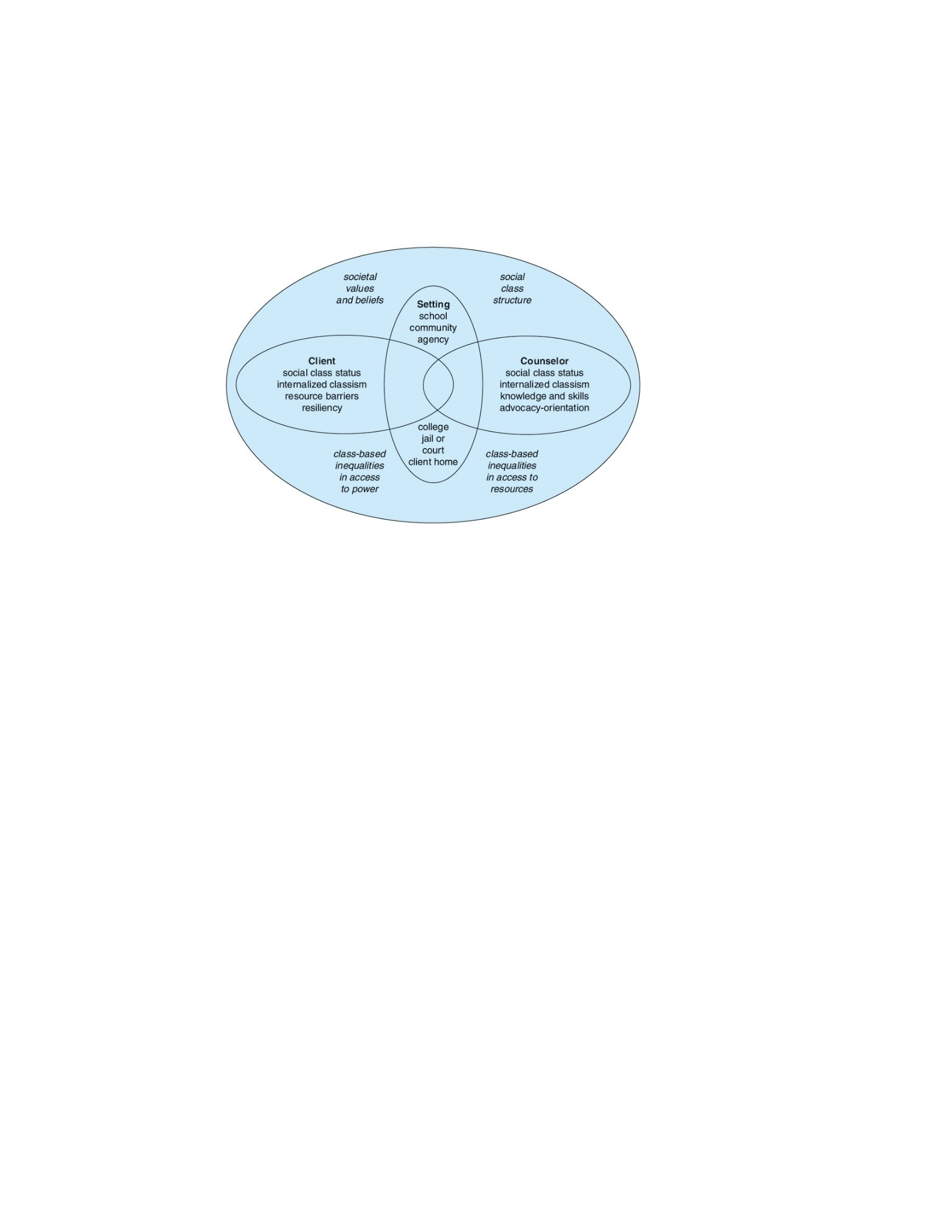
knowledge, and skills
regarding classism in
counseling
e.
f. Awareness
i. Cognitive dissonance—state of psychological disequilibrium experienced
when we face and have not resolved information that contradicts our
worldview
ii. Activities that will provide counselors with several opportunities for
increasing their awareness
1. Write own class story, volunteer, interact with other social classes,
educate yourself, interview professionals in your field, complete a
class privilege inventory, and explore your social class
g. Knowledge
i. Counselors should explore theory that integrates class and classism
ii. Feminist Theory, Womanist Theory, Relational-Cultural Theory (R C T),
Social Class Worldview Model (S C W M)

iii. Counselors should become more knowledgeable about needs and concerns
of poor and low-income individuals through informational interviews and
community status reports
iv. Counselors should increase their knowledge of community resources by
both identifying and investigating them
h. Skills
i. Importance of client and self-assessment of counselor values and biases
that emerge
ii. A comprehensive initial assessment of the client, the client’s context, and
the presenting concerns
iii. Explore client’s values and beliefs about social class, resource stressors
and strengths, include any concerns or goals, pay attention to
psychological symptoms, and assess the client’s awareness of classism,
racism and gender oppression
i. Advocacy
i. Advocacy is a collective response to social injustice
ii. It is a normal and necessary element of counseling
iii. At the professional level: self-care, integrated services, counselor training,
research
iv. At the individual level: attend to basic needs
v. At the community level: empowerment, education and training, public
policy, and universal health insurance
Changing Cultural Biases

I. Bias Basics: A Christian Perspective
a. The Fall’s effect
i. Racism is seen in most cultures
ii. Even well-intentioned people have biases
iii. No one is purely objective, not even scientists
b. We get defensive when considering whether we have a bias
II. What Changes Our Biases?
a. Education?
b. Laws?
c. Media portrayals & role models?
d. Cultural exposure?
e. The Contact Hypothesis?
f. Spiritual growth?
III. Education
a. The Talk Show Surprise
b. The Diversity Training debacle
c. Bottom line: typical strategies influence the well-intentioned but actually harden
the stances of those with significant racial bias!
IV. Laws
a. 1960s civil rights laws have had a positive impact
i. Provide recourse
ii. Laws are also limited in changing the human heart
iii. Racism can move “underground”

b. Have such laws gone too far?
i. Current controversies over reverse discrimination
V. Media Portrayals
a. Media creates implicit role models
b. Do we learn from our models?
c. Yes, positive role models do matter
d. Shape people’s view of their ethnic identity
e. Develop beliefs about achievement in life
VI. Cultural Exposure
a. Brief or “surfacy” cultural exposure can actually reinforce stereotypes
i. Only certain types of cultural exposure are truly beneficial
VII. The Contact Hypothesis I
a. Developed by Gordon Allport, 1954, The Nature of Prejudice
b. Theorizes that to change a prejudicial attitude…
i. Meaningful contact that is positive, sustained, & in-depth (nonsuperficial)
can create dissonance with stereotypes and lead to changes
VIII. The Contact Hypothesis II
a. Also theorizes that group members need to feel
i. Equal
ii. Share common goals
iii. Not be opposed by a significant authority figure
IX. Spiritual Growth vs Spiritual Deception
a. Individuals & groups have used faith to transform societal racism or to reinforce it

i. Abolitionists & underground railroad during the civil war
ii. Martin Luther King Jr., Ghandhi
iii. KKK, extremist Islamic groups
X. Unique Christian Contributions to Dealing with Racism & Bias I
a. “Racism is wrong” – clear moral framework with absolutes
b. Problems in post modern social constructionism prevent saying anything with
moral clarity
XI. Unique Christian Contributions to Dealing with Racism & Bias II
a. Peaceful protests/resistance
i. Martin Luther King Jr
ii. Without a spiritually-based moral framework, why resist peacefully?
b. Prayer
c. Communion: an early church witness of gender, class, and cross-cultural unity
XII. Unique Christian Contributions to Dealing with Racism & Bias III
a. The fallen nature’s contribution to the problem of racial prejudice
b. Repentance, forgiveness & reconciliation
i. Example: Robert Enright’s International Forgiveness Institute
Social Class and Classism
I. Social Class
a. Hinduism, caste system in India
II. Informal Structure
a. U.S. and many other countries
b. SES indicators

III. SES Status Indicators
a. Vary
i. Income
ii. Job prestige
iii. Education level
iv. Access to healthcare
v. Peer groups
b. Self perception matters
i. “poor yet rich” vs “rich yet poor”
ii. Role of faith
IV. Definitions
a. Classism
i. Prejudice and discriminatory behavior towards individuals based on their
perceived or actual SES
b. Internalized classism
i. A person’s beliefs, values, decisions, and relationships are based on self-
perceptions of being in a lower social class status
c. Poverty an uncomfortable subject
i. Psychological distancing
ii. Poverty attribution
1. How one explains poverty
V. Remainder of presentation
a. Low & middle SES stress examples

b. Poverty attribution
i. Two causes commonly offered to explain poverty
ii. A third cause seldom considered
iii. Making sense of the options
VI. Low & middle SES Stress Examples
a. Employment stress
i. wage stagnation
ii. outsourcing, layoffs common
iii. constant retraining due to technology improvements
iv. health benefits access & quality
b. Housing stress
i. Prices and loans
ii. Quality
iii. Community safety
VII. Low & Middle SES Stress Examples II
a. Health insurance stress
i. Disproportionate ethnic minorities, women, and children without health
insurance
ii. “working poor”
1. Low SES individuals without health insurance
iii. 18-34 age group
1. Many don't think they need health insurance
2. insurance rates higher for everyone else as a consequence

b. current health insurance changes
i. will they help or bankrupt the country?
ii. Tensions in two moral mandates: helping the sick and being financially
responsible
VIII. Poverty Attribution
a. Individual causation
i. Personal values, work ethic, choices
b. Structural causation
i. SES variables
ii. Poor quality education systems
iii. discrimination aspects
iv. the political aspect
c. multicultural literature favors structural causation as the causal explanation while
the majority culture tends to favor individual causation
IX. Poverty Attribution II
a. The third causation possibility?
b. Secular values promotion/ transmission
i. Theodore Dalrymple’s book Life at the Bottom: The Worldview that makes
the Underclass
ii. Psychiatrist working many years in inner city hospital and prison settings
iii. One premise:
1. Hollywood and elite culture promote values that are devastating
for low SES individuals

2. such values set up low SES individuals, especially women and
children, to remain poor
X. Poverty Attribution III
a. An example from Hollywood
i. the value of free sexual expression without permanent commitment
1. “live it up” sexually
2. Trade-in for new partners when bored or there’s a problem
ii. Upper SES father leaves a Hollywood actress mother with child
1. What will happen?
iii. Lower SES father leaves a low SES mother with a child
1. what happens?
iv. Lower SES father with a strong family value has marital problems
1. what happens?
XI. Making Sense of the Options
a. So which is it?
i. Individual causation?
ii. Structural causation?
iii. Secular values promotion?
b. My opinion: a combination of all three
XII. Making Sense of the Options II
a. Choice, social systems, and secular values
b. don't omit the role of secular cultural values promotion and transmission

i. Goes against values found in all major religious faiths (ex., value of
family, etc.)
ii. Fractured families, single parents more likely to get locked in at the low
SES when they live by secular values
iii. implications for social justice paradigms?

