



BUSI 620
C T 7QUESTIONS FOR
RITICAL HINKING
Salvatore Chapter 14: Discussion Questions: 12 & 15. Problems: spreadsheet problems 1 & 2.
1.12. What is the rationale behind the minimax regret rule? What are some less formal and
precise methods of dealing with uncertainty? When are these useful?
Minimax regret rule- minimizes the maximum regret or opportunity cost of a wrong decision,
regardless of the natural state. If the best strategy is selected, then there is no regret and if a less
than best strategy is selected the difference will be the difference between the pay-offs of
strategy selected and the best strategy under the same state of nature.
Other methods:
-acquiring additional information- reduces uncertainty and finds possibilities of the worst
outcomes
-referring to the authority- removes uncertainity by asking knowledgeable resources
specific questions
-attempts to control business environment- attempt to acquire monopoly by means of
patents and copyrights.
-Diversification- when fall in demand, returns derived from a particular asset, or when the
survival of the firm is not threatened.
2. 15. How does the adverse selection problem arise in the credit-card market? How do
credit-card companies reduce the adverse selection problem that they face? To what
complaint does this give rise?
-Adverse selection- aka negative selection, refers to a market procedure where
undesired consequences occur when sellers and buyers obtain different
information, resulting in bad products.
- Credit card companies use underwriting through third parties and take higher
interest rates to reduce the risk of loss of people defaulting.
- Underwriters can’t take out funds, contributing to economic collapse and raises
credit rates.
3.1. An individual has to choose between investment A and investment B. The individual
estimates that the income and probability of the income from each investment are as
given in the following table:
( a ) Using Excel’s statistical tools, calculate the standard deviation of the distribution
of each investment.
a- 1025
b- 1549
( b ) Which of the two investments is more risky?
B is higher, therefore more risky.
( c ) Which investment should the individual choose?
B, has more risk but also expects greater returns.
4.2. An individual is considering two investment projects. Project A will return a zero profit
if conditions are poor, a profit of $4 if conditions are good, and a profit of $8 if conditions

BUSI 620
are excellent. Project B will return a profit of $2 if conditions are poor, a profit of $3 if
conditions are good, and a profit of $4 if conditions are excellent. The probability
distribution of conditions is as follows:
( a ) Using Excel, calculate the expected value of each project and identify the preferred
project according to this criterion.
Expected value:A: 2.8
B: 2.7
Expected value of project A is the highest, and is the preferred project.
( b ) Assume that the individual’s utility function for profit is U( X ) = X – 0.05 X 2 .
Calculate the expected utility of each project and identify the preferred project according
to this criterion.
Expected utility:A: 2.08
B: 2.315
Expected utility of B is higher, B is the preferred project.
( c ) Is this individual risk averse, risk neutral, or risk seeking? Why?
The individual is risk AVERSE because marginal utility of money for the individual is
diminishing.
Note:
1. Spreadsheet problem 1: Use table 14-4 as reference.
2. Spreadsheet problem 2: Use tables 14-5 and 14-6 as reference.
Froeb et al. Chapter 17:
5.
BUSI 620
6.17 -4 Your company has a customer who is shutting down a production line, and it is
your responsibility to dispose of the extrusion machine. The company could keep it in
inventory for a possible future product and estimates that the reservation value is
$250,000. Your dealings on the secondhand market lead you to believe that there is a 0.4
chance a random buyer will pay $300,000, a 0.25 chance the buyer will pay $350,000, a
0.1 chance the buyer will pay $400,000, and a 0.25 chance it will not sell. If you must
commit to a posted price, what price maximizes profits?
= .4(300,000) + 350,000 (.25)+ 400,000 (.1) + .25(0)
= 120,000 + 87,500+40,000 + 0
= 247,500
The expected sell value would be 247,500, and the the highest chance of getting $300,000.
Froeb et al. Chapter 19:
7.19-5. Soft selling occurs when a buyer is skeptical of the usefulness of a product and the
seller offers to set a price that depends on realized value. For example, suppose you’re
trying to sell a company a new accounting system that will reduce costs by 10%. Instead
of naming a price, you offer to give them the product in exchange for 50% of their cost
savings. Describe the information asymmetry, the adverse selection problem, and why
soft selling is a successful signal.
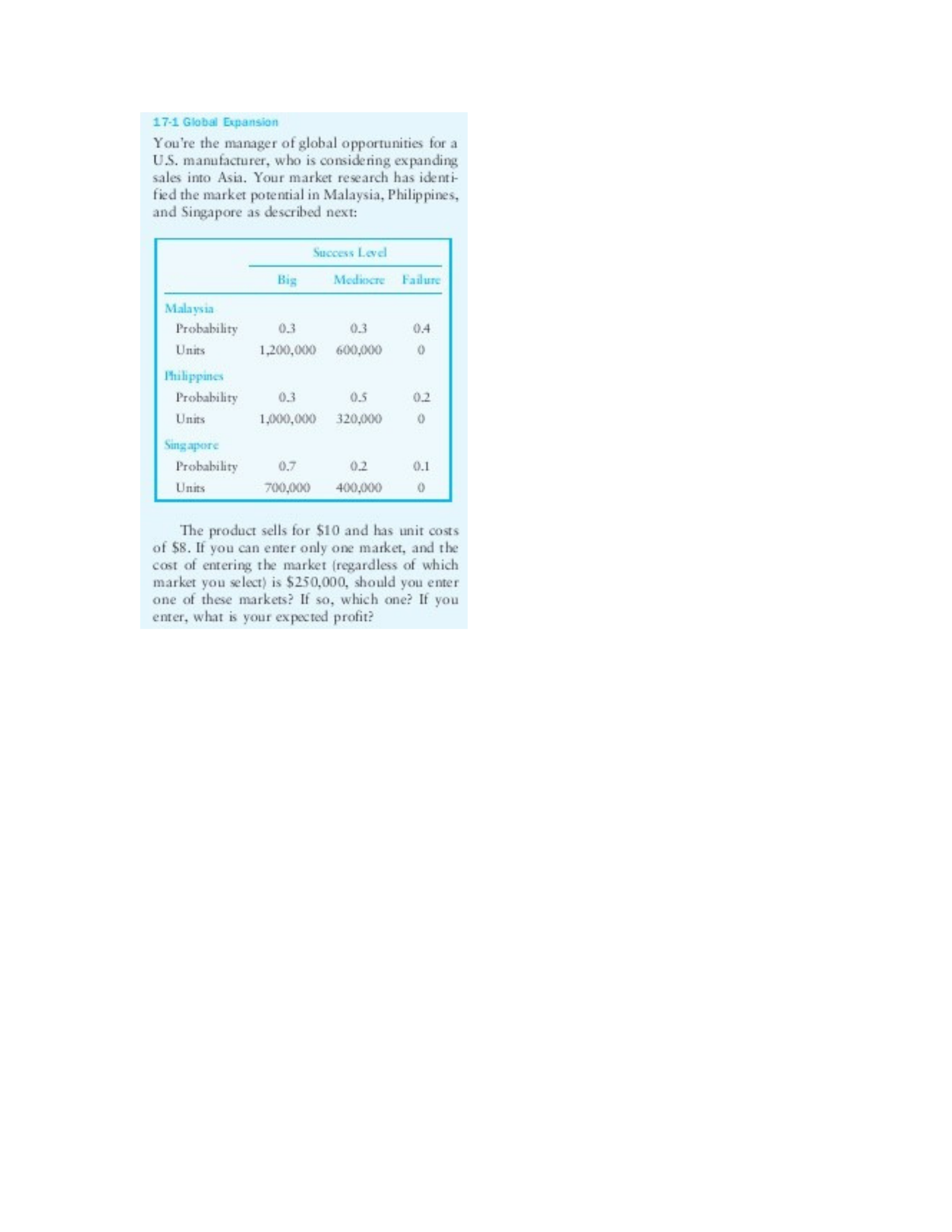
Yes, enter the market.
Malaysia= .3 * 1,200,000 + .3*600,000+.4*0
= 360,000 + 180,000+0=
540,000
Philippines= .3*1,000000+.5*320,000+.2*0
= 300,000 + 160,000+0
=460,000
Singapore= .7*700,000+.2*400,000+.1*0
= 490,000 + 80,000 +0
=570,000
product sells for $10, costs $8, profit +$2
Highest market is Singapore at 570,000
570,000 * 2 – 250,000 (cost to enter market)
Expected profit= $890,000
BUSI 620
Note:
P19-6: Need to consider the adverse selection.
Note:
19–6: Consider with and without the adverse selection.
Salvatore Chapter 15: Discussion Question7, Problems: 8, 10, and spreadsheet problem 1.
-Information asymmetry- where decisions are based off information that varies between
parties, often to the detriment of of one of the parties.
-Adverse selection problem- when a misinformed or less knowledgeable party enters a
contract or agreement with a perty that knows the correct or additional information that
the former is missing.
-Soft selling, a successful signal, helps to eliminate skepticism by allowing the buyer to
“test drive”free of cost for 50% of cost savings. When the buyer does not know that it
will reduce costs by 10%, which may or may not be a significant amount.
8.
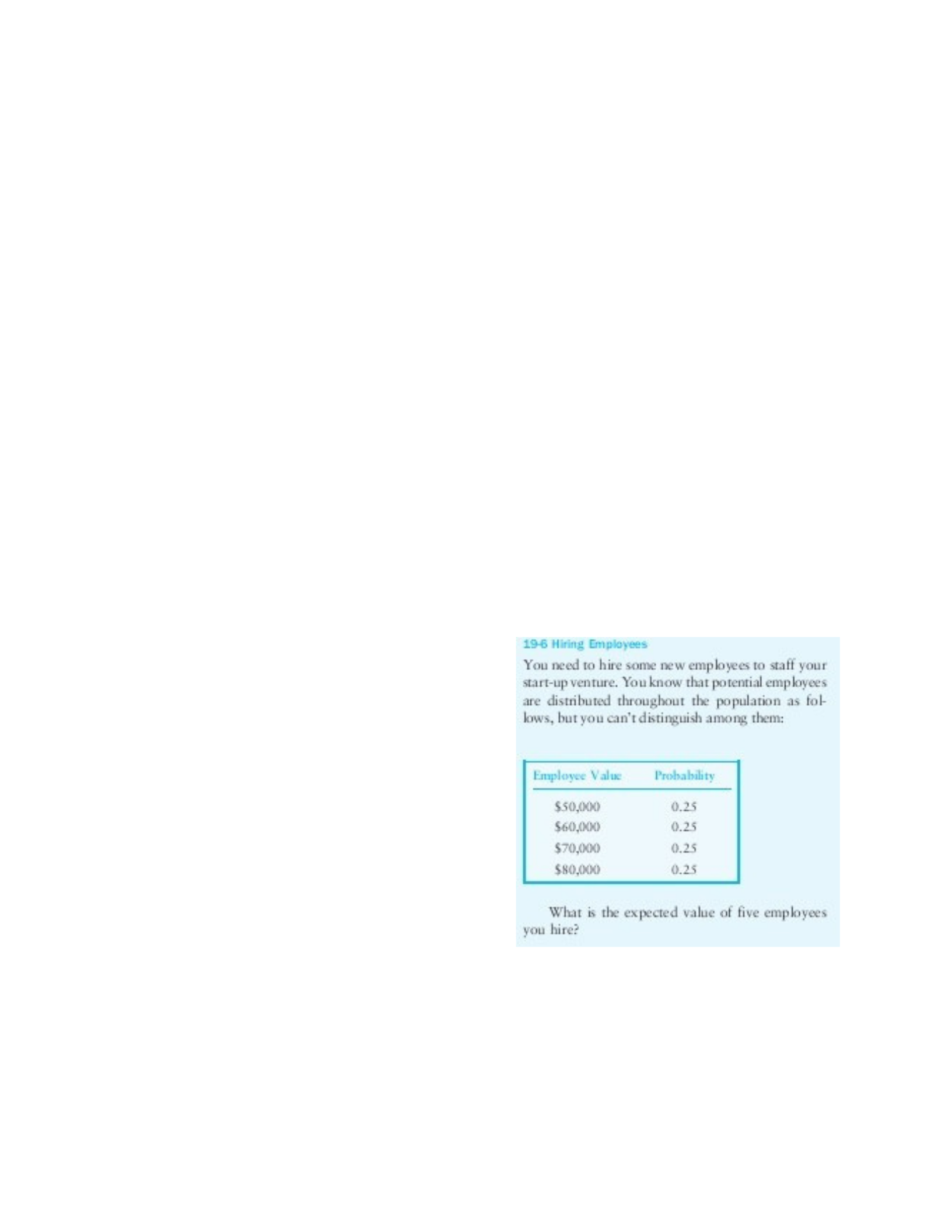
(50,000* .25) + ($60,000x* .25) + ($70,000* .25) +
($80,000*.25)
= $12,500 + 15,000 + 17,500 +20,000 = $65,000
Expected value without adverse selection = $65,000
The $50,000 & $60,000 employees would accept it
($50,000* .5) + ($60,000* .5) = $25,000 + 30,000
= $55,000
Expected value with adverse selection = $50,00
Leaving only the $50,000 employees who will
accept.
BUSI 620
9.
10.
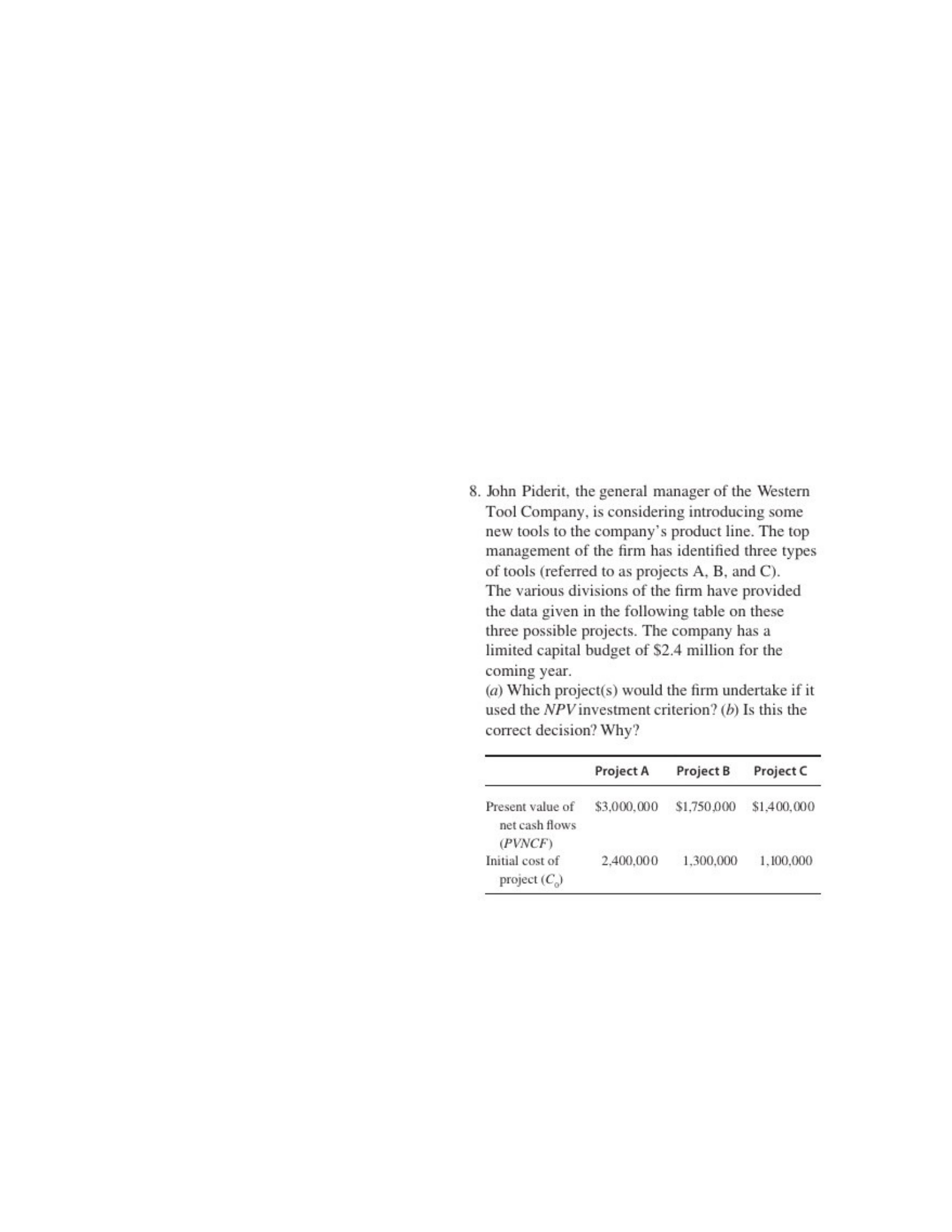
a.)NPV = PVNFC- C0
NPV A= 3,000,000 – 2,400,000 =600,000
NPV B= 1,750,000 – 1,300,000 = 450,000
NPV C= 1,4000,000 – 1,100,000= 300,000
NPV A has the highest value and will be selected.
b.)Project A is not the correct decision because it actually has the lowest rate of return.
Project B has a larger rate of profit and therefore is the correct choicefor a rational firm.
7. ( a ) When can the NPV and the IRR methods of evaluating investment projects
provide contradictory results?
An issue with IRR in utualy exclusive projects it can give contradicting decisions
compared to NPV.
( b ) How can this arise?
NPV, the net cash flow is supposed to be reinvested at the firm’s cost of capital or
risk adjusted discount rate.
IRR, net cash flow is supposed to be reinvested at the same time, greater than the
initial rate of return from the project.
( c ) Which method should then be used? Why?
Generally, NPV is better to determine the two mutually exclusive investment
projects since there is no certainty that the net cash flow produced can be
reinvested at the greater internal rate of return.
BUSI 620
No- total present value is less than the initial investment. See excel document.
Note:
1.P8: Remember the firm has a limited capital budget of $2.4 million for the coming year.
In other words, the firm faces the capital rationing and should use the profitability index
as its investment criterion (pp. 654–655).
2.P10: Use the dividend valuation model (pp. 657–658). “A share of the common stock of
the company currently sells for eight times current dividends.”
Submit this assignment by 11:59 p.m. (ET) on Sunday of Module/Week 7.
11.10. The MacBurger Company, a chain of fast-food restaurants, expects to earn $200
million after taxes for the current year. The company has a policy of paying out half of its
net after-tax income to the holders of the company’s 100 million shares of common stock.
A share of the common stock of the company currently sells for eight times current
earnings. Management and outside analysts expect the growth rate of earnings and
dividends for the company to be 7.5 percent per year. Calculate the cost of equity capital
to this firm.
Cost of equity capital= (Dividend per share / share sales point )+ growth
= 1/8 + .075= .125 + .075=.2 … *10= 20%
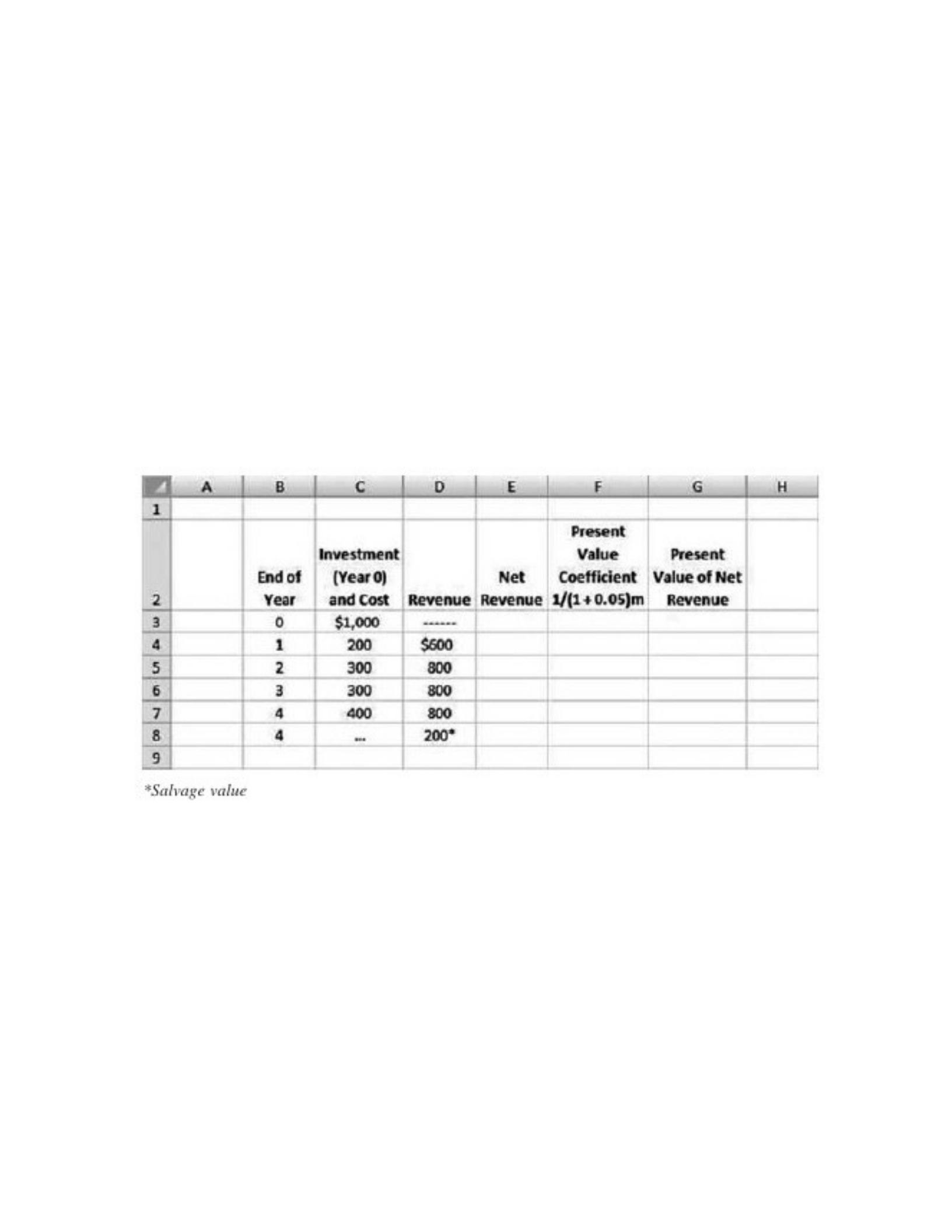
12.1. The benefits and costs of an investment project (the purchase of a piece of machinery)
are those given in the following table. In Excel, calculate net revenue, or the revenue
from the investment minus the costs; the present value coefficient for every year; and the
present value of the net revenue. Add together column G to get the net present value of
the project. Should the firm purchase the machine?

