



GENOMICS AND FUNCTIONAL GENOMICS
1 1. GENE EDITING ETHICS AND REGULATIONS
Problem 1. In a study on gene editing, researchers used CRISPR-Cas9 technology to edit a
gene in a population of fruit flies. They found that 25% of the offspring had the desired gene edit.
If a total of 800 offspring were produced, how many offspring had the desired gene edit?
Solution 1. Given that 25% of the offspring had the desired gene edit, we can set up a propor-
tion to find the number of offspring with the edit:
Number of offspring with edit
Total number of offspring =25%
100%
Let xbe the number of offspring with the desired gene edit. We can set up the proportion as:
x
800 =25
100
Solving for x:
x= 800 ×25
100 = 200
Therefore, out of the 800 offspring produced, 200 of them had the desired gene edit.
Problem 2. A research lab conducted a gene editing experiment on a population of bacte-
ria. The CRISPR-Cas9 technology used resulted in a success rate of 60%. If the researchers
performed the experiment on 500 bacteria, how many bacteria had the desired gene edit?
Solution 2. Given that the success rate was 60%, we can set up a proportion to find the number
of bacteria with the desired gene edit:
Number of bacteria with edit
Total number of bacteria =60%
100%
Let ybe the number of bacteria with the desired gene edit. Setting up the proportion:
y
500 =60
100
Solving for y:
y= 500 ×60
100 = 300
Therefore, out of the 500 bacteria, 300 of them had the desired gene edit.
2 2. CHALLENGES IN PERSONALIZED MEDICINE
Problem 2. Consider a patient with a genetic variation in a specific gene that is known to
affect drug metabolism. The patient is prescribed a medication that is primarily metabolized by the

enzyme coded by this gene. The patient has two copies of the normal allele (A), but the metabolic
activity of the enzyme is reduced by 50% in individuals with this genetic variation.
If the normal metabolic rate for this medication is 10 mg/hr, what would be the expected metabolic
rate for this patient?
Solution 2.
Given: Normal metabolic rate = 10 mg/hr Metabolic activity reduced by 50% for the patient with
genetic variation
Let’s define: Metabolic rate with genetic variation = X mg/hr
The patient has two copies of the normal allele (A), so the metabolic rate is reduced by 50%.
Therefore, the patient’s metabolic rate with genetic variation would be:
X= 10 mg/hr ×0.5=5mg/hr
Therefore, the expected metabolic rate for this patient with the genetic variation would be 5
mg/hr.
3 3. BIOINFORMATICS TOOLS FOR ANALYZING GENOMIC DATA
Problem 3. Consider a DNA sequence: "ATGCTAAGCT".
a) Calculate the total number of nucleotides in this sequence.
b) Determine the frequency of each nucleotide (A, T, G, C) in the sequence.
c) Compute the GC content of the sequence.
Solution 3.
a) To calculate the total number of nucleotides in the sequence "ATGCTAAGCT", we simply
count the characters:
Total number of nucleotides = 10
b) To determine the frequency of each nucleotide, we count the occurrences of each nucleotide
in the sequence:
Frequency of A: 3 Frequency of T: 2 Frequency of G: 2 Frequency of C: 3
c) The GC content of a DNA sequence is given by the percentage of G and C nucleotides in
the sequence.
Total number of G and C nucleotides = 2 (G) + 3 (C) = 5
Total number of nucleotides = 10
Therefore, GC content = (Number of G and C nucleotides / Total number of nucleotides) * 100
GC content = (5 / 10) * 100 = 50
So, the GC content of the sequence "ATGCTAAGCT" is 50
I.
4 3. COMMON SEQUENCE ANALYSIS TASKS
Problem 3. Consider two DNA sequences: Seq1 = "ACGTAGC" and Seq2 = "ACTAGT".
a) Calculate the Hamming distance between Seq1 and Seq2.
b) If a substitution mutation occurred at position 4 in Seq1, changing "A" to "T", determine the
new Hamming distance between Seq1 and Seq2.
Solution 3.

a) The Hamming distance is the number of positions at which the corresponding symbols differ
between two sequences of equal length. Given Seq1 = "ACGTAGC" and Seq2 = "ACTAGT", the
Hamming distance is as follows:
- Positions where symbols differ: 1 (T vs. G) and 6 (C vs. T) - Hamming distance = 2
b) After the substitution mutation at position 4 in Seq1 to "ACGTTGC", the new Seq1 becomes
"ACGT T GC". The updated Hamming distance between Seq1 and Seq2 is then:
- Positions where symbols differ: 1 (T vs. G), 4 (T vs. T), and 6 (C vs. T) - Updated Hamming
distance = 3
5 5. EPIGENETIC MODIFICATIONS AND THEIR ROLE IN GENE EXPRESSION
Problem 5. You are studying the role of DNA methylation in gene expression regulation. In a
particular gene, you observe that a CpG island located in the promoter region is heavily methylated.
You hypothesize that this methylation is leading to the suppression of gene expression. To test
this hypothesis, you perform a demethylation experiment using a DNA demethylating agent and
measure the gene expression levels before and after treatment.
Before treatment, the gene expression level was recorded as 200 arbitrary units. After treatment
with the demethylating agent, the gene expression level increased to 600 arbitrary units.
a) Calculate the fold change in gene expression after treatment.
b) If the gene had a baseline expression level of 1000 arbitrary units in an unmethylated state,
what is the fold change in gene expression when comparing the demethylated state to the unmethy-
lated baseline?
Solution 5.
a) The fold change in gene expression can be calculated using the formula:
Fold Change =Gene expression after treatment
Gene expression before treatment
Given that the gene expression before treatment was 200 arbitrary units and after treatment was
600 arbitrary units, we can substitute these values into the formula:
Fold Change =600
200 = 3
Therefore, the fold change in gene expression after treatment is 3.
b) To calculate the fold change when comparing the demethylated state to the unmethylated
baseline, we first need to determine the gene expression level in the demethylated state relative to
the baseline. This can be done using the formula:
Fold Change =Gene expression in demethylated state
Gene expression in unmethylated state
Given that the gene expression level in the demethylated state is 600 arbitrary units and in the
unmethylated state is 1000 arbitrary units, we can substitute these values into the formula:
Fold Change =600
1000 = 0.6
Therefore, the fold change in gene expression when comparing the demethylated state to the un-
methylated baseline is 0.6.

6 6. GENE-ENVIRONMENT INTERACTIONS IN DISEASE SUSCEPTIBILITY
Problem 6. A research study investigates the relationship between a specific gene variant (al-
lele A) and exposure to a certain environmental factor (Factor X) in increasing the risk of developing
a particular disease. The study found that individuals with allele A who were exposed to Factor X
had a disease risk of 0.6, while individuals without allele A who were exposed to Factor X had a
disease risk of 0.3. The disease risk for individuals with allele A but not exposed to Factor X was
0.1, and the disease risk for individuals without allele A and not exposed to Factor X was 0.05.
a) Calculate the relative risk for individuals with allele A when exposed to Factor X compared
to individuals without allele A.
b) Determine the attributable risk for the interaction between allele A and Factor X in disease
susceptibility.
c) Calculate the interaction contrast for allele A and Factor X in contributing to disease risk.
Solution 6. a) The relative risk (RR) is the ratio of the disease risk for individuals with allele A
exposed to Factor X to the disease risk for individuals without allele A exposed to Factor X.
Given: Risk of disease for individuals with allele A exposed to Factor X, P(D|A, X) = 0.6Risk
of disease for individuals without allele A exposed to Factor X, P(D|¬A, X) = 0.3
RR =0.6
0.3
= 2
Therefore, the relative risk for individuals with allele A when exposed to Factor X compared to
individuals without allele A is 2.
b) The attributable risk (AR) is the difference between the disease risk in the total population
and the disease risk in the unexposed group.
Given: Risk of disease for individuals with allele A exposed to Factor X, P(D|A, X) = 0.6Risk
of disease for individuals without allele A exposed to Factor X, P(D|¬A, X) = 0.3Risk of disease
for individuals with allele A but not exposed to Factor X, P(D|A, ¬X) = 0.1Risk of disease for
individuals without allele A and not exposed to Factor X, P(D|¬A, ¬X)=0.05
Total population disease risk:
P(D) = P(D|A, X)∗P(A) + P(D|¬A, X)∗P(¬A)
P(D)=0.6∗P(A)+0.3∗(1 −P(A))
Unexposed group disease risk:
P(D|¬X) = P(D|A, ¬X)∗P(A) + P(D|¬A, ¬X)∗P(¬A)
P(D|¬X) = 0.1∗P(A)+0.05 ∗(1 −P(A))
Attributable risk (AR) is then:
AR =P(D)−P(D|¬X)
c) The interaction contrast (IC) quantifies the interaction between allele A and Factor X in con-
tributing to disease risk.
Given:
IC =P(D|A, X)−P(D|A, ¬X)−P(D|¬A, X) + P(D|¬A, ¬X)
Substitute the given probabilities to find the interaction contrast.

7 Genomics and Functional Genomics
Problem:
Consider a gene with a DNA sequence of length 300 base pairs that codes for a protein. The
gene contains 4 exons (50, 75, 100, and 75 base pairs long) separated by 3 introns (20, 30, and
50 base pairs long).
a) Calculate the total length of the gene (including exons and introns).
b) If each codon in the gene corresponds to 3 base pairs, calculate the total number of codons
in the gene.
c) If each amino acid is coded by 1 codon, calculate the number of amino acids in the protein
produced by this gene.
Solution:
a) The total length of the gene can be calculated by adding the lengths of exons and introns
together:
Total gene length = (50 + 75 + 100 + 75) + (20 + 30 + 50) = 450 base pairs
b) Since each codon corresponds to 3 base pairs, the total number of codons can be calculated
by dividing the total gene length by 3:
Total number of codons = Total gene length / 3 = 450 / 3 = 150 codons
c) Since each amino acid is coded by 1 codon, the number of amino acids in the protein can
be calculated by simply counting the number of codons:
Number of amino acids = Total number of codons = 150 amino acids
8 8. GENOME-WIDE ASSOCIATION STUDIES IN COMPLEX DISEASES
Problem 8. In a genome-wide association study for a particular complex disease, researchers
found that a certain single nucleotide polymorphism (SNP) is significantly associated with the dis-
ease. The frequency of the disease allele for this SNP is 0.3 in the general population. The odds
ratio for this SNP is 2.5.
a) Calculate the odds of having the disease for individuals with the disease allele.
b) Calculate the odds of having the disease for individuals without the disease allele.
Solution 8.
a) The odds ratio is defined as the odds of having the disease for individuals with the disease
allele divided by the odds of having the disease for individuals without the disease allele. Given that
the odds ratio is 2.5 and the disease allele frequency is 0.3, we can calculate the odds of having
the disease for individuals with the disease allele as follows:
Let pbe the frequency of the disease allele and q= 1 −pbe the frequency of the non-disease
allele.
The odds ratio formula is:
OR =oddsdisease with allele
oddsdisease without allele
We are given that OR = 2.5and p= 0.3.
Therefore,
2.5 = 0.3
1−0.3

2.5 = 0.3
0.7
2.5×0.7=0.3
1.75 = 0.3
So, the odds of having the disease for individuals with the disease allele is 1.75.
b) We can calculate the odds of having the disease for individuals without the disease allele
using the odds ratio. Since the odds ratio formula is:
OR =oddsdisease with allele
oddsdisease without allele
We know that the odds of having the disease for individuals with the allele is 1.75. Therefore, to
find the odds of having the disease for individuals without the allele, we divide the odds of having
the disease for individuals with the allele by the odds ratio:
oddsdisease without allele =oddsdisease with allele
OR
oddsdisease without allele =1.75
2.5
oddsdisease without allele = 0.7
So, the odds of having the disease for individuals without the disease allele is 0.7.
9 9. EVOLUTIONARY GENOMICS AND PHYLOGENETICS
Problem 9. Consider the following DNA sequences for five species:
Species DNA Sequence
A ATGCCATCGAT
B ATGCCATGGAT
C ATGCCGTGGAT
D ATGCCATCGAT
E ATGCAATGGAT
a) Calculate the pairwise sequence identity between species A and each of the other species
(B, C, D, E).
b) Based on the sequence identities, construct a pairwise distance matrix for these five species.
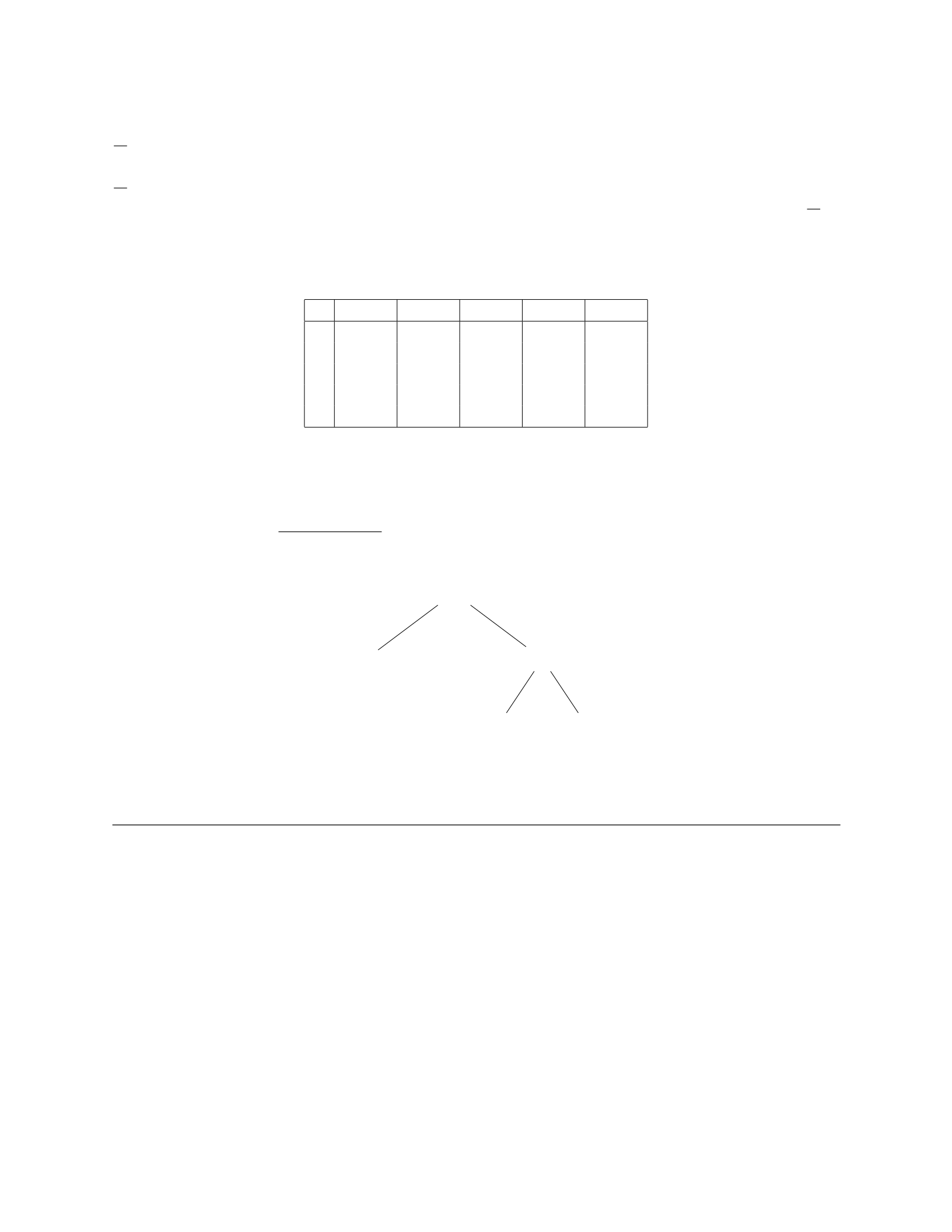
c) Construct a neighbor-joining tree using the pairwise distance matrix.
Solution 9.
a) The pairwise sequence identity is calculated as the number of matching positions divided by
the total number of positions compared. Let’s calculate the pairwise sequence identities between
species A and the other species.
For species B: Number of matches = 10 Total number of positions = 11 Pairwise identity =
10
11 ≈0.9091
For species C: Number of matches = 8 Total number of positions = 11 Pairwise identity =
8
11 ≈0.7273
For species D: Number of matches = 11 Total number of positions = 11 Pairwise identity =
11
11 = 1
For species E: Number of matches = 9 Total number of positions = 11 Pairwise identity = 9
11 ≈
0.8182
b) The pairwise distance matrix can be constructed using the formula: Dij = 1−pairwise identityij .
The pairwise distance matrix for these species is:
A B C D E
A0 0.0909 0.2727 0 0.1818
B0.0909 0 0.4545 0.0909 0.2727
C0.2727 0.4545 0 0.2727 0.1818
D0 0.0909 0.2727 0 0.1818
E0.1818 0.2727 0.1818 0.1818 0
c) To construct a neighbor-joining tree, we start by finding the minimum entry in the distance
matrix. In this case, the minimum entry is 0.0909, corresponding to the distance between species
A and B. We then define a new node (AB) to represent the cluster of A and B. We update the
distance matrix by computing the distances between the new node (AB) and all other nodes using
the formula D(AB)k=DAk +DB k −DAB
2.
Repeating this process, we construct the neighbor-joining tree:
AB
D AE
C E
10 10. COMPUTATIONAL METHODS FOR PREDICTING GENE FUNCTION
Problem 10. You are given a DNA sequence: ATGCGATCACCGCGTTCACCGTTT. Use the
genetic code table to translate this DNA sequence into a protein sequence. Additionally, predict
the function of the protein based on the amino acid sequence.
Solution 10. a) To translate the given DNA sequence into a protein sequence, we need to first
transcribe the DNA sequence into mRNA and then translate the mRNA into amino acids using the
genetic code table.
Starting DNA sequence: ATGCGATCACCGCGTTCACCGTTT
Transcribed mRNA: AUGCGAUCACCGCGUUACCGUUU
Using the genetic code table, we can translate the mRNA sequence into amino acids:
AUG - Methionine (Start) CGA - Arginine UCA - Serine CCG - Proline CGU - Arginine UUA -
Leucine CCG - Proline UUU - Phenylalanine
Therefore, the protein sequence translated from the given DNA sequence is: Met-Arg-Ser-Pro-
Arg-Leu-Pro-Phe.

b) Based on the amino acid sequence Met-Arg-Ser-Pro-Arg-Leu-Pro-Phe, we can analyze the
function of the protein. Proteins with specific amino acid sequences often have known functions or
structural motifs.
In this case, we can analyze the amino acid sequence to predict the function of the protein:
- The presence of methionine at the start indicates the start codon. - The presence of argi-
nine, serine, proline, and leucine suggests that this protein sequence may be involved in signaling
pathways, enzymatic reactions, or structural functions.
c) Without additional information or further analysis, it is challenging to definitively predict the
exact function of the protein solely based on its amino acid sequence. Further research or experi-
mental validation may be required to determine the precise function of this protein.
11 11. GENETIC DIVERSITY AND POPULATION GENETICS
Problem 11.
An allele frequency for a particular gene in a population is 0.7.
a) What is the frequency of the homozygous dominant genotype for this gene in the population?
b) What is the frequency of the heterozygous genotype for this gene in the population?
c) What is the frequency of the homozygous recessive genotype for this gene in the population?
Solution 11.
a) The frequency of the homozygous dominant genotype can be found by squaring the allele
frequency, which is 0.7.
Frequency of homozygous dominant genotype = (0.7)2= 0.49
Therefore, the frequency of the homozygous dominant genotype for this gene in the population
is 0.49.
b) The frequency of the heterozygous genotype can be found by multiplying the allele frequency
with the complement of the allele frequency (1 - 0.7).
Frequency of heterozygous genotype = 2 * 0.7 * (1 - 0.7) = 2 * 0.7 * 0.3 = 0.42
Therefore, the frequency of the heterozygous genotype for this gene in the population is 0.42.
c) The frequency of the homozygous recessive genotype can be found by squaring the com-
plement of the allele frequency (1 - 0.7).
Frequency of homozygous recessive genotype = (1 - 0.7)2= 0.09
Therefore, the frequency of the homozygous recessive genotype for this gene in the population
is 0.09.
I. REGULATORY NETWORKS CONTROLLING GENE EXPRESSION
Problem 12.
The expression of gene X is regulated by transcription factors Y and Z. The binding of Y to the
promoter region of gene X increases its expression by threefold, while the binding of Z decreases
its expression by half. In a specific experiment, the expression level of gene X is 100 units. If the
transcription factor Y is knocked out, what will be the new expression level of gene X?
Solution 12.
Let’s denote the expression level of gene X without any transcription factors as Xbaseline.
Given that the binding of transcription factor Y increases the expression by threefold and Z
decreases it by half, we can write the following equations:
With Y: XY= 3Xbaseline
Without Y: Xno Y =1
2XY=1
2·3Xbaseline =3
2Xbaseline
If the expression level of gene X is 100 units, then we can set up the following equation:

Xbaseline = 100
Now, substituting Xbaseline = 100 into Xno Y =3
2Xbaseline:
Xno Y =3
2·100 = 150
Therefore, if transcription factor Y is knocked out, the new expression level of gene X will be
150 units.

Problem 13.
A gene regulatory network consists of three genes: A, B, and C. Gene A activates the expres-
sion of gene B by two-fold, while gene B inhibits the expression of gene C by three-fold. If the basal
expression level of gene C is 120 units, what will be the new expression level of gene C if gene A
is knocked out?
Solution 13.
Let’s denote the expression level of gene C without any regulatory interactions as Cbaseline.
Given the effect of genes A and B on gene C, we have the following relationships:
With A: B= 2Aand C=B−3
Without A: Cno A =Bno A −3 = 2A−3
If the basal expression level of gene C is 120 units, then we can set up the following equation:
Cbaseline = 120
Now, substituting Cbaseline = 120 into Cno A = 2A−3:
Cno A = 2 ·0−3 = −3
Therefore, if gene A is knocked out, the new expression level of gene C will be -3 units.
12 13. STRUCTURAL GENOMICS AND PROTEIN STRUCTURE PREDICTION
Problem 13. Consider a protein with a sequence of amino acids given by:
SEQ: ALA-ARG-SER-LYS-ASP-GLY-GLU-ASP-ARG-GLY-ALA.
a) Calculate the molecular weight of this protein. Assume the average molecular weight of each
amino acid: Alanine (ALA) = 89.1 Da, Arginine (ARG) = 174.2 Da, Serine (SER) = 105.1 Da, Lysine
(LYS) = 128.2 Da, Aspartic Acid (ASP) = 133.1 Da, Glycine (GLY) = 75.1 Da, and Glutamic Acid
(GLU) = 147.1 Da.
b) Determine the isoelectric point (pI) of this protein.
Solution 13.
a) The molecular weight of a protein is calculated by adding up the molecular weights of each
amino acid in the sequence.
SEQ: ALA-ARG-SER-LYS-ASP-GLY-GLU-ASP-ARG-GLY-ALA
Molecular Weight: 89.1 + 174.2 + 105.1 + 128.2 + 133.1 + 75.1 + 147.1 + 133.1 + 174.2 + 75.1
+ 89.1
Molecular Weight: 1238.3 Da
Therefore, the molecular weight of the given protein sequence is 1238.3 Da.
b) The isoelectric point (pI) is the pH at which a protein carries no net charge. To calculate the
pI, we need to consider the pKa values of the amino acids. For simplicity, we will use the following
approximate pKa values:
Alanine (ALA) = 6.0, Arginine (ARG) = 12.0, Serine (SER) = 5.7, Lysine (LYS) = 10.5, Aspartic
Acid (ASP) = 3.9, Glycine (GLY) = 6.0, Glutamic Acid (GLU) = 4.1.
The pI of a protein can be estimated using the pKa values of the amino acids present in the
sequence. In this case, the amino acids present are: ALA, ARG, SER, LYS, ASP, GLY, GLU.
For a basic protein like this one (with arginine and lysine), we look for the pH that is closest
to the average of the pKa values of the basic (pKa > 7) and acidic (pKa < 7) amino acids in the
sequence.

Average of pKa values for Basic Amino Acids: (12.0 + 10.5) / 2 = 11.25
Average of pKa values for Acidic Amino Acids: (5.7 + 3.9 + 4.1) / 3 = 4.57
The isoelectric point (pI) is likely around the average of these values:
pI (11.25 + 4.57) / 2 = 7.91.
Therefore, the approximate isoelectric point of the protein is 7.91.
I. Genomics and Functional Genomics
Problem 1: In a population of 100 individuals, 25 are homozygous dominant (AA), 50 are
heterozygous (Aa), and 25 are homozygous recessive (aa) for a particular gene.
a) What is the allele frequency of the "A" allele in this population? b) What is the frequency of
individuals with the genotype Aa in this population?
Solution 1: a) The total number of alleles is twice the number of individuals, so there are 200
alleles in the population. The frequency of the "A" allele can be calculated as:
Frequency of "A" allele = [2(homozygous dominant) + 1(heterozygous)] / [2(total alleles)] =
[2(25) + 1(50)] / 200 = (50 + 50) / 200 = 100 / 200 = 0.5
Therefore, the allele frequency of the "A" allele in this population is 0.5.
b) The frequency of individuals with the genotype Aa can be calculated by dividing the number
of individuals with the genotype Aa by the total number of individuals:
Frequency of Aa genotype = Number of Aa individuals / Total number of individuals = 50 / 100
= 0.5
Therefore, the frequency of individuals with the genotype Aa in this population is 0.5.
I’m glad you’re interested in solving problems in Genomics and Functional Genomics! Here’s a
numerical problem along with a detailed solution:
13 15. PHARMACOGENOMICS AND PERSONALIZED DRUG THERAPIES
Problem 15. In a pharmacogenomics study, a group of patients with a specific genetic variant
were administered a drug to measure its efficacy. The results showed that 70
a) If 40 patients with the genetic variant were included in the study, how many patients re-
sponded positively to the drug?
b) If the overall response rate among patients without the genetic variant is 50
Solution 15.
a) The total number of patients with the genetic variant is 40. Since 70
Number of positive responders = 40 patients x 70
Therefore, 28 patients with the genetic variant responded positively to the drug.
b) Let’s denote the number of patients without the genetic variant as x. If the overall response
rate among these patients is 50
Number of positive responders = x patients x 50
To have the same number of positive responders in part (a), we set up an equation:
Number of positive responders in part (a) = Number of positive responders in part (b)
28 = 0.5x
Solving for x:
x = 28 / 0.5 = 56 patients
Therefore, 56 patients without the genetic variant would need to be included in the study to
have the same number of positive responders as in part (a).
Certainly! Here is a numerical problem on Genomics and Functional Genomics:

14 Genomics and Functional Genomics
Problem: In a plant species, a gene responsible for regulating flower color has two possible
alleles: A and a. In a population of 500 plants, it is found that 360 plants have at least one copy of
the dominant allele A.
a) Calculate the frequency of the allele A in the population. b) Determine the frequency of the
recessive allele a in the population. c) Find the percentage of plants in the population that are
homozygous for the dominant allele A.
Solution:
a) The frequency of allele A can be calculated by dividing the total number of copies of allele A
by the total number of alleles in the population.
Given: Total plants in the population, n= 500
Number of plants with at least one copy of allele A, p(AA) + p(Aa) = 360
Total number of copies of allele A, 2×360 = 720
Frequency of allele A, p(A) = 720
500×2= 0.72
b) The frequency of the recessive allele a can be determined by subtracting the frequency of
allele A from 1.
Frequency of allele a, p(a)=1−p(A)=1−0.72 = 0.28
c) To find the percentage of plants that are homozygous for the dominant allele A, we first need
to calculate the frequency of the homozygous genotype (AA). This can be obtained by squaring
the frequency of allele A.
Frequency of genotype AA, p(AA)=(p(A))2= 0.722= 0.5184
Percentage of plants that are homozygous for allele A, 51.84%
I. Problem:
Consider a genetic modifier that influences the progression of a neurodegenerative disease.
The modifier gene is known to have two alleles, A and a, with frequencies of 0.6 and 0.4, respec-
tively, in the population. Individuals with the A allele have a 20
a) What is the probability that an individual randomly selected from the population carries at
least one A allele?
b) If both of a person’s parents carry the A allele, what is the probability that the person will
develop the disease?
c) If an individual carries the a allele, what is the probability that their sibling also carries the a
allele?
II. Solution:
a) Let’s first calculate the probability of an individual carrying at least one A allele. This includes
individuals with AA or Aa genotypes.
P(A allele) = 0.6 P(a allele) = 0.4
P(at least one A allele) = 1 - P(no A allele) = 1 - P(aa) = 1 - P(a) * P(a) = 1 - 0.4 * 0.4 = 1 - 0.16
= 0.84
Therefore, the probability that an individual randomly selected from the population carries at
least one A allele is 0.84.
b) Given that both parents carry the A allele, the individual will have either AA or Aa genotype.
The risk of developing the disease for A allele carriers is reduced by 20
P(disease with both parents carrying A allele) = P(disease | AA or Aa) = 0.6*0.8 + 0.24*0.8 =
0.48 + 0.192 = 0.672
Therefore, the probability that the person will develop the disease is 0.672.
c) If an individual carries the a allele, the genotype can be aa.

Therefore, the probability that their sibling also carries the a allele is 1 (since both siblings will
have the aa genotype).
Hence, the probability that the sibling carries the a allele given one individual carries the a allele
is 1.
15 18. GENOMIC INSTABILITY AND CHROMOSOMAL ABNORMALITIES
Problem 18. A human cell line is known to have a chromosomal abnormality in which an extra
copy of chromosome 21 is present. Normally, human cells have 46 chromosomes. If a cell from
this line undergoes nondisjunction during meiosis I, what would be the chromosome number in the
resulting gametes?
Solution 18. a) When a cell undergoes nondisjunction during meiosis I, homologous chromo-
somes fail to separate properly, leading to one daughter cell having an extra chromosome and the
other missing one.
In this case, since the cell line already has an extra copy of chromosome 21, it would have 47
chromosomes instead of the normal 46.
During meiosis I, if nondisjunction occurs, one of the resulting daughter cells will have an ex-
tra chromosome 21, so it will have 47 chromosomes. The other daughter cell will be missing a
chromosome 21 and will have 45 chromosomes.
Therefore, the resulting gametes from this cell line would have 47 chromosomes and 45 chro-
mosomes, respectively.
b) If a sperm with 47 chromosomes fertilizes a normal egg (with 46 chromosomes), the resulting
zygote would have 47 + 46 = 93 chromosomes, which is an example of aneuploidy.
c) A zygote with 93 chromosomes may not be viable and could lead to developmental abnor-
malities or miscarriage.
I. Let’s generate a numerical problem in the field of Genomics and Functional Genomics:
16 Genomics and Functional Genomics
Problem: In a human DNA sequence, the frequency of the nucleotide Adenine (A) is 30%,
Thymine (T) is 20%, Cytosine (C) is 25%, and Guanine (G) is 25%. Calculate the GC content of
this DNA sequence.
Solution:
The GC content in DNA is the percentage of nucleotides Guanine (G) and Cytosine (C) in the
DNA sequence.
Given frequencies: - Frequency of Cytosine (C) = 25% - Frequency of Guanine (G) = 25%
The GC content can be calculated by adding the frequency of Cytosine and Guanine:
GC content =F requency(C) + F requency(G) = 25% + 25% = 50%
Therefore, the GC content of the DNA sequence is 50%.
II. Let’s generate another numerical problem in Genomics and Functional Genomics:
17 Genomics and Functional Genomics

Problem: A researcher is studying the expression of a gene in two different cell types – A and
B. In cell type A, the expression level of the gene is 200 TPM (Transcripts Per Million), and in cell
type B, the expression level is 500 TPM. Calculate the fold change in gene expression between
cell type A and cell type B.
Solution:
The fold change in gene expression between two conditions can be calculated using the for-
mula:
F oldChange =Expression level in Condition B
Expression level in Condition A
Given: - Expression level in cell type A = 200 TPM - Expression level in cell type B = 500 TPM
Substitute the values into the formula:
F oldChange =500 TPM
200 TPM = 2.5
Therefore, the fold change in gene expression between cell type A and cell type B is 2.5.
I’m glad to help you with that. Could you please specify a particular topic or concept within
Genomics and Functional Genomics that you would like the problem to focus on? This will help
me tailor the question to your needs.

enzyme coded by this gene. The patient has two copies of the normal allele (A), but the metabolic
activity of the enzyme is reduced by 50% in individuals with this genetic variation.
If the normal metabolic rate for this medication is 10 mg/hr, what would be the expected metabolic
rate for this patient?
Solution 2.
Given: Normal metabolic rate = 10 mg/hr Metabolic activity reduced by 50% for the patient with
genetic variation
Let’s define: Metabolic rate with genetic variation = X mg/hr
The patient has two copies of the normal allele (A), so the metabolic rate is reduced by 50%.
Therefore, the patient’s metabolic rate with genetic variation would be:
X= 10 mg/hr ×0.5=5mg/hr
Therefore, the expected metabolic rate for this patient with the genetic variation would be 5
mg/hr.
3 3. BIOINFORMATICS TOOLS FOR ANALYZING GENOMIC DATA
Problem 3. Consider a DNA sequence: "ATGCTAAGCT".
a) Calculate the total number of nucleotides in this sequence.
b) Determine the frequency of each nucleotide (A, T, G, C) in the sequence.
c) Compute the GC content of the sequence.
Solution 3.
a) To calculate the total number of nucleotides in the sequence "ATGCTAAGCT", we simply
count the characters:
Total number of nucleotides = 10
b) To determine the frequency of each nucleotide, we count the occurrences of each nucleotide
in the sequence:
Frequency of A: 3 Frequency of T: 2 Frequency of G: 2 Frequency of C: 3
c) The GC content of a DNA sequence is given by the percentage of G and C nucleotides in
the sequence.
Total number of G and C nucleotides = 2 (G) + 3 (C) = 5
Total number of nucleotides = 10
Therefore, GC content = (Number of G and C nucleotides / Total number of nucleotides) * 100
GC content = (5 / 10) * 100 = 50
So, the GC content of the sequence "ATGCTAAGCT" is 50
I.
4 3. COMMON SEQUENCE ANALYSIS TASKS
Problem 3. Consider two DNA sequences: Seq1 = "ACGTAGC" and Seq2 = "ACTAGT".
a) Calculate the Hamming distance between Seq1 and Seq2.
b) If a substitution mutation occurred at position 4 in Seq1, changing "A" to "T", determine the
new Hamming distance between Seq1 and Seq2.
Solution 3.

a) The Hamming distance is the number of positions at which the corresponding symbols differ
between two sequences of equal length. Given Seq1 = "ACGTAGC" and Seq2 = "ACTAGT", the
Hamming distance is as follows:
- Positions where symbols differ: 1 (T vs. G) and 6 (C vs. T) - Hamming distance = 2
b) After the substitution mutation at position 4 in Seq1 to "ACGTTGC", the new Seq1 becomes
"ACGT T GC". The updated Hamming distance between Seq1 and Seq2 is then:
- Positions where symbols differ: 1 (T vs. G), 4 (T vs. T), and 6 (C vs. T) - Updated Hamming
distance = 3
5 5. EPIGENETIC MODIFICATIONS AND THEIR ROLE IN GENE EXPRESSION
Problem 5. You are studying the role of DNA methylation in gene expression regulation. In a
particular gene, you observe that a CpG island located in the promoter region is heavily methylated.
You hypothesize that this methylation is leading to the suppression of gene expression. To test
this hypothesis, you perform a demethylation experiment using a DNA demethylating agent and
measure the gene expression levels before and after treatment.
Before treatment, the gene expression level was recorded as 200 arbitrary units. After treatment
with the demethylating agent, the gene expression level increased to 600 arbitrary units.
a) Calculate the fold change in gene expression after treatment.
b) If the gene had a baseline expression level of 1000 arbitrary units in an unmethylated state,
what is the fold change in gene expression when comparing the demethylated state to the unmethy-
lated baseline?
Solution 5.
a) The fold change in gene expression can be calculated using the formula:
Fold Change =Gene expression after treatment
Gene expression before treatment
Given that the gene expression before treatment was 200 arbitrary units and after treatment was
600 arbitrary units, we can substitute these values into the formula:
Fold Change =600
200 = 3
Therefore, the fold change in gene expression after treatment is 3.
b) To calculate the fold change when comparing the demethylated state to the unmethylated
baseline, we first need to determine the gene expression level in the demethylated state relative to
the baseline. This can be done using the formula:
Fold Change =Gene expression in demethylated state
Gene expression in unmethylated state
Given that the gene expression level in the demethylated state is 600 arbitrary units and in the
unmethylated state is 1000 arbitrary units, we can substitute these values into the formula:
Fold Change =600
1000 = 0.6
Therefore, the fold change in gene expression when comparing the demethylated state to the un-
methylated baseline is 0.6.

6 6. GENE-ENVIRONMENT INTERACTIONS IN DISEASE SUSCEPTIBILITY
Problem 6. A research study investigates the relationship between a specific gene variant (al-
lele A) and exposure to a certain environmental factor (Factor X) in increasing the risk of developing
a particular disease. The study found that individuals with allele A who were exposed to Factor X
had a disease risk of 0.6, while individuals without allele A who were exposed to Factor X had a
disease risk of 0.3. The disease risk for individuals with allele A but not exposed to Factor X was
0.1, and the disease risk for individuals without allele A and not exposed to Factor X was 0.05.
a) Calculate the relative risk for individuals with allele A when exposed to Factor X compared
to individuals without allele A.
b) Determine the attributable risk for the interaction between allele A and Factor X in disease
susceptibility.
c) Calculate the interaction contrast for allele A and Factor X in contributing to disease risk.
Solution 6. a) The relative risk (RR) is the ratio of the disease risk for individuals with allele A
exposed to Factor X to the disease risk for individuals without allele A exposed to Factor X.
Given: Risk of disease for individuals with allele A exposed to Factor X, P(D|A, X) = 0.6Risk
of disease for individuals without allele A exposed to Factor X, P(D|¬A, X) = 0.3
RR =0.6
0.3
= 2
Therefore, the relative risk for individuals with allele A when exposed to Factor X compared to
individuals without allele A is 2.
b) The attributable risk (AR) is the difference between the disease risk in the total population
and the disease risk in the unexposed group.
Given: Risk of disease for individuals with allele A exposed to Factor X, P(D|A, X) = 0.6Risk
of disease for individuals without allele A exposed to Factor X, P(D|¬A, X) = 0.3Risk of disease
for individuals with allele A but not exposed to Factor X, P(D|A, ¬X) = 0.1Risk of disease for
individuals without allele A and not exposed to Factor X, P(D|¬A, ¬X)=0.05
Total population disease risk:
P(D) = P(D|A, X)∗P(A) + P(D|¬A, X)∗P(¬A)
P(D)=0.6∗P(A)+0.3∗(1 −P(A))
Unexposed group disease risk:
P(D|¬X) = P(D|A, ¬X)∗P(A) + P(D|¬A, ¬X)∗P(¬A)
P(D|¬X) = 0.1∗P(A)+0.05 ∗(1 −P(A))
Attributable risk (AR) is then:
AR =P(D)−P(D|¬X)
c) The interaction contrast (IC) quantifies the interaction between allele A and Factor X in con-
tributing to disease risk.
Given:
IC =P(D|A, X)−P(D|A, ¬X)−P(D|¬A, X) + P(D|¬A, ¬X)
Substitute the given probabilities to find the interaction contrast.

7 Genomics and Functional Genomics
Problem:
Consider a gene with a DNA sequence of length 300 base pairs that codes for a protein. The
gene contains 4 exons (50, 75, 100, and 75 base pairs long) separated by 3 introns (20, 30, and
50 base pairs long).
a) Calculate the total length of the gene (including exons and introns).
b) If each codon in the gene corresponds to 3 base pairs, calculate the total number of codons
in the gene.
c) If each amino acid is coded by 1 codon, calculate the number of amino acids in the protein
produced by this gene.
Solution:
a) The total length of the gene can be calculated by adding the lengths of exons and introns
together:
Total gene length = (50 + 75 + 100 + 75) + (20 + 30 + 50) = 450 base pairs
b) Since each codon corresponds to 3 base pairs, the total number of codons can be calculated
by dividing the total gene length by 3:
Total number of codons = Total gene length / 3 = 450 / 3 = 150 codons
c) Since each amino acid is coded by 1 codon, the number of amino acids in the protein can
be calculated by simply counting the number of codons:
Number of amino acids = Total number of codons = 150 amino acids
8 8. GENOME-WIDE ASSOCIATION STUDIES IN COMPLEX DISEASES
Problem 8. In a genome-wide association study for a particular complex disease, researchers
found that a certain single nucleotide polymorphism (SNP) is significantly associated with the dis-
ease. The frequency of the disease allele for this SNP is 0.3 in the general population. The odds
ratio for this SNP is 2.5.
a) Calculate the odds of having the disease for individuals with the disease allele.
b) Calculate the odds of having the disease for individuals without the disease allele.
Solution 8.
a) The odds ratio is defined as the odds of having the disease for individuals with the disease
allele divided by the odds of having the disease for individuals without the disease allele. Given that
the odds ratio is 2.5 and the disease allele frequency is 0.3, we can calculate the odds of having
the disease for individuals with the disease allele as follows:
Let pbe the frequency of the disease allele and q= 1 −pbe the frequency of the non-disease
allele.
The odds ratio formula is:
OR =oddsdisease with allele
oddsdisease without allele
We are given that OR = 2.5and p= 0.3.
Therefore,
2.5 = 0.3
1−0.3

2.5 = 0.3
0.7
2.5×0.7=0.3
1.75 = 0.3
So, the odds of having the disease for individuals with the disease allele is 1.75.
b) We can calculate the odds of having the disease for individuals without the disease allele
using the odds ratio. Since the odds ratio formula is:
OR =oddsdisease with allele
oddsdisease without allele
We know that the odds of having the disease for individuals with the allele is 1.75. Therefore, to
find the odds of having the disease for individuals without the allele, we divide the odds of having
the disease for individuals with the allele by the odds ratio:
oddsdisease without allele =oddsdisease with allele
OR
oddsdisease without allele =1.75
2.5
oddsdisease without allele = 0.7
So, the odds of having the disease for individuals without the disease allele is 0.7.
9 9. EVOLUTIONARY GENOMICS AND PHYLOGENETICS
Problem 9. Consider the following DNA sequences for five species:
Species DNA Sequence
A ATGCCATCGAT
B ATGCCATGGAT
C ATGCCGTGGAT
D ATGCCATCGAT
E ATGCAATGGAT
a) Calculate the pairwise sequence identity between species A and each of the other species
(B, C, D, E).
b) Based on the sequence identities, construct a pairwise distance matrix for these five species.
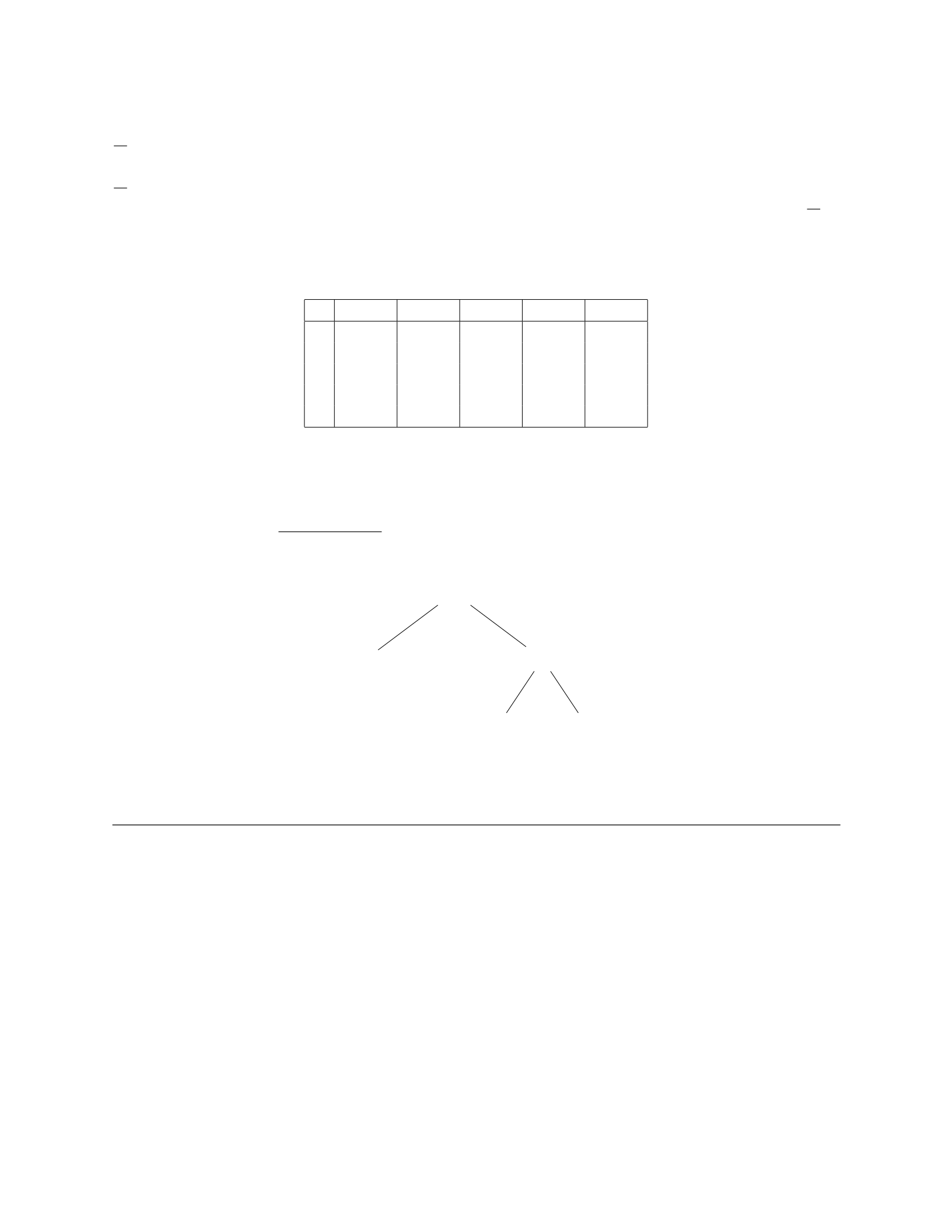
c) Construct a neighbor-joining tree using the pairwise distance matrix.
Solution 9.
a) The pairwise sequence identity is calculated as the number of matching positions divided by
the total number of positions compared. Let’s calculate the pairwise sequence identities between
species A and the other species.
For species B: Number of matches = 10 Total number of positions = 11 Pairwise identity =
10
11 ≈0.9091
For species C: Number of matches = 8 Total number of positions = 11 Pairwise identity =
8
11 ≈0.7273
For species D: Number of matches = 11 Total number of positions = 11 Pairwise identity =
11
11 = 1
For species E: Number of matches = 9 Total number of positions = 11 Pairwise identity = 9
11 ≈
0.8182
b) The pairwise distance matrix can be constructed using the formula: Dij = 1−pairwise identityij .
The pairwise distance matrix for these species is:
A B C D E
A0 0.0909 0.2727 0 0.1818
B0.0909 0 0.4545 0.0909 0.2727
C0.2727 0.4545 0 0.2727 0.1818
D0 0.0909 0.2727 0 0.1818
E0.1818 0.2727 0.1818 0.1818 0
c) To construct a neighbor-joining tree, we start by finding the minimum entry in the distance
matrix. In this case, the minimum entry is 0.0909, corresponding to the distance between species
A and B. We then define a new node (AB) to represent the cluster of A and B. We update the
distance matrix by computing the distances between the new node (AB) and all other nodes using
the formula D(AB)k=DAk +DB k −DAB
2.
Repeating this process, we construct the neighbor-joining tree:
AB
D AE
C E
10 10. COMPUTATIONAL METHODS FOR PREDICTING GENE FUNCTION
Problem 10. You are given a DNA sequence: ATGCGATCACCGCGTTCACCGTTT. Use the
genetic code table to translate this DNA sequence into a protein sequence. Additionally, predict
the function of the protein based on the amino acid sequence.
Solution 10. a) To translate the given DNA sequence into a protein sequence, we need to first
transcribe the DNA sequence into mRNA and then translate the mRNA into amino acids using the
genetic code table.
Starting DNA sequence: ATGCGATCACCGCGTTCACCGTTT
Transcribed mRNA: AUGCGAUCACCGCGUUACCGUUU
Using the genetic code table, we can translate the mRNA sequence into amino acids:
AUG - Methionine (Start) CGA - Arginine UCA - Serine CCG - Proline CGU - Arginine UUA -
Leucine CCG - Proline UUU - Phenylalanine
Therefore, the protein sequence translated from the given DNA sequence is: Met-Arg-Ser-Pro-
Arg-Leu-Pro-Phe.

b) Based on the amino acid sequence Met-Arg-Ser-Pro-Arg-Leu-Pro-Phe, we can analyze the
function of the protein. Proteins with specific amino acid sequences often have known functions or
structural motifs.
In this case, we can analyze the amino acid sequence to predict the function of the protein:
- The presence of methionine at the start indicates the start codon. - The presence of argi-
nine, serine, proline, and leucine suggests that this protein sequence may be involved in signaling
pathways, enzymatic reactions, or structural functions.
c) Without additional information or further analysis, it is challenging to definitively predict the
exact function of the protein solely based on its amino acid sequence. Further research or experi-
mental validation may be required to determine the precise function of this protein.
11 11. GENETIC DIVERSITY AND POPULATION GENETICS
Problem 11.
An allele frequency for a particular gene in a population is 0.7.
a) What is the frequency of the homozygous dominant genotype for this gene in the population?
b) What is the frequency of the heterozygous genotype for this gene in the population?
c) What is the frequency of the homozygous recessive genotype for this gene in the population?
Solution 11.
a) The frequency of the homozygous dominant genotype can be found by squaring the allele
frequency, which is 0.7.
Frequency of homozygous dominant genotype = (0.7)2= 0.49
Therefore, the frequency of the homozygous dominant genotype for this gene in the population
is 0.49.
b) The frequency of the heterozygous genotype can be found by multiplying the allele frequency
with the complement of the allele frequency (1 - 0.7).
Frequency of heterozygous genotype = 2 * 0.7 * (1 - 0.7) = 2 * 0.7 * 0.3 = 0.42
Therefore, the frequency of the heterozygous genotype for this gene in the population is 0.42.
c) The frequency of the homozygous recessive genotype can be found by squaring the com-
plement of the allele frequency (1 - 0.7).
Frequency of homozygous recessive genotype = (1 - 0.7)2= 0.09
Therefore, the frequency of the homozygous recessive genotype for this gene in the population
is 0.09.
I. REGULATORY NETWORKS CONTROLLING GENE EXPRESSION
Problem 12.
The expression of gene X is regulated by transcription factors Y and Z. The binding of Y to the
promoter region of gene X increases its expression by threefold, while the binding of Z decreases
its expression by half. In a specific experiment, the expression level of gene X is 100 units. If the
transcription factor Y is knocked out, what will be the new expression level of gene X?
Solution 12.
Let’s denote the expression level of gene X without any transcription factors as Xbaseline.
Given that the binding of transcription factor Y increases the expression by threefold and Z
decreases it by half, we can write the following equations:
With Y: XY= 3Xbaseline
Without Y: Xno Y =1
2XY=1
2·3Xbaseline =3
2Xbaseline
If the expression level of gene X is 100 units, then we can set up the following equation:

Xbaseline = 100
Now, substituting Xbaseline = 100 into Xno Y =3
2Xbaseline:
Xno Y =3
2·100 = 150
Therefore, if transcription factor Y is knocked out, the new expression level of gene X will be
150 units.

Problem 13.
A gene regulatory network consists of three genes: A, B, and C. Gene A activates the expres-
sion of gene B by two-fold, while gene B inhibits the expression of gene C by three-fold. If the basal
expression level of gene C is 120 units, what will be the new expression level of gene C if gene A
is knocked out?
Solution 13.
Let’s denote the expression level of gene C without any regulatory interactions as Cbaseline.
Given the effect of genes A and B on gene C, we have the following relationships:
With A: B= 2Aand C=B−3
Without A: Cno A =Bno A −3 = 2A−3
If the basal expression level of gene C is 120 units, then we can set up the following equation:
Cbaseline = 120
Now, substituting Cbaseline = 120 into Cno A = 2A−3:
Cno A = 2 ·0−3 = −3
Therefore, if gene A is knocked out, the new expression level of gene C will be -3 units.
12 13. STRUCTURAL GENOMICS AND PROTEIN STRUCTURE PREDICTION
Problem 13. Consider a protein with a sequence of amino acids given by:
SEQ: ALA-ARG-SER-LYS-ASP-GLY-GLU-ASP-ARG-GLY-ALA.
a) Calculate the molecular weight of this protein. Assume the average molecular weight of each
amino acid: Alanine (ALA) = 89.1 Da, Arginine (ARG) = 174.2 Da, Serine (SER) = 105.1 Da, Lysine
(LYS) = 128.2 Da, Aspartic Acid (ASP) = 133.1 Da, Glycine (GLY) = 75.1 Da, and Glutamic Acid
(GLU) = 147.1 Da.
b) Determine the isoelectric point (pI) of this protein.
Solution 13.
a) The molecular weight of a protein is calculated by adding up the molecular weights of each
amino acid in the sequence.
SEQ: ALA-ARG-SER-LYS-ASP-GLY-GLU-ASP-ARG-GLY-ALA
Molecular Weight: 89.1 + 174.2 + 105.1 + 128.2 + 133.1 + 75.1 + 147.1 + 133.1 + 174.2 + 75.1
+ 89.1
Molecular Weight: 1238.3 Da
Therefore, the molecular weight of the given protein sequence is 1238.3 Da.
b) The isoelectric point (pI) is the pH at which a protein carries no net charge. To calculate the
pI, we need to consider the pKa values of the amino acids. For simplicity, we will use the following
approximate pKa values:
Alanine (ALA) = 6.0, Arginine (ARG) = 12.0, Serine (SER) = 5.7, Lysine (LYS) = 10.5, Aspartic
Acid (ASP) = 3.9, Glycine (GLY) = 6.0, Glutamic Acid (GLU) = 4.1.
The pI of a protein can be estimated using the pKa values of the amino acids present in the
sequence. In this case, the amino acids present are: ALA, ARG, SER, LYS, ASP, GLY, GLU.
For a basic protein like this one (with arginine and lysine), we look for the pH that is closest
to the average of the pKa values of the basic (pKa > 7) and acidic (pKa < 7) amino acids in the
sequence.

Average of pKa values for Basic Amino Acids: (12.0 + 10.5) / 2 = 11.25
Average of pKa values for Acidic Amino Acids: (5.7 + 3.9 + 4.1) / 3 = 4.57
The isoelectric point (pI) is likely around the average of these values:
pI (11.25 + 4.57) / 2 = 7.91.
Therefore, the approximate isoelectric point of the protein is 7.91.
I. Genomics and Functional Genomics
Problem 1: In a population of 100 individuals, 25 are homozygous dominant (AA), 50 are
heterozygous (Aa), and 25 are homozygous recessive (aa) for a particular gene.
a) What is the allele frequency of the "A" allele in this population? b) What is the frequency of
individuals with the genotype Aa in this population?
Solution 1: a) The total number of alleles is twice the number of individuals, so there are 200
alleles in the population. The frequency of the "A" allele can be calculated as:
Frequency of "A" allele = [2(homozygous dominant) + 1(heterozygous)] / [2(total alleles)] =
[2(25) + 1(50)] / 200 = (50 + 50) / 200 = 100 / 200 = 0.5
Therefore, the allele frequency of the "A" allele in this population is 0.5.
b) The frequency of individuals with the genotype Aa can be calculated by dividing the number
of individuals with the genotype Aa by the total number of individuals:
Frequency of Aa genotype = Number of Aa individuals / Total number of individuals = 50 / 100
= 0.5
Therefore, the frequency of individuals with the genotype Aa in this population is 0.5.
I’m glad you’re interested in solving problems in Genomics and Functional Genomics! Here’s a
numerical problem along with a detailed solution:
13 15. PHARMACOGENOMICS AND PERSONALIZED DRUG THERAPIES
Problem 15. In a pharmacogenomics study, a group of patients with a specific genetic variant
were administered a drug to measure its efficacy. The results showed that 70
a) If 40 patients with the genetic variant were included in the study, how many patients re-
sponded positively to the drug?
b) If the overall response rate among patients without the genetic variant is 50
Solution 15.
a) The total number of patients with the genetic variant is 40. Since 70
Number of positive responders = 40 patients x 70
Therefore, 28 patients with the genetic variant responded positively to the drug.
b) Let’s denote the number of patients without the genetic variant as x. If the overall response
rate among these patients is 50
Number of positive responders = x patients x 50
To have the same number of positive responders in part (a), we set up an equation:
Number of positive responders in part (a) = Number of positive responders in part (b)
28 = 0.5x
Solving for x:
x = 28 / 0.5 = 56 patients
Therefore, 56 patients without the genetic variant would need to be included in the study to
have the same number of positive responders as in part (a).
Certainly! Here is a numerical problem on Genomics and Functional Genomics:

14 Genomics and Functional Genomics
Problem: In a plant species, a gene responsible for regulating flower color has two possible
alleles: A and a. In a population of 500 plants, it is found that 360 plants have at least one copy of
the dominant allele A.
a) Calculate the frequency of the allele A in the population. b) Determine the frequency of the
recessive allele a in the population. c) Find the percentage of plants in the population that are
homozygous for the dominant allele A.
Solution:
a) The frequency of allele A can be calculated by dividing the total number of copies of allele A
by the total number of alleles in the population.
Given: Total plants in the population, n= 500
Number of plants with at least one copy of allele A, p(AA) + p(Aa) = 360
Total number of copies of allele A, 2×360 = 720
Frequency of allele A, p(A) = 720
500×2= 0.72
b) The frequency of the recessive allele a can be determined by subtracting the frequency of
allele A from 1.
Frequency of allele a, p(a)=1−p(A)=1−0.72 = 0.28
c) To find the percentage of plants that are homozygous for the dominant allele A, we first need
to calculate the frequency of the homozygous genotype (AA). This can be obtained by squaring
the frequency of allele A.
Frequency of genotype AA, p(AA)=(p(A))2= 0.722= 0.5184
Percentage of plants that are homozygous for allele A, 51.84%
I. Problem:
Consider a genetic modifier that influences the progression of a neurodegenerative disease.
The modifier gene is known to have two alleles, A and a, with frequencies of 0.6 and 0.4, respec-
tively, in the population. Individuals with the A allele have a 20
a) What is the probability that an individual randomly selected from the population carries at
least one A allele?
b) If both of a person’s parents carry the A allele, what is the probability that the person will
develop the disease?
c) If an individual carries the a allele, what is the probability that their sibling also carries the a
allele?
II. Solution:
a) Let’s first calculate the probability of an individual carrying at least one A allele. This includes
individuals with AA or Aa genotypes.
P(A allele) = 0.6 P(a allele) = 0.4
P(at least one A allele) = 1 - P(no A allele) = 1 - P(aa) = 1 - P(a) * P(a) = 1 - 0.4 * 0.4 = 1 - 0.16
= 0.84
Therefore, the probability that an individual randomly selected from the population carries at
least one A allele is 0.84.
b) Given that both parents carry the A allele, the individual will have either AA or Aa genotype.
The risk of developing the disease for A allele carriers is reduced by 20
P(disease with both parents carrying A allele) = P(disease | AA or Aa) = 0.6*0.8 + 0.24*0.8 =
0.48 + 0.192 = 0.672
Therefore, the probability that the person will develop the disease is 0.672.
c) If an individual carries the a allele, the genotype can be aa.

Therefore, the probability that their sibling also carries the a allele is 1 (since both siblings will
have the aa genotype).
Hence, the probability that the sibling carries the a allele given one individual carries the a allele
is 1.
15 18. GENOMIC INSTABILITY AND CHROMOSOMAL ABNORMALITIES
Problem 18. A human cell line is known to have a chromosomal abnormality in which an extra
copy of chromosome 21 is present. Normally, human cells have 46 chromosomes. If a cell from
this line undergoes nondisjunction during meiosis I, what would be the chromosome number in the
resulting gametes?
Solution 18. a) When a cell undergoes nondisjunction during meiosis I, homologous chromo-
somes fail to separate properly, leading to one daughter cell having an extra chromosome and the
other missing one.
In this case, since the cell line already has an extra copy of chromosome 21, it would have 47
chromosomes instead of the normal 46.
During meiosis I, if nondisjunction occurs, one of the resulting daughter cells will have an ex-
tra chromosome 21, so it will have 47 chromosomes. The other daughter cell will be missing a
chromosome 21 and will have 45 chromosomes.
Therefore, the resulting gametes from this cell line would have 47 chromosomes and 45 chro-
mosomes, respectively.
b) If a sperm with 47 chromosomes fertilizes a normal egg (with 46 chromosomes), the resulting
zygote would have 47 + 46 = 93 chromosomes, which is an example of aneuploidy.
c) A zygote with 93 chromosomes may not be viable and could lead to developmental abnor-
malities or miscarriage.
I. Let’s generate a numerical problem in the field of Genomics and Functional Genomics:
16 Genomics and Functional Genomics
Problem: In a human DNA sequence, the frequency of the nucleotide Adenine (A) is 30%,
Thymine (T) is 20%, Cytosine (C) is 25%, and Guanine (G) is 25%. Calculate the GC content of
this DNA sequence.
Solution:
The GC content in DNA is the percentage of nucleotides Guanine (G) and Cytosine (C) in the
DNA sequence.
Given frequencies: - Frequency of Cytosine (C) = 25% - Frequency of Guanine (G) = 25%
The GC content can be calculated by adding the frequency of Cytosine and Guanine:
GC content =F requency(C) + F requency(G) = 25% + 25% = 50%
Therefore, the GC content of the DNA sequence is 50%.
II. Let’s generate another numerical problem in Genomics and Functional Genomics:
17 Genomics and Functional Genomics

Problem: A researcher is studying the expression of a gene in two different cell types – A and
B. In cell type A, the expression level of the gene is 200 TPM (Transcripts Per Million), and in cell
type B, the expression level is 500 TPM. Calculate the fold change in gene expression between
cell type A and cell type B.
Solution:
The fold change in gene expression between two conditions can be calculated using the for-
mula:
F oldChange =Expression level in Condition B
Expression level in Condition A
Given: - Expression level in cell type A = 200 TPM - Expression level in cell type B = 500 TPM
Substitute the values into the formula:
F oldChange =500 TPM
200 TPM = 2.5
Therefore, the fold change in gene expression between cell type A and cell type B is 2.5.
I’m glad to help you with that. Could you please specify a particular topic or concept within
Genomics and Functional Genomics that you would like the problem to focus on? This will help
me tailor the question to your needs.

enzyme coded by this gene. The patient has two copies of the normal allele (A), but the metabolic
activity of the enzyme is reduced by 50% in individuals with this genetic variation.
If the normal metabolic rate for this medication is 10 mg/hr, what would be the expected metabolic
rate for this patient?
Solution 2.
Given: Normal metabolic rate = 10 mg/hr Metabolic activity reduced by 50% for the patient with
genetic variation
Let’s define: Metabolic rate with genetic variation = X mg/hr
The patient has two copies of the normal allele (A), so the metabolic rate is reduced by 50%.
Therefore, the patient’s metabolic rate with genetic variation would be:
X= 10 mg/hr ×0.5=5mg/hr
Therefore, the expected metabolic rate for this patient with the genetic variation would be 5
mg/hr.
3 3. BIOINFORMATICS TOOLS FOR ANALYZING GENOMIC DATA
Problem 3. Consider a DNA sequence: "ATGCTAAGCT".
a) Calculate the total number of nucleotides in this sequence.
b) Determine the frequency of each nucleotide (A, T, G, C) in the sequence.
c) Compute the GC content of the sequence.
Solution 3.
a) To calculate the total number of nucleotides in the sequence "ATGCTAAGCT", we simply
count the characters:
Total number of nucleotides = 10
b) To determine the frequency of each nucleotide, we count the occurrences of each nucleotide
in the sequence:
Frequency of A: 3 Frequency of T: 2 Frequency of G: 2 Frequency of C: 3
c) The GC content of a DNA sequence is given by the percentage of G and C nucleotides in
the sequence.
Total number of G and C nucleotides = 2 (G) + 3 (C) = 5
Total number of nucleotides = 10
Therefore, GC content = (Number of G and C nucleotides / Total number of nucleotides) * 100
GC content = (5 / 10) * 100 = 50
So, the GC content of the sequence "ATGCTAAGCT" is 50
I.
4 3. COMMON SEQUENCE ANALYSIS TASKS
Problem 3. Consider two DNA sequences: Seq1 = "ACGTAGC" and Seq2 = "ACTAGT".
a) Calculate the Hamming distance between Seq1 and Seq2.
b) If a substitution mutation occurred at position 4 in Seq1, changing "A" to "T", determine the
new Hamming distance between Seq1 and Seq2.
Solution 3.

a) The Hamming distance is the number of positions at which the corresponding symbols differ
between two sequences of equal length. Given Seq1 = "ACGTAGC" and Seq2 = "ACTAGT", the
Hamming distance is as follows:
- Positions where symbols differ: 1 (T vs. G) and 6 (C vs. T) - Hamming distance = 2
b) After the substitution mutation at position 4 in Seq1 to "ACGTTGC", the new Seq1 becomes
"ACGT T GC". The updated Hamming distance between Seq1 and Seq2 is then:
- Positions where symbols differ: 1 (T vs. G), 4 (T vs. T), and 6 (C vs. T) - Updated Hamming
distance = 3
5 5. EPIGENETIC MODIFICATIONS AND THEIR ROLE IN GENE EXPRESSION
Problem 5. You are studying the role of DNA methylation in gene expression regulation. In a
particular gene, you observe that a CpG island located in the promoter region is heavily methylated.
You hypothesize that this methylation is leading to the suppression of gene expression. To test
this hypothesis, you perform a demethylation experiment using a DNA demethylating agent and
measure the gene expression levels before and after treatment.
Before treatment, the gene expression level was recorded as 200 arbitrary units. After treatment
with the demethylating agent, the gene expression level increased to 600 arbitrary units.
a) Calculate the fold change in gene expression after treatment.
b) If the gene had a baseline expression level of 1000 arbitrary units in an unmethylated state,
what is the fold change in gene expression when comparing the demethylated state to the unmethy-
lated baseline?
Solution 5.
a) The fold change in gene expression can be calculated using the formula:
Fold Change =Gene expression after treatment
Gene expression before treatment
Given that the gene expression before treatment was 200 arbitrary units and after treatment was
600 arbitrary units, we can substitute these values into the formula:
Fold Change =600
200 = 3
Therefore, the fold change in gene expression after treatment is 3.
b) To calculate the fold change when comparing the demethylated state to the unmethylated
baseline, we first need to determine the gene expression level in the demethylated state relative to
the baseline. This can be done using the formula:
Fold Change =Gene expression in demethylated state
Gene expression in unmethylated state
Given that the gene expression level in the demethylated state is 600 arbitrary units and in the
unmethylated state is 1000 arbitrary units, we can substitute these values into the formula:
Fold Change =600
1000 = 0.6
Therefore, the fold change in gene expression when comparing the demethylated state to the un-
methylated baseline is 0.6.

6 6. GENE-ENVIRONMENT INTERACTIONS IN DISEASE SUSCEPTIBILITY
Problem 6. A research study investigates the relationship between a specific gene variant (al-
lele A) and exposure to a certain environmental factor (Factor X) in increasing the risk of developing
a particular disease. The study found that individuals with allele A who were exposed to Factor X
had a disease risk of 0.6, while individuals without allele A who were exposed to Factor X had a
disease risk of 0.3. The disease risk for individuals with allele A but not exposed to Factor X was
0.1, and the disease risk for individuals without allele A and not exposed to Factor X was 0.05.
a) Calculate the relative risk for individuals with allele A when exposed to Factor X compared
to individuals without allele A.
b) Determine the attributable risk for the interaction between allele A and Factor X in disease
susceptibility.
c) Calculate the interaction contrast for allele A and Factor X in contributing to disease risk.
Solution 6. a) The relative risk (RR) is the ratio of the disease risk for individuals with allele A
exposed to Factor X to the disease risk for individuals without allele A exposed to Factor X.
Given: Risk of disease for individuals with allele A exposed to Factor X, P(D|A, X) = 0.6Risk
of disease for individuals without allele A exposed to Factor X, P(D|¬A, X) = 0.3
RR =0.6
0.3
= 2
Therefore, the relative risk for individuals with allele A when exposed to Factor X compared to
individuals without allele A is 2.
b) The attributable risk (AR) is the difference between the disease risk in the total population
and the disease risk in the unexposed group.
Given: Risk of disease for individuals with allele A exposed to Factor X, P(D|A, X) = 0.6Risk
of disease for individuals without allele A exposed to Factor X, P(D|¬A, X) = 0.3Risk of disease
for individuals with allele A but not exposed to Factor X, P(D|A, ¬X) = 0.1Risk of disease for
individuals without allele A and not exposed to Factor X, P(D|¬A, ¬X)=0.05
Total population disease risk:
P(D) = P(D|A, X)∗P(A) + P(D|¬A, X)∗P(¬A)
P(D)=0.6∗P(A)+0.3∗(1 −P(A))
Unexposed group disease risk:
P(D|¬X) = P(D|A, ¬X)∗P(A) + P(D|¬A, ¬X)∗P(¬A)
P(D|¬X) = 0.1∗P(A)+0.05 ∗(1 −P(A))
Attributable risk (AR) is then:
AR =P(D)−P(D|¬X)
c) The interaction contrast (IC) quantifies the interaction between allele A and Factor X in con-
tributing to disease risk.
Given:
IC =P(D|A, X)−P(D|A, ¬X)−P(D|¬A, X) + P(D|¬A, ¬X)
Substitute the given probabilities to find the interaction contrast.

7 Genomics and Functional Genomics
Problem:
Consider a gene with a DNA sequence of length 300 base pairs that codes for a protein. The
gene contains 4 exons (50, 75, 100, and 75 base pairs long) separated by 3 introns (20, 30, and
50 base pairs long).
a) Calculate the total length of the gene (including exons and introns).
b) If each codon in the gene corresponds to 3 base pairs, calculate the total number of codons
in the gene.
c) If each amino acid is coded by 1 codon, calculate the number of amino acids in the protein
produced by this gene.
Solution:
a) The total length of the gene can be calculated by adding the lengths of exons and introns
together:
Total gene length = (50 + 75 + 100 + 75) + (20 + 30 + 50) = 450 base pairs
b) Since each codon corresponds to 3 base pairs, the total number of codons can be calculated
by dividing the total gene length by 3:
Total number of codons = Total gene length / 3 = 450 / 3 = 150 codons
c) Since each amino acid is coded by 1 codon, the number of amino acids in the protein can
be calculated by simply counting the number of codons:
Number of amino acids = Total number of codons = 150 amino acids
8 8. GENOME-WIDE ASSOCIATION STUDIES IN COMPLEX DISEASES
Problem 8. In a genome-wide association study for a particular complex disease, researchers
found that a certain single nucleotide polymorphism (SNP) is significantly associated with the dis-
ease. The frequency of the disease allele for this SNP is 0.3 in the general population. The odds
ratio for this SNP is 2.5.
a) Calculate the odds of having the disease for individuals with the disease allele.
b) Calculate the odds of having the disease for individuals without the disease allele.
Solution 8.
a) The odds ratio is defined as the odds of having the disease for individuals with the disease
allele divided by the odds of having the disease for individuals without the disease allele. Given that
the odds ratio is 2.5 and the disease allele frequency is 0.3, we can calculate the odds of having
the disease for individuals with the disease allele as follows:
Let pbe the frequency of the disease allele and q= 1 −pbe the frequency of the non-disease
allele.
The odds ratio formula is:
OR =oddsdisease with allele
oddsdisease without allele
We are given that OR = 2.5and p= 0.3.
Therefore,
2.5 = 0.3
1−0.3

2.5 = 0.3
0.7
2.5×0.7=0.3
1.75 = 0.3
So, the odds of having the disease for individuals with the disease allele is 1.75.
b) We can calculate the odds of having the disease for individuals without the disease allele
using the odds ratio. Since the odds ratio formula is:
OR =oddsdisease with allele
oddsdisease without allele
We know that the odds of having the disease for individuals with the allele is 1.75. Therefore, to
find the odds of having the disease for individuals without the allele, we divide the odds of having
the disease for individuals with the allele by the odds ratio:
oddsdisease without allele =oddsdisease with allele
OR
oddsdisease without allele =1.75
2.5
oddsdisease without allele = 0.7
So, the odds of having the disease for individuals without the disease allele is 0.7.
9 9. EVOLUTIONARY GENOMICS AND PHYLOGENETICS
Problem 9. Consider the following DNA sequences for five species:
Species DNA Sequence
A ATGCCATCGAT
B ATGCCATGGAT
C ATGCCGTGGAT
D ATGCCATCGAT
E ATGCAATGGAT
a) Calculate the pairwise sequence identity between species A and each of the other species
(B, C, D, E).
b) Based on the sequence identities, construct a pairwise distance matrix for these five species.
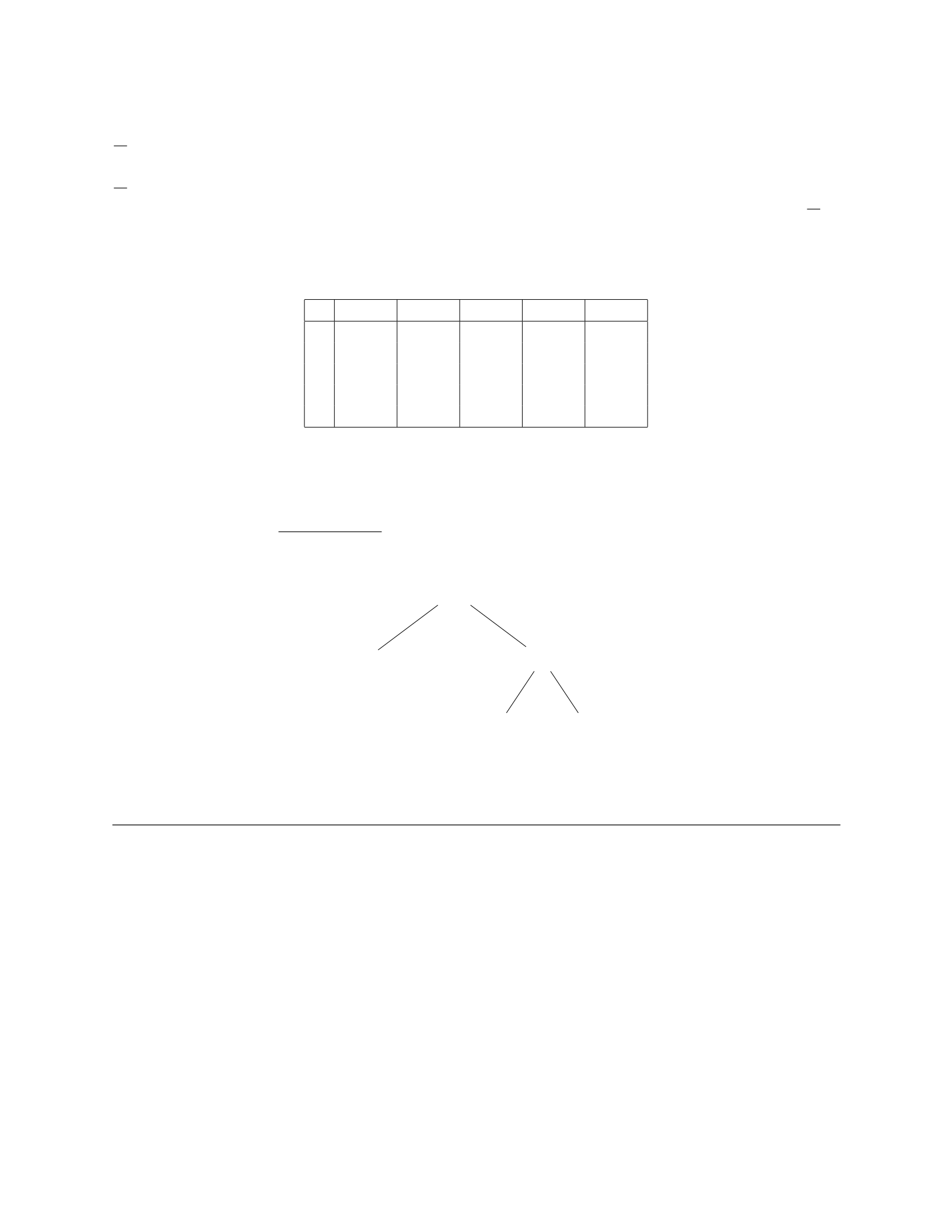
c) Construct a neighbor-joining tree using the pairwise distance matrix.
Solution 9.
a) The pairwise sequence identity is calculated as the number of matching positions divided by
the total number of positions compared. Let’s calculate the pairwise sequence identities between
species A and the other species.
For species B: Number of matches = 10 Total number of positions = 11 Pairwise identity =
10
11 ≈0.9091
For species C: Number of matches = 8 Total number of positions = 11 Pairwise identity =
8
11 ≈0.7273
For species D: Number of matches = 11 Total number of positions = 11 Pairwise identity =
11
11 = 1
For species E: Number of matches = 9 Total number of positions = 11 Pairwise identity = 9
11 ≈
0.8182
b) The pairwise distance matrix can be constructed using the formula: Dij = 1−pairwise identityij .
The pairwise distance matrix for these species is:
A B C D E
A0 0.0909 0.2727 0 0.1818
B0.0909 0 0.4545 0.0909 0.2727
C0.2727 0.4545 0 0.2727 0.1818
D0 0.0909 0.2727 0 0.1818
E0.1818 0.2727 0.1818 0.1818 0
c) To construct a neighbor-joining tree, we start by finding the minimum entry in the distance
matrix. In this case, the minimum entry is 0.0909, corresponding to the distance between species
A and B. We then define a new node (AB) to represent the cluster of A and B. We update the
distance matrix by computing the distances between the new node (AB) and all other nodes using
the formula D(AB)k=DAk +DB k −DAB
2.
Repeating this process, we construct the neighbor-joining tree:
AB
D AE
C E
10 10. COMPUTATIONAL METHODS FOR PREDICTING GENE FUNCTION
Problem 10. You are given a DNA sequence: ATGCGATCACCGCGTTCACCGTTT. Use the
genetic code table to translate this DNA sequence into a protein sequence. Additionally, predict
the function of the protein based on the amino acid sequence.
Solution 10. a) To translate the given DNA sequence into a protein sequence, we need to first
transcribe the DNA sequence into mRNA and then translate the mRNA into amino acids using the
genetic code table.
Starting DNA sequence: ATGCGATCACCGCGTTCACCGTTT
Transcribed mRNA: AUGCGAUCACCGCGUUACCGUUU
Using the genetic code table, we can translate the mRNA sequence into amino acids:
AUG - Methionine (Start) CGA - Arginine UCA - Serine CCG - Proline CGU - Arginine UUA -
Leucine CCG - Proline UUU - Phenylalanine
Therefore, the protein sequence translated from the given DNA sequence is: Met-Arg-Ser-Pro-
Arg-Leu-Pro-Phe.

b) Based on the amino acid sequence Met-Arg-Ser-Pro-Arg-Leu-Pro-Phe, we can analyze the
function of the protein. Proteins with specific amino acid sequences often have known functions or
structural motifs.
In this case, we can analyze the amino acid sequence to predict the function of the protein:
- The presence of methionine at the start indicates the start codon. - The presence of argi-
nine, serine, proline, and leucine suggests that this protein sequence may be involved in signaling
pathways, enzymatic reactions, or structural functions.
c) Without additional information or further analysis, it is challenging to definitively predict the
exact function of the protein solely based on its amino acid sequence. Further research or experi-
mental validation may be required to determine the precise function of this protein.
11 11. GENETIC DIVERSITY AND POPULATION GENETICS
Problem 11.
An allele frequency for a particular gene in a population is 0.7.
a) What is the frequency of the homozygous dominant genotype for this gene in the population?
b) What is the frequency of the heterozygous genotype for this gene in the population?
c) What is the frequency of the homozygous recessive genotype for this gene in the population?
Solution 11.
a) The frequency of the homozygous dominant genotype can be found by squaring the allele
frequency, which is 0.7.
Frequency of homozygous dominant genotype = (0.7)2= 0.49
Therefore, the frequency of the homozygous dominant genotype for this gene in the population
is 0.49.
b) The frequency of the heterozygous genotype can be found by multiplying the allele frequency
with the complement of the allele frequency (1 - 0.7).
Frequency of heterozygous genotype = 2 * 0.7 * (1 - 0.7) = 2 * 0.7 * 0.3 = 0.42
Therefore, the frequency of the heterozygous genotype for this gene in the population is 0.42.
c) The frequency of the homozygous recessive genotype can be found by squaring the com-
plement of the allele frequency (1 - 0.7).
Frequency of homozygous recessive genotype = (1 - 0.7)2= 0.09
Therefore, the frequency of the homozygous recessive genotype for this gene in the population
is 0.09.
I. REGULATORY NETWORKS CONTROLLING GENE EXPRESSION
Problem 12.
The expression of gene X is regulated by transcription factors Y and Z. The binding of Y to the
promoter region of gene X increases its expression by threefold, while the binding of Z decreases
its expression by half. In a specific experiment, the expression level of gene X is 100 units. If the
transcription factor Y is knocked out, what will be the new expression level of gene X?
Solution 12.
Let’s denote the expression level of gene X without any transcription factors as Xbaseline.
Given that the binding of transcription factor Y increases the expression by threefold and Z
decreases it by half, we can write the following equations:
With Y: XY= 3Xbaseline
Without Y: Xno Y =1
2XY=1
2·3Xbaseline =3
2Xbaseline
If the expression level of gene X is 100 units, then we can set up the following equation:

Xbaseline = 100
Now, substituting Xbaseline = 100 into Xno Y =3
2Xbaseline:
Xno Y =3
2·100 = 150
Therefore, if transcription factor Y is knocked out, the new expression level of gene X will be
150 units.

Problem 13.
A gene regulatory network consists of three genes: A, B, and C. Gene A activates the expres-
sion of gene B by two-fold, while gene B inhibits the expression of gene C by three-fold. If the basal
expression level of gene C is 120 units, what will be the new expression level of gene C if gene A
is knocked out?
Solution 13.
Let’s denote the expression level of gene C without any regulatory interactions as Cbaseline.
Given the effect of genes A and B on gene C, we have the following relationships:
With A: B= 2Aand C=B−3
Without A: Cno A =Bno A −3 = 2A−3
If the basal expression level of gene C is 120 units, then we can set up the following equation:
Cbaseline = 120
Now, substituting Cbaseline = 120 into Cno A = 2A−3:
Cno A = 2 ·0−3 = −3
Therefore, if gene A is knocked out, the new expression level of gene C will be -3 units.
12 13. STRUCTURAL GENOMICS AND PROTEIN STRUCTURE PREDICTION
Problem 13. Consider a protein with a sequence of amino acids given by:
SEQ: ALA-ARG-SER-LYS-ASP-GLY-GLU-ASP-ARG-GLY-ALA.
a) Calculate the molecular weight of this protein. Assume the average molecular weight of each
amino acid: Alanine (ALA) = 89.1 Da, Arginine (ARG) = 174.2 Da, Serine (SER) = 105.1 Da, Lysine
(LYS) = 128.2 Da, Aspartic Acid (ASP) = 133.1 Da, Glycine (GLY) = 75.1 Da, and Glutamic Acid
(GLU) = 147.1 Da.
b) Determine the isoelectric point (pI) of this protein.
Solution 13.
a) The molecular weight of a protein is calculated by adding up the molecular weights of each
amino acid in the sequence.
SEQ: ALA-ARG-SER-LYS-ASP-GLY-GLU-ASP-ARG-GLY-ALA
Molecular Weight: 89.1 + 174.2 + 105.1 + 128.2 + 133.1 + 75.1 + 147.1 + 133.1 + 174.2 + 75.1
+ 89.1
Molecular Weight: 1238.3 Da
Therefore, the molecular weight of the given protein sequence is 1238.3 Da.
b) The isoelectric point (pI) is the pH at which a protein carries no net charge. To calculate the
pI, we need to consider the pKa values of the amino acids. For simplicity, we will use the following
approximate pKa values:
Alanine (ALA) = 6.0, Arginine (ARG) = 12.0, Serine (SER) = 5.7, Lysine (LYS) = 10.5, Aspartic
Acid (ASP) = 3.9, Glycine (GLY) = 6.0, Glutamic Acid (GLU) = 4.1.
The pI of a protein can be estimated using the pKa values of the amino acids present in the
sequence. In this case, the amino acids present are: ALA, ARG, SER, LYS, ASP, GLY, GLU.
For a basic protein like this one (with arginine and lysine), we look for the pH that is closest
to the average of the pKa values of the basic (pKa > 7) and acidic (pKa < 7) amino acids in the
sequence.

Average of pKa values for Basic Amino Acids: (12.0 + 10.5) / 2 = 11.25
Average of pKa values for Acidic Amino Acids: (5.7 + 3.9 + 4.1) / 3 = 4.57
The isoelectric point (pI) is likely around the average of these values:
pI (11.25 + 4.57) / 2 = 7.91.
Therefore, the approximate isoelectric point of the protein is 7.91.
I. Genomics and Functional Genomics
Problem 1: In a population of 100 individuals, 25 are homozygous dominant (AA), 50 are
heterozygous (Aa), and 25 are homozygous recessive (aa) for a particular gene.
a) What is the allele frequency of the "A" allele in this population? b) What is the frequency of
individuals with the genotype Aa in this population?
Solution 1: a) The total number of alleles is twice the number of individuals, so there are 200
alleles in the population. The frequency of the "A" allele can be calculated as:
Frequency of "A" allele = [2(homozygous dominant) + 1(heterozygous)] / [2(total alleles)] =
[2(25) + 1(50)] / 200 = (50 + 50) / 200 = 100 / 200 = 0.5
Therefore, the allele frequency of the "A" allele in this population is 0.5.
b) The frequency of individuals with the genotype Aa can be calculated by dividing the number
of individuals with the genotype Aa by the total number of individuals:
Frequency of Aa genotype = Number of Aa individuals / Total number of individuals = 50 / 100
= 0.5
Therefore, the frequency of individuals with the genotype Aa in this population is 0.5.
I’m glad you’re interested in solving problems in Genomics and Functional Genomics! Here’s a
numerical problem along with a detailed solution:
13 15. PHARMACOGENOMICS AND PERSONALIZED DRUG THERAPIES
Problem 15. In a pharmacogenomics study, a group of patients with a specific genetic variant
were administered a drug to measure its efficacy. The results showed that 70
a) If 40 patients with the genetic variant were included in the study, how many patients re-
sponded positively to the drug?
b) If the overall response rate among patients without the genetic variant is 50
Solution 15.
a) The total number of patients with the genetic variant is 40. Since 70
Number of positive responders = 40 patients x 70
Therefore, 28 patients with the genetic variant responded positively to the drug.
b) Let’s denote the number of patients without the genetic variant as x. If the overall response
rate among these patients is 50
Number of positive responders = x patients x 50
To have the same number of positive responders in part (a), we set up an equation:
Number of positive responders in part (a) = Number of positive responders in part (b)
28 = 0.5x
Solving for x:
x = 28 / 0.5 = 56 patients
Therefore, 56 patients without the genetic variant would need to be included in the study to
have the same number of positive responders as in part (a).
Certainly! Here is a numerical problem on Genomics and Functional Genomics:

14 Genomics and Functional Genomics
Problem: In a plant species, a gene responsible for regulating flower color has two possible
alleles: A and a. In a population of 500 plants, it is found that 360 plants have at least one copy of
the dominant allele A.
a) Calculate the frequency of the allele A in the population. b) Determine the frequency of the
recessive allele a in the population. c) Find the percentage of plants in the population that are
homozygous for the dominant allele A.
Solution:
a) The frequency of allele A can be calculated by dividing the total number of copies of allele A
by the total number of alleles in the population.
Given: Total plants in the population, n= 500
Number of plants with at least one copy of allele A, p(AA) + p(Aa) = 360
Total number of copies of allele A, 2×360 = 720
Frequency of allele A, p(A) = 720
500×2= 0.72
b) The frequency of the recessive allele a can be determined by subtracting the frequency of
allele A from 1.
Frequency of allele a, p(a)=1−p(A)=1−0.72 = 0.28
c) To find the percentage of plants that are homozygous for the dominant allele A, we first need
to calculate the frequency of the homozygous genotype (AA). This can be obtained by squaring
the frequency of allele A.
Frequency of genotype AA, p(AA)=(p(A))2= 0.722= 0.5184
Percentage of plants that are homozygous for allele A, 51.84%
I. Problem:
Consider a genetic modifier that influences the progression of a neurodegenerative disease.
The modifier gene is known to have two alleles, A and a, with frequencies of 0.6 and 0.4, respec-
tively, in the population. Individuals with the A allele have a 20
a) What is the probability that an individual randomly selected from the population carries at
least one A allele?
b) If both of a person’s parents carry the A allele, what is the probability that the person will
develop the disease?
c) If an individual carries the a allele, what is the probability that their sibling also carries the a
allele?
II. Solution:
a) Let’s first calculate the probability of an individual carrying at least one A allele. This includes
individuals with AA or Aa genotypes.
P(A allele) = 0.6 P(a allele) = 0.4
P(at least one A allele) = 1 - P(no A allele) = 1 - P(aa) = 1 - P(a) * P(a) = 1 - 0.4 * 0.4 = 1 - 0.16
= 0.84
Therefore, the probability that an individual randomly selected from the population carries at
least one A allele is 0.84.
b) Given that both parents carry the A allele, the individual will have either AA or Aa genotype.
The risk of developing the disease for A allele carriers is reduced by 20
P(disease with both parents carrying A allele) = P(disease | AA or Aa) = 0.6*0.8 + 0.24*0.8 =
0.48 + 0.192 = 0.672
Therefore, the probability that the person will develop the disease is 0.672.
c) If an individual carries the a allele, the genotype can be aa.

Therefore, the probability that their sibling also carries the a allele is 1 (since both siblings will
have the aa genotype).
Hence, the probability that the sibling carries the a allele given one individual carries the a allele
is 1.
15 18. GENOMIC INSTABILITY AND CHROMOSOMAL ABNORMALITIES
Problem 18. A human cell line is known to have a chromosomal abnormality in which an extra
copy of chromosome 21 is present. Normally, human cells have 46 chromosomes. If a cell from
this line undergoes nondisjunction during meiosis I, what would be the chromosome number in the
resulting gametes?
Solution 18. a) When a cell undergoes nondisjunction during meiosis I, homologous chromo-
somes fail to separate properly, leading to one daughter cell having an extra chromosome and the
other missing one.
In this case, since the cell line already has an extra copy of chromosome 21, it would have 47
chromosomes instead of the normal 46.
During meiosis I, if nondisjunction occurs, one of the resulting daughter cells will have an ex-
tra chromosome 21, so it will have 47 chromosomes. The other daughter cell will be missing a
chromosome 21 and will have 45 chromosomes.
Therefore, the resulting gametes from this cell line would have 47 chromosomes and 45 chro-
mosomes, respectively.
b) If a sperm with 47 chromosomes fertilizes a normal egg (with 46 chromosomes), the resulting
zygote would have 47 + 46 = 93 chromosomes, which is an example of aneuploidy.
c) A zygote with 93 chromosomes may not be viable and could lead to developmental abnor-
malities or miscarriage.
I. Let’s generate a numerical problem in the field of Genomics and Functional Genomics:
16 Genomics and Functional Genomics
Problem: In a human DNA sequence, the frequency of the nucleotide Adenine (A) is 30%,
Thymine (T) is 20%, Cytosine (C) is 25%, and Guanine (G) is 25%. Calculate the GC content of
this DNA sequence.
Solution:
The GC content in DNA is the percentage of nucleotides Guanine (G) and Cytosine (C) in the
DNA sequence.
Given frequencies: - Frequency of Cytosine (C) = 25% - Frequency of Guanine (G) = 25%
The GC content can be calculated by adding the frequency of Cytosine and Guanine:
GC content =F requency(C) + F requency(G) = 25% + 25% = 50%
Therefore, the GC content of the DNA sequence is 50%.
II. Let’s generate another numerical problem in Genomics and Functional Genomics:
17 Genomics and Functional Genomics

Problem: A researcher is studying the expression of a gene in two different cell types – A and
B. In cell type A, the expression level of the gene is 200 TPM (Transcripts Per Million), and in cell
type B, the expression level is 500 TPM. Calculate the fold change in gene expression between
cell type A and cell type B.
Solution:
The fold change in gene expression between two conditions can be calculated using the for-
mula:
F oldChange =Expression level in Condition B
Expression level in Condition A
Given: - Expression level in cell type A = 200 TPM - Expression level in cell type B = 500 TPM
Substitute the values into the formula:
F oldChange =500 TPM
200 TPM = 2.5
Therefore, the fold change in gene expression between cell type A and cell type B is 2.5.
I’m glad to help you with that. Could you please specify a particular topic or concept within
Genomics and Functional Genomics that you would like the problem to focus on? This will help
me tailor the question to your needs.

enzyme coded by this gene. The patient has two copies of the normal allele (A), but the metabolic
activity of the enzyme is reduced by 50% in individuals with this genetic variation.
If the normal metabolic rate for this medication is 10 mg/hr, what would be the expected metabolic
rate for this patient?
Solution 2.
Given: Normal metabolic rate = 10 mg/hr Metabolic activity reduced by 50% for the patient with
genetic variation
Let’s define: Metabolic rate with genetic variation = X mg/hr
The patient has two copies of the normal allele (A), so the metabolic rate is reduced by 50%.
Therefore, the patient’s metabolic rate with genetic variation would be:
X= 10 mg/hr ×0.5=5mg/hr
Therefore, the expected metabolic rate for this patient with the genetic variation would be 5
mg/hr.
3 3. BIOINFORMATICS TOOLS FOR ANALYZING GENOMIC DATA
Problem 3. Consider a DNA sequence: "ATGCTAAGCT".
a) Calculate the total number of nucleotides in this sequence.
b) Determine the frequency of each nucleotide (A, T, G, C) in the sequence.
c) Compute the GC content of the sequence.
Solution 3.
a) To calculate the total number of nucleotides in the sequence "ATGCTAAGCT", we simply
count the characters:
Total number of nucleotides = 10
b) To determine the frequency of each nucleotide, we count the occurrences of each nucleotide
in the sequence:
Frequency of A: 3 Frequency of T: 2 Frequency of G: 2 Frequency of C: 3
c) The GC content of a DNA sequence is given by the percentage of G and C nucleotides in
the sequence.
Total number of G and C nucleotides = 2 (G) + 3 (C) = 5
Total number of nucleotides = 10
Therefore, GC content = (Number of G and C nucleotides / Total number of nucleotides) * 100
GC content = (5 / 10) * 100 = 50
So, the GC content of the sequence "ATGCTAAGCT" is 50
I.
4 3. COMMON SEQUENCE ANALYSIS TASKS
Problem 3. Consider two DNA sequences: Seq1 = "ACGTAGC" and Seq2 = "ACTAGT".
a) Calculate the Hamming distance between Seq1 and Seq2.
b) If a substitution mutation occurred at position 4 in Seq1, changing "A" to "T", determine the
new Hamming distance between Seq1 and Seq2.
Solution 3.

a) The Hamming distance is the number of positions at which the corresponding symbols differ
between two sequences of equal length. Given Seq1 = "ACGTAGC" and Seq2 = "ACTAGT", the
Hamming distance is as follows:
- Positions where symbols differ: 1 (T vs. G) and 6 (C vs. T) - Hamming distance = 2
b) After the substitution mutation at position 4 in Seq1 to "ACGTTGC", the new Seq1 becomes
"ACGT T GC". The updated Hamming distance between Seq1 and Seq2 is then:
- Positions where symbols differ: 1 (T vs. G), 4 (T vs. T), and 6 (C vs. T) - Updated Hamming
distance = 3
5 5. EPIGENETIC MODIFICATIONS AND THEIR ROLE IN GENE EXPRESSION
Problem 5. You are studying the role of DNA methylation in gene expression regulation. In a
particular gene, you observe that a CpG island located in the promoter region is heavily methylated.
You hypothesize that this methylation is leading to the suppression of gene expression. To test
this hypothesis, you perform a demethylation experiment using a DNA demethylating agent and
measure the gene expression levels before and after treatment.
Before treatment, the gene expression level was recorded as 200 arbitrary units. After treatment
with the demethylating agent, the gene expression level increased to 600 arbitrary units.
a) Calculate the fold change in gene expression after treatment.
b) If the gene had a baseline expression level of 1000 arbitrary units in an unmethylated state,
what is the fold change in gene expression when comparing the demethylated state to the unmethy-
lated baseline?
Solution 5.
a) The fold change in gene expression can be calculated using the formula:
Fold Change =Gene expression after treatment
Gene expression before treatment
Given that the gene expression before treatment was 200 arbitrary units and after treatment was
600 arbitrary units, we can substitute these values into the formula:
Fold Change =600
200 = 3
Therefore, the fold change in gene expression after treatment is 3.
b) To calculate the fold change when comparing the demethylated state to the unmethylated
baseline, we first need to determine the gene expression level in the demethylated state relative to
the baseline. This can be done using the formula:
Fold Change =Gene expression in demethylated state
Gene expression in unmethylated state
Given that the gene expression level in the demethylated state is 600 arbitrary units and in the
unmethylated state is 1000 arbitrary units, we can substitute these values into the formula:
Fold Change =600
1000 = 0.6
Therefore, the fold change in gene expression when comparing the demethylated state to the un-
methylated baseline is 0.6.

6 6. GENE-ENVIRONMENT INTERACTIONS IN DISEASE SUSCEPTIBILITY
Problem 6. A research study investigates the relationship between a specific gene variant (al-
lele A) and exposure to a certain environmental factor (Factor X) in increasing the risk of developing
a particular disease. The study found that individuals with allele A who were exposed to Factor X
had a disease risk of 0.6, while individuals without allele A who were exposed to Factor X had a
disease risk of 0.3. The disease risk for individuals with allele A but not exposed to Factor X was
0.1, and the disease risk for individuals without allele A and not exposed to Factor X was 0.05.
a) Calculate the relative risk for individuals with allele A when exposed to Factor X compared
to individuals without allele A.
b) Determine the attributable risk for the interaction between allele A and Factor X in disease
susceptibility.
c) Calculate the interaction contrast for allele A and Factor X in contributing to disease risk.
Solution 6. a) The relative risk (RR) is the ratio of the disease risk for individuals with allele A
exposed to Factor X to the disease risk for individuals without allele A exposed to Factor X.
Given: Risk of disease for individuals with allele A exposed to Factor X, P(D|A, X) = 0.6Risk
of disease for individuals without allele A exposed to Factor X, P(D|¬A, X) = 0.3
RR =0.6
0.3
= 2
Therefore, the relative risk for individuals with allele A when exposed to Factor X compared to
individuals without allele A is 2.
b) The attributable risk (AR) is the difference between the disease risk in the total population
and the disease risk in the unexposed group.
Given: Risk of disease for individuals with allele A exposed to Factor X, P(D|A, X) = 0.6Risk
of disease for individuals without allele A exposed to Factor X, P(D|¬A, X) = 0.3Risk of disease
for individuals with allele A but not exposed to Factor X, P(D|A, ¬X) = 0.1Risk of disease for
individuals without allele A and not exposed to Factor X, P(D|¬A, ¬X)=0.05
Total population disease risk:
P(D) = P(D|A, X)∗P(A) + P(D|¬A, X)∗P(¬A)
P(D)=0.6∗P(A)+0.3∗(1 −P(A))
Unexposed group disease risk:
P(D|¬X) = P(D|A, ¬X)∗P(A) + P(D|¬A, ¬X)∗P(¬A)
P(D|¬X) = 0.1∗P(A)+0.05 ∗(1 −P(A))
Attributable risk (AR) is then:
AR =P(D)−P(D|¬X)
c) The interaction contrast (IC) quantifies the interaction between allele A and Factor X in con-
tributing to disease risk.
Given:
IC =P(D|A, X)−P(D|A, ¬X)−P(D|¬A, X) + P(D|¬A, ¬X)
Substitute the given probabilities to find the interaction contrast.

7 Genomics and Functional Genomics
Problem:
Consider a gene with a DNA sequence of length 300 base pairs that codes for a protein. The
gene contains 4 exons (50, 75, 100, and 75 base pairs long) separated by 3 introns (20, 30, and
50 base pairs long).
a) Calculate the total length of the gene (including exons and introns).
b) If each codon in the gene corresponds to 3 base pairs, calculate the total number of codons
in the gene.
c) If each amino acid is coded by 1 codon, calculate the number of amino acids in the protein
produced by this gene.
Solution:
a) The total length of the gene can be calculated by adding the lengths of exons and introns
together:
Total gene length = (50 + 75 + 100 + 75) + (20 + 30 + 50) = 450 base pairs
b) Since each codon corresponds to 3 base pairs, the total number of codons can be calculated
by dividing the total gene length by 3:
Total number of codons = Total gene length / 3 = 450 / 3 = 150 codons
c) Since each amino acid is coded by 1 codon, the number of amino acids in the protein can
be calculated by simply counting the number of codons:
Number of amino acids = Total number of codons = 150 amino acids
8 8. GENOME-WIDE ASSOCIATION STUDIES IN COMPLEX DISEASES
Problem 8. In a genome-wide association study for a particular complex disease, researchers
found that a certain single nucleotide polymorphism (SNP) is significantly associated with the dis-
ease. The frequency of the disease allele for this SNP is 0.3 in the general population. The odds
ratio for this SNP is 2.5.
a) Calculate the odds of having the disease for individuals with the disease allele.
b) Calculate the odds of having the disease for individuals without the disease allele.
Solution 8.
a) The odds ratio is defined as the odds of having the disease for individuals with the disease
allele divided by the odds of having the disease for individuals without the disease allele. Given that
the odds ratio is 2.5 and the disease allele frequency is 0.3, we can calculate the odds of having
the disease for individuals with the disease allele as follows:
Let pbe the frequency of the disease allele and q= 1 −pbe the frequency of the non-disease
allele.
The odds ratio formula is:
OR =oddsdisease with allele
oddsdisease without allele
We are given that OR = 2.5and p= 0.3.
Therefore,
2.5 = 0.3
1−0.3

2.5 = 0.3
0.7
2.5×0.7=0.3
1.75 = 0.3
So, the odds of having the disease for individuals with the disease allele is 1.75.
b) We can calculate the odds of having the disease for individuals without the disease allele
using the odds ratio. Since the odds ratio formula is:
OR =oddsdisease with allele
oddsdisease without allele
We know that the odds of having the disease for individuals with the allele is 1.75. Therefore, to
find the odds of having the disease for individuals without the allele, we divide the odds of having
the disease for individuals with the allele by the odds ratio:
oddsdisease without allele =oddsdisease with allele
OR
oddsdisease without allele =1.75
2.5
oddsdisease without allele = 0.7
So, the odds of having the disease for individuals without the disease allele is 0.7.
9 9. EVOLUTIONARY GENOMICS AND PHYLOGENETICS
Problem 9. Consider the following DNA sequences for five species:
Species DNA Sequence
A ATGCCATCGAT
B ATGCCATGGAT
C ATGCCGTGGAT
D ATGCCATCGAT
E ATGCAATGGAT
a) Calculate the pairwise sequence identity between species A and each of the other species
(B, C, D, E).
b) Based on the sequence identities, construct a pairwise distance matrix for these five species.
c) Construct a neighbor-joining tree using the pairwise distance matrix.
Solution 9.
a) The pairwise sequence identity is calculated as the number of matching positions divided by
the total number of positions compared. Let’s calculate the pairwise sequence identities between
species A and the other species.
For species B: Number of matches = 10 Total number of positions = 11 Pairwise identity =
10
11 ≈0.9091
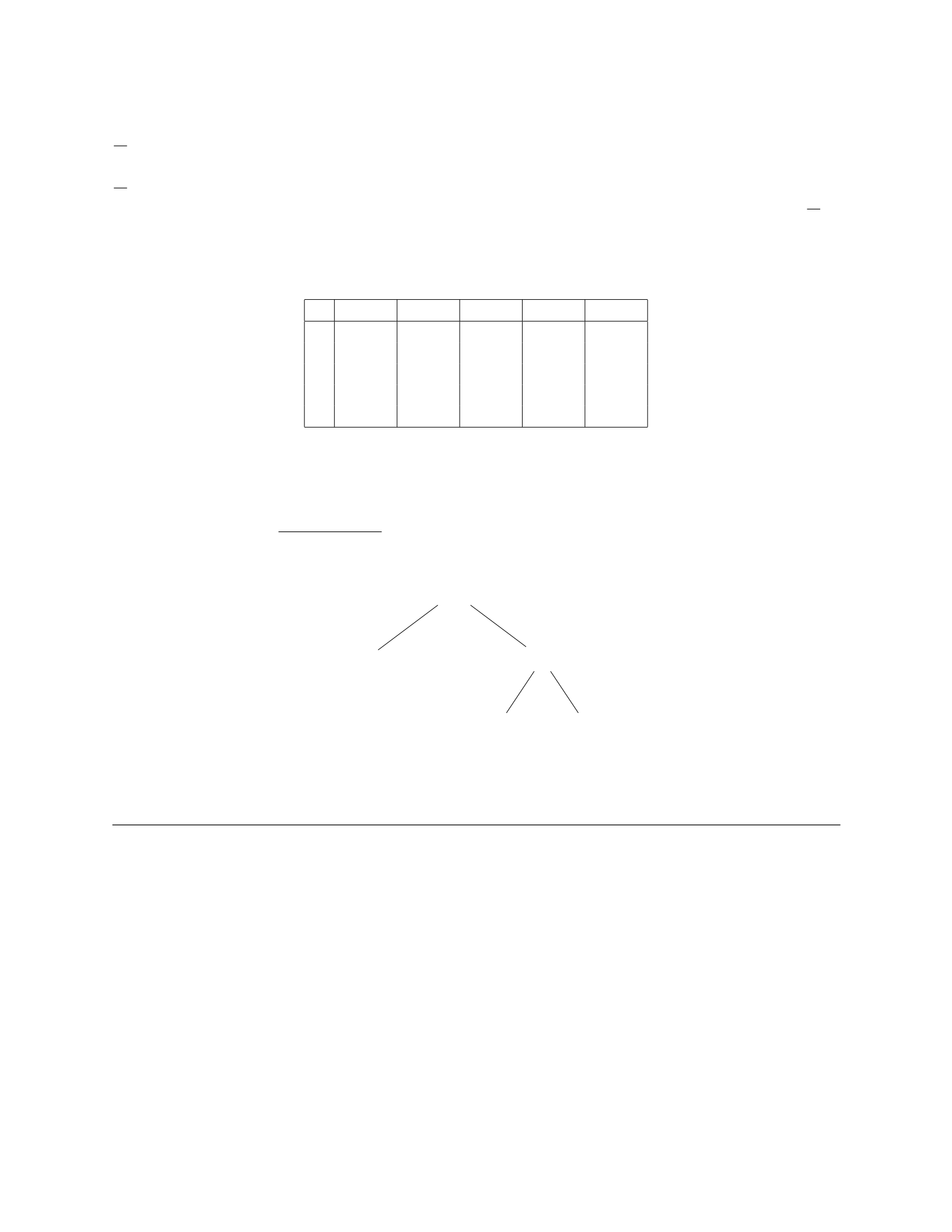
For species C: Number of matches = 8 Total number of positions = 11 Pairwise identity =
8
11 ≈0.7273
For species D: Number of matches = 11 Total number of positions = 11 Pairwise identity =
11
11 = 1
For species E: Number of matches = 9 Total number of positions = 11 Pairwise identity = 9
11 ≈
0.8182
b) The pairwise distance matrix can be constructed using the formula: Dij = 1−pairwise identityij .
The pairwise distance matrix for these species is:
A B C D E
A0 0.0909 0.2727 0 0.1818
B0.0909 0 0.4545 0.0909 0.2727
C0.2727 0.4545 0 0.2727 0.1818
D0 0.0909 0.2727 0 0.1818
E0.1818 0.2727 0.1818 0.1818 0
c) To construct a neighbor-joining tree, we start by finding the minimum entry in the distance
matrix. In this case, the minimum entry is 0.0909, corresponding to the distance between species
A and B. We then define a new node (AB) to represent the cluster of A and B. We update the
distance matrix by computing the distances between the new node (AB) and all other nodes using
the formula D(AB)k=DAk +DB k −DAB
2.
Repeating this process, we construct the neighbor-joining tree:
AB
D AE
C E
10 10. COMPUTATIONAL METHODS FOR PREDICTING GENE FUNCTION
Problem 10. You are given a DNA sequence: ATGCGATCACCGCGTTCACCGTTT. Use the
genetic code table to translate this DNA sequence into a protein sequence. Additionally, predict
the function of the protein based on the amino acid sequence.
Solution 10. a) To translate the given DNA sequence into a protein sequence, we need to first
transcribe the DNA sequence into mRNA and then translate the mRNA into amino acids using the
genetic code table.
Starting DNA sequence: ATGCGATCACCGCGTTCACCGTTT
Transcribed mRNA: AUGCGAUCACCGCGUUACCGUUU
Using the genetic code table, we can translate the mRNA sequence into amino acids:
AUG - Methionine (Start) CGA - Arginine UCA - Serine CCG - Proline CGU - Arginine UUA -
Leucine CCG - Proline UUU - Phenylalanine
Therefore, the protein sequence translated from the given DNA sequence is: Met-Arg-Ser-Pro-
Arg-Leu-Pro-Phe.

b) Based on the amino acid sequence Met-Arg-Ser-Pro-Arg-Leu-Pro-Phe, we can analyze the
function of the protein. Proteins with specific amino acid sequences often have known functions or
structural motifs.
In this case, we can analyze the amino acid sequence to predict the function of the protein:
- The presence of methionine at the start indicates the start codon. - The presence of argi-
nine, serine, proline, and leucine suggests that this protein sequence may be involved in signaling
pathways, enzymatic reactions, or structural functions.
c) Without additional information or further analysis, it is challenging to definitively predict the
exact function of the protein solely based on its amino acid sequence. Further research or experi-
mental validation may be required to determine the precise function of this protein.
11 11. GENETIC DIVERSITY AND POPULATION GENETICS
Problem 11.
An allele frequency for a particular gene in a population is 0.7.
a) What is the frequency of the homozygous dominant genotype for this gene in the population?
b) What is the frequency of the heterozygous genotype for this gene in the population?
c) What is the frequency of the homozygous recessive genotype for this gene in the population?
Solution 11.
a) The frequency of the homozygous dominant genotype can be found by squaring the allele
frequency, which is 0.7.
Frequency of homozygous dominant genotype = (0.7)2= 0.49
Therefore, the frequency of the homozygous dominant genotype for this gene in the population
is 0.49.
b) The frequency of the heterozygous genotype can be found by multiplying the allele frequency
with the complement of the allele frequency (1 - 0.7).
Frequency of heterozygous genotype = 2 * 0.7 * (1 - 0.7) = 2 * 0.7 * 0.3 = 0.42
Therefore, the frequency of the heterozygous genotype for this gene in the population is 0.42.
c) The frequency of the homozygous recessive genotype can be found by squaring the com-
plement of the allele frequency (1 - 0.7).
Frequency of homozygous recessive genotype = (1 - 0.7)2= 0.09
Therefore, the frequency of the homozygous recessive genotype for this gene in the population
is 0.09.
I. REGULATORY NETWORKS CONTROLLING GENE EXPRESSION
Problem 12.
The expression of gene X is regulated by transcription factors Y and Z. The binding of Y to the
promoter region of gene X increases its expression by threefold, while the binding of Z decreases
its expression by half. In a specific experiment, the expression level of gene X is 100 units. If the
transcription factor Y is knocked out, what will be the new expression level of gene X?
Solution 12.
Let’s denote the expression level of gene X without any transcription factors as Xbaseline.
Given that the binding of transcription factor Y increases the expression by threefold and Z
decreases it by half, we can write the following equations:
With Y: XY= 3Xbaseline
Without Y: Xno Y =1
2XY=1
2·3Xbaseline =3
2Xbaseline
If the expression level of gene X is 100 units, then we can set up the following equation:

Xbaseline = 100
Now, substituting Xbaseline = 100 into Xno Y =3
2Xbaseline:
Xno Y =3
2·100 = 150
Therefore, if transcription factor Y is knocked out, the new expression level of gene X will be
150 units.

Problem 13.
A gene regulatory network consists of three genes: A, B, and C. Gene A activates the expres-
sion of gene B by two-fold, while gene B inhibits the expression of gene C by three-fold. If the basal
expression level of gene C is 120 units, what will be the new expression level of gene C if gene A
is knocked out?
Solution 13.
Let’s denote the expression level of gene C without any regulatory interactions as Cbaseline.
Given the effect of genes A and B on gene C, we have the following relationships:
With A: B= 2Aand C=B−3
Without A: Cno A =Bno A −3 = 2A−3
If the basal expression level of gene C is 120 units, then we can set up the following equation:
Cbaseline = 120
Now, substituting Cbaseline = 120 into Cno A = 2A−3:
Cno A = 2 ·0−3 = −3
Therefore, if gene A is knocked out, the new expression level of gene C will be -3 units.
12 13. STRUCTURAL GENOMICS AND PROTEIN STRUCTURE PREDICTION
Problem 13. Consider a protein with a sequence of amino acids given by:
SEQ: ALA-ARG-SER-LYS-ASP-GLY-GLU-ASP-ARG-GLY-ALA.
a) Calculate the molecular weight of this protein. Assume the average molecular weight of each
amino acid: Alanine (ALA) = 89.1 Da, Arginine (ARG) = 174.2 Da, Serine (SER) = 105.1 Da, Lysine
(LYS) = 128.2 Da, Aspartic Acid (ASP) = 133.1 Da, Glycine (GLY) = 75.1 Da, and Glutamic Acid
(GLU) = 147.1 Da.
b) Determine the isoelectric point (pI) of this protein.
Solution 13.
a) The molecular weight of a protein is calculated by adding up the molecular weights of each
amino acid in the sequence.
SEQ: ALA-ARG-SER-LYS-ASP-GLY-GLU-ASP-ARG-GLY-ALA
Molecular Weight: 89.1 + 174.2 + 105.1 + 128.2 + 133.1 + 75.1 + 147.1 + 133.1 + 174.2 + 75.1
+ 89.1
Molecular Weight: 1238.3 Da
Therefore, the molecular weight of the given protein sequence is 1238.3 Da.
b) The isoelectric point (pI) is the pH at which a protein carries no net charge. To calculate the
pI, we need to consider the pKa values of the amino acids. For simplicity, we will use the following
approximate pKa values:
Alanine (ALA) = 6.0, Arginine (ARG) = 12.0, Serine (SER) = 5.7, Lysine (LYS) = 10.5, Aspartic
Acid (ASP) = 3.9, Glycine (GLY) = 6.0, Glutamic Acid (GLU) = 4.1.
The pI of a protein can be estimated using the pKa values of the amino acids present in the
sequence. In this case, the amino acids present are: ALA, ARG, SER, LYS, ASP, GLY, GLU.
For a basic protein like this one (with arginine and lysine), we look for the pH that is closest
to the average of the pKa values of the basic (pKa > 7) and acidic (pKa < 7) amino acids in the
sequence.

Average of pKa values for Basic Amino Acids: (12.0 + 10.5) / 2 = 11.25
Average of pKa values for Acidic Amino Acids: (5.7 + 3.9 + 4.1) / 3 = 4.57
The isoelectric point (pI) is likely around the average of these values:
pI (11.25 + 4.57) / 2 = 7.91.
Therefore, the approximate isoelectric point of the protein is 7.91.
I. Genomics and Functional Genomics
Problem 1: In a population of 100 individuals, 25 are homozygous dominant (AA), 50 are
heterozygous (Aa), and 25 are homozygous recessive (aa) for a particular gene.
a) What is the allele frequency of the "A" allele in this population? b) What is the frequency of
individuals with the genotype Aa in this population?
Solution 1: a) The total number of alleles is twice the number of individuals, so there are 200
alleles in the population. The frequency of the "A" allele can be calculated as:
Frequency of "A" allele = [2(homozygous dominant) + 1(heterozygous)] / [2(total alleles)] =
[2(25) + 1(50)] / 200 = (50 + 50) / 200 = 100 / 200 = 0.5
Therefore, the allele frequency of the "A" allele in this population is 0.5.
b) The frequency of individuals with the genotype Aa can be calculated by dividing the number
of individuals with the genotype Aa by the total number of individuals:
Frequency of Aa genotype = Number of Aa individuals / Total number of individuals = 50 / 100
= 0.5
Therefore, the frequency of individuals with the genotype Aa in this population is 0.5.
I’m glad you’re interested in solving problems in Genomics and Functional Genomics! Here’s a
numerical problem along with a detailed solution:
13 15. PHARMACOGENOMICS AND PERSONALIZED DRUG THERAPIES
Problem 15. In a pharmacogenomics study, a group of patients with a specific genetic variant
were administered a drug to measure its efficacy. The results showed that 70
a) If 40 patients with the genetic variant were included in the study, how many patients re-
sponded positively to the drug?
b) If the overall response rate among patients without the genetic variant is 50
Solution 15.
a) The total number of patients with the genetic variant is 40. Since 70
Number of positive responders = 40 patients x 70
Therefore, 28 patients with the genetic variant responded positively to the drug.
b) Let’s denote the number of patients without the genetic variant as x. If the overall response
rate among these patients is 50
Number of positive responders = x patients x 50
To have the same number of positive responders in part (a), we set up an equation:
Number of positive responders in part (a) = Number of positive responders in part (b)
28 = 0.5x
Solving for x:
x = 28 / 0.5 = 56 patients
Therefore, 56 patients without the genetic variant would need to be included in the study to
have the same number of positive responders as in part (a).
Certainly! Here is a numerical problem on Genomics and Functional Genomics:

14 Genomics and Functional Genomics
Problem: In a plant species, a gene responsible for regulating flower color has two possible
alleles: A and a. In a population of 500 plants, it is found that 360 plants have at least one copy of
the dominant allele A.
a) Calculate the frequency of the allele A in the population. b) Determine the frequency of the
recessive allele a in the population. c) Find the percentage of plants in the population that are
homozygous for the dominant allele A.
Solution:
a) The frequency of allele A can be calculated by dividing the total number of copies of allele A
by the total number of alleles in the population.
Given: Total plants in the population, n= 500
Number of plants with at least one copy of allele A, p(AA) + p(Aa) = 360
Total number of copies of allele A, 2×360 = 720
Frequency of allele A, p(A) = 720
500×2= 0.72
b) The frequency of the recessive allele a can be determined by subtracting the frequency of
allele A from 1.
Frequency of allele a, p(a)=1−p(A)=1−0.72 = 0.28
c) To find the percentage of plants that are homozygous for the dominant allele A, we first need
to calculate the frequency of the homozygous genotype (AA). This can be obtained by squaring
the frequency of allele A.
Frequency of genotype AA, p(AA)=(p(A))2= 0.722= 0.5184
Percentage of plants that are homozygous for allele A, 51.84%
I. Problem:
Consider a genetic modifier that influences the progression of a neurodegenerative disease.
The modifier gene is known to have two alleles, A and a, with frequencies of 0.6 and 0.4, respec-
tively, in the population. Individuals with the A allele have a 20
a) What is the probability that an individual randomly selected from the population carries at
least one A allele?
b) If both of a person’s parents carry the A allele, what is the probability that the person will
develop the disease?
c) If an individual carries the a allele, what is the probability that their sibling also carries the a
allele?
II. Solution:
a) Let’s first calculate the probability of an individual carrying at least one A allele. This includes
individuals with AA or Aa genotypes.
P(A allele) = 0.6 P(a allele) = 0.4
P(at least one A allele) = 1 - P(no A allele) = 1 - P(aa) = 1 - P(a) * P(a) = 1 - 0.4 * 0.4 = 1 - 0.16
= 0.84
Therefore, the probability that an individual randomly selected from the population carries at
least one A allele is 0.84.
b) Given that both parents carry the A allele, the individual will have either AA or Aa genotype.
The risk of developing the disease for A allele carriers is reduced by 20
P(disease with both parents carrying A allele) = P(disease | AA or Aa) = 0.6*0.8 + 0.24*0.8 =
0.48 + 0.192 = 0.672
Therefore, the probability that the person will develop the disease is 0.672.
c) If an individual carries the a allele, the genotype can be aa.

Therefore, the probability that their sibling also carries the a allele is 1 (since both siblings will
have the aa genotype).
Hence, the probability that the sibling carries the a allele given one individual carries the a allele
is 1.
15 18. GENOMIC INSTABILITY AND CHROMOSOMAL ABNORMALITIES
Problem 18. A human cell line is known to have a chromosomal abnormality in which an extra
copy of chromosome 21 is present. Normally, human cells have 46 chromosomes. If a cell from
this line undergoes nondisjunction during meiosis I, what would be the chromosome number in the
resulting gametes?
Solution 18. a) When a cell undergoes nondisjunction during meiosis I, homologous chromo-
somes fail to separate properly, leading to one daughter cell having an extra chromosome and the
other missing one.
In this case, since the cell line already has an extra copy of chromosome 21, it would have 47
chromosomes instead of the normal 46.
During meiosis I, if nondisjunction occurs, one of the resulting daughter cells will have an ex-
tra chromosome 21, so it will have 47 chromosomes. The other daughter cell will be missing a
chromosome 21 and will have 45 chromosomes.
Therefore, the resulting gametes from this cell line would have 47 chromosomes and 45 chro-
mosomes, respectively.
b) If a sperm with 47 chromosomes fertilizes a normal egg (with 46 chromosomes), the resulting
zygote would have 47 + 46 = 93 chromosomes, which is an example of aneuploidy.
c) A zygote with 93 chromosomes may not be viable and could lead to developmental abnor-
malities or miscarriage.
I. Let’s generate a numerical problem in the field of Genomics and Functional Genomics:
16 Genomics and Functional Genomics
Problem: In a human DNA sequence, the frequency of the nucleotide Adenine (A) is 30%,
Thymine (T) is 20%, Cytosine (C) is 25%, and Guanine (G) is 25%. Calculate the GC content of
this DNA sequence.
Solution:
The GC content in DNA is the percentage of nucleotides Guanine (G) and Cytosine (C) in the
DNA sequence.
Given frequencies: - Frequency of Cytosine (C) = 25% - Frequency of Guanine (G) = 25%
The GC content can be calculated by adding the frequency of Cytosine and Guanine:
GC content =F requency(C) + F requency(G) = 25% + 25% = 50%
Therefore, the GC content of the DNA sequence is 50%.
II. Let’s generate another numerical problem in Genomics and Functional Genomics:
17 Genomics and Functional Genomics

Problem: A researcher is studying the expression of a gene in two different cell types – A and
B. In cell type A, the expression level of the gene is 200 TPM (Transcripts Per Million), and in cell
type B, the expression level is 500 TPM. Calculate the fold change in gene expression between
cell type A and cell type B.
Solution:
The fold change in gene expression between two conditions can be calculated using the for-
mula:
F oldChange =Expression level in Condition B
Expression level in Condition A
Given: - Expression level in cell type A = 200 TPM - Expression level in cell type B = 500 TPM
Substitute the values into the formula:
F oldChange =500 TPM
200 TPM = 2.5
Therefore, the fold change in gene expression between cell type A and cell type B is 2.5.
I’m glad to help you with that. Could you please specify a particular topic or concept within
Genomics and Functional Genomics that you would like the problem to focus on? This will help
me tailor the question to your needs.

enzyme coded by this gene. The patient has two copies of the normal allele (A), but the metabolic
activity of the enzyme is reduced by 50% in individuals with this genetic variation.
If the normal metabolic rate for this medication is 10 mg/hr, what would be the expected metabolic
rate for this patient?
Solution 2.
Given: Normal metabolic rate = 10 mg/hr Metabolic activity reduced by 50% for the patient with
genetic variation
Let’s define: Metabolic rate with genetic variation = X mg/hr
The patient has two copies of the normal allele (A), so the metabolic rate is reduced by 50%.
Therefore, the patient’s metabolic rate with genetic variation would be:
X= 10 mg/hr ×0.5=5mg/hr
Therefore, the expected metabolic rate for this patient with the genetic variation would be 5
mg/hr.
3 3. BIOINFORMATICS TOOLS FOR ANALYZING GENOMIC DATA
Problem 3. Consider a DNA sequence: "ATGCTAAGCT".
a) Calculate the total number of nucleotides in this sequence.
b) Determine the frequency of each nucleotide (A, T, G, C) in the sequence.
c) Compute the GC content of the sequence.
Solution 3.
a) To calculate the total number of nucleotides in the sequence "ATGCTAAGCT", we simply
count the characters:
Total number of nucleotides = 10
b) To determine the frequency of each nucleotide, we count the occurrences of each nucleotide
in the sequence:
Frequency of A: 3 Frequency of T: 2 Frequency of G: 2 Frequency of C: 3
c) The GC content of a DNA sequence is given by the percentage of G and C nucleotides in
the sequence.
Total number of G and C nucleotides = 2 (G) + 3 (C) = 5
Total number of nucleotides = 10
Therefore, GC content = (Number of G and C nucleotides / Total number of nucleotides) * 100
GC content = (5 / 10) * 100 = 50
So, the GC content of the sequence "ATGCTAAGCT" is 50
I.
4 3. COMMON SEQUENCE ANALYSIS TASKS
Problem 3. Consider two DNA sequences: Seq1 = "ACGTAGC" and Seq2 = "ACTAGT".
a) Calculate the Hamming distance between Seq1 and Seq2.
b) If a substitution mutation occurred at position 4 in Seq1, changing "A" to "T", determine the
new Hamming distance between Seq1 and Seq2.
Solution 3.

a) The Hamming distance is the number of positions at which the corresponding symbols differ
between two sequences of equal length. Given Seq1 = "ACGTAGC" and Seq2 = "ACTAGT", the
Hamming distance is as follows:
- Positions where symbols differ: 1 (T vs. G) and 6 (C vs. T) - Hamming distance = 2
b) After the substitution mutation at position 4 in Seq1 to "ACGTTGC", the new Seq1 becomes
"ACGT T GC". The updated Hamming distance between Seq1 and Seq2 is then:
- Positions where symbols differ: 1 (T vs. G), 4 (T vs. T), and 6 (C vs. T) - Updated Hamming
distance = 3
5 5. EPIGENETIC MODIFICATIONS AND THEIR ROLE IN GENE EXPRESSION
Problem 5. You are studying the role of DNA methylation in gene expression regulation. In a
particular gene, you observe that a CpG island located in the promoter region is heavily methylated.
You hypothesize that this methylation is leading to the suppression of gene expression. To test
this hypothesis, you perform a demethylation experiment using a DNA demethylating agent and
measure the gene expression levels before and after treatment.
Before treatment, the gene expression level was recorded as 200 arbitrary units. After treatment
with the demethylating agent, the gene expression level increased to 600 arbitrary units.
a) Calculate the fold change in gene expression after treatment.
b) If the gene had a baseline expression level of 1000 arbitrary units in an unmethylated state,
what is the fold change in gene expression when comparing the demethylated state to the unmethy-
lated baseline?
Solution 5.
a) The fold change in gene expression can be calculated using the formula:
Fold Change =Gene expression after treatment
Gene expression before treatment
Given that the gene expression before treatment was 200 arbitrary units and after treatment was
600 arbitrary units, we can substitute these values into the formula:
Fold Change =600
200 = 3
Therefore, the fold change in gene expression after treatment is 3.
b) To calculate the fold change when comparing the demethylated state to the unmethylated
baseline, we first need to determine the gene expression level in the demethylated state relative to
the baseline. This can be done using the formula:
Fold Change =Gene expression in demethylated state
Gene expression in unmethylated state
Given that the gene expression level in the demethylated state is 600 arbitrary units and in the
unmethylated state is 1000 arbitrary units, we can substitute these values into the formula:
Fold Change =600
1000 = 0.6
Therefore, the fold change in gene expression when comparing the demethylated state to the un-
methylated baseline is 0.6.

6 6. GENE-ENVIRONMENT INTERACTIONS IN DISEASE SUSCEPTIBILITY
Problem 6. A research study investigates the relationship between a specific gene variant (al-
lele A) and exposure to a certain environmental factor (Factor X) in increasing the risk of developing
a particular disease. The study found that individuals with allele A who were exposed to Factor X
had a disease risk of 0.6, while individuals without allele A who were exposed to Factor X had a
disease risk of 0.3. The disease risk for individuals with allele A but not exposed to Factor X was
0.1, and the disease risk for individuals without allele A and not exposed to Factor X was 0.05.
a) Calculate the relative risk for individuals with allele A when exposed to Factor X compared
to individuals without allele A.
b) Determine the attributable risk for the interaction between allele A and Factor X in disease
susceptibility.
c) Calculate the interaction contrast for allele A and Factor X in contributing to disease risk.
Solution 6. a) The relative risk (RR) is the ratio of the disease risk for individuals with allele A
exposed to Factor X to the disease risk for individuals without allele A exposed to Factor X.
Given: Risk of disease for individuals with allele A exposed to Factor X, P(D|A, X) = 0.6Risk
of disease for individuals without allele A exposed to Factor X, P(D|¬A, X) = 0.3
RR =0.6
0.3
= 2
Therefore, the relative risk for individuals with allele A when exposed to Factor X compared to
individuals without allele A is 2.
b) The attributable risk (AR) is the difference between the disease risk in the total population
and the disease risk in the unexposed group.
Given: Risk of disease for individuals with allele A exposed to Factor X, P(D|A, X) = 0.6Risk
of disease for individuals without allele A exposed to Factor X, P(D|¬A, X) = 0.3Risk of disease
for individuals with allele A but not exposed to Factor X, P(D|A, ¬X) = 0.1Risk of disease for
individuals without allele A and not exposed to Factor X, P(D|¬A, ¬X)=0.05
Total population disease risk:
P(D) = P(D|A, X)∗P(A) + P(D|¬A, X)∗P(¬A)
P(D)=0.6∗P(A)+0.3∗(1 −P(A))
Unexposed group disease risk:
P(D|¬X) = P(D|A, ¬X)∗P(A) + P(D|¬A, ¬X)∗P(¬A)
P(D|¬X) = 0.1∗P(A)+0.05 ∗(1 −P(A))
Attributable risk (AR) is then:
AR =P(D)−P(D|¬X)
c) The interaction contrast (IC) quantifies the interaction between allele A and Factor X in con-
tributing to disease risk.
Given:
IC =P(D|A, X)−P(D|A, ¬X)−P(D|¬A, X) + P(D|¬A, ¬X)
Substitute the given probabilities to find the interaction contrast.

7 Genomics and Functional Genomics
Problem:
Consider a gene with a DNA sequence of length 300 base pairs that codes for a protein. The
gene contains 4 exons (50, 75, 100, and 75 base pairs long) separated by 3 introns (20, 30, and
50 base pairs long).
a) Calculate the total length of the gene (including exons and introns).
b) If each codon in the gene corresponds to 3 base pairs, calculate the total number of codons
in the gene.
c) If each amino acid is coded by 1 codon, calculate the number of amino acids in the protein
produced by this gene.
Solution:
a) The total length of the gene can be calculated by adding the lengths of exons and introns
together:
Total gene length = (50 + 75 + 100 + 75) + (20 + 30 + 50) = 450 base pairs
b) Since each codon corresponds to 3 base pairs, the total number of codons can be calculated
by dividing the total gene length by 3:
Total number of codons = Total gene length / 3 = 450 / 3 = 150 codons
c) Since each amino acid is coded by 1 codon, the number of amino acids in the protein can
be calculated by simply counting the number of codons:
Number of amino acids = Total number of codons = 150 amino acids
8 8. GENOME-WIDE ASSOCIATION STUDIES IN COMPLEX DISEASES
Problem 8. In a genome-wide association study for a particular complex disease, researchers
found that a certain single nucleotide polymorphism (SNP) is significantly associated with the dis-
ease. The frequency of the disease allele for this SNP is 0.3 in the general population. The odds
ratio for this SNP is 2.5.
a) Calculate the odds of having the disease for individuals with the disease allele.
b) Calculate the odds of having the disease for individuals without the disease allele.
Solution 8.
a) The odds ratio is defined as the odds of having the disease for individuals with the disease
allele divided by the odds of having the disease for individuals without the disease allele. Given that
the odds ratio is 2.5 and the disease allele frequency is 0.3, we can calculate the odds of having
the disease for individuals with the disease allele as follows:
Let pbe the frequency of the disease allele and q= 1 −pbe the frequency of the non-disease
allele.
The odds ratio formula is:
OR =oddsdisease with allele
oddsdisease without allele
We are given that OR = 2.5and p= 0.3.
Therefore,
2.5 = 0.3
1−0.3

2.5 = 0.3
0.7
2.5×0.7=0.3
1.75 = 0.3
So, the odds of having the disease for individuals with the disease allele is 1.75.
b) We can calculate the odds of having the disease for individuals without the disease allele
using the odds ratio. Since the odds ratio formula is:
OR =oddsdisease with allele
oddsdisease without allele
We know that the odds of having the disease for individuals with the allele is 1.75. Therefore, to
find the odds of having the disease for individuals without the allele, we divide the odds of having
the disease for individuals with the allele by the odds ratio:
oddsdisease without allele =oddsdisease with allele
OR
oddsdisease without allele =1.75
2.5
oddsdisease without allele = 0.7
So, the odds of having the disease for individuals without the disease allele is 0.7.
9 9. EVOLUTIONARY GENOMICS AND PHYLOGENETICS
Problem 9. Consider the following DNA sequences for five species:
Species DNA Sequence
A ATGCCATCGAT
B ATGCCATGGAT
C ATGCCGTGGAT
D ATGCCATCGAT
E ATGCAATGGAT
a) Calculate the pairwise sequence identity between species A and each of the other species
(B, C, D, E).
b) Based on the sequence identities, construct a pairwise distance matrix for these five species.
c) Construct a neighbor-joining tree using the pairwise distance matrix.
Solution 9.
a) The pairwise sequence identity is calculated as the number of matching positions divided by
the total number of positions compared. Let’s calculate the pairwise sequence identities between
species A and the other species.
For species B: Number of matches = 10 Total number of positions = 11 Pairwise identity =
10
11 ≈0.9091
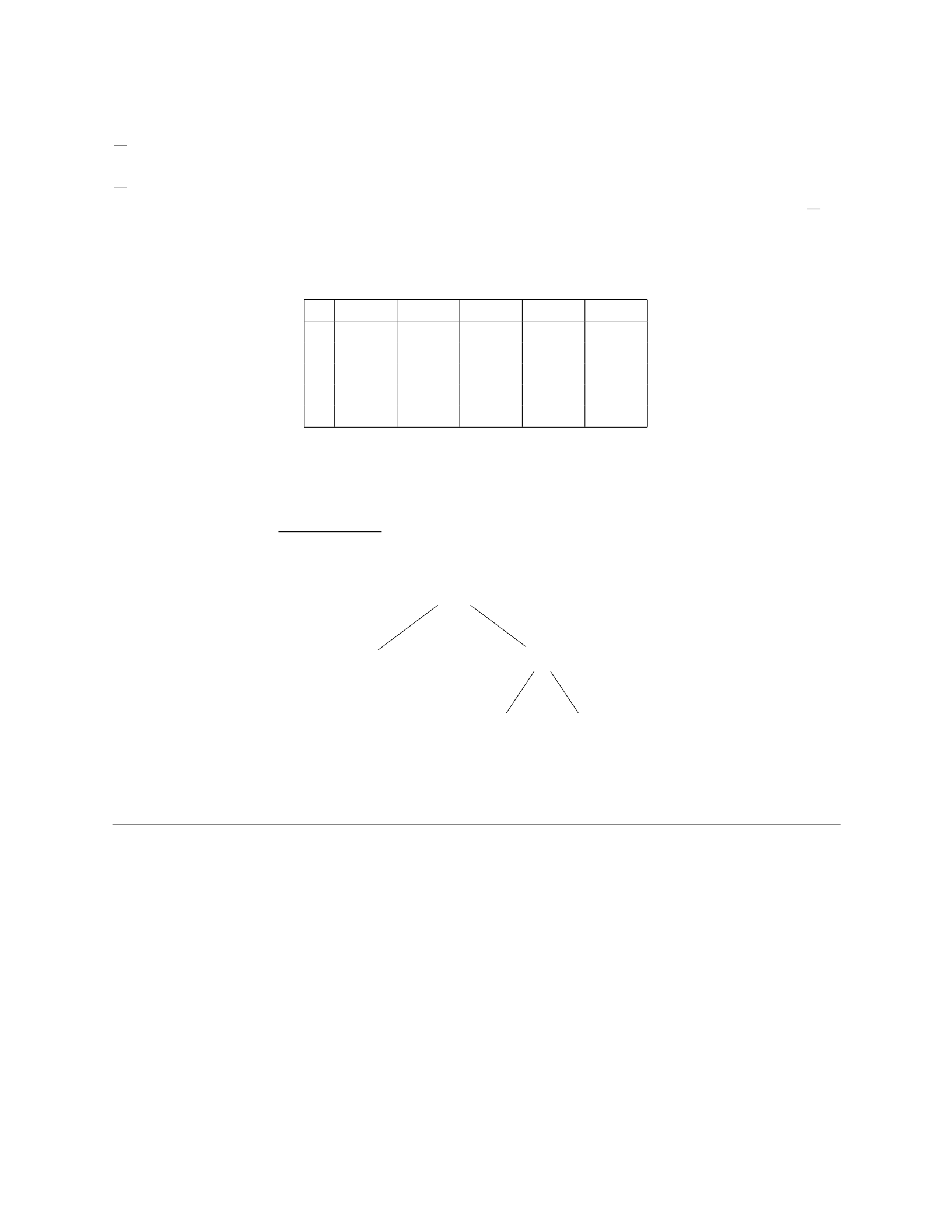
For species C: Number of matches = 8 Total number of positions = 11 Pairwise identity =
8
11 ≈0.7273
For species D: Number of matches = 11 Total number of positions = 11 Pairwise identity =
11
11 = 1
For species E: Number of matches = 9 Total number of positions = 11 Pairwise identity = 9
11 ≈
0.8182
b) The pairwise distance matrix can be constructed using the formula: Dij = 1−pairwise identityij .
The pairwise distance matrix for these species is:
A B C D E
A0 0.0909 0.2727 0 0.1818
B0.0909 0 0.4545 0.0909 0.2727
C0.2727 0.4545 0 0.2727 0.1818
D0 0.0909 0.2727 0 0.1818
E0.1818 0.2727 0.1818 0.1818 0
c) To construct a neighbor-joining tree, we start by finding the minimum entry in the distance
matrix. In this case, the minimum entry is 0.0909, corresponding to the distance between species
A and B. We then define a new node (AB) to represent the cluster of A and B. We update the
distance matrix by computing the distances between the new node (AB) and all other nodes using
the formula D(AB)k=DAk +DB k −DAB
2.
Repeating this process, we construct the neighbor-joining tree:
AB
D AE
C E
10 10. COMPUTATIONAL METHODS FOR PREDICTING GENE FUNCTION
Problem 10. You are given a DNA sequence: ATGCGATCACCGCGTTCACCGTTT. Use the
genetic code table to translate this DNA sequence into a protein sequence. Additionally, predict
the function of the protein based on the amino acid sequence.
Solution 10. a) To translate the given DNA sequence into a protein sequence, we need to first
transcribe the DNA sequence into mRNA and then translate the mRNA into amino acids using the
genetic code table.
Starting DNA sequence: ATGCGATCACCGCGTTCACCGTTT
Transcribed mRNA: AUGCGAUCACCGCGUUACCGUUU
Using the genetic code table, we can translate the mRNA sequence into amino acids:
AUG - Methionine (Start) CGA - Arginine UCA - Serine CCG - Proline CGU - Arginine UUA -
Leucine CCG - Proline UUU - Phenylalanine
Therefore, the protein sequence translated from the given DNA sequence is: Met-Arg-Ser-Pro-
Arg-Leu-Pro-Phe.

b) Based on the amino acid sequence Met-Arg-Ser-Pro-Arg-Leu-Pro-Phe, we can analyze the
function of the protein. Proteins with specific amino acid sequences often have known functions or
structural motifs.
In this case, we can analyze the amino acid sequence to predict the function of the protein:
- The presence of methionine at the start indicates the start codon. - The presence of argi-
nine, serine, proline, and leucine suggests that this protein sequence may be involved in signaling
pathways, enzymatic reactions, or structural functions.
c) Without additional information or further analysis, it is challenging to definitively predict the
exact function of the protein solely based on its amino acid sequence. Further research or experi-
mental validation may be required to determine the precise function of this protein.
11 11. GENETIC DIVERSITY AND POPULATION GENETICS
Problem 11.
An allele frequency for a particular gene in a population is 0.7.
a) What is the frequency of the homozygous dominant genotype for this gene in the population?
b) What is the frequency of the heterozygous genotype for this gene in the population?
c) What is the frequency of the homozygous recessive genotype for this gene in the population?
Solution 11.
a) The frequency of the homozygous dominant genotype can be found by squaring the allele
frequency, which is 0.7.
Frequency of homozygous dominant genotype = (0.7)2= 0.49
Therefore, the frequency of the homozygous dominant genotype for this gene in the population
is 0.49.
b) The frequency of the heterozygous genotype can be found by multiplying the allele frequency
with the complement of the allele frequency (1 - 0.7).
Frequency of heterozygous genotype = 2 * 0.7 * (1 - 0.7) = 2 * 0.7 * 0.3 = 0.42
Therefore, the frequency of the heterozygous genotype for this gene in the population is 0.42.
c) The frequency of the homozygous recessive genotype can be found by squaring the com-
plement of the allele frequency (1 - 0.7).
Frequency of homozygous recessive genotype = (1 - 0.7)2= 0.09
Therefore, the frequency of the homozygous recessive genotype for this gene in the population
is 0.09.
I. REGULATORY NETWORKS CONTROLLING GENE EXPRESSION
Problem 12.
The expression of gene X is regulated by transcription factors Y and Z. The binding of Y to the
promoter region of gene X increases its expression by threefold, while the binding of Z decreases
its expression by half. In a specific experiment, the expression level of gene X is 100 units. If the
transcription factor Y is knocked out, what will be the new expression level of gene X?
Solution 12.
Let’s denote the expression level of gene X without any transcription factors as Xbaseline.
Given that the binding of transcription factor Y increases the expression by threefold and Z
decreases it by half, we can write the following equations:
With Y: XY= 3Xbaseline
Without Y: Xno Y =1
2XY=1
2·3Xbaseline =3
2Xbaseline
If the expression level of gene X is 100 units, then we can set up the following equation:

Xbaseline = 100
Now, substituting Xbaseline = 100 into Xno Y =3
2Xbaseline:
Xno Y =3
2·100 = 150
Therefore, if transcription factor Y is knocked out, the new expression level of gene X will be
150 units.

Problem 13.
A gene regulatory network consists of three genes: A, B, and C. Gene A activates the expres-
sion of gene B by two-fold, while gene B inhibits the expression of gene C by three-fold. If the basal
expression level of gene C is 120 units, what will be the new expression level of gene C if gene A
is knocked out?
Solution 13.
Let’s denote the expression level of gene C without any regulatory interactions as Cbaseline.
Given the effect of genes A and B on gene C, we have the following relationships:
With A: B= 2Aand C=B−3
Without A: Cno A =Bno A −3 = 2A−3
If the basal expression level of gene C is 120 units, then we can set up the following equation:
Cbaseline = 120
Now, substituting Cbaseline = 120 into Cno A = 2A−3:
Cno A = 2 ·0−3 = −3
Therefore, if gene A is knocked out, the new expression level of gene C will be -3 units.
12 13. STRUCTURAL GENOMICS AND PROTEIN STRUCTURE PREDICTION
Problem 13. Consider a protein with a sequence of amino acids given by:
SEQ: ALA-ARG-SER-LYS-ASP-GLY-GLU-ASP-ARG-GLY-ALA.
a) Calculate the molecular weight of this protein. Assume the average molecular weight of each
amino acid: Alanine (ALA) = 89.1 Da, Arginine (ARG) = 174.2 Da, Serine (SER) = 105.1 Da, Lysine
(LYS) = 128.2 Da, Aspartic Acid (ASP) = 133.1 Da, Glycine (GLY) = 75.1 Da, and Glutamic Acid
(GLU) = 147.1 Da.
b) Determine the isoelectric point (pI) of this protein.
Solution 13.
a) The molecular weight of a protein is calculated by adding up the molecular weights of each
amino acid in the sequence.
SEQ: ALA-ARG-SER-LYS-ASP-GLY-GLU-ASP-ARG-GLY-ALA
Molecular Weight: 89.1 + 174.2 + 105.1 + 128.2 + 133.1 + 75.1 + 147.1 + 133.1 + 174.2 + 75.1
+ 89.1
Molecular Weight: 1238.3 Da
Therefore, the molecular weight of the given protein sequence is 1238.3 Da.
b) The isoelectric point (pI) is the pH at which a protein carries no net charge. To calculate the
pI, we need to consider the pKa values of the amino acids. For simplicity, we will use the following
approximate pKa values:
Alanine (ALA) = 6.0, Arginine (ARG) = 12.0, Serine (SER) = 5.7, Lysine (LYS) = 10.5, Aspartic
Acid (ASP) = 3.9, Glycine (GLY) = 6.0, Glutamic Acid (GLU) = 4.1.
The pI of a protein can be estimated using the pKa values of the amino acids present in the
sequence. In this case, the amino acids present are: ALA, ARG, SER, LYS, ASP, GLY, GLU.
For a basic protein like this one (with arginine and lysine), we look for the pH that is closest
to the average of the pKa values of the basic (pKa > 7) and acidic (pKa < 7) amino acids in the
sequence.

Average of pKa values for Basic Amino Acids: (12.0 + 10.5) / 2 = 11.25
Average of pKa values for Acidic Amino Acids: (5.7 + 3.9 + 4.1) / 3 = 4.57
The isoelectric point (pI) is likely around the average of these values:
pI (11.25 + 4.57) / 2 = 7.91.
Therefore, the approximate isoelectric point of the protein is 7.91.
I. Genomics and Functional Genomics
Problem 1: In a population of 100 individuals, 25 are homozygous dominant (AA), 50 are
heterozygous (Aa), and 25 are homozygous recessive (aa) for a particular gene.
a) What is the allele frequency of the "A" allele in this population? b) What is the frequency of
individuals with the genotype Aa in this population?
Solution 1: a) The total number of alleles is twice the number of individuals, so there are 200
alleles in the population. The frequency of the "A" allele can be calculated as:
Frequency of "A" allele = [2(homozygous dominant) + 1(heterozygous)] / [2(total alleles)] =
[2(25) + 1(50)] / 200 = (50 + 50) / 200 = 100 / 200 = 0.5
Therefore, the allele frequency of the "A" allele in this population is 0.5.
b) The frequency of individuals with the genotype Aa can be calculated by dividing the number
of individuals with the genotype Aa by the total number of individuals:
Frequency of Aa genotype = Number of Aa individuals / Total number of individuals = 50 / 100
= 0.5
Therefore, the frequency of individuals with the genotype Aa in this population is 0.5.
I’m glad you’re interested in solving problems in Genomics and Functional Genomics! Here’s a
numerical problem along with a detailed solution:
13 15. PHARMACOGENOMICS AND PERSONALIZED DRUG THERAPIES
Problem 15. In a pharmacogenomics study, a group of patients with a specific genetic variant
were administered a drug to measure its efficacy. The results showed that 70
a) If 40 patients with the genetic variant were included in the study, how many patients re-
sponded positively to the drug?
b) If the overall response rate among patients without the genetic variant is 50
Solution 15.
a) The total number of patients with the genetic variant is 40. Since 70
Number of positive responders = 40 patients x 70
Therefore, 28 patients with the genetic variant responded positively to the drug.
b) Let’s denote the number of patients without the genetic variant as x. If the overall response
rate among these patients is 50
Number of positive responders = x patients x 50
To have the same number of positive responders in part (a), we set up an equation:
Number of positive responders in part (a) = Number of positive responders in part (b)
28 = 0.5x
Solving for x:
x = 28 / 0.5 = 56 patients
Therefore, 56 patients without the genetic variant would need to be included in the study to
have the same number of positive responders as in part (a).
Certainly! Here is a numerical problem on Genomics and Functional Genomics:

14 Genomics and Functional Genomics
Problem: In a plant species, a gene responsible for regulating flower color has two possible
alleles: A and a. In a population of 500 plants, it is found that 360 plants have at least one copy of
the dominant allele A.
a) Calculate the frequency of the allele A in the population. b) Determine the frequency of the
recessive allele a in the population. c) Find the percentage of plants in the population that are
homozygous for the dominant allele A.
Solution:
a) The frequency of allele A can be calculated by dividing the total number of copies of allele A
by the total number of alleles in the population.
Given: Total plants in the population, n= 500
Number of plants with at least one copy of allele A, p(AA) + p(Aa) = 360
Total number of copies of allele A, 2×360 = 720
Frequency of allele A, p(A) = 720
500×2= 0.72
b) The frequency of the recessive allele a can be determined by subtracting the frequency of
allele A from 1.
Frequency of allele a, p(a)=1−p(A)=1−0.72 = 0.28
c) To find the percentage of plants that are homozygous for the dominant allele A, we first need
to calculate the frequency of the homozygous genotype (AA). This can be obtained by squaring
the frequency of allele A.
Frequency of genotype AA, p(AA)=(p(A))2= 0.722= 0.5184
Percentage of plants that are homozygous for allele A, 51.84%
I. Problem:
Consider a genetic modifier that influences the progression of a neurodegenerative disease.
The modifier gene is known to have two alleles, A and a, with frequencies of 0.6 and 0.4, respec-
tively, in the population. Individuals with the A allele have a 20
a) What is the probability that an individual randomly selected from the population carries at
least one A allele?
b) If both of a person’s parents carry the A allele, what is the probability that the person will
develop the disease?
c) If an individual carries the a allele, what is the probability that their sibling also carries the a
allele?
II. Solution:
a) Let’s first calculate the probability of an individual carrying at least one A allele. This includes
individuals with AA or Aa genotypes.
P(A allele) = 0.6 P(a allele) = 0.4
P(at least one A allele) = 1 - P(no A allele) = 1 - P(aa) = 1 - P(a) * P(a) = 1 - 0.4 * 0.4 = 1 - 0.16
= 0.84
Therefore, the probability that an individual randomly selected from the population carries at
least one A allele is 0.84.
b) Given that both parents carry the A allele, the individual will have either AA or Aa genotype.
The risk of developing the disease for A allele carriers is reduced by 20
P(disease with both parents carrying A allele) = P(disease | AA or Aa) = 0.6*0.8 + 0.24*0.8 =
0.48 + 0.192 = 0.672
Therefore, the probability that the person will develop the disease is 0.672.
c) If an individual carries the a allele, the genotype can be aa.

Therefore, the probability that their sibling also carries the a allele is 1 (since both siblings will
have the aa genotype).
Hence, the probability that the sibling carries the a allele given one individual carries the a allele
is 1.
15 18. GENOMIC INSTABILITY AND CHROMOSOMAL ABNORMALITIES
Problem 18. A human cell line is known to have a chromosomal abnormality in which an extra
copy of chromosome 21 is present. Normally, human cells have 46 chromosomes. If a cell from
this line undergoes nondisjunction during meiosis I, what would be the chromosome number in the
resulting gametes?
Solution 18. a) When a cell undergoes nondisjunction during meiosis I, homologous chromo-
somes fail to separate properly, leading to one daughter cell having an extra chromosome and the
other missing one.
In this case, since the cell line already has an extra copy of chromosome 21, it would have 47
chromosomes instead of the normal 46.
During meiosis I, if nondisjunction occurs, one of the resulting daughter cells will have an ex-
tra chromosome 21, so it will have 47 chromosomes. The other daughter cell will be missing a
chromosome 21 and will have 45 chromosomes.
Therefore, the resulting gametes from this cell line would have 47 chromosomes and 45 chro-
mosomes, respectively.
b) If a sperm with 47 chromosomes fertilizes a normal egg (with 46 chromosomes), the resulting
zygote would have 47 + 46 = 93 chromosomes, which is an example of aneuploidy.
c) A zygote with 93 chromosomes may not be viable and could lead to developmental abnor-
malities or miscarriage.
I. Let’s generate a numerical problem in the field of Genomics and Functional Genomics:
16 Genomics and Functional Genomics
Problem: In a human DNA sequence, the frequency of the nucleotide Adenine (A) is 30%,
Thymine (T) is 20%, Cytosine (C) is 25%, and Guanine (G) is 25%. Calculate the GC content of
this DNA sequence.
Solution:
The GC content in DNA is the percentage of nucleotides Guanine (G) and Cytosine (C) in the
DNA sequence.
Given frequencies: - Frequency of Cytosine (C) = 25% - Frequency of Guanine (G) = 25%
The GC content can be calculated by adding the frequency of Cytosine and Guanine:
GC content =F requency(C) + F requency(G) = 25% + 25% = 50%
Therefore, the GC content of the DNA sequence is 50%.
II. Let’s generate another numerical problem in Genomics and Functional Genomics:
17 Genomics and Functional Genomics

Problem: A researcher is studying the expression of a gene in two different cell types – A and
B. In cell type A, the expression level of the gene is 200 TPM (Transcripts Per Million), and in cell
type B, the expression level is 500 TPM. Calculate the fold change in gene expression between
cell type A and cell type B.
Solution:
The fold change in gene expression between two conditions can be calculated using the for-
mula:
F oldChange =Expression level in Condition B
Expression level in Condition A
Given: - Expression level in cell type A = 200 TPM - Expression level in cell type B = 500 TPM
Substitute the values into the formula:
F oldChange =500 TPM
200 TPM = 2.5
Therefore, the fold change in gene expression between cell type A and cell type B is 2.5.
I’m glad to help you with that. Could you please specify a particular topic or concept within
Genomics and Functional Genomics that you would like the problem to focus on? This will help
me tailor the question to your needs.

enzyme coded by this gene. The patient has two copies of the normal allele (A), but the metabolic
activity of the enzyme is reduced by 50% in individuals with this genetic variation.
If the normal metabolic rate for this medication is 10 mg/hr, what would be the expected metabolic
rate for this patient?
Solution 2.
Given: Normal metabolic rate = 10 mg/hr Metabolic activity reduced by 50% for the patient with
genetic variation
Let’s define: Metabolic rate with genetic variation = X mg/hr
The patient has two copies of the normal allele (A), so the metabolic rate is reduced by 50%.
Therefore, the patient’s metabolic rate with genetic variation would be:
X= 10 mg/hr ×0.5=5mg/hr
Therefore, the expected metabolic rate for this patient with the genetic variation would be 5
mg/hr.
3 3. BIOINFORMATICS TOOLS FOR ANALYZING GENOMIC DATA
Problem 3. Consider a DNA sequence: "ATGCTAAGCT".
a) Calculate the total number of nucleotides in this sequence.
b) Determine the frequency of each nucleotide (A, T, G, C) in the sequence.
c) Compute the GC content of the sequence.
Solution 3.
a) To calculate the total number of nucleotides in the sequence "ATGCTAAGCT", we simply
count the characters:
Total number of nucleotides = 10
b) To determine the frequency of each nucleotide, we count the occurrences of each nucleotide
in the sequence:
Frequency of A: 3 Frequency of T: 2 Frequency of G: 2 Frequency of C: 3
c) The GC content of a DNA sequence is given by the percentage of G and C nucleotides in
the sequence.
Total number of G and C nucleotides = 2 (G) + 3 (C) = 5
Total number of nucleotides = 10
Therefore, GC content = (Number of G and C nucleotides / Total number of nucleotides) * 100
GC content = (5 / 10) * 100 = 50
So, the GC content of the sequence "ATGCTAAGCT" is 50
I.
4 3. COMMON SEQUENCE ANALYSIS TASKS
Problem 3. Consider two DNA sequences: Seq1 = "ACGTAGC" and Seq2 = "ACTAGT".
a) Calculate the Hamming distance between Seq1 and Seq2.
b) If a substitution mutation occurred at position 4 in Seq1, changing "A" to "T", determine the
new Hamming distance between Seq1 and Seq2.
Solution 3.

a) The Hamming distance is the number of positions at which the corresponding symbols differ
between two sequences of equal length. Given Seq1 = "ACGTAGC" and Seq2 = "ACTAGT", the
Hamming distance is as follows:
- Positions where symbols differ: 1 (T vs. G) and 6 (C vs. T) - Hamming distance = 2
b) After the substitution mutation at position 4 in Seq1 to "ACGTTGC", the new Seq1 becomes
"ACGT T GC". The updated Hamming distance between Seq1 and Seq2 is then:
- Positions where symbols differ: 1 (T vs. G), 4 (T vs. T), and 6 (C vs. T) - Updated Hamming
distance = 3
5 5. EPIGENETIC MODIFICATIONS AND THEIR ROLE IN GENE EXPRESSION
Problem 5. You are studying the role of DNA methylation in gene expression regulation. In a
particular gene, you observe that a CpG island located in the promoter region is heavily methylated.
You hypothesize that this methylation is leading to the suppression of gene expression. To test
this hypothesis, you perform a demethylation experiment using a DNA demethylating agent and
measure the gene expression levels before and after treatment.
Before treatment, the gene expression level was recorded as 200 arbitrary units. After treatment
with the demethylating agent, the gene expression level increased to 600 arbitrary units.
a) Calculate the fold change in gene expression after treatment.
b) If the gene had a baseline expression level of 1000 arbitrary units in an unmethylated state,
what is the fold change in gene expression when comparing the demethylated state to the unmethy-
lated baseline?
Solution 5.
a) The fold change in gene expression can be calculated using the formula:
Fold Change =Gene expression after treatment
Gene expression before treatment
Given that the gene expression before treatment was 200 arbitrary units and after treatment was
600 arbitrary units, we can substitute these values into the formula:
Fold Change =600
200 = 3
Therefore, the fold change in gene expression after treatment is 3.
b) To calculate the fold change when comparing the demethylated state to the unmethylated
baseline, we first need to determine the gene expression level in the demethylated state relative to
the baseline. This can be done using the formula:
Fold Change =Gene expression in demethylated state
Gene expression in unmethylated state
Given that the gene expression level in the demethylated state is 600 arbitrary units and in the
unmethylated state is 1000 arbitrary units, we can substitute these values into the formula:
Fold Change =600
1000 = 0.6
Therefore, the fold change in gene expression when comparing the demethylated state to the un-
methylated baseline is 0.6.

6 6. GENE-ENVIRONMENT INTERACTIONS IN DISEASE SUSCEPTIBILITY
Problem 6. A research study investigates the relationship between a specific gene variant (al-
lele A) and exposure to a certain environmental factor (Factor X) in increasing the risk of developing
a particular disease. The study found that individuals with allele A who were exposed to Factor X
had a disease risk of 0.6, while individuals without allele A who were exposed to Factor X had a
disease risk of 0.3. The disease risk for individuals with allele A but not exposed to Factor X was
0.1, and the disease risk for individuals without allele A and not exposed to Factor X was 0.05.
a) Calculate the relative risk for individuals with allele A when exposed to Factor X compared
to individuals without allele A.
b) Determine the attributable risk for the interaction between allele A and Factor X in disease
susceptibility.
c) Calculate the interaction contrast for allele A and Factor X in contributing to disease risk.
Solution 6. a) The relative risk (RR) is the ratio of the disease risk for individuals with allele A
exposed to Factor X to the disease risk for individuals without allele A exposed to Factor X.
Given: Risk of disease for individuals with allele A exposed to Factor X, P(D|A, X) = 0.6Risk
of disease for individuals without allele A exposed to Factor X, P(D|¬A, X) = 0.3
RR =0.6
0.3
= 2
Therefore, the relative risk for individuals with allele A when exposed to Factor X compared to
individuals without allele A is 2.
b) The attributable risk (AR) is the difference between the disease risk in the total population
and the disease risk in the unexposed group.
Given: Risk of disease for individuals with allele A exposed to Factor X, P(D|A, X) = 0.6Risk
of disease for individuals without allele A exposed to Factor X, P(D|¬A, X) = 0.3Risk of disease
for individuals with allele A but not exposed to Factor X, P(D|A, ¬X) = 0.1Risk of disease for
individuals without allele A and not exposed to Factor X, P(D|¬A, ¬X)=0.05
Total population disease risk:
P(D) = P(D|A, X)∗P(A) + P(D|¬A, X)∗P(¬A)
P(D)=0.6∗P(A)+0.3∗(1 −P(A))
Unexposed group disease risk:
P(D|¬X) = P(D|A, ¬X)∗P(A) + P(D|¬A, ¬X)∗P(¬A)
P(D|¬X) = 0.1∗P(A)+0.05 ∗(1 −P(A))
Attributable risk (AR) is then:
AR =P(D)−P(D|¬X)
c) The interaction contrast (IC) quantifies the interaction between allele A and Factor X in con-
tributing to disease risk.
Given:
IC =P(D|A, X)−P(D|A, ¬X)−P(D|¬A, X) + P(D|¬A, ¬X)
Substitute the given probabilities to find the interaction contrast.

7 Genomics and Functional Genomics
Problem:
Consider a gene with a DNA sequence of length 300 base pairs that codes for a protein. The
gene contains 4 exons (50, 75, 100, and 75 base pairs long) separated by 3 introns (20, 30, and
50 base pairs long).
a) Calculate the total length of the gene (including exons and introns).
b) If each codon in the gene corresponds to 3 base pairs, calculate the total number of codons
in the gene.
c) If each amino acid is coded by 1 codon, calculate the number of amino acids in the protein
produced by this gene.
Solution:
a) The total length of the gene can be calculated by adding the lengths of exons and introns
together:
Total gene length = (50 + 75 + 100 + 75) + (20 + 30 + 50) = 450 base pairs
b) Since each codon corresponds to 3 base pairs, the total number of codons can be calculated
by dividing the total gene length by 3:
Total number of codons = Total gene length / 3 = 450 / 3 = 150 codons
c) Since each amino acid is coded by 1 codon, the number of amino acids in the protein can
be calculated by simply counting the number of codons:
Number of amino acids = Total number of codons = 150 amino acids
8 8. GENOME-WIDE ASSOCIATION STUDIES IN COMPLEX DISEASES
Problem 8. In a genome-wide association study for a particular complex disease, researchers
found that a certain single nucleotide polymorphism (SNP) is significantly associated with the dis-
ease. The frequency of the disease allele for this SNP is 0.3 in the general population. The odds
ratio for this SNP is 2.5.
a) Calculate the odds of having the disease for individuals with the disease allele.
b) Calculate the odds of having the disease for individuals without the disease allele.
Solution 8.
a) The odds ratio is defined as the odds of having the disease for individuals with the disease
allele divided by the odds of having the disease for individuals without the disease allele. Given that
the odds ratio is 2.5 and the disease allele frequency is 0.3, we can calculate the odds of having
the disease for individuals with the disease allele as follows:
Let pbe the frequency of the disease allele and q= 1 −pbe the frequency of the non-disease
allele.
The odds ratio formula is:
OR =oddsdisease with allele
oddsdisease without allele
We are given that OR = 2.5and p= 0.3.
Therefore,
2.5 = 0.3
1−0.3

2.5 = 0.3
0.7
2.5×0.7=0.3
1.75 = 0.3
So, the odds of having the disease for individuals with the disease allele is 1.75.
b) We can calculate the odds of having the disease for individuals without the disease allele
using the odds ratio. Since the odds ratio formula is:
OR =oddsdisease with allele
oddsdisease without allele
We know that the odds of having the disease for individuals with the allele is 1.75. Therefore, to
find the odds of having the disease for individuals without the allele, we divide the odds of having
the disease for individuals with the allele by the odds ratio:
oddsdisease without allele =oddsdisease with allele
OR
oddsdisease without allele =1.75
2.5
oddsdisease without allele = 0.7
So, the odds of having the disease for individuals without the disease allele is 0.7.
9 9. EVOLUTIONARY GENOMICS AND PHYLOGENETICS
Problem 9. Consider the following DNA sequences for five species:
Species DNA Sequence
A ATGCCATCGAT
B ATGCCATGGAT
C ATGCCGTGGAT
D ATGCCATCGAT
E ATGCAATGGAT
a) Calculate the pairwise sequence identity between species A and each of the other species
(B, C, D, E).
b) Based on the sequence identities, construct a pairwise distance matrix for these five species.
c) Construct a neighbor-joining tree using the pairwise distance matrix.
Solution 9.
a) The pairwise sequence identity is calculated as the number of matching positions divided by
the total number of positions compared. Let’s calculate the pairwise sequence identities between
species A and the other species.
For species B: Number of matches = 10 Total number of positions = 11 Pairwise identity =
10
11 ≈0.9091
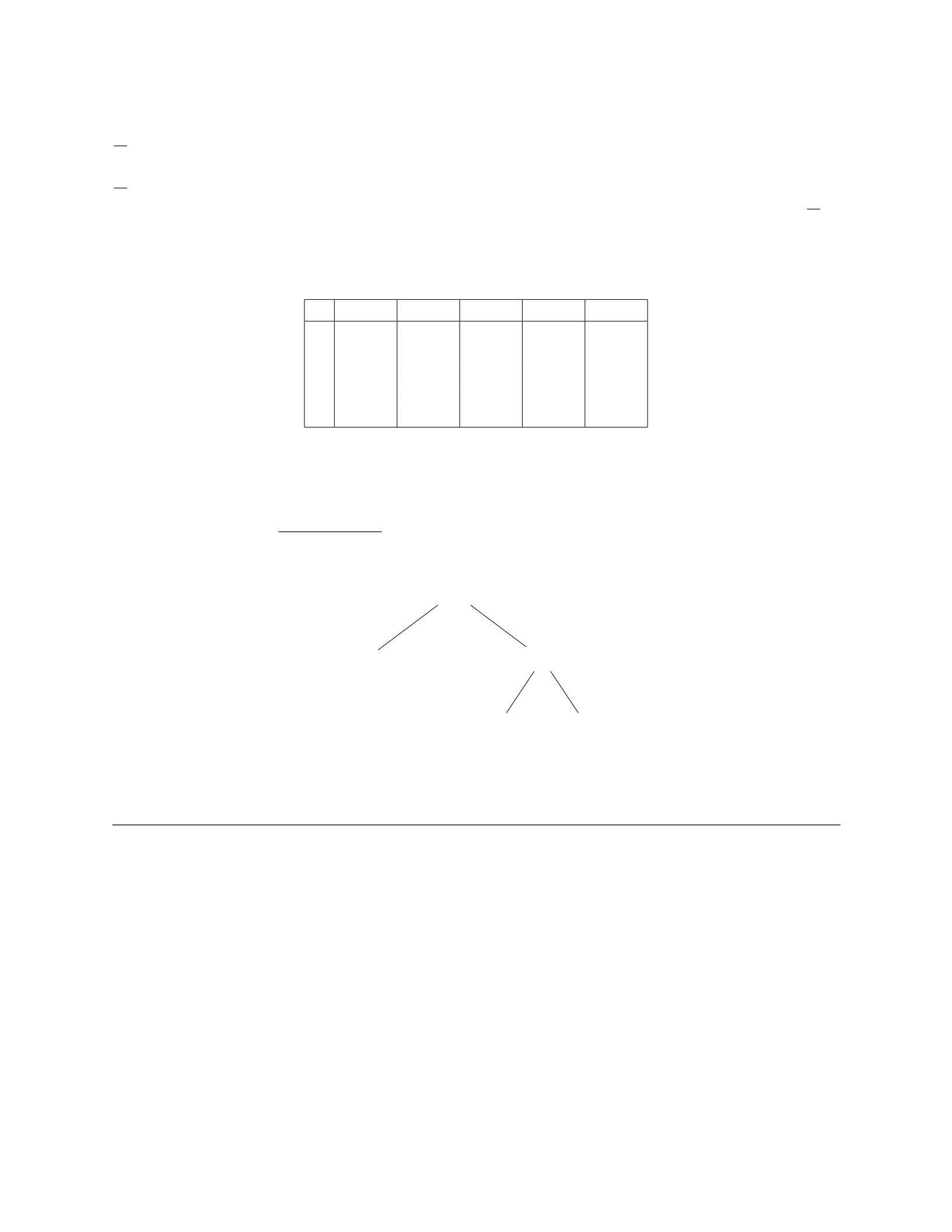
For species C: Number of matches = 8 Total number of positions = 11 Pairwise identity =
8
11 ≈0.7273
For species D: Number of matches = 11 Total number of positions = 11 Pairwise identity =
11
11 = 1
For species E: Number of matches = 9 Total number of positions = 11 Pairwise identity = 9
11 ≈
0.8182
b) The pairwise distance matrix can be constructed using the formula: Dij = 1−pairwise identityij .
The pairwise distance matrix for these species is:
A B C D E
A0 0.0909 0.2727 0 0.1818
B0.0909 0 0.4545 0.0909 0.2727
C0.2727 0.4545 0 0.2727 0.1818
D0 0.0909 0.2727 0 0.1818
E0.1818 0.2727 0.1818 0.1818 0
c) To construct a neighbor-joining tree, we start by finding the minimum entry in the distance
matrix. In this case, the minimum entry is 0.0909, corresponding to the distance between species
A and B. We then define a new node (AB) to represent the cluster of A and B. We update the
distance matrix by computing the distances between the new node (AB) and all other nodes using
the formula D(AB)k=DAk +DB k −DAB
2.
Repeating this process, we construct the neighbor-joining tree:
AB
D AE
C E
10 10. COMPUTATIONAL METHODS FOR PREDICTING GENE FUNCTION
Problem 10. You are given a DNA sequence: ATGCGATCACCGCGTTCACCGTTT. Use the
genetic code table to translate this DNA sequence into a protein sequence. Additionally, predict
the function of the protein based on the amino acid sequence.
Solution 10. a) To translate the given DNA sequence into a protein sequence, we need to first
transcribe the DNA sequence into mRNA and then translate the mRNA into amino acids using the
genetic code table.
Starting DNA sequence: ATGCGATCACCGCGTTCACCGTTT
Transcribed mRNA: AUGCGAUCACCGCGUUACCGUUU
Using the genetic code table, we can translate the mRNA sequence into amino acids:
AUG - Methionine (Start) CGA - Arginine UCA - Serine CCG - Proline CGU - Arginine UUA -
Leucine CCG - Proline UUU - Phenylalanine
Therefore, the protein sequence translated from the given DNA sequence is: Met-Arg-Ser-Pro-
Arg-Leu-Pro-Phe.

b) Based on the amino acid sequence Met-Arg-Ser-Pro-Arg-Leu-Pro-Phe, we can analyze the
function of the protein. Proteins with specific amino acid sequences often have known functions or
structural motifs.
In this case, we can analyze the amino acid sequence to predict the function of the protein:
- The presence of methionine at the start indicates the start codon. - The presence of argi-
nine, serine, proline, and leucine suggests that this protein sequence may be involved in signaling
pathways, enzymatic reactions, or structural functions.
c) Without additional information or further analysis, it is challenging to definitively predict the
exact function of the protein solely based on its amino acid sequence. Further research or experi-
mental validation may be required to determine the precise function of this protein.
11 11. GENETIC DIVERSITY AND POPULATION GENETICS
Problem 11.
An allele frequency for a particular gene in a population is 0.7.
a) What is the frequency of the homozygous dominant genotype for this gene in the population?
b) What is the frequency of the heterozygous genotype for this gene in the population?
c) What is the frequency of the homozygous recessive genotype for this gene in the population?
Solution 11.
a) The frequency of the homozygous dominant genotype can be found by squaring the allele
frequency, which is 0.7.
Frequency of homozygous dominant genotype = (0.7)2= 0.49
Therefore, the frequency of the homozygous dominant genotype for this gene in the population
is 0.49.
b) The frequency of the heterozygous genotype can be found by multiplying the allele frequency
with the complement of the allele frequency (1 - 0.7).
Frequency of heterozygous genotype = 2 * 0.7 * (1 - 0.7) = 2 * 0.7 * 0.3 = 0.42
Therefore, the frequency of the heterozygous genotype for this gene in the population is 0.42.
c) The frequency of the homozygous recessive genotype can be found by squaring the com-
plement of the allele frequency (1 - 0.7).
Frequency of homozygous recessive genotype = (1 - 0.7)2= 0.09
Therefore, the frequency of the homozygous recessive genotype for this gene in the population
is 0.09.
I. REGULATORY NETWORKS CONTROLLING GENE EXPRESSION
Problem 12.
The expression of gene X is regulated by transcription factors Y and Z. The binding of Y to the
promoter region of gene X increases its expression by threefold, while the binding of Z decreases
its expression by half. In a specific experiment, the expression level of gene X is 100 units. If the
transcription factor Y is knocked out, what will be the new expression level of gene X?
Solution 12.
Let’s denote the expression level of gene X without any transcription factors as Xbaseline.
Given that the binding of transcription factor Y increases the expression by threefold and Z
decreases it by half, we can write the following equations:
With Y: XY= 3Xbaseline
Without Y: Xno Y =1
2XY=1
2·3Xbaseline =3
2Xbaseline
If the expression level of gene X is 100 units, then we can set up the following equation:

Xbaseline = 100
Now, substituting Xbaseline = 100 into Xno Y =3
2Xbaseline:
Xno Y =3
2·100 = 150
Therefore, if transcription factor Y is knocked out, the new expression level of gene X will be
150 units.

Problem 13.
A gene regulatory network consists of three genes: A, B, and C. Gene A activates the expres-
sion of gene B by two-fold, while gene B inhibits the expression of gene C by three-fold. If the basal
expression level of gene C is 120 units, what will be the new expression level of gene C if gene A
is knocked out?
Solution 13.
Let’s denote the expression level of gene C without any regulatory interactions as Cbaseline.
Given the effect of genes A and B on gene C, we have the following relationships:
With A: B= 2Aand C=B−3
Without A: Cno A =Bno A −3 = 2A−3
If the basal expression level of gene C is 120 units, then we can set up the following equation:
Cbaseline = 120
Now, substituting Cbaseline = 120 into Cno A = 2A−3:
Cno A = 2 ·0−3 = −3
Therefore, if gene A is knocked out, the new expression level of gene C will be -3 units.
12 13. STRUCTURAL GENOMICS AND PROTEIN STRUCTURE PREDICTION
Problem 13. Consider a protein with a sequence of amino acids given by:
SEQ: ALA-ARG-SER-LYS-ASP-GLY-GLU-ASP-ARG-GLY-ALA.
a) Calculate the molecular weight of this protein. Assume the average molecular weight of each
amino acid: Alanine (ALA) = 89.1 Da, Arginine (ARG) = 174.2 Da, Serine (SER) = 105.1 Da, Lysine
(LYS) = 128.2 Da, Aspartic Acid (ASP) = 133.1 Da, Glycine (GLY) = 75.1 Da, and Glutamic Acid
(GLU) = 147.1 Da.
b) Determine the isoelectric point (pI) of this protein.
Solution 13.
a) The molecular weight of a protein is calculated by adding up the molecular weights of each
amino acid in the sequence.
SEQ: ALA-ARG-SER-LYS-ASP-GLY-GLU-ASP-ARG-GLY-ALA
Molecular Weight: 89.1 + 174.2 + 105.1 + 128.2 + 133.1 + 75.1 + 147.1 + 133.1 + 174.2 + 75.1
+ 89.1
Molecular Weight: 1238.3 Da
Therefore, the molecular weight of the given protein sequence is 1238.3 Da.
b) The isoelectric point (pI) is the pH at which a protein carries no net charge. To calculate the
pI, we need to consider the pKa values of the amino acids. For simplicity, we will use the following
approximate pKa values:
Alanine (ALA) = 6.0, Arginine (ARG) = 12.0, Serine (SER) = 5.7, Lysine (LYS) = 10.5, Aspartic
Acid (ASP) = 3.9, Glycine (GLY) = 6.0, Glutamic Acid (GLU) = 4.1.
The pI of a protein can be estimated using the pKa values of the amino acids present in the
sequence. In this case, the amino acids present are: ALA, ARG, SER, LYS, ASP, GLY, GLU.
For a basic protein like this one (with arginine and lysine), we look for the pH that is closest
to the average of the pKa values of the basic (pKa > 7) and acidic (pKa < 7) amino acids in the
sequence.

Average of pKa values for Basic Amino Acids: (12.0 + 10.5) / 2 = 11.25
Average of pKa values for Acidic Amino Acids: (5.7 + 3.9 + 4.1) / 3 = 4.57
The isoelectric point (pI) is likely around the average of these values:
pI (11.25 + 4.57) / 2 = 7.91.
Therefore, the approximate isoelectric point of the protein is 7.91.
I. Genomics and Functional Genomics
Problem 1: In a population of 100 individuals, 25 are homozygous dominant (AA), 50 are
heterozygous (Aa), and 25 are homozygous recessive (aa) for a particular gene.
a) What is the allele frequency of the "A" allele in this population? b) What is the frequency of
individuals with the genotype Aa in this population?
Solution 1: a) The total number of alleles is twice the number of individuals, so there are 200
alleles in the population. The frequency of the "A" allele can be calculated as:
Frequency of "A" allele = [2(homozygous dominant) + 1(heterozygous)] / [2(total alleles)] =
[2(25) + 1(50)] / 200 = (50 + 50) / 200 = 100 / 200 = 0.5
Therefore, the allele frequency of the "A" allele in this population is 0.5.
b) The frequency of individuals with the genotype Aa can be calculated by dividing the number
of individuals with the genotype Aa by the total number of individuals:
Frequency of Aa genotype = Number of Aa individuals / Total number of individuals = 50 / 100
= 0.5
Therefore, the frequency of individuals with the genotype Aa in this population is 0.5.
I’m glad you’re interested in solving problems in Genomics and Functional Genomics! Here’s a
numerical problem along with a detailed solution:
13 15. PHARMACOGENOMICS AND PERSONALIZED DRUG THERAPIES
Problem 15. In a pharmacogenomics study, a group of patients with a specific genetic variant
were administered a drug to measure its efficacy. The results showed that 70
a) If 40 patients with the genetic variant were included in the study, how many patients re-
sponded positively to the drug?
b) If the overall response rate among patients without the genetic variant is 50
Solution 15.
a) The total number of patients with the genetic variant is 40. Since 70
Number of positive responders = 40 patients x 70
Therefore, 28 patients with the genetic variant responded positively to the drug.
b) Let’s denote the number of patients without the genetic variant as x. If the overall response
rate among these patients is 50
Number of positive responders = x patients x 50
To have the same number of positive responders in part (a), we set up an equation:
Number of positive responders in part (a) = Number of positive responders in part (b)
28 = 0.5x
Solving for x:
x = 28 / 0.5 = 56 patients
Therefore, 56 patients without the genetic variant would need to be included in the study to
have the same number of positive responders as in part (a).
Certainly! Here is a numerical problem on Genomics and Functional Genomics:

14 Genomics and Functional Genomics
Problem: In a plant species, a gene responsible for regulating flower color has two possible
alleles: A and a. In a population of 500 plants, it is found that 360 plants have at least one copy of
the dominant allele A.
a) Calculate the frequency of the allele A in the population. b) Determine the frequency of the
recessive allele a in the population. c) Find the percentage of plants in the population that are
homozygous for the dominant allele A.
Solution:
a) The frequency of allele A can be calculated by dividing the total number of copies of allele A
by the total number of alleles in the population.
Given: Total plants in the population, n= 500
Number of plants with at least one copy of allele A, p(AA) + p(Aa) = 360
Total number of copies of allele A, 2×360 = 720
Frequency of allele A, p(A) = 720
500×2= 0.72
b) The frequency of the recessive allele a can be determined by subtracting the frequency of
allele A from 1.
Frequency of allele a, p(a)=1−p(A)=1−0.72 = 0.28
c) To find the percentage of plants that are homozygous for the dominant allele A, we first need
to calculate the frequency of the homozygous genotype (AA). This can be obtained by squaring
the frequency of allele A.
Frequency of genotype AA, p(AA)=(p(A))2= 0.722= 0.5184
Percentage of plants that are homozygous for allele A, 51.84%
I. Problem:
Consider a genetic modifier that influences the progression of a neurodegenerative disease.
The modifier gene is known to have two alleles, A and a, with frequencies of 0.6 and 0.4, respec-
tively, in the population. Individuals with the A allele have a 20
a) What is the probability that an individual randomly selected from the population carries at
least one A allele?
b) If both of a person’s parents carry the A allele, what is the probability that the person will
develop the disease?
c) If an individual carries the a allele, what is the probability that their sibling also carries the a
allele?
II. Solution:
a) Let’s first calculate the probability of an individual carrying at least one A allele. This includes
individuals with AA or Aa genotypes.
P(A allele) = 0.6 P(a allele) = 0.4
P(at least one A allele) = 1 - P(no A allele) = 1 - P(aa) = 1 - P(a) * P(a) = 1 - 0.4 * 0.4 = 1 - 0.16
= 0.84
Therefore, the probability that an individual randomly selected from the population carries at
least one A allele is 0.84.
b) Given that both parents carry the A allele, the individual will have either AA or Aa genotype.
The risk of developing the disease for A allele carriers is reduced by 20
P(disease with both parents carrying A allele) = P(disease | AA or Aa) = 0.6*0.8 + 0.24*0.8 =
0.48 + 0.192 = 0.672
Therefore, the probability that the person will develop the disease is 0.672.
c) If an individual carries the a allele, the genotype can be aa.

Therefore, the probability that their sibling also carries the a allele is 1 (since both siblings will
have the aa genotype).
Hence, the probability that the sibling carries the a allele given one individual carries the a allele
is 1.
15 18. GENOMIC INSTABILITY AND CHROMOSOMAL ABNORMALITIES
Problem 18. A human cell line is known to have a chromosomal abnormality in which an extra
copy of chromosome 21 is present. Normally, human cells have 46 chromosomes. If a cell from
this line undergoes nondisjunction during meiosis I, what would be the chromosome number in the
resulting gametes?
Solution 18. a) When a cell undergoes nondisjunction during meiosis I, homologous chromo-
somes fail to separate properly, leading to one daughter cell having an extra chromosome and the
other missing one.
In this case, since the cell line already has an extra copy of chromosome 21, it would have 47
chromosomes instead of the normal 46.
During meiosis I, if nondisjunction occurs, one of the resulting daughter cells will have an ex-
tra chromosome 21, so it will have 47 chromosomes. The other daughter cell will be missing a
chromosome 21 and will have 45 chromosomes.
Therefore, the resulting gametes from this cell line would have 47 chromosomes and 45 chro-
mosomes, respectively.
b) If a sperm with 47 chromosomes fertilizes a normal egg (with 46 chromosomes), the resulting
zygote would have 47 + 46 = 93 chromosomes, which is an example of aneuploidy.
c) A zygote with 93 chromosomes may not be viable and could lead to developmental abnor-
malities or miscarriage.
I. Let’s generate a numerical problem in the field of Genomics and Functional Genomics:
16 Genomics and Functional Genomics
Problem: In a human DNA sequence, the frequency of the nucleotide Adenine (A) is 30%,
Thymine (T) is 20%, Cytosine (C) is 25%, and Guanine (G) is 25%. Calculate the GC content of
this DNA sequence.
Solution:
The GC content in DNA is the percentage of nucleotides Guanine (G) and Cytosine (C) in the
DNA sequence.
Given frequencies: - Frequency of Cytosine (C) = 25% - Frequency of Guanine (G) = 25%
The GC content can be calculated by adding the frequency of Cytosine and Guanine:
GC content =F requency(C) + F requency(G) = 25% + 25% = 50%
Therefore, the GC content of the DNA sequence is 50%.
II. Let’s generate another numerical problem in Genomics and Functional Genomics:
17 Genomics and Functional Genomics

Problem: A researcher is studying the expression of a gene in two different cell types – A and
B. In cell type A, the expression level of the gene is 200 TPM (Transcripts Per Million), and in cell
type B, the expression level is 500 TPM. Calculate the fold change in gene expression between
cell type A and cell type B.
Solution:
The fold change in gene expression between two conditions can be calculated using the for-
mula:
F oldChange =Expression level in Condition B
Expression level in Condition A
Given: - Expression level in cell type A = 200 TPM - Expression level in cell type B = 500 TPM
Substitute the values into the formula:
F oldChange =500 TPM
200 TPM = 2.5
Therefore, the fold change in gene expression between cell type A and cell type B is 2.5.
I’m glad to help you with that. Could you please specify a particular topic or concept within
Genomics and Functional Genomics that you would like the problem to focus on? This will help
me tailor the question to your needs.

enzyme coded by this gene. The patient has two copies of the normal allele (A), but the metabolic
activity of the enzyme is reduced by 50% in individuals with this genetic variation.
If the normal metabolic rate for this medication is 10 mg/hr, what would be the expected metabolic
rate for this patient?
Solution 2.
Given: Normal metabolic rate = 10 mg/hr Metabolic activity reduced by 50% for the patient with
genetic variation
Let’s define: Metabolic rate with genetic variation = X mg/hr
The patient has two copies of the normal allele (A), so the metabolic rate is reduced by 50%.
Therefore, the patient’s metabolic rate with genetic variation would be:
X= 10 mg/hr ×0.5=5mg/hr
Therefore, the expected metabolic rate for this patient with the genetic variation would be 5
mg/hr.
3 3. BIOINFORMATICS TOOLS FOR ANALYZING GENOMIC DATA
Problem 3. Consider a DNA sequence: "ATGCTAAGCT".
a) Calculate the total number of nucleotides in this sequence.
b) Determine the frequency of each nucleotide (A, T, G, C) in the sequence.
c) Compute the GC content of the sequence.
Solution 3.
a) To calculate the total number of nucleotides in the sequence "ATGCTAAGCT", we simply
count the characters:
Total number of nucleotides = 10
b) To determine the frequency of each nucleotide, we count the occurrences of each nucleotide
in the sequence:
Frequency of A: 3 Frequency of T: 2 Frequency of G: 2 Frequency of C: 3
c) The GC content of a DNA sequence is given by the percentage of G and C nucleotides in
the sequence.
Total number of G and C nucleotides = 2 (G) + 3 (C) = 5
Total number of nucleotides = 10
Therefore, GC content = (Number of G and C nucleotides / Total number of nucleotides) * 100
GC content = (5 / 10) * 100 = 50
So, the GC content of the sequence "ATGCTAAGCT" is 50
I.
4 3. COMMON SEQUENCE ANALYSIS TASKS
Problem 3. Consider two DNA sequences: Seq1 = "ACGTAGC" and Seq2 = "ACTAGT".
a) Calculate the Hamming distance between Seq1 and Seq2.
b) If a substitution mutation occurred at position 4 in Seq1, changing "A" to "T", determine the
new Hamming distance between Seq1 and Seq2.
Solution 3.

a) The Hamming distance is the number of positions at which the corresponding symbols differ
between two sequences of equal length. Given Seq1 = "ACGTAGC" and Seq2 = "ACTAGT", the
Hamming distance is as follows:
- Positions where symbols differ: 1 (T vs. G) and 6 (C vs. T) - Hamming distance = 2
b) After the substitution mutation at position 4 in Seq1 to "ACGTTGC", the new Seq1 becomes
"ACGT T GC". The updated Hamming distance between Seq1 and Seq2 is then:
- Positions where symbols differ: 1 (T vs. G), 4 (T vs. T), and 6 (C vs. T) - Updated Hamming
distance = 3
5 5. EPIGENETIC MODIFICATIONS AND THEIR ROLE IN GENE EXPRESSION
Problem 5. You are studying the role of DNA methylation in gene expression regulation. In a
particular gene, you observe that a CpG island located in the promoter region is heavily methylated.
You hypothesize that this methylation is leading to the suppression of gene expression. To test
this hypothesis, you perform a demethylation experiment using a DNA demethylating agent and
measure the gene expression levels before and after treatment.
Before treatment, the gene expression level was recorded as 200 arbitrary units. After treatment
with the demethylating agent, the gene expression level increased to 600 arbitrary units.
a) Calculate the fold change in gene expression after treatment.
b) If the gene had a baseline expression level of 1000 arbitrary units in an unmethylated state,
what is the fold change in gene expression when comparing the demethylated state to the unmethy-
lated baseline?
Solution 5.
a) The fold change in gene expression can be calculated using the formula:
Fold Change =Gene expression after treatment
Gene expression before treatment
Given that the gene expression before treatment was 200 arbitrary units and after treatment was
600 arbitrary units, we can substitute these values into the formula:
Fold Change =600
200 = 3
Therefore, the fold change in gene expression after treatment is 3.
b) To calculate the fold change when comparing the demethylated state to the unmethylated
baseline, we first need to determine the gene expression level in the demethylated state relative to
the baseline. This can be done using the formula:
Fold Change =Gene expression in demethylated state
Gene expression in unmethylated state
Given that the gene expression level in the demethylated state is 600 arbitrary units and in the
unmethylated state is 1000 arbitrary units, we can substitute these values into the formula:
Fold Change =600
1000 = 0.6
Therefore, the fold change in gene expression when comparing the demethylated state to the un-
methylated baseline is 0.6.

6 6. GENE-ENVIRONMENT INTERACTIONS IN DISEASE SUSCEPTIBILITY
Problem 6. A research study investigates the relationship between a specific gene variant (al-
lele A) and exposure to a certain environmental factor (Factor X) in increasing the risk of developing
a particular disease. The study found that individuals with allele A who were exposed to Factor X
had a disease risk of 0.6, while individuals without allele A who were exposed to Factor X had a
disease risk of 0.3. The disease risk for individuals with allele A but not exposed to Factor X was
0.1, and the disease risk for individuals without allele A and not exposed to Factor X was 0.05.
a) Calculate the relative risk for individuals with allele A when exposed to Factor X compared
to individuals without allele A.
b) Determine the attributable risk for the interaction between allele A and Factor X in disease
susceptibility.
c) Calculate the interaction contrast for allele A and Factor X in contributing to disease risk.
Solution 6. a) The relative risk (RR) is the ratio of the disease risk for individuals with allele A
exposed to Factor X to the disease risk for individuals without allele A exposed to Factor X.
Given: Risk of disease for individuals with allele A exposed to Factor X, P(D|A, X) = 0.6Risk
of disease for individuals without allele A exposed to Factor X, P(D|¬A, X) = 0.3
RR =0.6
0.3
= 2
Therefore, the relative risk for individuals with allele A when exposed to Factor X compared to
individuals without allele A is 2.
b) The attributable risk (AR) is the difference between the disease risk in the total population
and the disease risk in the unexposed group.
Given: Risk of disease for individuals with allele A exposed to Factor X, P(D|A, X) = 0.6Risk
of disease for individuals without allele A exposed to Factor X, P(D|¬A, X) = 0.3Risk of disease
for individuals with allele A but not exposed to Factor X, P(D|A, ¬X) = 0.1Risk of disease for
individuals without allele A and not exposed to Factor X, P(D|¬A, ¬X)=0.05
Total population disease risk:
P(D) = P(D|A, X)∗P(A) + P(D|¬A, X)∗P(¬A)
P(D)=0.6∗P(A)+0.3∗(1 −P(A))
Unexposed group disease risk:
P(D|¬X) = P(D|A, ¬X)∗P(A) + P(D|¬A, ¬X)∗P(¬A)
P(D|¬X) = 0.1∗P(A)+0.05 ∗(1 −P(A))
Attributable risk (AR) is then:
AR =P(D)−P(D|¬X)
c) The interaction contrast (IC) quantifies the interaction between allele A and Factor X in con-
tributing to disease risk.
Given:
IC =P(D|A, X)−P(D|A, ¬X)−P(D|¬A, X) + P(D|¬A, ¬X)
Substitute the given probabilities to find the interaction contrast.

7 Genomics and Functional Genomics
Problem:
Consider a gene with a DNA sequence of length 300 base pairs that codes for a protein. The
gene contains 4 exons (50, 75, 100, and 75 base pairs long) separated by 3 introns (20, 30, and
50 base pairs long).
a) Calculate the total length of the gene (including exons and introns).
b) If each codon in the gene corresponds to 3 base pairs, calculate the total number of codons
in the gene.
c) If each amino acid is coded by 1 codon, calculate the number of amino acids in the protein
produced by this gene.
Solution:
a) The total length of the gene can be calculated by adding the lengths of exons and introns
together:
Total gene length = (50 + 75 + 100 + 75) + (20 + 30 + 50) = 450 base pairs
b) Since each codon corresponds to 3 base pairs, the total number of codons can be calculated
by dividing the total gene length by 3:
Total number of codons = Total gene length / 3 = 450 / 3 = 150 codons
c) Since each amino acid is coded by 1 codon, the number of amino acids in the protein can
be calculated by simply counting the number of codons:
Number of amino acids = Total number of codons = 150 amino acids
8 8. GENOME-WIDE ASSOCIATION STUDIES IN COMPLEX DISEASES
Problem 8. In a genome-wide association study for a particular complex disease, researchers
found that a certain single nucleotide polymorphism (SNP) is significantly associated with the dis-
ease. The frequency of the disease allele for this SNP is 0.3 in the general population. The odds
ratio for this SNP is 2.5.
a) Calculate the odds of having the disease for individuals with the disease allele.
b) Calculate the odds of having the disease for individuals without the disease allele.
Solution 8.
a) The odds ratio is defined as the odds of having the disease for individuals with the disease
allele divided by the odds of having the disease for individuals without the disease allele. Given that
the odds ratio is 2.5 and the disease allele frequency is 0.3, we can calculate the odds of having
the disease for individuals with the disease allele as follows:
Let pbe the frequency of the disease allele and q= 1 −pbe the frequency of the non-disease
allele.
The odds ratio formula is:
OR =oddsdisease with allele
oddsdisease without allele
We are given that OR = 2.5and p= 0.3.
Therefore,
2.5 = 0.3
1−0.3

2.5 = 0.3
0.7
2.5×0.7=0.3
1.75 = 0.3
So, the odds of having the disease for individuals with the disease allele is 1.75.
b) We can calculate the odds of having the disease for individuals without the disease allele
using the odds ratio. Since the odds ratio formula is:
OR =oddsdisease with allele
oddsdisease without allele
We know that the odds of having the disease for individuals with the allele is 1.75. Therefore, to
find the odds of having the disease for individuals without the allele, we divide the odds of having
the disease for individuals with the allele by the odds ratio:
oddsdisease without allele =oddsdisease with allele
OR
oddsdisease without allele =1.75
2.5
oddsdisease without allele = 0.7
So, the odds of having the disease for individuals without the disease allele is 0.7.
9 9. EVOLUTIONARY GENOMICS AND PHYLOGENETICS
Problem 9. Consider the following DNA sequences for five species:
Species DNA Sequence
A ATGCCATCGAT
B ATGCCATGGAT
C ATGCCGTGGAT
D ATGCCATCGAT
E ATGCAATGGAT
a) Calculate the pairwise sequence identity between species A and each of the other species
(B, C, D, E).
b) Based on the sequence identities, construct a pairwise distance matrix for these five species.
c) Construct a neighbor-joining tree using the pairwise distance matrix.
Solution 9.
a) The pairwise sequence identity is calculated as the number of matching positions divided by
the total number of positions compared. Let’s calculate the pairwise sequence identities between
species A and the other species.
For species B: Number of matches = 10 Total number of positions = 11 Pairwise identity =
10
11 ≈0.9091
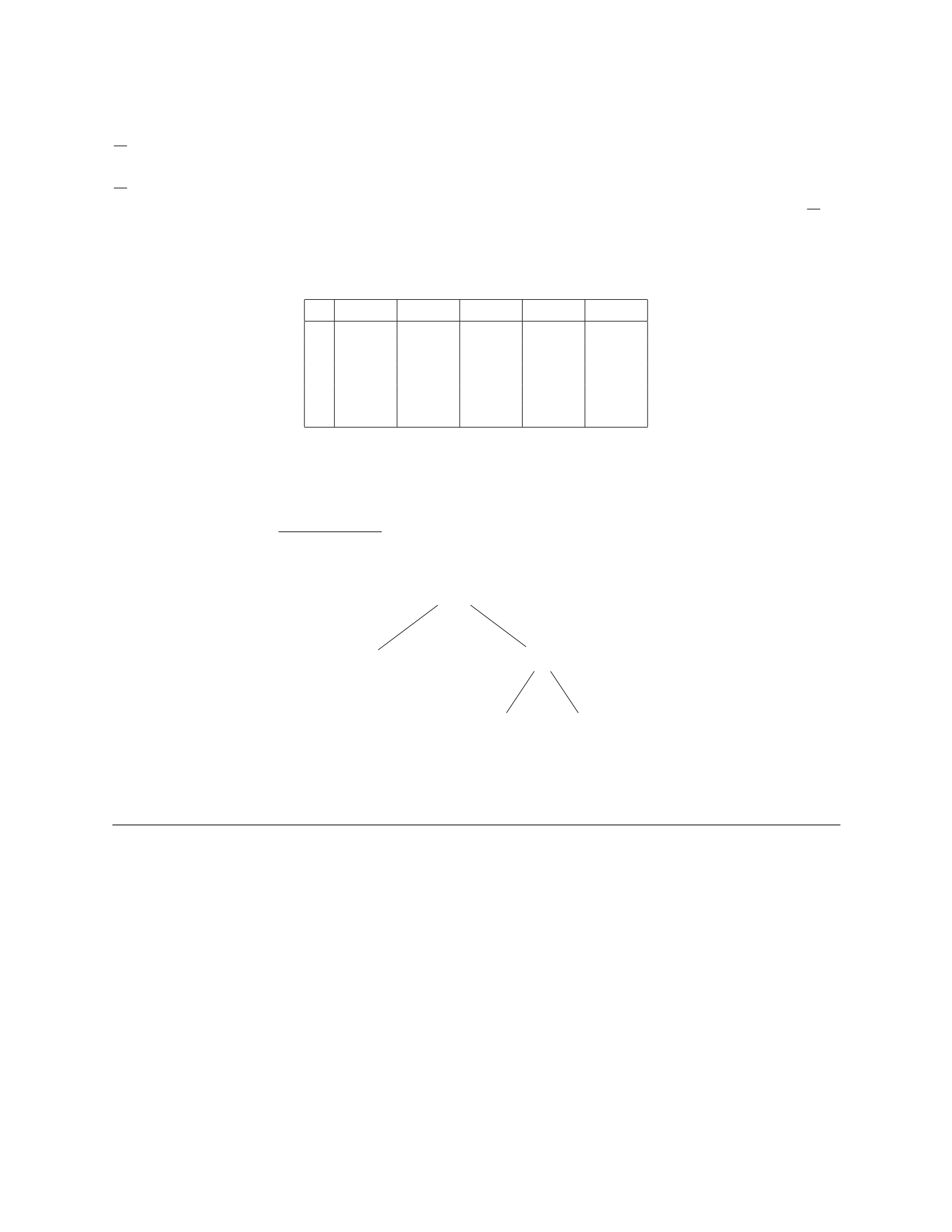
For species C: Number of matches = 8 Total number of positions = 11 Pairwise identity =
8
11 ≈0.7273
For species D: Number of matches = 11 Total number of positions = 11 Pairwise identity =
11
11 = 1
For species E: Number of matches = 9 Total number of positions = 11 Pairwise identity = 9
11 ≈
0.8182
b) The pairwise distance matrix can be constructed using the formula: Dij = 1−pairwise identityij .
The pairwise distance matrix for these species is:
A B C D E
A0 0.0909 0.2727 0 0.1818
B0.0909 0 0.4545 0.0909 0.2727
C0.2727 0.4545 0 0.2727 0.1818
D0 0.0909 0.2727 0 0.1818
E0.1818 0.2727 0.1818 0.1818 0
c) To construct a neighbor-joining tree, we start by finding the minimum entry in the distance
matrix. In this case, the minimum entry is 0.0909, corresponding to the distance between species
A and B. We then define a new node (AB) to represent the cluster of A and B. We update the
distance matrix by computing the distances between the new node (AB) and all other nodes using
the formula D(AB)k=DAk +DB k −DAB
2.
Repeating this process, we construct the neighbor-joining tree:
AB
D AE
C E
10 10. COMPUTATIONAL METHODS FOR PREDICTING GENE FUNCTION
Problem 10. You are given a DNA sequence: ATGCGATCACCGCGTTCACCGTTT. Use the
genetic code table to translate this DNA sequence into a protein sequence. Additionally, predict
the function of the protein based on the amino acid sequence.
Solution 10. a) To translate the given DNA sequence into a protein sequence, we need to first
transcribe the DNA sequence into mRNA and then translate the mRNA into amino acids using the
genetic code table.
Starting DNA sequence: ATGCGATCACCGCGTTCACCGTTT
Transcribed mRNA: AUGCGAUCACCGCGUUACCGUUU
Using the genetic code table, we can translate the mRNA sequence into amino acids:
AUG - Methionine (Start) CGA - Arginine UCA - Serine CCG - Proline CGU - Arginine UUA -
Leucine CCG - Proline UUU - Phenylalanine
Therefore, the protein sequence translated from the given DNA sequence is: Met-Arg-Ser-Pro-
Arg-Leu-Pro-Phe.

b) Based on the amino acid sequence Met-Arg-Ser-Pro-Arg-Leu-Pro-Phe, we can analyze the
function of the protein. Proteins with specific amino acid sequences often have known functions or
structural motifs.
In this case, we can analyze the amino acid sequence to predict the function of the protein:
- The presence of methionine at the start indicates the start codon. - The presence of argi-
nine, serine, proline, and leucine suggests that this protein sequence may be involved in signaling
pathways, enzymatic reactions, or structural functions.
c) Without additional information or further analysis, it is challenging to definitively predict the
exact function of the protein solely based on its amino acid sequence. Further research or experi-
mental validation may be required to determine the precise function of this protein.
11 11. GENETIC DIVERSITY AND POPULATION GENETICS
Problem 11.
An allele frequency for a particular gene in a population is 0.7.
a) What is the frequency of the homozygous dominant genotype for this gene in the population?
b) What is the frequency of the heterozygous genotype for this gene in the population?
c) What is the frequency of the homozygous recessive genotype for this gene in the population?
Solution 11.
a) The frequency of the homozygous dominant genotype can be found by squaring the allele
frequency, which is 0.7.
Frequency of homozygous dominant genotype = (0.7)2= 0.49
Therefore, the frequency of the homozygous dominant genotype for this gene in the population
is 0.49.
b) The frequency of the heterozygous genotype can be found by multiplying the allele frequency
with the complement of the allele frequency (1 - 0.7).
Frequency of heterozygous genotype = 2 * 0.7 * (1 - 0.7) = 2 * 0.7 * 0.3 = 0.42
Therefore, the frequency of the heterozygous genotype for this gene in the population is 0.42.
c) The frequency of the homozygous recessive genotype can be found by squaring the com-
plement of the allele frequency (1 - 0.7).
Frequency of homozygous recessive genotype = (1 - 0.7)2= 0.09
Therefore, the frequency of the homozygous recessive genotype for this gene in the population
is 0.09.
I. REGULATORY NETWORKS CONTROLLING GENE EXPRESSION
Problem 12.
The expression of gene X is regulated by transcription factors Y and Z. The binding of Y to the
promoter region of gene X increases its expression by threefold, while the binding of Z decreases
its expression by half. In a specific experiment, the expression level of gene X is 100 units. If the
transcription factor Y is knocked out, what will be the new expression level of gene X?
Solution 12.
Let’s denote the expression level of gene X without any transcription factors as Xbaseline.
Given that the binding of transcription factor Y increases the expression by threefold and Z
decreases it by half, we can write the following equations:
With Y: XY= 3Xbaseline
Without Y: Xno Y =1
2XY=1
2·3Xbaseline =3
2Xbaseline
If the expression level of gene X is 100 units, then we can set up the following equation:

Xbaseline = 100
Now, substituting Xbaseline = 100 into Xno Y =3
2Xbaseline:
Xno Y =3
2·100 = 150
Therefore, if transcription factor Y is knocked out, the new expression level of gene X will be
150 units.

Problem 13.
A gene regulatory network consists of three genes: A, B, and C. Gene A activates the expres-
sion of gene B by two-fold, while gene B inhibits the expression of gene C by three-fold. If the basal
expression level of gene C is 120 units, what will be the new expression level of gene C if gene A
is knocked out?
Solution 13.
Let’s denote the expression level of gene C without any regulatory interactions as Cbaseline.
Given the effect of genes A and B on gene C, we have the following relationships:
With A: B= 2Aand C=B−3
Without A: Cno A =Bno A −3 = 2A−3
If the basal expression level of gene C is 120 units, then we can set up the following equation:
Cbaseline = 120
Now, substituting Cbaseline = 120 into Cno A = 2A−3:
Cno A = 2 ·0−3 = −3
Therefore, if gene A is knocked out, the new expression level of gene C will be -3 units.
12 13. STRUCTURAL GENOMICS AND PROTEIN STRUCTURE PREDICTION
Problem 13. Consider a protein with a sequence of amino acids given by:
SEQ: ALA-ARG-SER-LYS-ASP-GLY-GLU-ASP-ARG-GLY-ALA.
a) Calculate the molecular weight of this protein. Assume the average molecular weight of each
amino acid: Alanine (ALA) = 89.1 Da, Arginine (ARG) = 174.2 Da, Serine (SER) = 105.1 Da, Lysine
(LYS) = 128.2 Da, Aspartic Acid (ASP) = 133.1 Da, Glycine (GLY) = 75.1 Da, and Glutamic Acid
(GLU) = 147.1 Da.
b) Determine the isoelectric point (pI) of this protein.
Solution 13.
a) The molecular weight of a protein is calculated by adding up the molecular weights of each
amino acid in the sequence.
SEQ: ALA-ARG-SER-LYS-ASP-GLY-GLU-ASP-ARG-GLY-ALA
Molecular Weight: 89.1 + 174.2 + 105.1 + 128.2 + 133.1 + 75.1 + 147.1 + 133.1 + 174.2 + 75.1
+ 89.1
Molecular Weight: 1238.3 Da
Therefore, the molecular weight of the given protein sequence is 1238.3 Da.
b) The isoelectric point (pI) is the pH at which a protein carries no net charge. To calculate the
pI, we need to consider the pKa values of the amino acids. For simplicity, we will use the following
approximate pKa values:
Alanine (ALA) = 6.0, Arginine (ARG) = 12.0, Serine (SER) = 5.7, Lysine (LYS) = 10.5, Aspartic
Acid (ASP) = 3.9, Glycine (GLY) = 6.0, Glutamic Acid (GLU) = 4.1.
The pI of a protein can be estimated using the pKa values of the amino acids present in the
sequence. In this case, the amino acids present are: ALA, ARG, SER, LYS, ASP, GLY, GLU.
For a basic protein like this one (with arginine and lysine), we look for the pH that is closest
to the average of the pKa values of the basic (pKa > 7) and acidic (pKa < 7) amino acids in the
sequence.

Average of pKa values for Basic Amino Acids: (12.0 + 10.5) / 2 = 11.25
Average of pKa values for Acidic Amino Acids: (5.7 + 3.9 + 4.1) / 3 = 4.57
The isoelectric point (pI) is likely around the average of these values:
pI (11.25 + 4.57) / 2 = 7.91.
Therefore, the approximate isoelectric point of the protein is 7.91.
I. Genomics and Functional Genomics
Problem 1: In a population of 100 individuals, 25 are homozygous dominant (AA), 50 are
heterozygous (Aa), and 25 are homozygous recessive (aa) for a particular gene.
a) What is the allele frequency of the "A" allele in this population? b) What is the frequency of
individuals with the genotype Aa in this population?
Solution 1: a) The total number of alleles is twice the number of individuals, so there are 200
alleles in the population. The frequency of the "A" allele can be calculated as:
Frequency of "A" allele = [2(homozygous dominant) + 1(heterozygous)] / [2(total alleles)] =
[2(25) + 1(50)] / 200 = (50 + 50) / 200 = 100 / 200 = 0.5
Therefore, the allele frequency of the "A" allele in this population is 0.5.
b) The frequency of individuals with the genotype Aa can be calculated by dividing the number
of individuals with the genotype Aa by the total number of individuals:
Frequency of Aa genotype = Number of Aa individuals / Total number of individuals = 50 / 100
= 0.5
Therefore, the frequency of individuals with the genotype Aa in this population is 0.5.
I’m glad you’re interested in solving problems in Genomics and Functional Genomics! Here’s a
numerical problem along with a detailed solution:
13 15. PHARMACOGENOMICS AND PERSONALIZED DRUG THERAPIES
Problem 15. In a pharmacogenomics study, a group of patients with a specific genetic variant
were administered a drug to measure its efficacy. The results showed that 70
a) If 40 patients with the genetic variant were included in the study, how many patients re-
sponded positively to the drug?
b) If the overall response rate among patients without the genetic variant is 50
Solution 15.
a) The total number of patients with the genetic variant is 40. Since 70
Number of positive responders = 40 patients x 70
Therefore, 28 patients with the genetic variant responded positively to the drug.
b) Let’s denote the number of patients without the genetic variant as x. If the overall response
rate among these patients is 50
Number of positive responders = x patients x 50
To have the same number of positive responders in part (a), we set up an equation:
Number of positive responders in part (a) = Number of positive responders in part (b)
28 = 0.5x
Solving for x:
x = 28 / 0.5 = 56 patients
Therefore, 56 patients without the genetic variant would need to be included in the study to
have the same number of positive responders as in part (a).
Certainly! Here is a numerical problem on Genomics and Functional Genomics:

14 Genomics and Functional Genomics
Problem: In a plant species, a gene responsible for regulating flower color has two possible
alleles: A and a. In a population of 500 plants, it is found that 360 plants have at least one copy of
the dominant allele A.
a) Calculate the frequency of the allele A in the population. b) Determine the frequency of the
recessive allele a in the population. c) Find the percentage of plants in the population that are
homozygous for the dominant allele A.
Solution:
a) The frequency of allele A can be calculated by dividing the total number of copies of allele A
by the total number of alleles in the population.
Given: Total plants in the population, n= 500
Number of plants with at least one copy of allele A, p(AA) + p(Aa) = 360
Total number of copies of allele A, 2×360 = 720
Frequency of allele A, p(A) = 720
500×2= 0.72
b) The frequency of the recessive allele a can be determined by subtracting the frequency of
allele A from 1.
Frequency of allele a, p(a)=1−p(A)=1−0.72 = 0.28
c) To find the percentage of plants that are homozygous for the dominant allele A, we first need
to calculate the frequency of the homozygous genotype (AA). This can be obtained by squaring
the frequency of allele A.
Frequency of genotype AA, p(AA)=(p(A))2= 0.722= 0.5184
Percentage of plants that are homozygous for allele A, 51.84%
I. Problem:
Consider a genetic modifier that influences the progression of a neurodegenerative disease.
The modifier gene is known to have two alleles, A and a, with frequencies of 0.6 and 0.4, respec-
tively, in the population. Individuals with the A allele have a 20
a) What is the probability that an individual randomly selected from the population carries at
least one A allele?
b) If both of a person’s parents carry the A allele, what is the probability that the person will
develop the disease?
c) If an individual carries the a allele, what is the probability that their sibling also carries the a
allele?
II. Solution:
a) Let’s first calculate the probability of an individual carrying at least one A allele. This includes
individuals with AA or Aa genotypes.
P(A allele) = 0.6 P(a allele) = 0.4
P(at least one A allele) = 1 - P(no A allele) = 1 - P(aa) = 1 - P(a) * P(a) = 1 - 0.4 * 0.4 = 1 - 0.16
= 0.84
Therefore, the probability that an individual randomly selected from the population carries at
least one A allele is 0.84.
b) Given that both parents carry the A allele, the individual will have either AA or Aa genotype.
The risk of developing the disease for A allele carriers is reduced by 20
P(disease with both parents carrying A allele) = P(disease | AA or Aa) = 0.6*0.8 + 0.24*0.8 =
0.48 + 0.192 = 0.672
Therefore, the probability that the person will develop the disease is 0.672.
c) If an individual carries the a allele, the genotype can be aa.

Therefore, the probability that their sibling also carries the a allele is 1 (since both siblings will
have the aa genotype).
Hence, the probability that the sibling carries the a allele given one individual carries the a allele
is 1.
15 18. GENOMIC INSTABILITY AND CHROMOSOMAL ABNORMALITIES
Problem 18. A human cell line is known to have a chromosomal abnormality in which an extra
copy of chromosome 21 is present. Normally, human cells have 46 chromosomes. If a cell from
this line undergoes nondisjunction during meiosis I, what would be the chromosome number in the
resulting gametes?
Solution 18. a) When a cell undergoes nondisjunction during meiosis I, homologous chromo-
somes fail to separate properly, leading to one daughter cell having an extra chromosome and the
other missing one.
In this case, since the cell line already has an extra copy of chromosome 21, it would have 47
chromosomes instead of the normal 46.
During meiosis I, if nondisjunction occurs, one of the resulting daughter cells will have an ex-
tra chromosome 21, so it will have 47 chromosomes. The other daughter cell will be missing a
chromosome 21 and will have 45 chromosomes.
Therefore, the resulting gametes from this cell line would have 47 chromosomes and 45 chro-
mosomes, respectively.
b) If a sperm with 47 chromosomes fertilizes a normal egg (with 46 chromosomes), the resulting
zygote would have 47 + 46 = 93 chromosomes, which is an example of aneuploidy.
c) A zygote with 93 chromosomes may not be viable and could lead to developmental abnor-
malities or miscarriage.
I. Let’s generate a numerical problem in the field of Genomics and Functional Genomics:
16 Genomics and Functional Genomics
Problem: In a human DNA sequence, the frequency of the nucleotide Adenine (A) is 30%,
Thymine (T) is 20%, Cytosine (C) is 25%, and Guanine (G) is 25%. Calculate the GC content of
this DNA sequence.
Solution:
The GC content in DNA is the percentage of nucleotides Guanine (G) and Cytosine (C) in the
DNA sequence.
Given frequencies: - Frequency of Cytosine (C) = 25% - Frequency of Guanine (G) = 25%
The GC content can be calculated by adding the frequency of Cytosine and Guanine:
GC content =F requency(C) + F requency(G) = 25% + 25% = 50%
Therefore, the GC content of the DNA sequence is 50%.
II. Let’s generate another numerical problem in Genomics and Functional Genomics:
17 Genomics and Functional Genomics

Problem: A researcher is studying the expression of a gene in two different cell types – A and
B. In cell type A, the expression level of the gene is 200 TPM (Transcripts Per Million), and in cell
type B, the expression level is 500 TPM. Calculate the fold change in gene expression between
cell type A and cell type B.
Solution:
The fold change in gene expression between two conditions can be calculated using the for-
mula:
F oldChange =Expression level in Condition B
Expression level in Condition A
Given: - Expression level in cell type A = 200 TPM - Expression level in cell type B = 500 TPM
Substitute the values into the formula:
F oldChange =500 TPM
200 TPM = 2.5
Therefore, the fold change in gene expression between cell type A and cell type B is 2.5.
I’m glad to help you with that. Could you please specify a particular topic or concept within
Genomics and Functional Genomics that you would like the problem to focus on? This will help
me tailor the question to your needs.

enzyme coded by this gene. The patient has two copies of the normal allele (A), but the metabolic
activity of the enzyme is reduced by 50% in individuals with this genetic variation.
If the normal metabolic rate for this medication is 10 mg/hr, what would be the expected metabolic
rate for this patient?
Solution 2.
Given: Normal metabolic rate = 10 mg/hr Metabolic activity reduced by 50% for the patient with
genetic variation
Let’s define: Metabolic rate with genetic variation = X mg/hr
The patient has two copies of the normal allele (A), so the metabolic rate is reduced by 50%.
Therefore, the patient’s metabolic rate with genetic variation would be:
X= 10 mg/hr ×0.5=5mg/hr
Therefore, the expected metabolic rate for this patient with the genetic variation would be 5
mg/hr.
3 3. BIOINFORMATICS TOOLS FOR ANALYZING GENOMIC DATA
Problem 3. Consider a DNA sequence: "ATGCTAAGCT".
a) Calculate the total number of nucleotides in this sequence.
b) Determine the frequency of each nucleotide (A, T, G, C) in the sequence.
c) Compute the GC content of the sequence.
Solution 3.
a) To calculate the total number of nucleotides in the sequence "ATGCTAAGCT", we simply
count the characters:
Total number of nucleotides = 10
b) To determine the frequency of each nucleotide, we count the occurrences of each nucleotide
in the sequence:
Frequency of A: 3 Frequency of T: 2 Frequency of G: 2 Frequency of C: 3
c) The GC content of a DNA sequence is given by the percentage of G and C nucleotides in
the sequence.
Total number of G and C nucleotides = 2 (G) + 3 (C) = 5
Total number of nucleotides = 10
Therefore, GC content = (Number of G and C nucleotides / Total number of nucleotides) * 100
GC content = (5 / 10) * 100 = 50
So, the GC content of the sequence "ATGCTAAGCT" is 50
I.
4 3. COMMON SEQUENCE ANALYSIS TASKS
Problem 3. Consider two DNA sequences: Seq1 = "ACGTAGC" and Seq2 = "ACTAGT".
a) Calculate the Hamming distance between Seq1 and Seq2.
b) If a substitution mutation occurred at position 4 in Seq1, changing "A" to "T", determine the
new Hamming distance between Seq1 and Seq2.
Solution 3.

a) The Hamming distance is the number of positions at which the corresponding symbols differ
between two sequences of equal length. Given Seq1 = "ACGTAGC" and Seq2 = "ACTAGT", the
Hamming distance is as follows:
- Positions where symbols differ: 1 (T vs. G) and 6 (C vs. T) - Hamming distance = 2
b) After the substitution mutation at position 4 in Seq1 to "ACGTTGC", the new Seq1 becomes
"ACGT T GC". The updated Hamming distance between Seq1 and Seq2 is then:
- Positions where symbols differ: 1 (T vs. G), 4 (T vs. T), and 6 (C vs. T) - Updated Hamming
distance = 3
5 5. EPIGENETIC MODIFICATIONS AND THEIR ROLE IN GENE EXPRESSION
Problem 5. You are studying the role of DNA methylation in gene expression regulation. In a
particular gene, you observe that a CpG island located in the promoter region is heavily methylated.
You hypothesize that this methylation is leading to the suppression of gene expression. To test
this hypothesis, you perform a demethylation experiment using a DNA demethylating agent and
measure the gene expression levels before and after treatment.
Before treatment, the gene expression level was recorded as 200 arbitrary units. After treatment
with the demethylating agent, the gene expression level increased to 600 arbitrary units.
a) Calculate the fold change in gene expression after treatment.
b) If the gene had a baseline expression level of 1000 arbitrary units in an unmethylated state,
what is the fold change in gene expression when comparing the demethylated state to the unmethy-
lated baseline?
Solution 5.
a) The fold change in gene expression can be calculated using the formula:
Fold Change =Gene expression after treatment
Gene expression before treatment
Given that the gene expression before treatment was 200 arbitrary units and after treatment was
600 arbitrary units, we can substitute these values into the formula:
Fold Change =600
200 = 3
Therefore, the fold change in gene expression after treatment is 3.
b) To calculate the fold change when comparing the demethylated state to the unmethylated
baseline, we first need to determine the gene expression level in the demethylated state relative to
the baseline. This can be done using the formula:
Fold Change =Gene expression in demethylated state
Gene expression in unmethylated state
Given that the gene expression level in the demethylated state is 600 arbitrary units and in the
unmethylated state is 1000 arbitrary units, we can substitute these values into the formula:
Fold Change =600
1000 = 0.6
Therefore, the fold change in gene expression when comparing the demethylated state to the un-
methylated baseline is 0.6.

6 6. GENE-ENVIRONMENT INTERACTIONS IN DISEASE SUSCEPTIBILITY
Problem 6. A research study investigates the relationship between a specific gene variant (al-
lele A) and exposure to a certain environmental factor (Factor X) in increasing the risk of developing
a particular disease. The study found that individuals with allele A who were exposed to Factor X
had a disease risk of 0.6, while individuals without allele A who were exposed to Factor X had a
disease risk of 0.3. The disease risk for individuals with allele A but not exposed to Factor X was
0.1, and the disease risk for individuals without allele A and not exposed to Factor X was 0.05.
a) Calculate the relative risk for individuals with allele A when exposed to Factor X compared
to individuals without allele A.
b) Determine the attributable risk for the interaction between allele A and Factor X in disease
susceptibility.
c) Calculate the interaction contrast for allele A and Factor X in contributing to disease risk.
Solution 6. a) The relative risk (RR) is the ratio of the disease risk for individuals with allele A
exposed to Factor X to the disease risk for individuals without allele A exposed to Factor X.
Given: Risk of disease for individuals with allele A exposed to Factor X, P(D|A, X) = 0.6Risk
of disease for individuals without allele A exposed to Factor X, P(D|¬A, X) = 0.3
RR =0.6
0.3
= 2
Therefore, the relative risk for individuals with allele A when exposed to Factor X compared to
individuals without allele A is 2.
b) The attributable risk (AR) is the difference between the disease risk in the total population
and the disease risk in the unexposed group.
Given: Risk of disease for individuals with allele A exposed to Factor X, P(D|A, X) = 0.6Risk
of disease for individuals without allele A exposed to Factor X, P(D|¬A, X) = 0.3Risk of disease
for individuals with allele A but not exposed to Factor X, P(D|A, ¬X) = 0.1Risk of disease for
individuals without allele A and not exposed to Factor X, P(D|¬A, ¬X)=0.05
Total population disease risk:
P(D) = P(D|A, X)∗P(A) + P(D|¬A, X)∗P(¬A)
P(D)=0.6∗P(A)+0.3∗(1 −P(A))
Unexposed group disease risk:
P(D|¬X) = P(D|A, ¬X)∗P(A) + P(D|¬A, ¬X)∗P(¬A)
P(D|¬X) = 0.1∗P(A)+0.05 ∗(1 −P(A))
Attributable risk (AR) is then:
AR =P(D)−P(D|¬X)
c) The interaction contrast (IC) quantifies the interaction between allele A and Factor X in con-
tributing to disease risk.
Given:
IC =P(D|A, X)−P(D|A, ¬X)−P(D|¬A, X) + P(D|¬A, ¬X)
Substitute the given probabilities to find the interaction contrast.

7 Genomics and Functional Genomics
Problem:
Consider a gene with a DNA sequence of length 300 base pairs that codes for a protein. The
gene contains 4 exons (50, 75, 100, and 75 base pairs long) separated by 3 introns (20, 30, and
50 base pairs long).
a) Calculate the total length of the gene (including exons and introns).
b) If each codon in the gene corresponds to 3 base pairs, calculate the total number of codons
in the gene.
c) If each amino acid is coded by 1 codon, calculate the number of amino acids in the protein
produced by this gene.
Solution:
a) The total length of the gene can be calculated by adding the lengths of exons and introns
together:
Total gene length = (50 + 75 + 100 + 75) + (20 + 30 + 50) = 450 base pairs
b) Since each codon corresponds to 3 base pairs, the total number of codons can be calculated
by dividing the total gene length by 3:
Total number of codons = Total gene length / 3 = 450 / 3 = 150 codons
c) Since each amino acid is coded by 1 codon, the number of amino acids in the protein can
be calculated by simply counting the number of codons:
Number of amino acids = Total number of codons = 150 amino acids
8 8. GENOME-WIDE ASSOCIATION STUDIES IN COMPLEX DISEASES
Problem 8. In a genome-wide association study for a particular complex disease, researchers
found that a certain single nucleotide polymorphism (SNP) is significantly associated with the dis-
ease. The frequency of the disease allele for this SNP is 0.3 in the general population. The odds
ratio for this SNP is 2.5.
a) Calculate the odds of having the disease for individuals with the disease allele.
b) Calculate the odds of having the disease for individuals without the disease allele.
Solution 8.
a) The odds ratio is defined as the odds of having the disease for individuals with the disease
allele divided by the odds of having the disease for individuals without the disease allele. Given that
the odds ratio is 2.5 and the disease allele frequency is 0.3, we can calculate the odds of having
the disease for individuals with the disease allele as follows:
Let pbe the frequency of the disease allele and q= 1 −pbe the frequency of the non-disease
allele.
The odds ratio formula is:
OR =oddsdisease with allele
oddsdisease without allele
We are given that OR = 2.5and p= 0.3.
Therefore,
2.5 = 0.3
1−0.3

2.5 = 0.3
0.7
2.5×0.7=0.3
1.75 = 0.3
So, the odds of having the disease for individuals with the disease allele is 1.75.
b) We can calculate the odds of having the disease for individuals without the disease allele
using the odds ratio. Since the odds ratio formula is:
OR =oddsdisease with allele
oddsdisease without allele
We know that the odds of having the disease for individuals with the allele is 1.75. Therefore, to
find the odds of having the disease for individuals without the allele, we divide the odds of having
the disease for individuals with the allele by the odds ratio:
oddsdisease without allele =oddsdisease with allele
OR
oddsdisease without allele =1.75
2.5
oddsdisease without allele = 0.7
So, the odds of having the disease for individuals without the disease allele is 0.7.
9 9. EVOLUTIONARY GENOMICS AND PHYLOGENETICS
Problem 9. Consider the following DNA sequences for five species:
Species DNA Sequence
A ATGCCATCGAT
B ATGCCATGGAT
C ATGCCGTGGAT
D ATGCCATCGAT
E ATGCAATGGAT
a) Calculate the pairwise sequence identity between species A and each of the other species
(B, C, D, E).
b) Based on the sequence identities, construct a pairwise distance matrix for these five species.
c) Construct a neighbor-joining tree using the pairwise distance matrix.
Solution 9.
a) The pairwise sequence identity is calculated as the number of matching positions divided by
the total number of positions compared. Let’s calculate the pairwise sequence identities between
species A and the other species.
For species B: Number of matches = 10 Total number of positions = 11 Pairwise identity =
10
11 ≈0.9091
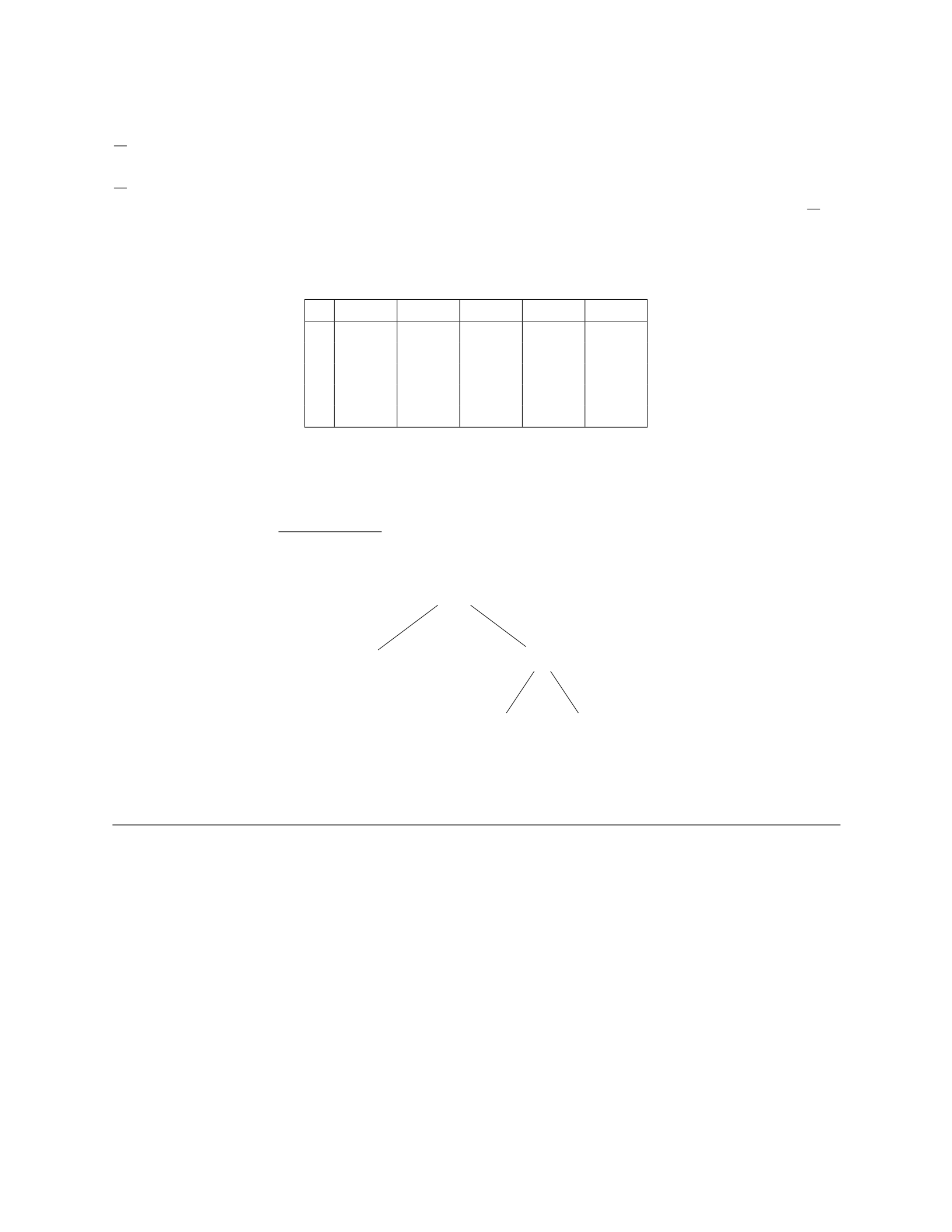
For species C: Number of matches = 8 Total number of positions = 11 Pairwise identity =
8
11 ≈0.7273
For species D: Number of matches = 11 Total number of positions = 11 Pairwise identity =
11
11 = 1
For species E: Number of matches = 9 Total number of positions = 11 Pairwise identity = 9
11 ≈
0.8182
b) The pairwise distance matrix can be constructed using the formula: Dij = 1−pairwise identityij .
The pairwise distance matrix for these species is:
A B C D E
A0 0.0909 0.2727 0 0.1818
B0.0909 0 0.4545 0.0909 0.2727
C0.2727 0.4545 0 0.2727 0.1818
D0 0.0909 0.2727 0 0.1818
E0.1818 0.2727 0.1818 0.1818 0
c) To construct a neighbor-joining tree, we start by finding the minimum entry in the distance
matrix. In this case, the minimum entry is 0.0909, corresponding to the distance between species
A and B. We then define a new node (AB) to represent the cluster of A and B. We update the
distance matrix by computing the distances between the new node (AB) and all other nodes using
the formula D(AB)k=DAk +DB k −DAB
2.
Repeating this process, we construct the neighbor-joining tree:
AB
D AE
C E
10 10. COMPUTATIONAL METHODS FOR PREDICTING GENE FUNCTION
Problem 10. You are given a DNA sequence: ATGCGATCACCGCGTTCACCGTTT. Use the
genetic code table to translate this DNA sequence into a protein sequence. Additionally, predict
the function of the protein based on the amino acid sequence.
Solution 10. a) To translate the given DNA sequence into a protein sequence, we need to first
transcribe the DNA sequence into mRNA and then translate the mRNA into amino acids using the
genetic code table.
Starting DNA sequence: ATGCGATCACCGCGTTCACCGTTT
Transcribed mRNA: AUGCGAUCACCGCGUUACCGUUU
Using the genetic code table, we can translate the mRNA sequence into amino acids:
AUG - Methionine (Start) CGA - Arginine UCA - Serine CCG - Proline CGU - Arginine UUA -
Leucine CCG - Proline UUU - Phenylalanine
Therefore, the protein sequence translated from the given DNA sequence is: Met-Arg-Ser-Pro-
Arg-Leu-Pro-Phe.

b) Based on the amino acid sequence Met-Arg-Ser-Pro-Arg-Leu-Pro-Phe, we can analyze the
function of the protein. Proteins with specific amino acid sequences often have known functions or
structural motifs.
In this case, we can analyze the amino acid sequence to predict the function of the protein:
- The presence of methionine at the start indicates the start codon. - The presence of argi-
nine, serine, proline, and leucine suggests that this protein sequence may be involved in signaling
pathways, enzymatic reactions, or structural functions.
c) Without additional information or further analysis, it is challenging to definitively predict the
exact function of the protein solely based on its amino acid sequence. Further research or experi-
mental validation may be required to determine the precise function of this protein.
11 11. GENETIC DIVERSITY AND POPULATION GENETICS
Problem 11.
An allele frequency for a particular gene in a population is 0.7.
a) What is the frequency of the homozygous dominant genotype for this gene in the population?
b) What is the frequency of the heterozygous genotype for this gene in the population?
c) What is the frequency of the homozygous recessive genotype for this gene in the population?
Solution 11.
a) The frequency of the homozygous dominant genotype can be found by squaring the allele
frequency, which is 0.7.
Frequency of homozygous dominant genotype = (0.7)2= 0.49
Therefore, the frequency of the homozygous dominant genotype for this gene in the population
is 0.49.
b) The frequency of the heterozygous genotype can be found by multiplying the allele frequency
with the complement of the allele frequency (1 - 0.7).
Frequency of heterozygous genotype = 2 * 0.7 * (1 - 0.7) = 2 * 0.7 * 0.3 = 0.42
Therefore, the frequency of the heterozygous genotype for this gene in the population is 0.42.
c) The frequency of the homozygous recessive genotype can be found by squaring the com-
plement of the allele frequency (1 - 0.7).
Frequency of homozygous recessive genotype = (1 - 0.7)2= 0.09
Therefore, the frequency of the homozygous recessive genotype for this gene in the population
is 0.09.
I. REGULATORY NETWORKS CONTROLLING GENE EXPRESSION
Problem 12.
The expression of gene X is regulated by transcription factors Y and Z. The binding of Y to the
promoter region of gene X increases its expression by threefold, while the binding of Z decreases
its expression by half. In a specific experiment, the expression level of gene X is 100 units. If the
transcription factor Y is knocked out, what will be the new expression level of gene X?
Solution 12.
Let’s denote the expression level of gene X without any transcription factors as Xbaseline.
Given that the binding of transcription factor Y increases the expression by threefold and Z
decreases it by half, we can write the following equations:
With Y: XY= 3Xbaseline
Without Y: Xno Y =1
2XY=1
2·3Xbaseline =3
2Xbaseline
If the expression level of gene X is 100 units, then we can set up the following equation:

Xbaseline = 100
Now, substituting Xbaseline = 100 into Xno Y =3
2Xbaseline:
Xno Y =3
2·100 = 150
Therefore, if transcription factor Y is knocked out, the new expression level of gene X will be
150 units.

Problem 13.
A gene regulatory network consists of three genes: A, B, and C. Gene A activates the expres-
sion of gene B by two-fold, while gene B inhibits the expression of gene C by three-fold. If the basal
expression level of gene C is 120 units, what will be the new expression level of gene C if gene A
is knocked out?
Solution 13.
Let’s denote the expression level of gene C without any regulatory interactions as Cbaseline.
Given the effect of genes A and B on gene C, we have the following relationships:
With A: B= 2Aand C=B−3
Without A: Cno A =Bno A −3 = 2A−3
If the basal expression level of gene C is 120 units, then we can set up the following equation:
Cbaseline = 120
Now, substituting Cbaseline = 120 into Cno A = 2A−3:
Cno A = 2 ·0−3 = −3
Therefore, if gene A is knocked out, the new expression level of gene C will be -3 units.
12 13. STRUCTURAL GENOMICS AND PROTEIN STRUCTURE PREDICTION
Problem 13. Consider a protein with a sequence of amino acids given by:
SEQ: ALA-ARG-SER-LYS-ASP-GLY-GLU-ASP-ARG-GLY-ALA.
a) Calculate the molecular weight of this protein. Assume the average molecular weight of each
amino acid: Alanine (ALA) = 89.1 Da, Arginine (ARG) = 174.2 Da, Serine (SER) = 105.1 Da, Lysine
(LYS) = 128.2 Da, Aspartic Acid (ASP) = 133.1 Da, Glycine (GLY) = 75.1 Da, and Glutamic Acid
(GLU) = 147.1 Da.
b) Determine the isoelectric point (pI) of this protein.
Solution 13.
a) The molecular weight of a protein is calculated by adding up the molecular weights of each
amino acid in the sequence.
SEQ: ALA-ARG-SER-LYS-ASP-GLY-GLU-ASP-ARG-GLY-ALA
Molecular Weight: 89.1 + 174.2 + 105.1 + 128.2 + 133.1 + 75.1 + 147.1 + 133.1 + 174.2 + 75.1
+ 89.1
Molecular Weight: 1238.3 Da
Therefore, the molecular weight of the given protein sequence is 1238.3 Da.
b) The isoelectric point (pI) is the pH at which a protein carries no net charge. To calculate the
pI, we need to consider the pKa values of the amino acids. For simplicity, we will use the following
approximate pKa values:
Alanine (ALA) = 6.0, Arginine (ARG) = 12.0, Serine (SER) = 5.7, Lysine (LYS) = 10.5, Aspartic
Acid (ASP) = 3.9, Glycine (GLY) = 6.0, Glutamic Acid (GLU) = 4.1.
The pI of a protein can be estimated using the pKa values of the amino acids present in the
sequence. In this case, the amino acids present are: ALA, ARG, SER, LYS, ASP, GLY, GLU.
For a basic protein like this one (with arginine and lysine), we look for the pH that is closest
to the average of the pKa values of the basic (pKa > 7) and acidic (pKa < 7) amino acids in the
sequence.

Average of pKa values for Basic Amino Acids: (12.0 + 10.5) / 2 = 11.25
Average of pKa values for Acidic Amino Acids: (5.7 + 3.9 + 4.1) / 3 = 4.57
The isoelectric point (pI) is likely around the average of these values:
pI (11.25 + 4.57) / 2 = 7.91.
Therefore, the approximate isoelectric point of the protein is 7.91.
I. Genomics and Functional Genomics
Problem 1: In a population of 100 individuals, 25 are homozygous dominant (AA), 50 are
heterozygous (Aa), and 25 are homozygous recessive (aa) for a particular gene.
a) What is the allele frequency of the "A" allele in this population? b) What is the frequency of
individuals with the genotype Aa in this population?
Solution 1: a) The total number of alleles is twice the number of individuals, so there are 200
alleles in the population. The frequency of the "A" allele can be calculated as:
Frequency of "A" allele = [2(homozygous dominant) + 1(heterozygous)] / [2(total alleles)] =
[2(25) + 1(50)] / 200 = (50 + 50) / 200 = 100 / 200 = 0.5
Therefore, the allele frequency of the "A" allele in this population is 0.5.
b) The frequency of individuals with the genotype Aa can be calculated by dividing the number
of individuals with the genotype Aa by the total number of individuals:
Frequency of Aa genotype = Number of Aa individuals / Total number of individuals = 50 / 100
= 0.5
Therefore, the frequency of individuals with the genotype Aa in this population is 0.5.
I’m glad you’re interested in solving problems in Genomics and Functional Genomics! Here’s a
numerical problem along with a detailed solution:
13 15. PHARMACOGENOMICS AND PERSONALIZED DRUG THERAPIES
Problem 15. In a pharmacogenomics study, a group of patients with a specific genetic variant
were administered a drug to measure its efficacy. The results showed that 70
a) If 40 patients with the genetic variant were included in the study, how many patients re-
sponded positively to the drug?
b) If the overall response rate among patients without the genetic variant is 50
Solution 15.
a) The total number of patients with the genetic variant is 40. Since 70
Number of positive responders = 40 patients x 70
Therefore, 28 patients with the genetic variant responded positively to the drug.
b) Let’s denote the number of patients without the genetic variant as x. If the overall response
rate among these patients is 50
Number of positive responders = x patients x 50
To have the same number of positive responders in part (a), we set up an equation:
Number of positive responders in part (a) = Number of positive responders in part (b)
28 = 0.5x
Solving for x:
x = 28 / 0.5 = 56 patients
Therefore, 56 patients without the genetic variant would need to be included in the study to
have the same number of positive responders as in part (a).
Certainly! Here is a numerical problem on Genomics and Functional Genomics:

14 Genomics and Functional Genomics
Problem: In a plant species, a gene responsible for regulating flower color has two possible
alleles: A and a. In a population of 500 plants, it is found that 360 plants have at least one copy of
the dominant allele A.
a) Calculate the frequency of the allele A in the population. b) Determine the frequency of the
recessive allele a in the population. c) Find the percentage of plants in the population that are
homozygous for the dominant allele A.
Solution:
a) The frequency of allele A can be calculated by dividing the total number of copies of allele A
by the total number of alleles in the population.
Given: Total plants in the population, n= 500
Number of plants with at least one copy of allele A, p(AA) + p(Aa) = 360
Total number of copies of allele A, 2×360 = 720
Frequency of allele A, p(A) = 720
500×2= 0.72
b) The frequency of the recessive allele a can be determined by subtracting the frequency of
allele A from 1.
Frequency of allele a, p(a)=1−p(A)=1−0.72 = 0.28
c) To find the percentage of plants that are homozygous for the dominant allele A, we first need
to calculate the frequency of the homozygous genotype (AA). This can be obtained by squaring
the frequency of allele A.
Frequency of genotype AA, p(AA)=(p(A))2= 0.722= 0.5184
Percentage of plants that are homozygous for allele A, 51.84%
I. Problem:
Consider a genetic modifier that influences the progression of a neurodegenerative disease.
The modifier gene is known to have two alleles, A and a, with frequencies of 0.6 and 0.4, respec-
tively, in the population. Individuals with the A allele have a 20
a) What is the probability that an individual randomly selected from the population carries at
least one A allele?
b) If both of a person’s parents carry the A allele, what is the probability that the person will
develop the disease?
c) If an individual carries the a allele, what is the probability that their sibling also carries the a
allele?
II. Solution:
a) Let’s first calculate the probability of an individual carrying at least one A allele. This includes
individuals with AA or Aa genotypes.
P(A allele) = 0.6 P(a allele) = 0.4
P(at least one A allele) = 1 - P(no A allele) = 1 - P(aa) = 1 - P(a) * P(a) = 1 - 0.4 * 0.4 = 1 - 0.16
= 0.84
Therefore, the probability that an individual randomly selected from the population carries at
least one A allele is 0.84.
b) Given that both parents carry the A allele, the individual will have either AA or Aa genotype.
The risk of developing the disease for A allele carriers is reduced by 20
P(disease with both parents carrying A allele) = P(disease | AA or Aa) = 0.6*0.8 + 0.24*0.8 =
0.48 + 0.192 = 0.672
Therefore, the probability that the person will develop the disease is 0.672.
c) If an individual carries the a allele, the genotype can be aa.

Therefore, the probability that their sibling also carries the a allele is 1 (since both siblings will
have the aa genotype).
Hence, the probability that the sibling carries the a allele given one individual carries the a allele
is 1.
15 18. GENOMIC INSTABILITY AND CHROMOSOMAL ABNORMALITIES
Problem 18. A human cell line is known to have a chromosomal abnormality in which an extra
copy of chromosome 21 is present. Normally, human cells have 46 chromosomes. If a cell from
this line undergoes nondisjunction during meiosis I, what would be the chromosome number in the
resulting gametes?
Solution 18. a) When a cell undergoes nondisjunction during meiosis I, homologous chromo-
somes fail to separate properly, leading to one daughter cell having an extra chromosome and the
other missing one.
In this case, since the cell line already has an extra copy of chromosome 21, it would have 47
chromosomes instead of the normal 46.
During meiosis I, if nondisjunction occurs, one of the resulting daughter cells will have an ex-
tra chromosome 21, so it will have 47 chromosomes. The other daughter cell will be missing a
chromosome 21 and will have 45 chromosomes.
Therefore, the resulting gametes from this cell line would have 47 chromosomes and 45 chro-
mosomes, respectively.
b) If a sperm with 47 chromosomes fertilizes a normal egg (with 46 chromosomes), the resulting
zygote would have 47 + 46 = 93 chromosomes, which is an example of aneuploidy.
c) A zygote with 93 chromosomes may not be viable and could lead to developmental abnor-
malities or miscarriage.
I. Let’s generate a numerical problem in the field of Genomics and Functional Genomics:
16 Genomics and Functional Genomics
Problem: In a human DNA sequence, the frequency of the nucleotide Adenine (A) is 30%,
Thymine (T) is 20%, Cytosine (C) is 25%, and Guanine (G) is 25%. Calculate the GC content of
this DNA sequence.
Solution:
The GC content in DNA is the percentage of nucleotides Guanine (G) and Cytosine (C) in the
DNA sequence.
Given frequencies: - Frequency of Cytosine (C) = 25% - Frequency of Guanine (G) = 25%
The GC content can be calculated by adding the frequency of Cytosine and Guanine:
GC content =F requency(C) + F requency(G) = 25% + 25% = 50%
Therefore, the GC content of the DNA sequence is 50%.
II. Let’s generate another numerical problem in Genomics and Functional Genomics:
17 Genomics and Functional Genomics

Problem: A researcher is studying the expression of a gene in two different cell types – A and
B. In cell type A, the expression level of the gene is 200 TPM (Transcripts Per Million), and in cell
type B, the expression level is 500 TPM. Calculate the fold change in gene expression between
cell type A and cell type B.
Solution:
The fold change in gene expression between two conditions can be calculated using the for-
mula:
F oldChange =Expression level in Condition B
Expression level in Condition A
Given: - Expression level in cell type A = 200 TPM - Expression level in cell type B = 500 TPM
Substitute the values into the formula:
F oldChange =500 TPM
200 TPM = 2.5
Therefore, the fold change in gene expression between cell type A and cell type B is 2.5.
I’m glad to help you with that. Could you please specify a particular topic or concept within
Genomics and Functional Genomics that you would like the problem to focus on? This will help
me tailor the question to your needs.

