


Name: Andrea Aleman
Student ID: 28528750
DB Forum 2, Group 1, Case 3-11
Date: July 20, 2017
Judgement Case 3-11: Debt vs Equity
When any business starts its operations, it is important to analyze and decide whether
they will be using debt or equity financing. This decision will make up their capital structure.
According to Investopedia, the capital structure is how a firm finances its overall operations and
growth by using different sources of funds [Inv14]. There are two financial resources that a
company can choose from, debt or equity, or a mixture of both.
Debt.
Debt financing occurs when the company borrows money from an outside source with the
promise of paying back the borrowed amount at a later date, plus an additional interest
previously agreed. The most common form of debt is secured loans, like the ones offered by
banks. These loans are typically paid in monthly installments and require a guaranty from the
borrower. These guaranties are usually some kind of assets from the company, like inventories,
accounts receivable, equipment and others; if the company isn’t to pay the loan, these guaranties
are used to satisfy payment.
Debt Advantages
Debt can be used to finance almost any kind of business, in terms of size.
Business loans give the company more control on how to run the business, since
its relationship with the lender ends as soon as the loan has been fulfilled.
Debt financing is flexible, in terms of the amount of money being borrowed and
the amount of time given to make the repayments.
Interest payments are tax-deductible.
Debt Disadvantages
Name: Andrea Aleman
Student ID: 28528750
DB Forum 2, Group 1, Case 3-11
Date: July 20, 2017
The company will have to spend part of its revenues to repay the money
borrowed.
Loans monthly repayments are still required regardless of revenues generated.
When companies use debt financing more than equity, it is said to have a high leverage
ratio and an aggressive capital structure. This means it has higher risk but leads to higher growth
rates.
Equity.
Equity financing means raising capital by selling shares of a business to investors. Unlike
debt, the capital raised isn’t paid back by monthly installments. Instead, investors become partial
owners of the business and receive profits over time.
Equity Advantages
Investors share business risk with the company, which means that if the business
fails, there are no repayments to be made.
Payments to investors doesn’t have to be made right away, which means it gives
more time to the company to grow business.
Equity Disadvantages
Investors become partial owners of the company, which may lead to loss of
control of the business.
Requirement 1
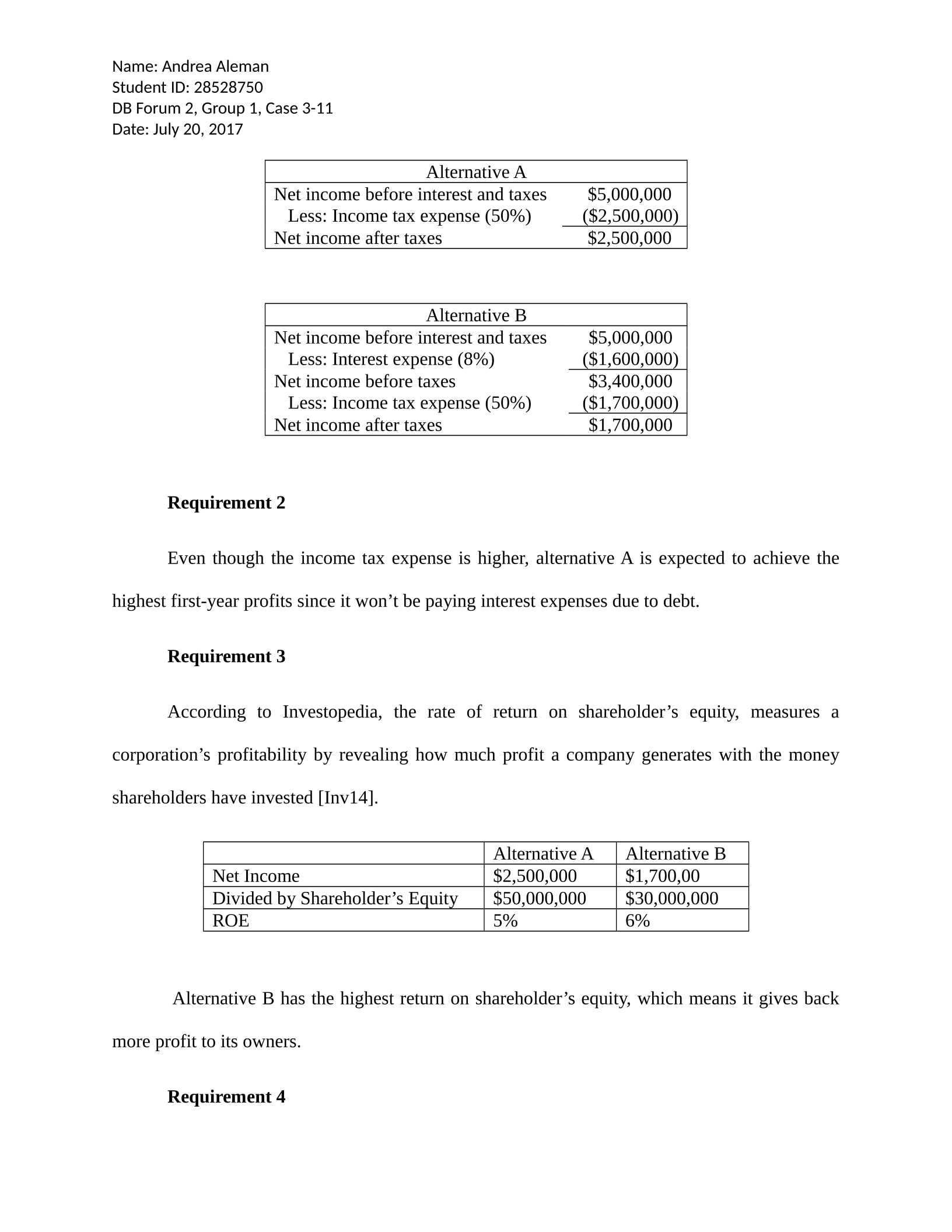
Abbreviated income statements that compare first-year profitability for each of the two
alternatives.
Name: Andrea Aleman
Student ID: 28528750
DB Forum 2, Group 1, Case 3-11
Date: July 20, 2017
Alternative A
Net income before interest and taxes $5,000,000
Less: Income tax expense (50%) ($2,500,000)
Net income after taxes $2,500,000
Alternative B
Net income before interest and taxes $5,000,000
Less: Interest expense (8%) ($1,600,000)
Net income before taxes $3,400,000
Less: Income tax expense (50%) ($1,700,000)
Net income after taxes $1,700,000
Requirement 2
Even though the income tax expense is higher, alternative A is expected to achieve the
highest first-year profits since it won’t be paying interest expenses due to debt.
Requirement 3
According to Investopedia, the rate of return on shareholder’s equity, measures a
corporation’s profitability by revealing how much profit a company generates with the money
shareholders have invested [Inv14].
Alternative A Alternative B
Net Income $2,500,000 $1,700,00
Divided by Shareholder’s Equity $50,000,000 $30,000,000
ROE 5% 6%
Alternative B has the highest return on shareholder’s equity, which means it gives back
more profit to its owners.
Requirement 4
Name: Andrea Aleman
Student ID: 28528750
DB Forum 2, Group 1, Case 3-11
Date: July 20, 2017
According to S. Myers on his article Capital Structure, there are three major implications
that companies must be aware when deciding to finance from debt or equity. The first is taxes,
remember that debt interest is a tax-deductible expense, “a taxpaying firm that pays an extra
dollar of interest receives a partially offsetting "interest tax shield" in the form of lower taxes
paid. Financing with debt instead of equity increases the total after-tax dollar return to debt and
equity investors, and should increase firm value.”[Mye01]. The second implication is
information differences between investors and managers. And the third implication is agency
costs, which result from problems between shareholders and management. “Shareholders wish
for management to run the company in a way that increases shareholder value, while
management may wish to grow the company in ways that maximize their personal power and
wealth that may not be in the best interests of shareholders” [Inv06]
Biblical Implication
The decision of choosing between debt and equity financing depends on the kind of
business and on its owners. Neither of them is good or bad. But it is important to remember that
debt will always come with the interest expense responsibility, besides the responsibility of
paying the money borrowed. Even the Bible recognizes interest expense, “whoever multiplies his
wealth by interest and profit gathers it for him who is generous to the poo” Proverbs 28:8. But
God also demands us to pay our debts “owe no one anything, except to love each other...”
Romans 13:8.
References
Name: Andrea Aleman
Student ID: 28528750
DB Forum 2, Group 1, Case 3-11
Date: July 20, 2017
Investopedia Staff. (2014). Agency costs. Retrieved from Investopedia:
http://www.investopedia.com/terms/a/agencycosts.asp
Investopedia Staff. (2014, October 23). Capital Structure. Retrieved from Investopedia:
http://www.investopedia.com/terms/c/capitalstructure.asp
Myers, S. C. (2001). Capital structure. The Journal of Economic Perspectives, 15(2), 81-102.
Retrieved from http://www.jstor.org.ezproxy.liberty.edu/stable/pdf/2696593.pdf?
refreqid=excelsior%3Ada7473e2e3171e3c7e73206e0567f899
Powered by TCPDF (www.tcpdf.org)

