


Math 105-003 Spring 2018 - Preston
5 May 2018 Study Guide for the Comprehensive Final Exam Page 1 of 3
Study Guide for Comprehensive Final Exam
Date/Time: 10:30 AM – 1:15 PM Wed 9 May 2018
Robinson B104 (our classroom)
General Information About the Exam:
Same general rules apply (see syllabus):
o In particular, no calculators of any kind may be used
Without going into detail, we’ve had an issue with the identity of person(s) taking an exam.
EVEN IF I KNOW YOU, when you turn in your exam, please wait for me to mark it on my list and
BE PREPARED TO SHOW YOUR GMU ID
Please don’t be insulted, this is not personal – I’m just doing my job. I’d rather not have to
be so formal but I’d also rather not have a student send someone else to take their exam
for them and think that I’m an idiot and can’t figure it out. So … this is the result – everyone
will need to be prepared to prove their identity.
There are 8 numbered problems (three of them have 2 parts) totaling 115 points (15% built-in
extra credit) this exam will be only slightly longer than one of our mid-terms. However, you
will have 2 hours and 45 mins compared to the 1 hour and 50 minutes for the mid-terms.
o Many of the problems are extremely similar to problems on our 3 mid-term exams and/or
the previous final exams, or previous mid-term exams.
All but one problem has appeared either exactly or nearly identically on prior exams
(and often they came from homework exercises or even numbered book exercises)
The
SHOW ALL OF YOUR WORK!!!
o I’ve gotten numerous answers on mid-term exams with no “solutions”, i.e. no work to back
them up. Those have typically gotten much less than full credit, sometimes no credit. On
the final exam, I will be even more strict about this NO WORK NO CREDIT, PERIOD
I can’t grade what I don’t see no work no credit
Math 105-003 Spring 2018 - Preston
5 May 2018 Study Guide for the Comprehensive Final Exam Page 2 of 3
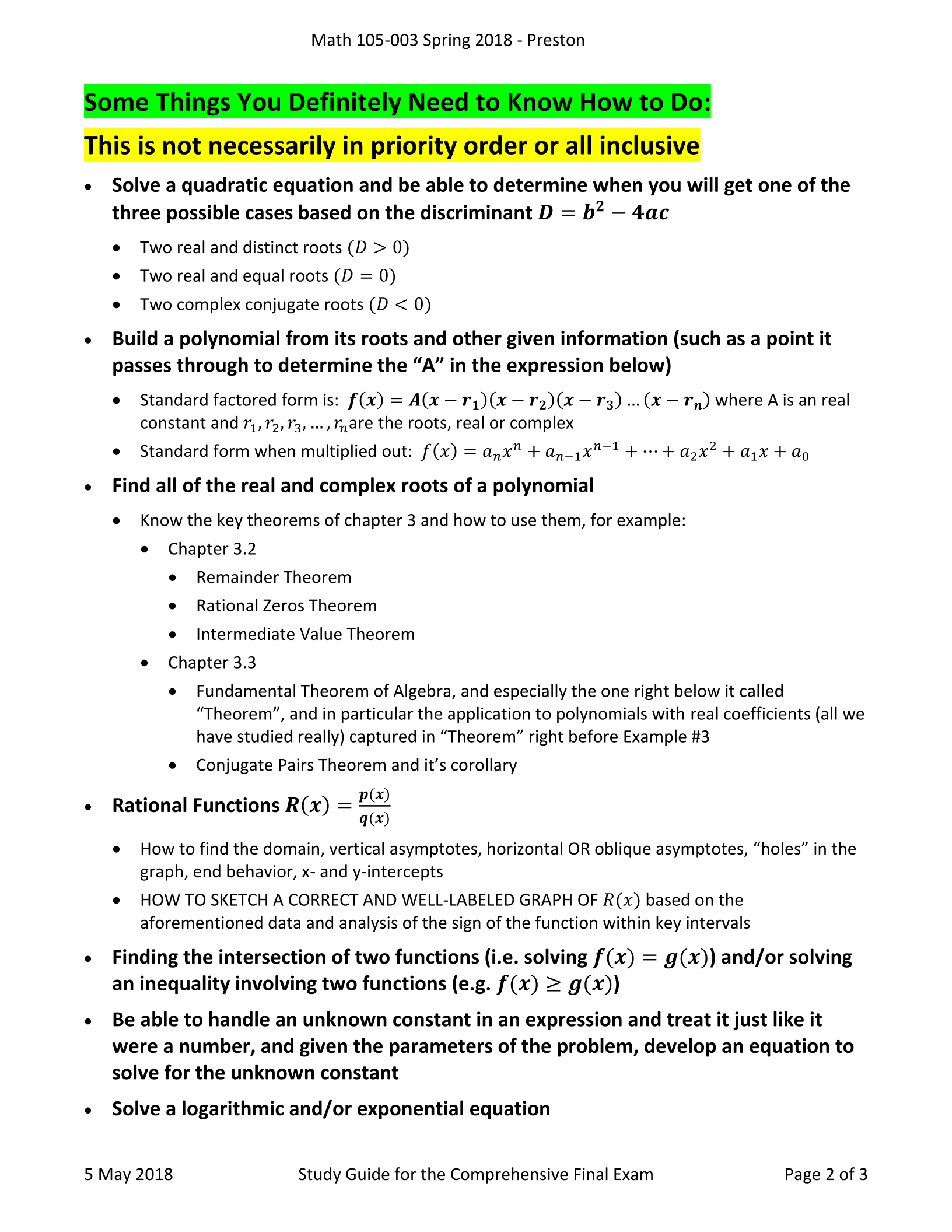
Some Things You Definitely Need to Know How to Do:
This is not necessarily in priority order or all inclusive
Solve a quadratic equation and be able to determine when you will get one of the
three possible cases based on the discriminant 𝑫 = 𝒃𝟐− 𝟒𝒂𝒄
Two real and distinct roots (𝐷 > 0)
Two real and equal roots (𝐷 = 0)
Two complex conjugate roots (𝐷 < 0)
Build a polynomial from its roots and other given information (such as a point it
passes through to determine the “A” in the expression below)
Standard factored form is: 𝒇(𝒙)= 𝑨(𝒙 − 𝒓𝟏)(𝒙−𝒓𝟐)(𝒙−𝒓𝟑)…(𝒙 − 𝒓𝒏) where A is an real
constant and 𝑟
1, 𝑟2, 𝑟3, … , 𝑟
𝑛are the roots, real or complex
Standard form when multiplied out: 𝑓(𝑥)= 𝑎𝑛𝑥𝑛+ 𝑎𝑛−1𝑥𝑛−1 + ⋯ + 𝑎2𝑥2+ 𝑎1𝑥 + 𝑎0
Find all of the real and complex roots of a polynomial
Know the key theorems of chapter 3 and how to use them, for example:
Chapter 3.2
Remainder Theorem
Rational Zeros Theorem
Intermediate Value Theorem
Chapter 3.3
Fundamental Theorem of Algebra, and especially the one right below it called
“Theorem”, and in particular the application to polynomials with real coefficients (all we
have studied really) captured in “Theorem” right before Example #3
Conjugate Pairs Theorem and it’s corollary
Rational Functions 𝑹(𝒙)=𝒑(𝒙)
𝒒(𝒙)
How to find the domain, vertical asymptotes, horizontal OR oblique asymptotes, “holes” in the
graph, end behavior, x- and y-intercepts
HOW TO SKETCH A CORRECT AND WELL-LABELED GRAPH OF 𝑅(𝑥) based on the
aforementioned data and analysis of the sign of the function within key intervals
Finding the intersection of two functions (i.e. solving 𝒇(𝒙) = 𝒈(𝒙)) and/or solving
an inequality involving two functions (e.g. 𝒇(𝒙) ≥ 𝒈(𝒙))
Be able to handle an unknown constant in an expression and treat it just like it
were a number, and given the parameters of the problem, develop an equation to
solve for the unknown constant
Solve a logarithmic and/or exponential equation
Math 105-003 Spring 2018 - Preston
5 May 2018 Study Guide for the Comprehensive Final Exam Page 3 of 3
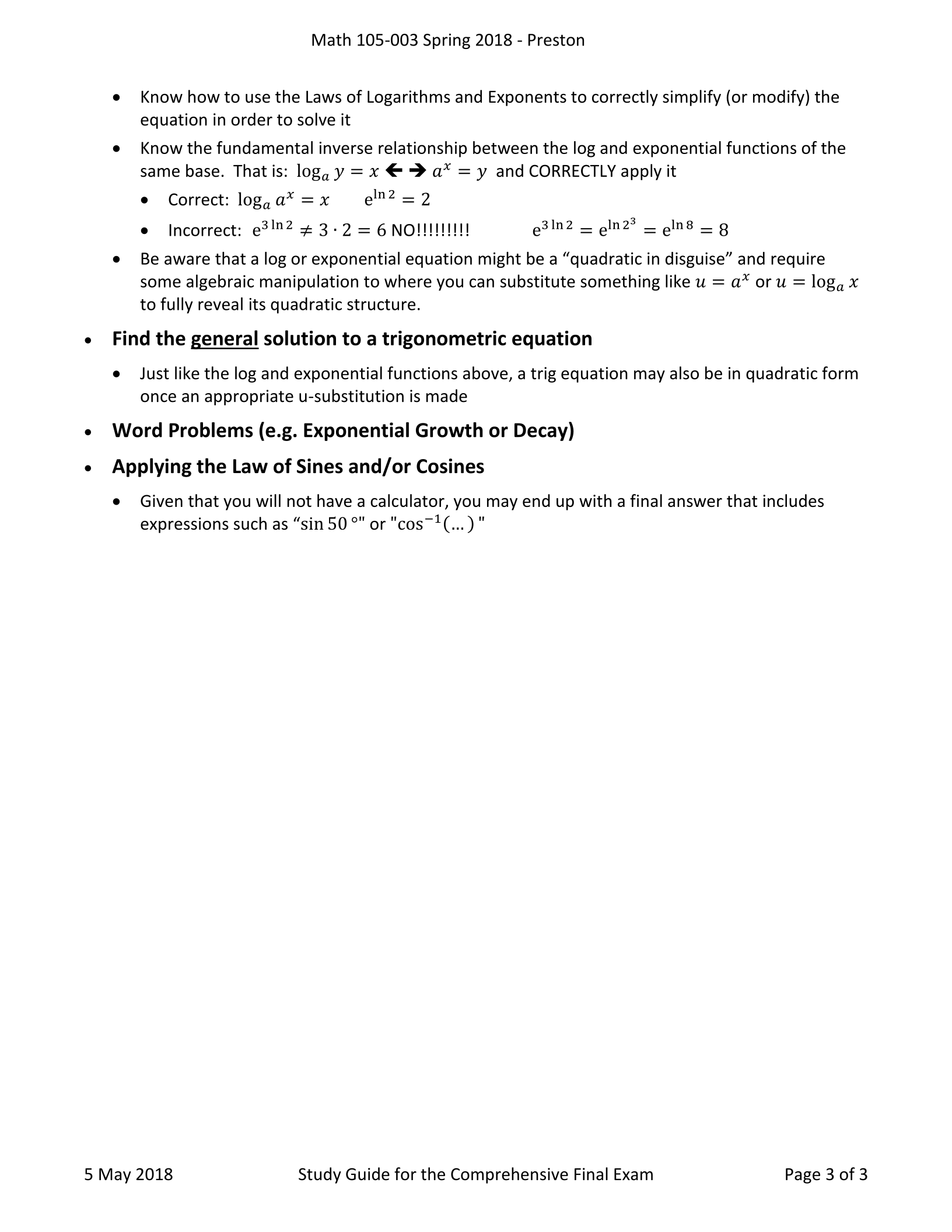
Know how to use the Laws of Logarithms and Exponents to correctly simplify (or modify) the
equation in order to solve it
Know the fundamental inverse relationship between the log and exponential functions of the
same base. That is: log𝑎𝑦 = 𝑥 𝑎𝑥= 𝑦 and CORRECTLY apply it
Correct: log𝑎𝑎𝑥= 𝑥 eln 2= 2
Incorrect: e3ln 2≠ 3 ∙ 2 = 6 NO!!!!!!!!! e3ln 2= eln 23= eln 8= 8
Be aware that a log or exponential equation might be a “quadratic in disguise” and require
some algebraic manipulation to where you can substitute something like 𝑢 = 𝑎𝑥 or 𝑢 = log𝑎𝑥
to fully reveal its quadratic structure.
Find the general solution to a trigonometric equation
Just like the log and exponential functions above, a trig equation may also be in quadratic form
once an appropriate u-substitution is made
Word Problems (e.g. Exponential Growth or Decay)
Applying the Law of Sines and/or Cosines
Given that you will not have a calculator, you may end up with a final answer that includes
expressions such as “sin 50 °" or "cos−1(…)"
Powered by TCPDF (www.tcpdf.org)

