



MATH 250 - Calculus II Study Notes: Core Concepts of Conic
Sections (Parabola and Ellipse)
CSUN MATH 250 Focus: Prerequisite Review, Parametric Forms, and
Integration Applications
Study Insights for Calculus II Students
Welcome back to the world of conic sections! While you extensively studied these
shapes in Precalculus, in MATH 250 (Calculus II), we revisit them for crucial
reasons:
1. Integration of Areas and Volumes: Conic sections often define the
boundaries of regions over which you will integrate, especially when
calculating areas, volumes of revolution (using the disk/washer or shell
methods), or surface areas. A solid grasp of the equations is necessary to
correctly set up the limits of integration.
2. Parametric Equations: Later in MATH 250, you will learn to represent these
curves using parametric equations. The standard Cartesian forms (like
x2/a2+y2/b2=1
) are the algebraic starting points for finding the appropriate
parametric representation (e.g.,
x=acos t , y=bsin t
for an ellipse).
3. Polar Coordinates: Conic sections have elegant definitions in the polar
coordinate system, which you will encounter toward the end of MATH 250.
Understanding the Cartesian standard forms is the necessary bridge to
understanding their polar forms.
4. Curvature and Arc Length: The formulas for arc length and curvature
(topics often covered in Calculus II or Multivariable Calculus) require a
functions derivative, which you obtain from the original equation.
The Key Difference: Dont just memorize the forms; understand why the constants (
a , b , c
) define the shape. This is critical for connecting the geometry to the algebra
needed for integration.
Knowledge Organization: The Parabola
A parabola is defined as the set of all points in a plane that are equidistant from a
fixed line (the directrix) and a fixed point not on the line (the focus).

I. Standard Forms of the Parabola (Vertex at Origin
(0,0)
)
The standard forms are derived from this geometric definition. The variable that is
squared determines the axis of symmetry and the direction of the opening.
A. Horizontal Parabola (
y
is squared)
These parabolas open either left or right. The axis of symmetry is the
x
-axis or
parallel to it.
1. Opens Right:
y2=4ax
oCondition:
a>0
oFocus:
(a , 0)
oDirectrix:
x=− a
oAxis of Symmetry:
y=0
(
x
-axis)
2. Opens Left:
y2=−4ax
oCondition:
a>0
(Note:
−4a
is negative)
oFocus:
(− a , 0)
oDirectrix:
x=a
oAxis of Symmetry:
y=0
(
x
-axis)
B. Vertical Parabola (
x
is squared)
These parabolas open either up or down. The axis of symmetry is the
y
-axis or
parallel to it.
1. Opens Up:
x2=4ay
oCondition:
a>0
oFocus:
(0, a)
oDirectrix:
y=− a
oAxis of Symmetry:
x=0
(
y
-axis)
2. Opens Down:
x2=−4ay
oCondition:
a>0
(Note:
−4a
is negative)
oFocus:
(0, − a)
oDirectrix:
y=a
oAxis of Symmetry:
x=0
(
y
-axis)
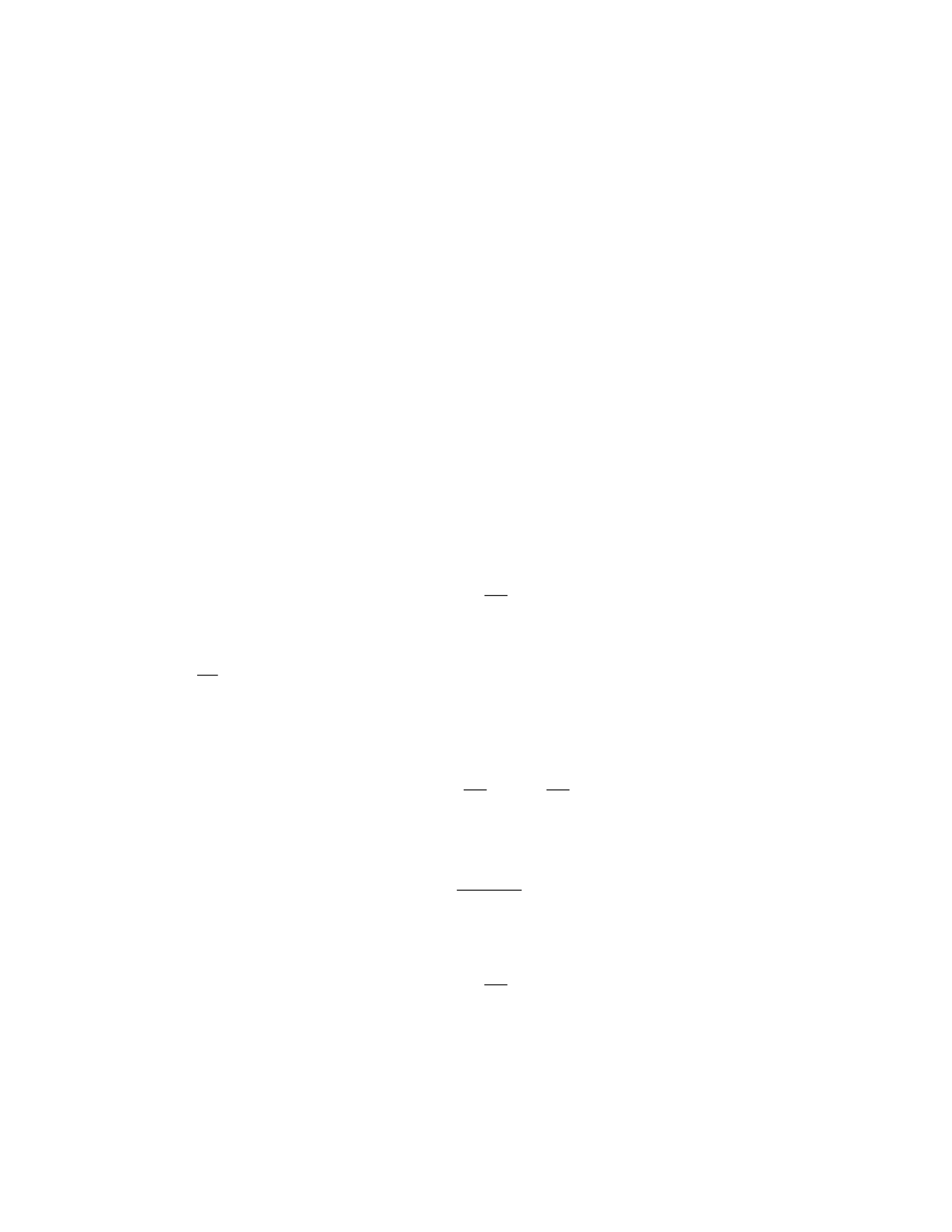
Visual Insight: The constant
4a
is known as the latus rectum, which
represents the width of the parabola at the focus. A larger
¿4a∨¿
means a
wider, flatter parabola.
II. The General Quadratic Form (Vertical Parabolas Only)
For vertical parabolas (which are functions of
x
), the form most familiar from
algebra is:
y=a x2+bx +c
This form is crucial for finding extrema (minimum/maximum) in optimization
problems using derivatives (
y′=0
).
A. Vertex Coordinates
The vertex
V(h , k )
is the turning point of the parabola.
x-coordinate (h) of the Vertex: Found directly from the coefficients
a
and
b
.
h=−b
2a
Calculus Connection: This is exactly the
x
-value where the derivative
dy
dx =2ax+b
equals zero (
2ax +b=0⇒x=−b /2a
).
y-coordinate (k) of the Vertex: Found by substituting
h
back into the
general equation.
k=y(h)=a
(
−b
2a
)
2
+b
(
−b
2a
)
+c
A simplified, though less frequently used, formula is:
k=4ac −b2
4a
Axis of Symmetry Equation: A vertical line passing through the vertex.
x=−b
2a
B. Opening Direction
The sign of the leading coefficient,
a
, dictates the direction of opening and the nature
of the extremum.

If
a>0
: The parabola opens Upward (Concave Up). The vertex is a minimum
point.
If
a<0
: The parabola opens Downward (Concave Down). The vertex is a
maximum point.
Graphing Tip: To graph, find the vertex, the
y
-intercept (
x=0⇒y=c
), and
the
x
-intercepts (by solving
a x2+bx+c=0
or factoring).
Knowledge Organization: The Ellipse📜
An ellipse is defined as the set of all points in a plane for which the sum of the
distances from two fixed points (foci) is a constant.
I. Standard Forms of the Ellipse (Center at Origin
(0,0)
)
The standard form is defined by the location of the major axis (the longer axis),
which contains the foci. The key determining factor is which denominator is larger.
Crucially, for an ellipse,
a
must always be the length of the semi-major axis,
meaning
a>b
must always hold.
A. Horizontal Major Axis (Foci on the
x
-axis)
In this case,
a2
is under the
x2
term, indicating the major axis lies along the
x
-axis.
x2
a2+y2
b2=1,where a>b>0
Center:
(0,0)
Vertices (Ends of Major Axis):
(± a , 0)
Co-Vertices (Ends of Minor Axis):
(0, ± b)
Foci:
(± c ,0)
Major Axis Length:
2a
Minor Axis Length:
2b
B. Vertical Major Axis (Foci on the
y
-axis)
In this case,
a2
is under the
y2
term, indicating the major axis lies along the
y
-axis.
y2
a2+x2
b2=1,where a>b>0
Center:
(0,0)

Vertices (Ends of Major Axis):
(0, ± a)
Co-Vertices (Ends of Minor Axis):
(± b , 0)
Foci:
(0, ± c)
Major Axis Length:
2a
Minor Axis Length:
2b
Crucial Distinction: For the ellipse standard form,
a2
is always the larger
denominator, and
b2
is the smaller. The position of
a2
determines the
orientation (horizontal or vertical).
II. Focus Calculation and Eccentricity
A. Relationship between
a , b , c
The distance from the center to a focus is denoted by
c
. This distance is related to
a
and
b
by the Pythagorean relationship, specific to the ellipse:
c2=a2− b2
This formula shows that
c
must be smaller than
a
, which is consistent with the
definition
a>b>0
. Always use this formula to find
c
for the ellipse.
B. Eccentricity (
e
)
Eccentricity is a measure of how "stretched out" an ellipse is compared to a perfect
circle. It is defined as the ratio of the distance from the center to the focus (
c
) to the
length of the semi-major axis (
a
).
e=c
a
Range: Because
0<c<a
, the eccentricity must satisfy:
0<e<1
.
Interpretation:
oWhen
e
is close to
0
(meaning
c ≈ 0
), the foci are close to the center,
and the ellipse is nearly a circle (
a ≈ b
).
oWhen
e
is close to
1
(meaning
c ≈ a
), the foci are close to the vertices,
and the ellipse is very elongated (flat).
Calculus and Physics Context: Planetary orbits are ellipses, and their
shapes are often described by their eccentricity.

Algebraic Methods: Simplification and Graphing🛠️
In Calculus, you will often encounter conic sections that are not centered at the
origin or are given in a general quadratic form. Converting them back to the
standard form is essential.
I. General Second-Degree Equation
The most general form of a second-degree equation in
x
and
y
is:
A x2+Bxy +C y2+Dx+Ey +F=0
For the purposes of this MATH 250 review, we assume
B=0
(no rotation),
which simplifies the analysis to curves with axes parallel to the coordinate
axes.
Parabola: Either
A=0
or
C=0
(only one variable squared).
Ellipse (or Circle):
A
and
C
have the same sign and
A ≠ C
. (If
A=C
, its a
circle).
II. Method: Completing the Square (CTS)
Completing the Square is the primary algebraic technique used to convert the
general form of a conic section into its standard form (Vertex form for Parabolas,
Center form for Ellipses/Hyperbolas). This process reveals the center
(h , k )
or
vertex
(h , k )
of the conic.
A. Step-by-Step for Ellipses and Hyperbolas
1. Group: Group the
x
terms and
y
terms together, and move the constant term
(
F
) to the right side of the equation.
2. Factor: Factor out the coefficient of
x2
(which is
A
) from the
x
group and the
coefficient of
y2
(which is
C
) from the
y
group.
3. Complete the Square (CTS):
oFor the
x
group, take half of the coefficient of
x
, square it, and add it
inside the parentheses.
oFor the
y
group, take half of the coefficient of
y
, square it, and add it
inside the parentheses.
4. Balance the Equation: Add the total value added on the left side
(remembering the factored out coefficients
A
and
C
) to the right side of the
equation.
5. Factor and Simplify: Factor the perfect square trinomials and simplify the
constant on the right.

6. Standardize: Divide the entire equation by the constant on the right side to
make the right side equal to 1.
B. Step-by-Step for Parabolas
Since only one variable is squared:
1. Isolate: Keep the squared variable terms on one side of the equation and
move all other terms (linear term of the squared variable, and constants) to
the other side.
2. Complete the Square (CTS): Complete the square on the side containing the
squared variable to form a perfect square, e.g.,
¿
.
3. Factor: On the other side (containing the linear variable), factor out the
coefficient of the linear term. This coefficient will be
4a
or
−4a
.
III. Graphing Steps
Graphing is essential for setting up integration problems.
Parabola:
a. Find the Vertex
(h , k )
.
b. Determine the direction of opening (based on
a
and the squared
term).
c. Find the distance
a
(from the standard form coefficient
4a
).
d. Plot the Focus and Directrix.
e. Use the latus rectum (
¿4a∨¿
) to find two points equidistant from the
focus, giving the width.
Ellipse:
a. Find the Center
(h , k )
.
b. Identify
a
(larger denominator) and
b
(smaller denominator).
c. Determine the orientation (Horizontal if
a2
is under
x2
; Vertical if
a2
is
under
y2
).
d. Plot the Vertices (along the major axis,
± a
units from the center).
e. Plot the Co-Vertices (along the minor axis,
± b
units from the center).
f. Calculate
c=
√
a2− b2
and plot the Foci (along the major axis,
± c
units
from the center).
g. Sketch the curve through the vertices and co-vertices.

🧩 Related Examples and Problem-Solving Techniques
Example 1: Analyzing and Graphing a General Parabola
Problem: Convert the general equation
x2−6x −8y+1=0
to standard form, find the
vertex, focus, and directrix, and determine the opening direction.
Step 1: Isolate the Squared Variable and CTS
The
x
term is squared, so we isolate
x
terms on the left:
x2−6x=8y − 1
Complete the square for
x2−6x
. Half of
−6
is
−3
, and
¿
.
x2−6x+9=8y −1+9¿
Step 2: Factor the Linear Term
Factor out the coefficient of
y
on the right side:
¿
Step 3: Identify Features
The standard form is
¿
.
Vertex
(h , k )
:
(3, −1)
4a
value:
4a=8⇒a=2
Opening Direction: Since the
x
term is squared and
4a=8>0
, the parabola
opens Upward.
Step 4: Find Focus and Directrix
Since the parabola opens upward, the focus and directrix lie on the vertical axis of
symmetry (
x=3
).
Focus:
(h , k +a)=(3, −1+2)=∗ ∗(3,1)∗∗
Directrix:
y=k − a ⇒y=−1−2⇒ ∗∗ y=−3∗ ∗
Example 2: Analyzing and Graphing a General Ellipse
Problem: Convert the general equation
9x2+4y2+18 x − 16 y −11=0
to standard
form and find the center, vertices, and foci.
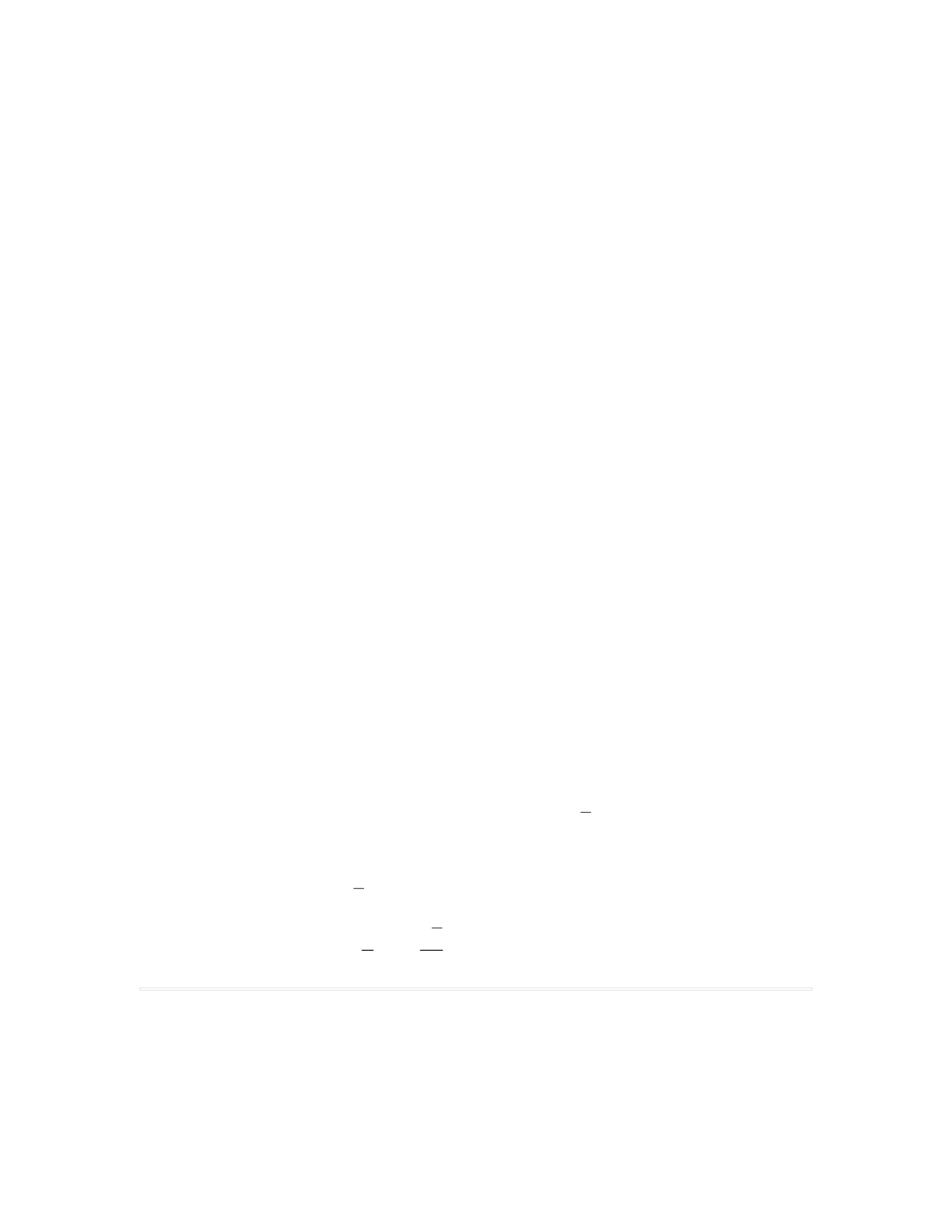
Step 1: Group and Move Constant
(9x2+18 x)+(4y2−16 y)=11
Step 2: Factor Coefficients
9(x2+2x)+4(y2−4y)=11
Step 3: Complete the Square (CTS)
x-group: Half of
2
is
1
.
12=1
. Add
9⋅1
to the right side.
y-group: Half of
−4
is
−2
.
¿
. Add
4⋅4
to the right side.
9(x2+2x+1)+4(y2−4y+4)=11+(9⋅1)+(4⋅4)9¿
Step 4: Standardize (Divide by 36)
9¿¿
Step 5: Identify Features
The standard form is
¿¿
, since
9>4
.
Center
(h , k )
:
(−1,2)
Orientation: Vertical Major Axis (since
a2
is under
y2
).
a2
and
b2
:
a2=9⇒a=3
;
b2=4⇒b=2
.
Step 6: Find Vertices and Foci
Vertices (Vertical Major Axis):
(h , k ± a)
o
(−1,2+3)=∗∗(−1,5)∗∗
o
(−1,2−3)=∗∗(−1,− 1)∗∗
Foci Calculation (
c
):
c2=a2− b2=9−4=5⇒c=
√
5
Foci (Vertical Major Axis):
(h , k ± c)
o
∗∗(−1,2±
√
5)∗∗
Eccentricity (
e
):
e=c
a=∗ ∗
√
5
3∗∗ ≈0.745
. (This is an elongated ellipse).

Deeper Connections to Calculus II📈
Connection A: Integration and Area
When calculating the area enclosed by an ellipse centered at the origin, you must
solve the equation for
y
:
x2
a2+y2
b2=1⇒y2
b2=1−x2
a2⇒y2=b2
(
1−x2
a2
)
y=± b
√
1−x2
a2
The area
A
of the ellipse is found by integrating the top half and doubling it, or
integrating from
y=− ytop
to
y=ytop
(where
ytop
is the positive solution):
A=2∫
− a
a
b
√
1−x2
a2dx
This integral is non-trivial and often requires a trigonometric substitution (e.g.,
x=asin θ
), a concept heavily covered in MATH 250.
Connection B: Volumes of Revolution (Disk/Washer Method)
If the parabola
y=x2
4a
is revolved around the
y
-axis (generating a paraboloid), or if
the ellipse
x2
a2+y2
b2=1
is revolved around the
x
-axis (generating an ellipsoid), the
radius function
R(x)
or
R(y)
is derived directly from the conic section equation.
Example (Paraboloid): If
x2=4ay
is revolved around the
y
-axis from
y=0
to
y=h
, the radius squared for the disk method is
R¿
.
VolumeV=∫
0
h
π¿
Connection C: Parametric Equations
The standard forms provide the necessary identities for converting to parametric
form, simplifying the analysis of arc length and velocity.
Ellipse:
x2
a2+y2
b2=1
naturally suggests the trigonometric identity
cos2t+sin2t=1
.
oLet
x
a=cost
and
y
b=sin t
.
oParametric Form:
x(t)=acos t
,
y(t)=bsin t
, for
0≤ t ≤ 2π
.

Understanding the original Cartesian geometry (the role of
a
and
b
) allows for the
correct construction of the parametric form, which is crucial for subsequent calculus
operations.

