


Introduction Emerging markets are described as underdeveloped
1.1 Background
Emerging markets are described as underdeveloped nations with significant room
for economic expansion and governments that support the free market system (Quelch,
1998; Hoskisson, 2000). Reverse mergers have dramatically expanded over the past 15
years, as have cross-border M&A activities by multinationals from established to
emerging markets. Since the 1980s, research has demonstrated that it is still being
determined how acquirers, especially in the case of cross-cultural mergers and
acquisitions, might benefit from economic improvements in emerging economies. In
M&A, cultural integration is the most significant and challenging issue businesses must
deal with. The "seven-seven law" of mergers and acquisitions refers to the considerable
risk involved in achieving optimal performance; it typically states that 70% of M&As fail
to meet the anticipated business target, and 70% of M&As fail to successfully integrate
their cultures after the merger. They keep in mind that the likelihood of failed cultural
integration following an M&A increases with the degree of cultural difference. Large
Chinese companies currently focus on mature businesses in Europe and America as
merger and acquisition targets. The staff at these companies have high appreciation for
both their national and company culture. Therefore, cultural integration is more
complicated when a Chinese company is acquired.
1.2 Definition of enterprise merger and acquisition
Merger and Acquisition, generally referred to as M&A, is a hot topics in the
theoretical field as it is an essential way to realize the rapid expansion of enterprises.
The meanings of Merger
The Encyclopedia of Great Britain explains, “Two or more independent enterprises
combine into one, typically with one or more being taken over by a powerful company”.
Merger is defined in the Encyclopedia of Great America as: “One business organization
remains after the merger of two or more businesses, but the other businesses lose their
distinct identities. Only the remaining firm retained its name and constitution and got the

assets of another firm. This Consolidation is not the same as consolidation, which resulted
in a whole new organization where all the firms involved lost their original identity."
Because it requires the blending of organizational cultures, structures, management
systems, and processes, the transition from two distinct organizations to one integrated
organization continues to be a significant task for top executives. (Gomes; Weber; Brown;
Tarba, 2011). As a result, a focus is put on planning procedures that make it easier for
these various organizational 'systems' to be reconciled in order to realize anticipated
synergies. (Schweiger; Weber, 1989; Stahl ; Voigt, 2008).
China's Company Law article distinguishes between two types of mergers. The first
is an absorption merger, also called a statutory merger. The absorbed firm will be
dissolved and lose its status as a legal person. The second type of merger is called a neural
merger, in which two or more businesses merge to form a new business, and both parties
are divided for consolidation. Of course, the definition of a "merger" varies depending on
the person. According to the restricted definition of a merger, the dominant enterprise
takes over one or more businesses in a disadvantaged position, destroying their legal
personhood; nevertheless, the broad meaning of a merger might combine merger and
acquisition.
According to the Securities Laws of our country, acquisition refers to the act of
acquiring control of a company through the public purchase of its shares. This definition
is put forward for listed companies, and there are some differences in the definition of
acquisition in the theoretical circle. For example, Zheng Xingshan (2000) believed that
corporate acquisition means that an enterprise owns parts or all of the assets of another
enterprise to achieve complete control over the enterprise, while the controlled enterprise
can continue to maintain an independent legal person status. Purchasing the assets,
business divisions, or shares of another company in order to take over that company is
known as an acquisition, according to Zhang Qiusheng (2001). The target enterprise's
position as a legal person will stay the same in the meantime. Asset Acquisition is the act
of buying part or all the assets of the seller. Equity Acquisition is the act of buying part
or all of the shares of the seller directly or indirectly. According to the shareholding ratio,
the seller and other shareholders jointly undertake the ownership and justice of the

enterprise. The proportion of equity acquired by the buyer enterprise can be divided into
participation acquisition, holding acquisition, and comprehensive acquisition.
Although people still have different understandings of the concepts of mergers,
mergers, and acquisitions, most scholars agree that "mergers and acquisitions are
collectively referred to as mergers and acquisitions.” (Zhao Jun , 2000; Zheng
Xingshan , 2000)
The purpose of this study is not to investigate the notions of mergers and acquisitions
but rather to theoretically define them as follows to make the concepts as plain as
possible:
A merger is a business transaction in which one or more independent businesses are
dissolved, and their independent legal standing is forfeited, while one business with legal
entity status acquires the assets of others. A merger refers to an economic act in which
two or more independent enterprises form a new enterprise, and the enterprises involved
in the merger are dissolved and lose their legal personality. All their assets, claims, and
debts are handed over to the new enterprise. Acquisition refers to an enterprise in the
stock market buying another enterprise's shares or assets in the form of cash, bonds, or
stocks in order to obtain the whole or parts of the control of the enterprise while the
controlled enterprise can still retain the independent legal person status of economic
action. Mergers and acquisitions are the general terms of mergers, which generally refer
to the property rights transaction activities carried out by an enterprise to obtain all or part
of the control rights of the target enterprise. The result is that the legal person status of
the target enterprise disappears, or the control rights of the target enterprise are changed.
From the perspective of cultural integration, merger and acquisition can be regarded as a
process in which two or more enterprises with different cultural systems combine to
achieve cultural synergies.
1.2.1 Types of M&A
1. The division shall be based on the industrial relationship between the two parties
Horizontal merger and acquisition

Horizontal merger and acquisition refers to the type of enterprise M & A in which
two sides of M & A are in the same industry to produce and sell similar products or trade.
Take the merger of two auto manufacturers as an example. The objectives of horizontal
M&A are to eliminate competitors, increase market share, and strengthen the monopoly
power of M&A enterprises in the industry market. The most significant advantages are
cutting costs and obtaining economies of scale. As a result, organizations usually establish
unified technical standards, united raw material purchasing, unified production process,
and unified product sales channels after a merger or acquisition. Horizontal M&A is
characterized by rapid expansion of enterprise scale and high centralization of M&A
companies. Since most people are engaged in similar work, the administration and staff
of overlapping institutions will be reduced after M&A, thus reducing management costs
and increasing the responsibilities of retained staff.
Vertical merger and acquisition
Vertical mergers and acquisitions are mergers and acquisitions between enterprises
that are connected and closely related to one another in production procedures or business
links or between specialized enterprises with a vertical cooperation relationship. They
involve different stages of a certain production activity. Vertical mergers and acquisitions
ensure the supply chain of raw materials and parts so that all links in the production
procedures are highly matched, lowering transaction costs, shortening the product life
cycle, speeding up the production process, and saveing money on shipping and storage.
Looking at vertical mergers and acquisitions from an M&A direction standpoint,
forward and backward M&A are distinguished. Forward M&A, often referred to as
forward integration, describes the combination of businesses at the end of the production
process with businesses at the beginning, such as manufacturing or assembly businesses
merging with suppliers of parts or raw materials. Backward merger and acquisition, also
known as backward integration, refers to the merger and acquisition of enterprises at the
beginning of the production process and enterprises at the end of the production process,
such as the merger and acquisition of raw materials and parts processing and assembly
enterprises or the merger and acquisition of retailers by production enterprises. Since the
parties in vertical M&A are usually raw material suppliers and finished product buyers,

vertical M&A mainly focuses on the processing manufacturing industry and related raw
materials, transportation, and trading companies.
Two advantages of vertical merger and acquisition are the expansion of production
and operation scale and the reduction of general equipment and cost. Collaboration in
manufacturing benefits from improved close coordination between the production chain's
parts. It shortens the manufacturing cycle, lowers storage and shipping expenses, saves
resources and energy, etc. Vertical mergers and acquisitions typically expand the business
of the acquiring company, making decentralized administration of operations more
feasible.
Mixed merger and acquisition
Mixed merger and acquisition refer to the merger and acquisition between
enterprises in different industries or sectors whose products belong to various markets
and have no special production technology connection with their industrial sectors. In
other words, a mixed merger is one in which there is no competition between the two
parties in the product market, and no actual or potential customer or supplier relationship.
The primary purpose of mixed M&A is to reduce the enterprise risk caused by the long-
term operation of an industry by diversifying investment or business and to expand the
scope of the enterprise's market activities by optimizing and complementing the
resources.
Specifically, mixed mergers and acquisitions can be subdivided into three types:
Product expansion merger and acquisition refers to the merger and acquisition
between enterprises with similar production technology or process, whose purpose is to
take advantage of their technological advantages and expand product categories. For
example, automobile manufacturers acquire agricultural tractors or harvesting machinery
manufacturers. If the production technology or process of products between enterprises
is very similar, it is equivalent to horizontal mergers and acquisitions.
Market expansion mergers and acquisitions refers to the mergers and acquisitions
between firms with the same product sales market, aiming to take advantage of their own
(or target enterprise) market advantages to expand market sales.

Pure hybrid mergers and acquisitions: Mergers and acquisitions between companies
unrelated to producing and operating products or services.
Mixed mergers and acquisitions typically result in an increase in the number of
factories and a more evenly distributed workforce.
Mergers and acquisitions will maintain more independence and autonomy for the
other side's enterprises in the management and cultural areas. However, due to the
significant cultural differences in the industries and the comparatively unfamiliar industry
and enterprise operation of the other side, it can lead to challenges in integration and
alignment. These differences may manifest in varying organizational structures,
management styles, corporate values, and employee expectations. To address these
challenges, it is crucial for the merging entities to invest in cultural due diligence, open
communication channels, and comprehensive integration planning. This approach can
help in identifying potential cultural clashes early on and developing strategies to
harmonize the distinct cultural elements into a cohesive organizational culture that
supports the merged entity's strategic goals and values. Furthermore, retaining key
personnel from both organizations and involving them in the integration process can
facilitate a smoother cultural transition and enhance employee retention, ultimately
contributing to the success of the merger or acquisition.
2. Divide base on the strength of both sides
Strong -- strong merger and acquisition. In other words, the merger and acquisition
of both parties in terms of size and strength are equal, and the status of both parties is
equal. This kind of merger and acquisition combined with its strength can rapidly expand
the enterprise’s market share and improve the industry’s status. It is generally a strategic
merger based on the complementary core capabilities of both parties.
Strong - weak merger and acquisition. The acquirer is in a dominant position and is
obviously stronger than the target enterprise in terms of scale and strength. Most of our
domestic mergers and acquisitions, such as superior private enterprises on the verge of
breaking the merger of small and medium-sized MNCs, belong to this type.
Weak-strong merger and acquisition. In other words, the target company is in a
stronger position than the merger and acquisition party, which is weaker in scale strength

or industry position. The terms "little fish devour large fish" and "snake swallow
elephant" are more frequently used in merger practice than this form of M&A. Think
about Lenovo's acquisition of IBM's PC business.
Weak - weak mergers and acquisitions. That is, weak companies merge or unite weak
companies. Sometimes, this type of merger and purchase is just the formal expansion of
enterprise scale without the capacity growth. Sometimes, it can also promote strengths
and avoid weaknesses by absorbing and reorganizing high-quality resources.
3.According to whether the target company's consent and cooperation
Bona fide acquisition: It means that the target company, especially the management
of the company, agrees with the acquisition plan and acquisition conditions proposed by
the acquisition company and takes a positive, cooperative attitude to promote the
completion of the acquisition transaction. In bona fide mergers and acquisitions, the
acquisition method, acquisition price, post-acquisition management integration, and other
specific matters are decided through joint negotiation by the senior management of both
parties until the merger and acquisition agreement acceptable to both parties is reached.
Because both parties intend to merge and are familiar with each other, the success rate of
a bona fide merger is relatively high.
Bad faith acquisition: It refers to the behavior of the acquisition company to forcibly
implement the acquisition even when the target company's management is not aware of
or opposes its acquisition intention. In a hostile takeover, the acquiring business
frequently uses unconventional acquisition strategies and presents stringent acquisition
requirements, which are challenging for the target company to accept. After learning of
the acquirer's purchase intention, the target firm will, therefore, pursue several anti-
takeover actions to stop the further implementation of the acquisition plan. Similarly, buy-
out companies will step up their efforts to subdue their targets. The hostile takeover is
exposed to significant acquisition risk due to the inability to secure the coordination and
cooperation of the target firm's management.
4. According to the degree of control obtained by the acquirer
Integrated merger and acquisition refers to the overall transfer of assets or property
rights of the target enterprise to the M&A enterprise. It takes much money to carry out a
whole merger.

Partial merger and acquisition refers to the merger and acquisition of the target
enterprise, which is only part of the assets or equity. Partial mergers and acquisitions make
it easier to solve the problem of merger funds and can often produce the effect of
"gambling big with small," which is usually accepted by enterprises.
5.The way of investment
Buy-for-assets mergers and acquisitions refer to the practice of the acquiring
company paying cash for all or the majority of the assets of the target company to
complete the acquisition.
6.The realization of mergers and acquisitions
Leveraged Buyouts refer to the acquiring firm using the income from the assets of
the target company to fund the acquisition or to secure such payments. In other words,
the acquisition company does not need a tremendous amount of capital but only needs to
provide a small amount of cash plus the amount borrowed from the assets and operations
of the target company as a financing security and repayment source to acquire the target
company.
Management buyout: Management Buyouts (Mbos) refers to a kind of acquisition
behavior in which the managers or managers of the target company purchase the
company’s share with the financing of the loan. The same is valid for changing the owner
structure, controlling structure, and asset structure of the company to achieve the purpose
of restructuring the company and obtaining the expected earnings. It is a type of leveraged
buyout. The enterprise’s operator becomes the enterprise’s owner through this kind of
acquisition. This type is generated to solve the problem of inconsistent interests between
the principal and the agent. In recent years, many Chinese enterprises, such as Guangdong
American, have tried MBO.
Tender offer: tender offer (namely, tender offer of listed companies in the narrow
sense) means that the acquirer holds the target company's shares to the legal proportion
(30% according to the Securities Law) through the trading of stock exchanges. If the
acquirer continues to be the shareholder with more shares, it must send a comprehensive
purchase to all the shareholders of the target company according to the law.
7. Our unique form of merger and acquisition

Administrative transfer merger: This often happens in MNCs in our country and
generally refers to the merger of enterprises with poor benefits and small scale by
advantage enterprises with good efficiency between MNCs in the body of the same
property owners. Because property ownership is within the scope of the property rights
relationship at the same level, and enterprise assets are only transferred between different
subjects at the same level.
Debt acquisition: In other words, when the target enterprise has the same assets and
debts or is insolvent, the merged enterprise will be absorbed by the debts and overall
property rights of the merged enterprise, and the merger will be realized under the
condition of assuming the debts of the merged enterprise. According to the different
degrees of debt, it can be divided into (1) In the case of equal assets and debts, the
concurrently merging party accepts all the assets and management rights of the annexed
party on the condition of assuming all the debts of the annexed party, and the legal person
status of the annexed party disappears; (2)The annexed party shall assume part of the
debts of the annexed party and provide technical and management services. The annexed
party shall acquire the ownership of part of the assets and all the management rights of
the annexed party. Although the leadership of the annexed party has been changed, the
annexed party shall still account independently and be responsible for its profits and
losses.
Mergers and acquisitions can be categorized into a wide range of distinct types using
various classification criteria. Although other classification methods are occasionally
used, the first classification method is primarily used in this study.
1.2.2 Motivation theory of enterprise buying
1. The division shall be based on the industrial relationship between the two parties
Due to the complexity and variability of M&A, western scholars have explained the
motivation of M&A from different theoretical perspectives. For example, Arthur.D.Uttle
Inc (1978), based on an Institute of Financial Management report, identified 21
motivations for mergers and acquisitions. In 1980, a U.S. Federal Trade Commission

panel of experts prepared a report based on focused interviews with ten senior executives
that cited 31 merger drivers (Rock; Sikora, 1994). Typical theories include:
Economies of scale theory
This theory contends that the goals of mergers and acquisitions (M&A) are to
increase corporate profits, achieve economies of scale, lower manufacturing costs,
enhance the potential to create new technologies, and all of the above. Its underlying
assumption is that the enterprise's production scale and management level before the
merger did not achieve scale economy.
Management synergy theory
This theory states that a company can acquire a less efficient company to utilize its
additional management resources fully and to organically combine the excess
management costs of the acquired company with the acquired company's non-
management organizational costs if the acquired company has an efficient management
team whose management ability exceeds the requirements of the acquired company's
daily management. The argument is predicated on the idea that markets are ineffective,
which prevents business shareholders from removing bad managers.
Financial synergy theory
The theory holds that mergers and acquisitions can bring various benefits to
enterprises in terms of finance. Firstly, the capital cost of enterprises can be reduced by
M&A. For example, the "debt co-guarantee" effect and the "internal cash flow" effect
generated by M&A can significantly reduce the financing capital of enterprises. Secondly,
the enterprise can merge with an enterprise with accumulated tax loss and tax deductions
and make use of the tax and accounting regulations related to the merger, such as loss
deferral, exemption from investment regulation tax, etc., to achieve the purpose of legal
tax avoidance. Finally, financial synergy, in a broad sense, also includes the "expected
effect" of stocks, that is, the impact of merger and acquisition on stock prices due to
changes in the stock market evaluation of corporate stocks, which is a major factor in
stock speculation. The implicit assumption of this theory is that the capital, tax savings,
or expected stock market returns brought by M&A activities are more significant than the
cost of M&A.

Portfolio theory
According to this idea, firms typically employ diversification to diversify risks
because of the unstable market environment, and hybrid M&A offers a solution to
diversify. According to the argument, market risk that is decreased through diversification
is enough to offset rising management expenses and additional operational hazards.
Target company undervaluation theory
According to this theory, due to the fluctuations of stock and exchange rates in the
capital market, when the value of a particular enterprise is undervalued, other enterprises
may acquire control of the enterprise by purchasing shares, or when the acquiring
enterprise believes that the value of the target company is undervalued because it knows
some information unknown to the external market, it will also purchase and combine.
Thus, expansion can be achieved at a relatively low cost.
Implicit in the theory is the assumption of inefficient markets.
Managerial hierarchy expansion motivation theory
The theory suggests that managers care more about their rights, income, social
prestige, and job stability than shareholders do about profits. Since the compensation of
managers is a function of the scale of the company (Muelle, 1909), managers have the
impulse to expand the scale of the company, and mergers and acquisitions are an
important way for them to develop the scale to increase their income, rights, and career
stability, while a large amount of idle cash flow (FCF) of the company also encourages
the expansion impulse of the management. This results in many mergers and acquisitions
with negative net present values (Jensen, 1986). The premise of this theory is that the
corporate governance structure cannot overcome the agency cost problem, and the stock
market is also inefficient, unable to control and supervise the behavior of managers.
Theory of market forces
This hypothesis contends that M&A is essential for market competition. On the one
hand, the M&A business can quickly grow at low cost and risk, and by successfully
leveraging the assets, sales channels, human resources, and other benefits of the target
business, it can lower the barriers to entry into a new market. On the other side, through
M&A, businesses can better control key production aspects, lower competition, eliminate

industry entry barriers, increase market share, and preserve the long-term consistent
profitability of their operations. This theory's central tenet is that business behavior is
entirely market-oriented and that business behavior and motivation are determined by the
market structure.
Principal-agent theory
Aiming at the conflict of interest between management and shareholders, this theory
holds that when the internal constraint and incentive mechanism of an enterprise cannot
effectively solve the agency problem, M&A provides the last external incentive
mechanism to prevent the management from excessively profiting from the expense of
the public or neglecting their duties. Otherwise, the operation and management lag caused
by inefficiency or agency problems will lead to the threat of a takeover of the enterprise.
Transaction cost theory
According to this theory, the only motive of M&A is to save transaction costs, and
the essence of M&A is the substitution of enterprise organization for market. On the one
hand, when an enterprise's "asset specificity "(Williamson, 1979) reaches a certain level,
the excessive potential cost of market transactions will encourage the enterprise to stop
relying on the market and internalize it in the form of vertical merger and acquisition to
save transaction costs. On the other hand, when the cost of managing unrelated business
activities is lower than the cost of organizing these activities through the market, the
enterprise will realize the operation of multi-sector enterprise through mixed merger and
acquisition to save transaction costs. In this sense, a multi-sector enterprise can be
regarded as internalized. Through a unified strategy, the microcapital market enables the
most efficient use of capital concentration. Transaction cost theory is a creative
explanation of enterprise merger motivation, but due to the abstractness of this theory, it
is challenging to give corresponding empirical verification, so it also affects its persuasion
to a certain extent.
Information and signal theory
This theory explains why the stock value of the target firm is always permanently
increased in a tender offer, whether the takeover is successful or not.
Information theory holds that new information is produced due to a tender offer, and
the revaluation is permanent. This hypothesis contains two explanations: The "whipping

behind" explanation contends that acquisitions encourage managers of the target firm to
pursue a more effective strategy on their own, without any external impetus to re-
overvalue the target firm. The "sitting on a gold mine" explanation contends that
acquisition activity will spread information about the undervalued stocks of the target
enterprises and prompt the market to revalue these stocks.
Information theory is distorted by signal theory. The market may be informed by
special actions that the company has an additional value that has not yet been recognized
or that the company's future cash flow will increase. The release of a signal can be
included in merger and acquisition activity in a number of different ways, and a takeover
offer has been made.
Redistribution theory
According to the redistribution theory, shareholder value increases at the expense of
the interests of other stakeholders in M&A activities. Under the "redistribution"
hypothesis, other company stakeholders include bondholders, government, workers, and
customers, and redistribution is reflected in the reduction of the value of bonds held by
bondholders. Less tax revenue equals less money for the government; for the workforce,
it means lower pay or less employment.
It can be seen that M&A is actually a comprehensive and balanced process involving
multiple factors. As Keith D. Brouthers et al. (1998) pointed out, the motivations of
enterprise merger and acquisition are diverse and complex, which is difficult to explain
by a theory. The actual process of enterprise merger and acquisition is an interactive
process that involves multiple factors.
Nevertheless, employees frequently react negatively during the post-acquisition
implementation phase; and cultural conflicts are linked to more dysfunctional employee
behaviors (Marmenout, 2011). Before, during, and after the acquisition, changes in
organizational patterns produce shock, anger, disbelief, depression, and helplessness.
Each of these emotions causes a loss of attachment and identification with the new
organization (Coff, 2002; Schweiger et al., 1987; Birkinshaw et al., 2000).

1.2.3 Research status of post-merger culture conflict
Berry first proposed the idea of acculturation, and according to the conflict between
the two sides of the merger and acquisition and the ways to solve the conflict, the
enterprise cultural integration mode in the merger and acquisition is divided into four
types: injection, penetration, separation, and extinction. Harris and Moran (1987)
proposed four cultural integration models similar to Berry's in view of cultural differences
within organizations: Dominance, Compromise, Synergy, and Isolation. According to
Edward (1996), culture can be divided into formal system level, informal system level,
and technical system level. Shrivastava (1986) believed that the effect of cultural
integration would directly affect the development of post-merger enterprises and that the
M&A enterprises needed to come up with solutions to solve the differences in
management system, business philosophy, and values between the two parties. Improper
integration was an critical reason for the failure and poor performance of M&A.
J. Richard Harrison (2006) pointed out that due to cultural differences, enterprises
with different cultural backgrounds tend to have differences in management concepts,
which makes it difficult for managers to convey management concepts in a timely and
effective manner. In order not to affect the business plan of enterprises, large-scale
employee replacement is easy to cause the problem of brain drain.
1.2.4 Domestic research status
In transnational M&A, the effective transfer of knowledge and skills cannot be
achieved without an excellent corporate culture atmosphere. Tang Yanzhao (2011)
compared and analyzed the differences between Eastern and Western business cultures
from the perspective of business culture to provide theoretical support for cultural
integration in transnational mergers and acquisitions of enterprises with Eastern and
Western business cultures. Based on the theory of cultural stratification, this paper
analyzes the cultural integration of transnational M&A from three dimensions (basic
premise, values, and norms of behavior). The model divides the cultural integration types
of M&A enterprises into absorption-cultural assimilation, retention-cultural
diversification, integration-cultural transformation, and anti-M&A-cultural assimilation.

He Chaohua (2005) believed that the cultural integration model could be divided into four
different models, namely assimilation, isolation, integration, and introduction, according
to the different stages of the development of corporate culture of the two sides of the
merger. When both cultures are at a low stage, the fusion mode is adopted. When both
cultures are at a high stage, assimilation and integration modes are adopted. When the
culture of the M&A enterprise is at a low stage, and the culture of the M&A enterprise is
at a high stage, the introduced cultural integration model mi is adopted.
Dai Chan (2011) pointed out that the cultural integration of an enterprise, on the one
hand, refers to the coordination of the differences and conflicts among different corporate
cultures; on the other hand, it refers to the process of innovating, reengineering, and
remolding based on the original corporate culture to form a new corporate culture with
complex changes and development. Yang Jie (2005) divided the cultural integration
modes of M&A into injection, retention, integration, and promotion modes according to
the degree of cultural change on both sides. Zhou Yuancheng, Li Xiangyin and Zou Zide
(2005) believed that the integration of corporate culture should be based on the original
superior corporate culture and through the mutual contact, exchange, absorption, and
penetration of two transplanted cultures and the management of their process, some high-
quality components in the heterogeneous culture should be absorbed, while some
backward characteristics in itself and the heterogeneous culture should be removed.
Gradually standardize, institutionalize, and rationalize it, and further strengthen it in the
psychological and behavioral characteristics of the new organization personnel, so as to
establish a new corporate culture system with more vitality and market competitiveness.
Wu Bingqian and Duan Qiaohong (2011) divided the cultural integration modes into the
following aspects according to the different strengths of the culture of the acquired
enterprise and the acquired enterprise: Injection, that is, the enemy is weak and the other
is strong; adaptation strategy, that is, the enemy is strong and the other is weak;
penetration and combination, that is, equal competition; retention culture, that is, the two
sides have significant cultural differences and the merger enterprise is multicultural.
Through investigation and a large number of case studies, Zhang Yongjian found that the
cultural integration mode selected by enterprises would be affected by merger and

acquisition, and the leadership should attach importance to informal organizations in
enterprises, which to some extent affect the effect of cultural integration.
Cai Ning and Shen Yuehua (2001) believe that corporate merger strategy,
entrepreneurial style, and original corporate culture characteristics have more prominent
influences on the selection of corporate cultural integration mode. Chen Xiaoping pointed
out that a "bicultural team" is prone to poor students' "two armies against each other"
situation, which is likely to greatly reduce the quality of communication and interaction
of team members and lead to the decline of team performance. This result proves why
senior management teams in joint ventures are most difficult to be efficient. Cross-
cultural teams have great potential to surpass single-culture teams, but if they are not well
managed, there will be great hidden dangers and risks. Sui Jing believes that Chinese
national culture is deeply influenced by Confucianism, which values the harmony and
integration of interpersonal relations and emphasizes the communication and
interpersonal skills of employees. Gu Weiping and Xue Qiuzhi (2004) argued that
transnational mergers and acquisitions are confronted with dual differences between
national culture and corporate culture, which may not only cause culture conflicts in
transnational mergers and acquisitions but also bring value to cultural innovation.
According to Sun Shizhu (2010), culture conflicts in M&A mainly manifest in the conflict
of values, customs, and norms of conduct.
Type of cultural integration mode: integration of cultures, creation of a blended
culture as a result of mutual understanding. When an enterprise is bought, its original
culture is abandoned in favor of assimilating into the culture of the new enterprise.
Maintaining the two civilizations' independence through cultural separation, cultural
extinction, and the acquisition of an unchanged company culture is unacceptable to the
acquiree. The integration mode of the M&A culture is altered in accordance with the
target change of M&A firms.
Wang Xiaohong (2011) put forward that different social and cultural backgrounds
and production practices also present different characteristics of corporate culture. Like
other organisms, the enterprise is a living entity with inevitable cultural rejection. When
the core cultures of the two sides of the merger are inconsistent or far apart, such as the

prudent and conservative culture and the innovative and aggressive culture, cultural
adaptability friction El will inevitably appear in the merger due to the differences in
values, behavior, and management styles of the two sides. Su Jin and Li Yingyu's research
focuses on cultural affinity at the level of reasoning.
Research on cultural integration in international business mergers and acquisitions
The analysis of cultural affinity at the level of values focuses on the compatibility of the
values, ways of thinking, and cultural customs of employees in different enterprises, using
the merger of two steel companies as an example. This is the highest guiding principle of
all behaviors between different enterprises. Employees' everyday behavior in various
organizations can be used to analyze cultural affinity at the behavioral level. Cai
Jiansheng (2006) explained that there may be an apparent division from the cultural
buffering stage to the cultural integration stage, or there may be overlapping processes.
The cultural integration and integration of the two sides' cultural fusion mode will
combine the excellent cultures of both sides, mix, and create a new corporate culture.
1.2.5 Cultural integration theory
The internationally famous "Law of 77" of cross-border mergers and acquisitions is
that 70% of M&As don’t realize the expected value, and 70% of the failures of cross-
border M&As are due to the unsuccessful cultural integration after the merger and
acquisition. If the two enterprises don’t properly handle the contradiction, the managers'
management methods are not unified since the employees' values differ. Promoting the
work and the development of the enterprise will be difficult. The potential of the acquired
businesses to create value is simply one factor in Huang Youjun's (2006) theory; post-
M&A integration also plays a significant role. One of them is the integration of corporate
culture; failing to consider the variations in corporate culture is a major factor in M&A
failure.
Through the analysis of the failure factors of mergers and acquisitions, Kearney
Consulting Company draws the conclusion that the conflict caused by different cultures
leads to the failure of cross-border mergers and acquisitions. A Conference Board survey
of 147 M&A directors at Fortune 500 companies found that 90% of successful mergers

and acquisitions were due to the right approach to cultural integration. American scholars
Kapoor and Cooper & Lybrand (Cooper & Lybrand) conducted a comprehensive survey
of the leaders of 100 famous international enterprises on the factors of cross-border
mergers and acquisitions.
The degree of integration of corporate culture has a significant impact on cross-
border mergers and acquisitions. Whether employees can accept the corporate culture
after the merger, comply with corporate rules and regulations, and recognize the
management style of managers are the core factors for the success or failure of mergers
and acquisitions. According to the research, successful mergers and acquisitions will also
improve the corporate culture. Diverse cultural viewpoints within a global context can
help us analyze and comprehend the challenges faced in the growth of enterprises in
various ways, which is conducive to fostering new work creativity, responding to culture,
promoting mutual integration, and making contributions to raising the competitiveness of
enterprises.
Research content and framework
Enterprises carry out mergers and acquisitions with beautiful visions. The acquirer
expects to achieve diversification or extend the industrial chain through mergers and
acquisitions, and the acquirer also expects to transform itself with the advantage of the
acquirer's resources. However, the results often run in the opposite direction. Based on
the medical industry, from the perspective of the cultural characteristics of MNCs and
private enterprises, the paper explores the culture conflicts at various levels caused by the
merger and acquisition of Company K, a well-known local medical company, by large
foreign-owned enterprise M company, and studies the focus of culture conflicts in the
process of merger and acquisition by quantitative analysis method. To put forward
targeted measures and suggestions to address and integrate the cultural conflicts that arise
in the merger and acquisition of medical enterprises within the context of different
property rights cultures, ultimately aiming to align the merged entities towards a shared
vision and successful collaboration.
This essay is divided into six chapters. The study background, significance, ideas,
techniques, and points of originality are all explained in the first chapter of this

publication. The second chapter scans the body of writing from three angles. (1) The
Chinese and foreign literature review on the concept, type, and motivation of M&A; (2)
the concept, characteristics, and classification of corporate culture in Chinese and foreign
languages. (3) The culture conflict and integration of mergers and acquisitions of Chinese
and foreign literature review. The third chapter introduces the case of M company's
merger with Company K. Then primarily describes the research methodology used in this
study, including the variable selection, questionnaire design, and hypothesis. The fourth
chapter uses SPSS 3.0 for statistical analysis of the collected questionnaire data to study
the influence of four aspects of cultural conflict on the intensity of conflict and the
problems in the cultural integration of merger and acquisition. The fifth chapter measures
the cultural integration of Chinese enterprises' merger and acquisition of private
enterprises. Starting from the problem of cultural conflict and integration, this paper
provides a valuable reference for integrating corporate culture after the merger. Chapter
six is the conclusion and enlightenment.
1.3 Hypothesis and Research Methods
Mergers and acquisitions are critical for enterprises to expand their scale and market
share. However, cultural conflicts often arise in the process, affecting the overall
performance of the merged companies. This paper aims to study the integration of cultural
conflicts in the M&A of enterprises, particularly in the medical sector. Based on a
comprehensive analysis of the literature and empirical research, we propose a set of
hypotheses and methods to prove the causal relationships among the factors that influence
cultural conflicts in the M&A of medical enterprises.
Hypothesis 1: Multinational and private enterprises have formed unique corporate
cultures in the long-term development process, and cultural conflicts will inevitably occur
after mergers and acquisitions.
Corporate culture refers to a common value, belief, code of conduct, and way of
thinking formed in an enterprise’s long-term production and operation activities. It
reflects the mission, vision, and strategy of an enterprise and affects its organizational
structure, management system, and employee behavior. Different enterprises will form

different corporate cultures due to their different development history, environment,
ownership nature, and other factors. There are significant differences between multi-
national enterprises and private enterprises in these aspects, so it is difficult to achieve
cultural consistency after merger and acquisition. Cultural conflict refers to the friction,
opposition, and contradiction caused by the differences and adaptations between different
cultures. Cultural differences between companies and cultural conflicts that arise after
M&A are objective rather than the subjective judgment of one company or individual.
Therefore, this paper mainly adopts the literature research method in this part. Carefully
study journals, papers, and works related to enterprise merger and acquisition and culture
conflict, understand the research status, research results, and methods of integration of
culture conflict in enterprise merger and acquisition, and enrich my theoretical knowledge
reserve. Meanwhile, questionnaires and cases are used to analyze the specific
manifestations of cultural differences between enterprises, and a certain amount of sample
statistical data is used to prove the widespread existence of cultural conflict after M&A.
Hypothesis 2: The cultural conflicts of medical enterprises in merger and acquisition
are mainly reflected in four aspects: spiritual cultural conflicts, behavioral cultural
conflicts, material cultural conflicts, and institutional cultural conflicts.
In the following literature review, there are relevant cultural hierarchy models that
divide corporate culture into four levels: spiritual culture, behavioral culture, material
culture, and institutional culture. Spiritual culture refers to the core values, beliefs, and
ideas of an enterprise. It is the soul of an enterprise culture and the most difficult part to
change. Behavioral culture refers to the behavior norms, habits, and styles of an
enterprise. It is the expression of corporate culture and the most easily observed part.
Material culture refers to the material products, facilities, and symbols of an enterprise. It
is the carrier of corporate culture and the part that is most easily changed. Institutional
culture refers to an enterprise's organizational structure, management system, and human
resources policy. It is the guarantee of corporate culture and the easiest part to adjust.
According to this paper, in the merger and acquisition, the four levels of the culture of
medical enterprises may conflict, which is as follows:

Spiritual and cultural conflict: Multinational enterprises and private enterprises may
be inconsistent or contradictory in terms of medical concept, service purpose, and social
responsibility, making it difficult to form consensus and trust between them.
Behavioral culture conflict: Multi-national enterprises and private enterprises may
have differences or incompatibilities in working methods, communication methods,
leadership styles, and other aspects, resulting in difficult cooperation and cooperation
between the two parties.
Material culture conflict: there may be gaps or incompatibility between
Multinational and private enterprises in terms of medical equipment, diagnosis and
treatment standards, brand image, etc., resulting in complex integration and unification
of the two sides.
Institutional culture conflict: Multinational enterprises and private enterprises may
have conflicts or dissatisfaction with the organizational structure, management system,
human resource policies, and other aspects, which makes it difficult for both parties to
adapt and obey.
Hypothesis 3: There is a high degree of correlation and interaction among the four
factors of cultural conflict.
This paper holds that the four factors of cultural conflict are not isolated but
influence and restrict each other. This is based on the following logic and evidence:
Obtain the relationship data between different cultural factors through a questionnaire
survey and verify the correlation between the four factors by statistical method of
correlation analysis.
Spiritual culture is the source of behavior culture, material culture, and system
culture, which determines the behavior mode, material form, and system arrangement of
enterprises. If there is a conflict between spiritual cultures, it is difficult for other levels
of culture to reach an agreement.
Behavior culture is the expression of material culture and system culture, which
reflects the actual operation and execution ability of an enterprise. If there are differences
between behavioral cultures, it is difficult for other levels of culture to integrate and
coordinate.

Material culture is the carrier of spiritual culture and behavior culture, which shows
the image and quality of an enterprise. If there is a gap between material cultures, it is
difficult to unify and standardize other levels of culture.
System culture is the guarantee of spirit culture, behavior culture, and material
culture. It standardizes the organization structure, management system, and human
resources policy of an enterprise.
Hypothesis 4: The four factors of cultural conflict have different degrees of influence
on the intensity of cultural conflict.
In the verification of this hypothesis, we will use a survey questionnaire to collect
data from employees of medical enterprises that have undergone mergers and
acquisitions. The questionnaire will be designed to measure the intensity of cultural
conflicts in the four dimensions mentioned in Hypothesis 2. Firstly, the perception degree
of employees on different types of cultural conflict was obtained through a questionnaire
survey, and then the influence degree of four factors on the intensity of cultural conflict
was analyzed by correlation analysis and regression analysis. For example, behavioral
culture conflict has the most significant impact on conflict intensity, while institutional
culture conflict has a relatively small impact.
Hypothesis 5:After mergers, different cultural conflict factors have varying degrees
of impact on talent retention. The cultural conflict factors affecting the retention of talent
among different groups.
In the validation of this hypothesis, we conducted a survey among employees of
medical enterprises that have experienced mergers and acquisitions. The surveyed group
included employees of different genders, those who are still employed and those who
have left the company, with varying job positions and lengths of service. The main focus
was to analyze the employees' perception of cultural conflicts and the extent to which
cultural conflicts influence their turnover, in order to gain a deeper understanding of how
different groups perceive various cultural conflicts and how these conflicts affect the
operations and employee retention of the merged enterprise.

Hypothesis 6: The intensity of cultural conflict after M&A can be reduced by
establishing a cultural integration program: enhanced training, employee engagement,
communication, and leadership.
In this regard, in addition to conducting a questionnaire survey on the perception of
cultural conflict among the employee samples after the implementation of the cultural
integration plan, this paper also uses qualitative analysis to conduct in-depth interviews.
The interview contents are measured and analyzed from various perspectives, such as
employee compensation and welfare, job satisfaction, and corporate performance. In-
depth interviews will be conducted with selected employees and managers from the
merged medical enterprises to explore their experiences and perceptions of cultural
conflicts in the M&A process. In addition, cultural integration is a dynamic process, and
in-depth interviews after a certain period of implementation can more comprehensively
evaluate the effect of a cultural integration plan and track the current situation of
enterprise culture.
To sum up, the hypothesis proposed in this paper will be provided with theoretical
and empirical support in the following paragraphs, providing guidance and a basis for the
subsequent data analysis and conclusions of this paper.
1.4 Expected Results and Possible Innovations
Expected results:
1.We expect to find a significant relationship between the cultural backgrounds of
the merging enterprises and the intensity of cultural conflicts after M&A.
2.We anticipate that the four factors of cultural conflicts will have varying degrees
of influence on the overall intensity of conflicts, with some factors having a more
substantial impact than others.
3.We expect to find that the four factors of cultural conflicts are highly correlated
and influence one another.
4.We expect to find significant differences in the impact of various cultural conflict
factors on talent retention after mergers.

5.We anticipate that the research results will reveal that certain cultural conflict
factors have a more pronounced effect on the retention of specific employee groups, while
having a relatively smaller impact on others.
6.We hypothesize that a well-designed cultural integration plan, including training,
employee participation, more communication, and leadership, will effectively reduce the
intensity of cultural conflicts after M&A.
Through this study, we hope to provide merged enterprises with a strategic
framework on how to manage and resolve cultural conflicts and promote talent retention,
thereby optimizing business operations and enhancing overall performance.
Possible Innovations:
Enterprises in the medical industry have unique industry characteristics in the
process of development, and MNCs and private enterprises themselves exist with a large
cultural difference, predecessors less research. This paper takes the case of the merger
and acquisition of Company K by the foreign-owned enterprise M Company in the merger
practice as the research object. It starts with the development history and cultural
accumulation of the two enterprises to explore the focus of the cultural conflict of the
merger and acquisition.
The cultural tensions that arise during corporate mergers and acquisitions are
frequently particular and imperceptible. Therefore, to study the process of cultural
integration and to list aspects of cultural conflicts, the existing literature primarily uses
qualitative methods. Using quantitative analysis and a survey, this paper aims to
investigate the root of cultural conflict following the merger and acquisition of medical
businesses. It has been discovered that the culture conflict resulting from the merger of
MNC and private firms has behavioral culture conflict as its outward manifestation and
spiritual and institutional culture conflict as its inner conflict. To find answers to the
cultural integration of MNCs' mergers and acquisitions of private businesses,
questionnaire surveys and interviews are further employed as a basis. Our findings will
also contribute to the existing literature on cultural conflict integration in mergers and
acquisitions and provide practical guidance for medical enterprises seeking to achieve a
successful M&A process.

Chapter 2 Literature Review
This paper examines the key ideas in the literature from the viewpoints of enterprise
merger and acquisition, enterprise culture, culture conflict, and integration of enterprise
merger and acquisition based on a thorough analysis of the pertinent literature.
2.1 Enterprise Merger and Acquisition
It is observed that almost all of America's most famous corporations have grown in
some way through mergers and acquisitions, but the motivations behind mergers and
acquisitions vary widely. Due to the different economic development backgrounds and
research stages, this paper respectively summarizes the motivation and success factors of
M&A at home and abroad.
Based on the theory of the separation of ownership and management rights in the
modern enterprise system, Jensen and Meckling (1979) proposed the agent theory of
M&A motivation, contending that when professional managers hold fewer shares of the
company or do not hold any shares, they initiate self-interested M&A in pursuit of their
interests. Mullin et al. (1983) investigated the effects of American steel company
separation on the industrial chain. They discovered that the separation of steel businesses
enhanced steel output and decreased steel price, which in turn supported the compelling
case for enterprise merger and acquisition. Dong et al. (2006) adopted the empirical
research method and concluded that with the changes in the market environment, the
driving forces of M&A were different at different stages. Before 1990, Tobin's Q value
theory dominated the M&A wave of listed companies. The M&A wave of listed
companies after 1990 is mostly driven by the theory of market timing. Mitchell and
Mulherin (1996) found that different industries have different industry characteristics,
development stages, and rules. Therefore, the probability and opportunity of M&A and
reorganization of enterprises in different industries are entirely different. To some extent,
they are all affected by industry shocks (Weston, 2004), starting from the synergy of
merger and acquisition, and proposed that different merger and acquisition methods have
different synergies. Horizontal mergers and acquisitions can improve the market share of
enterprises and expand the scale; Vertical M & A can open and down the business chain

and save transaction costs; Multiple mergers and acquisitions can effectively disperse
market risks.
As for the success or failure factors of merger and acquisition, Davis (1969) believed
that the key lies in the difference of management styles, among which management styles
mainly include management risk preference, investment return cycle, and proper
distribution. Buono and Lewis (1985) found that the main reason why mergers and
acquisitions failed to achieve the intended goal was the difference in corporate culture.
Bruce Wasserstein (1991) noted that the ability of the acquired party to create value is
only one factor in the success of an M&A. but also on the integration after the M&A.
Chattel and Lubatkin (1992) showed that the apparent difference in corporate culture
between the two sides of a merger and acquisition would lead to stock price fluctuations,
thus damping investors' investment enthusiasm. Singh (1994) pointed out that enterprises
should shorten the cultural distance between the two sides of the merger as much as
possible to better coordinate and integrate to reduce the adverse impact of cultural
conflicts after the merger.
Chinese enterprise M & A started late and was deeply affected by China's economic
system and economic environment. Enterprise M & A motivation has a certain
particularity. Zhang Qiusheng (2010) believes that the motivation for enterprise mergers
and acquisitions mainly includes the internal driving force of the pursuit of synergies and
the incentive factors limited by external environmental factors. Huang Yan (2011)
believes that in the market economy environment with Chinese characteristics, the
motivation of enterprise M&A has its particularity, such as setting up group enterprises,
adjusting state-owned asset’s structure, eliminating enterprise losses, solving employees'
employment problems, and so on. (1) Eliminate corporate losses. Early on, after the
People's Republic of China was established, MNCs dominated. When enterprises were
operating at a loss, the government, in order to stabilize employment and include state-
owned assets, often under the guidance of the government, by the large MNCs with sound
business and strong strength to acquire loss-making enterprises, to avoid the bankruptcy
of loss-making enterprises. (2)

Establish an enterprise group. With the development of
economic globalization, multinational corporations keep pouring into China to
compete fiercely with local enterprises. On the other hand, Chinese enterprises also need
to compete in the international market to compete for resources and markets. The Chinese
government encourages enterprises to set up large and powerful enterprise groups to
compete through mergers and acquisitions. (3) Backdoor listing. In China, the enterprise
listing threshold is high, the CSRC on the overall number of listed companies and listing
time control is strict, some of their conditions cannot reach the listing conditions or direct
listing cost is too high, often in the capital market to find listed shell resources, through
the acquisition of listed companies quickly become listed companies (1). Yu Yu and Wang
Jianqiong (2015) divided the theory of enterprise M&A motivation into western M&A
motivation and Chinese special M&A motivation. (2). Xie Qiaoli et al. (2020) proved
through examples that enterprise mergers and acquisitions can reduce costs while
expanding the market and achieve synergistic effect mi of complementary advantages.
To sum up, enterprise merger and acquisition is a process that tends to balance due
to the interaction of many factors. Its driving force is diversified and complex, which
cannot be explained by any specific theory. However, many scholars at home and abroad
put forward that whether cultural integration is smooth or not directly determines the
success or failure of enterprise M&A.
2.2 Corporate Culture
The conception of corporate culture is born in America, "blooms" in Japan, and
"takes root" in China. Chinese and international students have distinct perspectives on
corporate culture, and Chinese businesses have developed different cultures in order to
adapt to business growth due to different ownership.
1.General theory of corporate culture
The research boom of Corporate Cultures in the theoretical circle began in the 1980s.
The reason why it gained widespread attention was that Japanese enterprises were valued
by the US due to the rapid rise of "soft factors" after World War II. Second, the four books
Theory Z by Ouchi, Western Corporate Culture by Diehl and Kennedy, The Search for

Advantage by Peters and Waterman, and The Art of Japanese Business Management by
PASCAL and Athos contributed to the development. The following section will help you
understand corporate culture from the concept, structure, type, and measurement of
corporate culture.
2. The connotation and hierarchy of corporate culture
(1)The meaning of corporate culture
There have been many controversies about the definition of corporate culture at
home and abroad.
Early definitions of corporate culture include Hornes (1950), who defined corporate
culture as the norms gradually formed in the work team, for example, the special norms
of "a fair day's work, a fair day's wages" formed in the observation room of the relay
winding unit in Hawthorne experiment. Goffman (1967) and Van Menen (1979) believe
that corporate culture is the norms of behavior that people follow when interacting with
each other, such as the language they use and the etiquette they follow. According to
Tagiuri and Litwin (1968), corporate culture refers to the mood or ambiance that an
organization's design and the way its employees interact with clients or other external
parties create.
In the 1980s, with the publication of Ouchi's Theory Z and four other works on
corporate culture, people's research boom on corporate culture reached an unprecedented
height, and the definition of corporate culture was quite rich at that time. For example,
William Ouchi (1984) believes in the Theory that corporate culture is "constituted by its
tradition and ethos. A company's values, such as aggression, defensiveness, and energy,
which shape patterns of behavior, opinion, and action, are also a part of its culture.
Managers transmit that paradigm to upcoming worker generations by borrowing it from
their staff. “Terrance Deal (1989) and Allen Kennedy (1989) identified five components
that make up corporate culture in Western culture: corporate environment, values, heroes,
conventions and rituals, and cultural networks. The corporate environment is the most
important factor in determining corporate culture. Values are the foundation of corporate
culture, heroes are the concentrated embodiment of organizational power, and the
personalization of corporate values, customs, and rituals is a key means of passing down

and strengthening corporate culture. The cultural network is the conduit for disseminating
corporate culture. The writers of The Art of Management in Japan, Pascale and Athos
(R.T.; Athos, 1987), quoted Peter Drucker as saying that corporate management should
be both a discipline and a culture. A society with its standards, principles, customs, and
language. Peters and Waterman (1985) In his book Seeking the Edge -- Lessons from
America's Most Successful Companies, he detailed eight cultural characteristics of
exceptional companies: action first, customer friendliness, innovation encouragement,
people orientation, words, and deeds, sticking to their roots, streamlining the military,
leniency, and economy. In their view, corporate culture refers to the common values and
guiding ideology of a company, a kind of tradition that can harmonize the whole company,
and a process and activity that provides lofty and ambitious opportunities for employees.
The school of organizational culture also defines corporate culture from the perspective
of its discipline. Famous scholars include Dutch scholar Hofstede and American scholar
Shane. According to Hofstede (1983), corporate culture is a "collective mode of
thinking." Corporate culture is "made, discovered, and developed by a given organization
in the process of coping with the difficulties of external adaptability and internal
integration, which has proven to be effective," according to Schein (1984). And to teach
new members how to comprehend, consider, and experience the underlying
presumptions.
After entering the 1990s, people have a deeper understanding of the definition of
corporate culture. American scholars John P. Cote and James L. Heskett (1997) argued in
their book Corporate Culture and Business Performance that Corporate culture is defined
as the "common corporate beliefs and business practices of all departments of a
corporation, at least the senior managers of the enterprise. It refers to the shared cultural
phenomena among several divisional or departmental functions situated in varied
geographic contexts within an organization. 'Jaclyn Sheraton and James L. Stern (1998)
wrote in Corporate Culture: According to "Removing Potential Obstacles to Enterprise
Success" " corporate culture is the atmosphere or personality of an organization, and it is
primarily made up of four elements: (1) external expression forms, such as the shared
idea, employee behavior, and value orientation; (2) management atmosphere, which is

made up of management style and management concept; (3) management atmosphere,
which is made up of existing management systems and procedures; and (4) standards and
procedures, both written and oral.
Homs (1950) proposed that corporate culture is a unique system and that norms
gradually formed in the process of teamwork. Goffman (1967) mentioned that corporate
culture is the behavior norms that employees influence each other and follow together in
the process of production and management. William Ouchi (1981) proposed that
corporate culture is the behavior habits and value beliefs accumulated by enterprises in
long-term practice under a certain social and cultural background. J Schein (1984)
believed that leaders convey habits and beliefs to employees. In order to teach new
employees how to grasp and experience the aforementioned issues properly, corporate
culture is an assumption produced by an organization while dealing with internal and
external problems. O'Reilly (1996) believes that corporate culture is the values shared by
all members, and these values are an internalized normative belief guiding employees'
behavior. American scholar Stephen P. Robbins (1997) defined corporate culture as a
unique value system observed by all members of an organization.
Although scholars differ in their expressions of the connotation of corporate culture,
they all focus on "values" and "norms of behavior." The differences are mainly reflected
in the emphasis on corporate culture and the extension of its definition. Barton (1992), an
American scholar, proposed the concept of core rigidities, believing that the core
competence of enterprises originates from the accumulated knowledge during operation,
which is exclusive and difficult to imitate. Lebas (2005) believed that the uniqueness of
an enterprise's knowledge system was not only difficult for competitors to imitate but also
tricky to change. Shenkar (2008) believes that once a strong culture is established, it will
be substantial and ubiquitous. Such stable performance of corporate culture makes it exist
in the enterprise entity for a long time. According to Maitian (1999), enterprises carefully
design a set of logical and powerful operation mechanisms for self-protection and form
the overall internal communication mode through continuous strengthening so as to resist
external novelties and attempts to change the overall internal communication mode. With
the continuous development and maturity of the enterprise, some consciousness and

behavior will be confined to the common expectations of the organization, forming the
enterprise's unique code of conduct, values, group network relationship, and legend.
Often, the more successful a company was in the past, the more entrenched the corporate
perception was, and the more complacency and inertia were fostered in the culture.
Chinese scholars’ definitions of corporate culture are also varied and can be said to
be different people and wisdom. Liu Guangming (2002) believes that corporate culture is
a type of organizational culture that develops in businesses. The organization's members
recognize its principles, conduct standards, and other ideological and material forms. Wei
Jie (2002) The statement asserts that "business culture” is the value notion that enterprises
believe in putting into practice. In other words, corporate culture is the value idea that
businesses support and really put into reality. "Peng Jianfeng (2002) believes that
corporate culture is a psychological contract among organizational members. Every
enterprise has its own core values, and employees form a psychological contract with the
enterprise based on this. That is, employees identify with the common vision and pursuit
of the enterprise. Align personal goals with organizational goals, take responsibility, and
manage autonomously. At the same time, once integrated into the daily management of
enterprises, culture is a rational management means, which is a sensible choice for
enterprises to achieve utilitarian goals.
From the above definitions, corporate culture is defined differently by many
individuals despite having certain common denotations. For instance, they all agree that
"values" and "codes of conduct" are components of corporate culture. The distinctions
result from the definitions' emphasis and range, respectively. On the basis of this
comprehension, this study contends that corporate culture is a collection of values,
convictions, and guidelines for conduct that have been long-promoted by the company's
founders or senior managers and are largely accepted by the workers.
Enterprises formed and developed under different economic backgrounds and
property rights systems have formed unique cultural characteristics in their long-term
production and management practices. Luo Fan and Yu Lian (2001) proposed that the
cultural conflicts in MNCs are mainly focused on the struggle for rights and status, and
the frequency of conflicts is relatively high, almost every day or every week, and the

conflicts are obviously destructive, which may lead to the disintegration of people and
the decline of productivity. Song Hongmei (2003) believed that the government, as the
carrier of the personalization of MNC' property rights, to some extent, the MNCs have
social management responsibilities, which makes the management system of MNCs with
strong administrative color. Major decisions are reported to the superior departments for
examination and approval in strict accordance with procedures, and the senior
management is mostly appointed and removed by the government administrative
departments. MNCs have the problems of unclear rights and responsibilities, multiple
management, and low efficiency because it is not easy to determine the quantity and
quality of labor, in theory, according to the distribution of work, but in practice, the
distribution is equal. Gong Xiangchen (2012) proposed that the culture of MNCs is typical
of "equalitarianism", with employees' low enthusiasm for work and low efficiency. What's
more, the cliquism of cliquism under the orientation of relationships prevails in MNCs.
Wang Gang (2019) holds that the cultural construction of MNC is unbalanced, employees'
participation is poor, and leaders' understanding is insufficient. J Wang Yu (2020) holds
that the culture of MNC fails to stimulate its potential truly, and the appearance of cultural
construction is the next step.
Fu Liying (2004) proposed five characteristics of the culture of private enterprises,
which are local, family blood, short-term, individual and changeability. Sun Jing Hua
(2005) believed that credit crises are common in Chinese private enterprises. Xu
Xiangnong and Wang Huabing (2006) believe that family culture is the dominant culture
of private enterprises, and individuals will often override the organization with obvious
utilitarian tendencies and significant regional cultural color. (Ye Sheng, 2007) The culture
of private enterprises is deeply influenced by the doctrine of the mean and advocates
flexibility fickleness, as well as manipulative handling, which may make the management
system superficial. Yu Yanfu and Luo Lanrui (2009) believe that private enterprises, under
the influence of their culture, have valuable advantages such as high decision-making
efficiency, flexible management mode, and strict control of costs. Private enterprises have
the tendency to simply pursue short-term economic interests, and pursue "doctrine," all
in line with the interests of others, and can be moved to use.

Corporate culture is flexible and not sustainable.
Due to the differences in history, external environment, and development experience
between MNC and private enterprises, the significant cultural differences between them
have different impacts on management efficiency. Cui Ming et al. (2009) believe that in
spiritual pursuit, MNCs pay attention to "selfless" love and dedication to the country
while pursuing economic interests. Private enterprises pay more attention to corporate
pursuits and employees' perceptions. In terms of the system, the organizational structure
of MNCs has a solid cultural color in terms of administrative relationships between
superiors and subordinates. Private enterprises make independent decisions and have
flexible and diverse operators who can quickly respond to various risks, but their
management needs to be standardized. In terms of employees, the state-owned enterprise
has good welfare treatment, heavy flow management, poor self-development, personal
breakthrough innovation, and execution. Private enterprises have established a robust
incentive mechanism, and the employees are motivated by the culture conflict and
integration research competition caused by the merger of K by M Company and have a
solid executive force. Hu Sumin (2018) took 576 high-tech companies from 2009 to 2015
as research objects to explore the influence of corporate culture intensity on innovation
efficiency. The research shows that there is no significant correlation between the culture
of MNC and innovation efficiency, while the cultural intensity of private enterprises has
a positive effect on innovation efficiency.
2.3 Cultural Conflict and integration of mergers and acquisitions
American scholar Berry (1974) believes that culture conflict is the psychological
conflict and pressure when two different cultural groups communicate with each other
using the cultural mode of the other. Pryce Pritchett et al. (1981) argued that conflict is a
problem of perceived difference due to a state of confrontation. Mirvis and Mark (1992)
believe that the culture conflict of enterprise merger and acquisition is mainly divided
into four progressive stages (perception, amplification, typification, and suppression).
Cultural conflict at each stage has its characteristics, and different integrated
countermeasures should be adopted.

As for the causes of culture conflicts, Nahavandi and Malekzadeh (1988) believed
that the business independence of the merger parties affected the intensity of culture
conflicts. The business independence of the two parties is relatively high, which is
unlikely to produce cultural conflict. The two parties involved will conduct cultural
integration based on synergies, and the acquired party will abandon some or all of its text,
so the probability of cultural conflict is relatively high. Cote and Heskett (1997) attribute
culture conflict to differences in communication, structure, and personality.
Communication difference means that people have different cognitions of the same
cultural elements under different cultural backgrounds, and their cognition of the same
cultural elements under different cultural backgrounds will be distorted in the process of
transmission. Structural difference refers to the aggravation of culture conflicts caused by
horizontal and vertical structural differences in corporate culture. Personality difference
refers to the fact that each person has a unique growth background, education experience,
and lifestyle, and there are natural differences between each other and lifestyle. Junichi
(2013) believed that conflict mitigation and elimination in M&A should rely on effective
communication.
On the cultural integration of M&A, Berry (1982) proposed four modes of cultural
adaptation after M&A:①integration. Through the continuous infiltration of both cultures,
an inclusive mixed culture has been formed.② Absorption. The acquirer replaces the
original senior management of the acquiree and strongly integrates and replaces the
corporate culture of the acquiree.③Separation. Due to the different corporate cultures of
the two sides, , and the independence of contact between the two sides is limited, but
independence between the two cultures is maintained.④Chaos.
Employees who do not recognize corporate culture, behavior, and values become
confused.
Birkinshaw and Bresman (2000) conducted a 5-year follow-up survey on cross-
border mergers and acquisitions of three Swedish companies. Through a large number of
questionnaire analyses, individual interviews, and other methods, they realized that
merger and acquisition integration need to do well in the integration of tasks and people,
and the benign relationship between them is the key to the success of integration. Which

mode of cultural integration should be chosen first depends on the attractiveness of the
merger culture and then depends on whether the employees of the acquired party are
willing to retain the original culture. Walker (1999) pointed out that the merger and
integration of enterprises need the participation and guidance of a successful manager,
and the core figure plays a crucial role in the integration. Rudolf (2015) pointed out that
the most challenging aspect of cultural integration in M&A is the difference in
management styles and organizational cultures of both parties.
Mergers and acquisitions-related culture conflicts have an impact on company
performance. The majority of business leaders concur that the culture clash between the
two businesses following a merger is the most significant reason for M&A failure,
according to Coopers & Lybrand's analysis of 100 failed M&A cases. After carefully
examining 55 M&A examples, Larseson concluded that different countries' cultures are
among the main causes of M&A failure. National culture has a significant impact on
corporate culture. When national cultures clash, it is not enough to think about peaceful
coexistence within the business culture because employees have strong emotional ties to
their national cultures, and changing them is difficult.
Cooper and Cartwright investigate the various functions of various company
cultures in international merger and acquisition procedures. They believe that cultural
integration is detrimental and that cultural ambiguity will make life challenging for
workers and lower morale at work. In their examination of cultural adaptability, they
mostly investigate business culture. Even though cross-border M&A can sometimes
accommodate cultural differences, it is still crucial to take these differences into
consideration.
Sheldon (1962) The performance of non-related M&A is negatively impacted, while
horizontal M&A can yield enormous gains, according to a 1983 review of more than 200
M&A cases. Sheldon (1962) researched on more than 200 M&A cases conducted in 1983
revealed that while unconnected M&A has a detrimental impact on performance,
horizontal M&A can have substantial positive impacts. The contrary conclusion has been
reached by certain scholars, who claim that connected mergers and acquisitions are utterly
immaterial and that unrelated mergers and acquisitions are preferable to related ones.

Keem and his colleagues point out that despite the fact that the large corporations in the
diversity sample participate in international diversification across different business
portfolios, none of these studies take the level of company internationalization into
consideration. These studies emphasize how technology and business interact rather than
culture. Although one of the main forces behind cross-border M&A, the relationship
between technology and business is not the main factor in the success of the agreements.
Xu Huiji and Yu Shanfei (2014) believe that culture conflict refers to a kind of
pressure or conflict in which different corporate cultures collide or oppose each other in
the process of interaction. Lan Siyu (2019) believes that conflicts between the two parties
of merger and acquisition are inevitable due to unclear property rights, operating
mechanisms, and differences in cognition. Yan Pu (2014) believes that culture conflicts
after merger and acquisition are reflected in four aspects: spirit, behavior, system, and
material culture. Gao Fang (2014) proposed that corporate culture conflicts mainly
include conflicts at the individual and organizational levels. When the acquirer applies its
own corporate culture and management style to the acquirer, employees will be confused
about the new management culture and self-positioning and fear the change of working
mode, behavior habits, and future uncertainty. Cultural conflict at the organizational level
mainly refers to the fact that employees of the acquired enterprise will stick to their
original behavior habits and values with group strength, and the two different corporate
cultures will confront each other at the organizational level. Zhou Yuejun and Luo
Qiuming (2017) believe that corporate culture conflict is mainly manifested in three
aspects: management culture conflict, corporate culture value conflict and working style
conflict.
As for the causes of culture conflicts, Yao Qing (2017) pointed out that the root cause
of culture conflicts in mergers and acquisitions lies in the large differences in the cultural
backgrounds and connotations of the two sides; secondly, the internal stability of the
cultural accumulation of the two sides rejects the corporate culture that is different from
it; finally, the employees of enterprises resist the song of culture conflicts. Zhang Jiexuan
(2018) believes that cultural factors have different influences at different stages of M&A.
In the early stage of M&A, dominant culture can be perceived. In the period of adjustment

and development after merger and acquisition, the hidden culture conflicts such as
strategy, management style and spiritual culture become prominent. He Chenggong et al.
(2019) proposed that the culture conflicts of private enterprises in the merger and
reorganization of MNC mainly lie in the modes of operation and values. In terms of
operation mode, MNC tends to make collective decisions and execute them. Private
enterprises focus on independent and rapid decision-making, clear division of labor, and
strong execution. In terms of values, the operation of MNC considers both economic and
social benefits, and the risk response should be based on stability and seek change while
maintaining stability. Private enterprises pay more attention to financial benefits, flexible
responses to various risks, and the pursuit of economic profits.
Cultural integration, Han Haibo (2017) proposed that cultural integration refers to
the process of consciously integrating different corporate cultural tendencies into an
organic whole. Cultural integration is a complex and lengthy process. (Yao Qing, 2017)
The first stage is the preparation stage of an in-depth understanding of the two cultures,
and the second stage is the collision stage after the implementation of the integration plan.
The research on the culture conflict and integration of M Company's acquisition of
Company K consists of the three stages of cultural integration and identification, as well
as the fourth stage of the formation and solidification of the new culture. Zhang Jiesuan
(2018) proposed four ways of cultural integration: leading, adapting, innovating, and
blending. As for the cultural integration of MNC, Feng Zhenping (2019) believed that the
problems faced by the cultural integration of the restructuring of MNC mainly include
the deviation of the top-level design of corporate culture from the actual issues at the
grassroots level, Failing to properly deal with the relationship between cultural unity and
diversity; Cultural system construction and business activities two leather boots.
2.4 Employee Retention
Employee retention, also known as employee retention or talent retention, refers to
the process by which organizations use various strategies and measures to ensure that key
or valuable employees continue to stay within the company, maintain their positions, and
remain productive. This concept holds an important position in the field of human

resource management because employee retention is directly related to the stability,
productivity, and long-term competitiveness of an enterprise.
The concept of employee retention originated in the economic context of the early
to mid-20th century, and in today's 21st-century knowledge economy, it has evolved into
a key factor for the continuous development and enhancement of competitive advantage
for businesses. Employee retention not only reflects employees' satisfaction with their
current positions and willingness to stay but also measures the effectiveness of a
company's efforts to create a supportive work environment, increase employee
engagement, and maintain the stability of its workforce.
This topic has become a broad research area, with numerous studies revealing a
multitude of factors that influence employee retention. From an external perspective,
macro factors such as government policies, social stability, economic conditions, and
market competition all impact employees' decisions to stay. Internally, factors such as
compensation and benefits, job characteristics, career development opportunities, and
work environment are the main internal considerations for employees when deciding
whether to remain in their current positions.
Among the many studies, Medina (2012) emphasized the significant negative impact
of job satisfaction on employee turnover intentions and noted that organizational culture
plays a mediating role between job satisfaction and employee retention. Chen (2013)
found that organizational culture has a positive impact on the retention of international
talent, with employees' attitudes and values being one of the key factors affecting
international talent retention. Yang (2016) further pointed out that in the early financing
stage of start-ups, leadership style plays a central role in employee recruitment and
retention.
In summary, employee retention is a complex, multi-dimensional issue that not only
involves employees' personal career expectations and satisfaction but is also closely
related to the strategic planning, cultural construction, and leadership effectiveness of an
enterprise. To effectively improve employee retention rates, companies need to consider
both internal and external environments comprehensively and develop corresponding

human resource strategies to attract and retain key talent, thereby promoting the sustained
development and success of the enterprise.
Employee retention and employee turnover are two closely related but opposing
concepts in human resource management. The goal of employee retention is to reduce
employee turnover, and the occurrence of employee turnover can serve as an indicator to
assess the effectiveness of employee retention strategies. Employee turnover can provide
valuable feedback to companies. By analyzing the feedback and reasons for employees
leaving the company, organizations can adjust and refine their employee retention
strategies to better cater to the needs of their current workforce and enhance their
satisfaction and loyalty. Therefore, research on employee retention requires an analysis
of the factors influencing employee turnover.
Research on factors influencing employee turnover, Brown and Ghiselli (1953)
concluded from an ability perspective that there is a U-shaped relationship between test
scores and turnover, with employees scoring moderately on ability tests being less likely
to leave; in the 1970s, Price established a turnover causal relationship model, and around
2000, collaborated with Mueller to establish the Price-Mueller model. Mitchell et al.
(2001) proposed the concept of job embeddedness, introducing the relationship between
job embeddedness theory and organizational external factors and non-affective factors to
employee turnover into related research. Bartunek (2008) and Felps (2009) found through
research that employees' negative feelings can be transformed into shared collective
perceptions through processes such as emotional contagion, leading to the possibility of
other employees leaving. Deng Jingsong and Liu Xiaoping (2019) found through research
that turnover is group-based, and the behavior of employees who have left can invisibly
lead to an increase in the turnover tendency of those who have not left. Zhang Gaoqi
(2019) found that organizational culture plays a moderating role in employee turnover.
Yang Shiyu (2021) found that benevolent leadership can reduce employee turnover
behavior, and generational mismatch has the greatest impact on the turnover of younger
employees under the leadership of the older generation.
Yang Ying (2007) in "How Enterprises Retain Core Employees" proposed some
practical views on approaching from long-term talent planning. The management system

must be standardized to reduce the damage to talent retention. Jiang Bo (2010) proposed
the view that "employee compensation incentives show significant differences in gender
and age, and there should also be differences in compensation for different job natures."
It is suggested to implement personalized compensation incentive plans to ensure the best
incentive effects. On this basis, the construction of a family culture is particularly
prominent, strengthening employees' sense of belonging through emotions, and
enterprises value incentives for core employees to cope with competition and break
through difficulties. Yang Jianguo (2010) sorted out the theories of employee turnover by
domestic and foreign scholars, and investigated the reasons for the departure of technical
employees in Company E from various aspects such as job nature, workload, employee
training, career development, company management, compensation and benefits,
interpersonal relationships, and work environment. The main reasons for the departure of
technical employees were found to be the lack of transparency in the competition
mechanism, an imperfect job scoring system; an unreasonable compensation system;
impractical training content, an imperfect training system; an imperfect company
management system; and a weak corporate culture. Based on this, strategies to reduce the
departure of technical employees include focusing on employee career planning,
improving the compensation management system, redesigning employee work,
establishing a corporate culture, strengthening turnover prevention measures, and post-
turnover management, enriching the research on the reasons for the departure of technical
employees in foreign-funded enterprises.
Wang Shaohui (2011) in "Employee Retention and Compensation, Corporate
Culture" pointed out that in the context of fierce talent competition and rapid turnover,
the cost of talent retention and human resources for companies is constantly increasing.
Employees' focus has shifted from initial cash compensation to personal career
development, benefits, respect and recognition, a sense of achievement at work, work-
life balance, personal value realization, and a sense of security and stability. It is necessary
to pay more attention to non-monetary rewards, and corporate culture is an important
topic for non-monetary incentives.

Gao Fengyan (2014) in "The Importance of Corporate Culture in Retaining Talent"
conducted a detailed analysis of the current situation of talent construction at Fujian
Southeast Shipyard and proposed the view and measures of "relying on corporate culture
to retain talent." In a comprehensive analysis of the increasingly fierce competition for
talent in enterprises, it is suggested to deepen corporate culture into the hearts of
employees, further enhance their sense of belonging and loyalty. Only by strengthening
the cohesion and centripetal force of the entire corporate team can the core
competitiveness of the enterprise be enhanced.
Jiang Jiachen (2016) in "A Brief Discussion on Employee Retention Strategy"
proposed that the implementation of employee retention by enterprises is an important
support for enterprise development. In a three-year survey on employee turnover, it was
found that the first reason for employees to choose to leave was the discord with middle
management and disagreement with management methods. The second main reason was
that employees felt that their efforts at work could not be recognized and paid attention
to. He proposed that enterprises should truly respect employees' feelings, enhance their
satisfaction, and establish a harmonious corporate culture.
Wang Xuran (2019) found in his study of personal factors affecting employee
turnover that personal ability, job choice, interpersonal relationship handling ability at
work, and work-family relationships all affect employees' decisions to leave;
organizational factors such as outdated management concepts (employees passively
work, high-pressure management), unfair compensation and benefits (enthusiasm
depends on the sense of fairness in distribution, the reasonableness after comparison),
incomplete incentive mechanisms, lack of feedback mechanisms, and limited direct
communication all contribute to employee turnover to some extent; as external factors,
national policies and economic policies also play a role.
Although there are many domestic and foreign research results on employee
retention and employee turnover, there are few research results on employee retention in
medical companies based on the background of mergers of different natures. This article
intends to conduct micro-specific research in this area to solve practical problems.
2.5 Literature integration analysis

The research on corporate culture conflict in China is still in its infancy. The existing
research mainly focuses on the following aspects: the expression of corporate culture, the
formation process, and the promotion and retardation of corporate development; the
impact of corporate culture on the company's operating performance; the expression form
and cause of corporate culture conflict; the ways, methods, and implementation steps of
the integration of corporate culture conflict. Most of the research results basically stay at
the level of theoretical elaboration, but enterprises are constantly developing and
changing and are affected by the macro environment, industry conditions, competitors,
and other aspects. The universal theoretical interpretation may ignore the characteristics
of enterprises in different industries, and there is no focus and no target in the specific
implementation. So, this paper will try to combine the specific merger and acquisition
cases in the medical industry from a quantitative perspective to explore the focus of
corporate merger and acquisition culture conflict.
The majority of research findings center on how corporate culture affects an
organization's ability to survive and grow, but the enterprise's characteristics, industrial
characteristics, and other aspects influence the effect of corporate culture, and the focus,
form, and intensity of culture conflicts caused by different mergers and acquisitions of
enterprises are different. Therefore, in this paper, as the study's focus, giant MNCs in the
medical sector and the acquisition of small and medium-sized private businesses,
thoroughtly combined with the long-term corporate culture of MNC and private
enterprises, research quantitative analysis of the focus of conflict and put forward specific
measures, which can provide a reference for similar enterprise mergers and acquisitions.
Chapter 3 Research Design
3.1 Variables and questionnaire design
3.1.1 A brief introduction of Company M and Company K
This paper takes the integration of culture conflict between foreign-owned enterprise
M Company and Company K as the research object to explore the focus of corporate
culture conflict.

Company M, which is a US-based MNC company, has a business scope that includes
three business groups: cardiac business, surgical business, orthopedic business, etc.
We will research the high growth plan with a particular emphasis on the healthcare
group's worldwide strategies and the primary challenges they must face. To broaden their
product offering and increase their market share, they purchased local Chinese players.
Company K, established in 1997, specialized in orthopedics, including spine,
trauma, and interventional, and possessed the most advanced technology in China. The
IPO took place in 2009 on the New York Stock Exchange. Company M discovered that
Company K could assist them in expanding their portfolio and, in particular, in enhancing
their value segment product line. After M&A, business M aims to introduce its twin brand
strategy in China simultaneously.
Variable design
On this basis, this paper will further explore the factors that influence cultural
integration. In order to carry out empirical analysis, this paper will define the connotation
of variables involved in the research.
(1) Identification of culture conflict factors.
The most popular view of the "four layers of corporate culture" proposed by Liu
Guangming (2002): material culture, spiritual culture, institutional culture, and
behavioral culture. Therefore, the text divides corporate culture conflicts from the above
four dimensions to study the focus of culture conflicts in the process of MNC's merger
and acquisition of private enterprises.
①Material culture conflict
Material culture is in the outer layer of corporate culture, including products,
packaging, advertising, machinery and equipment, and other physical forms. After merger
and acquisition, enterprises inevitably adjust the original strategic layout and put forward
new product marketing strategies. Currently, a conflict exists between the new and old
material cultures. Material culture conflict is a very intuitive and easy-to-perceive
conflict.
②Behavioral culture conflict

Behavioral culture is formed in the daily work and entertainment process of
employees, which is reflected in the aspects of operation management, cultural publicity,
communication coordination, and so on. It includes leadership behavior, employee
behavior, and management behavior. If employees cannot reach a consensus or identify
with the enterprise spirit, enterprise system, material culture, and other aspects of the
merger enterprise, then the culture conflict between enterprises will be manifested as the
disharmony of employees' behaviors.
③Institutional culture conflict
System culture refers to the laws and regulations, management, production, and
operation system formulated by an enterprise in order to achieve its business objectives
smoothly. After an enterprise is acquired, its original management system will be
modified and adjusted due to the change in target strategy. Both employees and
management should adapt to the new system culture and abandon the original system
culture they have adapted to and gotten used to. At this time, there will be a conflict
between the old and new system culture.
④Spiritual and cultural conflict
The core of corporate culture is spiritual culture, which refers to the collection of
corporate values, business philosophy, enterprise spirit, and many other ideologies. Once
the spiritual culture is accepted by employees, it will be stable and challenging to change.
If there are significant differences and gaps in the spiritual and cultural aspects of the
enterprise culture of the two sides of the merger, there will be solid conflicts and
confrontations in the process of the merger, and such conflicts will break down the
spiritual support of employees.
(2) Intensity of culture conflict.
Cultural conflict refers to the collision, confrontation, and competition when
different cultures contact and communicate with each other in the process of merger and
acquisition. According to Lewin's theory of quasi-stationary equilibrium (1951), behavior
is the result of the dynamic action of opposite forces, and the forces are directional and
strong. The equilibrium constructed by weak forces (low-pressure system) is different
from the equilibrium constructed by strong forces. Under a low-pressure system,

corporate culture is more flexible and adaptable to environmental changes, and the level
of conflict is lower that than under a high-pressure system. Corporate cultures in high-
stress systems are often rigid, stubborn, and prone to intense debate, with a high level of
conflict. MNC and local enterprises belong to high-pressure system culture and low-
pressure system culture, and the level of cultural conflict between them may be different.
Song Yun (2006) believed that the intensity of culture conflict was manifested in
employees' resistance actions on the one hand and embodied in employees' ideological
boots on the other.
3.1.2 Questionnaire Design
In accordance with the research objectives and hypotheses, this paper has designed
a total of two questionnaires. Questionnaire 1focuses on the factors and intensity of
corporate cultural conflicts. Questionnaire 2 is concerned with the individual's perception
of cultural conflicts.
The questionnaire 1 includes three scales: the identification of factors of corporate
culture conflict, the intensity of culture conflict, and the factors influencing cultural
integration. The scale is designed using the Likert five-level scale method. These survey
scales entirely refer to the research results of the evaluation of corporate culture conflict
and integration in the existing literature. Therefore, the survey scale is highly reliable and
has a solid theoretical basis.
(1)Identification of cultural conflict factors
The culture conflict factor identification scale was designed by referring to the
enterprise culture index scale of Wang Shifa (2006), which was divided into four aspects:
behavioral, spiritual, institutional, and material culture conflict. The spiritual culture
conflict included nine issues of corporate vision, values, and enterprise spirit. Behavioral
culture conflict consists of 13 problems of leadership behavior, employee behavior, and
management behavior conflict. Material culture conflict includes five issues: image
communication, corporate identity, and advertising. Institutional culture conflict consists
of 14 problems of management systems, organization, information communication, and
incentive systems.

(2) Intensity of culture conflict
This paper refers to the measurement of corporate culture conflict by Song Yun
(2006) and Luo Fan (2001) and designs a scale containing several questions from the
individual level to the organizational level, including employees do not obey the orders
of superiors; Employees' enthusiasm for work decreased; Employees of both
organizations do not trust each other; The conflict between the two sides is sharp, and the
impact is immense; The frequency of departmental functional conflicts; The phenomenon
of group centralism after merger and acquisition is serious.
The questionnaire 2 is designed to provide an in-depth analysis of talent retention
following mergers and acquisitions involving multinational corporations. It
comprehensively covers various aspects, including the basic demographic and
employment details of the staff, reasons for talent attrition post-acquisition, internal
management practices within the company, the impact of talent loss on the organization,
and employee perspectives on potential improvement measures. The survey is structured
to ensure a thorough understanding of the effects of mergers and acquisitions on employee
retention.
Based on extensive literature review and theoretical research, the questionnaire 2 is
crafted to address the subject matter with scientific rigor and practical relevance.
Participation in the survey is encouraged to offer honest and reflective responses,
contributing to the precision and depth of the study. The insights gained from the survey
are expected to serve as a valuable reference for formulating targeted strategies to enhance
talent retention in the wake of corporate mergers and acquisitions.
3.2 Questionnaire survey
The questionnaire 1 takes the integration of the culture conflict between the merger
enterprise and the merger enterprise as the research object to explore the focus of the
corporate culture conflict. In order to ensure the efficiency and effect of this study, sample
objects of the questionnaire survey are divided into two parts: 1. The questionnaire was
sent to some resigned employees of K Company after M&A through the WeChat group.
2. After communication and coordination, the questionnaire was supported by the senior
leaders of M company. The human resource management department took the lead in

organizing some employees of the former K Company to answer the questionnaire and
gave small gifts to the employees to show their gratitude. A total of 180 copies of this
questionnaire were sent out, and 145 valid questionnaires were collected. Finally, I
organized the original questionnaire data into SPSS data format for analysis.
This questionnaire consists of four parts: 20 single-choice questions and 55 scale
questions. The scale questions adopt a five-level scoring method. The first part of the
questions from "completely inconsistent" to "very consistent" is successively 1-5 points,
and the second part from "very not obvious" to "very obvious" is successively 1-5 points.
The specific variables and topic distribution are as follows:
Table 3-1 The Specific Variables and Topic Distribution
Variable factor
(main dimension)
Subdimension
measurement
instrument
literature review
Title
Hypotheses
Culture conflict
factor
Material
culture conflict
Questionnaire
survey:Scale
(Likert five-
level scale
method)
1. Liu
Guangming,
(2002) Corporate
Culture [M].
Beijing:
Economic
Management
Press, 132-133.
2. Wang Shifa.
(2006). Research
on the Culture
Evaluation
Q30 ~Q34,
includes image
communication,
corporate
identity,
advertising 4
issues
Culture
conflicts in
M&A
mainly
focus on
behavior,
material,
spirit and
system
conflicts.
The four
factors are
also
Spiritual and
culture conflict
Q8~Q16,
includes the
company vision,
values and
enterprise spirit
of 9 questions
Institutional
culture
conflict
System of
Private
Enterprises [J].
Journal of
Changchun
University of
Science and
Technology, 19
(5) : 24-26.
Q35~Q48
includes 14
questions about
management
system,
organization,
information
communication
and incentive
system
positively
correlated
with each
other.

Behavioral
culture
conflict
Q17~Q29,
includes 14
problems of
leadership
behavior,
employee
behavior and
management
behavior conflict
Intensity of culture conflict
1.Song Yun.
(2006). An
empirical study
on the Impact of
culture conflict
and acculturation
on M&A
performance [J].
Science and
Technology
Management
Research, 26
(9) : 93-97.
2. Luo Fan.
(2001) Analysis
on the
Questionnaire
Survey of
Chinese
Enterprise
Organization
Conflict [J].
Journal of
Wuhan
University of
Technology, ,23
(2) : 52-63.
Q49~Q62,
designs a scale
containing 14
questions from
the individual
level to the
organizational
level, including:
employees do
not obey the
orders of
superiors:
employees work
actively; The
employees of the
merger and
acquisition
company and the
company to be
acquired do not
trust each other:
the conflict
touched is sharp,
the impact is
large; Frequency
of departmental
functional
conflicts: group
centralism is
serious after
merger and
acquisition
Four types
of culture
conflicts
have a
significant
impact on
the level of
culture
conflicts.
The primary purpose of Questionnaire 2 is to explore and determine the cultural
conflict factors affecting employee retention and the effective measures to mitigate talent
loss following the merger and acquisition of multinational medical equipment companies.
The preferred options are combined into the following dimensions:
Basic personnel information(Q1-Q8)

Explore factors for employee loss after company mergers and acquisitions (Q9-
Q13)
Investigation of the cultural integration measures taken after corporate mergers
(Q14-Q20)
The processing method for Questionnaire 2 involves analyzing the responses to
identify key cultural conflict factors that influence employee retention and to evaluate the
effectiveness of various strategies aimed at reducing talent loss after mergers and
acquisitions within multinational medical equipment corporations.
At this stage, IBM SPSS Statistics 27 was utilized, with a primary focus on
employing Chi-Square Tests and Logistic Regression Analysis for data processing and
statistical analysis.
The multiple response- nonparametric test- Chi-square analysis method was used to
verify whether there were significant differences between reasons for resignation and
reasons for talent loss since the questionnaire items were multiple-choice.
The multiple response- cross-tabulation- Chi-square test was used to verify whether
there were significant differences in reasons for resignation and reasons for talent loss
among different groups, as the questionnaire items included both multiple-choice and
single-choice questions.
The Chi-square test was used to examine the differences between groups in their
perceptions of post-merger corporate integration measures and measures to improve
talent loss.
Logistic regression analysis was used to verify the complex relationships between
various factors and resignation.
Chapter 4 Empirical analysis
4.1 Descriptive statistics
Goal: Explore the basic background of the sample
Table 4-1 Frequency Analysis Results

name
option
Frequency
percentage
(%)
cumulative
percentage (%)
Gender
male
73
50.34
50.34
female
72
49.66
100.00
Age
Under 30 years old
31-40 years old
1
92
0.69
63.45
0.69
64.14
41-50 years old
49
33.79
97.93
Over 50 years old
3
2.07
100.00
Education
background
Below high school
High school/technical
secondary school
Junior college or
university
1
8
94
0.69
5.52
64.83
0.69
6.21
71.03
Postgraduate or above
42
28.97
100.00
Length of
Service
3-5 years
5-10 years
2
27
1.38
18.62
1.38
20.00
More than 10 years
116
80.00
100.00
Position
specialist
Manager/Senior Manager
33
101
22.76
69.66
22.76
92.41
Director/Senior Director
10
6.90
99.31
Vice President and above
1
0.69
100.00
Industry
Pharmaceutical industry
Non-pharmaceutical
industry
105
40
72.41
27.59
72.41
100.00
total
145
100.0
100.0
Conclusion: From the perspective of gender, more than 50% of the sample is "male".
From the age distribution, most samples are "31-40 years old"; the proportion is 63.45%.
And 33.79% of the sample was “41-50 years old”. In terms of length of service, there are
relatively "more than 10 years" in the sample, accounting for 80%. From the distribution
of education background, most of the samples are "junior college or university",

accounting for 64.83%. From the perspective of job distribution, most of the samples
belong to middle and high-level enterprises, including "manager/senior manager",
director/senior director, "and vice president or above", with a total of 112.0, accounting
for 77.24%.
4.2 Data reliability and validity analysis
The reliability and validity of all scale questions of questionnaire data Q8~Q62 are
tested in the following aspects. The degree of consistency of analysis data, referred to as
reliability, reflects the relationship among survey questions. It is used to test whether
various questions are homogeneous or not. Cronbach's Alpha coefficient was often used
in reliability test to measure the consistency of analytical data. More than 0.7, Cronbach’s
Alpha coefficient indicates that the sample data passes the reliability test. Validity is the
degree to which survey findings may accurately represent the subject matter under
investigation. The validity would be higher or lower depending on how well the survey
results match the subject matter under investigation. Factor analysis is used to test the
validity of questionnaire data. KMO big hand 0.9, improper suitable:
0.7-0.9 suitable: 0.6-0.7 more suitable; Not suitable between 0.6 and 0.5: Give up below
0.5. Bartlett sphericity test values are used to test whether the correlation coefficients
between items are good. If the correlation coefficients are significant (i.e., sig.<0.05), it
is suitable for factor analysis.
Table 4-2 Reliability Analysis
Cronbach's α
coefficient
Standardized Cronbach's α
coefficient
Number of
terms
Sample
number
0.945 0.948 55 145

Figure 4-1 Standard Cronbach's α and Cronbach's α
Conclusion: The Cronbach's α coefficient of the model is 0.945, higher than 0.9,
indicating high reliability of the research data.
Table 4-3 KMO Test and Bartlett Test
KMO test and Bartlett test
KMO value
0.938
Bartlett sphericity test
Approximate chi-square
df
6919.249
1485.000
p
0.000 * * *
Note: ***, ** and * represent the significance level of 1%, 5% and 10% respectively
Conclusion: The KMO test findings indicate that the value of KMO is 0.938, the
study data is excellent for information extraction, and the validity is excellent on both
sides. In addition, the results of the Bartlett sphericity test demonstrate that there is a
correlation between the variables, factor analysis is successful, and the degree of fit, with
a significance P value of 0.000***, rejecting the null hypothesis.
4.3 Correlation analysis of culture conflicts

Goal: Explore the influencing factors and correlation degree of various culture
conflicts on the level of culture conflicts and screen the factors included in the equation
before regression.
Dependent variable: Q49~Q62 culture conflict intensity level
Independent variable: Q8~Q48 Subdivision of four dimensions of culture conflict
(spirit, behavior, material, and system)
Table 4-4 Correlation Analysis of Variables
Spiritual and
culture
conflict
Behavioral
culture
conflict
Material
culture
conflict
Institutional
culture
conflict
Intensity of
culture
conflict
Spiritual and
culture
conflict
Correlatio
n
coefficient
1
927 * *
766 * *
912 * *
- 366 * *
significanc
e
000.
000.
000.
000.
Behavioral
culture
conflict
Correlatio
n
coefficient
927 * *
1
804 * *
917 * *
- 425 * *
significanc
e
0
000.
000.
000.
Material
culture
conflict
Correlatio
n
coefficient
766 * *
804 * *
1
780 * *
- 421 * *
significanc
e
000.
000.
000.
000.
Institutional
culture
conflict
Correlatio
n
coefficient
912 * *
917 * *
780 * *
1
- 419 * *
significanc
e
000.
000.
000.
000.
Intensity of
culture
conflict
Correlatio
n
coefficient
- 366 * *
- 425 * *
- 421 * *
- 419 * *
1
significanc
e
000.
000.
000.
000.
Conclusion: Correlation results show that the dimensions of spiritual culture
conflict, behavioral culture conflict, material culture conflict, and institutional culture
conflict present moderate to strong positive correlation, and the correlation is statistically
significant, which is consistent with the research hypothesis. The correlation results of
the intensity of culture conflict show that the intensity of cultural conflict presents a

moderate negative correlation with the above culture conflicts of all dimensions, and the
correlation is statistically significant, which conforms to the research hypothesis and
internal logic.
4.4 Regression Analysis of culture conflict
Method:Incorporating sociodemographic factors and employees’ comprehensive
evaluation of cultural integration
Dependent variable:Q49~Q62 culture conflict intensity level.
Independent variables: Q1 ~ Q7 social demographic factors.
Q8~Q48 Subdivision of four dimensions of culture conflict (spirit, behavior,
material, and system).
Q63 ~ Q75 Employees' evaluation of cultural integration.
Regression method: The included independent variables are screened to use
Stepwise multiple regression.
Table 4-5 Abstract of Regression Analysis Model
Conclusion: The stepwise regression method is used to screen the independent
variables. The results show that gender, behavioral culture conflict, material culture
conflict, Q64, Q68, Q69, and Q75 are the independent variables, and the intensity of
culture conflict is the dependent variable. The change of regression model F is statistically
significant and less than 0.05, and the adjusted R square is 0.397. It states that the
independent variable explained 39.7% of the variation.
Table 4-6 Model Regression Results
Unstand Standardiza
Signific ar-dized tion
Collinear statistics
a-nce
coefficient coefficient
B
Standa
rd error
Beta
toleranc
e
VIF
model
R
squared
after
adjustment
Error
in
standard
estimates
ANOVA
Durbin
Watson
Change
in
F
Change
in
significance
F
1
397.
68698.
3.917
.05
1.801

(constant)
5.813
0.445
13.07
0.000
gender
0.409
0.115
0.232
3.572
0.000
0.991
1.009
Behavioral
culture
conflict
0.278
0.119
0.267
2.33
0.021
0.319
3.133
Material
culture
conflict
0.221
0.111
0.224
1.979
0.05
0.326
3.065
Q64
0.329
0.123
0.177
2.667
0.009
0.948
1.055
Q68
0.176
0.061
0.19
2.87
0.005
0.952
1.05
Q69
0.195
0.055
0.232
3.555
0.001
0.984
1.016
Q75
0.11
0.04
0.186
2.759
0.007
0.924
1.083
The regression results of the model show that the variance inflation factor VIF is
less than 10, indicating that there is no apparent collinearity between the independent
variables.
(1) Among the socio-demographic factors, gender is the factor that affects the
intensity of cultural conflict (P < 0.001). That is, the intensity of cultural conflict is higher
in the female group.
(2) Among the four factors of cultural conflict, behavioral and material culture
conflict have a significant impact on the intensity of cultural conflict (P≤0.05). The higher
the satisfaction of behavioral culture conflict, the lower the intensity of cultural conflict
after combination. The higher the satisfaction of material culture conflict, the lower the
intensity of cultural conflict after a merger. However, the spiritual and institutional culture
conflicts have no significant influence on the results.
(3) In the evaluation factors of employees on cultural integration, Q64 (whether
they have received cultural sensitivity training or similar training), Q68 (choice of cultural
integration mode), Q69 (employees of both sides of the merger hold attitudes to mode
choice) and Q75 (attitude towards the results achieved in cultural integration) have a
significant influence on the intensity of cultural conflict (P < 0.05). The results show that
employees who receive cultural sensitivity training or similar training experienced a
lower intensity of cultural conflict after the merger. The higher the intensity of cultural
conflict , the less satisfied the employees are with the cultural integration mode adopted
by the company after the merger. The higher the employees' evaluation of the effect of
cultural integration, the lower the intensity of cultural conflict after the merger.

To sum up, cultural conflicts in the sample M&A enterprises in the questionnaire
survey mainly focus on behavioral culture conflicts and material culture conflicts, among
which behavioral culture conflicts are the most significant. Leadership behavior,
employee conduct, management behavior, and interpersonal relationships develop during
long-term production. The operation process of the company is the major component of
corporate behavior culture. Therefore, the outbreak of conflicts is reflected in the failure
of the leadership to adapt to the corporate culture, the estrangement and misunderstanding
between the leadership and employees, and between employers and employees. At the
same time, corporate culture propaganda, image communication, and corporate logos
represented by material cultural conflict also have a certain influence. As the formation
and integration of corporate culture cannot be accomplished at one blow, it is gradually
formed through long-term work, life, and education. Enterprises lack cultural publicity
and employees lack long-term education and training related to cultural integration. As a
result, cultural conflicts gradually emerge due to their dismissive attitude towards the
mode of cultural integration. It begins to influence the effect of cultural integration and
even the business activities of enterprises.
Conclusion:
Conflicts are manifested in the following aspects for employees: First of all, the
conflict between the old employees and the newcomers of Company K have a deep-rooted
sense of belonging to the company in their long-term work; meanwhile, they would
unconsciously have inexplicable resistance to any outside world. Therefore, there is a
natural conflict between employees after the merger. Secondly, as a private enterprise,
company K Medical's special growth background and competitive environment enable its
employees to be proactive, bold in action, quick in thinking, flexible and resourceful, and
brave in the face of adversity. At that time, employees of
K Medical also showed negative aspects, such as asking questions later with highly
speculative instead of immediately. Private communication between employees is
frequent, and "business personal" is a noticeable phenomenon. Employees of MNC
generally handle affairs with rules, regulations, and procedures and have less personal
contact with each other. Employees with two cultural backgrounds do not understand

their own ways of behavior when working in the same enterprise and even have verbal
conflicts. After the merger and acquisition, company M adjusted the personnel, financial,
and operation systems of Company K, and the working environment was changed, which
employees were used to being familiar with. During this period, there was a lack of
effective publicity and training, and employees felt very unadaptable and helpless to
change the working environment. Some employees with poor adaptability even resigned
directly to fight against the changing working environment.
Company K has gradually formed a set of corporate cultures suitable for enterprise
development in the long-term operation process, including material, behavior, spirit, and
culture. Although the regression model shows that the focus of culture conflict in M
company's acquisition of Company K at the current stage is behavioral culture conflict,
behavioral culture conflict is not isolated but inextricably linked with other culture
conflicts.
This paper adopts the fourfold method of corporate culture, and the four are evolving
from the inside out. Among them, spiritual culture is the core of corporate culture. Once
it is recognized and accepted by employees, it will be the most stable, and the effect will
be very malleable. System culture is further extended by spiritual culture, which mainly
refers to a list of rules, processes, and arrangements for maintaining orderly production
and management activities of an enterprise. In the implementation of the system,
employees will produce a series of behaviors, habits, thinking awareness, interpersonal
relations, etc., which belong to the secondary explicit layer of corporate culture.
Therefore, behavioral culture conflicts are usually easy to be noticed. Finally, the material
culture of the enterprise lies on the surface of the enterprise culture, including the
enterprise environment, products, plant construction, cultural facilities, and so on. From
the relationship between the four aspects of corporate culture, it can be seen that corporate
behavior culture conflict is only a concentrated outbreak point of conflict, which is deeply
affected by spiritual and institutional cultural conflicts. In the corporate restructuring
event of M's merger with K, it can be seen from the corporate introduction, merger
process, and post-merger institutional adjustment of the two parties that there are
significant differences in corporate mission, core culture, and main system.

Relying on the strong financial strength of M Group, M company rapidly expands
through the acquisition of many small and medium-sized medical distribution enterprises.
However, it is difficult for many enterprises with different backgrounds and development
histories to form cohesive business concepts and values in a short period. M company
adheres to the values of "integrity, humanism, innovation and development". On the one
hand, this value highlights the social responsibility of M company as a state-owned
enterprise; on the other hand, the guiding role of this value on operation and management
is unclear. K has been pursuing the business philosophy of "One step faster than one
hundred steps" for many years, flexibly and quickly responding to the drastic changes in
the market environment, taking "customer first, integrity first" as the core value of the
enterprise, further sublimating the business philosophy of "one step faster than one
hundred steps," giving full recognition to the core value of the enterprise, and aiming at
the customers it serves. The two corporate cultures are completely different, and post-
purchase spiritual culture conflict is inevitable but not highlighted.
As a large state-owned enterprise, M Company has a profound management
foundation and system accumulation. It has a standard financial reporting system and
unified financial accounting system, highly informationized operation management
system, and a scientific personnel management system. However, K Medical, which was
started from scratch, had no foundation. It struggled through the fierce market
competition by itself and attacked the target market with flexible and rapid response
ability without any attention to system construction. Therefore, K's system foundation
was weak and seriously lagged. Company K's financial accounting remains at the manual
level, accounting of financial results is inaccurate, and management data lacks timeliness.
The financial reimbursement process is not clear; all kinds of expenses are reported at
sight, especially the business personnel, in the name of maintaining the customer's
relationship with the false reimbursement of personal consumption, which is repeatedly
forbidden. There is no unified and standardized personnel management system, and most
of the hired employees are introduced by friends or nepotism, with close personal
relationships between employees. The employee compensation system consists of low
base salary and high-performance bonuses. Performance appraisal is based on

"performance," and the comprehensive income of employees is in the upper middle level
of the city. Under this salary structure and performance evaluation standard, employees
have enough initiative to maintain the existing varieties and develop new varieties
through various means.
M and K differ significantly in the degree of institutional soundness and standard
level. After the merger and acquisition, the system cultural integration of injection made
K replace the original system of its system and then fully implement the M company's
personnel, finance, and operation system. The change in the institutional environment
will have a massive impact on employee behavior. For example, due to the limitations of
their own quality and knowledge level, employees cannot adapt to the operation system
of informatization and feel helpless to the institutional change. The other party's process-
based operation system is slow to respond to the temporary medical distribution
requirements, which may result in the delayed distribution of drugs urgently needed by
customers due to the approval process. The restriction of each link made the staff work
with low efficiency, and the enthusiasm of the work was hit. More importantly, after the
merger and acquisition, in order to show fairness and avoid a large increase in labor costs,
M company changed the salary system of Company K to a regular basic salary plus a
low-performance bonus, the salary of employees in the original functional departments
was increased, and the salary of sales staff in the front line was increased and actually
decreased. The performance evaluation standards were not uniform and lacked openness
and transparency. Nobody realized it. Even mergers and acquisitions during the
suspension of staff bonuses have been shelved. This has caused great dissatisfaction
among employees who have always been paid based on their performance. Some
employees have the negative feeling that "working more or less is the same", and even
some employees resign directly due to dissatisfaction with salary.
To sum up, the cultural conflicts after M company's acquisition of Company K focus
on the behavioral culture conflict. It is mainly manifested in explicit aspects such as the
failure of the corporate leadership to adapt to the corporate culture, the estrangement
between the leadership and employees, the conflicts among employees, and the confusion
of employees regarding the changes in the working environment. However, deep spiritual

and institutional culture conflicts subtly promote the concentrated outbreak of behavioral
culture conflicts.
4.5 Problems in Cultural Integration
Through the above regression analysis of the level of corporate culture conflict, it
can be seen that the focus of culture conflict after M company's acquisition of Company
K is behavioral culture conflict. Behavioral culture conflict is deeply influenced by
spiritual culture conflict and institutional culture conflict. If the cultural integration after
the merger only focuses on the integration of behavioral cultural conflicts, it is likely to
be "treating the symptoms rather than the root cause” and cannot get a good cultural
integration effect. In order to determine the current issues with cultural integration
following the merger, this thesis conducts a questionnaire survey and interview with K's
employees and management while consulting previous research literature about
behavioral cultural conflict, the merger process, cultural integration techniques, and so
forth.
4.5.1 Difficulty in implementing cultural integration.
After the acquisition of K, M company held frequent leadership meetings to propose
various beautiful visions for future development, such as "Never forget the original
intention, remember the mission," and so on, forming a set of "hollowing out" corporate
culture texts. However, the cultural core- spiritual culture- spiritual culturespiritual
culture- is not just a slogan. It needs to adapt to the market competition environment,
conform to the current and future development plan of the enterprise, and be recognized
by all employees and internalized in the consciousness, behavior, and attitude of
employees. The interview also found that the existing cultural integration measures
mostly stay in the material layer, such as office adjustment and decoration after the merger
and acquisition, and setting up staff leisure activities room. Party members actively
participate in national poverty alleviation projects and organize young employees to offer
love to nursing homes to improve the company's image. The integration of material
culture is one aspect of cultural integration, but it belongs to the explicit level of culture,

which can only ease the cultural conflict of merger and acquisition superficially but
cannot solve the fundamental problem. Some seemingly complete and scientific rules and
regulations have been added to the system, such as a financial accounting and
reimbursement system, intelligent warehouse management system, personnel assessment
and promotion system, etc. Company K's unique development process leads to the limited
quality, knowledge, and cultural level of its employees, weak institutional foundation, and
backward management. After the merger and acquisition, the seemingly scientific and
advanced management system puts employees at a loss.
4.5.2 Single mode of cultural integration
Based on interviews and questionnaires, cultural integration mode has an important
impact on the effect of post-merger cultural integration. At present, with the increasing
communication opportunities between enterprises, employees are accustomed to the
existence of multicultural culture. In the survey, 63% of people believe that multicultural
cultures can learn from each other and develop together. 15.6% of people believe that
diverse cultures can coexist without interference; 21.4% of people believe that conflicts
between different cultures will result in restrictions on enterprise development. However,
M company decisively chose the injection cultural integration mode when it acquired K
Medical, grafting its value orientation of upholding integrity and being brave enough to
take responsibility to K Medical, and basically implementing various systems of M
company to K Medical. As a private enterprise with fast development speed and excellent
performance in this city, K Medical has no redeemable points. Through individual
interviews with middle and senior managers, it was found that M&A is particularly fond
of the injection cultural integration mode, which is often based on a subjective thinking
set rather than strategic planning, market competition, resource allocation, and other
considerations. Firstly, cultural superiority.
The long history of MNC development and scientific and standardized management
systems give them cultural advantages. They hope to use their own culture to shape the
new culture of the enterprises after a merger, and secondly, management inertia. In the
process of long-term development and accumulation, the culture of the acquirer becomes

its own body and ADAPTS to the development, planning, operation, and management of
the enterprise. The managers are familiar with adapting to the existing corporate culture
and can better cope with various events under the existing corporate culture. If the culture
of the acquirer is injected into the acquirer, the culture of both sides can be kept in step
to prevent the uncontrolled changes in corporate culture from having adverse effects on
management. It can be seen that in the practice of cultural integration, in many cases, the
superiority of "capital" and self-protection consciousness far outweigh the consideration
of other factors.
4.5.3 Leadership plays a key role in cultural integration
Cultural integration is systematic work that requires leadership to take the lead in
research, deployment, and implementation. However, during the merger of M and K, the
leaders did not pay enough attention to the differences between corporate culture and
integration. Specifically, in the questionnaire, 45.6% of the respondents believed that the
acquirer had not conducted a cultural review and evaluation of the target company. When
asked whether you and your colleagues have received cultural sensitivity training or
similar educational and cultural training in the process of cultural integration, 78.6%
chose “no”. Only 15.2% of respondents chose “yes”, and 61.3% answered “no” to the
question of whether the company has specifically assigned someone to take charge of the
cultural integration of the system. In the answer to "Do you think the senior leaders of
your company attach great importance to cultural integration?", 3.9% of them choose
"very little importance", 38.6% chose "not much importance", 26.3% thought "basically
importance", 18.4% thought "relatively importance" and 12.8% chose "very importance".
When asked "Do you want your enterprise to adopt fast integration or slow integration",
76.3% of people chose "fast integration" and only 23.7% chose "slow integration". It can
be seen that most employees hope the enterprise can complete the cultural integration as
soon as possible and do not like to delay and procrastinate, which is consistent with
people's aversion to uncertainty. Employees will adjust to the new working environment
more quickly if integration is sped up. Employees also expect the organization to quickly
abide by the commitments established during the merger process.

It can be found from the interviews with middle and senior managers that there are
mainly three main reasons why the leadership ignores the cultural differences between
the two sides of the merger and pays no attention to cultural integration. Firstly, the
enterprise belongs to the ideological content, cannot be seen to touch, and is difficult to
grasp. Moreover, the integration of corporate culture is more complex, and the effect of
M&A performance cannot be seen immediately. It is less attractive than stock price and
profit for leaders. Secondly, managers do not have a clear understanding of the
importance of corporate culture and believe that both sides can carry out mergers and
acquisitions as long as they realize complementary advantages in development strategy,
resources, market, and other aspects. As for the cultural differences between enterprises,
they will naturally be solved in later operations and management practices. The
leadership, particularly in horizontal integration mergers and acquisitions, unconsciously
recognizes the similarities between the two cultures, believing that the two sides belong
to the same industry and that the cultural differences in operation and management won't
be too large. Lastly, the leadership lacks the knowledge and capabilities necessary for
cultural fusion. The coordination and integration of different corporate cultures is far
more complex than the simple construction of corporate culture, which requires higher
management requirements in cultural recognition, interpersonal relationship processing,
emotional resonance, coordinated behavior, and other aspects. After the merger and
acquisition, the deputy general manager of the head office was parachuted into the general
manager of K Medical. On the one hand, the new management lacked due attention to the
field of cultural integration. On the other hand, limited by management experience and
personal quality, they paid more than enough attention to the issue of cultural integration
and, to some extent, avoided the cultural issues after the merger. The final result is that
the enterprise merger and acquisition cultural integration action drags, and the progress
is slow.
4.5.4 Low employee participation
Because corporate culture is reflected in the values and codes of conduct of all
employees, cultural integration cannot be separated from the recognition and effective
implementation of employees. However, the questionnaire found that in the cultural

integration of M's merger and acquisition of K Medical, employees had low participation
and lack of enthusiasm. In terms of "to what extent do you participate in the cultural
integration after the merger?" 13% indicated no participation at all, 36% indicated no
participation at all, 21% indicated little involvement, 19% indicated more involvement,
and 11% indicated complete involvement.
Through interviews and surveys, the reasons for low employee participation in the
integration of corporate culture are mainly reflected in the following three aspects. Firstly,
although employees play a dominant role in the integration of corporate culture, Chinese
enterprises develop under unique historical background, especially in the early stage of
the development of private enterprises. The market insight, decision-making power and
enterprising spirit of the boss or leader are crucial for the development of enterprises. In
this context, the culture of many enterprises is embodied as "leadership culture" and
"individual heroism". Leaders play a dominant role in cultural construction, and their
personal style, attitude toward work and interpersonal relations have a substantial impact
on the construction of corporate culture. Employees are basically in a position of passive
acceptance for a long time, not talking about active participation in the construction of
corporate culture. In the cultural integration of enterprise merger and acquisition, the
mode and speed of cultural integration are usually decided by a few leaders through
meetings, and the real needs of employees are rarely reviewed. This practice of ignoring
employees' role as the main body in cultural construction makes employees' recognition
of the new enterprise and culture, and many beautiful cultural construction concepts
become empty talk. Secondly, the cultural integration plan is not communicated to
employees timely and accurately. Employees frequently feel lost throughout the
integration process as a result of information asymmetry, and the lack of information
openness makes it simple for employees to develop a mistrust of leaders and refuse to
support or collaborate with the integration plan. Thirdly, some employees have
conservative ideas and tend to stick to the original corporate culture. They hold a hostile
attitude towards post-merger cultural integration, so they also show negative emotions or
exclusion behaviors in the process of cultural integration.

4.5.5 Relevant institutional integration and conflicts
Performance appraisal was revised in accordance with the appraisal system of M
company and determined by a comprehensive formula that took into account
performance, seniority, position, and other contents. Under the new appraisal standard,
employees' performance salary decreased significantly compared with the previous one,
and employees were not very clear about the performance appraisal standard. Some
employees have communicated with M and finance about salary and performance
appraisals many times. Multiple standards and arbitrary adjustment standards made
employees complain, and some employees even quarreled with business leaders and M
employees. The decline in remuneration and the change of assessment standards seriously
hit the enthusiasm of employees and the situation of low performance.
The remaining problems in human resources have not been effectively solved.
During the merger and acquisition period, the gambling agreement requires the sales to
increase by 20% for three consecutive years. In order to meet the conditions of the
agreement, the management of the company strictly controlled the expenses. The
employees did not pay year-end bonuses for three consecutive years and promised to pay
them uniformly after the completion of the merger. After the completion of the merger,
K’s management adjusted, and M company did not recognize the year-end bonus under
the original assessment standard; this issue has been unresolved. The original salary
structure of Company K included a low basic salary (referring to the minimum living
allowance for urban residents) plus a high-performance bonus. However, after the merger
and acquisition, the performance appraisal standard changed, the performance bonus was
significantly reduced, and the basic salary was not adjusted according to the standard of
M company. The M department of Company K has submitted the salary adjustment
system many times, but it was not approved. At present, the salary examination system
of the company has caused great dissatisfaction among employees, and the turnover rate
of employees is relatively high.
After the merger and acquisition, I appointed a chief financial officer to YS to assist
in sorting out and improving the company's financial accounting system, launched the
ERP system integrating supply and marketing finance for information management, and

required financial and business personnel to submit management analysis reports
regularly. The finance department used to be based on manual accounting,and its main
tasks were billing, reimbursement, and reconciliation. After the new system goes online,
the staff operation is not skilled, often present notes cannot leave the situation, affect the
first-line sales business, and because of all kinds of management analysis reports
submitted to the staff bring a lot of pressure, cannot submit the report in time and high
quality. After the merger and acquisition, K established a standardized expense
reimbursement system and strictly controls the scope of expense reimbursement. Previous
business hospitality, relationship maintenance, and other expenses must be reported for
approval in advance. Moreover, official card settlement and expense reimbursement must
genuinely correspond to the business. Under the new regulations, the expense
reimbursement process of customer relationship maintenance becomes more and more
complicated. Employees are lazy in taking the initiative to maintain customer
relationships, blaming the system adjustment after the merger, and letting the relationship
deteriorate. In addition, the strict financial system often delays the payment for suppliers'
goods, resulting in the supply of goods and affecting the completion of sales and business.
Business personnel and enterprise customers expressed dissatisfaction.
4.5.6 System Integration and Conflict Symptom
After the merger and acquisition, M applied the company's warehouse management
system (WMS) and ERP system to Company K to help it realize the information
management of warehousing and logistics and enterprise operations. All links of purchase
and sales business and documents sealing were approved in the OA system, and daily
work coordination and communication should be completed in OA and other
communication software. It is forbidden to use public communication software to
communicate work matters in private. However, the standardized approval process does
not deal with some temporary and emergency events in a timely manner. Customers are
not satisfied with the emergency distribution service, and front-line business personnel
are tired of dealing with it, resulting in low work efficiency, which also makes inter-
departmental responsibilities clearer and communication more difficult. At the same time,

the system reviews and approves layers upon layers, and various indicators cannot be
easily modified after setting. As a result, some emergency cases cannot be handled in
time, such as drug prepayment not being timely, and drugs cannot be timely purchased
after hospitals are out of stock, etc., which causes a lot of inconvenience to drug suppliers
who mainly focus on distribution, and also brings specific influence on customers,
making business personnel anxious and impatient.
4.6 Conclusion of the influencing factors of M&A enterprise cultural integration
(1) The five-factor structure model is obtained
After the factor analysis and single factor analysis of variance in the preliminary test
and formal study, we finally get a five-factor model of cultural integration of merger and
acquisition enterprise, which contains 22 items. They are leadership behavior factor,
employee behavior factor, cultural trait factor, external facilitation factor, and mode
selection factor. (As shown in below figure)
Figure 4-2 Five-factor Structure Model of Cultural Integration of M&A Enterprises
(2) The five-factor structure model has a specific universal significance
According to the survey's statistical analysis results, there are no other significant
variations between the gender in terms of "external facilitation variables," education
level, enterprise type, and industry type in terms of "leadership conduct," or industry type
in terms of "mode selection. ". In most cases, there is no significant difference in the
importance of evaluating the five factors affecting the cultural integration of merger and

acquisition enterprises. This indicates that the five-factor structure obtained by this survey
has a certain universality and a particular guiding significance for the cultural integration
of Chinese merger and acquisition enterprises.
From the perspective of total variance explanatory amount, the variance explanatory
amount of the leadership behavior factor is the largest, at 20.613%, indicating that this
factor has a great influence on the cultural integration of M&A enterprises. In order to
improve the effectiveness of the cultural integration of Chinese M&A enterprises, leaders
should be mindful of the process of cultural integration, work to enhance their own
performance and take an active part in it. Employee behavior and cultural features, which
account for the second element, have variance interpretation rates of 14.398% and
11.675%, demonstrating that they have a significant influence on cultural integration on
both sides of the merger. In hence, consideration should be given to the attitude and
conduct of employees as well as their practical demands during the process of cultural
integration. The only way to ensure that cultural integration goes easily and has positive
integration consequences is through the employees' cooperation and understanding.
Furthermore, in the process of cultural blending, it is necessary to consider the degree of
cultural difference, cultural matching, cultural tolerance and cultural adaptability of the
two sides. On the basis of obtaining the consensus of both sides as far as possible, the
appropriate integration mode should be selected. Emphasis should be placed on the
cultural evaluation before the merger and the education and cultural training of employees
during the merger and acquisition process to grasp the integration speed properly.
4.6.1 The role of leaders in corporate culture change
The leader will take on a new role whenever the original company culture is rendered
ineffective due to changes in the business environment. In order to improve organizational
flexibility at this time, the leaders have to transcend organizational culture and implement
the essential cultural adjustments.
Schein (1989) pointed out that when enterprises were preparing to implement a new
strategy and needed new corporate culture to adapt to it, leaders took the vital task of
"destroying culture", for the original corporate culture would bring about "cultural
inertia" among corporate managers and employees, which was not conducive to the

generation of new corporate culture. However, the change of top leaders may weaken the
power of corporate culture or even change the direction of corporate culture. Turner
(1986) believed that leaders could use a top-down approach to initiate corporate culture
change and make it conform to the needs of business objectives, such as cost saving and
production efficiency improvement. John P. Kotter and James L. Heskett (1997) pointed
out in their book Corporate Culture and Business Performance: "Despite corporate culture
being difficult to alter, it can be totally changed to become one that supports the
development of business performance". In addition to the best managerial abilities, this
change is difficult, lengthy, and requires a different sort of leadership. These leaders need
to have a distinct understanding of reality.
It can be seen that leaders undertake the dual tasks of destroying the old culture and
building the new culture in the corporate culture change. In corporate practice, we can
find many facts. For example, Jack Welch, president of General Electric, and David
Kearns, president of Xerox, were both prominent leaders in corporate cultural change.
However, the role of leaders in promoting corporate cultural change is also restricted
by some factors. Meindl & Ehrlich & Dukerich (1985) demonstrated the driving role of
charismatic leadership and transformational leadership in corporate culture change.
Pinchot (1985) believes that organizational culture change should adopt a "top-down and
participatory" approach, which he calls "Intrapreneuring". He summarizes the process as
follows: Firstly, it is necessary for top management to establish new behaviors and
attitudes in order to facilitate entrepreneurship.
Management can change certain rituals and procedures, including reward systems, to send
substantive signals of change. Then, people can participate widely in such innovation
programs and discuss together the "ideas" needed in the new competitive environment. It
certainly touches on some of the "deep assumptions" that people have. It is reasonable to
expect a well-planned, systematic effort at cultural change to succeed. From Pinchot's
remarks, it can be seen that although leaders and senior managers play a crucial role in
cultural reform, the participation and cooperation of all the staff in the enterprise is also
a necessary condition for the success of cultural reform. Jirmieret. al. (1991) also believed
that leaders and managers should not impose a culture on subordinates unilaterally.

Roshabeth Kanter & Parry Stone & Tote Jack (1992) pointed out in their article The
Challenge of Reform that even if the top managers of large companies have extraordinary
leadership and art, the major reform of corporate culture still needs the active cooperation
and participation of others. Cote (1997) argued that the size of an enterprise would affect
the role of leaders in cultural change, and it would be more difficult to change the
corporate culture in large companies. For example, the cultural change of General
Electric, which advocated leadership and innovation spirit, spent the whole life of its
president, Jack Welch, and the cultural change of Hewlett-Packard was also very slow
and laborious. Martini et al. (1985) also proved that, compared with established mature
organizations for a long time, leaders in new and young organizations will exert more
influence on cultural change. However, the issues concerned leaders and their
explanations of external things are not fully shared by organization members. His
leadership behavior will be restricted by certain environmental factors, but within the
limits of these factors, the choice of the leader has an extremely important impact on how
the organization's members interpret the external world. Therefore, he constructs a
compromise model between the leadership that promotes the change of corporate culture
and the resistance that impedes it. Siehrs (1985) believed that the period of organizational
transformation or organizational crisis (such as mergers and acquisitions) would be
conducive for leaders to initiate cultural change. Sometimes, this kind of cultural change
only stays on the surface of the corporate culture, and sometimes, it can go deep into the
core values of the organization. Obviously, the latter kind of cultural change is much more
difficult to detect and measure. Cote (1997) also pointed out in his "Two-Level Theory
of Culture" that it is tough to change the deep-seated and unborable level, that is, the
cultural level representing the fundamental values, while it is relatively easy to change
the easy-to-detect level, that is, the cultural change reflecting the behavior pattern or
management style of enterprises.
Some scholars have studied the matching relationship between leadership type and
organizational culture. R. Wayne Mundy and Robert M. Noe believe that among the
factors affecting corporate culture, the leadership style of managers or leaders has an
essential impact on corporate culture. Dutch scholars Deanne N. and Jaap J. Van Muijen

et al. (1997) also proved this through empirical investigation and multivariate correlation
analysis. This essay examines the connections between transactional leadership and
transformational leadership and four different organizational cultures (support-oriented,
goal-oriented, rule-oriented, and innovation-oriented), and it concludes that transactional
leadership is more closely related to rules and goal-oriented cultures than
transformational leadership is. In other words, a mechanical environment with clearly
defined corporate goals, structures, and processes is more likely to support transactional
leadership. Contrarily, a nurturing and transformation-focused culture is on the contrary,
meaning that transformational leadership is more likely to emerge in a setting where the
organization's goals and structure are flexible, the atmosphere is kind and trustworthy,
and members are encouraged to express their creativity. Therefore, in the environment of
enterprise transformation, such as mergers and acquisitions, transformational leadership
will be more conducive to the change of corporate culture.
4.6.2 Analysis of leadership behavior factors in cultural integration of merger and
acquisition enterprises
The empirical findings indicate that the following factors influence leadership
behavior in the cultural integration of M&A enterprises: the importance of the leader,
coordination, and execution, M&A experience and integration ability, communication
ability, personal charm, appropriate centralization, the speedy establishment of the new
leadership, and the resignation of the senior M&A party managers.
4.6.2.1 Leaders attended the cultural integration.
In our questionnaire survey, the subjects generally scored highly on the item "the
importance leaders attach to cultural integration", and the factor "leadership behavior" in
the formal questionnaire was an important part. Some foreign scholars also emphasize
the significance of leadership's emphasis on cultural integration. For example, Oliver
(1995) and Bastin & Ven (1986) point out that most companies will encounter confusion
or communication barriers in cooperation at the initial stage of a merger. The "merger
syndrome" caused by cultural differences and employee personality differences can
become a key factor in determining the success or decline of the company. If it does not

arouse the high attention of the top management or if dealt with improperly, the merger
enterprise will fall into a culture conflict. On the contrary, the effective and reasonable
use of these two factors can make the merger enterprise succeed. Shrallow (1985) and
Buono, Bowditch and Lewis (1985) and Shrivastava (1986) and Tellijohn(2000) and
Habeck (2003) also showed that the major causes of poor business performance and even
failure of M&A firms are corporate culture differences and the failure to implement
appropriate integration strategies to manage differences and conflicts. Companies can
significantly increase the success rate of M&A by emphasizing the relevance of cultural
blending. It is clear that although employee personality differences and cultural
differences may cause potential cultural conflicts in M&A businesses, reasonable and
successful cultural integration measures can be taken to turn disadvantages into
advantages and turn them into the advantage resources of M&A businesses. In order to
achieve such a successful transformation, the primary condition is that enterprise leaders
must have the awareness and actions to pay attention to cultural integration.
In theory, we think leaders have good reasons to focus on cultural integration.
First of all, the trait theory of leadership holds that an ideal leader possesses six
distinguishing qualities: initiative, a desire for leadership, honesty and integrity,
confidence, wisdom, and knowledge of the workplace. The theory of charismatic
leadership also summarizes seven key characteristics of a leader, namely: Confidence,
vision, ability to articulate goals, strong belief in goals, non-conformity, agent of change
and sensitivity to circumstances. From these descriptions, we can see that leaders do have
advantages over ordinary employees. Enterprise enables them to have high achievement
motivation and leadership desire. Self-confidence enables them to go ahead and have a
great impact on others' behavior once they identify the goal. The characteristics of vision
and change agents enables them to go beyond the immediate interests, and identify and
seize the opportunity to promote the development of the enterprise, especially in the
special period when the enterprise is facing transformation or crisis. They are going to be
the key to turning the tide. M&A is clearly a type of organizational transformation and a
chance for businesses to grow, and since its success is frequently tightly correlated with
the effectiveness of its cultural integration, savvy leaders won't disregard it.

Secondly, from a practical point of view, within the enterprise, the personal interests
of the leaders are the most directly related to the interests of the enterprise because the
enterprise is created or developed in their hands. They have reasons to care the most about
the development and future of the enterprise from both emotional and economic interests,
so they are also the most likely to be interested in various possible ways to improve the
enterprise’s performance. As we know, successful cultural integration can make the
enterprise after the merger obtain cultural synergies, promote the smooth integration of
assets, technology, operation, personnel, and other aspects, consolidate the business
results brought by the merger, and gain recognition and work enthusiasm of the target
enterprise employees. Therefore, leaders have intrinsic motivation to support cultural
integration.
Some domestic enterprises, such as Haier, Lenovo, Huali Group…etc., can
successfully carry out cultural integration in mergers and acquisitions because there is a
visionary entrepreneur behind these enterprises. Excellent entrepreneurs such as Zhang
Ruimin, Liu Chuanzhi, and Wang Licheng have a deep understanding and thinking of
corporate culture, so they can look far ahead and objectively evaluate the target corporate
culture before the merger and acquisition and raise the integration of corporate culture to
a strategic height after the merger and acquisition.
4.6.2.2 Middle- and low-level managers are to cooperate with the implementation of the
cultural integration plan.
Similar to the factor of "leader importance", "cooperation and execution intensity of
middle and low-level managers" was also listed as the second most important factor of
"leadership behavior" twice in the pre-test and formal survey, with the two-factor loads,
respectively. Indeed, no matter how good the integration plan design is, it can only be
effective if it is implemented effectively. As the specific operators of the integration plan,
middle managers play the role of bridge and link between the senior management and the
grassroots employees. Defining "new standards" and the direction of cultural
development through the "formal expression" of business philosophy and organizational
mission; middle and low-level managers influence employees' understanding of corporate
culture by conveying and explaining the "formal expression" of senior leaders. However,

before conveying and explaining the "formal expression", they have already added their
own understanding. Meanwhile, because they are in the lower level of leaders, they have
more opportunities to directly contact with employees. Daily communication at work
makes them more emotionally close to employees. Therefore, the degree of identification
and implementation of the cultural integration plan implemented by the enterprise after
the merger and acquisition will greatly affect the attitude system or identification of
employees, and this influence sometimes even exceeds the influence of the senior
management of the enterprise. According to certain research, if managers carry out the
integration process appropriately, it can assist in preventing brain drain and potential
damage to staff morale and productivity (Watson Wyatt Worldwide, 1999). For the middle
and lower managers to clearly define their roles and responsibilities and take ownership
of them, as well as for the change plan to be actively coordinated and strictly implemented
in every link of work, senior leaders should be adept at creating their own teams and
relying on the teams to promote cultural change. Otherwise, due to the difficulty in
measuring the expected goal of cultural integration, the original requirements will be
reduced due to the balance of interests and various difficulties in the implementation
process, and the integration effect will be greatly reduced.
4.6.2.3 Leader’s M&A experience and cultural integration ability
Man is the carrier of culture, and his thinking and action are extremely complex.
Therefore, cultural integration is an art that requires leaders to use superior integration
skills and capabilities. Although merger and acquisition experience does not necessarily
lead to the improvement of managers' cultural integration capabilities, we believe that
cultural integration capabilities are at least partly derived from rich merger and
acquisition experience. However, in our project collection process and two questionnaire
surveys, subjects also emphasize the importance of M&A experience and cultural
integration ability of leaders, which is consistent with Buono & Bowditch (1998).They
believe that one of the conditions for the M&A direction to successfully inject its own
culture into the target enterprise is that the acquirer has established a social image of
"efficiency, fairness and integrity" and accumulated successful experience in previous
mergers and acquisitions. In addition, American scholars Coopers & Lybrand (1999)

survey results of 100 companies show that 30% of people believe that lack of experience
is the reason for the failure of mergers and acquisitions. Mercer Management Consulting
(MMC, 1995) 38 Business Week research also proves that experienced buyout firms (with
an average of more than 6 acquisitions per year) are much more likely to succeed than
inexperienced buyout firms (with an average of 1-5 acquisitions per year). Experienced
buy-out firms, which accounted for 24% of all buy-out firms, had a much better total
shareholder return three years after acquisition than their peers, and much better than
inexperienced buy-out firms. Among smaller firms, experienced buy-out firms had a 72%
better return on investment than their peers. Among large firms, only slightly more than
half (55%) of inexperienced buy-out firms had a better return on investment than their
peers. Hayward's (2002) empirical study also supports the view that M&A experience can
help the success of M&A. M&A experience is one of the most important factors in
improving corporate M&A performance, which also shows from the side that M&A
experience promotes the success of cultural integration.
Then what are the specific aspects of the cultural integration ability of leaders? We
did not investigate further, but we were informed by the work of Charles Gancel (2004)
et al., who argued that cultural integration is the attitude, skills, and behaviors that leaders
need to effectively deal with issues that cross cultural boundaries. More particularly, it is
the capacity for interpersonal communication. I particularly possess the resolve and
capacity to cope with issues with those who hold divergent opinions from mine. This
ability is manifested in nine aspects: (1) I keep curiosity and keen observation of the new
corporate culture and try my best to get familiar with the new working environment and
working methods with open-minded. (2) Realize the limitation of your acculturation
ability, and brave to control your negative emotions, when you are facing threatened by
other people’s culture, even if you wouldn’t be agreed with other people's cultural values,
you should show respect and acceptance. (3) The capability of taking risks and dealling
with uncertain situations. (4) Be good at listening to others to deepen understanding of
reality instead of jumping to conclusions. (5) Respect and understand others while clearly
expressing your own opinions. (6) Exert constructive influence and mediate in cultural

conflicts.(7)Focus on the process of cultural integration.(8)Language ability.(9)Build
trusting and cooperative relationships between individuals and groups.
It can be seen from the research of Charles Gancel (2004) that the cultural integration
ability of leaders is different from the ability required by general managers. In other
words, cultural integration ability is special cultural management ability, and not every
manager has this ability. It can be expected that the stronger the cultural integration ability
of the leader, the more effective the cultural integration of the merger and acquisition
enterprise can be improved. Cisco's M&A miracle is in large part due to an experienced
and effective integration team and a model integration manager.
4.6.2.4 Communication skills of leaders
Buono and Bowditch (1998) believe that mergers and acquisitions will bring great
shocks to employees, such as work safety issues, new environment adaptation issues,
interpersonal problems with colleagues, etc., all of which may bring anxiety and stress to
employees. Enterprise leaders should try to help employees eliminate the negative effects
of these uncertainties instead of only caring about their own interests. The research of
American scholars they found that in the process of promoting cultural change in an
organization, people will be afraid of new roles and responsibilities. If information is
allowed to be communicated layer by layer, misunderstandings will be easily caused.
Therefore, senior managers will communicate any information. You must tell lower-level
employees directly. Jeff Cartwright (2004), a British scholar, also said in his book Cultural
Transformation: "The most effective but least painful way to achieve change is to
communicate, let everyone understand its interests and reach a common goal." Post-
merger cultural integration can be a "psychological revolution" for employees.
If leaders have good communication skills and master certain communication skills,
they can relieve employees' fear and resistance through effective communication and gain
employees' recognition in communication so that cultural integration can be carried out
in an open and honest atmosphere. Through conversation, leaders can gain a deeper
understanding of one another's cultures, identify the root of cultural differences, clear up
employee misunderstandings, and communicate to employees in the most direct and
intuitive manner the values and standards of conduct that the company will uphold

following the merger. For example, a company promotes a "customer-centric" culture.
Employees may only know about it in general, but through your question-and-answer
interviews or public discussions, leaders can tell them what is encouraged and what is not
by listing specific behaviors. Through communication, leaders can also accurately inform
employees of the new enterprise's strategic goals, integration plans, employment plans,
compensation systems, etc., relieve employees' psychological pressure and let them feel
the leader's care for them, thus winning employees' trust and recognition of the leader.
Effective communication skills are a must for the seamless integration of corporate
culture. The requirement for communication between the leaders and other stakeholders
of the acquired firm, such as suppliers, middlemen, associations, etc., should be
particularly highlighted. And the media for communication are diverse, such as employee
interviews, interactive seminars, press conferences, video conferences, company
newsletters, promotion materials, E-mail systems, video viewing, and so on. What kind
of media should be used for communication? M. Habeck (2003) provides a reference for
us. the richness of mass communication media should match the complexity of
information; otherwise, information misunderstanding, or resource waste may be caused.
The areas within the two oblique lines in the figure represent effective communication in
which information and media achieve the best match.
In the M&A case, when Cisco acquired Cerent company in 1998, the company made
it a point to communicate with employees of the acquired company. Every employee had
a job, a position, but the changeover within two months, awareness of the company's
incentives and benefits, and direct access to Cisco's internal website for all kinds of
corporate information. With only four of Cerent's 400+ employees leaving the company
because of the acquisition, Cisco was able to obtain fiber technology and a sizable pool
of bright individuals for a relatively small investment.
Charisma of leaders
Two different types of abilities make up a leader's leadership: the capacity to manage
the market and adapt to it, and the ability to shape and influence the cultural norms and
employee behaviors. They are the two indispensable wheels that will help an excellent
leader achieve his career goals. Leaders led in one of two ways. One is to use their own

power to achieve the leadership of subordinates, this kind of leadership is "hard", is the
relationship between command and obedience; The other is that leaders attract, influence
and inspire others by virtue of their personal charm (character, style, reputation, talent,
level, knowledge, ability, cultural upbringing, etc.), which is commonly referred to as
non-power leadership or informal leadership. This kind of leader is not a power in the
eyes of his subordinates. They are leaders who, by virtue of their extraordinary
personality, exert a lasting influence on the thoughts and actions of their subordinates,
and the degree of influence directly depends on the degree of their personality. Therefore,
in the process of shaping or changing the culture, leaders, as the best embodiment of
corporate culture, can implement the values and behavioral assumptions of the enterprise
by virtue of their personal charm and behavior example, which is often greater than the
compulsory indoctrination of corporate culture. For example, an enterprise requires its
employees not to be late for a meeting. As a result, the leader himself is late for a meeting
when everyone arrives. In this way, the rule of not being late for a meeting becomes an
empty word, because everyone consciously or unconsciously takes the leader as an
example. As a result, in the process of cultural integration, the degree to which leaders
can demonstrate their own charisma and their ability to verbally express and apply the
new corporate culture becomes crucial variables impacting the outcome. Haier pays
special attention to the exemplary role of leaders in cultural integration and puts forward
that leaders are flags and slogans of direction.
In fact, the personal influence of leaders in the process of cultural integration can be
found in the theory of transformational leadership. Trice and Beyer (1991) called this
ability of the leader "cultural leadership", that is, "the process by which the leader exerts
influence on the cultural ideology and behavior of the members of the organization." They
also pointed out that cultural leadership is different from instrumental leadership.
Instrumental leadership focuses on how leaders influence the completion of
organizational tasks by virtue of their power, which is a kind of formal leadership, while
cultural leadership focuses on how leaders influence the understanding and views of other
members of the organization on external things through their own words and deeds.
Compared with instrumental leadership, cultural leadership may be more embodied in

informal leadership. Therefore, leaders at any level of the organization can have an impact
on cultural change. Cultural leadership can be divided into Cultural Innovation according
to its different role in organizing culture.
4.6.3 Employees play a dual role in corporate culture change
Culture is carried by people, and corporate culture is primarily carried by employees,
who also serve as the foundation for its application. That is to say, corporate culture
should finally be implemented on employees. Therefore, the change of corporate culture
must have the participation and active cooperation of employees. When the external
operating environment changes and the past experience and values are no longer effective,
the enterprise needs a cultural change. If employees can see the potential crisis outside
the company and feel that their personal interests will be damaged, they may become
supporters of cultural change and take the initiative to participate in the innovation of
corporate culture.
The problem is that employees are often unaware of this potential crisis, and people
are hardwired to hate change and maintain the status quo. It can be a painful struggle to
make changes to management and familiar working practices that have been adapted, or
even to let go of established values. Therefore, in the process of cultural change,
especially in the early stage of the change, many employees play the role of change
resisters, and the solution to the contradiction ends with the recognition of employees.
Therefore, American scholars Steve Ganbrell and Graig Stevens hold that successful
cultural change requires a good plan in the three stages of the change (before, during and
after the change), and the plan should include: Understand the motivation of employee
resistance, the cognitive differences between employee and management, and the
importance of continuous communication. The success of organizational culture change
requires the participation of employees themselves. In this way, they will have better
mentality adjustment and adaptability, and they will think that they should also take the
responsibility to promote the cultural change. If leaders willingly impose a certain culture
on their employees, it will only backfire. As Roxabeshuant (1992) said in his article "The
Challenge of Reform", "Even if the top managers of large companies have extraordinary

leadership and art, the major reform of corporate culture still needs the active cooperation
and participation of others". Siehfs (1985) proved the importance of employee
identification for the success of cultural change from an empirical perspective. She
conducted a field study of cultural change at a microcomputer company in transition and
found that: If employees do not recognize or see the value of cultural change, the
integrated management and change of corporate culture by managers can only stay on the
surface of culture and cannot go deep into the core values of the enterprise. Therefore,
successful cultural change is not only something that can be accomplished by leaders and
managers at the top, but also requires the participation and active cooperation of all
employees. Studies by other scholars have also supported the view that employees
participate in cultural change, such as Pinchot (1985), Reichers and Schneider (1990),
Jirmier et al., (1991), Mohan (1993), etc.
4.6.4 Analysis of employee behavior factors in cultural integration of merger and
acquisition enterprises
Mergers and acquisitions are the transformation of enterprise organizational form.
Naedozza (1997) and Toby J. Tetenbaum (1999) believe that although top managers are
crucial to the strategic decision of a merger or acquisition, the behavior and attitude of
employees on both sides also have a direct impact on the outcome. Employee attitude and
conduct will unavoidably have an impact on the process and outcome of cultural
integration because they are the carriers of corporate culture. Therefore, obtaining the
support of employees, especially the understanding of the employees of the acquired
enterprises, will be the basic force for the success of cultural integration. In our
questionnaire survey, "employee behavior factors" include five sub-factors, which will be
discussed separately as follows.
4.6.4.1 Psychological reaction of employees in merger and acquisition cultural integration
Corporate culture refers to the shared moral principles and ethics among employees
as well as the emotional connection between the company and its workforce. Employees
will be affected by the corporate culture for a period that is even longer than the lifespan
of the company once they become aware of it. As a result, even though the organizational

structure of the company has changed because of the merger and restructuring, the
original corporate culture will continue to be important for a considerable amount of time.
On the other hand, the development of an organization's culture involves more than just
the entrepreneurs' independent actions; it also involves the employees' comprehension of
and emotional engagement in the organization's experience of growth. The original
components of corporate culture will mostly alter because of the merger and acquisition,
and several actions and attitudes that employees once regarded as legitimate will no
longer be recognized owing to culture shock. Previously familiar work processes and
ways of doing things have been destroyed or denied, and new standards of value judgment
and norms of behavior feel so strange that, from the perspective of economics, any change
in cultural elements constitutes the "sunk cost" of employees' investment in the original
culture. Hence, it is simple for employees to feel a sense of nostalgia for the past and
opposition to the new culture when they learn that their corporate culture will change.
Bouno, Bowdich, & Lewis (1985) said: "Mergers and acquisitions threaten employees'
collective identification of the original culture. Mergers and acquisitions may be “harm”
to both ordinary employees and managers. This "injury" often leads to the deterioration
of employees' working attitude and the decline of productivity. These difficulties increase
the additional costs in the process of merger and integration and may make the enterprise
ultimately unable to achieve the expected objectives of merger and acquisition (Bouno,
Bowdich & Lewis, 1985; Blake & Mouton, 1985; Nahavandi & Malekedah, 1988;
Schweiger & Denisi, 1991; Schweiger & Walsh, 1990; Haunschild, Moreland & Murrell,
1994; Weber, 1996).
In addition, the status of the two sides of the merger and acquisition is often unequal,
especially in the strong - weak mergers and acquisitions, strong enterprises think that they
have incomparable advantages in capital, management and culture, their employees often
have the "winner" and "superior" pride psychology; However, the employees of weak
enterprises have the inferiority mentality of "loser" and "inferior" because of the
disadvantage of their own enterprises. These two extremely unbalanced mindsets easily
cause conflicts between employees of both sides, which will be reflected in the conflict
of two types of culture, which is extremely unfavorable to the integration of corporate

culture after merger. Studies by some scholars and research institutions have also
confirmed this point, such as McManus & Hergertb (1988) and Buono& Bowditch (1989)
found that: In the process of cultural integration after merger, no matter cultural
integration or cultural assimilation is adopted, there will be such a phenomenon, that is,
because the employees of the new enterprise after merger have no common experience,
so one party may feel inferior and threatened, resulting in anger and caution. Thus further,
to ensure a smooth integration, the acquirer should maintain a low profile, while the
acquiree's personnel should change their mindset, embrace the merger's reality, work to
finish their role transformation, and actively participate in the new workplace.
For example, Burroughs, founded in 1885 to make the world's first typewriter,
acquired Sperry Univac in 1986. Both companies have long histories, strong corporate
cultures, and large numbers of long-serving employees. But while Spry has grown slowly
in recent years, Burroughs has grown fast. When the merger between the two companies
was announced, Spry's employees feared that the company would be controlled by
Burroughs. They were demoralized and filled with pessimistic thoughts about the future.
To revive the morale of Spry employees, Burroughs put down its identity as an "acquirer".
At the very beginning, the company made a clear definition for the identity plan of a
merger enterprise: (1) to establish a new company;(2) Mergers and acquisitions of the
original two companies; (3) Build a new company based on operation and management.
In the integration process, try to make each other's employees feel that this is a merger of
equals, rather than a domination relationshi. As Janet Lehrman of Burroughs says,
"Insiders must believe in the legitimacy of the idea. There are no winners or losers." Based
on this, the new company decided to use a new name to represent the best combination
of the two corporate identities, thus forming a new organization. After the merger, the
company decided to introduce a CI system and let the internal staff give the new company
a mutually agreeable new name. At first, it was suggested that Burroughs-Spry Company
be called, but the president of the original Burroughs Company opposed it. He thought it
would embarrass the employees of the original Spry Company. Employees' trust and
recognition of middle and senior leaders

The completion of the merger marks the beginning of the two parties to work
together as a unit, at this time the common concern of company M’ staff is: who will be
the new company's leadership personnel? Whether the new leadership comes from the
acquirer or remains the leader of the acquirer, it is critical that the new leadership class
gain the trust and cooperation of the employees.
If you keep the same people, on the one hand, employees who have experienced
M&A pain may lose confidence in them by blaming their leaders for their incompetence.
On the other hand, if the leaders of the target company fail to communicate the relevant
information to their employees in a timely manner during the acquisition process, the
employees will feel cheated because they believe that the senior management knows
much more than they are being told, and they will assume that the leaders will have no
time to attend to the employees even when more important things happen in the future.
As a result, the leader must go through a process of rebuilding trust. If senior leaders are
transferred from the acquirer, employees of the target party may also take a hostile attitude
towards them because they cannot accept the fact of the merger. If the promised wages,
benefits and pension insurance of the merger and acquisition company are not fulfilled,
it will further reduce the trust of employees in the leadership of the merger and acquisition
company and may form a wrong thinking set -- future promises are not credible. If new
leaders are brought in from the outside, the leader also faces a process of building
credibility and authority due to strangers.
In other words, all forms of mistrust will significantly reduce the enterprise's internal
allure, resulting in an extraordinary sense of self-preservation among the workforces.
Employees will spend a lot of time and energy on self-protection strategies regardless of
the type, and as a result, they won't have time to consider the enterprise's overall interests
since they are too preoccupied with their own. Without a credible leader to follow,
employees are unlikely to integrate quickly into a new work team, let alone develop
cohesion and embrace a new corporate culture. Hence, the effectiveness of the cultural
integration following the merger will directly depend on the leadership's ability to win
over the employees' respect and trust. Birkinshaw and Bresman (2000) also proved this
point in their study. They conducted a 5-year follow-up study on the transnational mergers

and acquisitions of three Swedish companies and found that: If the manager in charge of
integration can create a harmonious atmosphere of mutual respect and trust, it can
improve the working attitude and job satisfaction of the employees of both sides, thus
contributing to the integration of corporate culture.
In the process of culture injection, the acquirer often adopts a high expectation
approach to motivate the morale, that is, the acquirer allows the acquiree and its
employees to have high expectations or sets up high expectations intentionally or
unintentionally in the publicity. In the short term, such expectation will play a huge
incentive effect. However, in the long term, if such an expectation is not met, morale will
be damaged, and the acquiree will have a sense of distrust towards the culture advocated
by the acquirer, and the re-injection of the merger culture will be affected. Zhang Minrui,
president of Haier, emphasized the four words "practical" for the target proposed by the
acquired company, pursuing a down-to-earth style. At the same time, he implemented a
competition mechanism in the acquired company, which did not create too high
expectations, but emphasized competition. The employees' belief that joining Haier
requires a higher income should be reformed and the necessity of market competition
should be instilled.
4.6.4.2 Job change and turnover rate of employees
As a result of business restructuring and other aspects of the relationship, staff
position adjustments, changes in work report relationships, and relocations to new
locations for employment are all frequent occurrences. Mergers and acquisitions
invariably result in the creation of new employee groups. Therefore, for the employees,
especially the employees of the acquired company, the most concerned question is
whether they still have a job, or how the follow-up work will change. If these problems
are left unresolved for a long time, it will lead to anxiety and even fear among employees,
reduce their loyalty to the enterprise, and then adopt intentional or unintentional
counteracting attitudes and behaviors towards post-merger integration measures. Some
employees, particularly seasoned managers and key technical professionals who are in
high demand on the job market, can't handle the stress of uncertainty and decide to leave
on their own. Employee morale and trust in the organization's future can be negatively

impacted if the rate of employee departures is too high, which can also have a detrimental
effect on those who remain with the company. Therefore, after the merger and acquisition,
the enterprise should formulate an employee settlement plan and related human resource
policies as soon as possible to stabilize people's morale and try to relieve the doubts of
the employees of the merger. After the merger, employees won't feel a new sense of
identity or belonging to the company until they are full of confidence and sense of security
in their professional futures. The employee of the acquired party may find it difficult to
accept the adjustment of the original position of the employee, such as the reduction of
the position and salary, at the time and may even perceive it as the behavior of the
previous manager breaking a promise, which will hasten the employee's resignation from
the acquired party. However, if the manager of the acquired party can patiently and
honestly explain the reasons for the change to the employee, if they believe that these
changes are necessary and can ultimately prevent job loss and corporate bankruptcy, they
may accept the changes following the merger with an open mind and tolerance, and
eventually integrate into the new business and culture with a positive outlook..
Figure 4-3 Employee Placement Strategy Sequence
When Lenovo bought IBM's PC business, it put IBM staff terms into the contract,
promising unchanged pay and equity in IBM. Changing the stock option to Lenovo's
option shows its respect and importance to IBM employees, and Lenovo's sincerity has
finally won the understanding of IBM employees. Up to now, almost no backbone of the
original IBM has been lost. Therefore, as for the problem of cultural running-in which the
public is most worried, the chairmen Liu Chuanzhi commented at the 2005 Annual
Meeting of Chinese Enterprise Leaders: "Lenovo and IBM work in the same language,
the same level of business, and the business is completely complementary, the process of
running-in is not as painful as people imagine..."

Another case of Cisco, after acquiring its first company, Crescendo, in 1993, Cisco
went on an acquisition spree, acquiring more than 70 companies, large and small, over a
decade, and integrating 10 companies in fiscal year 1999. Cisco implemented a no-layoff
policy after acquiring these companies. In the whole acquisition, the employee turnover
rate of the enterprises acquired by Cisco was only 2.1%, while the average employee
turnover rate of other software and hardware companies after the acquisition was more
than 20%. Therefore, Cisco became one of the most successful enterprises in the industry
to achieve growth through mergers and acquisitions. In 1999, Cisco's sales and operating
profit increased by 44% and 55%, respectively. (Donald, 2004)
4.6.4.3 Employees' future expectations for the new enterprise
The ability of the employees to retain their initial sense of enthusiasm and
responsibility for their work, as well as their perceptions of the company's future, is a key
factor in whether a merger and acquisition organization will be successful. The leadership
may have some idea of the future at this early stage of the merger and acquisition, but
regular employees are in the dark regarding their own futures and the future of the
company due to poor information flow. This sense of uncertainty makes employees
increasingly anxious and stressed. Abraham Maslow, an American psychologist who has
studied this, summarizes the concerns and concerns of employees in five areas: (1) How
will this affect me? (2) What does this mean for my future? (3) Will I still have the job?
(4) Can I still succeed in the new environment? (5) Am I working the way my boss wants
me to? Employees expect company leaders to give clear answers to such questions, but
currently, leaders often focus on the technical issues of merger and acquisition, and they
neglect to convey the important information they want to get to employees in a timely
manner. The researchers found that the earlier information about the merger was
communicated to employees, the more anxiety was reduced, and that by letting go of the
stress, they could quickly adapt to the new work environment and accept the new
corporate norms. Therefore, enterprise leaders should timely show employees the bright
prospects of the company's development, help them determine the goals and direction of
their work efforts, and know how to connect the company's business strategy with their
own work performance to realize the common growth of individuals and enterprises,
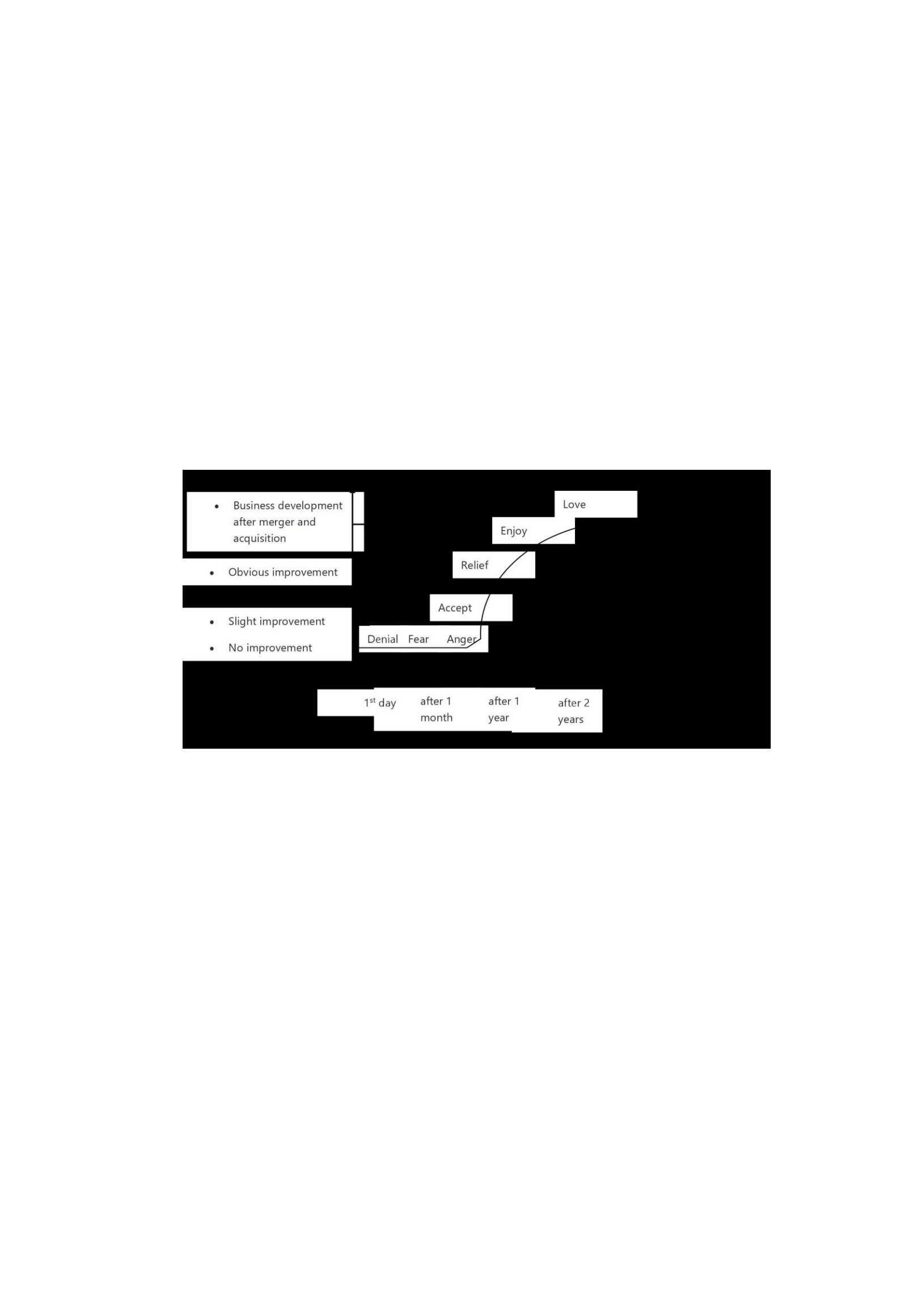
which will greatly enhance the attraction of the new company. The most direct indicator
of a company's prospects is its post-merger growth. According to the study of Marx M.
Habe et al., (2003) as the business development status of the enterprise after the merger
has never been improved -slightly improved -- significantly improved, the psychological
emotions of the employees after the merger have also experienced a process from
negation -- fear -anger -- recognition -- relief -- love -- enjoyment. As can be seen (below
Figure), good corporate performance can help relieve the mental pressure of employees,
make them forget the "pain" caused by the merger, and accept the new company from the
bottom of their hearts, thus generating new cohesion and sense of belonging, which lays
a good foundation for the smooth progress of cultural integration after the merger.
Figure 4-4 Change Curve of Employee Psychology and Behavior after Merger and Acquisition
4.6.4.4 Psychological contract strength of employees to the original enterprise
According to the international definition of enterprise, enterprise is an economic
organization formed by owners of various production factors in order to pursue their own
interests through contract. In other words, the firm is "a combination of contracts", a chain
of contracts. These contracts may be written and explicit, or they may be oral,
psychological, and implicit. The former is the formal economic contract which is often
talked about in the theory of the firm, and the latter is what we call the informal
psychological contract. The organizational psychologist Argyris (I960) originally

introduced the idea of psychological contrast in his book Understanding Organizational
Behavior. Originally used to denote an implicit or unwritten agreement or understanding
between an employer and a business. (Levinson, 1962; Kotter, 1973), and later Rousseau
(1990) defined it as the belief of employees and enterprises on mutual responsibility,
which is embodied in the subjective agreement of mutual responsibility and obligation.
From the dimension of psychological contract, there are two-dimensional structure theory
and three-dimensional structure theory. For example, the psychological Contract was
separated into two categories by Rousseau (1990), Transaction Contract and Relational
Contract. The transaction contract is that employees work overtime and work beyond
their responsibilities at a cost. It is a contractual partnership based on economic
transactions in exchange for high compensation, performance rewards, training, and
career development supplied by the company. In a relationship contract, employees trade
their long-term labor, loyalty, and readiness to accept internal work adjustments for the
organization's long-term employment security. This type of contract is built on the
exchange of social feelings. Arnold (1996) and Kickul J; Lester S. W. (2001) divided
psychological Contract into Intrinsic Contract and Extrinsic Contract. An extrinsic
contract involves an organization's commitment to the performance of employees. For
instance, flexible working hours, a secure work environment, competitive pay and
bonuses, and intrinsic contract refer to the commitment made by the company regarding
the nature of employees' work, such as job choice, independent decision-making, self-
control, engaging in challenging work, providing organizational support, participating in
decision-making, having development opportunities, and so forth. Shapiro J. C. and
Kessler L. split the psychological contract into three categories in 2000: Relational
Obligation, Transactional Obligation, and Training Obligation.
From the concept and dimension of psychological contract, we can see that the
psychological contract between employees and enterprises can be measured not only by
the mutual exchange of money or other economic values, but also mainly by the mutual
exchange or shared values, beliefs, expectations, satisfaction, and other psychological
perceptions. In this sense, the integration of enterprise culture after the merger is actually
the integration process of the psychological contract of the employees of the acquired

enterprise, that is, according to the degree of integration, either the continuation of the
original psychological contract, adjustment, and modification, or completely rebuild. The
emphasis and difficulty of the integration process are related to the strength of the
psychological contract between the employees of the acquired company and the original
enterprise. Strength refers to the firm degree of emotional bond between an employee and
the enterprise where he or she is working. There are three factors affecting the strength:
first, working experience. The longer an employee works in an enterprise, the more
emotional and energy he or she will invest in the enterprise, and the stronger the
psychological contract will be. Second, the degree of recognition of corporate culture and
management style. The higher the degree of recognition, the stronger the satisfaction of
employees with the enterprise. Third, human resource factors include matching the degree
of job requirements and abilities, job richness and employee participation, evaluation and
compensation system, career development training, etc. Thus, the more the psychological
contract's strength, the greater the feeling of loyalty and belonging to the original
business, and the greater the satisfaction with the business's current state. Employee
passivity and non-cooperation at the very least, or employee public resistance at worst,
will result from the merger and acquisition firm's decision to radically modify the target
enterprise. Thus, it is essential to thoroughly comprehend the psychological contract
status of the acquired party's employees at the outset of the cultural integration process
and to implement the necessary integration strategies.
4.7 Current situation of talent retention
Since S Company entered the market at the beginning of 2002, its business
development is relatively stable. In the initial stage, the business scale is relatively small,
with an annual growth rate of more than 30%. Later, it enters the stage of stable
development, with an annual growth rate of 10%-15% in the past five years.The business
is in good health, plus the leading position of brand and technology in the industry, the
turnover rate of S Company has been relatively low, keeping below 8%.
Analysis of the problems and causes of key personnel turnover

When it comes to brain drain, many people will think of salary first.It is often said
that water flows to the bottom, while man struggles to the top. However, when there is a
flow of talent, it is easy to feel that the salary must be too low and the benefits are not
good enough, so the talent goes to the enterprises with better pay. In fact, this is a common
misinterpretation, which is to treat the result of talent mobility as the cause. Regardless
of whether a person is qualified as a talent in an organization or not, whenever there is
turnover, they will always choose a position with higher pay, excluding some individual
special reasons. The increase in pay almost always goes along with the turnover. But this
only shows that when talents decide to leave for another job, they will always choose a
position with better salary or benefits, which is a phenomenon of talent mobility, not its
cause.
As mentioned in the first chapter above, foreign experts have been studying the
causes of talent mobility for a long time. No matter James Price's Price-Muellet model or
March and Simon's turnover intention model, their research mainly focuses on internal
and external reasons. The internal reasons are mainly the job expectations of talents and
the degree of realization of work value, while the external reasons are mainly the
emergence of new job opportunities and the fluctuation of labor market value. From these
analysis, it can be seen that the loss of talents is not simply due to the increase of salary.
4.7.1. Descriptive statistics
Goal Explore the basic background of the sample.
Table4 -7 Frequency Analysis Results
Cumulative
Questions Options Frequency Percentage(%)
Percentage(%)
63
62.4
62.4
38
37.6 100.0
Post-Merger
Employment Status
Still Employed
left the company

Male 53 52.48 52.48
3~5
Years 4 3.96 3.96
15 14.85
18.81
14 13.86
32.67
10+ Years 68 67.33 100.00
10 9.90 9.90
62
61.39
71.29
29 28.71
100.00
6 5.94 5.94
30 29.70 35.64
30 29.70 65.35
35 34.65 100.00
35
34.7 34.7
Marketing
19
18.8
18.8
Sales
47
46.5
65.3
Channel or
Position Operations 14 13.9 79.2
Finance,
Administration, 21 20.8 100.0 etc.
66 65.3 65.3
Position Type
34.7 100.0
Gender
:
Female
48
47.52
100.00
Work Experience
(Years):
5~8 Years
8~10 Years
Associate degree
Education
:
Bachelor’s Degree
Master’s Degree
Less than 1 Year
Years with Acquired
1-3 Years
Company
:
3~5 Years
5~8 Years
Frontline position
supporting position
35
Questions
Options
Frequency
Percentage(%)
Cumulative
Percentage(%)
Experience
Level
New
Employee
Senior
Employ
ee
66
65.3
100.0

92 91.1 91.1
Job title
9 8.9 100.0
Leading Team101 100.0 100.0 Startup 1 1.0 1.0
The nature of the1 1.0 2.0 company that
was acquired90 89.1 91.1
9 8.9 100.0
Total 101 100.0 100.0
Post-Mergers and Acquisitions (M&A) Employee Tenure:
Among the surveyed employees, 62.4% remained with the company after the merger
or acquisition, while 37.6% had already left. This indicates that the M&A had a certain
impact on employee stability, with a portion of the staff choosing to depart.
Gender Distribution: In the surveyed employees, males accounted for 52.48%, and
females accounted for 47.52%. The gender distribution was relatively balanced, with no
significant gender inclination.
Tenure Distribution: Looking at the tenure distribution, 3.96% of employees had 3
to 5 years of service, 14.85% had 5 to 8 years, 13.86% had 8 to 10 years, and the highest
percentage, 67.33%, had more than 10 years of service. This indicates that long-term
employees made up a significant proportion of those surveyed.
Education Composition: In terms of education, employees with a Bachelor's Degree
were the most numerous, accounting for 61.39%, followed by those with a Master's
Degree, at 28.71%, while employees with an Associate degree were the least, at 9.90%.
This suggests that the surveyed employees generally had a higher level of education.
Years of Service at the Acquired Company: Regarding the length of service at the
company before the acquisition, the most employees, 34.65%, had been with the company
for 5 to 8 years, followed by 29.70% for 1-3 years and 3~5 years, respectively. This
indicates that the distribution of years of service among the surveyed employees at the
acquired company was relatively even, with a mix of long-term and more recent
employees.
Manager/Senior
Manager
Director/Senior
Director
Leading Team
State-Owned
Enterprise
Foreign Enterprise
Well-Known
Private Enterprise

New Employee vs. Senior Employee Ratio: According to the survey, new employees
(those who had been with the company for less than 3 years after the acquisition) made
up 34.7%, while senior employees (those with more than 3 years of service) accounted
for 65.3%. This shows that senior employees were the majority in the survey sample,
possibly due to the company's stable operations, good business development, and low
employee turnover rate.
Position Distribution: In terms of position distribution, the most employees were in
Sales positions, accounting for 46.5%, followed by Marketing, Channel or Operations,
and Finance, Administration, etc. This reflects the distribution of different positions in the
survey sample, which may be related to the company's products or services requiring
more sales personnel, or it may indicate that the company is sales-oriented or places
emphasis on marketing development and customer relationship management.
Position Type: Looking at the position type, 65.3% of employees were in frontline
positions, and 34.7% were in supporting positions. The higher number of frontline
position employees may reflect the company's business focus and personnel allocation.
Job Title Distribution: In terms of job titles, employees at the Manager/Senior
Manager level accounted for the highest percentage, reaching 91.1%, while those at the
Director/Senior Director level were fewer, at 8.9%. This indicates that the surveyed
employees were mainly concentrated in middle management positions.
Leading Team: Among the 101 surveyed employees, 100% indicated that they led a
team before the acquisition. This shows that the surveyed employees generally had certain
managerial responsibilities and team leadership capabilities.
The Nature of the Company That Was Acquired: Looking at the nature of the
company that was acquired, Foreign Enterprises accounted for the highest percentage, at
89.1%, followed by Well-Known Private Enterprises, at 8.9%, while Startups and State-
Owned Enterprises had lower percentages. This reflects the fact that the survey sample
primarily came from Foreign Enterprises and Well-Known Private Enterprises.
Conclusion: In terms of gender, more than 50% of the samples were "male". From
the perspective of years of service (the total number of years engaged in all jobs): In the
sample, "more than 10 years" is relatively large, accounting for 67.33%. In terms of

educational background: most of the samples are "undergraduate", the proportion is
61.39%. At the same time, the working life of the sample in the acquired company is
generally longer.
4.7.2. Sample characteristics analysis
Goal
Explore the basic characteristics of the sample and understand the preference of the
sample when choosing the company by analyzing the selection frequency and
responsiveness, so as to understand the sensitivity of the sample to various variables.
For the multiple-choice questions in the second part of the survey, preferences when
selecting a company are understood by analyzing choice frequencies and response rates.
This helps to determine the sample's sensitivity to various variables and to explore the
basic characteristics of the sample.
A multiple response cross Chi-Square analysis is employed to understand if there
are any significant differences among the options within each question.
Q13 Analysis of the main reasons for initially joining the original company (the
acquired company):
Table 4 -8 Chi-Square Analysis of Reasons for Joining the Acquired Company
multiple-choice question Observed ExpectedResidualChi-Squaredf Asymptotic options
significance
Employment Pressure 8 53.3 -45.3
Major Relevance 27 53.3 -26.3
The company is large and
30 53.3 -23.3 enjoys a
strong reputation
Like the Job 51 53.3 -2.3
Salary and Benefits 55 53.3 1.8
122.657 7 .000
Capable of fulfilling this
74 53.3 20.8 position
The company has
promising development 86 53.3 32.8 prospects.
Personal Development 95 53.3 41.8
426

The results of the analysis indicate the following:
1.The Chi-Square value is 122.657, and the P-value is less than 0.001, which means
there is a significant difference in the main reasons respondents initially joined the
original company (the acquired company).
2.The primary concerns for respondents when joining the original company were
Personal Development, the belief that the company has promising development
prospects, and the capability to fulfill the position requirements.
3.The least concerning reasons for respondents were Employment Pressure, Major
Relevance, and the company's large size and reputation in society.
Table 4-9-1 Chi-Square Analysis of Partial Reasons for Joining the Acquired
Company
When choosing their original workplace, there was no significant difference in the
reasons "Capable of fulfilling this position," "The company has promising development
prospects," and "Personal Development."
Table 4-9-2 Chi-Square Analysis of Partial Reasons for Joining the Acquired Company
multiple-choice question
Observed
Expected
Residual
Chi-Square
df
Asymptotic
options
Significance
(p)
Like the Job
51
55
72.2
72.2
-21.2
-17.2
.000
Salary and Benefits
Capable of fulfilling this
1.8
multipl
e-choice
n
questio
s
option
Observed
Expected
Residual
Chi-Square
f
d
Asymptotic
Significance
)
p
(
Capabl
e
of
fulfilling
s
thi
positio
n
74
85.0
-11.0
2
2.61
2
0.271
The
company
has
g
promisin
development
prospects.
86
85.0
1.0
Personal
Development
9
5
85.0
10.0
25
5

position
74
86
72.2
72.2
72.2
20.205a
4
The company has
13.8
22.8
promising development
prospects.
Personal Development
95
Total
361
Upon analyzing certain options, it was found that with a P-value less than 0.001, the
five reasons show significant differences. When employees were choosing to join the
original company, the most important factor was Personal Development, followed by the
company's development prospects. In comparison, salary and compensation benefits, as
well as the factor of liking the job, were not the main driving factors.
Table 4-9-3 Chi-Square Analysis of Partial Reasons for Joining the Acquired
Company
Observe
d
Expe
Residua
Chi-Squar
df
Asymptotic
cted
l
e
Significance
(p)
The company is
.020
large and enjoys a
30
40.5
5.444 1
-10.5
10.5
strong reputation
in society
Like the Job
51
81
40.5
Total
When comparing these two conditions, with a P-value of 0.02, which is less than
0.05, it indicates that there is a significant difference between the two reasons. This
suggests that employees were more inclined to choose "Like the Job" as the main reason
for joining the original company, rather than "The company is large and enjoys a strong
reputation in society." This indicates that for these employees, personal preference for the
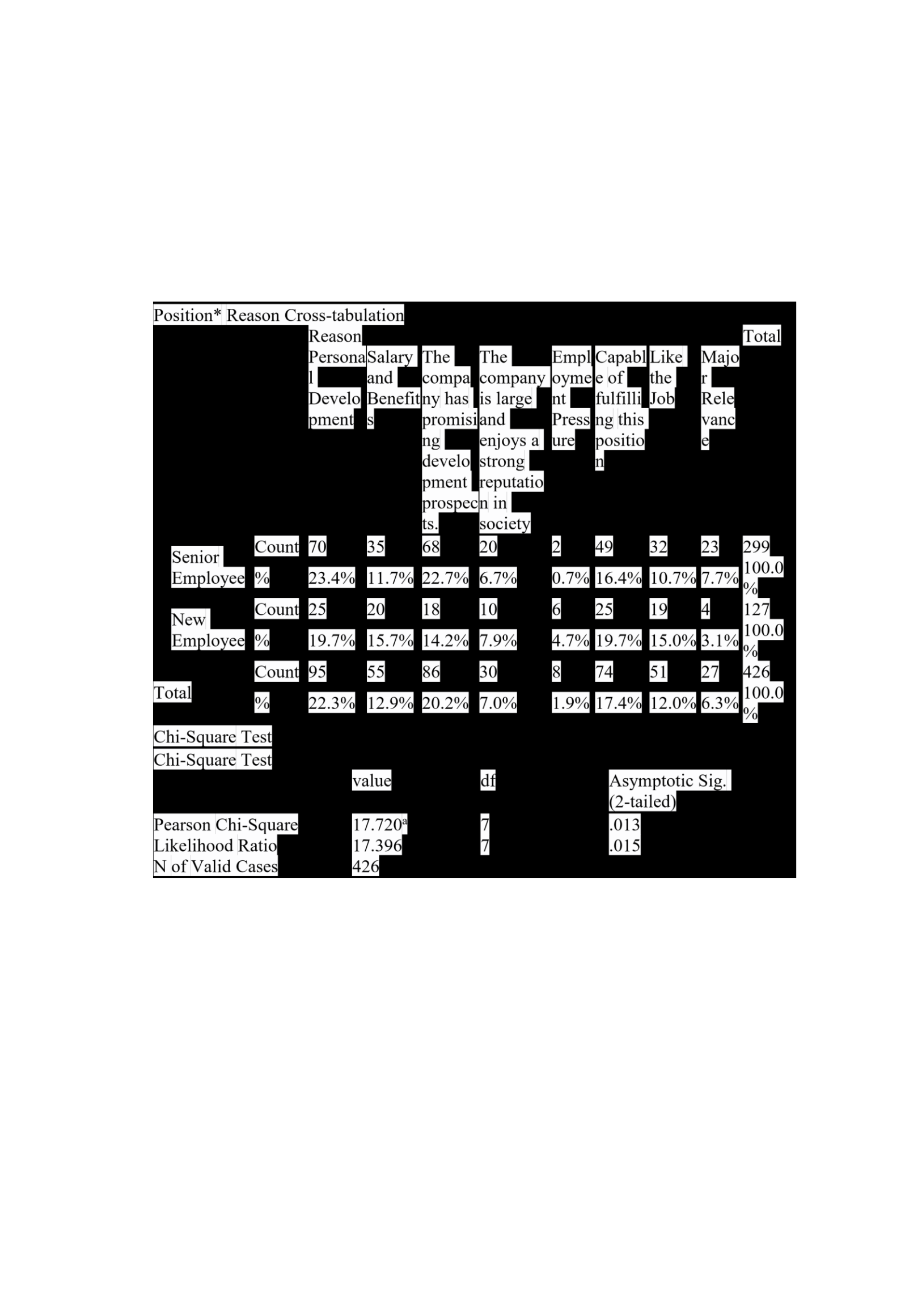
job is a more important consideration, and in comparison, the size and reputation of the
company may not be the primary driving factor.
Table 4-10 Chi-Square Analysis of Employee Retention Status in Relation to Reasons
for Joining the Acquired Company
With a P-value of 0.013, which is less than 0.05, there is a significant difference in
the reasons why new Senior Employees chose to join the original company (the acquired
company) at the time.
There are differences in the distribution of choices among the various reasons for
new Senior Employees. Senior Employees are more inclined to select "Personal
Development," "The company has promising development prospects," and "Capable of
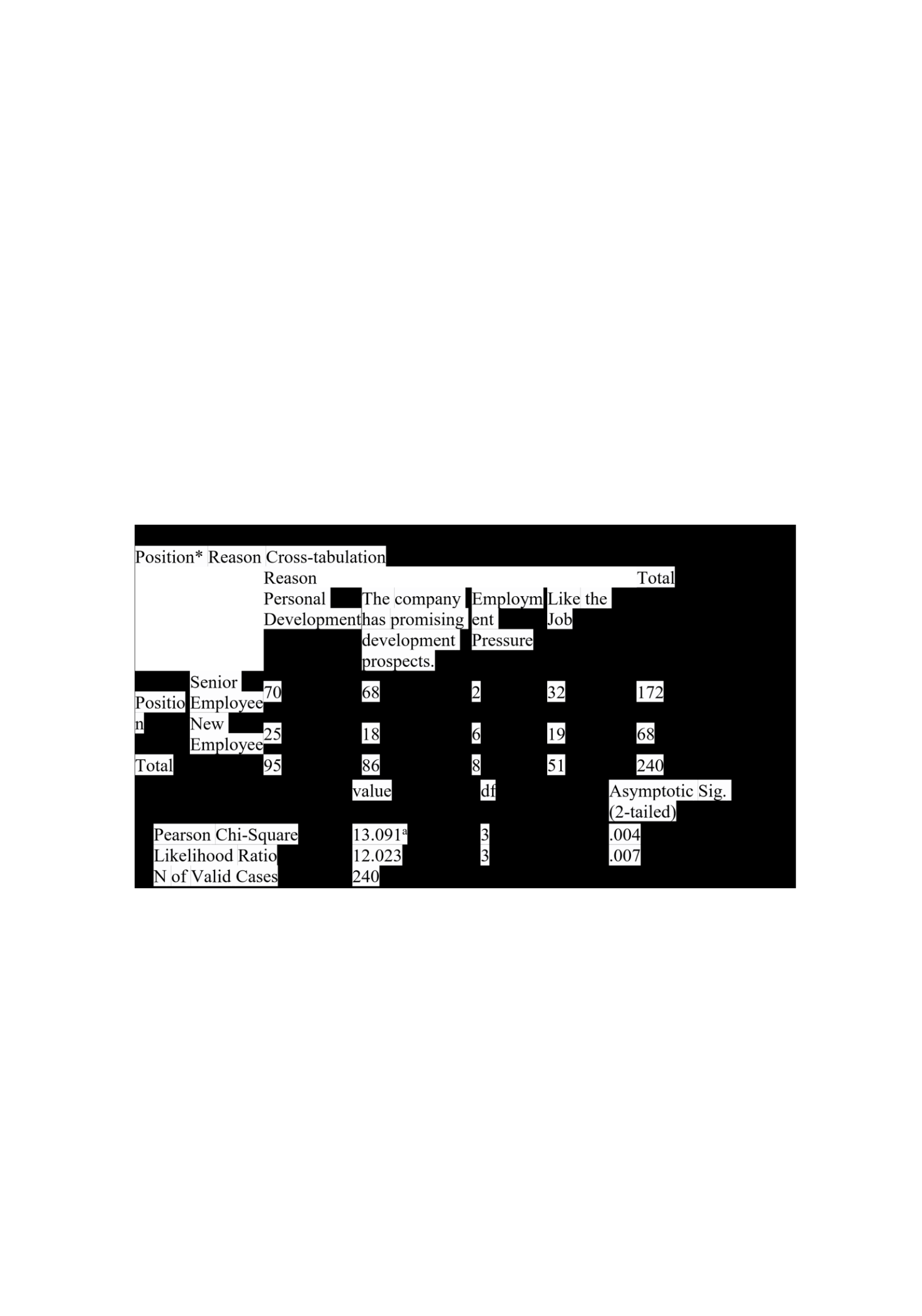
fulfilling this position," while New Employees have relatively higher proportions of
choices in "Salary and Benefits," "Like the Job," and "Major Relevance."
Senior Employees have a significantly higher proportion of choices in "Personal
Development" and "The company has promising development prospects" compared to
New Employees. New Employees have a higher proportion of choices in "Salary and
Benefits," and their choices in "Like the Job" and "Major Relevance" are also slightly
higher than those of Senior Employees.
Analysis of the concerns of new and old employees about material conditions when
they joined the original company.
Table 4-11 Chi-Square Analysis of Spiritual Reasons for New and Senior Employees
Joining the Merged Company
Within the spiritual aspects, there are differences: with p=0.007, which is less than
0.05, it indicates that there is a significant difference in the factors that Senior Employees
consider. Senior Employees place greater emphasis on personal development and
improvement, as well as "The company has promising development prospects," and are
the least concerned about work pressure. The attention that Senior Employees pay to "The
company has promising development prospects" significantly exceeds that of "Like the
Job."
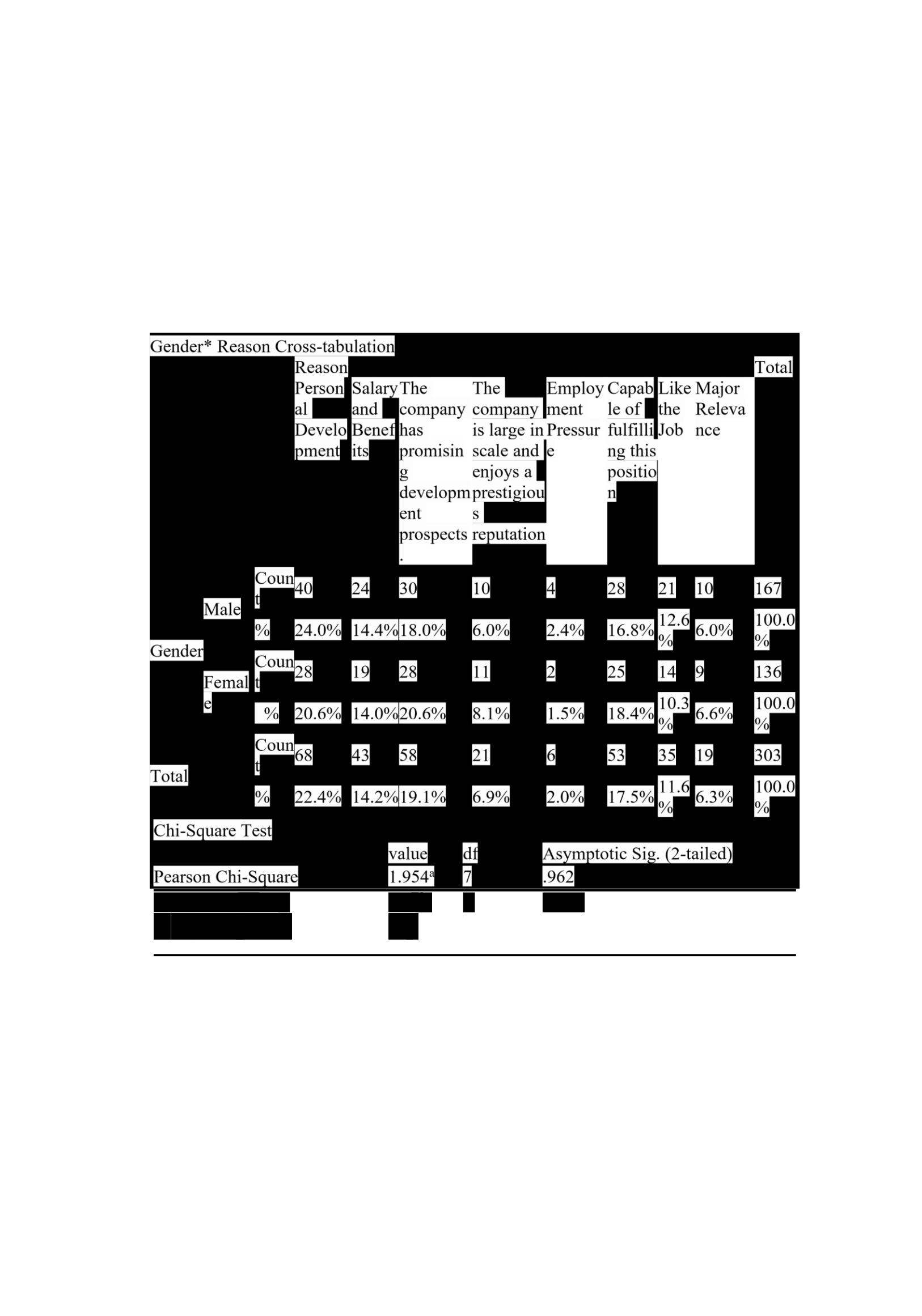
New Employees are most concerned with "Personal Development," followed by
"Like the Job." The level of concern for "Like the Job" is comparable to that for "The
company has promising development prospects."
Table 4-12 Chi-Square Analysis of Reasons for Male and Female Employees Joining
the Acquired Company
Male and female employees have very similar main reasons for choosing to join the
original company, with no significant differences.
Table 4-12-1 Chi-Square Analysis of Reasons for Joining the Acquired Company by
Different Job Types
Likelihood
Ratio
3
6
1.9
7
.962
N
of
Valid
Cases
30
3
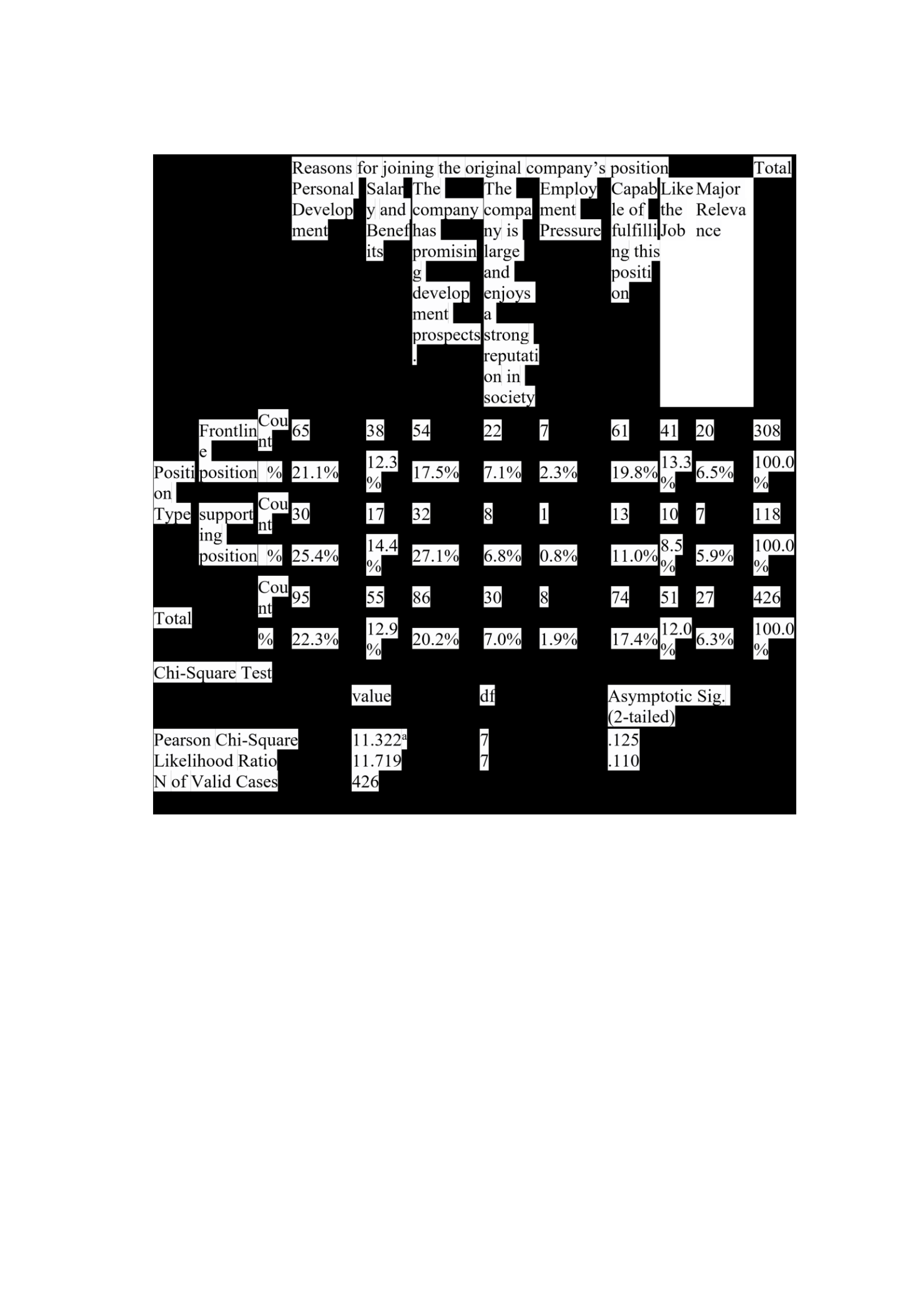
Employees in Front-line positions and those in supporting positions do not show
significant differences in their Reasons for joining the original company.
Table 4-13 Chi-Square Analysis of Reasons for Joining the Acquired Company by
Different Position
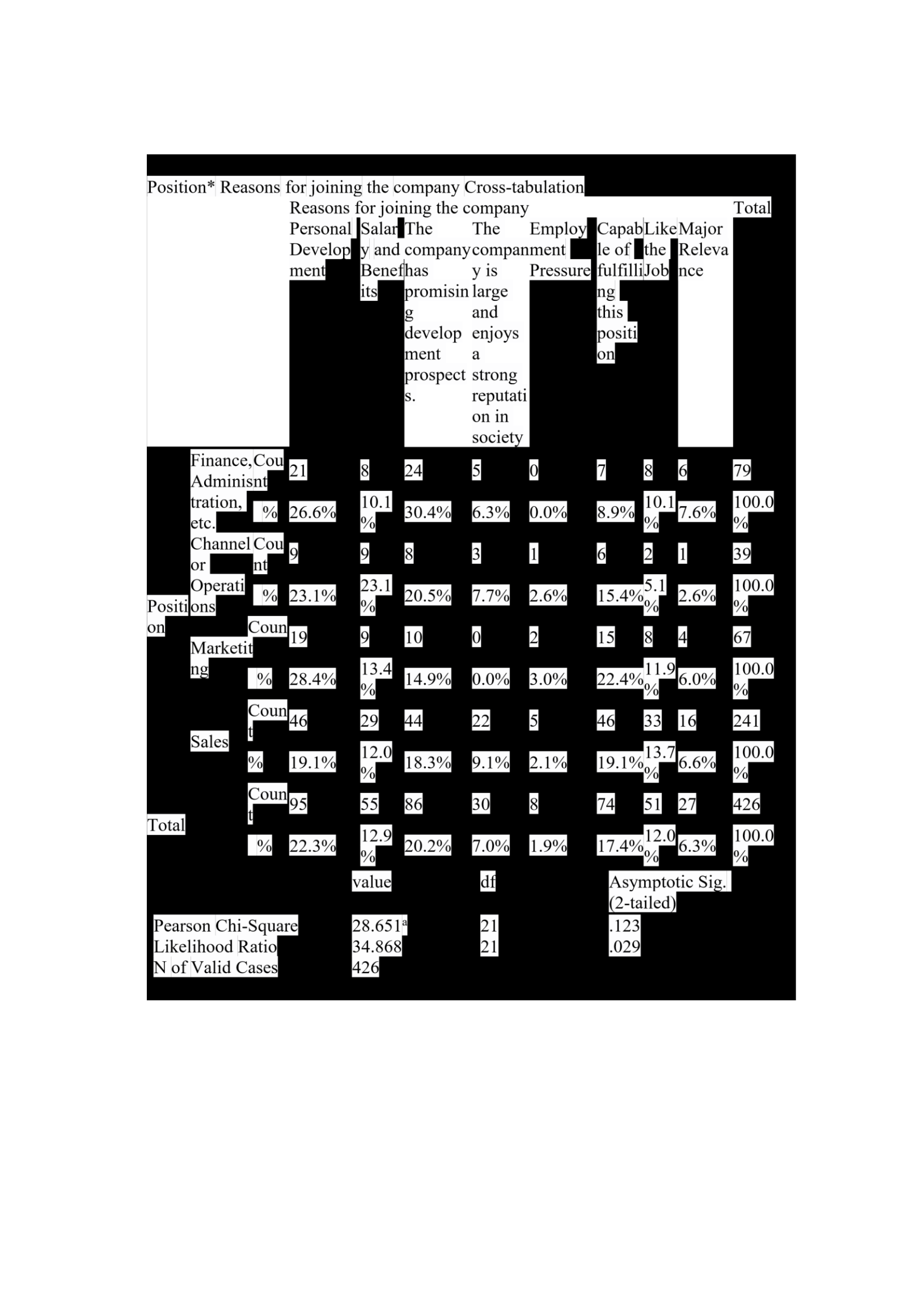
There are no significant differences in the Reasons for joining the original company
among employees of different positions.
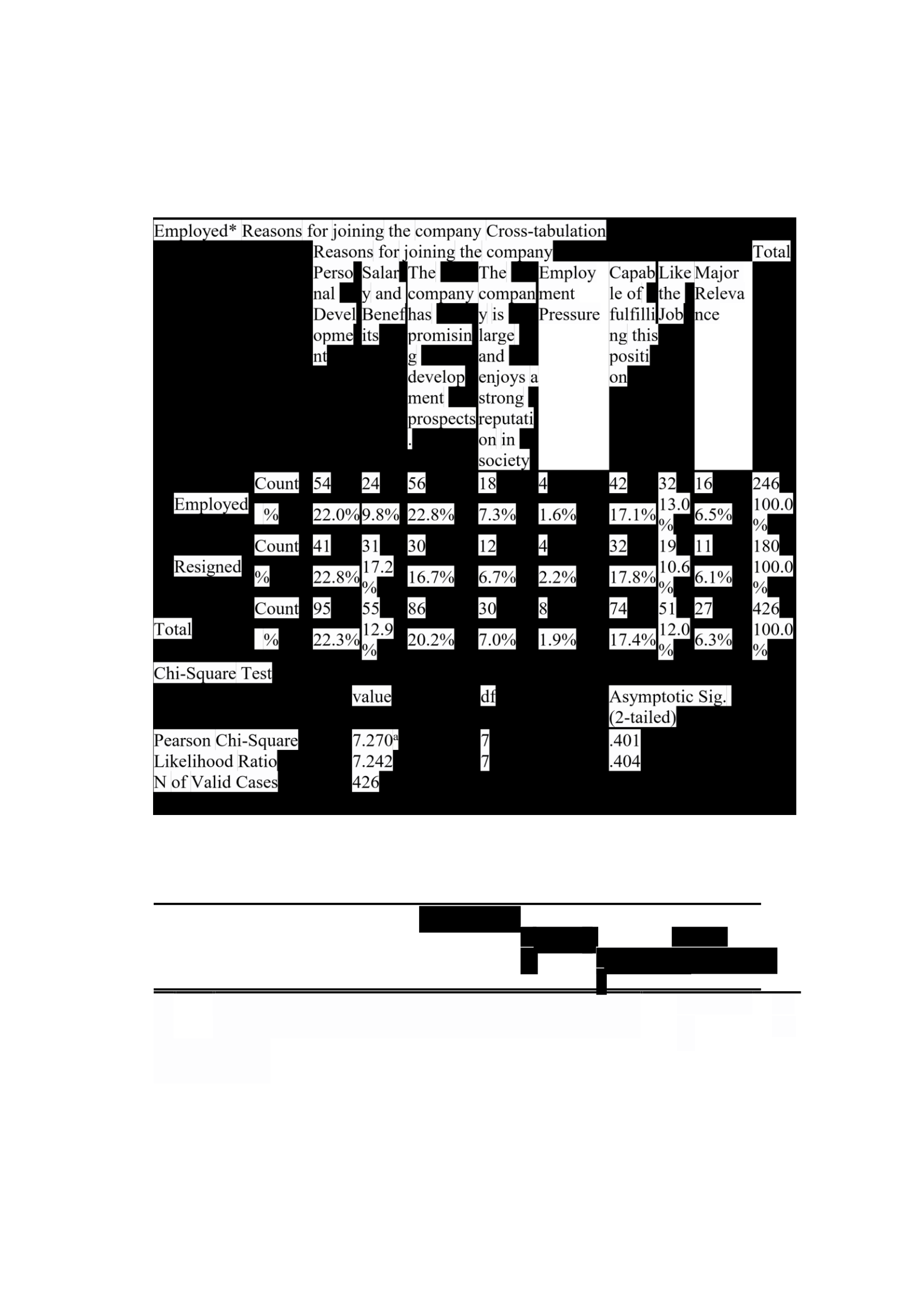
Table 4-14 Chi-Square Analysis of Reasons for Joining the Acquired Company by
Whether still employed
Whether an employee is still with the company or has left shows no significant
difference in the reasons for joining the original company.
Table 4-15 Frequency of the advantages for working at the acquired company
Th
e
Company’s own development has
64 15.5%
54
13.0%
46.
0%
advanta
ge
advanta
ges
Frequency
R
espons
e
Cases
Percentage
N
Percentag
e

s
of
Good salary
and benefits
65
15.7%
67
16.2%
86
20.8%
78 18.8%
38.
8%
46.
8%
48.
2%
61.
9%
56.
1%
choos
ing
Stable, good working environment
to work in Ability to realize self-worth
th
e
Internal
harmonious
relationships
prospects
original
acqui
red
Good company development
comp
any
Tot
al
4
1
4
100.
0%
29
7.8
%
The table above presents the primary advantages cited by employees for working at
the acquired company, highlighting job stability, self-worth realization, and harmonious
internal relationships as the most valued benefits.
Table 4-16 Chi-Square Analysis of the advantages for working at the acquired company
multiple-choice
Observed
ExpectedResidual
Chi-
Square
df
Asymptotic
significance
question options
Good salary and
54 69.0 -15.0
64 69.0 -5.0
9.275
5
.099
benefits
Company’s own
development has
advantages
Stable, good working
65
69.0
-4.0
-2.0
9.0
environment
69.0
69.0
Ability to realize
67
self-worth

Internal harmonious
78
86
69.0
17.0
relationships
Good company
development
prospects
Total
414
With a P-value of 0.099, which is greater than 0.05, the difference is not significant.
This indicates that there is no significant difference in the selection of six advantages that
employees consider for choosing to work at the original company that was acquired.
Table 4-17 Chi-Square Analysis of the Partial advantages for working at the acquired
company
multiple-choice question
Observed
Expecte
Residu
Chi-Squ
df
Asymptotic

105
options
d
al
are
significanc
e
Good salary and benefits
54
70.0
-16.0
7.314
1
.007
Good company
70.0
16.0
development prospects
86
Total
14
0
With a P-value of 0.007, which is less than 0.05, there is a significant difference
between "The company has promising development prospects" and "Good salary and
benefits." Survey respondents are more likely to stay and work at the original company
acquired because "The company has promising development prospects."
Table 4-18 Chi-Square Analysis of the Partial advantages for working at the acquired
company
multiple-choice question
Observed
Expecte
Residu
Chi-Squ
df
Asymptotic
options
d
al
are
significance
Good salary and benefits
54
66.0
-12.0
4.364
1
.037
Internal harmonious
78
66.0
12.0
relationship
s
Total
132
With a P-value of 0.007, which is less than 0.05, there is a significant difference
between "Internal harmonious relationships" and "Good salary and benefits." Survey
respondents are more likely to remain at the original company that was acquired due to
"Internal harmonious relationships."
Table 4-19 Chi-Square Analysis of Turnover Rates by Gender

106
Correctionb
1
1
.128
.129
.171
.088
Likelihood Ratio
2.319
Fisher’s Exact Test
2.299
Linear-by-Linear
Association
N of Valid Cases
139
Employees of different genders do not show significant differences in terms of
whether they leave the company or not.
Table 4-20 Chi-Square Analysis of Turnover Rates by Experience Level
still
ed
employ
left
the
company
l
Tota
Gender
:
Male
Count
0
3
46
7
6
cted
Expe
Count
34.4
41.6
76.0
Female
Count
33
30
63
cted
Expe
Count
28.6
34.4
63.0
Total
Count
63
76
139
cted
Expe
Count
63.0
76.0
139.0
Chi-Square
Test
value
f
d
mpto
tic
Asy
Sig.
ailed
t
(2-
)
Exact
Sig.
(
)
Two-tailed
Exact
Sig.
(
)
One-tailed
Pearson
C
hi-Square
2.31
6
a
1
.128
Continuity
1.82
4
1
.177
still
employed
left
the
ny
compa
Total
Position
Marketing
Coun
t
16
6
2
2
Expe
cted
10.0
12.0
22.
0
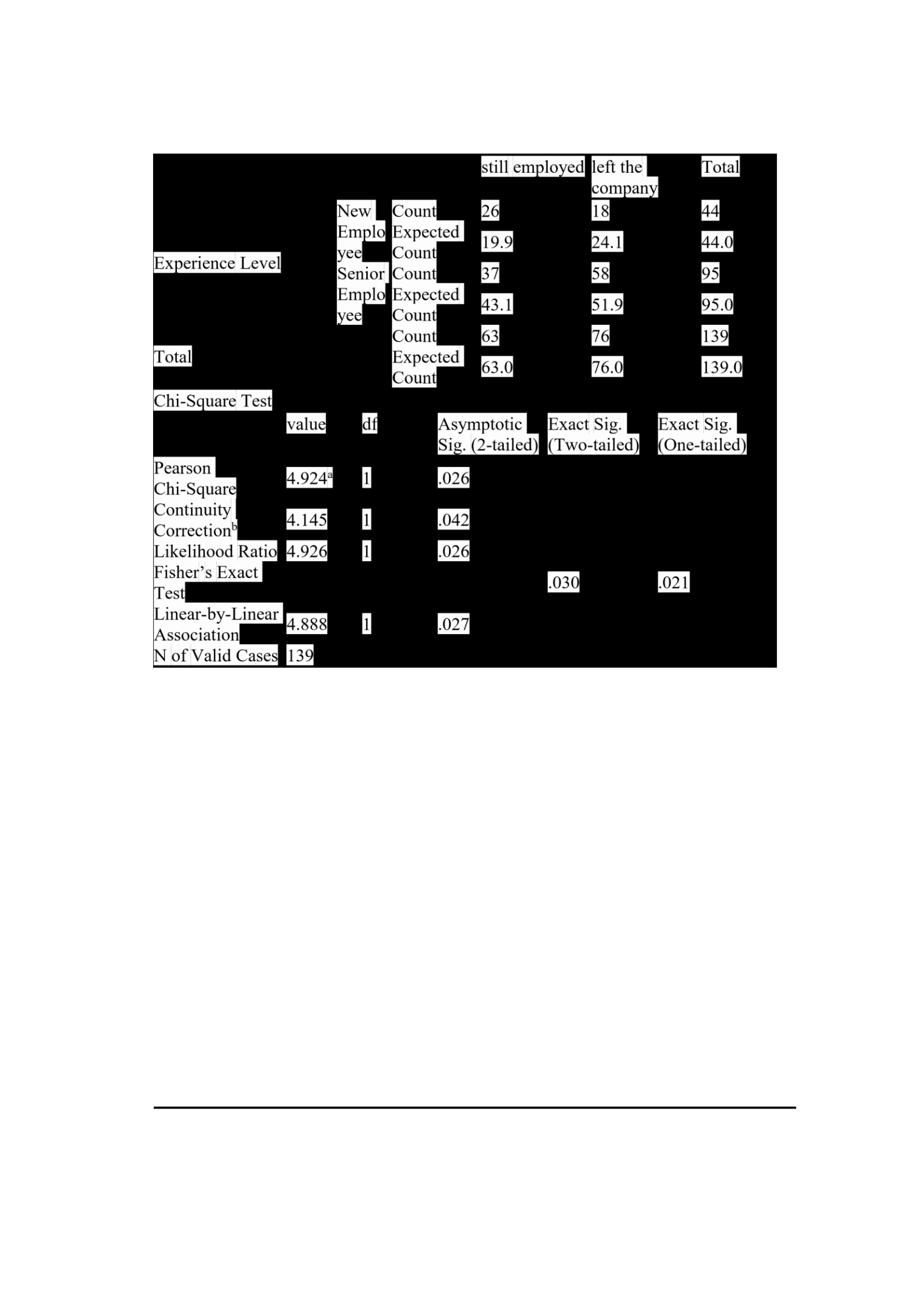
107
There is a significant difference in the likelihood of leaving the company between
new and senior employees, with a higher proportion of Senior Employees choosing to
depart.
Table 4-21 Chi-Square Analysis of Turnover Rates by different position
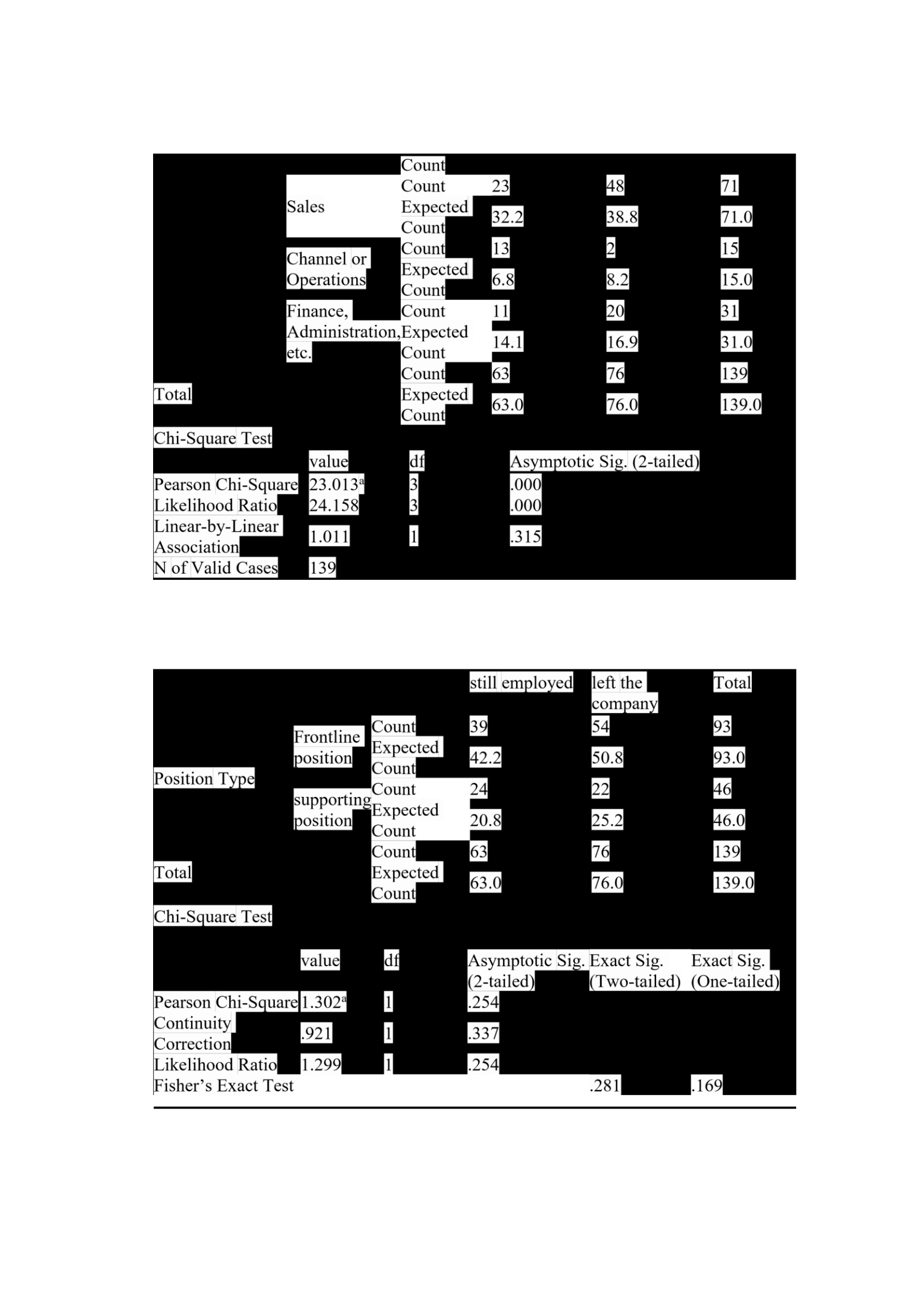
108
There are significant differences in the turnover rates among employees of different
positions, with the Sales position having a higher departure rate.
Table 4-22 Chi-Square Analysis of Turnover Rates by different position type
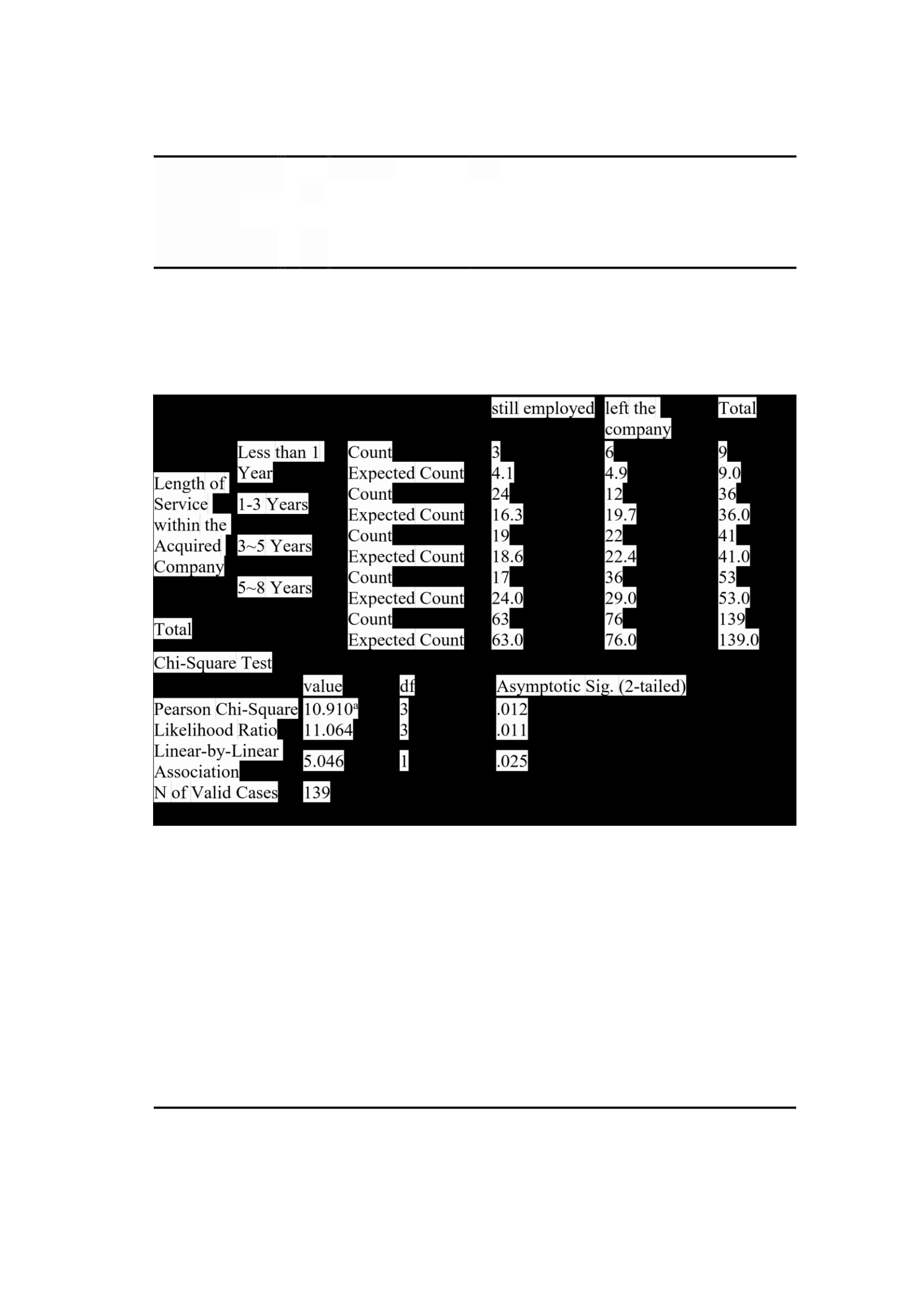
109
The turnover situation between Front-line position and supporting position shows
no significant difference.
Table 4-23 Chi-Square Analysis of Turnover Rates by Length of Service within the
Acquired Company
significant turnover differences. Those who have worked for the original company for 5-
8 years tend to leave more frequently, while employees with 1-3 years of service are
more inclined to remain with the company.
Table 4-24 Chi-Square Analysis of Turnover Rates by different job title
Linear-by-Linear
1.2
93 1
.256
Association
N of Valid Cases
139

110
still
employed
left
the
ny
compa
Total
Job
e
titl
Manager/Senior
r
Manage
t
Coun
56
72
128
Expe
cted
Count
.
58
0
.0
70
128
.0
Director
/Senior
Director
Coun
t
7
4
11
Expe
cted
Count
5.
0
6.0
11.0
Total
Coun
t
63
76
139
Expected
Count
63.
0
76.0
139.0
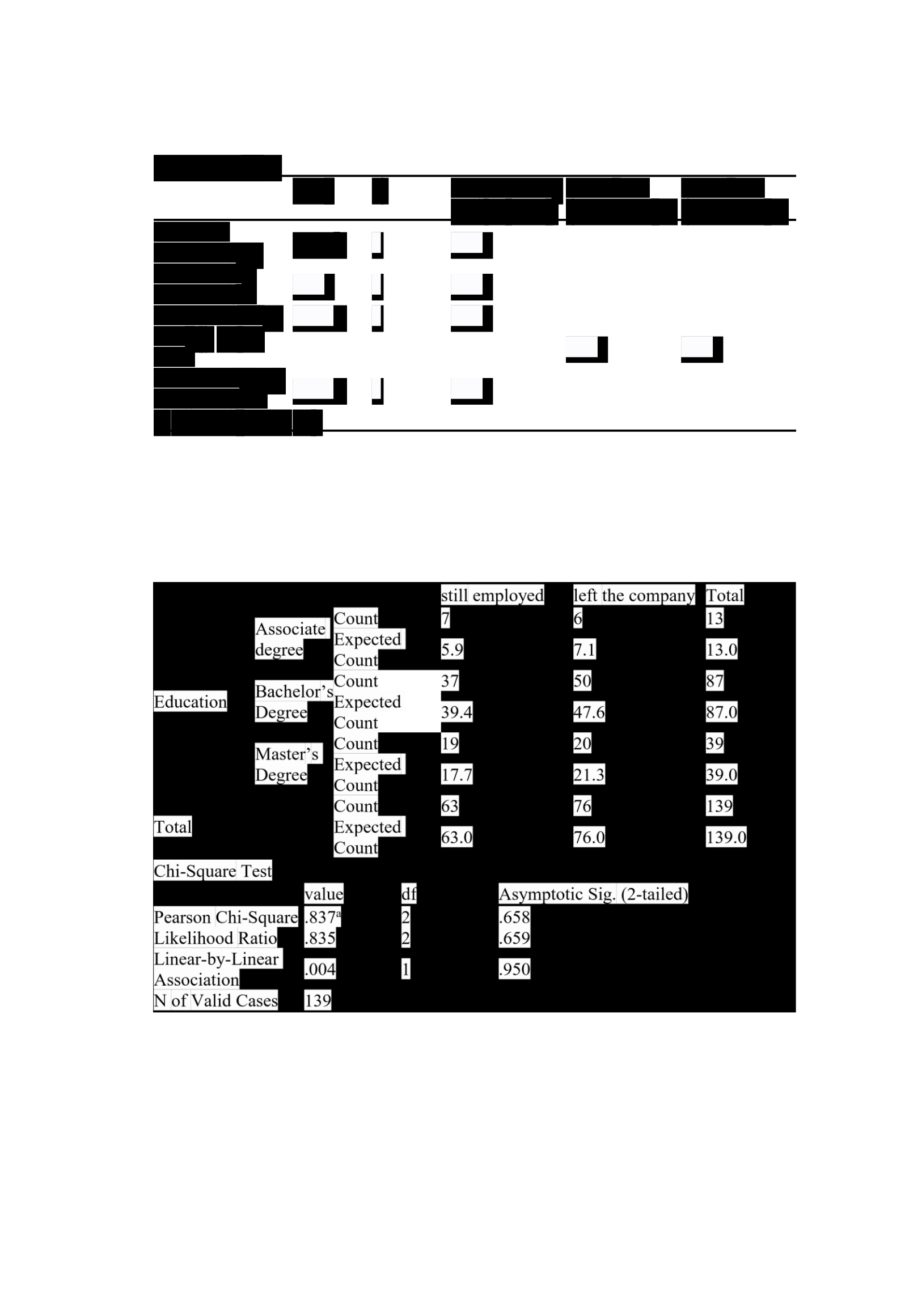
111
There are no significant differences in turnover among employees with different job
titles.
Table 4-25 Chi-Square Analysis of Turnover Rates by different job title education
degree
There are no significant differences in the turnover situation among employees with
different levels of education.
Chi-Square
Test
e
valu
d
f
Asymptotic
Sig.
)
tailed
(2-
Exact
Sig.
)
Two-tailed
(
Exact
Sig.
)
(
One-tailed
Pearson
Chi-Square
1.616
a
1
.204
Continuity
Correction
b
.914
1
.339
Likelihood
tio
Ra
1.616
1
.204
er
Fish
’
s
act
Ex
Test
.225
.170
Linear-by-
Linea
r
Association
1.605
1
.205
N
of
Valid
Cases
13
9

112
Table 4-26 Chi-Square Analysis of Turnover Rates by different age
still employed
left the company
Total
30-33
Age 34-36
37
and
above
Total
Count
8
6
14
Expected Count
6.3
7.7
14.0
Count
17
24
41
Expected Count
18.6
22.4
41.0
Count
38
46
84
Expected Count
38.1
45.9
84.0
Count
63
76
139
Expected Count
63.0
76.0
139.0
Chi-Square Test
value
df
Asymptotic Sig. (2-tailed)
Pearson Chi-Squ
are
1.036a
2
2
1
.596
.597
Likelihood Ratio
1.033
Linear-by-Linear
.190
.663
Association
N of Valid Cases
139
There are no significant differences in the turnover situation among employees of
different age groups.
Table 4-27 Chi-Square Analysis of Turnover Rates by work experience
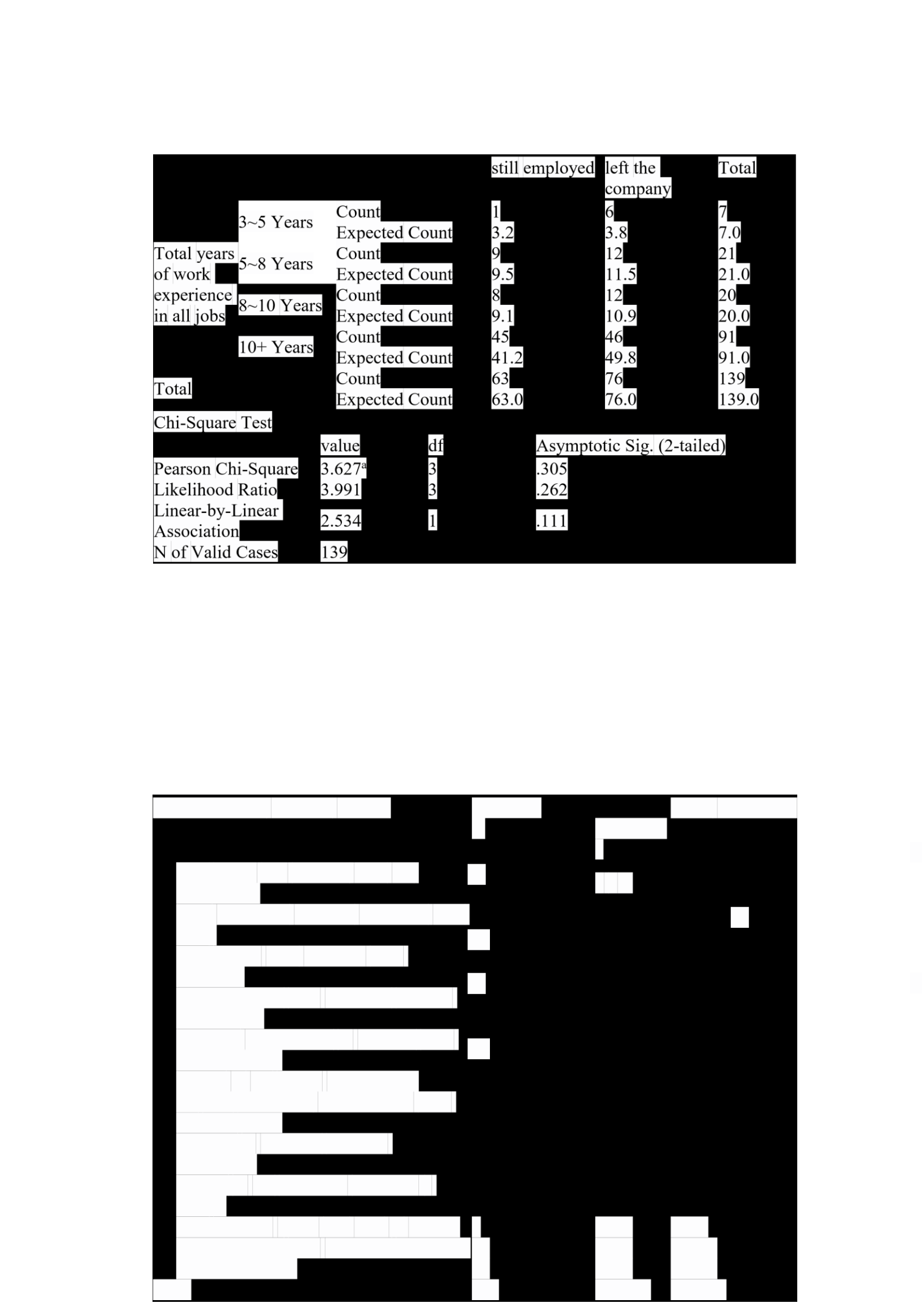
113
Employees with different total years of work experience show no significant
differences in turnover.
4.7.3Explore the influencing factors of turnover- single factor analysis
Goal:Explore the influencing factors of turnover and screen the factors included in
the equation before logistic regression.
4.7.3.1 From individual perception
Table 4-28 Frequency of Reasons for resignation if leaving after the acquisition
multiple-choice question options Response N
Low salary and benefits after the
15
acquisition.
High workload, frequent overtime, high
10 stress
Low salary, poor benefits, poor
16
treatment
Dissatisfaction with company policies
34 and
systems
Potential replacement of
position after
65 t
he acquisition
Impact of the macro
environment 12
Limited promotion
opportunities after
66 t
he acquisition
Inability to leverage
personal

114
44
advantages
Dislike of the acquiring company’s
62
culture
Low industry status and lack of respect 5
Dissatisfaction with company leadership33
Personal reasons 24
Total 386
Cases Percentage Percentag e
3.9% 11.5%
2.6% 7.2%
4.1% 11.5%
8.8% 24.5%
16.8% 46.8%
3.1% 8.6%
17.1% 46.8%
11.4% 31.7%
16.1% 44.6%
1.3% 3.6%
8.5% 23.7%
6.2% 17.3%
100.0% 277.7%
The data from Table indicates that the most frequently cited reasons for potential
resignation following an acquisition are dissatisfaction with company policies and
systems, followed by the potential replacement of position and limited promotion
opportunities after the acquisition. These concerns are closely linked to employees'
perceptions of job security and career advancement within the restructured organization.
Additionally, a significant number of respondents express discontent with the acquiring
company's culture, suggesting a possible misalignment between the merging entities'
cultural values, which could impact talent retention efforts.
Table 4-29 Chi-Square Analysis Reasons for resignation if leaving after the acquisition
ObservedExpectedResidual
Asymptotic
Chi-Squaredf
significance
Low industry status and lack of
5 32.2 -27.2 171.472
10 32.2 -22.2
11
.000
respect
High workload, frequent
overtime, high stress
Impact of the macro environment
12 32.2 -20.2
Low salary and benefits after the
15 32.2 -17.2
16 32.2 -16.2
acquisition.
Low salary, poor benefits, poor

115
treatment
24 32.2 -8.2 33
32.2 .8
34 32.2 1.8
44 32.2 11.8
62 32.2 29.8
65 32.2 32.8
66 32.2 33.8
Personal reasons
Dissatisfaction with company
leadership
Dissatisfaction with company
policies and systems
Inability to leverage personal
advantages
Dislike of the acquiring
company’s culture
Potential replacement of position
after the acquisition
Limited promotion opportunities
after the acquisition
Total
386
The Chi-Square value of 171.472 with a P-value less than 0.001 indicates that if
employees choose to leave after the announcement of the company's acquisition, the
reasons for their departure are not uniformly distributed but show extremely significant
differences.
When selecting reasons for leaving, employees are more inclined to cite "Limited
promotion opportunities after the acquisition," "Potential replacement of position after
the acquisition," and "Dislike of the acquiring company’s culture," while reasons such
as "Low industry status and lack of respect," "High workload, frequent overtime, high
stress" are less commonly cited.
Table 4-30 Chi-Square Analysis of Partial Reasons for resignation if leaving after the
acquisition

116
With a P-value of 0.044, less than 0.05, there is a significant difference between
"Potential replacement of position after the acquisition" and "Inability to leverage
personal advantages." This indicates that employees are more likely to leave due to the
"Potential replacement of position after the acquisition."
From the perspective of this question, in the context of mergers and acquisitions,
employees are more concerned about the stability and security of their positions and
relatively less focused on whether their advantages are being utilized. This may be
because mergers and acquisitions often involve organizational restructuring and
reassignment of positions, making the concern over potential replacement a more
prominent reason for leaving.
Table 4-31 Chi-Square Analysis of new and senior employees and reasons for
resignation
Reason* Position Cross-tabulation
Position Total
Senior New
EmployeeEmployee
Limited promotion opportunities Count 46 19 65 after the acquisition % 70.8%
29.2% 100.0% Low salary and benefits after the Count 10 6 16
acquisition. % 62.5% 37.5% 100.0%
Potential replacement of position Count 44 21 65
Reason
after the acquisition % 67.7% 32.3% 100.0% Dislike of the acquiring Count 41
21 62 company’s culture % 66.1% 33.9% 100.0% Dissatisfaction with company
Count 24 9 33
leadership % 72.7% 27.3% 100.0%
s
option
Observed
Expected
Residual
Chi-Square
d
f
Asymptotic
significance
Inability
to
leverage
personal
advantages
44
54.5
-10.5
4.046
1
.044
Potential
replacement
of
position
after
the
acquisitio
n
65
54.5
10.5
Total
109

117
Tot
al
Dissatisfaction with company
o
f
Cou
nt
2
3
1
1
3
4
policies and
systems
nefits, poor
quent
environmen
t
and lack
persona
l
%
67.6
%
32.4
%
100.0
%
Personal reasons
Low salary,
poor be
treatment
High
workload, fre
overtime, high
stress
Impact of the macro
Low industry status
respect
Inability to leverage
advantages
Cou
nt
1
9
5
2
4
%
79.2
%
20.8
%
100.0
%
Cou
nt
10
6
16
%
62.5
%
37.5
%
100.0
%
Cou
nt
7
3
1
0
%
70.0
%
30.0
%
100.0
%
Cou
nt
9
3
1
2
%
75.0
%
25.0
%
100.0
%
Cou
nt
2
3
5
%
40.0
%
60.0
%
100.0
%
Cou
nt
2
9
1
5
4
4
%
65.9
%
34.1
%
100.0
%
Cou
nt
26
4
12
2
38
6
%
68.4
%
31.6
%
100.0
%
Chi-
Square
Test
value
d
f
Asymptot
ic Sig.
(2-
tailed)
Pearson Chi-
Square
4.674a
1
1
.94
6

118
Likelihood
Ratio
4.614
1
1
.94
8
N of Valid
Cases
386
P=0.948>0.05, indicating no significant difference in the reasons for resignation
among new Senior Employees after the merger and acquisition. Their reasons are quite
similar. The top three reasons are limited promotion opportunities after the acquisition,
potential replacement of position after the acquisition, and dislike of the company’s
culture. The least likely reasons are: Low industry status and lack of respect, High
workload, frequent overtime, high stress, and the Impact of the macro environment.
Table 4-32 Chi-Square Analysis of reasons for resignation by different genders
Departed* Gender Cross-tabulation
Gender Total
Male Female
Limited promotion Count 38 27 65
The opportunities after the
possible % 58.5% 41.5% 100.0%
acquisition
reasons if
Low salary and benefitsCount 9 7 16 you resign
after the acquisition. % 56.2% 43.8% 100.0% after the
Potential replacement Count 37 28 65 company’s of
position after the
acquisition? % 56.9% 43.1% 100.0%
acquisition
Dislike of the acquiring Count 30 32 62 company’s culture % 48.4%
51.6% 100.0% Dissatisfaction with Count 26 7 33 company leadership %
78.8% 21.2% 100.0% Dissatisfaction with Count 25 9 34 company
policies and
% 73.5% 26.5% 100.0% systems
Count 10 14 24
Personal reasons
% 41.7% 58.3% 100.0% Low salary, poor
Count 8 8 16
benefits, poor treatment % 50.0% 50.0% 100.0%
High workload, Count 4 6 10 frequent overtime, high
% 40.0% 60.0% 100.0% stress

119
Impact of the macro Count 6 6 12 environment % 50.0% 50.0% 100.0%
Low industry status andCount 2 3 5 lack of respect % 40.0% 60.0%
100.0% Inability to leverage Count 20 24 44 personal advantages %
45.5% 54.5% 100.0%
Count 215 171 386
Total
% 55.7% 44.3% 100.0%
Chi-Square Test
value df Asymptotic Sig.
(2-tailed)
Pearson Chi-Square 18.749a 11 .066
Likelihood Ratio 19.525 11 .052
N of Valid Cases 386
The P-value of 0.066 is greater than 0.005, indicating no significant difference in the
overall reasons male and female employees chose for leaving the company after the
merger or acquisition announcement.
The perceived most important reasons are: "Limited promotion opportunities after
the acquisition," the possibility of position replacement post-acquisition, and "Dislike of
the acquiring company’s culture."
The least likely reasons are: "High workload, frequent overtime, high stress," and
"Low industry status and lack of respect."
Table 4-33 The impact of material cultural conflicts perceived by different genders on
turnover.
Perceived material
culture conflicts
Positi
on
Tot
al
Ma
le
Fema
le
Reas
on
Total
Low salary and
benefits
Count
9
7
1
6
after the
acquisition.
%
56.2
%
43.8
%
100.0
%
Potential
replacement of
Count
3
7
2
8
6
5
position after
the acquisition
%
56.9
%
43.1
%
100.0
%
Dissatisfacti
on with
Count
2
5
.5
%
9
3
4
0.0
%

120
company
policies and
%
7
3
8
26.5
%
8
1
0
syste
ms
Low salary,
poor benefits,
Count
1
6
poor
treatment
%
50.0
%
50.0
%
100.0
%
High workload,
frequent
Count
4
6
10
overtime,
high stress
%
40.0
%
60.0
%
100.0
%
Impact of
the macro
Count
6
6
1
2
environ
ment
%
50.0
%
50.0
%
100.0
%
Count
8
9
6
4
15
3
%
58.2
%
41.8
%
100.0
%
Chi-Square
Test
val
ue
d
f
Asympto
tic Sig.
(2-
tailed)
Pearson Chi-
Square
5.48
7a
5
5
.35
9
.34
3
Likelihood
Ratio
5.6
36
N of Valid
Cases
15
3
A. P-value greater than 0.05 indicates that there is no significant difference between
male and female employees regarding the aspect of perceived material culture conflicts
as a reason for leaving. The most common reason is the Potential replacement of position
after the acquisition, while the least common reasons are Dissatisfaction with company
policies and systems, High workload, frequent overtime, high stress, and Impact of the
macro environment.

121
Table 4-34 The impact of spiritual cultural conflicts perceived by different genders on
turnover.
Perceived spiritual cultural conflicts* Gender Cross-tabulation
Total
Perceived spiritual cultural conflicts
Position
Male
Femal
e
Reason
Limited promotion
Count
38
.5%
27
1.5%
65
0.0%
opportunities after the
%
58
4
10
acquisitio
n
Dislike of the acquiring
Count
30
32
62
company’s culture
%
48.4%
51.6%
100.0%
Dissatisfaction with
Count
26
7
33
company leadership
%
78.8%
21.2%
100.0%
Personal reasons
Count
10
14
24
%
41.7%
58.3%
100.0%
Total
Low industry status and lack
Count
2
3
5
of respect
%
40.0%
60.0%
100.0%
Inability to leverage
Count
20
24
44
personal advantages
%
45.5%
54.5%
100.0%
Count
126
107
233
%
54.1%
45.9%
100.0%
Chi-Square Test
value
df
Asymptotic Sig.
(2-tailed)
Pearson Chi-Square
12.630a
5
5
.027
.021
Likelihood Ratio
13.261
N of Valid Cases
233
With a P-value of 0.027, less than 0.05, there is a significant difference in the
spiritual cultural conflicts perceived by male and female employees. If male employees
were to leave, the most likely reason related to spiritual cultural conflicts would be

122
"Limited promotion opportunities after the acquisition," followed by "Dislike of the
acquiring company’s culture." On the other hand, female employees consider "Dislike of
the acquiring company’s culture" as the primary reason for potential departure, followed
by "Limited promotion opportunities after the acquisition." The greatest difference lies in
the option "Dissatisfaction with company leadership," where male employees view this
as a major reason for turnover compared to other spiritual cultural conflicts, while female
employees believe that this reason has a lesser impact on turnover compared to other
spiritual cultural conflicts.
Table 4-35 The impact of material cultural conflicts perceived by whether still
employed on turnover.
Reasons for Leaving* Employment Status Cross-
tabulation
Employment Status
Total
Departed
Still
employed
Limited promotion
Count
ted%
32
.2%
33
.8%
65
0.0%
opportunities after the
Depar
49
2
50
10
Reasons
acquisition
for
Low salary and benefits
Count
14
16
Leavin
g
after the acquisition.
Departed%
12.5%
87.5%
100.0%
Potential replacement of
Count
34
31
65
position after the
Departed% 52.3% 47.7% 100.0% acquisition
Dislike of the acquiring Count 34 28 62 company’s culture Departed%
54.8% 45.2% 100.0% Dissatisfaction with Count 24 9 33
company leadership Departed% 72.7% 27.3% 100.0%
Dissatisfaction with Count 24 10 34 company policies and
Departed% 70.6% 29.4% 100.0% systems
Count 14 10 24

123
Personal reasons
Departed% 58.3% 41.7% 100.0% Low
salary, poor benefits, Count 4 12 16 poor treatment
Departed% 25.0% 75.0% 100.0% High workload, frequent
Count 0 10 10
overtime, high stress Departed% 0.0% 100.0% 100.0%
Impact of the macro Count 6 6 12
environment Departed% 50.0% 50.0% 100.0% Low industry status and Count
4 1 5
lack of respect Departed% 80.0% 20.0% 100.0% Inability to leverage Count
22 22 44
personal advantages Departed% 50.0% 50.0% 100.0%
Count 200 186 386
Total
Departed% 51.8% 48.2% 100.0%
Chi-Square Test
value df Asymptotic Sig.
(2-tailed)
Pearson Chi-Square 38.327a 11 .000
Likelihood Ratio 44.012 11 .000
N of Valid Cases 386
Chi-Square Test Results: Both the Pearson Chi-Square and Likelihood Ratio values
are significantly high (38.327 and 44.012, respectively), and the Asymptotic Significance
(p) (Sig.) is .000, which is far below 0.05. This indicates a significant difference in the
reasons for leaving between employees who are still employed and those who have left
the company.
"Limited promotion opportunities after the acquisition," "Dislike of the acquiring
company's culture," and "Potential replacement of position after the acquisition" are the
most frequently cited reasons among both departed and still-employed employees, with
relatively small differences between them.
Employees who have left the company more frequently choose "Dissatisfaction with
company leadership" and "Dissatisfaction with company policies and systems." Still,
Employed employees have a higher proportion of choosing "Low salary, poor benefits,
poor treatment" and "High workload, frequent overtime, high stress."
External factors such as "Impact of the macro environment" and "Low industry
status and lack of respect" are chosen less frequently and have similar proportions among
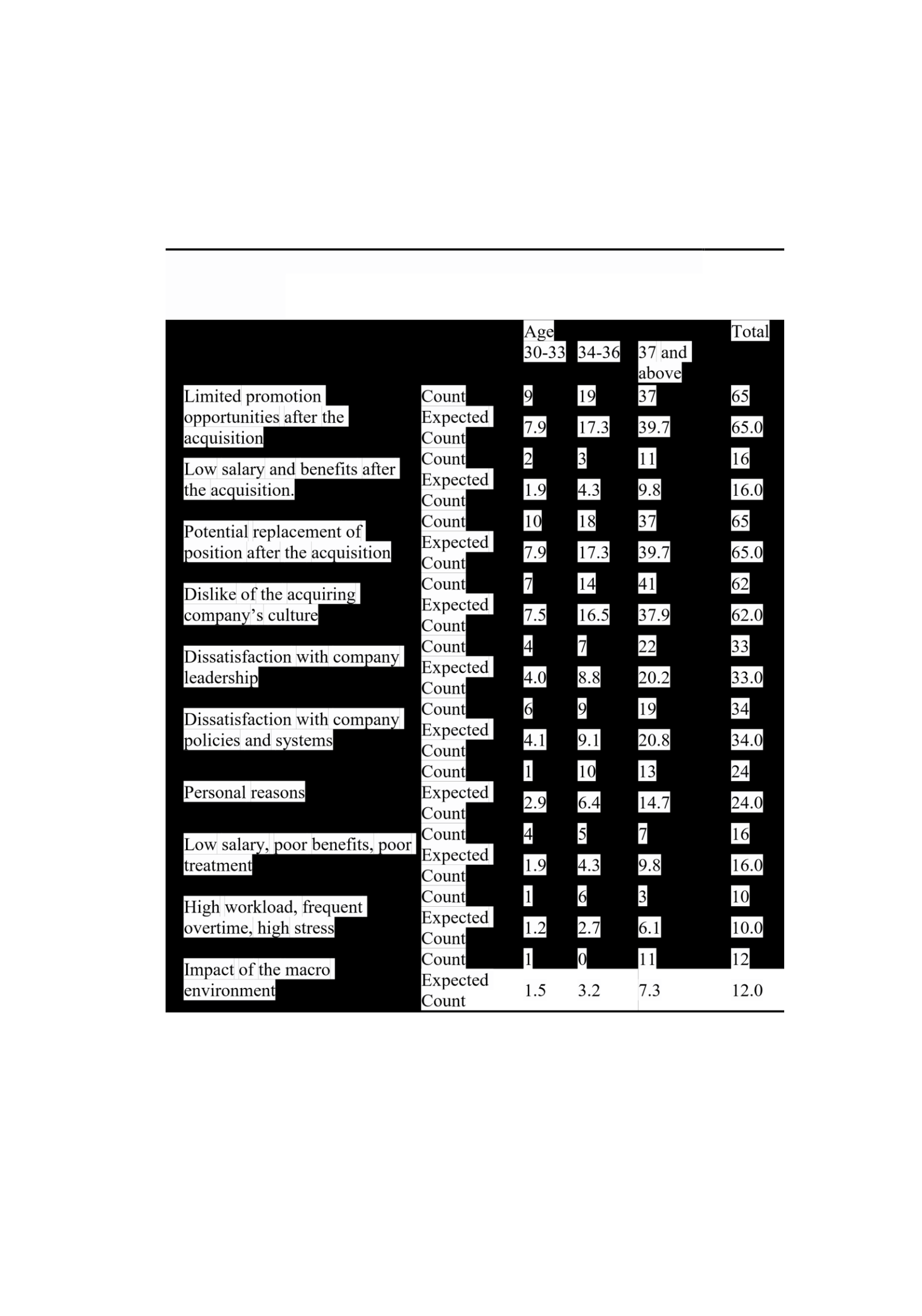
124
both groups of employees, indicating that these factors may not be considered the main
reasons for leaving by the employees.
Table 4-36 Cross-analysis of age and potential reasons for leaving the job
The possible reasons if you resign after the company’s acquisition?* Age
Cross-
tabulation
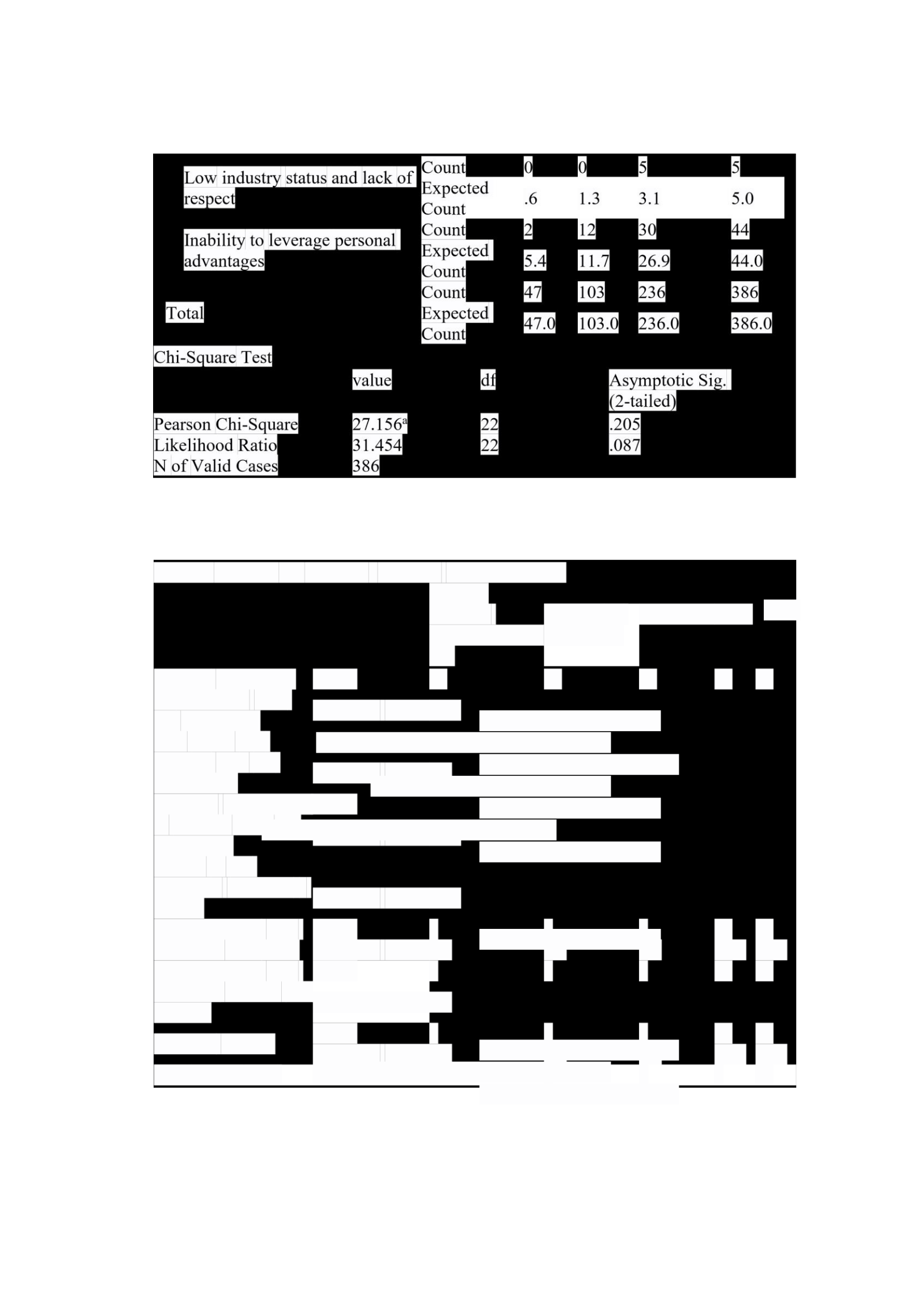
125
There are no significant differences in the reasons for leaving among employees of
different ages.
Table 4-37 Cross-analysis of position and potential reasons for leaving the job
Possible Reasons for Leaving* Position Cross-tabulation
Position Total
Finance, Channel or MarketingSales
Administration,Operations
etc.
Limited promotion Count 20 11 10 24 65 opportunities after
Expected Count13.5 5.7 10.6 35.2 65.0 the acquisition
Low salary and Count 1 7 1 7 16 benefits after the
Expected Count3.3 1.4 2.6 8.7 16.0 acquisition.
Potential replacementCount 17 6 7 35 65 of position after the
Expected Count13.5 5.7 10.6 35.2 65.0 acquisition
Dislike of the Count 13 4 10 35 62 acquiring company’s
Expected Count12.8 5.5 10.1 33.6 62.0 culture
Dissatisfaction with Count 5 1 2 25 33
company leadership Expected Count6.8 2.9 5.4 17.9 33.0
Dissatisfaction with Count 4 0 6 24 34 company policies and
Expected Count7.0 3.0 5.5 18.4 34.0 systems
Count 7 1 6 10 24
Personal reasons
Expected Count5.0 2.1 3.9 13.0 24.0
Low salary, poor Count 2 1 4 9 16 benefits, poor
Expected Count3.3 1.4 2.6 8.7 16.0 treatment
High workload, Count 2 1 6 1 10 frequent overtime,
Expected Count2.1 .9 1.6 5.4 10.0 high stress

126
Impact of the macro Count 1 0 1 10 12
environment Expected Count2.5 1.1 2.0 6.5 12.0
Low industry status Count 0 0 0 5 5
and lack of respect Expected Count1.0 .4 .8 2.7 5.0 Inability to leverage Count 8 2 10 24
44
personal advantages Expected Count9.1 3.9 7.2 23.8 44.0
Count 80 34 63 209 386
Total
Expected Count80.0 34.0 63.0 209.0386.0
Chi-Square Test
value df Asymptotic Sig.
(2-tailed)
Pearson Chi-Square 82.716a 33 .000
Likelihood Ratio 75.945 33 .000 N of Valid Cases 386
A P-value less than 0.001 indicates that if the company merges, there will be
significant differences in the potential reasons for leaving among different positions.
Sales Position: The two most frequently chosen options are "Dissatisfaction with
company leadership" and "Dissatisfaction with company policies and systems." There are
fewer choices for "Limited promotion opportunities after the acquisition" and "High
workload, frequent overtime, high stress."
Finance and Administration Positions: The most chosen options are "Limited
promotion opportunities after the acquisition" and "Potential replacement of position after
the acquisition." There are fewer choices for "Dissatisfaction with company policies and
systems" and "Low salary, poor benefits, poor treatment."
Channel or Operations Position: The most chosen options are "Limited promotion
opportunities after the acquisition" and "Low salary and benefits after the acquisition."
There are fewer choices for "Dissatisfaction with company leadership" and
"Dissatisfaction with company policies and systems."
Marketing Position: The options "High workload, frequent overtime, high stress"
and "Inability to leverage personal advantages" are chosen more than the average. There
are fewer choicesfor "Low salary and benefits after the
acquisition" and
"Dissatisfaction with company leadership."

127
Table 4-38 Cross-analysis of position type and potential reasons for leaving the job
Chi-Square Test
Possible Reasons for Departed* Position Type Cross-tabulation
Position Type Total
Frontline supportin position
g position
Limited promotion Count 34 31 65 opportunities after the
Expected Count45.8 19.2 65.0 acquisition
Low salary and benefits Count 8 8 16
after the acquisition. Expected Count11.3 4.7 16.0 Potential
replacement of Count 42 23 65 position after the
Expected Count45.8 19.2 65.0 acquisition
Dislike of the acquiring Count 45 17 62
company’s culture Expected Count43.7 18.3 62.0
Dissatisfaction with Count 27 6 33
Possible company leadership Expected Count23.3 9.7 33.0
Reasons Dissatisfaction with Count 30 4 34
for company policies and
Expected Count24.0 10.0 34.0
Departe systems
d Count 16 8 24
Personal reasons
Expected Count16.9 7.1 24.0 Low
salary, poor benefits, Count 13 3 16 poor treatment
Expected Count11.3 4.7 16.0 High workload, frequent Count
7 3 10
overtime, high stress Expected Count7.0 3.0 10.0
Impact of the macro Count 11 1 12
environment Expected Count8.5 3.5 12.0 Low industry status and Count 5
0 5
lack of respect Expected Count3.5 1.5 5.0 Inability to leverage Count 34 10
44
personal advantages Expected Count31.0 13.0 44.0
Count 272 114 386
Total
Expected Count272.0 114.0 386.0 value df
Asymptotic Sig.
(2-tailed)
Pearson Chi-Square 28.651a 11 .003
Likelihood Ratio 30.852 11 .001
N of Valid Cases 386

128
The Chi-Square significance value of P < 0.003 indicates that overall, there are
significant differences in the reasons for leaving among employees of different Position
Types.
"Dissatisfaction with company leadership" and "Dissatisfaction with company
policies and systems": The actual count for Frontline position employees is higher than
the expected count, while the actual count for supporting position employees is
significantly lower than the expected count. Frontline position employees are more likely
to leave for these reasons, whereas supporting position employees leave less frequently
for these reasons.
"Limited promotion opportunities after the acquisition": The actual count for
Frontline position employees is lower than the expected count, while the actual count for
supporting position employees is slightly higher than the expected count. Supporting
position employees are more likely to leave due to this reason.
"Potential replacement of position after the acquisition": The actual count for
Frontline position employees is lower than the expected count, while the actual count for
supporting position employees is higher than the expected count. Supporting position
employees are more concerned about this reason for leaving.
"Dislike of the acquiring company’s culture": The actual count for Frontline position
employees is higher than expected, while the actual count for supporting position
employees is slightly lower. This indicates that Frontline position employees are more
likely to leave due to their dislike of the acquiring company’s culture.
"Low salary and benefits after the acquisition": Both Position Types have actual
counts slightly lower than expected, but the difference is insignificant. This suggests that
salary and benefits may not be the main reason for employees in these two Position Types
to leave.
Table 4-39 Cross-analysis of job title and potential reasons for leaving the job
The possible reasons if resign after the company’s acquisition?* Job title Cross-tabulation
Job title Total
Manager/Senior Director/Senior
Manager Director
The possible Limited promotion Count 58 7 65
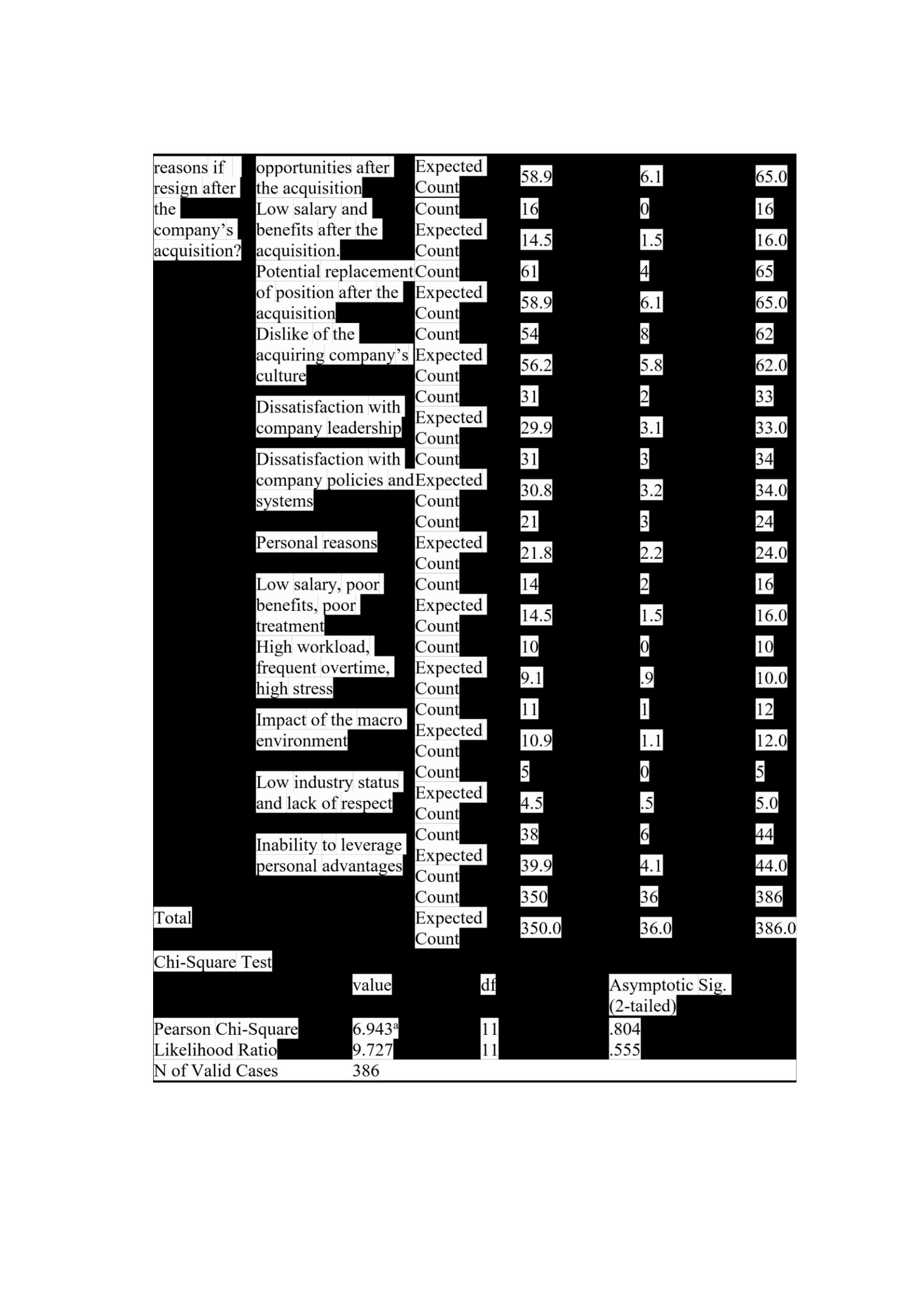
129

130
A P-value greater than 0.05 indicates that there is no significant difference in the
reasons for leaving chosen by the Manager/Senior Manager and Director/Senior Director
groups following a company merger or acquisition.
4.7.3.2 From a third-party perspective
Table 4-40 Frequency of main reason for employee turnover after company was
acquired
multiple-choice question options Response Cases
N Percentage Percentage
Low salary and benefits 17 4.3% 12.2%
Poor working environment 32 8.1% 23.0%
High workload, frequent overtime,
13 3.3% 9.4% high stress
Reason
Low salary, poor benefits, poor
s for 16 4.0% 11.5%
treatment
turnove
Dissatisfaction with company
r after 65 16.4% 46.8%
policies and systems
the
Limited promotion opportunities 77 19.4% 55.4%
merger
Lack of clear career planning 62 15.7% 44.6%
and
Inability to leverage personal
acquisi 56 14.1% 40.3%
advantages
tion.
Low industry status and lack of
15 3.8% 10.8% respect
Dissatisfaction with company
43 10.9% 30.9% leadership
Total 396 100.0% 284.9%
Table above reveals that dissatisfaction with company policies and limited
promotion opportunities are the leading causes of turnover after the acquisition, with a
significant number of employees also citing poor working conditions and high stress
levels as contributing factors.

131
Table 4-41 Chi-Square Analysis of main reason for employee turnover after company
was acquired
ObservedExpectedResidualChi-Squaredf
Asymptotic
significance
High workload, frequent
13 39.6 -26.6
overtime, high stress
Low industry status and la
ck
15 39.6
-24.6
132.939
9 .000
of respect
Low salary, poor benefits,
16
39.6
-23.6
A Chi-Square value of 132.939 with a P-value less than .001 indicates significant
differences, meaning that respondents perceive a clear preference or variation in the
reasons employees choose to leave after the company is acquired.
The options "Dissatisfaction with company leadership," "Inability to leverage
personal advantages," "Lack of clear career planning," "Dissatisfaction with company
policies and systems," and "Limited promotion opportunities" all have higher Observed
counts than Expected counts, with positive and large Residuals. This suggests that more
employees consider these factors as the main reasons for leaving after the acquisition.
Particularly, the option "Limited promotion opportunities" has a significantly higher
Observed count compared to other options, and the Residual is the largest, indicating that
this is a very prominent reason for employee turnover.
poor
treatment
Low
salary
and
benefits
17
39.6
6
-22.
Poor
working
environment
32
39.6
-7.6
ction
Dissatisfa
with
company
leadershi
p
43
39.6
3.4
Inability
to
leverage
personal
advantages
56
39.6
16.4
Lack
f
o
clear
career
plannin
g
62
39.6
22.4
Dissatisfaction
with
company
policies
and
systems
65
39.6
25.4
Limited
pro
motion
opportunitie
s
77
39.6
37.4
Total
39
6

132
The impact of "High workload, frequent overtime, high stress," "Low industry status
and lack of respect," and "Low salary, poor benefits, poor treatment" on turnover is
relatively minor.
Table 4-42 Chi-Square Analysis of Partial reason for employee turnover after
company was acquired
multiple-choice question
Observe
d
Expecte
Residu
Chi-Squ
df
Asymptotic
options
d
al
are
significance
Low salary and benefits
17
47.0
-30.0
38.298
1
.000
Limited promotion
77
47.0
30.0
opportunitie
s
Total
94
With a P-value less than .001, there is a significant difference between the reasons
for leaving: "Limited promotion opportunities" and "Low salary and benefits."
A higher number of employees consider "Limited promotion opportunities" as the
main reason for leaving after the merger and acquisition; relatively fewer employees cite
"Low salary and benefits" as their primary reason for leaving.
It can be inferred that after the company is acquired, employees are more inclined to
regard "Limited promotion opportunities" as the main reason for their departure, while
the factor of "Low salary and benefits" receives relatively less attention. Table 4-43 Chi-
Square Analysis of Partial reason for employee turnover after company was acquired
multiple-choice question
Observe
Expecte
Residual
Chi-Square
df
Asymptotic
options
d
d
significance
High workload, frequent
13 37.5 -24.5 32.013 1
62 37.5 24.5
.000
overtime, high stress
Lack of clear career
planning
Total
75
With a P-value less than 0.001, there is a significant difference in the reasons for
leaving between "Lack of clear career planning" and "High workload, frequent overtime,
high stress."

133
A larger number of employees consider "Lack of clear career planning" as the main
reason for leaving after the merger and acquisition; in contrast, relatively fewer
employees cite "High workload, frequent overtime, high stress" as their primary reason
for leaving.
Table 4-44 Chi-Square Analysis of Partial reason for employee turnover after
company was acquired
multiple-choice question
Observed
Expecte
Residu
Chi-Squ
df
Asymptotic
options
d
al
are
significance
Low salary, poor
.000
benefits, and unfavorable
16
36.0
-20.0 22.222 1
20.0
treatmen
t
36.0
Inability to leverage
56
personal advantages
Total
72
With a P-value less than 0.001, there is a significant difference in the reasons for
leaving between "Inability to leverage personal advantages" and "Low salary, poor
benefits, and unfavorable treatment."
A higher number of employees view "Inability to leverage personal advantages" as
the main reason for leaving following the merger and acquisition; in comparison,
relatively fewer employees cite "Low salary, poor benefits, and unfavorable treatment"
as their primary reason for departure.
Table 4-45 Analysis of the reasons for leaving among different groups
Reason* Position Cross-tabulation
Employment Status Total left
the still company employed
Low salary and benefits Count 4 13 17
after the acquisition. Expected Count 9.3 7.7 17.0
Dissatisfaction with Count 26 17 43
company leadership Expected Count 23.5 19.5 43.0
Dissatisfaction with Count 38 27 65 company policies and
Expected Count 35.5 29.5 65.0 systems
Low salary, poor benefits, Count 4 12 16
and unfavorable treatment.Expected Count 8.7 7.3 16.0
Count 24 8 32

134
Poor working environment
Expected Count 17.5 14.5 32.0 Heavy workload, frequent
Count 4 9 13
overtime, and high stress. Expected Count 7.1 5.9 13.0
Limited promotion Count 36 41 77
opportunities Expected Count 42.0 35.0 77.0
Lack of clear career Count 40 22 62 planning Expected
Count 33.8 28.2 62.0 Low industry status and Count 10 5
15 lack of respect Expected Count 8.2 6.8 15.0 Inability
to leverage Count 30 26 56
personal advantages Expected Count 30.5 25.5 56.0
Count 216 180 396
Total
Expected Count 216.0 180.0 396.0
Chi-Square Test
value df Asymptotic Sig.
(2-tailed)
Pearson Chi-Square 26.885a 9 .001
With a P-value less than 0.05, it shows a significant difference in the reasons for
employee turnover as perceived by those who left the company and those who aretill
employed after the merger and acquisition.
Employees who left the company believe that the main reasons for employee
turnover are: "Lack of clear career planning," "Dissatisfaction with company policies and
systems," "Poor working environment," and dissatisfaction with leadership. The
differences between the actual and expected counts for factors such as "Low salary and
benefits" and "High workload, frequent overtime, high stress" are relatively small,
suggesting that they may not be the main reasons for leaving.
Employees who are still Employed consider the main reasons for employee turnover
to be: "Low salary, poor benefits, and unfavorable treatment,"; "Heavy workload, frequent
overtime, and high stress,"; "Limited promotion opportunities." They do not consider
"Poor working environment" and "Lack of clear career planning" to be the leading causes
of employee turnover.
Table 4-46 Analysis of the reasons for leaving among different genders
Reason* Position Cross-tabulation
Likelihood
Ratio
27.
651
9
.001
N
of
Valid
Cases
396

135
Position Total
Male Female
Low salary and benefits after Count 11 6 17 the acquisition. Expected Count
9.7 7.3 17.0 Dissatisfaction with company Count 29 14 43 leadership
Expected Count 24.5 18.5 43.0 Dissatisfaction with company Count 34 31 65
policies and systems Expected Count 37.1 27.9 65.0 Low salary, poor
benefits, Count 10 6 16
and unfavorable treatment. Expected Count 9.1 6.9 16.0
Count 16 16 32
Poor working environment
Expected Count 18.3 13.7 32.0 Heavy workload,
frequent Count 8 5 13
overtime, and high stress. Expected Count 7.4 5.6 13.0
Limited promotion Count 43 34 77
opportunities Expected Count 43.9 33.1 77.0
Lack of clear career Count 34 28 62 planning Expected Count 35.4 26.6 62.0
Low industry status and lack Count 11 4 15
Total
of respect
Expected
Count
8.6
6.4
15.0
Inability to leverage personal
Count
30
26
56
advantage
s
Expected
Count
32
.0
24.0
56.0
Count
22
6
170
396
Expected
Count
22
6.0
170.0
396.0
Chi-Square Test
value
df
Asymptotic Sig. (2-tailed)
Pearson Chi-Square
5.918a
9
9
.748
.734
Likelihood Ratio
6.058
N of Valid Cases
396
There is no significant difference in the reasons for personnel turnover after the
company merger as perceived by employees of different genders. The main reasons are:
"Dissatisfaction with company policies and systems,"
"Limited promotion opportunities," and "Lack of clear career planning."
Table 4-47 Analysis of the reasons for leaving among different ages
Reason* Position Cross-tabulation

136
Position Total
30-33 34-36 37 and
above
Count 3 4 10 17
Low salary and benefits
Expected after the acquisition. 2.0 4.6
10.4 17.0
Count
Count 1 13 29 43
Dissatisfaction with
Expected company leadership 5.1 11.6
26.3 43.0
Count
Dissatisfaction with Count 2 17 46 65
company policies and Expected
7.7 17.6 39.7 65.0 systems
Count
Low salary, poor Count 3 2 11 16
benefits, and Expected
Reason 1.9 4.3 9.8 16.0
unfavorable treatment. Count
Count 2 15 15 32
Poor working
Expected
environment 3.8 8.6 19.6 32.0
Count
Heavy workload, Count 3 4 6 13
frequent overtime, and Expected
1.5 3.5 7.9 13.0 high stress.
Count
Count 12 20 45 77
Limited promotion
Expected opportunities 9.1 20.8 47.1
77.0
Count
Lack of clear career Count 9 18 35 62
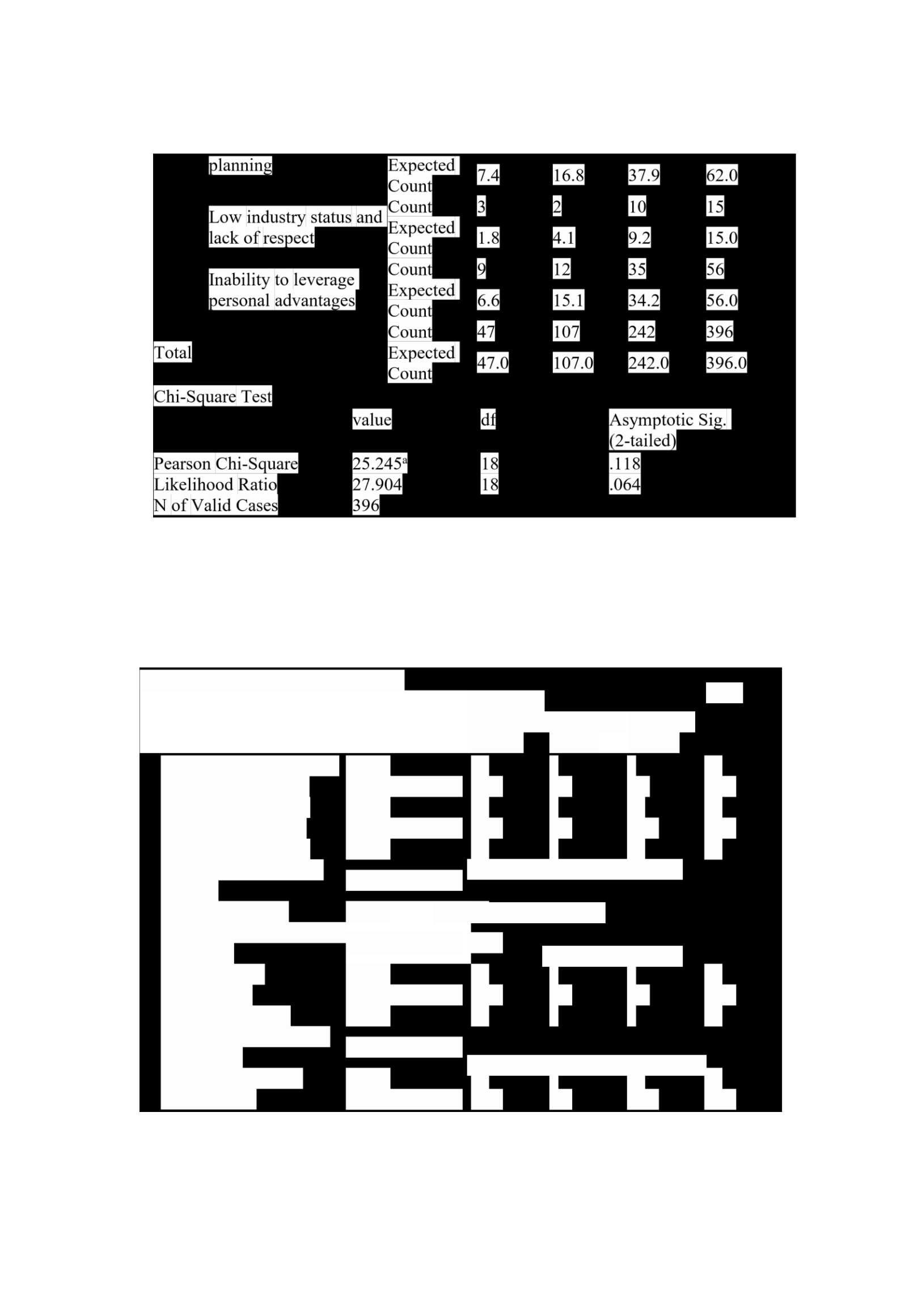
137
Employees across the three age groups do not show significant differences in the
reasons for employee turnover.
Table 4-48 Analysis of the reasons for leaving among different educational degree
Reason* Education Cross-tabulation
Education
Total
Bachelor’sAssociate Master’s
Degree degree Degree
Low salary and benefits Count 12 1 4 17
after the acquisition. Expected Count 11.3 1.4 4.3 17.0
Dissatisfaction with Count 26 5 12 43
company leadership Expected Count 28.7 3.5 10.9 43.0
Dissatisfaction with Count 37 7 21 65 company policies and
Expected Count 43.3 5.3 16.4 65.0
systems
Low salary, poor Count 13 1 2 16 benefits, and
unfavorable
Expected Count 10.7 1.3 4.0 16.0
treatment.
Poor working Count 21 5 6 32
environment Expected Count 21.3 2.6 8.1 32.0
Heavy workload, Count 10 0 3 13 frequent overtime, and
Expected Count 8.7 1.1 3.3 13.0 high
stress.

138
Limited promotion Count 54 4 19 77
opportunities Expected Count 51.3 6.2 19.4 77.0
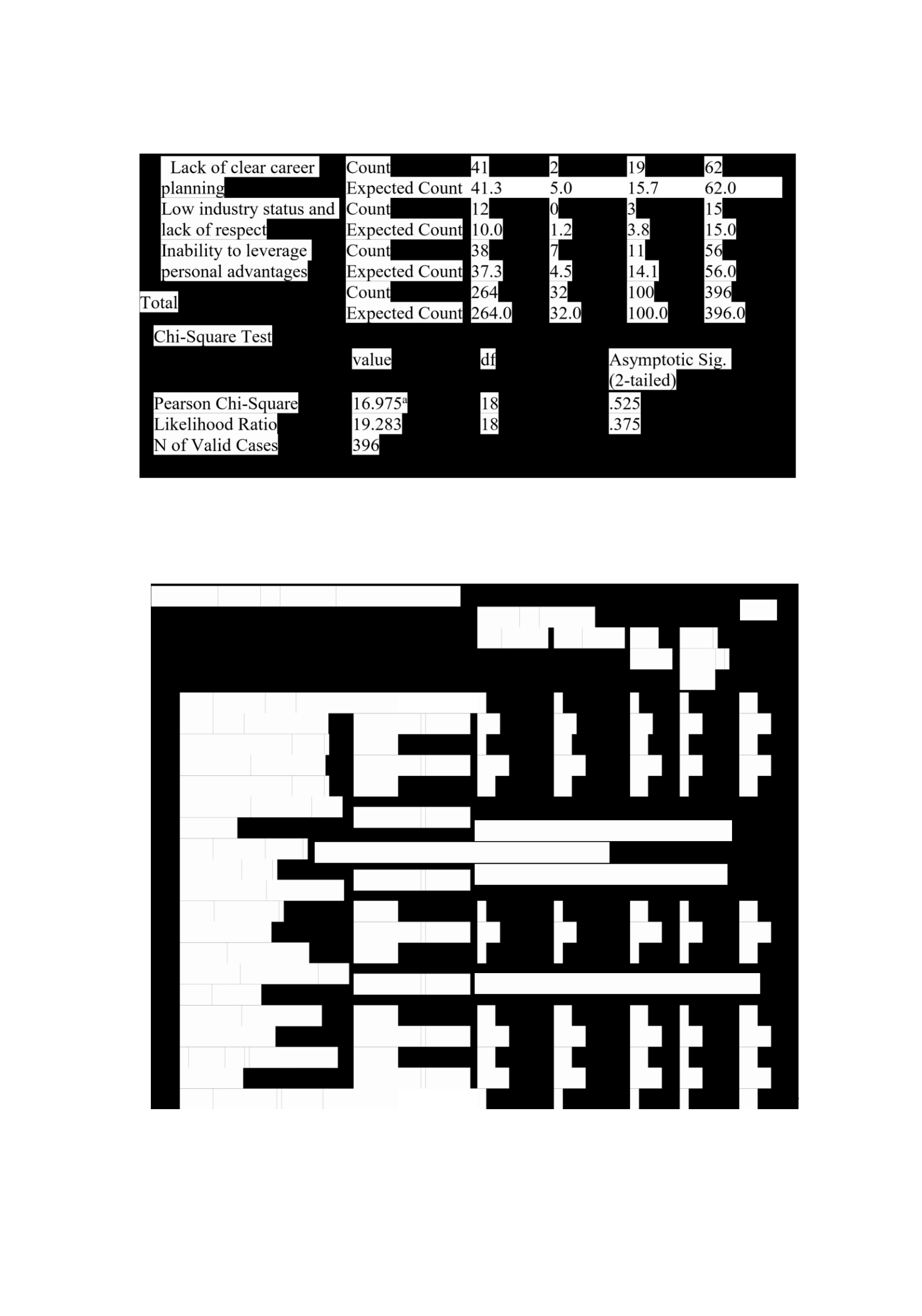
139
There are no significant differences in the reasons for employee turnover based on
different levels of education.
Table 4-49 Analysis of the reasons for leaving among different years of service
Reason* Years of service Cross-tabulation
Years of service Total
1-3 Years 3-5 Years 5-8 Less
Years than 1
Year
Low salary and benefitsCount 3 7 6 1 17
after the acquisition. Expected Count 4.2 5.2 6.6 1.0 17.0
Dissatisfaction with Count 8 15 19 1 43
company leadership Expected Count 10.5 13.1 16.7 2.6 43.0
Dissatisfaction with Count 12 24 27 2 65 company policies
and
Expected Count 15.9 19.9 25.3 3.9 65.0 systems
Low salary, poor Count 4 5 6 1 16 benefits, and
Expected Count 3.9 4.9 6.2 1.0 16.0
unfavorable treatment.
Poor working Count 6 7 16 3 32
environment Expected Count 7.8 9.8 12.4 1.9 32.0
Heavy workload, Count 5 5 3 0 13 frequent overtime, and
Expected Count 3.2 4.0 5.1 .8 13.0 high
stress.
Limited promotion Count 18 19 33 7 77
opportunities Expected Count 18.9 23.5 29.9 4.7 77.0
Lack of clear career Count 21 18 18 5 62

140
planning Expected Count 15.2 18.9 24.1 3.8 62.0
Low industry status andCount 5 6 3 1 15
lack of respect Expected Count 3.7 4.6 5.8 .9 15.0 Inability to leverage Count 15 15
23 3 56
personal advantages Expected Count 13.7 17.1 21.8 3.4 56.0
Count 97 121 154 24 396
Total
Expected Count 97.0 121.0 154.0 24.0 396.0
Chi-Square Test
value df Asymptotic Sig.
(2-tailed)
Pearson Chi-Square 21.255a 27 .774
Likelihood Ratio 22.517 27 .711 N of Valid Cases 396
The number of years of service within the acquired company does not show
significant differences in the perceived reasons for personnel turnover.
Table 4-50 Analysis of the reasons for leaving among different employee type
Reason* Employee Type Cross-tabulation
Low salary and benefits after Count
the acquisition. Expected Count
Dissatisfaction with company Count
leadership Expected Count
Dissatisfaction with company Count
policies and systems Expected Count
Low salary, poor benefits, andCount
unfavorable treatment. Expected Count
Count
Poor working environment
Expected Count
Heavy workload, frequent Count overtime,
and high stress. Expected Count
Limited promotion Count opportunities
Expected Count
Count
Lack of clear career planning
Expected Count
Low industry status and lack Count
of respect Expected Count
Inability to leverage personal Count
advantages Expected
Count
C
o
u
n
t
Total
Expected Count
Chi-Square Test
va
lue df
Employee Type Total
Senior New
Employee Employee
13 4 17
11.9 5.1 17.0
35 8 43
30.1 12.9 43.0
51 14 65
45.5 19.5 65.0
11 5 16
11.2 4.8 16.0
23 9 32

141
22.4 9.6 32.0
8 5 13
9.1 3.9 13.0
52 25 77
53.9 23.1 77.0
37 25 62
43.4 18.6 62.0
9 6 15
10.5 4.5 15.0
38 18 56
39.2 16.8 56.0
277 119 396
277.0 119.0 396.0
Asymptotic Sig.
New and senior employees do not perceive significant differences in the reasons for
personnel turnover.
Table 4-51 Analysis of the reasons for leaving among different position
Reason* Position Cross-tabulation
Position Total
Financial, Channel or MarketingSales
administrative, Operations and other positions
Count 3 3 5 6 17
Low salary and benefits
Expected after the acquisition. 3.4 1.6 2.7 9.3
17.0
Count
Count 10 2 4 27 43
Dissatisfaction with
Expected company leadership 8.6 4.1 6.8 23.5
43.0
Count
Dissatisfaction with Count 16 3 9 37 65 company policies and
Expected
13.0 6.2 10.3 35.5 65.0 systems
Count
Low salary, poor Count 2 1 4 9 16
benefits, and Expected
3.2 1.5 2.5 8.7 16.0 unfavorable treatment.
Count
Count 3 1 5 23 32
Poor working
Expected
environment 6.4 3.1 5.1 17.5 32.0
Count
Heavy workload, Count 2 2 4 5 13 frequent overtime, and
Expected
2.6 1.2 2.1 7.1 13.0 high stress. Count
(2-
tailed)
Pearson Chi-Squ
are
9.919a
9
9
.357
.341
Likelihood Ratio
10.116
N of Valid Cases
396

142
Count 17 12 14 34 77
Limited promotion
Expected
opportunities 15.4 7.4 12.3 42.0 77.0
Count
Count 14 6 9 33 62
Lack of clear career
Expected
planning 12.4 5.9 9.9 33.8 62.0
Count
Count 4 0 1 10 15
Low industry status and
Expected
lack of respect 3.0 1.4 2.4 8.2 15.0
Count
Count 8 8 8 32 56
Inability to leverage
Expected personal advantages 11.2 5.4 8.9 30.5
56.0
Count
Employees in different Positions do not perceive significant differences in the
reasons for personnel turnover following the company's merger or acquisition.
Table 4-52 Analysis of the reasons for leaving among different position type
Reason* Position Characteristics Cross-tabulation
Position type Total
Front-line supporting
position position
Low salary and benefits afterCount 11 6 17 the acquisition.
Expected Count 12.0 5.0 17.0 Dissatisfaction with Count
31 12 43
company leadership Expected Count 30.3 12.7 43.0
Total
Count
7
9
3
8
63
216
396
cted
Expe
t
Coun
0
79.
8.0
3
63.0
216.0
396.0
Chi-Square
Test
ue
val
df
mpto
Asy
tic
Sig.
)
ailed
t
(2-
Pearson
uare
Chi-Sq
29.
882
a
2
7
.319
Likelihood
o
Rati
31.
755
2
7
.241
N
of
Valid
s
Case
396

143
Dissatisfaction with Count 46 19 65 company policies and
Expected Count 45.8 19.2 65.0 systems
Low salary, poor benefits, Count 13 3 16
and unfavorable treatment. Expected Count 11.3 4.7 16.0
Count 28 4 32
Poor working environment
Expected Count 22.5 9.5 32.0 Heavy workload,
frequent Count 9 4 13
overtime, and high stress. Expected Count 9.2 3.8 13.0
Limited promotion Count 48 29 77
opportunities Expected Count 54.3 22.8 77.0
Lack of clear career Count 42 20 62 planning Expected
Count 43.7 18.3 62.0 Low industry status and lack Count 11
4 15 of respect Expected Count 10.6 4.4 15.0
Inability to leverage Count 40 16 56
personal advantages Expected Count 39.5 16.5 56.0
Count 279 117 396
Total
Expected Count 279.0 117.0 396.0
Chi-Square Test
value df Asymptotic Sig.
(2-tailed)

144
Employees with different Position Types do not perceive significant differences in
the reasons for personnel turnover after the company's merger or acquisition.
Table 4-53 Analysis of the reasons for leaving among different Job title
Reason* Job title Cross-tabulation
Job title Total
Manager/SeniorDirector/Senior
Manager Director
Low salary and benefitsCount 16 1 17
after the acquisition. Expected Count 15.4 1.6 17.0
Dissatisfaction with Count 36 7 43
company leadership Expected Count 38.9 4.1 43.0
Dissatisfaction with Count 55 10 65 company policies and
Expected Count 58.8 6.2 65.0 systems
Low salary, poor Count 14 2 16 benefits, and
Expected Count 14.5 1.5 16.0 unfavorable treatment.
Poor working Count 30 2 32
environment Expected Count 28.9 3.1 32.0
Heavy workload, Count 12 1 13 frequent overtime, and
Expected Count 11.8 1.2 13.0 high stress.
Limited promotion Count 68 9 77
opportunities Expected Count 69.6 7.4 77.0
Lack of clear career Count 60 2 62 planning Expected Count 56.1 5.9 62.0 Low
industry status andCount 14 1 15 lack of respect Expected Count 13.6 1.4 15.0
Inability to leverage Count 53 3 56
personal advantages Expected Count 50.6 5.4 56.0
Count 358 38 396
Total
Expected Count 358.0 38.0 396.0
Chi-Square Test
value df Asymptotic Sig.
(2-tailed)
Pearson Chi-Square 10.215a 9 .333
Likelihood Ratio 10.708 9 .296
N of Valid Cases 396
Employees with different Job titles do not perceive significant differences in the
reasons for personnel turnover following the company's merger or acquisition.
Pearson
are
Chi-Squ
8.442
a
9
.490
Likelihood
Rati
o
9.189
9
.420
N
of
Valid
Cases
396

145
4.7.3.3 The satisfaction levels of different groups with cultural integration measures after
the merger
Table 4-54 The satisfaction levels of cultural integration measures after merger by
whether still employed
Improvem
ent
Measures
Complete
ly
Dissatisfi
ed
Somewh
at
Dissatisfi
ed
Neutr
al
Somewh
at
Satisfied
Complet
ely
Satisfie
d
Chi-Squ
are Test
sig.
Counts
Emplo
Expected
yed
Counts
Counts
Resign
Expected
ed
Counts
Ability to
Self-Impr
ove
2
7.3
14
8.7
2
8.2
16
9.8
28
32.6
44
39.4
29
14.1
2
16.9
2
.9
0
1.1
.000
Counts
Employ ed
Expected
Counts
Counts
Resigne
d Expected
Counts
Direct
Supervisor
's
Managem
ent Style
1
9.5
20
11.5
1
5.0
10
6.0
30
28.1
32
33.9
27
16.8
10
20.2
4
3.6
4
4.4
.000
Counts
Employ ed
Expected
Counts
Counts
Resigne
d Expected
Counts
Senior
Managem
ent's
Attention
to
Employee
s
0
7.3
16
8.7
5
7.7
12
9.3
31
33.1
42
39.9
25
14.1
6
16.9
2
.9
0
1.1
.000

146
Employ
ed Counts
Expected
Counts
Resigne
d Counts
Expected
Counts
Talent
Developm
ent
Mechanis
m
0
6.3
14
7.7
4
10.9
20
13.1
35
32.2
36
38.8
23
13.1
6
15.9
1
.5
0
.5
.000
The data presented in Table above analyzes the satisfaction levels among different
job title groups regarding cultural integration measures implemented after a merger. The
survey results, which include Chi-Square Test significance (sig.), show a range of
responses from "Completely Dissatisfied" to "Completely Satisfied" for various
improvement measures such as "Ability to Self-Improve," "Direct Supervisor's
Management Style," "Senior Management's Attention to Employees," and "Talent
Development Mechanism."
For the group of employees who are still employed (Employed), dissatisfaction
levels are notably higher in all categories, with a significant number expressing
"Completely Dissatisfied" and "Somewhat Dissatisfied" sentiments, particularly
regarding the "Direct Supervisor's Management Style" and "Senior Management's
Attention to Employees." Conversely, the resigned employees (Resigned) show a more
even distribution of satisfaction levels, with a higher proportion leaning towards
"Somewhat Satisfied" and "Completely Satisfied" in all categories.
The Chi-Square Test results indicate a significant divergence between observed and
expected counts for each job title group across the improvement measures, suggesting
that the cultural integration measures have not been uniformly effective across different
employee levels and may have contributed to the dissatisfaction and turnover observed
among certain groups. These findings underscore the complexity of cultural integration
post-merger and the need for tailored approaches to address the diverse needs and
expectations of the workforce.
Table 4-55 The satisfaction levels of company’s compensation situation after merger by
different gender

147
Male and female employees exhibit significant differences in their perception of the
compensation situation after the merger and acquisition, with male employees
considering it "Somewhat unreasonable" and "Very unreasonable" more than female
employees. No male employees regard the compensation situation as "Very reasonable,"
and no female employees view it as "Very unreasonable."
Table 4-56 The satisfaction levels of company’s compensation situation after merger by
new or senior employee
l
Tota
Very
unreasonab
l
e
Somewhat
unreasonabl
e
Average
Somewha
t
reasonabl
e
Very
l
reasonab
e
Gender
Male
Coun
t
3
12
35
2
6
0
7
6
Expe
cted
Coun
t
1.6
7.1
36
.6
2
9.5
1.1
6.0
7
Female
Coun
t
0
1
32
8
2
2
6
3
cted
Expe
t
Coun
1.
4
5.9
30.4
24.
5
.9
63.
0
Total
Coun
t
3
13
67
54
2
13
9
Expe
cted
Coun
t
0
3.
13.0
67.0
.
54
0
0
2.
139.0
Chi-Square
Test
val
ue
d
f
mpto
Asy
tic
Sig.
(2-
)
ailed
t
Pearson
Chi-Square
13.
418
a
4
.009
Likelihood
Ratio
16.
893
4
.002
r
Linea
Linear-by-
Association
9.3
51
1
.002
N
of
Valid
Cases
139
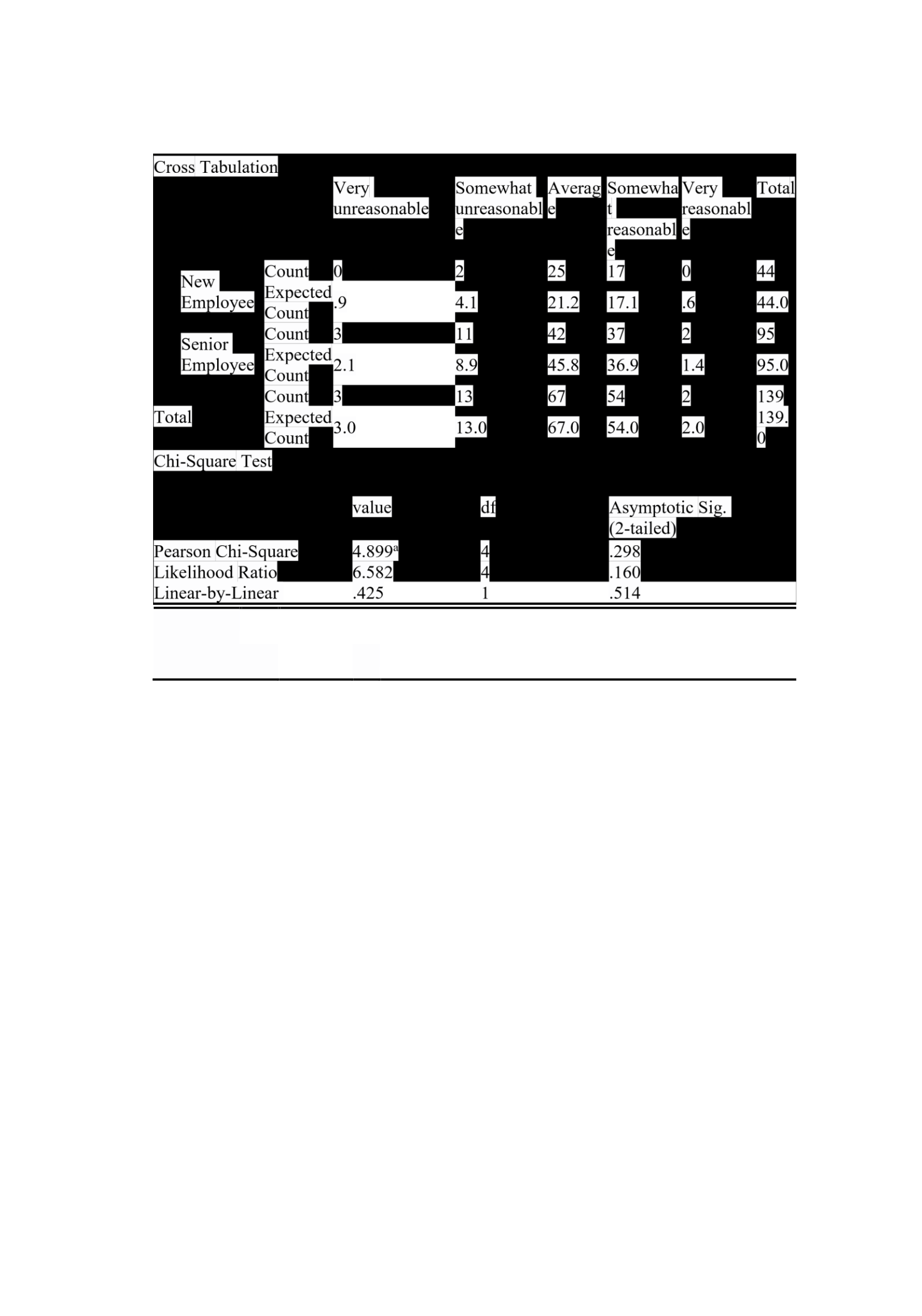
148
Association
N of Valid Cases
139
There are no significant differences between new and senior employees regarding
whether the compensation situation is reasonable after the company's merger and
acquisition.
Table 4-57 The satisfaction levels of company’s compensation situation after merger by
different position type
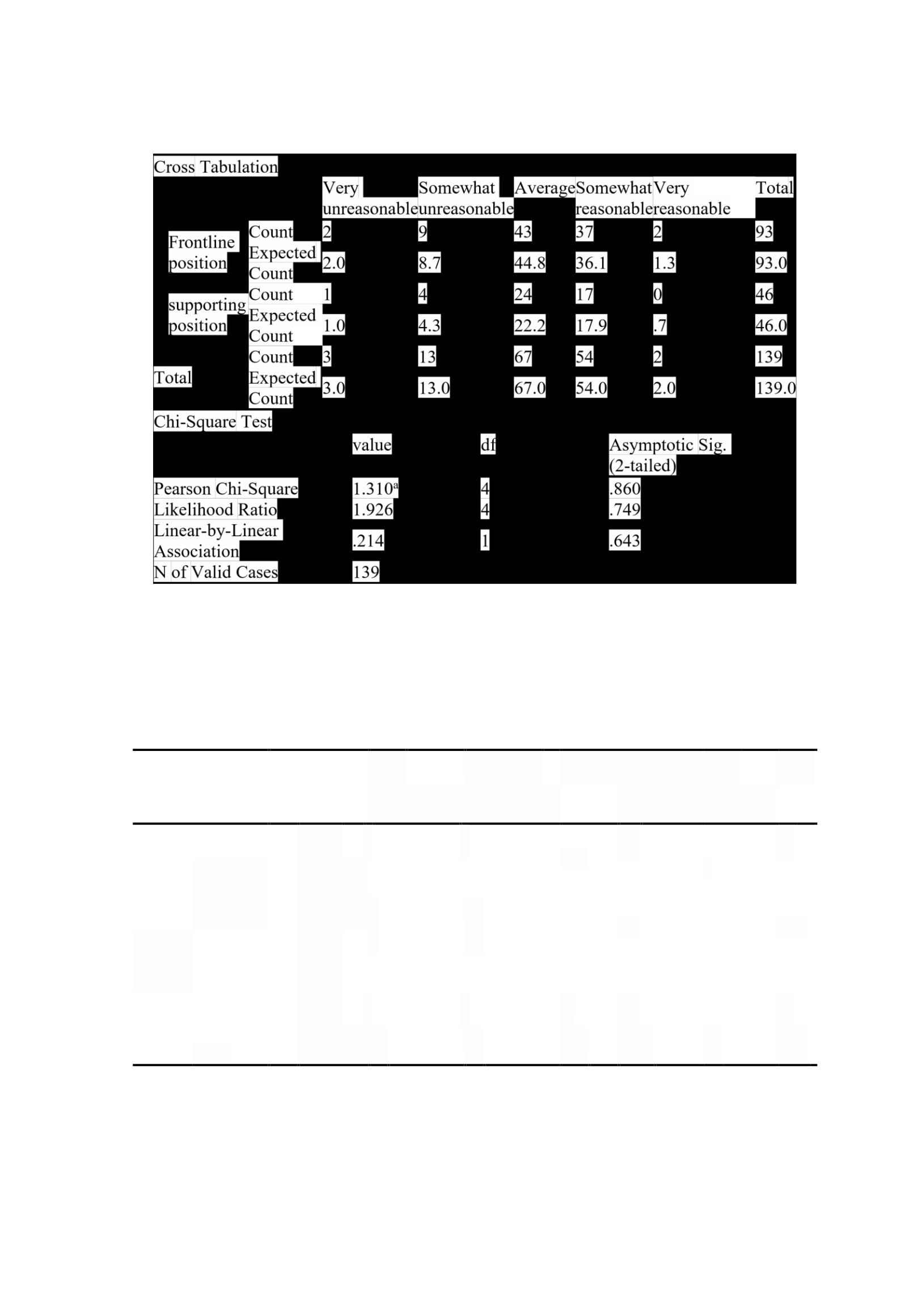
149
Frontline and supporting positions do not show significant differences in the
perception of whether the compensation situation is reasonable after the company's
merger and acquisition.
Table 4-58 The satisfaction levels of company’s compensation situation after merger by
different position
Very
Somewhat
AverageSomewhat
Very
Total
unreasonableunreasonable
reasonable
reasonable
Count
0
1
9
10.6
12
0
.3
2
22
.0
Marketing
Expected
8.5
22
5
2.1
Position
Sales
Count
Count
.
8
2
34
25
71
Expected
1.5
6.6
34.2
27.6
1.0
71.0
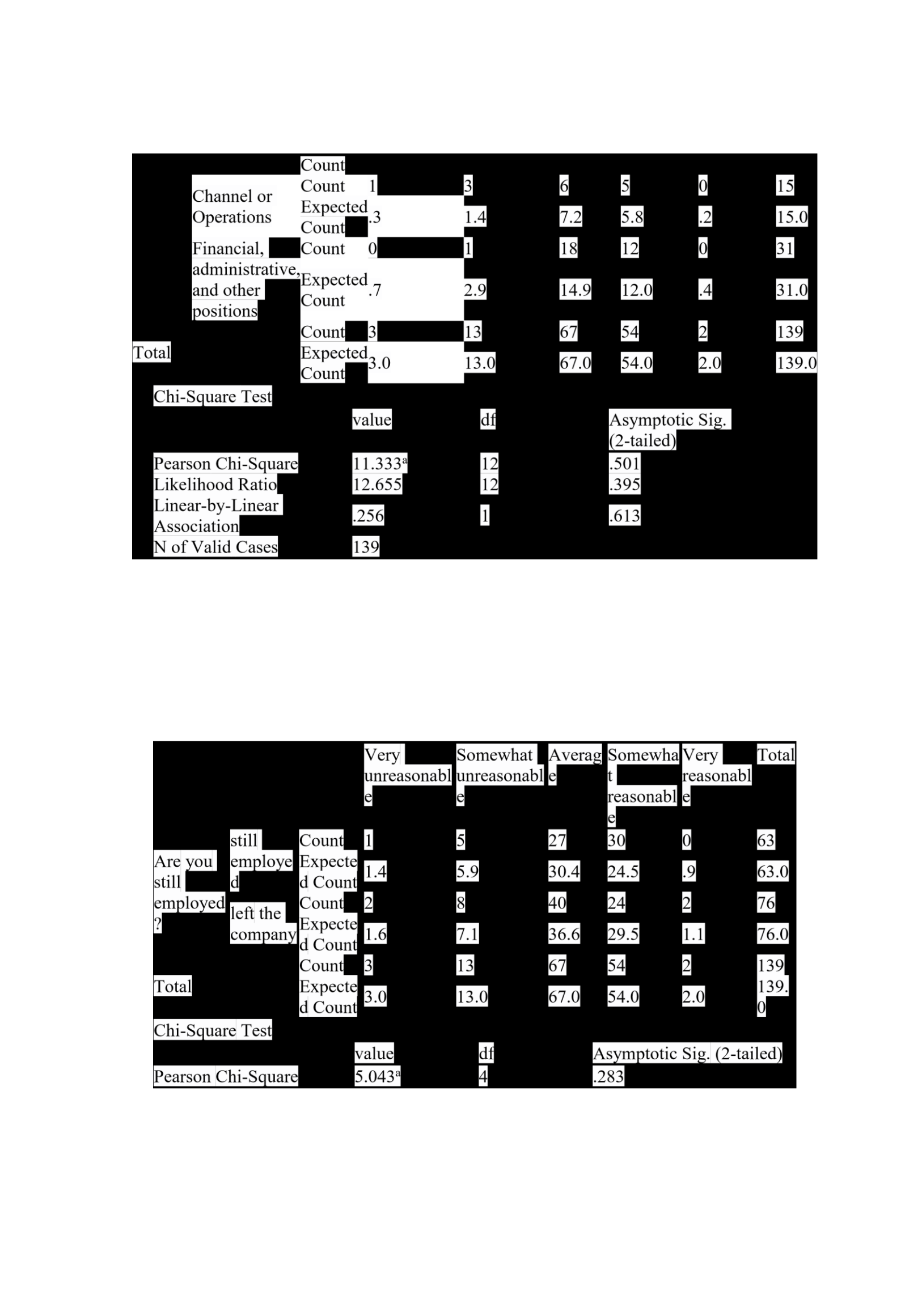
150
There are no significant differences in the perception of the fairness of
compensation conditions after the company's merger and acquisition among employees
of different positions.
Table 4-59 The satisfaction levels of company’s compensation situation after merger by
different Whether still employed
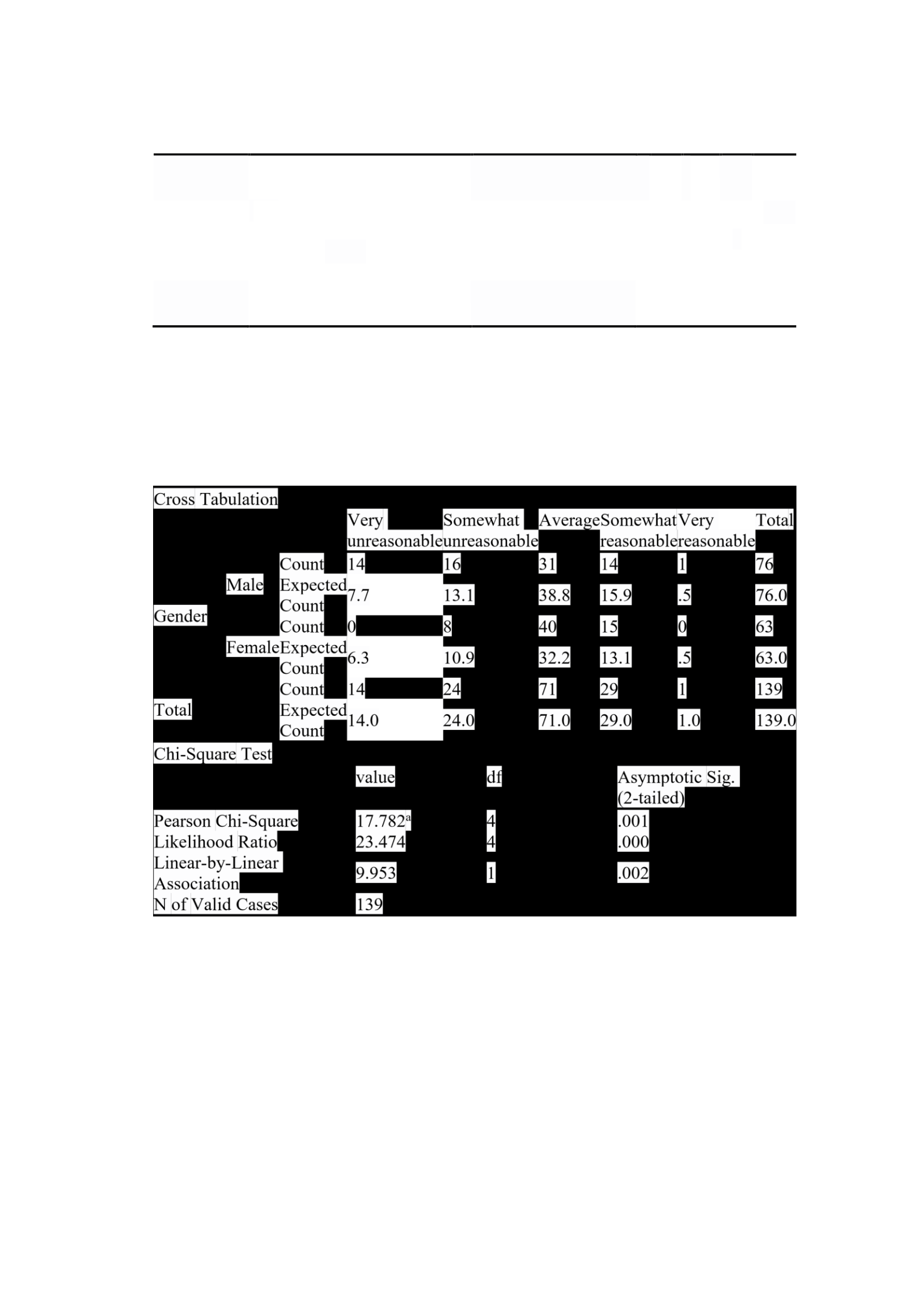
151
Likelihood
Ratio
5.8
00
4
.215
Linear-by-
Linear
1.4
93 1
.222
Association
N of Valid
Cases
139
Whether an employee is currently employed does not show a significant difference
in their perception of the reasonableness of the compensation situation after the
company's merger and acquisition.
Table 4-60 The satisfaction levels of company’s talent development mechanism after
merger by different gender
There is a significant difference between Male and Female employees in their
perception of the reasonableness of the company's talent cultivation mechanism after the
merger and acquisition. Male employees are more likely to consider it "Very
unreasonable" and "Somewhat unreasonable" than female employees. Female
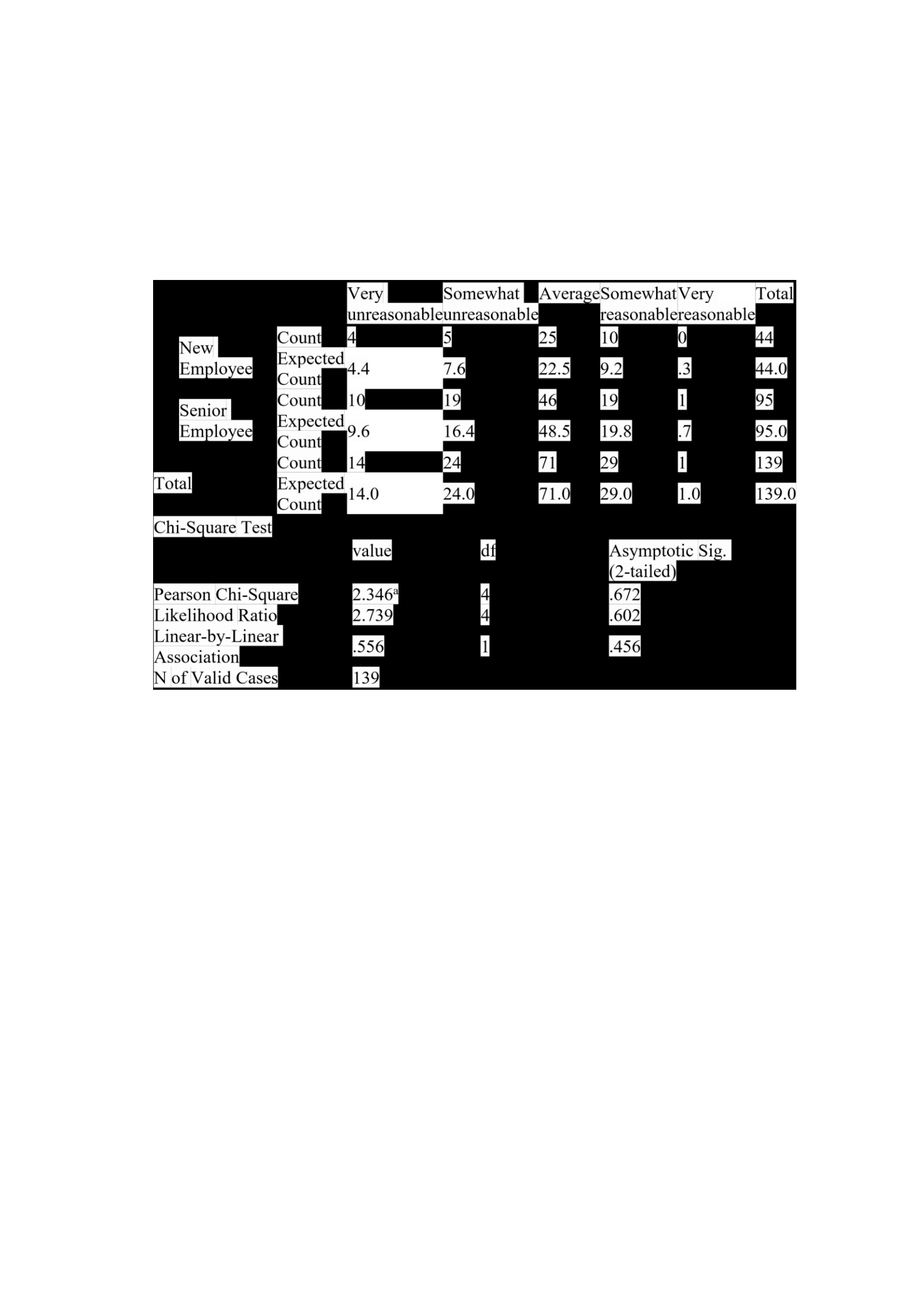
152
employees' choices are more centered, with the majority considering it "Average" and no
one choosing "Very unreasonable" or "Very reasonable."
Table 4-61 The satisfaction levels of company’s talent development mechanism after
merger by different Experience Level
There are no significant differences between new and senior employees in their
views on whether the company's talent cultivation mechanism is reasonable after the
merger and acquisition.
Table 4-62 The satisfaction levels of company’s talent development mechanism after
merger by different position

153
n
Very
Somewhat
Averag
Somewha
Very
Tota
unreasonabl
unreasonab
l
e
t
reasonabl
l
e
e
reasonabl
e
e
Marketing
Count
0
2.2
12
7.2
0
1.5
2
2
3.8
11
12.3
2
2.6
9
13
.2
.3
7
4.6
13
14.8
2
3.1
7
0
.2
0
.5
0
.1
1
22
2.0
1.0
5.0
Expecte
11
35
36
11
7.7
2
71
7
15
1
d Count
Count
Positio
Sales
Channel or
Operations
Expecte
d Count
Count
Expecte
d Count
Finance,
Count
12
31
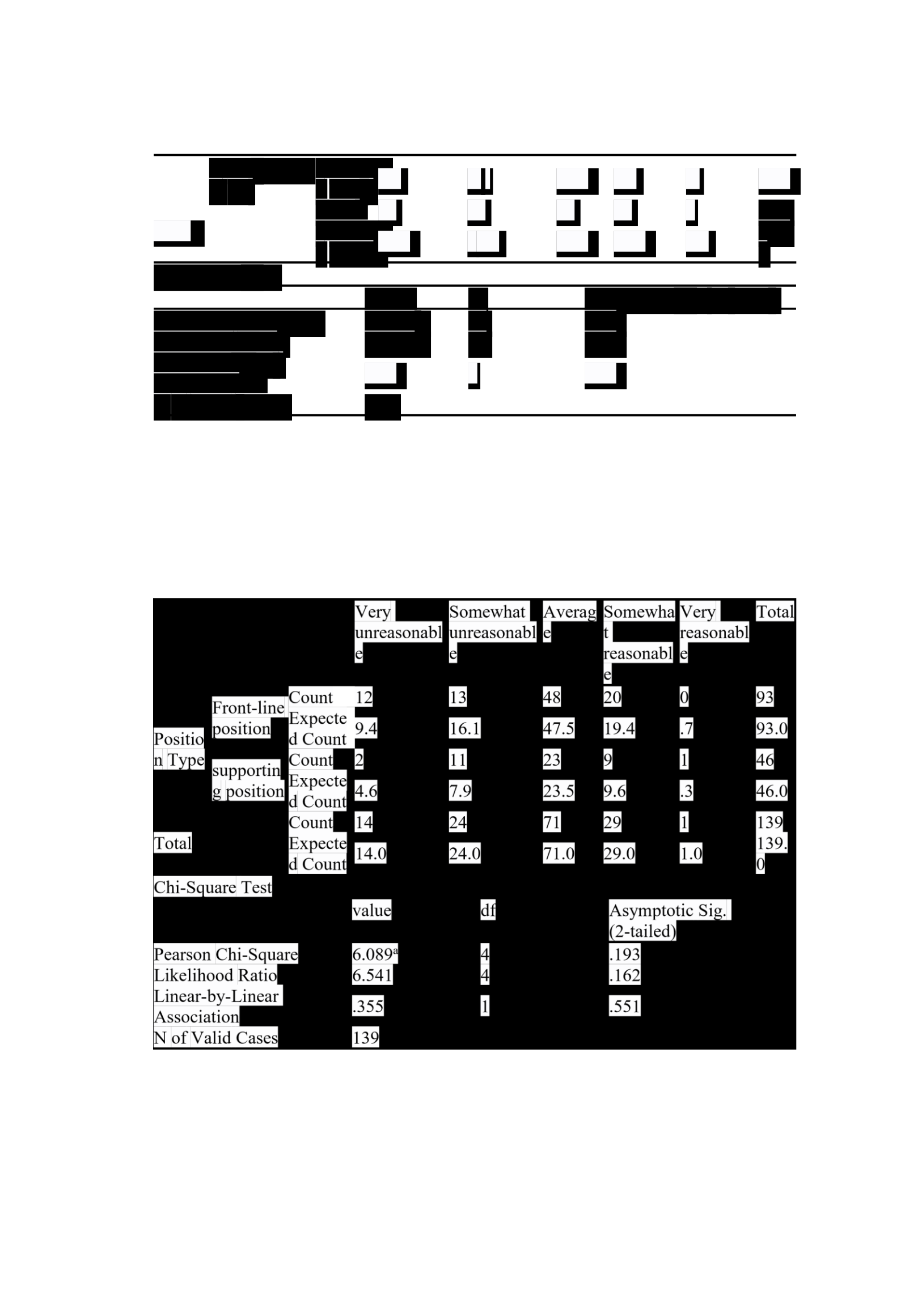
154
There are no significant differences among employees in different Positions
regarding their perception of the reasonableness of the company's talent cultivation
mechanism after the merger and acquisition.
Table 4-63 The satisfaction levels of company’s talent development mechanism after
merger by different position
Admi
nistratio
n,
etc
.
Expecte
d
nt
Cou
3.1
4
5.
15.8
6.5
.2
31.0
Total
Coun
t
14
24
71
29
1
139
Expecte
d
Count
14.0
2
4.0
71.0
29.0
1.0
139
.
0
Chi-Square
Test
value
df
Asymptotic
Sig.
)
tailed
(2-
Pearson
Chi-Square
19.145
a
12
.085
Likelihood
Ratio
21.445
12
.044
Linea
r
Linear-by-
Association
.199
1
.656
N
of
Valid
Cases
139
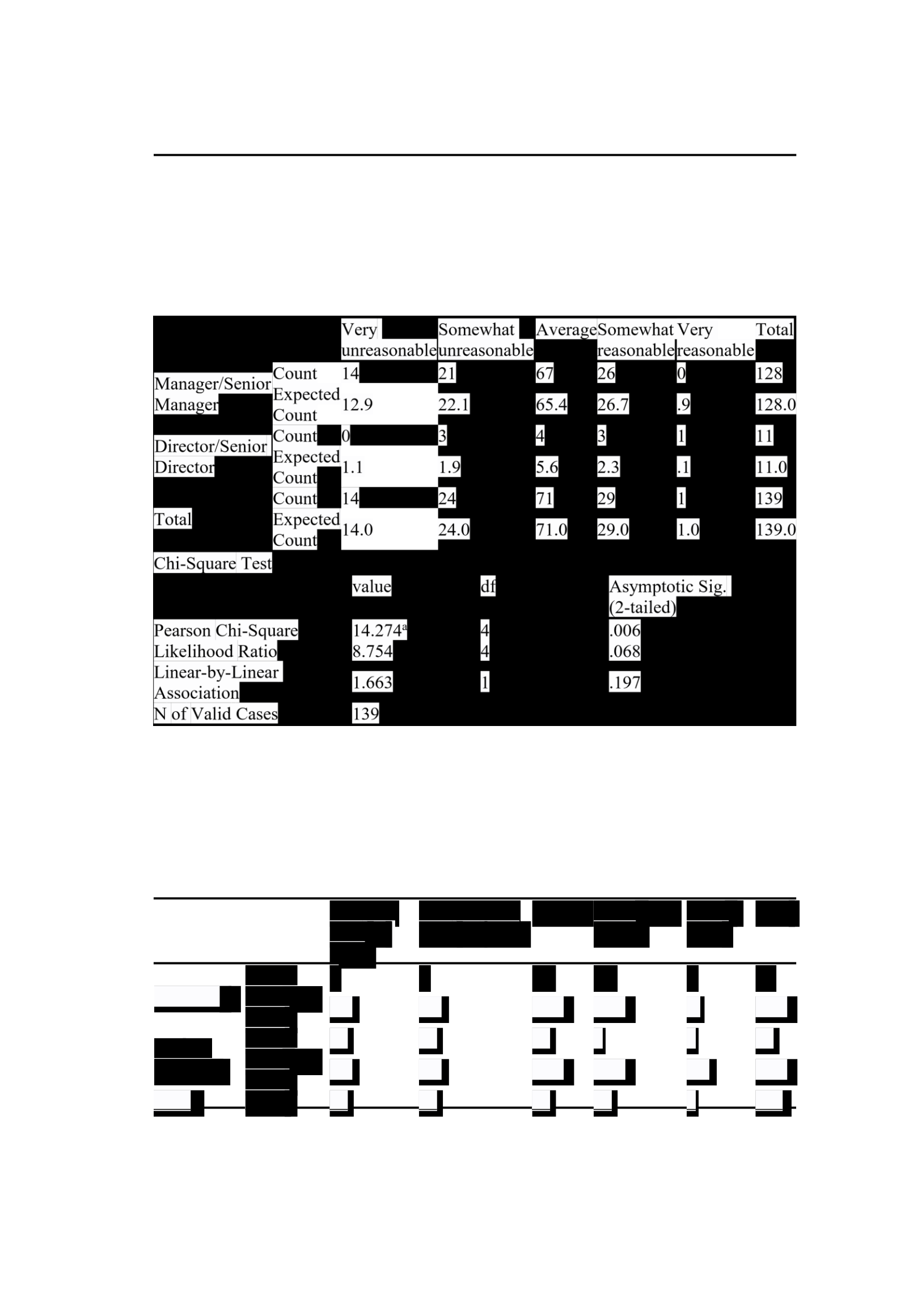
155
There are no significant differences in the perception of the reasonableness of the
company's talent cultivation mechanism after the merger and acquisition among
employees with different Positions.
Table 4-64 The satisfaction levels of company’s talent development mechanism after
merger by different Job title
There is a significant difference in the perception of whether the company's talent
cultivation mechanism is reasonable after a merger or acquisition among employees with
different job titles.
Table 4-65 The satisfaction levels of company’s improve yourself after merger by
different Whether still employed
Totally
does
t
no
meet
Somewhat
does
not
meet
Average
Some
what
meets
ly
Total
s
meet
l
Tota
d
Employe
t
Coun
2
2
28
29
2
6
3
cted
Expe
Coun
t
7.3
8.2
32.6
14.1
.9
63.0
left
the
y
compan
t
Coun
14
16
44
2
0
76
cted
Expe
Coun
t
8.7
9.8
39.4
16.9
1.1
76.0
Total
Coun
t
16
18
72
31
2
139
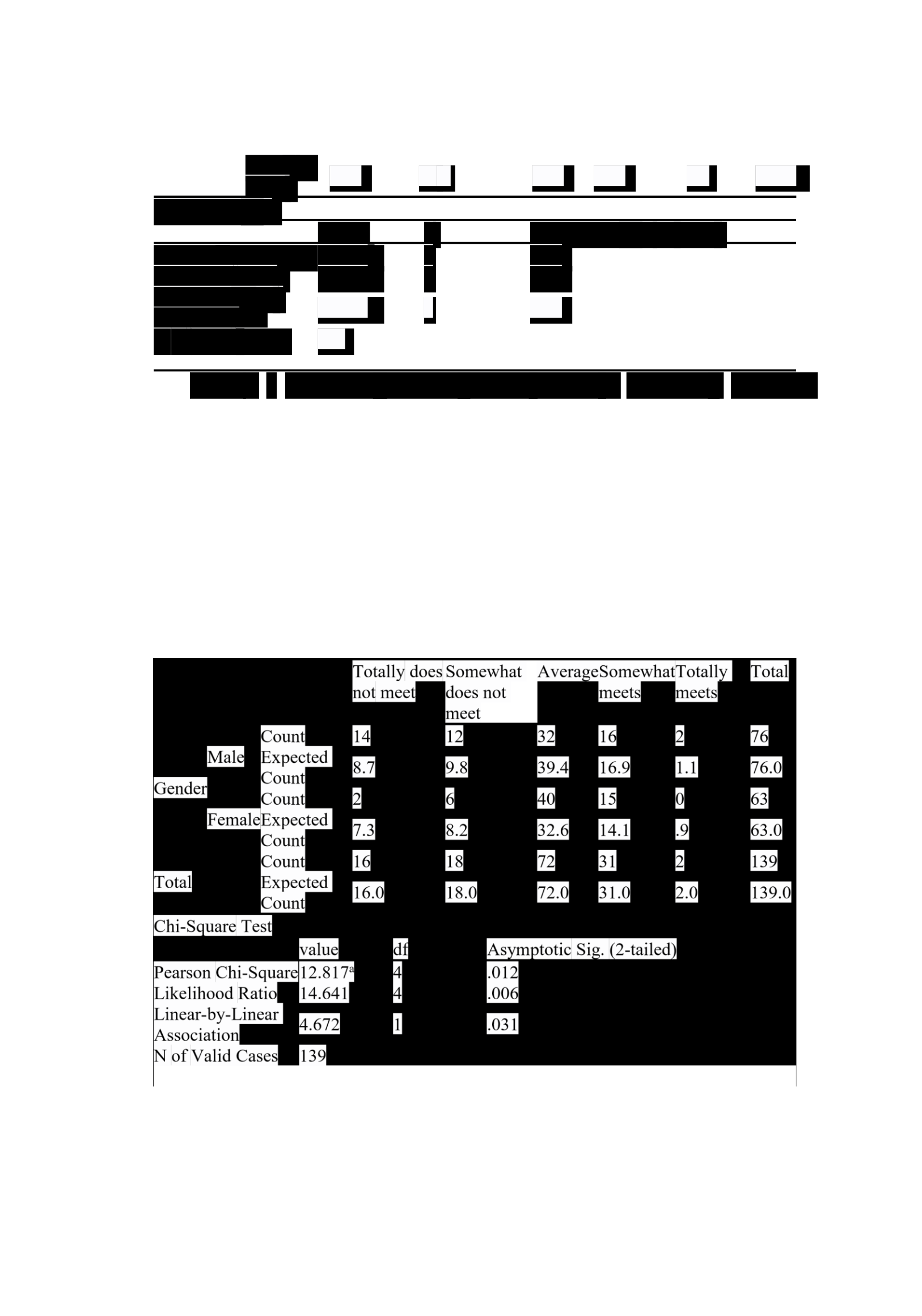
156
employed or not and their belief in the possibility of self-improvement after the
company's merger and acquisition. Employees who have already left the company have
a higher proportion who believe they "completely cannot" and "comparatively cannot"
improve themselves, with no one choosing the option of being able to enhance
themselves. On the other hand, still employed employees mostly believe they have
"Average" to "Fairly good" opportunities for self-improvement.
Table 4-66 The satisfaction levels of company’s improve yourself after merger by
different gender
Expe
ct
ed
Coun
t
16.0
18
.0
72.0
31.0
2.0
139.0
Chi-Square
Test
value
f
d
Asymptotic
Sig.
tailed
(2-
)
Pearson
Chi-Square
48.166
a
4
.000
Likelihood
Ratio
55.803
4
.000
r
Linear-by-
Linea
Association
38.335
1
.000
N
of
Valid
Cases
139
There
is
a
significant
difference
between
whether
an
employee
is
currently
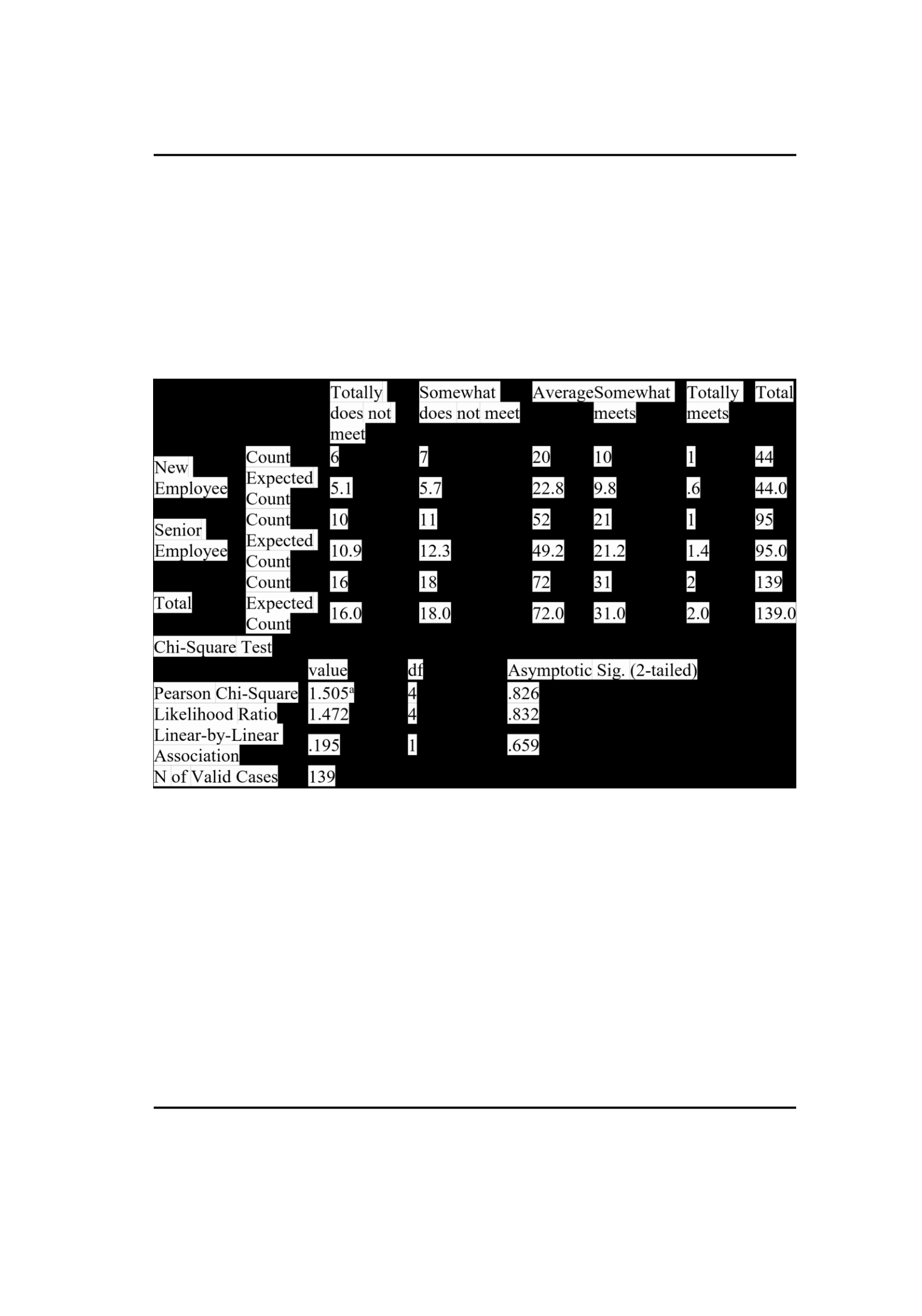
157
There is a significant difference between male and female employees in their belief
about the possibility of self-improvement after the company's merger and acquisition.
Male employees have a higher proportion who believe they "completely cannot" and
"comparatively cannot" improve themselves. Female employees predominantly choose
the "Average" option.
Table 4-67 The satisfaction levels of company’s improve yourself after merger by
different Experience Level
There are no significant differences between new and senior employees in their
belief about the possibility of self-improvement after the company's merger and
acquisition.
Table 4-68 The satisfaction levels of company’s improve yourself after merger by
different position
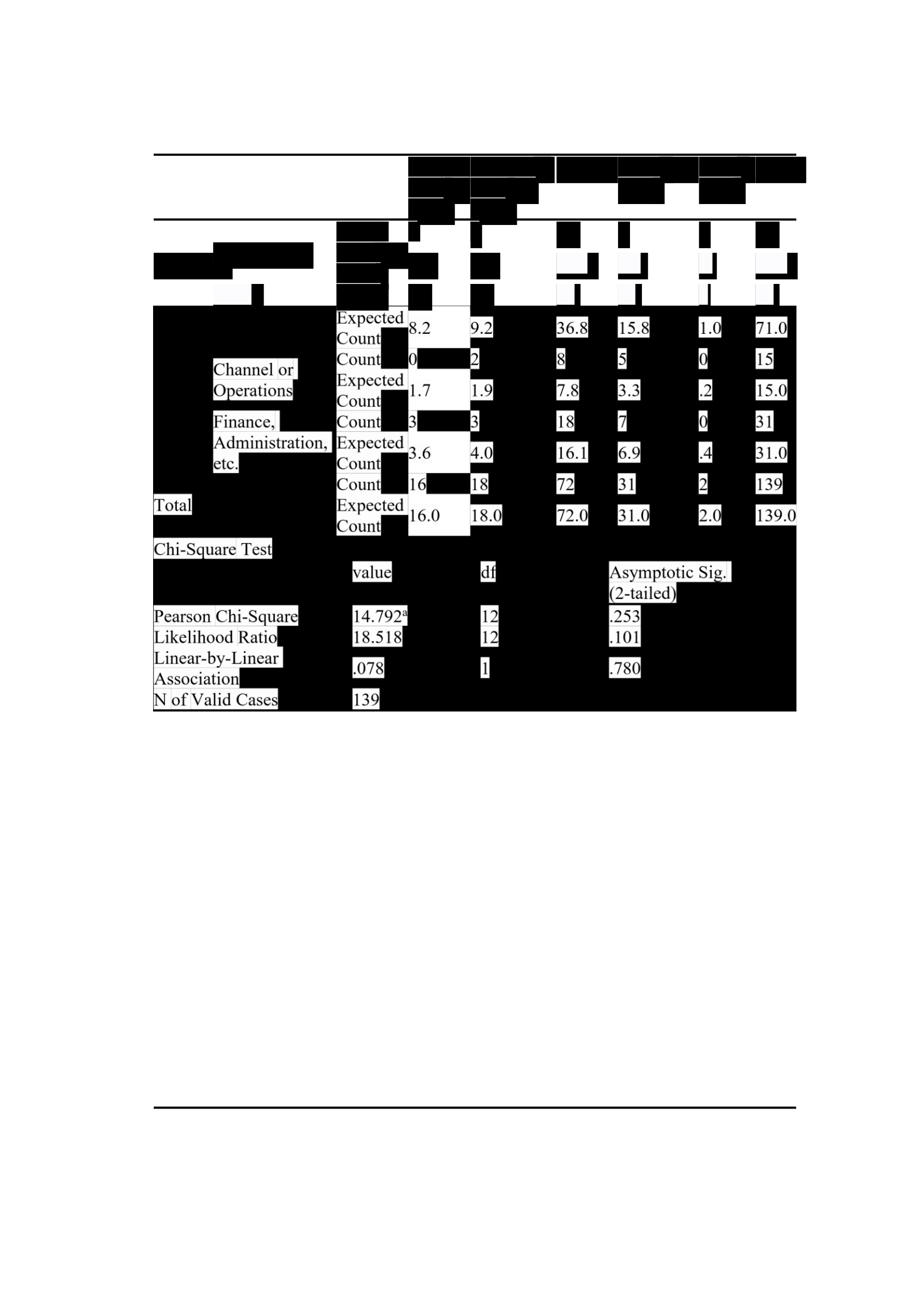
158
Employees in different Positions do not exhibit significant differences in their belief
about the possibility of self-improvement following the company's merger and
acquisition.
Table 4-69 The satisfaction levels of company’s improve yourself after merger by
different job title
Totally
does
not
meet
Somewh
at
does
not
meet
Average
Some
what
s
meet
Total
ly
s
meet
Total
Position
Marketing
t
Coun
0
2
11
8
1
22
Expe
cted
t
Coun
2.5
2.8
11.4
4.9
.3
22.0
Sales
Coun
t
13
11
35
11
1
71
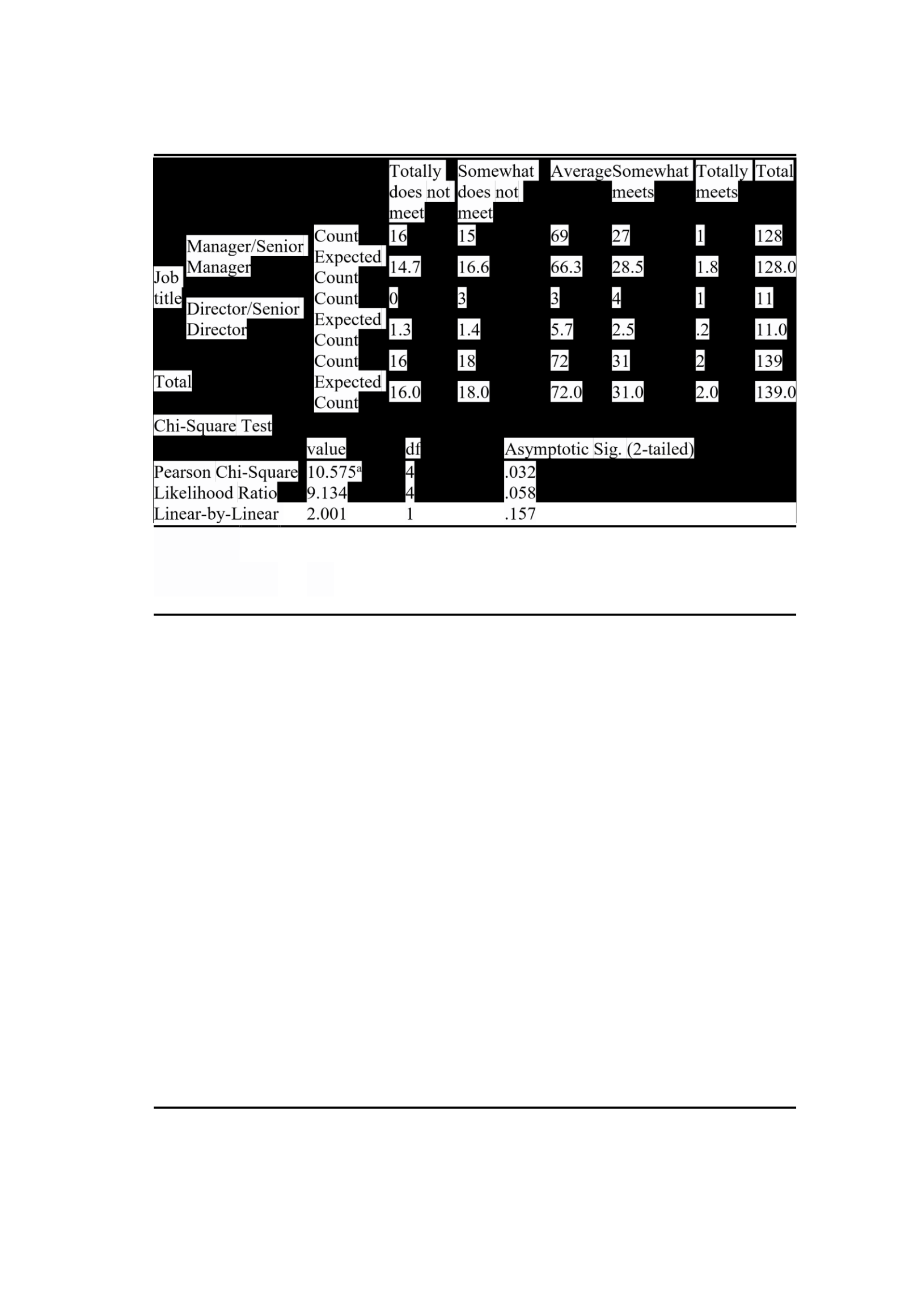
159
Association
N of Valid Cases
139
Employees with different Job titles show significant differences in their belief about
the possibility of self-improvement after the company's merger and acquisition.
However, due to the small number of directors' surveys, this conclusion's application
should be determined with caution.
Table 4-70 The satisfaction levels of management style after merger by different gender

160
There are significant differences in satisfaction with the management style of their
immediate supervisor after the company's merger and acquisition of male and female
employees. Male employees have a higher proportion who are "Very dissatisfied" and
"Somewhat dissatisfied," while female employees have a higher proportion who are
"Average" in satisfaction and "Somewhat satisfied."
Table 4-71 The satisfaction levels of management style after merger by different
experience level
Very Somewhat AverageSomewhat Very Total

161
dissatisfied
dissatisfied
satisfied
satisfied
Count
4
4
20
9.6
2.4
2.0
14
2
2.5
6
5.5
8
8.0
44
139.0
New
Expected
1
42
4
62
6
11.7
23
25.3
37
37.0
44.0
95
95.0
139
Employee
6.6
3.5
Experience
Count
Count
7
Level
17
Senior
Total
Expected
Employee
14.4
7.5
Count
Count
21
11
Expected
21.0
11.0
Count
Chi-Square Test
New and senior employees do not show significant differences in their satisfaction
with the management style of their immediate supervisor after the company's merger and
acquisition.
value
f
d
Asymptotic
Sig.
)
tailed
(2-
Pearson
Chi-Square
2.48
4
a
4
.648
Likelihood
Ratio
2.61
7
4
.624
Linear-by-
Linea
r
Association
1.007
1
.316
N
of
Valid
Cases
9
13
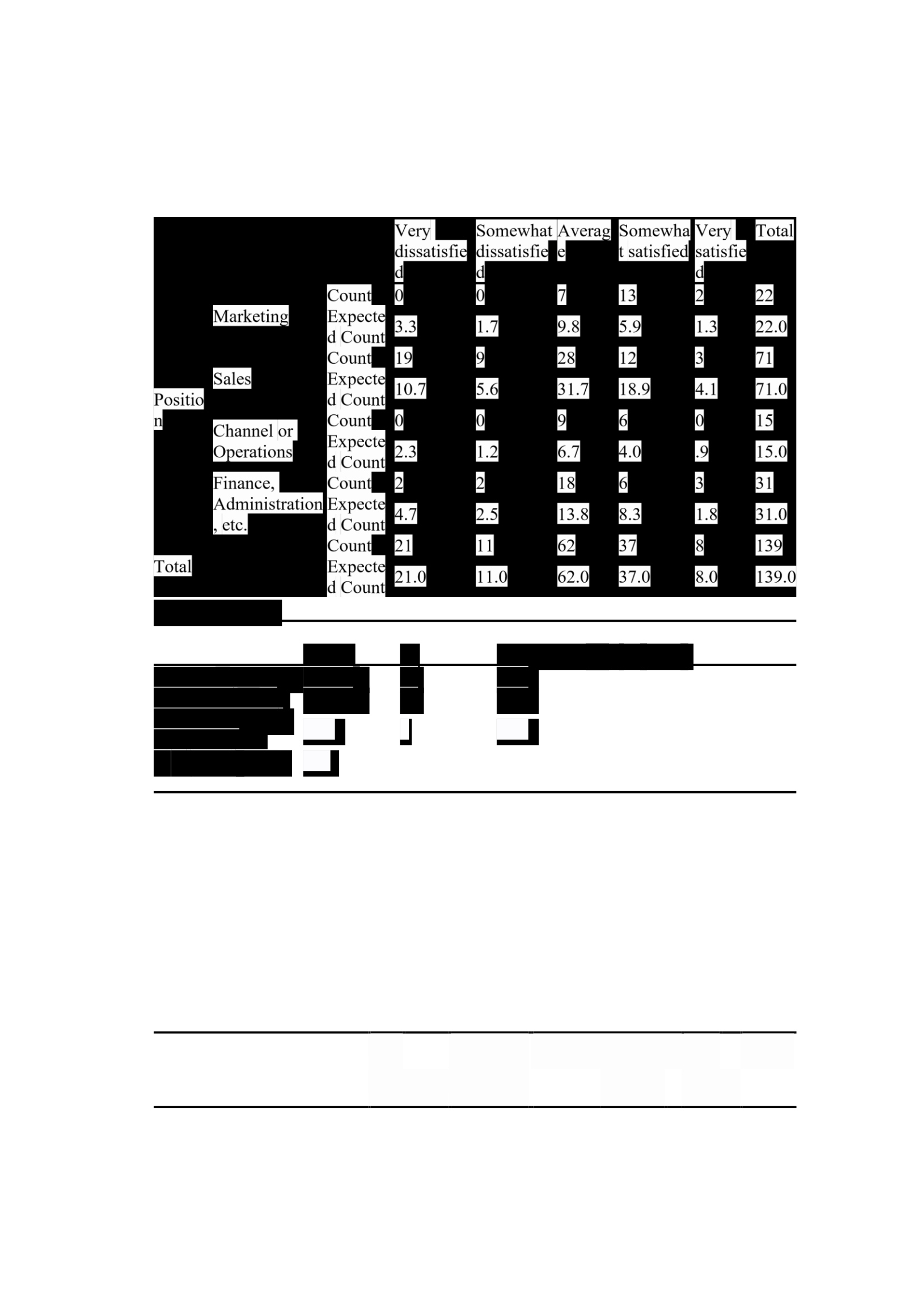
162
Table 4-72 The satisfaction levels of management style after merger by different
position
Employees in different Positions show significant differences in their satisfaction
with the management style of their immediate supervisor after the company's merger and
acquisition. Employees in Sales Positions are significantly more likely to choose "Very
dissatisfied" and "Somewhat dissatisfied" compared to those in Other Positions. In
contrast, employees in Other Positions mostly rate their satisfaction as "Average" or
"Somewhat satisfied."
Table 4-73 The satisfaction levels of management style after merger by different
position type
Very
Somewhat
AverageSomewhat
Very
Total
dissatisfied
dissatisfied
satisfied
satisfied
Chi-Square
Test
value
df
Asymptotic
Sig.
)
tailed
(2-
Pearson
Chi-Square
37.106
a
12
.000
Likelihood
Ratio
43.179
12
.000
Linear-by-
Linear
Association
.006
1
.938
N
of
Valid
Cases
139

163
Count
19
9
7.4
2
3.6
11
11.0
35
25
5
5.4
3
2.6
8
8.0
93
139.0
Frontline
Expected
41.5
27
20.5
62
62.0
24.8
12
12.2
37
37.0
93.0
46
46.0
139
position
14.1
Position
Count
Count
2
Type
supporting
Total
Expected
position
6.9
Count
Count
21
Expected
21.0
Count
Chi-Square Test
value
d
f
Asymptotic Sig. (2-tailed)
Pearson Chi-
Square
9.512a
4
4
1
.050
.030
Likelihood Ratio
10.719
Linear-by-Linear
3.937
.047
Association
N of Valid Cases
139
With a P-value of 0.05, which is close to the level of significance, it indicates a
noticeable difference between Frontline position and supporting position employees in
their satisfaction with the management style of their immediate supervisor.
Table 4-74 The satisfaction levels of management style after merger by different job

164
title
Very
Somewhat
AverageSomewhat
Very
Total
dissatisfied
dissatisfied
satisfied
satisfied
Count
19
11
58
7.1
9
2.0
34
6
7.4
2
.6
8
8.0
128
Manager/Senior
Expected
5
4
4.
62
6
34.1
3
2.9
37
37.0
128.0
11
11.0
139
139.0
Manager
19.3
10.1
Job
Count
Count
0
title
2
Director/Senior
Total
Expected
Director
1.7
.9
Count
Count
21
11
Expected
21.0
11.0
Count
Chi-Square Test
value
df
Asymptotic Sig. (2-
tailed)
Pearson Chi-Square
4.409a
4
4
1
.354
.377
Likelihood Ratio
4.218
Linear-by-Linear
.748
.387
Association
N of Valid Cases
139
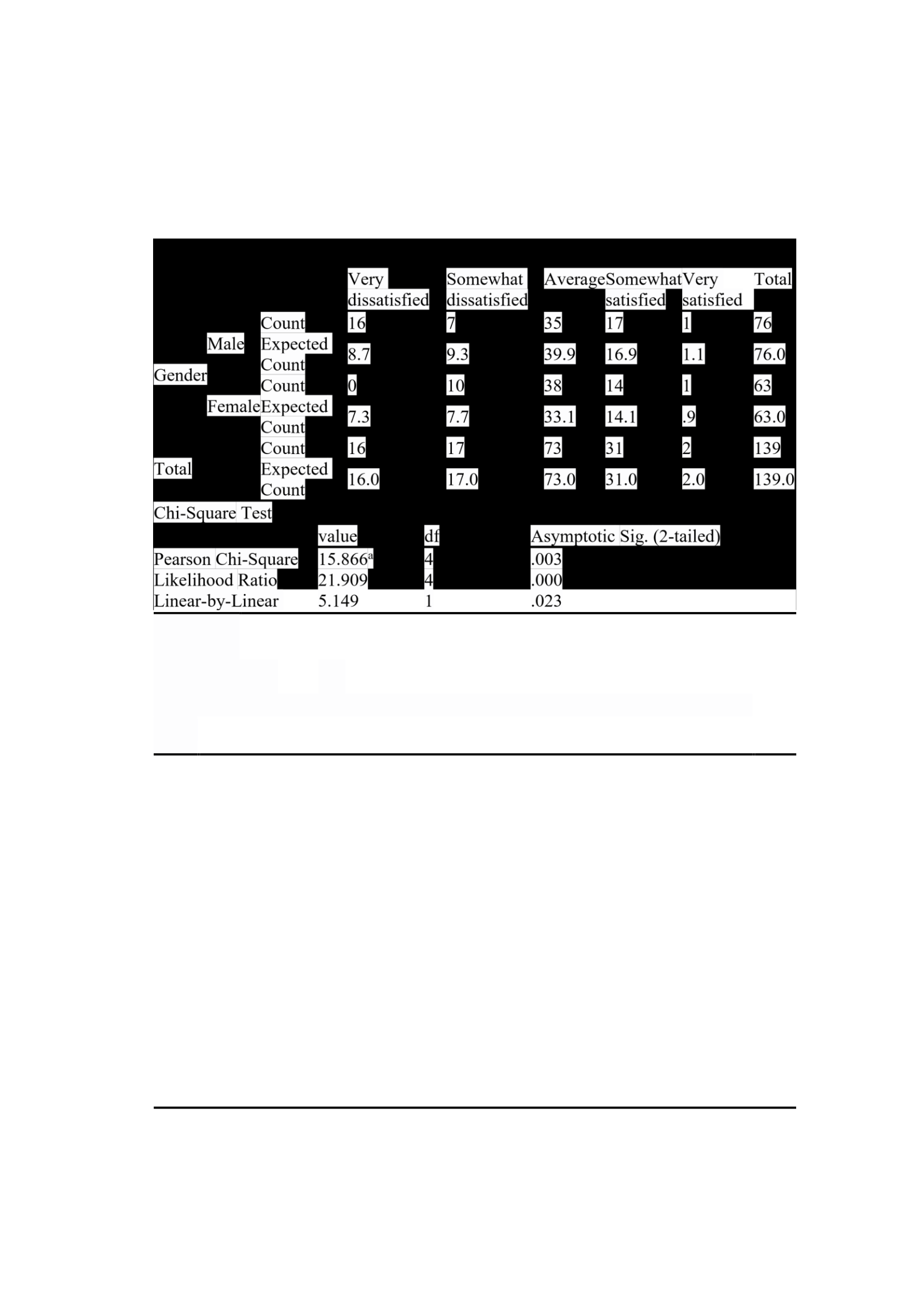
165
There are no significant differences in satisfaction with the management style of
their immediate supervisor among employees with different Job titles.
Table 4-75 The satisfaction levels of importance gives to employees after merger by
Associatio
n
N of Valid Cases
139
a. 2 cells (20.0%) have expected counts less than 5. The minimum expected count
is .91.
The satisfaction levels of employees of different genders and the degree of
importance given to them by the company's senior management, along with the degree
of importance given to them by the company's senior management, show significant
differences. Male employees tend to choose "Very dissatisfied" and "Somewhat
dissatisfied" more frequently.
Table 4-76 The satisfaction levels of importance gives to employees after merger by
different experience level
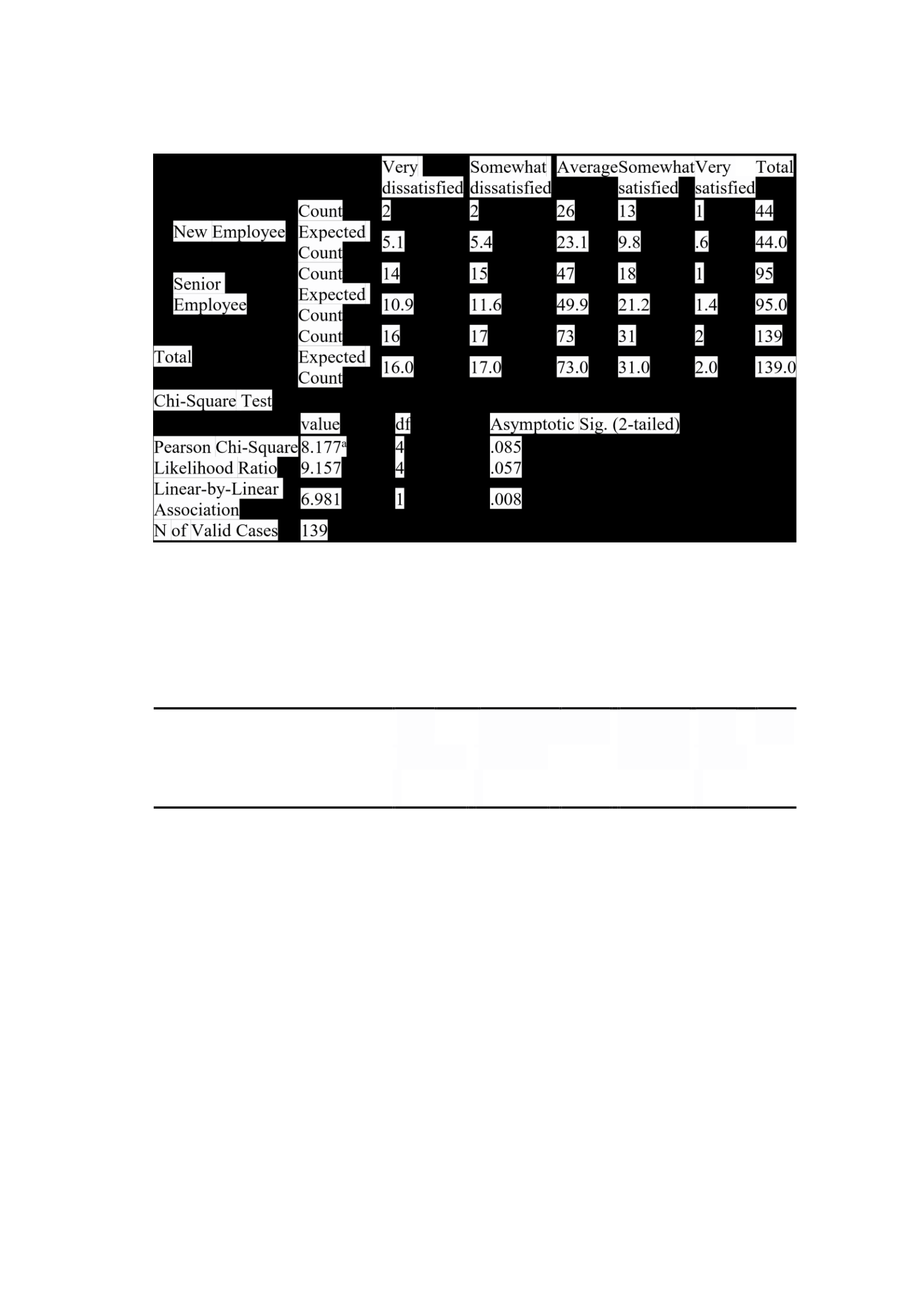
166
There is no significant difference in satisfaction levels regarding the degree of
importance senior management places on employees between new and old staff
members.
Table 4-77 The satisfaction levels of importance gives to employees after merger by
different position
Very
Somewhat
Averag
Somewha
Very
Total
dissatisfie
dissatisfie
e
t satisfied
satisfie
d
d
d
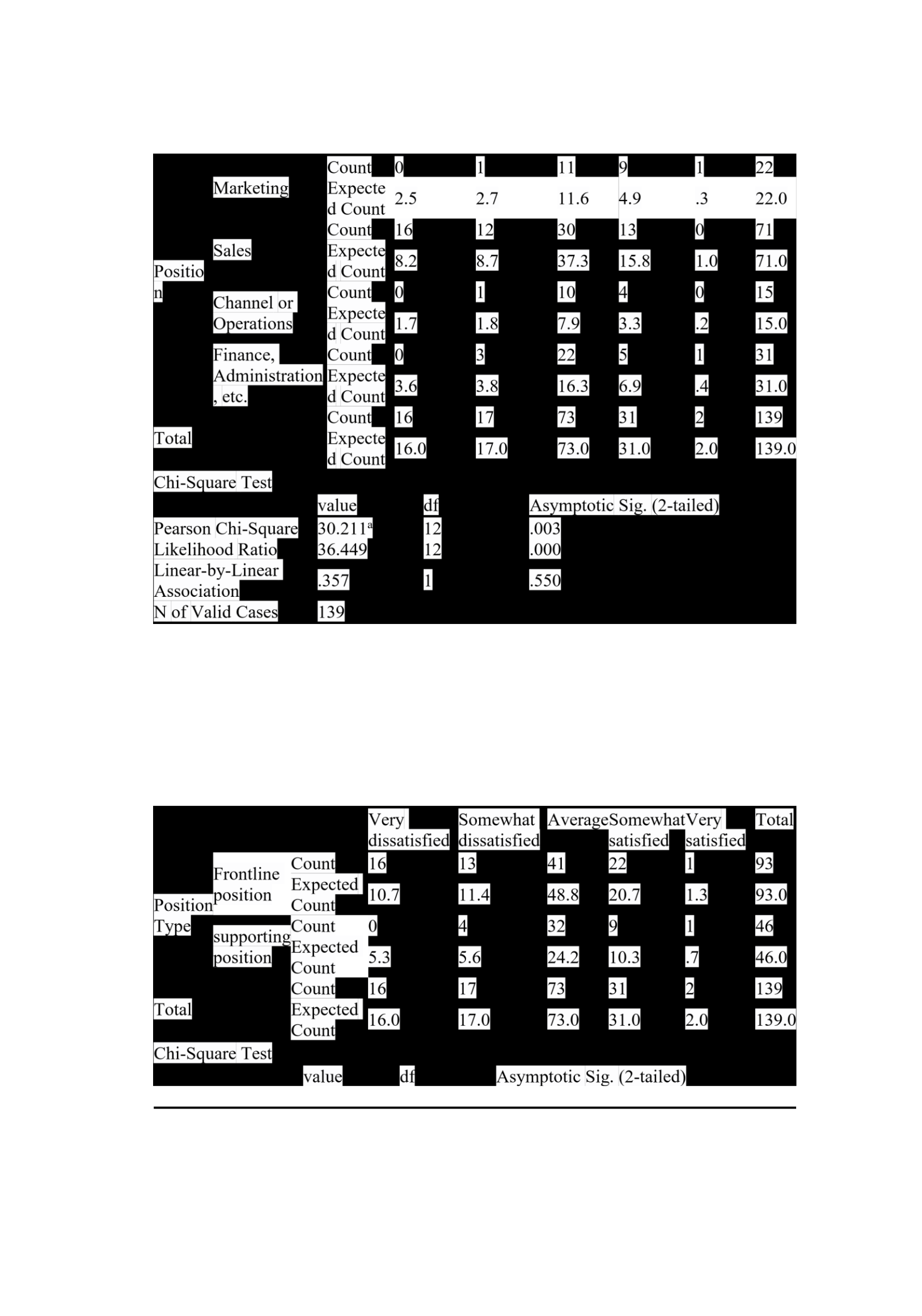
167
There are significant differences in satisfaction with the degree of importance --
senior management places on employees across different positions. Employees in Sales
positions tend to select "Very dissatisfied" and "Somewhat dissatisfied" more frequently.
Table 4-78 The satisfaction levels of importance gives to employees after merger by
different position type
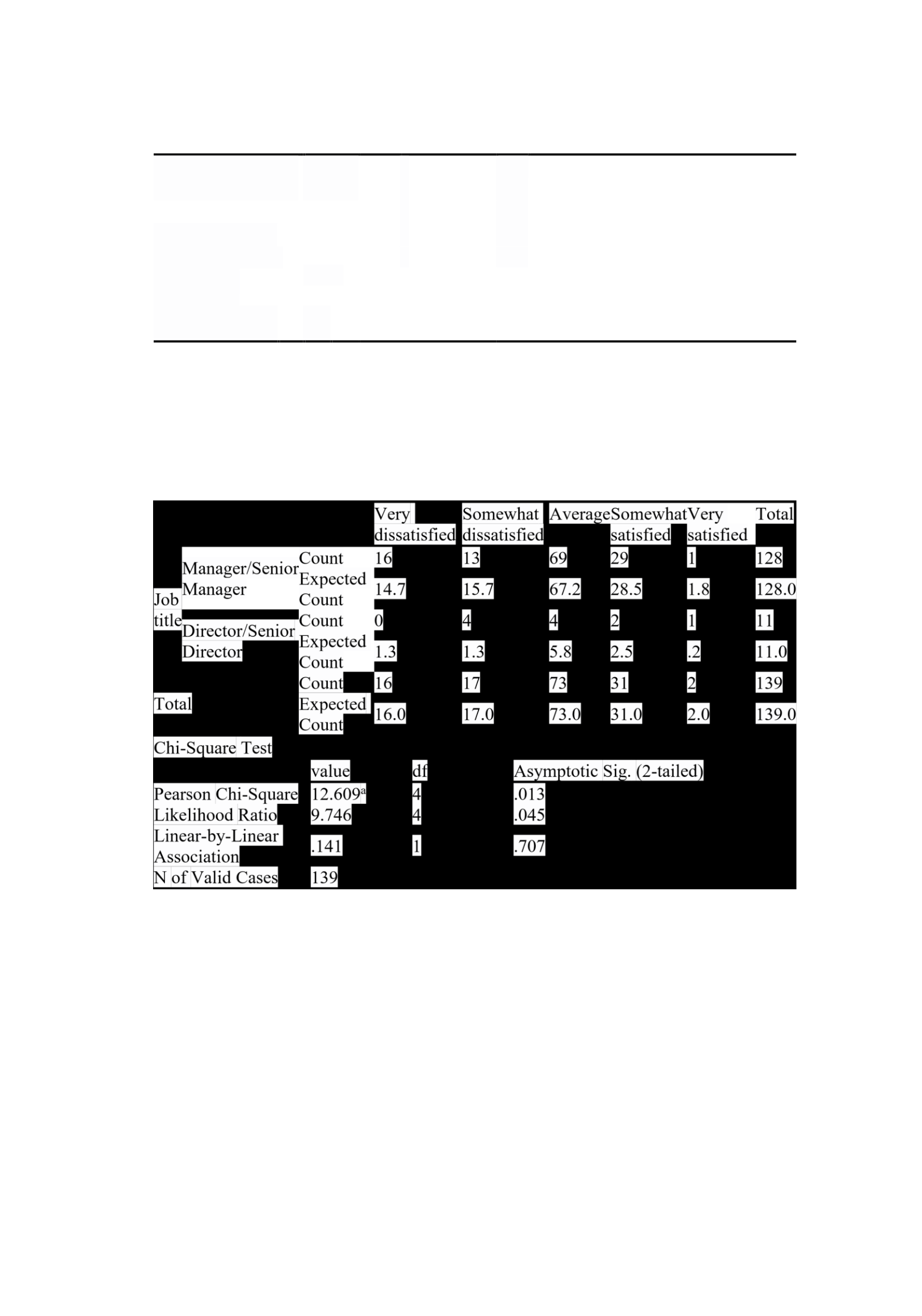
168
Pearson Chi-Square
12.910
a
4
.012
Likelihood Ratio
17.724
4
.001
Linear-by-Linear
5.117
1
.024
Association
N of Valid Cases
139
There are significant differences in satisfaction with the degree of importance senior
management places on employees based on various positions. Employees in Frontline
positions more often choose the options "Very dissatisfied" and "Somewhat dissatisfied."
Table 4-79 The satisfaction levels of importance gives to employees after merger by
different job title
Employees with different job titles exhibit significant differences in satisfaction
with the level of importance senior management attributes to employees. Those with the
job titles of Manager/Senior Manager select "Very dissatisfied" more frequently. Table
4-80 The main form of benefits After the acquisition with whether still employed
PerformanceYear-end RecognitionOther Total
bonus bonus
Count 26 35 1 1 63
Post-Merger still

169
Expected
Employment employed 34.4 24.9 1.4 2.3 63.0
Count

170
Status
left the
company
Count
50
20
2
4
76
Total
Expected
41.6
30.1
1.6
2.7
76.0
Count
Count
76
55
5.0
3
3.0
5
5.0
139
Expected
76.0
5
139.0
Count
Chi-Square
Test
value
df
Asymptotic Sig. (2-
tailed)
Pearson Chi-
Square
12.698a
3
3
1
.005
.005
.185
Likelihood Ratio
12.903
Linear-by-Linear
Association
1.754
N of Valid
Cases
139
Employees who are still employed and those who have left the company show
significant differences in the types of company benefits they receive. Former employees
primarily receive Performance bonuses, while those who are still employed are mainly
entitled to Year-end bonuses.
4.7.3.4 The most important measure to prevent talent loss
Table 4-81 The measure to prevent talent loss by whether still employed
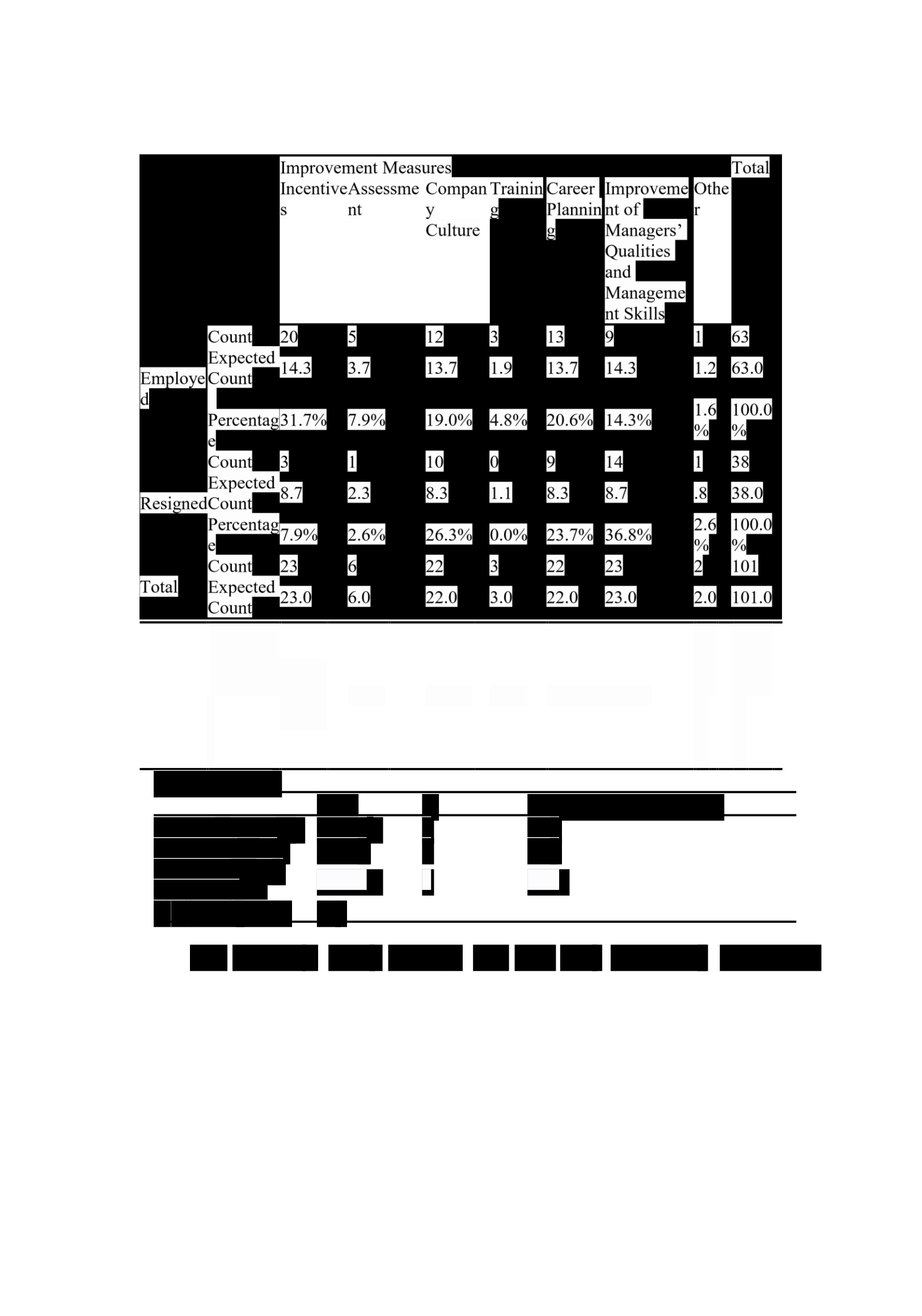
171
Percentag
5.9%
21.8%
3.0%
21.8% 22.8%
2.0
100.0
22.8%
e
%
%
difference.There is a significant association between whether employees are still
employed at the company and their view on which improvement measure is most
important.
Chi-Square
Test
valu
e
f
d
Asymptotic
Sig.
(2-
tailed
)
Pearson
are
Chi-Squ
14.956
a
6
.02
1
Likelihood
Ratio
9
16.89
6
0
.01
Linea
r
Linear-by-
Association
10.021
1
.002
N
of
Valid
Cases
1
10
The
P-value
is
0.021
,
which
is
less
than
0.05
,
indicating
a
significant

172
Employees who are still employed and those who have left the company have
significant differences in their opinions on measures to address employee
turnover.Employees who are still employed tend to favor Incentive mechanisms and
Career Planning, considering Performance Assessment and Training to be less effective.
Former employees, on the other hand, are more inclined to value the Improvement
of managers’ qualities and management skills and company culture, and they also
consider performance assessment and training to be less effective. Regarding the
Incentive mechanism, which is deemed most important by the Still E mechanism and is
deemed most important by the still employed employees, former employees do not
consider it to be very effective.
Table 4-82 The measure to prevent talent loss is material or spiritual by whether still
employed
The most important measure to prevent
Total
talent loss
Other
Material
spiritual
Count
1
1.4
2
1.6
28
34
63
EmployedExpected
16.3
8
19.7
45.3
66
54.7
63.0
76
76.0
Whether still
Resigned
Count
employed
Count
Expected
Count
The P-value is less than 0.001, which indicates a significant difference between
employees who are still employed and those who have already left the company in terms
Total
Count
3
36
0
10
9
13
ed
ct
Expe
t
Coun
3.0
36.0
100.
0
139.0
Chi-Square
Test
e
valu
f
d
Asymptotic
Sig.
)
tailed
(2-
Pearson
Chi-Square
20.649
a
2
.00
0
Likelihood
Ratio
21.312
2
.00
0
Linear-by-
Linear
Association
13.639
1
.000
N
of
Valid
Cases
139
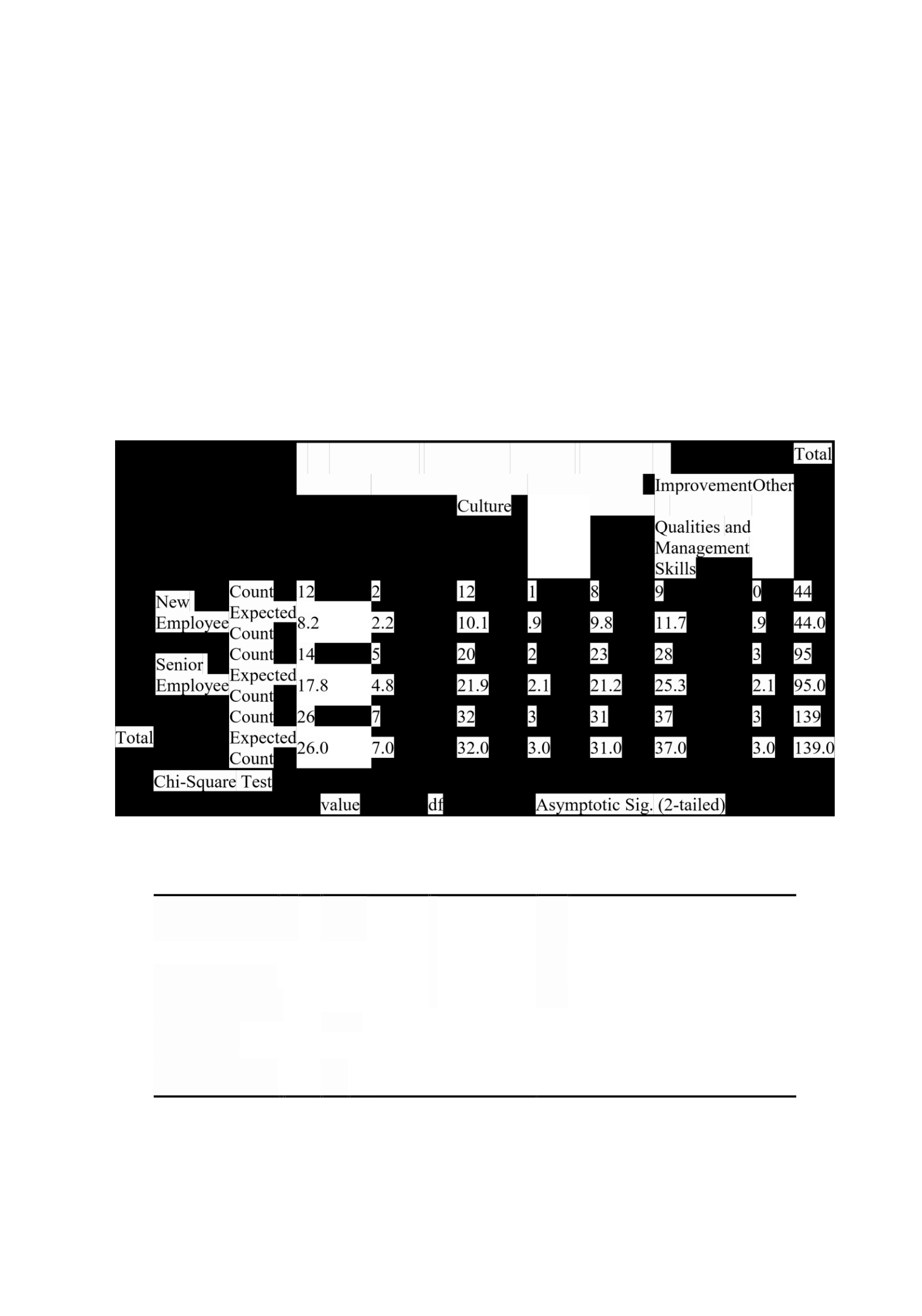
173
of the company's improvement measures addressing severe talent loss, specifically in the
material and spiritual aspects.
Employees who are . In contrast, employees who have left the company prefer
improvement measures in the Spiritual aspect and have fewer demands for measures in
the Mstill employed prefer improvement measures in the material aspect and have fewer
demands for measures in the spiritual aspect. In contrast, employees who have left the
company prefer improvement measures in the spiritual aspect and have fewer demands
for measures in the material aspect.
Table 4-83 The measure to prevent talent loss by new or senior employee
The most critical measures to improve talent loss?
IncentivesAssessmentCompanyTrainingCareer
Planningof Managers’
Pearson Chi-Squ
are
5.865
a
6
.438
Likelihood Ratio
6.656
6
.354
Linear-by-Linear
4.792
1
.029
Association
N of Valid Cases
139
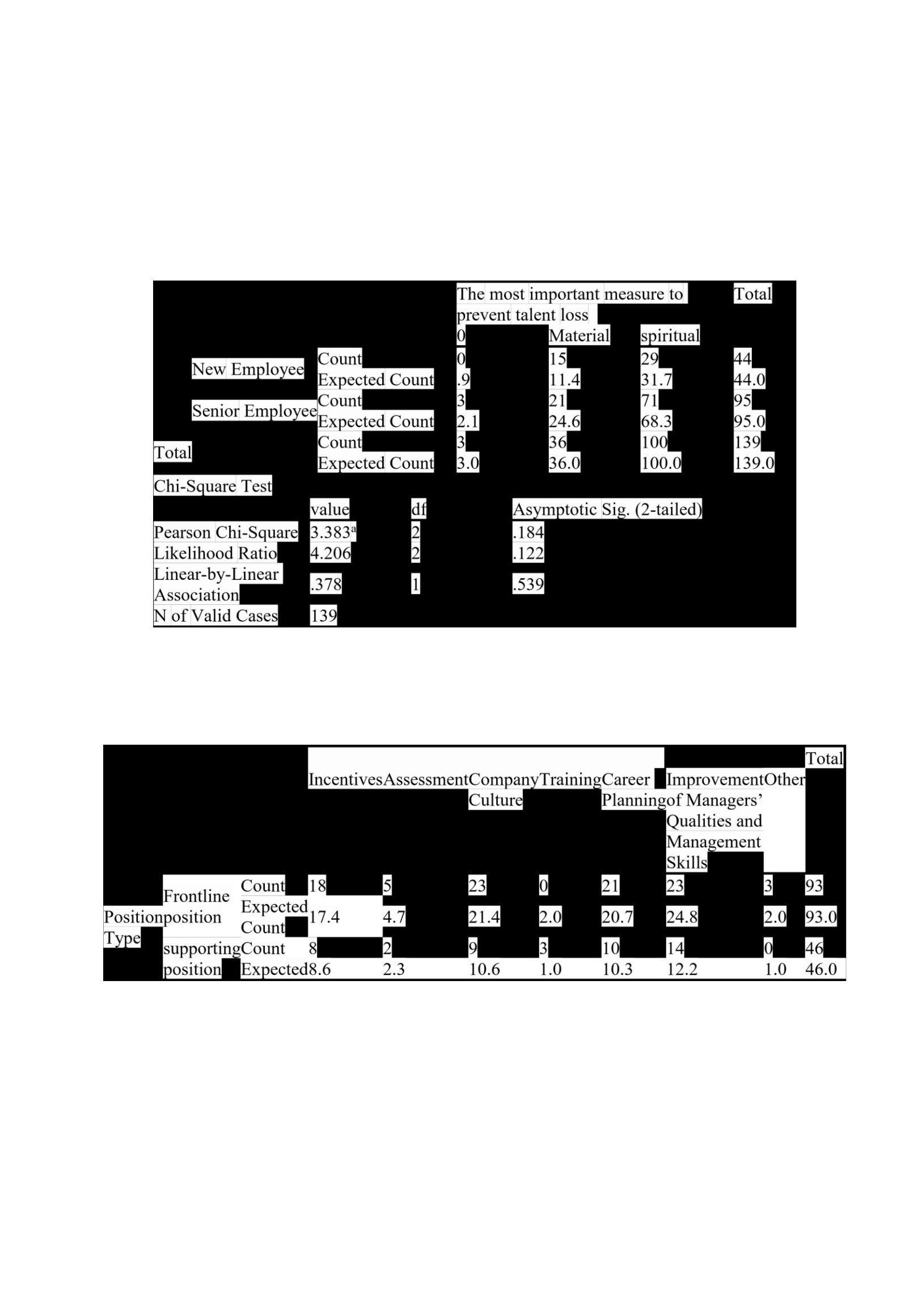
174
There are no significant differences between senior and new employees in their
views on measures to improve talent retention.
Table 4-84 The measure to prevent talent loss is material or spiritual by new or senior
employee
Senior and new employees show no significant difference in their views on material
or spiritual measures for improving talent retention.
Table 4-85 The measure to prevent talent by position type
The most critical measures to improve talent loss
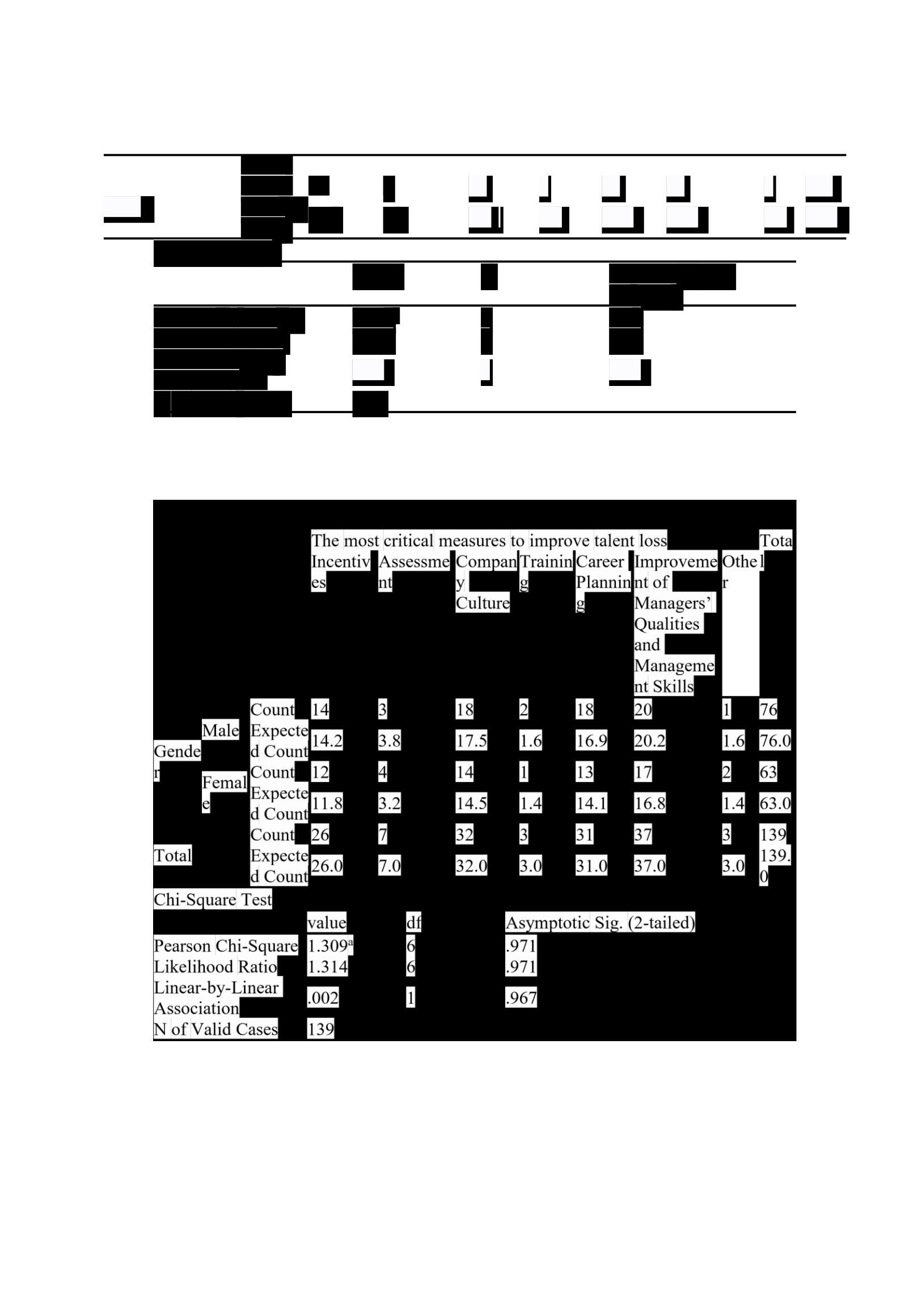
175
The front-line position and supporting position show no significant differences in
the measures used to improve talent retention.
Coun
t
Total
t
Coun
6
2
7
32
3
31
37
3
139
Expe
cted
t
Coun
26.
0
7.
0
0
32.
3.0
31.0
37.0
3.0
0
139.
Chi-Square
Test
value
f
d
tic
Asympto
Sig.
)
tailed
(2-
Pearson
are
i-Squ
Ch
0
8.42
a
6
.20
9
Likelihood
Ratio
1
9.92
6
.12
8
Linear-by-
r
Linea
Association
.167
1
.683
N
of
Valid
Cases
139

176
Male and female employees have no significant differences regarding the measures
to improve talent retention.
Table 4-87 The measure to prevent talent by Position Type
The most important measure to prevent
There is no significant difference between front-line position and supporting
position employees in their views on material or spiritual measures for improving talent
retention.
4.7.4 Logistics Regression analysis
Table 4-88 Model Summary of Logistics Regression analysis

177
1
a.
Table 4-89 Hosmer-Lemeshow Goodness of Fit Test
1
Table 4-90 Logistics Regression analysis
Variables in the Equation
95%C.I.for
EXP(B)
B
S.E.
Wald
Df
Sig.
Exp(B
)
Lower
Uppe
r
Step
Q2-Gender
:
1.242
.844
78
2.164
1
1
1
1
1
3
1
.141
3.462
.662
18.115
1a
-.773
-.470
.313
1.149
-
2.891
.668
.501
.710
.490
1.4
1.338
.883
.194
5.513
9.752
3.827
.247
.347
.659
.019
.021
.050
.462
.625
1.367
3.157
.056
.125
.234
.340
1.209
.003
1.710
1.667
5.499
8.240
1.006
Q3-Age
:
Q4-Work
Experience
(Years):
Q5-Education
:
Q6-Years with
Acquired
Model Summary
-2 Log
Step
Likelihood
Cox & Snell R Square
Nagelkerke R Square
58.683a
.524
.715
The estimation terminated at the 7th iteration due to insufficient change in parameter
estimates of less than .001.
Hosmer-Lemeshow Goodness of Fit Test
Step
Chi-
Square
Df
Sig.
2.511
8
.961

178
Company
:
Q8-Position
:
Q8-Position:
(1)
Q8-Position:
(2)
-2.488 1.364
3.326
1
.068
.083 .006 1.204
Q8-Position:
(3)
-6.460 2.112
1.373 .736
9.352
3.478
7.604
5.007
.164
1
1
1
1
1
.002
.062
.006
.025
.685
.002 .000 .098
3.946 .932 16.700
.133 .032 .558
.142 .026 .785
1.245 .432 3.583
Q17-After the
acquisition, do
you think the
company’s
compensation
situation is
reasonable?
Q18-After the
-2.015
.731
acquisition, do
you think you can
improve yourself
in the company?
Q19-After the
-
1.953
.873
acquisition, do
.219
.539
you think the
company’s talent
development
mechanism is
reasonable?
Q20-After the
acquisition, are
you satisfied with
the management
style of your

179
immediate
supervisor?
Q21-After the -.270 .654 .171 1 .679 .763 .212 2.747 acquisition, are you
satisfied with the level of importance the company’s top management gives to
employees?
Q22-After the 10.778 3 .013
acquisition, what
is the main form
of your
company’s
benefits?
Q22-After the 2.440 2.111 1.336 1 .248 11.477 .183 718.917
acquisition, what is the main form of your company’s
benefits?(1)
Q22-After the -2.280 2.136 1.139 1 .286 .102 .002 6.736
acquisition, what is the main form of your company’s
benefits?(2)
Q22-After the 1.124 3.555 .100 1 .752 3.078 .003 3267.83
acquisition, what 5 is the main form of your company’s
benefits?(3)
Constant 9.919 5.785 2.940 1 .086 20309.5
39
a. Variable(s) entered on step 1:Q2-Gender, Q3-Age, Q4-Work Experience (Years), Q5-
Education, Q6-Years with Acquired Company, Q8-Position, Q17-After the acquisition,
do you think the company’s compensation situation is reasonable?, Q18-After the
acquisition, do you think you can improve yourself in the company?,
Q19-After the acquisition, do you think the company’s talent development mechanism is
reasonable?, Q20-After the acquisition, are you satisfied with the management style of
your immediate supervisor, Q21-After the acquisition, are you satisfied with the level of
importance the company’s top management gives to employees?, Q22-After the
acquisition, what is the main form of your company’s benefits?
Based on the provided logistic regression analysis results, the following is a
categorized summary of items with significant differences in p-values:
Items with a significant impact on employee turnover (p-value < 0.05):
- Years of service within the acquired company (Q6): A significant positive
impact (B=1.449, p=.019). The longer the employees have worked in the company post-
acquisition, the higher their likelihood of leaving.

180
- Position Type (Q8): Different Position Types significantly impact employee
turnover, with all specific coefficients being negative (p=.021). Compared to Frontline
positions, employees in supporting positions are less likely to leave.
- Opportunities for self-improvement (Q18): Employees' perception of
whether the company provides opportunities for self-improvement significantly
negatively impacts turnover (B=-2.015, p=.004). If the company cannot provide
sufficient opportunities for self-improvement, the risk of turnover increases.
- Talent development mechanism (Q19): Employees' perception of the
rationality of the company's talent development mechanism significantly negatively
impacts turnover (B=-1.953, p=.025). An irrational talent development mechanism
increases the risk of turnover.
Items close to being significant but with slightly higher p-values (0.05 ≤ p < 0.1):
- Compensation situation (Q17): Employees' perception of the fairness of their
compensation situation positively impacts turnover (B=1.373, p=.062). Although it is
close to the significant level, it indicates that unfair compensation may increase t turnover
risk.
Other items:
For other variables such as Gender, age group, work experience, Education,
satisfaction with direct supervisor's management style, satisfaction with the company's
senior management's emphasis on employees, and company benefits, their p-values are
all greater than 0.1. Thus, they do not significantly impact employee turnover in the
current model.
It should be noted that these results are based solely on the current logistic regression
model and may be influenced by factors such as sample size, data quality, and model
settings.
Results.
There are significant differences in the impact of various cultural conflict factors on
employee turnover (individual perception).
There are significant differences in the impact of various cultural conflict factors on
employee attrition within the enterprise(from a third-party perspective).

181
Different cultural conflict factors have a significant differential impact on the
turnover of different groups of employees.
Different cultural conflict factors have a significant differential impact on the
turnover of different groups of employees.
Different groups perceive significant differences in the effectiveness of various
measures to reduce talent turnover rate.
For example, A has been working in S Company for ten years and has been the
right-hand man of the business leader for a long time. He is familiar with various
situations and history inside and outside the company. From the definition of key talents,
these characteristics of A are very valuable to S company, and ordinary people can not
randomly replace the work experience and knowledge accumulated over a long period.
After A left, S company also quickly found A replacement, but neither from the
perspective of experience nor work efficiency, can not reach the level of A in a short time.
In addition, the work process itself changed during the integration period after the merger
and acquisition, which involved coordination in many aspects, and it became more
difficult for the newly arrived replacement to improve the work efficiency in the short
term.
It is not difficult to see that when K company acquired S Company, it did not make
the overall planning of human resources in advance, and its preparation for the reten tion
of key talents was obviously insufficient. If we can make an assessment of the
departments involved, have an in-depth understanding of talent needs, and communicate
well about the career development of key talents before the merger and integration,
perhaps we can avoid the departure of A, or at least delay the departure of A, so as not to
lose the most capable personnel before the completion of the integration.
In addition to the adjustment of responsibilities, the integration of K company also
involves the organizational structure of some technical research and development
departments. The strength of K's products lies in its strong research and development
capabilities, which have always been at the forefront of the industry. K company's
research and development specialty mainly focuses on the mechanical part. In order to
improve its research and development capability, after the acquisition of S Company, the

182
original software development team of S Company was merged into K Company's Asia
Pacific Technology Research and Development Center (hereinafter referred to as TC)
and became a department of TC.The intention of acquiring K Company is also to
strengthen the research and development capability, and the research and development
team after the merger can give full play to the technical advantages.However, from the
perspective of the software team of S company, this change has brought some unknown
factors into their career development prospects.
(1)Change of position in the organizational structure
The software development team manager used to be a member of the management
of S company. He participated in the company's management meetings and had a say in
the company's R&D direction and other decisions. However, after being incorporated
into the TC R&D department of K company, the software team became a working group
of the whole TC and lost its original position in the organizational structure. Although
the specific content of the work did not change much for the time being, the psychological
gap was very large.
(2)Leadership management changes
From the perspective of the whole software team, it is a core part of the
organizational structure of S Company. However, after it was incorporated into the R&D
center of K company, the direct leadership and working environment changed, and it is
not clear what new content will be added to the work content.
(3)Failure to clarify new work processes and responsibilities in a timely manner
The merger of the software team was in a hurry, so it was not clear how to deal with
the software development needs of S Company in the future and who should be
responsible for it.For other business departments of S Company, they can't help worrying
about whether technical work related to software development will be disjointed in the
following projects and cause customer dissatisfaction.
The above unknown factors affected the stability of the software manager and his
team to a large extent. Two senior development engineers proposed to quit successively
after being incorporated into K Company, and one of them was retained through various
efforts, but the other engineer left the team. The project that this engineer was responsible
for was not finished at that time, and it was still in the on-line test.

183
When he left, the project was handed over to another engineer, which to some extent
affected the progress of the finishing work of the project and also caused some negative
influence on the client.
The merger of software development teams, from the perspective of the company,
is the enhancement and improvement of technical capabilities.Since the two companies
have merged, they should fully combine their technological capabilities to strengthen
their competitive advantage.However, in the process of implementing the merger, the
management of the two companies failed to make hiring plans in advance and failed to
timely communicate and deal with the career development doubts arising from the
software team, which eventually resulted in the loss of key talents.
The internal communication of the enterprise, combined with the two-factor theory
mentioned above, belongs to the health factor.For the change of enterprise structure,
merger and integration, management and employees should fully communicate, although
it can not directly make employees feel satisfied, but can prevent employees from
worrying and dissatisfied emotions.The software team of S company was merged into
TC department of K suddenly, and there was no active communication with the
implementation in advance, and no special working group was responsible for explaining
the work adjustment and plan involved in the merger. As a result, employees had no
questions in their minds and were easily dissatisfied with the working environment and
the new working relationship, resulting in increased turnover intention.
Differences in bonus and employee welfare
Bonuses and welfare are vital to employees' interests, and any adjustment can
directly affect employees' satisfaction with their work, which is the most important and
immediate motivating factor.After the merger of S Company and K Company, the
compensation and welfare of the two companies were significantly different, which is
mainly reflected in the following aspects:
Bonus structure
Like most foreign enterprises, S Company and K company put a variable bonus into
the salary structure and have different incentive policies for key talents and important
positions.As an additional incentive, the bonus is not a fixed income, but whether or not

184
to be paid and the amount to be paid each year according to the company's performance
and the employee's personal performance.Although the general structure of the two
companies is the same, Company K makes a more detailed allocation of floating bonus,
divides different types of key talents and adopts different methods to motivate them.
After the merger and acquisition, K company required S Company to maintain the
same bonus system, raised the lower limit of the performance bonus to 70%, added the
requirement of achieving the EBIT index, and maintained the upper limit of 200%. This
adjustment directly affected the vital interests of sales staff, department managers and
key technical staff. Not only was the original minimum of 50% raised to 70%, but the
condition requirement that EBIT must reach the lower limit was also added. However,
the positions of these talents are the core functions of S company, and their working status
directly affects the performance of the company and the whole team ,They will leave
their jobs naturally.
4.8 Deep interviews with senior management teams
We interviewed the company M and Company K senior management team,
including China General manager, Senior business director, financial director, operation
director and, marketing director, etc. The executives who participated in the merger and
acquisition have many experiences in mergers and acquisitions and integration.
Company K, the acquired part, is mainly local research and developed and listed on the
New York Stock Exchange in the United States. After M’s merger and acquisition, a
dual-brand strategy was formed in the market for different segments customers. Since
the executives require anonymous presentation in the paper, we do not disclose their
identities.
Table 4-91 Cultural Integration Executive Interview Data Collection
Key factors
Specific content

185
1 Own
culture,
integration
of
experience
and abilities
A .M has strong integration ability and rich experience in
mergers and acquisitions. It had over 30 M&A experience. B.M
has the ability to integrate, resources and "internal power",A
clear integration idea and plan were formulated before the
merger and acquisition.
C. successful merger and acquisition integration Company K
belongs toTop medical device company in China.
2 As the
interface of
business
partners
A M worked with the consultant team to do due diligence.
B Investment Fund plays an important role with Goldman
Sachs Group.
C M chooses three partners with certain strength.
3 Eliminate the
other party's
sleepiness
Confused,
strengthen
communication,
Respect each
other's culture
At the beginning of the merger, about 80% of employees did
not support the acquisition. ……
A.M’s Culture eliminates the original concerns and enhances
the sense of belonging of employees.。
B.K company avoided the wording mergers and acquisitions
carefully and they chose Cooperation replace the word
Acqusition .
C M company Commitment 123 Principle: 1 is M company
and Kang HuiIt's a family, 2 is two brands. That is, M company
and K company exist at the same time, targeting different target
markets. 3 are the three basic principles: that is, to maintain K
company Management team and The workforce is stable and
maintained.
For Company K talents, The company released "Talent
Retention Program”,
D M company asked employees to take the initiative to think
about problems from each other's standpoint.
E integrate into the local language by changing yourself
rather than changing each other.
F M company is based on integrity, empathy, and the
scheme design takes into account the enterprises, employees and
governments of both sides. Government, society and other
interests to achieve "multi-win".
G M company should really stand from the perspective of

186
each other's enterprises and employees.It is reasonable and can
make the double All parties can have a profitable acquisition
plan.
J M company insists on not engaging in layoffs and diversion,
not changing the leadership team, and only sending relevant
personnel to be responsible for both. The party's coordination and
communication matters. The adoption of the model of "Italian
governance, a high degree of autonomy" has stabilized the
military's heart. With a smooth transition, the two enterprises with
huge cultural differences can haveSequentially in running-in
Integration.
4 Cultural
Interaction
Party
Standards
A Medtrony follows international rules, respects their
respective cultures, and learns from each other's advantages.
The senior management of M company also told Kangkui
employees :Kang Hui was the largest orthepedic company in
China.
C M company is not treated as a "conqueror", but as a
relatively "weak" attitude.Kang Hui (Such as not adjusting the
original management team, etc.)
D Restructuring mergers and acquisitions does not mean the
annexation of another enterprise by one enterprise, but the two
sides working together.
Heart, create a new platform for collaborative development.
E Internationalization is not economic colonization, not
cultural colonization, not whoever buys or conquers whom, but It
is to establish common interests and achieve common
development under a common vision.
From the early communication to the later integration, the
general manager has been telling the country.Internal high-
level,Kang Hui have high-quality resources For property,
intellectual property rights and human resources, M company
should respect and learn from Company K.
5 Treat cultural
with
Different
ways
A .The corporate culture is different in many aspects, such as
promoting corporate social responsibility, employee loyalty, and
employee benifits.
B.Company K's management system and evaluation system
remain relatively independent.
C. Company K has excellent domestic brands, excellent
quality and advanced technology, cost control, operation and
management. Well done.
D"Kang hui ahd good quality before the merger and
acquisition. Kang HuiThe management team is excellent. Kang

187
Hui used to be a good vendor which had 10 years of OEM
experience for Johnson & Johnson.
6 New culture
generation
Way
A .The same vision can motivated employees both M company
and Kang Hui.
B.To solve the system of both sides Advantages,
disadvantages and compatibility, synthesize the new system of
post-merger and acquisition.
C M company "inclusion, sharing and responsibility" reflected
in the acquisition process,It is inseparable from the strong
tolerance and support of the corporate culture.
7
Implementation
of negative
preventive
measures
A. On the basis of the establishment of a sound culture and
system, the enterprise can form a management mode with strong
execution, high efficiency and smooth flow
B. M company and Comfort employees often organize
exchange activities to integrate cultures and enhance synergies
C. M company also regularly organizes the backbone staff
of Comfort to visit the headquarters of M company and
communicate in the customer experience center and clinical
animal testing center, so as to promote the integration of Comfort
staff into the big family of M company
D. Management and staff have regular exchanges and open
discussions to enhance their understanding of each other's culture.
8
Implementation
of positive
guidance
mechanisms
A. On the basis of the establishment of a sound culture and
system, the enterprise can form a management mode with strong
execution, high efficiency and smooth flow
B. M company and Comfort employees often organize
exchange activities to integrate cultures and enhance synergies
C. M company also regularly organizes the backbone staff
of Comfort to visit the headquarters of M company and
communicate in the customer experience center and clinical
animal testing center, so as to promote the integration of Comfort
staff into the big family of M company
D. Management and staff have regular exchanges and open
discussions to enhance their understanding of each other's culture.

188
Comparison of bonus and welfare policy differences between Company M and
Company K
Bonus and welfare are the vital interests of employees, and any adjustment can
directly affect employees' satisfaction with their work, which is the most important and
immediate motivating factor. After the merger of M Company and Company K, the
compensation and welfare of the two companies are significantly different; this is mainly
reflected in the following aspects, as shown in below table.
Table 4-92 Comparison of Bonus and Welfare Policy Differences between Company M
and Company K
Bonus category
and contrast
Referring to a
position or
function
M company
Company K
Pre-merger
compensation
policy
Post-merger
compensation
policy
Heyi
rank
Compensation
policy
Performance
bonus
(Variable
Salary)
Department
manager
Reach the
minimum
50%
The bonus is
capped at
200%
Reach the
lower limit
70%
The bonus is
capped at
200% If
EBIT does
not reach U,
the company
has the right
to adjust or
cancel part
of the bonus
12-16
The lower limit of
the target reached
70%
The bonus is
capped at 200% If
the EBIT does not
reach the
minimum value,
the company has
the right to adjust
or cancel the bonus
Key
technic
al personnel
(Project
Engineer,
Designer)
9 to 11
The lower limit of
the target reached
70%
The bonus is
capped at 150%

189
Sales staff
9 to 11
The lower limit of
the target reached
70%
The bonus is
capped at 200%. If
the EBIT does not
reach the minimum
value, the company
has the right to
adjust or cancel the
bonus.
Variable bonus
(Bonus)
Ordinary staff
1-3 months
'salary
0-4 months
salary
5-10
0-4 months salary
as a floating bonus
Travel
allowance
Sales
personnel,
project
personnel,
after-sales
technical
personnel
Short-term
business
trip
only Subsidy
policy
Short-term
business
trip
only Subsidy
policy
-
For short-term and
long-term business
trips, there are more
substantial and
detailed subsidy
policies.
For long-term
overseas visits, you
can enjoy
additional benefits
such as housing and
family leave.

the
190
Chapter 5 Integration measures of merger and acquisition culture
Through exploring the current situation and problems of M Company's
acquisition of K corporate culture integration, it can be seen that its cultural
integration effect is poor and has many problems. This paper focuses on the
focus of post-merger cultural conflict -- behavioral cultural conflict and
proposes the solution of behavioral cultural conflict and the direction of cultural
integration efforts by combining the mode and level of cultural integration.
5.1 Strengthen communication and enhance employee emotion management.
Almost all businesses will face different challenges when merging and
acquiring other businesses. Effective communication is the only way to
overcome these challenges, which might stem from disputes brought on by poor
cultural integration, ambiguous leadership roles, or insufficient policy
implementation. Most employees in mergers and acquisitions are reluctant to let
go of the past and prefer the original corporate culture despite the numerous
business operations that have altered. Employees experience psychological
discomfort because corporate cultures vary across different systems, and the
behavioral problems are made worse by the antagonistic feelings that
accompany this worry. Following that, employees' drive gradually fades and
slow work emerges. In order to prevent employee disputes and confrontations,
communication should occur as early as feasible during the merger and
acquisition process.
The merger and acquisition process should be patient and detailed in all
kinds of communication and employee emotion management and actively
explain the corporate culture and the development direction of the company,
which will reduce employees' resistance and increase their sense of corporate
culture. Departments should analyze and summarize the problems generated
and give positive feedback to the company leaders to find solutions. Leaders
strengthen communication with employees to understand the conflict points and
improve the work process. Company M actively hold employee seminars,
organize inter-department coordination meetings, establish employee feedback
channels, etc., communicate with the acquirer more about the problems arising
from the merger and acquisition, and find out a system more suitable for

191
development of the enterprise. Only by constantly strengthening
communication in all aspects, we put lots of efforts to avoid kinds of conflicts
during M&A in time.
At the same time, enterprises should actively carry out various cultural
activities, such as competitive competitions, quizzes, outdoor activities, social
assistance, etc., which can not only increase employees' communication but also
make them cooperate more highly, so that employees can realize the superiority
of the new corporate culture and gradually generate a sense of belonging to the
enterprise.
5.2 Develop a comprehensive cultural integration plan
Cultural integration programs are programs and guidelines for specific
integration actions and should be as comprehensive as possible, both in terms
of content and in other areas. Content, the enterprise culture contains four
aspects is a kind of from the inside-out, layer by layer progressive relationship.
Therefore, the cultural integration program should pay attention to the focus of
culture conflicts, and at the same time, it should also pay attention to the deeper
cultural aspects. Otherwise, it can only "treat the symptoms instead of the root
cause" and cannot achieve a good cultural integration effect. As for the main
body, cultural integration is mainly implemented by the management level, but
it cannot be separated from all employees' common recognition and
implementation. Therefore, in the integration plan, we should take into account
the status and role of all posts and employees at all levels in cultural integration
and make targeted deployment in advance.
5.2.1 Strengthen the cultural review of both sides.
"Only by knowing yourself and your enemy can you win every battle."
Only by having a deep and accurate grasp of the corporate culture of both sides
can the merger and acquisition of corporate cultural integration achieve
significant results. On the one hand, cultural review can effectively prevent the
risk of improper selection of M&A targets. Prior to the cultural review of the
two sides of the merger enterprise, if it is found that the two cultures are quite

the
192
different, or even contradictory, and there is no possibility of integration, the
risk can be nipped in the bud. On the other hand, cultural review is a re-sorting
of the cultures of both parties, which can help both parties to clarify the
strengths, weaknesses, and cultural foundations of their respective cultures,
provide a foundation for subsequent cultural integration, and formulate a
comprehensive corporate cultural integration plan on the basis of accurately
grasping the corporate cultures of both parties.
5.2.2 Scientific selection of integration mode
There are many models of cultural integration, but each has its own scope
of application. Injection cultural integration mode is simple, rough, and violent,
high risk, easy to ignore, stifle the excellent culture of the acquired enterprise.
Therefore, in the process of using this method, attention should be paid to ways
and methods to avoid blindly inculcating corporate culture into the acquired
enterprise without any choice. At the same time, high attention should be paid
to the psychology and behavior of employees after a certain aspect of culture is
injected. M chose the injection cultural integration model as a one-size-fits-all
merger with K.M Company, as an enterprise growing from the merger and
acquisition of MNC in recent years, it does not have a deep cultural foundation.
On the contrary, K was founded in the early 21st century, and has formed
its own unique corporate culture in the long-term market competition. The two
sides have similar cultural forces and characteristics, so the cultural integration
mode does not suit the actual situation of the two sides. Therefore, in the actual
operation process, enterprises need to start from the actual situation, according
to the specific situation changes, in turn or at the same time to use multi-cultural
integration mode, to achieve the best integration effect.
5.2.3 Properly control the integration speed
In terms of the implementation speed of the cultural integration program,
leaders subjectively believe that cultural integration should be planned in the
long term and implemented gradually to avoid the dangerous situation that
enterprise cannot control. However, according to the results of the

193
questionnaire, most employees hope that the enterprise can quickly implement
the cultural integration plan. Procrastination and slow progress will only
increase the anxiety and boredom of employees under certain circumstances.
According to different levels of corporate culture, cultural material, behavior,
and system can be easily perceived and grasped at the peripheral level of culture,
so cultural integration should be implemented as soon as possible. In order to
ensure the quality and efficiency of the integration plan, the enterprise can adopt
the project management method to decompose the cultural integration
objectives of a certain aspect layer by layer and implement them to specific
things and people. On the one hand, the integration personnel should take
various measures to deepen the employees' recognition of the new corporate
culture. On the other hand, they should be very patient and persevere in shaping
the new culture and the employees' recognition so as to leave adequate
psychological adjustment opportunities for the employees.
5.3 Leaders actively carry out cultural integration
Cultural integration is a very intricate and methodical project that requires
the leadership's constant attention and backing. After a merger or acquisition,
top management must handle a lot of work and doesn't have time to focus on
cultural integration. In order to fully manage cultural integration and integrate
it into daily management tasks, the company should establish a leading group
for cultural integration as soon as feasible following the merger and acquisition.
On the one hand, senior management needs to focus more on integrating
cultures; on the other hand, group decision-making can greatly increase the
quality of decision-making and reduce individual decision-making errors.
Performance reviews have an impact on management's behavior because they
are senior personnel The evaluation of management following the merger often
concentrates on metrics like market share and profit growth. Senior
management must now prioritize sales performance while ignoring cultural
integration due to this performance appraisal mindset. Nevertheless, in a setting
of cultural tensions and contradictions, economic success is merely a fleeting
phenomenon that cannot be sustained over the long term and may potentially
weaken the basis for business growth. In order to improve the leadership's

the
194
emphasis on cultural integration, it is advised that the company include cultural
integration in the management's performance evaluation after the merger.
Managers at different levels have different responsibilities in enterprises'
production and operation management, and the businesses and personnel they
contact are also different. Therefore, enterprises should be aware of the different
roles of different management levels in cultural integration to implement the
cultural integration plan with target. Generally speaking, senior management
mainly starts from the overall situation, designs cultural integration plans,
redefines business philosophy and organizational mission, and passes it on to
middle and lower management. On the basis of learning and understanding the
"formal expression" of corporate culture proposed by senior management,
middle and lower management pass it on to ordinary employees. Middle
managers, who are between the senior management and the ordinary staff, play
a connecting role in the cultural integration program. At the same time, because
middle and lower management are in a lower management position, they have
more opportunities to contact ordinary employees. Communication at work and
communication in daily life make them closer to each other. Therefore, when
the middle and lower management implement the cultural integration plan, the
staff's attitude resistance or identification is affected by the closeness of the
relationship. Middle and lower management should have strong action power
and a good foundation for employee relationships. As the "top level", senior
leaders should be good at building an optimized team in the cultural integration
and promote the cultural integration with the help of team wisdom. At the same
time, middle and lower-level managers should have a deep understanding of
their own role, have the courage to take responsibility, shine and contribute to
the process of cultural integration.
Leaders play a guiding role like beacons in the cultural integration of
enterprises, so they need both internal and external cultivation and excellent
qualities. According to the trait theory of leaders, an excellent leader should
have the gumption to wait for no time, the strong desire to lead, the sincere and
upright personal cultivation, the positive and optimistic confidence, resourceful
wisdom, and the rich work experience. These characteristics are particularly
important in all aspects of cultural integration. Enterprise leadership should

195
cultivate both inside and outside, constantly improve self-cultivation and ability,
and lead the way and do good deeds in cultural integration.
5.4 Increase employee participation
5.4.1 Smooth communication channels
In the process of cultural integration, employee participation directly
affects the effect of integration. In ation. By integrating merger and acquisition
culture, we should communicate information in multiple ways to ensure that
information is delivered to employees in a timely and accurate manner.
Specifically, we can set up a reception day for leaders, set up a special channel
for employees' opinions, and make full use of social software, internal journals,
seminars, and other effective communication methods. Enterprises should pay
attention to the smooth communication channels of information. On the one
hand, the channels of information transmission should be straightened out, and
the responsibility of communicating with specific employees should be
implemented. Make clear the specific work requirements of the company for
employees, and inform them of the salary, welfare and promotion channels
concerning the vital interests of employees in a timely manner. On the other
hand, multiple channels of information access should be opened for low-level
employees, such as manager's mailbox, manager's reception day, special
seminars and so on. This improves the enthusiasm and possibility of employees
participating in the cultural integration program, which is conducive to
improving the program's quality and alleviating employees' resistance to a large
extent. When employees truly experience their own status and role in cultural
integration, they will naturally cooperate actively to seek better integration
effect, and they will be full of confidence in the future of the company and take
the initiative to carry out various work.
5.4.2 Strengthen education and training
Employee training is an important means of cultural integration, especially
in the integration of system culture, training shows unique advantages. On the
one hand, it can make employees familiar with the new system as soon as

the
196
possible and eliminate the strange fear of the new process and new office means.
On the other hand, employees can communicate with each other during training
to strengthen their sense of closeness. Therefore, after the merger and
acquisition of enterprises, diversified employee education and training should
be carried out, especially focusing on influential key employees whose business
implementation, code of conduct, and ideology can be cultivated to produce a
model-driving effect on ordinary employees. Staff training methods are flexible
and varied. Traditional teaching training can invite experienced behavioral
organizing masters to focus on strengthening. It can also organize themed
activities such as mutual help and sports programs to strengthen emotional
connection between employees. Watch and record the development process of
the enterprise video data, trigger the internal resonance of employees. In
addition, various forms of seminars, publicity meetings, commendation
meetings, and other forms of staff training. Middle and senior management are
examples and models in the practice of corporate culture, and their values and
codes of conduct will be directly transmitted to employees.
5.4.3 Setting a benchmark
The award and selection of outstanding personnel in an enterprise plays a
positive role in promoting the development of an enterprise. The quality of an
enterprise's culture can be reflected in the actions of outstanding employees.
Employees do not adapt to the system and culture of the new enterprise is often
no one to take the lead in practice, the lack of guidance personnel. Enterprises
can select excellent leaders from leaders and employees and guide employees
to adapt to the new corporate culture through various ways such as rewards,
guidance, and leading implementation so that employees can recognize the
various systems of the new company and reduce the confusion

197
caused by cultural transition. The benchmark plays an exemplary role. Through
continuous selection and reward, the surrounding employees are led to carry
out an activity together, which shortens the employees' inadaptability to the
new enterprise, reduces their fear and resistance, and continuously increases
their enthusiasm to promote the positive development of the enterprise.
In addition, enterprises should do a good job in the application of publicity
carriers and expand corporate culture publicity through local advertising media,
logistics vehicles, office paper, envelopes, bags, and other corporate logos, so
that employees have a sense of collective honor for the new enterprise, not to
identify and integrate into the new enterprise.

198
Chapter 6 Conclusion
This paper mainly studies the focus of culture conflicts in the merger of
state-owned medical and private enterprises. It proposes corresponding
measures based on the cultural characteristics and cultural integration status of
MNC and private enterprises. Through empirical analysis and theoretical
combing, this paper draws the following conclusions.
First, the focus of culture conflict in the merger of MNC and private
enterprises is behavioral culture conflict. MNC and private enterprises have
formed unique corporate culture in the long-term development process. The
merger and collision between them will inevitably produce culture conflict, but
manifests itself in all aspects. Through questionnaire survey, this paper
collected the performance of culture conflict after the merger of K. Through
empirical analysis, it was concluded that the behavioral culture conflict after
the merger was the most prominent, which was mainly manifested in the overall
organizational level and the individual level of employees. At the same time,
combined with the interview and theoretical combing, it is found that the
behavior culture conflict is the explicit conflict, and the control culture and
spiritual culture conflict is the root of the behavior culture conflict.
Second, the problem of cultural integration. Based on the data statistics of
the fourth part of "Investigation on culture conflict and integration Factors of
Mergers and acquisitions Enterprises", combined with individual interviews of
management and employees, this paper finds that there are four aspects of
cultural integration problems in the merger and acquisition of private
enterprises by MNC companies. First, the integration of corporate culture after
the merger is in a superficial form, staying in the material and cultural level of
product packaging, advertising, office environment, etc., and the integration of
system basically stays in the text system and wall system level, without
combining the advanced system with the actual situation of the enterprise after
the merger. Secondly, the cultural integration uses injection, and the mode is
single, mainly because of the acquirer's cultural superiority and management
inertia. Third, the leadership ignored the cultural integration, poor performance.
It is difficult to grasp because of the concealment and complexity of corporate
culture. Leaders ignore the importance of cultural integration due to their

199
limitations. Even if some leaders realize the importance of cultural integration,
the effect of cultural integration is not satisfactory due to their lack of
experience and skills. Finally, employee participation is low, the subject
position of the merger and acquisition parties is unequal, the cultural integration
plan is not timely and accurately communicated and implemented, and some
employees are conservative and reject the culture of the new enterprise.
Thirdly, cultural integration measures o, through exploring the current
situation and problems of the cultural integration of K medical enterprise
acquired by M, shows that its cultural integration effect is poor and there are
many problems. This paper focuses on the focus of post-merger culture conflict
-- behavioral culture conflict and puts forward the direction of cultural
integration efforts by combining the mode and level of cultural integration.
Strengthen the cognition and examination of the cultural differences
between the two sides, to "know oneself and the enemy", and formulate a
comprehensive cultural integration plan, including integration mode,
integration speed and integration scope, based on accurately grasping the
corporate culture of both sides. First of all, we should fully consider the
adaptation conditions of various cultural integration modes and choose the
appropriate integration mode without any one condition under the guidance of
enterprise development strategy and cultural construction. Secondly,
considering the anxiety and irritability of employees to the unstable
environment, the speed of cultural integration should be accelerated to establish
a new stable corporate system culture as soon as possible. Finally, the
integration plan covers as much as possible, including material, system,
behavior, and spiritual culture horizontally, and focuses on the progressive
influence relationship between the four vertically on the vertical progressive
influence relationship between the four. On the main body, the integration
program should involve the extensive participation of the leadership and
employees.
The leadership attaches importance to and actively carries out cultural
integration. First, we should pay attention to the assessment orientation after
the merger and acquisition so that the assessment standards have a positive
impact on employee behavior in the integration of corporate culture and avoid

200
simply pursuing profit indicators. Secondly, managers at different levels have
different responsibilities in enterprises' production and operation management,
and the businesses and personnel they contact are also different. Therefore,
enterprises should be aware of the different roles of varying management levels
in cultural integration, which is conducive to the targeted implementation of
cultural integration programs. Thirdly, the deepest part of corporate cultural
integration is integrating ideas, consciousness, and concepts. Therefore, in
addition to paying attention to the different roles of leadership means and
leadership levels in cultural integration, the leadership should also pay attention
to the important role of soft strength such as its own quality, talent, and
personality attractiveness.
Improve employee participation, strengthen training, etc. Workers are an
important component of the culture conflict in the merger of MNCs and private
enterprises. Without extensive participation and cooperation of employees,
cultural integration cannot achieve good results. To participate in cultural
integration, employees need to understand the relevant information in a timely
and accurate manner. Enterprises can adopt interactive seminars, internal
magazines, network communication, and other effective communication tools
to let employees fully understand the issues related to cultural integration and
encourage them to speak out and offer suggestions actively. Employee training
is an important means of cultural integration. On the one hand, it can make
employees familiar with the new system as soon as possible and eliminate the
unfamiliar fear of the new process and new office means. On the other hand,
employees can communicate with each other during training to strengthen their
sense of closeness.

