


Socialist Systems in Action
The most important example of socialism was the economy of the Union of Soviet Socialist
Republics, the Soviet Union. The Russian Revolution succeeded in 1917 in overthrowing the
czarist regime that had ruled the Russian Empire for centuries. Leaders of the revolution
created the Soviet Union in its place and sought to establish a socialist state based on the
ideas of Karl Marx.
The leaders of the Soviet Union faced a difficulty in using Marx’s writings as a foundation for
a socialist system. He had sought to explain why capitalism would collapse; he had little to say
about how the socialist system that would replace it would function. He did suggest the
utopian notion that, over time, there would be less and less need for a government and the
state would wither away. But his writings did not provide much of a blueprint for running a
socialist economic system.
Lacking a guide for establishing a socialist economy, the leaders of the new regime in Russia
struggled to invent one. In 1917, Lenin attempted to establish what he called “war
communism.” The national government declared its ownership of most firms and forced
peasants to turn over a share of their output to the government. The program sought to
eliminate the market as an allocative mechanism; government would control production and
distribution. The program of war communism devastated the economy. In 1921, Lenin
declared a New Economic Policy. It returned private ownership to some sectors of the
economy and reinstituted the market as an allocative mechanism.
Lenin’s death in 1924 precipitated a power struggle from which Joseph Stalin emerged
victorious. It was under Stalin that the Soviet economic system was created. Because that
system served as a model for most of the other command socialist systems that emerged, we
shall examine it in some detail. We shall also examine an intriguing alternative version of
socialism that was created in Yugoslavia after World War II.
Command Socialism in the Soviet Union
Stalin began by seizing virtually all remaining privately-owned capital and natural resources in
the country. The seizure was a brutal affair; he eliminated opposition to his measures through
mass executions, forced starvation of whole regions, and deportation of political opponents
to prison camps. Estimates of the number of people killed during Stalin’s centralization of
power range in the tens of millions. With the state in control of the means of production,
Stalin established a rigid system in which a central administration in Moscow determined what
would be produced.
The justification for the brutality of Soviet rule lay in the quest to develop “socialist man.”
Leaders of the Soviet Union argued that the tendency of people to behave in their own self-
interest was a by-product of capitalism, not an inherent characteristic of human beings. A
successful socialist state required that the preferences of people be transformed so that they
would be motivated by the collective interests of society, not their own self-interest.
Propaganda was widely used to reinforce a collective identity. Those individuals who were
deemed beyond reform were likely to be locked up or executed.

The political arm of command socialism was the Communist party. Party officials participated
in every aspect of Soviet life in an effort to promote the concept of socialist man and to control
individual behavior. Party leaders were represented in every firm and in every government
agency. Party officials charted the general course for the economy as well.
A planning agency, Gosplan, determined the quantities of output that key firms would
produce each year and the prices that would be charged. Other government agencies set
output levels for smaller firms. These determinations were made in a series of plans. A 1-year
plan specified production targets for that year. Soviet planners also developed 5-year and 20-
year plans.
Managers of state-owned firms were rewarded on the basis of their ability to meet the annual
quotas set by the Gosplan. The system of quotas and rewards created inefficiency in several
ways. First, no central planning agency could incorporate preferences of consumers and costs
of factors of production in its decisions concerning the quantity of each good to produce.
Decisions about what to produce were made by political leaders; they were not a response to
market forces. Further, planners could not select prices at which quantities produced would
clear their respective markets. In a market economy, prices adjust to changes in demand and
supply. Given that demand and supply are always changing, it is inconceivable that central
planners could ever select market-clearing prices. Soviet central planners typically selected
prices for consumer goods that were below market-clearing levels, causing shortages
throughout the economy. Changes in prices were rare.
Plant managers had a powerful incentive for meeting their quotas; they could expect bonuses
equal to about 35% of their base salary for producing the quantities required of their firms.
Those who exceeded their quotas could boost this to 50%. In addition, successful managers
were given vacations, better apartments, better medical care, and a host of other perquisites.
Managers thus had a direct interest in meeting their quotas; they had no incentive to select
efficient production techniques or to reduce costs.
Perhaps most important, there was no incentive for plant managers to adopt new
technologies. A plant implementing a new technology risked start-up delays that could cause
it to fall short of its quota. If a plant did succeed in boosting output, it was likely to be forced
to accept even larger quotas in the future. A plant manager who introduced a successful
technology would only be slapped with tougher quotas; if the technology failed, he or she
would lose a bonus. With little to gain and a great deal to lose, Soviet plant managers were
extremely reluctant to adopt new technologies. Soviet production was, as a result,
characterized by outdated technologies. When the system fell in 1991, Soviet manufacturers
were using production methods that had been obsolete for decades in other countries.
Centrally controlled systems often generated impressive numbers for total output but failed
in satisfying consumer demands. Gosplan officials, recognizing that Soviet capital was not very
productive, ordered up a lot of it. The result was a heavy emphasis on unproductive capital
goods and relatively little production of consumer goods. On the eve of the collapse of the
Soviet Union, Soviet economists estimated that per capita consumption was less than one-
sixth of the U.S. level.

The Soviet system also generated severe environmental problems. In principle, a socialist
system should have an advantage over a capitalist system in allocating environmental
resources for which private property rights are difficult to define. Because a socialist
government owns all capital and natural resources, the ownership problem is solved. The
problem in the Soviet system, however, came from the labor theory of value. Since natural
resources are not produced by labor, the value assigned to them was zero. Soviet plant
managers thus had no incentive to limit their exploitation of environmental resources, and
terrible environmental tragedies were common.
Systems similar to that created in the Soviet Union were established in other Soviet bloc
countries as well. The most important exceptions were Yugoslavia, which is discussed in the
next section, and China, which started with a Soviet-style system and then moved away from
it. The Chinese case is examined later in this chapter.
Yugoslavia: Another Socialist Experiment
Although the Soviet Union was able to impose a system of command socialism on nearly all
the Eastern European countries it controlled after World War II, Yugoslavia managed to forge
its own path. Yugoslavia’s communist leader, Marshal Tito, charted an independent course,
accepting aid from Western nations such as the United States and establishing a unique form
of socialism that made greater use of markets than the Soviet-style systems did. Most
important, however, Tito quickly moved away from the centralized management style of the
Soviet Union to a decentralized system in which workers exercised considerable autonomy.
In the Yugoslav system, firms with five or more employees were owned by the state but made
their own decisions concerning what to produce and what prices to charge. Workers in these
firms elected their managers and established their own systems for sharing revenues. Each
firm paid a fee for the use of its state-owned capital. In effect, firms operated as labor
cooperatives. Firms with fewer than five employees could be privately owned and operated.
Economic performance in Yugoslavia was impressive. Living standards there were generally
higher than those in other Soviet bloc countries. The distribution of income was similar to that
of command socialist economies; it was generally more equal than distributions achieved in
market capitalist economies. The Yugoslav economy was plagued, however, by persistent
unemployment, high inflation, and increasing disparities in regional income levels.
Yugoslavia began breaking up shortly after command socialist systems began falling in Eastern
Europe. It had been a country of republics and provinces with uneasy relationships among
them. Tito had been the glue that held them together. After his death, the groups began to
move apart and a number of countries have formed out of what was once Yugoslavia, in
several cases accompanied by war. They all seem to be moving in the market capitalist
direction, with Slovenia and Macedonia leading the way. Over time, the others—Croatia,
Bosnia, and Herzegovina, and even Serbia and Montenegra–have been following suit.
Evaluating Economic Performance Under Socialism
Soviet leaders placed great emphasis on Marx’s concept of the inevitable collapse of
capitalism. While they downplayed the likelihood of a global revolution, they argued that the

inherent superiority of socialism would gradually become apparent. Countries would adopt
the socialist model in order to improve their living standards, and socialism would gradually
assert itself as the dominant world system.
One key to achieving the goal of a socialist world was to outperform the United States
economically. Stalin promised in the 1930s that the Soviet economy would surpass that of the
United States within a few decades. The goal was clearly not achieved. Indeed, it was the
gradual realization that the command socialist system could not deliver high living standards
that led to the collapse of the old system.
Figure 34.1 "Per Capita Output in Former Soviet Bloc States and in the United States,
1995" shows the World Bank’s estimates of per capita output, measured in dollars of 1995
purchasing power, for the republics that made up the Soviet Union, for the Warsaw Pact
nations of Eastern Europe for which data are available, and for the United States in 1995.
Nations that had operated within the old Soviet system had quite low levels of per capita
output. Living standards were lower still, given that these nations devoted much higher shares
of total output to investment and to defense than did the United States.
Figure 34.1 Per Capita Output in Former Soviet Bloc States and in the United States, 1995
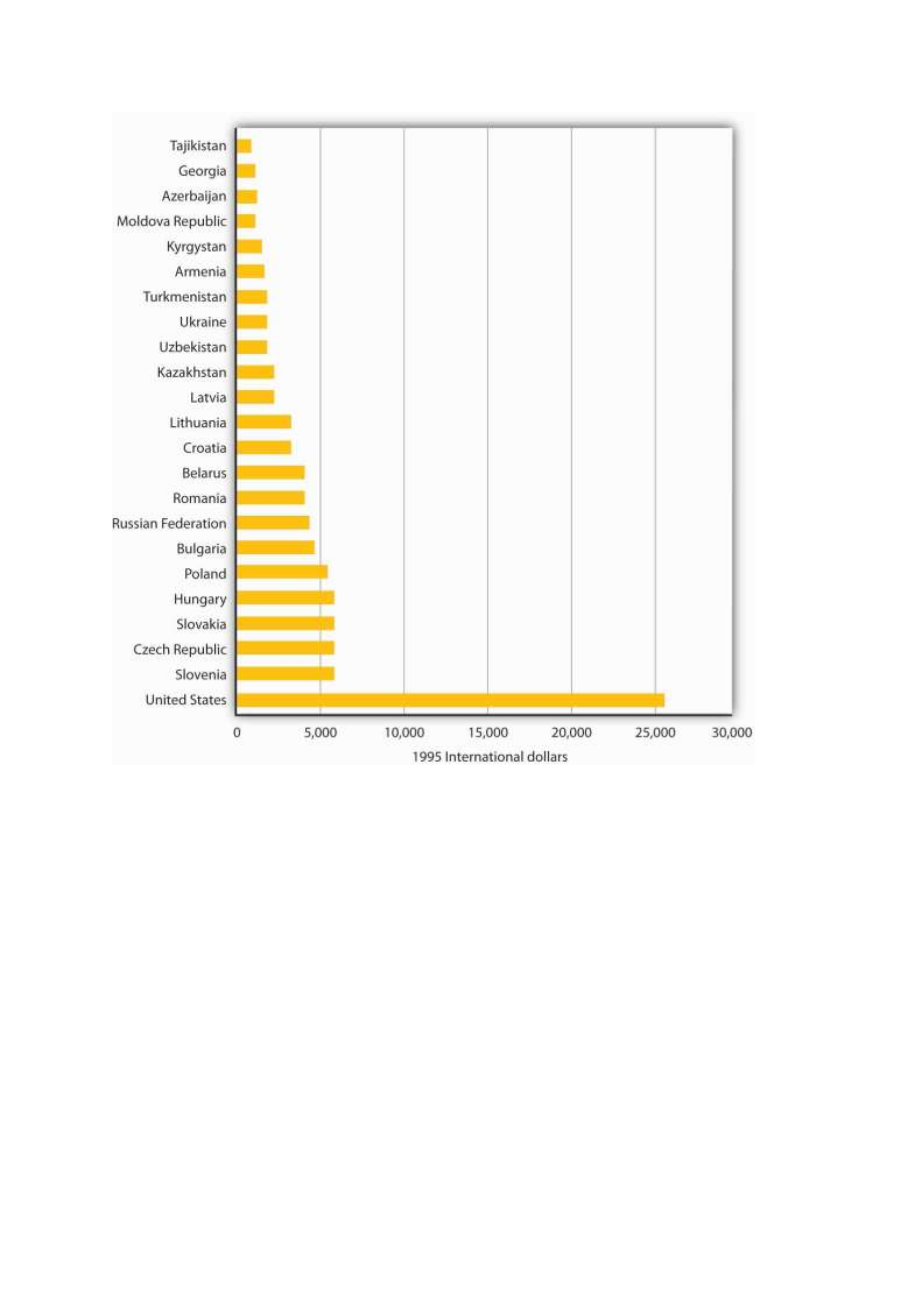
Per capita output was far lower in the former republics of the Soviet Union and in Warsaw Pact
countries in 1995 than in the United States. All values are measured in units of equivalent
purchasing power.
Source: United Nations, Human Development Report, 1998.
Ultimately, it was the failure of the Soviet system to deliver living standards on a par with
those achieved by market capitalist economies that brought the system down. Market
capitalist economic systems create incentives to allocate resources efficiently; socialist
systems do not. Of course, a society may decide that other attributes of a socialist system
make it worth retaining. But the lesson of the 1980s was that few that had lived under
command socialist systems wanted to continue to do so.
The most important example of socialism was the economy of the Union of Soviet Socialist
Republics, the Soviet Union. The Russian Revolution succeeded in 1917 in overthrowing the
czarist regime that had ruled the Russian Empire for centuries. Leaders of the revolution
created the Soviet Union in its place and sought to establish a socialist state based on the
ideas of Karl Marx.

The leaders of the Soviet Union faced a difficulty in using Marx’s writings as a foundation for
a socialist system. He had sought to explain why capitalism would collapse; he had little to say
about how the socialist system that would replace it would function. He did suggest the
utopian notion that, over time, there would be less and less need for a government and the
state would wither away. But his writings did not provide much of a blueprint for running a
socialist economic system.
Lacking a guide for establishing a socialist economy, the leaders of the new regime in Russia
struggled to invent one. In 1917, Lenin attempted to establish what he called “war
communism.” The national government declared its ownership of most firms and forced
peasants to turn over a share of their output to the government. The program sought to
eliminate the market as an allocative mechanism; government would control production and
distribution. The program of war communism devastated the economy. In 1921, Lenin
declared a New Economic Policy. It returned private ownership to some sectors of the
economy and reinstituted the market as an allocative mechanism.
Lenin’s death in 1924 precipitated a power struggle from which Joseph Stalin emerged
victorious. It was under Stalin that the Soviet economic system was created. Because that
system served as a model for most of the other command socialist systems that emerged, we
shall examine it in some detail. We shall also examine an intriguing alternative version of
socialism that was created in Yugoslavia after World War II.
Command Socialism in the Soviet Union
Stalin began by seizing virtually all remaining privately-owned capital and natural resources in
the country. The seizure was a brutal affair; he eliminated opposition to his measures through
mass executions, forced starvation of whole regions, and deportation of political opponents
to prison camps. Estimates of the number of people killed during Stalin’s centralization of
power range in the tens of millions. With the state in control of the means of production,
Stalin established a rigid system in which a central administration in Moscow determined what
would be produced.
The justification for the brutality of Soviet rule lay in the quest to develop “socialist man.”
Leaders of the Soviet Union argued that the tendency of people to behave in their own self-
interest was a by-product of capitalism, not an inherent characteristic of human beings. A
successful socialist state required that the preferences of people be transformed so that they
would be motivated by the collective interests of society, not their own self-interest.
Propaganda was widely used to reinforce a collective identity. Those individuals who were
deemed beyond reform were likely to be locked up or executed.
The political arm of command socialism was the Communist party. Party officials participated
in every aspect of Soviet life in an effort to promote the concept of socialist man and to control
individual behavior. Party leaders were represented in every firm and in every government
agency. Party officials charted the general course for the economy as well.
A planning agency, Gosplan, determined the quantities of output that key firms would
produce each year and the prices that would be charged. Other government agencies set

output levels for smaller firms. These determinations were made in a series of plans. A 1-year
plan specified production targets for that year. Soviet planners also developed 5-year and 20-
year plans.
Managers of state-owned firms were rewarded on the basis of their ability to meet the annual
quotas set by the Gosplan. The system of quotas and rewards created inefficiency in several
ways. First, no central planning agency could incorporate preferences of consumers and costs
of factors of production in its decisions concerning the quantity of each good to produce.
Decisions about what to produce were made by political leaders; they were not a response to
market forces. Further, planners could not select prices at which quantities produced would
clear their respective markets. In a market economy, prices adjust to changes in demand and
supply. Given that demand and supply are always changing, it is inconceivable that central
planners could ever select market-clearing prices. Soviet central planners typically selected
prices for consumer goods that were below market-clearing levels, causing shortages
throughout the economy. Changes in prices were rare.
Plant managers had a powerful incentive for meeting their quotas; they could expect bonuses
equal to about 35% of their base salary for producing the quantities required of their firms.
Those who exceeded their quotas could boost this to 50%. In addition, successful managers
were given vacations, better apartments, better medical care, and a host of other perquisites.
Managers thus had a direct interest in meeting their quotas; they had no incentive to select
efficient production techniques or to reduce costs.
Perhaps most important, there was no incentive for plant managers to adopt new
technologies. A plant implementing a new technology risked start-up delays that could cause
it to fall short of its quota. If a plant did succeed in boosting output, it was likely to be forced
to accept even larger quotas in the future. A plant manager who introduced a successful
technology would only be slapped with tougher quotas; if the technology failed, he or she
would lose a bonus. With little to gain and a great deal to lose, Soviet plant managers were
extremely reluctant to adopt new technologies. Soviet production was, as a result,
characterized by outdated technologies. When the system fell in 1991, Soviet manufacturers
were using production methods that had been obsolete for decades in other countries.
Centrally controlled systems often generated impressive numbers for total output but failed
in satisfying consumer demands. Gosplan officials, recognizing that Soviet capital was not very
productive, ordered up a lot of it. The result was a heavy emphasis on unproductive capital
goods and relatively little production of consumer goods. On the eve of the collapse of the
Soviet Union, Soviet economists estimated that per capita consumption was less than one-
sixth of the U.S. level.
The Soviet system also generated severe environmental problems. In principle, a socialist
system should have an advantage over a capitalist system in allocating environmental
resources for which private property rights are difficult to define. Because a socialist
government owns all capital and natural resources, the ownership problem is solved. The
problem in the Soviet system, however, came from the labor theory of value. Since natural
resources are not produced by labor, the value assigned to them was zero. Soviet plant

managers thus had no incentive to limit their exploitation of environmental resources, and
terrible environmental tragedies were common.
Systems similar to that created in the Soviet Union were established in other Soviet bloc
countries as well. The most important exceptions were Yugoslavia, which is discussed in the
next section, and China, which started with a Soviet-style system and then moved away from
it. The Chinese case is examined later in this chapter.
Yugoslavia: Another Socialist Experiment
Although the Soviet Union was able to impose a system of command socialism on nearly all
the Eastern European countries it controlled after World War II, Yugoslavia managed to forge
its own path. Yugoslavia’s communist leader, Marshal Tito, charted an independent course,
accepting aid from Western nations such as the United States and establishing a unique form
of socialism that made greater use of markets than the Soviet-style systems did. Most
important, however, Tito quickly moved away from the centralized management style of the
Soviet Union to a decentralized system in which workers exercised considerable autonomy.
In the Yugoslav system, firms with five or more employees were owned by the state but made
their own decisions concerning what to produce and what prices to charge. Workers in these
firms elected their managers and established their own systems for sharing revenues. Each
firm paid a fee for the use of its state-owned capital. In effect, firms operated as labor
cooperatives. Firms with fewer than five employees could be privately owned and operated.
Economic performance in Yugoslavia was impressive. Living standards there were generally
higher than those in other Soviet bloc countries. The distribution of income was similar to that
of command socialist economies; it was generally more equal than distributions achieved in
market capitalist economies. The Yugoslav economy was plagued, however, by persistent
unemployment, high inflation, and increasing disparities in regional income levels.
Yugoslavia began breaking up shortly after command socialist systems began falling in Eastern
Europe. It had been a country of republics and provinces with uneasy relationships among
them. Tito had been the glue that held them together. After his death, the groups began to
move apart and a number of countries have formed out of what was once Yugoslavia, in
several cases accompanied by war. They all seem to be moving in the market capitalist
direction, with Slovenia and Macedonia leading the way. Over time, the others—Croatia,
Bosnia, and Herzegovina, and even Serbia and Montenegra–have been following suit.
Evaluating Economic Performance Under Socialism
Soviet leaders placed great emphasis on Marx’s concept of the inevitable collapse of
capitalism. While they downplayed the likelihood of a global revolution, they argued that the
inherent superiority of socialism would gradually become apparent. Countries would adopt
the socialist model in order to improve their living standards, and socialism would gradually
assert itself as the dominant world system.
One key to achieving the goal of a socialist world was to outperform the United States
economically. Stalin promised in the 1930s that the Soviet economy would surpass that of the

United States within a few decades. The goal was clearly not achieved. Indeed, it was the
gradual realization that the command socialist system could not deliver high living standards
that led to the collapse of the old system.
The most important example of socialism was the economy of the Union of Soviet Socialist
Republics, the Soviet Union. The Russian Revolution succeeded in 1917 in overthrowing the
czarist regime that had ruled the Russian Empire for centuries. Leaders of the revolution
created the Soviet Union in its place and sought to establish a socialist state based on the
ideas of Karl Marx.
The leaders of the Soviet Union faced a difficulty in using Marx’s writings as a foundation for
a socialist system. He had sought to explain why capitalism would collapse; he had little to say
about how the socialist system that would replace it would function. He did suggest the
utopian notion that, over time, there would be less and less need for a government and the
state would wither away. But his writings did not provide much of a blueprint for running a
socialist economic system.
Lacking a guide for establishing a socialist economy, the leaders of the new regime in Russia
struggled to invent one. In 1917, Lenin attempted to establish what he called “war
communism.” The national government declared its ownership of most firms and forced
peasants to turn over a share of their output to the government. The program sought to
eliminate the market as an allocative mechanism; government would control production and
distribution. The program of war communism devastated the economy. In 1921, Lenin
declared a New Economic Policy. It returned private ownership to some sectors of the
economy and reinstituted the market as an allocative mechanism.
Lenin’s death in 1924 precipitated a power struggle from which Joseph Stalin emerged
victorious. It was under Stalin that the Soviet economic system was created. Because that
system served as a model for most of the other command socialist systems that emerged, we
shall examine it in some detail. We shall also examine an intriguing alternative version of
socialism that was created in Yugoslavia after World War II.
Command Socialism in the Soviet Union
Stalin began by seizing virtually all remaining privately-owned capital and natural resources in
the country. The seizure was a brutal affair; he eliminated opposition to his measures through
mass executions, forced starvation of whole regions, and deportation of political opponents
to prison camps. Estimates of the number of people killed during Stalin’s centralization of
power range in the tens of millions. With the state in control of the means of production,
Stalin established a rigid system in which a central administration in Moscow determined what
would be produced.
The justification for the brutality of Soviet rule lay in the quest to develop “socialist man.”
Leaders of the Soviet Union argued that the tendency of people to behave in their own self-
interest was a by-product of capitalism, not an inherent characteristic of human beings. A
successful socialist state required that the preferences of people be transformed so that they
would be motivated by the collective interests of society, not their own self-interest.

Propaganda was widely used to reinforce a collective identity. Those individuals who were
deemed beyond reform were likely to be locked up or executed.
The political arm of command socialism was the Communist party. Party officials participated
in every aspect of Soviet life in an effort to promote the concept of socialist man and to control
individual behavior. Party leaders were represented in every firm and in every government
agency. Party officials charted the general course for the economy as well.
A planning agency, Gosplan, determined the quantities of output that key firms would
produce each year and the prices that would be charged. Other government agencies set
output levels for smaller firms. These determinations were made in a series of plans. A 1-year
plan specified production targets for that year. Soviet planners also developed 5-year and 20-
year plans.
Managers of state-owned firms were rewarded on the basis of their ability to meet the annual
quotas set by the Gosplan. The system of quotas and rewards created inefficiency in several
ways. First, no central planning agency could incorporate preferences of consumers and costs
of factors of production in its decisions concerning the quantity of each good to produce.
Decisions about what to produce were made by political leaders; they were not a response to
market forces. Further, planners could not select prices at which quantities produced would
clear their respective markets. In a market economy, prices adjust to changes in demand and
supply. Given that demand and supply are always changing, it is inconceivable that central
planners could ever select market-clearing prices. Soviet central planners typically selected
prices for consumer goods that were below market-clearing levels, causing shortages
throughout the economy. Changes in prices were rare.
Plant managers had a powerful incentive for meeting their quotas; they could expect bonuses
equal to about 35% of their base salary for producing the quantities required of their firms.
Those who exceeded their quotas could boost this to 50%. In addition, successful managers
were given vacations, better apartments, better medical care, and a host of other perquisites.
Managers thus had a direct interest in meeting their quotas; they had no incentive to select
efficient production techniques or to reduce costs.
Perhaps most important, there was no incentive for plant managers to adopt new
technologies. A plant implementing a new technology risked start-up delays that could cause
it to fall short of its quota. If a plant did succeed in boosting output, it was likely to be forced
to accept even larger quotas in the future. A plant manager who introduced a successful
technology would only be slapped with tougher quotas; if the technology failed, he or she
would lose a bonus. With little to gain and a great deal to lose, Soviet plant managers were
extremely reluctant to adopt new technologies. Soviet production was, as a result,
characterized by outdated technologies. When the system fell in 1991, Soviet manufacturers
were using production methods that had been obsolete for decades in other countries.
Centrally controlled systems often generated impressive numbers for total output but failed
in satisfying consumer demands. Gosplan officials, recognizing that Soviet capital was not very
productive, ordered up a lot of it. The result was a heavy emphasis on unproductive capital
goods and relatively little production of consumer goods. On the eve of the collapse of the

Soviet Union, Soviet economists estimated that per capita consumption was less than one-
sixth of the U.S. level.
The Soviet system also generated severe environmental problems. In principle, a socialist
system should have an advantage over a capitalist system in allocating environmental
resources for which private property rights are difficult to define. Because a socialist
government owns all capital and natural resources, the ownership problem is solved. The
problem in the Soviet system, however, came from the labor theory of value. Since natural
resources are not produced by labor, the value assigned to them was zero. Soviet plant
managers thus had no incentive to limit their exploitation of environmental resources, and
terrible environmental tragedies were common.
Systems similar to that created in the Soviet Union were established in other Soviet bloc
countries as well. The most important exceptions were Yugoslavia, which is discussed in the
next section, and China, which started with a Soviet-style system and then moved away from
it. The Chinese case is examined later in this chapter.
Yugoslavia: Another Socialist Experiment
Although the Soviet Union was able to impose a system of command socialism on nearly all
the Eastern European countries it controlled after World War II, Yugoslavia managed to forge
its own path. Yugoslavia’s communist leader, Marshal Tito, charted an independent course,
accepting aid from Western nations such as the United States and establishing a unique form
of socialism that made greater use of markets than the Soviet-style systems did. Most
important, however, Tito quickly moved away from the centralized management style of the
Soviet Union to a decentralized system in which workers exercised considerable autonomy.
In the Yugoslav system, firms with five or more employees were owned by the state but made
their own decisions concerning what to produce and what prices to charge. Workers in these
firms elected their managers and established their own systems for sharing revenues. Each
firm paid a fee for the use of its state-owned capital. In effect, firms operated as labor
cooperatives. Firms with fewer than five employees could be privately owned and operated.
Economic performance in Yugoslavia was impressive. Living standards there were generally
higher than those in other Soviet bloc countries. The distribution of income was similar to that
of command socialist economies; it was generally more equal than distributions achieved in
market capitalist economies. The Yugoslav economy was plagued, however, by persistent
unemployment, high inflation, and increasing disparities in regional income levels.
Yugoslavia began breaking up shortly after command socialist systems began falling in Eastern
Europe. It had been a country of republics and provinces with uneasy relationships among
them. Tito had been the glue that held them together. After his death, the groups began to
move apart and a number of countries have formed out of what was once Yugoslavia, in
several cases accompanied by war. They all seem to be moving in the market capitalist
direction, with Slovenia and Macedonia leading the way. Over time, the others—Croatia,
Bosnia, and Herzegovina, and even Serbia and Montenegra–have been following suit.
Evaluating Economic Performance Under Socialism

Soviet leaders placed great emphasis on Marx’s concept of the inevitable collapse of
capitalism. While they downplayed the likelihood of a global revolution, they argued that the
inherent superiority of socialism would gradually become apparent. Countries would adopt
the socialist model in order to improve their living standards, and socialism would gradually
assert itself as the dominant world system.
One key to achieving the goal of a socialist world was to outperform the United States
economically. Stalin promised in the 1930s that the Soviet economy would surpass that of the
United States within a few decades. The goal was clearly not achieved. Indeed, it was the
gradual realization that the command socialist system could not deliver high living standards
that led to the collapse of the old system.
The most important example of socialism was the economy of the Union of Soviet Socialist
Republics, the Soviet Union. The Russian Revolution succeeded in 1917 in overthrowing the
czarist regime that had ruled the Russian Empire for centuries. Leaders of the revolution
created the Soviet Union in its place and sought to establish a socialist state based on the
ideas of Karl Marx.
The leaders of the Soviet Union faced a difficulty in using Marx’s writings as a foundation for
a socialist system. He had sought to explain why capitalism would collapse; he had little to say
about how the socialist system that would replace it would function. He did suggest the
utopian notion that, over time, there would be less and less need for a government and the
state would wither away. But his writings did not provide much of a blueprint for running a
socialist economic system.
Lacking a guide for establishing a socialist economy, the leaders of the new regime in Russia
struggled to invent one. In 1917, Lenin attempted to establish what he called “war
communism.” The national government declared its ownership of most firms and forced
peasants to turn over a share of their output to the government. The program sought to
eliminate the market as an allocative mechanism; government would control production and
distribution. The program of war communism devastated the economy. In 1921, Lenin
declared a New Economic Policy. It returned private ownership to some sectors of the
economy and reinstituted the market as an allocative mechanism.
Lenin’s death in 1924 precipitated a power struggle from which Joseph Stalin emerged
victorious. It was under Stalin that the Soviet economic system was created. Because that
system served as a model for most of the other command socialist systems that emerged, we
shall examine it in some detail. We shall also examine an intriguing alternative version of
socialism that was created in Yugoslavia after World War II.
Command Socialism in the Soviet Union
Stalin began by seizing virtually all remaining privately-owned capital and natural resources in
the country. The seizure was a brutal affair; he eliminated opposition to his measures through
mass executions, forced starvation of whole regions, and deportation of political opponents
to prison camps. Estimates of the number of people killed during Stalin’s centralization of
power range in the tens of millions. With the state in control of the means of production,

Stalin established a rigid system in which a central administration in Moscow determined what
would be produced.
The justification for the brutality of Soviet rule lay in the quest to develop “socialist man.”
Leaders of the Soviet Union argued that the tendency of people to behave in their own self-
interest was a by-product of capitalism, not an inherent characteristic of human beings. A
successful socialist state required that the preferences of people be transformed so that they
would be motivated by the collective interests of society, not their own self-interest.
Propaganda was widely used to reinforce a collective identity. Those individuals who were
deemed beyond reform were likely to be locked up or executed.
The political arm of command socialism was the Communist party. Party officials participated
in every aspect of Soviet life in an effort to promote the concept of socialist man and to control
individual behavior. Party leaders were represented in every firm and in every government
agency. Party officials charted the general course for the economy as well.
A planning agency, Gosplan, determined the quantities of output that key firms would
produce each year and the prices that would be charged. Other government agencies set
output levels for smaller firms. These determinations were made in a series of plans. A 1-year
plan specified production targets for that year. Soviet planners also developed 5-year and 20-
year plans.
Managers of state-owned firms were rewarded on the basis of their ability to meet the annual
quotas set by the Gosplan. The system of quotas and rewards created inefficiency in several
ways. First, no central planning agency could incorporate preferences of consumers and costs
of factors of production in its decisions concerning the quantity of each good to produce.
Decisions about what to produce were made by political leaders; they were not a response to
market forces. Further, planners could not select prices at which quantities produced would
clear their respective markets. In a market economy, prices adjust to changes in demand and
supply. Given that demand and supply are always changing, it is inconceivable that central
planners could ever select market-clearing prices. Soviet central planners typically selected
prices for consumer goods that were below market-clearing levels, causing shortages
throughout the economy. Changes in prices were rare.
Plant managers had a powerful incentive for meeting their quotas; they could expect bonuses
equal to about 35% of their base salary for producing the quantities required of their firms.
Those who exceeded their quotas could boost this to 50%. In addition, successful managers
were given vacations, better apartments, better medical care, and a host of other perquisites.
Managers thus had a direct interest in meeting their quotas; they had no incentive to select
efficient production techniques or to reduce costs.
Perhaps most important, there was no incentive for plant managers to adopt new
technologies. A plant implementing a new technology risked start-up delays that could cause
it to fall short of its quota. If a plant did succeed in boosting output, it was likely to be forced
to accept even larger quotas in the future. A plant manager who introduced a successful
technology would only be slapped with tougher quotas; if the technology failed, he or she
would lose a bonus. With little to gain and a great deal to lose, Soviet plant managers were

extremely reluctant to adopt new technologies. Soviet production was, as a result,
characterized by outdated technologies. When the system fell in 1991, Soviet manufacturers
were using production methods that had been obsolete for decades in other countries.
Centrally controlled systems often generated impressive numbers for total output but failed
in satisfying consumer demands. Gosplan officials, recognizing that Soviet capital was not very
productive, ordered up a lot of it. The result was a heavy emphasis on unproductive capital
goods and relatively little production of consumer goods. On the eve of the collapse of the
Soviet Union, Soviet economists estimated that per capita consumption was less than one-
sixth of the U.S. level.
The Soviet system also generated severe environmental problems. In principle, a socialist
system should have an advantage over a capitalist system in allocating environmental
resources for which private property rights are difficult to define. Because a socialist
government owns all capital and natural resources, the ownership problem is solved. The
problem in the Soviet system, however, came from the labor theory of value. Since natural
resources are not produced by labor, the value assigned to them was zero. Soviet plant
managers thus had no incentive to limit their exploitation of environmental resources, and
terrible environmental tragedies were common.
Systems similar to that created in the Soviet Union were established in other Soviet bloc
countries as well. The most important exceptions were Yugoslavia, which is discussed in the
next section, and China, which started with a Soviet-style system and then moved away from
it. The Chinese case is examined later in this chapter.
Yugoslavia: Another Socialist Experiment
Although the Soviet Union was able to impose a system of command socialism on nearly all
the Eastern European countries it controlled after World War II, Yugoslavia managed to forge
its own path. Yugoslavia’s communist leader, Marshal Tito, charted an independent course,
accepting aid from Western nations such as the United States and establishing a unique form
of socialism that made greater use of markets than the Soviet-style systems did. Most
important, however, Tito quickly moved away from the centralized management style of the
Soviet Union to a decentralized system in which workers exercised considerable autonomy.
In the Yugoslav system, firms with five or more employees were owned by the state but made
their own decisions concerning what to produce and what prices to charge. Workers in these
firms elected their managers and established their own systems for sharing revenues. Each
firm paid a fee for the use of its state-owned capital. In effect, firms operated as labor
cooperatives. Firms with fewer than five employees could be privately owned and operated.
Economic performance in Yugoslavia was impressive. Living standards there were generally
higher than those in other Soviet bloc countries. The distribution of income was similar to that
of command socialist economies; it was generally more equal than distributions achieved in
market capitalist economies. The Yugoslav economy was plagued, however, by persistent
unemployment, high inflation, and increasing disparities in regional income levels.

Yugoslavia began breaking up shortly after command socialist systems began falling in Eastern
Europe. It had been a country of republics and provinces with uneasy relationships among
them. Tito had been the glue that held them together. After his death, the groups began to
move apart and a number of countries have formed out of what was once Yugoslavia, in
several cases accompanied by war. They all seem to be moving in the market capitalist
direction, with Slovenia and Macedonia leading the way. Over time, the others—Croatia,
Bosnia, and Herzegovina, and even Serbia and Montenegra–have been following suit.
Evaluating Economic Performance Under Socialism
Soviet leaders placed great emphasis on Marx’s concept of the inevitable collapse of
capitalism. While they downplayed the likelihood of a global revolution, they argued that the
inherent superiority of socialism would gradually become apparent. Countries would adopt
the socialist model in order to improve their living standards, and socialism would gradually
assert itself as the dominant world system.
One key to achieving the goal of a socialist world was to outperform the United States
economically. Stalin promised in the 1930s that the Soviet economy would surpass that of the
United States within a few decades. The goal was clearly not achieved. Indeed, it was the
gradual realization that the command socialist system could not deliver high living standards
that led to the collapse of the old system.
The most important example of socialism was the economy of the Union of Soviet Socialist
Republics, the Soviet Union. The Russian Revolution succeeded in 1917 in overthrowing the
czarist regime that had ruled the Russian Empire for centuries. Leaders of the revolution
created the Soviet Union in its place and sought to establish a socialist state based on the
ideas of Karl Marx.
The leaders of the Soviet Union faced a difficulty in using Marx’s writings as a foundation for
a socialist system. He had sought to explain why capitalism would collapse; he had little to say
about how the socialist system that would replace it would function. He did suggest the
utopian notion that, over time, there would be less and less need for a government and the
state would wither away. But his writings did not provide much of a blueprint for running a
socialist economic system.
Lacking a guide for establishing a socialist economy, the leaders of the new regime in Russia
struggled to invent one. In 1917, Lenin attempted to establish what he called “war
communism.” The national government declared its ownership of most firms and forced
peasants to turn over a share of their output to the government. The program sought to
eliminate the market as an allocative mechanism; government would control production and
distribution. The program of war communism devastated the economy. In 1921, Lenin
declared a New Economic Policy. It returned private ownership to some sectors of the
economy and reinstituted the market as an allocative mechanism.
Lenin’s death in 1924 precipitated a power struggle from which Joseph Stalin emerged
victorious. It was under Stalin that the Soviet economic system was created. Because that
system served as a model for most of the other command socialist systems that emerged, we

shall examine it in some detail. We shall also examine an intriguing alternative version of
socialism that was created in Yugoslavia after World War II.
Command Socialism in the Soviet Union
Stalin began by seizing virtually all remaining privately-owned capital and natural resources in
the country. The seizure was a brutal affair; he eliminated opposition to his measures through
mass executions, forced starvation of whole regions, and deportation of political opponents
to prison camps. Estimates of the number of people killed during Stalin’s centralization of
power range in the tens of millions. With the state in control of the means of production,
Stalin established a rigid system in which a central administration in Moscow determined what
would be produced.
The justification for the brutality of Soviet rule lay in the quest to develop “socialist man.”
Leaders of the Soviet Union argued that the tendency of people to behave in their own self-
interest was a by-product of capitalism, not an inherent characteristic of human beings. A
successful socialist state required that the preferences of people be transformed so that they
would be motivated by the collective interests of society, not their own self-interest.
Propaganda was widely used to reinforce a collective identity. Those individuals who were
deemed beyond reform were likely to be locked up or executed.
The political arm of command socialism was the Communist party. Party officials participated
in every aspect of Soviet life in an effort to promote the concept of socialist man and to control
individual behavior. Party leaders were represented in every firm and in every government
agency. Party officials charted the general course for the economy as well.
A planning agency, Gosplan, determined the quantities of output that key firms would
produce each year and the prices that would be charged. Other government agencies set
output levels for smaller firms. These determinations were made in a series of plans. A 1-year
plan specified production targets for that year. Soviet planners also developed 5-year and 20-
year plans.
Managers of state-owned firms were rewarded on the basis of their ability to meet the annual
quotas set by the Gosplan. The system of quotas and rewards created inefficiency in several
ways. First, no central planning agency could incorporate preferences of consumers and costs
of factors of production in its decisions concerning the quantity of each good to produce.
Decisions about what to produce were made by political leaders; they were not a response to
market forces. Further, planners could not select prices at which quantities produced would
clear their respective markets. In a market economy, prices adjust to changes in demand and
supply. Given that demand and supply are always changing, it is inconceivable that central
planners could ever select market-clearing prices. Soviet central planners typically selected
prices for consumer goods that were below market-clearing levels, causing shortages
throughout the economy. Changes in prices were rare.
Plant managers had a powerful incentive for meeting their quotas; they could expect bonuses
equal to about 35% of their base salary for producing the quantities required of their firms.
Those who exceeded their quotas could boost this to 50%. In addition, successful managers

were given vacations, better apartments, better medical care, and a host of other perquisites.
Managers thus had a direct interest in meeting their quotas; they had no incentive to select
efficient production techniques or to reduce costs.
Perhaps most important, there was no incentive for plant managers to adopt new
technologies. A plant implementing a new technology risked start-up delays that could cause
it to fall short of its quota. If a plant did succeed in boosting output, it was likely to be forced
to accept even larger quotas in the future. A plant manager who introduced a successful
technology would only be slapped with tougher quotas; if the technology failed, he or she
would lose a bonus. With little to gain and a great deal to lose, Soviet plant managers were
extremely reluctant to adopt new technologies. Soviet production was, as a result,
characterized by outdated technologies. When the system fell in 1991, Soviet manufacturers
were using production methods that had been obsolete for decades in other countries.
Centrally controlled systems often generated impressive numbers for total output but failed
in satisfying consumer demands. Gosplan officials, recognizing that Soviet capital was not very
productive, ordered up a lot of it. The result was a heavy emphasis on unproductive capital
goods and relatively little production of consumer goods. On the eve of the collapse of the
Soviet Union, Soviet economists estimated that per capita consumption was less than one-
sixth of the U.S. level.
The Soviet system also generated severe environmental problems. In principle, a socialist
system should have an advantage over a capitalist system in allocating environmental
resources for which private property rights are difficult to define. Because a socialist
government owns all capital and natural resources, the ownership problem is solved. The
problem in the Soviet system, however, came from the labor theory of value. Since natural
resources are not produced by labor, the value assigned to them was zero. Soviet plant
managers thus had no incentive to limit their exploitation of environmental resources, and
terrible environmental tragedies were common.
Systems similar to that created in the Soviet Union were established in other Soviet bloc
countries as well. The most important exceptions were Yugoslavia, which is discussed in the
next section, and China, which started with a Soviet-style system and then moved away from
it. The Chinese case is examined later in this chapter.
Yugoslavia: Another Socialist Experiment
Although the Soviet Union was able to impose a system of command socialism on nearly all
the Eastern European countries it controlled after World War II, Yugoslavia managed to forge
its own path. Yugoslavia’s communist leader, Marshal Tito, charted an independent course,
accepting aid from Western nations such as the United States and establishing a unique form
of socialism that made greater use of markets than the Soviet-style systems did. Most
important, however, Tito quickly moved away from the centralized management style of the
Soviet Union to a decentralized system in which workers exercised considerable autonomy.
In the Yugoslav system, firms with five or more employees were owned by the state but made
their own decisions concerning what to produce and what prices to charge. Workers in these

firms elected their managers and established their own systems for sharing revenues. Each
firm paid a fee for the use of its state-owned capital. In effect, firms operated as labor
cooperatives. Firms with fewer than five employees could be privately owned and operated.
Economic performance in Yugoslavia was impressive. Living standards there were generally
higher than those in other Soviet bloc countries. The distribution of income was similar to that
of command socialist economies; it was generally more equal than distributions achieved in
market capitalist economies. The Yugoslav economy was plagued, however, by persistent
unemployment, high inflation, and increasing disparities in regional income levels.
Yugoslavia began breaking up shortly after command socialist systems began falling in Eastern
Europe. It had been a country of republics and provinces with uneasy relationships among
them. Tito had been the glue that held them together. After his death, the groups began to
move apart and a number of countries have formed out of what was once Yugoslavia, in
several cases accompanied by war. They all seem to be moving in the market capitalist
direction, with Slovenia and Macedonia leading the way. Over time, the others—Croatia,
Bosnia, and Herzegovina, and even Serbia and Montenegra–have been following suit.
Evaluating Economic Performance Under Socialism
Soviet leaders placed great emphasis on Marx’s concept of the inevitable collapse of
capitalism. While they downplayed the likelihood of a global revolution, they argued that the
inherent superiority of socialism would gradually become apparent. Countries would adopt
the socialist model in order to improve their living standards, and socialism would gradually
assert itself as the dominant world system.
One key to achieving the goal of a socialist world was to outperform the United States
economically. Stalin promised in the 1930s that the Soviet economy would surpass that of the
United States within a few decades. The goal was clearly not achieved. Indeed, it was the
gradual realization that the command socialist system could not deliver high living standards
that led to the collapse of the old system.
The most important example of socialism was the economy of the Union of Soviet Socialist
Republics, the Soviet Union. The Russian Revolution succeeded in 1917 in overthrowing the
czarist regime that had ruled the Russian Empire for centuries. Leaders of the revolution
created the Soviet Union in its place and sought to establish a socialist state based on the
ideas of Karl Marx.
The leaders of the Soviet Union faced a difficulty in using Marx’s writings as a foundation for
a socialist system. He had sought to explain why capitalism would collapse; he had little to say
about how the socialist system that would replace it would function. He did suggest the
utopian notion that, over time, there would be less and less need for a government and the
state would wither away. But his writings did not provide much of a blueprint for running a
socialist economic system.
Lacking a guide for establishing a socialist economy, the leaders of the new regime in Russia
struggled to invent one. In 1917, Lenin attempted to establish what he called “war
communism.” The national government declared its ownership of most firms and forced

peasants to turn over a share of their output to the government. The program sought to
eliminate the market as an allocative mechanism; government would control production and
distribution. The program of war communism devastated the economy. In 1921, Lenin
declared a New Economic Policy. It returned private ownership to some sectors of the
economy and reinstituted the market as an allocative mechanism.
Lenin’s death in 1924 precipitated a power struggle from which Joseph Stalin emerged
victorious. It was under Stalin that the Soviet economic system was created. Because that
system served as a model for most of the other command socialist systems that emerged, we
shall examine it in some detail. We shall also examine an intriguing alternative version of
socialism that was created in Yugoslavia after World War II.
Command Socialism in the Soviet Union
Stalin began by seizing virtually all remaining privately-owned capital and natural resources in
the country. The seizure was a brutal affair; he eliminated opposition to his measures through
mass executions, forced starvation of whole regions, and deportation of political opponents
to prison camps. Estimates of the number of people killed during Stalin’s centralization of
power range in the tens of millions. With the state in control of the means of production,
Stalin established a rigid system in which a central administration in Moscow determined what
would be produced.
The justification for the brutality of Soviet rule lay in the quest to develop “socialist man.”
Leaders of the Soviet Union argued that the tendency of people to behave in their own self-
interest was a by-product of capitalism, not an inherent characteristic of human beings. A
successful socialist state required that the preferences of people be transformed so that they
would be motivated by the collective interests of society, not their own self-interest.
Propaganda was widely used to reinforce a collective identity. Those individuals who were
deemed beyond reform were likely to be locked up or executed.
The political arm of command socialism was the Communist party. Party officials participated
in every aspect of Soviet life in an effort to promote the concept of socialist man and to control
individual behavior. Party leaders were represented in every firm and in every government
agency. Party officials charted the general course for the economy as well.
A planning agency, Gosplan, determined the quantities of output that key firms would
produce each year and the prices that would be charged. Other government agencies set
output levels for smaller firms. These determinations were made in a series of plans. A 1-year
plan specified production targets for that year. Soviet planners also developed 5-year and 20-
year plans.
Managers of state-owned firms were rewarded on the basis of their ability to meet the annual
quotas set by the Gosplan. The system of quotas and rewards created inefficiency in several
ways. First, no central planning agency could incorporate preferences of consumers and costs
of factors of production in its decisions concerning the quantity of each good to produce.
Decisions about what to produce were made by political leaders; they were not a response to
market forces. Further, planners could not select prices at which quantities produced would

clear their respective markets. In a market economy, prices adjust to changes in demand and
supply. Given that demand and supply are always changing, it is inconceivable that central
planners could ever select market-clearing prices. Soviet central planners typically selected
prices for consumer goods that were below market-clearing levels, causing shortages
throughout the economy. Changes in prices were rare.
Plant managers had a powerful incentive for meeting their quotas; they could expect bonuses
equal to about 35% of their base salary for producing the quantities required of their firms.
Those who exceeded their quotas could boost this to 50%. In addition, successful managers
were given vacations, better apartments, better medical care, and a host of other perquisites.
Managers thus had a direct interest in meeting their quotas; they had no incentive to select
efficient production techniques or to reduce costs.
Perhaps most important, there was no incentive for plant managers to adopt new
technologies. A plant implementing a new technology risked start-up delays that could cause
it to fall short of its quota. If a plant did succeed in boosting output, it was likely to be forced
to accept even larger quotas in the future. A plant manager who introduced a successful
technology would only be slapped with tougher quotas; if the technology failed, he or she
would lose a bonus. With little to gain and a great deal to lose, Soviet plant managers were
extremely reluctant to adopt new technologies. Soviet production was, as a result,
characterized by outdated technologies. When the system fell in 1991, Soviet manufacturers
were using production methods that had been obsolete for decades in other countries.
Centrally controlled systems often generated impressive numbers for total output but failed
in satisfying consumer demands. Gosplan officials, recognizing that Soviet capital was not very
productive, ordered up a lot of it. The result was a heavy emphasis on unproductive capital
goods and relatively little production of consumer goods. On the eve of the collapse of the
Soviet Union, Soviet economists estimated that per capita consumption was less than one-
sixth of the U.S. level.
The Soviet system also generated severe environmental problems. In principle, a socialist
system should have an advantage over a capitalist system in allocating environmental
resources for which private property rights are difficult to define. Because a socialist
government owns all capital and natural resources, the ownership problem is solved. The
problem in the Soviet system, however, came from the labor theory of value. Since natural
resources are not produced by labor, the value assigned to them was zero. Soviet plant
managers thus had no incentive to limit their exploitation of environmental resources, and
terrible environmental tragedies were common.
Systems similar to that created in the Soviet Union were established in other Soviet bloc
countries as well. The most important exceptions were Yugoslavia, which is discussed in the
next section, and China, which started with a Soviet-style system and then moved away from
it. The Chinese case is examined later in this chapter.
Yugoslavia: Another Socialist Experiment

Although the Soviet Union was able to impose a system of command socialism on nearly all
the Eastern European countries it controlled after World War II, Yugoslavia managed to forge
its own path. Yugoslavia’s communist leader, Marshal Tito, charted an independent course,
accepting aid from Western nations such as the United States and establishing a unique form
of socialism that made greater use of markets than the Soviet-style systems did. Most
important, however, Tito quickly moved away from the centralized management style of the
Soviet Union to a decentralized system in which workers exercised considerable autonomy.
In the Yugoslav system, firms with five or more employees were owned by the state but made
their own decisions concerning what to produce and what prices to charge. Workers in these
firms elected their managers and established their own systems for sharing revenues. Each
firm paid a fee for the use of its state-owned capital. In effect, firms operated as labor
cooperatives. Firms with fewer than five employees could be privately owned and operated.
Economic performance in Yugoslavia was impressive. Living standards there were generally
higher than those in other Soviet bloc countries. The distribution of income was similar to that
of command socialist economies; it was generally more equal than distributions achieved in
market capitalist economies. The Yugoslav economy was plagued, however, by persistent
unemployment, high inflation, and increasing disparities in regional income levels.
Yugoslavia began breaking up shortly after command socialist systems began falling in Eastern
Europe. It had been a country of republics and provinces with uneasy relationships among
them. Tito had been the glue that held them together. After his death, the groups began to
move apart and a number of countries have formed out of what was once Yugoslavia, in
several cases accompanied by war. They all seem to be moving in the market capitalist
direction, with Slovenia and Macedonia leading the way. Over time, the others—Croatia,
Bosnia, and Herzegovina, and even Serbia and Montenegra–have been following suit.
Evaluating Economic Performance Under Socialism
Soviet leaders placed great emphasis on Marx’s concept of the inevitable collapse of
capitalism. While they downplayed the likelihood of a global revolution, they argued that the
inherent superiority of socialism would gradually become apparent. Countries would adopt
the socialist model in order to improve their living standards, and socialism would gradually
assert itself as the dominant world system.
One key to achieving the goal of a socialist world was to outperform the United States
economically. Stalin promised in the 1930s that the Soviet economy would surpass that of the
United States within a few decades. The goal was clearly not achieved. Indeed, it was the
gradual realization that the command socialist system could not deliver high living standards
that led to the collapse of the old system.
The most important example of socialism was the economy of the Union of Soviet Socialist
Republics, the Soviet Union. The Russian Revolution succeeded in 1917 in overthrowing the
czarist regime that had ruled the Russian Empire for centuries. Leaders of the revolution
created the Soviet Union in its place and sought to establish a socialist state based on the
ideas of Karl Marx.

The leaders of the Soviet Union faced a difficulty in using Marx’s writings as a foundation for
a socialist system. He had sought to explain why capitalism would collapse; he had little to say
about how the socialist system that would replace it would function. He did suggest the
utopian notion that, over time, there would be less and less need for a government and the
state would wither away. But his writings did not provide much of a blueprint for running a
socialist economic system.
Lacking a guide for establishing a socialist economy, the leaders of the new regime in Russia
struggled to invent one. In 1917, Lenin attempted to establish what he called “war
communism.” The national government declared its ownership of most firms and forced
peasants to turn over a share of their output to the government. The program sought to
eliminate the market as an allocative mechanism; government would control production and
distribution. The program of war communism devastated the economy. In 1921, Lenin
declared a New Economic Policy. It returned private ownership to some sectors of the
economy and reinstituted the market as an allocative mechanism.
Lenin’s death in 1924 precipitated a power struggle from which Joseph Stalin emerged
victorious. It was under Stalin that the Soviet economic system was created. Because that
system served as a model for most of the other command socialist systems that emerged, we
shall examine it in some detail. We shall also examine an intriguing alternative version of
socialism that was created in Yugoslavia after World War II.
Command Socialism in the Soviet Union
Stalin began by seizing virtually all remaining privately-owned capital and natural resources in
the country. The seizure was a brutal affair; he eliminated opposition to his measures through
mass executions, forced starvation of whole regions, and deportation of political opponents
to prison camps. Estimates of the number of people killed during Stalin’s centralization of
power range in the tens of millions. With the state in control of the means of production,
Stalin established a rigid system in which a central administration in Moscow determined what
would be produced.
The justification for the brutality of Soviet rule lay in the quest to develop “socialist man.”
Leaders of the Soviet Union argued that the tendency of people to behave in their own self-
interest was a by-product of capitalism, not an inherent characteristic of human beings. A
successful socialist state required that the preferences of people be transformed so that they
would be motivated by the collective interests of society, not their own self-interest.
Propaganda was widely used to reinforce a collective identity. Those individuals who were
deemed beyond reform were likely to be locked up or executed.
The political arm of command socialism was the Communist party. Party officials participated
in every aspect of Soviet life in an effort to promote the concept of socialist man and to control
individual behavior. Party leaders were represented in every firm and in every government
agency. Party officials charted the general course for the economy as well.
A planning agency, Gosplan, determined the quantities of output that key firms would
produce each year and the prices that would be charged. Other government agencies set

output levels for smaller firms. These determinations were made in a series of plans. A 1-year
plan specified production targets for that year. Soviet planners also developed 5-year and 20-
year plans.
Managers of state-owned firms were rewarded on the basis of their ability to meet the annual
quotas set by the Gosplan. The system of quotas and rewards created inefficiency in several
ways. First, no central planning agency could incorporate preferences of consumers and costs
of factors of production in its decisions concerning the quantity of each good to produce.
Decisions about what to produce were made by political leaders; they were not a response to
market forces. Further, planners could not select prices at which quantities produced would
clear their respective markets. In a market economy, prices adjust to changes in demand and
supply. Given that demand and supply are always changing, it is inconceivable that central
planners could ever select market-clearing prices. Soviet central planners typically selected
prices for consumer goods that were below market-clearing levels, causing shortages
throughout the economy. Changes in prices were rare.
Plant managers had a powerful incentive for meeting their quotas; they could expect bonuses
equal to about 35% of their base salary for producing the quantities required of their firms.
Those who exceeded their quotas could boost this to 50%. In addition, successful managers
were given vacations, better apartments, better medical care, and a host of other perquisites.
Managers thus had a direct interest in meeting their quotas; they had no incentive to select
efficient production techniques or to reduce costs.
Perhaps most important, there was no incentive for plant managers to adopt new
technologies. A plant implementing a new technology risked start-up delays that could cause
it to fall short of its quota. If a plant did succeed in boosting output, it was likely to be forced
to accept even larger quotas in the future. A plant manager who introduced a successful
technology would only be slapped with tougher quotas; if the technology failed, he or she
would lose a bonus. With little to gain and a great deal to lose, Soviet plant managers were
extremely reluctant to adopt new technologies. Soviet production was, as a result,
characterized by outdated technologies. When the system fell in 1991, Soviet manufacturers
were using production methods that had been obsolete for decades in other countries.
Centrally controlled systems often generated impressive numbers for total output but failed
in satisfying consumer demands. Gosplan officials, recognizing that Soviet capital was not very
productive, ordered up a lot of it. The result was a heavy emphasis on unproductive capital
goods and relatively little production of consumer goods. On the eve of the collapse of the
Soviet Union, Soviet economists estimated that per capita consumption was less than one-
sixth of the U.S. level.
The Soviet system also generated severe environmental problems. In principle, a socialist
system should have an advantage over a capitalist system in allocating environmental
resources for which private property rights are difficult to define. Because a socialist
government owns all capital and natural resources, the ownership problem is solved. The
problem in the Soviet system, however, came from the labor theory of value. Since natural
resources are not produced by labor, the value assigned to them was zero. Soviet plant

managers thus had no incentive to limit their exploitation of environmental resources, and
terrible environmental tragedies were common.
Systems similar to that created in the Soviet Union were established in other Soviet bloc
countries as well. The most important exceptions were Yugoslavia, which is discussed in the
next section, and China, which started with a Soviet-style system and then moved away from
it. The Chinese case is examined later in this chapter.
Yugoslavia: Another Socialist Experiment
Although the Soviet Union was able to impose a system of command socialism on nearly all
the Eastern European countries it controlled after World War II, Yugoslavia managed to forge
its own path. Yugoslavia’s communist leader, Marshal Tito, charted an independent course,
accepting aid from Western nations such as the United States and establishing a unique form
of socialism that made greater use of markets than the Soviet-style systems did. Most
important, however, Tito quickly moved away from the centralized management style of the
Soviet Union to a decentralized system in which workers exercised considerable autonomy.
In the Yugoslav system, firms with five or more employees were owned by the state but made
their own decisions concerning what to produce and what prices to charge. Workers in these
firms elected their managers and established their own systems for sharing revenues. Each
firm paid a fee for the use of its state-owned capital. In effect, firms operated as labor
cooperatives. Firms with fewer than five employees could be privately owned and operated.
Economic performance in Yugoslavia was impressive. Living standards there were generally
higher than those in other Soviet bloc countries. The distribution of income was similar to that
of command socialist economies; it was generally more equal than distributions achieved in
market capitalist economies. The Yugoslav economy was plagued, however, by persistent
unemployment, high inflation, and increasing disparities in regional income levels.
Yugoslavia began breaking up shortly after command socialist systems began falling in Eastern
Europe. It had been a country of republics and provinces with uneasy relationships among
them. Tito had been the glue that held them together. After his death, the groups began to
move apart and a number of countries have formed out of what was once Yugoslavia, in
several cases accompanied by war. They all seem to be moving in the market capitalist
direction, with Slovenia and Macedonia leading the way. Over time, the others—Croatia,
Bosnia, and Herzegovina, and even Serbia and Montenegra–have been following suit.
Evaluating Economic Performance Under Socialism
Soviet leaders placed great emphasis on Marx’s concept of the inevitable collapse of
capitalism. While they downplayed the likelihood of a global revolution, they argued that the
inherent superiority of socialism would gradually become apparent. Countries would adopt
the socialist model in order to improve their living standards, and socialism would gradually
assert itself as the dominant world system.
One key to achieving the goal of a socialist world was to outperform the United States
economically. Stalin promised in the 1930s that the Soviet economy would surpass that of the

United States within a few decades. The goal was clearly not achieved. Indeed, it was the
gradual realization that the command socialist system could not deliver high living standards
that led to the collapse of the old system.
The most important example of socialism was the economy of the Union of Soviet Socialist
Republics, the Soviet Union. The Russian Revolution succeeded in 1917 in overthrowing the
czarist regime that had ruled the Russian Empire for centuries. Leaders of the revolution
created the Soviet Union in its place and sought to establish a socialist state based on the
ideas of Karl Marx.
The leaders of the Soviet Union faced a difficulty in using Marx’s writings as a foundation for
a socialist system. He had sought to explain why capitalism would collapse; he had little to say
about how the socialist system that would replace it would function. He did suggest the
utopian notion that, over time, there would be less and less need for a government and the
state would wither away. But his writings did not provide much of a blueprint for running a
socialist economic system.
Lacking a guide for establishing a socialist economy, the leaders of the new regime in Russia
struggled to invent one. In 1917, Lenin attempted to establish what he called “war
communism.” The national government declared its ownership of most firms and forced
peasants to turn over a share of their output to the government. The program sought to
eliminate the market as an allocative mechanism; government would control production and
distribution. The program of war communism devastated the economy. In 1921, Lenin
declared a New Economic Policy. It returned private ownership to some sectors of the
economy and reinstituted the market as an allocative mechanism.
Lenin’s death in 1924 precipitated a power struggle from which Joseph Stalin emerged
victorious. It was under Stalin that the Soviet economic system was created. Because that
system served as a model for most of the other command socialist systems that emerged, we
shall examine it in some detail. We shall also examine an intriguing alternative version of
socialism that was created in Yugoslavia after World War II.
Command Socialism in the Soviet Union
Stalin began by seizing virtually all remaining privately-owned capital and natural resources in
the country. The seizure was a brutal affair; he eliminated opposition to his measures through
mass executions, forced starvation of whole regions, and deportation of political opponents
to prison camps. Estimates of the number of people killed during Stalin’s centralization of
power range in the tens of millions. With the state in control of the means of production,
Stalin established a rigid system in which a central administration in Moscow determined what
would be produced.
The justification for the brutality of Soviet rule lay in the quest to develop “socialist man.”
Leaders of the Soviet Union argued that the tendency of people to behave in their own self-
interest was a by-product of capitalism, not an inherent characteristic of human beings. A
successful socialist state required that the preferences of people be transformed so that they
would be motivated by the collective interests of society, not their own self-interest.

Propaganda was widely used to reinforce a collective identity. Those individuals who were
deemed beyond reform were likely to be locked up or executed.
The political arm of command socialism was the Communist party. Party officials participated
in every aspect of Soviet life in an effort to promote the concept of socialist man and to control
individual behavior. Party leaders were represented in every firm and in every government
agency. Party officials charted the general course for the economy as well.
A planning agency, Gosplan, determined the quantities of output that key firms would
produce each year and the prices that would be charged. Other government agencies set
output levels for smaller firms. These determinations were made in a series of plans. A 1-year
plan specified production targets for that year. Soviet planners also developed 5-year and 20-
year plans.
Managers of state-owned firms were rewarded on the basis of their ability to meet the annual
quotas set by the Gosplan. The system of quotas and rewards created inefficiency in several
ways. First, no central planning agency could incorporate preferences of consumers and costs
of factors of production in its decisions concerning the quantity of each good to produce.
Decisions about what to produce were made by political leaders; they were not a response to
market forces. Further, planners could not select prices at which quantities produced would
clear their respective markets. In a market economy, prices adjust to changes in demand and
supply. Given that demand and supply are always changing, it is inconceivable that central
planners could ever select market-clearing prices. Soviet central planners typically selected
prices for consumer goods that were below market-clearing levels, causing shortages
throughout the economy. Changes in prices were rare.
Plant managers had a powerful incentive for meeting their quotas; they could expect bonuses
equal to about 35% of their base salary for producing the quantities required of their firms.
Those who exceeded their quotas could boost this to 50%. In addition, successful managers
were given vacations, better apartments, better medical care, and a host of other perquisites.
Managers thus had a direct interest in meeting their quotas; they had no incentive to select
efficient production techniques or to reduce costs.
Perhaps most important, there was no incentive for plant managers to adopt new
technologies. A plant implementing a new technology risked start-up delays that could cause
it to fall short of its quota. If a plant did succeed in boosting output, it was likely to be forced
to accept even larger quotas in the future. A plant manager who introduced a successful
technology would only be slapped with tougher quotas; if the technology failed, he or she
would lose a bonus. With little to gain and a great deal to lose, Soviet plant managers were
extremely reluctant to adopt new technologies. Soviet production was, as a result,
characterized by outdated technologies. When the system fell in 1991, Soviet manufacturers
were using production methods that had been obsolete for decades in other countries.
Centrally controlled systems often generated impressive numbers for total output but failed
in satisfying consumer demands. Gosplan officials, recognizing that Soviet capital was not very
productive, ordered up a lot of it. The result was a heavy emphasis on unproductive capital
goods and relatively little production of consumer goods. On the eve of the collapse of the

Soviet Union, Soviet economists estimated that per capita consumption was less than one-
sixth of the U.S. level.
The Soviet system also generated severe environmental problems. In principle, a socialist
system should have an advantage over a capitalist system in allocating environmental
resources for which private property rights are difficult to define. Because a socialist
government owns all capital and natural resources, the ownership problem is solved. The
problem in the Soviet system, however, came from the labor theory of value. Since natural
resources are not produced by labor, the value assigned to them was zero. Soviet plant
managers thus had no incentive to limit their exploitation of environmental resources, and
terrible environmental tragedies were common.
Systems similar to that created in the Soviet Union were established in other Soviet bloc
countries as well. The most important exceptions were Yugoslavia, which is discussed in the
next section, and China, which started with a Soviet-style system and then moved away from
it. The Chinese case is examined later in this chapter.
Yugoslavia: Another Socialist Experiment
Although the Soviet Union was able to impose a system of command socialism on nearly all
the Eastern European countries it controlled after World War II, Yugoslavia managed to forge
its own path. Yugoslavia’s communist leader, Marshal Tito, charted an independent course,
accepting aid from Western nations such as the United States and establishing a unique form
of socialism that made greater use of markets than the Soviet-style systems did. Most
important, however, Tito quickly moved away from the centralized management style of the
Soviet Union to a decentralized system in which workers exercised considerable autonomy.
In the Yugoslav system, firms with five or more employees were owned by the state but made
their own decisions concerning what to produce and what prices to charge. Workers in these
firms elected their managers and established their own systems for sharing revenues. Each
firm paid a fee for the use of its state-owned capital. In effect, firms operated as labor
cooperatives. Firms with fewer than five employees could be privately owned and operated.
Economic performance in Yugoslavia was impressive. Living standards there were generally
higher than those in other Soviet bloc countries. The distribution of income was similar to that
of command socialist economies; it was generally more equal than distributions achieved in
market capitalist economies. The Yugoslav economy was plagued, however, by persistent
unemployment, high inflation, and increasing disparities in regional income levels.
Yugoslavia began breaking up shortly after command socialist systems began falling in Eastern
Europe. It had been a country of republics and provinces with uneasy relationships among
them. Tito had been the glue that held them together. After his death, the groups began to
move apart and a number of countries have formed out of what was once Yugoslavia, in
several cases accompanied by war. They all seem to be moving in the market capitalist
direction, with Slovenia and Macedonia leading the way. Over time, the others—Croatia,
Bosnia, and Herzegovina, and even Serbia and Montenegra–have been following suit.
Evaluating Economic Performance Under Socialism

Soviet leaders placed great emphasis on Marx’s concept of the inevitable collapse of
capitalism. While they downplayed the likelihood of a global revolution, they argued that the
inherent superiority of socialism would gradually become apparent. Countries would adopt
the socialist model in order to improve their living standards, and socialism would gradually
assert itself as the dominant world system.
One key to achieving the goal of a socialist world was to outperform the United States
economically. Stalin promised in the 1930s that the Soviet economy would surpass that of the
United States within a few decades. The goal was clearly not achieved. Indeed, it was the
gradual realization that the command socialist system could not deliver high living standards
that led to the collapse of the old system.
The most important example of socialism was the economy of the Union of Soviet Socialist
Republics, the Soviet Union. The Russian Revolution succeeded in 1917 in overthrowing the
czarist regime that had ruled the Russian Empire for centuries. Leaders of the revolution
created the Soviet Union in its place and sought to establish a socialist state based on the
ideas of Karl Marx.
The leaders of the Soviet Union faced a difficulty in using Marx’s writings as a foundation for
a socialist system. He had sought to explain why capitalism would collapse; he had little to say
about how the socialist system that would replace it would function. He did suggest the
utopian notion that, over time, there would be less and less need for a government and the
state would wither away. But his writings did not provide much of a blueprint for running a
socialist economic system.
Lacking a guide for establishing a socialist economy, the leaders of the new regime in Russia
struggled to invent one. In 1917, Lenin attempted to establish what he called “war
communism.” The national government declared its ownership of most firms and forced
peasants to turn over a share of their output to the government. The program sought to
eliminate the market as an allocative mechanism; government would control production and
distribution. The program of war communism devastated the economy. In 1921, Lenin
declared a New Economic Policy. It returned private ownership to some sectors of the
economy and reinstituted the market as an allocative mechanism.
Lenin’s death in 1924 precipitated a power struggle from which Joseph Stalin emerged
victorious. It was under Stalin that the Soviet economic system was created. Because that
system served as a model for most of the other command socialist systems that emerged, we
shall examine it in some detail. We shall also examine an intriguing alternative version of
socialism that was created in Yugoslavia after World War II.
Command Socialism in the Soviet Union
Stalin began by seizing virtually all remaining privately-owned capital and natural resources in
the country. The seizure was a brutal affair; he eliminated opposition to his measures through
mass executions, forced starvation of whole regions, and deportation of political opponents
to prison camps. Estimates of the number of people killed during Stalin’s centralization of
power range in the tens of millions. With the state in control of the means of production,

Stalin established a rigid system in which a central administration in Moscow determined what
would be produced.
The justification for the brutality of Soviet rule lay in the quest to develop “socialist man.”
Leaders of the Soviet Union argued that the tendency of people to behave in their own self-
interest was a by-product of capitalism, not an inherent characteristic of human beings. A
successful socialist state required that the preferences of people be transformed so that they
would be motivated by the collective interests of society, not their own self-interest.
Propaganda was widely used to reinforce a collective identity. Those individuals who were
deemed beyond reform were likely to be locked up or executed.
The political arm of command socialism was the Communist party. Party officials participated
in every aspect of Soviet life in an effort to promote the concept of socialist man and to control
individual behavior. Party leaders were represented in every firm and in every government
agency. Party officials charted the general course for the economy as well.
A planning agency, Gosplan, determined the quantities of output that key firms would
produce each year and the prices that would be charged. Other government agencies set
output levels for smaller firms. These determinations were made in a series of plans. A 1-year
plan specified production targets for that year. Soviet planners also developed 5-year and 20-
year plans.
Managers of state-owned firms were rewarded on the basis of their ability to meet the annual
quotas set by the Gosplan. The system of quotas and rewards created inefficiency in several
ways. First, no central planning agency could incorporate preferences of consumers and costs
of factors of production in its decisions concerning the quantity of each good to produce.
Decisions about what to produce were made by political leaders; they were not a response to
market forces. Further, planners could not select prices at which quantities produced would
clear their respective markets. In a market economy, prices adjust to changes in demand and
supply. Given that demand and supply are always changing, it is inconceivable that central
planners could ever select market-clearing prices. Soviet central planners typically selected
prices for consumer goods that were below market-clearing levels, causing shortages
throughout the economy. Changes in prices were rare.
Plant managers had a powerful incentive for meeting their quotas; they could expect bonuses
equal to about 35% of their base salary for producing the quantities required of their firms.
Those who exceeded their quotas could boost this to 50%. In addition, successful managers
were given vacations, better apartments, better medical care, and a host of other perquisites.
Managers thus had a direct interest in meeting their quotas; they had no incentive to select
efficient production techniques or to reduce costs.
Perhaps most important, there was no incentive for plant managers to adopt new
technologies. A plant implementing a new technology risked start-up delays that could cause
it to fall short of its quota. If a plant did succeed in boosting output, it was likely to be forced
to accept even larger quotas in the future. A plant manager who introduced a successful
technology would only be slapped with tougher quotas; if the technology failed, he or she
would lose a bonus. With little to gain and a great deal to lose, Soviet plant managers were

extremely reluctant to adopt new technologies. Soviet production was, as a result,
characterized by outdated technologies. When the system fell in 1991, Soviet manufacturers
were using production methods that had been obsolete for decades in other countries.
Centrally controlled systems often generated impressive numbers for total output but failed
in satisfying consumer demands. Gosplan officials, recognizing that Soviet capital was not very
productive, ordered up a lot of it. The result was a heavy emphasis on unproductive capital
goods and relatively little production of consumer goods. On the eve of the collapse of the
Soviet Union, Soviet economists estimated that per capita consumption was less than one-
sixth of the U.S. level.
The Soviet system also generated severe environmental problems. In principle, a socialist
system should have an advantage over a capitalist system in allocating environmental
resources for which private property rights are difficult to define. Because a socialist
government owns all capital and natural resources, the ownership problem is solved. The
problem in the Soviet system, however, came from the labor theory of value. Since natural
resources are not produced by labor, the value assigned to them was zero. Soviet plant
managers thus had no incentive to limit their exploitation of environmental resources, and
terrible environmental tragedies were common.
Systems similar to that created in the Soviet Union were established in other Soviet bloc
countries as well. The most important exceptions were Yugoslavia, which is discussed in the
next section, and China, which started with a Soviet-style system and then moved away from
it. The Chinese case is examined later in this chapter.
Yugoslavia: Another Socialist Experiment
Although the Soviet Union was able to impose a system of command socialism on nearly all
the Eastern European countries it controlled after World War II, Yugoslavia managed to forge
its own path. Yugoslavia’s communist leader, Marshal Tito, charted an independent course,
accepting aid from Western nations such as the United States and establishing a unique form
of socialism that made greater use of markets than the Soviet-style systems did. Most
important, however, Tito quickly moved away from the centralized management style of the
Soviet Union to a decentralized system in which workers exercised considerable autonomy.
In the Yugoslav system, firms with five or more employees were owned by the state but made
their own decisions concerning what to produce and what prices to charge. Workers in these
firms elected their managers and established their own systems for sharing revenues. Each
firm paid a fee for the use of its state-owned capital. In effect, firms operated as labor
cooperatives. Firms with fewer than five employees could be privately owned and operated.
Economic performance in Yugoslavia was impressive. Living standards there were generally
higher than those in other Soviet bloc countries. The distribution of income was similar to that
of command socialist economies; it was generally more equal than distributions achieved in
market capitalist economies. The Yugoslav economy was plagued, however, by persistent
unemployment, high inflation, and increasing disparities in regional income levels.

Yugoslavia began breaking up shortly after command socialist systems began falling in Eastern
Europe. It had been a country of republics and provinces with uneasy relationships among
them. Tito had been the glue that held them together. After his death, the groups began to
move apart and a number of countries have formed out of what was once Yugoslavia, in
several cases accompanied by war. They all seem to be moving in the market capitalist
direction, with Slovenia and Macedonia leading the way. Over time, the others—Croatia,
Bosnia, and Herzegovina, and even Serbia and Montenegra–have been following suit.
Evaluating Economic Performance Under Socialism
Soviet leaders placed great emphasis on Marx’s concept of the inevitable collapse of
capitalism. While they downplayed the likelihood of a global revolution, they argued that the
inherent superiority of socialism would gradually become apparent. Countries would adopt
the socialist model in order to improve their living standards, and socialism would gradually
assert itself as the dominant world system.
One key to achieving the goal of a socialist world was to outperform the United States
economically. Stalin promised in the 1930s that the Soviet economy would surpass that of the
United States within a few decades. The goal was clearly not achieved. Indeed, it was the
gradual realization that the command socialist system could not deliver high living standards
that led to the collapse of the old system.
The most important example of socialism was the economy of the Union of Soviet Socialist
Republics, the Soviet Union. The Russian Revolution succeeded in 1917 in overthrowing the
czarist regime that had ruled the Russian Empire for centuries. Leaders of the revolution
created the Soviet Union in its place and sought to establish a socialist state based on the
ideas of Karl Marx.
The leaders of the Soviet Union faced a difficulty in using Marx’s writings as a foundation for
a socialist system. He had sought to explain why capitalism would collapse; he had little to say
about how the socialist system that would replace it would function. He did suggest the
utopian notion that, over time, there would be less and less need for a government and the
state would wither away. But his writings did not provide much of a blueprint for running a
socialist economic system.
Lacking a guide for establishing a socialist economy, the leaders of the new regime in Russia
struggled to invent one. In 1917, Lenin attempted to establish what he called “war
communism.” The national government declared its ownership of most firms and forced
peasants to turn over a share of their output to the government. The program sought to
eliminate the market as an allocative mechanism; government would control production and
distribution. The program of war communism devastated the economy. In 1921, Lenin
declared a New Economic Policy. It returned private ownership to some sectors of the
economy and reinstituted the market as an allocative mechanism.
Lenin’s death in 1924 precipitated a power struggle from which Joseph Stalin emerged
victorious. It was under Stalin that the Soviet economic system was created. Because that
system served as a model for most of the other command socialist systems that emerged, we

shall examine it in some detail. We shall also examine an intriguing alternative version of
socialism that was created in Yugoslavia after World War II.
Command Socialism in the Soviet Union
Stalin began by seizing virtually all remaining privately-owned capital and natural resources in
the country. The seizure was a brutal affair; he eliminated opposition to his measures through
mass executions, forced starvation of whole regions, and deportation of political opponents
to prison camps. Estimates of the number of people killed during Stalin’s centralization of
power range in the tens of millions. With the state in control of the means of production,
Stalin established a rigid system in which a central administration in Moscow determined what
would be produced.
The justification for the brutality of Soviet rule lay in the quest to develop “socialist man.”
Leaders of the Soviet Union argued that the tendency of people to behave in their own self-
interest was a by-product of capitalism, not an inherent characteristic of human beings. A
successful socialist state required that the preferences of people be transformed so that they
would be motivated by the collective interests of society, not their own self-interest.
Propaganda was widely used to reinforce a collective identity. Those individuals who were
deemed beyond reform were likely to be locked up or executed.
The political arm of command socialism was the Communist party. Party officials participated
in every aspect of Soviet life in an effort to promote the concept of socialist man and to control
individual behavior. Party leaders were represented in every firm and in every government
agency. Party officials charted the general course for the economy as well.
A planning agency, Gosplan, determined the quantities of output that key firms would
produce each year and the prices that would be charged. Other government agencies set
output levels for smaller firms. These determinations were made in a series of plans. A 1-year
plan specified production targets for that year. Soviet planners also developed 5-year and 20-
year plans.
Managers of state-owned firms were rewarded on the basis of their ability to meet the annual
quotas set by the Gosplan. The system of quotas and rewards created inefficiency in several
ways. First, no central planning agency could incorporate preferences of consumers and costs
of factors of production in its decisions concerning the quantity of each good to produce.
Decisions about what to produce were made by political leaders; they were not a response to
market forces. Further, planners could not select prices at which quantities produced would
clear their respective markets. In a market economy, prices adjust to changes in demand and
supply. Given that demand and supply are always changing, it is inconceivable that central
planners could ever select market-clearing prices. Soviet central planners typically selected
prices for consumer goods that were below market-clearing levels, causing shortages
throughout the economy. Changes in prices were rare.
Plant managers had a powerful incentive for meeting their quotas; they could expect bonuses
equal to about 35% of their base salary for producing the quantities required of their firms.
Those who exceeded their quotas could boost this to 50%. In addition, successful managers

were given vacations, better apartments, better medical care, and a host of other perquisites.
Managers thus had a direct interest in meeting their quotas; they had no incentive to select
efficient production techniques or to reduce costs.
Perhaps most important, there was no incentive for plant managers to adopt new
technologies. A plant implementing a new technology risked start-up delays that could cause
it to fall short of its quota. If a plant did succeed in boosting output, it was likely to be forced
to accept even larger quotas in the future. A plant manager who introduced a successful
technology would only be slapped with tougher quotas; if the technology failed, he or she
would lose a bonus. With little to gain and a great deal to lose, Soviet plant managers were
extremely reluctant to adopt new technologies. Soviet production was, as a result,
characterized by outdated technologies. When the system fell in 1991, Soviet manufacturers
were using production methods that had been obsolete for decades in other countries.
Centrally controlled systems often generated impressive numbers for total output but failed
in satisfying consumer demands. Gosplan officials, recognizing that Soviet capital was not very
productive, ordered up a lot of it. The result was a heavy emphasis on unproductive capital
goods and relatively little production of consumer goods. On the eve of the collapse of the
Soviet Union, Soviet economists estimated that per capita consumption was less than one-
sixth of the U.S. level.
The Soviet system also generated severe environmental problems. In principle, a socialist
system should have an advantage over a capitalist system in allocating environmental
resources for which private property rights are difficult to define. Because a socialist
government owns all capital and natural resources, the ownership problem is solved. The
problem in the Soviet system, however, came from the labor theory of value. Since natural
resources are not produced by labor, the value assigned to them was zero. Soviet plant
managers thus had no incentive to limit their exploitation of environmental resources, and
terrible environmental tragedies were common.
Systems similar to that created in the Soviet Union were established in other Soviet bloc
countries as well. The most important exceptions were Yugoslavia, which is discussed in the
next section, and China, which started with a Soviet-style system and then moved away from
it. The Chinese case is examined later in this chapter.
Yugoslavia: Another Socialist Experiment
Although the Soviet Union was able to impose a system of command socialism on nearly all
the Eastern European countries it controlled after World War II, Yugoslavia managed to forge
its own path. Yugoslavia’s communist leader, Marshal Tito, charted an independent course,
accepting aid from Western nations such as the United States and establishing a unique form
of socialism that made greater use of markets than the Soviet-style systems did. Most
important, however, Tito quickly moved away from the centralized management style of the
Soviet Union to a decentralized system in which workers exercised considerable autonomy.
In the Yugoslav system, firms with five or more employees were owned by the state but made
their own decisions concerning what to produce and what prices to charge. Workers in these

firms elected their managers and established their own systems for sharing revenues. Each
firm paid a fee for the use of its state-owned capital. In effect, firms operated as labor
cooperatives. Firms with fewer than five employees could be privately owned and operated.
Economic performance in Yugoslavia was impressive. Living standards there were generally
higher than those in other Soviet bloc countries. The distribution of income was similar to that
of command socialist economies; it was generally more equal than distributions achieved in
market capitalist economies. The Yugoslav economy was plagued, however, by persistent
unemployment, high inflation, and increasing disparities in regional income levels.
Yugoslavia began breaking up shortly after command socialist systems began falling in Eastern
Europe. It had been a country of republics and provinces with uneasy relationships among
them. Tito had been the glue that held them together. After his death, the groups began to
move apart and a number of countries have formed out of what was once Yugoslavia, in
several cases accompanied by war. They all seem to be moving in the market capitalist
direction, with Slovenia and Macedonia leading the way. Over time, the others—Croatia,
Bosnia, and Herzegovina, and even Serbia and Montenegra–have been following suit.
Evaluating Economic Performance Under Socialism
Soviet leaders placed great emphasis on Marx’s concept of the inevitable collapse of
capitalism. While they downplayed the likelihood of a global revolution, they argued that the
inherent superiority of socialism would gradually become apparent. Countries would adopt
the socialist model in order to improve their living standards, and socialism would gradually
assert itself as the dominant world system.
One key to achieving the goal of a socialist world was to outperform the United States
economically. Stalin promised in the 1930s that the Soviet economy would surpass that of the
United States within a few decades. The goal was clearly not achieved. Indeed, it was the
gradual realization that the command socialist system could not deliver high living standards
that led to the collapse of the old system.
The most important example of socialism was the economy of the Union of Soviet Socialist
Republics, the Soviet Union. The Russian Revolution succeeded in 1917 in overthrowing the
czarist regime that had ruled the Russian Empire for centuries. Leaders of the revolution
created the Soviet Union in its place and sought to establish a socialist state based on the
ideas of Karl Marx.
The leaders of the Soviet Union faced a difficulty in using Marx’s writings as a foundation for
a socialist system. He had sought to explain why capitalism would collapse; he had little to say
about how the socialist system that would replace it would function. He did suggest the
utopian notion that, over time, there would be less and less need for a government and the
state would wither away. But his writings did not provide much of a blueprint for running a
socialist economic system.
Lacking a guide for establishing a socialist economy, the leaders of the new regime in Russia
struggled to invent one. In 1917, Lenin attempted to establish what he called “war
communism.” The national government declared its ownership of most firms and forced

peasants to turn over a share of their output to the government. The program sought to
eliminate the market as an allocative mechanism; government would control production and
distribution. The program of war communism devastated the economy. In 1921, Lenin
declared a New Economic Policy. It returned private ownership to some sectors of the
economy and reinstituted the market as an allocative mechanism.
Lenin’s death in 1924 precipitated a power struggle from which Joseph Stalin emerged
victorious. It was under Stalin that the Soviet economic system was created. Because that
system served as a model for most of the other command socialist systems that emerged, we
shall examine it in some detail. We shall also examine an intriguing alternative version of
socialism that was created in Yugoslavia after World War II.
Command Socialism in the Soviet Union
Stalin began by seizing virtually all remaining privately-owned capital and natural resources in
the country. The seizure was a brutal affair; he eliminated opposition to his measures through
mass executions, forced starvation of whole regions, and deportation of political opponents
to prison camps. Estimates of the number of people killed during Stalin’s centralization of
power range in the tens of millions. With the state in control of the means of production,
Stalin established a rigid system in which a central administration in Moscow determined what
would be produced.
The justification for the brutality of Soviet rule lay in the quest to develop “socialist man.”
Leaders of the Soviet Union argued that the tendency of people to behave in their own self-
interest was a by-product of capitalism, not an inherent characteristic of human beings. A
successful socialist state required that the preferences of people be transformed so that they
would be motivated by the collective interests of society, not their own self-interest.
Propaganda was widely used to reinforce a collective identity. Those individuals who were
deemed beyond reform were likely to be locked up or executed.
The political arm of command socialism was the Communist party. Party officials participated
in every aspect of Soviet life in an effort to promote the concept of socialist man and to control
individual behavior. Party leaders were represented in every firm and in every government
agency. Party officials charted the general course for the economy as well.
A planning agency, Gosplan, determined the quantities of output that key firms would
produce each year and the prices that would be charged. Other government agencies set
output levels for smaller firms. These determinations were made in a series of plans. A 1-year
plan specified production targets for that year. Soviet planners also developed 5-year and 20-
year plans.
Managers of state-owned firms were rewarded on the basis of their ability to meet the annual
quotas set by the Gosplan. The system of quotas and rewards created inefficiency in several
ways. First, no central planning agency could incorporate preferences of consumers and costs
of factors of production in its decisions concerning the quantity of each good to produce.
Decisions about what to produce were made by political leaders; they were not a response to
market forces. Further, planners could not select prices at which quantities produced would

clear their respective markets. In a market economy, prices adjust to changes in demand and
supply. Given that demand and supply are always changing, it is inconceivable that central
planners could ever select market-clearing prices. Soviet central planners typically selected
prices for consumer goods that were below market-clearing levels, causing shortages
throughout the economy. Changes in prices were rare.
Plant managers had a powerful incentive for meeting their quotas; they could expect bonuses
equal to about 35% of their base salary for producing the quantities required of their firms.
Those who exceeded their quotas could boost this to 50%. In addition, successful managers
were given vacations, better apartments, better medical care, and a host of other perquisites.
Managers thus had a direct interest in meeting their quotas; they had no incentive to select
efficient production techniques or to reduce costs.
Perhaps most important, there was no incentive for plant managers to adopt new
technologies. A plant implementing a new technology risked start-up delays that could cause
it to fall short of its quota. If a plant did succeed in boosting output, it was likely to be forced
to accept even larger quotas in the future. A plant manager who introduced a successful
technology would only be slapped with tougher quotas; if the technology failed, he or she
would lose a bonus. With little to gain and a great deal to lose, Soviet plant managers were
extremely reluctant to adopt new technologies. Soviet production was, as a result,
characterized by outdated technologies. When the system fell in 1991, Soviet manufacturers
were using production methods that had been obsolete for decades in other countries.
Centrally controlled systems often generated impressive numbers for total output but failed
in satisfying consumer demands. Gosplan officials, recognizing that Soviet capital was not very
productive, ordered up a lot of it. The result was a heavy emphasis on unproductive capital
goods and relatively little production of consumer goods. On the eve of the collapse of the
Soviet Union, Soviet economists estimated that per capita consumption was less than one-
sixth of the U.S. level.
The Soviet system also generated severe environmental problems. In principle, a socialist
system should have an advantage over a capitalist system in allocating environmental
resources for which private property rights are difficult to define. Because a socialist
government owns all capital and natural resources, the ownership problem is solved. The
problem in the Soviet system, however, came from the labor theory of value. Since natural
resources are not produced by labor, the value assigned to them was zero. Soviet plant
managers thus had no incentive to limit their exploitation of environmental resources, and
terrible environmental tragedies were common.
Systems similar to that created in the Soviet Union were established in other Soviet bloc
countries as well. The most important exceptions were Yugoslavia, which is discussed in the
next section, and China, which started with a Soviet-style system and then moved away from
it. The Chinese case is examined later in this chapter.
Yugoslavia: Another Socialist Experiment

Although the Soviet Union was able to impose a system of command socialism on nearly all
the Eastern European countries it controlled after World War II, Yugoslavia managed to forge
its own path. Yugoslavia’s communist leader, Marshal Tito, charted an independent course,
accepting aid from Western nations such as the United States and establishing a unique form
of socialism that made greater use of markets than the Soviet-style systems did. Most
important, however, Tito quickly moved away from the centralized management style of the
Soviet Union to a decentralized system in which workers exercised considerable autonomy.
In the Yugoslav system, firms with five or more employees were owned by the state but made
their own decisions concerning what to produce and what prices to charge. Workers in these
firms elected their managers and established their own systems for sharing revenues. Each
firm paid a fee for the use of its state-owned capital. In effect, firms operated as labor
cooperatives. Firms with fewer than five employees could be privately owned and operated.
Economic performance in Yugoslavia was impressive. Living standards there were generally
higher than those in other Soviet bloc countries. The distribution of income was similar to that
of command socialist economies; it was generally more equal than distributions achieved in
market capitalist economies. The Yugoslav economy was plagued, however, by persistent
unemployment, high inflation, and increasing disparities in regional income levels.
Yugoslavia began breaking up shortly after command socialist systems began falling in Eastern
Europe. It had been a country of republics and provinces with uneasy relationships among
them. Tito had been the glue that held them together. After his death, the groups began to
move apart and a number of countries have formed out of what was once Yugoslavia, in
several cases accompanied by war. They all seem to be moving in the market capitalist
direction, with Slovenia and Macedonia leading the way. Over time, the others—Croatia,
Bosnia, and Herzegovina, and even Serbia and Montenegra–have been following suit.
Evaluating Economic Performance Under Socialism
Soviet leaders placed great emphasis on Marx’s concept of the inevitable collapse of
capitalism. While they downplayed the likelihood of a global revolution, they argued that the
inherent superiority of socialism would gradually become apparent. Countries would adopt
the socialist model in order to improve their living standards, and socialism would gradually
assert itself as the dominant world system.
One key to achieving the goal of a socialist world was to outperform the United States
economically. Stalin promised in the 1930s that the Soviet economy would surpass that of the
United States within a few decades. The goal was clearly not achieved. Indeed, it was the
gradual realization that the command socialist system could not deliver high living standards
that led to the collapse of the old system.
Command Socialism in the Soviet Union
Stalin began by seizing virtually all remaining privately-owned capital and natural resources in
the country. The seizure was a brutal affair; he eliminated opposition to his measures through
mass executions, forced starvation of whole regions, and deportation of political opponents
to prison camps. Estimates of the number of people killed during Stalin’s centralization of

power range in the tens of millions. With the state in control of the means of production,
Stalin established a rigid system in which a central administration in Moscow determined what
would be produced.
The justification for the brutality of Soviet rule lay in the quest to develop “socialist man.”
Leaders of the Soviet Union argued that the tendency of people to behave in their own self-
interest was a by-product of capitalism, not an inherent characteristic of human beings. A
successful socialist state required that the preferences of people be transformed so that they
would be motivated by the collective interests of society, not their own self-interest.
Propaganda was widely used to reinforce a collective identity. Those individuals who were
deemed beyond reform were likely to be locked up or executed.
The political arm of command socialism was the Communist party. Party officials participated
in every aspect of Soviet life in an effort to promote the concept of socialist man and to control
individual behavior. Party leaders were represented in every firm and in every government
agency. Party officials charted the general course for the economy as well.
A planning agency, Gosplan, determined the quantities of output that key firms would
produce each year and the prices that would be charged. Other government agencies set
output levels for smaller firms. These determinations were made in a series of plans. A 1-year
plan specified production targets for that year. Soviet planners also developed 5-year and 20-
year plans.
Managers of state-owned firms were rewarded on the basis of their ability to meet the annual
quotas set by the Gosplan. The system of quotas and rewards created inefficiency in several
ways. First, no central planning agency could incorporate preferences of consumers and costs
of factors of production in its decisions concerning the quantity of each good to produce.
Decisions about what to produce were made by political leaders; they were not a response to
market forces. Further, planners could not select prices at which quantities produced would
clear their respective markets. In a market economy, prices adjust to changes in demand and
supply. Given that demand and supply are always changing, it is inconceivable that central
planners could ever select market-clearing prices. Soviet central planners typically selected
prices for consumer goods that were below market-clearing levels, causing shortages
throughout the economy. Changes in prices were rare.
Plant managers had a powerful incentive for meeting their quotas; they could expect bonuses
equal to about 35% of their base salary for producing the quantities required of their firms.
Those who exceeded their quotas could boost this to 50%. In addition, successful managers
were given vacations, better apartments, better medical care, and a host of other perquisites.
Managers thus had a direct interest in meeting their quotas; they had no incentive to select
efficient production techniques or to reduce costs.
Perhaps most important, there was no incentive for plant managers to adopt new
technologies. A plant implementing a new technology risked start-up delays that could cause
it to fall short of its quota. If a plant did succeed in boosting output, it was likely to be forced
to accept even larger quotas in the future. A plant manager who introduced a successful
technology would only be slapped with tougher quotas; if the technology failed, he or she

would lose a bonus. With little to gain and a great deal to lose, Soviet plant managers were
extremely reluctant to adopt new technologies. Soviet production was, as a result,
characterized by outdated technologies. When the system fell in 1991, Soviet manufacturers
were using production methods that had been obsolete for decades in other countries.
Centrally controlled systems often generated impressive numbers for total output but failed
in satisfying consumer demands. Gosplan officials, recognizing that Soviet capital was not very
productive, ordered up a lot of it. The result was a heavy emphasis on unproductive capital
goods and relatively little production of consumer goods. On the eve of the collapse of the
Soviet Union, Soviet economists estimated that per capita consumption was less than one-
sixth of the U.S. level.
The Soviet system also generated severe environmental problems. In principle, a socialist
system should have an advantage over a capitalist system in allocating environmental
resources for which private property rights are difficult to define. Because a socialist
government owns all capital and natural resources, the ownership problem is solved. The
problem in the Soviet system, however, came from the labor theory of value. Since natural
resources are not produced by labor, the value assigned to them was zero. Soviet plant
managers thus had no incentive to limit their exploitation of environmental resources, and
terrible environmental tragedies were common.
Systems similar to that created in the Soviet Union were established in other Soviet bloc
countries as well. The most important exceptions were Yugoslavia, which is discussed in the
next section, and China, which started with a Soviet-style system and then moved away from
it. The Chinese case is examined later in this chapter.
Yugoslavia: Another Socialist Experiment
Although the Soviet Union was able to impose a system of command socialism on nearly all
the Eastern European countries it controlled after World War II, Yugoslavia managed to forge
its own path. Yugoslavia’s communist leader, Marshal Tito, charted an independent course,
accepting aid from Western nations such as the United States and establishing a unique form
of socialism that made greater use of markets than the Soviet-style systems did. Most
important, however, Tito quickly moved away from the centralized management style of the
Soviet Union to a decentralized system in which workers exercised considerable autonomy.
In the Yugoslav system, firms with five or more employees were owned by the state but made
their own decisions concerning what to produce and what prices to charge. Workers in these
firms elected their managers and established their own systems for sharing revenues. Each
firm paid a fee for the use of its state-owned capital. In effect, firms operated as labor
cooperatives. Firms with fewer than five employees could be privately owned and operated.
Economic performance in Yugoslavia was impressive. Living standards there were generally
higher than those in other Soviet bloc countries. The distribution of income was similar to that
of command socialist economies; it was generally more equal than distributions achieved in
market capitalist economies. The Yugoslav economy was plagued, however, by persistent
unemployment, high inflation, and increasing disparities in regional income levels.

Yugoslavia began breaking up shortly after command socialist systems began falling in Eastern
Europe. It had been a country of republics and provinces with uneasy relationships among
them. Tito had been the glue that held them together. After his death, the groups began to
move apart and a number of countries have formed out of what was once Yugoslavia, in
several cases accompanied by war. They all seem to be moving in the market capitalist
direction, with Slovenia and Macedonia leading the way. Over time, the others—Croatia,
Bosnia, and Herzegovina, and even Serbia and Montenegra–have been following suit.
Evaluating Economic Performance Under Socialism
Soviet leaders placed great emphasis on Marx’s concept of the inevitable collapse of
capitalism. While they downplayed the likelihood of a global revolution, they argued that the
inherent superiority of socialism would gradually become apparent. Countries would adopt
the socialist model in order to improve their living standards, and socialism would gradually
assert itself as the dominant world system.
One key to achieving the goal of a socialist world was to outperform the United States
economically. Stalin promised in the 1930s that the Soviet economy would surpass that of the
United States within a few decades. The goal was clearly not achieved. Indeed, it was the
gradual realization that the command socialist system could not deliver high living standards
that led to the collapse of the old system.
The most important example of socialism was the economy of the Union of Soviet Socialist
Republics, the Soviet Union. The Russian Revolution succeeded in 1917 in overthrowing the
czarist regime that had ruled the Russian Empire for centuries. Leaders of the revolution
created the Soviet Union in its place and sought to establish a socialist state based on the
ideas of Karl Marx.
The leaders of the Soviet Union faced a difficulty in using Marx’s writings as a foundation for
a socialist system. He had sought to explain why capitalism would collapse; he had little to say
about how the socialist system that would replace it would function. He did suggest the
utopian notion that, over time, there would be less and less need for a government and the
state would wither away. But his writings did not provide much of a blueprint for running a
socialist economic system.
Lacking a guide for establishing a socialist economy, the leaders of the new regime in Russia
struggled to invent one. In 1917, Lenin attempted to establish what he called “war
communism.” The national government declared its ownership of most firms and forced
peasants to turn over a share of their output to the government. The program sought to
eliminate the market as an allocative mechanism; government would control production and
distribution. The program of war communism devastated the economy. In 1921, Lenin
declared a New Economic Policy. It returned private ownership to some sectors of the
economy and reinstituted the market as an allocative mechanism.
Lenin’s death in 1924 precipitated a power struggle from which Joseph Stalin emerged
victorious. It was under Stalin that the Soviet economic system was created. Because that
system served as a model for most of the other command socialist systems that emerged, we

shall examine it in some detail. We shall also examine an intriguing alternative version of
socialism that was created in Yugoslavia after World War II.
Command Socialism in the Soviet Union
Stalin began by seizing virtually all remaining privately-owned capital and natural resources in
the country. The seizure was a brutal affair; he eliminated opposition to his measures through
mass executions, forced starvation of whole regions, and deportation of political opponents
to prison camps. Estimates of the number of people killed during Stalin’s centralization of
power range in the tens of millions. With the state in control of the means of production,
Stalin established a rigid system in which a central administration in Moscow determined what
would be produced.
The justification for the brutality of Soviet rule lay in the quest to develop “socialist man.”
Leaders of the Soviet Union argued that the tendency of people to behave in their own self-
interest was a by-product of capitalism, not an inherent characteristic of human beings. A
successful socialist state required that the preferences of people be transformed so that they
would be motivated by the collective interests of society, not their own self-interest.
Propaganda was widely used to reinforce a collective identity. Those individuals who were
deemed beyond reform were likely to be locked up or executed.
The political arm of command socialism was the Communist party. Party officials participated
in every aspect of Soviet life in an effort to promote the concept of socialist man and to control
individual behavior. Party leaders were represented in every firm and in every government
agency. Party officials charted the general course for the economy as well.
A planning agency, Gosplan, determined the quantities of output that key firms would
produce each year and the prices that would be charged. Other government agencies set
output levels for smaller firms. These determinations were made in a series of plans. A 1-year
plan specified production targets for that year. Soviet planners also developed 5-year and 20-
year plans.
Managers of state-owned firms were rewarded on the basis of their ability to meet the annual
quotas set by the Gosplan. The system of quotas and rewards created inefficiency in several
ways. First, no central planning agency could incorporate preferences of consumers and costs
of factors of production in its decisions concerning the quantity of each good to produce.
Decisions about what to produce were made by political leaders; they were not a response to
market forces. Further, planners could not select prices at which quantities produced would
clear their respective markets. In a market economy, prices adjust to changes in demand and
supply. Given that demand and supply are always changing, it is inconceivable that central
planners could ever select market-clearing prices. Soviet central planners typically selected
prices for consumer goods that were below market-clearing levels, causing shortages
throughout the economy. Changes in prices were rare.
Plant managers had a powerful incentive for meeting their quotas; they could expect bonuses
equal to about 35% of their base salary for producing the quantities required of their firms.
Those who exceeded their quotas could boost this to 50%. In addition, successful managers

were given vacations, better apartments, better medical care, and a host of other perquisites.
Managers thus had a direct interest in meeting their quotas; they had no incentive to select
efficient production techniques or to reduce costs.
Perhaps most important, there was no incentive for plant managers to adopt new
technologies. A plant implementing a new technology risked start-up delays that could cause
it to fall short of its quota. If a plant did succeed in boosting output, it was likely to be forced
to accept even larger quotas in the future. A plant manager who introduced a successful
technology would only be slapped with tougher quotas; if the technology failed, he or she
would lose a bonus. With little to gain and a great deal to lose, Soviet plant managers were
extremely reluctant to adopt new technologies. Soviet production was, as a result,
characterized by outdated technologies. When the system fell in 1991, Soviet manufacturers
were using production methods that had been obsolete for decades in other countries.
Centrally controlled systems often generated impressive numbers for total output but failed
in satisfying consumer demands. Gosplan officials, recognizing that Soviet capital was not very
productive, ordered up a lot of it. The result was a heavy emphasis on unproductive capital
goods and relatively little production of consumer goods. On the eve of the collapse of the
Soviet Union, Soviet economists estimated that per capita consumption was less than one-
sixth of the U.S. level.
The Soviet system also generated severe environmental problems. In principle, a socialist
system should have an advantage over a capitalist system in allocating environmental
resources for which private property rights are difficult to define. Because a socialist
government owns all capital and natural resources, the ownership problem is solved. The
problem in the Soviet system, however, came from the labor theory of value. Since natural
resources are not produced by labor, the value assigned to them was zero. Soviet plant
managers thus had no incentive to limit their exploitation of environmental resources, and
terrible environmental tragedies were common.
Systems similar to that created in the Soviet Union were established in other Soviet bloc
countries as well. The most important exceptions were Yugoslavia, which is discussed in the
next section, and China, which started with a Soviet-style system and then moved away from
it. The Chinese case is examined later in this chapter.
Yugoslavia: Another Socialist Experiment
Although the Soviet Union was able to impose a system of command socialism on nearly all
the Eastern European countries it controlled after World War II, Yugoslavia managed to forge
its own path. Yugoslavia’s communist leader, Marshal Tito, charted an independent course,
accepting aid from Western nations such as the United States and establishing a unique form
of socialism that made greater use of markets than the Soviet-style systems did. Most
important, however, Tito quickly moved away from the centralized management style of the
Soviet Union to a decentralized system in which workers exercised considerable autonomy.
In the Yugoslav system, firms with five or more employees were owned by the state but made
their own decisions concerning what to produce and what prices to charge. Workers in these

firms elected their managers and established their own systems for sharing revenues. Each
firm paid a fee for the use of its state-owned capital. In effect, firms operated as labor
cooperatives. Firms with fewer than five employees could be privately owned and operated.
Economic performance in Yugoslavia was impressive. Living standards there were generally
higher than those in other Soviet bloc countries. The distribution of income was similar to that
of command socialist economies; it was generally more equal than distributions achieved in
market capitalist economies. The Yugoslav economy was plagued, however, by persistent
unemployment, high inflation, and increasing disparities in regional income levels.
Yugoslavia began breaking up shortly after command socialist systems began falling in Eastern
Europe. It had been a country of republics and provinces with uneasy relationships among
them. Tito had been the glue that held them together. After his death, the groups began to
move apart and a number of countries have formed out of what was once Yugoslavia, in
several cases accompanied by war. They all seem to be moving in the market capitalist
direction, with Slovenia and Macedonia leading the way. Over time, the others—Croatia,
Bosnia, and Herzegovina, and even Serbia and Montenegra–have been following suit.
Evaluating Economic Performance Under Socialism
Soviet leaders placed great emphasis on Marx’s concept of the inevitable collapse of
capitalism. While they downplayed the likelihood of a global revolution, they argued that the
inherent superiority of socialism would gradually become apparent. Countries would adopt
the socialist model in order to improve their living standards, and socialism would gradually
assert itself as the dominant world system.
One key to achieving the goal of a socialist world was to outperform the United States
economically. Stalin promised in the 1930s that the Soviet economy would surpass that of the
United States within a few decades. The goal was clearly not achieved. Indeed, it was the
gradual realization that the command socialist system could not deliver high living standards
that led to the collapse of the old system.
The most important example of socialism was the economy of the Union of Soviet Socialist
Republics, the Soviet Union. The Russian Revolution succeeded in 1917 in overthrowing the
czarist regime that had ruled the Russian Empire for centuries. Leaders of the revolution
created the Soviet Union in its place and sought to establish a socialist state based on the
ideas of Karl Marx.
The leaders of the Soviet Union faced a difficulty in using Marx’s writings as a foundation for
a socialist system. He had sought to explain why capitalism would collapse; he had little to say
about how the socialist system that would replace it would function. He did suggest the
utopian notion that, over time, there would be less and less need for a government and the
state would wither away. But his writings did not provide much of a blueprint for running a
socialist economic system.
Lacking a guide for establishing a socialist economy, the leaders of the new regime in Russia
struggled to invent one. In 1917, Lenin attempted to establish what he called “war
communism.” The national government declared its ownership of most firms and forced

peasants to turn over a share of their output to the government. The program sought to
eliminate the market as an allocative mechanism; government would control production and
distribution. The program of war communism devastated the economy. In 1921, Lenin
declared a New Economic Policy. It returned private ownership to some sectors of the
economy and reinstituted the market as an allocative mechanism.
Lenin’s death in 1924 precipitated a power struggle from which Joseph Stalin emerged
victorious. It was under Stalin that the Soviet economic system was created. Because that
system served as a model for most of the other command socialist systems that emerged, we
shall examine it in some detail. We shall also examine an intriguing alternative version of
socialism that was created in Yugoslavia after World War II.
Command Socialism in the Soviet Union
Stalin began by seizing virtually all remaining privately-owned capital and natural resources in
the country. The seizure was a brutal affair; he eliminated opposition to his measures through
mass executions, forced starvation of whole regions, and deportation of political opponents
to prison camps. Estimates of the number of people killed during Stalin’s centralization of
power range in the tens of millions. With the state in control of the means of production,
Stalin established a rigid system in which a central administration in Moscow determined what
would be produced.
The justification for the brutality of Soviet rule lay in the quest to develop “socialist man.”
Leaders of the Soviet Union argued that the tendency of people to behave in their own self-
interest was a by-product of capitalism, not an inherent characteristic of human beings. A
successful socialist state required that the preferences of people be transformed so that they
would be motivated by the collective interests of society, not their own self-interest.
Propaganda was widely used to reinforce a collective identity. Those individuals who were
deemed beyond reform were likely to be locked up or executed.
The political arm of command socialism was the Communist party. Party officials participated
in every aspect of Soviet life in an effort to promote the concept of socialist man and to control
individual behavior. Party leaders were represented in every firm and in every government
agency. Party officials charted the general course for the economy as well.
A planning agency, Gosplan, determined the quantities of output that key firms would
produce each year and the prices that would be charged. Other government agencies set
output levels for smaller firms. These determinations were made in a series of plans. A 1-year
plan specified production targets for that year. Soviet planners also developed 5-year and 20-
year plans.
Managers of state-owned firms were rewarded on the basis of their ability to meet the annual
quotas set by the Gosplan. The system of quotas and rewards created inefficiency in several
ways. First, no central planning agency could incorporate preferences of consumers and costs
of factors of production in its decisions concerning the quantity of each good to produce.
Decisions about what to produce were made by political leaders; they were not a response to
market forces. Further, planners could not select prices at which quantities produced would

clear their respective markets. In a market economy, prices adjust to changes in demand and
supply. Given that demand and supply are always changing, it is inconceivable that central
planners could ever select market-clearing prices. Soviet central planners typically selected
prices for consumer goods that were below market-clearing levels, causing shortages
throughout the economy. Changes in prices were rare.
Plant managers had a powerful incentive for meeting their quotas; they could expect bonuses
equal to about 35% of their base salary for producing the quantities required of their firms.
Those who exceeded their quotas could boost this to 50%. In addition, successful managers
were given vacations, better apartments, better medical care, and a host of other perquisites.
Managers thus had a direct interest in meeting their quotas; they had no incentive to select
efficient production techniques or to reduce costs.
Perhaps most important, there was no incentive for plant managers to adopt new
technologies. A plant implementing a new technology risked start-up delays that could cause
it to fall short of its quota. If a plant did succeed in boosting output, it was likely to be forced
to accept even larger quotas in the future. A plant manager who introduced a successful
technology would only be slapped with tougher quotas; if the technology failed, he or she
would lose a bonus. With little to gain and a great deal to lose, Soviet plant managers were
extremely reluctant to adopt new technologies. Soviet production was, as a result,
characterized by outdated technologies. When the system fell in 1991, Soviet manufacturers
were using production methods that had been obsolete for decades in other countries.
Centrally controlled systems often generated impressive numbers for total output but failed
in satisfying consumer demands. Gosplan officials, recognizing that Soviet capital was not very
productive, ordered up a lot of it. The result was a heavy emphasis on unproductive capital
goods and relatively little production of consumer goods. On the eve of the collapse of the
Soviet Union, Soviet economists estimated that per capita consumption was less than one-
sixth of the U.S. level.
The Soviet system also generated severe environmental problems. In principle, a socialist
system should have an advantage over a capitalist system in allocating environmental
resources for which private property rights are difficult to define. Because a socialist
government owns all capital and natural resources, the ownership problem is solved. The
problem in the Soviet system, however, came from the labor theory of value. Since natural
resources are not produced by labor, the value assigned to them was zero. Soviet plant
managers thus had no incentive to limit their exploitation of environmental resources, and
terrible environmental tragedies were common.
Systems similar to that created in the Soviet Union were established in other Soviet bloc
countries as well. The most important exceptions were Yugoslavia, which is discussed in the
next section, and China, which started with a Soviet-style system and then moved away from
it. The Chinese case is examined later in this chapter.
Yugoslavia: Another Socialist Experiment

Although the Soviet Union was able to impose a system of command socialism on nearly all
the Eastern European countries it controlled after World War II, Yugoslavia managed to forge
its own path. Yugoslavia’s communist leader, Marshal Tito, charted an independent course,
accepting aid from Western nations such as the United States and establishing a unique form
of socialism that made greater use of markets than the Soviet-style systems did. Most
important, however, Tito quickly moved away from the centralized management style of the
Soviet Union to a decentralized system in which workers exercised considerable autonomy.
In the Yugoslav system, firms with five or more employees were owned by the state but made
their own decisions concerning what to produce and what prices to charge. Workers in these
firms elected their managers and established their own systems for sharing revenues. Each
firm paid a fee for the use of its state-owned capital. In effect, firms operated as labor
cooperatives. Firms with fewer than five employees could be privately owned and operated.
Economic performance in Yugoslavia was impressive. Living standards there were generally
higher than those in other Soviet bloc countries. The distribution of income was similar to that
of command socialist economies; it was generally more equal than distributions achieved in
market capitalist economies. The Yugoslav economy was plagued, however, by persistent
unemployment, high inflation, and increasing disparities in regional income levels.
Yugoslavia began breaking up shortly after command socialist systems began falling in Eastern
Europe. It had been a country of republics and provinces with uneasy relationships among
them. Tito had been the glue that held them together. After his death, the groups began to
move apart and a number of countries have formed out of what was once Yugoslavia, in
several cases accompanied by war. They all seem to be moving in the market capitalist
direction, with Slovenia and Macedonia leading the way. Over time, the others—Croatia,
Bosnia, and Herzegovina, and even Serbia and Montenegra–have been following suit.
Evaluating Economic Performance Under Socialism
Soviet leaders placed great emphasis on Marx’s concept of the inevitable collapse of
capitalism. While they downplayed the likelihood of a global revolution, they argued that the
inherent superiority of socialism would gradually become apparent. Countries would adopt
the socialist model in order to improve their living standards, and socialism would gradually
assert itself as the dominant world system.
One key to achieving the goal of a socialist world was to outperform the United States
economically. Stalin promised in the 1930s that the Soviet economy would surpass that of the
United States within a few decades. The goal was clearly not achieved. Indeed, it was the
gradual realization that the command socialist system could not deliver high living standards
that led to the collapse of the old system.
The most important example of socialism was the economy of the Union of Soviet Socialist
Republics, the Soviet Union. The Russian Revolution succeeded in 1917 in overthrowing the
czarist regime that had ruled the Russian Empire for centuries. Leaders of the revolution
created the Soviet Union in its place and sought to establish a socialist state based on the
ideas of Karl Marx.

The leaders of the Soviet Union faced a difficulty in using Marx’s writings as a foundation for
a socialist system. He had sought to explain why capitalism would collapse; he had little to say
about how the socialist system that would replace it would function. He did suggest the
utopian notion that, over time, there would be less and less need for a government and the
state would wither away. But his writings did not provide much of a blueprint for running a
socialist economic system.
Lacking a guide for establishing a socialist economy, the leaders of the new regime in Russia
struggled to invent one. In 1917, Lenin attempted to establish what he called “war
communism.” The national government declared its ownership of most firms and forced
peasants to turn over a share of their output to the government. The program sought to
eliminate the market as an allocative mechanism; government would control production and
distribution. The program of war communism devastated the economy. In 1921, Lenin
declared a New Economic Policy. It returned private ownership to some sectors of the
economy and reinstituted the market as an allocative mechanism.
Lenin’s death in 1924 precipitated a power struggle from which Joseph Stalin emerged
victorious. It was under Stalin that the Soviet economic system was created. Because that
system served as a model for most of the other command socialist systems that emerged, we
shall examine it in some detail. We shall also examine an intriguing alternative version of
socialism that was created in Yugoslavia after World War II.
Command Socialism in the Soviet Union
Stalin began by seizing virtually all remaining privately-owned capital and natural resources in
the country. The seizure was a brutal affair; he eliminated opposition to his measures through
mass executions, forced starvation of whole regions, and deportation of political opponents
to prison camps. Estimates of the number of people killed during Stalin’s centralization of
power range in the tens of millions. With the state in control of the means of production,
Stalin established a rigid system in which a central administration in Moscow determined what
would be produced.
The justification for the brutality of Soviet rule lay in the quest to develop “socialist man.”
Leaders of the Soviet Union argued that the tendency of people to behave in their own self-
interest was a by-product of capitalism, not an inherent characteristic of human beings. A
successful socialist state required that the preferences of people be transformed so that they
would be motivated by the collective interests of society, not their own self-interest.
Propaganda was widely used to reinforce a collective identity. Those individuals who were
deemed beyond reform were likely to be locked up or executed.
The political arm of command socialism was the Communist party. Party officials participated
in every aspect of Soviet life in an effort to promote the concept of socialist man and to control
individual behavior. Party leaders were represented in every firm and in every government
agency. Party officials charted the general course for the economy as well.
A planning agency, Gosplan, determined the quantities of output that key firms would
produce each year and the prices that would be charged. Other government agencies set

output levels for smaller firms. These determinations were made in a series of plans. A 1-year
plan specified production targets for that year. Soviet planners also developed 5-year and 20-
year plans.
Managers of state-owned firms were rewarded on the basis of their ability to meet the annual
quotas set by the Gosplan. The system of quotas and rewards created inefficiency in several
ways. First, no central planning agency could incorporate preferences of consumers and costs
of factors of production in its decisions concerning the quantity of each good to produce.
Decisions about what to produce were made by political leaders; they were not a response to
market forces. Further, planners could not select prices at which quantities produced would
clear their respective markets. In a market economy, prices adjust to changes in demand and
supply. Given that demand and supply are always changing, it is inconceivable that central
planners could ever select market-clearing prices. Soviet central planners typically selected
prices for consumer goods that were below market-clearing levels, causing shortages
throughout the economy. Changes in prices were rare.
Plant managers had a powerful incentive for meeting their quotas; they could expect bonuses
equal to about 35% of their base salary for producing the quantities required of their firms.
Those who exceeded their quotas could boost this to 50%. In addition, successful managers
were given vacations, better apartments, better medical care, and a host of other perquisites.
Managers thus had a direct interest in meeting their quotas; they had no incentive to select
efficient production techniques or to reduce costs.
Perhaps most important, there was no incentive for plant managers to adopt new
technologies. A plant implementing a new technology risked start-up delays that could cause
it to fall short of its quota. If a plant did succeed in boosting output, it was likely to be forced
to accept even larger quotas in the future. A plant manager who introduced a successful
technology would only be slapped with tougher quotas; if the technology failed, he or she
would lose a bonus. With little to gain and a great deal to lose, Soviet plant managers were
extremely reluctant to adopt new technologies. Soviet production was, as a result,
characterized by outdated technologies. When the system fell in 1991, Soviet manufacturers
were using production methods that had been obsolete for decades in other countries.
Centrally controlled systems often generated impressive numbers for total output but failed
in satisfying consumer demands. Gosplan officials, recognizing that Soviet capital was not very
productive, ordered up a lot of it. The result was a heavy emphasis on unproductive capital
goods and relatively little production of consumer goods. On the eve of the collapse of the
Soviet Union, Soviet economists estimated that per capita consumption was less than one-
sixth of the U.S. level.
The Soviet system also generated severe environmental problems. In principle, a socialist
system should have an advantage over a capitalist system in allocating environmental
resources for which private property rights are difficult to define. Because a socialist
government owns all capital and natural resources, the ownership problem is solved. The
problem in the Soviet system, however, came from the labor theory of value. Since natural
resources are not produced by labor, the value assigned to them was zero. Soviet plant

managers thus had no incentive to limit their exploitation of environmental resources, and
terrible environmental tragedies were common.
Systems similar to that created in the Soviet Union were established in other Soviet bloc
countries as well. The most important exceptions were Yugoslavia, which is discussed in the
next section, and China, which started with a Soviet-style system and then moved away from
it. The Chinese case is examined later in this chapter.
Yugoslavia: Another Socialist Experiment
Although the Soviet Union was able to impose a system of command socialism on nearly all
the Eastern European countries it controlled after World War II, Yugoslavia managed to forge
its own path. Yugoslavia’s communist leader, Marshal Tito, charted an independent course,
accepting aid from Western nations such as the United States and establishing a unique form
of socialism that made greater use of markets than the Soviet-style systems did. Most
important, however, Tito quickly moved away from the centralized management style of the
Soviet Union to a decentralized system in which workers exercised considerable autonomy.
In the Yugoslav system, firms with five or more employees were owned by the state but made
their own decisions concerning what to produce and what prices to charge. Workers in these
firms elected their managers and established their own systems for sharing revenues. Each
firm paid a fee for the use of its state-owned capital. In effect, firms operated as labor
cooperatives. Firms with fewer than five employees could be privately owned and operated.
Economic performance in Yugoslavia was impressive. Living standards there were generally
higher than those in other Soviet bloc countries. The distribution of income was similar to that
of command socialist economies; it was generally more equal than distributions achieved in
market capitalist economies. The Yugoslav economy was plagued, however, by persistent
unemployment, high inflation, and increasing disparities in regional income levels.
Yugoslavia began breaking up shortly after command socialist systems began falling in Eastern
Europe. It had been a country of republics and provinces with uneasy relationships among
them. Tito had been the glue that held them together. After his death, the groups began to
move apart and a number of countries have formed out of what was once Yugoslavia, in
several cases accompanied by war. They all seem to be moving in the market capitalist
direction, with Slovenia and Macedonia leading the way. Over time, the others—Croatia,
Bosnia, and Herzegovina, and even Serbia and Montenegra–have been following suit.
Evaluating Economic Performance Under Socialism
Soviet leaders placed great emphasis on Marx’s concept of the inevitable collapse of
capitalism. While they downplayed the likelihood of a global revolution, they argued that the
inherent superiority of socialism would gradually become apparent. Countries would adopt
the socialist model in order to improve their living standards, and socialism would gradually
assert itself as the dominant world system.
One key to achieving the goal of a socialist world was to outperform the United States
economically. Stalin promised in the 1930s that the Soviet economy would surpass that of the

United States within a few decades. The goal was clearly not achieved. Indeed, it was the
gradual realization that the command socialist system could not deliver high living standards
that led to the collapse of the old system.
The most important example of socialism was the economy of the Union of Soviet Socialist
Republics, the Soviet Union. The Russian Revolution succeeded in 1917 in overthrowing the
czarist regime that had ruled the Russian Empire for centuries. Leaders of the revolution
created the Soviet Union in its place and sought to establish a socialist state based on the
ideas of Karl Marx.
The leaders of the Soviet Union faced a difficulty in using Marx’s writings as a foundation for
a socialist system. He had sought to explain why capitalism would collapse; he had little to say
about how the socialist system that would replace it would function. He did suggest the
utopian notion that, over time, there would be less and less need for a government and the
state would wither away. But his writings did not provide much of a blueprint for running a
socialist economic system.
Lacking a guide for establishing a socialist economy, the leaders of the new regime in Russia
struggled to invent one. In 1917, Lenin attempted to establish what he called “war
communism.” The national government declared its ownership of most firms and forced
peasants to turn over a share of their output to the government. The program sought to
eliminate the market as an allocative mechanism; government would control production and
distribution. The program of war communism devastated the economy. In 1921, Lenin
declared a New Economic Policy. It returned private ownership to some sectors of the
economy and reinstituted the market as an allocative mechanism.
Lenin’s death in 1924 precipitated a power struggle from which Joseph Stalin emerged
victorious. It was under Stalin that the Soviet economic system was created. Because that
system served as a model for most of the other command socialist systems that emerged, we
shall examine it in some detail. We shall also examine an intriguing alternative version of
socialism that was created in Yugoslavia after World War II.
Command Socialism in the Soviet Union
Stalin began by seizing virtually all remaining privately-owned capital and natural resources in
the country. The seizure was a brutal affair; he eliminated opposition to his measures through
mass executions, forced starvation of whole regions, and deportation of political opponents
to prison camps. Estimates of the number of people killed during Stalin’s centralization of
power range in the tens of millions. With the state in control of the means of production,
Stalin established a rigid system in which a central administration in Moscow determined what
would be produced.
The justification for the brutality of Soviet rule lay in the quest to develop “socialist man.”
Leaders of the Soviet Union argued that the tendency of people to behave in their own self-
interest was a by-product of capitalism, not an inherent characteristic of human beings. A
successful socialist state required that the preferences of people be transformed so that they
would be motivated by the collective interests of society, not their own self-interest.

Propaganda was widely used to reinforce a collective identity. Those individuals who were
deemed beyond reform were likely to be locked up or executed.
The political arm of command socialism was the Communist party. Party officials participated
in every aspect of Soviet life in an effort to promote the concept of socialist man and to control
individual behavior. Party leaders were represented in every firm and in every government
agency. Party officials charted the general course for the economy as well.
A planning agency, Gosplan, determined the quantities of output that key firms would
produce each year and the prices that would be charged. Other government agencies set
output levels for smaller firms. These determinations were made in a series of plans. A 1-year
plan specified production targets for that year. Soviet planners also developed 5-year and 20-
year plans.
Managers of state-owned firms were rewarded on the basis of their ability to meet the annual
quotas set by the Gosplan. The system of quotas and rewards created inefficiency in several
ways. First, no central planning agency could incorporate preferences of consumers and costs
of factors of production in its decisions concerning the quantity of each good to produce.
Decisions about what to produce were made by political leaders; they were not a response to
market forces. Further, planners could not select prices at which quantities produced would
clear their respective markets. In a market economy, prices adjust to changes in demand and
supply. Given that demand and supply are always changing, it is inconceivable that central
planners could ever select market-clearing prices. Soviet central planners typically selected
prices for consumer goods that were below market-clearing levels, causing shortages
throughout the economy. Changes in prices were rare.
Plant managers had a powerful incentive for meeting their quotas; they could expect bonuses
equal to about 35% of their base salary for producing the quantities required of their firms.
Those who exceeded their quotas could boost this to 50%. In addition, successful managers
were given vacations, better apartments, better medical care, and a host of other perquisites.
Managers thus had a direct interest in meeting their quotas; they had no incentive to select
efficient production techniques or to reduce costs.
Perhaps most important, there was no incentive for plant managers to adopt new
technologies. A plant implementing a new technology risked start-up delays that could cause
it to fall short of its quota. If a plant did succeed in boosting output, it was likely to be forced
to accept even larger quotas in the future. A plant manager who introduced a successful
technology would only be slapped with tougher quotas; if the technology failed, he or she
would lose a bonus. With little to gain and a great deal to lose, Soviet plant managers were
extremely reluctant to adopt new technologies. Soviet production was, as a result,
characterized by outdated technologies. When the system fell in 1991, Soviet manufacturers
were using production methods that had been obsolete for decades in other countries.
Centrally controlled systems often generated impressive numbers for total output but failed
in satisfying consumer demands. Gosplan officials, recognizing that Soviet capital was not very
productive, ordered up a lot of it. The result was a heavy emphasis on unproductive capital
goods and relatively little production of consumer goods. On the eve of the collapse of the

Soviet Union, Soviet economists estimated that per capita consumption was less than one-
sixth of the U.S. level.
The Soviet system also generated severe environmental problems. In principle, a socialist
system should have an advantage over a capitalist system in allocating environmental
resources for which private property rights are difficult to define. Because a socialist
government owns all capital and natural resources, the ownership problem is solved. The
problem in the Soviet system, however, came from the labor theory of value. Since natural
resources are not produced by labor, the value assigned to them was zero. Soviet plant
managers thus had no incentive to limit their exploitation of environmental resources, and
terrible environmental tragedies were common.
Systems similar to that created in the Soviet Union were established in other Soviet bloc
countries as well. The most important exceptions were Yugoslavia, which is discussed in the
next section, and China, which started with a Soviet-style system and then moved away from
it. The Chinese case is examined later in this chapter.
Yugoslavia: Another Socialist Experiment
Although the Soviet Union was able to impose a system of command socialism on nearly all
the Eastern European countries it controlled after World War II, Yugoslavia managed to forge
its own path. Yugoslavia’s communist leader, Marshal Tito, charted an independent course,
accepting aid from Western nations such as the United States and establishing a unique form
of socialism that made greater use of markets than the Soviet-style systems did. Most
important, however, Tito quickly moved away from the centralized management style of the
Soviet Union to a decentralized system in which workers exercised considerable autonomy.
In the Yugoslav system, firms with five or more employees were owned by the state but made
their own decisions concerning what to produce and what prices to charge. Workers in these
firms elected their managers and established their own systems for sharing revenues. Each
firm paid a fee for the use of its state-owned capital. In effect, firms operated as labor
cooperatives. Firms with fewer than five employees could be privately owned and operated.
Economic performance in Yugoslavia was impressive. Living standards there were generally
higher than those in other Soviet bloc countries. The distribution of income was similar to that
of command socialist economies; it was generally more equal than distributions achieved in
market capitalist economies. The Yugoslav economy was plagued, however, by persistent
unemployment, high inflation, and increasing disparities in regional income levels.
Yugoslavia began breaking up shortly after command socialist systems began falling in Eastern
Europe. It had been a country of republics and provinces with uneasy relationships among
them. Tito had been the glue that held them together. After his death, the groups began to
move apart and a number of countries have formed out of what was once Yugoslavia, in
several cases accompanied by war. They all seem to be moving in the market capitalist
direction, with Slovenia and Macedonia leading the way. Over time, the others—Croatia,
Bosnia, and Herzegovina, and even Serbia and Montenegra–have been following suit.
Evaluating Economic Performance Under Socialism

Soviet leaders placed great emphasis on Marx’s concept of the inevitable collapse of
capitalism. While they downplayed the likelihood of a global revolution, they argued that the
inherent superiority of socialism would gradually become apparent. Countries would adopt
the socialist model in order to improve their living standards, and socialism would gradually
assert itself as the dominant world system.
One key to achieving the goal of a socialist world was to outperform the United States
economically. Stalin promised in the 1930s that the Soviet economy would surpass that of the
United States within a few decades. The goal was clearly not achieved. Indeed, it was the
gradual realization that the command socialist system could not deliver high living standards
that led to the collapse of the old system.
The most important example of socialism was the economy of the Union of Soviet Socialist
Republics, the Soviet Union. The Russian Revolution succeeded in 1917 in overthrowing the
czarist regime that had ruled the Russian Empire for centuries. Leaders of the revolution
created the Soviet Union in its place and sought to establish a socialist state based on the
ideas of Karl Marx.
The leaders of the Soviet Union faced a difficulty in using Marx’s writings as a foundation for
a socialist system. He had sought to explain why capitalism would collapse; he had little to say
about how the socialist system that would replace it would function. He did suggest the
utopian notion that, over time, there would be less and less need for a government and the
state would wither away. But his writings did not provide much of a blueprint for running a
socialist economic system.
Lacking a guide for establishing a socialist economy, the leaders of the new regime in Russia
struggled to invent one. In 1917, Lenin attempted to establish what he called “war
communism.” The national government declared its ownership of most firms and forced
peasants to turn over a share of their output to the government. The program sought to
eliminate the market as an allocative mechanism; government would control production and
distribution. The program of war communism devastated the economy. In 1921, Lenin
declared a New Economic Policy. It returned private ownership to some sectors of the
economy and reinstituted the market as an allocative mechanism.
Lenin’s death in 1924 precipitated a power struggle from which Joseph Stalin emerged
victorious. It was under Stalin that the Soviet economic system was created. Because that
system served as a model for most of the other command socialist systems that emerged, we
shall examine it in some detail. We shall also examine an intriguing alternative version of
socialism that was created in Yugoslavia after World War II.
Command Socialism in the Soviet Union
Stalin began by seizing virtually all remaining privately-owned capital and natural resources in
the country. The seizure was a brutal affair; he eliminated opposition to his measures through
mass executions, forced starvation of whole regions, and deportation of political opponents
to prison camps. Estimates of the number of people killed during Stalin’s centralization of
power range in the tens of millions. With the state in control of the means of production,

Stalin established a rigid system in which a central administration in Moscow determined what
would be produced.
The justification for the brutality of Soviet rule lay in the quest to develop “socialist man.”
Leaders of the Soviet Union argued that the tendency of people to behave in their own self-
interest was a by-product of capitalism, not an inherent characteristic of human beings. A
successful socialist state required that the preferences of people be transformed so that they
would be motivated by the collective interests of society, not their own self-interest.
Propaganda was widely used to reinforce a collective identity. Those individuals who were
deemed beyond reform were likely to be locked up or executed.
The political arm of command socialism was the Communist party. Party officials participated
in every aspect of Soviet life in an effort to promote the concept of socialist man and to control
individual behavior. Party leaders were represented in every firm and in every government
agency. Party officials charted the general course for the economy as well.
A planning agency, Gosplan, determined the quantities of output that key firms would
produce each year and the prices that would be charged. Other government agencies set
output levels for smaller firms. These determinations were made in a series of plans. A 1-year
plan specified production targets for that year. Soviet planners also developed 5-year and 20-
year plans.
Managers of state-owned firms were rewarded on the basis of their ability to meet the annual
quotas set by the Gosplan. The system of quotas and rewards created inefficiency in several
ways. First, no central planning agency could incorporate preferences of consumers and costs
of factors of production in its decisions concerning the quantity of each good to produce.
Decisions about what to produce were made by political leaders; they were not a response to
market forces. Further, planners could not select prices at which quantities produced would
clear their respective markets. In a market economy, prices adjust to changes in demand and
supply. Given that demand and supply are always changing, it is inconceivable that central
planners could ever select market-clearing prices. Soviet central planners typically selected
prices for consumer goods that were below market-clearing levels, causing shortages
throughout the economy. Changes in prices were rare.
Plant managers had a powerful incentive for meeting their quotas; they could expect bonuses
equal to about 35% of their base salary for producing the quantities required of their firms.
Those who exceeded their quotas could boost this to 50%. In addition, successful managers
were given vacations, better apartments, better medical care, and a host of other perquisites.
Managers thus had a direct interest in meeting their quotas; they had no incentive to select
efficient production techniques or to reduce costs.
Perhaps most important, there was no incentive for plant managers to adopt new
technologies. A plant implementing a new technology risked start-up delays that could cause
it to fall short of its quota. If a plant did succeed in boosting output, it was likely to be forced
to accept even larger quotas in the future. A plant manager who introduced a successful
technology would only be slapped with tougher quotas; if the technology failed, he or she
would lose a bonus. With little to gain and a great deal to lose, Soviet plant managers were

extremely reluctant to adopt new technologies. Soviet production was, as a result,
characterized by outdated technologies. When the system fell in 1991, Soviet manufacturers
were using production methods that had been obsolete for decades in other countries.
Centrally controlled systems often generated impressive numbers for total output but failed
in satisfying consumer demands. Gosplan officials, recognizing that Soviet capital was not very
productive, ordered up a lot of it. The result was a heavy emphasis on unproductive capital
goods and relatively little production of consumer goods. On the eve of the collapse of the
Soviet Union, Soviet economists estimated that per capita consumption was less than one-
sixth of the U.S. level.
The Soviet system also generated severe environmental problems. In principle, a socialist
system should have an advantage over a capitalist system in allocating environmental
resources for which private property rights are difficult to define. Because a socialist
government owns all capital and natural resources, the ownership problem is solved. The
problem in the Soviet system, however, came from the labor theory of value. Since natural
resources are not produced by labor, the value assigned to them was zero. Soviet plant
managers thus had no incentive to limit their exploitation of environmental resources, and
terrible environmental tragedies were common.
Systems similar to that created in the Soviet Union were established in other Soviet bloc
countries as well. The most important exceptions were Yugoslavia, which is discussed in the
next section, and China, which started with a Soviet-style system and then moved away from
it. The Chinese case is examined later in this chapter.
Yugoslavia: Another Socialist Experiment
Although the Soviet Union was able to impose a system of command socialism on nearly all
the Eastern European countries it controlled after World War II, Yugoslavia managed to forge
its own path. Yugoslavia’s communist leader, Marshal Tito, charted an independent course,
accepting aid from Western nations such as the United States and establishing a unique form
of socialism that made greater use of markets than the Soviet-style systems did. Most
important, however, Tito quickly moved away from the centralized management style of the
Soviet Union to a decentralized system in which workers exercised considerable autonomy.
In the Yugoslav system, firms with five or more employees were owned by the state but made
their own decisions concerning what to produce and what prices to charge. Workers in these
firms elected their managers and established their own systems for sharing revenues. Each
firm paid a fee for the use of its state-owned capital. In effect, firms operated as labor
cooperatives. Firms with fewer than five employees could be privately owned and operated.
Economic performance in Yugoslavia was impressive. Living standards there were generally
higher than those in other Soviet bloc countries. The distribution of income was similar to that
of command socialist economies; it was generally more equal than distributions achieved in
market capitalist economies. The Yugoslav economy was plagued, however, by persistent
unemployment, high inflation, and increasing disparities in regional income levels.

Yugoslavia began breaking up shortly after command socialist systems began falling in Eastern
Europe. It had been a country of republics and provinces with uneasy relationships among
them. Tito had been the glue that held them together. After his death, the groups began to
move apart and a number of countries have formed out of what was once Yugoslavia, in
several cases accompanied by war. They all seem to be moving in the market capitalist
direction, with Slovenia and Macedonia leading the way. Over time, the others—Croatia,
Bosnia, and Herzegovina, and even Serbia and Montenegra–have been following suit.
Evaluating Economic Performance Under Socialism
Soviet leaders placed great emphasis on Marx’s concept of the inevitable collapse of
capitalism. While they downplayed the likelihood of a global revolution, they argued that the
inherent superiority of socialism would gradually become apparent. Countries would adopt
the socialist model in order to improve their living standards, and socialism would gradually
assert itself as the dominant world system.
One key to achieving the goal of a socialist world was to outperform the United States
economically. Stalin promised in the 1930s that the Soviet economy would surpass that of the
United States within a few decades. The goal was clearly not achieved. Indeed, it was the
gradual realization that the command socialist system could not deliver high living standards
that led to the collapse of the old system.
The most important example of socialism was the economy of the Union of Soviet Socialist
Republics, the Soviet Union. The Russian Revolution succeeded in 1917 in overthrowing the
czarist regime that had ruled the Russian Empire for centuries. Leaders of the revolution
created the Soviet Union in its place and sought to establish a socialist state based on the
ideas of Karl Marx.
The leaders of the Soviet Union faced a difficulty in using Marx’s writings as a foundation for
a socialist system. He had sought to explain why capitalism would collapse; he had little to say
about how the socialist system that would replace it would function. He did suggest the
utopian notion that, over time, there would be less and less need for a government and the
state would wither away. But his writings did not provide much of a blueprint for running a
socialist economic system.
Lacking a guide for establishing a socialist economy, the leaders of the new regime in Russia
struggled to invent one. In 1917, Lenin attempted to establish what he called “war
communism.” The national government declared its ownership of most firms and forced
peasants to turn over a share of their output to the government. The program sought to
eliminate the market as an allocative mechanism; government would control production and
distribution. The program of war communism devastated the economy. In 1921, Lenin
declared a New Economic Policy. It returned private ownership to some sectors of the
economy and reinstituted the market as an allocative mechanism.
Lenin’s death in 1924 precipitated a power struggle from which Joseph Stalin emerged
victorious. It was under Stalin that the Soviet economic system was created. Because that
system served as a model for most of the other command socialist systems that emerged, we

shall examine it in some detail. We shall also examine an intriguing alternative version of
socialism that was created in Yugoslavia after World War II.
Command Socialism in the Soviet Union
Stalin began by seizing virtually all remaining privately-owned capital and natural resources in
the country. The seizure was a brutal affair; he eliminated opposition to his measures through
mass executions, forced starvation of whole regions, and deportation of political opponents
to prison camps. Estimates of the number of people killed during Stalin’s centralization of
power range in the tens of millions. With the state in control of the means of production,
Stalin established a rigid system in which a central administration in Moscow determined what
would be produced.
The justification for the brutality of Soviet rule lay in the quest to develop “socialist man.”
Leaders of the Soviet Union argued that the tendency of people to behave in their own self-
interest was a by-product of capitalism, not an inherent characteristic of human beings. A
successful socialist state required that the preferences of people be transformed so that they
would be motivated by the collective interests of society, not their own self-interest.
Propaganda was widely used to reinforce a collective identity. Those individuals who were
deemed beyond reform were likely to be locked up or executed.
The political arm of command socialism was the Communist party. Party officials participated
in every aspect of Soviet life in an effort to promote the concept of socialist man and to control
individual behavior. Party leaders were represented in every firm and in every government
agency. Party officials charted the general course for the economy as well.
A planning agency, Gosplan, determined the quantities of output that key firms would
produce each year and the prices that would be charged. Other government agencies set
output levels for smaller firms. These determinations were made in a series of plans. A 1-year
plan specified production targets for that year. Soviet planners also developed 5-year and 20-
year plans.
Managers of state-owned firms were rewarded on the basis of their ability to meet the annual
quotas set by the Gosplan. The system of quotas and rewards created inefficiency in several
ways. First, no central planning agency could incorporate preferences of consumers and costs
of factors of production in its decisions concerning the quantity of each good to produce.
Decisions about what to produce were made by political leaders; they were not a response to
market forces. Further, planners could not select prices at which quantities produced would
clear their respective markets. In a market economy, prices adjust to changes in demand and
supply. Given that demand and supply are always changing, it is inconceivable that central
planners could ever select market-clearing prices. Soviet central planners typically selected
prices for consumer goods that were below market-clearing levels, causing shortages
throughout the economy. Changes in prices were rare.
Plant managers had a powerful incentive for meeting their quotas; they could expect bonuses
equal to about 35% of their base salary for producing the quantities required of their firms.
Those who exceeded their quotas could boost this to 50%. In addition, successful managers

were given vacations, better apartments, better medical care, and a host of other perquisites.
Managers thus had a direct interest in meeting their quotas; they had no incentive to select
efficient production techniques or to reduce costs.
Perhaps most important, there was no incentive for plant managers to adopt new
technologies. A plant implementing a new technology risked start-up delays that could cause
it to fall short of its quota. If a plant did succeed in boosting output, it was likely to be forced
to accept even larger quotas in the future. A plant manager who introduced a successful
technology would only be slapped with tougher quotas; if the technology failed, he or she
would lose a bonus. With little to gain and a great deal to lose, Soviet plant managers were
extremely reluctant to adopt new technologies. Soviet production was, as a result,
characterized by outdated technologies. When the system fell in 1991, Soviet manufacturers
were using production methods that had been obsolete for decades in other countries.
Centrally controlled systems often generated impressive numbers for total output but failed
in satisfying consumer demands. Gosplan officials, recognizing that Soviet capital was not very
productive, ordered up a lot of it. The result was a heavy emphasis on unproductive capital
goods and relatively little production of consumer goods. On the eve of the collapse of the
Soviet Union, Soviet economists estimated that per capita consumption was less than one-
sixth of the U.S. level.
The Soviet system also generated severe environmental problems. In principle, a socialist
system should have an advantage over a capitalist system in allocating environmental
resources for which private property rights are difficult to define. Because a socialist
government owns all capital and natural resources, the ownership problem is solved. The
problem in the Soviet system, however, came from the labor theory of value. Since natural
resources are not produced by labor, the value assigned to them was zero. Soviet plant
managers thus had no incentive to limit their exploitation of environmental resources, and
terrible environmental tragedies were common.
Systems similar to that created in the Soviet Union were established in other Soviet bloc
countries as well. The most important exceptions were Yugoslavia, which is discussed in the
next section, and China, which started with a Soviet-style system and then moved away from
it. The Chinese case is examined later in this chapter.
Yugoslavia: Another Socialist Experiment
Although the Soviet Union was able to impose a system of command socialism on nearly all
the Eastern European countries it controlled after World War II, Yugoslavia managed to forge
its own path. Yugoslavia’s communist leader, Marshal Tito, charted an independent course,
accepting aid from Western nations such as the United States and establishing a unique form
of socialism that made greater use of markets than the Soviet-style systems did. Most
important, however, Tito quickly moved away from the centralized management style of the
Soviet Union to a decentralized system in which workers exercised considerable autonomy.
In the Yugoslav system, firms with five or more employees were owned by the state but made
their own decisions concerning what to produce and what prices to charge. Workers in these

firms elected their managers and established their own systems for sharing revenues. Each
firm paid a fee for the use of its state-owned capital. In effect, firms operated as labor
cooperatives. Firms with fewer than five employees could be privately owned and operated.
Economic performance in Yugoslavia was impressive. Living standards there were generally
higher than those in other Soviet bloc countries. The distribution of income was similar to that
of command socialist economies; it was generally more equal than distributions achieved in
market capitalist economies. The Yugoslav economy was plagued, however, by persistent
unemployment, high inflation, and increasing disparities in regional income levels.
Yugoslavia began breaking up shortly after command socialist systems began falling in Eastern
Europe. It had been a country of republics and provinces with uneasy relationships among
them. Tito had been the glue that held them together. After his death, the groups began to
move apart and a number of countries have formed out of what was once Yugoslavia, in
several cases accompanied by war. They all seem to be moving in the market capitalist
direction, with Slovenia and Macedonia leading the way. Over time, the others—Croatia,
Bosnia, and Herzegovina, and even Serbia and Montenegra–have been following suit.
Evaluating Economic Performance Under Socialism
Soviet leaders placed great emphasis on Marx’s concept of the inevitable collapse of
capitalism. While they downplayed the likelihood of a global revolution, they argued that the
inherent superiority of socialism would gradually become apparent. Countries would adopt
the socialist model in order to improve their living standards, and socialism would gradually
assert itself as the dominant world system.
One key to achieving the goal of a socialist world was to outperform the United States
economically. Stalin promised in the 1930s that the Soviet economy would surpass that of the
United States within a few decades. The goal was clearly not achieved. Indeed, it was the
gradual realization that the command socialist system could not deliver high living standards
that led to the collapse of the old system.
The most important example of socialism was the economy of the Union of Soviet Socialist
Republics, the Soviet Union. The Russian Revolution succeeded in 1917 in overthrowing the
czarist regime that had ruled the Russian Empire for centuries. Leaders of the revolution
created the Soviet Union in its place and sought to establish a socialist state based on the
ideas of Karl Marx.
The leaders of the Soviet Union faced a difficulty in using Marx’s writings as a foundation for
a socialist system. He had sought to explain why capitalism would collapse; he had little to say
about how the socialist system that would replace it would function. He did suggest the
utopian notion that, over time, there would be less and less need for a government and the
state would wither away. But his writings did not provide much of a blueprint for running a
socialist economic system.
Lacking a guide for establishing a socialist economy, the leaders of the new regime in Russia
struggled to invent one. In 1917, Lenin attempted to establish what he called “war
communism.” The national government declared its ownership of most firms and forced

peasants to turn over a share of their output to the government. The program sought to
eliminate the market as an allocative mechanism; government would control production and
distribution. The program of war communism devastated the economy. In 1921, Lenin
declared a New Economic Policy. It returned private ownership to some sectors of the
economy and reinstituted the market as an allocative mechanism.
Lenin’s death in 1924 precipitated a power struggle from which Joseph Stalin emerged
victorious. It was under Stalin that the Soviet economic system was created. Because that
system served as a model for most of the other command socialist systems that emerged, we
shall examine it in some detail. We shall also examine an intriguing alternative version of
socialism that was created in Yugoslavia after World War II.
Command Socialism in the Soviet Union
Stalin began by seizing virtually all remaining privately-owned capital and natural resources in
the country. The seizure was a brutal affair; he eliminated opposition to his measures through
mass executions, forced starvation of whole regions, and deportation of political opponents
to prison camps. Estimates of the number of people killed during Stalin’s centralization of
power range in the tens of millions. With the state in control of the means of production,
Stalin established a rigid system in which a central administration in Moscow determined what
would be produced.
The justification for the brutality of Soviet rule lay in the quest to develop “socialist man.”
Leaders of the Soviet Union argued that the tendency of people to behave in their own self-
interest was a by-product of capitalism, not an inherent characteristic of human beings. A
successful socialist state required that the preferences of people be transformed so that they
would be motivated by the collective interests of society, not their own self-interest.
Propaganda was widely used to reinforce a collective identity. Those individuals who were
deemed beyond reform were likely to be locked up or executed.
The political arm of command socialism was the Communist party. Party officials participated
in every aspect of Soviet life in an effort to promote the concept of socialist man and to control
individual behavior. Party leaders were represented in every firm and in every government
agency. Party officials charted the general course for the economy as well.
A planning agency, Gosplan, determined the quantities of output that key firms would
produce each year and the prices that would be charged. Other government agencies set
output levels for smaller firms. These determinations were made in a series of plans. A 1-year
plan specified production targets for that year. Soviet planners also developed 5-year and 20-
year plans.
Managers of state-owned firms were rewarded on the basis of their ability to meet the annual
quotas set by the Gosplan. The system of quotas and rewards created inefficiency in several
ways. First, no central planning agency could incorporate preferences of consumers and costs
of factors of production in its decisions concerning the quantity of each good to produce.
Decisions about what to produce were made by political leaders; they were not a response to
market forces. Further, planners could not select prices at which quantities produced would

clear their respective markets. In a market economy, prices adjust to changes in demand and
supply. Given that demand and supply are always changing, it is inconceivable that central
planners could ever select market-clearing prices. Soviet central planners typically selected
prices for consumer goods that were below market-clearing levels, causing shortages
throughout the economy. Changes in prices were rare.
Plant managers had a powerful incentive for meeting their quotas; they could expect bonuses
equal to about 35% of their base salary for producing the quantities required of their firms.
Those who exceeded their quotas could boost this to 50%. In addition, successful managers
were given vacations, better apartments, better medical care, and a host of other perquisites.
Managers thus had a direct interest in meeting their quotas; they had no incentive to select
efficient production techniques or to reduce costs.
Perhaps most important, there was no incentive for plant managers to adopt new
technologies. A plant implementing a new technology risked start-up delays that could cause
it to fall short of its quota. If a plant did succeed in boosting output, it was likely to be forced
to accept even larger quotas in the future. A plant manager who introduced a successful
technology would only be slapped with tougher quotas; if the technology failed, he or she
would lose a bonus. With little to gain and a great deal to lose, Soviet plant managers were
extremely reluctant to adopt new technologies. Soviet production was, as a result,
characterized by outdated technologies. When the system fell in 1991, Soviet manufacturers
were using production methods that had been obsolete for decades in other countries.
Centrally controlled systems often generated impressive numbers for total output but failed
in satisfying consumer demands. Gosplan officials, recognizing that Soviet capital was not very
productive, ordered up a lot of it. The result was a heavy emphasis on unproductive capital
goods and relatively little production of consumer goods. On the eve of the collapse of the
Soviet Union, Soviet economists estimated that per capita consumption was less than one-
sixth of the U.S. level.
The Soviet system also generated severe environmental problems. In principle, a socialist
system should have an advantage over a capitalist system in allocating environmental
resources for which private property rights are difficult to define. Because a socialist
government owns all capital and natural resources, the ownership problem is solved. The
problem in the Soviet system, however, came from the labor theory of value. Since natural
resources are not produced by labor, the value assigned to them was zero. Soviet plant
managers thus had no incentive to limit their exploitation of environmental resources, and
terrible environmental tragedies were common.
Systems similar to that created in the Soviet Union were established in other Soviet bloc
countries as well. The most important exceptions were Yugoslavia, which is discussed in the
next section, and China, which started with a Soviet-style system and then moved away from
it. The Chinese case is examined later in this chapter.
Yugoslavia: Another Socialist Experiment

Although the Soviet Union was able to impose a system of command socialism on nearly all
the Eastern European countries it controlled after World War II, Yugoslavia managed to forge
its own path. Yugoslavia’s communist leader, Marshal Tito, charted an independent course,
accepting aid from Western nations such as the United States and establishing a unique form
of socialism that made greater use of markets than the Soviet-style systems did. Most
important, however, Tito quickly moved away from the centralized management style of the
Soviet Union to a decentralized system in which workers exercised considerable autonomy.
In the Yugoslav system, firms with five or more employees were owned by the state but made
their own decisions concerning what to produce and what prices to charge. Workers in these
firms elected their managers and established their own systems for sharing revenues. Each
firm paid a fee for the use of its state-owned capital. In effect, firms operated as labor
cooperatives. Firms with fewer than five employees could be privately owned and operated.
Economic performance in Yugoslavia was impressive. Living standards there were generally
higher than those in other Soviet bloc countries. The distribution of income was similar to that
of command socialist economies; it was generally more equal than distributions achieved in
market capitalist economies. The Yugoslav economy was plagued, however, by persistent
unemployment, high inflation, and increasing disparities in regional income levels.
Yugoslavia began breaking up shortly after command socialist systems began falling in Eastern
Europe. It had been a country of republics and provinces with uneasy relationships among
them. Tito had been the glue that held them together. After his death, the groups began to
move apart and a number of countries have formed out of what was once Yugoslavia, in
several cases accompanied by war. They all seem to be moving in the market capitalist
direction, with Slovenia and Macedonia leading the way. Over time, the others—Croatia,
Bosnia, and Herzegovina, and even Serbia and Montenegra–have been following suit.
Evaluating Economic Performance Under Socialism
Soviet leaders placed great emphasis on Marx’s concept of the inevitable collapse of
capitalism. While they downplayed the likelihood of a global revolution, they argued that the
inherent superiority of socialism would gradually become apparent. Countries would adopt
the socialist model in order to improve their living standards, and socialism would gradually
assert itself as the dominant world system.
One key to achieving the goal of a socialist world was to outperform the United States
economically. Stalin promised in the 1930s that the Soviet economy would surpass that of the
United States within a few decades. The goal was clearly not achieved. Indeed, it was the
gradual realization that the command socialist system could not deliver high living standards
that led to the collapse of the old system.
The most important example of socialism was the economy of the Union of Soviet Socialist
Republics, the Soviet Union. The Russian Revolution succeeded in 1917 in overthrowing the
czarist regime that had ruled the Russian Empire for centuries. Leaders of the revolution
created the Soviet Union in its place and sought to establish a socialist state based on the
ideas of Karl Marx.

The leaders of the Soviet Union faced a difficulty in using Marx’s writings as a foundation for
a socialist system. He had sought to explain why capitalism would collapse; he had little to say
about how the socialist system that would replace it would function. He did suggest the
utopian notion that, over time, there would be less and less need for a government and the
state would wither away. But his writings did not provide much of a blueprint for running a
socialist economic system.
Lacking a guide for establishing a socialist economy, the leaders of the new regime in Russia
struggled to invent one. In 1917, Lenin attempted to establish what he called “war
communism.” The national government declared its ownership of most firms and forced
peasants to turn over a share of their output to the government. The program sought to
eliminate the market as an allocative mechanism; government would control production and
distribution. The program of war communism devastated the economy. In 1921, Lenin
declared a New Economic Policy. It returned private ownership to some sectors of the
economy and reinstituted the market as an allocative mechanism.
Lenin’s death in 1924 precipitated a power struggle from which Joseph Stalin emerged
victorious. It was under Stalin that the Soviet economic system was created. Because that
system served as a model for most of the other command socialist systems that emerged, we
shall examine it in some detail. We shall also examine an intriguing alternative version of
socialism that was created in Yugoslavia after World War II.
Command Socialism in the Soviet Union
Stalin began by seizing virtually all remaining privately-owned capital and natural resources in
the country. The seizure was a brutal affair; he eliminated opposition to his measures through
mass executions, forced starvation of whole regions, and deportation of political opponents
to prison camps. Estimates of the number of people killed during Stalin’s centralization of
power range in the tens of millions. With the state in control of the means of production,
Stalin established a rigid system in which a central administration in Moscow determined what
would be produced.
The justification for the brutality of Soviet rule lay in the quest to develop “socialist man.”
Leaders of the Soviet Union argued that the tendency of people to behave in their own self-
interest was a by-product of capitalism, not an inherent characteristic of human beings. A
successful socialist state required that the preferences of people be transformed so that they
would be motivated by the collective interests of society, not their own self-interest.
Propaganda was widely used to reinforce a collective identity. Those individuals who were
deemed beyond reform were likely to be locked up or executed.
The political arm of command socialism was the Communist party. Party officials participated
in every aspect of Soviet life in an effort to promote the concept of socialist man and to control
individual behavior. Party leaders were represented in every firm and in every government
agency. Party officials charted the general course for the economy as well.
A planning agency, Gosplan, determined the quantities of output that key firms would
produce each year and the prices that would be charged. Other government agencies set

output levels for smaller firms. These determinations were made in a series of plans. A 1-year
plan specified production targets for that year. Soviet planners also developed 5-year and 20-
year plans.
Managers of state-owned firms were rewarded on the basis of their ability to meet the annual
quotas set by the Gosplan. The system of quotas and rewards created inefficiency in several
ways. First, no central planning agency could incorporate preferences of consumers and costs
of factors of production in its decisions concerning the quantity of each good to produce.
Decisions about what to produce were made by political leaders; they were not a response to
market forces. Further, planners could not select prices at which quantities produced would
clear their respective markets. In a market economy, prices adjust to changes in demand and
supply. Given that demand and supply are always changing, it is inconceivable that central
planners could ever select market-clearing prices. Soviet central planners typically selected
prices for consumer goods that were below market-clearing levels, causing shortages
throughout the economy. Changes in prices were rare.
Plant managers had a powerful incentive for meeting their quotas; they could expect bonuses
equal to about 35% of their base salary for producing the quantities required of their firms.
Those who exceeded their quotas could boost this to 50%. In addition, successful managers
were given vacations, better apartments, better medical care, and a host of other perquisites.
Managers thus had a direct interest in meeting their quotas; they had no incentive to select
efficient production techniques or to reduce costs.
Perhaps most important, there was no incentive for plant managers to adopt new
technologies. A plant implementing a new technology risked start-up delays that could cause
it to fall short of its quota. If a plant did succeed in boosting output, it was likely to be forced
to accept even larger quotas in the future. A plant manager who introduced a successful
technology would only be slapped with tougher quotas; if the technology failed, he or she
would lose a bonus. With little to gain and a great deal to lose, Soviet plant managers were
extremely reluctant to adopt new technologies. Soviet production was, as a result,
characterized by outdated technologies. When the system fell in 1991, Soviet manufacturers
were using production methods that had been obsolete for decades in other countries.
Centrally controlled systems often generated impressive numbers for total output but failed
in satisfying consumer demands. Gosplan officials, recognizing that Soviet capital was not very
productive, ordered up a lot of it. The result was a heavy emphasis on unproductive capital
goods and relatively little production of consumer goods. On the eve of the collapse of the
Soviet Union, Soviet economists estimated that per capita consumption was less than one-
sixth of the U.S. level.
The Soviet system also generated severe environmental problems. In principle, a socialist
system should have an advantage over a capitalist system in allocating environmental
resources for which private property rights are difficult to define. Because a socialist
government owns all capital and natural resources, the ownership problem is solved. The
problem in the Soviet system, however, came from the labor theory of value. Since natural
resources are not produced by labor, the value assigned to them was zero. Soviet plant

managers thus had no incentive to limit their exploitation of environmental resources, and
terrible environmental tragedies were common.
Systems similar to that created in the Soviet Union were established in other Soviet bloc
countries as well. The most important exceptions were Yugoslavia, which is discussed in the
next section, and China, which started with a Soviet-style system and then moved away from
it. The Chinese case is examined later in this chapter.
Yugoslavia: Another Socialist Experiment
Although the Soviet Union was able to impose a system of command socialism on nearly all
the Eastern European countries it controlled after World War II, Yugoslavia managed to forge
its own path. Yugoslavia’s communist leader, Marshal Tito, charted an independent course,
accepting aid from Western nations such as the United States and establishing a unique form
of socialism that made greater use of markets than the Soviet-style systems did. Most
important, however, Tito quickly moved away from the centralized management style of the
Soviet Union to a decentralized system in which workers exercised considerable autonomy.
In the Yugoslav system, firms with five or more employees were owned by the state but made
their own decisions concerning what to produce and what prices to charge. Workers in these
firms elected their managers and established their own systems for sharing revenues. Each
firm paid a fee for the use of its state-owned capital. In effect, firms operated as labor
cooperatives. Firms with fewer than five employees could be privately owned and operated.
Economic performance in Yugoslavia was impressive. Living standards there were generally
higher than those in other Soviet bloc countries. The distribution of income was similar to that
of command socialist economies; it was generally more equal than distributions achieved in
market capitalist economies. The Yugoslav economy was plagued, however, by persistent
unemployment, high inflation, and increasing disparities in regional income levels.
Yugoslavia began breaking up shortly after command socialist systems began falling in Eastern
Europe. It had been a country of republics and provinces with uneasy relationships among
them. Tito had been the glue that held them together. After his death, the groups began to
move apart and a number of countries have formed out of what was once Yugoslavia, in
several cases accompanied by war. They all seem to be moving in the market capitalist
direction, with Slovenia and Macedonia leading the way. Over time, the others—Croatia,
Bosnia, and Herzegovina, and even Serbia and Montenegra–have been following suit.
Evaluating Economic Performance Under Socialism
Soviet leaders placed great emphasis on Marx’s concept of the inevitable collapse of
capitalism. While they downplayed the likelihood of a global revolution, they argued that the
inherent superiority of socialism would gradually become apparent. Countries would adopt
the socialist model in order to improve their living standards, and socialism would gradually
assert itself as the dominant world system.
One key to achieving the goal of a socialist world was to outperform the United States
economically. Stalin promised in the 1930s that the Soviet economy would surpass that of the

United States within a few decades. The goal was clearly not achieved. Indeed, it was the
gradual realization that the command socialist system could not deliver high living standards
that led to the collapse of the old system.
The most important example of socialism was the economy of the Union of Soviet Socialist
Republics, the Soviet Union. The Russian Revolution succeeded in 1917 in overthrowing the
czarist regime that had ruled the Russian Empire for centuries. Leaders of the revolution
created the Soviet Union in its place and sought to establish a socialist state based on the
ideas of Karl Marx.
The leaders of the Soviet Union faced a difficulty in using Marx’s writings as a foundation for
a socialist system. He had sought to explain why capitalism would collapse; he had little to say
about how the socialist system that would replace it would function. He did suggest the
utopian notion that, over time, there would be less and less need for a government and the
state would wither away. But his writings did not provide much of a blueprint for running a
socialist economic system.
Lacking a guide for establishing a socialist economy, the leaders of the new regime in Russia
struggled to invent one. In 1917, Lenin attempted to establish what he called “war
communism.” The national government declared its ownership of most firms and forced
peasants to turn over a share of their output to the government. The program sought to
eliminate the market as an allocative mechanism; government would control production and
distribution. The program of war communism devastated the economy. In 1921, Lenin
declared a New Economic Policy. It returned private ownership to some sectors of the
economy and reinstituted the market as an allocative mechanism.
Lenin’s death in 1924 precipitated a power struggle from which Joseph Stalin emerged
victorious. It was under Stalin that the Soviet economic system was created. Because that
system served as a model for most of the other command socialist systems that emerged, we
shall examine it in some detail. We shall also examine an intriguing alternative version of
socialism that was created in Yugoslavia after World War II.
Command Socialism in the Soviet Union
Stalin began by seizing virtually all remaining privately-owned capital and natural resources in
the country. The seizure was a brutal affair; he eliminated opposition to his measures through
mass executions, forced starvation of whole regions, and deportation of political opponents
to prison camps. Estimates of the number of people killed during Stalin’s centralization of
power range in the tens of millions. With the state in control of the means of production,
Stalin established a rigid system in which a central administration in Moscow determined what
would be produced.
The justification for the brutality of Soviet rule lay in the quest to develop “socialist man.”
Leaders of the Soviet Union argued that the tendency of people to behave in their own self-
interest was a by-product of capitalism, not an inherent characteristic of human beings. A
successful socialist state required that the preferences of people be transformed so that they
would be motivated by the collective interests of society, not their own self-interest.

Propaganda was widely used to reinforce a collective identity. Those individuals who were
deemed beyond reform were likely to be locked up or executed.
The political arm of command socialism was the Communist party. Party officials participated
in every aspect of Soviet life in an effort to promote the concept of socialist man and to control
individual behavior. Party leaders were represented in every firm and in every government
agency. Party officials charted the general course for the economy as well.
A planning agency, Gosplan, determined the quantities of output that key firms would
produce each year and the prices that would be charged. Other government agencies set
output levels for smaller firms. These determinations were made in a series of plans. A 1-year
plan specified production targets for that year. Soviet planners also developed 5-year and 20-
year plans.
Managers of state-owned firms were rewarded on the basis of their ability to meet the annual
quotas set by the Gosplan. The system of quotas and rewards created inefficiency in several
ways. First, no central planning agency could incorporate preferences of consumers and costs
of factors of production in its decisions concerning the quantity of each good to produce.
Decisions about what to produce were made by political leaders; they were not a response to
market forces. Further, planners could not select prices at which quantities produced would
clear their respective markets. In a market economy, prices adjust to changes in demand and
supply. Given that demand and supply are always changing, it is inconceivable that central
planners could ever select market-clearing prices. Soviet central planners typically selected
prices for consumer goods that were below market-clearing levels, causing shortages
throughout the economy. Changes in prices were rare.
Plant managers had a powerful incentive for meeting their quotas; they could expect bonuses
equal to about 35% of their base salary for producing the quantities required of their firms.
Those who exceeded their quotas could boost this to 50%. In addition, successful managers
were given vacations, better apartments, better medical care, and a host of other perquisites.
Managers thus had a direct interest in meeting their quotas; they had no incentive to select
efficient production techniques or to reduce costs.
Perhaps most important, there was no incentive for plant managers to adopt new
technologies. A plant implementing a new technology risked start-up delays that could cause
it to fall short of its quota. If a plant did succeed in boosting output, it was likely to be forced
to accept even larger quotas in the future. A plant manager who introduced a successful
technology would only be slapped with tougher quotas; if the technology failed, he or she
would lose a bonus. With little to gain and a great deal to lose, Soviet plant managers were
extremely reluctant to adopt new technologies. Soviet production was, as a result,
characterized by outdated technologies. When the system fell in 1991, Soviet manufacturers
were using production methods that had been obsolete for decades in other countries.
Centrally controlled systems often generated impressive numbers for total output but failed
in satisfying consumer demands. Gosplan officials, recognizing that Soviet capital was not very
productive, ordered up a lot of it. The result was a heavy emphasis on unproductive capital
goods and relatively little production of consumer goods. On the eve of the collapse of the

Soviet Union, Soviet economists estimated that per capita consumption was less than one-
sixth of the U.S. level.
The Soviet system also generated severe environmental problems. In principle, a socialist
system should have an advantage over a capitalist system in allocating environmental
resources for which private property rights are difficult to define. Because a socialist
government owns all capital and natural resources, the ownership problem is solved. The
problem in the Soviet system, however, came from the labor theory of value. Since natural
resources are not produced by labor, the value assigned to them was zero. Soviet plant
managers thus had no incentive to limit their exploitation of environmental resources, and
terrible environmental tragedies were common.
Systems similar to that created in the Soviet Union were established in other Soviet bloc
countries as well. The most important exceptions were Yugoslavia, which is discussed in the
next section, and China, which started with a Soviet-style system and then moved away from
it. The Chinese case is examined later in this chapter.
Yugoslavia: Another Socialist Experiment
Although the Soviet Union was able to impose a system of command socialism on nearly all
the Eastern European countries it controlled after World War II, Yugoslavia managed to forge
its own path. Yugoslavia’s communist leader, Marshal Tito, charted an independent course,
accepting aid from Western nations such as the United States and establishing a unique form
of socialism that made greater use of markets than the Soviet-style systems did. Most
important, however, Tito quickly moved away from the centralized management style of the
Soviet Union to a decentralized system in which workers exercised considerable autonomy.
In the Yugoslav system, firms with five or more employees were owned by the state but made
their own decisions concerning what to produce and what prices to charge. Workers in these
firms elected their managers and established their own systems for sharing revenues. Each
firm paid a fee for the use of its state-owned capital. In effect, firms operated as labor
cooperatives. Firms with fewer than five employees could be privately owned and operated.
Economic performance in Yugoslavia was impressive. Living standards there were generally
higher than those in other Soviet bloc countries. The distribution of income was similar to that
of command socialist economies; it was generally more equal than distributions achieved in
market capitalist economies. The Yugoslav economy was plagued, however, by persistent
unemployment, high inflation, and increasing disparities in regional income levels.
Yugoslavia began breaking up shortly after command socialist systems began falling in Eastern
Europe. It had been a country of republics and provinces with uneasy relationships among
them. Tito had been the glue that held them together. After his death, the groups began to
move apart and a number of countries have formed out of what was once Yugoslavia, in
several cases accompanied by war. They all seem to be moving in the market capitalist
direction, with Slovenia and Macedonia leading the way. Over time, the others—Croatia,
Bosnia, and Herzegovina, and even Serbia and Montenegra–have been following suit.
Evaluating Economic Performance Under Socialism

Soviet leaders placed great emphasis on Marx’s concept of the inevitable collapse of
capitalism. While they downplayed the likelihood of a global revolution, they argued that the
inherent superiority of socialism would gradually become apparent. Countries would adopt
the socialist model in order to improve their living standards, and socialism would gradually
assert itself as the dominant world system.
One key to achieving the goal of a socialist world was to outperform the United States
economically. Stalin promised in the 1930s that the Soviet economy would surpass that of the
United States within a few decades. The goal was clearly not achieved. Indeed, it was the
gradual realization that the command socialist system could not deliver high living standards
that led to the collapse of the old system.
Command Socialism in the Soviet Union
Stalin began by seizing virtually all remaining privately-owned capital and natural resources in
the country. The seizure was a brutal affair; he eliminated opposition to his measures through
mass executions, forced starvation of whole regions, and deportation of political opponents
to prison camps. Estimates of the number of people killed during Stalin’s centralization of
power range in the tens of millions. With the state in control of the means of production,
Stalin established a rigid system in which a central administration in Moscow determined what
would be produced.
The justification for the brutality of Soviet rule lay in the quest to develop “socialist man.”
Leaders of the Soviet Union argued that the tendency of people to behave in their own self-
interest was a by-product of capitalism, not an inherent characteristic of human beings. A
successful socialist state required that the preferences of people be transformed so that they
would be motivated by the collective interests of society, not their own self-interest.
Propaganda was widely used to reinforce a collective identity. Those individuals who were
deemed beyond reform were likely to be locked up or executed.
The political arm of command socialism was the Communist party. Party officials participated
in every aspect of Soviet life in an effort to promote the concept of socialist man and to control
individual behavior. Party leaders were represented in every firm and in every government
agency. Party officials charted the general course for the economy as well.
A planning agency, Gosplan, determined the quantities of output that key firms would
produce each year and the prices that would be charged. Other government agencies set
output levels for smaller firms. These determinations were made in a series of plans. A 1-year
plan specified production targets for that year. Soviet planners also developed 5-year and 20-
year plans.
Managers of state-owned firms were rewarded on the basis of their ability to meet the annual
quotas set by the Gosplan. The system of quotas and rewards created inefficiency in several
ways. First, no central planning agency could incorporate preferences of consumers and costs
of factors of production in its decisions concerning the quantity of each good to produce.
Decisions about what to produce were made by political leaders; they were not a response to
market forces. Further, planners could not select prices at which quantities produced would

clear their respective markets. In a market economy, prices adjust to changes in demand and
supply. Given that demand and supply are always changing, it is inconceivable that central
planners could ever select market-clearing prices. Soviet central planners typically selected
prices for consumer goods that were below market-clearing levels, causing shortages
throughout the economy. Changes in prices were rare.
Plant managers had a powerful incentive for meeting their quotas; they could expect bonuses
equal to about 35% of their base salary for producing the quantities required of their firms.
Those who exceeded their quotas could boost this to 50%. In addition, successful managers
were given vacations, better apartments, better medical care, and a host of other perquisites.
Managers thus had a direct interest in meeting their quotas; they had no incentive to select
efficient production techniques or to reduce costs.
Perhaps most important, there was no incentive for plant managers to adopt new
technologies. A plant implementing a new technology risked start-up delays that could cause
it to fall short of its quota. If a plant did succeed in boosting output, it was likely to be forced
to accept even larger quotas in the future. A plant manager who introduced a successful
technology would only be slapped with tougher quotas; if the technology failed, he or she
would lose a bonus. With little to gain and a great deal to lose, Soviet plant managers were
extremely reluctant to adopt new technologies. Soviet production was, as a result,
characterized by outdated technologies. When the system fell in 1991, Soviet manufacturers
were using production methods that had been obsolete for decades in other countries.
Centrally controlled systems often generated impressive numbers for total output but failed
in satisfying consumer demands. Gosplan officials, recognizing that Soviet capital was not very
productive, ordered up a lot of it. The result was a heavy emphasis on unproductive capital
goods and relatively little production of consumer goods. On the eve of the collapse of the
Soviet Union, Soviet economists estimated that per capita consumption was less than one-
sixth of the U.S. level.
The Soviet system also generated severe environmental problems. In principle, a socialist
system should have an advantage over a capitalist system in allocating environmental
resources for which private property rights are difficult to define. Because a socialist
government owns all capital and natural resources, the ownership problem is solved. The
problem in the Soviet system, however, came from the labor theory of value. Since natural
resources are not produced by labor, the value assigned to them was zero. Soviet plant
managers thus had no incentive to limit their exploitation of environmental resources, and
terrible environmental tragedies were common.
Systems similar to that created in the Soviet Union were established in other Soviet bloc
countries as well. The most important exceptions were Yugoslavia, which is discussed in the
next section, and China, which started with a Soviet-style system and then moved away from
it. The Chinese case is examined later in this chapter.
Yugoslavia: Another Socialist Experiment

Although the Soviet Union was able to impose a system of command socialism on nearly all
the Eastern European countries it controlled after World War II, Yugoslavia managed to forge
its own path. Yugoslavia’s communist leader, Marshal Tito, charted an independent course,
accepting aid from Western nations such as the United States and establishing a unique form
of socialism that made greater use of markets than the Soviet-style systems did. Most
important, however, Tito quickly moved away from the centralized management style of the
Soviet Union to a decentralized system in which workers exercised considerable autonomy.
In the Yugoslav system, firms with five or more employees were owned by the state but made
their own decisions concerning what to produce and what prices to charge. Workers in these
firms elected their managers and established their own systems for sharing revenues. Each
firm paid a fee for the use of its state-owned capital. In effect, firms operated as labor
cooperatives. Firms with fewer than five employees could be privately owned and operated.
Economic performance in Yugoslavia was impressive. Living standards there were generally
higher than those in other Soviet bloc countries. The distribution of income was similar to that
of command socialist economies; it was generally more equal than distributions achieved in
market capitalist economies. The Yugoslav economy was plagued, however, by persistent
unemployment, high inflation, and increasing disparities in regional income levels.
Yugoslavia began breaking up shortly after command socialist systems began falling in Eastern
Europe. It had been a country of republics and provinces with uneasy relationships among
them. Tito had been the glue that held them together. After his death, the groups began to
move apart and a number of countries have formed out of what was once Yugoslavia, in
several cases accompanied by war. They all seem to be moving in the market capitalist
direction, with Slovenia and Macedonia leading the way. Over time, the others—Croatia,
Bosnia, and Herzegovina, and even Serbia and Montenegra–have been following suit.
Evaluating Economic Performance Under Socialism
Soviet leaders placed great emphasis on Marx’s concept of the inevitable collapse of
capitalism. While they downplayed the likelihood of a global revolution, they argued that the
inherent superiority of socialism would gradually become apparent. Countries would adopt
the socialist model in order to improve their living standards, and socialism would gradually
assert itself as the dominant world system.
One key to achieving the goal of a socialist world was to outperform the United States
economically. Stalin promised in the 1930s that the Soviet economy would surpass that of the
United States within a few decades. The goal was clearly not achieved. Indeed, it was the
gradual realization that the command socialist system could not deliver high living standards
that led to the collapse of the old system.
The most important example of socialism was the economy of the Union of Soviet Socialist
Republics, the Soviet Union. The Russian Revolution succeeded in 1917 in overthrowing the
czarist regime that had ruled the Russian Empire for centuries. Leaders of the revolution
created the Soviet Union in its place and sought to establish a socialist state based on the
ideas of Karl Marx.

The leaders of the Soviet Union faced a difficulty in using Marx’s writings as a foundation for
a socialist system. He had sought to explain why capitalism would collapse; he had little to say
about how the socialist system that would replace it would function. He did suggest the
utopian notion that, over time, there would be less and less need for a government and the
state would wither away. But his writings did not provide much of a blueprint for running a
socialist economic system.
Lacking a guide for establishing a socialist economy, the leaders of the new regime in Russia
struggled to invent one. In 1917, Lenin attempted to establish what he called “war
communism.” The national government declared its ownership of most firms and forced
peasants to turn over a share of their output to the government. The program sought to
eliminate the market as an allocative mechanism; government would control production and
distribution. The program of war communism devastated the economy. In 1921, Lenin
declared a New Economic Policy. It returned private ownership to some sectors of the
economy and reinstituted the market as an allocative mechanism.
Lenin’s death in 1924 precipitated a power struggle from which Joseph Stalin emerged
victorious. It was under Stalin that the Soviet economic system was created. Because that
system served as a model for most of the other command socialist systems that emerged, we
shall examine it in some detail. We shall also examine an intriguing alternative version of
socialism that was created in Yugoslavia after World War II.
Command Socialism in the Soviet Union
Stalin began by seizing virtually all remaining privately-owned capital and natural resources in
the country. The seizure was a brutal affair; he eliminated opposition to his measures through
mass executions, forced starvation of whole regions, and deportation of political opponents
to prison camps. Estimates of the number of people killed during Stalin’s centralization of
power range in the tens of millions. With the state in control of the means of production,
Stalin established a rigid system in which a central administration in Moscow determined what
would be produced.
The justification for the brutality of Soviet rule lay in the quest to develop “socialist man.”
Leaders of the Soviet Union argued that the tendency of people to behave in their own self-
interest was a by-product of capitalism, not an inherent characteristic of human beings. A
successful socialist state required that the preferences of people be transformed so that they
would be motivated by the collective interests of society, not their own self-interest.
Propaganda was widely used to reinforce a collective identity. Those individuals who were
deemed beyond reform were likely to be locked up or executed.
The political arm of command socialism was the Communist party. Party officials participated
in every aspect of Soviet life in an effort to promote the concept of socialist man and to control
individual behavior. Party leaders were represented in every firm and in every government
agency. Party officials charted the general course for the economy as well.
A planning agency, Gosplan, determined the quantities of output that key firms would
produce each year and the prices that would be charged. Other government agencies set

output levels for smaller firms. These determinations were made in a series of plans. A 1-year
plan specified production targets for that year. Soviet planners also developed 5-year and 20-
year plans.
Managers of state-owned firms were rewarded on the basis of their ability to meet the annual
quotas set by the Gosplan. The system of quotas and rewards created inefficiency in several
ways. First, no central planning agency could incorporate preferences of consumers and costs
of factors of production in its decisions concerning the quantity of each good to produce.
Decisions about what to produce were made by political leaders; they were not a response to
market forces. Further, planners could not select prices at which quantities produced would
clear their respective markets. In a market economy, prices adjust to changes in demand and
supply. Given that demand and supply are always changing, it is inconceivable that central
planners could ever select market-clearing prices. Soviet central planners typically selected
prices for consumer goods that were below market-clearing levels, causing shortages
throughout the economy. Changes in prices were rare.
Plant managers had a powerful incentive for meeting their quotas; they could expect bonuses
equal to about 35% of their base salary for producing the quantities required of their firms.
Those who exceeded their quotas could boost this to 50%. In addition, successful managers
were given vacations, better apartments, better medical care, and a host of other perquisites.
Managers thus had a direct interest in meeting their quotas; they had no incentive to select
efficient production techniques or to reduce costs.
Perhaps most important, there was no incentive for plant managers to adopt new
technologies. A plant implementing a new technology risked start-up delays that could cause
it to fall short of its quota. If a plant did succeed in boosting output, it was likely to be forced
to accept even larger quotas in the future. A plant manager who introduced a successful
technology would only be slapped with tougher quotas; if the technology failed, he or she
would lose a bonus. With little to gain and a great deal to lose, Soviet plant managers were
extremely reluctant to adopt new technologies. Soviet production was, as a result,
characterized by outdated technologies. When the system fell in 1991, Soviet manufacturers
were using production methods that had been obsolete for decades in other countries.
Centrally controlled systems often generated impressive numbers for total output but failed
in satisfying consumer demands. Gosplan officials, recognizing that Soviet capital was not very
productive, ordered up a lot of it. The result was a heavy emphasis on unproductive capital
goods and relatively little production of consumer goods. On the eve of the collapse of the
Soviet Union, Soviet economists estimated that per capita consumption was less than one-
sixth of the U.S. level.
The Soviet system also generated severe environmental problems. In principle, a socialist
system should have an advantage over a capitalist system in allocating environmental
resources for which private property rights are difficult to define. Because a socialist
government owns all capital and natural resources, the ownership problem is solved. The
problem in the Soviet system, however, came from the labor theory of value. Since natural
resources are not produced by labor, the value assigned to them was zero. Soviet plant

managers thus had no incentive to limit their exploitation of environmental resources, and
terrible environmental tragedies were common.
Systems similar to that created in the Soviet Union were established in other Soviet bloc
countries as well. The most important exceptions were Yugoslavia, which is discussed in the
next section, and China, which started with a Soviet-style system and then moved away from
it. The Chinese case is examined later in this chapter.
Yugoslavia: Another Socialist Experiment
Although the Soviet Union was able to impose a system of command socialism on nearly all
the Eastern European countries it controlled after World War II, Yugoslavia managed to forge
its own path. Yugoslavia’s communist leader, Marshal Tito, charted an independent course,
accepting aid from Western nations such as the United States and establishing a unique form
of socialism that made greater use of markets than the Soviet-style systems did. Most
important, however, Tito quickly moved away from the centralized management style of the
Soviet Union to a decentralized system in which workers exercised considerable autonomy.
In the Yugoslav system, firms with five or more employees were owned by the state but made
their own decisions concerning what to produce and what prices to charge. Workers in these
firms elected their managers and established their own systems for sharing revenues. Each
firm paid a fee for the use of its state-owned capital. In effect, firms operated as labor
cooperatives. Firms with fewer than five employees could be privately owned and operated.
Economic performance in Yugoslavia was impressive. Living standards there were generally
higher than those in other Soviet bloc countries. The distribution of income was similar to that
of command socialist economies; it was generally more equal than distributions achieved in
market capitalist economies. The Yugoslav economy was plagued, however, by persistent
unemployment, high inflation, and increasing disparities in regional income levels.
Yugoslavia began breaking up shortly after command socialist systems began falling in Eastern
Europe. It had been a country of republics and provinces with uneasy relationships among
them. Tito had been the glue that held them together. After his death, the groups began to
move apart and a number of countries have formed out of what was once Yugoslavia, in
several cases accompanied by war. They all seem to be moving in the market capitalist
direction, with Slovenia and Macedonia leading the way. Over time, the others—Croatia,
Bosnia, and Herzegovina, and even Serbia and Montenegra–have been following suit.
Evaluating Economic Performance Under Socialism
Soviet leaders placed great emphasis on Marx’s concept of the inevitable collapse of
capitalism. While they downplayed the likelihood of a global revolution, they argued that the
inherent superiority of socialism would gradually become apparent. Countries would adopt
the socialist model in order to improve their living standards, and socialism would gradually
assert itself as the dominant world system.
One key to achieving the goal of a socialist world was to outperform the United States
economically. Stalin promised in the 1930s that the Soviet economy would surpass that of the

United States within a few decades. The goal was clearly not achieved. Indeed, it was the
gradual realization that the command socialist system could not deliver high living standards
that led to the collapse of the old system.
The most important example of socialism was the economy of the Union of Soviet Socialist
Republics, the Soviet Union. The Russian Revolution succeeded in 1917 in overthrowing the
czarist regime that had ruled the Russian Empire for centuries. Leaders of the revolution
created the Soviet Union in its place and sought to establish a socialist state based on the
ideas of Karl Marx.
The leaders of the Soviet Union faced a difficulty in using Marx’s writings as a foundation for
a socialist system. He had sought to explain why capitalism would collapse; he had little to say
about how the socialist system that would replace it would function. He did suggest the
utopian notion that, over time, there would be less and less need for a government and the
state would wither away. But his writings did not provide much of a blueprint for running a
socialist economic system.
Lacking a guide for establishing a socialist economy, the leaders of the new regime in Russia
struggled to invent one. In 1917, Lenin attempted to establish what he called “war
communism.” The national government declared its ownership of most firms and forced
peasants to turn over a share of their output to the government. The program sought to
eliminate the market as an allocative mechanism; government would control production and
distribution. The program of war communism devastated the economy. In 1921, Lenin
declared a New Economic Policy. It returned private ownership to some sectors of the
economy and reinstituted the market as an allocative mechanism.
Lenin’s death in 1924 precipitated a power struggle from which Joseph Stalin emerged
victorious. It was under Stalin that the Soviet economic system was created. Because that
system served as a model for most of the other command socialist systems that emerged, we
shall examine it in some detail. We shall also examine an intriguing alternative version of
socialism that was created in Yugoslavia after World War II.
Command Socialism in the Soviet Union
Stalin began by seizing virtually all remaining privately-owned capital and natural resources in
the country. The seizure was a brutal affair; he eliminated opposition to his measures through
mass executions, forced starvation of whole regions, and deportation of political opponents
to prison camps. Estimates of the number of people killed during Stalin’s centralization of
power range in the tens of millions. With the state in control of the means of production,
Stalin established a rigid system in which a central administration in Moscow determined what
would be produced.
The justification for the brutality of Soviet rule lay in the quest to develop “socialist man.”
Leaders of the Soviet Union argued that the tendency of people to behave in their own self-
interest was a by-product of capitalism, not an inherent characteristic of human beings. A
successful socialist state required that the preferences of people be transformed so that they
would be motivated by the collective interests of society, not their own self-interest.

Propaganda was widely used to reinforce a collective identity. Those individuals who were
deemed beyond reform were likely to be locked up or executed.
The political arm of command socialism was the Communist party. Party officials participated
in every aspect of Soviet life in an effort to promote the concept of socialist man and to control
individual behavior. Party leaders were represented in every firm and in every government
agency. Party officials charted the general course for the economy as well.
A planning agency, Gosplan, determined the quantities of output that key firms would
produce each year and the prices that would be charged. Other government agencies set
output levels for smaller firms. These determinations were made in a series of plans. A 1-year
plan specified production targets for that year. Soviet planners also developed 5-year and 20-
year plans.
Managers of state-owned firms were rewarded on the basis of their ability to meet the annual
quotas set by the Gosplan. The system of quotas and rewards created inefficiency in several
ways. First, no central planning agency could incorporate preferences of consumers and costs
of factors of production in its decisions concerning the quantity of each good to produce.
Decisions about what to produce were made by political leaders; they were not a response to
market forces. Further, planners could not select prices at which quantities produced would
clear their respective markets. In a market economy, prices adjust to changes in demand and
supply. Given that demand and supply are always changing, it is inconceivable that central
planners could ever select market-clearing prices. Soviet central planners typically selected
prices for consumer goods that were below market-clearing levels, causing shortages
throughout the economy. Changes in prices were rare.
Plant managers had a powerful incentive for meeting their quotas; they could expect bonuses
equal to about 35% of their base salary for producing the quantities required of their firms.
Those who exceeded their quotas could boost this to 50%. In addition, successful managers
were given vacations, better apartments, better medical care, and a host of other perquisites.
Managers thus had a direct interest in meeting their quotas; they had no incentive to select
efficient production techniques or to reduce costs.
Perhaps most important, there was no incentive for plant managers to adopt new
technologies. A plant implementing a new technology risked start-up delays that could cause
it to fall short of its quota. If a plant did succeed in boosting output, it was likely to be forced
to accept even larger quotas in the future. A plant manager who introduced a successful
technology would only be slapped with tougher quotas; if the technology failed, he or she
would lose a bonus. With little to gain and a great deal to lose, Soviet plant managers were
extremely reluctant to adopt new technologies. Soviet production was, as a result,
characterized by outdated technologies. When the system fell in 1991, Soviet manufacturers
were using production methods that had been obsolete for decades in other countries.
Centrally controlled systems often generated impressive numbers for total output but failed
in satisfying consumer demands. Gosplan officials, recognizing that Soviet capital was not very
productive, ordered up a lot of it. The result was a heavy emphasis on unproductive capital
goods and relatively little production of consumer goods. On the eve of the collapse of the

Soviet Union, Soviet economists estimated that per capita consumption was less than one-
sixth of the U.S. level.
The Soviet system also generated severe environmental problems. In principle, a socialist
system should have an advantage over a capitalist system in allocating environmental
resources for which private property rights are difficult to define. Because a socialist
government owns all capital and natural resources, the ownership problem is solved. The
problem in the Soviet system, however, came from the labor theory of value. Since natural
resources are not produced by labor, the value assigned to them was zero. Soviet plant
managers thus had no incentive to limit their exploitation of environmental resources, and
terrible environmental tragedies were common.
Systems similar to that created in the Soviet Union were established in other Soviet bloc
countries as well. The most important exceptions were Yugoslavia, which is discussed in the
next section, and China, which started with a Soviet-style system and then moved away from
it. The Chinese case is examined later in this chapter.
Yugoslavia: Another Socialist Experiment
Although the Soviet Union was able to impose a system of command socialism on nearly all
the Eastern European countries it controlled after World War II, Yugoslavia managed to forge
its own path. Yugoslavia’s communist leader, Marshal Tito, charted an independent course,
accepting aid from Western nations such as the United States and establishing a unique form
of socialism that made greater use of markets than the Soviet-style systems did. Most
important, however, Tito quickly moved away from the centralized management style of the
Soviet Union to a decentralized system in which workers exercised considerable autonomy.
In the Yugoslav system, firms with five or more employees were owned by the state but made
their own decisions concerning what to produce and what prices to charge. Workers in these
firms elected their managers and established their own systems for sharing revenues. Each
firm paid a fee for the use of its state-owned capital. In effect, firms operated as labor
cooperatives. Firms with fewer than five employees could be privately owned and operated.
Economic performance in Yugoslavia was impressive. Living standards there were generally
higher than those in other Soviet bloc countries. The distribution of income was similar to that
of command socialist economies; it was generally more equal than distributions achieved in
market capitalist economies. The Yugoslav economy was plagued, however, by persistent
unemployment, high inflation, and increasing disparities in regional income levels.
Yugoslavia began breaking up shortly after command socialist systems began falling in Eastern
Europe. It had been a country of republics and provinces with uneasy relationships among
them. Tito had been the glue that held them together. After his death, the groups began to
move apart and a number of countries have formed out of what was once Yugoslavia, in
several cases accompanied by war. They all seem to be moving in the market capitalist
direction, with Slovenia and Macedonia leading the way. Over time, the others—Croatia,
Bosnia, and Herzegovina, and even Serbia and Montenegra–have been following suit.
Evaluating Economic Performance Under Socialism

Soviet leaders placed great emphasis on Marx’s concept of the inevitable collapse of
capitalism. While they downplayed the likelihood of a global revolution, they argued that the
inherent superiority of socialism would gradually become apparent. Countries would adopt
the socialist model in order to improve their living standards, and socialism would gradually
assert itself as the dominant world system.
One key to achieving the goal of a socialist world was to outperform the United States
economically. Stalin promised in the 1930s that the Soviet economy would surpass that of the
United States within a few decades. The goal was clearly not achieved. Indeed, it was the
gradual realization that the command socialist system could not deliver high living standards
that led to the collapse of the old system.
The most important example of socialism was the economy of the Union of Soviet Socialist
Republics, the Soviet Union. The Russian Revolution succeeded in 1917 in overthrowing the
czarist regime that had ruled the Russian Empire for centuries. Leaders of the revolution
created the Soviet Union in its place and sought to establish a socialist state based on the
ideas of Karl Marx.
The leaders of the Soviet Union faced a difficulty in using Marx’s writings as a foundation for
a socialist system. He had sought to explain why capitalism would collapse; he had little to say
about how the socialist system that would replace it would function. He did suggest the
utopian notion that, over time, there would be less and less need for a government and the
state would wither away. But his writings did not provide much of a blueprint for running a
socialist economic system.
Lacking a guide for establishing a socialist economy, the leaders of the new regime in Russia
struggled to invent one. In 1917, Lenin attempted to establish what he called “war
communism.” The national government declared its ownership of most firms and forced
peasants to turn over a share of their output to the government. The program sought to
eliminate the market as an allocative mechanism; government would control production and
distribution. The program of war communism devastated the economy. In 1921, Lenin
declared a New Economic Policy. It returned private ownership to some sectors of the
economy and reinstituted the market as an allocative mechanism.
Lenin’s death in 1924 precipitated a power struggle from which Joseph Stalin emerged
victorious. It was under Stalin that the Soviet economic system was created. Because that
system served as a model for most of the other command socialist systems that emerged, we
shall examine it in some detail. We shall also examine an intriguing alternative version of
socialism that was created in Yugoslavia after World War II.
Command Socialism in the Soviet Union
Stalin began by seizing virtually all remaining privately-owned capital and natural resources in
the country. The seizure was a brutal affair; he eliminated opposition to his measures through
mass executions, forced starvation of whole regions, and deportation of political opponents
to prison camps. Estimates of the number of people killed during Stalin’s centralization of
power range in the tens of millions. With the state in control of the means of production,

Stalin established a rigid system in which a central administration in Moscow determined what
would be produced.
The justification for the brutality of Soviet rule lay in the quest to develop “socialist man.”
Leaders of the Soviet Union argued that the tendency of people to behave in their own self-
interest was a by-product of capitalism, not an inherent characteristic of human beings. A
successful socialist state required that the preferences of people be transformed so that they
would be motivated by the collective interests of society, not their own self-interest.
Propaganda was widely used to reinforce a collective identity. Those individuals who were
deemed beyond reform were likely to be locked up or executed.
The political arm of command socialism was the Communist party. Party officials participated
in every aspect of Soviet life in an effort to promote the concept of socialist man and to control
individual behavior. Party leaders were represented in every firm and in every government
agency. Party officials charted the general course for the economy as well.
A planning agency, Gosplan, determined the quantities of output that key firms would
produce each year and the prices that would be charged. Other government agencies set
output levels for smaller firms. These determinations were made in a series of plans. A 1-year
plan specified production targets for that year. Soviet planners also developed 5-year and 20-
year plans.
Managers of state-owned firms were rewarded on the basis of their ability to meet the annual
quotas set by the Gosplan. The system of quotas and rewards created inefficiency in several
ways. First, no central planning agency could incorporate preferences of consumers and costs
of factors of production in its decisions concerning the quantity of each good to produce.
Decisions about what to produce were made by political leaders; they were not a response to
market forces. Further, planners could not select prices at which quantities produced would
clear their respective markets. In a market economy, prices adjust to changes in demand and
supply. Given that demand and supply are always changing, it is inconceivable that central
planners could ever select market-clearing prices. Soviet central planners typically selected
prices for consumer goods that were below market-clearing levels, causing shortages
throughout the economy. Changes in prices were rare.
Plant managers had a powerful incentive for meeting their quotas; they could expect bonuses
equal to about 35% of their base salary for producing the quantities required of their firms.
Those who exceeded their quotas could boost this to 50%. In addition, successful managers
were given vacations, better apartments, better medical care, and a host of other perquisites.
Managers thus had a direct interest in meeting their quotas; they had no incentive to select
efficient production techniques or to reduce costs.
Perhaps most important, there was no incentive for plant managers to adopt new
technologies. A plant implementing a new technology risked start-up delays that could cause
it to fall short of its quota. If a plant did succeed in boosting output, it was likely to be forced
to accept even larger quotas in the future. A plant manager who introduced a successful
technology would only be slapped with tougher quotas; if the technology failed, he or she
would lose a bonus. With little to gain and a great deal to lose, Soviet plant managers were

extremely reluctant to adopt new technologies. Soviet production was, as a result,
characterized by outdated technologies. When the system fell in 1991, Soviet manufacturers
were using production methods that had been obsolete for decades in other countries.
Centrally controlled systems often generated impressive numbers for total output but failed
in satisfying consumer demands. Gosplan officials, recognizing that Soviet capital was not very
productive, ordered up a lot of it. The result was a heavy emphasis on unproductive capital
goods and relatively little production of consumer goods. On the eve of the collapse of the
Soviet Union, Soviet economists estimated that per capita consumption was less than one-
sixth of the U.S. level.
The Soviet system also generated severe environmental problems. In principle, a socialist
system should have an advantage over a capitalist system in allocating environmental
resources for which private property rights are difficult to define. Because a socialist
government owns all capital and natural resources, the ownership problem is solved. The
problem in the Soviet system, however, came from the labor theory of value. Since natural
resources are not produced by labor, the value assigned to them was zero. Soviet plant
managers thus had no incentive to limit their exploitation of environmental resources, and
terrible environmental tragedies were common.
Systems similar to that created in the Soviet Union were established in other Soviet bloc
countries as well. The most important exceptions were Yugoslavia, which is discussed in the
next section, and China, which started with a Soviet-style system and then moved away from
it. The Chinese case is examined later in this chapter.
Yugoslavia: Another Socialist Experiment
Although the Soviet Union was able to impose a system of command socialism on nearly all
the Eastern European countries it controlled after World War II, Yugoslavia managed to forge
its own path. Yugoslavia’s communist leader, Marshal Tito, charted an independent course,
accepting aid from Western nations such as the United States and establishing a unique form
of socialism that made greater use of markets than the Soviet-style systems did. Most
important, however, Tito quickly moved away from the centralized management style of the
Soviet Union to a decentralized system in which workers exercised considerable autonomy.
In the Yugoslav system, firms with five or more employees were owned by the state but made
their own decisions concerning what to produce and what prices to charge. Workers in these
firms elected their managers and established their own systems for sharing revenues. Each
firm paid a fee for the use of its state-owned capital. In effect, firms operated as labor
cooperatives. Firms with fewer than five employees could be privately owned and operated.
Economic performance in Yugoslavia was impressive. Living standards there were generally
higher than those in other Soviet bloc countries. The distribution of income was similar to that
of command socialist economies; it was generally more equal than distributions achieved in
market capitalist economies. The Yugoslav economy was plagued, however, by persistent
unemployment, high inflation, and increasing disparities in regional income levels.

Yugoslavia began breaking up shortly after command socialist systems began falling in Eastern
Europe. It had been a country of republics and provinces with uneasy relationships among
them. Tito had been the glue that held them together. After his death, the groups began to
move apart and a number of countries have formed out of what was once Yugoslavia, in
several cases accompanied by war. They all seem to be moving in the market capitalist
direction, with Slovenia and Macedonia leading the way. Over time, the others—Croatia,
Bosnia, and Herzegovina, and even Serbia and Montenegra–have been following suit.
Evaluating Economic Performance Under Socialism
Soviet leaders placed great emphasis on Marx’s concept of the inevitable collapse of
capitalism. While they downplayed the likelihood of a global revolution, they argued that the
inherent superiority of socialism would gradually become apparent. Countries would adopt
the socialist model in order to improve their living standards, and socialism would gradually
assert itself as the dominant world system.
One key to achieving the goal of a socialist world was to outperform the United States
economically. Stalin promised in the 1930s that the Soviet economy would surpass that of the
United States within a few decades. The goal was clearly not achieved. Indeed, it was the
gradual realization that the command socialist system could not deliver high living standards
that led to the collapse of the old system.
The most important example of socialism was the economy of the Union of Soviet Socialist
Republics, the Soviet Union. The Russian Revolution succeeded in 1917 in overthrowing the
czarist regime that had ruled the Russian Empire for centuries. Leaders of the revolution
created the Soviet Union in its place and sought to establish a socialist state based on the
ideas of Karl Marx.
The leaders of the Soviet Union faced a difficulty in using Marx’s writings as a foundation for
a socialist system. He had sought to explain why capitalism would collapse; he had little to say
about how the socialist system that would replace it would function. He did suggest the
utopian notion that, over time, there would be less and less need for a government and the
state would wither away. But his writings did not provide much of a blueprint for running a
socialist economic system.
Lacking a guide for establishing a socialist economy, the leaders of the new regime in Russia
struggled to invent one. In 1917, Lenin attempted to establish what he called “war
communism.” The national government declared its ownership of most firms and forced
peasants to turn over a share of their output to the government. The program sought to
eliminate the market as an allocative mechanism; government would control production and
distribution. The program of war communism devastated the economy. In 1921, Lenin
declared a New Economic Policy. It returned private ownership to some sectors of the
economy and reinstituted the market as an allocative mechanism.
Lenin’s death in 1924 precipitated a power struggle from which Joseph Stalin emerged
victorious. It was under Stalin that the Soviet economic system was created. Because that
system served as a model for most of the other command socialist systems that emerged, we

shall examine it in some detail. We shall also examine an intriguing alternative version of
socialism that was created in Yugoslavia after World War II.
Command Socialism in the Soviet Union
Stalin began by seizing virtually all remaining privately-owned capital and natural resources in
the country. The seizure was a brutal affair; he eliminated opposition to his measures through
mass executions, forced starvation of whole regions, and deportation of political opponents
to prison camps. Estimates of the number of people killed during Stalin’s centralization of
power range in the tens of millions. With the state in control of the means of production,
Stalin established a rigid system in which a central administration in Moscow determined what
would be produced.
The justification for the brutality of Soviet rule lay in the quest to develop “socialist man.”
Leaders of the Soviet Union argued that the tendency of people to behave in their own self-
interest was a by-product of capitalism, not an inherent characteristic of human beings. A
successful socialist state required that the preferences of people be transformed so that they
would be motivated by the collective interests of society, not their own self-interest.
Propaganda was widely used to reinforce a collective identity. Those individuals who were
deemed beyond reform were likely to be locked up or executed.
The political arm of command socialism was the Communist party. Party officials participated
in every aspect of Soviet life in an effort to promote the concept of socialist man and to control
individual behavior. Party leaders were represented in every firm and in every government
agency. Party officials charted the general course for the economy as well.
A planning agency, Gosplan, determined the quantities of output that key firms would
produce each year and the prices that would be charged. Other government agencies set
output levels for smaller firms. These determinations were made in a series of plans. A 1-year
plan specified production targets for that year. Soviet planners also developed 5-year and 20-
year plans.
Managers of state-owned firms were rewarded on the basis of their ability to meet the annual
quotas set by the Gosplan. The system of quotas and rewards created inefficiency in several
ways. First, no central planning agency could incorporate preferences of consumers and costs
of factors of production in its decisions concerning the quantity of each good to produce.
Decisions about what to produce were made by political leaders; they were not a response to
market forces. Further, planners could not select prices at which quantities produced would
clear their respective markets. In a market economy, prices adjust to changes in demand and
supply. Given that demand and supply are always changing, it is inconceivable that central
planners could ever select market-clearing prices. Soviet central planners typically selected
prices for consumer goods that were below market-clearing levels, causing shortages
throughout the economy. Changes in prices were rare.
Plant managers had a powerful incentive for meeting their quotas; they could expect bonuses
equal to about 35% of their base salary for producing the quantities required of their firms.
Those who exceeded their quotas could boost this to 50%. In addition, successful managers

were given vacations, better apartments, better medical care, and a host of other perquisites.
Managers thus had a direct interest in meeting their quotas; they had no incentive to select
efficient production techniques or to reduce costs.
Perhaps most important, there was no incentive for plant managers to adopt new
technologies. A plant implementing a new technology risked start-up delays that could cause
it to fall short of its quota. If a plant did succeed in boosting output, it was likely to be forced
to accept even larger quotas in the future. A plant manager who introduced a successful
technology would only be slapped with tougher quotas; if the technology failed, he or she
would lose a bonus. With little to gain and a great deal to lose, Soviet plant managers were
extremely reluctant to adopt new technologies. Soviet production was, as a result,
characterized by outdated technologies. When the system fell in 1991, Soviet manufacturers
were using production methods that had been obsolete for decades in other countries.
Centrally controlled systems often generated impressive numbers for total output but failed
in satisfying consumer demands. Gosplan officials, recognizing that Soviet capital was not very
productive, ordered up a lot of it. The result was a heavy emphasis on unproductive capital
goods and relatively little production of consumer goods. On the eve of the collapse of the
Soviet Union, Soviet economists estimated that per capita consumption was less than one-
sixth of the U.S. level.
The Soviet system also generated severe environmental problems. In principle, a socialist
system should have an advantage over a capitalist system in allocating environmental
resources for which private property rights are difficult to define. Because a socialist
government owns all capital and natural resources, the ownership problem is solved. The
problem in the Soviet system, however, came from the labor theory of value. Since natural
resources are not produced by labor, the value assigned to them was zero. Soviet plant
managers thus had no incentive to limit their exploitation of environmental resources, and
terrible environmental tragedies were common.
Systems similar to that created in the Soviet Union were established in other Soviet bloc
countries as well. The most important exceptions were Yugoslavia, which is discussed in the
next section, and China, which started with a Soviet-style system and then moved away from
it. The Chinese case is examined later in this chapter.
Yugoslavia: Another Socialist Experiment
Although the Soviet Union was able to impose a system of command socialism on nearly all
the Eastern European countries it controlled after World War II, Yugoslavia managed to forge
its own path. Yugoslavia’s communist leader, Marshal Tito, charted an independent course,
accepting aid from Western nations such as the United States and establishing a unique form
of socialism that made greater use of markets than the Soviet-style systems did. Most
important, however, Tito quickly moved away from the centralized management style of the
Soviet Union to a decentralized system in which workers exercised considerable autonomy.
In the Yugoslav system, firms with five or more employees were owned by the state but made
their own decisions concerning what to produce and what prices to charge. Workers in these

firms elected their managers and established their own systems for sharing revenues. Each
firm paid a fee for the use of its state-owned capital. In effect, firms operated as labor
cooperatives. Firms with fewer than five employees could be privately owned and operated.
Economic performance in Yugoslavia was impressive. Living standards there were generally
higher than those in other Soviet bloc countries. The distribution of income was similar to that
of command socialist economies; it was generally more equal than distributions achieved in
market capitalist economies. The Yugoslav economy was plagued, however, by persistent
unemployment, high inflation, and increasing disparities in regional income levels.
Yugoslavia began breaking up shortly after command socialist systems began falling in Eastern
Europe. It had been a country of republics and provinces with uneasy relationships among
them. Tito had been the glue that held them together. After his death, the groups began to
move apart and a number of countries have formed out of what was once Yugoslavia, in
several cases accompanied by war. They all seem to be moving in the market capitalist
direction, with Slovenia and Macedonia leading the way. Over time, the others—Croatia,
Bosnia, and Herzegovina, and even Serbia and Montenegra–have been following suit.
Evaluating Economic Performance Under Socialism
Soviet leaders placed great emphasis on Marx’s concept of the inevitable collapse of
capitalism. While they downplayed the likelihood of a global revolution, they argued that the
inherent superiority of socialism would gradually become apparent. Countries would adopt
the socialist model in order to improve their living standards, and socialism would gradually
assert itself as the dominant world system.
One key to achieving the goal of a socialist world was to outperform the United States
economically. Stalin promised in the 1930s that the Soviet economy would surpass that of the
United States within a few decades. The goal was clearly not achieved. Indeed, it was the
gradual realization that the command socialist system could not deliver high living standards
that led to the collapse of the old system.
The most important example of socialism was the economy of the Union of Soviet Socialist
Republics, the Soviet Union. The Russian Revolution succeeded in 1917 in overthrowing the
czarist regime that had ruled the Russian Empire for centuries. Leaders of the revolution
created the Soviet Union in its place and sought to establish a socialist state based on the
ideas of Karl Marx.
The leaders of the Soviet Union faced a difficulty in using Marx’s writings as a foundation for
a socialist system. He had sought to explain why capitalism would collapse; he had little to say
about how the socialist system that would replace it would function. He did suggest the
utopian notion that, over time, there would be less and less need for a government and the
state would wither away. But his writings did not provide much of a blueprint for running a
socialist economic system.
Lacking a guide for establishing a socialist economy, the leaders of the new regime in Russia
struggled to invent one. In 1917, Lenin attempted to establish what he called “war
communism.” The national government declared its ownership of most firms and forced

peasants to turn over a share of their output to the government. The program sought to
eliminate the market as an allocative mechanism; government would control production and
distribution. The program of war communism devastated the economy. In 1921, Lenin
declared a New Economic Policy. It returned private ownership to some sectors of the
economy and reinstituted the market as an allocative mechanism.
Lenin’s death in 1924 precipitated a power struggle from which Joseph Stalin emerged
victorious. It was under Stalin that the Soviet economic system was created. Because that
system served as a model for most of the other command socialist systems that emerged, we
shall examine it in some detail. We shall also examine an intriguing alternative version of
socialism that was created in Yugoslavia after World War II.
Command Socialism in the Soviet Union
Stalin began by seizing virtually all remaining privately-owned capital and natural resources in
the country. The seizure was a brutal affair; he eliminated opposition to his measures through
mass executions, forced starvation of whole regions, and deportation of political opponents
to prison camps. Estimates of the number of people killed during Stalin’s centralization of
power range in the tens of millions. With the state in control of the means of production,
Stalin established a rigid system in which a central administration in Moscow determined what
would be produced.
The justification for the brutality of Soviet rule lay in the quest to develop “socialist man.”
Leaders of the Soviet Union argued that the tendency of people to behave in their own self-
interest was a by-product of capitalism, not an inherent characteristic of human beings. A
successful socialist state required that the preferences of people be transformed so that they
would be motivated by the collective interests of society, not their own self-interest.
Propaganda was widely used to reinforce a collective identity. Those individuals who were
deemed beyond reform were likely to be locked up or executed.
The political arm of command socialism was the Communist party. Party officials participated
in every aspect of Soviet life in an effort to promote the concept of socialist man and to control
individual behavior. Party leaders were represented in every firm and in every government
agency. Party officials charted the general course for the economy as well.
A planning agency, Gosplan, determined the quantities of output that key firms would
produce each year and the prices that would be charged. Other government agencies set
output levels for smaller firms. These determinations were made in a series of plans. A 1-year
plan specified production targets for that year. Soviet planners also developed 5-year and 20-
year plans.
Managers of state-owned firms were rewarded on the basis of their ability to meet the annual
quotas set by the Gosplan. The system of quotas and rewards created inefficiency in several
ways. First, no central planning agency could incorporate preferences of consumers and costs
of factors of production in its decisions concerning the quantity of each good to produce.
Decisions about what to produce were made by political leaders; they were not a response to
market forces. Further, planners could not select prices at which quantities produced would

clear their respective markets. In a market economy, prices adjust to changes in demand and
supply. Given that demand and supply are always changing, it is inconceivable that central
planners could ever select market-clearing prices. Soviet central planners typically selected
prices for consumer goods that were below market-clearing levels, causing shortages
throughout the economy. Changes in prices were rare.
Plant managers had a powerful incentive for meeting their quotas; they could expect bonuses
equal to about 35% of their base salary for producing the quantities required of their firms.
Those who exceeded their quotas could boost this to 50%. In addition, successful managers
were given vacations, better apartments, better medical care, and a host of other perquisites.
Managers thus had a direct interest in meeting their quotas; they had no incentive to select
efficient production techniques or to reduce costs.
Perhaps most important, there was no incentive for plant managers to adopt new
technologies. A plant implementing a new technology risked start-up delays that could cause
it to fall short of its quota. If a plant did succeed in boosting output, it was likely to be forced
to accept even larger quotas in the future. A plant manager who introduced a successful
technology would only be slapped with tougher quotas; if the technology failed, he or she
would lose a bonus. With little to gain and a great deal to lose, Soviet plant managers were
extremely reluctant to adopt new technologies. Soviet production was, as a result,
characterized by outdated technologies. When the system fell in 1991, Soviet manufacturers
were using production methods that had been obsolete for decades in other countries.
Centrally controlled systems often generated impressive numbers for total output but failed
in satisfying consumer demands. Gosplan officials, recognizing that Soviet capital was not very
productive, ordered up a lot of it. The result was a heavy emphasis on unproductive capital
goods and relatively little production of consumer goods. On the eve of the collapse of the
Soviet Union, Soviet economists estimated that per capita consumption was less than one-
sixth of the U.S. level.
The Soviet system also generated severe environmental problems. In principle, a socialist
system should have an advantage over a capitalist system in allocating environmental
resources for which private property rights are difficult to define. Because a socialist
government owns all capital and natural resources, the ownership problem is solved. The
problem in the Soviet system, however, came from the labor theory of value. Since natural
resources are not produced by labor, the value assigned to them was zero. Soviet plant
managers thus had no incentive to limit their exploitation of environmental resources, and
terrible environmental tragedies were common.
Systems similar to that created in the Soviet Union were established in other Soviet bloc
countries as well. The most important exceptions were Yugoslavia, which is discussed in the
next section, and China, which started with a Soviet-style system and then moved away from
it. The Chinese case is examined later in this chapter.
Yugoslavia: Another Socialist Experiment

Although the Soviet Union was able to impose a system of command socialism on nearly all
the Eastern European countries it controlled after World War II, Yugoslavia managed to forge
its own path. Yugoslavia’s communist leader, Marshal Tito, charted an independent course,
accepting aid from Western nations such as the United States and establishing a unique form
of socialism that made greater use of markets than the Soviet-style systems did. Most
important, however, Tito quickly moved away from the centralized management style of the
Soviet Union to a decentralized system in which workers exercised considerable autonomy.
In the Yugoslav system, firms with five or more employees were owned by the state but made
their own decisions concerning what to produce and what prices to charge. Workers in these
firms elected their managers and established their own systems for sharing revenues. Each
firm paid a fee for the use of its state-owned capital. In effect, firms operated as labor
cooperatives. Firms with fewer than five employees could be privately owned and operated.
Economic performance in Yugoslavia was impressive. Living standards there were generally
higher than those in other Soviet bloc countries. The distribution of income was similar to that
of command socialist economies; it was generally more equal than distributions achieved in
market capitalist economies. The Yugoslav economy was plagued, however, by persistent
unemployment, high inflation, and increasing disparities in regional income levels.
Yugoslavia began breaking up shortly after command socialist systems began falling in Eastern
Europe. It had been a country of republics and provinces with uneasy relationships among
them. Tito had been the glue that held them together. After his death, the groups began to
move apart and a number of countries have formed out of what was once Yugoslavia, in
several cases accompanied by war. They all seem to be moving in the market capitalist
direction, with Slovenia and Macedonia leading the way. Over time, the others—Croatia,
Bosnia, and Herzegovina, and even Serbia and Montenegra–have been following suit.
Evaluating Economic Performance Under Socialism
Soviet leaders placed great emphasis on Marx’s concept of the inevitable collapse of
capitalism. While they downplayed the likelihood of a global revolution, they argued that the
inherent superiority of socialism would gradually become apparent. Countries would adopt
the socialist model in order to improve their living standards, and socialism would gradually
assert itself as the dominant world system.
One key to achieving the goal of a socialist world was to outperform the United States
economically. Stalin promised in the 1930s that the Soviet economy would surpass that of the
United States within a few decades. The goal was clearly not achieved. Indeed, it was the
gradual realization that the command socialist system could not deliver high living standards
that led to the collapse of the old system.
The most important example of socialism was the economy of the Union of Soviet Socialist
Republics, the Soviet Union. The Russian Revolution succeeded in 1917 in overthrowing the
czarist regime that had ruled the Russian Empire for centuries. Leaders of the revolution
created the Soviet Union in its place and sought to establish a socialist state based on the
ideas of Karl Marx.

The leaders of the Soviet Union faced a difficulty in using Marx’s writings as a foundation for
a socialist system. He had sought to explain why capitalism would collapse; he had little to say
about how the socialist system that would replace it would function. He did suggest the
utopian notion that, over time, there would be less and less need for a government and the
state would wither away. But his writings did not provide much of a blueprint for running a
socialist economic system.
Lacking a guide for establishing a socialist economy, the leaders of the new regime in Russia
struggled to invent one. In 1917, Lenin attempted to establish what he called “war
communism.” The national government declared its ownership of most firms and forced
peasants to turn over a share of their output to the government. The program sought to
eliminate the market as an allocative mechanism; government would control production and
distribution. The program of war communism devastated the economy. In 1921, Lenin
declared a New Economic Policy. It returned private ownership to some sectors of the
economy and reinstituted the market as an allocative mechanism.
Lenin’s death in 1924 precipitated a power struggle from which Joseph Stalin emerged
victorious. It was under Stalin that the Soviet economic system was created. Because that
system served as a model for most of the other command socialist systems that emerged, we
shall examine it in some detail. We shall also examine an intriguing alternative version of
socialism that was created in Yugoslavia after World War II.
Command Socialism in the Soviet Union
Stalin began by seizing virtually all remaining privately-owned capital and natural resources in
the country. The seizure was a brutal affair; he eliminated opposition to his measures through
mass executions, forced starvation of whole regions, and deportation of political opponents
to prison camps. Estimates of the number of people killed during Stalin’s centralization of
power range in the tens of millions. With the state in control of the means of production,
Stalin established a rigid system in which a central administration in Moscow determined what
would be produced.
The justification for the brutality of Soviet rule lay in the quest to develop “socialist man.”
Leaders of the Soviet Union argued that the tendency of people to behave in their own self-
interest was a by-product of capitalism, not an inherent characteristic of human beings. A
successful socialist state required that the preferences of people be transformed so that they
would be motivated by the collective interests of society, not their own self-interest.
Propaganda was widely used to reinforce a collective identity. Those individuals who were
deemed beyond reform were likely to be locked up or executed.
The political arm of command socialism was the Communist party. Party officials participated
in every aspect of Soviet life in an effort to promote the concept of socialist man and to control
individual behavior. Party leaders were represented in every firm and in every government
agency. Party officials charted the general course for the economy as well.
A planning agency, Gosplan, determined the quantities of output that key firms would
produce each year and the prices that would be charged. Other government agencies set

output levels for smaller firms. These determinations were made in a series of plans. A 1-year
plan specified production targets for that year. Soviet planners also developed 5-year and 20-
year plans.
Managers of state-owned firms were rewarded on the basis of their ability to meet the annual
quotas set by the Gosplan. The system of quotas and rewards created inefficiency in several
ways. First, no central planning agency could incorporate preferences of consumers and costs
of factors of production in its decisions concerning the quantity of each good to produce.
Decisions about what to produce were made by political leaders; they were not a response to
market forces. Further, planners could not select prices at which quantities produced would
clear their respective markets. In a market economy, prices adjust to changes in demand and
supply. Given that demand and supply are always changing, it is inconceivable that central
planners could ever select market-clearing prices. Soviet central planners typically selected
prices for consumer goods that were below market-clearing levels, causing shortages
throughout the economy. Changes in prices were rare.
Plant managers had a powerful incentive for meeting their quotas; they could expect bonuses
equal to about 35% of their base salary for producing the quantities required of their firms.
Those who exceeded their quotas could boost this to 50%. In addition, successful managers
were given vacations, better apartments, better medical care, and a host of other perquisites.
Managers thus had a direct interest in meeting their quotas; they had no incentive to select
efficient production techniques or to reduce costs.
Perhaps most important, there was no incentive for plant managers to adopt new
technologies. A plant implementing a new technology risked start-up delays that could cause
it to fall short of its quota. If a plant did succeed in boosting output, it was likely to be forced
to accept even larger quotas in the future. A plant manager who introduced a successful
technology would only be slapped with tougher quotas; if the technology failed, he or she
would lose a bonus. With little to gain and a great deal to lose, Soviet plant managers were
extremely reluctant to adopt new technologies. Soviet production was, as a result,
characterized by outdated technologies. When the system fell in 1991, Soviet manufacturers
were using production methods that had been obsolete for decades in other countries.
Centrally controlled systems often generated impressive numbers for total output but failed
in satisfying consumer demands. Gosplan officials, recognizing that Soviet capital was not very
productive, ordered up a lot of it. The result was a heavy emphasis on unproductive capital
goods and relatively little production of consumer goods. On the eve of the collapse of the
Soviet Union, Soviet economists estimated that per capita consumption was less than one-
sixth of the U.S. level.
The Soviet system also generated severe environmental problems. In principle, a socialist
system should have an advantage over a capitalist system in allocating environmental
resources for which private property rights are difficult to define. Because a socialist
government owns all capital and natural resources, the ownership problem is solved. The
problem in the Soviet system, however, came from the labor theory of value. Since natural
resources are not produced by labor, the value assigned to them was zero. Soviet plant

managers thus had no incentive to limit their exploitation of environmental resources, and
terrible environmental tragedies were common.
Systems similar to that created in the Soviet Union were established in other Soviet bloc
countries as well. The most important exceptions were Yugoslavia, which is discussed in the
next section, and China, which started with a Soviet-style system and then moved away from
it. The Chinese case is examined later in this chapter.
Yugoslavia: Another Socialist Experiment
Although the Soviet Union was able to impose a system of command socialism on nearly all
the Eastern European countries it controlled after World War II, Yugoslavia managed to forge
its own path. Yugoslavia’s communist leader, Marshal Tito, charted an independent course,
accepting aid from Western nations such as the United States and establishing a unique form
of socialism that made greater use of markets than the Soviet-style systems did. Most
important, however, Tito quickly moved away from the centralized management style of the
Soviet Union to a decentralized system in which workers exercised considerable autonomy.
In the Yugoslav system, firms with five or more employees were owned by the state but made
their own decisions concerning what to produce and what prices to charge. Workers in these
firms elected their managers and established their own systems for sharing revenues. Each
firm paid a fee for the use of its state-owned capital. In effect, firms operated as labor
cooperatives. Firms with fewer than five employees could be privately owned and operated.
Economic performance in Yugoslavia was impressive. Living standards there were generally
higher than those in other Soviet bloc countries. The distribution of income was similar to that
of command socialist economies; it was generally more equal than distributions achieved in
market capitalist economies. The Yugoslav economy was plagued, however, by persistent
unemployment, high inflation, and increasing disparities in regional income levels.
Yugoslavia began breaking up shortly after command socialist systems began falling in Eastern
Europe. It had been a country of republics and provinces with uneasy relationships among
them. Tito had been the glue that held them together. After his death, the groups began to
move apart and a number of countries have formed out of what was once Yugoslavia, in
several cases accompanied by war. They all seem to be moving in the market capitalist
direction, with Slovenia and Macedonia leading the way. Over time, the others—Croatia,
Bosnia, and Herzegovina, and even Serbia and Montenegra–have been following suit.
Evaluating Economic Performance Under Socialism
Soviet leaders placed great emphasis on Marx’s concept of the inevitable collapse of
capitalism. While they downplayed the likelihood of a global revolution, they argued that the
inherent superiority of socialism would gradually become apparent. Countries would adopt
the socialist model in order to improve their living standards, and socialism would gradually
assert itself as the dominant world system.
One key to achieving the goal of a socialist world was to outperform the United States
economically. Stalin promised in the 1930s that the Soviet economy would surpass that of the

United States within a few decades. The goal was clearly not achieved. Indeed, it was the
gradual realization that the command socialist system could not deliver high living standards
that led to the collapse of the old system.
The most important example of socialism was the economy of the Union of Soviet Socialist
Republics, the Soviet Union. The Russian Revolution succeeded in 1917 in overthrowing the
czarist regime that had ruled the Russian Empire for centuries. Leaders of the revolution
created the Soviet Union in its place and sought to establish a socialist state based on the
ideas of Karl Marx.
The leaders of the Soviet Union faced a difficulty in using Marx’s writings as a foundation for
a socialist system. He had sought to explain why capitalism would collapse; he had little to say
about how the socialist system that would replace it would function. He did suggest the
utopian notion that, over time, there would be less and less need for a government and the
state would wither away. But his writings did not provide much of a blueprint for running a
socialist economic system.
Lacking a guide for establishing a socialist economy, the leaders of the new regime in Russia
struggled to invent one. In 1917, Lenin attempted to establish what he called “war
communism.” The national government declared its ownership of most firms and forced
peasants to turn over a share of their output to the government. The program sought to
eliminate the market as an allocative mechanism; government would control production and
distribution. The program of war communism devastated the economy. In 1921, Lenin
declared a New Economic Policy. It returned private ownership to some sectors of the
economy and reinstituted the market as an allocative mechanism.
Lenin’s death in 1924 precipitated a power struggle from which Joseph Stalin emerged
victorious. It was under Stalin that the Soviet economic system was created. Because that
system served as a model for most of the other command socialist systems that emerged, we
shall examine it in some detail. We shall also examine an intriguing alternative version of
socialism that was created in Yugoslavia after World War II.
Command Socialism in the Soviet Union
Stalin began by seizing virtually all remaining privately-owned capital and natural resources in
the country. The seizure was a brutal affair; he eliminated opposition to his measures through
mass executions, forced starvation of whole regions, and deportation of political opponents
to prison camps. Estimates of the number of people killed during Stalin’s centralization of
power range in the tens of millions. With the state in control of the means of production,
Stalin established a rigid system in which a central administration in Moscow determined what
would be produced.
The justification for the brutality of Soviet rule lay in the quest to develop “socialist man.”
Leaders of the Soviet Union argued that the tendency of people to behave in their own self-
interest was a by-product of capitalism, not an inherent characteristic of human beings. A
successful socialist state required that the preferences of people be transformed so that they
would be motivated by the collective interests of society, not their own self-interest.

Propaganda was widely used to reinforce a collective identity. Those individuals who were
deemed beyond reform were likely to be locked up or executed.
The political arm of command socialism was the Communist party. Party officials participated
in every aspect of Soviet life in an effort to promote the concept of socialist man and to control
individual behavior. Party leaders were represented in every firm and in every government
agency. Party officials charted the general course for the economy as well.
A planning agency, Gosplan, determined the quantities of output that key firms would
produce each year and the prices that would be charged. Other government agencies set
output levels for smaller firms. These determinations were made in a series of plans. A 1-year
plan specified production targets for that year. Soviet planners also developed 5-year and 20-
year plans.
Managers of state-owned firms were rewarded on the basis of their ability to meet the annual
quotas set by the Gosplan. The system of quotas and rewards created inefficiency in several
ways. First, no central planning agency could incorporate preferences of consumers and costs
of factors of production in its decisions concerning the quantity of each good to produce.
Decisions about what to produce were made by political leaders; they were not a response to
market forces. Further, planners could not select prices at which quantities produced would
clear their respective markets. In a market economy, prices adjust to changes in demand and
supply. Given that demand and supply are always changing, it is inconceivable that central
planners could ever select market-clearing prices. Soviet central planners typically selected
prices for consumer goods that were below market-clearing levels, causing shortages
throughout the economy. Changes in prices were rare.
Plant managers had a powerful incentive for meeting their quotas; they could expect bonuses
equal to about 35% of their base salary for producing the quantities required of their firms.
Those who exceeded their quotas could boost this to 50%. In addition, successful managers
were given vacations, better apartments, better medical care, and a host of other perquisites.
Managers thus had a direct interest in meeting their quotas; they had no incentive to select
efficient production techniques or to reduce costs.
Perhaps most important, there was no incentive for plant managers to adopt new
technologies. A plant implementing a new technology risked start-up delays that could cause
it to fall short of its quota. If a plant did succeed in boosting output, it was likely to be forced
to accept even larger quotas in the future. A plant manager who introduced a successful
technology would only be slapped with tougher quotas; if the technology failed, he or she
would lose a bonus. With little to gain and a great deal to lose, Soviet plant managers were
extremely reluctant to adopt new technologies. Soviet production was, as a result,
characterized by outdated technologies. When the system fell in 1991, Soviet manufacturers
were using production methods that had been obsolete for decades in other countries.
Centrally controlled systems often generated impressive numbers for total output but failed
in satisfying consumer demands. Gosplan officials, recognizing that Soviet capital was not very
productive, ordered up a lot of it. The result was a heavy emphasis on unproductive capital
goods and relatively little production of consumer goods. On the eve of the collapse of the

Soviet Union, Soviet economists estimated that per capita consumption was less than one-
sixth of the U.S. level.
The Soviet system also generated severe environmental problems. In principle, a socialist
system should have an advantage over a capitalist system in allocating environmental
resources for which private property rights are difficult to define. Because a socialist
government owns all capital and natural resources, the ownership problem is solved. The
problem in the Soviet system, however, came from the labor theory of value. Since natural
resources are not produced by labor, the value assigned to them was zero. Soviet plant
managers thus had no incentive to limit their exploitation of environmental resources, and
terrible environmental tragedies were common.
Systems similar to that created in the Soviet Union were established in other Soviet bloc
countries as well. The most important exceptions were Yugoslavia, which is discussed in the
next section, and China, which started with a Soviet-style system and then moved away from
it. The Chinese case is examined later in this chapter.
Yugoslavia: Another Socialist Experiment
Although the Soviet Union was able to impose a system of command socialism on nearly all
the Eastern European countries it controlled after World War II, Yugoslavia managed to forge
its own path. Yugoslavia’s communist leader, Marshal Tito, charted an independent course,
accepting aid from Western nations such as the United States and establishing a unique form
of socialism that made greater use of markets than the Soviet-style systems did. Most
important, however, Tito quickly moved away from the centralized management style of the
Soviet Union to a decentralized system in which workers exercised considerable autonomy.
In the Yugoslav system, firms with five or more employees were owned by the state but made
their own decisions concerning what to produce and what prices to charge. Workers in these
firms elected their managers and established their own systems for sharing revenues. Each
firm paid a fee for the use of its state-owned capital. In effect, firms operated as labor
cooperatives. Firms with fewer than five employees could be privately owned and operated.
Economic performance in Yugoslavia was impressive. Living standards there were generally
higher than those in other Soviet bloc countries. The distribution of income was similar to that
of command socialist economies; it was generally more equal than distributions achieved in
market capitalist economies. The Yugoslav economy was plagued, however, by persistent
unemployment, high inflation, and increasing disparities in regional income levels.
Yugoslavia began breaking up shortly after command socialist systems began falling in Eastern
Europe. It had been a country of republics and provinces with uneasy relationships among
them. Tito had been the glue that held them together. After his death, the groups began to
move apart and a number of countries have formed out of what was once Yugoslavia, in
several cases accompanied by war. They all seem to be moving in the market capitalist
direction, with Slovenia and Macedonia leading the way. Over time, the others—Croatia,
Bosnia, and Herzegovina, and even Serbia and Montenegra–have been following suit.
Evaluating Economic Performance Under Socialism

Soviet leaders placed great emphasis on Marx’s concept of the inevitable collapse of
capitalism. While they downplayed the likelihood of a global revolution, they argued that the
inherent superiority of socialism would gradually become apparent. Countries would adopt
the socialist model in order to improve their living standards, and socialism would gradually
assert itself as the dominant world system.
One key to achieving the goal of a socialist world was to outperform the United States
economically. Stalin promised in the 1930s that the Soviet economy would surpass that of the
United States within a few decades. The goal was clearly not achieved. Indeed, it was the
gradual realization that the command socialist system could not deliver high living standards
that led to the collapse of the old system.
The most important example of socialism was the economy of the Union of Soviet Socialist
Republics, the Soviet Union. The Russian Revolution succeeded in 1917 in overthrowing the
czarist regime that had ruled the Russian Empire for centuries. Leaders of the revolution
created the Soviet Union in its place and sought to establish a socialist state based on the
ideas of Karl Marx.
The leaders of the Soviet Union faced a difficulty in using Marx’s writings as a foundation for
a socialist system. He had sought to explain why capitalism would collapse; he had little to say
about how the socialist system that would replace it would function. He did suggest the
utopian notion that, over time, there would be less and less need for a government and the
state would wither away. But his writings did not provide much of a blueprint for running a
socialist economic system.
Lacking a guide for establishing a socialist economy, the leaders of the new regime in Russia
struggled to invent one. In 1917, Lenin attempted to establish what he called “war
communism.” The national government declared its ownership of most firms and forced
peasants to turn over a share of their output to the government. The program sought to
eliminate the market as an allocative mechanism; government would control production and
distribution. The program of war communism devastated the economy. In 1921, Lenin
declared a New Economic Policy. It returned private ownership to some sectors of the
economy and reinstituted the market as an allocative mechanism.
Lenin’s death in 1924 precipitated a power struggle from which Joseph Stalin emerged
victorious. It was under Stalin that the Soviet economic system was created. Because that
system served as a model for most of the other command socialist systems that emerged, we
shall examine it in some detail. We shall also examine an intriguing alternative version of
socialism that was created in Yugoslavia after World War II.
Command Socialism in the Soviet Union
Stalin began by seizing virtually all remaining privately-owned capital and natural resources in
the country. The seizure was a brutal affair; he eliminated opposition to his measures through
mass executions, forced starvation of whole regions, and deportation of political opponents
to prison camps. Estimates of the number of people killed during Stalin’s centralization of
power range in the tens of millions. With the state in control of the means of production,

Stalin established a rigid system in which a central administration in Moscow determined what
would be produced.
The justification for the brutality of Soviet rule lay in the quest to develop “socialist man.”
Leaders of the Soviet Union argued that the tendency of people to behave in their own self-
interest was a by-product of capitalism, not an inherent characteristic of human beings. A
successful socialist state required that the preferences of people be transformed so that they
would be motivated by the collective interests of society, not their own self-interest.
Propaganda was widely used to reinforce a collective identity. Those individuals who were
deemed beyond reform were likely to be locked up or executed.
The political arm of command socialism was the Communist party. Party officials participated
in every aspect of Soviet life in an effort to promote the concept of socialist man and to control
individual behavior. Party leaders were represented in every firm and in every government
agency. Party officials charted the general course for the economy as well.
A planning agency, Gosplan, determined the quantities of output that key firms would
produce each year and the prices that would be charged. Other government agencies set
output levels for smaller firms. These determinations were made in a series of plans. A 1-year
plan specified production targets for that year. Soviet planners also developed 5-year and 20-
year plans.
Managers of state-owned firms were rewarded on the basis of their ability to meet the annual
quotas set by the Gosplan. The system of quotas and rewards created inefficiency in several
ways. First, no central planning agency could incorporate preferences of consumers and costs
of factors of production in its decisions concerning the quantity of each good to produce.
Decisions about what to produce were made by political leaders; they were not a response to
market forces. Further, planners could not select prices at which quantities produced would
clear their respective markets. In a market economy, prices adjust to changes in demand and
supply. Given that demand and supply are always changing, it is inconceivable that central
planners could ever select market-clearing prices. Soviet central planners typically selected
prices for consumer goods that were below market-clearing levels, causing shortages
throughout the economy. Changes in prices were rare.
Plant managers had a powerful incentive for meeting their quotas; they could expect bonuses
equal to about 35% of their base salary for producing the quantities required of their firms.
Those who exceeded their quotas could boost this to 50%. In addition, successful managers
were given vacations, better apartments, better medical care, and a host of other perquisites.
Managers thus had a direct interest in meeting their quotas; they had no incentive to select
efficient production techniques or to reduce costs.
Perhaps most important, there was no incentive for plant managers to adopt new
technologies. A plant implementing a new technology risked start-up delays that could cause
it to fall short of its quota. If a plant did succeed in boosting output, it was likely to be forced
to accept even larger quotas in the future. A plant manager who introduced a successful
technology would only be slapped with tougher quotas; if the technology failed, he or she
would lose a bonus. With little to gain and a great deal to lose, Soviet plant managers were

extremely reluctant to adopt new technologies. Soviet production was, as a result,
characterized by outdated technologies. When the system fell in 1991, Soviet manufacturers
were using production methods that had been obsolete for decades in other countries.
Centrally controlled systems often generated impressive numbers for total output but failed
in satisfying consumer demands. Gosplan officials, recognizing that Soviet capital was not very
productive, ordered up a lot of it. The result was a heavy emphasis on unproductive capital
goods and relatively little production of consumer goods. On the eve of the collapse of the
Soviet Union, Soviet economists estimated that per capita consumption was less than one-
sixth of the U.S. level.
The Soviet system also generated severe environmental problems. In principle, a socialist
system should have an advantage over a capitalist system in allocating environmental
resources for which private property rights are difficult to define. Because a socialist
government owns all capital and natural resources, the ownership problem is solved. The
problem in the Soviet system, however, came from the labor theory of value. Since natural
resources are not produced by labor, the value assigned to them was zero. Soviet plant
managers thus had no incentive to limit their exploitation of environmental resources, and
terrible environmental tragedies were common.
Systems similar to that created in the Soviet Union were established in other Soviet bloc
countries as well. The most important exceptions were Yugoslavia, which is discussed in the
next section, and China, which started with a Soviet-style system and then moved away from
it. The Chinese case is examined later in this chapter.
Yugoslavia: Another Socialist Experiment
Although the Soviet Union was able to impose a system of command socialism on nearly all
the Eastern European countries it controlled after World War II, Yugoslavia managed to forge
its own path. Yugoslavia’s communist leader, Marshal Tito, charted an independent course,
accepting aid from Western nations such as the United States and establishing a unique form
of socialism that made greater use of markets than the Soviet-style systems did. Most
important, however, Tito quickly moved away from the centralized management style of the
Soviet Union to a decentralized system in which workers exercised considerable autonomy.
In the Yugoslav system, firms with five or more employees were owned by the state but made
their own decisions concerning what to produce and what prices to charge. Workers in these
firms elected their managers and established their own systems for sharing revenues. Each
firm paid a fee for the use of its state-owned capital. In effect, firms operated as labor
cooperatives. Firms with fewer than five employees could be privately owned and operated.
Economic performance in Yugoslavia was impressive. Living standards there were generally
higher than those in other Soviet bloc countries. The distribution of income was similar to that
of command socialist economies; it was generally more equal than distributions achieved in
market capitalist economies. The Yugoslav economy was plagued, however, by persistent
unemployment, high inflation, and increasing disparities in regional income levels.

Yugoslavia began breaking up shortly after command socialist systems began falling in Eastern
Europe. It had been a country of republics and provinces with uneasy relationships among
them. Tito had been the glue that held them together. After his death, the groups began to
move apart and a number of countries have formed out of what was once Yugoslavia, in
several cases accompanied by war. They all seem to be moving in the market capitalist
direction, with Slovenia and Macedonia leading the way. Over time, the others—Croatia,
Bosnia, and Herzegovina, and even Serbia and Montenegra–have been following suit.
Evaluating Economic Performance Under Socialism
Soviet leaders placed great emphasis on Marx’s concept of the inevitable collapse of
capitalism. While they downplayed the likelihood of a global revolution, they argued that the
inherent superiority of socialism would gradually become apparent. Countries would adopt
the socialist model in order to improve their living standards, and socialism would gradually
assert itself as the dominant world system.
One key to achieving the goal of a socialist world was to outperform the United States
economically. Stalin promised in the 1930s that the Soviet economy would surpass that of the
United States within a few decades. The goal was clearly not achieved. Indeed, it was the
gradual realization that the command socialist system could not deliver high living standards
that led to the collapse of the old system.
The most important example of socialism was the economy of the Union of Soviet Socialist
Republics, the Soviet Union. The Russian Revolution succeeded in 1917 in overthrowing the
czarist regime that had ruled the Russian Empire for centuries. Leaders of the revolution
created the Soviet Union in its place and sought to establish a socialist state based on the
ideas of Karl Marx.
The leaders of the Soviet Union faced a difficulty in using Marx’s writings as a foundation for
a socialist system. He had sought to explain why capitalism would collapse; he had little to say
about how the socialist system that would replace it would function. He did suggest the
utopian notion that, over time, there would be less and less need for a government and the
state would wither away. But his writings did not provide much of a blueprint for running a
socialist economic system.
Lacking a guide for establishing a socialist economy, the leaders of the new regime in Russia
struggled to invent one. In 1917, Lenin attempted to establish what he called “war
communism.” The national government declared its ownership of most firms and forced
peasants to turn over a share of their output to the government. The program sought to
eliminate the market as an allocative mechanism; government would control production and
distribution. The program of war communism devastated the economy. In 1921, Lenin
declared a New Economic Policy. It returned private ownership to some sectors of the
economy and reinstituted the market as an allocative mechanism.
Lenin’s death in 1924 precipitated a power struggle from which Joseph Stalin emerged
victorious. It was under Stalin that the Soviet economic system was created. Because that
system served as a model for most of the other command socialist systems that emerged, we

shall examine it in some detail. We shall also examine an intriguing alternative version of
socialism that was created in Yugoslavia after World War II.
Command Socialism in the Soviet Union
Stalin began by seizing virtually all remaining privately-owned capital and natural resources in
the country. The seizure was a brutal affair; he eliminated opposition to his measures through
mass executions, forced starvation of whole regions, and deportation of political opponents
to prison camps. Estimates of the number of people killed during Stalin’s centralization of
power range in the tens of millions. With the state in control of the means of production,
Stalin established a rigid system in which a central administration in Moscow determined what
would be produced.
The justification for the brutality of Soviet rule lay in the quest to develop “socialist man.”
Leaders of the Soviet Union argued that the tendency of people to behave in their own self-
interest was a by-product of capitalism, not an inherent characteristic of human beings. A
successful socialist state required that the preferences of people be transformed so that they
would be motivated by the collective interests of society, not their own self-interest.
Propaganda was widely used to reinforce a collective identity. Those individuals who were
deemed beyond reform were likely to be locked up or executed.
The political arm of command socialism was the Communist party. Party officials participated
in every aspect of Soviet life in an effort to promote the concept of socialist man and to control
individual behavior. Party leaders were represented in every firm and in every government
agency. Party officials charted the general course for the economy as well.
A planning agency, Gosplan, determined the quantities of output that key firms would
produce each year and the prices that would be charged. Other government agencies set
output levels for smaller firms. These determinations were made in a series of plans. A 1-year
plan specified production targets for that year. Soviet planners also developed 5-year and 20-
year plans.
Managers of state-owned firms were rewarded on the basis of their ability to meet the annual
quotas set by the Gosplan. The system of quotas and rewards created inefficiency in several
ways. First, no central planning agency could incorporate preferences of consumers and costs
of factors of production in its decisions concerning the quantity of each good to produce.
Decisions about what to produce were made by political leaders; they were not a response to
market forces. Further, planners could not select prices at which quantities produced would
clear their respective markets. In a market economy, prices adjust to changes in demand and
supply. Given that demand and supply are always changing, it is inconceivable that central
planners could ever select market-clearing prices. Soviet central planners typically selected
prices for consumer goods that were below market-clearing levels, causing shortages
throughout the economy. Changes in prices were rare.
Plant managers had a powerful incentive for meeting their quotas; they could expect bonuses
equal to about 35% of their base salary for producing the quantities required of their firms.
Those who exceeded their quotas could boost this to 50%. In addition, successful managers

were given vacations, better apartments, better medical care, and a host of other perquisites.
Managers thus had a direct interest in meeting their quotas; they had no incentive to select
efficient production techniques or to reduce costs.
Perhaps most important, there was no incentive for plant managers to adopt new
technologies. A plant implementing a new technology risked start-up delays that could cause
it to fall short of its quota. If a plant did succeed in boosting output, it was likely to be forced
to accept even larger quotas in the future. A plant manager who introduced a successful
technology would only be slapped with tougher quotas; if the technology failed, he or she
would lose a bonus. With little to gain and a great deal to lose, Soviet plant managers were
extremely reluctant to adopt new technologies. Soviet production was, as a result,
characterized by outdated technologies. When the system fell in 1991, Soviet manufacturers
were using production methods that had been obsolete for decades in other countries.
Centrally controlled systems often generated impressive numbers for total output but failed
in satisfying consumer demands. Gosplan officials, recognizing that Soviet capital was not very
productive, ordered up a lot of it. The result was a heavy emphasis on unproductive capital
goods and relatively little production of consumer goods. On the eve of the collapse of the
Soviet Union, Soviet economists estimated that per capita consumption was less than one-
sixth of the U.S. level.
The Soviet system also generated severe environmental problems. In principle, a socialist
system should have an advantage over a capitalist system in allocating environmental
resources for which private property rights are difficult to define. Because a socialist
government owns all capital and natural resources, the ownership problem is solved. The
problem in the Soviet system, however, came from the labor theory of value. Since natural
resources are not produced by labor, the value assigned to them was zero. Soviet plant
managers thus had no incentive to limit their exploitation of environmental resources, and
terrible environmental tragedies were common.
Systems similar to that created in the Soviet Union were established in other Soviet bloc
countries as well. The most important exceptions were Yugoslavia, which is discussed in the
next section, and China, which started with a Soviet-style system and then moved away from
it. The Chinese case is examined later in this chapter.
Yugoslavia: Another Socialist Experiment
Although the Soviet Union was able to impose a system of command socialism on nearly all
the Eastern European countries it controlled after World War II, Yugoslavia managed to forge
its own path. Yugoslavia’s communist leader, Marshal Tito, charted an independent course,
accepting aid from Western nations such as the United States and establishing a unique form
of socialism that made greater use of markets than the Soviet-style systems did. Most
important, however, Tito quickly moved away from the centralized management style of the
Soviet Union to a decentralized system in which workers exercised considerable autonomy.
In the Yugoslav system, firms with five or more employees were owned by the state but made
their own decisions concerning what to produce and what prices to charge. Workers in these

firms elected their managers and established their own systems for sharing revenues. Each
firm paid a fee for the use of its state-owned capital. In effect, firms operated as labor
cooperatives. Firms with fewer than five employees could be privately owned and operated.
Economic performance in Yugoslavia was impressive. Living standards there were generally
higher than those in other Soviet bloc countries. The distribution of income was similar to that
of command socialist economies; it was generally more equal than distributions achieved in
market capitalist economies. The Yugoslav economy was plagued, however, by persistent
unemployment, high inflation, and increasing disparities in regional income levels.
Yugoslavia began breaking up shortly after command socialist systems began falling in Eastern
Europe. It had been a country of republics and provinces with uneasy relationships among
them. Tito had been the glue that held them together. After his death, the groups began to
move apart and a number of countries have formed out of what was once Yugoslavia, in
several cases accompanied by war. They all seem to be moving in the market capitalist
direction, with Slovenia and Macedonia leading the way. Over time, the others—Croatia,
Bosnia, and Herzegovina, and even Serbia and Montenegra–have been following suit.
Evaluating Economic Performance Under Socialism
Soviet leaders placed great emphasis on Marx’s concept of the inevitable collapse of
capitalism. While they downplayed the likelihood of a global revolution, they argued that the
inherent superiority of socialism would gradually become apparent. Countries would adopt
the socialist model in order to improve their living standards, and socialism would gradually
assert itself as the dominant world system.
One key to achieving the goal of a socialist world was to outperform the United States
economically. Stalin promised in the 1930s that the Soviet economy would surpass that of the
United States within a few decades. The goal was clearly not achieved. Indeed, it was the
gradual realization that the command socialist system could not deliver high living standards
that led to the collapse of the old system.
Command Socialism in the Soviet Union
Stalin began by seizing virtually all remaining privately-owned capital and natural resources in
the country. The seizure was a brutal affair; he eliminated opposition to his measures through
mass executions, forced starvation of whole regions, and deportation of political opponents
to prison camps. Estimates of the number of people killed during Stalin’s centralization of
power range in the tens of millions. With the state in control of the means of production,
Stalin established a rigid system in which a central administration in Moscow determined what
would be produced.
The justification for the brutality of Soviet rule lay in the quest to develop “socialist man.”
Leaders of the Soviet Union argued that the tendency of people to behave in their own self-
interest was a by-product of capitalism, not an inherent characteristic of human beings. A
successful socialist state required that the preferences of people be transformed so that they
would be motivated by the collective interests of society, not their own self-interest.

Propaganda was widely used to reinforce a collective identity. Those individuals who were
deemed beyond reform were likely to be locked up or executed.
The political arm of command socialism was the Communist party. Party officials participated
in every aspect of Soviet life in an effort to promote the concept of socialist man and to control
individual behavior. Party leaders were represented in every firm and in every government
agency. Party officials charted the general course for the economy as well.
A planning agency, Gosplan, determined the quantities of output that key firms would
produce each year and the prices that would be charged. Other government agencies set
output levels for smaller firms. These determinations were made in a series of plans. A 1-year
plan specified production targets for that year. Soviet planners also developed 5-year and 20-
year plans.
Managers of state-owned firms were rewarded on the basis of their ability to meet the annual
quotas set by the Gosplan. The system of quotas and rewards created inefficiency in several
ways. First, no central planning agency could incorporate preferences of consumers and costs
of factors of production in its decisions concerning the quantity of each good to produce.
Decisions about what to produce were made by political leaders; they were not a response to
market forces. Further, planners could not select prices at which quantities produced would
clear their respective markets. In a market economy, prices adjust to changes in demand and
supply. Given that demand and supply are always changing, it is inconceivable that central
planners could ever select market-clearing prices. Soviet central planners typically selected
prices for consumer goods that were below market-clearing levels, causing shortages
throughout the economy. Changes in prices were rare.
Plant managers had a powerful incentive for meeting their quotas; they could expect bonuses
equal to about 35% of their base salary for producing the quantities required of their firms.
Those who exceeded their quotas could boost this to 50%. In addition, successful managers
were given vacations, better apartments, better medical care, and a host of other perquisites.
Managers thus had a direct interest in meeting their quotas; they had no incentive to select
efficient production techniques or to reduce costs.
Perhaps most important, there was no incentive for plant managers to adopt new
technologies. A plant implementing a new technology risked start-up delays that could cause
it to fall short of its quota. If a plant did succeed in boosting output, it was likely to be forced
to accept even larger quotas in the future. A plant manager who introduced a successful
technology would only be slapped with tougher quotas; if the technology failed, he or she
would lose a bonus. With little to gain and a great deal to lose, Soviet plant managers were
extremely reluctant to adopt new technologies. Soviet production was, as a result,
characterized by outdated technologies. When the system fell in 1991, Soviet manufacturers
were using production methods that had been obsolete for decades in other countries.
Centrally controlled systems often generated impressive numbers for total output but failed
in satisfying consumer demands. Gosplan officials, recognizing that Soviet capital was not very
productive, ordered up a lot of it. The result was a heavy emphasis on unproductive capital
goods and relatively little production of consumer goods. On the eve of the collapse of the

Soviet Union, Soviet economists estimated that per capita consumption was less than one-
sixth of the U.S. level.
The Soviet system also generated severe environmental problems. In principle, a socialist
system should have an advantage over a capitalist system in allocating environmental
resources for which private property rights are difficult to define. Because a socialist
government owns all capital and natural resources, the ownership problem is solved. The
problem in the Soviet system, however, came from the labor theory of value. Since natural
resources are not produced by labor, the value assigned to them was zero. Soviet plant
managers thus had no incentive to limit their exploitation of environmental resources, and
terrible environmental tragedies were common.
Systems similar to that created in the Soviet Union were established in other Soviet bloc
countries as well. The most important exceptions were Yugoslavia, which is discussed in the
next section, and China, which started with a Soviet-style system and then moved away from
it. The Chinese case is examined later in this chapter.
Yugoslavia: Another Socialist Experiment
Although the Soviet Union was able to impose a system of command socialism on nearly all
the Eastern European countries it controlled after World War II, Yugoslavia managed to forge
its own path. Yugoslavia’s communist leader, Marshal Tito, charted an independent course,
accepting aid from Western nations such as the United States and establishing a unique form
of socialism that made greater use of markets than the Soviet-style systems did. Most
important, however, Tito quickly moved away from the centralized management style of the
Soviet Union to a decentralized system in which workers exercised considerable autonomy.
In the Yugoslav system, firms with five or more employees were owned by the state but made
their own decisions concerning what to produce and what prices to charge. Workers in these
firms elected their managers and established their own systems for sharing revenues. Each
firm paid a fee for the use of its state-owned capital. In effect, firms operated as labor
cooperatives. Firms with fewer than five employees could be privately owned and operated.
Economic performance in Yugoslavia was impressive. Living standards there were generally
higher than those in other Soviet bloc countries. The distribution of income was similar to that
of command socialist economies; it was generally more equal than distributions achieved in
market capitalist economies. The Yugoslav economy was plagued, however, by persistent
unemployment, high inflation, and increasing disparities in regional income levels.
Yugoslavia began breaking up shortly after command socialist systems began falling in Eastern
Europe. It had been a country of republics and provinces with uneasy relationships among
them. Tito had been the glue that held them together. After his death, the groups began to
move apart and a number of countries have formed out of what was once Yugoslavia, in
several cases accompanied by war. They all seem to be moving in the market capitalist
direction, with Slovenia and Macedonia leading the way. Over time, the others—Croatia,
Bosnia, and Herzegovina, and even Serbia and Montenegra–have been following suit.
Evaluating Economic Performance Under Socialism

Soviet leaders placed great emphasis on Marx’s concept of the inevitable collapse of
capitalism. While they downplayed the likelihood of a global revolution, they argued that the
inherent superiority of socialism would gradually become apparent. Countries would adopt
the socialist model in order to improve their living standards, and socialism would gradually
assert itself as the dominant world system.
One key to achieving the goal of a socialist world was to outperform the United States
economically. Stalin promised in the 1930s that the Soviet economy would surpass that of the
United States within a few decades. The goal was clearly not achieved. Indeed, it was the
gradual realization that the command socialist system could not deliver high living standards
that led to the collapse of the old system.
The most important example of socialism was the economy of the Union of Soviet Socialist
Republics, the Soviet Union. The Russian Revolution succeeded in 1917 in overthrowing the
czarist regime that had ruled the Russian Empire for centuries. Leaders of the revolution
created the Soviet Union in its place and sought to establish a socialist state based on the
ideas of Karl Marx.
The leaders of the Soviet Union faced a difficulty in using Marx’s writings as a foundation for
a socialist system. He had sought to explain why capitalism would collapse; he had little to say
about how the socialist system that would replace it would function. He did suggest the
utopian notion that, over time, there would be less and less need for a government and the
state would wither away. But his writings did not provide much of a blueprint for running a
socialist economic system.
Lacking a guide for establishing a socialist economy, the leaders of the new regime in Russia
struggled to invent one. In 1917, Lenin attempted to establish what he called “war
communism.” The national government declared its ownership of most firms and forced
peasants to turn over a share of their output to the government. The program sought to
eliminate the market as an allocative mechanism; government would control production and
distribution. The program of war communism devastated the economy. In 1921, Lenin
declared a New Economic Policy. It returned private ownership to some sectors of the
economy and reinstituted the market as an allocative mechanism.
Lenin’s death in 1924 precipitated a power struggle from which Joseph Stalin emerged
victorious. It was under Stalin that the Soviet economic system was created. Because that
system served as a model for most of the other command socialist systems that emerged, we
shall examine it in some detail. We shall also examine an intriguing alternative version of
socialism that was created in Yugoslavia after World War II.
Command Socialism in the Soviet Union
Stalin began by seizing virtually all remaining privately-owned capital and natural resources in
the country. The seizure was a brutal affair; he eliminated opposition to his measures through
mass executions, forced starvation of whole regions, and deportation of political opponents
to prison camps. Estimates of the number of people killed during Stalin’s centralization of
power range in the tens of millions. With the state in control of the means of production,

Stalin established a rigid system in which a central administration in Moscow determined what
would be produced.
The justification for the brutality of Soviet rule lay in the quest to develop “socialist man.”
Leaders of the Soviet Union argued that the tendency of people to behave in their own self-
interest was a by-product of capitalism, not an inherent characteristic of human beings. A
successful socialist state required that the preferences of people be transformed so that they
would be motivated by the collective interests of society, not their own self-interest.
Propaganda was widely used to reinforce a collective identity. Those individuals who were
deemed beyond reform were likely to be locked up or executed.
The political arm of command socialism was the Communist party. Party officials participated
in every aspect of Soviet life in an effort to promote the concept of socialist man and to control
individual behavior. Party leaders were represented in every firm and in every government
agency. Party officials charted the general course for the economy as well.
A planning agency, Gosplan, determined the quantities of output that key firms would
produce each year and the prices that would be charged. Other government agencies set
output levels for smaller firms. These determinations were made in a series of plans. A 1-year
plan specified production targets for that year. Soviet planners also developed 5-year and 20-
year plans.
Managers of state-owned firms were rewarded on the basis of their ability to meet the annual
quotas set by the Gosplan. The system of quotas and rewards created inefficiency in several
ways. First, no central planning agency could incorporate preferences of consumers and costs
of factors of production in its decisions concerning the quantity of each good to produce.
Decisions about what to produce were made by political leaders; they were not a response to
market forces. Further, planners could not select prices at which quantities produced would
clear their respective markets. In a market economy, prices adjust to changes in demand and
supply. Given that demand and supply are always changing, it is inconceivable that central
planners could ever select market-clearing prices. Soviet central planners typically selected
prices for consumer goods that were below market-clearing levels, causing shortages
throughout the economy. Changes in prices were rare.
Plant managers had a powerful incentive for meeting their quotas; they could expect bonuses
equal to about 35% of their base salary for producing the quantities required of their firms.
Those who exceeded their quotas could boost this to 50%. In addition, successful managers
were given vacations, better apartments, better medical care, and a host of other perquisites.
Managers thus had a direct interest in meeting their quotas; they had no incentive to select
efficient production techniques or to reduce costs.
Perhaps most important, there was no incentive for plant managers to adopt new
technologies. A plant implementing a new technology risked start-up delays that could cause
it to fall short of its quota. If a plant did succeed in boosting output, it was likely to be forced
to accept even larger quotas in the future. A plant manager who introduced a successful
technology would only be slapped with tougher quotas; if the technology failed, he or she
would lose a bonus. With little to gain and a great deal to lose, Soviet plant managers were

extremely reluctant to adopt new technologies. Soviet production was, as a result,
characterized by outdated technologies. When the system fell in 1991, Soviet manufacturers
were using production methods that had been obsolete for decades in other countries.
Centrally controlled systems often generated impressive numbers for total output but failed
in satisfying consumer demands. Gosplan officials, recognizing that Soviet capital was not very
productive, ordered up a lot of it. The result was a heavy emphasis on unproductive capital
goods and relatively little production of consumer goods. On the eve of the collapse of the
Soviet Union, Soviet economists estimated that per capita consumption was less than one-
sixth of the U.S. level.
The Soviet system also generated severe environmental problems. In principle, a socialist
system should have an advantage over a capitalist system in allocating environmental
resources for which private property rights are difficult to define. Because a socialist
government owns all capital and natural resources, the ownership problem is solved. The
problem in the Soviet system, however, came from the labor theory of value. Since natural
resources are not produced by labor, the value assigned to them was zero. Soviet plant
managers thus had no incentive to limit their exploitation of environmental resources, and
terrible environmental tragedies were common.
Systems similar to that created in the Soviet Union were established in other Soviet bloc
countries as well. The most important exceptions were Yugoslavia, which is discussed in the
next section, and China, which started with a Soviet-style system and then moved away from
it. The Chinese case is examined later in this chapter.
Yugoslavia: Another Socialist Experiment
Although the Soviet Union was able to impose a system of command socialism on nearly all
the Eastern European countries it controlled after World War II, Yugoslavia managed to forge
its own path. Yugoslavia’s communist leader, Marshal Tito, charted an independent course,
accepting aid from Western nations such as the United States and establishing a unique form
of socialism that made greater use of markets than the Soviet-style systems did. Most
important, however, Tito quickly moved away from the centralized management style of the
Soviet Union to a decentralized system in which workers exercised considerable autonomy.
In the Yugoslav system, firms with five or more employees were owned by the state but made
their own decisions concerning what to produce and what prices to charge. Workers in these
firms elected their managers and established their own systems for sharing revenues. Each
firm paid a fee for the use of its state-owned capital. In effect, firms operated as labor
cooperatives. Firms with fewer than five employees could be privately owned and operated.
Economic performance in Yugoslavia was impressive. Living standards there were generally
higher than those in other Soviet bloc countries. The distribution of income was similar to that
of command socialist economies; it was generally more equal than distributions achieved in
market capitalist economies. The Yugoslav economy was plagued, however, by persistent
unemployment, high inflation, and increasing disparities in regional income levels.

Yugoslavia began breaking up shortly after command socialist systems began falling in Eastern
Europe. It had been a country of republics and provinces with uneasy relationships among
them. Tito had been the glue that held them together. After his death, the groups began to
move apart and a number of countries have formed out of what was once Yugoslavia, in
several cases accompanied by war. They all seem to be moving in the market capitalist
direction, with Slovenia and Macedonia leading the way. Over time, the others—Croatia,
Bosnia, and Herzegovina, and even Serbia and Montenegra–have been following suit.
Evaluating Economic Performance Under Socialism
Soviet leaders placed great emphasis on Marx’s concept of the inevitable collapse of
capitalism. While they downplayed the likelihood of a global revolution, they argued that the
inherent superiority of socialism would gradually become apparent. Countries would adopt
the socialist model in order to improve their living standards, and socialism would gradually
assert itself as the dominant world system.
One key to achieving the goal of a socialist world was to outperform the United States
economically. Stalin promised in the 1930s that the Soviet economy would surpass that of the
United States within a few decades. The goal was clearly not achieved. Indeed, it was the
gradual realization that the command socialist system could not deliver high living standards
that led to the collapse of the old system.
The most important example of socialism was the economy of the Union of Soviet Socialist
Republics, the Soviet Union. The Russian Revolution succeeded in 1917 in overthrowing the
czarist regime that had ruled the Russian Empire for centuries. Leaders of the revolution
created the Soviet Union in its place and sought to establish a socialist state based on the
ideas of Karl Marx.
The leaders of the Soviet Union faced a difficulty in using Marx’s writings as a foundation for
a socialist system. He had sought to explain why capitalism would collapse; he had little to say
about how the socialist system that would replace it would function. He did suggest the
utopian notion that, over time, there would be less and less need for a government and the
state would wither away. But his writings did not provide much of a blueprint for running a
socialist economic system.
Lacking a guide for establishing a socialist economy, the leaders of the new regime in Russia
struggled to invent one. In 1917, Lenin attempted to establish what he called “war
communism.” The national government declared its ownership of most firms and forced
peasants to turn over a share of their output to the government. The program sought to
eliminate the market as an allocative mechanism; government would control production and
distribution. The program of war communism devastated the economy. In 1921, Lenin
declared a New Economic Policy. It returned private ownership to some sectors of the
economy and reinstituted the market as an allocative mechanism.
Lenin’s death in 1924 precipitated a power struggle from which Joseph Stalin emerged
victorious. It was under Stalin that the Soviet economic system was created. Because that
system served as a model for most of the other command socialist systems that emerged, we

shall examine it in some detail. We shall also examine an intriguing alternative version of
socialism that was created in Yugoslavia after World War II.
Command Socialism in the Soviet Union
Stalin began by seizing virtually all remaining privately-owned capital and natural resources in
the country. The seizure was a brutal affair; he eliminated opposition to his measures through
mass executions, forced starvation of whole regions, and deportation of political opponents
to prison camps. Estimates of the number of people killed during Stalin’s centralization of
power range in the tens of millions. With the state in control of the means of production,
Stalin established a rigid system in which a central administration in Moscow determined what
would be produced.
The justification for the brutality of Soviet rule lay in the quest to develop “socialist man.”
Leaders of the Soviet Union argued that the tendency of people to behave in their own self-
interest was a by-product of capitalism, not an inherent characteristic of human beings. A
successful socialist state required that the preferences of people be transformed so that they
would be motivated by the collective interests of society, not their own self-interest.
Propaganda was widely used to reinforce a collective identity. Those individuals who were
deemed beyond reform were likely to be locked up or executed.
The political arm of command socialism was the Communist party. Party officials participated
in every aspect of Soviet life in an effort to promote the concept of socialist man and to control
individual behavior. Party leaders were represented in every firm and in every government
agency. Party officials charted the general course for the economy as well.
A planning agency, Gosplan, determined the quantities of output that key firms would
produce each year and the prices that would be charged. Other government agencies set
output levels for smaller firms. These determinations were made in a series of plans. A 1-year
plan specified production targets for that year. Soviet planners also developed 5-year and 20-
year plans.
Managers of state-owned firms were rewarded on the basis of their ability to meet the annual
quotas set by the Gosplan. The system of quotas and rewards created inefficiency in several
ways. First, no central planning agency could incorporate preferences of consumers and costs
of factors of production in its decisions concerning the quantity of each good to produce.
Decisions about what to produce were made by political leaders; they were not a response to
market forces. Further, planners could not select prices at which quantities produced would
clear their respective markets. In a market economy, prices adjust to changes in demand and
supply. Given that demand and supply are always changing, it is inconceivable that central
planners could ever select market-clearing prices. Soviet central planners typically selected
prices for consumer goods that were below market-clearing levels, causing shortages
throughout the economy. Changes in prices were rare.
Plant managers had a powerful incentive for meeting their quotas; they could expect bonuses
equal to about 35% of their base salary for producing the quantities required of their firms.
Those who exceeded their quotas could boost this to 50%. In addition, successful managers

were given vacations, better apartments, better medical care, and a host of other perquisites.
Managers thus had a direct interest in meeting their quotas; they had no incentive to select
efficient production techniques or to reduce costs.
Perhaps most important, there was no incentive for plant managers to adopt new
technologies. A plant implementing a new technology risked start-up delays that could cause
it to fall short of its quota. If a plant did succeed in boosting output, it was likely to be forced
to accept even larger quotas in the future. A plant manager who introduced a successful
technology would only be slapped with tougher quotas; if the technology failed, he or she
would lose a bonus. With little to gain and a great deal to lose, Soviet plant managers were
extremely reluctant to adopt new technologies. Soviet production was, as a result,
characterized by outdated technologies. When the system fell in 1991, Soviet manufacturers
were using production methods that had been obsolete for decades in other countries.
Centrally controlled systems often generated impressive numbers for total output but failed
in satisfying consumer demands. Gosplan officials, recognizing that Soviet capital was not very
productive, ordered up a lot of it. The result was a heavy emphasis on unproductive capital
goods and relatively little production of consumer goods. On the eve of the collapse of the
Soviet Union, Soviet economists estimated that per capita consumption was less than one-
sixth of the U.S. level.
The Soviet system also generated severe environmental problems. In principle, a socialist
system should have an advantage over a capitalist system in allocating environmental
resources for which private property rights are difficult to define. Because a socialist
government owns all capital and natural resources, the ownership problem is solved. The
problem in the Soviet system, however, came from the labor theory of value. Since natural
resources are not produced by labor, the value assigned to them was zero. Soviet plant
managers thus had no incentive to limit their exploitation of environmental resources, and
terrible environmental tragedies were common.
Systems similar to that created in the Soviet Union were established in other Soviet bloc
countries as well. The most important exceptions were Yugoslavia, which is discussed in the
next section, and China, which started with a Soviet-style system and then moved away from
it. The Chinese case is examined later in this chapter.
Yugoslavia: Another Socialist Experiment
Although the Soviet Union was able to impose a system of command socialism on nearly all
the Eastern European countries it controlled after World War II, Yugoslavia managed to forge
its own path. Yugoslavia’s communist leader, Marshal Tito, charted an independent course,
accepting aid from Western nations such as the United States and establishing a unique form
of socialism that made greater use of markets than the Soviet-style systems did. Most
important, however, Tito quickly moved away from the centralized management style of the
Soviet Union to a decentralized system in which workers exercised considerable autonomy.
In the Yugoslav system, firms with five or more employees were owned by the state but made
their own decisions concerning what to produce and what prices to charge. Workers in these

firms elected their managers and established their own systems for sharing revenues. Each
firm paid a fee for the use of its state-owned capital. In effect, firms operated as labor
cooperatives. Firms with fewer than five employees could be privately owned and operated.
Economic performance in Yugoslavia was impressive. Living standards there were generally
higher than those in other Soviet bloc countries. The distribution of income was similar to that
of command socialist economies; it was generally more equal than distributions achieved in
market capitalist economies. The Yugoslav economy was plagued, however, by persistent
unemployment, high inflation, and increasing disparities in regional income levels.
Yugoslavia began breaking up shortly after command socialist systems began falling in Eastern
Europe. It had been a country of republics and provinces with uneasy relationships among
them. Tito had been the glue that held them together. After his death, the groups began to
move apart and a number of countries have formed out of what was once Yugoslavia, in
several cases accompanied by war. They all seem to be moving in the market capitalist
direction, with Slovenia and Macedonia leading the way. Over time, the others—Croatia,
Bosnia, and Herzegovina, and even Serbia and Montenegra–have been following suit.
Evaluating Economic Performance Under Socialism
Soviet leaders placed great emphasis on Marx’s concept of the inevitable collapse of
capitalism. While they downplayed the likelihood of a global revolution, they argued that the
inherent superiority of socialism would gradually become apparent. Countries would adopt
the socialist model in order to improve their living standards, and socialism would gradually
assert itself as the dominant world system.
One key to achieving the goal of a socialist world was to outperform the United States
economically. Stalin promised in the 1930s that the Soviet economy would surpass that of the
United States within a few decades. The goal was clearly not achieved. Indeed, it was the
gradual realization that the command socialist system could not deliver high living standards
that led to the collapse of the old system.
The most important example of socialism was the economy of the Union of Soviet Socialist
Republics, the Soviet Union. The Russian Revolution succeeded in 1917 in overthrowing the
czarist regime that had ruled the Russian Empire for centuries. Leaders of the revolution
created the Soviet Union in its place and sought to establish a socialist state based on the
ideas of Karl Marx.
The leaders of the Soviet Union faced a difficulty in using Marx’s writings as a foundation for
a socialist system. He had sought to explain why capitalism would collapse; he had little to say
about how the socialist system that would replace it would function. He did suggest the
utopian notion that, over time, there would be less and less need for a government and the
state would wither away. But his writings did not provide much of a blueprint for running a
socialist economic system.
Lacking a guide for establishing a socialist economy, the leaders of the new regime in Russia
struggled to invent one. In 1917, Lenin attempted to establish what he called “war
communism.” The national government declared its ownership of most firms and forced

peasants to turn over a share of their output to the government. The program sought to
eliminate the market as an allocative mechanism; government would control production and
distribution. The program of war communism devastated the economy. In 1921, Lenin
declared a New Economic Policy. It returned private ownership to some sectors of the
economy and reinstituted the market as an allocative mechanism.
Lenin’s death in 1924 precipitated a power struggle from which Joseph Stalin emerged
victorious. It was under Stalin that the Soviet economic system was created. Because that
system served as a model for most of the other command socialist systems that emerged, we
shall examine it in some detail. We shall also examine an intriguing alternative version of
socialism that was created in Yugoslavia after World War II.
Command Socialism in the Soviet Union
Stalin began by seizing virtually all remaining privately-owned capital and natural resources in
the country. The seizure was a brutal affair; he eliminated opposition to his measures through
mass executions, forced starvation of whole regions, and deportation of political opponents
to prison camps. Estimates of the number of people killed during Stalin’s centralization of
power range in the tens of millions. With the state in control of the means of production,
Stalin established a rigid system in which a central administration in Moscow determined what
would be produced.
The justification for the brutality of Soviet rule lay in the quest to develop “socialist man.”
Leaders of the Soviet Union argued that the tendency of people to behave in their own self-
interest was a by-product of capitalism, not an inherent characteristic of human beings. A
successful socialist state required that the preferences of people be transformed so that they
would be motivated by the collective interests of society, not their own self-interest.
Propaganda was widely used to reinforce a collective identity. Those individuals who were
deemed beyond reform were likely to be locked up or executed.
The political arm of command socialism was the Communist party. Party officials participated
in every aspect of Soviet life in an effort to promote the concept of socialist man and to control
individual behavior. Party leaders were represented in every firm and in every government
agency. Party officials charted the general course for the economy as well.
A planning agency, Gosplan, determined the quantities of output that key firms would
produce each year and the prices that would be charged. Other government agencies set
output levels for smaller firms. These determinations were made in a series of plans. A 1-year
plan specified production targets for that year. Soviet planners also developed 5-year and 20-
year plans.
Managers of state-owned firms were rewarded on the basis of their ability to meet the annual
quotas set by the Gosplan. The system of quotas and rewards created inefficiency in several
ways. First, no central planning agency could incorporate preferences of consumers and costs
of factors of production in its decisions concerning the quantity of each good to produce.
Decisions about what to produce were made by political leaders; they were not a response to
market forces. Further, planners could not select prices at which quantities produced would

clear their respective markets. In a market economy, prices adjust to changes in demand and
supply. Given that demand and supply are always changing, it is inconceivable that central
planners could ever select market-clearing prices. Soviet central planners typically selected
prices for consumer goods that were below market-clearing levels, causing shortages
throughout the economy. Changes in prices were rare.
Plant managers had a powerful incentive for meeting their quotas; they could expect bonuses
equal to about 35% of their base salary for producing the quantities required of their firms.
Those who exceeded their quotas could boost this to 50%. In addition, successful managers
were given vacations, better apartments, better medical care, and a host of other perquisites.
Managers thus had a direct interest in meeting their quotas; they had no incentive to select
efficient production techniques or to reduce costs.
Perhaps most important, there was no incentive for plant managers to adopt new
technologies. A plant implementing a new technology risked start-up delays that could cause
it to fall short of its quota. If a plant did succeed in boosting output, it was likely to be forced
to accept even larger quotas in the future. A plant manager who introduced a successful
technology would only be slapped with tougher quotas; if the technology failed, he or she
would lose a bonus. With little to gain and a great deal to lose, Soviet plant managers were
extremely reluctant to adopt new technologies. Soviet production was, as a result,
characterized by outdated technologies. When the system fell in 1991, Soviet manufacturers
were using production methods that had been obsolete for decades in other countries.
Centrally controlled systems often generated impressive numbers for total output but failed
in satisfying consumer demands. Gosplan officials, recognizing that Soviet capital was not very
productive, ordered up a lot of it. The result was a heavy emphasis on unproductive capital
goods and relatively little production of consumer goods. On the eve of the collapse of the
Soviet Union, Soviet economists estimated that per capita consumption was less than one-
sixth of the U.S. level.
The Soviet system also generated severe environmental problems. In principle, a socialist
system should have an advantage over a capitalist system in allocating environmental
resources for which private property rights are difficult to define. Because a socialist
government owns all capital and natural resources, the ownership problem is solved. The
problem in the Soviet system, however, came from the labor theory of value. Since natural
resources are not produced by labor, the value assigned to them was zero. Soviet plant
managers thus had no incentive to limit their exploitation of environmental resources, and
terrible environmental tragedies were common.
Systems similar to that created in the Soviet Union were established in other Soviet bloc
countries as well. The most important exceptions were Yugoslavia, which is discussed in the
next section, and China, which started with a Soviet-style system and then moved away from
it. The Chinese case is examined later in this chapter.
Yugoslavia: Another Socialist Experiment

Although the Soviet Union was able to impose a system of command socialism on nearly all
the Eastern European countries it controlled after World War II, Yugoslavia managed to forge
its own path. Yugoslavia’s communist leader, Marshal Tito, charted an independent course,
accepting aid from Western nations such as the United States and establishing a unique form
of socialism that made greater use of markets than the Soviet-style systems did. Most
important, however, Tito quickly moved away from the centralized management style of the
Soviet Union to a decentralized system in which workers exercised considerable autonomy.
In the Yugoslav system, firms with five or more employees were owned by the state but made
their own decisions concerning what to produce and what prices to charge. Workers in these
firms elected their managers and established their own systems for sharing revenues. Each
firm paid a fee for the use of its state-owned capital. In effect, firms operated as labor
cooperatives. Firms with fewer than five employees could be privately owned and operated.
Economic performance in Yugoslavia was impressive. Living standards there were generally
higher than those in other Soviet bloc countries. The distribution of income was similar to that
of command socialist economies; it was generally more equal than distributions achieved in
market capitalist economies. The Yugoslav economy was plagued, however, by persistent
unemployment, high inflation, and increasing disparities in regional income levels.
Yugoslavia began breaking up shortly after command socialist systems began falling in Eastern
Europe. It had been a country of republics and provinces with uneasy relationships among
them. Tito had been the glue that held them together. After his death, the groups began to
move apart and a number of countries have formed out of what was once Yugoslavia, in
several cases accompanied by war. They all seem to be moving in the market capitalist
direction, with Slovenia and Macedonia leading the way. Over time, the others—Croatia,
Bosnia, and Herzegovina, and even Serbia and Montenegra–have been following suit.
Evaluating Economic Performance Under Socialism
Soviet leaders placed great emphasis on Marx’s concept of the inevitable collapse of
capitalism. While they downplayed the likelihood of a global revolution, they argued that the
inherent superiority of socialism would gradually become apparent. Countries would adopt
the socialist model in order to improve their living standards, and socialism would gradually
assert itself as the dominant world system.
One key to achieving the goal of a socialist world was to outperform the United States
economically. Stalin promised in the 1930s that the Soviet economy would surpass that of the
United States within a few decades. The goal was clearly not achieved. Indeed, it was the
gradual realization that the command socialist system could not deliver high living standards
that led to the collapse of the old system.
The most important example of socialism was the economy of the Union of Soviet Socialist
Republics, the Soviet Union. The Russian Revolution succeeded in 1917 in overthrowing the
czarist regime that had ruled the Russian Empire for centuries. Leaders of the revolution
created the Soviet Union in its place and sought to establish a socialist state based on the
ideas of Karl Marx.

The leaders of the Soviet Union faced a difficulty in using Marx’s writings as a foundation for
a socialist system. He had sought to explain why capitalism would collapse; he had little to say
about how the socialist system that would replace it would function. He did suggest the
utopian notion that, over time, there would be less and less need for a government and the
state would wither away. But his writings did not provide much of a blueprint for running a
socialist economic system.
Lacking a guide for establishing a socialist economy, the leaders of the new regime in Russia
struggled to invent one. In 1917, Lenin attempted to establish what he called “war
communism.” The national government declared its ownership of most firms and forced
peasants to turn over a share of their output to the government. The program sought to
eliminate the market as an allocative mechanism; government would control production and
distribution. The program of war communism devastated the economy. In 1921, Lenin
declared a New Economic Policy. It returned private ownership to some sectors of the
economy and reinstituted the market as an allocative mechanism.
Lenin’s death in 1924 precipitated a power struggle from which Joseph Stalin emerged
victorious. It was under Stalin that the Soviet economic system was created. Because that
system served as a model for most of the other command socialist systems that emerged, we
shall examine it in some detail. We shall also examine an intriguing alternative version of
socialism that was created in Yugoslavia after World War II.
Command Socialism in the Soviet Union
Stalin began by seizing virtually all remaining privately-owned capital and natural resources in
the country. The seizure was a brutal affair; he eliminated opposition to his measures through
mass executions, forced starvation of whole regions, and deportation of political opponents
to prison camps. Estimates of the number of people killed during Stalin’s centralization of
power range in the tens of millions. With the state in control of the means of production,
Stalin established a rigid system in which a central administration in Moscow determined what
would be produced.
The justification for the brutality of Soviet rule lay in the quest to develop “socialist man.”
Leaders of the Soviet Union argued that the tendency of people to behave in their own self-
interest was a by-product of capitalism, not an inherent characteristic of human beings. A
successful socialist state required that the preferences of people be transformed so that they
would be motivated by the collective interests of society, not their own self-interest.
Propaganda was widely used to reinforce a collective identity. Those individuals who were
deemed beyond reform were likely to be locked up or executed.
The political arm of command socialism was the Communist party. Party officials participated
in every aspect of Soviet life in an effort to promote the concept of socialist man and to control
individual behavior. Party leaders were represented in every firm and in every government
agency. Party officials charted the general course for the economy as well.
A planning agency, Gosplan, determined the quantities of output that key firms would
produce each year and the prices that would be charged. Other government agencies set

output levels for smaller firms. These determinations were made in a series of plans. A 1-year
plan specified production targets for that year. Soviet planners also developed 5-year and 20-
year plans.
Managers of state-owned firms were rewarded on the basis of their ability to meet the annual
quotas set by the Gosplan. The system of quotas and rewards created inefficiency in several
ways. First, no central planning agency could incorporate preferences of consumers and costs
of factors of production in its decisions concerning the quantity of each good to produce.
Decisions about what to produce were made by political leaders; they were not a response to
market forces. Further, planners could not select prices at which quantities produced would
clear their respective markets. In a market economy, prices adjust to changes in demand and
supply. Given that demand and supply are always changing, it is inconceivable that central
planners could ever select market-clearing prices. Soviet central planners typically selected
prices for consumer goods that were below market-clearing levels, causing shortages
throughout the economy. Changes in prices were rare.
Plant managers had a powerful incentive for meeting their quotas; they could expect bonuses
equal to about 35% of their base salary for producing the quantities required of their firms.
Those who exceeded their quotas could boost this to 50%. In addition, successful managers
were given vacations, better apartments, better medical care, and a host of other perquisites.
Managers thus had a direct interest in meeting their quotas; they had no incentive to select
efficient production techniques or to reduce costs.
Perhaps most important, there was no incentive for plant managers to adopt new
technologies. A plant implementing a new technology risked start-up delays that could cause
it to fall short of its quota. If a plant did succeed in boosting output, it was likely to be forced
to accept even larger quotas in the future. A plant manager who introduced a successful
technology would only be slapped with tougher quotas; if the technology failed, he or she
would lose a bonus. With little to gain and a great deal to lose, Soviet plant managers were
extremely reluctant to adopt new technologies. Soviet production was, as a result,
characterized by outdated technologies. When the system fell in 1991, Soviet manufacturers
were using production methods that had been obsolete for decades in other countries.
Centrally controlled systems often generated impressive numbers for total output but failed
in satisfying consumer demands. Gosplan officials, recognizing that Soviet capital was not very
productive, ordered up a lot of it. The result was a heavy emphasis on unproductive capital
goods and relatively little production of consumer goods. On the eve of the collapse of the
Soviet Union, Soviet economists estimated that per capita consumption was less than one-
sixth of the U.S. level.
The Soviet system also generated severe environmental problems. In principle, a socialist
system should have an advantage over a capitalist system in allocating environmental
resources for which private property rights are difficult to define. Because a socialist
government owns all capital and natural resources, the ownership problem is solved. The
problem in the Soviet system, however, came from the labor theory of value. Since natural
resources are not produced by labor, the value assigned to them was zero. Soviet plant

managers thus had no incentive to limit their exploitation of environmental resources, and
terrible environmental tragedies were common.
Systems similar to that created in the Soviet Union were established in other Soviet bloc
countries as well. The most important exceptions were Yugoslavia, which is discussed in the
next section, and China, which started with a Soviet-style system and then moved away from
it. The Chinese case is examined later in this chapter.
Yugoslavia: Another Socialist Experiment
Although the Soviet Union was able to impose a system of command socialism on nearly all
the Eastern European countries it controlled after World War II, Yugoslavia managed to forge
its own path. Yugoslavia’s communist leader, Marshal Tito, charted an independent course,
accepting aid from Western nations such as the United States and establishing a unique form
of socialism that made greater use of markets than the Soviet-style systems did. Most
important, however, Tito quickly moved away from the centralized management style of the
Soviet Union to a decentralized system in which workers exercised considerable autonomy.
In the Yugoslav system, firms with five or more employees were owned by the state but made
their own decisions concerning what to produce and what prices to charge. Workers in these
firms elected their managers and established their own systems for sharing revenues. Each
firm paid a fee for the use of its state-owned capital. In effect, firms operated as labor
cooperatives. Firms with fewer than five employees could be privately owned and operated.
Economic performance in Yugoslavia was impressive. Living standards there were generally
higher than those in other Soviet bloc countries. The distribution of income was similar to that
of command socialist economies; it was generally more equal than distributions achieved in
market capitalist economies. The Yugoslav economy was plagued, however, by persistent
unemployment, high inflation, and increasing disparities in regional income levels.
Yugoslavia began breaking up shortly after command socialist systems began falling in Eastern
Europe. It had been a country of republics and provinces with uneasy relationships among
them. Tito had been the glue that held them together. After his death, the groups began to
move apart and a number of countries have formed out of what was once Yugoslavia, in
several cases accompanied by war. They all seem to be moving in the market capitalist
direction, with Slovenia and Macedonia leading the way. Over time, the others—Croatia,
Bosnia, and Herzegovina, and even Serbia and Montenegra–have been following suit.
Evaluating Economic Performance Under Socialism
Soviet leaders placed great emphasis on Marx’s concept of the inevitable collapse of
capitalism. While they downplayed the likelihood of a global revolution, they argued that the
inherent superiority of socialism would gradually become apparent. Countries would adopt
the socialist model in order to improve their living standards, and socialism would gradually
assert itself as the dominant world system.
One key to achieving the goal of a socialist world was to outperform the United States
economically. Stalin promised in the 1930s that the Soviet economy would surpass that of the

United States within a few decades. The goal was clearly not achieved. Indeed, it was the
gradual realization that the command socialist system could not deliver high living standards
that led to the collapse of the old system.
The most important example of socialism was the economy of the Union of Soviet Socialist
Republics, the Soviet Union. The Russian Revolution succeeded in 1917 in overthrowing the
czarist regime that had ruled the Russian Empire for centuries. Leaders of the revolution
created the Soviet Union in its place and sought to establish a socialist state based on the
ideas of Karl Marx.
The leaders of the Soviet Union faced a difficulty in using Marx’s writings as a foundation for
a socialist system. He had sought to explain why capitalism would collapse; he had little to say
about how the socialist system that would replace it would function. He did suggest the
utopian notion that, over time, there would be less and less need for a government and the
state would wither away. But his writings did not provide much of a blueprint for running a
socialist economic system.
Lacking a guide for establishing a socialist economy, the leaders of the new regime in Russia
struggled to invent one. In 1917, Lenin attempted to establish what he called “war
communism.” The national government declared its ownership of most firms and forced
peasants to turn over a share of their output to the government. The program sought to
eliminate the market as an allocative mechanism; government would control production and
distribution. The program of war communism devastated the economy. In 1921, Lenin
declared a New Economic Policy. It returned private ownership to some sectors of the
economy and reinstituted the market as an allocative mechanism.
Lenin’s death in 1924 precipitated a power struggle from which Joseph Stalin emerged
victorious. It was under Stalin that the Soviet economic system was created. Because that
system served as a model for most of the other command socialist systems that emerged, we
shall examine it in some detail. We shall also examine an intriguing alternative version of
socialism that was created in Yugoslavia after World War II.
Command Socialism in the Soviet Union
Stalin began by seizing virtually all remaining privately-owned capital and natural resources in
the country. The seizure was a brutal affair; he eliminated opposition to his measures through
mass executions, forced starvation of whole regions, and deportation of political opponents
to prison camps. Estimates of the number of people killed during Stalin’s centralization of
power range in the tens of millions. With the state in control of the means of production,
Stalin established a rigid system in which a central administration in Moscow determined what
would be produced.
The justification for the brutality of Soviet rule lay in the quest to develop “socialist man.”
Leaders of the Soviet Union argued that the tendency of people to behave in their own self-
interest was a by-product of capitalism, not an inherent characteristic of human beings. A
successful socialist state required that the preferences of people be transformed so that they
would be motivated by the collective interests of society, not their own self-interest.

Propaganda was widely used to reinforce a collective identity. Those individuals who were
deemed beyond reform were likely to be locked up or executed.
The political arm of command socialism was the Communist party. Party officials participated
in every aspect of Soviet life in an effort to promote the concept of socialist man and to control
individual behavior. Party leaders were represented in every firm and in every government
agency. Party officials charted the general course for the economy as well.
A planning agency, Gosplan, determined the quantities of output that key firms would
produce each year and the prices that would be charged. Other government agencies set
output levels for smaller firms. These determinations were made in a series of plans. A 1-year
plan specified production targets for that year. Soviet planners also developed 5-year and 20-
year plans.
Managers of state-owned firms were rewarded on the basis of their ability to meet the annual
quotas set by the Gosplan. The system of quotas and rewards created inefficiency in several
ways. First, no central planning agency could incorporate preferences of consumers and costs
of factors of production in its decisions concerning the quantity of each good to produce.
Decisions about what to produce were made by political leaders; they were not a response to
market forces. Further, planners could not select prices at which quantities produced would
clear their respective markets. In a market economy, prices adjust to changes in demand and
supply. Given that demand and supply are always changing, it is inconceivable that central
planners could ever select market-clearing prices. Soviet central planners typically selected
prices for consumer goods that were below market-clearing levels, causing shortages
throughout the economy. Changes in prices were rare.
Plant managers had a powerful incentive for meeting their quotas; they could expect bonuses
equal to about 35% of their base salary for producing the quantities required of their firms.
Those who exceeded their quotas could boost this to 50%. In addition, successful managers
were given vacations, better apartments, better medical care, and a host of other perquisites.
Managers thus had a direct interest in meeting their quotas; they had no incentive to select
efficient production techniques or to reduce costs.
Perhaps most important, there was no incentive for plant managers to adopt new
technologies. A plant implementing a new technology risked start-up delays that could cause
it to fall short of its quota. If a plant did succeed in boosting output, it was likely to be forced
to accept even larger quotas in the future. A plant manager who introduced a successful
technology would only be slapped with tougher quotas; if the technology failed, he or she
would lose a bonus. With little to gain and a great deal to lose, Soviet plant managers were
extremely reluctant to adopt new technologies. Soviet production was, as a result,
characterized by outdated technologies. When the system fell in 1991, Soviet manufacturers
were using production methods that had been obsolete for decades in other countries.
Centrally controlled systems often generated impressive numbers for total output but failed
in satisfying consumer demands. Gosplan officials, recognizing that Soviet capital was not very
productive, ordered up a lot of it. The result was a heavy emphasis on unproductive capital
goods and relatively little production of consumer goods. On the eve of the collapse of the

Soviet Union, Soviet economists estimated that per capita consumption was less than one-
sixth of the U.S. level.
The Soviet system also generated severe environmental problems. In principle, a socialist
system should have an advantage over a capitalist system in allocating environmental
resources for which private property rights are difficult to define. Because a socialist
government owns all capital and natural resources, the ownership problem is solved. The
problem in the Soviet system, however, came from the labor theory of value. Since natural
resources are not produced by labor, the value assigned to them was zero. Soviet plant
managers thus had no incentive to limit their exploitation of environmental resources, and
terrible environmental tragedies were common.
Systems similar to that created in the Soviet Union were established in other Soviet bloc
countries as well. The most important exceptions were Yugoslavia, which is discussed in the
next section, and China, which started with a Soviet-style system and then moved away from
it. The Chinese case is examined later in this chapter.
Yugoslavia: Another Socialist Experiment
Although the Soviet Union was able to impose a system of command socialism on nearly all
the Eastern European countries it controlled after World War II, Yugoslavia managed to forge
its own path. Yugoslavia’s communist leader, Marshal Tito, charted an independent course,
accepting aid from Western nations such as the United States and establishing a unique form
of socialism that made greater use of markets than the Soviet-style systems did. Most
important, however, Tito quickly moved away from the centralized management style of the
Soviet Union to a decentralized system in which workers exercised considerable autonomy.
In the Yugoslav system, firms with five or more employees were owned by the state but made
their own decisions concerning what to produce and what prices to charge. Workers in these
firms elected their managers and established their own systems for sharing revenues. Each
firm paid a fee for the use of its state-owned capital. In effect, firms operated as labor
cooperatives. Firms with fewer than five employees could be privately owned and operated.
Economic performance in Yugoslavia was impressive. Living standards there were generally
higher than those in other Soviet bloc countries. The distribution of income was similar to that
of command socialist economies; it was generally more equal than distributions achieved in
market capitalist economies. The Yugoslav economy was plagued, however, by persistent
unemployment, high inflation, and increasing disparities in regional income levels.
Yugoslavia began breaking up shortly after command socialist systems began falling in Eastern
Europe. It had been a country of republics and provinces with uneasy relationships among
them. Tito had been the glue that held them together. After his death, the groups began to
move apart and a number of countries have formed out of what was once Yugoslavia, in
several cases accompanied by war. They all seem to be moving in the market capitalist
direction, with Slovenia and Macedonia leading the way. Over time, the others—Croatia,
Bosnia, and Herzegovina, and even Serbia and Montenegra–have been following suit.
Evaluating Economic Performance Under Socialism

Soviet leaders placed great emphasis on Marx’s concept of the inevitable collapse of
capitalism. While they downplayed the likelihood of a global revolution, they argued that the
inherent superiority of socialism would gradually become apparent. Countries would adopt
the socialist model in order to improve their living standards, and socialism would gradually
assert itself as the dominant world system.
One key to achieving the goal of a socialist world was to outperform the United States
economically. Stalin promised in the 1930s that the Soviet economy would surpass that of the
United States within a few decades. The goal was clearly not achieved. Indeed, it was the
gradual realization that the command socialist system could not deliver high living standards
that led to the collapse of the old system.
The most important example of socialism was the economy of the Union of Soviet Socialist
Republics, the Soviet Union. The Russian Revolution succeeded in 1917 in overthrowing the
czarist regime that had ruled the Russian Empire for centuries. Leaders of the revolution
created the Soviet Union in its place and sought to establish a socialist state based on the
ideas of Karl Marx.
The leaders of the Soviet Union faced a difficulty in using Marx’s writings as a foundation for
a socialist system. He had sought to explain why capitalism would collapse; he had little to say
about how the socialist system that would replace it would function. He did suggest the
utopian notion that, over time, there would be less and less need for a government and the
state would wither away. But his writings did not provide much of a blueprint for running a
socialist economic system.
Lacking a guide for establishing a socialist economy, the leaders of the new regime in Russia
struggled to invent one. In 1917, Lenin attempted to establish what he called “war
communism.” The national government declared its ownership of most firms and forced
peasants to turn over a share of their output to the government. The program sought to
eliminate the market as an allocative mechanism; government would control production and
distribution. The program of war communism devastated the economy. In 1921, Lenin
declared a New Economic Policy. It returned private ownership to some sectors of the
economy and reinstituted the market as an allocative mechanism.
Lenin’s death in 1924 precipitated a power struggle from which Joseph Stalin emerged
victorious. It was under Stalin that the Soviet economic system was created. Because that
system served as a model for most of the other command socialist systems that emerged, we
shall examine it in some detail. We shall also examine an intriguing alternative version of
socialism that was created in Yugoslavia after World War II.
Command Socialism in the Soviet Union
Stalin began by seizing virtually all remaining privately-owned capital and natural resources in
the country. The seizure was a brutal affair; he eliminated opposition to his measures through
mass executions, forced starvation of whole regions, and deportation of political opponents
to prison camps. Estimates of the number of people killed during Stalin’s centralization of
power range in the tens of millions. With the state in control of the means of production,

Stalin established a rigid system in which a central administration in Moscow determined what
would be produced.
The justification for the brutality of Soviet rule lay in the quest to develop “socialist man.”
Leaders of the Soviet Union argued that the tendency of people to behave in their own self-
interest was a by-product of capitalism, not an inherent characteristic of human beings. A
successful socialist state required that the preferences of people be transformed so that they
would be motivated by the collective interests of society, not their own self-interest.
Propaganda was widely used to reinforce a collective identity. Those individuals who were
deemed beyond reform were likely to be locked up or executed.
The political arm of command socialism was the Communist party. Party officials participated
in every aspect of Soviet life in an effort to promote the concept of socialist man and to control
individual behavior. Party leaders were represented in every firm and in every government
agency. Party officials charted the general course for the economy as well.
A planning agency, Gosplan, determined the quantities of output that key firms would
produce each year and the prices that would be charged. Other government agencies set
output levels for smaller firms. These determinations were made in a series of plans. A 1-year
plan specified production targets for that year. Soviet planners also developed 5-year and 20-
year plans.
Managers of state-owned firms were rewarded on the basis of their ability to meet the annual
quotas set by the Gosplan. The system of quotas and rewards created inefficiency in several
ways. First, no central planning agency could incorporate preferences of consumers and costs
of factors of production in its decisions concerning the quantity of each good to produce.
Decisions about what to produce were made by political leaders; they were not a response to
market forces. Further, planners could not select prices at which quantities produced would
clear their respective markets. In a market economy, prices adjust to changes in demand and
supply. Given that demand and supply are always changing, it is inconceivable that central
planners could ever select market-clearing prices. Soviet central planners typically selected
prices for consumer goods that were below market-clearing levels, causing shortages
throughout the economy. Changes in prices were rare.
Plant managers had a powerful incentive for meeting their quotas; they could expect bonuses
equal to about 35% of their base salary for producing the quantities required of their firms.
Those who exceeded their quotas could boost this to 50%. In addition, successful managers
were given vacations, better apartments, better medical care, and a host of other perquisites.
Managers thus had a direct interest in meeting their quotas; they had no incentive to select
efficient production techniques or to reduce costs.
Perhaps most important, there was no incentive for plant managers to adopt new
technologies. A plant implementing a new technology risked start-up delays that could cause
it to fall short of its quota. If a plant did succeed in boosting output, it was likely to be forced
to accept even larger quotas in the future. A plant manager who introduced a successful
technology would only be slapped with tougher quotas; if the technology failed, he or she
would lose a bonus. With little to gain and a great deal to lose, Soviet plant managers were

extremely reluctant to adopt new technologies. Soviet production was, as a result,
characterized by outdated technologies. When the system fell in 1991, Soviet manufacturers
were using production methods that had been obsolete for decades in other countries.
Centrally controlled systems often generated impressive numbers for total output but failed
in satisfying consumer demands. Gosplan officials, recognizing that Soviet capital was not very
productive, ordered up a lot of it. The result was a heavy emphasis on unproductive capital
goods and relatively little production of consumer goods. On the eve of the collapse of the
Soviet Union, Soviet economists estimated that per capita consumption was less than one-
sixth of the U.S. level.
The Soviet system also generated severe environmental problems. In principle, a socialist
system should have an advantage over a capitalist system in allocating environmental
resources for which private property rights are difficult to define. Because a socialist
government owns all capital and natural resources, the ownership problem is solved. The
problem in the Soviet system, however, came from the labor theory of value. Since natural
resources are not produced by labor, the value assigned to them was zero. Soviet plant
managers thus had no incentive to limit their exploitation of environmental resources, and
terrible environmental tragedies were common.
Systems similar to that created in the Soviet Union were established in other Soviet bloc
countries as well. The most important exceptions were Yugoslavia, which is discussed in the
next section, and China, which started with a Soviet-style system and then moved away from
it. The Chinese case is examined later in this chapter.
Yugoslavia: Another Socialist Experiment
Although the Soviet Union was able to impose a system of command socialism on nearly all
the Eastern European countries it controlled after World War II, Yugoslavia managed to forge
its own path. Yugoslavia’s communist leader, Marshal Tito, charted an independent course,
accepting aid from Western nations such as the United States and establishing a unique form
of socialism that made greater use of markets than the Soviet-style systems did. Most
important, however, Tito quickly moved away from the centralized management style of the
Soviet Union to a decentralized system in which workers exercised considerable autonomy.
In the Yugoslav system, firms with five or more employees were owned by the state but made
their own decisions concerning what to produce and what prices to charge. Workers in these
firms elected their managers and established their own systems for sharing revenues. Each
firm paid a fee for the use of its state-owned capital. In effect, firms operated as labor
cooperatives. Firms with fewer than five employees could be privately owned and operated.
Economic performance in Yugoslavia was impressive. Living standards there were generally
higher than those in other Soviet bloc countries. The distribution of income was similar to that
of command socialist economies; it was generally more equal than distributions achieved in
market capitalist economies. The Yugoslav economy was plagued, however, by persistent
unemployment, high inflation, and increasing disparities in regional income levels.

Yugoslavia began breaking up shortly after command socialist systems began falling in Eastern
Europe. It had been a country of republics and provinces with uneasy relationships among
them. Tito had been the glue that held them together. After his death, the groups began to
move apart and a number of countries have formed out of what was once Yugoslavia, in
several cases accompanied by war. They all seem to be moving in the market capitalist
direction, with Slovenia and Macedonia leading the way. Over time, the others—Croatia,
Bosnia, and Herzegovina, and even Serbia and Montenegra–have been following suit.
Evaluating Economic Performance Under Socialism
Soviet leaders placed great emphasis on Marx’s concept of the inevitable collapse of
capitalism. While they downplayed the likelihood of a global revolution, they argued that the
inherent superiority of socialism would gradually become apparent. Countries would adopt
the socialist model in order to improve their living standards, and socialism would gradually
assert itself as the dominant world system.
One key to achieving the goal of a socialist world was to outperform the United States
economically. Stalin promised in the 1930s that the Soviet economy would surpass that of the
United States within a few decades. The goal was clearly not achieved. Indeed, it was the
gradual realization that the command socialist system could not deliver high living standards
that led to the collapse of the old system.
The most important example of socialism was the economy of the Union of Soviet Socialist
Republics, the Soviet Union. The Russian Revolution succeeded in 1917 in overthrowing the
czarist regime that had ruled the Russian Empire for centuries. Leaders of the revolution
created the Soviet Union in its place and sought to establish a socialist state based on the
ideas of Karl Marx.
The leaders of the Soviet Union faced a difficulty in using Marx’s writings as a foundation for
a socialist system. He had sought to explain why capitalism would collapse; he had little to say
about how the socialist system that would replace it would function. He did suggest the
utopian notion that, over time, there would be less and less need for a government and the
state would wither away. But his writings did not provide much of a blueprint for running a
socialist economic system.
Lacking a guide for establishing a socialist economy, the leaders of the new regime in Russia
struggled to invent one. In 1917, Lenin attempted to establish what he called “war
communism.” The national government declared its ownership of most firms and forced
peasants to turn over a share of their output to the government. The program sought to
eliminate the market as an allocative mechanism; government would control production and
distribution. The program of war communism devastated the economy. In 1921, Lenin
declared a New Economic Policy. It returned private ownership to some sectors of the
economy and reinstituted the market as an allocative mechanism.
Lenin’s death in 1924 precipitated a power struggle from which Joseph Stalin emerged
victorious. It was under Stalin that the Soviet economic system was created. Because that
system served as a model for most of the other command socialist systems that emerged, we

shall examine it in some detail. We shall also examine an intriguing alternative version of
socialism that was created in Yugoslavia after World War II.
Command Socialism in the Soviet Union
Stalin began by seizing virtually all remaining privately-owned capital and natural resources in
the country. The seizure was a brutal affair; he eliminated opposition to his measures through
mass executions, forced starvation of whole regions, and deportation of political opponents
to prison camps. Estimates of the number of people killed during Stalin’s centralization of
power range in the tens of millions. With the state in control of the means of production,
Stalin established a rigid system in which a central administration in Moscow determined what
would be produced.
The justification for the brutality of Soviet rule lay in the quest to develop “socialist man.”
Leaders of the Soviet Union argued that the tendency of people to behave in their own self-
interest was a by-product of capitalism, not an inherent characteristic of human beings. A
successful socialist state required that the preferences of people be transformed so that they
would be motivated by the collective interests of society, not their own self-interest.
Propaganda was widely used to reinforce a collective identity. Those individuals who were
deemed beyond reform were likely to be locked up or executed.
The political arm of command socialism was the Communist party. Party officials participated
in every aspect of Soviet life in an effort to promote the concept of socialist man and to control
individual behavior. Party leaders were represented in every firm and in every government
agency. Party officials charted the general course for the economy as well.
A planning agency, Gosplan, determined the quantities of output that key firms would
produce each year and the prices that would be charged. Other government agencies set
output levels for smaller firms. These determinations were made in a series of plans. A 1-year
plan specified production targets for that year. Soviet planners also developed 5-year and 20-
year plans.
Managers of state-owned firms were rewarded on the basis of their ability to meet the annual
quotas set by the Gosplan. The system of quotas and rewards created inefficiency in several
ways. First, no central planning agency could incorporate preferences of consumers and costs
of factors of production in its decisions concerning the quantity of each good to produce.
Decisions about what to produce were made by political leaders; they were not a response to
market forces. Further, planners could not select prices at which quantities produced would
clear their respective markets. In a market economy, prices adjust to changes in demand and
supply. Given that demand and supply are always changing, it is inconceivable that central
planners could ever select market-clearing prices. Soviet central planners typically selected
prices for consumer goods that were below market-clearing levels, causing shortages
throughout the economy. Changes in prices were rare.
Plant managers had a powerful incentive for meeting their quotas; they could expect bonuses
equal to about 35% of their base salary for producing the quantities required of their firms.
Those who exceeded their quotas could boost this to 50%. In addition, successful managers

were given vacations, better apartments, better medical care, and a host of other perquisites.
Managers thus had a direct interest in meeting their quotas; they had no incentive to select
efficient production techniques or to reduce costs.
Perhaps most important, there was no incentive for plant managers to adopt new
technologies. A plant implementing a new technology risked start-up delays that could cause
it to fall short of its quota. If a plant did succeed in boosting output, it was likely to be forced
to accept even larger quotas in the future. A plant manager who introduced a successful
technology would only be slapped with tougher quotas; if the technology failed, he or she
would lose a bonus. With little to gain and a great deal to lose, Soviet plant managers were
extremely reluctant to adopt new technologies. Soviet production was, as a result,
characterized by outdated technologies. When the system fell in 1991, Soviet manufacturers
were using production methods that had been obsolete for decades in other countries.
Centrally controlled systems often generated impressive numbers for total output but failed
in satisfying consumer demands. Gosplan officials, recognizing that Soviet capital was not very
productive, ordered up a lot of it. The result was a heavy emphasis on unproductive capital
goods and relatively little production of consumer goods. On the eve of the collapse of the
Soviet Union, Soviet economists estimated that per capita consumption was less than one-
sixth of the U.S. level.
The Soviet system also generated severe environmental problems. In principle, a socialist
system should have an advantage over a capitalist system in allocating environmental
resources for which private property rights are difficult to define. Because a socialist
government owns all capital and natural resources, the ownership problem is solved. The
problem in the Soviet system, however, came from the labor theory of value. Since natural
resources are not produced by labor, the value assigned to them was zero. Soviet plant
managers thus had no incentive to limit their exploitation of environmental resources, and
terrible environmental tragedies were common.
Systems similar to that created in the Soviet Union were established in other Soviet bloc
countries as well. The most important exceptions were Yugoslavia, which is discussed in the
next section, and China, which started with a Soviet-style system and then moved away from
it. The Chinese case is examined later in this chapter.
Yugoslavia: Another Socialist Experiment
Although the Soviet Union was able to impose a system of command socialism on nearly all
the Eastern European countries it controlled after World War II, Yugoslavia managed to forge
its own path. Yugoslavia’s communist leader, Marshal Tito, charted an independent course,
accepting aid from Western nations such as the United States and establishing a unique form
of socialism that made greater use of markets than the Soviet-style systems did. Most
important, however, Tito quickly moved away from the centralized management style of the
Soviet Union to a decentralized system in which workers exercised considerable autonomy.
In the Yugoslav system, firms with five or more employees were owned by the state but made
their own decisions concerning what to produce and what prices to charge. Workers in these

firms elected their managers and established their own systems for sharing revenues. Each
firm paid a fee for the use of its state-owned capital. In effect, firms operated as labor
cooperatives. Firms with fewer than five employees could be privately owned and operated.
Economic performance in Yugoslavia was impressive. Living standards there were generally
higher than those in other Soviet bloc countries. The distribution of income was similar to that
of command socialist economies; it was generally more equal than distributions achieved in
market capitalist economies. The Yugoslav economy was plagued, however, by persistent
unemployment, high inflation, and increasing disparities in regional income levels.
Yugoslavia began breaking up shortly after command socialist systems began falling in Eastern
Europe. It had been a country of republics and provinces with uneasy relationships among
them. Tito had been the glue that held them together. After his death, the groups began to
move apart and a number of countries have formed out of what was once Yugoslavia, in
several cases accompanied by war. They all seem to be moving in the market capitalist
direction, with Slovenia and Macedonia leading the way. Over time, the others—Croatia,
Bosnia, and Herzegovina, and even Serbia and Montenegra–have been following suit.
Evaluating Economic Performance Under Socialism
Soviet leaders placed great emphasis on Marx’s concept of the inevitable collapse of
capitalism. While they downplayed the likelihood of a global revolution, they argued that the
inherent superiority of socialism would gradually become apparent. Countries would adopt
the socialist model in order to improve their living standards, and socialism would gradually
assert itself as the dominant world system.
One key to achieving the goal of a socialist world was to outperform the United States
economically. Stalin promised in the 1930s that the Soviet economy would surpass that of the
United States within a few decades. The goal was clearly not achieved. Indeed, it was the
gradual realization that the command socialist system could not deliver high living standards
that led to the collapse of the old system.
The most important example of socialism was the economy of the Union of Soviet Socialist
Republics, the Soviet Union. The Russian Revolution succeeded in 1917 in overthrowing the
czarist regime that had ruled the Russian Empire for centuries. Leaders of the revolution
created the Soviet Union in its place and sought to establish a socialist state based on the
ideas of Karl Marx.
The leaders of the Soviet Union faced a difficulty in using Marx’s writings as a foundation for
a socialist system. He had sought to explain why capitalism would collapse; he had little to say
about how the socialist system that would replace it would function. He did suggest the
utopian notion that, over time, there would be less and less need for a government and the
state would wither away. But his writings did not provide much of a blueprint for running a
socialist economic system.
Lacking a guide for establishing a socialist economy, the leaders of the new regime in Russia
struggled to invent one. In 1917, Lenin attempted to establish what he called “war
communism.” The national government declared its ownership of most firms and forced

peasants to turn over a share of their output to the government. The program sought to
eliminate the market as an allocative mechanism; government would control production and
distribution. The program of war communism devastated the economy. In 1921, Lenin
declared a New Economic Policy. It returned private ownership to some sectors of the
economy and reinstituted the market as an allocative mechanism.
Lenin’s death in 1924 precipitated a power struggle from which Joseph Stalin emerged
victorious. It was under Stalin that the Soviet economic system was created. Because that
system served as a model for most of the other command socialist systems that emerged, we
shall examine it in some detail. We shall also examine an intriguing alternative version of
socialism that was created in Yugoslavia after World War II.
Command Socialism in the Soviet Union
Stalin began by seizing virtually all remaining privately-owned capital and natural resources in
the country. The seizure was a brutal affair; he eliminated opposition to his measures through
mass executions, forced starvation of whole regions, and deportation of political opponents
to prison camps. Estimates of the number of people killed during Stalin’s centralization of
power range in the tens of millions. With the state in control of the means of production,
Stalin established a rigid system in which a central administration in Moscow determined what
would be produced.
The justification for the brutality of Soviet rule lay in the quest to develop “socialist man.”
Leaders of the Soviet Union argued that the tendency of people to behave in their own self-
interest was a by-product of capitalism, not an inherent characteristic of human beings. A
successful socialist state required that the preferences of people be transformed so that they
would be motivated by the collective interests of society, not their own self-interest.
Propaganda was widely used to reinforce a collective identity. Those individuals who were
deemed beyond reform were likely to be locked up or executed.
The political arm of command socialism was the Communist party. Party officials participated
in every aspect of Soviet life in an effort to promote the concept of socialist man and to control
individual behavior. Party leaders were represented in every firm and in every government
agency. Party officials charted the general course for the economy as well.
A planning agency, Gosplan, determined the quantities of output that key firms would
produce each year and the prices that would be charged. Other government agencies set
output levels for smaller firms. These determinations were made in a series of plans. A 1-year
plan specified production targets for that year. Soviet planners also developed 5-year and 20-
year plans.
Managers of state-owned firms were rewarded on the basis of their ability to meet the annual
quotas set by the Gosplan. The system of quotas and rewards created inefficiency in several
ways. First, no central planning agency could incorporate preferences of consumers and costs
of factors of production in its decisions concerning the quantity of each good to produce.
Decisions about what to produce were made by political leaders; they were not a response to
market forces. Further, planners could not select prices at which quantities produced would

clear their respective markets. In a market economy, prices adjust to changes in demand and
supply. Given that demand and supply are always changing, it is inconceivable that central
planners could ever select market-clearing prices. Soviet central planners typically selected
prices for consumer goods that were below market-clearing levels, causing shortages
throughout the economy. Changes in prices were rare.
Plant managers had a powerful incentive for meeting their quotas; they could expect bonuses
equal to about 35% of their base salary for producing the quantities required of their firms.
Those who exceeded their quotas could boost this to 50%. In addition, successful managers
were given vacations, better apartments, better medical care, and a host of other perquisites.
Managers thus had a direct interest in meeting their quotas; they had no incentive to select
efficient production techniques or to reduce costs.
Perhaps most important, there was no incentive for plant managers to adopt new
technologies. A plant implementing a new technology risked start-up delays that could cause
it to fall short of its quota. If a plant did succeed in boosting output, it was likely to be forced
to accept even larger quotas in the future. A plant manager who introduced a successful
technology would only be slapped with tougher quotas; if the technology failed, he or she
would lose a bonus. With little to gain and a great deal to lose, Soviet plant managers were
extremely reluctant to adopt new technologies. Soviet production was, as a result,
characterized by outdated technologies. When the system fell in 1991, Soviet manufacturers
were using production methods that had been obsolete for decades in other countries.
Centrally controlled systems often generated impressive numbers for total output but failed
in satisfying consumer demands. Gosplan officials, recognizing that Soviet capital was not very
productive, ordered up a lot of it. The result was a heavy emphasis on unproductive capital
goods and relatively little production of consumer goods. On the eve of the collapse of the
Soviet Union, Soviet economists estimated that per capita consumption was less than one-
sixth of the U.S. level.
The Soviet system also generated severe environmental problems. In principle, a socialist
system should have an advantage over a capitalist system in allocating environmental
resources for which private property rights are difficult to define. Because a socialist
government owns all capital and natural resources, the ownership problem is solved. The
problem in the Soviet system, however, came from the labor theory of value. Since natural
resources are not produced by labor, the value assigned to them was zero. Soviet plant
managers thus had no incentive to limit their exploitation of environmental resources, and
terrible environmental tragedies were common.
Systems similar to that created in the Soviet Union were established in other Soviet bloc
countries as well. The most important exceptions were Yugoslavia, which is discussed in the
next section, and China, which started with a Soviet-style system and then moved away from
it. The Chinese case is examined later in this chapter.
Yugoslavia: Another Socialist Experiment

Although the Soviet Union was able to impose a system of command socialism on nearly all
the Eastern European countries it controlled after World War II, Yugoslavia managed to forge
its own path. Yugoslavia’s communist leader, Marshal Tito, charted an independent course,
accepting aid from Western nations such as the United States and establishing a unique form
of socialism that made greater use of markets than the Soviet-style systems did. Most
important, however, Tito quickly moved away from the centralized management style of the
Soviet Union to a decentralized system in which workers exercised considerable autonomy.
In the Yugoslav system, firms with five or more employees were owned by the state but made
their own decisions concerning what to produce and what prices to charge. Workers in these
firms elected their managers and established their own systems for sharing revenues. Each
firm paid a fee for the use of its state-owned capital. In effect, firms operated as labor
cooperatives. Firms with fewer than five employees could be privately owned and operated.
Economic performance in Yugoslavia was impressive. Living standards there were generally
higher than those in other Soviet bloc countries. The distribution of income was similar to that
of command socialist economies; it was generally more equal than distributions achieved in
market capitalist economies. The Yugoslav economy was plagued, however, by persistent
unemployment, high inflation, and increasing disparities in regional income levels.
Yugoslavia began breaking up shortly after command socialist systems began falling in Eastern
Europe. It had been a country of republics and provinces with uneasy relationships among
them. Tito had been the glue that held them together. After his death, the groups began to
move apart and a number of countries have formed out of what was once Yugoslavia, in
several cases accompanied by war. They all seem to be moving in the market capitalist
direction, with Slovenia and Macedonia leading the way. Over time, the others—Croatia,
Bosnia, and Herzegovina, and even Serbia and Montenegra–have been following suit.
Evaluating Economic Performance Under Socialism
Soviet leaders placed great emphasis on Marx’s concept of the inevitable collapse of
capitalism. While they downplayed the likelihood of a global revolution, they argued that the
inherent superiority of socialism would gradually become apparent. Countries would adopt
the socialist model in order to improve their living standards, and socialism would gradually
assert itself as the dominant world system.
One key to achieving the goal of a socialist world was to outperform the United States
economically. Stalin promised in the 1930s that the Soviet economy would surpass that of the
United States within a few decades. The goal was clearly not achieved. Indeed, it was the
gradual realization that the command socialist system could not deliver high living standards
that led to the collapse of the old system.
The most important example of socialism was the economy of the Union of Soviet Socialist
Republics, the Soviet Union. The Russian Revolution succeeded in 1917 in overthrowing the
czarist regime that had ruled the Russian Empire for centuries. Leaders of the revolution
created the Soviet Union in its place and sought to establish a socialist state based on the
ideas of Karl Marx.

The leaders of the Soviet Union faced a difficulty in using Marx’s writings as a foundation for
a socialist system. He had sought to explain why capitalism would collapse; he had little to say
about how the socialist system that would replace it would function. He did suggest the
utopian notion that, over time, there would be less and less need for a government and the
state would wither away. But his writings did not provide much of a blueprint for running a
socialist economic system.
Lacking a guide for establishing a socialist economy, the leaders of the new regime in Russia
struggled to invent one. In 1917, Lenin attempted to establish what he called “war
communism.” The national government declared its ownership of most firms and forced
peasants to turn over a share of their output to the government. The program sought to
eliminate the market as an allocative mechanism; government would control production and
distribution. The program of war communism devastated the economy. In 1921, Lenin
declared a New Economic Policy. It returned private ownership to some sectors of the
economy and reinstituted the market as an allocative mechanism.
Lenin’s death in 1924 precipitated a power struggle from which Joseph Stalin emerged
victorious. It was under Stalin that the Soviet economic system was created. Because that
system served as a model for most of the other command socialist systems that emerged, we
shall examine it in some detail. We shall also examine an intriguing alternative version of
socialism that was created in Yugoslavia after World War II.
Command Socialism in the Soviet Union
Stalin began by seizing virtually all remaining privately-owned capital and natural resources in
the country. The seizure was a brutal affair; he eliminated opposition to his measures through
mass executions, forced starvation of whole regions, and deportation of political opponents
to prison camps. Estimates of the number of people killed during Stalin’s centralization of
power range in the tens of millions. With the state in control of the means of production,
Stalin established a rigid system in which a central administration in Moscow determined what
would be produced.
The justification for the brutality of Soviet rule lay in the quest to develop “socialist man.”
Leaders of the Soviet Union argued that the tendency of people to behave in their own self-
interest was a by-product of capitalism, not an inherent characteristic of human beings. A
successful socialist state required that the preferences of people be transformed so that they
would be motivated by the collective interests of society, not their own self-interest.
Propaganda was widely used to reinforce a collective identity. Those individuals who were
deemed beyond reform were likely to be locked up or executed.
The political arm of command socialism was the Communist party. Party officials participated
in every aspect of Soviet life in an effort to promote the concept of socialist man and to control
individual behavior. Party leaders were represented in every firm and in every government
agency. Party officials charted the general course for the economy as well.
A planning agency, Gosplan, determined the quantities of output that key firms would
produce each year and the prices that would be charged. Other government agencies set

output levels for smaller firms. These determinations were made in a series of plans. A 1-year
plan specified production targets for that year. Soviet planners also developed 5-year and 20-
year plans.
Managers of state-owned firms were rewarded on the basis of their ability to meet the annual
quotas set by the Gosplan. The system of quotas and rewards created inefficiency in several
ways. First, no central planning agency could incorporate preferences of consumers and costs
of factors of production in its decisions concerning the quantity of each good to produce.
Decisions about what to produce were made by political leaders; they were not a response to
market forces. Further, planners could not select prices at which quantities produced would
clear their respective markets. In a market economy, prices adjust to changes in demand and
supply. Given that demand and supply are always changing, it is inconceivable that central
planners could ever select market-clearing prices. Soviet central planners typically selected
prices for consumer goods that were below market-clearing levels, causing shortages
throughout the economy. Changes in prices were rare.
Plant managers had a powerful incentive for meeting their quotas; they could expect bonuses
equal to about 35% of their base salary for producing the quantities required of their firms.
Those who exceeded their quotas could boost this to 50%. In addition, successful managers
were given vacations, better apartments, better medical care, and a host of other perquisites.
Managers thus had a direct interest in meeting their quotas; they had no incentive to select
efficient production techniques or to reduce costs.
Perhaps most important, there was no incentive for plant managers to adopt new
technologies. A plant implementing a new technology risked start-up delays that could cause
it to fall short of its quota. If a plant did succeed in boosting output, it was likely to be forced
to accept even larger quotas in the future. A plant manager who introduced a successful
technology would only be slapped with tougher quotas; if the technology failed, he or she
would lose a bonus. With little to gain and a great deal to lose, Soviet plant managers were
extremely reluctant to adopt new technologies. Soviet production was, as a result,
characterized by outdated technologies. When the system fell in 1991, Soviet manufacturers
were using production methods that had been obsolete for decades in other countries.
Centrally controlled systems often generated impressive numbers for total output but failed
in satisfying consumer demands. Gosplan officials, recognizing that Soviet capital was not very
productive, ordered up a lot of it. The result was a heavy emphasis on unproductive capital
goods and relatively little production of consumer goods. On the eve of the collapse of the
Soviet Union, Soviet economists estimated that per capita consumption was less than one-
sixth of the U.S. level.
The Soviet system also generated severe environmental problems. In principle, a socialist
system should have an advantage over a capitalist system in allocating environmental
resources for which private property rights are difficult to define. Because a socialist
government owns all capital and natural resources, the ownership problem is solved. The
problem in the Soviet system, however, came from the labor theory of value. Since natural
resources are not produced by labor, the value assigned to them was zero. Soviet plant

managers thus had no incentive to limit their exploitation of environmental resources, and
terrible environmental tragedies were common.
Systems similar to that created in the Soviet Union were established in other Soviet bloc
countries as well. The most important exceptions were Yugoslavia, which is discussed in the
next section, and China, which started with a Soviet-style system and then moved away from
it. The Chinese case is examined later in this chapter.
Yugoslavia: Another Socialist Experiment
Although the Soviet Union was able to impose a system of command socialism on nearly all
the Eastern European countries it controlled after World War II, Yugoslavia managed to forge
its own path. Yugoslavia’s communist leader, Marshal Tito, charted an independent course,
accepting aid from Western nations such as the United States and establishing a unique form
of socialism that made greater use of markets than the Soviet-style systems did. Most
important, however, Tito quickly moved away from the centralized management style of the
Soviet Union to a decentralized system in which workers exercised considerable autonomy.
In the Yugoslav system, firms with five or more employees were owned by the state but made
their own decisions concerning what to produce and what prices to charge. Workers in these
firms elected their managers and established their own systems for sharing revenues. Each
firm paid a fee for the use of its state-owned capital. In effect, firms operated as labor
cooperatives. Firms with fewer than five employees could be privately owned and operated.
Economic performance in Yugoslavia was impressive. Living standards there were generally
higher than those in other Soviet bloc countries. The distribution of income was similar to that
of command socialist economies; it was generally more equal than distributions achieved in
market capitalist economies. The Yugoslav economy was plagued, however, by persistent
unemployment, high inflation, and increasing disparities in regional income levels.
Yugoslavia began breaking up shortly after command socialist systems began falling in Eastern
Europe. It had been a country of republics and provinces with uneasy relationships among
them. Tito had been the glue that held them together. After his death, the groups began to
move apart and a number of countries have formed out of what was once Yugoslavia, in
several cases accompanied by war. They all seem to be moving in the market capitalist
direction, with Slovenia and Macedonia leading the way. Over time, the others—Croatia,
Bosnia, and Herzegovina, and even Serbia and Montenegra–have been following suit.
Evaluating Economic Performance Under Socialism
Soviet leaders placed great emphasis on Marx’s concept of the inevitable collapse of
capitalism. While they downplayed the likelihood of a global revolution, they argued that the
inherent superiority of socialism would gradually become apparent. Countries would adopt
the socialist model in order to improve their living standards, and socialism would gradually
assert itself as the dominant world system.
One key to achieving the goal of a socialist world was to outperform the United States
economically. Stalin promised in the 1930s that the Soviet economy would surpass that of the

United States within a few decades. The goal was clearly not achieved. Indeed, it was the
gradual realization that the command socialist system could not deliver high living standards
that led to the collapse of the old system.
Command Socialism in the Soviet Union
Stalin began by seizing virtually all remaining privately-owned capital and natural resources in
the country. The seizure was a brutal affair; he eliminated opposition to his measures through
mass executions, forced starvation of whole regions, and deportation of political opponents
to prison camps. Estimates of the number of people killed during Stalin’s centralization of
power range in the tens of millions. With the state in control of the means of production,
Stalin established a rigid system in which a central administration in Moscow determined what
would be produced.
The justification for the brutality of Soviet rule lay in the quest to develop “socialist man.”
Leaders of the Soviet Union argued that the tendency of people to behave in their own self-
interest was a by-product of capitalism, not an inherent characteristic of human beings. A
successful socialist state required that the preferences of people be transformed so that they
would be motivated by the collective interests of society, not their own self-interest.
Propaganda was widely used to reinforce a collective identity. Those individuals who were
deemed beyond reform were likely to be locked up or executed.
The political arm of command socialism was the Communist party. Party officials participated
in every aspect of Soviet life in an effort to promote the concept of socialist man and to control
individual behavior. Party leaders were represented in every firm and in every government
agency. Party officials charted the general course for the economy as well.
A planning agency, Gosplan, determined the quantities of output that key firms would
produce each year and the prices that would be charged. Other government agencies set
output levels for smaller firms. These determinations were made in a series of plans. A 1-year
plan specified production targets for that year. Soviet planners also developed 5-year and 20-
year plans.
Managers of state-owned firms were rewarded on the basis of their ability to meet the annual
quotas set by the Gosplan. The system of quotas and rewards created inefficiency in several
ways. First, no central planning agency could incorporate preferences of consumers and costs
of factors of production in its decisions concerning the quantity of each good to produce.
Decisions about what to produce were made by political leaders; they were not a response to
market forces. Further, planners could not select prices at which quantities produced would
clear their respective markets. In a market economy, prices adjust to changes in demand and
supply. Given that demand and supply are always changing, it is inconceivable that central
planners could ever select market-clearing prices. Soviet central planners typically selected
prices for consumer goods that were below market-clearing levels, causing shortages
throughout the economy. Changes in prices were rare.
Plant managers had a powerful incentive for meeting their quotas; they could expect bonuses
equal to about 35% of their base salary for producing the quantities required of their firms.

Those who exceeded their quotas could boost this to 50%. In addition, successful managers
were given vacations, better apartments, better medical care, and a host of other perquisites.
Managers thus had a direct interest in meeting their quotas; they had no incentive to select
efficient production techniques or to reduce costs.
Perhaps most important, there was no incentive for plant managers to adopt new
technologies. A plant implementing a new technology risked start-up delays that could cause
it to fall short of its quota. If a plant did succeed in boosting output, it was likely to be forced
to accept even larger quotas in the future. A plant manager who introduced a successful
technology would only be slapped with tougher quotas; if the technology failed, he or she
would lose a bonus. With little to gain and a great deal to lose, Soviet plant managers were
extremely reluctant to adopt new technologies. Soviet production was, as a result,
characterized by outdated technologies. When the system fell in 1991, Soviet manufacturers
were using production methods that had been obsolete for decades in other countries.
Centrally controlled systems often generated impressive numbers for total output but failed
in satisfying consumer demands. Gosplan officials, recognizing that Soviet capital was not very
productive, ordered up a lot of it. The result was a heavy emphasis on unproductive capital
goods and relatively little production of consumer goods. On the eve of the collapse of the
Soviet Union, Soviet economists estimated that per capita consumption was less than one-
sixth of the U.S. level.
The Soviet system also generated severe environmental problems. In principle, a socialist
system should have an advantage over a capitalist system in allocating environmental
resources for which private property rights are difficult to define. Because a socialist
government owns all capital and natural resources, the ownership problem is solved. The
problem in the Soviet system, however, came from the labor theory of value. Since natural
resources are not produced by labor, the value assigned to them was zero. Soviet plant
managers thus had no incentive to limit their exploitation of environmental resources, and
terrible environmental tragedies were common.
Systems similar to that created in the Soviet Union were established in other Soviet bloc
countries as well. The most important exceptions were Yugoslavia, which is discussed in the
next section, and China, which started with a Soviet-style system and then moved away from
it. The Chinese case is examined later in this chapter.
Yugoslavia: Another Socialist Experiment
Although the Soviet Union was able to impose a system of command socialism on nearly all
the Eastern European countries it controlled after World War II, Yugoslavia managed to forge
its own path. Yugoslavia’s communist leader, Marshal Tito, charted an independent course,
accepting aid from Western nations such as the United States and establishing a unique form
of socialism that made greater use of markets than the Soviet-style systems did. Most
important, however, Tito quickly moved away from the centralized management style of the
Soviet Union to a decentralized system in which workers exercised considerable autonomy.

In the Yugoslav system, firms with five or more employees were owned by the state but made
their own decisions concerning what to produce and what prices to charge. Workers in these
firms elected their managers and established their own systems for sharing revenues. Each
firm paid a fee for the use of its state-owned capital. In effect, firms operated as labor
cooperatives. Firms with fewer than five employees could be privately owned and operated.
Economic performance in Yugoslavia was impressive. Living standards there were generally
higher than those in other Soviet bloc countries. The distribution of income was similar to that
of command socialist economies; it was generally more equal than distributions achieved in
market capitalist economies. The Yugoslav economy was plagued, however, by persistent
unemployment, high inflation, and increasing disparities in regional income levels.
Yugoslavia began breaking up shortly after command socialist systems began falling in Eastern
Europe. It had been a country of republics and provinces with uneasy relationships among
them. Tito had been the glue that held them together. After his death, the groups began to
move apart and a number of countries have formed out of what was once Yugoslavia, in
several cases accompanied by war. They all seem to be moving in the market capitalist
direction, with Slovenia and Macedonia leading the way. Over time, the others—Croatia,
Bosnia, and Herzegovina, and even Serbia and Montenegra–have been following suit.
Evaluating Economic Performance Under Socialism
Soviet leaders placed great emphasis on Marx’s concept of the inevitable collapse of
capitalism. While they downplayed the likelihood of a global revolution, they argued that the
inherent superiority of socialism would gradually become apparent. Countries would adopt
the socialist model in order to improve their living standards, and socialism would gradually
assert itself as the dominant world system.
One key to achieving the goal of a socialist world was to outperform the United States
economically. Stalin promised in the 1930s that the Soviet economy would surpass that of the
United States within a few decades. The goal was clearly not achieved. Indeed, it was the
gradual realization that the command socialist system could not deliver high living standards
that led to the collapse of the old system.
The most important example of socialism was the economy of the Union of Soviet Socialist
Republics, the Soviet Union. The Russian Revolution succeeded in 1917 in overthrowing the
czarist regime that had ruled the Russian Empire for centuries. Leaders of the revolution
created the Soviet Union in its place and sought to establish a socialist state based on the
ideas of Karl Marx.
The leaders of the Soviet Union faced a difficulty in using Marx’s writings as a foundation for
a socialist system. He had sought to explain why capitalism would collapse; he had little to say
about how the socialist system that would replace it would function. He did suggest the
utopian notion that, over time, there would be less and less need for a government and the
state would wither away. But his writings did not provide much of a blueprint for running a
socialist economic system.

Lacking a guide for establishing a socialist economy, the leaders of the new regime in Russia
struggled to invent one. In 1917, Lenin attempted to establish what he called “war
communism.” The national government declared its ownership of most firms and forced
peasants to turn over a share of their output to the government. The program sought to
eliminate the market as an allocative mechanism; government would control production and
distribution. The program of war communism devastated the economy. In 1921, Lenin
declared a New Economic Policy. It returned private ownership to some sectors of the
economy and reinstituted the market as an allocative mechanism.
Lenin’s death in 1924 precipitated a power struggle from which Joseph Stalin emerged
victorious. It was under Stalin that the Soviet economic system was created. Because that
system served as a model for most of the other command socialist systems that emerged, we
shall examine it in some detail. We shall also examine an intriguing alternative version of
socialism that was created in Yugoslavia after World War II.
Command Socialism in the Soviet Union
Stalin began by seizing virtually all remaining privately-owned capital and natural resources in
the country. The seizure was a brutal affair; he eliminated opposition to his measures through
mass executions, forced starvation of whole regions, and deportation of political opponents
to prison camps. Estimates of the number of people killed during Stalin’s centralization of
power range in the tens of millions. With the state in control of the means of production,
Stalin established a rigid system in which a central administration in Moscow determined what
would be produced.
The justification for the brutality of Soviet rule lay in the quest to develop “socialist man.”
Leaders of the Soviet Union argued that the tendency of people to behave in their own self-
interest was a by-product of capitalism, not an inherent characteristic of human beings. A
successful socialist state required that the preferences of people be transformed so that they
would be motivated by the collective interests of society, not their own self-interest.
Propaganda was widely used to reinforce a collective identity. Those individuals who were
deemed beyond reform were likely to be locked up or executed.
The political arm of command socialism was the Communist party. Party officials participated
in every aspect of Soviet life in an effort to promote the concept of socialist man and to control
individual behavior. Party leaders were represented in every firm and in every government
agency. Party officials charted the general course for the economy as well.
A planning agency, Gosplan, determined the quantities of output that key firms would
produce each year and the prices that would be charged. Other government agencies set
output levels for smaller firms. These determinations were made in a series of plans. A 1-year
plan specified production targets for that year. Soviet planners also developed 5-year and 20-
year plans.
Managers of state-owned firms were rewarded on the basis of their ability to meet the annual
quotas set by the Gosplan. The system of quotas and rewards created inefficiency in several
ways. First, no central planning agency could incorporate preferences of consumers and costs

of factors of production in its decisions concerning the quantity of each good to produce.
Decisions about what to produce were made by political leaders; they were not a response to
market forces. Further, planners could not select prices at which quantities produced would
clear their respective markets. In a market economy, prices adjust to changes in demand and
supply. Given that demand and supply are always changing, it is inconceivable that central
planners could ever select market-clearing prices. Soviet central planners typically selected
prices for consumer goods that were below market-clearing levels, causing shortages
throughout the economy. Changes in prices were rare.
Plant managers had a powerful incentive for meeting their quotas; they could expect bonuses
equal to about 35% of their base salary for producing the quantities required of their firms.
Those who exceeded their quotas could boost this to 50%. In addition, successful managers
were given vacations, better apartments, better medical care, and a host of other perquisites.
Managers thus had a direct interest in meeting their quotas; they had no incentive to select
efficient production techniques or to reduce costs.
Perhaps most important, there was no incentive for plant managers to adopt new
technologies. A plant implementing a new technology risked start-up delays that could cause
it to fall short of its quota. If a plant did succeed in boosting output, it was likely to be forced
to accept even larger quotas in the future. A plant manager who introduced a successful
technology would only be slapped with tougher quotas; if the technology failed, he or she
would lose a bonus. With little to gain and a great deal to lose, Soviet plant managers were
extremely reluctant to adopt new technologies. Soviet production was, as a result,
characterized by outdated technologies. When the system fell in 1991, Soviet manufacturers
were using production methods that had been obsolete for decades in other countries.
Centrally controlled systems often generated impressive numbers for total output but failed
in satisfying consumer demands. Gosplan officials, recognizing that Soviet capital was not very
productive, ordered up a lot of it. The result was a heavy emphasis on unproductive capital
goods and relatively little production of consumer goods. On the eve of the collapse of the
Soviet Union, Soviet economists estimated that per capita consumption was less than one-
sixth of the U.S. level.
The Soviet system also generated severe environmental problems. In principle, a socialist
system should have an advantage over a capitalist system in allocating environmental
resources for which private property rights are difficult to define. Because a socialist
government owns all capital and natural resources, the ownership problem is solved. The
problem in the Soviet system, however, came from the labor theory of value. Since natural
resources are not produced by labor, the value assigned to them was zero. Soviet plant
managers thus had no incentive to limit their exploitation of environmental resources, and
terrible environmental tragedies were common.
Systems similar to that created in the Soviet Union were established in other Soviet bloc
countries as well. The most important exceptions were Yugoslavia, which is discussed in the
next section, and China, which started with a Soviet-style system and then moved away from
it. The Chinese case is examined later in this chapter.

Yugoslavia: Another Socialist Experiment
Although the Soviet Union was able to impose a system of command socialism on nearly all
the Eastern European countries it controlled after World War II, Yugoslavia managed to forge
its own path. Yugoslavia’s communist leader, Marshal Tito, charted an independent course,
accepting aid from Western nations such as the United States and establishing a unique form
of socialism that made greater use of markets than the Soviet-style systems did. Most
important, however, Tito quickly moved away from the centralized management style of the
Soviet Union to a decentralized system in which workers exercised considerable autonomy.
In the Yugoslav system, firms with five or more employees were owned by the state but made
their own decisions concerning what to produce and what prices to charge. Workers in these
firms elected their managers and established their own systems for sharing revenues. Each
firm paid a fee for the use of its state-owned capital. In effect, firms operated as labor
cooperatives. Firms with fewer than five employees could be privately owned and operated.
Economic performance in Yugoslavia was impressive. Living standards there were generally
higher than those in other Soviet bloc countries. The distribution of income was similar to that
of command socialist economies; it was generally more equal than distributions achieved in
market capitalist economies. The Yugoslav economy was plagued, however, by persistent
unemployment, high inflation, and increasing disparities in regional income levels.
Yugoslavia began breaking up shortly after command socialist systems began falling in Eastern
Europe. It had been a country of republics and provinces with uneasy relationships among
them. Tito had been the glue that held them together. After his death, the groups began to
move apart and a number of countries have formed out of what was once Yugoslavia, in
several cases accompanied by war. They all seem to be moving in the market capitalist
direction, with Slovenia and Macedonia leading the way. Over time, the others—Croatia,
Bosnia, and Herzegovina, and even Serbia and Montenegra–have been following suit.
Evaluating Economic Performance Under Socialism
Soviet leaders placed great emphasis on Marx’s concept of the inevitable collapse of
capitalism. While they downplayed the likelihood of a global revolution, they argued that the
inherent superiority of socialism would gradually become apparent. Countries would adopt
the socialist model in order to improve their living standards, and socialism would gradually
assert itself as the dominant world system.
One key to achieving the goal of a socialist world was to outperform the United States
economically. Stalin promised in the 1930s that the Soviet economy would surpass that of the
United States within a few decades. The goal was clearly not achieved. Indeed, it was the
gradual realization that the command socialist system could not deliver high living standards
that led to the collapse of the old system.
The most important example of socialism was the economy of the Union of Soviet Socialist
Republics, the Soviet Union. The Russian Revolution succeeded in 1917 in overthrowing the
czarist regime that had ruled the Russian Empire for centuries. Leaders of the revolution

created the Soviet Union in its place and sought to establish a socialist state based on the
ideas of Karl Marx.
The leaders of the Soviet Union faced a difficulty in using Marx’s writings as a foundation for
a socialist system. He had sought to explain why capitalism would collapse; he had little to say
about how the socialist system that would replace it would function. He did suggest the
utopian notion that, over time, there would be less and less need for a government and the
state would wither away. But his writings did not provide much of a blueprint for running a
socialist economic system.
Lacking a guide for establishing a socialist economy, the leaders of the new regime in Russia
struggled to invent one. In 1917, Lenin attempted to establish what he called “war
communism.” The national government declared its ownership of most firms and forced
peasants to turn over a share of their output to the government. The program sought to
eliminate the market as an allocative mechanism; government would control production and
distribution. The program of war communism devastated the economy. In 1921, Lenin
declared a New Economic Policy. It returned private ownership to some sectors of the
economy and reinstituted the market as an allocative mechanism.
Lenin’s death in 1924 precipitated a power struggle from which Joseph Stalin emerged
victorious. It was under Stalin that the Soviet economic system was created. Because that
system served as a model for most of the other command socialist systems that emerged, we
shall examine it in some detail. We shall also examine an intriguing alternative version of
socialism that was created in Yugoslavia after World War II.
Command Socialism in the Soviet Union
Stalin began by seizing virtually all remaining privately-owned capital and natural resources in
the country. The seizure was a brutal affair; he eliminated opposition to his measures through
mass executions, forced starvation of whole regions, and deportation of political opponents
to prison camps. Estimates of the number of people killed during Stalin’s centralization of
power range in the tens of millions. With the state in control of the means of production,
Stalin established a rigid system in which a central administration in Moscow determined what
would be produced.
The justification for the brutality of Soviet rule lay in the quest to develop “socialist man.”
Leaders of the Soviet Union argued that the tendency of people to behave in their own self-
interest was a by-product of capitalism, not an inherent characteristic of human beings. A
successful socialist state required that the preferences of people be transformed so that they
would be motivated by the collective interests of society, not their own self-interest.
Propaganda was widely used to reinforce a collective identity. Those individuals who were
deemed beyond reform were likely to be locked up or executed.
The political arm of command socialism was the Communist party. Party officials participated
in every aspect of Soviet life in an effort to promote the concept of socialist man and to control
individual behavior. Party leaders were represented in every firm and in every government
agency. Party officials charted the general course for the economy as well.

A planning agency, Gosplan, determined the quantities of output that key firms would
produce each year and the prices that would be charged. Other government agencies set
output levels for smaller firms. These determinations were made in a series of plans. A 1-year
plan specified production targets for that year. Soviet planners also developed 5-year and 20-
year plans.
Managers of state-owned firms were rewarded on the basis of their ability to meet the annual
quotas set by the Gosplan. The system of quotas and rewards created inefficiency in several
ways. First, no central planning agency could incorporate preferences of consumers and costs
of factors of production in its decisions concerning the quantity of each good to produce.
Decisions about what to produce were made by political leaders; they were not a response to
market forces. Further, planners could not select prices at which quantities produced would
clear their respective markets. In a market economy, prices adjust to changes in demand and
supply. Given that demand and supply are always changing, it is inconceivable that central
planners could ever select market-clearing prices. Soviet central planners typically selected
prices for consumer goods that were below market-clearing levels, causing shortages
throughout the economy. Changes in prices were rare.
Plant managers had a powerful incentive for meeting their quotas; they could expect bonuses
equal to about 35% of their base salary for producing the quantities required of their firms.
Those who exceeded their quotas could boost this to 50%. In addition, successful managers
were given vacations, better apartments, better medical care, and a host of other perquisites.
Managers thus had a direct interest in meeting their quotas; they had no incentive to select
efficient production techniques or to reduce costs.
Perhaps most important, there was no incentive for plant managers to adopt new
technologies. A plant implementing a new technology risked start-up delays that could cause
it to fall short of its quota. If a plant did succeed in boosting output, it was likely to be forced
to accept even larger quotas in the future. A plant manager who introduced a successful
technology would only be slapped with tougher quotas; if the technology failed, he or she
would lose a bonus. With little to gain and a great deal to lose, Soviet plant managers were
extremely reluctant to adopt new technologies. Soviet production was, as a result,
characterized by outdated technologies. When the system fell in 1991, Soviet manufacturers
were using production methods that had been obsolete for decades in other countries.
Centrally controlled systems often generated impressive numbers for total output but failed
in satisfying consumer demands. Gosplan officials, recognizing that Soviet capital was not very
productive, ordered up a lot of it. The result was a heavy emphasis on unproductive capital
goods and relatively little production of consumer goods. On the eve of the collapse of the
Soviet Union, Soviet economists estimated that per capita consumption was less than one-
sixth of the U.S. level.
The Soviet system also generated severe environmental problems. In principle, a socialist
system should have an advantage over a capitalist system in allocating environmental
resources for which private property rights are difficult to define. Because a socialist
government owns all capital and natural resources, the ownership problem is solved. The

problem in the Soviet system, however, came from the labor theory of value. Since natural
resources are not produced by labor, the value assigned to them was zero. Soviet plant
managers thus had no incentive to limit their exploitation of environmental resources, and
terrible environmental tragedies were common.
Systems similar to that created in the Soviet Union were established in other Soviet bloc
countries as well. The most important exceptions were Yugoslavia, which is discussed in the
next section, and China, which started with a Soviet-style system and then moved away from
it. The Chinese case is examined later in this chapter.
Yugoslavia: Another Socialist Experiment
Although the Soviet Union was able to impose a system of command socialism on nearly all
the Eastern European countries it controlled after World War II, Yugoslavia managed to forge
its own path. Yugoslavia’s communist leader, Marshal Tito, charted an independent course,
accepting aid from Western nations such as the United States and establishing a unique form
of socialism that made greater use of markets than the Soviet-style systems did. Most
important, however, Tito quickly moved away from the centralized management style of the
Soviet Union to a decentralized system in which workers exercised considerable autonomy.
In the Yugoslav system, firms with five or more employees were owned by the state but made
their own decisions concerning what to produce and what prices to charge. Workers in these
firms elected their managers and established their own systems for sharing revenues. Each
firm paid a fee for the use of its state-owned capital. In effect, firms operated as labor
cooperatives. Firms with fewer than five employees could be privately owned and operated.
Economic performance in Yugoslavia was impressive. Living standards there were generally
higher than those in other Soviet bloc countries. The distribution of income was similar to that
of command socialist economies; it was generally more equal than distributions achieved in
market capitalist economies. The Yugoslav economy was plagued, however, by persistent
unemployment, high inflation, and increasing disparities in regional income levels.
Yugoslavia began breaking up shortly after command socialist systems began falling in Eastern
Europe. It had been a country of republics and provinces with uneasy relationships among
them. Tito had been the glue that held them together. After his death, the groups began to
move apart and a number of countries have formed out of what was once Yugoslavia, in
several cases accompanied by war. They all seem to be moving in the market capitalist
direction, with Slovenia and Macedonia leading the way. Over time, the others—Croatia,
Bosnia, and Herzegovina, and even Serbia and Montenegra–have been following suit.
Evaluating Economic Performance Under Socialism
Soviet leaders placed great emphasis on Marx’s concept of the inevitable collapse of
capitalism. While they downplayed the likelihood of a global revolution, they argued that the
inherent superiority of socialism would gradually become apparent. Countries would adopt
the socialist model in order to improve their living standards, and socialism would gradually
assert itself as the dominant world system.

One key to achieving the goal of a socialist world was to outperform the United States
economically. Stalin promised in the 1930s that the Soviet economy would surpass that of the
United States within a few decades. The goal was clearly not achieved. Indeed, it was the
gradual realization that the command socialist system could not deliver high living standards
that led to the collapse of the old system.
The most important example of socialism was the economy of the Union of Soviet Socialist
Republics, the Soviet Union. The Russian Revolution succeeded in 1917 in overthrowing the
czarist regime that had ruled the Russian Empire for centuries. Leaders of the revolution
created the Soviet Union in its place and sought to establish a socialist state based on the
ideas of Karl Marx.
The leaders of the Soviet Union faced a difficulty in using Marx’s writings as a foundation for
a socialist system. He had sought to explain why capitalism would collapse; he had little to say
about how the socialist system that would replace it would function. He did suggest the
utopian notion that, over time, there would be less and less need for a government and the
state would wither away. But his writings did not provide much of a blueprint for running a
socialist economic system.
Lacking a guide for establishing a socialist economy, the leaders of the new regime in Russia
struggled to invent one. In 1917, Lenin attempted to establish what he called “war
communism.” The national government declared its ownership of most firms and forced
peasants to turn over a share of their output to the government. The program sought to
eliminate the market as an allocative mechanism; government would control production and
distribution. The program of war communism devastated the economy. In 1921, Lenin
declared a New Economic Policy. It returned private ownership to some sectors of the
economy and reinstituted the market as an allocative mechanism.
Lenin’s death in 1924 precipitated a power struggle from which Joseph Stalin emerged
victorious. It was under Stalin that the Soviet economic system was created. Because that
system served as a model for most of the other command socialist systems that emerged, we
shall examine it in some detail. We shall also examine an intriguing alternative version of
socialism that was created in Yugoslavia after World War II.
Command Socialism in the Soviet Union
Stalin began by seizing virtually all remaining privately-owned capital and natural resources in
the country. The seizure was a brutal affair; he eliminated opposition to his measures through
mass executions, forced starvation of whole regions, and deportation of political opponents
to prison camps. Estimates of the number of people killed during Stalin’s centralization of
power range in the tens of millions. With the state in control of the means of production,
Stalin established a rigid system in which a central administration in Moscow determined what
would be produced.
The justification for the brutality of Soviet rule lay in the quest to develop “socialist man.”
Leaders of the Soviet Union argued that the tendency of people to behave in their own self-
interest was a by-product of capitalism, not an inherent characteristic of human beings. A

successful socialist state required that the preferences of people be transformed so that they
would be motivated by the collective interests of society, not their own self-interest.
Propaganda was widely used to reinforce a collective identity. Those individuals who were
deemed beyond reform were likely to be locked up or executed.
The political arm of command socialism was the Communist party. Party officials participated
in every aspect of Soviet life in an effort to promote the concept of socialist man and to control
individual behavior. Party leaders were represented in every firm and in every government
agency. Party officials charted the general course for the economy as well.
A planning agency, Gosplan, determined the quantities of output that key firms would
produce each year and the prices that would be charged. Other government agencies set
output levels for smaller firms. These determinations were made in a series of plans. A 1-year
plan specified production targets for that year. Soviet planners also developed 5-year and 20-
year plans.
Managers of state-owned firms were rewarded on the basis of their ability to meet the annual
quotas set by the Gosplan. The system of quotas and rewards created inefficiency in several
ways. First, no central planning agency could incorporate preferences of consumers and costs
of factors of production in its decisions concerning the quantity of each good to produce.
Decisions about what to produce were made by political leaders; they were not a response to
market forces. Further, planners could not select prices at which quantities produced would
clear their respective markets. In a market economy, prices adjust to changes in demand and
supply. Given that demand and supply are always changing, it is inconceivable that central
planners could ever select market-clearing prices. Soviet central planners typically selected
prices for consumer goods that were below market-clearing levels, causing shortages
throughout the economy. Changes in prices were rare.
Plant managers had a powerful incentive for meeting their quotas; they could expect bonuses
equal to about 35% of their base salary for producing the quantities required of their firms.
Those who exceeded their quotas could boost this to 50%. In addition, successful managers
were given vacations, better apartments, better medical care, and a host of other perquisites.
Managers thus had a direct interest in meeting their quotas; they had no incentive to select
efficient production techniques or to reduce costs.
Perhaps most important, there was no incentive for plant managers to adopt new
technologies. A plant implementing a new technology risked start-up delays that could cause
it to fall short of its quota. If a plant did succeed in boosting output, it was likely to be forced
to accept even larger quotas in the future. A plant manager who introduced a successful
technology would only be slapped with tougher quotas; if the technology failed, he or she
would lose a bonus. With little to gain and a great deal to lose, Soviet plant managers were
extremely reluctant to adopt new technologies. Soviet production was, as a result,
characterized by outdated technologies. When the system fell in 1991, Soviet manufacturers
were using production methods that had been obsolete for decades in other countries.
Centrally controlled systems often generated impressive numbers for total output but failed
in satisfying consumer demands. Gosplan officials, recognizing that Soviet capital was not very

productive, ordered up a lot of it. The result was a heavy emphasis on unproductive capital
goods and relatively little production of consumer goods. On the eve of the collapse of the
Soviet Union, Soviet economists estimated that per capita consumption was less than one-
sixth of the U.S. level.
The Soviet system also generated severe environmental problems. In principle, a socialist
system should have an advantage over a capitalist system in allocating environmental
resources for which private property rights are difficult to define. Because a socialist
government owns all capital and natural resources, the ownership problem is solved. The
problem in the Soviet system, however, came from the labor theory of value. Since natural
resources are not produced by labor, the value assigned to them was zero. Soviet plant
managers thus had no incentive to limit their exploitation of environmental resources, and
terrible environmental tragedies were common.
Systems similar to that created in the Soviet Union were established in other Soviet bloc
countries as well. The most important exceptions were Yugoslavia, which is discussed in the
next section, and China, which started with a Soviet-style system and then moved away from
it. The Chinese case is examined later in this chapter.
Yugoslavia: Another Socialist Experiment
Although the Soviet Union was able to impose a system of command socialism on nearly all
the Eastern European countries it controlled after World War II, Yugoslavia managed to forge
its own path. Yugoslavia’s communist leader, Marshal Tito, charted an independent course,
accepting aid from Western nations such as the United States and establishing a unique form
of socialism that made greater use of markets than the Soviet-style systems did. Most
important, however, Tito quickly moved away from the centralized management style of the
Soviet Union to a decentralized system in which workers exercised considerable autonomy.
In the Yugoslav system, firms with five or more employees were owned by the state but made
their own decisions concerning what to produce and what prices to charge. Workers in these
firms elected their managers and established their own systems for sharing revenues. Each
firm paid a fee for the use of its state-owned capital. In effect, firms operated as labor
cooperatives. Firms with fewer than five employees could be privately owned and operated.
Economic performance in Yugoslavia was impressive. Living standards there were generally
higher than those in other Soviet bloc countries. The distribution of income was similar to that
of command socialist economies; it was generally more equal than distributions achieved in
market capitalist economies. The Yugoslav economy was plagued, however, by persistent
unemployment, high inflation, and increasing disparities in regional income levels.
Yugoslavia began breaking up shortly after command socialist systems began falling in Eastern
Europe. It had been a country of republics and provinces with uneasy relationships among
them. Tito had been the glue that held them together. After his death, the groups began to
move apart and a number of countries have formed out of what was once Yugoslavia, in
several cases accompanied by war. They all seem to be moving in the market capitalist

direction, with Slovenia and Macedonia leading the way. Over time, the others—Croatia,
Bosnia, and Herzegovina, and even Serbia and Montenegra–have been following suit.
Evaluating Economic Performance Under Socialism
Soviet leaders placed great emphasis on Marx’s concept of the inevitable collapse of
capitalism. While they downplayed the likelihood of a global revolution, they argued that the
inherent superiority of socialism would gradually become apparent. Countries would adopt
the socialist model in order to improve their living standards, and socialism would gradually
assert itself as the dominant world system.
One key to achieving the goal of a socialist world was to outperform the United States
economically. Stalin promised in the 1930s that the Soviet economy would surpass that of the
United States within a few decades. The goal was clearly not achieved. Indeed, it was the
gradual realization that the command socialist system could not deliver high living standards
that led to the collapse of the old system.
The most important example of socialism was the economy of the Union of Soviet Socialist
Republics, the Soviet Union. The Russian Revolution succeeded in 1917 in overthrowing the
czarist regime that had ruled the Russian Empire for centuries. Leaders of the revolution
created the Soviet Union in its place and sought to establish a socialist state based on the
ideas of Karl Marx.
The leaders of the Soviet Union faced a difficulty in using Marx’s writings as a foundation for
a socialist system. He had sought to explain why capitalism would collapse; he had little to say
about how the socialist system that would replace it would function. He did suggest the
utopian notion that, over time, there would be less and less need for a government and the
state would wither away. But his writings did not provide much of a blueprint for running a
socialist economic system.
Lacking a guide for establishing a socialist economy, the leaders of the new regime in Russia
struggled to invent one. In 1917, Lenin attempted to establish what he called “war
communism.” The national government declared its ownership of most firms and forced
peasants to turn over a share of their output to the government. The program sought to
eliminate the market as an allocative mechanism; government would control production and
distribution. The program of war communism devastated the economy. In 1921, Lenin
declared a New Economic Policy. It returned private ownership to some sectors of the
economy and reinstituted the market as an allocative mechanism.
Lenin’s death in 1924 precipitated a power struggle from which Joseph Stalin emerged
victorious. It was under Stalin that the Soviet economic system was created. Because that
system served as a model for most of the other command socialist systems that emerged, we
shall examine it in some detail. We shall also examine an intriguing alternative version of
socialism that was created in Yugoslavia after World War II.
Command Socialism in the Soviet Union

Stalin began by seizing virtually all remaining privately-owned capital and natural resources in
the country. The seizure was a brutal affair; he eliminated opposition to his measures through
mass executions, forced starvation of whole regions, and deportation of political opponents
to prison camps. Estimates of the number of people killed during Stalin’s centralization of
power range in the tens of millions. With the state in control of the means of production,
Stalin established a rigid system in which a central administration in Moscow determined what
would be produced.
The justification for the brutality of Soviet rule lay in the quest to develop “socialist man.”
Leaders of the Soviet Union argued that the tendency of people to behave in their own self-
interest was a by-product of capitalism, not an inherent characteristic of human beings. A
successful socialist state required that the preferences of people be transformed so that they
would be motivated by the collective interests of society, not their own self-interest.
Propaganda was widely used to reinforce a collective identity. Those individuals who were
deemed beyond reform were likely to be locked up or executed.
The political arm of command socialism was the Communist party. Party officials participated
in every aspect of Soviet life in an effort to promote the concept of socialist man and to control
individual behavior. Party leaders were represented in every firm and in every government
agency. Party officials charted the general course for the economy as well.
A planning agency, Gosplan, determined the quantities of output that key firms would
produce each year and the prices that would be charged. Other government agencies set
output levels for smaller firms. These determinations were made in a series of plans. A 1-year
plan specified production targets for that year. Soviet planners also developed 5-year and 20-
year plans.
Managers of state-owned firms were rewarded on the basis of their ability to meet the annual
quotas set by the Gosplan. The system of quotas and rewards created inefficiency in several
ways. First, no central planning agency could incorporate preferences of consumers and costs
of factors of production in its decisions concerning the quantity of each good to produce.
Decisions about what to produce were made by political leaders; they were not a response to
market forces. Further, planners could not select prices at which quantities produced would
clear their respective markets. In a market economy, prices adjust to changes in demand and
supply. Given that demand and supply are always changing, it is inconceivable that central
planners could ever select market-clearing prices. Soviet central planners typically selected
prices for consumer goods that were below market-clearing levels, causing shortages
throughout the economy. Changes in prices were rare.
Plant managers had a powerful incentive for meeting their quotas; they could expect bonuses
equal to about 35% of their base salary for producing the quantities required of their firms.
Those who exceeded their quotas could boost this to 50%. In addition, successful managers
were given vacations, better apartments, better medical care, and a host of other perquisites.
Managers thus had a direct interest in meeting their quotas; they had no incentive to select
efficient production techniques or to reduce costs.

Perhaps most important, there was no incentive for plant managers to adopt new
technologies. A plant implementing a new technology risked start-up delays that could cause
it to fall short of its quota. If a plant did succeed in boosting output, it was likely to be forced
to accept even larger quotas in the future. A plant manager who introduced a successful
technology would only be slapped with tougher quotas; if the technology failed, he or she
would lose a bonus. With little to gain and a great deal to lose, Soviet plant managers were
extremely reluctant to adopt new technologies. Soviet production was, as a result,
characterized by outdated technologies. When the system fell in 1991, Soviet manufacturers
were using production methods that had been obsolete for decades in other countries.
Centrally controlled systems often generated impressive numbers for total output but failed
in satisfying consumer demands. Gosplan officials, recognizing that Soviet capital was not very
productive, ordered up a lot of it. The result was a heavy emphasis on unproductive capital
goods and relatively little production of consumer goods. On the eve of the collapse of the
Soviet Union, Soviet economists estimated that per capita consumption was less than one-
sixth of the U.S. level.
The Soviet system also generated severe environmental problems. In principle, a socialist
system should have an advantage over a capitalist system in allocating environmental
resources for which private property rights are difficult to define. Because a socialist
government owns all capital and natural resources, the ownership problem is solved. The
problem in the Soviet system, however, came from the labor theory of value. Since natural
resources are not produced by labor, the value assigned to them was zero. Soviet plant
managers thus had no incentive to limit their exploitation of environmental resources, and
terrible environmental tragedies were common.
Systems similar to that created in the Soviet Union were established in other Soviet bloc
countries as well. The most important exceptions were Yugoslavia, which is discussed in the
next section, and China, which started with a Soviet-style system and then moved away from
it. The Chinese case is examined later in this chapter.
Yugoslavia: Another Socialist Experiment
Although the Soviet Union was able to impose a system of command socialism on nearly all
the Eastern European countries it controlled after World War II, Yugoslavia managed to forge
its own path. Yugoslavia’s communist leader, Marshal Tito, charted an independent course,
accepting aid from Western nations such as the United States and establishing a unique form
of socialism that made greater use of markets than the Soviet-style systems did. Most
important, however, Tito quickly moved away from the centralized management style of the
Soviet Union to a decentralized system in which workers exercised considerable autonomy.
In the Yugoslav system, firms with five or more employees were owned by the state but made
their own decisions concerning what to produce and what prices to charge. Workers in these
firms elected their managers and established their own systems for sharing revenues. Each
firm paid a fee for the use of its state-owned capital. In effect, firms operated as labor
cooperatives. Firms with fewer than five employees could be privately owned and operated.

Economic performance in Yugoslavia was impressive. Living standards there were generally
higher than those in other Soviet bloc countries. The distribution of income was similar to that
of command socialist economies; it was generally more equal than distributions achieved in
market capitalist economies. The Yugoslav economy was plagued, however, by persistent
unemployment, high inflation, and increasing disparities in regional income levels.
Yugoslavia began breaking up shortly after command socialist systems began falling in Eastern
Europe. It had been a country of republics and provinces with uneasy relationships among
them. Tito had been the glue that held them together. After his death, the groups began to
move apart and a number of countries have formed out of what was once Yugoslavia, in
several cases accompanied by war. They all seem to be moving in the market capitalist
direction, with Slovenia and Macedonia leading the way. Over time, the others—Croatia,
Bosnia, and Herzegovina, and even Serbia and Montenegra–have been following suit.
Evaluating Economic Performance Under Socialism
Soviet leaders placed great emphasis on Marx’s concept of the inevitable collapse of
capitalism. While they downplayed the likelihood of a global revolution, they argued that the
inherent superiority of socialism would gradually become apparent. Countries would adopt
the socialist model in order to improve their living standards, and socialism would gradually
assert itself as the dominant world system.
One key to achieving the goal of a socialist world was to outperform the United States
economically. Stalin promised in the 1930s that the Soviet economy would surpass that of the
United States within a few decades. The goal was clearly not achieved. Indeed, it was the
gradual realization that the command socialist system could not deliver high living standards
that led to the collapse of the old system.
The most important example of socialism was the economy of the Union of Soviet Socialist
Republics, the Soviet Union. The Russian Revolution succeeded in 1917 in overthrowing the
czarist regime that had ruled the Russian Empire for centuries. Leaders of the revolution
created the Soviet Union in its place and sought to establish a socialist state based on the
ideas of Karl Marx.
The leaders of the Soviet Union faced a difficulty in using Marx’s writings as a foundation for
a socialist system. He had sought to explain why capitalism would collapse; he had little to say
about how the socialist system that would replace it would function. He did suggest the
utopian notion that, over time, there would be less and less need for a government and the
state would wither away. But his writings did not provide much of a blueprint for running a
socialist economic system.
Lacking a guide for establishing a socialist economy, the leaders of the new regime in Russia
struggled to invent one. In 1917, Lenin attempted to establish what he called “war
communism.” The national government declared its ownership of most firms and forced
peasants to turn over a share of their output to the government. The program sought to
eliminate the market as an allocative mechanism; government would control production and
distribution. The program of war communism devastated the economy. In 1921, Lenin

declared a New Economic Policy. It returned private ownership to some sectors of the
economy and reinstituted the market as an allocative mechanism.
Lenin’s death in 1924 precipitated a power struggle from which Joseph Stalin emerged
victorious. It was under Stalin that the Soviet economic system was created. Because that
system served as a model for most of the other command socialist systems that emerged, we
shall examine it in some detail. We shall also examine an intriguing alternative version of
socialism that was created in Yugoslavia after World War II.
Command Socialism in the Soviet Union
Stalin began by seizing virtually all remaining privately-owned capital and natural resources in
the country. The seizure was a brutal affair; he eliminated opposition to his measures through
mass executions, forced starvation of whole regions, and deportation of political opponents
to prison camps. Estimates of the number of people killed during Stalin’s centralization of
power range in the tens of millions. With the state in control of the means of production,
Stalin established a rigid system in which a central administration in Moscow determined what
would be produced.
The justification for the brutality of Soviet rule lay in the quest to develop “socialist man.”
Leaders of the Soviet Union argued that the tendency of people to behave in their own self-
interest was a by-product of capitalism, not an inherent characteristic of human beings. A
successful socialist state required that the preferences of people be transformed so that they
would be motivated by the collective interests of society, not their own self-interest.
Propaganda was widely used to reinforce a collective identity. Those individuals who were
deemed beyond reform were likely to be locked up or executed.
The political arm of command socialism was the Communist party. Party officials participated
in every aspect of Soviet life in an effort to promote the concept of socialist man and to control
individual behavior. Party leaders were represented in every firm and in every government
agency. Party officials charted the general course for the economy as well.
A planning agency, Gosplan, determined the quantities of output that key firms would
produce each year and the prices that would be charged. Other government agencies set
output levels for smaller firms. These determinations were made in a series of plans. A 1-year
plan specified production targets for that year. Soviet planners also developed 5-year and 20-
year plans.
Managers of state-owned firms were rewarded on the basis of their ability to meet the annual
quotas set by the Gosplan. The system of quotas and rewards created inefficiency in several
ways. First, no central planning agency could incorporate preferences of consumers and costs
of factors of production in its decisions concerning the quantity of each good to produce.
Decisions about what to produce were made by political leaders; they were not a response to
market forces. Further, planners could not select prices at which quantities produced would
clear their respective markets. In a market economy, prices adjust to changes in demand and
supply. Given that demand and supply are always changing, it is inconceivable that central
planners could ever select market-clearing prices. Soviet central planners typically selected

prices for consumer goods that were below market-clearing levels, causing shortages
throughout the economy. Changes in prices were rare.
Plant managers had a powerful incentive for meeting their quotas; they could expect bonuses
equal to about 35% of their base salary for producing the quantities required of their firms.
Those who exceeded their quotas could boost this to 50%. In addition, successful managers
were given vacations, better apartments, better medical care, and a host of other perquisites.
Managers thus had a direct interest in meeting their quotas; they had no incentive to select
efficient production techniques or to reduce costs.
Perhaps most important, there was no incentive for plant managers to adopt new
technologies. A plant implementing a new technology risked start-up delays that could cause
it to fall short of its quota. If a plant did succeed in boosting output, it was likely to be forced
to accept even larger quotas in the future. A plant manager who introduced a successful
technology would only be slapped with tougher quotas; if the technology failed, he or she
would lose a bonus. With little to gain and a great deal to lose, Soviet plant managers were
extremely reluctant to adopt new technologies. Soviet production was, as a result,
characterized by outdated technologies. When the system fell in 1991, Soviet manufacturers
were using production methods that had been obsolete for decades in other countries.
Centrally controlled systems often generated impressive numbers for total output but failed
in satisfying consumer demands. Gosplan officials, recognizing that Soviet capital was not very
productive, ordered up a lot of it. The result was a heavy emphasis on unproductive capital
goods and relatively little production of consumer goods. On the eve of the collapse of the
Soviet Union, Soviet economists estimated that per capita consumption was less than one-
sixth of the U.S. level.
The Soviet system also generated severe environmental problems. In principle, a socialist
system should have an advantage over a capitalist system in allocating environmental
resources for which private property rights are difficult to define. Because a socialist
government owns all capital and natural resources, the ownership problem is solved. The
problem in the Soviet system, however, came from the labor theory of value. Since natural
resources are not produced by labor, the value assigned to them was zero. Soviet plant
managers thus had no incentive to limit their exploitation of environmental resources, and
terrible environmental tragedies were common.
Systems similar to that created in the Soviet Union were established in other Soviet bloc
countries as well. The most important exceptions were Yugoslavia, which is discussed in the
next section, and China, which started with a Soviet-style system and then moved away from
it. The Chinese case is examined later in this chapter.
Yugoslavia: Another Socialist Experiment
Although the Soviet Union was able to impose a system of command socialism on nearly all
the Eastern European countries it controlled after World War II, Yugoslavia managed to forge
its own path. Yugoslavia’s communist leader, Marshal Tito, charted an independent course,
accepting aid from Western nations such as the United States and establishing a unique form

of socialism that made greater use of markets than the Soviet-style systems did. Most
important, however, Tito quickly moved away from the centralized management style of the
Soviet Union to a decentralized system in which workers exercised considerable autonomy.
In the Yugoslav system, firms with five or more employees were owned by the state but made
their own decisions concerning what to produce and what prices to charge. Workers in these
firms elected their managers and established their own systems for sharing revenues. Each
firm paid a fee for the use of its state-owned capital. In effect, firms operated as labor
cooperatives. Firms with fewer than five employees could be privately owned and operated.
Economic performance in Yugoslavia was impressive. Living standards there were generally
higher than those in other Soviet bloc countries. The distribution of income was similar to that
of command socialist economies; it was generally more equal than distributions achieved in
market capitalist economies. The Yugoslav economy was plagued, however, by persistent
unemployment, high inflation, and increasing disparities in regional income levels.
Yugoslavia began breaking up shortly after command socialist systems began falling in Eastern
Europe. It had been a country of republics and provinces with uneasy relationships among
them. Tito had been the glue that held them together. After his death, the groups began to
move apart and a number of countries have formed out of what was once Yugoslavia, in
several cases accompanied by war. They all seem to be moving in the market capitalist
direction, with Slovenia and Macedonia leading the way. Over time, the others—Croatia,
Bosnia, and Herzegovina, and even Serbia and Montenegra–have been following suit.
Evaluating Economic Performance Under Socialism
Soviet leaders placed great emphasis on Marx’s concept of the inevitable collapse of
capitalism. While they downplayed the likelihood of a global revolution, they argued that the
inherent superiority of socialism would gradually become apparent. Countries would adopt
the socialist model in order to improve their living standards, and socialism would gradually
assert itself as the dominant world system.
One key to achieving the goal of a socialist world was to outperform the United States
economically. Stalin promised in the 1930s that the Soviet economy would surpass that of the
United States within a few decades. The goal was clearly not achieved. Indeed, it was the
gradual realization that the command socialist system could not deliver high living standards
that led to the collapse of the old system.
The most important example of socialism was the economy of the Union of Soviet Socialist
Republics, the Soviet Union. The Russian Revolution succeeded in 1917 in overthrowing the
czarist regime that had ruled the Russian Empire for centuries. Leaders of the revolution
created the Soviet Union in its place and sought to establish a socialist state based on the
ideas of Karl Marx.
The leaders of the Soviet Union faced a difficulty in using Marx’s writings as a foundation for
a socialist system. He had sought to explain why capitalism would collapse; he had little to say
about how the socialist system that would replace it would function. He did suggest the
utopian notion that, over time, there would be less and less need for a government and the

state would wither away. But his writings did not provide much of a blueprint for running a
socialist economic system.
Lacking a guide for establishing a socialist economy, the leaders of the new regime in Russia
struggled to invent one. In 1917, Lenin attempted to establish what he called “war
communism.” The national government declared its ownership of most firms and forced
peasants to turn over a share of their output to the government. The program sought to
eliminate the market as an allocative mechanism; government would control production and
distribution. The program of war communism devastated the economy. In 1921, Lenin
declared a New Economic Policy. It returned private ownership to some sectors of the
economy and reinstituted the market as an allocative mechanism.
Lenin’s death in 1924 precipitated a power struggle from which Joseph Stalin emerged
victorious. It was under Stalin that the Soviet economic system was created. Because that
system served as a model for most of the other command socialist systems that emerged, we
shall examine it in some detail. We shall also examine an intriguing alternative version of
socialism that was created in Yugoslavia after World War II.
Command Socialism in the Soviet Union
Stalin began by seizing virtually all remaining privately-owned capital and natural resources in
the country. The seizure was a brutal affair; he eliminated opposition to his measures through
mass executions, forced starvation of whole regions, and deportation of political opponents
to prison camps. Estimates of the number of people killed during Stalin’s centralization of
power range in the tens of millions. With the state in control of the means of production,
Stalin established a rigid system in which a central administration in Moscow determined what
would be produced.
The justification for the brutality of Soviet rule lay in the quest to develop “socialist man.”
Leaders of the Soviet Union argued that the tendency of people to behave in their own self-
interest was a by-product of capitalism, not an inherent characteristic of human beings. A
successful socialist state required that the preferences of people be transformed so that they
would be motivated by the collective interests of society, not their own self-interest.
Propaganda was widely used to reinforce a collective identity. Those individuals who were
deemed beyond reform were likely to be locked up or executed.
The political arm of command socialism was the Communist party. Party officials participated
in every aspect of Soviet life in an effort to promote the concept of socialist man and to control
individual behavior. Party leaders were represented in every firm and in every government
agency. Party officials charted the general course for the economy as well.
A planning agency, Gosplan, determined the quantities of output that key firms would
produce each year and the prices that would be charged. Other government agencies set
output levels for smaller firms. These determinations were made in a series of plans. A 1-year
plan specified production targets for that year. Soviet planners also developed 5-year and 20-
year plans.

Managers of state-owned firms were rewarded on the basis of their ability to meet the annual
quotas set by the Gosplan. The system of quotas and rewards created inefficiency in several
ways. First, no central planning agency could incorporate preferences of consumers and costs
of factors of production in its decisions concerning the quantity of each good to produce.
Decisions about what to produce were made by political leaders; they were not a response to
market forces. Further, planners could not select prices at which quantities produced would
clear their respective markets. In a market economy, prices adjust to changes in demand and
supply. Given that demand and supply are always changing, it is inconceivable that central
planners could ever select market-clearing prices. Soviet central planners typically selected
prices for consumer goods that were below market-clearing levels, causing shortages
throughout the economy. Changes in prices were rare.
Plant managers had a powerful incentive for meeting their quotas; they could expect bonuses
equal to about 35% of their base salary for producing the quantities required of their firms.
Those who exceeded their quotas could boost this to 50%. In addition, successful managers
were given vacations, better apartments, better medical care, and a host of other perquisites.
Managers thus had a direct interest in meeting their quotas; they had no incentive to select
efficient production techniques or to reduce costs.
Perhaps most important, there was no incentive for plant managers to adopt new
technologies. A plant implementing a new technology risked start-up delays that could cause
it to fall short of its quota. If a plant did succeed in boosting output, it was likely to be forced
to accept even larger quotas in the future. A plant manager who introduced a successful
technology would only be slapped with tougher quotas; if the technology failed, he or she
would lose a bonus. With little to gain and a great deal to lose, Soviet plant managers were
extremely reluctant to adopt new technologies. Soviet production was, as a result,
characterized by outdated technologies. When the system fell in 1991, Soviet manufacturers
were using production methods that had been obsolete for decades in other countries.
Centrally controlled systems often generated impressive numbers for total output but failed
in satisfying consumer demands. Gosplan officials, recognizing that Soviet capital was not very
productive, ordered up a lot of it. The result was a heavy emphasis on unproductive capital
goods and relatively little production of consumer goods. On the eve of the collapse of the
Soviet Union, Soviet economists estimated that per capita consumption was less than one-
sixth of the U.S. level.
The Soviet system also generated severe environmental problems. In principle, a socialist
system should have an advantage over a capitalist system in allocating environmental
resources for which private property rights are difficult to define. Because a socialist
government owns all capital and natural resources, the ownership problem is solved. The
problem in the Soviet system, however, came from the labor theory of value. Since natural
resources are not produced by labor, the value assigned to them was zero. Soviet plant
managers thus had no incentive to limit their exploitation of environmental resources, and
terrible environmental tragedies were common.

Systems similar to that created in the Soviet Union were established in other Soviet bloc
countries as well. The most important exceptions were Yugoslavia, which is discussed in the
next section, and China, which started with a Soviet-style system and then moved away from
it. The Chinese case is examined later in this chapter.
Yugoslavia: Another Socialist Experiment
Although the Soviet Union was able to impose a system of command socialism on nearly all
the Eastern European countries it controlled after World War II, Yugoslavia managed to forge
its own path. Yugoslavia’s communist leader, Marshal Tito, charted an independent course,
accepting aid from Western nations such as the United States and establishing a unique form
of socialism that made greater use of markets than the Soviet-style systems did. Most
important, however, Tito quickly moved away from the centralized management style of the
Soviet Union to a decentralized system in which workers exercised considerable autonomy.
In the Yugoslav system, firms with five or more employees were owned by the state but made
their own decisions concerning what to produce and what prices to charge. Workers in these
firms elected their managers and established their own systems for sharing revenues. Each
firm paid a fee for the use of its state-owned capital. In effect, firms operated as labor
cooperatives. Firms with fewer than five employees could be privately owned and operated.
Economic performance in Yugoslavia was impressive. Living standards there were generally
higher than those in other Soviet bloc countries. The distribution of income was similar to that
of command socialist economies; it was generally more equal than distributions achieved in
market capitalist economies. The Yugoslav economy was plagued, however, by persistent
unemployment, high inflation, and increasing disparities in regional income levels.
Yugoslavia began breaking up shortly after command socialist systems began falling in Eastern
Europe. It had been a country of republics and provinces with uneasy relationships among
them. Tito had been the glue that held them together. After his death, the groups began to
move apart and a number of countries have formed out of what was once Yugoslavia, in
several cases accompanied by war. They all seem to be moving in the market capitalist
direction, with Slovenia and Macedonia leading the way. Over time, the others—Croatia,
Bosnia, and Herzegovina, and even Serbia and Montenegra–have been following suit.
Evaluating Economic Performance Under Socialism
Soviet leaders placed great emphasis on Marx’s concept of the inevitable collapse of
capitalism. While they downplayed the likelihood of a global revolution, they argued that the
inherent superiority of socialism would gradually become apparent. Countries would adopt
the socialist model in order to improve their living standards, and socialism would gradually
assert itself as the dominant world system.
One key to achieving the goal of a socialist world was to outperform the United States
economically. Stalin promised in the 1930s that the Soviet economy would surpass that of the
United States within a few decades. The goal was clearly not achieved. Indeed, it was the
gradual realization that the command socialist system could not deliver high living standards
that led to the collapse of the old system.

The most important example of socialism was the economy of the Union of Soviet Socialist
Republics, the Soviet Union. The Russian Revolution succeeded in 1917 in overthrowing the
czarist regime that had ruled the Russian Empire for centuries. Leaders of the revolution
created the Soviet Union in its place and sought to establish a socialist state based on the
ideas of Karl Marx.
The leaders of the Soviet Union faced a difficulty in using Marx’s writings as a foundation for
a socialist system. He had sought to explain why capitalism would collapse; he had little to say
about how the socialist system that would replace it would function. He did suggest the
utopian notion that, over time, there would be less and less need for a government and the
state would wither away. But his writings did not provide much of a blueprint for running a
socialist economic system.
Lacking a guide for establishing a socialist economy, the leaders of the new regime in Russia
struggled to invent one. In 1917, Lenin attempted to establish what he called “war
communism.” The national government declared its ownership of most firms and forced
peasants to turn over a share of their output to the government. The program sought to
eliminate the market as an allocative mechanism; government would control production and
distribution. The program of war communism devastated the economy. In 1921, Lenin
declared a New Economic Policy. It returned private ownership to some sectors of the
economy and reinstituted the market as an allocative mechanism.
Lenin’s death in 1924 precipitated a power struggle from which Joseph Stalin emerged
victorious. It was under Stalin that the Soviet economic system was created. Because that
system served as a model for most of the other command socialist systems that emerged, we
shall examine it in some detail. We shall also examine an intriguing alternative version of
socialism that was created in Yugoslavia after World War II.
Command Socialism in the Soviet Union
Stalin began by seizing virtually all remaining privately-owned capital and natural resources in
the country. The seizure was a brutal affair; he eliminated opposition to his measures through
mass executions, forced starvation of whole regions, and deportation of political opponents
to prison camps. Estimates of the number of people killed during Stalin’s centralization of
power range in the tens of millions. With the state in control of the means of production,
Stalin established a rigid system in which a central administration in Moscow determined what
would be produced.
The justification for the brutality of Soviet rule lay in the quest to develop “socialist man.”
Leaders of the Soviet Union argued that the tendency of people to behave in their own self-
interest was a by-product of capitalism, not an inherent characteristic of human beings. A
successful socialist state required that the preferences of people be transformed so that they
would be motivated by the collective interests of society, not their own self-interest.
Propaganda was widely used to reinforce a collective identity. Those individuals who were
deemed beyond reform were likely to be locked up or executed.

The political arm of command socialism was the Communist party. Party officials participated
in every aspect of Soviet life in an effort to promote the concept of socialist man and to control
individual behavior. Party leaders were represented in every firm and in every government
agency. Party officials charted the general course for the economy as well.
A planning agency, Gosplan, determined the quantities of output that key firms would
produce each year and the prices that would be charged. Other government agencies set
output levels for smaller firms. These determinations were made in a series of plans. A 1-year
plan specified production targets for that year. Soviet planners also developed 5-year and 20-
year plans.
Managers of state-owned firms were rewarded on the basis of their ability to meet the annual
quotas set by the Gosplan. The system of quotas and rewards created inefficiency in several
ways. First, no central planning agency could incorporate preferences of consumers and costs
of factors of production in its decisions concerning the quantity of each good to produce.
Decisions about what to produce were made by political leaders; they were not a response to
market forces. Further, planners could not select prices at which quantities produced would
clear their respective markets. In a market economy, prices adjust to changes in demand and
supply. Given that demand and supply are always changing, it is inconceivable that central
planners could ever select market-clearing prices. Soviet central planners typically selected
prices for consumer goods that were below market-clearing levels, causing shortages
throughout the economy. Changes in prices were rare.
Plant managers had a powerful incentive for meeting their quotas; they could expect bonuses
equal to about 35% of their base salary for producing the quantities required of their firms.
Those who exceeded their quotas could boost this to 50%. In addition, successful managers
were given vacations, better apartments, better medical care, and a host of other perquisites.
Managers thus had a direct interest in meeting their quotas; they had no incentive to select
efficient production techniques or to reduce costs.
Perhaps most important, there was no incentive for plant managers to adopt new
technologies. A plant implementing a new technology risked start-up delays that could cause
it to fall short of its quota. If a plant did succeed in boosting output, it was likely to be forced
to accept even larger quotas in the future. A plant manager who introduced a successful
technology would only be slapped with tougher quotas; if the technology failed, he or she
would lose a bonus. With little to gain and a great deal to lose, Soviet plant managers were
extremely reluctant to adopt new technologies. Soviet production was, as a result,
characterized by outdated technologies. When the system fell in 1991, Soviet manufacturers
were using production methods that had been obsolete for decades in other countries.
Centrally controlled systems often generated impressive numbers for total output but failed
in satisfying consumer demands. Gosplan officials, recognizing that Soviet capital was not very
productive, ordered up a lot of it. The result was a heavy emphasis on unproductive capital
goods and relatively little production of consumer goods. On the eve of the collapse of the
Soviet Union, Soviet economists estimated that per capita consumption was less than one-
sixth of the U.S. level.

The Soviet system also generated severe environmental problems. In principle, a socialist
system should have an advantage over a capitalist system in allocating environmental
resources for which private property rights are difficult to define. Because a socialist
government owns all capital and natural resources, the ownership problem is solved. The
problem in the Soviet system, however, came from the labor theory of value. Since natural
resources are not produced by labor, the value assigned to them was zero. Soviet plant
managers thus had no incentive to limit their exploitation of environmental resources, and
terrible environmental tragedies were common.
Systems similar to that created in the Soviet Union were established in other Soviet bloc
countries as well. The most important exceptions were Yugoslavia, which is discussed in the
next section, and China, which started with a Soviet-style system and then moved away from
it. The Chinese case is examined later in this chapter.
Yugoslavia: Another Socialist Experiment
Although the Soviet Union was able to impose a system of command socialism on nearly all
the Eastern European countries it controlled after World War II, Yugoslavia managed to forge
its own path. Yugoslavia’s communist leader, Marshal Tito, charted an independent course,
accepting aid from Western nations such as the United States and establishing a unique form
of socialism that made greater use of markets than the Soviet-style systems did. Most
important, however, Tito quickly moved away from the centralized management style of the
Soviet Union to a decentralized system in which workers exercised considerable autonomy.
In the Yugoslav system, firms with five or more employees were owned by the state but made
their own decisions concerning what to produce and what prices to charge. Workers in these
firms elected their managers and established their own systems for sharing revenues. Each
firm paid a fee for the use of its state-owned capital. In effect, firms operated as labor
cooperatives. Firms with fewer than five employees could be privately owned and operated.
Economic performance in Yugoslavia was impressive. Living standards there were generally
higher than those in other Soviet bloc countries. The distribution of income was similar to that
of command socialist economies; it was generally more equal than distributions achieved in
market capitalist economies. The Yugoslav economy was plagued, however, by persistent
unemployment, high inflation, and increasing disparities in regional income levels.
Yugoslavia began breaking up shortly after command socialist systems began falling in Eastern
Europe. It had been a country of republics and provinces with uneasy relationships among
them. Tito had been the glue that held them together. After his death, the groups began to
move apart and a number of countries have formed out of what was once Yugoslavia, in
several cases accompanied by war. They all seem to be moving in the market capitalist
direction, with Slovenia and Macedonia leading the way. Over time, the others—Croatia,
Bosnia, and Herzegovina, and even Serbia and Montenegra–have been following suit.
Evaluating Economic Performance Under Socialism
Soviet leaders placed great emphasis on Marx’s concept of the inevitable collapse of
capitalism. While they downplayed the likelihood of a global revolution, they argued that the

inherent superiority of socialism would gradually become apparent. Countries would adopt
the socialist model in order to improve their living standards, and socialism would gradually
assert itself as the dominant world system.
One key to achieving the goal of a socialist world was to outperform the United States
economically. Stalin promised in the 1930s that the Soviet economy would surpass that of the
United States within a few decades. The goal was clearly not achieved. Indeed, it was the
gradual realization that the command socialist system could not deliver high living standards
that led to the collapse of the old system.
The most important example of socialism was the economy of the Union of Soviet Socialist
Republics, the Soviet Union. The Russian Revolution succeeded in 1917 in overthrowing the
czarist regime that had ruled the Russian Empire for centuries. Leaders of the revolution
created the Soviet Union in its place and sought to establish a socialist state based on the
ideas of Karl Marx.
The leaders of the Soviet Union faced a difficulty in using Marx’s writings as a foundation for
a socialist system. He had sought to explain why capitalism would collapse; he had little to say
about how the socialist system that would replace it would function. He did suggest the
utopian notion that, over time, there would be less and less need for a government and the
state would wither away. But his writings did not provide much of a blueprint for running a
socialist economic system.
Lacking a guide for establishing a socialist economy, the leaders of the new regime in Russia
struggled to invent one. In 1917, Lenin attempted to establish what he called “war
communism.” The national government declared its ownership of most firms and forced
peasants to turn over a share of their output to the government. The program sought to
eliminate the market as an allocative mechanism; government would control production and
distribution. The program of war communism devastated the economy. In 1921, Lenin
declared a New Economic Policy. It returned private ownership to some sectors of the
economy and reinstituted the market as an allocative mechanism.
Lenin’s death in 1924 precipitated a power struggle from which Joseph Stalin emerged
victorious. It was under Stalin that the Soviet economic system was created. Because that
system served as a model for most of the other command socialist systems that emerged, we
shall examine it in some detail. We shall also examine an intriguing alternative version of
socialism that was created in Yugoslavia after World War II.
Command Socialism in the Soviet Union
Stalin began by seizing virtually all remaining privately-owned capital and natural resources in
the country. The seizure was a brutal affair; he eliminated opposition to his measures through
mass executions, forced starvation of whole regions, and deportation of political opponents
to prison camps. Estimates of the number of people killed during Stalin’s centralization of
power range in the tens of millions. With the state in control of the means of production,
Stalin established a rigid system in which a central administration in Moscow determined what
would be produced.

The justification for the brutality of Soviet rule lay in the quest to develop “socialist man.”
Leaders of the Soviet Union argued that the tendency of people to behave in their own self-
interest was a by-product of capitalism, not an inherent characteristic of human beings. A
successful socialist state required that the preferences of people be transformed so that they
would be motivated by the collective interests of society, not their own self-interest.
Propaganda was widely used to reinforce a collective identity. Those individuals who were
deemed beyond reform were likely to be locked up or executed.
The political arm of command socialism was the Communist party. Party officials participated
in every aspect of Soviet life in an effort to promote the concept of socialist man and to control
individual behavior. Party leaders were represented in every firm and in every government
agency. Party officials charted the general course for the economy as well.
A planning agency, Gosplan, determined the quantities of output that key firms would
produce each year and the prices that would be charged. Other government agencies set
output levels for smaller firms. These determinations were made in a series of plans. A 1-year
plan specified production targets for that year. Soviet planners also developed 5-year and 20-
year plans.
Managers of state-owned firms were rewarded on the basis of their ability to meet the annual
quotas set by the Gosplan. The system of quotas and rewards created inefficiency in several
ways. First, no central planning agency could incorporate preferences of consumers and costs
of factors of production in its decisions concerning the quantity of each good to produce.
Decisions about what to produce were made by political leaders; they were not a response to
market forces. Further, planners could not select prices at which quantities produced would
clear their respective markets. In a market economy, prices adjust to changes in demand and
supply. Given that demand and supply are always changing, it is inconceivable that central
planners could ever select market-clearing prices. Soviet central planners typically selected
prices for consumer goods that were below market-clearing levels, causing shortages
throughout the economy. Changes in prices were rare.
Plant managers had a powerful incentive for meeting their quotas; they could expect bonuses
equal to about 35% of their base salary for producing the quantities required of their firms.
Those who exceeded their quotas could boost this to 50%. In addition, successful managers
were given vacations, better apartments, better medical care, and a host of other perquisites.
Managers thus had a direct interest in meeting their quotas; they had no incentive to select
efficient production techniques or to reduce costs.
Perhaps most important, there was no incentive for plant managers to adopt new
technologies. A plant implementing a new technology risked start-up delays that could cause
it to fall short of its quota. If a plant did succeed in boosting output, it was likely to be forced
to accept even larger quotas in the future. A plant manager who introduced a successful
technology would only be slapped with tougher quotas; if the technology failed, he or she
would lose a bonus. With little to gain and a great deal to lose, Soviet plant managers were
extremely reluctant to adopt new technologies. Soviet production was, as a result,

characterized by outdated technologies. When the system fell in 1991, Soviet manufacturers
were using production methods that had been obsolete for decades in other countries.
Centrally controlled systems often generated impressive numbers for total output but failed
in satisfying consumer demands. Gosplan officials, recognizing that Soviet capital was not very
productive, ordered up a lot of it. The result was a heavy emphasis on unproductive capital
goods and relatively little production of consumer goods. On the eve of the collapse of the
Soviet Union, Soviet economists estimated that per capita consumption was less than one-
sixth of the U.S. level.
The Soviet system also generated severe environmental problems. In principle, a socialist
system should have an advantage over a capitalist system in allocating environmental
resources for which private property rights are difficult to define. Because a socialist
government owns all capital and natural resources, the ownership problem is solved. The
problem in the Soviet system, however, came from the labor theory of value. Since natural
resources are not produced by labor, the value assigned to them was zero. Soviet plant
managers thus had no incentive to limit their exploitation of environmental resources, and
terrible environmental tragedies were common.
Systems similar to that created in the Soviet Union were established in other Soviet bloc
countries as well. The most important exceptions were Yugoslavia, which is discussed in the
next section, and China, which started with a Soviet-style system and then moved away from
it. The Chinese case is examined later in this chapter.
Yugoslavia: Another Socialist Experiment
Although the Soviet Union was able to impose a system of command socialism on nearly all
the Eastern European countries it controlled after World War II, Yugoslavia managed to forge
its own path. Yugoslavia’s communist leader, Marshal Tito, charted an independent course,
accepting aid from Western nations such as the United States and establishing a unique form
of socialism that made greater use of markets than the Soviet-style systems did. Most
important, however, Tito quickly moved away from the centralized management style of the
Soviet Union to a decentralized system in which workers exercised considerable autonomy.
In the Yugoslav system, firms with five or more employees were owned by the state but made
their own decisions concerning what to produce and what prices to charge. Workers in these
firms elected their managers and established their own systems for sharing revenues. Each
firm paid a fee for the use of its state-owned capital. In effect, firms operated as labor
cooperatives. Firms with fewer than five employees could be privately owned and operated.
Economic performance in Yugoslavia was impressive. Living standards there were generally
higher than those in other Soviet bloc countries. The distribution of income was similar to that
of command socialist economies; it was generally more equal than distributions achieved in
market capitalist economies. The Yugoslav economy was plagued, however, by persistent
unemployment, high inflation, and increasing disparities in regional income levels.
Yugoslavia began breaking up shortly after command socialist systems began falling in Eastern
Europe. It had been a country of republics and provinces with uneasy relationships among

them. Tito had been the glue that held them together. After his death, the groups began to
move apart and a number of countries have formed out of what was once Yugoslavia, in
several cases accompanied by war. They all seem to be moving in the market capitalist
direction, with Slovenia and Macedonia leading the way. Over time, the others—Croatia,
Bosnia, and Herzegovina, and even Serbia and Montenegra–have been following suit.
Evaluating Economic Performance Under Socialism
Soviet leaders placed great emphasis on Marx’s concept of the inevitable collapse of
capitalism. While they downplayed the likelihood of a global revolution, they argued that the
inherent superiority of socialism would gradually become apparent. Countries would adopt
the socialist model in order to improve their living standards, and socialism would gradually
assert itself as the dominant world system.
One key to achieving the goal of a socialist world was to outperform the United States
economically. Stalin promised in the 1930s that the Soviet economy would surpass that of the
United States within a few decades. The goal was clearly not achieved. Indeed, it was the
gradual realization that the command socialist system could not deliver high living standards
that led to the collapse of the old system.
The most important example of socialism was the economy of the Union of Soviet Socialist
Republics, the Soviet Union. The Russian Revolution succeeded in 1917 in overthrowing the
czarist regime that had ruled the Russian Empire for centuries. Leaders of the revolution
created the Soviet Union in its place and sought to establish a socialist state based on the
ideas of Karl Marx.
The leaders of the Soviet Union faced a difficulty in using Marx’s writings as a foundation for
a socialist system. He had sought to explain why capitalism would collapse; he had little to say
about how the socialist system that would replace it would function. He did suggest the
utopian notion that, over time, there would be less and less need for a government and the
state would wither away. But his writings did not provide much of a blueprint for running a
socialist economic system.
Lacking a guide for establishing a socialist economy, the leaders of the new regime in Russia
struggled to invent one. In 1917, Lenin attempted to establish what he called “war
communism.” The national government declared its ownership of most firms and forced
peasants to turn over a share of their output to the government. The program sought to
eliminate the market as an allocative mechanism; government would control production and
distribution. The program of war communism devastated the economy. In 1921, Lenin
declared a New Economic Policy. It returned private ownership to some sectors of the
economy and reinstituted the market as an allocative mechanism.
Lenin’s death in 1924 precipitated a power struggle from which Joseph Stalin emerged
victorious. It was under Stalin that the Soviet economic system was created. Because that
system served as a model for most of the other command socialist systems that emerged, we
shall examine it in some detail. We shall also examine an intriguing alternative version of
socialism that was created in Yugoslavia after World War II.

Command Socialism in the Soviet Union
Stalin began by seizing virtually all remaining privately-owned capital and natural resources in
the country. The seizure was a brutal affair; he eliminated opposition to his measures through
mass executions, forced starvation of whole regions, and deportation of political opponents
to prison camps. Estimates of the number of people killed during Stalin’s centralization of
power range in the tens of millions. With the state in control of the means of production,
Stalin established a rigid system in which a central administration in Moscow determined what
would be produced.
The justification for the brutality of Soviet rule lay in the quest to develop “socialist man.”
Leaders of the Soviet Union argued that the tendency of people to behave in their own self-
interest was a by-product of capitalism, not an inherent characteristic of human beings. A
successful socialist state required that the preferences of people be transformed so that they
would be motivated by the collective interests of society, not their own self-interest.
Propaganda was widely used to reinforce a collective identity. Those individuals who were
deemed beyond reform were likely to be locked up or executed.
The political arm of command socialism was the Communist party. Party officials participated
in every aspect of Soviet life in an effort to promote the concept of socialist man and to control
individual behavior. Party leaders were represented in every firm and in every government
agency. Party officials charted the general course for the economy as well.
A planning agency, Gosplan, determined the quantities of output that key firms would
produce each year and the prices that would be charged. Other government agencies set
output levels for smaller firms. These determinations were made in a series of plans. A 1-year
plan specified production targets for that year. Soviet planners also developed 5-year and 20-
year plans.
Managers of state-owned firms were rewarded on the basis of their ability to meet the annual
quotas set by the Gosplan. The system of quotas and rewards created inefficiency in several
ways. First, no central planning agency could incorporate preferences of consumers and costs
of factors of production in its decisions concerning the quantity of each good to produce.
Decisions about what to produce were made by political leaders; they were not a response to
market forces. Further, planners could not select prices at which quantities produced would
clear their respective markets. In a market economy, prices adjust to changes in demand and
supply. Given that demand and supply are always changing, it is inconceivable that central
planners could ever select market-clearing prices. Soviet central planners typically selected
prices for consumer goods that were below market-clearing levels, causing shortages
throughout the economy. Changes in prices were rare.
Plant managers had a powerful incentive for meeting their quotas; they could expect bonuses
equal to about 35% of their base salary for producing the quantities required of their firms.
Those who exceeded their quotas could boost this to 50%. In addition, successful managers
were given vacations, better apartments, better medical care, and a host of other perquisites.
Managers thus had a direct interest in meeting their quotas; they had no incentive to select
efficient production techniques or to reduce costs.

Perhaps most important, there was no incentive for plant managers to adopt new
technologies. A plant implementing a new technology risked start-up delays that could cause
it to fall short of its quota. If a plant did succeed in boosting output, it was likely to be forced
to accept even larger quotas in the future. A plant manager who introduced a successful
technology would only be slapped with tougher quotas; if the technology failed, he or she
would lose a bonus. With little to gain and a great deal to lose, Soviet plant managers were
extremely reluctant to adopt new technologies. Soviet production was, as a result,
characterized by outdated technologies. When the system fell in 1991, Soviet manufacturers
were using production methods that had been obsolete for decades in other countries.
Centrally controlled systems often generated impressive numbers for total output but failed
in satisfying consumer demands. Gosplan officials, recognizing that Soviet capital was not very
productive, ordered up a lot of it. The result was a heavy emphasis on unproductive capital
goods and relatively little production of consumer goods. On the eve of the collapse of the
Soviet Union, Soviet economists estimated that per capita consumption was less than one-
sixth of the U.S. level.
The Soviet system also generated severe environmental problems. In principle, a socialist
system should have an advantage over a capitalist system in allocating environmental
resources for which private property rights are difficult to define. Because a socialist
government owns all capital and natural resources, the ownership problem is solved. The
problem in the Soviet system, however, came from the labor theory of value. Since natural
resources are not produced by labor, the value assigned to them was zero. Soviet plant
managers thus had no incentive to limit their exploitation of environmental resources, and
terrible environmental tragedies were common.
Systems similar to that created in the Soviet Union were established in other Soviet bloc
countries as well. The most important exceptions were Yugoslavia, which is discussed in the
next section, and China, which started with a Soviet-style system and then moved away from
it. The Chinese case is examined later in this chapter.
Yugoslavia: Another Socialist Experiment
Although the Soviet Union was able to impose a system of command socialism on nearly all
the Eastern European countries it controlled after World War II, Yugoslavia managed to forge
its own path. Yugoslavia’s communist leader, Marshal Tito, charted an independent course,
accepting aid from Western nations such as the United States and establishing a unique form
of socialism that made greater use of markets than the Soviet-style systems did. Most
important, however, Tito quickly moved away from the centralized management style of the
Soviet Union to a decentralized system in which workers exercised considerable autonomy.
In the Yugoslav system, firms with five or more employees were owned by the state but made
their own decisions concerning what to produce and what prices to charge. Workers in these
firms elected their managers and established their own systems for sharing revenues. Each
firm paid a fee for the use of its state-owned capital. In effect, firms operated as labor
cooperatives. Firms with fewer than five employees could be privately owned and operated.

Economic performance in Yugoslavia was impressive. Living standards there were generally
higher than those in other Soviet bloc countries. The distribution of income was similar to that
of command socialist economies; it was generally more equal than distributions achieved in
market capitalist economies. The Yugoslav economy was plagued, however, by persistent
unemployment, high inflation, and increasing disparities in regional income levels.
Yugoslavia began breaking up shortly after command socialist systems began falling in Eastern
Europe. It had been a country of republics and provinces with uneasy relationships among
them. Tito had been the glue that held them together. After his death, the groups began to
move apart and a number of countries have formed out of what was once Yugoslavia, in
several cases accompanied by war. They all seem to be moving in the market capitalist
direction, with Slovenia and Macedonia leading the way. Over time, the others—Croatia,
Bosnia, and Herzegovina, and even Serbia and Montenegra–have been following suit.
Evaluating Economic Performance Under Socialism
Soviet leaders placed great emphasis on Marx’s concept of the inevitable collapse of
capitalism. While they downplayed the likelihood of a global revolution, they argued that the
inherent superiority of socialism would gradually become apparent. Countries would adopt
the socialist model in order to improve their living standards, and socialism would gradually
assert itself as the dominant world system.
One key to achieving the goal of a socialist world was to outperform the United States
economically. Stalin promised in the 1930s that the Soviet economy would surpass that of the
United States within a few decades. The goal was clearly not achieved. Indeed, it was the
gradual realization that the command socialist system could not deliver high living standards
that led to the collapse of the old system.

