


Architecting Resilient Cloud Systems: Lessons from AWS
and the Future of AI-Enhanced Fault Tolerance
ABSTRACT
In today's fast-moving digital world, making robust software systems has become a prerequisite for any organization
looking to assure business continuity and sustain competitive advantage. Resilience is defined as the capacity of a
system to absorb, survive, and recover from failures, disruptions, or unexpected events. The authors of this paper delve
into various design patterns and strategies for building resilient software systems. We motivate this with real-world
examples and outline an architecture that illustrates such patterns, showing how AI and ML techniques could be
integrated to boost resilience further.
INTRODUCTION
As these modern software systems grow in size and
extend their functionalities, so does the tendency to
experience failures and disruptions. Operational
disruptions might rise due to increasing risk for intricate
systems with many interrelated components,
dependencies, and other factors. This has placed
resilience in the software design on the frontline,
mitigating possible effects of failures while guaranteeing
continuity in system operation under adverse conditions.
Resilience is a design principle that keeps downtime
short, customer trust high, and allows any business to
protect critical interests from technological risks.
Resilient software design involves various strategies and
patterns that ensure system robustness. In such a regard,
this paper considers some design patterns and strategies
mainly focused on redundancy, fault tolerance, circuit
breakers, and other significant resilient techniques. Two
major patterns of this are redundancy and replication.
This entails making copies of elements and data in
different nodes or locations to ensure continuous
functioning despite the failure of some of its
components. These design patterns are more significant
in distributed systems, which spread services and data
across servers or data centers to achieve high availability
and fault tolerance.
Fault tolerance mechanisms are essential in maintaining
system stability by allowing it to work correctly even
when some of its constituents malfunction (Abbaspour et
al., 2020). Circuit breakers avoid the situation in which a
system continuously tries to execute an operation that is
likely to fail and thus avoid cascading failures,
preserving integral system integrity.
It proposes an architecture integrating those resilience
techniques and further investigates the potential of AI
and ML in improving system resilience. With AI and
ML, an intelligent layer over the described resilience
strategies can be added by predicting possible failures in
a system before they happen and changing dynamically
with evolving conditions. Thus, Their integration
provides a proactive approach to resilience beyond
traditional reactive measures. In software design,
resilience ultimately means eliminating failures but in a
way that the designed system can foresee, resist, and
recover from them to maintain high performance and
reliability.
Design Patterns for Resilience
Redundancy and Replication
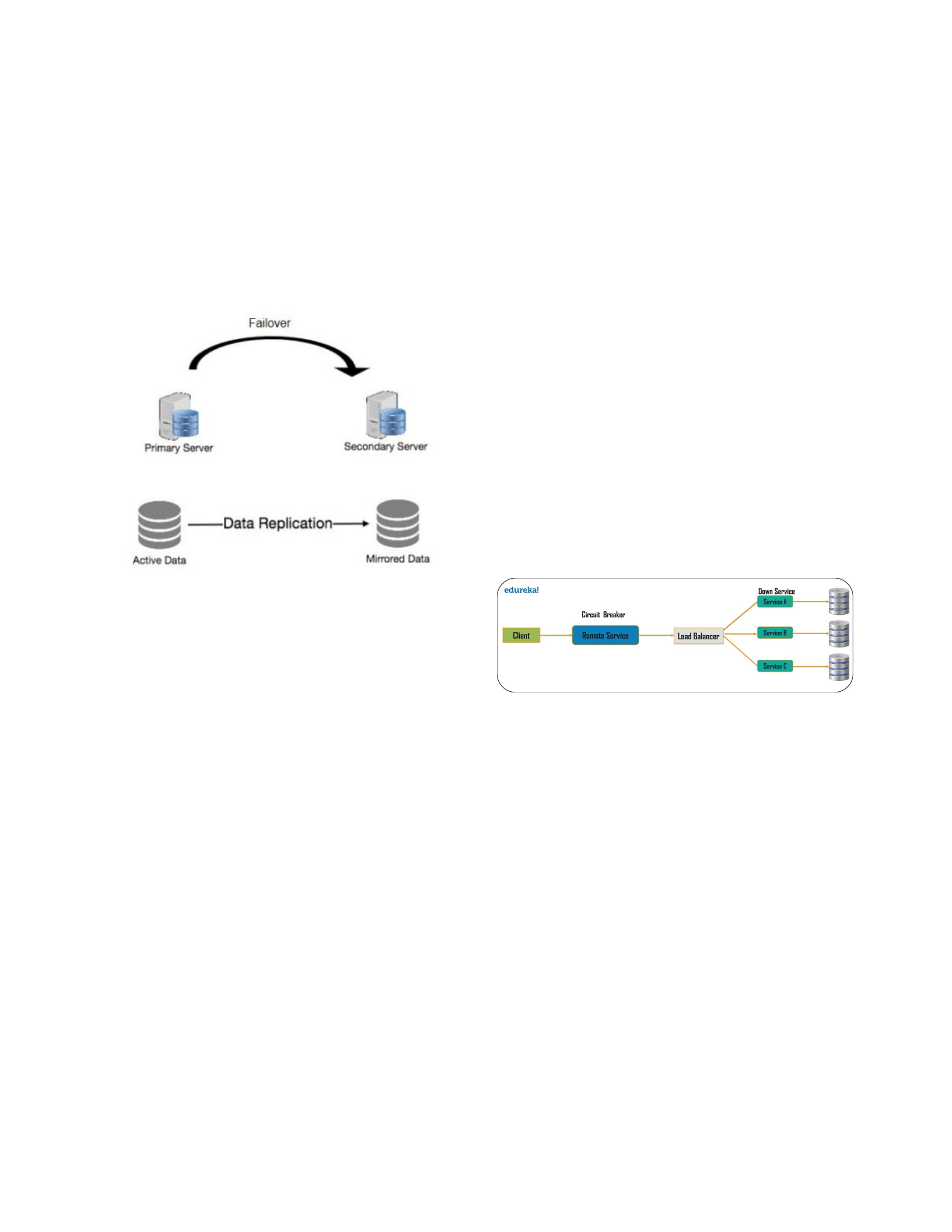
Redundancy and replication are two of the basic design
patterns for resilient systems. A system can work even if
one or more of its components fail by introducing
redundant components and data replication across
different nodes or places (Lezoche & Panetto. 2020).
This pattern finds typical applications in distributed
systems where data and services are replicated across
multiple servers or data centers to achieve high
availability and fault tolerance.
Example
Python
import boto3
# Create an S3 client
1
s3 = boto3.client('s3')
# List of buckets to replicate data
buckets = ['bucket1', 'bucket2', 'bucket3']
def replicate_data(file_name, data):
for a bucket in buckets:
s3.put_object(Bucket=bucket, Key=file_name,
Body=dat
Picture 1.1. Redundancy and Replication
Circuit Breaker Pattern
The circuit breaker pattern is one of the most essential
strategies in design that should make distributed systems
more resilient. This will ensure that a possibly failing
component does not take other components down with
itself, thus guaranteeing system stability and
performance. The value offered in this design pattern
within environments where services are highly
dependent upon each other and where handling and
containing failures is critical to success in operations
ranges very high.
Example
Python
import circuitbreaker
# Define the circuit breaker configuration
circuit_breaker = circuitbreaker.CircuitBreaker(
failure_threshold=5,
recovery_timeout=60,
expected_exception=Exception
)
# Decorate the function with the circuit breaker
@circuit_breaker
def process_data(data):
# Code to process data and interact with downstream
services
# ...
return result
# Call the decorated function
try:
result = process_data(data)
Except circuitbreaker.CircuitBreakerError:
# Handle circuit breaker open state
# (e.g., fallback mechanism, retry later)
Pass
Concept and Mechanism
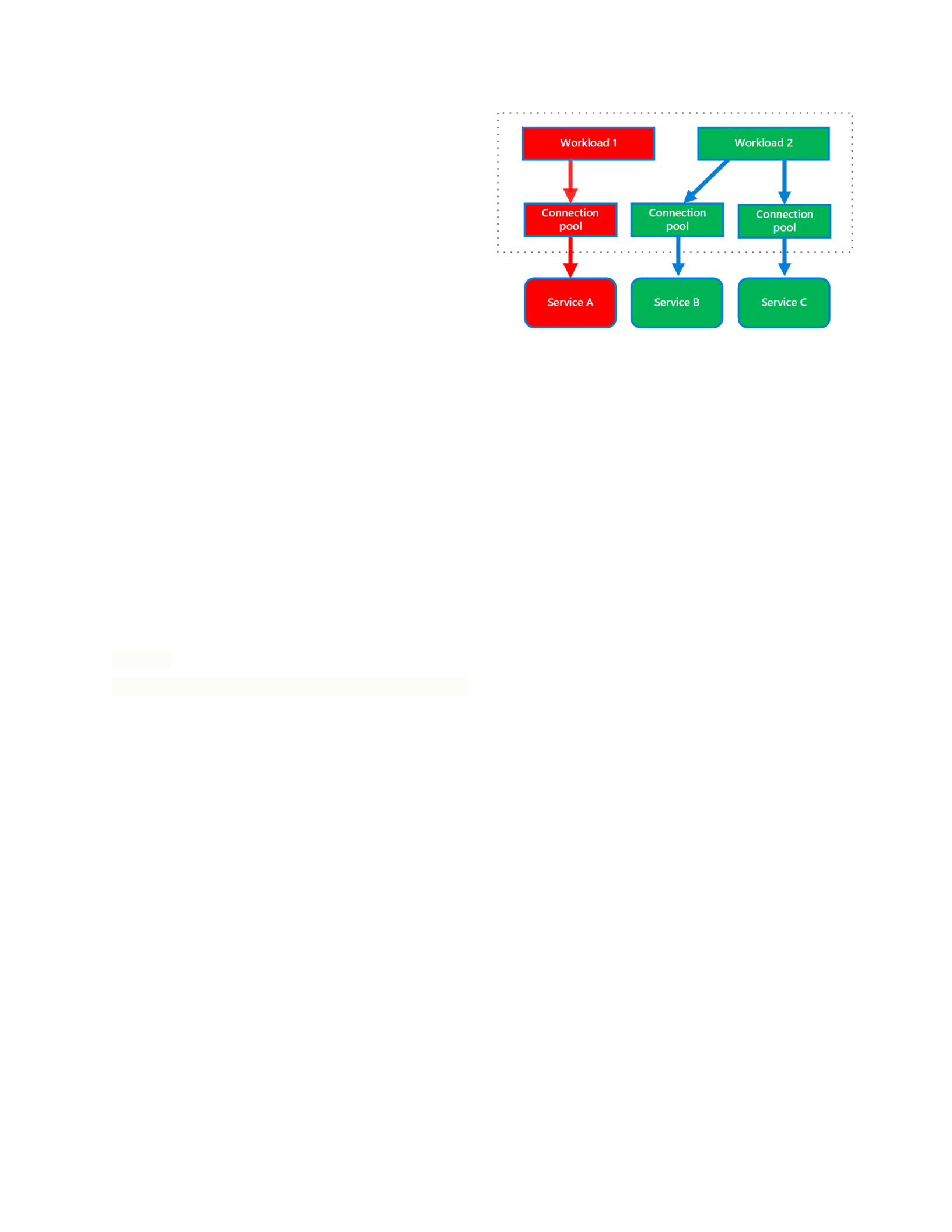
The circuit breaker pattern works much like an electrical
circuit breaker (Surendro & Sunindyo, 2021). In the
electrical system, the circuit breaker automatically shuts
off electricity in case there is any overload or short-
circuit to avoid damage to the system. Similarly, the
circuit breaker monitors service call success and failure
rates within a software system. It will 'trip' when it
detects a high rate of failures and prevent further
requests from reaching the failing service.
Picture 1.2. illustration of a Circuit Breaker
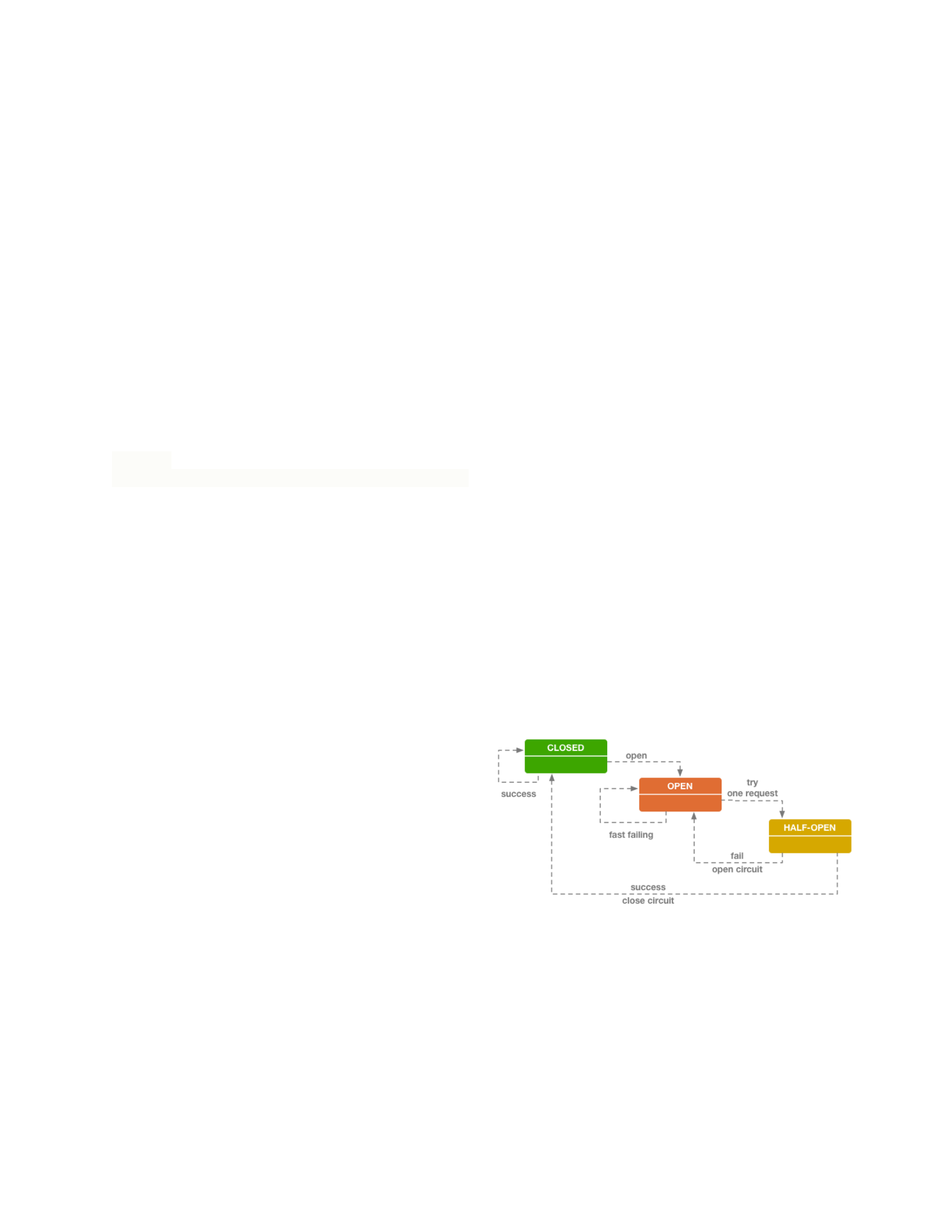
The circuit breaker can have three states:
Closed: In this state, the circuit breaker forwards
requests as it should. It continues monitoring the rate of
successes and failures of the requests.
Open: The circuit breaker is said to be in the Open state
when the failure rate exceeds some specified
predetermined threshold. In the Open state, it does not
allow any request to go towards the same failing service;
in other words, no more such requests are permitted.
Instead, the predefined fallback mechanism can be
executed, and an error response can be returned quickly.
Half-Open: Once the timeout expires, the circuit
breaker goes half-open, and it lets a limited number of
test requests through. If the requests go through, the
circuit is switched back to closed, allowing regular
operation. If the failures persist, the circuit is left open.
Benefits
2
Prevents Cascading Failures: The circuit breaker does
this by isolating the failing service, preventing its issues
from affecting other components, hence avoiding a chain
reaction of failures.
Graceful Degradation: The circuit breaker allows
graceful degradation of the system instead of crashing it
when some service fails. It may further provide fallback
responses or alternative pathways to hold up part of the
service. Better Stability: By handling failures
proactively, the circuit breaker improves the stability of
a system as a whole and prevents cascading
shortcomings that render it resilient.
Increased Visibility: The circuit breaker gives details
on the health and performance of services, enabling the
developer to detect and correct issues before they
become complex problems.
Bulkhead Pattern
The bulkhead pattern has been derived from the
watertight compartments used in ships, whereby it
divides the vessel into parts so that in case of flooding,
water does not spread to other areas. In software
systems, the components or resources are isolated in
different pools. That means if one pool crashes, all the
others keep working. The bulkhead pattern has particular
value in microservices architectures, wherein it enables
isolation between services from one another to ensure
that a single point of failure does not bring down the
system (Miraj & Fajar, 2022)
Example:
Python
from concurrent.futures import ThreadPoolExecutor
# Define bulkheads for different services
bulkhead_a = ThreadPoolExecutor(max_workers=5)
bulkhead_b = ThreadPoolExecutor(max_workers=5)
def service_a_task():
# Task for service A
pass
def service_b_task():
# Task for service B
pass
# Submit tasks to respective bulkheads
bulkhead_a.submit(service_a_task)
bulkhead_b.submit(service_b_task)
Picture 1.3. Bulkhead Pattern
Application in Microservices Architectures
The bulkhead pattern particularly fits well in
microservice architectures. Microservices mean several
independently deployable services that communicate
with each other to form a complete application. By
nature, microservices are decentralized, so system
stability and failure isolation mechanisms need to be
introduced. The bulkhead architectural pattern solves
this challenge:
Isolation of Services: Every service runs in its silo. If
one fails or is hit with too much traffic, this failure is, at
worst, contained to the service rather than a cascade in a
systematic failure.
Resource Pooling: Resources, such as databases queues,
or external APIs, are divided into separate pools. In this
way, if one service fails or consumes too many
resources, it won't affect the other services.
Increased Resilience: Bulkhead patterns isolation of
faults make the system more resilient. It continues
running the unaffected parts while fixing issues,
reducing downtime, and giving the best possible user
experience.
Benefits
Improved Fault Tolerance: Since this isolates the
failure in a single compartment, the system is kept more
stable.
Better Resource Management: Resources are managed
more resource-efficiently, so there is less possibility of
some essential services being starved.
Increased System Reliability: Make sure that there is
not a single point of failure where the entire system goes
down, but that availability is maintained.
Challenges
3
It can also add complexity to the system design and
management when implementing the bulkhead pattern.
Overhead: Maintaining separate pools and ensuring
proper isolation can introduce overhead in terms of
resource usage and monitoring
Retry and Fallback Patterns
One of the effective ways to handle temporary failures in
a distributed system is through retry patterns
(Punithavathy & Priya, 2024). If, during the pass, the
request fails, then the system will automatically retry an
operation for a specified number of times before it is
considered unsuccessful. Another important resilience
pattern that usually goes with it is the fallback pattern.
This provides either an alternative way or a default value
when a service or operation has failed. The system
degrades gracefully or continues functioning but perhaps
at a lower level.
Example:
Python
import time
import random
def retry_operation(operation, retries=3, delay=2):
for attempt in range(retries):
try:
return operation()
except Exception as e:
if attempt < retries - 1:
time.sleep(delay)
else:
raise e
def fallback_operation():
return "Fallback result"
def main_operation():
if random.choice([True, False]):
raise Exception("Transient failure")
return "Main result"
try:
result = retry_operation(main_operation)
except Exception:
result = fallback_operation()
print(result)
Key Elements of the Retry Pattern
1. Automatic Retries: When a failure occurs, the
system automatically retries the operation. This
is configured to happen a certain number of
times before the failure is considered
permanent.
2. Configurable Parameters: The retry
mechanism typically includes configurable
parameters such as:
oRetry Count: The number of retry
attempts before giving up.
oRetry Interval: The delay between
each retry attempt.
oExponential Backoff: Increasing the
delay interval between retries to avoid
overwhelming the service.
3. Detection of Transient Failures: Not all
failures are transient. The system needs to
distinguish between temporary glitches and
persistent errors to avoid futile retries.
Key Elements of the Fallback Pattern
1. Graceful Degradation: More like gracefully
curved, in the sense that instead of failing, the
system may degrade to using a different method
or achieve the same by returning a default
value.
2. Default Values: It returns predefined default
responses in case of failure of the primary
operation.
3. Alternative Services: This means switching to
an alternative service or resource in the case of
unavailability of the primary service to handle
the request.
Picture 1.3. Illustration of a Retry and Fallback Patterns
Circuit Breaker State Diagram
Combined Usage of Retry and Fallback
Patterns
Combining retry and fallback patterns can bring much-
needed resilience into distributed systems. Here is how
they interact:
Retry Mechanism: In the case of an operation failure, it
will be retried for a given number of times with
4

configurable intervals. This allows for temporary failures
to be overcome without User Experience Implications.
Fallback Mechanism: In the case of all retry attempts
failing, the fallback mechanism kicks in with an
alternative method or a default response, making the
system still operational, but partially.
Benefits of Retry and Fallback Patterns
Increased Resilience: The system will recover from
transient failures and keep running.
Improved User Experience: Since total failures are
avoided, users face less disruption.
Operational Continuity: Essential services continue to
operate even in the event of some failed components.
Challenges
Complexity: This could increase the system architecture
with the implementation of these patterns.
Overhead: Some, due to retrying operations and
maintaining fallbacks.
Error Handling: It should correctly classify transient
from permanent errors to avoid redundant retries and
ensure efficient fallbacks.
Monitoring and Observability
Monitoring and observability are essential ingredients of
resilient systems. That is, continuous monitoring of
health, performance, and behavior in a system enables an
organization to have a better chance of recognizing and
automatically remedying issues with the system before
they snowball into critical failures. Distributed tracing,
log aggregation, and metric collection ensure adequate
insight into the system's condition as a whole and allow
for effective diagnosis and resolution within very short
periods. (Montanari & Aguirre, 2020).
Example:
Python
import boto3
# Create a CloudWatch client
cloudwatch = boto3.client('cloudwatch')
def put_metric_data(namespace, metric_name, value):
cloud watch.put_metric_data(
Namespace=namespace,
MetricData=[
{
'MetricName': metric_name,
'Value': value
},
]
)
# Example usage
put_metric_data('MyApp', 'RequestLatency', 123)
Importance of Monitoring and Observability
Proactive Issue Detection: The earlier the
potential issue can be detected, the more time there
is to fix it before it reaches the user or escalates into
something much bigger.
Faster Incident Resolution: Detailed insight into
behavior and performance could deliver the depth
of monitoring and, therefore, observability required
to diagnose and troubleshoot issues rapidly.
Continuous Improvement: Data gathered through
monitoring and observability helps to show where
there could be room for optimization, how the
meshing of resources can be improved, and how
overall reliability and performance might be
bettered.
Challenges
Complexity: The challenge of handling huge amounts of
data from monitoring activities requires efficient
management and interpretive tools.
Integration: To integrate their monitoring and
observability tools in such diverse, distributed
environments, especially microservices architectures,
can be quite a challenge.
(a). Microservices Architecture
Enhancing Resilience through Service Isolation
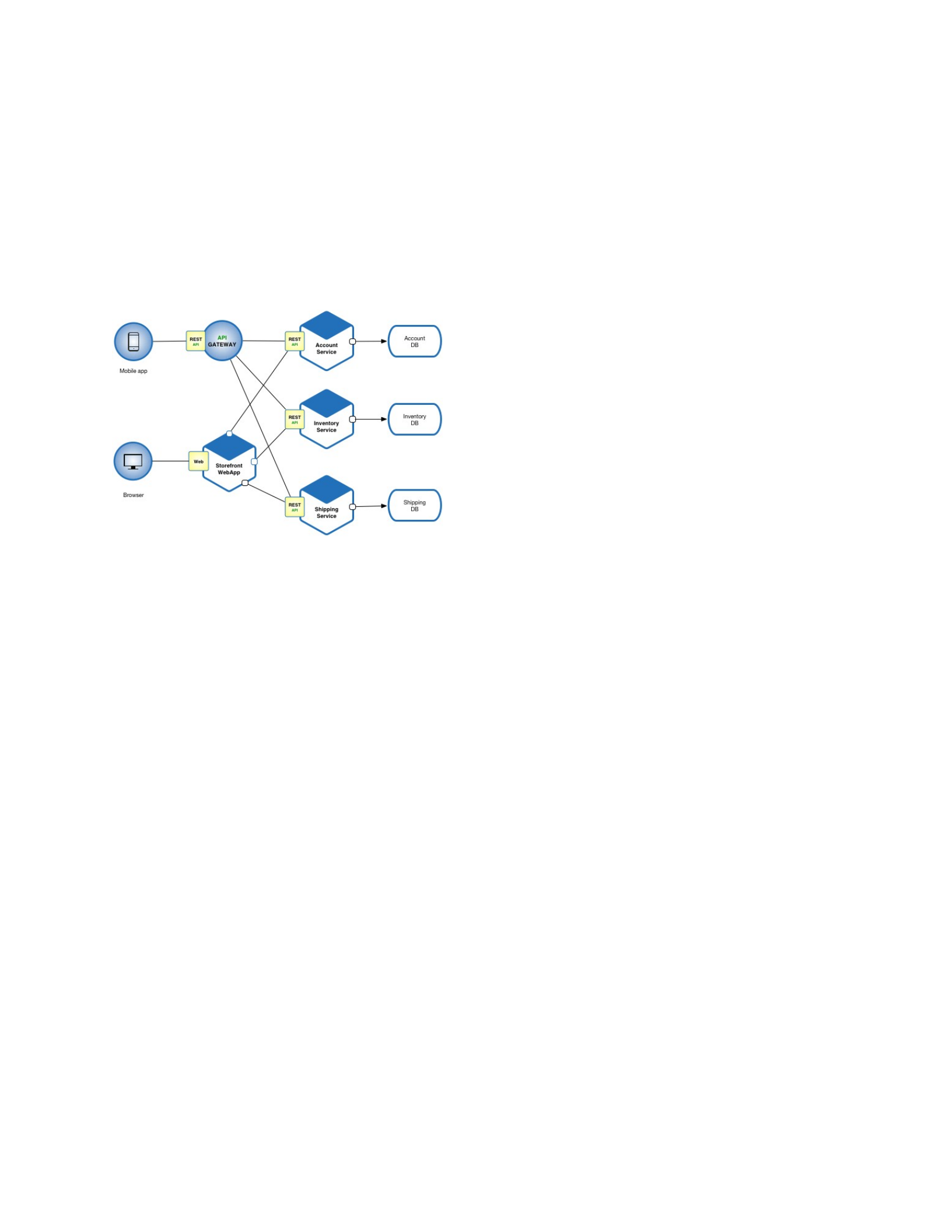
The microservices architecture is an architectural style
that structures an application as a collection of small
services developed, tested, deployed, and version-
controlled independently(Newman, 2021). Each
microservice focuses on a specific business functionality
and communicates with other services through well-
defined APIs. It is, therefore, in direct contrast to the
monolithic architecture, whereby all functionalities are
fitted into one tightly integrated application.
Key Characteristics of Microservices Architecture
Service Decomposition: The application is basically
divided into several services, with each service having
some business functionality. This naturally takes the
form of business domains, and an apparent separation of
concerns develops.
Independent Deployment: Microservices can be
independently developed, tested, deployed, and scaled.
This independence allows a team to deploy new features
or updates for a service without affecting other system
components.
Decentralized Data Management: Each microservice
manages its database or data store. Due to this
decentralized approach, services are not coupled through
5
a shared database schema; hence, the risk of data-related
failures propagating across services is significantly
minimized.
Lightweight Communication: Services communicate
through lightweight mechanisms. For example, these can
be HTTP/REST or messaging queues.
Technology Diversity: For different services, several
programming languages, frameworks, and tools can be
used; teams might use the best technology stack for each
service.
Photo 1.4. Microsoft Architecture pattern
Benefits of Microservices Architecture
Resiliency and Fault Isolation: Since microservices are
isolated, their failures do not directly impact the system's
functioning. One service's failure will not bring other
services down; therefore, the failure is contained, and
other services can still work as expected.
Scalability: Microservices can be scaled independently,
depending upon their specific requirements/demands
(Alliance, 2021). Services experiencing high load may
scale out, that is, sort out by adding more instances
without affecting the remaining services for efficient
resource utilization.
Continuous Deployment and Delivery: Since
microservices are independent, continuous integration
and continuous deployment is relatively easy. An
updated service can be made available without waiting
for an integrated release to be coordinated with other
services. This accelerates the development and
deployment cycle.
The maintainability, in general, is more significant
because of the smaller code base of each service. Thus, it
is easier to understand, maintain, and develop the
system. A developer can focus on one specific service
without an extensive monolithic application's cognitive
load.
Team Autonomy and Productivity: Since
microservices enable smaller, cross-functional teams to
take ownership over specific services, that brings along
autonomy, which increases the productivity of the teams.
Any team can then make its decisions and deploy
changes on its own.
Design Considerations for Building Resilient
Microservices
Service Contracts and APIs: Service interfaces should
be well-defined and agree to well-documented API
contracts to facilitate trustworthy interactions among
services, even when they are developed independently.
Data Cons-consistent: Select an adequate data
consistency model, depending on business demands. In a
microservices architecture, the Architect prefers eventual
consistency to Performance Consistency and Circuit
Breaker Patterns for the proper balance between
performance and reliability.
Service Discovery: Implement service discovery
mechanisms to locate services dynamically within a
distributed environment. This can be attained through
tools like Consul, Eureka, or the service discovery by
Kubernetes itself.
Circuit Breakers and Retries: Avoid cascading failures
using circuit breakers and implement retries for transient
failures. These are patterns provided in libraries like
Netflix Hystrix or Resilience4j.
Monitoring and Observability: Services and system
health are monitored with highly efficient monitoring
and constant observability based on logging, metrics,
and distributed tracing. The use of tools like Prometheus,
Grafana, ELK stack, and Jaeger enables these.
Security: Implement secure communication of
microservices with at least the basics of encryption, such
as TLS, and request authentication using tokens—e.g.,
JWT; implement RBAC and other good practices related
to security.
Service Orchestration and Choreography: A
judgment would have to be made regarding the right
balance between orchestration, normalized in a central
unit that coordinates service interactions, and its
decentralized counterpart, choreography. One could use
orchestration tools like Kubernetes or workflow engines
such as Cadence or Temporal.
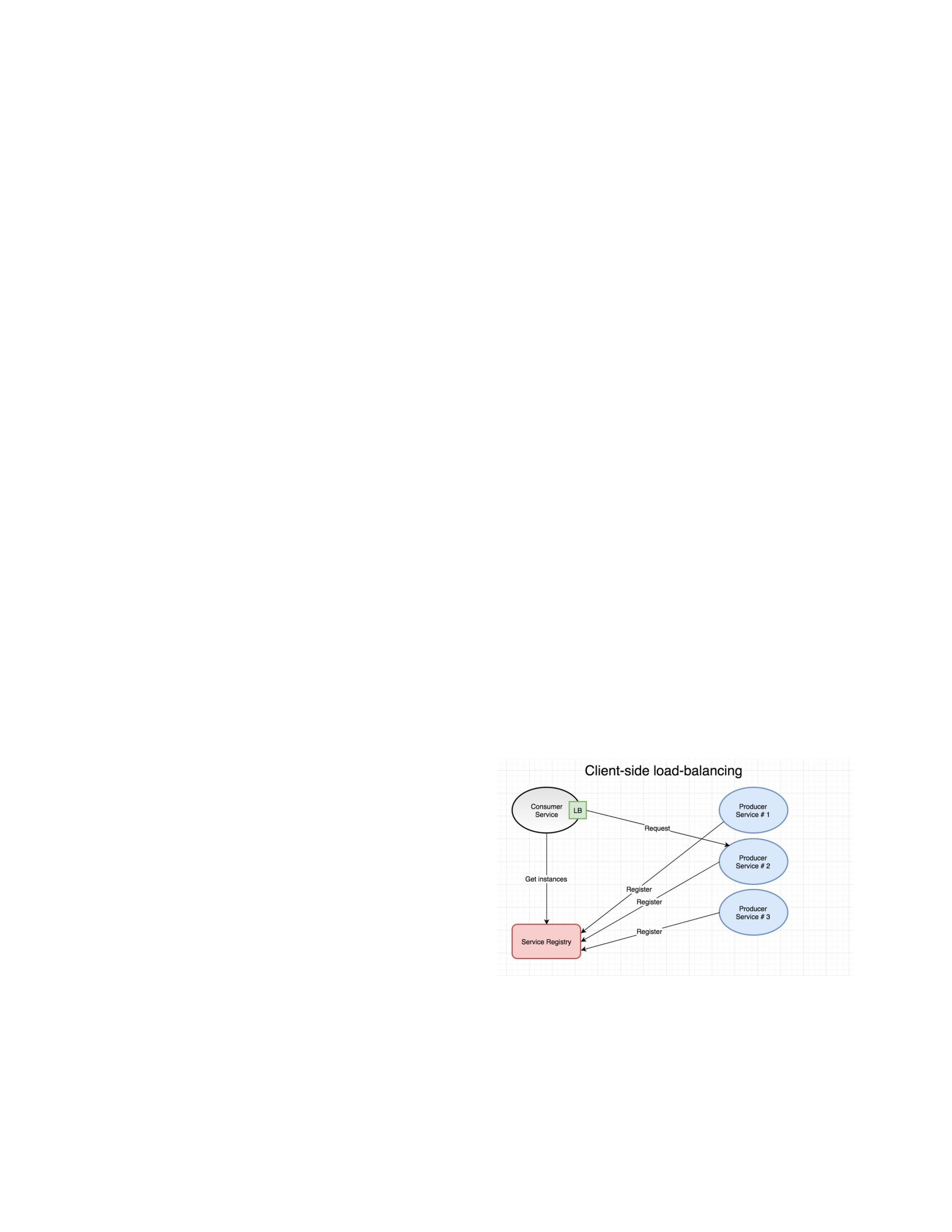
(b). Load Balancing and Service Discovery
Load balancing and service discovery mechanisms are in
place to make sure that traffic is distributed between
several instances of each service, ensuring high
availability and fault tolerance. Requests are routed
correctly to the healthy instances even when some
instances may have failed.
Load Balancing
6
It means distributing the incoming network traffic
across many servers or service instances. The main goals
of load balancing are:
High Availability: Load Balancers Distribute the load
within multiple servers; in case one fails or gets
overloaded, others on stand-by pick up the incoming
requests, reducing downtown and increasing reliability
(Barbette et al., 2020).
Scalability: The load balancers provide horizontal
scaling by adding more servers to the pool in case of any
increase in demand. In this way, elasticity helps ensure
that increased traffic can easily be handled without
performance degradation.
Optimization: Traffic can be balanced depending on
server response times, current server load, clients'
geographical location, or any other specific routing rules.
This optimization will help improve the overall system
performance and user experience.
Types of Load Balancers
There are several varieties of load balancers, each with
their own benefits:
Hardware Load Balancers: These are dedicated
appliances that are specifically optimized for load-
balancing tasks. They provide a fast performance and,
most of the time, include advanced features such as SSL
termination and protection against DDoS.
Software Load Balancers: Run as an instance of
software within the application stack or as an integral
part of the operating system—flexibility and cost-
effective. Examples include HAProxy and Nginx.
Cloud Load Balancers: It is provided as a managed
service and offered by cloud providers like AWS Elastic
Load Balancing, aka ELB, and Azure Load Balancer.
This brings flexibility, integrability with other cloud
services, and ease of management of the underlying
infrastructure.
Service Discovery
Service discovery, in combination with load balancing,
automatically finds out all locations of a service's
running instances and monitors their statuses on the
network. Some key points for Service Discovery are:
Dynamic Updates: Adding or removing services,
scaling up/down can be done dynamically without
manual intervention, with the service discovery
mechanism updating its registry correspondingly.
Health Checking: This periodically checks the health of
service instances to ensure they are responsive. Non-
healthy instances can be removed from the set of
available servers; this can happen automatically until
they recover.
Load Balancer Integration: Service discovery is deeply
integrated with load balancers; it provides real-time
information regarding the available service instances,
thereby ensuring that traffic routes only to healthy and
responsive servers.
Implementations of Service Discovery
DNS-Based Service Discovery: Services register at a
DNS server with their locations in the network—to be
more specific, their IP addresses and ports—while
clients resolve the service name to these addresses
dynamically.
Client-Side Discovery: The clients query a discovery
service or registry, such as Consul or etcd. That will
return the available instances of each service. In this
approach, the clients are responsible for connecting
directly to the chosen service instances.
Service Mesh is the advanced approach whereby a
dedicated infrastructure layer takes care of service-to-
service communication, including load balancing and
service discovery. More often than not, it uses sidecar
proxies like Envoy or Istio (Schneider, 2023).
Benefits of Combined Approach
By coupling load balancing with efficient mechanisms
for service discovery, the following can be achieved by
organizations:
Fault Tolerance: It detects failed instances and
automatically re-routes user traffic.
Scalability: Distributing traffic efficiently across
dynamically changing service landscapes.
Performance: Optimized routing, using real-time
metrics and load conditions.
Simplicity: Reduced operational complexity due to
automation and central management.
Picture 1.4.: Service discovery and load balancing
(c). Circuit Breakers and Fallbacks
7

One of the most prominent strategies in resilient
software design, especially for microservices
architecture, is circuit breakers and fallback
mechanisms. They act as safeguards at service
boundaries against cascading failures across a
distributed system. When the failure rate of a given
service reaches a threshold, be it timeouts, errors,
or unresponsiveness, the circuit breaker "trips."
That basically brings a halt to any further request to
the failing service and isolates the problem from the
remainder. By doing so, circuit breakers help to
maintain the overall stability and performance of
the system, as continuous retries to a failing service
can consume resources and exacerbate the issue.
Fallbacks, along with circuit breakers, ensure
service availability and user experience in case of a
failure (Meiklejohn et al 2022). Such mechanisms
return alternative responses or provide default
values when some service is not available. The
fallback may return the cached data, respond with a
simplified answer, or redirect the request to another
service. This system will degrade gracefully instead
of brutally failing. After all, being able to receive
probably useful information or limited functionality
is preferable to meeting an error or downtime.
Therefore, the circuit breakers and fallback
implemented together give the system a way to
handle failures robustly so that, in the case of
partial outages or degraded services, it affords a
seamless and resilient experience. These
mechanisms are crucial for reliability maintenance
and building trust with users in a complex service
environment with high interdependence between
the services involved.
(d). Redundancy and Replication
Redundancy and replication are among the simple
principles of building resilient and reliable distributed
systems. Redundancy refers to the process for making
multiple copies of essential components, essentially
meaning that if one copy goes down, another is able to
take over its duties without service disruption (Láruson,
et al 2020) This redundancy usually faces fronting across
different availability zones or regions in a cloud
infrastructure. By geographically distributing such
redundant instances, systems can work to avoid a
particular zone or region falling victim to faults localized
in nature, such as power outages, network issues, or
natural disasters. Geographic distribution does not only
offer fault tolerance; it also load-balances locations
thereby improving overall system performance and thus
reduces latency for the end user.
Replication, however, creates and maintains copies of
data across a number of locations to facilitate results in
higher availability. For example, even if one location
fails, the data remains accessible. If a database is
replicated across a number of regions, it can sustain a
loss in one region and still function seamlessly due to the
fact that the data will still be present in the other regions.
Replication also holds the key to disaster recovery,
whereby normal operations can be quickly restored
through failover to one of the replicas that contains the
most recent data. The redundancy and replication
therefore provide a highly available and resilient
framework allowing systems to ensure continuity of
service, integrity of data, and uniformity and reliability
of user experience in the face of failures or major
disruptions.
(e). Monitoring and Observability
Monitoring and observability are the most important
parts of modern distributed systems architectures, which
provide granularity with respect to both the health and
performance of any given system. With stronger
monitoring solutions in place, firms will be able to track
status and performance of their various components at
any given time. Distributed tracing tools in such a setting
become indispensable by helping in tracing requests
throughout multipart services and components within a
complex system. It provides end-to-end tracing
capability at the fingertips of developers and operators to
identify bottlenecks, latency issues, and failure points in
any particular service quickly. Due to distributed tracing,
in the event of any performance issue or failure, it would
provide enough context about where and why this
happened, reducing mean time to recovery.
Besides tracing, log aggregation and metric collection
are vital features to a functioning, performant system (Le
et al 2020). Logs from various services will be collected
into a single log management system for ease in
analyzing trends base-lining, anomaly detection, and
root cause analysis. Continuous gathering of metrics,
like CPU usage, memory consumption, response times,
or error rates, and visualization through dashboards
empowers one single real-time view on the system's
behavior. With such fine-grained and time-accurate
visibility into a system's operational state, probable
issues can be proactively detected and mitigated before
they become critical problems. In conjunction, this
monitoring and observability ensure that systems have a
reaction not only to failures but also in being predictive
and preventive, hence improving the general reliability,
performance, and user satisfaction.
(f). Integration with AI and ML
8

AI and ML techniques can significantly enhance such
proposed architecture to provide resilience and
operational efficiency (Belhadi et al 2024). Machine
learning models trained on historical system metrics and
log data can be used to detect anomalies and predict
possible failures before they take place. Such models
study patterns, recognize deviations that may reflect
underlying problems—like unusual spikes in latency,
error rates, or resource consumption—and use this
knowledge to train themselves. These predictive
capabilities can be used to trigger automated remediation
actions, such as by restarting a failing service, scaling
resources, or rerouting traffic. The models can also
provide actionable recommendations to system
administrators so that they may take proactive measures
to mitigate issues before they escalate into critical
problems. This proactive approach not only limits
downtime and enhances overall reliability but also offers
better robustness of the system.
On the other hand, AI-based decision engines can also
be leveraged for the dynamic adjustment of system
configurations, resource allocations, and failover
strategies against real-time conditions and workload
patterns (Hechler et al 2020). These are perpetual
engines that look at the state of the system before any
data-driven decisions with regard to changes likely to
enhance performance or resilience. For instance, the
decision engine might want to allocate more resources or
adjust the configuration in such a way as to deal
effectively with a rise in demand. In case of failure, it
can directly apply strategies for failover, maintaining its
services in a continuous way. This flexibility enables
resources to be well utilized, minimizes wastages, and
guarantees maximum performance and system
resilience. Incorporating both AI and ML into the
architecture would thus make an organization's
infrastructure more intelligent, responsive, and resilient
to autonomously manage investment and mitigation
issues occurring in any exigency.
Picture 1.5: AI Integrating data machine
Real-world Example: Amazon Web Services
(AWS)
During my work period as the Software Development
Engineer in Amazon Web Services, I have worked on a
project covering multiple design models and strategies
used to come up with a reliable system. It mainly
focused on designing a distributed data processing
pipeline for ingesting and analyzing huge volumes of
data from different sources. This mission demanded the
employment of strong redundancies and replications,
which would prove effective for the availability and
integrity of data across the regions. We integrated broad
monitoring and observability solutions using distributed
tracing to track data flows, hence find performance
bottlenecks in them. We have embedded AI and ML
models for predicting failures and adapting resource
allocation dynamically based on real-time conditions.
These were the enhancements that made system
performance optimized and, more importantly,
significantly increased its resiliency to ensure seamless
data processing in the event of regional outages or
infrastructure failures.
Challenges and Requirements
Designing and testing a fault-tolerant, highly available
data processing pipeline where multiple services and
components interact poses several significant challenges.
The first primary concern is intrinsic system complexity.
Each service and component in this pipeline may have
its own failure modes, dependency behavior, and
performance characteristics. For instance, network
disruptions might make services unavailable or degrade
performance, leading to delays with probable data loss.
Moreover, service outages may be due to hardware
failures, software bugs, or planned maintenance of any
component. Such issues are dealt with effectively by
detailed knowledge of how all components depend on or
interact with one another in a range of scenarios.
Another key challenge lies in data integrity, concerning
the fact that data can be corrupted (Megouache et al.,
2020). Data corruption can occur at any level of the
pipeline—for example, across the network during
transmission, within storage systems on execution, or for
processing data. This polluted information will become
part of the pipeline, making some analytics inaccurate
and the business insight unsuitable, resulting in
substantial potential financial or reputational damage.
More than that, robust data validation, error detection,
and correction mechanisms are needed to ensure that
everything is well in the process. This always implies
9

some redundancy: maintaining redundant copies of data
in order to recover from errors, possessing additional bits
inside the data that detect corruption by checking the
integrity of data with checksums, and having
sophisticated algorithms to recover from errors.
There is a need to reduce downtime as much as possible
and ensure very high uptime. Long-time downtime may
lead to a slowdown in business activities, loss of
revenue, and eventually, a situation whereby customers
do not trust you anymore. In designing for high
availability, the pipeline must be structured to handle
any failure quickly and seamlessly. This may involve
techniques such as failover, which involves putting
backup systems that will automatically take over in case
the primary ones fail, and load balancing to evenly
distribute workload on several services. In addition,
these monitoring and alerting systems can give real-time
indications of potential problems and allow for
automatic recovery processes. This scheme aims to build
a resilient pipeline that will function even in the event of
failure of its elements, ensuring non-stop processing of
data and, therefore, preserving the entire system's
stability.
````
Implementation and Design Patterns
To mitigate this, several design patterns and strategies
for resilience were implemented:
1. Microservices Architecture: The pipeline was
designed as a collection of loosely coupled
microservices, each responsible for a specific task
independent of the others. For example, data ingestion,
transformation, and storage. This style brought in
independent scaling, deployment, and failure isolation.
2. Circuit Breakers and Fallbacks: Circuit breakers were
introduced at each edge of every microservice; therefore,
a cascading failure would never propagate from one
service to another. Assuming that a downstream service
returned failures more than a certain percentage of the
time, this circuit breaker would trip, preventing further
requests from passing through to the failing service. In
addition to circuit breakers, fallback mechanisms
provided alternative responses or default values to allow
graceful degradation of functionality within the pipeline,
which enabled continued processing despite reduced
functionality.
3. Microservices Architecture: The pipeline was
envisioned as loosely coupled microservices—each
handling one task, be it data ingestion, transformation, or
storage. This architectural type supported independent
scaling, deployments, and failure isolation.
4. Circuit Breakers and Fallbacks: Circuit breakers were
introduced at the edges of every microservice to stop
cascading failures. If this failure rate in the downstream
service is too high, the circuit breaker trips and prevents
subsequent requests from reaching the failing service.
Fallback mechanisms were also introduced to provide an
alternative
5. Monitoring and Observability: Extensive monitoring
and observability solutions were developed, including
AWS CloudWatch, AWS X-Ray, and Amazon
CloudWatch Logs. These tools provide insights into
pipeline health, performance, and behavior that could be
useful in detecting issues before they escalate into
critical problems.
6. Automated Deployment and Rollback: We utilized
AWS CodePipeline and AWS Code Deploy to make
automated deployments of microservices together with
rollbacks. This provided a facility for fast deployment of
new versions of services but guaranteed rollback
possibility to a previous stable version in case something
went wrong, reducing thus downtime and minimizing
the risk of failures during deployments.
Future Trends in Resilient Cloud Systems
1. AI and ML for Proactive Resilience
Artificial intelligence and machine learning are changing
the face of resilience with predictive maintenance and
automated recovery. Machine learning models analyze
historical data to predict potential failures, giving the go-
ahead for preemptive actions to avoid downtime. For
example, anomaly detection algorithms monitor system
metrics and logs for variance that might appear as
failures early, enabling early intervention. AI-driven
decision engines can automatically respond to the
detection of an issue, thereby reducing human
intervention and minimizing the overall downtown— for
instance, scaling resources or rerouting traffic.
2. Edge Computing and Distributed Resilience
Nearer to the source of data, edge computing places
computation, and data storage, making the system
resilient by reducing latency and reliance on central
servers. Local redundancy further enhances this at the
edges: failure in one location does not affect the system.
For example, multiple edge nodes may replicate data and
services. Federated learning allows machine learning
model training with decentralized data sources,
providing a pathway to enhanced robustness and
resilience of AI applications sans centralized data
aggregation.
3. Serverless Architectures
Serverless computing has inherent scalability and fault
tolerance, opening new vistas for resilient system
construction (Li et al., 2022). The serverless architecture
fulfills functions due to specific events. This event-
10

driven model decouples the parts while containing
failures within a single function, enhancing resilience
and preventing problems in one part of the system from
snowballing into the entire system. Moreover, serverless
platforms scale resources automatically based on
demand, ensuring the system can handle varying loads
without manual intervention.
4. Security and Resilience Integration
The convergence between security and resilience is
significant because cyber threats are increasing the
impact on system availability and integrity (Jasiūnas et
al., 2021). Zero trust architecture enforces strict access
controls and continuous verification, regardless of
location, reducing the risk of security breaches on
system resilience. It also puts in place resilient security
practices that limit the effect of attacks on systems
through automated incident response and threat detection
in real time.
5. Multi-Cloud and Hybrid Cloud Strategies
Resiliency can be achieved using multiple cloud
providers or the hybrid approach, avoiding vendor lock-
in and delivering redundancy within different platforms.
Cross-cloud redundancy ensures data and services have
been cloned to several cloud providers so that their
failure in one does not stop the system. Interoperability
standards and methods facilitate seamless integration
and failover across heterogeneous cloud environments,
hence helping to make a robust framework for resilient
cloud systems (Merseedi & Zeebaree,2024)
Conclusion
Building resilient software systems is required for
modern, complex, and distributed computing
environments. Organizations can better get through by
embracing redundancy, circuit breakers, bulkheads,
retries, and fallbacks in designing more resilient systems,
ensuring business continuity in the presence of failures
or disruptive events.
Besides that, the architecture proposed in this paper
allows the integration of those patterns into a
microservice-based system using load balancing, service
discovery, monitoring, and observability to strengthen
resilience even more. Also, AI and ML techniques can
be integrated to have proactive failure detection,
automated remediation, and resource allocation, further
enhancing the system's resilience and adaptability axis.
Real-world examples, such as the data processing
pipeline project at Amazon Web Services, show these
patterns and strategies for real-life applications. By
embracing resilience in core design and using
appropriate patterns and technologies within their
application, organizations can build robust and reliable
systems that not only survive failures and maintain
customer trust but also serve and safeguard business
interests against known and unknown threats in a
continuously evolving digital environment.
REFERENCES
[1] Abbaspour, A., Mokhtari, S., Sargolzaei, A., &
Yen, K. K. (2020). A survey on active fault-
tolerant control systems.$Electronics,$9(9),
1513.
[2] Surendra, K., & Sunindyo, W. D. (2021,
February). Circuit breaker in microservices:
State of the art and prospects. In IOP
Conference Series: Materials Science and
Engineering$(Vol. 1077, No. 1, p. 012065). IOP
Publishing.
[3] Miraj, M., & Fajar, A. N. (2022). Model-based
resilience pattern analysis for fault tolerance in
reactive MICROSERVICE.$Journal of
Theoretical and Applied Information
Technology,$100(9).
[4] Punithavathy, E., & Priya, N. (2024). Auto retry
circuit breaker for enhanced performance in
microservice applications.$International Journal
of Electrical & Computer Engineering (2088-
8708),$14(2).
[5] Newman, S. (2021).$Building microservices. "
O'Reilly Media, Inc.".
[6] Alliance, N. G. M. N. (2021). Cloud Native
Enabling Future Telco Platforms.
[7] Barbette, T., Tang, C., Yao, H., Kostić, D.,
Maguire Jr, G. Q., Papadimitratos, P., &
Chiesa, M. (2020). A {High-Speed}{Load-
Balancer} Design with Guaranteed {Per-
Connection-Consistency}. In$17th USENIX
Symposium on Networked Systems Design and
Implementation (NSDI 20) (pp. 667–683).
[8] Schneider, M. (2023).$Performance
Benchmarking of Open-Source Service Meshes
Using Load Testing$(Doctoral dissertation,
Master’s thesis, University of Applied Sciences
Campus Vienna, Vienna, Austria).
[9] Meiklejohn, C., Stark, L., Celozzi, C., Ranney,
M., & Miller, H. (2022, November). Method
overloading the circuit. In$Proceedings of the
11

13th Symposium on Cloud Computing$(pp. 273-
288).
Láruson, Á. J., Yeaman, S., & Lotterhos, K. E.
(2020). The importance of genetic redundancy
in evolution.$Trends in ecology &
evolution,$35(9), 809-822
[10] Láruson, Á. J., Yeaman, S., & Lotterhos, K. E.
(2020). The importance of genetic redundancy
in evolution.$Trends in ecology &
evolution,$35(9), 809-822.
[11] Le, V. H., & Zhang, H. (2022, May). Log-based
anomaly detection with deep learning: How far
are we? In Proceedings of the 44th
International Conference on Software
Engineering$(pp. 1356-1367).
[12] Belhadi, A., Mani, V., Kamble, S. S., Khan, S.
A. R., & Verma, S. (2024). Artificial intelligence-
driven innovation for enhancing supply chain
resilience and performance under the effect of
supply chain dynamism: an empirical
investigation.$Annals of Operations
Research,$333(2), 627-652.
[13] Jasiūnas, J., Lund, P. D., & Mikkola, J. (2021).
Energy system resilience–A review.$Renewable
and Sustainable Energy Reviews,$150, 111476.
[14] Merseedi, K. J., & Zeebaree, S. R. (2024). The
cloud architectures for distributed multi-cloud
computing: a hybrid and federated cloud
environment review. Indonesian Journal of
Computer Science,$13(2).
(15) Hechler, E., Oberhofer, M., & Schaeck, T.
(2020). Deploying AI in the Enterprise.$IT
Approaches for Design, DevOps, Governance,
Change Management, Blockchain, and
Quantum Computing, Apress, Berkeley, CA.
(16) Li, Z., Guo, L., Cheng, J., Chen, Q., He, B., &
Guo, M. (2022). The serverless computing
survey: A technical primer for design
architecture.$ACM Computing Surveys
(CSUR),$54(10s), 1-34.
[17] Megouache, L., Zitouni, A., & Djoudi, M.
(2020). Ensuring user authentication and data
integrity in a multi-cloud environment. Human-
centric Computing and information
sciences,$10, 1-20.
(18) Lezoche, M., & Panetto, H. (2020). Cyber-
physical systems, a new formal paradigm to
model redundancy and resiliency.$Enterprise
Information Systems,$14(8), 1150-1171.
(19) Montanari, A. N., & Aguirre, L. A. (2020).
Observability of network systems: A critical
review of recent results.$Journal of Control,
Automation and Electrical Systems,$31(6),
1348-1374.
(20) Abualkishik, A. Z., Alwan, A. A., & Gulzar, Y.
(2020). Disaster recovery in cloud computing
systems: An overview.$International Journal of
Advanced Computer Science and
Applications,$11(9).
12

