


Effects of Cattle Rustling
Cattle raids have both negative and positive socio-economic impacts on their livelihoods; it has
political, social and environment effects as enumerated below.
Suffering, especially by Women-Cattle rustling and banditry have led to the loss of many
human lives and the displacement of various population groups. Women and children seem to
bear the brunt in these new forms of violence. Contrary to traditional norms, they are not spared.
As the then UN Deputy Secretary-General, Layashi Yaker, stated in 1994: Today women
constitute 80% of the displaced and refugees in Africa. Violations of the fundamental rights of
women and girls are widespread in times of war and civil strife, including atrocious crimes as
well as rape, torture, murder, maltreatment and neglect. (Ayot 1995:3) Furthermore, Theodore
Ayot notes that “wars” and conflict often leave women in situations whereby they can hardly
make ends meet. They have little or no resources at all against these acts of violence, whether
they occur while they are trying to make it across the border or in a refugee camp (Ayot 1995:4).
Breakdown of the social order-The targeting of non-combatants, especially women and
children, seems to be a symptom of the breakdown of the entire social order. Another symptom
is the way in which cattle are raided for selfish purposes. The pastoral communities have a lot of
attachment to cattle due to their ritualistic and cultural importance. Thus, the loss of livestock is
assumed to affect the entire social fabric.
Economic Hardship-The 1980s happened to be a period characterized by droughts and famines.
At the same time the cattle-rustling menace appeared on the scene, bringing about a massive
looting of livestock and destruction of property. The Pokot and the Turkana lost more than 80%
of their livestock during this period. By February 1982 about 50% of the Turkana population
(180,000) were in refugee camps and depended on relief supplies (Markakis 1993:146).
Consequently, most people were in a state of despair, hoping for a “messiah” to deliver them
from their unending tribulations. In most parts of north-western Kenya it is extremely difficult
for the pastoralists to get started again after heavy stock losses. Thus social and economic
differentiation is becoming more pronounced.
Effects of Cattle-rustling
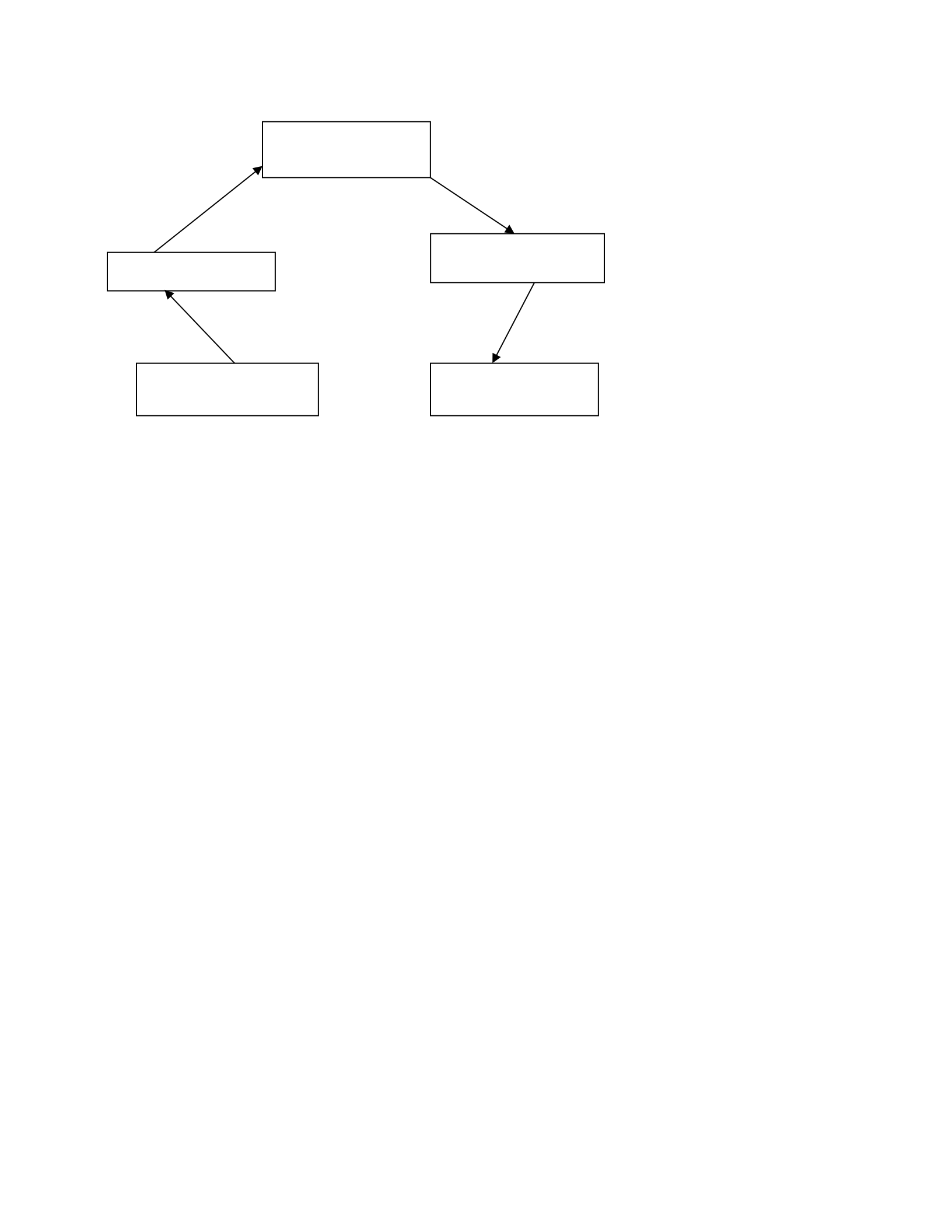
Figure 1: Graphical Illustration of the Economic, Social and Cultural Effects of Cattle-rustling.
Suggested Conflict Resolution Mechanisms to Cattle Rustling in Kenya
Although Kenya is prominently present and active in the international and regional initiatives on
conflict resolution, the government has achieved very little in terms of controlling trade in illegal
arms in northern region and Kerio Valley. In Kerio Valley, the government had deployed
General Service Unit (GSU); Anti Stock Theft Unit (ASTU); Administrative Police [AP] and
Regular Police in five trading centers along the valley.
These centres are; Arror, Mogil, Chesongoch, Literand Tot with the responsibility of providing
security to the people and their property. This approach had three weaknesses; one the officers
lacked coordination particularly when a raid occurred second is that officers are less armed
compared to cattle rustlers who had sophisticated weapons and thirdly is whether the security
officers should shoot at raiders who are citizens [Kimenju et al. 2003]. These weaknesses made
the security officers insufficient in curbing cattle raids and its associated impacts to Pokot and
Marakwet people.
The government also organized occasional security operations in the North Rift aimed at
confiscating illegal arms from citizens. However these operations have failed because residents
are intimidated in the process. The government has also used tactics of declaring amnesty to
those willing to surrender guns, while using threats and ultimatums to others. Whenever such
security operations are carried out the residents are physically abused, molested and ripped of
UNDER DEVELOPMENT
POVERTY & DEATH
HARDSHIP
HUMAN RIGHTS
VIOLATION
VIOLETIONS
INSECURITY
BREACKDOWN OF
SOCIAL ORDER

property. These government tactics have only served to create more hatred and despise for
government security personnel in the Kerio Valley. Cattle rustlers who get forcefully disarmed
ended up upgrading their weapons into sophisticated ones, Paula Palmer (2010).
2.11 Conceptual Framework
Left with no intervention, cattle’s rustling has ability to last. This comes with adverse effects on
economic development. Support for economic development emanates from the fact that once
cattle’s rustling is suppressed, there will be minimal chances of it recurring hence ushering in a
peaceful and economically stable environment. Conflict resolution mechanisms and
diversification of livelihoods will result to reduced cases of cattle rustling hence realization of
economic development. Economic development will depend on community’s willingness to
adopt and appreciate peace through embracing conflict resolution mechanisms, diversification of
livelihoods, and promotion of interaction among warring communities. For economic
development to be realized, these efforts will be targeted at the personal, relational, structural
and cultural aspects of the conflict. The conceptual framework is summarized in the fig – below
Independent Variable Dependent Variable
Loss of life
Displacements

Intervening variable
Source: Author 2013
Retarded Economic
Development
Migration
Rape
Fear
Cultural Practices

