


a 1
Chapter 5- Homework 4
Question 1:
Uniform distribution
Question 5:
P (6< X < 7)
Question 8:
f(x) = 1/ (b-1)
f(x) = 1/10
P(x =7) = 0/10 = 0
Question 16:
Uniform distribution
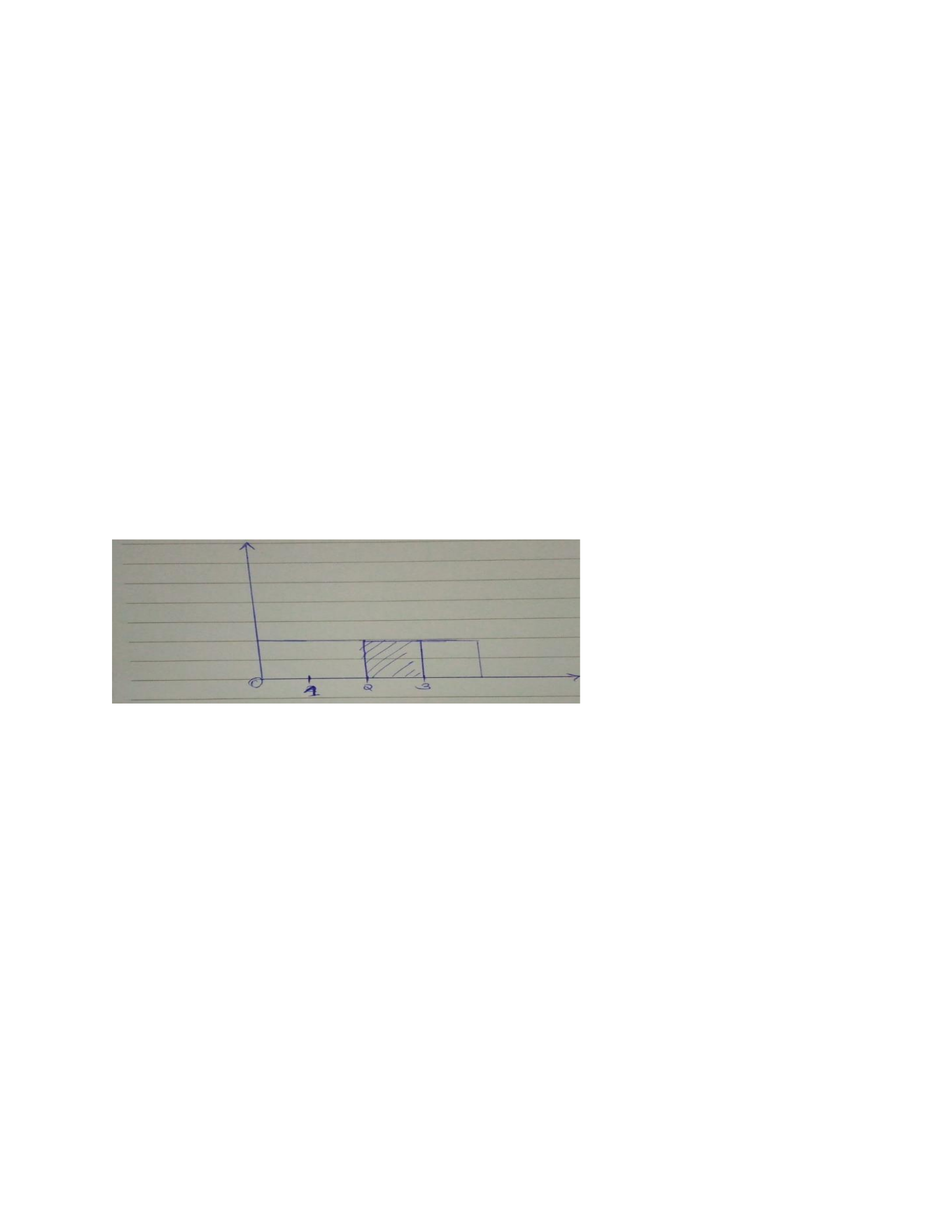
Question 20: Graph P (2< x< 3)
Question 27: a
b= 12; it represents the highest value of x
Question 35:
X = the age (in years) of cars in the staff parking lot
Question 38:
X ~ 𝑈 (0.5, 9.5)
Question 50:
m = 0.2 = 1/5
mean = 5
mean = standard deviation
standard deviation = 5

a 2
Question 59: Draw the distribution
Question 67: What is the decay rate (m)?
m = 0.000121
Question 72:
a) What part of the experiment will yield discrete data?
R.N degrees
b) What part of the experiment will yield continuous data?
Number of nurses
Question 77: A subway train arrives every eight minutes during rush hour. We are interested I
the length of time a commuter must wait for a train to arrive. The time follows a uniform
distribution.
a) Define random variable X
X represents the length of time a commuter must wait for a train to arrive on the red
line
b) X
X ~𝑈(0, 8)
c) Graph the probability distribution
d) F(x)
F(x) = 1/8
e) Mean
Mean = 8/ 2
Mean = 4
f) Standard deviation
Standard deviation= sqrt (64/12)
Standard deviation = 2.31
g) Find the probability that the commuter waits less than one minute
P (x< 1) = 1/8
h) Find the probability that the commuter waits between three and four minutes

a 3
= 1/8
i) Sixty percent of commuters wait more than how long for the train?
60% = 0.6
P (x > 2) = 3.2
Question 83: Suppose that the value of a stock varies each day from $16 to $25 with a uniform
distribution
a) Find the probability that the value of the stock is more than $19
F(x) = (1/ 25 – 1/16)
F(x) = 1/9
P(x> 19) = (25 – 19) (1/9) = 2/3
b) Probability between $19 and $ 22
P (19 < x < 22)
= (22 – 19) (1/9) = 1/3
c) The upper quartile 25%
25% = 0.25
0.25=x(1/9)
X= (0.25)(9)
= 2.25
Quartile = 25 – 2.25
Quartile = 22.75
d) Given stock is greater than $18 find the probability the stock is more than $21
P(x> 21| x> 18)
F(x) = 1/ 21 – 1/18 = 1/7
P(x> 21| x> 18) = (25 – 21) 1/7
P(x> 21| x> 18) = 4/7
Question 89:
a) define the random variable X
X is the time (in years) after reaching age 60 that it takes an individual to retire
b) Is X continuous or discrete?
X is continuous
c) X
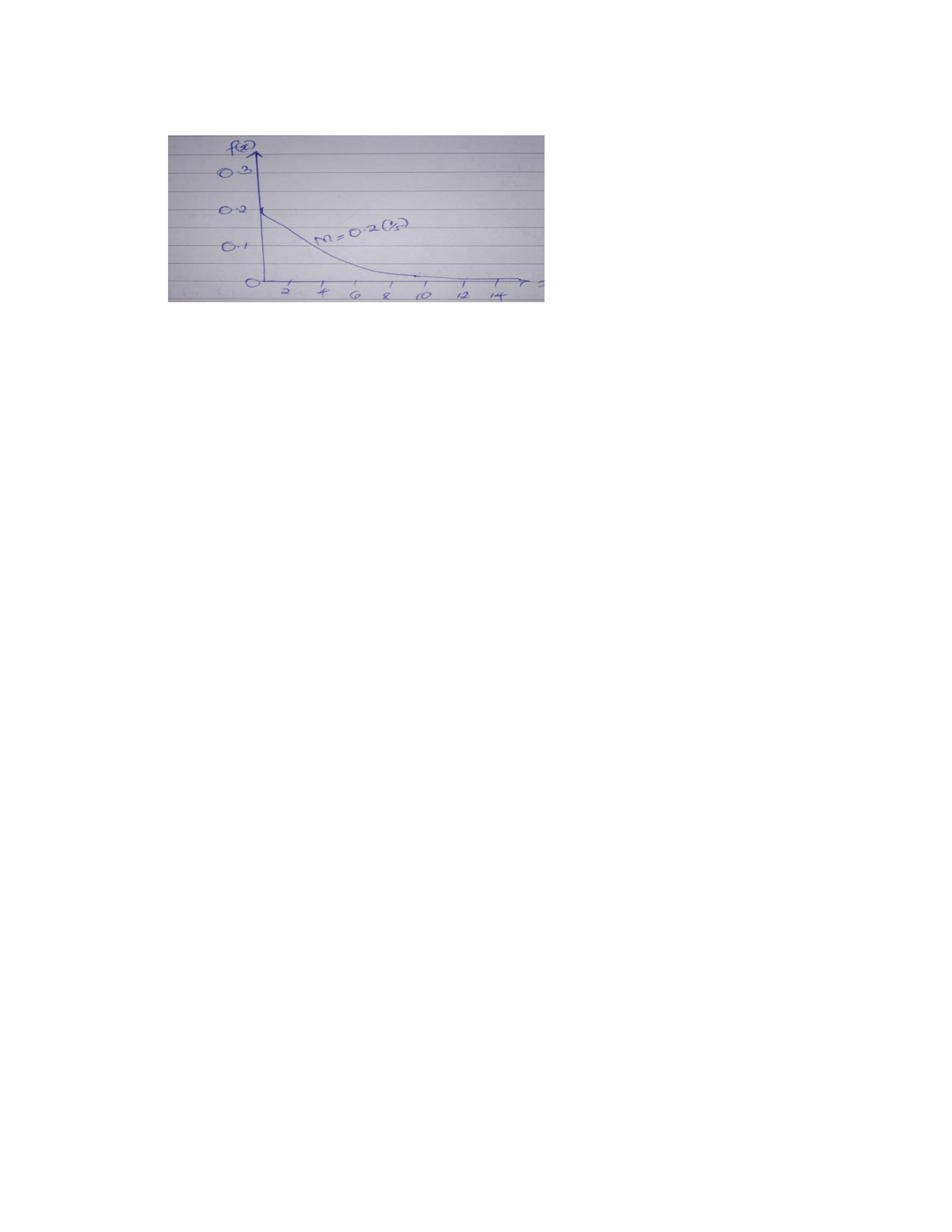
X ~𝐸𝑥𝑝 (1
5)
d) Mean
M = 1/5
Mean= 5
= 5
e) Standard deviation
Mean = standard deviation
Standard deviation = 5
a 4
f) Draw a graph of the probability distribution. Label the axes
g) Find the probability that the person retired after age 70
P (X > 70)
= 1- e^(-0.2* 70)
= 0.999
h) Do more people retire before age 65 or after age 65?
Before age 65
i) In a room of 1,000 people over age 80, how many do you expect will not have retired
yet?
18.3
Question 96:
a) On average, how much time occurs between five consecutive calls
Expected time = 5* 2 = 10
Expected time = 10 minutes
b) Find the probability that after a call is received, it takes more than three minutes for the
next call to occur
P(x>3)
P(x>3) = 1- P(x>3)
= 1- (1- e^-3/2)
= 0.223
c) Ninety- percent of all calls occur within how many minutes of the previous call?
90% = 0.9
-2*ln (1-0.9)
= 4.605
d) Suppose that two minutes have elapsed since the last call. Find the probability that the
next call will occur within the next minute.
P (x< 1) = 1- e^-0.5
= 0.393

