


Pablo Picasso, Jackson Pollock: The
Revolutionary Modern Artists

Introduction
Art has played a pivotal role in helping to
enhance people’s lives from generation to
generation. Artists have been instrumental not
only in expressing the culture of people but also
in transforming it. As a result, art is now
regarded a part of our daily lives.
Artwork is evident in various aspects of our lives
for example, in the houses we live in, programs
we watch on our televisions, and artifacts on our
religious buildings. Individuals rely on works of
art to represent their ideas, thereby helping to
influence people at a particular moment in time.
Through the ages, artists have used art to both
express and influence culture in a bid to reveal
deep ideas affecting a society.
From ancient times to the present, art
movements have had a great influence on social-

cultural changes. Every art movement has a
reason and individuals behind it. This essay
focuses on modern art movements. Cubism and
Abstract expressionism art movements are
reviewed by focusing on how they developed
and the impact they have had on art as a
discipline. The works of Pablo Picasso and
Jackson Pollock has had a profound influence on
modern art. The essay addresses the contribution
of these famous artists to their particular art
movements and in general, the world of art.
Modern Art
Modern art represents works of art created
during the period ranging from the1880s to
1970s. These works of art were highly
influenced by modern thoughts and ideas.
Modern art therefore also refers to art
philosophy and styles of works of art created
between 1880s and 1970s (Hunter, Jacobus &

Wheeler 17). Before the modern art,
conventional philosophies and styles were very
influential.
Modern art therefore represents a major
breakaway from conventional styles arts to
modern experimental styles. Among other
differences found in the traditional styles of art,
modern art has high tendency towards
abstraction. Within modern art, there are various
art movements. Each art movement or group had
in itself peculiar features, which sets it apart
from other art movements. Among the modern
art movements are impressionism, fauvism,
expressionism, Art Nouveau movement,
Cubism, Art Deco movement, Pop Art
movement, Conceptual art and Digital art
movement (Hunter, Jacobus & Wheeler 69).
Cubism and Abstract expressionism are some of
the influential movements in modern art. The

movements led to great changes in the world of
art. Even today, magnificent works of arts from
these movements are still popular. Pablo
Picasso, probable the most popular artist, was
the founder and the main force behind Cubism.
On the other hand, Jackson Pollock is
considered a founder member of abstract
expressionism. The artist is named as one of the
most popular American artists and is credited
with having exposed American works of art to
the international audience.
Modern art was a great break away from
conventional art. The two artists lead in use of
unconventional methods in developing their
works. Their use of unconventional methods
attracted attention to their works of art, making
other artists to emulate them. Growth in cubism
and abstract expressionist may be attributed to
Picasso and Pollock although other artists had

significant contribution. Pablo Picasso, along
with Georges Braque are considered the fathers
of modern art while is regarded Pollock regarded
as the father of American art.
Cubism
Cubism was an art movement which was formed
in early 20th century. The movement started in
1907 in France and spread quickly to other
regions in Europe. Cubism led to great change in
modern art (Hunter, Jacobus & Wheeler 106).
Led by Georges Braque and Pablo Picasso,
Cubist artists broke away from conventional
tendency to look at work of art from a single
point of view.
Cubists made use of analytical systems which
allowed them to represent three-dimensional
subject in several points of views. The new

method of art was considered a new way of
viewing and representing the world.
Unlike earlier movements in art, Cubism
incorporated outside contribution in art such as
African art. The art movement also incorporated
the modern theories of nature. One of the
emerging theories that greatly influenced the
movement was Einstein’s Theory of Relativism.
Other current thoughts affecting social-
economic aspects of the people were also
reflected in the works of art.
Cubism greatly changed how art was perceived.
Conventional painters were confused by the
emerging style of art. Unlike conventional
works of art, Cubism did not focus on translating
objects naturally but emotionally. Cubism led to
works of art that were more oriented towards
aesthetic rather than expressing reality
(Gantefuhrer-Trier & Grosenick 53).

The new style of art led to great change in
producing works of art that were outrageously
different from the conventional works of art. It
represented a new and different way of
perceiving and representing the world. Cubists’
way of representing objects was very different.
It tendency to totally distort landscapes and
portraits attracted attention to itself leading to
development of the new style of art.
The uniqueness of cubism was largely due to its
tendency to view a subject from multiple
perspectives, leading to a distorted work of art.
In Cubism, objects were first broken down and
the then re-assembled in abstract form upon
analysis. Cubists used multiple viewpoints in
order to represent the subject in a broader
contest.
The surfaces of dissected objects intersected at
random angles. Another distinct feature in cubist

work of art was the tendency of the background
and object planes to interpenetrate one another.
This led to a thin ambiguous space that
distinguished Cubism work of art from other
works of art.
Cubism was developed in two major phases
resulting in the two major branches of Cubism.
These include analytic and synthetic cubism.
Analytic cubism was developed between 1007
and 1911. Most of it was from Picasso and
Braque’s works. The second phase of
development of cubism lasted from 1911 to
1919 leading to Synthetic cubism. Analytic
cubism was the first form and the foundation of
cubism.
Natural forms drawn in elementary geometric
parts characterized analytic cubism. Analytic
Cubism analyzed natural forms breaking them
down to basic parts. They did not use color in

their paintings except for monochromatic
scheme mostly involving blue, grew and ochre.
The analysts focused more on basic geometric
forms derived from the natural forms, rather
than color (Gantefuhrer-Trier & Grosenick 91).
In this first phase of cubism, Pablo Picasso and
Georges Braque’s works of art were almost
related. Later, the cubist artists led by Pablo
Picasso and Georges Braque adopted abstraction
where they would create works of art that were
highly detached from reality.
The second phase of cubism movement-
synthetic cubism- was a development from the
analytic cubism. Unlike Analytic Cubism that
was more intellectual than decorative, Synthetic
Cubism tended to add decorations. Synthetic
cubism movement took place between 1912 and
1919 led Pablo, Juan Gris, Braque among other
artists.

Synthetic cubism was characterized by distinct
features such collage elements, and diverse
texture. ‘Still Life with Chair-caning’, by Pablo
Picasso is considered the pioneer work of art in
this movement. While analytic cubism entailed
breaking down of subject in to different forms,
synthetic cubism entailed more of bringing
several objects together. As aforementioned,
cubism was a sharp breakaway from
conventional styles.
Abstract Expressionism
Also referred to as New York School of art,
Abstract Expressionism was an art movement
that took place in United States leading to a great
change in art. The term ‘Abstract
Expressionism’ is used to represent the style’s
tendency to used abstract forms and express
emotion (Hess 32).

The movement started in mid 1940 and
dominated the world in the mid 20th century.
Although the term had been used in 1919 in
Germany, the movement is highly associated
with America and especially to the New York
group of artists. The new style of art brought
great change on the styles of painting. It was the
first style originating from United States to bring
high influence on international art.
Unlike conventional works of arts, Abstract
Expressionism was oriented towards expression
of emotion rather that objects. Most of the
paintings in this style were made in large
canvasses using dramatic colors. Unlike in other
conventional styles, there was use of loose
brushwork in Abstract Expressionism.
With its origin in New York, United States, the
movement tried to differentiate itself from other
styles of art in Europe. Before this movement,

art movements in Europe had high influence in
the style of art in United States. The movement
therefore represented the first instance that a
style originating from United States had
influence on international styles of art (Hess 67).
The movement did not only represent a change
in style of art but it was also a reflection of
psychological state in the society.
Psychoanalytic theories of Sigmund Freund
provided some of the intellectual foundation of
the style. Many artists who had migrated to
United State because of Second World War also
influenced the style. Some of influential artists
to this style included Jackson Pollock, Franz
Kline, William de Kooning, Lee Krasner,
Richard Pousette-Dart, Barnett Newman and
Clyfford Still (Hess 53).
Abstract Expressionism artists’ departure from
conventional styles of painting led to

revolutionary attitude that was associated with
the movement. The movement was dominant for
a considerable duration during the mid
20th century until the development of Pop art.
Among other major consequences of this
movement was development of New York as
center of art world replacing Paris.
Abstract Expression was an art movement
viewing painting as a means for expressing
emotions and visual communication. Although
not all works of art in this style demonstrated
abstraction and expressionism, all the works
were characterized by unplanned release of
unconscious creativity. The paintings had some
common features that distinguished them from
other styles. Abstraction meant that the paintings
expressed meaning that was different from
conventional meaning in visual world (Hess 58).

Most of paintings in Abstract Expressionism
movement were created on large canvasses.
Unlike those in Cubism, the artists gave more
attention to color, texture and general surface
quality. Most of the artists emphasized on
chance and accident. Although part of the
paintings were planned, the artists highly used
spontaneous development of ideas.
Pablo Picasso’s Guernica versus Jackson
Pollock’s Lavender Mist
Both Pablo Picasso and Jackson Pollock were
very instrumental in the development of their
particular style of art. Pablo Picasso played a
very significant role in development of Cubism
while Jackson Pollock had the highest influence
in development of Abstract Expressionism.
Pablo Picasso lived from from1881 to 1973. In
his long life, Picasso contributed highly to the

world of art. Picasso was born in Malaga, Spain
where he showed interest in art from early age.
His family was full of talented artists. For
instance, his father was a popular artist as well
as professor and a curator.
In pursuit of his interest, Picasso studied art in
Madrid and later moved to Paris. It is in Paris
that he started to paint. Influenced by French
culture, Picasso initial works of art were highly
in Parisian style (Moffat par 7). Pablo Picasso
experience with life had high influence on his
style art. Having experienced the First and the
Second World War and the Spanish Civil War,
Picasso had a lot to communicate through his
works of art.
Guernica is considered to be one of Picasso’s
most memorable art works as illustrated below.
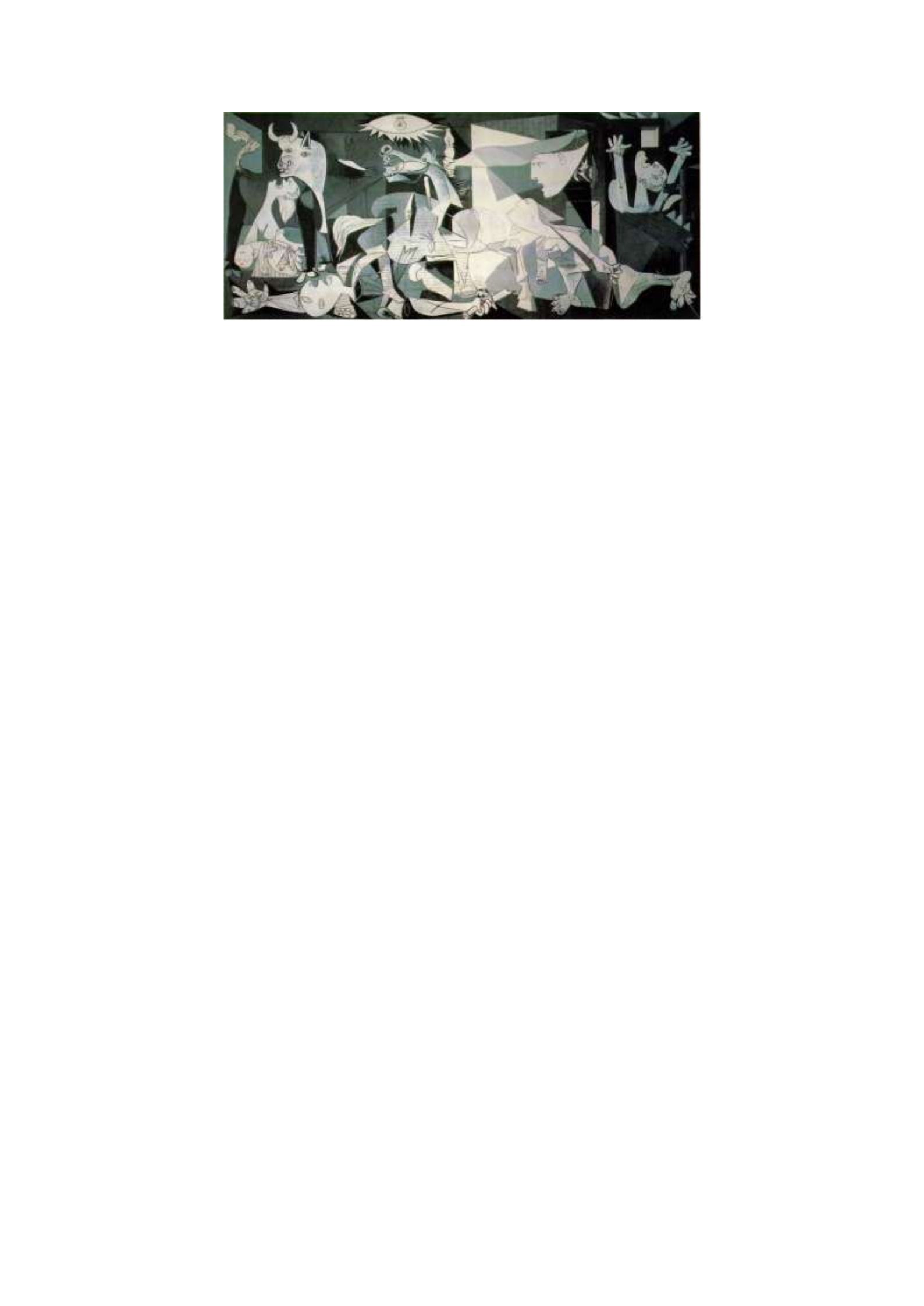
Guernica (1937) by Pablo Picasso.
Jackson Pollock is America’s most successful
artist. His high contribution to world of art
through his unique style left a mark in art not
only United States but also internationally (Wyo
par. 5). Born in 1912, Jackson lived for only
forty years but left a great mark in the work of
arts. Pollock has interest in art right from his
early age. His interest in art was given an
opportunity to develop by attending Manual Art
High School in Los Angeles and later enrolling
at Art Student league with Thomas Hartion New
York. Benton’s guidance at the league enabled
Pollock develop his skills.
In the league, Pollock got exposure that had high
influence on his painting. One of the major
exposures was to work with mural painting
which later influenced his new style. In addition,
Pollock was influenced by European painters
among them Picasso to develop his skills in art.
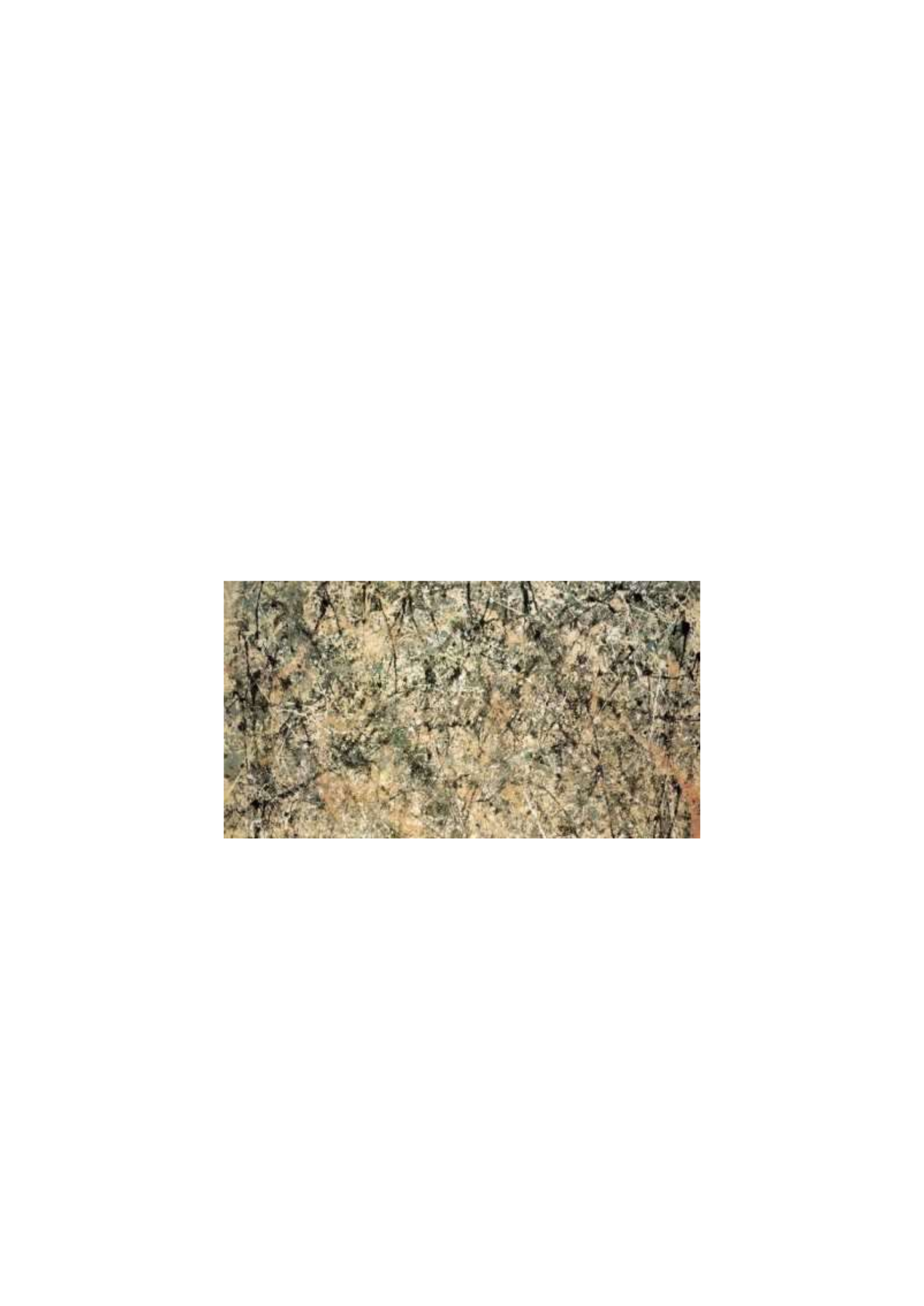
Lavender Mist is one panting that demonstrates
his unique skills and style as illustrated below.
Number 1, 1950 (Lavender Mist) by Jackson
Pollock.
Guernica was created in 1937 and remains to be
one of Picasso’s most acclaimed works. The
painting is composed of Oil on Canvas
measuring 349.3 by 776.6 centimeters. It is

created using Pablo Picasso’s unique cubism
style. As the painting’s name, Guernica was
aimed at representing aerial bombardment of the
little village of Guernica (Moffat par 7).
Pablo Picasso considered himself as a pacifist.
He was therefore not impressed by the war that
was taking place during that time. He was
particularly angered by the bombing at
Guernica, which considered as attempt to
intimidate Spain into the war. The painting does
not just represent real object but had deeper
meaning wrapped in the painting. Thus, the
painting was not just a recreation of the events
that had happened at Guernica but aimed at
sending the message of futility of war.
Lavender Mist (Number 1) was one of Jackson
Pollock’s most successful paintings. The
painting was created in 1950 and it is until today
preserved in the National Gallery of Art in

Washington, DC. The painting is oil on canvas,
enamel, oil and aluminum paint on canvas (Wyo
par. 8).
Similar to his previous art work, the painting is
in a large canvas measuring 221 by 300
centimeters. The painting was made using
unconventional material. For instance, materials
used to paint Lavender mist include enamel
house paints rather than conventional thicker oil
based paints (Wyo par. 8). Not only does Pollock
uses unconventional paints but also include
other materials such as glass sand in the
painting. The paints on the painting seem to have
been poured without being touched therefore
forming random patterns.
Unlike in conventional painting, Pollock used
variety of utensils such as sticks, knives and
brushes to develop the painting. Lavender mist
appears as web of colors that is spread violently

over the canvas. Although Pollock did not assign
a theme to the painting, looking at the painting
invokes varied emotions including controlled
violence.
Pablo Picasso and Jackson Pollock had
messages, which they intended to communicate
to their audiences. Guernica’s message is
explicit. From the painting, the viewer is able to
have an impression that painting has a message
on warfare. Painted in black and white, the
painting is able to communicate a message of
horror of war.
Visual elements are used effectively on the
painting. For instance, use of curvature along
with lines generates a chaotic feeling. Most of
the figures on the painting overlap but shading
around the figures help to create the feeling of
space. Color is used to communicate the
intended message.

For instance, Picasso used light color to
represent positive figures while dark shading to
represent negative figures. The message or
theme in Lavender Mist is not explicit. The
painting represents internal feelings flowing
freely from the painter. Unlike Picasso’s
Guernica, Lavender Mist is completely abstract.
One cannot be able to associate the forms on the
painting with any real object. Instead, the
painting seems to represent internal feelings of
the painter.
Main colors used in the painting include green,
black, while and some cases brown. The painter
succeeds in use of color to express the painter’s
feelings. Painter’s use of lines creates a feeling
of movement. Dance like movement on the
painting encourages flow of unconscious
imagery. The result is that each audience may

have their own different interpretation of the
painting.

Conclusion
Paintings have been used as means of
communication for along time. Painters use their
skill to communicate to the audience. Various art
movements have been witnessed over time.
Modern movements are some of the most
vibrant art movements. The movements brought
great change in relation to art.
Cubism and Abstract Expressionism are the two
most influential art movements in modern art.
Pablo Picasso and Jackson Pollock were among
the most influential artists in their respective art
movements. Pablo Picasso’s new way of
painting brought great change from Fauvism to
Cubism while Jackson Pollock took United
States to the limelight of art by introducing
revolutionary new form of painting: Abstract
Expressionism.

Guernica by Pablo Picasso and Lavender Mist
by Jackson Pollock are well known today almost
as they were known after being created. Pablo
Picasso use cubism to represent warfare in his
Guernica. Lavender in completely abstract, it
invokes varied emotions from every audience
that views it.

Works Cited
Gantefuhrer-Trier, Ann and Grosenick,
Uta. Cubism. New York: Taschen, 2004. Print.
Hess, Barbara. Abstract Expressionism. New
York: Taschen America LLC, 2009. Print
Hunter, Sam, Jacobus, John and Wheeler,
Daniel. Modern art: Painting, sculpture,
architecture, photography. New York: Prentice
Hall, 2004.
Moffat, Charles. The most Famous Artist of the
20th Century. 2005. Web.
Wyo, Cody. Jackson Pollock: Pioneer in
Abstract Panting. 2003. Web.

Modern Art: From Impressionism to
Contemporary
Impressionism is a style of art often known as
optical realism. It is denoted by a unique visual
experience with light effects and movements in
the manner objects appear. Key highlights of this
art style include pure primary colors and little
strokes to compliment the light reflected
(Wildendstein, 2010).
Claude Monet, a key French painter, was among
the founders of this style of painting. He was
well able to incorporate elements of art which
involved bright distinct colors, small strokes to
create unique and elaborate pieces of art work
that fall under this style of art (Kelder, 1978).
Most impressionists perceive that the human eye
is a tremendous vessel.

“The Stroll, Camille Monet and Her Son Jean
(Woman with a Parasol)” is one of the great
works of Monet. The portrait is of the wife
Camille and his son Jean who are on the hillside
against a cloudless sky. In this masterpiece, it is
evident that it was painted outside on a summer
day in open air where Monet’s family seems to
be out strolling in the meadow.
Monet, in his pursuit to capture the son and
wife’s likenesses, uses strokes of bright color
creating a spontaneous effect throughout the
portrait. The folds on Camille depict the breeze
which seems to blow the thin fabric across her
face. Light is seen to come from the right side
creating contrasting breeze from the left side.
This unique feel from the wind and the sun
converge at the middle of the canvas
(WebMuseum, 2002).

Another aspect depicted from this painting is
that of perspective. It is seen to be upward as the
view from the bottom is able to shield the images
away from the sky which gives it a great feel of
both light and sun. Depth is yet another aspect
highlighted in this painting. The son seems to
appear from his waist upwards, enabling Monet
to comfortably create a feel of depth into the
work of art. Color and line are well highlighted
in this painting bringing a contrast of light, sun
and the wind (WebMuseum, 2002).
Green as the dominant color appears on the
parasol and the grass on the hillside signifying
nature. This color unifies the parasol and the
grass on the hill, creating a flow of the eyes from
one point (the parasol) to the bottom (the
hillside) (Monet & Gattinara 2004). This flow
attracts the eyes to concentrate on the art work
as denoted by the shadows on the grass. The

painting appears to be blurry as one cannot tell
if Mrs. Monet is walking or not.
On scrutinizing the painting from a distance,
clarity diminishes. The presence of light
compliments the wind and movement in this
portrait. One cannot be in a position to pinpoint
exactly where the clouds seem to seize existence
as the wind gently blows Mrs. Monet’s scarf.
Light seems to bring in a feel of perspective as
the portrait is viewed from the bottom where the
grass is, all the way to the top where the clouds
lie. Green as the prevalent color unifies the
parasol and the hillside.
This makes it bring in rhythm as the eyes flow
from the parasol’s handle to its top, then slowly
to the green that appears on the hillside. The sun
rays shining from behind Mrs. Monet seems to
give the parasol a bright white look that also
compliments her veil, as reflections from the

flowers beneath radiantly give her front a nice
touch of yellow (Monet & Gattinara 2004). The
vibrant colors and light used by Monet are key
features in accentuating this painting style
known as impressionism.
Philosophy is defined as determining the truth;
which involves a number of years of studying
some of the greatest minds of history, which we
eventually uphold in life (Wildendstein, 2010).
The impressionist style of painting concentrates
on the impression as a whole, created by a scene
through a rigorous use of pure (unmixed)
primary colors in conjunction with small brush
strokes to intensify the actual reflected light.
Monet in his painting, “The Stroll, Camille
Monet and Her Son Jean (Woman with a
Parasol)”, is scrupulous enough to convey this
style through the use of vibrant colors; a key
feature of style. The short broken strokes of the

brushes used also depict form which is a key
element of art in this painting technique.
Effects of light are also amplified through the
extensive use of color. This, in Monet’s “The
Stroll, Camille Monet and Her Son Jean
(Woman with a Parasol)” when the shadow in
the grass, was rendered through the effect of
light. The use of brushes in a relaxed manner
leaves the piece of art with a touch of naturalness
(Monet & Gattinara, 2004). However, he has
thoughtfully been able to blend in light with
these colors to bring in a feeling on perspective.
In Monet’s work, it is quite clear that philosophy
creates a beautiful illusion in our minds which in
turn opens up tremendous possibilities for art
through representation (Issacson & Monet,
1978). This is achieved though the reality of
knowledge. Impressionism clearly comes out as
the greatest form of art when combined with

philosophy because it gives everything a sense
of change yet preserving the time line.
In conclusion, the bright distinct colors, small
strokes and effects of light incorporated in this
unique painting technique make the lovers of art
appreciate the impressionist’s expertise that
involves the “minds eye” dexterity. This goes a
long way in retaining a mental picture of the
viewed work of art.
This technique of painting is viewed both
brightly and full of life. Art as a language brings
out that which nature cannot bring forth.
Impressionalism as a form of art qualifies as it
not only represents the outward physical view of
things but highlights their inward significance.

References
Issacson, J. and Monet, C. (1978). Claude
Monet, observation and reflection. London:
Phaidon.
Kelder, D. (1978). Great masters of French
impressionism. London, UK: Crown Publisher.
Monet, C. and Gattinara, F. C. (2004). Woman
with a parasol. New York, NY: Barrons.
WebMuseum. (2002). Monet, Claude: The
stroll, Camille Monet and the son Jean (Woman
with a parasol). Web.
Wildendstein, D. (2010). Monet, or, the triumph
of impressionalism. Los Angeles, CA: Taschen
America LLC.

Recent Modern Art Exhibition: Projects 89
Introduction
Art exhibitions are the places, which will be
interesting to people of any age and any gender
any time. “A natural effect of the Museum
exhibition will be to lead the public to enquire
why it is that objects of ‘museum quality’ are to
be found only in Museums and are not in daily
use and readily obtainable.” (Coomaraswamy,
13) Without any doubts, each exhibition presents
something new and extraordinary to the lives of
millions of people.
One of such exhibitions, which impressed me a
lot, is Projects 89 by Klara Liden. This
exhibition was opened February 25, 2009, and
will be closed June 8, 2009. In spite of the fact
that it is not much time to share her creation with

lots of people, this exhibition has already
impressed someone. The ideas of rebellion,
desire to act and demonstrate personal vision
and comprehension of the events – this is what
motivated Klara to present this modern art
exhibition.
Discussion
Art and Enthusiasm of Klara Liden
One French Thomistic philosopher, Etienne
Gilson, admitted that it was better to turn back
to pictorial philosophical approach in order to
demonstrate how paintings and, at the same
time, other art masterpieces could easily
demonstrate the concrete act of existence.
(Gilson, 7)
This young Swedish artist with her exhibition
under consideration is full of enthusiasm. Can it
be that a big blank box, placed at the center of

the room, turns out to be rather attractive for
many people? At the Museum of Modern Art,
this event gathers more and more people every
day. This box cannot stay monumental for a long
period of time – it would be not that interesting
to observe, this is why Klara Liden makes this
creature work, shelving.
And, finally, it is necessary to admit that modern
art cannot forget about innovations with various
video and audio additions, so, in the corner on
the floor, there is a video monitor, where short
video is shown during three and a half minutes.
The peculiar feature of this video is Liden’s
presence on it. She stands on the Manhattan
bank of the East River and skips little stones
across the water. To my mind, such choice of the
video is not casual.
These stones in the water may symbolize a life
that lasts not for a long period of time, but its

movements are really brilliant and attract the
attention of many people, and the consequences
of these movements, the traces on the water,
excite again and again. Liden’s exhibition lasts
during a certain period of time, and, as the traces
in the water, left by the stone, her work should
be kept in mind for a long period of time.
What Newspapers Write about the
Exhibition
Not many magazines and newspapers are ready
to describe the events, which happen now in the
Museum of Modern Art, however, New York
Times presents a captivating article about this
artist and her abilities to create unbelievable
things to the viewer. Holland Cotter writes about
the exhibitions the following:
The idea, as I read it, was to keep a piece of the
show outside the art space and in the world,

which meant incorporating the world – whoever
happened to sit on the bench – into the show.
Over the years she has negotiated similar
transactions between art and life in other places,
in other ways. (Cotter, 2009)
So, people, who do comprehend the essence of
art and the ideas, which artists want to represent
in their works, will certainly understand that this
box of papers is not a simple gathering of
different sheet of papers. It is a history that is
closely connected to people, their lives, and their
future.
Other articles in newspapers and magazines like
to describe this exhibition and share the ideas of
what they see there: “architectural interventions
and installations by cannibalizing existing
structures and materials, such as cardboard,
corrugated metal, drywall, wood, and carpet
remnants.” (NY Art Beat)

Any piece of art may be compared to each other.
Is it possible to relate poems and museum
exhibitions? To my mind, it is quite possible. For
example, Jacques Maritain told that “to one
degree or another, even in the most obscure
poems, even when the poet turns his back
completely on intelligence, the intelligible sense
is always there.” (Maritain, 261)
Almost the same happens during the exhibition
by Klara Liden: she makes an attempt to forget
about the reasons and consequences, and create
something untraditional, but taking into
consideration some modern features and
innovations. This is why her work is something
really intelligent and true.

Conclusion
People should have a chance to forget about their
current problems and affairs, and entertain for
some period of time. Current exhibitions are the
places, where people can do it with ease.
Imagination of artists and their ideas are usually
quite different and amazing. Klara Liden is a
Swedish artist, who presents her
exhibition Projects 89 at the Museum of
Modern Art in New York. Her work and video
file turn out to be really interesting and unusual
for our times, this is why lots of people are eager
to visit this exhibit again and again.

Works Cited
Coomaraswamy, Ananda, K. Cristian and
Oriental Philosophy of Art. Courier Dover
Cotter, Holland. “Cutting Modernism’s Big
Cube Down to Size.” The New York Times. 19
Mar. 2009. 16 Jun. 2009.
<https://www.nytimes.com/2009/03/20/arts/des
ign/20lide.html?_r=1&scp=2&sq=Projects%20
89:%20Klara%20Liden&st=cse>
Gilson, Etienne. Painting and Reality. Meridian,
1959.
Maritain, Jacques. Creative Intuition in Art and
Poetry: Abdrew Mellon Lectures in the Fine
Arts. Princeton University Press, 1977.
NY Art Beat, “Projects 89: Klara Liden”
Exhibition. 16 Jun. 2009.
<http://www.nyartbeat.com/event/2009/9B4A>

Effects of World War I on the Development of
Modern Art
Introduction
The World War I and the events that preceded it
had significant and long lasting implications on
modern art. There was an explosion of
innovation and creativity both in technology and
art during the period. The automobile and the
airplane are some of the recent technologies that
quickened the pace of human life and triggered
a lot of curiosities and ambition among people.
Artists from different places of the world started
converging in European cities such as Paris and
London where there aligned themselves with
artistic movements such as cubism,
constructivism, futurism, and imagism among
others. The paper aims at analyzing the role that

the World War I played in shaping the
modernism movements in the arts both before
and after it took place.
World War I implications: how they
influenced modern art
Among the modernists who prevailed before the
start of the war were the futurists led by Filippo
Marinetti. He launched the movement in 1909 in
his famed Futurist manifesto. Just like the
other avant-garde artists, the futurists resented
everything that was representative of the older
schools of thought and expressed a sense of hope
for the future through science.
Other artists such as “the painters Umberto
Boccioni, Carlo Carra, Giacomo Balla and Luigi
Russolo later joined Marinetti.” The works of
the futurists as evidenced by “Boccioni’s The

Street Enters the House (1911) reflect their
admiration of speed, technology, violence,
youth, the car and the airplane which are all
representatives of the technological triumph
over nature by humanity.”
This movement in modern art tried to integrate
the dynamism of the machine age that
contributed to the emergence of the war with art.
They bore the ‘smear of madness’ proudly. The
objected the serenity and harmony that was
represented in earlier artistic pieces. They
praised scientific inventions as they paralleled
their worldview of the future.
Fred Kleiner considers Artistic excitement to
have reached its peak in 1914 when the First
World War began. The war was responsible for
the horrors that saw a generation of young men
wiped out across the European continent and

those who survived left with mental conditions
that completely changed their lives.
The war triggered the catastrophic Russian
revolution forming the foundation for worse
conflagration that came to take place decades
later. For the artists and most of the people in
Europe, the time that preceded the World War I,
the actual war period and the aftermath of the
was presented a period of profound
disillusionment.
The people as well as the artists were completed
with the values that the great civilizations
wanted a new representation of the reality as it
was. Modernism depicts the break away from
the Victorian bourgeois morality and the
optimism that was represented by the art works
of the 19th century. They instead expressed
hopelessness in a pessimistic culture in disarray.
The modernists were opposed to the pretentious

nature of the past years in that despite their being
the tensions and the pressures that exploded into
the war, artists kept on presenting the
environment as serene and posing no threats to
humanity.
Fatigued by the horrors of the First World War,
artists sought other new forms of inspiration that
were completely contrasting with the nature of
the previous schools of thought. For instance, for
the Southern Italian immigrant in the US; Joseph
Stella, the Brooklyn Bridge ‘was a shrine
containing all the efforts of the new civilization
of America.’ To this artist, technology was a
totally new religion as represented by the
Bridge.
The mass destruction of property, the loss of
millions of lives in the war as well as the
possibility of the outbreak of another war of
similar or even greater magnitude planted a seed

of despair in the lives of many people across the
world and specifically in the European
continent.
The absurdity that was presented in most artistic
works of the period between the first and the
Second World War can be correlated with this
despair. For instance, “the Dadaists portrayed a
reaction to industrial technology of the time with
subversive playfulness.” For instance, one of the
famed Dadaism work ‘The Bride Stripped Bare
by Her Bachelors, Even’ by Marcel Duchamp
conveys some form of sardonic humour. The
masterpiece is an assemblage of oil, wires, lead
foil, dust and glasses, which display deep-seated
absurdity. The absurdity, “which forms part of
the viewer’s experience, was meant to subvert
their expectations.”
The psychological trauma and the depressions
that most people experienced after the First

world war was expressed by most works of
artists from the Surrealist school. Surrealism
according to Smith and Wilde implies to ‘the
pure, psychic automatism, through which one
seeks to express the real course their thinking,
without the influence of reason or any ethical
considerations.’
The experiences of the war reshaped the lives of
most people with some suffering from severe
psychological problems that permanently lived
with them for the rest of their lives. Artists such
as Max Ernst (1891-1976), Salvador Dali (1904-
1989) among others were key shapers of
surrealism. The war activities as well as the
rebuilding needs that came with the aftermath of
the war influenced the modernist movement of
constructivism. The movement, which was
started in Russia by Vladimir Tatlin and Antione
Pevsner, was also greatly influenced by Cubism.

The modern art movement viewed art from a
utilitarian perspective and as result tried to apply
it to political and social issues. The main
subjects included the “abstracted assemblages of
metals, plastics, glass, wires in sculpture and
other forms of visual arts.”
The constructivists held the view that art
provided the people with the chance to employ
scientific activities for the reconstruction of their
societies that had been flattened by the horrors
of the First World War. Prototypes for
architecture and interior designs were among
other constructions.
The desire to use machines to restore some sort
of classical sense of order that was obviously
lacking due to the physical and emotional
destructions of the First World War is expressed
in the works of artists such as Charles Steeler
(18883-1965) and Charles Demuth. These artists

belong to the precisionist school of thought. The
art works which were in most cases drawings
and paintings lacked the influence of nature or
human beings as they were in most cases images
of factories, warehouses, bridges alongside
others and portrayed lack of expressive gesture.
For instance, Sheeler’s painting ‘American
Landscape’ (1930) show this absence of human
figures and nature. In addition to this, Sheeler is
recorded to have said, “Our factories are our
substitute for religious expression especially in
this time of recovering from the great loses of
the war.”

Conclusion
The political and social implications of the First
World War influenced the paths that were taken
by most of the modernist artistic movements.
The needs to express the realities in the society,
to rebuild the social, political and economic
institutions as well as to express the fears that
the people lived with for the possibilities of the
emergence of another war were among some of
the significant implications that shaped modern
art.
Some of the significant paths that modernist
movements such as futurism, cubism, Dadaism,
Constructivism and surrealism among others
took were correlated to either the events that
preceded the war, the events that took place
during the war or the aftermath of the war.

Bibliography
Anderson, Stanford. “The Legacy of German
Neoclassicism and Biedermeier: Behrens,
Tessenow, Loos and Mies” Assemblage, no.15
(1991): 32:38.
Antle, Martine. Surrealism and the Orient‘, Yale
French Studies 109. USA: Yale University
Press, 2006.
Banham, Reyner. Theory and Design in the First
Machine Age. Massachusetts: MIT Press, 1980.
Benjamin, Walter. The Work of Art in the Age of
Mechanical Reproduction in Illuminations. New
York: Schocken, 1999.
Breton, Andre. Surrealism and
Painting. Boston: MFA Publications, 2002.
Broude, Norma and Mary Garrad. Feminism
and Art History: Questioning the Litany. New
York: ICON, 1982.

Burgard, Timothy Anglin. “Picasso and
Appropriation”. The Art Bulletin, 73, no. 3
(1991):45-56.
Cahoone, Lawrence. From Modernism to
Postmodernism: An
Anthology. Mass: Blackwell, 1996.
Calinescu, Matei. Five Faces of Modernity:
Avant-garde, Decadence, Kitsch. Durhan: Duke
University Press, 1987.
Chave, Anna. “New Encounters with Les
Demoiselles d‘Avignon: Gender, Race, and the
Origins of Cubism.” The Art Bulletin, 76, no. 4
(1994): 345-356. Web.
Chipp, Herschel. Theories of Modern Art: A
Source Book by Artists and Critics. Berkeley:
University of California Press, 1984.

Dawtrey, Liz et al. Investigating Modern
Art. USA. Yale University Press in association
With The Open University, 1996.
Demos, Todd. “Duchamp‘s Labyrinth” First
Papers of Surrealism 1942, October No.97
(2001):23-45.
Docker, John. Architectural Modernism: Le
Corbusier Chapter 1 in modernism and Popular
Culture: A Cultural History. Cambridge:
Cambridge University Press, 1995.
Donnell, Radka Zagoroff. “Space in Abstract
Expressionism.” The Journal of Aesthetics and
Art Criticism, 23, no. 2, (1964): 45-52.
Einstein, Carl and Haxthausen Charles. “Notes
on Cubism.” October 107 no.1 (2004):78-90.
Faccini, Dominic, and Monnet Georges.
“Picasso and Cubism.” October 60 no.23
(1992):12-56.

Fishman, Richard. The Contemporary City in
Urban Utopias in the Twentieth Century. New
York: MIT Press, 1982.
Fitzgerald, Gerald and Poggioli, Renato. The
Theory of the Avant-garde, Harvard: Harvard
University Press, 1981.
Frampton, Kenneth. Modern Architecture – A
Critical History. Thames & Hudson, London,
1989.
Frey, John G. “From Dada to
Surrealism.” Parnassus, 8, no. 7 (1980): 90-123.
Habermas, Jurgen. The Philosophical Discourse
of Modernism. Cambridge: Cambridge
University Press, 1987.
Hand, John Oliver. “Futurism in America: 1909
– 14.” Art Journal, 41, no. 4 (1981): 90- 109.
Harrison, Charles, Frascina Francis and Perry
Gill.Primitivism, Cubism, Abstraction: The

Early Twentieth Century. London: Yale
University Press. 1993.
Harrison, Charles and Wood Paul. Art in Theory
1900-1990: An Anthology of Changing
Ideas. Oxford: Blackwell, 1992.
Kleiner, Fred. Gardner’s Art Through the Ages:
A Global History. London: Prentice Hall, 2008.
Orton, Fred. On the Intention of Modern (ist)
Art‘, Chapter 18 in Smith, Paul and Wilde,
Carolyn, Companion to Art Theory. Oxford:
Wiley-Blackwell, 2007.
Passanti, Francesco. “The Vernacular,
Modernism and Le Corbusier.” Journal of the
Society of Architectural Historians, 56, no. 4
(1997): 564-78.
Pevsner, Nikolaus and Weston,
Richard. Pioneers of Modern Design. New
York: Yale University Press, 2003.

Platt, Colin. Marks of Opulence: The Why, When
and Where of Western Art 1000-1914. Australia:
Harper Collins, 2004.
Pollock, Griselda. “Women, Art and Ideology:
Questions for Feminist Art Historians.” Womens
Art Journal, 4, no. 1 (1983): 32-58.
Richter, Hans. Dada: Art and Anti-Art. London:
Thames & Hudson, 1997.
Robbins, Daniel. “Sources of Cubism and
Futurism.” Art Journal, 41, no. 4 (1981): 234 –
36.
Smith, Paul and Wilde Carolyn. Companion to
Art History. New York: Wiley-Blackwell, 2002.
Stangos, Nikos. Concepts of Modern
Art. London: Thames & Hudson, 1981.
Stokstad, Marion. Art History. U.S.A: Prentice
Hall, 1995.

Tarnas, Richard. The Transformation of the
Modern Era in the Passion of the Western Mind:
Understanding the Ideas that have shaped Our
World View London: Pamlico, 1991.

Theory of Modern Art: Theory of Realism
Humans are quintessentially political animals,
and art is a quintessentially human activity. It
should not surprise us, therefore, that art has
been used in the service of politics from earliest
times. The notion of realism as an art movement
is as much of an approximation as any other term
applied to art.
Any representation of the world in a work of art
is by definition different from the real thing. It
becomes different the moment that the artist puts
brush to canvas, or thumb to clay. There is
always going to be a difference between what
the artist sees and what is depicted.
Thus, Realism is as much of a fiction as
Abstraction or any other title for a movement.
However, the tendencies that the term Realism

describes are definitely associated with political
movements, including nationalism. This is
because the artist is asserting that the art mirrors
reality, and therefore is shaping reality.
Since nationhood is itself a fiction, it is perfectly
natural that an artistic fiction should be used
describe or support a political fiction. The
authors in the selected readings all recognize the
potential uses to which art, whether
representational or not, may be put.
Carl Gustav Jung asserted that the human race
carries, within its unconscious, shared patterns
that express themselves in comprehensible
images in common, and he recognized that this
had powerful implications.
He says, “The far-reaching implications of this
statement must not be overlooked.” Although
they might be expressed in terms that reflected

the particular culture of the artist, these shared
ideas, he asserts, would be recognizable by other
peoples elsewhere in the world. As an example,
all humans pass through some basic experiences.
All humans are fed by an adult while an infant,
or are held by an adult when small.
These experiences and ideas might be expressed
in images that most people would recognize as
relating to mothering, or parenting/nurturing. As
noted above, no one image captures all of the
concept of mothers across cultures, or even one
particular mother. However, Jung might assert
that the notion of mother can and will be
depicted in ways that are understood without
words or conscious thought.
This can occur, even if the form is quite strange
and not realistic by Western standards at all, or
realistic, but reflecting a very different culture.
Thus, if any piece of art addresses themes and

ideas that are archetypal, the artist does not need
to use words to get across the idea. This possible
way of influencing people can be very appealing
to any political group that is trying to motivate
people in one direction or another.
Alfred Barr, writing between the two World
Wars, recognizes both that art was used to
influence people, and that the control of what art
is allowed is another way to influence a
population. He always makes the important
point that any term to describe an art style is only
an approximation.
He distinguishes two contrasting trends in art,
which alternate in dominating the art world. One
is more or less the depiction of nature as the eye
sees it. The other is everything else. Cubism,
abstraction, and styles that make no effort to
depict any object, person, or place, are in this
category.

Barr acknowledges that although in his view,
abstract art, “needs no defense,” it cannot be
appreciated, “without some study and sacrifice
of prejudice.” Harrison and Wood assert that he
associated the more abstract styles with a less
oppressive political environment, and realism
with a more oppressive political regime.
This is borne out in the AKhRR Declaration,
which asserts that abstraction represents art as a
luxury, some sort of a mental game, or, “vacuous
philosophizing,” rather than a wholesome tool
for instruction and inspiration. The proper use of
art, according to this declaration, was to
document “a true picture of the events” and
shape the mind towards the revolutionary ideal.
This links back to Jung. If archetypes do exist,
then the evocation of images that support the
aim of the revolution (whatever kind of
revolution it is) need not even use words to be

effective. By using “heroic realism”, the artist
can glorify the revolutionary activist and his/her
aims without text at all.
The revolutionaries may have been responding
to the same sort of distinction that Mondrian
outlined. He contrasted the “direct creation of
universal beauty’ with the “aesthetic expression
of oneself.” Nationalism, revolution, and
utopian goals frequently call for self-sacrifice.
Thus, anything that focuses on the self, rather
than the country, cause, or goal, is less desirable.
In Mondrian’s view, therefore, he is suggesting
that abstraction substitutes the artist’s purely
personal perspective for a perspective on the
world that can be shared. He says that
”it is a great pity that those who are concerned
with the social life in general do not recognize
the utility of pure abstract art…In general the

use art as propaganda for collective or personal
ideas, thus as literature.
They are both in favor of the progress of the
mass and against the progress of the elite, thus
against the logical march of human
evolution…The elite rises from the mass; is it
not therefore its highest expression?” This
sharing should be, presumably, constructive. It
should uplift the community, if that is what the
community demands.”
Siqueiros makes the demands of the community
rather explicit. He says that art should reverse
the evils of colonial oppression, which include
the suppression of indigenous art forms, calling
it, “the most wholesome spiritual expression in
the world.” The way to do this is through
monumental art. He also praises the indigenous
art of Mexico, which is somewhat ironic.

On the one hand, the art of the ancient Meso-
Americans was definitely monumental and
public. On the other hand, however, repeated
articles and documentaries on the mural arts of
the ancient Inca and Maya suggest that decoding
their artwork has been very difficult.
The images are very abstracted. They may show
a king with a jaguar skin around him, for
example, or a headdress made of feathers, but it
has taken decades for archeologists to figure this
out. However, although the images are
condensed and heavily edited, they do represent
some aspect of reality.
Diego Rivera is the most famous practitioner of
heroic mural art in Mexico, and, arguably,
anywhere. His statement on art offers some very
cutting insights, even though his admiration for
Communism sounds somewhat naïve from
today’s perspective. He asserts that in the past,

art was valued for being difficult to appreciate.
This required that only a small elite group could
prepare themselves to understand it.
This also implied that there was solely an elite
group capable of such understanding. This is a
clearly implied criticism of all forms of
abstraction. This is because experience suggests
that most people who have any experience of
visual media can readily understand a
representational picture.
Rivera goes on to say that the elitist approach to
art, “serves to discredit the use of art as
revolutionary weapon and serves to affirm that
all art which has a theme, a social content, is bad
art.” It is hard to avoid the impression that
Rivera’s solution is somewhat self-serving.
He proposes that the proletariat adopt the best
techniques of the bourgeois academics and

produce mural art in a Super-Realist style. This
just happens to be his own style and medium.
Harrison and Wood, by the way, helpfully point
out that Rivera’s use of the term Super-Realism
was equivalent to the French Surrealism.
Thus, for Rivera, realism, after a fashion, on a
giant scale, with revolutionary themes and
academic technique, is the proper proletarian use
of art. However, if one visualizes a Rivera work,
there is very little of the real world in it, and
much more of fantasy and magic.
The reading from Lenin, while not mentioning
‘realism’ specifically, clearly contends that art
should be used for the education of the people.
The goal of this education is the removal of all
forms of exploitation by man. Lenin says, “…the
field of art in particular, should be imbued with
the spirit of class struggle…” The reading is not

explicit with regard to how this spirit can be
communicated. However, it is challenging to
imagine how one can unambiguously represent
such class struggle with color, line, and form
alone.
These are human concepts and even an abstract
work would probably need to allude to, or refer
to something human or at least in the real world.
This would immediately make it less abstractly
pure. Thus, in order to meet Lenin’s demands on
art, it must be realistic, and, equally importantly,
represent ideas supportive of his political ideas.
Adolf Hitler, as many readers know from the
informal oral history of grandparents and other
elders, used anything and everything to further
his goals. The creation of an exhibit and
exhibition space for ‘real’ German art is one
among many strategies. He distinguishes, in his
speech, between normal artists’ vision and the

distorted vision of the modern artists he
despises. He sarcastically notes that,
“…the eye shows things differently to certain
human beings than the way they really are, that
is, that there really are men who see the present
population of our nation as rotten cretins; who
on principle, see meadows blue, skies green,
clouds sulphur yellow…”
He goes on to suggest that the eye defect of such
artists represents an element that should be
eliminated, perhaps by force, from the
population. The Third Reich used this same
approach in eliminating other supposed
defectives, such as Gypsies, the insane, and
anyone else Hitler defined as undesirable.
Elsewhere in this brief speech, he insults Jews,
and anyone who is not German or who mixes the
blood of Germans. Art, in this poisonous

context, is meant to represent the people, but not
the people as in Lenin’s view. This ‘people’ are
true Germans. One can only infer that their art
must be of, and by, and depicting these true
Germans.
This certainly rules out abstraction, even if
Hitler had not also railed against art that
reflected personal experience, as noted in the
quote. Posters from that era certainly show
sturdy (German) folks doing their bit for the
Fatherland. Thus, both by requiring that the style
be representational and that the content focus on
Germans and Germany, Hitler promoted his own
goals and controlled events and populations.
These readings present a rather disturbing
picture of the various uses to which art, and
specifically, realism have been put. There are
doubtless readings that would attest powerfully
to the uses of abstraction as well, but they are

largely not in this assortment. Realism certainly
lends itself to messages that have to do with
daily life as well as ideas that are more
philosophical.
This is because people can identify with such
images. As Jung suggested, these ideas
communicate themselves straight to the oldest
parts of the brain. Thus, viewers can be
influenced to do whatever it is that the artist or
the government wants them to do without ever
saying so!
Furthermore, people will do things based on
these images without ever putting the ideas into
words. The message of all these readings is that
all art can be used to influence people in subtle
and not so subtle ways, but realism has a record
of having been used very obviously to achieve
nationalistic or utopian goals.

Bibliography
Asssociation of Artists of Revolutionary Russia.
“AKhRR Declaration.” In Art In Theory: 1900-
2000, by C., Wood, P. Harrison, 403-406.
Oxford: Wiley-Blackwell, 2002.
Barr, Alfred. “Cubism and Abstract Art.” In Art
in Theory: 1900-2002, by C. Harrison and P.
Wood, 381-383. Oxford: Wiley-Blackwell,
2002.
Harrison, C., and P. Wood. Art in Theory: 1900-
2002. Oxford: Wiley-Blackwell, 2002.
Hitler, Adolf. “Speech Inaugurating the Great
Exhibition of German Art.” In Art in THeory:
1900-2000, by C. Harrison and P. Wood, 439.
Oxford: Wiley-Blackwell, 2002.
Jung, Carl Gustav. “On the Concept of the
‘Archetype’.” In Art in Theory: 1900-2000, by

C. Harrison and P. Wood, 378-381. Oxford:
Wiley-Blackwell, 2002.
Lenin, Vladimir Ilyich. “On Proletarian
Culture.” In Art in Theory: 1900-2000, by C.:
Wood, P. Harrison, 402. Oxford: Wiley-
Blackwell, 2002.
Mondrian, Piet. “Plastic Art and Pure Plastic
Art.” In Art in Theory: 1900 – 2000, by C.
Harrison and P. Wood, 387-393. Oxford: Wiley-
Blackwell, 2002.
Rivera, Diego. “The Revolutionary Spirit in
Modern Art.” In Art in Theory: 1900-2000, by
C. Harrison and P. Wood, 421-424. Oxford:
Wiley-Blackwell, 2002.
Siqueiros, David A.: et alia. “”A Declaration of
Social, Political and Aesthetic Principles”.”
In Art in Theory: 1900-2000, by C. Harrison and
P. Wood, 406. Oxford: Wiley-Blackwell, 2002.

Theory of Modern Art Institutions
Expository
It is like time travel to look at vintage images
from the 1960s of Yves Klein creating art using
the naked bodies of young women, blue paint,
and paper surfaces. Watching his process of
creation, it is easy to see why some members of
the public threw up their hands in bafflement and
disapproval at ‘modern art’, and still do so today.
It is also easy to understand the reaction of
governments that provide funding for cultural
activities. If the daily news is any measure, they
often dismiss such displays as antics, immoral,
trivial, or simply not constituting art at all.
Institutions of culture, such as museums, may
have similar concerns. However, in our decade,
they seem to wish to err on the side of accepting

as art things that might not be art, rather than
risking overlooking a work or an artist that
history will show to have had merit.
Klein himself seems to have been trying to
detach the experience of art from anything that
would engage the viewer, largely in an
institutional setting, whether by eliminating
multiple colors, focusing on blue to the
exclusion of all others, by directing women to
use other women’s bodies as paintbrushes, or by
proposing buildings entirely without walls or
furniture. However, as odd as all this can seem,
he has been accepted by prominent institutions,
such as the Hirschorn Museum.
His proposals fit into a continuum of detachment
from the real and the concrete that has been
evident in the art and the writing on art in the
20th century.

In his piece entitled “The Evolution of Art
towards the Immaterial”, Klein describes how he
arrived at the idea that even two colors were too
many. He felt that the presence of two colors
would involve the viewer in a visual exercise
that he did not intend. After seeing that the
viewers responded to a wall of paintings of
different colors by trying somehow to form them
into one coherent whole, even if he did not
intend that to be the interpretation. This
phenomenon reflects the institutional locale in
which his work appeared.
After all, if viewers were seeing one painting at
a time in a private home or a corporate office,
they could not make this visual collation and re-
interpretation of his paintings.
In reaction to this experience, he says, “I
precisely and categorically refuse to present on
one surface even the interplay of two colors”. In

this instance, the support of institutions of art
actually worked against his purposes.
When one looks at the footage from a
subsequent decade, documenting his works
using blue women, which are conveniently
recorded in snippets on YouTube, it is very
tempting to see this as a stunt. However, in light
of the readings, this approach to art fits neatly, if
bizarrely, into a progression of thought and
practice over the middle decades of the
20th Century.
For example, consider Michel Foucault’s adroit
questioning of the whole concept of authorship
in What is an Author? In the case of the blue
women, there is a reasonable question as to
whether the author is Klein, the woman
manipulating the paint-covered woman, or
perhaps even the paint-covered woman herself.

The whole institutions of publishing, where the
name associated with a work is crucial, as
Foucault notes, and the emphasis on attribution
in museums are all called into doubt by the use
of such a technique.
As another example of how Klein’s work fits
into the mood of the time, consider Germano
Celant’s encouragement of “an innocent art’ in
his piece entitled Arte Povera. In the context of
Celant’s insistence on utter simplicity, nothing
could be simpler.
What does the ‘poor’ artist need except a bucket
of paint, a surface, and a naked body? Klein’s
technique neatly eliminates the need for the
whole tradition of academic art training, and
associated colleges, trusts, foundations,
scholarships, internships, artists’ colonies, not to
speak of the entire business sector of art supply
stores.

Finally, Klein’s approach to art fits with the
egalitarian stance of Joseph Beuys’ essay; I am
Searching for Field Character. When he states,
“This most modern art discipline – Social
Sculpture/Social Architecture – will only reach
fruition when every living person becomes a
creator, a sculptor, or architect of the social
organism”, he could be describing the ultimate
logical working out of Klein’s technique. The
artist could be the brush if need be.
There is no need for training, no need for fancy
diploma. The individual can simply strip, apply
paint to self, and apply self to surface. The
random nature of the result is clearly acceptable.
Neither talent nor training is needed. Everyone
can be his or her own artist. No need for art
authenticators, or auction houses, or forensic art
experts, and all the institutions associated with
them!

In light of these readings, the 1960’s work of
Klein can be seen as a logical evolution away
from art that one looks at and wonders about to,
eventually, art that one lives, perhaps literally.
The readings make clear that the mid-century
period was a time in which the relationship of art
to all sorts of institutions was being called into
question. However, it has been increasingly a
time when museums have been more liberal and
open to new forms than ever before. Without
their support, any artist would have difficulty in
publicizing their work and ideas.
This continues to be the case, even in the era of
the internet. Thus, there seems to be a continuing
tension, observable in the context of these
readings and now as well, between a need for
institutions and a wish to dispense with them
entirely.

Bibliography
Beuys, Joseph. “I Am Searching for Field
Character.” In Art in Theory: 1900-2000, by C.
Harrison and P. Wood, 929-930. Oxford: Wiley-
Blackwell, 2002.
Celant, Germano. “Arte Povera.” In Art in
Theory: 1900-2000, by C. Harrison and P.
Wood, 897-900. Oxford: Wiley-Blackwell,
2002.
Foucault, Michel. “What is an Author?” In Art
in Theory: 1900-2000, by C. Harrison and P.
Wood, 949-953. Oxford: Wiley-Blackwell,
2002.
Klein, Yves. “The Evolution of Art Towards the
Immaterial.” In Art in Theory: 1900-2000, by C.
Harrison and P. Wood, 818-820. Oxford: Wiley-
Blackwell, 2002.

Modern Art: A Cultural-Aesthetic Movement
In a broad sense, the term Modernism covers
both a range of cultural trends and a set of related
cultural movements that resulted in rapid shifts
in Western society in the end of 19th century. In
20th century, Modernism was encouraged by
technological advancement, and was
characterized by new approaches and ideas.
This tendency is often contrasted to realistic
tendencies and their conservative values. The
problem of defining of the term Modernism
created much difficulty for artists, philosophers
and writers of the 20th century. Modernism is,
indeed, a constantly shifting category.
Therefore, writers, critics, and philosophers
tried to group the main features of this artistic
movement and contributed much to the
development of modernistic era.

A great number of writers made their attempts at
defining modernism on the basis of one or more
chief characteristics. Richard Sheppard can be
considered one of the most prominent writers
who successfully managed to gather the main
features of modernism into one definition.
Hence, according to the writer modernism
“included an “uncompromising intellectuality”,
a preoccupation with nihilism, a “discontinuity”,
an attraction to the Dionysiac, a “formalism”, an
“attitude of detachment”, the use of myth “as an
arbitrary means of ordering art”, and a
“reflexivism”, an “antidemocratic” cast of
mind….emphasis on subjectivity” (Sheppard 4).
Further development of the term and modernist
movement was encouraged by such activist as
Stephen Kern whose original views on
modernism as a new stage of cultural
consciousness gave rise to modernist movement

– futurism and vorticism – that strived to portray
the time instability (Earle 128).
The rise of self-selection of style was initiated
by historian Ernst Gombrich who stated that the
rise of modernism can be influenced by personal
consciousness and new dimension of cultural
awareness (Frascina and Charles 55).
Modern art has been developed in other sub-
categories and one of them is abstractionism.
The rise of modernist movement began with the
advent of outstanding artists like Paul Cezanne,
Georges Seuret, Vincent van Gogh among others
(Adams 5).
Along with Cubist painters, such as Georges
Braque, Andre Derain and Maurice de Vlamink,
they came up with modern ideas in painting
practices, producing their outstanding artworks
in the beginning of 20th century. Due to the

influence of modernism, painting transformed
from animals and human images representation
to revolt against traditional state of being.
The first modern art was established within a
1860- 1870 period that was characterized by
modern styles and ideological ideas as referred
by the earliest modern art philosophers (Adams
6). Historically, modern art had characteristics
that included color qualities and flatness. The
techniques used in art were directed at
presenting an unconventional vision of the
world.
Many modernists thought that the introduction
of a new approach to art is possible only through
rejecting firmly established traditions. This
conception also relates to music, literature,
photography, and cinematography. Modernist
impact also touched upon the painting where the
major approaches to rendering new ideas were

those performed with the help of color and
shape.
In order to pursue the origins and underpinnings
of modernism, it is necessary to analyze the
artistic movement emerged long before
modernism. The introduction of enlightenment
systems transformed itself in the 18th century,
and was marked by the rise of outstanding
humanists’ maturity affairs. Renaissance
brought about modernist thinking, which led to
the growth of modernism art. However, quarrel
of the ancient and modern art dominated a
dispute arguing the necessity to establish the
difference between those two periods (Adams
17).
In the course of time, the aspect of realism came
into consideration to change a way of thinking
of earlier models so that modern art could take
over. Hence, realism is the acquisition of

knowledge used to solve critical problems in the
visual art and characterized by romantic,
subjectivism and imagination favor. Realism led
to introduction of academic art, which
emphasizes the development of new
technologies in architectural constructions.
However, the introduction of realism
encouraged artists and activists to stop imitating
past artistic works and introduce contemporary
measures and new ideas and opinions to support
modern art. The subject of realism developed
naturalism with an emphasis on introducing
traditional art. French novelist accompanied by
painter Courbet defined the word realism as a
peasant scene (Adams 15).
From point of perception, realism was the best
motivational aspect that the upcoming models
could use to support the growth of modernism.
Realism has been widely used since 1840s,

focusing on painting and photographic activities
as seen from pre-Raphaelite and Millais Ophelia
works.
Moreover, it was not only the use of realism that
had to be considered for modernism support.
Other models had new approaches that also
supported the growth of modern art. Earliest
models like Kant used this abstract aspect to
analyze his artistic works. He believed that
abstract represents spiritual deformation that
carries entire moral dimensions (Sheppard 5).
He added by saying that, this moral dimensions
had their own outstanding order virtues, purity
and simplicity, which encourage development of
new ideas. The philosopher believed that
abstract method had a great influence on modern
art when used.
Abstractionism is one way of extracting some
elements within the context. Artists used this

model to make sure that they studied some of the
challenging objects and analyze any critical area
in the easiest way possible for other people to
understand and visualize some elements of
abstractionism. Modernism contributed to the
development of new dimension in presenting
ideas. I also helped to adjust to rapid changes
occurred in postwar society. This trend provided
new incentives for promoting art.
Postmodernism is the idea of artwork
transformation from ancient Greek and Romans
perception to modern artwork perception. The
influence of modernism led to the provision of
postmodernism, which was characterized by pop
art, conceptual art, Neo-Expressionism and
Feminist from early 1960s (Ozenfant 74). It was
an influence provided by Western Europe that
led to the collapsing of higher culture and
popular culture, creating boundaries between

them. However, postmodernism had an
influence to the growth of modernism since; it
fails to recognize the presence of any single style
of art and its transformation. However, we have
significant difference between modernism and
postmodernism.
As seen from earlier art models, modernists
believed that they can discover a lot when they
do away with tradition forms of artistic
approach. In his old days of music discoveries,
Arnold Schoenberg believed that he could do
away with traditional tonal harmony, which was
termed as the most systematic hierarchical way
of music organization (Ozenfant 76).
Through this, he developed his own approach by
organizing music sounds using twelve-note
rows. Moreover, earlier models like Paul
Cezanne and Edward Munich believed that the
essential characteristics of art were impressive

using color and shapes that portray real vision.
Many of these cultural and consumer reactions
were the cause of modernism rise (Adams 18).
There was a lot of criticism on the modernism
approach that gained its momentum after the
World War II. Modern art was opposing tradition
ways of representing artwork by creating
freedom of expression (Sheppard 4). Artists had
freedom to portray their own fresh and new
ideas and opinions. The aim of introducing
modern art was to establish the simplest way one
could understand every aspect in the art gallery.
This modern adoption enabled modernist to
combine musical traditions with modernist
verses. In this regard, modernism is a
transformation that made everyone understand
that freedom of feelings and emotion can be
revealed in different ways. However, through all
these transformation, modernism is regarded as

the strongest and persistent artwork (Ozenfant
74).
In conclusion, modernism was a transition stage
that changes the approach to conveying artistic
ideas. Its foundation was due to literary works
and conceptions where such writers as Sheppard
and Kern group all features of modernism in a
single unity. For its transformation, modernism
revolutionary went through hardship and many
models that came up with this ideas and opinions
faced considerable challenges.
Modern art involves transformation and
supporting stages, which include; abstract art,
impressionism and postmodernism. Although all
definitions of the term are quite diverse, there
are some similar features describing this term. In
this regard, modernism can be defined as a
cultural-aesthetic movement that rejected all
conventions and established norms and distorted

the underpinnings of realism. Such tendencies
were revealed in all cultural spheres.

Works Cited
Adams, Hugh. Modern Painting. United
Kingdom: Phaidon Press, 1979. Print.
Earl, David M. Re-covering Modernism: Pulps,
paperback and the prejudice of form. US:
Ashgate Publishing, 2009. Print.
Frascina, Frank. and Charles, Hugh. Modern Art
and Modernism: A Critical Anthology. London:
Paul Chapman Publishing, Ltd. 1982. Print.
Ozenfant, Aron. Foundations of Modern Art.
New York: Dover Publications. 1952. Print.
Sheppard, Richard. Modernism-dada-
postmodernism. US: Northwestern University
Press, 2000. Print.

