


Kennedy 2
I: Introduction
Mobility has always been a central component of people’s lives, and from the horse drawn
chariot to the ox pulled wagon, it has facilitated conflict and exchange. These two concepts have been
intertwined since human beings have organized themselves into societies, shaping technological and
political endeavors for millennia. In the twentieth century, new modes of transportation on land, in the
air, and in space made the world smaller, with developments on one side of the globe impacting
seemingly disconnected peoples. This trend toward interconnectedness has continued in the twenty-first
century and necessitated the growth of fields like supply chain management to aid business people and
policy makers in planning for future events. Public awareness of this important field has increased in
recent years due to the COVID-19 pandemic and war in Ukraine, which have impacted countless lives
and changed the way in which business is conducted around the world. The purpose of this research
project will be to conduct a contemporary study of how Western tire manufacturers are responding to
sourcing challenges arising from the ongoing conflict in Ukraine. It will also seek to analyze how current
strategies connect to those applied during the Second World War, when tire manufacturers faced the last
challenge of a similar magnitude. While the situations mirror each other in a number of ways, the effects
of globalization, technological advancements, and a dynamic political and economic environment have
made the situation distinct from that of 1939. Through considering the past and current situation with a
supply chain mindset, decision-makers may be able to better prepare for future events in a proactive
manner. Ultimately, this paper will seek to address how the supply of rubber was managed in World War
II, how it is being managed today in response to the Russo-Ukrainian War, and how it should be managed
during future conflicts.

Kennedy 3
Research Questions
The research questions that this project will aim to answer are the following:
1) How did tire manufacturers respond to rubber supply challenges during World War II?
2) How are tire manufacturers adapting to difficulties within the industry resulting from the current
Russo-Ukrainian War?
3) How should tire manufacturers prepare for potential disruptions resulting from future conflicts?
II: Literature Review
Conducting a literature review involves weaving a patchwork of background information on
sources from a range of topics; in this case, the topics differ regarding the time periods in which they
occur, with World War II, the Russo-Ukrainian War, and the near future being the main areas of interest.
However, to truly understand the nature of the tire and rubber industry, one must learn more about its
foundational history. Rubber is a material which is relatively new in its utility to mankind. It is found
naturally in extrusions from the tropical rubber tree; however, throughout most of human history it
possessed little use or value. As is described in Tully’s work Devil’s Milk: A social history of rubber,
rubber’s unusefulness persisted until it was refined through the process of vulcanization by American
chemist Charles Goodyear in 1839. Goodyear’s innovation allowed rubber to be hardened, from which it
could be shaped into forms like tires that provide the rolling resistance necessary to transport a vehicle
upon the road. At the end of the twentieth century, tire manufacturers sprouted up to feed the
transportation and manufacturing needs of rapidly industrializing nations, mainly in the United States,
France, and Germany. These markets provided many of the resources needed for tire production like
coal, steel, and skilled labor; however, they are far from the limited areas in which rubber has
traditionally been extracted from the tropical rubber tree in Southeast Asia and to a lesser degree in
Brazil and Central Africa. Throughout the first half of the last century, natural rubber’s main sources of

Kennedy 4
supply were in Malaya and the East Indies, then colonies of the British and Dutch empires, respectively.
While colonial management allowed Western companies to develop steady sources of supply during
times of peace, they increased risk dramatically during times of war, as the majority of the supply was
concentrated in the hands of belligerent nations.
1) It is from this background that the sources relating to the Second World War begin. One of the
benefits of studying World War II in relation to the tire and rubber industry is the abundance of literature
associated with the period, as the magnitude of the historical events determined that scholars would
study how industries dealt with the conflict. Additionally, the war dictated that governments would be
highly involved in commercial affairs, which has had the effect of making more information public than is
conferred by today’s private companies. When the planet descended into war in 1939 for the second
time in just over twenty years, the world was a very different place than it is today. Relatively small states
in Europe controlled large colonial empires, mainly for their own financial benefits, holding little regard
for the will of the native peoples in matters of political representation or economic empowerment. At
the beginning of the war, the Allies controlled the vast majority of the world’s rubber supplies with
“around 77 percent [coming] from plantations in British Malaya and the [Dutch] East Indies” (Tully 294).
Capturing these holdings and other reserves of raw materials would be a chief objective of the Axis
powers, especially the aggressively expanding Japanese Empire, which was the geographically closest to
Malaya and the East Indies, the modern Malaysia and Indonesia. Through bold Japanese military efforts,
the two territories had been captured by early 1942, just a few short months after the Japanese Empire’s
attack on the United States at Pearl Harbor, which brought the US into the war. These developments put
the United States in a dire situation as Japan “had captured 90 percent of the crude rubber of the world
and 97 percent of the American supply” (Tuttle 38). In response to these urgent wartime challenges, the
US government launched what became known as the Emergency Rubber Project, whereby it began using
what would later come to be known as principles of supply chain management to deal with threats to its

Kennedy 5
supply of rubber. One of its first actions was to search for new sources of supply in underdeveloped
markets. The two main alternate providers adopted by the Allies were Sri Lanka and Brazil. Sri Lanka
“became the Allies’ single largest source of natural rubber” (Clarence-Smith 4), and was then a part of
the British Empire, providing a degree of stability and control to the situation. Brazil and the Amazon
rainforest also provided potential rubber development, and it was persuaded to aid the United States by
signing the Washington Accords in 1942, under which it “launched a five-year program (1942-1947) to
increase production of [the] strategic material and export the surplus to the United States for the war
effort” (Wilkinson 3).
Simultaneously to the United States’s difficulties, other belligerent nations were facing their own
challenges with regard to rubber. First among them was Nazi Germany, which even before the war had
found itself increasingly isolated due to its open hostility toward other nations. It also had the largest
distance between itself and natural rubber producing regions of any of the nations in the war, and as
such was at the forefront of innovations in the then new technology of synthetic rubber. The German
government developed synthetic rubber through partnerships with private companies like I.G. Farben,
whose mission centered on “the production of synthetic rubber… [known as Buna], which would be used
for manufacturing tires” (Breitman 1), as well as other chemicals. Germany relied so heavily on synthetic
rubber that by the middle of the war “roughly a mere eight percent of German tires were made of
natural rubber” (Provost 8). Germany’s main rival in the war, the Soviet Union, also faced challenges in
securing its necessary supplies of rubber. During the course of the war, the flow of industrial supplies
into the Soviet Union was severely limited. Germany and its European Axis partners controlled most of
the shipping routes into Europe, and while the USSR was not at war with Japan until late into the
conflict, supplies sent by the United States took a great deal of time to reach Soviet industries and could
be susceptible to Axis bombing and other interference. Against this backdrop, Soviet scientists and
policymakers undertook actions through which the country attempted to become self-sufficient in

Kennedy 6
production of rubber, mainly through developing novel sources to fulfill its supply needs. The Soviet
Union had begun experimenting with new forms of natural rubber in the 1930s and discovered that
dandelions could provide many of the same properties as traditional rubber from the tropical rubber
tree, H. brasiliensis. By the time that the USSR was invaded in 1941, dandelion-derived rubber proved to
be a significant boon to the country as “67,000 ha of Russian dandelion covered 30% of the total USSR
rubber consumption…[but] cultivation was very labor intensive and expensive…[and] after World War II
cheap H. brasiliensis rubber became available again…[so] the Russian dandelion programs were
terminated” (van Beilen & Poirier 11). In a move that paralleled that of the Soviet Union, the United
States attempted to develop natural rubber substitutes during the war through experimenting with
guayule, a desert plant native to the American Southwest. In the spring of 1942, the federal
government’s Emergency Rubber Project enacted a plan that lasted the course of the war through which
it “leased land [including] 31,689 acres of cultivated guayule… [with the aim of producing] nearly 3
million pounds of rubber” (McGinnies 6). While the federal government hoped that this plan would
allow the United States to become self-sufficient, the project failed to produce the necessary supplies of
rubber and the “guayule plantings yielded only approximately 1,000 long tons of rubber in the three
years 1943-45” (Wendt 206), as significant opposition from established economic interests coupled with
poor crop yields to hamper the project.
2) As was the case during the Second World War, the ongoing War in Ukraine has caused difficulties for
tire manufacturers by exposing weaknesses in their supply chains. In World War II, natural rubber was
the most constrained commodity for tire manufacturers, but in the current conflict, tire components
related to petroleum are the most impacted. This has been most clearly seen with the sourcing
arrangement for a material called carbon black, which is a petroleum-based substance used as a filler in
tires. Before the war about 54% of the carbon black used by European manufacturers came from Russia,
Belarus, and Ukraine (Schunk), and therefore it has been subject to major supply chain disruptions as a

Kennedy 7
result of the physical risks associated with moving the material in a war zone. Critical supply chain routes
within the region such as “Odesa, [Ukraine’s] key ‘gate’ to maritime export routes,… has been blocked
due to Russian shelling, and Mariupol, besieged and destroyed by Russian missile strikes…[is] now
occupied”(Kryvetska). In addition to the physical challenges of sourcing critical raw materials from a war
zone, significant worldwide political and social opposition to Russia’s military actions in Ukraine have
also impacted Western tire manufacturer’s supply chain practices. Many tire manufacturers have
adopted self-imposed restrictions to “make business difficult for Russia while supporting Ukraine and its
refugees” (Detore). This component of the current crisis is different from that of WWII, in that there is
less direct government control over tire manufacturers within Western nations as critical defense
industries, but they have mobilized in a clearly understood manner against Russia. Finding alternative
sources of carbon black has proven to be difficult and presented tire manufacturers with less options
than during World War II. One country seen as a potential replacement for providing the substance is
China, and “European imports of Chinese carbon black increased from less than 400 metric tons in
January [2022] to more than 11,000 metric tons in March [2022]” (Meyer) signaling that it may possess
the capability of scaling supply to further meet manufacturers’ needs. Dampening this potential windfall
is the fact that China poses a relatively high degree of political and business risk due to its willingness to
side with Russia on matters of trade and national security. Furthermore, other countries viewed as
potential sources of carbon black like India, Iran, and Saudi Arabia present similar issues. The possibility
of finding new global sources of carbon black remains uncertain, which could lead to attempts to
develop substitutes. One method that has recently gained traction is recovering carbon black from used
tires through the process of pyrolysis. In this arrangement, “the organic compounds of the used tire are
broken down [and] at the end of the process, a carbon-containing residue remains – the so-called raw-
recovered carbon black [raw rCB]”(Raeder). This revolutionary new technological process could allow tire

Kennedy 8
manufacturers to reduce emissions, minimize waste, and source carbon black from a local and secure
source.
3) While the war in Ukraine has illustrated the need for more dependable supply chains, many tire
manufacturers remain as vulnerable to large scale future disruptions today as they did in the lead up to
World War II. In the period preceding the Second World War, tensions between the leading nations of
the world were building, as Germany prepared for militaristic expansion and Japan aimed to achieve
great power status in the Pacific. In response to aggressive Japanese actions in the interwar period, the
United States “imposed a series of increasingly stringent economic sanctions on Japan” culminating in
the freezing of Japanese assets within the United and embargoing the export of oil to the nation while
“the British and the Dutch followed suit, embargoing exports to Japan from their colonies in southeast
Asia”(Higgs). These steps were instrumental in taking the two nations down the path of war, and echo
many of the developments that have occurred in recent years between the West, led primarily by the
United States, and Russia and China. This has led some observers to question whether direct conflict
between the United States and Russia or China could be a possibility, with the risk of such a conflict
becoming much more heightened with the now-actualized war in Ukraine. Such a conflict would serve as
a massive disruption for global commerce, as globalization, just-in-time supply chains, and the internet
have made businesses more interdependent than ever before. One great concern for tire manufacturers
is the fact that a potential conflict with China could take place in Southeast Asia, where most of the
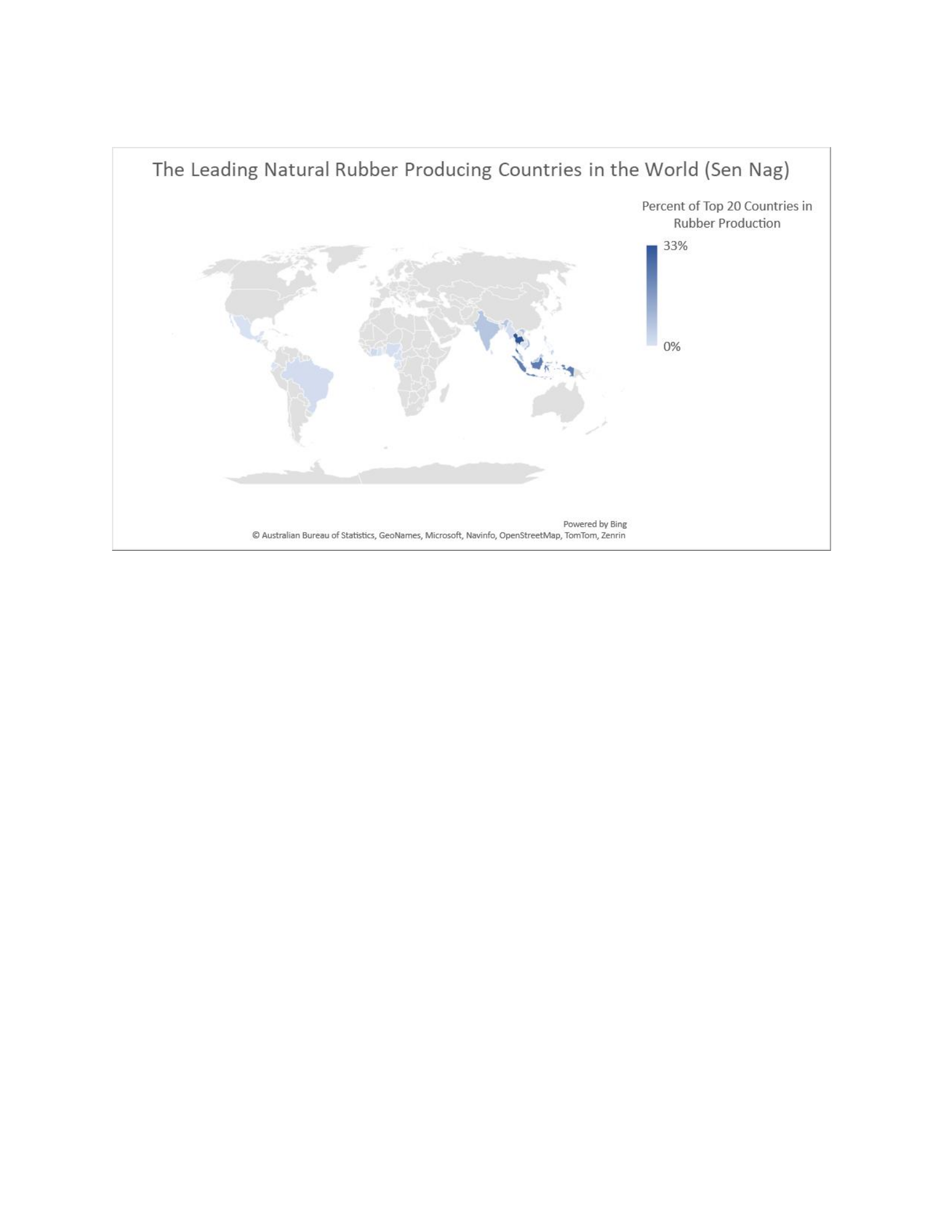
world’s natural rubber is still sourced from. In 2013, 72% of the world’s natural rubber came from
Thailand, Indonesia, and Malaysia (Sen Nag), with Vietnam, India, and China being the next largest
sources, as seen in Figure B: Modern Natural Rubber Supply Distribution (2013), located in the Appendix.
If Western tire manufacturers were to lose access to the supply of natural rubber in these regions, as has
happened in past conflicts, reliance on alternative supply bases would dramatically increase. In response
to natural rubber’s potentially precarious supply situation, some companies have begun development on

Kennedy 9
substitutes which invoke memories of efforts undertaken in World War II. One example of this
phenomenon is the over $100 million dollars that Bridgestone has spent to develop guayule as a
sustainable source of natural rubber. Bridgestone’s program draws upon knowledge learned during the
U.S. government’s Emergency Rubber Project, and the company aims to combine it with other initiatives
to “achieve carbon neutrality and make tires from 100 percent renewable materials by 2050” (Harley).
This plan can be seen as a result of both supply chain risk concerns and consumer pressures to produce
tires in a more sustainable way. A similar move has been made by some companies with the further
development of dandelion-based rubber which has resumed in the modern day. One notable example of
this trend is the efforts undertaken by Continental AG, which has partnered with the German Fraunhofer
Institute to grow dandelions for rubber production and test the substance’s performance in tires
(McGovan). Continued development of experimental natural sources of rubber provides a model that
could be used by tire manufacturers to deal with supply chain challenges that could arise from potential
future conflicts.
III: Methods
The main methodology through which analysis is conducted in this research is by combining a
wide range of historical precedent with established supply chain principles to see how they can be better
applied in the future. Initial research was conducted to form background information on the tire and
rubber industry in the modern day through news sites like Rubber News and Tire Business, which are
standard industry publications. From this point, the research into the history of rubber and supply chain
management decisions during World War II was able to be conducted. In order to do this, one of the
most important steps was to examine the background of the key decision makers as stakeholders. At the
time of the Second World War, industrial planners were operating in a do-or-die mindset, and this
contributed to a degree of hastiness in decision making, as governments simply tried to maintain
adequate supplies to defeat the enemy. This was seen in the Emergency Rubber Project, as the United

Kennedy 10
States funneled massive resources into experimental programs like those utilizing guayule as a source of
natural rubber, which ultimately did not provide the necessary output for wartime demand. Making rash
decisions is a common characteristic of supply choices made in a time of crisis, and it is for this reason
that many modern companies develop long range contingency planning to avoid inefficiency and waste
when it matters most. Another step that must be taken in evaluating historical supply chain strategies is
to consider how the nature of governmental involvement may be different today than in the past. At the
time of World War II, the degree to which central governments exercised control over production
decisions within private companies cannot be overstated. This is something which is difficult for many to
imagine today because most tire manufacturers are now multinational in nature, and because there has
not been a significant worldwide conflict which could force governments to assume control of critical
defense industries since the end of the Korean War. This phenomenon had the effect of overemphasizing
the role of government in the past, while downplaying it in the present; however, observers of the
current situation will likely be unable to know governments’ roles in ongoing supply chain situations for
some time. Future examinations of ongoing supply chain problems will be more likely to paint a full
picture of how governments are currently supporting tire manufacturers in their operations. The actions
taken during World War II are compared concisely to those of tire manufacturers in the present day in
Figure A: Comparative Table, located in the Appendix.
The second component of the project’s methodology is to introduce currently taught supply
chain principles to universalize historical situations as case studies for future users. In this project, this
was done by reviewing Johnson and Flynn’s reliable textbook Purchasing and Supply Management,
which is commonly used at American universities to educate supply chain students. This allowed for the
historical research to be refined in a way that connects it to academic principles which can be accessed
by a broad range of future supply chain students. It may also allow for future critiques of the research by

Kennedy 11
providing a basis for students to connect to it with, which will aid the goal of the project in staying
relevant to future decision-makers.
IV: Results
The main results of this project reinforce the key tenets of supply chain management, but there
are instances in which it points to different conclusions than would be drawn in the traditional approach.
One of the main considerations in supply chain management decisions is whether to adopt a single or
multiple sourcing arrangement. Many of the generally accepted supply chain principles lead to selecting
single sourcing because it allows a firm to ensure satisfactory quality, consistent delivery, and utilize just
in time delivery of component parts to minimize the cost of inventory. However, there are important
arguments to be made to support multiple sourcing in that it can provide contingencies, promote
flexibility, be scaled to meet future needs, and allow for testing of new technologies (Johnson & Flynn
333). The historical examples provided in this research are generally unsupportive of single sourcing,
most clearly illustrated by the United States’s overreliance on Southeast Asian sources of natural rubber
in the lead up to World War II. This left it vulnerable to the disruptions that occurred in the ensuing
conflict and left the country scrambling to find substitutes like guayule and natural rubber from Brazil
through the Emergency Rubber Project. What must also be considered is the atypical economic and
political conditions present in the time periods discussed in this research, which leads the historical
examples to be more supportive of multiple sourcing, despite single sourcing arrangements remaining
valid guidelines during more stable timeframes. A useful methodology for evaluating these risks in a
historical and everyday business context is the PESTEL framework, which focuses on market-wide
political, economic, social, technological, environmental, and legal issues. Utilizing this framework allows
supply chain managers to more clearly see how outside factors could shape industry-wide trends, and in
the case of both historical and current conflicts, would be more supportive of multiple sourcing
arrangements.

Kennedy 12
Another result gained from the research is the importance that innovation can play in making an
industry’s supply chain more secure and sustainable. This can be seen by using Michael Porter’s Five
Forces model, which is one of the most famous frameworks for conducting business analysis and
analyzes competition within industries. One of the forces described in the model is the threat of
substitutes, and while this is seen as a negative in the model, it can be seen as a positive in a supply
chain context, because it showcases the impact that disruptive technologies can play in furthering
organizational objectives. The research uncovered that there were many examples of the positively
disruptive effects of substitutes, like the innovations of synthetic rubber, guayule, and dandelions, which
lessened reliance of the natural rubber tree, or recovered carbon black, which could provide similar
impacts for petroleum-based components of tires. Substitute technologies may allow tire manufacturers
to make their supply chain operations more secure through onshoring activities that currently have long
transit times, which could have the added benefit of reducing carbon emissions and other forms of
organizational waste that contribute to excess spend. This is also related to the importance of creating
cross-functional teams in a supply chain context, as they allow for a combination of operational and
strategic elements within a procurement function that drives innovation in products and processes
(Johnson & Flynn 500).
The final set of results from this research is the combined importance of integrating suppliers
and their operations into a firm’s value-added processes to alleviate bottlenecks. The value chain is the
consecutive body of steps which transform raw materials into a finished product. In the tire and rubber
industry, this involves extracting the natural rubber from its source in rubber tree plantations,
transporting it to processing locations to be checked for quality, then washing and drying it in processing
plants, transporting it to manufacturing plants, where it can be combined with other components to
make finished tires which are then delivered to customers. The many moving parts of this process create
the possibility of bottlenecks, which are congestive points in the supply chain process that are often

Kennedy 13
characterized by a unique specification (Johnson & Flynn 343) a company must maintain to support its
other operations. In the modern tire and rubber supply chain, carbon black clearly exemplifies a
bottleneck which must be addressed. The fact that it is sourced from a contested region has made
supply of carbon black difficult to sustain, and caused tire manufacturers to deploy necessary resources
to what would otherwise be a relatively routine and insignificant part of the value chain. To effectively
take back control of carbon black’s role in the rubber supply chain, manufacturers must begin finding
ways through which its sourcing arrangements can be simplified. This research provides an intriguing
procedure, the development of recovered carbon black pyrolysis technologies, which could serve as a
revolutionary advance because it would allow tire manufacturers to bring what is currently a bottleneck
in-house to greatly lessen uncertainty and the level of effort necessary to conduct a critical activity. It
remains to be seen whether this technology will alleviate the Russia-Ukraine related carbon black issues,
but it is important that tire manufacturers recognize the risk to their supply chains that is caused by
having such an activity outside of their central control.
V: Implications for Future Research
Further research into historical sourcing concerns within the tire and rubber context could be
conducted to see what other supply chain concepts connect to modern problems. One interesting aspect
is the degree to which environmental and sustainability measures may influence a firm’s preference for
single vs multiple sourcing arrangements. In current business operations, most decisions made by firms
are done based on how they will affect profit, however with the growth of the environmental and social
governance (ESG) movement in management, this could begin to change. The adoption of financially
intensive, ecologically sustainable practices may encourage firms to adopt single sourcing arrangements,
as the switching costs would provide a significant barrier to exit. Additionally, sustainability based single
sourcing arrangements may be mandated by government policy or strongly tied to consumer pressure
which would effectively force manufacturers to stick with green suppliers. This may have the effect of

Kennedy 14
creating new bottlenecks in terms of rare earth minerals and other scarce components, which are not
yet chief supply chain concerns, but could become so in the near future. In the context of the tire and
rubber industry, this could be seen in chemicals used to refine alternative sources of natural rubber like
guayule and dandelions of those for recovered carbon black technology. If this was to be the case, it
would open up the possibility for new supply chain issues which future decision makers will likely have to
address.
Regarding studying the history of the tire and rubber industry, one aspect which could be further
researched is the importance of secondary activities in the value chain and how they have adapted
during times of conflict. Secondary activities are those which do not directly go into producing the end
product, but are vital to the operations of the business, with common examples being human resources
and administrative infrastructures like accounting, finance, and legal activities. These aspects deal more
with human and financial resources than raw materials, and the events of World War II likely made
significant changes to these vital aspects of business as well. Studying secondary activities could be even
more impactful when considering the ongoing War in Ukraine and the long-range effects of the COVID-
19 pandemic on business practices, which are likely far from being seen in their entirety. This research
could serve as a complement to future research into the development of secondary activities, because it
deals more with the sourcing of direct components which are necessary in tires.
VI: Conclusion
Human conflict is an unavoidable part of life and often focuses on competing interests for scarce
resources. Managing these resources to minimize loss is the goal of all sound supply chain principles,
and historical events like the Second World War have given a model to those today on how to deal with
similar challenges. Demands associated with today’s war in Ukraine and potential future conflicts will not
be easily solved by tire manufacturers, but if their strategies focus on innovation in products and

TO
TE
ns
Kennedy 15
processes, they may be able to sustain their businesses, meet objectives, and bring some degree of
resolution to the conflict with hope for a better tomorrow.

Kennedy 16
VII: Appendix
Figure A: Comparative Table
World War II 1939-1945
Russo-Ukrainian War & Disputes
with China 2022-Present
Concentrated Supply Bases
Natural Rubber: 77% contained
in British Malaya and Dutch
East Indies (Tully)
Carbon Black: 54% of European
Supplies from Russia, Belarus, &
Ukraine (Schunck)
Supply Disruptions
Natural Rubber: Japan captures
90% of world supply and 97%
of U.S.’s (Tuttle)
Industrial Goods: Russia blockades
Black Sea ports and attacks on land
shipping infrastructure (Kryvetska)
Economic Conflict
U.S. and U.K. opposition to
German actions
U.S. Embargo on Japan 1941 &
Freezing of Japanese Assets in
U.S. (Anderson)
Western sanctions of Russia and its
private economic entities by
governments and businesses
(Detore)
U.S. trade war with China in response
to dumping & intellectual property
theft
Alternative Supply Bases
Natural Rubber: British
controlled Sri Lanka became
world’s largest supplier
(Clarence-Smith)
Brazil develops strategic
partnership with U.S.
(Wilkinson)
Carbon Black: Supply from potentially
antagonistic sources, China, India
(Meyer)
Potential for development in friendly
petroleum-rich states like Canada
Synthetic Rubber
German development and over
reliance on synthetic rubber,
only 8% from natural sources
by war’s end (Provost)
Potential Chinese aggression in
Southeast Asia could threaten natural
rubber suppliers in Indonesia and
Malaysia leading to synthetic reliance
Experimental Substitutes
Guayule: Emergency Rubber
Project planned 3 million
pounds of rubber production
from guayule (McGinnes), but
delivered only 1,000 long tons
(Wendt)
Dandelions: 30% of Russian
rubber consumption created by
67,000 ha of dandelions (van
Beilen & Poirier)
Guayule: Bridgestone has invested
over $100 million in modern
development of guayule (Harley)
Dandelions: Continental AG
partnership with Fraunhofer Institute
to grow and test dandelions for
natural rubber
Carbon Black: No direct synthetic
substitute yet found, but recovered
carbon black could lessen new
demand (Raeder)
Kennedy 17
Figure B: Modern Natural Rubber Supply Distribution (2013)

