


Kingston-Bryce Business Case
Joselyn Duwana
Rasmussen University
Section 01CBE Business Project Management
Eric Jackson
April 3rd, 2023
h

Kingston-Bryce Business Case
As the Project Manager of Kingston-Bryce Limited, I have been assigned the task to
create a business case to allow the Board of Directors of KBL to proceed with the acquisition
process. Following a successful acquisition of the competitor, KBL will triple its workforce and
widen the operations. The projected cost for the acquisition process is $5 million within 18
months.
Project Scope
To successfully carry out the acquisition process, KBL plans to carry out the project in
four main phases, stipulated as quarters. Within the first quarter, the company plans to
complete two main tasks. The first task within phase one will involve establishing the acquisition
team and assignment of specific roles. This task will be accomplished within eight weeks. By
doing this, every team member will be responsible for any duty assigned to him/her toward the
achievement of the set objectives.
The second quarter will involve two main tasks, just like the initial phase. Within this
phase, the first task will be to evaluate the financial statements to check on the profit
generation of the targeted firm. Conducting financial evaluation will run for 12 weeks and will
allow KBL to decide whether to continue with the acquisition or not, based on the financial

report generated. The second task in phase two will run for six weeks. It will entail the legal
documents analysis to ensure that the firm has all the necessary legal documentation to
conduct business. Also, analysis of the legal documents will allow KBL to establish whether the
competitor has remained compliant with all legal procedures and if so, then the acquisition
process can continue.
In the third quarter, six main tasks will be accomplished, and this phase will mark the
final phase to acquisition. The first task in phase three will be to analyze liabilities, an activity
that will run for two weeks. By analyzing the liabilities, KBL will identify the key areas that need
to be reformed to minimize the liabilities. Task two under phase three involves evaluating the
competitor’s assets, and it will take two weeks. High asset valuation will add value to KBL asset
valuation, and the acquisition process can be accomplished if the asset valuation reaches the
minimum target. Tasks three and four under quarter three will take two weeks and four weeks,
respectively, and they will entail a further assessment of tax compliance and employee review.
Under employee review, the team will establish the workers to retain and those to release to
keep the best skills and professionals to aid in achieving success. Tasks five and six will take two
and six weeks, respectively, and involve a review of customer feedback and risk assessment,
respectively.
The fourth and final quarter will involve three main tasks. The first task will be the
presentation of the findings to the board of directors. This will last for four weeks to allow the
board to have a more in-depth review of the compiled report to make the final decision. The
second task in quarter four will be the actual acquisition process. KBL will sign a purchase
agreement with the acquired firm, and the exchange of possession will be carried out in the
presence of legal authority. The acquisition will last for 12 weeks to allow the involved parties to
complete the transaction of all necessary legal documents. After a successful acquisition, the
two firms will have two weeks to close the deal.
Benefits
Following the competitor company’s acquisition, KBL will successfully expand its
operations and enhance performance by providing additional products and services to meet the
consumers’ needs. There will be increased profitability, improved performance, and an
increased range of products.
Risks
The main risks, in this case, are the budget concern and an uncertain future. The
acquisition can be successful, but over time, the business can fail and cost the company a
fortune. Too heavy losses may even cause the company to collapse.
Opportunities
By acquiring the competitor, KBL will gain new customers and have the chance to
venture into a new market that was initially dominated by the acquired firm. Also, KBL has room
for expansion of the company, which guarantees KBL a chance to enhance its performance.

Limitations
Maintaining production during the merger process may be difficult and costly to KBL.
Also, shifting the operations from affiliate firms to a centralized firm may be difficult and may
take time to keep the activities moving as projected. Hiring the staff; may also be challenging
since it’s difficult to predict the future performance of the employees.
Assumptions
During the acquisition process, what assumptions did the team make to support the cost
of the project? What assumptions were made about the ability to recruit employees and triple
the productivity of the organization? What assumptions were made concerning the project
schedule?
Funding Schedule
The allocated $5 million should be used to fund the entire project to complete fully. The
funding is projected to be done in phases, starting from the first phase running through the
second and third phases up to the last phase. The periodic financing will allow the management
to account for the pumped resources to ensure that everything is used efficiently. The funding
schedule is as shown below:
Milesto
nes
Activity Date Funding
1 Establish project acquisition team 01/04/2023 $15,000
Analysis of to be acquired company 03/01/2023 $18,000
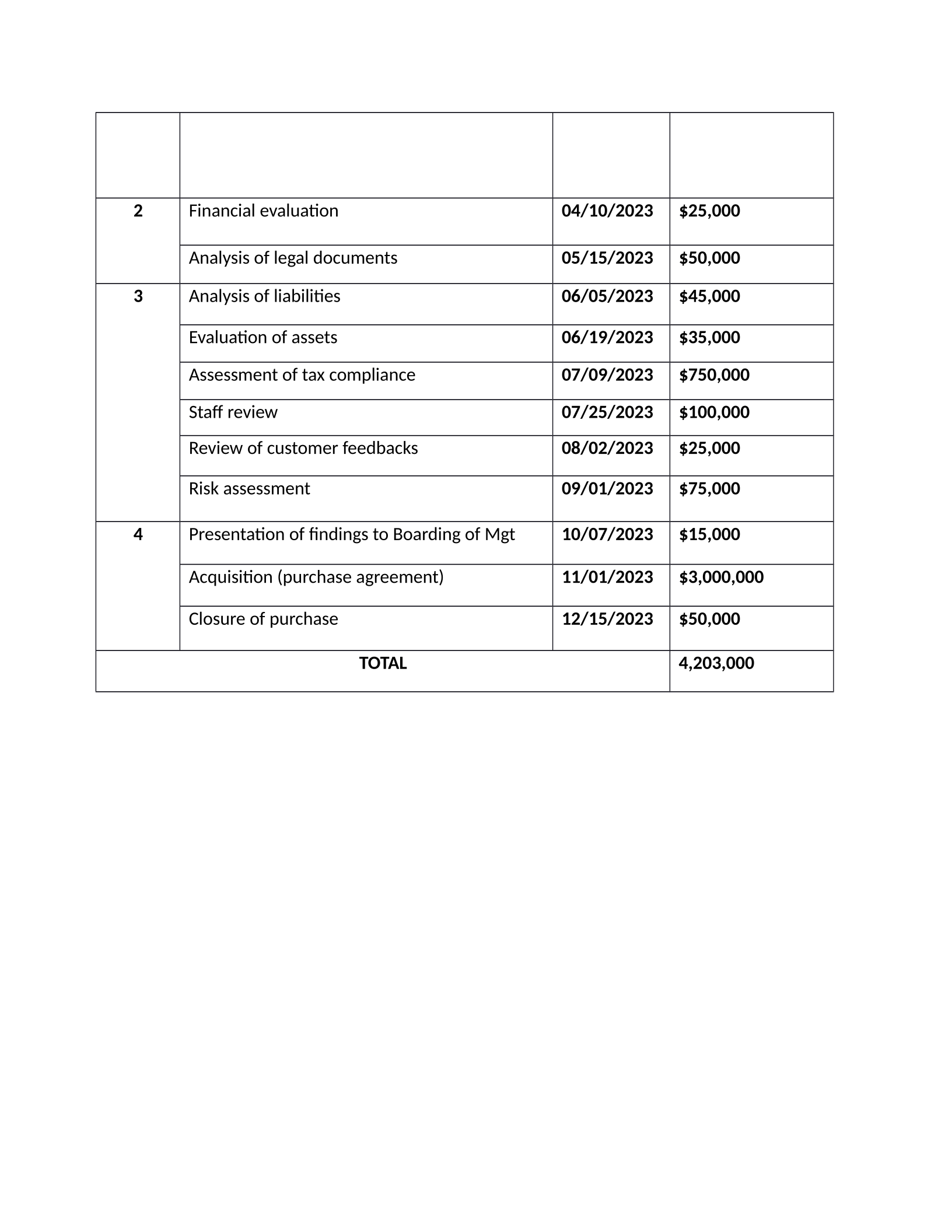
2Financial evaluation 04/10/2023 $25,000
Analysis of legal documents 05/15/2023 $50,000
3Analysis of liabilities 06/05/2023 $45,000
Evaluation of assets 06/19/2023 $35,000
Assessment of tax compliance 07/09/2023 $750,000
Staff review 07/25/2023 $100,000
Review of customer feedbacks 08/02/2023 $25,000
Risk assessment 09/01/2023 $75,000
4Presentation of findings to Boarding of Mgt 10/07/2023 $15,000
Acquisition (purchase agreement) 11/01/2023 $3,000,000
Closure of purchase 12/15/2023 $50,000
TOTAL 4,203,000
Powered by TCPDF (www.tcpdf.org)

