


ince 2018 I have been teaching English as a Second
Language (ESL) in private schools at secondary and higher
secondary levels.
During this period, I have observed lack of interest among the
students, their inadequate knowledge about articles and their usage
in the English language. Therefore, it motivated me to identify some
of the key problems experienced by teachers and students, and
explore research-based strategies to address the identified issues
and concerns related to uses of articles in English language. I believe
that ESL teachers need to enhance their understanding of articles in
order to effectively teach ESL learners. The articles’ system has
remained one of the most difficult concepts of English for ESL
learners.
Literature suggests that there are common issues related to the use
of articles among ESL learners such as overuse, underuse, or
substituting the articles wrongly (Shakur & Khanum, 2021). It is
acknowledged that many second language learners have issues in
using articles in the target language and unconsciously make errors
because they did not have enough knowledge about articles in their
first language (Butler, 2002; Shakur & Khanum, 2021 ). Research on
the use of articles also suggests that Urdu as a first language, which
does not have any articles, is a barrier in teaching and is challenging
for Pakistani learners. Therefore, they either ignore articles or use
them excessively even if it is not required (Shakur & Khanum, 2021).
According to Alhaisoni, Gaudel, and Al-Zuoud (2017) most of the
errors in the article are made due to overgeneralization and in
appropriate transfer from the first language to the target language.
Such errors indicate the problems students face in learning English
as a second/ foreign language in schools.
Likewise, the Japanese students make errors in using the articles as
the concept of definite and indefinite articles is missing in the
Japanese language (Butler, 2002) similarly in Urdu language there
are no articles. Due to the lack of understanding between their first
language and the target language, students find it challenging to
grasp the concept of articles.
12

For deeper understanding of the topic, I reviewed multiple research
studies related to the acquisition of articles in different languages such
as Urdu, Arabic, and Japanese. I discovered that all these languages
share a common feature: they lack a system for articles. Therefore, the
learners face challenges in understanding articles while learning
English.
Literature suggests some recommendations to engage ESL learners in
building the concept. English articles are unteachable but can be
learned by exposure to language and the learners need to understand
them through personal experiences (Shakur & Khanum, 2021).
Furthermore, the study suggested that all language teachers need to
review the work of students and identify the errors during usage of
articles, along with grammatical and language errors. English teachers
also need to be aware of the rules of definite and indefinite articles
when engaging ESL learnes, and without understanding the rules it
would be difficult for them to use it properly (Miller, 2005). Similarly, the
study also reveals that the essence of all languages is different from
each other. Therefore, learners do not necessarily need to assimilate
their first language and the target language. Moreover, contextualised
and meaning-based activities are essential for teaching articles related
to the real-life context.
In the concept of the article system in English, it has been suggested
that learners need to understand the “Noun Phrase” because articles are
used in noun phrases (Butler, 2002). Therefore, focusing on the
countable and uncountable nouns in noun phrases would be helpful to
understand the article system better. In a nutshell, all these findings and
strategies would be helpful for teachers to address the identified
problems and enable students to use articles appropriately.
13

C
Subject
English
Topic
Definite and Indefinite articles
Class
06
Duration
45 minutes
Prior
Knowledge
Students’ familiarity with articles i.e., usage of a, an, the in
sentences.
Students
Learning
Outcomes
By the end of the lesson, students will be able to:
Differentiate between definite and indefinite articles
with examples.
Identify the articles from texts.
Write a paragraph using definite and indefinite articles.
Learning
Resources
Whiteboard, board markers, duster, short story,
worksheets.
14

Time
Content and teacher/ student activity
5 mins
Engage
The teacher will ask students to observe the classroom
silently for one minute. The students will be given a chance
to make sentences using any one object available in the
classroom. Students will write their observations on the
whiteboard after which the teacher will collect their
responses by asking the reasoning behind the responses.
For instance, the students will write: ‘There is a rostrum in
our class.” In response, the teacher will ask them the
rationale behind the use of the article ‘a’ with the noun
‘rostrum’.
10
mins
Explore
The teacher will instruct the students to sit in pairs. A short
story “Hungry Dogs” (Refer Annexure A for the story) will be
provided by the teacher in this paired activity with the
following instructions:
Underline the articles ‘a’, ‘an’, and ‘the’.
Also underline the succeeding words.
Discuss with your partner why specific article(s) is/ are
used with the words.
After the completion of pair work, the teacher will randomly
call the students to share the identified articles and the
reasons bhind the use.
15
mins
Explain
Teacher will now announce the topic “definite and indefinite
articles.” Based on the reasons identified by the students,
the teacher will explain the concept of definite and indefinite
articles. In addition, the teacher will also explain the basic
rules of articles and their use in sentences with examples.
For instance,
Articles are small words that are used to modify nouns.
E.g., The dog barked loudly. (Dog is modified by the
article ‘the’).
Articles always come before nouns they modify. E.g., He
found a pen in the classroom. (Pen is preceded by the
article ‘a’).
Definite articles are used to define specific things while
indefinite articles are used to define indefinite things.
E.g., The cat climbed the tree to catch a bird. ('the' is
used before 'cat' )
Definite: Let’s go to the head office. (Referring to a
specific office that is known to both the speaker and
listener).
Indefinite: He is riding a cycle. (Referring to any cycle, not a
specific cycle).
15

Time
Content and teacher/ student activity
10
mins
Elaborate
The teacher will ask students in pairs to write a small
paragraph on their favorite activity in the school using
definite and indefinite articles (at least three).
5 mins
Evaluate
The teacher will ask students randomly to share their work in
front of the class. Students will share their work and the
teacher will ask why the students use ‘a’, ‘an’, and ‘the’ with
different nouns in the paragraph.
Homework
Students will be asked to write a short paragraph on their favorite sport
(100-150 words) by using articles a, an, and the.
Annexure A
Story:
Read the story in pairs and underline the definite and indefinite articles
in the story. Share your responses with the class.
Hungry Dogs:
Three dogs lived in the city. They were very close friends. One day, all
of them were hungry. So, they started searching for food, but they
couldn’t find anything. At last, they found a bone lying under the water.
They tried hard to get the bone, but they failed. One of them thought
that if we were able to drink all the water, we could get that bone. They
started drinking water. Even when their stomachs were full, they didn’t
stop drinking water, which caused their stomachs to burst, and they
died.
The moral of the story is that we shouldn’t try an impossible task in a
foolish manner.
Source:
Students will be asked to write a short paragraph on their favorite sport
(100-150 words) by using articles a, an, and the.
16

Alhaisoni, E., Gaudel, D. R., & Al-Zuoud, K. M. (2017). Article errors in
the English writing of Saudi EFL preparatory year students. Advances
in Language and Literary Studies, 8(1), 72-78.
Butler, Y. G. (2002). Second language learners ‘theories on the use of
English articles: An analysis of the metalinguistic knowledge used by
Japanese students in acquiring the English article system. Cambridge
University Press, 24(3), 451-480.
Miller, J. (2005). Most of ESL Students Have Trouble with the Articles.
International Education Journal, 5(5), 80-88.
Shakur, N., & Khanum, T. (2021). The English article system and
second language Pakistani learners: A case study. Pakistan Journal of
Society, Education and Language, 8(1), 46-63.
References
17

Variables:
A Bridging Tool
Between Algebra and
Other Areas of
Mathematics
Sadam Hussain
18

eing a mathematics teacher, I have experienced that my
students feel difficulties in learning algebraic concepts.
Similarly, Bhutta and Rizvi (2021), also found that the
students’ performance in Algebra in middle school
remains low as compared to other math concepts.
Variables, in my opinion, is the most fundamental notion in algebra,
and it can be used for a variety of sub-concepts in algebra that
develop linkages with arithmetic, pattern finding, and geometry. I
selected a student-centered approach to help grade VI students to
gain conceptual knowledge about variables so that they can
understand the basic concepts of algebra. Algebra is an extension of
arithmetic and pattern-finding in which letters (variables) represent
numbers or values.
The concept of a variable seems simple (a letter represents a number),
but it is extremely complicated because letters in mathematics are
used in a variety of ways (Russell, O'Dwyer, & Miranda, 2009). In
arithmetic, ‘m’ is mostly used to represent a metre as a unit, not the
number of meters and when ‘m’ is used as a variable, in algebra,
students might misinterpret and use it as a label for the unit (meter).
Furthermore, students frequently make mistakes (a variable for an item
name), and they identify letters with their alphabetical placements
(Bush, & Karp, 2013; Russell, O'Dwyer, & Miranda, 2009; Welder,
2012). Students often associate 'a' with 'apple' from primary school
lessons and sometimes with '1' as ‘a’ it is the first placed letter of the
English alphabet.
Welder (2012) has identified four different strategies to overcome the
challenges or misconceptions dealing with variables in algebra.
Firstly, finding missing values in equations like 3+y=14 could be
introduced by providing arithmetic equations with missing values and
allowing students to use different symbols for the missing values.
Secondly, if variables are needed to generalise patterns, students
should be encouraged to learn how to locate, record, and express
pattern rules in words first, and then variables can be introduced
afterwards. Thirdly, the use of abbreviations and letters might be
distinguished by pronouncing and writing the word ‘meter’ instead of
the letter ‘m’. While it will require time and effort, this approach will
help students understand the abbreviation of a variable. Finally,
variables could be taught by giving students a mathematical
expression or equation and then having them translate the expression
or equation into word(s), phrases or a story before introducing the
concept of variables.
19

C
Subject
Mathematics
Topic
Variables (Algebra)
Class
06
Duration
60 minutes
Prior
Knowledge
Students have an understanding about the use arithmetic
operations (addition and subtraction) to find the missing
numbers.
Students
Learning
Outcomes
By the end of the lesson, students will be able to:
Define variables as letters to denote numbers in
algebra.
Understand the concept of the variables and their use
in real-life situations.
Learning
Resources
Stationery items (copy, pencil, ruler, geometry box,
eraser, sticky notes, etc.), worksheets
20

Time
Content and teacher/ student activity
5 mins
Engage
The teacher will ask students the following questions:
Have you watched the movie “Tare Zameen Par”? (If
students say no, then the teacher will explain the plot of
the film and draw connections between the film’s plot with
math).
Note: The teacher should inform students about the plot of the
novel i.e., the movie is based on the story of a boy Ishan, who
was weak in identifying and recalling content. One day, the
teacher asked him to read a passage from a book and at that
time he said that he couldn’t read the text because the letters
were dancing.
After this, the teacher will ask the students the following
question:
Can you imagine how the letters will dance?
The teacher will then engage the students in a ‘dancing
numbers and letters’ activity in the class.
15
mins
Explore
The teacher will divide students into groups of 5 and provide
them with a worksheet. The worksheet has three parts and
each part is pinned. Refer to Annexure A for worksheet.
Students will be asked to open the first part and complete it
after which they will be allowed to open the second, and finally
the third part of the worksheet.
Instructions for 1st part:
This part has 4 squares and each square needs to be filled
with one or more numbers.
In the first square, add all the numbers and write their sum
in the empty box.
In the second square, the sum, which is 45, is already
given. You have to identify and find out the number to be
added to 8 and 20 to get 45.
In the third square, the sum 45 is given with one number
that is 15. Identify the number that, when doubled and
added to 15, equals 45.. Write that number in both empty
boxes.
In the fourth square, only the sum 45 is given and you
have to write down the three numbers whose sum is 45.
Remember that the numbers should be different from the
previous squares.
After completing the first part, the teacher will ask students to
open the second part.
Instructions for the second part:
There are 4 questions in this part. They are related to the
arithmetic operations that you have learned previously.
21

Time
Content and teacher/ student activity
5 mins
Now find the missing numbers in each question.
Follow the instructions in question ‘c’ to find the number
which, when added to itself, and then subtracting 13 from
the sum, results in 17.
Later on, the teacher will ask the students to share their
answers. The teacher will ask the following probing
questions to the students regarding the activity above:
What did you find in all the situations that were provided
to you? (missing numbers/ values)
What else do we call that missing value? A missing value
is also known as ______. (an unknown value)
Are missing values only found in arithmetic or can they
also be found in other fields of mathematics like
measurements, geometry, etc?
What else can we use instead of symbols? (variables)
In terms of mathematics, what do we call an unknown
value that is represented with symbols? (variable)
15
mins
Explain
Based on the discussion above, the teacher will share that:
Algebra is a generalised form of arithmetic and pattern-
finding in which letters (variables) replace numbers or
values.
A value of the variable can vary if the sum, difference,
product, or quotient of the expression is not given.
Let's take an example: If the expression is X+5=11, then
the value of ‘x’ could be any number. It may be 1 or 2 or 5
or 11 or 290 or any other number.
Since only 6 added to 5 equals 11, the variable's value is 6.
15
mins
Elaborate
To enhance the student’s understanding of variables, the
teacher will engage them in an activity.
Activity details: The teacher will show some items from the
class (like pencil, eraser, ruler, pen, copy, book, etc.) and label
them with price tags by using sticky notes. The teacher will also
show the students a list of variables and their values. Next, the
the teacher will ask the students if they have Rs. 100 to spend
at the store. They will be inquired regarding which items they
would like to buy and will be tasked to share the list of items
available within that amount. Secondly, the students will be
asked to represent those items, with their amounts, and the
variables that were used.
With the help of this activity, the teacher will discuss that the
variables do not label any object or item, but it’s the numerical
value or amount that is shared. In other words, the variable
doesn’t have any fixed numerical value, but can vary.
22

Homework
Write these statements and equations mathematically by using any letter,
where the number is unknown.
1. + 7 = 15
2. 20 - = 9
3. Hafeez had some apples. He bought 14 more apples, and now he has 21
apples. How many apples did Hafeez initially have? _________
4. Sana had 20 marbles, but she lost some of them. Now she has 3
marbles left. How many marbles did Sana lose? ___________
Time
Content and teacher/ student activity
10
mins
Evaluate
Finally, students will be asked to open the last pin of the paper
and look at the third part that they need to complete by
following the given instructions:
This part has three questions. You need to write the
statements mathematically and also use the variables in the
mathematical statements.
Annexure A
Fill with the same number
Complete the blanks.
a. 17 + 23 = b. - 15 = 75
c. ( + ) - 13 = 17 d. 100 - = 89
Write these statements mathematically by using any letter, where the
number is unknown.
Ali had some pencils. He bought 2 more. The number of pencils Ali
now has is _______________.
Add 30 to a certain number. The resultant number is ______________.
Babar added two same numbers and subtracted 3 from it. The
resultant number is _______________.
23

Bhutta, S. M., & Rizvi, N. F. (2021). Assessing teachers’ pedagogical
practices and students’ learning outcomes in mathematics and science
across primary and secondary school levels: A nationwide study
[unpublished report]. Aga Khan University Institute for Educational
Development, Pakistan.
Bush, S. B., & Karp, K. S. (2013). Prerequisite algebra skills and
associated misconceptions of middle-grade students: A review. The
Journal of Mathematical Behavior, 32(3), 613-632
.
Russell, M., O’dwyer, L. M., & Miranda, H. (2009). Diagnosing students’
misconceptions in algebra: Results from an experimental pilot study.
Behavior Research Methods, 41(2), 414-424.
Welder, R. M. (2012). Improving algebra preparation: Implications from
research on student misconceptions and difficulties. School Science
and Mathematics, 112(4), 255-264.
References
24

Teaching
and
Learning History
Sardar Hussain
25

course is a exploration of literature to understand why history is
difficult to teach and what are the research-based strategies that help
in developing the students’ interest in the subject.
Based on my teaching experiences, I have experienced that students
consider history as a boring subject. According to Harrisa and Haydn
(2006) the research conducted to explore students’ attitude towards
history as a subject in England found that many students think that
history is on the timetable because the students want to sleep in the
class. One of the possible reasons could be that usually teachers use
traditional lecture methods to teach history that lead students to lose
their concentration. According to Hover and Yeager (2004) history
teachers whose instructional skills are good, can make the lesson
interesting as compared to those who use traditional lecture method.
History is also given less importance as compared to other subjects. In
middle school curriculum, history is not a major component within the
social studies curriculum. Therefore, it becomes difficult for the
teacher to draw students’ attention towards history (De Oliveira,
2008).
Teaching approaches matters. Harrisa and Haydn (2006) found that
students enjoy interactive activities such as role playing, drama,
presentations, discussion, debate, making things, and so forth.
Teaching history through movies is another technique to teach history
effectively. Movies help students identify and analyse different stories
about the past and explore the nature of historical interpretations, an
important element of effective historical thinking (Marcus, Metzge r,
Paxton, Stoddard).
Different effective teaching strategies like role play, drama, discussion,
movie watching, and project methods for history are emphasised in the
literature. Implementaion of these strategies by the teacher is essential
to make history engaging for students.
s a social studies teacher, I have faced difficulty in
teaching history. Therefore, the focus for one of the
assignments in the Curriculum, Teaching and Learning
26

C
Subject
Social Studies
Topic
Mughal Rule
Class
06
Duration
65 minutes
Prior
Knowledge
Students already know about:
Names of historical figures known for their conquests
or leadership.
Conquerors from different parts of the world.
Students
Learning
Outcomes
By the end of the lesson, students will be able to:
Identify the ruler who laid the foundation of Muslim
rule in India.
Identify the first ruler of the Mughal Empire.
Discuss the life and ruling period of Zaheer-ud-Din
Babur.
Learning
Resources
Textbook, maps, worksheets, multimedia, stationery
27

Time
Content and teacher/ student activity
5 mins
Engage
Some questions will be asked from students to probe their
prior knowledge. Some sample questions are given below:
Who was the first ruler to come to India?
Name Muslim dynasties who ruled over India before the
Mughals.
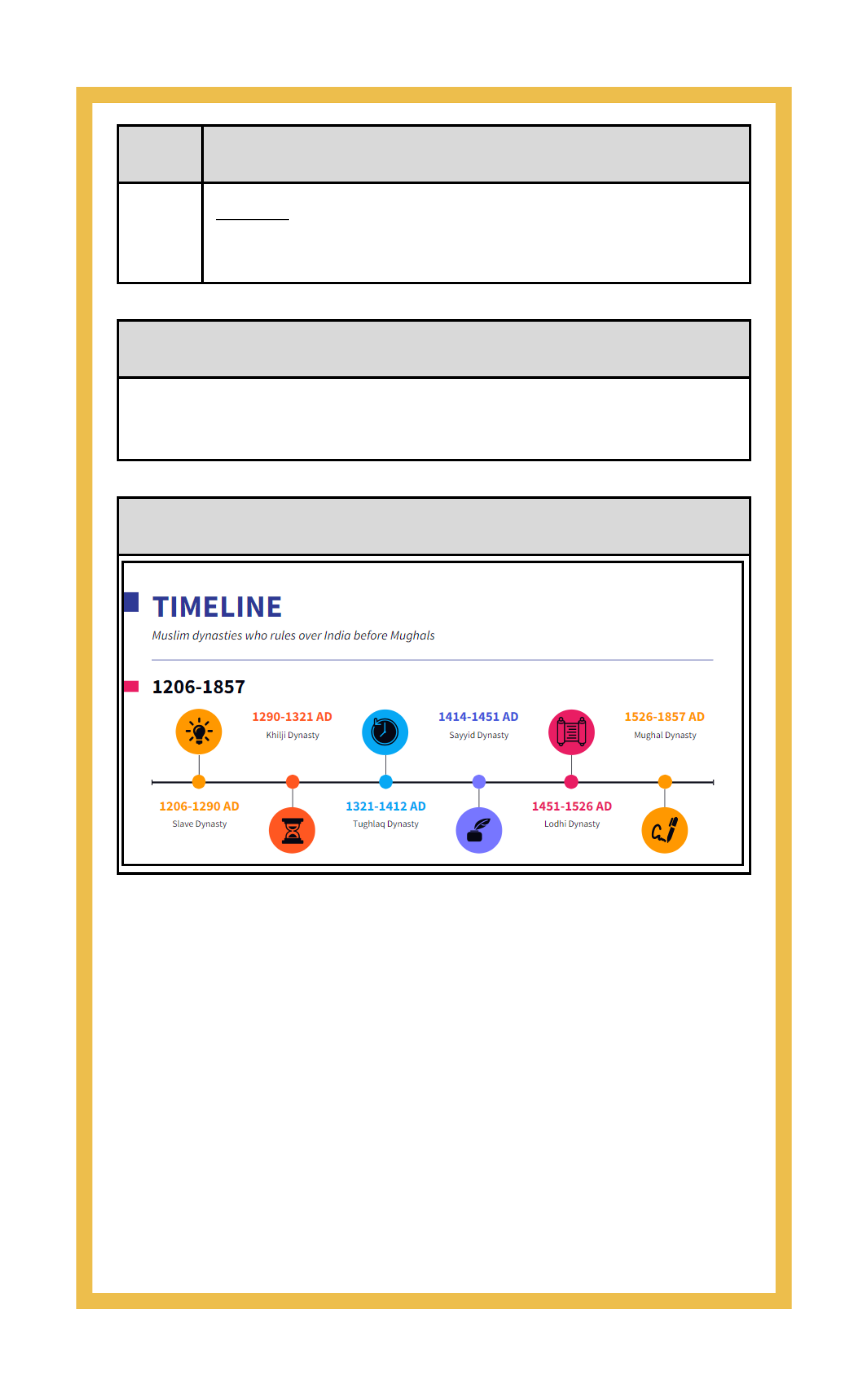
Note: Have students draw a timeline on the given chart
papers to show Muslim dynasties who ruled over India before
Mughals. Assist where required.
15
mins
Explore
Students will be divided in groups and each group will be
provided a handout about Zaheer-ud-Din Babur.
(https://historypak.com/zaheeruddin-babar/)
Students will read the story and answer the following
questions in their groups:
Who was Zaheer-ud-Din Babur?
When did he come to India?
What is the Battle of Panipat?
What was his strategy as a commander?
Who were the two significant individuals in Babur's early
life that played a role in shaping his personality and skills,
and what were their contributions?
Describe the circumstances under which Babur became
the king of Ferghana at the age of 12.
How did he navigate the challenges posed by his enemies
at a young age?
Discuss the significance of Babur's successful conquest
of Samarqand and his brief rule there.
20
mins
Explain
Each group will be given 3-4 minutes to present their
timelines and their findings from the story above in front of
the class. Then, the teacher will consolidate all the points
and will add if something is left. The teacher will also show
the timeline to give students a clear understanding about the
topic. (Refer to Annexure A for the timeline)
By the end of this activity, the teacher will address any
questions or misconceptions the students still have.
20
mins
Elaborate
The teacher will facilitate a discussion on the impact of
Babur’s rule in the subcontinent, encouraging the students to
think critically about the positive/negative aspects of his
rule, including his contributions to architecture, art and
governance. They will then work in groups to create either a
timeline or visual representation depicting key events in
Babur’s life.
28
Homework
Students are asked to design a poster highlighting Babur’s struggle in
India.
Time
Content and teacher/ student activity
5 mins
Evaluate
Students will be asked to write a small paragraph of 3-4 lines
describing what they learned from the class.
Annexure A
29

De Oliveira, L. C. (2008). “History Doesn't Count": Challenges of
Teaching History in California Schools. The history teacher, 41(3), 363-
378.
Harris. R, Haydn.T "Pupils' enjoyment of history: what lessons can
teachers learn from their pupils?" The Curriculum Journal 17, no. 4
(2006): 315-333.
Haydn, T., & Stephen, A. (2022). Learning to teach history in the
secondary school: A companion to school experience. (5th ed).
Routledge.
https://doi.org/10.4324/9780429060885
Marcus, A. S., Metzger, S. A., Paxton, R. J., & Stoddard, J. D. (2018).
Teaching history with film: Strategies for secondary social studies.
(2nd ed). Routledge.
https://doi.org/10.4324/9780429060885
Van Hover, S. D., & Yeager, E. A. (2004). Challenges facing beginning
history teachers: An exploratory study. International journal of social
education, 19(1), 8-21.
References
30

ATOMS:
Imagination of an
Abstract Concept
of Science
Shella Asad
31

comprehension about the universe. This topic also demands
visualisation and conceptualisation of models at the micro-level and
application at the macro-level, something which challenges a teacher
to draft a lesson plan accordingly. Similarly, according to Cokelez
(2010), understanding the nature of the atom is complicated because
its structure is abstract and cannot be seen with naked eyes. As a
result, teachers struggle in disseminating the concept of atomic
structure as students face difficulty in imagining the abstract structure
of an atom.
Moreover, teaching and learning of the atomic structure is significantly
more difficult at the elementary level where the concept of the
structure of an atom is mentioned in grade 7 science books,
specifically in Pakistan. Learners at this level are unable to visualise
and elaborate the concept of the structure of an atom. According to
Polat-Yaseen (2012), teaching about atoms and atomic structure to
elementary students is a challenging task because it is difficult to
imagine how atoms look like”.
Hence, modeling atomic structure can help thinking and working
scientifically on the concept of the atom and models can also provide
pictorial representations to the students (Polat-Yaseen,2012). Models
are valuable tools as they can be used to understand abstract science
concepts such as the structure of atoms. Consequently, teachers of
science amongst other teachers use metaphors and analogy (Polat-
Yaseen,2012) in teaching concepts of science. Others use different
symbols to help students understand the microscopic concept at a
macroscopic level. These include structural formulas, and ball-and-
stick models (Wu, 2003).
Furthermore, the analogy of the solar system can also be used to
describe the structure of atoms (Nakiboğlu & Taber, 2013) and
teachers believe that the use of models in science education supports
meaningful teaching and learning processes. In 2012, Cokelez also
stressed budding models and integrating those models into the
syllabus as classroom activities. Teachers on the other hand also
prefer to choose easy models in their instructions rather than
explaining all the concepts from the textbooks that are not enough to
clarify the abstract concept of structure of atoms (Polat-Yaseen,2012),
which also facilitates teachers and learners in understanding the
concept of the structure of the atom easily.
he idea of the atom serves as a cornerstone in the field
of science in the quest to understand the fundamental
components of matter. Its significance comes from
being the smallest indivisible unit of an element, which
represents a significant advancement in our
32

C
Subject
Science
Topic
Structure of Atom
Class
07
Duration
55 minutes
Prior
Knowledge
Students already know about:
The nature of an atom.
The structure of an atom which is made up of tiny
particles.
Students
Learning
Outcomes
By the end of the lesson, students will be able to:
Describe the structure of an atom.
Differentiate between atomic number and mass
number.
Draw the model of the atomic structure of the first ten
elements in the periodic table.
Learning
Resources
Blackboard, Chalk, Duster, Periodic Table, small wooden
sticks and pieces of paper, colored paper/markers
(different colors for protons, neutrons, and electrons),
glue or tape for model of the atom,
and a laptop (short video clip).
33
Time
Content and teacher/ student activity
10
mins
Engage
The teacher will distribute pieces of paper and wooden sticks
among students.
Students will hold a piece of paper or wooden sticks in their
hands.
They will make small pieces of paper or wooden sticks (as
small as possible) until they become unbreakable.
The teacher will question the students, including the
following inquiries (with the possibility of additional
questions):
Did you tear the paper into pieces or break the wooden
sticks?
What happened when you tore the paper into pieces or
broke the wooden sticks?
How small can you make them?
Imagine that a piece of paper or sticks represents an
object. How does breaking it down help us understand its
smaller components?
After that, the teacher will encourage the students to join the
small pieces.
The teacher further probes the students by asking the
following questions:
Based on your observation, why do scientists consider
the atom to be a tiny particle?
How does breaking paper and wood support the idea that
all things are made of atoms?
Can you think of other everyday examples that illustrate
the idea that everything is made up of atoms?
10
mins
Explore
The teacher will ask students to share ideas on the activity
and relate the process with the concept of science.
http://www.youtube.com/watch?v=pNroKeV2fgk
(2:24 and then from 3:21 to 3:59)
After watching the video, the teacher will ask the following
questions:
What was the title of the video?
What does an atom look like?
Write the names of the sub-atomic particles of an atom.
Differentiate between a proton, electron, and neutron.
Why is an atom neutral?
Draw and label the structure of an atom.
34

Homework
Students will be asked to create a model of any two periodic elements
numbered between 11 and 15 either by using play dough or any other
materials they like and also attach a note with their model describing the
placement of each component.
Time
Content and teacher/ student activity
20
mins
Explain
Students will share their responses to the questions above. The
teacher will consolidate the responses and explain the concept
of an atom.
Next, the teacher will illustrate the atom's structure on the
board, labelling it using colored markers or paper. (different
colors for protons, neutrons, and electrons).
The teacher will explain the terms ‘atomic number’ and ‘mass
number’, and differences between them.
Then, the teacher will show students the periodic table and
inform them about the first ten elements of the periodic table.
The positions of the atomic number and mass number in the
periodic table will also be highlighted by the teacher to facilitate
the students in understanding the periodic table’s properties.
5 mins
Elaborate
Students will draw and label the structure of the first ten
elements of the periodic table in their notebooks and label
them.
The teacher will assess the task in the class.
10
mins
Evaluate
Students will do an analysis in pairs and write a brief description
on the ‘structure of an atom’.
They will be encouraged to include all the concepts taught in
the class regarding atom and its structures.
35

Cokelez, A. (2012). Junior high school students’ ideas about the shape
and size of the atom. Research in Science Education, 42(4), 673-686.
Fuse School. What is an atom? [video]. YouTube.
https://www.youtube.com/watch?v=pNroKeV2fgk
Nakiboğlu, C., & Taber, K. S. (2013). The atom as a tiny solar system:
Turkish High School students’ understanding of the Atom in relation to
a common teaching analogy. Concepts of Matter in Science Education.
Polat-Yaseen, Z. (2012). A comparison between elementary school
students' mental models and visualizations in textbooks for the
concept of Atom. Australian Association for Research in Education
(NJ1), 1-19.
Wu, Hsin-Kai. (2003). Linking the microscopic view of chemistry to
real‐life experiences: Intertextuality in a high‐school science
classroom. Science education, 87(6), 868-891.
References
36

Teaching
and
Learning of
Prepositions
Tahira Jabeen
under at
on outside she in
above
up
across down
between by
with
near beside
37

to choose a topic that I believe is challenging for students. Although I
didn’t have experience in teaching these grades, but I took it as a new
learning experience to assist the teachers in their teaching and
learning. Grasping the underlying concepts also required a substantial
amount of time for me. During my research, I utilised the national
curriculum, research articles and other resources. However, by
analysing different sources I observed that it isn’t difficult, particularly
for students of one context hence for the students globally. The
reasons behind the difficulty in learning prepositions are attributed to
the difference in languages and direct translation of one’s national
language or mother tongue into English. According to Penny (2001)
these types of errors occur due to improper or partial learning of the
foreign language.
Prepositions are known to be extremely difficult for English language
learners to master due to multiple meanings Lorincz et.,al (2012).
Having more than one meaning creates confusion for the learners as
well as the teachers on how to make the lesson understandable for
students with appropriate use of prepositions. Such errors may be the
result of the influence of one language upon another. According to
Brown (1987), learners’ errors are attributed to transfer, the context of
learning, and communication strategies. The tool for identifying and
understanding errors involves the existence of reasons for errors that
are made by the learners (Erdoğan 2005).
The literature proposes various strategies and activities to engage
learners in developing their understanding of prepositions.
According to Lorincz et., al (2012), three approaches are analysed and
evaluated such as, the traditional approach, the collection approach,
and the prototype approach. The traditional method of teaching
prepositions is through explicit grammar instruction. Students focus on
learning prepositions individually within context, with no further
expansion (Lam, 2009, p. 3). Furthermore, this approach does not
allow students to think out of the box and build up their understanding
about the rules of using prepositions. One alternative to the traditional
method of teaching prepositions is to use collocations (rather than
teaching prepositions individually, it can be taught in chunks).
s a learner and teacher it was always difficult for me to
use prepositions in sentences. I always find difficulty in
teaching and learning prepositions as they are used in
different scenarios. As I was instructed to choose a
lesson either from grade 4 or 5 for teaching, I decided
38

The collection approach is the combination of words that follow the
rules and are learned by heart by the students. For instance, rather
than only teaching, the teacher can teach combinations of words for
example work on, to rely on, on time, etc. The third type of teaching
preposition is the prototype; despite having multiple meanings of a
preposition the dominancy of one meaning comes under prototype.
For instance, the preposition ‘on’ has multiple meanings, but the
typical definition is “contact of an object with a line of surface”
(Lindstromberg, 1996, p. 229). Teachers can take advantage of
resources that provide learners with accurate ideas as well as take the
time to explore the various meanings of prepositions and how they
relate to one another.
39

C
Subject
English
Topic
Prepositions
Class
05
Duration
70 minutes
Prior
Knowledge
Students have familiarity of using vocabulary to indicate
the direction or position of an object.
Students
Learning
Outcomes
By the end of the lesson, students will be able to:
Identify prepositions.
Use prepositions in real world context.
Learning
Resources
marker, white boards, balls, basket with chits
40

Time
Content and teacher/ student activity
15
mins
Engage
The teacher will take students outside the classroom. Four
students who are willing to participate in the activity will be
selected. From those students two students will be
blindfolded and two will be the guiders. While other students
in the class will be observing the activity.
The teacher will hide balls on their way and also keep
hurdles in between. The guiders will be instructed to guide
their fellow students and help them reach the end mark by
collecting all the balls. The one who will collect the most
balls will win the race.
After the activity, the teacher will ask following questions
which will help the students to reflect upon the activity:
Was it easy to guide your fellow students? Why or why
not?
How did you help your fellow students to reach the balls
and the end point?
Did you use any specific words to describe the way or
position of the balls? If yes, then specify which ones.
15
mins
Explore
Students will be asked to observe the positions of the
objects in the classroom. After that, the teacher will ask each
student to take out one chit from the basket and write a
sentence describing the location of that object.
As soon as students will complete their sentences, they will
exchange their chits with their fellow students and read their
sentences. Students will identify words which help them in
understanding the location of the object and write that word
on the anchor chart placed in front of the classroom.
15
mins
Explain
The teacher will ask one of the students to read all the words
and ask them regarding their terminology. As per their prior
knowledge, they will be able to identify that these are
prepositions or they could also say that these words help to
describe the position, direction, and location of the objects.
The teacher will then present the topic, ‘Preposition’ and
explain the term in detail while also sharing some daily life
examples of using prepositions.
41

Homework
The students will be tasked to describe a scene or scenario by using at
least three prepositions to indicate the positions or movement of the
various items. They will be encouraged to use their imagination and
creativity, and use prepositions in different ways.
Time
Content and teacher/ student activity
15
mins
Elaborate
Create a story of 100-120 words by using prepositions,
describing the positions and movements of characters, and
objects.
10
mins
Evaluate
The teacher will randomly call few students in front of the class
and ask them to share their stories. The teacher will also be
giving students feedback where needed.
42

Ahmad, N., Ahmed, S., Bukhari, M. A., & Bukhari, T. A. (2011). The
nature of difficulties in learning English by the students at secondary
school level in Pakistan. Journal of Education and Practice, 2(10), 18-
24.
Arthur Cassell. (2017, January 27). Compound prepositions | The parts
of speech | Grammar | Khan Academy [Video]. YouTube.
https://www.youtube.com/watch?v=EaUOGYWrPdc
Brotherson, V. (2018, October 23). Outlook – free personal email and
calendar from Microsoft. Pinterest.
https://www.pinterest.com/pin/484277766178998647/
Humeid, A. M. A. A., & Mohammed, A. (2013). Compound prepositions
used by Iraqi EFL university students. International Journal of English
Linguistics, 3(2), 98-114
Lorincz, K., & Gordon, R. (2012). Difficulties in learning prepositions
and possible solutions. Linguistic Portfolios, 1(1), 14.
References
43

Air is
No More an
Abstract Concept
of Science
Tajun Nisa
44

and blow balloons; but they consider the hollow object empty without
mentioning the existence of air inside. Although children are familiar
with the word “air” but the properties of air like mass, pressure, volume,
and even its existence in the stationary form are very challenging for
the students to understand due to their abstract nature (Bulunuz &
Jarret, 2012). In addition, the colorless, odorless, and tasteless nature
of air makes it difficult for the students to imagine its existence in
nature (Bulunuz & Jarret, 2009). They cannot use their senses to
observe and predict the properties of air when the air is not moving.
As a science educator, I've faced challenges with students struggling
to analyse the characteristics of stationary air. i.e., mass, pressure and
its existence. They think air has no pressure when it is at rest and
cannot justify the existence of air because they cannot see it and air is
also the lightest state of matter, so it has no mass. To address
students' misconceptions about the properties of air, I decided to teach
this topic at a community-based school in Karachi.
Moreover, it is my personal experience that to run a science class
using inquiry-based teaching strategies like discrepant events, a
teacher should have a well-planned lesson. There are certain ways of
prior planning, among which one is the 5E Model of lesson planning.
It is a pedagogical framework designed to enhance teaching
effectiveness by promoting active and engaging learning experiences.
Comprising five distinct phases—Engage, Explore, Explain, Elaborate,
and Evaluate—the model encourages a student-centred approach that
aligns with constructivist principles. The Engage phase captures
students' attention and curiosity, while the Explore phase enables
hands-on exploration of concepts. In the Explain phase, teachers
provide structured explanations, rectifying misconceptions, and
establishing a conceptual foundation.
earners of science believe in the existence of matter
when they can see it with naked eyes, and they consider
hollow objects empty if they don't see anything inside..
Students can only feel the moving air while sitting under
a fan, see the rustling trees of a windy day, breathe air,
45

The Elaborate phase fosters application and extension of knowledge,
and the Evaluate phase assesses understanding through formative and
summative assessments. This model cultivates critical thinking,
inquiry-based learning, and holistic comprehension, ultimately
fostering a conductive environment to effective teaching and learning.
In a nutshell, only a written draft on paper is not enough for science
teachers, instead they have to perform the activity at least twice before
going to the real classroom. I have experienced some activities failing
in my class due to lack of trial while planning. These errors can also
lead to students’ misconceptions; therefore science teachers have to
be well planned, have authentic knowledge, should be experts in
pedagogical concepts and have a habit of trials before entering the
real classroom.
46

C
Subject
Science
Topic
Properties of Air
Class
05
Duration
70 minutes
Prior
Knowledge
Students already know about:
Air is the mixture of gases.
Living things need air to breathe.
Air exists all around us and a place where air is not
present, it is known as a vacuum.
Students
Learning
Outcomes
By the end of the lesson, students will be able to:
Recognise the four properties of air (air exists
everywhere, it occupies space, has mass and exerts
pressure).
Demonstrate four properties of air with the help small
experiments.
Discuss one implication of each property of air in their
daily life.
Learning
Resources
Balloons, plastic bottles, balancing rod, water,
thread, matchbox, tap, scissors, needle, notebook/pencil,
board/marker
47

Time
Content and teacher/ student activity
15
mins
Engage
The class will start with a small demonstration to gauge
students’ attention and to help them activate their prior
knowledge.
Students will be shown an empty plastic bottle and probed
about what is inside it. The students will not be able to see
any concrete object inside so they may consider that the
bottle is empty. There is a possibility that students might
identify that air is present inside the bottle, but they will be
asked to prove their stance.
After this discussion, one of the students will be asked to
cover the mouth of the bottle with a balloon. The whole class
will be asked to observe it carefully and answer some
questions in Annexure A.
(Note: Refer to Annexure A for the activity.)
The teacher will again ask a few questions to help the
students to better understand the concept such as:
Since the bottle was empty, then where did the air come?
If air is not visible to us, does it occupy space?
If yes, how do you know?
30
mins
Explore
The class will be divided into three stations and students will
be divided into 3 groups. The students will be asked to go to
the assigned station and perform the activity as per the given
instructions and observe the outcome. They will be asked to
note down their observations or findings in the table given in
Annexure B.
The groups will be allowed to spend 05 minutes at each
station. As soon as the siren rings, the students will be asked
to move to another station.
(Note: Refer to Annexure B for station activity and table.)
As soon as all the groups visit all the stations, they will be
asked to go back to their seats and complete if something is
still left.
Note that on each station a sheet will be present (with
procedure and questions) mentioned on it. Students will
identify the remaining items and complete the table below.
48

Homework
Students will be asked to see the activities in the given worksheet and try
to perform the experiments by themselves at home, and encouraged to
write down their observation and new learning from the activity.
Time
Content and teacher/ student activity
15
mins
Explain
The teacher will initiate a discussion on air and its properties
by giving them time to share some of their findings from the
previous activity. The teacher will then introduce the topic,
‘Properties of Air’ and explain each property of air in detail
using everyday examples
5 mins
Elaborate
The teacher will ask students some questions such as:
Why do you think air classifies as a matter?
How can you justify that air has weight?
Why didn’t the balloon blow when it was kept inside the
bottle?
How is air beneficial for us?
5 mins
Evaluate
The teacher will use 3-2-1 strategy and ask students to write 3
things they learned, 2 questions they have, and 1 aspect of the
lesson they appreciated.
49
Annexure A
Activity 1
Purpose of the Activity: Prove that the air is present everywhere.
Materials: Balloons, plastic bottle
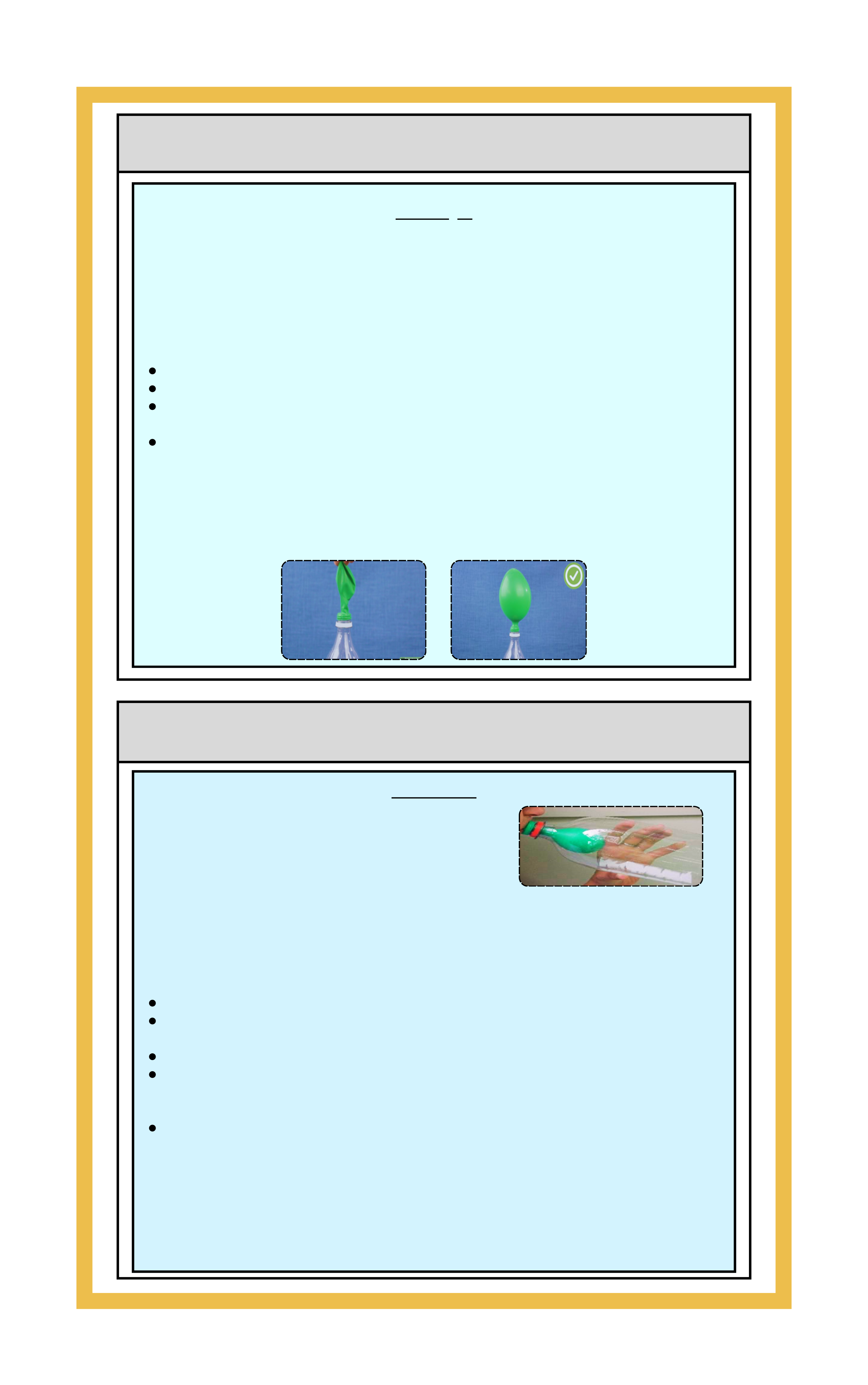
Procedure: Take an empty plastic bottle and cover the mouth of the
bottle with the balloon. Press the bottle with great force and see what
happens.
Questions:
What happened when the bottle was pressed?
What do you think helped the balloon to blow?
Do you think the bottle was empty, or did it have something in it
which we cannot see? How do you get to know that?
Why did the balloon inflate when pressure was applied on the
bottle?
Findings: Air is not visible to us, but it is present everywhere. As we
see that when pressure was exerted on the bottle, the balloon started
to blow and we concluded that air was present inside the bottle which
helped blow the balloon.
Annexure B
Station 01
Purpose of the Activity: To prove that air
occupies space.
Materials: Balloons, plastic bottle
Procedure: Blow a balloon in an open environment. Now pick up the
plastic bottle and put the balloon inside the bottle by covering its
mouth and then try to blow the balloon.
Questions:
Which balloon you were able to blow and why?
What was present inside the bottle which didn’t allow the balloon
to blow?
How do you get to know that air is present inside the bottle?
Air is also present in an open environment and inside the bottle.
Why was the balloon not able to blow inside the bottle as air is
present in both cases?
What can you conclude through this experiment?
Findings: The balloon was blowing when it was out of the bottle in an
open environment and when it was in the bottle it became difficult to
blow. Inside the bottle, air was present so there was not enough
space for the balloon to be blown. It means the bottle was not empty
instead air was there, and it takes up space due to which it didn’t
allow the balloon to blow.
50

Annexure B
Station 02
Purpose of the Activity: To prove that air exerts pressure.
Materials: Plastic bottle, thumb pins, tub, water
Procedure: Fill a plastic bottle with water and close it. Prick the
bottle with the needle and see what happens to water? Now open
the lid of the bottle and observe what happens?
Questions:
What happened when you pricked the bottle?
What happened when you opened the lid of the bottle and why?
Why do you think water did not flow when the lid was closed?
Findings: When the lid was closed, water did not flow through the
pricked holes but when the lid was opened water started flowing. It
means when the lid was opened, air from the top applied pressure on
water and it started to flow. On the other hand, when the lid was
closed no air pressure was being applied so the water did not flow. It
shows that air exerts pressure on objects.
Station 03
Purpose of the Activity: To prove that air has weight.
Materials: Balloons, rod, tap, scissors, thread, needle
Procedure: Fill two balloons with air making them the same size. Tie
them on both sides of the rod and balance them on the wedge. Glue
one point of the balloon with tape and prick on the tapped area with
a needle.
Questions:
What did you observe when the balloons were initially balanced
on the rod?
How did the position of the balloons change after one was
pricked with a needle?
How does this activity demonstrate that air has mass or weight?
Findings: The smaller balloon will tilt upward, and the bigger balloon
will move downward making the rod imbalanced. It demonstrates
that the bigger balloon is heavier due to the greater amount of air in
it. It implies that air has mass/weight as well.
Table
Purpose of the activity:
Materials used:
Make notes by answering the questions:
Findings
51

Use of
Algebra Tiles to
Make Teaching
and Learning
Simple
Wahid Murad
53

as variables and their use in algebra challenges the students. In
addition, other misconceptions, and perceptions about symbols, signs,
coefficients, and powers make it challenging for the students to
develop their understanding about algebraic concepts. This leads to
students’ failure in solving questions, such as linear equations and
word problems in grades 7 and 8, and complex mathematical problems
at the secondary level, and onwards. Eventually, students'
performance decreases, leading to a loss of motivation among them.
Literature has identified difficulties and issues for teachers and
students in teaching and learning algebra. In teachers’ opinion, there
are some reasons for students lacking in linear equations as students
are unable to understand the mathematical statements, and thus they
memorise the procedures instead of understanding the concepts
(Samuel et al, 2016). Secondly, algebra is taught abstractly without
using concrete materials. Lastly, students failed to recognise and
understand algebraic terms such as constants, coefficients, evaluate,
expand, factorise, etc., contributing to lower rate of achievement. A
study conducted in a government girls' high school of Karachi revealed
that students have misconceptions regarding the use of letters and
signs in algebra (Samo, 2009). The researcher further argued that
such problems have a connection with students’ lack of understanding
of concepts and teachers’ content knowledge. He further added
students misunderstand the equal sign as a signal for doing something
as an operator rather than a relational symbol of equivalence. For
example, students were not ready to accept the answers as a variable
or an expression but were looking for a single numeral value after an
equal sign as it used in arithmetic. To cope with the challenges faced
by teachers and students in an algebraic classroom, especially in
solving equations, researchers shared some of the strategies,
methods, and activities. These could be used in designing lesson plans
to achieve the desired learning objectives. This, in turn, would be
helpful for the students to build a strong conceptual understanding of
the basic algebraic terms and would also help them in evaluating and
simplifying the given expression and equations.
n the context of Pakistan, algebra is introduced in grade 6. As
beginners, most of the students face difficulties in
understanding the concepts of algebra due to their abstract
nature. For instance, the introduction of the English alphabet
54

The teaching styles, strategies, methods in designing the activities using
concrete aids play an important role in teaching topics such as linear
equations. The principles and standards for mathematics school (2000)
states that: representation is central to the study of mathematics. The
students can develop and deepen their understanding of mathematical
concepts and relationships as they create, compare, and use various
representations. Representations such as physical objects, drawings,
charts, graphs, and symbols also help students to communicate their
thinking. As explained by Toh (2009), the use of cartoons and comics to
teach algebra in a mathematics class can work out. However, the use of
cartoons and comics was not encouraged in academic books by other
educationists. He also argued that the feedback from teachers showed
that their students became more motivated to learn the subject through
the use of cartoons and comics in algebraic lessons. The teachers were
able to engage their students in the learning process. Saraswati, Putri,
and Somakim (2016) focused on the use of algebraic tiles to support the
students’ understanding of linear equations in one variable. Based on the
results, the researchers suggested that students could be supported in
understanding linear equations with one variable.
Cooper (2012) also identified the effectiveness of algebra tiles and
stated that, “I have seen that these tools can help students increase their
conceptual understanding of the mathematics concepts beyond
memorization and rote procedures” (p.116). Algebra tiles are considered
effective teaching aids used in the lessons of algebra in mathematics
class. Teachers can also replicate the algebra tiles using available
resources.
55

C
Subject
Mathematics
Topic
Linear Equation With One Variable
Class
07
Duration
55 minutes
Prior
Knowledge
Students are already familiar with the ways to find the
missing numbers.
Students
Learning
Outcomes
By the end of the lesson, students will be able to:
Define linear equations in one variable with examples.
Find the solution of linear equations in one variable
using algebra tiles.
Learning
Resources
Algebra tiles, markers, books, copies, board, and duster or
relevant materials
56

Time
Content and teacher/ student activity
10
mins
Engage
The teacher will use the inquiry method to know students'
prior knowledge related to the topic. For instance, he/she
will ask the following questions from the previous lessons to
engage students and make a connection with the lesson on
the topic.
3 times 2 is equals to ………?. If students answer 6, then
ask them if 2 times 3 is also w.
The previous question aims to see the students’
misunderstanding of the concept of the equal sign. Some
students believe that after an equal sign, there is always a
specific answer, usually a number.
What do you think is meant by the term ‘is equal to’?
The rationale behind giving the second question is to explore
another misconception that numeric values are always
placed on the right side of the equal sign; answers in the
form of variables are not permissible.
Based on these two questions, the teacher will later build up
the conceptual understanding of linear equations and equal
sign.
10
mins
Explore
The students will actively engage with algebra tiles to
deepen their understanding of linear equations. A variety of
algebra tiles will be provided to groups that represent
positive and negative values, as well as variables. Each
group will be assigned a simple linear equation, such as 2x +
4 = 6. They will be asked to represent this equation using
algebra tiles on their tables.
Meanwhile, the teacher will supervise their work and ask
guiding questions to facilitate their exploration. For instance,
"How can you represent variable 'x' using algebra tiles?"
The teacher will also encourage multiple representations of
the same equation with algebra tiles and encourage them to
explore different approaches and discuss why they chose
the specific approach to represent this equation.
57

Time
Content and teacher/ student activity
15
mins
Explain
The teacher will now reveal the topic and share the
objectives of the lesson with the students. With the help of
the student’s responses, he/she will define linear equations
with examples.
Next, the teacher will introduce the algebra tiles, and explain
the representation of respective tiles. He/she will make
groups of three, and ask students to solve an equation (e.g.,
3x + 5= 11). Students have the freedom in using any method
including the algebra tiles to find the unknown variable.
During the task, the teacher will supervise the class,
ensuring the active participation of all students. He/she will
also facilitate students.
The task done by the students in groups will now be
reviewed by the teacher. After that, he/she will take
responses from the students about their experience using
manipulatives (if used) and will give feedback. The teacher
will further strengthen the students’ understanding of the
basics of algebra tiles such as the names, values, and
representation of positive and negative values.
Moreover, the teacher will explain the concept of ‘zero pair’,
and how to use the algebra tiles to perform basic operations
during the process. Lastly, with the help of algebra tiles, the
teacher will solve a linear equation to faciliate students’
understanding of the concept.
15
mins
Elaborate
Students will now work in the same group, but this time they will
solve a linear equation having variables on both sides i.e., this
question will define the students' level of understanding of the
new manipulative used. Students will also be allowed to move
into other groups to help each other when done with their work.
If students are unable to solve the equation, the teacher will
help them to find the solution.
5 mins
Evaluate
At this stage, the teacher will ask students to share at least one
learning from the activity or lesson and share their opinion
about the use of manipulatives during the session with the
class.
58

Homework
Students will be asked to solve the following equations by using
traditional method as well as pictorial representation of algebraic tiles.
The working will be shown in the students’ notebooks.
6x - 4 = 20 and 9x - 5 = 32
Annexure A
Algebra Tiles
Figure 01: Positive sides of algebra tiles
Figure 02: Negative sides of algebra tiles
59

Annexure A
Concept of Zero Order Pair
Traditional Methods Algebra Tiles
3x + 5 = 11
3x = 11 - 5
3x - 6
x = 6/3
x = 2
Take out 5 small squares from both sides
to isolate the rectangular bar (x)
x - 2
60

