


Running head: BASELINE REPORT 1
Baseline Report
Dennis M Killen
School of Behavioral Sciences, Liberty University
PSYC 320, Behavior Management
Instructor Dr. Deborah Newman
February 20th, 2021

BASELINE REPORT 2
Target Behavior
The target behavior is to identify the cause of disruptive behavior in a classroom as it is
rather common and leads to the loss of valuable time to all the learners and teachers involved. In
this regard, such disruptive behavior is often caused by Oppositional Defiant Disorder (ODD),
Conduct Disorder (CD), behavioral modification and Disruptive Behavior Disorders (DBDs)
(López-Villalobos et al., 2012). In order to measure the behavior, frequencies need to be
measured in regards to the amount of times that the behavior is showcased in a classroom. In
addition, the associated power of the behavior will also be measured as well as the duration in
which the behavior lasts. This will greatly help in understanding the effects as well as
consistency of the behavior and thus creating an understanding of the effects of the behavior. In
addition, understanding the associated power of the behavior will also help to determine the
implications that such behavior can have on a functioning classroom. Such disruptive behavior is
rather common in most classrooms and is cause for great concern if not well analyzed and
changed as it serves to greatly harm the educational progress as well as the concentration of the
classroom.
Observation Period
The observation took a total of five days as these represent an average school week. In
this regard, the observation started at 8 am and ended at 3 pm every day for one week as most
school days tend to start and end at this time. The observation was carried out in a public school

BASELINE REPORT 3
from the 1st to the 5th of January 2021. The observation spanned a period of 6 hours a day as one
hour was used for lunch and short breaks thus excluded from the observation which focusses on
the behavior displayed during a normal class lesson.
Experiment Narrative
In order to complete the experiment effectively and efficiently, an ordinary classroom of
22 students are involved in the experiment. In addition, the experiment lasts the length of a full
school day in order to observe the behavior of the class in a typical setting. Short break and lunch
break are not included in the experiment as they do not count for disruptive behavior in the class
room. The structure of the observation is structured as consistent observation will be made
during class hours and observations and effects of disruptive behavior will be consistently
monitored and recorded whenever it happens. The recorded data will be filled by hand to a table
that indicates the behavior, the effect it has on the progression of the class and how long this
effect lasts. The data filled will however be in line with the time it happened and how long it
lasts as this is very important for the experiment and will help to answer questions on the reasons
being disruptive behavior in the classroom. The setting of the experiment can be termed as
natural as the experiment will be observation based and thus any incidents recorded should be
natural.
The experiment was carried out via the use of observation and any actions of disruptive
behavior was immediately recorded as well as its effect and duration. This includes actions such
as making of jokes while the teacher is teaching, noise making, doing irrelevant activities during
the lesson at hand and unnecessary movement around the class room as this can harm both the
concentration of teachers and students. In addition, the duration that each disruptive behavior had

BASELINE REPORT 4
on the classroom was noted. The effects of the disruptive behavior were also recorded as such
behavior may affect or influence other classmates thus serving to harm the integrity of the lesson.
Dimensions
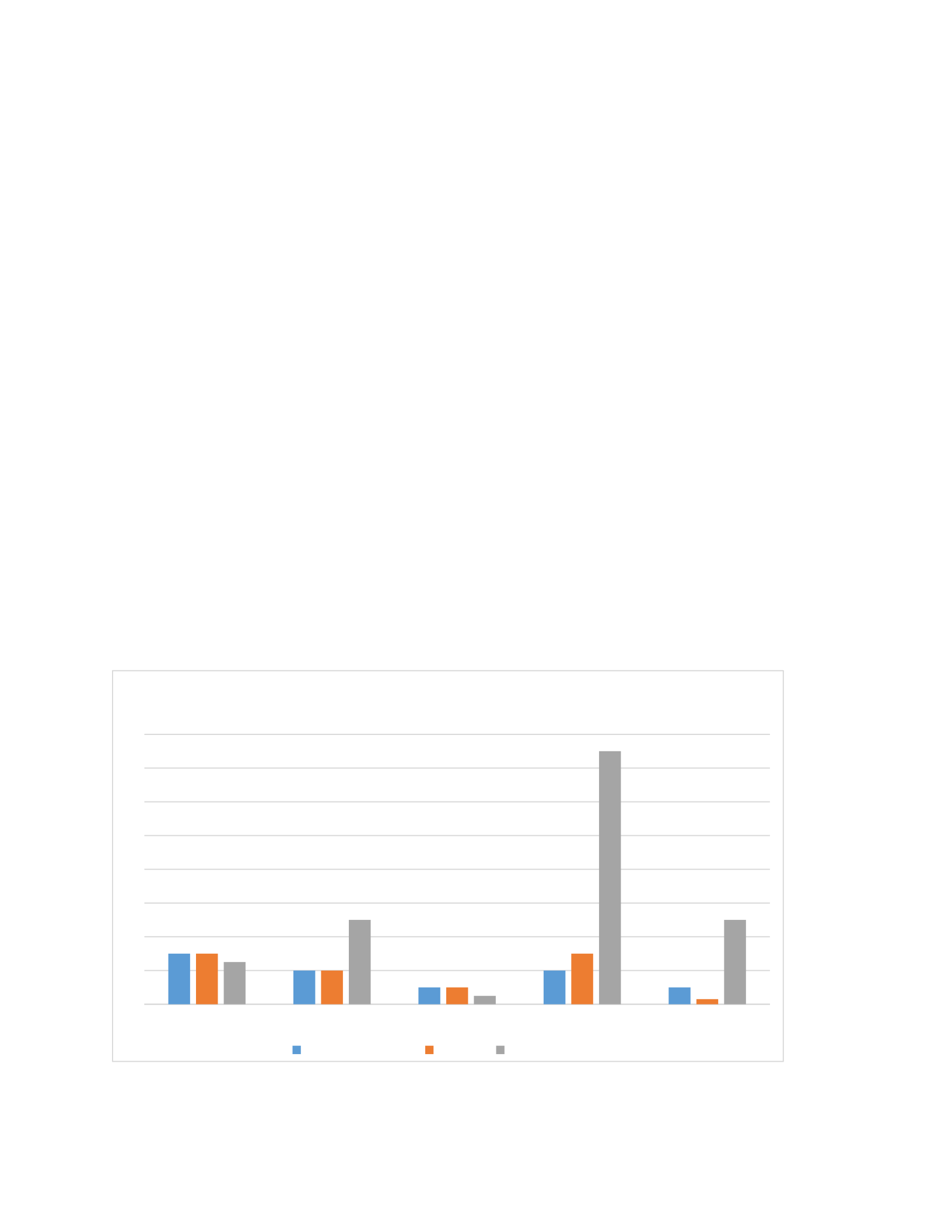
On the first day, three observations were made of disruptive behavior. Two of the
observations were made on the lesson before the lunch break and the last observation was made
on the final lesson before the end of the school day. The first two observations did not have
much intensity as they lasted only for a short period of time and only incited laughter among the
classmates. The last observation made however had a great intensity as it led the teacher two
waste two minutes of a productive lesson. The first observation made occurred for a duration of
10 seconds, the second lasted 20 seconds while the last lasted a total of two minutes. The latency
of the first two observations was almost immediate as the whole classroom was affected by the
jokes. However, the last observation had slow latency and took a while to affect the whole
classroom. On the second day of observation, two observations of disruptive behavior were
made. The first was recorded 5 minutes before 1pm which is the lunch break while the second
was recorded on the last period. In this regard, the first observation of disruptive behavior lasted
for three minutes while the second lasted for five minutes as it led to engagement from the
teacher thus disrupting the period for five minutes. This shows that the second observation had
more intensity than the first as it prompted a dialogue with the teacher who was very displeased.
Both observations showcased high latency.
On the third day, one observation of disruptive conduct was noticed that involved noise
making while the teacher was teaching. The observation lasted for 30 seconds and it managed to
disrupt the class effectively as the teacher pointed it out. The intensity of this observation was
rather low as it only involved three participants including the teacher. The latency of this

BASELINE REPORT 5
observation was rather low. Two observations were made on the fourth day and they both
happened on the last period of the day. In this regard, the first behavioral interruption lasted for
five minutes while the second lasted for ten minutes. The intensity for this disruptions was rather
high and it made the teacher to slightly go off topic. The whole classroom was affected by the
disruptions with some students pointing out that the disruptions had negatively affected their
concentration. One observation of disruptive behavior was made on the last day. It also happened
on the last duration with only 10 minutes to the end of the period. The observation lasted for five
minutes but it was not very intense as the rest of the classroom ignored it. In this regard, the
latency of this observation was surprisingly low. The fifth day also offered a single observation
that lasted 10 minutes and had low latency and intensity.
Target Behavior Observations
Various target behavior observations were made throughout the experiment. In this
regard, I noticed that students who often caused disruptive behavior were mostly seated at the
back of the class. This may be an indicator that they are aware of their behavior and thus tend to
avoid sitting at the front which is close to the teacher. In addition, most of the observations were
made at the nearly the end of the period rather than at the beginning and this serves to show that
the concentration of students is not maintained throughout the whole lesson. In addition, most of
the disruptive behavior was recorded either in the lesson before the lunch break or at the very last
lesson. This may be due to the excitement that students have about the break or about the end of
a school day. However, it can also be attributed to exhaustion as the students are very likely to be
worn out during the last period of the day and that before lunch. Such exhaustion has an impact
on the concentration of the students and may prompt them to display disruptive behavior.
Moreover, students find it relatively harder to pay attention in class when they are exhausted than

BASELINE REPORT 6
when they are refreshed. Student’s mostly disrupted the class by making uninvited noise and
engaging in small talk with each other. However, majority of the students who displayed this
behavior where mostly those who seat at the back and somehow think that the teacher cannot
monitor their behavior or that they can remain anonymous.
In addition, conflict also plays a crucial role from the observation. In this regard, some of
the disruptive behavior was often caused by two students who were engaged in an argument. In
this regard, not all students get a long in a classroom and this is a great concern as it can greatly
favor disruptive behavior. Students who had conflicts with each other portrayed rude behavior
towards each other that would commonly lead to disruptive behavior forcing the teacher to
intervene (Miltenberger, 2015). Such conflicts also lead students to make fun of each other and
even make jokes while the teacher is teaching. Such jokes have an adverse effect particularly in
regards to disruptive behavior as they serve to engage students in laughter which greatly harms
their concentration. Moreover, the process of making jokes created a disruption as students who
were silent would also feel the urge to comment on the jokes. Such behavior is not only harmful
to the integrity of the class but also to the emotional warfare of the students involved. Classwork
also proved to be slightly disruptive as it was common for students to ask each other questions in
regards to topics that they did not understand while the teacher was teaching. Despite this being a
good behavior, it however contributed to disruptive behavior in the classroom as such verbal
communications between students can affect the concentration of other students.
Overall stress was also noted in the observation as a cause of disruptive behavior. In this
regard, some student’s appeared to be stressed and this may be due to the extensive workload
that they have in class as well as pressure from upcoming assignments and exams. This stress is
in turn manifested as disruptive behavior as stressed students are very likely to engage in
BASELINE REPORT 7
arguments with other students over minor issues that in turn serve to harm the concentration of
all the students (Masi et al., 2013). In addition, stress is very common in a classroom as students
are faced with extreme pressure to not only understand the teachings but also pass in the
examination. This stress or pressure for performance can be termed as a major stimuli of the
target behavior as most students showcased signs of being stressed and easily irritable from
minor actions in the class room. The students also have a big impact of themselves as they often
encourage each other to portray the target behavior. This is, however, done indirectly as students
may react by laughing loudly to an unwelcomed joke and this encourages other students to
portray similar behavior. This can be viewed as influence from each other as the students are all
well familiar of each other and they thus have an influence in each other’s behavior. This
influence is the key determinant in the effect of the target behavior and can change the target
behavior if implemented effectively. However, more aspects need to be taken into consideration
as indicated by the experiment.
1st January 2nd January 3rd January 4th January 5th January
0
2
4
6
8
10
12
14
16
Chart Title
No. of observations Intensity Duration in mins

BASELINE REPORT 8
References
López-Villalobos, J. A., Llano, J. A., Sánchez-Azón, M. I., Sanguino-Andrés, R., & Alberola-
López, S. (2012). Disruptive behavior disorders: Multidimensional analysis. International
Journal of Clinical and Health Psychology, 12(3), 405-417.
Masi, G., Muratori, P., Manfredi, A., Lenzi, F., Polidori, L., Ruglioni, L., Milone, A. (2013).
Response to treatments in youth with disruptive behavior disorders. Comprehensive
Psychiatry, 54(7), 1009-1015. 10.1016/j.comppsych.2013.04.007
Miltenberger, R. G. (2015). Behavior modification: Principles and procedures (5th ed.).
Stamford, CT: Cengage.

