



PHYS 201 - Space physics Question Bank
Question 1
Problem: Calculate the escape velocity from the surface of the Earth. As-
sume the mass of the Earth Meis approximately 5.972 ×1024 kg, and the radius
of the Earth Reis approximately 6.371 ×10⁶meters.
Constants: - Gravitational constant, G= 6.67430 ×10⁻¹¹ m3kg−1s−2
Formulas: - Escape Velocity ve=q2GMe
Re
Step-by-Step Solution:
1. Identify Known Values: - Mass of Earth, Me= 5.972 ×1024 kg - Ra-
dius of Earth, Re= 6.371 ×10⁶m - Gravitational constant, G= 6.67430 ×
10−11 m3kg−1s−2
2. Insert the known values into the escape velocity formula:
ve=r2×6.67430 ×10−11 ×5.972 ×1024
6.371 ×10⁶
3. Perform the Multiplication in the Numerator: - Calculate 2 ×G×Me=
2×6.67430 ×10−11 ×5.972 ×1024 = 7.978 ×10¹⁴ (m
³
kg/s
²
)
4. Calculate the Escape Velocity: - ve=q7.978×1014
6.371×10⁶-ve=√1.252 ×10⁸
(m
²
/s
²
) - ve≈11186 m/s
5. Conclusion: The escape velocity from the surface of the Earth is approx-
imately 11,186 meters per second (or about 11.2 kilometers per second).
This calculation gives you a sense of the speed needed to break free from
Earth’s gravitational attraction without further propulsion. Question 1: Cal-
culating the Escape Velocity from Earth
Problem: Calculate the escape velocity from the surface of the
Earth. Assume the mass of the Earth Meis approximately 5.972 ×1024
kg, and the radius of the Earth Reis approximately 6.371×10⁶meters.
Constants: - Gravitational constant, G= 6.67430 ×10⁻¹¹ m3kg−1s−2
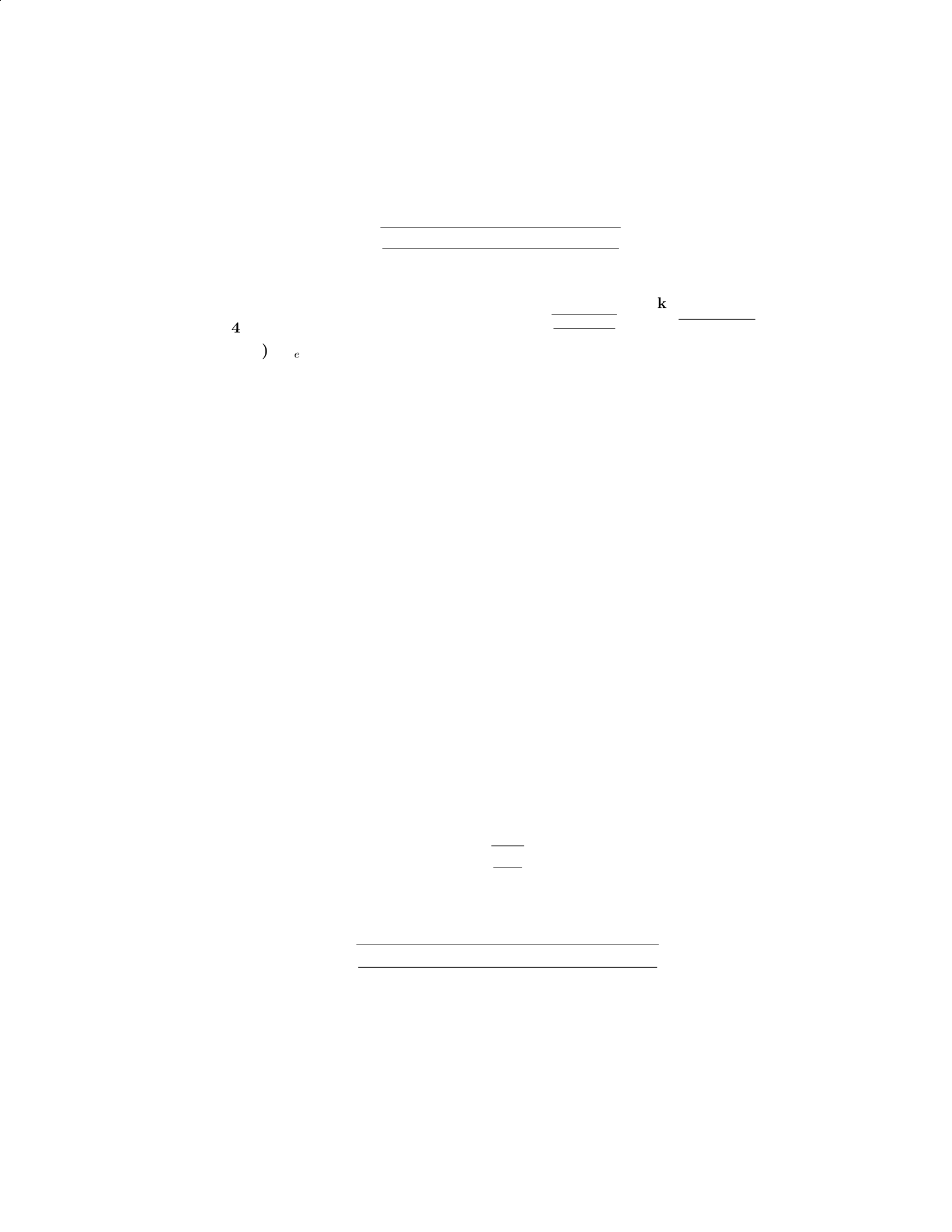
Formulas: - Escape Velocity ve=q2GMe
Re
Step-by-Step Solution:
1. Identify Known Values: - Mass of Earth, Me= 5.972 ×1024
kg - Radius of Earth, Re= 6.371 ×10⁶m - Gravitational constant,
G= 6.67430 ×10⁻¹¹ m3kg−1s−2
1
2. Insert the known values into the escape velocity formula:
ve=r2×6.67430 ×10−11 ×5.972 ×1024
6.371 ×10⁶
3. Perform the Multiplication in the Numerator: - Calculate 2×
G×Me= 2 ×6.67430 ×10−11 ×5.972 ×1024 = 7.978 ×10¹⁴ (m
³
kg/s
²
)
4. Calculate the Escape Velocity: - ve=q7.978×1014
6.371×10⁶-ve=√1.252 ×10⁸
(m
²
/s
²
) - ve≈11186 m/s
5. Conclusion: The escape velocity from the surface of the Earth
is approximately 11,186 meters per second (or about 11.2 kilometers
per second).
This calculation gives you a sense of the speed needed to break free
from Earth’s gravitational attraction without further propulsion.
Question 2
Question: A satellite orbits the Earth at a height of 300 kilometers
(km) above the Earth’s surface. Given that the mass of the Earth is
approximately 5.97 ×1024 kilograms (kg), and the gravitational con-
stant is 6.674 ×10⁻¹¹ N(m/kg)2, calculate the period of the satellite’s
orbit in hours. Assume the radius of the Earth is 6,371 km.
Step-by-Step Solution:
Step 1: Find the total distance from the center of the Earth to the
satellite. The total distance rfrom the center of Earth to the satellite
is the sum of the Earth’s radius and the altitude of the satellite:
r= 6,371 km + 300 km = 6,671 km
Convert rinto meters (since 1 km = 1,000 m):
r= 6,671 ×1,000 m= 6,671,000 m
Step 2: Use Newton’s version of Kepler’s third law to find the
period T. The period Tof the orbit can be calculated by the formula:
T= 2πrr3
GM
where Gis the gravitational constant and Mis the mass of the Earth.
Step 3: Plug in the values and calculate T.
T= 2πs(6,671,000 m)3
(6.674 ×10⁻¹¹ N(m/kg)2)(5.97 ×1024 kg)
Step 4: Calculate inside the square root.
Cubic meters (m3): (6,671,000)3= 2.97 ×10²⁰ m3
2

Denominator : (6.674 ×10−11)×(5.97 ×1024)=3.986 ×10¹⁴ m3/s2
s2.97 ×1020 m3
3.986 ×10¹⁴ m3/s2=p745.017 ×105s2= 27310 s
Step 5: Convert the period from seconds to hours.
T=27310 s
3600 s/hr ≈7.59 hours
Conclusion: The period of the satellite’s orbit is approximately
7.59 hours.
Answer: The orbital period of the satellite is approximately 7.59
hours. Question 2: Determining the Period of an Orbiting Satellite
Question: A satellite orbits the Earth at a height of 300 kilometers
(km) above the Earth’s surface. Given that the mass of the Earth is
approximately 5.97 ×1024 kilograms (kg), and the gravitational con-
stant is 6.674 ×10⁻¹¹ N(m/kg)2, calculate the period of the satellite’s
orbit in hours. Assume the radius of the Earth is 6,371 km.
Step-by-Step Solution:
Step 1: Find the total distance from the center of the Earth to the
satellite. The total distance rfrom the center of Earth to the satellite
is the sum of the Earth’s radius and the altitude of the satellite:
r= 6,371 km + 300 km = 6,671 km
Convert rinto meters (since 1 km = 1,000 m):
r= 6,671 ×1,000 m= 6,671,000 m
Step 2: Use Newton’s version of Kepler’s third law to find the
period T. The period Tof the orbit can be calculated by the formula:
T= 2πrr3
GM
where Gis the gravitational constant and Mis the mass of the Earth.
Step 3: Plug in the values and calculate T.
T= 2πs(6,671,000 m)3
(6.674 ×10⁻¹¹ N(m/kg)2)(5.97 ×1024 kg)
Step 4: Calculate inside the square root.
Cubic meters (m3): (6,671,000)3= 2.97 ×10²⁰ m3
Denominator : (6.674 ×10−11)×(5.97 ×1024)=3.986 ×10¹⁴ m3/s2
s2.97 ×1020 m3
3.986 ×10¹⁴ m3/s2=p745.017 ×105s2= 27310 s
3

Step 5: Convert the period from seconds to hours.
T=27310 s
3600 s/hr ≈7.59 hours
Conclusion: The period of the satellite’s orbit is approximately
7.59 hours.
Answer: The orbital period of the satellite is approximately 7.59
hours.
Question 3
Problem: A satellite is in a circular orbit 300 km above Earth’s
surface. Calculate the orbital velocity of the satellite. Assume the
radius of Earth is approximately 6371 km, and the mass of Earth is
5.972 ×1024 kg.
Given: - Height of the satellite above Earth’s surface (h) = 300
km - Radius of Earth (REarth) = 6371 km - Mass of Earth (MEarth ) =
5.972 ×1024 kg - Gravitational constant (G) = 6.674 ×10⁻¹¹ N·m
²
/kg
²
Objective: Calculate the orbital velocity (v) of the satellite.
—
Solution:
Step 1: Convert the altitude of the satellite from kilometers to
meters
h= 300 km = 300,000 m
Step 2: Calculate the total distance from the center of Earth to
the satellite
r=REarth +h
r= 6371 km + 300 km = 6671 km
r= 6671 km ×1000 m/km = 6,671,000 m
Step 3: Use the formula for the orbital velocity of a satellite in
circular orbit The orbital velocity vis given by:
v=rG·MEarth
r
Step 4: Substitute the known values and calculate v
v=s6.674 ×10−11 N·m2/kg2×5.972 ×1024 kg
6,671,000 m
v=s3.985 ×1014 N·m2
6,671,000 m
4

v=p59.737 ×106m2/s2
v≈7731 m/s
Conclusion: The orbital velocity of the satellite is approximately
7731 m/s. This is the speed needed to maintain a stable circular orbit
at an altitude of 300 km above Earth’s surface. Question 3: Orbital
Velocities and Satellite Motion
Problem: A satellite is in a circular orbit 300 km above Earth’s
surface. Calculate the orbital velocity of the satellite. Assume the
radius of Earth is approximately 6371 km, and the mass of Earth is
5.972 ×1024 kg.
Given: - Height of the satellite above Earth’s surface (h) = 300
km - Radius of Earth (REarth) = 6371 km - Mass of Earth (MEarth ) =
5.972 ×1024 kg - Gravitational constant (G) = 6.674 ×10⁻¹¹ N·m
²
/kg
²
Objective: Calculate the orbital velocity (v) of the satellite.
—
Solution:
Step 1: Convert the altitude of the satellite from kilometers to
meters
h= 300 km = 300,000 m
Step 2: Calculate the total distance from the center of Earth to
the satellite
r=REarth +h
r= 6371 km + 300 km = 6671 km
r= 6671 km ×1000 m/km = 6,671,000 m
Step 3: Use the formula for the orbital velocity of a satellite in
circular orbit The orbital velocity vis given by:
v=rG·MEarth
r
Step 4: Substitute the known values and calculate v
v=s6.674 ×10−11 N·m2/kg2×5.972 ×1024 kg
6,671,000 m
v=s3.985 ×1014 N·m2
6,671,000 m
v=p59.737 ×106m2/s2
v≈7731 m/s
Conclusion: The orbital velocity of the satellite is approximately
7731 m/s. This is the speed needed to maintain a stable circular orbit
at an altitude of 300 km above Earth’s surface.
5

Question 4
Problem: The Earth’s magnetosphere is predominantly influenced
by the Sun, particularly by the solar wind, a stream of charged parti-
cles emanating from the Sun. The solar wind carries magnetic fields
that interact with Earth’s magnetic field, impacting phenomena such
as the auroras and satellite communication. Given this, calculate the
time it takes for the solar wind to travel from the Sun to Earth if the
solar wind speed is approximately 400 kilometers per second.
Solution Steps:
Step 1: Understand the distance between the Sun and Earth. -
The average distance from the Earth to the Sun is about 150 million
kilometers, or 1 astronomical unit (AU).
Step 2: Establish the formula to calculate the travel time. - The
formula to calculate travel time (t) is given by
t=d
v
where dis the distance and vis the speed of the solar wind.
Step 3: Plug in the known values. - Here, d= 150,000,000 km
(distance from the Sun to Earth) and v= 400 km/s (speed of the
solar wind).
Step 4: Calculate the time (t). - Substitute the values into the
formula:
t=150,000,000 km
400 km/s = 375,000 seconds
Step 5: Convert the time from seconds to more conventional units
(hours, minutes). - Seconds to hours: Since 1 hour = 3600 seconds,
t=375,000 seconds
3600 seconds/hour ≈104.17 hours
- Hours to days: Since 1 day = 24 hours,
t=104.17 hours
24 hours/day ≈4.34 days
Step 6: Conclusion - It takes about 4.34 days for the solar wind
to travel from the Sun to Earth at a speed of 400 km/s.
This calculation is essential for understanding the dynamics be-
tween the solar wind and Earth’s magnetosphere, including the tim-
ing of geomagnetic storms that can affect satellite operations and
power grids on Earth. Question 4: The Sun’s Impact on Earth’s
Magnetosphere
Problem: The Earth’s magnetosphere is predominantly influenced
by the Sun, particularly by the solar wind, a stream of charged parti-
cles emanating from the Sun. The solar wind carries magnetic fields
6

that interact with Earth’s magnetic field, impacting phenomena such
as the auroras and satellite communication. Given this, calculate the
time it takes for the solar wind to travel from the Sun to Earth if the
solar wind speed is approximately 400 kilometers per second.
Solution Steps:
Step 1: Understand the distance between the Sun and Earth. -
The average distance from the Earth to the Sun is about 150 million
kilometers, or 1 astronomical unit (AU).
Step 2: Establish the formula to calculate the travel time. - The
formula to calculate travel time (t) is given by
t=d
v
where dis the distance and vis the speed of the solar wind.
Step 3: Plug in the known values. - Here, d= 150,000,000 km
(distance from the Sun to Earth) and v= 400 km/s (speed of the
solar wind).
Step 4: Calculate the time (t). - Substitute the values into the
formula:
t=150,000,000 km
400 km/s = 375,000 seconds
Step 5: Convert the time from seconds to more conventional units
(hours, minutes). - Seconds to hours: Since 1 hour = 3600 seconds,
t=375,000 seconds
3600 seconds/hour ≈104.17 hours
- Hours to days: Since 1 day = 24 hours,
t=104.17 hours
24 hours/day ≈4.34 days
Step 6: Conclusion - It takes about 4.34 days for the solar wind
to travel from the Sun to Earth at a speed of 400 km/s.
This calculation is essential for understanding the dynamics be-
tween the solar wind and Earth’s magnetosphere, including the tim-
ing of geomagnetic storms that can affect satellite operations and
power grids on Earth.
Question 5
Question: Describe the solar wind and its composition. How does
the solar wind interact with the Earth’s magnetosphere, and what
are the observable effects on Earth?
Step-by-Step Solution:
7

Step 1: Understanding Solar Wind Begin by defining the solar
wind: The solarsmith is a stream of charged particles (mainly elec-
trons and protons) that are released from the upper atmosphere of
the sun, known as the corona. This wind flows through the solar
system at speeds of about 400 kilometers per second.
Step 2: Composition of Solar Wind Discuss its composition: It
mainly consists of electrons, protons, and alpha particles (which are
helium nuclei). Sometimes, heavier ions can be found in the solar
wind as it carries elements found in the corona.
Step 3: Interaction with Earth’s Magnetosphere Describe how so-
lar wind interacts with Earth: - The Earth’s magnetosphere is the
region around the planet that is controlled by Earth’s magnetic field.
The solar wind affects this region significantly. - When the solar
wind reaches Earth, it can compress the sunward side of the mag-
netosphere and elongate the night side into a tail. - As solar wind
particles collide with the magnetic field, some particles are trapped
and can travel along the field lines towards the Earth’s poles.
Step 4: Observable Effects on Earth List and explain observable
effects: - Auroras (Northern and Southern Lights): These are per-
haps the most beautiful and well-known effects of the solar wind.
The charged particles from the solar wind excite atoms in Earth’s
upper atmosphere, causing them to glow. - Magnetic Storms: In-
creased solar wind can lead to disturbances in the magnetosphere
called geomagnetic storms. These can disrupt radio communications
and navigation systems. - Satellite Disruption: Intense solar wind
can increase drag on low Earth orbit satellites and disturb their or-
bits. - Power Grid Fluctuations: During extreme conditions, solar
wind can induce currents that can overload power grids on Earth.
Step 5: Conclusion Conclude by emphasizing the importance of
studying solar wind: Understanding solar wind is crucial for pre-
dicting space weather and protecting Earth’s electronic systems and
infrastructures.
This explanation should give a comprehensive understanding of
the solar wind, its interactions with Earth’s magnetosphere, and its
effects. Question 5: Solar Wind and Its Effects on Earth
Question: Describe the solar wind and its composition. How does
the solar wind interact with the Earth’s magnetosphere, and what
are the observable effects on Earth?
Step-by-Step Solution:
Step 1: Understanding Solar Wind Begin by defining the solar
wind: The solarsmith is a stream of charged particles (mainly elec-
trons and protons) that are released from the upper atmosphere of
the sun, known as the corona. This wind flows through the solar
system at speeds of about 400 kilometers per second.
Step 2: Composition of Solar Wind Discuss its composition: It
mainly consists of electrons, protons, and alpha particles (which are
8

helium nuclei). Sometimes, heavier ions can be found in the solar
wind as it carries elements found in the corona.
Step 3: Interaction with Earth’s Magnetosphere Describe how so-
lar wind interacts with Earth: - The Earth’s magnetosphere is the
region around the planet that is controlled by Earth’s magnetic field.
The solar wind affects this region significantly. - When the solar
wind reaches Earth, it can compress the sunward side of the mag-
netosphere and elongate the night side into a tail. - As solar wind
particles collide with the magnetic field, some particles are trapped
and can travel along the field lines towards the Earth’s poles.
Step 4: Observable Effects on Earth List and explain observable
effects: - Auroras (Northern and Southern Lights): These are per-
haps the most beautiful and well-known effects of the solar wind.
The charged particles from the solar wind excite atoms in Earth’s
upper atmosphere, causing them to glow. - Magnetic Storms: In-
creased solar wind can lead to disturbances in the magnetosphere
called geomagnetic storms. These can disrupt radio communications
and navigation systems. - Satellite Disruption: Intense solar wind
can increase drag on low Earth orbit satellites and disturb their or-
bits. - Power Grid Fluctuations: During extreme conditions, solar
wind can induce currents that can overload power grids on Earth.
Step 5: Conclusion Conclude by emphasizing the importance of
studying solar wind: Understanding solar wind is crucial for pre-
dicting space weather and protecting Earth’s electronic systems and
infrastructures.
This explanation should give a comprehensive understanding of
the solar wind, its interactions with Earth’s magnetosphere, and its
effects.
Question 6
Problem: A spacecraft is to travel from Earth to Mars using a
Hohmann transfer orbit. The semi-major axis of Earth’s orbit around
the Sun is approximately 1 AU (Astronomical Unit) and that of Mars’
orbit is approximately 1.52 AU. Calculate the time period for the half
orbit transfer from Earth to Mars.
Given: - Semi-major axis of Earth’s orbit, aEarth = 1 AU - Semi-
major strategy of Mars’ orbit, aMars = 1.52 AU
Assume: - One Astronomical Unit (AU) is the average distance
from the Earth to the Sun, approximately 1.496 ×10¹¹ meters. - The
orbital period of a planet in years can be approximated by T=a3/2,
where Tis the orbital period in Earth years, and ais the semi-major
axis in AU.
Steps to Solve:
9

Step 1: Calculate the semi-major axis of the transfer orbit The
semi-major axis of the Hohmann transfer orbit, atrans , is the average
of the semi-major axes of the Earth’s and Mars’ orbits:
atrans =aEarth +aMars
2=1+1.52
2= 1.26 AU
Step 2: Calculate the orbital period of the transfer orbit Using
the formula for the orbital period:
T=a3/2
Substitute atrans = 1.26 AU:
Ttrans = (1.26)3/2≈1.41 years
Step 3: Calculate the time for the half orbit transfer Since the
Hohmann transfer involves only half the orbit from Earth to Mars,
the transfer time is half the total period:
Thalf-transfer =Ttrans
2=1.41
2≈0.705 years
Conclusion: The time required for the spacecraft to transfer from
Earth to Mars using a Hohmann transfer orbit is approximately 0.705
years, which is around 258 days (since 1year ≈365 days).
This concludes the calculation for the half orbit transfer time using
a Hohmann transfer orbit. Question 6: The Hohmann Transfer Orbit
Problem: A spacecraft is to travel from Earth to Mars using a
Hohmann transfer orbit. The semi-major axis of Earth’s orbit around
the Sun is approximately 1 AU (Astronomical Unit) and that of Mars’
orbit is approximately 1.52 AU. Calculate the time period for the half
orbit transfer from Earth to Mars.
Given: - Semi-major axis of Earth’s orbit, aEarth = 1 AU - Semi-
major strategy of Mars’ orbit, aMars = 1.52 AU
Assume: - One Astronomical Unit (AU) is the average distance
from the Earth to the Sun, approximately 1.496 ×10¹¹ meters. - The
orbital period of a planet in years can be approximated by T=a3/2,
where Tis the orbital period in Earth years, and ais the semi-major
axis in AU.
Steps to Solve:
Step 1: Calculate the semi-major axis of the transfer orbit The
semi-major axis of the Hohmann transfer orbit, atrans , is the average
of the semi-major axes of the Earth’s and Mars’ orbits:
atrans =aEarth +aMars
2=1+1.52
2= 1.26 AU
Step 2: Calculate the orbital period of the transfer orbit Using
the formula for the orbital period:
T=a3/2
10

Substitute atrans = 1.26 AU:
Ttrans = (1.26)3/2≈1.41 years
Step 3: Calculate the time for the half orbit transfer Since the
Hohmann transfer involves only half the orbit from Earth to Mars,
the transfer time is half the total period:
Thalf-transfer =Ttrans
2=1.41
2≈0.705 years
Conclusion: The time required for the spacecraft to transfer from
Earth to Mars using a Hohmann transfer orbit is approximately 0.705
years, which is around 258 days (since 1year ≈365 days).
This concludes the calculation for the half orbit transfer time using
a Hohmann transfer orbit.
Question 7
Problem: A distant star’s light exhibits a redshift, indicating that
it is moving away from Earth. If the observed wavelength of a partic-
ular spectral line is 656.5 nm, and the rest (actual) wavelength of that
line (when the star is considered stationary relative to Earth) is 656.2
nm, calculate the velocity at which the star is receding from Earth.
Assume the speed of light in a vacuum is approximately 3.00 ×10⁸
m/s.
Step-by-Step Solution:
Step 1: Identify the given information. - Observed wavelength
(λobs) = 656.5 nm - Rest wavelength (λrest) = 656.2 nm - Speed of
light (c) = 3.00 ×10⁸m/s
Step 2: Convert wavelengths from nanometers to meters for ac-
curate calculation (1 nm = 1×10⁻⁹m). - λobs = 656.5×10⁻⁹m -
λrest = 656.2×10⁻⁹m
Step 3: Calculate the Doppler shift (z) using the formula:
z=λobs −λrest
λrest
Plugging in the values:
z=656.5×10⁻⁹m−656.2×10⁻⁹m
656.2×10⁻⁹m
z=0.3×10⁻⁹
656.2×10⁻⁹
z≈4.573 ×10⁻⁴
11

Step 4: Use the redshift (z) to find the velocity (v) of the star
using the relation:
v=z×c
v= 4.573 ×10−4×3.00 ×108m/s
v≈137190 m/s
Step 5: Convert velocity from meters per second to kilometers per
second for easier comprehension if desired.
v≈137.19 km/s
Conclusion: The star is receding from Earth at approximately
137.19 km/s based on the observed redshift in its spectral line. Ques-
tion 7: Investigating the Doppler Shift in Stellar Spectra
Problem: A distant star’s light exhibits a redshift, indicating that
it is moving away from Earth. If the observed wavelength of a partic-
ular spectral line is 656.5 nm, and the rest (actual) wavelength of that
line (when the star is considered stationary relative to Earth) is 656.2
nm, calculate the velocity at which the star is receding from Earth.
Assume the speed of light in a vacuum is approximately 3.00 ×10⁸
m/s.
Step-by-Step Solution:
Step 1: Identify the given information. - Observed wavelength
(λobs) = 656.5 nm - Rest wavelength (λrest ) = 656.2 nm - Speed of
light (c) = 3.00 ×10⁸m/s
Step 2: Convert wavelengths from nanometers to meters for ac-
curate calculation (1 nm = 1×10⁻⁹m). - λobs = 656.5×10⁻⁹m -
λrest = 656.2×10⁻⁹m
Step 3: Calculate the Doppler shift (z) using the formula:
z=λobs −λrest
λrest
Plugging in the values:
z=656.5×10⁻⁹m−656.2×10⁻⁹m
656.2×10⁻⁹m
z=0.3×10⁻⁹
656.2×10⁻⁹
z≈4.573 ×10⁻⁴
Step 4: Use the redshift (z) to find the velocity (v) of the star
using the relation:
v=z×c
v= 4.573 ×10−4×3.00 ×108m/s
12

v≈137190 m/s
Step 5: Convert velocity from meters per second to kilometers per
second for easier comprehension if desired.
v≈137.19 km/s
Conclusion: The star is receding from Earth at approximately
137.19 km/s based on the observed redshift in its spectral line.
Question 8
Question: The solar wind is a stream of charged particles released
from the upper atmosphere of the Sun, known as the corona. This
wind flows throughout the solar system, influencing various space
weather phenomena and interactions with planetary atmospheres and
magnetic fields. Discuss:
1. What primarily composes the solar wind and how are these
components generated in the Sun? 2. Explain how the solar wind
interacts with Earth’s magnetosphere. 3. What is an aurora, and
how is it related to the solar wind?
Provide detailed responses and use diagrams where necessary.
Solution:
Step 1: Composition and Generation of the Solar Wind - Primary
Components: The solar wind is primarily composed of electrons, pro-
tons, and alpha particles (helium nuclei). These charged particles are
all plasma, which is the fourth state of matter. - Generation in the
Sun: The high temperatures of the Sun’s corona (about 1 to 3 million
degrees Kelvin) provide enough energy for electrons to escape from
the attraction of their nuclei, creating plasma. This plasma is then
ejected from the corona due to the Sun’s high temperature and its
dynamic magnetic fields which are not completely understood but are
believed to play a crucial role in heating the corona and accelerating
solar wind particles.
Step 2: Interactions with Earth’s Magnetosphere - Encounter with
Magnetosphere: When the solar wind reaches Earth, it encounters
the Earth’s magnetosphere, which is a region around the Earth dom-
inated by Earth’s magnetic field. - Magnetic Reconnection: Some of
the solar wind’s charged particles are captured by Earth’s magnetic
field, particularly at the polar regions. The process involves mag-
netic reconnection, where the Earth’s magnetic field lines connect
with those of the solar wind, transferring energy, mass, and momen-
tum from the solar wind into the magnetosphere. - Effects: This
interaction can compress the magnetosphere on the day-side and ex-
tend the magnetic tail on the night-side. The process can disturb the
magnetosphere, causing geomagnetic storms and related phenomena.
13

Step 3: The Aurora Formation - Mechanism of Aurora Formation:
Auroras, commonly known as Northern Lights (Aurora Borealis) in
the northern hemisphere and Southern Lights (Aurora Australis) in
the southern hemisphere, are caused by the interaction of Earth’s
magnetosphere with charged particles from the solar wind. - Process:
These particles travel along the planetary magnetic field lines to the
poles, where they collide with atoms and molecules in Earth’s upper
atmosphere, such as oxygen and nitrogen. The energy transfer from
these collisions excites atoms to higher energy states, and as they
return to their ground state, they emit light, visible as auroras. -
Colors and Patterns: The colors of the aurora depend on the type of
gas molecules involved and their altitudes. Oxygen emits green and
red light, while nitrogen emits blue and purple light.
Using diagrams in the explanations, such as those depicting Earth’s
magnetosphere and how solar wind particles are funneled towards the
poles, can enhance understanding. Additionally, illustrating the mag-
netic reconnection process and variations in auroral colors could be
beneficial for visual learners. Question 8: Characteristics of the Solar
Wind and Its Effects on Earth
Question: The solar wind is a stream of charged particles released
from the upper atmosphere of the Sun, known as the corona. This
wind flows throughout the solar system, influencing various space
weather phenomena and interactions with planetary atmospheres and
magnetic fields. Discuss:
1. What primarily composes the solar wind and how are these
components generated in the Sun? 2. Explain how the solar wind
interacts with Earth’s magnetosphere. 3. What is an aurora, and
how is it related to the solar wind?
Provide detailed responses and use diagrams where necessary.
Solution:
Step 1: Composition and Generation of the Solar Wind - Primary
Components: The solar wind is primarily composed of electrons, pro-
tons, and alpha particles (helium nuclei). These charged particles are
all plasma, which is the fourth state of matter. - Generation in the
Sun: The high temperatures of the Sun’s corona (about 1 to 3 million
degrees Kelvin) provide enough energy for electrons to escape from
the attraction of their nuclei, creating plasma. This plasma is then
ejected from the corona due to the Sun’s high temperature and its
dynamic magnetic fields which are not completely understood but are
believed to play a crucial role in heating the corona and accelerating
solar wind particles.
Step 2: Interactions with Earth’s Magnetosphere - Encounter with
Magnetosphere: When the solar wind reaches Earth, it encounters
the Earth’s magnetosphere, which is a region around the Earth dom-
inated by Earth’s magnetic field. - Magnetic Reconnection: Some of
the solar wind’s charged particles are captured by Earth’s magnetic
14

field, particularly at the polar regions. The process involves mag-
netic reconnection, where the Earth’s magnetic field lines connect
with those of the solar wind, transferring energy, mass, and momen-
tum from the solar wind into the magnetosphere. - Effects: This
interaction can compress the magnetosphere on the day-side and ex-
tend the magnetic tail on the night-side. The process can disturb the
magnetosphere, causing geomagnetic storms and related phenomena.
Step 3: The Aurora Formation - Mechanism of Aurora Formation:
Auroras, commonly known as Northern Lights (Aurora Borealis) in
the northern hemisphere and Southern Lights (Aurora Australis) in
the southern hemisphere, are caused by the interaction of Earth’s
magnetosphere with charged particles from the solar wind. - Process:
These particles travel along the planetary magnetic field lines to the
poles, where they collide with atoms and molecules in Earth’s upper
atmosphere, such as oxygen and nitrogen. The energy transfer from
these collisions excites atoms to higher energy states, and as they
return to their ground state, they emit light, visible as auroras. -
Colors and Patterns: The colors of the aurora depend on the type of
gas molecules involved and their altitudes. Oxygen emits green and
red light, while nitrogen emits blue and purple light.
Using diagrams in the explanations, such as those depicting Earth’s
magnetosphere and how solar wind particles are funneled towards the
poles, can enhance understanding. Additionally, illustrating the mag-
netic reconnection process and variations in auroral colors could be
beneficial for visual learners.
Question 9
Problem: Consider a hypothetical planet X orbiting a star similar
to the Sun in another solar system. The orbital period of planet X is
16 Earth years, and the semi-major axis of its orbit is 4 AU.
Part A: Use Kepler’s Third Law of Planetary Motion to predict
the ratio of the masses of the sun-like star and the hypothetical planet
X. Assume that the mass of planet X is much smaller than the mass
of the star.
Part B: Considering the given semi-major axis of the orbit, calcu-
late the average orbital speed of planet X.
Solution
Part A: Step-by-Step Solution
1. Understanding Kepler’s Third Law: Kepler’s Third Law states
that for any planet, the square of the orbital period (T) is propor-
tional to the cube of the semi-major axis (a) of its orbit around the
sun, which mathematically can be expressed as T2∝a3.
2. Formulating the Equation: In terms of universal gravitation,
the relation becomes T2=4π2
G(M+m)×a3, where: - Tis the orbital period
15

-ais the semi-major axis - Gis the gravitational constant - Mis the
mass of the star - mis the mass of the planet
3. Applying the Assumption: Since m(mass of planet X) is much
smaller than M(mass of the sun-like star), we can simplify the equa-
tion to T2≈4π2
GM ×a3.
4. Isolating the Mass of the Star: Re-arranging to find Mgives:
M≈4π2
G×a3
T2
5. Substituting the Values: - T= 16 years = 16 ×365.25 ×86400
seconds (converting years to seconds) - a= 4 AU = 4×1.496 ×1011
meters (converting AU to meters) - As this is a calculation of the
ratio of masses and considering Gand 4π2as constants, the result
simplifies further emphasizing that Mis significantly greater than m.
Conclusion for Part A: The star’s mass, compared to Earth’s sun
if aand Tare the same in terms of magnitude, reflects a similar mass
since Kepler’s laws are universal.
—
Part B: Step-by-Step Solution
1. Average Orbital Speed Calculation: The average orbital speed
vof a planet is given by the circumference of the orbit divided by the
orbital period, v=2πa
T.
2. Substituting the Values: - Using a= 4 AU and T= 16 years
from Part A - Convert ato meters and Tto seconds as before
3. Calculate:
v=2π×4×1.496 ×1011 m
16 ×365.25 ×86400 s
v≈3.7699 ×10¹² m
505440000 s
v≈7463 m/s
Conclusion for Part B: The average orbital speed of planet X is
approximately 7463 m/s, moving in its orbit around the sun-like star.
Overall Conclusion: These calculations based on Kepler’s laws
show how we can estimate essential orbital parameters for exoplanets
in other solar systems, assuming similar conditions to our solar sys-
tem. Question 9: Understanding Kepler’s Laws of Planetary Motion
Problem: Consider a hypothetical planet X orbiting a star similar
to the Sun in another solar system. The orbital period of planet X is
16 Earth years, and the semi-major axis of its orbit is 4 AU.
Part A: Use Kepler’s Third Law of Planetary Motion to predict
the ratio of the masses of the sun-like star and the hypothetical planet
X. Assume that the mass of planet X is much smaller than the mass
of the star.
Part B: Considering the given semi-major axis of the orbit, calcu-
late the average orbital speed of planet X.
16

Solution
Part A: Step-by-Step Solution
1. Understanding Kepler’s Third Law: Kepler’s Third Law states
that for any planet, the square of the orbital period (T) is propor-
tional to the cube of the semi-major axis (a) of its orbit around the
sun, which mathematically can be expressed as T2∝a3.
2. Formulating the Equation: In terms of universal gravitation,
the relation becomes T2=4π2
G(M+m)×a3, where: - Tis the orbital period
-ais the semi-major axis - Gis the gravitational constant - Mis the
mass of the star - mis the mass of the planet
3. Applying the Assumption: Since m(mass of planet X) is much
smaller than M(mass of the sun-like star), we can simplify the equa-
tion to T2≈4π2
GM ×a3.
4. Isolating the Mass of the Star: Re-arranging to find Mgives:
M≈4π2
G×a3
T2
5. Substituting the Values: - T= 16 years = 16 ×365.25 ×86400
seconds (converting years to seconds) - a= 4 AU = 4×1.496 ×1011
meters (converting AU to meters) - As this is a calculation of the
ratio of masses and considering Gand 4π2as constants, the result
simplifies further emphasizing that Mis significantly greater than m.
Conclusion for Part A: The star’s mass, compared to Earth’s sun
if aand Tare the same in terms of magnitude, reflects a similar mass
since Kepler’s laws are universal.
—
Part B: Step-by-Step Solution
1. Average Orbital Speed Calculation: The average orbital speed
vof a planet is given by the circumference of the orbit divided by the
orbital period, v=2πa
T.
2. Substituting the Values: - Using a= 4 AU and T= 16 years
from Part A - Convert ato meters and Tto seconds as before
3. Calculate:
v=2π×4×1.496 ×1011 m
16 ×365.25 ×86400 s
v≈3.7699 ×10¹² m
505440000 s
v≈7463 m/s
Conclusion for Part B: The average orbital speed of planet X is
approximately 7463 m/s, moving in its orbit around the sun-like star.
Overall Conclusion: These calculations based on Kepler’s laws
show how we can estimate essential orbital parameters for exoplan-
ets in other solar systems, assuming similar conditions to our solar
system.
17

Question 10
In a mission to Jupiter, a spacecraft utilizes a gravity assist maneu-
ver by flying close to Venus for an increase in speed. The spacecraft,
with an initial velocity of 12 km/s relative to the Sun, approaches
Venus, which orbits the Sun at 35 km/s. Calculate the new velocity
of the spacecraft relative to the Sun after the gravity assist, assuming
an ideal scenario where the angle of deflection is 180 degrees.
Steps for Solution:
Step 1: Understand the concept of a gravity assist (or slingshot
maneuver). Gravity assist maneuvers take advantage of the gravita-
tional field of a planet to change the speed and direction of a space-
craft. When the spacecraft flies close to a planet, it effectively steals
a small amount of the planet’s orbital momentum, thereby altering
its own trajectory and speed relative to the Sun.
Step 2: Analyze the initial conditions. - Spacecraft velocity rel-
ative to the Sun before encounter: Vsi = 12 km/s. - Venus velocity
relative to the Sun: VV= 35 km/s.
Step 3: Calculate the spacecraft’s velocity relative to Venus before
the maneuver. To find the change in velocity, we first calculate the
relative velocity of the spacecraft to Venus:
Vreli=Vsi −VV= 12 km/s −35 km/s =−23 km/s
Step 4: Assumption of an ideal gravity assist. With a deflection
angle of 180 degrees, the magnitude of the velocity of the spacecraft
relative to Venus remains the same but the direction reverses. Hence,
after the encounter:
Vrelf=−Vreli= 23 km/s
Step 5: Calculate the spacecraft’s velocity relative to the Sun after
the maneuver.
Vsf =Vrelf+VV= 23 km/s + 35 km/s = 58 km/s
Conclusion: The new velocity of the spacecraft relative to the Sun
after receiving a gravity assist from Venus is 58 km/s. This significant
increase illustrates the effectiveness of gravity assist maneuvers in
interplanetary space missions. Question 10: Gravity Assist Maneuver
In a mission to Jupiter, a spacecraft utilizes a gravity assist maneu-
ver by flying close to Venus for an increase in speed. The spacecraft,
with an initial velocity of 12 km/s relative to the Sun, approaches
Venus, which orbits the Sun at 35 km/s. Calculate the new velocity
of the spacecraft relative to the Sun after the gravity assist, assuming
an ideal scenario where the angle of deflection is 180 degrees.
Steps for Solution:
18

Step 1: Understand the concept of a gravity assist (or slingshot
maneuver). Gravity assist maneuvers take advantage of the gravita-
tional field of a planet to change the speed and direction of a space-
craft. When the spacecraft flies close to a planet, it effectively steals
a small amount of the planet’s orbital momentum, thereby altering
its own trajectory and speed relative to the Sun.
Step 2: Analyze the initial conditions. - Spacecraft velocity rel-
ative to the Sun before encounter: Vsi = 12 km/s. - Venus velocity
relative to the Sun: VV= 35 km/s.
Step 3: Calculate the spacecraft’s velocity relative to Venus before
the maneuver. To find the change in velocity, we first calculate the
relative velocity of the spacecraft to Venus:
Vreli=Vsi −VV= 12 km/s −35 km/s =−23 km/s
Step 4: Assumption of an ideal gravity assist. With a deflection
angle of 180 degrees, the magnitude of the velocity of the spacecraft
relative to Venus remains the same but the direction reverses. Hence,
after the encounter:
Vrelf=−Vreli= 23 km/s
Step 5: Calculate the spacecraft’s velocity relative to the Sun after
the maneuver.
Vsf =Vrelf+VV= 23 km/s + 35 km/s = 58 km/s
Conclusion: The new velocity of the spacecraft relative to the Sun
after receiving a gravity assist from Venus is 58 km/s. This significant
increase illustrates the effectiveness of gravity assist maneuvers in
interplanetary space missions.
19
2. Insert the known values into the escape velocity formula:
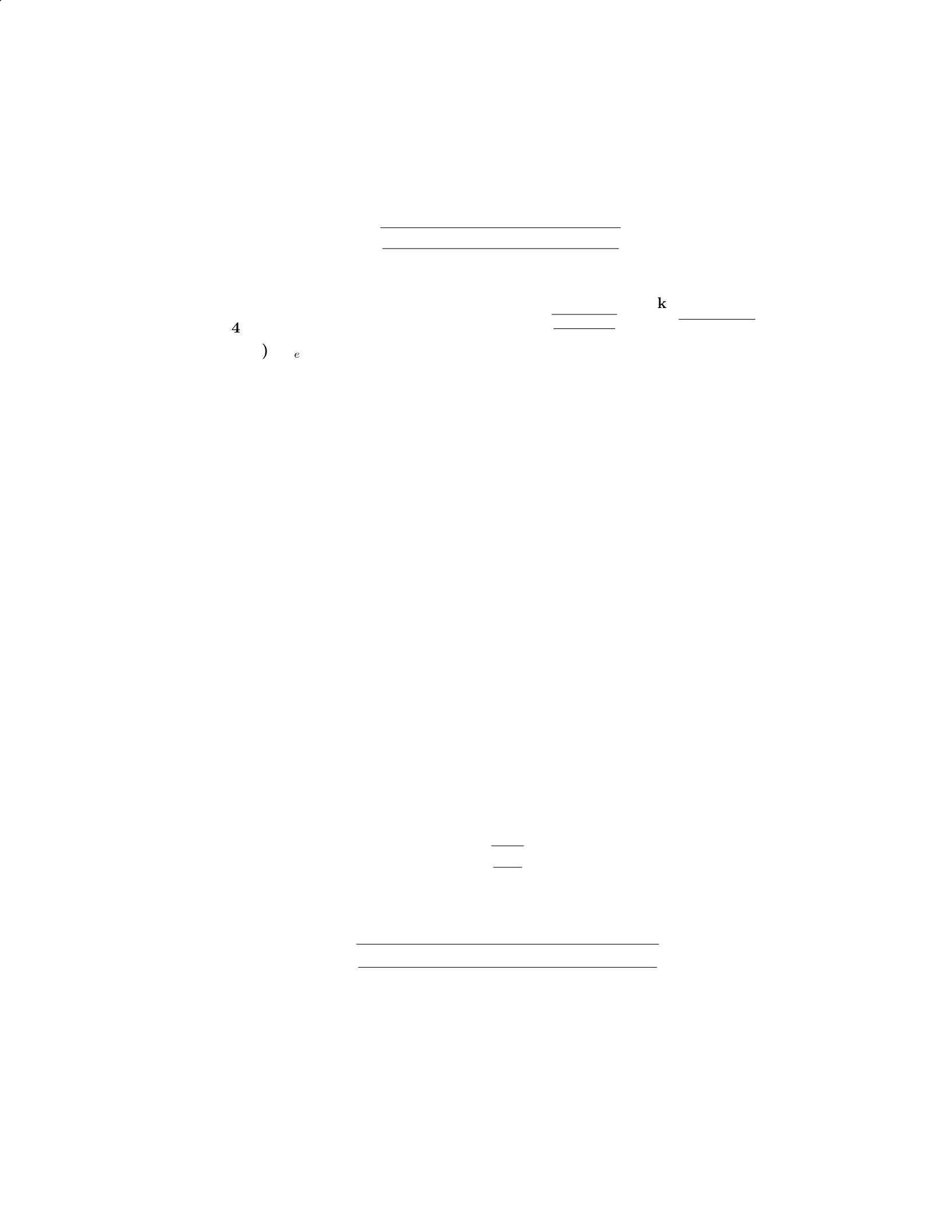
ve=r2×6.67430 ×10−11 ×5.972 ×1024
6.371 ×10⁶
3. Perform the Multiplication in the Numerator: - Calculate 2×
G×Me= 2 ×6.67430 ×10−11 ×5.972 ×1024 = 7.978 ×10¹⁴ (m
³
kg/s
²
)
4. Calculate the Escape Velocity: - ve=q7.978×1014
6.371×10⁶-ve=√1.252 ×10⁸
(m
²
/s
²
) - ve≈11186 m/s
5. Conclusion: The escape velocity from the surface of the Earth
is approximately 11,186 meters per second (or about 11.2 kilometers
per second).
This calculation gives you a sense of the speed needed to break free
from Earth’s gravitational attraction without further propulsion.
Question 2
Question: A satellite orbits the Earth at a height of 300 kilometers
(km) above the Earth’s surface. Given that the mass of the Earth is
approximately 5.97 ×1024 kilograms (kg), and the gravitational con-
stant is 6.674 ×10⁻¹¹ N(m/kg)2, calculate the period of the satellite’s
orbit in hours. Assume the radius of the Earth is 6,371 km.
Step-by-Step Solution:
Step 1: Find the total distance from the center of the Earth to the
satellite. The total distance rfrom the center of Earth to the satellite
is the sum of the Earth’s radius and the altitude of the satellite:
r= 6,371 km + 300 km = 6,671 km
Convert rinto meters (since 1 km = 1,000 m):
r= 6,671 ×1,000 m= 6,671,000 m
Step 2: Use Newton’s version of Kepler’s third law to find the
period T. The period Tof the orbit can be calculated by the formula:
T= 2πrr3
GM
where Gis the gravitational constant and Mis the mass of the Earth.
Step 3: Plug in the values and calculate T.
T= 2πs(6,671,000 m)3
(6.674 ×10⁻¹¹ N(m/kg)2)(5.97 ×1024 kg)
Step 4: Calculate inside the square root.
Cubic meters (m3): (6,671,000)3= 2.97 ×10²⁰ m3
2

Denominator : (6.674 ×10−11)×(5.97 ×1024)=3.986 ×10¹⁴ m3/s2
s2.97 ×1020 m3
3.986 ×10¹⁴ m3/s2=p745.017 ×105s2= 27310 s
Step 5: Convert the period from seconds to hours.
T=27310 s
3600 s/hr ≈7.59 hours
Conclusion: The period of the satellite’s orbit is approximately
7.59 hours.
Answer: The orbital period of the satellite is approximately 7.59
hours. Question 2: Determining the Period of an Orbiting Satellite
Question: A satellite orbits the Earth at a height of 300 kilometers
(km) above the Earth’s surface. Given that the mass of the Earth is
approximately 5.97 ×1024 kilograms (kg), and the gravitational con-
stant is 6.674 ×10⁻¹¹ N(m/kg)2, calculate the period of the satellite’s
orbit in hours. Assume the radius of the Earth is 6,371 km.
Step-by-Step Solution:
Step 1: Find the total distance from the center of the Earth to the
satellite. The total distance rfrom the center of Earth to the satellite
is the sum of the Earth’s radius and the altitude of the satellite:
r= 6,371 km + 300 km = 6,671 km
Convert rinto meters (since 1 km = 1,000 m):
r= 6,671 ×1,000 m= 6,671,000 m
Step 2: Use Newton’s version of Kepler’s third law to find the
period T. The period Tof the orbit can be calculated by the formula:
T= 2πrr3
GM
where Gis the gravitational constant and Mis the mass of the Earth.
Step 3: Plug in the values and calculate T.
T= 2πs(6,671,000 m)3
(6.674 ×10⁻¹¹ N(m/kg)2)(5.97 ×1024 kg)
Step 4: Calculate inside the square root.
Cubic meters (m3): (6,671,000)3= 2.97 ×10²⁰ m3
Denominator : (6.674 ×10−11)×(5.97 ×1024)=3.986 ×10¹⁴ m3/s2
s2.97 ×1020 m3
3.986 ×10¹⁴ m3/s2=p745.017 ×105s2= 27310 s
3

Step 5: Convert the period from seconds to hours.
T=27310 s
3600 s/hr ≈7.59 hours
Conclusion: The period of the satellite’s orbit is approximately
7.59 hours.
Answer: The orbital period of the satellite is approximately 7.59
hours.
Question 3
Problem: A satellite is in a circular orbit 300 km above Earth’s
surface. Calculate the orbital velocity of the satellite. Assume the
radius of Earth is approximately 6371 km, and the mass of Earth is
5.972 ×1024 kg.
Given: - Height of the satellite above Earth’s surface (h) = 300
km - Radius of Earth (REarth) = 6371 km - Mass of Earth (MEarth ) =
5.972 ×1024 kg - Gravitational constant (G) = 6.674 ×10⁻¹¹ N·m
²
/kg
²
Objective: Calculate the orbital velocity (v) of the satellite.
—
Solution:
Step 1: Convert the altitude of the satellite from kilometers to
meters
h= 300 km = 300,000 m
Step 2: Calculate the total distance from the center of Earth to
the satellite
r=REarth +h
r= 6371 km + 300 km = 6671 km
r= 6671 km ×1000 m/km = 6,671,000 m
Step 3: Use the formula for the orbital velocity of a satellite in
circular orbit The orbital velocity vis given by:
v=rG·MEarth
r
Step 4: Substitute the known values and calculate v
v=s6.674 ×10−11 N·m2/kg2×5.972 ×1024 kg
6,671,000 m
v=s3.985 ×1014 N·m2
6,671,000 m
4

v=p59.737 ×106m2/s2
v≈7731 m/s
Conclusion: The orbital velocity of the satellite is approximately
7731 m/s. This is the speed needed to maintain a stable circular orbit
at an altitude of 300 km above Earth’s surface. Question 3: Orbital
Velocities and Satellite Motion
Problem: A satellite is in a circular orbit 300 km above Earth’s
surface. Calculate the orbital velocity of the satellite. Assume the
radius of Earth is approximately 6371 km, and the mass of Earth is
5.972 ×1024 kg.
Given: - Height of the satellite above Earth’s surface (h) = 300
km - Radius of Earth (REarth) = 6371 km - Mass of Earth (MEarth ) =
5.972 ×1024 kg - Gravitational constant (G) = 6.674 ×10⁻¹¹ N·m
²
/kg
²
Objective: Calculate the orbital velocity (v) of the satellite.
—
Solution:
Step 1: Convert the altitude of the satellite from kilometers to
meters
h= 300 km = 300,000 m
Step 2: Calculate the total distance from the center of Earth to
the satellite
r=REarth +h
r= 6371 km + 300 km = 6671 km
r= 6671 km ×1000 m/km = 6,671,000 m
Step 3: Use the formula for the orbital velocity of a satellite in
circular orbit The orbital velocity vis given by:
v=rG·MEarth
r
Step 4: Substitute the known values and calculate v
v=s6.674 ×10−11 N·m2/kg2×5.972 ×1024 kg
6,671,000 m
v=s3.985 ×1014 N·m2
6,671,000 m
v=p59.737 ×106m2/s2
v≈7731 m/s
Conclusion: The orbital velocity of the satellite is approximately
7731 m/s. This is the speed needed to maintain a stable circular orbit
at an altitude of 300 km above Earth’s surface.
5

Question 4
Problem: The Earth’s magnetosphere is predominantly influenced
by the Sun, particularly by the solar wind, a stream of charged parti-
cles emanating from the Sun. The solar wind carries magnetic fields
that interact with Earth’s magnetic field, impacting phenomena such
as the auroras and satellite communication. Given this, calculate the
time it takes for the solar wind to travel from the Sun to Earth if the
solar wind speed is approximately 400 kilometers per second.
Solution Steps:
Step 1: Understand the distance between the Sun and Earth. -
The average distance from the Earth to the Sun is about 150 million
kilometers, or 1 astronomical unit (AU).
Step 2: Establish the formula to calculate the travel time. - The
formula to calculate travel time (t) is given by
t=d
v
where dis the distance and vis the speed of the solar wind.
Step 3: Plug in the known values. - Here, d= 150,000,000 km
(distance from the Sun to Earth) and v= 400 km/s (speed of the
solar wind).
Step 4: Calculate the time (t). - Substitute the values into the
formula:
t=150,000,000 km
400 km/s = 375,000 seconds
Step 5: Convert the time from seconds to more conventional units
(hours, minutes). - Seconds to hours: Since 1 hour = 3600 seconds,
t=375,000 seconds
3600 seconds/hour ≈104.17 hours
- Hours to days: Since 1 day = 24 hours,
t=104.17 hours
24 hours/day ≈4.34 days
Step 6: Conclusion - It takes about 4.34 days for the solar wind
to travel from the Sun to Earth at a speed of 400 km/s.
This calculation is essential for understanding the dynamics be-
tween the solar wind and Earth’s magnetosphere, including the tim-
ing of geomagnetic storms that can affect satellite operations and
power grids on Earth. Question 4: The Sun’s Impact on Earth’s
Magnetosphere
Problem: The Earth’s magnetosphere is predominantly influenced
by the Sun, particularly by the solar wind, a stream of charged parti-
cles emanating from the Sun. The solar wind carries magnetic fields
6

that interact with Earth’s magnetic field, impacting phenomena such
as the auroras and satellite communication. Given this, calculate the
time it takes for the solar wind to travel from the Sun to Earth if the
solar wind speed is approximately 400 kilometers per second.
Solution Steps:
Step 1: Understand the distance between the Sun and Earth. -
The average distance from the Earth to the Sun is about 150 million
kilometers, or 1 astronomical unit (AU).
Step 2: Establish the formula to calculate the travel time. - The
formula to calculate travel time (t) is given by
t=d
v
where dis the distance and vis the speed of the solar wind.
Step 3: Plug in the known values. - Here, d= 150,000,000 km
(distance from the Sun to Earth) and v= 400 km/s (speed of the
solar wind).
Step 4: Calculate the time (t). - Substitute the values into the
formula:
t=150,000,000 km
400 km/s = 375,000 seconds
Step 5: Convert the time from seconds to more conventional units
(hours, minutes). - Seconds to hours: Since 1 hour = 3600 seconds,
t=375,000 seconds
3600 seconds/hour ≈104.17 hours
- Hours to days: Since 1 day = 24 hours,
t=104.17 hours
24 hours/day ≈4.34 days
Step 6: Conclusion - It takes about 4.34 days for the solar wind
to travel from the Sun to Earth at a speed of 400 km/s.
This calculation is essential for understanding the dynamics be-
tween the solar wind and Earth’s magnetosphere, including the tim-
ing of geomagnetic storms that can affect satellite operations and
power grids on Earth.
Question 5
Question: Describe the solar wind and its composition. How does
the solar wind interact with the Earth’s magnetosphere, and what
are the observable effects on Earth?
Step-by-Step Solution:
7

Step 1: Understanding Solar Wind Begin by defining the solar
wind: The solarsmith is a stream of charged particles (mainly elec-
trons and protons) that are released from the upper atmosphere of
the sun, known as the corona. This wind flows through the solar
system at speeds of about 400 kilometers per second.
Step 2: Composition of Solar Wind Discuss its composition: It
mainly consists of electrons, protons, and alpha particles (which are
helium nuclei). Sometimes, heavier ions can be found in the solar
wind as it carries elements found in the corona.
Step 3: Interaction with Earth’s Magnetosphere Describe how so-
lar wind interacts with Earth: - The Earth’s magnetosphere is the
region around the planet that is controlled by Earth’s magnetic field.
The solar wind affects this region significantly. - When the solar
wind reaches Earth, it can compress the sunward side of the mag-
netosphere and elongate the night side into a tail. - As solar wind
particles collide with the magnetic field, some particles are trapped
and can travel along the field lines towards the Earth’s poles.
Step 4: Observable Effects on Earth List and explain observable
effects: - Auroras (Northern and Southern Lights): These are per-
haps the most beautiful and well-known effects of the solar wind.
The charged particles from the solar wind excite atoms in Earth’s
upper atmosphere, causing them to glow. - Magnetic Storms: In-
creased solar wind can lead to disturbances in the magnetosphere
called geomagnetic storms. These can disrupt radio communications
and navigation systems. - Satellite Disruption: Intense solar wind
can increase drag on low Earth orbit satellites and disturb their or-
bits. - Power Grid Fluctuations: During extreme conditions, solar
wind can induce currents that can overload power grids on Earth.
Step 5: Conclusion Conclude by emphasizing the importance of
studying solar wind: Understanding solar wind is crucial for pre-
dicting space weather and protecting Earth’s electronic systems and
infrastructures.
This explanation should give a comprehensive understanding of
the solar wind, its interactions with Earth’s magnetosphere, and its
effects. Question 5: Solar Wind and Its Effects on Earth
Question: Describe the solar wind and its composition. How does
the solar wind interact with the Earth’s magnetosphere, and what
are the observable effects on Earth?
Step-by-Step Solution:
Step 1: Understanding Solar Wind Begin by defining the solar
wind: The solarsmith is a stream of charged particles (mainly elec-
trons and protons) that are released from the upper atmosphere of
the sun, known as the corona. This wind flows through the solar
system at speeds of about 400 kilometers per second.
Step 2: Composition of Solar Wind Discuss its composition: It
mainly consists of electrons, protons, and alpha particles (which are
8

helium nuclei). Sometimes, heavier ions can be found in the solar
wind as it carries elements found in the corona.
Step 3: Interaction with Earth’s Magnetosphere Describe how so-
lar wind interacts with Earth: - The Earth’s magnetosphere is the
region around the planet that is controlled by Earth’s magnetic field.
The solar wind affects this region significantly. - When the solar
wind reaches Earth, it can compress the sunward side of the mag-
netosphere and elongate the night side into a tail. - As solar wind
particles collide with the magnetic field, some particles are trapped
and can travel along the field lines towards the Earth’s poles.
Step 4: Observable Effects on Earth List and explain observable
effects: - Auroras (Northern and Southern Lights): These are per-
haps the most beautiful and well-known effects of the solar wind.
The charged particles from the solar wind excite atoms in Earth’s
upper atmosphere, causing them to glow. - Magnetic Storms: In-
creased solar wind can lead to disturbances in the magnetosphere
called geomagnetic storms. These can disrupt radio communications
and navigation systems. - Satellite Disruption: Intense solar wind
can increase drag on low Earth orbit satellites and disturb their or-
bits. - Power Grid Fluctuations: During extreme conditions, solar
wind can induce currents that can overload power grids on Earth.
Step 5: Conclusion Conclude by emphasizing the importance of
studying solar wind: Understanding solar wind is crucial for pre-
dicting space weather and protecting Earth’s electronic systems and
infrastructures.
This explanation should give a comprehensive understanding of
the solar wind, its interactions with Earth’s magnetosphere, and its
effects.
Question 6
Problem: A spacecraft is to travel from Earth to Mars using a
Hohmann transfer orbit. The semi-major axis of Earth’s orbit around
the Sun is approximately 1 AU (Astronomical Unit) and that of Mars’
orbit is approximately 1.52 AU. Calculate the time period for the half
orbit transfer from Earth to Mars.
Given: - Semi-major axis of Earth’s orbit, aEarth = 1 AU - Semi-
major strategy of Mars’ orbit, aMars = 1.52 AU
Assume: - One Astronomical Unit (AU) is the average distance
from the Earth to the Sun, approximately 1.496 ×10¹¹ meters. - The
orbital period of a planet in years can be approximated by T=a3/2,
where Tis the orbital period in Earth years, and ais the semi-major
axis in AU.
Steps to Solve:
9

Step 1: Calculate the semi-major axis of the transfer orbit The
semi-major axis of the Hohmann transfer orbit, atrans , is the average
of the semi-major axes of the Earth’s and Mars’ orbits:
atrans =aEarth +aMars
2=1+1.52
2= 1.26 AU
Step 2: Calculate the orbital period of the transfer orbit Using
the formula for the orbital period:
T=a3/2
Substitute atrans = 1.26 AU:
Ttrans = (1.26)3/2≈1.41 years
Step 3: Calculate the time for the half orbit transfer Since the
Hohmann transfer involves only half the orbit from Earth to Mars,
the transfer time is half the total period:
Thalf-transfer =Ttrans
2=1.41
2≈0.705 years
Conclusion: The time required for the spacecraft to transfer from
Earth to Mars using a Hohmann transfer orbit is approximately 0.705
years, which is around 258 days (since 1year ≈365 days).
This concludes the calculation for the half orbit transfer time using
a Hohmann transfer orbit. Question 6: The Hohmann Transfer Orbit
Problem: A spacecraft is to travel from Earth to Mars using a
Hohmann transfer orbit. The semi-major axis of Earth’s orbit around
the Sun is approximately 1 AU (Astronomical Unit) and that of Mars’
orbit is approximately 1.52 AU. Calculate the time period for the half
orbit transfer from Earth to Mars.
Given: - Semi-major axis of Earth’s orbit, aEarth = 1 AU - Semi-
major strategy of Mars’ orbit, aMars = 1.52 AU
Assume: - One Astronomical Unit (AU) is the average distance
from the Earth to the Sun, approximately 1.496 ×10¹¹ meters. - The
orbital period of a planet in years can be approximated by T=a3/2,
where Tis the orbital period in Earth years, and ais the semi-major
axis in AU.
Steps to Solve:
Step 1: Calculate the semi-major axis of the transfer orbit The
semi-major axis of the Hohmann transfer orbit, atrans , is the average
of the semi-major axes of the Earth’s and Mars’ orbits:
atrans =aEarth +aMars
2=1+1.52
2= 1.26 AU
Step 2: Calculate the orbital period of the transfer orbit Using
the formula for the orbital period:
T=a3/2
10

Substitute atrans = 1.26 AU:
Ttrans = (1.26)3/2≈1.41 years
Step 3: Calculate the time for the half orbit transfer Since the
Hohmann transfer involves only half the orbit from Earth to Mars,
the transfer time is half the total period:
Thalf-transfer =Ttrans
2=1.41
2≈0.705 years
Conclusion: The time required for the spacecraft to transfer from
Earth to Mars using a Hohmann transfer orbit is approximately 0.705
years, which is around 258 days (since 1year ≈365 days).
This concludes the calculation for the half orbit transfer time using
a Hohmann transfer orbit.
Question 7
Problem: A distant star’s light exhibits a redshift, indicating that
it is moving away from Earth. If the observed wavelength of a partic-
ular spectral line is 656.5 nm, and the rest (actual) wavelength of that
line (when the star is considered stationary relative to Earth) is 656.2
nm, calculate the velocity at which the star is receding from Earth.
Assume the speed of light in a vacuum is approximately 3.00 ×10⁸
m/s.
Step-by-Step Solution:
Step 1: Identify the given information. - Observed wavelength
(λobs) = 656.5 nm - Rest wavelength (λrest) = 656.2 nm - Speed of
light (c) = 3.00 ×10⁸m/s
Step 2: Convert wavelengths from nanometers to meters for ac-
curate calculation (1 nm = 1×10⁻⁹m). - λobs = 656.5×10⁻⁹m -
λrest = 656.2×10⁻⁹m
Step 3: Calculate the Doppler shift (z) using the formula:
z=λobs −λrest
λrest
Plugging in the values:
z=656.5×10⁻⁹m−656.2×10⁻⁹m
656.2×10⁻⁹m
z=0.3×10⁻⁹
656.2×10⁻⁹
z≈4.573 ×10⁻⁴
11

Step 4: Use the redshift (z) to find the velocity (v) of the star
using the relation:
v=z×c
v= 4.573 ×10−4×3.00 ×108m/s
v≈137190 m/s
Step 5: Convert velocity from meters per second to kilometers per
second for easier comprehension if desired.
v≈137.19 km/s
Conclusion: The star is receding from Earth at approximately
137.19 km/s based on the observed redshift in its spectral line. Ques-
tion 7: Investigating the Doppler Shift in Stellar Spectra
Problem: A distant star’s light exhibits a redshift, indicating that
it is moving away from Earth. If the observed wavelength of a partic-
ular spectral line is 656.5 nm, and the rest (actual) wavelength of that
line (when the star is considered stationary relative to Earth) is 656.2
nm, calculate the velocity at which the star is receding from Earth.
Assume the speed of light in a vacuum is approximately 3.00 ×10⁸
m/s.
Step-by-Step Solution:
Step 1: Identify the given information. - Observed wavelength
(λobs) = 656.5 nm - Rest wavelength (λrest ) = 656.2 nm - Speed of
light (c) = 3.00 ×10⁸m/s
Step 2: Convert wavelengths from nanometers to meters for ac-
curate calculation (1 nm = 1×10⁻⁹m). - λobs = 656.5×10⁻⁹m -
λrest = 656.2×10⁻⁹m
Step 3: Calculate the Doppler shift (z) using the formula:
z=λobs −λrest
λrest
Plugging in the values:
z=656.5×10⁻⁹m−656.2×10⁻⁹m
656.2×10⁻⁹m
z=0.3×10⁻⁹
656.2×10⁻⁹
z≈4.573 ×10⁻⁴
Step 4: Use the redshift (z) to find the velocity (v) of the star
using the relation:
v=z×c
v= 4.573 ×10−4×3.00 ×108m/s
12

v≈137190 m/s
Step 5: Convert velocity from meters per second to kilometers per
second for easier comprehension if desired.
v≈137.19 km/s
Conclusion: The star is receding from Earth at approximately
137.19 km/s based on the observed redshift in its spectral line.
Question 8
Question: The solar wind is a stream of charged particles released
from the upper atmosphere of the Sun, known as the corona. This
wind flows throughout the solar system, influencing various space
weather phenomena and interactions with planetary atmospheres and
magnetic fields. Discuss:
1. What primarily composes the solar wind and how are these
components generated in the Sun? 2. Explain how the solar wind
interacts with Earth’s magnetosphere. 3. What is an aurora, and
how is it related to the solar wind?
Provide detailed responses and use diagrams where necessary.
Solution:
Step 1: Composition and Generation of the Solar Wind - Primary
Components: The solar wind is primarily composed of electrons, pro-
tons, and alpha particles (helium nuclei). These charged particles are
all plasma, which is the fourth state of matter. - Generation in the
Sun: The high temperatures of the Sun’s corona (about 1 to 3 million
degrees Kelvin) provide enough energy for electrons to escape from
the attraction of their nuclei, creating plasma. This plasma is then
ejected from the corona due to the Sun’s high temperature and its
dynamic magnetic fields which are not completely understood but are
believed to play a crucial role in heating the corona and accelerating
solar wind particles.
Step 2: Interactions with Earth’s Magnetosphere - Encounter with
Magnetosphere: When the solar wind reaches Earth, it encounters
the Earth’s magnetosphere, which is a region around the Earth dom-
inated by Earth’s magnetic field. - Magnetic Reconnection: Some of
the solar wind’s charged particles are captured by Earth’s magnetic
field, particularly at the polar regions. The process involves mag-
netic reconnection, where the Earth’s magnetic field lines connect
with those of the solar wind, transferring energy, mass, and momen-
tum from the solar wind into the magnetosphere. - Effects: This
interaction can compress the magnetosphere on the day-side and ex-
tend the magnetic tail on the night-side. The process can disturb the
magnetosphere, causing geomagnetic storms and related phenomena.
13

Step 3: The Aurora Formation - Mechanism of Aurora Formation:
Auroras, commonly known as Northern Lights (Aurora Borealis) in
the northern hemisphere and Southern Lights (Aurora Australis) in
the southern hemisphere, are caused by the interaction of Earth’s
magnetosphere with charged particles from the solar wind. - Process:
These particles travel along the planetary magnetic field lines to the
poles, where they collide with atoms and molecules in Earth’s upper
atmosphere, such as oxygen and nitrogen. The energy transfer from
these collisions excites atoms to higher energy states, and as they
return to their ground state, they emit light, visible as auroras. -
Colors and Patterns: The colors of the aurora depend on the type of
gas molecules involved and their altitudes. Oxygen emits green and
red light, while nitrogen emits blue and purple light.
Using diagrams in the explanations, such as those depicting Earth’s
magnetosphere and how solar wind particles are funneled towards the
poles, can enhance understanding. Additionally, illustrating the mag-
netic reconnection process and variations in auroral colors could be
beneficial for visual learners. Question 8: Characteristics of the Solar
Wind and Its Effects on Earth
Question: The solar wind is a stream of charged particles released
from the upper atmosphere of the Sun, known as the corona. This
wind flows throughout the solar system, influencing various space
weather phenomena and interactions with planetary atmospheres and
magnetic fields. Discuss:
1. What primarily composes the solar wind and how are these
components generated in the Sun? 2. Explain how the solar wind
interacts with Earth’s magnetosphere. 3. What is an aurora, and
how is it related to the solar wind?
Provide detailed responses and use diagrams where necessary.
Solution:
Step 1: Composition and Generation of the Solar Wind - Primary
Components: The solar wind is primarily composed of electrons, pro-
tons, and alpha particles (helium nuclei). These charged particles are
all plasma, which is the fourth state of matter. - Generation in the
Sun: The high temperatures of the Sun’s corona (about 1 to 3 million
degrees Kelvin) provide enough energy for electrons to escape from
the attraction of their nuclei, creating plasma. This plasma is then
ejected from the corona due to the Sun’s high temperature and its
dynamic magnetic fields which are not completely understood but are
believed to play a crucial role in heating the corona and accelerating
solar wind particles.
Step 2: Interactions with Earth’s Magnetosphere - Encounter with
Magnetosphere: When the solar wind reaches Earth, it encounters
the Earth’s magnetosphere, which is a region around the Earth dom-
inated by Earth’s magnetic field. - Magnetic Reconnection: Some of
the solar wind’s charged particles are captured by Earth’s magnetic
14

field, particularly at the polar regions. The process involves mag-
netic reconnection, where the Earth’s magnetic field lines connect
with those of the solar wind, transferring energy, mass, and momen-
tum from the solar wind into the magnetosphere. - Effects: This
interaction can compress the magnetosphere on the day-side and ex-
tend the magnetic tail on the night-side. The process can disturb the
magnetosphere, causing geomagnetic storms and related phenomena.
Step 3: The Aurora Formation - Mechanism of Aurora Formation:
Auroras, commonly known as Northern Lights (Aurora Borealis) in
the northern hemisphere and Southern Lights (Aurora Australis) in
the southern hemisphere, are caused by the interaction of Earth’s
magnetosphere with charged particles from the solar wind. - Process:
These particles travel along the planetary magnetic field lines to the
poles, where they collide with atoms and molecules in Earth’s upper
atmosphere, such as oxygen and nitrogen. The energy transfer from
these collisions excites atoms to higher energy states, and as they
return to their ground state, they emit light, visible as auroras. -
Colors and Patterns: The colors of the aurora depend on the type of
gas molecules involved and their altitudes. Oxygen emits green and
red light, while nitrogen emits blue and purple light.
Using diagrams in the explanations, such as those depicting Earth’s
magnetosphere and how solar wind particles are funneled towards the
poles, can enhance understanding. Additionally, illustrating the mag-
netic reconnection process and variations in auroral colors could be
beneficial for visual learners.
Question 9
Problem: Consider a hypothetical planet X orbiting a star similar
to the Sun in another solar system. The orbital period of planet X is
16 Earth years, and the semi-major axis of its orbit is 4 AU.
Part A: Use Kepler’s Third Law of Planetary Motion to predict
the ratio of the masses of the sun-like star and the hypothetical planet
X. Assume that the mass of planet X is much smaller than the mass
of the star.
Part B: Considering the given semi-major axis of the orbit, calcu-
late the average orbital speed of planet X.
Solution
Part A: Step-by-Step Solution
1. Understanding Kepler’s Third Law: Kepler’s Third Law states
that for any planet, the square of the orbital period (T) is propor-
tional to the cube of the semi-major axis (a) of its orbit around the
sun, which mathematically can be expressed as T2∝a3.
2. Formulating the Equation: In terms of universal gravitation,
the relation becomes T2=4π2
G(M+m)×a3, where: - Tis the orbital period
15

-ais the semi-major axis - Gis the gravitational constant - Mis the
mass of the star - mis the mass of the planet
3. Applying the Assumption: Since m(mass of planet X) is much
smaller than M(mass of the sun-like star), we can simplify the equa-
tion to T2≈4π2
GM ×a3.
4. Isolating the Mass of the Star: Re-arranging to find Mgives:
M≈4π2
G×a3
T2
5. Substituting the Values: - T= 16 years = 16 ×365.25 ×86400
seconds (converting years to seconds) - a= 4 AU = 4×1.496 ×1011
meters (converting AU to meters) - As this is a calculation of the
ratio of masses and considering Gand 4π2as constants, the result
simplifies further emphasizing that Mis significantly greater than m.
Conclusion for Part A: The star’s mass, compared to Earth’s sun
if aand Tare the same in terms of magnitude, reflects a similar mass
since Kepler’s laws are universal.
—
Part B: Step-by-Step Solution
1. Average Orbital Speed Calculation: The average orbital speed
vof a planet is given by the circumference of the orbit divided by the
orbital period, v=2πa
T.
2. Substituting the Values: - Using a= 4 AU and T= 16 years
from Part A - Convert ato meters and Tto seconds as before
3. Calculate:
v=2π×4×1.496 ×1011 m
16 ×365.25 ×86400 s
v≈3.7699 ×10¹² m
505440000 s
v≈7463 m/s
Conclusion for Part B: The average orbital speed of planet X is
approximately 7463 m/s, moving in its orbit around the sun-like star.
Overall Conclusion: These calculations based on Kepler’s laws
show how we can estimate essential orbital parameters for exoplanets
in other solar systems, assuming similar conditions to our solar sys-
tem. Question 9: Understanding Kepler’s Laws of Planetary Motion
Problem: Consider a hypothetical planet X orbiting a star similar
to the Sun in another solar system. The orbital period of planet X is
16 Earth years, and the semi-major axis of its orbit is 4 AU.
Part A: Use Kepler’s Third Law of Planetary Motion to predict
the ratio of the masses of the sun-like star and the hypothetical planet
X. Assume that the mass of planet X is much smaller than the mass
of the star.
Part B: Considering the given semi-major axis of the orbit, calcu-
late the average orbital speed of planet X.
16

Solution
Part A: Step-by-Step Solution
1. Understanding Kepler’s Third Law: Kepler’s Third Law states
that for any planet, the square of the orbital period (T) is propor-
tional to the cube of the semi-major axis (a) of its orbit around the
sun, which mathematically can be expressed as T2∝a3.
2. Formulating the Equation: In terms of universal gravitation,
the relation becomes T2=4π2
G(M+m)×a3, where: - Tis the orbital period
-ais the semi-major axis - Gis the gravitational constant - Mis the
mass of the star - mis the mass of the planet
3. Applying the Assumption: Since m(mass of planet X) is much
smaller than M(mass of the sun-like star), we can simplify the equa-
tion to T2≈4π2
GM ×a3.
4. Isolating the Mass of the Star: Re-arranging to find Mgives:
M≈4π2
G×a3
T2
5. Substituting the Values: - T= 16 years = 16 ×365.25 ×86400
seconds (converting years to seconds) - a= 4 AU = 4×1.496 ×1011
meters (converting AU to meters) - As this is a calculation of the
ratio of masses and considering Gand 4π2as constants, the result
simplifies further emphasizing that Mis significantly greater than m.
Conclusion for Part A: The star’s mass, compared to Earth’s sun
if aand Tare the same in terms of magnitude, reflects a similar mass
since Kepler’s laws are universal.
—
Part B: Step-by-Step Solution
1. Average Orbital Speed Calculation: The average orbital speed
vof a planet is given by the circumference of the orbit divided by the
orbital period, v=2πa
T.
2. Substituting the Values: - Using a= 4 AU and T= 16 years
from Part A - Convert ato meters and Tto seconds as before
3. Calculate:
v=2π×4×1.496 ×1011 m
16 ×365.25 ×86400 s
v≈3.7699 ×10¹² m
505440000 s
v≈7463 m/s
Conclusion for Part B: The average orbital speed of planet X is
approximately 7463 m/s, moving in its orbit around the sun-like star.
Overall Conclusion: These calculations based on Kepler’s laws
show how we can estimate essential orbital parameters for exoplan-
ets in other solar systems, assuming similar conditions to our solar
system.
17

Question 10
In a mission to Jupiter, a spacecraft utilizes a gravity assist maneu-
ver by flying close to Venus for an increase in speed. The spacecraft,
with an initial velocity of 12 km/s relative to the Sun, approaches
Venus, which orbits the Sun at 35 km/s. Calculate the new velocity
of the spacecraft relative to the Sun after the gravity assist, assuming
an ideal scenario where the angle of deflection is 180 degrees.
Steps for Solution:
Step 1: Understand the concept of a gravity assist (or slingshot
maneuver). Gravity assist maneuvers take advantage of the gravita-
tional field of a planet to change the speed and direction of a space-
craft. When the spacecraft flies close to a planet, it effectively steals
a small amount of the planet’s orbital momentum, thereby altering
its own trajectory and speed relative to the Sun.
Step 2: Analyze the initial conditions. - Spacecraft velocity rel-
ative to the Sun before encounter: Vsi = 12 km/s. - Venus velocity
relative to the Sun: VV= 35 km/s.
Step 3: Calculate the spacecraft’s velocity relative to Venus before
the maneuver. To find the change in velocity, we first calculate the
relative velocity of the spacecraft to Venus:
Vreli=Vsi −VV= 12 km/s −35 km/s =−23 km/s
Step 4: Assumption of an ideal gravity assist. With a deflection
angle of 180 degrees, the magnitude of the velocity of the spacecraft
relative to Venus remains the same but the direction reverses. Hence,
after the encounter:
Vrelf=−Vreli= 23 km/s
Step 5: Calculate the spacecraft’s velocity relative to the Sun after
the maneuver.
Vsf =Vrelf+VV= 23 km/s + 35 km/s = 58 km/s
Conclusion: The new velocity of the spacecraft relative to the Sun
after receiving a gravity assist from Venus is 58 km/s. This significant
increase illustrates the effectiveness of gravity assist maneuvers in
interplanetary space missions. Question 10: Gravity Assist Maneuver
In a mission to Jupiter, a spacecraft utilizes a gravity assist maneu-
ver by flying close to Venus for an increase in speed. The spacecraft,
with an initial velocity of 12 km/s relative to the Sun, approaches
Venus, which orbits the Sun at 35 km/s. Calculate the new velocity
of the spacecraft relative to the Sun after the gravity assist, assuming
an ideal scenario where the angle of deflection is 180 degrees.
Steps for Solution:
18

Step 1: Understand the concept of a gravity assist (or slingshot
maneuver). Gravity assist maneuvers take advantage of the gravita-
tional field of a planet to change the speed and direction of a space-
craft. When the spacecraft flies close to a planet, it effectively steals
a small amount of the planet’s orbital momentum, thereby altering
its own trajectory and speed relative to the Sun.
Step 2: Analyze the initial conditions. - Spacecraft velocity rel-
ative to the Sun before encounter: Vsi = 12 km/s. - Venus velocity
relative to the Sun: VV= 35 km/s.
Step 3: Calculate the spacecraft’s velocity relative to Venus before
the maneuver. To find the change in velocity, we first calculate the
relative velocity of the spacecraft to Venus:
Vreli=Vsi −VV= 12 km/s −35 km/s =−23 km/s
Step 4: Assumption of an ideal gravity assist. With a deflection
angle of 180 degrees, the magnitude of the velocity of the spacecraft
relative to Venus remains the same but the direction reverses. Hence,
after the encounter:
Vrelf=−Vreli= 23 km/s
Step 5: Calculate the spacecraft’s velocity relative to the Sun after
the maneuver.
Vsf =Vrelf+VV= 23 km/s + 35 km/s = 58 km/s
Conclusion: The new velocity of the spacecraft relative to the Sun
after receiving a gravity assist from Venus is 58 km/s. This significant
increase illustrates the effectiveness of gravity assist maneuvers in
interplanetary space missions.
19

