


Contents
Does God Want Israel to Have a King?.......................................................................................1
Views throughout the Bible...........................................................................................................2
The Author’s Viewpoint in 1 Samuel...........................................................................................3
Conclusion......................................................................................................................................4
Bibliography...................................................................................................................................5
ii
1
1 Samuel chapters eight through ten show a shift from the rule of judges to a monarchy
society. It is a shift demanded by people who had rejected God countless times to follow the
customs of the people they failed to destroy when they crossed over Jordan. God had promised
them the land if they just put their faith in Him, not human frailties and desires. This paper will
discuss the necessity of a king and if God desired a king for His people. This paper will also
examine whether there is biblical support for a king by viewing the good and bad aspects of the
Bible’s context. The thesis of this paper is to determine whether God, the writer, or biblical
evidence supports a kingly rule in First Samuel chapters eight through twelve.
Does God Want Israel to Have a King?
Baldwin states, “ When Samuel became old marks a change of circumstances, recognized
by Samuel himself as well as by the nation.”1 Samuel was finishing his tenure as the judge of
Israel. He appointed his sons to judge Israel, and they had not performed their tasks honorably,
so the people cried out for a king. Samuel viewed their lament as a rejection of both God and
him. God shows Samuel that he is not alone. God’s Word states, “Like all the deeds which they
have done since the day that I brought them up from Egypt even to this day—in that they have
forsaken Me and served other gods—so they are doing to you also (1 Samuel 8:8, New American
Standard Bible 1995). The intro to choosing a king for Israel shows that God did not expect more
from His people. The Israelites rejected God as their judge during the reign of the judges and
now rejected Him as their King. Hamilton states, “Yahweh clarifies in verse seven that it is
Yahweh, not Samuel, on whom the people are turning their backs.”2 Because of God’s grace and
1 Joyce G. Baldwin and D. J. Wiseman, 1 and 2 Samuel: An Introduction and Commentary, (Nottingham,
England: Inter-Varsity Press, 2008), 90.
2 Victor P. Hamilton, Handbook on the Historical Books, (Grand Rapids, MI: Baker Academic, 2001), 232
2
mercy, He granted them the request to have a king to defend them from their enemies and be
their judge. By looking at the text, it is apparent that God wants the Israelites to have Him as
their King by giving instructions for the king and warnings about the king’s reign. God tells
Samuel to warn the Israelites of a king’s rule in chapter eight in verses ten through eighteen.
Despite the warning from God’s prophet, the people refused to listen and demanded Samuel
appoint them a king. The next section will see how a king is viewed from the Bible’s perspective
and if the Israelites put their faith in God or man.
Views throughout the Bible
Arnold states, “The Israelites’ request for a king is sinful in its motives, selfish in its
timing, and cowardly in its spirit.”3 The Israelites had laid their hope in the judges and not God.
With Samuel aging and his sons failing, the Israelites demanded another person to lead them. In
chapter eight, Samuel is pained by his people’s desire. It is not to be seen as entirely negative. A
kingly promise is viewed positively in the covenants of Abraham and Jacob. God’s Word states,
“I will make you exceedingly fruitful, and I will make nations of you, and kings will come forth
from you (Gen. 17:6, NASB 1995)” In Genesis, God blesses Abram and shows the blessing
unfold to kings as a part of God’s promise. The Abrahamic covenant is also granted to Sarai,
Abram’s wife. Sarah is also told that kings will come from the promise of her lineage. Repeated
more than once in the Pentateuch, God promises a king will eventually rule His people.4 God’s
promise to Jacob also includes royalty as one of the blessings of the covenant.
3 Bill T. Arnold, 1 & 2 Samuel: The NIV Commentary from Biblical Text ... to Contemporary Life, (Grand
Rapids, MI: Zondervan, 2003), 149.
4 Andrew Steinmann, Genesis: An Introduction and Commentary, (Downers Grove, IL: IVP Academic,
2019), 187.
3
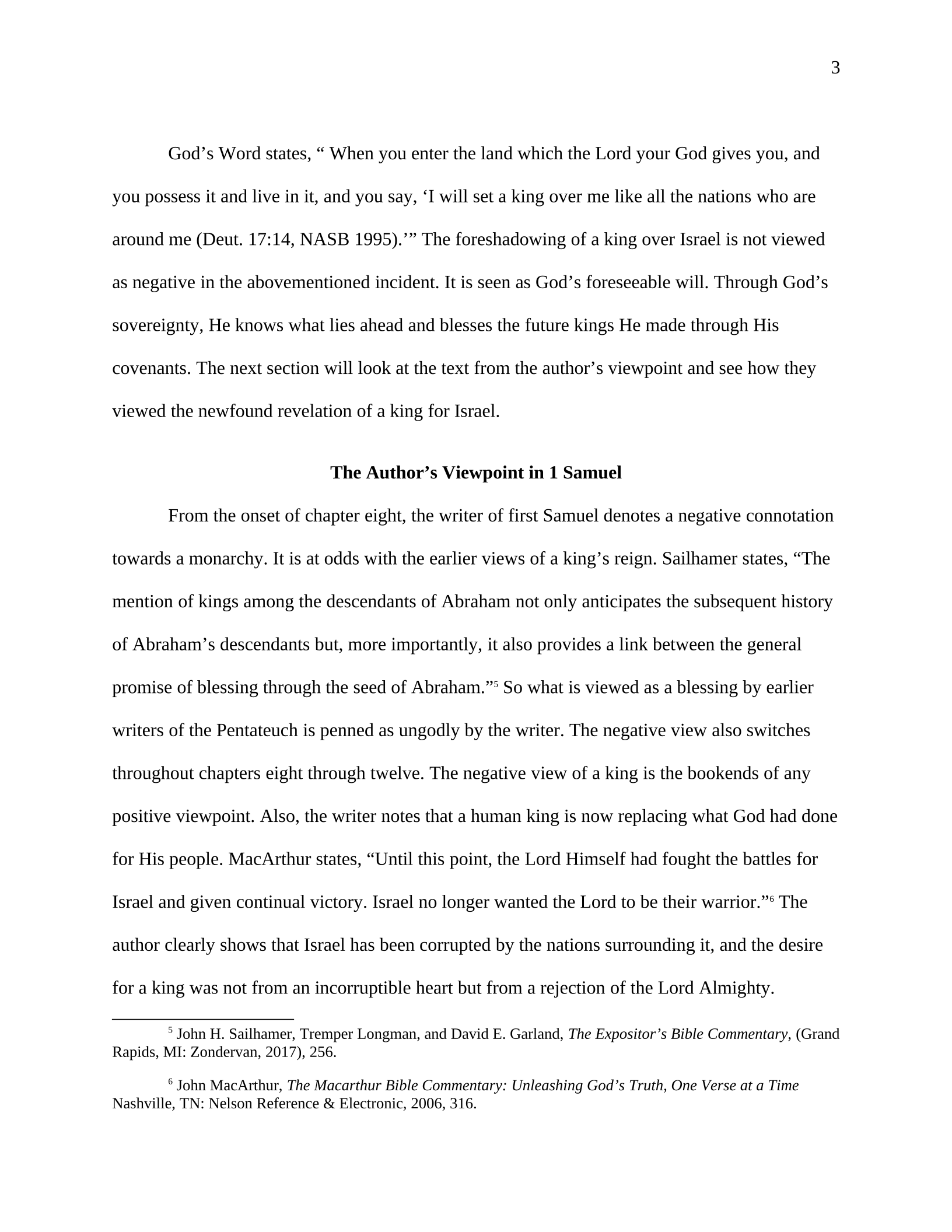
God’s Word states, “ When you enter the land which the Lord your God gives you, and
you possess it and live in it, and you say, ‘I will set a king over me like all the nations who are
around me (Deut. 17:14, NASB 1995).’” The foreshadowing of a king over Israel is not viewed
as negative in the abovementioned incident. It is seen as God’s foreseeable will. Through God’s
sovereignty, He knows what lies ahead and blesses the future kings He made through His
covenants. The next section will look at the text from the author’s viewpoint and see how they
viewed the newfound revelation of a king for Israel.
The Author’s Viewpoint in 1 Samuel
From the onset of chapter eight, the writer of first Samuel denotes a negative connotation
towards a monarchy. It is at odds with the earlier views of a king’s reign. Sailhamer states, “The
mention of kings among the descendants of Abraham not only anticipates the subsequent history
of Abraham’s descendants but, more importantly, it also provides a link between the general
promise of blessing through the seed of Abraham.”5 So what is viewed as a blessing by earlier
writers of the Pentateuch is penned as ungodly by the writer. The negative view also switches
throughout chapters eight through twelve. The negative view of a king is the bookends of any
positive viewpoint. Also, the writer notes that a human king is now replacing what God had done
for His people. MacArthur states, “Until this point, the Lord Himself had fought the battles for
Israel and given continual victory. Israel no longer wanted the Lord to be their warrior.”6 The
author clearly shows that Israel has been corrupted by the nations surrounding it, and the desire
for a king was not from an incorruptible heart but from a rejection of the Lord Almighty.
5 John H. Sailhamer, Tremper Longman, and David E. Garland, The Expositor’s Bible Commentary, (Grand
Rapids, MI: Zondervan, 2017), 256.
6 John MacArthur, The Macarthur Bible Commentary: Unleashing God’s Truth, One Verse at a Time
Nashville, TN: Nelson Reference & Electronic, 2006, 316.
4
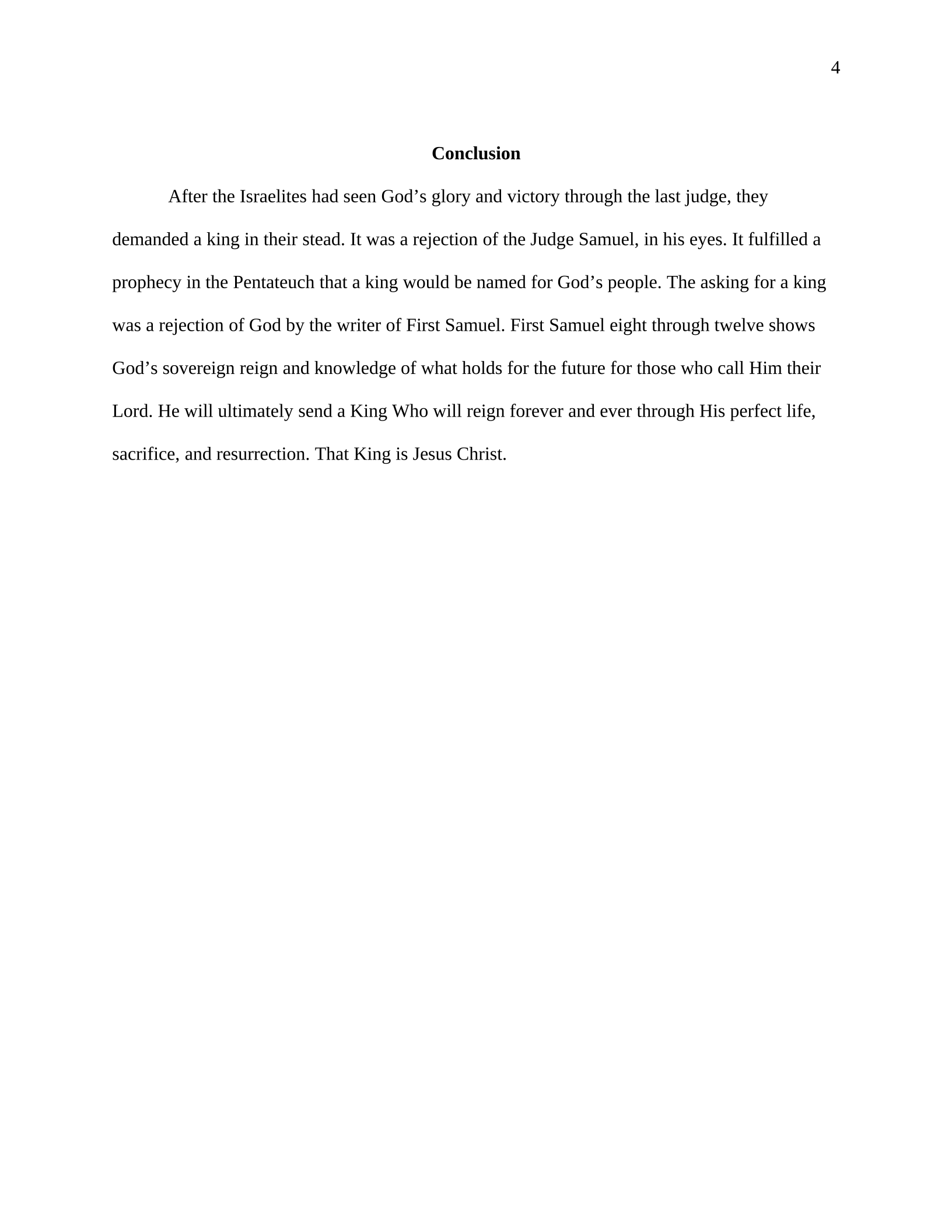
Conclusion
After the Israelites had seen God’s glory and victory through the last judge, they
demanded a king in their stead. It was a rejection of the Judge Samuel, in his eyes. It fulfilled a
prophecy in the Pentateuch that a king would be named for God’s people. The asking for a king
was a rejection of God by the writer of First Samuel. First Samuel eight through twelve shows
God’s sovereign reign and knowledge of what holds for the future for those who call Him their
Lord. He will ultimately send a King Who will reign forever and ever through His perfect life,
sacrifice, and resurrection. That King is Jesus Christ.
5
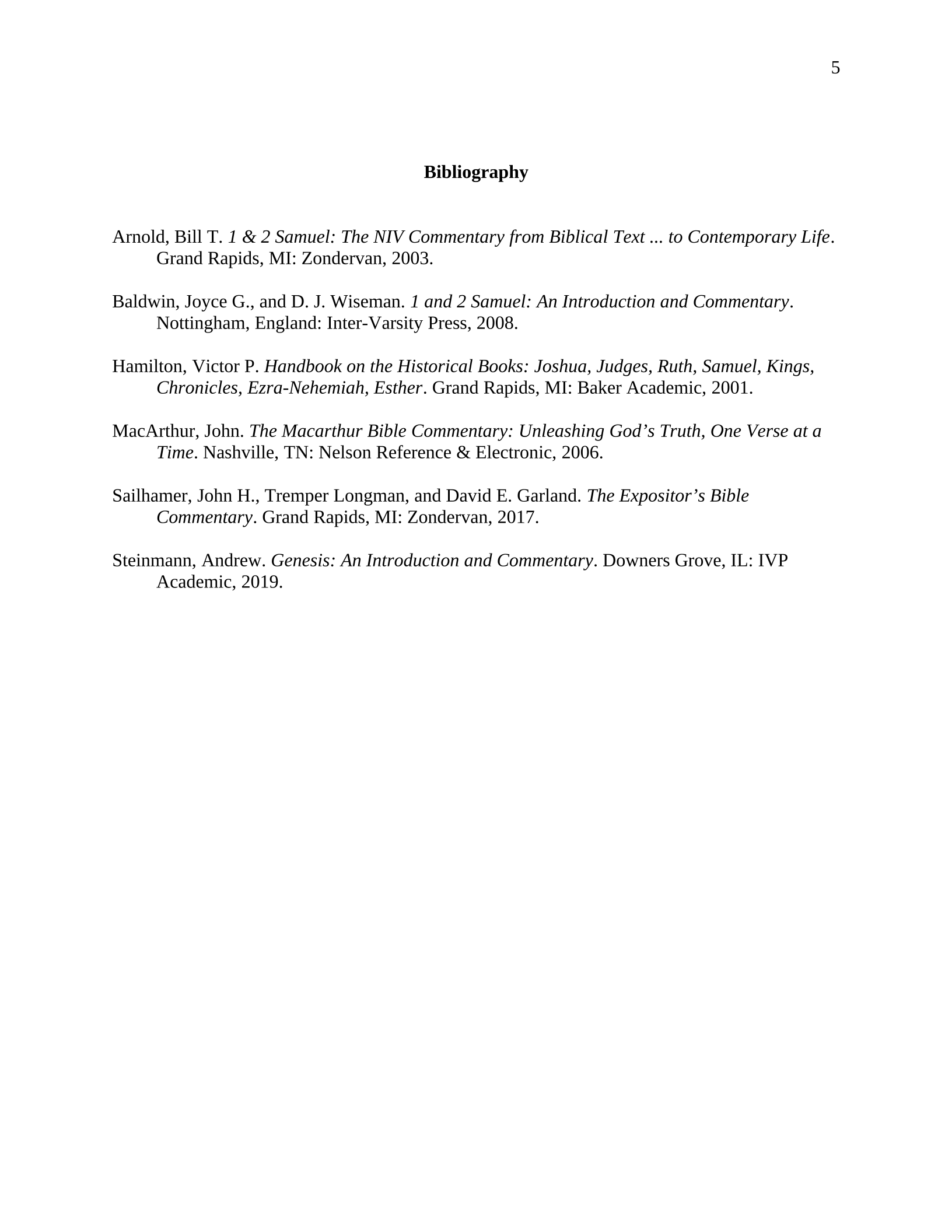
Bibliography
Arnold, Bill T. 1 & 2 Samuel: The NIV Commentary from Biblical Text ... to Contemporary Life.
Grand Rapids, MI: Zondervan, 2003.
Baldwin, Joyce G., and D. J. Wiseman. 1 and 2 Samuel: An Introduction and Commentary.
Nottingham, England: Inter-Varsity Press, 2008.
Hamilton, Victor P. Handbook on the Historical Books: Joshua, Judges, Ruth, Samuel, Kings,
Chronicles, Ezra-Nehemiah, Esther. Grand Rapids, MI: Baker Academic, 2001.
MacArthur, John. The Macarthur Bible Commentary: Unleashing God’s Truth, One Verse at a
Time. Nashville, TN: Nelson Reference & Electronic, 2006.
Sailhamer, John H., Tremper Longman, and David E. Garland. The Expositor’s Bible
Commentary. Grand Rapids, MI: Zondervan, 2017.
Steinmann, Andrew. Genesis: An Introduction and Commentary. Downers Grove, IL: IVP
Academic, 2019.
Powered by TCPDF (www.tcpdf.org)

