



MATH 350 - DISCRETE
MATHEMATICS - Discrete random
variables and expected value
Question Bank - Set 4
Liberty University
Question 1
Question
Let Xbe a discrete random variable with the following probability mass func-
tion:
P(X=−2) = 0.2, P (X= 0) = 0.3, P (X= 2) = 0.5
Calculate the expected value of X.
Solution
Step 1: Recall that the expected value of a discrete random variable Xis given
by the formula:
E(X) = X
x
x·P(X=x)
Step 2: Substitute the given probabilities into the formula:
E(X)=(−2) ·0.2 + (0) ·0.3 + (2) ·0.5
Step 3: Calculate the expected value:
E(X) = −0.4 + 0 + 1 = 0.6
Therefore, the expected value of random variable Xis 0.6.

Question 2
Question
Let Xbe a discrete random variable with probability mass function given by:
P(X=−2) = 0.1, P (X= 1) = 0.5, P (X= 3) = 0.4
Calculate the expected value of X,E(X).
Solution
Step 1: To find the expected value of a discrete random variable, we use the
formula:
E(X) = X
x
x·P(X=x)
Step 2: Plug in the values from the probability mass function into the for-
mula:
E(X)=(−2) ·0.1 + (1) ·0.5 + (3) ·0.4
Step 3: Calculate the expected value:
E(X) = −0.2+0.5+1.2=1.5
So, the expected value of the random variable Xis 1.5.
Question 3
Question
Let Xbe a discrete random variable with the following probability mass func-
tion:
P(X=−1) = 1
6, P (X= 0) = 1
3, P (X= 1) = 1
2
Calculate the expected value of X.
Solution
Step 1: Recall that the expected value of a discrete random variable is given by
the formula:
E(X) = X
all x
x·P(X=x)
Step 2: Plug in the probabilities from the given probability mass function
to find E(X):
2

E(X)=(−1) ·1
6+ (0) ·1
3+ (1) ·1
2
Step 3: Simplify the expression:
E(X) = −1
6+0+1
2=2
3
Therefore, the expected value of the random variable Xis 2
3.
Question 4
Question
Let Xbe a discrete random variable with the following probability mass func-
tion:
P(X= 1) = 1
3, P (X= 2) = 1
6, P (X= 3) = 1
2
Calculate the expected value of X.
Solution
Step 1: To calculate the expected value of a discrete random variable X, we use
the formula:
E(X) = X
x
x·P(X=x)
Step 2: Substitute the values of P(X= 1), P(X= 2), and P(X= 3) into
the formula:
E(X)=1·1
3+ 2 ·1
6+ 3 ·1
2
Step 3: Simplify the expression:
E(X) = 1
3+1
3+3
2=2
3+3
2=4
6+9
6=13
6
Step 4: Therefore, the expected value of the random variable Xis 13
6.
Question 5
Question
Let Xbe a discrete random variable with probability mass function given by:
P(X=−2) = 1
4, P (X= 0) = 1
8, P (X= 2) = 1
8, P (X=n) = 1
2n,for n≥3.
3

Find the expected value of X.
Solution
Step 1: First, we recall that the expected value of a discrete random variable X
is given by:
E(X) = X
i
xi·P(X=xi),
where the sum is taken over all possible values xithat Xcan take on.
Step 2: In this case, our random variable Xcan take on the values −2, 0, 2,
and all non-negative integers greater than or equal to 3. So, we have:
E(X) = (−2) ×1
4+ (0) ×1
8+ (2) ×1
8+
∞
X
n=3
n·1
2n.
Step 3: Simplifying the expression, we get:
E(X) = −1
2+0+1
4+
∞
X
n=3
n
2n.
Step 4: To evaluate the sum P∞
n=3
n
2n, we differentiate the power series for
f(x) = P∞
n=0 xn, to get:
f′(x) =
∞
X
n=1
nxn−1=1
(1 −x)2.
Step 5: Substituting x=1
2into f′(x), we find:
∞
X
n=1
n
2n=1
(1 −1
2)2=4
3.
Step 6: Therefore, the expected value of the random variable Xis:
E(X) = −1
2+1
4+4
3=5
4.
Hence, the expected value of Xis 5
4.
Question 6
Question
Let Xbe a discrete random variable with the following probability mass func-
tion:
P(X= 1) = 0.2, P (X= 2) = 0.3, P (X= 3) = 0.1,and P(X= 4) = 0.4.
Find the expected value of X.
4

Solution
Step 1: The expected value of a discrete random variable X, denoted by E(X),
is given by the formula:
E(X) = X
x
x·P(X=x),
where the sum is taken over all possible values of X.
Step 2: Calculate the expected value E(X) using the probability mass func-
tion given.
E(X)=1·0.2+2·0.3+3·0.1+4·0.4
E(X)=0.2+0.6+0.3+1.6
E(X) = 2.7
Therefore, the expected value of Xis 2.7 .
Question 7
Question
Let Xbe a discrete random variable with the following probability mass func-
tion:
P(X=−1) = 0.1, P (X= 0) = 0.4, P (X= 1) = 0.3, P (X= 2) = 0.2
Find the expected value of X.
Solution
Step 1: Recall that the expected value of a discrete random variable Xis given
by:
E(X) = X
x
x·P(X=x)
Step 2: Let’s calculate the expected value E(X) using the probability mass
function given.
We have:
E(X)=(−1) ·0.1 + (0) ·0.4 + (1) ·0.3 + (2) ·0.2
Step 3: Simplify the expression to find the expected value:
E(X) = −0.1+0+0.3+0.4=0.6
Step 4: Therefore, the expected value of the random variable Xis 0.6 .
5

Question 8
Question
Let Xbe a discrete random variable with the following probability mass func-
tion:
P(X=k) = (c·2−k,if k= 1,2,3,4,5
0,otherwise
Determine the value of the constant cin order for this to be a valid proba-
bility mass function. Calculate the expected value of X.
Solution
Step 1: Determining the value of c: To be a valid probability mass function, the
sum of all probabilities must equal 1. Thus, we have:
5
X
k=1
c·2−k= 1
c·2−1+ 2−2+ 2−3+ 2−4+ 2−5= 1
c·1
2+1
4+1
8+1
16 +1
32= 1
c·16+8+4+2+1
32 = 1
c·31
32= 1
c=32
31
Therefore, c=32
31 is the value needed for the probability mass function to
be valid.
Step 2: Calculating the expected value of X: The expected value of a discrete
random variable Xis given by E(X) = Pkk·P(X=k). In this case, we have:
E(X) =
5
X
k=1
k·32
31 ·2−k
=32
31 ·1·2−1+ 2 ·2−2+ 3 ·2−3+ 4 ·2−4+ 5 ·2−5
=32
31 ·1
2+2
4+3
8+4
16 +5
32
6

=32
31 ·16 + 16 + 12 + 8 + 5
32
=32
31 ·57
32
=57
31
Therefore, the expected value of Xis 57
31 .
Question 9
Question
Let Xbe a discrete random variable with probability mass function given by:
P(X=−1) = 1
3, P (X= 0) = 1
6, P (X= 2) = 1
2
Find the expected value of X, denoted by E(X).
Solution
Step 1: Identify the formula for the expected value of a discrete random variable.
The expected value of a discrete random variable Xis given by:
E(X) = X
∀x
x·P(X=x)
Step 2: Substitute the given probabilities into the formula.
In this case, we have:
E(X)=(−1) ·1
3+ (0) ·1
6+ (2) ·1
2
Step 3: Simplify the expression.
E(X) = −1
3+ 0 + 1
Step 4: Calculate the expected value.
E(X) = 2
3
Therefore, the expected value of the discrete random variable Xis 2
3.
7

Question 10
Question
Let Xbe a discrete random variable with the probability mass function given
by:
P(X=−2) = 1
8, P (X= 0) = 3
8, P (X= 4) = 1
4, P (X= 6) = 1
4
Find the expected value of X.
Solution
Step 1: To find the expected value E[X], we use the formula:
E[X] = X
all x
x·P(X=x)
Step 2: Substituting the given probabilities for X=−2,0,4,6, we have:
E[X] = (−2) ·1
8+ (0) ·3
8+ (4) ·1
4+ (6) ·1
4
Step 3: Simplifying the expression, we get:
E[X] = −1
4+0+1+3
2=5
4
Step 4: Therefore, the expected value of the random variable Xis 5
4.
Question 11
Question
Let X be a discrete random variable with the following probability mass function:
P(X=−1) = 0.3, P (X= 0) = 0.4, P (X= 1) = 0.1, P (X= 2) = 0.2
Find the expected value of X.
Solution
Step 1: Recall that the expected value of a discrete random variable X is given
by the formula:
E(X) = X
x
x·P(X=x)
8
Step 2: Calculate the expected value by using the probabilities given for
each value of X:
E(X) = −1·0.3+0·0.4+1·0.1+2·0.2
Step 3: Simplify the expression by multiplying the values of X with their
respective probabilities and summing them up:
E(X) = −0.3+0+0.1+0.4
E(X)=0.2
Step 4: Therefore, the expected value of the random variable X is 0.2.
Question 12
Question
Let Xbe a discrete random variable with the following probability distribution:
X−2 0 1 3
P(X) 0.2 0.3k0.1
If E(X)=0.5, find the value of k.
Solution
Step 1: The expected value of a discrete random variable Xis given by the
formula:
E(X) = X
i
Xi·P(Xi)
where Xiare the possible values of Xand P(Xi) are the corresponding proba-
bilities.
Step 2: Substituting the values into the formula:
0.5=(−2)(0.2) + (0)(0.3) + (1)(k) + (3)(0.1)
Step 3: Simplifying the equation:
0.5 = −0.4+0.1k+ 0.3
Step 4: Rearranging terms:
0.1k= 0.6
Step 5: Solving for k:
k=0.6
0.1= 6
Therefore, the value of kis 6.
9

Question 13
Question
Let Xbe a discrete random variable with probability mass function given by:
P(X=−2) = 0.2, P (X= 0) = 0.5, P (X= 3) = 0.3
Calculate the expected value of X.
Solution
Step 1: Recall that the expected value of a discrete random variable Xis calcu-
lated by summing the product of each possible value of Xand its corresponding
probability mass function. In other words, the expected value E(X) is given
by:
E(X) = X
x
x·P(X=x)
Step 2: Calculate the expected value E(X) using the given probability mass
function.
E(X)=(−2) ·0.2 + (0) ·0.5 + (3) ·0.3
Step 3: Compute the values for each term in the sum.
E(X) = −0.4+0+0.9
Step 4: Add the terms together to find the expected value.
E(X)=0.5
Therefore, the expected value of the random variable Xis 0.
Question 14
Question
Let Xbe a discrete random variable with the following probability mass func-
tion:
P(X=−3) = 0.2, P (X= 5) = 0.3, P (X= 7) = 0.5.
Calculate the expected value of X.
10

Solution
Step 1: Recall that the expected value of a discrete random variable Xis given
by:
E(X) = X
x
x·P(X=x),
where the sum is taken over all possible values xof X.
Step 2: We can calculate the expected value E(X) using the given probability
mass function:
E(X) = (−3) ·0.2+5·0.3+7·0.5.
Step 3: Calculate the expected value E(X):
E(X) = −0.6+1.5+3.5 = 4.4.
Therefore, the expected value of the random variable Xis 4.4.
Question 15
Question
Let Xbe a discrete random variable with the probability mass function given
by:
P(X=−2) = 1
6, P (X= 1) = 1
3, P (X= 2) = 1
2.
Calculate the expected value of X.
Solution
Step 1: Recall that the expected value of a discrete random variable Xis given
by:
E(X) = X
x
x·P(X=x),
where the sum is taken over all possible values xthat Xcan take.
Step 2: We will substitute the values from the probability mass function into
the formula for expected value:
E(X)=(−2) ·1
6+ 1 ·1
3+ 2 ·1
2.
Step 3: Simplify the expression:
E(X) = −2
6+1
3+2
2=−1
3+1
3+ 1 = 1.
Step 4: Therefore, the expected value of random variable Xis 1 .
11

Question 16
Question
Let Xbe a discrete random variable with the following probability mass func-
tion:
P(X=−2) = 1
6, P (X= 0) = 1
6, P (X= 1) = 1
3, P (X= 2) = 1
3
Calculate the expected value of X.
Solution
Step 1: First, recall that the expected value of a discrete random variable Xis
given by the formula:
E(X) = X
all x
x·P(X=x)
Step 2: Plug in the given probabilities for X=−2, X= 0, X= 1, and
X= 2 into the formula for expected value:
E(X) = −2·1
6+ 0 ·1
6+ 1 ·1
3+ 2 ·1
3
Step 3: Simplify the expression:
E(X) = −2
6+1
3+2
3
Step 4: Combine the terms:
E(X) = −1
6+3
3
E(X) = −1
6+ 1
E(X) = 5
6
Therefore, the expected value of Xis 5
6.
Question 17
Question
Let Xbe a discrete random variable with the following probability mass func-
tion:
12

P(X=−2) = 1
16, P (X=−1) = 1
4, P (X= 0) = 3
8, P (X= 1) = 1
4,and P(X= 2) = 1
16.
Calculate the expected value of X.
Solution
Step 1: Recall that the expected value of a discrete random variable is given by
the formula:
E(X) = Xx·P(X=x),
where the sum is taken over all possible values of X.
Step 2: We can now calculate the expected value of Xusing the given
probabilities:
E(X)=(−2) ·1
16 + (−1) ·1
4+ (0) ·3
8+ (1) ·1
4+ (2) ·1
16
=−1
8−1
4+0+1
4+1
8
=−1
8−2
8+4
8+1
8
=2
8=1
4.
Therefore, the expected value of the random variable Xis 1
4.
Question 18
Question
Let Xbe a discrete random variable with the following probability mass func-
tion:
P(X=−3) = 1
9, P (X=−2) = 1
9, P (X=−1) = 2
9,
P(X= 0) = 1
3, P (X= 1) = 1
9, P (X= 2) = 1
9.
Calculate the expected value of X.
13

Solution
Step 1: Recall that the expected value of a discrete random variable Xis given
by:
E(X) = X
all x
x·P(X=x).
Step 2: We can calculate the expected value of Xusing the provided prob-
ability mass function:
E(X) = −3·1
9+ (−2) ·1
9+ (−1) ·2
9+ 0 ·1
3+ 1 ·1
9+ 2 ·1
9.
Step 3: Simplifying each term, we get:
E(X) = −3
9−2
9−2
9+0+1
9+2
9.
Step 4: Combining like terms, we find:
E(X) = −6
9+3
9=−3
9=−1
3.
Step 5: Therefore, the expected value of the random variable Xis −1
3.
Question 19
Question
Let Xbe a discrete random variable with probability mass function given by:
P(X=k) = (2
3kif k= 1,2,3, . . .
0 otherwise
Calculate the expected value of X.
Solution
Step 1: First, we recall the formula for calculating the expected value of a
discrete random variable:
E(X) = X
k
k·P(X=k)
Step 2: Substitute the given probability mass function into the formula:
E(X) =
∞
X
k=1
k·2
3k
Step 3: We can rewrite the series as:
14

E(X)=21
3+2
9+3
27 +. . .
Step 4: Notice that the series inside the parentheses is a geometric series
with first term 1
3and common ratio 1
3.
Step 5: Recall the formula for the sum of an infinite geometric series: S=
a
1−r, where ais the first term and ris the common ratio.
Step 6: Apply the formula to find the sum of the series:
E(X)=2·
1
3
1−1
3
Step 7: Simplifying, we get:
E(X)=2·
1
3
2
3
= 2 ·1
2= 1
Therefore, the expected value of the random variable Xis 1 .
Question 20
Question
Let Xbe a discrete random variable with the following probability distribution:
X−1 0 1
P(X)1
4
1
2
1
4
Calculate the expected value of X.
Solution
Step 1: To calculate the expected value of a discrete random variable, we use
the formula:
E(X) = X
all x
x·P(X=x)
Step 2: Calculate the expected value E(X):
E(X)=(−1) ·1
4+ (0) ·1
2+ (1) ·1
4
Step 3: Simplify the expression:
E(X) = −1
4+0+1
4
E(X) = 0
Therefore, the expected value of the discrete random variable Xis 0 .
15

Question 21
Question
Let Xbe a discrete random variable with the following probability distribution:
X−2 0 2 4
P(X)k1
4
3
8
1
8
Calculate the expected value of X,E(X).
Solution
Step 1: First, calculate the value of kby using the fact that the sum of all
probabilities in a probability distribution must equal 1. Thus, we have:
k+1
4+3
8+1
8= 1
k= 1 −1
4−3
8−1
8
k= 1 −4
8−3
8−1
8
k= 1 −8
8
k= 0
Therefore, the probability distribution of Xis:
X−2 0 2 4
P(X) 0 1
4
3
8
1
8
Step 2: Now, calculate the expected value E(X) using the formula:
E(X) = X
x
x·P(X=x)
E(X)=(−2) ·0 + (0) ·1
4+ (2) ·3
8+ (4) ·1
8
E(X) = 0 + 0 + 6
8+4
8
E(X) = 10
8
E(X) = 5
4
Therefore, the expected value of Xis 5
4.
16

Question 22
Question
Let Xbe a discrete random variable with the following probability mass func-
tion:
P(X= 1) = 0.2, P (X= 2) = 0.3, P (X= 3) = 0.4, P (X= 4) = 0.1.
Calculate the expected value of X.
Solution
Step 1: First, we recall that the expected value of a discrete random variable X
is given by:
E[X] = Xx·P(X=x),
where the sum is taken over all possible values xthat Xcan take on.
Step 2: Given the probability mass function of X, we can calculate the
expected value as follows:
E[X] = 1 ·0.2+2·0.3+3·0.4+4·0.1.
Step 3: Simplifying the expression:
E[X]=0.2+0.6+1.2+0.4=2.4.
Step 4: Therefore, the expected value of the random variable Xis 2.4 .
Question 23
Question
Let Xbe a discrete random variable with the following probability mass func-
tion:
P(X= 1) = 0.2, P (X= 2) = 0.3, P (X= 3) = 0.4, P (X= 4) = 0.1
Calculate the expected value of X.
Solution
Step 1: The expected value of a discrete random variable Xis given by the
formula:
E(X) = X
x
x·P(X=x)
17

where the sum is over all possible values of X.
Step 2: Substitute the given probabilities into the formula for the expected
value:
E(X) = 1 ×0.2+2×0.3+3×0.4+4×0.1
Step 3: Calculate the expected value:
E(X)=0.2+0.6+1.2+0.4
E(X)=2.4
Therefore, the expected value of Xis 2.4 .
Question 24
Question
Let Xbe a discrete random variable with the following probability distribution
function:
X1 2
P(X) 0.4 0.6
Find the expected value of X.
Solution
Step 1: Recall that the expected value (or mean) of a discrete random variable
Xis given by:
E[X] = X
all x
x·P(X=x)
Step 2: In this case, we need to find E[X] = 1 ·P(X= 1) + 2 ·P(X= 2).
Step 3: Substitute the given probabilities into the formula:
E[X]=1·0.4+2·0.6
Step 4: Calculate the expected value:
E[X]=0.4+1.2=1.6
Step 5: Therefore, the expected value of the random variable Xis 1.6 .
18

Question 25
Question
Let Xbe a discrete random variable with the following probability mass func-
tion:
P(X=−1) = 0.1, P (X= 0) = 0.2, P (X= 1) = 0.3, P (X= 2) = 0.4.
Calculate the expected value of X.
Solution
Step 1: The expected value of a discrete random variable Xis given by:
E(X) = X
i
xi·P(X=xi),
where the sum is taken over all possible values xiof X.
Step 2: Given the probability mass function of X, we have:
E(X) = (−1)(0.1) + (0)(0.2) + (1)(0.3) + (2)(0.4).
Step 3: Calculating the expected value:
E(X) = −0.1+0+0.3+0.8 = 1 .
Therefore, the expected value of Xis 1.
Question 26
Question
Let Xbe a discrete random variable with the following probability mass func-
tion:
P(X=−2) = 0.1, P (X= 1) = 0.3, P (X= 3) = 0.2, P (X= 5) = 0.4
Find the expected value of X.
Solution
Step 1: Recall that the expected value of a discrete random variable Xis given
by:
E(X) = X
all x
x·P(X=x)
where the sum is taken over all possible values that Xcan take on.
19

Step 2: Substituting the given probabilities into the formula for the expected
value, we have:
E(X)=(−2)(0.1) + (1)(0.3) + (3)(0.2) + (5)(0.4)
=−0.2+0.3+0.6+2
= 3.7
Therefore, the expected value of the random variable Xis 3.7.
Question 27
Question
Let Xbe a discrete random variable with the following probability mass func-
tion:
P(X=−2) = 1
6, P (X= 0) = 1
3, P (X= 3) = 1
2
Find the expected value of X.
Solution
Step 1: Recall that the expected value of a discrete random variable is given by
the formula:
E(X) = X
x
x·P(X=x)
Step 2: Compute the expected value using the given probability mass func-
tion:
E(X) = (−2) ·1
6+ 0 ·1
3+ 3 ·1
2
Step 3: Simplify the expression to find the expected value:
E(X) = −2
6+0+3
2=−1
3+3
2
Step 4: Write the expected value in simplest form:
E(X) = 5
6
Therefore, the expected value of the discrete random variable Xis 5
6.
20

Question 28
Question
Let Xbe a discrete random variable with the following probability mass func-
tion:
P(X= 1) = 1
4, P (X= 2) = 1
2, P (X= 3) = 1
4.
Find the expected value of X.
Solution
To find the expected value of a discrete random variable X, denoted as E(X),
we use the formula:
E(X) = X
x
x·P(X=x)
where the sum is taken over all possible values of X.
Step 1: Identify the values of Xand their corresponding probabil-
ities In this case, Xcan take on the values 1, 2, or 3 with probabilities 1
4,1
2,
and 1
4respectively.
Step 2: Calculate the expected value Using the formula for expected
value:
E(X) = 1 ·1
4+ 2 ·1
2+ 3 ·1
4
E(X) = 1
4+2
2+3
4
E(X) = 1
4+1+3
4
E(X) = 1+4+3
4
E(X) = 8
4
E(X) = 2
Therefore, the expected value of the random variable Xis 2.
21

Question 29
Question
Let Xbe a discrete random variable with the following probability mass func-
tion:
P(X= 1) = 0.2, P (X= 2) = 0.3, P (X= 3) = 0.1, P (X= 4) = 0.4
Calculate the expected value of X.
Solution
Step 1: Recall that the expected value of a discrete random variable Xis defined
as:
E(X) = X
x
x·P(X=x)
Step 2: Substitute the given probabilities into the formula to calculate the
expected value:
E(X)=1·0.2+2·0.3+3·0.1+4·0.4
Step 3: Multiply each value of xby its corresponding probability:
E(X)=0.2+0.6+0.3+1.6
Step 4: Sum the results to find the expected value:
E(X)=2.7
Therefore, the expected value of the discrete random variable Xis 2.7.
Question 30
Question
Let Xbe a discrete random variable with the following probability mass func-
tion:
f(x) =
0.2 if x= 1,
0.3 if x= 2,
0.4 if x= 3,
0.1 if x= 4,
0 otherwise.
Find the expected value of X.
22

Solution
Step 1: To find the expected value of X, we use the formula:
E(X) = X
x
x·P(X=x)
Step 2: Plug in the values from the probability mass function:
E(X)=1·0.2+2·0.3+3·0.4+4·0.1
Step 3: Calculate the expected value:
E(X)=0.2+0.6+1.2+0.4
E(X)=2.4
Therefore, the expected value of Xis 2.4.
Question 31
Question
Let Xbe a discrete random variable with the following probability mass func-
tion:
P(X= 1) = 0.2, P (X= 2) = 0.3, P (X= 3) = 0.1, P (X= 4) = 0.4
Calculate the expected value of X.
Solution
Step 1: The expected value of a discrete random variable Xis given by the
formula:
E(X) = X
x
x·P(X=x)
where the sum is taken over all possible values of X.
Step 2: Substitute the given probability mass function values into the for-
mula:
E(X)=1·0.2+2·0.3+3·0.1+4·0.4
Step 3: Calculate the expected value:
E(X)=0.2+0.6+0.3+1.6
E(X)=2.7
Therefore, the expected value of the random variable Xis 2.7.
23

Question 32
Question
Let Xbe a discrete random variable with the following probability mass func-
tion:
P(X= 1) = 0.2, P (X= 2) = 0.3, P (X= 3) = 0.4, P (X= 4) = 0.1
Calculate the expected value of X.
Solution
Step 1: The expected value of a discrete random variable Xis denoted as E[X]
and is calculated as:
E[X] = X
all x
x·P(X=x)
where xtakes on all possible values of X.
Step 2: Given the probability mass function of X, we have:
E[X]=1·0.2+2·0.3+3·0.4+4·0.1
Step 3: Calculate the expected value using the probabilities given:
E[X]=0.2+0.6+1.2+0.4
E[X]=2.4
Therefore, the expected value of Xis 2.4.
Question 33
Question
Let Xbe a discrete random variable with the following probability mass func-
tion:
P(X=−2) = 0.1, P (X= 1) = 0.2, P (X= 3) = 0.3, P (X= 5) = 0.4
Find the expected value of X.
24

Solution
Step 1: To find the expected value of X, we use the formula:
E[X] = X
x
x·P(X=x)
Step 2: Substitute the values from the probability mass function:
E[X] = (−2) ·0.1 + (1) ·0.2 + (3) ·0.3 + (5) ·0.4
Step 3: Calculate the expected value:
E[X] = −0.2+0.2+0.9 + 2 = 3
Therefore, the expected value of the random variable Xis 3 .
Question 34
Question
Let Xbe a discrete random variable with the following probability mass func-
tion:
P(X= 1) = 1
4, P (X= 2) = 1
8, P (X= 3) = 1
16, P (X= 4) = 1
16, P (X= 5) = 1
4, P (X= 6) = 1
8.
Find the expected value of X.
Solution
Step 1: Recall that the expected value of a discrete random variable Xis given
by:
E(X) = X
x
x·P(X=x),
where the sum is taken over all possible values of X.
Step 2: Calculate the expected value E(X) using the given probability mass
function:
E(X)=1·1
4+ 2 ·1
8+ 3 ·1
16 + 4 ·1
16 + 5 ·1
4+ 6 ·1
8.
Step 3: Simplify the expression:
E(X) = 1
4+2
8+3
16 +4
16 +5
4+6
8.
Step 4: Further simplify to find the expected value:
E(X) = 1
4+1
4+3
16 +1
4+5
4+3
4=15
4.
Therefore, the expected value of the random variable Xis 15
4= 3.75.
25

Question 35
Question
Let Xbe a discrete random variable with the following probability mass func-
tion:
P(X=−2) = 0.1, P (X= 0) = 0.2, P (X= 1) = 0.3, P (X= 2) = 0.4.
Calculate the expected value of X.
Solution
Step 1: The expected value of a discrete random variable Xis given by:
E(X) = X
x
x·P(X=x),
where the sum is taken over all possible values of X.
Step 2: Substitute the given probabilities into the formula:
E(X)=(−2) ·0.1 + (0) ·0.2 + (1) ·0.3 + (2) ·0.4.
Step 3: Calculate the expected value:
E(X) = −0.2+0+0.3+0.8=0.9.
Therefore, the expected value of the random variable Xis 0.9 .
26

Question 2
Question
Let Xbe a discrete random variable with probability mass function given by:
P(X=−2) = 0.1, P (X= 1) = 0.5, P (X= 3) = 0.4
Calculate the expected value of X,E(X).
Solution
Step 1: To find the expected value of a discrete random variable, we use the
formula:
E(X) = X
x
x·P(X=x)
Step 2: Plug in the values from the probability mass function into the for-
mula:
E(X)=(−2) ·0.1 + (1) ·0.5 + (3) ·0.4
Step 3: Calculate the expected value:
E(X) = −0.2+0.5+1.2=1.5
So, the expected value of the random variable Xis 1.5.
Question 3
Question
Let Xbe a discrete random variable with the following probability mass func-
tion:
P(X=−1) = 1
6, P (X= 0) = 1
3, P (X= 1) = 1
2
Calculate the expected value of X.
Solution
Step 1: Recall that the expected value of a discrete random variable is given by
the formula:
E(X) = X
all x
x·P(X=x)
Step 2: Plug in the probabilities from the given probability mass function
to find E(X):
2

E(X)=(−1) ·1
6+ (0) ·1
3+ (1) ·1
2
Step 3: Simplify the expression:
E(X) = −1
6+0+1
2=2
3
Therefore, the expected value of the random variable Xis 2
3.
Question 4
Question
Let Xbe a discrete random variable with the following probability mass func-
tion:
P(X= 1) = 1
3, P (X= 2) = 1
6, P (X= 3) = 1
2
Calculate the expected value of X.
Solution
Step 1: To calculate the expected value of a discrete random variable X, we use
the formula:
E(X) = X
x
x·P(X=x)
Step 2: Substitute the values of P(X= 1), P(X= 2), and P(X= 3) into
the formula:
E(X)=1·1
3+ 2 ·1
6+ 3 ·1
2
Step 3: Simplify the expression:
E(X) = 1
3+1
3+3
2=2
3+3
2=4
6+9
6=13
6
Step 4: Therefore, the expected value of the random variable Xis 13
6.
Question 5
Question
Let Xbe a discrete random variable with probability mass function given by:
P(X=−2) = 1
4, P (X= 0) = 1
8, P (X= 2) = 1
8, P (X=n) = 1
2n,for n≥3.
3

Find the expected value of X.
Solution
Step 1: First, we recall that the expected value of a discrete random variable X
is given by:
E(X) = X
i
xi·P(X=xi),
where the sum is taken over all possible values xithat Xcan take on.
Step 2: In this case, our random variable Xcan take on the values −2, 0, 2,
and all non-negative integers greater than or equal to 3. So, we have:
E(X) = (−2) ×1
4+ (0) ×1
8+ (2) ×1
8+
∞
X
n=3
n·1
2n.
Step 3: Simplifying the expression, we get:
E(X) = −1
2+0+1
4+
∞
X
n=3
n
2n.
Step 4: To evaluate the sum P∞
n=3
n
2n, we differentiate the power series for
f(x) = P∞
n=0 xn, to get:
f′(x) =
∞
X
n=1
nxn−1=1
(1 −x)2.
Step 5: Substituting x=1
2into f′(x), we find:
∞
X
n=1
n
2n=1
(1 −1
2)2=4
3.
Step 6: Therefore, the expected value of the random variable Xis:
E(X) = −1
2+1
4+4
3=5
4.
Hence, the expected value of Xis 5
4.
Question 6
Question
Let Xbe a discrete random variable with the following probability mass func-
tion:
P(X= 1) = 0.2, P (X= 2) = 0.3, P (X= 3) = 0.1,and P(X= 4) = 0.4.
Find the expected value of X.
4

Solution
Step 1: The expected value of a discrete random variable X, denoted by E(X),
is given by the formula:
E(X) = X
x
x·P(X=x),
where the sum is taken over all possible values of X.
Step 2: Calculate the expected value E(X) using the probability mass func-
tion given.
E(X)=1·0.2+2·0.3+3·0.1+4·0.4
E(X)=0.2+0.6+0.3+1.6
E(X) = 2.7
Therefore, the expected value of Xis 2.7 .
Question 7
Question
Let Xbe a discrete random variable with the following probability mass func-
tion:
P(X=−1) = 0.1, P (X= 0) = 0.4, P (X= 1) = 0.3, P (X= 2) = 0.2
Find the expected value of X.
Solution
Step 1: Recall that the expected value of a discrete random variable Xis given
by:
E(X) = X
x
x·P(X=x)
Step 2: Let’s calculate the expected value E(X) using the probability mass
function given.
We have:
E(X)=(−1) ·0.1 + (0) ·0.4 + (1) ·0.3 + (2) ·0.2
Step 3: Simplify the expression to find the expected value:
E(X) = −0.1+0+0.3+0.4=0.6
Step 4: Therefore, the expected value of the random variable Xis 0.6 .
5

Question 8
Question
Let Xbe a discrete random variable with the following probability mass func-
tion:
P(X=k) = (c·2−k,if k= 1,2,3,4,5
0,otherwise
Determine the value of the constant cin order for this to be a valid proba-
bility mass function. Calculate the expected value of X.
Solution
Step 1: Determining the value of c: To be a valid probability mass function, the
sum of all probabilities must equal 1. Thus, we have:
5
X
k=1
c·2−k= 1
c·2−1+ 2−2+ 2−3+ 2−4+ 2−5= 1
c·1
2+1
4+1
8+1
16 +1
32= 1
c·16+8+4+2+1
32 = 1
c·31
32= 1
c=32
31
Therefore, c=32
31 is the value needed for the probability mass function to
be valid.
Step 2: Calculating the expected value of X: The expected value of a discrete
random variable Xis given by E(X) = Pkk·P(X=k). In this case, we have:
E(X) =
5
X
k=1
k·32
31 ·2−k
=32
31 ·1·2−1+ 2 ·2−2+ 3 ·2−3+ 4 ·2−4+ 5 ·2−5
=32
31 ·1
2+2
4+3
8+4
16 +5
32
6

=32
31 ·16 + 16 + 12 + 8 + 5
32
=32
31 ·57
32
=57
31
Therefore, the expected value of Xis 57
31 .
Question 9
Question
Let Xbe a discrete random variable with probability mass function given by:
P(X=−1) = 1
3, P (X= 0) = 1
6, P (X= 2) = 1
2
Find the expected value of X, denoted by E(X).
Solution
Step 1: Identify the formula for the expected value of a discrete random variable.
The expected value of a discrete random variable Xis given by:
E(X) = X
∀x
x·P(X=x)
Step 2: Substitute the given probabilities into the formula.
In this case, we have:
E(X)=(−1) ·1
3+ (0) ·1
6+ (2) ·1
2
Step 3: Simplify the expression.
E(X) = −1
3+ 0 + 1
Step 4: Calculate the expected value.
E(X) = 2
3
Therefore, the expected value of the discrete random variable Xis 2
3.
7

Question 10
Question
Let Xbe a discrete random variable with the probability mass function given
by:
P(X=−2) = 1
8, P (X= 0) = 3
8, P (X= 4) = 1
4, P (X= 6) = 1
4
Find the expected value of X.
Solution
Step 1: To find the expected value E[X], we use the formula:
E[X] = X
all x
x·P(X=x)
Step 2: Substituting the given probabilities for X=−2,0,4,6, we have:
E[X] = (−2) ·1
8+ (0) ·3
8+ (4) ·1
4+ (6) ·1
4
Step 3: Simplifying the expression, we get:
E[X] = −1
4+0+1+3
2=5
4
Step 4: Therefore, the expected value of the random variable Xis 5
4.
Question 11
Question
Let X be a discrete random variable with the following probability mass function:
P(X=−1) = 0.3, P (X= 0) = 0.4, P (X= 1) = 0.1, P (X= 2) = 0.2
Find the expected value of X.
Solution
Step 1: Recall that the expected value of a discrete random variable X is given
by the formula:
E(X) = X
x
x·P(X=x)
8
Step 2: Calculate the expected value by using the probabilities given for
each value of X:
E(X) = −1·0.3+0·0.4+1·0.1+2·0.2
Step 3: Simplify the expression by multiplying the values of X with their
respective probabilities and summing them up:
E(X) = −0.3+0+0.1+0.4
E(X)=0.2
Step 4: Therefore, the expected value of the random variable X is 0.2.
Question 12
Question
Let Xbe a discrete random variable with the following probability distribution:
X−2 0 1 3
P(X) 0.2 0.3k0.1
If E(X)=0.5, find the value of k.
Solution
Step 1: The expected value of a discrete random variable Xis given by the
formula:
E(X) = X
i
Xi·P(Xi)
where Xiare the possible values of Xand P(Xi) are the corresponding proba-
bilities.
Step 2: Substituting the values into the formula:
0.5=(−2)(0.2) + (0)(0.3) + (1)(k) + (3)(0.1)
Step 3: Simplifying the equation:
0.5 = −0.4+0.1k+ 0.3
Step 4: Rearranging terms:
0.1k= 0.6
Step 5: Solving for k:
k=0.6
0.1= 6
Therefore, the value of kis 6.
9

Question 13
Question
Let Xbe a discrete random variable with probability mass function given by:
P(X=−2) = 0.2, P (X= 0) = 0.5, P (X= 3) = 0.3
Calculate the expected value of X.
Solution
Step 1: Recall that the expected value of a discrete random variable Xis calcu-
lated by summing the product of each possible value of Xand its corresponding
probability mass function. In other words, the expected value E(X) is given
by:
E(X) = X
x
x·P(X=x)
Step 2: Calculate the expected value E(X) using the given probability mass
function.
E(X)=(−2) ·0.2 + (0) ·0.5 + (3) ·0.3
Step 3: Compute the values for each term in the sum.
E(X) = −0.4+0+0.9
Step 4: Add the terms together to find the expected value.
E(X)=0.5
Therefore, the expected value of the random variable Xis 0.
Question 14
Question
Let Xbe a discrete random variable with the following probability mass func-
tion:
P(X=−3) = 0.2, P (X= 5) = 0.3, P (X= 7) = 0.5.
Calculate the expected value of X.
10

Solution
Step 1: Recall that the expected value of a discrete random variable Xis given
by:
E(X) = X
x
x·P(X=x),
where the sum is taken over all possible values xof X.
Step 2: We can calculate the expected value E(X) using the given probability
mass function:
E(X) = (−3) ·0.2+5·0.3+7·0.5.
Step 3: Calculate the expected value E(X):
E(X) = −0.6+1.5+3.5 = 4.4.
Therefore, the expected value of the random variable Xis 4.4.
Question 15
Question
Let Xbe a discrete random variable with the probability mass function given
by:
P(X=−2) = 1
6, P (X= 1) = 1
3, P (X= 2) = 1
2.
Calculate the expected value of X.
Solution
Step 1: Recall that the expected value of a discrete random variable Xis given
by:
E(X) = X
x
x·P(X=x),
where the sum is taken over all possible values xthat Xcan take.
Step 2: We will substitute the values from the probability mass function into
the formula for expected value:
E(X)=(−2) ·1
6+ 1 ·1
3+ 2 ·1
2.
Step 3: Simplify the expression:
E(X) = −2
6+1
3+2
2=−1
3+1
3+ 1 = 1.
Step 4: Therefore, the expected value of random variable Xis 1 .
11

Question 16
Question
Let Xbe a discrete random variable with the following probability mass func-
tion:
P(X=−2) = 1
6, P (X= 0) = 1
6, P (X= 1) = 1
3, P (X= 2) = 1
3
Calculate the expected value of X.
Solution
Step 1: First, recall that the expected value of a discrete random variable Xis
given by the formula:
E(X) = X
all x
x·P(X=x)
Step 2: Plug in the given probabilities for X=−2, X= 0, X= 1, and
X= 2 into the formula for expected value:
E(X) = −2·1
6+ 0 ·1
6+ 1 ·1
3+ 2 ·1
3
Step 3: Simplify the expression:
E(X) = −2
6+1
3+2
3
Step 4: Combine the terms:
E(X) = −1
6+3
3
E(X) = −1
6+ 1
E(X) = 5
6
Therefore, the expected value of Xis 5
6.
Question 17
Question
Let Xbe a discrete random variable with the following probability mass func-
tion:
12

P(X=−2) = 1
16, P (X=−1) = 1
4, P (X= 0) = 3
8, P (X= 1) = 1
4,and P(X= 2) = 1
16.
Calculate the expected value of X.
Solution
Step 1: Recall that the expected value of a discrete random variable is given by
the formula:
E(X) = Xx·P(X=x),
where the sum is taken over all possible values of X.
Step 2: We can now calculate the expected value of Xusing the given
probabilities:
E(X)=(−2) ·1
16 + (−1) ·1
4+ (0) ·3
8+ (1) ·1
4+ (2) ·1
16
=−1
8−1
4+0+1
4+1
8
=−1
8−2
8+4
8+1
8
=2
8=1
4.
Therefore, the expected value of the random variable Xis 1
4.
Question 18
Question
Let Xbe a discrete random variable with the following probability mass func-
tion:
P(X=−3) = 1
9, P (X=−2) = 1
9, P (X=−1) = 2
9,
P(X= 0) = 1
3, P (X= 1) = 1
9, P (X= 2) = 1
9.
Calculate the expected value of X.
13

Solution
Step 1: Recall that the expected value of a discrete random variable Xis given
by:
E(X) = X
all x
x·P(X=x).
Step 2: We can calculate the expected value of Xusing the provided prob-
ability mass function:
E(X) = −3·1
9+ (−2) ·1
9+ (−1) ·2
9+ 0 ·1
3+ 1 ·1
9+ 2 ·1
9.
Step 3: Simplifying each term, we get:
E(X) = −3
9−2
9−2
9+0+1
9+2
9.
Step 4: Combining like terms, we find:
E(X) = −6
9+3
9=−3
9=−1
3.
Step 5: Therefore, the expected value of the random variable Xis −1
3.
Question 19
Question
Let Xbe a discrete random variable with probability mass function given by:
P(X=k) = (2
3kif k= 1,2,3, . . .
0 otherwise
Calculate the expected value of X.
Solution
Step 1: First, we recall the formula for calculating the expected value of a
discrete random variable:
E(X) = X
k
k·P(X=k)
Step 2: Substitute the given probability mass function into the formula:
E(X) =
∞
X
k=1
k·2
3k
Step 3: We can rewrite the series as:
14

E(X)=21
3+2
9+3
27 +. . .
Step 4: Notice that the series inside the parentheses is a geometric series
with first term 1
3and common ratio 1
3.
Step 5: Recall the formula for the sum of an infinite geometric series: S=
a
1−r, where ais the first term and ris the common ratio.
Step 6: Apply the formula to find the sum of the series:
E(X)=2·
1
3
1−1
3
Step 7: Simplifying, we get:
E(X)=2·
1
3
2
3
= 2 ·1
2= 1
Therefore, the expected value of the random variable Xis 1 .
Question 20
Question
Let Xbe a discrete random variable with the following probability distribution:
X−1 0 1
P(X)1
4
1
2
1
4
Calculate the expected value of X.
Solution
Step 1: To calculate the expected value of a discrete random variable, we use
the formula:
E(X) = X
all x
x·P(X=x)
Step 2: Calculate the expected value E(X):
E(X)=(−1) ·1
4+ (0) ·1
2+ (1) ·1
4
Step 3: Simplify the expression:
E(X) = −1
4+0+1
4
E(X) = 0
Therefore, the expected value of the discrete random variable Xis 0 .
15
Question 21
Question
Let Xbe a discrete random variable with the following probability distribution:
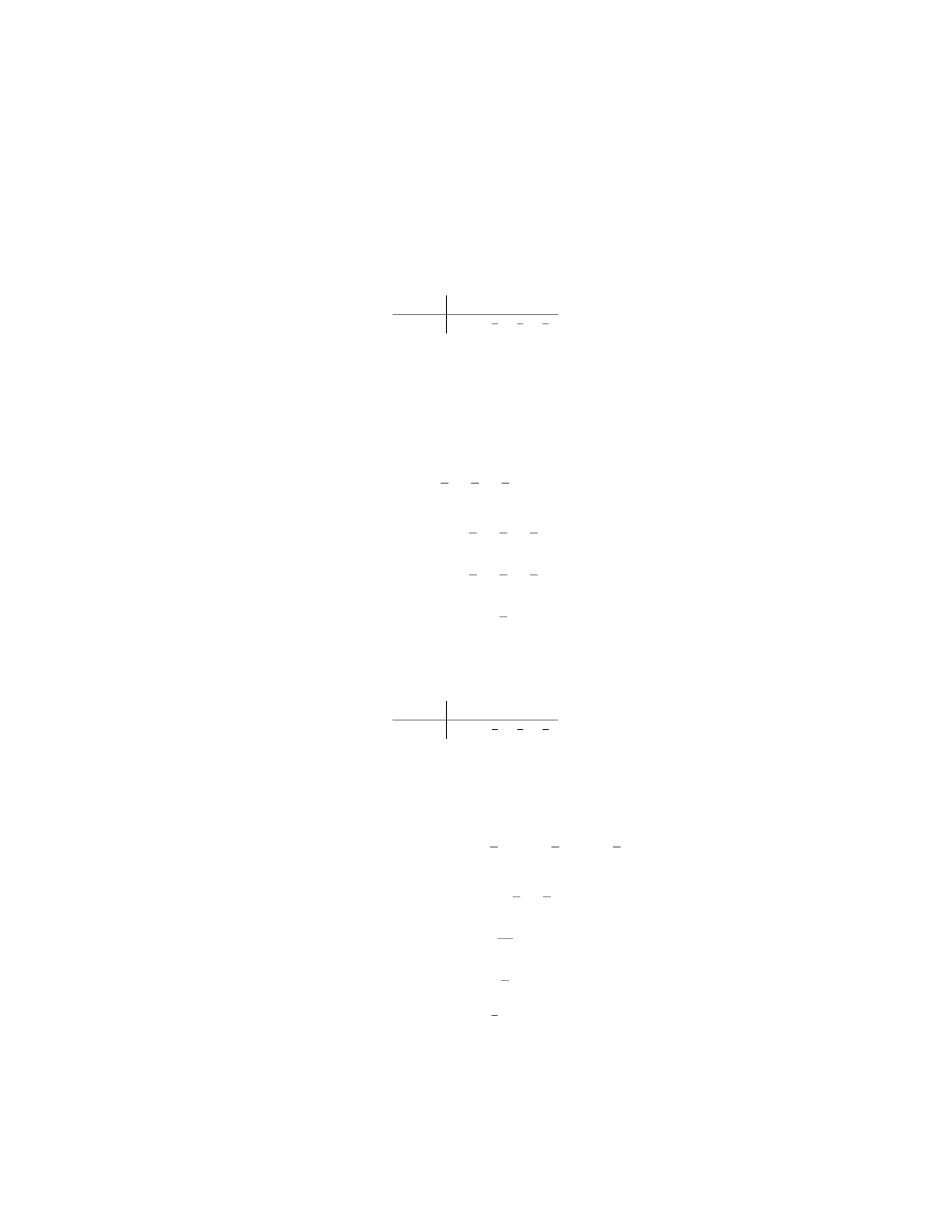
X−2 0 2 4
P(X)k1
4
3
8
1
8
Calculate the expected value of X,E(X).
Solution
Step 1: First, calculate the value of kby using the fact that the sum of all
probabilities in a probability distribution must equal 1. Thus, we have:
k+1
4+3
8+1
8= 1
k= 1 −1
4−3
8−1
8
k= 1 −4
8−3
8−1
8
k= 1 −8
8
k= 0
Therefore, the probability distribution of Xis:
X−2 0 2 4
P(X) 0 1
4
3
8
1
8
Step 2: Now, calculate the expected value E(X) using the formula:
E(X) = X
x
x·P(X=x)
E(X)=(−2) ·0 + (0) ·1
4+ (2) ·3
8+ (4) ·1
8
E(X) = 0 + 0 + 6
8+4
8
E(X) = 10
8
E(X) = 5
4
Therefore, the expected value of Xis 5
4.
16

Question 22
Question
Let Xbe a discrete random variable with the following probability mass func-
tion:
P(X= 1) = 0.2, P (X= 2) = 0.3, P (X= 3) = 0.4, P (X= 4) = 0.1.
Calculate the expected value of X.
Solution
Step 1: First, we recall that the expected value of a discrete random variable X
is given by:
E[X] = Xx·P(X=x),
where the sum is taken over all possible values xthat Xcan take on.
Step 2: Given the probability mass function of X, we can calculate the
expected value as follows:
E[X] = 1 ·0.2+2·0.3+3·0.4+4·0.1.
Step 3: Simplifying the expression:
E[X]=0.2+0.6+1.2+0.4=2.4.
Step 4: Therefore, the expected value of the random variable Xis 2.4 .
Question 23
Question
Let Xbe a discrete random variable with the following probability mass func-
tion:
P(X= 1) = 0.2, P (X= 2) = 0.3, P (X= 3) = 0.4, P (X= 4) = 0.1
Calculate the expected value of X.
Solution
Step 1: The expected value of a discrete random variable Xis given by the
formula:
E(X) = X
x
x·P(X=x)
17

where the sum is over all possible values of X.
Step 2: Substitute the given probabilities into the formula for the expected
value:
E(X) = 1 ×0.2+2×0.3+3×0.4+4×0.1
Step 3: Calculate the expected value:
E(X)=0.2+0.6+1.2+0.4
E(X)=2.4
Therefore, the expected value of Xis 2.4 .
Question 24
Question
Let Xbe a discrete random variable with the following probability distribution
function:
X1 2
P(X) 0.4 0.6
Find the expected value of X.
Solution
Step 1: Recall that the expected value (or mean) of a discrete random variable
Xis given by:
E[X] = X
all x
x·P(X=x)
Step 2: In this case, we need to find E[X] = 1 ·P(X= 1) + 2 ·P(X= 2).
Step 3: Substitute the given probabilities into the formula:
E[X]=1·0.4+2·0.6
Step 4: Calculate the expected value:
E[X]=0.4+1.2=1.6
Step 5: Therefore, the expected value of the random variable Xis 1.6 .
18

Question 25
Question
Let Xbe a discrete random variable with the following probability mass func-
tion:
P(X=−1) = 0.1, P (X= 0) = 0.2, P (X= 1) = 0.3, P (X= 2) = 0.4.
Calculate the expected value of X.
Solution
Step 1: The expected value of a discrete random variable Xis given by:
E(X) = X
i
xi·P(X=xi),
where the sum is taken over all possible values xiof X.
Step 2: Given the probability mass function of X, we have:
E(X) = (−1)(0.1) + (0)(0.2) + (1)(0.3) + (2)(0.4).
Step 3: Calculating the expected value:
E(X) = −0.1+0+0.3+0.8 = 1 .
Therefore, the expected value of Xis 1.
Question 26
Question
Let Xbe a discrete random variable with the following probability mass func-
tion:
P(X=−2) = 0.1, P (X= 1) = 0.3, P (X= 3) = 0.2, P (X= 5) = 0.4
Find the expected value of X.
Solution
Step 1: Recall that the expected value of a discrete random variable Xis given
by:
E(X) = X
all x
x·P(X=x)
where the sum is taken over all possible values that Xcan take on.
19

Step 2: Substituting the given probabilities into the formula for the expected
value, we have:
E(X)=(−2)(0.1) + (1)(0.3) + (3)(0.2) + (5)(0.4)
=−0.2+0.3+0.6+2
= 3.7
Therefore, the expected value of the random variable Xis 3.7.
Question 27
Question
Let Xbe a discrete random variable with the following probability mass func-
tion:
P(X=−2) = 1
6, P (X= 0) = 1
3, P (X= 3) = 1
2
Find the expected value of X.
Solution
Step 1: Recall that the expected value of a discrete random variable is given by
the formula:
E(X) = X
x
x·P(X=x)
Step 2: Compute the expected value using the given probability mass func-
tion:
E(X) = (−2) ·1
6+ 0 ·1
3+ 3 ·1
2
Step 3: Simplify the expression to find the expected value:
E(X) = −2
6+0+3
2=−1
3+3
2
Step 4: Write the expected value in simplest form:
E(X) = 5
6
Therefore, the expected value of the discrete random variable Xis 5
6.
20

Question 28
Question
Let Xbe a discrete random variable with the following probability mass func-
tion:
P(X= 1) = 1
4, P (X= 2) = 1
2, P (X= 3) = 1
4.
Find the expected value of X.
Solution
To find the expected value of a discrete random variable X, denoted as E(X),
we use the formula:
E(X) = X
x
x·P(X=x)
where the sum is taken over all possible values of X.
Step 1: Identify the values of Xand their corresponding probabil-
ities In this case, Xcan take on the values 1, 2, or 3 with probabilities 1
4,1
2,
and 1
4respectively.
Step 2: Calculate the expected value Using the formula for expected
value:
E(X) = 1 ·1
4+ 2 ·1
2+ 3 ·1
4
E(X) = 1
4+2
2+3
4
E(X) = 1
4+1+3
4
E(X) = 1+4+3
4
E(X) = 8
4
E(X) = 2
Therefore, the expected value of the random variable Xis 2.
21

Question 29
Question
Let Xbe a discrete random variable with the following probability mass func-
tion:
P(X= 1) = 0.2, P (X= 2) = 0.3, P (X= 3) = 0.1, P (X= 4) = 0.4
Calculate the expected value of X.
Solution
Step 1: Recall that the expected value of a discrete random variable Xis defined
as:
E(X) = X
x
x·P(X=x)
Step 2: Substitute the given probabilities into the formula to calculate the
expected value:
E(X)=1·0.2+2·0.3+3·0.1+4·0.4
Step 3: Multiply each value of xby its corresponding probability:
E(X)=0.2+0.6+0.3+1.6
Step 4: Sum the results to find the expected value:
E(X)=2.7
Therefore, the expected value of the discrete random variable Xis 2.7.
Question 30
Question
Let Xbe a discrete random variable with the following probability mass func-
tion:
f(x) =
0.2 if x= 1,
0.3 if x= 2,
0.4 if x= 3,
0.1 if x= 4,
0 otherwise.
Find the expected value of X.
22

Solution
Step 1: To find the expected value of X, we use the formula:
E(X) = X
x
x·P(X=x)
Step 2: Plug in the values from the probability mass function:
E(X)=1·0.2+2·0.3+3·0.4+4·0.1
Step 3: Calculate the expected value:
E(X)=0.2+0.6+1.2+0.4
E(X)=2.4
Therefore, the expected value of Xis 2.4.
Question 31
Question
Let Xbe a discrete random variable with the following probability mass func-
tion:
P(X= 1) = 0.2, P (X= 2) = 0.3, P (X= 3) = 0.1, P (X= 4) = 0.4
Calculate the expected value of X.
Solution
Step 1: The expected value of a discrete random variable Xis given by the
formula:
E(X) = X
x
x·P(X=x)
where the sum is taken over all possible values of X.
Step 2: Substitute the given probability mass function values into the for-
mula:
E(X)=1·0.2+2·0.3+3·0.1+4·0.4
Step 3: Calculate the expected value:
E(X)=0.2+0.6+0.3+1.6
E(X)=2.7
Therefore, the expected value of the random variable Xis 2.7.
23

Question 32
Question
Let Xbe a discrete random variable with the following probability mass func-
tion:
P(X= 1) = 0.2, P (X= 2) = 0.3, P (X= 3) = 0.4, P (X= 4) = 0.1
Calculate the expected value of X.
Solution
Step 1: The expected value of a discrete random variable Xis denoted as E[X]
and is calculated as:
E[X] = X
all x
x·P(X=x)
where xtakes on all possible values of X.
Step 2: Given the probability mass function of X, we have:
E[X]=1·0.2+2·0.3+3·0.4+4·0.1
Step 3: Calculate the expected value using the probabilities given:
E[X]=0.2+0.6+1.2+0.4
E[X]=2.4
Therefore, the expected value of Xis 2.4.
Question 33
Question
Let Xbe a discrete random variable with the following probability mass func-
tion:
P(X=−2) = 0.1, P (X= 1) = 0.2, P (X= 3) = 0.3, P (X= 5) = 0.4
Find the expected value of X.
24

Solution
Step 1: To find the expected value of X, we use the formula:
E[X] = X
x
x·P(X=x)
Step 2: Substitute the values from the probability mass function:
E[X] = (−2) ·0.1 + (1) ·0.2 + (3) ·0.3 + (5) ·0.4
Step 3: Calculate the expected value:
E[X] = −0.2+0.2+0.9 + 2 = 3
Therefore, the expected value of the random variable Xis 3 .
Question 34
Question
Let Xbe a discrete random variable with the following probability mass func-
tion:
P(X= 1) = 1
4, P (X= 2) = 1
8, P (X= 3) = 1
16, P (X= 4) = 1
16, P (X= 5) = 1
4, P (X= 6) = 1
8.
Find the expected value of X.
Solution
Step 1: Recall that the expected value of a discrete random variable Xis given
by:
E(X) = X
x
x·P(X=x),
where the sum is taken over all possible values of X.
Step 2: Calculate the expected value E(X) using the given probability mass
function:
E(X)=1·1
4+ 2 ·1
8+ 3 ·1
16 + 4 ·1
16 + 5 ·1
4+ 6 ·1
8.
Step 3: Simplify the expression:
E(X) = 1
4+2
8+3
16 +4
16 +5
4+6
8.
Step 4: Further simplify to find the expected value:
E(X) = 1
4+1
4+3
16 +1
4+5
4+3
4=15
4.
Therefore, the expected value of the random variable Xis 15
4= 3.75.
25

Question 35
Question
Let Xbe a discrete random variable with the following probability mass func-
tion:
P(X=−2) = 0.1, P (X= 0) = 0.2, P (X= 1) = 0.3, P (X= 2) = 0.4.
Calculate the expected value of X.
Solution
Step 1: The expected value of a discrete random variable Xis given by:
E(X) = X
x
x·P(X=x),
where the sum is taken over all possible values of X.
Step 2: Substitute the given probabilities into the formula:
E(X)=(−2) ·0.1 + (0) ·0.2 + (1) ·0.3 + (2) ·0.4.
Step 3: Calculate the expected value:
E(X) = −0.2+0+0.3+0.8=0.9.
Therefore, the expected value of the random variable Xis 0.9 .
26

