



MATH 332 - ADVANCED CALCULUS
- Green’s Theorem
Question Bank - Set 4
Liberty University
Question 1
Question
Let Cbe the curve defined by x2+y2= 1 oriented counterclockwise. Evaluate
the line integral HC(2x2−y2)dx + (x2+ 2y)dy using Green’s Theorem.
Solution
Step 1: Determine the region Denclosed by the curve C.
Since x2+y2= 1 represents a circle of radius 1 centered at the origin,
the region Denclosed by the curve Cis the interior of the circle.
Step 2: Apply Green’s Theorem, which states that for a region Denclosed
by a simple, closed, positively-oriented curve C, the line integral of a vector field
around Ccan be expressed as a double integral over the region Dof the curl of
the vector field.
Here, f(x, y) = 2x2−y2and g(x, y) = x2+ 2y.
Calculate the curl of the vector field
F(x, y) = (f(x, y), g(x, y)) :
∇ ×
F=∂g
∂x −∂f
∂y = (2 −(−2)) = 4.
Step 3: Compute the area integral over the region Dfor the curl of the
vector field. ZZD∇ ×
F dA = 4 ZZD
dA = 4 ·Area of D.
Since the radius of the circle is 1, the area of D=π(1)2=π.

Step 4: Evaluate the line integral using Green’s Theorem.
IC
F·dr =ZZD∇ ×
F dA = 4π.
Therefore, the line integral HC(2x2−y2)dx + (x2+ 2y)dy around the curve Cis
4π.
Question 2
Question
Let Cbe the curve that bounds the region Denclosed by the parabola y=x2,
the line y= 2x, and the x-axis. Use Green’s Theorem to evaluate the line
integral
IC
(3x−2y)dx + (x+ 4y)dy
Solution
1. We start by determining the region Denclosed by the given curves. The
parabola y=x2intersects y= 2xat x= 0 and x= 1. Therefore, the
region Dis bounded by 0≤x≤1.
2. Green’s Theorem states that for a region Denclosed by a simple closed
curve Coriented counterclockwise, and a vector field F= (P, Q)that has
continuous partial derivatives on an open region containing D, then the
line integral of Faround Cis equal to the double integral of the curl of F
over the region D:
IC
F·dr=ZZD∂Q
∂x −∂P
∂y dA
In this case, we have F= (3x−2y, x +4y), so P= 3x−2yand Q=x+4y.
3. To apply Green’s Theorem, we need to calculate the partial derivatives of
Pand Q:
∂Q
∂x = 1 and ∂P
∂y =−2
4. Now, we evaluate the double integral over the region D:
ZZD∂Q
∂x −∂P
∂y dA =ZZD
(1 + 2) dA =ZZD
3dA
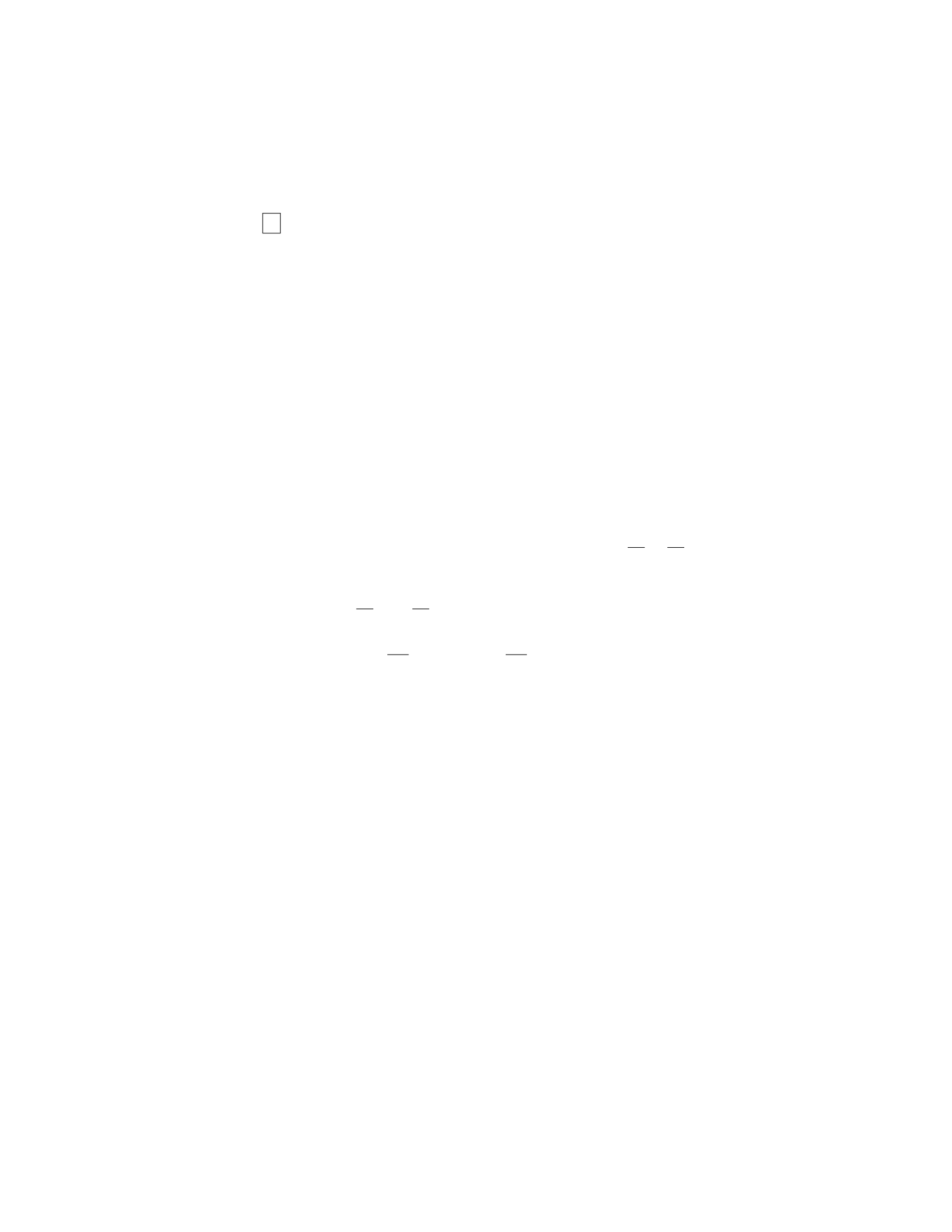
5. Since the region Dis bounded by 0≤x≤1and 0≤y≤x2, we have:
ZZD
3dA =Z1
0Zx2
0
3dy dx =Z1
0
3x2dx =x31
0= 1
2
6. Therefore, by Green’s Theorem, the line integral of Faround the curve C
is 1.
Question 3
Question
Let Cbe the curve given by x2+y2= 4 oriented counterclockwise. Calculate
the line integral HC(x+y2)dx + (x2+y)dy using Green’s Thejsonm.
Solution
Step 1: To apply Green’s Theorem to evaluate the line integral, we need to find
the region Denclosed by the curve C.
Step 2: The curve Cis a circle centered at the origin with radius 2. There-
fore, Dis the disk enclosed by the circle.
Step 3: Green’s Theorem states that for a region Denclosed by a simple,
positively oriented curve C, the line integral along Cof the vector field F=
P(x, y)i+Q(x, y)jis equal to the double integral over Dof ∂Q
∂x −∂P
∂y dA.
Step 4: In this case, we have F= (x+y2)i+ (x2+y)j, so P(x, y) = x+y2
and Q(x, y) = x2+y.
Step 5: Calculate ∂Q
∂x and ∂P
∂y :
∂Q
∂x = 2xand ∂P
∂y = 2y
Step 6: Compute the double integral over D:
ZZD
(2x−2y)dA
Step 7: Switch to polar coordinates: x=rcos(θ),y=rsin(θ), and dA =
rdrdθ.
Step 8: Rewrite the integral in polar coordinates:
Z2π
0Z2
0
(2rcos(θ)−2rsin(θ))rdrdθ
Step 9: Simplify the integral:
Z2π
0Z2
0
(2r2cos(θ)−2r2sin(θ))drdθ
Step 10: Evaluate the double integral to find the line integral along C.
3
Question 4
Question
Let Cbe the curve defined by xy = 1 oriented counterclockwise. Calculate the
line integral HCy dx +x dy using Green’s Theorem.
Solution
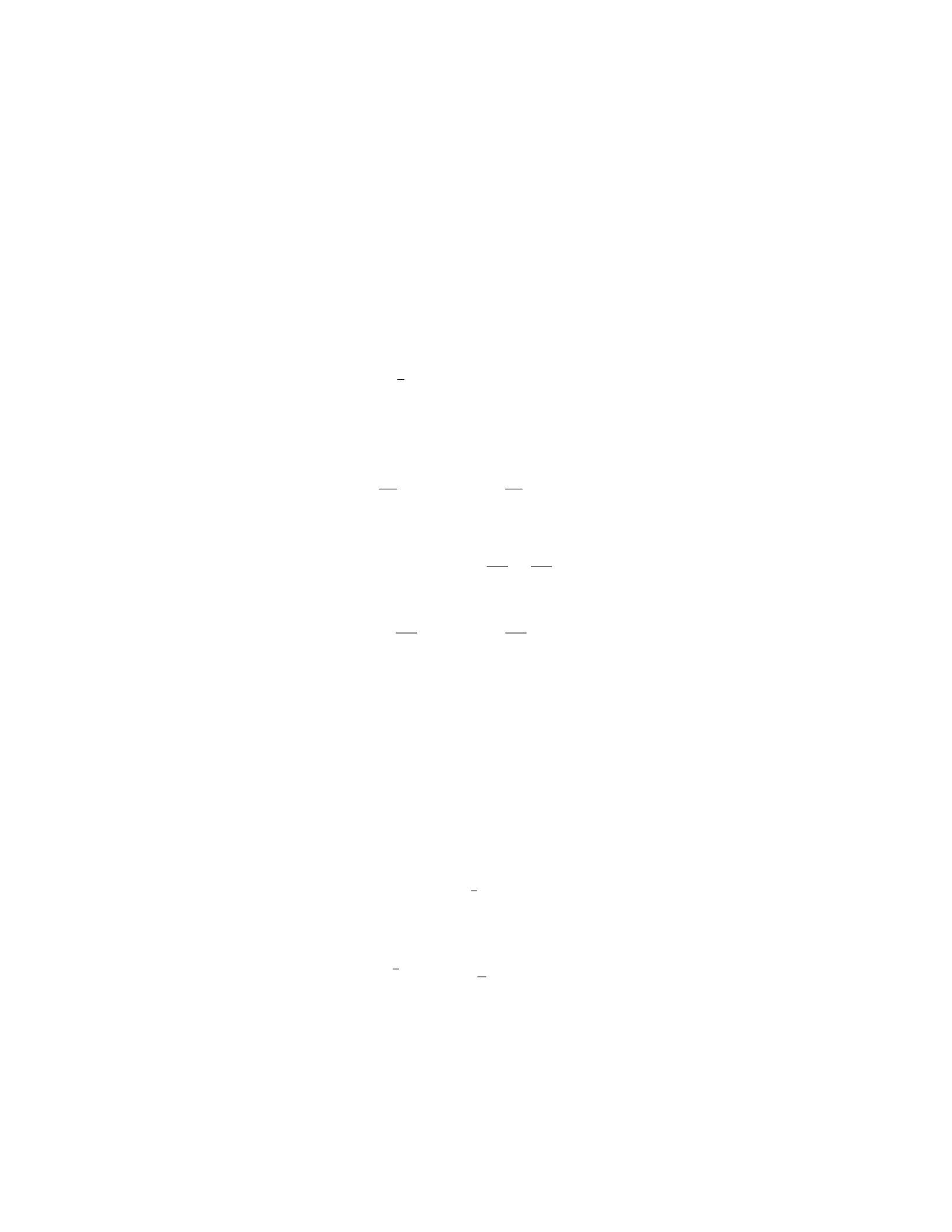
Step 1: Determine the region enclosed by the curve C. Given the curve xy = 1,
we can rewrite it as y=1
x. This curve is the rectangular hyperbola with
asymptotes x= 0 and y= 0. The region enclosed by Cis the area in the first
quadrant.
Step 2: Find the partial derivatives of the vector field. The vector field is
F= (y, x). Compute the partial derivatives:
∂
∂x (y) = 0 and ∂
∂y (x) = 0
Step 3: Calculate the line integral using Green’s Theorem. Green’s Theo-
rem states: IC
F·dr =ZZR∂Q
∂x −∂P
∂y dA
Here, P=yand Q=x. So, we have:
∂Q
∂x = 1 and ∂P
∂y = 0
The line integral becomes:
IC
y dx +x dy =ZZR
1dA
Step 4: Calculate the double integral over the region R. Since the region
Ris the area in the first quadrant enclosed by the curve C, the double integral
becomes: ZZR
1dA =ZZR
dA
Step 5: Evaluate the double integral. The integral RRRdA over the first
quadrant region enclosed by xy = 1 is equivalent to finding the area of this
region. This can be done by integrating:
Z∞
0Z1
x
0
1dy dx
This integral evaluates to:
Z∞
0
[y]
1
x
0dx =Z∞
0
1
xdx = lim
c→∞[ln(x)]c
1
= lim
c→∞ ln(c)−ln(1) = ∞
Therefore, the line integral HCy dx +x dy around the curve xy = 1 is ∞.
4

Question 5
Question
Let Cbe the curve that consists of the line segment from (0,0) to (2,4) and
the line segment from (2,4) to (4,0). Use Green’s Theorem to evaluate the line
integral
IC
(x2+y2)dx +xy dy
Solution
Step 1: Calculate the double integral over the region enclosed by curve C. Let
Dbe the region enclosed by C. We have Das a triangle with vertices at (0,0),
(2,4), and (4,0). Then, Green’s Theorem gives
ZZD∂Q
∂x −∂P
∂y dA =IC
P dx +Q dy
where P=x2+y2and Q=xy. Then,
∂Q
∂x =yand ∂P
∂y = 2y
So, the given integral becomes
ZZD
(y−2y)dA =ZZD
(−y)dA
Step 2: Convert the integral over Dto a double integral. To integrate over
the triangular region Dwith vertices at (0,0),(2,4), and (4,0), we set up the
double integral as follows:
ZZD
(−y)dA =Z4
0Z4−1
2y
1
2y
(−y)dx dy
Step 3: Evaluate the double integral. Integrating with respect to xfirst,
we have:
Z4
0
[−xy]4−1
2y
1
2ydy =Z4
0
(−4y+ 2y)dy
=Z4
0
(−2y)dy =−y2
4
0=−16
Therefore, the value of the line integral is −16 .
5

Question 6
Question
Let Cbe the circle centered at the origin with radius 2, oriented counter-
clockwise. Let Dbe the region enclosed by C. Consider the vector field
F(x, y) = (yex2, x cosy2). Calculate the circulation of Faround Cand the
flux of Facross the boundary of Dusing Green’s Theorem.
Solution
To calculate the circulation of Faround Cusing Green’s Theorem, we need to
evaluate the line integral of Faround C:
IC
F·dr=ZZD∂Q
∂x −∂P
∂y dA
where F(x, y) = (P(x, y), Q(x, y)). In this case, P(x, y) = yex2and Q(x, y) =
xcosy2. Let’s first calculate the partial derivatives:
∂Q
∂x = cosy2
∂P
∂y =ex2
Therefore, the line integral becomes:
IC
F·dr=ZZD
(cosy2−ex2)dA
To evaluate the integral RRD(cosy2−ex2)dA, we switch to polar coordi-
nates. The region Dis described by 0≤r≤2and 0≤θ≤2π. Then, the
integral becomes:
Z2π
0Z2
0
(rcos(θ)2−er2cos(θ)2)r dr dθ
After evaluating this integral, we will obtain the circulation of Faround C.
Next, we use Green’s Theorem to calculate the flux of Facross the boundary
of D. The flux is given by:
ZZD
(∂Q
∂x −∂P
∂y )dA
We already calculated the partial derivatives so we can directly evaluate this
integral in polar coordinates as well. This will give us the flux of Facross the
boundary of D.
6
Question 7
Question
Let Cbe the boundary of the region enclosed by the curve x2+y2= 4, oriented
counterclockwise when viewed from above. Compute the line integral HC(x+
y)dx + (2x−y)dy using Green’s theorem.
Solution
Step 1: Find the region Denclosed by the curve x2+y2= 4. The region
enclosed by x2+y2= 4 is a circle of radius 2 centered at the origin.
Step 2: Using Green’s theorem, we have
IC
(x+y)dx + (2x−y)dy =ZZD∂(2x−y)
∂x −∂(x+y)
∂y dA.
Step 3: Compute the partial derivatives:
∂(2x−y)
∂x = 2,∂(x+y)
∂y = 1.
Therefore, the line integral simplifies to
ZZD
(2 −1) dA =ZZD
dA.
Step 4: Switch to polar coordinates to evaluate the double integral. Let
x=rcos θand y=rsin θ. Also, dA =rdrdθ. The limits of integration for r
are from 0 to 2, and for θare from 0 to 2π.
Step 5: Evaluate the double integral:
Z2π
0Z2
0
r drdθ =Z2π
0r2
22
0
dθ =Z2π
0
2dθ = 4π.
Therefore, the line integral HC(x+y)dx + (2x−y)dy around the curve
x2+y2= 4 is equal to 4π.
Question 8
Question
Let Cbe the unit circle centered at the origin, oriented counterclockwise, and
let Dbe the region inside C. Consider the vector field F(x, y)=(xex2+y2−
y, yex2+y2+x). Use Green’s Theorem to calculate the line integral HCF·dr.
7
Solution
Step 1: Calculate the divergence of F:
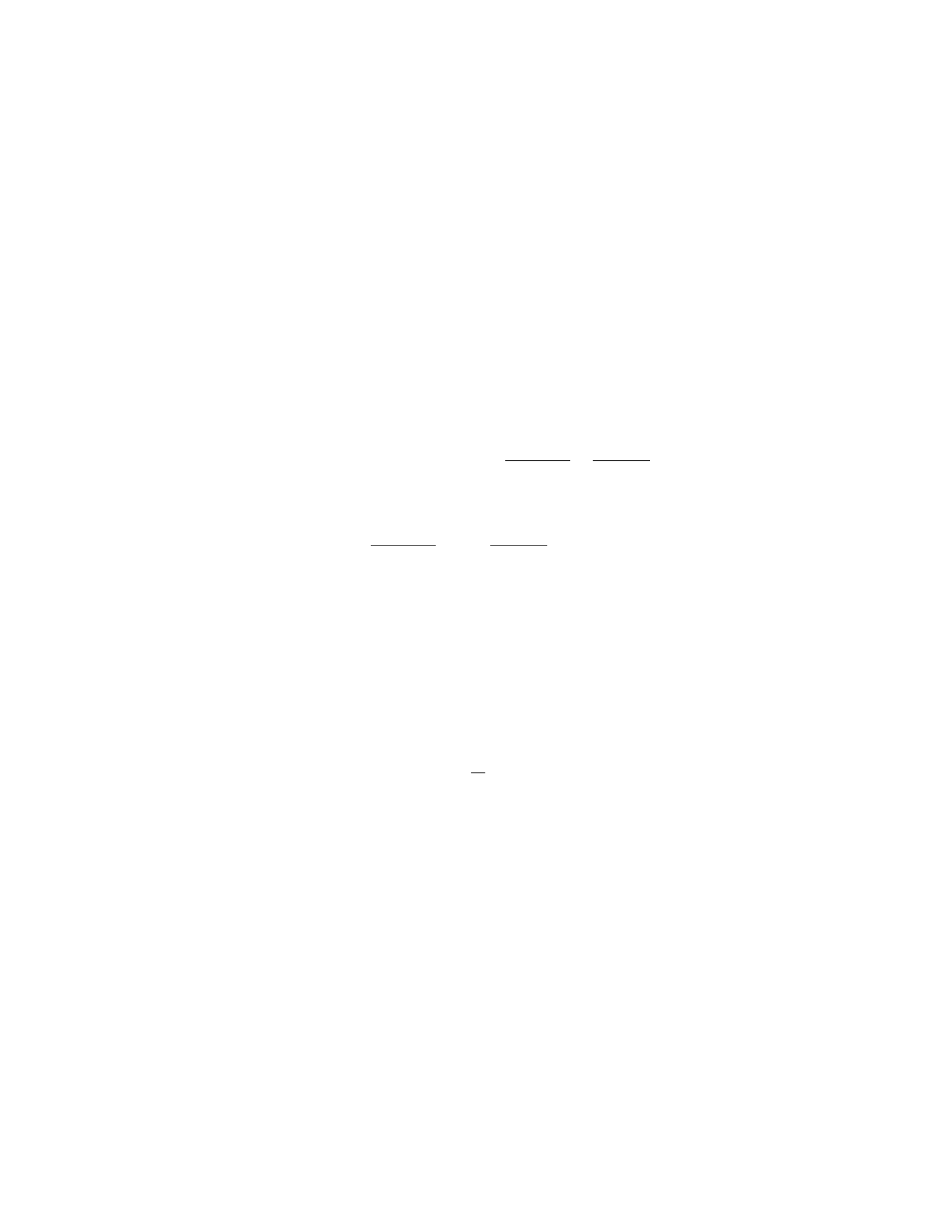
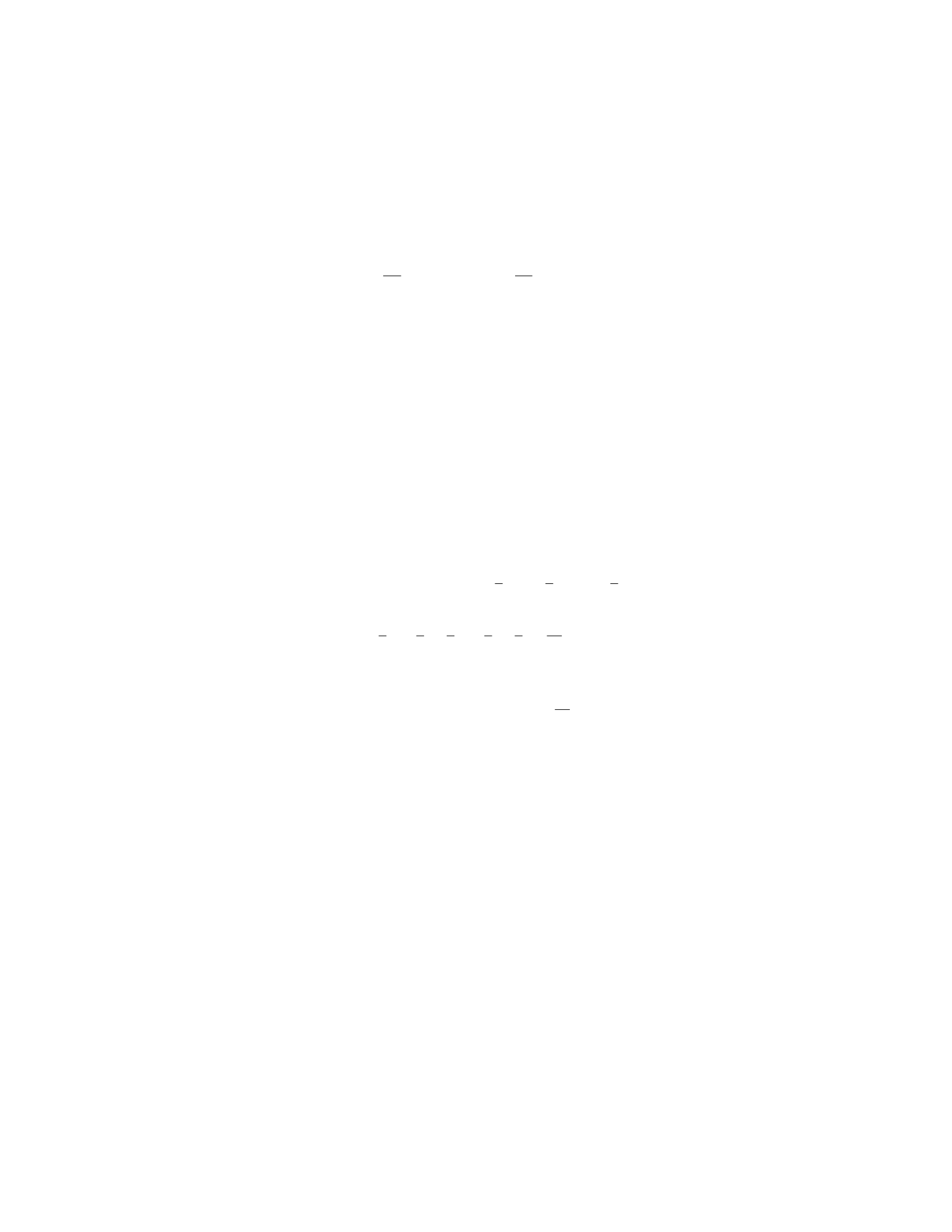
∇ · F=∂
∂x (xex2+y2−y) + ∂
∂y (yex2+y2+x)
=ex2+y2+ 2x2ex2+y2−1
Step 2: Apply Green’s Theorem: Using Green’s Theorem, we have:
IC
F·dr=ZZD
(∇ · F)dA
Step 3: Calculate the area integral: Since the region Dis inside the unit
circle, we can use polar coordinates to integrate over D:
ZZD
(∇ · F)dA =Z2π
0Z1
0
(er2+ 2r2er2−1) r dr dθ
Step 4: Evaluate the integral: Integrating with respect to rfirst, we get:
Z1
0
(er2+ 2r2er2−1) r dr =1
2er2+2
3r3er2−1
2r2
1
0
=1
2e−1
2+2
3e−2
3−1
2=5e
6−2
Step 5: Compute the final result: Finally, we have:
IC
F·dr=ZZD
(∇ · F)dA =5e
6−2
Question 9
Question
Let Cbe the curve given by x= 2 cos(t),y= 3 sin(t)for 0≤t≤2π, oriented
counterclockwise. Calculate the circulation of the vector field F(x, y) = ⟨y2, x2⟩
around the curve C.
Solution
Step 1: Parameterize the curve C.
x(t) = 2 cos(t)
y(t) = 3 sin(t)
8

Step 2: Calculate the derivatives of x(t)and y(t).
dx
dt =−2 sin(t)
dy
dt = 3 cos(t)
Step 3: Calculate the line integral of Fover Cusing circulation.
circulation =ZC
F·dr
=Z2π
0⟨32sin2(t),22cos2(t)⟩ · ⟨−2 sin(t),3 cos(t)⟩dt
=Z2π
0−9 sin3(t) + 4 cos3(t)dt
=Z2π
0−9 sin3(t)dt +Z2π
0
4 cos3(t)dt
= 0 (Use symmetry properties of sine and cosine functions)
Therefore, the circulation of the vector field Faround the curve Cis 0.
Question 10
Question
Let Cbe the curve defined by x2+y2= 4 oriented counterclockwise. Evaluate
the line integral HC(x3y2+y3)dx + (2xy2+x2y)dy using Green’s Theorem.
Solution
Step 1: Determine the region enclosed by the curve C.
• The curve Cis a circle of radius 2 centered at the origin.
• The region enclosed by Cis the interior of this circle.
Step 2: Compute the partial derivatives of the given vector field. Let
F(x, y) = (x3y2+y3,2xy2+x2y).
• Compute ∂
∂y (x3y2+y3) = 2x3y+ 3y2.
• Compute ∂
∂x (2xy2+x2y) = 2y2+ 2xy.
Step 3: Apply Green’s Theorem. Green’s Theorem states that for a simply
connected region Denclosed by a positively oriented, piecewise smooth, simple
9
closed curve C, if F= (P, Q)is a vector field whose components have continuous
first partial derivatives in an open region containing D, then
IC
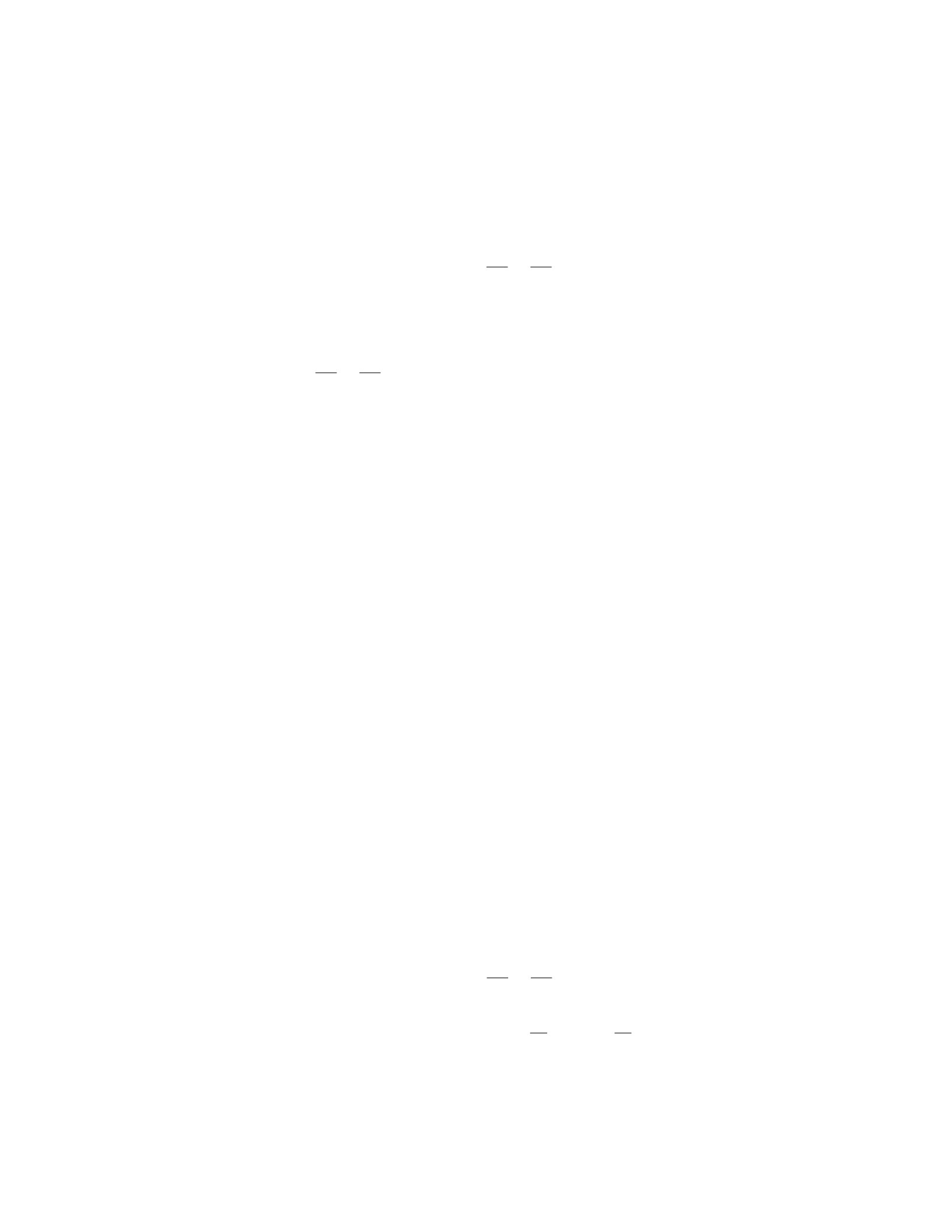
F·dr =ZZD∂Q
∂x −∂P
∂y dA.
Substitute P=x3y2+y3and Q= 2xy2+x2yinto the formula above.
Step 4: Evaluate the double integral.
ZZD∂Q
∂x −∂P
∂y dA =ZZD2y2+ 2xy −(2x3y+ 3y2)dA.
Step 5: Switch to polar coordinates to simplify the integral. Let x=rcos(θ)
and y=rsin(θ). Also, dA =rdrdθ.
Step 6: Calculate the integral using the polar form of the vector field.
Z2π
0Z2
02(rsin(θ))2+ 2(rcos(θ))(rsin(θ)) −2(rcos(θ))3(rsin(θ)) −3(rsin(θ))2rdrdθ
Step 7: Simplify the integral and compute the final result to find the value
of the line integral over the curve C.
Question 11
Question
Let Cbe the curve given by the intersection of the plane z= 2 and the cylinder
x2+y2= 1. Use Green’s Theorem to evaluate HC(2x+ 3y)dx + (x−2y)dy.
Solution
Step 1: Find the region Denclosed by the curve C. Since Cis the intersection
of the plane z= 2 and the cylinder x2+y2= 1, the curve Clies on the disk in
the xy-plane with radius 1 centered at the origin. Let’s denote this region as D.
Step 2: Parametrize the boundary curve C. We can parametrize Cusing
polar coordinates as x= cos(t)and y= sin(t)for 0≤t≤2π. Given that z= 2
on C, we have z= 2 as the constant for the C.
Step 3: Apply Green’s Theorem. Green’s Theorem states that for a smooth
curve Cenclosing a region Din the plane, and a vector field F=Pi+Qj
defined on an open region containing D, the circulation of Faround Cis equal
to the double integral of ∇ ×Fover the region D. Mathematically, this can be
expressed as:
IC
F·dr=ZZD
(∂Q
∂x −∂P
∂y )dA
Step 4: Evaluate the line integral. Given F= (2x+ 3y)i+ (x−2y)j, we
can write P= 2x+ 3yand Q=x−2y. Then, ∂Q
∂x = 1 and ∂P
∂y = 3.
10

Therefore, by Green’s Theorem, we have:
IC
(2x+ 3y)dx + (x−2y)dy =ZZD
(1 −3) dA =−2ZZD
dA
Step 5: Calculate the double integral over the region D. The double integral
of 1over the unit circle Dis the area of the circle, which is π(12) = π. Therefore,
the value of the line integral is:
−2ZZD
dA =−2·π=−2π
Question 12
Question
Let Cbe the curve defined by the intersection of the surfaces x2+y2+z2= 1
and y2+z2=x. Use Green’s Theorem to evaluate the line integral HCx2dy +
y2dz +z2dx.
Solution
Step 1: Determine the region Denclosed by the curve Cin the xy-plane.
The curve Cis the intersection of the surfaces x2+y2+z2= 1 and y2+z2=x.
Solving for xin y2+z2=x, we get x=y2+z2. Substituting this into
x2+y2+z2= 1, we have (y2+z2)2+y2+z2= 1.
Solving this equation will give us the curve Cin terms of yand z.
Step 2: Apply Green’s Theorem.
Given that the line integral is HCx2dy +y2dz +z2dx, we rewrite it as
HCP dx +Q dy +R dz, where P=z2,Q=x2, and R=y2.
Green’s Theorem states:
IC
P dx +Q dy =ZZD∂Q
∂x −∂P
∂y dA
Applying Green’s Theorem, we have:
IC
x2dy +y2dz +z2dx =ZZD
(2x−2y)dA
Step 3: Evaluate the double integral.
Evaluate the double integral RRD(2x−2y)dA over the region Dfound in
Step 1.
This will give us the final answer for the line integral over curve C.
11

Question 13
Question
Let Cbe the curve given by x2+y2= 1 oriented counterclockwise. Calculate
the circulation of the vector field F(x, y) = (y, −x)around C.
Solution
Step 1: To calculate the circulation of Faround C, we need to use Green’s
Theorem, which relates circulation to a double integral over the region bounded
by C.
Step 2: Green’s Theorem states that for a vector field F(x, y) = (P(x, y), Q(x, y))
with a positively oriented simple closed curve Cgiven by r(t) = (x(t), y(t)) pa-
rameterized by a≤t≤b, the circulation of Faround Cis given by:
IC
F·dr=ZZD∂Q
∂x −∂P
∂y dA,
where Dis the region enclosed by C.
Step 3: In this case, F(x, y)=(y, −x), so P(x, y) = yand Q(x, y) = −x.
We also have that ∂Q
∂x =−1and ∂P
∂y = 1.
Step 4: Substituting these into Green’s Theorem, we obtain:
IC
F·dr=ZZD
(−1−1)dA =−2ZZD
dA.
Step 5: The region Denclosed by Cis the unit circle centered at the origin.
We can express this as D={(x, y)∈R2:x2+y2≤1}.
Step 6: Calculating the double integral over D, we have:
−2ZZD
dA =−2Z1
−1Z√1−x2
−√1−x2
dydx =−4Z1
−1p1−x2dx.
Step 7: To evaluate the integral, we make a trigonometric substitution x=
sin θ:
−4Z1
−1p1−x2dx =−4Zπ
2
−π
2
cos2θdθ.
Step 8: Using the identity cos2θ=1+cos 2θ
2, we obtain:
−4Zπ
2
−π
2
cos2θdθ =−2θ+sin 2θ
2π
2
−π
2
=−2π.
Step 9: Therefore, the circulation of the vector field F(x, y) = (y, −x)around
the curve Cis −2π.
12
Question 14
Question
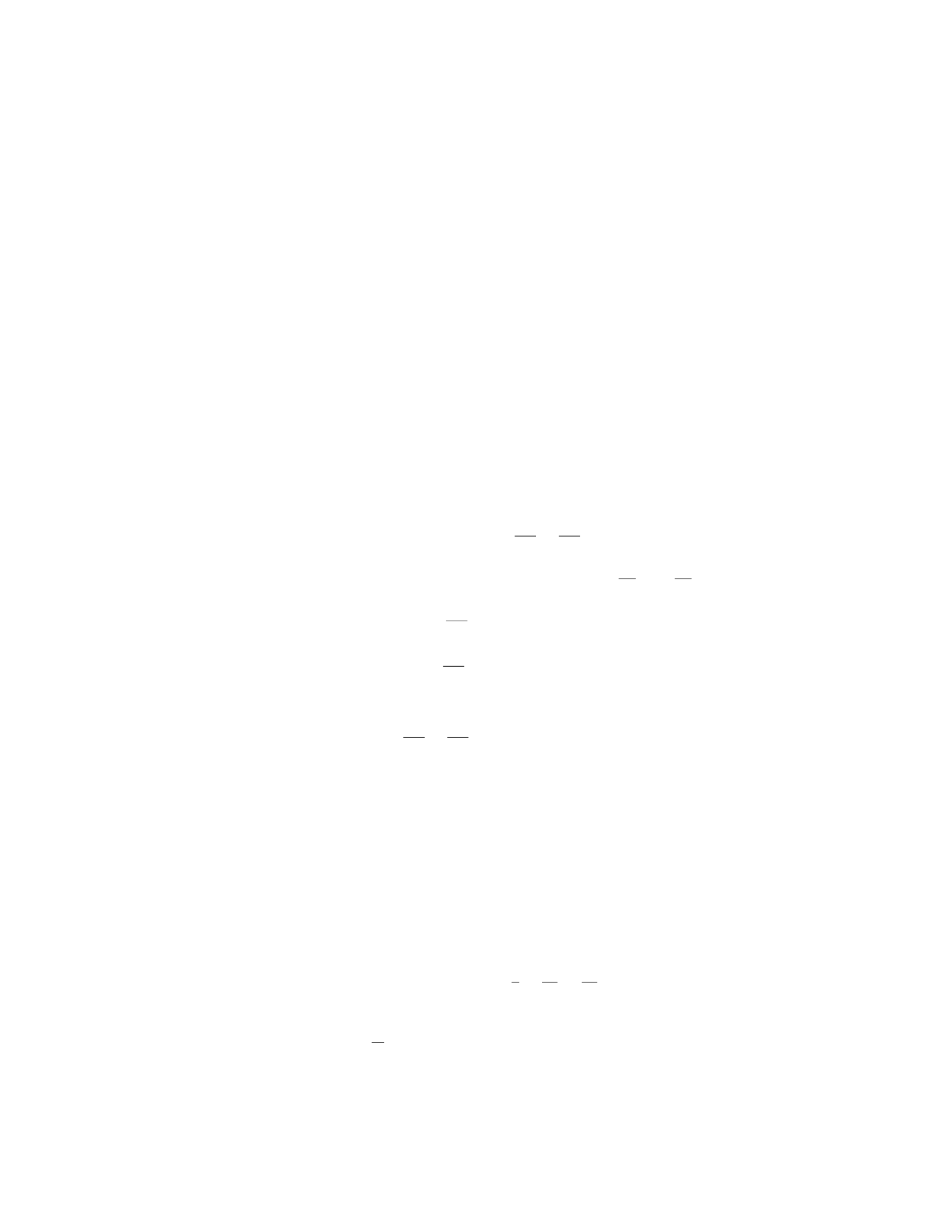
Let Cbe the curve defined by x=t2and y=t3for 0≤t≤1, ori-
ented counterclockwise. Use Green’s Theorem to evaluate the line integral
HCy3−x3dx +x2+y2dy.
Solution
Step 1: Find the region Denclosed by the curve C. Since x=t2and y=t3,
we can eliminate the parameter tby considering yas a function of x.
y=x3/2
The region Dis the area enclosed by the curve y=x3/2in the xy-plane over
the interval 0≤x≤1.
Step 2: Apply Green’s Theorem. Green’s Theorem states:
IC
(P dx +Q dy) = ZZD∂Q
∂x −∂P
∂y dA
In our case, P=y3−x3and Q=x2+y2. We need to find ∂Q
∂x and ∂P
∂y .
∂Q
∂x = 2x
∂P
∂y = 3y2
So, the expression inside the double integral becomes:
∂Q
∂x −∂P
∂y = 2x−3y2
Step 3: Compute the double integral. The double integral becomes:
ZZD
(2x−3y2)dA =Z1
0Zx3/2
0
(2x−3y2)dy dx
Step 4: Evaluate the double integral.
Zx3/2
0
(2x−3y2)dy = 2xy −y3
x3/2
0= 2x5/2−(x3/2)3= 2x5/2−x9/2
Integrating this with respect to xover 0≤x≤1, we get:
Z1
0
(2x5/2−x9/2)dx =4
7−2
11 =38
77
Step 5: Final answer. Therefore, the value of the line integral HC(y3−
x3)dx + (x2+y2)dy is 38
77 .
13

Question 15
Question
Let Cbe the boundary of the region enclosed by the ellipse x2
a2+y2
b2= 1, where
a > b > 0, oriented counterclockwise. Use Green’s Theorem to evaluate the line
integral HC(y2−x)dx + (x2+y)dy.
Solution
Step 1: Write the given line integral in the form of Green’s Theorem. The
line integral can be rewritten in the form P dx +Q dy, where P=y2−xand
Q=x2+y
Step 2: Find the partial derivatives of Qwith respect to xand Pwith
respect to y. Calculating the partial derivative of Qwith respect to x:
∂Q
∂x = 2x
Calculating the partial derivative of Pwith respect to y:
∂P
∂y = 2y
Step 3: Apply Green’s Theorem, which states:
IC
(P dx +Q dy) = ZZD∂Q
∂x −∂P
∂y dA
where Dis the region bounded by C.
Step 4: Evaluate the double integral on the right-hand side of Green’s
Theorem. ZZD
(2x−2y)dA
Step 5: Simplify and solve the double integral over the region Denclosed
by the given ellipse. Since the given ellipse can be parametrized by x=acos(t)
and y=bsin(t)for 0≤t≤2π, we have:
ZZD
(2x−2y)dA =Z2π
0Z1
0
(2(acos(t)) −2(bsin(t))) (ab)dr dt
= 2ab Z2π
0
(acos(t)−bsin(t)) dt
= 2ab[(asin(t) + bcos(t))]2π
0= 0
Therefore, the value of the line integral HC(y2−x)dx + (x2+y)dy is 0.
14
Question 16
Question
Let Cbe the curve consisting of the intersection of the plane z= 0 and the cone
z=px2+y2oriented counterclockwise as viewed from high z-values. Use
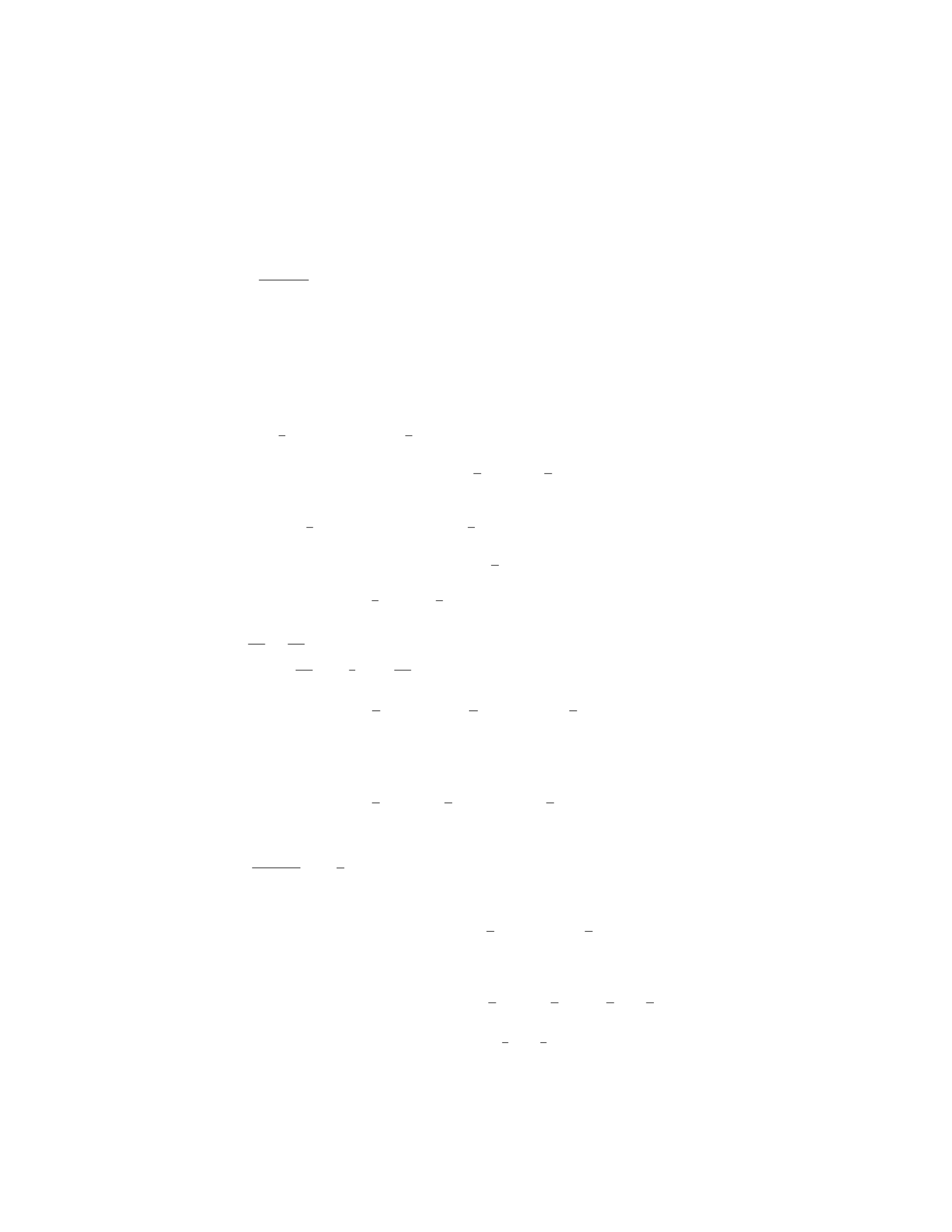
Green’s Theorem to evaluate the line integral HC(x2+y2)dx + 2xy dy.
Solution
To use Green’s Theorem, we first need to find a vector field F=⟨P, Q⟩such
that curl F=Qx−Py=x2+y2.
Step 1: Find a vector field F=⟨P, Q⟩such that curl F=x2+y2. Let
P(x, y) = y
2and Q(x, y) = −x
2. Then,
curl F=Qx−Py=−1
2−0 = −1
2=x2+y2.
To correct this, we need to add a term to Por Q. Let’s try adding x2to P:
Let P(x, y) = y
2+x2and Q(x, y) = −x
2. Now,
curl F=Qx−Py=−1
2−2x=x2+y2.
Hence, we can let F=⟨y
2+x2,−x
2⟩.
Step 2: Apply Green’s Theorem. Green’s Theorem states: HCF·dr=
RRD∂Q
∂x −∂P
∂y dA.
We have ∂Q
∂x =−1
2and ∂P
∂y = 1. Substitute into Green’s Theorem:
ICy
2+x2dx −x
2dy =ZZD
(−3
2)dA.
Step 3: Simplify the line integral. Since Dis the region inside the curve C,
we can rewrite the right side as:
ZZD
(−3
2)dA =−3
2ZZD
dA =−3
2·Area(D).
Step 4: Calculate the area enclosed by C. The area of the region inside
Ccan be calculated by finding the area of the circle with radius r= 1 (as
z=√12+ 12=√2) and subtracting the area of the right triangle formed by
the x-axis, y-axis, and the line y=x.
Area(D) = π·12−1
2·1·1 = π−1
2.
Step 5: Substitute the area back into the line integral.
IC
(x2+y2)dx + 2xy dy =−3
2·π−1
2=−3
2π+3
4.
Therefore, HC(x2+y2)dx + 2xy dy =−3
2π+3
4.
15
Question 17
Question
Let Cbe the curve given by x= cos(t),y= sin(t)for 0≤t≤π, oriented
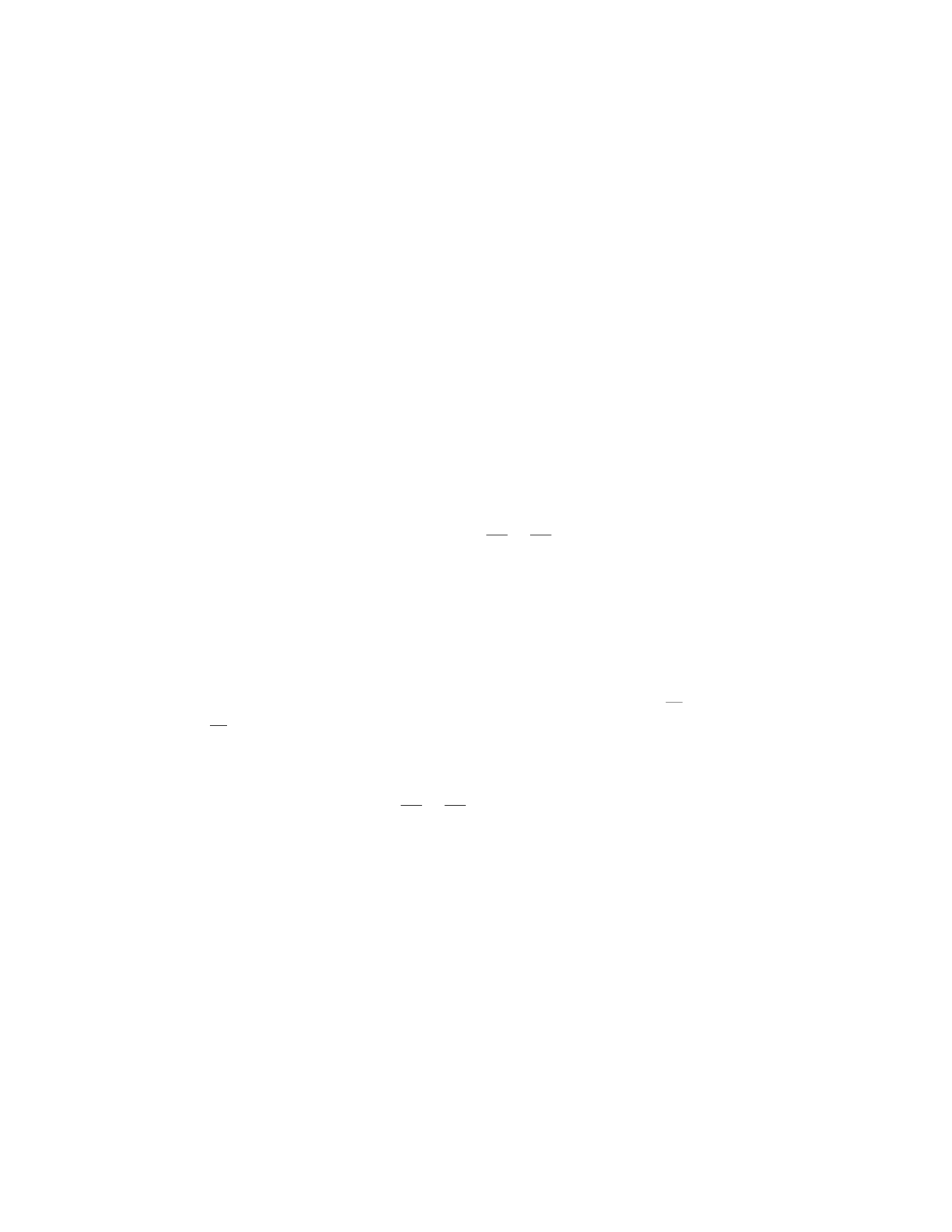
counterclockwise. Compute the line integral HC(x2+y2)dx + (x2−y2)dy using
Green’s Theorem.
Solution
Step 1: Determine the region enclosed by the curve Cand find a suitable
description of it. The curve Cis a unit circle centered at the origin, traversed
counterclockwise from t= 0 to t=π. The region enclosed by Cis the interior
of this unit circle.
Step 2: Apply Green’s Theorem, which states for a vector field F=Pi+Qj,
where Pand Qhave continuous first-order partial derivatives on a closed region
Rbounded by a positively oriented simple closed curve C, we have
IC
F·dr=ZZR∂Q
∂x −∂P
∂y dA
Step 3: Express the line integral in terms of the vector field for Green’s
Theorem. The given line integral is
IC
(x2+y2)dx + (x2−y2)dy =IC
x2dx +y2dx +x2dy −y2dy
This can be rewritten as HC(P dx +Q dy)where P=x2and Q=x2−y2.
Step 4: Calculate the partial derivatives of Pand Q. We have ∂P
∂y = 0 and
∂Q
∂x = 2x.
Step 5: Compute the double integral over the region enclosed by C. Using
Green’s Theorem, we have
ZZR∂Q
∂x −∂P
∂y dA =ZZR
2x dA
Step 6: Evaluate the double integral over the region R. Since the region R
is the interior of a unit circle, we can convert to polar coordinates: 0≤r≤1,
0≤θ≤π. Thus, the double integral becomes
Zπ
0Z1
0
2rcos(θ)dr dθ =π
Step 7: Provide the final answer. Therefore, the line integral HC(x2+
y2)dx + (x2−y2)dy is equal to π.
16

Question 18
Question
Let Cbe the curve given by r(t) = (t2+ 1)i+ (2t−1)jfor 0≤t≤2. Calculate
the circulation of the vector field F(x, y) = (2x+y)i−(x−y)jaround the curve
C.
Solution
Step 1: First, we need to parameterize the curve C:r(t) = (t2+ 1)i+ (2t−1)j
for 0≤t≤2.
Step 2: To calculate circulation, we use the formula: HCF·dr=RCF·Tds,
where F= (2x+y)i−(x−y)j,r(t) = (t2+ 1)i+ (2t−1)j,Tis the unit tangent
vector, and ds is the arc length element.
Step 3: We need to find Tand ds:T=r′(t)
|r′(t)|=2ti+2j
√4t2+4 =1
√t2+1 (ti+j),
ds =|r′(t)|dt =√4t2+ 4dt = 2√t2+ 1dt.
Step 4: Substituting everything into the circulation formula: HCF·dr=
R2
0((2(t2+ 1) + (2t−1))t−((t2+ 1) −(2t−1))) ·(ti+j)2√t2+ 1dt.
Step 5: Simplifying the integral: HCF·dr=R2
0(4t3+ 3t)2√t2+ 1dt.
Step 6: The integration may require trigonometric substitution to evaluate
the integral further.
Question 19
Question
Let Cbe the curve parametrized by x=t2and y=t3for 0≤t≤1. Calculate
the line integral RC(x2−y2)dx + 2xydy using Green’s Theorem.
Solution
Step 1: Find the parametric equations for the curve C. The parametric equa-
tions for the curve Care given by x=t2and y=t3for 0≤t≤1.
Step 2: Calculate the derivatives of xand ywith respect to t. We have
dx
dt = 2tand dy
dt = 3t2.
Step 3: Compute the line integral as a double integral using Green’s The-
orem. Using Green’s Theorem, we have
ZC
(x2−y2)dx + 2xydy =ZZD∂(2xy)
∂x −∂(x2−y2)
∂y dA,
where Dis the region enclosed by the curve C.
17

Step 4: Evaluate the partial derivatives and rewrite the double integral.
We have ∂(2xy)
∂x = 2yand ∂(x2−y2)
∂y =−2y. Thus, the line integral becomes
ZZD
(2y+ 2y)dA =ZZD
4ydA.
Step 5: Convert the double integral into a single integral. Since the region
Dis defined by 0≤t≤1, we have
ZZD
4ydA =Z1
0Zt3
t2
4t3dydx
=Z1
0
4t3(t3−t2)dt
=Z1
0
4t6−4t5dt
=4
7t7−4
6t61
0
=4
7−2
3
=10
21.
Therefore, the line integral RC(x2−y2)dx + 2xydy is equal to 10
21 .
Question 20
Question
Let Cbe the curve given by the intersection of the cylinder x2+y2= 1 and the
plane z=y. Use Green’s Theorem to evaluate the line integral HC(2y−x)dx +
(x+z)dy counterclockwise.
Solution
Step 1: Determine the region Denclosed by the curve C.
The curve Cis the intersection of the cylinder x2+y2= 1 and the plane
z=y. This intersection occurs when z=ywhich means the curve lies in the
xy-plane. Thus, Cis a circle of radius 1 centered at the origin. Therefore, the
region Denclosed by Cis the disk x2+y2≤1.
Step 2: Write the line integral as a double integral using Green’s Theorem.
Green’s Theorem states that for a curve Cenclosing a region Doriented
counterclockwise, and a vector field F(x, y) = P(x, y)i+Q(x, y)j, the line inte-
gral HCF·drcan be expressed as the double integral of the curl of Fover the
region D. The line integral can be written as:
18
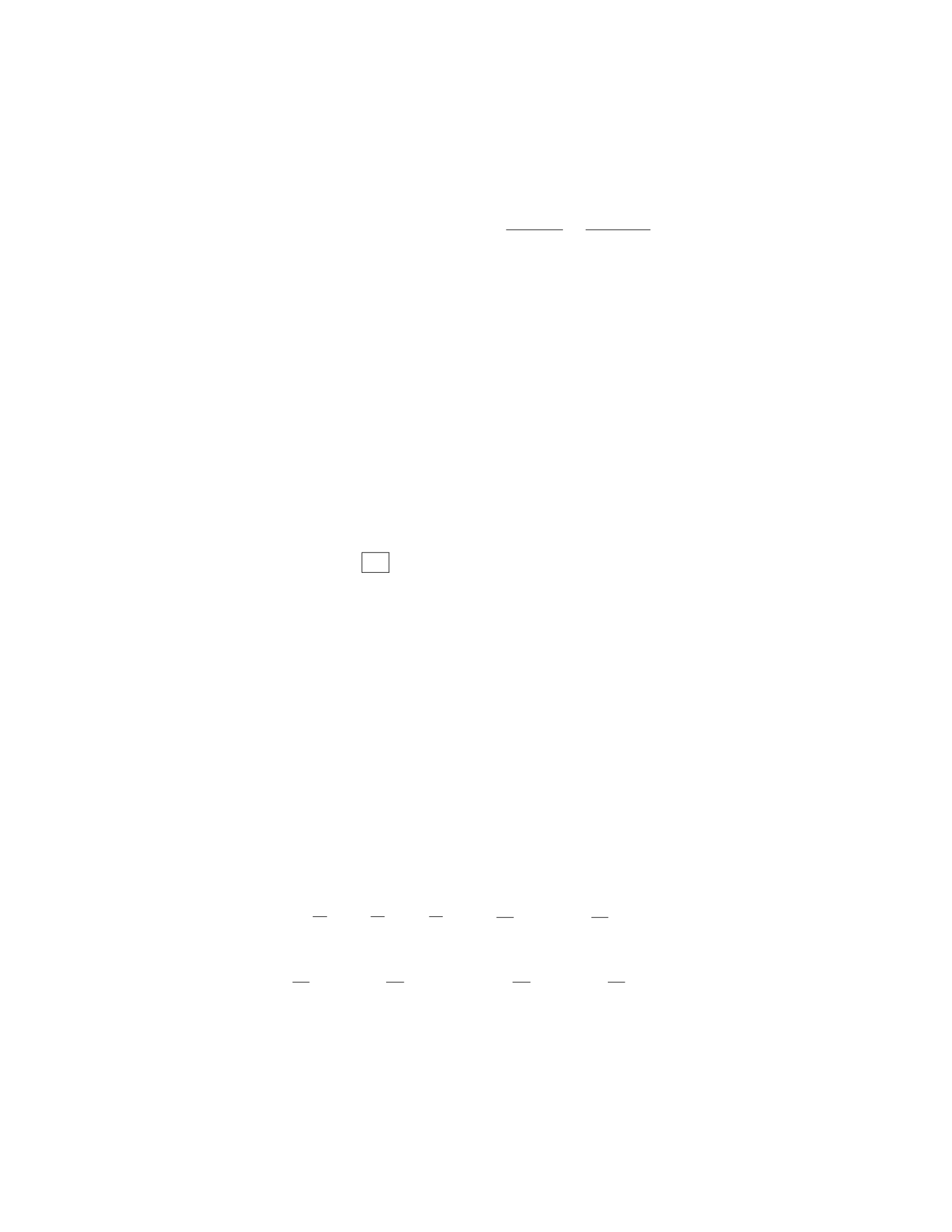
IC
(2y−x)dx + (x+z)dy =ZZD∂(x+z)
∂x −∂(2y−x)
∂y dA
Simplifying the expression inside the double integral, we get:
ZZD
(1 −(−2))dA =ZZD
3dA
Step 3: Evaluate the double integral over the region D.
The double integral of the constant function 3 over the disk Dcan be cal-
culated as follows:
ZZD
3dA = 3 ZZD
dA
Given that Dis the unit disk, the area of Dis π. Therefore, the double
integral simplifies to:
3·π= 3π
Thus, the value of the line integral HC(2y−x)dx+(x+z)dy counterclockwise
around the curve Cis 3π.
Question 21
Question
Let Cbe the curve given by the intersection of the plane z= 4 −xand the
cylinder x2+y2= 1, oriented counterclockwise when viewed from above. Use
Green’s Theorem to evaluate HC(y3−z)dx + (z3−x)dy + (x3−y)dz.
Solution
Step 1: Firstly, we parameterize the curve Cusing cylindrical coordinates. Let
x= cos(t)and y= sin(t), then z= 4 −cos(t). The parameterization of C
becomes r(t) = (cos(t),sin(t),4−cos(t)) where 0≤t≤2π.
Step 2: Next, we find the curl of the vector field F= (y3−z, z3−x, x3−y).
The curl of Fis given by
∇ × F=
i j k
∂
∂x
∂
∂y
∂
∂z
y3−z z3−x x3−y
=∂
∂y (x3−y)−∂
∂z (z3−x)i+···
··· +∂
∂z (y3−z)−∂
∂x (x3−y)j+∂
∂x (z3−x)−∂
∂y (y3−z)k.
Step 3: After computing the curl, we get ∇ × F= (−3,−3,−3).
19
Step 4: By Green’s theorem, we have
IC
F·dr=ZZD
(∇ × F)·kdA =ZZD
(−3) dA
where Dis the region in the xy-plane corresponding to the projection of the
curve C.
Step 5: The region Dcan be described as 0≤t≤2π,0≤r≤1. Thus, the
double integral becomes
Z2π
0Z1
0
(−3)r dr dt =Z2π
0−3
2r21
0
dt =Z2π
0−3
2dt =−3π.
Therefore, the value of the line integral over the curve Cis −3π.
Question 22
Question
Let Cbe the curve given by x2+y2= 4 oriented counterclockwise. Calculate the
circulation of the vector field F(x, y) = ⟨y, x⟩around Cusing Green’s Theorem.
Solution
Step 1: First, we need to find the region Denclosed by the curve C, which is the
circle with radius 2 centered at the origin. We can represent Das −2≤x≤2,
−√4−x2≤y≤√4−x2.
Step 2: Green’s Theorem states that for a vector field F(x, y) = ⟨P(x, y), Q(x, y)⟩
and a region Denclosed by a simple, positively oriented, piecewise smooth curve
C, the circulation of Faround Cis given by
IC
F·dr=ZZD∂Q
∂x −∂P
∂y dA.
Step 3: Let P(x, y) = yand Q(x, y) = x. We compute the partial derivatives:
∂Q
∂x = 1 and ∂P
∂y = 1.
Step 4: The circulation of Faround Cis therefore given by
IC
F·dr=ZZD
(1 −1) dA =ZZD
0dA = 0.
Therefore, the circulation of the vector field F(x, y) = ⟨y, x⟩around the
circle x2+y2= 4 is 0.
20

Question 23
Question
Let Cbe the curve given by x=t2,y= 2tfor 0≤t≤1. Use Green’s theorem
to evaluate the line integral
IC
(x2+y2)dx + (3x−2y)dy.
Solution
Step 1: We first need to parameterize the curve C. From the given equations,
we have x=t2and y= 2t. This gives us the parameterization r(t) = t2i+ 2tj
for 0≤t≤1.
Step 2: Calculating the partial derivatives of xand ywith respect to t, we
have ∂y
∂t = 2,∂x
∂t = 2t.
Step 3: Substituting x=t2and y= 2tinto the line integral, we get
IC
(t4+ 4t2) (2t) + (3t2−4t)·2dt.
Step 4: Simplifying the integrand, we have
IC
(2t5+ 8t3) + (6t2−8t)dt.
Step 5: Applying Green’s theorem, the given line integral is equal to the
double integral over the region Denclosed by Cof
ZZD∂Q
∂x −∂P
∂y dA,
where P=x2+y2and Q= 3x−2y.
Step 6: Computing the partial derivatives,
∂Q
∂x = 3,∂P
∂y = 2y.
Step 7: Thus, the double integral becomes
ZZD
(3 −2y)dA.
Step 8: The region Dis the area enclosed by the curve C, namely the curve
given by x=t2,y= 2tfor 0≤t≤1. This region is a parabolic sector.
Step 9: Evaluating the double integral, we get
Z1
0Z2t
0
(3 −2y)dy dt =Z1
0
[3y−y2]
2t
0dt.
Step 10: After evaluating the integral, we find the final answer to be 11
3.
21

Question 24
Question
Let Cbe the curve defined by x2+y2= 1 oriented counterclockwise. Calculate
the line integral RCy2dx +x2dy using Green’s Theorem.
Solution
Step 1: Determine the region bounded by the curve C.
Since Cis the circle x2+y2= 1, we know that Cis a closed curve that
bounds the region inside the circle.
Step 2: Apply Green’s Theorem.
Green’s Theorem states that for a smooth curve Cbounding a region Din
the plane and a vector field F=Pi+Qj, we have
ZC
P dx +Q dy =ZZD∂Q
∂x −∂P
∂y dA.
In this case, P=y2and Q=x2, so ∂Q
∂x = 2x,∂P
∂y = 2y, and ∂Q
∂x −∂P
∂y =
2x−2y. The integral becomes
ZC
y2dx +x2dy =ZZD
(2x−2y)dA.
Step 3: Calculate the double integral.
To find the double integral, we need to determine the region D. Since Cis
the unit circle centered at the origin, Dis the unit disk x2+y2≤1.
Thus, the double integral becomes
ZZD
(2x−2y)dA =Z1
−1Z√1−x2
−√1−x2
(2x−2y)dy dx.
Step 4: Evaluate the double integral.
Calculating the double integral, we get
Z1
−1Z√1−x2
−√1−x2
(2x−2y)dy dx =Z1
−1
4xp1−x2dx.
Using the substitution u= 1 −x2, we have du =−2x dx and the integral
becomes
Z1
−1−2√u du =−4
3u3/2
1
−1
=−8
3.
Therefore, the line integral RCy2dx +x2dy =−8
3.
22
Question 25
Question
Let Cbe the curve consisting of the line segment from (0,0) to (2,4) followed
by the line segment from (2,4) to (4,0), oriented from (0,0) to (4,0). Calculate
the line integral HC(2y+x)dx + (x+ 3y)dy using Green’s ThejsonThm.
Solution
Step 1: Parameterize the curve C. Since Cconsists of two line segments, we can
parameterize the first segment from (0,0) to (2,4) as r1(t) = 2t
4tfor 0≤t≤1,
and the second segment from (2,4) to (4,0) as r2(t) = 2t+ 2
4−4tfor 0≤t≤1.
Step 2: Calculate ∂Q
∂x −∂P
∂y . Given the line integral is of the form P dx+Qdy,
we have P(x, y) = 2y+xand Q(x, y) = x+ 3y. So,
∂Q
∂x = 1 and ∂P
∂y = 2.
Hence, ∂Q
∂x −∂P
∂y = 1 −2 = −1.
Step 3: Calculate the double integral over the region enclosed by C. By
Green’s Theorem, we have
IC
(2y+x)dx + (x+ 3y)dy =ZZD
(−1)dA,
where Dis the region enclosed by C. Since Dis a triangle with vertices at
(0,0),(2,4), and (4,0), we can express the double integral as
ZZD
(−1)dA =−Z4
0Z2−x
2
0
dydx −Z0
4Z4
2+ x
2
dydx,
which simplifies to −8.
Therefore, the line integral HC(2y+x)dx + (x+ 3y)dy is equal to −8.
23

Step 4: Evaluate the line integral using Green’s Theorem.
IC
F·dr =ZZD∇ ×
F dA = 4π.
Therefore, the line integral HC(2x2−y2)dx + (x2+ 2y)dy around the curve Cis
4π.
Question 2
Question
Let Cbe the curve that bounds the region Denclosed by the parabola y=x2,
the line y= 2x, and the x-axis. Use Green’s Theorem to evaluate the line
integral
IC
(3x−2y)dx + (x+ 4y)dy
Solution
1. We start by determining the region Denclosed by the given curves. The
parabola y=x2intersects y= 2xat x= 0 and x= 1. Therefore, the
region Dis bounded by 0≤x≤1.
2. Green’s Theorem states that for a region Denclosed by a simple closed
curve Coriented counterclockwise, and a vector field F= (P, Q)that has
continuous partial derivatives on an open region containing D, then the
line integral of Faround Cis equal to the double integral of the curl of F
over the region D:
IC
F·dr=ZZD∂Q
∂x −∂P
∂y dA
In this case, we have F= (3x−2y, x +4y), so P= 3x−2yand Q=x+4y.
3. To apply Green’s Theorem, we need to calculate the partial derivatives of
Pand Q:
∂Q
∂x = 1 and ∂P
∂y =−2
4. Now, we evaluate the double integral over the region D:
ZZD∂Q
∂x −∂P
∂y dA =ZZD
(1 + 2) dA =ZZD
3dA
5. Since the region Dis bounded by 0≤x≤1and 0≤y≤x2, we have:
ZZD
3dA =Z1
0Zx2
0
3dy dx =Z1
0
3x2dx =x31
0= 1
2
6. Therefore, by Green’s Theorem, the line integral of Faround the curve C
is 1.
Question 3
Question
Let Cbe the curve given by x2+y2= 4 oriented counterclockwise. Calculate
the line integral HC(x+y2)dx + (x2+y)dy using Green’s Thejsonm.
Solution
Step 1: To apply Green’s Theorem to evaluate the line integral, we need to find
the region Denclosed by the curve C.
Step 2: The curve Cis a circle centered at the origin with radius 2. There-
fore, Dis the disk enclosed by the circle.
Step 3: Green’s Theorem states that for a region Denclosed by a simple,
positively oriented curve C, the line integral along Cof the vector field F=
P(x, y)i+Q(x, y)jis equal to the double integral over Dof ∂Q
∂x −∂P
∂y dA.
Step 4: In this case, we have F= (x+y2)i+ (x2+y)j, so P(x, y) = x+y2
and Q(x, y) = x2+y.
Step 5: Calculate ∂Q
∂x and ∂P
∂y :
∂Q
∂x = 2xand ∂P
∂y = 2y
Step 6: Compute the double integral over D:
ZZD
(2x−2y)dA
Step 7: Switch to polar coordinates: x=rcos(θ),y=rsin(θ), and dA =
rdrdθ.
Step 8: Rewrite the integral in polar coordinates:
Z2π
0Z2
0
(2rcos(θ)−2rsin(θ))rdrdθ
Step 9: Simplify the integral:
Z2π
0Z2
0
(2r2cos(θ)−2r2sin(θ))drdθ
Step 10: Evaluate the double integral to find the line integral along C.
3
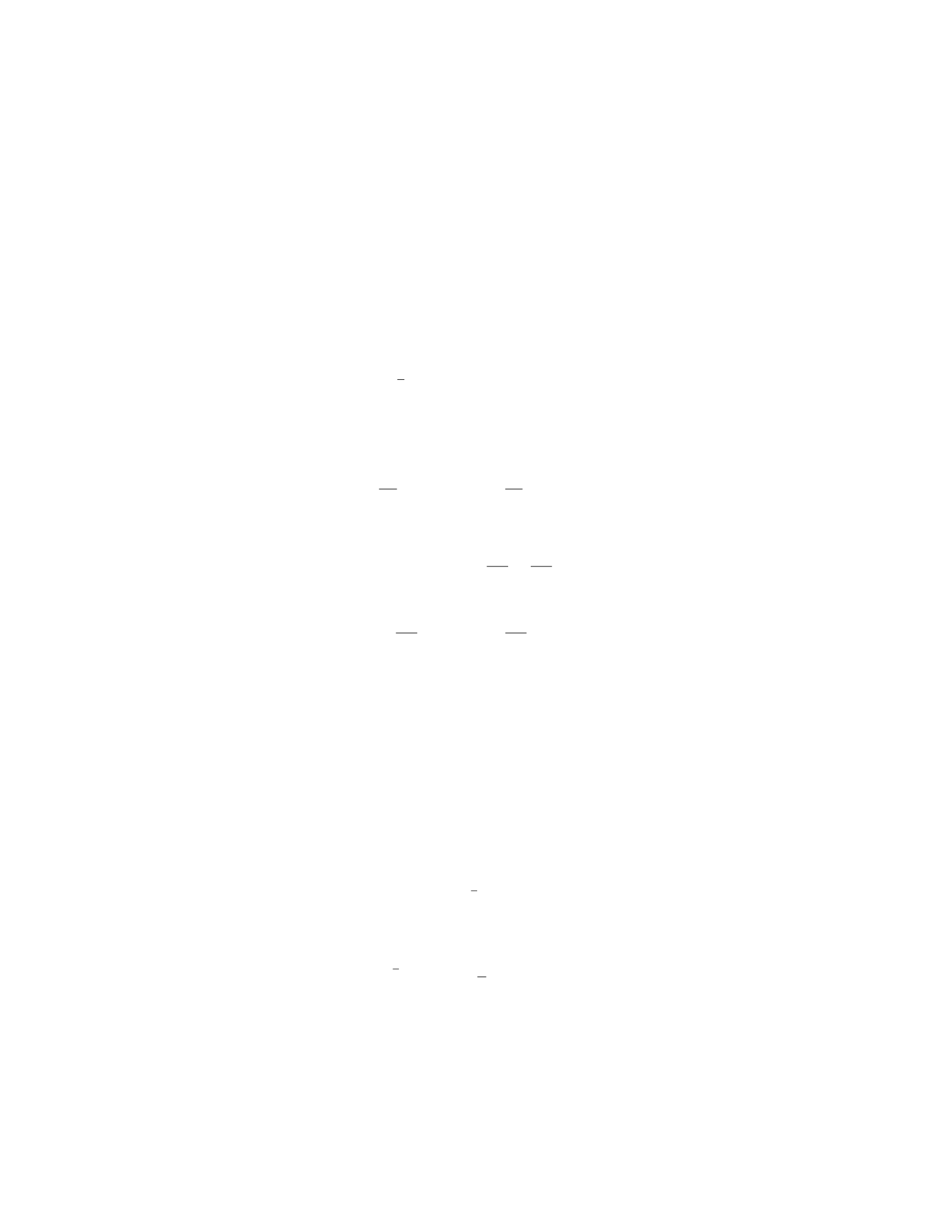
Question 4
Question
Let Cbe the curve defined by xy = 1 oriented counterclockwise. Calculate the
line integral HCy dx +x dy using Green’s Theorem.
Solution
Step 1: Determine the region enclosed by the curve C. Given the curve xy = 1,
we can rewrite it as y=1
x. This curve is the rectangular hyperbola with
asymptotes x= 0 and y= 0. The region enclosed by Cis the area in the first
quadrant.
Step 2: Find the partial derivatives of the vector field. The vector field is
F= (y, x). Compute the partial derivatives:
∂
∂x (y) = 0 and ∂
∂y (x) = 0
Step 3: Calculate the line integral using Green’s Theorem. Green’s Theo-
rem states: IC
F·dr =ZZR∂Q
∂x −∂P
∂y dA
Here, P=yand Q=x. So, we have:
∂Q
∂x = 1 and ∂P
∂y = 0
The line integral becomes:
IC
y dx +x dy =ZZR
1dA
Step 4: Calculate the double integral over the region R. Since the region
Ris the area in the first quadrant enclosed by the curve C, the double integral
becomes: ZZR
1dA =ZZR
dA
Step 5: Evaluate the double integral. The integral RRRdA over the first
quadrant region enclosed by xy = 1 is equivalent to finding the area of this
region. This can be done by integrating:
Z∞
0Z1
x
0
1dy dx
This integral evaluates to:
Z∞
0
[y]
1
x
0dx =Z∞
0
1
xdx = lim
c→∞[ln(x)]c
1
= lim
c→∞ ln(c)−ln(1) = ∞
Therefore, the line integral HCy dx +x dy around the curve xy = 1 is ∞.
4

Question 5
Question
Let Cbe the curve that consists of the line segment from (0,0) to (2,4) and
the line segment from (2,4) to (4,0). Use Green’s Theorem to evaluate the line
integral
IC
(x2+y2)dx +xy dy
Solution
Step 1: Calculate the double integral over the region enclosed by curve C. Let
Dbe the region enclosed by C. We have Das a triangle with vertices at (0,0),
(2,4), and (4,0). Then, Green’s Theorem gives
ZZD∂Q
∂x −∂P
∂y dA =IC
P dx +Q dy
where P=x2+y2and Q=xy. Then,
∂Q
∂x =yand ∂P
∂y = 2y
So, the given integral becomes
ZZD
(y−2y)dA =ZZD
(−y)dA
Step 2: Convert the integral over Dto a double integral. To integrate over
the triangular region Dwith vertices at (0,0),(2,4), and (4,0), we set up the
double integral as follows:
ZZD
(−y)dA =Z4
0Z4−1
2y
1
2y
(−y)dx dy
Step 3: Evaluate the double integral. Integrating with respect to xfirst,
we have:
Z4
0
[−xy]4−1
2y
1
2ydy =Z4
0
(−4y+ 2y)dy
=Z4
0
(−2y)dy =−y2
4
0=−16
Therefore, the value of the line integral is −16 .
5

Question 6
Question
Let Cbe the circle centered at the origin with radius 2, oriented counter-
clockwise. Let Dbe the region enclosed by C. Consider the vector field
F(x, y) = (yex2, x cosy2). Calculate the circulation of Faround Cand the
flux of Facross the boundary of Dusing Green’s Theorem.
Solution
To calculate the circulation of Faround Cusing Green’s Theorem, we need to
evaluate the line integral of Faround C:
IC
F·dr=ZZD∂Q
∂x −∂P
∂y dA
where F(x, y) = (P(x, y), Q(x, y)). In this case, P(x, y) = yex2and Q(x, y) =
xcosy2. Let’s first calculate the partial derivatives:
∂Q
∂x = cosy2
∂P
∂y =ex2
Therefore, the line integral becomes:
IC
F·dr=ZZD
(cosy2−ex2)dA
To evaluate the integral RRD(cosy2−ex2)dA, we switch to polar coordi-
nates. The region Dis described by 0≤r≤2and 0≤θ≤2π. Then, the
integral becomes:
Z2π
0Z2
0
(rcos(θ)2−er2cos(θ)2)r dr dθ
After evaluating this integral, we will obtain the circulation of Faround C.
Next, we use Green’s Theorem to calculate the flux of Facross the boundary
of D. The flux is given by:
ZZD
(∂Q
∂x −∂P
∂y )dA
We already calculated the partial derivatives so we can directly evaluate this
integral in polar coordinates as well. This will give us the flux of Facross the
boundary of D.
6
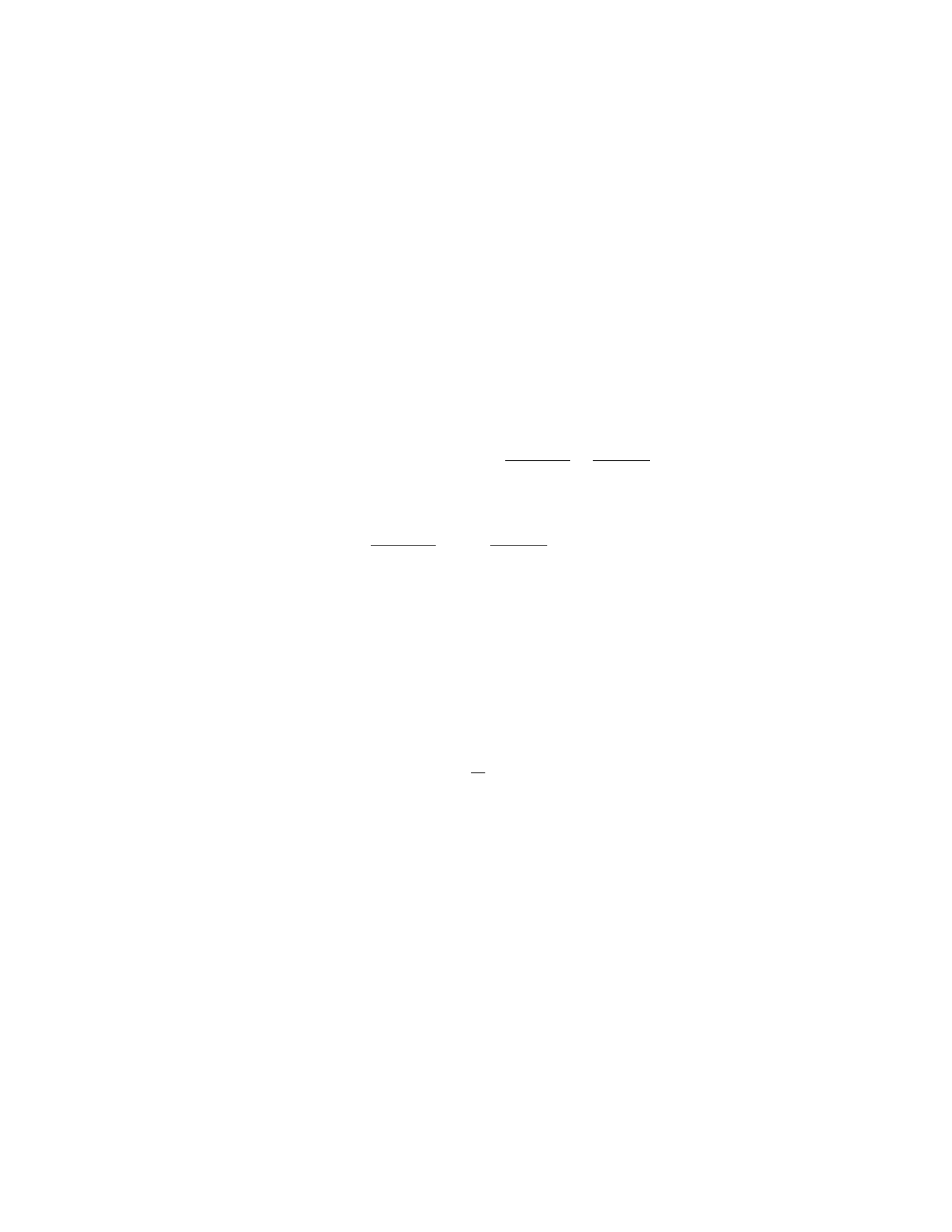
Question 7
Question
Let Cbe the boundary of the region enclosed by the curve x2+y2= 4, oriented
counterclockwise when viewed from above. Compute the line integral HC(x+
y)dx + (2x−y)dy using Green’s theorem.
Solution
Step 1: Find the region Denclosed by the curve x2+y2= 4. The region
enclosed by x2+y2= 4 is a circle of radius 2 centered at the origin.
Step 2: Using Green’s theorem, we have
IC
(x+y)dx + (2x−y)dy =ZZD∂(2x−y)
∂x −∂(x+y)
∂y dA.
Step 3: Compute the partial derivatives:
∂(2x−y)
∂x = 2,∂(x+y)
∂y = 1.
Therefore, the line integral simplifies to
ZZD
(2 −1) dA =ZZD
dA.
Step 4: Switch to polar coordinates to evaluate the double integral. Let
x=rcos θand y=rsin θ. Also, dA =rdrdθ. The limits of integration for r
are from 0 to 2, and for θare from 0 to 2π.
Step 5: Evaluate the double integral:
Z2π
0Z2
0
r drdθ =Z2π
0r2
22
0
dθ =Z2π
0
2dθ = 4π.
Therefore, the line integral HC(x+y)dx + (2x−y)dy around the curve
x2+y2= 4 is equal to 4π.
Question 8
Question
Let Cbe the unit circle centered at the origin, oriented counterclockwise, and
let Dbe the region inside C. Consider the vector field F(x, y)=(xex2+y2−
y, yex2+y2+x). Use Green’s Theorem to calculate the line integral HCF·dr.
7
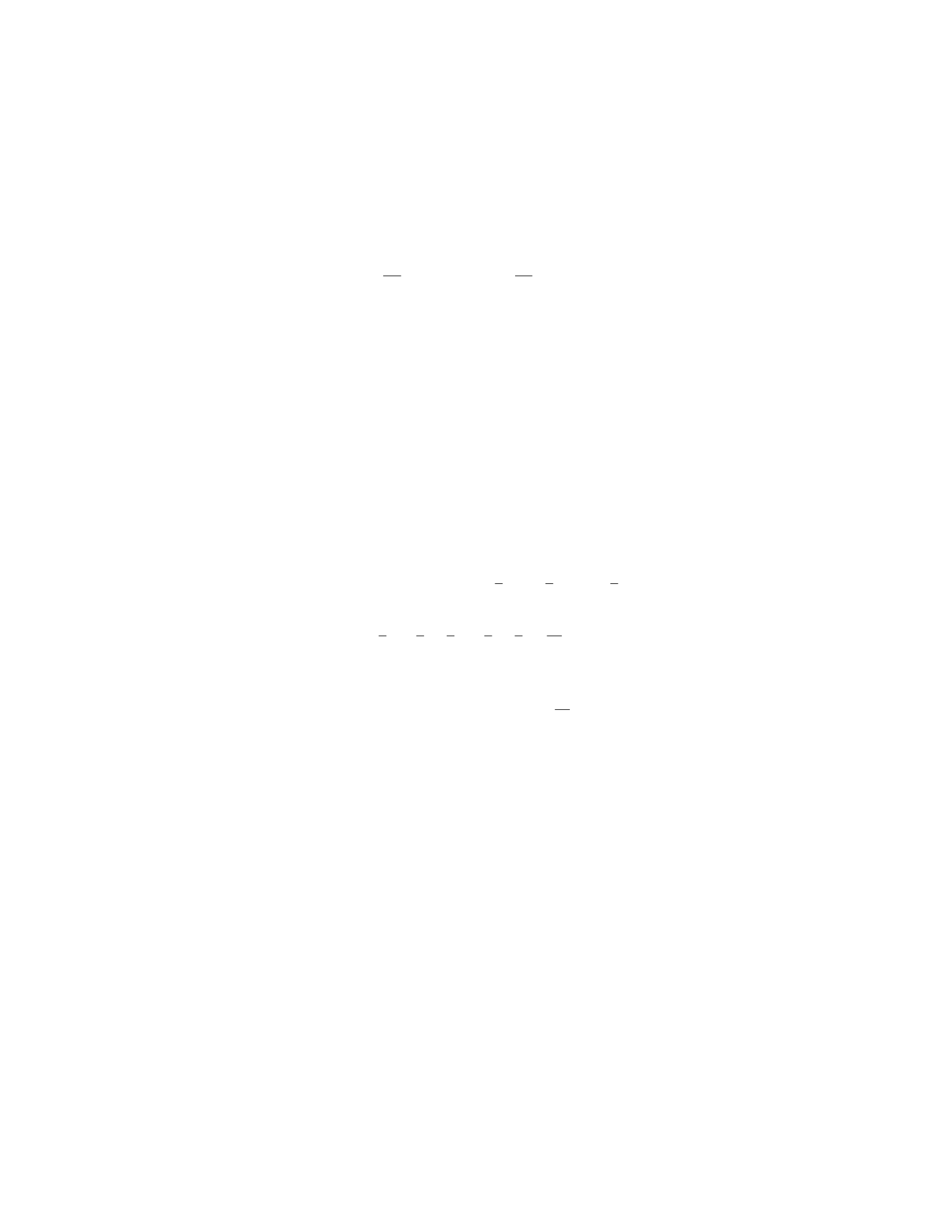
Solution
Step 1: Calculate the divergence of F:
∇ · F=∂
∂x (xex2+y2−y) + ∂
∂y (yex2+y2+x)
=ex2+y2+ 2x2ex2+y2−1
Step 2: Apply Green’s Theorem: Using Green’s Theorem, we have:
IC
F·dr=ZZD
(∇ · F)dA
Step 3: Calculate the area integral: Since the region Dis inside the unit
circle, we can use polar coordinates to integrate over D:
ZZD
(∇ · F)dA =Z2π
0Z1
0
(er2+ 2r2er2−1) r dr dθ
Step 4: Evaluate the integral: Integrating with respect to rfirst, we get:
Z1
0
(er2+ 2r2er2−1) r dr =1
2er2+2
3r3er2−1
2r2
1
0
=1
2e−1
2+2
3e−2
3−1
2=5e
6−2
Step 5: Compute the final result: Finally, we have:
IC
F·dr=ZZD
(∇ · F)dA =5e
6−2
Question 9
Question
Let Cbe the curve given by x= 2 cos(t),y= 3 sin(t)for 0≤t≤2π, oriented
counterclockwise. Calculate the circulation of the vector field F(x, y) = ⟨y2, x2⟩
around the curve C.
Solution
Step 1: Parameterize the curve C.
x(t) = 2 cos(t)
y(t) = 3 sin(t)
8

Step 2: Calculate the derivatives of x(t)and y(t).
dx
dt =−2 sin(t)
dy
dt = 3 cos(t)
Step 3: Calculate the line integral of Fover Cusing circulation.
circulation =ZC
F·dr
=Z2π
0⟨32sin2(t),22cos2(t)⟩ · ⟨−2 sin(t),3 cos(t)⟩dt
=Z2π
0−9 sin3(t) + 4 cos3(t)dt
=Z2π
0−9 sin3(t)dt +Z2π
0
4 cos3(t)dt
= 0 (Use symmetry properties of sine and cosine functions)
Therefore, the circulation of the vector field Faround the curve Cis 0.
Question 10
Question
Let Cbe the curve defined by x2+y2= 4 oriented counterclockwise. Evaluate
the line integral HC(x3y2+y3)dx + (2xy2+x2y)dy using Green’s Theorem.
Solution
Step 1: Determine the region enclosed by the curve C.
• The curve Cis a circle of radius 2 centered at the origin.
• The region enclosed by Cis the interior of this circle.
Step 2: Compute the partial derivatives of the given vector field. Let
F(x, y) = (x3y2+y3,2xy2+x2y).
• Compute ∂
∂y (x3y2+y3) = 2x3y+ 3y2.
• Compute ∂
∂x (2xy2+x2y) = 2y2+ 2xy.
Step 3: Apply Green’s Theorem. Green’s Theorem states that for a simply
connected region Denclosed by a positively oriented, piecewise smooth, simple
9
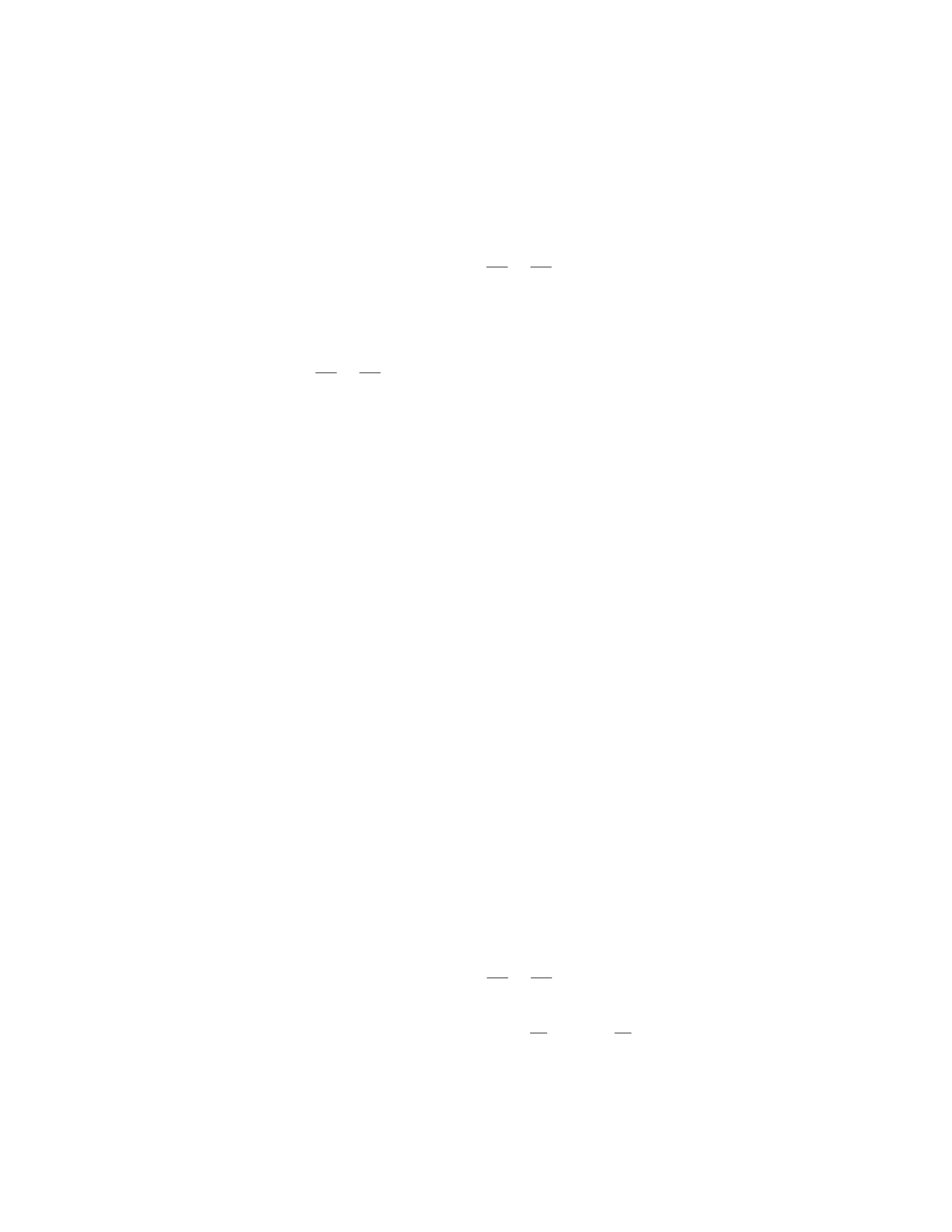
closed curve C, if F= (P, Q)is a vector field whose components have continuous
first partial derivatives in an open region containing D, then
IC
F·dr =ZZD∂Q
∂x −∂P
∂y dA.
Substitute P=x3y2+y3and Q= 2xy2+x2yinto the formula above.
Step 4: Evaluate the double integral.
ZZD∂Q
∂x −∂P
∂y dA =ZZD2y2+ 2xy −(2x3y+ 3y2)dA.
Step 5: Switch to polar coordinates to simplify the integral. Let x=rcos(θ)
and y=rsin(θ). Also, dA =rdrdθ.
Step 6: Calculate the integral using the polar form of the vector field.
Z2π
0Z2
02(rsin(θ))2+ 2(rcos(θ))(rsin(θ)) −2(rcos(θ))3(rsin(θ)) −3(rsin(θ))2rdrdθ
Step 7: Simplify the integral and compute the final result to find the value
of the line integral over the curve C.
Question 11
Question
Let Cbe the curve given by the intersection of the plane z= 2 and the cylinder
x2+y2= 1. Use Green’s Theorem to evaluate HC(2x+ 3y)dx + (x−2y)dy.
Solution
Step 1: Find the region Denclosed by the curve C. Since Cis the intersection
of the plane z= 2 and the cylinder x2+y2= 1, the curve Clies on the disk in
the xy-plane with radius 1 centered at the origin. Let’s denote this region as D.
Step 2: Parametrize the boundary curve C. We can parametrize Cusing
polar coordinates as x= cos(t)and y= sin(t)for 0≤t≤2π. Given that z= 2
on C, we have z= 2 as the constant for the C.
Step 3: Apply Green’s Theorem. Green’s Theorem states that for a smooth
curve Cenclosing a region Din the plane, and a vector field F=Pi+Qj
defined on an open region containing D, the circulation of Faround Cis equal
to the double integral of ∇ ×Fover the region D. Mathematically, this can be
expressed as:
IC
F·dr=ZZD
(∂Q
∂x −∂P
∂y )dA
Step 4: Evaluate the line integral. Given F= (2x+ 3y)i+ (x−2y)j, we
can write P= 2x+ 3yand Q=x−2y. Then, ∂Q
∂x = 1 and ∂P
∂y = 3.
10

Therefore, by Green’s Theorem, we have:
IC
(2x+ 3y)dx + (x−2y)dy =ZZD
(1 −3) dA =−2ZZD
dA
Step 5: Calculate the double integral over the region D. The double integral
of 1over the unit circle Dis the area of the circle, which is π(12) = π. Therefore,
the value of the line integral is:
−2ZZD
dA =−2·π=−2π
Question 12
Question
Let Cbe the curve defined by the intersection of the surfaces x2+y2+z2= 1
and y2+z2=x. Use Green’s Theorem to evaluate the line integral HCx2dy +
y2dz +z2dx.
Solution
Step 1: Determine the region Denclosed by the curve Cin the xy-plane.
The curve Cis the intersection of the surfaces x2+y2+z2= 1 and y2+z2=x.
Solving for xin y2+z2=x, we get x=y2+z2. Substituting this into
x2+y2+z2= 1, we have (y2+z2)2+y2+z2= 1.
Solving this equation will give us the curve Cin terms of yand z.
Step 2: Apply Green’s Theorem.
Given that the line integral is HCx2dy +y2dz +z2dx, we rewrite it as
HCP dx +Q dy +R dz, where P=z2,Q=x2, and R=y2.
Green’s Theorem states:
IC
P dx +Q dy =ZZD∂Q
∂x −∂P
∂y dA
Applying Green’s Theorem, we have:
IC
x2dy +y2dz +z2dx =ZZD
(2x−2y)dA
Step 3: Evaluate the double integral.
Evaluate the double integral RRD(2x−2y)dA over the region Dfound in
Step 1.
This will give us the final answer for the line integral over curve C.
11

Question 13
Question
Let Cbe the curve given by x2+y2= 1 oriented counterclockwise. Calculate
the circulation of the vector field F(x, y) = (y, −x)around C.
Solution
Step 1: To calculate the circulation of Faround C, we need to use Green’s
Theorem, which relates circulation to a double integral over the region bounded
by C.
Step 2: Green’s Theorem states that for a vector field F(x, y) = (P(x, y), Q(x, y))
with a positively oriented simple closed curve Cgiven by r(t) = (x(t), y(t)) pa-
rameterized by a≤t≤b, the circulation of Faround Cis given by:
IC
F·dr=ZZD∂Q
∂x −∂P
∂y dA,
where Dis the region enclosed by C.
Step 3: In this case, F(x, y)=(y, −x), so P(x, y) = yand Q(x, y) = −x.
We also have that ∂Q
∂x =−1and ∂P
∂y = 1.
Step 4: Substituting these into Green’s Theorem, we obtain:
IC
F·dr=ZZD
(−1−1)dA =−2ZZD
dA.
Step 5: The region Denclosed by Cis the unit circle centered at the origin.
We can express this as D={(x, y)∈R2:x2+y2≤1}.
Step 6: Calculating the double integral over D, we have:
−2ZZD
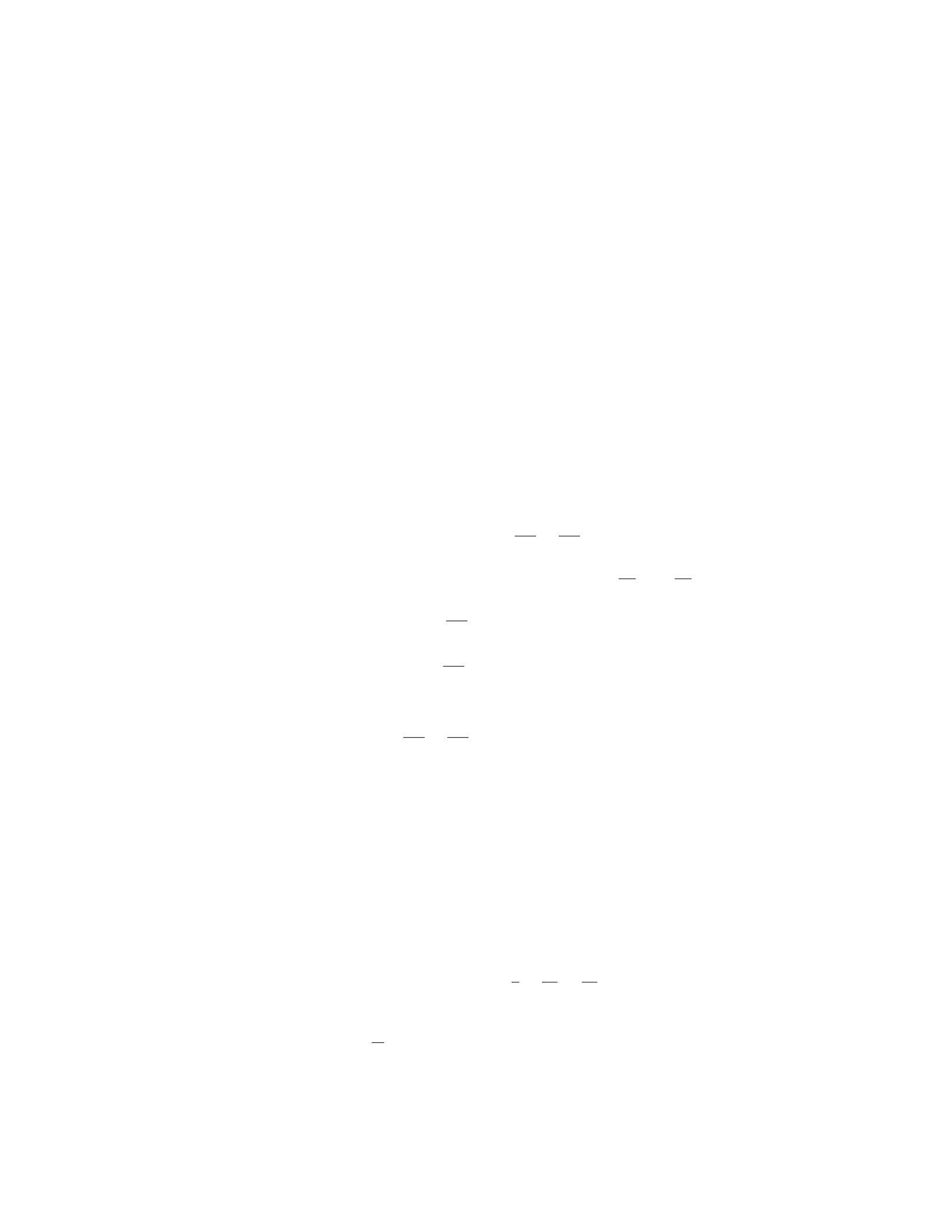
dA =−2Z1
−1Z√1−x2
−√1−x2
dydx =−4Z1
−1p1−x2dx.
Step 7: To evaluate the integral, we make a trigonometric substitution x=
sin θ:
−4Z1
−1p1−x2dx =−4Zπ
2
−π
2
cos2θdθ.
Step 8: Using the identity cos2θ=1+cos 2θ
2, we obtain:
−4Zπ
2
−π
2
cos2θdθ =−2θ+sin 2θ
2π
2
−π
2
=−2π.
Step 9: Therefore, the circulation of the vector field F(x, y) = (y, −x)around
the curve Cis −2π.
12
Question 14
Question
Let Cbe the curve defined by x=t2and y=t3for 0≤t≤1, ori-
ented counterclockwise. Use Green’s Theorem to evaluate the line integral
HCy3−x3dx +x2+y2dy.
Solution
Step 1: Find the region Denclosed by the curve C. Since x=t2and y=t3,
we can eliminate the parameter tby considering yas a function of x.
y=x3/2
The region Dis the area enclosed by the curve y=x3/2in the xy-plane over
the interval 0≤x≤1.
Step 2: Apply Green’s Theorem. Green’s Theorem states:
IC
(P dx +Q dy) = ZZD∂Q
∂x −∂P
∂y dA
In our case, P=y3−x3and Q=x2+y2. We need to find ∂Q
∂x and ∂P
∂y .
∂Q
∂x = 2x
∂P
∂y = 3y2
So, the expression inside the double integral becomes:
∂Q
∂x −∂P
∂y = 2x−3y2
Step 3: Compute the double integral. The double integral becomes:
ZZD
(2x−3y2)dA =Z1
0Zx3/2
0
(2x−3y2)dy dx
Step 4: Evaluate the double integral.
Zx3/2
0
(2x−3y2)dy = 2xy −y3
x3/2
0= 2x5/2−(x3/2)3= 2x5/2−x9/2
Integrating this with respect to xover 0≤x≤1, we get:
Z1
0
(2x5/2−x9/2)dx =4
7−2
11 =38
77
Step 5: Final answer. Therefore, the value of the line integral HC(y3−
x3)dx + (x2+y2)dy is 38
77 .
13

Question 15
Question
Let Cbe the boundary of the region enclosed by the ellipse x2
a2+y2
b2= 1, where
a > b > 0, oriented counterclockwise. Use Green’s Theorem to evaluate the line
integral HC(y2−x)dx + (x2+y)dy.
Solution
Step 1: Write the given line integral in the form of Green’s Theorem. The
line integral can be rewritten in the form P dx +Q dy, where P=y2−xand
Q=x2+y
Step 2: Find the partial derivatives of Qwith respect to xand Pwith
respect to y. Calculating the partial derivative of Qwith respect to x:
∂Q
∂x = 2x
Calculating the partial derivative of Pwith respect to y:
∂P
∂y = 2y
Step 3: Apply Green’s Theorem, which states:
IC
(P dx +Q dy) = ZZD∂Q
∂x −∂P
∂y dA
where Dis the region bounded by C.
Step 4: Evaluate the double integral on the right-hand side of Green’s
Theorem. ZZD
(2x−2y)dA
Step 5: Simplify and solve the double integral over the region Denclosed
by the given ellipse. Since the given ellipse can be parametrized by x=acos(t)
and y=bsin(t)for 0≤t≤2π, we have:
ZZD
(2x−2y)dA =Z2π
0Z1
0
(2(acos(t)) −2(bsin(t))) (ab)dr dt
= 2ab Z2π
0
(acos(t)−bsin(t)) dt
= 2ab[(asin(t) + bcos(t))]2π
0= 0
Therefore, the value of the line integral HC(y2−x)dx + (x2+y)dy is 0.
14
Question 16
Question
Let Cbe the curve consisting of the intersection of the plane z= 0 and the cone
z=px2+y2oriented counterclockwise as viewed from high z-values. Use
Green’s Theorem to evaluate the line integral HC(x2+y2)dx + 2xy dy.
Solution
To use Green’s Theorem, we first need to find a vector field F=⟨P, Q⟩such
that curl F=Qx−Py=x2+y2.
Step 1: Find a vector field F=⟨P, Q⟩such that curl F=x2+y2. Let
P(x, y) = y
2and Q(x, y) = −x
2. Then,
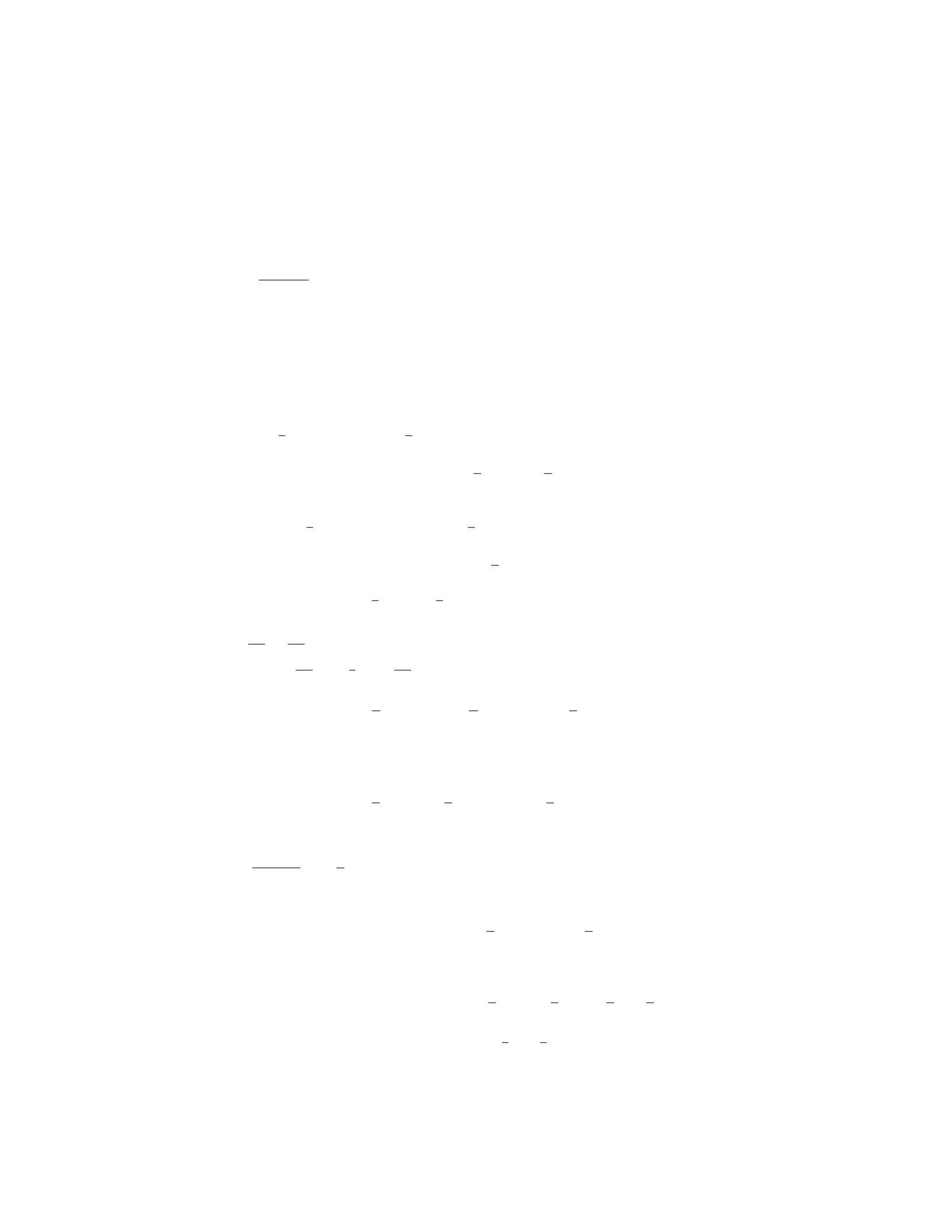
curl F=Qx−Py=−1
2−0 = −1
2=x2+y2.
To correct this, we need to add a term to Por Q. Let’s try adding x2to P:
Let P(x, y) = y
2+x2and Q(x, y) = −x
2. Now,
curl F=Qx−Py=−1
2−2x=x2+y2.
Hence, we can let F=⟨y
2+x2,−x
2⟩.
Step 2: Apply Green’s Theorem. Green’s Theorem states: HCF·dr=
RRD∂Q
∂x −∂P
∂y dA.
We have ∂Q
∂x =−1
2and ∂P
∂y = 1. Substitute into Green’s Theorem:
ICy
2+x2dx −x
2dy =ZZD
(−3
2)dA.
Step 3: Simplify the line integral. Since Dis the region inside the curve C,
we can rewrite the right side as:
ZZD
(−3
2)dA =−3
2ZZD
dA =−3
2·Area(D).
Step 4: Calculate the area enclosed by C. The area of the region inside
Ccan be calculated by finding the area of the circle with radius r= 1 (as
z=√12+ 12=√2) and subtracting the area of the right triangle formed by
the x-axis, y-axis, and the line y=x.
Area(D) = π·12−1
2·1·1 = π−1
2.
Step 5: Substitute the area back into the line integral.
IC
(x2+y2)dx + 2xy dy =−3
2·π−1
2=−3
2π+3
4.
Therefore, HC(x2+y2)dx + 2xy dy =−3
2π+3
4.
15
Question 17
Question
Let Cbe the curve given by x= cos(t),y= sin(t)for 0≤t≤π, oriented
counterclockwise. Compute the line integral HC(x2+y2)dx + (x2−y2)dy using
Green’s Theorem.
Solution
Step 1: Determine the region enclosed by the curve Cand find a suitable
description of it. The curve Cis a unit circle centered at the origin, traversed
counterclockwise from t= 0 to t=π. The region enclosed by Cis the interior
of this unit circle.
Step 2: Apply Green’s Theorem, which states for a vector field F=Pi+Qj,
where Pand Qhave continuous first-order partial derivatives on a closed region
Rbounded by a positively oriented simple closed curve C, we have
IC
F·dr=ZZR∂Q
∂x −∂P
∂y dA
Step 3: Express the line integral in terms of the vector field for Green’s
Theorem. The given line integral is
IC
(x2+y2)dx + (x2−y2)dy =IC
x2dx +y2dx +x2dy −y2dy
This can be rewritten as HC(P dx +Q dy)where P=x2and Q=x2−y2.
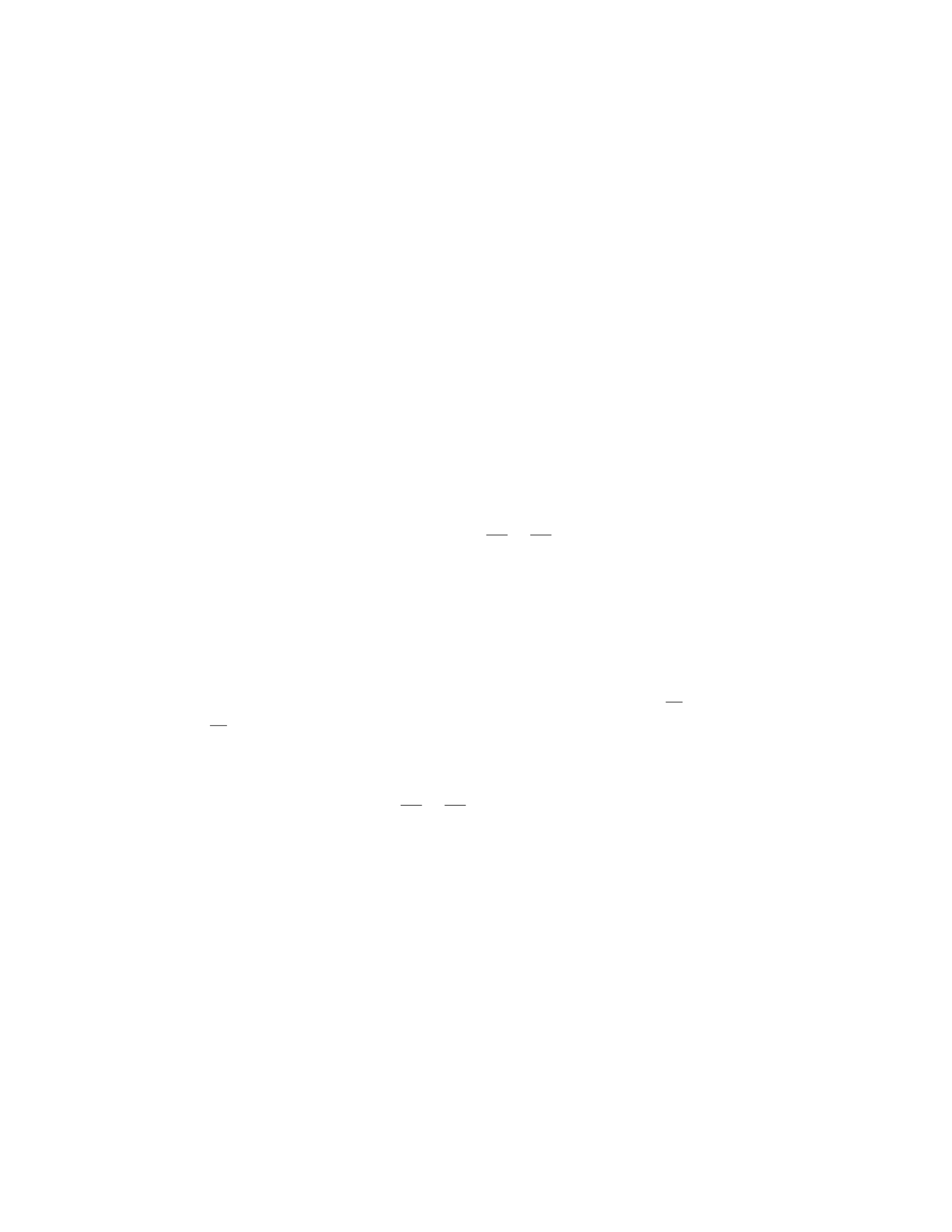
Step 4: Calculate the partial derivatives of Pand Q. We have ∂P
∂y = 0 and
∂Q
∂x = 2x.
Step 5: Compute the double integral over the region enclosed by C. Using
Green’s Theorem, we have
ZZR∂Q
∂x −∂P
∂y dA =ZZR
2x dA
Step 6: Evaluate the double integral over the region R. Since the region R
is the interior of a unit circle, we can convert to polar coordinates: 0≤r≤1,
0≤θ≤π. Thus, the double integral becomes
Zπ
0Z1
0
2rcos(θ)dr dθ =π
Step 7: Provide the final answer. Therefore, the line integral HC(x2+
y2)dx + (x2−y2)dy is equal to π.
16

Question 18
Question
Let Cbe the curve given by r(t) = (t2+ 1)i+ (2t−1)jfor 0≤t≤2. Calculate
the circulation of the vector field F(x, y) = (2x+y)i−(x−y)jaround the curve
C.
Solution
Step 1: First, we need to parameterize the curve C:r(t) = (t2+ 1)i+ (2t−1)j
for 0≤t≤2.
Step 2: To calculate circulation, we use the formula: HCF·dr=RCF·Tds,
where F= (2x+y)i−(x−y)j,r(t) = (t2+ 1)i+ (2t−1)j,Tis the unit tangent
vector, and ds is the arc length element.
Step 3: We need to find Tand ds:T=r′(t)
|r′(t)|=2ti+2j
√4t2+4 =1
√t2+1 (ti+j),
ds =|r′(t)|dt =√4t2+ 4dt = 2√t2+ 1dt.
Step 4: Substituting everything into the circulation formula: HCF·dr=
R2
0((2(t2+ 1) + (2t−1))t−((t2+ 1) −(2t−1))) ·(ti+j)2√t2+ 1dt.
Step 5: Simplifying the integral: HCF·dr=R2
0(4t3+ 3t)2√t2+ 1dt.
Step 6: The integration may require trigonometric substitution to evaluate
the integral further.
Question 19
Question
Let Cbe the curve parametrized by x=t2and y=t3for 0≤t≤1. Calculate
the line integral RC(x2−y2)dx + 2xydy using Green’s Theorem.
Solution
Step 1: Find the parametric equations for the curve C. The parametric equa-
tions for the curve Care given by x=t2and y=t3for 0≤t≤1.
Step 2: Calculate the derivatives of xand ywith respect to t. We have
dx
dt = 2tand dy
dt = 3t2.
Step 3: Compute the line integral as a double integral using Green’s The-
orem. Using Green’s Theorem, we have
ZC
(x2−y2)dx + 2xydy =ZZD∂(2xy)
∂x −∂(x2−y2)
∂y dA,
where Dis the region enclosed by the curve C.
17

Step 4: Evaluate the partial derivatives and rewrite the double integral.
We have ∂(2xy)
∂x = 2yand ∂(x2−y2)
∂y =−2y. Thus, the line integral becomes
ZZD
(2y+ 2y)dA =ZZD
4ydA.
Step 5: Convert the double integral into a single integral. Since the region
Dis defined by 0≤t≤1, we have
ZZD
4ydA =Z1
0Zt3
t2
4t3dydx
=Z1
0
4t3(t3−t2)dt
=Z1
0
4t6−4t5dt
=4
7t7−4
6t61
0
=4
7−2
3
=10
21.
Therefore, the line integral RC(x2−y2)dx + 2xydy is equal to 10
21 .
Question 20
Question
Let Cbe the curve given by the intersection of the cylinder x2+y2= 1 and the
plane z=y. Use Green’s Theorem to evaluate the line integral HC(2y−x)dx +
(x+z)dy counterclockwise.
Solution
Step 1: Determine the region Denclosed by the curve C.
The curve Cis the intersection of the cylinder x2+y2= 1 and the plane
z=y. This intersection occurs when z=ywhich means the curve lies in the
xy-plane. Thus, Cis a circle of radius 1 centered at the origin. Therefore, the
region Denclosed by Cis the disk x2+y2≤1.
Step 2: Write the line integral as a double integral using Green’s Theorem.
Green’s Theorem states that for a curve Cenclosing a region Doriented
counterclockwise, and a vector field F(x, y) = P(x, y)i+Q(x, y)j, the line inte-
gral HCF·drcan be expressed as the double integral of the curl of Fover the
region D. The line integral can be written as:
18
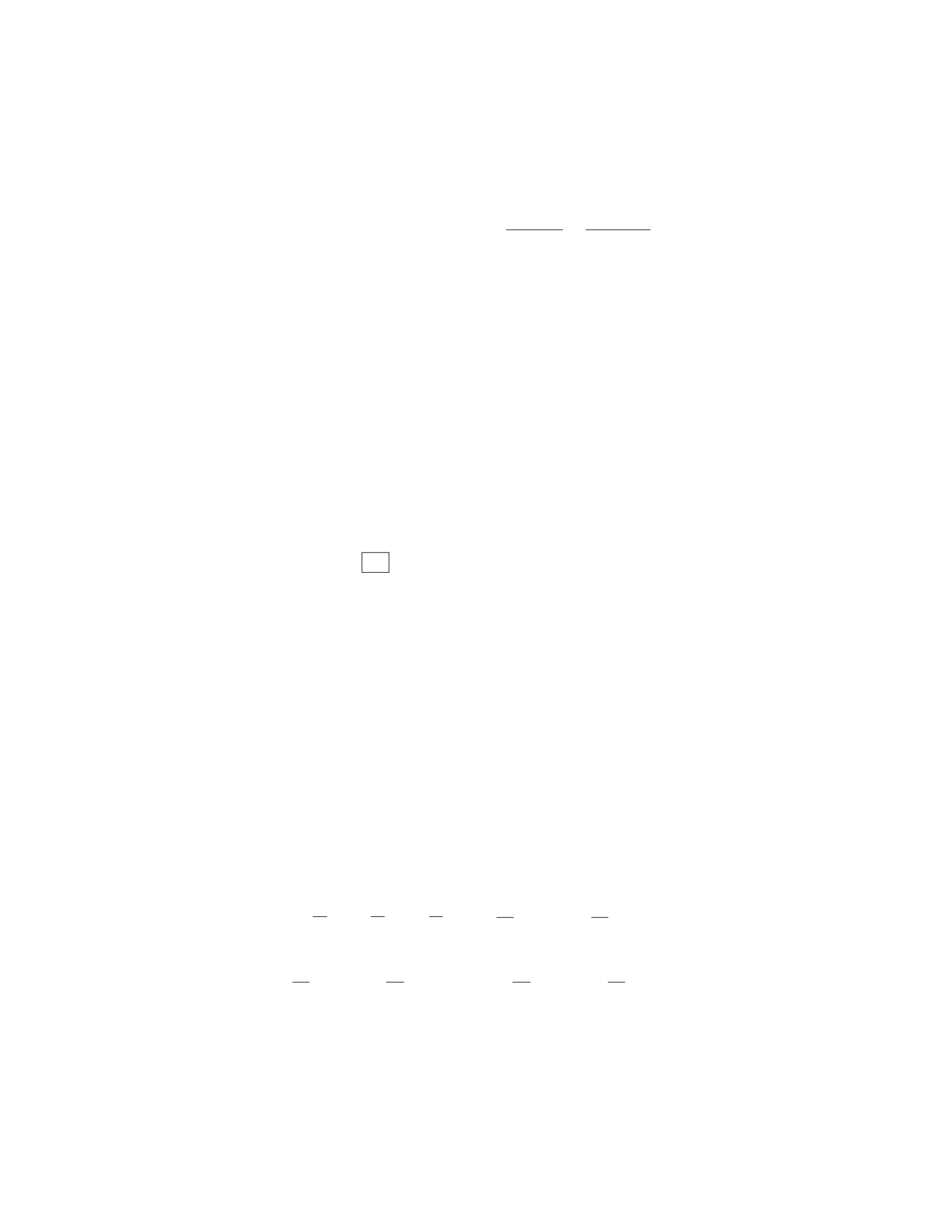
IC
(2y−x)dx + (x+z)dy =ZZD∂(x+z)
∂x −∂(2y−x)
∂y dA
Simplifying the expression inside the double integral, we get:
ZZD
(1 −(−2))dA =ZZD
3dA
Step 3: Evaluate the double integral over the region D.
The double integral of the constant function 3 over the disk Dcan be cal-
culated as follows:
ZZD
3dA = 3 ZZD
dA
Given that Dis the unit disk, the area of Dis π. Therefore, the double
integral simplifies to:
3·π= 3π
Thus, the value of the line integral HC(2y−x)dx+(x+z)dy counterclockwise
around the curve Cis 3π.
Question 21
Question
Let Cbe the curve given by the intersection of the plane z= 4 −xand the
cylinder x2+y2= 1, oriented counterclockwise when viewed from above. Use
Green’s Theorem to evaluate HC(y3−z)dx + (z3−x)dy + (x3−y)dz.
Solution
Step 1: Firstly, we parameterize the curve Cusing cylindrical coordinates. Let
x= cos(t)and y= sin(t), then z= 4 −cos(t). The parameterization of C
becomes r(t) = (cos(t),sin(t),4−cos(t)) where 0≤t≤2π.
Step 2: Next, we find the curl of the vector field F= (y3−z, z3−x, x3−y).
The curl of Fis given by
∇ × F=
i j k
∂
∂x
∂
∂y
∂
∂z
y3−z z3−x x3−y
=∂
∂y (x3−y)−∂
∂z (z3−x)i+···
··· +∂
∂z (y3−z)−∂
∂x (x3−y)j+∂
∂x (z3−x)−∂
∂y (y3−z)k.
Step 3: After computing the curl, we get ∇ × F= (−3,−3,−3).
19
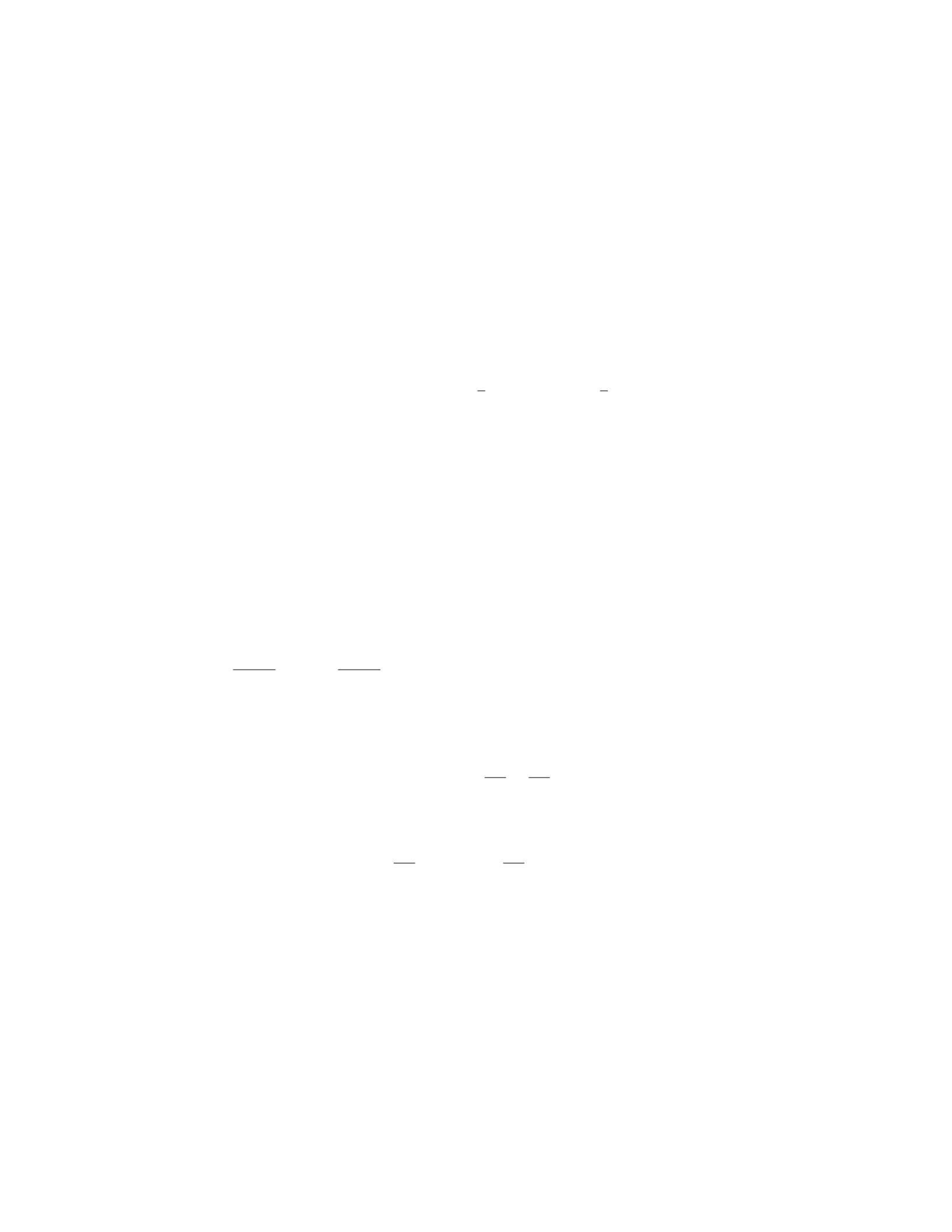
Step 4: By Green’s theorem, we have
IC
F·dr=ZZD
(∇ × F)·kdA =ZZD
(−3) dA
where Dis the region in the xy-plane corresponding to the projection of the
curve C.
Step 5: The region Dcan be described as 0≤t≤2π,0≤r≤1. Thus, the
double integral becomes
Z2π
0Z1
0
(−3)r dr dt =Z2π
0−3
2r21
0
dt =Z2π
0−3
2dt =−3π.
Therefore, the value of the line integral over the curve Cis −3π.
Question 22
Question
Let Cbe the curve given by x2+y2= 4 oriented counterclockwise. Calculate the
circulation of the vector field F(x, y) = ⟨y, x⟩around Cusing Green’s Theorem.
Solution
Step 1: First, we need to find the region Denclosed by the curve C, which is the
circle with radius 2 centered at the origin. We can represent Das −2≤x≤2,
−√4−x2≤y≤√4−x2.
Step 2: Green’s Theorem states that for a vector field F(x, y) = ⟨P(x, y), Q(x, y)⟩
and a region Denclosed by a simple, positively oriented, piecewise smooth curve
C, the circulation of Faround Cis given by
IC
F·dr=ZZD∂Q
∂x −∂P
∂y dA.
Step 3: Let P(x, y) = yand Q(x, y) = x. We compute the partial derivatives:
∂Q
∂x = 1 and ∂P
∂y = 1.
Step 4: The circulation of Faround Cis therefore given by
IC
F·dr=ZZD
(1 −1) dA =ZZD
0dA = 0.
Therefore, the circulation of the vector field F(x, y) = ⟨y, x⟩around the
circle x2+y2= 4 is 0.
20

Question 23
Question
Let Cbe the curve given by x=t2,y= 2tfor 0≤t≤1. Use Green’s theorem
to evaluate the line integral
IC
(x2+y2)dx + (3x−2y)dy.
Solution
Step 1: We first need to parameterize the curve C. From the given equations,
we have x=t2and y= 2t. This gives us the parameterization r(t) = t2i+ 2tj
for 0≤t≤1.
Step 2: Calculating the partial derivatives of xand ywith respect to t, we
have ∂y
∂t = 2,∂x
∂t = 2t.
Step 3: Substituting x=t2and y= 2tinto the line integral, we get
IC
(t4+ 4t2) (2t) + (3t2−4t)·2dt.
Step 4: Simplifying the integrand, we have
IC
(2t5+ 8t3) + (6t2−8t)dt.
Step 5: Applying Green’s theorem, the given line integral is equal to the
double integral over the region Denclosed by Cof
ZZD∂Q
∂x −∂P
∂y dA,
where P=x2+y2and Q= 3x−2y.
Step 6: Computing the partial derivatives,
∂Q
∂x = 3,∂P
∂y = 2y.
Step 7: Thus, the double integral becomes
ZZD
(3 −2y)dA.
Step 8: The region Dis the area enclosed by the curve C, namely the curve
given by x=t2,y= 2tfor 0≤t≤1. This region is a parabolic sector.
Step 9: Evaluating the double integral, we get
Z1
0Z2t
0
(3 −2y)dy dt =Z1
0
[3y−y2]
2t
0dt.
Step 10: After evaluating the integral, we find the final answer to be 11
3.
21

Question 24
Question
Let Cbe the curve defined by x2+y2= 1 oriented counterclockwise. Calculate
the line integral RCy2dx +x2dy using Green’s Theorem.
Solution
Step 1: Determine the region bounded by the curve C.
Since Cis the circle x2+y2= 1, we know that Cis a closed curve that
bounds the region inside the circle.
Step 2: Apply Green’s Theorem.
Green’s Theorem states that for a smooth curve Cbounding a region Din
the plane and a vector field F=Pi+Qj, we have
ZC
P dx +Q dy =ZZD∂Q
∂x −∂P
∂y dA.
In this case, P=y2and Q=x2, so ∂Q
∂x = 2x,∂P
∂y = 2y, and ∂Q
∂x −∂P
∂y =
2x−2y. The integral becomes
ZC
y2dx +x2dy =ZZD
(2x−2y)dA.
Step 3: Calculate the double integral.
To find the double integral, we need to determine the region D. Since Cis
the unit circle centered at the origin, Dis the unit disk x2+y2≤1.
Thus, the double integral becomes
ZZD
(2x−2y)dA =Z1
−1Z√1−x2
−√1−x2
(2x−2y)dy dx.
Step 4: Evaluate the double integral.
Calculating the double integral, we get
Z1
−1Z√1−x2
−√1−x2
(2x−2y)dy dx =Z1
−1
4xp1−x2dx.
Using the substitution u= 1 −x2, we have du =−2x dx and the integral
becomes
Z1
−1−2√u du =−4
3u3/2
1
−1
=−8
3.
Therefore, the line integral RCy2dx +x2dy =−8
3.
22
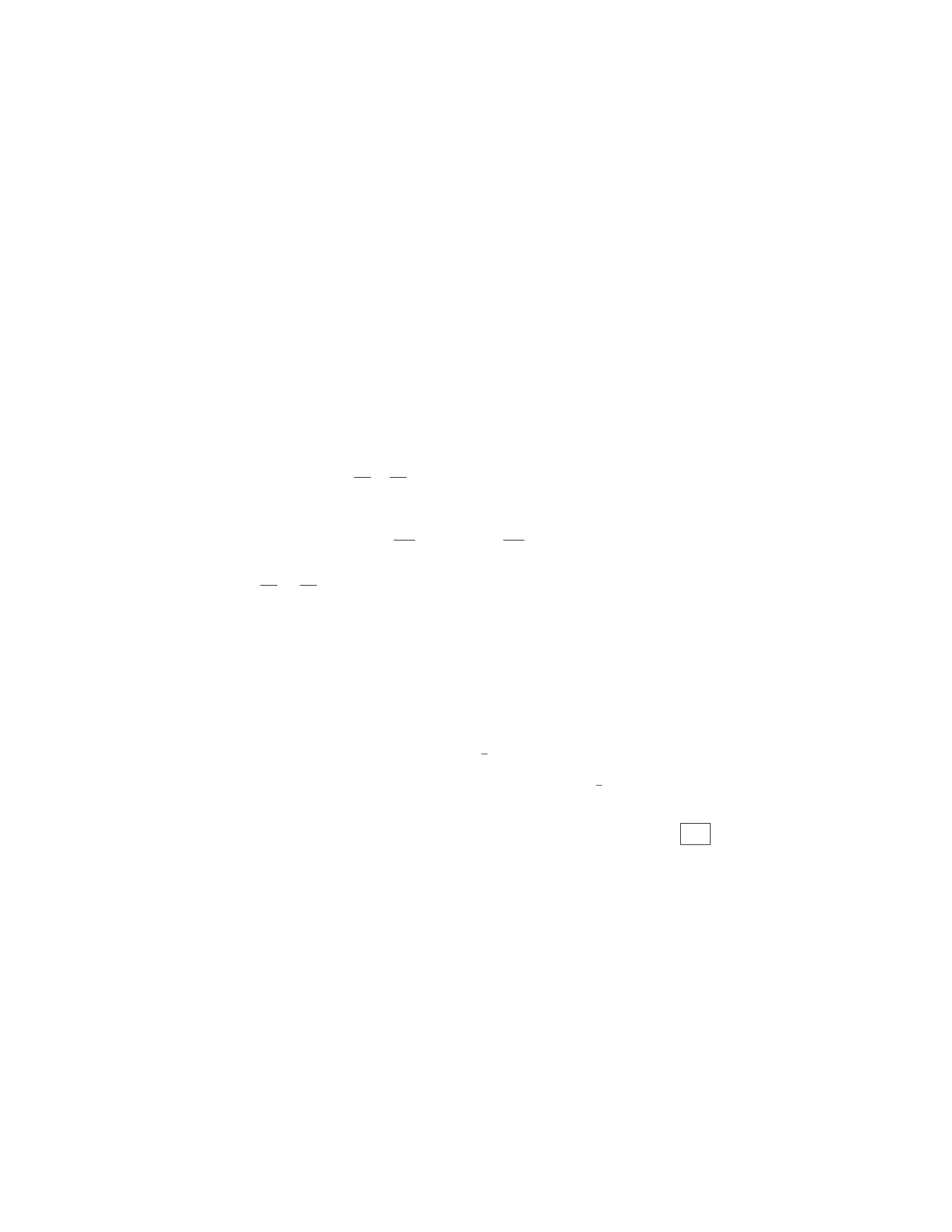
Question 25
Question
Let Cbe the curve consisting of the line segment from (0,0) to (2,4) followed
by the line segment from (2,4) to (4,0), oriented from (0,0) to (4,0). Calculate
the line integral HC(2y+x)dx + (x+ 3y)dy using Green’s ThejsonThm.
Solution
Step 1: Parameterize the curve C. Since Cconsists of two line segments, we can
parameterize the first segment from (0,0) to (2,4) as r1(t) = 2t
4tfor 0≤t≤1,
and the second segment from (2,4) to (4,0) as r2(t) = 2t+ 2
4−4tfor 0≤t≤1.
Step 2: Calculate ∂Q
∂x −∂P
∂y . Given the line integral is of the form P dx+Qdy,
we have P(x, y) = 2y+xand Q(x, y) = x+ 3y. So,
∂Q
∂x = 1 and ∂P
∂y = 2.
Hence, ∂Q
∂x −∂P
∂y = 1 −2 = −1.
Step 3: Calculate the double integral over the region enclosed by C. By
Green’s Theorem, we have
IC
(2y+x)dx + (x+ 3y)dy =ZZD
(−1)dA,
where Dis the region enclosed by C. Since Dis a triangle with vertices at
(0,0),(2,4), and (4,0), we can express the double integral as
ZZD
(−1)dA =−Z4
0Z2−x
2
0
dydx −Z0
4Z4
2+ x
2
dydx,
which simplifies to −8.
Therefore, the line integral HC(2y+x)dx + (x+ 3y)dy is equal to −8.
23

Step 4: Evaluate the line integral using Green’s Theorem.
IC
F·dr =ZZD∇ ×
F dA = 4π.
Therefore, the line integral HC(2x2−y2)dx + (x2+ 2y)dy around the curve Cis
4π.
Question 2
Question
Let Cbe the curve that bounds the region Denclosed by the parabola y=x2,
the line y= 2x, and the x-axis. Use Green’s Theorem to evaluate the line
integral
IC
(3x−2y)dx + (x+ 4y)dy
Solution
1. We start by determining the region Denclosed by the given curves. The
parabola y=x2intersects y= 2xat x= 0 and x= 1. Therefore, the
region Dis bounded by 0≤x≤1.
2. Green’s Theorem states that for a region Denclosed by a simple closed
curve Coriented counterclockwise, and a vector field F= (P, Q)that has
continuous partial derivatives on an open region containing D, then the
line integral of Faround Cis equal to the double integral of the curl of F
over the region D:
IC
F·dr=ZZD∂Q
∂x −∂P
∂y dA
In this case, we have F= (3x−2y, x +4y), so P= 3x−2yand Q=x+4y.
3. To apply Green’s Theorem, we need to calculate the partial derivatives of
Pand Q:
∂Q
∂x = 1 and ∂P
∂y =−2
4. Now, we evaluate the double integral over the region D:
ZZD∂Q
∂x −∂P
∂y dA =ZZD
(1 + 2) dA =ZZD
3dA
5. Since the region Dis bounded by 0≤x≤1and 0≤y≤x2, we have:
ZZD
3dA =Z1
0Zx2
0
3dy dx =Z1
0
3x2dx =x31
0= 1
2
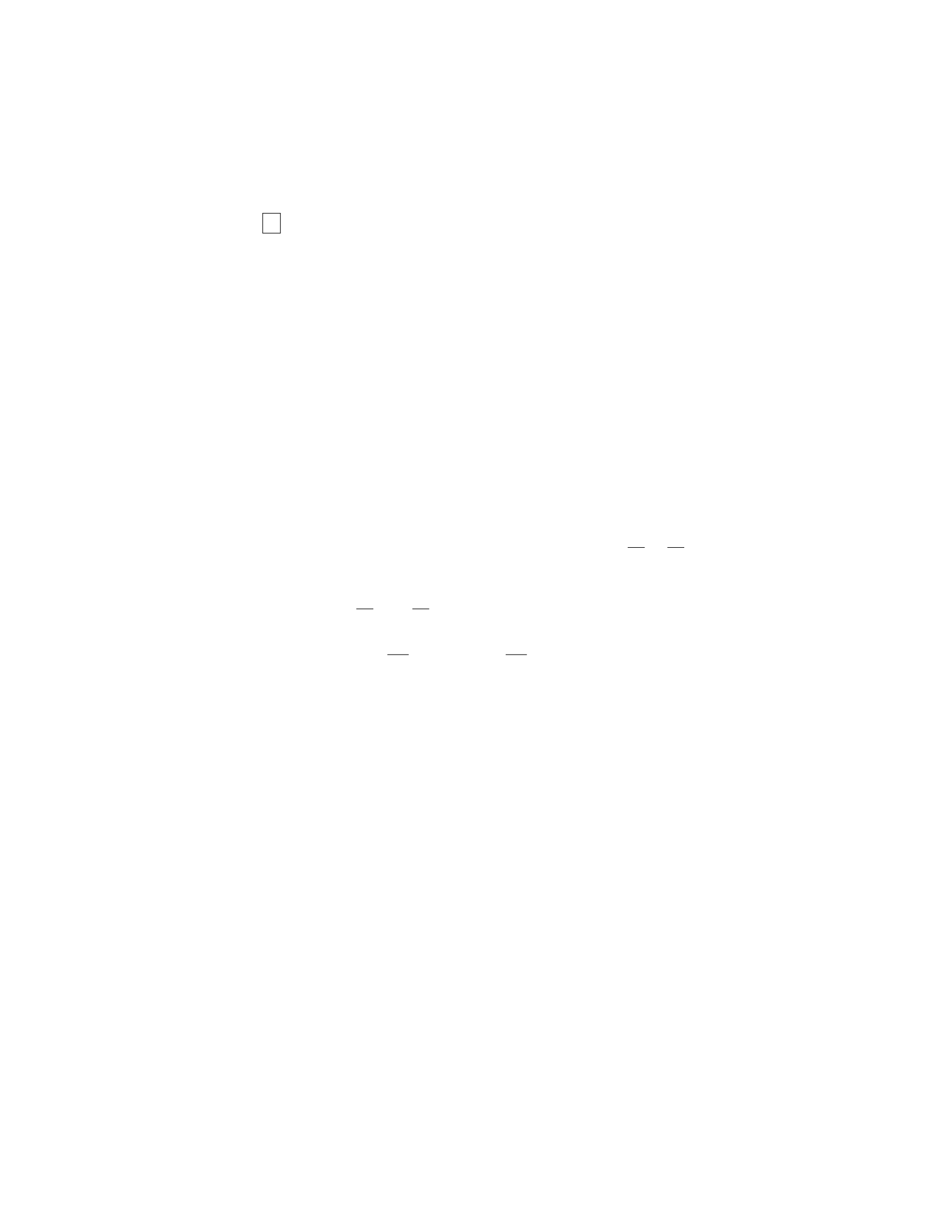
6. Therefore, by Green’s Theorem, the line integral of Faround the curve C
is 1.
Question 3
Question
Let Cbe the curve given by x2+y2= 4 oriented counterclockwise. Calculate
the line integral HC(x+y2)dx + (x2+y)dy using Green’s Thejsonm.
Solution
Step 1: To apply Green’s Theorem to evaluate the line integral, we need to find
the region Denclosed by the curve C.
Step 2: The curve Cis a circle centered at the origin with radius 2. There-
fore, Dis the disk enclosed by the circle.
Step 3: Green’s Theorem states that for a region Denclosed by a simple,
positively oriented curve C, the line integral along Cof the vector field F=
P(x, y)i+Q(x, y)jis equal to the double integral over Dof ∂Q
∂x −∂P
∂y dA.
Step 4: In this case, we have F= (x+y2)i+ (x2+y)j, so P(x, y) = x+y2
and Q(x, y) = x2+y.
Step 5: Calculate ∂Q
∂x and ∂P
∂y :
∂Q
∂x = 2xand ∂P
∂y = 2y
Step 6: Compute the double integral over D:
ZZD
(2x−2y)dA
Step 7: Switch to polar coordinates: x=rcos(θ),y=rsin(θ), and dA =
rdrdθ.
Step 8: Rewrite the integral in polar coordinates:
Z2π
0Z2
0
(2rcos(θ)−2rsin(θ))rdrdθ
Step 9: Simplify the integral:
Z2π
0Z2
0
(2r2cos(θ)−2r2sin(θ))drdθ
Step 10: Evaluate the double integral to find the line integral along C.
3
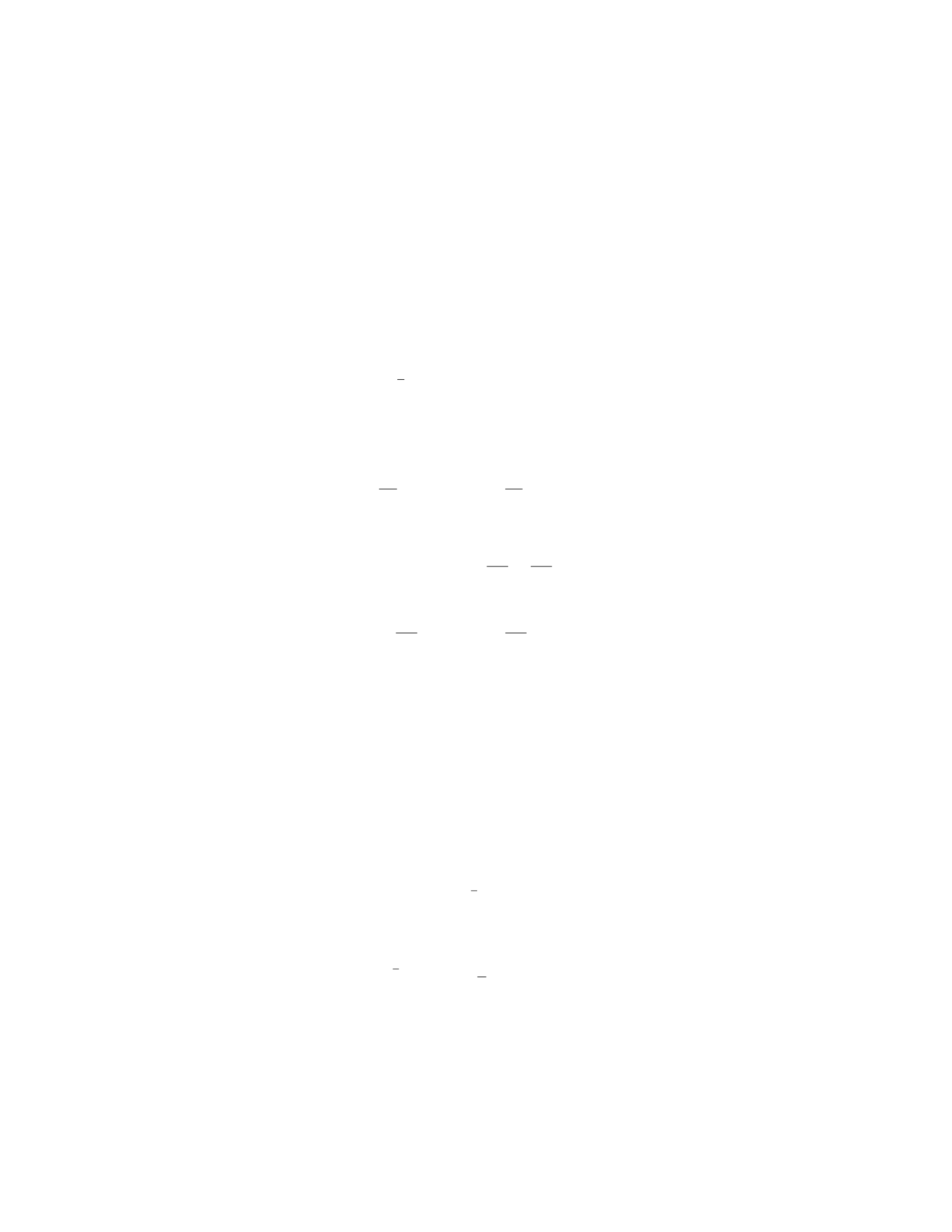
Question 4
Question
Let Cbe the curve defined by xy = 1 oriented counterclockwise. Calculate the
line integral HCy dx +x dy using Green’s Theorem.
Solution
Step 1: Determine the region enclosed by the curve C. Given the curve xy = 1,
we can rewrite it as y=1
x. This curve is the rectangular hyperbola with
asymptotes x= 0 and y= 0. The region enclosed by Cis the area in the first
quadrant.
Step 2: Find the partial derivatives of the vector field. The vector field is
F= (y, x). Compute the partial derivatives:
∂
∂x (y) = 0 and ∂
∂y (x) = 0
Step 3: Calculate the line integral using Green’s Theorem. Green’s Theo-
rem states: IC
F·dr =ZZR∂Q
∂x −∂P
∂y dA
Here, P=yand Q=x. So, we have:
∂Q
∂x = 1 and ∂P
∂y = 0
The line integral becomes:
IC
y dx +x dy =ZZR
1dA
Step 4: Calculate the double integral over the region R. Since the region
Ris the area in the first quadrant enclosed by the curve C, the double integral
becomes: ZZR
1dA =ZZR
dA
Step 5: Evaluate the double integral. The integral RRRdA over the first
quadrant region enclosed by xy = 1 is equivalent to finding the area of this
region. This can be done by integrating:
Z∞
0Z1
x
0
1dy dx
This integral evaluates to:
Z∞
0
[y]
1
x
0dx =Z∞
0
1
xdx = lim
c→∞[ln(x)]c
1
= lim
c→∞ ln(c)−ln(1) = ∞
Therefore, the line integral HCy dx +x dy around the curve xy = 1 is ∞.
4

Question 5
Question
Let Cbe the curve that consists of the line segment from (0,0) to (2,4) and
the line segment from (2,4) to (4,0). Use Green’s Theorem to evaluate the line
integral
IC
(x2+y2)dx +xy dy
Solution
Step 1: Calculate the double integral over the region enclosed by curve C. Let
Dbe the region enclosed by C. We have Das a triangle with vertices at (0,0),
(2,4), and (4,0). Then, Green’s Theorem gives
ZZD∂Q
∂x −∂P
∂y dA =IC
P dx +Q dy
where P=x2+y2and Q=xy. Then,
∂Q
∂x =yand ∂P
∂y = 2y
So, the given integral becomes
ZZD
(y−2y)dA =ZZD
(−y)dA
Step 2: Convert the integral over Dto a double integral. To integrate over
the triangular region Dwith vertices at (0,0),(2,4), and (4,0), we set up the
double integral as follows:
ZZD
(−y)dA =Z4
0Z4−1
2y
1
2y
(−y)dx dy
Step 3: Evaluate the double integral. Integrating with respect to xfirst,
we have:
Z4
0
[−xy]4−1
2y
1
2ydy =Z4
0
(−4y+ 2y)dy
=Z4
0
(−2y)dy =−y2
4
0=−16
Therefore, the value of the line integral is −16 .
5

Question 6
Question
Let Cbe the circle centered at the origin with radius 2, oriented counter-
clockwise. Let Dbe the region enclosed by C. Consider the vector field
F(x, y) = (yex2, x cosy2). Calculate the circulation of Faround Cand the
flux of Facross the boundary of Dusing Green’s Theorem.
Solution
To calculate the circulation of Faround Cusing Green’s Theorem, we need to
evaluate the line integral of Faround C:
IC
F·dr=ZZD∂Q
∂x −∂P
∂y dA
where F(x, y) = (P(x, y), Q(x, y)). In this case, P(x, y) = yex2and Q(x, y) =
xcosy2. Let’s first calculate the partial derivatives:
∂Q
∂x = cosy2
∂P
∂y =ex2
Therefore, the line integral becomes:
IC
F·dr=ZZD
(cosy2−ex2)dA
To evaluate the integral RRD(cosy2−ex2)dA, we switch to polar coordi-
nates. The region Dis described by 0≤r≤2and 0≤θ≤2π. Then, the
integral becomes:
Z2π
0Z2
0
(rcos(θ)2−er2cos(θ)2)r dr dθ
After evaluating this integral, we will obtain the circulation of Faround C.
Next, we use Green’s Theorem to calculate the flux of Facross the boundary
of D. The flux is given by:
ZZD
(∂Q
∂x −∂P
∂y )dA
We already calculated the partial derivatives so we can directly evaluate this
integral in polar coordinates as well. This will give us the flux of Facross the
boundary of D.
6
Question 7
Question
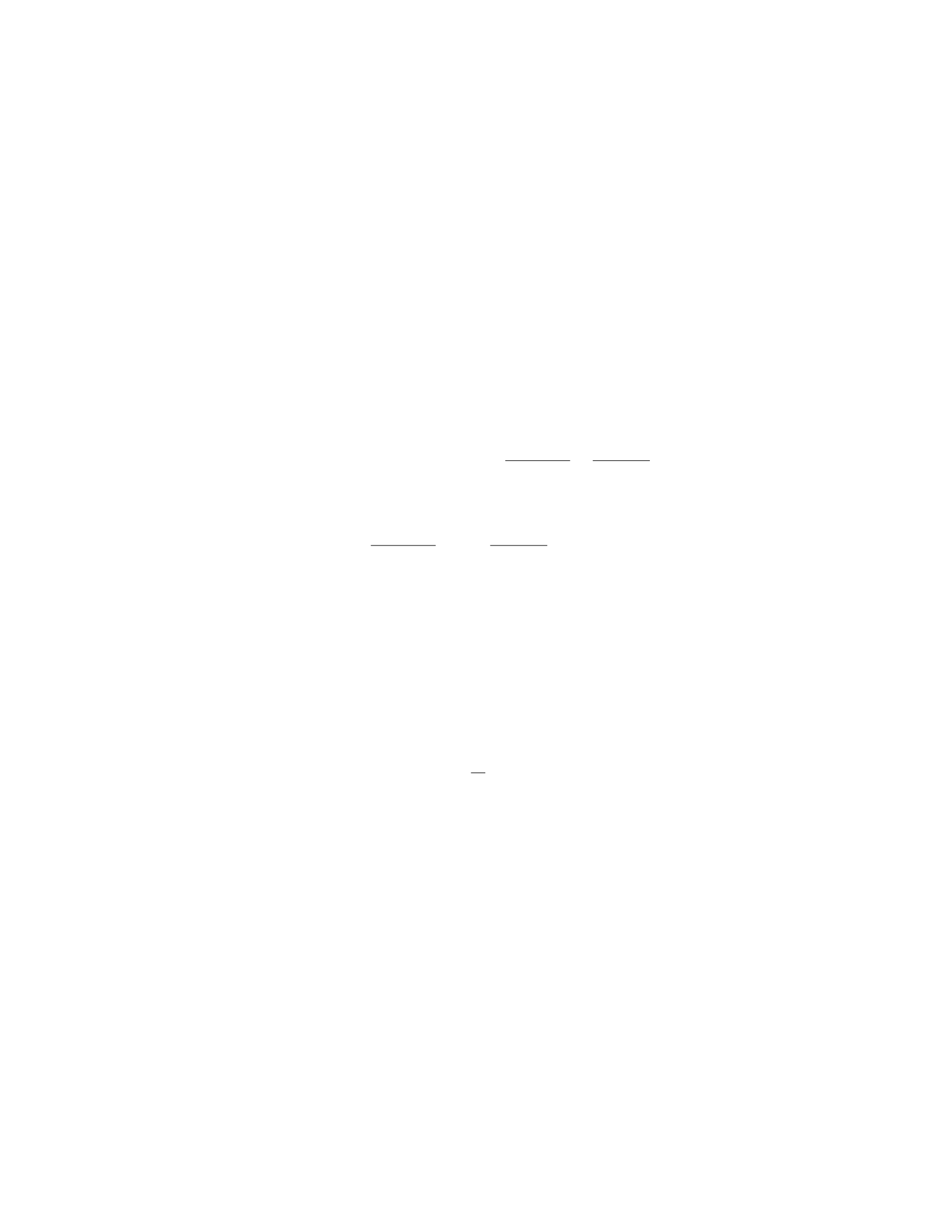
Let Cbe the boundary of the region enclosed by the curve x2+y2= 4, oriented
counterclockwise when viewed from above. Compute the line integral HC(x+
y)dx + (2x−y)dy using Green’s theorem.
Solution
Step 1: Find the region Denclosed by the curve x2+y2= 4. The region
enclosed by x2+y2= 4 is a circle of radius 2 centered at the origin.
Step 2: Using Green’s theorem, we have
IC
(x+y)dx + (2x−y)dy =ZZD∂(2x−y)
∂x −∂(x+y)
∂y dA.
Step 3: Compute the partial derivatives:
∂(2x−y)
∂x = 2,∂(x+y)
∂y = 1.
Therefore, the line integral simplifies to
ZZD
(2 −1) dA =ZZD
dA.
Step 4: Switch to polar coordinates to evaluate the double integral. Let
x=rcos θand y=rsin θ. Also, dA =rdrdθ. The limits of integration for r
are from 0 to 2, and for θare from 0 to 2π.
Step 5: Evaluate the double integral:
Z2π
0Z2
0
r drdθ =Z2π
0r2
22
0
dθ =Z2π
0
2dθ = 4π.
Therefore, the line integral HC(x+y)dx + (2x−y)dy around the curve
x2+y2= 4 is equal to 4π.
Question 8
Question
Let Cbe the unit circle centered at the origin, oriented counterclockwise, and
let Dbe the region inside C. Consider the vector field F(x, y)=(xex2+y2−
y, yex2+y2+x). Use Green’s Theorem to calculate the line integral HCF·dr.
7
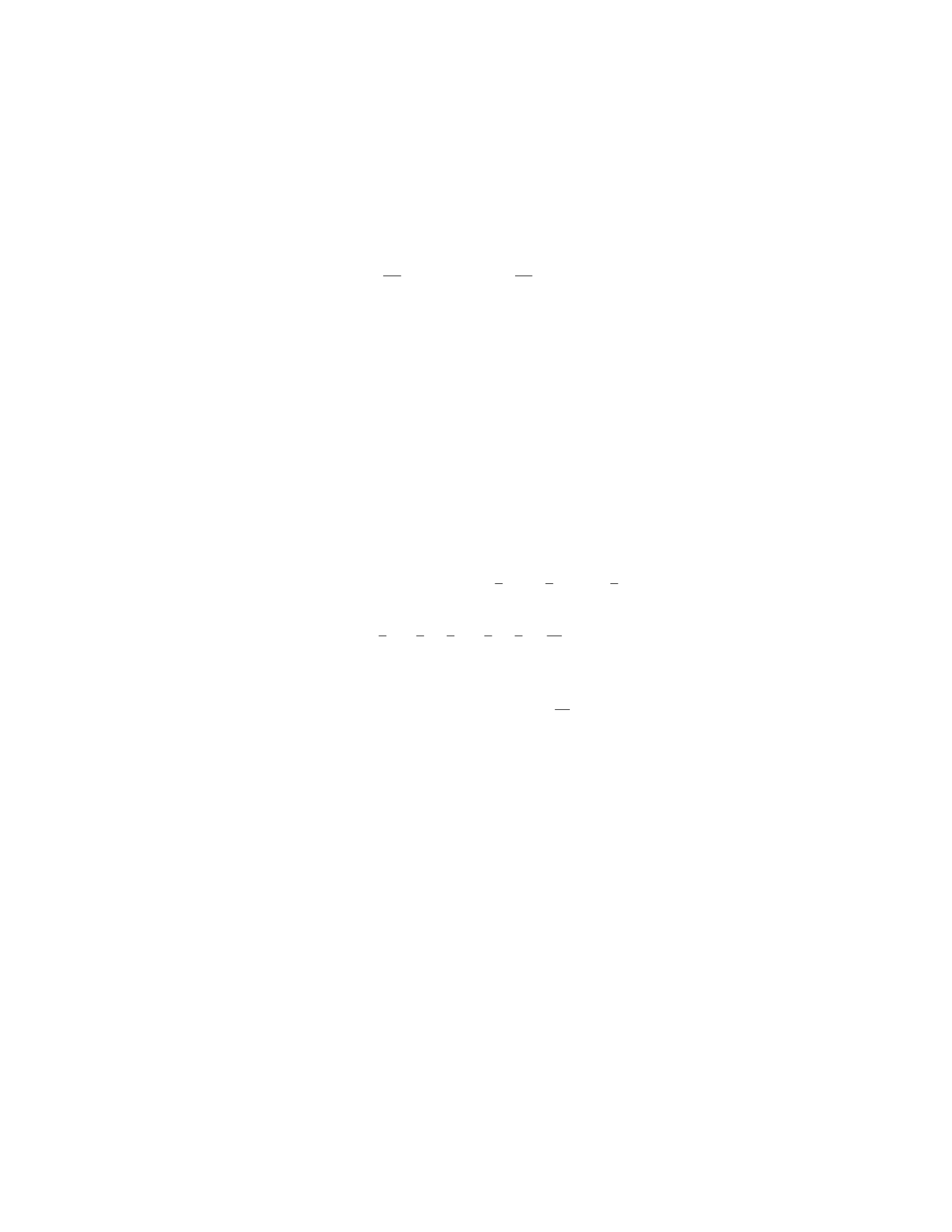
Solution
Step 1: Calculate the divergence of F:
∇ · F=∂
∂x (xex2+y2−y) + ∂
∂y (yex2+y2+x)
=ex2+y2+ 2x2ex2+y2−1
Step 2: Apply Green’s Theorem: Using Green’s Theorem, we have:
IC
F·dr=ZZD
(∇ · F)dA
Step 3: Calculate the area integral: Since the region Dis inside the unit
circle, we can use polar coordinates to integrate over D:
ZZD
(∇ · F)dA =Z2π
0Z1
0
(er2+ 2r2er2−1) r dr dθ
Step 4: Evaluate the integral: Integrating with respect to rfirst, we get:
Z1
0
(er2+ 2r2er2−1) r dr =1
2er2+2
3r3er2−1
2r2
1
0
=1
2e−1
2+2
3e−2
3−1
2=5e
6−2
Step 5: Compute the final result: Finally, we have:
IC
F·dr=ZZD
(∇ · F)dA =5e
6−2
Question 9
Question
Let Cbe the curve given by x= 2 cos(t),y= 3 sin(t)for 0≤t≤2π, oriented
counterclockwise. Calculate the circulation of the vector field F(x, y) = ⟨y2, x2⟩
around the curve C.
Solution
Step 1: Parameterize the curve C.
x(t) = 2 cos(t)
y(t) = 3 sin(t)
8

Step 2: Calculate the derivatives of x(t)and y(t).
dx
dt =−2 sin(t)
dy
dt = 3 cos(t)
Step 3: Calculate the line integral of Fover Cusing circulation.
circulation =ZC
F·dr
=Z2π
0⟨32sin2(t),22cos2(t)⟩ · ⟨−2 sin(t),3 cos(t)⟩dt
=Z2π
0−9 sin3(t) + 4 cos3(t)dt
=Z2π
0−9 sin3(t)dt +Z2π
0
4 cos3(t)dt
= 0 (Use symmetry properties of sine and cosine functions)
Therefore, the circulation of the vector field Faround the curve Cis 0.
Question 10
Question
Let Cbe the curve defined by x2+y2= 4 oriented counterclockwise. Evaluate
the line integral HC(x3y2+y3)dx + (2xy2+x2y)dy using Green’s Theorem.
Solution
Step 1: Determine the region enclosed by the curve C.
• The curve Cis a circle of radius 2 centered at the origin.
• The region enclosed by Cis the interior of this circle.
Step 2: Compute the partial derivatives of the given vector field. Let
F(x, y) = (x3y2+y3,2xy2+x2y).
• Compute ∂
∂y (x3y2+y3) = 2x3y+ 3y2.
• Compute ∂
∂x (2xy2+x2y) = 2y2+ 2xy.
Step 3: Apply Green’s Theorem. Green’s Theorem states that for a simply
connected region Denclosed by a positively oriented, piecewise smooth, simple
9
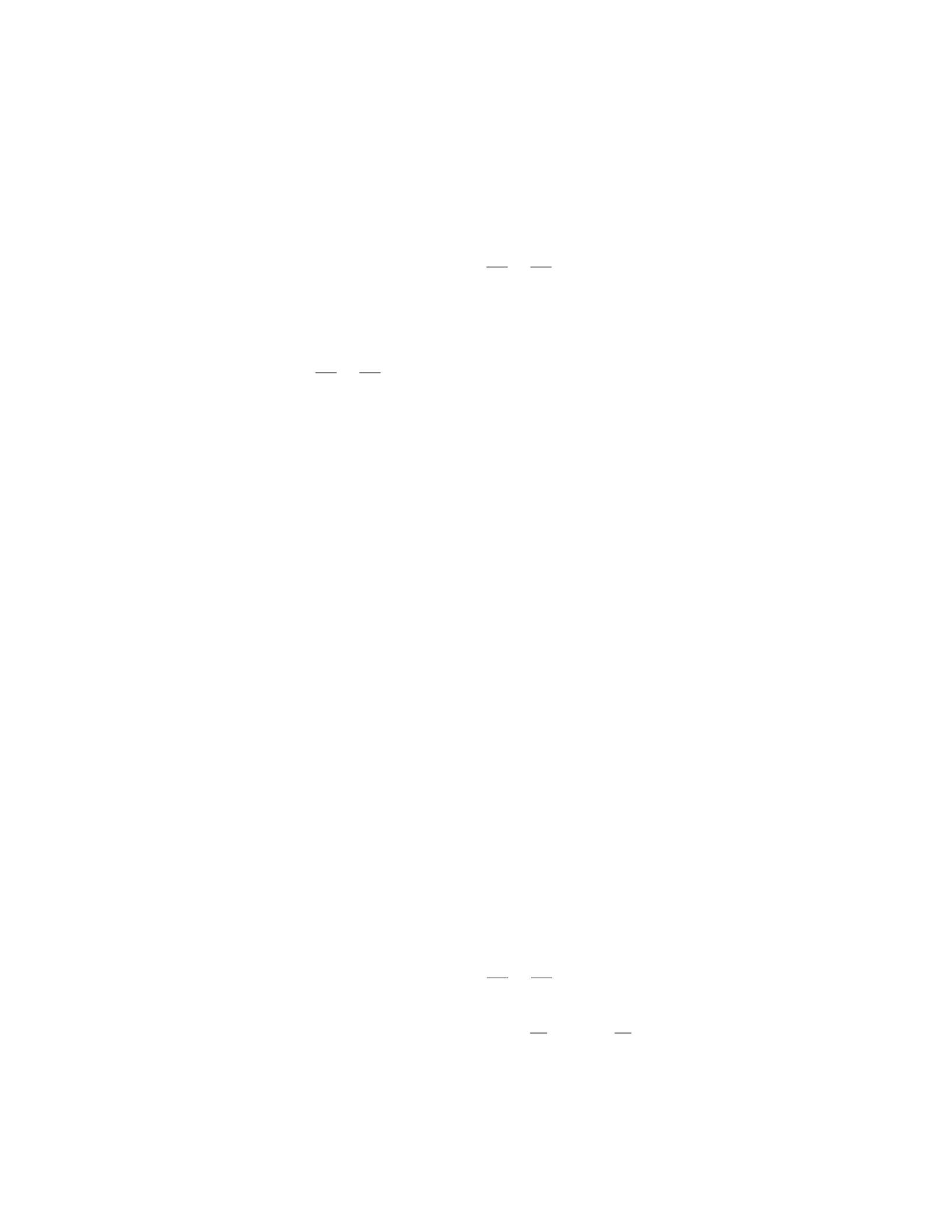
closed curve C, if F= (P, Q)is a vector field whose components have continuous
first partial derivatives in an open region containing D, then
IC
F·dr =ZZD∂Q
∂x −∂P
∂y dA.
Substitute P=x3y2+y3and Q= 2xy2+x2yinto the formula above.
Step 4: Evaluate the double integral.
ZZD∂Q
∂x −∂P
∂y dA =ZZD2y2+ 2xy −(2x3y+ 3y2)dA.
Step 5: Switch to polar coordinates to simplify the integral. Let x=rcos(θ)
and y=rsin(θ). Also, dA =rdrdθ.
Step 6: Calculate the integral using the polar form of the vector field.
Z2π
0Z2
02(rsin(θ))2+ 2(rcos(θ))(rsin(θ)) −2(rcos(θ))3(rsin(θ)) −3(rsin(θ))2rdrdθ
Step 7: Simplify the integral and compute the final result to find the value
of the line integral over the curve C.
Question 11
Question
Let Cbe the curve given by the intersection of the plane z= 2 and the cylinder
x2+y2= 1. Use Green’s Theorem to evaluate HC(2x+ 3y)dx + (x−2y)dy.
Solution
Step 1: Find the region Denclosed by the curve C. Since Cis the intersection
of the plane z= 2 and the cylinder x2+y2= 1, the curve Clies on the disk in
the xy-plane with radius 1 centered at the origin. Let’s denote this region as D.
Step 2: Parametrize the boundary curve C. We can parametrize Cusing
polar coordinates as x= cos(t)and y= sin(t)for 0≤t≤2π. Given that z= 2
on C, we have z= 2 as the constant for the C.
Step 3: Apply Green’s Theorem. Green’s Theorem states that for a smooth
curve Cenclosing a region Din the plane, and a vector field F=Pi+Qj
defined on an open region containing D, the circulation of Faround Cis equal
to the double integral of ∇ ×Fover the region D. Mathematically, this can be
expressed as:
IC
F·dr=ZZD
(∂Q
∂x −∂P
∂y )dA
Step 4: Evaluate the line integral. Given F= (2x+ 3y)i+ (x−2y)j, we
can write P= 2x+ 3yand Q=x−2y. Then, ∂Q
∂x = 1 and ∂P
∂y = 3.
10

Therefore, by Green’s Theorem, we have:
IC
(2x+ 3y)dx + (x−2y)dy =ZZD
(1 −3) dA =−2ZZD
dA
Step 5: Calculate the double integral over the region D. The double integral
of 1over the unit circle Dis the area of the circle, which is π(12) = π. Therefore,
the value of the line integral is:
−2ZZD
dA =−2·π=−2π
Question 12
Question
Let Cbe the curve defined by the intersection of the surfaces x2+y2+z2= 1
and y2+z2=x. Use Green’s Theorem to evaluate the line integral HCx2dy +
y2dz +z2dx.
Solution
Step 1: Determine the region Denclosed by the curve Cin the xy-plane.
The curve Cis the intersection of the surfaces x2+y2+z2= 1 and y2+z2=x.
Solving for xin y2+z2=x, we get x=y2+z2. Substituting this into
x2+y2+z2= 1, we have (y2+z2)2+y2+z2= 1.
Solving this equation will give us the curve Cin terms of yand z.
Step 2: Apply Green’s Theorem.
Given that the line integral is HCx2dy +y2dz +z2dx, we rewrite it as
HCP dx +Q dy +R dz, where P=z2,Q=x2, and R=y2.
Green’s Theorem states:
IC
P dx +Q dy =ZZD∂Q
∂x −∂P
∂y dA
Applying Green’s Theorem, we have:
IC
x2dy +y2dz +z2dx =ZZD
(2x−2y)dA
Step 3: Evaluate the double integral.
Evaluate the double integral RRD(2x−2y)dA over the region Dfound in
Step 1.
This will give us the final answer for the line integral over curve C.
11

Question 13
Question
Let Cbe the curve given by x2+y2= 1 oriented counterclockwise. Calculate
the circulation of the vector field F(x, y) = (y, −x)around C.
Solution
Step 1: To calculate the circulation of Faround C, we need to use Green’s
Theorem, which relates circulation to a double integral over the region bounded
by C.
Step 2: Green’s Theorem states that for a vector field F(x, y) = (P(x, y), Q(x, y))
with a positively oriented simple closed curve Cgiven by r(t) = (x(t), y(t)) pa-
rameterized by a≤t≤b, the circulation of Faround Cis given by:
IC
F·dr=ZZD∂Q
∂x −∂P
∂y dA,
where Dis the region enclosed by C.
Step 3: In this case, F(x, y)=(y, −x), so P(x, y) = yand Q(x, y) = −x.
We also have that ∂Q
∂x =−1and ∂P
∂y = 1.
Step 4: Substituting these into Green’s Theorem, we obtain:
IC
F·dr=ZZD
(−1−1)dA =−2ZZD
dA.
Step 5: The region Denclosed by Cis the unit circle centered at the origin.
We can express this as D={(x, y)∈R2:x2+y2≤1}.
Step 6: Calculating the double integral over D, we have:
−2ZZD
dA =−2Z1
−1Z√1−x2
−√1−x2
dydx =−4Z1
−1p1−x2dx.
Step 7: To evaluate the integral, we make a trigonometric substitution x=
sin θ:
−4Z1
−1p1−x2dx =−4Zπ
2
−π
2
cos2θdθ.
Step 8: Using the identity cos2θ=1+cos 2θ
2, we obtain:
−4Zπ
2
−π
2
cos2θdθ =−2θ+sin 2θ
2π
2
−π
2
=−2π.
Step 9: Therefore, the circulation of the vector field F(x, y) = (y, −x)around
the curve Cis −2π.
12
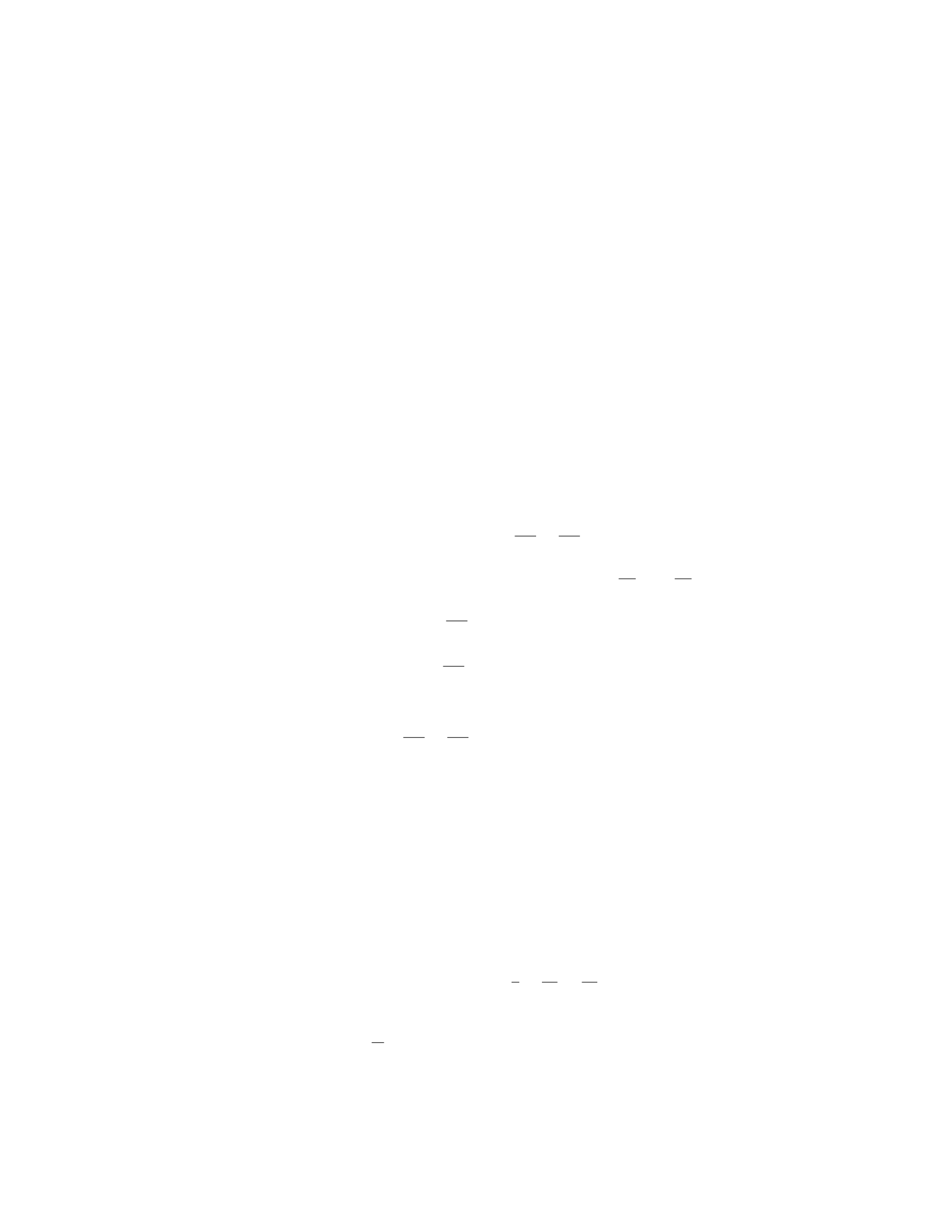
Question 14
Question
Let Cbe the curve defined by x=t2and y=t3for 0≤t≤1, ori-
ented counterclockwise. Use Green’s Theorem to evaluate the line integral
HCy3−x3dx +x2+y2dy.
Solution
Step 1: Find the region Denclosed by the curve C. Since x=t2and y=t3,
we can eliminate the parameter tby considering yas a function of x.
y=x3/2
The region Dis the area enclosed by the curve y=x3/2in the xy-plane over
the interval 0≤x≤1.
Step 2: Apply Green’s Theorem. Green’s Theorem states:
IC
(P dx +Q dy) = ZZD∂Q
∂x −∂P
∂y dA
In our case, P=y3−x3and Q=x2+y2. We need to find ∂Q
∂x and ∂P
∂y .
∂Q
∂x = 2x
∂P
∂y = 3y2
So, the expression inside the double integral becomes:
∂Q
∂x −∂P
∂y = 2x−3y2
Step 3: Compute the double integral. The double integral becomes:
ZZD
(2x−3y2)dA =Z1
0Zx3/2
0
(2x−3y2)dy dx
Step 4: Evaluate the double integral.
Zx3/2
0
(2x−3y2)dy = 2xy −y3
x3/2
0= 2x5/2−(x3/2)3= 2x5/2−x9/2
Integrating this with respect to xover 0≤x≤1, we get:
Z1
0
(2x5/2−x9/2)dx =4
7−2
11 =38
77
Step 5: Final answer. Therefore, the value of the line integral HC(y3−
x3)dx + (x2+y2)dy is 38
77 .
13

Question 15
Question
Let Cbe the boundary of the region enclosed by the ellipse x2
a2+y2
b2= 1, where
a > b > 0, oriented counterclockwise. Use Green’s Theorem to evaluate the line
integral HC(y2−x)dx + (x2+y)dy.
Solution
Step 1: Write the given line integral in the form of Green’s Theorem. The
line integral can be rewritten in the form P dx +Q dy, where P=y2−xand
Q=x2+y
Step 2: Find the partial derivatives of Qwith respect to xand Pwith
respect to y. Calculating the partial derivative of Qwith respect to x:
∂Q
∂x = 2x
Calculating the partial derivative of Pwith respect to y:
∂P
∂y = 2y
Step 3: Apply Green’s Theorem, which states:
IC
(P dx +Q dy) = ZZD∂Q
∂x −∂P
∂y dA
where Dis the region bounded by C.
Step 4: Evaluate the double integral on the right-hand side of Green’s
Theorem. ZZD
(2x−2y)dA
Step 5: Simplify and solve the double integral over the region Denclosed
by the given ellipse. Since the given ellipse can be parametrized by x=acos(t)
and y=bsin(t)for 0≤t≤2π, we have:
ZZD
(2x−2y)dA =Z2π
0Z1
0
(2(acos(t)) −2(bsin(t))) (ab)dr dt
= 2ab Z2π
0
(acos(t)−bsin(t)) dt
= 2ab[(asin(t) + bcos(t))]2π
0= 0
Therefore, the value of the line integral HC(y2−x)dx + (x2+y)dy is 0.
14
Question 16
Question
Let Cbe the curve consisting of the intersection of the plane z= 0 and the cone
z=px2+y2oriented counterclockwise as viewed from high z-values. Use
Green’s Theorem to evaluate the line integral HC(x2+y2)dx + 2xy dy.
Solution
To use Green’s Theorem, we first need to find a vector field F=⟨P, Q⟩such
that curl F=Qx−Py=x2+y2.
Step 1: Find a vector field F=⟨P, Q⟩such that curl F=x2+y2. Let
P(x, y) = y
2and Q(x, y) = −x
2. Then,
curl F=Qx−Py=−1
2−0 = −1
2=x2+y2.
To correct this, we need to add a term to Por Q. Let’s try adding x2to P:
Let P(x, y) = y
2+x2and Q(x, y) = −x
2. Now,
curl F=Qx−Py=−1
2−2x=x2+y2.
Hence, we can let F=⟨y
2+x2,−x
2⟩.
Step 2: Apply Green’s Theorem. Green’s Theorem states: HCF·dr=
RRD∂Q
∂x −∂P
∂y dA.
We have ∂Q
∂x =−1
2and ∂P
∂y = 1. Substitute into Green’s Theorem:
ICy
2+x2dx −x
2dy =ZZD
(−3
2)dA.
Step 3: Simplify the line integral. Since Dis the region inside the curve C,
we can rewrite the right side as:
ZZD
(−3
2)dA =−3
2ZZD
dA =−3
2·Area(D).
Step 4: Calculate the area enclosed by C. The area of the region inside
Ccan be calculated by finding the area of the circle with radius r= 1 (as
z=√12+ 12=√2) and subtracting the area of the right triangle formed by
the x-axis, y-axis, and the line y=x.
Area(D) = π·12−1
2·1·1 = π−1
2.
Step 5: Substitute the area back into the line integral.
IC
(x2+y2)dx + 2xy dy =−3
2·π−1
2=−3
2π+3
4.
Therefore, HC(x2+y2)dx + 2xy dy =−3
2π+3
4.
15
Question 17
Question
Let Cbe the curve given by x= cos(t),y= sin(t)for 0≤t≤π, oriented
counterclockwise. Compute the line integral HC(x2+y2)dx + (x2−y2)dy using
Green’s Theorem.
Solution
Step 1: Determine the region enclosed by the curve Cand find a suitable
description of it. The curve Cis a unit circle centered at the origin, traversed
counterclockwise from t= 0 to t=π. The region enclosed by Cis the interior
of this unit circle.
Step 2: Apply Green’s Theorem, which states for a vector field F=Pi+Qj,
where Pand Qhave continuous first-order partial derivatives on a closed region
Rbounded by a positively oriented simple closed curve C, we have
IC
F·dr=ZZR∂Q
∂x −∂P
∂y dA
Step 3: Express the line integral in terms of the vector field for Green’s
Theorem. The given line integral is
IC
(x2+y2)dx + (x2−y2)dy =IC
x2dx +y2dx +x2dy −y2dy
This can be rewritten as HC(P dx +Q dy)where P=x2and Q=x2−y2.
Step 4: Calculate the partial derivatives of Pand Q. We have ∂P
∂y = 0 and
∂Q
∂x = 2x.
Step 5: Compute the double integral over the region enclosed by C. Using
Green’s Theorem, we have
ZZR∂Q
∂x −∂P
∂y dA =ZZR
2x dA
Step 6: Evaluate the double integral over the region R. Since the region R
is the interior of a unit circle, we can convert to polar coordinates: 0≤r≤1,
0≤θ≤π. Thus, the double integral becomes
Zπ
0Z1
0
2rcos(θ)dr dθ =π
Step 7: Provide the final answer. Therefore, the line integral HC(x2+
y2)dx + (x2−y2)dy is equal to π.
16

Question 18
Question
Let Cbe the curve given by r(t) = (t2+ 1)i+ (2t−1)jfor 0≤t≤2. Calculate
the circulation of the vector field F(x, y) = (2x+y)i−(x−y)jaround the curve
C.
Solution
Step 1: First, we need to parameterize the curve C:r(t) = (t2+ 1)i+ (2t−1)j
for 0≤t≤2.
Step 2: To calculate circulation, we use the formula: HCF·dr=RCF·Tds,
where F= (2x+y)i−(x−y)j,r(t) = (t2+ 1)i+ (2t−1)j,Tis the unit tangent
vector, and ds is the arc length element.
Step 3: We need to find Tand ds:T=r′(t)
|r′(t)|=2ti+2j
√4t2+4 =1
√t2+1 (ti+j),
ds =|r′(t)|dt =√4t2+ 4dt = 2√t2+ 1dt.
Step 4: Substituting everything into the circulation formula: HCF·dr=
R2
0((2(t2+ 1) + (2t−1))t−((t2+ 1) −(2t−1))) ·(ti+j)2√t2+ 1dt.
Step 5: Simplifying the integral: HCF·dr=R2
0(4t3+ 3t)2√t2+ 1dt.
Step 6: The integration may require trigonometric substitution to evaluate
the integral further.
Question 19
Question
Let Cbe the curve parametrized by x=t2and y=t3for 0≤t≤1. Calculate
the line integral RC(x2−y2)dx + 2xydy using Green’s Theorem.
Solution
Step 1: Find the parametric equations for the curve C. The parametric equa-
tions for the curve Care given by x=t2and y=t3for 0≤t≤1.
Step 2: Calculate the derivatives of xand ywith respect to t. We have
dx
dt = 2tand dy
dt = 3t2.
Step 3: Compute the line integral as a double integral using Green’s The-
orem. Using Green’s Theorem, we have
ZC
(x2−y2)dx + 2xydy =ZZD∂(2xy)
∂x −∂(x2−y2)
∂y dA,
where Dis the region enclosed by the curve C.
17

Step 4: Evaluate the partial derivatives and rewrite the double integral.
We have ∂(2xy)
∂x = 2yand ∂(x2−y2)
∂y =−2y. Thus, the line integral becomes
ZZD
(2y+ 2y)dA =ZZD
4ydA.
Step 5: Convert the double integral into a single integral. Since the region
Dis defined by 0≤t≤1, we have
ZZD
4ydA =Z1
0Zt3
t2
4t3dydx
=Z1
0
4t3(t3−t2)dt
=Z1
0
4t6−4t5dt
=4
7t7−4
6t61
0
=4
7−2
3
=10
21.
Therefore, the line integral RC(x2−y2)dx + 2xydy is equal to 10
21 .
Question 20
Question
Let Cbe the curve given by the intersection of the cylinder x2+y2= 1 and the
plane z=y. Use Green’s Theorem to evaluate the line integral HC(2y−x)dx +
(x+z)dy counterclockwise.
Solution
Step 1: Determine the region Denclosed by the curve C.
The curve Cis the intersection of the cylinder x2+y2= 1 and the plane
z=y. This intersection occurs when z=ywhich means the curve lies in the
xy-plane. Thus, Cis a circle of radius 1 centered at the origin. Therefore, the
region Denclosed by Cis the disk x2+y2≤1.
Step 2: Write the line integral as a double integral using Green’s Theorem.
Green’s Theorem states that for a curve Cenclosing a region Doriented
counterclockwise, and a vector field F(x, y) = P(x, y)i+Q(x, y)j, the line inte-
gral HCF·drcan be expressed as the double integral of the curl of Fover the
region D. The line integral can be written as:
18
IC
(2y−x)dx + (x+z)dy =ZZD∂(x+z)
∂x −∂(2y−x)
∂y dA
Simplifying the expression inside the double integral, we get:
ZZD
(1 −(−2))dA =ZZD
3dA
Step 3: Evaluate the double integral over the region D.
The double integral of the constant function 3 over the disk Dcan be cal-
culated as follows:
ZZD
3dA = 3 ZZD
dA
Given that Dis the unit disk, the area of Dis π. Therefore, the double
integral simplifies to:
3·π= 3π
Thus, the value of the line integral HC(2y−x)dx+(x+z)dy counterclockwise
around the curve Cis 3π.
Question 21
Question
Let Cbe the curve given by the intersection of the plane z= 4 −xand the
cylinder x2+y2= 1, oriented counterclockwise when viewed from above. Use
Green’s Theorem to evaluate HC(y3−z)dx + (z3−x)dy + (x3−y)dz.
Solution
Step 1: Firstly, we parameterize the curve Cusing cylindrical coordinates. Let
x= cos(t)and y= sin(t), then z= 4 −cos(t). The parameterization of C
becomes r(t) = (cos(t),sin(t),4−cos(t)) where 0≤t≤2π.
Step 2: Next, we find the curl of the vector field F= (y3−z, z3−x, x3−y).
The curl of Fis given by
∇ × F=
i j k
∂
∂x
∂
∂y
∂
∂z
y3−z z3−x x3−y
=∂
∂y (x3−y)−∂
∂z (z3−x)i+···
··· +∂
∂z (y3−z)−∂
∂x (x3−y)j+∂
∂x (z3−x)−∂
∂y (y3−z)k.
Step 3: After computing the curl, we get ∇ × F= (−3,−3,−3).
19
Step 4: By Green’s theorem, we have
IC
F·dr=ZZD
(∇ × F)·kdA =ZZD
(−3) dA
where Dis the region in the xy-plane corresponding to the projection of the
curve C.
Step 5: The region Dcan be described as 0≤t≤2π,0≤r≤1. Thus, the
double integral becomes
Z2π
0Z1
0
(−3)r dr dt =Z2π
0−3
2r21
0
dt =Z2π
0−3
2dt =−3π.
Therefore, the value of the line integral over the curve Cis −3π.
Question 22
Question
Let Cbe the curve given by x2+y2= 4 oriented counterclockwise. Calculate the
circulation of the vector field F(x, y) = ⟨y, x⟩around Cusing Green’s Theorem.
Solution
Step 1: First, we need to find the region Denclosed by the curve C, which is the
circle with radius 2 centered at the origin. We can represent Das −2≤x≤2,
−√4−x2≤y≤√4−x2.
Step 2: Green’s Theorem states that for a vector field F(x, y) = ⟨P(x, y), Q(x, y)⟩
and a region Denclosed by a simple, positively oriented, piecewise smooth curve
C, the circulation of Faround Cis given by
IC
F·dr=ZZD∂Q
∂x −∂P
∂y dA.
Step 3: Let P(x, y) = yand Q(x, y) = x. We compute the partial derivatives:
∂Q
∂x = 1 and ∂P
∂y = 1.
Step 4: The circulation of Faround Cis therefore given by
IC
F·dr=ZZD
(1 −1) dA =ZZD
0dA = 0.
Therefore, the circulation of the vector field F(x, y) = ⟨y, x⟩around the
circle x2+y2= 4 is 0.
20

Question 23
Question
Let Cbe the curve given by x=t2,y= 2tfor 0≤t≤1. Use Green’s theorem
to evaluate the line integral
IC
(x2+y2)dx + (3x−2y)dy.
Solution
Step 1: We first need to parameterize the curve C. From the given equations,
we have x=t2and y= 2t. This gives us the parameterization r(t) = t2i+ 2tj
for 0≤t≤1.
Step 2: Calculating the partial derivatives of xand ywith respect to t, we
have ∂y
∂t = 2,∂x
∂t = 2t.
Step 3: Substituting x=t2and y= 2tinto the line integral, we get
IC
(t4+ 4t2) (2t) + (3t2−4t)·2dt.
Step 4: Simplifying the integrand, we have
IC
(2t5+ 8t3) + (6t2−8t)dt.
Step 5: Applying Green’s theorem, the given line integral is equal to the
double integral over the region Denclosed by Cof
ZZD∂Q
∂x −∂P
∂y dA,
where P=x2+y2and Q= 3x−2y.
Step 6: Computing the partial derivatives,
∂Q
∂x = 3,∂P
∂y = 2y.
Step 7: Thus, the double integral becomes
ZZD
(3 −2y)dA.
Step 8: The region Dis the area enclosed by the curve C, namely the curve
given by x=t2,y= 2tfor 0≤t≤1. This region is a parabolic sector.
Step 9: Evaluating the double integral, we get
Z1
0Z2t
0
(3 −2y)dy dt =Z1
0
[3y−y2]
2t
0dt.
Step 10: After evaluating the integral, we find the final answer to be 11
3.
21

Question 24
Question
Let Cbe the curve defined by x2+y2= 1 oriented counterclockwise. Calculate
the line integral RCy2dx +x2dy using Green’s Theorem.
Solution
Step 1: Determine the region bounded by the curve C.
Since Cis the circle x2+y2= 1, we know that Cis a closed curve that
bounds the region inside the circle.
Step 2: Apply Green’s Theorem.
Green’s Theorem states that for a smooth curve Cbounding a region Din
the plane and a vector field F=Pi+Qj, we have
ZC
P dx +Q dy =ZZD∂Q
∂x −∂P
∂y dA.
In this case, P=y2and Q=x2, so ∂Q
∂x = 2x,∂P
∂y = 2y, and ∂Q
∂x −∂P
∂y =
2x−2y. The integral becomes
ZC
y2dx +x2dy =ZZD
(2x−2y)dA.
Step 3: Calculate the double integral.
To find the double integral, we need to determine the region D. Since Cis
the unit circle centered at the origin, Dis the unit disk x2+y2≤1.
Thus, the double integral becomes
ZZD
(2x−2y)dA =Z1
−1Z√1−x2
−√1−x2
(2x−2y)dy dx.
Step 4: Evaluate the double integral.
Calculating the double integral, we get
Z1
−1Z√1−x2
−√1−x2
(2x−2y)dy dx =Z1
−1
4xp1−x2dx.
Using the substitution u= 1 −x2, we have du =−2x dx and the integral
becomes
Z1
−1−2√u du =−4
3u3/2
1
−1
=−8
3.
Therefore, the line integral RCy2dx +x2dy =−8
3.
22
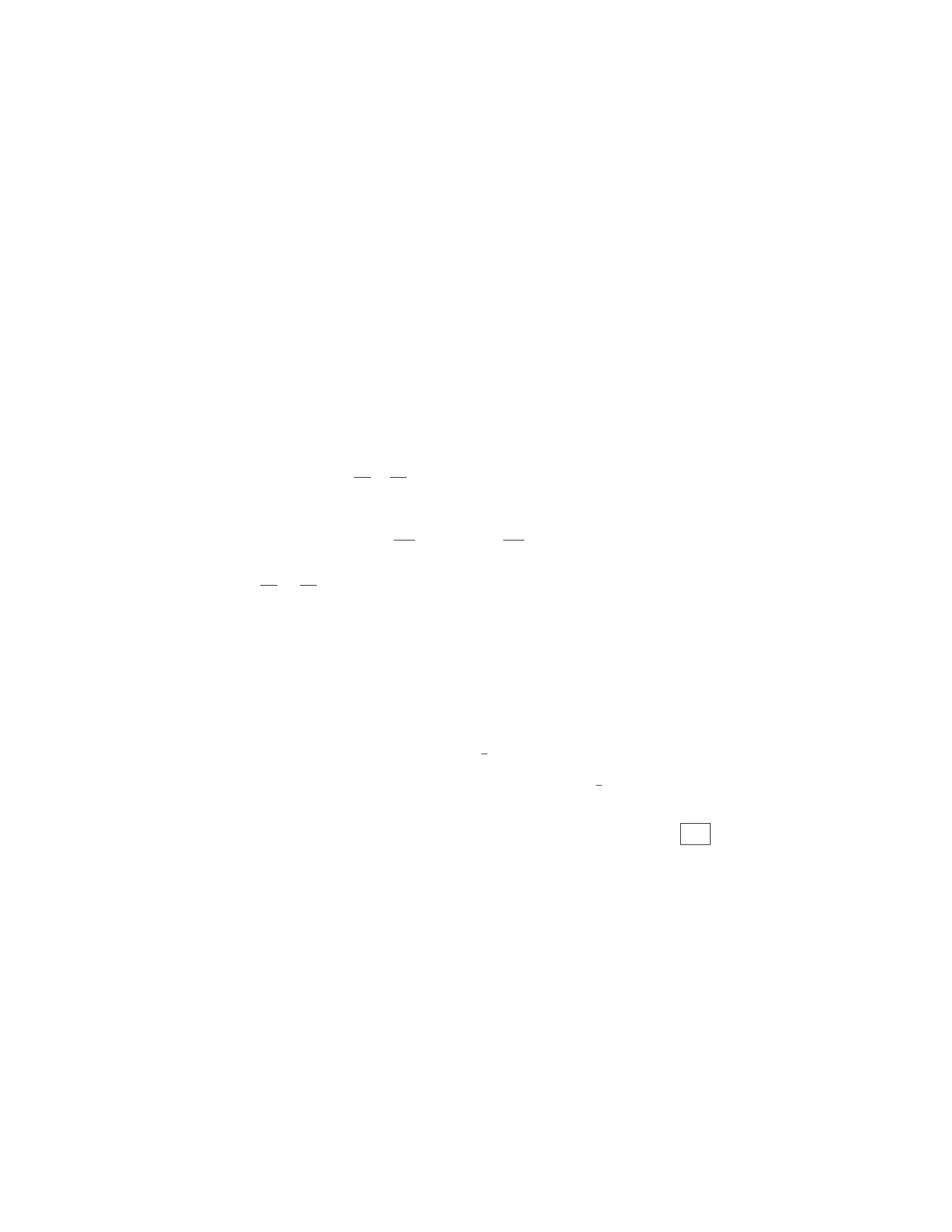
Question 25
Question
Let Cbe the curve consisting of the line segment from (0,0) to (2,4) followed
by the line segment from (2,4) to (4,0), oriented from (0,0) to (4,0). Calculate
the line integral HC(2y+x)dx + (x+ 3y)dy using Green’s ThejsonThm.
Solution
Step 1: Parameterize the curve C. Since Cconsists of two line segments, we can
parameterize the first segment from (0,0) to (2,4) as r1(t) = 2t
4tfor 0≤t≤1,
and the second segment from (2,4) to (4,0) as r2(t) = 2t+ 2
4−4tfor 0≤t≤1.
Step 2: Calculate ∂Q
∂x −∂P
∂y . Given the line integral is of the form P dx+Qdy,
we have P(x, y) = 2y+xand Q(x, y) = x+ 3y. So,
∂Q
∂x = 1 and ∂P
∂y = 2.
Hence, ∂Q
∂x −∂P
∂y = 1 −2 = −1.
Step 3: Calculate the double integral over the region enclosed by C. By
Green’s Theorem, we have
IC
(2y+x)dx + (x+ 3y)dy =ZZD
(−1)dA,
where Dis the region enclosed by C. Since Dis a triangle with vertices at
(0,0),(2,4), and (4,0), we can express the double integral as
ZZD
(−1)dA =−Z4
0Z2−x
2
0
dydx −Z0
4Z4
2+ x
2
dydx,
which simplifies to −8.
Therefore, the line integral HC(2y+x)dx + (x+ 3y)dy is equal to −8.
23

