



MATH 132 - CALCULUS AND
ANALYTIC GEOMETRY II -
Integration by Parts
Question Bank - Set 4
Liberty University
Question 1
Question
Evaluate the integral ∫xln(x)dx using integration by parts.
Solution
Let’s use integration by parts to evaluate ∫xln(x)dx. Integration by parts
states: ∫u dv =uv −∫v du.
Step 1: Choose uand dv Let u= ln(x)and dv =x dx. Then, we have:
du =1
xdx and v=1
2x2.
Step 2: Compute du and vWe already have du and v. Now, we can
compute uand dv:u= ln(x),dv =x dx,du =1
xdx, and v=1
2x2.
Step 3: Apply integration by parts formula Using the integration by
parts formula ∫u dv =uv −∫v du, we have: ∫xln(x)dx = ln(x)·1
2x2−
∫1
2x2·1
xdx.
Step 4: Simplify the expression Simplify the expression to get: ∫xln(x)dx =
1
2x2ln(x)−1
2∫x dx.

Step 5: Evaluate the integral Next, we evaluate the integral ∫x dx to
get: ∫xln(x)dx =1
2x2ln(x)−1
2·1
2x2+C.
Step 6: Final answer Therefore, the solution to the integral ∫xln(x)dx
is 1
2x2ln(x)−1
4x2+C, where Cis the constant of integration.
Question 2
Question
Evaluate the integral ∫xln(x)dx using integration by parts.
Solution
To evaluate the integral ∫xln(x)dx using integration by parts, we will choose
u= ln(x)and dv =x dx. Then, we will find du and vand apply the integration
by parts formula:
Step 1: Let u= ln(x)and dv =x dx.Step 2: Find du and v.
du =1
xdx
v=∫x dx =x2
2
Applying the integration by parts formula:
∫xln(x)dx =uv −∫v du
= ln(x)·x2
2−∫x2
2·1
xdx
=x2ln(x)
2−1
2∫x dx
=x2ln(x)
2−x2
4+C
Therefore, ∫xln(x)dx =x2ln(x)
2−x2
4+C, where Cis the constant of inte-
gration.
Question 3
Question
Compute the integral ∫xln x dx using integration by parts.
2

Solution
To evaluate ∫xln x dx using integration by parts, we will let u= ln xand
dv =x dx. Then, we can calculate du and vas follows:
Step 1: Calculate du and v.
• Let u= ln x.
• Calculate du =1
xdx.
• Let dv =x dx.
• Integrate dv to find v, which yields v=1
2x2.
Step 2: Apply the integration by parts formula ∫u dv =uv −∫v du.
∫xln x dx = ln x·1
2x2−∫1
2x2·1
xdx
=1
2x2ln x−1
2∫x dx
=1
2x2ln x−1
2·1
2x2+C
=1
2x2ln x−1
4x2+C,
where Cis the constant of integration.
Therefore, ∫xln x dx =1
2x2ln x−1
4x2+C.
Question 4
Question
Evaluate the integral ∫xln(x)dx using integration by parts.
Solution
To solve the integral ∫xln(x)dx using integration by parts, we choose u= ln(x)
and dv =x dx. Then, we can find du and v.
Step 1: Let’s differentiate u= ln(x)and integrate dv =x dx.
•du =1
xdx
•v=1
2x2
3
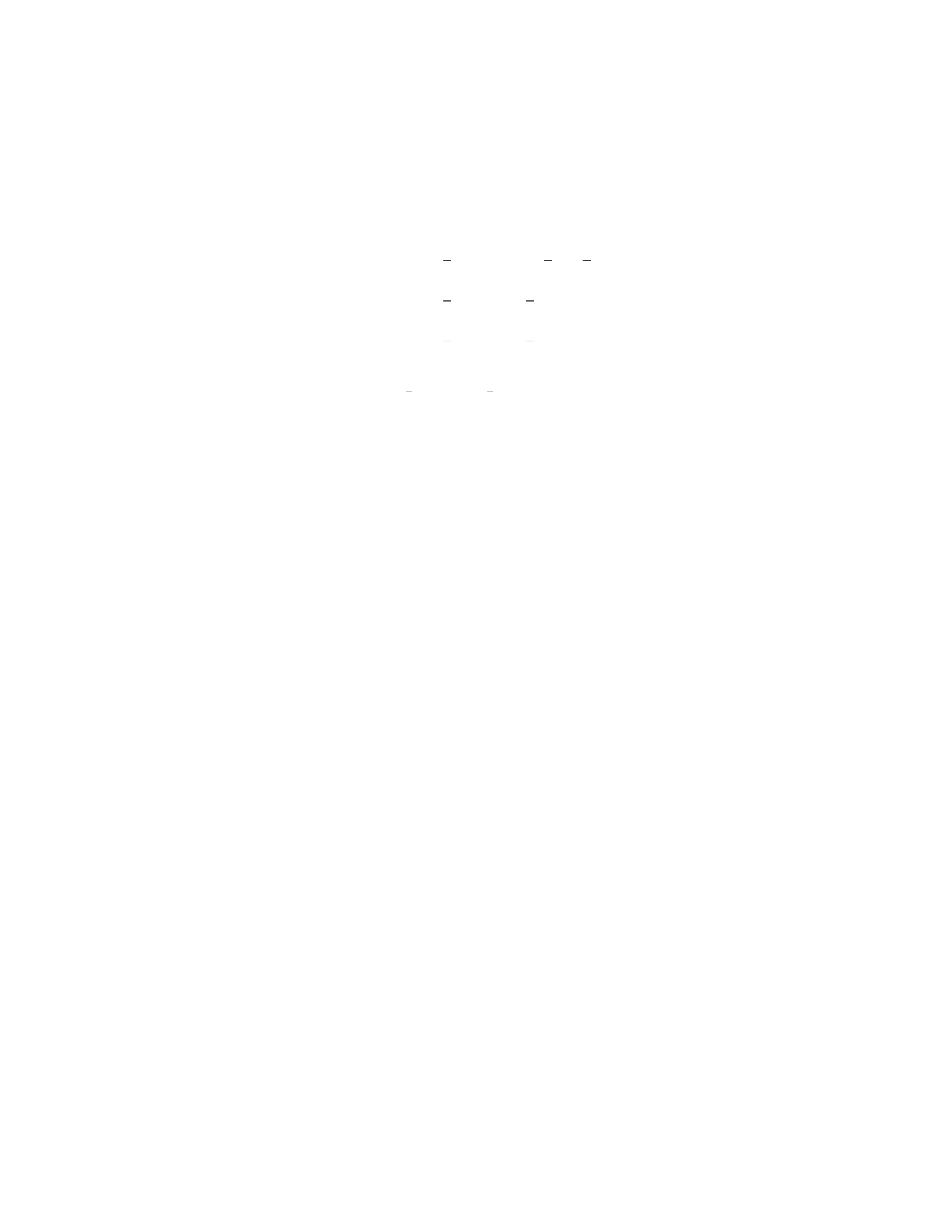
Step 2: Now, we can apply the integration by parts formula: ∫u dv =
uv −∫v du.
∫xln(x)dx =1
2x2ln(x)−∫1
2x2·1
xdx
=1
2x2ln(x)−1
2∫x dx
=1
2x2ln(x)−1
4x2+C
where Cis the constant of integration.
Therefore, ∫xln(x)dx =1
2x2ln(x)−1
4x2+C.
Question 5
Question
Evaluate the definite integral: ∫1
0x2exdx
Solution
To evaluate this integral, we will use integration by parts. Recall the formula
for integration by parts:
∫u dv =uv −∫v du
Step 1: Choose uand dv. Let u=x2and dv =exdx. Then, du = 2x dx
and v=ex.
Step 2: Apply integration by parts.
∫x2exdx =x2ex−∫2xexdx
Step 3: Integrate the remaining integral. Using integration by parts again,
let u= 2xand dv =exdx. Then, du = 2 dx and v=ex.
∫2xexdx = 2xex−∫2exdx
Step 4: Evaluate the definite integral. Putting everything together, we get:
∫x2exdx =x2ex−(2xex−2ex)
Now, evaluate the definite integral:
∫1
0
x2exdx =[x2ex−(2xex−2ex)]1
0
Substitute x= 1:= (12e1−(2 ·1e1−2e1))
Substitute x= 0:= (02e0−(2 ·0e0−2e0))
Simplify these expressions to find the final answer.
4

Question 6
Question
Evaluate the integral ∫excos x dx using integration by parts.
Solution
To evaluate ∫excos x dx using integration by parts, we will choose u= cos x
and dv =exdx. Then we will differentiate uto find du and integrate dv to find
v.
Step 1: Determine uand dv. Let u= cos xand dv =exdx.
Step 2: Compute du and v.
du =−sin x dx
v=∫exdx =ex
Step 3: Apply integration by parts formula.
∫excos x dx =uv −∫v du
= cos x ex−∫ex(−sin x)dx
= cos x ex+∫exsin x dx
Now, we have a new integral to solve: ∫exsin x dx. We will use integration
by parts again.
Step 4: Choose u= sin xand dv =exdx. Then compute du and v.
du = cos x dx
v=∫exdx =ex
Step 5: Apply integration by parts to the new integral.
∫exsin x dx =uv −∫v du
= sin x ex−∫excos x dx
Step 6: Substitute the integral back into the original equation.
∫excos x dx = cos x ex+ (sin x ex−∫excos x dx)
2∫excos x dx = (cos x+ sin x)ex
∫excos x dx =(cos x+ sin x)ex
2+C
5

Thus, ∫excos x dx =(cos x+sin x)ex
2+C.
Question 7
Question
Evaluate the integral ∫xcos(x)dx using integration by parts.
Solution
To evaluate the integral ∫xcos(x)dx using integration by parts, we will use the
formula ∫u dv =uv −∫v du.
Step 1: Let’s choose u=xand dv = cos(x)dx. Then, we have:
du =dx and v=∫cos(x)dx = sin(x)
Step 2: Apply the integration by parts formula:
∫xcos(x)dx =uv −∫v du
=xsin(x)−∫sin(x)dx
=xsin(x) + cos(x) + C,
where Cis the constant of integration.
Therefore, the integral ∫xcos(x)dx evaluates to xsin(x) + cos(x) + C.
Question 8
Question
Evaluate the integral ∫xln(x)dx using integration by parts.
Solution
To evaluate the integral ∫xln(x)dx using integration by parts, we choose u=
ln(x)and dv =x dx.
Step 1: Calculate du and v.
•du =1
xdx
•v=1
2x2
6
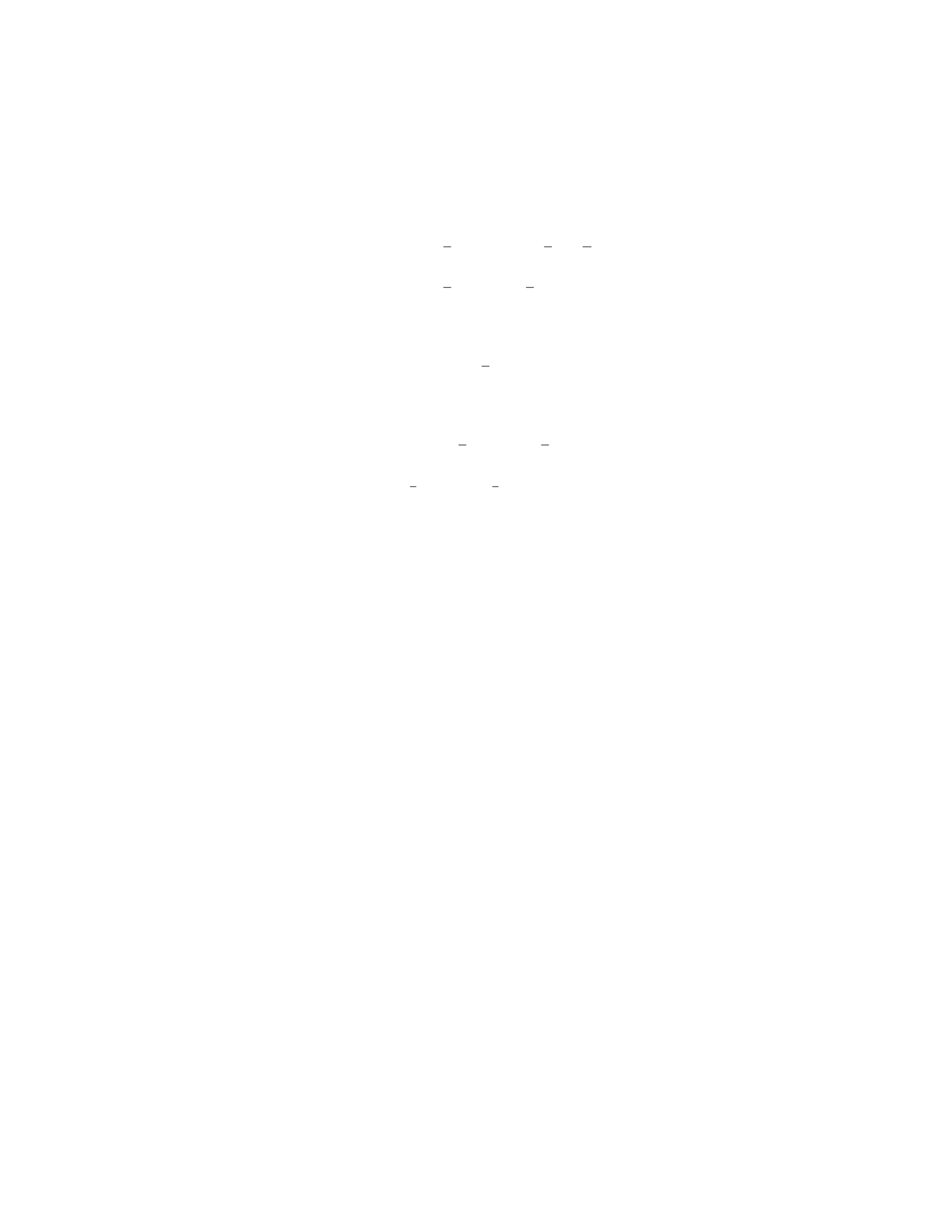
Step 2: Apply integration by parts formula: ∫u dv =uv −∫v du.
∫xln(x)dx =1
2x2ln(x)−∫1
2x2·1
xdx
=1
2x2ln(x)−1
2∫x dx
Step 3: Evaluate the remaining integral.
∫x dx =1
2x2+C
Step 4: Substitute back to find the final answer.
∫xln(x)dx =1
2x2ln(x)−1
4x2+C
Therefore, ∫xln(x)dx =1
2x2ln(x)−1
4x2+C, where Cis the constant of
integration.
Question 9
Question
Evaluate the integral ∫xcos(x)dx using integration by parts.
Solution
To evaluate the integral ∫xcos(x)dx using integration by parts, we will set
u=xand dv = cos(x)dx.
Step 1: Determine du and v.
• We have u=x, so du =dx.
• To find v, we integrate dv = cos(x)dx:
v=∫cos(x)dx = sin(x)
Step 2: Apply the integration by parts formula: ∫u dv =uv −∫v du.
∫xcos(x)dx =xsin(x)−∫sin(x)dx
=xsin(x) + ∫sin(x)dx (integrating sin(x))
=xsin(x)−cos(x) + C
Therefore, ∫xcos(x)dx =xsin(x)−cos(x) + C, where Cis the constant of
integration.
7

Question 10
Question
Evaluate the integral ∫xsin−1(x)dx.
Solution
To evaluate the given integral, we will use integration by parts. Recall the
formula for integration by parts:
∫u dv =uv −∫v du
In this case, we will let u= sin−1(x)and dv =x dx. Then, we will find du
and vand proceed with the integration by parts method.
Step 1: Find du and v
• Let u= sin−1(x). Then, du =1
√1−x2dx
• Let dv =x dx. Integrating dv gives v=1
2x2
Step 2: Apply the integration by parts formula
∫xsin−1(x)dx =uv −∫v du
∫xsin−1(x)dx = sin−1(x)·1
2x2−∫1
2x2·1
√1−x2dx
Step 3: Simplify and integrate the remaining integral
∫xsin−1(x)dx =1
2x2sin−1(x)−1
2∫x√1−x2dx
We can now use the substitution method to evaluate the remaining integral.
Let u= 1 −x2so du =−2x dx. This implies −1
2du =x dx.
Step 4: Evaluate the integral
∫xsin−1(x)dx =1
2x2sin−1(x)−1
2∫x√1−x2dx
∫xsin−1(x)dx =1
2x2sin−1(x)−1
2(−1
2)∫√u du
∫xsin−1(x)dx =1
2x2sin−1(x) + 1
4∫u1
2du
∫xsin−1(x)dx =1
2x2sin−1(x) + 1
4(2
3u3
2)+C
Step 5: Final answer Substitute u= 1 −x2back into the integral and
simplify:
∫xsin−1(x)dx =1
2x2sin−1(x) + 1
6(1 −x2)3
2+C
Therefore, ∫xsin−1(x)dx =1
2x2sin−1(x) + 1
6(1 −x2)3
2+C.
8

Question 11
Question
Evaluate the integral ∫x2exdx using integration by parts.
Solution
To evaluate the integral ∫x2exdx using integration by parts, we will use the
formula: ∫u dv =uv −∫v du
where we choose u,dv,du, and vappropriately.
Step 1: Let’s choose our uand dv.
• We can choose u=x2which means du = 2x dx.
• We can choose dv =exdx which means v=ex.
Step 2: Now, let’s apply the integration by parts formula.
∫x2exdx =∫u dv
=x2ex−∫v du
=x2ex−∫ex·2x dx
=x2ex−2∫xexdx
Step 3: We have obtained a new integral ∫xexdx, which we can evaluate
again using integration by parts. We will repeat the process.
Let u=xand dv =exdx:
∫xexdx =xex−∫exdx
=xex−ex
Step 4: Substitute ∫xexdx back into our original integral:
∫x2exdx =x2ex−2·(xex−ex)
=x2ex−2xex+ 2ex+C
So, ∫x2exdx =x2ex−2xex+2ex+C, where Cis the constant of integration.
9

Question 12
Question
Evaluate the integral ∫xln(x)dx using integration by parts.
Solution
To evaluate the given integral ∫xln(x)dx using integration by parts, we will
apply the formula:
∫u dv =uv −∫v du
where we choose u= ln(x)and dv =x dx. This gives us du =1
xdx and
v=1
2x2.
Step 1: Apply integration by parts:
∫xln(x)dx =1
2x2ln(x)−∫1
2x2·1
xdx
=1
2x2ln(x)−1
2∫x dx
Step 2: Evaluate the remaining integral:
∫x dx =1
2x2
Step 3: Substituting back the result into the integration by parts formula:
∫xln(x)dx =1
2x2ln(x)−1
2·1
2x2+C
=1
2x2ln(x)−1
4x2+C
Therefore, ∫xln(x)dx =1
2x2ln(x)−1
4x2+C, where Cis the constant of
integration.
Question 13
Question
Evaluate the integral ∫x·ln(x)dx using integration by parts.
Solution
To evaluate the integral ∫x·ln(x)dx using integration by parts, we will choose
u= ln(x)and dv =x dx. Then, we will differentiate uto find du and integrate
dv to find v.
Step 1: Let’s determine du and v:
10
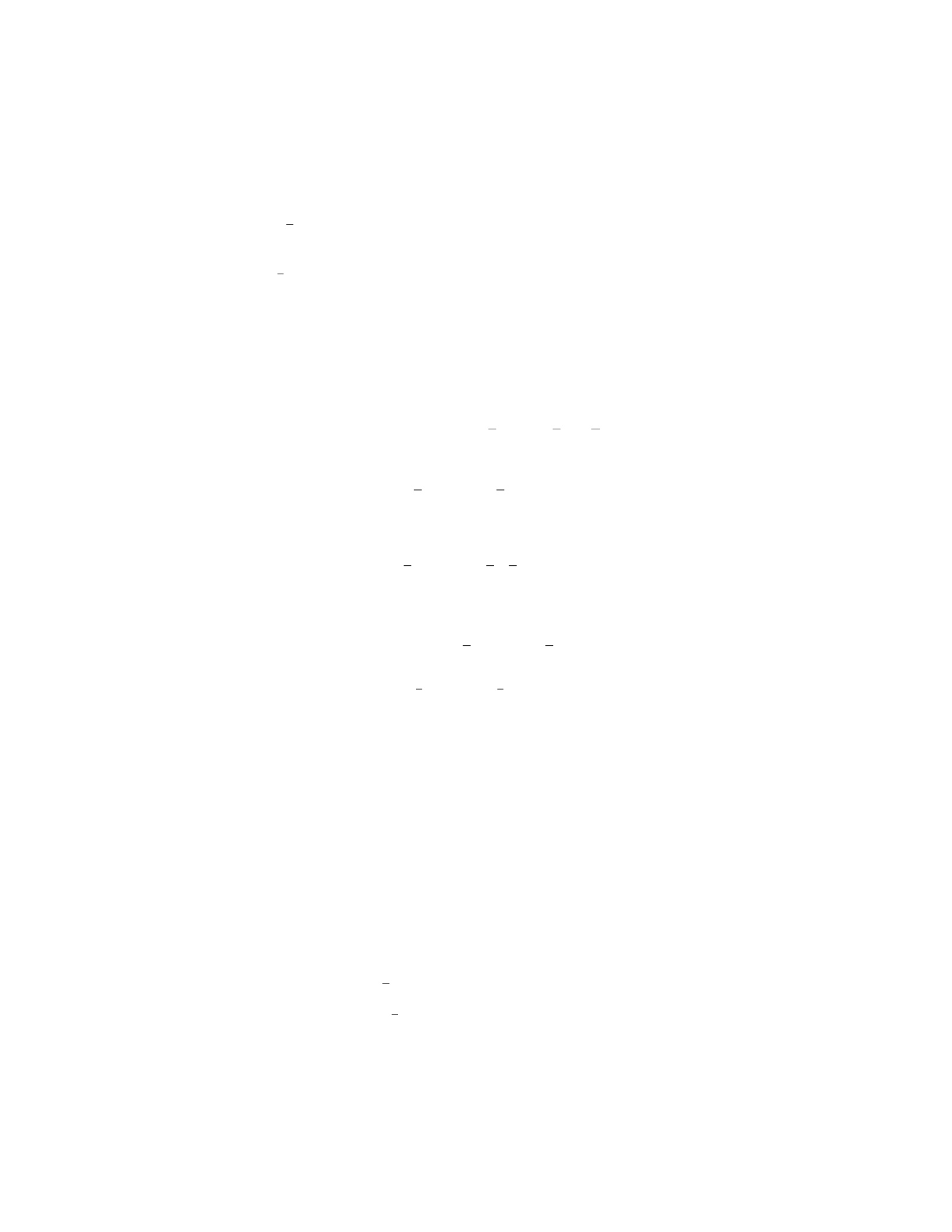
•u= ln(x)
du =1
xdx
•dv =x dx
v=1
2x2
Step 2: Now, we can apply integration by parts:
∫x·ln(x)dx =uv −∫v du
Step 3: Substitute our values of u,v, and du into the integration by parts
formula: ∫x·ln(x)dx = ln(x)·1
2x2−∫1
2x2·1
xdx
Simplify to get:
=1
2x2ln(x)−1
2∫x dx
Step 4: Evaluate the integral on the right side:
=1
2x2ln(x)−1
2·1
2x2+C
Step 5: Finally, simplify and combine like terms:
∫x·ln(x)dx =1
2x2ln(x)−1
4x2+C
Therefore, ∫x·ln(x)dx =1
2x2ln(x)−1
4x2+C, where Cis the constant of
integration.
Question 14
Question
Evaluate the integral ∫x3ln x dx using integration by parts.
Solution
To evaluate the integral ∫x3ln x dx using integration by parts, we will choose
u= ln xand dv =x3dx. Then, we will differentiate uand integrate dv to find
du and v.
Step 1: Let’s determine du and v.
•u= ln x=⇒du =1
xdx
•dv =x3dx =⇒v=1
4x4
11

Step 2: Apply integration by parts formula ∫u dv =uv −∫v du.
∫x3ln x dx =1
4x4ln x−∫1
4x4(1
xdx)
Step 3: Simplify the expression.
∫x3ln x dx =1
4x4ln x−1
4∫x3dx
Step 4: Evaluate the integral.
∫x3ln x dx =1
4x4ln x−1
4(1
4x4)+C
Step 5: Simplify the final result.
∫x3ln x dx =1
4x4ln x−1
16x4+C
Therefore, ∫x3ln x dx =1
4x4ln x−1
16 x4+C, where Cis the constant of
integration.
Question 15
Question
Evaluate the integral ∫xln(x)dx using integration by parts.
Solution
To evaluate the integral ∫xln(x)dx using integration by parts, we will choose
u= ln(x)and dv =x dx.
Step 1: Calculate du and v:
du =1
xdx, v =1
2x2
Step 2: Apply the integration by parts formula:
∫u dv =uv −∫v du
Step 3: Substitute the values of u,dv,du, and vinto the formula:
∫xln(x)dx =1
2x2ln(x)−∫1
2x2·1
xdx
Step 4: Simplify the integral:
∫xln(x)dx =1
2x2ln(x)−1
2∫x dx
12

Step 5: Evaluate the integral:
∫xln(x)dx =1
2x2ln(x)−1
4x2+C
Therefore, ∫xln(x)dx =1
2x2ln(x)−1
4x2+C, where Cis the constant of
integration.
Question 16
Question
Evaluate the integral ∫x2ln(x)dx using integration by parts.
Solution
Step 1: To apply integration by parts, we need to choose uand dv. Let
u= ln(x)and dv =x2dx. Then, we have:
du =1
xdx and v=∫x2dx =1
3x3
Step 2: Now, we can use the integration by parts formula:
∫u dv =uv −∫v du
Substitute u, du, v, dv into the formula:
∫x2ln(x)dx = ln(x)·1
3x3−∫1
3x3·1
xdx
Step 3: Simplify the expression:
∫x2ln(x)dx =1
3x3ln(x)−1
3∫x2dx
Step 4: Now, we can easily integrate ∫x2dx:
∫x2ln(x)dx =1
3x3ln(x)−1
9x3+C
Therefore, the integral ∫x2ln(x)dx evaluates to 1
3x3ln(x)−1
9x3+C, where
Cis the constant of integration.
Question 17
Question
Evaluate the integral ∫xln(1 + x)dx using integration by parts.
13

Solution
To evaluate the integral ∫xln(1 + x)dx, we will use integration by parts. Inte-
gration by parts is given by the formula:
∫u dv =uv −∫v du
Let’s choose u= ln(1 + x)and dv =x dx. Then, we have du =1
1+xdx and
v=1
2x2.
Step 1: Apply integration by parts:
∫xln(1 + x)dx =1
2x2ln(1 + x)−∫1
2x21
1 + xdx
=1
2x2ln(1 + x)−1
2∫x2
1 + xdx
Step 2: Simplify the remaining integral:
1
2x2ln(1 + x)−1
2∫x2
1 + xdx =1
2x2ln(1 + x)−1
2∫(x−x
1 + x)dx
=1
2x2ln(1 + x)−1
2(1
2x2−ln(1 + x))+C
=1
4x2ln(1 + x)−1
4x2+1
2ln(1 + x) + C
Therefore, ∫xln(1 + x)dx =1
4x2ln(1 + x)−1
4x2+1
2ln(1 + x) + C, where
Cis the constant of integration.
Question 18
Question
Evaluate the integral ∫xln(x)dx using integration by parts.
Solution
To evaluate the integral ∫xln(x)dx using integration by parts, we will let
u= ln(x)and dv =x dx.
Step 1: Find du and v.
Let u= ln(x)
⇒du =1
xdx
Let dv =x dx
⇒v=x2
2
14

Step 2: Apply the integration by parts formula
∫u dv =uv −∫v du
to evaluate the integral.
Step 3: Substitute into the integration by parts formula.
∫xln(x)dx =xln(x)·x2
2−∫x2
2·1
xdx
=x3ln(x)
2−1
2∫x dx
=x3ln(x)
2−1
2·x2
2+C
=x3ln(x)
2−x2
4+C
Therefore, ∫xln(x)dx =x3ln(x)
2−x2
4+C, where Cis the constant of
integration.
Question 19
Question
Evaluate the integral ∫x2exdx using integration by parts.
Solution
To evaluate the given integral ∫x2exdx, we will use integration by parts, which
is given by the formula:
∫u dv =uv −∫v du,
where uand dv are differentiable functions of x.
Step 1: Let’s choose u=x2and dv =exdx. Then, we have:
du = 2x dx and v=∫exdx =ex.
15

Step 2: Now, we can apply the integration by parts formula:
∫x2exdx =∫u dv
=uv −∫v du
=x2ex−∫ex·2x dx
=x2ex−2∫xexdx.
Step 3: We will now apply integration by parts again to evaluate ∫xexdx.
Let’s choose u=xand dv =exdx, so that:
du =dx and v=ex.
Step 4: Using the integration by parts formula, we have:
∫xexdx =∫u dv
=uv −∫v du
=xex−∫exdx
=xex−ex.
Step 5: Substituting this back into the expression from Step 2, we get:
∫x2exdx =x2ex−2∫xexdx
=x2ex−2(xex−ex)
=x2ex−2xex+ 2ex+C,
where Cis the constant of integration.
Therefore, ∫x2exdx =x2ex−2xex+ 2ex+C.
Question 20
Question
Evaluate the integral ∫x2ln x dx using integration by parts.
16
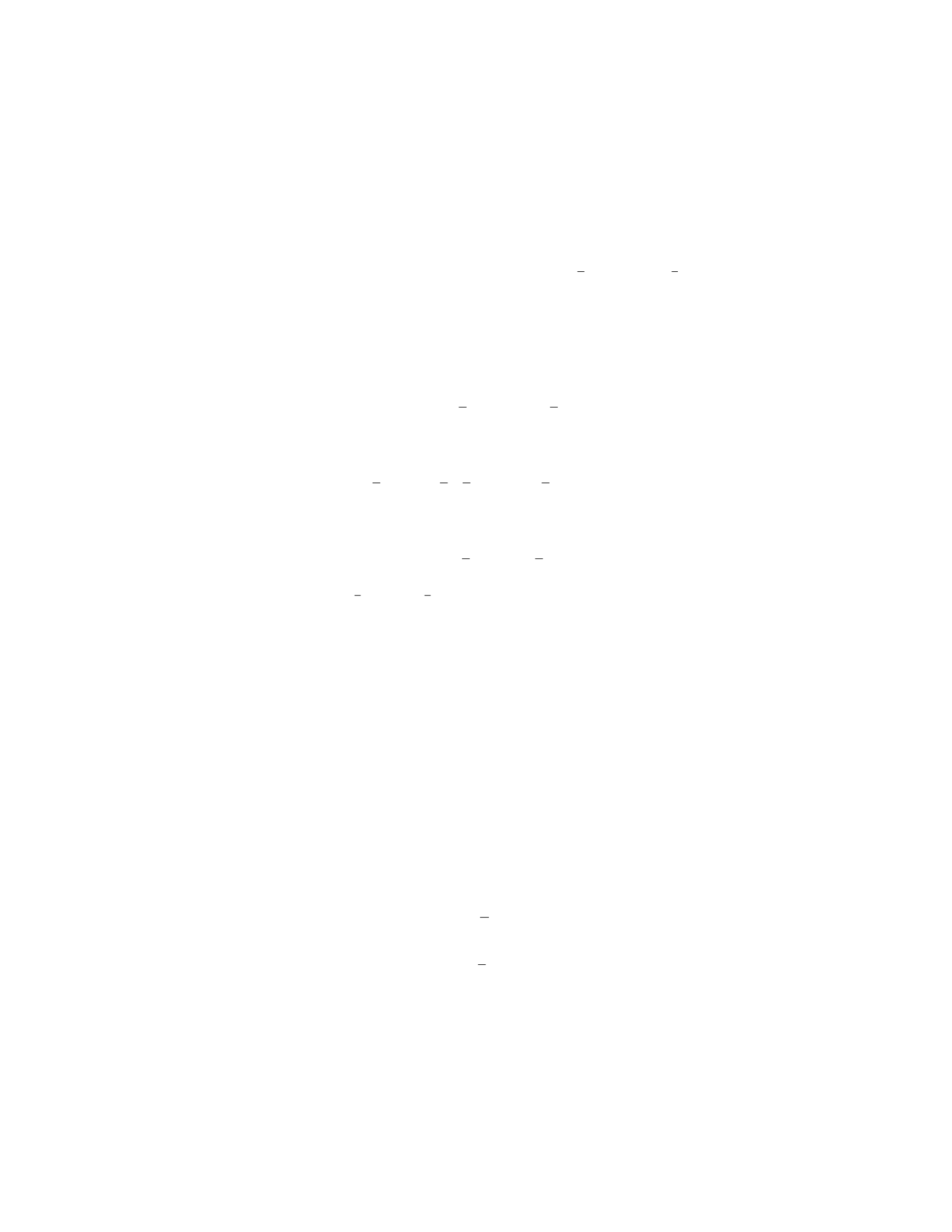
Solution
To evaluate ∫x2ln x dx using integration by parts, we will choose u= ln xand
dv =x2dx. Then we will differentiate uto get du and integrate dv to get v.
Step 1: Let u= ln xand dv =x2dx. Then, du =1
xdx and v=1
3x3.
Step 2: Apply the formula for integration by parts:
∫u dv =uv −∫v du
Substitute u,dv,v, and du:
∫x2ln x dx =1
3x3ln x−∫1
3x2dx
Step 3: Integrate the remaining integral:
∫1
3x2dx =1
3·1
3x3+C=1
9x3+C
Step 4: Simplify the expression:
∫x2ln x dx =1
3x3ln x−1
9x3+C
So, ∫x2ln x dx =1
3x3ln x−1
9x3+Cwhere Cis the constant of integration.
Question 21
Question
Evaluate the integral ∫xln(x)dx using integration by parts.
Solution
To evaluate the integral ∫xln(x)dx using integration by parts, we choose:
u= ln(x)
dv =x dx
Step 1: Calculate du and v.
du =1
xdx
v=1
2x2
Step 2: Apply integration by parts formula:
∫u dv =uv −∫v du
17
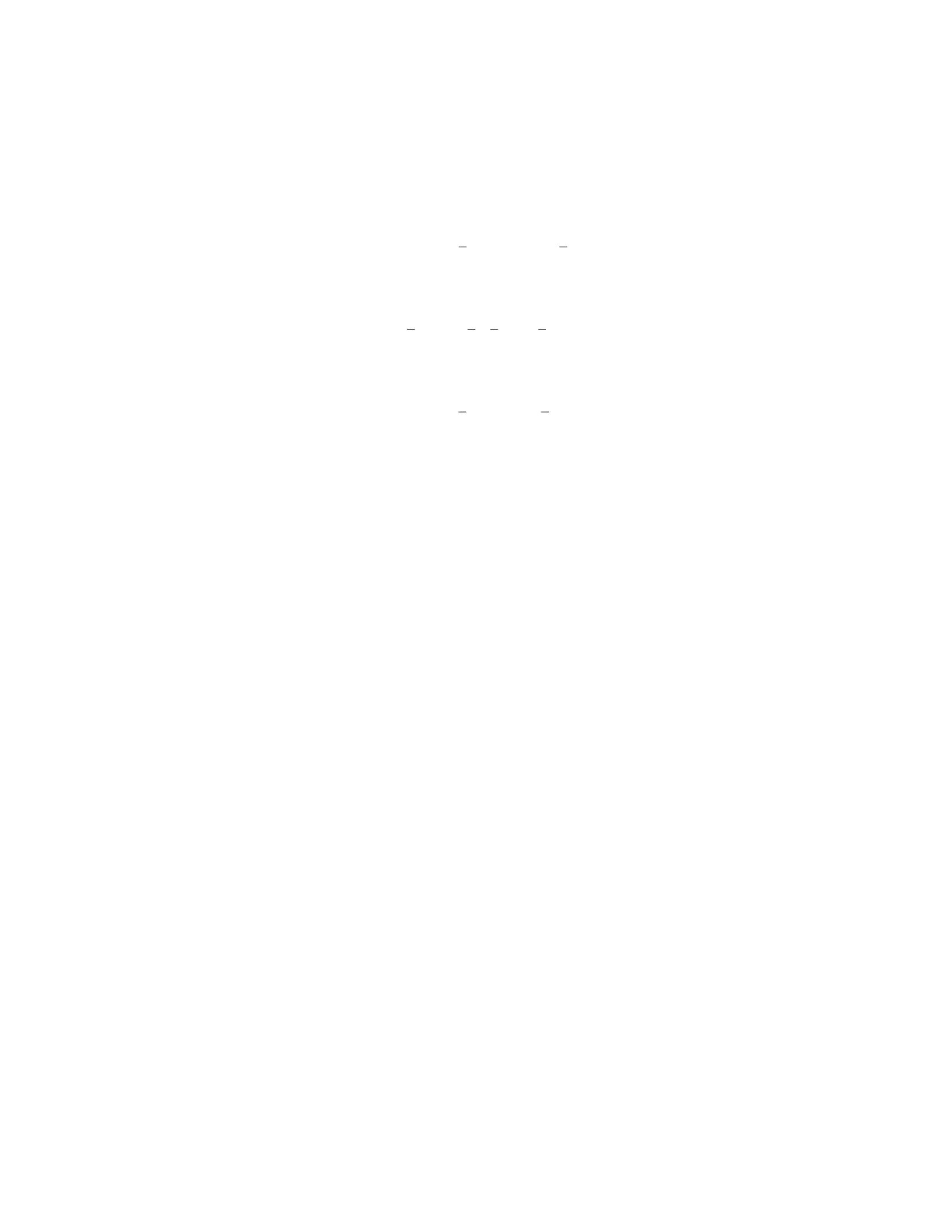
Step 3: Substitute u, v, du, and dv into the formula:
∫xln(x)dx =1
2x2ln(x)−∫1
2x dx
Step 4: Integrate the remaining integral:
∫1
2x dx =1
2·1
2x2=1
4x2
Step 5: Put the results together:
∫xln(x)dx =1
2x2ln(x)−1
4x2+C
where Cis the constant of integration.
Question 22
Question
Evaluate the integral ∫excos(x)dx using integration by parts.
Solution
To evaluate the integral ∫excos(x)dx, we will use integration by parts. The
formula for integration by parts is ∫u dv =uv −∫v du.
Step 1: Choose uand dv. Let u=exand dv = cos(x)dx. Then, we have
du =exdx and v= sin(x).
Step 2: Apply the integration by parts formula.
∫excos(x)dx =exsin(x)−∫sin(x)·exdx
Step 3: Evaluate the new integral.
∫sin(x)·exdx
Step 4: Repeat the integration by parts procedure. Let u= sin(x)and
dv =exdx, then du = cos(x)dx and v=ex.
∫sin(x)·exdx =−cos(x)·ex+∫cos(x)·exdx
Step 5: Substitute back into the original integral.
∫excos(x)dx =exsin(x)−(−cos(x)·ex+∫cos(x)·exdx)
18

Step 6: Simplify the expression.
∫excos(x)dx =exsin(x) + excos(x)−∫excos(x)dx
Step 7: Solve for the integral.
2∫excos(x)dx =ex(sin(x) + cos(x))
Step 8: Finally, divide by 2 to get the value of the integral.
∫excos(x)dx =ex(sin(x) + cos(x))
2+C
Question 23
Question
Evaluate the integral ∫excos(x)dx using integration by parts.
Solution
To evaluate the given integral ∫excos(x)dx, we will use integration by parts.
Integration by parts is given by the formula:
∫u dv =uv −∫v du
where uand vare differentiable functions of x.
Step 1: Let us choose:
u=exand dv = cos(x)dx
Then, we have:
du =exdx and v=∫cos(x)dx = sin(x)
Step 2: Apply the formula for integration by parts:
∫excos(x)dx =exsin(x)−∫sin(x)exdx
Step 3: Rewrite the remaining integral using integration by parts again:
u= sin(x), dv =exdx
du = cos(x)dx, v =∫exdx =ex
19

Step 4: Substitute into the formula for integration by parts:
∫excos(x)dx =exsin(x)−(sin(x)ex−∫excos(x)dx)
∫excos(x)dx =exsin(x)−sin(x)ex+∫excos(x)dx
Step 5: Rearrange the terms to solve for the integral:
∫excos(x)dx =exsin(x)−sin(x)ex+∫excos(x)dx
∫excos(x)dx =exsin(x)−sin(x)ex+C
Therefore, ∫excos(x)dx =exsin(x)−sin(x)ex+C, where Cis the constant
of integration.
Question 24
Question
Evaluate the integral ∫exsin x dx using integration by parts.
Solution
To evaluate the integral ∫exsin x dx using integration by parts, we will consider
u= sin xand dv =exdx. Then, we can apply the formula for integration by
parts:
∫u dv =uv −∫v du
Step 1: Let’s find du and v.
•du = cos x dx
•v=∫exdx =ex
Step 2: Apply the integration by parts formula:
∫exsin x dx =uv −∫v du
= sin x·ex−∫excos x dx
Step 3: Now, we will apply integration by parts again to evaluate ∫excos x dx.
Let u= cos xand dv =exdx.
Step 4: Find du and v.
•du =−sin x dx
20
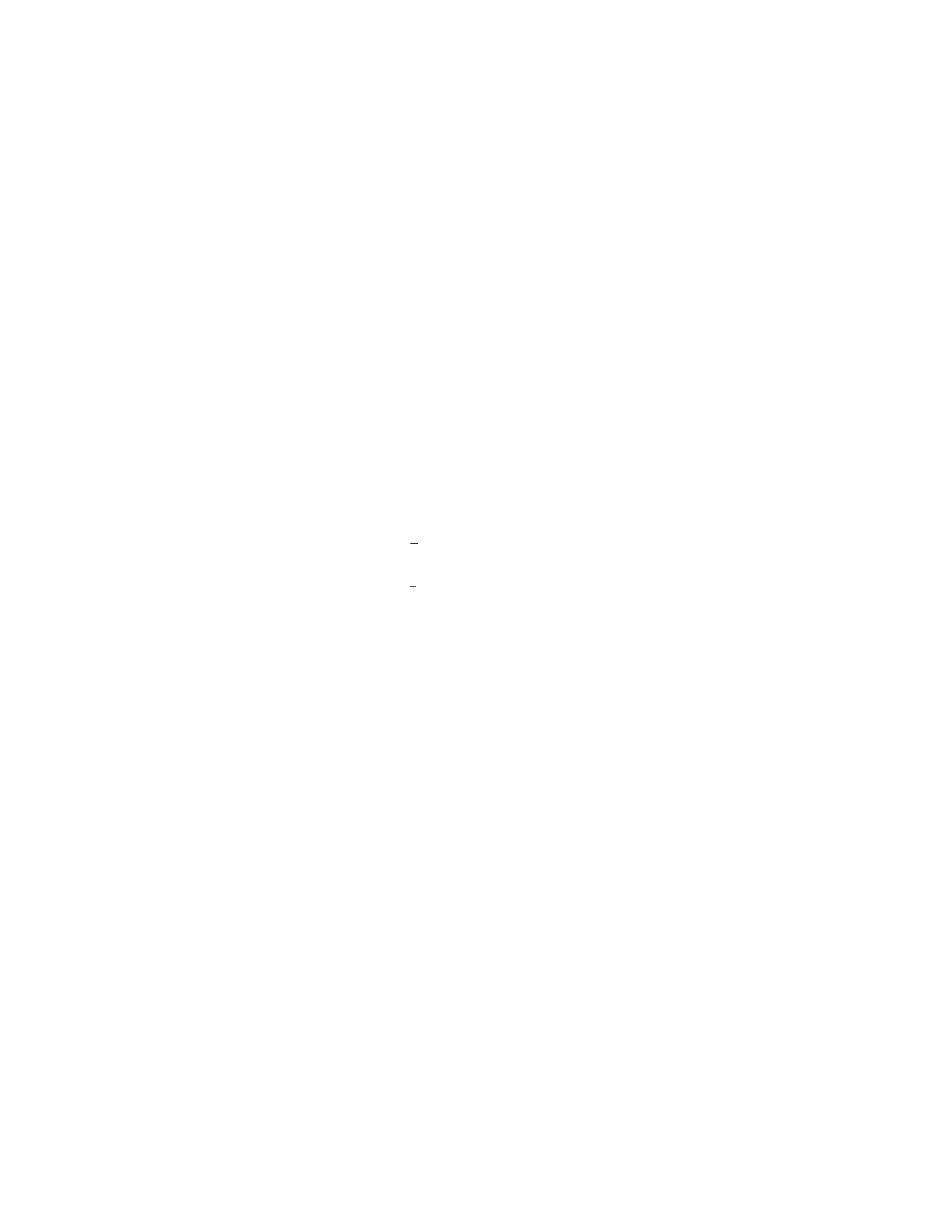
•v=∫exdx =ex
Step 5: Apply the integration by parts formula again:
∫excos x dx =uv −∫v du
= cos x·ex−∫ex(−sin x)dx
= cos x·ex+∫exsin x dx
Step 6: Now, substitute back the integral ∫excos x dx into the expression
from Step 2:
∫exsin x dx = sin x·ex−(cos x·ex+∫exsin x dx)
2∫exsin x dx = sin x·ex−cos x·ex
∫exsin x dx =1
2(sin x−cos x)·ex+C
Therefore, ∫exsin x dx =1
2(sin x−cos x)·ex+C, where Cis the constant
of integration.
Question 25
Question
Evaluate the integral ∫excos x dx using integration by parts.
Solution
To evaluate the integral ∫excos x dx, we will use integration by parts, which
states ∫u dv =uv −∫v du
where uand vare differentiable functions of x.
Step 1: Let’s choose u=exand dv = cos x dx. Then, we have du =exdx
and v=∫cos x dx = sin x.
Step 2: Using the integration by parts formula, we have:
∫excos x dx =exsin x−∫sin x(exdx)
=exsin x−(−cos xex+∫excos x dx)
21

Step 3: Now, we can simplify the equation by isolating the term with the
integral on one side:
∫excos x dx =exsin x+ cos xex−∫excos x dx
2∫excos x dx =exsin x+ cos xex
∫excos x dx =ex(sin x+ cos x)
2
Therefore, the solution to the integral ∫excos x dx is ex(sin x+cos x)
2+C, where
Cis the constant of integration.
22

Step 5: Evaluate the integral Next, we evaluate the integral ∫x dx to
get: ∫xln(x)dx =1
2x2ln(x)−1
2·1
2x2+C.
Step 6: Final answer Therefore, the solution to the integral ∫xln(x)dx
is 1
2x2ln(x)−1
4x2+C, where Cis the constant of integration.
Question 2
Question
Evaluate the integral ∫xln(x)dx using integration by parts.
Solution
To evaluate the integral ∫xln(x)dx using integration by parts, we will choose
u= ln(x)and dv =x dx. Then, we will find du and vand apply the integration
by parts formula:
Step 1: Let u= ln(x)and dv =x dx.Step 2: Find du and v.
du =1
xdx
v=∫x dx =x2
2
Applying the integration by parts formula:
∫xln(x)dx =uv −∫v du
= ln(x)·x2
2−∫x2
2·1
xdx
=x2ln(x)
2−1
2∫x dx
=x2ln(x)
2−x2
4+C
Therefore, ∫xln(x)dx =x2ln(x)
2−x2
4+C, where Cis the constant of inte-
gration.
Question 3
Question
Compute the integral ∫xln x dx using integration by parts.
2

Solution
To evaluate ∫xln x dx using integration by parts, we will let u= ln xand
dv =x dx. Then, we can calculate du and vas follows:
Step 1: Calculate du and v.
• Let u= ln x.
• Calculate du =1
xdx.
• Let dv =x dx.
• Integrate dv to find v, which yields v=1
2x2.
Step 2: Apply the integration by parts formula ∫u dv =uv −∫v du.
∫xln x dx = ln x·1
2x2−∫1
2x2·1
xdx
=1
2x2ln x−1
2∫x dx
=1
2x2ln x−1
2·1
2x2+C
=1
2x2ln x−1
4x2+C,
where Cis the constant of integration.
Therefore, ∫xln x dx =1
2x2ln x−1
4x2+C.
Question 4
Question
Evaluate the integral ∫xln(x)dx using integration by parts.
Solution
To solve the integral ∫xln(x)dx using integration by parts, we choose u= ln(x)
and dv =x dx. Then, we can find du and v.
Step 1: Let’s differentiate u= ln(x)and integrate dv =x dx.
•du =1
xdx
•v=1
2x2
3
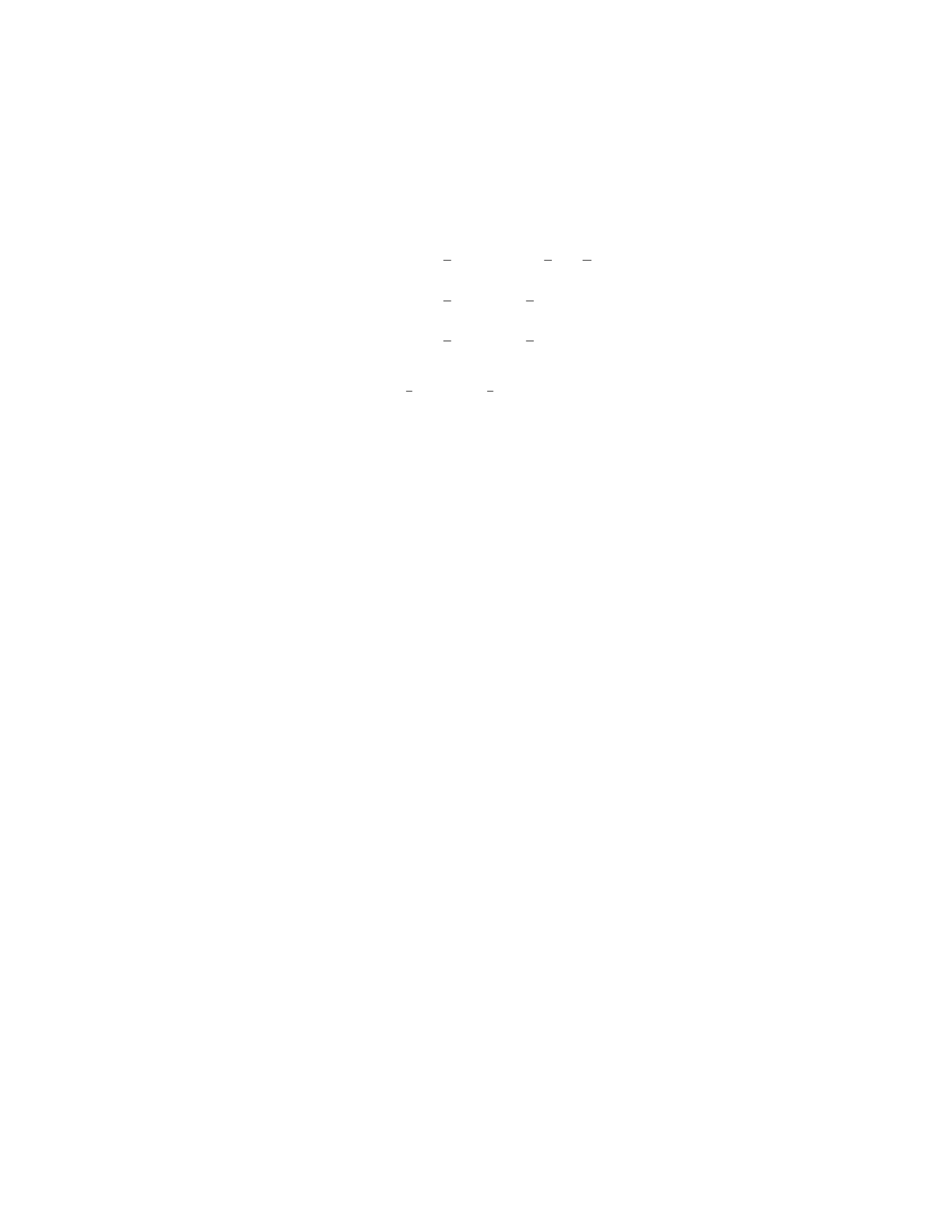
Step 2: Now, we can apply the integration by parts formula: ∫u dv =
uv −∫v du.
∫xln(x)dx =1
2x2ln(x)−∫1
2x2·1
xdx
=1
2x2ln(x)−1
2∫x dx
=1
2x2ln(x)−1
4x2+C
where Cis the constant of integration.
Therefore, ∫xln(x)dx =1
2x2ln(x)−1
4x2+C.
Question 5
Question
Evaluate the definite integral: ∫1
0x2exdx
Solution
To evaluate this integral, we will use integration by parts. Recall the formula
for integration by parts:
∫u dv =uv −∫v du
Step 1: Choose uand dv. Let u=x2and dv =exdx. Then, du = 2x dx
and v=ex.
Step 2: Apply integration by parts.
∫x2exdx =x2ex−∫2xexdx
Step 3: Integrate the remaining integral. Using integration by parts again,
let u= 2xand dv =exdx. Then, du = 2 dx and v=ex.
∫2xexdx = 2xex−∫2exdx
Step 4: Evaluate the definite integral. Putting everything together, we get:
∫x2exdx =x2ex−(2xex−2ex)
Now, evaluate the definite integral:
∫1
0
x2exdx =[x2ex−(2xex−2ex)]1
0
Substitute x= 1:= (12e1−(2 ·1e1−2e1))
Substitute x= 0:= (02e0−(2 ·0e0−2e0))
Simplify these expressions to find the final answer.
4

Question 6
Question
Evaluate the integral ∫excos x dx using integration by parts.
Solution
To evaluate ∫excos x dx using integration by parts, we will choose u= cos x
and dv =exdx. Then we will differentiate uto find du and integrate dv to find
v.
Step 1: Determine uand dv. Let u= cos xand dv =exdx.
Step 2: Compute du and v.
du =−sin x dx
v=∫exdx =ex
Step 3: Apply integration by parts formula.
∫excos x dx =uv −∫v du
= cos x ex−∫ex(−sin x)dx
= cos x ex+∫exsin x dx
Now, we have a new integral to solve: ∫exsin x dx. We will use integration
by parts again.
Step 4: Choose u= sin xand dv =exdx. Then compute du and v.
du = cos x dx
v=∫exdx =ex
Step 5: Apply integration by parts to the new integral.
∫exsin x dx =uv −∫v du
= sin x ex−∫excos x dx
Step 6: Substitute the integral back into the original equation.
∫excos x dx = cos x ex+ (sin x ex−∫excos x dx)
2∫excos x dx = (cos x+ sin x)ex
∫excos x dx =(cos x+ sin x)ex
2+C
5

Thus, ∫excos x dx =(cos x+sin x)ex
2+C.
Question 7
Question
Evaluate the integral ∫xcos(x)dx using integration by parts.
Solution
To evaluate the integral ∫xcos(x)dx using integration by parts, we will use the
formula ∫u dv =uv −∫v du.
Step 1: Let’s choose u=xand dv = cos(x)dx. Then, we have:
du =dx and v=∫cos(x)dx = sin(x)
Step 2: Apply the integration by parts formula:
∫xcos(x)dx =uv −∫v du
=xsin(x)−∫sin(x)dx
=xsin(x) + cos(x) + C,
where Cis the constant of integration.
Therefore, the integral ∫xcos(x)dx evaluates to xsin(x) + cos(x) + C.
Question 8
Question
Evaluate the integral ∫xln(x)dx using integration by parts.
Solution
To evaluate the integral ∫xln(x)dx using integration by parts, we choose u=
ln(x)and dv =x dx.
Step 1: Calculate du and v.
•du =1
xdx
•v=1
2x2
6
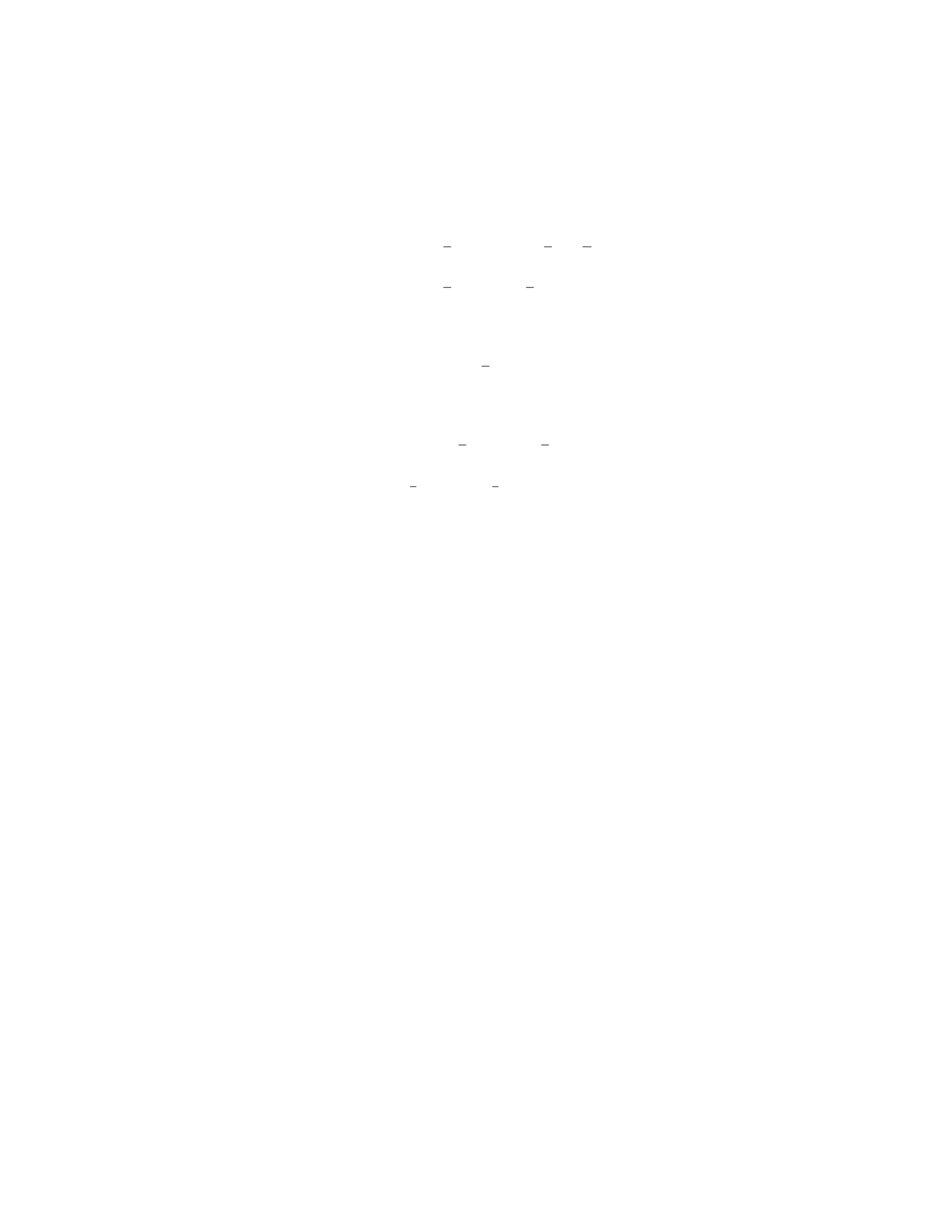
Step 2: Apply integration by parts formula: ∫u dv =uv −∫v du.
∫xln(x)dx =1
2x2ln(x)−∫1
2x2·1
xdx
=1
2x2ln(x)−1
2∫x dx
Step 3: Evaluate the remaining integral.
∫x dx =1
2x2+C
Step 4: Substitute back to find the final answer.
∫xln(x)dx =1
2x2ln(x)−1
4x2+C
Therefore, ∫xln(x)dx =1
2x2ln(x)−1
4x2+C, where Cis the constant of
integration.
Question 9
Question
Evaluate the integral ∫xcos(x)dx using integration by parts.
Solution
To evaluate the integral ∫xcos(x)dx using integration by parts, we will set
u=xand dv = cos(x)dx.
Step 1: Determine du and v.
• We have u=x, so du =dx.
• To find v, we integrate dv = cos(x)dx:
v=∫cos(x)dx = sin(x)
Step 2: Apply the integration by parts formula: ∫u dv =uv −∫v du.
∫xcos(x)dx =xsin(x)−∫sin(x)dx
=xsin(x) + ∫sin(x)dx (integrating sin(x))
=xsin(x)−cos(x) + C
Therefore, ∫xcos(x)dx =xsin(x)−cos(x) + C, where Cis the constant of
integration.
7
Question 10
Question
Evaluate the integral ∫xsin−1(x)dx.
Solution
To evaluate the given integral, we will use integration by parts. Recall the
formula for integration by parts:
∫u dv =uv −∫v du
In this case, we will let u= sin−1(x)and dv =x dx. Then, we will find du
and vand proceed with the integration by parts method.
Step 1: Find du and v
• Let u= sin−1(x). Then, du =1
√1−x2dx
• Let dv =x dx. Integrating dv gives v=1
2x2
Step 2: Apply the integration by parts formula
∫xsin−1(x)dx =uv −∫v du
∫xsin−1(x)dx = sin−1(x)·1
2x2−∫1
2x2·1
√1−x2dx
Step 3: Simplify and integrate the remaining integral
∫xsin−1(x)dx =1
2x2sin−1(x)−1
2∫x√1−x2dx
We can now use the substitution method to evaluate the remaining integral.
Let u= 1 −x2so du =−2x dx. This implies −1
2du =x dx.
Step 4: Evaluate the integral
∫xsin−1(x)dx =1
2x2sin−1(x)−1
2∫x√1−x2dx
∫xsin−1(x)dx =1
2x2sin−1(x)−1
2(−1
2)∫√u du
∫xsin−1(x)dx =1
2x2sin−1(x) + 1
4∫u1
2du
∫xsin−1(x)dx =1
2x2sin−1(x) + 1
4(2
3u3
2)+C
Step 5: Final answer Substitute u= 1 −x2back into the integral and
simplify:
∫xsin−1(x)dx =1
2x2sin−1(x) + 1
6(1 −x2)3
2+C
Therefore, ∫xsin−1(x)dx =1
2x2sin−1(x) + 1
6(1 −x2)3
2+C.
8

Question 11
Question
Evaluate the integral ∫x2exdx using integration by parts.
Solution
To evaluate the integral ∫x2exdx using integration by parts, we will use the
formula: ∫u dv =uv −∫v du
where we choose u,dv,du, and vappropriately.
Step 1: Let’s choose our uand dv.
• We can choose u=x2which means du = 2x dx.
• We can choose dv =exdx which means v=ex.
Step 2: Now, let’s apply the integration by parts formula.
∫x2exdx =∫u dv
=x2ex−∫v du
=x2ex−∫ex·2x dx
=x2ex−2∫xexdx
Step 3: We have obtained a new integral ∫xexdx, which we can evaluate
again using integration by parts. We will repeat the process.
Let u=xand dv =exdx:
∫xexdx =xex−∫exdx
=xex−ex
Step 4: Substitute ∫xexdx back into our original integral:
∫x2exdx =x2ex−2·(xex−ex)
=x2ex−2xex+ 2ex+C
So, ∫x2exdx =x2ex−2xex+2ex+C, where Cis the constant of integration.
9

Question 12
Question
Evaluate the integral ∫xln(x)dx using integration by parts.
Solution
To evaluate the given integral ∫xln(x)dx using integration by parts, we will
apply the formula:
∫u dv =uv −∫v du
where we choose u= ln(x)and dv =x dx. This gives us du =1
xdx and
v=1
2x2.
Step 1: Apply integration by parts:
∫xln(x)dx =1
2x2ln(x)−∫1
2x2·1
xdx
=1
2x2ln(x)−1
2∫x dx
Step 2: Evaluate the remaining integral:
∫x dx =1
2x2
Step 3: Substituting back the result into the integration by parts formula:
∫xln(x)dx =1
2x2ln(x)−1
2·1
2x2+C
=1
2x2ln(x)−1
4x2+C
Therefore, ∫xln(x)dx =1
2x2ln(x)−1
4x2+C, where Cis the constant of
integration.
Question 13
Question
Evaluate the integral ∫x·ln(x)dx using integration by parts.
Solution
To evaluate the integral ∫x·ln(x)dx using integration by parts, we will choose
u= ln(x)and dv =x dx. Then, we will differentiate uto find du and integrate
dv to find v.
Step 1: Let’s determine du and v:
10
•u= ln(x)
du =1
xdx
•dv =x dx
v=1
2x2
Step 2: Now, we can apply integration by parts:
∫x·ln(x)dx =uv −∫v du
Step 3: Substitute our values of u,v, and du into the integration by parts
formula: ∫x·ln(x)dx = ln(x)·1
2x2−∫1
2x2·1
xdx
Simplify to get:
=1
2x2ln(x)−1
2∫x dx
Step 4: Evaluate the integral on the right side:
=1
2x2ln(x)−1
2·1
2x2+C
Step 5: Finally, simplify and combine like terms:
∫x·ln(x)dx =1
2x2ln(x)−1
4x2+C
Therefore, ∫x·ln(x)dx =1
2x2ln(x)−1
4x2+C, where Cis the constant of
integration.
Question 14
Question
Evaluate the integral ∫x3ln x dx using integration by parts.
Solution
To evaluate the integral ∫x3ln x dx using integration by parts, we will choose
u= ln xand dv =x3dx. Then, we will differentiate uand integrate dv to find
du and v.
Step 1: Let’s determine du and v.
•u= ln x=⇒du =1
xdx
•dv =x3dx =⇒v=1
4x4
11

Step 2: Apply integration by parts formula ∫u dv =uv −∫v du.
∫x3ln x dx =1
4x4ln x−∫1
4x4(1
xdx)
Step 3: Simplify the expression.
∫x3ln x dx =1
4x4ln x−1
4∫x3dx
Step 4: Evaluate the integral.
∫x3ln x dx =1
4x4ln x−1
4(1
4x4)+C
Step 5: Simplify the final result.
∫x3ln x dx =1
4x4ln x−1
16x4+C
Therefore, ∫x3ln x dx =1
4x4ln x−1
16 x4+C, where Cis the constant of
integration.
Question 15
Question
Evaluate the integral ∫xln(x)dx using integration by parts.
Solution
To evaluate the integral ∫xln(x)dx using integration by parts, we will choose
u= ln(x)and dv =x dx.
Step 1: Calculate du and v:
du =1
xdx, v =1
2x2
Step 2: Apply the integration by parts formula:
∫u dv =uv −∫v du
Step 3: Substitute the values of u,dv,du, and vinto the formula:
∫xln(x)dx =1
2x2ln(x)−∫1
2x2·1
xdx
Step 4: Simplify the integral:
∫xln(x)dx =1
2x2ln(x)−1
2∫x dx
12

Step 5: Evaluate the integral:
∫xln(x)dx =1
2x2ln(x)−1
4x2+C
Therefore, ∫xln(x)dx =1
2x2ln(x)−1
4x2+C, where Cis the constant of
integration.
Question 16
Question
Evaluate the integral ∫x2ln(x)dx using integration by parts.
Solution
Step 1: To apply integration by parts, we need to choose uand dv. Let
u= ln(x)and dv =x2dx. Then, we have:
du =1
xdx and v=∫x2dx =1
3x3
Step 2: Now, we can use the integration by parts formula:
∫u dv =uv −∫v du
Substitute u, du, v, dv into the formula:
∫x2ln(x)dx = ln(x)·1
3x3−∫1
3x3·1
xdx
Step 3: Simplify the expression:
∫x2ln(x)dx =1
3x3ln(x)−1
3∫x2dx
Step 4: Now, we can easily integrate ∫x2dx:
∫x2ln(x)dx =1
3x3ln(x)−1
9x3+C
Therefore, the integral ∫x2ln(x)dx evaluates to 1
3x3ln(x)−1
9x3+C, where
Cis the constant of integration.
Question 17
Question
Evaluate the integral ∫xln(1 + x)dx using integration by parts.
13

Solution
To evaluate the integral ∫xln(1 + x)dx, we will use integration by parts. Inte-
gration by parts is given by the formula:
∫u dv =uv −∫v du
Let’s choose u= ln(1 + x)and dv =x dx. Then, we have du =1
1+xdx and
v=1
2x2.
Step 1: Apply integration by parts:
∫xln(1 + x)dx =1
2x2ln(1 + x)−∫1
2x21
1 + xdx
=1
2x2ln(1 + x)−1
2∫x2
1 + xdx
Step 2: Simplify the remaining integral:
1
2x2ln(1 + x)−1
2∫x2
1 + xdx =1
2x2ln(1 + x)−1
2∫(x−x
1 + x)dx
=1
2x2ln(1 + x)−1
2(1
2x2−ln(1 + x))+C
=1
4x2ln(1 + x)−1
4x2+1
2ln(1 + x) + C
Therefore, ∫xln(1 + x)dx =1
4x2ln(1 + x)−1
4x2+1
2ln(1 + x) + C, where
Cis the constant of integration.
Question 18
Question
Evaluate the integral ∫xln(x)dx using integration by parts.
Solution
To evaluate the integral ∫xln(x)dx using integration by parts, we will let
u= ln(x)and dv =x dx.
Step 1: Find du and v.
Let u= ln(x)
⇒du =1
xdx
Let dv =x dx
⇒v=x2
2
14

Step 2: Apply the integration by parts formula
∫u dv =uv −∫v du
to evaluate the integral.
Step 3: Substitute into the integration by parts formula.
∫xln(x)dx =xln(x)·x2
2−∫x2
2·1
xdx
=x3ln(x)
2−1
2∫x dx
=x3ln(x)
2−1
2·x2
2+C
=x3ln(x)
2−x2
4+C
Therefore, ∫xln(x)dx =x3ln(x)
2−x2
4+C, where Cis the constant of
integration.
Question 19
Question
Evaluate the integral ∫x2exdx using integration by parts.
Solution
To evaluate the given integral ∫x2exdx, we will use integration by parts, which
is given by the formula:
∫u dv =uv −∫v du,
where uand dv are differentiable functions of x.
Step 1: Let’s choose u=x2and dv =exdx. Then, we have:
du = 2x dx and v=∫exdx =ex.
15

Step 2: Now, we can apply the integration by parts formula:
∫x2exdx =∫u dv
=uv −∫v du
=x2ex−∫ex·2x dx
=x2ex−2∫xexdx.
Step 3: We will now apply integration by parts again to evaluate ∫xexdx.
Let’s choose u=xand dv =exdx, so that:
du =dx and v=ex.
Step 4: Using the integration by parts formula, we have:
∫xexdx =∫u dv
=uv −∫v du
=xex−∫exdx
=xex−ex.
Step 5: Substituting this back into the expression from Step 2, we get:
∫x2exdx =x2ex−2∫xexdx
=x2ex−2(xex−ex)
=x2ex−2xex+ 2ex+C,
where Cis the constant of integration.
Therefore, ∫x2exdx =x2ex−2xex+ 2ex+C.
Question 20
Question
Evaluate the integral ∫x2ln x dx using integration by parts.
16
Solution
To evaluate ∫x2ln x dx using integration by parts, we will choose u= ln xand
dv =x2dx. Then we will differentiate uto get du and integrate dv to get v.
Step 1: Let u= ln xand dv =x2dx. Then, du =1
xdx and v=1
3x3.
Step 2: Apply the formula for integration by parts:
∫u dv =uv −∫v du
Substitute u,dv,v, and du:
∫x2ln x dx =1
3x3ln x−∫1
3x2dx
Step 3: Integrate the remaining integral:
∫1
3x2dx =1
3·1
3x3+C=1
9x3+C
Step 4: Simplify the expression:
∫x2ln x dx =1
3x3ln x−1
9x3+C
So, ∫x2ln x dx =1
3x3ln x−1
9x3+Cwhere Cis the constant of integration.
Question 21
Question
Evaluate the integral ∫xln(x)dx using integration by parts.
Solution
To evaluate the integral ∫xln(x)dx using integration by parts, we choose:
u= ln(x)
dv =x dx
Step 1: Calculate du and v.
du =1
xdx
v=1
2x2
Step 2: Apply integration by parts formula:
∫u dv =uv −∫v du
17
Step 3: Substitute u, v, du, and dv into the formula:
∫xln(x)dx =1
2x2ln(x)−∫1
2x dx
Step 4: Integrate the remaining integral:
∫1
2x dx =1
2·1
2x2=1
4x2
Step 5: Put the results together:
∫xln(x)dx =1
2x2ln(x)−1
4x2+C
where Cis the constant of integration.
Question 22
Question
Evaluate the integral ∫excos(x)dx using integration by parts.
Solution
To evaluate the integral ∫excos(x)dx, we will use integration by parts. The
formula for integration by parts is ∫u dv =uv −∫v du.
Step 1: Choose uand dv. Let u=exand dv = cos(x)dx. Then, we have
du =exdx and v= sin(x).
Step 2: Apply the integration by parts formula.
∫excos(x)dx =exsin(x)−∫sin(x)·exdx
Step 3: Evaluate the new integral.
∫sin(x)·exdx
Step 4: Repeat the integration by parts procedure. Let u= sin(x)and
dv =exdx, then du = cos(x)dx and v=ex.
∫sin(x)·exdx =−cos(x)·ex+∫cos(x)·exdx
Step 5: Substitute back into the original integral.
∫excos(x)dx =exsin(x)−(−cos(x)·ex+∫cos(x)·exdx)
18

Step 6: Simplify the expression.
∫excos(x)dx =exsin(x) + excos(x)−∫excos(x)dx
Step 7: Solve for the integral.
2∫excos(x)dx =ex(sin(x) + cos(x))
Step 8: Finally, divide by 2 to get the value of the integral.
∫excos(x)dx =ex(sin(x) + cos(x))
2+C
Question 23
Question
Evaluate the integral ∫excos(x)dx using integration by parts.
Solution
To evaluate the given integral ∫excos(x)dx, we will use integration by parts.
Integration by parts is given by the formula:
∫u dv =uv −∫v du
where uand vare differentiable functions of x.
Step 1: Let us choose:
u=exand dv = cos(x)dx
Then, we have:
du =exdx and v=∫cos(x)dx = sin(x)
Step 2: Apply the formula for integration by parts:
∫excos(x)dx =exsin(x)−∫sin(x)exdx
Step 3: Rewrite the remaining integral using integration by parts again:
u= sin(x), dv =exdx
du = cos(x)dx, v =∫exdx =ex
19

Step 4: Substitute into the formula for integration by parts:
∫excos(x)dx =exsin(x)−(sin(x)ex−∫excos(x)dx)
∫excos(x)dx =exsin(x)−sin(x)ex+∫excos(x)dx
Step 5: Rearrange the terms to solve for the integral:
∫excos(x)dx =exsin(x)−sin(x)ex+∫excos(x)dx
∫excos(x)dx =exsin(x)−sin(x)ex+C
Therefore, ∫excos(x)dx =exsin(x)−sin(x)ex+C, where Cis the constant
of integration.
Question 24
Question
Evaluate the integral ∫exsin x dx using integration by parts.
Solution
To evaluate the integral ∫exsin x dx using integration by parts, we will consider
u= sin xand dv =exdx. Then, we can apply the formula for integration by
parts:
∫u dv =uv −∫v du
Step 1: Let’s find du and v.
•du = cos x dx
•v=∫exdx =ex
Step 2: Apply the integration by parts formula:
∫exsin x dx =uv −∫v du
= sin x·ex−∫excos x dx
Step 3: Now, we will apply integration by parts again to evaluate ∫excos x dx.
Let u= cos xand dv =exdx.
Step 4: Find du and v.
•du =−sin x dx
20
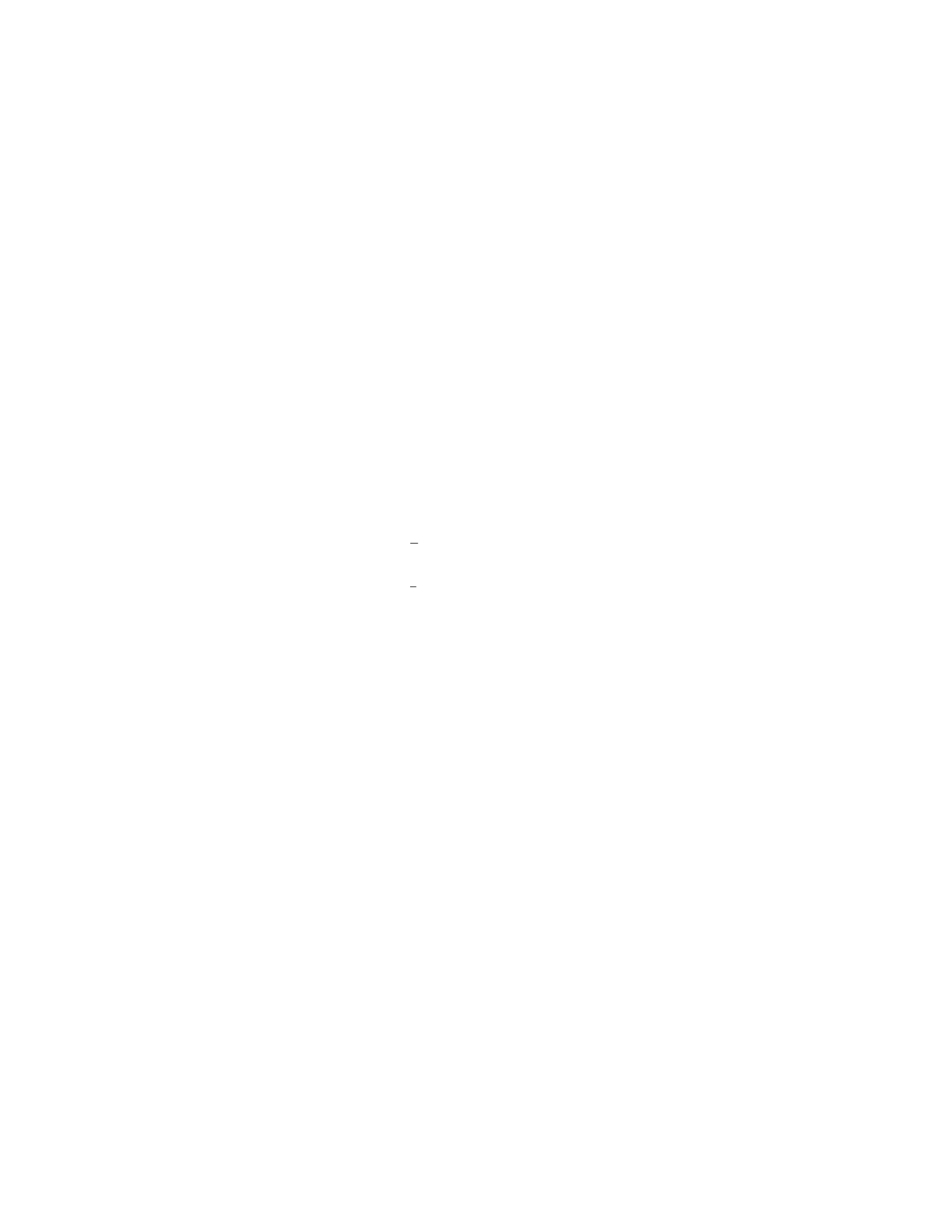
•v=∫exdx =ex
Step 5: Apply the integration by parts formula again:
∫excos x dx =uv −∫v du
= cos x·ex−∫ex(−sin x)dx
= cos x·ex+∫exsin x dx
Step 6: Now, substitute back the integral ∫excos x dx into the expression
from Step 2:
∫exsin x dx = sin x·ex−(cos x·ex+∫exsin x dx)
2∫exsin x dx = sin x·ex−cos x·ex
∫exsin x dx =1
2(sin x−cos x)·ex+C
Therefore, ∫exsin x dx =1
2(sin x−cos x)·ex+C, where Cis the constant
of integration.
Question 25
Question
Evaluate the integral ∫excos x dx using integration by parts.
Solution
To evaluate the integral ∫excos x dx, we will use integration by parts, which
states ∫u dv =uv −∫v du
where uand vare differentiable functions of x.
Step 1: Let’s choose u=exand dv = cos x dx. Then, we have du =exdx
and v=∫cos x dx = sin x.
Step 2: Using the integration by parts formula, we have:
∫excos x dx =exsin x−∫sin x(exdx)
=exsin x−(−cos xex+∫excos x dx)
21

Step 3: Now, we can simplify the equation by isolating the term with the
integral on one side:
∫excos x dx =exsin x+ cos xex−∫excos x dx
2∫excos x dx =exsin x+ cos xex
∫excos x dx =ex(sin x+ cos x)
2
Therefore, the solution to the integral ∫excos x dx is ex(sin x+cos x)
2+C, where
Cis the constant of integration.
22

Step 5: Evaluate the integral Next, we evaluate the integral ∫x dx to
get: ∫xln(x)dx =1
2x2ln(x)−1
2·1
2x2+C.
Step 6: Final answer Therefore, the solution to the integral ∫xln(x)dx
is 1
2x2ln(x)−1
4x2+C, where Cis the constant of integration.
Question 2
Question
Evaluate the integral ∫xln(x)dx using integration by parts.
Solution
To evaluate the integral ∫xln(x)dx using integration by parts, we will choose
u= ln(x)and dv =x dx. Then, we will find du and vand apply the integration
by parts formula:
Step 1: Let u= ln(x)and dv =x dx.Step 2: Find du and v.
du =1
xdx
v=∫x dx =x2
2
Applying the integration by parts formula:
∫xln(x)dx =uv −∫v du
= ln(x)·x2
2−∫x2
2·1
xdx
=x2ln(x)
2−1
2∫x dx
=x2ln(x)
2−x2
4+C
Therefore, ∫xln(x)dx =x2ln(x)
2−x2
4+C, where Cis the constant of inte-
gration.
Question 3
Question
Compute the integral ∫xln x dx using integration by parts.
2

Solution
To evaluate ∫xln x dx using integration by parts, we will let u= ln xand
dv =x dx. Then, we can calculate du and vas follows:
Step 1: Calculate du and v.
• Let u= ln x.
• Calculate du =1
xdx.
• Let dv =x dx.
• Integrate dv to find v, which yields v=1
2x2.
Step 2: Apply the integration by parts formula ∫u dv =uv −∫v du.
∫xln x dx = ln x·1
2x2−∫1
2x2·1
xdx
=1
2x2ln x−1
2∫x dx
=1
2x2ln x−1
2·1
2x2+C
=1
2x2ln x−1
4x2+C,
where Cis the constant of integration.
Therefore, ∫xln x dx =1
2x2ln x−1
4x2+C.
Question 4
Question
Evaluate the integral ∫xln(x)dx using integration by parts.
Solution
To solve the integral ∫xln(x)dx using integration by parts, we choose u= ln(x)
and dv =x dx. Then, we can find du and v.
Step 1: Let’s differentiate u= ln(x)and integrate dv =x dx.
•du =1
xdx
•v=1
2x2
3

Step 2: Now, we can apply the integration by parts formula: ∫u dv =
uv −∫v du.
∫xln(x)dx =1
2x2ln(x)−∫1
2x2·1
xdx
=1
2x2ln(x)−1
2∫x dx
=1
2x2ln(x)−1
4x2+C
where Cis the constant of integration.
Therefore, ∫xln(x)dx =1
2x2ln(x)−1
4x2+C.
Question 5
Question
Evaluate the definite integral: ∫1
0x2exdx
Solution
To evaluate this integral, we will use integration by parts. Recall the formula
for integration by parts:
∫u dv =uv −∫v du
Step 1: Choose uand dv. Let u=x2and dv =exdx. Then, du = 2x dx
and v=ex.
Step 2: Apply integration by parts.
∫x2exdx =x2ex−∫2xexdx
Step 3: Integrate the remaining integral. Using integration by parts again,
let u= 2xand dv =exdx. Then, du = 2 dx and v=ex.
∫2xexdx = 2xex−∫2exdx
Step 4: Evaluate the definite integral. Putting everything together, we get:
∫x2exdx =x2ex−(2xex−2ex)
Now, evaluate the definite integral:
∫1
0
x2exdx =[x2ex−(2xex−2ex)]1
0
Substitute x= 1:= (12e1−(2 ·1e1−2e1))
Substitute x= 0:= (02e0−(2 ·0e0−2e0))
Simplify these expressions to find the final answer.
4

Question 6
Question
Evaluate the integral ∫excos x dx using integration by parts.
Solution
To evaluate ∫excos x dx using integration by parts, we will choose u= cos x
and dv =exdx. Then we will differentiate uto find du and integrate dv to find
v.
Step 1: Determine uand dv. Let u= cos xand dv =exdx.
Step 2: Compute du and v.
du =−sin x dx
v=∫exdx =ex
Step 3: Apply integration by parts formula.
∫excos x dx =uv −∫v du
= cos x ex−∫ex(−sin x)dx
= cos x ex+∫exsin x dx
Now, we have a new integral to solve: ∫exsin x dx. We will use integration
by parts again.
Step 4: Choose u= sin xand dv =exdx. Then compute du and v.
du = cos x dx
v=∫exdx =ex
Step 5: Apply integration by parts to the new integral.
∫exsin x dx =uv −∫v du
= sin x ex−∫excos x dx
Step 6: Substitute the integral back into the original equation.
∫excos x dx = cos x ex+ (sin x ex−∫excos x dx)
2∫excos x dx = (cos x+ sin x)ex
∫excos x dx =(cos x+ sin x)ex
2+C
5

Thus, ∫excos x dx =(cos x+sin x)ex
2+C.
Question 7
Question
Evaluate the integral ∫xcos(x)dx using integration by parts.
Solution
To evaluate the integral ∫xcos(x)dx using integration by parts, we will use the
formula ∫u dv =uv −∫v du.
Step 1: Let’s choose u=xand dv = cos(x)dx. Then, we have:
du =dx and v=∫cos(x)dx = sin(x)
Step 2: Apply the integration by parts formula:
∫xcos(x)dx =uv −∫v du
=xsin(x)−∫sin(x)dx
=xsin(x) + cos(x) + C,
where Cis the constant of integration.
Therefore, the integral ∫xcos(x)dx evaluates to xsin(x) + cos(x) + C.
Question 8
Question
Evaluate the integral ∫xln(x)dx using integration by parts.
Solution
To evaluate the integral ∫xln(x)dx using integration by parts, we choose u=
ln(x)and dv =x dx.
Step 1: Calculate du and v.
•du =1
xdx
•v=1
2x2
6
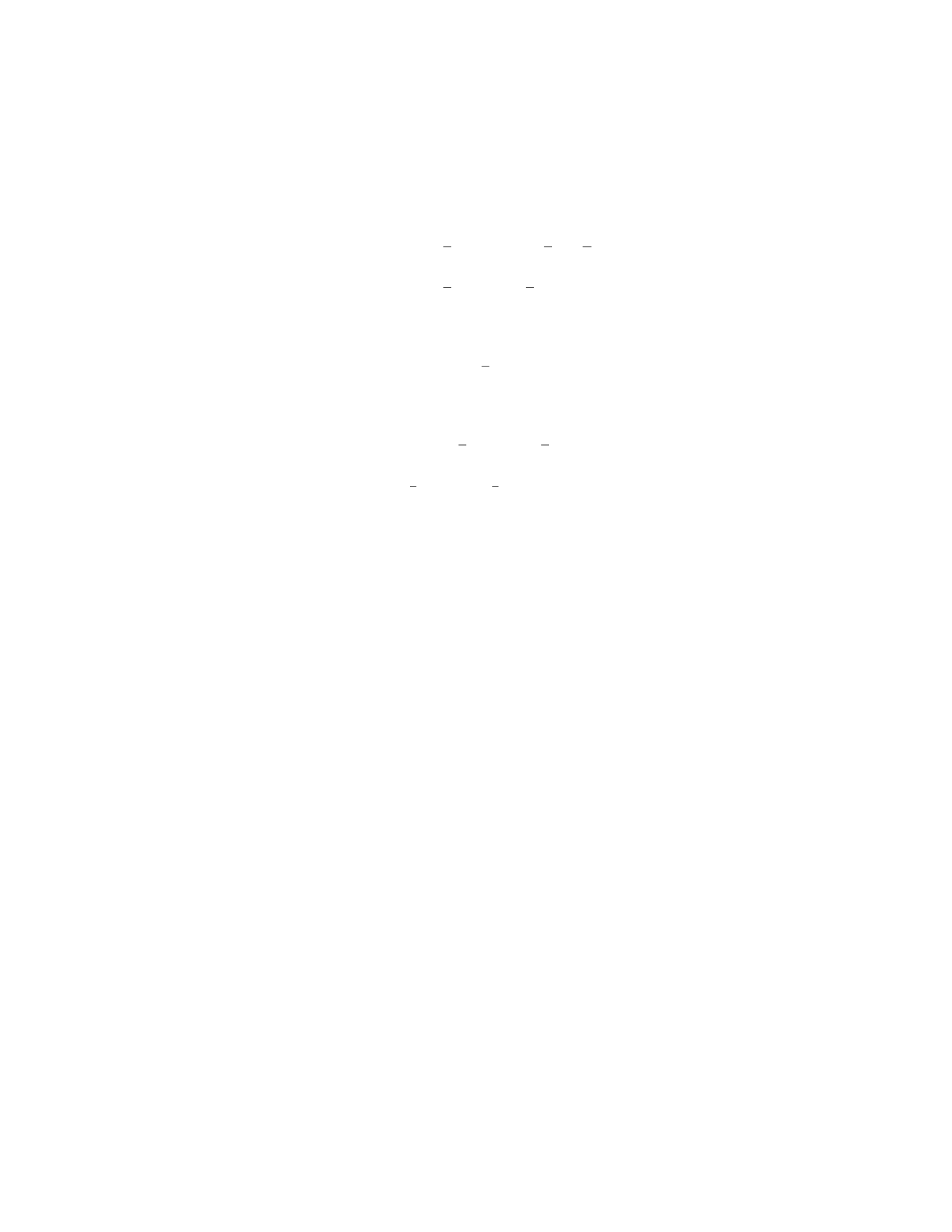
Step 2: Apply integration by parts formula: ∫u dv =uv −∫v du.
∫xln(x)dx =1
2x2ln(x)−∫1
2x2·1
xdx
=1
2x2ln(x)−1
2∫x dx
Step 3: Evaluate the remaining integral.
∫x dx =1
2x2+C
Step 4: Substitute back to find the final answer.
∫xln(x)dx =1
2x2ln(x)−1
4x2+C
Therefore, ∫xln(x)dx =1
2x2ln(x)−1
4x2+C, where Cis the constant of
integration.
Question 9
Question
Evaluate the integral ∫xcos(x)dx using integration by parts.
Solution
To evaluate the integral ∫xcos(x)dx using integration by parts, we will set
u=xand dv = cos(x)dx.
Step 1: Determine du and v.
• We have u=x, so du =dx.
• To find v, we integrate dv = cos(x)dx:
v=∫cos(x)dx = sin(x)
Step 2: Apply the integration by parts formula: ∫u dv =uv −∫v du.
∫xcos(x)dx =xsin(x)−∫sin(x)dx
=xsin(x) + ∫sin(x)dx (integrating sin(x))
=xsin(x)−cos(x) + C
Therefore, ∫xcos(x)dx =xsin(x)−cos(x) + C, where Cis the constant of
integration.
7
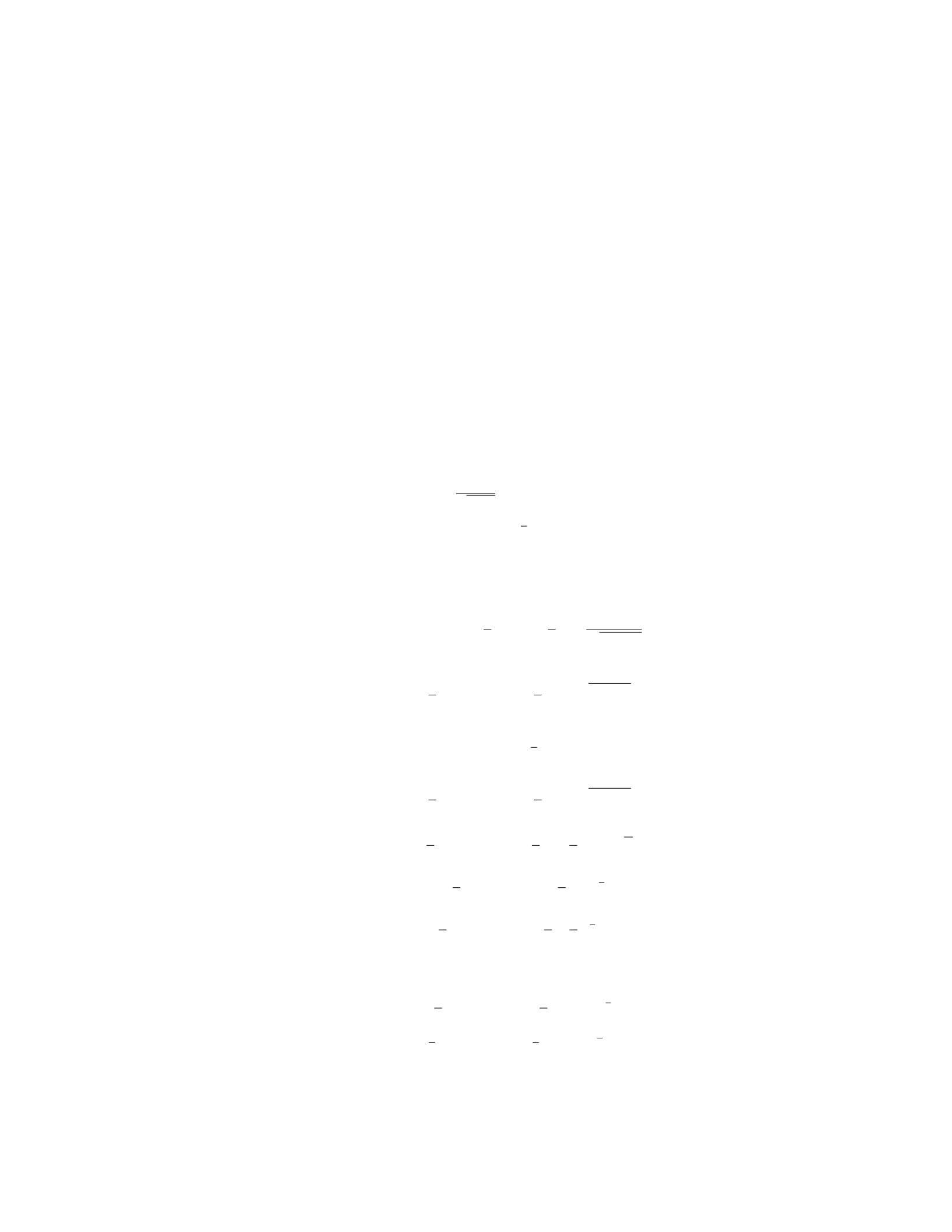
Question 10
Question
Evaluate the integral ∫xsin−1(x)dx.
Solution
To evaluate the given integral, we will use integration by parts. Recall the
formula for integration by parts:
∫u dv =uv −∫v du
In this case, we will let u= sin−1(x)and dv =x dx. Then, we will find du
and vand proceed with the integration by parts method.
Step 1: Find du and v
• Let u= sin−1(x). Then, du =1
√1−x2dx
• Let dv =x dx. Integrating dv gives v=1
2x2
Step 2: Apply the integration by parts formula
∫xsin−1(x)dx =uv −∫v du
∫xsin−1(x)dx = sin−1(x)·1
2x2−∫1
2x2·1
√1−x2dx
Step 3: Simplify and integrate the remaining integral
∫xsin−1(x)dx =1
2x2sin−1(x)−1
2∫x√1−x2dx
We can now use the substitution method to evaluate the remaining integral.
Let u= 1 −x2so du =−2x dx. This implies −1
2du =x dx.
Step 4: Evaluate the integral
∫xsin−1(x)dx =1
2x2sin−1(x)−1
2∫x√1−x2dx
∫xsin−1(x)dx =1
2x2sin−1(x)−1
2(−1
2)∫√u du
∫xsin−1(x)dx =1
2x2sin−1(x) + 1
4∫u1
2du
∫xsin−1(x)dx =1
2x2sin−1(x) + 1
4(2
3u3
2)+C
Step 5: Final answer Substitute u= 1 −x2back into the integral and
simplify:
∫xsin−1(x)dx =1
2x2sin−1(x) + 1
6(1 −x2)3
2+C
Therefore, ∫xsin−1(x)dx =1
2x2sin−1(x) + 1
6(1 −x2)3
2+C.
8

Question 11
Question
Evaluate the integral ∫x2exdx using integration by parts.
Solution
To evaluate the integral ∫x2exdx using integration by parts, we will use the
formula: ∫u dv =uv −∫v du
where we choose u,dv,du, and vappropriately.
Step 1: Let’s choose our uand dv.
• We can choose u=x2which means du = 2x dx.
• We can choose dv =exdx which means v=ex.
Step 2: Now, let’s apply the integration by parts formula.
∫x2exdx =∫u dv
=x2ex−∫v du
=x2ex−∫ex·2x dx
=x2ex−2∫xexdx
Step 3: We have obtained a new integral ∫xexdx, which we can evaluate
again using integration by parts. We will repeat the process.
Let u=xand dv =exdx:
∫xexdx =xex−∫exdx
=xex−ex
Step 4: Substitute ∫xexdx back into our original integral:
∫x2exdx =x2ex−2·(xex−ex)
=x2ex−2xex+ 2ex+C
So, ∫x2exdx =x2ex−2xex+2ex+C, where Cis the constant of integration.
9

Question 12
Question
Evaluate the integral ∫xln(x)dx using integration by parts.
Solution
To evaluate the given integral ∫xln(x)dx using integration by parts, we will
apply the formula:
∫u dv =uv −∫v du
where we choose u= ln(x)and dv =x dx. This gives us du =1
xdx and
v=1
2x2.
Step 1: Apply integration by parts:
∫xln(x)dx =1
2x2ln(x)−∫1
2x2·1
xdx
=1
2x2ln(x)−1
2∫x dx
Step 2: Evaluate the remaining integral:
∫x dx =1
2x2
Step 3: Substituting back the result into the integration by parts formula:
∫xln(x)dx =1
2x2ln(x)−1
2·1
2x2+C
=1
2x2ln(x)−1
4x2+C
Therefore, ∫xln(x)dx =1
2x2ln(x)−1
4x2+C, where Cis the constant of
integration.
Question 13
Question
Evaluate the integral ∫x·ln(x)dx using integration by parts.
Solution
To evaluate the integral ∫x·ln(x)dx using integration by parts, we will choose
u= ln(x)and dv =x dx. Then, we will differentiate uto find du and integrate
dv to find v.
Step 1: Let’s determine du and v:
10
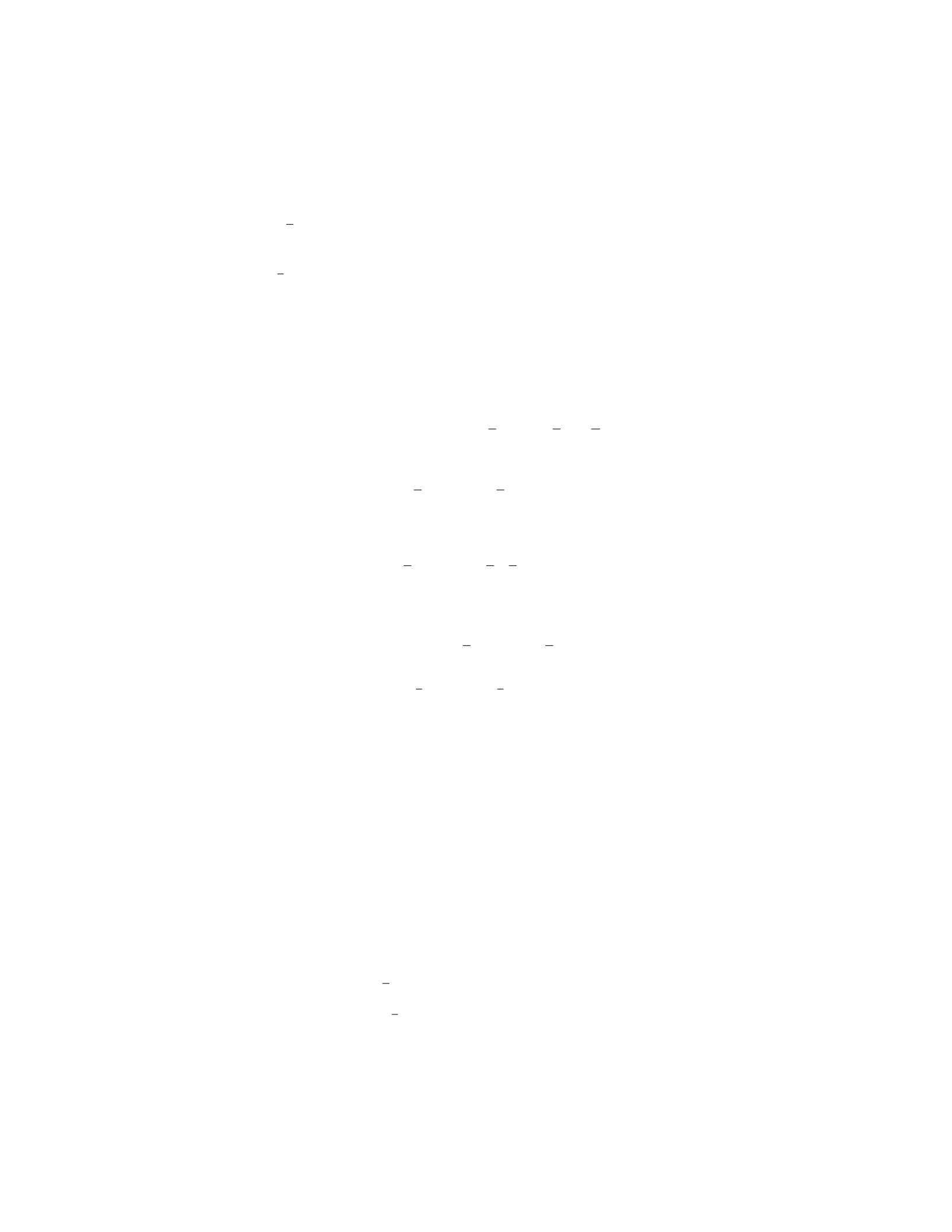
•u= ln(x)
du =1
xdx
•dv =x dx
v=1
2x2
Step 2: Now, we can apply integration by parts:
∫x·ln(x)dx =uv −∫v du
Step 3: Substitute our values of u,v, and du into the integration by parts
formula: ∫x·ln(x)dx = ln(x)·1
2x2−∫1
2x2·1
xdx
Simplify to get:
=1
2x2ln(x)−1
2∫x dx
Step 4: Evaluate the integral on the right side:
=1
2x2ln(x)−1
2·1
2x2+C
Step 5: Finally, simplify and combine like terms:
∫x·ln(x)dx =1
2x2ln(x)−1
4x2+C
Therefore, ∫x·ln(x)dx =1
2x2ln(x)−1
4x2+C, where Cis the constant of
integration.
Question 14
Question
Evaluate the integral ∫x3ln x dx using integration by parts.
Solution
To evaluate the integral ∫x3ln x dx using integration by parts, we will choose
u= ln xand dv =x3dx. Then, we will differentiate uand integrate dv to find
du and v.
Step 1: Let’s determine du and v.
•u= ln x=⇒du =1
xdx
•dv =x3dx =⇒v=1
4x4
11

Step 2: Apply integration by parts formula ∫u dv =uv −∫v du.
∫x3ln x dx =1
4x4ln x−∫1
4x4(1
xdx)
Step 3: Simplify the expression.
∫x3ln x dx =1
4x4ln x−1
4∫x3dx
Step 4: Evaluate the integral.
∫x3ln x dx =1
4x4ln x−1
4(1
4x4)+C
Step 5: Simplify the final result.
∫x3ln x dx =1
4x4ln x−1
16x4+C
Therefore, ∫x3ln x dx =1
4x4ln x−1
16 x4+C, where Cis the constant of
integration.
Question 15
Question
Evaluate the integral ∫xln(x)dx using integration by parts.
Solution
To evaluate the integral ∫xln(x)dx using integration by parts, we will choose
u= ln(x)and dv =x dx.
Step 1: Calculate du and v:
du =1
xdx, v =1
2x2
Step 2: Apply the integration by parts formula:
∫u dv =uv −∫v du
Step 3: Substitute the values of u,dv,du, and vinto the formula:
∫xln(x)dx =1
2x2ln(x)−∫1
2x2·1
xdx
Step 4: Simplify the integral:
∫xln(x)dx =1
2x2ln(x)−1
2∫x dx
12

Step 5: Evaluate the integral:
∫xln(x)dx =1
2x2ln(x)−1
4x2+C
Therefore, ∫xln(x)dx =1
2x2ln(x)−1
4x2+C, where Cis the constant of
integration.
Question 16
Question
Evaluate the integral ∫x2ln(x)dx using integration by parts.
Solution
Step 1: To apply integration by parts, we need to choose uand dv. Let
u= ln(x)and dv =x2dx. Then, we have:
du =1
xdx and v=∫x2dx =1
3x3
Step 2: Now, we can use the integration by parts formula:
∫u dv =uv −∫v du
Substitute u, du, v, dv into the formula:
∫x2ln(x)dx = ln(x)·1
3x3−∫1
3x3·1
xdx
Step 3: Simplify the expression:
∫x2ln(x)dx =1
3x3ln(x)−1
3∫x2dx
Step 4: Now, we can easily integrate ∫x2dx:
∫x2ln(x)dx =1
3x3ln(x)−1
9x3+C
Therefore, the integral ∫x2ln(x)dx evaluates to 1
3x3ln(x)−1
9x3+C, where
Cis the constant of integration.
Question 17
Question
Evaluate the integral ∫xln(1 + x)dx using integration by parts.
13

Solution
To evaluate the integral ∫xln(1 + x)dx, we will use integration by parts. Inte-
gration by parts is given by the formula:
∫u dv =uv −∫v du
Let’s choose u= ln(1 + x)and dv =x dx. Then, we have du =1
1+xdx and
v=1
2x2.
Step 1: Apply integration by parts:
∫xln(1 + x)dx =1
2x2ln(1 + x)−∫1
2x21
1 + xdx
=1
2x2ln(1 + x)−1
2∫x2
1 + xdx
Step 2: Simplify the remaining integral:
1
2x2ln(1 + x)−1
2∫x2
1 + xdx =1
2x2ln(1 + x)−1
2∫(x−x
1 + x)dx
=1
2x2ln(1 + x)−1
2(1
2x2−ln(1 + x))+C
=1
4x2ln(1 + x)−1
4x2+1
2ln(1 + x) + C
Therefore, ∫xln(1 + x)dx =1
4x2ln(1 + x)−1
4x2+1
2ln(1 + x) + C, where
Cis the constant of integration.
Question 18
Question
Evaluate the integral ∫xln(x)dx using integration by parts.
Solution
To evaluate the integral ∫xln(x)dx using integration by parts, we will let
u= ln(x)and dv =x dx.
Step 1: Find du and v.
Let u= ln(x)
⇒du =1
xdx
Let dv =x dx
⇒v=x2
2
14

Step 2: Apply the integration by parts formula
∫u dv =uv −∫v du
to evaluate the integral.
Step 3: Substitute into the integration by parts formula.
∫xln(x)dx =xln(x)·x2
2−∫x2
2·1
xdx
=x3ln(x)
2−1
2∫x dx
=x3ln(x)
2−1
2·x2
2+C
=x3ln(x)
2−x2
4+C
Therefore, ∫xln(x)dx =x3ln(x)
2−x2
4+C, where Cis the constant of
integration.
Question 19
Question
Evaluate the integral ∫x2exdx using integration by parts.
Solution
To evaluate the given integral ∫x2exdx, we will use integration by parts, which
is given by the formula:
∫u dv =uv −∫v du,
where uand dv are differentiable functions of x.
Step 1: Let’s choose u=x2and dv =exdx. Then, we have:
du = 2x dx and v=∫exdx =ex.
15

Step 2: Now, we can apply the integration by parts formula:
∫x2exdx =∫u dv
=uv −∫v du
=x2ex−∫ex·2x dx
=x2ex−2∫xexdx.
Step 3: We will now apply integration by parts again to evaluate ∫xexdx.
Let’s choose u=xand dv =exdx, so that:
du =dx and v=ex.
Step 4: Using the integration by parts formula, we have:
∫xexdx =∫u dv
=uv −∫v du
=xex−∫exdx
=xex−ex.
Step 5: Substituting this back into the expression from Step 2, we get:
∫x2exdx =x2ex−2∫xexdx
=x2ex−2(xex−ex)
=x2ex−2xex+ 2ex+C,
where Cis the constant of integration.
Therefore, ∫x2exdx =x2ex−2xex+ 2ex+C.
Question 20
Question
Evaluate the integral ∫x2ln x dx using integration by parts.
16
Solution
To evaluate ∫x2ln x dx using integration by parts, we will choose u= ln xand
dv =x2dx. Then we will differentiate uto get du and integrate dv to get v.
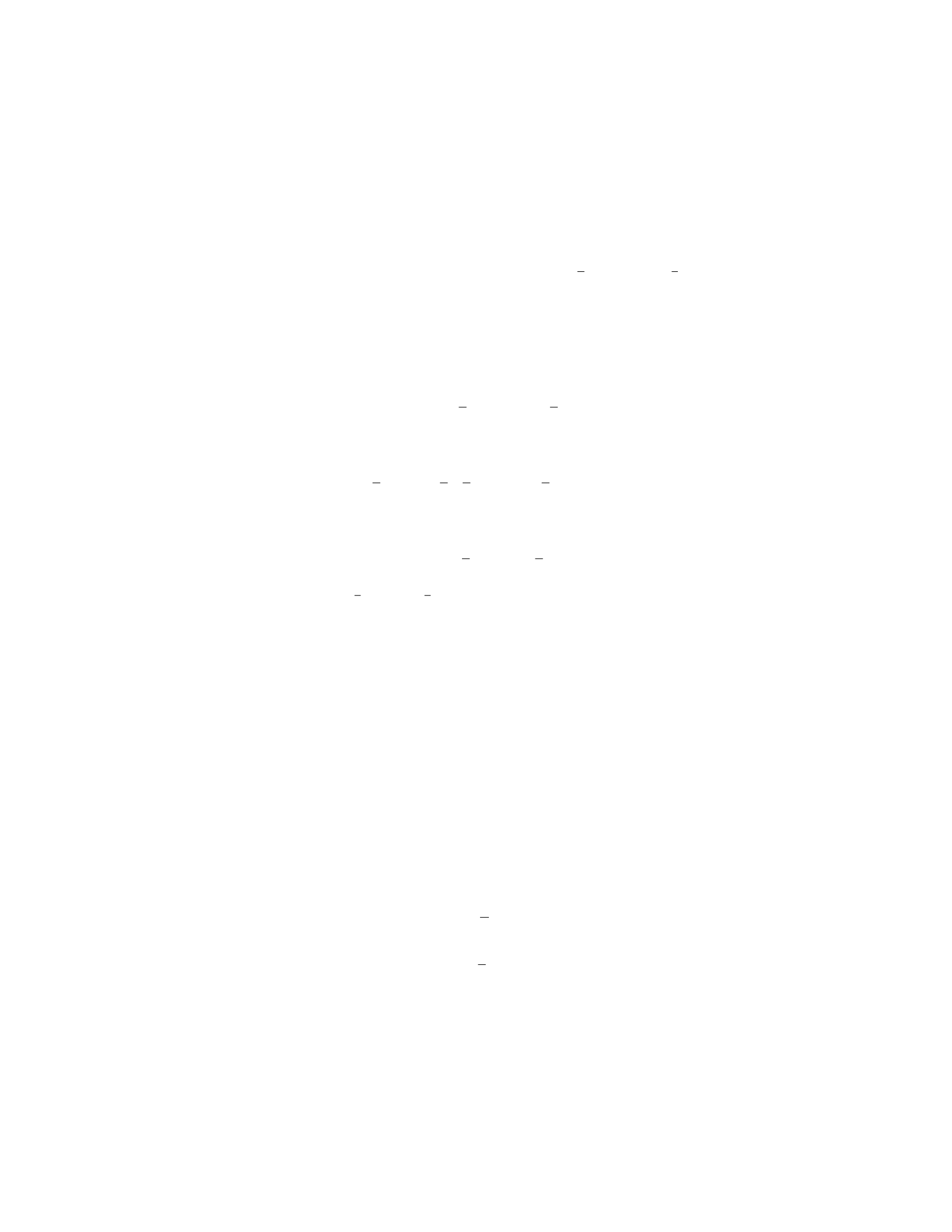
Step 1: Let u= ln xand dv =x2dx. Then, du =1
xdx and v=1
3x3.
Step 2: Apply the formula for integration by parts:
∫u dv =uv −∫v du
Substitute u,dv,v, and du:
∫x2ln x dx =1
3x3ln x−∫1
3x2dx
Step 3: Integrate the remaining integral:
∫1
3x2dx =1
3·1
3x3+C=1
9x3+C
Step 4: Simplify the expression:
∫x2ln x dx =1
3x3ln x−1
9x3+C
So, ∫x2ln x dx =1
3x3ln x−1
9x3+Cwhere Cis the constant of integration.
Question 21
Question
Evaluate the integral ∫xln(x)dx using integration by parts.
Solution
To evaluate the integral ∫xln(x)dx using integration by parts, we choose:
u= ln(x)
dv =x dx
Step 1: Calculate du and v.
du =1
xdx
v=1
2x2
Step 2: Apply integration by parts formula:
∫u dv =uv −∫v du
17

Step 3: Substitute u, v, du, and dv into the formula:
∫xln(x)dx =1
2x2ln(x)−∫1
2x dx
Step 4: Integrate the remaining integral:
∫1
2x dx =1
2·1
2x2=1
4x2
Step 5: Put the results together:
∫xln(x)dx =1
2x2ln(x)−1
4x2+C
where Cis the constant of integration.
Question 22
Question
Evaluate the integral ∫excos(x)dx using integration by parts.
Solution
To evaluate the integral ∫excos(x)dx, we will use integration by parts. The
formula for integration by parts is ∫u dv =uv −∫v du.
Step 1: Choose uand dv. Let u=exand dv = cos(x)dx. Then, we have
du =exdx and v= sin(x).
Step 2: Apply the integration by parts formula.
∫excos(x)dx =exsin(x)−∫sin(x)·exdx
Step 3: Evaluate the new integral.
∫sin(x)·exdx
Step 4: Repeat the integration by parts procedure. Let u= sin(x)and
dv =exdx, then du = cos(x)dx and v=ex.
∫sin(x)·exdx =−cos(x)·ex+∫cos(x)·exdx
Step 5: Substitute back into the original integral.
∫excos(x)dx =exsin(x)−(−cos(x)·ex+∫cos(x)·exdx)
18

Step 6: Simplify the expression.
∫excos(x)dx =exsin(x) + excos(x)−∫excos(x)dx
Step 7: Solve for the integral.
2∫excos(x)dx =ex(sin(x) + cos(x))
Step 8: Finally, divide by 2 to get the value of the integral.
∫excos(x)dx =ex(sin(x) + cos(x))
2+C
Question 23
Question
Evaluate the integral ∫excos(x)dx using integration by parts.
Solution
To evaluate the given integral ∫excos(x)dx, we will use integration by parts.
Integration by parts is given by the formula:
∫u dv =uv −∫v du
where uand vare differentiable functions of x.
Step 1: Let us choose:
u=exand dv = cos(x)dx
Then, we have:
du =exdx and v=∫cos(x)dx = sin(x)
Step 2: Apply the formula for integration by parts:
∫excos(x)dx =exsin(x)−∫sin(x)exdx
Step 3: Rewrite the remaining integral using integration by parts again:
u= sin(x), dv =exdx
du = cos(x)dx, v =∫exdx =ex
19

Step 4: Substitute into the formula for integration by parts:
∫excos(x)dx =exsin(x)−(sin(x)ex−∫excos(x)dx)
∫excos(x)dx =exsin(x)−sin(x)ex+∫excos(x)dx
Step 5: Rearrange the terms to solve for the integral:
∫excos(x)dx =exsin(x)−sin(x)ex+∫excos(x)dx
∫excos(x)dx =exsin(x)−sin(x)ex+C
Therefore, ∫excos(x)dx =exsin(x)−sin(x)ex+C, where Cis the constant
of integration.
Question 24
Question
Evaluate the integral ∫exsin x dx using integration by parts.
Solution
To evaluate the integral ∫exsin x dx using integration by parts, we will consider
u= sin xand dv =exdx. Then, we can apply the formula for integration by
parts:
∫u dv =uv −∫v du
Step 1: Let’s find du and v.
•du = cos x dx
•v=∫exdx =ex
Step 2: Apply the integration by parts formula:
∫exsin x dx =uv −∫v du
= sin x·ex−∫excos x dx
Step 3: Now, we will apply integration by parts again to evaluate ∫excos x dx.
Let u= cos xand dv =exdx.
Step 4: Find du and v.
•du =−sin x dx
20
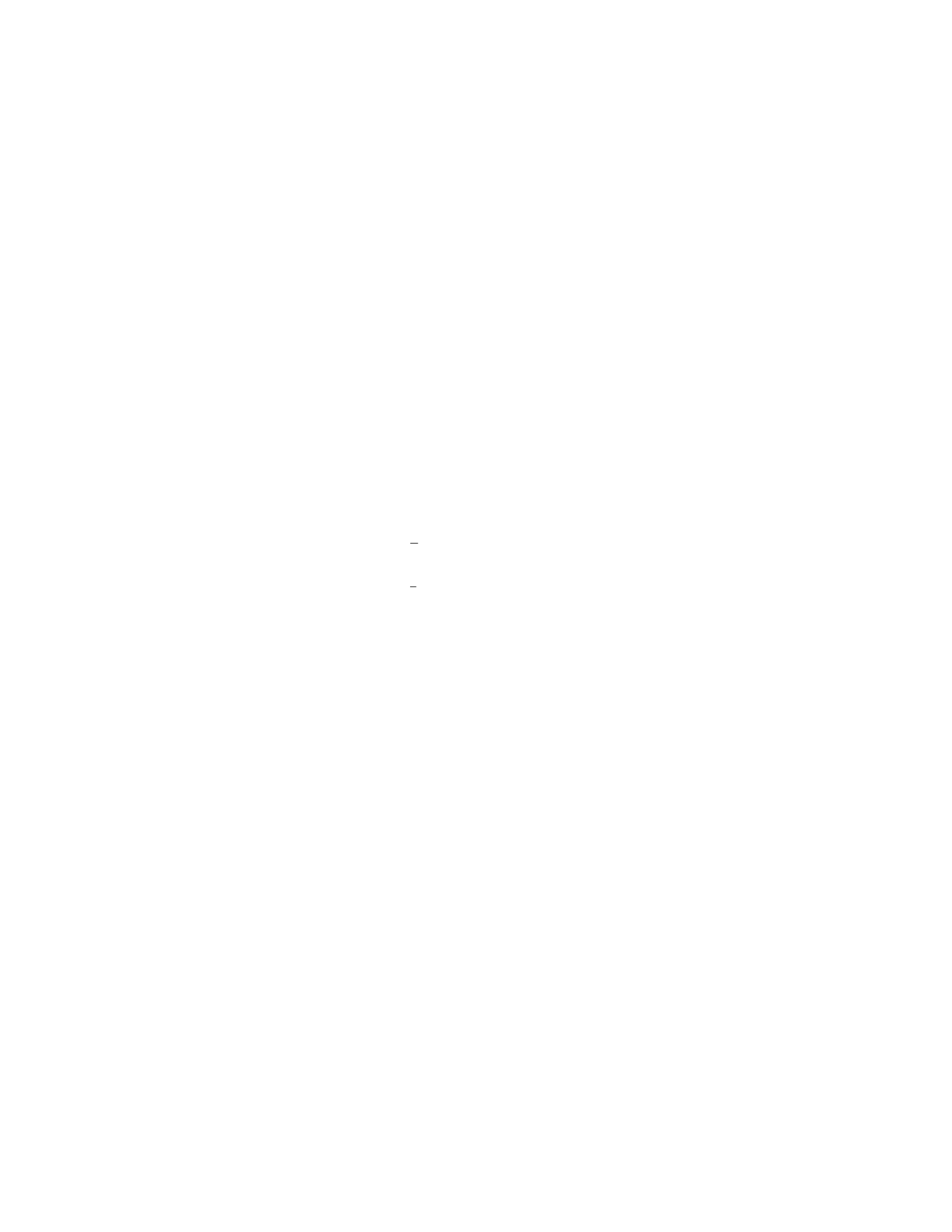
•v=∫exdx =ex
Step 5: Apply the integration by parts formula again:
∫excos x dx =uv −∫v du
= cos x·ex−∫ex(−sin x)dx
= cos x·ex+∫exsin x dx
Step 6: Now, substitute back the integral ∫excos x dx into the expression
from Step 2:
∫exsin x dx = sin x·ex−(cos x·ex+∫exsin x dx)
2∫exsin x dx = sin x·ex−cos x·ex
∫exsin x dx =1
2(sin x−cos x)·ex+C
Therefore, ∫exsin x dx =1
2(sin x−cos x)·ex+C, where Cis the constant
of integration.
Question 25
Question
Evaluate the integral ∫excos x dx using integration by parts.
Solution
To evaluate the integral ∫excos x dx, we will use integration by parts, which
states ∫u dv =uv −∫v du
where uand vare differentiable functions of x.
Step 1: Let’s choose u=exand dv = cos x dx. Then, we have du =exdx
and v=∫cos x dx = sin x.
Step 2: Using the integration by parts formula, we have:
∫excos x dx =exsin x−∫sin x(exdx)
=exsin x−(−cos xex+∫excos x dx)
21

Step 3: Now, we can simplify the equation by isolating the term with the
integral on one side:
∫excos x dx =exsin x+ cos xex−∫excos x dx
2∫excos x dx =exsin x+ cos xex
∫excos x dx =ex(sin x+ cos x)
2
Therefore, the solution to the integral ∫excos x dx is ex(sin x+cos x)
2+C, where
Cis the constant of integration.
22

Step 5: Evaluate the integral Next, we evaluate the integral ∫x dx to
get: ∫xln(x)dx =1
2x2ln(x)−1
2·1
2x2+C.
Step 6: Final answer Therefore, the solution to the integral ∫xln(x)dx
is 1
2x2ln(x)−1
4x2+C, where Cis the constant of integration.
Question 2
Question
Evaluate the integral ∫xln(x)dx using integration by parts.
Solution
To evaluate the integral ∫xln(x)dx using integration by parts, we will choose
u= ln(x)and dv =x dx. Then, we will find du and vand apply the integration
by parts formula:
Step 1: Let u= ln(x)and dv =x dx.Step 2: Find du and v.
du =1
xdx
v=∫x dx =x2
2
Applying the integration by parts formula:
∫xln(x)dx =uv −∫v du
= ln(x)·x2
2−∫x2
2·1
xdx
=x2ln(x)
2−1
2∫x dx
=x2ln(x)
2−x2
4+C
Therefore, ∫xln(x)dx =x2ln(x)
2−x2
4+C, where Cis the constant of inte-
gration.
Question 3
Question
Compute the integral ∫xln x dx using integration by parts.
2

Solution
To evaluate ∫xln x dx using integration by parts, we will let u= ln xand
dv =x dx. Then, we can calculate du and vas follows:
Step 1: Calculate du and v.
• Let u= ln x.
• Calculate du =1
xdx.
• Let dv =x dx.
• Integrate dv to find v, which yields v=1
2x2.
Step 2: Apply the integration by parts formula ∫u dv =uv −∫v du.
∫xln x dx = ln x·1
2x2−∫1
2x2·1
xdx
=1
2x2ln x−1
2∫x dx
=1
2x2ln x−1
2·1
2x2+C
=1
2x2ln x−1
4x2+C,
where Cis the constant of integration.
Therefore, ∫xln x dx =1
2x2ln x−1
4x2+C.
Question 4
Question
Evaluate the integral ∫xln(x)dx using integration by parts.
Solution
To solve the integral ∫xln(x)dx using integration by parts, we choose u= ln(x)
and dv =x dx. Then, we can find du and v.
Step 1: Let’s differentiate u= ln(x)and integrate dv =x dx.
•du =1
xdx
•v=1
2x2
3
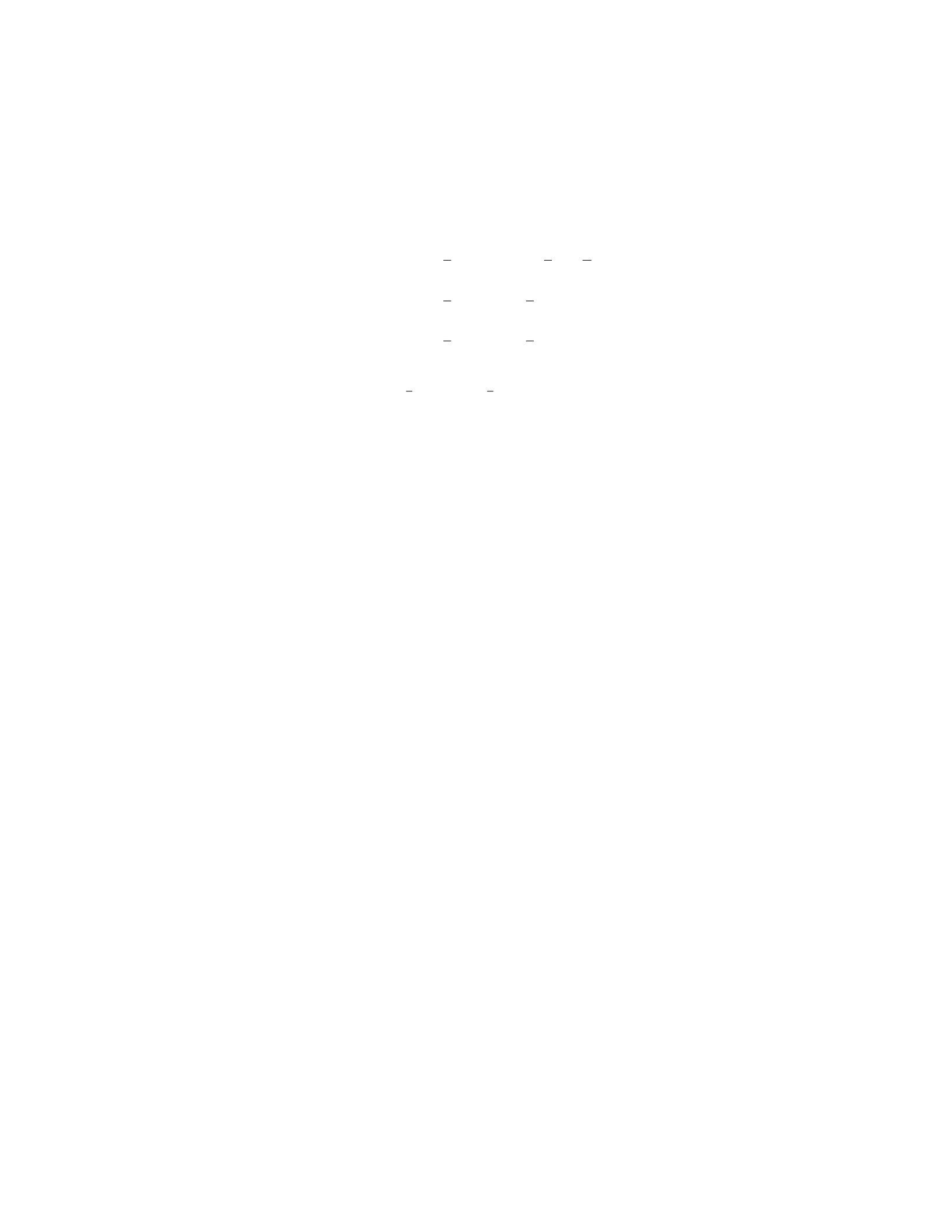
Step 2: Now, we can apply the integration by parts formula: ∫u dv =
uv −∫v du.
∫xln(x)dx =1
2x2ln(x)−∫1
2x2·1
xdx
=1
2x2ln(x)−1
2∫x dx
=1
2x2ln(x)−1
4x2+C
where Cis the constant of integration.
Therefore, ∫xln(x)dx =1
2x2ln(x)−1
4x2+C.
Question 5
Question
Evaluate the definite integral: ∫1
0x2exdx
Solution
To evaluate this integral, we will use integration by parts. Recall the formula
for integration by parts:
∫u dv =uv −∫v du
Step 1: Choose uand dv. Let u=x2and dv =exdx. Then, du = 2x dx
and v=ex.
Step 2: Apply integration by parts.
∫x2exdx =x2ex−∫2xexdx
Step 3: Integrate the remaining integral. Using integration by parts again,
let u= 2xand dv =exdx. Then, du = 2 dx and v=ex.
∫2xexdx = 2xex−∫2exdx
Step 4: Evaluate the definite integral. Putting everything together, we get:
∫x2exdx =x2ex−(2xex−2ex)
Now, evaluate the definite integral:
∫1
0
x2exdx =[x2ex−(2xex−2ex)]1
0
Substitute x= 1:= (12e1−(2 ·1e1−2e1))
Substitute x= 0:= (02e0−(2 ·0e0−2e0))
Simplify these expressions to find the final answer.
4

Question 6
Question
Evaluate the integral ∫excos x dx using integration by parts.
Solution
To evaluate ∫excos x dx using integration by parts, we will choose u= cos x
and dv =exdx. Then we will differentiate uto find du and integrate dv to find
v.
Step 1: Determine uand dv. Let u= cos xand dv =exdx.
Step 2: Compute du and v.
du =−sin x dx
v=∫exdx =ex
Step 3: Apply integration by parts formula.
∫excos x dx =uv −∫v du
= cos x ex−∫ex(−sin x)dx
= cos x ex+∫exsin x dx
Now, we have a new integral to solve: ∫exsin x dx. We will use integration
by parts again.
Step 4: Choose u= sin xand dv =exdx. Then compute du and v.
du = cos x dx
v=∫exdx =ex
Step 5: Apply integration by parts to the new integral.
∫exsin x dx =uv −∫v du
= sin x ex−∫excos x dx
Step 6: Substitute the integral back into the original equation.
∫excos x dx = cos x ex+ (sin x ex−∫excos x dx)
2∫excos x dx = (cos x+ sin x)ex
∫excos x dx =(cos x+ sin x)ex
2+C
5

Thus, ∫excos x dx =(cos x+sin x)ex
2+C.
Question 7
Question
Evaluate the integral ∫xcos(x)dx using integration by parts.
Solution
To evaluate the integral ∫xcos(x)dx using integration by parts, we will use the
formula ∫u dv =uv −∫v du.
Step 1: Let’s choose u=xand dv = cos(x)dx. Then, we have:
du =dx and v=∫cos(x)dx = sin(x)
Step 2: Apply the integration by parts formula:
∫xcos(x)dx =uv −∫v du
=xsin(x)−∫sin(x)dx
=xsin(x) + cos(x) + C,
where Cis the constant of integration.
Therefore, the integral ∫xcos(x)dx evaluates to xsin(x) + cos(x) + C.
Question 8
Question
Evaluate the integral ∫xln(x)dx using integration by parts.
Solution
To evaluate the integral ∫xln(x)dx using integration by parts, we choose u=
ln(x)and dv =x dx.
Step 1: Calculate du and v.
•du =1
xdx
•v=1
2x2
6
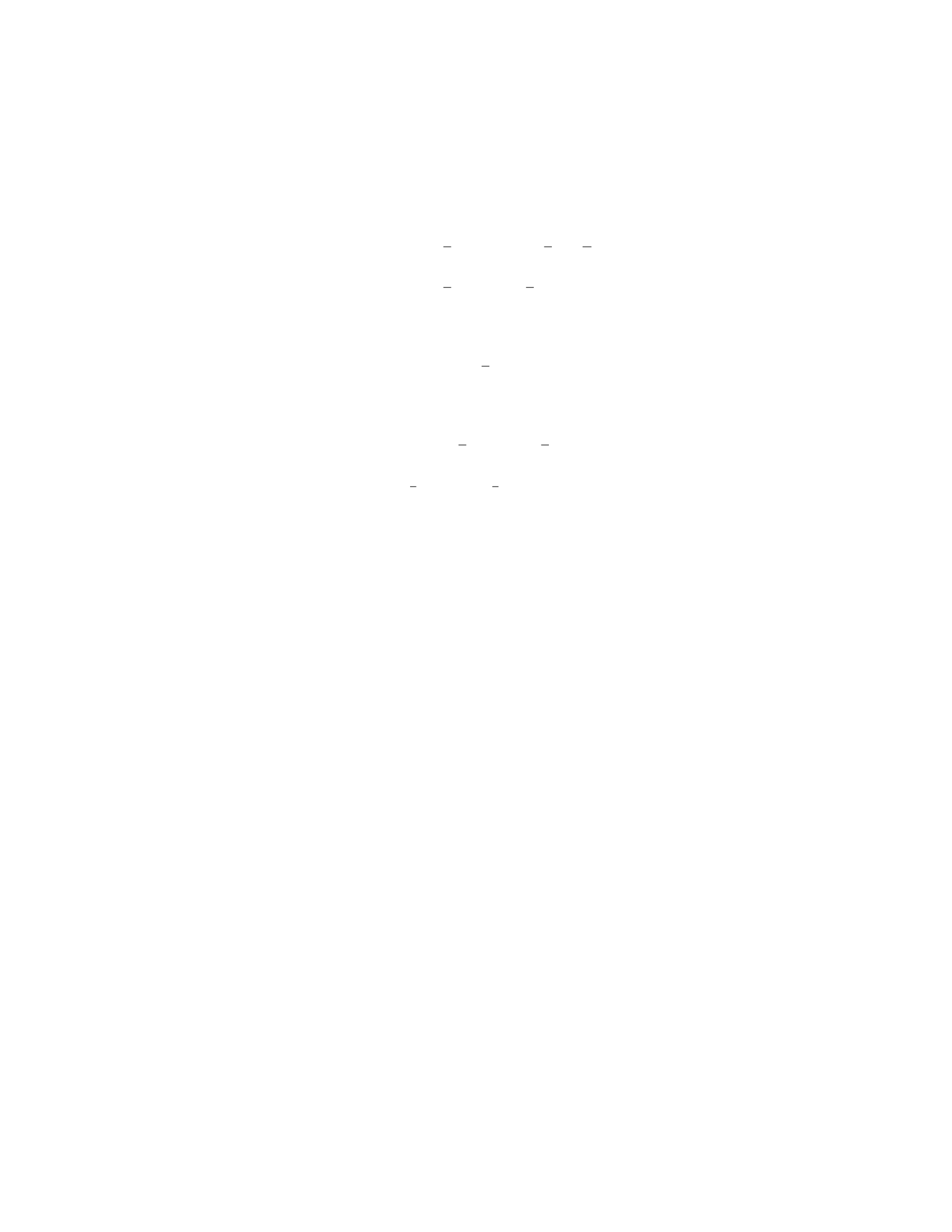
Step 2: Apply integration by parts formula: ∫u dv =uv −∫v du.
∫xln(x)dx =1
2x2ln(x)−∫1
2x2·1
xdx
=1
2x2ln(x)−1
2∫x dx
Step 3: Evaluate the remaining integral.
∫x dx =1
2x2+C
Step 4: Substitute back to find the final answer.
∫xln(x)dx =1
2x2ln(x)−1
4x2+C
Therefore, ∫xln(x)dx =1
2x2ln(x)−1
4x2+C, where Cis the constant of
integration.
Question 9
Question
Evaluate the integral ∫xcos(x)dx using integration by parts.
Solution
To evaluate the integral ∫xcos(x)dx using integration by parts, we will set
u=xand dv = cos(x)dx.
Step 1: Determine du and v.
• We have u=x, so du =dx.
• To find v, we integrate dv = cos(x)dx:
v=∫cos(x)dx = sin(x)
Step 2: Apply the integration by parts formula: ∫u dv =uv −∫v du.
∫xcos(x)dx =xsin(x)−∫sin(x)dx
=xsin(x) + ∫sin(x)dx (integrating sin(x))
=xsin(x)−cos(x) + C
Therefore, ∫xcos(x)dx =xsin(x)−cos(x) + C, where Cis the constant of
integration.
7
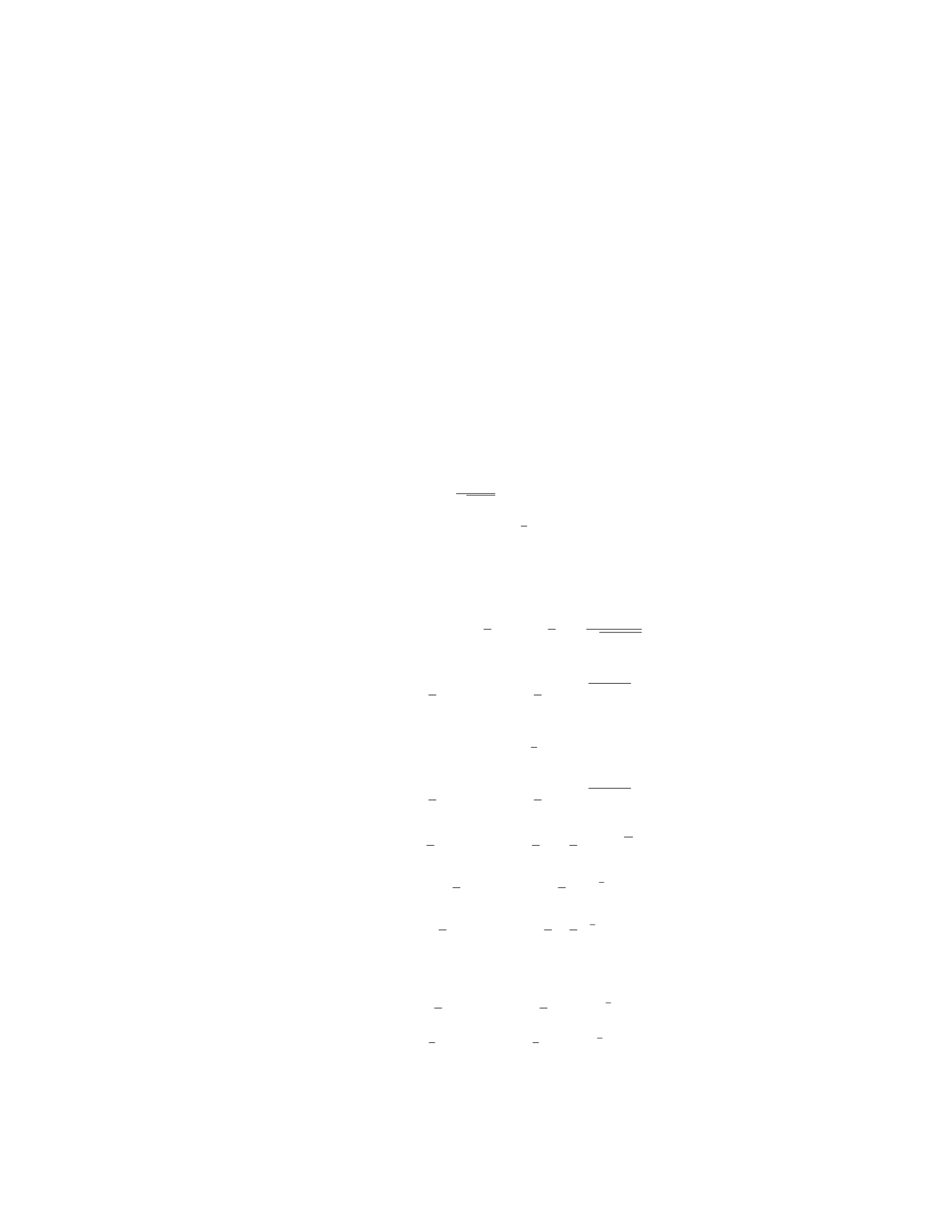
Question 10
Question
Evaluate the integral ∫xsin−1(x)dx.
Solution
To evaluate the given integral, we will use integration by parts. Recall the
formula for integration by parts:
∫u dv =uv −∫v du
In this case, we will let u= sin−1(x)and dv =x dx. Then, we will find du
and vand proceed with the integration by parts method.
Step 1: Find du and v
• Let u= sin−1(x). Then, du =1
√1−x2dx
• Let dv =x dx. Integrating dv gives v=1
2x2
Step 2: Apply the integration by parts formula
∫xsin−1(x)dx =uv −∫v du
∫xsin−1(x)dx = sin−1(x)·1
2x2−∫1
2x2·1
√1−x2dx
Step 3: Simplify and integrate the remaining integral
∫xsin−1(x)dx =1
2x2sin−1(x)−1
2∫x√1−x2dx
We can now use the substitution method to evaluate the remaining integral.
Let u= 1 −x2so du =−2x dx. This implies −1
2du =x dx.
Step 4: Evaluate the integral
∫xsin−1(x)dx =1
2x2sin−1(x)−1
2∫x√1−x2dx
∫xsin−1(x)dx =1
2x2sin−1(x)−1
2(−1
2)∫√u du
∫xsin−1(x)dx =1
2x2sin−1(x) + 1
4∫u1
2du
∫xsin−1(x)dx =1
2x2sin−1(x) + 1
4(2
3u3
2)+C
Step 5: Final answer Substitute u= 1 −x2back into the integral and
simplify:
∫xsin−1(x)dx =1
2x2sin−1(x) + 1
6(1 −x2)3
2+C
Therefore, ∫xsin−1(x)dx =1
2x2sin−1(x) + 1
6(1 −x2)3
2+C.
8

Question 11
Question
Evaluate the integral ∫x2exdx using integration by parts.
Solution
To evaluate the integral ∫x2exdx using integration by parts, we will use the
formula: ∫u dv =uv −∫v du
where we choose u,dv,du, and vappropriately.
Step 1: Let’s choose our uand dv.
• We can choose u=x2which means du = 2x dx.
• We can choose dv =exdx which means v=ex.
Step 2: Now, let’s apply the integration by parts formula.
∫x2exdx =∫u dv
=x2ex−∫v du
=x2ex−∫ex·2x dx
=x2ex−2∫xexdx
Step 3: We have obtained a new integral ∫xexdx, which we can evaluate
again using integration by parts. We will repeat the process.
Let u=xand dv =exdx:
∫xexdx =xex−∫exdx
=xex−ex
Step 4: Substitute ∫xexdx back into our original integral:
∫x2exdx =x2ex−2·(xex−ex)
=x2ex−2xex+ 2ex+C
So, ∫x2exdx =x2ex−2xex+2ex+C, where Cis the constant of integration.
9

Question 12
Question
Evaluate the integral ∫xln(x)dx using integration by parts.
Solution
To evaluate the given integral ∫xln(x)dx using integration by parts, we will
apply the formula:
∫u dv =uv −∫v du
where we choose u= ln(x)and dv =x dx. This gives us du =1
xdx and
v=1
2x2.
Step 1: Apply integration by parts:
∫xln(x)dx =1
2x2ln(x)−∫1
2x2·1
xdx
=1
2x2ln(x)−1
2∫x dx
Step 2: Evaluate the remaining integral:
∫x dx =1
2x2
Step 3: Substituting back the result into the integration by parts formula:
∫xln(x)dx =1
2x2ln(x)−1
2·1
2x2+C
=1
2x2ln(x)−1
4x2+C
Therefore, ∫xln(x)dx =1
2x2ln(x)−1
4x2+C, where Cis the constant of
integration.
Question 13
Question
Evaluate the integral ∫x·ln(x)dx using integration by parts.
Solution
To evaluate the integral ∫x·ln(x)dx using integration by parts, we will choose
u= ln(x)and dv =x dx. Then, we will differentiate uto find du and integrate
dv to find v.
Step 1: Let’s determine du and v:
10
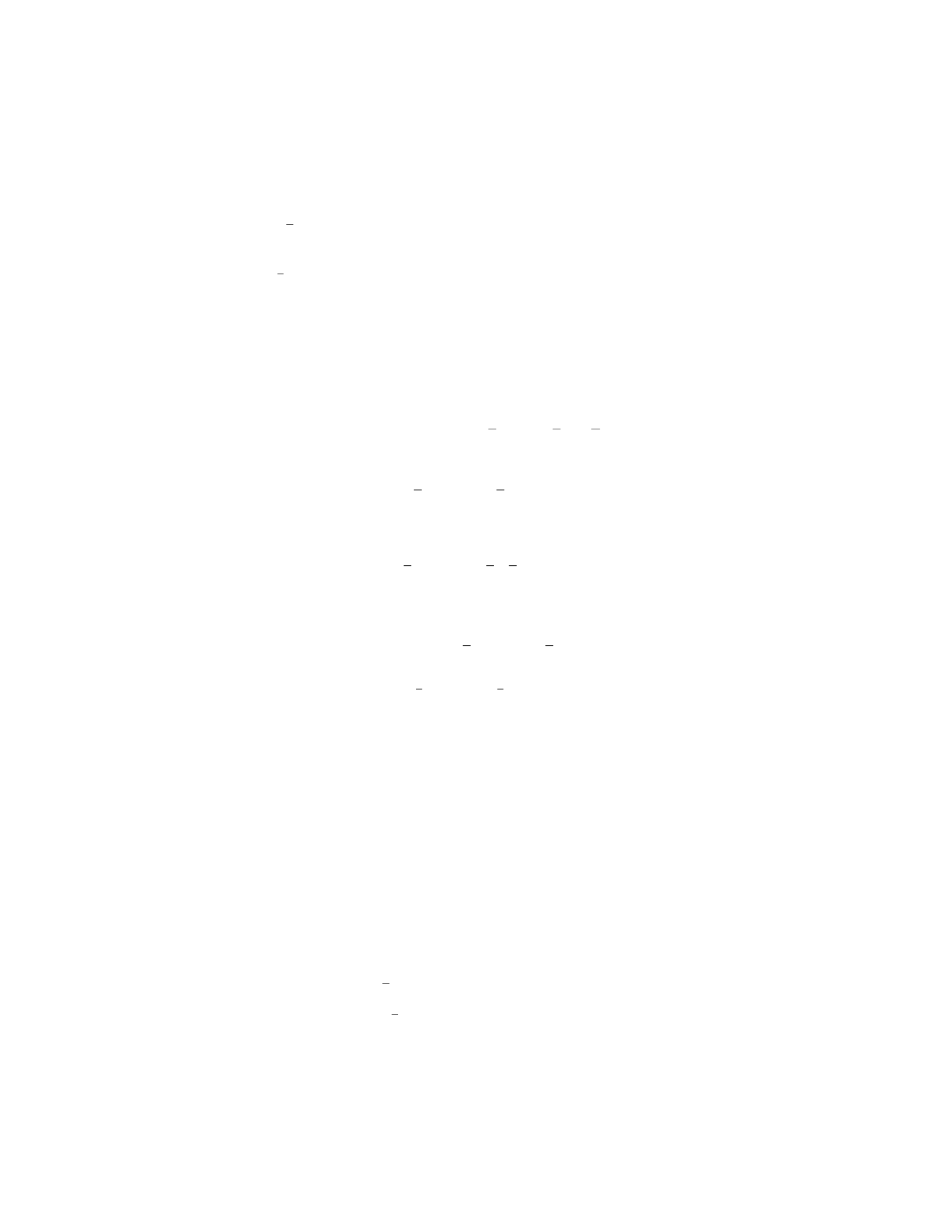
•u= ln(x)
du =1
xdx
•dv =x dx
v=1
2x2
Step 2: Now, we can apply integration by parts:
∫x·ln(x)dx =uv −∫v du
Step 3: Substitute our values of u,v, and du into the integration by parts
formula: ∫x·ln(x)dx = ln(x)·1
2x2−∫1
2x2·1
xdx
Simplify to get:
=1
2x2ln(x)−1
2∫x dx
Step 4: Evaluate the integral on the right side:
=1
2x2ln(x)−1
2·1
2x2+C
Step 5: Finally, simplify and combine like terms:
∫x·ln(x)dx =1
2x2ln(x)−1
4x2+C
Therefore, ∫x·ln(x)dx =1
2x2ln(x)−1
4x2+C, where Cis the constant of
integration.
Question 14
Question
Evaluate the integral ∫x3ln x dx using integration by parts.
Solution
To evaluate the integral ∫x3ln x dx using integration by parts, we will choose
u= ln xand dv =x3dx. Then, we will differentiate uand integrate dv to find
du and v.
Step 1: Let’s determine du and v.
•u= ln x=⇒du =1
xdx
•dv =x3dx =⇒v=1
4x4
11

Step 2: Apply integration by parts formula ∫u dv =uv −∫v du.
∫x3ln x dx =1
4x4ln x−∫1
4x4(1
xdx)
Step 3: Simplify the expression.
∫x3ln x dx =1
4x4ln x−1
4∫x3dx
Step 4: Evaluate the integral.
∫x3ln x dx =1
4x4ln x−1
4(1
4x4)+C
Step 5: Simplify the final result.
∫x3ln x dx =1
4x4ln x−1
16x4+C
Therefore, ∫x3ln x dx =1
4x4ln x−1
16 x4+C, where Cis the constant of
integration.
Question 15
Question
Evaluate the integral ∫xln(x)dx using integration by parts.
Solution
To evaluate the integral ∫xln(x)dx using integration by parts, we will choose
u= ln(x)and dv =x dx.
Step 1: Calculate du and v:
du =1
xdx, v =1
2x2
Step 2: Apply the integration by parts formula:
∫u dv =uv −∫v du
Step 3: Substitute the values of u,dv,du, and vinto the formula:
∫xln(x)dx =1
2x2ln(x)−∫1
2x2·1
xdx
Step 4: Simplify the integral:
∫xln(x)dx =1
2x2ln(x)−1
2∫x dx
12

Step 5: Evaluate the integral:
∫xln(x)dx =1
2x2ln(x)−1
4x2+C
Therefore, ∫xln(x)dx =1
2x2ln(x)−1
4x2+C, where Cis the constant of
integration.
Question 16
Question
Evaluate the integral ∫x2ln(x)dx using integration by parts.
Solution
Step 1: To apply integration by parts, we need to choose uand dv. Let
u= ln(x)and dv =x2dx. Then, we have:
du =1
xdx and v=∫x2dx =1
3x3
Step 2: Now, we can use the integration by parts formula:
∫u dv =uv −∫v du
Substitute u, du, v, dv into the formula:
∫x2ln(x)dx = ln(x)·1
3x3−∫1
3x3·1
xdx
Step 3: Simplify the expression:
∫x2ln(x)dx =1
3x3ln(x)−1
3∫x2dx
Step 4: Now, we can easily integrate ∫x2dx:
∫x2ln(x)dx =1
3x3ln(x)−1
9x3+C
Therefore, the integral ∫x2ln(x)dx evaluates to 1
3x3ln(x)−1
9x3+C, where
Cis the constant of integration.
Question 17
Question
Evaluate the integral ∫xln(1 + x)dx using integration by parts.
13

Solution
To evaluate the integral ∫xln(1 + x)dx, we will use integration by parts. Inte-
gration by parts is given by the formula:
∫u dv =uv −∫v du
Let’s choose u= ln(1 + x)and dv =x dx. Then, we have du =1
1+xdx and
v=1
2x2.
Step 1: Apply integration by parts:
∫xln(1 + x)dx =1
2x2ln(1 + x)−∫1
2x21
1 + xdx
=1
2x2ln(1 + x)−1
2∫x2
1 + xdx
Step 2: Simplify the remaining integral:
1
2x2ln(1 + x)−1
2∫x2
1 + xdx =1
2x2ln(1 + x)−1
2∫(x−x
1 + x)dx
=1
2x2ln(1 + x)−1
2(1
2x2−ln(1 + x))+C
=1
4x2ln(1 + x)−1
4x2+1
2ln(1 + x) + C
Therefore, ∫xln(1 + x)dx =1
4x2ln(1 + x)−1
4x2+1
2ln(1 + x) + C, where
Cis the constant of integration.
Question 18
Question
Evaluate the integral ∫xln(x)dx using integration by parts.
Solution
To evaluate the integral ∫xln(x)dx using integration by parts, we will let
u= ln(x)and dv =x dx.
Step 1: Find du and v.
Let u= ln(x)
⇒du =1
xdx
Let dv =x dx
⇒v=x2
2
14

Step 2: Apply the integration by parts formula
∫u dv =uv −∫v du
to evaluate the integral.
Step 3: Substitute into the integration by parts formula.
∫xln(x)dx =xln(x)·x2
2−∫x2
2·1
xdx
=x3ln(x)
2−1
2∫x dx
=x3ln(x)
2−1
2·x2
2+C
=x3ln(x)
2−x2
4+C
Therefore, ∫xln(x)dx =x3ln(x)
2−x2
4+C, where Cis the constant of
integration.
Question 19
Question
Evaluate the integral ∫x2exdx using integration by parts.
Solution
To evaluate the given integral ∫x2exdx, we will use integration by parts, which
is given by the formula:
∫u dv =uv −∫v du,
where uand dv are differentiable functions of x.
Step 1: Let’s choose u=x2and dv =exdx. Then, we have:
du = 2x dx and v=∫exdx =ex.
15

Step 2: Now, we can apply the integration by parts formula:
∫x2exdx =∫u dv
=uv −∫v du
=x2ex−∫ex·2x dx
=x2ex−2∫xexdx.
Step 3: We will now apply integration by parts again to evaluate ∫xexdx.
Let’s choose u=xand dv =exdx, so that:
du =dx and v=ex.
Step 4: Using the integration by parts formula, we have:
∫xexdx =∫u dv
=uv −∫v du
=xex−∫exdx
=xex−ex.
Step 5: Substituting this back into the expression from Step 2, we get:
∫x2exdx =x2ex−2∫xexdx
=x2ex−2(xex−ex)
=x2ex−2xex+ 2ex+C,
where Cis the constant of integration.
Therefore, ∫x2exdx =x2ex−2xex+ 2ex+C.
Question 20
Question
Evaluate the integral ∫x2ln x dx using integration by parts.
16

Solution
To evaluate ∫x2ln x dx using integration by parts, we will choose u= ln xand
dv =x2dx. Then we will differentiate uto get du and integrate dv to get v.
Step 1: Let u= ln xand dv =x2dx. Then, du =1
xdx and v=1
3x3.
Step 2: Apply the formula for integration by parts:
∫u dv =uv −∫v du
Substitute u,dv,v, and du:
∫x2ln x dx =1
3x3ln x−∫1
3x2dx
Step 3: Integrate the remaining integral:
∫1
3x2dx =1
3·1
3x3+C=1
9x3+C
Step 4: Simplify the expression:
∫x2ln x dx =1
3x3ln x−1
9x3+C
So, ∫x2ln x dx =1
3x3ln x−1
9x3+Cwhere Cis the constant of integration.
Question 21
Question
Evaluate the integral ∫xln(x)dx using integration by parts.
Solution
To evaluate the integral ∫xln(x)dx using integration by parts, we choose:
u= ln(x)
dv =x dx
Step 1: Calculate du and v.
du =1
xdx
v=1
2x2
Step 2: Apply integration by parts formula:
∫u dv =uv −∫v du
17
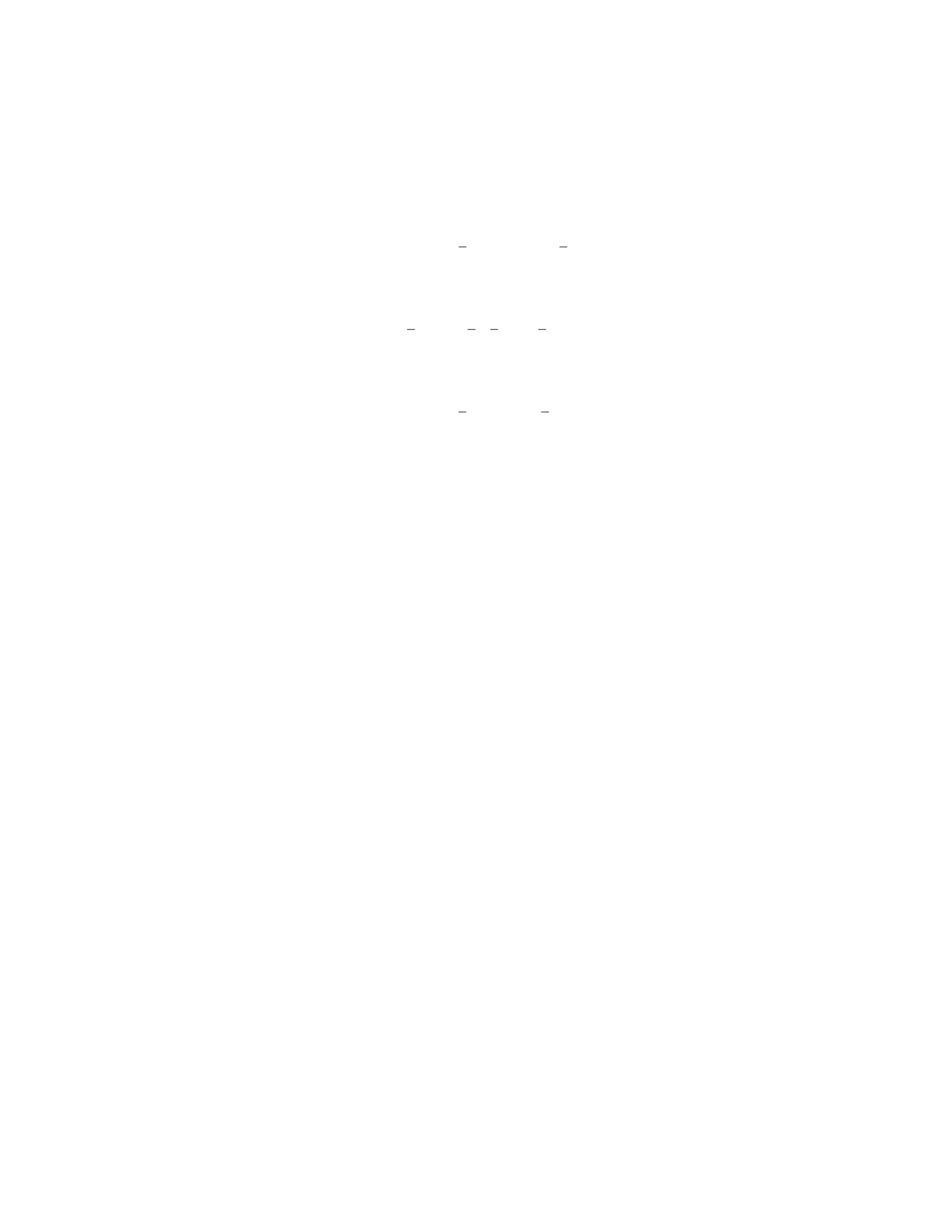
Step 3: Substitute u, v, du, and dv into the formula:
∫xln(x)dx =1
2x2ln(x)−∫1
2x dx
Step 4: Integrate the remaining integral:
∫1
2x dx =1
2·1
2x2=1
4x2
Step 5: Put the results together:
∫xln(x)dx =1
2x2ln(x)−1
4x2+C
where Cis the constant of integration.
Question 22
Question
Evaluate the integral ∫excos(x)dx using integration by parts.
Solution
To evaluate the integral ∫excos(x)dx, we will use integration by parts. The
formula for integration by parts is ∫u dv =uv −∫v du.
Step 1: Choose uand dv. Let u=exand dv = cos(x)dx. Then, we have
du =exdx and v= sin(x).
Step 2: Apply the integration by parts formula.
∫excos(x)dx =exsin(x)−∫sin(x)·exdx
Step 3: Evaluate the new integral.
∫sin(x)·exdx
Step 4: Repeat the integration by parts procedure. Let u= sin(x)and
dv =exdx, then du = cos(x)dx and v=ex.
∫sin(x)·exdx =−cos(x)·ex+∫cos(x)·exdx
Step 5: Substitute back into the original integral.
∫excos(x)dx =exsin(x)−(−cos(x)·ex+∫cos(x)·exdx)
18

Step 6: Simplify the expression.
∫excos(x)dx =exsin(x) + excos(x)−∫excos(x)dx
Step 7: Solve for the integral.
2∫excos(x)dx =ex(sin(x) + cos(x))
Step 8: Finally, divide by 2 to get the value of the integral.
∫excos(x)dx =ex(sin(x) + cos(x))
2+C
Question 23
Question
Evaluate the integral ∫excos(x)dx using integration by parts.
Solution
To evaluate the given integral ∫excos(x)dx, we will use integration by parts.
Integration by parts is given by the formula:
∫u dv =uv −∫v du
where uand vare differentiable functions of x.
Step 1: Let us choose:
u=exand dv = cos(x)dx
Then, we have:
du =exdx and v=∫cos(x)dx = sin(x)
Step 2: Apply the formula for integration by parts:
∫excos(x)dx =exsin(x)−∫sin(x)exdx
Step 3: Rewrite the remaining integral using integration by parts again:
u= sin(x), dv =exdx
du = cos(x)dx, v =∫exdx =ex
19

Step 4: Substitute into the formula for integration by parts:
∫excos(x)dx =exsin(x)−(sin(x)ex−∫excos(x)dx)
∫excos(x)dx =exsin(x)−sin(x)ex+∫excos(x)dx
Step 5: Rearrange the terms to solve for the integral:
∫excos(x)dx =exsin(x)−sin(x)ex+∫excos(x)dx
∫excos(x)dx =exsin(x)−sin(x)ex+C
Therefore, ∫excos(x)dx =exsin(x)−sin(x)ex+C, where Cis the constant
of integration.
Question 24
Question
Evaluate the integral ∫exsin x dx using integration by parts.
Solution
To evaluate the integral ∫exsin x dx using integration by parts, we will consider
u= sin xand dv =exdx. Then, we can apply the formula for integration by
parts:
∫u dv =uv −∫v du
Step 1: Let’s find du and v.
•du = cos x dx
•v=∫exdx =ex
Step 2: Apply the integration by parts formula:
∫exsin x dx =uv −∫v du
= sin x·ex−∫excos x dx
Step 3: Now, we will apply integration by parts again to evaluate ∫excos x dx.
Let u= cos xand dv =exdx.
Step 4: Find du and v.
•du =−sin x dx
20
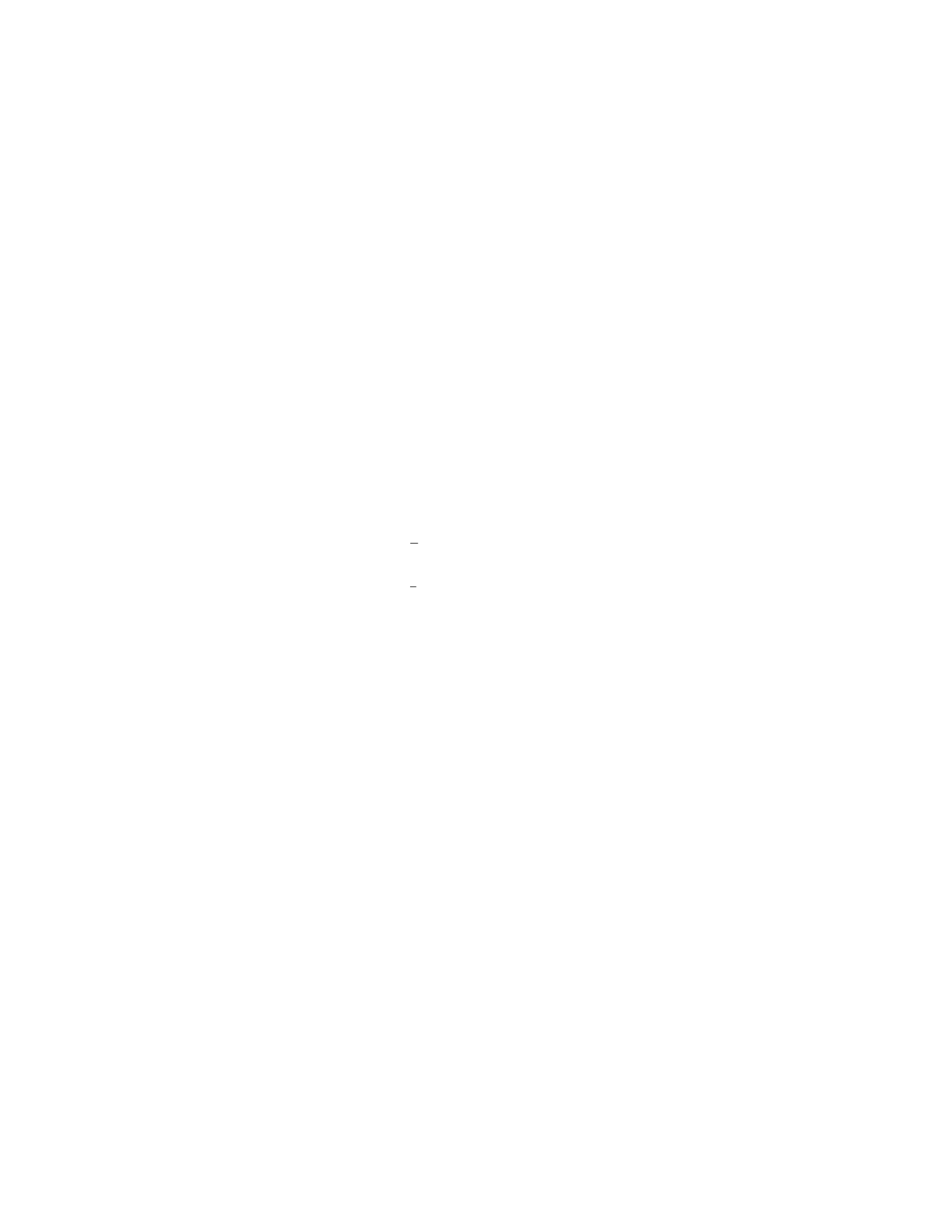
•v=∫exdx =ex
Step 5: Apply the integration by parts formula again:
∫excos x dx =uv −∫v du
= cos x·ex−∫ex(−sin x)dx
= cos x·ex+∫exsin x dx
Step 6: Now, substitute back the integral ∫excos x dx into the expression
from Step 2:
∫exsin x dx = sin x·ex−(cos x·ex+∫exsin x dx)
2∫exsin x dx = sin x·ex−cos x·ex
∫exsin x dx =1
2(sin x−cos x)·ex+C
Therefore, ∫exsin x dx =1
2(sin x−cos x)·ex+C, where Cis the constant
of integration.
Question 25
Question
Evaluate the integral ∫excos x dx using integration by parts.
Solution
To evaluate the integral ∫excos x dx, we will use integration by parts, which
states ∫u dv =uv −∫v du
where uand vare differentiable functions of x.
Step 1: Let’s choose u=exand dv = cos x dx. Then, we have du =exdx
and v=∫cos x dx = sin x.
Step 2: Using the integration by parts formula, we have:
∫excos x dx =exsin x−∫sin x(exdx)
=exsin x−(−cos xex+∫excos x dx)
21

Step 3: Now, we can simplify the equation by isolating the term with the
integral on one side:
∫excos x dx =exsin x+ cos xex−∫excos x dx
2∫excos x dx =exsin x+ cos xex
∫excos x dx =ex(sin x+ cos x)
2
Therefore, the solution to the integral ∫excos x dx is ex(sin x+cos x)
2+C, where
Cis the constant of integration.
22

Step 5: Evaluate the integral Next, we evaluate the integral ∫x dx to
get: ∫xln(x)dx =1
2x2ln(x)−1
2·1
2x2+C.
Step 6: Final answer Therefore, the solution to the integral ∫xln(x)dx
is 1
2x2ln(x)−1
4x2+C, where Cis the constant of integration.
Question 2
Question
Evaluate the integral ∫xln(x)dx using integration by parts.
Solution
To evaluate the integral ∫xln(x)dx using integration by parts, we will choose
u= ln(x)and dv =x dx. Then, we will find du and vand apply the integration
by parts formula:
Step 1: Let u= ln(x)and dv =x dx.Step 2: Find du and v.
du =1
xdx
v=∫x dx =x2
2
Applying the integration by parts formula:
∫xln(x)dx =uv −∫v du
= ln(x)·x2
2−∫x2
2·1
xdx
=x2ln(x)
2−1
2∫x dx
=x2ln(x)
2−x2
4+C
Therefore, ∫xln(x)dx =x2ln(x)
2−x2
4+C, where Cis the constant of inte-
gration.
Question 3
Question
Compute the integral ∫xln x dx using integration by parts.
2

Solution
To evaluate ∫xln x dx using integration by parts, we will let u= ln xand
dv =x dx. Then, we can calculate du and vas follows:
Step 1: Calculate du and v.
• Let u= ln x.
• Calculate du =1
xdx.
• Let dv =x dx.
• Integrate dv to find v, which yields v=1
2x2.
Step 2: Apply the integration by parts formula ∫u dv =uv −∫v du.
∫xln x dx = ln x·1
2x2−∫1
2x2·1
xdx
=1
2x2ln x−1
2∫x dx
=1
2x2ln x−1
2·1
2x2+C
=1
2x2ln x−1
4x2+C,
where Cis the constant of integration.
Therefore, ∫xln x dx =1
2x2ln x−1
4x2+C.
Question 4
Question
Evaluate the integral ∫xln(x)dx using integration by parts.
Solution
To solve the integral ∫xln(x)dx using integration by parts, we choose u= ln(x)
and dv =x dx. Then, we can find du and v.
Step 1: Let’s differentiate u= ln(x)and integrate dv =x dx.
•du =1
xdx
•v=1
2x2
3
Step 2: Now, we can apply the integration by parts formula: ∫u dv =
uv −∫v du.
∫xln(x)dx =1
2x2ln(x)−∫1
2x2·1
xdx
=1
2x2ln(x)−1
2∫x dx
=1
2x2ln(x)−1
4x2+C
where Cis the constant of integration.
Therefore, ∫xln(x)dx =1
2x2ln(x)−1
4x2+C.
Question 5
Question
Evaluate the definite integral: ∫1
0x2exdx
Solution
To evaluate this integral, we will use integration by parts. Recall the formula
for integration by parts:
∫u dv =uv −∫v du
Step 1: Choose uand dv. Let u=x2and dv =exdx. Then, du = 2x dx
and v=ex.
Step 2: Apply integration by parts.
∫x2exdx =x2ex−∫2xexdx
Step 3: Integrate the remaining integral. Using integration by parts again,
let u= 2xand dv =exdx. Then, du = 2 dx and v=ex.
∫2xexdx = 2xex−∫2exdx
Step 4: Evaluate the definite integral. Putting everything together, we get:
∫x2exdx =x2ex−(2xex−2ex)
Now, evaluate the definite integral:
∫1
0
x2exdx =[x2ex−(2xex−2ex)]1
0
Substitute x= 1:= (12e1−(2 ·1e1−2e1))
Substitute x= 0:= (02e0−(2 ·0e0−2e0))
Simplify these expressions to find the final answer.
4

Question 6
Question
Evaluate the integral ∫excos x dx using integration by parts.
Solution
To evaluate ∫excos x dx using integration by parts, we will choose u= cos x
and dv =exdx. Then we will differentiate uto find du and integrate dv to find
v.
Step 1: Determine uand dv. Let u= cos xand dv =exdx.
Step 2: Compute du and v.
du =−sin x dx
v=∫exdx =ex
Step 3: Apply integration by parts formula.
∫excos x dx =uv −∫v du
= cos x ex−∫ex(−sin x)dx
= cos x ex+∫exsin x dx
Now, we have a new integral to solve: ∫exsin x dx. We will use integration
by parts again.
Step 4: Choose u= sin xand dv =exdx. Then compute du and v.
du = cos x dx
v=∫exdx =ex
Step 5: Apply integration by parts to the new integral.
∫exsin x dx =uv −∫v du
= sin x ex−∫excos x dx
Step 6: Substitute the integral back into the original equation.
∫excos x dx = cos x ex+ (sin x ex−∫excos x dx)
2∫excos x dx = (cos x+ sin x)ex
∫excos x dx =(cos x+ sin x)ex
2+C
5

Thus, ∫excos x dx =(cos x+sin x)ex
2+C.
Question 7
Question
Evaluate the integral ∫xcos(x)dx using integration by parts.
Solution
To evaluate the integral ∫xcos(x)dx using integration by parts, we will use the
formula ∫u dv =uv −∫v du.
Step 1: Let’s choose u=xand dv = cos(x)dx. Then, we have:
du =dx and v=∫cos(x)dx = sin(x)
Step 2: Apply the integration by parts formula:
∫xcos(x)dx =uv −∫v du
=xsin(x)−∫sin(x)dx
=xsin(x) + cos(x) + C,
where Cis the constant of integration.
Therefore, the integral ∫xcos(x)dx evaluates to xsin(x) + cos(x) + C.
Question 8
Question
Evaluate the integral ∫xln(x)dx using integration by parts.
Solution
To evaluate the integral ∫xln(x)dx using integration by parts, we choose u=
ln(x)and dv =x dx.
Step 1: Calculate du and v.
•du =1
xdx
•v=1
2x2
6
Step 2: Apply integration by parts formula: ∫u dv =uv −∫v du.
∫xln(x)dx =1
2x2ln(x)−∫1
2x2·1
xdx
=1
2x2ln(x)−1
2∫x dx
Step 3: Evaluate the remaining integral.
∫x dx =1
2x2+C
Step 4: Substitute back to find the final answer.
∫xln(x)dx =1
2x2ln(x)−1
4x2+C
Therefore, ∫xln(x)dx =1
2x2ln(x)−1
4x2+C, where Cis the constant of
integration.
Question 9
Question
Evaluate the integral ∫xcos(x)dx using integration by parts.
Solution
To evaluate the integral ∫xcos(x)dx using integration by parts, we will set
u=xand dv = cos(x)dx.
Step 1: Determine du and v.
• We have u=x, so du =dx.
• To find v, we integrate dv = cos(x)dx:
v=∫cos(x)dx = sin(x)
Step 2: Apply the integration by parts formula: ∫u dv =uv −∫v du.
∫xcos(x)dx =xsin(x)−∫sin(x)dx
=xsin(x) + ∫sin(x)dx (integrating sin(x))
=xsin(x)−cos(x) + C
Therefore, ∫xcos(x)dx =xsin(x)−cos(x) + C, where Cis the constant of
integration.
7
Question 10
Question
Evaluate the integral ∫xsin−1(x)dx.
Solution
To evaluate the given integral, we will use integration by parts. Recall the
formula for integration by parts:
∫u dv =uv −∫v du
In this case, we will let u= sin−1(x)and dv =x dx. Then, we will find du
and vand proceed with the integration by parts method.
Step 1: Find du and v
• Let u= sin−1(x). Then, du =1
√1−x2dx
• Let dv =x dx. Integrating dv gives v=1
2x2
Step 2: Apply the integration by parts formula
∫xsin−1(x)dx =uv −∫v du
∫xsin−1(x)dx = sin−1(x)·1
2x2−∫1
2x2·1
√1−x2dx
Step 3: Simplify and integrate the remaining integral
∫xsin−1(x)dx =1
2x2sin−1(x)−1
2∫x√1−x2dx
We can now use the substitution method to evaluate the remaining integral.
Let u= 1 −x2so du =−2x dx. This implies −1
2du =x dx.
Step 4: Evaluate the integral
∫xsin−1(x)dx =1
2x2sin−1(x)−1
2∫x√1−x2dx
∫xsin−1(x)dx =1
2x2sin−1(x)−1
2(−1
2)∫√u du
∫xsin−1(x)dx =1
2x2sin−1(x) + 1
4∫u1
2du
∫xsin−1(x)dx =1
2x2sin−1(x) + 1
4(2
3u3
2)+C
Step 5: Final answer Substitute u= 1 −x2back into the integral and
simplify:
∫xsin−1(x)dx =1
2x2sin−1(x) + 1
6(1 −x2)3
2+C
Therefore, ∫xsin−1(x)dx =1
2x2sin−1(x) + 1
6(1 −x2)3
2+C.
8

Question 11
Question
Evaluate the integral ∫x2exdx using integration by parts.
Solution
To evaluate the integral ∫x2exdx using integration by parts, we will use the
formula: ∫u dv =uv −∫v du
where we choose u,dv,du, and vappropriately.
Step 1: Let’s choose our uand dv.
• We can choose u=x2which means du = 2x dx.
• We can choose dv =exdx which means v=ex.
Step 2: Now, let’s apply the integration by parts formula.
∫x2exdx =∫u dv
=x2ex−∫v du
=x2ex−∫ex·2x dx
=x2ex−2∫xexdx
Step 3: We have obtained a new integral ∫xexdx, which we can evaluate
again using integration by parts. We will repeat the process.
Let u=xand dv =exdx:
∫xexdx =xex−∫exdx
=xex−ex
Step 4: Substitute ∫xexdx back into our original integral:
∫x2exdx =x2ex−2·(xex−ex)
=x2ex−2xex+ 2ex+C
So, ∫x2exdx =x2ex−2xex+2ex+C, where Cis the constant of integration.
9

Question 12
Question
Evaluate the integral ∫xln(x)dx using integration by parts.
Solution
To evaluate the given integral ∫xln(x)dx using integration by parts, we will
apply the formula:
∫u dv =uv −∫v du
where we choose u= ln(x)and dv =x dx. This gives us du =1
xdx and
v=1
2x2.
Step 1: Apply integration by parts:
∫xln(x)dx =1
2x2ln(x)−∫1
2x2·1
xdx
=1
2x2ln(x)−1
2∫x dx
Step 2: Evaluate the remaining integral:
∫x dx =1
2x2
Step 3: Substituting back the result into the integration by parts formula:
∫xln(x)dx =1
2x2ln(x)−1
2·1
2x2+C
=1
2x2ln(x)−1
4x2+C
Therefore, ∫xln(x)dx =1
2x2ln(x)−1
4x2+C, where Cis the constant of
integration.
Question 13
Question
Evaluate the integral ∫x·ln(x)dx using integration by parts.
Solution
To evaluate the integral ∫x·ln(x)dx using integration by parts, we will choose
u= ln(x)and dv =x dx. Then, we will differentiate uto find du and integrate
dv to find v.
Step 1: Let’s determine du and v:
10
•u= ln(x)
du =1
xdx
•dv =x dx
v=1
2x2
Step 2: Now, we can apply integration by parts:
∫x·ln(x)dx =uv −∫v du
Step 3: Substitute our values of u,v, and du into the integration by parts
formula: ∫x·ln(x)dx = ln(x)·1
2x2−∫1
2x2·1
xdx
Simplify to get:
=1
2x2ln(x)−1
2∫x dx
Step 4: Evaluate the integral on the right side:
=1
2x2ln(x)−1
2·1
2x2+C
Step 5: Finally, simplify and combine like terms:
∫x·ln(x)dx =1
2x2ln(x)−1
4x2+C
Therefore, ∫x·ln(x)dx =1
2x2ln(x)−1
4x2+C, where Cis the constant of
integration.
Question 14
Question
Evaluate the integral ∫x3ln x dx using integration by parts.
Solution
To evaluate the integral ∫x3ln x dx using integration by parts, we will choose
u= ln xand dv =x3dx. Then, we will differentiate uand integrate dv to find
du and v.
Step 1: Let’s determine du and v.
•u= ln x=⇒du =1
xdx
•dv =x3dx =⇒v=1
4x4
11

Step 2: Apply integration by parts formula ∫u dv =uv −∫v du.
∫x3ln x dx =1
4x4ln x−∫1
4x4(1
xdx)
Step 3: Simplify the expression.
∫x3ln x dx =1
4x4ln x−1
4∫x3dx
Step 4: Evaluate the integral.
∫x3ln x dx =1
4x4ln x−1
4(1
4x4)+C
Step 5: Simplify the final result.
∫x3ln x dx =1
4x4ln x−1
16x4+C
Therefore, ∫x3ln x dx =1
4x4ln x−1
16 x4+C, where Cis the constant of
integration.
Question 15
Question
Evaluate the integral ∫xln(x)dx using integration by parts.
Solution
To evaluate the integral ∫xln(x)dx using integration by parts, we will choose
u= ln(x)and dv =x dx.
Step 1: Calculate du and v:
du =1
xdx, v =1
2x2
Step 2: Apply the integration by parts formula:
∫u dv =uv −∫v du
Step 3: Substitute the values of u,dv,du, and vinto the formula:
∫xln(x)dx =1
2x2ln(x)−∫1
2x2·1
xdx
Step 4: Simplify the integral:
∫xln(x)dx =1
2x2ln(x)−1
2∫x dx
12

Step 5: Evaluate the integral:
∫xln(x)dx =1
2x2ln(x)−1
4x2+C
Therefore, ∫xln(x)dx =1
2x2ln(x)−1
4x2+C, where Cis the constant of
integration.
Question 16
Question
Evaluate the integral ∫x2ln(x)dx using integration by parts.
Solution
Step 1: To apply integration by parts, we need to choose uand dv. Let
u= ln(x)and dv =x2dx. Then, we have:
du =1
xdx and v=∫x2dx =1
3x3
Step 2: Now, we can use the integration by parts formula:
∫u dv =uv −∫v du
Substitute u, du, v, dv into the formula:
∫x2ln(x)dx = ln(x)·1
3x3−∫1
3x3·1
xdx
Step 3: Simplify the expression:
∫x2ln(x)dx =1
3x3ln(x)−1
3∫x2dx
Step 4: Now, we can easily integrate ∫x2dx:
∫x2ln(x)dx =1
3x3ln(x)−1
9x3+C
Therefore, the integral ∫x2ln(x)dx evaluates to 1
3x3ln(x)−1
9x3+C, where
Cis the constant of integration.
Question 17
Question
Evaluate the integral ∫xln(1 + x)dx using integration by parts.
13

Solution
To evaluate the integral ∫xln(1 + x)dx, we will use integration by parts. Inte-
gration by parts is given by the formula:
∫u dv =uv −∫v du
Let’s choose u= ln(1 + x)and dv =x dx. Then, we have du =1
1+xdx and
v=1
2x2.
Step 1: Apply integration by parts:
∫xln(1 + x)dx =1
2x2ln(1 + x)−∫1
2x21
1 + xdx
=1
2x2ln(1 + x)−1
2∫x2
1 + xdx
Step 2: Simplify the remaining integral:
1
2x2ln(1 + x)−1
2∫x2
1 + xdx =1
2x2ln(1 + x)−1
2∫(x−x
1 + x)dx
=1
2x2ln(1 + x)−1
2(1
2x2−ln(1 + x))+C
=1
4x2ln(1 + x)−1
4x2+1
2ln(1 + x) + C
Therefore, ∫xln(1 + x)dx =1
4x2ln(1 + x)−1
4x2+1
2ln(1 + x) + C, where
Cis the constant of integration.
Question 18
Question
Evaluate the integral ∫xln(x)dx using integration by parts.
Solution
To evaluate the integral ∫xln(x)dx using integration by parts, we will let
u= ln(x)and dv =x dx.
Step 1: Find du and v.
Let u= ln(x)
⇒du =1
xdx
Let dv =x dx
⇒v=x2
2
14

Step 2: Apply the integration by parts formula
∫u dv =uv −∫v du
to evaluate the integral.
Step 3: Substitute into the integration by parts formula.
∫xln(x)dx =xln(x)·x2
2−∫x2
2·1
xdx
=x3ln(x)
2−1
2∫x dx
=x3ln(x)
2−1
2·x2
2+C
=x3ln(x)
2−x2
4+C
Therefore, ∫xln(x)dx =x3ln(x)
2−x2
4+C, where Cis the constant of
integration.
Question 19
Question
Evaluate the integral ∫x2exdx using integration by parts.
Solution
To evaluate the given integral ∫x2exdx, we will use integration by parts, which
is given by the formula:
∫u dv =uv −∫v du,
where uand dv are differentiable functions of x.
Step 1: Let’s choose u=x2and dv =exdx. Then, we have:
du = 2x dx and v=∫exdx =ex.
15

Step 2: Now, we can apply the integration by parts formula:
∫x2exdx =∫u dv
=uv −∫v du
=x2ex−∫ex·2x dx
=x2ex−2∫xexdx.
Step 3: We will now apply integration by parts again to evaluate ∫xexdx.
Let’s choose u=xand dv =exdx, so that:
du =dx and v=ex.
Step 4: Using the integration by parts formula, we have:
∫xexdx =∫u dv
=uv −∫v du
=xex−∫exdx
=xex−ex.
Step 5: Substituting this back into the expression from Step 2, we get:
∫x2exdx =x2ex−2∫xexdx
=x2ex−2(xex−ex)
=x2ex−2xex+ 2ex+C,
where Cis the constant of integration.
Therefore, ∫x2exdx =x2ex−2xex+ 2ex+C.
Question 20
Question
Evaluate the integral ∫x2ln x dx using integration by parts.
16
Solution
To evaluate ∫x2ln x dx using integration by parts, we will choose u= ln xand
dv =x2dx. Then we will differentiate uto get du and integrate dv to get v.
Step 1: Let u= ln xand dv =x2dx. Then, du =1
xdx and v=1
3x3.
Step 2: Apply the formula for integration by parts:
∫u dv =uv −∫v du
Substitute u,dv,v, and du:
∫x2ln x dx =1
3x3ln x−∫1
3x2dx
Step 3: Integrate the remaining integral:
∫1
3x2dx =1
3·1
3x3+C=1
9x3+C
Step 4: Simplify the expression:
∫x2ln x dx =1
3x3ln x−1
9x3+C
So, ∫x2ln x dx =1
3x3ln x−1
9x3+Cwhere Cis the constant of integration.
Question 21
Question
Evaluate the integral ∫xln(x)dx using integration by parts.
Solution
To evaluate the integral ∫xln(x)dx using integration by parts, we choose:
u= ln(x)
dv =x dx
Step 1: Calculate du and v.
du =1
xdx
v=1
2x2
Step 2: Apply integration by parts formula:
∫u dv =uv −∫v du
17
Step 3: Substitute u, v, du, and dv into the formula:
∫xln(x)dx =1
2x2ln(x)−∫1
2x dx
Step 4: Integrate the remaining integral:
∫1
2x dx =1
2·1
2x2=1
4x2
Step 5: Put the results together:
∫xln(x)dx =1
2x2ln(x)−1
4x2+C
where Cis the constant of integration.
Question 22
Question
Evaluate the integral ∫excos(x)dx using integration by parts.
Solution
To evaluate the integral ∫excos(x)dx, we will use integration by parts. The
formula for integration by parts is ∫u dv =uv −∫v du.
Step 1: Choose uand dv. Let u=exand dv = cos(x)dx. Then, we have
du =exdx and v= sin(x).
Step 2: Apply the integration by parts formula.
∫excos(x)dx =exsin(x)−∫sin(x)·exdx
Step 3: Evaluate the new integral.
∫sin(x)·exdx
Step 4: Repeat the integration by parts procedure. Let u= sin(x)and
dv =exdx, then du = cos(x)dx and v=ex.
∫sin(x)·exdx =−cos(x)·ex+∫cos(x)·exdx
Step 5: Substitute back into the original integral.
∫excos(x)dx =exsin(x)−(−cos(x)·ex+∫cos(x)·exdx)
18

Step 6: Simplify the expression.
∫excos(x)dx =exsin(x) + excos(x)−∫excos(x)dx
Step 7: Solve for the integral.
2∫excos(x)dx =ex(sin(x) + cos(x))
Step 8: Finally, divide by 2 to get the value of the integral.
∫excos(x)dx =ex(sin(x) + cos(x))
2+C
Question 23
Question
Evaluate the integral ∫excos(x)dx using integration by parts.
Solution
To evaluate the given integral ∫excos(x)dx, we will use integration by parts.
Integration by parts is given by the formula:
∫u dv =uv −∫v du
where uand vare differentiable functions of x.
Step 1: Let us choose:
u=exand dv = cos(x)dx
Then, we have:
du =exdx and v=∫cos(x)dx = sin(x)
Step 2: Apply the formula for integration by parts:
∫excos(x)dx =exsin(x)−∫sin(x)exdx
Step 3: Rewrite the remaining integral using integration by parts again:
u= sin(x), dv =exdx
du = cos(x)dx, v =∫exdx =ex
19

Step 4: Substitute into the formula for integration by parts:
∫excos(x)dx =exsin(x)−(sin(x)ex−∫excos(x)dx)
∫excos(x)dx =exsin(x)−sin(x)ex+∫excos(x)dx
Step 5: Rearrange the terms to solve for the integral:
∫excos(x)dx =exsin(x)−sin(x)ex+∫excos(x)dx
∫excos(x)dx =exsin(x)−sin(x)ex+C
Therefore, ∫excos(x)dx =exsin(x)−sin(x)ex+C, where Cis the constant
of integration.
Question 24
Question
Evaluate the integral ∫exsin x dx using integration by parts.
Solution
To evaluate the integral ∫exsin x dx using integration by parts, we will consider
u= sin xand dv =exdx. Then, we can apply the formula for integration by
parts:
∫u dv =uv −∫v du
Step 1: Let’s find du and v.
•du = cos x dx
•v=∫exdx =ex
Step 2: Apply the integration by parts formula:
∫exsin x dx =uv −∫v du
= sin x·ex−∫excos x dx
Step 3: Now, we will apply integration by parts again to evaluate ∫excos x dx.
Let u= cos xand dv =exdx.
Step 4: Find du and v.
•du =−sin x dx
20

•v=∫exdx =ex
Step 5: Apply the integration by parts formula again:
∫excos x dx =uv −∫v du
= cos x·ex−∫ex(−sin x)dx
= cos x·ex+∫exsin x dx
Step 6: Now, substitute back the integral ∫excos x dx into the expression
from Step 2:
∫exsin x dx = sin x·ex−(cos x·ex+∫exsin x dx)
2∫exsin x dx = sin x·ex−cos x·ex
∫exsin x dx =1
2(sin x−cos x)·ex+C
Therefore, ∫exsin x dx =1
2(sin x−cos x)·ex+C, where Cis the constant
of integration.
Question 25
Question
Evaluate the integral ∫excos x dx using integration by parts.
Solution
To evaluate the integral ∫excos x dx, we will use integration by parts, which
states ∫u dv =uv −∫v du
where uand vare differentiable functions of x.
Step 1: Let’s choose u=exand dv = cos x dx. Then, we have du =exdx
and v=∫cos x dx = sin x.
Step 2: Using the integration by parts formula, we have:
∫excos x dx =exsin x−∫sin x(exdx)
=exsin x−(−cos xex+∫excos x dx)
21

Step 3: Now, we can simplify the equation by isolating the term with the
integral on one side:
∫excos x dx =exsin x+ cos xex−∫excos x dx
2∫excos x dx =exsin x+ cos xex
∫excos x dx =ex(sin x+ cos x)
2
Therefore, the solution to the integral ∫excos x dx is ex(sin x+cos x)
2+C, where
Cis the constant of integration.
22

Step 5: Evaluate the integral Next, we evaluate the integral ∫x dx to
get: ∫xln(x)dx =1
2x2ln(x)−1
2·1
2x2+C.
Step 6: Final answer Therefore, the solution to the integral ∫xln(x)dx
is 1
2x2ln(x)−1
4x2+C, where Cis the constant of integration.
Question 2
Question
Evaluate the integral ∫xln(x)dx using integration by parts.
Solution
To evaluate the integral ∫xln(x)dx using integration by parts, we will choose
u= ln(x)and dv =x dx. Then, we will find du and vand apply the integration
by parts formula:
Step 1: Let u= ln(x)and dv =x dx.Step 2: Find du and v.
du =1
xdx
v=∫x dx =x2
2
Applying the integration by parts formula:
∫xln(x)dx =uv −∫v du
= ln(x)·x2
2−∫x2
2·1
xdx
=x2ln(x)
2−1
2∫x dx
=x2ln(x)
2−x2
4+C
Therefore, ∫xln(x)dx =x2ln(x)
2−x2
4+C, where Cis the constant of inte-
gration.
Question 3
Question
Compute the integral ∫xln x dx using integration by parts.
2

Solution
To evaluate ∫xln x dx using integration by parts, we will let u= ln xand
dv =x dx. Then, we can calculate du and vas follows:
Step 1: Calculate du and v.
• Let u= ln x.
• Calculate du =1
xdx.
• Let dv =x dx.
• Integrate dv to find v, which yields v=1
2x2.
Step 2: Apply the integration by parts formula ∫u dv =uv −∫v du.
∫xln x dx = ln x·1
2x2−∫1
2x2·1
xdx
=1
2x2ln x−1
2∫x dx
=1
2x2ln x−1
2·1
2x2+C
=1
2x2ln x−1
4x2+C,
where Cis the constant of integration.
Therefore, ∫xln x dx =1
2x2ln x−1
4x2+C.
Question 4
Question
Evaluate the integral ∫xln(x)dx using integration by parts.
Solution
To solve the integral ∫xln(x)dx using integration by parts, we choose u= ln(x)
and dv =x dx. Then, we can find du and v.
Step 1: Let’s differentiate u= ln(x)and integrate dv =x dx.
•du =1
xdx
•v=1
2x2
3
Step 2: Now, we can apply the integration by parts formula: ∫u dv =
uv −∫v du.
∫xln(x)dx =1
2x2ln(x)−∫1
2x2·1
xdx
=1
2x2ln(x)−1
2∫x dx
=1
2x2ln(x)−1
4x2+C
where Cis the constant of integration.
Therefore, ∫xln(x)dx =1
2x2ln(x)−1
4x2+C.
Question 5
Question
Evaluate the definite integral: ∫1
0x2exdx
Solution
To evaluate this integral, we will use integration by parts. Recall the formula
for integration by parts:
∫u dv =uv −∫v du
Step 1: Choose uand dv. Let u=x2and dv =exdx. Then, du = 2x dx
and v=ex.
Step 2: Apply integration by parts.
∫x2exdx =x2ex−∫2xexdx
Step 3: Integrate the remaining integral. Using integration by parts again,
let u= 2xand dv =exdx. Then, du = 2 dx and v=ex.
∫2xexdx = 2xex−∫2exdx
Step 4: Evaluate the definite integral. Putting everything together, we get:
∫x2exdx =x2ex−(2xex−2ex)
Now, evaluate the definite integral:
∫1
0
x2exdx =[x2ex−(2xex−2ex)]1
0
Substitute x= 1:= (12e1−(2 ·1e1−2e1))
Substitute x= 0:= (02e0−(2 ·0e0−2e0))
Simplify these expressions to find the final answer.
4

Question 6
Question
Evaluate the integral ∫excos x dx using integration by parts.
Solution
To evaluate ∫excos x dx using integration by parts, we will choose u= cos x
and dv =exdx. Then we will differentiate uto find du and integrate dv to find
v.
Step 1: Determine uand dv. Let u= cos xand dv =exdx.
Step 2: Compute du and v.
du =−sin x dx
v=∫exdx =ex
Step 3: Apply integration by parts formula.
∫excos x dx =uv −∫v du
= cos x ex−∫ex(−sin x)dx
= cos x ex+∫exsin x dx
Now, we have a new integral to solve: ∫exsin x dx. We will use integration
by parts again.
Step 4: Choose u= sin xand dv =exdx. Then compute du and v.
du = cos x dx
v=∫exdx =ex
Step 5: Apply integration by parts to the new integral.
∫exsin x dx =uv −∫v du
= sin x ex−∫excos x dx
Step 6: Substitute the integral back into the original equation.
∫excos x dx = cos x ex+ (sin x ex−∫excos x dx)
2∫excos x dx = (cos x+ sin x)ex
∫excos x dx =(cos x+ sin x)ex
2+C
5

Thus, ∫excos x dx =(cos x+sin x)ex
2+C.
Question 7
Question
Evaluate the integral ∫xcos(x)dx using integration by parts.
Solution
To evaluate the integral ∫xcos(x)dx using integration by parts, we will use the
formula ∫u dv =uv −∫v du.
Step 1: Let’s choose u=xand dv = cos(x)dx. Then, we have:
du =dx and v=∫cos(x)dx = sin(x)
Step 2: Apply the integration by parts formula:
∫xcos(x)dx =uv −∫v du
=xsin(x)−∫sin(x)dx
=xsin(x) + cos(x) + C,
where Cis the constant of integration.
Therefore, the integral ∫xcos(x)dx evaluates to xsin(x) + cos(x) + C.
Question 8
Question
Evaluate the integral ∫xln(x)dx using integration by parts.
Solution
To evaluate the integral ∫xln(x)dx using integration by parts, we choose u=
ln(x)and dv =x dx.
Step 1: Calculate du and v.
•du =1
xdx
•v=1
2x2
6
Step 2: Apply integration by parts formula: ∫u dv =uv −∫v du.
∫xln(x)dx =1
2x2ln(x)−∫1
2x2·1
xdx
=1
2x2ln(x)−1
2∫x dx
Step 3: Evaluate the remaining integral.
∫x dx =1
2x2+C
Step 4: Substitute back to find the final answer.
∫xln(x)dx =1
2x2ln(x)−1
4x2+C
Therefore, ∫xln(x)dx =1
2x2ln(x)−1
4x2+C, where Cis the constant of
integration.
Question 9
Question
Evaluate the integral ∫xcos(x)dx using integration by parts.
Solution
To evaluate the integral ∫xcos(x)dx using integration by parts, we will set
u=xand dv = cos(x)dx.
Step 1: Determine du and v.
• We have u=x, so du =dx.
• To find v, we integrate dv = cos(x)dx:
v=∫cos(x)dx = sin(x)
Step 2: Apply the integration by parts formula: ∫u dv =uv −∫v du.
∫xcos(x)dx =xsin(x)−∫sin(x)dx
=xsin(x) + ∫sin(x)dx (integrating sin(x))
=xsin(x)−cos(x) + C
Therefore, ∫xcos(x)dx =xsin(x)−cos(x) + C, where Cis the constant of
integration.
7
Question 10
Question
Evaluate the integral ∫xsin−1(x)dx.
Solution
To evaluate the given integral, we will use integration by parts. Recall the
formula for integration by parts:
∫u dv =uv −∫v du
In this case, we will let u= sin−1(x)and dv =x dx. Then, we will find du
and vand proceed with the integration by parts method.
Step 1: Find du and v
• Let u= sin−1(x). Then, du =1
√1−x2dx
• Let dv =x dx. Integrating dv gives v=1
2x2
Step 2: Apply the integration by parts formula
∫xsin−1(x)dx =uv −∫v du
∫xsin−1(x)dx = sin−1(x)·1
2x2−∫1
2x2·1
√1−x2dx
Step 3: Simplify and integrate the remaining integral
∫xsin−1(x)dx =1
2x2sin−1(x)−1
2∫x√1−x2dx
We can now use the substitution method to evaluate the remaining integral.
Let u= 1 −x2so du =−2x dx. This implies −1
2du =x dx.
Step 4: Evaluate the integral
∫xsin−1(x)dx =1
2x2sin−1(x)−1
2∫x√1−x2dx
∫xsin−1(x)dx =1
2x2sin−1(x)−1
2(−1
2)∫√u du
∫xsin−1(x)dx =1
2x2sin−1(x) + 1
4∫u1
2du
∫xsin−1(x)dx =1
2x2sin−1(x) + 1
4(2
3u3
2)+C
Step 5: Final answer Substitute u= 1 −x2back into the integral and
simplify:
∫xsin−1(x)dx =1
2x2sin−1(x) + 1
6(1 −x2)3
2+C
Therefore, ∫xsin−1(x)dx =1
2x2sin−1(x) + 1
6(1 −x2)3
2+C.
8

Question 11
Question
Evaluate the integral ∫x2exdx using integration by parts.
Solution
To evaluate the integral ∫x2exdx using integration by parts, we will use the
formula: ∫u dv =uv −∫v du
where we choose u,dv,du, and vappropriately.
Step 1: Let’s choose our uand dv.
• We can choose u=x2which means du = 2x dx.
• We can choose dv =exdx which means v=ex.
Step 2: Now, let’s apply the integration by parts formula.
∫x2exdx =∫u dv
=x2ex−∫v du
=x2ex−∫ex·2x dx
=x2ex−2∫xexdx
Step 3: We have obtained a new integral ∫xexdx, which we can evaluate
again using integration by parts. We will repeat the process.
Let u=xand dv =exdx:
∫xexdx =xex−∫exdx
=xex−ex
Step 4: Substitute ∫xexdx back into our original integral:
∫x2exdx =x2ex−2·(xex−ex)
=x2ex−2xex+ 2ex+C
So, ∫x2exdx =x2ex−2xex+2ex+C, where Cis the constant of integration.
9

Question 12
Question
Evaluate the integral ∫xln(x)dx using integration by parts.
Solution
To evaluate the given integral ∫xln(x)dx using integration by parts, we will
apply the formula:
∫u dv =uv −∫v du
where we choose u= ln(x)and dv =x dx. This gives us du =1
xdx and
v=1
2x2.
Step 1: Apply integration by parts:
∫xln(x)dx =1
2x2ln(x)−∫1
2x2·1
xdx
=1
2x2ln(x)−1
2∫x dx
Step 2: Evaluate the remaining integral:
∫x dx =1
2x2
Step 3: Substituting back the result into the integration by parts formula:
∫xln(x)dx =1
2x2ln(x)−1
2·1
2x2+C
=1
2x2ln(x)−1
4x2+C
Therefore, ∫xln(x)dx =1
2x2ln(x)−1
4x2+C, where Cis the constant of
integration.
Question 13
Question
Evaluate the integral ∫x·ln(x)dx using integration by parts.
Solution
To evaluate the integral ∫x·ln(x)dx using integration by parts, we will choose
u= ln(x)and dv =x dx. Then, we will differentiate uto find du and integrate
dv to find v.
Step 1: Let’s determine du and v:
10
•u= ln(x)
du =1
xdx
•dv =x dx
v=1
2x2
Step 2: Now, we can apply integration by parts:
∫x·ln(x)dx =uv −∫v du
Step 3: Substitute our values of u,v, and du into the integration by parts
formula: ∫x·ln(x)dx = ln(x)·1
2x2−∫1
2x2·1
xdx
Simplify to get:
=1
2x2ln(x)−1
2∫x dx
Step 4: Evaluate the integral on the right side:
=1
2x2ln(x)−1
2·1
2x2+C
Step 5: Finally, simplify and combine like terms:
∫x·ln(x)dx =1
2x2ln(x)−1
4x2+C
Therefore, ∫x·ln(x)dx =1
2x2ln(x)−1
4x2+C, where Cis the constant of
integration.
Question 14
Question
Evaluate the integral ∫x3ln x dx using integration by parts.
Solution
To evaluate the integral ∫x3ln x dx using integration by parts, we will choose
u= ln xand dv =x3dx. Then, we will differentiate uand integrate dv to find
du and v.
Step 1: Let’s determine du and v.
•u= ln x=⇒du =1
xdx
•dv =x3dx =⇒v=1
4x4
11

Step 2: Apply integration by parts formula ∫u dv =uv −∫v du.
∫x3ln x dx =1
4x4ln x−∫1
4x4(1
xdx)
Step 3: Simplify the expression.
∫x3ln x dx =1
4x4ln x−1
4∫x3dx
Step 4: Evaluate the integral.
∫x3ln x dx =1
4x4ln x−1
4(1
4x4)+C
Step 5: Simplify the final result.
∫x3ln x dx =1
4x4ln x−1
16x4+C
Therefore, ∫x3ln x dx =1
4x4ln x−1
16 x4+C, where Cis the constant of
integration.
Question 15
Question
Evaluate the integral ∫xln(x)dx using integration by parts.
Solution
To evaluate the integral ∫xln(x)dx using integration by parts, we will choose
u= ln(x)and dv =x dx.
Step 1: Calculate du and v:
du =1
xdx, v =1
2x2
Step 2: Apply the integration by parts formula:
∫u dv =uv −∫v du
Step 3: Substitute the values of u,dv,du, and vinto the formula:
∫xln(x)dx =1
2x2ln(x)−∫1
2x2·1
xdx
Step 4: Simplify the integral:
∫xln(x)dx =1
2x2ln(x)−1
2∫x dx
12

Step 5: Evaluate the integral:
∫xln(x)dx =1
2x2ln(x)−1
4x2+C
Therefore, ∫xln(x)dx =1
2x2ln(x)−1
4x2+C, where Cis the constant of
integration.
Question 16
Question
Evaluate the integral ∫x2ln(x)dx using integration by parts.
Solution
Step 1: To apply integration by parts, we need to choose uand dv. Let
u= ln(x)and dv =x2dx. Then, we have:
du =1
xdx and v=∫x2dx =1
3x3
Step 2: Now, we can use the integration by parts formula:
∫u dv =uv −∫v du
Substitute u, du, v, dv into the formula:
∫x2ln(x)dx = ln(x)·1
3x3−∫1
3x3·1
xdx
Step 3: Simplify the expression:
∫x2ln(x)dx =1
3x3ln(x)−1
3∫x2dx
Step 4: Now, we can easily integrate ∫x2dx:
∫x2ln(x)dx =1
3x3ln(x)−1
9x3+C
Therefore, the integral ∫x2ln(x)dx evaluates to 1
3x3ln(x)−1
9x3+C, where
Cis the constant of integration.
Question 17
Question
Evaluate the integral ∫xln(1 + x)dx using integration by parts.
13

Solution
To evaluate the integral ∫xln(1 + x)dx, we will use integration by parts. Inte-
gration by parts is given by the formula:
∫u dv =uv −∫v du
Let’s choose u= ln(1 + x)and dv =x dx. Then, we have du =1
1+xdx and
v=1
2x2.
Step 1: Apply integration by parts:
∫xln(1 + x)dx =1
2x2ln(1 + x)−∫1
2x21
1 + xdx
=1
2x2ln(1 + x)−1
2∫x2
1 + xdx
Step 2: Simplify the remaining integral:
1
2x2ln(1 + x)−1
2∫x2
1 + xdx =1
2x2ln(1 + x)−1
2∫(x−x
1 + x)dx
=1
2x2ln(1 + x)−1
2(1
2x2−ln(1 + x))+C
=1
4x2ln(1 + x)−1
4x2+1
2ln(1 + x) + C
Therefore, ∫xln(1 + x)dx =1
4x2ln(1 + x)−1
4x2+1
2ln(1 + x) + C, where
Cis the constant of integration.
Question 18
Question
Evaluate the integral ∫xln(x)dx using integration by parts.
Solution
To evaluate the integral ∫xln(x)dx using integration by parts, we will let
u= ln(x)and dv =x dx.
Step 1: Find du and v.
Let u= ln(x)
⇒du =1
xdx
Let dv =x dx
⇒v=x2
2
14

Step 2: Apply the integration by parts formula
∫u dv =uv −∫v du
to evaluate the integral.
Step 3: Substitute into the integration by parts formula.
∫xln(x)dx =xln(x)·x2
2−∫x2
2·1
xdx
=x3ln(x)
2−1
2∫x dx
=x3ln(x)
2−1
2·x2
2+C
=x3ln(x)
2−x2
4+C
Therefore, ∫xln(x)dx =x3ln(x)
2−x2
4+C, where Cis the constant of
integration.
Question 19
Question
Evaluate the integral ∫x2exdx using integration by parts.
Solution
To evaluate the given integral ∫x2exdx, we will use integration by parts, which
is given by the formula:
∫u dv =uv −∫v du,
where uand dv are differentiable functions of x.
Step 1: Let’s choose u=x2and dv =exdx. Then, we have:
du = 2x dx and v=∫exdx =ex.
15

Step 2: Now, we can apply the integration by parts formula:
∫x2exdx =∫u dv
=uv −∫v du
=x2ex−∫ex·2x dx
=x2ex−2∫xexdx.
Step 3: We will now apply integration by parts again to evaluate ∫xexdx.
Let’s choose u=xand dv =exdx, so that:
du =dx and v=ex.
Step 4: Using the integration by parts formula, we have:
∫xexdx =∫u dv
=uv −∫v du
=xex−∫exdx
=xex−ex.
Step 5: Substituting this back into the expression from Step 2, we get:
∫x2exdx =x2ex−2∫xexdx
=x2ex−2(xex−ex)
=x2ex−2xex+ 2ex+C,
where Cis the constant of integration.
Therefore, ∫x2exdx =x2ex−2xex+ 2ex+C.
Question 20
Question
Evaluate the integral ∫x2ln x dx using integration by parts.
16
Solution
To evaluate ∫x2ln x dx using integration by parts, we will choose u= ln xand
dv =x2dx. Then we will differentiate uto get du and integrate dv to get v.
Step 1: Let u= ln xand dv =x2dx. Then, du =1
xdx and v=1
3x3.
Step 2: Apply the formula for integration by parts:
∫u dv =uv −∫v du
Substitute u,dv,v, and du:
∫x2ln x dx =1
3x3ln x−∫1
3x2dx
Step 3: Integrate the remaining integral:
∫1
3x2dx =1
3·1
3x3+C=1
9x3+C
Step 4: Simplify the expression:
∫x2ln x dx =1
3x3ln x−1
9x3+C
So, ∫x2ln x dx =1
3x3ln x−1
9x3+Cwhere Cis the constant of integration.
Question 21
Question
Evaluate the integral ∫xln(x)dx using integration by parts.
Solution
To evaluate the integral ∫xln(x)dx using integration by parts, we choose:
u= ln(x)
dv =x dx
Step 1: Calculate du and v.
du =1
xdx
v=1
2x2
Step 2: Apply integration by parts formula:
∫u dv =uv −∫v du
17
Step 3: Substitute u, v, du, and dv into the formula:
∫xln(x)dx =1
2x2ln(x)−∫1
2x dx
Step 4: Integrate the remaining integral:
∫1
2x dx =1
2·1
2x2=1
4x2
Step 5: Put the results together:
∫xln(x)dx =1
2x2ln(x)−1
4x2+C
where Cis the constant of integration.
Question 22
Question
Evaluate the integral ∫excos(x)dx using integration by parts.
Solution
To evaluate the integral ∫excos(x)dx, we will use integration by parts. The
formula for integration by parts is ∫u dv =uv −∫v du.
Step 1: Choose uand dv. Let u=exand dv = cos(x)dx. Then, we have
du =exdx and v= sin(x).
Step 2: Apply the integration by parts formula.
∫excos(x)dx =exsin(x)−∫sin(x)·exdx
Step 3: Evaluate the new integral.
∫sin(x)·exdx
Step 4: Repeat the integration by parts procedure. Let u= sin(x)and
dv =exdx, then du = cos(x)dx and v=ex.
∫sin(x)·exdx =−cos(x)·ex+∫cos(x)·exdx
Step 5: Substitute back into the original integral.
∫excos(x)dx =exsin(x)−(−cos(x)·ex+∫cos(x)·exdx)
18

Step 6: Simplify the expression.
∫excos(x)dx =exsin(x) + excos(x)−∫excos(x)dx
Step 7: Solve for the integral.
2∫excos(x)dx =ex(sin(x) + cos(x))
Step 8: Finally, divide by 2 to get the value of the integral.
∫excos(x)dx =ex(sin(x) + cos(x))
2+C
Question 23
Question
Evaluate the integral ∫excos(x)dx using integration by parts.
Solution
To evaluate the given integral ∫excos(x)dx, we will use integration by parts.
Integration by parts is given by the formula:
∫u dv =uv −∫v du
where uand vare differentiable functions of x.
Step 1: Let us choose:
u=exand dv = cos(x)dx
Then, we have:
du =exdx and v=∫cos(x)dx = sin(x)
Step 2: Apply the formula for integration by parts:
∫excos(x)dx =exsin(x)−∫sin(x)exdx
Step 3: Rewrite the remaining integral using integration by parts again:
u= sin(x), dv =exdx
du = cos(x)dx, v =∫exdx =ex
19

Step 4: Substitute into the formula for integration by parts:
∫excos(x)dx =exsin(x)−(sin(x)ex−∫excos(x)dx)
∫excos(x)dx =exsin(x)−sin(x)ex+∫excos(x)dx
Step 5: Rearrange the terms to solve for the integral:
∫excos(x)dx =exsin(x)−sin(x)ex+∫excos(x)dx
∫excos(x)dx =exsin(x)−sin(x)ex+C
Therefore, ∫excos(x)dx =exsin(x)−sin(x)ex+C, where Cis the constant
of integration.
Question 24
Question
Evaluate the integral ∫exsin x dx using integration by parts.
Solution
To evaluate the integral ∫exsin x dx using integration by parts, we will consider
u= sin xand dv =exdx. Then, we can apply the formula for integration by
parts:
∫u dv =uv −∫v du
Step 1: Let’s find du and v.
•du = cos x dx
•v=∫exdx =ex
Step 2: Apply the integration by parts formula:
∫exsin x dx =uv −∫v du
= sin x·ex−∫excos x dx
Step 3: Now, we will apply integration by parts again to evaluate ∫excos x dx.
Let u= cos xand dv =exdx.
Step 4: Find du and v.
•du =−sin x dx
20
•v=∫exdx =ex
Step 5: Apply the integration by parts formula again:
∫excos x dx =uv −∫v du
= cos x·ex−∫ex(−sin x)dx
= cos x·ex+∫exsin x dx
Step 6: Now, substitute back the integral ∫excos x dx into the expression
from Step 2:
∫exsin x dx = sin x·ex−(cos x·ex+∫exsin x dx)
2∫exsin x dx = sin x·ex−cos x·ex
∫exsin x dx =1
2(sin x−cos x)·ex+C
Therefore, ∫exsin x dx =1
2(sin x−cos x)·ex+C, where Cis the constant
of integration.
Question 25
Question
Evaluate the integral ∫excos x dx using integration by parts.
Solution
To evaluate the integral ∫excos x dx, we will use integration by parts, which
states ∫u dv =uv −∫v du
where uand vare differentiable functions of x.
Step 1: Let’s choose u=exand dv = cos x dx. Then, we have du =exdx
and v=∫cos x dx = sin x.
Step 2: Using the integration by parts formula, we have:
∫excos x dx =exsin x−∫sin x(exdx)
=exsin x−(−cos xex+∫excos x dx)
21

Step 3: Now, we can simplify the equation by isolating the term with the
integral on one side:
∫excos x dx =exsin x+ cos xex−∫excos x dx
2∫excos x dx =exsin x+ cos xex
∫excos x dx =ex(sin x+ cos x)
2
Therefore, the solution to the integral ∫excos x dx is ex(sin x+cos x)
2+C, where
Cis the constant of integration.
22

