


MATH 117 - ELEMENTS OF
MATHEMATICS - Gradient,
divergence, and curl
Question Bank - Set 9
Liberty University
Question 1
Question
Let F(x, y, z) = (2xy +x2z, x2y+z, xyz). Calculate the curl of F.
Solution
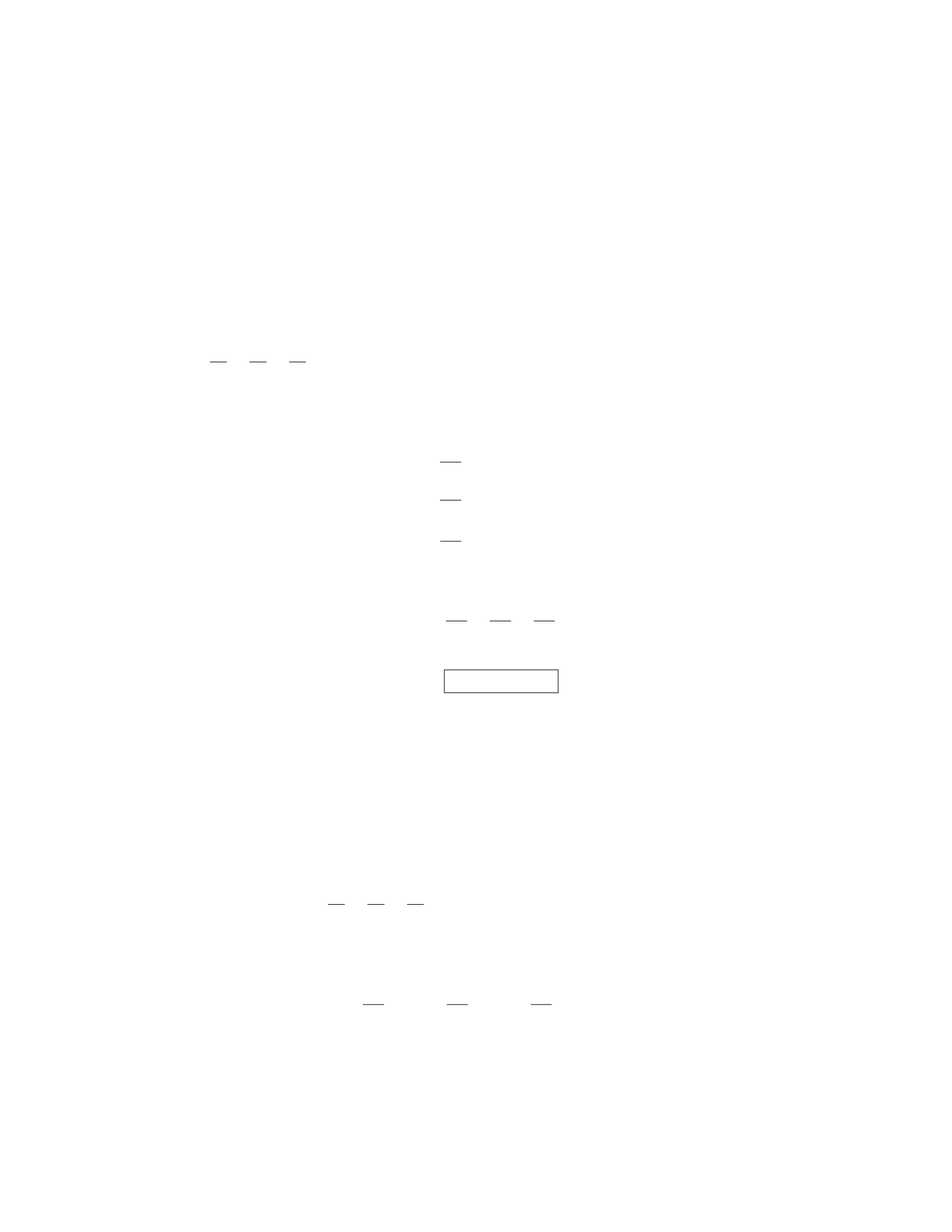
To calculate the curl of a vector field F(x, y, z)=(P(x, y, z), Q(x, y, z), R(x, y, z)),
we use the formula:
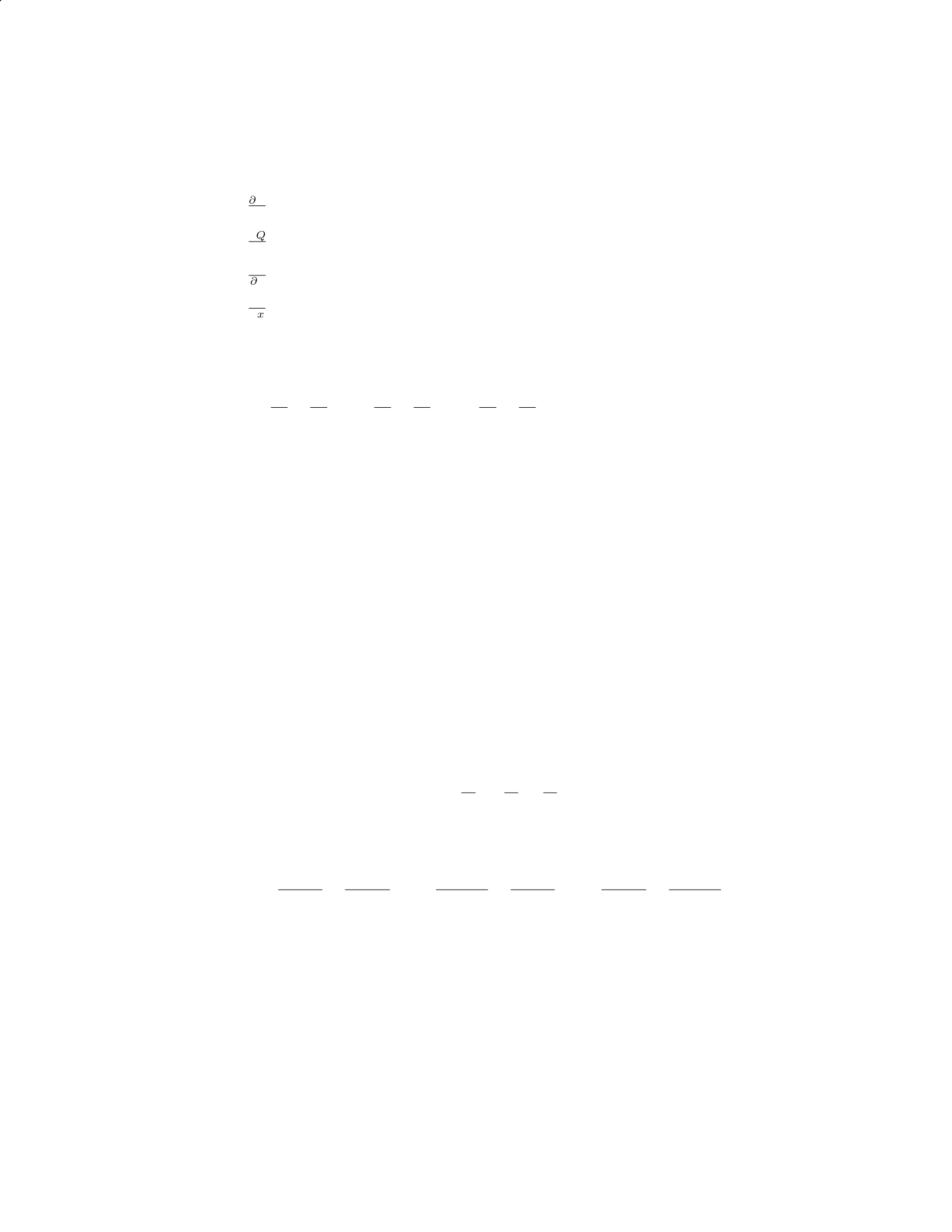
curl(F) = ∂R
∂y −∂Q
∂z ,∂P
∂z −∂R
∂x ,∂Q
∂x −∂P
∂y
Step 1: Calculate the partial derivatives of P,Q, and R:
P(x, y, z) = 2xy +x2z,
Q(x, y, z) = x2y+z,
R(x, y, z) = xyz.
Step 2: Calculate the curl of F:
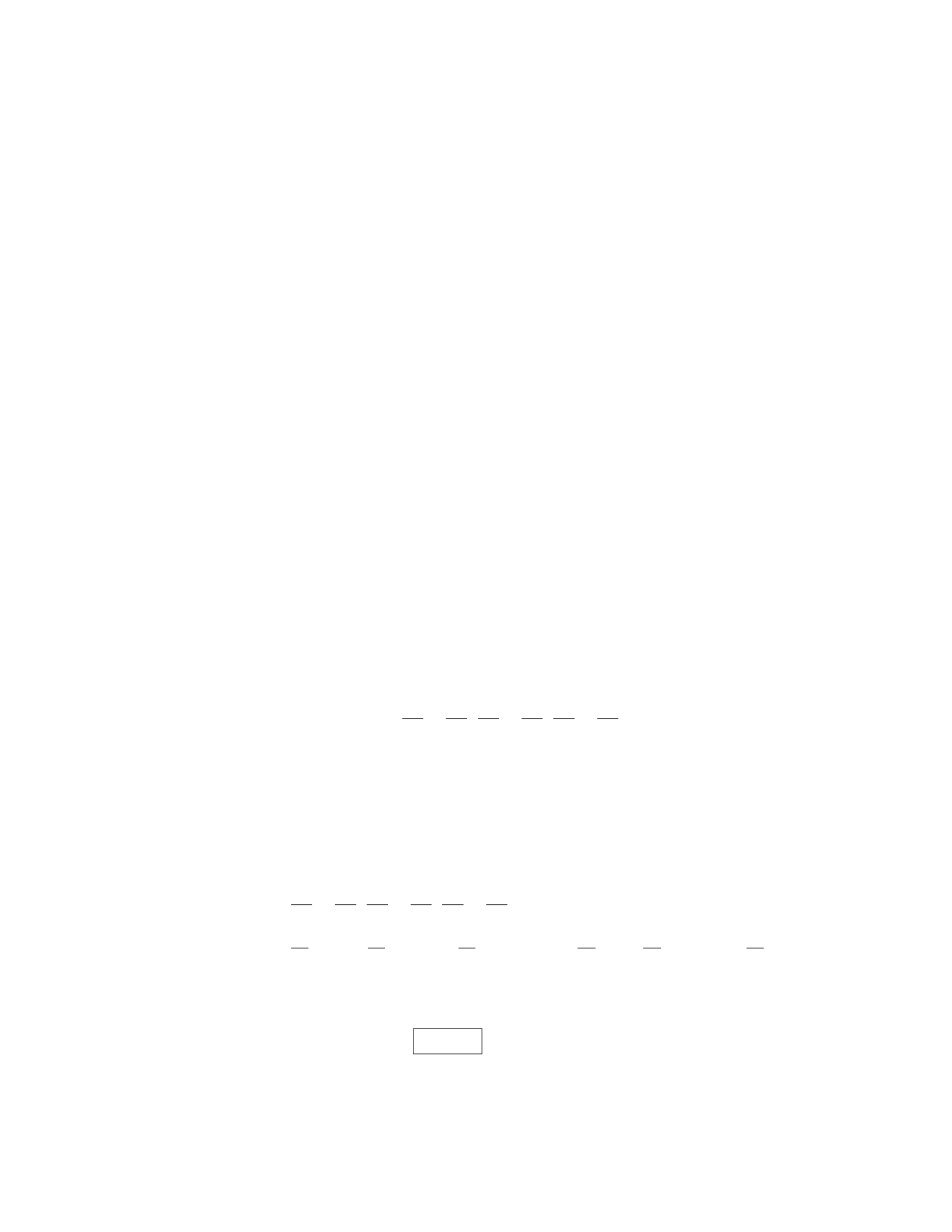
curl(F) = ∂R
∂y −∂Q
∂z ,∂P
∂z −∂R
∂x ,∂Q
∂x −∂P
∂y
=∂
∂y (xyz)−∂
∂z (x2y+z),∂
∂z (2xy +x2z)−∂
∂x (xyz),∂
∂x (x2y+z)−∂
∂y (2xy +x2z)
= (xz −0,2y−y, 2x−2x)
= (xz, y, 0) .
Therefore, the curl of Fis (xz, y, 0) .
Question 2
Question
Let F(x, y, z) = x2yi+xyzj+xz2k. Compute the divergence of F.
Solution
Step 1: The divergence of a vector field F=Pi+Qj+Rkis defined as ∇ · F=
∂P
∂x +∂Q
∂y +∂R
∂z .
Step 2: Given F(x, y, z) = x2yi+xyzj+xz2k, we have P(x, y, z) = x2y,
Q(x, y, z) = xyz, and R(x, y, z) = xz2.
Step 3: Calculate the partial derivatives:
∂P
∂x = 2xy,
∂Q
∂y =xz,
∂R
∂z = 2xz.
Step 4: Now, find the divergence:
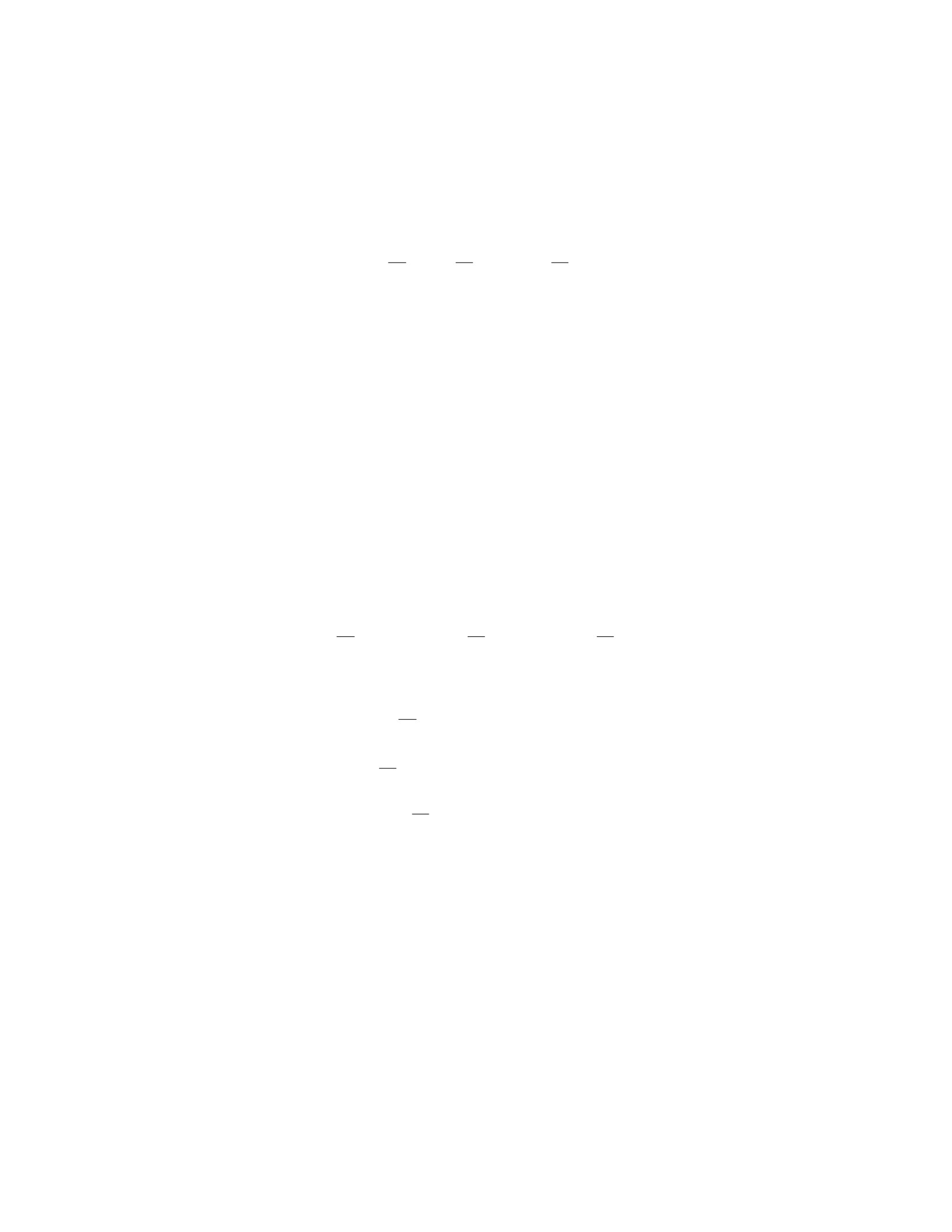
∇ · F=∂P
∂x +∂Q
∂y +∂R
∂z
= 2xy +xz + 2xz
= 2xy +xz + 2xz .
Question 3
Question
Let F(x, y, z) = (2xy +z)i+ (x2+y2)j+ (xy +z2)kbe a vector field in R3.
Calculate the divergence and curl of F.
Solution
Divergence: Step 1: The divergence of a vector field F=Pi+Qj+Rkis
given by ∇ · F=∂P
∂x +∂Q
∂y +∂R
∂z .
Step 2: In this case, F(x, y, z) = (2xy +z)i+ (x2+y2)j+ (xy +z2)k, where
P= 2xy +z,Q=x2+y2, and R=xy +z2.
Step 3: Calculate the partial derivatives:
∂P
∂x = 2y, ∂Q
∂y = 2y, ∂R
∂z = 2z
2
Step 4: The divergence of Fis:
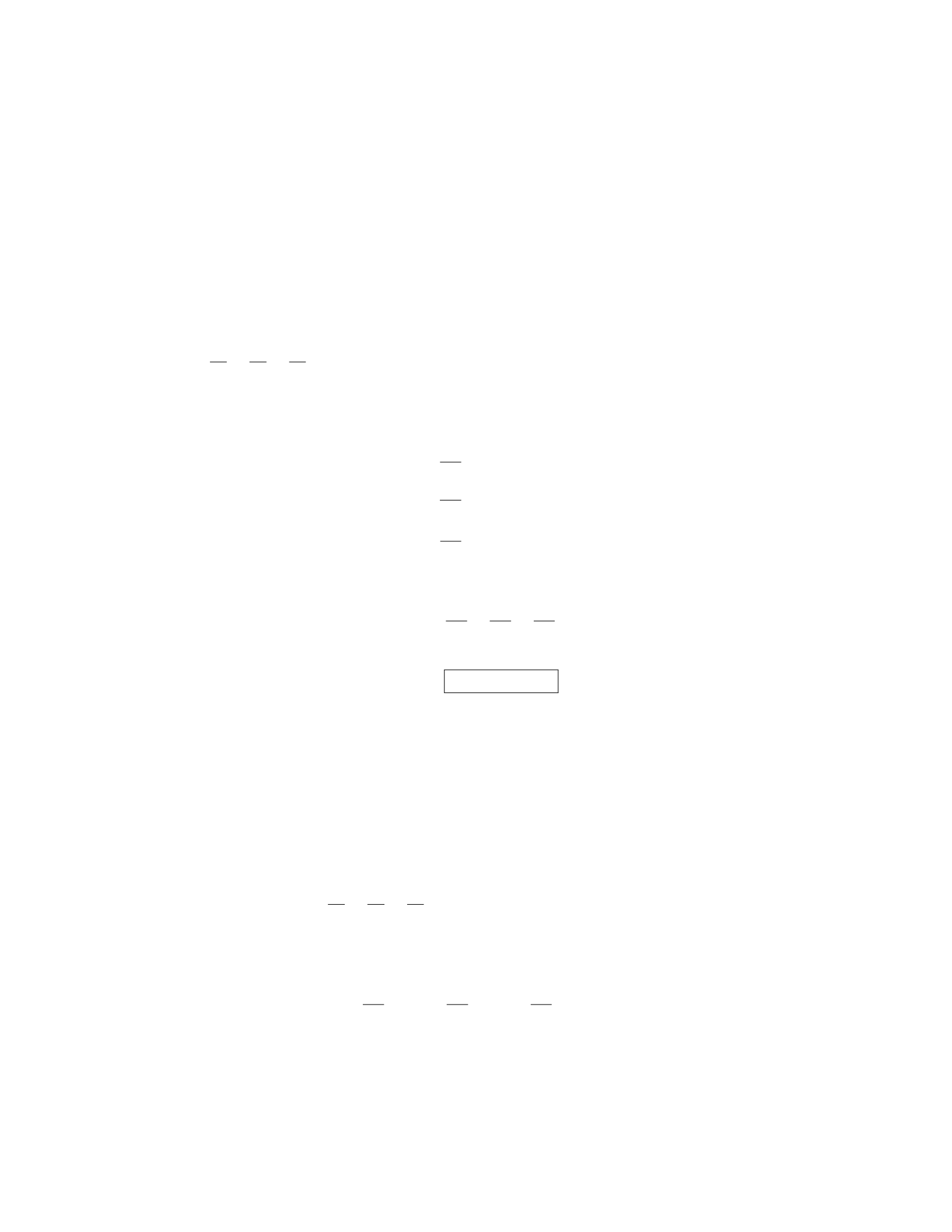
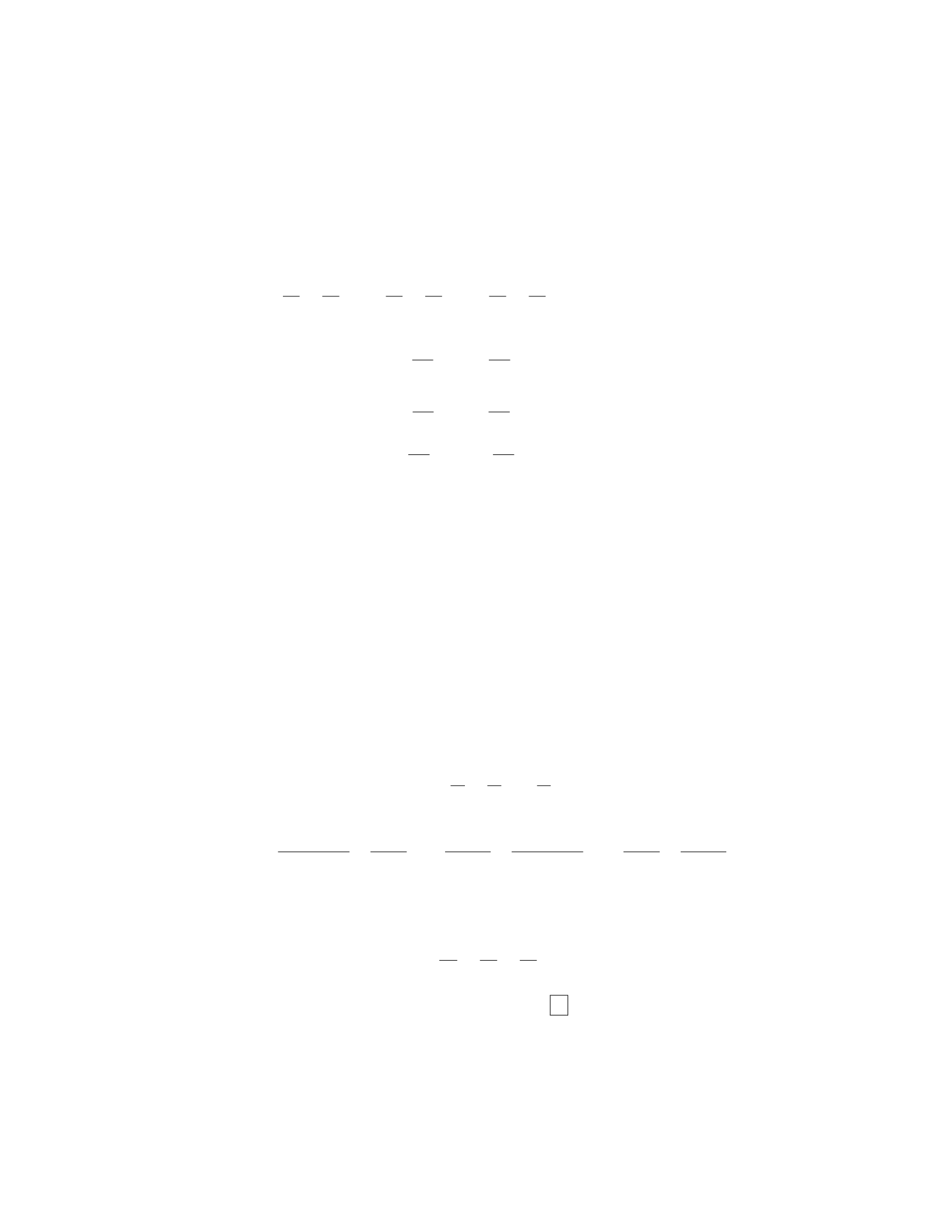
∇ · F= 2y+ 2y+ 2z= 4y+ 2z
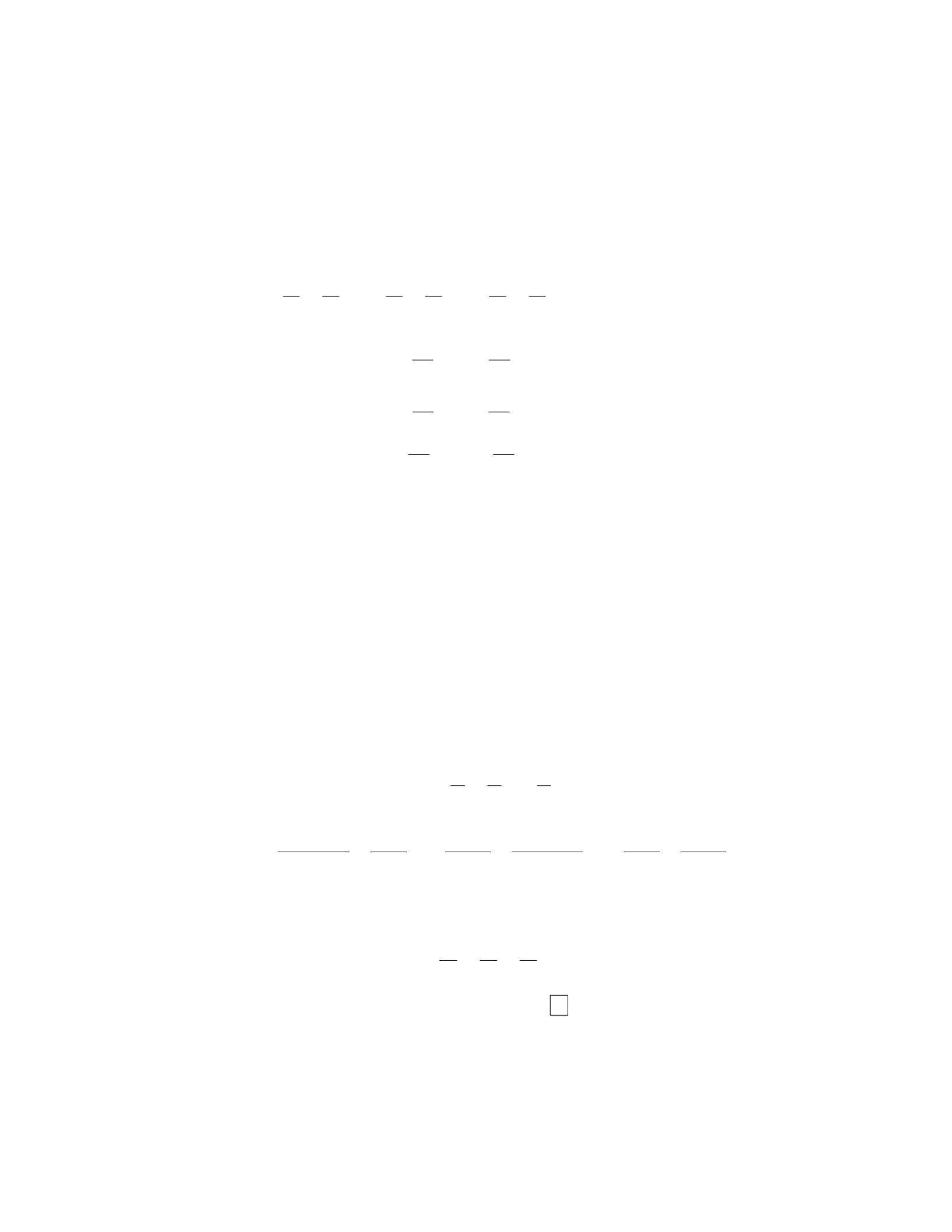
Curl: Step 1: The curl of a vector field F=Pi+Qj+Rkis given by
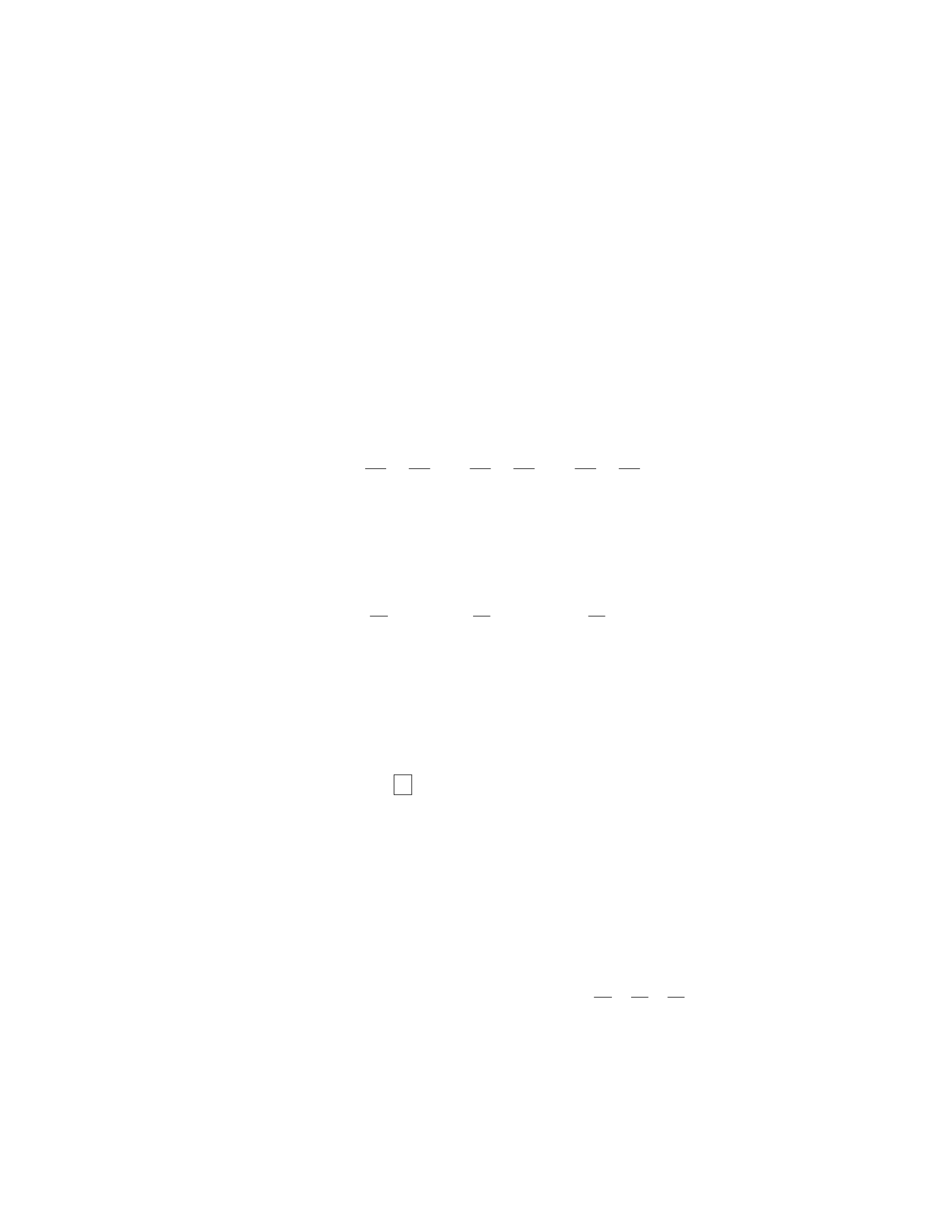
∇ × F=∂R
∂y −∂Q
∂z i−∂R
∂x −∂P
∂z j+∂Q
∂x −∂P
∂y k.
Step 2: Calculate the partial derivatives for the curl:
∂R
∂y =x, ∂Q
∂z = 0
∂R
∂x =y, ∂P
∂z = 0
∂Q
∂x = 2x, ∂P
∂y = 0
Step 3: The curl of Fis:
∇ × F= (x−0)i−(y−0)j+ (2x−0)k=xi−yj+ 2xk
Question 4
Question
Let F(x, y, z)=2xzˆ
i+y2ˆ
j+ (2x2−z)ˆ
kbe a vector field in R3. Compute
∇ · ∇ × F.
Solution
Step 1: Compute the curl of the vector field F.
∇ × F=
ˆ
iˆ
jˆ
k
∂
∂x
∂
∂y
∂
∂z
2xz y22x2−z
∇ × F= (∂(2x2−z)
∂y −∂(y2)
∂z )ˆ
i−(∂(2xz)
∂z −∂(2x2−z)
∂x )ˆ
j+ (∂(y2)
∂x −∂(2xz)
∂y )ˆ
k
∇ × F= 0ˆ
i+ 0ˆ
j+ 0ˆ
k=0
Step 2: Compute the divergence of the zero vector field.
∇ · 0=∂0
∂x +∂0
∂y +∂0
∂z = 0
Step 3: The result suggests that ∇ · ∇ × F= 0 .
3

Question 5
Question
Let F(x, y, z)=(eycos(z),−xeysin(z),−yeysin(z)). Calculate the divergence
of F.
Solution
To calculate the divergence of a vector field F= (P, Q, R), we use the formula:
div(F) = ∂P
∂x +∂Q
∂y +∂R
∂z .
In this case, F(x, y, z)=(eycos(z),−xeysin(z),−yeysin(z)), so P=eycos(z),
Q=−xeysin(z), and R=−yeysin(z).
Step 1: Calculate ∂P
∂x :
∂P
∂x = 0
Step 2: Calculate ∂Q
∂y :
∂Q
∂y =−eysin(z)−xeycos(z)
Step 3: Calculate ∂R
∂z :
∂R
∂z =−yeycos(z)
Step 4: Add up the partial derivatives to find the divergence:
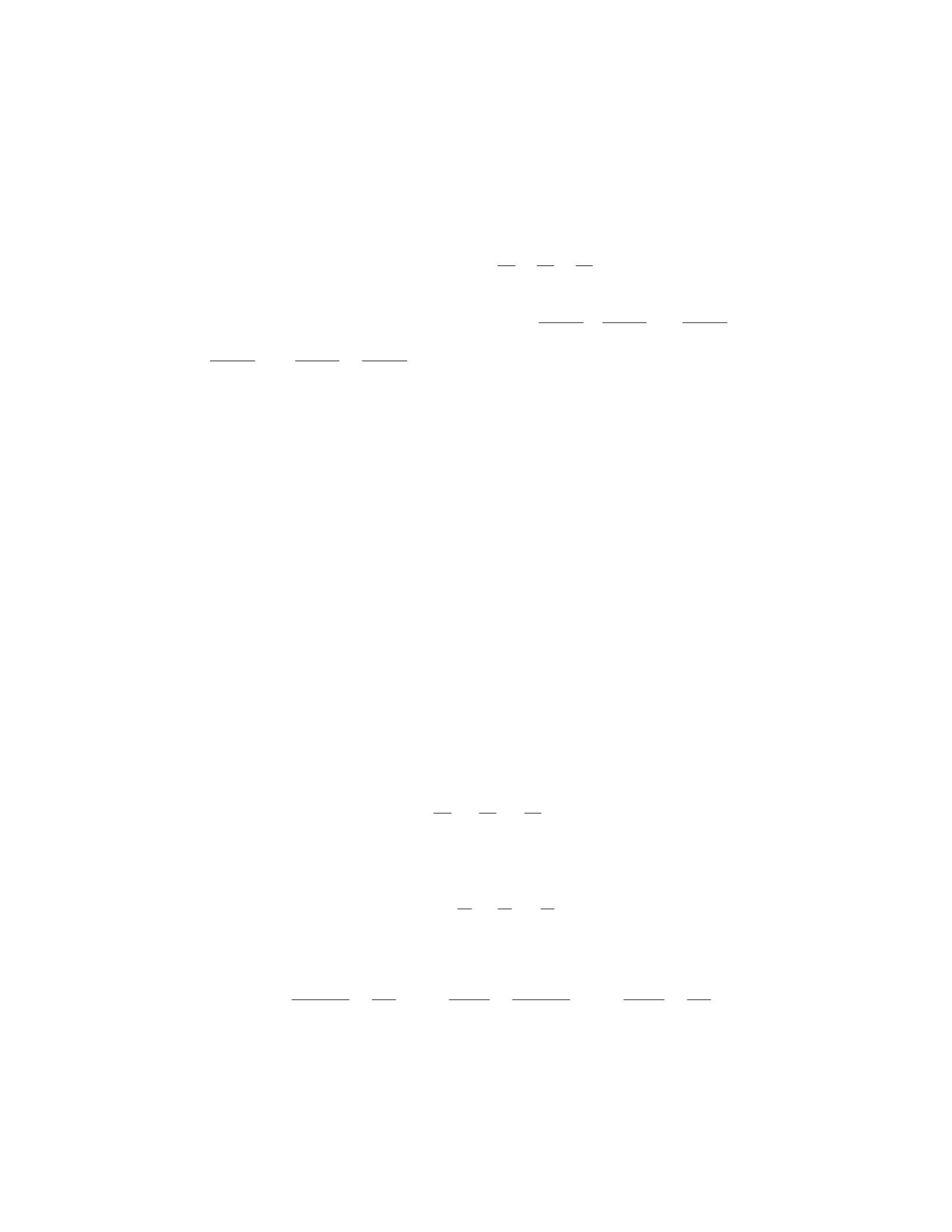
div(F) = ∂P
∂x +∂Q
∂y +∂R
∂z = 0 −eysin(z)−xeycos(z)−yeycos(z)
Therefore, the divergence of Fis div(F) = −eysin(z)−xeycos(z)−yeycos(z).
Question 6
Question
Let F(x, y, z)=(yz +x2)i+ (xz +y2)j+ (xy +z2)k. Compute the divergence
of F.
Solution
To compute the divergence of F, we use the formula:
div F=∇ · F=∂P
∂x +∂Q
∂y +∂R
∂z ,
where F(x, y, z) = P(x, y, z)i+Q(x, y, z)j+R(x, y, z)k.
4
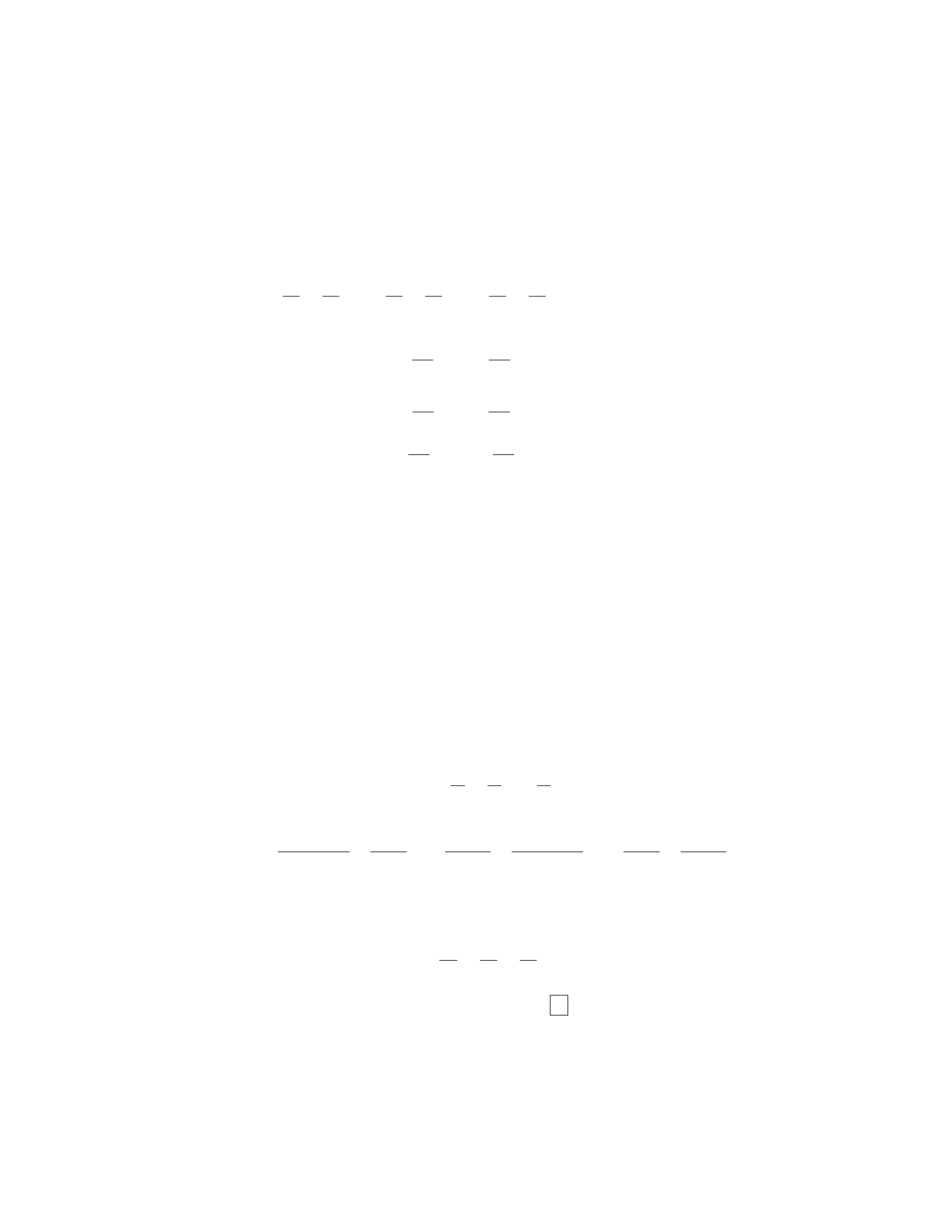
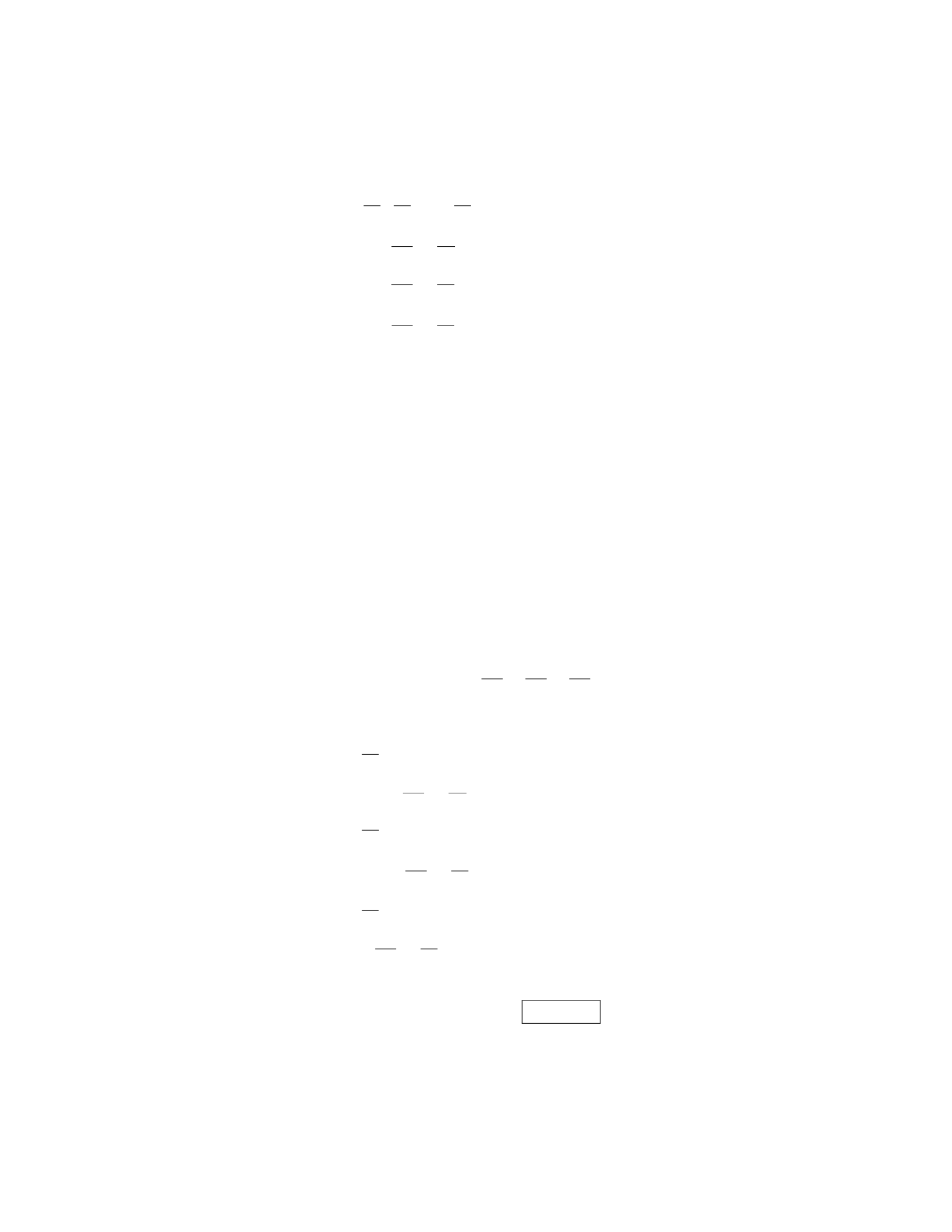
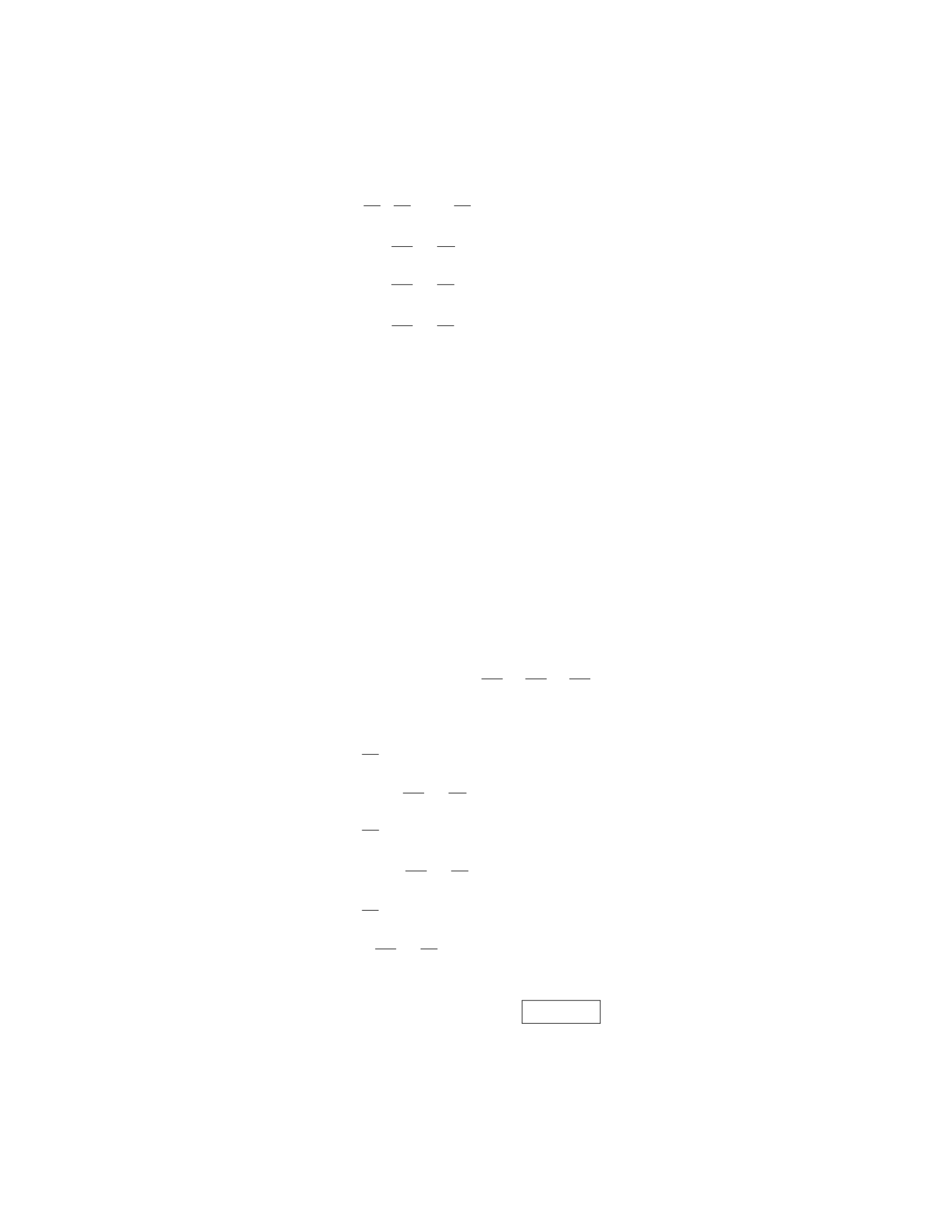
Step 1: Calculate ∂P
∂x ,∂Q
∂y , and ∂R
∂z :
∂P
∂x =∂
∂x (yz +x2) = 2x,
∂Q
∂y =∂
∂y (xz +y2) = x,
∂R
∂z =∂
∂z (xy +z2)=1.
Step 2: Compute the divergence:
div F= 2x+x+ 1 = 3x+ 1.
Therefore, the divergence of Fis 3x+ 1.
Question 7
Question
Let F(x, y, z)=(x2y, −2xz, xz2) be a vector field. Compute the divergence of
F.
Solution
To compute the divergence of F, we use the formula for the divergence of a
vector field F(x, y, z)=(P(x, y, z), Q(x, y, z), R(x, y, z)):
div(F) = ∇ · F=∂P
∂x +∂Q
∂y +∂R
∂z
In this case, F(x, y, z)=(x2y, −2xz, xz2), so P(x, y, z) = x2y,Q(x, y, z) =
−2xz, and R(x, y, z) = xz2.
Step 1: Compute ∂P
∂x :
∂P
∂x =∂
∂x (x2y) = 2xy
Step 2: Compute ∂Q
∂y :
∂Q
∂y =∂
∂y (−2xz) = 0
Step 3: Compute ∂R
∂z :
∂R
∂z =∂
∂z (xz2) = x(2z)=2xz
Step 4: Add the partial derivatives together:
∇ · F= 2xy + 0 + 2xz = 2xy + 2xz
Therefore, the divergence of Fis 2xy + 2xz.
5
Question 8
Question
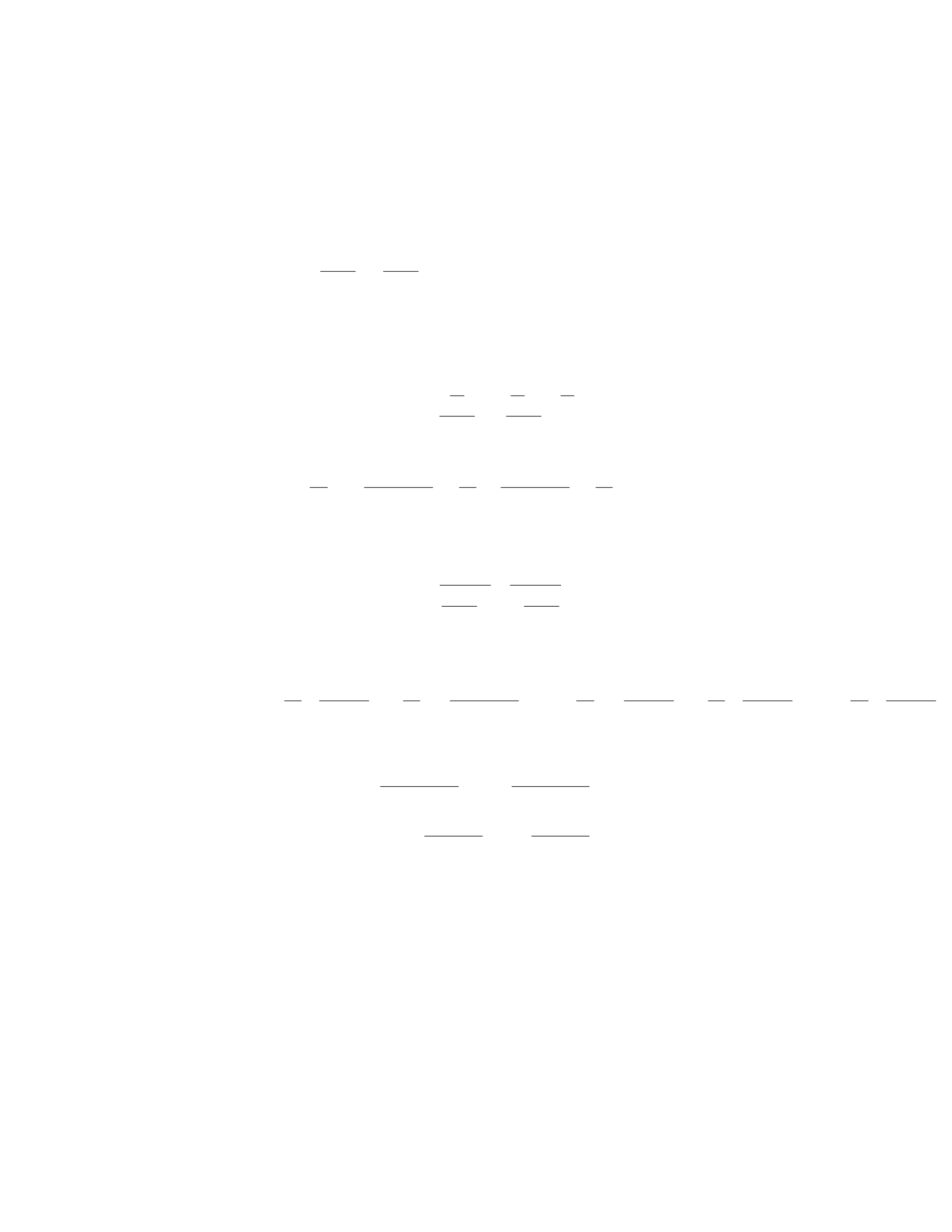
Let F(x, y, z) = y
x2+y2i−x
x2+y2j+zk. Calculate the curl of F.
Solution
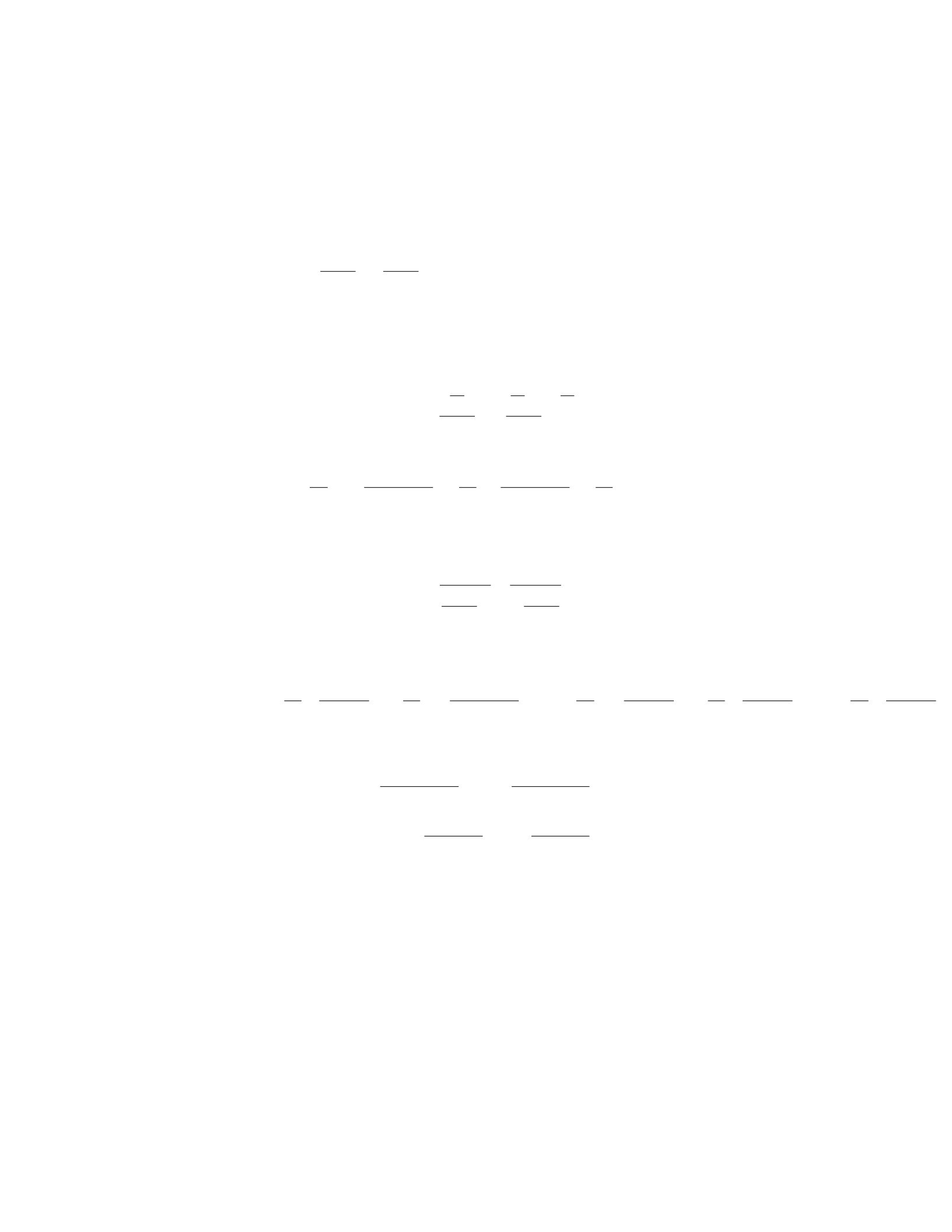
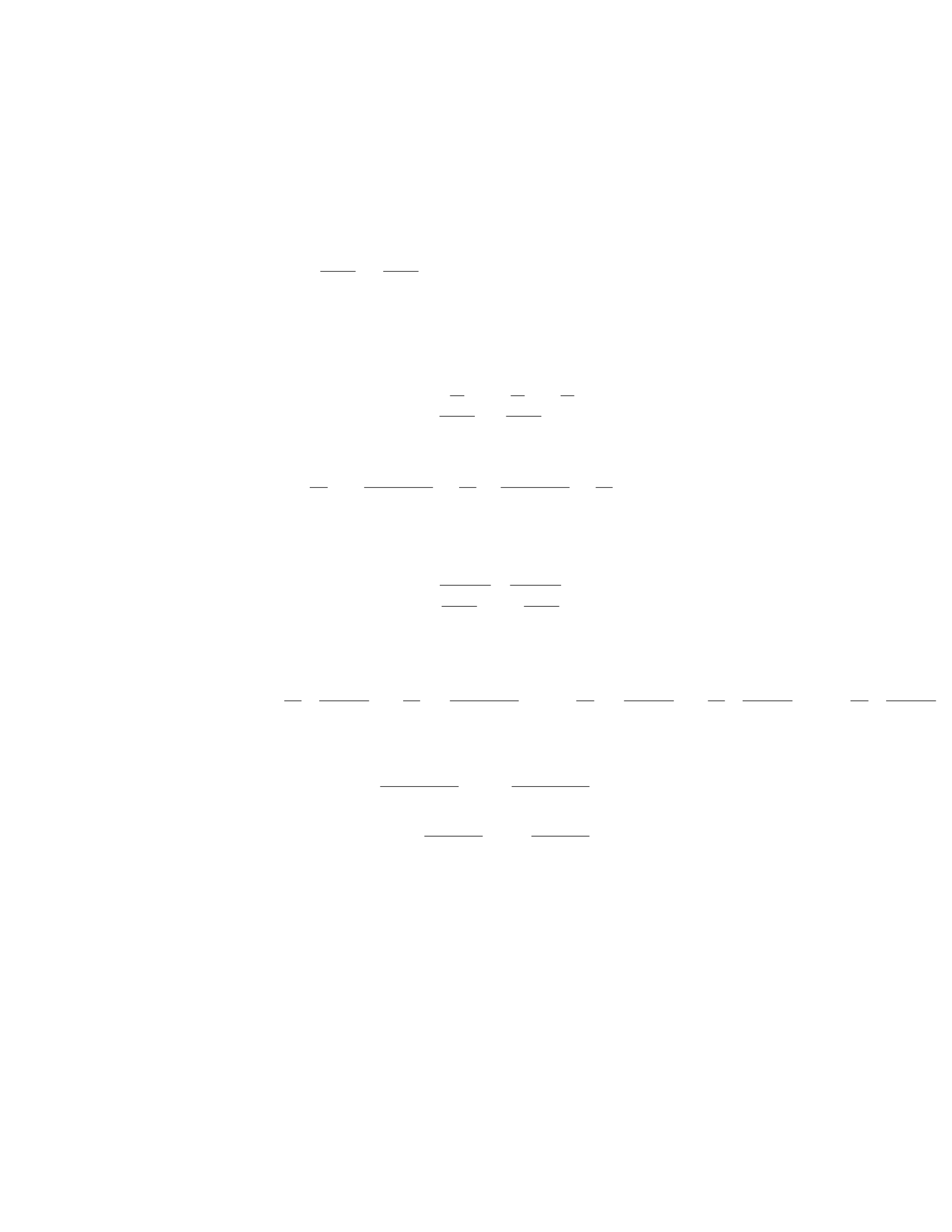
To find the curl of F, we need to compute the determinant of the following
matrix:
curl F=
i j k
∂
∂x
∂
∂y
∂
∂z
y
x2+y2−x
x2+y2z
Step 1: Compute the partial derivatives of F:
∂
∂x =−y(2x)
(x2+y2)2,∂
∂y =x(2x)
(x2+y2)2,∂
∂z = 1
Step 2: Substitute the partial derivatives into the determinant expression:
curl F=
i j k
−y(2x)
(x2+y2)2
x(2x)
(x2+y2)21
y
x2+y2−x
x2+y2z
Step 3: Expand the determinant using the cofactor expansion along the top
row:
curl F=∂
∂y x
x2+y2−∂
∂z −y(2x)
(x2+y2)2i−∂
∂x −x
x2+y2−∂
∂z y
x2+y2j+∂
∂x y
x2+y2−∂
∂y −x
x2+y2k
Step 4: Simplify the expressions to obtain the components of the curl:
curl F=2x(x2−y2)
(x2+y2)2i+2y(x2−y2)
(x2+y2)2j+ 0k
Therefore, the curl of Fis 2x(x2
−y2)
(x2+y2)2i+2y(x2
−y2)
(x2+y2)2j.
Question 9
Question
Let F(x, y, z) = 2x2yi+x2zj+x2yk. Determine the divergence of Fat the
point (1,2,3).
6
Solution
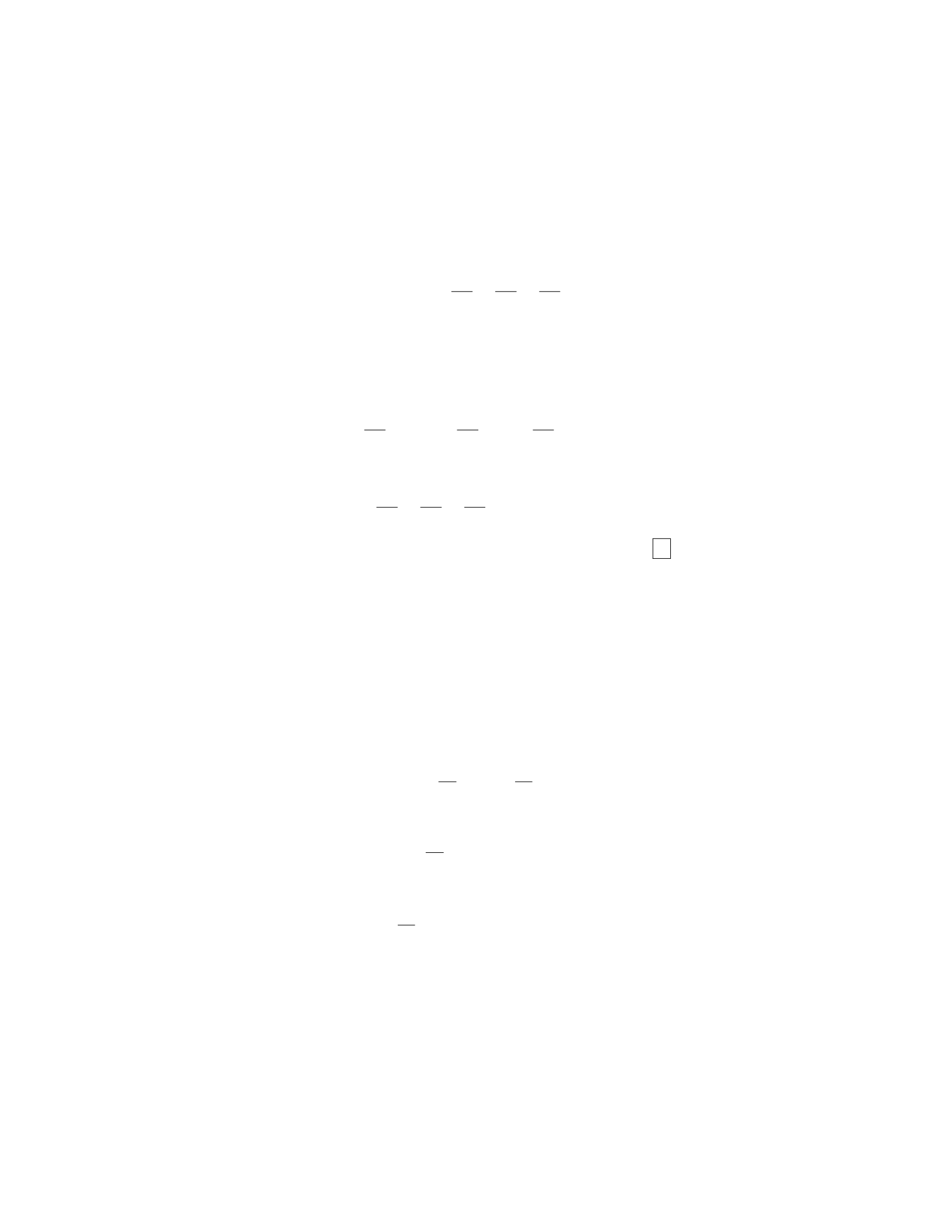
Step 1: The divergence of a vector field F(x, y, z) = P(x, y, z)i+Q(x, y, z)j+
R(x, y, z)kis given by the formula:
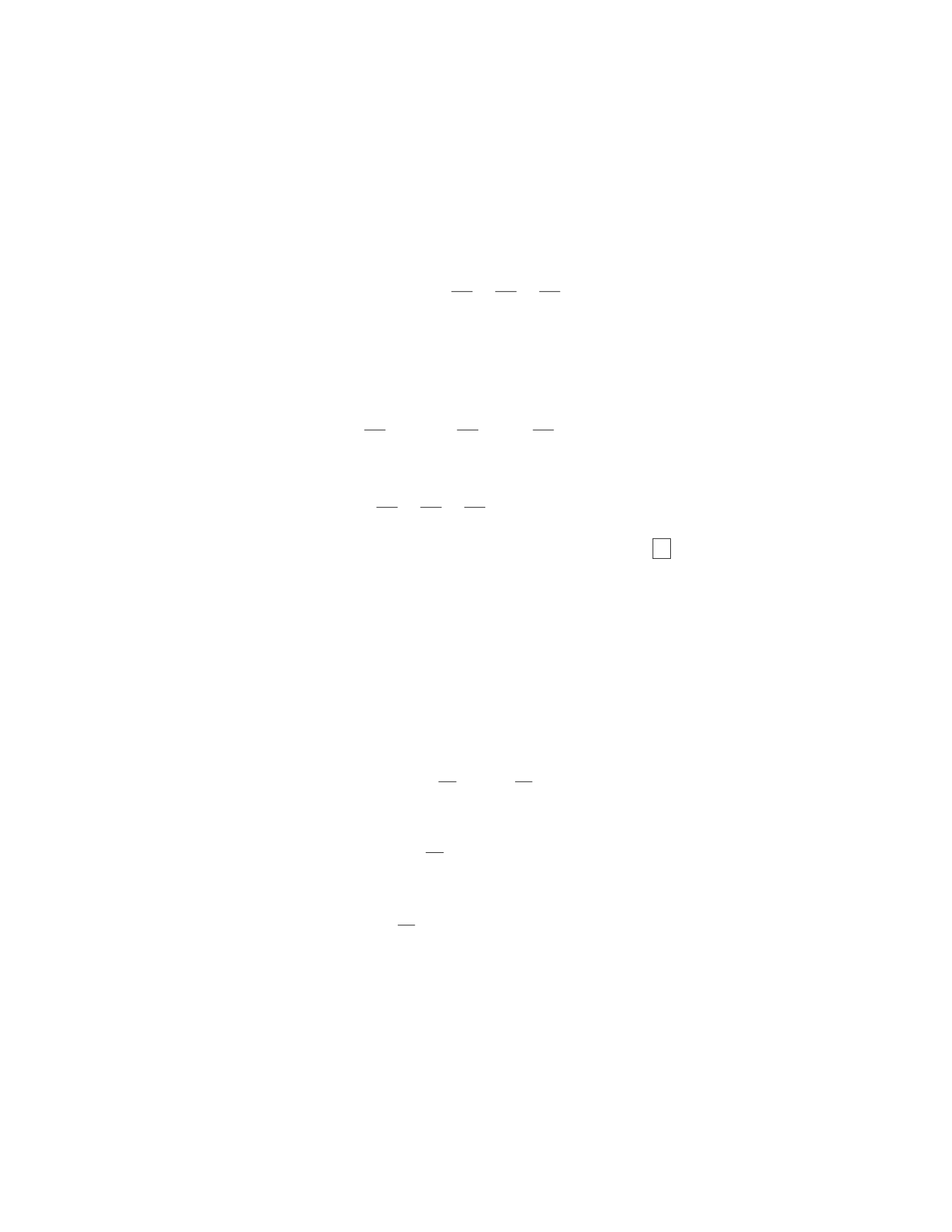
div(F) = ∂P
∂x +∂Q
∂y +∂R
∂z .
Step 2: Given F(x, y, z)=2x2yi+x2zj+x2yk, we have:
P(x, y, z)=2x2y, Q(x, y, z) = x2z, R(x, y, z) = x2y.
Step 3: Calculate the partial derivatives:
∂P
∂x = 4xy, ∂Q
∂y = 0,∂R
∂z = 0.
Step 4: The divergence of Fat the point (1,2,3) is then:
div(F) = ∂P
∂x +∂Q
∂y +∂R
∂z = 4(1)(2) + 0 + 0 = 8.
Step 5: Therefore, the divergence of Fat the point (1,2,3) is 8 .
Question 10
Question
Let F(x, y) = ⟨x2y, xy2⟩be a vector field. Compute the divergence of F.
Solution
To find the divergence of the vector field F(x, y) = ⟨x2y, xy2⟩, we use the formula
for divergence:
∇ · F=∂
∂x (x2y) + ∂
∂y (xy2)
Step 1: Compute the partial derivative with respect to x:
∂
∂x (x2y)=2xy
Step 2: Compute the partial derivative with respect to y:
∂
∂y (xy2) = x·2y= 2xy
Step 3: Add the two partial derivatives together to find the divergence:
∇ · F= 2xy + 2xy = 4xy
Therefore, the divergence of the vector field F(x, y) = ⟨x2y, xy2⟩is ∇ · F=
4xy.
7
Question 11
Question
Let F(x, y, z) = x2yi+e2zj+xyzkbe a vector field in R3. Compute the
divergence of F.
Solution
To find the divergence of a vector field F=Pi+Qj+Rk, we use the formula
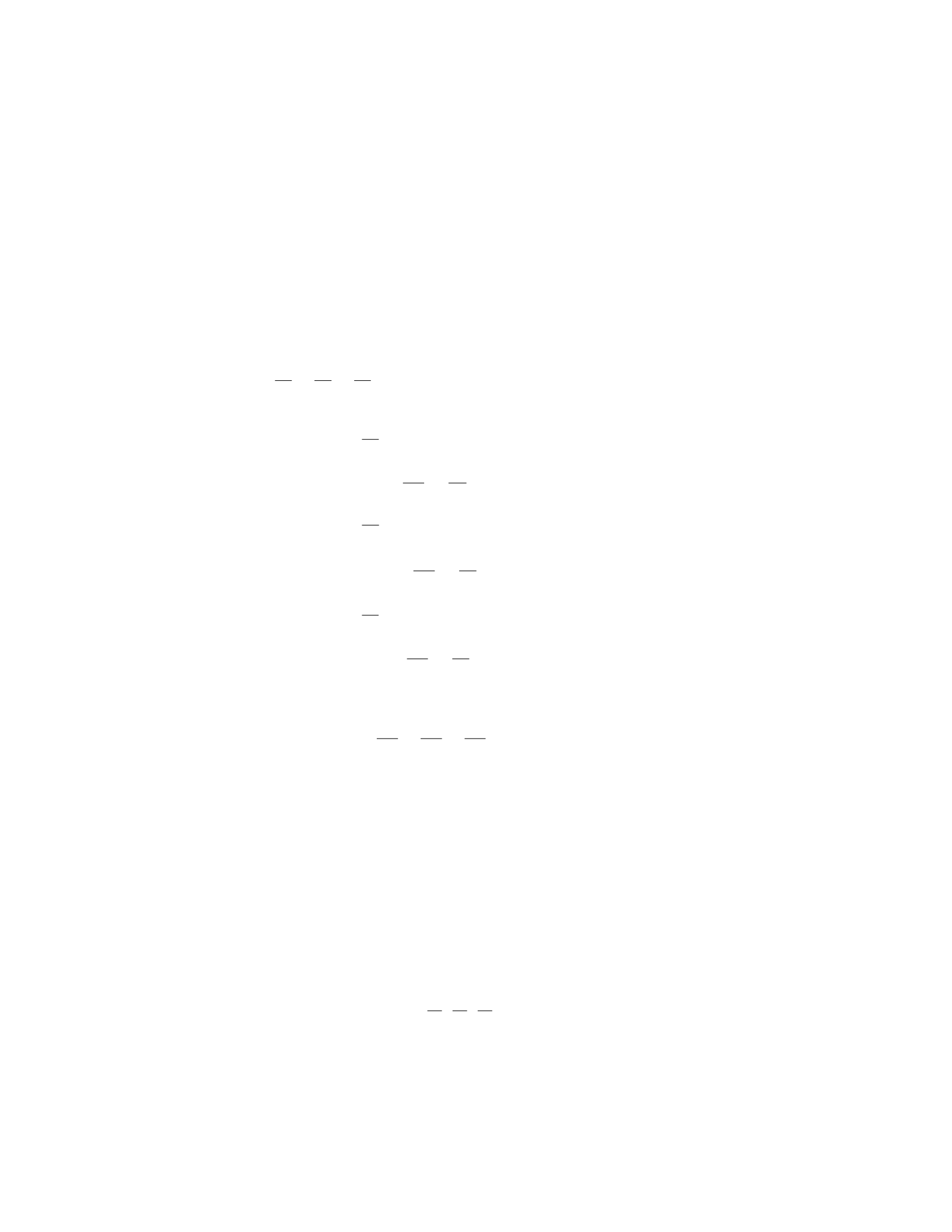
div(F) = ∂P
∂x +∂Q
∂y +∂R
∂z .
In this case, F(x, y, z) = x2yi+e2zj+xyzk, so P=x2y,Q=e2z, and
R=xyz.
Step 1: Compute ∂P
∂x .
∂P
∂x =∂
∂x (x2y) = 2xy
Step 2: Compute ∂Q
∂y .
∂Q
∂y =∂
∂y (e2z)=0
Step 3: Compute ∂R
∂z .
∂R
∂z =∂
∂z (xyz) = xy
Step 4: Compute the divergence of F.
div(F) = ∂P
∂x +∂Q
∂y +∂R
∂z = 2xy +0+xy = 3xy
Therefore, the divergence of Fis div(F) = 3xy.
Question 12
Question
Let F(x, y, z) = (2xy+zex, x2−zcos(y), y2+ez) be a vector field in R3. Calculate
the gradient, divergence, and curl of F.
Solution
Step 1: Calculate the gradient of F. The gradient of a vector field F=
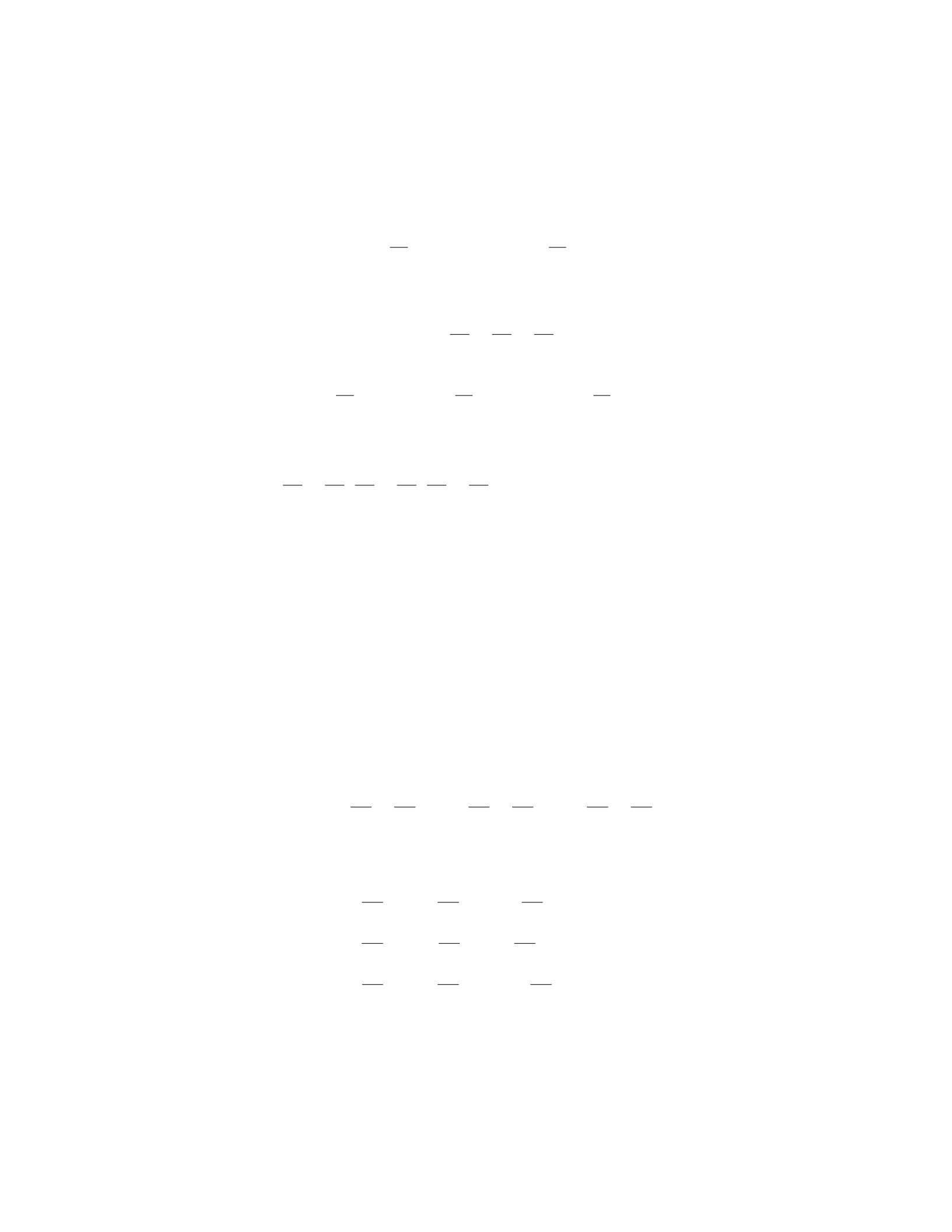
(f1, f2, f3) is given by ∇ · F=∂f
∂x ,∂f
∂y ,∂f
∂z .
8
So, for F(x, y, z) = (2xy +zex, x2−zcos(y), y2+ez), we have:
∇ · F=2y+ex+∂
∂x (zex),2x−cos(y)−∂
∂y (zcos(y)),2y+ez
= (2y+ex+zex,2x−cos(y) + zsin(y),2y+ez)
Step 2: Calculate the divergence of F. The divergence of a vector field
F= (f1, f2, f3) is given by ∇ · F=∂f1
∂x +∂f2
∂y +∂f3
∂z .
For F(x, y, z) above, the divergence is:
∇ · F=∂
∂x (2xy +zex) + ∂
∂y (x2−zcos(y)) + ∂
∂z (y2+ez)
= 2y+ex+ 2x−cos(y)+1
Step 3: Calculate the curl of F. The curl of a vector field Fis given by
∇ × F=∂f3
∂y −∂f2
∂z ,∂f1
∂z −∂f3
∂x ,∂f2
∂x −∂f1
∂y .
Thus, for F(x, y, z), the curl is:
∇ × F= (1 −0, ex−0,−2y−0)
= (1, ex,−2y)
Question 13
Question
Let F(x, y, z) = x2yi+xyzj+ (x+y+z)k. Compute ∇ · ∇ × F.
Solution
Step 1: Compute ∇ × F. The curl of a vector field F=Pi+Qj+Rkis given
by:
∇ × F=∂R
∂y −∂Q
∂z i−∂R
∂x −∂P
∂z j+∂Q
∂x −∂P
∂y k
In our case, F=x2yi+xyzj+(x+y+z)k, so P=x2y,Q=xyz,R=x+y+z.
Now, compute the partial derivatives:
∂P
∂z = 0,∂Q
∂x =yz, ∂R
∂y = 1
∂Q
∂z =x, ∂R
∂x = 1,∂P
∂y =x2
∂R
∂z = 1,∂P
∂x = 2xy, ∂Q
∂y =xz
So,
∇ × F= (x−xz)i−(1 −x2)j+ (xz −2xy)k
9
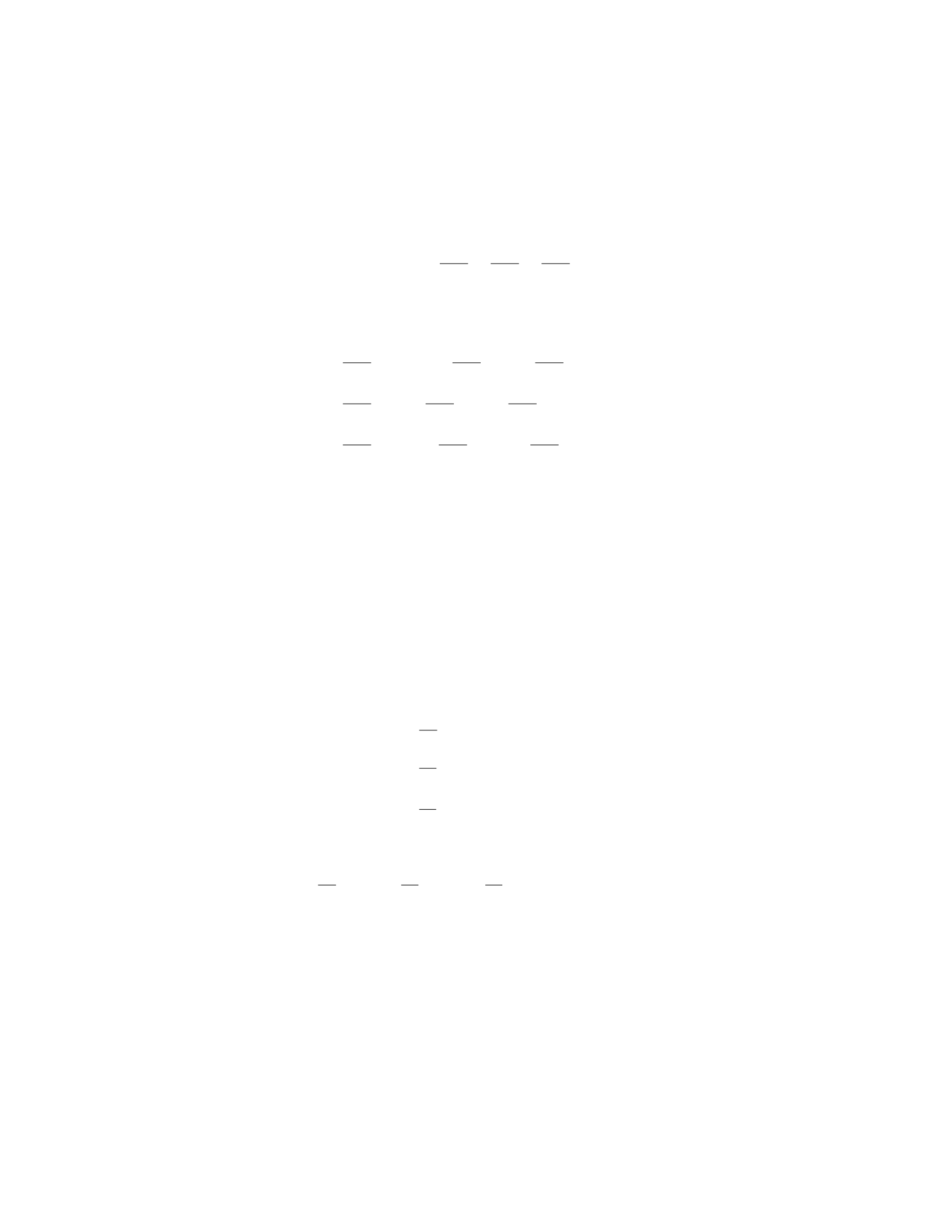
Step 2: Compute ∇·∇×F. The divergence of a vector field G=G1i+
G2j+G3kis given by:
∇ · G=∂G1
∂x +∂G2
∂y +∂G3
∂z
In our case, G= (x−xz)i−(1 −x2)j+ (xz −2xy)k, so G1=x−xz,
G2=−1 + x2,G3=xz −2xy. Now, compute the partial derivatives:
∂G1
∂x = 1 −z, ∂G2
∂y = 0,∂G3
∂z =x
∂G1
∂y = 0,∂G2
∂z = 0,∂G3
∂x =z−2y
∂G1
∂z =−x, ∂G2
∂x = 2x, ∂G3
∂y =−2x
So,
∇ · ∇ × F= (1 −z)+(z−2x) = 1 −2x
Question 14
Question
Let F(x, y, z)=(x2ey, ye−z, z2ex). Find ∇ · F.
Solution
Step 1: Compute the partial derivatives of each component of F.
∂
∂x (x2ey)=2xey
∂
∂y (ye−z) = e−z
∂
∂z (z2ex)=2zex
Step 2: Take the dot product of ∇with F.
∇ · F=∂
∂x (x2ey) + ∂
∂y (ye−z) + ∂
∂z (z2ex)=2xey+e−z+ 2zex
Therefore, ∇ · F= 2xey+e−z+ 2zex.
Question 15
Question
Let F=xzi+ (x+y)zj+ (x+y2)kbe a vector field in R3. Calculate ∇ · F.
10
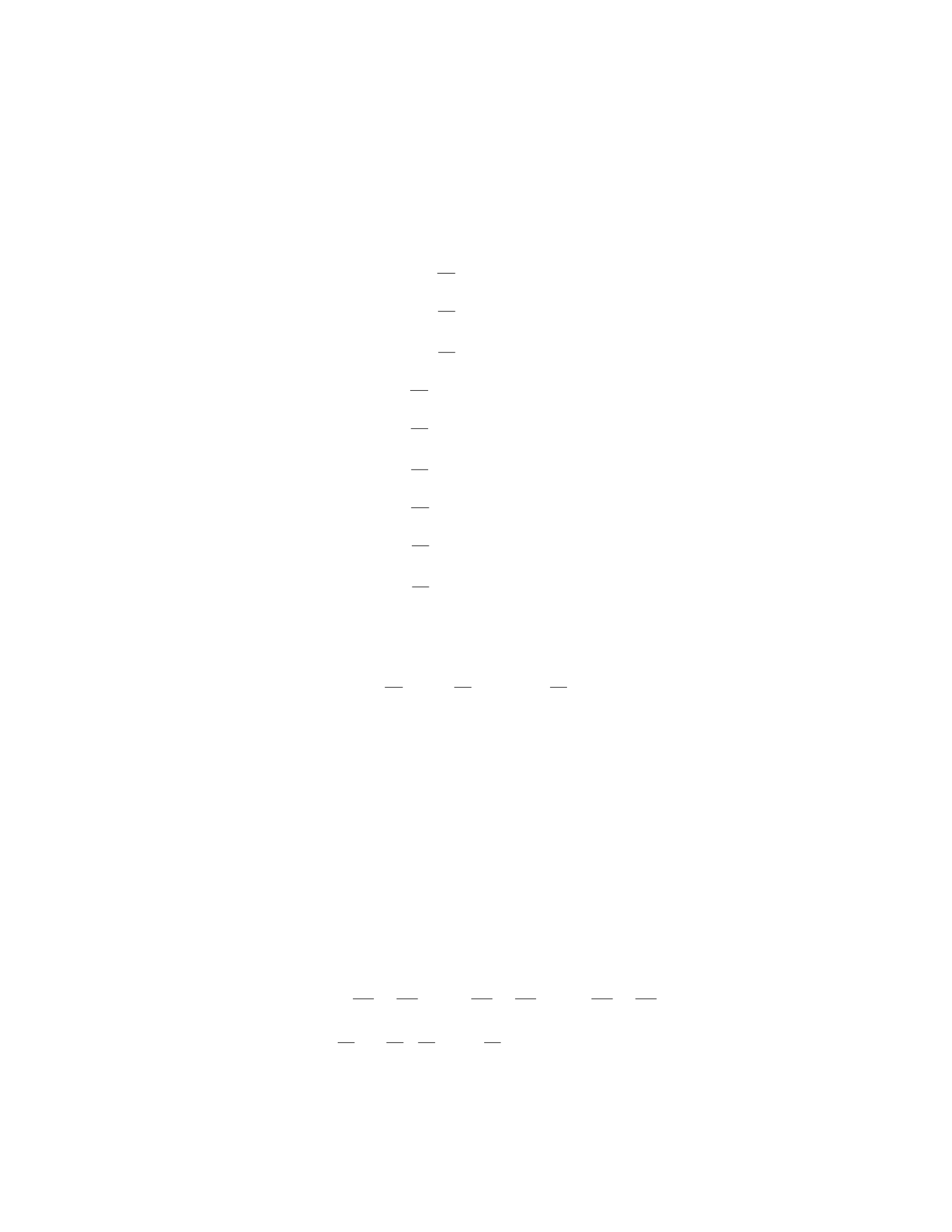
Solution
Step 1: Calculate the partial derivatives of each component of F.
∂
∂x (xz) = z
∂
∂y (xz) = 0
∂
∂z (xz) = x
∂
∂x (x+y)z=z
∂
∂y (x+y)z=z
∂
∂z (x+y)z=x+y
∂
∂x (x+y2) = 1
∂
∂y (x+y2) = 2y
∂
∂z (x+y2) = 0
Step 2: Calculate the divergence of F.
∇ · F=∂
∂x (xz) + ∂
∂y (x+y)z+∂
∂z (x+y2)
=z+z+x+y= 2z+x+y
Therefore, the divergence of Fis 2z+x+y.
Question 16
Question
Let F(x, y, z) = exsin(y)i+eycos(z)j+ezsin(x)k. Determine the curl of F.
Solution
To find the curl of F, we can use the formula for the curl of a vector field
F=P i +Qj +Rk:
curl(F) = ∂R
∂y −∂Q
∂z i+∂P
∂z −∂R
∂x j+∂Q
∂x −∂P
∂y k
Step 1: Find ∂P ∂y,∂Q
∂z ,∂Q
∂x , and ∂R
∂x .
11
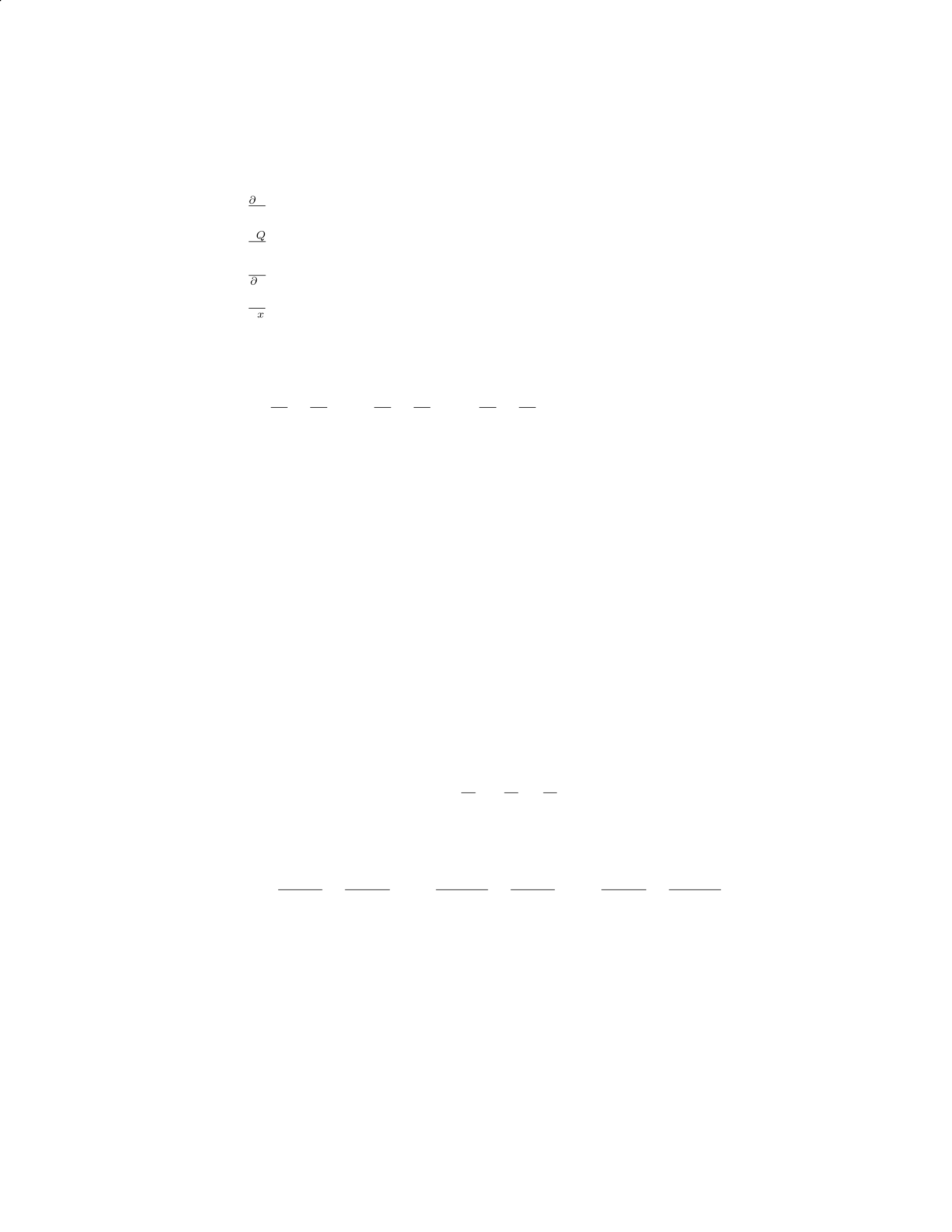
∂P
∂y =excos(y)
∂Q
∂z =−eysin(z)
∂Q
∂x = 0
∂R
∂x =ezcos(x)
Step 2: Calculate the components of the curl.
) = ∂R
∂y −∂Q
∂z i+∂P
∂z −∂R
∂x j+∂Q
∂x −∂P
∂y k
= (0 −(−eysin(z))) i+ (0 −ezcos(x)) j+ (0 −excos(y)) k
=eysin(z)i−ezcos(x)j−excos(y)k
Therefore, the curl of Fis curl(F) = eysin(z)i−ezcos(x)j−excos(y)k.
Question 17
Question
Let F(x, y, z)=(x2y3, xz2, y2z). Calculate ∇ · (∇ × F).
Solution
Step 1: Find ∇ × F. Step 2: Find ∇ · (∇ × F).
Step 1: We have F(x, y, z)=(x2y3, xz2, y2z).
The curl of F, denoted ∇ × F, is given by:
∇ × F=
i j k
∂
∂x
∂
∂y
∂
∂z
x2y3xz2y2z
Calculating the determinant, we get:
∇×F=∂(y2z)
∂y −∂(xz2)
∂z i−∂(x2y3)
∂x −∂(y2z)
∂z j+∂(xz2)
∂x −∂(x2y3)
∂y k
Simplifying further, we get:
∇ × F= (z2−0)i−(2xy3−0)j+ (2xz −3x2y2)k
So, ∇ × F= (z2)i−(2xy3)j+ (2xz −3x2y2)k.
Step 2: Now, we need to find ∇ · (∇ × F).
12
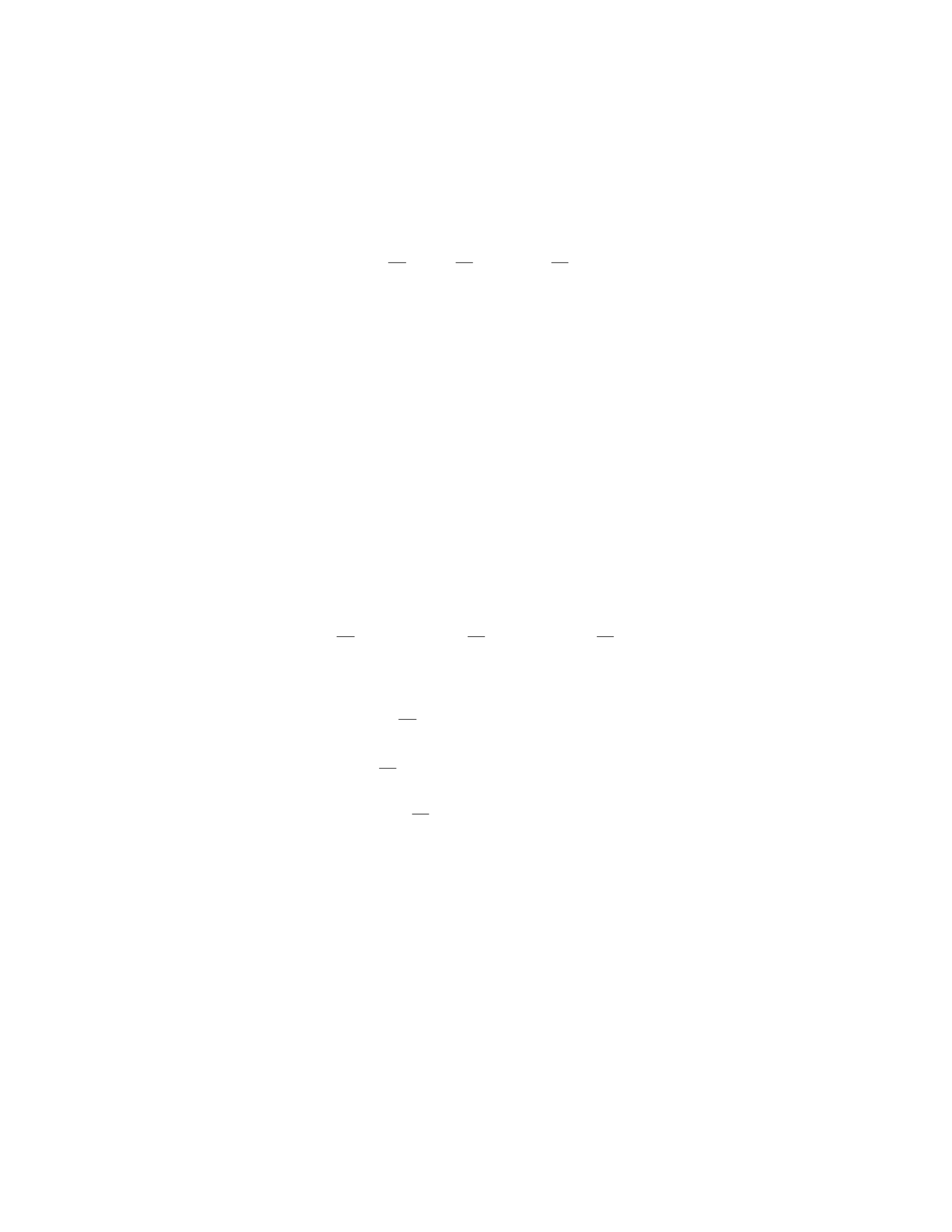
Since ∇ · (∇ × F) is equivalent to the divergence of the curl, we can compute
this as:
∇ · (∇ × F) = ∂
∂x (z2) + ∂
∂y (−2xy3) + ∂
∂z (2xz −3x2y2)
Solving these partial derivatives, we have:
∇ · (∇ × F)=0−6xy + 2x
Therefore, the final answer is ∇ · (∇ × F)=2x−6xy.
Question 18
Question
Let F(x, y, z) = 2x2y+yz3, x2z3−3y2,3xyz2be a vector field. Compute
∇ · F, where ∇is the gradient operator.
Solution
Step 1: Compute ∇ · Fby taking the dot product of the gradient operator ∇
and the vector field F.
∇ · F=∂
∂x 2x2y+yz3+∂
∂y x2z3−3y2+∂
∂z 3xyz2
Step 2: Calculate the partial derivatives with respect to x,y, and z.
∂
∂x 2x2y+yz3= 4xy
∂
∂y x2z3−3y2=x2z3−6y
∂
∂z 3xyz2= 6xyz
Step 3: Substitute the partial derivatives back into the expression for ∇ · F.
∇ · F= 4xy + (x2z3−6y)+6xyz
Step 4: Simplify the expression.
∇ · F= 4xy +x2z3−6y+ 6xyz
Therefore, ∇ · F= 4xy +x2z3−6y+ 6xyz.
13
Question 19
Question
Let F(x, y, z)=(x2+y2)i+ (y2+z2)j+ (z2+x2)kbe a vector field in R3.
Compute ∇ · ∇ × F.
Solution
Step 1: Let’s first find ∇ × F.
F(x, y, z) = (x2+y2)i+ (y2+z2)j+ (z2+x2)k
The curl of a vector field F=Pi+Qj+Rkis given by
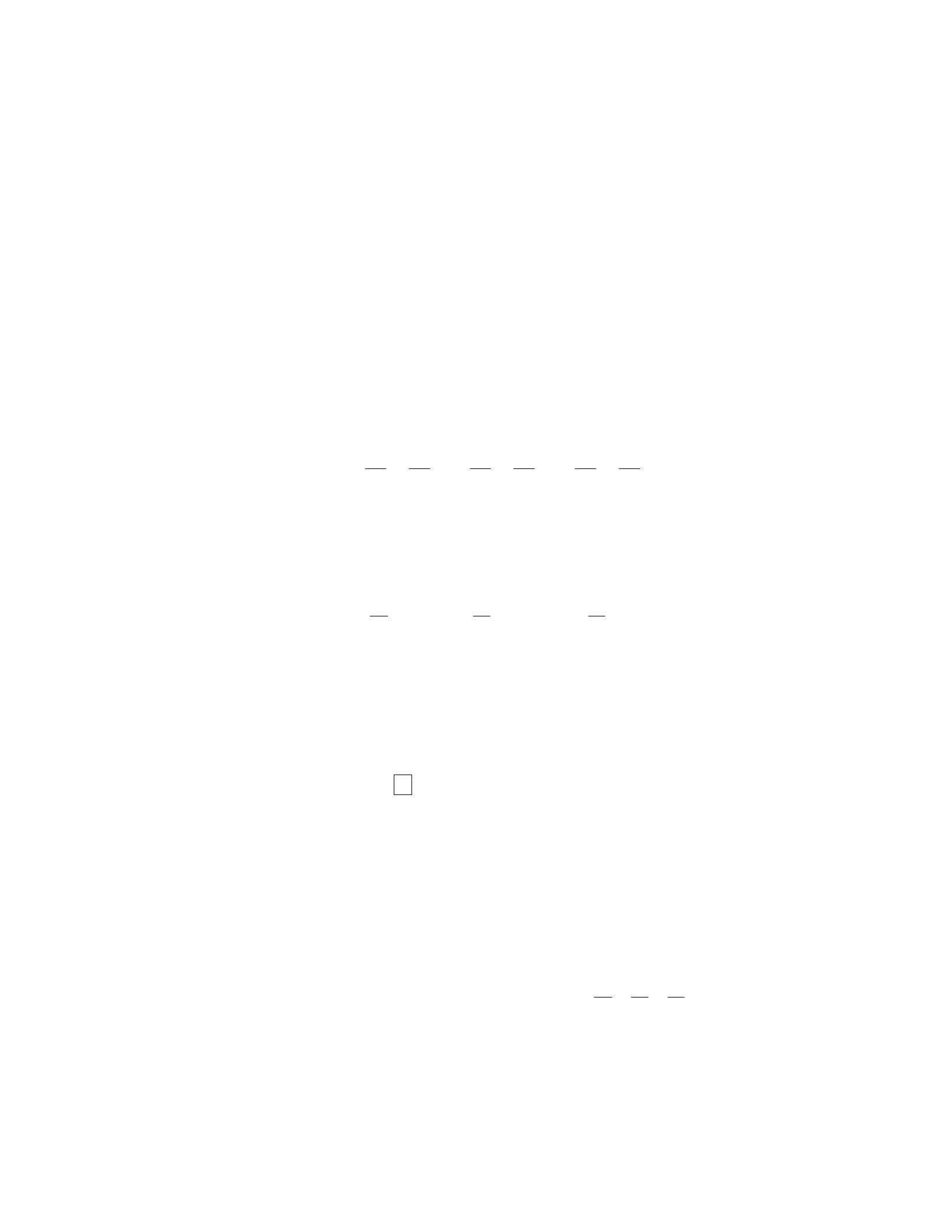
∇ × F= (∂R
∂y −∂Q
∂z )i−(∂R
∂x −∂P
∂z )j+ ( ∂Q
∂x −∂P
∂y )k
Thus, the curl of Fis
∇ × F= (2z−2y)i−(2z−2x)j+ (2y−2x)k
Step 2: Next, we will compute ∇ · ∇ × F.
∇ · ∇ × F=∂
∂x (2z−2y) + ∂
∂y (−2z+ 2x) + ∂
∂z (2y−2x)
Simplifying, we get
= -2 + 2 + 0
= 0
Therefore, ∇ · ∇ × F= 0 .
Question 20
Question
Let F(x, y, z) = x2yi+y2zj+z2xk. Calculate the curl of F.
Solution
To find the curl of F, we use the formula: ∇ × F=
i j k
∂
∂x
∂
∂y
∂
∂z
P Q R
, where
F(x, y, z) = Pi+Qj+Rk.
14
Step 1: Calculate the partial derivatives of P,Q, and R:P=x2y,Q=y2z,
R=z2x.
Step 2: Calculate the curl: ∇ × F=
i j k
∂
∂x
∂
∂y
∂
∂z
x2y y2z z2x
.
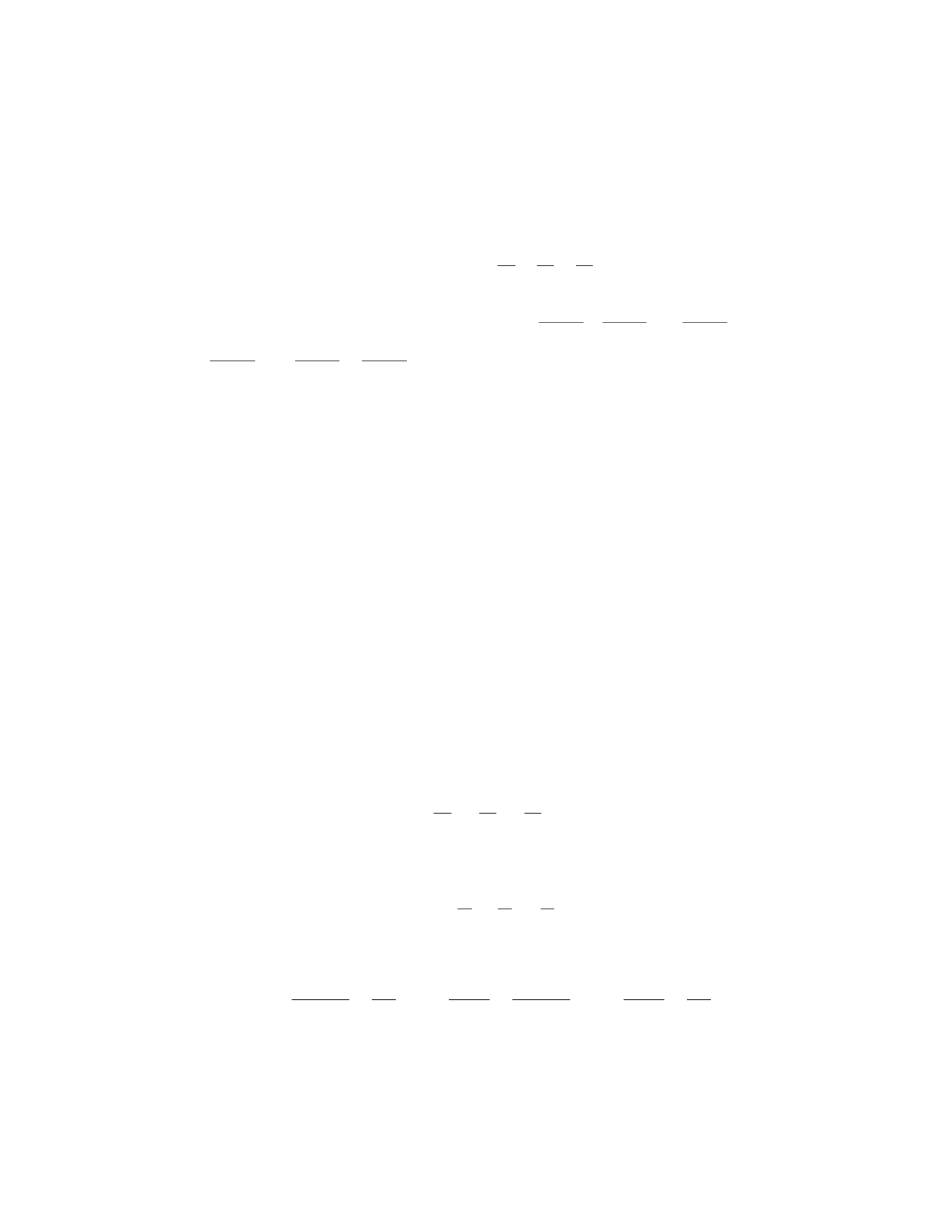
Step 3: Expand the determinant: ∇×F= ( ∂(z2x)
∂y −∂(y2z)
∂z )i−(∂(z2x)
∂x −
∂(x2y)
∂z )j+ ( ∂(y2z)
∂x −∂(x2y)
∂y )k.
Step 4: Evaluate the partial derivatives: ∇ × F= ((0 −2z)i−(2y−0)j+
(2y−2x)k.
Step 5: Simplify the curl: ∇ × F=−2zi−2yj+ (2y−2x)k.
Therefore, the curl of Fis −2zi−2yj+ (2y−2x)k.
Question 21
Question
Let F(x, y, z)=3xy2i+z3j−2xzkbe a vector field. Calculate the curl of Fat
the point P(1,2,−1).
Solution
To find the curl of Fat the point P(1,2,−1), we will use the formula for the
curl of a vector field:
curl F=∇ × F
where ∇is the del operator and ∇ × Frepresents the cross product of ∇and
F.
Step 1: Find the components of the del operator The del operator ∇
in Cartesian coordinates is given by:
∇=∂
∂x i+∂
∂y j+∂
∂z k
Step 2: Calculate the curl of F Given F(x, y, z) = 3xy2i+z3j−2xzk,
we have:
∇ × F=
i j k
∂
∂x
∂
∂y
∂
∂z
3xy2z3−2xz
Expanding the determinant, we get:
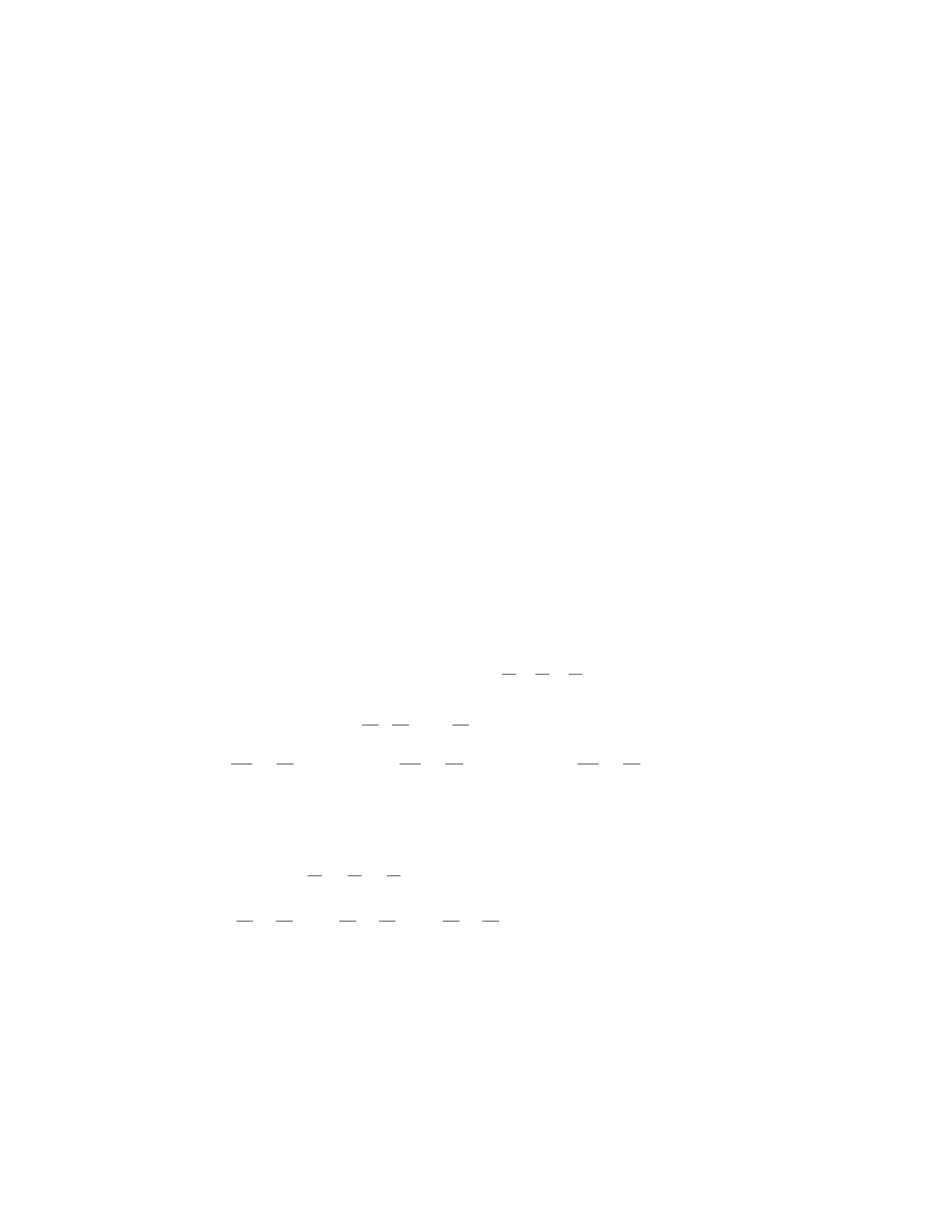
∇ × F=∂(−2xz)
∂y −∂z3
∂z i−∂3xy2
∂x −∂(−2xz)
∂z j+∂3xy2
∂x −∂z3
∂y k
15
Simplify each term:
∇ × F= (0 −3z)i−(3y2−2x)j+ (3y2−0)k
∇ × F=−3zi−(3y2−2x)j+ 3y2k
Step 3: Evaluate the expression at P(1,2,−1) Substitute x= 1, y= 2,
and z=−1 into the curl expression:
∇ × F=−3(−1)i−(3(2)2−2(1))j+ 3(2)2k
∇ × F= 3i−(12 −2)j+ 12k
∇ × F= 3i−10j+ 12k
Therefore, the curl of Fat the point P(1,2,−1) is curl F= 3i−10j+ 12k.
Question 22
Question
Let F=x2yi+ 3xzj+y2zkbe a vector field in R3. Determine the curl of Fat
the point (1,2,3).
Solution
To find the curl of a vector field F=Pi+Qj+Rkat a point (x0, y0, z0), we
calculate the determinant of the following matrix:
curl F(x0, y0, z0) =
i j k
∂
∂x
∂
∂y
∂
∂z
P Q R
Step 1: Compute ∂P
∂z ,∂Q
∂x , and ∂R
∂y .
∂P
∂z =∂
∂z (x2y) = 0 ; ∂Q
∂x =∂
∂x (3xz)=3z;∂R
∂y =∂
∂y (y2z)=2yz
Step 2: Calculate the curl of Fat the point (1,2,3) using the determinant
formula.
(1,2,3) =
i j k
∂
∂x
∂
∂y
∂
∂z
x2y3xz y2z
=∂R
∂y −∂Q
∂x i−∂P
∂z −∂R
∂x j+∂Q
∂x −∂P
∂y k
= (2yz −0)i−(0 −3z)j+ (3z−2xy)k
= 2(2)(3)i−(−3(3))j+ (3(3) −2(1)(2))k
= 12i+ 9j+ 15k
Therefore, the curl of Fat the point (1,2,3) is curl F(1,2,3) = 12i+9j+15k.
16
Question 23
Question
Let F(x, y) = x
x2+y2,y
x2+y2be a vector field in R2. Determine the diver-
gence of F.
Solution
To find the divergence of a vector field F(x, y) = (P(x, y), Q(x, y)), we use the
formula:
div(F) = ∂P
∂x +∂Q
∂y
Step 1: Compute ∂P
∂x and ∂Q
∂y .
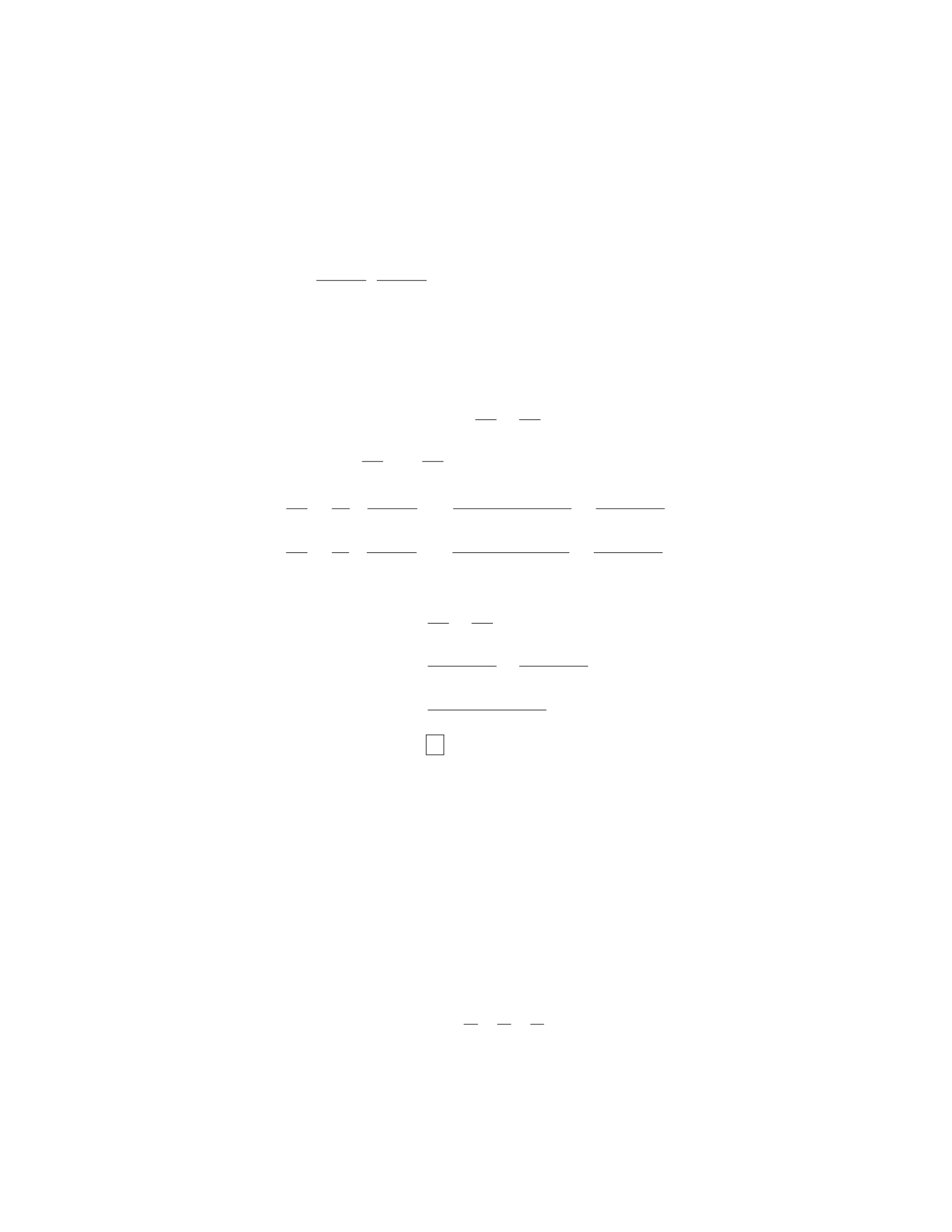
∂P
∂x =∂
∂x x
x2+y2=(x2+y2)−x(2x)
(x2+y2)2=y2−x2
(x2+y2)2
∂Q
∂y =∂
∂y y
x2+y2=(x2+y2)−y(2y)
(x2+y2)2=x2−y2
(x2+y2)2
Step 2: Find the divergence of F.
div(F) = ∂P
∂x +∂Q
∂y
=y2−x2
(x2+y2)2+x2−y2
(x2+y2)2
=y2−x2+x2−y2
(x2+y2)2
= 0
Therefore, the divergence of the vector field F(x, y) is 0.
Question 24
Question
Let F(x, y, z) = x2yi+y2zj+z2xkbe a vector field in R3. Compute the curl
of F.
Solution
To compute the curl of F, we use the formula
∇ × F=
i j k
∂
∂x
∂
∂y
∂
∂z
P Q R
,
17

where F(x, y, z) = Pi+Qj+Rk.
Step 1: Compute ∂R ∂y
∂R
∂y =∂
∂y (z2x)=0
Step 2: Compute ∂Q ∂z
∂Q
∂z =∂
∂z (y2z) = y2
Step 3: Compute ∂P ∂z
∂P
∂z =∂
∂z (x2y)=0
Step 4: Compute ∂R ∂x
∂R
∂x =∂
∂x (z2x)=2z
Step 5: Compute ∂Q ∂y
∂Q
∂y =∂
∂y (y2z) = 2yz
Step 6: Compute ∂P ∂y
∂P
∂y =∂
∂y (x2y) = x2
Step 7: Compute the curl of F Now, we can plug these partial derivatives
into the formula for the curl:
∇ × F=∂R
∂y −∂Q
∂z i−∂R
∂x −∂P
∂z j+∂Q
∂x −∂P
∂y k
Substitute the computed partial derivatives:
∇ × F= (−y2)i−2zj−x2k
Therefore, the curl of Fis (−y2)i−2zj−x2k.
Question 25
Question
Let F(x, y, z) = x2yi+y2zj+z2xkbe a vector field in R3. Compute the
divergence of F.
18
Solution
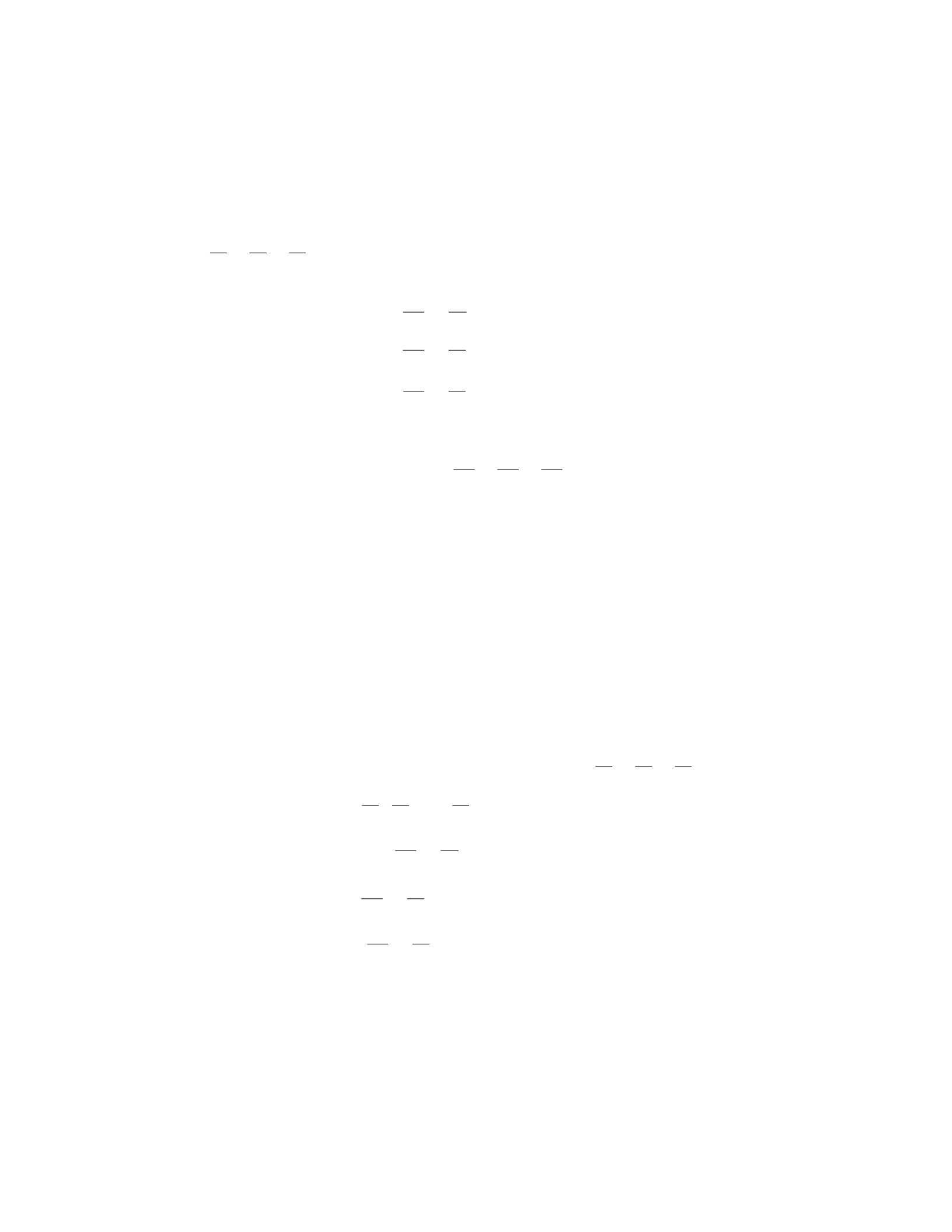
To find the divergence of F, we use the formula for divergence: div(F) = ∇·F=
∂P
∂x +∂Q
∂y +∂R
∂z , where F(x, y, z) = P(x, y, z)i+Q(x, y, z)j+R(x, y, z)k.
Step 1: Compute the partial derivatives of P,Q, and R.
∂P
∂x =∂
∂x (x2y) = 2xy
∂Q
∂y =∂
∂y (y2z)=2yz
∂R
∂z =∂
∂z (z2x)=2zx
Step 2: Calculate the divergence.
div(F) = ∂P
∂x +∂Q
∂y +∂R
∂z
= 2xy + 2yz + 2zx
= 2(xy +yz +zx)
Therefore, the divergence of the vector field F(x, y, z) = x2yi+y2zj+z2xk
is 2(xy +yz +zx).
Question 26
Question
Let F(x, y, z) = x2yzi+e2ysin(z)j+ cos(xy)k. Compute ∇ · F.
Solution
To find the divergence of F, we use the formula ∇ · F=∂P
∂x +∂Q
∂y +∂R
∂z , where
F(x, y, z) = P(x, y, z)i+Q(x, y, z)j+R(x, y, z)k.
Step 1: Compute ∂P
∂x ,∂Q
∂y , and ∂R
∂z .
∂P
∂x =∂
∂x (x2yz) = 2xyz
∂Q
∂y =∂
∂y (e2ysin(z)) = 2e2ysin(z)
∂R
∂z =∂
∂z (cos(xy)) = −xsin(xy)
Step 2: Find ∇ · F.
∇ · F= 2xyz + 2e2ysin(z)−xsin(xy)
Therefore, the divergence of Fis 2xyz + 2e2ysin(z)−xsin(xy).
19
Question 27
Question
Let F(x, y, z) = x2yi−xy2j+z3k. Compute the curl of F.
Solution
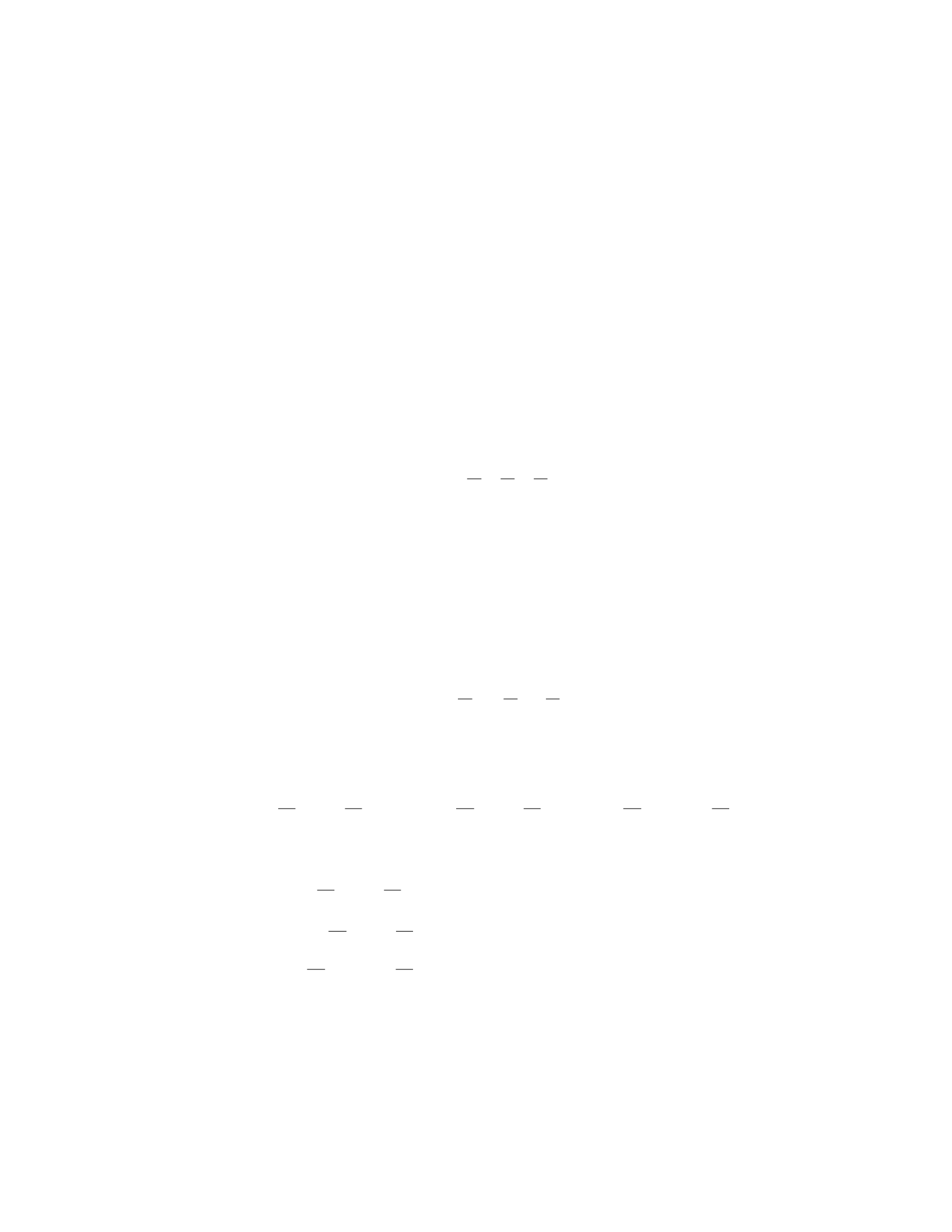
To find the curl of F, we use the formula:
curl F=∇ × F
where ∇is the del operator in Cartesian coordinates. For a vector field F=
Pi+Qj+Rk, the curl is given by:
∇ × F=
i j k
∂
∂x
∂
∂y
∂
∂z
P Q R
Step 1: Compute the three partial derivatives P,Q, and R.
P=x2y
Q=−xy2
R=z3
Step 2: Substitute P,Q, and Rinto the determinant formula for the curl.
∇ × F=
i j k
∂
∂x
∂
∂y
∂
∂z
x2y−xy2z3
Step 3: Evaluate the determinant by computing the cross product of the
unit vectors.
∇×F=∂
∂y (z3)−∂
∂z (−xy2)i−∂
∂x (z3)−∂
∂z (x2y)j+∂
∂x (−xy2)−∂
∂y (x2y)k
Step 4: Compute the partial derivatives and simplify. We have:
∂
∂y (z3)−∂
∂z (−xy2) = 0 −(−y2) = y2
∂
∂x (z3)−∂
∂z (x2y) = 0 −(−x2) = x2
∂
∂x (−xy2)−∂
∂y (x2y) = −y2−2xy =−y2(1 + 2x)
Therefore, the curl of Fis:
curl F=y2i+x2j−y2(1 + 2x)k
20
Question 28
Question
Let F(x, y, z)=(x2y, yz, xz2) be a vector field in R3. Compute the curl of F.
Solution
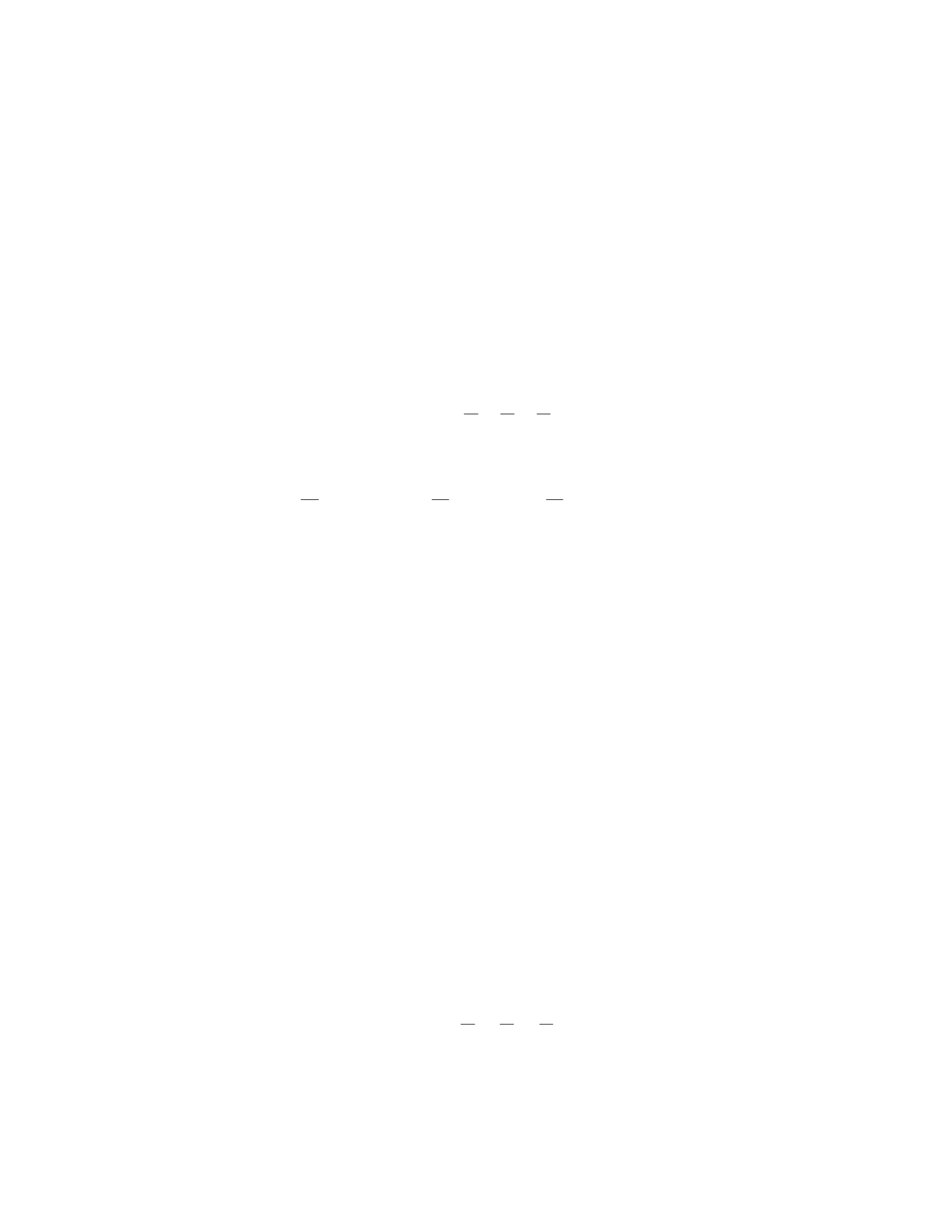
To find the curl of F, denoted by ∇ × F, we need to compute the determinant
of the following matrix:
∇ × F=
i j k
∂
∂x
∂
∂y
∂
∂z
x2y yz xz2
Step 1: Compute the partial derivatives:
∂
∂x = (2xy, 0, z2)∂
∂y = (x2, z, 0) ∂
∂z = (0, y, 2xz)
Step 2: Expand the determinant:
∇ × F=
i j k
(2xy) 0 z2
x2y yz xz2
−
i j k
0 (x2) 0
x2y yz xz2
+
i j k
0 (z)y
x2y yz xz2
Step 3: Evaluate the determinants:
∇ × F=0−z2y, 2x2y−xz2,2xy −0= (−z2y, 2x2y−xz2,2xy)
Therefore, the curl of Fis ∇ × F= (−z2y, 2x2y−xz2,2xy).
Question 29
Question
Let F(x, y, z) = x2yi+yz2j+xyzkbe a vector field in R3. Find ∇ × ∇ × F.
Solution
We know that for a vector field Gin R3, the curl of the curl of Gis given by
the following formula:
∇ × ∇ × G=∇(∇ · G)− ∇2G
Let’s calculate ∇ × Ffirst. Given F(x, y, z) = x2yi+yz2j+xyzk, we have:
∇ × F=
i j k
∂
∂x
∂
∂y
∂
∂z
x2y yz2xyz
21
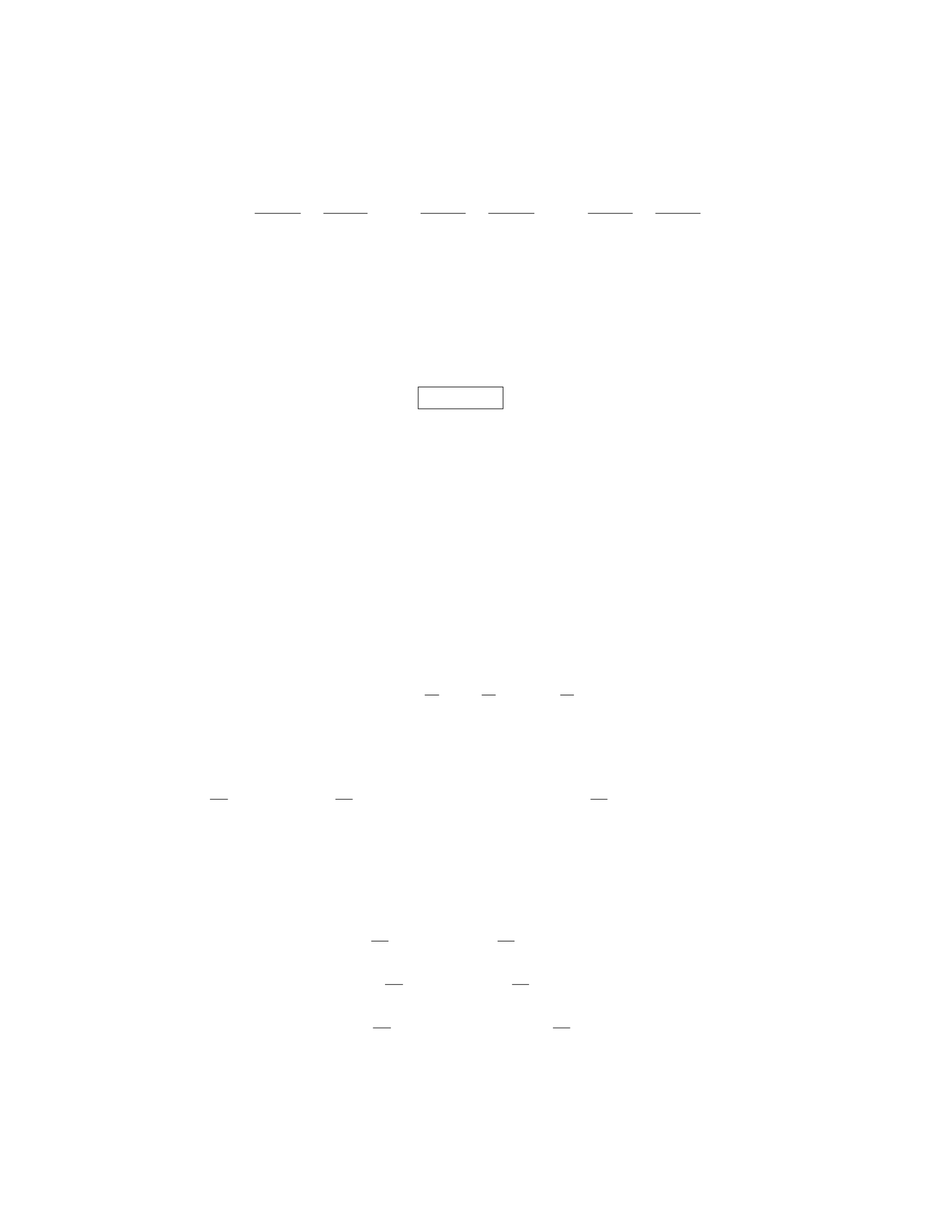
=∂(xyz)
∂y −∂(yz2)
∂z i−∂(x2y)
∂x −∂(xyz)
∂z j+∂(xz2)
∂x −∂(x2y)
∂y k
= (xz −2yz)i−(2xy −xz)j+ (z2−y)k
Now, we can calculate ∇ × (∇ × F):
∇ × (xz −2yz)i−(2xy −xz)j+ (z2−y)k
=∇(z2−y)−(−2z)i−∇ (xz −2yz)−(z2−y)j+∇[(2xy −xz)−(2yz)] k
= 0i−0j−0k
∇ × ∇ × F=0
Question 30
Question
Let F(x, y, z) = x2yi+zsin(xy)j+y2cos(xz)kbe a vector field in R3. Find the
curl of F.
Solution
To find the curl of F, we first need to compute the determinant of the following
matrix composed of the unit vectors i,j, and k, and the partial derivative
operators with respect to x,y, and z:
curl(F) =
i j k
∂
∂x
∂
∂y
∂
∂z
x2y z sin(xy)y2cos(xz)
Step 1: Compute the partial derivatives Compute the partial deriva-
tives of the vector field components:
∂
∂x (x2y) = 2xy, ∂
∂y (zsin(xy)) = zcos(xy)+sin(xy),∂
∂z (y2cos(xz)) = −y2xsin(xz)
Step 2: Calculate the determinant Substitute the computed partial
derivatives into the determinant expression:
curl(F) =
i j k
2xy z cos(xy) + sin(xy)−y2xsin(xz)
=−∂
∂y (y2xsin(xz)) −∂
∂z (zcos(xy) + sin(xy))i
−−∂
∂x (y2xsin(xz)) −∂
∂z (2xy)j
+∂
∂x (zcos(xy) + sin(xy)) + ∂
∂y (2xy)k
22
Question 2
Question
Let F(x, y, z) = x2yi+xyzj+xz2k. Compute the divergence of F.
Solution
Step 1: The divergence of a vector field F=Pi+Qj+Rkis defined as ∇ · F=
∂P
∂x +∂Q
∂y +∂R
∂z .
Step 2: Given F(x, y, z) = x2yi+xyzj+xz2k, we have P(x, y, z) = x2y,
Q(x, y, z) = xyz, and R(x, y, z) = xz2.
Step 3: Calculate the partial derivatives:
∂P
∂x = 2xy,
∂Q
∂y =xz,
∂R
∂z = 2xz.
Step 4: Now, find the divergence:
∇ · F=∂P
∂x +∂Q
∂y +∂R
∂z
= 2xy +xz + 2xz
= 2xy +xz + 2xz .
Question 3
Question
Let F(x, y, z) = (2xy +z)i+ (x2+y2)j+ (xy +z2)kbe a vector field in R3.
Calculate the divergence and curl of F.
Solution
Divergence: Step 1: The divergence of a vector field F=Pi+Qj+Rkis
given by ∇ · F=∂P
∂x +∂Q
∂y +∂R
∂z .
Step 2: In this case, F(x, y, z) = (2xy +z)i+ (x2+y2)j+ (xy +z2)k, where
P= 2xy +z,Q=x2+y2, and R=xy +z2.
Step 3: Calculate the partial derivatives:
∂P
∂x = 2y, ∂Q
∂y = 2y, ∂R
∂z = 2z
2
Step 4: The divergence of Fis:
∇ · F= 2y+ 2y+ 2z= 4y+ 2z
Curl: Step 1: The curl of a vector field F=Pi+Qj+Rkis given by
∇ × F=∂R
∂y −∂Q
∂z i−∂R
∂x −∂P
∂z j+∂Q
∂x −∂P
∂y k.
Step 2: Calculate the partial derivatives for the curl:
∂R
∂y =x, ∂Q
∂z = 0
∂R
∂x =y, ∂P
∂z = 0
∂Q
∂x = 2x, ∂P
∂y = 0
Step 3: The curl of Fis:
∇ × F= (x−0)i−(y−0)j+ (2x−0)k=xi−yj+ 2xk
Question 4
Question
Let F(x, y, z)=2xzˆ
i+y2ˆ
j+ (2x2−z)ˆ
kbe a vector field in R3. Compute
∇ · ∇ × F.
Solution
Step 1: Compute the curl of the vector field F.
∇ × F=
ˆ
iˆ
jˆ
k
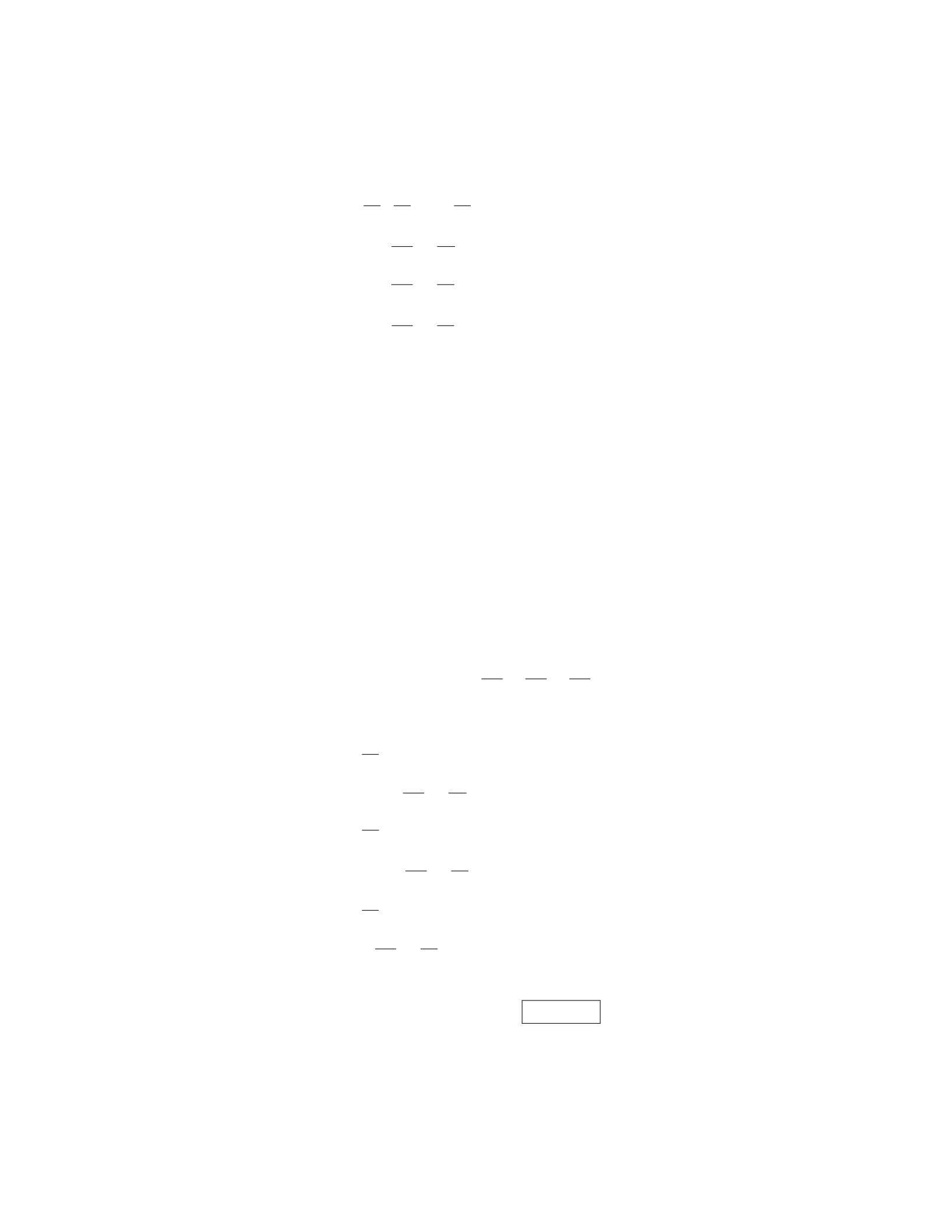
∂
∂x
∂
∂y
∂
∂z
2xz y22x2−z
∇ × F= (∂(2x2−z)
∂y −∂(y2)
∂z )ˆ
i−(∂(2xz)
∂z −∂(2x2−z)
∂x )ˆ
j+ (∂(y2)
∂x −∂(2xz)
∂y )ˆ
k
∇ × F= 0ˆ
i+ 0ˆ
j+ 0ˆ
k=0
Step 2: Compute the divergence of the zero vector field.
∇ · 0=∂0
∂x +∂0
∂y +∂0
∂z = 0
Step 3: The result suggests that ∇ · ∇ × F= 0 .
3

Question 5
Question
Let F(x, y, z)=(eycos(z),−xeysin(z),−yeysin(z)). Calculate the divergence
of F.
Solution
To calculate the divergence of a vector field F= (P, Q, R), we use the formula:
div(F) = ∂P
∂x +∂Q
∂y +∂R
∂z .
In this case, F(x, y, z)=(eycos(z),−xeysin(z),−yeysin(z)), so P=eycos(z),
Q=−xeysin(z), and R=−yeysin(z).
Step 1: Calculate ∂P
∂x :
∂P
∂x = 0
Step 2: Calculate ∂Q
∂y :
∂Q
∂y =−eysin(z)−xeycos(z)
Step 3: Calculate ∂R
∂z :
∂R
∂z =−yeycos(z)
Step 4: Add up the partial derivatives to find the divergence:
div(F) = ∂P
∂x +∂Q
∂y +∂R
∂z = 0 −eysin(z)−xeycos(z)−yeycos(z)
Therefore, the divergence of Fis div(F) = −eysin(z)−xeycos(z)−yeycos(z).
Question 6
Question
Let F(x, y, z)=(yz +x2)i+ (xz +y2)j+ (xy +z2)k. Compute the divergence
of F.
Solution
To compute the divergence of F, we use the formula:
div F=∇ · F=∂P
∂x +∂Q
∂y +∂R
∂z ,
where F(x, y, z) = P(x, y, z)i+Q(x, y, z)j+R(x, y, z)k.
4
Step 1: Calculate ∂P
∂x ,∂Q
∂y , and ∂R
∂z :
∂P
∂x =∂
∂x (yz +x2) = 2x,
∂Q
∂y =∂
∂y (xz +y2) = x,
∂R
∂z =∂
∂z (xy +z2)=1.
Step 2: Compute the divergence:
div F= 2x+x+ 1 = 3x+ 1.
Therefore, the divergence of Fis 3x+ 1.
Question 7
Question
Let F(x, y, z)=(x2y, −2xz, xz2) be a vector field. Compute the divergence of
F.
Solution
To compute the divergence of F, we use the formula for the divergence of a
vector field F(x, y, z)=(P(x, y, z), Q(x, y, z), R(x, y, z)):
div(F) = ∇ · F=∂P
∂x +∂Q
∂y +∂R
∂z
In this case, F(x, y, z)=(x2y, −2xz, xz2), so P(x, y, z) = x2y,Q(x, y, z) =
−2xz, and R(x, y, z) = xz2.
Step 1: Compute ∂P
∂x :
∂P
∂x =∂
∂x (x2y) = 2xy
Step 2: Compute ∂Q
∂y :
∂Q
∂y =∂
∂y (−2xz) = 0
Step 3: Compute ∂R
∂z :
∂R
∂z =∂
∂z (xz2) = x(2z)=2xz
Step 4: Add the partial derivatives together:
∇ · F= 2xy + 0 + 2xz = 2xy + 2xz
Therefore, the divergence of Fis 2xy + 2xz.
5
Question 8
Question
Let F(x, y, z) = y
x2+y2i−x
x2+y2j+zk. Calculate the curl of F.
Solution
To find the curl of F, we need to compute the determinant of the following
matrix:
curl F=
i j k
∂
∂x
∂
∂y
∂
∂z
y
x2+y2−x
x2+y2z
Step 1: Compute the partial derivatives of F:
∂
∂x =−y(2x)
(x2+y2)2,∂
∂y =x(2x)
(x2+y2)2,∂
∂z = 1
Step 2: Substitute the partial derivatives into the determinant expression:
curl F=
i j k
−y(2x)
(x2+y2)2
x(2x)
(x2+y2)21
y
x2+y2−x
x2+y2z
Step 3: Expand the determinant using the cofactor expansion along the top
row:
curl F=∂
∂y x
x2+y2−∂
∂z −y(2x)
(x2+y2)2i−∂
∂x −x
x2+y2−∂
∂z y
x2+y2j+∂
∂x y
x2+y2−∂
∂y −x
x2+y2k
Step 4: Simplify the expressions to obtain the components of the curl:
curl F=2x(x2−y2)
(x2+y2)2i+2y(x2−y2)
(x2+y2)2j+ 0k
Therefore, the curl of Fis 2x(x2
−y2)
(x2+y2)2i+2y(x2
−y2)
(x2+y2)2j.
Question 9
Question
Let F(x, y, z) = 2x2yi+x2zj+x2yk. Determine the divergence of Fat the
point (1,2,3).
6
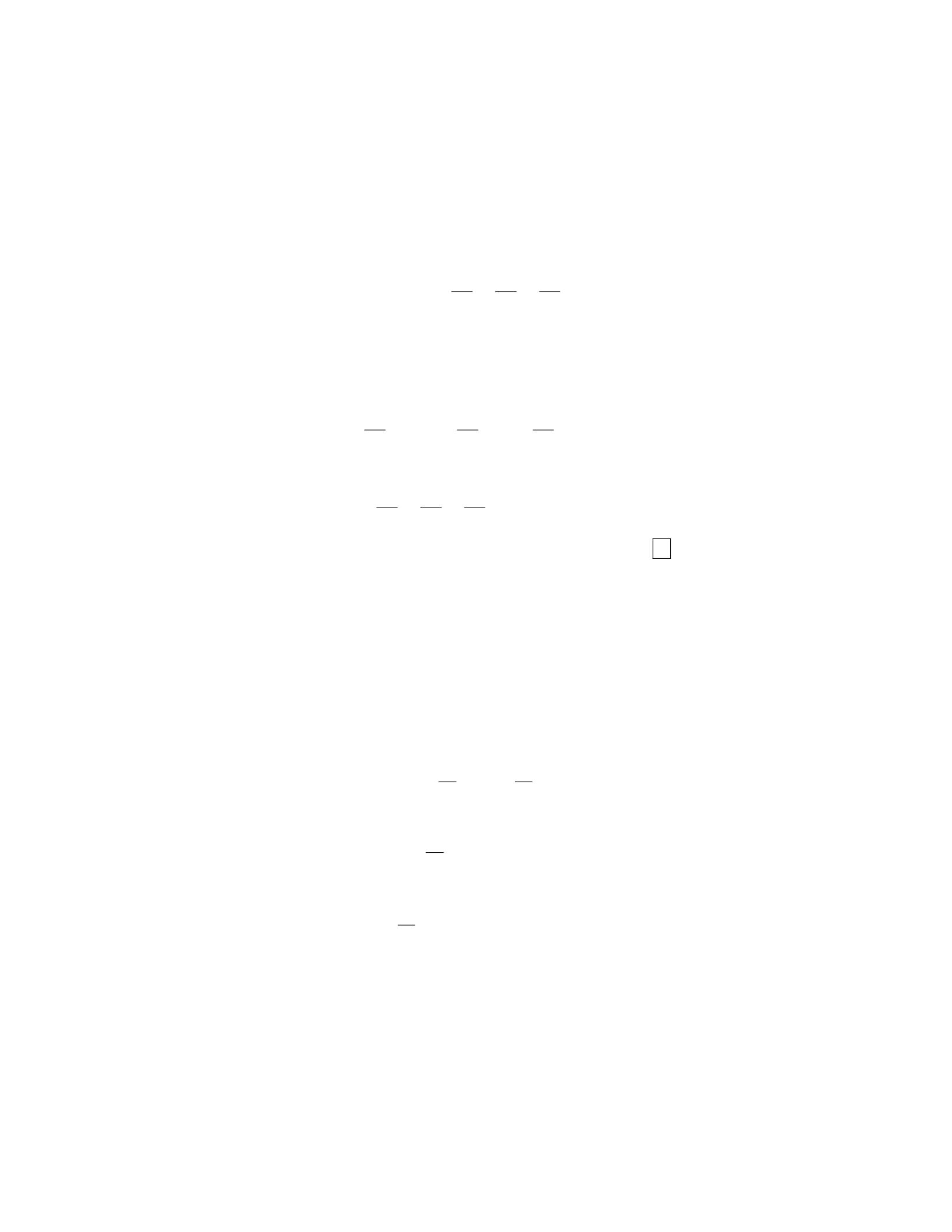
Solution
Step 1: The divergence of a vector field F(x, y, z) = P(x, y, z)i+Q(x, y, z)j+
R(x, y, z)kis given by the formula:
div(F) = ∂P
∂x +∂Q
∂y +∂R
∂z .
Step 2: Given F(x, y, z)=2x2yi+x2zj+x2yk, we have:
P(x, y, z)=2x2y, Q(x, y, z) = x2z, R(x, y, z) = x2y.
Step 3: Calculate the partial derivatives:
∂P
∂x = 4xy, ∂Q
∂y = 0,∂R
∂z = 0.
Step 4: The divergence of Fat the point (1,2,3) is then:
div(F) = ∂P
∂x +∂Q
∂y +∂R
∂z = 4(1)(2) + 0 + 0 = 8.
Step 5: Therefore, the divergence of Fat the point (1,2,3) is 8 .
Question 10
Question
Let F(x, y) = ⟨x2y, xy2⟩be a vector field. Compute the divergence of F.
Solution
To find the divergence of the vector field F(x, y) = ⟨x2y, xy2⟩, we use the formula
for divergence:
∇ · F=∂
∂x (x2y) + ∂
∂y (xy2)
Step 1: Compute the partial derivative with respect to x:
∂
∂x (x2y)=2xy
Step 2: Compute the partial derivative with respect to y:
∂
∂y (xy2) = x·2y= 2xy
Step 3: Add the two partial derivatives together to find the divergence:
∇ · F= 2xy + 2xy = 4xy
Therefore, the divergence of the vector field F(x, y) = ⟨x2y, xy2⟩is ∇ · F=
4xy.
7
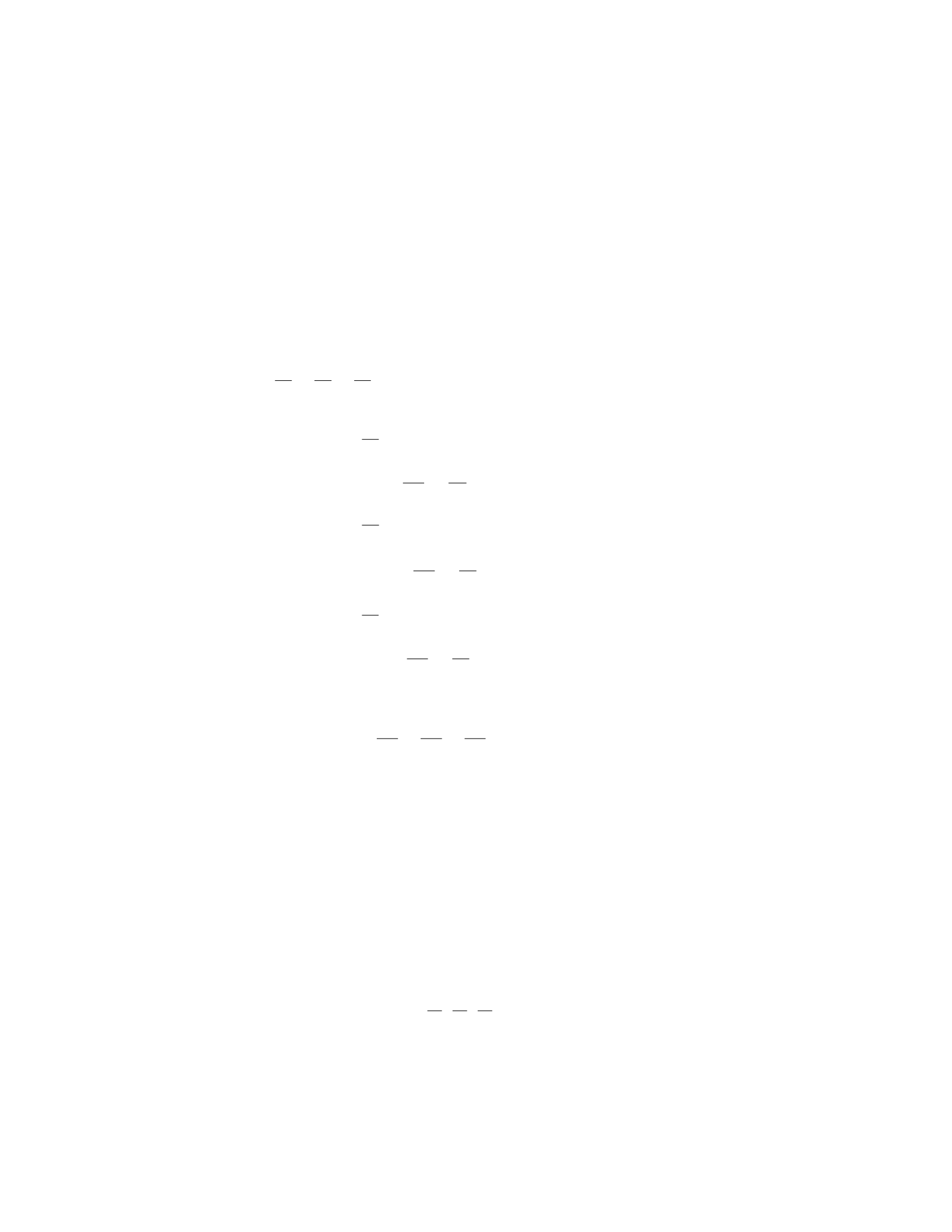
Question 11
Question
Let F(x, y, z) = x2yi+e2zj+xyzkbe a vector field in R3. Compute the
divergence of F.
Solution
To find the divergence of a vector field F=Pi+Qj+Rk, we use the formula
div(F) = ∂P
∂x +∂Q
∂y +∂R
∂z .
In this case, F(x, y, z) = x2yi+e2zj+xyzk, so P=x2y,Q=e2z, and
R=xyz.
Step 1: Compute ∂P
∂x .
∂P
∂x =∂
∂x (x2y) = 2xy
Step 2: Compute ∂Q
∂y .
∂Q
∂y =∂
∂y (e2z)=0
Step 3: Compute ∂R
∂z .
∂R
∂z =∂
∂z (xyz) = xy
Step 4: Compute the divergence of F.
div(F) = ∂P
∂x +∂Q
∂y +∂R
∂z = 2xy +0+xy = 3xy
Therefore, the divergence of Fis div(F) = 3xy.
Question 12
Question
Let F(x, y, z) = (2xy+zex, x2−zcos(y), y2+ez) be a vector field in R3. Calculate
the gradient, divergence, and curl of F.
Solution
Step 1: Calculate the gradient of F. The gradient of a vector field F=
(f1, f2, f3) is given by ∇ · F=∂f
∂x ,∂f
∂y ,∂f
∂z .
8
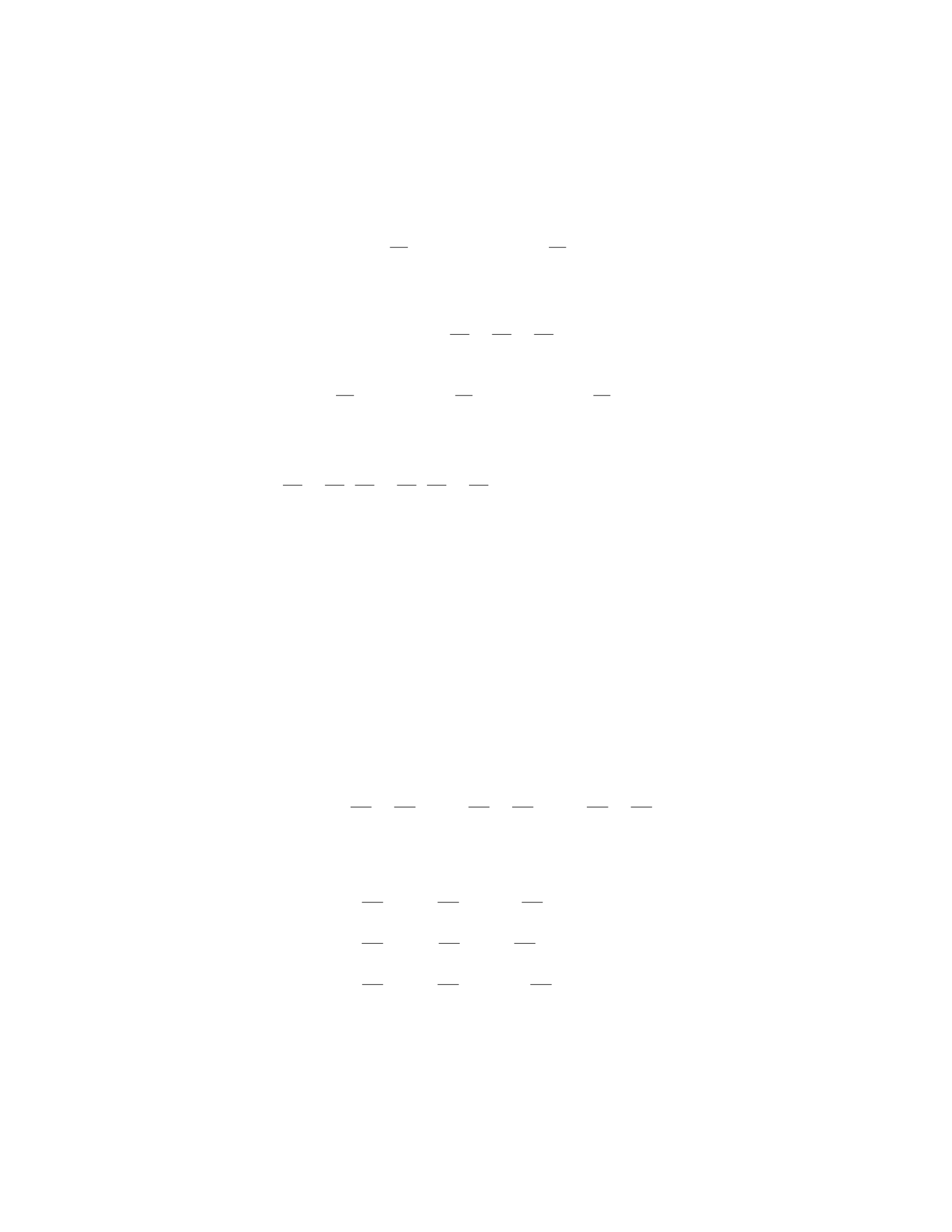
So, for F(x, y, z) = (2xy +zex, x2−zcos(y), y2+ez), we have:
∇ · F=2y+ex+∂
∂x (zex),2x−cos(y)−∂
∂y (zcos(y)),2y+ez
= (2y+ex+zex,2x−cos(y) + zsin(y),2y+ez)
Step 2: Calculate the divergence of F. The divergence of a vector field
F= (f1, f2, f3) is given by ∇ · F=∂f1
∂x +∂f2
∂y +∂f3
∂z .
For F(x, y, z) above, the divergence is:
∇ · F=∂
∂x (2xy +zex) + ∂
∂y (x2−zcos(y)) + ∂
∂z (y2+ez)
= 2y+ex+ 2x−cos(y)+1
Step 3: Calculate the curl of F. The curl of a vector field Fis given by
∇ × F=∂f3
∂y −∂f2
∂z ,∂f1
∂z −∂f3
∂x ,∂f2
∂x −∂f1
∂y .
Thus, for F(x, y, z), the curl is:
∇ × F= (1 −0, ex−0,−2y−0)
= (1, ex,−2y)
Question 13
Question
Let F(x, y, z) = x2yi+xyzj+ (x+y+z)k. Compute ∇ · ∇ × F.
Solution
Step 1: Compute ∇ × F. The curl of a vector field F=Pi+Qj+Rkis given
by:
∇ × F=∂R
∂y −∂Q
∂z i−∂R
∂x −∂P
∂z j+∂Q
∂x −∂P
∂y k
In our case, F=x2yi+xyzj+(x+y+z)k, so P=x2y,Q=xyz,R=x+y+z.
Now, compute the partial derivatives:
∂P
∂z = 0,∂Q
∂x =yz, ∂R
∂y = 1
∂Q
∂z =x, ∂R
∂x = 1,∂P
∂y =x2
∂R
∂z = 1,∂P
∂x = 2xy, ∂Q
∂y =xz
So,
∇ × F= (x−xz)i−(1 −x2)j+ (xz −2xy)k
9
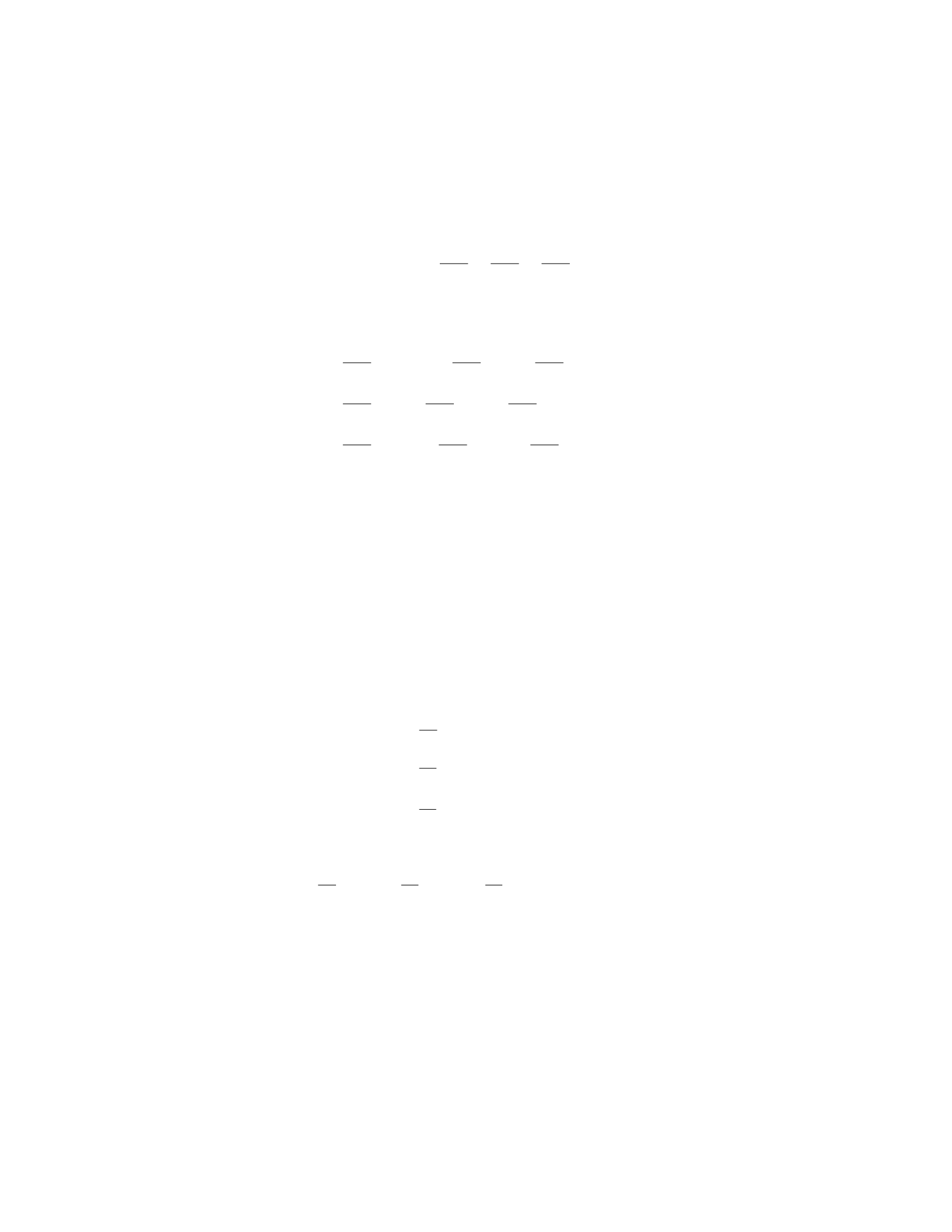
Step 2: Compute ∇·∇×F. The divergence of a vector field G=G1i+
G2j+G3kis given by:
∇ · G=∂G1
∂x +∂G2
∂y +∂G3
∂z
In our case, G= (x−xz)i−(1 −x2)j+ (xz −2xy)k, so G1=x−xz,
G2=−1 + x2,G3=xz −2xy. Now, compute the partial derivatives:
∂G1
∂x = 1 −z, ∂G2
∂y = 0,∂G3
∂z =x
∂G1
∂y = 0,∂G2
∂z = 0,∂G3
∂x =z−2y
∂G1
∂z =−x, ∂G2
∂x = 2x, ∂G3
∂y =−2x
So,
∇ · ∇ × F= (1 −z)+(z−2x) = 1 −2x
Question 14
Question
Let F(x, y, z)=(x2ey, ye−z, z2ex). Find ∇ · F.
Solution
Step 1: Compute the partial derivatives of each component of F.
∂
∂x (x2ey)=2xey
∂
∂y (ye−z) = e−z
∂
∂z (z2ex)=2zex
Step 2: Take the dot product of ∇with F.
∇ · F=∂
∂x (x2ey) + ∂
∂y (ye−z) + ∂
∂z (z2ex)=2xey+e−z+ 2zex
Therefore, ∇ · F= 2xey+e−z+ 2zex.
Question 15
Question
Let F=xzi+ (x+y)zj+ (x+y2)kbe a vector field in R3. Calculate ∇ · F.
10
Solution
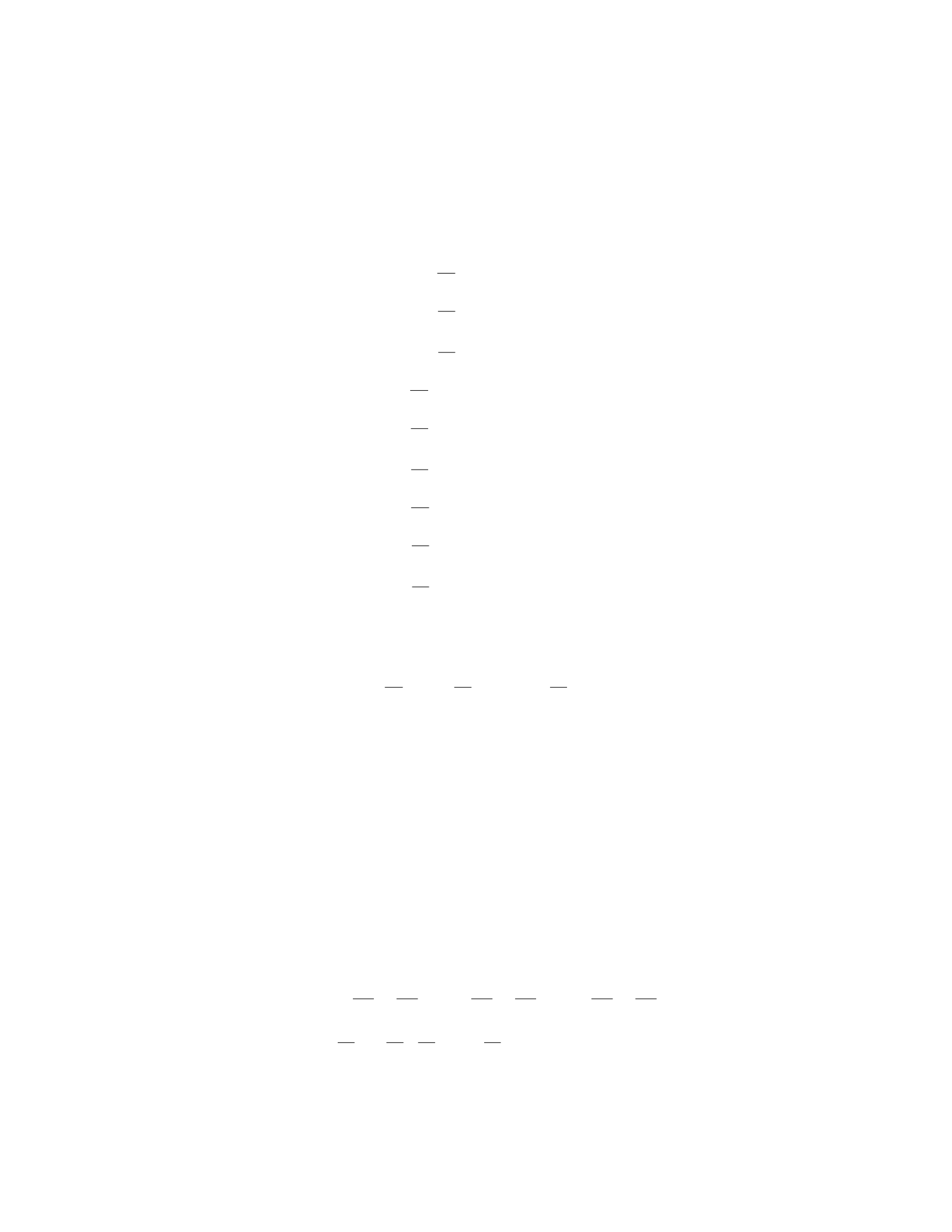
Step 1: Calculate the partial derivatives of each component of F.
∂
∂x (xz) = z
∂
∂y (xz) = 0
∂
∂z (xz) = x
∂
∂x (x+y)z=z
∂
∂y (x+y)z=z
∂
∂z (x+y)z=x+y
∂
∂x (x+y2) = 1
∂
∂y (x+y2) = 2y
∂
∂z (x+y2) = 0
Step 2: Calculate the divergence of F.
∇ · F=∂
∂x (xz) + ∂
∂y (x+y)z+∂
∂z (x+y2)
=z+z+x+y= 2z+x+y
Therefore, the divergence of Fis 2z+x+y.
Question 16
Question
Let F(x, y, z) = exsin(y)i+eycos(z)j+ezsin(x)k. Determine the curl of F.
Solution
To find the curl of F, we can use the formula for the curl of a vector field
F=P i +Qj +Rk:
curl(F) = ∂R
∂y −∂Q
∂z i+∂P
∂z −∂R
∂x j+∂Q
∂x −∂P
∂y k
Step 1: Find ∂P ∂y,∂Q
∂z ,∂Q
∂x , and ∂R
∂x .
11
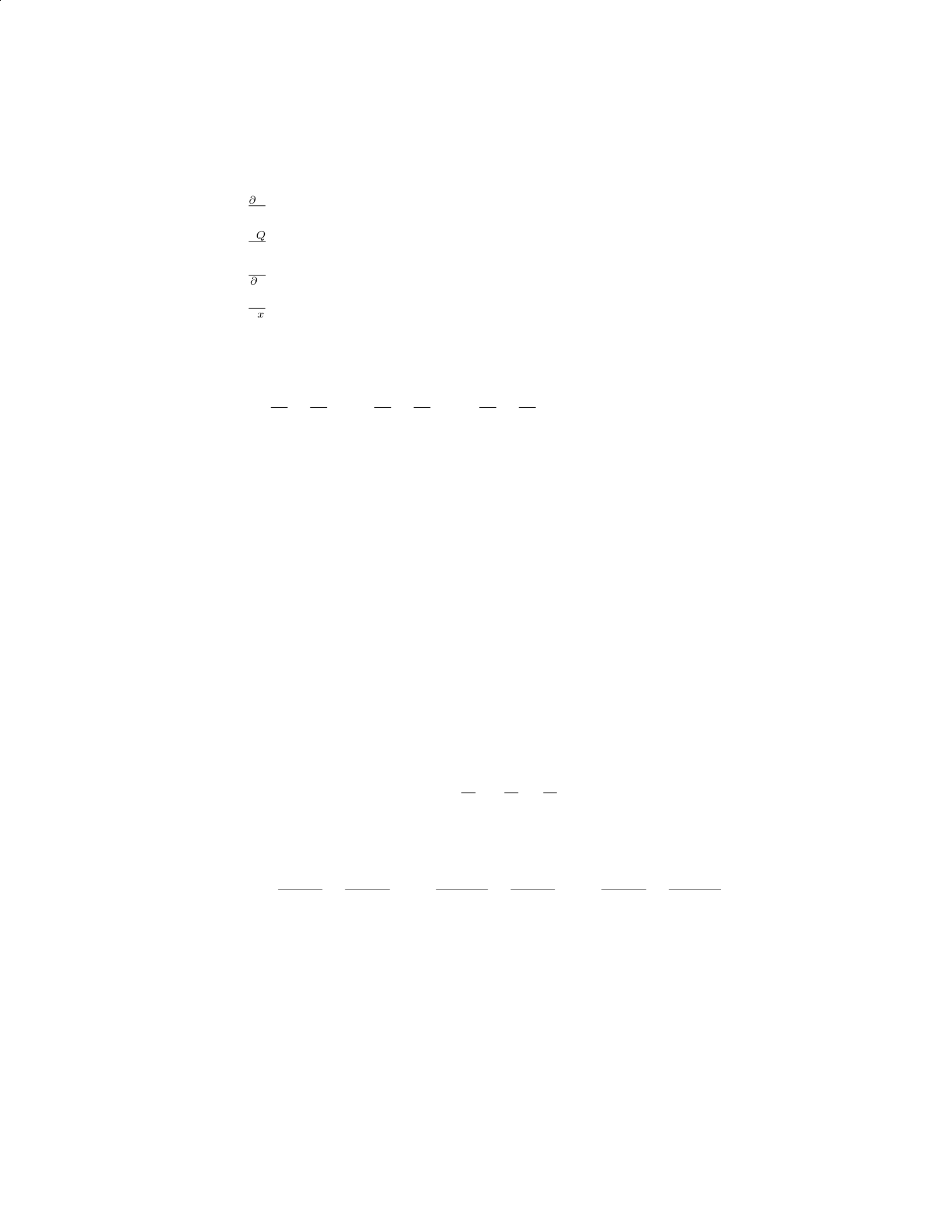
∂P
∂y =excos(y)
∂Q
∂z =−eysin(z)
∂Q
∂x = 0
∂R
∂x =ezcos(x)
Step 2: Calculate the components of the curl.
) = ∂R
∂y −∂Q
∂z i+∂P
∂z −∂R
∂x j+∂Q
∂x −∂P
∂y k
= (0 −(−eysin(z))) i+ (0 −ezcos(x)) j+ (0 −excos(y)) k
=eysin(z)i−ezcos(x)j−excos(y)k
Therefore, the curl of Fis curl(F) = eysin(z)i−ezcos(x)j−excos(y)k.
Question 17
Question
Let F(x, y, z)=(x2y3, xz2, y2z). Calculate ∇ · (∇ × F).
Solution
Step 1: Find ∇ × F. Step 2: Find ∇ · (∇ × F).
Step 1: We have F(x, y, z)=(x2y3, xz2, y2z).
The curl of F, denoted ∇ × F, is given by:
∇ × F=
i j k
∂
∂x
∂
∂y
∂
∂z
x2y3xz2y2z
Calculating the determinant, we get:
∇×F=∂(y2z)
∂y −∂(xz2)
∂z i−∂(x2y3)
∂x −∂(y2z)
∂z j+∂(xz2)
∂x −∂(x2y3)
∂y k
Simplifying further, we get:
∇ × F= (z2−0)i−(2xy3−0)j+ (2xz −3x2y2)k
So, ∇ × F= (z2)i−(2xy3)j+ (2xz −3x2y2)k.
Step 2: Now, we need to find ∇ · (∇ × F).
12
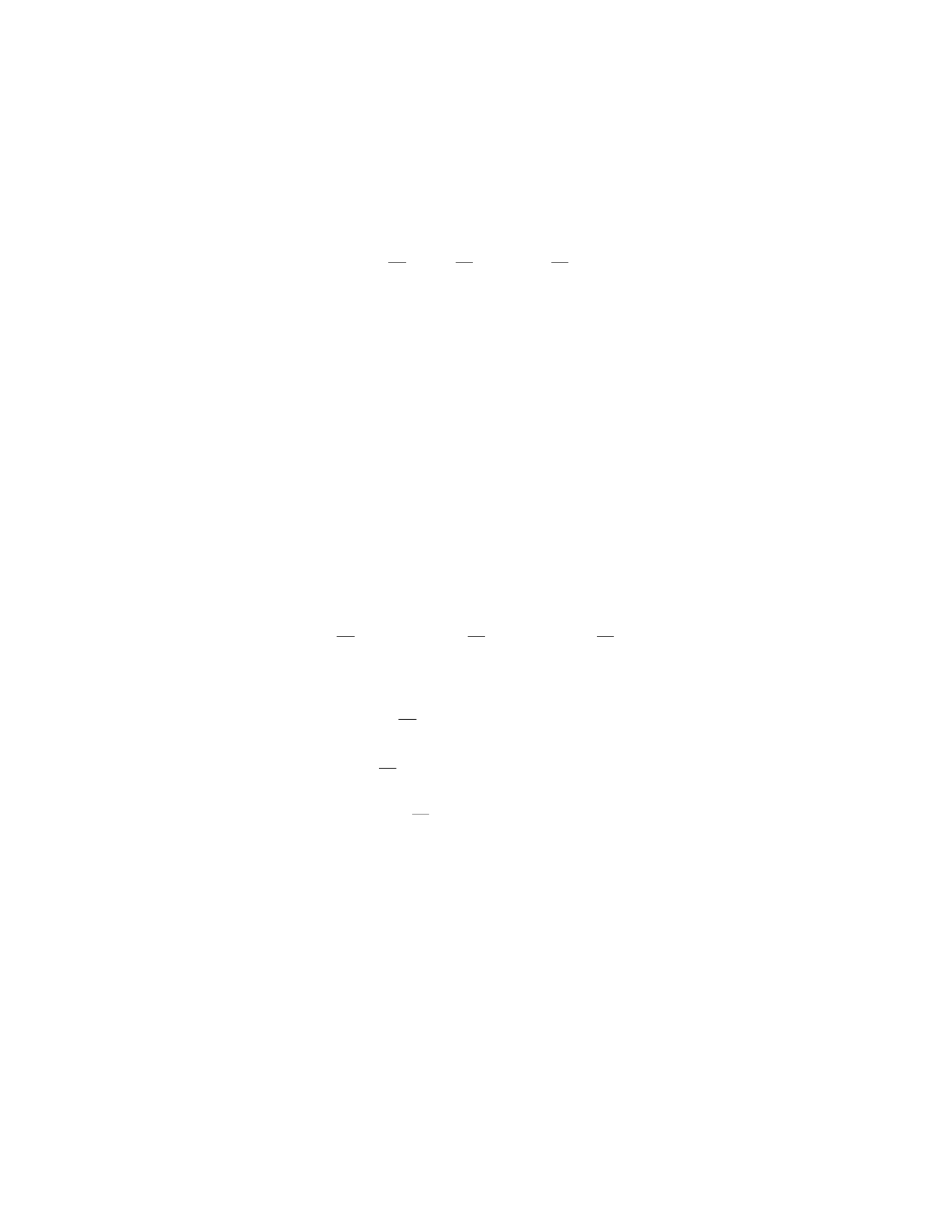
Since ∇ · (∇ × F) is equivalent to the divergence of the curl, we can compute
this as:
∇ · (∇ × F) = ∂
∂x (z2) + ∂
∂y (−2xy3) + ∂
∂z (2xz −3x2y2)
Solving these partial derivatives, we have:
∇ · (∇ × F)=0−6xy + 2x
Therefore, the final answer is ∇ · (∇ × F)=2x−6xy.
Question 18
Question
Let F(x, y, z) = 2x2y+yz3, x2z3−3y2,3xyz2be a vector field. Compute
∇ · F, where ∇is the gradient operator.
Solution
Step 1: Compute ∇ · Fby taking the dot product of the gradient operator ∇
and the vector field F.
∇ · F=∂
∂x 2x2y+yz3+∂
∂y x2z3−3y2+∂
∂z 3xyz2
Step 2: Calculate the partial derivatives with respect to x,y, and z.
∂
∂x 2x2y+yz3= 4xy
∂
∂y x2z3−3y2=x2z3−6y
∂
∂z 3xyz2= 6xyz
Step 3: Substitute the partial derivatives back into the expression for ∇ · F.
∇ · F= 4xy + (x2z3−6y)+6xyz
Step 4: Simplify the expression.
∇ · F= 4xy +x2z3−6y+ 6xyz
Therefore, ∇ · F= 4xy +x2z3−6y+ 6xyz.
13
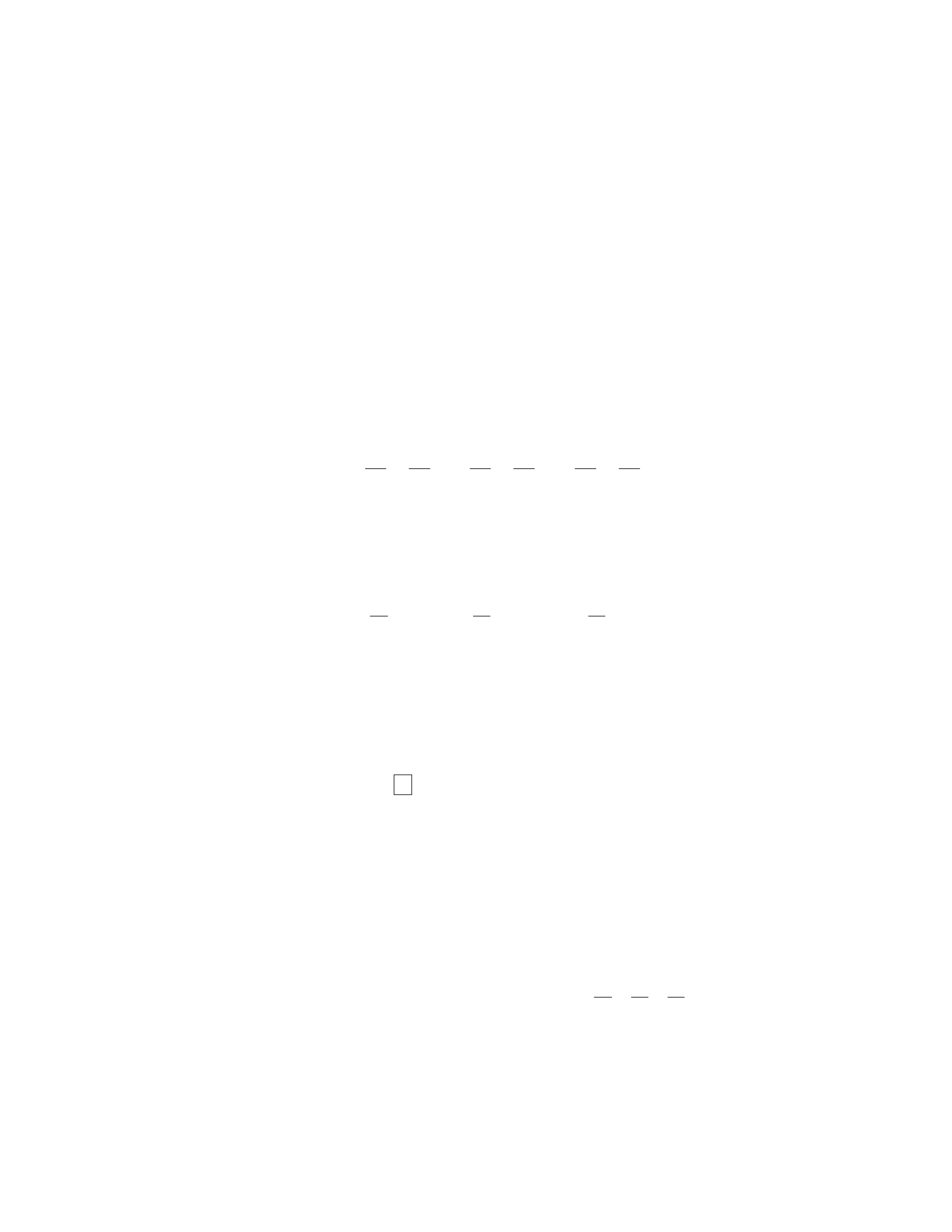
Question 19
Question
Let F(x, y, z)=(x2+y2)i+ (y2+z2)j+ (z2+x2)kbe a vector field in R3.
Compute ∇ · ∇ × F.
Solution
Step 1: Let’s first find ∇ × F.
F(x, y, z) = (x2+y2)i+ (y2+z2)j+ (z2+x2)k
The curl of a vector field F=Pi+Qj+Rkis given by
∇ × F= (∂R
∂y −∂Q
∂z )i−(∂R
∂x −∂P
∂z )j+ ( ∂Q
∂x −∂P
∂y )k
Thus, the curl of Fis
∇ × F= (2z−2y)i−(2z−2x)j+ (2y−2x)k
Step 2: Next, we will compute ∇ · ∇ × F.
∇ · ∇ × F=∂
∂x (2z−2y) + ∂
∂y (−2z+ 2x) + ∂
∂z (2y−2x)
Simplifying, we get
= -2 + 2 + 0
= 0
Therefore, ∇ · ∇ × F= 0 .
Question 20
Question
Let F(x, y, z) = x2yi+y2zj+z2xk. Calculate the curl of F.
Solution
To find the curl of F, we use the formula: ∇ × F=
i j k
∂
∂x
∂
∂y
∂
∂z
P Q R
, where
F(x, y, z) = Pi+Qj+Rk.
14
Step 1: Calculate the partial derivatives of P,Q, and R:P=x2y,Q=y2z,
R=z2x.
Step 2: Calculate the curl: ∇ × F=
i j k
∂
∂x
∂
∂y
∂
∂z
x2y y2z z2x
.
Step 3: Expand the determinant: ∇×F= ( ∂(z2x)
∂y −∂(y2z)
∂z )i−(∂(z2x)
∂x −
∂(x2y)
∂z )j+ ( ∂(y2z)
∂x −∂(x2y)
∂y )k.
Step 4: Evaluate the partial derivatives: ∇ × F= ((0 −2z)i−(2y−0)j+
(2y−2x)k.
Step 5: Simplify the curl: ∇ × F=−2zi−2yj+ (2y−2x)k.
Therefore, the curl of Fis −2zi−2yj+ (2y−2x)k.
Question 21
Question
Let F(x, y, z)=3xy2i+z3j−2xzkbe a vector field. Calculate the curl of Fat
the point P(1,2,−1).
Solution
To find the curl of Fat the point P(1,2,−1), we will use the formula for the
curl of a vector field:
curl F=∇ × F
where ∇is the del operator and ∇ × Frepresents the cross product of ∇and
F.
Step 1: Find the components of the del operator The del operator ∇
in Cartesian coordinates is given by:
∇=∂
∂x i+∂
∂y j+∂
∂z k
Step 2: Calculate the curl of F Given F(x, y, z) = 3xy2i+z3j−2xzk,
we have:
∇ × F=
i j k
∂
∂x
∂
∂y
∂
∂z
3xy2z3−2xz
Expanding the determinant, we get:
∇ × F=∂(−2xz)
∂y −∂z3
∂z i−∂3xy2
∂x −∂(−2xz)
∂z j+∂3xy2
∂x −∂z3
∂y k
15
Simplify each term:
∇ × F= (0 −3z)i−(3y2−2x)j+ (3y2−0)k
∇ × F=−3zi−(3y2−2x)j+ 3y2k
Step 3: Evaluate the expression at P(1,2,−1) Substitute x= 1, y= 2,
and z=−1 into the curl expression:
∇ × F=−3(−1)i−(3(2)2−2(1))j+ 3(2)2k
∇ × F= 3i−(12 −2)j+ 12k
∇ × F= 3i−10j+ 12k
Therefore, the curl of Fat the point P(1,2,−1) is curl F= 3i−10j+ 12k.
Question 22
Question
Let F=x2yi+ 3xzj+y2zkbe a vector field in R3. Determine the curl of Fat
the point (1,2,3).
Solution
To find the curl of a vector field F=Pi+Qj+Rkat a point (x0, y0, z0), we
calculate the determinant of the following matrix:
curl F(x0, y0, z0) =
i j k
∂
∂x
∂
∂y
∂
∂z
P Q R
Step 1: Compute ∂P
∂z ,∂Q
∂x , and ∂R
∂y .
∂P
∂z =∂
∂z (x2y) = 0 ; ∂Q
∂x =∂
∂x (3xz)=3z;∂R
∂y =∂
∂y (y2z)=2yz
Step 2: Calculate the curl of Fat the point (1,2,3) using the determinant
formula.
(1,2,3) =
i j k
∂
∂x
∂
∂y
∂
∂z
x2y3xz y2z
=∂R
∂y −∂Q
∂x i−∂P
∂z −∂R
∂x j+∂Q
∂x −∂P
∂y k
= (2yz −0)i−(0 −3z)j+ (3z−2xy)k
= 2(2)(3)i−(−3(3))j+ (3(3) −2(1)(2))k
= 12i+ 9j+ 15k
Therefore, the curl of Fat the point (1,2,3) is curl F(1,2,3) = 12i+9j+15k.
16
Question 23
Question
Let F(x, y) = x
x2+y2,y
x2+y2be a vector field in R2. Determine the diver-
gence of F.
Solution
To find the divergence of a vector field F(x, y) = (P(x, y), Q(x, y)), we use the
formula:
div(F) = ∂P
∂x +∂Q
∂y
Step 1: Compute ∂P
∂x and ∂Q
∂y .
∂P
∂x =∂
∂x x
x2+y2=(x2+y2)−x(2x)
(x2+y2)2=y2−x2
(x2+y2)2
∂Q
∂y =∂
∂y y
x2+y2=(x2+y2)−y(2y)
(x2+y2)2=x2−y2
(x2+y2)2
Step 2: Find the divergence of F.
div(F) = ∂P
∂x +∂Q
∂y
=y2−x2
(x2+y2)2+x2−y2
(x2+y2)2
=y2−x2+x2−y2
(x2+y2)2
= 0
Therefore, the divergence of the vector field F(x, y) is 0.
Question 24
Question
Let F(x, y, z) = x2yi+y2zj+z2xkbe a vector field in R3. Compute the curl
of F.
Solution
To compute the curl of F, we use the formula
∇ × F=
i j k
∂
∂x
∂
∂y
∂
∂z
P Q R
,
17

where F(x, y, z) = Pi+Qj+Rk.
Step 1: Compute ∂R ∂y
∂R
∂y =∂
∂y (z2x)=0
Step 2: Compute ∂Q ∂z
∂Q
∂z =∂
∂z (y2z) = y2
Step 3: Compute ∂P ∂z
∂P
∂z =∂
∂z (x2y)=0
Step 4: Compute ∂R ∂x
∂R
∂x =∂
∂x (z2x)=2z
Step 5: Compute ∂Q ∂y
∂Q
∂y =∂
∂y (y2z) = 2yz
Step 6: Compute ∂P ∂y
∂P
∂y =∂
∂y (x2y) = x2
Step 7: Compute the curl of F Now, we can plug these partial derivatives
into the formula for the curl:
∇ × F=∂R
∂y −∂Q
∂z i−∂R
∂x −∂P
∂z j+∂Q
∂x −∂P
∂y k
Substitute the computed partial derivatives:
∇ × F= (−y2)i−2zj−x2k
Therefore, the curl of Fis (−y2)i−2zj−x2k.
Question 25
Question
Let F(x, y, z) = x2yi+y2zj+z2xkbe a vector field in R3. Compute the
divergence of F.
18
Solution
To find the divergence of F, we use the formula for divergence: div(F) = ∇·F=
∂P
∂x +∂Q
∂y +∂R
∂z , where F(x, y, z) = P(x, y, z)i+Q(x, y, z)j+R(x, y, z)k.
Step 1: Compute the partial derivatives of P,Q, and R.
∂P
∂x =∂
∂x (x2y) = 2xy
∂Q
∂y =∂
∂y (y2z)=2yz
∂R
∂z =∂
∂z (z2x)=2zx
Step 2: Calculate the divergence.
div(F) = ∂P
∂x +∂Q
∂y +∂R
∂z
= 2xy + 2yz + 2zx
= 2(xy +yz +zx)
Therefore, the divergence of the vector field F(x, y, z) = x2yi+y2zj+z2xk
is 2(xy +yz +zx).
Question 26
Question
Let F(x, y, z) = x2yzi+e2ysin(z)j+ cos(xy)k. Compute ∇ · F.
Solution
To find the divergence of F, we use the formula ∇ · F=∂P
∂x +∂Q
∂y +∂R
∂z , where
F(x, y, z) = P(x, y, z)i+Q(x, y, z)j+R(x, y, z)k.
Step 1: Compute ∂P
∂x ,∂Q
∂y , and ∂R
∂z .
∂P
∂x =∂
∂x (x2yz) = 2xyz
∂Q
∂y =∂
∂y (e2ysin(z)) = 2e2ysin(z)
∂R
∂z =∂
∂z (cos(xy)) = −xsin(xy)
Step 2: Find ∇ · F.
∇ · F= 2xyz + 2e2ysin(z)−xsin(xy)
Therefore, the divergence of Fis 2xyz + 2e2ysin(z)−xsin(xy).
19
Question 27
Question
Let F(x, y, z) = x2yi−xy2j+z3k. Compute the curl of F.
Solution
To find the curl of F, we use the formula:
curl F=∇ × F
where ∇is the del operator in Cartesian coordinates. For a vector field F=
Pi+Qj+Rk, the curl is given by:
∇ × F=
i j k
∂
∂x
∂
∂y
∂
∂z
P Q R
Step 1: Compute the three partial derivatives P,Q, and R.
P=x2y
Q=−xy2
R=z3
Step 2: Substitute P,Q, and Rinto the determinant formula for the curl.
∇ × F=
i j k
∂
∂x
∂
∂y
∂
∂z
x2y−xy2z3
Step 3: Evaluate the determinant by computing the cross product of the
unit vectors.
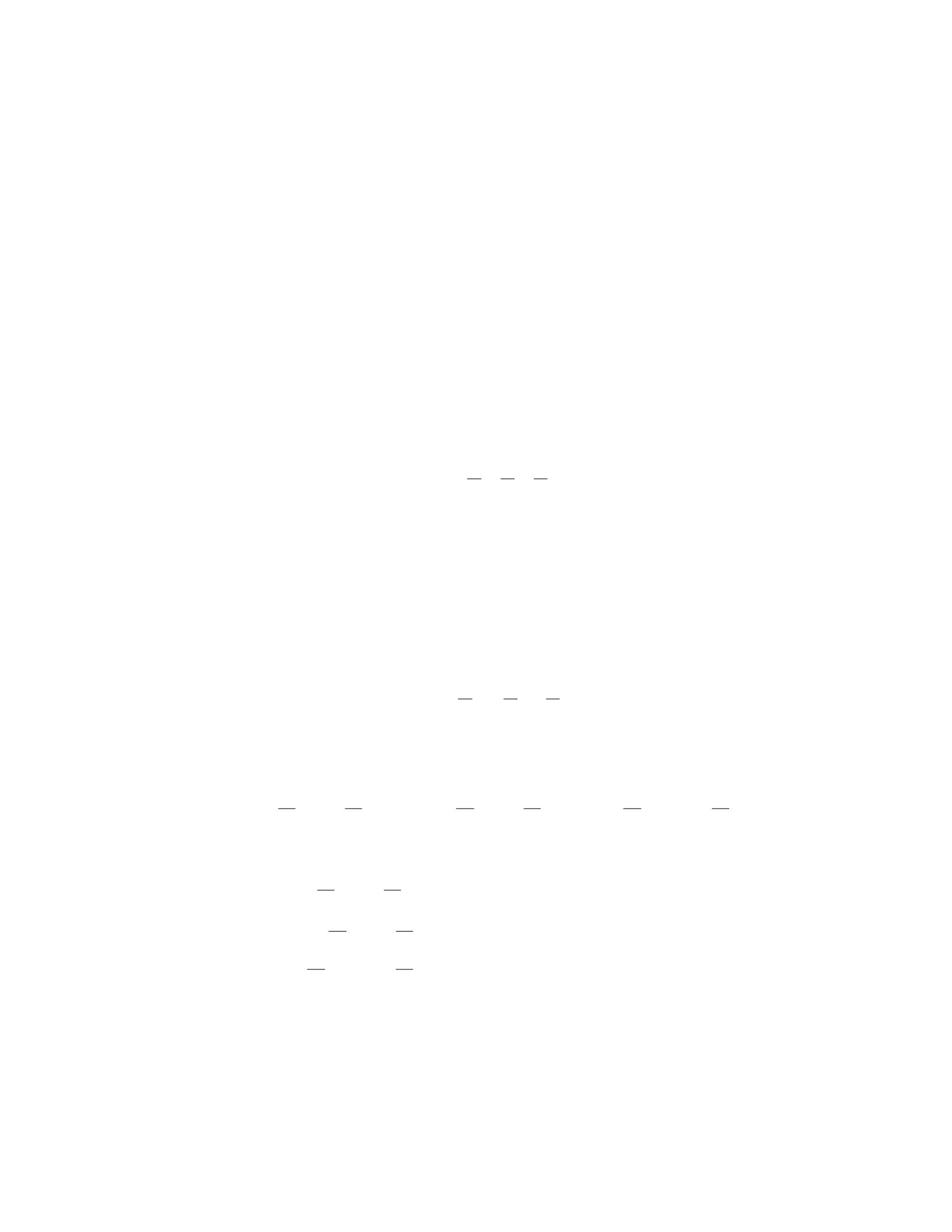
∇×F=∂
∂y (z3)−∂
∂z (−xy2)i−∂
∂x (z3)−∂
∂z (x2y)j+∂
∂x (−xy2)−∂
∂y (x2y)k
Step 4: Compute the partial derivatives and simplify. We have:
∂
∂y (z3)−∂
∂z (−xy2) = 0 −(−y2) = y2
∂
∂x (z3)−∂
∂z (x2y) = 0 −(−x2) = x2
∂
∂x (−xy2)−∂
∂y (x2y) = −y2−2xy =−y2(1 + 2x)
Therefore, the curl of Fis:
curl F=y2i+x2j−y2(1 + 2x)k
20
Question 28
Question
Let F(x, y, z)=(x2y, yz, xz2) be a vector field in R3. Compute the curl of F.
Solution
To find the curl of F, denoted by ∇ × F, we need to compute the determinant
of the following matrix:
∇ × F=
i j k
∂
∂x
∂
∂y
∂
∂z
x2y yz xz2
Step 1: Compute the partial derivatives:
∂
∂x = (2xy, 0, z2)∂
∂y = (x2, z, 0) ∂
∂z = (0, y, 2xz)
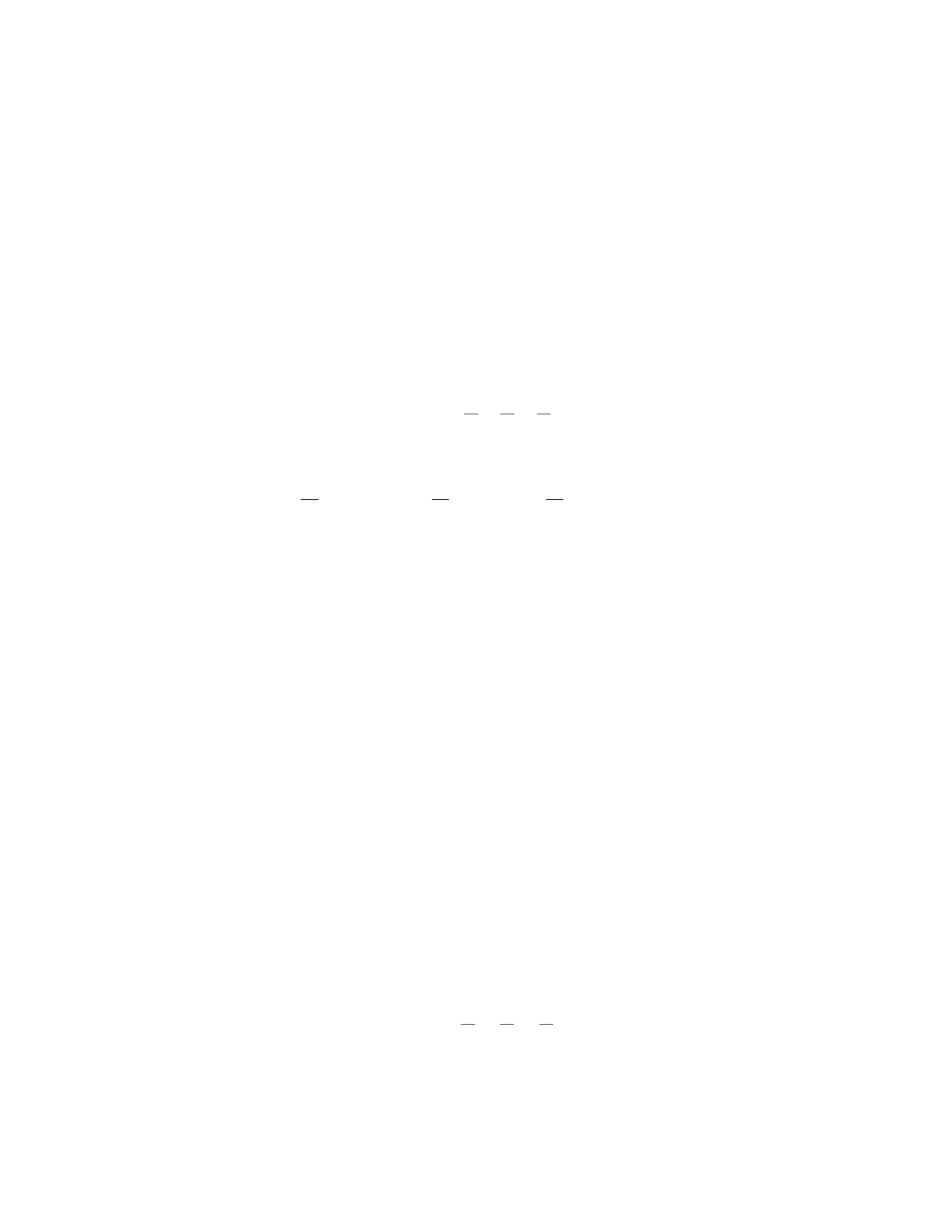
Step 2: Expand the determinant:
∇ × F=
i j k
(2xy) 0 z2
x2y yz xz2
−
i j k
0 (x2) 0
x2y yz xz2
+
i j k
0 (z)y
x2y yz xz2
Step 3: Evaluate the determinants:
∇ × F=0−z2y, 2x2y−xz2,2xy −0= (−z2y, 2x2y−xz2,2xy)
Therefore, the curl of Fis ∇ × F= (−z2y, 2x2y−xz2,2xy).
Question 29
Question
Let F(x, y, z) = x2yi+yz2j+xyzkbe a vector field in R3. Find ∇ × ∇ × F.
Solution
We know that for a vector field Gin R3, the curl of the curl of Gis given by
the following formula:
∇ × ∇ × G=∇(∇ · G)− ∇2G
Let’s calculate ∇ × Ffirst. Given F(x, y, z) = x2yi+yz2j+xyzk, we have:
∇ × F=
i j k
∂
∂x
∂
∂y
∂
∂z
x2y yz2xyz
21
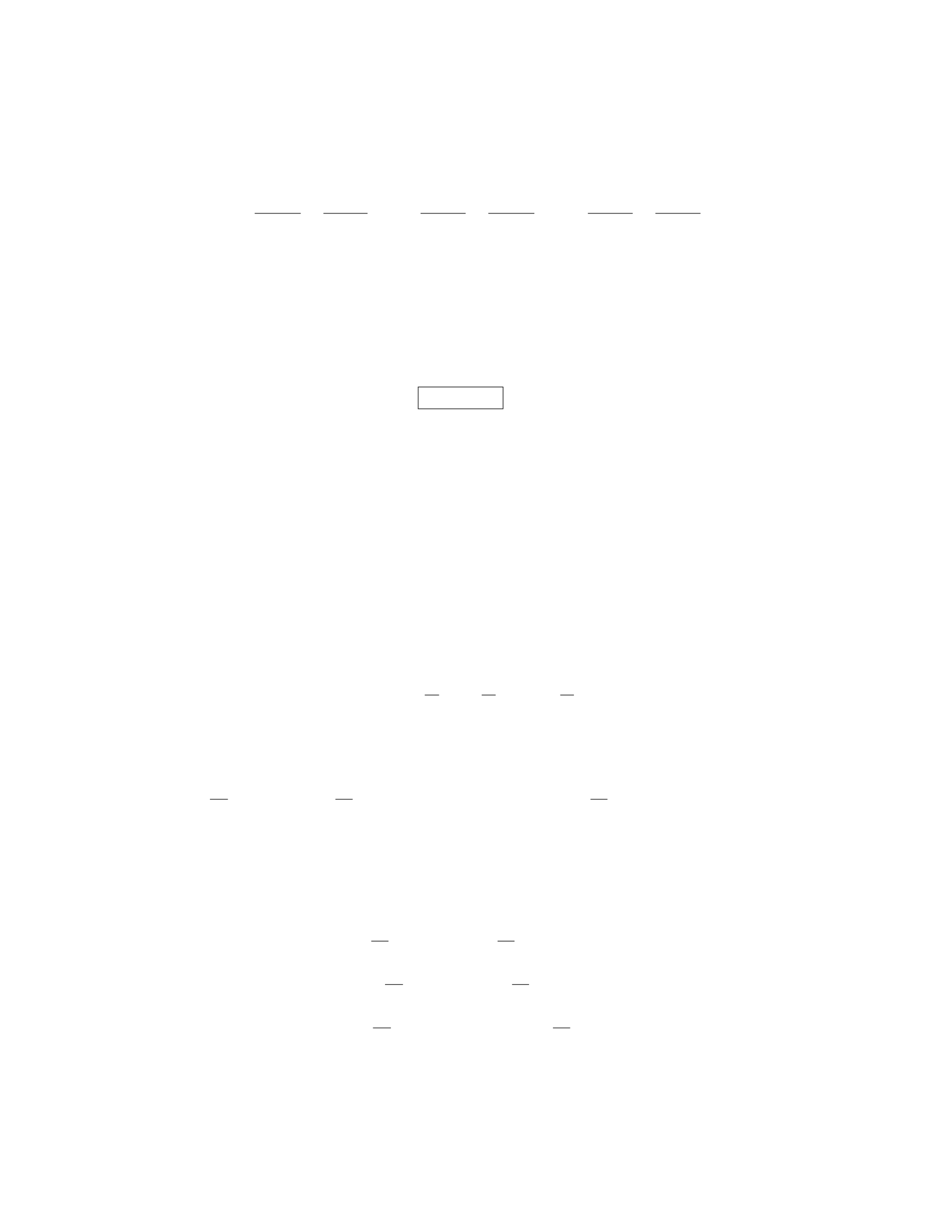
=∂(xyz)
∂y −∂(yz2)
∂z i−∂(x2y)
∂x −∂(xyz)
∂z j+∂(xz2)
∂x −∂(x2y)
∂y k
= (xz −2yz)i−(2xy −xz)j+ (z2−y)k
Now, we can calculate ∇ × (∇ × F):
∇ × (xz −2yz)i−(2xy −xz)j+ (z2−y)k
=∇(z2−y)−(−2z)i−∇ (xz −2yz)−(z2−y)j+∇[(2xy −xz)−(2yz)] k
= 0i−0j−0k
∇ × ∇ × F=0
Question 30
Question
Let F(x, y, z) = x2yi+zsin(xy)j+y2cos(xz)kbe a vector field in R3. Find the
curl of F.
Solution
To find the curl of F, we first need to compute the determinant of the following
matrix composed of the unit vectors i,j, and k, and the partial derivative
operators with respect to x,y, and z:
curl(F) =
i j k
∂
∂x
∂
∂y
∂
∂z
x2y z sin(xy)y2cos(xz)
Step 1: Compute the partial derivatives Compute the partial deriva-
tives of the vector field components:
∂
∂x (x2y) = 2xy, ∂
∂y (zsin(xy)) = zcos(xy)+sin(xy),∂
∂z (y2cos(xz)) = −y2xsin(xz)
Step 2: Calculate the determinant Substitute the computed partial
derivatives into the determinant expression:
curl(F) =
i j k
2xy z cos(xy) + sin(xy)−y2xsin(xz)
=−∂
∂y (y2xsin(xz)) −∂
∂z (zcos(xy) + sin(xy))i
−−∂
∂x (y2xsin(xz)) −∂
∂z (2xy)j
+∂
∂x (zcos(xy) + sin(xy)) + ∂
∂y (2xy)k
22
Question 2
Question
Let F(x, y, z) = x2yi+xyzj+xz2k. Compute the divergence of F.
Solution
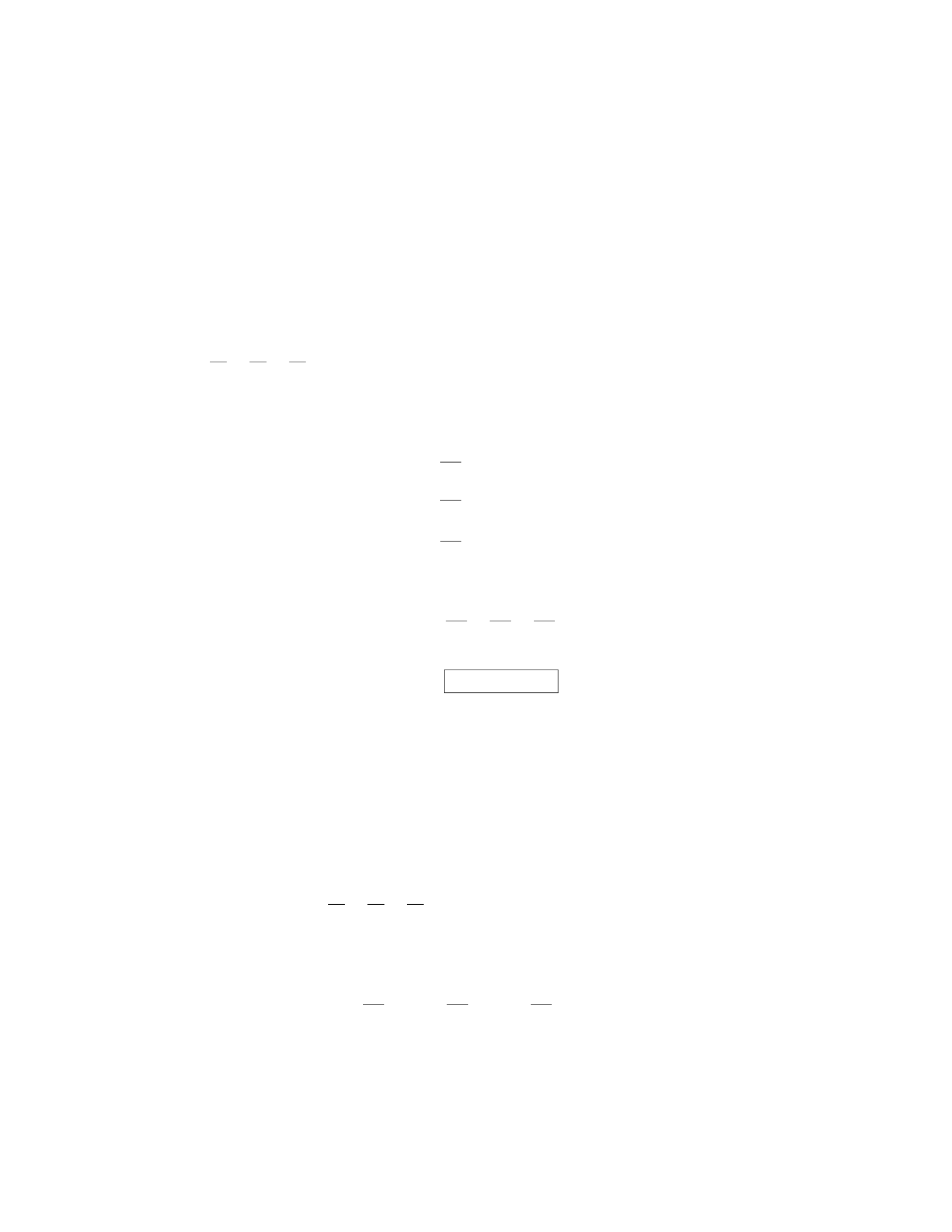
Step 1: The divergence of a vector field F=Pi+Qj+Rkis defined as ∇ · F=
∂P
∂x +∂Q
∂y +∂R
∂z .
Step 2: Given F(x, y, z) = x2yi+xyzj+xz2k, we have P(x, y, z) = x2y,
Q(x, y, z) = xyz, and R(x, y, z) = xz2.
Step 3: Calculate the partial derivatives:
∂P
∂x = 2xy,
∂Q
∂y =xz,
∂R
∂z = 2xz.
Step 4: Now, find the divergence:
∇ · F=∂P
∂x +∂Q
∂y +∂R
∂z
= 2xy +xz + 2xz
= 2xy +xz + 2xz .
Question 3
Question
Let F(x, y, z) = (2xy +z)i+ (x2+y2)j+ (xy +z2)kbe a vector field in R3.
Calculate the divergence and curl of F.
Solution
Divergence: Step 1: The divergence of a vector field F=Pi+Qj+Rkis
given by ∇ · F=∂P
∂x +∂Q
∂y +∂R
∂z .
Step 2: In this case, F(x, y, z) = (2xy +z)i+ (x2+y2)j+ (xy +z2)k, where
P= 2xy +z,Q=x2+y2, and R=xy +z2.
Step 3: Calculate the partial derivatives:
∂P
∂x = 2y, ∂Q
∂y = 2y, ∂R
∂z = 2z
2
Step 4: The divergence of Fis:
∇ · F= 2y+ 2y+ 2z= 4y+ 2z
Curl: Step 1: The curl of a vector field F=Pi+Qj+Rkis given by
∇ × F=∂R
∂y −∂Q
∂z i−∂R
∂x −∂P
∂z j+∂Q
∂x −∂P
∂y k.
Step 2: Calculate the partial derivatives for the curl:
∂R
∂y =x, ∂Q
∂z = 0
∂R
∂x =y, ∂P
∂z = 0
∂Q
∂x = 2x, ∂P
∂y = 0
Step 3: The curl of Fis:
∇ × F= (x−0)i−(y−0)j+ (2x−0)k=xi−yj+ 2xk
Question 4
Question
Let F(x, y, z)=2xzˆ
i+y2ˆ
j+ (2x2−z)ˆ
kbe a vector field in R3. Compute
∇ · ∇ × F.
Solution
Step 1: Compute the curl of the vector field F.
∇ × F=
ˆ
iˆ
jˆ
k
∂
∂x
∂
∂y
∂
∂z
2xz y22x2−z
∇ × F= (∂(2x2−z)
∂y −∂(y2)
∂z )ˆ
i−(∂(2xz)
∂z −∂(2x2−z)
∂x )ˆ
j+ (∂(y2)
∂x −∂(2xz)
∂y )ˆ
k
∇ × F= 0ˆ
i+ 0ˆ
j+ 0ˆ
k=0
Step 2: Compute the divergence of the zero vector field.
∇ · 0=∂0
∂x +∂0
∂y +∂0
∂z = 0
Step 3: The result suggests that ∇ · ∇ × F= 0 .
3

Question 5
Question
Let F(x, y, z)=(eycos(z),−xeysin(z),−yeysin(z)). Calculate the divergence
of F.
Solution
To calculate the divergence of a vector field F= (P, Q, R), we use the formula:
div(F) = ∂P
∂x +∂Q
∂y +∂R
∂z .
In this case, F(x, y, z)=(eycos(z),−xeysin(z),−yeysin(z)), so P=eycos(z),
Q=−xeysin(z), and R=−yeysin(z).
Step 1: Calculate ∂P
∂x :
∂P
∂x = 0
Step 2: Calculate ∂Q
∂y :
∂Q
∂y =−eysin(z)−xeycos(z)
Step 3: Calculate ∂R
∂z :
∂R
∂z =−yeycos(z)
Step 4: Add up the partial derivatives to find the divergence:
div(F) = ∂P
∂x +∂Q
∂y +∂R
∂z = 0 −eysin(z)−xeycos(z)−yeycos(z)
Therefore, the divergence of Fis div(F) = −eysin(z)−xeycos(z)−yeycos(z).
Question 6
Question
Let F(x, y, z)=(yz +x2)i+ (xz +y2)j+ (xy +z2)k. Compute the divergence
of F.
Solution
To compute the divergence of F, we use the formula:
div F=∇ · F=∂P
∂x +∂Q
∂y +∂R
∂z ,
where F(x, y, z) = P(x, y, z)i+Q(x, y, z)j+R(x, y, z)k.
4
Step 1: Calculate ∂P
∂x ,∂Q
∂y , and ∂R
∂z :
∂P
∂x =∂
∂x (yz +x2) = 2x,
∂Q
∂y =∂
∂y (xz +y2) = x,
∂R
∂z =∂
∂z (xy +z2)=1.
Step 2: Compute the divergence:
div F= 2x+x+ 1 = 3x+ 1.
Therefore, the divergence of Fis 3x+ 1.
Question 7
Question
Let F(x, y, z)=(x2y, −2xz, xz2) be a vector field. Compute the divergence of
F.
Solution
To compute the divergence of F, we use the formula for the divergence of a
vector field F(x, y, z)=(P(x, y, z), Q(x, y, z), R(x, y, z)):
div(F) = ∇ · F=∂P
∂x +∂Q
∂y +∂R
∂z
In this case, F(x, y, z)=(x2y, −2xz, xz2), so P(x, y, z) = x2y,Q(x, y, z) =
−2xz, and R(x, y, z) = xz2.
Step 1: Compute ∂P
∂x :
∂P
∂x =∂
∂x (x2y) = 2xy
Step 2: Compute ∂Q
∂y :
∂Q
∂y =∂
∂y (−2xz) = 0
Step 3: Compute ∂R
∂z :
∂R
∂z =∂
∂z (xz2) = x(2z)=2xz
Step 4: Add the partial derivatives together:
∇ · F= 2xy + 0 + 2xz = 2xy + 2xz
Therefore, the divergence of Fis 2xy + 2xz.
5
Question 8
Question
Let F(x, y, z) = y
x2+y2i−x
x2+y2j+zk. Calculate the curl of F.
Solution
To find the curl of F, we need to compute the determinant of the following
matrix:
curl F=
i j k
∂
∂x
∂
∂y
∂
∂z
y
x2+y2−x
x2+y2z
Step 1: Compute the partial derivatives of F:
∂
∂x =−y(2x)
(x2+y2)2,∂
∂y =x(2x)
(x2+y2)2,∂
∂z = 1
Step 2: Substitute the partial derivatives into the determinant expression:
curl F=
i j k
−y(2x)
(x2+y2)2
x(2x)
(x2+y2)21
y
x2+y2−x
x2+y2z
Step 3: Expand the determinant using the cofactor expansion along the top
row:
curl F=∂
∂y x
x2+y2−∂
∂z −y(2x)
(x2+y2)2i−∂
∂x −x
x2+y2−∂
∂z y
x2+y2j+∂
∂x y
x2+y2−∂
∂y −x
x2+y2k
Step 4: Simplify the expressions to obtain the components of the curl:
curl F=2x(x2−y2)
(x2+y2)2i+2y(x2−y2)
(x2+y2)2j+ 0k
Therefore, the curl of Fis 2x(x2
−y2)
(x2+y2)2i+2y(x2
−y2)
(x2+y2)2j.
Question 9
Question
Let F(x, y, z) = 2x2yi+x2zj+x2yk. Determine the divergence of Fat the
point (1,2,3).
6
Solution
Step 1: The divergence of a vector field F(x, y, z) = P(x, y, z)i+Q(x, y, z)j+
R(x, y, z)kis given by the formula:
div(F) = ∂P
∂x +∂Q
∂y +∂R
∂z .
Step 2: Given F(x, y, z)=2x2yi+x2zj+x2yk, we have:
P(x, y, z)=2x2y, Q(x, y, z) = x2z, R(x, y, z) = x2y.
Step 3: Calculate the partial derivatives:
∂P
∂x = 4xy, ∂Q
∂y = 0,∂R
∂z = 0.
Step 4: The divergence of Fat the point (1,2,3) is then:
div(F) = ∂P
∂x +∂Q
∂y +∂R
∂z = 4(1)(2) + 0 + 0 = 8.
Step 5: Therefore, the divergence of Fat the point (1,2,3) is 8 .
Question 10
Question
Let F(x, y) = ⟨x2y, xy2⟩be a vector field. Compute the divergence of F.
Solution
To find the divergence of the vector field F(x, y) = ⟨x2y, xy2⟩, we use the formula
for divergence:
∇ · F=∂
∂x (x2y) + ∂
∂y (xy2)
Step 1: Compute the partial derivative with respect to x:
∂
∂x (x2y)=2xy
Step 2: Compute the partial derivative with respect to y:
∂
∂y (xy2) = x·2y= 2xy
Step 3: Add the two partial derivatives together to find the divergence:
∇ · F= 2xy + 2xy = 4xy
Therefore, the divergence of the vector field F(x, y) = ⟨x2y, xy2⟩is ∇ · F=
4xy.
7
Question 11
Question
Let F(x, y, z) = x2yi+e2zj+xyzkbe a vector field in R3. Compute the
divergence of F.
Solution
To find the divergence of a vector field F=Pi+Qj+Rk, we use the formula
div(F) = ∂P
∂x +∂Q
∂y +∂R
∂z .
In this case, F(x, y, z) = x2yi+e2zj+xyzk, so P=x2y,Q=e2z, and
R=xyz.
Step 1: Compute ∂P
∂x .
∂P
∂x =∂
∂x (x2y) = 2xy
Step 2: Compute ∂Q
∂y .
∂Q
∂y =∂
∂y (e2z)=0
Step 3: Compute ∂R
∂z .
∂R
∂z =∂
∂z (xyz) = xy
Step 4: Compute the divergence of F.
div(F) = ∂P
∂x +∂Q
∂y +∂R
∂z = 2xy +0+xy = 3xy
Therefore, the divergence of Fis div(F) = 3xy.
Question 12
Question
Let F(x, y, z) = (2xy+zex, x2−zcos(y), y2+ez) be a vector field in R3. Calculate
the gradient, divergence, and curl of F.
Solution
Step 1: Calculate the gradient of F. The gradient of a vector field F=
(f1, f2, f3) is given by ∇ · F=∂f
∂x ,∂f
∂y ,∂f
∂z .
8
So, for F(x, y, z) = (2xy +zex, x2−zcos(y), y2+ez), we have:
∇ · F=2y+ex+∂
∂x (zex),2x−cos(y)−∂
∂y (zcos(y)),2y+ez
= (2y+ex+zex,2x−cos(y) + zsin(y),2y+ez)
Step 2: Calculate the divergence of F. The divergence of a vector field
F= (f1, f2, f3) is given by ∇ · F=∂f1
∂x +∂f2
∂y +∂f3
∂z .
For F(x, y, z) above, the divergence is:
∇ · F=∂
∂x (2xy +zex) + ∂
∂y (x2−zcos(y)) + ∂
∂z (y2+ez)
= 2y+ex+ 2x−cos(y)+1
Step 3: Calculate the curl of F. The curl of a vector field Fis given by
∇ × F=∂f3
∂y −∂f2
∂z ,∂f1
∂z −∂f3
∂x ,∂f2
∂x −∂f1
∂y .
Thus, for F(x, y, z), the curl is:
∇ × F= (1 −0, ex−0,−2y−0)
= (1, ex,−2y)
Question 13
Question
Let F(x, y, z) = x2yi+xyzj+ (x+y+z)k. Compute ∇ · ∇ × F.
Solution
Step 1: Compute ∇ × F. The curl of a vector field F=Pi+Qj+Rkis given
by:
∇ × F=∂R
∂y −∂Q
∂z i−∂R
∂x −∂P
∂z j+∂Q
∂x −∂P
∂y k
In our case, F=x2yi+xyzj+(x+y+z)k, so P=x2y,Q=xyz,R=x+y+z.
Now, compute the partial derivatives:
∂P
∂z = 0,∂Q
∂x =yz, ∂R
∂y = 1
∂Q
∂z =x, ∂R
∂x = 1,∂P
∂y =x2
∂R
∂z = 1,∂P
∂x = 2xy, ∂Q
∂y =xz
So,
∇ × F= (x−xz)i−(1 −x2)j+ (xz −2xy)k
9
Step 2: Compute ∇·∇×F. The divergence of a vector field G=G1i+
G2j+G3kis given by:
∇ · G=∂G1
∂x +∂G2
∂y +∂G3
∂z
In our case, G= (x−xz)i−(1 −x2)j+ (xz −2xy)k, so G1=x−xz,
G2=−1 + x2,G3=xz −2xy. Now, compute the partial derivatives:
∂G1
∂x = 1 −z, ∂G2
∂y = 0,∂G3
∂z =x
∂G1
∂y = 0,∂G2
∂z = 0,∂G3
∂x =z−2y
∂G1
∂z =−x, ∂G2
∂x = 2x, ∂G3
∂y =−2x
So,
∇ · ∇ × F= (1 −z)+(z−2x) = 1 −2x
Question 14
Question
Let F(x, y, z)=(x2ey, ye−z, z2ex). Find ∇ · F.
Solution
Step 1: Compute the partial derivatives of each component of F.
∂
∂x (x2ey)=2xey
∂
∂y (ye−z) = e−z
∂
∂z (z2ex)=2zex
Step 2: Take the dot product of ∇with F.
∇ · F=∂
∂x (x2ey) + ∂
∂y (ye−z) + ∂
∂z (z2ex)=2xey+e−z+ 2zex
Therefore, ∇ · F= 2xey+e−z+ 2zex.
Question 15
Question
Let F=xzi+ (x+y)zj+ (x+y2)kbe a vector field in R3. Calculate ∇ · F.
10
Solution
Step 1: Calculate the partial derivatives of each component of F.
∂
∂x (xz) = z
∂
∂y (xz) = 0
∂
∂z (xz) = x
∂
∂x (x+y)z=z
∂
∂y (x+y)z=z
∂
∂z (x+y)z=x+y
∂
∂x (x+y2) = 1
∂
∂y (x+y2) = 2y
∂
∂z (x+y2) = 0
Step 2: Calculate the divergence of F.
∇ · F=∂
∂x (xz) + ∂
∂y (x+y)z+∂
∂z (x+y2)
=z+z+x+y= 2z+x+y
Therefore, the divergence of Fis 2z+x+y.
Question 16
Question
Let F(x, y, z) = exsin(y)i+eycos(z)j+ezsin(x)k. Determine the curl of F.
Solution
To find the curl of F, we can use the formula for the curl of a vector field
F=P i +Qj +Rk:
curl(F) = ∂R
∂y −∂Q
∂z i+∂P
∂z −∂R
∂x j+∂Q
∂x −∂P
∂y k
Step 1: Find ∂P ∂y,∂Q
∂z ,∂Q
∂x , and ∂R
∂x .
11
∂P
∂y =excos(y)
∂Q
∂z =−eysin(z)
∂Q
∂x = 0
∂R
∂x =ezcos(x)
Step 2: Calculate the components of the curl.
) = ∂R
∂y −∂Q
∂z i+∂P
∂z −∂R
∂x j+∂Q
∂x −∂P
∂y k
= (0 −(−eysin(z))) i+ (0 −ezcos(x)) j+ (0 −excos(y)) k
=eysin(z)i−ezcos(x)j−excos(y)k
Therefore, the curl of Fis curl(F) = eysin(z)i−ezcos(x)j−excos(y)k.
Question 17
Question
Let F(x, y, z)=(x2y3, xz2, y2z). Calculate ∇ · (∇ × F).
Solution
Step 1: Find ∇ × F. Step 2: Find ∇ · (∇ × F).
Step 1: We have F(x, y, z)=(x2y3, xz2, y2z).
The curl of F, denoted ∇ × F, is given by:
∇ × F=
i j k
∂
∂x
∂
∂y
∂
∂z
x2y3xz2y2z
Calculating the determinant, we get:
∇×F=∂(y2z)
∂y −∂(xz2)
∂z i−∂(x2y3)
∂x −∂(y2z)
∂z j+∂(xz2)
∂x −∂(x2y3)
∂y k
Simplifying further, we get:
∇ × F= (z2−0)i−(2xy3−0)j+ (2xz −3x2y2)k
So, ∇ × F= (z2)i−(2xy3)j+ (2xz −3x2y2)k.
Step 2: Now, we need to find ∇ · (∇ × F).
12
Since ∇ · (∇ × F) is equivalent to the divergence of the curl, we can compute
this as:
∇ · (∇ × F) = ∂
∂x (z2) + ∂
∂y (−2xy3) + ∂
∂z (2xz −3x2y2)
Solving these partial derivatives, we have:
∇ · (∇ × F)=0−6xy + 2x
Therefore, the final answer is ∇ · (∇ × F)=2x−6xy.
Question 18
Question
Let F(x, y, z) = 2x2y+yz3, x2z3−3y2,3xyz2be a vector field. Compute
∇ · F, where ∇is the gradient operator.
Solution
Step 1: Compute ∇ · Fby taking the dot product of the gradient operator ∇
and the vector field F.
∇ · F=∂
∂x 2x2y+yz3+∂
∂y x2z3−3y2+∂
∂z 3xyz2
Step 2: Calculate the partial derivatives with respect to x,y, and z.
∂
∂x 2x2y+yz3= 4xy
∂
∂y x2z3−3y2=x2z3−6y
∂
∂z 3xyz2= 6xyz
Step 3: Substitute the partial derivatives back into the expression for ∇ · F.
∇ · F= 4xy + (x2z3−6y)+6xyz
Step 4: Simplify the expression.
∇ · F= 4xy +x2z3−6y+ 6xyz
Therefore, ∇ · F= 4xy +x2z3−6y+ 6xyz.
13
Question 19
Question
Let F(x, y, z)=(x2+y2)i+ (y2+z2)j+ (z2+x2)kbe a vector field in R3.
Compute ∇ · ∇ × F.
Solution
Step 1: Let’s first find ∇ × F.
F(x, y, z) = (x2+y2)i+ (y2+z2)j+ (z2+x2)k
The curl of a vector field F=Pi+Qj+Rkis given by
∇ × F= (∂R
∂y −∂Q
∂z )i−(∂R
∂x −∂P
∂z )j+ ( ∂Q
∂x −∂P
∂y )k
Thus, the curl of Fis
∇ × F= (2z−2y)i−(2z−2x)j+ (2y−2x)k
Step 2: Next, we will compute ∇ · ∇ × F.
∇ · ∇ × F=∂
∂x (2z−2y) + ∂
∂y (−2z+ 2x) + ∂
∂z (2y−2x)
Simplifying, we get
= -2 + 2 + 0
= 0
Therefore, ∇ · ∇ × F= 0 .
Question 20
Question
Let F(x, y, z) = x2yi+y2zj+z2xk. Calculate the curl of F.
Solution
To find the curl of F, we use the formula: ∇ × F=
i j k
∂
∂x
∂
∂y
∂
∂z
P Q R
, where
F(x, y, z) = Pi+Qj+Rk.
14
Step 1: Calculate the partial derivatives of P,Q, and R:P=x2y,Q=y2z,
R=z2x.
Step 2: Calculate the curl: ∇ × F=
i j k
∂
∂x
∂
∂y
∂
∂z
x2y y2z z2x
.
Step 3: Expand the determinant: ∇×F= ( ∂(z2x)
∂y −∂(y2z)
∂z )i−(∂(z2x)
∂x −
∂(x2y)
∂z )j+ ( ∂(y2z)
∂x −∂(x2y)
∂y )k.
Step 4: Evaluate the partial derivatives: ∇ × F= ((0 −2z)i−(2y−0)j+
(2y−2x)k.
Step 5: Simplify the curl: ∇ × F=−2zi−2yj+ (2y−2x)k.
Therefore, the curl of Fis −2zi−2yj+ (2y−2x)k.
Question 21
Question
Let F(x, y, z)=3xy2i+z3j−2xzkbe a vector field. Calculate the curl of Fat
the point P(1,2,−1).
Solution
To find the curl of Fat the point P(1,2,−1), we will use the formula for the
curl of a vector field:
curl F=∇ × F
where ∇is the del operator and ∇ × Frepresents the cross product of ∇and
F.
Step 1: Find the components of the del operator The del operator ∇
in Cartesian coordinates is given by:
∇=∂
∂x i+∂
∂y j+∂
∂z k
Step 2: Calculate the curl of F Given F(x, y, z) = 3xy2i+z3j−2xzk,
we have:
∇ × F=
i j k
∂
∂x
∂
∂y
∂
∂z
3xy2z3−2xz
Expanding the determinant, we get:
∇ × F=∂(−2xz)
∂y −∂z3
∂z i−∂3xy2
∂x −∂(−2xz)
∂z j+∂3xy2
∂x −∂z3
∂y k
15
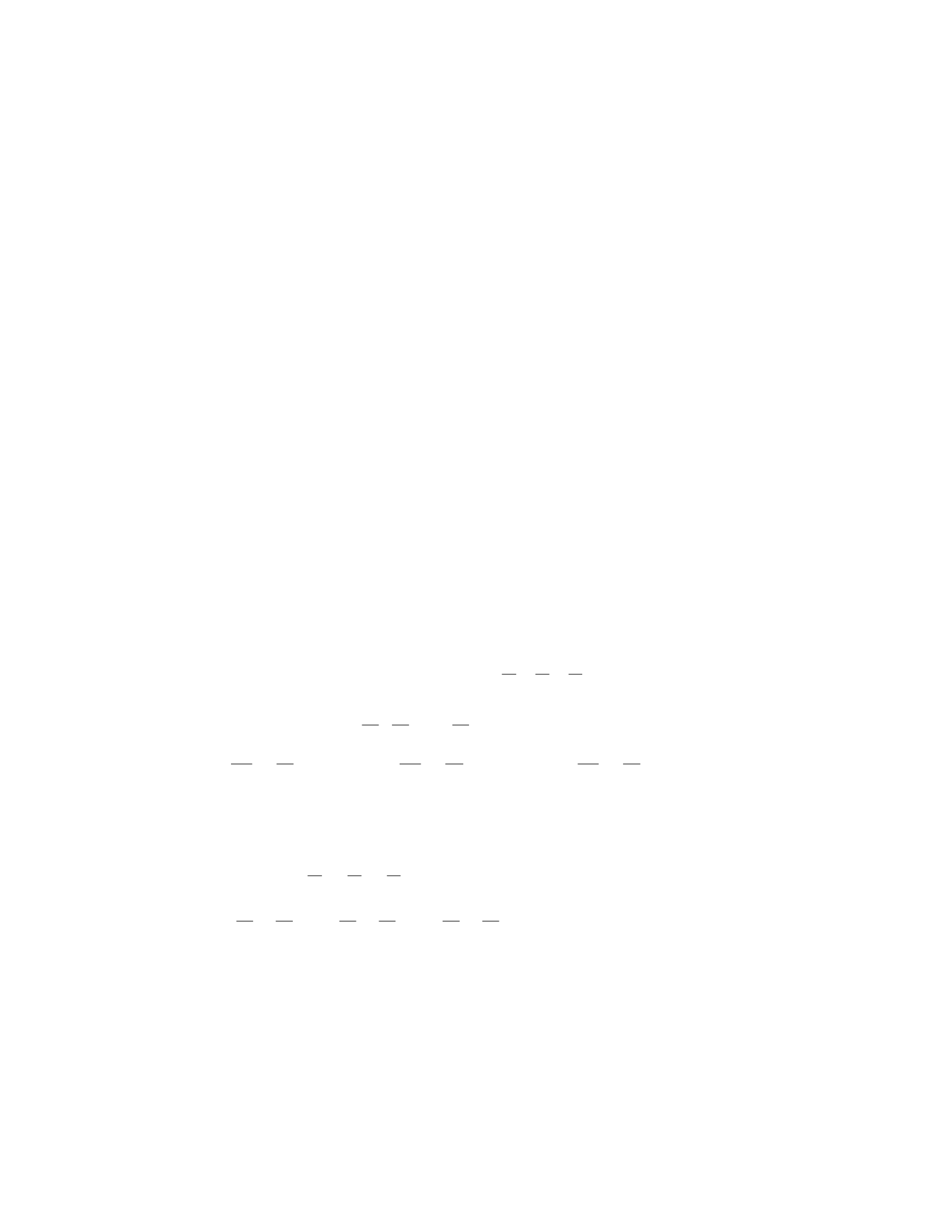
Simplify each term:
∇ × F= (0 −3z)i−(3y2−2x)j+ (3y2−0)k
∇ × F=−3zi−(3y2−2x)j+ 3y2k
Step 3: Evaluate the expression at P(1,2,−1) Substitute x= 1, y= 2,
and z=−1 into the curl expression:
∇ × F=−3(−1)i−(3(2)2−2(1))j+ 3(2)2k
∇ × F= 3i−(12 −2)j+ 12k
∇ × F= 3i−10j+ 12k
Therefore, the curl of Fat the point P(1,2,−1) is curl F= 3i−10j+ 12k.
Question 22
Question
Let F=x2yi+ 3xzj+y2zkbe a vector field in R3. Determine the curl of Fat
the point (1,2,3).
Solution
To find the curl of a vector field F=Pi+Qj+Rkat a point (x0, y0, z0), we
calculate the determinant of the following matrix:
curl F(x0, y0, z0) =
i j k
∂
∂x
∂
∂y
∂
∂z
P Q R
Step 1: Compute ∂P
∂z ,∂Q
∂x , and ∂R
∂y .
∂P
∂z =∂
∂z (x2y) = 0 ; ∂Q
∂x =∂
∂x (3xz)=3z;∂R
∂y =∂
∂y (y2z)=2yz
Step 2: Calculate the curl of Fat the point (1,2,3) using the determinant
formula.
(1,2,3) =
i j k
∂
∂x
∂
∂y
∂
∂z
x2y3xz y2z
=∂R
∂y −∂Q
∂x i−∂P
∂z −∂R
∂x j+∂Q
∂x −∂P
∂y k
= (2yz −0)i−(0 −3z)j+ (3z−2xy)k
= 2(2)(3)i−(−3(3))j+ (3(3) −2(1)(2))k
= 12i+ 9j+ 15k
Therefore, the curl of Fat the point (1,2,3) is curl F(1,2,3) = 12i+9j+15k.
16
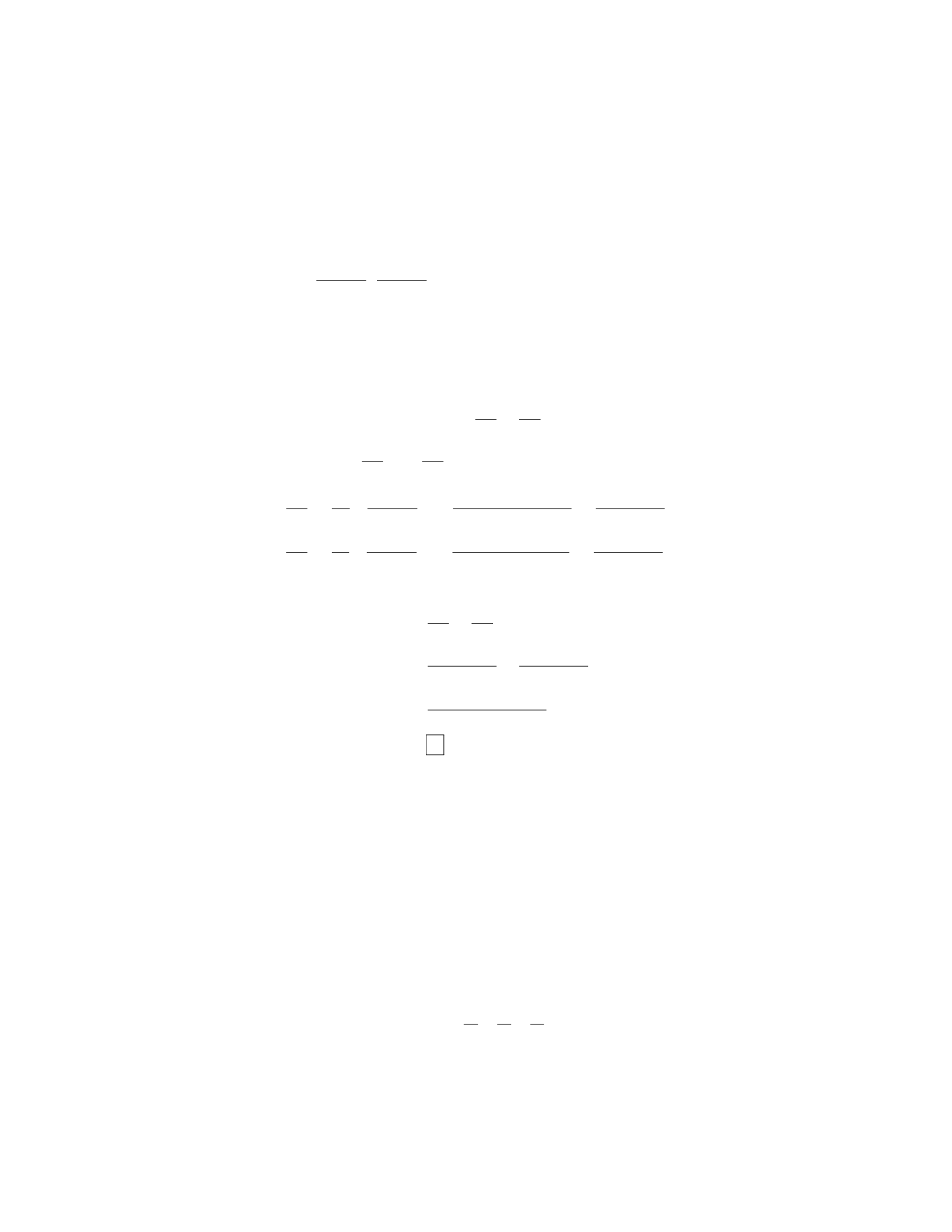
Question 23
Question
Let F(x, y) = x
x2+y2,y
x2+y2be a vector field in R2. Determine the diver-
gence of F.
Solution
To find the divergence of a vector field F(x, y) = (P(x, y), Q(x, y)), we use the
formula:
div(F) = ∂P
∂x +∂Q
∂y
Step 1: Compute ∂P
∂x and ∂Q
∂y .
∂P
∂x =∂
∂x x
x2+y2=(x2+y2)−x(2x)
(x2+y2)2=y2−x2
(x2+y2)2
∂Q
∂y =∂
∂y y
x2+y2=(x2+y2)−y(2y)
(x2+y2)2=x2−y2
(x2+y2)2
Step 2: Find the divergence of F.
div(F) = ∂P
∂x +∂Q
∂y
=y2−x2
(x2+y2)2+x2−y2
(x2+y2)2
=y2−x2+x2−y2
(x2+y2)2
= 0
Therefore, the divergence of the vector field F(x, y) is 0.
Question 24
Question
Let F(x, y, z) = x2yi+y2zj+z2xkbe a vector field in R3. Compute the curl
of F.
Solution
To compute the curl of F, we use the formula
∇ × F=
i j k
∂
∂x
∂
∂y
∂
∂z
P Q R
,
17

where F(x, y, z) = Pi+Qj+Rk.
Step 1: Compute ∂R ∂y
∂R
∂y =∂
∂y (z2x)=0
Step 2: Compute ∂Q ∂z
∂Q
∂z =∂
∂z (y2z) = y2
Step 3: Compute ∂P ∂z
∂P
∂z =∂
∂z (x2y)=0
Step 4: Compute ∂R ∂x
∂R
∂x =∂
∂x (z2x)=2z
Step 5: Compute ∂Q ∂y
∂Q
∂y =∂
∂y (y2z) = 2yz
Step 6: Compute ∂P ∂y
∂P
∂y =∂
∂y (x2y) = x2
Step 7: Compute the curl of F Now, we can plug these partial derivatives
into the formula for the curl:
∇ × F=∂R
∂y −∂Q
∂z i−∂R
∂x −∂P
∂z j+∂Q
∂x −∂P
∂y k
Substitute the computed partial derivatives:
∇ × F= (−y2)i−2zj−x2k
Therefore, the curl of Fis (−y2)i−2zj−x2k.
Question 25
Question
Let F(x, y, z) = x2yi+y2zj+z2xkbe a vector field in R3. Compute the
divergence of F.
18
Solution
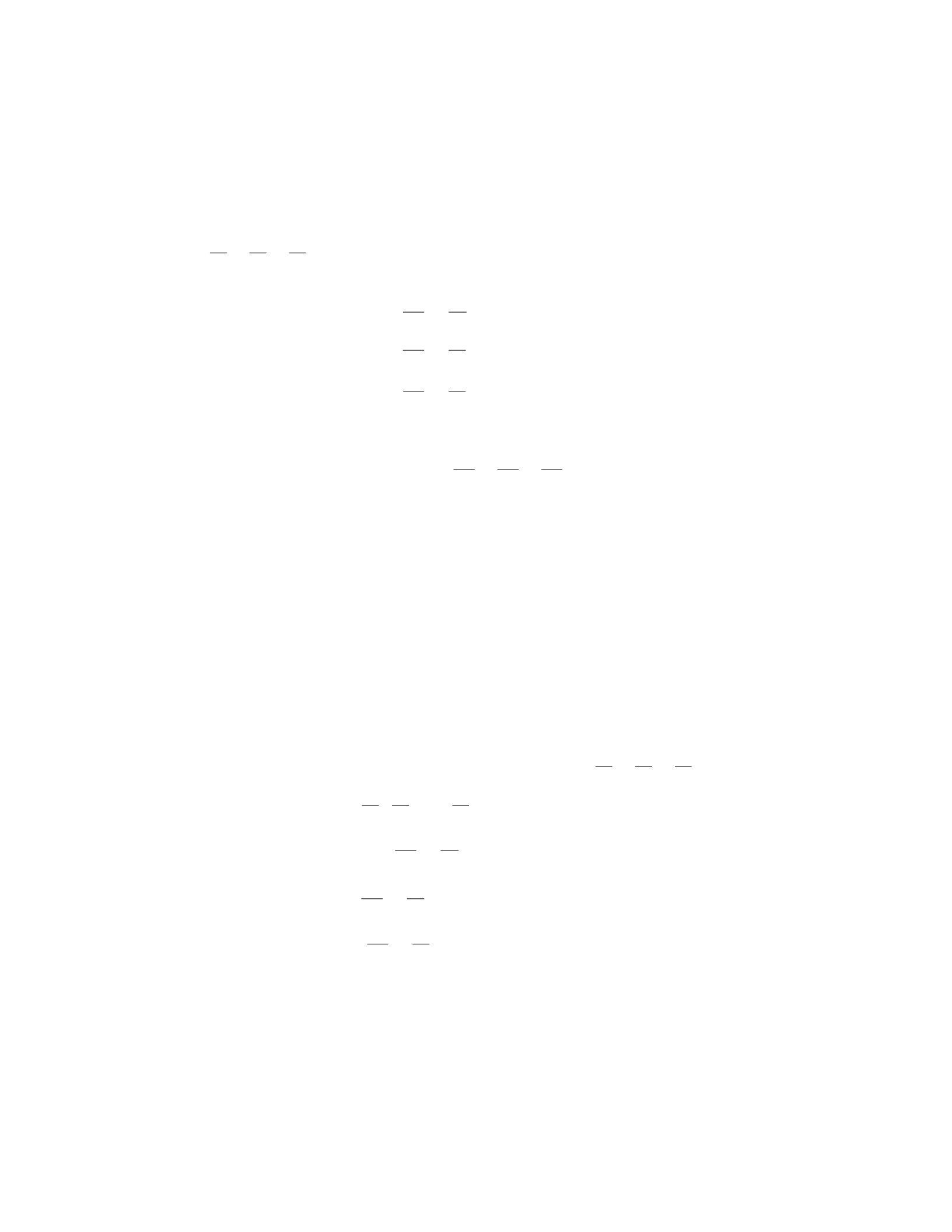
To find the divergence of F, we use the formula for divergence: div(F) = ∇·F=
∂P
∂x +∂Q
∂y +∂R
∂z , where F(x, y, z) = P(x, y, z)i+Q(x, y, z)j+R(x, y, z)k.
Step 1: Compute the partial derivatives of P,Q, and R.
∂P
∂x =∂
∂x (x2y) = 2xy
∂Q
∂y =∂
∂y (y2z)=2yz
∂R
∂z =∂
∂z (z2x)=2zx
Step 2: Calculate the divergence.
div(F) = ∂P
∂x +∂Q
∂y +∂R
∂z
= 2xy + 2yz + 2zx
= 2(xy +yz +zx)
Therefore, the divergence of the vector field F(x, y, z) = x2yi+y2zj+z2xk
is 2(xy +yz +zx).
Question 26
Question
Let F(x, y, z) = x2yzi+e2ysin(z)j+ cos(xy)k. Compute ∇ · F.
Solution
To find the divergence of F, we use the formula ∇ · F=∂P
∂x +∂Q
∂y +∂R
∂z , where
F(x, y, z) = P(x, y, z)i+Q(x, y, z)j+R(x, y, z)k.
Step 1: Compute ∂P
∂x ,∂Q
∂y , and ∂R
∂z .
∂P
∂x =∂
∂x (x2yz) = 2xyz
∂Q
∂y =∂
∂y (e2ysin(z)) = 2e2ysin(z)
∂R
∂z =∂
∂z (cos(xy)) = −xsin(xy)
Step 2: Find ∇ · F.
∇ · F= 2xyz + 2e2ysin(z)−xsin(xy)
Therefore, the divergence of Fis 2xyz + 2e2ysin(z)−xsin(xy).
19
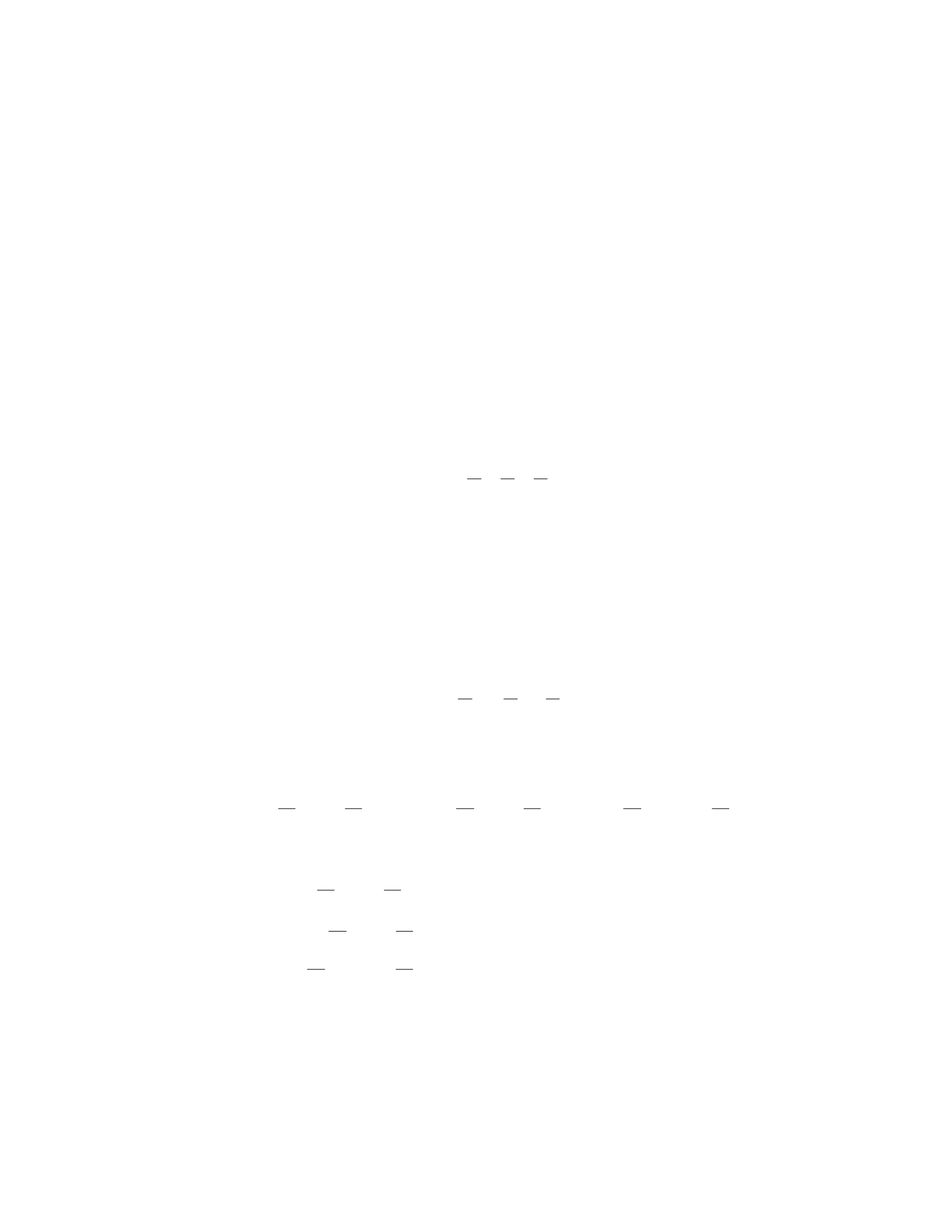
Question 27
Question
Let F(x, y, z) = x2yi−xy2j+z3k. Compute the curl of F.
Solution
To find the curl of F, we use the formula:
curl F=∇ × F
where ∇is the del operator in Cartesian coordinates. For a vector field F=
Pi+Qj+Rk, the curl is given by:
∇ × F=
i j k
∂
∂x
∂
∂y
∂
∂z
P Q R
Step 1: Compute the three partial derivatives P,Q, and R.
P=x2y
Q=−xy2
R=z3
Step 2: Substitute P,Q, and Rinto the determinant formula for the curl.
∇ × F=
i j k
∂
∂x
∂
∂y
∂
∂z
x2y−xy2z3
Step 3: Evaluate the determinant by computing the cross product of the
unit vectors.
∇×F=∂
∂y (z3)−∂
∂z (−xy2)i−∂
∂x (z3)−∂
∂z (x2y)j+∂
∂x (−xy2)−∂
∂y (x2y)k
Step 4: Compute the partial derivatives and simplify. We have:
∂
∂y (z3)−∂
∂z (−xy2) = 0 −(−y2) = y2
∂
∂x (z3)−∂
∂z (x2y) = 0 −(−x2) = x2
∂
∂x (−xy2)−∂
∂y (x2y) = −y2−2xy =−y2(1 + 2x)
Therefore, the curl of Fis:
curl F=y2i+x2j−y2(1 + 2x)k
20
Question 28
Question
Let F(x, y, z)=(x2y, yz, xz2) be a vector field in R3. Compute the curl of F.
Solution
To find the curl of F, denoted by ∇ × F, we need to compute the determinant
of the following matrix:
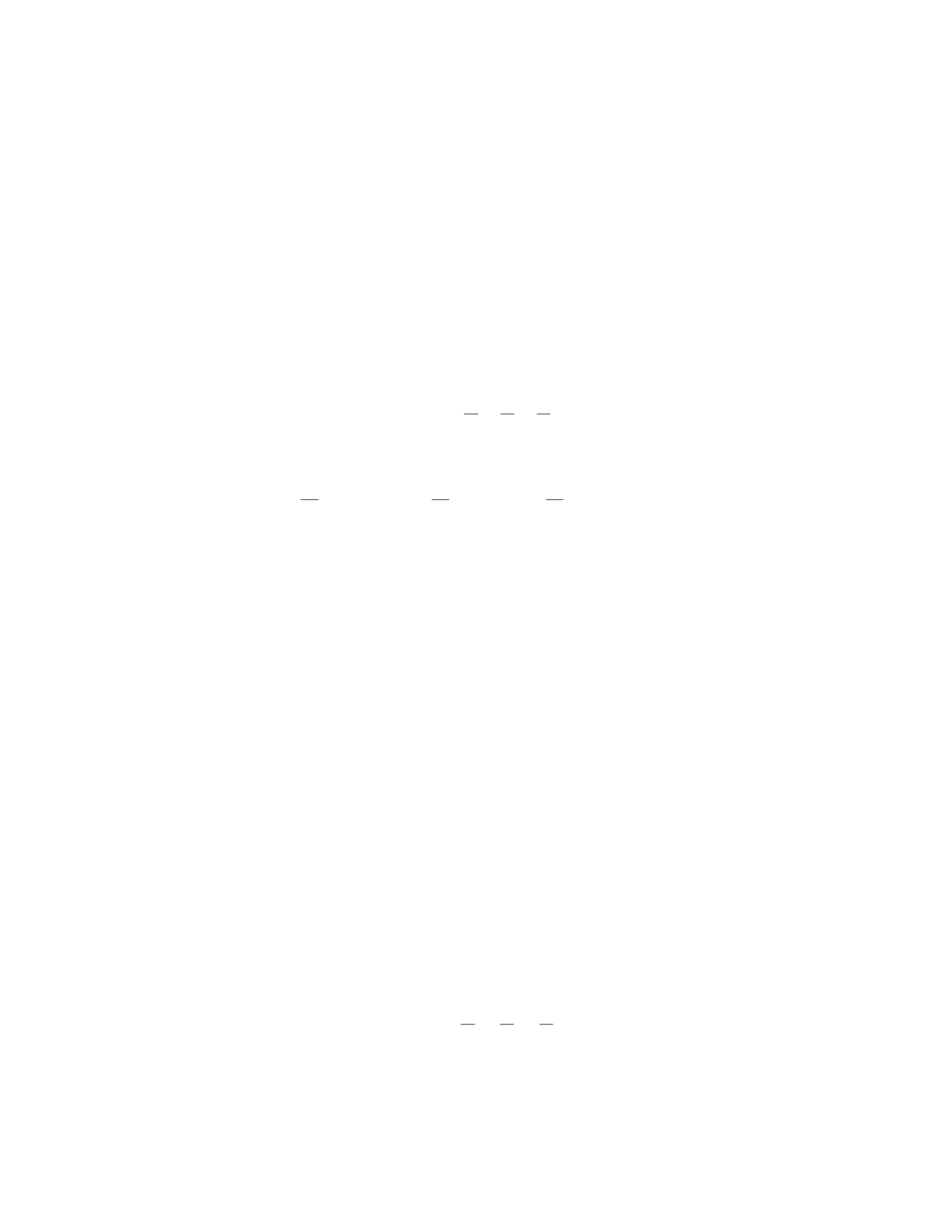
∇ × F=
i j k
∂
∂x
∂
∂y
∂
∂z
x2y yz xz2
Step 1: Compute the partial derivatives:
∂
∂x = (2xy, 0, z2)∂
∂y = (x2, z, 0) ∂
∂z = (0, y, 2xz)
Step 2: Expand the determinant:
∇ × F=
i j k
(2xy) 0 z2
x2y yz xz2
−
i j k
0 (x2) 0
x2y yz xz2
+
i j k
0 (z)y
x2y yz xz2
Step 3: Evaluate the determinants:
∇ × F=0−z2y, 2x2y−xz2,2xy −0= (−z2y, 2x2y−xz2,2xy)
Therefore, the curl of Fis ∇ × F= (−z2y, 2x2y−xz2,2xy).
Question 29
Question
Let F(x, y, z) = x2yi+yz2j+xyzkbe a vector field in R3. Find ∇ × ∇ × F.
Solution
We know that for a vector field Gin R3, the curl of the curl of Gis given by
the following formula:
∇ × ∇ × G=∇(∇ · G)− ∇2G
Let’s calculate ∇ × Ffirst. Given F(x, y, z) = x2yi+yz2j+xyzk, we have:
∇ × F=
i j k
∂
∂x
∂
∂y
∂
∂z
x2y yz2xyz
21
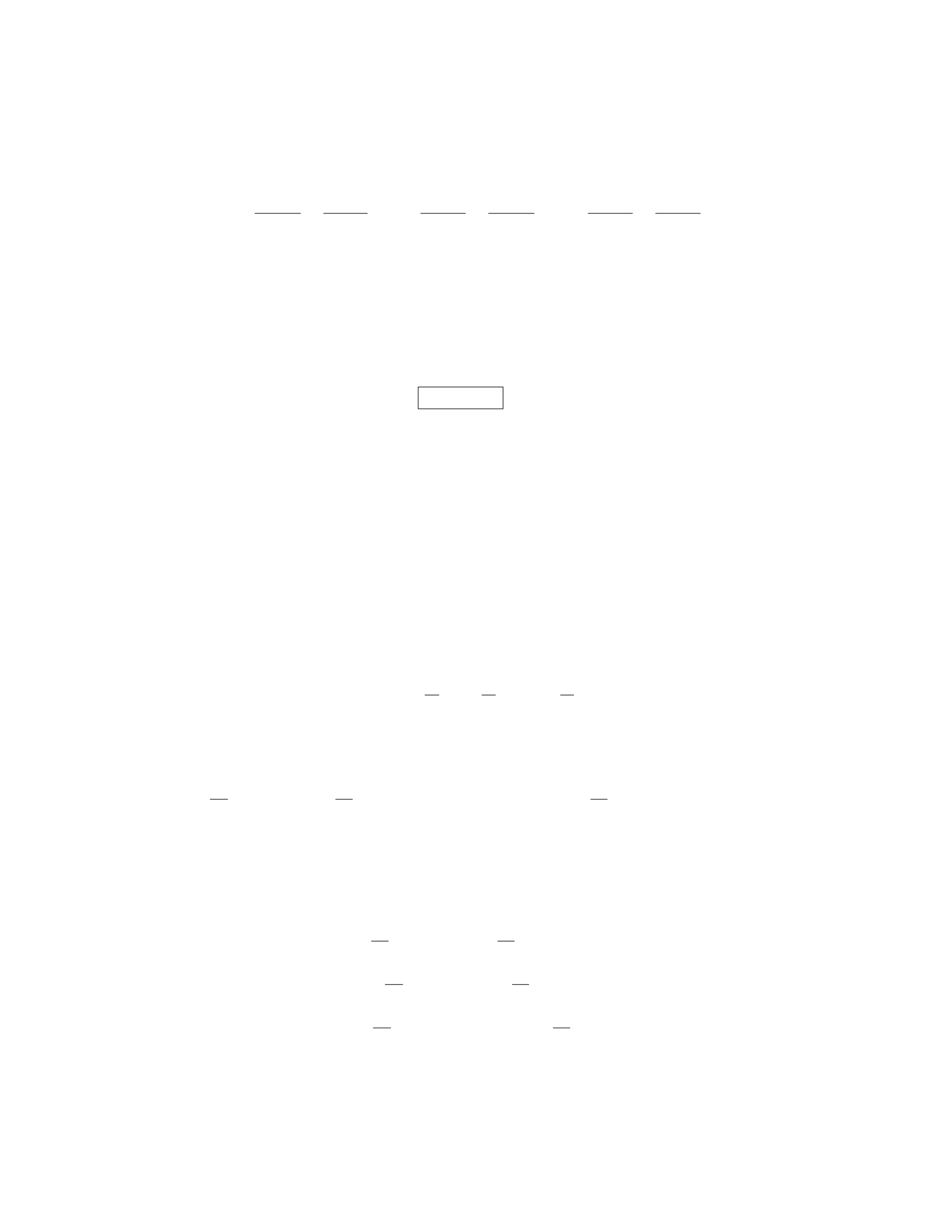
=∂(xyz)
∂y −∂(yz2)
∂z i−∂(x2y)
∂x −∂(xyz)
∂z j+∂(xz2)
∂x −∂(x2y)
∂y k
= (xz −2yz)i−(2xy −xz)j+ (z2−y)k
Now, we can calculate ∇ × (∇ × F):
∇ × (xz −2yz)i−(2xy −xz)j+ (z2−y)k
=∇(z2−y)−(−2z)i−∇ (xz −2yz)−(z2−y)j+∇[(2xy −xz)−(2yz)] k
= 0i−0j−0k
∇ × ∇ × F=0
Question 30
Question
Let F(x, y, z) = x2yi+zsin(xy)j+y2cos(xz)kbe a vector field in R3. Find the
curl of F.
Solution
To find the curl of F, we first need to compute the determinant of the following
matrix composed of the unit vectors i,j, and k, and the partial derivative
operators with respect to x,y, and z:
curl(F) =
i j k
∂
∂x
∂
∂y
∂
∂z
x2y z sin(xy)y2cos(xz)
Step 1: Compute the partial derivatives Compute the partial deriva-
tives of the vector field components:
∂
∂x (x2y) = 2xy, ∂
∂y (zsin(xy)) = zcos(xy)+sin(xy),∂
∂z (y2cos(xz)) = −y2xsin(xz)
Step 2: Calculate the determinant Substitute the computed partial
derivatives into the determinant expression:
curl(F) =
i j k
2xy z cos(xy) + sin(xy)−y2xsin(xz)
=−∂
∂y (y2xsin(xz)) −∂
∂z (zcos(xy) + sin(xy))i
−−∂
∂x (y2xsin(xz)) −∂
∂z (2xy)j
+∂
∂x (zcos(xy) + sin(xy)) + ∂
∂y (2xy)k
22

Step 3: Simplify the expressions Substitute the derived expressions and
simplify to find the curl of F.
Therefore, the curl of the vector field Fis ∇ × F= (0 −0)i−(zcos(xy) +
2y)j+ (2y)k.
23

