



MATH 117 - ELEMENTS OF
MATHEMATICS - Gradient,
divergence, and curl
Question Bank - Set 8
Liberty University
Question 1
Question
Let
F(x, y, z) = x2yˆ
i+xyzˆ
j+z2ˆ
kbe a vector field. Compute the gradient,
divergence, and curl of
F.
Solution
Step 1: Gradient The gradient of a vector field
F(x, y, z) = P(x, y, z)ˆ
i+
Q(x, y, z)ˆ
j+R(x, y, z)ˆ
kis given by:
∇ ·
F=∂P
∂x ˆ
i+∂Q
∂y ˆ
j+∂R
∂z ˆ
k
For
F(x, y, z) = x2yˆ
i+xyzˆ
j+z2ˆ
k, we have:
∇ ·
F= (2xy)ˆ
i+ (xz)ˆ
j+ (2z)ˆ
k
Step 2: Divergence The divergence of a vector field
F(x, y, z) = P(x, y, z)ˆ
i+
Q(x, y, z)ˆ
j+R(x, y, z)ˆ
kis given by:
∇ ·
F=∂P
∂x +∂Q
∂y +∂R
∂z
For
F(x, y, z) = x2yˆ
i+xyzˆ
j+z2ˆ
k, we have:
∇ ·
F=∂
∂x (x2y) + ∂
∂y (xyz) + ∂
∂z (z2)=2y+x+ 2z

Step 3: Curl The curl of a vector field
F(x, y, z) = P(x, y, z)ˆ
i+Q(x, y, z)ˆ
j+
R(x, y, z)ˆ
kis given by:
∇ ×
F=
ˆ
iˆ
jˆ
k
∂
∂x
∂
∂y
∂
∂z
P Q R
For
F(x, y, z) = x2yˆ
i+xyzˆ
j+z2ˆ
k, we have:
∇ ×
F=
ˆ
iˆ
jˆ
k
∂
∂x
∂
∂y
∂
∂z
x2y xyz z2
= (z−y)ˆ
i−2zˆ
j+ (xy −x2)ˆ
k
Question 2
Question
Let F(x, y, z) = (xez+ sin y, x2+yz, e2z+xcos y) be a vector field in R3.
Calculate the divergence of F.
Solution
To find the divergence of F, denoted by ∇ · F, we use the formula:
∇ · F=∂
∂x (F1) + ∂
∂y (F2) + ∂
∂z (F3),
where F(x, y, z)=(F1, F2, F3).
Step 1: Calculate ∂F1
∂x .
∂
∂x (xez+ sin y) = ez
Step 2: Calculate ∂F2
∂y .
∂
∂y (x2+yz) = z
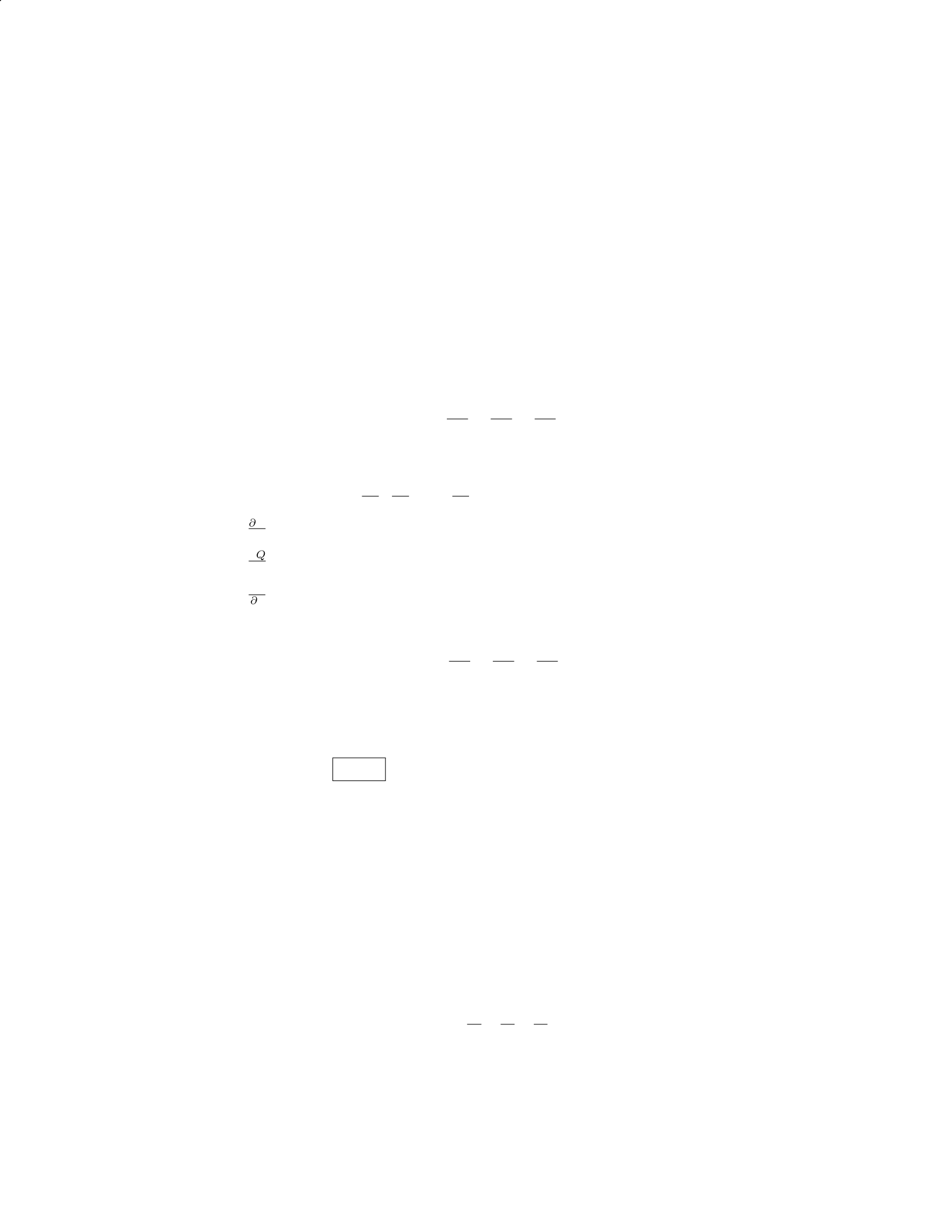
Step 3: Calculate ∂F3
∂z .
∂
∂z (e2z+xcos y)=2e2z
Step 4: Now, compute the divergence of F.
∇ · F=ez+z+ 2e2z
Therefore, the divergence of Fis ez+z+ 2e2z.
2
Question 3
Question
Let F(x, y, z)=(xz+y2)i−(y2−z2)j+(x−y)kbe a vector field in R3. Compute
the divergence of F.
Solution
To compute the divergence of a vector field F(x, y, z) = P(x, y, z)i+Q(x, y, z)j+
R(x, y, z)k, we use the formula
∇ · F=∂P
∂x +∂Q
∂y +∂R
∂z .
Given F(x, y, z) = (xz +y2)i−(y2−z2)j+(x−y)k, we have P(x, y, z) = xz +y2,
Q(x, y, z) = −(y2−z2), and R(x, y, z) = x−y.
Step 1: Compute ∂P
∂x ,∂Q
∂y , and ∂R
∂z .
∂P
∂x =z
∂Q
∂y =−(−2y)=2y
∂R
∂z = 0
Step 2: Compute the divergence ∇ · F.
∇ · F=∂P
∂x +∂Q
∂y +∂R
∂z
=z+ 2y+ 0
=z+ 2y.
Therefore, the divergence of the vector field F(x, y, z)=(xz +y2)i−(y2−
z2)j+ (x−y)kis z+ 2y.
Question 4
Question
Let Fbe a vector field defined by F(x, y, z) = zi+xj+yk. Calculate the curl
of F.
Solution
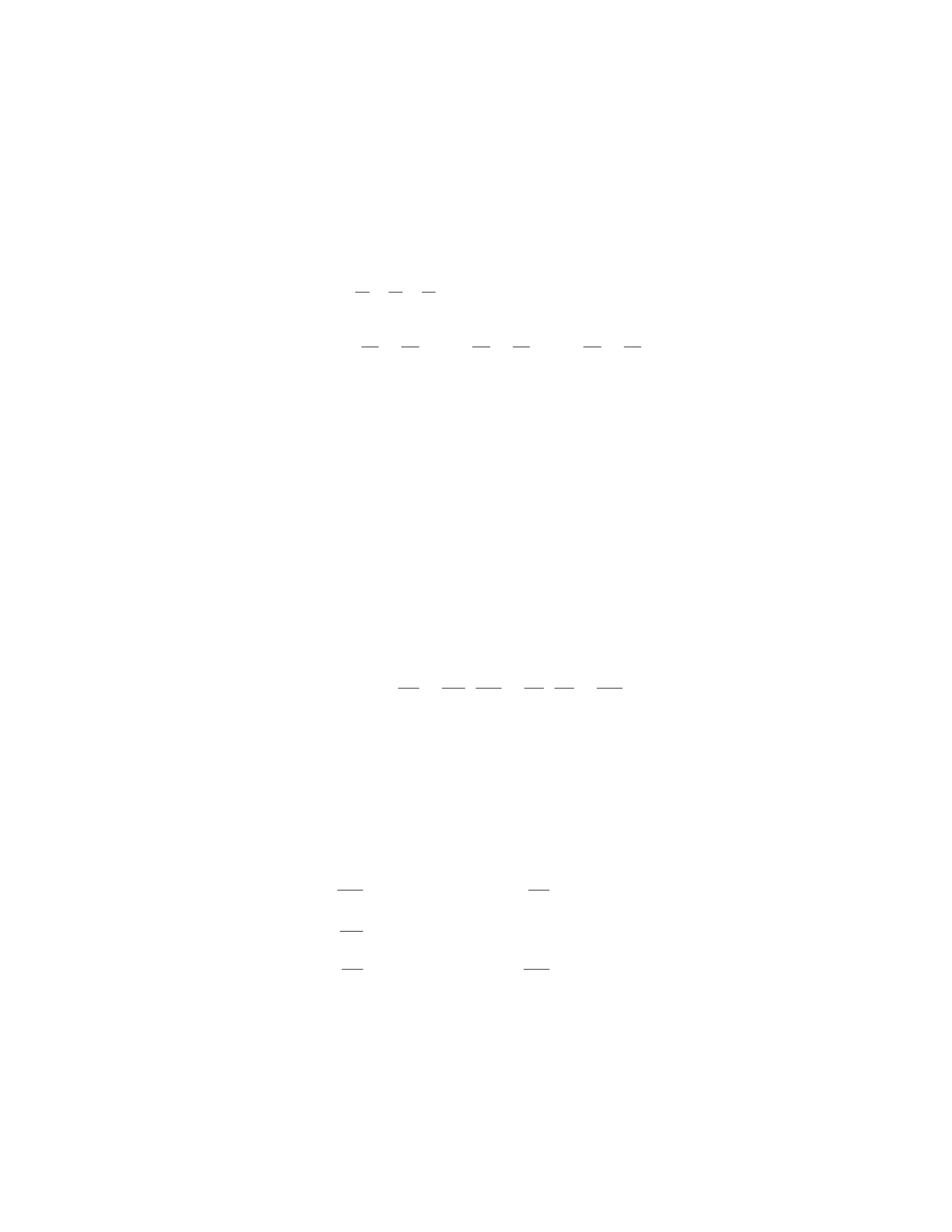
To calculate the curl of a vector field F=Pi+Qj+Rk, we use the formula:
∇ × F=
i j k
∂
∂x
∂
∂y
∂
∂z
P Q R
3
In this case, F(x, y, z) = zi+xj+yk, so P=z,Q=x,R=y. We can now
compute the curl as follows:
∇ × F=
i j k
∂
∂x
∂
∂y
∂
∂z
z x y
=∂y
∂y −∂x
∂z i−∂y
∂x −∂z
∂z j+∂x
∂x −∂z
∂y k
= 0i−0j+ 0k
=0
Therefore, the curl of Fis the zero vector, i.e., ∇ × F=0.
Question 5
Question
Let F(x, y, z)=(yz +ex, xz +y2, xy +z2) be a vector field in R3. Compute the
curl of F.
Solution
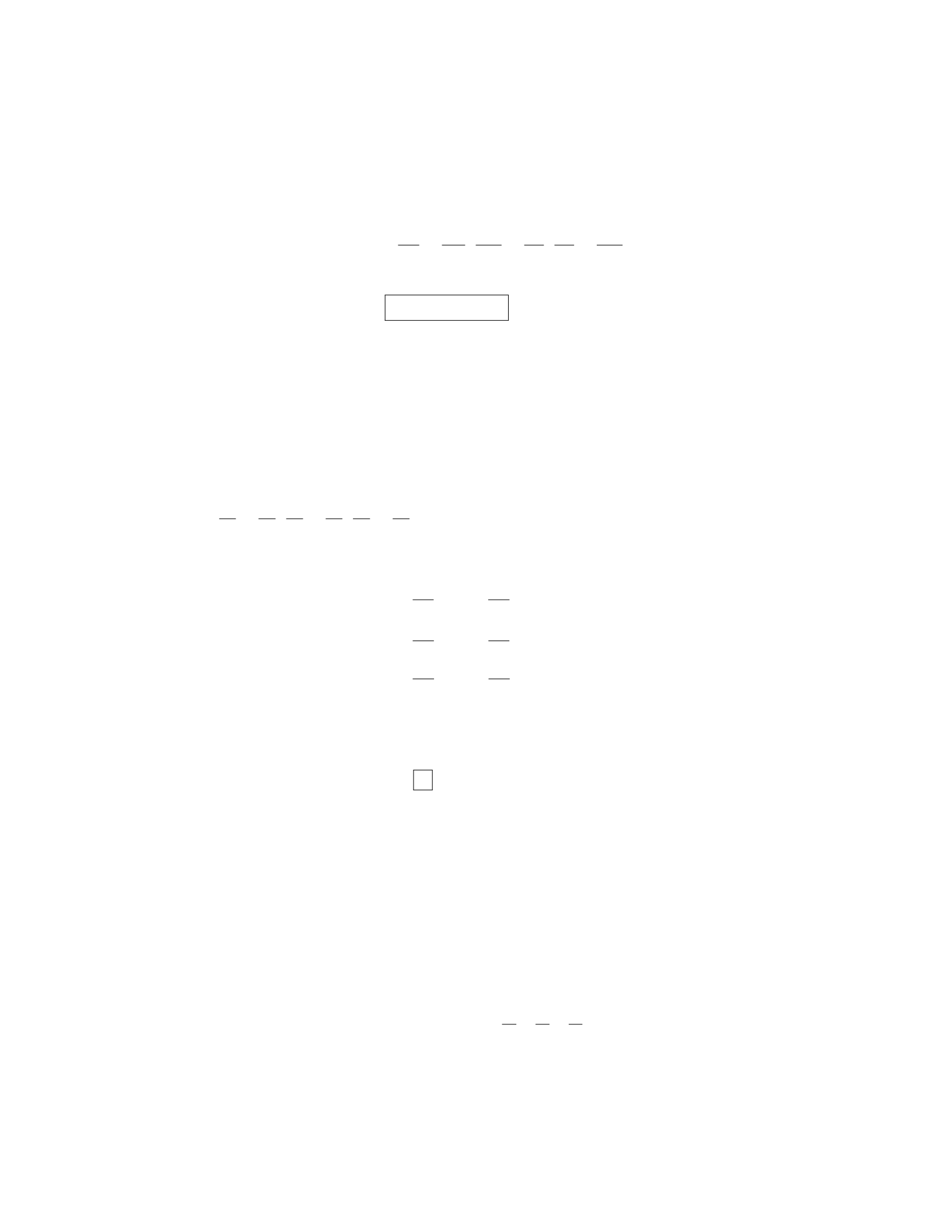
To find the curl of F, we use the formula
curl(F) = ∂P
∂y −∂N
∂z ,∂M
∂z −∂L
∂x ,∂L
∂y −∂M
∂x
where F(x, y, z)=(M, N, P ).
Step 1: Compute the partial derivatives of M,N, and P:
M=xz +y2P=xy +z2
N=yz +ex
∂M
∂z =x∂P
∂y =x+ 2z
∂N
∂z =y
∂P
∂x =y∂M
∂y = 2y
4
Step 2: Calculate the curl of F:
curl(F) = ∂P
∂y −∂N
∂z ,∂M
∂z −∂L
∂x ,∂L
∂y −∂M
∂x
= (x+ 2z−y, x −0,2y−y)
= (x+ 2z−y, x, y).
Question 6
Question
Let F(x, y, z)=(x2, yz, ez). Calculate the curl of F.
Solution
To calculate the curl of a vector field F= (P, Q, R), we use the formula: ∇×F=
∂R
∂y −∂Q
∂z ,∂P
∂z −∂R
∂x ,∂Q
∂x −∂P
∂y .
Step 1: Identify P,Q, and R. Here, P=x2,Q=yz, and R=ez.
Step 2: Calculate the partial derivatives.
∂R
∂y = 0,∂Q
∂z = 0
∂P
∂z = 0,∂R
∂x = 0
∂Q
∂x = 0,∂P
∂y = 0
Step 3: Compute the curl of F.
∇ × F= (0 −0,0−0,0−0) = (0,0,0)
Therefore, the curl of Fis 0.
Question 7
Question
Let F(x, y) = ⟨x2y, yex, x2⟩. Compute div(curl(F)).
Solution
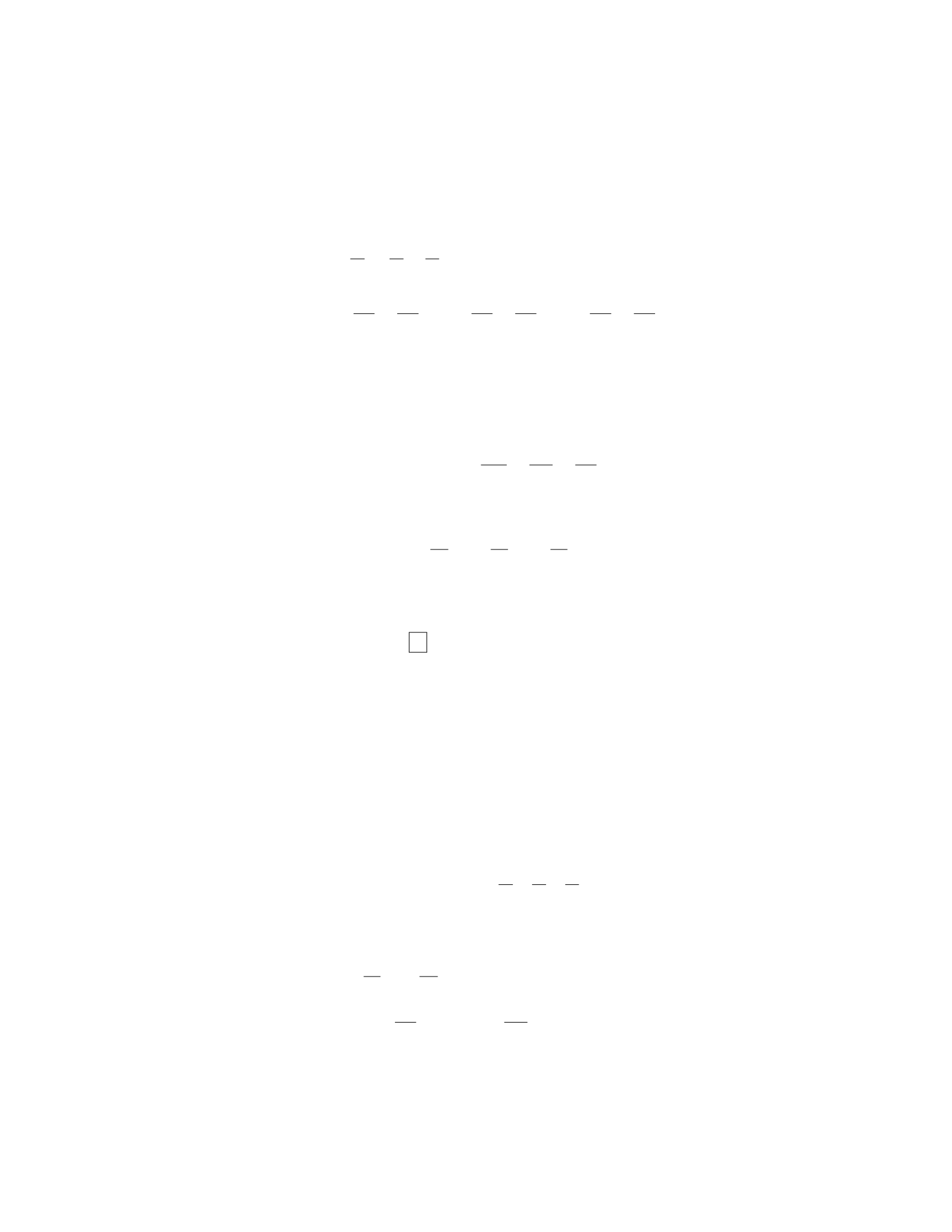
Step 1: Find the curl of F. The curl of a vector field F(x, y, z) = ⟨P(x, y, z), Q(x, y, z), R(x, y, z)⟩
is given by:
curl(F) = ∇ × F=
i j k
∂
∂x
∂
∂y
∂
∂z
P Q R
5
For F(x, y) = ⟨x2y, yex, x2⟩, we have:
curl(F) =
i j k
∂
∂x
∂
∂y
∂
∂z
x2y yexx2
=∂R
∂y −∂Q
∂z i−∂R
∂x −∂P
∂z j+∂Q
∂x −∂P
∂y k
= (0 −0) i−(0 −0) j+ (2x−x)k
=xk
Step 2: Find the divergence of the curl of F. The divergence of a vector field
G(x, y, z) = ⟨M(x, y, z), N (x, y, z), P (x, y, z)⟩is given by:
div(G) = ∇ · G=∂M
∂x +∂N
∂y +∂P
∂z
For G(x, y, z) = xk, we have:
div(G) = ∂
∂x (0) + ∂
∂y (0) + ∂
∂z (x)
=0+0+0+1
= 1
Therefore, div(curl(F)) = 1 .
Question 8
Question
Let F(x, y, z)=(x2+y2)i+y2j+zk. Find the curl of F.
Solution
To find the curl of F, we use the formula:
curl F=∇ × F=
i j k
∂
∂x
∂
∂y
∂
∂z
M N P
where F(x, y, z) = M(x, y, z)i+N(x, y, z)j+P(x, y, z)k.
In this case, M(x, y, z) = x2+y2,N(x, y, z) = y2, and P(x, y, z) = z.
Step 1: Calculate ∂P
∂y and ∂N
∂z .
∂P
∂y = 0 and ∂N
∂z = 0
6
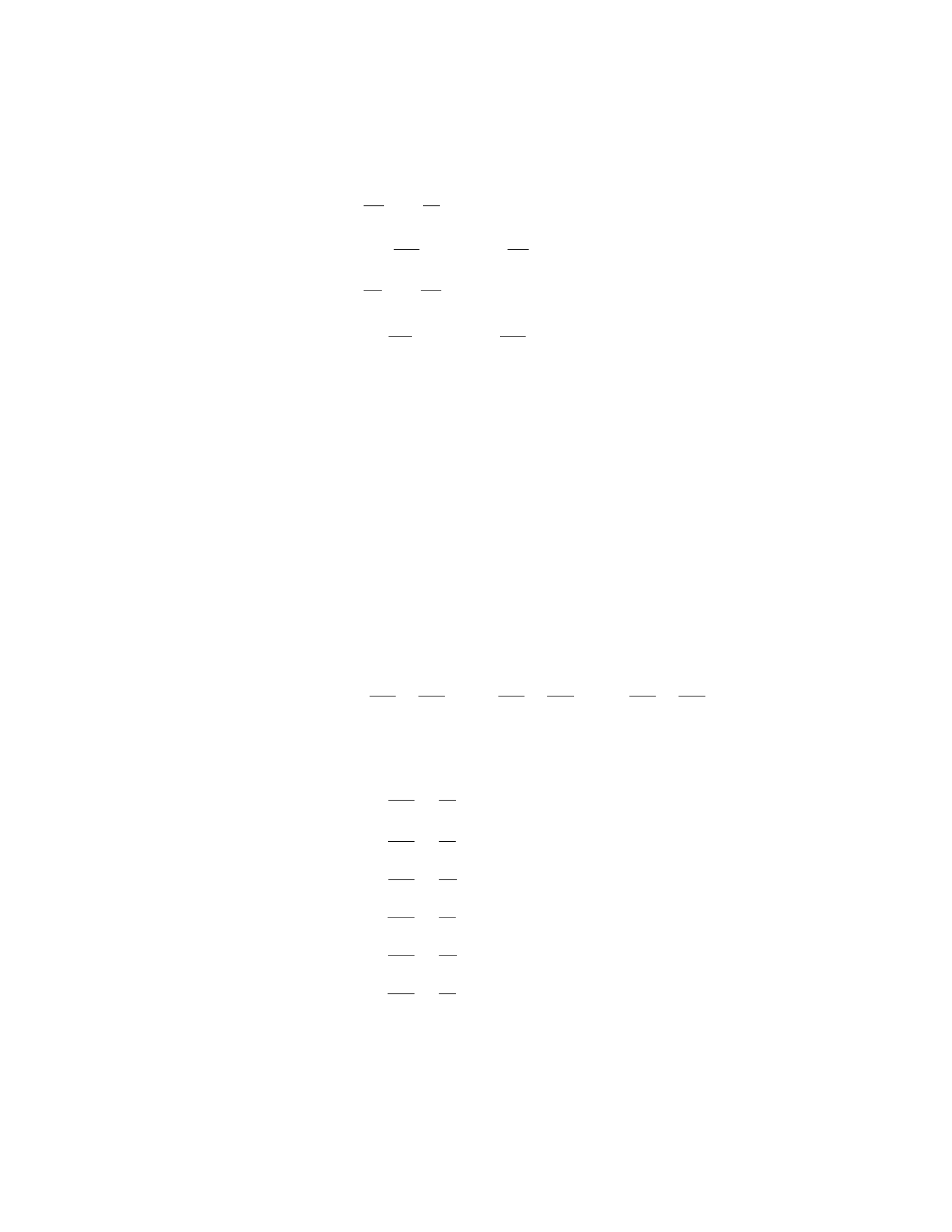
Step 2: Calculate ∂M
∂z and ∂P
∂x .
∂M
∂z = 0 and ∂P
∂x = 0
Step 3: Calculate ∂N
∂x and ∂M
∂y .
∂N
∂x = 0 and ∂M
∂y = 2y
Step 4: Substitute the partial derivatives into the formula for the curl.
curl F= (0 −0) i−(0 −0) j+ (2y−0) k= 2yk
Therefore, the curl of Fis 2yk.
Question 9
Question
Let F= (x2y+ 2z)i+ (xz −y2)j+ 3y2kbe a vector field in 3-dimensional space.
Calculate the curl of Fat the point (1,2,3).
Solution
To calculate the curl of a vector field Fat a given point, we use the formula:
curl(F) = ∇ × F=∂Fz
∂y −∂Fy
∂z i−∂Fz
∂x −∂Fx
∂z j+∂Fy
∂x −∂Fx
∂y k
Step 1: Calculate the partial derivatives of F= (x2y+ 2z)i+ (xz −y2)j+
3y2k:
∂Fz
∂y =∂
∂y (3y2) = 6y
∂Fy
∂z =∂
∂z (xz −y2)=0
∂Fz
∂x =∂
∂x (3y2) = 0
∂Fx
∂z =∂
∂z (x2y+ 2z) = 0
∂Fy
∂x =∂
∂x (xz −y2) = z
∂Fx
∂y =∂
∂y (x2y+ 2z) = x2
7
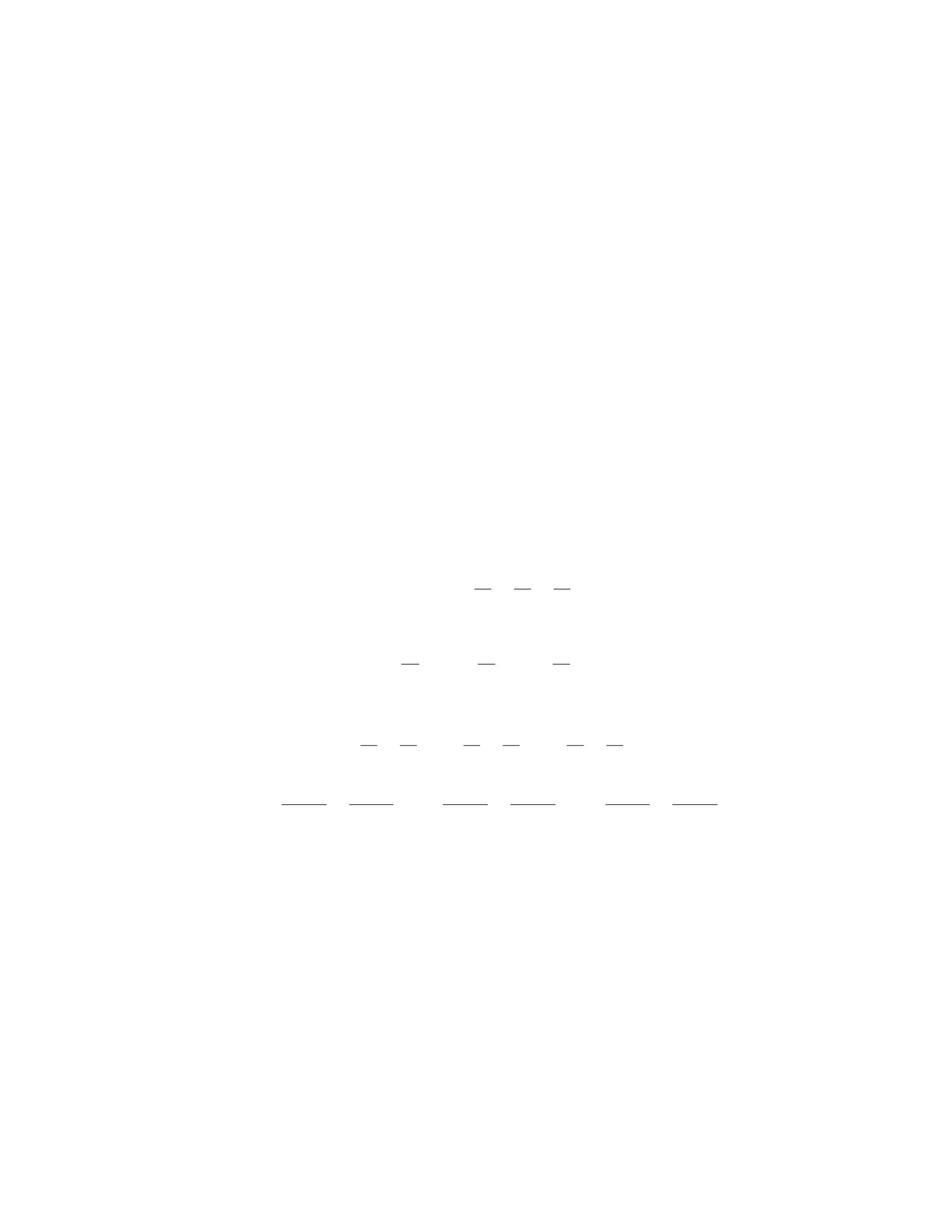
Step 2: Plug the partial derivatives into the formula to find the curl at the
point (1,2,3):
curl(F) = (6y−0)i−(0 −0)j+ (z−x2)k
= 6(2)i+ (3 −12)k
= 12i+ 2k
Therefore, the curl of Fat the point (1,2,3) is 12i+ 2k.
Question 10
Question
Let F(x, y, z) = x2yi+y2zj+z2xkbe a vector field. Compute the divergence
of Fand the curl of F.
Solution
To compute the divergence and curl of F, we first express Fin terms of its
component functions.
Step 1: Compute the divergence of F The divergence of a vector field
F=Pi+Qj+Rkis given by ∇ · F=∂P
∂x +∂Q
∂y +∂R
∂z .
Here, P(x, y, z) = x2y,Q(x, y, z) = y2z, and R(x, y, z) = z2x.
Therefore, the divergence of Fis:
∇ · F=∂
∂x (x2y) + ∂
∂y (y2z) + ∂
∂z (z2x)
∇ · F= 2xy + 2yz + 2zx
Step 2: Compute the curl of F The curl of a vector field F=Pi+Qj+Rk
is given by ∇ × F=∂R
∂y −∂Q
∂z i−∂R
∂x −∂P
∂z j+∂Q
∂x −∂P
∂y k.
Applying this to F, we have:
∇×F=∂(z2x)
∂y −∂(y2z)
∂z i−∂(z2x)
∂x −∂(x2y)
∂z j+∂(y2z)
∂x −∂(x2y)
∂y k
∇ × F= (2z)i−(2z)j+ (2y)k
∇ × F= 2zi−2zj+ 2yk
Therefore, the divergence of Fis 2xy + 2yz + 2zx and the curl of Fis
2zi−2zj+ 2yk.
Question 11
Question
Let F(x, y, z) = (zcos y−ysin z, x sin z−zcos x, y cos x−xsin y) be a vector
field. Compute ∇ · ∇ × F.
8
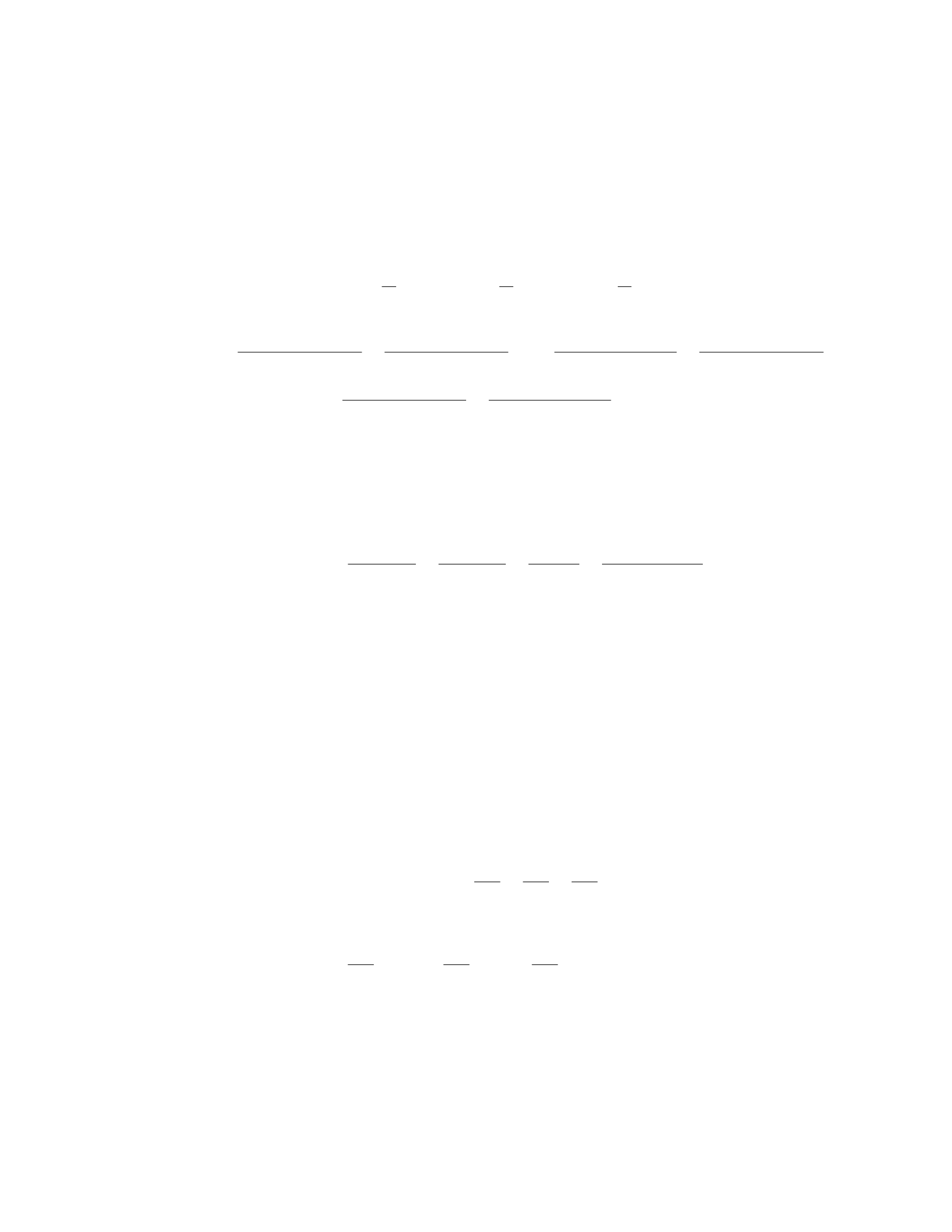
Solution
Step 1: Compute ∇ × F.
∇ × F=
i j k
∂
∂x
∂
∂y
∂
∂z
zcos y−ysin z x sin z−zcos x y cos x−xsin y
=∂(ycos x−xsin y)
∂y −∂(xsin z−zcos x)
∂z i−∂(zcos y−ysin z)
∂x −∂(ycos x−xsin y)
∂z j
+∂(xsin z−zcos x)
∂x −∂(zcos y−ysin z)
∂y k
= (−cos x−cos y)i+ (0 + sin y)j+ (cos z+ sin z)k
=−cos xi−cos yi+ sin yj+ cos zk+ sin zk
=−cos xi−cos yi+ sin yj+ (cos z+ sin z)k
Step 2: Compute ∇ · (∇ × F).
∇ · (∇ × F) = ∂(−cos x)
∂x +∂(−cos y)
∂y +∂(sin y)
∂y +∂(cos z+ sin z)
∂z
= sin x+ sin y+ cos z
Therefore, ∇ · ∇ × F= sin x+ sin y+ cos z.
Question 12
Question
Let F(x, y, z) = 3xy2+z3, x3+ 2yz, y3+ 3xz2be a vector field in R3. Calcu-
late the divergence of F.
Solution
To find the divergence of F, we use the following formula:
div(F) = ∇ · F=∂F1
∂x +∂F2
∂y +∂F3
∂z
Step 1: We find the partial derivatives of F1,F2, and F3:
∂F1
∂x = 3y2,∂F2
∂y = 2z, ∂F3
∂z = 6xz
Step 2: Now, we add these partial derivatives to find the divergence:
div(F)=3y2+ 2z+ 6xz
9
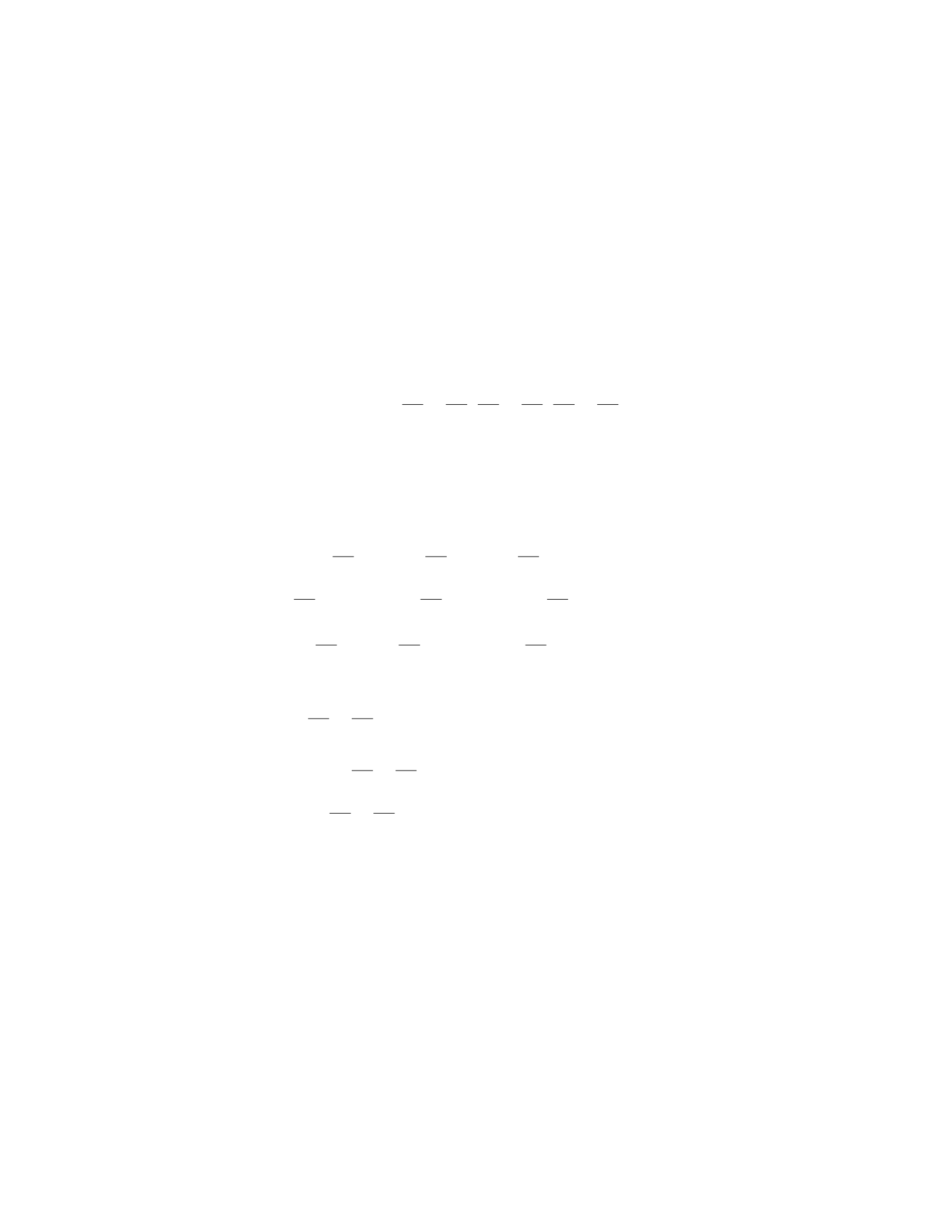
Question 13
Question
Let F(x, y, z)=(x2y+y2z, x2z+yz2, xy2+xz2). Find the curl of F.
Solution
To find the curl of a vector field F= (P, Q, R), where P, Q, R are the component
functions, use the formula:
curl(F) = ∂R
∂y −∂Q
∂z ,∂P
∂z −∂R
∂x ,∂Q
∂x −∂P
∂y
Step 1: Find the partial derivatives of P, Q, and Rwith respect to x, y, and
z, respectively.
P=x2y+y2z, Q =x2z+yz2, R =xy2+xz2
∂P
∂x = 2xy, ∂Q
∂x = 2xz, ∂R
∂x =y2+ 2xz
∂P
∂y =x2+ 2yz, ∂Q
∂y =z2+ 2yx, ∂R
∂y = 2xy + 2xz
∂P
∂z =y2,∂Q
∂z =x2+ 2yz, ∂R
∂z = 2xz + 2xy
Step 2: Calculate the components of the curl of F.
∂R
∂y −∂Q
∂z = (2xy + 2xz)−(x2+ 2yz)=2yz −x2
∂P
∂z −∂R
∂x =y2−(y2+ 2xz) = −2xz
∂Q
∂x −∂P
∂y = (2xz)−(x2+ 2yz) = 2xz −x2
Therefore, the curl of Fis ∇ × F= (−x2+ 2yz, −2xz, 2xz −x2).
Question 14
Question
Consider the vector field F(x, y, z) = (2xy, x2−z, 3xz). Find the divergence of
Fat the point (1,−1,2).
10
Solution
To find the divergence of a vector field F= (P, Q, R), we use the formula:
div(F) = ∂P
∂x +∂Q
∂y +∂R
∂z .
Step 1: Calculate the partial derivatives of P,Q, and R:
∂P
∂x =∂
∂x (2xy)=2y,
∂Q
∂y =∂
∂y (x2−z) = 0,
∂R
∂z =∂
∂z (3xz) = 3x.
Step 2: Substitute the given point (1,−1,2) into the partial derivatives:
∂P
∂x (1,−1,2)
= 2(−1) = −2,
∂Q
∂y (1,−1,2)
= 0,
∂R
∂z (1,−1,2)
= 3(1) = 3.
Step 3: Find the divergence of Fat the point (1,−1,2):
div(F)(1,−1,2)
=∂P
∂x (1,−1,2)
+∂Q
∂y (1,−1,2)
+∂R
∂z (1,−1,2)
=−2 + 0 + 3 = 1 .
Question 15
Question
Let F(x, y, z) = (x2y, y2z, z2x) be a vector field in R3. Compute the divergence
of Fat the point (1,2,3).
Solution
Step 1: The divergence of a vector field F(x, y, z)=(P(x, y, z), Q(x, y, z), R(x, y, z))
is given by
∇ · F=∂P
∂x +∂Q
∂y +∂R
∂z .
For F(x, y, z)=(x2y, y2z, z2x), we have P(x, y, z) = x2y,Q(x, y, z) = y2z, and
R(x, y, z) = z2x.
11
Step 2: Compute the partial derivatives of P,Q, and R:
∂P
∂x = 2xy,
∂Q
∂y = 2yz,
∂R
∂z = 2zx.
Step 3: Find the divergence of Fat the point (1,2,3) by substituting the
point into the partial derivatives:
∇ · F(1,2,3) = ∂P
∂x (1,2,3) + ∂Q
∂y (1,2,3) + ∂R
∂z (1,2,3)
= 2(1)(2) + 2(2)(3) + 2(3)(1)
= 4 + 12 + 6
= 22.
Therefore, the divergence of Fat the point (1,2,3) is 22 .
Question 16
Question
Let F be a vector field defined by F(x, y, z) = 3x2y+ 4z3, xz2−2y3,2xyz.
Find the divergence of F at the point (1, -1, 2).
Solution
Step 1: The divergence of a vector field F is defined as ∇ · F=∂
∂x F1+∂
∂y F2+
∂
∂z F3.
Step 2: Substitute the components of F into the formula for the divergence:
∇ · F=∂
∂x (3x2y+ 4z3) + ∂
∂y (xz2−2y3) + ∂
∂z (2xyz)
= (6xy) + (2xz) + (2xy)
= 8xy + 2xz
Step 3: Evaluate the divergence at the point (1, -1, 2):
∇ · F(1,−1,2) = 8(1)(−1) + 2(1)(2)
=−8+4
=−4
Therefore, the divergence of F at the point (1, -1, 2) is -4.
12
Question 17
Question
Let F(x, y, z) = ⟨eysin z, excos z, exsin y⟩. Find the curl of F.
Solution
To find the curl of F, denoted by ∇ × F, we can use the formula:
∇ × F=
i j k
∂
∂x
∂
∂y
∂
∂z
P Q R
where F(x, y, z) = ⟨P, Q, R⟩.
Step 1: Compute the partial derivatives of P,Q, and R.
∂P
∂x =eycos z, ∂Q
∂y =−exsin z, ∂R
∂z = 0
Step 2: Build the curl.
∇ × F=
i j k
eycos z−exsin z0
Step 3: Simplify the determinant.
∇ × F=∂R
∂y −∂Q
∂z i−∂R
∂x −∂P
∂z j+∂Q
∂x −∂P
∂y k
∇ × F= (−excos z)i−(eysin z)j−0k
∇ × F=−excos zi−eysin zj
Therefore, the curl of Fis −excos zi−eysin zj.
Question 18
Question
Let F(x, y, z)=(x2+y, xz, ey) be a vector field. Find the divergence of Fand
determine if the vector field is conservative.
13
Solution
Step 1: To find the divergence of F, we need to compute the dot product of the
del operator (∇) and F.
div(F) = ∇ · F=∂
∂x (x2+y) + ∂
∂y (xz) + ∂
∂z (ey)
Step 2: Calculating the partial derivatives, we get:
∂
∂x (x2+y) = 2x, ∂
∂y (xz)=0,∂
∂z (ey)=0
Step 3: Therefore, the divergence of Fis:
div(F)=2x
Step 4: For a vector field to be conservative, its curl must be zero. Let’s
calculate the curl of Fto determine if it is conservative.
∇ × F=
i j k
∂
∂x
∂
∂y
∂
∂z
x2+y xz ey
Step 5: Calculating the determinant above, we find:
∇ × F= (0 −0)i−(ey−0)j+ (x−2x)k=−eyj−xk
Step 6: Since the curl of Fis not zero, the vector field is not conservative.
Question 19
Question
Let F(x, y, z) = xzi+yzj+ (x2−y2)k. Calculate the curl of F.
Solution
Step 1: The curl of a vector field F(x, y, z) = P(x, y, z)i+Q(x, y, z)j+R(x, y, z)k
is given by the determinant
∇ × F=
i j k
∂
∂x
∂
∂y
∂
∂z
P Q R
Step 2: Substitute P=xz,Q=yz,R=x2−y2into the determinant
formula to find the curl of F.
∇ × F=
i j k
∂
∂x
∂
∂y
∂
∂z
xz yz x2−y2
14
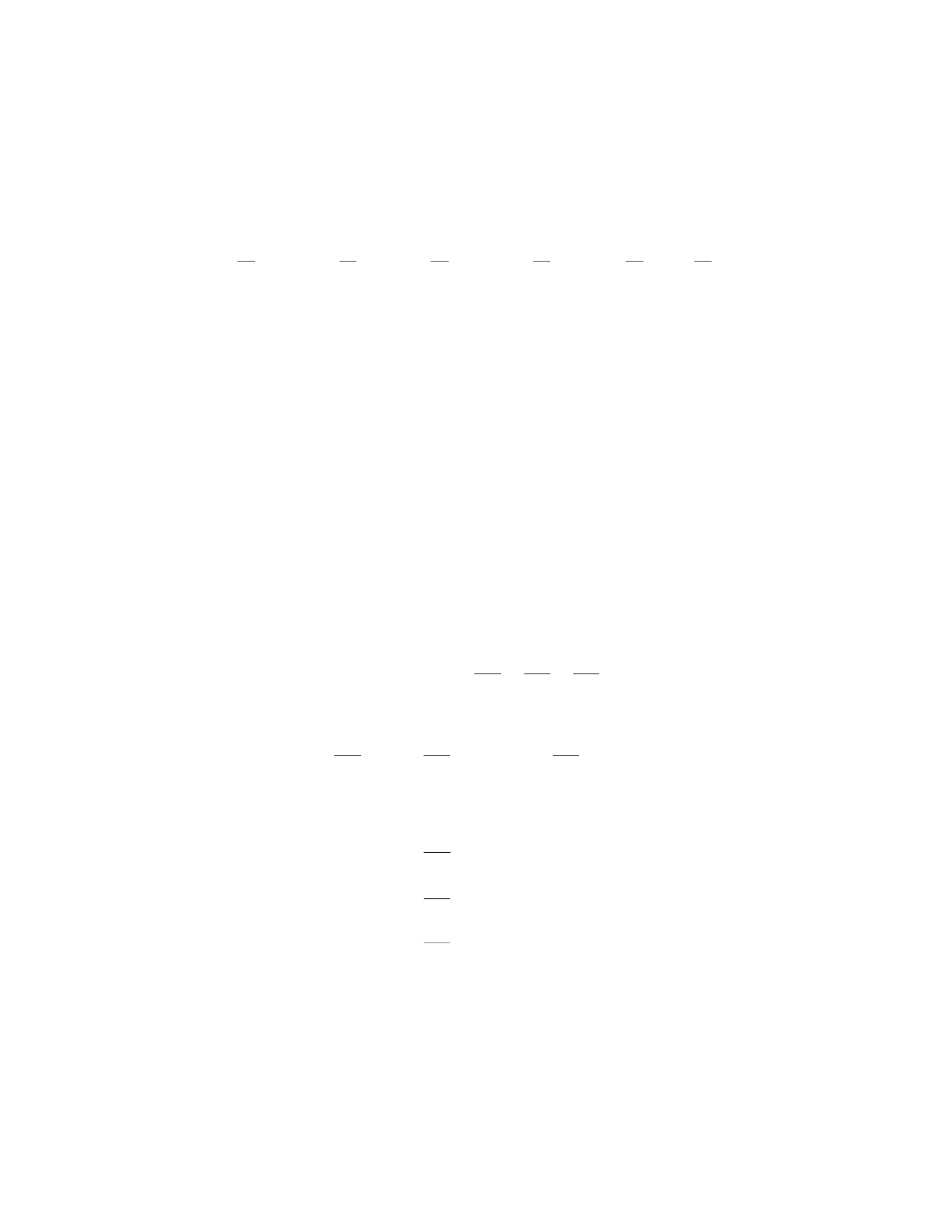
Step 3: Evaluate the determinant using cofactor expansion along the top
row.
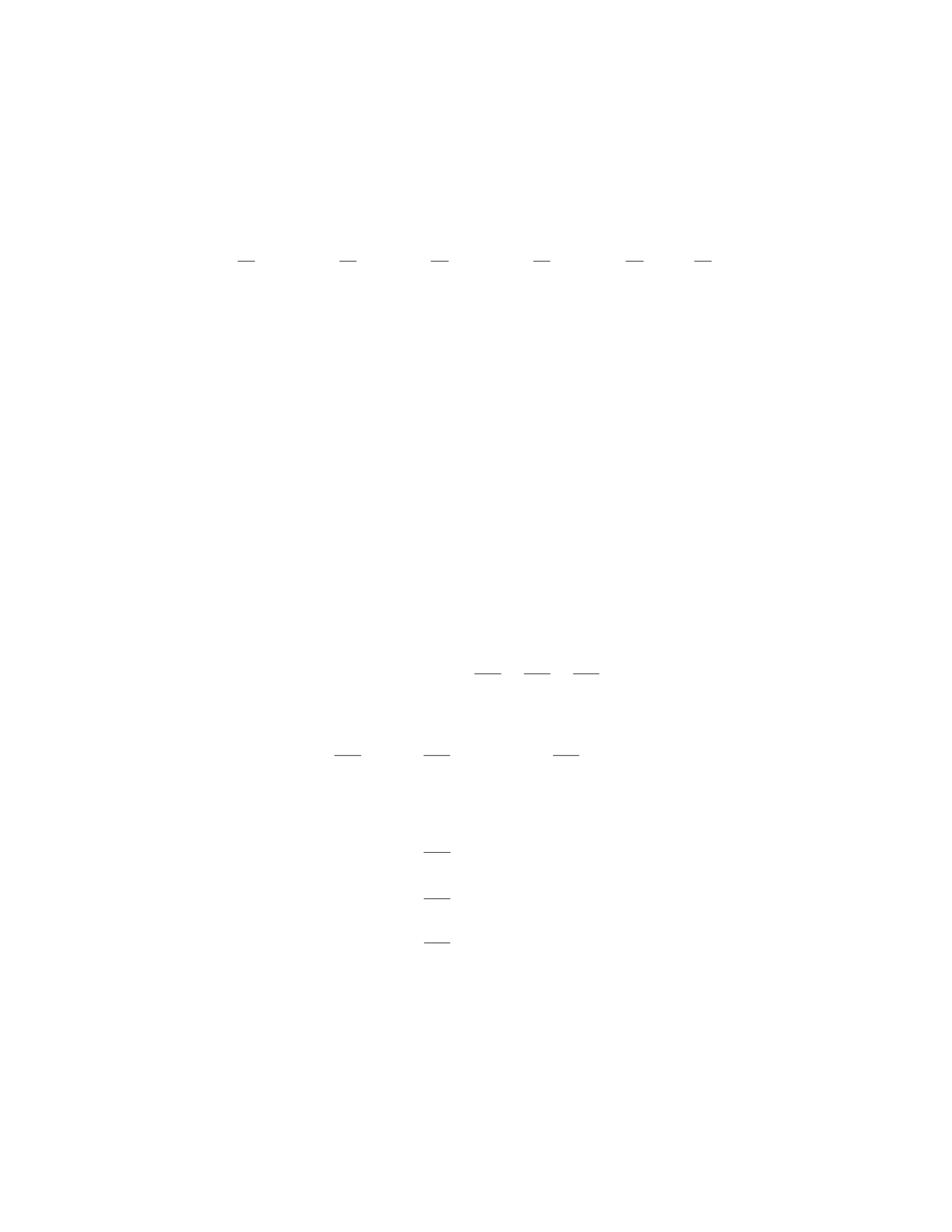
=∂
∂y (x2−y2)−∂
∂z (yz)i−∂
∂x (x2−y2)−∂
∂z (xz)j+∂
∂x (yz)−∂
∂y (xz)k
Step 4: Simplify each component of the curl.
= (−2y)i−(2x)j+ (z−(−z)) k
Step 5: Combine the components to find the curl of F.
∇ × F=−2yi−2xj+ 2zk
Therefore, the curl of Fis −2yi−2xj+ 2zk.
Question 20
Question
Let
F(x, y, z)=3xzˆ
i+ (x2+ 2yz)ˆ
j+ 3xyˆ
k. Find the divergence of
Fat the
point (1,2,0).
Solution
To find the divergence of
F, we use the formula:
div(
F) = ∇ ·
F=∂Fx
∂x +∂Fy
∂y +∂Fz
∂z
Step 1: Find the partial derivatives of
F
∂Fx
∂x = 3z, ∂Fy
∂y = 2z, and ∂Fz
∂z = 3x
Step 2: Evaluate the partial derivatives at the point (1,2,0) Substi-
tute x= 1, y= 2, and z= 0 into the partial derivatives:
∂Fx
∂x = 3(0) = 0
∂Fy
∂y = 2(0) = 0
∂Fz
∂z = 3(1) = 3
Step 3: Find the divergence at the point (1,2,0)
div(
F)|(1,2,0) = 0 + 0 + 3 = 3
Therefore, the divergence of
Fat the point (1,2,0) is 3.
15
Question 21
Question
Let F(x, y, z) = x2yzi+xyz2j+x2z2k. Determine if Fis conservative. If it is,
find a scalar potential function f(x, y, z) such that F=∇f.
Solution
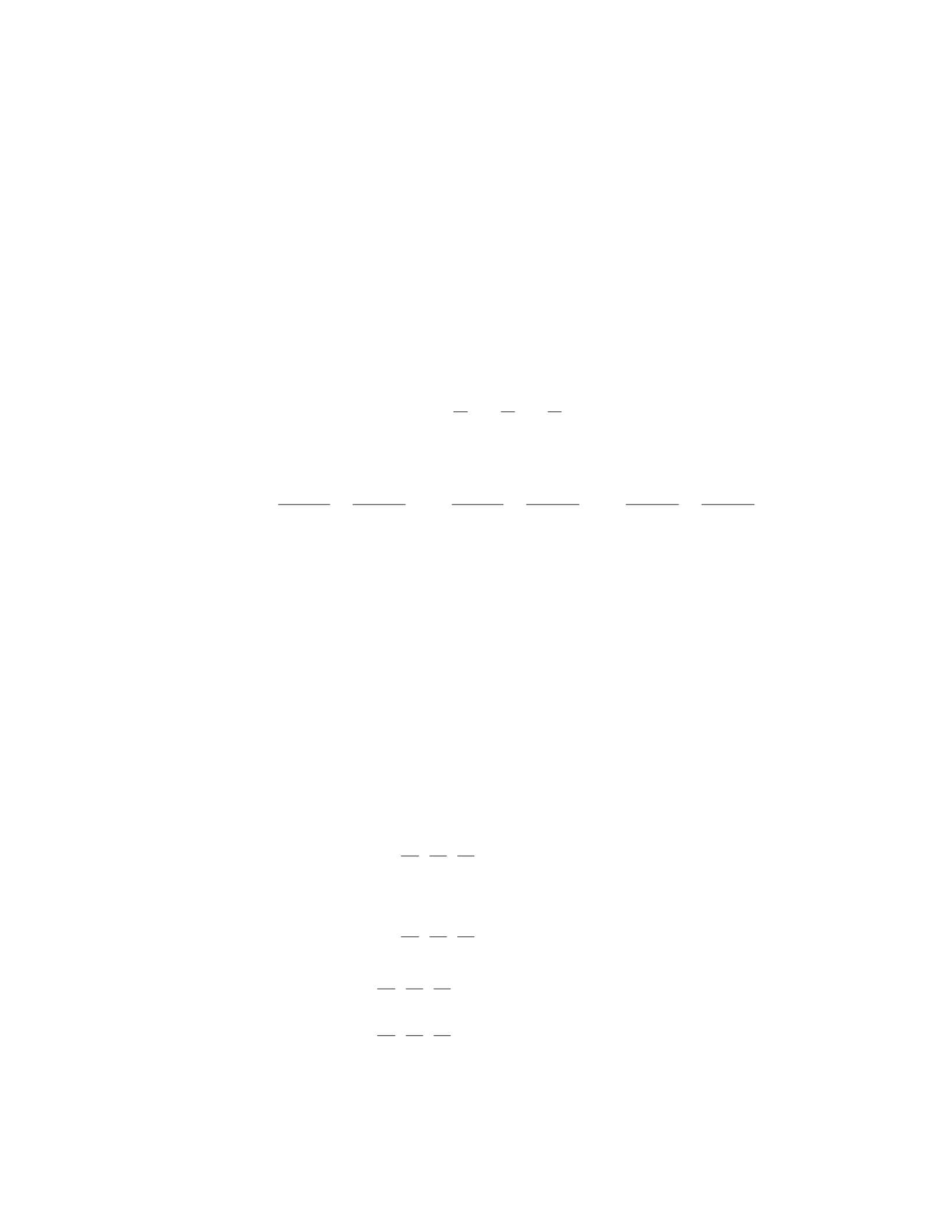
Step 1: To determine if Fis conservative, we check if the curl of Fis zero.
∇ × F=
i j k
∂
∂x
∂
∂y
∂
∂z
x2yz xyz2x2z2
Step 2: Compute the curl of F.
∇×F=∂(x2z2)
∂y −∂(xyz2)
∂z i−∂(x2z2)
∂x −∂(x2yz)
∂z j+∂(xyz2)
∂x −∂(x2yz)
∂y k
Step 3: Simplify the cross product and check if it is zero.
∇ × F= (2xz)i−(−2xz)j+ (yz)k= 2xzi+ 2xzj+yzk
Step 4: Since the curl of Fis not zero, Fis not conservative. Thus, there
does not exist a scalar potential function f(x, y, z) such that F=∇f.
Question 22
Question
Let Fbe a vector field defined by F(x, y)=(x2+y3,2xy −3). Compute ∇ × F.
Solution
Step 1: Determine the components of the curl of F.
∇ × F=∂
∂x ,∂
∂y ,∂
∂z ×(x2+y3,2xy −3)
Step 2: Expand the cross product.
∇ × F=∂
∂x ,∂
∂y ,∂
∂z ×(x2+y3,2xy −3)
=∂
∂x ,∂
∂y ,∂
∂z ×(x2+y3,2xy −3)
=∂
∂x ,∂
∂y ,∂
∂z ×(x2+y3,2xy −3)
16
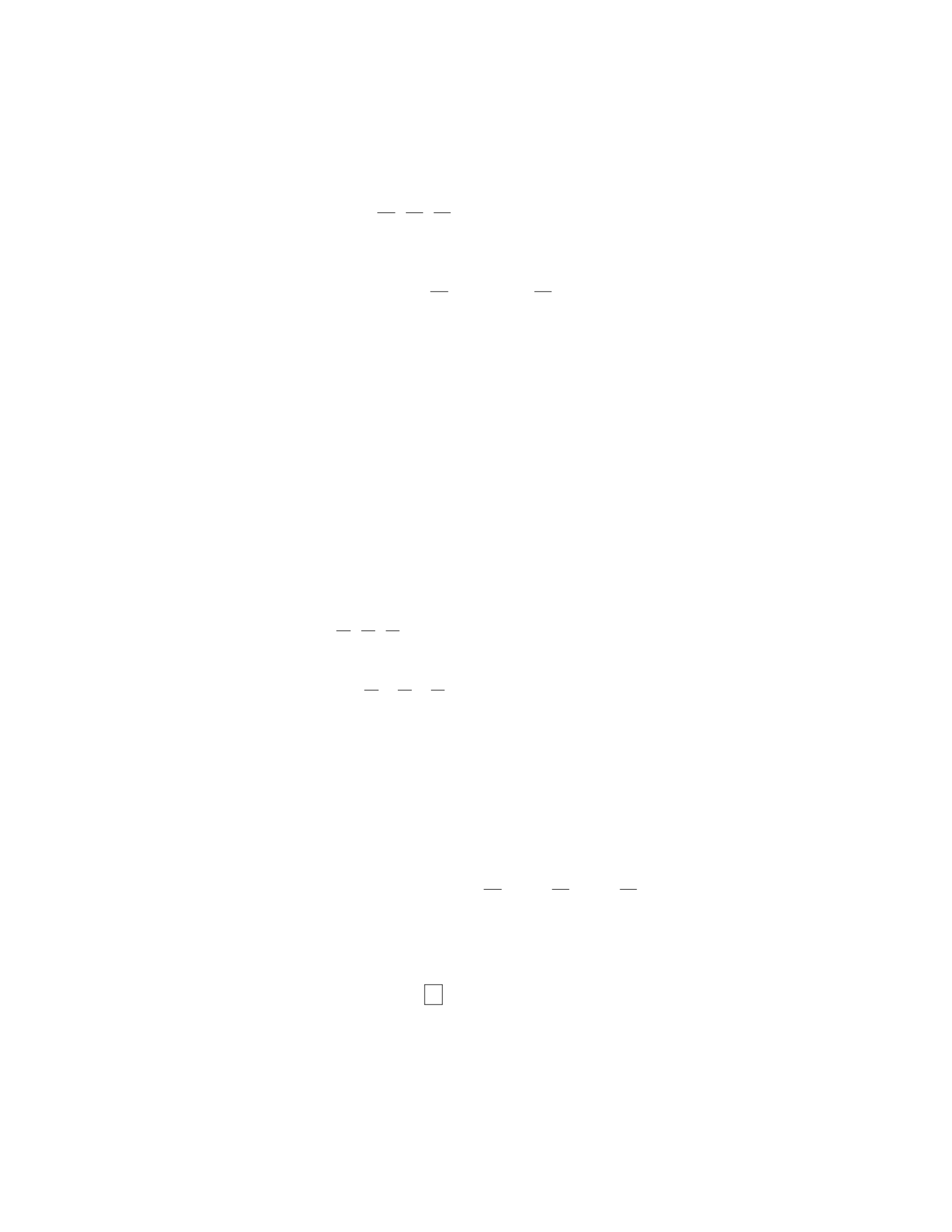
=∂
∂x ,∂
∂y ,∂
∂z ×(x2+y3,2xy −3)
Step 3: Compute the partial derivatives and simplify.
∇ × F=0,0,∂
∂x (2xy −3) −∂
∂y (x2+y3)
= (0,0,2y−2y)
= (0,0,0)
Therefore, the curl of Fis ∇ × F=0.
Question 23
Question
Let F(x, y, z) = y2i+x2j+z2kbe a vector field. Calculate div(curl(F)).
Solution
1. Find the curl of F:
curl(F) = ∇ × F
where ∇=∂
∂x ,∂
∂y ,∂
∂z . So,
curl(F) =
i j k
∂
∂x
∂
∂y
∂
∂z
y2x2z2
= (2z−0) i−(0 −2y)j+ (2x−0) k
curl(F)=2zi+ 2yj+ 2xk
2. Find the divergence of the resulting curl:
div(curl(F)) = ∇ · (curl(F))
where ∇is the del operator. Since curl(F)=2zi+ 2yj+ 2xk, we have
div(2zi+ 2yj+ 2xk) = ∂
∂x (2z) + ∂
∂y (2y) + ∂
∂z (2x)
div(2zi+ 2yj+ 2xk)=0+2+0
div(2zi+ 2yj+ 2xk)=2
Therefore, div(curl(F)) = 2 .
17

Question 24
Question
Let F=⟨yz, xz, xy⟩be a vector field. Compute ∇ · ∇ × F.
Solution
Step 1: First, we compute ∇ × F.
=
ˆ
iˆ
jˆ
k
∂
∂x
∂
∂y
∂
∂z
yz xz xy
=∂(xy)
∂y −∂(xz)
∂z ˆ
i−∂(xz)
∂x −∂(yz)
∂z ˆ
j+∂(yz)
∂x −∂(xy)
∂y ˆ
k
= (x−x)ˆ
i−(z−z)ˆ
j+ (y−y)ˆ
k
=0
Step 2: Next, we compute ∇ · 0.
=∂(0)∂x+∂(0)
∂y +∂(0)
∂z =0+0+0=0
Therefore, ∇ · ∇ × F= 0 .
Question 25
Question
Let F(x, y, z)=(x2y, sin(yz), z cos(x)) be a vector field in R3. Compute ∇ · F,
where ∇ · Fdenotes the divergence of F.
Solution
Step 1: The divergence of a vector field F= (F1, F2, F3) is defined as
∇ · F=∂F1
∂x +∂F2
∂y +∂F3
∂z .
Step 2: For the given vector field F(x, y, z)=(x2y, sin(yz), z cos(x)), we
have F1(x, y, z) = x2y,F2(x, y, z) = sin(yz), and F3(x, y, z) = zcos(x).
18
Step 3: Compute the partial derivatives:
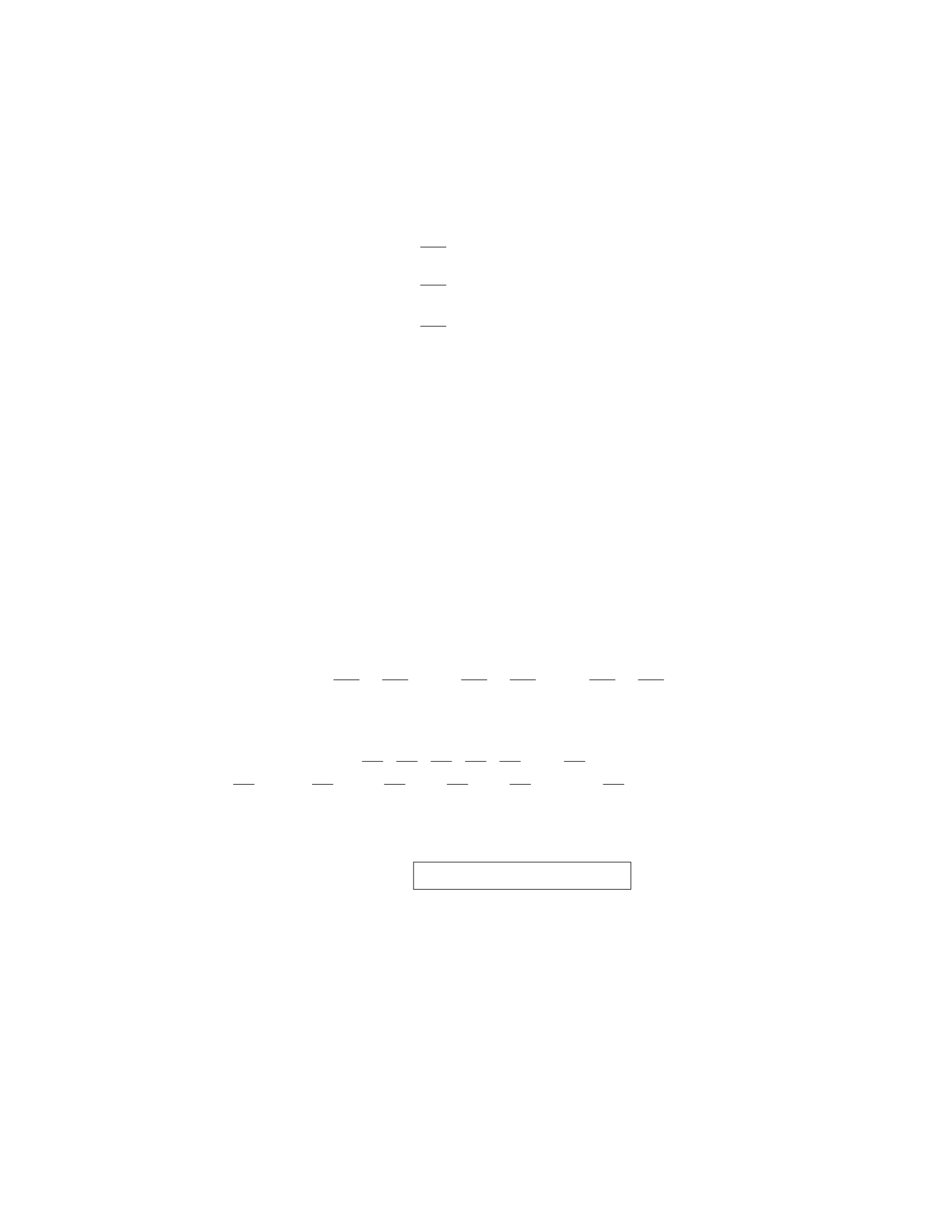
∂F1
∂x = 2xy,
∂F2
∂y =zcos(yz),
∂F3
∂z = cos(x).
Step 4: Therefore, the divergence of Fis
∇ · F= 2xy +zcos(yz) + cos(x).
So, ∇ · F= 2xy +zcos(yz) + cos(x).
Question 26
Question
Let F(x, y, z) = x2yi+xyzj+yz2kbe a vector field. Compute the curl of F.
Solution
To find the curl of a vector field F(x, y, z) = F1(x, y, z)i+F2(x, y, z)j+F3(x, y, z)k,
we can use the formula
curl F=∂F3
∂y −∂F2
∂z i−∂F3
∂x −∂F1
∂z j+∂F2
∂x −∂F1
∂y k.
In this case, F(x, y, z) = x2yi+xyzj+yz2k, so F1(x, y, z) = x2y,F2(x, y, z) =
xyz, and F3(x, y, z) = yz2.
Step 1: Compute ∂F3
∂y ,∂F2
∂z ,∂F3
∂x ,∂F1
∂z ,∂F2
∂x , and ∂F1
∂y .
∂F3
∂y = 2yz,∂F2
∂z =xy,∂F3
∂x = 0, ∂F1
∂z = 0, ∂F2
∂x =y, and ∂F1
∂y =x2.
Step 2: Plug these values into the formula for the curl of F.
curl F= (2yz −xy)i−(−yz2)j+ (y−x2)k.
Therefore, the curl of Fis (2yz −xy)i+yz2j+ (y−x2)k.
Question 27
Question
Let F(x, y, z)=(x2y, y2z, z2x) be a vector field in R3. Evaluate the divergence
of Fat the point (1,1,1).
19
Solution
To find the divergence of Fat the point (1,1,1), we need to compute the dot
product of the del operator (∇) and the vector field Fat that point.
Step 1: Compute the del operator. The del operator in Cartesian coordi-
nates is given by:
∇=∂
∂x ,∂
∂y ,∂
∂z
Step 2: Compute the divergence of F. The divergence of a vector field
F= (P, Q, R) is given by:
∇ · F=∂P
∂x +∂Q
∂y +∂R
∂z
For F(x, y, z)=(x2y, y2z, z2x), we have P=x2y,Q=y2z, and R=z2x.
Step 3: Compute the partial derivatives.
∂P
∂x = 2xy
∂Q
∂y = 2yz
∂R
∂z = 2zx
Step 4: Evaluate the divergence at (1,1,1).
∇ · F=∂P
∂x +∂Q
∂y +∂R
∂z
= 2xy + 2yz + 2zx
= 2(1)(1) + 2(1)(1) + 2(1)(1)
= 6
Therefore, the divergence of the vector field Fat the point (1,1,1) is 6 .
Question 28
Question
Let F(x, y, z) = exsin yi+ycos zj+xz2k. Calculate ∇ · ∇ × F.
Solution
Step 1: Let’s first find the curl of F:
curl F=
i j k
∂
∂x
∂
∂y
∂
∂z
exsin y y cos z xz2
20
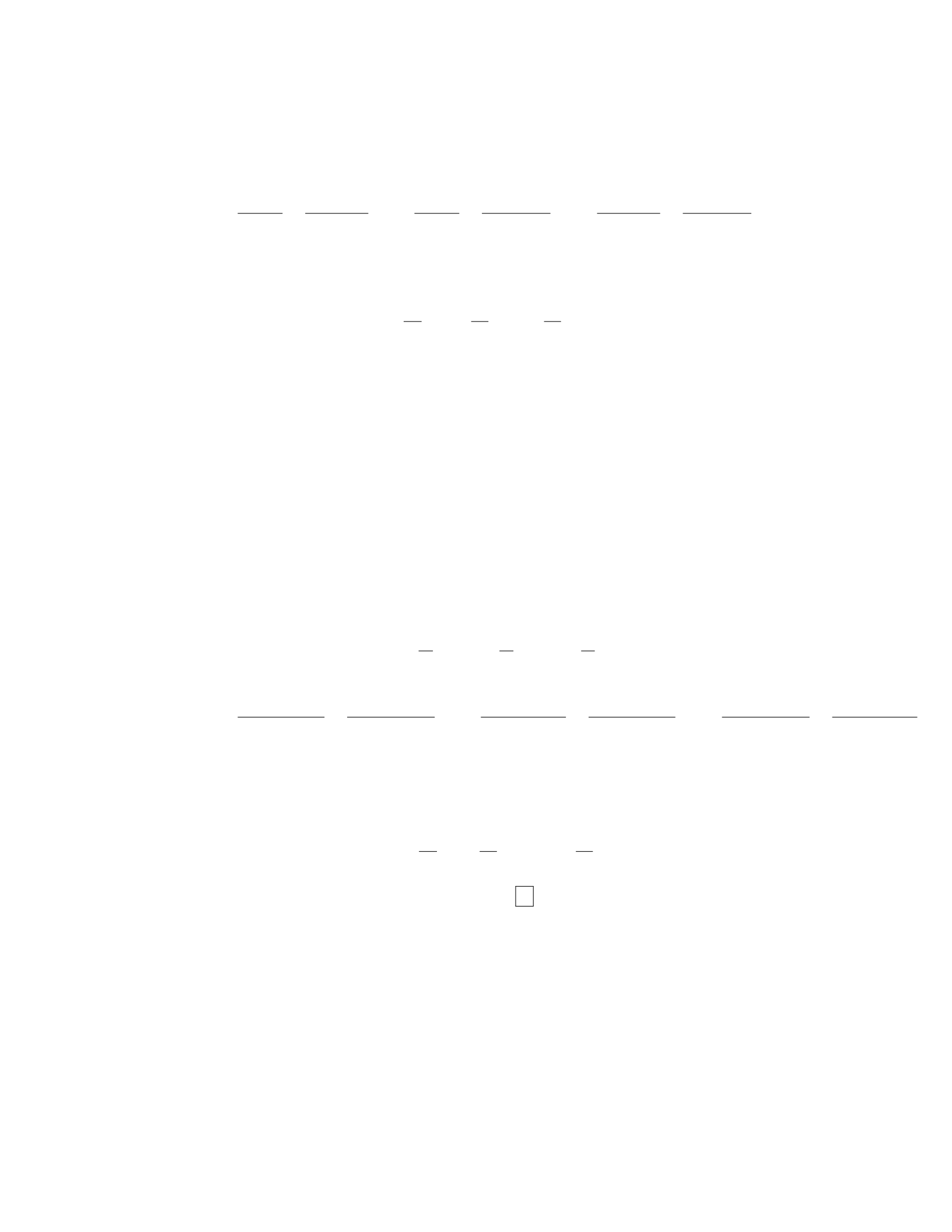
=∂(xz2)
∂y −∂(ycos z)
∂z i−∂(xz2)
∂x −∂(exsin y)
∂z j+∂(ycos z)
∂x −∂(exsin y)
∂y k
=z2i−xj−excos yk
Step 2: Next, let’s find the divergence of our curl:
∇ · curl F=∂
∂x (z2) + ∂
∂y (−x) + ∂
∂z (−excos y)
= 0 −0 + exsin y
Hence, ∇ · ∇ × F=exsin y.
Question 29
Question
Let F(x, y, z)=(xeyz +y2, xz2+ 2yz, xy2z+z3) be a vector field. Compute
∇ · ∇ × F.
Solution
Step 1: Compute ∇ × F.
∇ × F=
i j k
∂
∂x
∂
∂y
∂
∂z
xeyz +y2xz2+ 2yz xy2z+z3
=∂(xy2z+z3)
∂y −∂(xz2+ 2yz)
∂z i−∂(xeyz +y2)
∂x −∂(xy2z+z3)
∂z j+∂(xz2+ 2yz)
∂x −∂(xeyz +y2)
∂y k
= (x−0)i−(eyz −0)j+ (2z−2y)k
=xi−eyzj+ 2zk
Step 2: Compute ∇ · ∇ × F.
∇ · ∇ × F=∂
∂x ·x+∂
∂y ·(−eyz ) + ∂
∂z ·2z
= 1 −0 + 2 = 3
Question 30
Question
Let F(x, y, z)=3x2yi+ 2yexz j+zey2k. Compute ∇ · ∇ × F.
21

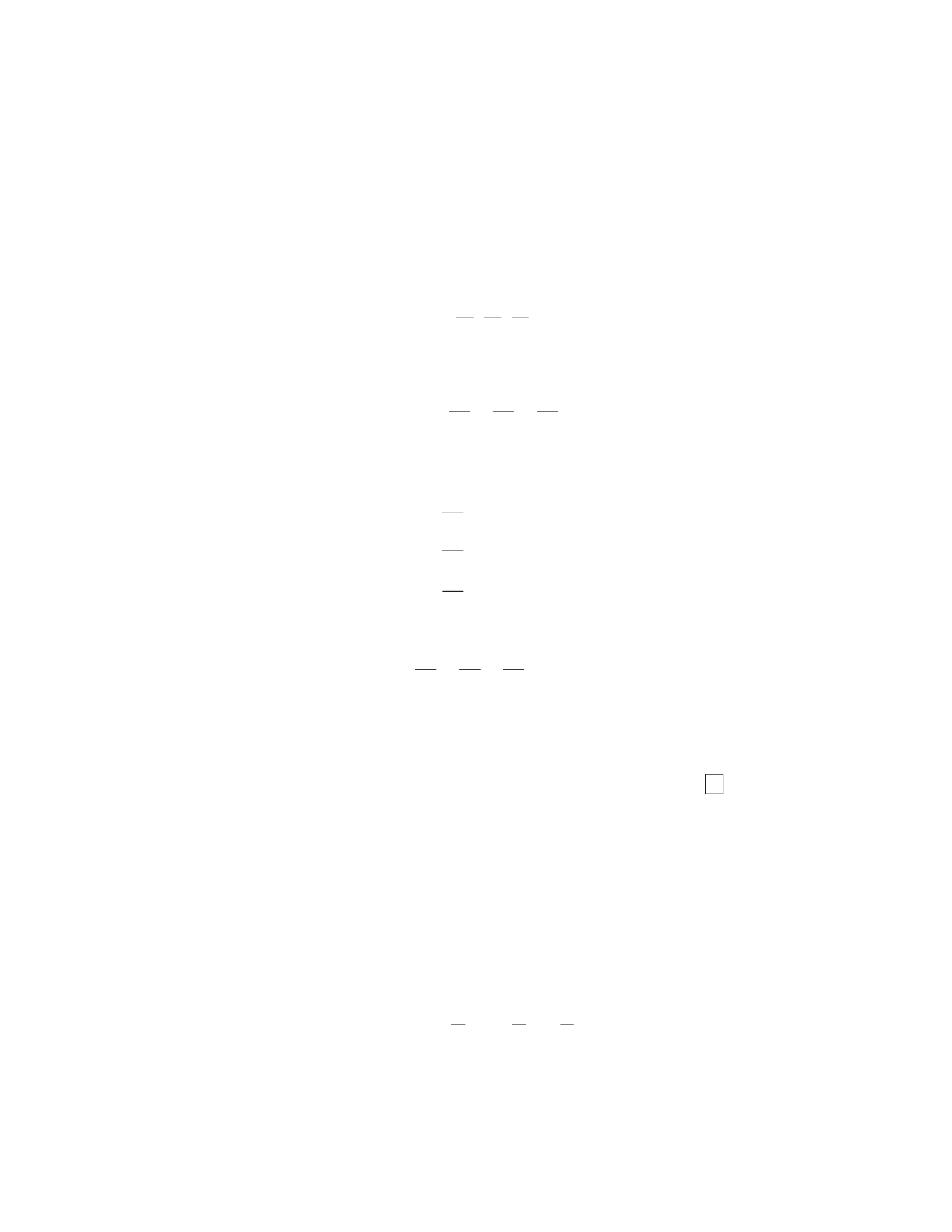
Step 3: Curl The curl of a vector field
F(x, y, z) = P(x, y, z)ˆ
i+Q(x, y, z)ˆ
j+
R(x, y, z)ˆ
kis given by:
∇ ×
F=
ˆ
iˆ
jˆ
k
∂
∂x
∂
∂y
∂
∂z
P Q R
For
F(x, y, z) = x2yˆ
i+xyzˆ
j+z2ˆ
k, we have:
∇ ×
F=
ˆ
iˆ
jˆ
k
∂
∂x
∂
∂y
∂
∂z
x2y xyz z2
= (z−y)ˆ
i−2zˆ
j+ (xy −x2)ˆ
k
Question 2
Question
Let F(x, y, z) = (xez+ sin y, x2+yz, e2z+xcos y) be a vector field in R3.
Calculate the divergence of F.
Solution
To find the divergence of F, denoted by ∇ · F, we use the formula:
∇ · F=∂
∂x (F1) + ∂
∂y (F2) + ∂
∂z (F3),
where F(x, y, z)=(F1, F2, F3).
Step 1: Calculate ∂F1
∂x .
∂
∂x (xez+ sin y) = ez
Step 2: Calculate ∂F2
∂y .
∂
∂y (x2+yz) = z
Step 3: Calculate ∂F3
∂z .
∂
∂z (e2z+xcos y)=2e2z
Step 4: Now, compute the divergence of F.
∇ · F=ez+z+ 2e2z
Therefore, the divergence of Fis ez+z+ 2e2z.
2
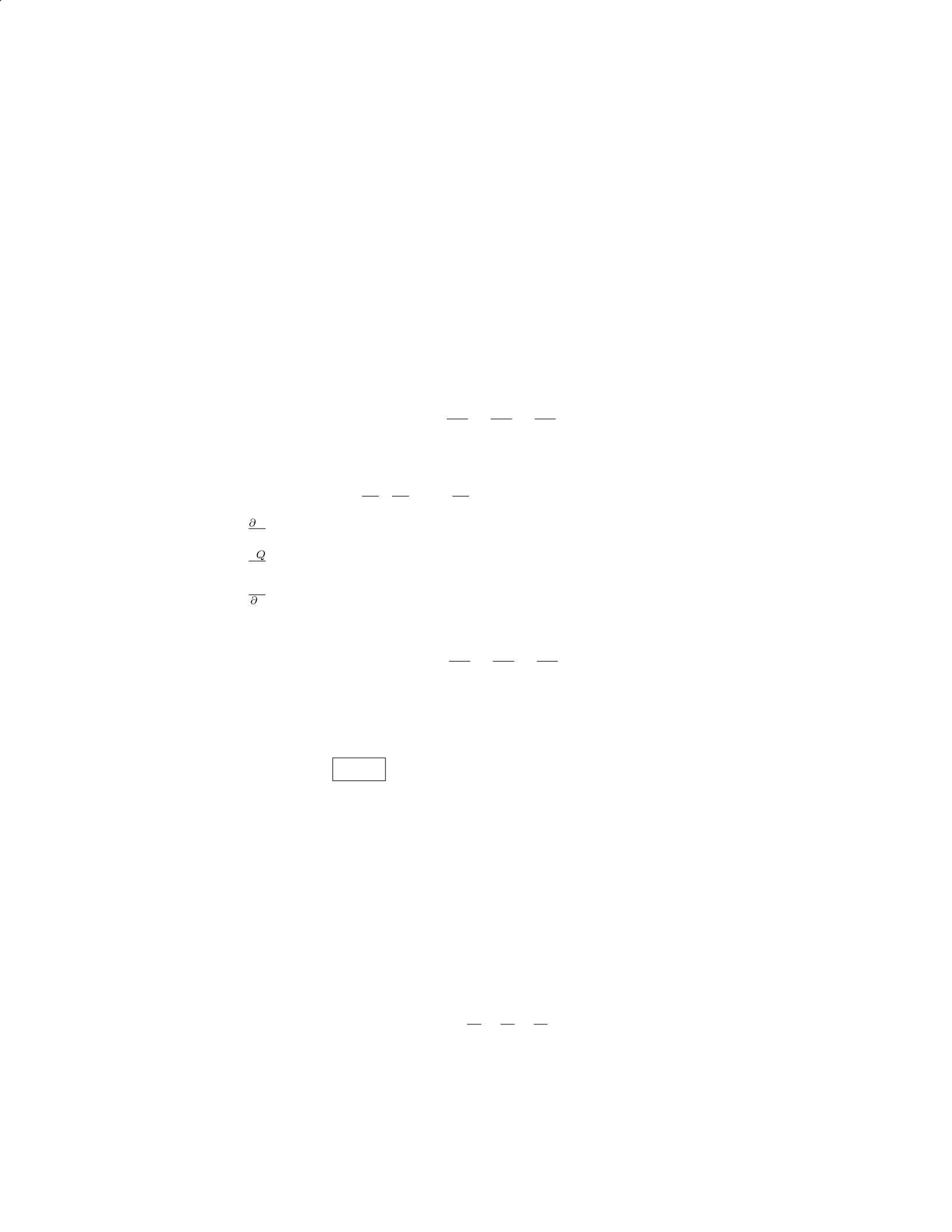
Question 3
Question
Let F(x, y, z)=(xz+y2)i−(y2−z2)j+(x−y)kbe a vector field in R3. Compute
the divergence of F.
Solution
To compute the divergence of a vector field F(x, y, z) = P(x, y, z)i+Q(x, y, z)j+
R(x, y, z)k, we use the formula
∇ · F=∂P
∂x +∂Q
∂y +∂R
∂z .
Given F(x, y, z) = (xz +y2)i−(y2−z2)j+(x−y)k, we have P(x, y, z) = xz +y2,
Q(x, y, z) = −(y2−z2), and R(x, y, z) = x−y.
Step 1: Compute ∂P
∂x ,∂Q
∂y , and ∂R
∂z .
∂P
∂x =z
∂Q
∂y =−(−2y)=2y
∂R
∂z = 0
Step 2: Compute the divergence ∇ · F.
∇ · F=∂P
∂x +∂Q
∂y +∂R
∂z
=z+ 2y+ 0
=z+ 2y.
Therefore, the divergence of the vector field F(x, y, z)=(xz +y2)i−(y2−
z2)j+ (x−y)kis z+ 2y.
Question 4
Question
Let Fbe a vector field defined by F(x, y, z) = zi+xj+yk. Calculate the curl
of F.
Solution
To calculate the curl of a vector field F=Pi+Qj+Rk, we use the formula:
∇ × F=
i j k
∂
∂x
∂
∂y
∂
∂z
P Q R
3
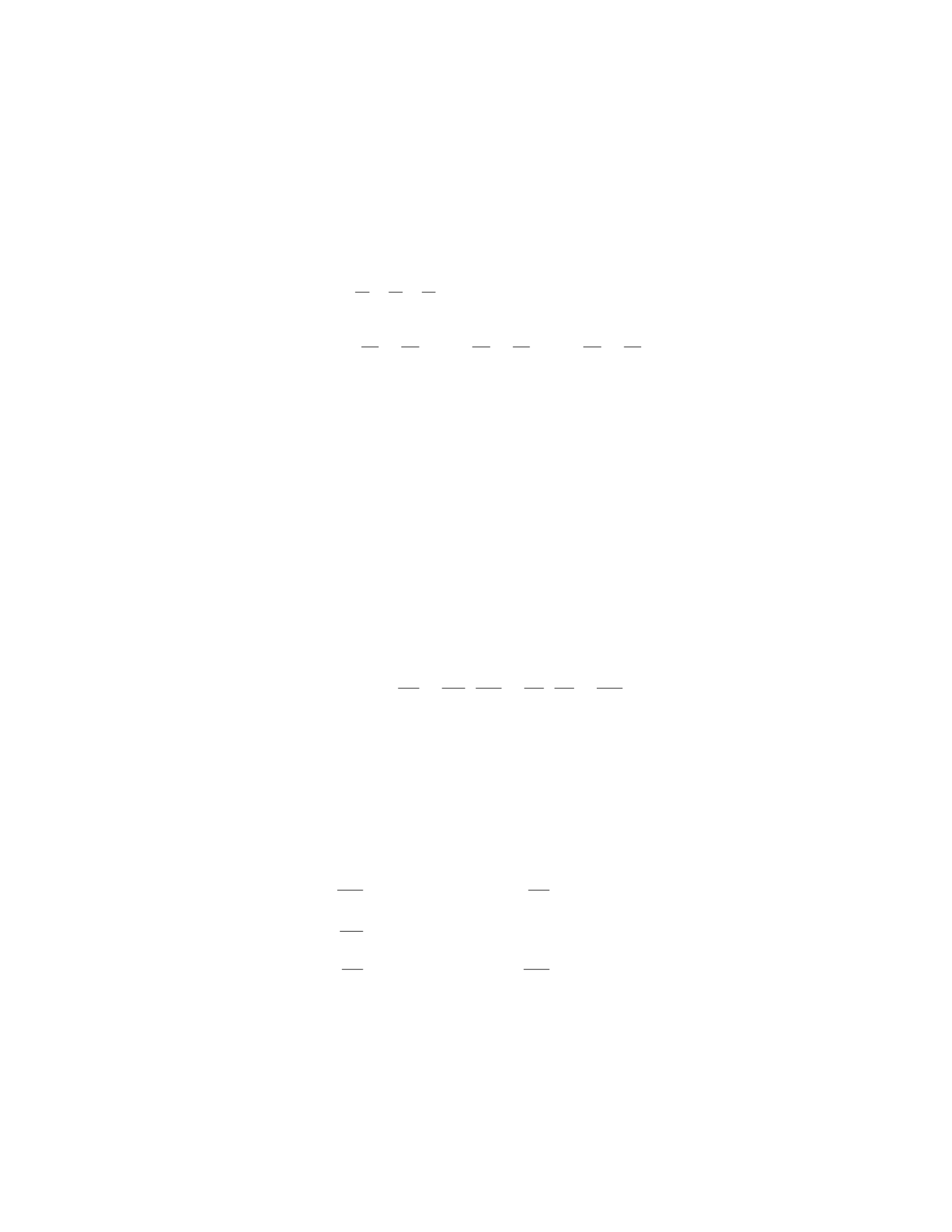
In this case, F(x, y, z) = zi+xj+yk, so P=z,Q=x,R=y. We can now
compute the curl as follows:
∇ × F=
i j k
∂
∂x
∂
∂y
∂
∂z
z x y
=∂y
∂y −∂x
∂z i−∂y
∂x −∂z
∂z j+∂x
∂x −∂z
∂y k
= 0i−0j+ 0k
=0
Therefore, the curl of Fis the zero vector, i.e., ∇ × F=0.
Question 5
Question
Let F(x, y, z)=(yz +ex, xz +y2, xy +z2) be a vector field in R3. Compute the
curl of F.
Solution
To find the curl of F, we use the formula
curl(F) = ∂P
∂y −∂N
∂z ,∂M
∂z −∂L
∂x ,∂L
∂y −∂M
∂x
where F(x, y, z)=(M, N, P ).
Step 1: Compute the partial derivatives of M,N, and P:
M=xz +y2P=xy +z2
N=yz +ex
∂M
∂z =x∂P
∂y =x+ 2z
∂N
∂z =y
∂P
∂x =y∂M
∂y = 2y
4
Step 2: Calculate the curl of F:
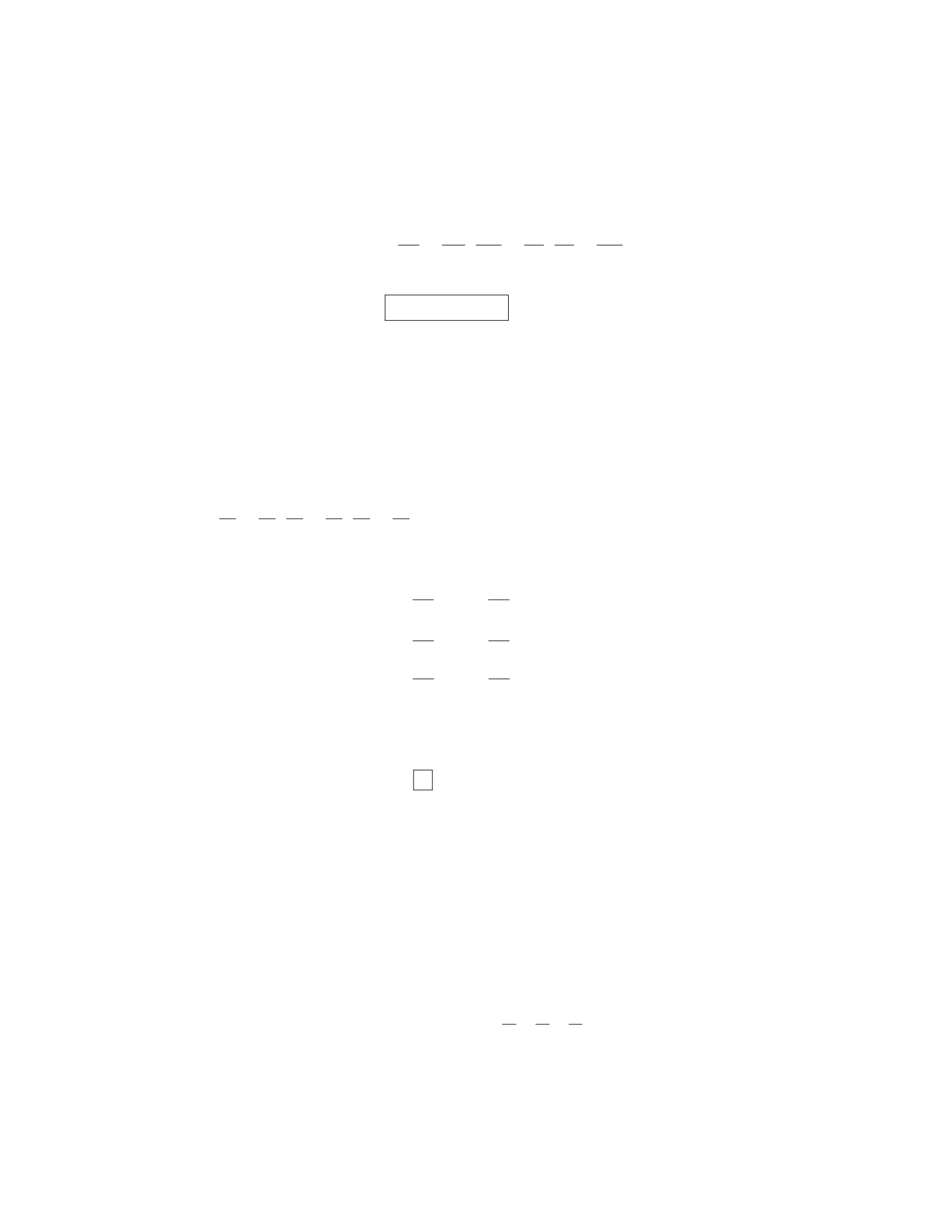
curl(F) = ∂P
∂y −∂N
∂z ,∂M
∂z −∂L
∂x ,∂L
∂y −∂M
∂x
= (x+ 2z−y, x −0,2y−y)
= (x+ 2z−y, x, y).
Question 6
Question
Let F(x, y, z)=(x2, yz, ez). Calculate the curl of F.
Solution
To calculate the curl of a vector field F= (P, Q, R), we use the formula: ∇×F=
∂R
∂y −∂Q
∂z ,∂P
∂z −∂R
∂x ,∂Q
∂x −∂P
∂y .
Step 1: Identify P,Q, and R. Here, P=x2,Q=yz, and R=ez.
Step 2: Calculate the partial derivatives.
∂R
∂y = 0,∂Q
∂z = 0
∂P
∂z = 0,∂R
∂x = 0
∂Q
∂x = 0,∂P
∂y = 0
Step 3: Compute the curl of F.
∇ × F= (0 −0,0−0,0−0) = (0,0,0)
Therefore, the curl of Fis 0.
Question 7
Question
Let F(x, y) = ⟨x2y, yex, x2⟩. Compute div(curl(F)).
Solution
Step 1: Find the curl of F. The curl of a vector field F(x, y, z) = ⟨P(x, y, z), Q(x, y, z), R(x, y, z)⟩
is given by:
curl(F) = ∇ × F=
i j k
∂
∂x
∂
∂y
∂
∂z
P Q R
5
For F(x, y) = ⟨x2y, yex, x2⟩, we have:
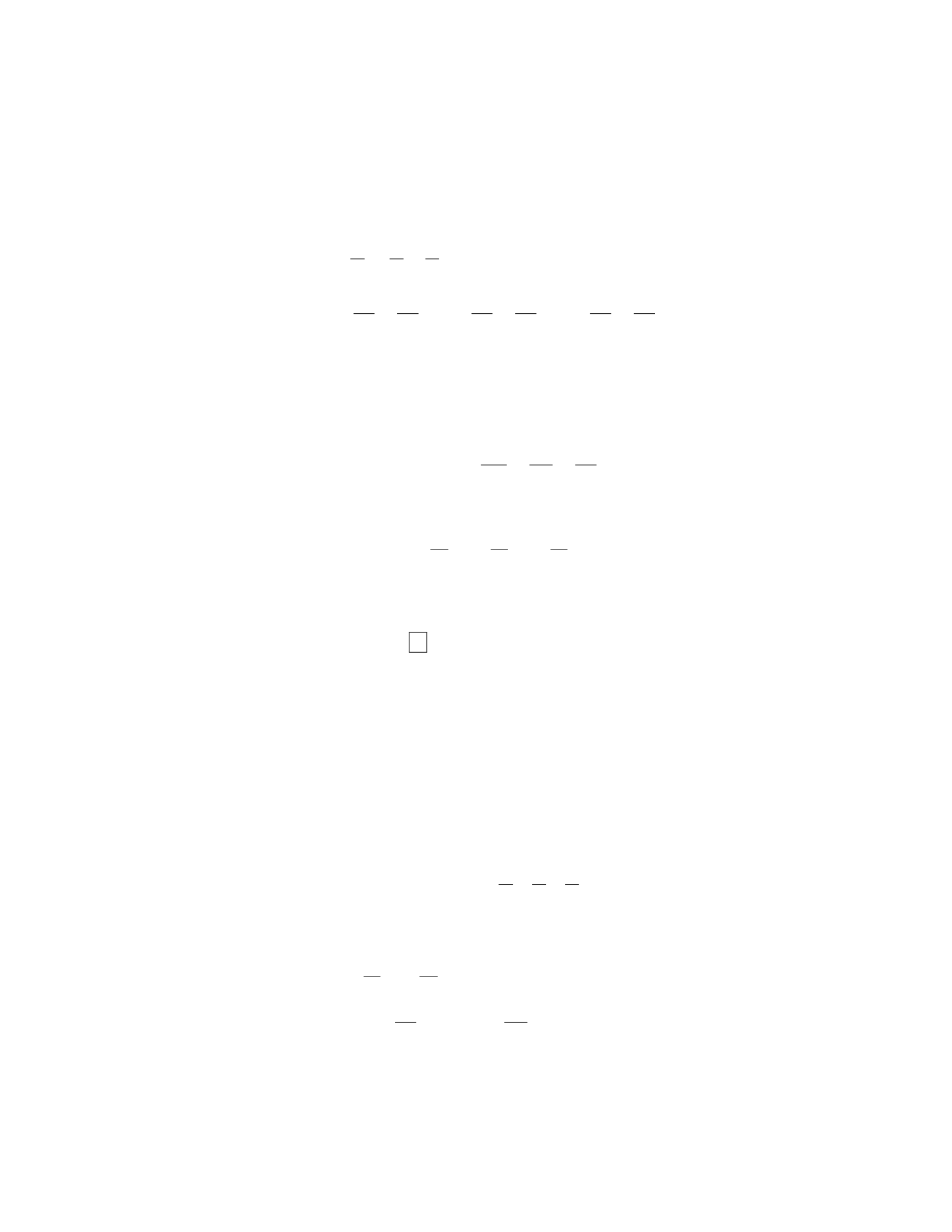
curl(F) =
i j k
∂
∂x
∂
∂y
∂
∂z
x2y yexx2
=∂R
∂y −∂Q
∂z i−∂R
∂x −∂P
∂z j+∂Q
∂x −∂P
∂y k
= (0 −0) i−(0 −0) j+ (2x−x)k
=xk
Step 2: Find the divergence of the curl of F. The divergence of a vector field
G(x, y, z) = ⟨M(x, y, z), N (x, y, z), P (x, y, z)⟩is given by:
div(G) = ∇ · G=∂M
∂x +∂N
∂y +∂P
∂z
For G(x, y, z) = xk, we have:
div(G) = ∂
∂x (0) + ∂
∂y (0) + ∂
∂z (x)
=0+0+0+1
= 1
Therefore, div(curl(F)) = 1 .
Question 8
Question
Let F(x, y, z)=(x2+y2)i+y2j+zk. Find the curl of F.
Solution
To find the curl of F, we use the formula:
curl F=∇ × F=
i j k
∂
∂x
∂
∂y
∂
∂z
M N P
where F(x, y, z) = M(x, y, z)i+N(x, y, z)j+P(x, y, z)k.
In this case, M(x, y, z) = x2+y2,N(x, y, z) = y2, and P(x, y, z) = z.
Step 1: Calculate ∂P
∂y and ∂N
∂z .
∂P
∂y = 0 and ∂N
∂z = 0
6
Step 2: Calculate ∂M
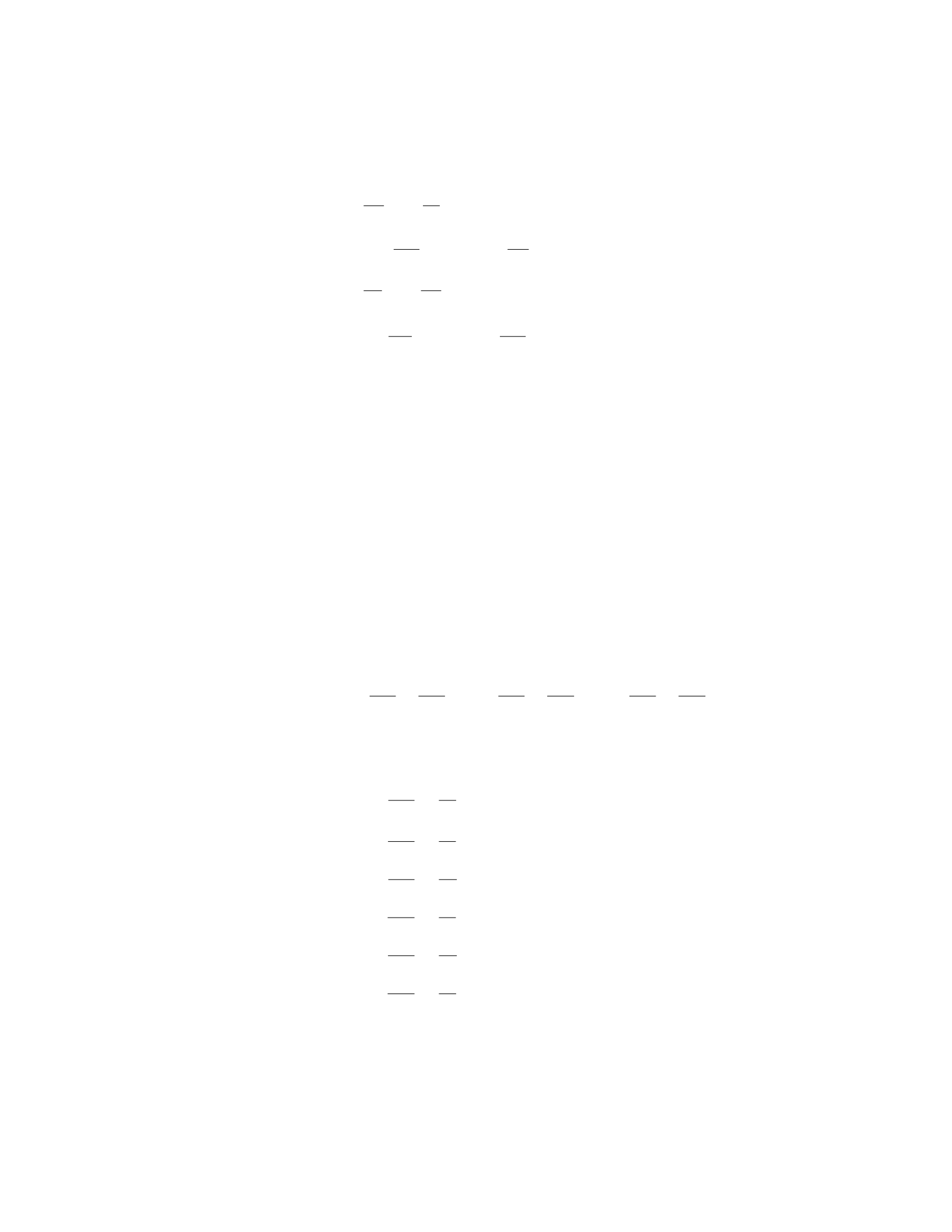
∂z and ∂P
∂x .
∂M
∂z = 0 and ∂P
∂x = 0
Step 3: Calculate ∂N
∂x and ∂M
∂y .
∂N
∂x = 0 and ∂M
∂y = 2y
Step 4: Substitute the partial derivatives into the formula for the curl.
curl F= (0 −0) i−(0 −0) j+ (2y−0) k= 2yk
Therefore, the curl of Fis 2yk.
Question 9
Question
Let F= (x2y+ 2z)i+ (xz −y2)j+ 3y2kbe a vector field in 3-dimensional space.
Calculate the curl of Fat the point (1,2,3).
Solution
To calculate the curl of a vector field Fat a given point, we use the formula:
curl(F) = ∇ × F=∂Fz
∂y −∂Fy
∂z i−∂Fz
∂x −∂Fx
∂z j+∂Fy
∂x −∂Fx
∂y k
Step 1: Calculate the partial derivatives of F= (x2y+ 2z)i+ (xz −y2)j+
3y2k:
∂Fz
∂y =∂
∂y (3y2) = 6y
∂Fy
∂z =∂
∂z (xz −y2)=0
∂Fz
∂x =∂
∂x (3y2) = 0
∂Fx
∂z =∂
∂z (x2y+ 2z) = 0
∂Fy
∂x =∂
∂x (xz −y2) = z
∂Fx
∂y =∂
∂y (x2y+ 2z) = x2
7
Step 2: Plug the partial derivatives into the formula to find the curl at the
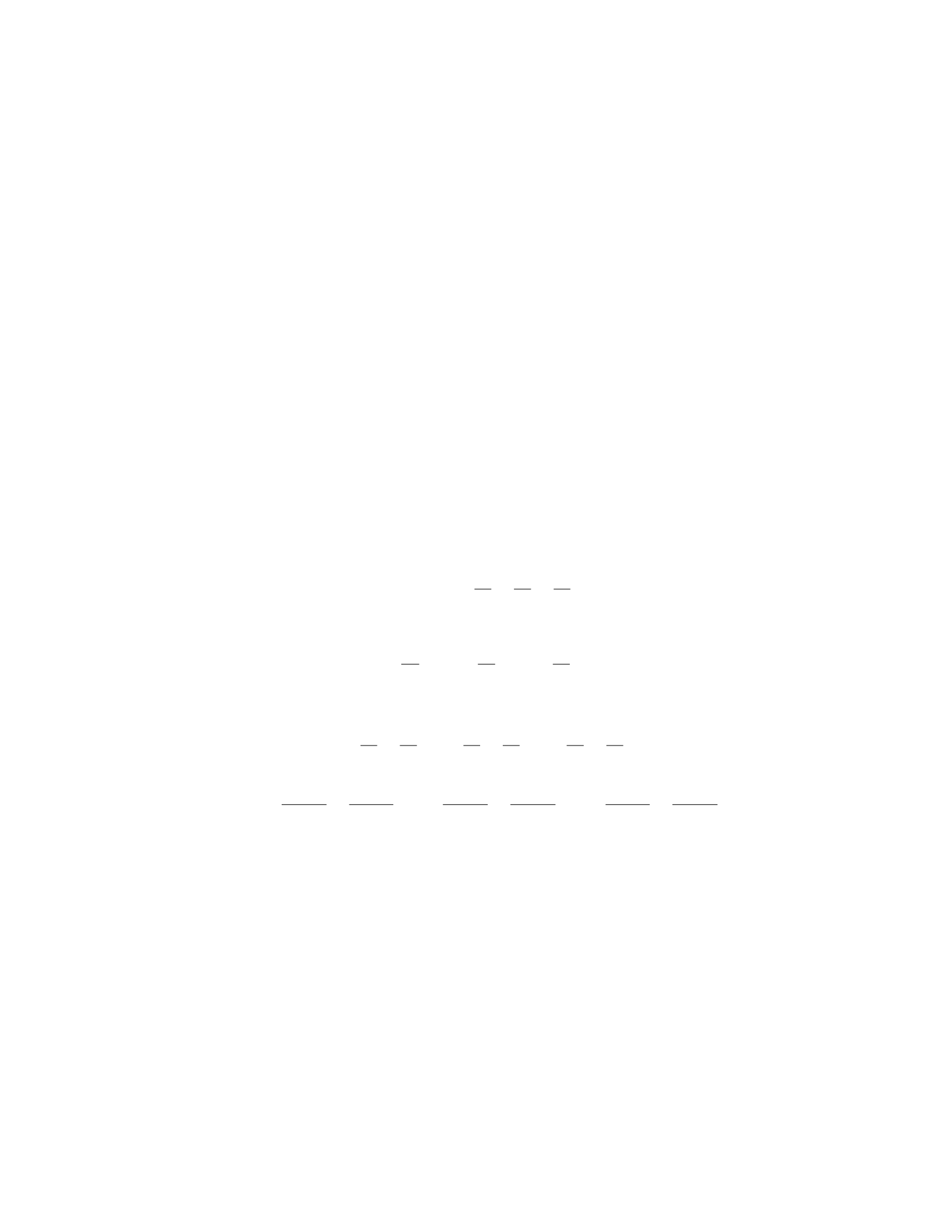
point (1,2,3):
curl(F) = (6y−0)i−(0 −0)j+ (z−x2)k
= 6(2)i+ (3 −12)k
= 12i+ 2k
Therefore, the curl of Fat the point (1,2,3) is 12i+ 2k.
Question 10
Question
Let F(x, y, z) = x2yi+y2zj+z2xkbe a vector field. Compute the divergence
of Fand the curl of F.
Solution
To compute the divergence and curl of F, we first express Fin terms of its
component functions.
Step 1: Compute the divergence of F The divergence of a vector field
F=Pi+Qj+Rkis given by ∇ · F=∂P
∂x +∂Q
∂y +∂R
∂z .
Here, P(x, y, z) = x2y,Q(x, y, z) = y2z, and R(x, y, z) = z2x.
Therefore, the divergence of Fis:
∇ · F=∂
∂x (x2y) + ∂
∂y (y2z) + ∂
∂z (z2x)
∇ · F= 2xy + 2yz + 2zx
Step 2: Compute the curl of F The curl of a vector field F=Pi+Qj+Rk
is given by ∇ × F=∂R
∂y −∂Q
∂z i−∂R
∂x −∂P
∂z j+∂Q
∂x −∂P
∂y k.
Applying this to F, we have:
∇×F=∂(z2x)
∂y −∂(y2z)
∂z i−∂(z2x)
∂x −∂(x2y)
∂z j+∂(y2z)
∂x −∂(x2y)
∂y k
∇ × F= (2z)i−(2z)j+ (2y)k
∇ × F= 2zi−2zj+ 2yk
Therefore, the divergence of Fis 2xy + 2yz + 2zx and the curl of Fis
2zi−2zj+ 2yk.
Question 11
Question
Let F(x, y, z) = (zcos y−ysin z, x sin z−zcos x, y cos x−xsin y) be a vector
field. Compute ∇ · ∇ × F.
8
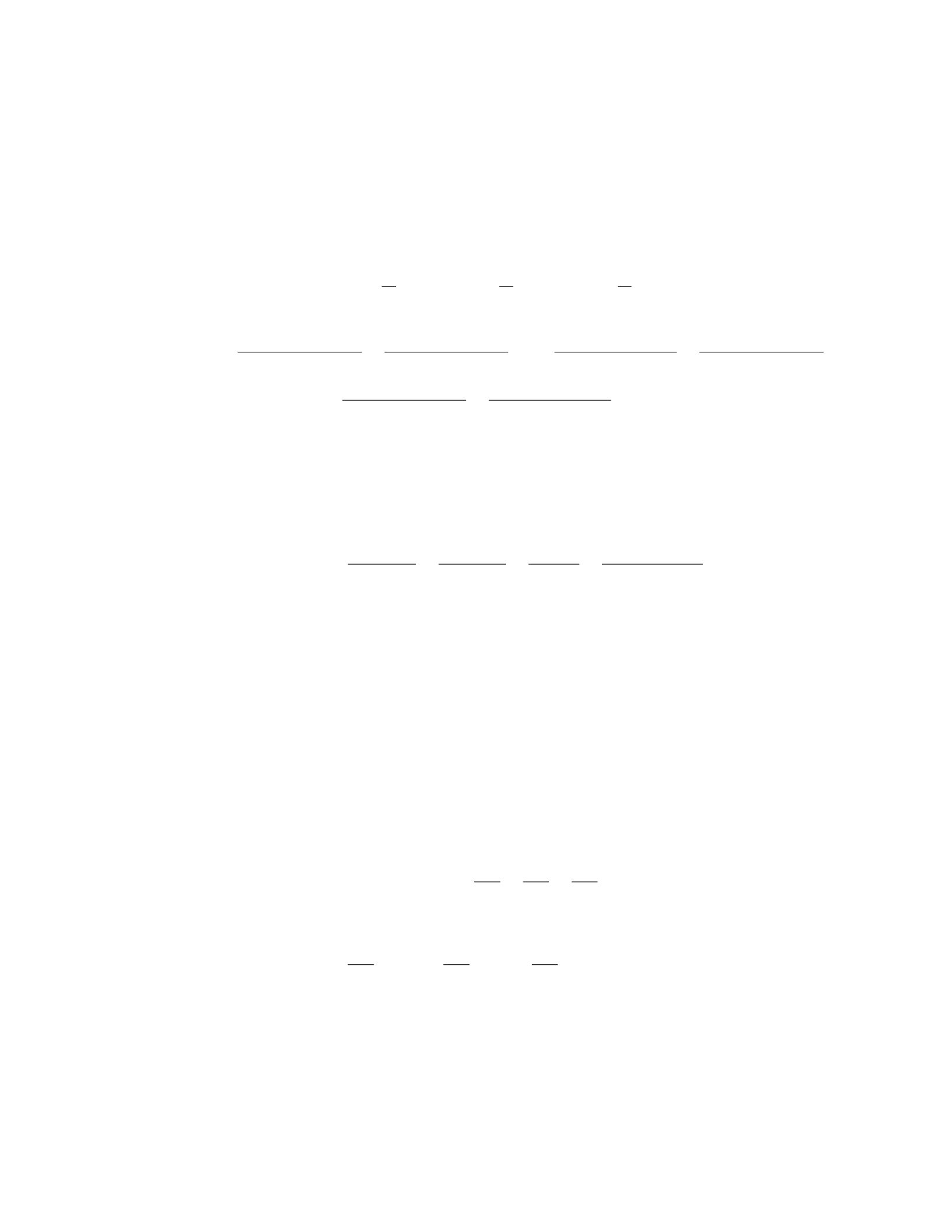
Solution
Step 1: Compute ∇ × F.
∇ × F=
i j k
∂
∂x
∂
∂y
∂
∂z
zcos y−ysin z x sin z−zcos x y cos x−xsin y
=∂(ycos x−xsin y)
∂y −∂(xsin z−zcos x)
∂z i−∂(zcos y−ysin z)
∂x −∂(ycos x−xsin y)
∂z j
+∂(xsin z−zcos x)
∂x −∂(zcos y−ysin z)
∂y k
= (−cos x−cos y)i+ (0 + sin y)j+ (cos z+ sin z)k
=−cos xi−cos yi+ sin yj+ cos zk+ sin zk
=−cos xi−cos yi+ sin yj+ (cos z+ sin z)k
Step 2: Compute ∇ · (∇ × F).
∇ · (∇ × F) = ∂(−cos x)
∂x +∂(−cos y)
∂y +∂(sin y)
∂y +∂(cos z+ sin z)
∂z
= sin x+ sin y+ cos z
Therefore, ∇ · ∇ × F= sin x+ sin y+ cos z.
Question 12
Question
Let F(x, y, z) = 3xy2+z3, x3+ 2yz, y3+ 3xz2be a vector field in R3. Calcu-
late the divergence of F.
Solution
To find the divergence of F, we use the following formula:
div(F) = ∇ · F=∂F1
∂x +∂F2
∂y +∂F3
∂z
Step 1: We find the partial derivatives of F1,F2, and F3:
∂F1
∂x = 3y2,∂F2
∂y = 2z, ∂F3
∂z = 6xz
Step 2: Now, we add these partial derivatives to find the divergence:
div(F)=3y2+ 2z+ 6xz
9
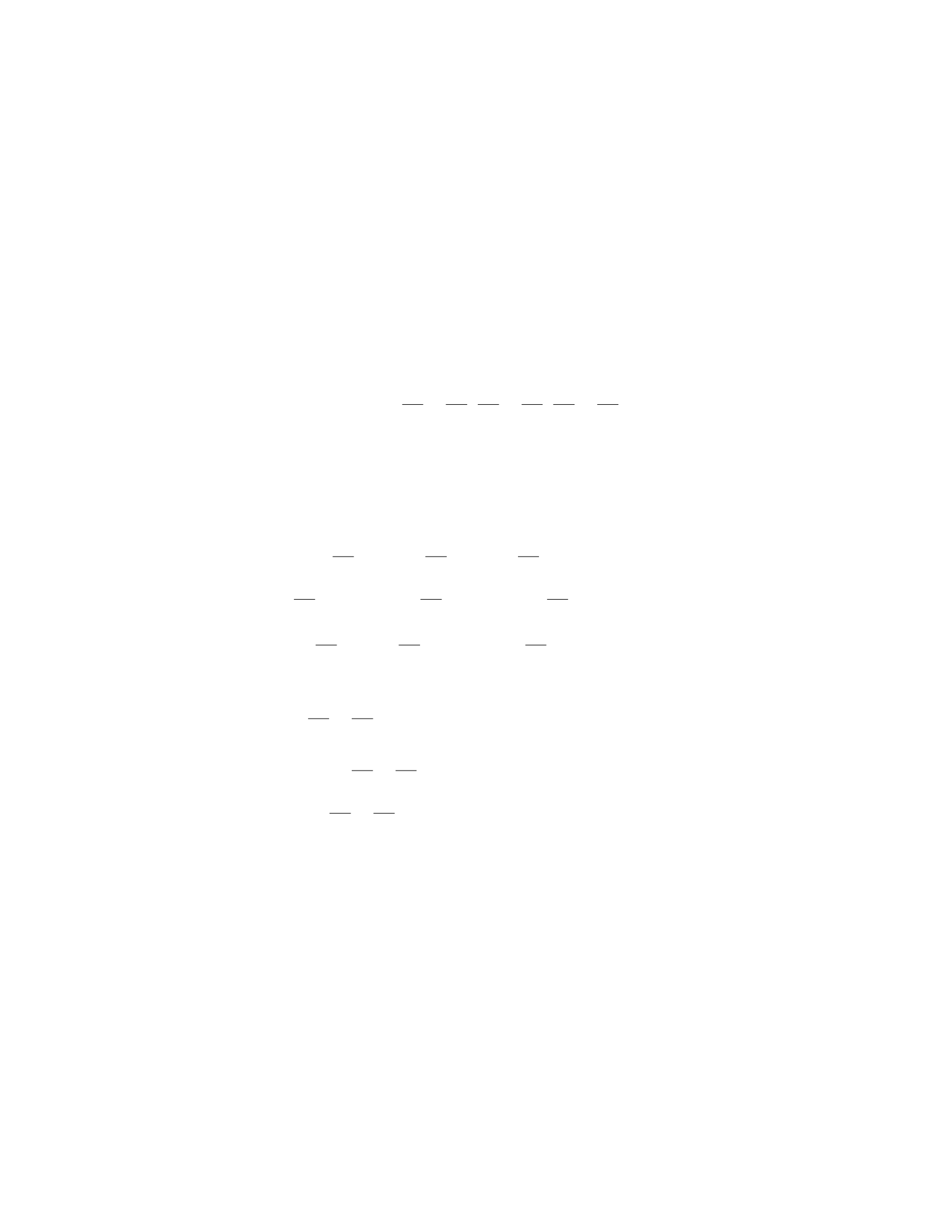
Question 13
Question
Let F(x, y, z)=(x2y+y2z, x2z+yz2, xy2+xz2). Find the curl of F.
Solution
To find the curl of a vector field F= (P, Q, R), where P, Q, R are the component
functions, use the formula:
curl(F) = ∂R
∂y −∂Q
∂z ,∂P
∂z −∂R
∂x ,∂Q
∂x −∂P
∂y
Step 1: Find the partial derivatives of P, Q, and Rwith respect to x, y, and
z, respectively.
P=x2y+y2z, Q =x2z+yz2, R =xy2+xz2
∂P
∂x = 2xy, ∂Q
∂x = 2xz, ∂R
∂x =y2+ 2xz
∂P
∂y =x2+ 2yz, ∂Q
∂y =z2+ 2yx, ∂R
∂y = 2xy + 2xz
∂P
∂z =y2,∂Q
∂z =x2+ 2yz, ∂R
∂z = 2xz + 2xy
Step 2: Calculate the components of the curl of F.
∂R
∂y −∂Q
∂z = (2xy + 2xz)−(x2+ 2yz)=2yz −x2
∂P
∂z −∂R
∂x =y2−(y2+ 2xz) = −2xz
∂Q
∂x −∂P
∂y = (2xz)−(x2+ 2yz) = 2xz −x2
Therefore, the curl of Fis ∇ × F= (−x2+ 2yz, −2xz, 2xz −x2).
Question 14
Question
Consider the vector field F(x, y, z) = (2xy, x2−z, 3xz). Find the divergence of
Fat the point (1,−1,2).
10
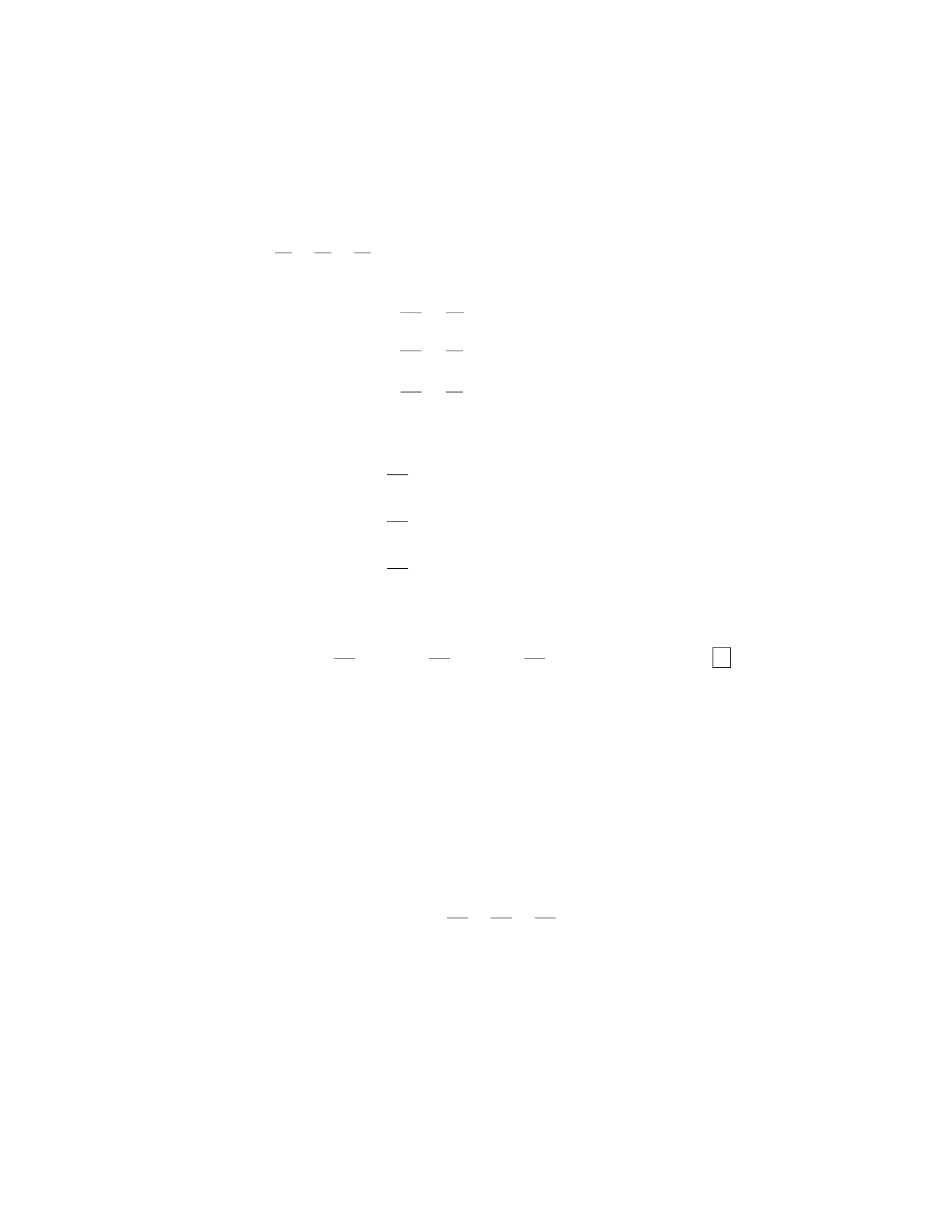
Solution
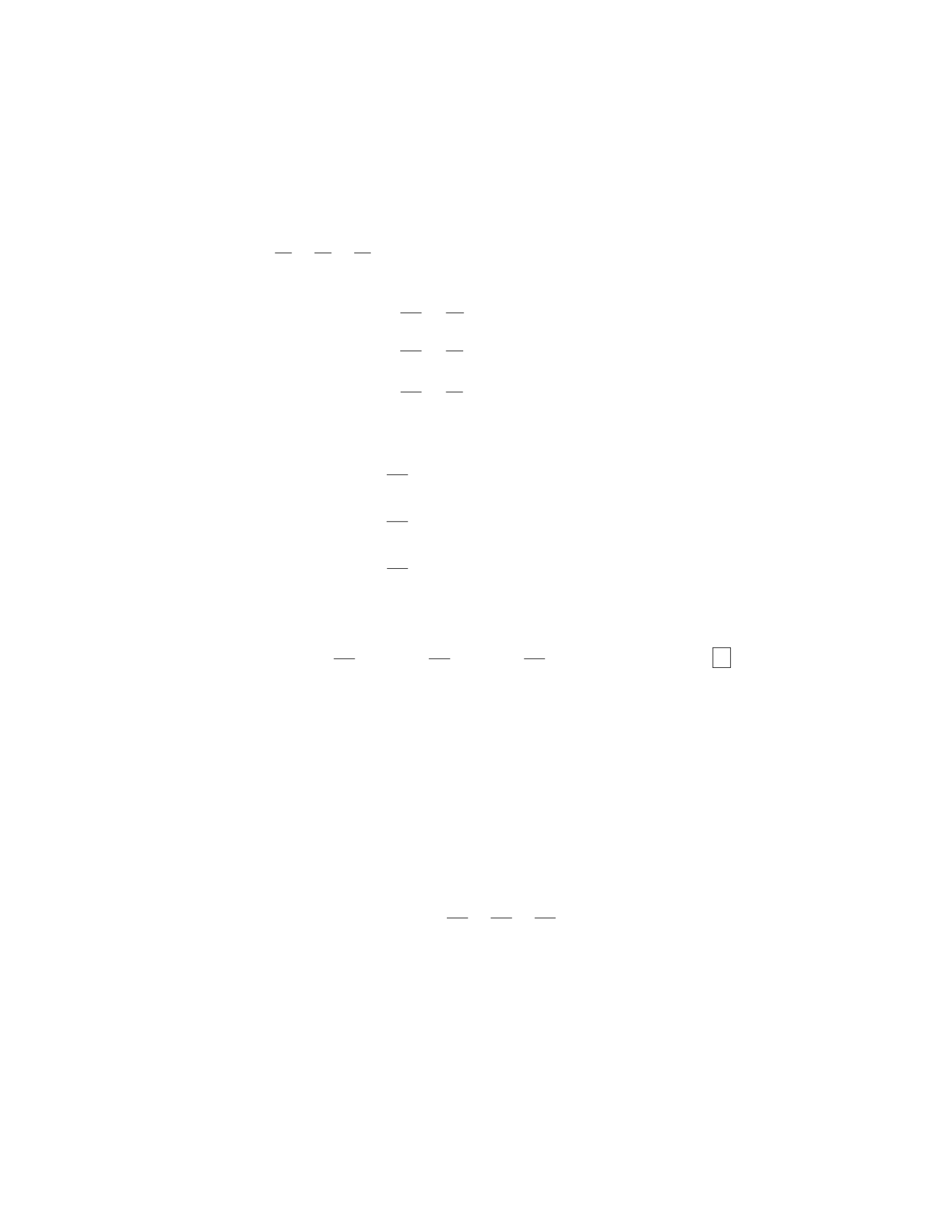
To find the divergence of a vector field F= (P, Q, R), we use the formula:
div(F) = ∂P
∂x +∂Q
∂y +∂R
∂z .
Step 1: Calculate the partial derivatives of P,Q, and R:
∂P
∂x =∂
∂x (2xy)=2y,
∂Q
∂y =∂
∂y (x2−z) = 0,
∂R
∂z =∂
∂z (3xz) = 3x.
Step 2: Substitute the given point (1,−1,2) into the partial derivatives:
∂P
∂x (1,−1,2)
= 2(−1) = −2,
∂Q
∂y (1,−1,2)
= 0,
∂R
∂z (1,−1,2)
= 3(1) = 3.
Step 3: Find the divergence of Fat the point (1,−1,2):
div(F)(1,−1,2)
=∂P
∂x (1,−1,2)
+∂Q
∂y (1,−1,2)
+∂R
∂z (1,−1,2)
=−2 + 0 + 3 = 1 .
Question 15
Question
Let F(x, y, z) = (x2y, y2z, z2x) be a vector field in R3. Compute the divergence
of Fat the point (1,2,3).
Solution
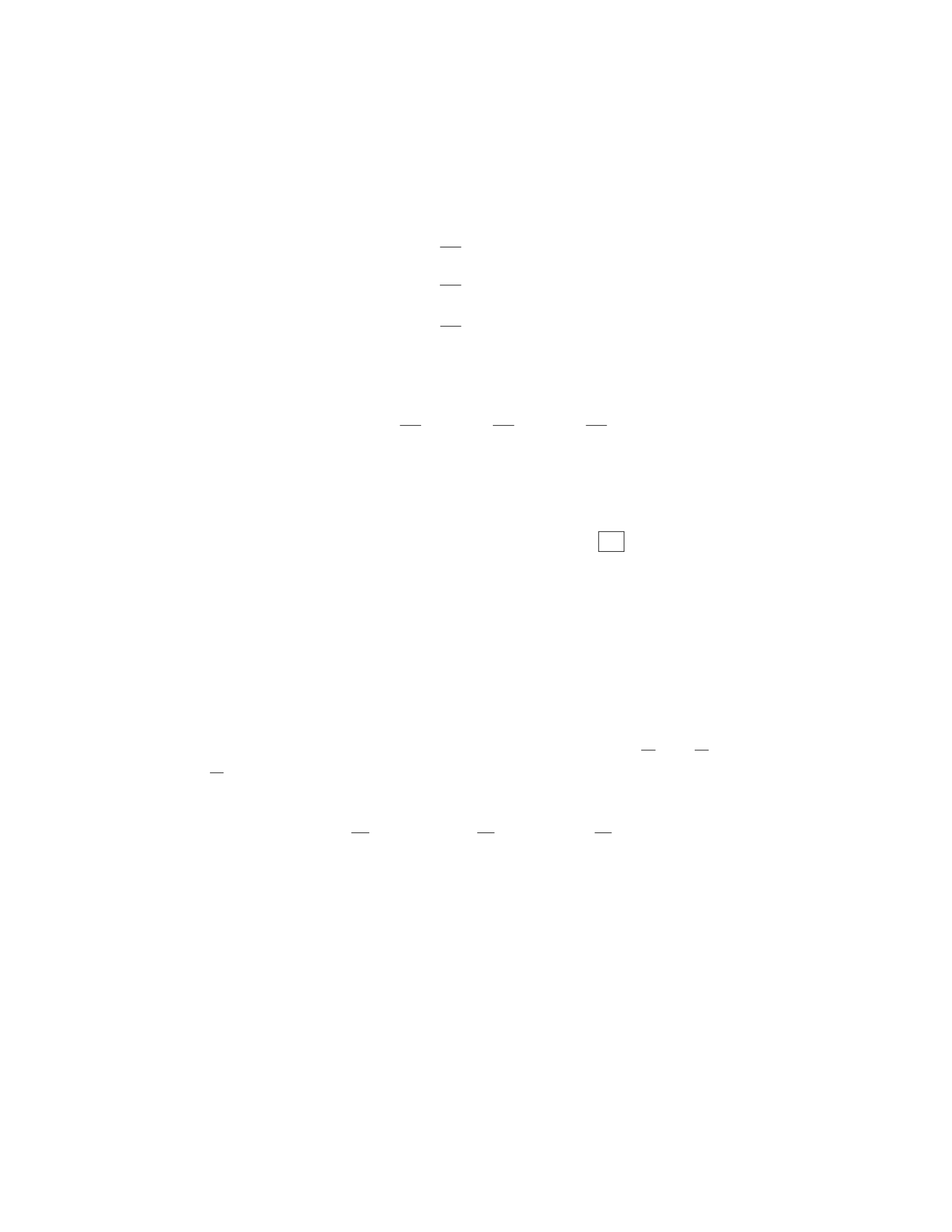
Step 1: The divergence of a vector field F(x, y, z)=(P(x, y, z), Q(x, y, z), R(x, y, z))
is given by
∇ · F=∂P
∂x +∂Q
∂y +∂R
∂z .
For F(x, y, z)=(x2y, y2z, z2x), we have P(x, y, z) = x2y,Q(x, y, z) = y2z, and
R(x, y, z) = z2x.
11
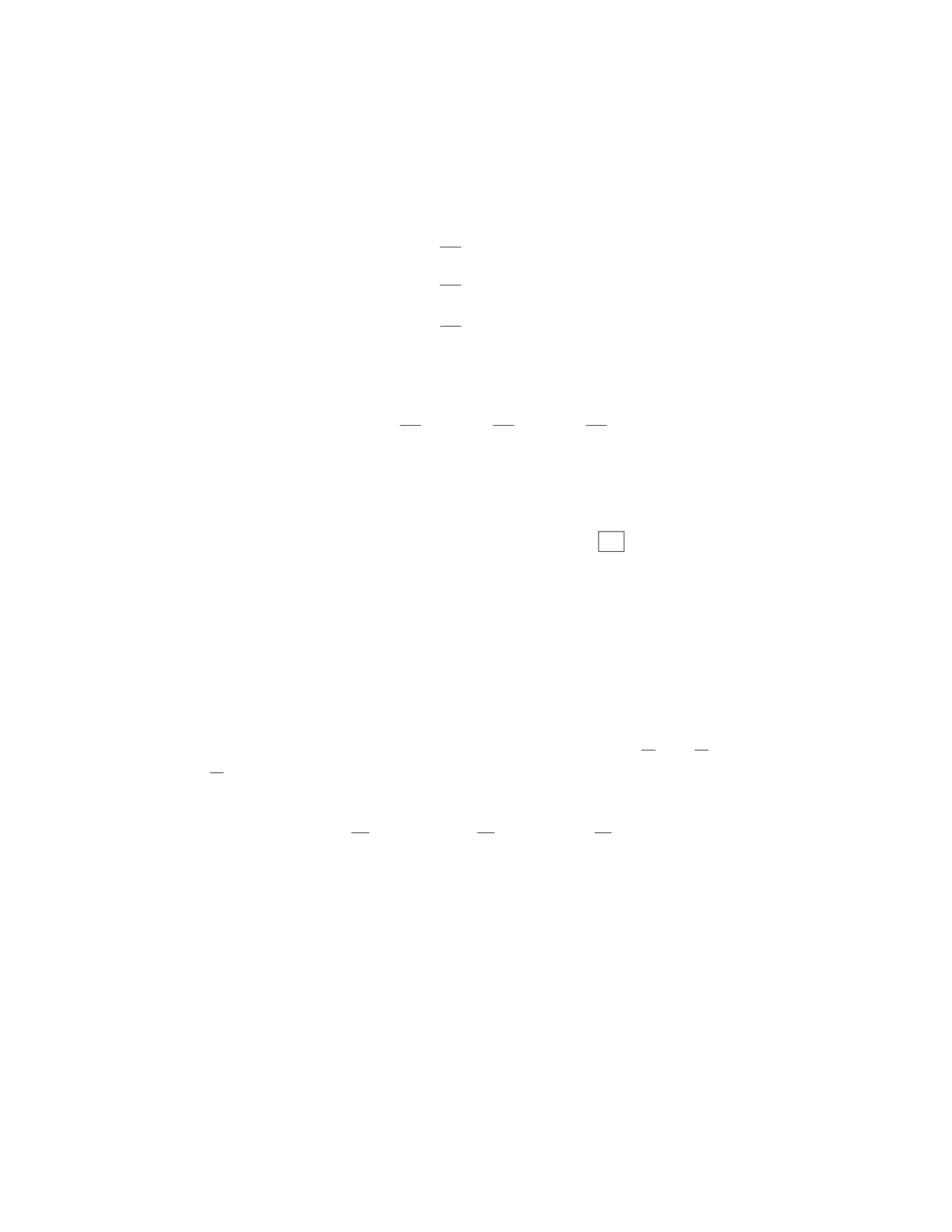
Step 2: Compute the partial derivatives of P,Q, and R:
∂P
∂x = 2xy,
∂Q
∂y = 2yz,
∂R
∂z = 2zx.
Step 3: Find the divergence of Fat the point (1,2,3) by substituting the
point into the partial derivatives:
∇ · F(1,2,3) = ∂P
∂x (1,2,3) + ∂Q
∂y (1,2,3) + ∂R
∂z (1,2,3)
= 2(1)(2) + 2(2)(3) + 2(3)(1)
= 4 + 12 + 6
= 22.
Therefore, the divergence of Fat the point (1,2,3) is 22 .
Question 16
Question
Let F be a vector field defined by F(x, y, z) = 3x2y+ 4z3, xz2−2y3,2xyz.
Find the divergence of F at the point (1, -1, 2).
Solution
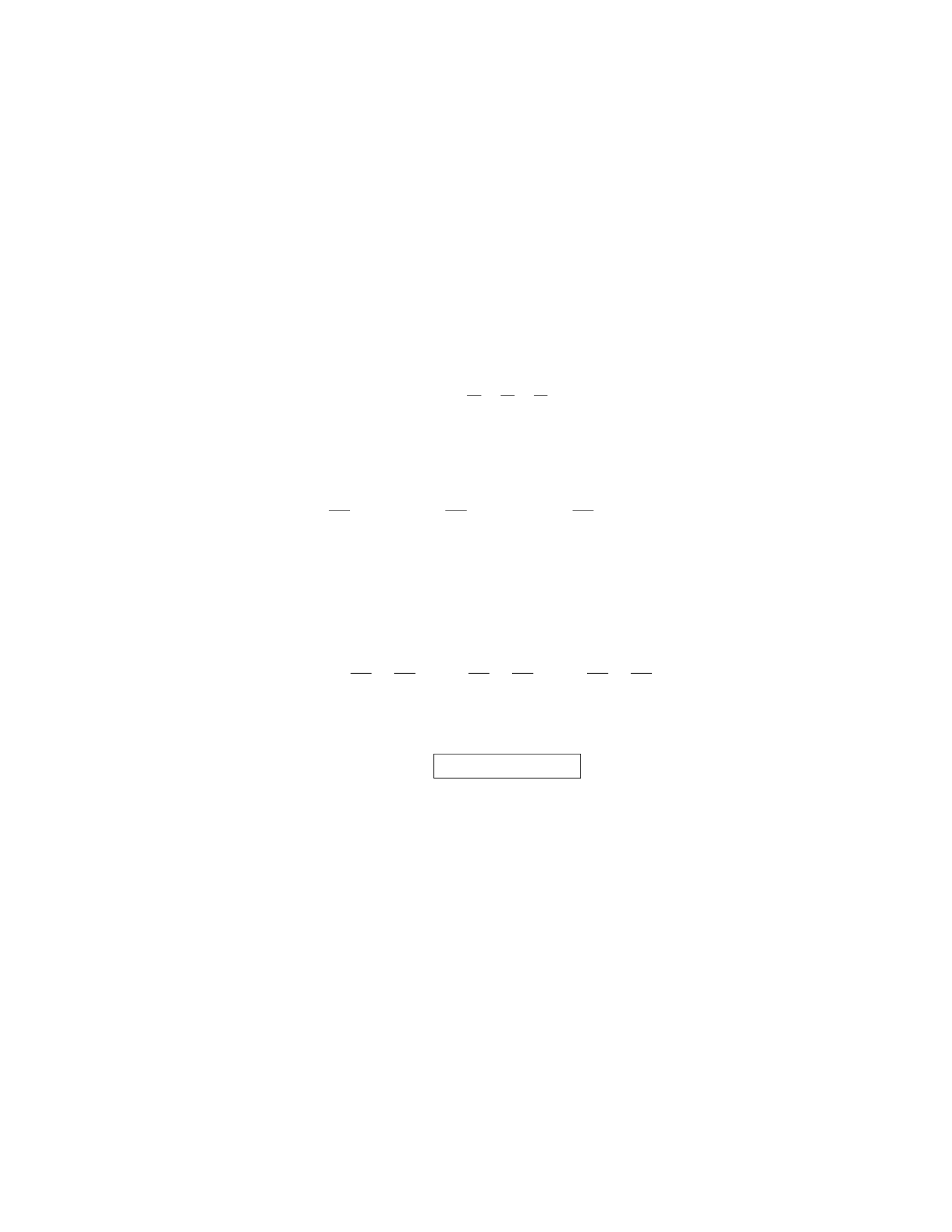
Step 1: The divergence of a vector field F is defined as ∇ · F=∂
∂x F1+∂
∂y F2+
∂
∂z F3.
Step 2: Substitute the components of F into the formula for the divergence:
∇ · F=∂
∂x (3x2y+ 4z3) + ∂
∂y (xz2−2y3) + ∂
∂z (2xyz)
= (6xy) + (2xz) + (2xy)
= 8xy + 2xz
Step 3: Evaluate the divergence at the point (1, -1, 2):
∇ · F(1,−1,2) = 8(1)(−1) + 2(1)(2)
=−8+4
=−4
Therefore, the divergence of F at the point (1, -1, 2) is -4.
12
Question 17
Question
Let F(x, y, z) = ⟨eysin z, excos z, exsin y⟩. Find the curl of F.
Solution
To find the curl of F, denoted by ∇ × F, we can use the formula:
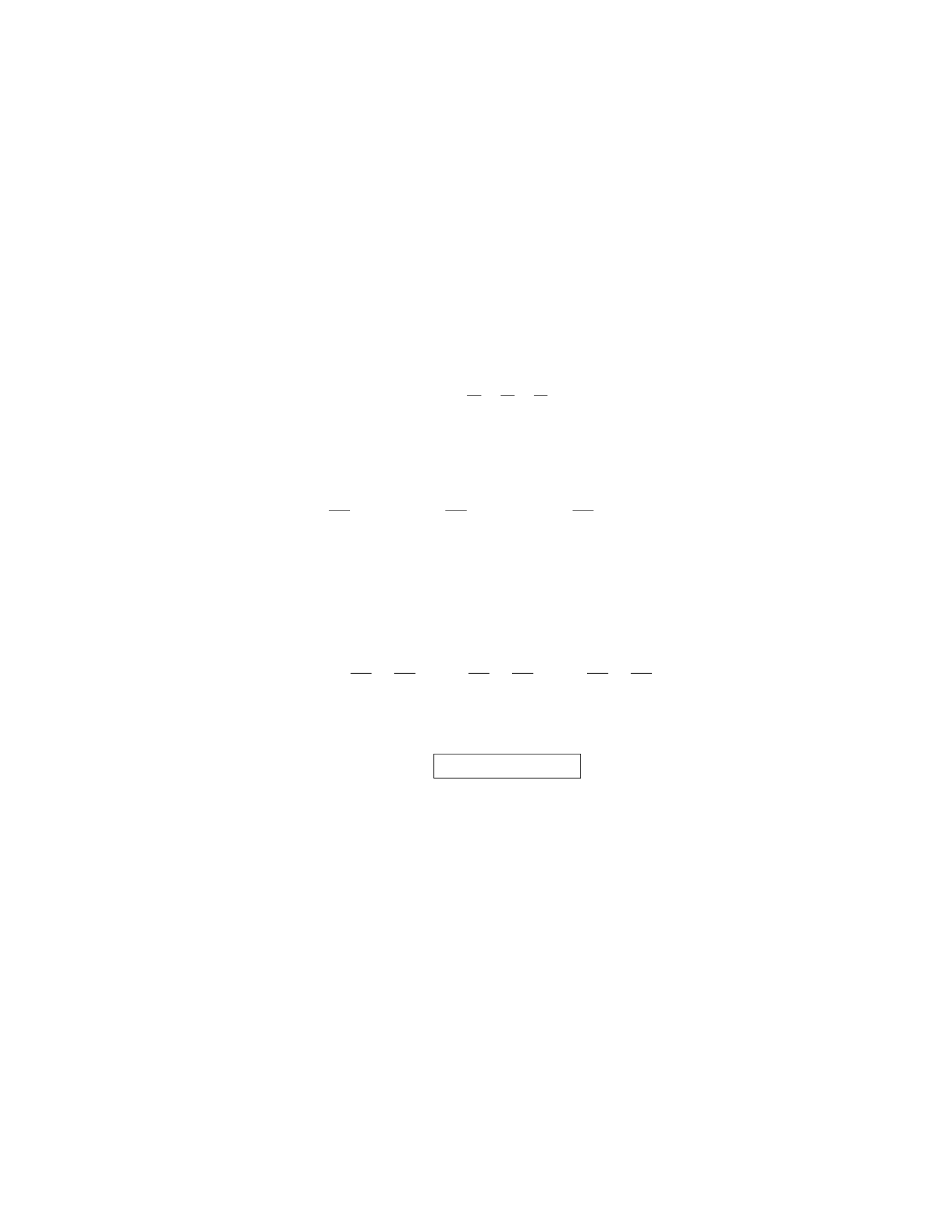
∇ × F=
i j k
∂
∂x
∂
∂y
∂
∂z
P Q R
where F(x, y, z) = ⟨P, Q, R⟩.
Step 1: Compute the partial derivatives of P,Q, and R.
∂P
∂x =eycos z, ∂Q
∂y =−exsin z, ∂R
∂z = 0
Step 2: Build the curl.
∇ × F=
i j k
eycos z−exsin z0
Step 3: Simplify the determinant.
∇ × F=∂R
∂y −∂Q
∂z i−∂R
∂x −∂P
∂z j+∂Q
∂x −∂P
∂y k
∇ × F= (−excos z)i−(eysin z)j−0k
∇ × F=−excos zi−eysin zj
Therefore, the curl of Fis −excos zi−eysin zj.
Question 18
Question
Let F(x, y, z)=(x2+y, xz, ey) be a vector field. Find the divergence of Fand
determine if the vector field is conservative.
13
Solution
Step 1: To find the divergence of F, we need to compute the dot product of the
del operator (∇) and F.
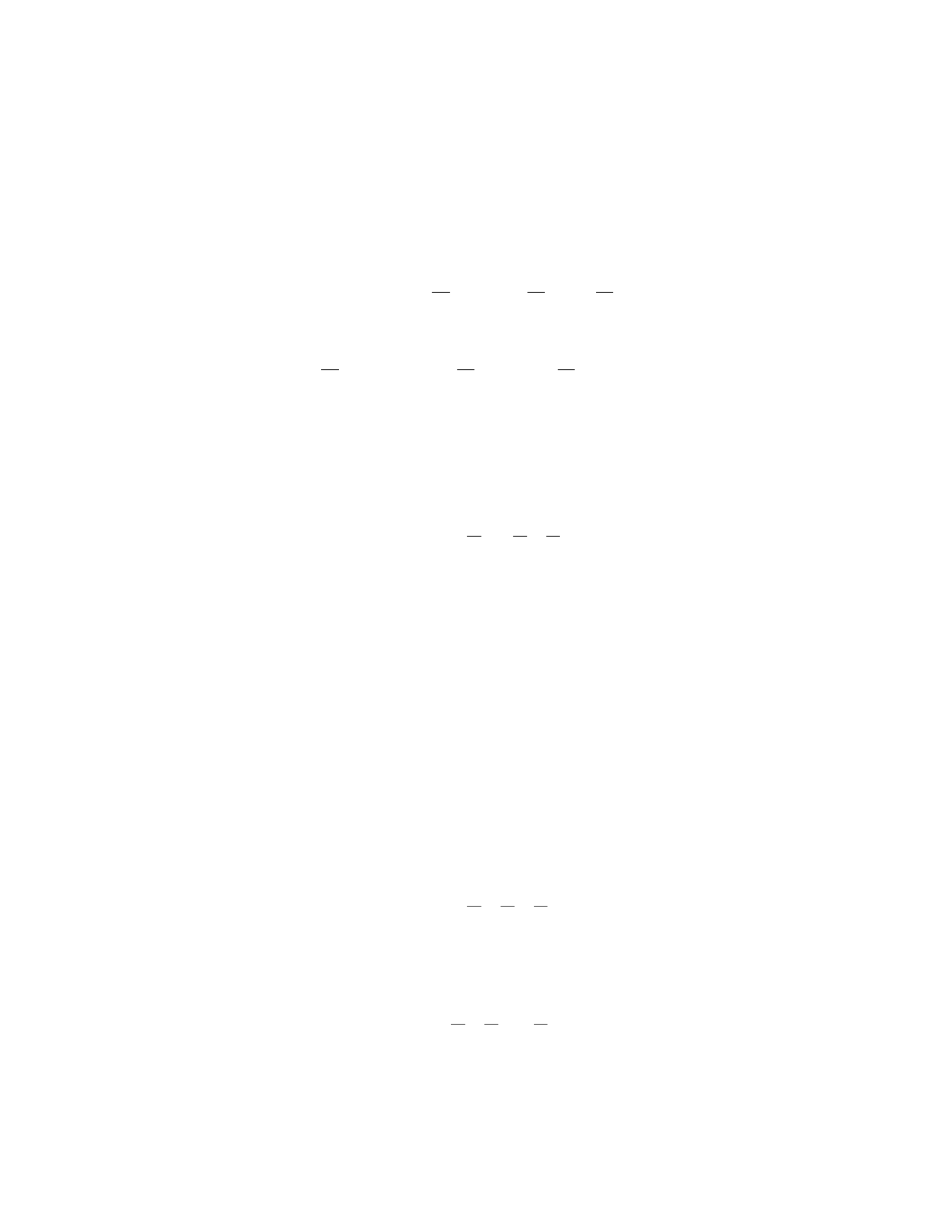
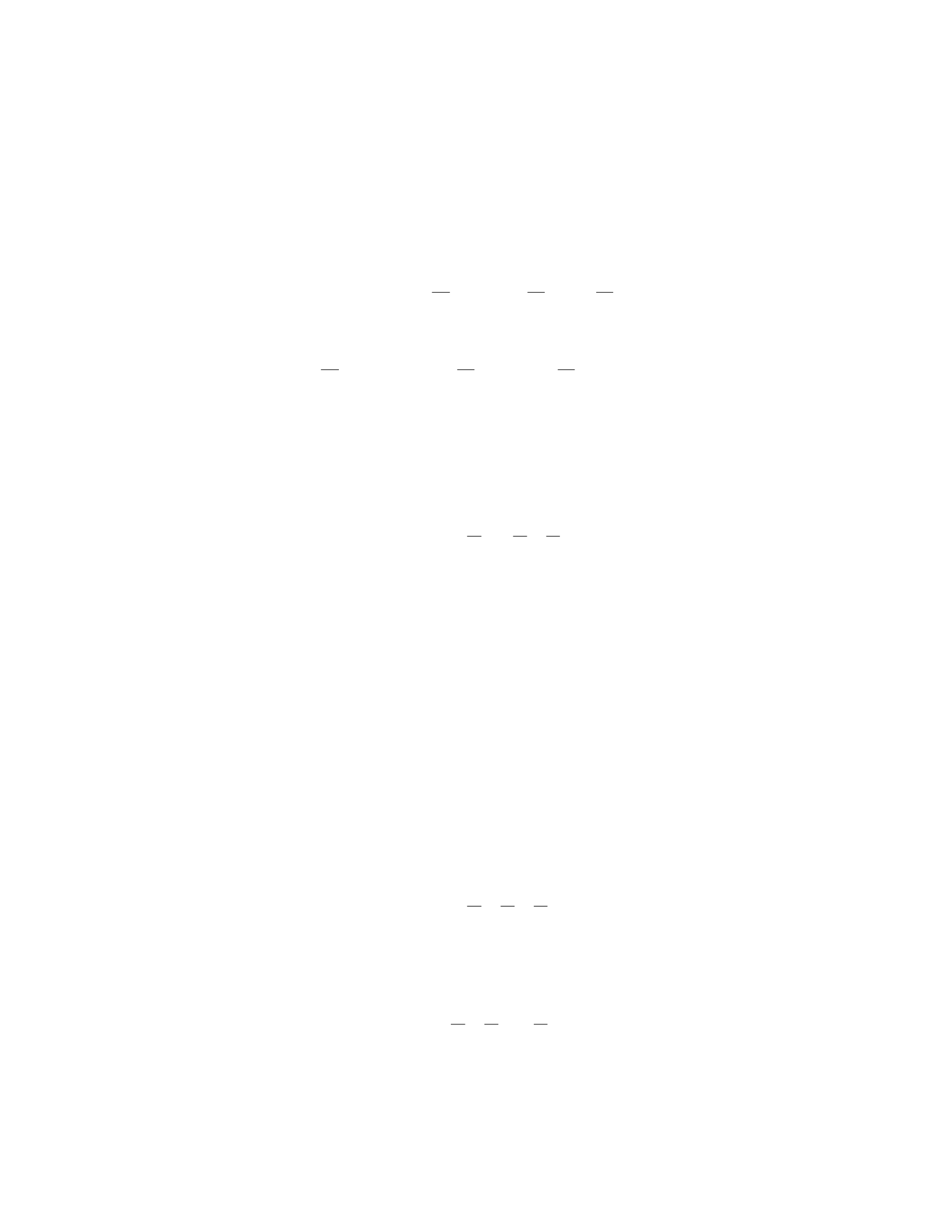
div(F) = ∇ · F=∂
∂x (x2+y) + ∂
∂y (xz) + ∂
∂z (ey)
Step 2: Calculating the partial derivatives, we get:
∂
∂x (x2+y) = 2x, ∂
∂y (xz)=0,∂
∂z (ey)=0
Step 3: Therefore, the divergence of Fis:
div(F)=2x
Step 4: For a vector field to be conservative, its curl must be zero. Let’s
calculate the curl of Fto determine if it is conservative.
∇ × F=
i j k
∂
∂x
∂
∂y
∂
∂z
x2+y xz ey
Step 5: Calculating the determinant above, we find:
∇ × F= (0 −0)i−(ey−0)j+ (x−2x)k=−eyj−xk
Step 6: Since the curl of Fis not zero, the vector field is not conservative.
Question 19
Question
Let F(x, y, z) = xzi+yzj+ (x2−y2)k. Calculate the curl of F.
Solution
Step 1: The curl of a vector field F(x, y, z) = P(x, y, z)i+Q(x, y, z)j+R(x, y, z)k
is given by the determinant
∇ × F=
i j k
∂
∂x
∂
∂y
∂
∂z
P Q R
Step 2: Substitute P=xz,Q=yz,R=x2−y2into the determinant
formula to find the curl of F.
∇ × F=
i j k
∂
∂x
∂
∂y
∂
∂z
xz yz x2−y2
14
Step 3: Evaluate the determinant using cofactor expansion along the top
row.
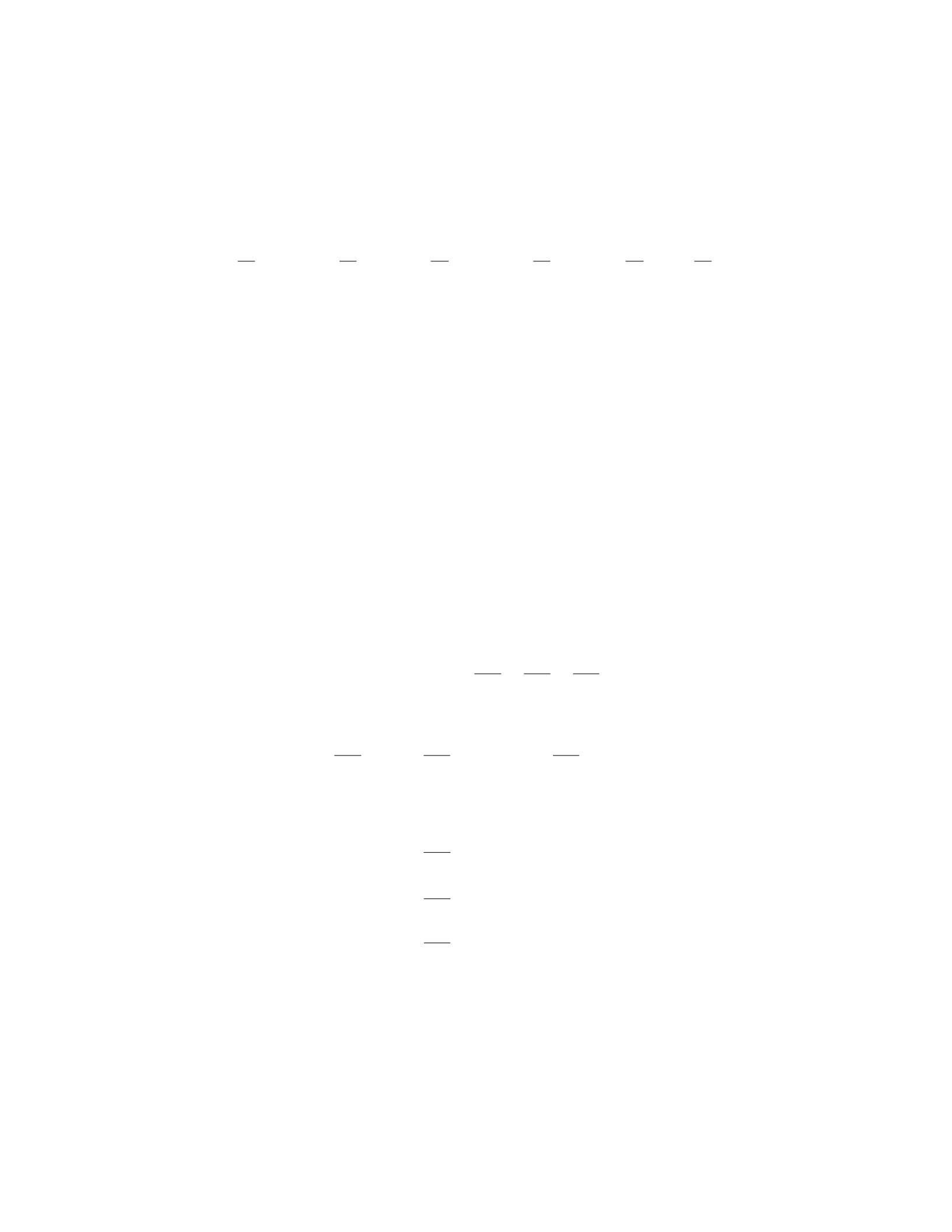
=∂
∂y (x2−y2)−∂
∂z (yz)i−∂
∂x (x2−y2)−∂
∂z (xz)j+∂
∂x (yz)−∂
∂y (xz)k
Step 4: Simplify each component of the curl.
= (−2y)i−(2x)j+ (z−(−z)) k
Step 5: Combine the components to find the curl of F.
∇ × F=−2yi−2xj+ 2zk
Therefore, the curl of Fis −2yi−2xj+ 2zk.
Question 20
Question
Let
F(x, y, z)=3xzˆ
i+ (x2+ 2yz)ˆ
j+ 3xyˆ
k. Find the divergence of
Fat the
point (1,2,0).
Solution
To find the divergence of
F, we use the formula:
div(
F) = ∇ ·
F=∂Fx
∂x +∂Fy
∂y +∂Fz
∂z
Step 1: Find the partial derivatives of
F
∂Fx
∂x = 3z, ∂Fy
∂y = 2z, and ∂Fz
∂z = 3x
Step 2: Evaluate the partial derivatives at the point (1,2,0) Substi-
tute x= 1, y= 2, and z= 0 into the partial derivatives:
∂Fx
∂x = 3(0) = 0
∂Fy
∂y = 2(0) = 0
∂Fz
∂z = 3(1) = 3
Step 3: Find the divergence at the point (1,2,0)
div(
F)|(1,2,0) = 0 + 0 + 3 = 3
Therefore, the divergence of
Fat the point (1,2,0) is 3.
15
Question 21
Question
Let F(x, y, z) = x2yzi+xyz2j+x2z2k. Determine if Fis conservative. If it is,
find a scalar potential function f(x, y, z) such that F=∇f.
Solution
Step 1: To determine if Fis conservative, we check if the curl of Fis zero.
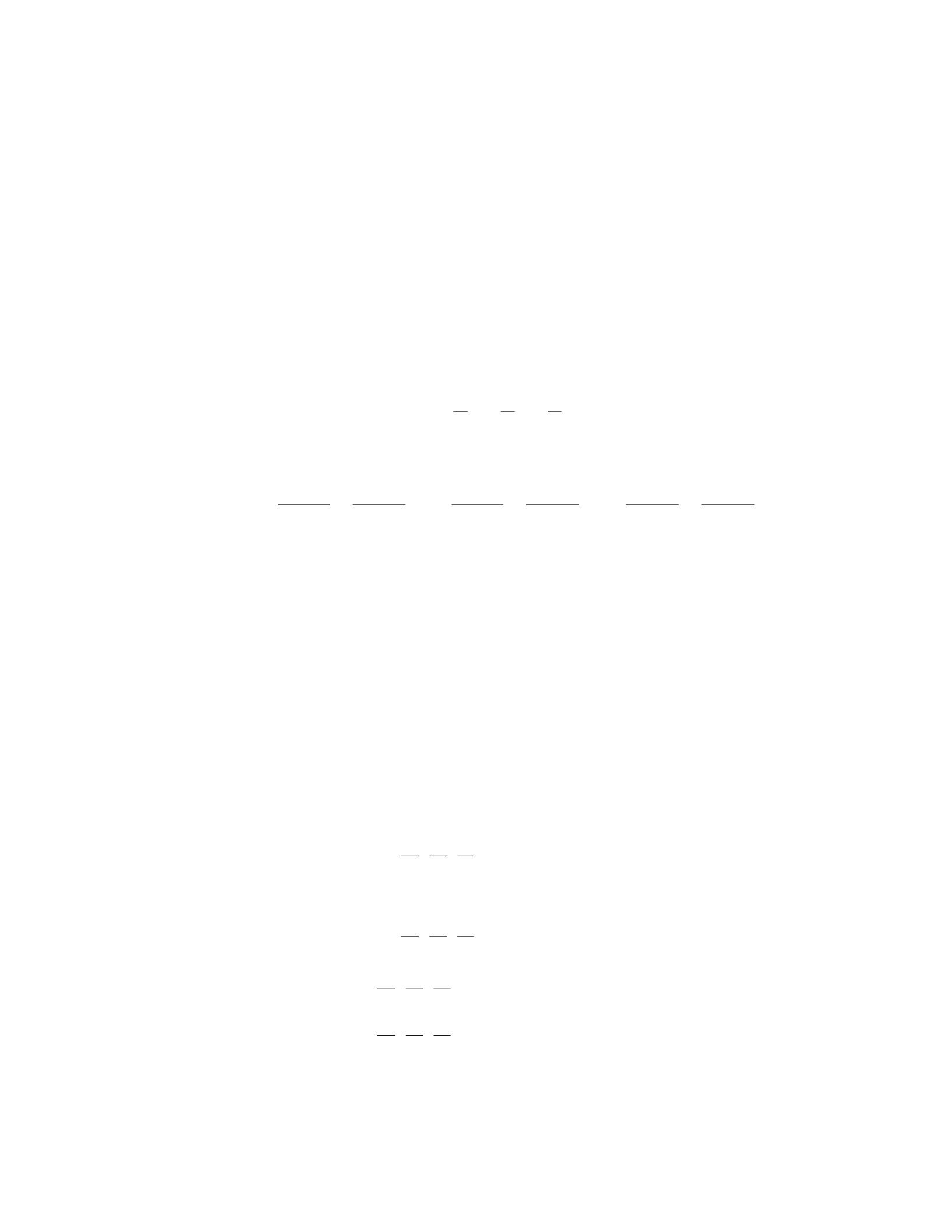
∇ × F=
i j k
∂
∂x
∂
∂y
∂
∂z
x2yz xyz2x2z2
Step 2: Compute the curl of F.
∇×F=∂(x2z2)
∂y −∂(xyz2)
∂z i−∂(x2z2)
∂x −∂(x2yz)
∂z j+∂(xyz2)
∂x −∂(x2yz)
∂y k
Step 3: Simplify the cross product and check if it is zero.
∇ × F= (2xz)i−(−2xz)j+ (yz)k= 2xzi+ 2xzj+yzk
Step 4: Since the curl of Fis not zero, Fis not conservative. Thus, there
does not exist a scalar potential function f(x, y, z) such that F=∇f.
Question 22
Question
Let Fbe a vector field defined by F(x, y)=(x2+y3,2xy −3). Compute ∇ × F.
Solution
Step 1: Determine the components of the curl of F.
∇ × F=∂
∂x ,∂
∂y ,∂
∂z ×(x2+y3,2xy −3)
Step 2: Expand the cross product.
∇ × F=∂
∂x ,∂
∂y ,∂
∂z ×(x2+y3,2xy −3)
=∂
∂x ,∂
∂y ,∂
∂z ×(x2+y3,2xy −3)
=∂
∂x ,∂
∂y ,∂
∂z ×(x2+y3,2xy −3)
16
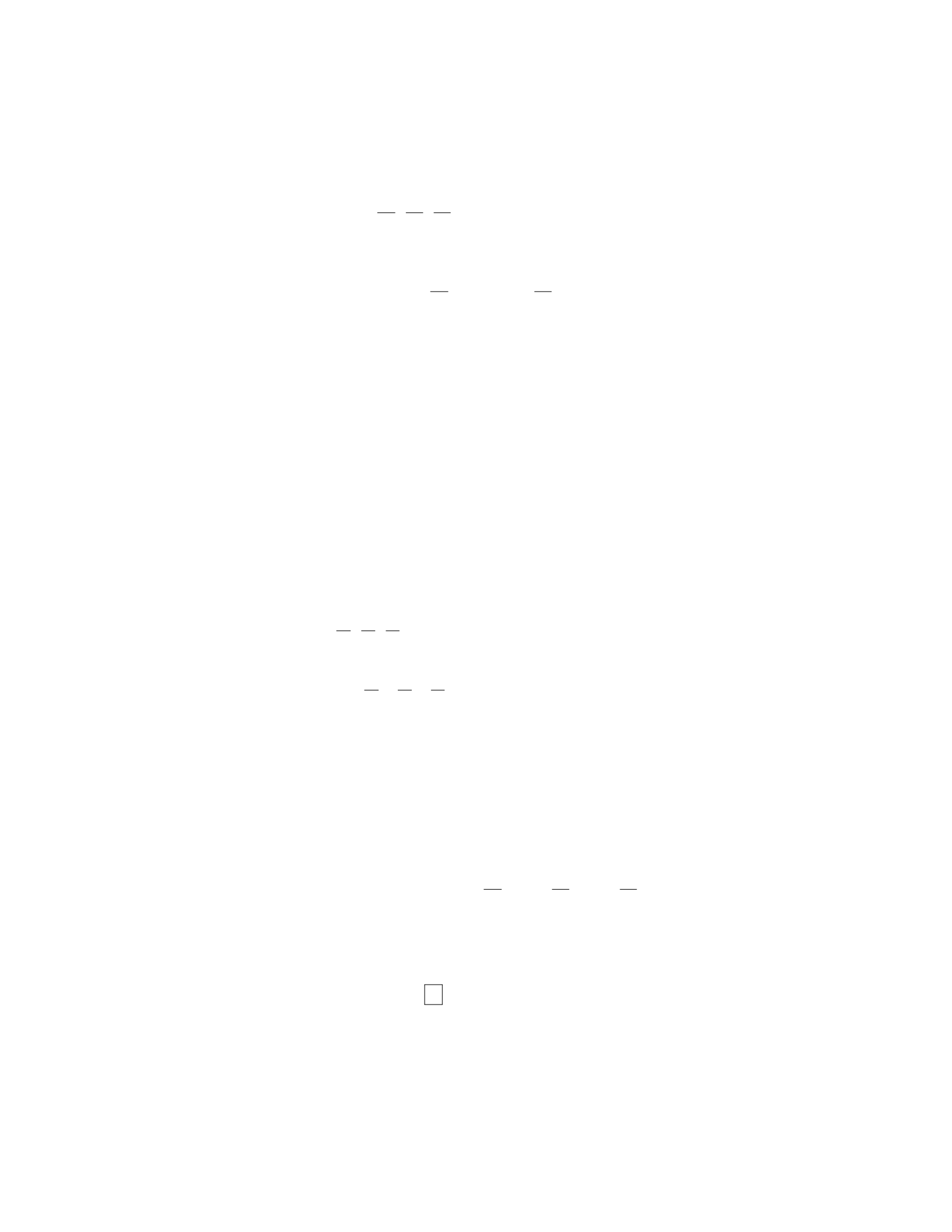
=∂
∂x ,∂
∂y ,∂
∂z ×(x2+y3,2xy −3)
Step 3: Compute the partial derivatives and simplify.
∇ × F=0,0,∂
∂x (2xy −3) −∂
∂y (x2+y3)
= (0,0,2y−2y)
= (0,0,0)
Therefore, the curl of Fis ∇ × F=0.
Question 23
Question
Let F(x, y, z) = y2i+x2j+z2kbe a vector field. Calculate div(curl(F)).
Solution
1. Find the curl of F:
curl(F) = ∇ × F
where ∇=∂
∂x ,∂
∂y ,∂
∂z . So,
curl(F) =
i j k
∂
∂x
∂
∂y
∂
∂z
y2x2z2
= (2z−0) i−(0 −2y)j+ (2x−0) k
curl(F)=2zi+ 2yj+ 2xk
2. Find the divergence of the resulting curl:
div(curl(F)) = ∇ · (curl(F))
where ∇is the del operator. Since curl(F)=2zi+ 2yj+ 2xk, we have
div(2zi+ 2yj+ 2xk) = ∂
∂x (2z) + ∂
∂y (2y) + ∂
∂z (2x)
div(2zi+ 2yj+ 2xk)=0+2+0
div(2zi+ 2yj+ 2xk)=2
Therefore, div(curl(F)) = 2 .
17

Question 24
Question
Let F=⟨yz, xz, xy⟩be a vector field. Compute ∇ · ∇ × F.
Solution
Step 1: First, we compute ∇ × F.
=
ˆ
iˆ
jˆ
k
∂
∂x
∂
∂y
∂
∂z
yz xz xy
=∂(xy)
∂y −∂(xz)
∂z ˆ
i−∂(xz)
∂x −∂(yz)
∂z ˆ
j+∂(yz)
∂x −∂(xy)
∂y ˆ
k
= (x−x)ˆ
i−(z−z)ˆ
j+ (y−y)ˆ
k
=0
Step 2: Next, we compute ∇ · 0.
=∂(0)∂x+∂(0)
∂y +∂(0)
∂z =0+0+0=0
Therefore, ∇ · ∇ × F= 0 .
Question 25
Question
Let F(x, y, z)=(x2y, sin(yz), z cos(x)) be a vector field in R3. Compute ∇ · F,
where ∇ · Fdenotes the divergence of F.
Solution
Step 1: The divergence of a vector field F= (F1, F2, F3) is defined as
∇ · F=∂F1
∂x +∂F2
∂y +∂F3
∂z .
Step 2: For the given vector field F(x, y, z)=(x2y, sin(yz), z cos(x)), we
have F1(x, y, z) = x2y,F2(x, y, z) = sin(yz), and F3(x, y, z) = zcos(x).
18
Step 3: Compute the partial derivatives:
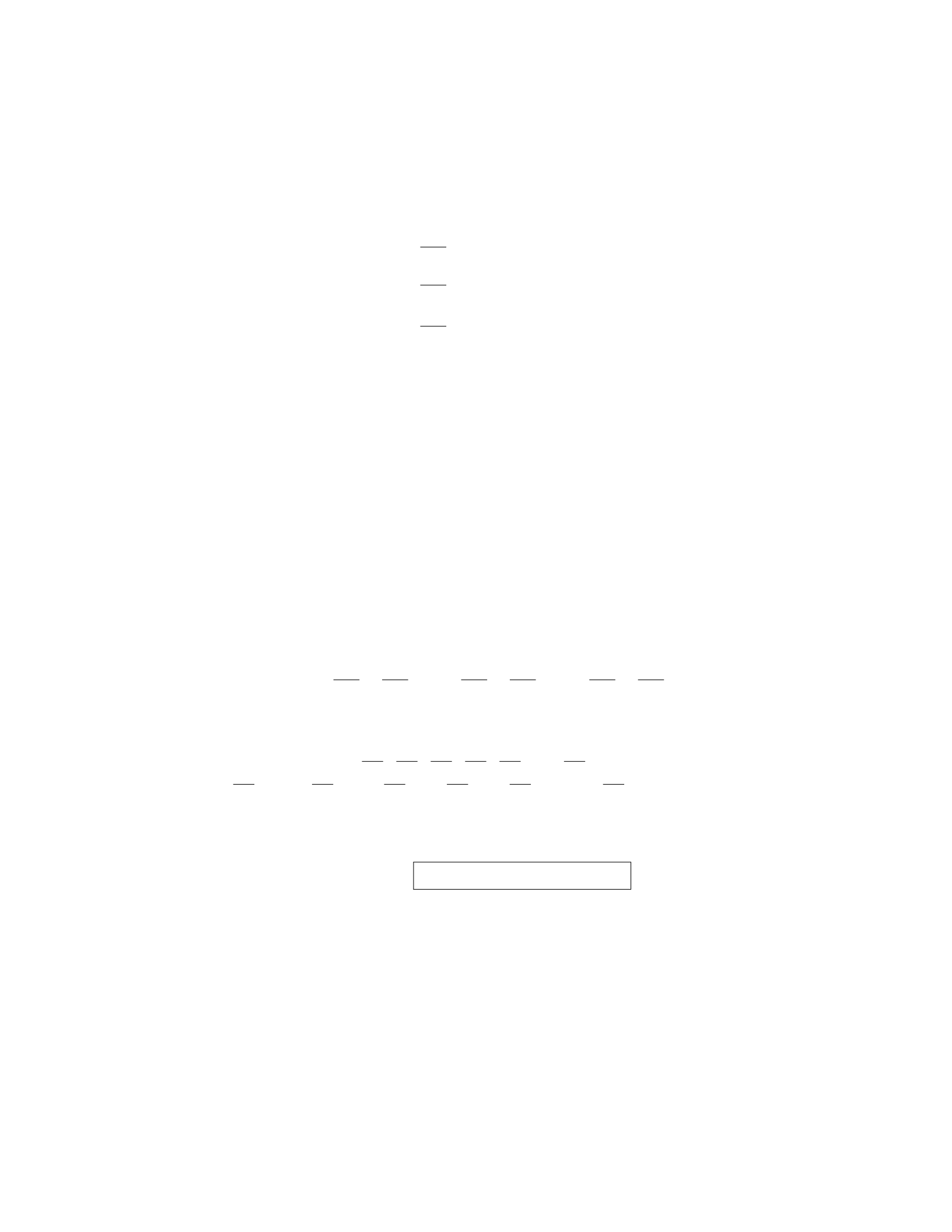
∂F1
∂x = 2xy,
∂F2
∂y =zcos(yz),
∂F3
∂z = cos(x).
Step 4: Therefore, the divergence of Fis
∇ · F= 2xy +zcos(yz) + cos(x).
So, ∇ · F= 2xy +zcos(yz) + cos(x).
Question 26
Question
Let F(x, y, z) = x2yi+xyzj+yz2kbe a vector field. Compute the curl of F.
Solution
To find the curl of a vector field F(x, y, z) = F1(x, y, z)i+F2(x, y, z)j+F3(x, y, z)k,
we can use the formula
curl F=∂F3
∂y −∂F2
∂z i−∂F3
∂x −∂F1
∂z j+∂F2
∂x −∂F1
∂y k.
In this case, F(x, y, z) = x2yi+xyzj+yz2k, so F1(x, y, z) = x2y,F2(x, y, z) =
xyz, and F3(x, y, z) = yz2.
Step 1: Compute ∂F3
∂y ,∂F2
∂z ,∂F3
∂x ,∂F1
∂z ,∂F2
∂x , and ∂F1
∂y .
∂F3
∂y = 2yz,∂F2
∂z =xy,∂F3
∂x = 0, ∂F1
∂z = 0, ∂F2
∂x =y, and ∂F1
∂y =x2.
Step 2: Plug these values into the formula for the curl of F.
curl F= (2yz −xy)i−(−yz2)j+ (y−x2)k.
Therefore, the curl of Fis (2yz −xy)i+yz2j+ (y−x2)k.
Question 27
Question
Let F(x, y, z)=(x2y, y2z, z2x) be a vector field in R3. Evaluate the divergence
of Fat the point (1,1,1).
19
Solution
To find the divergence of Fat the point (1,1,1), we need to compute the dot
product of the del operator (∇) and the vector field Fat that point.
Step 1: Compute the del operator. The del operator in Cartesian coordi-
nates is given by:
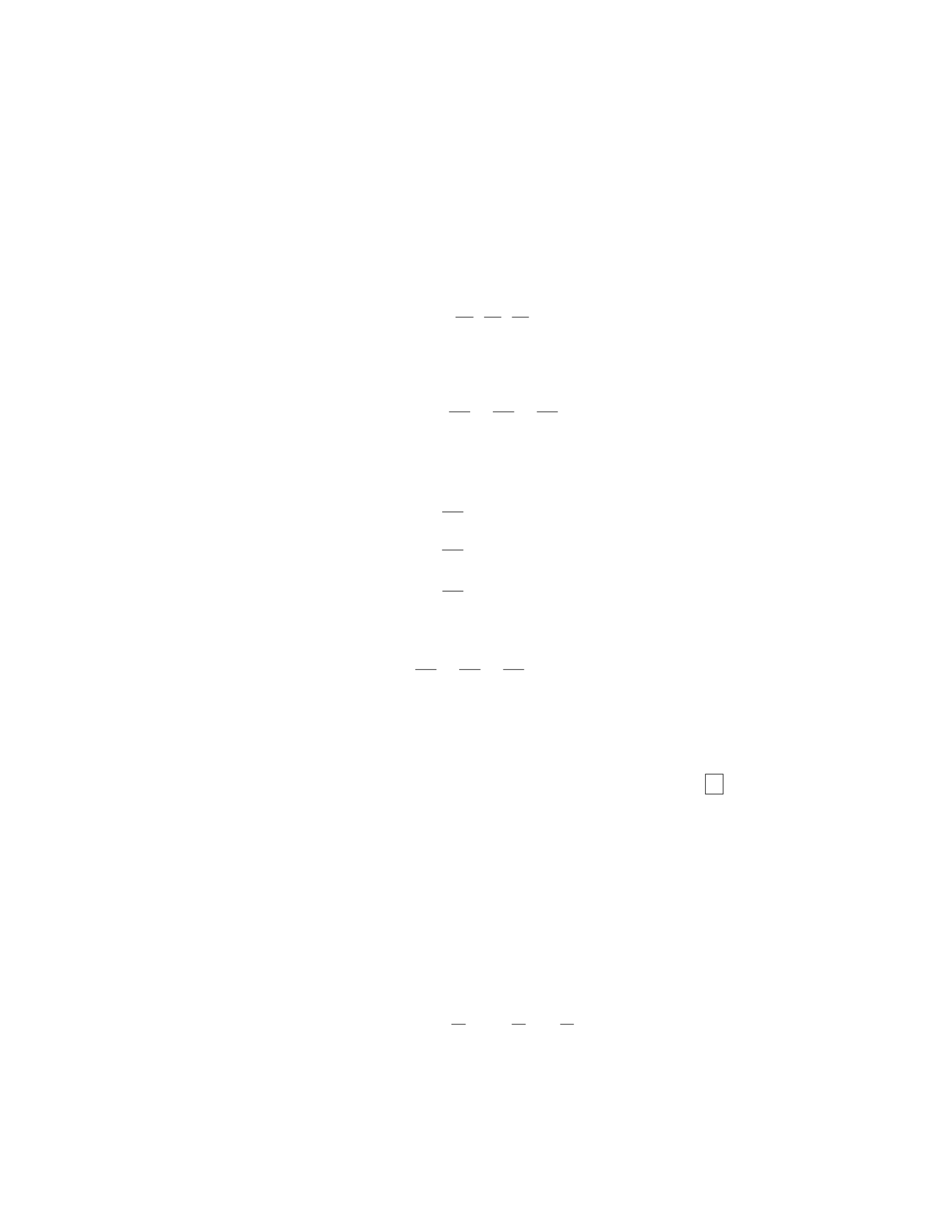
∇=∂
∂x ,∂
∂y ,∂
∂z
Step 2: Compute the divergence of F. The divergence of a vector field
F= (P, Q, R) is given by:
∇ · F=∂P
∂x +∂Q
∂y +∂R
∂z
For F(x, y, z)=(x2y, y2z, z2x), we have P=x2y,Q=y2z, and R=z2x.
Step 3: Compute the partial derivatives.
∂P
∂x = 2xy
∂Q
∂y = 2yz
∂R
∂z = 2zx
Step 4: Evaluate the divergence at (1,1,1).
∇ · F=∂P
∂x +∂Q
∂y +∂R
∂z
= 2xy + 2yz + 2zx
= 2(1)(1) + 2(1)(1) + 2(1)(1)
= 6
Therefore, the divergence of the vector field Fat the point (1,1,1) is 6 .
Question 28
Question
Let F(x, y, z) = exsin yi+ycos zj+xz2k. Calculate ∇ · ∇ × F.
Solution
Step 1: Let’s first find the curl of F:
curl F=
i j k
∂
∂x
∂
∂y
∂
∂z
exsin y y cos z xz2
20
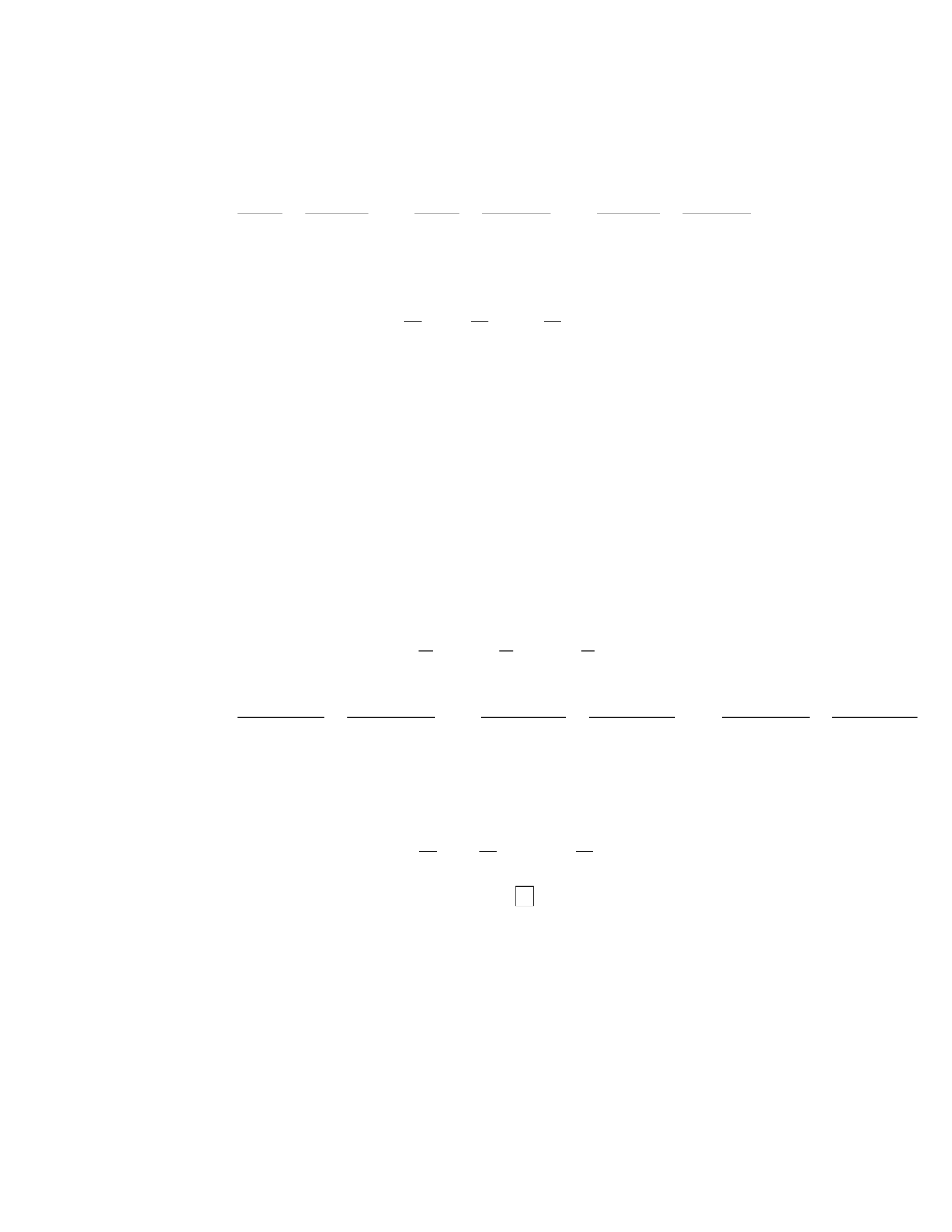
=∂(xz2)
∂y −∂(ycos z)
∂z i−∂(xz2)
∂x −∂(exsin y)
∂z j+∂(ycos z)
∂x −∂(exsin y)
∂y k
=z2i−xj−excos yk
Step 2: Next, let’s find the divergence of our curl:
∇ · curl F=∂
∂x (z2) + ∂
∂y (−x) + ∂
∂z (−excos y)
= 0 −0 + exsin y
Hence, ∇ · ∇ × F=exsin y.
Question 29
Question
Let F(x, y, z)=(xeyz +y2, xz2+ 2yz, xy2z+z3) be a vector field. Compute
∇ · ∇ × F.
Solution
Step 1: Compute ∇ × F.
∇ × F=
i j k
∂
∂x
∂
∂y
∂
∂z
xeyz +y2xz2+ 2yz xy2z+z3
=∂(xy2z+z3)
∂y −∂(xz2+ 2yz)
∂z i−∂(xeyz +y2)
∂x −∂(xy2z+z3)
∂z j+∂(xz2+ 2yz)
∂x −∂(xeyz +y2)
∂y k
= (x−0)i−(eyz −0)j+ (2z−2y)k
=xi−eyzj+ 2zk
Step 2: Compute ∇ · ∇ × F.
∇ · ∇ × F=∂
∂x ·x+∂
∂y ·(−eyz ) + ∂
∂z ·2z
= 1 −0 + 2 = 3
Question 30
Question
Let F(x, y, z)=3x2yi+ 2yexz j+zey2k. Compute ∇ · ∇ × F.
21

Step 3: Curl The curl of a vector field
F(x, y, z) = P(x, y, z)ˆ
i+Q(x, y, z)ˆ
j+
R(x, y, z)ˆ
kis given by:
∇ ×
F=
ˆ
iˆ
jˆ
k
∂
∂x
∂
∂y
∂
∂z
P Q R
For
F(x, y, z) = x2yˆ
i+xyzˆ
j+z2ˆ
k, we have:
∇ ×
F=
ˆ
iˆ
jˆ
k
∂
∂x
∂
∂y
∂
∂z
x2y xyz z2
= (z−y)ˆ
i−2zˆ
j+ (xy −x2)ˆ
k
Question 2
Question
Let F(x, y, z) = (xez+ sin y, x2+yz, e2z+xcos y) be a vector field in R3.
Calculate the divergence of F.
Solution
To find the divergence of F, denoted by ∇ · F, we use the formula:
∇ · F=∂
∂x (F1) + ∂
∂y (F2) + ∂
∂z (F3),
where F(x, y, z)=(F1, F2, F3).
Step 1: Calculate ∂F1
∂x .
∂
∂x (xez+ sin y) = ez
Step 2: Calculate ∂F2
∂y .
∂
∂y (x2+yz) = z
Step 3: Calculate ∂F3
∂z .
∂
∂z (e2z+xcos y)=2e2z
Step 4: Now, compute the divergence of F.
∇ · F=ez+z+ 2e2z
Therefore, the divergence of Fis ez+z+ 2e2z.
2
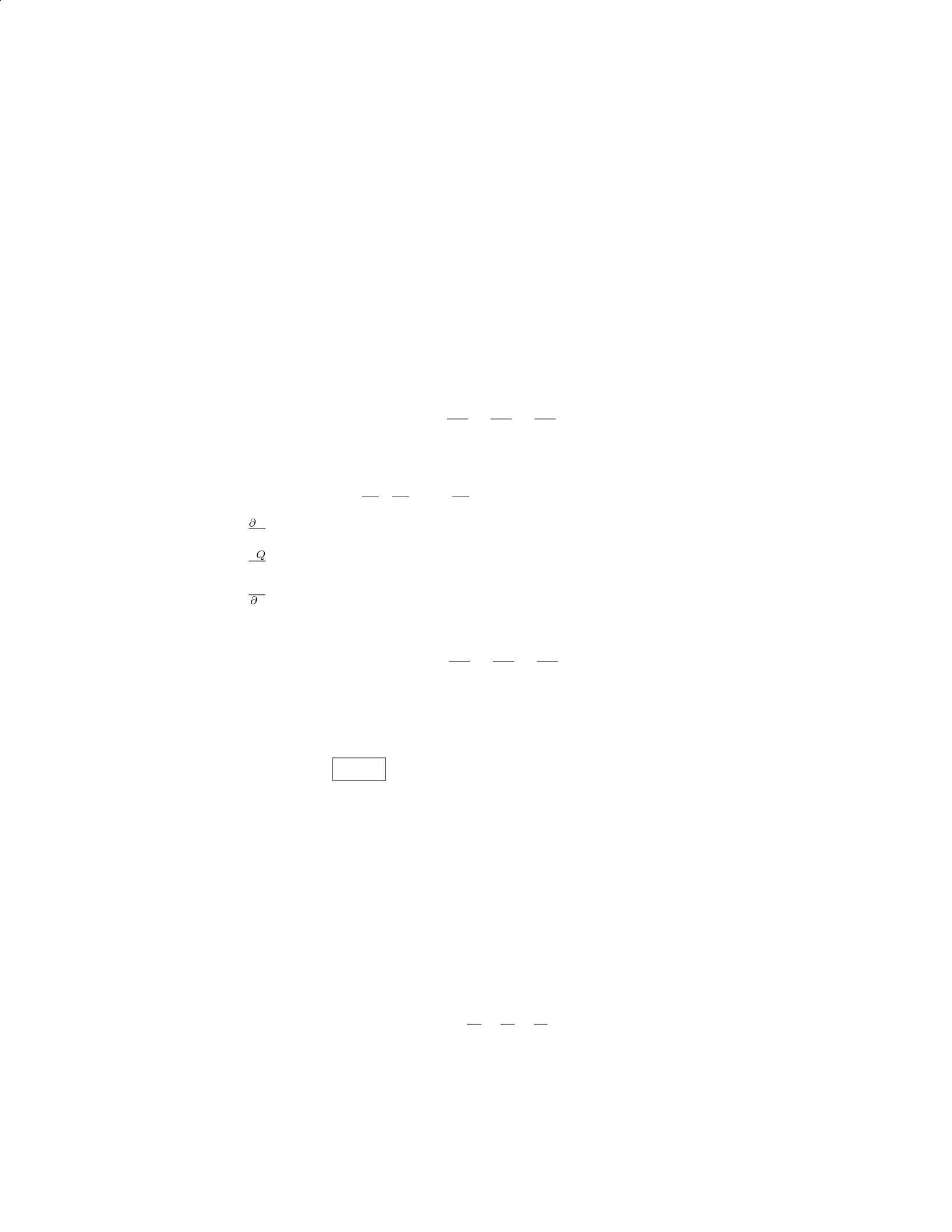
Question 3
Question
Let F(x, y, z)=(xz+y2)i−(y2−z2)j+(x−y)kbe a vector field in R3. Compute
the divergence of F.
Solution
To compute the divergence of a vector field F(x, y, z) = P(x, y, z)i+Q(x, y, z)j+
R(x, y, z)k, we use the formula
∇ · F=∂P
∂x +∂Q
∂y +∂R
∂z .
Given F(x, y, z) = (xz +y2)i−(y2−z2)j+(x−y)k, we have P(x, y, z) = xz +y2,
Q(x, y, z) = −(y2−z2), and R(x, y, z) = x−y.
Step 1: Compute ∂P
∂x ,∂Q
∂y , and ∂R
∂z .
∂P
∂x =z
∂Q
∂y =−(−2y)=2y
∂R
∂z = 0
Step 2: Compute the divergence ∇ · F.
∇ · F=∂P
∂x +∂Q
∂y +∂R
∂z
=z+ 2y+ 0
=z+ 2y.
Therefore, the divergence of the vector field F(x, y, z)=(xz +y2)i−(y2−
z2)j+ (x−y)kis z+ 2y.
Question 4
Question
Let Fbe a vector field defined by F(x, y, z) = zi+xj+yk. Calculate the curl
of F.
Solution
To calculate the curl of a vector field F=Pi+Qj+Rk, we use the formula:
∇ × F=
i j k
∂
∂x
∂
∂y
∂
∂z
P Q R
3
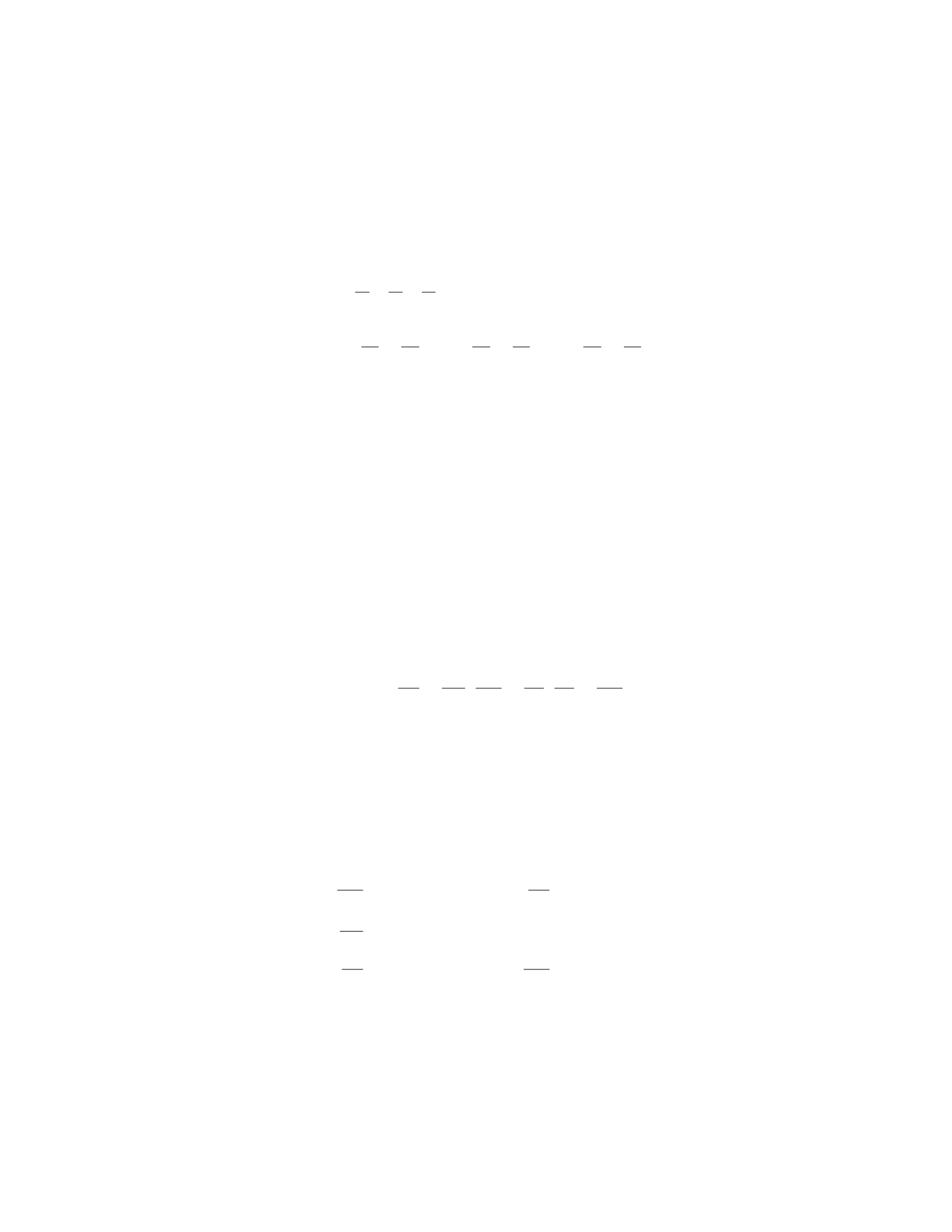
In this case, F(x, y, z) = zi+xj+yk, so P=z,Q=x,R=y. We can now
compute the curl as follows:
∇ × F=
i j k
∂
∂x
∂
∂y
∂
∂z
z x y
=∂y
∂y −∂x
∂z i−∂y
∂x −∂z
∂z j+∂x
∂x −∂z
∂y k
= 0i−0j+ 0k
=0
Therefore, the curl of Fis the zero vector, i.e., ∇ × F=0.
Question 5
Question
Let F(x, y, z)=(yz +ex, xz +y2, xy +z2) be a vector field in R3. Compute the
curl of F.
Solution
To find the curl of F, we use the formula
curl(F) = ∂P
∂y −∂N
∂z ,∂M
∂z −∂L
∂x ,∂L
∂y −∂M
∂x
where F(x, y, z)=(M, N, P ).
Step 1: Compute the partial derivatives of M,N, and P:
M=xz +y2P=xy +z2
N=yz +ex
∂M
∂z =x∂P
∂y =x+ 2z
∂N
∂z =y
∂P
∂x =y∂M
∂y = 2y
4
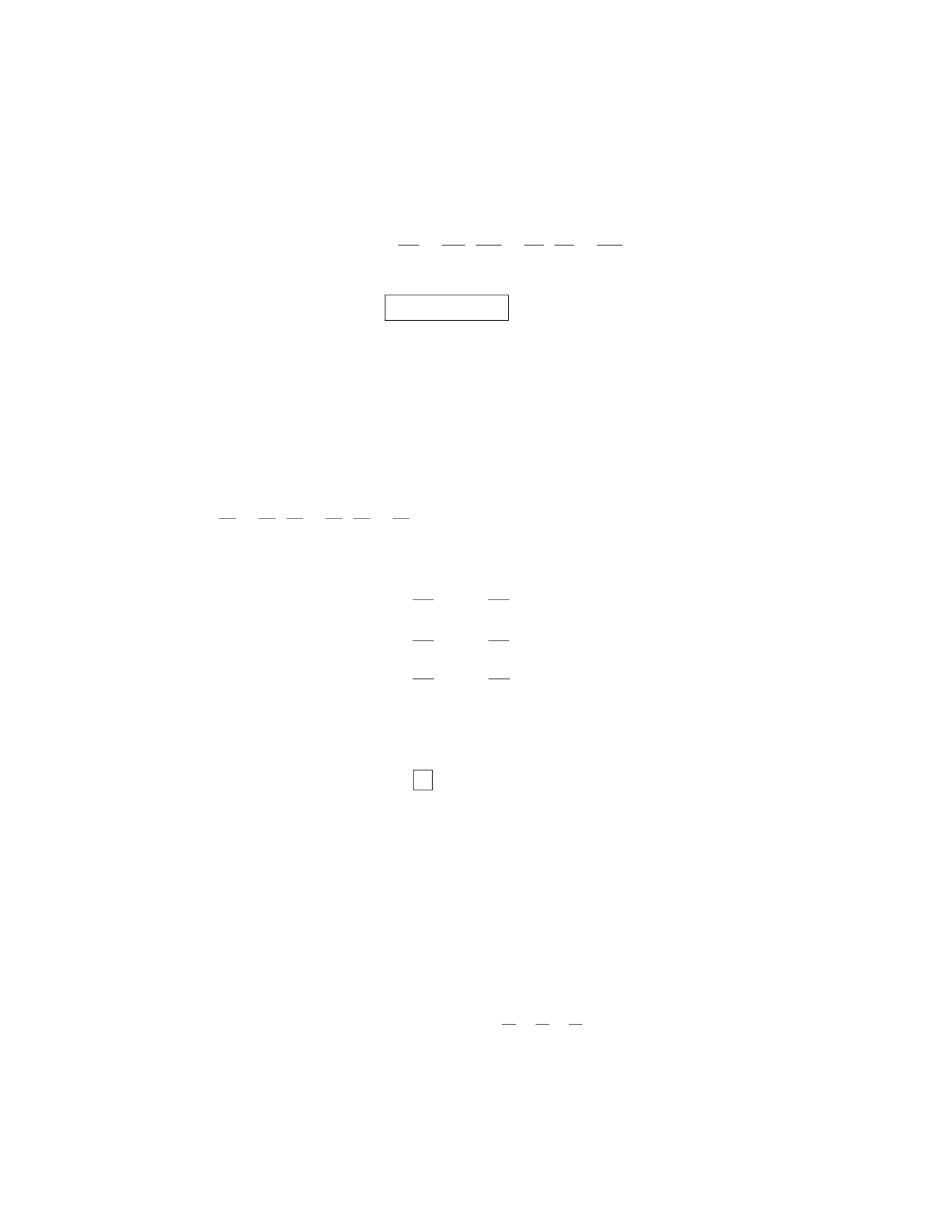
Step 2: Calculate the curl of F:
curl(F) = ∂P
∂y −∂N
∂z ,∂M
∂z −∂L
∂x ,∂L
∂y −∂M
∂x
= (x+ 2z−y, x −0,2y−y)
= (x+ 2z−y, x, y).
Question 6
Question
Let F(x, y, z)=(x2, yz, ez). Calculate the curl of F.
Solution
To calculate the curl of a vector field F= (P, Q, R), we use the formula: ∇×F=
∂R
∂y −∂Q
∂z ,∂P
∂z −∂R
∂x ,∂Q
∂x −∂P
∂y .
Step 1: Identify P,Q, and R. Here, P=x2,Q=yz, and R=ez.
Step 2: Calculate the partial derivatives.
∂R
∂y = 0,∂Q
∂z = 0
∂P
∂z = 0,∂R
∂x = 0
∂Q
∂x = 0,∂P
∂y = 0
Step 3: Compute the curl of F.
∇ × F= (0 −0,0−0,0−0) = (0,0,0)
Therefore, the curl of Fis 0.
Question 7
Question
Let F(x, y) = ⟨x2y, yex, x2⟩. Compute div(curl(F)).
Solution
Step 1: Find the curl of F. The curl of a vector field F(x, y, z) = ⟨P(x, y, z), Q(x, y, z), R(x, y, z)⟩
is given by:
curl(F) = ∇ × F=
i j k
∂
∂x
∂
∂y
∂
∂z
P Q R
5
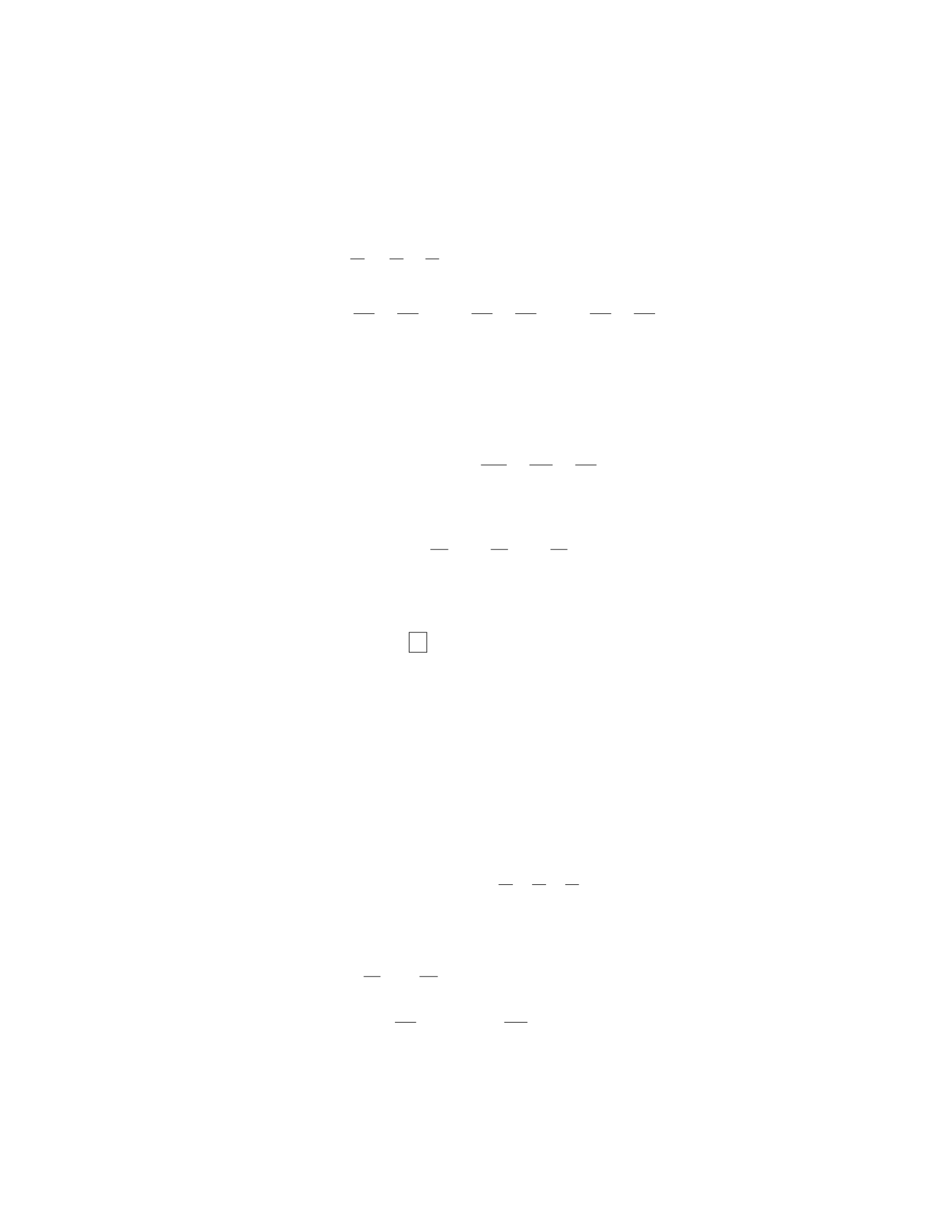
For F(x, y) = ⟨x2y, yex, x2⟩, we have:
curl(F) =
i j k
∂
∂x
∂
∂y
∂
∂z
x2y yexx2
=∂R
∂y −∂Q
∂z i−∂R
∂x −∂P
∂z j+∂Q
∂x −∂P
∂y k
= (0 −0) i−(0 −0) j+ (2x−x)k
=xk
Step 2: Find the divergence of the curl of F. The divergence of a vector field
G(x, y, z) = ⟨M(x, y, z), N (x, y, z), P (x, y, z)⟩is given by:
div(G) = ∇ · G=∂M
∂x +∂N
∂y +∂P
∂z
For G(x, y, z) = xk, we have:
div(G) = ∂
∂x (0) + ∂
∂y (0) + ∂
∂z (x)
=0+0+0+1
= 1
Therefore, div(curl(F)) = 1 .
Question 8
Question
Let F(x, y, z)=(x2+y2)i+y2j+zk. Find the curl of F.
Solution
To find the curl of F, we use the formula:
curl F=∇ × F=
i j k
∂
∂x
∂
∂y
∂
∂z
M N P
where F(x, y, z) = M(x, y, z)i+N(x, y, z)j+P(x, y, z)k.
In this case, M(x, y, z) = x2+y2,N(x, y, z) = y2, and P(x, y, z) = z.
Step 1: Calculate ∂P
∂y and ∂N
∂z .
∂P
∂y = 0 and ∂N
∂z = 0
6
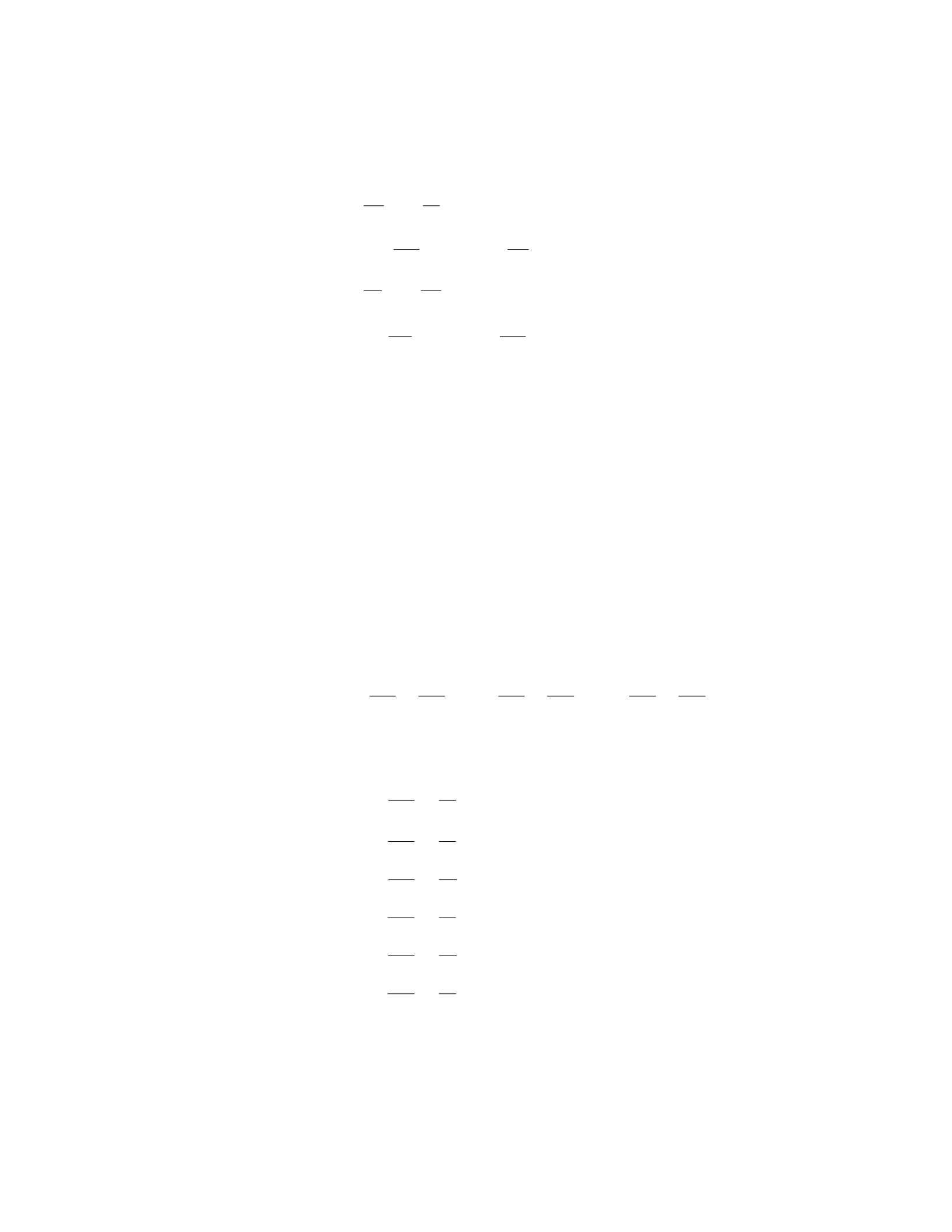
Step 2: Calculate ∂M
∂z and ∂P
∂x .
∂M
∂z = 0 and ∂P
∂x = 0
Step 3: Calculate ∂N
∂x and ∂M
∂y .
∂N
∂x = 0 and ∂M
∂y = 2y
Step 4: Substitute the partial derivatives into the formula for the curl.
curl F= (0 −0) i−(0 −0) j+ (2y−0) k= 2yk
Therefore, the curl of Fis 2yk.
Question 9
Question
Let F= (x2y+ 2z)i+ (xz −y2)j+ 3y2kbe a vector field in 3-dimensional space.
Calculate the curl of Fat the point (1,2,3).
Solution
To calculate the curl of a vector field Fat a given point, we use the formula:
curl(F) = ∇ × F=∂Fz
∂y −∂Fy
∂z i−∂Fz
∂x −∂Fx
∂z j+∂Fy
∂x −∂Fx
∂y k
Step 1: Calculate the partial derivatives of F= (x2y+ 2z)i+ (xz −y2)j+
3y2k:
∂Fz
∂y =∂
∂y (3y2) = 6y
∂Fy
∂z =∂
∂z (xz −y2)=0
∂Fz
∂x =∂
∂x (3y2) = 0
∂Fx
∂z =∂
∂z (x2y+ 2z) = 0
∂Fy
∂x =∂
∂x (xz −y2) = z
∂Fx
∂y =∂
∂y (x2y+ 2z) = x2
7
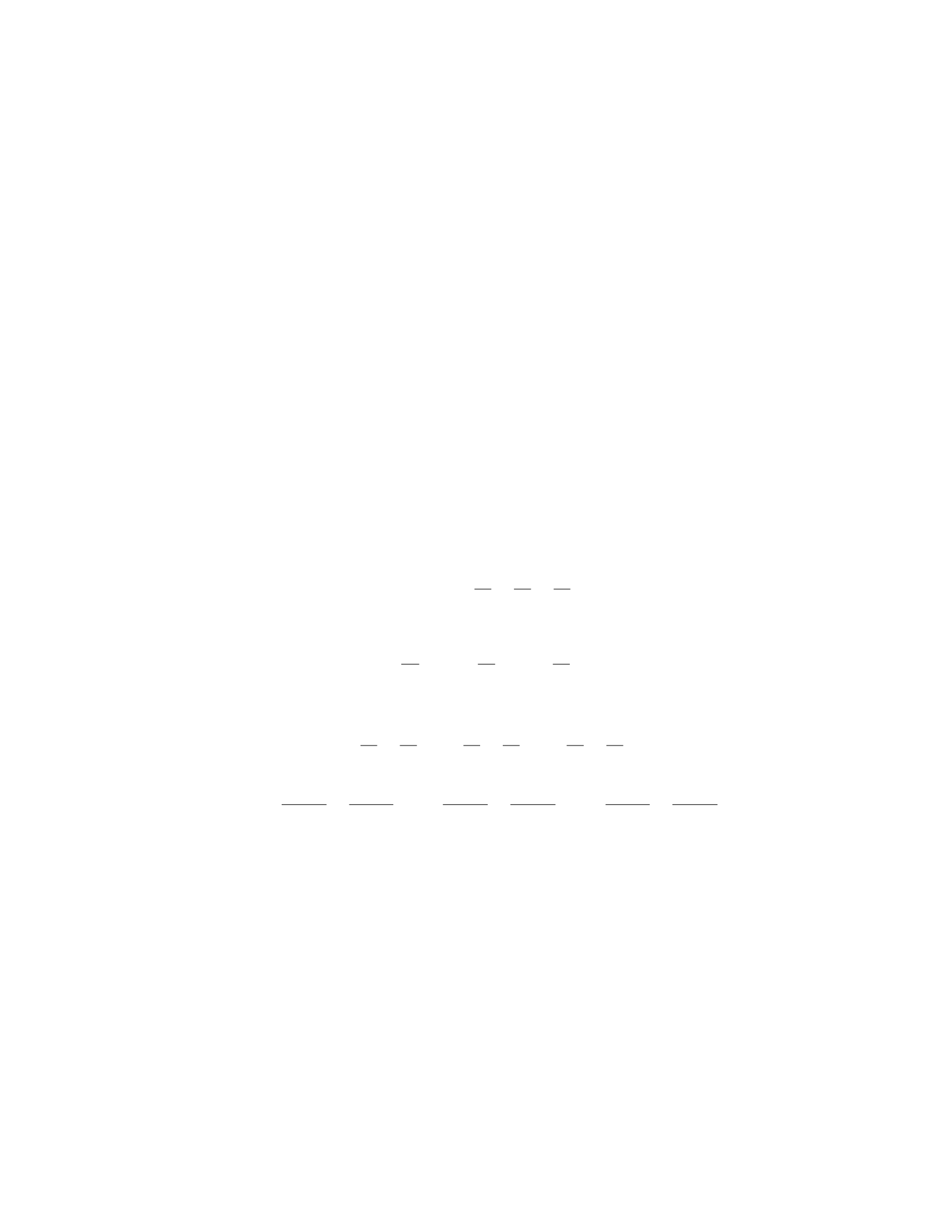
Step 2: Plug the partial derivatives into the formula to find the curl at the
point (1,2,3):
curl(F) = (6y−0)i−(0 −0)j+ (z−x2)k
= 6(2)i+ (3 −12)k
= 12i+ 2k
Therefore, the curl of Fat the point (1,2,3) is 12i+ 2k.
Question 10
Question
Let F(x, y, z) = x2yi+y2zj+z2xkbe a vector field. Compute the divergence
of Fand the curl of F.
Solution
To compute the divergence and curl of F, we first express Fin terms of its
component functions.
Step 1: Compute the divergence of F The divergence of a vector field
F=Pi+Qj+Rkis given by ∇ · F=∂P
∂x +∂Q
∂y +∂R
∂z .
Here, P(x, y, z) = x2y,Q(x, y, z) = y2z, and R(x, y, z) = z2x.
Therefore, the divergence of Fis:
∇ · F=∂
∂x (x2y) + ∂
∂y (y2z) + ∂
∂z (z2x)
∇ · F= 2xy + 2yz + 2zx
Step 2: Compute the curl of F The curl of a vector field F=Pi+Qj+Rk
is given by ∇ × F=∂R
∂y −∂Q
∂z i−∂R
∂x −∂P
∂z j+∂Q
∂x −∂P
∂y k.
Applying this to F, we have:
∇×F=∂(z2x)
∂y −∂(y2z)
∂z i−∂(z2x)
∂x −∂(x2y)
∂z j+∂(y2z)
∂x −∂(x2y)
∂y k
∇ × F= (2z)i−(2z)j+ (2y)k
∇ × F= 2zi−2zj+ 2yk
Therefore, the divergence of Fis 2xy + 2yz + 2zx and the curl of Fis
2zi−2zj+ 2yk.
Question 11
Question
Let F(x, y, z) = (zcos y−ysin z, x sin z−zcos x, y cos x−xsin y) be a vector
field. Compute ∇ · ∇ × F.
8
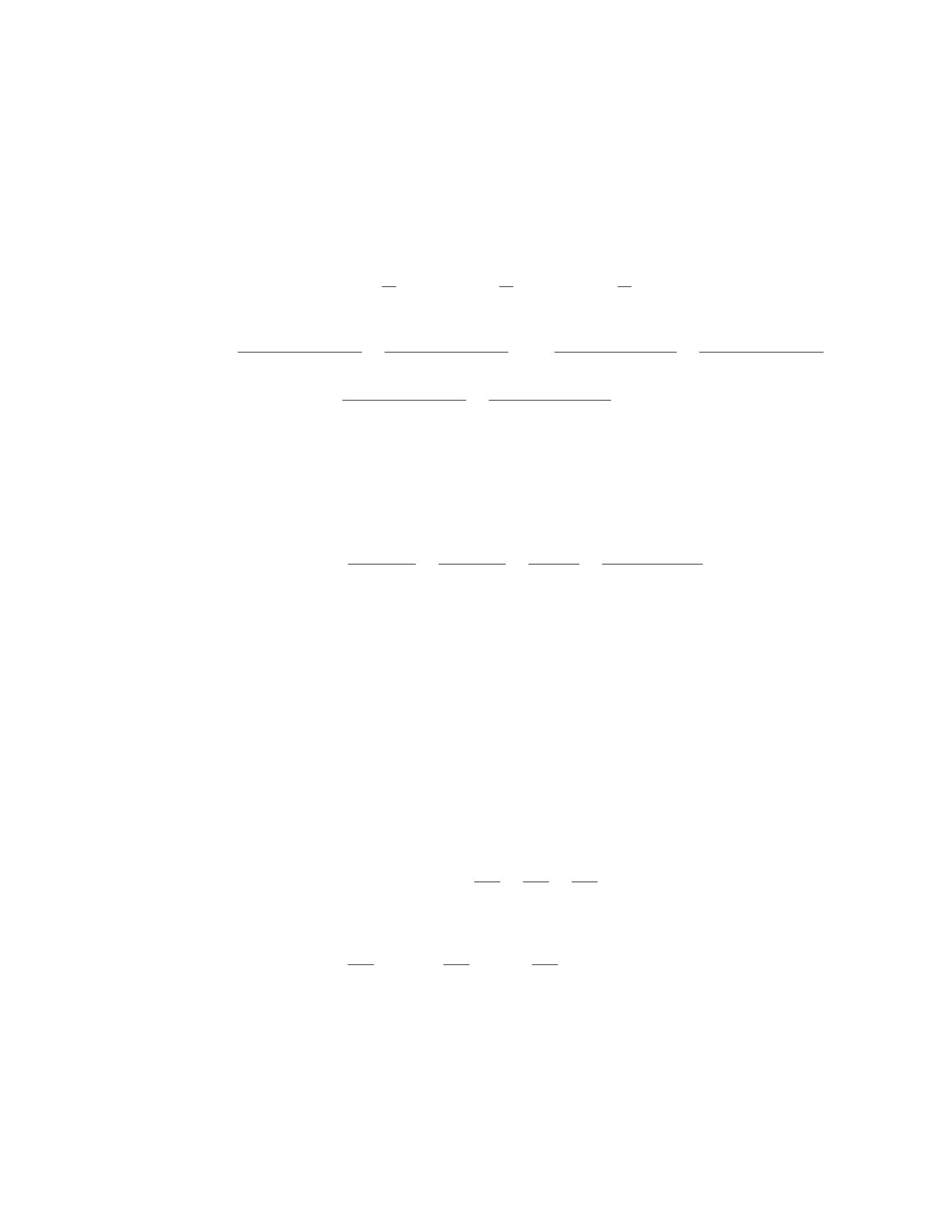
Solution
Step 1: Compute ∇ × F.
∇ × F=
i j k
∂
∂x
∂
∂y
∂
∂z
zcos y−ysin z x sin z−zcos x y cos x−xsin y
=∂(ycos x−xsin y)
∂y −∂(xsin z−zcos x)
∂z i−∂(zcos y−ysin z)
∂x −∂(ycos x−xsin y)
∂z j
+∂(xsin z−zcos x)
∂x −∂(zcos y−ysin z)
∂y k
= (−cos x−cos y)i+ (0 + sin y)j+ (cos z+ sin z)k
=−cos xi−cos yi+ sin yj+ cos zk+ sin zk
=−cos xi−cos yi+ sin yj+ (cos z+ sin z)k
Step 2: Compute ∇ · (∇ × F).
∇ · (∇ × F) = ∂(−cos x)
∂x +∂(−cos y)
∂y +∂(sin y)
∂y +∂(cos z+ sin z)
∂z
= sin x+ sin y+ cos z
Therefore, ∇ · ∇ × F= sin x+ sin y+ cos z.
Question 12
Question
Let F(x, y, z) = 3xy2+z3, x3+ 2yz, y3+ 3xz2be a vector field in R3. Calcu-
late the divergence of F.
Solution
To find the divergence of F, we use the following formula:
div(F) = ∇ · F=∂F1
∂x +∂F2
∂y +∂F3
∂z
Step 1: We find the partial derivatives of F1,F2, and F3:
∂F1
∂x = 3y2,∂F2
∂y = 2z, ∂F3
∂z = 6xz
Step 2: Now, we add these partial derivatives to find the divergence:
div(F)=3y2+ 2z+ 6xz
9
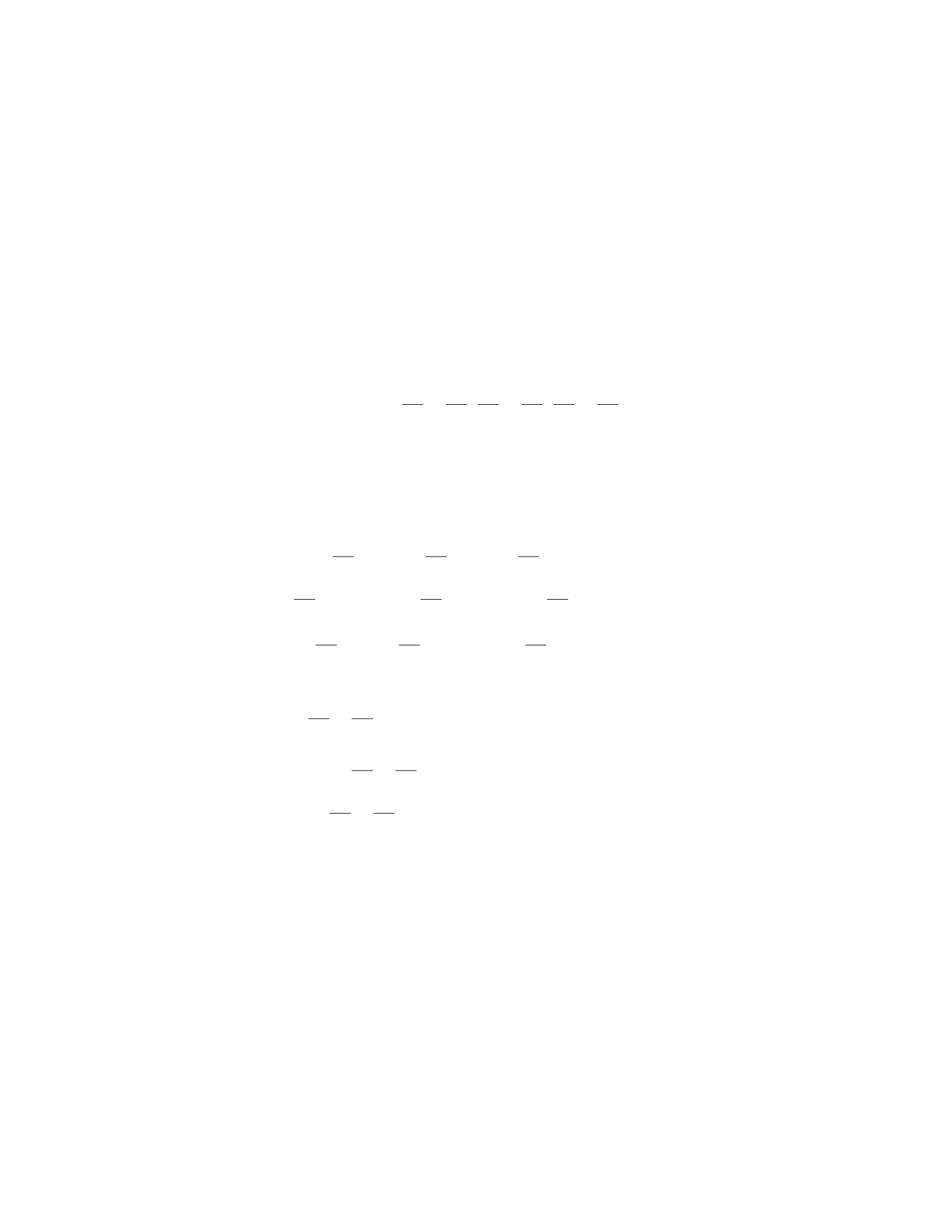
Question 13
Question
Let F(x, y, z)=(x2y+y2z, x2z+yz2, xy2+xz2). Find the curl of F.
Solution
To find the curl of a vector field F= (P, Q, R), where P, Q, R are the component
functions, use the formula:
curl(F) = ∂R
∂y −∂Q
∂z ,∂P
∂z −∂R
∂x ,∂Q
∂x −∂P
∂y
Step 1: Find the partial derivatives of P, Q, and Rwith respect to x, y, and
z, respectively.
P=x2y+y2z, Q =x2z+yz2, R =xy2+xz2
∂P
∂x = 2xy, ∂Q
∂x = 2xz, ∂R
∂x =y2+ 2xz
∂P
∂y =x2+ 2yz, ∂Q
∂y =z2+ 2yx, ∂R
∂y = 2xy + 2xz
∂P
∂z =y2,∂Q
∂z =x2+ 2yz, ∂R
∂z = 2xz + 2xy
Step 2: Calculate the components of the curl of F.
∂R
∂y −∂Q
∂z = (2xy + 2xz)−(x2+ 2yz)=2yz −x2
∂P
∂z −∂R
∂x =y2−(y2+ 2xz) = −2xz
∂Q
∂x −∂P
∂y = (2xz)−(x2+ 2yz) = 2xz −x2
Therefore, the curl of Fis ∇ × F= (−x2+ 2yz, −2xz, 2xz −x2).
Question 14
Question
Consider the vector field F(x, y, z) = (2xy, x2−z, 3xz). Find the divergence of
Fat the point (1,−1,2).
10
Solution
To find the divergence of a vector field F= (P, Q, R), we use the formula:
div(F) = ∂P
∂x +∂Q
∂y +∂R
∂z .
Step 1: Calculate the partial derivatives of P,Q, and R:
∂P
∂x =∂
∂x (2xy)=2y,
∂Q
∂y =∂
∂y (x2−z) = 0,
∂R
∂z =∂
∂z (3xz) = 3x.
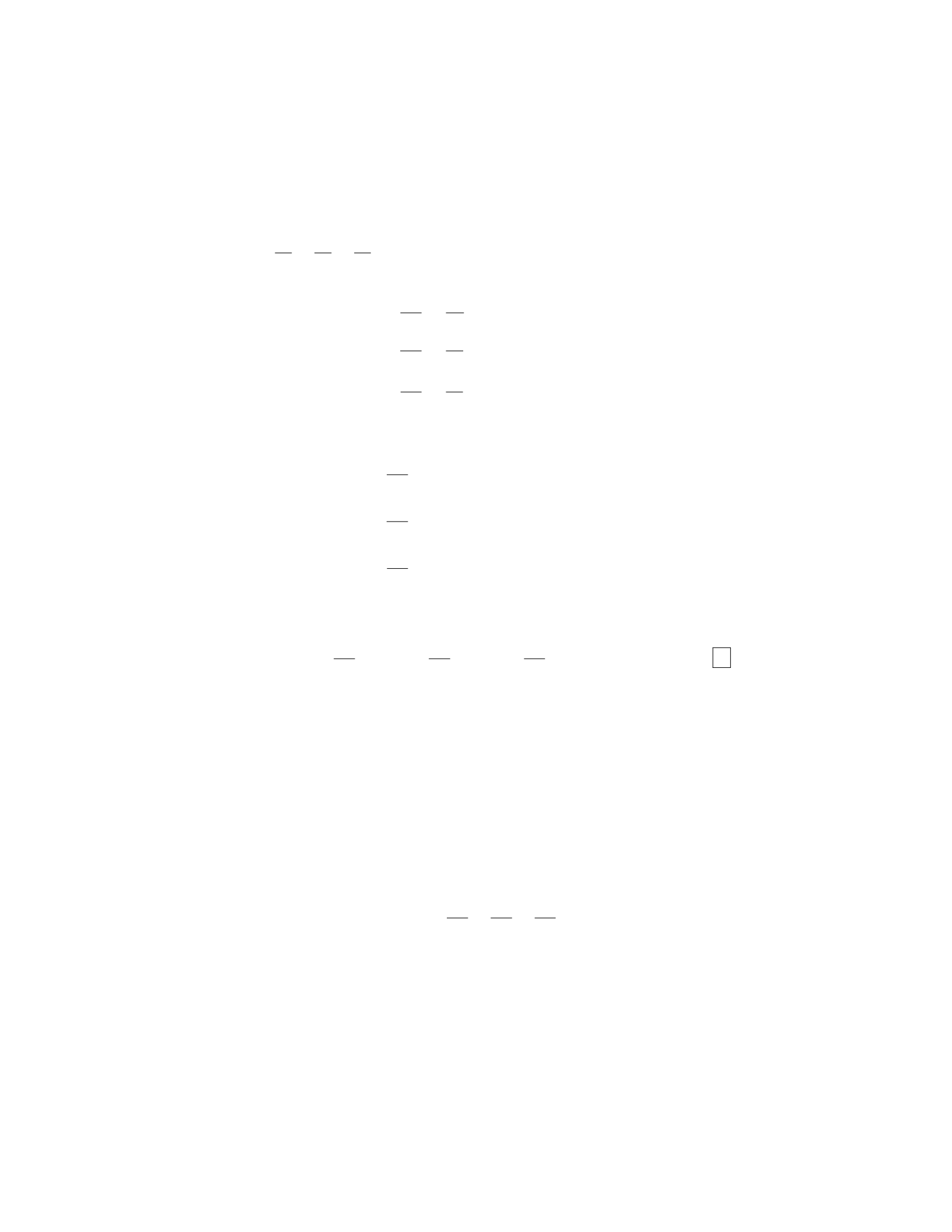
Step 2: Substitute the given point (1,−1,2) into the partial derivatives:
∂P
∂x (1,−1,2)
= 2(−1) = −2,
∂Q
∂y (1,−1,2)
= 0,
∂R
∂z (1,−1,2)
= 3(1) = 3.
Step 3: Find the divergence of Fat the point (1,−1,2):
div(F)(1,−1,2)
=∂P
∂x (1,−1,2)
+∂Q
∂y (1,−1,2)
+∂R
∂z (1,−1,2)
=−2 + 0 + 3 = 1 .
Question 15
Question
Let F(x, y, z) = (x2y, y2z, z2x) be a vector field in R3. Compute the divergence
of Fat the point (1,2,3).
Solution
Step 1: The divergence of a vector field F(x, y, z)=(P(x, y, z), Q(x, y, z), R(x, y, z))
is given by
∇ · F=∂P
∂x +∂Q
∂y +∂R
∂z .
For F(x, y, z)=(x2y, y2z, z2x), we have P(x, y, z) = x2y,Q(x, y, z) = y2z, and
R(x, y, z) = z2x.
11
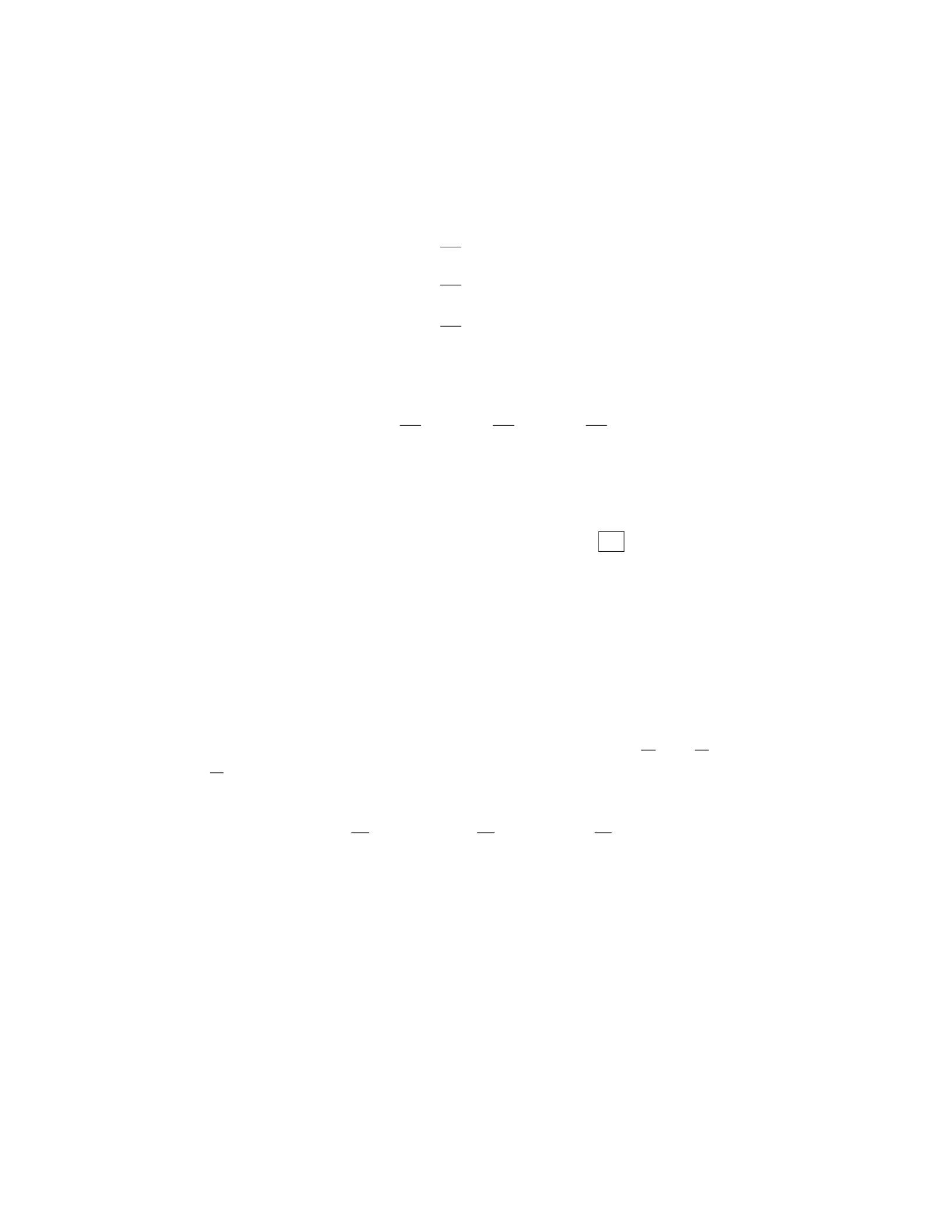
Step 2: Compute the partial derivatives of P,Q, and R:
∂P
∂x = 2xy,
∂Q
∂y = 2yz,
∂R
∂z = 2zx.
Step 3: Find the divergence of Fat the point (1,2,3) by substituting the
point into the partial derivatives:
∇ · F(1,2,3) = ∂P
∂x (1,2,3) + ∂Q
∂y (1,2,3) + ∂R
∂z (1,2,3)
= 2(1)(2) + 2(2)(3) + 2(3)(1)
= 4 + 12 + 6
= 22.
Therefore, the divergence of Fat the point (1,2,3) is 22 .
Question 16
Question
Let F be a vector field defined by F(x, y, z) = 3x2y+ 4z3, xz2−2y3,2xyz.
Find the divergence of F at the point (1, -1, 2).
Solution
Step 1: The divergence of a vector field F is defined as ∇ · F=∂
∂x F1+∂
∂y F2+
∂
∂z F3.
Step 2: Substitute the components of F into the formula for the divergence:
∇ · F=∂
∂x (3x2y+ 4z3) + ∂
∂y (xz2−2y3) + ∂
∂z (2xyz)
= (6xy) + (2xz) + (2xy)
= 8xy + 2xz
Step 3: Evaluate the divergence at the point (1, -1, 2):
∇ · F(1,−1,2) = 8(1)(−1) + 2(1)(2)
=−8+4
=−4
Therefore, the divergence of F at the point (1, -1, 2) is -4.
12
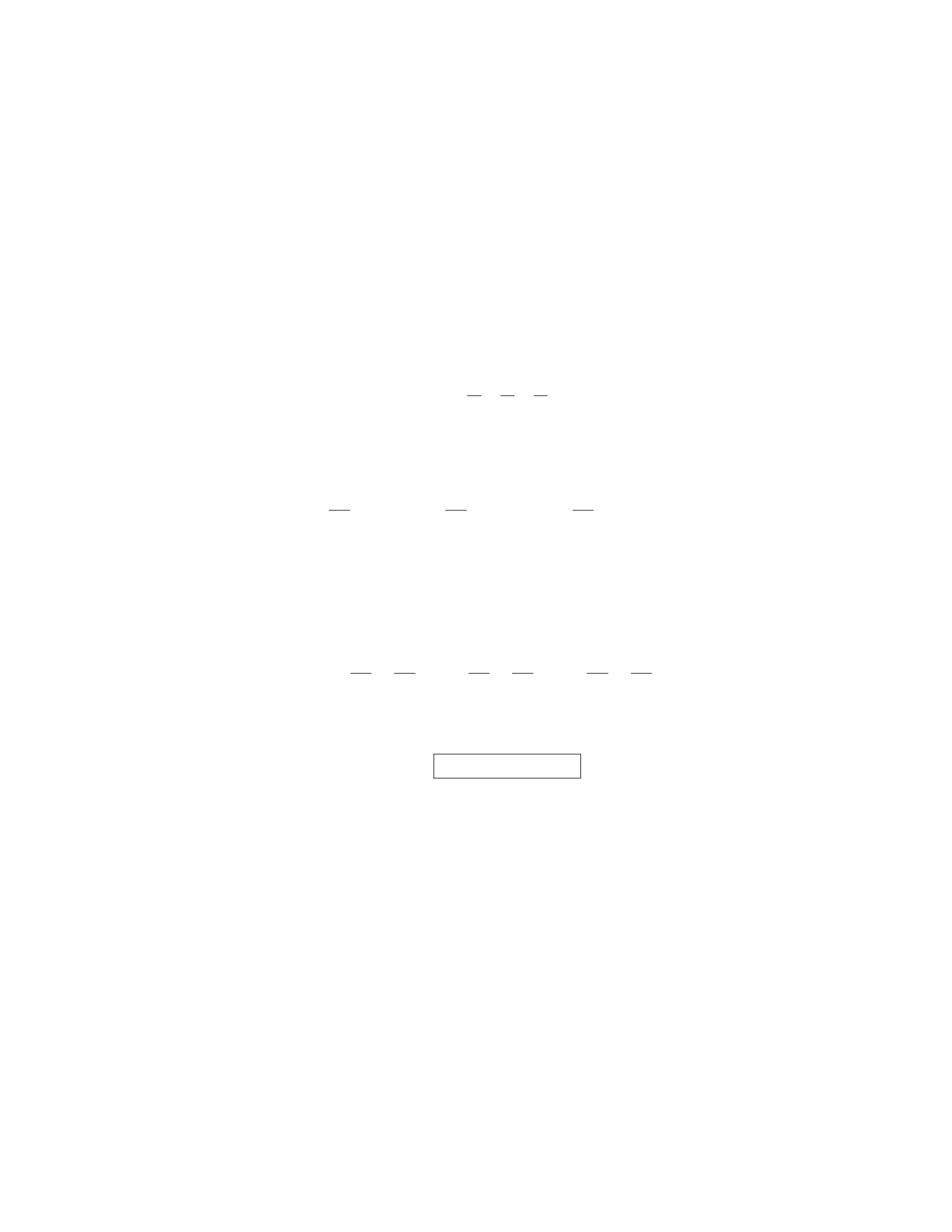
Question 17
Question
Let F(x, y, z) = ⟨eysin z, excos z, exsin y⟩. Find the curl of F.
Solution
To find the curl of F, denoted by ∇ × F, we can use the formula:
∇ × F=
i j k
∂
∂x
∂
∂y
∂
∂z
P Q R
where F(x, y, z) = ⟨P, Q, R⟩.
Step 1: Compute the partial derivatives of P,Q, and R.
∂P
∂x =eycos z, ∂Q
∂y =−exsin z, ∂R
∂z = 0
Step 2: Build the curl.
∇ × F=
i j k
eycos z−exsin z0
Step 3: Simplify the determinant.
∇ × F=∂R
∂y −∂Q
∂z i−∂R
∂x −∂P
∂z j+∂Q
∂x −∂P
∂y k
∇ × F= (−excos z)i−(eysin z)j−0k
∇ × F=−excos zi−eysin zj
Therefore, the curl of Fis −excos zi−eysin zj.
Question 18
Question
Let F(x, y, z)=(x2+y, xz, ey) be a vector field. Find the divergence of Fand
determine if the vector field is conservative.
13
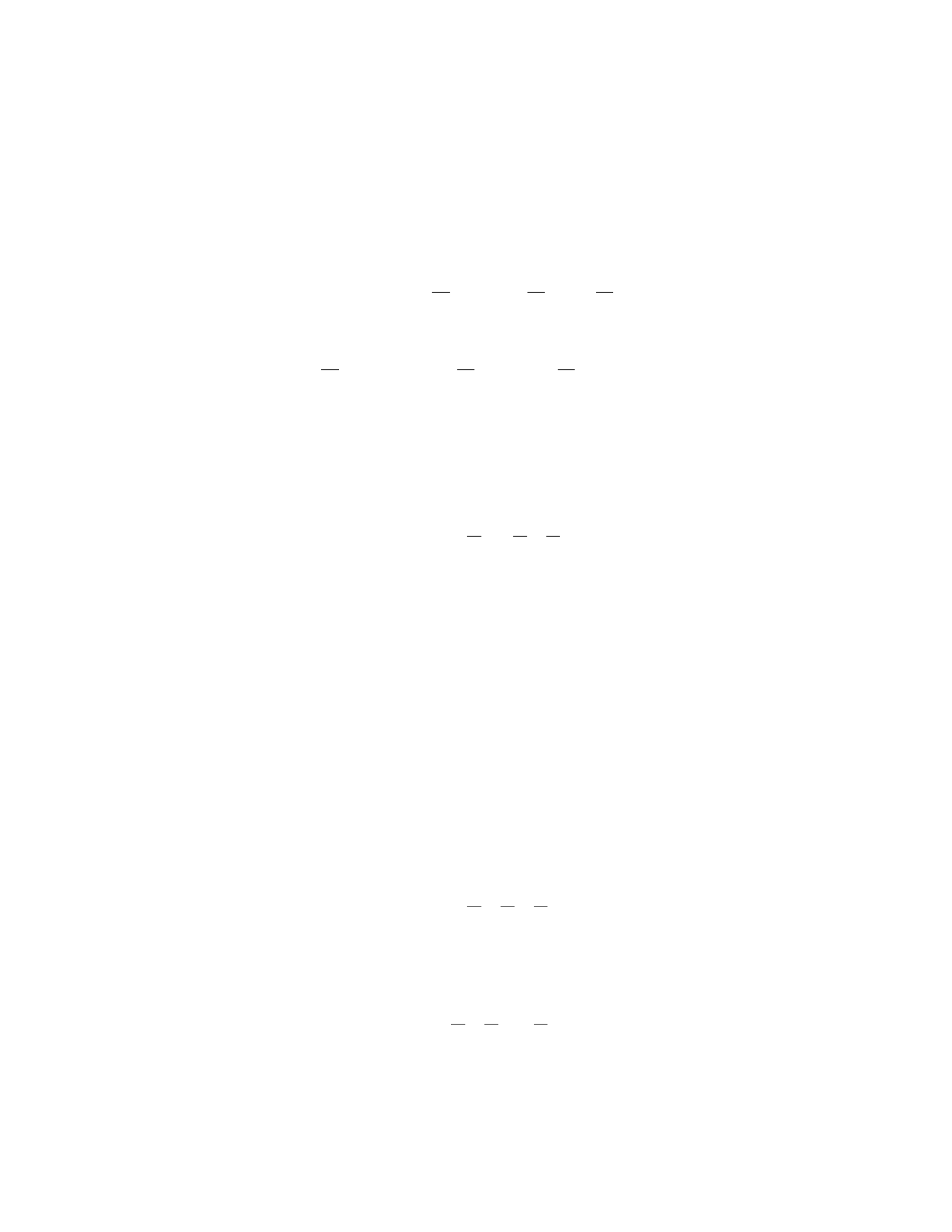
Solution
Step 1: To find the divergence of F, we need to compute the dot product of the
del operator (∇) and F.
div(F) = ∇ · F=∂
∂x (x2+y) + ∂
∂y (xz) + ∂
∂z (ey)
Step 2: Calculating the partial derivatives, we get:
∂
∂x (x2+y) = 2x, ∂
∂y (xz)=0,∂
∂z (ey)=0
Step 3: Therefore, the divergence of Fis:
div(F)=2x
Step 4: For a vector field to be conservative, its curl must be zero. Let’s
calculate the curl of Fto determine if it is conservative.
∇ × F=
i j k
∂
∂x
∂
∂y
∂
∂z
x2+y xz ey
Step 5: Calculating the determinant above, we find:
∇ × F= (0 −0)i−(ey−0)j+ (x−2x)k=−eyj−xk
Step 6: Since the curl of Fis not zero, the vector field is not conservative.
Question 19
Question
Let F(x, y, z) = xzi+yzj+ (x2−y2)k. Calculate the curl of F.
Solution
Step 1: The curl of a vector field F(x, y, z) = P(x, y, z)i+Q(x, y, z)j+R(x, y, z)k
is given by the determinant
∇ × F=
i j k
∂
∂x
∂
∂y
∂
∂z
P Q R
Step 2: Substitute P=xz,Q=yz,R=x2−y2into the determinant
formula to find the curl of F.
∇ × F=
i j k
∂
∂x
∂
∂y
∂
∂z
xz yz x2−y2
14
Step 3: Evaluate the determinant using cofactor expansion along the top
row.
=∂
∂y (x2−y2)−∂
∂z (yz)i−∂
∂x (x2−y2)−∂
∂z (xz)j+∂
∂x (yz)−∂
∂y (xz)k
Step 4: Simplify each component of the curl.
= (−2y)i−(2x)j+ (z−(−z)) k
Step 5: Combine the components to find the curl of F.
∇ × F=−2yi−2xj+ 2zk
Therefore, the curl of Fis −2yi−2xj+ 2zk.
Question 20
Question
Let
F(x, y, z)=3xzˆ
i+ (x2+ 2yz)ˆ
j+ 3xyˆ
k. Find the divergence of
Fat the
point (1,2,0).
Solution
To find the divergence of
F, we use the formula:
div(
F) = ∇ ·
F=∂Fx
∂x +∂Fy
∂y +∂Fz
∂z
Step 1: Find the partial derivatives of
F
∂Fx
∂x = 3z, ∂Fy
∂y = 2z, and ∂Fz
∂z = 3x
Step 2: Evaluate the partial derivatives at the point (1,2,0) Substi-
tute x= 1, y= 2, and z= 0 into the partial derivatives:
∂Fx
∂x = 3(0) = 0
∂Fy
∂y = 2(0) = 0
∂Fz
∂z = 3(1) = 3
Step 3: Find the divergence at the point (1,2,0)
div(
F)|(1,2,0) = 0 + 0 + 3 = 3
Therefore, the divergence of
Fat the point (1,2,0) is 3.
15
Question 21
Question
Let F(x, y, z) = x2yzi+xyz2j+x2z2k. Determine if Fis conservative. If it is,
find a scalar potential function f(x, y, z) such that F=∇f.
Solution
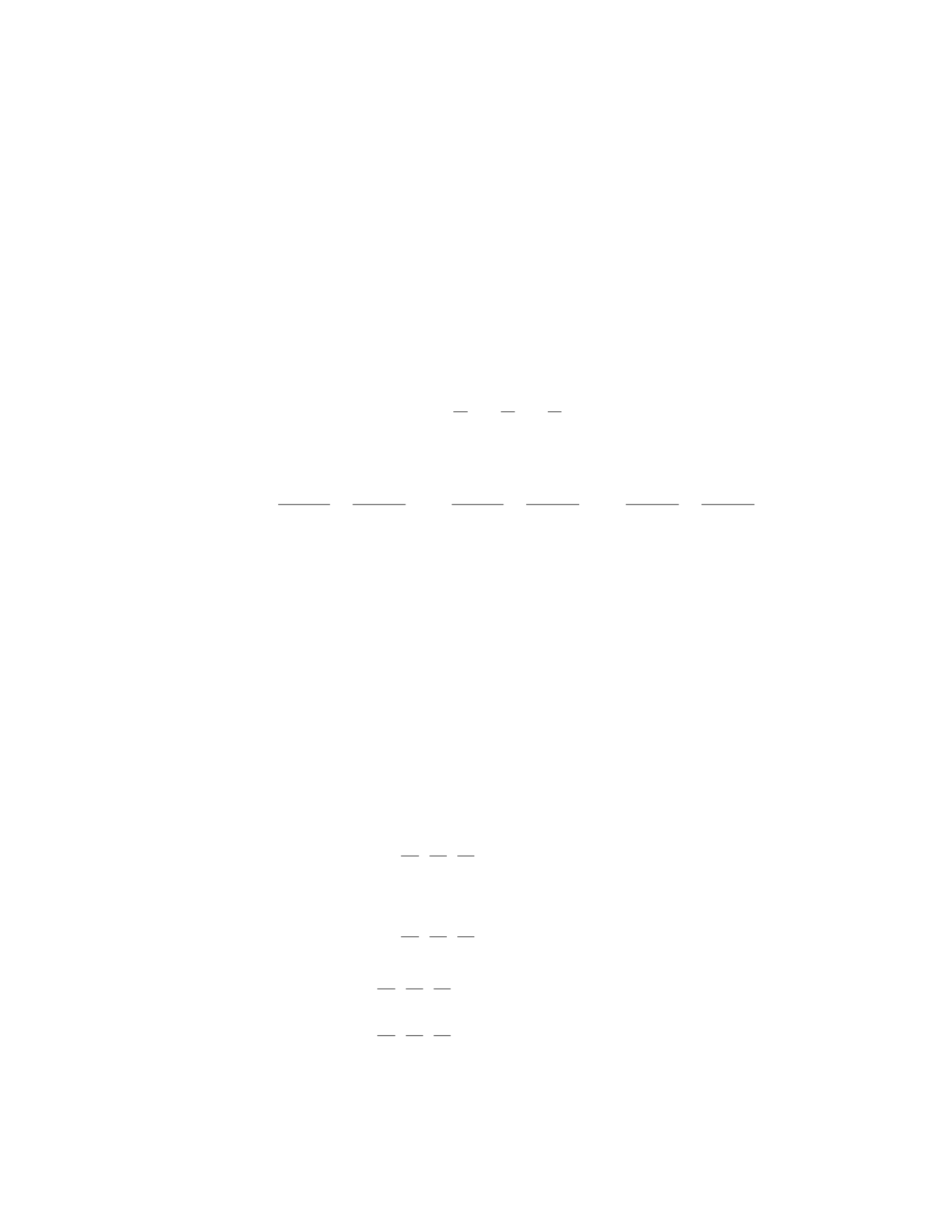
Step 1: To determine if Fis conservative, we check if the curl of Fis zero.
∇ × F=
i j k
∂
∂x
∂
∂y
∂
∂z
x2yz xyz2x2z2
Step 2: Compute the curl of F.
∇×F=∂(x2z2)
∂y −∂(xyz2)
∂z i−∂(x2z2)
∂x −∂(x2yz)
∂z j+∂(xyz2)
∂x −∂(x2yz)
∂y k
Step 3: Simplify the cross product and check if it is zero.
∇ × F= (2xz)i−(−2xz)j+ (yz)k= 2xzi+ 2xzj+yzk
Step 4: Since the curl of Fis not zero, Fis not conservative. Thus, there
does not exist a scalar potential function f(x, y, z) such that F=∇f.
Question 22
Question
Let Fbe a vector field defined by F(x, y)=(x2+y3,2xy −3). Compute ∇ × F.
Solution
Step 1: Determine the components of the curl of F.
∇ × F=∂
∂x ,∂
∂y ,∂
∂z ×(x2+y3,2xy −3)
Step 2: Expand the cross product.
∇ × F=∂
∂x ,∂
∂y ,∂
∂z ×(x2+y3,2xy −3)
=∂
∂x ,∂
∂y ,∂
∂z ×(x2+y3,2xy −3)
=∂
∂x ,∂
∂y ,∂
∂z ×(x2+y3,2xy −3)
16
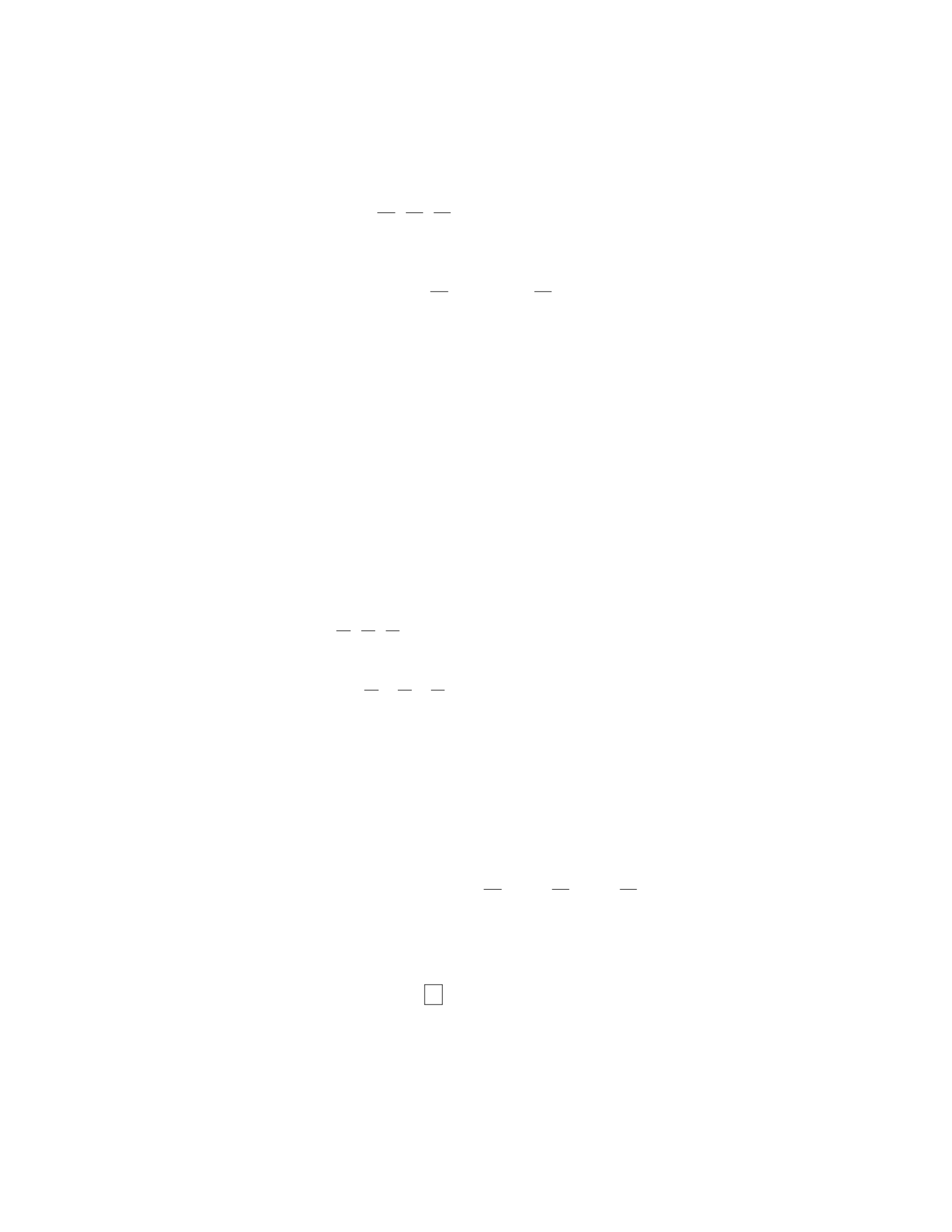
=∂
∂x ,∂
∂y ,∂
∂z ×(x2+y3,2xy −3)
Step 3: Compute the partial derivatives and simplify.
∇ × F=0,0,∂
∂x (2xy −3) −∂
∂y (x2+y3)
= (0,0,2y−2y)
= (0,0,0)
Therefore, the curl of Fis ∇ × F=0.
Question 23
Question
Let F(x, y, z) = y2i+x2j+z2kbe a vector field. Calculate div(curl(F)).
Solution
1. Find the curl of F:
curl(F) = ∇ × F
where ∇=∂
∂x ,∂
∂y ,∂
∂z . So,
curl(F) =
i j k
∂
∂x
∂
∂y
∂
∂z
y2x2z2
= (2z−0) i−(0 −2y)j+ (2x−0) k
curl(F)=2zi+ 2yj+ 2xk
2. Find the divergence of the resulting curl:
div(curl(F)) = ∇ · (curl(F))
where ∇is the del operator. Since curl(F)=2zi+ 2yj+ 2xk, we have
div(2zi+ 2yj+ 2xk) = ∂
∂x (2z) + ∂
∂y (2y) + ∂
∂z (2x)
div(2zi+ 2yj+ 2xk)=0+2+0
div(2zi+ 2yj+ 2xk)=2
Therefore, div(curl(F)) = 2 .
17

Question 24
Question
Let F=⟨yz, xz, xy⟩be a vector field. Compute ∇ · ∇ × F.
Solution
Step 1: First, we compute ∇ × F.
=
ˆ
iˆ
jˆ
k
∂
∂x
∂
∂y
∂
∂z
yz xz xy
=∂(xy)
∂y −∂(xz)
∂z ˆ
i−∂(xz)
∂x −∂(yz)
∂z ˆ
j+∂(yz)
∂x −∂(xy)
∂y ˆ
k
= (x−x)ˆ
i−(z−z)ˆ
j+ (y−y)ˆ
k
=0
Step 2: Next, we compute ∇ · 0.
=∂(0)∂x+∂(0)
∂y +∂(0)
∂z =0+0+0=0
Therefore, ∇ · ∇ × F= 0 .
Question 25
Question
Let F(x, y, z)=(x2y, sin(yz), z cos(x)) be a vector field in R3. Compute ∇ · F,
where ∇ · Fdenotes the divergence of F.
Solution
Step 1: The divergence of a vector field F= (F1, F2, F3) is defined as
∇ · F=∂F1
∂x +∂F2
∂y +∂F3
∂z .
Step 2: For the given vector field F(x, y, z)=(x2y, sin(yz), z cos(x)), we
have F1(x, y, z) = x2y,F2(x, y, z) = sin(yz), and F3(x, y, z) = zcos(x).
18
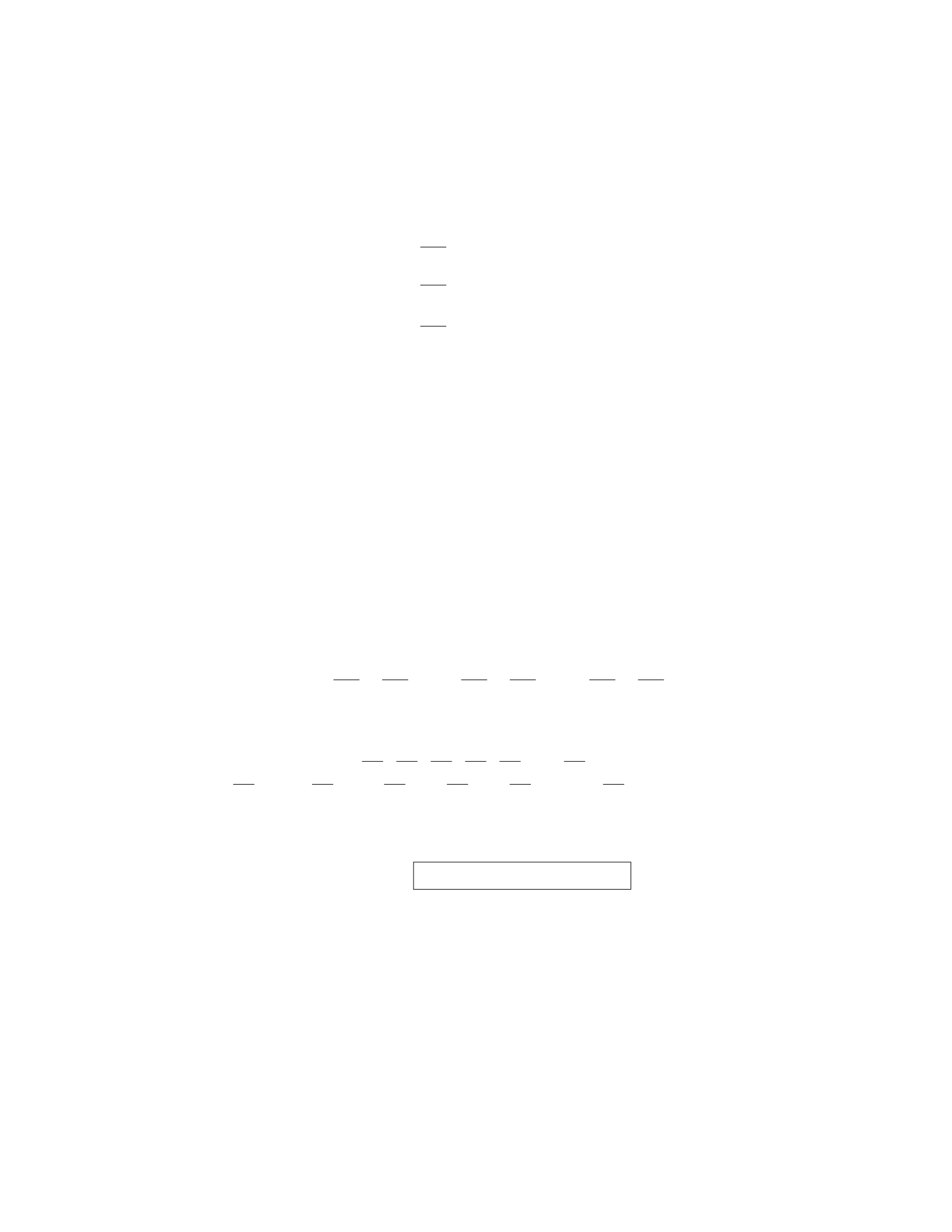
Step 3: Compute the partial derivatives:
∂F1
∂x = 2xy,
∂F2
∂y =zcos(yz),
∂F3
∂z = cos(x).
Step 4: Therefore, the divergence of Fis
∇ · F= 2xy +zcos(yz) + cos(x).
So, ∇ · F= 2xy +zcos(yz) + cos(x).
Question 26
Question
Let F(x, y, z) = x2yi+xyzj+yz2kbe a vector field. Compute the curl of F.
Solution
To find the curl of a vector field F(x, y, z) = F1(x, y, z)i+F2(x, y, z)j+F3(x, y, z)k,
we can use the formula
curl F=∂F3
∂y −∂F2
∂z i−∂F3
∂x −∂F1
∂z j+∂F2
∂x −∂F1
∂y k.
In this case, F(x, y, z) = x2yi+xyzj+yz2k, so F1(x, y, z) = x2y,F2(x, y, z) =
xyz, and F3(x, y, z) = yz2.
Step 1: Compute ∂F3
∂y ,∂F2
∂z ,∂F3
∂x ,∂F1
∂z ,∂F2
∂x , and ∂F1
∂y .
∂F3
∂y = 2yz,∂F2
∂z =xy,∂F3
∂x = 0, ∂F1
∂z = 0, ∂F2
∂x =y, and ∂F1
∂y =x2.
Step 2: Plug these values into the formula for the curl of F.
curl F= (2yz −xy)i−(−yz2)j+ (y−x2)k.
Therefore, the curl of Fis (2yz −xy)i+yz2j+ (y−x2)k.
Question 27
Question
Let F(x, y, z)=(x2y, y2z, z2x) be a vector field in R3. Evaluate the divergence
of Fat the point (1,1,1).
19
Solution
To find the divergence of Fat the point (1,1,1), we need to compute the dot
product of the del operator (∇) and the vector field Fat that point.
Step 1: Compute the del operator. The del operator in Cartesian coordi-
nates is given by:
∇=∂
∂x ,∂
∂y ,∂
∂z
Step 2: Compute the divergence of F. The divergence of a vector field
F= (P, Q, R) is given by:
∇ · F=∂P
∂x +∂Q
∂y +∂R
∂z
For F(x, y, z)=(x2y, y2z, z2x), we have P=x2y,Q=y2z, and R=z2x.
Step 3: Compute the partial derivatives.
∂P
∂x = 2xy
∂Q
∂y = 2yz
∂R
∂z = 2zx
Step 4: Evaluate the divergence at (1,1,1).
∇ · F=∂P
∂x +∂Q
∂y +∂R
∂z
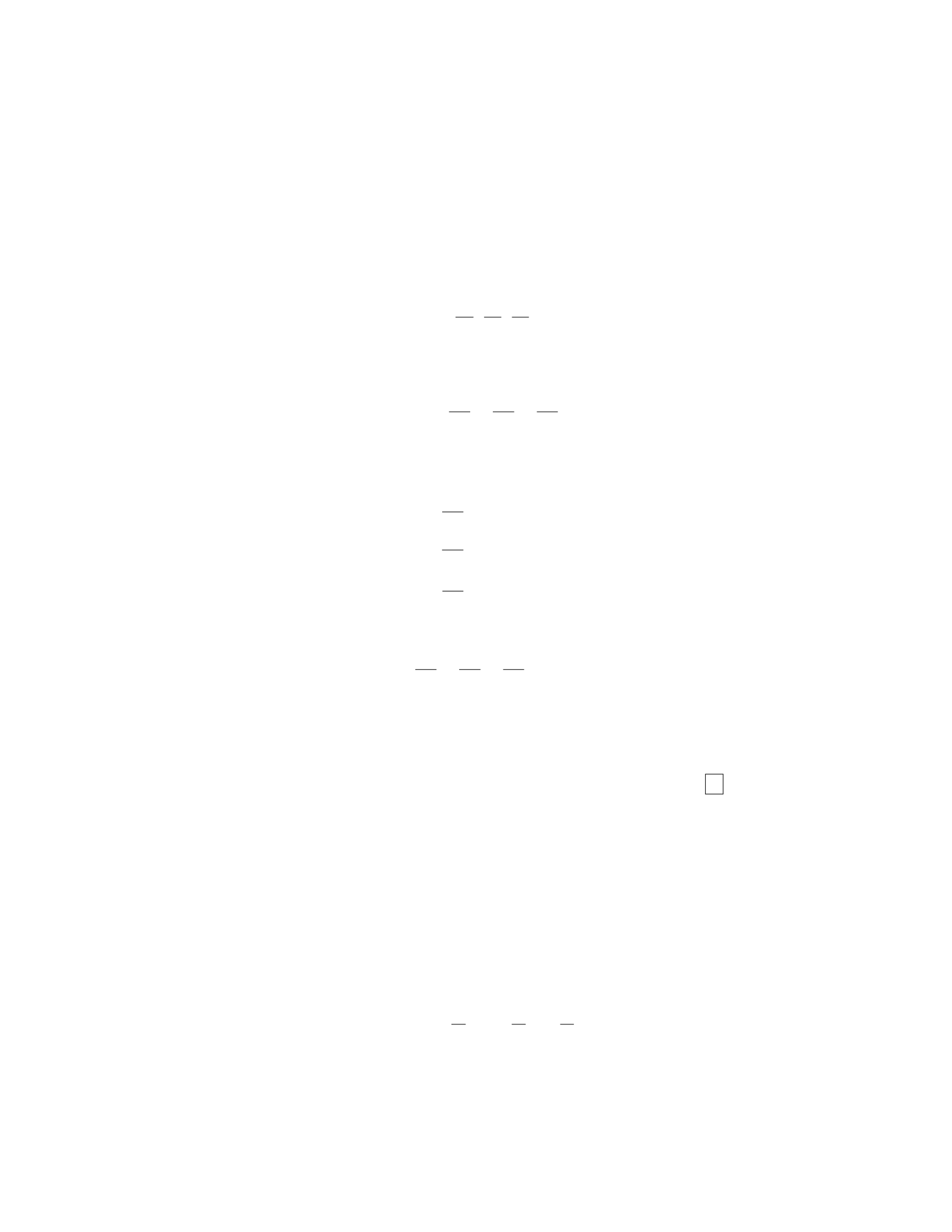
= 2xy + 2yz + 2zx
= 2(1)(1) + 2(1)(1) + 2(1)(1)
= 6
Therefore, the divergence of the vector field Fat the point (1,1,1) is 6 .
Question 28
Question
Let F(x, y, z) = exsin yi+ycos zj+xz2k. Calculate ∇ · ∇ × F.
Solution
Step 1: Let’s first find the curl of F:
curl F=
i j k
∂
∂x
∂
∂y
∂
∂z
exsin y y cos z xz2
20
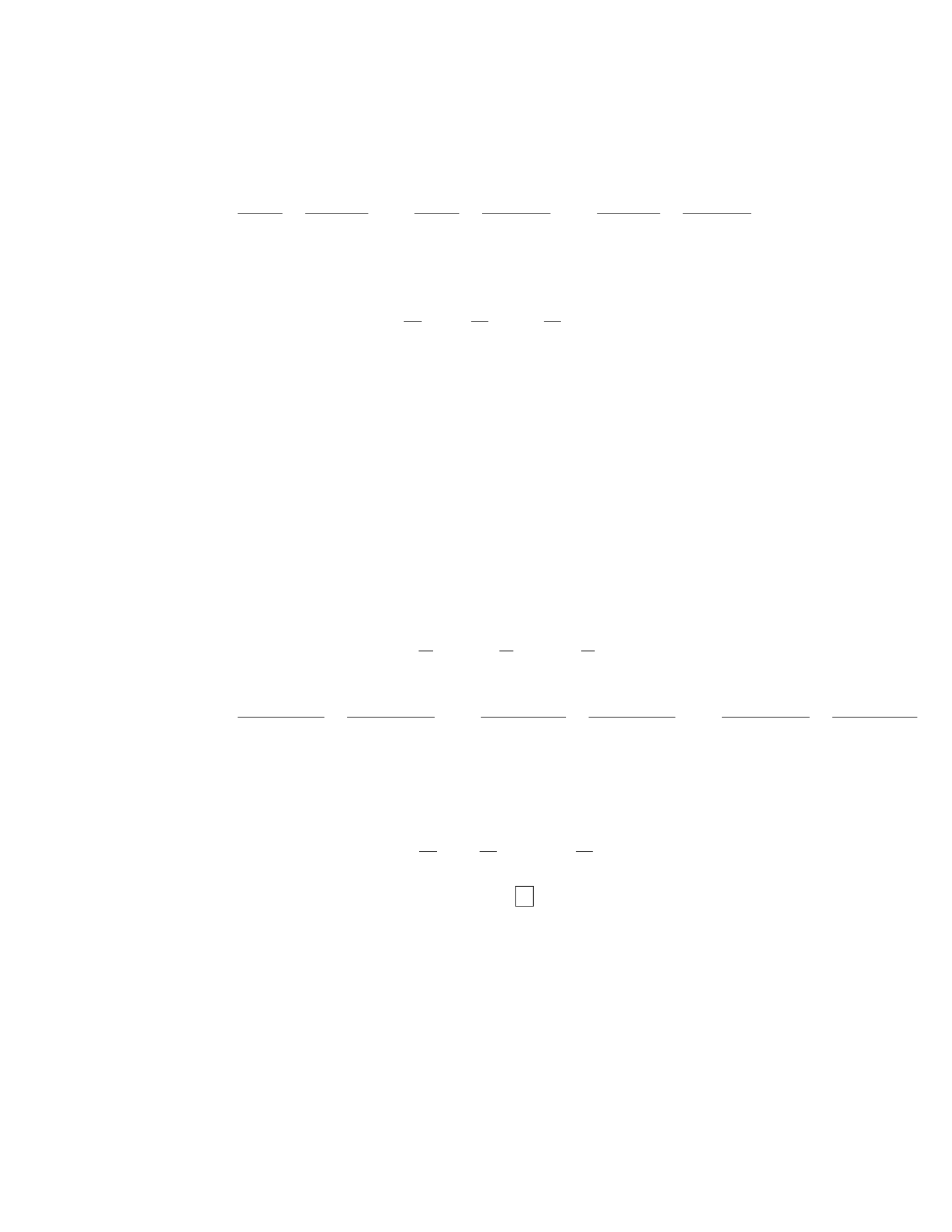
=∂(xz2)
∂y −∂(ycos z)
∂z i−∂(xz2)
∂x −∂(exsin y)
∂z j+∂(ycos z)
∂x −∂(exsin y)
∂y k
=z2i−xj−excos yk
Step 2: Next, let’s find the divergence of our curl:
∇ · curl F=∂
∂x (z2) + ∂
∂y (−x) + ∂
∂z (−excos y)
= 0 −0 + exsin y
Hence, ∇ · ∇ × F=exsin y.
Question 29
Question
Let F(x, y, z)=(xeyz +y2, xz2+ 2yz, xy2z+z3) be a vector field. Compute
∇ · ∇ × F.
Solution
Step 1: Compute ∇ × F.
∇ × F=
i j k
∂
∂x
∂
∂y
∂
∂z
xeyz +y2xz2+ 2yz xy2z+z3
=∂(xy2z+z3)
∂y −∂(xz2+ 2yz)
∂z i−∂(xeyz +y2)
∂x −∂(xy2z+z3)
∂z j+∂(xz2+ 2yz)
∂x −∂(xeyz +y2)
∂y k
= (x−0)i−(eyz −0)j+ (2z−2y)k
=xi−eyzj+ 2zk
Step 2: Compute ∇ · ∇ × F.
∇ · ∇ × F=∂
∂x ·x+∂
∂y ·(−eyz ) + ∂
∂z ·2z
= 1 −0 + 2 = 3
Question 30
Question
Let F(x, y, z)=3x2yi+ 2yexz j+zey2k. Compute ∇ · ∇ × F.
21
Solution
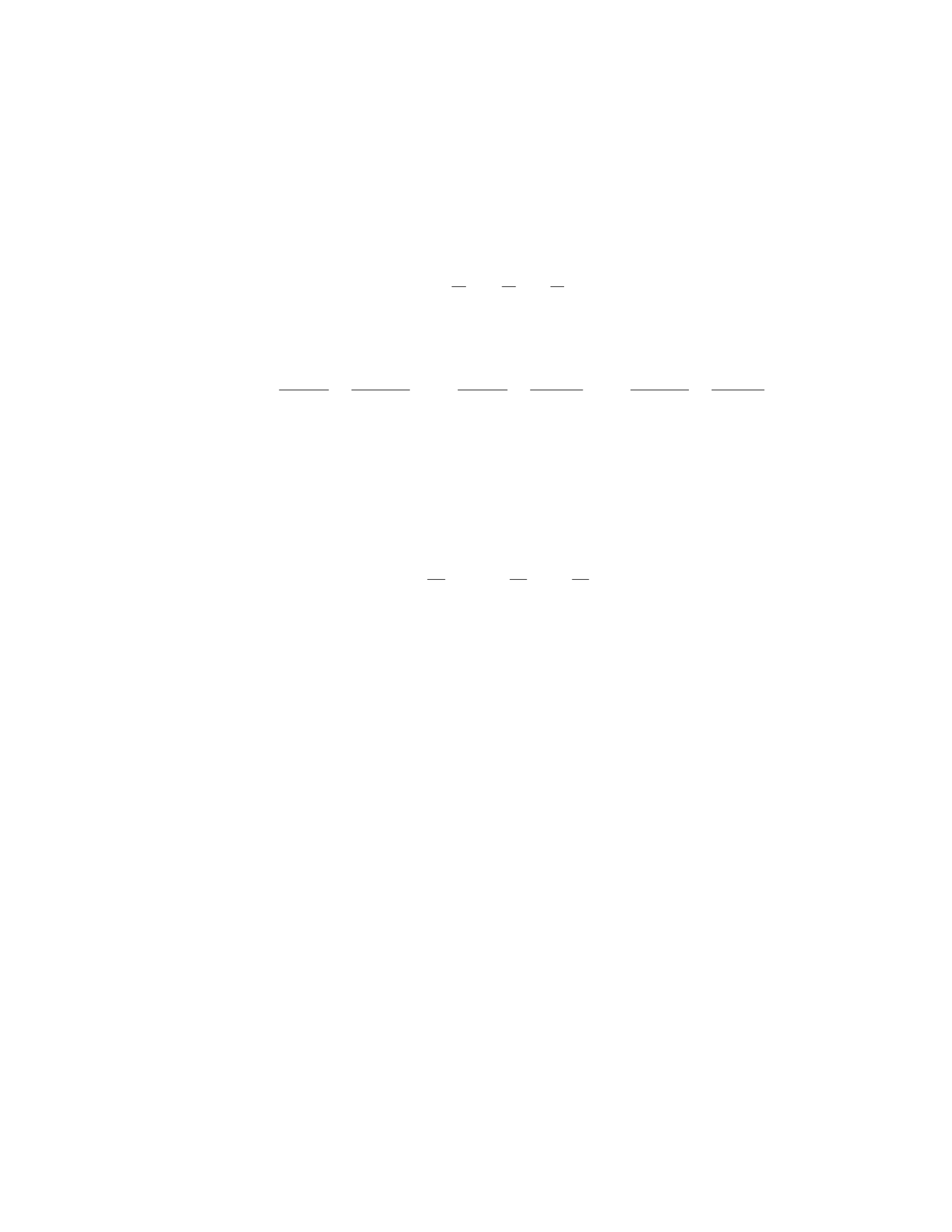
Step 1: Calculate ∇ × F.
∇ × F=
i j k
∂
∂x
∂
∂y
∂
∂z
3x2y2yexz zey2
Step 2: Expand the determinant to find the curl.
∇×F= ∂(zey2)
∂y −∂(2yexz )
∂z !i− ∂(zey2)
∂x −∂(3x2y)
∂z !j+∂(2yexz )
∂x −∂(3x2y)
∂y k
Step 3: Simplify the expressions.
∇ × F= (ey2+ 0)i−(0 −0)j+ (0 −0)k
∇ × F=ey2i
Step 4: Calculate ∇ · ∇ × F.
∇ · ∇ × F=∂
∂x ey2+∂
∂y (0) + ∂
∂z (0)
∇ · ∇ × F= 0
Therefore, ∇ · ∇ × F= 0.
22

